Embryology Quotes (18 quotes)
… the embryological record, as it is usually presented to us, is both imperfect and misleading. It may be compared to an ancient manuscript, with many of the sheets lost, others displaced, and with spurious passages interpolated by a later hand. … Like the scholar with his manuscript, the embryologist has by a process of careful and critical examination to determine where the gaps are present, to detect the later insertions, and to place in order what has been misplaced.
A Treatise on Comparative Embryology (1885), Vol. 1, 3-4.
[Other than fossils,] the most important of these other records of creation is, without doubt, ontogeny, that is, the history of the developmment of the organic individual (embryology and motamorphology). It briefly repeats in great and marked features the series of forms which the ancestors of the respective individuals have passed through from the beginning of their tribe. We have designated the palaeontological history of the development of the ancestors of a living form as the history of a tribe, or phylogeny, and we may therefore thus enunciate this exceedingly important biogenetic fundamental principle: “Ontogeny is a short and quick repetition, or recapitulation, of Phylogeny, determined by the laws of Inheritance and Adaptation.”
In Ernst Haeckel and E. Ray Lankester (trans.), The History of Creation (1876), Vol. 2, 33. Seen shortened to “Ontogeny recapitulates phylogeny.” This was Haeckel's (incorrect) answer to the vexing question of his time: what is the relationship between individual development (ontogeny) and the evolution of species and lineages (phylogeny)?
A living organism must be studied from two distinct aspects. One of these is the causal-analytic aspect which is so fruitfully applicable to ontogeny. The other is the historical descriptive aspect which is unravelling lines of phylogeny with ever-increasing precision. Each of these aspects may make suggestions concerning the possible significance of events seen under the other, but does not explain or translate them into simpler terms.
'Embryology and Evolution', in G. R. de Beer (ed.), Evolution: Essays on Aspects of Evolutionary Biology presented to Professor E. S. Goodrich on his Seventieth Birthday (1938), 76-7.
All that stuff I was taught about evolution, embryology, Big Bang theory, all that is lies straight from the pit of hell. It’s lies to try to keep me and all the folks who are taught that from understanding that they need a savior.
[Revealing his anti-science views, contrary to the qualifications needed to make important public policy on matters of science.]
[Revealing his anti-science views, contrary to the qualifications needed to make important public policy on matters of science.]
From speech (27 Sep 2012) to a sportman’s banquet at Liberty Baptist Church, Hartwell, Georgia, as quoted in Matt Pearce, 'U.S. Rep. Paul Broun: Evolution a lie ‘from the pit of hell’', Los Angeles Times (7 Oct 2012).
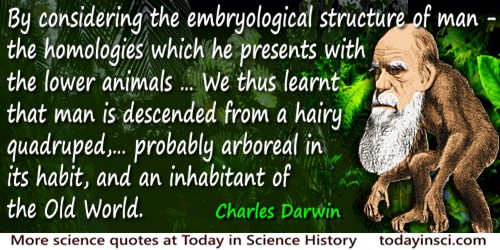
By considering the embryological structure of man - the homologies which he presents with the lower animals - the rudiments which he retains - and the reversions to which he is liable, we can partly recall in imagination the former condition of our early progenitors; and we can approximately place them in their proper position in the zoological series. We thus learnt that man is descended from a hairy quadruped, furnished with a tail and pointed ears, probably arboreal in its habit, and an inhabitant of the Old World. This creature, if its whole structure had been examined by a naturalist, would have been classed among the Quadrumana, as surely as would be the common and still more ancient progenitor of the Old and New World monkeys.
The Descent of Man (1871), Vol. 2, 389.
By its very nature the uterus is a field for growing the seeds, that is to say the ova, sown upon it. Here the eggs are fostered, and here the parts of the living [fetus], when they have further unfolded, become manifest and are made strong. Yet although it has been cast off by the mother and sown, the egg is weak and powerless and so requires the energy of the semen of the male to initiate growth. Hence in accordance with the laws of Nature, and like the other orders of living things, women produce eggs which, when received into the chamber of the uterus and fecundated by the semen of the male, unfold into a new life.
'On the Developmental Process', in H. B. Adelmann (ed.), Marcello Malpighi and the Evolution of Embryology (1966), Vol. 2, 861.
Embryology furnishes … the best measure of the true affinities existing between animals.
In 'Essay on Classification', Contributions to the Natural History of the United States of America (1857), Pt. 1, 85.
Embryology furnishes, also, the best measure of true affinities existing between animals.
Essay on Classification (1857). Contributions to the Natural History of the United States of America (1857), Vol. I, 85.
Embryology will often reveal to us the structure, in some degree obscured, of the prototype of each great class.
My only wish would be to have ten more lives to live on this planet. If that were possible, I’d spend one lifetime each in embryology, genetics, physics, astronomy and geology. The other lifetimes would be as a pianist, backwoodsman, tennis player, or writer for the National Geographic. … I’d like to keep open the option for another lifetime as a surgeon-scientist.
In Tore Frängsmyr and Jan E. Lindsten (eds.), Nobel Lectures: Physiology Or Medicine: 1981-1990 (1993), 557.
Ontogeny recapitulates phylogeny.
Shortened expression of the original statement in Ernst Haeckel and E. Ray Lankester (trans.), The History of Creation (1876), Vol. 2, 33. The original paragraph is elsewhere on this webpage with comment that Haeckel was incorrect.
The embryological record is almost always abbreviated in accordance with the tendency of nature (to be explained on the principle of survival of the fittest) to attain her needs by the easiest means.
A Treatise on Comparative Embryology (1880), Vol. I, 3-4.
The embryos of mammals, of birds, lizards, and snakes are, in their earliest states, exceedingly like one another, both as a whole and in the mode of development of their parts, indeed we can often distinguish such embryos only by their size. I have two little embryos in spirit [alcohol] to which I have omitted to attach the names. I am now quite unable to say to what class they belong.
The fertilized ovum of a mouse and a whale look much alike, but differences quickly show up in the course of their development. If we could study their molecules with the naked eyes, we would see the differences from the start.
Epigraph in Isaac Asimov’s Book of Science and Nature Quotations (1988), 73.
The generation of seeds ... is therefore marvelous and analogous to the other productions of living things. For first of all an umbilicus appears. ... Its extremity gradually expands and after gathering a colliquamentous ichor becomes analogous to an amnion. ... In the course of time the seed or fetus begins to become visible.
'On the Developmental Process', in H. B. Adelmann (ed.), Marcello Malpighi and the Evolution of Embryology (1966), Vol. 2, 850.
The seed of a tree has the nature of a branch or twig or bud. While it grows upon the tree it is a part of the tree: but if separated and set in the earth to be better nourished, the embryo or young tree contained in it takes root and grows into a new tree.
As quoted in Roderick W. Home, Electricity and Experimental Physics in Eighteenth-century Europe (1992), 112.
The Zebra fish is a vertebrate like us, but unlike mammals, you can get at the embryo which grows fast and hatches within three days. The fish lays lots of transparent eggs, so you have a lot of material to work with. One can watch everything developing: the formation of the nervous system, eyes, brain, and body. … We can see that embryo, follow its growth, and see effects of mutations immediately.
From interview with Anthony Liversidge, in 'Walter Gilbert', Omni (Nov 1992), 15, No. 2.
We spend long hours discussing the curious situation that the two great bodies of biological knowledge, genetics and embryology, which were obviously intimately interrelated in development, had never been brought together in any revealing way. An obvious difficulty was that the most favorable organisms for genetics, Drosophila as a prime example, were not well suited for embryological study, and the classical objects of embryological study, sea urchins and frogs as examples, were not easily investigated genetically. What might we do about it? There were two obvious approaches: one to learn more about the genetics of an embryologically favourable organism, the other to better understand the development of Drosophila. We resolved to gamble up to a year of our lives on the latter approach, this in Ephrussi’s laboratory in Paris which was admirably equipped for tissue culture, tissue or organ transplantation, and related techniques.
In 'Recollections', Annual Review of Biochemistry, 1974, 43, 6.
 In science it often happens that scientists say, 'You know that's a really good argument; my position is mistaken,' and then they would actually change their minds and you never hear that old view from them again. They really do it. It doesn't happen as often as it should, because scientists are human and change is sometimes painful. But it happens every day. I cannot recall the last time something like that happened in politics or religion.
(1987) --
In science it often happens that scientists say, 'You know that's a really good argument; my position is mistaken,' and then they would actually change their minds and you never hear that old view from them again. They really do it. It doesn't happen as often as it should, because scientists are human and change is sometimes painful. But it happens every day. I cannot recall the last time something like that happened in politics or religion.
(1987) -- 





