Electron Quotes (97 quotes)
…where the electron behaves and misbehaves as it will,
where the forces tie themselves up into knots of atoms
and come united…
where the forces tie themselves up into knots of atoms
and come united…
'Give Us Gods', David Herbert Lawrence, The Works of D.H. Lawrence (1994), 354.
“Daddy,” she says, “which came first, the chicken or the egg?”
Steadfastly, even desperately, we have been refusing to commit ourselves. But our questioner is insistent. The truth alone will satisfy her. Nothing less. At long last we gather up courage and issue our solemn pronouncement on the subject: “Yes!”
So it is here.
“Daddy, is it a wave or a particle?”
“Yes.”
“Daddy, is the electron here or is it there?”
“Yes.”
“Daddy, do scientists really know what they are talking about?”
“Yes!”
Steadfastly, even desperately, we have been refusing to commit ourselves. But our questioner is insistent. The truth alone will satisfy her. Nothing less. At long last we gather up courage and issue our solemn pronouncement on the subject: “Yes!”
So it is here.
“Daddy, is it a wave or a particle?”
“Yes.”
“Daddy, is the electron here or is it there?”
“Yes.”
“Daddy, do scientists really know what they are talking about?”
“Yes!”
The Strange Story of the Quantum (1947), 156-7.
[Radium emits electrons with a velocity so great that] one gram is enough to lift the whole of the British fleet to the top of Ben Nevis; and I am not quite certain that we could not throw in the French fleet as well.
As quoted in 'Radium', New York Times (22 Feb 1903), 6. The reporter clarifies that this statement is “popular not scientific.” However, it is somewhat prescient, since only two years later (1905) Einstein published his E=mc² formula relating mass and energy. The top of Ben Nevis, the highest mountain in Britain, is 1344-m high. As energy, one gram mass would lift about 68 million tonnes there—over a thousand modern battleships.
[The chemical bond] First, it is related to the disposition of two electrons (remember, no one has ever seen an electron!): next, these electrons have their spins pointing in opposite directions (remember, no one can ever measure the spin of a particular electron!): then, the spatial distribution of these electrons is described analytically with some degree of precision (remember, there is no way of distinguishing experimentally the density distribution of one electron from another!): concepts like hybridization, covalent and ionic structures, resonance, all appear, not one of which corresponds to anything that is directly measurable. These concepts make a chemical bond seem so real, so life-like, that I can almost see it. Then I wake with a shock to the realization that a chemical bond does not exist; it is a figment of the imagination that we have invented, and no more real than the square root of - 1. I will not say that the known is explained in terms of the unknown, for that is to misconstrue the sense of intellectual adventure. There is no explanation: there is form: there is structure: there is symmetry: there is growth: and there is therefore change and life.
Quoted in his obituary, Biographical Memoirs of the Fellows of the Royal Society 1974, 20, 96.
Accordingly the primordial state of things which I picture is an even distribution of protons and electrons, extremely diffuse and filling all (spherical) space, remaining nearly balanced for an exceedingly long time until its inherent instability prevails. We shall see later that the density of this distribution can be calculated; it was about one proton and electron per litre. There is no hurry for anything to begin to happen. But at last small irregular tendencies accumulate, and evolution gets under way. The first stage is the formation of condensations ultimately to become the galaxies; this, as we have seen, started off an expansion, which then automatically increased in speed until it is now manifested to us in the recession of the spiral nebulae.
As the matter drew closer together in the condensations, the various evolutionary processes followed—evolution of stars, evolution of the more complex elements, evolution of planets and life.
As the matter drew closer together in the condensations, the various evolutionary processes followed—evolution of stars, evolution of the more complex elements, evolution of planets and life.
The Expanding Universe (1933), 56-57.
After all, we scientific workers … like women, are the victims of fashion: at one time we wear dissociated ions, at another electrons; and we are always loth to don rational clothing; some fixed belief we must have manufactured for us: we are high or low church, of this or that degree of nonconformity, according to the school in which we are brought up—but the agnostic is always rare of us and of late years the critic has been taboo.
'The Thirst of Salted Water or the Ions Overboard', Science Progress (1909), 3, 643.
After long reflection in solitude and meditation, I suddenly had the idea, during the year 1923, that the discovery made by Einstein in 1905 should be generalised by extending it to all material particles and notably to electrons.
Preface to his re-edited 1924 Ph.D. Thesis, Recherches sur la théorie des quanta (1963), 4. In Steve Adams, Frontiers (2000), 13.
All that glisters may not be gold, but at least it contains free electrons.
From Lecture at Birkbeck College, University of London (1960). As quoted and cited in Alan L. Mackay and Maurice Ebison (ed.), The Harvest of a Quiet Eye (1977, 1981), 7. Below the quote, a comment is added in brackets: “[But consider the Golden Scarab Beetle which has a metallic lustre without metal.]” [Webmaster’s note: In this book, the comment is shown in a much smaller type size, in a different font, and is therefore presumably an editorial remark, and not part of Bernal’s own words. Both Bernal and Mackay were crystallographers at Birkbeck College, where the lecture was given. Webmaster speculates that Mackay attended the lecture, and the quote is made from his own recollection, since no print source is included with the citation. In general, metals are lustrous because of the free electrons they have, which interact with incident light.]
Almost all of the material phenomena which occur under terrestrial conditions are recognized as quantum mechanical consequences of the electrical attraction between electrons and nuclei and of the gravitational attraction between massive objects. We should be able, therefore, to express all the relevant magnitudes which characterize the properties of matter in terms of the following six magnitudes: M, m, e, c, G, and h; M is the mass of the proton, m and e are the mass and electrical charge of the electron, c is the light velocity, G is Newton's gravitational constant, and—most importantly—h is the quantum of action.
In 'Of Atoms, Mountains, and Stars: A Study in Qualitative Physics' (21 Feb 1975), Science, 187 No. 4177, 605.
An electron is no more (and no less) hypothetical than a star. Nowadays we count electrons one by one in a Geiger counter, as we count the stars one by one on a photographic plate.
Messenger Lectures (1934), New Pathways in Science (1935), 21.
As advertising always convinces the sponsor even more than the public, the scientists have become sold, and remain sold, on the idea that they have the key to the Absolute, and that nothing will do for Mr. Average Citizen but to stuff himself full of electrons.
In Science is a Sacred Cow (1950), 26.
As I have often said, electrons and gerbils don’t cheat.
In 'Science: Why I Am Not A Paranormalist', The Whys of a Philosophical Scrivener (1983), Chap. 3, 64.
As the nineteenth century drew to a close, scientists could reflect with satisfaction that they had pinned down most of the mysteries of the physical world: electricity, magnetism, gases, optics, acoustics, kinetics and statistical mechanics … all had fallen into order before them. They had discovered the X ray, the cathode ray, the electron, and radioactivity, invented the ohm, the watt, the Kelvin, the joule, the amp, and the little erg.
A Short History of Nearly Everything. In Clifford A. Pickover, Archimedes to Hawking: Laws of Science and the Great Minds Behind Them (2008), 172.
Atoms have a nucleus, made of protons and neutrons bound together. Around this nucleus shells of electrons spin, and each shell is either full or trying to get full, to balance with the number of protons—to balance the number of positive and negative charges. An atom is like a human heart, you see.
The Lunatics (1988). In Gary Westfahl, Science Fiction Quotations: From the Inner Mind to the Outer Limits (2006), 323.
But in its [the corpuscular theory of radiation] relation to the wave theory there is one extraordinary and, at present, insoluble problem. It is not known how the energy of the electron in the X-ray bulb is transferred by a wave motion to an electron in the photographic plate or in any other substance on which the X-rays fall. It is as if one dropped a plank into the sea from the height of 100 ft. and found that the spreading ripple was able, after travelling 1000 miles and becoming infinitesimal in comparison with its original amount, to act upon a wooden ship in such a way that a plank of that ship flew out of its place to a height of 100 ft. How does the energy get from one place to the other?
'Aether Waves and Electrons' (Summary of the Robert Boyle Lecture), Nature, 1921, 107, 374.
But it is necessary to insist more strongly than usual that what I am putting before you is a model—the Bohr model atom—because later I shall take you to a profounder level of representation in which the electron instead of being confined to a particular locality is distributed in a sort of probability haze all over the atom.
Messenger Lectures (1934), New Pathways in Science (1935), 34.
Can a physicist visualize an electron? The electron is materially inconceivable and yet, it is so perfectly known through its effects that we use it to illuminate our cities, guide our airlines through the night skies and take the most accurate measurements. What strange rationale makes some physicists accept the inconceivable electrons as real while refusing to accept the reality of a Designer on the ground that they cannot conceive Him?
In letter to California State board of Education (14 Sep 1972).
Can quantum mechanics represent the fact that an electron finds itself approximately in a given place and that it moves approximately with a given velocity, and can we make these approximations so close that they do not cause experimental difficulties?
Physics and Beyond: Encounters and Conversations, trans. Arnold J. Pomerans (1971), 78.
Electricity is actually made up of extremely tiny particles called electrons, that you cannot see with the naked eye unless you have been drinking.
In The Taming of the Screw: How to Sidestep Several Million Homeowner's Problems (1983), 12.
Every new theory as it arises believes in the flush of youth that it has the long sought goal; it sees no limits to its applicability, and believes that at last it is the fortunate theory to achieve the 'right' answer. This was true of electron theory—perhaps some readers will remember a book called The Electrical Theory of the Universe by de Tunzelman. It is true of general relativity theory with its belief that we can formulate a mathematical scheme that will extrapolate to all past and future time and the unfathomed depths of space. It has been true of wave mechanics, with its first enthusiastic claim a brief ten years ago that no problem had successfully resisted its attack provided the attack was properly made, and now the disillusionment of age when confronted by the problems of the proton and the neutron. When will we learn that logic, mathematics, physical theory, are all only inventions for formulating in compact and manageable form what we already know, like all inventions do not achieve complete success in accomplishing what they were designed to do, much less complete success in fields beyond the scope of the original design, and that our only justification for hoping to penetrate at all into the unknown with these inventions is our past experience that sometimes we have been fortunate enough to be able to push on a short distance by acquired momentum.
The Nature of Physical Theory (1936), 136.
Firm support has been found for the assertion that electricity occurs at thousands of points where we at most conjectured that it was present. Innumerable electrical particles oscillate in every flame and light source. We can in fact assume that every heat source is filled with electrons which will continue to oscillate ceaselessly and indefinitely. All these electrons leave their impression on the emitted rays. We can hope that experimental study of the radiation phenomena, which are exposed to various influences, but in particular to the effect of magnetism, will provide us with useful data concerning a new field, that of atomistic astronomy, as Lodge called it, populated with atoms and electrons instead of planets and worlds.
'Light Radiation in a Magnetic Field', Nobel Lecture, 2 May 1903. In Nobel Lectures: Physics 1901-1921 (1967), 40.
For if those who hold that there must be a physical basis for everything hold that these mystical views are nonsense, we may ask—What then is the physical basis of nonsense? ... In a world of ether and electrons we might perhaps encounter nonsense; we could not encounter damned nonsense.
…...
From that night on, the electron—up to that time largely the plaything of the scientist—had clearly entered the field as a potent agent in the supplying of man's commercial and industrial needs… The electronic amplifier tube now underlies the whole art of communications, and this in turn is at least in part what has made possible its application to a dozen other arts. It was a great day for both science and industry when they became wedded through the development of the electronic amplifier tube.
The Autobiography of Robert A. Millikan (1951), 136.
Historical science is not worse, more restricted, or less capable of achieving firm conclusions because experiment, prediction, and subsumption under invariant laws of nature do not represent its usual working methods. The sciences of history use a different mode of explanation, rooted in the comparative and observational richness in our data. We cannot see a past event directly, but science is usually based on inference, not unvarnished observation (you don’t see electrons, gravity, or black holes either).
…...
I am glad that Dr. Chadwick has stuck to the view that it [the neutron] is a combination of a proton and electron. Some people have said it was a new kind of ultimate particle. It was really too much to believe—that a new ultimate particle should exist with its mass so conveniently close to that of the proton and electron combined. It was nothing but a bad joke played on its creator and on the rest of us. Still, there is no doubt this neutron business is going to have many developments.
As reported in article on the York Meeting of the British Association for the Advancement of Science by Ferdinand Kuhn Jr., 'Finds Two Particles Make Up Neutrons', New York Times (6 Sep 1932), 12.
I believe there are
15,747,724,136,275,002,577,605,653,961,181,555,468,044,717,
914,527,116,709,366,231,025,076,185,631,031,296
protons in the universe, and the same number of electrons.
15,747,724,136,275,002,577,605,653,961,181,555,468,044,717,
914,527,116,709,366,231,025,076,185,631,031,296
protons in the universe, and the same number of electrons.
From Tarner Lecture (1938), 'The Physical Universe', in The Philosophy of Physical Science (1939, 2012), 170. Note: the number is 136 x 2256.
I don’t know whether there is a finite set of basic laws of physics or whether there are infinite sets of structure like an infinite set of Chinese boxes. Will the electron turn out to have an interior structure? I wish I knew!
In Kendrick Frazier, 'A Mind at Play: An Interview with Martin Gardner', Skeptical Inquirer (Mar/Apr 1998), 37.
I notice that, in the lecture … which Prof. Lowry gave recently, in Paris … he brought forward certain freak formulae for tartaric acid, in which hydrogen figures as bigamist … I may say, he but follows the loose example set by certain Uesanians, especially one G. N. Lewis, a Californian thermodynamiter, who has chosen to disregard the fundamental canons of chemistry—for no obvious reason other than that of indulging in premature speculation upon electrons as the cause of valency…
'Bigamist Hydrogen. A Protest', Nature (1926), 117, 553.
I once had the honour of hearing the great molecular biologist Jacques Monod talking about creativity in science. I have forgotten his exact words, but he said approximately that, when trying to think through a chemical problem, he would ask himself what he would do if he were an electron.
In 'Introduction to the 30th Anniversary Edition', The Selfish Gene: 30th Anniversary Edition (1976, 2006), xi.
I think that a particle must have a separate reality independent of the measurements. That is an electron has spin, location and so forth even when it is not being measured. I like to think that the moon is there even if I am not looking at it.
…...
I used to say the evening that I developed the first x-ray photograph I took of insulin in 1935 was the most exciting moment of my life. But the Saturday afternoon in late July 1969, when we realized that the insulin electron density map was interpretable, runs that moment very close.
'X-rays and the Structure of Insulin', British Medical Journal (1971), 4, 449.
I used to wonder how it comes about that the electron is negative. Negative-positive—these are perfectly symmetric in physics. There is no reason whatever to prefer one to the other. Then why is the electron negative? I thought about this for a long time and at last all I could think was 'It won the fight!'
Quoted in George Wald, 'The Origin of Optical Activity', Annals of the New York Academy of Sciences (1957), 60, 352-68.
If I say [electrons] behave like particles I give the wrong impression; also if I say they behave like waves. They behave in their own inimitable way, which technically could be called a quantum mechanical way. They behave in a way that is like nothing that you have seen before.
'Probability abd Uncertainty—the Quantum Mechanical View of Nature', the sixth of his Messenger Lectures (1964), Cornell University. Collected in The Character of Physical Law (1967), 128.
If I’m concerned about what an electron does in an amorphous mass then I become an electron. I try to have that picture in my mind and to behave like an electron, looking at the problem in all its dimensions and scales.
Quoted in Timothy L. O’Brien, 'Not Invented here: Are U.S. Innovators Losing Their Competitive Edge?', New York Times (13 Nov 2005), B6.
If to-day you ask a physicist what he has finally made out the æther or the electron to be, the answer will not be a description in terms of billiard balls or fly-wheels or anything concrete; he will point instead to a number of symbols and a set of mathematical equations which they satisfy. What do the symbols stand for? The mysterious reply is given that physics is indifferent to that; it has no means of probing beneath the symbolism. To understand the phenomena of the physical world it is necessary to know the equations which the symbols obey but not the nature of that which is being symbolised. …this newer outlook has modified the challenge from the material to the spiritual world.
Swarthmore Lecture (1929) at Friends’ House, London, printed in Science and the Unseen World (1929), 30.
If we ascribe the ejection of the proton to a Compton recoil from a quantum of 52 x 106 electron volts, then the nitrogen recoil atom arising by a similar process should have an energy not greater than about 400,000 volts, should produce not more than about 10,000 ions, and have a range in the air at N.T.P. of about 1-3mm. Actually, some of the recoil atoms in nitrogen produce at least 30,000 ions. In collaboration with Dr. Feather, I have observed the recoil atoms in an expansion chamber, and their range, estimated visually, was sometimes as much as 3mm. at N.T.P.
These results, and others I have obtained in the course of the work, are very difficult to explain on the assumption that the radiation from beryllium is a quantum radiation, if energy and momentum are to be conserved in the collisions. The difficulties disappear, however, if it be assumed that the radiation consists of particles of mass 1 and charge 0, or neutrons. The capture of the a-particle by the Be9 nucleus may be supposed to result in the formation of a C12 nucleus and the emission of the neutron. From the energy relations of this process the velocity of the neutron emitted in the forward direction may well be about 3 x 109 cm. per sec. The collisions of this neutron with the atoms through which it passes give rise to the recoil atoms, and the observed energies of the recoil atoms are in fair agreement with this view. Moreover, I have observed that the protons ejected from hydrogen by the radiation emitted in the opposite direction to that of the exciting a-particle appear to have a much smaller range than those ejected by the forward radiation.
This again receives a simple explanation on the neutron hypothesis.
These results, and others I have obtained in the course of the work, are very difficult to explain on the assumption that the radiation from beryllium is a quantum radiation, if energy and momentum are to be conserved in the collisions. The difficulties disappear, however, if it be assumed that the radiation consists of particles of mass 1 and charge 0, or neutrons. The capture of the a-particle by the Be9 nucleus may be supposed to result in the formation of a C12 nucleus and the emission of the neutron. From the energy relations of this process the velocity of the neutron emitted in the forward direction may well be about 3 x 109 cm. per sec. The collisions of this neutron with the atoms through which it passes give rise to the recoil atoms, and the observed energies of the recoil atoms are in fair agreement with this view. Moreover, I have observed that the protons ejected from hydrogen by the radiation emitted in the opposite direction to that of the exciting a-particle appear to have a much smaller range than those ejected by the forward radiation.
This again receives a simple explanation on the neutron hypothesis.
'Possible Existence of a Neutron', Letter to the Editor, Nature, 1932, 129, 312.
In recent years several new particles have been discovered which are currently assumed to be “elementary,” that is, essentially structureless. The probability that all such particles should be really elementary becomes less and less as their number increases. It is by no means certain that nucleons, mesons, electrons, neutrinos are all elementary particles.
Opening statement, Enrico Fermi and C.N. Yang, 'Are Mesons Elementary Particles?', Physical Review (1949), 76, 1739. As cited in James Gleick, Genius: The Life and Science of Richard Feynman (1992), 283.
In size the electron bears the same relation to an atom that a baseball bears to the earth. Or, as Sir Oliver Lodge puts it, if a hydrogen atom were magnified to the size of a church, an electron would be a speck of dust in that church.
Quoted in 'Science Entering New Epoch', New York Times (5 Apr 1908), Sunday Magazine, 3.
In the year 1902 (while I was attempting to explain to an elementary class in chemistry some of the ideas involved in the periodic law) becoming interested in the new theory of the electron, and combining this idea with those which are implied in the periodic classification, I formed an idea of the inner structure of the atom which, although it contained certain crudities, I have ever since regarded as representing essentially the arrangement of electrons in the atom ... In accordance with the idea of Mendeleef, that hydrogen is the first member of a full period, I erroneously assumed helium to have a shell of eight electrons. Regarding the disposition in the positive charge which balanced the electrons in the neutral atom, my ideas were very vague; I believed I inclined at that time toward the idea that the positive charge was also made up of discrete particles, the localization of which determined the localization of the electrons.
Valence and the Structure of Atoms and Molecules (1923), 29-30.
Indeed, nothing more beautifully simplifying has ever happened in the history of science than the whole series of discoveries culminating about 1914 which finally brought practically universal acceptance to the theory that the material world contains but two fundamental entities, namely, positive and negative electrons, exactly alike in charge, but differing widely in mass, the positive electron—now usually called a proton—being 1850 times heavier than the negative, now usually called simply the electron.
Time, Matter and Values (1932), 46. Cited in Karl Raimund Popper and William Warren Bartley (ed.), Quantum Theory and theSchism in Physics (1992), 37.
It did not cause anxiety that Maxwell’s equations did not apply to gravitation, since nobody expected to find any link between electricity and gravitation at that particular level. But now physics was faced with an entirely new situation. The same entity, light, was at once a wave and a particle. How could one possibly imagine its proper size and shape? To produce interference it must be spread out, but to bounce off electrons it must be minutely localized. This was a fundamental dilemma, and the stalemate in the wave-photon battle meant that it must remain an enigma to trouble the soul of every true physicist. It was intolerable that light should be two such contradictory things. It was against all the ideals and traditions of science to harbor such an unresolved dualism gnawing at its vital parts. Yet the evidence on either side could not be denied, and much water was to flow beneath the bridges before a way out of the quandary was to be found. The way out came as a result of a brilliant counterattack initiated by the wave theory, but to tell of this now would spoil the whole story. It is well that the reader should appreciate through personal experience the agony of the physicists of the period. They could but make the best of it, and went around with woebegone faces sadly complaining that on Mondays, Wednesdays, and Fridays they must look on light as a wave; on Tuesdays, Thursdays, and Saturdays, as a particle. On Sundays they simply prayed.
The Strange Story of the Quantum (1947), 42.
It is structure that we look for whenever we try to understand anything. All science is built upon this search; we investigate how the cell is built of reticular material, cytoplasm, chromosomes; how crystals aggregate; how atoms are fastened together; how electrons constitute a chemical bond between atoms. We like to understand, and to explain, observed facts in terms of structure. A chemist who understands why a diamond has certain properties, or why nylon or hemoglobin have other properties, because of the different ways their atoms are arranged, may ask questions that a geologist would not think of formulating, unless he had been similarly trained in this way of thinking about the world.
‘The Place of Chemistry In the Integration of the Sciences’, Main Currents in Modern Thought (1950), 7, 110.
It seems sensible to discard all hope of observing hitherto unobservable quantities, such as the position and period of the electron... Instead it seems more reasonable to try to establish a theoretical quantum mechanics, analogous to classical mechanics, but in which only relations between observable quantities occur.
In Helge Kragh, Quantum Generations: A History of Physics in the Twentieth Century (1999), 161.
Judging from our experience upon this planet, such a history, that begins with elementary particles, leads perhaps inevitably toward a strange and moving end: a creature that knows, a science-making animal, that turns back upon the process that generated him and attempts to understand it. Without his like, the universe could be, but not be known, and this is a poor thing. Surely this is a great part of our dignity as men, that we can know, and that through us matter can know itself; that beginning with protons and electrons, out of the womb of time and the vastnesses of space, we can begin to understand; that organized as in us, the hydrogen, the carbon, the nitrogen, the oxygen, those 16-21 elements, the water, the sunlight—all having become us, can begin to understand what they are, and how they came to be.
In 'The Origins of Life', Proceedings of the National Academy of Sciences of the United States of America (1964), 52, 609-110.
Life is a partial, continuous, progressive, multiform and conditionally interactive, self-realization of the potentialities of atomic electron states.
In The Origin of Life (1967), 251.
Many scientists have tried to make determinism and complementarity the basis of conclusions that seem to me weak and dangerous; for instance, they have used Heisenberg’s uncertainty principle to bolster up human free will, though his principle, which applies exclusively to the behavior of electrons and is the direct result of microphysical measurement techniques, has nothing to do with human freedom of choice. It is far safer and wiser that the physicist remain on the solid ground of theoretical physics itself and eschew the shifting sands of philosophic extrapolations.
In New Perspectives in Physics (1962), viii.
Mathematics is not only real, but it is the only reality. That is that entire universe is made of matter, obviously. And matter is made of particles. It’s made of electrons and neutrons and protons. So the entire universe is made out of particles. Now what are the particles made out of? They’re not made out of anything. The only thing you can say about the reality of an electron is to cite its mathematical properties. So there’s a sense in which matter has completely dissolved and what is left is just a mathematical structure.
In 'Gardner on Gardner: JPBM Communications Award Presentation', Focus-The Newsletter of the Mathematical Association of America (Dec 1994), 14, No. 6. Also, first sentence as filler, with citation, after Washek F. Pfeffer, 'A Devil's Platform', The American Mathematical Monthly (Dec 2008), 115, No. 10, 947.
Most American homes have alternating current, which means that the electricty goes in one direction for a while, then goes in the other direction. This prevents harmful electron buildup in the wires.
In The Taming of the Screw: How to Sidestep Several Million Homeowner’s Problems (1983), 12.
Naturally, some intriguing thoughts arise from the discovery that the three chief particles making up matter—the proton, the neutron, and the electron—all have antiparticles. Were particles and antiparticles created in equal numbers at the beginning of the universe? If so, does the universe contain worlds, remote from ours, which are made up of antiparticles?
In The Intelligent Man's Guide to the Physical Sciences (1960, 1968), 222. Also in Isaac Asimov’s Book of Science and Nature Quotations (1988), 138.
New sources of power … will surely be discovered. Nuclear energy is incomparably greater than the molecular energy we use today. The coal a man can get in a day can easily do five hundred times as much work as himself. Nuclear energy is at least one million times more powerful still. If the hydrogen atoms in a pound of water could be prevailed upon to combine and form helium, they would suffice to drive a thousand-horsepower engine for a whole year. If the electrons, those tiny planets of the atomic systems, were induced to combine with the nuclei in hydrogen, the horsepower would be 120 times greater still. There is no question among scientists that this gigantic source of energy exists. What is lacking is the match to set the bonfire alight, or it may be the detonator to cause the dynamite to explode. The scientists are looking for this.
[In his last major speech to the House of Commons on 1 Mar 1955, Churchill quoted from his original printed article, nearly 25 years earlier.]
[In his last major speech to the House of Commons on 1 Mar 1955, Churchill quoted from his original printed article, nearly 25 years earlier.]
'Fifty Years Hence'. Strand Magazine (Dec 1931). Reprinted in Popular Mechanics (Mar 1932), 57:3, 395.
O. Hahn and F. Strassmann have discovered a new type of nuclear reaction, the splitting into two smaller nuclei of the nuclei of uranium and thorium under neutron bombardment. Thus they demonstrated the production of nuclei of barium, lanthanum, strontium, yttrium, and, more recently, of xenon and caesium. It can be shown by simple considerations that this type of nuclear reaction may be described in an essentially classical way like the fission of a liquid drop, and that the fission products must fly apart with kinetic energies of the order of hundred million electron-volts each.
'Products of the Fission of the Urarium Nucleus', Nature (1939), 143, 471.
On careful examination the physicist finds that in the sense in which he uses language no meaning at all can be attached to a physical concept which cannot ultimately be described in terms of some sort of measurement. A body has position only in so far as its position can be measured; if a position cannot in principle be measured, the concept of position applied to the body is meaningless, or in other words, a position of the body does not exist. Hence if both the position and velocity of electron cannot in principle be measured, the electron cannot have the same position and velocity; position and velocity as expressions of properties which an electron can simultaneously have are meaningless.
Reflections of a Physicist (1950), 90.
One might talk about the sanity of the atom
the sanity of space
the sanity of the electron
the sanity of water—
For it is all alive
and has something comparable to that which we call sanity in ourselves.
The only oneness is the oneness of sanity.
the sanity of space
the sanity of the electron
the sanity of water—
For it is all alive
and has something comparable to that which we call sanity in ourselves.
The only oneness is the oneness of sanity.
'The Sane Universe', David Herbert Lawrence, The Works of D.H. Lawrence (1994), 428.
Our knowledge of the external world must always consist of numbers, and our picture of the universe—the synthesis of our knowledge—must necessarily be mathematical in form. All the concrete details of the picture, the apples, the pears and bananas, the ether and atoms and electrons, are mere clothing that we ourselves drape over our mathematical symbols— they do not belong to Nature, but to the parables by which we try to make Nature comprehensible. It was, I think, Kronecker who said that in arithmetic God made the integers and man made the rest; in the same spirit, we may add that in physics God made the mathematics and man made the rest.
From Address (1934) to the British Association for the Advancement of Science, Aberdeen, 'The New World—Picture of Modern Physics'. Printed in Nature (Sep 1934) 134, No. 3384, 356. As quoted and cited in Wilbur Marshall Urban, Language and Reality: The Philosophy of Language and the Principles of Symbolism (2004), Vol. 15, 542.
Over the last century, physicists have used light quanta, electrons, alpha particles, X-rays, gamma-rays, protons, neutrons and exotic sub-nuclear particles for this purpose [scattering experiments]. Much important information about the target atoms or nuclei or their assemblage has been obtained in this way. In witness of this importance one can point to the unusual concentration of scattering enthusiasts among earlier Nobel Laureate physicists. One could say that physicists just love to perform or interpret scattering experiments.
Nobel Banquet Speech (10 Dec 1994), in Tore Frängsmyr (ed.), Les Prix Nobel. The Nobel Prizes 1994 (1995).
Physical science is thus approaching the stage when it will be complete, and therefore uninteresting. Given the laws governing the motions of electrons and protons, the rest is merely geography—a collection of particular facts.
In What I Believe (1925), 2.
Physicists speak of the particle representation or the wave representation. Bohr's principle of complementarity asserts that there exist complementary properties of the same object of knowledge, one of which if known will exclude knowledge of the other. We may therefore describe an object like an electron in ways which are mutually exclusive—e.g., as wave or particle—without logical contradiction provided we also realize that the experimental arrangements that determine these descriptions are similarly mutually exclusive. Which experiment—and hence which description one chooses—is purely a matter of human choice.
The Cosmic Code: Quantum Physics as the Language of Nature (1982), 94.
Reagents are regarded as acting by virtue of a constitutional affinity either for electrons or for nuclei... the terms electrophilic (electron-seeking) and nucleophilic (nucleus-seeking) are suggested... and the organic molecule, in the activation necessary for reaction, is therefore required to develop at the seat of attack either a high or low electron density as the case may be.
'Significance of Tautomerism and of the Reactions of Aromatic Compounds in the Electronic Theory of Organic Relations', Journal of the Chemical Society (1933), 136, 1121, fn.
Saying that each of two atoms can attain closed electron shells by sharing a pair of electrons is equivalent to saying that husband and wife, by having a total of two dollars in a joint account and each having six dollars in individual bank accounts, have eight dollars apiece!
Quoted in Reynold E. Holmen, 'Kasimir Fajans (1887-1975): The Man and His Work', Bulletin for the History of Chemistry, 1990, 6, 7-8.
Science is in a literal sense constructive of new facts. It has no fixed body of facts passively awaiting explanation, for successful theories allow the construction of new instruments—electron microscopes and deep space probes—and the exploration of phenomena that were beyond description—the behavior of transistors, recombinant DNA, and elementary particles, for example. This is a key point in the progressive nature of science—not only are there more elegant or accurate analyses of phenomena already known, but there is also extension of the range of phenomena that exist to be described and explained.
Co-author with Michael A. Arbib, English-born professor of computer science and biomedical engineering (1940-)
Co-author with Michael A. Arbib, English-born professor of computer science and biomedical engineering (1940-)
Michael A. Arbib and Mary B. Hesse, The Construction of Reality (1986), 8.
Science is often regarded as the most objective and truth-directed of human enterprises, and since direct observation is supposed to be the favored route to factuality, many people equate respectable science with visual scrutiny–just the facts ma’am, and palpably before my eyes. But science is a battery of observational and inferential methods, all directed to the testing of propositions that can, in principle, be definitely proven false ... At all scales, from smallest to largest, quickest to slowest, many well-documented conclusions of science lie beyond the strictly limited domain of direct observation. No one has ever seen an electron or a black hole, the events of a picosecond or a geological eon.
In Eight Little Piggies: Reflections in Natural History (1994), 200.
Shortly after electrons were discovered it was thought that atoms were like little solar systems, made up of a … nucleus and electrons, which went around in “orbits,” much like the planets … around the sun. If you think that’s the way atoms are, then you’re back in 1910.
In QED: The Strange Theory of Light and Matter (1985, 2006), 84.
Since it is proposed to regard chemical reactions as electrical transactions in which reagents act by reason of a constitutional affinity either for electrons or for atomic nuclei, it is important to be able to recognize which type of reactivity any given reagent exhibits.
'Principles of an Electronic Theory of Organic Reactions', Chemical Reviews (1934), 15, 265.
Strong, deeply rooted desire is the starting point of all achievement. Just as the electron is the last unit of matter discernible to the scientist. DESIRE is the seed of all achievement; the starting place, back of which there is nothing, or at least there is nothing of which we have any knowledge.
…...
Surely something is wanting in our conception of the universe. We know positive and negative electricity, north and south magnetism, and why not some extra terrestrial matter related to terrestrial matter, as the source is to the sink. … Worlds may have formed of this stuff, with element and compounds possessing identical properties with our own, indistinguishable from them until they are brought into each other’s vicinity. … Astronomy, the oldest and most juvenile of the sciences, may still have some surprises in store. May anti-matter be commended to its care! … Do dreams ever come true?
[Purely whimsical prediction long before the 1932 discovery of the positron, the antiparticle of the electron.]
[Purely whimsical prediction long before the 1932 discovery of the positron, the antiparticle of the electron.]
'Potential Matter—A Holiday Dream', Letter to the Editor, Nature (18 Aug 1898), 58, No. 1503, 367. Quoted in Edward Robert Harrison, Cosmology: the Science of the Universe (2000), 433.
Take the living human brain endowed with mind and thought. …. The physicist brings his tools and commences systematic exploration. All that he discovers is a collection of atoms and electrons and fields of force arranged in space and time, apparently similar to those found in inorganic objects. He may trace other physical characteristics, energy, temperature, entropy. None of these is identical with thought. … How can this collection of ordinary atoms be a thinking machine? … The Victorian physicist felt that he knew just what he was talking about when he used such terms as matter and atoms. … But now we realize that science has nothing to say as to the intrinsic nature of the atom. The physical atom is, like everything else in physics, a schedule of pointer readings.
From a Gifford Lecture, University of Edinburgh (1927), published in 'Pointer Readings: Limits of Physical Knowledge', The Nature of the Physical World (1929), 258-259.
The century of biology upon which we are now well embarked is no matter of trivialities. It is a movement of really heroic dimensions, one of the great episodes in man’s intellectual history. The scientists who are carrying the movement forward talk in terms of nucleo-proteins, of ultracentrifuges, of biochemical genetics, of electrophoresis, of the electron microscope, of molecular morphology, of radioactive isotopes. But do not be misled by these horrendous terms, and above all do not be fooled into thinking this is mere gadgetry. This is the dependable way to seek a solution of the cancer and polio problems, the problems of rheumatism and of the heart. This is the knowledge on which we must base our solution of the population and food problems. This is the understanding of life.
Letter to H. M. H. Carsan (17 Jun 1949). Quoted in Raymond B. Fosdick, The Story of the Rockefeller Foundation (1952), 166.
The chemist in America has in general been content with what I have called a loafer electron theory. He has imagined the electrons sitting around on dry goods boxes at every corner [viz. the cubic atom], ready to shake hands with, or hold on to similar loafer electrons in other atoms.
'Atomism in Modern Physics', Journal of the Chemical Society (1924), 1411.
The electron is not as simple as it looks.
As quoted in Alan L. Mackay, “The Harvest of a Quiet Eye” (1977), 23. Cited as “recounted by Sir George Paget Thompson at the Electron Diffraction Conference, Imperial College, 1967.”
The electron, as it leaves the atom, crystallises out of Schrödinger’s mist like a genie emerging from his bottle.
Gifford Lectures (1927), The Nature of the Physical World (1928), 199.
The energy of a covalent bond is largely the energy of resonance of two electrons between two atoms. The examination of the form of the resonance integral shows that the resonance energy increases in magnitude with increase in the overlapping of the two atomic orbitals involved in the formation of the bond, the word ‘overlapping” signifying the extent to which regions in space in which the two orbital wave functions have large values coincide... Consequently it is expected that of two orbitals in an atom the one which can overlap more with an orbital of another atom will form the stronger bond with that atom, and, moreover, the bond formed by a given orbital will tend to lie in that direction in which the orbital is concentrated.
Nature of the Chemical Bond and the Structure of Molecules and Crystals (1939), 76.
The goddess of learning is fabled to have sprung full-grown from the brain of Zeus, but it is seldom that a scientific conception is born in its final form, or owns a single parent. More often it is the product of a series of minds, each in turn modifying the ideas of those that came before, and providing material for those that came after. The electron is no exception.
'Electronic Waves', Nobel Lecture (7 Jun 1938). Nobel Lectures: Physics 1922-1941 (1998), 397.
The ingenious but nevertheless somewhat artificial assumptions of [Bohr’s model of the atom], …
are replaced by a much more natural assumption in de Broglie’s wave phenomena. The wave phenomenon forms the real “body” of the atom. It replaces the individual punctiform electrons, which in Bohr’s model swarm around the nucleus.
From 'Our Image of Matter', collected in Werner Heisenberg, Max Born, Erwin Schrödinger, Pierre Auger, On Modern Physics (1961), 50. Webmaster note: “punctiform” means composed of points.
The ionosphere had been critical in the development of atomic and molecular physics. … The upper regions of the atmosphere are a rich showcase of phenomena based on non-equilibrium energy distributions for both protons and electrons.
From 'Edward Uhler Condon, A Personal Recollection', presented at the Fourth International Conference on Atomic Physics, published in the Proceedings of this conference by G. zu Pulitz et al. (eds.), Atomic Physics (1975), Vol. 4, as collected in Asim O. Barut, Halis Odabasi and Alwyn van der Merwe (eds.), Selected Popular Writings of E.U. Condon (1991), 2.
The kinetic concept of motion in classical theory will have to undergo profound modifications. (That is why I also avoided the term “orbit” in my paper throughout.) … We must not bind the atoms in the chains of our prejudices—to which, in my opinion, also belongs the assumption that electron orbits exist in the sense of ordinary mechanics—but we must, on the contrary, adapt our concepts to experience.
Letter to Niels Bohr (12 Dec 1924), in K. von Meyenn (ed.), Wolfgang Pauli - Wissenschaftliche Korrespondenz (1979), Vol. 1, 188. Quoted and cited in Daniel Greenberger, Klaus Hentschel and Friedel Weinert, Compendium of Quantum Physics: Concepts, Experiments, History and Philosophy (2009), 615.
The mathematician is in much more direct contact with reality. … [Whereas] the physicist’s reality, whatever it may be, has few or none of the attributes which common sense ascribes instinctively to reality. A chair may be a collection of whirling electrons.
In A Mathematician's Apology (1940, 2012), 128.
The most startling result of Faraday’s Law is perhaps this. If we accept the hypothesis that the elementary substances are composed of atoms, we cannot avoid concluding that electricity also, positive as well as negative, is divided into definite elementary portions, which behave like atoms of electricity.
Faraday Lecture (1881). In 'On the Modern Development of Faraday's Conception of Electricity', Journal of the Chemical Society 1881, 39, 290. It is also stated in the book by Laurie M. Brown, Abraham Pais and Brian Pippard, Twentieth Century P, Vol. 1, 52, that this is 'a statement which explains why in subsequent years the quantity e was occasionally referred to in German literature as das Helmholtzsche Elementarquantum'.
The rigid electron is in my view a monster in relation to Maxwell's equations, whose innermost harmony is the principle of relativity... the rigid electron is no working hypothesis, but a working hindrance. Approaching Maxwell's equations with the concept of the rigid electron seems to me the same thing as going to a concert with your ears stopped up with cotton wool. We must admire the courage and the power of the school of the rigid electron which leaps across the widest mathematical hurdles with fabulous hypotheses, with the hope to land safely over there on experimental-physical ground.
In Arthur I. Miller, Albert Einstein's Special Theory of Relativity (1981), 350.
The same algebraic sum of positive and negative charges in the nucleus, when the arithmetical sum is different, gives what I call “isotopes” or “isotopic elements,” because they occupy the same place in the periodic table. They are chemically identical, and save only as regards the relatively few physical properties which depend upon atomic mass directly, physically identical also. Unit changes of this nuclear charge, so reckoned algebraically, give the successive places in the periodic table. For any one “place” or any one nuclear charge, more than one number of electrons in the outer-ring system may exist, and in such a case the element exhibits variable valency. But such changes of number, or of valency, concern only the ring and its external environment. There is no in- and out-going of electrons between ring and nucleus.
Concluding paragraph of 'Intra-atomic Charge', Nature (1913), 92, 400. Collected in Alfred Romer, Radiochemistry and the Discovery of Isotopes (1970), 251-252.
The sun atom shakes; my eye electron shakes eight minutes later, because of a direct interaction across.
In his Nobel Prize Lecture (11 Dec 1965), 'The Development of the Space-Time View of Quantum Electrodynamics'. Collected in Stig Lundqvist, Nobel Lectures: Physics, 1963-1970 (1998), 156.
The symbol A is not the counterpart of anything in familiar life. To the child the letter A would seem horribly abstract; so we give him a familiar conception along with it. “A was an Archer who shot at a frog.” This tides over his immediate difficulty; but he cannot make serious progress with word-building so long as Archers, Butchers, Captains, dance round the letters. The letters are abstract, and sooner or later he has to realise it. In physics we have outgrown archer and apple-pie definitions of the fundamental symbols. To a request to explain what an electron really is supposed to be we can only answer, “It is part of the A B C of physics”.
In Introduction to The Nature of the Physical World (1928), xiv.
There can never be two or more equivalent electrons in an atom, for which in a strong field the values of all the quantum numbers n, k1, k2 and m are the same. If an electron is present, for which these quantum numbers (in an external field) have definite values, then this state is ‘occupied.’
Quoted by M. Fierz, in article ‘Wolfgang Pauli’, in C. C. Gillispie (ed.), Dictionary of Scientific Biography (1974), Vol. 10, 423.
There is one simplification at least. Electrons behave ... in exactly the same way as photons; they are both screwy, but in exactly in the same way...
'Probability abd Uncertainty—the Quantum Mechanical View of Nature', the sixth of his Messenger Lectures (1964), Cornell University. Collected in The Character of Physical Law (1967), 128.
There was a time when we wanted to be told what an electron is. The question was never answered. No familiar conceptions can be woven around the electron; it belongs to the waiting list.
The Nature Of The Physical World (1928), 290.
This interpretation of the atomic number [as the number of orbital electrons] may be said to signify an important step toward the solution of the boldest dreams of natural science, namely to build up an understanding of the regularities of nature upon the consideration of pure number.
Atomic Theory and the Description of Nature (1934), 103-104Cited in Gerald James Holton, Thematic Origins of Scientific Thought: Kepler to Einstein (1985), 74.
Though much new light is shed by ... studies in radioactivity, the nucleus of the atom, with its hoard of energy, thus continues to present us with a fascinating mystery. ... Our assault on atoms has broken down the outer fortifications. We feel that we know the fundamental rules according to which the outer part of the atom is built. The appearance and properties of the electron atmosphere are rather familiar. Yet that inner citadel, the atomic nucleus, remains unconquered, and we have reason to believe that within this citadel is secreted a great treasure. Its capture may form the main objective of the physicists’ next great drive.
'Assault on Atoms' (Read 23 Apr 1931 at Symposium—The Changing World) Proceedings of the American Philosophical Society (1931), 70, No. 3, 229.
Thus one becomes entangled in contradictions if one speaks of the probable position of the electron without considering the experiment used to determine it ... It must also be emphasized that the statistical character of the relation depends on the fact that the influence of the measuring device is treated in a different manner than the interaction of the various parts of the system on one another. This last interaction also causes changes in the direction of the vector representing the system in the Hilbert space, but these are completely determined. If one were to treat the measuring device as a part of the system—which would necessitate an extension of the Hilbert space—then the changes considered above as indeterminate would appear determinate. But no use could be made of this determinateness unless our observation of the measuring device were free of indeterminateness. For these observations, however, the same considerations are valid as those given above, and we should be forced, for example, to include our own eyes as part of the system, and so on. The chain of cause and effect could be quantitatively verified only if the whole universe were considered as a single system—but then physics has vanished, and only a mathematical scheme remains. The partition of the world into observing and observed system prevents a sharp formulation of the law of cause and effect. (The observing system need not always be a human being; it may also be an inanimate apparatus, such as a photographic plate.)
The Physical Principles of the Quantum Theory, trans. Carl Eckart and Frank C. Hoyt (1949), 58.
Tiny ferryboats they were, each laden with its little electric charge, unloading their etheric cargo at the opposite electrode and retracing their journeyings, or caught by a cohesive force, building up little bridges, or trees with quaint and beautiful patterns.
Describing the flow of electrons between electrodes in a vacuum tube.
Describing the flow of electrons between electrodes in a vacuum tube.
Father of Radio: the Autobiography of Lee De Forest (1950), 119. In Rodney P. Carlisle, Scientific American Inventions and Discoveries (2004), 391.
To the electron—may it never be of any use to anyone.
[Favorite toast of hard-headed Cavendish scientists in the early 1900s.]
[Favorite toast of hard-headed Cavendish scientists in the early 1900s.]
In Michael Riordan and Lillian Hoddeson, Crystal Fire. In Marc J. Madou, Fundamentals of Microfabrication: the Science of Miniaturization (2nd ed., 2002), 615.
Today, nothing is unusual about a scientific discovery's being followed soon after by a technical application: The discovery of electrons led to electronics; fission led to nuclear energy. But before the 1880's, science played almost no role in the advances of technology. For example, James Watt developed the first efficient steam engine long before science established the equivalence between mechanical heat and energy.
Edward Teller with Judith L. Shoolery, Memoirs: A Twentieth-Century Journey in Science and Politics (2001), 42.
We bombarded aluminum with alpha rays … then after a certain period of irradiation, we removed the source of alpha rays. We now observed that the sheet of aluminum continued to emit positive electrons over a period of several minutes.
Describing the crucial experiment made in 1934 that discovered artificial radioactivity. As quoted in John Daintith and Derek Gjertsen, A Dictionary of Scientists (1999), 287.
We must regard it rather as an accident that the Earth (and presumably the whole solar system) contains a preponderance of negative electrons and positive protons. It is quite possible that for some of the stars it is the other way about.
(1902)
We think we understand the regular reflection of light and X rays - and we should understand the reflections of electrons as well if electrons were only waves instead of particles ... It is rather as if one were to see a rabbit climbing a tree, and were to say ‘Well, that is rather a strange thing for a rabbit to be doing, but after all there is really nothing to get excited about. Cats climb trees - so that if the rabbit were only a cat, we would understand its behavior perfectly.’ Of course, the explanation might be that what we took to be a rabbit was not a rabbit at all but was actually a cat. Is it possible that we are mistaken all this time in supposing they are particles, and that actually they are waves?
Franklin Institute Journal Vol. 205, 597. Cited in New Scientist (14 Apr 1977), 66.
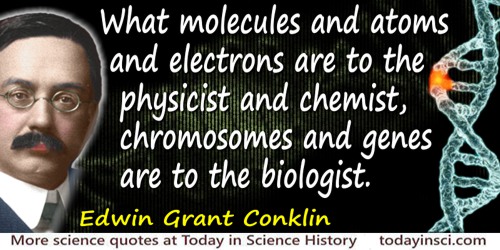
What molecules and atoms and electrons are to the physicist and chemist, chromosomes and genes are to the biologist.
From Penrose Memorial Lecture to the American Philosophical Society, Philadelphia (20 Apr 1934), published as 'A Generation's Progress in the Study of Evolution', Science (17 Aug 1934), 80, No 2068, 151.
When I received my B.S. degree in 1932, only two of the fundamental particles of physics were known. Every bit of matter in the universe was thought to consist solely of protons and electrons.
From Nobel Lecture (11 Dec 1968). Collected in Yong Zhou (ed.), Nobel Lecture: Physics, 1963-1970 (2013), 241.
With all reserve we advance the view that a supernova represents the transition of an ordinary star into a neutron star consisting mainly of neutrons. Such a star may possess a very small radius and an extremely high density. As neutrons can be packed much more closely than ordinary nuclei and electrons, the gravitational packing energy in a cold neutron star may become very large, and under certain conditions may far exceed the ordinary nuclear packing fractions...
[Co-author with Walter Baade]
[Co-author with Walter Baade]
Paper presented to American Physical Society meeting at Stanford (15-16 Dec 1933). Published in Physical Review (15 Jan 1934). Cited in P. Haensel, Paweł Haensel and A. Y. Potekhin, D. G. Yakovlev, Neutron Stars: Equation of State and Structure (2007), 2-3. Longer version of quote from Freeman Dyson, From Eros to Gaia (1992), 34. The theoretical prediction of neutron stars was made after analyzing observations of supernovae and proposed as an explanation of the enormous energy released in such explosions. It was written just two years after Chadwick discovered the neutron.
You tell me of an invisible planetary system in which electrons gravitate around a nucleus. You explain this world to me with an image. I realize that you have been reduced to poetry. … So that science that was to teach me everything ends up in a hypothesis, that lucidity founders in metaphor, that uncertainty is resolved in a work of art.
In Albert Camus and Justin O’Brien (trans.), 'An Absurd Reasoning', The Myth of Sisyphus and Other Essays (1955), 15.
 In science it often happens that scientists say, 'You know that's a really good argument; my position is mistaken,' and then they would actually change their minds and you never hear that old view from them again. They really do it. It doesn't happen as often as it should, because scientists are human and change is sometimes painful. But it happens every day. I cannot recall the last time something like that happened in politics or religion.
(1987) --
In science it often happens that scientists say, 'You know that's a really good argument; my position is mistaken,' and then they would actually change their minds and you never hear that old view from them again. They really do it. It doesn't happen as often as it should, because scientists are human and change is sometimes painful. But it happens every day. I cannot recall the last time something like that happened in politics or religion.
(1987) -- 





