Electricity Quotes (171 quotes)
… (T)he same cause, such as electricity, can simultaneously affect all sensory organs, since they are all sensitive to it; and yet, every sensory nerve reacts to it differently; one nerve perceives it as light, another hears its sound, another one smells it; another tastes the electricity, and another one feels it as pain and shock. One nerve perceives a luminous picture through mechanical irritation, another one hears it as buzzing, another one senses it as pain… He who feels compelled to consider the consequences of these facts cannot but realize that the specific sensibility of nerves for certain impressions is not enough, since all nerves are sensitive to the same cause but react to the same cause in different ways… (S)ensation is not the conduction of a quality or state of external bodies to consciousness, but the conduction of a quality or state of our nerves to consciousness, excited by an external cause.
Law of Specific Nerve Energies.
Law of Specific Nerve Energies.
Handbuch der Physiologie des Menschen für Vorlesungen, 2nd Ed. translation by Edwin Clarke and Charles Donald O'Malley
... every chemical combination is wholly and solely dependent on two opposing forces, positive and negative electricity, and every chemical compound must be composed of two parts combined by the agency of their electrochemical reaction, since there is no third force. Hence it follows that every compound body, whatever the number of its constituents, can be divided into two parts, one of which is positively and the other negatively electrical.
Essai sur la théorie des proportions chemiques (1819), 98. Quoted by Henry M. Leicester in article on Bessel in Charles Coulston Gillespie (editor), Dictionary of Scientific Biography (1981), Vol. 2, 94.
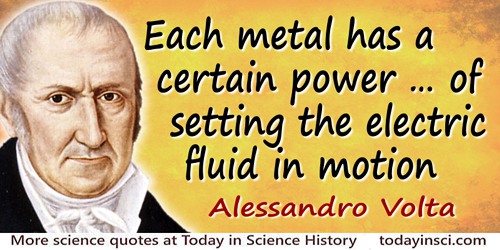
...each metal has a certain power, which is different from metal to metal, of setting the electric fluid in motion...
Le Opere, Vol. 1, 149. In Giuliano Pancaldi, Volta: Science and Culture in the Age of Enlightenment (2005), 190.
“Advance, ye mates! Cross your lances full before me. Well done! Let me touch the axis.” So saying, with extended arm, he grasped the three level, radiating lances at their crossed centre; while so doing, suddenly and nervously twitched them; meanwhile, glancing intently from Starbuck to Stubb; from Stubb to Flask. It seemed as though, by some nameless, interior volition, he would fain have shocked into them the same fiery emotion accumulated within the Leyden jar of his own magnetic life. The three mates quailed before his strong, sustained, and mystic aspect. Stubb and Flask looked sideways from him; the honest eye of Starbuck fell downright.
“In vain!&rsdquo; cried Ahab; “but, maybe, ’tis well. For did ye three but once take the full-forced shock, then mine own electric thing, that had perhaps expired from out me. Perchance, too, it would have dropped ye dead.…”
[Commentary by Henry Schlesinger: Electricity—mysterious and powerful as it seemed at the time—served as a perfect metaphor for Captain Ahab’s primal obsession and madness, which he transmits through the crew as if through an electrical circuit in Moby-Dick.]
“In vain!&rsdquo; cried Ahab; “but, maybe, ’tis well. For did ye three but once take the full-forced shock, then mine own electric thing, that had perhaps expired from out me. Perchance, too, it would have dropped ye dead.…”
[Commentary by Henry Schlesinger: Electricity—mysterious and powerful as it seemed at the time—served as a perfect metaphor for Captain Ahab’s primal obsession and madness, which he transmits through the crew as if through an electrical circuit in Moby-Dick.]
Extract from Herman Melville, Moby-Dick and comment by Henry Schlesinger from his The Battery: How Portable Power Sparked a Technological Revolution (2010), 64.
[Davy's] March of Glory, which he has run for the last six weeks—within which time by the aid and application of his own great discovery, of the identity of electricity and chemical attractions, he has placed all the elements and all their inanimate combinations in the power of man; having decomposed both the Alkalies, and three of the Earths, discovered as the base of the Alkalies a new metal... Davy supposes there is only one power in the world of the senses; which in particles acts as chemical attractions, in specific masses as electricity, & on matter in general, as planetary Gravitation... when this has been proved, it will then only remain to resolve this into some Law of vital Intellect—and all human knowledge will be Science and Metaphysics the only Science.
In November 1807 Davy gave his famous Second Bakerian Lecture at the Royal Society, in which he used Voltaic batteries to “decompose, isolate and name” several new chemical elements, notably sodium and potassium.
In November 1807 Davy gave his famous Second Bakerian Lecture at the Royal Society, in which he used Voltaic batteries to “decompose, isolate and name” several new chemical elements, notably sodium and potassium.
Letter to Dorothy Wordsworth, 24 November 1807. In Earl Leslie Griggs (ed.), The Collected Letters of Samuel Taylor Coleridge (1956), Vol. 3, 38.
[I predict] the electricity generated by water power is the only thing that is going to keep future generations from freezing. Now we use coal whenever we produce electric power by steam engine, but there will be a time when there’ll be no more coal to use. That time is not in the very distant future. … Oil is too insignificant in its available supply to come into much consideration.
As quoted in 'Electricity Will Keep The World From Freezing Up', New York Times (12 Nov 1911), SM4.
[My grandmother] lived the latter years of her life in the horrible suspicion that electricity was dripping invisibly all over the house. It leaked, she contended, out of empty sockets if the wall switch had been left on. She would go around screwing in bulbs, and if they lighted up, she would fearfully turn off the wall switch and go back to her Pearson's or Everybody's, happy in the satisfaction that she had stopped not only a costly but dangerous leakage. nothing could ever clear this up for her.
In My Life and Hard Times (1937, 1999), 16.
[The nanotube] brings those properties you cannot get from other organic molecules. And it’s still carbon, so it has organic chemistry. Here is an object that has, to a superlative degree, the aspects that we hold most central to the inorganic world: hardness, toughness, terrific strength, thermal and electrical conductivity. Things you just can’t do with bone and wood. But it’s made out of carbon. It’s something that plays the game at the same level of perfection as molecules and life.
From interview in 'Wires of Wonder', Technology Review (Mar 2001), 104, No. 2, 88.
[When I was a child] I grew up in Brooklyn, New York, and I was a street kid. … [T]here was one aspect of that environment that, for some reason, struck me as different, and that was the stars. … I could tell they were lights in the sky, but that wasn’t an explanation. I mean, what were they? Little electric bulbs on long black wires, so you couldn’t see what they were held up by? What were they? … My mother said to me, "Look, we’ve just got you a library card … get out a book and find the answer.” … It was in there. It was stunning. The answer was that the Sun was a star, except very far away. … The dazzling idea of a universe vast beyond imagining swept over me. … I sensed awe.
In 'Wonder and Skepticism', Skeptical Enquirer (Jan-Feb 1995), 19, No. 1.
I. Animals have an electricity peculiar to themselves to which the name animal electricity is given.
II. The organs in which animal electricity acts above all others, and by which it is distributed throughout the whole body, are the nerves, and the most important organ of secretion is the brain.
II. The organs in which animal electricity acts above all others, and by which it is distributed throughout the whole body, are the nerves, and the most important organ of secretion is the brain.
Thierische Elektricitäund Reizbarkeit. Ein Beytrag zu den neuesten Entdeckungen üdiese Gegenstä(1795), 329. Quoted and trans. in Edwin Clarke and C. D. O'Malley, The Human Brain and Spinal Cord (1968), 180.
A plain, reasonable working man supposes, in the old way which is also the common-sense way, that if there are people who spend their lives in study, whom he feeds and keeps while they think for him—then no doubt these men are engaged in studying things men need to know; and he expects of science that it will solve for him the questions on which his welfare, and that of all men, depends. He expects science to tell him how he ought to live: how to treat his family, his neighbours and the men of other tribes, how to restrain his passions, what to believe in and what not to believe in, and much else. And what does our science say to him on these matters?
It triumphantly tells him: how many million miles it is from the earth to the sun; at what rate light travels through space; how many million vibrations of ether per second are caused by light, and how many vibrations of air by sound; it tells of the chemical components of the Milky Way, of a new element—helium—of micro-organisms and their excrements, of the points on the hand at which electricity collects, of X rays, and similar things.
“But I don't want any of those things,” says a plain and reasonable man—“I want to know how to live.”
It triumphantly tells him: how many million miles it is from the earth to the sun; at what rate light travels through space; how many million vibrations of ether per second are caused by light, and how many vibrations of air by sound; it tells of the chemical components of the Milky Way, of a new element—helium—of micro-organisms and their excrements, of the points on the hand at which electricity collects, of X rays, and similar things.
“But I don't want any of those things,” says a plain and reasonable man—“I want to know how to live.”
In 'Modern Science', Essays and Letters (1903), 221-222.
Almost daily we shudder as prophets of doom announce the impending end of civilization and universe. We are being asphyxiated, they say, by the smoke of the industry; we are suffocating in the ever growing mountain of rubbish. Every new project depicts its measureable effects and is denounced by protesters screaming about catastrophe, the upsetting of the land, the assault on nature. If we accepted this new mythology we would have to stop pushing roads through the forest, harnessing rivers to produce the electricity, breaking grounds to extract metals, enriching the soil with chemicals, killing insects, combating viruses … But progress—basically, an effort to organise a corner of land and make it more favourable for human life—cannot be baited. Without the science of pomiculture, for example, trees will bear fruits that are small, bitter, hard, indigestible, and sour. Progress is desirable.
Uncredited. In Lachman Mehta, Stolen Treasure (2012), 117.
Although with the majority of those who study and practice in these capacities [engineers, builders, surveyors, geographers, navigators, hydrographers, astronomers], secondhand acquirements, trite formulas, and appropriate tables are sufficient for ordinary purposes, yet these trite formulas and familiar rules were originally or gradually deduced from the profound investigations of the most gifted minds, from the dawn of science to the present day. … The further developments of the science, with its possible applications to larger purposes of human utility and grander theoretical generalizations, is an achievement reserved for a few of the choicest spirits, touched from time to time by Heaven to these highest issues. The intellectual world is filled with latent and undiscovered truth as the material world is filled with latent electricity.
In Orations and Speeches, Vol. 3 (1870), 513.
Among those whom I could never pursuade to rank themselves with idlers, and who speak with indignation of my morning sleeps and nocturnal rambles, one passes the day in catching spiders, that he may count their eyes with a microscope; another exhibits the dust of a marigold separated from the flower with a dexterity worthy of Leuwenhoweck himself. Some turn the wheel of electricity; some suspend rings to a lodestone, and find that what they did yesterday, they can do again to-day.—Some register the changes of the wind, and die fully convinced that the wind is changeable.—There are men yet more profound, who have heard that two colorless liquors may produce a color by union, and that two cold bodies will grow hot of they are mingled: they mingle them, and produce the effect expected, say it is strange, and mingle them again.
In Tryon Edwards, A Dictionary of Thoughts (1908), 243.
Ampère was a mathematician of various resources & I think might rather be called excentric [sic] than original. He was as it were always mounted upon a hobby horse of a monstrous character pushing the most remote & distant analogies. This hobby horse was sometimes like that of a child ['s] made of heavy wood, at other times it resembled those [?] shapes [?] used in the theatre [?] & at other times it was like a hypogrif in a pantomime de imagie. He had a sort of faith in animal magnetism & has published some refined & ingenious memoirs to prove the identity of electricity & magnetism but even in these views he is rather as I said before excentric than original. He has always appeared to me to possess a very discursive imagination & but little accuracy of observation or acuteness of research.
'Davy’s Sketches of his Contemporaries', Chymia, 1967, 12, 135-6.
An induction shock results in a contraction or fails to do so according to its strength; if it does so at all, it produces in the muscle at that time the maximal contraction that can result from stimuli of any strength.
Über die Eigentümlichkeiten der Reizbarkeit welche die Muskelfasern des Herzen zeigen', Ber. süchs. Akad. Wiss., Math.-nat Klasse, 1871, 23, 652-689. Trans. Edwin Clarke and C. D. O'Malley, The Human Brain and Spinal Cord (1968), 218.
And by the influence of heat, light, and electrical powers, there is a constant series of changes [in animal and vegetal substances]; matter assumes new forms, the destruction of one order of beings tends to the conservation of another, solution and consolidation, decay and renovation, are connected, and whilst the parts of the system, continue in a state of fluctuation and change, the order and harmony of the whole remain unalterable.
The Elements of Agricultural Chemistry (1813), in J. Davy (ed.) The Collected Works of Sir Humphry Davy(1839-40), Vol 7, 182.
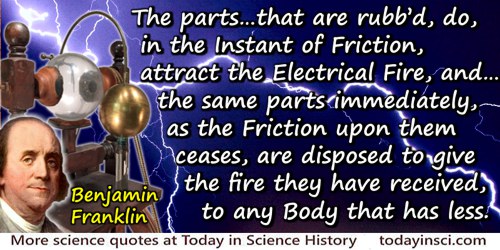
And we daily in our experiments electrise bodies plus or minus, as we think proper. [These terms we may use till your Philosophers give us better.] To electrise plus or minus, no more needs to be known than this, that the parts of the Tube or Sphere, that are rubb’d, do, in the Instant of Friction, attract the Electrical Fire, and therefore take it from the Thin rubbing; the same parts immediately, as the Friction upon them ceases, are disposed to give the fire they have received, to any Body that has less.
Letter 25 May 1747. Quoted in I. Bernard Cohen, Franklin and Newton: An Enquiry into Speculative Newtonian Experimental Science and Franklin’s Work in Electricity as an Example Thereof (1956), 439.
As every circumstance relating to so capital a discovery as this (the greatest, perhaps, that has been made in the whole compass of philosophy, since the time of Sir Isaac Newton) cannot but give pleasure to all my readers, I shall endeavour to gratify them with the communication of a few particulars which I have from the best authority. The Doctor [Benjamin Franklin], after having published his method of verifying his hypothesis concerning the sameness of electricity with the matter lightning, was waiting for the erection of a spire in Philadelphia to carry his views into execution; not imagining that a pointed rod, of a moderate height, could answer the purpose; when it occurred to him, that, by means of a common kite, he could have a readier and better access to the regions of thunder than by any spire whatever. Preparing, therefore, a large silk handkerchief, and two cross sticks, of a proper length, on which to extend it, he took the opportunity of the first approaching thunder storm to take a walk into a field, in which there was a shed convenient for his purpose. But dreading the ridicule which too commonly attends unsuccessful attempts in science, he communicated his intended experiment to no body but his son, who assisted him in raising the kite.
The kite being raised, a considerable time elapsed before there was any appearance of its being electrified. One very promising cloud passed over it without any effect; when, at length, just as he was beginning to despair of his contrivance, he observed some loose threads of the hempen string to stand erect, and to avoid one another, just as if they had been suspended on a common conductor. Struck with this promising appearance, he inmmediately presented his knuckle to the key, and (let the reader judge of the exquisite pleasure he must have felt at that moment) the discovery was complete. He perceived a very evident electric spark. Others succeeded, even before the string was wet, so as to put the matter past all dispute, and when the rain had wetted the string, he collected electric fire very copiously. This happened in June 1752, a month after the electricians in France had verified the same theory, but before he had heard of any thing that they had done.
The kite being raised, a considerable time elapsed before there was any appearance of its being electrified. One very promising cloud passed over it without any effect; when, at length, just as he was beginning to despair of his contrivance, he observed some loose threads of the hempen string to stand erect, and to avoid one another, just as if they had been suspended on a common conductor. Struck with this promising appearance, he inmmediately presented his knuckle to the key, and (let the reader judge of the exquisite pleasure he must have felt at that moment) the discovery was complete. He perceived a very evident electric spark. Others succeeded, even before the string was wet, so as to put the matter past all dispute, and when the rain had wetted the string, he collected electric fire very copiously. This happened in June 1752, a month after the electricians in France had verified the same theory, but before he had heard of any thing that they had done.
The History and Present State of Electricity, with Original Experiments (1767, 3rd ed. 1775), Vol. 1, 216-7.
As physicists have arranged an extensive series of effects under the general term of Heat, so they have named another series Light, and a third they have called Electricity. We find ... that all these principles are capable of being produced through the medium of living bodies, for nearly all animals have the power of evolving heat; many insects, moreover, can voluntarily emit light; and the property of producing electricity is well evinced in the terrible shock of the electric eel, as well as in that of some other creatures. We are indeed in the habit of talking of the Electric fluid, or the Galvanic fluid, but this in reality is nothing but a licence of expression suitable to our finite and material notions.
In the Third Edition of Elements of Electro-Metallurgy: or The Art of Working in Metals by the Galvanic Fluid (1851), 1.
As plants convert the minerals into food for animals, so each man converts some raw material in nature to human use. The inventors of fire, electricity, magnetism, iron, lead, glass, linen, silk, cotton; the makers of tools; the inventor of decimal notation, the geometer, the engineer, the musician, severally make an easy way for all, through unknown and impossible confusions.
In 'Uses of Great Men', Representative Men (1850), 5-6.
As the nineteenth century drew to a close, scientists could reflect with satisfaction that they had pinned down most of the mysteries of the physical world: electricity, magnetism, gases, optics, acoustics, kinetics and statistical mechanics … all had fallen into order before them. They had discovered the X ray, the cathode ray, the electron, and radioactivity, invented the ohm, the watt, the Kelvin, the joule, the amp, and the little erg.
A Short History of Nearly Everything. In Clifford A. Pickover, Archimedes to Hawking: Laws of Science and the Great Minds Behind Them (2008), 172.
Ask a follower of Bacon what [science] the new philosophy, as it was called in the time of Charles the Second, has effected for mankind, and his answer is ready; “It has lengthened life; it has mitigated pain; it has extinguished diseases; it has increased the fertility of the soil; it has given new securities to the mariner; it has furnished new arms to the warrior; it has spanned great rivers and estuaries with bridges of form unknown to our fathers; it has guided the thunderbolt innocuously from heaven to earth; it has lighted up the night with the splendour of the day; it has extended the range of the human vision; it has multiplied the power of the human muscles; it has accelerated motion; it has annihilated distance; it has facilitated intercourse, correspondence, all friendly offices, all dispatch of business; it has enabled man to descend to the depths of the sea, to soar into the air, to penetrate securely into the noxious recesses of the earth, to traverse the land in cars which whirl along without horses, to cross the ocean in ships which run ten knots an hour against the wind. These are but a part of its fruits, and of its first-fruits; for it is a philosophy which never rests, which has never attained, which is never perfect. Its law is progress. A point which yesterday was invisible is its goal to-day, and will be its starting-point to-morrow.”
From essay (Jul 1837) on 'Francis Bacon' in Edinburgh Review. In Baron Thomas Babington Macaulay and Lady Trevelyan (ed.) The Works of Lord Macaulay Complete (1871), Vol. 6, 222.
Besides electrical engineering theory of the transmission of messages, there is a larger field [cybernetics] which includes not only the study of language but the study of messages as a means of controlling machinery and society, the development of computing machines and other such automata, certain reflections upon psychology and the nervous system, and a tentative new theory of scientific method.
In Cybernetics (1948).
Bread has been made (indifferent) from potatoes;
And galvanism has set some corpses grinning,
But has not answer'd like the apparatus
Of the Humane Society's beginning,
By which men are unsuffocated gratis:
What wondrous new machines have late been spinning.
And galvanism has set some corpses grinning,
But has not answer'd like the apparatus
Of the Humane Society's beginning,
By which men are unsuffocated gratis:
What wondrous new machines have late been spinning.
Don Juan (1819, 1858), Canto I, CXXX, 35. Aware of scientific experiments, the poet refers to the animating effects of electrical current on nerves of human corpses investigated by Professor Aldini (nephew of Galvani) on the body of Forster, a murderer (Jan-Feb 1803). Potato flour can be made by grinding dried grated potatoes.
But nothing of a nature foreign to the duties of my profession [clergyman] engaged my attention while I was at Leeds so much as the, prosecution of my experiments relating to electricity, and especially the doctrine of air. The last I was led into a consequence of inhabiting a house adjoining to a public brewery, where first amused myself with making experiments on fixed air [carbon dioxide] which found ready made in the process of fermentation. When I removed from that house, I was under the necessity making the fixed air for myself; and one experiment leading to another, as I have distinctly and faithfully noted in my various publications on the subject, I by degrees contrived a convenient apparatus for the purpose, but of the cheapest kind. When I began these experiments I knew very little of chemistry, and had in a manner no idea on the subject before I attended a course of chymical lectures delivered in the Academy at Warrington by Dr. Turner of Liverpool. But I have often thought that upon the whole, this circumstance was no disadvantage to me; as in this situation I was led to devise an apparatus and processes of my own, adapted to my peculiar views. Whereas, if I had been previously accustomed to the usual chemical processes, I should not have so easily thought of any other; and without new modes of operation I should hardly have discovered anything materially new.
Memoirs of Dr. Joseph Priestley, in the Year 1795 (1806), Vol. 1, 61-2.
But when we face the great questions about gravitation Does it require time? Is it polar to the 'outside of the universe' or to anything? Has it any reference to electricity? or does it stand on the very foundation of matter–mass or inertia? then we feel the need of tests, whether they be comets or nebulae or laboratory experiments or bold questions as to the truth of received opinions.
Letter to Michael Faraday, 9 Nov 1857. In P. M. Harman (ed.), The Scientific Letters and Papers of James Clerk Maxwell (1990), Vol. 1, 1846-1862, 551-2.
By research in pure science I mean research made without any idea of application to industrial matters but solely with the view of extending our knowledge of the Laws of Nature. I will give just one example of the ‘utility’ of this kind of research, one that has been brought into great prominence by the War—I mean the use of X-rays in surgery. Now, not to speak of what is beyond money value, the saving of pain, or, it may be, the life of the wounded, and of bitter grief to those who loved them, the benefit which the state has derived from the restoration of so many to life and limb, able to render services which would otherwise have been lost, is almost incalculable. Now, how was this method discovered? It was not the result of a research in applied science starting to find an improved method of locating bullet wounds. This might have led to improved probes, but we cannot imagine it leading to the discovery of X-rays. No, this method is due to an investigation in pure science, made with the object of discovering what is the nature of Electricity. The experiments which led to this discovery seemed to be as remote from ‘humanistic interest’ —to use a much misappropriated word—as anything that could well be imagined. The apparatus consisted of glass vessels from which the last drops of air had been sucked, and which emitted a weird greenish light when stimulated by formidable looking instruments called induction coils. Near by, perhaps, were great coils of wire and iron built up into electro-magnets. I know well the impression it made on the average spectator, for I have been occupied in experiments of this kind nearly all my life, notwithstanding the advice, given in perfect good faith, by non-scientific visitors to the laboratory, to put that aside and spend my time on something useful.
In Speech made on behalf of a delegation from the Conjoint Board of Scientific Studies in 1916 to Lord Crewe, then Lord President of the Council. In George Paget Thomson, J. J. Thomson and the Cavendish Laboratory in His Day (1965), 167-8.
Chagrined a little that we have been hitherto able to produce nothing in this way of use to mankind; and the hot weather coming on, when electrical experiments are not so agreeable, it is proposed to put an end to them for this season, somewhat humorously, in a party of pleasure, on the banks of Skuylkil. Spirits, at the same time, are to be fired by a spark sent from side to side through the river, without any other conductor that the water; an experiment which we some time since performed, to the amazement of many. A turkey is to be killed for our dinner by the electrified bottle: when the healths of all the famous electricians in England, Holland, France, and Germany are to be drank in electrified bumpers, under the discharge of guns from the electrical battery.
Letter to Peter Collinson, 29 Apr 1749. In I. Bernard Cohen (ed.), Benjamin Franklin's Experiments (1941), 199-200.
Computers and rocket ships are examples of invention, not of understanding. … All that is needed to build machines is the knowledge that when one thing happens, another thing happens as a result. It’s an accumulation of simple patterns. A dog can learn patterns. There is no “why” in those examples. We don’t understand why electricity travels. We don’t know why light travels at a constant speed forever. All we can do is observe and record patterns.
In God's Debris: A Thought Experiment (2004), 22.
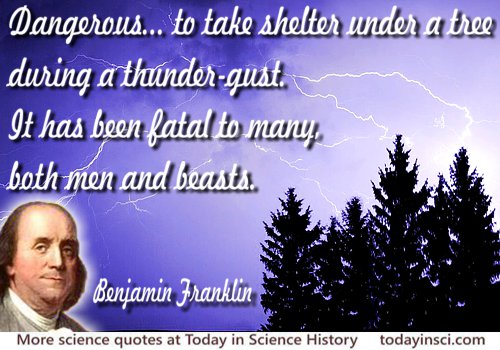
Dangerous, therefore, is it to take shelter under a tree, during a thunder-gust. It has been fatal to many, both men and beasts.
'Letter IV. Containing Observations and Suppositions towards forming a new Hypothesis, for explaining the several Phænomena of Thunder-Gusts', in Experiments and Observations on Electricity, Made at Philadelphia in America by Mr. Benjamin Franklin, and Commnicated in Several Letters to Mr. P. Collinson, of London, F.R.S. (1751), 47. In the book, the letter is undated, but it is printed after a footnote dated 29 Apr 1749, and is followed by one dated 29 Jul 1750. Therefore, it is assumed by later authors to have been written in summer 1749. When I. Bernard Cohen editted Benjamin Franklin's Experiments (1941), 209, he wrote that the letter was wrtten during summer or autumn of 1749 and “was dispatched, not to Collinson, but to Dr John Mitchel F.R.S." In his later books, Cohen dates it as 29 Apr 1749.
Do not electric bodies by friction emit a subtile exhalation or spirit by which they perform their attractions?
As quoted in Roderick W. Home, Electricity and Experimental Physics in Eighteenth-Century Europe (1992), 103.
Do you realize we’ve got 250 million years of coal? But coal has got environmental hazards to it, but there’s—I’m convinced, and I know that we—technology can be developed so we can have zero-emissions coal-fired electricity plants.
Remarks at the Associated Builders and Contractors National Legislative Conference (8 Jun 2005). The White house corrected “250 million years” to “250 years” in a footnote to the printed record, 41 WCPD 956 in 'Administration of George W. Bush', 959.
Electric and magnetic forces. May they live for ever, and never be forgot, if only to remind us that the science of electromagnetics, in spite of the abstract nature of its theory, involving quantities whose nature is entirely unknown at the present, is really and truly founded on the observations of real Newtonian forces, electric and magnetic respectively.
From 'Electromagnetic Theory, CXII', The Electrician (23 Feb 1900), Vol. 44, 615.
Electricity is actually made up of extremely tiny particles called electrons, that you cannot see with the naked eye unless you have been drinking.
In The Taming of the Screw: How to Sidestep Several Million Homeowner's Problems (1983), 12.
Electricity is but yet a new agent for the arts and manufactures, and, doubtless, generations unborn will regard with interest this century, in which it has been first applied to the wants of mankind.
In Preface to the Third Edition ofElements of Electro-Metallurgy: or The Art of Working in Metals by the Galvanic Fluid (1851), viii.
Electricity is doing for the distribution of energy what the railroads have done for the distribution of materials.
As quoted in 'C.P. Steinmetz Dies In Sudden Relapse', New York Times (27 Oct 1923), 1.
Electricity is often called wonderful, beautiful; but it is so only in common with the other forces of nature. The beauty of electricity or of any other force is not that the power is mysterious, and unexpected, touching every sense at unawares in turn, but that it is under law, and that the taught intellect can even govern it largely. The human mind is placed above, and not beneath it, and it is in such a point of view that the mental education afforded by science is rendered super-eminent in dignity, in practical application and utility; for by enabling the mind to apply the natural power through law, it conveys the gifts of God to man.
Notes for a Friday Discourse at the Royal Institution (1858).
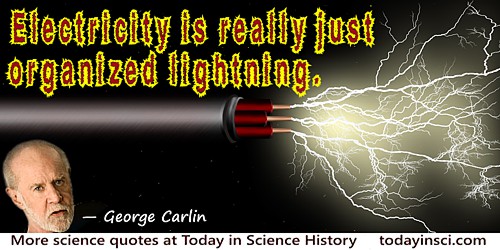
Electricity is really just organized lightning.
In Napalm and Silly Putty (2002), 170.
ELECTRICITY, n. The power that causes all natural phenomena not known to be caused by something else. It is the same thing as lightning, and its famous attempt to strike Dr. Franklin is one of the most picturesque incidents in that great and good man's career. The memory of Dr. Franklin is justly held in great reverence, particularly in France, where a waxen effigy of him was recently on exhibition, bearing the following touching account of his life and services to science:
Monsieur Franqulin, inventor of electricity. This illustrious savant, after having made several voyages around the world, died on the Sandwich Islands and was devoured by savages, of whom not a single fragment was ever recovered.
Electricity seems destined to play a most important part in the arts and industries. The question of its economical application to some purposes is still unsettled, but experiment has already proved that it will propel a street car better than a gas jet and give more light than a horse.
Monsieur Franqulin, inventor of electricity. This illustrious savant, after having made several voyages around the world, died on the Sandwich Islands and was devoured by savages, of whom not a single fragment was ever recovered.
Electricity seems destined to play a most important part in the arts and industries. The question of its economical application to some purposes is still unsettled, but experiment has already proved that it will propel a street car better than a gas jet and give more light than a horse.
The Cynic's Word Book (1906), 87. Also published later as The Devil's Dictionary.
Engineers apply the theories and principles of science and mathematics to research and develop economical solutions to practical technical problems. Their work is the link between scientific discoveries and commercial applications. Engineers design products, the machinery to build those products, the factories in which those products are made, and the systems that ensure the quality of the product and efficiency of the workforce and manufacturing process. They design, plan, and supervise the construction of buildings, highways, and transit systems. They develop and implement improved ways to extract, process, and use raw materials, such as petroleum and natural gas. They develop new materials that both improve the performance of products, and make implementing advances in technology possible. They harness the power of the sun, the earth, atoms, and electricity for use in supplying the Nation’s power needs, and create millions of products using power. Their knowledge is applied to improving many things, including the
quality of health care, the safety of food products, and the efficient operation of financial systems.
Bureau of Labor Statistics, Occupational Outlook Handbook (2000) as quoted in Charles R. Lord. Guide to Information Sources in Engineering (2000), 5. This definition has been revised and expanded over time in different issues of the Handbook.
Every discoverer of a new truth, or inventor of the method which evolves it, makes a dozen, perhaps fifty, useless combinations, experiments, or trials for one successful one. In the realm of electricity or of mechanics there is no objection to this. But when such rejected failures involve a torture of animals, sometimes fearful in its character, there is a distinct objection to it.
From 'Vivisection', an original paper in Surgical Anaesthesia: Addresses, and Other Papers (1894, 1900), 369-370.
Faith is like electricity. You can't see it, but you can see its light shining on you.
In 'Quotes and Quips', Hinduism Today Magazine (Jan-Mar 2009), web edition.
Faraday, … by his untiring faithfulness in keeping his diary, contributes to our understanding the objects of his scientific research in magnetism, electricity and light, but he also makes us understand the scientist himself, as a living subject, the mind in action.
In 'The Scientific Grammar of Michael Faraday’s Diaries', Part I, 'The Classic of Science', A Classic and a Founder (1937), collected in Rosenstock-Huessy Papers (1981), Vol. 1, 2.
Firm support has been found for the assertion that electricity occurs at thousands of points where we at most conjectured that it was present. Innumerable electrical particles oscillate in every flame and light source. We can in fact assume that every heat source is filled with electrons which will continue to oscillate ceaselessly and indefinitely. All these electrons leave their impression on the emitted rays. We can hope that experimental study of the radiation phenomena, which are exposed to various influences, but in particular to the effect of magnetism, will provide us with useful data concerning a new field, that of atomistic astronomy, as Lodge called it, populated with atoms and electrons instead of planets and worlds.
'Light Radiation in a Magnetic Field', Nobel Lecture, 2 May 1903. In Nobel Lectures: Physics 1901-1921 (1967), 40.
Franklin brought down the lightning, Morse made it a bearer of dispatches, and in answer to the increasing human demands of progressive human nature, Daguerre has taught the god of day to deck the world with pictures far beyond the art of ancient masters.
In Henry Louis Gates, Jr. (ed.), The Portable Frederick Douglass (2016), 350.
Gravity. Surely this force must be capable of an experimental relation to electricity, magnetism, and the other forces, so as to bind it up with them in reciprocal action and equivalent effect.
Notebook entry (19 Mar 1849). In Bence Jones (ed.), The Life and Letters of Faraday (1870), Vol. 2, 252.
Heat energy of uniform temperature [is] the ultimate fate of all energy. The power of sunlight and coal, electric power, water power, winds and tides do the work of the world, and in the end all unite to hasten the merry molecular dance.
Matter and Energy (1911), 140.
I am an expert of electricity. My father occupied the chair of applied electricity at the state prison.
Movie, The Big Broadcast of 1938 (1938). In Larry Langman and Paul Gold, Comedy Quotes from the Movies (2001), 248. Note that this is a variation of a similar joke published nearly two decades earlier. For example, ‘My father occupied the chair of applied physics at Cambridge.’ ‘Dat’s nuttin’; mine occupied the seat of applied electricity at Sing Sing. —Voo Doo.” included in University of Virginia, Virginia Reel (May 1920), Vol. 1, 68.
I did not expect to find the electric cable in its primitive state, such as it was on leaving the manufactory. The long serpent, covered with the remains of shells, bristling with foraminiferae, was encrusted with a strong coating which served as a protection against all boring mollusks. It lay quietly sheltered from the motions of the sea, and under a favorable pressure for the transmission of the electric spark which passes from Europe to America in .32 of a second. Doubtless this cable will last for a great length of time, for they find that the gutta-percha covering is improved by the sea water.
[Referring to the Transatlantic telegraph cable laid in 1866, as viewed from the fictional submarine Nautilus.]
[Referring to the Transatlantic telegraph cable laid in 1866, as viewed from the fictional submarine Nautilus.]
Twenty Thousand Leagues Under The Seas, (1874), 285. Translated from the original French edition, Vingt Mille Lieues Sous Les Mers (1870).
I had observed that there were different lines exhibited in the spectra of different metals when ignited in the voltaic arc; and if I had had any reasonable amount of wit I ought to have seen the converse, viz., that by ignition different bodies show in their spectral lines the materials of which they are formed. If that thought had occured to my mind, I should have discovered the spectroscope before Kirchoff; but it didn’t.
Address, in 'Report to the Chemical Society's Jubilee', Nature (26 Mar 1891), 43, 493. Words as in original text, occured and Kirchoff are sic.
I happen to have discovered a direct relation between magnetism and light, also electricity and light, and the field it opens is so large and I think rich.
Letter to Christian Schönbein (13 Nov 1845), The Letters of Faraday and Schoenbein, 1836-1862 (1899), 148.
I have been much amused at ye singular φενόμενα [phenomena] resulting from bringing of a needle into contact with a piece of amber or resin fricated on silke clothe. Ye flame putteth me in mind of sheet lightning on a small—how very small—scale.
Letter to Dr. Law (15 Dec 1716) as quoted in Norman Lockyer, (ed.), Nature (25 May 1881), 24, 39. The source refers to it as an unpublished letter. Newton's comment relating the spark of static electricity with lightning long predates the work of Benjamin Franklin.
I have rather, however, been desirous of discovering new facts and new relations dependent on magneto-electric induction, than of exalting the force of those already obtained; being assured that the latter would find their full development hereafter.
Read 12 Jan 1832, reprinted from Philosophical Transactions of 1831-1828, in 'Second Series', Experimental Researches in Electricity: Volume 1 (1839), 47.
I have read somewhere that the resistance offered by a wire ... is affected by the tension of the wire. If this is so, a continuous current of electricity passed through a vibrating wire should meet with a varying resistance, and hence a pulsatory action should be induced in the current ... [corresponding] in amplitude, as well as in rate of movement, to the vibrations of the string ... [Thus] the timbre of a sound [a quality essential to intelligible speech] could be transmitted ... [and] the strength of the current can be increased ad libitum without destroying the relative intensities of the vibrations.
Letter to Gardiner Greene Hubbard (4 May 1875), 3-4. Bell Papers, Library of Congress.
I must own I am much in the dark about light. I am not satisfied with the doctrine that supposes particles of matter, called light … May not all the phenomena of light be more conveniently solved, by supposing universal space filled with a subtle elastic fluid, which, when at rest, is not visible, but whose vibrations affect that fine sense in the eye, as … the ear … in the case of sound … May not different degrees of the vibration of the above-mentioned universal medium occasion the appearances of different colors? I think the electric fluid is always the same; yet I find that weaker and stronger sparks differ in apparent color; some white, blue, purple, red; the strongest, white; weak ones, red.
In Letter (23 Apr 1752) to Calwallader Colden, collected in William Duane (ed.), Memoirs of Benjamin Franklin (1834), Vol. 2, 270.
I must reject fluids and ethers of all kinds, magnetical, electrical, and universal, to whatever quintessential thinness they may be treble distilled, and (as it were) super-substantiated.
Hints Towards the Formation of a more Comprehensive Theory of Life (1848). In The Collected Works of Samuel Taylor Coleridge: Shorter Works and Fragments (1995), H. J. Jackson and J. R. de J. Jackson (eds.), Vol 11, 1, 502.
I venture to assert that the feelings one has when the beautiful symbolism of the infinitesimal calculus first gets a meaning, or when the delicate analysis of Fourier has been mastered, or while one follows Clerk Maxwell or Thomson into the strange world of electricity, now growing so rapidly in form and being, or can almost feel with Stokes the pulsations of light that gives nature to our eyes, or track with Clausius the courses of molecules we can measure, even if we know with certainty that we can never see them I venture to assert that these feelings are altogether comparable to those aroused in us by an exquisite poem or a lofty thought.
In paper (May 1891) read before Bath Branch of the Teachers’ Guild, published in The Practical Teacher (July 1891), reprinted as 'Geometry', in Frederic Spencer, Chapters on the Aims and Practice of Teaching (1897), 194.
I will set ambitious goals—to see 500 million solar panels installed within four years and enough renewable electricity to power every home in America within 10 years.
In Hillary Clinton, 'Hillary Clinton: America Must Lead at Paris Climate Talks', Time (29 Nov 2015).
I've found out so much about electricity that I've reached the point where I understand nothing and can explain nothing.
[Describing his experiments with the Leyden jar.]
[Describing his experiments with the Leyden jar.]
Letter to Réamur (20 Jan 1746), in AS. Proc. verb., LXV (1746), 6. Cited in J. L. Heilbron, Electricity in the 17th and 18th Centuries: a Study of Early Modern Physics (1979), 314.
If there is a regulation that says you have to do something—whether it be putting in seat belts, catalytic converters, clean air for coal plants, clean water—the first tack that the lawyers use, among others things, and that companies use, is that it’s going to drive the electricity bill up, drive the cost of cars up, drive everything up. It repeatedly has been demonstrated that once the engineers start thinking about it, it’s actually far less than the original estimates. We should remember that when we hear this again, because you will hear it again.
Talk (Apr 2007) quoted in 'Obama's Energy and Environment Team Includes a Nobel Laureate', Kent Garber, US News website (posted 11 Dec 2008).
If we turn to the problems to which the calculus owes its origin, we find that not merely, not even primarily, geometry, but every other branch of mathematical physics—astronomy, mechanics, hydrodynamics, elasticity, gravitation, and later electricity and magnetism—in its fundamental concepts and basal laws contributed to its development and that the new science became the direct product of these influences.
Opening of Presidential Address (27 Apr 1907) to the American Mathematical Society, 'The Calculus in Colleges and Technical Schools', published in Bulletin of the American Mathematical Society (Jun 1907), 13, 449.
In 1891, during the Presidency of William Henry Harrison [Benjamin Harrison], electric lights were first installed in the White House, the residence of the leaders of our country. At that time, commercial electricity was not economically feasible, but President Harrison wanted to affirm his confidence in the technological capability of our country.
Speech, at dedication of solar panels on the White House roof, 'Solar Energy Remarks Announcing Administration Proposals' (20 Jun 1979).
In experimenting on the arc, my aim was not so much to add to the large number of isolated facts that had already been discovered, as to form some idea of the bearing of these upon one another, and thus to arrive at a clear conception of what takes place in each part of the arc and carbons at every moment. The attempt to correlate all the known phenomena, and to bind them together into one consistent whole, led to the deduction of new facts, which, when duly tested by experiment, became parts of the growing body, and, themselves, opened up fresh questions, to be answered in their turn by experiment.
In The Electric Arc (1902), Preface, iii. Ayrton described the growth of her published work on the electric arc, from a series of articles in The Electrician in 1895-6, to the full book, which “has attained to its present proportions almost with the growth of an organic body.”
In fact, I’ve come to the conclusion that I never did know anything about it [electricity].
In going on with these Experiments, how many pretty systems do we build, which we soon find ourselves oblig’d to destroy! If there is no other Use discover’d of Electricity, this, however, is something considerable, that it may help to make a vain Man humble.
Letter to Peter Collinson, 14 Aug 1747. In I. Bernard Cohen (ed.), Benjamin Franklin’s Experiments (1941), 63.
In that memorable year, 1822: Oersted, a Danish physicist, held in his hands a piece of copper wire, joined by its extremities to the two poles of a Volta pile. On his table was a magnetized needle on its pivot, and he suddenly saw (by chance you will say, but chance only favours the mind which is prepared) the needle move and take up a position quite different from the one assigned to it by terrestrial magnetism. A wire carrying an electric current deviates a magnetized needle from its position. That, gentlemen, was the birth of the modern telegraph.
Le hasard favorise l’esprit preparé
Le hasard favorise l’esprit preparé
Inaugural Address as newly appointed Professor and Dean (Sep 1854) at the opening of the new Faculté des Sciences at Lille (7 Dec 1854). In René Vallery-Radot, The Life of Pasteur, translated by Mrs. R. L. Devonshire (1919), 76.
In the early days of telephone engineering, the mere sending of a message was so much of a miracle that nobody asked how it should be sent.
In The Human Use of Human Beings: Cybernetics and Society (1950), 4.
In the expressions we adopt to prescribe physical phenomena we necessarily hover between two extremes. We either have to choose a word which implies more than we can prove, or we have to use vague and general terms which hide the essential point, instead of bringing it out. The history of electrical theories furnishes a good example.
Opening Address to the Annual Meeting of the British Association by Prof. Arthur Schuster, in Nature (4 Aug 1892), 46, 325.
In using the present in order to reveal the past, we assume that the forces in the world are essentially the same through all time; for these forces are based on the very nature of matter, and could not have changed. The ocean has always had its waves, and those waves have always acted in the same manner. Running water on the land has ever had the same power of wear and transportation and mathematical value to its force. The laws of chemistry, heat, electricity, and mechanics have been the same through time. The plan of living structures has been fundamentally one, for the whole series belongs to one system, as much almost as the parts of an animal to the one body; and the relations of life to light and heat, and to the atmosphere, have ever been the same as now.
In 'Introduction', Manual of Geology: Treating of the Principles of the Science (1863), 7.
Is it a fact—or have I dreamt it—that, by means of electricity, the world of matter has become a great nerve, vibrating thousands of miles in a breathless point of time?
In The House of the Seven Gables (1851), 203.
Is it not true that electricity, and all the prodigies it has hitherto discovered, have only served to excite curiosity?
Letter to Jean le Rond D'Alembert (7 Jan 1768). Collected in Correspondence: Letters Between Frederick II and M. D’Alembert (1789), 79, as translated by Thomas Holcroft.
It costs … more than a million dollars to produce each gallon of petroleum when the amount of energy as heat and pressure used for the length of time necessary … is charged for at [1980 U.S. retail rates for electrical energy].
In Critical Path (1982), 200.
It did not cause anxiety that Maxwell’s equations did not apply to gravitation, since nobody expected to find any link between electricity and gravitation at that particular level. But now physics was faced with an entirely new situation. The same entity, light, was at once a wave and a particle. How could one possibly imagine its proper size and shape? To produce interference it must be spread out, but to bounce off electrons it must be minutely localized. This was a fundamental dilemma, and the stalemate in the wave-photon battle meant that it must remain an enigma to trouble the soul of every true physicist. It was intolerable that light should be two such contradictory things. It was against all the ideals and traditions of science to harbor such an unresolved dualism gnawing at its vital parts. Yet the evidence on either side could not be denied, and much water was to flow beneath the bridges before a way out of the quandary was to be found. The way out came as a result of a brilliant counterattack initiated by the wave theory, but to tell of this now would spoil the whole story. It is well that the reader should appreciate through personal experience the agony of the physicists of the period. They could but make the best of it, and went around with woebegone faces sadly complaining that on Mondays, Wednesdays, and Fridays they must look on light as a wave; on Tuesdays, Thursdays, and Saturdays, as a particle. On Sundays they simply prayed.
The Strange Story of the Quantum (1947), 42.
It is arguable whether the human race have been gainers by the march of science beyond the steam engine. Electricity opens a field of infinite conveniences to ever greater numbers, but they may well have to pay dearly for them. But anyhow in my thought I stop short of the internal combustion engine which has made the world so much smaller. Still more must we fear the consequences of entrusting a human race so little different from their predecessors of the so-called barbarous ages such awful agencies as the atomic bomb. Give me the horse.
Address to the Royal College of Surgeons (10 Jul 1951). Collected in Stemming the Tide: Speeches 1951 and 1952 (1953), 91.
It is by no means hopeless to expect to make a machine for really very difficult mathematical problems. But you would have to proceed step-by-step. I think electricity would be the best thing to rely on.
In Charles Sanders Peirce, Max Harold Fisch, Christian J. W. Kloesel Writings of Charles S. Peirce: 1884-1886 (1993), 422.
It is impossible not to feel stirred at the thought of the emotions of man at certain historic moments of adventure and discovery—Columbus when he first saw the Western shore, Pizarro when he stared at the Pacific Ocean, Franklin when the electric spark came from the string of his kite, Galileo when he first turned his telescope to the heavens. Such moments are also granted to students in the abstract regions of thought, and high among them must be placed the morning when Descartes lay in bed and invented the method of co-ordinate geometry.
Quoted in James Roy Newman, The World of Mathematics (2000), Vol. 1, 239.
It is often said that all the conditions for the first production of a living being are now present, which could ever have been present. But if (and oh what a big if) we could conceive in some warm little pond with all sort of ammonia and phosphoric salts—light, heat, electricity present, that a protein compound was chemically formed, ready to undergo still more complex changes, at the present such matter would be instantly devoured, or absorbed, which would not have been the case before living creatures were formed.
Letter (1 Feb 1871) to Joseph Dalton Hooker. In The Life and Letters of Charles Darwin (1888), Vol. 3, 18.
It is often said that all the conditions for the first production of a living organism are now present, which could have ever been present. But if (and oh! what a big if!) we could conceive in some warm pond, with all sorts of ammonia and phosphoric salts, light, heat, electricity, &c., present, that a proteine compound was chemically formed ready to undergo still more complex changes, at the present day such matter would be instantly devoured or absorbed, which would not have been the case before living creatures were formed.
Letter; as quoted in The Origin of Life by J.D. Bernal (1967) publ.Weidenfeld and Nicholson, London
It is the triumph of civilization that at last communities have obtained such a mastery over natural laws that they drive and control them. The winds, the water, electricity, all aliens that in their wild form were dangerous, are now controlled by human will, and are made useful servants.
In Tryon Edwards, A Dictionary of Thoughts (1908), 75.
It seems to me, he says, that the test of “Do we or not understand a particular subject in physics?” is, “Can we make a mechanical model of it?” I have an immense admiration for Maxwell’s model of electromagnetic induction. He makes a model that does all the wonderful things that electricity docs in inducing currents, etc., and there can be no doubt that a mechanical model of that kind is immensely instructive and is a step towards a definite mechanical theory of electromagnetism.
From stenographic report by A.S. Hathaway of the Lecture 20 Kelvin presented at Johns Hopkins University, Baltimore, on 'Molecular Dynamics and the Wave Theory of Light' (1884), 132. (Hathaway was a Mathematics fellow there.) This remark is not included in the first typeset publication—a revised version, printed twenty years later, in 1904, as Lord Kelvin’s Baltimore Lectures on Molecular Dynamics and the Wave Theory of Light. The original notes were reproduced by the “papyrograph” process. They are excerpted in Pierre Maurice Marie Duhem, Essays in the History and Philosophy of Science (1996), 54-55.
It was necessary to invent everything. Dynamos, regulators, meters, switches, fuses, fixtures, underground conductors with their necessary connecting boxes, and a host of other detail parts, even down to insulating tape.
Concerning the electrical system to power his customers’ electric lights.
It will be a general expression of the facts that have been detailed, relating to the changes and transitions by electricity, in common philosophical language, to say, that hydrogen, the alkaline substances, the metals, and certain metallic oxides, are all attracted by negatively electrified metallic surfaces; and contrariwise, that oxygen and acid substances are attracted by positively electrified metallic surfaces and rejected by negatively electrified metallic surfaces; and these attractive and repulsive forces are sufficiently energetic to destroy or suspend the usual operation of elective affinity.
Bakerian Lecture, 'On Some Chemical Agencies of Electricity', Philosophical Transactions of the Royal Society, 1807, 97, 28-29.
Life through many long periods has been manifested in a countless host of varying structures, all circumscribed by one general plan, each appointed to a definite place, and limited to an appointed duration. On the whole the earth has been thus more and more covered by the associated life of plants and animals, filling all habitable space with beings capable of enjoying their own existence or ministering to the enjoyment of others; till finally, after long preparation, a being was created capable of the wonderful power of measuring and weighing all the world of matter and space which surrounds him, of treasuring up the past history of all the forms of life, and considering his own relation to the whole. When he surveys this vast and co-ordinated system, and inquires into its history and origin, can he be at a loss to decide whether it be a work of Divine thought and wisdom, or the fortunate offspring of a few atoms of matter, warmed by the anima mundi, a spark of electricity, or an accidental ray of sunshine?
Life on the Earth: Its Origin and Succession (1860), 216-7.
Looking at the thunder machine which had been set up, I saw not the slightest indication of the presence of electricity. However, while they were putting the food on the table, I obtained extraordinary electric sparks from the wire. My wife and others approached from it, for the reason that I wished to have witnesses see the various colors of fire about which the departed Professor Richmann used to argue with me. Suddenly it thundered most violently at the exact time that I was holding my hand to the metal, and sparks crackled. All fled away from me, and my wife implored that I go away. Curiosity kept me there two or three minutes more, until they told me that the soup was getting cold. By that time the force of electricity greatly subsided. I had sat at table only a few minutes when the man servant of the departed Richmann suddenly opened the door, all in tears and out of breath from fear. I thought that some one had beaten him as he was on his way to me, but he said, with difficulty, that the professor had been injured by thunder… . Nonetheless, Mr. Richmann died a splendid death, fulfilling a duty of his profession.
As quoted in Boris Menshutkin, 'Lomonosov: Excerpts', collected in Thomas Riha (ed.), Readings for Introduction to Russian Civilization (1963), Vol. 2, 30.
Magnetism, galvanism, electricity, are “one form of many names.” Without magnetism we should never have discovered America; to which we are indebted for nothing but evil; diseases in the worst forms that can afflict humanity, and slavery in the worst form in which slavery can exist. The Old World had the sugar-cane and the cotton-plant, though it did not so misuse them.
Written for fictional character, the Rev. Dr. Opimian, in Gryll Grange (1861), collected in Sir Henry Cole (ed.) The Works of Thomas Love Peacock(1875), Vol. 2, 382. [Hans Øersted discovered electromagnetism in 1820. Presumably the next reference to magnetism refers to a compass needle for navigation. —Webmaster]
Millions and immortality are well within reach of the man who discovers or devises a practical substitute for coal. Never has a great chemical problem come so close to the lives of the people. Science asks for a fuel which will be cheap, accessible, and plentiful, from which light, heat, electricity, and motion in all its modes may he generated. Science so far finds no
answer. …
[N]atural gas has been found in limited areas and quantities only. Artificial gas is generated, like electricity—both admirable heating and lighting agents—from the coal pile. …
Air, earth, water, and fire—the elemental three are useless to humanity without the fourth. So far earth has furnished the source of heat and light. But the coal beds cannot last forever. What has earth to offer in place of coal?
[N]atural gas has been found in limited areas and quantities only. Artificial gas is generated, like electricity—both admirable heating and lighting agents—from the coal pile. …
Air, earth, water, and fire—the elemental three are useless to humanity without the fourth. So far earth has furnished the source of heat and light. But the coal beds cannot last forever. What has earth to offer in place of coal?
— Magazine
In 'A Fuel to Supplant Coal', Harper’s Weekly (18 Oct 1902), 46, No. 2391, 1490.
More than ever before in the history of science and invention, it is safe now to say what is possible and what is impossible. No one would claim for a moment that during the next five hundred years the accumulated stock of knowledge of geography will increase as it has during the last five hundred In the same way it may safely be affirmed that in electricity the past hundred years is not likely to be duplicated in the next, at least as to great, original, and far-reaching discoveries, or novel and almost revolutionary applications.
In A Century of Electricity (1890), 223.
Most American homes have alternating current, which means that the electricty goes in one direction for a while, then goes in the other direction. This prevents harmful electron buildup in the wires.
In The Taming of the Screw: How to Sidestep Several Million Homeowner’s Problems (1983), 12.
My friend was explaining electricity and I was like watt?
My position is perfectly definite. Gravitation, motion, heat, light, electricity and chemical action are one and the same object in various forms of manifestation.
Annalen der Chemie und der Pharmacie (1842). Trans. A. S. Eve and C. H. Creasey, The Life and Work of John Tyndall (1945), 94.
My theory of electrical forces is that they are called into play in insulating media by slight electric displacements, which put certain small portions of the medium into a state of distortion which, being resisted by the elasticity of the medium, produces an electromotive force ... I suppose the elasticity of the sphere to react on the electrical matter surrounding it, and press it downwards.
From the determination by Kohlrausch and Weber of the numerical relation between the statical and magnetic effects of electricity, I have determined the elasticity of the medium in air, and assuming that it is the same with the luminiferous ether I have determined the velocity of propagation of transverse vibrations.
The result is
193088 miles per second
(deduced from electrical & magnetic experiments).
Fizeau has determined the velocity of light
= 193118 miles per second
by direct experiment.
This coincidence is not merely numerical. I worked out the formulae in the country, before seeing Webers [sic] number, which is in millimetres, and I think we have now strong reason to believe, whether my theory is a fact or not, that the luminiferous and the electromagnetic medium are one.
From the determination by Kohlrausch and Weber of the numerical relation between the statical and magnetic effects of electricity, I have determined the elasticity of the medium in air, and assuming that it is the same with the luminiferous ether I have determined the velocity of propagation of transverse vibrations.
The result is
193088 miles per second
(deduced from electrical & magnetic experiments).
Fizeau has determined the velocity of light
= 193118 miles per second
by direct experiment.
This coincidence is not merely numerical. I worked out the formulae in the country, before seeing Webers [sic] number, which is in millimetres, and I think we have now strong reason to believe, whether my theory is a fact or not, that the luminiferous and the electromagnetic medium are one.
Letter to Michael Faraday (19 Oct 1861). In P. M. Harman (ed.), The Scientific Letters and Papers of James Clerk Maxwell (1990), Vol. 1, 1846-1862, 684-6.
Natural Science treats of motion and force. Many of its teachings remain as part of an educated man's permanent equipment in life.
Such are:
(a) The harder you shove a bicycle the faster it will go. This is because of natural science.
(b) If you fall from a high tower, you fall quicker and quicker and quicker; a judicious selection of a tower will ensure any rate of speed.
(c) If you put your thumb in between two cogs it will go on and on, until the wheels are arrested, by your suspenders. This is machinery.
(d) Electricity is of two kinds, positive and negative. The difference is, I presume, that one kind comes a little more expensive, but is more durable; the other is a cheaper thing, but the moths get into it.
Such are:
(a) The harder you shove a bicycle the faster it will go. This is because of natural science.
(b) If you fall from a high tower, you fall quicker and quicker and quicker; a judicious selection of a tower will ensure any rate of speed.
(c) If you put your thumb in between two cogs it will go on and on, until the wheels are arrested, by your suspenders. This is machinery.
(d) Electricity is of two kinds, positive and negative. The difference is, I presume, that one kind comes a little more expensive, but is more durable; the other is a cheaper thing, but the moths get into it.
In Literary Lapses (1918), 130.
Newton’s laws of motion made it possible to state on one page facts about nature which would otherwise require whole libraries. Maxwell’s laws of electricity and magnetism also had an abbreviating effect.
In 'Man’s Place in the Physical Universe', Bulletin of the Atomic Scientists (Sep 1965), 21, No. 7, 16.
Now, I must tell you of a strange experience which bore fruit in my later life. … We had a cold [snap] drier that ever observed before. People walking in the snow left a luminous trail behind them and a snowball thrown against an obstacle gave a flare of light like a loaf of sugar hit with a knife. [As I stroked] Mačak’s back, [it became] a sheet of light and my hand produced a shower of sparks. … My father … remarked, this is nothing but electricity, the same thing you see on the trees in a storm. My mother seemed alarmed. Stop playing with the cat, she said, he might start a fire. I was thinking abstractly. Is nature a cat? If so, who strokes its back? It can only be God, I concluded. …
I cannot exaggerate the effect of this marvelous sight on my childish imagination. Day after day I asked myself what is electricity and found no answer. Eighty years have gone by since and I still ask the same question, unable to answer it.
I cannot exaggerate the effect of this marvelous sight on my childish imagination. Day after day I asked myself what is electricity and found no answer. Eighty years have gone by since and I still ask the same question, unable to answer it.
Letter to Miss Pola Fotitch, 'A Story of Youth Told by Age' (1939). In John Ratzlaff, editor, Tesla Said (1984), 283-84. Cited in Marc J. Seifer, Wizard: The Life and Times of Nikola Tesla (1998), 5.
Ohm (a distinguished mathematician, be it noted) brought into order a host of puzzling facts connecting electromotive force and electric current in conductors, which all previous electricians had only succeeded in loosely binding together qualitatively under some rather vague statements. Even as late as 20 years ago, “quantity” and “tension” were much used by men who did not fully appreciate Ohm's law. (Is it not rather remarkable that some of Germany's best men of genius should have been, perhaps, unfairly treated? Ohm; Mayer; Reis; even von Helmholtz has mentioned the difficulty he had in getting recognised. But perhaps it is the same all the world over.)
Ohm found that the results could be summed up in such a simple law that he who runs may read it, and a schoolboy now can predict what a Faraday then could only guess at roughly. By Ohm's discovery a large part of the domain of electricity became annexed by Coulomb's discovery of the law of inverse squares, and completely annexed by Green's investigations. Poisson attacked the difficult problem of induced magnetisation, and his results, though differently expressed, are still the theory, as a most important first approximation. Ampere brought a multitude of phenomena into theory by his investigations of the mechanical forces between conductors supporting currents and magnets. Then there were the remarkable researches of Faraday, the prince of experimentalists, on electrostatics and electrodynamics and the induction of currents. These were rather long in being brought from the crude experimental state to a compact system, expressing the real essence. Unfortunately, in my opinion, Faraday was not a mathematician. It can scarely be doubted that had he been one, he would have anticipated much later work. He would, for instance, knowing Ampere's theory, by his own results have readily been led to Neumann’s theory, and the connected work of Helmholtz and Thomson. But it is perhaps too much to expect a man to be both the prince of experimentalists and a competent mathematician.
From article 'Electro-magnetic Theory II', in The Electrician (16 Jan 1891), 26, No. 661, 331.
One word characterises the most strenuous of the efforts for the advancement of science that I have made perseveringly during fifty-five years; that word is failure. I know no more of electric and magnetic force, or of the relation between ether, electricity and ponderable matter, or of chemical affinity, than I knew and tried to teach to my students of natural philosophy fifty years ago in my first session as Professor.
Address (16 Jun 1896), at Celebration for his Jubilee as Professor, at Glasgow University. Printed in The Electrician (19 Jun 1896), 37, 247.
Our children will enjoy in their homes electrical energy too cheap to meter. … Transmutation of the elements, unlimited power, ability to investigate the working of living cells by tracer atoms, the secret of photosynthesis about to be uncovered, these and a host of other results, all in about fifteen short years. It is not too much to expect that our children will know of great periodic regional famines in the world only as matters of history, will travel effortlessly over the seas and under the and through the air with a minimum of danger and at great speeds, and will experience a life span far longer than ours, as disease yields and man comes to understand what causes him to age.
Speech at the 20th anniversary of the National Association of Science Writers, New York City (16 Sep 1954), as quoted in 'Abundant Power From Atom Seen', New York Times (17 Sep 1954) 5.
Our confused wish finds expression in the confused question as to the nature of force and electricity. But the answer which we want is not really an answer to this question. It is not by finding out more and fresh relations and connections that it can be answered; but by removing the contradictions existing between those already known, and thus perhaps by reducing their number. When these painful contradictions are removed, the question as to the nature of force will not have been answered; but our minds, no longer vexed, will cease to ask illegitimate questions.
Principles of Mechanics (1899), 7-8.
Science and religion no more contradict each other than light and electricity.
In Tryon Edwards, C. N. Catrevas, The New Dictionary of Thoughts: a Cyclopedia of Quotations (1891, 1960), 554.
Science is the only truth and it is the great lie. It knows nothing, and people think it knows everything. It is misrepresented. People think that science is electricity, automobilism, and dirigible balloons. It is something very different. It is life devouring itself. It is the sensibility transformed into intelligence. It is the need to know stifling the need to live. It is the genius of knowledge vivisecting the vital genius.
repr. In Selected Writings, ed. and trans. by Glen S. Burne (1966). 'Art and Science,' Promenades Philosophiques (1905-1909).
Scientific training gives its votaries freedom from the impositions of modern quackery. Those who know nothing of the laws and processes of Nature fall an easy prey to quacks and impostors. Perfectionism in the realm of religion; a score of frauds in the realm of medicine, as electric shoe soles, hair brushes and belts, electropises, oxydonors, insulating bed casters, and the like; Christian science, in the presence of whose unspeakable stillness and self-stultifying idealism a wise man knows not whether to laugh or cry; Prof. Weltmer’s magnetic treatment of disease; divine healing and miracle working by long-haired peripatetics—these and a score of other contagious fads and rank impostures find their followers among those who have no scientific training. Among their deluded victims are thousands of men and women of high character, undoubted piety, good intentions, charitable impulses and literary culture, but none trained to scientific research. Vaccinate the general public with scientific training and these epidemics will become a thing of the past.
As quoted by S.D. Van Meter, Chairman, closing remarks for 'Report of Committee on Public Policy and Legislation', to the Colorado State Medical Society in Denver, printed in Colorado Medicine (Oct 1904), 1, No. 12, 363. Van Meter used the quote following his statement, “In conclusion, allow me to urge once more the necessity of education of the public as well as the profession if we ever expect to correct the evils we are striving to reach by State and Society legislation. Much can be accomplished toward this end by the publication of well edited articles in the secular press upon medical subjects the public is eager to know about.” Prof. Weltmer is presumably Sidney A. Weltmer, founder of The Weltmer Institute of Suggestive Therapeutics, who offered a Course in Magnetic Healing by mail order correspondence (1899). [The word printed as “electropises” in the article is presumably a typo for “electropoises”. —Webmaster]
Some of my youthful readers are developing wonderful imaginations. This pleases me. Imagination has brought mankind through the Dark Ages to its present state of civilization. Imagination led Columbus to discover America. Imagination led Franklin to discover electricity. Imagination has given us the steam engine, the telephone, the talking-machine and the automobile, for these things had to be dreamed of before they became realities. So I believe that dreams—day dreams, you know, with your eyes wide open and your brain-machinery whizzing—are likely to lead to the betterment of the world. The imaginative child will become the imaginative man or woman most apt to create, to invent, and therefore to foster civilization. A prominent educator tells me that fairy tales are of untold value in developing imagination in the young. I believe it.
Opening paragraph of preface, 'To My Readers', The Lost Princess of Oz (1917), 13.
Some writers, rejecting the idea which science had reached, that reefs of rocks could be due in any way to “animalcules,” have talked of electrical forces, the first and last appeal of ignorance.
In Corals and Coral Islands (1879), 17.
Surely something is wanting in our conception of the universe. We know positive and negative electricity, north and south magnetism, and why not some extra terrestrial matter related to terrestrial matter, as the source is to the sink. … Worlds may have formed of this stuff, with element and compounds possessing identical properties with our own, indistinguishable from them until they are brought into each other’s vicinity. … Astronomy, the oldest and most juvenile of the sciences, may still have some surprises in store. May anti-matter be commended to its care! … Do dreams ever come true?
[Purely whimsical prediction long before the 1932 discovery of the positron, the antiparticle of the electron.]
[Purely whimsical prediction long before the 1932 discovery of the positron, the antiparticle of the electron.]
'Potential Matter—A Holiday Dream', Letter to the Editor, Nature (18 Aug 1898), 58, No. 1503, 367. Quoted in Edward Robert Harrison, Cosmology: the Science of the Universe (2000), 433.
The alternating current will kill people, of course. So will gunpowder, and dynamite, and whisky, and lots of other things; but we have a system whereby the deadly electricity of the alternating current can do no harm unless a man is fool enough to swallow a whole dynamo.
(1884). As quoted in Francis Ellington Leupp, George Westinghouse: His Life and Achievements (1918), 149.
The California crunch really is the result of not enough power-generating plants and then not enough power to power the power of generating plants.
From 'Excerpts From the Interview With President-Elect George W. Bush', New York Times (14 Jan 2001)
The cases of action at a distance are becoming, in a physical point of view, daily more and more important. Sound, light, electricity, magnetism, gravitation, present them as a series.
The nature of sound and its dependence on a medium we think we understand, pretty well. The nature of light as dependent on a medium is now very largely accepted. The presence of a medium in the phenomena of electricity and magnetism becomes more and more probable daily. We employ ourselves, and I think rightly, in endeavouring to elucidate the physical exercise of these forces, or their sets of antecedents and consequents, and surely no one can find fault with the labours which eminent men have entered upon in respect of light, or into which they may enter as regards electricity and magnetism. Then what is there about gravitation that should exclude it from consideration also? Newton did not shut out the physical view, but had evidently thought deeply of it; and if he thought of it, why should not we, in these advanced days, do so too?
The nature of sound and its dependence on a medium we think we understand, pretty well. The nature of light as dependent on a medium is now very largely accepted. The presence of a medium in the phenomena of electricity and magnetism becomes more and more probable daily. We employ ourselves, and I think rightly, in endeavouring to elucidate the physical exercise of these forces, or their sets of antecedents and consequents, and surely no one can find fault with the labours which eminent men have entered upon in respect of light, or into which they may enter as regards electricity and magnetism. Then what is there about gravitation that should exclude it from consideration also? Newton did not shut out the physical view, but had evidently thought deeply of it; and if he thought of it, why should not we, in these advanced days, do so too?
Letter to E. Jones, 9 Jun 1857. In Michael Faraday, Bence Jones (ed.), The Life and Letters of Faraday (1870), Vol. 2, 387.
The determination of the relationship and mutual dependence of the facts in particular cases must be the first goal of the Physicist; and for this purpose he requires that an exact measurement may be taken in an equally invariable manner anywhere in the world… Also, the history of electricity yields a well-known truth—that the physicist shirking measurement only plays, different from children only in the nature of his game and the construction of his toys.
In 'Mémoire sur la mesure de force de l'électricité', Journal de Physique (1782), 21, 191. English version by Google Translate tweaked by Webmaster. From the original French, “La determination de la relation & de la dépendance mutuelle de ces données dans certains cas particuliers, doit être le premier but du Physicien; & pour cet effet, il falloit one mesure exacte qui indiquât d’une manière invariable & égale dans tous les lieux de la terre, le degré de l'électricité au moyen duquel les expéiences ont été faites… Aussi, l’histoire de l'électricité prouve une vérité suffisamment reconnue; c’est que le Physicien sans mesure ne fait que jouer, & qu’il ne diffère en cela des enfans, que par la nature de son jeu & la construction de ses jouets.”
The difference between electricity and electronics is the difference between a toaster and a television set.
Epigraph in Isaac Asimov’s Book of Science and Nature Quotations (1988), 68.
The discovery of the telephone has made us acquainted with many strange phenomena. It has enabled us, amongst other things, to establish beyond a doubt the fact that electric currents actually traverse the earth’s crust. The theory that the earth acts as a great reservoir for electricity may be placed in the physicist's waste-paper basket, with phlogiston, the materiality of light, and other old-time hypotheses.
From Recent Progress in Telephony: British Association Report (1882). Excerpted in John Joseph Fahie, A History of Wireless Telegraphy (1902), 136.
The electric age ... established a global network that has much the character of our central nervous system.
Understanding Media: the Extensions of Man? (2nd Ed.,1964), 302.
The electric light invades the dunnest deep of Hades.
Cries Pluto, ‘twixt his snores: “O temporal O mores!”
Cries Pluto, ‘twixt his snores: “O temporal O mores!”
The electric nerve, whose instantaneous thrill
Makes next-door gossips of the antipodes…
Makes next-door gossips of the antipodes…
Poem 'Science and Poetry', collected in The Poetical Works of James Russell (1848, 1897), 437.
The electrical matter consists of particles extremely subtile, since it can permeate common matter, even the densest metals, with such ease and freedom as not to receive any perceptible resistance.
If anyone should doubt whether the electrical matter passes through the substance of bodies, or only over along their surfaces, a shock from an electrified large glass jar, taken through his own body, will probably convince him.
Electrical matter differs from common matter in this, that the parts of the latter mutually attract, those of the former mutually repel each other.
If anyone should doubt whether the electrical matter passes through the substance of bodies, or only over along their surfaces, a shock from an electrified large glass jar, taken through his own body, will probably convince him.
Electrical matter differs from common matter in this, that the parts of the latter mutually attract, those of the former mutually repel each other.
'Opinions and Conjectures, Concerning the Properties and Effects of the Electrical Matter, arising from Experiments and Observations, made at Philadelphia, 1749.' In I. Bernard Cohen (ed.), Benjamin Franklin's Experiments (1941), 213.
The experiment left no doubt that, as far as accuracy of measurement went, the resistance disappeared. At the same time, however, something unexpected occurred. The disappearance did not take place gradually but abruptly. From 1/500 the resistance at 4.2K, it could be established that the resistance had become less than a thousand-millionth part of that at normal temperature. Thus the mercury at 4.2K has entered a new state, which, owing to its particular electrical properties, can be called the state of superconductivity.
'Investigations into the Properties of Substances at low Temperatures, which have led, amongst other Things, to the Preparation of Liquid Helium', Nobel Lecture (11 Dec 1913). In Nobel Lectures in Physics 1901-1921 (1967), 333.
The experimental investigation by which Ampere established the law of the mechanical action between electric currents is one of the most brilliant achievements in science. The whole theory and experiment, seems as if it had leaped, full grown and full armed, from the brain of the 'Newton of Electricity'. It is perfect in form, and unassailable in accuracy, and it is summed up in a formula from which all the phenomena may be deduced, and which must always remain the cardinal formula of electro-dynamics.
A Treatise on Electricity and Magnetism (1873), Vol. 2, 162.
The experimental investigation by which Ampère established the law of the mechanical action between electric currents is one of the most brilliant achievements in science. The whole, theory and experiment, seems as if it had leaped, full grown and full armed, from the brain of the “Newton of Electricity”. It is perfect in form, and unassailable in accuracy, and it is summed up in a formula from which all the phenomena may be deduced, and which must always remain the cardinal formula of electro-dynamics.
In James Clerk Maxwell, Electricity and Magnetism (1881), Vol. 2, 163
The experiments made on the mutual electrical relations of bodies have taught us that they can be divided into two classes: electropositive and electronegative. The simple bodies which belong to the first class, as well as their oxides, always take up positive electricity when they meet simple bodies or oxides belonging to the second class; and the oxides of the first class always behave with the oxides of the other like salifiable bases with acids.
Essai sur le théorie des proportions chimiques (1819). Translated in Henry M. Leicester and Herbert S. Klickstein, A Source Book in Chemistry 1400-1900 (1952), 260.
The farthest Thunder that I heard
Was nearer than the Sky
And rumbles still, though torrid Noons
Have lain their missiles by-
The Lightning that preceded it
Struck no one but myself-
But I would not exchange the Bolt
For all the rest of Life-
Indebtedness to Oxygen
The Happy may repay,
But not the obligation
To Electricity-
It founds the Homes and decks the Days
And every clamor bright
Is but the gleam concomitant
Of that waylaying Light-
The Thought is quiet as a Flake-
A Crash without a Sound,
How Life’s reverberation
Is Explanation found-—
Was nearer than the Sky
And rumbles still, though torrid Noons
Have lain their missiles by-
The Lightning that preceded it
Struck no one but myself-
But I would not exchange the Bolt
For all the rest of Life-
Indebtedness to Oxygen
The Happy may repay,
But not the obligation
To Electricity-
It founds the Homes and decks the Days
And every clamor bright
Is but the gleam concomitant
Of that waylaying Light-
The Thought is quiet as a Flake-
A Crash without a Sound,
How Life’s reverberation
Is Explanation found-—
The forces of nature, such as electricity for instance, were not discovered by men who started out with the set purpose of adapting them for utilitarian purposes. Scientific discovery and scientific knowledge have been achieved only by those who have gone in pursuit of it without any practical purpose whatsoever in view. … Heinrich Hertz, for instance, never dreamt that his discoveries would have been developed by Marconi and finally evolved into a system of wireless telegraphy.
In Max Planck and James Vincent Murphy (trans.), Where Is Science Going? (1932), 138.
The influence of electricity in producing decompositions, although of inestimable value as an instrument of discovery in chemical inquiries, can hardly be said to have been applied to the practical purposes of life, until the same powerful genius [Davy] which detected the principle, applied it, by a singular felicity of reasoning, to arrest the corrosion of the copper-sheathing of vessels. … this was regarded as by Laplace as the greatest of Sir Humphry's discoveries.
Reflections on the Decline of Science in England (1830), 16.
The landed classes neglected technical education, taking refuge in classical studies; as late as 1930, for example, long after Ernest Rutherford at Cambridge had discovered the atomic nucleus and begun transmuting elements, the physics laboratory at Oxford had not been wired for electricity. Intellectuals neglect technical education to this day.
Describing C.P. Snow’s observations on the neglect of technical education in Visions of Technology (1999), 23.
The laws of light and of heat translate each other;—so do the laws of sound and colour; and so galvanism, electricity and magnetism are varied forms of this selfsame energy.
In 'Letters and Social Aims: Poetry and Imagination', Prose works of Ralph Waldo Emerson (1880), Vol. 3, 198.
The lessons of science should be experimental also. The sight of a planet through a telescope is worth all the course on astronomy; the shock of the electric spark in the elbow outvalues all theories; the taste of the nitrous oxide, the firing of an artificial volcano, are better than volumes of chemistry.
The Prose Works of Ralph Waldo Emerson (1870), 552.
The major gift of science to the world is a mighty increase of power. Did science then create that power? Not a bit of it! Science discovered that power in the universe and set it free. Science found out the conditions, fulfilling which, the endless dynamic forces of the cosmos are liberated. Electricity is none of man’s making, but man has learned how to fulfill the conditions that release it. Atomic energy is a force that man did not create, but that some day man may liberate. Man by himself is still a puny animal; a gorilla is much the stronger. Man's significance lies in another realm—he knows how to fulfill conditions so that universal power not his own is set free. The whole universe as man now sees it is essentially a vast system of power waiting to be released.
In 'When Prayer Means Power', collected in Living Under Tension: Sermons On Christianity Today (1941), 78-79.
The momentous laws of induction between currents and between currents and magnets were discovered by Michael Faraday in 1831-32. Faraday was asked: “What is the use of this discovery?” He answered: “What is the use of a child—it grows to be a man.” Faraday’s child has grown to be a man and is now the basis of all the modern applications of electricity.
In An Introduction to Mathematics (1911), 34-35.
The most convincing proof of the conversion of heat into living force [vis viva] has been derived from my experiments with the electro-magnetic engine, a machine composed of magnets and bars of iron set in motion by an electrical battery. I have proved by actual experiment that, in exact proportion to the force with which this machine works, heat is abstracted from the electrical battery. You see, therefore, that living force may be converted into heat, and that heat may be converted into living force, or its equivalent attraction through space.
'On Matter, Living Force, and Heat' (1847). In The Scientific Papers of James Prescott Joule (1884), Vol. 1, 270-1.
The most startling result of Faraday’s Law is perhaps this. If we accept the hypothesis that the elementary substances are composed of atoms, we cannot avoid concluding that electricity also, positive as well as negative, is divided into definite elementary portions, which behave like atoms of electricity.
Faraday Lecture (1881). In 'On the Modern Development of Faraday's Conception of Electricity', Journal of the Chemical Society 1881, 39, 290. It is also stated in the book by Laurie M. Brown, Abraham Pais and Brian Pippard, Twentieth Century P, Vol. 1, 52, that this is 'a statement which explains why in subsequent years the quantity e was occasionally referred to in German literature as das Helmholtzsche Elementarquantum'.
The motive for the study of mathematics is insight into the nature of the universe. Stars and strata, heat and electricity, the laws and processes of becoming and being, incorporate mathematical truths. If language imitates the voice of the Creator, revealing His heart, mathematics discloses His intellect, repeating the story of how things came into being. And Value of Mathematics, appealing as it does to our energy and to our honor, to our desire to know the truth and thereby to live as of right in the household of God, is that it establishes us in larger and larger certainties. As literature develops emotion, understanding, and sympathy, so mathematics develops observation, imagination, and reason.
In A Theory of Motives, Ideals and Values in Education (1907), 406.
The nature of the atoms, and the forces called into play in their chemical union; the interactions between these atoms and the non-differentiated ether as manifested in the phenomena of light and electricity; the structures of the molecules and molecular systems of which the atoms are the units; the explanation of cohesion, elasticity, and gravitation—all these will be marshaled into a single compact and consistent body of scientific knowledge.
In Light Waves and Their Uses? (1902), 163.
The nervous system is the most complex and delicate instrument on our planet, by means of which relations, connections are established between the numerous parts of the organism, as well as between the organism, as a highly complex system, and the innumerable, external influences. If the closing and opening of electric current is now regarded as an ordinary technical device, why should there be any objection to the idea that the same principle acts in this wonderful instrument? On this basis the constant connection between the external agent and the response of the organism, which it evokes, can be rightly called an unconditioned reflex, and the temporary connection—a conditioned reflex.
The Conditioned Reflex (1935), 249.
The next difficulty is in the economical production of small lights by electricity. This is what is commonly meant by the phrase, ‘dividing the electric light.’ Up to the present time, and including Mr. Edison’s latest experiments, it appears that this involves an immense loss of efficiency. Next comes the difficulty of distributing on any large scale the immense electric currents which would be needed.
In 'A Scientific View of It: Prof. Henry Morton Not Sanguine About Edison’s Success', New York Times (28 Dec 1879), 1.
The phosphorous smell which is developed when electricity (to speak the profane language) is passing from the points of a conductor into air, or when lightning happens to fall upon some terrestrial object, or when water is electrolysed, has been engaging my attention the last couple of years, and induced me to make many attempts at clearing up that mysterious phenomenon. Though baffled for a long time, at last, I think, I have succeeded so far as to have got the clue which will lead to the discovery of the true cause of the smell in question.
[His first reference to investigating ozone, for which he is remembered.]
[His first reference to investigating ozone, for which he is remembered.]
Letter to Michael Faraday (4 Apr 1840), The Letters of Faraday and Schoenbein, 1836-1862 (1899), 73. This letter was communicated to the Royal Society on 7 May, and an abstract published in the Philosophical Magazine.
The plain message physical science has for the world at large is this, that were our political and social and moral devices only as well contrived to their ends as a linotype machine, an antiseptic operating plant, or an electric tram-car, there need now at the present moment be no appreciable toil in the world.
A Modern Utopia (1904, 2006), 49.
The Post Office Committee of the House has referred to a sub-committee all the bills authorizing the building or buying of telegraph lines for the purpose of establishing a postal telegraph—that is, of sending mails by electricity … All is done by contract … with the carriage of mails by steam power [railroads] … It does not appear why there should be any difference of principle because of the substitution of electricity for steam.
[Foreshadowing email.]
[Foreshadowing email.]
In 'Mails by Electricity', New York Times (26 Apr 1884), 4. A previous proposal for U.S. Government ownership of a test postal telegraph received an adverse Report of the House Post Office Committee, reported in 'Postal Telegraph', New York Times (25 Feb 1869).
The pre-Darwinian age had come to be regarded as a Dark Age in which men still believed that the book of Genesis was a standard scientific treatise, and that the only additions to it were Galileo’s demonstration of Leonardo da Vinci’s simple remark that the earth is a moon of the sun, Newton’s theory of gravitation, Sir Humphry Davy's invention of the safety-lamp, the discovery of electricity, the application of steam to industrial purposes, and the penny post.
Back to Methuselah: a Metabiological Pentateuch (1921), viii.
The present state of electrical science seems peculiarly unfavorable to speculation … to appreciate the requirements of the science, the student must make himself familiar with a considerable body of most intricate mathematics, the mere retention of which in the memory materially interferes with further progress. The first process therefore in the effectual study of the science, must be one of simplification and reduction of the results of previous investigation to a form in which the mind can grasp them.
First sentence of Maxwell’s first paper (read 10 Dec 1855), 'On Faraday’s Lines of Force', Transactions of the Cambridge Philosophical Society (1857), Vol. X, part I. Collected in William Davidson Niven (ed.), The Scientific Papers of James Clerk Maxwell (1890), Vol. 1, 155.
The question, What is cholera? is left unsolved. Concerning this, the fundamental point, all is darkness and confusion, vague theory, and a vain speculation. Is it a fungus, an insect, a miasm,
an electrical disturbance, a deficiency of ozone, a morbid offscouring from the intestinal canal? We know nothing; we are at sea, in a whirlpool of conjecture.
Editorial in Lancet 1 (1853), 393. As quoted in Peter Vinten-Johansen, et al., Cholera, Chloroform, and the Science of Medicine: A Life of John Snow (2003), 116.
The science of the modern school … is in effect … the acquisition of imperfectly analyzed misstatements about entrails, elements, and electricity…
Mankind in the Making (1903), 206.
The second law of thermodynamics is, without a doubt, one of the most perfect laws in physics. Any reproducible violation of it, however small, would bring the discoverer great riches as well as a trip to Stockholm. The world’s energy problems would be solved at one stroke… . Not even Maxwell’s laws of electricity or Newton’s law of gravitation are so sacrosanct, for each has measurable corrections coming from quantum effects or general relativity. The law has caught the attention of poets and philosophers and has been called the greatest scientific achievement of the nineteenth century.
In Thermodynamics (1964). As cited in The Mathematics Devotional: Celebrating the Wisdom and Beauty of Physics (2015), 82.
The study of the radio-active substances and of the discharge of electricity through gases has supplied very strong experimental evidence in support of the fundamental ideas of the existing atomic theory. It has also indicated that the atom itself is not the smallest unit of matter, but is a complicated structure made up of a number of smaller bodies.
In Radio-activity (1905), 1.
The terror of the thunderstorm led primitive man to the conception of a Supreme Being whose attribute was the thunderbolt. But when Franklin brought the lightning from the clouds and showed it to he a mere electric spark, when we learned to make the lightning harmless by the lightning-rod, and when finally we harnessed electricity to do our work, naturally our reverence for the thrower of the thunderbolt decayed. So the gods of experience vanished.
In 'Religion and Modern Science', The Christian Register (16 Nov 1922), 101, 1089. The article is introduced as “the substance of an address to the Laymen’s League in All Soul’s Church (5 Nov 1922).
The word “electromagnetic” which is used to characterize the phenomena produced by the conducting wires of the voltaic pile, … were those which M. Oersted discovered, exhibited by an electric current and a magnet. I have determined to use the word electrodynamic in order to unite under a common name all these phenomena, and particularly to designate those which I have observed between two voltaic conductors. It expresses their true character, that of being produced by electricity in motion: while the electric attractions and repulsions, which have been known for a long time, are electrostatic phenomena produced by the unequal distribution of electricity at rest in the bodies in which they are observed.
New terminology introduced in 'Experiments on the New Electrodynamical Phenomena', Annales de Chemie et de Physique (1822), Series 2, Vol. 20, 60. As translated in Dagobert David Runes (ed.), A Treasury of World Science (1962), 5.
There are two kinds of equality, one potential and the other actual, one theoretical and the other practical. We should not be satisfied by merely quoting the doctrine of equality as laid down in the Declaration of Independence, but we should give it practical illustration. We have to do as well as to be. If we had built great ships, sailed around the world, taught the science of navigation, discovered far-off islands, capes, and continents, enlarged the boundaries of human knowledge, improved the conditions of man’s existence, brought valuable contributions of art, science, and literature, revealed great truths, organized great states, administered great governments, defined the laws of the universe, formulated systems of mental and moral philosophy, invented railroads, steam engines, mowing machines, sewing machines, taught the sun to take pictures, the lightning to carry messages, we then might claim, not only potential and theoretical equality, but actual and practical equality.
From Speech (16 Apr 1889) delivered to the Bethel Literary and Historical Society, Washington D.C., 'The Nation’s Problem'. Collected in Philip S. Foner, Yuval Taylor (eds.), Frederick Douglass: Selected Speeches and Writings (2000), 731.
There is no plea which will justify the use of high-tension and alternating currents, either in a scientific or a commercial sense. They are employed solely to reduce investment in copper wire and real estate.
In 'The Dangers of Electric Lighting', North American Review (Nov 1889), 149, No. 396, 633.
There is nothing wrong with electricity; nothing except that modern man is not a god who holds the thunderbolts but a savage who is struck by lightning.
They could have done it better with an axe.
(1890) On the first use of the electric chair—the horrendously botched execution of William Kemmler, condemned murderer. As quoted in 'Warden Durston's Record: The Man Who Botched the Kemmler Execution', New York Times (18 Aug 1890), 5.
They may say what they like; everything is organized matter. The tree is the first link of the chain; man is the last. Men are young; the earth is old. Vegetable and animal chemistry are still in their infancy. Electricity, galvanism,—what discoveries in a few years!
…...
This leads us to ask for the reasons which call for this new theory of transmutation. The beginning of things must needs lie in obscurity, beyond the bounds of proof, though within those of conjecture or of analogical inference. Why not hold fast to the customary view, that all species were directly, instead of indirectly, created after their respective kinds, as we now behold them,--and that in a manner which, passing our comprehension, we intuitively refer to the supernatural? Why this continual striving after “the unattained and dim,”—these anxious endeavors, especially of late years, by naturalists and philosophers of various schools and different tendencies, to penetrate what one of them calls “the mystery of mysteries,” the origin of species? To this, in general, sufficient answer may be found in the activity of the human intellect, “the delirious yet divine desire to know,” stimulated as it has been by its own success in unveiling the laws and processes of inorganic Nature,—in the fact that the principal triumphs of our age in physical science have consisted in tracing connections where none were known before, in reducing heterogeneous phenomena to a common cause or origin, in a manner quite analogous to that of the reduction of supposed independently originated species to a common ultimate origin,—thus, and in various other ways, largely and legitimately extending the domain of secondary causes. Surely the scientific mind of an age which contemplates the solar system as evolved from a common, revolving, fluid mass,— which, through experimental research, has come to regard light, heat, electricity, magnetism, chemical affinity, and mechanical power as varieties or derivative and convertible forms of one force, instead of independent species,—which has brought the so-called elementary kinds of matter, such as the metals, into kindred groups, and raised the question, whether the members of each group may not be mere varieties of one species,—and which speculates steadily in the direction of the ultimate unity of matter, of a sort of prototype or simple element which may be to the ordinary species of matter what the protozoa or component cells of an organism are to the higher sorts of animals and plants,—the mind of such an age cannot be expected to let the old belief about species pass unquestioned.
— Asa Gray
'Darwin on the Origin of Species', The Atlantic Monthly (Jul 1860), 112-3. Also in 'Natural Selection Not Inconsistent With Natural Theology', Darwiniana: Essays and Reviews Pertaining to Darwinism (1876), 94-95.
This morning’s messages announce the death oF Thomas Alva Edison, the great American inventor who for two generations has been an almost legendary figure. … He seemed to belong to a past which was already becoming remote, a past, without the incandescent electric light, and without the phonograph, and without other gifts with which his ingenuity and persistence endowed the world. … In the philosophical, theoretical sense he [Thomas Edison] was not a scientific man. To the understanding of electricity, with the use of which most of his inventions are concerned, he contributed little or nothing. Yet no man discovered more, or more ingenious, ways of using electricity for practical purposes.
In 'Thomas Edison', The Times (19 Oct 1931), 13.
This new power, which has proved itself to be such a terrifying weapon of destruction, is harnessed for the first time for the common good of our community. [Upon opening Calder Hall nuclear power station in 1956.]
Speech, reproduced in Nuclear Power: The Journal of British Nuclear Engineering (1956), Vol. 1, 274.
This whole theory of electrostatics constitutes a group of abstract ideas and general propositions, formulated in the clear and precise language of geometry and algebra, and connected with one another by the rules of strict logic. This whole fully satisfies the reason of a French physicist and his taste for clarity, simplicity and order. The same does not hold for the Englishman. These abstract notions of material points, force, line of force, and equipotential surface do not satisfy his need to imagine concrete, material, visible, and tangible things. 'So long as we cling to this mode of representation,' says an English physicist, 'we cannot form a mental representation of the phenomena which are really happening.' It is to satisfy the need that he goes and creates a model.
The French or German physicist conceives, in the space separating two conductors, abstract lines of force having no thickness or real existence; the English physicist materializes these lines and thickens them to the dimensions of a tube which he will fill with vulcanised rubber. In place of a family of lines of ideal forces, conceivable only by reason, he will have a bundle of elastic strings, visible and tangible, firmly glued at both ends to the surfaces of the two conductors, and, when stretched, trying both to contact and to expand. When the two conductors approach each other, he sees the elastic strings drawing closer together; then he sees each of them bunch up and grow large. Such is the famous model of electrostatic action imagined by Faraday and admired as a work of genius by Maxwell and the whole English school.
The employment of similar mechanical models, recalling by certain more or less rough analogies the particular features of the theory being expounded, is a regular feature of the English treatises on physics. Here is a book* [by Oliver Lodge] intended to expound the modern theories of electricity and to expound a new theory. In it are nothing but strings which move around pulleys, which roll around drums, which go through pearl beads, which carry weights; and tubes which pump water while others swell and contract; toothed wheels which are geared to one another and engage hooks. We thought we were entering the tranquil and neatly ordered abode of reason, but we find ourselves in a factory.
*Footnote: O. Lodge, Les Théories Modernes (Modern Views on Electricity) (1889), 16.
The French or German physicist conceives, in the space separating two conductors, abstract lines of force having no thickness or real existence; the English physicist materializes these lines and thickens them to the dimensions of a tube which he will fill with vulcanised rubber. In place of a family of lines of ideal forces, conceivable only by reason, he will have a bundle of elastic strings, visible and tangible, firmly glued at both ends to the surfaces of the two conductors, and, when stretched, trying both to contact and to expand. When the two conductors approach each other, he sees the elastic strings drawing closer together; then he sees each of them bunch up and grow large. Such is the famous model of electrostatic action imagined by Faraday and admired as a work of genius by Maxwell and the whole English school.
The employment of similar mechanical models, recalling by certain more or less rough analogies the particular features of the theory being expounded, is a regular feature of the English treatises on physics. Here is a book* [by Oliver Lodge] intended to expound the modern theories of electricity and to expound a new theory. In it are nothing but strings which move around pulleys, which roll around drums, which go through pearl beads, which carry weights; and tubes which pump water while others swell and contract; toothed wheels which are geared to one another and engage hooks. We thought we were entering the tranquil and neatly ordered abode of reason, but we find ourselves in a factory.
*Footnote: O. Lodge, Les Théories Modernes (Modern Views on Electricity) (1889), 16.
The Aim and Structure of Physical Theory (1906), 2nd edition (1914), trans. Philip P. Wiener (1954), 70-1.
Those who would legislate against the teaching of evolution should also legislate against gravity, electricity and the unreasonable velocity of light, and also should introduce a clause to prevent the use of the telescope, the microscope and the spectroscope or any other instrument of precision which may in the future be invented, constructed or used for the discovery of truth.
In 'Science and Civilization', Prescott Evening Courier (3 Nov 1925), 6.
To cross the seas, to traverse the roads, and to work machinery by galvanism, or rather electro-magnetism, will certainly, if executed, be the most noble achievement ever performed by man.
In Elements of Electro-Metallurgy: or The Art of Working in Metals by the Galvanic Fluid (1841), 147.
To what part of electrical science are we not indebted to Faraday? He has increased our knowledge of the hidden and unknown to such an extent, that all subsequent writers are compelled so frequently to mention his name and quote his papers, that the very repetition becomes monotonous. [How] humiliating it may be to acknowledge so great a share of successful investigation to one man...
In the Second Edition ofElements of Electro-Metallurgy: or The Art of Working in Metals by the Galvanic Fluid (143), 128.
Watson, if I can get a mechanism which will make a current of electricity vary in its intensity, as the air varies in density when a sound is passing through it, I can telegraph any sound, even the sound of speech.
As quoted by Thomas A. Watson, in Exploring Life: The Autobiography of Thomas A. Watson (1926), 62.
We call that fire of the black thunder-cloud “electricity,” and lecture learnedly about it, and grind the like of it out of glass and silk: but what is it? What made it? Whence comes it? Whither goes it?
The Carlyle Anthology (1876), 230.
We believe that ‘buckytubes’ are best thought of as a new miracle polymer, However, in this case, the polymer conducts electricity, and that’s a new play.
In Paul Dempsey. 'The Good of Small Things', Power Engineer (Feb/Mar 2005), 23. Note: ‘Buckytubes’ refers to nanotubes.
We don’t understand electricity. We use it. You can plug into it and light up a lamp, keep a heart pump going, light a cathedral, or you can electrocute a person with it. … I think talent is like that.
In Maya Angelo and Joanne M. Braxon (ed.), 'An interview with Claudia Tate', I Know why the Caged Bird Sings: A Casebook (1999), 154. Also seen paraphrased as, “Talent is like electricity. We don’t understand electricity. We use it.…”. [Many thanks to P.D. for locating the citation, previously unverified here.]
We must have a relentless commitment to producing a meaningful, comprehensive energy package aimed at conservation, alleviating the burden of energy prices on consumers, decreasing our country’s dependency on foreign oil, and increasing electricity grid reliability.
…...
What agencies of electricity, gravity, light, affinity combine to make every plant what it is, and in a manner so quiet that the presence of these tremendous powers is not ordinarily suspected. Faraday said, “A grain of water is known to have electric relations equivalent to a very powerful flash of lightning.”
In 'Perpetual Forces', North American Review (1877), No. 125. Collected in Ralph Waldo Emerson and James Elliot Cabot (ed.), Lectures and Biographical Sketches (1883), 60.
What magnetism is, no-one knows. We can only think of it as a peculiar condition created in space by the motion of electricity. (1925)
As quoted by Stephen T. Keith and Pierre Quédec, in 'Magnetism and Magnetic Materials', an article collected in Out of the Crystal Maze: Chapters from The History of Solid State Physics (1992), 360.
When ever we turn in these days of iron, steam and electricity we find that Mathematics has been the pioneer. Were its back bone removed, our material civilization would inevitably collapse. Modern thought and belief would have been altogether different, had Mathematics not made the various sciences exact.
The Teaching of Mathematics in the Elementary and the Secondary School (1907), 13.
When Faraday filled space with quivering lines of force, he was bringing mathematics into electricity. When Maxwell stated his famous laws about the electromagnetic field it was mathematics. The relativity theory of Einstein which makes gravity a fiction, and reduces the mechanics of the universe to geometry, is mathematical research.
In 'The Spirit of Research', III, 'Mathematical Research', in The Monist (Oct 1922), 32, No. 4, 542-543.
When the face, the back of the hand, or another part of the body the sensitivity of which is not too weakened by touch is brought near an electrified conductor, there is felt the impression of a fresh breeze, of a light breath, or of a cobweb.
In biography article by Louis Dulieu, in Charles Coulston Gillispie, Dictionary of Scientific Biographt (1980), Vol. 2, 83.
When Thomas Edison worked late into the night on the electric light, he had to do it by gas lamp or candle. I’m sure it made the work seem that much more urgent.
In Napalm and Silly Putty (2002), 128.
Who saw what ferns and palms were pressed
Under the tumbling mountain’s breast,
In the safe herbal of the coal?
But when the quarried means were piled,
All is waste and worthless, till
Arrives the wise selecting Will,
And, out of slime and chaos, Wit
Draws the threads of fair and fit
Then temples rose, and towns, and marts,
The shop of toil, the hall of arts;
Then flew the sail across the seas
To feed the North from tropic trees;
The storm-wind wove, the torrent span,
Where they were bid the rivers ran;
New slaves fulfilled the poet’s dream.
Galvanic wire, strong-shouldered steam.
Under the tumbling mountain’s breast,
In the safe herbal of the coal?
But when the quarried means were piled,
All is waste and worthless, till
Arrives the wise selecting Will,
And, out of slime and chaos, Wit
Draws the threads of fair and fit
Then temples rose, and towns, and marts,
The shop of toil, the hall of arts;
Then flew the sail across the seas
To feed the North from tropic trees;
The storm-wind wove, the torrent span,
Where they were bid the rivers ran;
New slaves fulfilled the poet’s dream.
Galvanic wire, strong-shouldered steam.
Poem, 'Wealth', collected in The Complete Works of Ralph Waldo Emerson: The Conduct of Life (1859), 83-84.
Who would not have been laughed at if he had said in 1800 that metals could be extracted from their ores by electricity or that portraits could be drawn by chemistry.
[Commenting on Becquerel’s process for extracting metals by voltaic means.]
[Commenting on Becquerel’s process for extracting metals by voltaic means.]
Letter (20 Aug 1847), The Letters of Faraday and Schoenbein, 1836-1862 (1899), footnote, 209.
Why, sir, there is every probability that you will soon be able to tax it!
Said to William Gladstone, the Chancellor of the Exchequer, when he asked about the practical worth of electricity.
Said to William Gladstone, the Chancellor of the Exchequer, when he asked about the practical worth of electricity.
Quoted in R. A. Gregory, Discovery, Or The Spirit and Service of Science (1916), 3.
 In science it often happens that scientists say, 'You know that's a really good argument; my position is mistaken,' and then they would actually change their minds and you never hear that old view from them again. They really do it. It doesn't happen as often as it should, because scientists are human and change is sometimes painful. But it happens every day. I cannot recall the last time something like that happened in politics or religion.
(1987) --
In science it often happens that scientists say, 'You know that's a really good argument; my position is mistaken,' and then they would actually change their minds and you never hear that old view from them again. They really do it. It doesn't happen as often as it should, because scientists are human and change is sometimes painful. But it happens every day. I cannot recall the last time something like that happened in politics or religion.
(1987) -- 





