Effect Quotes (418 quotes)
...He cannot conclude however, without observing, that from the contemplation of so great a variety of extraneous fossils discovered in the cliffs which were evidently the produce of very different climates, he thinks himself rationally induced to believe that nothing short of an universal deluge could be a cause adequate to this effect.
Plantae Favershamiensis, Appendix, 'Establishing a short view of the fossil bodies of the adjacent island of Sheppey.' Quoted in David Beerling, The Emerald Planet: How Plants Changed Earth's History (2007), 145.
“Heaven helps those who help themselves” is a well-tried maxim, embodying in a small compass the results of vast human experience. The spirit of self-help is the root of all genuine growth in the individual; and, exhibited in the lives of many, it constitutes the true source of national vigour and strength. Help from without is often enfeebling in its effects, but help from within invariably invigorates. Whatever is done for men or classes, to a certain extent takes away the stimulus and necessity of doing for themselves; and where men are subjected to over-guidance and over-government, the inevitable tendency is to render them comparatively helpless.
In Self-help: With Illustrations of Character and Conduct (1859, 1861), 15.
[Concerning] phosphorescent bodies, and in particular to uranium salts whose phosphorescence has a very brief duration. With the double sulfate of uranium and potassium ... I was able to perform the following experiment: One wraps a Lumière photographic plate with a bromide emulsion in two sheets of very thick black paper, such that the plate does not become clouded upon being exposed to the sun for a day. One places on the sheet of paper, on the outside, a slab of the phosphorescent substance, and one exposes the whole to the sun for several hours. When one then develops the photographic plate, one recognizes that the silhouette of the phosphorescent substance appears in black on the negative. If one places between the phosphorescent substance and the paper a piece of money or a metal screen pierced with a cut-out design, one sees the image of these objects appear on the negative. One can repeat the same experiments placing a thin pane of glass between the phosphorescent substance and the paper, which excludes the possibility of chemical action due to vapors which might emanate from the substance when heated by the sun's rays. One must conclude from these experiments that the phosphorescent substance in question emits rays which pass through the opaque paper and reduces silver salts.
[Although the sun is irrelevant, and he misinterprets the role of phosphorescence, he has discovered the effect of radioactivity.]
[Although the sun is irrelevant, and he misinterprets the role of phosphorescence, he has discovered the effect of radioactivity.]
Read at French Academy of Science (24 Feb 1896). In Comptes Rendus (1896), 122, 420. As translated by Carmen Giunta on the Classic Chemistry web site.
[Describing a freshman seminar titled “How the Tabby Cat Got Her Stripes or The Silence of the Genes”:] The big idea we start with is: “How is the genome interpreted, and how are stable decisions that affect gene expression inherited from one cell to the next? This is one of the most competitive areas of molecular biology at the moment, and the students are reading papers that in some instances were published this past year. As a consequence, one of the most common answers I have to give to their questions is, “We just don't know.”
As quoted by Kitta MacPherson in 'Exploring Epigenetics: President Shirley Tilghman in the Classroom,'
Princeton University Undergraduate Admission web page accessed 14 Oct 2013.
[Experimental Physicist] Phys. I know that it is often a help to represent pressure and volume as height and width on paper; and so geometry may have applications to the theory of gases. But is it not going rather far to say that geometry can deal directly with these things and is not necessarily concerned with lengths in space?
[Mathematician] Math. No. Geometry is nowadays largely analytical, so that in form as well as in effect, it deals with variables of an unknown nature. …It is literally true that I do not want to know the significance of the variables x, y, z, t that I am discussing. …
Phys. Yours is a strange subject. You told us at the beginning that you are not concerned as to whether your propositions are true, and now you tell us you do not even care to know what you are talking about.
Math. That is an excellent description of Pure Mathematics, which has already been given by an eminent mathematician [Bertrand Russell].
[Mathematician] Math. No. Geometry is nowadays largely analytical, so that in form as well as in effect, it deals with variables of an unknown nature. …It is literally true that I do not want to know the significance of the variables x, y, z, t that I am discussing. …
Phys. Yours is a strange subject. You told us at the beginning that you are not concerned as to whether your propositions are true, and now you tell us you do not even care to know what you are talking about.
Math. That is an excellent description of Pure Mathematics, which has already been given by an eminent mathematician [Bertrand Russell].
In Space, Time and Gravitation: An Outline of the General Relativity Theory (1920, 1921), 14.
[My research] throve best under adversity … in Germany in the middle 1930s under the Nazis when things became quite unpleasant and official seminars became dull. … We had a little private club… theoretical physicists and biologists. The discussions we had at that time have had a remarkable long-range effect, an effect that astonished us all. This was one adverse situation. Like the great Plague in Florence in 1348, which is the background setting for Bocaccio's Decameron.
In 'Homo Scientificus According to Beckett', collected in William Beranek, Jr. (ed.),Science, Scientists, and Society, (1972), 135-. Excerpted in Ann E. Kammer, Science, Sex, and Society (1979), 278.
[The effect of deep-sea mining is] to essentially clear-cut the deep ocean.
In interview with Pierce Nahigyan, 'Dr. Sylvia Earle: “We’re Literally Destroying The Systems That Keep Us Alive”', Huffington Post (6 Jan 2016).
[The problem I hope scientists will have solved by the end of the 21st century is:] The production of energy without any deleterious effects. The problem is then we’d be so powerful, there’d be no restraint and we’d continue wrecking everything. Solar energy would be preferable to nuclear. If you could harness it to produce desalination, you could make the Sahara bloom.
From 'Interview: Of Mind and Matter: David Attenborough Meets Richard Dawkins', The Guardian (11 Sep 2010).
[The steamboat] will answer for sea voyages as well as for inland navigation, in particular for packets, where there may be a great number of passengers. He is also of opinion, that fuel for a short voyage would not exceed the weight of water for a long one, and it would produce a constant supply of fresh water. ... [T]he boat would make head against the most violent tempests, and thereby escape the danger of a lee shore; and that the same force may be applied to a pump to free a leaky ship of her water. ... [T]he good effects of the machine, is the almost omnipotent force by which it is actuated, and the very simple, easy, and natural way by which the screws or paddles are turned to answer the purpose of oars.
[This letter was written in 1785, before the first steamboat carried a man (Fitch) on 27 Aug 1787.]
[This letter was written in 1785, before the first steamboat carried a man (Fitch) on 27 Aug 1787.]
Letter to Benjamin Franklin (12 Oct 1785), in The Works of Benjamin Franklin (1882), Vol. 10, 232.
[The] complex pattern of the misallocation of credit for scientific work must quite evidently be described as “the Matthew effect,” for, as will be remembered, the Gospel According to St. Matthew puts it this way: For unto every one that hath shall be given, and he shall have abundance: but from him that hath not shall be taken away even that which he hath. Put in less stately language, the Matthew effect consists of the accruing of greater increments of recognition for particular scientific contributions to scientists of considerable repute and the withholding of such recognition from scientists who have not yet made their mark.
'The Matthew Effect in Science', Science (1968), 159, 58.
[The] erroneous assumption is to the effect that the aim of public education is to fill the young of the species with knowledge and awaken their intelligence, and so make them fit to discharge the duties of citizenship in an enlightened and independent manner. Nothing could be further from the truth. The aim of public education is not to spread enlightenment at all; it is simply to reduce as many individuals as possible to the same safe level, to breed and train a standardised citizenry, to put down dissent and originality.
The American Mercury (24 Apr 1924).
[There] are cases where there is no dishonesty involved but where people are tricked into false results by a lack of understanding about what human beings can do to themselves in the way of being led astray by subjective effects, wishful thinking or threshold interactions. These are examples of pathological science. These are things that attracted a great deal of attention. Usually hundreds of papers have been published upon them. Sometimes they have lasted for fifteen or twenty years and then they gradually die away.
[Coining the term “pathological science” for the self-deceiving application of science to a phenomenon that doesn't exist.]
[Coining the term “pathological science” for the self-deceiving application of science to a phenomenon that doesn't exist.]
From a Colloquium at The Knolls Research Laboratory (18 Dec 1953). Transcribed and edited by R. N. Hall. In General Electric Laboratories, Report No. 68-C-035 (April 1968).
[We need not think] that there is any Contradiction, when Philosophy teaches that to be done by Nature; which Religion, and the Sacred Scriptures, teach us to be done by God: no more, than to say, That the balance of a Watch is moved by the next Wheel, is to deny that Wheel, and the rest, to be moved by the Spring; and that both the Spring, and all the other Parts, are caused to move together by the Maker of them. So God may be truly the Cause of This Effect, although a Thousand other Causes should be supposed to intervene: For all Nature is as one Great Engine, made by, and held in His Hand.
'An Idea of a Philosophical History of Plants', in The Anatomy of Plants With an Idea of a Philosophical History of Plants and Several Other Lectures Read Before the Royal Society (1682),80.
[Describing the effects of over-indulgence in wine:]
But most too passive, when the blood runs low
Too weakly indolent to strive with pain,
And bravely by resisting conquer fate,
Try Circe's arts; and in the tempting bowl
Of poisoned nectar sweet oblivion swill.
Struck by the powerful charm, the gloom dissolves
In empty air; Elysium opens round,
A pleasing frenzy buoys the lightened soul,
And sanguine hopes dispel your fleeting care;
And what was difficult, and what was dire,
Yields to your prowess and superior stars:
The happiest you of all that e'er were mad,
Or are, or shall be, could this folly last.
But soon your heaven is gone: a heavier gloom
Shuts o'er your head; and, as the thundering stream,
Swollen o'er its banks with sudden mountain rain,
Sinks from its tumult to a silent brook,
So, when the frantic raptures in your breast
Subside, you languish into mortal man;
You sleep, and waking find yourself undone,
For, prodigal of life, in one rash night
You lavished more than might support three days.
A heavy morning comes; your cares return
With tenfold rage. An anxious stomach well
May be endured; so may the throbbing head;
But such a dim delirium, such a dream,
Involves you; such a dastardly despair
Unmans your soul, as maddening Pentheus felt,
When, baited round Citheron's cruel sides,
He saw two suns, and double Thebes ascend.
But most too passive, when the blood runs low
Too weakly indolent to strive with pain,
And bravely by resisting conquer fate,
Try Circe's arts; and in the tempting bowl
Of poisoned nectar sweet oblivion swill.
Struck by the powerful charm, the gloom dissolves
In empty air; Elysium opens round,
A pleasing frenzy buoys the lightened soul,
And sanguine hopes dispel your fleeting care;
And what was difficult, and what was dire,
Yields to your prowess and superior stars:
The happiest you of all that e'er were mad,
Or are, or shall be, could this folly last.
But soon your heaven is gone: a heavier gloom
Shuts o'er your head; and, as the thundering stream,
Swollen o'er its banks with sudden mountain rain,
Sinks from its tumult to a silent brook,
So, when the frantic raptures in your breast
Subside, you languish into mortal man;
You sleep, and waking find yourself undone,
For, prodigal of life, in one rash night
You lavished more than might support three days.
A heavy morning comes; your cares return
With tenfold rage. An anxious stomach well
May be endured; so may the throbbing head;
But such a dim delirium, such a dream,
Involves you; such a dastardly despair
Unmans your soul, as maddening Pentheus felt,
When, baited round Citheron's cruel sides,
He saw two suns, and double Thebes ascend.
The Art of Preserving Health: a Poem in Four Books (2nd. ed., 1745), Book IV, 108-110.
Air Force Chief of Staff: Doctor, what do you think of our new creation, the … Corporation?
von Kármán: Why, General, I think that corporation has already had an effect on the whole industry.
Air Force Chief of Staff: I’m delighted. What effect is that?
von Kármán: Why, they’ve upset the salary schedule of the whole industry.
von Kármán: Why, General, I think that corporation has already had an effect on the whole industry.
Air Force Chief of Staff: I’m delighted. What effect is that?
von Kármán: Why, they’ve upset the salary schedule of the whole industry.
As quoted by William R. Sears in 'Some Recollections of Theodore von Kármán', Address to the Symposium in Memory of Theodore von Kármán, Society for Industrial and Applied Mathematics, National Meeting (13-14 May 1964), Washington, D.C. Printed in Journal of the Society for Industrial and Applied Mathematics (Mar 1965), 13>, No. 1, 181. These are likely not verbatim words of Karman, but as recollected by Sears, giving an example of von Kármán’s willingness to speak truth to power.
Copernicus, who rightly did condemn
This eldest systeme, form’d a wiser scheme;
In which he leaves the Sun at Rest, and rolls
The Orb Terrestial on its proper Poles;
Which makes the Night and Day by this Career,
And by its slow and crooked Course the Year.
The famous Dane, who oft the Modern guides,
To Earth and Sun their Provinces divides:
The Earth’s Rotation makes the Night and Day,
The Sun revolving through th’ Eccliptic Way
Effects the various seasons of the Year,
Which in their Turn for happy Ends appear.
This Scheme or that, which pleases best, embrace,
Still we the Fountain of their Motion trace.
Kepler asserts these Wonders may be done
By the Magnetic Vertue of the Sun,
Which he, to gain his End, thinks fit to place
Full in the Center of that mighty Space,
Which does the Spheres, where Planets roll, include,
And leaves him with Attractive Force endu’d.
The Sun, thus seated, by Mechanic Laws,
The Earth, and every distant Planet draws;
By which Attraction all the Planets found
Within his reach, are turn'd in Ether round.
This eldest systeme, form’d a wiser scheme;
In which he leaves the Sun at Rest, and rolls
The Orb Terrestial on its proper Poles;
Which makes the Night and Day by this Career,
And by its slow and crooked Course the Year.
The famous Dane, who oft the Modern guides,
To Earth and Sun their Provinces divides:
The Earth’s Rotation makes the Night and Day,
The Sun revolving through th’ Eccliptic Way
Effects the various seasons of the Year,
Which in their Turn for happy Ends appear.
This Scheme or that, which pleases best, embrace,
Still we the Fountain of their Motion trace.
Kepler asserts these Wonders may be done
By the Magnetic Vertue of the Sun,
Which he, to gain his End, thinks fit to place
Full in the Center of that mighty Space,
Which does the Spheres, where Planets roll, include,
And leaves him with Attractive Force endu’d.
The Sun, thus seated, by Mechanic Laws,
The Earth, and every distant Planet draws;
By which Attraction all the Planets found
Within his reach, are turn'd in Ether round.
In Creation: A Philosophical Poem in Seven Books (1712), book 2, l. 430-53, p.78-9.
Dilbert: Evolution must be true because it is a logical conclusion of the scientific method.
Dogbert: But science is based on the irrational belief that because we cannot perceive reality all at once, things called “time” and “cause and effect” exist.
Dilbert: That’s what I was taught and that’s what I believe.
Dogbert: Sounds cultish.
Dogbert: But science is based on the irrational belief that because we cannot perceive reality all at once, things called “time” and “cause and effect” exist.
Dilbert: That’s what I was taught and that’s what I believe.
Dogbert: Sounds cultish.
Dilbert comic strip (8 Feb 1992).
Error of confounding cause and effect.—There is no more dangerous error than confounding consequence with cause: I call it the intrinsic depravity of reason. … I take an
example: everybody knows the book of the celebrated Comaro, in which he recommends his spare diet as a recipe for a long and happy life,—for a virtuous life also. Few books have been read so much… I believe hardly any book … has caused so much harm, has shortened so many lives, as this well-meant curiosity. The source of this mischief is in confounding consequence with cause. The candid Italian saw in his diet the cause of his long life, while the prerequisite to long life, the extraordinary slowness of the metabolic process, small consumption, was the cause of his spare diet. He was not at liberty to eat little or much; his frugality—was not of “free will;” he became sick when he ate more.
From 'The Four Great Errors', The Twilight of the Idols (1888), collected in Thomas Common (trans.), The Works of Friedrich Nietzsche (1896), Vol. 11, 139.
I believe in logic, the sequence of cause and effect, and in science its only begotten son our law, which was conceived by the ancient Greeks, thrived under Isaac Newton, suffered under Albert Einstein…
That fragment of a 'creed for materialism' which a friend in college had once shown him rose through Donald's confused mind.
That fragment of a 'creed for materialism' which a friend in college had once shown him rose through Donald's confused mind.
Stand on Zanzibar (1969)
Je me rends parfaitement compte du desagreable effet que produit sur la majorite de l'humanité, tout ce qui se rapporte, même au plus faible dègré, á des calculs ou raisonnements mathematiques.
I am well aware of the disagreeable effect produced on the majority of humanity, by whatever relates, even at the slightest degree to calculations or mathematical reasonings.
I am well aware of the disagreeable effect produced on the majority of humanity, by whatever relates, even at the slightest degree to calculations or mathematical reasonings.
From 'French Reply to Baron Czyllak' concerning the game at Monte Carlo, Monte Carlo Facts and Fallacies (1904), 290, originally published in L'Écho de la Mediterranée as a response to an earlier open letter by the Baron in the same magazine. Maxim defended his prior mathematical calculations about gambling games. At the end of his paper giving a cautionary mathematical analysis of 'The Gambler's Ruin', < a href="http://todayinsci.com/C/Coolidge_Julian/CoolidgeJulian-Quotations.htm">Julian Coolidge referenced this quotation, saying “it gives the best explanation which I have seen for the fact that the people continue to gamble.”
A fool will not only pay for a “cure” that does him no good, but will write a testimonial to the effect that he was cured.
In Sinner Sermons: A Selection of the Best Paragraphs of E. W. Howe (1926), 33.
A hundred years ago … an engineer, Herbert Spencer, was willing to expound every aspect of life, with an effect on his admiring readers which has not worn off today.
Things do not happen quite in this way nowadays. This, we are told, is an age of specialists. The pursuit of knowledge has become a profession. The time when a man could master several sciences is past. He must now, they say, put all his efforts into one subject. And presumably, he must get all his ideas from this one subject. The world, to be sure, needs men who will follow such a rule with enthusiasm. It needs the greatest numbers of the ablest technicians. But apart from them it also needs men who will converse and think and even work in more than one science and know how to combine or connect them. Such men, I believe, are still to be found today. They are still as glad to exchange ideas as they have been in the past. But we cannot say that our way of life is well-fitted to help them. Why is this?
Things do not happen quite in this way nowadays. This, we are told, is an age of specialists. The pursuit of knowledge has become a profession. The time when a man could master several sciences is past. He must now, they say, put all his efforts into one subject. And presumably, he must get all his ideas from this one subject. The world, to be sure, needs men who will follow such a rule with enthusiasm. It needs the greatest numbers of the ablest technicians. But apart from them it also needs men who will converse and think and even work in more than one science and know how to combine or connect them. Such men, I believe, are still to be found today. They are still as glad to exchange ideas as they have been in the past. But we cannot say that our way of life is well-fitted to help them. Why is this?
In 'The Unification of Biology', New Scientist (11 Jan 1962), 13, No. 269, 72.
A man avails himself of the truth so long as it is serviceable; but he seizes on what is false with a passionate eloquence as soon as he can make a momentary use of it; whether it be to dazzle others with it as a kind of half-truth, or to employ it as a stopgap for effecting all apparent union between things that have been disjointed.
In The Maxims and Reflections of Goethe (1906), 193.
A manure containing several ingredients acts in this wise: The effect of all of them in the soil accommodates itself to that one among them which, in comparison to the wants of the plant, is present in the smallest quantity.
'Laws of Minimum', in Natural Laws of Husbandry (1863), 215.
A moment’s consideration of this case shows what a really great advance in the theory and practise of breeding has been obtained through the discovery of Mendel’s law. What a puzzle this case would have presented to the biologist ten years ago! Agouti crossed with chocolate gives in the second filial generation (not in the first) four varieties, viz., agouti, chocolate, black and cinnamon. We could only have shaken our heads and looked wise (or skeptical).
Then we had no explanation to offer for such occurrences other than the “instability of color characters under domestication,” the “effects of inbreeding,” “maternal impressions.” Serious consideration would have been given to the proximity of cages containing both black and cinnamon-agouti mice.
Now we have a simple, rational explanation, which anyone can put to the test. We are able to predict the production of new varieties, and to produce them.
We must not, of course, in our exuberance, conclude that the powers of the hybridizer know no limits. The result under consideration consists, after all, only in the making of new combinations of unit characters, but it is much to know that these units exist and that all conceivable combinations of them are ordinarily capable of production. This valuable knowledge we owe to the discoverer and to the rediscoverers of Mendel’s law.
Then we had no explanation to offer for such occurrences other than the “instability of color characters under domestication,” the “effects of inbreeding,” “maternal impressions.” Serious consideration would have been given to the proximity of cages containing both black and cinnamon-agouti mice.
Now we have a simple, rational explanation, which anyone can put to the test. We are able to predict the production of new varieties, and to produce them.
We must not, of course, in our exuberance, conclude that the powers of the hybridizer know no limits. The result under consideration consists, after all, only in the making of new combinations of unit characters, but it is much to know that these units exist and that all conceivable combinations of them are ordinarily capable of production. This valuable knowledge we owe to the discoverer and to the rediscoverers of Mendel’s law.
'New Colour Variety of the Guinea Pig', Science, 1908, 28, 250-252.
A perfect thermo-dynamic engine is such that, whatever amount of mechanical effect it can derive from a certain thermal agency; if an equal amount be spent in working it backwards, an equal reverse thermal effect will be produced.
'Thomson on Carnot’s Motive Power of Heat' (appended to 'Réflexions sur la puissance motrice du feu' (1824) translated by R.H. Thurston) in Reflections on the Motive Power of Fire, and on Machines Fitted to Develop that Power (1890), 139.
A person who is religiously enlightened appears to me to be one who has, to the best of his ability, liberated himself from the fetters of his selfish desires and is preoccupied with thoughts, feelings, and aspirations to which he clings because of their superpersonal value. It seems to me that what is important is the force of this superpersonal content and the depth of the conviction concerning its overpowering meaningfulness, regardless of whether any attempt is made to unite this content with a divine Being, for otherwise it would not be possible to count Buddha and Spinoza as religious personalities. Accordingly, a religious person is devout in the sense that he has no doubt of the significance and loftiness of those superpersonal objects and goals which neither require nor are capable of rational foundation. They exist with the same necessity and matter-of-factness as he himself. In this sense religion is the age-old endeavor of mankind to become clearly and completely conscious of these values and goals and constantly to strengthen and extend their effect. If one conceives of religion and science according to these definitions then a conflict between them appears impossible. For science can only ascertain what is, but not what should be, and outside of its domain value judgments of all kinds remain necessary.
…...
A professor … may be to produce a perfect mathematical work of art, having every axiom stated, every conclusion drawn with flawless logic, the whole syllabus covered. This sounds excellent, but in practice the result is often that the class does not have the faintest idea of what is going on. … The framework is lacking; students do not know where the subject fits in, and this has a paralyzing effect on the mind.
In A Concrete Approach to Abstract Algebra (1959), 1-2.
A science cannot be played with. If an hypothesis is advanced that obviously brings into direct sequence of cause and effect all the phenomena of human history, we must accept it, and if we accept it, we must teach it.
In The Degradation of the Democratic Dogma (1919), 131.
A science cannot be played with. If an hypothesis is advanced that obviously brings into direct sequence of cause and effect all the phenomena of human history, we must accept it, and if we accept it, we must teach it.
In The Degradation of the Democratic Dogma (1919), 131.
A teacher effects eternity; [s]he can never tell where [her] his influence stops.
The Education of Henry Adams: An Autobiography? (1918), 300.
A troubling question for those of us committed to the widest application of intelligence in the study and solution of the problems of men is whether a general understanding of the social sciences will be possible much longer. Many significant areas of these disciplines have already been removed by the advances of the past two decades beyond the reach of anyone who does not know mathematics; and the man of letters is increasingly finding, to his dismay, that the study of mankind proper is passing from his hands to those of technicians and specialists. The aesthetic effect is admittedly bad: we have given up the belletristic “essay on man” for the barbarisms of a technical vocabulary, or at best the forbidding elegance of mathematical syntax.
Opening paragraph of 'The Study of Man: Sociology Learns the Language of Mathematics' in Commentary (1 Sep 1952). Reprinted in James Roy Newman, The World of Mathematics (1956), Vol. 2, 1294.
A very small cause which escapes our notice determines a considerable effect that we cannot fail to see, and then we say that the effect is due to chance. If we knew exactly the laws of nature and the situation of the universe at the initial moment, we could predict exactly the situation of that same universe at a succeeding moment.
In 'Chance', Science et Méthode (1908). Quoted in Richard Kautz, Chaos: The Science of Predictable Random Motion (2011), 167 as translated in Science and Method by F. Maitland (1918).
About ten months ago [1609] a report reached my ears that a certain Fleming [Hans Lippershey] had constructed a spyglass, by means of which visible objects, though very distant from the eye of the observer, were distinctly seen as if nearby... Of this truly remarkable effect several experiences were related, to which some persons gave credence while others denied them. A few days later the report was confirmed to me in a letter from a noble Frenchman at Paris, Jacques Badovere, which caused me to apply myself wholeheartedly to enquire into the means by which I might arrive at the invention of a similar instrument. This I did shortly afterwards, my basis being the theory of refraction. First I prepared a tube of lead, at the ends of which I fitted two glass lenses, both plane on one side while on the other side one was spherically convex and the other concave.
The Starry Messenger (1610), trans. Stillman Drake, Discoveries and Opinions of Galileo (1957), 28-9.
According to the older view, for every single effect of a serum, there was a separate substance, or at least a particular chemical group... A normal serum contained as many different haemagglutinins as it agglutinated different cells. The situation was undoubtedly made much simpler if, to use the Ehrlich terminology... the separate haptophore groups can combine with an extremely large number of receptors in stepwise differing quantities as a stain does with different animal tissues, though not always with the same intensity. A normal serum would therefore visibly affect such a large number of different blood cells... not because it contained countless special substances, but because of the colloids of the serum, and therefore of the agglutinins by reason of their chemical constitution and the electrochemical properties resulting from it. That this manner of representation is a considerable simplification is clear; it also opens the way to direct experimental testing by the methods of structural chemistry.
'Die Theorien der Antikorperbildung ... ', Wiener klinische Wöchenschrift (1909), 22, 1623-1631. Trans. Pauline M. H. Mazumdar.
All knowledge is profitable; profitable in its ennobling effect on the character, in the pleasure it imparts in its acquisition, as well as in the power it gives over the operations of mind and of matter. All knowledge is useful; every part of this complex system of nature is connected with every other. Nothing is isolated. The discovery of to-day, which appears unconnected with any useful process, may, in the course of a few years, become the fruitful source of a thousand inventions.
In 'Report of the Secretary', Sixth Annual Report of the Board of Regents of the Smithsonian Institution for 1851 (1852), 10.
All science is concerned with the relationship of cause and effect. Each scientific discovery increases man’s ability to predict the consequences of his actions and thus his ability to control future events.
…...
All that Eddington and Millikan achieve, when they attempt their preposterous reconciliation of science and theology, is to prove that they themselves, for all their technical skill, are scientists only by trade, not by conviction. They practice science diligently and to some effect, but only in the insensate way in which Blind Tom played the piano. … they can’t get rid of a congenital incredulity. Science, to them, remains a bit strange and shocking. They are somewhat in the position of a Christian clergyman who finds himself unable to purge himself of a suspicion that Jonah, after all, probably did not swallow the whale.
Minority Report (1956, 2006 reprint), 140.
All the effects of Nature are only the mathematical consequences of a small number of immutable laws.
From the original French, “Tous les effets de la nature ne sont que résultats mathématiques d'un petit noinbre de lois immuables.”, in Oeuvres de Laplace, Vol. VII: Théorie des probabilités (1847), Introduction, cliv.
All the experiments which have been hitherto carried out, and those that are still being daily performed, concur in proving that between different bodies, whether principles or compounds, there is an agreement, relation, affinity or attraction (if you will have it so), which disposes certain bodies to unite with one another, while with others they are unable to contract any union: it is this effect, whatever be its cause, which will help us to give a reason for all the phenomena furnished by chemistry, and to tie them together.
From Elemens de Chymie Theorique (1749). As quoted, in Trevor Harvey Levere, Affinity and Matter: Elements of Chemical Philosophy, 1800-1865 (1971), 17.
Almost daily we shudder as prophets of doom announce the impending end of civilization and universe. We are being asphyxiated, they say, by the smoke of the industry; we are suffocating in the ever growing mountain of rubbish. Every new project depicts its measureable effects and is denounced by protesters screaming about catastrophe, the upsetting of the land, the assault on nature. If we accepted this new mythology we would have to stop pushing roads through the forest, harnessing rivers to produce the electricity, breaking grounds to extract metals, enriching the soil with chemicals, killing insects, combating viruses … But progress—basically, an effort to organise a corner of land and make it more favourable for human life—cannot be baited. Without the science of pomiculture, for example, trees will bear fruits that are small, bitter, hard, indigestible, and sour. Progress is desirable.
Uncredited. In Lachman Mehta, Stolen Treasure (2012), 117.
Altering a gene in the gene line to produce improved offspring is likely to be very difficult because of the danger of unwanted side effects. It would also raise obvious ethical problems.
Among innumerable footsteps of divine providence to be found in the works of nature, there is a very remarkable one to be observed in the exact balance that is maintained, between the numbers of men and women; for by this means is provided, that the species never may fail, nor perish, since every male may have its female, and of proportionable age. This equality of males and females is not the effect of chance but divine providence, working for a good end, which I thus demonstrate.
'An Argument for Divine Providence, taken from the Constant Regularity observ’d in the Births of both Sexes', Philosophical Transactions of the Royal Society, 1710-12, 27, 186. This has been regarded as the origin of mathematical statistics
Among those whom I could never pursuade to rank themselves with idlers, and who speak with indignation of my morning sleeps and nocturnal rambles, one passes the day in catching spiders, that he may count their eyes with a microscope; another exhibits the dust of a marigold separated from the flower with a dexterity worthy of Leuwenhoweck himself. Some turn the wheel of electricity; some suspend rings to a lodestone, and find that what they did yesterday, they can do again to-day.—Some register the changes of the wind, and die fully convinced that the wind is changeable.—There are men yet more profound, who have heard that two colorless liquors may produce a color by union, and that two cold bodies will grow hot of they are mingled: they mingle them, and produce the effect expected, say it is strange, and mingle them again.
In Tryon Edwards, A Dictionary of Thoughts (1908), 243.
An objective measure of the effects upon blood production was the chief basis of our conclusions that by feeding liver, significant improvement had been obtained.
From Nobel Prize Lecture (12 Dec 1934), collected in Nobel Lectures, Physiology or Medicine 1922-1941 (1965).
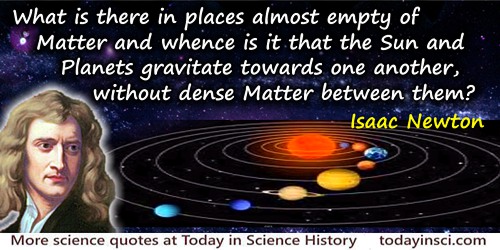
And for rejecting such a Medium, we have the Authority of those the oldest and most celebrated Philosophers of Greece and Phoenicia, who made a Vacuum, and Atoms, and the Gravity of Atoms, the first Principles of their Philosophy; tacitly attributing Gravity to some other Cause than dense Matter. Later Philosophers banish the Consideration of such a Cause out of natural Philosophy, feigning Hypotheses for explaining all things mechanically, and referring other Causes to Metaphysicks: Whereas the main Business of natural Philosophy is to argue from Phaenomena without feigning Hypotheses, and to deduce Causes from Effects, till we come to the very first Cause, which certainly is not mechanical; and not only to unfold the Mechanism of the World, but chiefly to resolve these and such like Questions. What is there in places almost empty of Matter, and whence is it that the Sun and Planets gravitate towards one another, without dense Matter between them? Whence is it that Nature doth nothing in vain; and whence arises all that Order and Beauty which we see in the World? ... does it not appear from phaenomena that there is a Being incorporeal, living, intelligent, omnipresent, who in infinite space, as it were in his Sensory, sees the things themselves intimately, and thoroughly perceives them, and comprehends them wholly by their immediate presence to himself.
In Opticks, (1704, 2nd. Ed. 1718), Book 3, Query 28, 343-5. Newton’s reference to “Nature does nothing in vain” recalls the axiom from Aristotle, which may be seen as “Natura nihil agit frustra” in the Aristotle Quotes on this web site.
And invention must still go on for it is necessary that we should completely control our circumstances. It is not sufficient that there should [only] be organization capable of providing food and shelter for all and organization to effect its proper distribution.
Aphorism listed Frederick Seitz, The Cosmic Inventor: Reginald Aubrey Fessenden (1866-1932) (1999), 54, being Transactions of the American Philosophical Society, Held at Philadelphia For Promoting Useful Knowledge, Vol. 86, Pt. 6.
And there are absolutely no judgments (or rules) in Mechanics which do not also pertain to Physics, of which Mechanics is a part or type: and it is as natural for a clock, composed of wheels of a certain kind, to indicate the hours, as for a tree, grown from a certain kind of seed, to produce the corresponding fruit. Accordingly, just as when those who are accustomed to considering automata know the use of some machine and see some of its parts, they easily conjecture from this how the other parts which they do not see are made: so, from the perceptible effects and parts of natural bodies, I have attempted to investigate the nature of their causes and of their imperceptible parts.
Principles of Philosophy (1644), trans. V. R. and R. P. Miller (1983), 285-6.
Anton Chekhov wrote that ‘one must not put a loaded rifle on stage if no one is thinking of firing it.’ Good drama requires spare and purposive action, sensible linking of potential causes with realized effects. Life is much messier; nothing happens most of the time. Millions of Americans (many hotheaded) own rifles (many loaded), but the great majority, thank God, do not go off most of the time. We spend most of real life waiting for Godot, not charging once more unto the breach.
…...
Any opinion as to the form in which the energy of gravitation exists in space is of great importance, and whoever can make his opinion probable will have, made an enormous stride in physical speculation. The apparent universality of gravitation, and the equality of its effects on matter of all kinds are most remarkable facts, hitherto without exception; but they are purely experimental facts, liable to be corrected by a single observed exception. We cannot conceive of matter with negative inertia or mass; but we see no way of accounting for the proportionality of gravitation to mass by any legitimate method of demonstration. If we can see the tails of comets fly off in the direction opposed to the sun with an accelerated velocity, and if we believe these tails to be matter and not optical illusions or mere tracks of vibrating disturbance, then we must admit a force in that direction, and we may establish that it is caused by the sun if it always depends upon his position and distance.
Letter to William Huggins (13 Oct 1868). In P. M. Hannan (ed.), The Scientific Letters and Papers of James Clerk Maxwell (1995), Vol. 2, 1862-1873, 451-2.
Art creates an incomparable and unique effect, and, having done so, passes on to other things. Nature, upon the other hand, forgetting that imitation can be made the sincerest form of insult, keeps on repeating the effect until we all become absolutely wearied of it.
In 'Decay of Lying', The Writings of Oscar Wilde: Epigrams, Phrases and Philosophies For the Use of the Young (1907), 8.

As crude a weapon as the cave man’s club, the chemical barrage has been hurled against the fabric of life—a fabric on the one hand delicate and destructible, on the other miraculously tough and resilient, and capable of striking back in unexpected ways. [On the effect of chemical insecticides and fertilizers.]
In Silent Spring, (1962), 297.
As every circumstance relating to so capital a discovery as this (the greatest, perhaps, that has been made in the whole compass of philosophy, since the time of Sir Isaac Newton) cannot but give pleasure to all my readers, I shall endeavour to gratify them with the communication of a few particulars which I have from the best authority. The Doctor [Benjamin Franklin], after having published his method of verifying his hypothesis concerning the sameness of electricity with the matter lightning, was waiting for the erection of a spire in Philadelphia to carry his views into execution; not imagining that a pointed rod, of a moderate height, could answer the purpose; when it occurred to him, that, by means of a common kite, he could have a readier and better access to the regions of thunder than by any spire whatever. Preparing, therefore, a large silk handkerchief, and two cross sticks, of a proper length, on which to extend it, he took the opportunity of the first approaching thunder storm to take a walk into a field, in which there was a shed convenient for his purpose. But dreading the ridicule which too commonly attends unsuccessful attempts in science, he communicated his intended experiment to no body but his son, who assisted him in raising the kite.
The kite being raised, a considerable time elapsed before there was any appearance of its being electrified. One very promising cloud passed over it without any effect; when, at length, just as he was beginning to despair of his contrivance, he observed some loose threads of the hempen string to stand erect, and to avoid one another, just as if they had been suspended on a common conductor. Struck with this promising appearance, he inmmediately presented his knuckle to the key, and (let the reader judge of the exquisite pleasure he must have felt at that moment) the discovery was complete. He perceived a very evident electric spark. Others succeeded, even before the string was wet, so as to put the matter past all dispute, and when the rain had wetted the string, he collected electric fire very copiously. This happened in June 1752, a month after the electricians in France had verified the same theory, but before he had heard of any thing that they had done.
The kite being raised, a considerable time elapsed before there was any appearance of its being electrified. One very promising cloud passed over it without any effect; when, at length, just as he was beginning to despair of his contrivance, he observed some loose threads of the hempen string to stand erect, and to avoid one another, just as if they had been suspended on a common conductor. Struck with this promising appearance, he inmmediately presented his knuckle to the key, and (let the reader judge of the exquisite pleasure he must have felt at that moment) the discovery was complete. He perceived a very evident electric spark. Others succeeded, even before the string was wet, so as to put the matter past all dispute, and when the rain had wetted the string, he collected electric fire very copiously. This happened in June 1752, a month after the electricians in France had verified the same theory, but before he had heard of any thing that they had done.
The History and Present State of Electricity, with Original Experiments (1767, 3rd ed. 1775), Vol. 1, 216-7.
As physicists have arranged an extensive series of effects under the general term of Heat, so they have named another series Light, and a third they have called Electricity. We find ... that all these principles are capable of being produced through the medium of living bodies, for nearly all animals have the power of evolving heat; many insects, moreover, can voluntarily emit light; and the property of producing electricity is well evinced in the terrible shock of the electric eel, as well as in that of some other creatures. We are indeed in the habit of talking of the Electric fluid, or the Galvanic fluid, but this in reality is nothing but a licence of expression suitable to our finite and material notions.
In the Third Edition of Elements of Electro-Metallurgy: or The Art of Working in Metals by the Galvanic Fluid (1851), 1.
As scientific men we have all, no doubt, felt that our fellow men have become more and more satisfying as fish have taken up their work which has been put often to base uses, which must lead to disaster. But what sin is to the moralist and crime to the jurist so to the scientific man is ignorance. On our plane, knowledge and ignorance are the immemorial adversaries. Scientific men can hardly escape the charge of ignorance with regard to the precise effect of the impact of modern science upon the mode of living of the people and upon their civilisation. For them, such a charge is worse than that of crime.
From Banquet Speech (10 Dec 1922), Nobel Prize in Chemistry, collected in Carl Gustaf Santesson (ed.), Les Prix Nobel en 1921-1922 (1923).
As soon as the circumstances of an experiment are well known, we stop gathering statistics. … The effect will occur always without exception, because the cause of the phenomena is accurately defined. Only when a phenomenon includes conditions as yet undefined,Only when a phenomenon includes conditions as yet undefined, can we compile statistics. … we must learn therefore that we compile statistics only when we cannot possibly help it; for in my opinion, statistics can never yield scientific truth.
From An Introduction to the Study of Experimental Medicine (1865), as translated by Henry Copley Greene (1957), 134-137.
![Robert Fulton quote: As the component parts of all new machines may be said to be old[,] it is a nice discriminating judgment,](https://todayinsci.com/F/Fulton_Robert/FultonRobert-Mechanic500x250px.jpg)
As the component parts of all new machines may be said to be old[,] it is a nice discriminating judgment, which discovers that a particular arrangement will produce a new and desired effect. ... Therefore, the mechanic should sit down among levers, screws, wedges, wheels, etc. like a poet among the letters of the alphabet, considering them as the exhibition of his thoughts; in which a new arrangement transmits a new idea to the world.
A Treatise on the Improvement of Canal Navigation (1796), preface, x.
As the ostensible effect of the heat … consists not in warming the surrounding bodies but in rendering the ice fluid, so, in the case of boiling, the heat absorbed does not warm surrounding bodies but converts the water into vapor. In both cases, considered as the cause of warmth, we do not perceive its presence: it is concealed, or latent, and I gave it the name of “latent heat.”
Ask a follower of Bacon what [science] the new philosophy, as it was called in the time of Charles the Second, has effected for mankind, and his answer is ready; “It has lengthened life; it has mitigated pain; it has extinguished diseases; it has increased the fertility of the soil; it has given new securities to the mariner; it has furnished new arms to the warrior; it has spanned great rivers and estuaries with bridges of form unknown to our fathers; it has guided the thunderbolt innocuously from heaven to earth; it has lighted up the night with the splendour of the day; it has extended the range of the human vision; it has multiplied the power of the human muscles; it has accelerated motion; it has annihilated distance; it has facilitated intercourse, correspondence, all friendly offices, all dispatch of business; it has enabled man to descend to the depths of the sea, to soar into the air, to penetrate securely into the noxious recesses of the earth, to traverse the land in cars which whirl along without horses, to cross the ocean in ships which run ten knots an hour against the wind. These are but a part of its fruits, and of its first-fruits; for it is a philosophy which never rests, which has never attained, which is never perfect. Its law is progress. A point which yesterday was invisible is its goal to-day, and will be its starting-point to-morrow.”
From essay (Jul 1837) on 'Francis Bacon' in Edinburgh Review. In Baron Thomas Babington Macaulay and Lady Trevelyan (ed.) The Works of Lord Macaulay Complete (1871), Vol. 6, 222.
At length being at Clapham where there is, on the common, a large pond which, I observed to be one day very rough with the wind, I fetched out a cruet of oil and dropt a little of it on the water. I saw it spread itself with surprising swiftness upon the surface; but the effect of smoothing the waves was not produced; for I had applied it first on the leeward side of the pond, where the waves were largest, and the wind drove my oil back upon the shore. I then went to the windward side, where they began to form; and there the oil, though not more than a tea-spoonful, produced an instant calm over a space several yards square, which spread amazingly, and extended itself gradually till it reached the leeside, making all that quarter of the pond, perhaps half an acre, as smooth as a looking-glass.
[Experiment to test an observation made at sea in 1757, when he had seen the wake of a ship smoothed, explained by the captain as presumably due to cooks emptying greasy water in to the sea through the scuppers.]
[Experiment to test an observation made at sea in 1757, when he had seen the wake of a ship smoothed, explained by the captain as presumably due to cooks emptying greasy water in to the sea through the scuppers.]
Letter, extract in 'Of the still of Waves by Means of Oil The Gentleman's Magazine (1775), Vol. 45, 82.
At the end of the book [Zoonomia] he sums up his [Erasmus Darwin] views in the following sentences: “The world has been evolved, not created: it has arisen little by little from a small beginning, and has increased through the activity of the elemental forces embodied in itself, and so has rather grown than come into being at an almighty word.” “What a sublime idea of the infinite might of the great Architect, the Cause of all causes, the Father of all fathers, the Ens Entium! For if we would compare the Infinite, it would surely require a greater Infinite to cause the causes of effects than to produce the effects themselves.”
[This is a restatement, not a verbatim quote of the original words of Erasmus Darwin, who attributed the idea he summarized to David Hume.]
[This is a restatement, not a verbatim quote of the original words of Erasmus Darwin, who attributed the idea he summarized to David Hume.]
In August Weismann, John Arthur Thomson (trans.), Margaret R. Thomson (trans.) The Evolution Theory (1904), Vol. 1, 17-18. The verbatim form of the quote from Zoonomia, in context, can be seen on the webpage here for Erasmus Darwin. Later authors have quoted from Weismann's translated book, and given the reworded passage as a direct quote by Erasmus Darwin. Webmaster has found a verbatim form in Zoonomia (1794), but has been unable to find the wording used by Weismann in any primary source by Erasmus Darwin. The rewording is perhaps due to the translation of the quote into German for Weismann's original book, Vorträge über Descendenztheorie (1902) followed by another translation for the English edition.
Be a nuisance where it counts. … Do your part to inform and stimulate the public to join your action. Be depressed, discouraged, and disappointed at failure and the disheartening effects of ignorance, greed, corruption, and bad politics — but never give up.
As quoted in Post Editors, 'Marjory Stoneman Douglas and The Saturday Evening Post', Saturday Evening Post (26 Feb 2018). Cited as “From a 1980 article she wrote”, in 'A Life of Advocacy and Activism', a floridastateparks.org webpage.
Be enthusiastic. Remember the placebo effect—30% of medicine is showbiz.
advising his medical colleagues, in Medical World News, February 16, 1981.
Bearing in mind that it is from the vitality of the atmospheric particles that all the mischief arises, it appears that all that is requisite is to dress the wound with some material capable of killing these septic germs, provided that any substance can be found reliable for this purpose, yet not too potent as a caustic. In the course of the year 1864 I was much struck with an account of the remarkable effects produced by carbolic acid upon the sewage of the town of Carlisle, the admixture of a very small proportion not only preventing all odour from the lands irrigated with the refuse material, but, as it was stated, destroying the entozoa which usually infest cattle fed upon such pastures.
'On a New Method of Treating Compound Fracture, Abscesses, etc: With Observations on the Conditions of Supperation', Part 1, The Lancet (1867), 327.
Besides agreeing with the aims of vegetarianism for aesthetic and moral reasons, it is my view that a vegetarian manner of living by its purely physical effect on the human temperament would most beneficially influence the lot of mankind.
In letter to Harmann Huth (27 Dec 1930). Presumably published in Vegetarische Warte (Vegetarian Watch, some time before 1935), a German magazine published by the society Vegetarier-Bund of which Harmann Huth was vice-president. As cited by Alice Calaprice (ed.) in The Ultimate Quotable Einstein (2010), 453. This might be the inspiration for a much-circulated and much-elaborated version attributed, but apparently wrongly, to Einstein. The questionable quote appears as: “Nothing will benefit human health and increase the chances for survival of life on Earth as much as the evolution to a vegetarian diet,” but no reliable source has been found for this as Einstein’s own words. Calaprice included this quote in her earlier edition of The Quotable Einstein (1996) in a final section of “Attributed to Einstein,” but it was removed from the final edition (2010), presumably because after much effort, it remained unsubstantiated.
But for twenty years previous to 1847 a force had been at work in a little county town of Germany destined to effect the education of Christendom, and at the same time to enlarge the boundaries of human knowledge, first in chemistry and the allied branches, then in every other one of the natural sciences. The place was Giessen; the inventor Liebig; the method, a laboratory for instruction and research.
A Semi-Centennial Discourse, 1847-97' (28 Oct 1897), The Sheffield Scientific School of Yale University. Quoted in Daniel Coit Gilman, University Problems in the United States (1898), 120.
But if any skillful minister of nature shall apply force to matter, and by design torture and vex it, in order to [effect] its annihilation, it, on the contrary being brought under this necessity, changes and transforms itself into a strange variety of shapes and appearances; for nothing but the power of the Creator can annihilate, or truly destroy it.
As quoted in M.J. Gorton, 'The Weather', Popular Science News (1889), 23, No. 8, 115.
But the dreams about the modes of creation, enquiries whether our globe has been formed by the agency of fire or water, how many millions of years it has cost Vulcan or Neptune to produce what the fiat of the Creator would effect by a single act of will, is too idle to be worth a single hour of any man’s life.
Letter (2 May 1826) to Doctor John P. Emmet. Collected in The Writings of Thomas Jefferson (1854), Vol. 7, 443.
By relieving the brain of all unnecessary work, a good notation sets it free to concentrate on more advanced problems, and in effect increases the mental power of the race.
In An Introduction to Mathematics (1911), 59.
By teaching us how to cultivate each ferment in its purity—in other words, by teaching us how to rear the individual organism apart from all others,—Pasteur has enabled us to avoid all these errors. And where this isolation of a particular organism has been duly effected it grows and multiplies indefinitely, but no change of it into another organism is ever observed. In Pasteur’s researches the Bacterium remained a Bacterium, the Vibrio a Vibrio, the Penicillium a Penicillium, and the Torula a Torula. Sow any of these in a state of purity in an appropriate liquid; you get it, and it alone, in the subsequent crop. In like manner, sow smallpox in the human body, your crop is smallpox. Sow there scarlatina, and your crop is scarlatina. Sow typhoid virus, your crop is typhoid—cholera, your crop is cholera. The disease bears as constant a relation to its contagium as the microscopic organisms just enumerated do to their germs, or indeed as a thistle does to its seed.
In 'Fermentation, and its Bearings on Surgery and Medicine', Essays on the FloatingMatter of the Air in Relation to Putrefaction and Infection (1881), 264.
By the end of the next century, the “greenhouse effect” may increase temperatures worldwide to levels that have not been reached for at least 100,000 years. And the effects on sea level and on agriculture and other human activities are likely to be so profound that we should be planning for them now.
In 'Temperatures Rise in the Global Greenhouse', New Scientist (15 May 1986), 110, No. 1508, 32.
Can a physicist visualize an electron? The electron is materially inconceivable and yet, it is so perfectly known through its effects that we use it to illuminate our cities, guide our airlines through the night skies and take the most accurate measurements. What strange rationale makes some physicists accept the inconceivable electrons as real while refusing to accept the reality of a Designer on the ground that they cannot conceive Him?
In letter to California State board of Education (14 Sep 1972).
Can the cause be reached from knowledge of the effect with the same certainty as the effect can be shown to follow from its cause? Is it possible for one effect to have many causes? If one determinate cause cannot be reached from the effect, since there is no effect which has not some cause, it follows that an effect, when it has one cause, may have another, and so that there may be several causes of it.
As quoted in Alistair Cameron Crombie, Robert Grosseteste and the Origins of Experimental Science, 1100-1700 (1971), 81.
Can the cultural evolution of higher ethical values gain a direction and momentum of its own and completely replace genetic evolution? I think not. The genes hold culture an a leash. The leash is very long, but inevitably values will be constrained in accordance with their effects in the human gene pool. The brain is a product of evolution. Human behaviour—like the deepest capacities for emotional response which drive and guide it—is the circuitous technique by which human genetic material has been and will be kept intact. Morality has no other demonstrable ultimate function.
In On Human Nature (1978), 167. In William Andrew Rottschaefer, The Biology and Psychology of Moral Agency (1998), 58.
Catastrophe Theory is a new mathematical method for describing the evolution of forms in nature. … It is particularly applicable where gradually changing forces produce sudden effects. We often call such effects catastrophes, because our intuition about the underlying continuity of the forces makes the very discontinuity of the effects so unexpected, and this has given rise to the name.
From Catastrophe Theory: Selected Papers, 1972-1977 (1977), 1. As quoted and cited in a Review by: Hector J. Sussmann, SIAM Review (Apr 1979), 21, No. 2, 269.
Cells are required to stick precisely to the point. Any ambiguity, any tendency to wander from the matter at hand, will introduce grave hazards for the cells, and even more for the host in which they live. … There is a theory that the process of aging may be due to the cumulative effect of imprecision, a gradual degrading of information. It is not a system that allows for deviating.
In 'Information', The Lives of a Cell: Notes of a Biology Watcher (1974), 110-111.
Certain students of genetics inferred that the Mendelian units responsible for the selected character were genes producing only a single effect. This was careless logic. It took a good deal of hammering to get rid of this erroneous idea. As facts accumulated it became evident that each gene produces not a single effect, but in some cases a multitude of effects on the characters of the individual. It is true that in most genetic work only one of these character-effects is selected for study—the one that is most sharply defined and separable from its contrasted character—but in most cases minor differences also are recognizable that are just as much the product of the same gene as is the major effect.
'The Relation of Genetics to Physiology and Medicine', Nobel Lecture (4 Jun 1934). In Nobel Lectures, Physiology or Medicine 1922-1941 (1965), 317.
Chemistry is the science or study of those effects and qualities of matter which are discovered by mixing bodies variously together, or applying them to one another with a view to mixture, and by exposing them to different degrees of heat, alone, or in mixture with one another, in order to enlarge our knowledge of nature, and to promote the useful arts.
From the first of a series of lectures on chemistry, collected in John Robison (ed.), Lectures on the Elements of Chemistry: Delivered in the University of Edinburgh (1807), Vol. 1, 11.
Chemistry is the study of the effects of heat and mixture, with a view of discovering their general and subordinate laws, and of improving the useful arts.
This is an editor’s shorter restatement of the definition given by Black in the first of a series of lectures on chemistry, collected in John Robison (ed.), Lectures on the Elements of Chemistry: Delivered in the University of Edinburgh (1807), Vol. 1, 11, footnote. For the definitions as given by Black, see elsewhere on this web page.
Considering it as thus established, that heat is not a substance, but a dynamical form of mechanical effect, we perceive that there must be an equivalence between mechanical work and heat, as between cause and effect.
In 'On the Dynamical Theory of Heat, with Numerical Results Deduced from Mr. Joule's Equivalent of a Thermal Unit, and M. Regnault's Observations on Steam' (1851). In Mathematical and Physical Papers (1882-1911), Vol. 1, 175.
Detection is, or ought to be, an exact science, and should be treated in the same cold unemotional manner. You have attempted to tinge it with romanticism, which produces the same effect as if you worked a love-story into the fifth proposition of Euclid.
By Sherlock Holmes to Dr. Watson, fictional characters in The Sign of Four (1890), 6.
Discoveries are always accidental; and the great use of science is by investigating the nature of the effects produced by any process or contrivance, and of the causes by which they are brought about, to explain the operation and determine the precise value of every new invention. This fixes as it were the latitude and longitude of each discovery, and enables us to place it in that part of the map of human knowledge which it ought to occupy. It likewise enables us to use it in taking bearings and distances, and in shaping our course when we go in search of new discoveries.
In The Complete Works of Count Rumford (1876), Vol. 4, 270.
Dr Ian G. MacDonald, a Los Angeles surgeon who smokes (but doesn't inhale), contends that “For the majority of people, the use of tobacco has a beneficial effect, far better for you than taking tranquilizers.”
Quoted in Newsweek (18 Nov 1969), 62, Pt. 2, 66. A misguided comment, often seen as the shortened quote “For the majority ... beneficial effect” in a list of regrettable remarks, without the fuller context of the quote given here. MacDonald was quoted in the article to be an example that physicians were not unanimous in their attitudes against smoking. The quote is an opinion expressed to the reporter; it was not the result of scholarly research.
During my second year at Edinburgh [1826-27] I attended Jameson's lectures on Geology and Zoology, but they were incredible dull. The sole effect they produced on me was the determination never as long as I lived to read a book on Geology.
Charles Darwin, His Life Told in an Autobiographical Chapter and a Selected Series of his Published Letters (1892), 15. In Patrick Wyse Jackson, Four Centuries of Geological Travel (2007), 32.
During the eighteenth and nineteenth centuries we can see the emergence of a tension that has yet to be resolved, concerning the attitude of scientists towards the usefulness of science. During this time, scientists were careful not to stress too much their relationships with industry or the military. They were seeking autonomy for their activities. On the other hand, to get social support there had to be some perception that the fruits of scientific activity could have useful results. One resolution of this dilemma was to assert that science only contributed at the discovery stage; others, industrialists for example, could apply the results. ... Few noted the ... obvious paradox of this position; that, if scientists were to be distanced from the 'evil' effects of the applications of scientific ideas, so too should they receive no credit for the 'good' or socially beneficial, effects of their activities.
Co-author with Philip Gummett (1947- ), -British social scientist
Co-author with Philip Gummett (1947- ), -British social scientist
Science, Technology and Society Today (1984), Introduction, 4.
Dust consisting of fine fibers of asbestos, which are insoluble and virtually indestructible, may become a public health problem in the near future. At a recent international conference on the biological effects of asbestos sponsored by the New York Academy of Sciences, participants pointed out on the one hand that workers exposed to asbestos dust are prone in later life to develop lung cancer, and on the other hand that the use of this family of fibrous silicate compounds has expanded enormously during the past few decades. A laboratory curiosity 100 years ago, asbestos today is a major component of building materials.
— Magazine
In Scientific American (Sep 1964). As cited in '50, 100 & 150 Years Ago', Scientific American (Dec 2014), 311, No. 6, 98.
EFFECT, n. The second of two phenomena which always occur together in the same order. The first, called a Cause, is said to generate the other—which is no more sensible than it would be for one who has never seen a dog except in pursuit of a rabbit to declare the rabbit the cause of the dog.
The Cynic's Word Book (1906), 86. Later published as The Devil's Dictionary.
Effects vary with the conditions which bring them to pass, but laws do not vary. Physiological and pathological states are ruled by the same forces; they differ only because of the special conditions under which the vital laws manifest themselves.
From An Introduction to the Study of Experimental Medicine (1865), as translated by Henry Copley Greene (1957),10.
Einstein never accepted quantum mechanics because of this element of chance and uncertainty. He said: God does not play dice. It seems that Einstein was doubly wrong. The quantum effects of black holes suggests that not only does God play dice, He sometimes throws them where they cannot be seen.
…...
Einstein, twenty-six years old, only three years away from crude privation, still a patent examiner, published in the Annalen der Physik in 1905 five papers on entirely different subjects. Three of them were among the greatest in the history of physics. One, very simple, gave the quantum explanation of the photoelectric effect—it was this work for which, sixteen years later, he was awarded the Nobel prize. Another dealt with the phenomenon of Brownian motion, the apparently erratic movement of tiny particles suspended in a liquid: Einstein showed that these movements satisfied a clear statistical law. This was like a conjuring trick, easy when explained: before it, decent scientists could still doubt the concrete existence of atoms and molecules: this paper was as near to a direct proof of their concreteness as a theoretician could give. The third paper was the special theory of relativity, which quietly amalgamated space, time, and matter into one fundamental unity.
This last paper contains no references and quotes no authority. All of them are written in a style unlike any other theoretical physicist’s. They contain very little mathematics. There is a good deal of verbal commentary. The conclusions, the bizarre conclusions, emerge as though with the greatest of ease: the reasoning is unbreakable. It looks as though he had reached the conclusions by pure thought, unaided, without listening to the opinions of others. To a surprisingly large extent, that is precisely what he had done.
This last paper contains no references and quotes no authority. All of them are written in a style unlike any other theoretical physicist’s. They contain very little mathematics. There is a good deal of verbal commentary. The conclusions, the bizarre conclusions, emerge as though with the greatest of ease: the reasoning is unbreakable. It looks as though he had reached the conclusions by pure thought, unaided, without listening to the opinions of others. To a surprisingly large extent, that is precisely what he had done.
In Variety of Men (1966), 100-101. First published in Commentary magazine.
Error held as truth has much the effect of truth. In politics and religion this fact upsets many confident predictions.
From chapter 'Jottings from a Note-Book', in Canadian Stories (1918), 177.
Even more difficult to explain, than the breaking-up of a single mass into fragments, and the drifting apart of these blocks to form the foundations of the present-day continents, is the explanation of the original production of the single mass, or PANGAEA, by the concentration of the former holosphere of granitic sial into a hemisphere of compressed and crushed gneisses and schists. Creep and the effects of compression, due to shrinking or other causes, have been appealed to but this is hardly a satisfactory explanation. The earth could no more shrug itself out of its outer rock-shell unaided, than an animal could shrug itself out of its hide, or a man wriggle out of his skin, or even out of his closely buttoned coat, without assistance either of his own hands or those of others.
The Rhythm of Ages (1940), 9-10.
Even the taking of medicine serves to make time go on with less heaviness. I have a sort of genius for physic and always had great entertainment in observing the changes of the human body and the effects produced by diet, labor, rest, and physical operations.
Even today a good many distinguished minds seem unable to accept or even to understand that from a source of noise natural selection alone and unaided could have drawn all the music of the biosphere. In effect natural selection operates upon the products of chance and can feed nowhere else; but it operates in a domain of very demanding conditions, and from this domain chance is barred. It is not to chance but to these conditions that eveloution owes its generally progressive cource, its successive conquests, and the impresssion it gives of a smooth and steady unfolding.
In Jacques Monod and Austryn Wainhouse (trans.), Chance and Necessity: An Essay on the Natural Philosophy of Modern Biology (1971), 118-119.
Every occurrence in Nature is preceded by other occurrences which are its causes, and succeeded by others which are its effects. The human mind is not satisfied with observing and studying any natural occurrence alone, but takes pleasure in connecting every natural fact with what has gone before it, and with what is to come after it.
In Forms of Water in Clouds and Rivers, Ice and Glaciers (1872), 1.
Exper. I. I made a small hole in a window-shutter, and covered it with a piece of thick paper, which I perforated with a fine needle. For greater convenience of observation I placed a small looking-glass without the window-shutter, in such a position as to reflect the sun's light, in a direction nearly horizontal, upon the opposite wall, and to cause the cone of diverging light to pass over a table on which were several little screens of card-paper. I brought into the sunbeam a slip of card, about one-thirtieth of an inch in breadth, and observed its shadow, either on the wall or on other cards held at different distances. Besides the fringes of colour on each side of the shadow, the shadow itself was divided by similar parallel fringes, of smaller dimensions, differing in number, according to the distance at which the shadow was observed, but leaving the middle of the shadow always white. Now these fringes were the joint effects of the portions of light passing on each side of the slip of card and inflected, or rather diffracted, into the shadow. For, a little screen being placed a few inches from the card, so as to receive either edge of the shadow on its margin, all the fringes which had before been observed in the shadow on the wall, immediately disappeared, although the light inflected on the other side was allowed to retain its course, and although this light must have undergone any modification that the proximity of the other edge of the slip of card might have been capable of occasioning... Nor was it for want of a sufficient intensity of light that one of the two portions was incapable of producing the fringes alone; for when they were both uninterrupted, the lines appeared, even if the intensity was reduced to one-tenth or one-twentieth.
'Experiments and Calculations Relative to Physical Optics' (read in 1803), Philosophical Transactions (1804), 94, 2-3.
Experiments may be of two kinds: experiments of simple fact, and experiments of quantity. ...[In the latter] the conditions will ... vary, not in quality, but quantity, and the effect will also vary in quantity, so that the result of quantitative induction is also to arrive at some mathematical expression involving the quantity of each condition, and expressing the quantity of the result. In other words, we wish to know what function the effect is of its conditions. We shall find that it is one thing to obtain the numerical results, and quite another thing to detect the law obeyed by those results, the latter being an operation of an inverse and tentative character.
Principles of Science: A Treatise on Logic and Scientific Method (1874, 1892), 439.
Firm support has been found for the assertion that electricity occurs at thousands of points where we at most conjectured that it was present. Innumerable electrical particles oscillate in every flame and light source. We can in fact assume that every heat source is filled with electrons which will continue to oscillate ceaselessly and indefinitely. All these electrons leave their impression on the emitted rays. We can hope that experimental study of the radiation phenomena, which are exposed to various influences, but in particular to the effect of magnetism, will provide us with useful data concerning a new field, that of atomistic astronomy, as Lodge called it, populated with atoms and electrons instead of planets and worlds.
'Light Radiation in a Magnetic Field', Nobel Lecture, 2 May 1903. In Nobel Lectures: Physics 1901-1921 (1967), 40.
For chemistry is no science form’d à priori; ’tis no production of the human mind, framed by reasoning and deduction: it took its rise from a number of experiments casually made, without any expectation of what follow’d; and was only reduced into an art or system, by collecting and comparing the effects of such unpremeditated experiments, and observing the uniform tendency thereof. So far, then, as a number of experimenters agree to establish any undoubted truth; so far they may be consider'd as constituting the theory of chemistry.
From 'The Author's Preface', in A New Method of Chemistry (1727), vi.
For if medicine is really to accomplish its great task, it must intervene in political and social life. It must point out the hindrances that impede the normal social functioning of vital processes, and effect their removal.
In Die einheitsrebungen in der wissenschaftlichen medicin (1849), 48. As quoted and citefd in Paul Farmer, Pathologies of Power (2004), 323.
For it is the nature of that which is the same and remains in the same state always to produce the same effects, so either there will always be coming to be or perishing.
From 'On Generation and Corruption', Natural Philosophy, Book 2, Chap. 10, 336a27. As translated by Inna Kupreeva, Ancient Commentators on Aristotle: Philoponus: On Aristotle on Coming-to-be and Perishing 2.5-11 (2014), 84.
For nature by the same cause, provided it remain in the same condition, always produces the same effect, so that either coming-to-be or passing-away will always result.
On Generation and Corruption, 336a, 27-9. In Jonathan Barnes (ed.), The Complete Works of Aristotle (1984), Vol. I, 551.
For what is that which we call evil but the absence of good? In the bodies of animals, disease and wounds mean nothing but the absence of health; for when a cure is effected, that does not mean that the evils which were present—namely, the diseases and wounds—go away from the body and dwell elsewhere: they altogether cease to exist; for the wound or disease is not a substance, but a defect in the fleshly substance,—the flesh itself being a substance, and therefore something good, of which those evils—that is, privations of the good which we call health—are accidents. Just in the same way, what are called vices in the soul are nothing but privations of natural good. And when they are cured, they are not transferred elsewhere: when they cease to exist in the healthy soul, they cannot exist anywhere else.
In Marcus Dods (ed.), J.F. Shaw (trans.), The Enchiridion of Augustine, Chap. 9, collected in The Works of Aurelius Augustine, Bishop of Hippo: A new translation (1873), Vol. 9, 181-182.
Fortunately Nature herself seems to have prepared for us the means of supplying that want which arises from the impossibility of making certain experiments on living bodies. The different classes of animals exhibit almost all the possible combinations of organs: we find them united, two and two, three and three, and in all proportions; while at the same time it may be said that there is no organ of which some class or some genus is not deprived. A careful examination of the effects which result from these unions and privations is therefore sufficient to enable us to form probable conclusions respecting the nature and use of each organ, or form of organ. In the same manner we may proceed to ascertain the use of the different parts of the same organ, and to discover those which are essential, and separate them from those which are only accessory. It is sufficient to trace the organ through all the classes which possess it, and to examine what parts constantly exist, and what change is produced in the respective functions of the organ, by the absence of those parts which are wanting in certain classes.
Letter to Jean Claude Mertrud. In Lectures on Comparative Anatomy (1802), Vol. I, xxiii--xxiv.
Furthermore, it’s equally evident that what goes on is actually one degree better than self-reproduction, for organisms appear to have gotten more elaborate in the course of time. Today's organisms are phylogenetically descended from others which were vastly simpler than they are, so much simpler, in fact, that it’s inconceivable, how any kind of description of the latter, complex organism could have existed in the earlier one. It’s not easy to imagine in what sense a gene, which is probably a low order affair, can contain a description of the human being which will come from it. But in this case you can say that since the gene has its effect only within another human organism, it probably need not contain a complete description of what is to happen, but only a few cues for a few alternatives. However, this is not so in phylogenetic evolution. That starts from simple entities, surrounded by an unliving amorphous milieu, and produce, something more complicated. Evidently, these organisms have the ability to produce something more complicated than themselves.
From lecture series on self-replicating machines at the University of Illinois, Lecture 5 (Dec 1949), 'Re-evaluation of the Problems of Complicated Automata—Problems of Hierarchy and Evolution', Theory of Self-Reproducing Automata (1966).
Gases are distinguished from other forms of matter, not only by their power of indefinite expansion so as to fill any vessel, however large, and by the great effect heat has in dilating them, but by the uniformity and simplicity of the laws which regulate these changes.
Theory of Heat (1904), 31.
Genuine science, of course, is neutral. But its practical effects, when harnessed to the appetites of the market, are something less than neutral. Heartbeats are human, but when harnessed to a public-address system, they can be terrifying. Ordinary human appetites for comfort, prestige, or power have in history been troublesome enough, but when they are given exaggerated expression by means of applied science they promise swift destruction.
In The Mechanical Bride: Folklore of Industrial Man (1967), 93.
Go into a room where the shutters are always shut (in a sick-room or a bed-room there should never be shutters shut), and though the room be uninhabited—though the air has never been polluted by the breathing of human beings, you will observe a close, musty smell of corrupt air—of air unpurified by the effect of the sun's rays.
Notes on Nursing: What it is and what it is not (1860), 120.
Gravity. Surely this force must be capable of an experimental relation to electricity, magnetism, and the other forces, so as to bind it up with them in reciprocal action and equivalent effect.
Notebook entry (19 Mar 1849). In Bence Jones (ed.), The Life and Letters of Faraday (1870), Vol. 2, 252.
He [Lord Bacon] appears to have been utterly ignorant of the discoveries which had just been made by Kepler’s calculations … he does not say a word about Napier’s Logarithms, which had been published only nine years before and reprinted more than once in the interval. He complained that no considerable advance had been made in Geometry beyond Euclid, without taking any notice of what had been done by Archimedes and Apollonius. He saw the importance of determining accurately the specific gravities of different substances, and himself attempted to form a table of them by a rude process of his own, without knowing of the more scientific though still imperfect methods previously employed by Archimedes, Ghetaldus and Porta. He speaks of the εὕρηκα of Archimedes in a manner which implies that he did not clearly appreciate either the problem to be solved or the principles upon which the solution depended. In reviewing the progress of Mechanics, he makes no mention either of Archimedes, or Stevinus, Galileo, Guldinus, or Ghetaldus. He makes no allusion to the theory of Equilibrium. He observes that a ball of one pound weight will fall nearly as fast through the air as a ball of two, without alluding to the theory of acceleration of falling bodies, which had been made known by Galileo more than thirty years before. He proposed an inquiry with regard to the lever,—namely, whether in a balance with arms of different length but equal weight the distance from the fulcrum has any effect upon the inclination—though the theory of the lever was as well understood in his own time as it is now. … He speaks of the poles of the earth as fixed, in a manner which seems to imply that he was not acquainted with the precession of the equinoxes; and in another place, of the north pole being above and the south pole below, as a reason why in our hemisphere the north winds predominate over the south.
From Spedding’s 'Preface' to De Interpretations Naturae Proœmium, in The Works of Francis Bacon (1857), Vol. 3, 511-512. [Note: the Greek word “εὕρηκα” is “Eureka” —Webmaster.]
Heraclitus son of Bloson (or, according to some, of Herakon) of Ephesus. This man was at his prime in the 69th Olympiad. He grew up to be exceptionally haughty and supercilious, as is clear also from his book, in which he says: “Learning of many things does not teach intelligence; if so it would have taught Hesiod and Pythagoras, and again Xenophanes and Hecataeus.” … Finally he became a misanthrope, withdrew from the world, and lived in the mountains feeding on grasses and plants. However, having fallen in this way into a dropsy he came down to town and asked the doctors in a riddle if they could make a drought out of rainy weather. When they did not understand he buried himself in a cow-stall, expecting that the dropsy would be evaporated off by the heat of the manure; but even so he failed to effect anything, and ended his life at the age of sixty.
Diogenes Laertius 9.1. In G. S. Kirk, E. Raven, and M. Schofield (eds.), The Presocratic philosophers: A Critical History with a Selection of Texts (1983), 181.
How can we be so willfully blind as to look for causes in nature when nature herself is an effect?
How much has happened in these fifty years—a period more remarkable than any, I will venture to say, in the annals of mankind. I am not thinking of the rise and fall of Empires, the change of dynasties, the establishment of Governments. I am thinking of those revolutions of science which have had much more effect than any political causes, which have changed the position and prospects of mankind more than all the conquests and all the codes and all the legislators that ever lived.
Banquet speech, Glasgow. In Nature (27 Nov 1873), 9, 71.
However, the small probability of a similar encounter [of the earth with a comet], can become very great in adding up over a huge sequence of centuries. It is easy to picture to oneself the effects of this impact upon the Earth. The axis and the motion of rotation changed; the seas abandoning their old position to throw themselves toward the new equator; a large part of men and animals drowned in this universal deluge, or destroyed by the violent tremor imparted to the terrestrial globe.
Exposition du Système du Monde, 2nd edition (1799), 208, trans. Ivor Grattan-Guinness.
Human behaviour reveals uniformities which constitute natural laws. If these uniformities did not exist, then there would be neither social science nor political economy, and even the study of history would largely be useless. In effect, if the future actions of men having nothing in common with their past actions, our knowledge of them, although possibly satisfying our curiosity by way of an interesting story, would be entirely useless to us as a guide in life.
In Cours d’Economie Politique (1896-7), Vol. 2, 397.
Human knowledge and human power meet in one; for where the cause is not known the effect cannot be produced. Nature to be commanded must be obeyed; and that which in contemplation is as the cause is in operation as the rule.
From Novum Organum (1620), Book 1, Aphorism 3. Translated as The New Organon: Aphorisms Concerning the Interpretation of Nature and the Kingdom of Man), collected in James Spedding, Robert Ellis and Douglas Heath (eds.), The Works of Francis Bacon (1857), Vol. 4, 47.
I accepted the Copernican position several years ago and discovered from thence the causes of many natural effects which are doubtless inexplicable by the current theories. I have written up many reasons and refutations on the subject, but I have not dared until now to bring them into the open, being warned by the fortunes of Copernicus himself, our master, who procured for himself immortal fame among a few but stepped down among the great crowd (for this is how foolish people are to be numbered), only to be derided and dishonoured. I would dare publish my thoughts if there were many like you; but since there are not, I shall forbear.
Letter to Johannes Kepler, 4 Aug 1597. Quoted in G. de Santillana, Crime of Galileo (1955), 11.
I am a strong advocate for free thought on all subjects, yet it appears to me (whether rightly or wrongly) that direct arguments against christianity & theism produce hardly any effect on the public; & freedom of thought is best promoted by the gradual illumination of men's minds, which follow[s] from the advance of science. It has, therefore, been always my object to avoid writing on religion, & I have confined myself to science. I may, however, have been unduly biassed by the pain which it would give some members of my family, if I aided in any way direct attacks on religion.
Letter to E.B. Aveling (13 Oct 1880).
I am inclined to think I shall owe ten years of my life to the good effects of the gas, for I inhale about 20 gallons every day in showing patients how to commence. The gas is just like air, only containing a little more oxygen. Oxygen is what gives life and vitality to the blood. We live on oxygen.
Quoted in The Electrical Review (11 Aug 1893), Vol. 33, 143.
I am of opinion, then, ... that, if there is any circumstance thoroughly established in geology, it is, that the crust of our globe has been subjected to a great and sudden revolution, the epoch of which cannot be dated much farther back than five or six thousand years ago; that this revolution had buried all the countries which were before inhabited by men and by the other animals that are now best known; that the same revolution had laid dry the bed of the last ocean, which now forms all the countries at present inhabited; that the small number of individuals of men and other animals that escaped from the effects of that great revolution, have since propagated and spread over the lands then newly laid dry; and consequently, that the human race has only resumed a progressive state of improvement since that epoch, by forming established societies, raising monuments, collecting natural facts, and constructing systems of science and of learning.
'Preliminary discourse', to Recherches sur les Ossemens Fossiles (1812), trans. R. Kerr Essay on the Theory of the Earth (1813), 171-2.
I became expert at dissecting crayfish. At one point I had a crayfish claw mounted on an apparatus in such a way that I could operate the individual nerves. I could get the several-jointed claw to reach down and pick up a pencil and wave it around. I am not sure that what I was doing had much scientific value, although I did learn which nerve fiber had to be excited to inhibit the effects of another fiber so that the claw would open. And it did get me interested in robotic instrumentation, something that I have now returned to. I am trying to build better micromanipulators for surgery and the like.
In Jeremy Bernstein, 'A.I.', The New Yorker (14 Dec 1981).
I believe—and human psychologists, particularly psychoanalysts should test this—that present-day civilized man suffers from insufficient discharge of his aggressive drive. It is more than probable that the evil effects of the human aggressive drives, explained by Sigmund Freud as the results of a special death wish, simply derive from the fact that in prehistoric times intra-specific selection bred into man a measure of aggression drive for which in the social order today he finds no adequate outlet.
On Aggression, trans. M. Latzke (1966), 209.
I cannot but look upon the strange Instinct of this noisome and troublesome Creature a Louse, of searching out foul and nasty Clothes to harbor and breed in, as an Effect of divine Providence, design’d to deter Men and Women from Sluttishness and Sordidness.
— John Ray
In The Wisdom of God Manifested in the Works of the Creation (1691), 309.
I consider then, that generally speaking, to render a reason of an effect or Phaenomenon, is to deduce It from something else in Nature more known than it self, and that consequently there may be divers kinds of Degrees of Explication of the same thing. For although such Explications be the most satisfactory to the Understanding, wherein ’tis shewn how the effect is produc’d by the more primitive and Catholick Affection of Matter, namely bulk, shape and motion, yet are not these Explications to be despis’d, wherein particular effects are deduc’d from the more obvious and familiar Qualities or States of Bodies, … For in the search after Natural Causes, every new measure of Discovery does both instinct and gratifie the Understanding.
Physiological Essays (1669), 20.
I do not intend to go deeply into the question how far mathematical studies, as the representatives of conscious logical reasoning, should take a more important place in school education. But it is, in reality, one of the questions of the day. In proportion as the range of science extends, its system and organization must be improved, and it must inevitably come about that individual students will find themselves compelled to go through a stricter course of training than grammar is in a position to supply. What strikes me in my own experience with students who pass from our classical schools to scientific and medical studies, is first, a certain laxity in the application of strictly universal laws. The grammatical rules, in which they have been exercised, are for the most part followed by long lists of exceptions; accordingly they are not in the habit of relying implicitly on the certainty of a legitimate deduction from a strictly universal law. Secondly, I find them for the most part too much inclined to trust to authority, even in cases where they might form an independent judgment. In fact, in philological studies, inasmuch as it is seldom possible to take in the whole of the premises at a glance, and inasmuch as the decision of disputed questions often depends on an aesthetic feeling for beauty of expression, or for the genius of the language, attainable only by long training, it must often happen that the student is referred to authorities even by the best teachers. Both faults are traceable to certain indolence and vagueness of thought, the sad effects of which are not confined to subsequent scientific studies. But certainly the best remedy for both is to be found in mathematics, where there is absolute certainty in the reasoning, and no authority is recognized but that of one’s own intelligence.
In 'On the Relation of Natural Science to Science in general', Popular Lectures on Scientific Subjects, translated by E. Atkinson (1900), 25-26.
I do not maintain that the chief value of the study of arithmetic consists in the lessons of morality that arise from this study. I claim only that, to be impressed from day to day, that there is something that is right as an answer to the questions with which one is able to grapple, and that there is a wrong answer—that there are ways in which the right answer can be established as right, that these ways automatically reject error and slovenliness, and that the learner is able himself to manipulate these ways and to arrive at the establishment of the true as opposed to the untrue, this relentless hewing to the line and stopping at the line, must color distinctly the thought life of the pupil with more than a tinge of morality. … To be neighborly with truth, to feel one’s self somewhat facile in ways of recognizing and establishing what is right, what is correct, to find the wrong persistently and unfailingly rejected as of no value, to feel that one can apply these ways for himself, that one can think and work independently, have a real, a positive, and a purifying effect upon moral character. They are the quiet, steady undertones of the work that always appeal to the learner for the sanction of his best judgment, and these are the really significant matters in school work. It is not the noise and bluster, not even the dramatics or the polemics from the teacher’s desk, that abide longest and leave the deepest and stablest imprint upon character. It is these still, small voices that speak unmistakably for the right and against the wrong and the erroneous that really form human character. When the school subjects are arranged on the basis of the degree to which they contribute to the moral upbuilding of human character good arithmetic will be well up the list.
In Arithmetic in Public Education (1909), 18. As quoted and cited in Robert Édouard Moritz, Memorabilia Mathematica; Or, The Philomath’s Quotation-book (1914), 69.
I do not see any reason to assume that the heuristic significance of the principle of general relativity is restricted to gravitation and that the rest of physics can be dealt with separately on the basis of special relativity, with the hope that later on the whole may be fitted consistently into a general relativistic scheme. I do not think that such an attitude, although historically understandable, can be objectively justified. The comparative smallness of what we know today as gravitational effects is not a conclusive reason for ignoring the principle of general relativity in theoretical investigations of a fundamental character. In other words, I do not believe that it is justifiable to ask: What would physics look like without gravitation?
…...
I found the invention was applicable to painting, and would also contribute to facilitate the study of geography: for I have applied it to some maps, the rivers of which I represented in silver, and in the cities in gold. The rivers appearing, as it were, in silver streams, have a most pleasing effect on the sight, and relieve the eye of that painful search for the course, and origin, of rivers, the minutest branches of which can be splendidly represented this way.
Description of an outcome of her experiments originally investigating 'the possibility of making cloths of gold, silver and other metals by chemical processes.'
Description of an outcome of her experiments originally investigating 'the possibility of making cloths of gold, silver and other metals by chemical processes.'
Preface to An Essay on Combustion with a View to a New Art of Dyeing and Painting (1794), iii-iv. In Marilyn Bailey
Ogilvie and Joy Dorothy
Harvey, The Biographical Dictionary of Women in Science (2000), 478.
I had at one time a very bad fever of which I almost died. In my fever I had a long consistent delirium. I dreamt that I was in Hell, and that Hell is a place full of all those happenings that are improbable but not impossible. The effects of this are curious. Some of the damned, when they first arrive below, imagine that they will beguile the tedium of eternity by games of cards. But they find this impossible, because, whenever a pack is shuffled, it comes out in perfect order, beginning with the Ace of Spades and ending with the King of Hearts. There is a special department of Hell for students of probability. In this department there are many typewriters and many monkeys. Every time that a monkey walks on a typewriter, it types by chance one of Shakespeare's sonnets. There is another place of torment for physicists. In this there are kettles and fires, but when the kettles are put on the fires, the water in them freezes. There are also stuffy rooms. But experience has taught the physicists never to open a window because, when they do, all the air rushes out and leaves the room a vacuum.
'The Metaphysician's Nightmare', Nightmares of Eminent Persons and Other Stories (1954), 38-9.
I had made up my mind to find that for which I was searching even if it required the remainder of my life. After innumerable failures I finally uncovered the principle for which I was searching, and I was astounded at its simplicity. I was still more astounded to discover the principle I had revealed not only beneficial in the construction of a mechanical hearing aid but it served as well as means of sending the sound of the voice over a wire. Another discovery which came out of my investigation was the fact that when a man gives his order to produce a definite result and stands by that order it seems to have the effect of giving him what might be termed a second sight which enables him to see right through ordinary problems. What this power is I cannot say; all I know is that it exists and it becomes available only when a man is in that state of mind in which he knows exactly what he wants and is fully determined not to quit until he finds it.
As quoted, without citation, in Mack R. Douglas, Making a Habit of Success: How to Make a Habit of Succeeding, How to Win With High Self-Esteem (1966, 1994), 38. Note: Webmaster is dubious of a quote which seems to appear in only one source, without a citation, decades after Bell’s death. If you know a primary source, please contact Webmaster.
I have been battering away at Saturn, returning to the charge every now and then. I have effected several breaches in the solid ring, and now I am splash into the fluid one, amid a clash of symbols truly astounding. When I reappear it will be in the dusky ring, which is something like the state of the air supposing the siege of Sebastopol conducted from a forest of guns 100 miles one way, and 30,000 miles the other, and the shot never to stop, but go spinning away round a circle, radius 170,000 miles.
Letter to Lewis Campbell (28 Aug 1857). In P. M. Harman (ed.), The Scientific Letters and Papers of James Clerk Maxwell (1990), Vol. 1, 1846-1862, 538.
I have been so electrically occupied of late that I feel as if hungry for a little chemistry: but then the conviction crosses my mind that these things hang together under one law & that the more haste we make onwards each in his own path the sooner we shall arrive, and meet each other, at that state of knowledge of natural causes from which all varieties of effects may be understood & enjoyed.
Letter to Eilhard Mitscherlich, 24 Jan 1838. In Frank A. J. L. James (ed.), The Correspondence of Michael Faraday (1993), Vol. 2, 488.
I have never had reason, up to now, to give up the concept which I have always stressed, that nerve cells, instead of working individually, act together, so that we must think that several groups of elements exercise a cumulative effect on the peripheral organs through whole bundles of fibres. It is understood that this concept implies another regarding the opposite action of sensory functions. However opposed it may seem to the popular tendency to individualize the elements, I cannot abandon the idea of a unitary action of the nervous system, without bothering if, by that, I approach old conceptions.
'The Neuron Doctrine-Theory and Facts', Nobel Lecture 11 Dec 1906. In Nobel Lectures: Physiology or Medicine 1901-1921 (1967), 216.
I have no doubt that many small strikes of a hammer will finally have as much effect as one very heavy blow: I say as much in quantity, although they may be different in mode, but in my opinion, everything happens in nature in a mathematical way, and there is no quantity that is not divisible into an infinity of parts; and Force, Movement, Impact etc. are types of quantities.
From the original French, “Ie ne doute point que plusieurs petits coups de Marteau ne fassent enfin autant d’effet qu’vn fort grand coup, ie dis autant en quantité, bien qu’ils puissent estre différents, in modo; mais apud me omnia fiunt Mathematicè in Natura, & il n’y a point de quantité qui ne soit divisible en une infinité de parties; Or la Force, le Mouuement, la Percussion, &c. sont des Especes de quantitez,” in letter (11 Mar 1640) to Père Marin Mersenne (AT III 36), collected in Lettres de Mr Descartes (1659), Vol. 2, 211-212. English version by Webmaster using online resources.
I know, indeed, and can conceive of no pursuit so antagonistic to the cultivation of the oratorical faculty … as the study of Mathematics. An eloquent mathematician must, from the nature of things, ever remain as rare a phenomenon as a talking fish, and it is certain that the more anyone gives himself up to the study of oratorical effect the less will he find himself in a fit state to mathematicize.
In Address (22 Feb 1877) for Commemoration Day at Johns Hopkins University. Published as a pamphlet, and reprinted in The Collected Mathematical Papers of James Joseph Sylvester: (1870-1883) (1909), Vol. 3, 72.
https://books.google.com/books?id=wgVbAAAAQAAJ
James Joseph Sylvester - 1877
I like people. I like animals, too—whales and quail, dinosaurs and dodos. But I like human beings especially, and I am unhappy that the pool of human germ plasm, which determines the nature of the human race, is deteriorating.
[Stating his alarm for the effect of radioactive fallout on human heredity. The article containing the quote was published three days after he was awarded the 1962 Nobel Peace Prize.]
[Stating his alarm for the effect of radioactive fallout on human heredity. The article containing the quote was published three days after he was awarded the 1962 Nobel Peace Prize.]
Quoted in The New York Times (13 Oct 1962), 179.
I ought to say that one of our first joint researches, so far as publication was concerned, had the peculiar effect of freeing me forever from the wiles of college football, and if that is a defect, make the most of it! Dr. Noyes and I conceived an idea on sodium aluminate solutions on the morning of the day of a Princeton-Harvard game (as I recall it) that we had planned to attend. It looked as though a few days' work on freezing-point determinations and electrical conductivities would answer the question. We could not wait, so we gave up the game and stayed in the laboratory. Our experiments were successful. I think that this was the last game I have ever cared about seeing. I mention this as a warning, because this immunity might attack anyone. I find that I still complainingly wonder at the present position of football in American education.
Address upon receiving the Perkin Medal Award, 'The Big Things in Chemistry', The Journal of Industrial and Engineering Chemistry (Feb 1921), 13, No. 2, 162-163.
I suspect that the most important effect of World War II on physical science lay in the change in the attitude of people to science. The politicians and the public were convinced that science was useful and were in no position to argue about the details. A professor of physics might be more sinister than he was in the 1930s, but he was no longer an old fool with a beard in a comic-strip. The scientists or at any rate the physicists, had changed their attitude. They not only believed in the interest of science for themselves, they had acquired also a belief that the tax-payer should and would pay for it and would, in some unspecified length of run, benefit by it.
'The Effect of World War II on the Development of Knowledge in the Physical Sciences', Proceedings of the Royal Society of London, 1975, Series A, 342, 532.
I then shouted into M [the mouthpiece] the following sentence: “Mr. Watson—Come here—I want to see you.” To my delight he came and declared that he had heard and understood what I said. I asked him to repeat the words. He answered “You said—‘Mr. Watson—-come here—I want to see you.’” We then changed places and I listened at S [the reed receiver] while Mr. Watson read a few passages from a book into the mouth piece M. It was certainly the case that articulate sounds proceeded from S. The effect was loud but indistinct and muffled. If I had read beforehand the passage given by Mr. Watson I should have recognized every word. As it was I could not make out the sense—but an occasional word here and there was quite distinct. I made out “to” and “out” and “further”; and finally the sentence “Mr. Bell do you understand what I say? Do—you—un—der—stand—what—I—say” came quite clearly and intelligibly. No sound was audible when the armature S was removed.
Notebook, 'Experiments made by A. Graham Bell, vol. I'. Entry for 10 March 1876. Quoted in Robert V. Bruce, Bell: Alexander Graham Bell and the Conquest of Solitude (1973), 181.
I think that space flight is a condition of Nature that comes into effect when an intelligent species reaches the saturation point of its planetary habitat combined with a certain level of technological ability... I think it is a built-in gene-directed drive for the spreading of the species and its continuation.
…...
I was suffering from a sharp attack of intermittent fever, and every day during the cold and succeeding hot fits had to lie down for several hours, during which time I had nothing to do but to think over any subjects then particularly interesting me. One day something brought to my recollection Malthus's 'Principles of Population', which I had read about twelve years before. I thought of his clear exposition of 'the positive checks to increase'—disease, accidents, war, and famine—which keep down the population of savage races to so much lower an average than that of more civilized peoples. It then occurred to me that these causes or their equivalents are continually acting in the case of animals also; and as animals usually breed much more rapidly than does mankind, the destruction every year from these causes must be enormous in order to keep down the numbers of each species, since they evidently do not increase regularly from year to year, as otherwise the world would long ago have been densely crowded with those that breed most quickly. Vaguely thinking over the enormous and constant destruction which this implied, it occurred to me to ask the question, Why do some die and some live? The answer was clearly, that on the whole the best fitted live. From the effects of disease the most healthy escaped; from enemies, the strongest, swiftest, or the most cunning; from famine, the best hunters or those with the best digestion; and so on. Then it suddenly flashed upon me that this self-acting process would necessarily improve the race, because in every generation the inferior would inevitably be killed off and the superior would remain—that is, the fittest would survive.
[The phrase 'survival of the fittest,' suggested by the writings of Thomas Robert Malthus, was expressed in those words by Herbert Spencer in 1865. Wallace saw the term in correspondence from Charles Darwin the following year, 1866. However, Wallace did not publish anything on his use of the expression until very much later, and his recollection is likely flawed.]
[The phrase 'survival of the fittest,' suggested by the writings of Thomas Robert Malthus, was expressed in those words by Herbert Spencer in 1865. Wallace saw the term in correspondence from Charles Darwin the following year, 1866. However, Wallace did not publish anything on his use of the expression until very much later, and his recollection is likely flawed.]
My Life: A Record of Events and Opinions (1905), Vol. 1, 361-362, or in reprint (2004), 190.
I was working with a Crookes tube covered by a shield of black cardboard. A piece of barium platino-cyanide paper lay on the bench there. I had been passing a current through the tube, and I noticed a peculiar black line across the paper. …
The effect was one which could only be produced in ordinary parlance by the passage of light. No light could come from the tube because the shield which covered it was impervious to any light known even that of the electric arc. …
I did not think; I investigated. …
I assumed that the effect must have come from the tube since its character indicated that it could come from nowhere else. … It seemed at first a new kind of invisible light. It was clearly something new something unrecorded. …
There is much to do, and I am busy, very busy. [Describing to a journalist the discovery of X-rays that he had made on 8 Nov 1895.]
The effect was one which could only be produced in ordinary parlance by the passage of light. No light could come from the tube because the shield which covered it was impervious to any light known even that of the electric arc. …
I did not think; I investigated. …
I assumed that the effect must have come from the tube since its character indicated that it could come from nowhere else. … It seemed at first a new kind of invisible light. It was clearly something new something unrecorded. …
There is much to do, and I am busy, very busy. [Describing to a journalist the discovery of X-rays that he had made on 8 Nov 1895.]
In H.J.W. Dam in 'The New Marvel in Photography", McClure's Magazine (Apr 1896), 4:5, 413.
I wasn’t aware of Chargaff’s rules when he said them, but the effect on me was quite electric because I realized immediately that if you had this sort of scheme that John Griffith was proposing, of adenine being paired with thymine, and guanine being paired with cytosine, then you should get Chargaff’s rules.
I was very excited, but I didn’t actually tell Chargaff because it was something I was doing with John Griffith. There was a sort of musical comedy effect where I forgot what the bases were and I had to go to the library to check, and I went back to John Griffith to find out which places he said. Low and behold, it turned out that John Griffith’s ideas fitted in with Chargaff’s rules!
This was very exciting, and we thought “ah ha!” and we realized—I mean what anyone who is familiar with the history of science ought to realize—that when you have one-to-one ratios, it means things go to together. And how on Earth no one pointed out this simple fact in those years, I don’t know.
I was very excited, but I didn’t actually tell Chargaff because it was something I was doing with John Griffith. There was a sort of musical comedy effect where I forgot what the bases were and I had to go to the library to check, and I went back to John Griffith to find out which places he said. Low and behold, it turned out that John Griffith’s ideas fitted in with Chargaff’s rules!
This was very exciting, and we thought “ah ha!” and we realized—I mean what anyone who is familiar with the history of science ought to realize—that when you have one-to-one ratios, it means things go to together. And how on Earth no one pointed out this simple fact in those years, I don’t know.
From Transcript of documentary by VSM Productions, The DNA Story (1973). As excerpted on web page 'Chargaff’s Rules', Linus Pauling and the Race for DNA on website scarc.library.oregonstate.edu
I will insist particularly upon the following fact, which seems to me quite important and beyond the phenomena which one could expect to observe: The same [double sulfate of uranium and potassium] crystalline crusts, arranged the same way [as reported to the French academy on 24 Feb 1896] with respect to the photographic plates, in the same conditions and through the same screens, but sheltered from the excitation of incident rays and kept in darkness, still produce the same photographic images … [when kept from 26 Feb 1896] in the darkness of a bureau drawer. … I developed the photographic plates on the 1st of March, expecting to find the images very weak. Instead the silhouettes appeared with great intensity.
It is important to observe that it appears this phenomenon must not be attributed to the luminous radiation emitted by phosphorescence … One hypothesis which presents itself to the mind naturally enough would be to suppose that these rays, whose effects have a great similarity to the effects produced by the rays studied by M. Lenard and M. Röntgen, are invisible rays …
[Having eliminated phosphorescence as a cause, he has further revealed the effect of the as yet unknown radioactivity.]
It is important to observe that it appears this phenomenon must not be attributed to the luminous radiation emitted by phosphorescence … One hypothesis which presents itself to the mind naturally enough would be to suppose that these rays, whose effects have a great similarity to the effects produced by the rays studied by M. Lenard and M. Röntgen, are invisible rays …
[Having eliminated phosphorescence as a cause, he has further revealed the effect of the as yet unknown radioactivity.]
Read at French Academy of Science (2 Mar 1896). In Comptes Rendus (1896), 122, 501. As translated by Carmen Giunta on the Classic Chemistry web site.
I wrote a booklet on the evil effects of the cigarette, and more than a million copies of it were distributed on the battle-front in France. About the same time, the New York World, was raising money to send hundreds of tons of cigarettes to our soldiers.
In Hudson Maxim and Clifton Johnson, 'Smoking, Swearing, and Perfumery', Hudson Maxim: Reminiscences and Comments (1924), 234. The quote is as reported by Clifton Johnson, based on interviews with Hudson Maxim.
I’d like the [Cosmos] series to be so visually stimulating that somebody who isn’t even interested in the concepts will just watch for the effects. And I’d like people who are prepared to do some thinking to be really stimulated.
Quoted by Dennis Meredith, in 'Carl Sagan’s Cosmic Connection and Extraterrestrial Life-Wish', Science Digest (Jun 1979), 85, 38. Reproduced in Carl Sagan and Tom Head, Conversations With Sagan (2006), 55.
If a body previously at rest begin to move, we may be certain that this is only in virtue of some extraneous cause acting upon it. This cause, whatever it may be, and which is known to us only by its effects, we call Force. Force then is any cause whatever of motion.
In Thomas Sutton (trans.), The Elements of Statics (1847), Vol. 1, 1. A footnote is added (Appendix, p.63): “Force is very often defined to be ‘any cause which changes tries to change the state of a body’s rest or motion.’”
If all the parts of the universe are interchained in a certain measure, any one phenomenon will not be the effect of a single cause, but the resultant of causes infinitely numerous.
…...
If experiments are performed thousands of times at all seasons and in every place without once producing the effects mentioned by your philosophers, poets, and historians, this will mean nothing and we must believe their words rather our own eyes? But what if I find for you a state of the air that has all the conditions you say are required, and still the egg is not cooked nor the lead ball destroyed? Alas! I should be wasting my efforts... for all too prudently you have secured your position by saying that 'there is needed for this effect violent motion, a great quantity of exhalations, a highly attenuated material and whatever else conduces to it.' This 'whatever else' is what beats me, and gives you a blessed harbor, a sanctuary completely secure.
'The Assayer' (1623), trans. Stillman Drake, Discoveries and Opinions of Galileo (1957), 273.
If it be urged that the action of the potato is chemical and mechanical only, and that it is due to the chemical and mechanical effects of light and heat, the answer would seem to lie in an enquiry whether every sensation is not chemical and mechanical in its operation? Whether those things which we deem most purely spiritual are anything but disturbances of equilibrium in an infinite series of levers, beginning with those that are too small for microscopic detection, and going up to the human arm and the appliances which it makes use of? Whether there be not a molecular action of thought, whence a dynamical theory of the passions shall be deducible?
In Erewhon, Or, Over the Range (1872), 192.
If one were to demonstrate to an architect that the bricks…in his constructions were under other circumstances capable of entirely different uses—let us say,…that they could with effect be employed as an explosive incomparably more powerful in its activities than dynamite—the surprise of the architect would be no greater than the surprise of the chemist at the new and undreamt of possibilities of matter demonstrated by the mere existence of such an element as radium.
In 'The Discovery of Radioactivity: Radioactivity, a New Science', The Interpretation of Radium and the Structure of the Atom (4th ed., 1920), 3.
If the greenhouse effect is a blanket in which we wrap ourselves to keep warm, nuclear winter kicks the blanket off.
[co-author with American atmospheric chemist Richard P. Turco (1943- )]
[co-author with American atmospheric chemist Richard P. Turco (1943- )]
A Path Where No Man Thought: Nuclear Winter and the End of the Arms Race (1990), 24.
If the Weismann idea triumphs, it will be in a sense a triumph of fatalism; for, according to it, while we may indefinitely improve the forces of our education and surroundings, and this civilizing nurture will improve the individuals of each generation, its actual effects will not be cumulative as regards the race itself, but only as regards the environment of the race; each new generation must start de novo, receiving no increment of the moral and intellectual advance made during the lifetime of its predecessors. It would follow that one deep, almost instinctive motive for a higher life would be removed if the race were only superficially benefited by its nurture, and the only possible channel of actual improvement were in the selection of the fittest chains of race plasma.
'The Present Problem of Heredity', The Atlantic Monthly (1891), 57, 363.
If these d'Hérelle bodies were really genes, fundamentally like our chromosome genes, they would give us an utterly new angle from which to attack the gene problem. They are filterable, to some extent isolable, can be handled in test-tubes, and their properties, as shown by their effects on the bacteria, can then be studied after treatment. It would be very rash to call these bodies genes, and yet at present we must confess that there is no distinction known between the genes and them. Hence we can not categorically deny that perhaps we may be able to grind genes in a mortar and cook them in a beaker after all. Must we geneticists become bacteriologists, physiological chemists and physicists, simultaneously with being zoologists and botanists? Let us hope so.
'Variation Due to Change in the Individual Gene', The American Naturalist (1922), 56, 48-9.
If two or more instances of the phenomenon under investigation have only one circumstance in common, the circumstance in which alone all the instances agree is the cause (or effect) of the given phenomenon.
A System of Logic, Ratiocinative and Inductive (1858), 224.
If we betake ourselves to the statistical method, we do so confessing that we are unable to follow the details of each individual case, and expecting that the effects of widespread causes, though very different in each individual, will produce an average result on the whole nation, from a study of which we may estimate the character and propensities of an imaginary being called the Mean Man.
'Does the Progress of Physical Science tend to give any advantage to the opinion of necessity (or determinism) over that of the continuency of Events and the Freedom of the Will?' In P. M. Hannan (ed.), The Scientific Letters and Papers of James Clerk Maxwell (1995), Vol. 2, 1862-1873, 818.
If we denote excitation as an end-effect by the sign plus (+), and inhibition as end-effect by the sign minus (–), such a reflex as the scratch-reflex can be termed a reflex of double-sign, for it develops excitatory end-effect and then inhibitory end-effect even during the duration of the exciting stimulus.
The Integrative Action of the Nervous System (1906), 83.
In a democracy dissent is an act of faith. Like medicine, the test of its value is not in its taste, but its effects.
Speech to the U.S. Senate (21 Apr 1966). In Tristram Coffin, Senator Fulbright; Portrait of a Public Philosopher (1966), 12.
In all cases when a particular agent or cause is to be studied, experiments should be arranged in such a way as to lead if possible to results depending on it alone ; or, if this cannot be done, they should be arranged so as to increase the effects due to the cause to be studied till these so far exceed the unavoidable concomitants, that the latter may be considered as only disturbing, not essentially modifying the effects of the principal agent.
In William Thomson and Peter Guthrie Tait, Treatise on Natural Philosophy (1867), Vol. 1, 305.
In all speculations on the origin, or agents that have produced the changes on this globe, it is probable that we ought to keep within the boundaries of the probable effects resulting from the regular operations of the great laws of nature which our experience and observation have brought within the sphere of our knowledge. When we overleap those limits, and suppose a total change in nature's laws, we embark on the sea of uncertainty, where one conjecture is perhaps as probable as another; for none of them can have any support, or derive any authority from the practical facts wherewith our experience has brought us acquainted.
Observations on the Geology of the United States of America (1817), iv-v.
In August, 1896, I exposed the sodium flame to large magnetic forces by placing it between the poles of a strong electromagnet. Again I studied the radiation of the flame by means of Rowland's mirror, the observations being made in the direction perpendicular to the lines of force. Each line, which in the absence of the effect of the magnetic forces was very sharply defined, was now broadened. This indicated that not only the original oscillations, but also others with greater and again others with smaller periods of oscillation were being radiated by the flame. The change was however very small. In an easily produced magnetic field it corresponded to a thirtieth of the distance between the two sodium lines, say two tenths of an Angstrom, a unit of measure whose name will always recall to physicists the meritorious work done by the father of my esteemed colleague.
'Light Radiation in a Magnetic Field', Nobel Lecture, 2 May 1903. In Nobel Lectures: Physics 1901-1921 (1967), 34-5.
In discussing the state of the atmosphere following a nuclear exchange, we point especially to the effects of the many fires that would be ignited by the thousands of nuclear explosions in cities, forests, agricultural fields, and oil and gas fields. As a result of these fires, the loading of the atmosphere with strongly light absorbing particles in the submicron size range (1 micron = 10-6 m) would increase so much that at noon solar radiation at the ground would be reduced by at least a factor of two and possibly a factor of greater than one hundred.
Paul J. Crutzen -and John W. Birks (1946-, American chemist), 'The Atmosphere after a Nuclear War: Twilight at Noon', Ambio, 1982, 11, 115.
In fact, the thickness of the Earth's atmosphere, compared with the size of the Earth, is in about the same ratio as the thickness of a coat of shellac on a schoolroom globe is to the diameter of the globe. That's the air that nurtures us and almost all other life on Earth, that protects us from deadly ultraviolet light from the sun, that through the greenhouse effect brings the surface temperature above the freezing point. (Without the greenhouse effect, the entire Earth would plunge below the freezing point of water and we'd all be dead.) Now that atmosphere, so thin and fragile, is under assault by our technology. We are pumping all kinds of stuff into it. You know about the concern that chlorofluorocarbons are depleting the ozone layer; and that carbon dioxide and methane and other greenhouse gases are producing global warming, a steady trend amidst fluctuations produced by volcanic eruptions and other sources. Who knows what other challenges we are posing to this vulnerable layer of air that we haven't been wise enough to foresee?
In 'Wonder and Skepticism', Skeptical Enquirer (Jan-Feb 1995), 19, No. 1.
In general the actions which we see ever taking place around us are complex, or due to the simultaneous action of many causes. When, as in astronomy, we endeavour to ascertain these causes by simply watching their effects, we observe; when, as in our laboratories, we interfere arbitrarily with the causes or circumstances of a phenomenon, we are said to experiment.
In William Thomson and Peter Guthrie Tait, Treatise on Natural Philosophy (1867), Vol. 1, 305.
In geologists’ own lives, the least effect of time is that they think in two languages, function on two different scales. … “A million years is a short time—the shortest worth messing with for most problems.”
In Basin and Range (1981), 134.
In geology the effects to be explained have almost all occurred already, whereas in these other sciences effects actually taking place have to be explained.
Climate and Time in their Geological Relations: A Theory of Secular Change of the Earth's Climate (1875), 4.
In geometry, as in most sciences, it is very rare that an isolated proposition is of immediate utility. But the theories most powerful in practice are formed of propositions which curiosity alone brought to light, and which long remained useless without its being able to divine in what way they should one day cease to be so. In this sense it may be said, that in real science, no theory, no research, is in effect useless.
In 'Geometry', A Philosophical Dictionary, (1881), Vol. l, 374.
In its earliest development knowledge is self-sown. Impressions force themselves upon men’s senses whether they will or not, and often against their will. The amount of interest in which these impressions awaken is determined by the coarser pains and pleasures which they carry in their train or by mere curiosity; and reason deals with the materials supplied to it as far as that interest carries it, and no further. Such common knowledge is rather brought than sought; and such ratiocination is little more than the working of a blind intellectual instinct. It is only when the mind passes beyond this condition that it begins to evolve science. When simple curiosity passes into the love of knowledge as such, and the gratification of the æsthetic sense of the beauty of completeness and accuracy seems more desirable that the easy indolence of ignorance; when the finding out of the causes of things becomes a source of joy, and he is accounted happy who is successful in the search, common knowledge passes into what our forefathers called natural history, whence there is but a step to that which used to be termed natural philosophy, and now passes by the name of physical science.
In this final state of knowledge the phenomena of nature are regarded as one continuous series of causes and effects; and the ultimate object of science is to trace out that series, from the term which is nearest to us, to that which is at the farthest limit accessible to our means of investigation.
The course of nature as it is, as it has been, and as it will be, is the object of scientific inquiry; whatever lies beyond, above, or below this is outside science. But the philosopher need not despair at the limitation on his field of labor; in relation to the human mind Nature is boundless; and, though nowhere inaccessible, she is everywhere unfathomable.
In this final state of knowledge the phenomena of nature are regarded as one continuous series of causes and effects; and the ultimate object of science is to trace out that series, from the term which is nearest to us, to that which is at the farthest limit accessible to our means of investigation.
The course of nature as it is, as it has been, and as it will be, is the object of scientific inquiry; whatever lies beyond, above, or below this is outside science. But the philosopher need not despair at the limitation on his field of labor; in relation to the human mind Nature is boundless; and, though nowhere inaccessible, she is everywhere unfathomable.
The Crayfish: an Introduction to the Study of Zoölogy (1880), 2-3. Excerpted in Popular Science (Apr 1880), 16, 789-790.
In like manner, the loadstone has from nature its two poles, a northern and a southern; fixed, definite points in the stone, which are the primary termini of the movements and effects, and the limits and regulators of the several actions and properties. It is to be understood, however, that not from a mathematical point does the force of the stone emanate, but from the parts themselves; and all these parts in the whole—while they belong to the whole—the nearer they are to the poles of the stone the stronger virtues do they acquire and pour out on other bodies. These poles look toward the poles of the earth, and move toward them, and are subject to them. The magnetic poles may be found in very loadstone, whether strong and powerful (male, as the term was in antiquity) or faint, weak, and female; whether its shape is due to design or to chance, and whether it be long, or flat, or four-square, or three-cornered or polished; whether it be rough, broken-off, or unpolished: the loadstone ever has and ever shows its poles.
On the Loadstone and Magnetic Bodies and on the Great Magnet the Earth: A New Physiology, Demonstrated with many Arguments and Experiments (1600), trans. P. Fleury Mottelay (1893), 23.
In my considered opinion the peer review system, in which proposals rather than proposers are reviewed, is the greatest disaster visited upon the scientific community in this century. No group of peers would have approved my building the 72-inch bubble chamber. Even Ernest Lawrence told me he thought I was making a big mistake. He supported me because he knew my track record was good. I believe that U.S. science could recover from the stultifying effects of decades of misguided peer reviewing if we returned to the tried-and-true method of evaluating experimenters rather than experimental proposals. Many people will say that my ideas are elitist, and I certainly agree. The alternative is the egalitarianism that we now practice and I’ve seen nearly kill basic science in the USSR and in the People's Republic of China.
Alvarez: Adventures of a Physicist (1987), 200-1.
In one department of his [Joseph Black’s] lecture he exceeded any I have ever known, the neatness and unvarying success with which all the manipulations of his experiments were performed. His correct eye and steady hand contributed to the one; his admirable precautions, foreseeing and providing for every emergency, secured the other. I have seen him pour boiling water or boiling acid from a vessel that had no spout into a tube, holding it at such a distance as made the stream’s diameter small, and so vertical that not a drop was spilt. While he poured he would mention this adaptation of the height to the diameter as a necessary condition of success. I have seen him mix two substances in a receiver into which a gas, as chlorine, had been introduced, the effect of the combustion being perhaps to produce a compound inflammable in its nascent state, and the mixture being effected by drawing some string or wire working through the receiver's sides in an air-tight socket. The long table on which the different processes had been carried on was as clean at the end of the lecture as it had been before the apparatus was planted upon it. Not a drop of liquid, not a grain of dust remained.
In Lives of Men of Letters and Science, Who Flourished in the Time of George III (1845), 346-7.
In order to discover Truth in this manner by observation and reason, it is requisite we should fix on some principles whose certainty and effects are demonstrable to our senses, which may serve to explain the phenomena of natural bodies and account for the accidents that arise in them; such only are those which are purely material in the human body with mechanical and physical experiments … a physician may and ought to furnish himself with, and reason from, such things as are demonstrated to be true in anatomy, chemistry, and mechanics, with natural and experimental philosophy, provided he confines his reasoning within the bounds of truth and simple experiment.
As quoted in selection from the writings of Herman Boerhaave, collected in Oliver Joseph Thatcher (ed.), The Ideas that Have Influenced Civilization, in the Original Documents (1800), Vol. 6, 242.
In order to form for one's self a just notion of the operations which result in the production of thought, it is necessary to conceive of the brain as a peculiar organ, specially designed for the production thereof, just as the stomach is designed to effect digestion, the liver to filter the bile, the parotids and the maxillary and sublingual glands to prepare the salivary juices.
Rapports du Physique et du Moral de l'Homme (1805), 2nd edition, Vol. 1, 152-3. Translated in Robert M. Young, Mind, Brain and Adaptation in the Nineteenth Century (1970), 20.
In our daily lives, we enjoy the pervasive benefits of long-lived robotic spacecraft that provide high-capacity worldwide telecommunications; reconnaissance of Earth’s solid surface and oceans, with far-reaching cultural and environmental implications; much-improved weather and climatic forecasts; improved knowledge about the terrestrial effects of the Sun’s radiations; a revolutionary new global navigational system for all manner of aircraft and many other uses both civil and military; and the science of Earth itself as a sustainable abode of life.
In 'Is Human Spaceflight Obsolete?', Issues in Science and Technology (Summer 2004).
In reality, all Arguments from Experience are founded on the Similarity which we discover among natural Objects, and by which we are induc'd to expect effects similar to those which we have found to follow from such Objects. And tho' none but a Fool or Madman will ever pretend to dispute the Authority of Experience, or to reject that great Guide of human Life, it may surely be allow'd a Philosopher to have so much Curiosity at least as to examine the Principle of human Nature, which gives this mighty Authority to Experience, and makes us draw Advantage from that Similarity which Nature has plac'd among different Objects. From Causes which appear similar we expect similar Effects. This is the Sum of our experimental Conclusions.
An Enquiry Concerning Human Understanding (1748), 63.
In speaking of cause and effect we arbitrarily give relief to those elements to whose connection we have to attend … in the respect in which it is important to us. [But t]here is no cause nor effect in nature; nature has but an individual existence; nature simply is.
In The Science of Mechanics (1893), 483.
In the beginning of the year 1800 the illustrious professor [Volta] conceived the idea of forming a long column by piling up, in succession, a disc of copper, a disc of zinc, and a disc of wet cloth, with scrupulous attention to not changing this order. What could be expected beforehand from such a combination? Well, I do not hesitate to say, this apparently inert mass, this bizarre assembly, this pile of so many couples of unequal metals separated by a little liquid is, in the singularity of effect, the most marvellous instrument which men have yet invented, the telescope and the steam engine not excepted.
In François Arago, 'Bloge for Volta' (1831), Oeuvres Completes de François Arago (1854), Vol. 1, 219-20.
In the discussion of the. energies involved in the deformation of nuclei, the concept of surface tension of nuclear matter has been used and its value had been estimated from simple considerations regarding nuclear forces. It must be remembered, however, that the surface tension of a charged droplet is diminished by its charge, and a rough estimate shows that the surface tension of nuclei, decreasing with increasing nuclear charge, may become zero for atomic numbers of the order of 100. It seems therefore possible that the uranium nucleus has only small stability of form, and may, after neutron capture, divide itself into two nuclei of roughly equal size (the precise ratio of sizes depending on liner structural features and perhaps partly on chance). These two nuclei will repel each other and should gain a total kinetic energy of c. 200 Mev., as calculated from nuclear radius and charge. This amount of energy may actually be expected to be available from the difference in packing fraction between uranium and the elements in the middle of the periodic system. The whole 'fission' process can thus be described in an essentially classical way, without having to consider quantum-mechanical 'tunnel effects', which would actually be extremely small, on account of the large masses involved.
[Co-author with Otto Robert Frisch]
[Co-author with Otto Robert Frisch]
Lise Meitner and O. R. Frisch, 'Disintegration of Uranium by Neutrons: a New Type of Nuclear Reaction', Nature (1939), 143, 239.
In the secondary schools mathematics should be a part of general culture and not contributory to technical training of any kind; it should cultivate space intuition, logical thinking, the power to rephrase in clear language thoughts recognized as correct, and ethical and esthetic effects; so treated, mathematics is a quite indispensable factor of general education in so far as the latter shows its traces in the comprehension of the development of civilization and the ability to participate in the further tasks of civilization.
The purposes of instruction in mathematics in secondary schools formulated by the German Society for the Advancement of Instruction. From Unterrichtsblätter fur Mathematik und Naturwissenschaft (1904), 128. As translated in Robert Édouard Moritz, Memorabilia Mathematica; Or, The Philomath’s Quotation-Book (1914), 72-73.
In the X-ray laboratory we are exposed, not only to the direct action of the rays, but to the effects of ionized air. This may be proved by hanging a charged silk tassel anywhere in the room. It will suddenly collapse when the current is turned on through the focus tube.
In 'Protection in X-Ray Work', Archives of the Roentgen Ray (July 1905), 10, No. 2, 38. [Note that this concern for protection, written in 1905, comes within 10 years of the discovery of X-Rays in 1895. —Webmaster]
In the year 1666 he retired again from Cambridge... to his mother in Lincolnshire & whilst he was musing in a garden it came into his thought that the power of gravity (wch brought an apple from the tree to the ground) was not limited to a certain distance from the earth but that this power must extend much farther than was usually thought. Why not as high as the moon said he to himself & if so that must influence her motion & perhaps retain her in her orbit, whereupon he fell a calculating what would be the effect of that supposition but being absent from books & taking the common estimate in use among Geographers & our seamen before Norwood had measured the earth, that 60 English miles were contained in one degree of latitude on the surface of the Earth his computation did not agree with his theory & inclined him then to entertain a notion that together with the force of gravity there might be a mixture of that force wch the moon would have if it was carried along in a vortex.
[The earliest account of Newton, gravity and an apple.]
[The earliest account of Newton, gravity and an apple.]
Memorandum of a conversation with Newton in August 1726. Quoted in Richard Westfall, Never at Rest: A Biography of Isaac Newton (1980), 154.
In truth, we know causes only by their effects; and in order to learn the nature of the causes which modify the earth, we must study them through all ages of their action, and not select arbitrarily the period in which we live as the standard for all other epochs.
In History of the Inductive Sciences (1857), Vol. 3, 514.
Increasingly, our leaders must deal with dangers that threaten the entire world, where an understanding of those dangers and the possible solutions depend on a good grasp of science. The ozone layer, the greenhouse effect, acid rain, questions of diet and of heredity--all require scientific literacy. Can Americans choose the proper leaders and support the proper programs if they are scientifically illiterate?
articles.latimes.com/1989-03-31/news/vw-543_1_scientific-literacy
Increasingly, our leaders must deal with dangers that threaten the entire world, where an understanding of those dangers and the possible solutions depends on a good grasp of science. The ozone layer, the greenhouse effect, acid rain, questions of diet and heredity. All require scientific literacy. Can Americans choose the proper leaders and support the proper programs if they themselves are scientifically illiterate? The whole premise of democracy is that it is safe to leave important questions to the court of public opinion—but is it safe to leave them to the court of public ignorance?
In Los Angeles Times (31 Mar 1989).
Indeed, we need not look back half a century to times which many now living remember well, and see the wonderful advances in the sciences and arts which have been made within that period. Some of these have rendered the elements themselves subservient to the purposes of man, have harnessed them to the yoke of his labors and effected the great blessings of moderating his own, of accomplishing what was beyond his feeble force, and extending the comforts of life to a much enlarged circle, to those who had before known its necessaries only.
From paper 'Report of the Commissioners Appointed to Fix the Site of the University of Virginia' (Dec 1818), reprinted in Annual Report of the Board of Visitors of the University of Virginia for the Fiscal Year Ending May 31, 1879 (1879), 10. Collected in Commonwealth of Virginia, Annual Reports of Officers, Boards, and Institutions of the Commonwealth of Virginia, for the Year Ending September 30, 1879 (1879).
Instead of saying that a man behaves because of the consequences which are to follow his behavior, we simply say that he behaves because of the consequences which have followed similar behavior in the past. This is, of course, the Law of Effect or operant conditioning.
In Science and Human Behavior (1953), 87.
It has always seemed to me extreme presumptuousness on the part of those who want to make human ability the measure of what nature can and knows how to do, since, when one comes down to it, there is not one effect in nature, no matter how small, that even the most speculative minds can fully understand.
…...
It is an error to imagine that evolution signifies a constant tendency to increased perfection. That process undoubtedly involves a constant remodeling of the organism in adaptation to new conditions; but it depends on the nature of those conditions whether the direction of the modifications effected shall be upward or downward.
'The Struggle for Existence in Human Society' (1888). In Collected Essays (1894), Vol. 9, 199.
It is by the aid of iron that we construct houses, cleave rocks, and perform so many other useful offices of life. But it is with iron also that wars, murders, and robberies are effected, and this, not only hand to hand, but from a distance even, by the aid of missiles and winged weapons, now launched from engines, now hurled by the human arm, and now furnished with feathery wings. This last I regard as the most criminal artifice that has been devised by the human mind; for, as if to bring death upon man with still greater rapidity, we have given wings to iron and taught it to fly. ... Nature, in conformity with her usual benevolence, has limited the power of iron, by inflicting upon it the punishment of rust; and has thus displayed her usual foresight in rendering nothing in existence more perishable, than the substance which brings the greatest dangers upon perishable mortality.
Natural History of Pliny, translation (1857, 1898) by John Bostock and H. T. Riley, 205-6.
It is curious how often erroneous theories have had a beneficial effect for particular branches of science.
The Growth of Biological Thought: Diversity, Evolution and Inheritance (1982), 847.
It is evident that certain genes which either initially or ultimately have beneficial effects may at the same time produce characters of a non-adaptive type, which will therefore be established with them. Such characters may sometimes serve most easily to distinguish different races or species; indeed, they may be the only ones ordinarily available, when the advantages with which they are associated are of a physiological nature. Further, it may happen that the chain of reactions which a gene sets going is of advantage, while the end-product to which this gives rise, say a character in a juvenile or the adult stage, is of no adaptive significance.
Mendelism and Evolution (1931), 78-9.
It is folly to think that we can destroy one species and ecosystem after another and not affect humanity. When we save species, we’re actually saving ourselves.
On the 'About' page of his web site.
It is hardly possible to maintain seriously that the evil done by science is not altogether outweighed by the good. For example, if ten million lives were lost in every war, the net effect of science would still have been to increase the average length of life.
In A Mathematician's Apology (1940, 2012), 65.
It is impossible for us adequately to conceive the boldness of the measure which aimed at universal education through the establishment of free schools. ... it had no precedent in the world's history ... But time has ratified its soundness. Two centuries proclaim it to be as wise as it was courageous, as beneficient as it was disinterested. ... The establishment of free schools was one of those grand mental and moral experiments whose effects could not be developed and made manifest in a single generation. ... The sincerity of our gratitude must be tested by our efforts to perpetuate and improve what they established. The gratitude of the lips only is an unholy offering.
Tenth Report of the Secretary of the Massachusetts Board of Education (1946). Life and Works of Horace Mann (1891), Vol. 4, 111-112.
It is madness and a contradiction to expect that things which were never yet performed should be effected, except by means hitherto untried.
Novum Organum (1620), Part 1, Sec. 1, Aphorism 6. In The Works of Franics Bacon (1815), Vol. 4, 4.
It is remarkable that when great discoveries are effected, their simplicity always seems to detract from their originality: on these occasions we are reminded of the egg of Columbus!
Curiosities of Literature (1824), Vol. 3, 277-278.
It is the constant attempt in this country [Canada] to make fundamental science responsive to the marketplace. Because technology needs science, it is tempting to require that scientific projects be justified in terms of the worth of the technology they can be expected to generate. The effect of applying this criterion is, however, to restrict science to developed fields where the links to technology are most evident. By continually looking for a short-term payoff we disqualify the sort of science that … attempts to answer fundamental questions, and, having answered them, suggests fundamentally new approaches in the realm of applications.
'A Scientist and the World He Lives In', Speech to the Empire Club of Canada (27 Nov 1986) in C. Frank Turner and Tim Dickson (eds.), The Empire Club of Canada Speeches 1986-1987 (1987), 149-161.
It is well known that theoretical physicists cannot handle experimental equipment; it breaks whenever they touch it. Pauli was such a good theoretical physicist that something usually broke in the lab whenever he merely stepped across the threshold. A mysterious event that did not seem at first to be connected with Pauli's presence once occurred in Professor J. Franck's laboratory in Göttingen. Early one afternoon, without apparent cause, a complicated apparatus for the study of atomic phenomena collapsed. Franck wrote humorously about this to Pauli at his Zürich address and, after some delay, received an answer in an envelope with a Danish stamp. Pauli wrote that he had gone to visit Bohr and at the time of the mishap in Franck's laboratory his train was stopped for a few minutes at the Göttingen railroad station. You may believe this anecdote or not, but there are many other observations concerning the reality of the Pauli Effect!
From Thirty Years That Shook Physics: The Story of Quantum Theory (1966), 64. Note the so-called Pauli Effect is merely anecdotal to provide humor about supposed parapsychology phenomena in coincidences involving Pauli; it should not be confused with scientifically significant Pauli Exclusion Principle.
It may be true, that as Francis Thompson noted, ‘Thou canst not stir a flower without troubling a star’, but in computing the motion of stars and planets, the effects of flowers do not loom large. It is the disregarding of the effect of flowers on stars that allows progress in astronomy. Appropriate abstraction is critical to progress in science.
…...
It often happens that men, even of the best understandings and greatest circumspection, are guilty of that fault in reasoning which the writers on logick call the insufficient, or imperfect enumeration of parts, or cases: insomuch that I will venture to assert, that this is the chief, and almost the only, source of the vast number of erroneous opinions, and those too very often in matters of great importance, which we are apt to form on all the subjects we reflect upon, whether they relate to the knowledge of nature, or the merits and motives of human actions. It must therefore be acknowledged, that the art which affords a cure to this weakness, or defect, of our understandings, and teaches us to enumerate all the possible ways in which a given number of things may be mixed and combined together, that we may be certain that we have not omitted anyone arrangement of them that can lead to the object of our inquiry, deserves to be considered as most eminently useful and worthy of our highest esteem and attention. And this is the business of the art, or doctrine of combinations ... It proceeds indeed upon mathematical principles in calculating the number of the combinations of the things proposed: but by the conclusions that are obtained by it, the sagacity of the natural philosopher, the exactness of the historian, the skill and judgement of the physician, and the prudence and foresight of the politician, may be assisted; because the business of all these important professions is but to form reasonable conjectures concerning the several objects which engage their attention, and all wise conjectures are the results of a just and careful examination of the several different effects that may possibly arise from the causes that are capable of producing them.
Ars conjectandi (1713). In F. Maseres, The Doctrine of Permutations and Combinations (1795), 36.
It seems to me that the view toward which we are tending is that the specificity in gene action is always a chemical specificity, probably the production of enzymes which guide metabolic processes along particular channels. A given array of genes thus determines the production of a particular kind of protoplasm with particular properties—such, for example, as that of responding to surface forces by the formation of a special sort of semipermeable membrane, and that of responding to trivial asymmetries in the play of external stimuli by polarization, with consequent orderly quantitative gradients in all physiologic processes. Different genes may now be called into play at different points in this simple pattern, either through the local formation of their specific substrates for action, or by activation of a mutational nature. In either case the pattern becomes more complex and qualitatively differentiated. Successive interactions of differentiated regions and the calling into play of additional genes may lead to any degree of complexity of pattern in the organism as a largely self-contained system. The array of genes, assembled in the course of evolution, must of course be one which determines a highly selfregulatory system of reactions. On this view the genes are highly specific chemically, and thus called into play only under very specific conditions; but their morphological effects, if any, rest on quantitative influences of immediate or remote products on growth gradients, which are resultants of all that has gone on before in the organism.
In 'Genetics of Abnormal Growth in the Guinea Pig', Cold Spring Harbor Symposia on Quantitative Biology (1934), 2, 142.
It was basic research in the photoelectric field—in the photoelectric effect that would one day lead to solar panels. It was basic research in physics that would eventually produce the CAT scan. The calculations of today's GPS satellites are based on the equations that Einstein put to paper more than a century ago.
Speech to the National Academy of Sciences Annual Meeting (27 Apr 2009).
It would seem at first sight as if the rapid expansion of the region of mathematics must be a source of danger to its future progress. Not only does the area widen but the subjects of study increase rapidly in number, and the work of the mathematician tends to become more and more specialized. It is, of course, merely a brilliant exaggeration to say that no mathematician is able to understand the work of any other mathematician, but it is certainly true that it is daily becoming more and more difficult for a mathematician to keep himself acquainted, even in a general way, with the progress of any of the branches of mathematics except those which form the field of his own labours. I believe, however, that the increasing extent of the territory of mathematics will always be counteracted by increased facilities in the means of communication. Additional knowledge opens to us new principles and methods which may conduct us with the greatest ease to results which previously were most difficult of access; and improvements in notation may exercise the most powerful effects both in the simplification and accessibility of a subject. It rests with the worker in mathematics not only to explore new truths, but to devise the language by which they may be discovered and expressed; and the genius of a great mathematician displays itself no less in the notation he invents for deciphering his subject than in the results attained. … I have great faith in the power of well-chosen notation to simplify complicated theories and to bring remote ones near and I think it is safe to predict that the increased knowledge of principles and the resulting improvements in the symbolic language of mathematics will always enable us to grapple satisfactorily with the difficulties arising from the mere extent of the subject.
In Presidential Address British Association for the Advancement of Science, Section A., (1890), Nature, 42, 466.
It’s becoming clear that in a sense the cosmos provides the only laboratory where sufficiently extreme conditions are ever achieved to test new ideas on particle physics. The energies in the Big Bang were far higher than we can ever achieve on Earth. So by looking at evidence for the Big Bang, and by studying things like neutron stars, we are in effect learning something about fundamental physics.
From editted transcript of BBC Radio 3 interview, collected in Lewis Wolpert and Alison Richards, A Passion For Science (1988), 33.
It’s never been more important for us to understand the effects of biodiversity loss… only if we do that, will we have any hope of averting disaster.
From BBC TV program Extinction: The Facts (13 Sep 2020). As quoted in press release on a BBC Media Centre web page.
Judged superficially, a progressive saturation of the germ plasm of a species with mutant genes a majority of which are deleterious in their effects is a destructive process, a sort of deterioration of the genotype which threatens the very existence of the species and can finally lead only to its extinction. The eugenical Jeremiahs keep constantly before our eyes the nightmare of human populations accumulating recessive genes that produce pathological effects when homozygous. These prophets of doom seem to be unaware of the fact that wild species in the state of nature fare in this respect no better than man does with all the artificality of his surroundings, and yet life has not come to an end on this planet. The eschatological cries proclaiming the failure of natural selection to operate in human populations have more to do with political beliefs than with scientific findings.
Genetics and Origin of Species (1937), 126.
Just as a tree constitutes a mass arranged in a definite manner, in which, in every single part, in the leaves as in the root, in the trunk as in the blossom, cells are discovered to be the ultimate elements, so is it also with the forms of animal life. Every animal presents itself as a sum of vital unities, every one of which manifests all the characteristics of life. The characteristics and unity of life cannot be limited to anyone particular spot in a highly developed organism (for example, to the brain of man), but are to be found only in the definite, constantly recurring structure, which every individual element displays. Hence it follows that the structural composition of a body of considerable size, a so-called individual, always represents a kind of social arrangement of parts, an arrangement of a social kind, in which a number of individual existences are mutually dependent, but in such a way, that every element has its own special action, and, even though it derive its stimulus to activity from other parts, yet alone effects the actual performance of its duties.
In Lecture I, 'Cells and the Cellular Theory' (1858), Rudolf Virchow and Frank Chance (trans.) ,Cellular Pathology (1860), 13-14.
Language is simply alive, like an organism. We all tell each other this, in fact, when we speak of living languages, and I think we mean something more than an abstract metaphor. We mean alive. Words are the cells of language, moving the great body, on legs. Language grows and evolves, leaving fossils behind. The individual words are like different species of animals. Mutations occur. Words fuse, and then mate. Hybrid words and wild varieties or compound words are the progeny. Some mixed words are dominated by one parent while the other is recessive. The way a word is used this year is its phenotype, but it has deeply immutable meanings, often hidden, which is its genotype.... The separate languages of the Indo-European family were at one time, perhaps five thousand years ago, maybe much longer, a single language. The separation of the speakers by migrations had effects on language comparable to the speciation observed by Darwin on various islands of the Galapagos. Languages became different species, retaining enough resemblance to an original ancestor so that the family resemblance can still be seen.
in 'Living Language,' The Lives of a Cell: Notes of a Biology Watcher, (1974, 1984), 106.
Leo Szilard’s Ten Commandments:
1. Recognize the connections of things and the laws of conduct of men, so that you may know what you are doing.
2. Let your acts be directed towards a worthy goal, but do not ask if they will reach it; they are to be models and examples, not means to an end.
3. Speak to all men as you do to yourself, with no concern for the effect you make, so that you do not shut them out from your world; lest in isolation the meaning of life slips out of sight and you lose the belief in the perfection of the creation.
4. Do not destroy what you cannot create.
5. Touch no dish, except that you are hungry.
6. Do not covet what you cannot have.
7. Do not lie without need.
8. Honor children. Listen reverently to their words and speak to them with infinite love.
9. Do your work for six years; but in the seventh, go into solitude or among strangers, so that the memory of your friends does not hinder you from being what you have become.
10. Lead your life with a gentle hand and be ready to leave whenever you are called.
1. Recognize the connections of things and the laws of conduct of men, so that you may know what you are doing.
2. Let your acts be directed towards a worthy goal, but do not ask if they will reach it; they are to be models and examples, not means to an end.
3. Speak to all men as you do to yourself, with no concern for the effect you make, so that you do not shut them out from your world; lest in isolation the meaning of life slips out of sight and you lose the belief in the perfection of the creation.
4. Do not destroy what you cannot create.
5. Touch no dish, except that you are hungry.
6. Do not covet what you cannot have.
7. Do not lie without need.
8. Honor children. Listen reverently to their words and speak to them with infinite love.
9. Do your work for six years; but in the seventh, go into solitude or among strangers, so that the memory of your friends does not hinder you from being what you have become.
10. Lead your life with a gentle hand and be ready to leave whenever you are called.
Circulated by Mrs. Szilard in July 1964, in a letter to their friends (translated by Dr. Jacob
Bronowski). As printed in Robert J. Levine, Ethics and Regulation of Clinical Research (1988), 431.

Life thus forms a long, unbroken chain of generations, in which the child becomes the mother, and the effect becomes the cause.
In 'On the Mechanistic Interpretation of Life' (1858), Rudolf Virchow and Lelland J. Rather (trans.) , Disease, Life, and Man: Selected Essays by Rudolf Virchow (1958), 116.
Logic it is called [referring to Whitehead and Russell’s Principia Mathematica] and logic it is, the logic of propositions and functions and classes and relations, by far the greatest (not merely the biggest) logic that our planet has produced, so much that is new in matter and in manner; but it is also mathematics, a prolegomenon to the science, yet itself mathematics in its most genuine sense, differing from other parts of the science only in the respects that it surpasses these in fundamentally, generality and precision, and lacks traditionality. Few will read it, but all will feel its effect, for behind it is the urgence and push of a magnificent past: two thousand five hundred years of record and yet longer tradition of human endeavor to think aright.
In Science (1912), 35, 110, from his book review on Alfred North Whitehead and Bertrand Russell, Principia Mathematica.
Logic, like whiskey, loses its beneficial effect when taken in too large quantities.
In 'Weeds and Moss', My Ireland (1937), Chap. 19, 186.
Lord Kelvin, unable to meet his classes one day, posted the following notice on the door of his lecture room, “Professor Thomson will not meet his classes today.” The disappointed class decided to play a joke on the professor. Erasing the “c” they left the legend to read, “Professor Thomson will not meet his lasses today.” When the class assembled the next day in anticipation of the effect of their joke, they were astonished and chagrined to find that the professor had outwitted them. The legend of yesterday was now found to read, “Professor Thomson will not meet his asses today.”
From Address (2 Nov 1908) at the University of Washington. Footnote: E.T. Bell attributes the same anecdote to J.S. Blackie, Professor of Greek at Aberdeen and Edinburgh. As quoted and cited in Robert Édouard Moritz, Memorabilia Mathematica; Or, The Philomath’s Quotation-Book (1914), 180.
̈Machines which do not receive their motion from heat, those which have for a motor the force of men or of animal, a waterfall, an air current, etc., can be studied even to their smallest details by the mechanical theory. All cases are foreseen, all imaginable movements are referred to these general principles, firmly established, and applicable under all circumstances. This is the character of a complete theory. A similar theory is evidently needed for heat-engines. A similar theory is evidently needed for heat-engines. We shall have it only when the laws of Physics shall be extended enough, generalized enough, to make known beforehand all of the effects of heat acting in a determined manner on any body.
As translated in Reflections on the Motive Power of Heat and on Machines Fitted to Develop Power (1890, Rev. 1897), 44. Edited by R. H. Thurston, from the original French, Réflexions sur la Puissance Motrice du Feu (1824).
Magic is a faculty of wonderful virtue, full of most high mysteries, containing the most profound contemplation of most secret things, together with the nature, power, quality, substance and virtues thereof, as also the knowledge of whole Nature, and it doth instruct us concerning the differing and agreement of things amongst themselves, whence it produceth its wonderful effects, by uniting the virtues of things through the application of them one to the other.
In De Occulta Philosophia (1533), Vol. 1. Translation by J.F. (1651) reprinted as The Philosophy of Natural Magic (1913), 38-39.
Man cannot have an effect on nature, cannot adopt any of her forces, if he does not know the natural laws in terms of measurement and numerical relations. Here also lies the strength of the national intelligence, which increases and decreases according to such knowledge. Knowledge and comprehension are the joy and justification of humanity; they are parts of the national wealth, often a replacement for the materials that nature has too sparcely dispensed. Those very people who are behind us in general industrial activity, in application and technical chemistry, in careful selection and processing of natural materials, such that regard for such enterprise does not permeate all classes, will inevitably decline in prosperity; all the more so were neighbouring states, in which science and the industrial arts have an active interrelationship, progress with youthful vigour.
Kosmos (1845), vol.1, 35. Quoted in C. C. Gillispie (ed.), Dictionary of Scientific Biography (1970), vol. 6, 552.
Man is made for science; he reasons from effects to causes, and from causes to effects; but he does not always reason without error. In reasoning, therefore, from appearances which are particular, care must be taken how we generalize; we should be cautious not to attribute to nature, laws which may perhaps be only of our own invention.
'Theory of the Earth', Transactions of the Royal Society of Edinburgh, 1788, 1, 273.
Man is merely a frequent effect, a monstrosity is a rare one, but both are equally natural, equally inevitable, equally part of the universal and general order. And what is strange about that? All creatures are involved in the life of all others, consequently every species... all nature is in a perpetual state of flux. Every animal is more or less a human being, every mineral more or less a plant, every plant more or less an animal... There is nothing clearly defined in nature.
D'Alembert's Dream (1769), in Rameau's Nephew and D' Alembert's Dream, trans. Leonard Tancock (Penguin edition 1966), 181.
Many of the nobles and senators, although of great age, mounted more than once to the top of the highest church in Venice, in order to see sails and shipping … so far off that it was two hours before they were seen without my spy-glass …, for the effect of my instrument is such that it makes an object fifty miles off appear as large as if it were only five miles away. ... The Senate, knowing the way in which I had served it for seventeen years at Padua, ... ordered my election to the professorship for life.
Quoted in Will Durant, Ariel Duran, The Age of Reason Begins (1961), 604. From Charles Singer, Studies in the History and Method of Science (1917), Vol. 1, 228.
Many scientists have spent years collecting information about the effect of human actions on the climate. There’s no question that the climate is changing, I’ve seen it all over the world. And the fact that people can deny that humans have influenced this change in climate is quite frankly absurd.
From Facebook video 10155220356117171 (31 Mar 2017) posted by Dr. Jane Goodall.
Many small strikes of a hammer will finally have as much effect as one very heavy blow.
From the original French, “Plusieurs petits coups de Marteau ne fassent enfin autant d’effet qu’vn fort grand coup,” in letter (11 Mar 1640) to Père Marin Mersenne (AT III 36), collected in Lettres de Mr Descartes (1659), Vol. 2, 211-212. English version by Webmaster using online resources. See context in longer quote that begins, “I have no doubt….” on the René Descartes Quotes page of this website.
May we not suspect that the vague but very real fears of children, which are quite independent of experience, are the inherited effects of real dangers and abject superstitions during ancient savage times?
Mind, 1877
Meteorology has ever been an apple of contention, as if the violent commotions of the atmosphere induced a sympathetic effect on the minds of those who have attempted to study them.
'Meteorology in its Connection with Agriculture', US Patent Office Annual Report Agricultural, 1858. In J. R. Fleming, Meteorology in America: 1800-1870 (1990), 23.
Misuse of reason might yet return the world to pre-technological night; plenty of religious zealots hunger for just such a result, and are happy to use the latest technology to effect it.
The Heart of Things: Applying Philosophy to the 21st Century (2006).
Mutations and chromosomal changes arise in every sufficiently studied organism with a certain finite frequency, and thus constantly and unremittingly supply the raw materials for evolution. But evolution involves something more than origin of mutations. Mutations and chromosomal changes are only the first stage, or level, of the evolutionary process, governed entirely by the laws of the physiology of individuals. Once produced, mutations are injected in the genetic composition of the population, where their further fate is determined by the dynamic regularities of the physiology of populations. A mutation may be lost or increased in frequency in generations immediately following its origin, and this (in the case of recessive mutations) without regard to the beneficial or deleterious effects of the mutation. The influences of selection, migration, and geographical isolation then mold the genetic structure of populations into new shapes, in conformity with the secular environment and the ecology, especially the breeding habits, of the species. This is the second level of the evolutionary process, on which the impact of the environment produces historical changes in the living population.
Genetics and Origin of Species (1937), 13.
My mother, my dad and I left Cuba when I was two [January, 1959]. Castro had taken control by then, and life for many ordinary people had become very difficult. My dad had worked [as a personal bodyguard for the wife of Cuban president Batista], so he was a marked man. We moved to Miami, which is about as close to Cuba as you can get without being there. It’s a Cuba-centric society. I think a lot of Cubans moved to the US thinking everything would be perfect. Personally, I have to say that those early years were not particularly happy. A lot of people didn’t want us around, and I can remember seeing signs that said: “No children. No pets. No Cubans.” Things were not made easier by the fact that Dad had begun working for the US government. At the time he couldn’t really tell us what he was doing, because it was some sort of top-secret operation. He just said he wanted to fight against what was happening back at home. [Estefan’s father was one of the many Cuban exiles taking part in the ill-fated, anti-Castro Bay of Pigs invasion to overthrow dictator Fidel Castro.] One night, Dad disappeared. I think he was so worried about telling my mother he was going that he just left her a note. There were rumors something was happening back home, but we didn’t really know where Dad had gone. It was a scary time for many Cubans. A lot of men were involved—lots of families were left without sons and fathers. By the time we found out what my dad had been doing, the attempted coup had taken place, on April 17, 1961. Initially he’d been training in Central America, but after the coup attempt he was captured and spent the next two years as a political prisoner in Cuba. That was probably the worst time for my mother and me. Not knowing what was going to happen to Dad. I was only a kid, but I had worked out where my dad was. My mother was trying to keep it a secret, so she used to tell me Dad was on a farm. Of course, I thought that she didn’t know what had really happened to him, so I used to keep up the pretense that Dad really was working on a farm. We used to do this whole pretending thing every day, trying to protect each other. Those two years had a terrible effect on my mother. She was very nervous, just going from church to church. Always carrying her rosary beads, praying her little heart out. She had her religion, and I had my music. Music was in our family. My mother was a singer, and on my father’s side there was a violinist and a pianist. My grandmother was a poet.
…...
My theory of electrical forces is that they are called into play in insulating media by slight electric displacements, which put certain small portions of the medium into a state of distortion which, being resisted by the elasticity of the medium, produces an electromotive force ... I suppose the elasticity of the sphere to react on the electrical matter surrounding it, and press it downwards.
From the determination by Kohlrausch and Weber of the numerical relation between the statical and magnetic effects of electricity, I have determined the elasticity of the medium in air, and assuming that it is the same with the luminiferous ether I have determined the velocity of propagation of transverse vibrations.
The result is
193088 miles per second
(deduced from electrical & magnetic experiments).
Fizeau has determined the velocity of light
= 193118 miles per second
by direct experiment.
This coincidence is not merely numerical. I worked out the formulae in the country, before seeing Webers [sic] number, which is in millimetres, and I think we have now strong reason to believe, whether my theory is a fact or not, that the luminiferous and the electromagnetic medium are one.
From the determination by Kohlrausch and Weber of the numerical relation between the statical and magnetic effects of electricity, I have determined the elasticity of the medium in air, and assuming that it is the same with the luminiferous ether I have determined the velocity of propagation of transverse vibrations.
The result is
193088 miles per second
(deduced from electrical & magnetic experiments).
Fizeau has determined the velocity of light
= 193118 miles per second
by direct experiment.
This coincidence is not merely numerical. I worked out the formulae in the country, before seeing Webers [sic] number, which is in millimetres, and I think we have now strong reason to believe, whether my theory is a fact or not, that the luminiferous and the electromagnetic medium are one.
Letter to Michael Faraday (19 Oct 1861). In P. M. Harman (ed.), The Scientific Letters and Papers of James Clerk Maxwell (1990), Vol. 1, 1846-1862, 684-6.
Myriad small ponds and streams would reflect the full glare of the sun for one or two seconds, then fade away as a new set of water surfaces came into the reflecting position. The effect was as if the land were covered with sparkling jewels.
…...
Natural powers, principally those of steam and falling water, are subsidized and taken into human employment Spinning-machines, power-looms, and all the mechanical devices, acting, among other operatives, in the factories and work-shops, are but so many laborers. They are usually denominated labor-saving machines, but it would be more just to call them labor-doing machines. They are made to be active agents; to have motion, and to produce effect; and though without intelligence, they are guided by laws of science, which are exact and perfect, and they produce results, therefore, in general, more accurate than the human hand is capable of producing.
Speech in Senate (12 Mar 1838). In The Writings and Speeches of Daniel Webster (1903), Vol. 8, 177.
Neither the naked hand nor the understanding left to itself can effect much. It is by instruments and helps that the work is done, which are as much wanted for the understanding as for the hand. And as the instruments of the hand either give motion or guide it, so the instruments of the mind supply either suggestions for the understanding or cautions.
From Novum Organum (1620), Book 1, Aphorism 2. Translated as The New Organon: Aphorisms Concerning the Interpretation of Nature and the Kingdom of Man), collected in James Spedding, Robert Ellis and Douglas Heath (eds.), The Works of Francis Bacon (1857), Vol. 4, 47.
Newton’s laws of motion made it possible to state on one page facts about nature which would otherwise require whole libraries. Maxwell’s laws of electricity and magnetism also had an abbreviating effect.
In 'Man’s Place in the Physical Universe', Bulletin of the Atomic Scientists (Sep 1965), 21, No. 7, 16.
No effect that requires more than 10 percent accuracy in measurement is worth investigating.
…...
Not only do the various components of the cells form a living system, in which the capacity to live, react, and reproduce is dependent on the interactions of all the members of the system; but this living system is identical with the genetic system. The form of life is determined not only by the specific nature of the hereditary units but also by the structure and arrangement of the system. The whole system is more than the sum of its parts, and the effect of each of the components depends on and is influenced by all previous reactions, whose sequence is in turn determined by the whole idiotype.
'Cytoplasmic Inheritance in Epilobium and Its Theoretical Significance', Advances in Genetics (1954), 6, 320.
Now it must be asked if we can comprehend why comets signify the death of magnates and coming wars, for writers of philosophy say so. The reason is not apparent, since vapor no more rises in a land where a pauper lives than where a rich man resides, whether he be king or someone else. Furthermore, it is evident that a comet has a natural cause not dependent on anything else; so it seems that it has no relation to someone’s death or to war. For if it be said that it does relate to war or someone’s death, either it does so as a cause or effect or sign.
De Cometis (On Comets) [before 1280], trans. Lynn Thorndike, from ed. Borgnet, IV, 499-508, quoted in Lynn Thorndike (ed.), Latin Treatises on Comets between 1238 and 1368 A.D. (1950), 75.
Now, all causes of natural effects must be expressed by means of lines, angles and figures, for otherwise it is impossible to grasp their explanation. This is evident as follows. A natural agent multiplies its power from itself to the recipient, whether it acts on sense or on matter. This power is sometimes called species, sometimes a likeness, and it is the same thing whatever it may be called; and the agent sends the same power into sense and into matter, or into its own contrary, as heat sends the same thing into the sense of touch and into a cold body. For it does not act, by deliberation and choice, and therefore it acts in a single manner whatever it encounters, whether sense or something insensitive, whether something animate or inanimate. But the effects are diversified by the diversity of the recipient, for when this power is received by the senses, it produces an effect that is somehow spiritual and noble; on the other hand, when it is received by matter, it produces a material effect. Thus the sun produces different effects in different recipients by the same power, for it cakes mud and melts ice.
De Uneis, Angulis et Figuris seu Fractionibus Reflexionibus Radiorum (On Lines, Angles and Figures or On the Refraction and Reflection of Rays) [1230/31], trans. D. C. Lindberg, quoted in E. Grant (ed.), A Source Book in Medieval Science (1974), 385-6.
Now, I must tell you of a strange experience which bore fruit in my later life. … We had a cold [snap] drier that ever observed before. People walking in the snow left a luminous trail behind them and a snowball thrown against an obstacle gave a flare of light like a loaf of sugar hit with a knife. [As I stroked] Mačak’s back, [it became] a sheet of light and my hand produced a shower of sparks. … My father … remarked, this is nothing but electricity, the same thing you see on the trees in a storm. My mother seemed alarmed. Stop playing with the cat, she said, he might start a fire. I was thinking abstractly. Is nature a cat? If so, who strokes its back? It can only be God, I concluded. …
I cannot exaggerate the effect of this marvelous sight on my childish imagination. Day after day I asked myself what is electricity and found no answer. Eighty years have gone by since and I still ask the same question, unable to answer it.
I cannot exaggerate the effect of this marvelous sight on my childish imagination. Day after day I asked myself what is electricity and found no answer. Eighty years have gone by since and I still ask the same question, unable to answer it.
Letter to Miss Pola Fotitch, 'A Story of Youth Told by Age' (1939). In John Ratzlaff, editor, Tesla Said (1984), 283-84. Cited in Marc J. Seifer, Wizard: The Life and Times of Nikola Tesla (1998), 5.
October 9, 1863
Always, however great the height of the balloon, when I have seen the horizon it has roughly appeared to be on the level of the car though of course the dip of the horizon is a very appreciable quantity or the same height as the eye. From this one might infer that, could the earth be seen without a cloud or anything to obscure it, and the boundary line of the plane approximately the same height as the eye, the general appearance would be that of a slight concavity; but I have never seen any part of the surface of the earth other than as a plane.
Towns and cities, when viewed from the balloon are like models in motion. I shall always remember the ascent of 9th October, 1863, when we passed over London about sunset. At the time when we were 7,000 feet high, and directly over London Bridge, the scene around was one that cannot probably be equalled in the world. We were still so low as not to have lost sight of the details of the spectacle which presented itself to our eyes; and with one glance the homes of 3,000,000 people could be seen, and so distinct was the view, that every large building was easily distinguishable. In fact, the whole of London was visible, and some parts most clearly. All round, the suburbs were also very distinct, with their lines of detached villas, imbedded as it were in a mass of shrubs; beyond, the country was like a garden, its fields, well marked, becoming smaller and smaller as the eye wandered farther and farther away.
Again looking down, there was the Thames, throughout its whole length, without the slightest mist, dotted over its winding course with innumerable ships and steamboats, like moving toys. Gravesend was visible, also the mouth of the Thames, and the coast around as far as Norfolk. The southern shore of the mouth of the Thames was not so clear, but the sea beyond was seen for many miles; when at a higher elevation, I looked for the coast of France, but was unable to see it. On looking round, the eye was arrested by the garden-like appearance of the county of Kent, till again London claimed yet more careful attention.
Smoke, thin and blue, was curling from it, and slowly moving away in beautiful curves, from all except one part, south of the Thames, where it was less blue and seemed more dense, till the cause became evident; it was mixed with mist rising from the ground, the southern limit of which was bounded by an even line, doubtless indicating the meeting of the subsoils of gravel and clay. The whole scene was surmounted by a canopy of blue, everywhere free from cloud, except near the horizon, where a band of cumulus and stratus extended all round, forming a fitting boundary to such a glorious view.
As seen from the earth, the sunset this evening was described as fine, the air being clear and the shadows well defined; but, as we rose to view it and its effects, the golden hues increased in intensity; their richness decreased as the distance from the sun increased, both right and left; but still as far as 90º from the sun, rose-coloured clouds extended. The remainder of the circle was completed, for the most part, by pure white cumulus of well-rounded and symmetrical forms.
I have seen London by night. I have crossed it during the day at the height of four miles. I have often admired the splendour of sky scenery, but never have I seen anything which surpassed this spectacle. The roar of the town heard at this elevation was a deep, rich, continuous sound the voice of labour. At four miles above London, all was hushed; no sound reached our ears.
Always, however great the height of the balloon, when I have seen the horizon it has roughly appeared to be on the level of the car though of course the dip of the horizon is a very appreciable quantity or the same height as the eye. From this one might infer that, could the earth be seen without a cloud or anything to obscure it, and the boundary line of the plane approximately the same height as the eye, the general appearance would be that of a slight concavity; but I have never seen any part of the surface of the earth other than as a plane.
Towns and cities, when viewed from the balloon are like models in motion. I shall always remember the ascent of 9th October, 1863, when we passed over London about sunset. At the time when we were 7,000 feet high, and directly over London Bridge, the scene around was one that cannot probably be equalled in the world. We were still so low as not to have lost sight of the details of the spectacle which presented itself to our eyes; and with one glance the homes of 3,000,000 people could be seen, and so distinct was the view, that every large building was easily distinguishable. In fact, the whole of London was visible, and some parts most clearly. All round, the suburbs were also very distinct, with their lines of detached villas, imbedded as it were in a mass of shrubs; beyond, the country was like a garden, its fields, well marked, becoming smaller and smaller as the eye wandered farther and farther away.
Again looking down, there was the Thames, throughout its whole length, without the slightest mist, dotted over its winding course with innumerable ships and steamboats, like moving toys. Gravesend was visible, also the mouth of the Thames, and the coast around as far as Norfolk. The southern shore of the mouth of the Thames was not so clear, but the sea beyond was seen for many miles; when at a higher elevation, I looked for the coast of France, but was unable to see it. On looking round, the eye was arrested by the garden-like appearance of the county of Kent, till again London claimed yet more careful attention.
Smoke, thin and blue, was curling from it, and slowly moving away in beautiful curves, from all except one part, south of the Thames, where it was less blue and seemed more dense, till the cause became evident; it was mixed with mist rising from the ground, the southern limit of which was bounded by an even line, doubtless indicating the meeting of the subsoils of gravel and clay. The whole scene was surmounted by a canopy of blue, everywhere free from cloud, except near the horizon, where a band of cumulus and stratus extended all round, forming a fitting boundary to such a glorious view.
As seen from the earth, the sunset this evening was described as fine, the air being clear and the shadows well defined; but, as we rose to view it and its effects, the golden hues increased in intensity; their richness decreased as the distance from the sun increased, both right and left; but still as far as 90º from the sun, rose-coloured clouds extended. The remainder of the circle was completed, for the most part, by pure white cumulus of well-rounded and symmetrical forms.
I have seen London by night. I have crossed it during the day at the height of four miles. I have often admired the splendour of sky scenery, but never have I seen anything which surpassed this spectacle. The roar of the town heard at this elevation was a deep, rich, continuous sound the voice of labour. At four miles above London, all was hushed; no sound reached our ears.
Travels in the Air (1871), 99-100.
On the Enquirer I specialized in news of organized labor. … The dock and timber workers and the migratory farm laborers…were drawn to communism. The California State Legislature had passed a strong bill defining criminal syndicalism and making it a felony. The politicians were looking for a place to use it. On November 9, 1919, I was the only reporter from a conservative paper to cover the organization meeting of the Communist Labor Party of California, as it was then called. I wrote lurid and sensational stories about this small group of…persons, which resulted in indictments against them, and which required that I had to testify against them, in trial after trial, over the next several years. In this connection I became aware of open boasting by a police detective of his having framed some of the defendants in a matter where I knew the facts to be otherwise. The effect of this involvement on me was to wipe out any desire to be…[a] newspaperman; so I entered the university and went into physical science largely as a means of escape from the corruption of the world, in addition to the fact that I was genuinely interested in physical science.
As a high school student in Oakland, California, Condon had rival interests in journalism and science, and became a reporter for the Oakland Enquirer. That had a lasting effect on his attitude toward government and society. As described in his autobiographical 'Reminiscences of a Life in and out of Quantum Mechanics', Proceedings of the International Symposium on Atomic, Molecular, Solid State Theory and Quantum Biology, Sanibel Island, Florida' (22 Jan 1973), published in International Journal of Quantum Chemistry (1973), 7, 7-22; collected in Asim O. Barut, Halis Odabasi and Alwyn van der Merwe (eds.), Selected Popular Writings of E.U. Condon (1991), 316-317.
On the 20th of May 1747, I took twelve patients in the scurvy, on board the Salisbury at sea. Their cases were as similar as I could have them. They all in general had putrid gums, the spots and lassitude, with weakness of their knees. They lay together in one place, being a proper apartment for the sick in the fore-hold; and had one diet common to all, viz, water-gruel sweetened with sugar in the morning; fresh mutton-broth often times for dinner; at other times puddings, boiled biscuit with sugar, &c.; and for supper, barley and raisins, rice and currents, sago and wine, or the like.
Two of these were ordered each a quart of cider a-day. Two others took twenty-five gutta of elixir vitriol three times a-day, upon an empty stomach; using a gargle strongly acidulated with it for their mouths. Two others took two spoonfuls of vinegar three times a-day, upon an empty stomach; having their gruels and their other food well acidulated with it, as also the gargle for their mouth. Two of the worst patients, with the tendons in the ham rigid, (a symptom none of the rest had), were put under a course of sea-water. Of this they drank half a pint every day, and sometimes more or less as it operated, by way of gentle physics. The others had each two oranges and one lemon given them every day. These they eat with greediness, at different times, upon an empty stomach. They continued but six days under this course, having consumed the quantity that could be spared. The two remaining patients, took the bigness of a nutmeg three times a-day, of an electuary recommended by an hospital-surgeon, made of garlic, mustard-seed, rad. raphan. balsam of Peru, and gum myrrh; using for common drink, barley-water well acidulated with tamarinds; by a decoction of which, with the addition of cremor tartar, they were gently purged three or four times during the course.
The consequence was, that the most sudden and visible good effects were perceived from the use of the oranges and lemons; one of those who had taken them, being at the end of six days fit for duty. …
Next to the oranges, I thought the cider had the best effects.
Two of these were ordered each a quart of cider a-day. Two others took twenty-five gutta of elixir vitriol three times a-day, upon an empty stomach; using a gargle strongly acidulated with it for their mouths. Two others took two spoonfuls of vinegar three times a-day, upon an empty stomach; having their gruels and their other food well acidulated with it, as also the gargle for their mouth. Two of the worst patients, with the tendons in the ham rigid, (a symptom none of the rest had), were put under a course of sea-water. Of this they drank half a pint every day, and sometimes more or less as it operated, by way of gentle physics. The others had each two oranges and one lemon given them every day. These they eat with greediness, at different times, upon an empty stomach. They continued but six days under this course, having consumed the quantity that could be spared. The two remaining patients, took the bigness of a nutmeg three times a-day, of an electuary recommended by an hospital-surgeon, made of garlic, mustard-seed, rad. raphan. balsam of Peru, and gum myrrh; using for common drink, barley-water well acidulated with tamarinds; by a decoction of which, with the addition of cremor tartar, they were gently purged three or four times during the course.
The consequence was, that the most sudden and visible good effects were perceived from the use of the oranges and lemons; one of those who had taken them, being at the end of six days fit for duty. …
Next to the oranges, I thought the cider had the best effects.
A Treatise of the Scurvy (1753), 191-193. Quoted in Carleton Ellis and Annie Louise Macleod, Vital Factors of Foods: Vitamins and Nutrition (1922), 229-230.
One feature which will probably most impress the mathematician accustomed to the rapidity and directness secured by the generality of modern methods is the deliberation with which Archimedes approaches the solution of any one of his main problems. Yet this very characteristic, with its incidental effects, is calculated to excite the more admiration because the method suggests the tactics of some great strategist who foresees everything, eliminates everything not immediately conducive to the execution of his plan, masters every position in its order, and then suddenly (when the very elaboration of the scheme has almost obscured, in the mind of the spectator, its ultimate object) strikes the final blow. Thus we read in Archimedes proposition after proposition the bearing of which is not immediately obvious but which we find infallibly used later on; and we are led by such easy stages that the difficulties of the original problem, as presented at the outset, are scarcely appreciated. As Plutarch says: “It is not possible to find in geometry more difficult and troublesome questions, or more simple and lucid explanations.” But it is decidedly a rhetorical exaggeration when Plutarch goes on to say that we are deceived by the easiness of the successive steps into the belief that anyone could have discovered them for himself. On the contrary, the studied simplicity and the perfect finish of the treatises involve at the same time an element of mystery. Though each step depends on the preceding ones, we are left in the dark as to how they were suggested to Archimedes. There is, in fact, much truth in a remark by Wallis to the effect that he seems “as it were of set purpose to have covered up the traces of his investigation as if he had grudged posterity the secret of his method of inquiry while he wished to extort from them assent to his results.” Wallis adds with equal reason that not only Archimedes but nearly all the ancients so hid away from posterity their method of Analysis (though it is certain that they had one) that more modern mathematicians found it easier to invent a new Analysis than to seek out the old.
In The Works of Archimedes (1897), Preface, vi.
One should not wrongly reify “cause” and “effect,” as the natural scientists do (and whoever, like them, now “naturalizes” in his thinking), according to the prevailing mechanical doltishness which makes the cause press and push until it “effects” its end; one should use “cause” and “effect” only as pure concepts, that is to say, as conventional fictions for the purpose of designation and communication—not for explanation.
In Beyond Good and Evil (1886). Trans. W. Kaufmann (ed.), Basic Writings of Nietzsche (1968), 219.
One summer day, while I was walking along the country road on the farm where I was born, a section of the stone wall opposite me, and not more than three or four yards distant, suddenly fell down. Amid the general stillness and immobility about me the effect was quite startling. ... It was the sudden summing up of half a century or more of atomic changes in the material of the wall. A grain or two of sand yielded to the pressure of long years, and gravity did the rest.
Under the Apple-Trees (1916), 105.
Our contemporary culture, primed by population growth and driven by technology, has created problems of environmental degradation that directly affect all of our senses: noise, odors and toxins which bring physical pain and suffering, and ugliness, barrenness, and homogeneity of experience which bring emotional and psychological suffering and emptiness. In short, we are jeopardizing our human qualities by pursuing technology as an end rather than a means. Too often we have failed to ask two necessary questions: First, what human purpose will a given technology or development serve? Second, what human and environmental effects will it have?
Report of the Subcommittee on Air and Water Pollution (7 Aug 1969). 'Environmental Quality: Summary and Discussion of Major Provisions', U.S. Environmental Protection Agency, Legal Compilation, (Jan 1973), Water, Vol. 3, 1365. EPA website.
Pain is a sensation produced by something contrary to the course of nature and this sensation is set up by one of two circumstances: either a very sudden change of the temperament (or the bad effect of a contrary temperament) or a solution of continuity.
— Avicenna
'A General Discussion of the Causes of Pain', in The Canon of Medicine, adapted by L. Bakhtiar (1999), 246.
People are usually surprised to discover that I hate the phrase “constitutional rights.” I hate the phrase because it is terribly misleading. Most of the people who say it or hear it have the impression that the Constitution “grants” them their rights. Nothing could be further from the truth. Strictly speaking it is the Bill of Rights that enumerates our rights, but none of our founding documents bestow anything on you at all [...] The government can burn the Constitution and shred the Bill of Rights, but those actions wouldn’t have the slightest effect on the rights you’ve always had.
…...
People say the effect is only on the mind. It is no such thing. The effect is on the body, too. Little as we know about the way in which we are affected by form, by color, and light, we do know this, that they have an actual physical effect. Variety of form and brilliancy of color in the objects presented to patients, are actual means of recovery.
Notes on Nursing: What it is and what it is not (1860), 84.
Perhaps it would be necessary to weaken their opposition by not subjecting the actual proprietors to the new tax, which might take effect only with the next change either by sale or by inheritance. A restriction of the right of transfer would also facilitate the passage from one situation to the other. All changes in taxes should, as a general thing, be made gradually, in order to avoid sudden changes of fortune.
From Appendix A, 'Extracts From the Unpublished Writings of Carnot', Reflections on the Motive Power of Heat (1890, 2nd ed. 1897), 214.
Physicists often quote from T. H. White’s epic novel The Once and Future King, where a society of ants declares, “Everything not forbidden is compulsory.” In other words, if there isn't a basic principle of physics forbidding time travel, then time travel is necessarily a physical possibility. (The reason for this is the uncertainty principle. Unless something is forbidden, quantum effects and fluctuations will eventually make it possible if we wait long enough. Thus, unless there is a law forbidding it, it will eventually occur.)
In Parallel Worlds: a Journey Through Creation, Higher Dimensions, and the Future of the Cosmos (2006), 136.
Plainly, then, these are the causes, and this is how many they are. They are four, and the student of nature should know them all, and it will be his method, when stating on account of what, to get back to them all: the matter, the form, the thing which effects the change, and what the thing is for.
From Physics, Book II, Part 7, 198a21-26. As quoted in Stephen Everson, 'Aristotle on the Foundations of the State', Political Studies (1988), 36, 89-101. Reprinted in Lloyd P. Gerson (ed.), Aristotle: Politics, Rhetoric and Aesthetics (1999), 74.
Plants, again, inasmuch as they are without locomotion, present no great variety in their heterogeneous pacts. For, when the functions are but few, few also are the organs required to effect them. ... Animals, however, that not only live but perceive, present a great multiformity of pacts, and this diversity is greater in some animals than in others, being most varied in those to whose share has fallen not mere life but life of high degree. Now such an animal is man.
Parts of Animals, 655b, 37-656a, 7. In Jonathan Barnes (ed.), The Complete Works of Aristotle (1984), Vol. I, 1021-2.
Proposition VIII. When two Undulations, from different Origins, coincide either perfectly or very nearly in Direction, their joint effect is a Combination of the Motions belonging to each.
'On the Theory of Light and Colours' (read in 1801), Philosophical Transactions (1802), 92, 34.
Recurrences of like cases in which A is always connected with B, that is, like results under like circumstances, that is again, the essence of the connection of cause and effect, exist but in the abstraction which we perform for the purpose of mentally reproducing the facts. Let a fact become familiar, and we no longer require this putting into relief of its connecting marks, our attention is no longer attracted to the new and surprising, and we cease to speak of cause and effect.
In The Science of Mechanics (1893), 483.
Reflexion is careful and laborious thought, and watchful attention directed to the agreeable effect of one’s plan. Invention, on the other hand, is the solving of intricate problems and the discovery of new principles by means of brilliancy and versatility.
In De Architectura, Book 1, Chap 2, Sec. 2. As translated in Morris Hicky Morgan (trans.), Vitruvius: The Ten Books on Architecture (1914), 14.
Researchers keep identifying new species, but they have no idea about the life cycle of a given species or its other hosts. They cut open an animal and find a new species. Where did it come from? What effect does it have on its host? What is its next host? They don't know and they don't have time to find out, because there are too many other species waiting to be discovered and described.
Talk at Columbia University, 'The Power of Parasites.'
Scholars should always receive with thanks new suppositions about things, provided they possess some tincture of sense; another head may often make an important discovery prompted by nothing more than such a stimulus: the generally accepted way of explaining a thing no longer had any effect on his brain and could communicate to it no new notion.
Aphorism 81 in Notebook D (1773-1775), as translated by R.J. Hollingdale in Aphorisms (1990). Reprinted as The Waste Books (2000), 56.
Science affects the average man and woman in two ways already. He or she benefits by its application driving a motor-car or omnibus instead of a horse-drawn vehicle, being treated for disease by a doctor or surgeon rather than a witch, and being killed with an automatic pistol or shell in place of a dagger or a battle-axe.
'The Scientific Point of View' In R.C. Prasad (ed.), Modern Essays: Studying Language Through Literature (1987), 26.
Science can have a purifying effect on religion, freeing it from beliefs of a pre-scientific age and helping us to a truer conception of God. At the same time, I am far from believing that science will ever give us the answers to all our questions.
Essay 'Science Will Never Give Us the Answers to All Our Questions', collected in Henry Margenau, and Roy Abraham Varghese (eds.), Cosmos, Bios, Theos (1992), 65.
Science is the knowledge of many, orderly and methodically digested and arranged, so as to become attainable by one. The knowledge of reasons and their conclusions constitutes abstract, that of causes and their effects, and of the laws of nature, natural science.
A Preliminary Discourse on the Study of Natural Philosophy (1830).
Science quickens and cultivates directly the faculty of observation, which in very many persons lies almost dormant through life, the power of accurate and rapid generalizations, and the mental habit of method and arrangement; it accustoms young persons to trace the sequence of cause and effect; it familiarizes then with a kind of reasoning which interests them, and which they can promptly comprehend; and it is perhaps the best corrective for that indolence which is the vice of half-awakened minds, and which shrinks from any exertion that is not, like an effort of memory, merely mechanical.
Report of the Royal Commission on Education (1861), Parliamentary Papers (1864), Vol 20, 32-33, as cited in Paul White, Thomas Huxley: Making the "Man of Science" (2003), 77, footnote. Also quoted in John Lubbock, The Pleasures of Life (1887, 2007), 63.
Science recognizes no personal powers in the universe responsive to the prayers and needs of men. Belief in mysterious powers which constitutes, according to our definition, the conceptual aspect of religion is usually an animistic belief in personal powers. Science in effect denies the existence of spiritual beings which religion affirms.
Religion in Human Affairs (1929), 470.
Science teaches us, in effect, to submit our reason to the truth and to know and judge of things as they are—that is to say, as they themselves choose to be and not as we would have them to be.
In Tragic Sense of Life (1913), translated by John Ernest Crawford Flitch (1954), 193.
Scientific research can reduce superstition by encouraging people to think and survey things in terms of cause and effect. Certain it is that a conviction, akin to religious feeling, of the rationality or intelligibility of the world lies behind all scientific work of a higher order.
From 'Scientific Truth' in Essays in Science (1934, 2004), 11.
Scientific studies have strengthened my faith, strengthened it indeed to an extent that no study besides could have effected.
Quoted in Arthur Holmes, 'The Faith of the Scientist', The Biblical World (1916), 48 7. [Source identifies 'Professor Meehan'. Webmaster believes this would be Thomas Meeham.'.]
Should a scientist consider possible ramifications of his research and their effects on society,…? Answer: I think it is impossible for anybody, scientist or not, to foresee the ramifications. We might say that that is a definition of basic science. Vide Einstein’s discovery of 1905 of the equivalence of mass and energy and the development of atomic weaponry. … CONSIDER RAMIFICATIONS? IMPOSSIBLE.
In 'Homo Scientificus According to Beckett," collected in William Beranek, Jr. (ed.)Science, Scientists, and Society, (1972), 135. Excerpted in Ann E. Kammer, Science, Sex, and Society (1979), 277.
Slowly, but very surely, by means of quiet sap,… we are effecting an entrance into the treasure-houses wherein are kept the secrets of the sun.
In 'What the Sun Is Made Of', The Nineteenth Century (1878), 4, No. 17, 75. [The term sap comes from trench warfare. It refers to digging a trench (sap) toward the enemy line. In a figurative sense, it means to secretly infiltrate. —Webmaster]
So great is the effect of cleanliness upon man, that it extends even to his moral character. Virtue never dwelt long with filth and nastiness; nor do I believe there ever was a person scrupulously attentive to cleanliness, who was a consummate villain.
In Essays, Political, Economical, and Philosophical (1798), Vol. 1, 35.
So use all that is called Fortune. Most men gamble with her, and gain all, and lose all, as her wheel rolls. But do thou leave as unlawful these winnings, and deal with Cause and Effect, the Chancellors of God.
From 'Self-Reliance', collected in The Complete Works of Ralph Waldo Emerson (1903), 89.
So, then, the Tincture of the Philosophers is a universal medicine, and consumes all diseases, by whatsoever name they are called, just like an invisible fire. The dose is very small, but its effect is most powerful. By means thereof I have cured the leprosy, venereal disease, dropsy, the falling sickness, colic, scab, and similar afflictions; also lupus, cancer, noli-metangere, fistulas, and the whole race of internal diseases, more surely than one could believe.
Quoted in Paracelsus and Arthur Edward Waite (ed.), The Hermetic and Alchemical Writings of Paracelsus (1894), Vol. 1, 29.
Suicide is merely the product of the general condition of society, and that the individual felon only carries into effect what is a necessary consequence of preceding circumstances. In a given state of society, a certain number of persons must put an end to their own life. This is the general law; and the special question as to who shall commit the crime depends of course upon special laws; which, however, in their total action, must obey the large social law to which they are all subordinate. And the power of the larger law is so irresistible, that neither the love of life nor the fear of another world can avail any thing towards even checking its operation.
In History of Civilization in England (1857, 1904), 15-16.
Suppose a number of equal waves of water to move upon the surface of a stagnant lake, with a certain constant velocity, and to enter a narrow channel leading out of the lake. Suppose then another similar cause to have excited another equal series of waves, which arrive at the same time, with the first. Neither series of waves will destroy the other, but their effects will be combined: if they enter the channel in such a manner that the elevations of one series coincide with those of the other, they must together produce a series of greater joint elevations; but if the elevations of one series are so situated as to correspond to the depressions of the other, they must exactly fill up those depressions. And the surface of the water must remain smooth; at least I can discover no alternative, either from theory or from experiment.
A Reply to the Animadversions of the Edinburgh Reviewers on Some Papers Published in the Philosophical Transactions (1804), 17-8.
Sylvester was incapable of reading mathematics in a purely receptive way. Apparently a subject either fired in his brain a train of active and restless thought, or it would not retain his attention at all. To a man of such a temperament, it would have been peculiarly helpful to live in an atmosphere in which his human associations would have supplied the stimulus which he could not find in mere reading. The great modern work in the theory of functions and in allied disciplines, he never became acquainted with …
What would have been the effect if, in the prime of his powers, he had been surrounded by the influences which prevail in Berlin or in Gottingen? It may be confidently taken for granted that he would have done splendid work in those domains of analysis, which have furnished the laurels of the great mathematicians of Germany and France in the second half of the present century.
What would have been the effect if, in the prime of his powers, he had been surrounded by the influences which prevail in Berlin or in Gottingen? It may be confidently taken for granted that he would have done splendid work in those domains of analysis, which have furnished the laurels of the great mathematicians of Germany and France in the second half of the present century.
In Address delivered at a memorial meeting at the Johns Hopkins University (2 May 1897), published in Bulletin of the American Mathematical Society (Jun 1897), 303. Also in Johns Hopkins University Circulars, 16 (1897), 54.
The ‘Doctrine of Uniformity’ in Geology, as held by many of the most eminent of British Geologists, assumes that the earth’s surface and upper crust have been nearly as they are at present in temperature, and other physical qualities, during millions of millions of years. But the heat which we know, by observation, to be now conducted out of the earth yearly is so great, that if this action has been going on with any approach to uniformity for 20,000 million years, the amount of heat lost out of the earth would have been about as much as would heat, by 100 Cent., a quantity of ordinary surface rock of 100 times the earth’s bulk. This would be more than enough to melt a mass of surface rock equal in bulk to the whole earth. No hypothesis as to chemical action, internal fluidity, effects of pressure at great depth, or possible character of substances in the interior of the earth, possessing the smallest vestige of probability, can justify the supposition that the earth’s upper crust has remained nearly as it is, while from the whole, or from any part, of the earth, so great a quantity of heat has been lost.
In 'The “Doctrine of Uniformity” in Geology Briefly Refuted' (1866), Popular Lectures and Addresses (1891), Vol. 2, 6-7.
The advancement of science is slow; it is effected only by virtue of hard work and perseverance. And when a result is attained, should we not in recognition connect it with the efforts of those who have preceded us, who have struggled and suffered in advance? Is it not truly a duty to recall the difficulties which they vanquished, the thoughts which guided them; and how men of different nations, ideas, positions, and characters, moved solely by the love of science, have bequeathed to us the unsolved problem? Should not the last comer recall the researches of his predecessors while adding in his turn his contribution of intelligence and of labor? Here is an intellectual collaboration consecrated entirely to the search for truth, and which continues from century to century.
[Respecting how the work of prior researchers had enabled his isolation of fluorine.]
[Respecting how the work of prior researchers had enabled his isolation of fluorine.]
Proceedings of the Royal Institution (1897). In Annual Report of the Board of Regents of the Smithsonian Institution to July 1897 (1898), 262.
The American Cancer Society's position on the question of a possible cause-effect relationship between cigarette smoking and lung cancer is:
1. The evidence to date justifies suspicion that cigarette smoking does, to a degree as yet undetermined, increase the likelihood of developing cancer of the lung.
2. That available evidence does not constitute irrefutable proof that cigarette smoking is wholly or chiefly or partly responsible for lung cancer.
3. That the evidence at hand calls for the extension of statistical and laboratory studies designed to confirm or deny a causual relationship between cigarette smoking and lung cancer.
4. That the society is committed to furthering such intensified investigation as its resources will permit.
1. The evidence to date justifies suspicion that cigarette smoking does, to a degree as yet undetermined, increase the likelihood of developing cancer of the lung.
2. That available evidence does not constitute irrefutable proof that cigarette smoking is wholly or chiefly or partly responsible for lung cancer.
3. That the evidence at hand calls for the extension of statistical and laboratory studies designed to confirm or deny a causual relationship between cigarette smoking and lung cancer.
4. That the society is committed to furthering such intensified investigation as its resources will permit.
Conclusions of statement after a meeting of the ACS board of directors in San Francisco (17 Mar 1954). Quoted in 'Tobacco Industry Denies Cancer Tie'. New York Times (14 Apr 1954), 51.
The chemist studies the effects produced by heat and by mixture, in all bodies, or mixtures of bodies, natural or artificial, and studies them with a view to the improvement of arts, and the knowledge of nature.
Restating his own definition in fewer words, from the first of a series of lectures on chemistry, collected in John Robison (ed.), Lectures on the Elements of Chemistry: Delivered in the University of Edinburgh (1807), Vol. 1, 11.
The chemist works along his own brilliant line of discovery and exposition; the astronomer has his special field to explore; the geologist has a well-defined sphere to occupy. It is manifest, however, that not one of these men can tell the whole tale, and make a complete story of creation. Another man is wanted. A man who, though not necessarily going into formal science, sees the whole idea, and speaks of it in its unity. This man is the theologian. He is not a chemist, an astronomer, a geologist, a botanist——he is more: he speaks of circles, not of segments; of principles, not of facts; of causes and purposes rather than of effects and appearances. Not that the latter are excluded from his study, but that they are so wisely included in it as to be put in their proper places.
In The People's Bible: Discourses Upon Holy Scripture: Vol. 1. Genesis (1885), 120.
The climate of Colorado contains more of the essential elements which effectively promote health than that of any other country. These requisites are found in the chemical composition of the atmosphere; in the dry, pure, clean, soft, yet stimulating breezes which quicken circulation and multiply the corpuscles of the blood; in the tonic effect and exhilarating influence of the ozone; in the flood of its life-giving germ-destroying sunshine …
From F.H. Faus, 'Pike’s Peak Region Calls', Rock Island Magazine (Aug 1920), 15, No. 8, 4.
The contents of physics is the concern of physicists, its effect the concern of all men.
In '21 Points,' The Physicists (1962).
The course of the line we indicated as forming our grandest terrestrial fold [along the shores of Japan] returns upon itself. It is an endless fold, an endless band, the common possession of two sciences. It is geological in origin, geographical in effect. It is the wedding ring of geology and geography, uniting them at once and for ever in indissoluble union.
Presidential Address to the Geology Section, Report of the British Association for the Advancement of Science (1892), 705.
The discoveries of Darwin, himself a magnificent field naturalist, had the remarkable effect of sending the whole zoological world flocking indoors, where they remained hard at work for fifty years or more, and whence they are now beginning to put forth cautious heads into the open air.
(1960)
The discovery of an interaction among the four hemes made it obvious that they must be touching, but in science what is obvious is not necessarily true. When the structure of hemoglobin was finally solved, the hemes were found to lie in isolated pockets on the surface of the subunits. Without contact between them how could one of them sense whether the others had combined with oxygen? And how could as heterogeneous a collection of chemical agents as protons, chloride ions, carbon dioxide, and diphosphoglycerate influence the oxygen equilibrium curve in a similar way? It did not seem plausible that any of them could bind directly to the hemes or that all of them could bind at any other common site, although there again it turned out we were wrong. To add to the mystery, none of these agents affected the oxygen equilibrium of myoglobin or of isolated subunits of hemoglobin. We now know that all the cooperative effects disappear if the hemoglobin molecule is merely split in half, but this vital clue was missed. Like Agatha Christie, Nature kept it to the last to make the story more exciting. There are two ways out of an impasse in science: to experiment or to think. By temperament, perhaps, I experimented, whereas Jacques Monod thought.
From essay 'The Second Secret of Life', collected in I Wish I'd Made You Angry Earlier (1998), 263-5.
The discovery that these soccer-ball-like molecules can be made in large quantities will have an effect on chemistry like the sowing of a bucket of flower seeds—the results will spring up everywhere from now on. I’d be surprised if we don’t see thousands of new fullerene compounds in the next few years, some of which are almost certain to have important uses.
As quoted in Malcolm W. Browne, 'Bizarre New Class of Molecules Spawns Its Own Branch of Chemistry', New York Times (25 Dec 1990), Late Edition (East Coast), L37.
The doctrine that logical reasoning produces no new truths, but only unfolds and brings into view those truths which were, in effect, contained in the first principles of the reasoning, is assented to by almost all who, in modern times, have attended to the science of logic.
In
The Philosophy of the Inductive Sciences: Founded Upon Their History (1840), Vol. 1, 67.
The effect of a concept-driven revolution is to explain old things in new ways. The effect of a tool-driven revolution is to discover new things that have to be explained.
In Imagined Worlds (1997), 50-51.
The effects of general change in literature are most tellingly recorded not in alteration of the best products, but in the transformation of the most ordinary workaday books; for when potboilers adopt the new style, then the revolution is complete.
…...
The end of our foundation [Salomon's House in the New Atlantis] is the knowledge of Causes and the secret motions of things; and the enlarging of the bounds of Human Empire, to the effecting of all things possible.
In Francis Bacon and William Rawle (ed.), The Works of Francis Bacon: Philosophical Works (1887), 156.
The fact is that in creating towns, men create the materials for an immense hotbed of disease, and this effect can only be neutralised by extraordinary artificial precautions.
The Times (8 Oct 1868)
The farther researches we make into this admirable scene of things, the more beauty and harmony we see in them: And the stronger and clearer convictions they give us, of the being, power and wisdom of the divine Architect, who has made all things to concur with a wonderful conformity, in carrying on, by various and innumerable combinations of matter, such a circulation of causes, and effects, as was necessary to the great ends of nature. And since we are assured that the all-wise Creator has observed the most exact proportions, of number, weight and measure, in the make of all things; the most likely way therefore, to get any insight into the nature of those parts of the creation, which come within our observation, must in all reason be to number, weigh and measure. And we have much encouragement to pursue this method, of searching into the nature of things, from the great success that has attended any attempts of this kind.
Vegetable Staticks (1727), xxxi.
The first effect of the mind growing cultivated is that processes once multiple get to be performed in a single act. Lazarus has called this the progressive “condensation” of thought. ... Steps really sink from sight. An advanced thinker sees the relations of his topics is such masses and so instantaneously that when he comes to explain to younger minds it is often hard ... Bowditch, who translated and annotated Laplace's Méchanique Céleste, said that whenever his author prefaced a proposition by the words “it is evident,” he knew that many hours of hard study lay before him.
In The Principles of Psychology (1918), Vol. 2, 369-370.
The first entirely vital action, so termed because it is not effected outside the influence of life, consists in the creation of the glycogenic material in the living hepatic tissue. The second entirely chemical action, which can be effected outside the influence of life, consists in the transformation of the glycogenic material into sugar by means of a ferment.
Sur le Méchanisme de la Fonction du Sucre dans Ie Foie (1857), 583. Translated in Joseph S. Fruton, Proteins, Enzymes, Genes: The Interplay of Chemistry and Biology (1999), 340.
The following general conclusions are drawn from the propositions stated above, and known facts with reference to the mechanics of animal and vegetable bodies:—
There is at present in the material world a universal tendency to the dissipation of mechanical energy.
Any restoration of mechanical energy, without more than an equivalent of dissipation, is impossible in inanimate material processes, and is probably never effected by means of organized matter, either endowed with vegetable life, or subjected to the will of an animated creature.
Within a finite period of time past the earth must have been, and within a finite period of time to come the earth must again be, unfit for the habitation of man as at present constituted, unless operations have been, or are to be performed, which are impossible under the laws to which the known operations going on at present in the material world are subject.
There is at present in the material world a universal tendency to the dissipation of mechanical energy.
Any restoration of mechanical energy, without more than an equivalent of dissipation, is impossible in inanimate material processes, and is probably never effected by means of organized matter, either endowed with vegetable life, or subjected to the will of an animated creature.
Within a finite period of time past the earth must have been, and within a finite period of time to come the earth must again be, unfit for the habitation of man as at present constituted, unless operations have been, or are to be performed, which are impossible under the laws to which the known operations going on at present in the material world are subject.
In 'On a Universal Tendency in Nature to the Dissipation of Mechanical Energy', Proceedings of the Royal Society of Edinburgh, 1852, 3, 141-142. In Mathematical and Physical Papers (1882-1911), Vol. 1, 513-514.
The forces which displace continents are the same as those which produce great fold-mountain ranges. Continental drift, faults and compressions, earthquakes, volcanicity, transgression cycles and polar wandering are undoubtedly connected causally on a grand scale. Their common intensification in certain periods of the earth’s history shows this to be true. However, what is cause and what effect, only the future will unveil.
In The Origins of Continents and Oceans (4th ed. 1929), trans. John Biram (1966), 179.
The form of society has a very great effect on the rate of inventions and a form of society which in its young days encourages technical progress can, as a result of the very inventions it engenders, eventually come to retard further progress until a new social structure replaces it. The converse is also true. Technical progress affects the structure of society.
In Men, Machines and History (1948).
The geologist, who is blest with an assured conviction of the immensity of geological time, moves with an ease and freedom from cause to effect wholly denied to those wanting in this conviction.
In 'The Relations of Geology', Scottish Geographical Magazine (Aug 1902), 19, No. 8, 398.
The gold rush in Madre de Dios, Peru, exceeds the combined effects of all other causes of forest loss in the region, including from logging, ranching and agriculture. This is really important because we’re talking about a global biodiversity hotspot. The region’s incredible flora and fauna is being lost to gold fever.
As quoted by Rhett A. Butler in article 'Gold mining in the Amazon rainforest surges 400%' on monabay.com website (28 Oct 2013).
The great upheavals which precede changes of civilisation, such as the fall of the Roman Empire and the founding of the Arabian Empire, for example, seem to have been determined mainly by considerable political transformations, invasions, or the overthrow of dynasties. But … most often, the real cause is … a profound modification in the ideas of the peoples. … The memorable events of history are the visible effects of the invisible changes of human thought. … The present epoch is one of these critical moments in which the thought of mankind is undergoing a process of transformation.
From Psychologie des Foules (1895), Introduction, 1-2. English text in The Crowd: A Study of the Popular Mind (1897), Introduction, xiii-xiv, tweaked by Webmaster. Original French text: “Les grands bouleversements qui précèdent les changements de civilisations, tels que la chute de l’Empire romain et la fondation de l’Empire arabe par exemple semblent … déterminés surtout par des transformations politiques considérables: invasions de peuples ou renversements de dynasties. Mais … se trouve le plus souvent, comme cause réelle, une modification profonde dans les peuples. … Les événements mémorables de l’histoire sont les effets visibles des invisibles changements de la pensée des hommes. … L’époque actuelle constitue un de ces moments critiques où la pensée des hommes est en voie de se transformer.”
The greater part of our daily actions are the result of hidden motives which escape our observation.
From original French, “La plupart de nos actions journalières ne sont que l’effet de mobiles cachés qui nous échappent,” in Psychologie des Foules (1895), 16. English text in The Crowd: A Study of the Popular Mind (1897), Book 1, Chap. 1, 7. [A closer translation could be: “Most of our daily actions are just the effect of hidden motives that we don’t notice.” —Webmaster]
The greatest delight which the fields and woods minister, is the suggestion of an occult relation between man and the vegetable. I am not alone and unacknowledged. They nod to me, and I to them. The waving of the boughs in the storm, is new to me and old. It takes me by surprise, and yet is not unknown. Its effect is like that of a higher thought or a better emotion coming over me, when I deemed I was thinking justly or doing right.
In Nature: An Essay, to Which is Added, Orations, Lectures, and Addresses (1845), 5.
The history of penicillin is one of the disgraces of medical research. Fleming published his
classic paper in the British Journal of Experimental Pathology for June, 1929, but it was not until 1939 that Florey followed up the clue. An antiseptic which is almost ideal, inasmuch as it has no toxic effects, was allowed to slumber for ten years. Had it not been for the exigencies of the present war it might be slumbering still.
In book review, 'The Story of a Neglected Miracle', New York Times (25 Mar 1945), BR3. (The book being reviewed was J.D. Ratcliff, Yellow Magic: The Story of Penicillin.)
The idea that our natural resources were inexhaustible still obtained, and there was as yet no real knowledge of their extent and condition. The relation of the conservation of natural resources to the problems of National welfare and National efficiency had not yet dawned on the public mind. The reclamation of arid public lands in the West was still a matter for private enterprise alone; and our magnificent river system, with its superb possibilities for public usefulness, was dealt with by the National Government not as a unit, but as a disconnected series of pork-barrel problems, whose only real interest was in their effect on the re-election or defeat of a Congressman here and there —a theory which, I regret to say, still obtains.
The Works of Theodore Roosevelt. Vol. 20: Theodore Roosevelt, An Autobiography (1926), 386.
The idea that something in food might be of advantage to patients with pernicious anemia was in my mind in 1912, when I was a house officer at the Massachusetts General Hospital…. Ever since my student days, when I had the opportunity, in my father’s wards at the Massachusetts General Hospital, … I have taken a deep interest in this disease. … Prolonged observation permitted me to become acquainted with the multiple variations and many aspects of the disease, and to realize that from a few cases it was difficult to determine the effect of therapeutic procedures.
From Nobel Prize Lecture (12 Dec 1934), collected in Nobel Lectures, Physiology or Medicine 1922-1941 (1965).
The industry of artificers maketh some small improvement of things invented; and chance sometimes in experimenting maketh us to stumble upon somewhat which is new; but all the disputation of the learned never brought to light one effect of nature before unknown.
In The Works of Francis Bacon (1740), Vol. 1, 69.
The instinct of brutes and insects can be the effect of nothing else than the wisdom and skill of a powerful ever-living agent.
From 'Query 31', Opticks (1704, 2nd ed., 1718), 379.
The integrals which we have obtained are not only general expressions which satisfy the differential equation, they represent in the most distinct manner the natural effect which is the object of the phenomenon… when this condition is fulfilled, the integral is, properly speaking, the equation of the phenomenon; it expresses clearly the character and progress of it, in the same manner as the finite equation of a line or curved surface makes known all the properties of those forms.
Théorie Analytique de la Chaleur (1822), Art. 428, trans. Ivor Grattan-Guinness.
The investigation of causal relations between economic phenomena presents many problems of peculiar difficulty, and offers many opportunities for fallacious conclusions. Since the statistician can seldom or never make experiments for himself, he has to accept the data of daily experience, and discuss as best he can the relations of a whole group of changes; he cannot, like the physicist, narrow down the issue to the effect of one variation at a time. The problems of statistics are in this sense far more complex than the problems of physics.
In 'On the Theory of Correlation', Journal of the Royal Statistical Society (Dec 1897), 60, 812, as cited in Stephen M. Stigler, The History of Statistics: The Measurement of Uncertainty Before 1900 (1986), 348.
The late Mr. David Hume, in his posthumous works, places the powers of generation much above those of our boasted reason; and adds, that reason can only make a machine, as a clock or a ship, but the power of generation makes the maker of the machine; … he concludes, that the world itself might have been generated, rather than created; that is, it might have been gradually produced from very small beginnings, increasing by the activity of its inherent principles, rather than by a sudden evolution of the whole by the Almighty fiat.—What a magnificent idea of the infinite power of THE GREAT ARCHITECT! THE CAUSE OF CAUSES! PARENT OF PARENTS! ENS ENTIUM!
For if we may compare infinities, it would seem to require a greater infinity of power to cause the causes of effects, than to cause the effects themselves.
For if we may compare infinities, it would seem to require a greater infinity of power to cause the causes of effects, than to cause the effects themselves.
'Generation', Zoonomia (1794), Vol. 1, 509. Note that this passage was restated in a 1904 translation of a book by August Weismann. That rewording was given in quotation marks and attributed to Erasumus Darwin without reference to David Hume. In the reworded form, it is seen in a number of later works as a direct quote made by Erasmus Darwin. For that restated form see the webpage for August Weismann. Webmaster has checked the quotation on this webpage in the original Zoonomia, and is the only verbatim form found so far.
The laws of nature are the rules according to which the effects are produced; but there must be a cause which operates according to these rules. The laws of navigation never navigated a ship. The rules of architecture never built a house.
'Essay I: On Active Power In General: Chapter 6: On the Efficient Causes of the Phenomena of Nature', Essays on the Active Powers of Man (1785), Chap. 6, 47.
The layman, taught to revere scientists for their absolute respect for the observed facts, and for the judiciously detached and purely provisional manner in which they hold scientific theories (always ready to abandon a theory at the sight of any contradictory evidence) might well have thought that, at [Dayton C.] Miller's announcement of this overwhelming evidence of a “positive effect” [indicating that the speed of light is not independent from the motion of the observer, as Einstein's theory of relativity demands] in his presidential address to the American Physical Society on December 29th, 1925, his audience would have instantly abandoned the theory of relativity. Or, at the very least, that scientists—wont to look down from the pinnacle of their intellectual humility upon the rest of dogmatic mankind—might suspend judgment in this matter until Miller's results could be accounted for without impairing the theory of relativity. But no: by that time they had so well closed their minds to any suggestion which threatened the new rationality achieved by Einstein's world-picture, that it was almost impossible for them to think again in different terms. Little attention was paid to the experiments, the evidence being set aside in the hope that it would one day turn out to be wrong.
Personal Knowledge: Towards a Post-Critical Philosophy (1958, 1998), 13. Miller had earlier presented his evidence against the validity of the relativity theory at the annual meeting, 28 Apr 1925, of the National Academy of Sciences. Miller believed he had, by a much-refined and improved repetition of the so-called Michelson-Morley experiment, shown that there is a definite and measurable motion of the earth through the ether. In 1955, a paper by R.S. Shankland, et al., in Rev. Modern Phys. (1955), 27, 167, concluded that statistical fluctuations and temperature effects in the data had simulated what Miller had taken to be he apparent ether drift.
The links between ecosystem and human health are many and obvious: the value in wetlands of filtering pollutants out of groundwater aquifers; the potential future medical use of different plants’ genetic material; the human health effects of heavy metal accumulation in fish and shellfish. It is clear that healthy ecosystems provide the underpinnings for the long-term health of economics and societies.
…...
The logic of the subject [algebra], which, both educationally and scientifically speaking, is the most important part of it, is wholly neglected. The whole training consists in example grinding. What should have been merely the help to attain the end has become the end itself. The result is that algebra, as we teach it, is neither an art nor a science, but an ill-digested farrago of rules, whose object is the solution of examination problems. … The result, so far as problems worked in examinations go, is, after all, very miserable, as the reiterated complaints of examiners show; the effect on the examinee is a well-known enervation of mind, an almost incurable superficiality, which might be called Problematic Paralysis—a disease which unfits a man to follow an argument extending beyond the length of a printed octavo page.
In Presidential Address British Association for the Advancement of Science (1885), Nature, 32, 447-448.
The main Business of Natural Philosophy is to argue from Phænomena without feigning Hypotheses, and to deduce Causes from Effects till we come to the very first Cause, which certainly is not mechanical; and not only to unfold the Mechanism of the World, but chiefly to resolve these, and to such like Questions.
From 'Query 31', Opticks (1704, 2nd ed., 1718), 344.
The man in the street will, therefore, twist the statement that the scientist has come to the end of meaning into the statement that the scientist has penetrated as far as he can with the tools at his command, and that there is something beyond the ken of the scientist. This imagined beyond, which the scientist has proved he cannot penetrate, will become the playground of the imagination of every mystic and dreamer. The existence of such a domain will be made the basis of an orgy of rationalizing. It will be made the substance of the soul; the spirits of the dead will populate it; God will lurk in its shadows; the principle of vital processes will have its seat here; and it will be the medium of telepathic communication. One group will find in the failure of the physical law of cause and effect the solution of the age-long problem of the freedom of the will; and on the other hand the atheist will find the justification of his contention that chance rules the universe.
Reflections of a Physicist (1950),102-3.
The material universe must consist ... of bodies ... such that each of them exercises its own separate, independent, and invariable effect, a change of the total state being compounded of a number of separate changes each of which is solely due to a separate portion of the preceding state.
A Treatise on Probability (), 249. In Antony Flew, A Dictionary of Philosophy (1984), 30.
The mathematics of cooperation of men and tools is interesting. Separated men trying their individual experiments contribute in proportion to their numbers and their work may be called mathematically additive. The effect of a single piece of apparatus given to one man is also additive only, but when a group of men are cooperating, as distinct from merely operating, their work raises with some higher power of the number than the first power. It approaches the square for two men and the cube for three. Two men cooperating with two different pieces of apparatus, say a special furnace and a pyrometer or a hydraulic press and new chemical substances, are more powerful than their arithmetical sum. These facts doubtless assist as assets of a research laboratory.
Quoted from a speech delivered at the fiftieth anniversary of granting of M.I.T's charter, in Guy Suits, 'Willis Rodney Whitney', National Academy of Sciences, Biographical Memoirs (1960), 352.
The Mathematics, I say, which effectually exercises, not vainly deludes or vexatiously torments studious Minds with obscure Subtilties, perplexed Difficulties, or contentious Disquisitions; which overcomes without Opposition, triumphs without Pomp, compels without Force, and rules absolutely without Loss of Liberty; which does not privately over-reach a weak Faith, but openly assaults an armed Reason, obtains a total Victory, and puts on inevitable Chains; whose Words are so many Oracles, and Works as many Miracles; which blabs out nothing rashly, nor designs anything from the Purpose, but plainly demonstrates and readily performs all Things within its Verge; which obtrudes no false Shadow of Science, but the very Science itself, the Mind firmly adhering to it, as soon as possessed of it, and can never after desert it of its own Accord, or be deprived of it by any Force of others: Lastly the Mathematics, which depends upon Principles clear to the Mind, and agreeable to Experience; which draws certain Conclusions, instructs by profitable Rules, unfolds pleasant Questions; and produces wonderful Effects; which is the fruitful Parent of, I had almost said all, Arts, the unshaken Foundation of Sciences, and the plentiful Fountain of Advantage to human Affairs.
Address to the University of Cambridge upon being elected Lucasian Professor of Mathematics (14 Mar 1664). In Mathematical Lectures (1734), xxviii.
The maxim of science is simply that of common sense—simple cases first; begin with seeing how the main force acts when there is as little as possible to impede it, and when you thoroughly comprehend that, add to it in succession the separate effects of each of the incumbering and interfering agencies.
Collected in The Works of Walter Bagehot (1889), Vol. 5, 319-320.
The middle third of the twentieth century was the era of hegemony of physics in American science. During that whole period Edward Uhler Condon was a leader in physics, in research of his own, in stimulating research in others, in applying physics, and in calling attention to the effects on all of us of its indiscriminate and irrational application. When he made his first contribution to theoretical physics in 1926, the word physics was not in the vocabularies of most Americans and the revolutionary concepts of quantum mechanics and relativity were just being worked out in Europe; by 1960 the applications of electronics and solid state physics had begun to change our lives irreversibly, and the implications of nuclear physics were manifest to everyone. Ed Condon contributed to each part of this explosive evolution.
From 'Edward Uhler Condon, 1902-1974', Reviews of Modern Physics (1975), 47, 1; as collected in Asim O. Barut, Halis Odabasi and Alwyn van der Merwe (eds.), Selected Popular Writings of E.U. Condon (1991), 42.
The modern system of elevating every minor group, however trifling the characters by which it is distinguished, to the rank of genus, evinces, we think, a want of appreciation of the true value of classification. The genus is the group which, in consequence of our system of nomenclature, is kept most prominently before the mind, and which has therefore most importance attached to it ... The rashness of some botanists is productive of still more detrimental effects to the science in the case of species; for though a beginner may pause before venturing to institute a genus, it rarely enters into his head to hesitate before proposing a new species.
(With Thomas Thomson) Flora Indica: A Systematic Account of the Plants of British India (1855),10-11.
The more the subject is examined the more complex must we suppose the constitution of matter in order to explain the remarkable effects observed.
In Radio-activity (1905), 1.
The more we resist the steam the greater is the effect of the engine. On these principles, very light, but powerful engines, can be made, suitable for propelling boats and land-carriages, without the great incumbrance of their own weight
From 'On the Origin of Steam Boats and Steam Wagons', Thomas Cooper (ed.), The Emporium of Arts and Sciences (Feb 1814), 2, No. 2, 212.
The most important effect of the suffrage is psychological. The permanent consciousness of power for effective action, the knowledge that their own thoughts have an equal chance with those of any other person … this is what has always rendered the men of a free state so energetic, so acutely intelligent, so powerful.
In “Common Sense” Applied to Woman Suffrage (1894), 180.
The object of the present volume is to point out the effects and the advantages which arise from the use of tools and machines;—to endeavour to classify their modes of action;—and to trace both the causes and the conséquences of applying machinery to supersede the skill and power of the human arm.
Opening statement in 'Introduction', Economy of Machinery and Manufactures (1st ed., 1832), 15.
The only distinct meaning of the word “natural” is stated, fixed, or
settled; since what is natural as much requires and presupposes an intelligent agent to render it so, i.e. to effect it continually or at stated times, as what is supernatural or miraculous does to effect it for once.
In The Analogy of Revealed Religion, Natural and Revealed, to the Constitution and Course of Nature (1791), 43. Charles Darwin placed this quote on the title page of his On the Origin of Species.
The only sure foundations of medicine are, an intimate knowledge of the human body, and observation on the effects of medicinal substances on that. The anatomical and clinical schools, therefore, are those in which the young physician should be formed. If he enters with innocence that of the theory of medicine, it is scarcely possible he should come out untainted with error. His mind must be strong indeed, if, rising above juvenile credulity, it can maintain a wise infidelity against the authority of his instructors, and the bewitching delusions of their theories.
In letter to Caspar Wistar (21 Jun 1807), collected in Thomas Jefferson Randolph (ed.), Memoir, Correspondence, And Miscellanies, From The Papers Of Thomas Jefferson (1829), Vol. 4, 93.
The opinion of Bacon on this subject [geometry] was diametrically opposed to that of the ancient philosophers. He valued geometry chiefly, if not solely, on account of those uses, which to Plato appeared so base. And it is remarkable that the longer Bacon lived the stronger this feeling became. When in 1605 he wrote the two books on the Advancement of Learning, he dwelt on the advantages which mankind derived from mixed mathematics; but he at the same time admitted that the beneficial effect produced by mathematical study on the intellect, though a collateral advantage, was “no less worthy than that which was principal and intended.” But it is evident that his views underwent a change. When near twenty years later, he published the De Augmentis, which is the Treatise on the Advancement of Learning, greatly expanded and carefully corrected, he made important alterations in the part which related to mathematics. He condemned with severity the pretensions of the mathematicians, “delidas et faslum mathematicorum.” Assuming the well-being of the human race to be the end of knowledge, he pronounced that mathematical science could claim no higher rank than that of an appendage or an auxiliary to other sciences. Mathematical science, he says, is the handmaid of natural philosophy; she ought to demean herself as such; and he declares that he cannot conceive by what ill chance it has happened that she presumes to claim precedence over her mistress.
In 'Lord Bacon', Edinburgh Review (Jul 1837). Collected in Critical and Miscellaneous Essays: Contributed to the Edinburgh Review (1857), Vol. 1, 395.
The origin of a science is usually to be sought for not in any systematic treatise, but in the investigation and solution of some particular problem. This is especially the case in the ordinary history of the great improvements in any department of mathematical science. Some problem, mathematical or physical, is proposed, which is found to be insoluble by known methods. This condition of insolubility may arise from one of two causes: Either there exists no machinery powerful enough to effect the required reduction, or the workmen are not sufficiently expert to employ their tools in the performance of an entirely new piece of work. The problem proposed is, however, finally solved, and in its solution some new principle, or new application of old principles, is necessarily introduced. If a principle is brought to light it is soon found that in its application it is not necessarily limited to the particular question which occasioned its discovery, and it is then stated in an abstract form and applied to problems of gradually increasing generality.
Other principles, similar in their nature, are added, and the original principle itself receives such modifications and extensions as are from time to time deemed necessary. The same is true of new applications of old principles; the application is first thought to be merely confined to a particular problem, but it is soon recognized that this problem is but one, and generally a very simple one, out of a large class, to which the same process of investigation and solution are applicable. The result in both of these cases is the same. A time comes when these several problems, solutions, and principles are grouped together and found to produce an entirely new and consistent method; a nomenclature and uniform system of notation is adopted, and the principles of the new method become entitled to rank as a distinct science.
Other principles, similar in their nature, are added, and the original principle itself receives such modifications and extensions as are from time to time deemed necessary. The same is true of new applications of old principles; the application is first thought to be merely confined to a particular problem, but it is soon recognized that this problem is but one, and generally a very simple one, out of a large class, to which the same process of investigation and solution are applicable. The result in both of these cases is the same. A time comes when these several problems, solutions, and principles are grouped together and found to produce an entirely new and consistent method; a nomenclature and uniform system of notation is adopted, and the principles of the new method become entitled to rank as a distinct science.
In A Treatise on Projections (1880), Introduction, xi. Published as United States Coast and Geodetic Survey, Treasury Department Document, No. 61.
The other book you may have heard of and perhaps read, but it is not one perusal which will enable any man to appreciate it. I have read it through five or six times, each time with increasing admiration. It will live as long as the ‘Principia’ of Newton. It shows that nature is, as I before remarked to you, a study that yields to none in grandeur and immensity. The cycles of astronomy or even the periods of geology will alone enable us to appreciate the vast depths of time we have to contemplate in the endeavour to understand the slow growth of life upon the earth. The most intricate effects of the law of gravitation, the mutual disturbances of all the bodies of the solar system, are simplicity itself compared with the intricate relations and complicated struggle which have determined what forms of life shall exist and in what proportions. Mr. Darwin has given the world a new science, and his name should, in my opinion, stand above that of every philosopher of ancient or modem times. The force of admiration can no further go!!!
Letter to George Silk (1 Sep 1860), in My Life (1905), Vol. I, 372-373.
The philosophy that I have worked under most of my life is that the serious study of natural history is an activity which has far-reaching effects in every aspect of a person’s life. It ultimately makes people protective of the environment in a very committed way. It is my opinion that the study of natural history should be the primary avenue for creating environmentalists.
As quoted in William V. Mealy, Peter Friederici and Roger Tory Peterson Institute, Value in American Wildlife Art: Proceedings of the 1992 Forum (1992), 3.
The physiological combustion theory takes as its starting point the fundamental principle that the amount of heat that arises from the combustion of a given substance is an invariable quantity–i.e., one independent of the circumstances accompanying the combustion–from which it is more specifically concluded that the chemical effect of the combustible materials undergoes no quantitative change even as a result of the vital process, or that the living organism, with all its mysteries and marvels, is not capable of generating heat out of nothing.
Bemerkungen über das mechanische Aequivalent der Wärme [Remarks on the Mechanical Equivalent of Heat] (1851), 17-9. Trans. Kenneth L. Caneva, Robert Mayer and the Conservation of Energy (1993), 240.
The plan followed by nature in producing animals clearly comprises a predominant prime cause. This endows animal life with the power to make organization gradually more complex, and to bring increasing complexity and perfection not only to the total organization but also to each individual apparatus when it comes to be established by animal life. This progressive complication of organisms was in effect accomplished by the said principal cause in all existing animals. Occasionally a foreign, accidental, and therefore variable cause has interfered with the execution of the plan, without, however, destroying it. This has created gaps in the series, in the form either of terminal branches that depart from the series in several points and alter its simplicity, or of anomalies observable in specific apparatuses of various organisms.
Histoire Naturelle des Animaux sans Vertèbres (1815-22), Vol. 1, 133. In Pietro Corsi, The Age of Lamarck: Evolutionary Theories in France 1790-1830, trans. J. Mandelbaum (1988), 189.
The plough is to the farmer what the wand is to the sorcerer. Its effect is really like sorcery.
Jefferson to Charles Willson Peale, Monticello (17 Apr 1813). Epigraph in Edwin Morris Betts (ed.) Thomas Jefferson's Farm Book (1953), 47.
The precise equivalence of the chromosomes contributed by the two sexes is a physical correlative of the fact that the two sexes play, on the whole, equal parts in hereditary transmission, and it seems to show that the chromosomal substance, the chromatin, is to be regarded as the physical basis of inheritance. Now, chromatin is known to be closely similar to, if not identical with, a substance known as nuclein (C29H49N9O22, according to Miescher), which analysis shows to be a tolerably definite chemical compased of nucleic acid (a complex organic acid rich in phosphorus) and albumin. And thus we reach the remarkable conclusion that inheritance may, perhaps, be effected by the physical transmission of a particular chemical compound from parent to offspring.
In An Atlas of the Fertilization and Karyokinesis of the Ovum (1895), 4.
The process of scientific discovery is, in effect, a continual flight from wonder.
…...
The publication in 1859 of the Origin of Species by Charles Darwin made a marked epoch in my own mental development, as it did in that of human thought generally. Its effect was to demolish a multitude of dogmatic barriers by a single stroke, and to arouse a spirit of rebellion against all ancient authorities whose positive and unauthenticated statements were contradicted by modern science.
Memories of My Life (1908), 287.
The publication of the Darwin and Wallace papers in 1858, and still more that of the 'Origin' in 1859, had the effect upon them of the flash of light, which to a man who has lost himself in a dark night, suddenly reveals a road which, whether it takes him straight home or not, certainly goes his way. That which we were looking for, and could not find, was a hypothesis respecting the origin of known organic forms, which assumed the operation of no causes but such as could be proved to be actually at work. We wanted, not to pin our faith to that or any other speculation, but to get hold of clear and definite conceptions which could be brought face to face with facts and have their validity tested. The 'Origin' provided us with the working hypothesis we sought.
'On the Reception of the Origin of Species'. In F. Darwin (ed.), The Life and Letters of Charles Darwin, Including an Autobiographical Chapter (1888), Vol 2, 197.
The pursuits of the greatest trifles may sometimes have a very good effect. The search after the philosopher’s stone has preserved chemistry; and the following astrology so much in former ages has been the cause of astronomy’s being so much advanced in ours. Sir Isaac Newton himself has owned that he began with studying judicial astrology, and that it was his pursuits of that idle and vain study which led him into the beauties and love of astronomy.
As recalled and recorded in Joseph Spence and Edmund Malone (ed.) Anecdotes, Observations, and Characters of Books and Men (1858), 159-160.
The question of a possible physiological significance, in the resemblance between the action of choline esters and the effects of certain divisions of the involuntary nervous system, is one of great interest, but one for the discussion of which little evidence is available. Acetyl-choline is, of all the substances examined, the one whose action is most suggestive in this direction. The fact that its action surpasses even that of adrenaline, both in intensity and evanescence, when considered in conjunction with the fact that each of these two bases reproduces those effects of involuntary nerves which are absent from the action of the other, so that the two actions are in many directions at once complementary and antagonistic, gives plenty of scope for speculation.
In 'The Action of Certain Esters and Ethers of Choline, and Their Relation to Muscarine', The Journal of Pharmacology and Experimental Therapeutics, 1914-15, 6, 188.
The question of protection against the noxious action of the X rays appears to be assuming more and more importance, as we begin to recognise the searching nature of their action on the deep-seated tissues and their far-reaching therapeutic effect on the internal organs.
In 'Protection in X-Ray Work', Archives of the Roentgen Ray (July 1905), 10, No. 2, 38. [Note that this concern for protection, written in 1905, comes within 10 years of the discovery of X-Rays in 1895. —Webmaster]
The real question is, Did God use evolution as His plan? If it could be shown that man, instead of being made in the image of God, is a development of beasts we would have to accept it, regardless of its effort, for truth is truth and must prevail. But when there is no proof we have a right to consider the effect of the acceptance of an unsupported hypothesis.
'God and Evolution', New York Times (26 Feb 1922), 84. Rebuttals were printed a few days later from Henry Fairfield Osborn and Edwin Grant Conklin.
The Reason of making Experiments is, for the Discovery of the Method of Nature, in its Progress and Operations. Whosoever, therefore doth rightly make Experiments, doth design to enquire into some of these Operations; and, in order thereunto, doth consider what Circumstances and Effects, in the Experiment, will be material and instructive in that Enquiry, whether for the confirming or destroying of any preconceived Notion, or for the Limitation and Bounding thereof, either to this or that Part of the Hypothesis, by allowing a greater Latitude and Extent to one Part, and by diminishing or restraining another Part within narrower Bounds than were at first imagin'd, or hypothetically supposed. The Method therefore of making Experiments by the Royal Society I conceive should be this.
First, To propound the Design and Aim of the Curator in his present Enquiry.
Secondly, To make the Experiment, or Experiments, leisurely, and with Care and Exactness.
Thirdly, To be diligent, accurate, and curious, in taking Notice of, and shewing to the Assembly of Spectators, such Circumstances and Effects therein occurring, as are material, or at least, as he conceives such, in order to his Theory .
Fourthly, After finishing the Experiment, to discourse, argue, defend, and further explain, such Circumstances and Effects in the preceding Experiments, as may seem dubious or difficult: And to propound what new Difficulties and Queries do occur, that require other Trials and Experiments to be made, in order to their clearing and answering: And farther, to raise such Axioms and Propositions, as are thereby plainly demonstrated and proved.
Fifthly, To register the whole Process of the Proposal, Design, Experiment, Success, or Failure; the Objections and Objectors, the Explanation and Explainers, the Proposals and Propounders of new and farther Trials; the Theories and Axioms, and their Authors; and, in a Word the history of every Thing and Person, that is material and circumstantial in the whole Entertainment of the said Society; which shall be prepared and made ready, fairly written in a bound Book, to be read at the Beginning of the Sitting of the Society: The next Day of their Meeting, then to be read over and further discoursed, augmented or diminished, as the Matter shall require, and then to be sign'd by a certain Number of the Persons present, who have been present, and Witnesses of all the said Proceedings, who, by Subscribing their names, will prove undoubted testimony to Posterity of the whole History.
First, To propound the Design and Aim of the Curator in his present Enquiry.
Secondly, To make the Experiment, or Experiments, leisurely, and with Care and Exactness.
Thirdly, To be diligent, accurate, and curious, in taking Notice of, and shewing to the Assembly of Spectators, such Circumstances and Effects therein occurring, as are material, or at least, as he conceives such, in order to his Theory .
Fourthly, After finishing the Experiment, to discourse, argue, defend, and further explain, such Circumstances and Effects in the preceding Experiments, as may seem dubious or difficult: And to propound what new Difficulties and Queries do occur, that require other Trials and Experiments to be made, in order to their clearing and answering: And farther, to raise such Axioms and Propositions, as are thereby plainly demonstrated and proved.
Fifthly, To register the whole Process of the Proposal, Design, Experiment, Success, or Failure; the Objections and Objectors, the Explanation and Explainers, the Proposals and Propounders of new and farther Trials; the Theories and Axioms, and their Authors; and, in a Word the history of every Thing and Person, that is material and circumstantial in the whole Entertainment of the said Society; which shall be prepared and made ready, fairly written in a bound Book, to be read at the Beginning of the Sitting of the Society: The next Day of their Meeting, then to be read over and further discoursed, augmented or diminished, as the Matter shall require, and then to be sign'd by a certain Number of the Persons present, who have been present, and Witnesses of all the said Proceedings, who, by Subscribing their names, will prove undoubted testimony to Posterity of the whole History.
'Dr Hooke's Method of Making Experiments' (1664-5). In W. Derham (ed.), Philosophical Experiments and Observations Of the Late Eminent Dr. Robert Hooke, F.R.S. And Geom. Prof. Gresh. and Other Eminent Virtuoso's in his Time (1726), 26-8.
The role of biology today, like the role of every other science, is simply to describe, and when it explains it does not mean that it arrives at finality; it only means that some descriptions are so charged with significance that they expose the relationship of cause and effect.
As quoted in Isaac Asimov and Jason A. Shulman (eds.), Isaac Asimov’s Book of Science and Nature Quotations (1988), 37. Webmaster so far has not found the primary source (can you help?)
The science of constructing a commonwealth, or renovating it, or reforming it, is, like every other experimental science, not to be taught a priori. Nor is it a short experience that can instruct us in that practical science, because the real effects of moral causes are not always immediate.
Reflections on the Revolution in France, p. 53, ed. Pocock (1790).
The science of medicine is a barbarous jargon and the effects of our medicine on the human system are in the highest degree uncertain, except indeed that they have already destroyed more lives than war, pestilence, and famine combined.
…...
The science of the modern school … is in effect … the acquisition of imperfectly analyzed misstatements about entrails, elements, and electricity…
Mankind in the Making (1903), 206.
The sciences throw an inexpressible grace over our compositions, even where they are not immediately concerned; as their effects are discernible where we least expect to find them.
'A Dialogue Concerning Oratory', The Works of Tacitus By Cornelius Tacitus (1854), Vol. 2, 439.
The second law of thermodynamics is, without a doubt, one of the most perfect laws in physics. Any reproducible violation of it, however small, would bring the discoverer great riches as well as a trip to Stockholm. The world’s energy problems would be solved at one stroke… . Not even Maxwell’s laws of electricity or Newton’s law of gravitation are so sacrosanct, for each has measurable corrections coming from quantum effects or general relativity. The law has caught the attention of poets and philosophers and has been called the greatest scientific achievement of the nineteenth century.
In Thermodynamics (1964). As cited in The Mathematics Devotional: Celebrating the Wisdom and Beauty of Physics (2015), 82.
The seeds from Ramanujan’s garden have been blowing on the wind and have been sprouting all over the landscape.
[On the stimulating effects of Ramanujan's mathematical legacy.]
[On the stimulating effects of Ramanujan's mathematical legacy.]
From lecture, the Ramanujan Centenary Conference, University of Illinois (2 Jun 1987), 'A Walk in Ramanujan's Garden', collected in Selected Papers of Freeman Dyson (1996), 198.
The simplicity of nature is not to be measured by that of our conceptions. Infinitely varied in its effects, nature is simple only in its causes, and its economy consists in producing a great number of phenomena, often very complicated, by means of a small number of general laws.
Philosophical Essay on Probabilities (1825), trans. Andrew I. Dale (1995), book 1, chap. 14.
The star [Tycho’s supernova] was at first like Venus and Jupiter, giving pleasing effects; but as it then became like Mars, there will next come a period of wars, seditions, captivity and death of princes, and destruction of cities, together with dryness and fiery meteors in the air, pestilence, and venomous snakes. Lastly, the star became like Saturn, and there will finally come a time of want, death, imprisonment and all sorts of sad things.
The starting point of Darwin’s theory of evolution is precisely the existence of those differences between individual members of a race or species which morphologists for the most part rightly neglect. The first condition necessary, in order that any process of Natural Selection may begin among a race, or species, is the existence of differences among its members; and the first step in an enquiry into the possible effect of a selective process upon any character of a race must be an estimate of the frequency with which individuals, exhibiting any given degree of abnormality with respect to that, character, occur. The unit, with which such an enquiry must deal, is not an individual but a race, or a statistically representative sample of a race; and the result must take the form of a numerical statement, showing the relative frequency with which the various kinds of individuals composing the race occur.
Biometrika: A Joumal for the Statistical Study of Biological Problems (1901), 1, 1-2.
The statistical method is required in the interpretation of figures which are at the mercy of numerous influences, and its object is to determine whether individual influences can be isolated and their effects measured. The essence of the method lies in the determination that we are really comparing like with like, and that we have not overlooked a relevant factor which is present in Group A and absent from Group B. The variability of human beings in their illnesses and in their reactions to them is a fundamental reason for the planned clinical trial and not against it.
Principles of Medical Statistics (1971), 13.
The sun's rays are the ultimate source of almost every motion which takes place on the surface of the earth. By their heat are produced all winds, and those disturbances in the electric equilibrium of the atmosphere which give rise to the phenomena of terrestrial magnetism. By their vivifying action vegetables are elaborated from inorganic matter, and become in their turn the support of animals and of man, and the sources of those great deposits of dynamical efficiency which are laid up for human use in our coal strata. By them the waters of the sea are made to circulate in vapor through the air, and irrigate the land, producing springs and rivers. By them are produced all disturbances of the chemical equilibrium of the elements of nature which, by a series of compositions and decompositions, give rise to new products, and originate a transfer of materials. Even the slow degradation of the solid constituents of the surface, in which its chief geological changes consist, and their diffusion among the waters of the ocean, are entirely due to the abrasion of the wind, rain, and tides, which latter, however, are only in part the effect of solar influence and the alternate action of the seasons.
from Outlines of Astronomy (1849), 237.
The sun’s rays proceed from the sun along straight lines and are reflected from every polished object at equal angles, i.e. the reflected ray subtends, together with the line tangential to the polished object which is in the plane of the reflected ray, two equal angles. Hence it follows that the ray reflected from the spherical surface, together with the circumference of the circle which is in the plane of the ray, subtends two equal angles. From this it also follows that the reflected ray, together with the diameter of the circle, subtends two equal angles. And every ray which is reflected from a polished object to a point produces a certain heating at that point, so that if numerous rays are collected at one point, the heating at that point is multiplied: and if the number of rays increases, the effect of the heat increases accordingly.
— Alhazan
In H.J.J. Winter, 'A Discourse of the Concave Spherical Mirror by Ibn Al-Haitham', Journal of the Royal Asiatic Society of Bengal, 1950, 16, 2.
The swelling and towering omnibuses, the huge trucks and wagons and carriages, the impetuous hansoms and the more sobered four-wheelers, the pony-carts, donkey-carts, hand-carts, and bicycles which fearlessly find their way amidst the turmoil, with foot-passengers winding in and out, and covering the sidewalks with their multitude, give the effect of a single monstrous organism, which writhes swiftly along the channel where it had run in the figure of a flood till you were tired of that metaphor. You are now a molecule of that vast organism.
Describing streets in London, from 'London Films', Harper’s Magazine (), 110, No. 655, 72.
The technologies which have had the most profound effects on human life are usually simple. A good example of a simple technology with profound historical consequences is hay. ... It was hay that allowed populations to grow and civilizations to flourish among the forests of Northern Europe. Hay moved the greatness of Rome to Paris and London, and later to Berlin and Moscow and New York.
[The year-round growth of green grass in the Mediterranean climate meant that hay was not needed by the Romans. North of the Alps, hay maintained horses and oxen and thus their motive power, and productivity.]
[The year-round growth of green grass in the Mediterranean climate meant that hay was not needed by the Romans. North of the Alps, hay maintained horses and oxen and thus their motive power, and productivity.]
In 'Quick is Beautiful', Infinite in All Directions: Gifford Lectures Given at Aberdeen, Scotland (1988, 2004), 135.
The technologies which have had the most profound effects on human life are usually simple. A good example of a simple technology with profound historical consequences is hay. Nobody knows who invented hay, the idea of cutting grass in the autumn and storing it in large enough quantities to keep horses and cows alive through the winter. All we know is that the technology of hay was unknown to the Roman Empire but was known to every village of medieval Europe. Like many other crucially important technologies, hay emerged anonymously during the so-called Dark Ages. According to the Hay Theory of History, the invention of hay was the decisive event which moved the center of gravity of urban civilization from the Mediterranean basin to Northern and Western Europe. The Roman Empire did not need hay because in a Mediterranean climate the grass grows well enough in winter for animals to graze. North of the Alps, great cities dependent on horses and oxen for motive power could not exist without hay. So it was hay that allowed populations to grow and civilizations to flourish among the forests of Northern Europe. Hay moved the greatness of Rome to Paris and London, and later to Berlin and Moscow and New York. ... Great inventions like hay and printing, whatever their immediate social costs may be, result in a permanent expansion of our horizons, a lasting acquisition of new territory for human bodies and minds to cultivate.
Infinite In All Directions (1988, 2004), 135. The book is a revised version of a series of the Gifford Lectures under the title 'In Praise of Diversity', given at Aberdeen, Scotland.
The thermal agency by which mechanical effect may be obtained is the transference of heat from one body to another at a lower temperature.
'Réflexions sur la puissance motrice du feu' (1824) translated by R.H. Thurston in Reflections on the Motive Power of Fire, and on Machines Fitted to Develop that Power (1890), 139.
The thinker makes a great mistake when he asks after cause and effect. They both together make up the invisible phenomenon.
…...
The third [argument of motion is] to the effect that the flying arrow is at rest, which result follows from the assumption that time is composed of moments: if this assumption is not granted, the conclusion will not follow.Arrow paradox
— Zeno
Aristotle, Physics, 239b, 30-1. In Jonathan Barnes (ed.), The Complete Works of Aristotle (1984), Vol. 1, 405.
The universe, that vast assemblage of every thing that exists, presents only matter and motion: the whole offers to our contemplation, nothing but an immense, an uninterrupted succession of causes and effects.
The System of Nature (1770), trans. Samuel Wilkinson (1820), Vol. 1, 12-13.
The web is more a social creation than a technical one. I designed it for a social effect—to help people work together—and not as a technical toy. The ultimate goal of the Web is to support and improve our weblike existence in the world. We clump into families, associations, and companies. We develop trust across the miles and distrust around the corner.
Weaving The Web: The Original Design and Ultimate Destiny of the World Wide Web (2004), 123.
The whole theory of the motive power of heat is founded on the two following propositions, due respectively to Joule, and to Carnot and Clausius.
PROP. I. Joule).—When equal quantities of mechanical effect are produced by any means whatever from purely thermal sources, or lost in purely thermal effects, equal quantities of heat are put out of existence or are generated.
PROP. II. (Carnot and Clausius).—If an engine be such that, when it is worked backwards, the physical and mechanical agencies in every part of its motions are all reversed, it produces as much mechanical effect as can be produced by any thermo-dynamic engine, with the same temperatures of source and refrigerator, from a given quantity of heat.
PROP. I. Joule).—When equal quantities of mechanical effect are produced by any means whatever from purely thermal sources, or lost in purely thermal effects, equal quantities of heat are put out of existence or are generated.
PROP. II. (Carnot and Clausius).—If an engine be such that, when it is worked backwards, the physical and mechanical agencies in every part of its motions are all reversed, it produces as much mechanical effect as can be produced by any thermo-dynamic engine, with the same temperatures of source and refrigerator, from a given quantity of heat.
In 'On the Dynamical Theory of Heat, with Numerical Results Deduced from Mr Joule's Equivalent of a Thermal Unit, and M. Regnault's Observations on Steam' (1851). In Mathematical and Physical Papers (1882), Vol. 1, 178.
The world hath been much abused by the opinion of making gold; the work itself I judge to be possible; but the means, hitherto propounded, to effect it are, in the practice, full of error and imposture; and in the theory, full of unfound imaginations.
From 'Experiment Solitary Touching the Making of Gold', Sylva Sylvarum: Or, a Natural History (1627), published posthumously by William Rawley. As collected and translated in The Works of Francis Bacon (1765), Vol. 1, 204. As quoted in Samuel Austin Allibone, Prose Quotations From Socrates to Macaulay (1876), 28.
The world is not as it was when it came from its Maker’s hands. It has been modified by many great revolutions, brought about by an inner mechanism of which we very imperfectly comprehend the movements; but of which we gain a glimpse by studying their effects: and their many causes still acting on the surface of our globe with undiminished power, which are changing, and will continue to change it, as long as it shall last.
Letter 1 to William Wordsworth. Quoted in the appendix to W. Wordsworth, A Complete Guide to the Lakes, Comprising Minute Direction for the Tourist, with Mr Wordsworth's Description of the Scenery of the County and Three Letters upon the Geology of the Lake District (1841), 6.
Their specific effect on the glucosides might thus be explained by assuming that the intimate contact between the molecules necessary for the release of the chemical reaction is possible only with similar geometrical configurations. To give an illustration I will say that enzyme and glucoside must fit together like lock and key in order to be able to exercise a chemical action on each other. This concept has undoubtedly gained in probability and value for stereochemical research, after the phenomenon itself was transferred from the biological to the purely chemical field. It is an extension of the theory of asymmetry without being a direct consequence of it: for the conviction that the geometrical structure of the molecule even for optical isomers exercises such a great influence on the chemical affinities, in my opinion could only be gained by new actual observations.
'Einfluss der Configuration auf die wirkung der Enzyme', Berichte der deutschen Chemischen Gesellschaft, 1894, 27, 2985-93. Trans. B. Holmstedt and G. Liljestrand (eds.) Readings in Pharmacology (1963), 251.
Theory always tends to become abstract as it emerges successfully from the chaos of facts by the processes of differentiation and elimination, whereby the essentials and their connections become recognised, whilst minor effects are seen to be secondary or unessential, and are ignored temporarily, to be explained by additional means.
In Electromagnetic Theory (1892), Vol. 2, 1.
There are certain general Laws that run through the whole Chain of natural Effects: these are learned by the Observation and Study of Nature, and are by Men applied as well to the framing artificial things for the Use and Ornament of Life, as to the explaining the various Phænomena: Which Explication consists only in shewing the Conformity any particular Phænomenon hath to the general Laws of Nature, or, which is the same thing, in discovering the Uniformity there is in the production of natural Effects; as will be evident to whoever shall attend to the several Instances, wherin Philosophers pretend to account for Appearances.
A Treatise Concerning the Principles of Human Knowledge [first published 1710], (1734), 87-8.
There are three side effects of acid. Enhanced long term memory, decreased short term memory, and I forgot the third.
…...
There are various causes for the generation of force: a tensed spring, an air current, a falling mass of water, fire burning under a boiler, a metal that dissolves in an acid—one and the same effect can be produced by means of all these various causes. But in the animal body we recognise only one cause as the ultimate cause of all generation of force, and that is the reciprocal interaction exerted on one another by the constituents of the food and the oxygen of the air. The only known and ultimate cause of the vital activity in the animal as well as in the plant is a chemical process.
'Der Lebensprocess im Thiere und die Atmosphare', Annalen der Chemie und Pharmacie (1841), 41, 215-7. Trans. Kenneth L. Caneva, Robert Mo.yer and the Conservation of Energy (1993), 78.
Therefore to the same natural effects we must, as far as possible, assign the same causes.
From Isaac Newton, Rules of Reasoning in Philosophy, Rule 2, as translated by Andrew Motte in The Mathematical Principles of Natural Philosophy (1803), Vol. 2, 160.
Therefore, the causes assigned to natural effects of the same kind must be, so far as possible, the same.
The Principia: Mathematical Principles of Natural Philosophy (1687), 3rd edition (1726), trans. I. Bernard Cohen and Anne Whitman (1999), Book 3, Rule. of Reasoning in Philosophy, Rule 2, 795.
These are some of the things wilderness can do for us. That is the reason we need to put into effect, for its preservation, some other principle that the principles of exploitation or “usefulness” or even recreation. We simply need that wild country available to us, even if we never do more than drive to its edge and look in. For it can be a means of reassuring ourselves of our sanity as creatures, a part of the geography of hope.
Letter (3 Dec 1960) written to David E. Pesonen of the Outdoor Recreation Resources Review Commission. Collected in 'Coda: Wilderness Letter', The Sound of Mountain Water: The Changing American West (1969), 153.
Things that people learn purely out of curiosity can have a revolutionary effect on human affairs.
From interview (3 Sep 1997), published on George C. Marshall Institute web site
Thinking is merely the comparing of ideas, discerning relations of likeness and of difference between ideas, and drawing inferences. It is seizing general truths on the basis of clearly apprehended particulars. It is but generalizing and particularizing. Who will deny that a child can deal profitably with sequences of ideas like: How many marbles are 2 marbles and 3 marbles? 2 pencils and 3 pencils? 2 balls and 3 balls? 2 children and 3 children? 2 inches and 3 inches? 2 feet and 3 feet? 2 and 3? Who has not seen the countenance of some little learner light up at the end of such a series of questions with the exclamation, “Why it’s always that way. Isn’t it?” This is the glow of pleasure that the generalizing step always affords him who takes the step himself. This is the genuine life-giving joy which comes from feeling that one can successfully take this step. The reality of such a discovery is as great, and the lasting effect upon the mind of him that makes it is as sure as was that by which the great Newton hit upon the generalization of the law of gravitation. It is through these thrills of discovery that love to learn and intellectual pleasure are begotten and fostered. Good arithmetic teaching abounds in such opportunities.
In Arithmetic in Public Education (1909), 13. As quoted and cited in Robert Édouard Moritz, Memorabilia Mathematica; Or, The Philomath’s Quotation-book (1914), 68.
This example illustrates the differences in the effects which may be produced by research in pure or applied science. A research on the lines of applied science would doubtless have led to improvement and development of the older methods—the research in pure science has given us an entirely new and much more powerful method. In fact, research in applied science leads to reforms, research in pure science leads to revolutions, and revolutions, whether political or industrial, are exceedingly profitable things if you are on the winning side.
In Lord Rayleigh, The Life of Sir J. J. Thomson (1943), 199
This Excellent Mathematician having given us, in the Transactions of February last, an account of the cause, which induced him to think upon Reflecting Telescopes, instead of Refracting ones, hath thereupon presented the curious world with an Essay of what may be performed by such Telescopes; by which it is found, that Telescopical Tubes may be considerably shortened without prejudice to their magnifiying effect.
On his invention of the catadioptrical telescope, as he communicated to the Royal Society.
On his invention of the catadioptrical telescope, as he communicated to the Royal Society.
'An Account of a New Catadioptrical Telescope Invented by Mr Newton', Philosophical Transactions (1672), 7, 4004.
Though Hippocrates understood not the Circulation of the Blood, yet by accurately observing the Effects of the Disease, which he looked upon as an unknown Entity, and by remarking the Endeavours of Nature, by which the Disease tended to either Health or Recovery, did from thence deduce a proper Method of Cure, namely by assisting the salutary Endeavours of Nature, and by resisting those of the Disease; and thus Hippocrates, ignorant of the Causes, cured Disease as well as ourselves, stocked with so many Discoveries.
In Dr. Boerhaave's Academical Lectures on the Theory of Physic (1746), Vol. 6, 352.
Through the discovery of Buchner, Biology was relieved of another fragment of mysticism. The splitting up of sugar into CO2 and alcohol is no more the effect of a 'vital principle' than the splitting up of cane sugar by invertase. The history of this problem is instructive, as it warns us against considering problems as beyond our reach because they have not yet found their solution.
The Dynamics of Living Matter (1906), 22.
Thus one becomes entangled in contradictions if one speaks of the probable position of the electron without considering the experiment used to determine it ... It must also be emphasized that the statistical character of the relation depends on the fact that the influence of the measuring device is treated in a different manner than the interaction of the various parts of the system on one another. This last interaction also causes changes in the direction of the vector representing the system in the Hilbert space, but these are completely determined. If one were to treat the measuring device as a part of the system—which would necessitate an extension of the Hilbert space—then the changes considered above as indeterminate would appear determinate. But no use could be made of this determinateness unless our observation of the measuring device were free of indeterminateness. For these observations, however, the same considerations are valid as those given above, and we should be forced, for example, to include our own eyes as part of the system, and so on. The chain of cause and effect could be quantitatively verified only if the whole universe were considered as a single system—but then physics has vanished, and only a mathematical scheme remains. The partition of the world into observing and observed system prevents a sharp formulation of the law of cause and effect. (The observing system need not always be a human being; it may also be an inanimate apparatus, such as a photographic plate.)
The Physical Principles of the Quantum Theory, trans. Carl Eckart and Frank C. Hoyt (1949), 58.
Thus, we have three principles for increasing adequacy of data: if you must work with a single object, look for imperfections that record historical descent; if several objects are available, try to render them as stages of a single historical process; if processes can be directly observed, sum up their effects through time. One may discuss these principles directly or recognize the ‘little problems’ that Darwin used to exemplify them: orchids, coral reefs, and worms–the middle book, the first, and the last.
…...
Tis evident that all reasonings concerning matter of fact are founded on the relation of cause and effect, and that we can never infer the existence of one object from another, unless they be connected together, either mediately or immediately... Here is a billiard ball lying on the table, and another ball moving toward it with rapidity. They strike; and the ball which was formerly at rest now acquires a motion. This is as perfect an instance of the relation of cause and effect as any which we know, either by sensation or reflection.
An Abstract of A Treatise on Human Nature (1740), ed. John Maynard Keynes and Piero Sraffa (1938), 11.
To consider the matter aright, reason is nothing but a wonderful and unintelligible instinct in our souls, which carries us along a certain train of ideas, and endows them with particular qualities, according to their particular situations and relations. This instinct, 'tis true, arises from past observation and experience; but can anyone give the ultimate reason, why past experience and observation produces such an effect, any more than why nature alone should produce it?
A Treatise on Human Nature (1739-40), ed. L. A. Selby-Bigge (1888), book 1, part 3, section 16, 179.
To please men and to kill parasites are the only uses tobacco—its ultimate effects are the same in both cases.
In Tobaccoism: or, How Tobacco Kills (1922), Preface, 7.
To the east was our giant neighbor Makalu, unexplored and unclimbed, and even on top of Everest the mountaineering instinct was sufficient strong to cause me to spend some moments conjecturing as to whether a route up that mountain might not exist. Far away across the clouds the great bulk of Kangchenjunga loomed on the horizon. To the west, Cho Oyu, our old adversary from 1952, dominated the scene and we could see the great unexplored ranges of Nepal stretching off into the distance. The most important photograph, I felt, was a shot down the north ridge, showing the North Col and the old route that had been made famous by the struggles of those great climbers of the 1920s and 1930s. I had little hope of the results being particularly successful, as I had a lot of difficulty in holding the camera steady in my clumsy gloves, but I felt that they would at least serve as a record. After some ten minutes of this, I realized that I was becoming rather clumsy-fingered and slow-moving, so I quickly replaced my oxygen set and experience once more the stimulating effect of even a few liters of oxygen. Meanwhile, Tenzing had made a little hole in the snow and in it he placed small articles of food – a bar of chocolate, a packet of biscuits and a handful of lollies. Small offerings, indeed, but at least a token gifts to the gods that all devoted Buddhists believe have their home on this lofty summit. While we were together on the South Col two days before, Hunt had given me a small crucifix that he had asked me to take to the top. I, too, made a hole in the snow and placed the crucifix beside Tenzing’s gifts.
As quoted in Whit Burnett, The Spirit of Adventure: The Challenge (1955), 349.
Tobacco, in its various forms, is one of the most mischievous of all drugs. There is perhaps no other drug which injures the body in so many ways and so universally as does tobacco. Some drugs offer a small degree of compensation for the evil effects which they produce; but tobacco has not a single redeeming feature and gives nothing in return.
In Tobaccoism: or, How Tobacco Kills (1922), Preface, 7.
True and constant vigour of body is the effect of health, which is much better preserved with watery, herbaceous, frugal, and tender food, than with vinous, abundant, hard, and gross flesh (che col cameo vinoso ed unto abundante e duro). And in a sound body, a clear intelligence, and desire to suppress the mischievous inclinations (voglie dannose), and to conquer the irrational passions, produces true worth.
From Dell Vitto Pitagorico (1743), (The Pythagorean Diet: for the Use of the Medical Faculty), as translated quotes in Howard Williams, The Ethics of Diet: A Catena of Authorities Deprecatory of the Practice of Flesh-Eating (1883), 158.
Very few, even among those who have taken the keenest interest in the progress of the revolution in natural knowledge set afoot by the publication of the “Origin of Species”; and who have watched, not without astonishment, the rapid and complete change which has been effected both inside and outside the boundaries of the scientific world in the attitude of men’s minds towards the doctrines which are expounded in that great work, can have been prepared for the extraordinary manifestation of affectionate regard for the man, and of profound reverence for the philosopher, which followed the announcement, on Thursday last, of the death of Mr Darwin.
'Obituary [of Charles Darwin]' (1882). In Collected Essays (1893), Vol. 2, 244.
We are not to suppose, that there is any violent exertion of power, such as is required in order to produce a great event in little time; in nature, we find no deficiency in respect of time, nor any limitation with regard to power. But time is not made to flow in vain; nor does there ever appear the exertion of superfluous power, or the manifestation of design, not calculated in wisdom to effect some general end.
'Theory of the Earth', Transactions of the Royal Society of Edinburgh, 1788, 1, 294.
We find that one of the most rewarding features of being scientists these days ... is the common bond which the search for truth provides to scholars of many tongues and many heritages. In the long run, that spirit will inevitably have a constructive effect on the benefits which man can derive from knowledge of himself and his environment.
Nobel Prize Banquet Speech (10 Dec 1972).
We have no other notion of cause and effect, but that of certain objects, which have always conjoin’d together, and which in all past instances have been found inseparable. We cannot penetrate into the reason of the conjunction. We only observe the thing itself, and always find that from the constant conjunction the objects acquire an union in the imagination.
A Treatise on Human Nature (1739-40), ed. L. A. Selby-Bigge (1888), book 1, part 3, section 6, 93.
We have seen that a proton of energy corresponding to 30,000 volts can effect the transformation of lithium into two fast α-particles, which together have an energy equivalent of more than 16 million volts. Considering the individual process, the output of energy in the transmutation is more than 500 times greater than the energy carried by the proton. There is thus a great gain of energy in the single transmutation, but we must not forget that on an average more than 1000 million protons of equal energy must be fired into the lithium before one happens to hit and enter the lithium nucleus. It is clear in this case that on the whole the energy derived from transmutation of the atom is small compared with the energy of the bombarding particles. There thus seems to be little prospect that we can hope to obtain a new source of power by these processes. It has sometimes been suggested, from analogy with ordinary explosives, that the transmutation of one atom might cause the transmutation of a neighbouring nucleus, so that the explosion would spread throughout all the material. If this were true, we should long ago have had a gigantic explosion in our laboratories with no one remaining to tell the tale. The absence of these accidents indicates, as we should expect, that the explosion is confined to the individual nucleus and does not spread to the neighbouring nuclei, which may be regarded as relatively far removed from the centre of the explosion.
The Transmutation of the Atom (1933), 23-4
We have usually no knowledge that any one factor will exert its effects independently of all others that can be varied, or that its effects are particularly simply related to variations in these other factors.
The Design of Experiments (6th Ed., 1951), 92.
We may conclude, that the flux and reflux of the ocean have produced all the mountains, valleys, and other inequalities on the surface of the earth; that currents of the sea have scooped out the valleys, elevated the hills, and bestowed on them their corresponding directions; that that same waters of the ocean, by transporting and depositing earth, &c., have given rise to the parallel strata; that the waters from the heavens gradually destroy the effects of the sea, by continually diminishing the height of the mountains, filling up the valleys, and choking the mouths of rivers; and, by reducing every thing to its former level, they will, in time, restore the earth to the sea, which, by its natural operations, will again create new continents, interspersed with mountains and valleys, every way similar to those we inhabit.
'Second Discours: Histoire et Théorie de la Terre', Histoire Naturelle, Générale et Particulière, Avec la Description du Cabinet du Roi (1749), Vol. I, 124; Natural History, General and Particular (1785), Vol. I, Irans. W. Smellie, 57-8.
We may consequently regard it as certain that, neither by natural agencies of inanimate matter, nor by the operations arbitrarily effected by animated Creatures, can there be any change produced in the amount of mechanical energy in the Universe.
In Draft of 'On a Universal Tendency … ', PA 137, Kelvin Collection, Cambridge Univ Library. As cited in Crosbie Smith, The Science of Energy: A Cultural History of Energy Physics in Victorian Britain (1998), 139.
We may produce at will, from a sending station. an electrical effect in any particular region of the globe; we may determine the relative position or course of a moving object, such as a vessel at sea, the distance traversed by the same, or its speed.
In 'The Problem of Increasing Human Energy', Century Illustrated Monthly Magazine (Jun 1900), 60, 208-209.
We may, I think, draw a yet higher and deeper teaching from the phenomena of degeneration. We seem to learn from it the absolute necessity of labour and effort, of struggle and difficulty, of discomfort and pain, as the condition of all progress, whether physical or mental, and that the lower the organism the more need there is of these ever-present stimuli, not only to effect progress, but to avoid retrogression. And if so, does not this afford us the nearest attainable solution of the great problem of the origin of evil? What we call evil is the essential condition of progress in the lower stages of the development of conscious organisms, and will only cease when the mind has become so thoroughly healthy, so well balanced, and so highly organised, that the happiness derived from mental activity, moral harmony, and the social affections, will itself be a sufficient stimulus to higher progress and to the attainment of a more perfect life.
In 'Two Darwinian Essays', Nature (1880), 22, 142.
We must also teach science not as the bare body of fact, but more as human endeavor in its historic context—in the context of the effects of scientific thought on every kind of thought. We must teach it as an intellectual pursuit rather than as a body of tricks.
In Kermit Lansner, Second-Rate Brains: A Factual, Perceptive Report by Top Scientists, Educators, Journalists, and Their Urgent Recommendations (1958), 31. Note: Dr. I.I. Rabi was chairman of President Eisenhower's Science Advisory Committee.
We must therefore bear the undoubtedly bad effect s of the weak surviving and propagating their kind; but there appears to be at least one check in steady action, namely that the weaker and inferior members of society do not marry so freely as the sound; and this check might be indefinitely increased by the weak in body or mind refraining from marriage, though this is more to be hoped for than expected.
…...
We need only reflect on what has been prov'd at large, that we are never sensible of any connexion betwixt causes and effects, and that 'tis only by our experience of their constant conjunction, we can arrive at any knowledge of this relation.
A Treatise on Human Nature (1739-40), ed. L. A. Selby-Bigge (1888), book 1, part 4, section 165, 247.
We ought then to consider the present state of the universe as the effect of its previous state and as the cause of that which is to follow. An intelligence that, at a given instant, could comprehend all the forces by which nature is animated and the respective situation of the beings that make it up, if moreover it were vast enough to submit these data to analysis, would encompass in the same formula the movements of the greatest bodies of the universe and those of the lightest atoms. For such an intelligence nothing would be uncertain, and the future, like the past, would be open to its eyes.
Philosophical Essay on Probabilities (1814), 5th edition (1825), trans. Andrew I. Dale (1995), 2.
What is found in the effect was already in the cause.
In Creative Evolution (1907).
What Pasteur and Langmuir believed—and what history has shown—is that both epidemiologists and laboratory scientists can make independent discoveries that have significant scientific impact, but collaboration across these disciplines has a synergistic effect, yielding public health data that are stronger than either discipline can provide alone
These words are not quoted directly from Walter R. Dowdle, but are a paraphrase of an explanation of an epigraph attributed to him: [“Alexander Langmuir was quoted in the early 1960s instructing incoming Epidemic Intelligence Service (EIS) officers that the only need for the laboratory in an outbreak investigation was to ‘prove their conclusions were right.’— Walter R. Dowdle (2011)”], to Chap. 9, M. Shannon Keckler, Reynolds M. Salerno, and Michael W. Shaw, 'Optimizing Epidemiology–Laboratory Collaborations' in Centers for Disease Control and Prevention, The CDC Field Epidemiology Manual (2018), 188. These authors paraphrased and expanded on a footnoted reference for which Dowdle was the corresponding author: “Langmuir’s point was not to denigrate the laboratory but to emphasize the power of an investigation based on a solid clinical case definition and established field epidemiologic principles,” in Walter R. Dowdle, Leonard W. Mayer, Karen K. Steinberg, Neelam D. Ghiya and Tanja Popovic (co-authors), 'CDC Laboratory Contributions to Public Health', Morbidity and Mortality Weekly Report, Supplements (7 Oct 2011), 60, 27. [This epigraph was complemented by another: “Sans laboratoires les savants sont des soldats sans armes.”. Without laboratories men of science are soldiers without arms. — Louis Pasteur (1923).]
What purpose is effected by a catalogue of undistinguished kings and queens? Tom, Dick, or Harry, they are all dead. General resurrections are failures, and are better postponed.
In 'The Aims of Education', The Aims of Education and Other Essays (1929), 20.
Whatever phenomenon varies in any manner whenever another phenomenon varies in some particular manner, is either a cause or an effect of that phenomenon, or is connected with it through some fact of causation.
Fifth Canon of Induction (the Method of Concomitant Variations). In A System of Logic: Ratiocinative and Inductive; Being a Connected View of Principles of Evidence and the Methods of Scientific Investigation (1850), 233.
When ‘thermal agency’ is thus spent in conducting heat through a solid, what becomes of the mechanical effect which it might produce? Nothing can be lost in the operations of nature—no energy can be destroyed.
In 'An Account of Carnot's Theory of the Motive Power of Heat; with Numerical Results Deduced from Regnault's Experiments on Steam' (1849). In Mathematical and Physical Papers (1882-1911), Vol. 1, 118.
When air has been freshly and strongly tainted with putrefaction, so as to smell through the water, sprigs of mint have presently died, upon being put into it, their leaves turning black; but if they do not die presently, they thrive in a most surprizing manner. In no other circumstances have I ever seen vegetation so vigorous as in this kind of air, which is immediately fatal to animal life. Though these plants have been crouded in jars filled with this air, every leaf has been full of life; fresh shoots have branched out in various , and have grown much faster than other similiar plants, growing in the same exposure in common air.
This observation led me to conclude that plants, instead of affecting the air in the same manner with animal respiration, reverse the effects of breathing, and tend to keep the atmosphere sweet and wholesome, when it is become noxious, in consequence on animals living and breathing, or dying and putrefying in it.
In order to ascertain this, I took a quantity of air, made thoroughly noxious, by mice breathing and dying in it, and divided it into two parts; one of which I put into a phial immersed in water; and to the other (which was contained in a glass jar, standing in water) I put a sprig of mint. This was about the beginning of August 1771, and after eight or nine days, I found that a mouse lived perfectly well in that part of the air, in which the sprig of mint had grown, but died the moment it was put into the other part of the same original quantity of air; and which I had kept in the very same exposure, but without any plant growing in it.
This observation led me to conclude that plants, instead of affecting the air in the same manner with animal respiration, reverse the effects of breathing, and tend to keep the atmosphere sweet and wholesome, when it is become noxious, in consequence on animals living and breathing, or dying and putrefying in it.
In order to ascertain this, I took a quantity of air, made thoroughly noxious, by mice breathing and dying in it, and divided it into two parts; one of which I put into a phial immersed in water; and to the other (which was contained in a glass jar, standing in water) I put a sprig of mint. This was about the beginning of August 1771, and after eight or nine days, I found that a mouse lived perfectly well in that part of the air, in which the sprig of mint had grown, but died the moment it was put into the other part of the same original quantity of air; and which I had kept in the very same exposure, but without any plant growing in it.
'Observations on Different Kinds of Air', Philosophical Transactions (1772), 62, 193-4.
When Da Vinci wanted an effect, he willed, he planned the means to make it happen: that was the purpose of his machines. But the machines of Newton … are means not for doing but for observing. He saw an effect, and he looked for its cause.
From The Common Sense of Science (1951), 25.
When the aggregate amount of solid matter transported by rivers in a given number of centuries from a large continent, shall be reduced to arithmetical computation, the result will appear most astonishing to those...not in the habit of reflecting how many of the mightiest of operations in nature are effected insensibly, without noise or disorder.
Principles of Geology (1837), Vol. 1, 230.
When we make the photon meet a tourmaline crystal, we are subjecting it to an observation. We are observing whether it is polarised parallel or perpendicular to the optic axis. The effect of making the observation is to force the photon entirely into the state of perpendicular polarisation. It has to make a sudden jump from being partly in each of these two states to being entirely in one or other of them. Which of the two states it will jump into cannot be predicted, but is governed only by probability laws. If it jumps into the perpendicular state it passes through the crystal and appears on the other side preserving this state of polarisation.
The Principles of Quantum Mechanics (1930).
When, in an experiment, all known causes being allowed for, there remain certain unexplained effects (excessively slight it may be), these must be carefully investigated, and every conceivable variation of arrangement of apparatus, etc., tried ; until, if possible, we manage so to exaggerate the residual phenomenon as to be able to detect its cause. It is here, perhaps, that in the present state of science we may most reasonably look for extensions of our knowledge
In William Thomson and Peter Guthrie Tait, Treatise on Natural Philosophy (1867), Vol. 1, 306.
Why Become Extinct? Authors with varying competence have suggested that dinosaurs disappeared because the climate deteriorated (became suddenly or slowly too hot or cold or dry or wet), or that the diet did (with too much food or not enough of such substances as fern oil; from poisons in water or plants or ingested minerals; by bankruptcy of calcium or other necessary elements). Other writers have put the blame on disease, parasites, wars, anatomical or metabolic disorders (slipped vertebral discs, malfunction or imbalance of hormone and endocrine systems, dwindling brain and consequent stupidity, heat sterilization, effects of being warm-blooded in the Mesozoic world), racial old age, evolutionary drift into senescent overspecialization, changes in the pressure or composition of the atmosphere, poison gases, volcanic dust, excessive oxygen from plants, meteorites, comets, gene pool drainage by little mammalian egg-eaters, overkill capacity by predators, fluctuation of gravitational constants, development of psychotic suicidal factors, entropy, cosmic radiation, shift of Earth’s rotational poles, floods, continental drift, extraction of the moon from the Pacific Basin, draining of swamp and lake environments, sunspots, God’s will, mountain building, raids by little green hunters in flying saucers, lack of standing room in Noah’s Ark, and palaeoweltschmerz.
'Riddles of the Terrible Lizards', American Scientist (1964) 52, 231.
Why can the chemist not take the requisite numbers of atoms and simply put them together? The answer is that the chemist never has atoms at his disposal, and if he had, the direct combination of the appropriate numbers of atoms would lead only to a Brobdingnagian potpourri of different kinds of molecules, having a vast array of different structures. What the chemist has at hand always consists of substances, themselves made up of molecules, containing defined numbers of atoms in ordered arrangements. Consequently, in order to synthesize anyone substance, his task is that of combining, modifying, transforming, and tailoring known substances, until the total effect of his manipulations is the conversion of one or more forms of matter into another.
In 'Art and Science in the Synthesis of Organic Compounds: Retrospect and Prospect', in Maeve O'Connor (ed.), Pointers and Pathways in Research (1963), 28.
Why may not the present generation, who have already good turnpikes, make the experiment of using steam carriages upon them? They will assuredly effect the movement of heavy burthens; with a slow motion of two and a half miles an hour, and as their progress need not be interrupted, they may travel fifty or sixty miles in the 24 hours.
From 'On the Origin of Steam Boats and Steam Wagons', Thomas Cooper (ed.), The Emporium of Arts and Sciences (Feb 1814), 2, No. 2, 215.
With the sole guidance of our practical knowledge of those physical agents which we see actually used in the continuous workings of nature, and of our knowledge of the respective effects induced by the same workings, we can with reasonable basis surmise what the forces were which acted even in the remotest times.
Quoted in Francesco Rodolico, 'Arduino', In Charles Coulston Gillispie (ed.), Dictionary of Scientific Biography (1970), Vol. 1, 234.
Wonder [admiratio astonishment, marvel] is a kind of desire for knowledge. The situation arises when one sees an effect and does not know its cause, or when the cause of the particular effect is one that exceeds his power of understanding. Hence, wonder is a cause of pleasure insofar as there is annexed the hope of attaining understanding of that which one wants to know. ... For desire is especially aroused by the awareness of ignorance, and consequently a man takes the greatest pleasure in those things which he discovers for himself or learns from the ground up.
From Summa Theologiae Question 32, 'The Causes of Pleasure,' Article 8, 'Is Pleasure Caused by Wondering.'(1a2ae 32.8). As translated in James Vincent Cunningham, Tragic Effect and Tragic Process in Some Plays of Shakespeare (1945). Also in The Collected Essays of J.V. Cunningham (1976), 72-73.
Wonder [admiratio astonishment, marvel] is a kind of desire for knowledge. The situation arises when one sees an effect and does not know its cause, or when the cause of the particular effect is one that exceeds his power of understanding. Hence, wonder is a cause of pleasure insofar as there is annexed the hope of attaining understanding of that which one wants to know. ... For desire is especially aroused by the awareness of ignorance, and consequently a man takes the greatest pleasure in those things which he discovers for himself or learns from the ground up.
From Summa Theologiae Question 32, 'The Causes of Pleasure,' Article 8, 'Is Pleasure Caused by Wondering.'(1a2ae 32.8). As translated in James Vincent Cunningham, Tragic Effect and Tragic Process in Some Plays of Shakespeare (1945). Also in The Collected Essays of J.V. Cunningham (1976), 72-73.
Words differently arranged have a different meaning, and meanings differently arranged have different effects.
In Pensées. As translated by W.F. Trotter in Blaise Pascal: Thoughts, Letters, and Minor Works (1910), 15.
Words were originally magic, and the word retains much of its old magical power even to-day, With words one man can make another blessed, or drive him to despair;… Words call forth effects and are the universal means of influencing human beings. Therefore let us not underestimate the use of words in psychotherapy.
From a series of 28 lectures for laymen, Part One, 'The Psychology of Errors'. Lecture 1, 'Introduction' collected in Sigmund Freud and G. Stanley Hall (trans.), A General Introduction to Psychoanalysis (1920), 3.
 In science it often happens that scientists say, 'You know that's a really good argument; my position is mistaken,' and then they would actually change their minds and you never hear that old view from them again. They really do it. It doesn't happen as often as it should, because scientists are human and change is sometimes painful. But it happens every day. I cannot recall the last time something like that happened in politics or religion.
(1987) --
In science it often happens that scientists say, 'You know that's a really good argument; my position is mistaken,' and then they would actually change their minds and you never hear that old view from them again. They really do it. It doesn't happen as often as it should, because scientists are human and change is sometimes painful. But it happens every day. I cannot recall the last time something like that happened in politics or religion.
(1987) --