Ecology Quotes (82 quotes)
“Crawling at your feet,” said the Gnat … “you may observe a Bread-and-Butterfly. …”
“And what does it live on?”
“Weak tea with cream in it.”
A new difficulty came into Alice's head. “Supposing it couldn't find any?” she suggested.
“Then it would die, of course.”
“But that must happen very often,” Alice remarked thoughtfully.
“It always happens,” said the Gnat.
“And what does it live on?”
“Weak tea with cream in it.”
A new difficulty came into Alice's head. “Supposing it couldn't find any?” she suggested.
“Then it would die, of course.”
“But that must happen very often,” Alice remarked thoughtfully.
“It always happens,” said the Gnat.
In Through the Looking Glass: And what Alice Found There (1893), 66-67.
Interviewer: Is there any science that’s not wrapped in politics?
Seitz: Oh, there are some things. The disappearance of the frog—as you know, the frog is dying worldwide. … I don’t think that has had any political repercussions other than the fact that that is happening.
Seitz: Oh, there are some things. The disappearance of the frog—as you know, the frog is dying worldwide. … I don’t think that has had any political repercussions other than the fact that that is happening.
Interview transcript on PBS Frontline website (24 Apr 2007). Seitz was a leading skeptic, dismissive of climate change.
1. The First Law of Ecology: Everything is connected to everything else.
In The Closing Circle: Nature, Man, and Technology (2014).
2. The Second Law of Ecology: Everything must go somewhere.
In The Closing Circle: Nature, Man, and Technology (2014).
3. The Third Law of Ecology: Nature knows best.
In The Closing Circle: Nature, Man, and Technology (2014).
4. The Fourth Law of Ecology: There is no such thing as a free lunch.
In The Closing Circle: Nature, Man, and Technology (2014).
A single tree by itself is dependent upon all the adverse chances of shifting circumstances. The wind stunts it: the variations in temperature check its foliage: the rains denude its soil: its leaves are blown away and are lost for the purpose of fertilisation. You may obtain individual specimens of line trees either in exceptional circumstances, or where human cultivation had intervened. But in nature the normal way in which trees flourish is by their association in a forest. Each tree may lose something of its individual perfection of growth, but they mutually assist each other in preserving the conditions of survival. The soil is preserved and shaded; and the microbes necessary for its fertility are neither scorched, nor frozen, nor washed away. A forest is the triumph of the organisation of mutually dependent species.
In Science and the Modern World (1926), 296-7.
A species consists of a group of populations which replace each other geographically or ecologically and of which the neighboring ones integrate or hybridise wherever they are in contact or which are potentially capable of doing so (with one or more of the populations) in those cases where contact is prevented by geographical or ecological barriers.
'Speciation Phenomena in Birds', The American Naturalist (1940), 74, 256.
All Nature is linked together by invisible bonds and every organic creature, however low, however feeble, however dependent, is necessary to the well-being of some other among the myriad forms of life.
From Man and Nature (1864), 109.
An ever-green revolution implies the enhancement of productivity in perpetuity without associated ecological harm.
In Sustainable Agriculture: Towards an Evergreen Revolution (1996), 219. Also quoted himself later, in 'Science and Shaping the Future of Rice', collected in Pramod K. Aggarwal et al. (eds.), 206 International Rice Congress: Science, Technology, and Trade for Peace and Prosperity (2007), 5.
As a word, ecology has been so debased by recent political usage that many people employ it to identify anything good that happens far from cities and without human interference.
…...
As our technology evolves, we will have the capacity to reach new, ever-increasing depths. The question is: What kind of technology, in the end, do we want to deploy in the far reaches of the ocean? Tools of science, ecology and documentation, or the destructive tools of heavy industry? Some parts of our oceans, like the rich and mysterious recesses of our Atlantic submarine canyons and seamounts, are so stunning and sensitive they deserve to be protected from destructive activities.
In 'Ocean Oases: Protecting Canyons & Seamounts of the Atlantic Coast', The Huffington Post (8 Jun 2011).
At first, the people talking about ecology were only defending the fishes, the animals, the forest, and the river. They didn’t realize that human beings were in the forest—and that these humans were the real ecologists, because they couldn’t live without the forest and the forest couldn’t be saved without them.
Quoted in Andrew Revkin, The Burning Season
Biology as a discipline would benefit enormously if we could bring together the scientists working at the opposite ends of the biological spectrum. Students of organisms who know natural history have abundant questions to offer the students of molecules and cells. And molecular and cellular biologists with their armory of techniques and special insights have much to offer students of organisms and ecology.
In 'The role of natural history in contemporary biology', BioScience (1986), 36, 328-329.
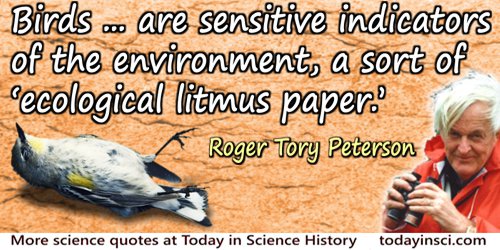
Birds ... are sensitive indicators of the environment, a sort of “ecological litmus paper,” ... The observation and recording of bird populations over time lead inevitably to environmental awareness and can signal impending changes.
In Peterson Field Guide to Birds of North America (2008), 10.
Both biological and cultural diversity are now severely threatened and working for their preservation is a critical task.
The Quark and the Jaguar: Adventure in the Simple and Compex (1994), 374-375.
Clinical ecology [is] a new branch of medicine aimed at helping people made sick by a failure to adapt to facets of our modern, polluted environment. Adverse reactions to processed foods and their chemical contaminants, and to indoor and outdoor air pollution with petrochemicals, are becoming more and more widespread and so far these reactions are being misdiagnosed by mainstream medical practitioners and so are not treated effectively.
Quoted in article 'Richard Mackarness', Contemporary Authors Online (2002).
Clothing represented man’s first environment-controlling and ecology-transforming tool.
In Utopia or Oblivion: The Prospects for Humanity (1963), 86.
Differences between individuals are the raw materials for evolutionary change and for the evolution of adaptations, yet of course most physiologists treat these differences as noise that is to be filtered out. From the standpoint of physiological ecology, the traditional emphasis of physiologists on central tendencies rather than on variance has some unhappy consequences. Variation is not just noise; it is also the stuff of evolution and a central attribute of living systems. The physiological differences between individuals in the same species or population, and also the patterns of variation in different groups, must not be ignored.
From 'Interspecific comparison as a tool for ecological physiologists', collected in M.E. Feder, A.F. Bennett, W.W. Burggren, and R.B. Huey, (eds.), New Directions in Ecological Physiology (1987), 32-33,
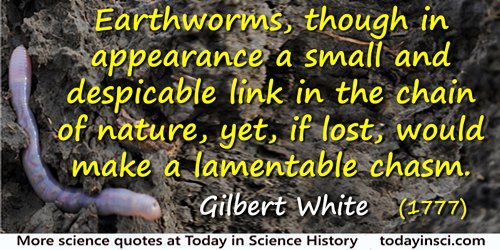
Earthworms, though in appearance a small and despicable link in the chain of nature, yet, if lost, would make a lamentable chasm … worms seem to be the great promoters of vegetation, which would proceed but lamely without them.
[Showing an early awareness in ecology.]
[Showing an early awareness in ecology.]
Letter XXXV, to Daines Barrington, (20 May 1777) in The Natural History of Selborne (1789), 216 and (1899), 174.
Ecological differentiation is the necessary condition for coexistence.
'The Competitive Exclusion Principle', Science, 1960,131, 1296.
Ecologically speaking, a spilt tanker load is like sticking a safety pin into an elephant’s foot. The planet barely notices. After the Exxon Valdez accident in Alaska the oil company spent billions tidying up the coastline, but it was a waste of money because the waves were cleaning up faster than Exxon could. Environmentalists can never accept the planet’s ability to self-heal.
'Seat Leon Cupra SR1, in The Times (22 Dec 2002)
Ecology and economics may unify toward a more sound use of environmental resources and … can translate into a change in paradigm regarding how humans view nature.
From interview (16 Jul 2009) on rorotoko.com about his book The Balance of Nature: Ecology’s Enduring Myth (2009).
Ecology has not yet explicitly developed the kind of cohesive, simplifying generalizations exemplified by, say, the laws of physics. Nevertheless there are a number of generalizations that are already evident in what we now know about the ecosphere and that can be organized into a kind of informal set of laws of ecology.
In The Closing Circle: Nature, Man, and Technology (2014).
Ecology is vacuous without contextualizing it within evolution.
From interview (16 Jul 2009) on rorotoko.com about his book The Balance of Nature: Ecology’s Enduring Myth (2009).
English science … isolates the reptile or mollusk it assumes to explain; whilst reptile or mollusk only exists in system, in relation.
In essay, 'Literature', English Traits (1856), collected in Works of Ralph Waldo Emerson: Essays First and Second Series (1883), 341.
Eventually, we’ll realize that if we destroy the ecosystem, we destroy ourselves.
From interview with James Reston, Jr., in Pamela Weintraub (ed.), The Omni Interviews (1984), 105. Previously published in magazine, Omni (May 1982).
Personal Library
Every one of us can do something to protect and care for our planet. We have to live in such a way that a future will be possible for our children and our grandchildren. Our own life has to be. Our own life has to be our message.
In The World We Have: A Buddhist Approach to Peace and Ecology (2008), i.
Evolution is ecology on a longer time scale.
From interview (16 Jul 2009) on rorotoko.com about his book The Balance of Nature: Ecology’s Enduring Myth (2009).
Food is the burning question in animal society, and the whole structure and activities of the community are dependent upon questions of food-supply.
(1960)
For terrestrial vertebrates, the climate in the usual meteorological sense of the term would appear to be a reasonable approximation of the conditions of temperature, humidity, radiation, and air movement in which terrestrial vertebrates live. But, in fact, it would be difficult to find any other lay assumption about ecology and natural history which has less general validity. … Most vertebrates are much smaller than man and his domestic animals, and the universe of these small creatures is one of cracks and crevices, holes in logs, dense underbrush, tunnels, and nests—a world where distances are measured in yards rather than miles and where the difference between sunshine and shadow may be the difference between life and death. Actually, climate in the usual sense of the term is little more than a crude index to the physical conditions in which most terrestrial animals live.
From 'Interaction of physiology and behavior under natural conditions', collected in R.I. Bowman (ed.), The Galapagos (1966), 40.
For this knowledge of right living, we have sought a new name... . As theology is the science of religious life, and biology the science of [physical] life ... so let Oekology be henceforth the science of [our] normal lives ... the worthiest of all the applied sciences which teaches the principles on which to found... healthy... and happy life.
Quoted in Robert Clarke (ed.), Ellen Swallow: The Woman Who Founded Ecology (1973), 120.
I always feel like our descendants—they're going to be upset with us for wrecking the planet anyway—but they're really going to be mad that we didn't even bother to take a good picture. [On the importance of thorough research of even a little ant species.]
Quoted from NPR radio interview, also published on NPR web page by Christopher Joyce, Morning Edition (1 Aug 2013).
I shall collect plants and fossils, and with the best of instruments make astronomic observations. Yet this is not the main purpose of my journey. I shall endeavor to find out how nature's forces act upon one another, and in what manner the geographic environment exerts its influence on animals and plants. In short, I must find out about the harmony in nature.
Letter to Karl Freiesleben (Jun 1799). In Helmut de Terra, Humboldt: The Life and Times of Alexander van Humboldt 1769-1859 (1955), 87.
I want to turn women loose on the environmental crisis…. Nobody knows more about pollution when detergents back up in the sink.
In Unity, Freedom & Peace: A Blueprint for Tomorrow (1968), 87.
If a man walked in the woods for love of them half of each day, he is in danger of being regarded as a loafer, but if he spends his whole day as a speculator shearing of those woods and making earth bald before her time, he is estimated as an industrious and enterprising citizen—as if a town had no interest in forests but to cut them down.
Walden. Quoted in Dr. N Sreedharan, Quotations of Wit and Wisdom (2007), 19.
If farm ecology and economics go wrong, nothing else will go right in agriculture.
In 'Science and Shaping the Future of Rice', collected in Pramod K. Aggarwal et al. (eds.), 2006 International Rice Congress: Science, Technology, and Trade for Peace and Prosperity (2007), 5.
If you’re telling a story, it’s very tempting to personalise an animal. To start with, biologists said this fascination with one individual was just television storytelling. But they began to realise that, actually, it was a new way to understand behaviour–following the fortunes of one particular animal could be very revealing and have all kinds of implications in terms of the ecology and general behaviour of the animals in that area.
From interview with Alice Roberts, 'Attenborough: My Life on Earth', The Biologist (Aug 2015), 62, No. 4, 15.
In nature, nothing exists alone.
In Silent Spring (1962), 51.
In New England they once thought blackbirds useless, and mischievous to the corn. They made efforts to destroy them. The consequence was, the blackbirds were diminished; but a kind of worm, which devoured their grass, and which the blackbirds used to feed on, increased prodigiously; then, finding their loss in grass much greater than their saving in corn, they wished again for their blackbirds.
Letter to Richard Jackson, 5 May 1753. In Albert Henry Smyth, The Writings of Benjamin Franklin (1905), Vol. 3, 135.
In recent years it has become impossible to talk about man’s relation to nature without referring to “ecology” … such leading scientists in this area as Rachel Carson, Barry Commoner, Eugene Odum, Paul Ehrlich and others, have become our new delphic voices … so influential has their branch of science become that our time might well be called the “Age of Ecology”.
In opening paragraph of Preface, Nature’s Economy: A History of Ecological Ideas (1994), 14.
Industrial Society is not merely one containing 'industry,' large-scale productive units capable of supplying man's material needs in a way which can eliminate poverty: it is also a society in which knowledge plays a part wholly different from that which it played in earlier social forms, and which indeed possesses a quite different type of knowledge. Modern science is inconceivable outside an industrial society: but modern industrial society is equally inconceivable without modern science. Roughly, science is the mode of cognition of industrial society, and industry is the ecology of science.
Thought and Change (1965), 179.
It is perhaps a law of nature that when a species (or group) fits itself to a place not previously occupied, and in which it is subject to no opposition from beings of its own class, or where it attains so great a perfection as to be able easily to overcome all opposition, the character eventually loses its original plasticity, or tendency to vary, since improvement in such a case would be superfluous, and becomes, so to speak, crystallized in that form which continues thereafter unaltered. … [Such as] the humming-bird.
In The Naturalist in La Plata (1895), 40.
It is so hard for an evolutionary biologist to write about extinction caused by human stupidity ... Let me then float an unconventional plea, the inverse of the usual argument ... The extinction of Partula is unfair to Partula. That is the conventional argument, and I do not challenge its primacy. But we need a humanistic ecology as well, both for the practical reason that people will always touch people more than snails do or can, and for the moral reason that humans are legitimately the measure of all ethical questions–for these are our issues, not nature’s.
…...
It is the intertwined and interacting mechanisms of evolution and ecology, each of which is at the same time a product and a process, that are responsible for life as we see it, and as it has been.
In Evolutionary Paleoecology of the Marine Biosphere (1973), 58.
Knowing Pains
I studied parts
of a flower
to understand
its flowering.
I learned much
about my limits.
I had forgotten
Earth and climate.
I studied parts
of a flower
to understand
its flowering.
I learned much
about my limits.
I had forgotten
Earth and climate.
Poem, in Starting Points: Poems (1971), 38. As quoted in Arthur Lerner, 'Poetry Therapy', The American Journal of Nursing (Aug 1973), 73, No. 8, 1338.
Land that is left wholly to nature, that has no improvement of pasturage, tillage, or planting, is called, as indeed it is, “waste”.
In John Locke and Thomas Preston Peardon (ed.), The Second Treatise of Civil Government: An Essay Concerning the True Original, Extent and End of Civil Government (Dec 1689, 1952), 25.
Modern technology
Owes ecology
An apology.
Owes ecology
An apology.
From Worse Verse (1969), as cited in Colin Jarman, The Book of Poisonous Quotes (1993), 237.
Mutations and chromosomal changes arise in every sufficiently studied organism with a certain finite frequency, and thus constantly and unremittingly supply the raw materials for evolution. But evolution involves something more than origin of mutations. Mutations and chromosomal changes are only the first stage, or level, of the evolutionary process, governed entirely by the laws of the physiology of individuals. Once produced, mutations are injected in the genetic composition of the population, where their further fate is determined by the dynamic regularities of the physiology of populations. A mutation may be lost or increased in frequency in generations immediately following its origin, and this (in the case of recessive mutations) without regard to the beneficial or deleterious effects of the mutation. The influences of selection, migration, and geographical isolation then mold the genetic structure of populations into new shapes, in conformity with the secular environment and the ecology, especially the breeding habits, of the species. This is the second level of the evolutionary process, on which the impact of the environment produces historical changes in the living population.
Genetics and Origin of Species (1937), 13.
One dictionary that I consulted remarks that “natural history” now commonly means the study of animals and plants “in a popular and superficial way,” meaning popular and superficial to be equally damning adjectives. This is related to the current tendency in the biological sciences to label every subdivision of science with a name derived from the Greek. “Ecology” is erudite and profound; while “natural history” is popular and superficial. Though, as far as I can see, both labels apply to just about the same package of goods.
In The Nature of Natural History (1961, 2014), 7.
One of the most disturbing ways that climate change is already playing out is through what ecologists call “mismatch” or “mistiming.” This is the process whereby warming causes animals to fall out of step with a critical food source, particularly at breeding times, when a failure to find enough food can lead to rapid population losses.
In 'The Change Within: The Obstacles We Face Are Not Just External', The Nation (12 May 2014).
Over and over again, we must stress that a healthy ecology is the basis for a healthy economy.
Quoted in Glenn D. Paige, To Nonviolent Political Science (1993), 126.
Over the years it has become clear that adjustments to the physical environment are behavioral as well as physiological and are inextricably intertwined with ecology and evolution. Consequently, a student of the physiology of adaptation should not only be a technically competent physiologist, but also be familiar with the evolutionary and ecological setting of the phenomenon that he or she is studying.
From 'Interspecific comparison as a tool for ecological physiologists', collected in M.E. Feder, A.F. Bennett, W.W. Burggren, and R.B. Huey, (eds.), New Directions in Ecological Physiology (1987), 17.
People still do not understand that a live fish is more valuable than a dead one, and that destructive fishing techniques are taking a wrecking ball to biodiversity.
In 'Can We Stop Killing Our Oceans Now, Please?', Huffington Post (14 Aug 2013).
Pervasive depletion and overuse of water supplies, the high capital cost of new large water projects, rising pumping costs and worsening ecological damage call for a shift in the way water is valued, used and managed.
From a study Postel wrote for Worldwatch Institute, quoted in New York Times (22 Sep 1985), 19.
Science arouses a soaring sense of wonder. But so does pseudoscience. Sparse and poor popularizations of science abandon ecological niches that pseudoscience promptly fills. If it were widely understood that claims to knowledge require adequate evidence before they can be accepted, there would be no room for pseudoscience.
The Demon-Haunted World: Science as a Candle in the Dark (1996), 6.
Since my first discussions of ecological problems with Professor John Day around 1950 and since reading Konrad Lorenz's “King Solomon's Ring,” I have become increasingly interested in the study of animals for what they might teach us about man, and the study of man as an animal. I have become increasingly disenchanted with what the thinkers of the so-called Age of Enlightenment tell us about the nature of man, and with what the formal religions and doctrinaire political theorists tell us about the same subject.
'Autobiography of Allan M. Cormack,' Les Prix Nobel/Nobel Lectures 1979, editted by Wilhelm Odelberg.
Television, films, and newspapers are forms of pollution for us and our children. They sow seeds of violence and anxiety in us and pollute our consciousness, just as we destroy our environment by farming with chemicals, clear-cutting the trees, and polluting the water. We need to protect the ecology of the Earth and the ecology of the mind, or this kind of violence and recklessness will spill over into even more areas of life.
In Love in Action: Writings on Nonviolent Social Change (1993), 132.
Tell me of what plant-birthday a man takes notice, and I shall tell you a good deal about his vocation, his hobbies, his hay fever, and the general level of his ecological education.
In 'Prairie Birthday', A Sand County Almanac, and Sketches Here and There (1949, 1987), 44. [Birthday refers to the time of first blooming.]
That land is a community is the basic concept of ecology, but that land is to be loved and respected is an extension of ethics. That land yields a cultural harvest is a fact long known, but latterly often forgotten.
In 'Foreword', A Sand County Almanac, and Sketches Here and There (1949, 1987), viii-ix.
The big blue area that dominates the view of earth from space was once our home and today represents 97 percent of the biosphere where life exists, providing the water we drink and the air we breathe. And we are destroying it.
In 'Can We Stop Killing Our Oceans Now, Please?', Huffington Post (14 Aug 2013).
The crescendo of noise—whether it comes from truck or jackhammer, siren or airplane—is more than an irritating nuisance. It intrudes on privacy, shatters serenity, and can inflict pain. We dare not be complacent about this ever mounting volume of noise. In the years ahead, it can bring even more discomfort—and worse—to the lives of people.
In 'Special Message to the Congress on Conservation: “To Renew a Nation” (8 Mar 1968). Collected in Public Papers of the Presidents of the United States: Lyndon B. Johnson: 1968-69 (1970), 363.
https://books.google.com/books?isbn=1623768977
Johnson, Lyndon B. - 1970
The greatest spiritual revolutionary Western history, Saint Francis, proposed what he thought was an alternative Christian view of nature and man’s relation to it: he tried to substitute the idea of the equality of creatures, including man, for the idea of man’s limitless rule of creation. He failed. Both our present science and our present technology are so tinctured with orthodox Christian arrogance toward nature that no solution for our ecologic crisis can be expected from them alone. Since the roots of our trouble are so largely religious, the remedy must also be essentially religious, whether we call it that or not. We must rethink and refeel our nature and destiny. The profoundly religious, but heretical, sense of the primitive Franciscans for the spiritual autonomy of all parts of nature may point a direction. I propose Francis as a patron saint for ecologists.
In The Historical Roots of our Ecologic Crisis (1967), 1207.
The highway system devours land resources and atmosphere at a rate that is impossible to sustain.
(1972).
The interactions of man with his environment are so complex that only an ecological approach to nutrition permits an understanding of the whole spectrum of factors determining the nutritional problems that exist in human societies.
World Health Organization, Nutrition in Preventive Medicine, 13. From http://whqlibdoc.who.int/monograph/WHO_MONO_62_(chp1).pdf
The term ecology comes from the Greek word oikos, and means ‘the household.’ Ecological responsibility, then, begins at home and expands to fill the entire planet.
The Green Lifestyle Handbook
The theory here developed is that mega-evolution normally occurs among small populations that become preadaptive and evolve continuously (without saltation, but at exceptionally rapid rates) to radically different ecological positions. The typical pattern involved is probably this: A large population is fragmented into numerous small isolated lines of descent. Within these, inadaptive differentiation and random fixation of mutations occur. Among many such inadaptive lines one or a few are preadaptive, i.e., some of their characters tend to fit them for available ecological stations quite different from those occupied by their immediate ancestors. Such groups are subjected to strong selection pressure and evolve rapidly in the further direction of adaptation to the new status. The very few lines that successfully achieve this perfected adaptation then become abundant and expand widely, at the same time becoming differentiated and specialized on lower levels within the broad new ecological zone.
Tempo and Mode in Evolution (1944), 123.
The theory of evolution by natural selection is an ecological theory—founded on ecological observation by perhaps the greatest of all ecologists. It has been adopted by and brought up by the science of genetics, and ecologists, being modest people, are apt to forget their distinguished parenthood.
'A Darwinian Approach to Plant Ecology', Journal of Ecology, 1967, 55, 247.
The time has come to link ecology to economic and human development. When you have seen one ant, one bird, one tree, you have not seen them all. What is happening to the rain forests of Madagascar and Brazil will affect us all.
Quoted in Jamie Murphy and Andrea Dorfman, 'The Quiet Apocalypse,' Time (13 Oct 1986).
The tragedy of deforestation in Amazonia as well as elsewhere in the tropics is that its costs, in... economic, social, cultural, and aesthetic terms, far outweigh its benefits. In many cases, destruction of the region’s rainforests is motivated by short-term gains rather than the long-term productive capacity of the land. And, as a result, deforestation usually leaves behind landscapes that are economically as well as ecologically impoverished.
From Anthony Bennett Anderson (ed.), Alternatives to Deforestation: Steps Toward Sustainable Use
of the Amazon Rain Forest (1990), xi. As cited in Lykke E. Andersen (ed.), The Dynamics of Deforestation and Economic Growth in the Brazilian Amazon (2002), 2.
There are three times as many people in the world as when I started making television programs 56 years ago. It is frightening. We can’t go on as we have been. We are seeing the consequences in terms of ecology, pollution, space and food production.
On becoming a patron of the Optimum Population Trust, as reported in The Times (14 Apr 2009).
There is nothing in which the birds differ more from man than the way in which they can build and yet leave a landscape as it was before.
In The Blue Lion, and Other Essays (1923), 29.
This being the only living world we are ever likely to know, let us join to make the most of it.
Concluding remark in 'The Biological Diversity Crisis', Bioscience (Dec 1985), 35, No. 11, 705. Also collect in Paul R. Krausman and Bruce D. Leopold (eds.), Essential Readings in Wildlife Management and Conservation (2013), 472.
Three hundred trout are needed to support one man for a year. The trout, in turn, must consume 90,000 frogs, that must consume 27 million grasshoppers that live off of 1,000 tons of grass.
From Energetics, Kinetics, and Life: An Ecological Approach (1971), 293.
We are the intelligent elite among animal life on earth and whatever our mistakes, [Earth] needs us. This may seem an odd statement after … the way 20th century humans became almost a planetary disease organism. But it has taken [Earth] 2.5 billion years to evolve an animal that can think and communicate its thoughts. If we become extinct she has little chance of evolving another.
In The Vanishing Face of Gaia: A Final Warning (2010), 28.
We must learn to think not only logically, but bio-logically.
In One Life at a Time, Please (1988), 68.
We want them to use the education to be leaders in their community with an understanding of ecology and conservation for the wild outdoors far beyond their legislators back home. We expect these people to he a grain of sand on the beach of future leadership.
…...
What makes it so hard to organize the environment sensibly is that everything we touch is hooked up to everything else.
Epigraph in Isaac Asimov’s Book of Science and Nature Quotations (1988), 64.
Whatever terrain the environmental historian chooses to investigate, he has to address the age-old predicament of how humankind can feed itself without degrading the primal source of life. Today as ever, that problem is the fundamental challenge in human ecology, and meeting it will require knowing the earth well—knowing its history and knowing its limits.
In 'Transformations of the Earth: toward an Agroecological Perspective in History', Journal of American History (Mar 1990), 76, No. 4, 1106.
When not protected by law, by popular favor or superstition, or by other special circumstances, [birds] yield very readily to the influences of civilization, and, though the first operations of the settler are favorable to the increase of many species, the great extension of rural and of mechanical industry is, in a variety of ways, destructive even to tribes not directly warred upon by man.
In Man and Nature, (1864), 93-93.
Wildlife management consists mainly of raising more animals for hunters to shoot.
From interview collected in Pamela Weintraub (ed.), The Omni Interviews (1984), 78.
You can’t see oxygen being generated by trees, carbon dioxide being taken up by trees, but we get that. We’re beginning to understand the importance of forests. But the ocean has its forests, too. They just happen to be very small. They’re very small in size but they’re very large in numbers.
In interview with Pierce Nahigyan, 'Dr. Sylvia Earle: “We’re Literally Destroying The Systems That Keep Us Alive”', Huffington Post (6 Jan 2016).
 In science it often happens that scientists say, 'You know that's a really good argument; my position is mistaken,' and then they would actually change their minds and you never hear that old view from them again. They really do it. It doesn't happen as often as it should, because scientists are human and change is sometimes painful. But it happens every day. I cannot recall the last time something like that happened in politics or religion.
(1987) --
In science it often happens that scientists say, 'You know that's a really good argument; my position is mistaken,' and then they would actually change their minds and you never hear that old view from them again. They really do it. It doesn't happen as often as it should, because scientists are human and change is sometimes painful. But it happens every day. I cannot recall the last time something like that happened in politics or religion.
(1987) -- 





