Earthquake Quotes (38 quotes)
[In plotting earthquake measurements] the range between the largest and smallest magnitudes seemed unmanageably large. Dr. Beno Gutenberg then made the natural suggestion to plot the amplitudes logarithmically.
From interview with Henry Spall, as in an abridged version of Earthquake Information Bulletin (Jan-Feb 1980), 12, No. 1, that is on the USGS website.
[Interviewer: If the building you are in now started to shake and you knew an earthquake was occurring, what would you do?]
I would walk - not run - to the nearest seismograph.
I would walk - not run - to the nearest seismograph.
From interview in the Earthquake Information Bulletin (Jul-Aug 1971), 3, No. 4, as abridged in article on USGS website.
A bad earthquake at once destroys the oldest associations: the world, the very emblem of all that is solid, has moved beneath our feet like a crust over a fluid; one second of time has conveyed to the mind a strange idea of insecurity, which hours of reflection would never have created.
Journal of Researches: Into the Natural History and Geology of the Countries Visited During the Voyage of H.M.S. BeagIe Round the World (1839), ch. XVI, 369.
A first step in the study of civilization is to dissect it into details, and to classify these in their proper groups. Thus, in examining weapons, they are to be classed under spear, club, sling, bow and arrow, and so forth; among textile arts are to be ranged matting, netting, and several grades of making and weaving threads; myths are divided under such headings as myths of sunrise and sunset, eclipse-myths, earthquake-myths, local myths which account for the names of places by some fanciful tale, eponymic myths which account for the parentage of a tribe by turning its name into the name of an imaginary ancestor; under rites and ceremonies occur such practices as the various kinds of sacrifice to the ghosts of the dead and to other spiritual beings, the turning to the east in worship, the purification of ceremonial or moral uncleanness by means of water or fire. Such are a few miscellaneous examples from a list of hundreds … To the ethnographer, the bow and arrow is the species, the habit of flattening children’s skulls is a species, the practice of reckoning numbers by tens is a species. The geographical distribution of these things, and their transmission from region to region, have to be studied as the naturalist studies the geography of his botanical and zoological species.
In Primitive Culture (1871), Vol. 1, 7.
All admit that the mountains of the globe are situated mostly along the border regions of the continents (taking these regions as 300 to 1000 miles or more in width), and that over these same areas the sedimentary deposits have, as a general thing, their greatest thickness. At first thought, it would seem almost incredible that the upliftings of mountains, whatever their mode of origin, should have taken place just where the earth’s crust, through these sedimentary accumulations, was the thickest, and where, therefore, there was the greatest weight to be lifted. … Earthquakes show that even now, in this last of the geological ages, the same border regions of the continents, although daily thickening from the sediments borne to the ocean by rivers, are the areas of the greatest and most frequent movements of the earth’s crust. (1866)
[Thus, the facts were known long ago; the explanation by tectonic activity came many decades later.]
[Thus, the facts were known long ago; the explanation by tectonic activity came many decades later.]
In 'Observations on the Origin of Some of the Earth’s Features', The American Journal of Science (Sep 1866), Second Series, 42, No. 125, 210-211.
Believe me, this planet has put up with much worse than us. It’s been through earthquakes, volcanoes, plate tectonics, solar flares, sun-spots, magnetic storms, pole reversals, planetary floods, worldwide fires, tidal waves, wind and water erosion, cosmic rays, ice ages, and hundreds of thousands of years of bombardment by comets, asteroids, and meteors. And people think a few plastic bags and aluminum cans are going to make a difference?
In Napalm and Silly Putty (2002), 97.
Diseased nature oftentimes breaks forth
In strange eruptions: oft the teeming earth
Is with a kind of colic pinch’d and vex’d
By the imprisoning of unruly wind
Within her womb; which, for enlargement striving,
Shakes the old beldam earth, and topples down
Steeples and moss-grown towers.
In strange eruptions: oft the teeming earth
Is with a kind of colic pinch’d and vex’d
By the imprisoning of unruly wind
Within her womb; which, for enlargement striving,
Shakes the old beldam earth, and topples down
Steeples and moss-grown towers.
Dialogue by Hotspur to Glendower, in King Henry IV, Part I (c. 1597), Act III, Scene 1. Reprinted in The Works of Shakespeare: The First Part of King Henry IV (1790), 47.
Earthquakes may be brought about because wind is caught up in the earth, so the earth is dislocated in small masses and is continually shaken, and that causes it to sway.
— Epicurus
Letter to Pythocles, in Epicurus: The Extant Remains (1926), trans. C. Bailey, 71.
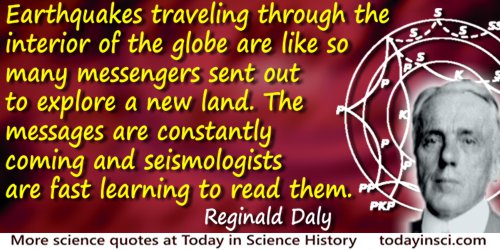
Earthquakes traveling through the interior of the globe are like so many messengers sent out to explore a new land. The messages are constantly coming and seismologists are fast learning to read them.
In Our Mobile Earth (1926), 5.
Geology depends on impressions made by floods, earthquakes, volcanoes. The mountains tell the story of their oppressions and rebellions. The outstanding data of this science of Mother Earth are those furnished by the most violent impressions that mark an epoch in evolution
In I Am an Impure Thinker (1970), 16.
GNU, n. An animal of South Africa, which in its domesticated state resembles a horse, a buffalo and a stag. In its wild condition it is something like a thunderbolt, an earthquake and a cyclone.
The Collected Works of Ambrose Bierce (1911), Vol. 7, The Devil's Dictionary, 119.
![Charles Richter quote: I think that harping on [earthquake] prediction is something between a will-o'-the-wisp and a red herring](https://todayinsci.com/R/Richter_Charles/RichterCharles-Harping500x250px.jpg)
I think that harping on [earthquake] prediction is something between a will-o’-the-wisp and a red herring. Attention is thereby diverted away from positive measures to eliminate earthquake risk.
From interview in the Earthquake Information Bulletin (Jul-Aug 1971), 3, No. 4, as abridged in article on USGS website.
It is to heat that should be attributed the vast movements observed on the Earth; the disturbances of the atmosphere are due to heat, the arising of clouds, the fall of rains and other aspects of weather, the currents of water crisscrossing the globe’s surface of which man manages to harness a small fraction; finally, earthquakes and volcanic eruptions are also caused by heat.
As translated by Webmaster from the original French: “C’est à la chaleur que doivent être attribués les grands mouvements qui frappent nos regards sur la terre; c’est à elle que sont dues les agitations de l’atmosphère, l’ascension des nuages, la chute des pluies et des autres météores, les courants d’eau qui sillonnent la surface du globe et dont l’homme est parvenue à employer pour son usage une faible partie; enfin les tremblements de terre, les éruptions volcaniques reconnaissent aussi pour cause la chaleur.” From Réflexions sur la Puissance Motrice du Feu et sur les Machines Propres a Développer cette Puissance (1824, 1878), 1-2. Also in N.-L.-S. Carnot and R. H. Thurston (ed.), Reflections on the Motive Power of Heat and on Machines Fitted to Develop That Power (1890, 2nd ed. 1897), 11 (in French), and 37-38 (in English) as: “To heat also are due the vast movements which take place on the earth. It causes the agitations of the atmosphere, the ascension of clouds, the fall of rain and of meteors*, the currents of water which channel the surface of the globe, and of which man has thus far employed but a small portion. Even earthquakes and volcanic eruptions are the result of heat.” [*Note the obsolete term “meteors” meaning atmospheric or meteorological phenomena, and does not refer here to rocks falling from space. —Webmaster]
It must have appeared almost as improbable to the earlier geologists, that the laws of earthquakes should one day throw light on the origin of mountains, as it must to the first astronomers, that the fall of an apple should assist in explaining the motions of the moon.
Principles of Geology(1830-3), Vol. 3, 5.
Just as the spectroscope opened up a new astronomy by enabling the astronomer to determine some of the constituents of which distant stars are composed, so the seismograph, recording the unfelt motion of distant earthquakes, enables us to see into the earth and determine its nature with as great a certainty, up to a certain point, as if we could drive a tunnel through it and take samples of the matter passed through.
'The Constitution of the Interior of the Earth, as Revealed by Earthquakes', Quarterly Journal of the Geological Society (1906), 62, 456.
Let us suppose, that the Old and New worlds were formerly but one continent, and that, by a violent earthquake, the ancient Atalantis [sic] of Plato was sunk ... The sea would necessarily rush in from all quarters, and form what is now called the Atlantic ocean.
'Second Discours: Histoire et Théorie de la Terre', Histoire Naturelle, Générale et Particulière, Avec la Description du Cabinet du Roi (1749), Vol. I, 96; Natural History, General and Particular (1785), Vol. I, trans. W. Smellie, 31.
Like an earthquake, true senility announces itself by trembling and stammering.
In Charlas de Café: pensamientos, anécdotas y confidencias (1920, 1967), 95. (Café Chats: Thoughts, Anecdotes and Confidences). As (loosely) translated in Peter McDonald (ed.) Oxford Dictionary of Medical Quotations (2004), 83. From the original Spanish, “La verdadera, la aterradora, la inexorable senilidad comienza en la fase de temblor y balbuceo, es decir, cuando el cerebro está salpicado de placas seniles y entendimiento y carácter retroceden al estado infantil. A semejanza del edificio cuarteado por el terremoto, la citada agitación anuncia ruina inminente.”
A more complete translation attempted by Webmaster with Google Translate is: “True, the terrifying, the inexorable senility begins at the stage of tremor and slurred speech, i.e. when the brain is dotted with senile plaques, and understanding and character regress to the infantile state. Like the building cracked by the earthquake, said agitation announces impending doom.”
Looking back across the long cycles of change through which the land has been shaped into its present form, let us realise that these geographical revolutions are not events wholly of the dim past, but that they are still in progress. So slow and measured has been their march, that even from the earliest times of human history they seem hardly to have advanced at all. But none the less are they surely and steadily transpiring around us. In the fall of rain and the flow of rivers, in the bubble of springs and the silence of frost, in the quiet creep of glaciers and the tumultuous rush of ocean waves, in the tremor of the earthquake and the outburst of the volcano, we may recognise the same play of terrestrial forces by which the framework of the continents has been step by step evolved.
Lecture at the Evening Meeting, Royal Geographical Society (24 Mar 1879), 'Discussion on Geographical Evolution', in Proceedings of the Royal Geographical Society and Monthly Record (1879), New Monthly Series, 1, 443.
M. Waldman … concluded with a panegyric upon modern chemistry…:— “The ancient teachers of this science” said he, “Promised impossibilities and performed nothing. The modern masters promise very little; they know that metals cannot be transmuted and that the elixir of life is a chimera. But these philosophers seem only made to dabble in dirt, and their eyes to pore over the microscope or crucible, have indeed performed miracles. They penetrate into the recesses of nature and show how she works in her hiding-places. They ascend into the heavens; they have discovered how the blood circulates, and the nature of the air we breathe. They can command the thunders of heaven, mimic the earthquake, and even mock the invisible world with its own shadows.”
In Frankenstein: Or, The Modern Prometheus (1823), Vol. 1, 73-74. Webmaster note: In the novel, when the fictional characters meet, M. Waldman, professor of chemistry, sparks Victor Frankenstein’s interest in science. Shelley was age 20 when the first edition of the novel was published anonymously (1818).
Moreover, within the hollows of the earth,
When from one quarter the wind builds up, lunges,
Muscles the deep caves with its headstrong power,
The earth leans hard where the force of wind has pressed it;
Then above ground, the higher the house is built,
The nearer it rises to the sky, the worse
Will it lean that way and jut out perilously,
The beams wrenched loose and hanging ready to fall.
And to think, men can't believe that for this world
Some time of death and ruin lies in wait,
Yet they see so great a mass of earth collapse!
And the winds pause for breath—that's lucky, for else
No force could rein things galloping to destruction.
But since they pause for breath, to rally their force,
Come building up and then fall driven back,
More often the earth will threaten ruin than
Perform it. The earth will lean and then sway back,
Its wavering mass restored to the right poise.
That explains why all houses reel, top floor
Most then the middle, and ground floor hardly at all.
When from one quarter the wind builds up, lunges,
Muscles the deep caves with its headstrong power,
The earth leans hard where the force of wind has pressed it;
Then above ground, the higher the house is built,
The nearer it rises to the sky, the worse
Will it lean that way and jut out perilously,
The beams wrenched loose and hanging ready to fall.
And to think, men can't believe that for this world
Some time of death and ruin lies in wait,
Yet they see so great a mass of earth collapse!
And the winds pause for breath—that's lucky, for else
No force could rein things galloping to destruction.
But since they pause for breath, to rally their force,
Come building up and then fall driven back,
More often the earth will threaten ruin than
Perform it. The earth will lean and then sway back,
Its wavering mass restored to the right poise.
That explains why all houses reel, top floor
Most then the middle, and ground floor hardly at all.
On the Nature of Things, trans. Anthony M. Esolen (1995), Book 6, lines 558-77, 216.
Most loss of life and property has been due to the collapse of antiquated and unsafe structures, mostly of brick and other masonry. ... There is progress of California toward building new construction according to earthquake-resistant design. We would have less reason to ask for earthquake prediction if this was universal.
From interview with Henry Spall, as in an abridged version of Earthquake Information Bulletin (Jan-Feb 1980), 12, No. 1, that was on the USGS website.
Most of these Mountains and Inland places whereon these kind of Petrify’d Bodies and Shells are found at present, or have been heretofore, were formerly under the Water, and that either by the descending of the Waters to another part of the Earth by the alteration of the Centre of Gravity of the whole bulk, or rather by the Eruption of some kind of Subterraneous Fires or Earthquakes, great quantities of Earth have been deserted by the Water and laid bare and dry.
Lectures and Discourses of Earthquakes (1668). In The Posthumous Works of Robert Hooke, containing his Cutlerian Lectures and other Discourses read at the Meetings of the Illustrious Royal Society (1705), 320-1.
My amateur interest in astronomy brought out the term “magnitude,” which is used for the brightness of a star.
From interview with Henry Spall, as in an abridged version of Earthquake Information Bulletin (Jan-Feb 1980), 12, No. 1, that is on the USGS website.
Nature uncovers the inner secrets of nature in two ways: one by the force of bodies operating outside it; the other by the very movements of its innards. The external actions are strong winds, rains, river currents, sea waves, ice, forest fires, floods; there is only one internal force—earthquake.
About the Layers of the Earth and other Works on Geology (1757), trans. A. P. Lapov (1949), 45.
Not all the winds, and storms, and earthquakes, and seas, and seasons of the world, have done so much to revolutionize the earth as Man, the power of an endless life, has done since the day he came forth upon it, and received dominion over it.
From Sermon on the Power of Endless Life, and Other Sermons (1876), 310.
Our earth is very old, an old warrior that has lived through many battles. Nevertheless, the face of it is still changing, and science sees no certain limit of time for its stately evolution. Our solid earth, apparently so stable, inert, and finished, is changing, mobile, and still evolving. Its major quakings are largely the echoes of that divine far-off event, the building of our noble mountains. The lava floods and intriguing volcanoes tell us of the plasticity, mobility, of the deep interior of the globe. The slow coming and going of ancient shallow seas on the continental plateaus tell us of the rhythmic distortion of the deep interior-deep-seated flow and changes of volume. Mountain chains prove the earth’s solid crust itself to be mobile in high degree. And the secret of it all—the secret of the earthquake, the secret of the “temple of fire,” the secret of the ocean basin, the secret of the highland—is in the heart of the earth, forever invisible to human eyes.
In Our Mobile Earth (1926), 320.
Pathology would remain a lovely science, even if there were no therapeutics, just as seismology is a lovely science, though no one knows how to stop earthquakes.
In A Mencken Chrestomathy (1949, 1956), 625-626.
Scourges, pestilence, famine, earthquakes, and wars are to be regarded as blessings, since they serve to prune away the luxuriant growth of the human race.
In The Timeline Book of Science by George Ochoa and Melinda Corey (1995).
The discovery of the famous original [Rosetta Stone] enabled Napoleon’s experts to begin the reading of Egypt’s ancient literature. In like manner the seismologists, using the difficult but manageable Greek of modern physics, are beginning the task of making earthquakes tell the nature of the earth’s interior and translating into significant speech the hieroglyphics written by the seismograph.
The forces which displace continents are the same as those which produce great fold-mountain ranges. Continental drift, faults and compressions, earthquakes, volcanicity, transgression cycles and polar wandering are undoubtedly connected causally on a grand scale. Their common intensification in certain periods of the earth’s history shows this to be true. However, what is cause and what effect, only the future will unveil.
In The Origins of Continents and Oceans (4th ed. 1929), trans. John Biram (1966), 179.
The most remarkable feature about the magnitude scale was that it worked at all and that it could be extended on a worldwide basis. It was originally envisaged as a rather rough-and-ready procedure by which we could grade earthquakes. We would have been happy if we could have assigned just three categories, large, medium, and small; the point is, we wanted to avoid personal judgments. It actually turned out to be quite a finely tuned scale.
From interview with Henry Spall, as in an abridged version of Earthquake Information Bulletin (Jan-Feb 1980), 12, No. 1, that is on the USGS website.
The time is coming when man will be so well-versed in the earth’s habits that he will be able to anticipate earthquakes and prepare for them. When this happens, a unity between man and earth will have been achieved, a unity without which a consistent concept of the world is impossible.
In 'Prologue', Conversation with the Earth (1954), 9. As translated by E.B. Garside from Gespräch mit der Erde (1947).
The usual designation of the magnitude scale to my name does less than justice to the great part that Dr. Gutenberg played in extending the scale to apply to earthquakes in all parts of the world.
From interview with Henry Spall, as in an abridged version of Earthquake Information Bulletin (Jan-Feb 1980), 12, No. 1, that is on the USGS website.
There is another passage from the Old Testament that comes nearer to my own sympathies—“And behold the Lord passed by, and a great and strong wind rent the mountains, and brake in pieces the rocks before the Lord; but the Lord was not in the wind: and after the wind an earthquake; but the Lord was not in the earthquake: and after the earthquake a fire; but the Lord was not in the fire: and after the fire a still small voice. …And behold there came a voice unto him, and said. What doest thou here, Elijah?”
Swarthmore Lecture (1929) at Friends’ House, London, printed in Science and the Unseen World (1929), 25-26.
Time, inexhaustible and ever accumulating his efficacy, can undoubtedly do much for the theorist in geology; but Force, whose limits we cannot measure, and whose nature we cannot fathom, is also a power never to be slighted: and to call in the one to protect us from the other, is equally presumptuous, to whichever of the two our superstition leans. To invoke Time, with ten thousand earthquakes, to overturn and set on edge a mountain-chain, should the phenomena indicate the change to have been sudden and not successive, would be ill excused by pleading the obligation of first appealing to known causes.
In History of the Inductive Sciences (1857), Vol. 3, 513-514.
We rest in the immense and complete order of the earth. And then it may well happen that what we have been seeing as beautiful repose changes into motions; lines seem to rise and fall, surfaces wave and swing. Folding, which long ago buckled horizontal strata into huge subterranean waves of stone (folds) is revived. The rounded crests of folds rise and fall rhythmically. Giant smoking volcanoes stand in a row like the pipes of a cosmic organ through which the earth’s mighty breath blows its roaring music. Granite domes in the deserts, the broadly arched shields of the Rocky Mountains become the chimes waiting only for the earthquake’s stroke to awaken the mighty symphony that drowns out all human tones and resounds throughout the world.
In 'Prologue', Conversation with the Earth (1954), 4. As translated by E.B. Garside from Gespräch mit der Erde (1947).
When Benjamin Franklin invented the lightning-rod, the clergy, both in England and America, with the enthusiastic support of George III, condemned it as an impious attempt to defeat the will of God. For, as all right-thinking people were aware, lightning is sent by God to punish impiety or some other grave sin—the virtuous are never struck by lightning. Therefore if God wants to strike any one, Benjamin Franklin [and his lightning-rod] ought not to defeat His design; indeed, to do so is helping criminals to escape. But God was equal to the occasion, if we are to believe the eminent Dr. Price, one of the leading divines of Boston. Lightning having been rendered ineffectual by the “iron points invented by the sagacious Dr. Franklin,” Massachusetts was shaken by earthquakes, which Dr. Price perceived to be due to God’s wrath at the “iron points.” In a sermon on the subject he said,“In Boston are more erected than elsewhere in New England, and Boston seems to be more dreadfully shaken. Oh! there is no getting out of the mighty hand of God.” Apparently, however, Providence gave up all hope of curing Boston of its wickedness, for, though lightning-rods became more and more common, earthquakes in Massachusetts have remained rare.
In An Outline of Intellectual Rubbish (1943), 6-7.
Wind, earthquake, fire—meteorology, seismology, physics—pass in review, as we have been reviewing the natural forces of evolution; the Lord was not in them. Afterwards, a stirring, an awakening in the organ of the brain, a voice which asks “What doest thou here?”
Swarthmore Lecture (1929) at Friends’ House, London, printed in Science and the Unseen World (1929), 26.
 In science it often happens that scientists say, 'You know that's a really good argument; my position is mistaken,' and then they would actually change their minds and you never hear that old view from them again. They really do it. It doesn't happen as often as it should, because scientists are human and change is sometimes painful. But it happens every day. I cannot recall the last time something like that happened in politics or religion.
(1987) --
In science it often happens that scientists say, 'You know that's a really good argument; my position is mistaken,' and then they would actually change their minds and you never hear that old view from them again. They really do it. It doesn't happen as often as it should, because scientists are human and change is sometimes painful. But it happens every day. I cannot recall the last time something like that happened in politics or religion.
(1987) -- 




