Dust Quotes (68 quotes)
“But in the binary system,” Dale points out, handing back the squeezable glass, “the alternative to one isn’t minus one, it’s zero. That’s the beauty of it, mechanically.” “O.K. Gotcha. You’re asking me, What’s this minus one? I’ll tell you. It’s a plus one moving backward in time. This is all in the space-time foam, inside the Planck duration, don’t forget. The dust of points gives birth to time, and time gives birth to the dust of points. Elegant, huh? It has to be. It’s blind chance, plus pure math. They’re proving it, every day. Astronomy, particle physics, it’s all coming together. Relax into it, young fella. It feels great. Space-time foam.”
In Roger's Version: A Novel (1986), 304.
[During a violent dust storm, Bartender (Dewey Robinson):] You ain't aimin' to drive back to your farm tonight, mister?
[John Phillips (John Wayne):] Why not?
[Bartender:] Save time by stayin' put. Let the wind blow the farm to you.
[John Phillips (John Wayne):] Why not?
[Bartender:] Save time by stayin' put. Let the wind blow the farm to you.
From movie Three Faces West (1940). Writers, F. Hugh Herbert, Joseph Moncure March, Samuel Ornitz. In Larry Langman and Paul Gold, Comedy Quotes from the Movies (2001), 241.
[In research on bacteria metabolism] we have indeed much the same position as an observer trying to gain an idea of the life of a household by careful scrutiny of the persons and material arriving or leaving the house; we keep accurate records of the foods and commodities left at the door and patiently examine the contents of the dust-bin and endeavour to deduce from such data the events occurring within the closed doors.
Bacterial Metabolism (1930), Preface. In 'Obituary Notice: Marjory Stephenson, 1885–1948', Biochemistry Journal (1950), 46:4, 380.
[The attitude of the Renaissance towards the antique world was that] Archaeology to them was not a mere science for the antiquarian; it was a means by which they could touch the dry dust of antiquity into the very breath and beauty of life, and fill with the new wine of romanticism forms that else had been old and out-worn.
In his essay 'The Truth of Masks', collected in Intentions (1904), 213.
[Wind power is] for the birds, [tidal power] is for the fish, [and solar power makes sense chiefly in tropical places where the sun shines regularly and where there is plenty of human labor to dust off the mirrors that focus the sun’s rays in solar furnaces].
In address at City College, reported in Victor K. McElheny, 'Hans Bethe Urges U.S. Drive for Atom Power and Coal', The New York Times (14 Dec 1974), 58. Notice that almost all the statement above is in the the reporter’s own words, summarizing what Bethe said. The article context shows Bethe strongly supporting nuclear fission power plants. Bethe also stated—quoting in the reporter’s own words in the article—that: “solar power is three times as expensive as nuclear, while wind power could deliver only a tenth as much as solar, and tidal power can be harnessed in only a few places.” [The quote is from 1974, and of course, the situation for alternative power has very much improved decades later. —Webmaster]
After an orange cloud—formed as a result of a dust storm over the Sahara and caught up by air currents—reached the Philippines and settled there with rain, I understood that we are all sailing in the same boat.
In Jack Hassard and Julie Weisberg , Environmental Science on the Net: The Global Thinking Project (1999), 40.
All the old constellations had gone from the sky, however: that slow movement which is imperceptible in a hundred human lifetimes, had long since rearranged them in unfamiliar groupings. But the Milky Way, it seemed to me, was still the same tattered streamer of star-dust as of yore.
In The Time Machine (1898), 144.
Among those whom I could never pursuade to rank themselves with idlers, and who speak with indignation of my morning sleeps and nocturnal rambles, one passes the day in catching spiders, that he may count their eyes with a microscope; another exhibits the dust of a marigold separated from the flower with a dexterity worthy of Leuwenhoweck himself. Some turn the wheel of electricity; some suspend rings to a lodestone, and find that what they did yesterday, they can do again to-day.—Some register the changes of the wind, and die fully convinced that the wind is changeable.—There are men yet more profound, who have heard that two colorless liquors may produce a color by union, and that two cold bodies will grow hot of they are mingled: they mingle them, and produce the effect expected, say it is strange, and mingle them again.
In Tryon Edwards, A Dictionary of Thoughts (1908), 243.
As for the earth, out of it comes bread, but underneath it is turned up as by fire. Its stones are the place of sapphires, and it has dust of gold.
— Bible
Bible: English Standard Version, Job Chap 28, verses 5-6.
As the brain of man is the speck of dust in the universe that thinks, so the leaves—the fern and the needled pine and the latticed frond and the seaweed ribbon—perceive the light in a fundamental and constructive sense. … Their leaves see the light, as my eyes can never do. … They impound its stellar energy, and with that force they make life out of the elements.
In Flowering Earth (1939), 4.
As the human fetus develops, its changing form seems to retrace the whole of human evolution from the time we were cosmic dust to the time we were single-celled organisms in the primordial sea to the time we were four-legged, land-dwelling reptiles and beyond, to our current status as largebrained, bipedal mammals. Thus, humans seem to be the sum total of experience since the beginning of the cosmos.
From interview with James Reston, Jr., in Pamela Weintraub (ed.), The Omni Interviews (1984), 99. Previously published in magazine, Omni (May 1982).
Because of the way it came into existence, the solar system has only one-way traffic—like Piccadilly Circus. … If we want to make a model to scale, we must take a very tiny object, such as a pea, to represent the sun. On the same scale the nine planets will be small seeds, grains of sand and specks of dust. Even so, Piccadilly Circus is only just big enough to contain the orbit of Pluto. … The whole of Piccadilly Circus was needed to represent the space of the solar system, but a child can carry the whole substance of the model in its hand. All the rest is empty space.
In The Stars in Their Courses (1931, 1954), 49-50 & 89.
But for us, it’s different. Look again at that dot. That’s here. That’s home. That’s us. On it everyone you love, everyone you know, everyone you ever heard of, every human being who ever was, lived out their lives. The aggregate of our joy and suffering, thousands of confident religions, ideologies, and economic doctrines, every hunter and forager, every hero and coward, every creator and destroyer of civilization, every king and peasant, every young couple in love, every mother and father, hopeful child, inventor and explorer, every teacher of morals, every corrupt politician, every “superstar,” every “supreme leader,” every saint and sinner in the history of our species lived there - on a mote of dust suspended in a sunbeam.
…...
Consider now the Milky Way. Here also we see an innumerable dust, only the grains of this dust are no longer atoms but stars; these grains also move with great velocities, they act at a distance one upon another, but this action is so slight at great distances that their trajectories are rectilineal; nevertheless, from time to time, two of them may come near enough together to be deviated from their course, like a comet that passed too close to Jupiter. In a word, in the eyes of a giant, to whom our Suns were what our atoms are to us, the Milky Way would only look like a bubble of gas.
Science and Method (1908), trans. Francis Maitland (1914), 254-5.
Dead archaeology is the driest dust that blows.
In Archaeology from the Earth (1954), Preface, v.
Doubtless the reasoning faculty, the mind, is the leading and characteristic attribute of the human race. By the exercise of this, man arrives at the properties of the natural bodies. This is science, properly and emphatically so called. It is the science of pure mathematics; and in the high branches of this science lies the truly sublime of human acquisition. If any attainment deserves that epithet, it is the knowledge, which, from the mensuration of the minutest dust of the balance, proceeds on the rising scale of material bodies, everywhere weighing, everywhere measuring, everywhere detecting and explaining the laws of force and motion, penetrating into the secret principles which hold the universe of God together, and balancing worlds against worlds, and system against system. When we seek to accompany those who pursue studies at once so high, so vast, and so exact; when we arrive at the discoveries of Newton, which pour in day on the works of God, as if a second fiat had gone forth from his own mouth; when, further, we attempt to follow those who set out where Newton paused, making his goal their starting-place, and, proceeding with demonstration upon demonstration, and discovery upon discovery, bring new worlds and new systems of worlds within the limits of the known universe, failing to learn all only because all is infinite; however we may say of man, in admiration of his physical structure, that “in form and moving he is express and admirable,” it is here, and here without irreverence, we may exclaim, “In apprehension how like a god!” The study of the pure mathematics will of course not be extensively pursued in an institution, which, like this [Boston Mechanics’ Institute], has a direct practical tendency and aim. But it is still to be remembered, that pure mathematics lie at the foundation of mechanical philosophy, and that it is ignorance only which can speak or think of that sublime science as useless research or barren speculation.
In Works (1872), Vol. 1, 180.
Dust consisting of fine fibers of asbestos, which are insoluble and virtually indestructible, may become a public health problem in the near future. At a recent international conference on the biological effects of asbestos sponsored by the New York Academy of Sciences, participants pointed out on the one hand that workers exposed to asbestos dust are prone in later life to develop lung cancer, and on the other hand that the use of this family of fibrous silicate compounds has expanded enormously during the past few decades. A laboratory curiosity 100 years ago, asbestos today is a major component of building materials.
— Magazine
In Scientific American (Sep 1964). As cited in '50, 100 & 150 Years Ago', Scientific American (Dec 2014), 311, No. 6, 98.
Education in my family was not merely emphasized, it was our raison d'être. Virtually all of our aunts and uncles had Ph.D.s in science or engineering, and it was taken for granted that the next generation of Chu's were to follow the family tradition. When the dust had settled, my two brothers and four cousins collected three MDs, four Ph.D.s and a law degree. I could manage only a single advanced degree.
Autobiography in Gösta Ekspong (ed.), Nobel Lectures: Physics 1996-2000 (2002), 115.
Einstein’s 1905 paper came out and suddenly changed people’s thinking about space-time. We’re again [2007] in the middle of something like that. When the dust settles, time—whatever it may be—could turn out to be even stranger and more illusory than even Einstein could imagine.
Quoted by Tim Folger in 'Newsflash: Time May Not Exist', Discover Magazine (Jun 2007).
Even a speck of dust is pervaded by divinity.
Quoted in Kim Lim (ed.), 1,001 Pearls of Spiritual Wisdom: Words to Enrich, Inspire, and Guide Your Life (2014), 36
Even the facts of science may dust the mind by their dryness, unless they are … rendered fertile by the dews of fresh and living truth. Knowledge does not come to us by details, but in flashes of light from heaven.
Essay, first published as 'Life Without Principle', Atlantic Monthly (Oct 1863). Collected in Yankee in Canada, Etc., (1866) 267. Also excerpted in H.G.O. Blake (ed.), Thoreau's Thoughts: Selections From the Writings of Henry David Thoreau (1890, 2005), 102.
Everything is determined … by forces over which we have no control. It is determined for the insect as well as the star. Human beings, vegetables, or cosmic dust—we all dance to a mysterious tune, intoned in the distance by an invisible piper.
In interview, George Sylvester Viereck, 'What Life Means to Einstein', The Saturday Evening Post (26 Oct 1929), 117.
Geology ... offers always some material for observation. ... [When] spring and summer come round, how easily may the hammer be buckled round the waist, and the student emerge from the dust of town into the joyous air of the country, for a few delightful hours among the rocks.
In The Story of a Boulder: or, Gleanings from the Note-book of a Field Geologist (1858), viii.
Gold is found in our own part of the world; not to mention the gold extracted from the earth in India by the ants, and in Scythia by the Griffins. Among us it is procured in three different ways; the first of which is in the shape of dust, found in running streams. … A second mode of obtaining gold is by sinking shafts or seeking among the debris of mountains …. The third method of obtaining gold surpasses the labors of the giants even: by the aid of galleries driven to a long distance, mountains are excavated by the light of torches, the duration of which forms the set times for work, the workmen never seeing the light of day for many months together.
In Pliny and John Bostock (trans.), The Natural History of Pliny (1857), Vol. 6, 99-101.
Has Matter innate Motion? Then each Atom,
Asserting its indisputable Right
To dance, would form an Universe of Dust.
Asserting its indisputable Right
To dance, would form an Universe of Dust.
The Complaint: or, Night-Thoughts on Life, Death, and Immortality (1742, 1750), Night 9, 278.
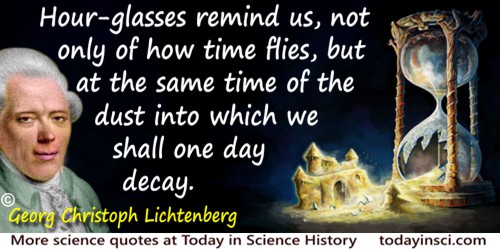
Hour-glasses remind us, not only of how time flies, but at the same time of the dust into which we shall one day decay.
Aphorism 4 in Notebook C (1772-1773), as translated by R.J. Hollingdale in Aphorisms (1990). Reprinted as The Waste Books (2000), 31.
I can hear the sizzle of newborn stars, and know anything of meaning, of the fierce magic emerging here. I am witness to flexible eternity, the evolving past, and I know we will live forever, as dust or breathe in the face of stars, in the shifting pattern of winds.
In Secrets from the Center of the World (1989), 56.
I have satisfied myself that the [cosmic] rays are not generated by the formation of new matter in space, a process which would be like water running up a hill. Nor do they come to any appreciable amount from the stars. According to my investigations the sun emits a radiation of such penetrative power that it is virtually impossible to absorb it in lead or other substances. ... This ray, which I call the primary solar ray, gives rise to a secondary radiation by impact against the cosmic dust scattered through space. It is the secondary radiation which now is commonly called the cosmic ray, and comes, of course, equally from all directions in space. [The article continues: The phenomena of radioactivity are not the result of forces within the radioactive substances but are caused by this ray emitted by the sun. If radium could be screened effectively against this ray it would cease to be radioactive, he said.]
Quoted in 'Tesla, 75, Predicts New Power Source', New York Times (5 Jul 1931), Section 2, 1.
I with my hammer pounding evermore
The rocky coast, smite Andes into dust.
Strewing my bed and, in another age.
Rebuild a continent for better men.
The rocky coast, smite Andes into dust.
Strewing my bed and, in another age.
Rebuild a continent for better men.
Poem, 'Seashore' (1857), published in The Boatswain’s Whistle (Boston 18 Nov 1864). Collected in Percy H. Boynton (ed.), American poetry (1921), 217. The blank verse of this poem was recast from a prose passage he wrote in his journal (3 Jul 1857), the day after a two-week visit to Cap Ann.
I would by all means have men beware, lest Æsop’s pretty fable of the fly that sate [sic] on the pole of a chariot at the Olympic races and said, “What a dust do I raise,” be verified in them. For so it is that some small observation, and that disturbed sometimes by the instrument, sometimes by the eye, sometimes by the calculation, and which may be owing to some real change in the heaven, raises new heavens and new spheres and circles.
'Of Vain Glory' (1625) in James Spedding, Robert Ellis and Douglas Heath (eds.), The Works of Francis Bacon (1887-1901), Vol. 6, 503.
I would rather be ashes than dust!
I would rather that my spark should burn out in a brilliant blaze than it should be stifled by dry-rot.
I would rather be a superb meteor, every atom of me in magnificent glow, than a sleepy and permanent planet.
The proper function of man is to live, not to exist.
I shall not waste my days in trying to prolong them.
I shall use my time.
I would rather that my spark should burn out in a brilliant blaze than it should be stifled by dry-rot.
I would rather be a superb meteor, every atom of me in magnificent glow, than a sleepy and permanent planet.
The proper function of man is to live, not to exist.
I shall not waste my days in trying to prolong them.
I shall use my time.
'Jack London Credo' quoted, without citing a source, in Irving Shepard (ed.), Jack London’s Tales of Adventure (1956), Introduction, vii. (Irving Shepard was London's literary executor.) This sentiment, expressed two months before his death, was quoted by journalist Ernest J. Hopkins in the San Francisco Bulletin (2 Dec 1916), Pt. 2, 1. No direct source in London's writings has been found, though he wrote “I would rather be ashes than dust&rdquo. as an inscription in an autograph book. Biographer Clarice Stasz cautions that although Hopkins had visited the ranch just weeks before London's death, the journalist's quote (as was not uncommon in his time) is not necessarily reliable, or may be his own invention. See this comment in 'Apocrypha' appended to Jack London, The Call Of The Wild (eBookEden.com).
If we peep into Dom Claude’s cell, we are introduced to a typical alchemist’s laboratory—a gloomy, dimly-lighted place, full of strange vessels, and furnaces, and melting-pots, spheres, and portions of skeletons hanging from the ceiling; the floor littered with stone bottles, pans, charcoal, aludels, and alembics, great parchment books covered with hieroglyphics; the bellows with its motto Spira, Spera; the hour-glass, the astrolabe, and over all cobwebs, and dust, and ashes. The walls covered with various aphorisms of the brotherhood; legends and memorials in many tongues; passages from the Smaragdine Table of Hermes Trismegistus; and looming out from all in great capitals, ’ANAΓKH.
In The Birth of Chemistry (1874), 100.
In a sense, the galaxy hardest for us to see is our own. For one thing, we are imprisoned within it, while the others can be viewed as a whole from outside… . Furthermore, we are far out from the center, and to make matters worse, we lie in a spiral arm clogged with dust. In other words, we are on a low roof on the outskirts of the city on a foggy day.
In The Intelligent Man's Guide to the Physical Sciences (1960, 1968), 64. Also in Isaac Asimov’s Book of Science and Nature Quotations (1988), 185.
In a University we are especially bound to recognise not only the unity of science itself, but the communion of the workers in science. We are too apt to suppose that we are congregated here merely to be within reach of certain appliances of study, such as museums and laboratories, libraries and lecturers, so that each of us may study what he prefers. I suppose that when the bees crowd round the flowers it is for the sake of the honey that they do so, never thinking that it is the dust which they are carrying from flower to flower which is to render possible a more splendid array of flowers, and a busier crowd of bees, in the years to come. We cannot, therefore, do better than improve the shining hour in helping forward the cross-fertilization of the sciences.
'The Telephone', Nature, 15, 1878. In W. D. Niven (ed.), The Scientific Papers of James Clerk Maxwell (1890), Vol. 2, 743-4.
In my opinion, the cholera poison only produces its effects through the air when carried by insects, or when the evacuations become dry, and are wafted as a fine dust.
In 'On the Mode of Communication of Cholera', The Edinburgh Medical Journal (Jan 1856), Vol. 1, No. 7, 669.
In one department of his [Joseph Black’s] lecture he exceeded any I have ever known, the neatness and unvarying success with which all the manipulations of his experiments were performed. His correct eye and steady hand contributed to the one; his admirable precautions, foreseeing and providing for every emergency, secured the other. I have seen him pour boiling water or boiling acid from a vessel that had no spout into a tube, holding it at such a distance as made the stream’s diameter small, and so vertical that not a drop was spilt. While he poured he would mention this adaptation of the height to the diameter as a necessary condition of success. I have seen him mix two substances in a receiver into which a gas, as chlorine, had been introduced, the effect of the combustion being perhaps to produce a compound inflammable in its nascent state, and the mixture being effected by drawing some string or wire working through the receiver's sides in an air-tight socket. The long table on which the different processes had been carried on was as clean at the end of the lecture as it had been before the apparatus was planted upon it. Not a drop of liquid, not a grain of dust remained.
In Lives of Men of Letters and Science, Who Flourished in the Time of George III (1845), 346-7.
In size the electron bears the same relation to an atom that a baseball bears to the earth. Or, as Sir Oliver Lodge puts it, if a hydrogen atom were magnified to the size of a church, an electron would be a speck of dust in that church.
Quoted in 'Science Entering New Epoch', New York Times (5 Apr 1908), Sunday Magazine, 3.
In this model, the sun is a very tiny speck of dust indeed—a speck less than a three-thousandth of an inch in diameter ... Think of the sun as something less than a speck of dust in a vast city, of the earth as less than a millionth part of such a speck of dust, and we have perhaps as vivid a picture as the mind can really grasp of the relation of our home in space to the rest of the universe.
In The Universe Around Us (1953), 96.
It goes so heavily with my disposition that this goodly frame, the earth, seems to me a sterile promontory. This most excellent canopy the air, look you, this brave o'erhanging, this majestic roof fretted with golden fire—why, it appears no other thing to me than a foul and pestilent congregation of vapours. What a piece of work is a man. How noble in reason, how infinite in faculty, in form and moving, how express and admirable, in action, how like an angel! in apprehension, how like a god—the beauty of the world, the paragon of animals! And yet to me, what is this quintessence of dust? Man delights not me—no, nor woman neither, though by your smiling you seem to say so.
Hamlet (1601), II, ii.
It is unlikely that we will ever see a star being born. Stars are like animals in the wild. We may see the very young, but never their actual birth, which is a veiled and secret event. Stars are born inside thick clouds of dust and gas in the spiral arms of the galaxy, so thick that visible light cannot penetrate them.
Perfect Symmetry: The Search for the Beginning of Time (1985), 44.
It’s not the critic who counts; not the man which points out how the strong man stumbles or where the doer of deeds could have done them better. The credit belongs to the man who is actually in the arena, whose face is marred by dust and sweat and blood; who strives valiantly; who errs, who comes short again and again … who knows great enthusiasms, the great devotions; who spends himself in a worthy cause; who at the best knows in the end the triumph of high achievement, and who at the worst, if he fails, at least fails while daring greatly, so that his place shall never be with those cold and timid souls who neither know victory nor defeat.
In Joseph A. Califano, Jr., Inside: A Public and Private Life (2005), 356.
Let not a monument give you or me hopes,
Since not a pinch of dust remains of Cheops.
Since not a pinch of dust remains of Cheops.
Life is a phenomenon sui generis, a primal fact in its own right, like energy. Cut flesh or wood how you like, hack at them in a baffled fury—you cannot find life itself, you can only see what it built out of the lifeless dust.
In An Almanac for Moderns (1935), 393.
Looking through the telescope, one saw a circle of deep blue and the little round planet swimming in the field. It seemed such a little thing, so bright and small and still, faintly marked with transverse stripes, and slightly flattened from the perfect round. But so little it was, so silvery warm—a pin’s-head of light! It was as if it quivered, but really this was the telescope vibrating with the activity of the clockwork that kept the planet in view.
As I watched, the planet seemed to grow larger and smaller and to advance and recede, but that was simply that my eye was tired. Forty millions of miles it was from us—more than forty millions of miles of void. Few people realise the immensity of vacancy in which the dust of the material universe swims.
As I watched, the planet seemed to grow larger and smaller and to advance and recede, but that was simply that my eye was tired. Forty millions of miles it was from us—more than forty millions of miles of void. Few people realise the immensity of vacancy in which the dust of the material universe swims.
The War of the Worlds (1898), editted by Frank D. McConnell (1977), 128.
Man cannot afford to be a naturalist, to look at Nature directly, but only with the side of his eye. He must look through and beyond her, to look at her is fatal as to look at the head of Medusa. It turns the man of science to stone. I feel that I am dissipated by so many observations. I should be the magnet in the midst of all this dust and filings.
From Journal entry (23 Mar 1953), in Henry David Thoreau and Bradford Torrey (ed.), Journal (1906), Vol. 5, 45.
Man’s history has been graven on the rock of Egypt, stamped on the brick of Assyria, enshrined in the marble of the Parthenon—it rises before us a majestic presence in the piled up arches of the Coliseum—it lurks an unsuspected treasure amid the oblivious dust of archives and monasteries—it is embodied in all the looms of religions, of races, of families.
In Lecture to the Oxford meeting of the Archaeological Institute (18 Jun 1850), printed in 'On the Study of Achaeology', Archaeological Journal (1851), 8, 1.
Of all the trees that have ever been cultivated by man, the genealogical tree is the driest. It is one, we may be sure, that had no place in the garden of Eden. Its root is in the grave; its produce mere Dead Sea fruit—apples of dust and ashes.
In novel, Half a Million of Money (1865), Vol. 1, 18.
Once the hatch was opened, I turned the lock handle and bright rays of sunlight burst through it. I opened the hatch and dust from the station flew in like little sparklets, looking like tiny snowflakes on a frosty day. Space, like a giant vacuum cleaner, began to suck everything out. Flying out together with the dust were some little washers and nuts that dad got stuck somewhere; a pencil flew by.
My first impression when I opened the hatch was of a huge Earth and of the sense of unreality concerning everything that was going on. Space is very beautiful. There was the dark velvet of the sky, the blue halo of the Earth and fast-moving lakes, rivers, fields and clouds clusters. It was dead silence all around, nothing whatever to indicate the velocity of the flight… no wind whistling in your ears, no pressure on you. The panorama was very serene and majestic.
My first impression when I opened the hatch was of a huge Earth and of the sense of unreality concerning everything that was going on. Space is very beautiful. There was the dark velvet of the sky, the blue halo of the Earth and fast-moving lakes, rivers, fields and clouds clusters. It was dead silence all around, nothing whatever to indicate the velocity of the flight… no wind whistling in your ears, no pressure on you. The panorama was very serene and majestic.
…...
Papyra, throned upon the banks of Nile,
Spread her smooth leaf, and waved her silver style.
The storied pyramid, the laurel’d bust,
The trophy’d arch had crumbled into dust;
The sacred symbol, and the epic song (Unknown the character, forgot the tongue,)
With each unconquer’d chief, or sainted maid,
Sunk undistinguish’d in Oblivion’s shade.
Sad o’er the scatter’d ruins Genius sigh’d,
And infant Arts but learn’d to lisp, and died.
Till to astonish’d realms Papyra taught To paint in mystic colours Sound and Thought,
With Wisdom’s voice to print the page sublime,
And mark in adamant the steps of Time.
Spread her smooth leaf, and waved her silver style.
The storied pyramid, the laurel’d bust,
The trophy’d arch had crumbled into dust;
The sacred symbol, and the epic song (Unknown the character, forgot the tongue,)
With each unconquer’d chief, or sainted maid,
Sunk undistinguish’d in Oblivion’s shade.
Sad o’er the scatter’d ruins Genius sigh’d,
And infant Arts but learn’d to lisp, and died.
Till to astonish’d realms Papyra taught To paint in mystic colours Sound and Thought,
With Wisdom’s voice to print the page sublime,
And mark in adamant the steps of Time.
Round about the accredited and orderly facts of every science there ever floats a sort of dust-cloud of exceptional observations, of occurrences minute and irregular and seldom met with, which it always proves more easy to ignore than to attend to … Anyone will renovate his science who will steadily look after the irregular phenomena, and when science is renewed, its new formulas often have more of the voice of the exceptions in them than of what were supposed to be the rules.
In 'The Hidden Self', Scribner’s Magazine (1890), Vol. 7, 361.
Science has gone down into the mines and coal-pits, and before the safety-lamp the Gnomes and Genii of those dark regions have disappeared… Sirens, mermaids, shining cities glittering at the bottom of quiet seas and in deep lakes, exist no longer; but in their place, Science, their destroyer, shows us whole coasts of coral reef constructed by the labours of minute creatures; points to our own chalk cliffs and limestone rocks as made of the dust of myriads of generations of infinitesimal beings that have passed away; reduces the very element of water into its constituent airs, and re-creates it at her pleasure.
Book review of Robert Hunt, Poetry of Science (1848), in the London Examiner (1848). Although uncredited in print, biographers identified his authorship from his original handwritten work. Collected in Charles Dickens and Frederic George Kitton (ed.) Old Lamps for New Ones: And Other Sketches and Essays (1897), 86-87.
Some miners’ wives take in washing and make more money than their husbands do. In every gold rush from this one to the Klondike, the suppliers and service industries will gather up the dust while ninety-nine per cent of the miners go home with empty pokes.
Assembling California
Suddenly there was an enormous explosion, like a violent volcano. The nuclear reactions had led to overheating in the underground burial grounds. The explosion poured radioactive dust and materials high up into the sky. It was just the wrong weather for such a tragedy. Strong winds blew the radioactive clouds hundreds of miles away. It was difficult to gauge the extent of the disaster immediately, and no evacuation plan was put into operation right away. Many villages and towns were only ordered to evacuate when the symptoms of radiation sickness were already quite apparent. Tens of thousands of people were affected, hundreds dying, though the real figures have never been made public. The large area, where the accident happened, is still considered dangerous and is closed to the public.
'Two Decades of Dissidence', New Scientist (4 Nov 1976), 72, No. 72, 265.
The books of the great scientists are gathering dust on the shelves of learned libraries. ... While the artist's communication is linked forever with its original form, that of the scientist is modified, amplified, fused with the ideas and results of others and melts into the stream of knowledge and ideas which forms our culture. The scientist has in common with the artist only this: that he can find no better retreat from the world than his work and also no stronger link with the world than his work.
From Nobel Lecture (10 Dec 1969), 'A Physicist's Renewed Look at Biology – Twenty Years Later.' in Nobel Lectures, Physiology or Medicine 1963-1970 (1972), 409.
The explosions [of dying stars] scattered the heavy elements as a fine dust through space. By the time it made the Sun, the primordial gas of the Milky Way was sufficiently enriched with heavier elements for rocky planets like the Earth to form. And from the rocks atoms escaped for eventual incorporation in living things: carbon, nitrogen, oxygen, phosphorus and sulphur for all living tissue; calcium for bones and teeth; sodium and potassium for the workings of nerves and brains; the iron colouring blood red… and so on.
No other conclusion of modern research testifies more clearly to mankind’s intimate connections with the universe at large and with the cosmic forces at work among the stars.
In The Key to the Universe: A Report on the New Physics (1977), 33.
The mighty steam-engine has its germ in the simple boiler in which the peasant prepares his food. The huge ship is but the expansion of the floating leaf freighted with its cargo of atmospheric dust; and the flying balloon is but the infant's soap-bubble lightly laden and overgrown. But the Telescope, even in its most elementary form, embodies a novel and gigantic idea, without an analogue in nature, and without a prototype in experience
Stories of Inventors and Discoverers in Science and the Useful Arts (1860), 145.
The object of geometry in all its measuring and computing, is to ascertain with exactness the plan of the great Geometer, to penetrate the veil of material forms, and disclose the thoughts which lie beneath them? When our researches are successful, and when a generous and heaven-eyed inspiration has elevated us above humanity, and raised us triumphantly into the very presence, as it were, of the divine intellect, how instantly and entirely are human pride and vanity repressed, and, by a single glance at the glories of the infinite mind, are we humbled to the dust.
From 'Mathematical Investigation of the Fractions Which Occur in Phyllotaxis', Proceedings of the American Association for the Advancement of Science (1850), 2, 447, as quoted by R. C. Archibald in 'Benjamin Peirce: V. Biographical Sketch', The American Mathematical Monthly (Jan 1925), 32, No. 1, 12.
The ravages committed by man subvert the relations and destroy the balance which nature had established between her organized and her inorganic creations; and she avenges herself upon the intruder, by letting loose upon her defaced provinces destructive energies hitherto kept in check by organic forces destined to be his best auxiliaries, but which he has unwisely dispersed and driven from the field of action. When the forest is gone, the great reservoir of moisture stored up in its vegetable mould is evaporated, and returns only in deluges of rain to wash away the parched dust into which that mould has been converted. The well-wooded and humid hills are turned to ridges of dry rock, which encumbers the low grounds and chokes the watercourses with its debris, and–except in countries favored with an equable distribution of rain through the seasons, and a moderate and regular inclination of surface–the whole earth, unless rescued by human art from the physical degradation to which it tends, becomes an assemblage of bald mountains, of barren, turfless hills, and of swampy and malarious plains. There are parts of Asia Minor, of Northern Africa, of Greece, and even of Alpine Europe, where the operation of causes set in action by man has brought the face of the earth to a desolation almost as complete as that of the moon; and though, within that brief space of time which we call “the historical period,” they are known to have been covered with luxuriant woods, verdant pastures, and fertile meadows, they are now too far deteriorated to be reclaimable by man, nor can they become again fitted for human use, except through great geological changes, or other mysterious influences or agencies of which we have no present knowledge, and over which we have no prospective control. The earth is fast becoming an unfit home for its noblest inhabitant, and another era of equal human crime and human improvidence, and of like duration with that through which traces of that crime and that improvidence extend, would reduce it to such a condition of impoverished productiveness, of shattered surface, of climatic excess, as to threaten the depravation, barbarism, and perhaps even extinction of the species.
Man and Nature, (1864), 42-3.
These neutrino observations are so exciting and significant that I think we're about to see the birth of an entirely new branch of astronomy: neutrino astronomy. Supernova explosions that are invisible to us because of dust clouds may occur in our galaxy as often as once every 10 years, and neutrino bursts could give us a way to study them.
New York Times (3 Apr 1987)
Things cannot always go your way. Learn to accept in silence the minor aggravations, cultivate the gift of taciturnity and consume your own smoke with an extra draught of hard work, so that those about you may not be annoyed with the dust and soot of your complaints.
In Harvey Cushing, The Life of Sir William Osler (1926), Vol. 1, 619. 'The Master-Word in Medicine' was written for a festival (1903) for inauguration of new laboratories at the University of Toronto. It was published as No. 18 in Aequanimitas and other Addresses (1904, 1906), 385.
We are hit by tons of material every day, but it is all dust. We are all walking around with comet dust in our hair.
…...
What, then, shall we say about the receipts of alchemy, and about the diversity of its vessels and instruments? These are furnaces, glasses, jars, waters, oils, limes, sulphurs, salts, saltpeters, alums, vitriols, chrysocollae, copper greens, atraments, auripigments, fel vitri, ceruse, red earth, thucia, wax, lutum sapientiae, pounded glass, verdigris, soot, crocus of Mars, soap, crystal, arsenic, antimony, minium, elixir, lazarium, gold leaf salt niter, sal ammoniac, calamine stone, magnesia, bolus armenus, and many other things. Then, again, concerning herbs, roots, seeds, woods, stones, animals, worms, bone dust, snail shells, other shells, and pitch. These and the like, whereof there are some very farfetched in alchemy, are mere incumbrances of work; since even if Sol and Luna [gold and silver] could be made by them they rather hinder and delay than further one’s purpose.
In Paracelsus and Arthur Edward Waite (ed.), The Hermetic and Alchemical Writings of Paracelsus (1894), Vol. 1, 13.
When I began my physical studies [in Munich in 1874] and sought advice from my venerable teacher Philipp von Jolly...he portrayed to me physics as a highly developed, almost fully matured science...Possibly in one or another nook there would perhaps be a dust particle or a small bubble to be examined and classified, but the system as a whole stood there fairly secured, and theoretical physics approached visibly that degree of perfection which, for example, geometry has had already for centuries.
From a lecture (1924). In Damien Broderick (ed.), Year Million: Science at the Far Edge of Knowledge (2008), 104.
When one studies strongly radioactive substances special precautions must be taken if one wishes to be able to take delicate measurements. The various objects used in a chemical laboratory and those used in a chemical laboratory, and those which serve for experiments in physics, become radioactive in a short time and act upon photographic plates through black paper. Dust, the air of the room, and one’s clothes all become radioactive.
Notebook entry. In Eve Curie, Madame Curie: a Biography by Eve Curie (1937, 2007), 196.
When the movement of the comets is considered and we reflect on the laws of gravity, it will be readily perceived that their approach to Earth might there cause the most woeful events, bring back the deluge, or make it perish in a deluge of fire, shatter it into small dust, or at least turn it from its orbit, drive away its Moon, or, still worse, the Earth itself outside the orbit of Saturn, and inflict upon us a winter several centuries long, which neither men nor animals would be able to bear. The tails even of comets would not be unimportant phenomena, if in taking their departure left them in whole or part in our atmosphere
From Cosmologische Briefe über die Einrichtung des Weltbaues (1761). As quoted in Carl Sagan, Broca’s Brain: Reflections on the Romance of Science (1986), 95.
While we keep an open mind on this question of vitalism, or while we lean, as so many of us now do, or even cling with a great yearning, to the belief that something other than the physical forces animates the dust of which we are made, it is rather the business of the philosopher than of the biologist, or of the biologist only when he has served his humble and severe apprenticeship to philosophy, to deal with the ultimate problem. It is the plain bounden duty of the biologist to pursue his course unprejudiced by vitalistic hypotheses, along the road of observation and experiment, according to the accepted discipline of the natural and physical sciences. … It is an elementary scientific duty, it is a rule that Kant himself laid down, that we should explain, just as far as we possibly can, all that is capable of such explanation, in the light of the properties of matter and of the forms of energy with which we are already acquainted.
From Presidential Address to Zoological Section of the British Association for the Advancement of Science. As quoted in H.V. Neal, 'The Basis of Individuality in Organisms: A Defense of Vitalism', Science (21 Jul 1916), 44 N.S., No. 1125, 82.
Why Become Extinct? Authors with varying competence have suggested that dinosaurs disappeared because the climate deteriorated (became suddenly or slowly too hot or cold or dry or wet), or that the diet did (with too much food or not enough of such substances as fern oil; from poisons in water or plants or ingested minerals; by bankruptcy of calcium or other necessary elements). Other writers have put the blame on disease, parasites, wars, anatomical or metabolic disorders (slipped vertebral discs, malfunction or imbalance of hormone and endocrine systems, dwindling brain and consequent stupidity, heat sterilization, effects of being warm-blooded in the Mesozoic world), racial old age, evolutionary drift into senescent overspecialization, changes in the pressure or composition of the atmosphere, poison gases, volcanic dust, excessive oxygen from plants, meteorites, comets, gene pool drainage by little mammalian egg-eaters, overkill capacity by predators, fluctuation of gravitational constants, development of psychotic suicidal factors, entropy, cosmic radiation, shift of Earth’s rotational poles, floods, continental drift, extraction of the moon from the Pacific Basin, draining of swamp and lake environments, sunspots, God’s will, mountain building, raids by little green hunters in flying saucers, lack of standing room in Noah’s Ark, and palaeoweltschmerz.
'Riddles of the Terrible Lizards', American Scientist (1964) 52, 231.
You are dust.
— Genesis
…...
 In science it often happens that scientists say, 'You know that's a really good argument; my position is mistaken,' and then they would actually change their minds and you never hear that old view from them again. They really do it. It doesn't happen as often as it should, because scientists are human and change is sometimes painful. But it happens every day. I cannot recall the last time something like that happened in politics or religion.
(1987) --
In science it often happens that scientists say, 'You know that's a really good argument; my position is mistaken,' and then they would actually change their minds and you never hear that old view from them again. They really do it. It doesn't happen as often as it should, because scientists are human and change is sometimes painful. But it happens every day. I cannot recall the last time something like that happened in politics or religion.
(1987) --