Dry Quotes (65 quotes)
[A man] must learn to understand the motives of human beings, their illusions, and their sufferings human beings, their illusions, and their sufferings in order to acquire a proper relationship to individual fellow-men and to the community. These precious things … primarily constitutes and preserves culture. This is what I have in mind when I recommend the “humanities” as important, not just dry specialized knowledge in the fields of history and philosophy.
From interview with Benjamin Fine, 'Einstein Stresses Critical Thinking', New York Times (5 Oct 1952), 37.
[The attitude of the Renaissance towards the antique world was that] Archaeology to them was not a mere science for the antiquarian; it was a means by which they could touch the dry dust of antiquity into the very breath and beauty of life, and fill with the new wine of romanticism forms that else had been old and out-worn.
In his essay 'The Truth of Masks', collected in Intentions (1904), 213.
[There] are still to be found text-books of the old sort, teaching Mathematics under the guise of Physics, presenting nothing but the dry husks of the latter.
A paper read at the Association for the Improvement of Geometrical Teaching (19 Jan 1889), 'The Vices of our Scientific Education', in Nature (6 Jun 1889), 40, 128.
[Two college boys on the Flambeau River in a canoe]… their watches had run down, and for the first time in their lives there was no clock, whistle, or radio to set watches by. For two days they had lived by “sun-time,” and were getting a thrill out of it. No servant brought them meals: they got their meat out of the river, or went without. No traffic cop whistled them off the hidden rock in the next rapids. No friendly roof kept them dry when they misguessed whether or not to pitch the tent. No guide showed them which camping spots offered a nightlong breeze, and which a nightlong misery of mosquitoes; which firewood made clean coals, and which only smoke.
In 'Wisconsin: Flambeau', A Sand County Almanac, and Sketches Here and There (1949, 1987), 112-113.
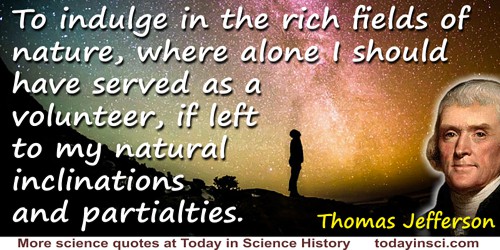
[Writing this letter] has permitted me, for a moment, to abstract myself from the dry and dreary waste of politics, into which I have been impressed by the times on which I happened, and to indulge in the rich fields of nature, where alone I should have served as a volunteer, if left to my natural inclinations and partialties.
In letter to Caspar Wistar (21 Jun 1807), collected in Thomas Jefferson Randolph (ed.), Memoir, Correspondence, And Miscellanies, From The Papers Of Thomas Jefferson (1829), Vol. 4, 94.
Q: What is the definition of a tachyon?
A: It’s a gluon that’s not completely dry.
A: It’s a gluon that’s not completely dry.
Question: If you walk on a dry path between two walls a few feet apart, you hear a musical note or “ring” at each footstep. Whence comes this?
Answer: This is similar to phosphorescent paint. Once any sound gets between two parallel reflectors or walls, it bounds from one to the other and never stops for a long time. Hence it is persistent, and when you walk between the walls you hear the sounds made by those who walked there before you. By following a muffin man down the passage within a short time you can hear most distinctly a musical note, or, as it is more properly termed in the question, a “ring” at every (other) step.
Answer: This is similar to phosphorescent paint. Once any sound gets between two parallel reflectors or walls, it bounds from one to the other and never stops for a long time. Hence it is persistent, and when you walk between the walls you hear the sounds made by those who walked there before you. By following a muffin man down the passage within a short time you can hear most distinctly a musical note, or, as it is more properly termed in the question, a “ring” at every (other) step.
Genuine student answer* to an Acoustics, Light and Heat paper (1880), Science and Art Department, South Kensington, London, collected by Prof. Oliver Lodge. Quoted in Henry B. Wheatley, Literary Blunders (1893), 175-6, Question 2. (*From a collection in which Answers are not given verbatim et literatim, and some instances may combine several students' blunders.)
A bewildering assortment of (mostly microscopic) life-forms has been found thriving in what were once thought to be uninhabitable regions of our planet. These hardy creatures have turned up in deep, hot underground rocks, around scalding volcanic vents at the bottom of the ocean, in the desiccated, super-cold Dry Valleys of Antarctica, in places of high acid, alkaline, and salt content, and below many meters of polar ice. ... Some deep-dwelling, heat-loving microbes, genetic studies suggest, are among the oldest species known, hinting that not only can life thrive indefinitely in what appear to us totally alien environments, it may actually originate in such places.
In Life Everywhere: the Maverick Science of Astrobiology (2002), xi.
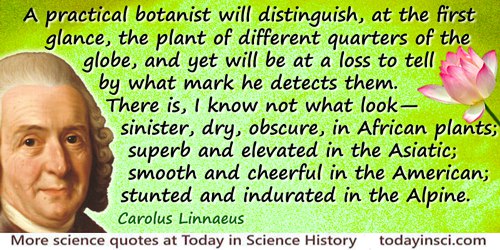
A practical botanist will distinguish, at the first glance, the plant of different quarters of the globe, and yet will be at a loss to tell by what mark he detects them. There is, I know not what look—sinister, dry, obscure, in African plants; superb and elevated in the Asiatic; smooth and cheerful in the American; stunted and indurated in the Alpine.
Quoted in William Whewell, History of the Inductive Sciences (1847), Vol. 3, 355-356, citing ‘Philosophia Botanica’ (1751), 171.
Adam is fading out. It is on account of Darwin and that crowd. I can see that he is not going to last much longer. There's a plenty of signs. He is getting belittled to a germ—a little bit of a speck that you can't see without a microscope powerful enough to raise a gnat to the size of a church. They take that speck and breed from it: first a flea; then a fly, then a bug, then cross these and get a fish, then a raft of fishes, all kinds, then cross the whole lot and get a reptile, then work up the reptiles till you've got a supply of lizards and spiders and toads and alligators and Congressmen and so on, then cross the entire lot again and get a plant of amphibiums, which are half-breeds and do business both wet and dry, such as turtles and frogs and ornithorhyncuses and so on, and cross-up again and get a mongrel bird, sired by a snake and dam'd by a bat, resulting in a pterodactyl, then they develop him, and water his stock till they've got the air filled with a million things that wear feathers, then they cross-up all the accumulated animal life to date and fetch out a mammal, and start-in diluting again till there's cows and tigers and rats and elephants and monkeys and everything you want down to the Missing Link, and out of him and a mermaid they propagate Man, and there you are! Everything ship-shape and finished-up, and nothing to do but lay low and wait and see if it was worth the time and expense.
'The Refuge of the Derelicts' collected in Mark Twain and John Sutton Tuckey, The Devil's Race-Track: Mark Twain's Great Dark Writings (1980), 340-41.
- 1980
After having produced aquatic animals of all ranks and having caused extensive variations in them by the different environments provided by the waters, nature led them little by little to the habit of living in the air, first by the water's edge and afterwards on all the dry parts of the globe. These animals have in course of time been profoundly altered by such novel conditions; which so greatly influenced their habits and organs that the regular gradation which they should have exhibited in complexity of organisation is often scarcely recognisable.
Hydrogéologie (1802), trans. A. V. Carozzi (1964), 69-70.
Alcmaeon maintains that the bond of health is the 'equal balance' of the powers, moist and dry, cold and hot, bitter and sweet, and the rest, while the 'supremacy' of one of them is the cause of disease; for the supremacy of either is destructive. Illness comes aboutdirectly through excess of heat or cold, indirectly through surfeit or deficiency of nourishment; and its centre is either the blood or the marrow or the brain. It sometimes arises in these centres from external causes, moisture of some sort or environment or exhaustion or hardship or similar causes. Health on the other hand is the proportionate admixture of the qualities.
About Alcmaeon of Croton. In Clarence J. Glacken, Traces on the Rhodian Shore: Nature and Culture in Western Thought from Ancient Times to the End of the Eighteenth Century (1976) 11.
All animals whatsoever, whether they fly or swim or walk upon dry land, whether they bring forth their young alive or in the egg, develop in the same way.
In The Works of Aristotle: Historia Animalium (350 BC), (The History of Animals), Book VII, Part 7, 586a21 translated in William David Ross and John Alexander Smith (eds.), D’Arcy Wentworth Thompson (trans.), (1910), Vol. 4, 27.
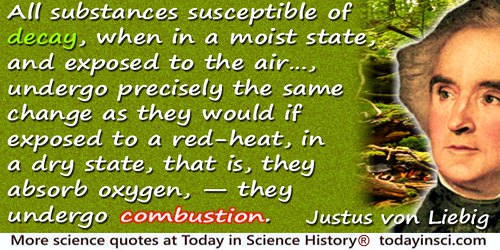
All substances susceptible of decay, when in a moist state, and exposed to the air and light at the common temperature, undergo precisely the same change as they would if exposed to a red-heat, in a dry state, that is, they absorb oxygen,—they undergo combustion.
Justus von Liebig and John Gardner (ed.), Familiar Letters on Chemistry: Second Series. The Philosophical Principles and General Laws of the Science (1844), 183.
America, so far as her physical history is concerned, has been falsely denominated the New World. Hers was the first dry land lifted out of the waters, hers the first shore washed by the ocean that enveloped all the earth beside; and while Europe was represented only by islands rising here and there above the sea, America already stretched an unbroken line of land from Nova Scotia to the Far West.
Geological Sketches (1866), I.
An ignorant or half-informed teacher may present science as an accumulation of unconnected facts. … To teach in that fashion is like going to the tree of science with its glorious fruit in order to pick up a handful of the dry fallen leaves from the ground.
In Inaugural Presidential Address (9 Sep 1885) to the British Association for the Advancement of Science, Aberdeen, Scotland, 'Relations of Science to the Public Weal', Report to the Fifty-Fifth Meeting of the British Association (1886), 11.
An infallible Remedy for the Tooth-ach, viz Wash the Root of an aching Tooth, in Elder Vinegar, and let it dry half an hour in the Sun; after which it will never ach more; Probatum est.
In Poor Richard's Almanack (1739).
As I am writing, another illustration of ye generation of hills proposed above comes into my mind. Milk is as uniform a liquor as ye chaos was. If beer be poured into it & ye mixture let stand till it be dry, the surface of ye curdled substance will appear as rugged & mountanous as the Earth in any place.
Letter to Thomas Burnet (Jan 1680/1. In H. W. Turnbull (ed.), The Correspondence of Isaac Newton, 1676-1687 (1960), Vol. 2, 334.
Consider the hateful brew compounded with gleaming, deadly white lead whose fresh colour is like milk…. Over the victim’s jaws and in the grooves of the gums is plastered an astringent froth, and the furrow of the tongue turns rough on either side, and the depth of the throat grows somewhat dry, and from the pernicious venom follows a dry retching and hawking, for this affliction is severe; meanwhile his spirit sickens and he is worn out with mortal suffering. His body too grows chill, while sometimes his eyes behold strange illusions or else he drowses; nor can he bestir his limbs as heretofore, and he succumbs to the overmastering fatigue.
— Nicander
As translated by A.S.F. Gow and A.F. Scholfield in Nicander: The Poems and Portical Fragments (1953), 99.
Fed on the dry husks of facts, the human heart has a hidden want which science cannot supply.
Science and Immorality (1904), 76.
For mining I cannot say much good except that its operations are generally short-lived. The extractable wealth is taken and the shafts, the tailings, and the ruins left, and in a dry country such as the American West the wounds men make in the earth do not quickly heal.
Letter (3 Dec 1960) written to David E. Pesonen of the Outdoor Recreation Resources Review Commission. Collected in 'Coda: Wilderness Letter', The Sound of Mountain Water: The Changing American West (1969), 151.
Geology does better in reclothing dry bones and revealing lost creations, than in tracing veins of lead and beds of iron; astronomy better in opening to us the houses of heaven than in teaching navigation; surgery better in investigating organiation than in setting limbs; only it is ordained that, for our encouragement, every step we make in science adds something to its practical applicabilities.
Modern Painters (1852), Part 3, 8-9.
I am almost thanking God that I was never educated, for it seems to me that 999 of those who are so, expensively and laboriously, have lost all before they arrive at my age—& remain like Swift's Stulbruggs—cut and dry for life, making no use of their earlier-gained treasures:—whereas, I seem to be on the threshold of knowledge.
In Vivien Noakes, Edward Lear: the Life of a Wanderer (1969), 22.
I am of opinion, then, ... that, if there is any circumstance thoroughly established in geology, it is, that the crust of our globe has been subjected to a great and sudden revolution, the epoch of which cannot be dated much farther back than five or six thousand years ago; that this revolution had buried all the countries which were before inhabited by men and by the other animals that are now best known; that the same revolution had laid dry the bed of the last ocean, which now forms all the countries at present inhabited; that the small number of individuals of men and other animals that escaped from the effects of that great revolution, have since propagated and spread over the lands then newly laid dry; and consequently, that the human race has only resumed a progressive state of improvement since that epoch, by forming established societies, raising monuments, collecting natural facts, and constructing systems of science and of learning.
'Preliminary discourse', to Recherches sur les Ossemens Fossiles (1812), trans. R. Kerr Essay on the Theory of the Earth (1813), 171-2.
I did try “to make things clear,” first to myself (an important point) and then to my students and somehow to make “these dry bones live.”
His response on his 80th birthday (1929) recognition of his mathematical contributions and teachings by his former students. As quoted by R.T. Glazebrook in Obituary Notices of Fellows of the Royal Society (Dec 1935), 392.
I would rather be ashes than dust!
I would rather that my spark should burn out in a brilliant blaze than it should be stifled by dry-rot.
I would rather be a superb meteor, every atom of me in magnificent glow, than a sleepy and permanent planet.
The proper function of man is to live, not to exist.
I shall not waste my days in trying to prolong them.
I shall use my time.
I would rather that my spark should burn out in a brilliant blaze than it should be stifled by dry-rot.
I would rather be a superb meteor, every atom of me in magnificent glow, than a sleepy and permanent planet.
The proper function of man is to live, not to exist.
I shall not waste my days in trying to prolong them.
I shall use my time.
'Jack London Credo' quoted, without citing a source, in Irving Shepard (ed.), Jack London’s Tales of Adventure (1956), Introduction, vii. (Irving Shepard was London's literary executor.) This sentiment, expressed two months before his death, was quoted by journalist Ernest J. Hopkins in the San Francisco Bulletin (2 Dec 1916), Pt. 2, 1. No direct source in London's writings has been found, though he wrote “I would rather be ashes than dust&rdquo. as an inscription in an autograph book. Biographer Clarice Stasz cautions that although Hopkins had visited the ranch just weeks before London's death, the journalist's quote (as was not uncommon in his time) is not necessarily reliable, or may be his own invention. See this comment in 'Apocrypha' appended to Jack London, The Call Of The Wild (eBookEden.com).
If a child left school at ten, knowing nothing of detailed information, but knowing the pleasure that comes from agreeable music, from reading, from making things, from finding things out, it would be better off than a man who left university at twenty-two, full of facts but without any desire to enquire further into such dry domains.
In Mathematician's Delight (1943), 9.
If we continue on our current course, the damage that has been the defining feature of my lifetime will be eclipsed by the damage coming in the next. … Science predicts that were I born today, I would be witness to the 2030s—The Amazon Rainforest, cut down until it can no longer produce enough moisture, degrades into a dry savannah, bringing catastrophic species loss—and altering the global water cycle.
From narration to Netflix TV program, A Life on Our Planet: My Witness Statement and a Vision for the Future (4 Oct 2020).
In every case the awakening touch has been the mathematical spirit, the attempt to count, to measure, or to calculate. What to the poet or the seer may appear to be the very death of all his poetry and all his visions—the cold touch of the calculating mind,—this has proved to be the spell by which knowledge has been born, by which new sciences have been created, and hundreds of definite problems put before the minds and into the hands of diligent students. It is the geometrical figure, the dry algebraical formula, which transforms the vague reasoning of the philosopher into a tangible and manageable conception; which represents, though it does not fully describe, which corresponds to, though it does not explain, the things and processes of nature: this clothes the fruitful, but otherwise indefinite, ideas in such a form that the strict logical methods of thought can be applied, that the human mind can in its inner chamber evolve a train of reasoning the result of which corresponds to the phenomena of the outer world.
In A History of European Thought in the Nineteenth Century (1896), Vol. 1, 314.
In my opinion, the cholera poison only produces its effects through the air when carried by insects, or when the evacuations become dry, and are wafted as a fine dust.
In 'On the Mode of Communication of Cholera', The Edinburgh Medical Journal (Jan 1856), Vol. 1, No. 7, 669.
It is a strange feeling which comes over one as he stands in the centre of the tunnel, and knows that a mighty river is rolling on over his head, and that great ships with their thousands of tons burthen, sail over him. ... There is no single work of Art in London (with the exception of St. Paul's Cathedral) which excites so much curiosity and admiration among foreigners as the Tunnel. Great buildings are common to all parts of Europe, but the world has not such another Tunnel as this. There is something grand in the idea of walking under a broad river—making a pathway dry and secure beneath ships and navies!
[About visiting Brunel's Thames Tunnel, the first in the world under a navigable waterway.]
[About visiting Brunel's Thames Tunnel, the first in the world under a navigable waterway.]
What I Saw in London: or, Men and Things in the Great Metropolis (1853), 168-169.
It is hard to imagine while strenuously walking in the heart of an equatorial rain forest, gasping for every breath in a stifling humid sauna, how people could have ever adapted to life under these conditions. It is not just the oppressive climate - the tall forest itself is dark, little light reaching the floor from the canopy, and you do not see any animals. It is a complete contrast to the herbivore-rich dry savannahs of tropical Africa. Yet there are many animals here, evident by the loud, continual noise of large cryptic insects and the constant threat of stepping on a deadly king cobra. This was my first impression of the rain forest in Borneo.
The Humans Who Went Extinct
It seems wonderful to everyone that sometimes stones are found that have figures of animals inside and outside. For outside they have an outline, and when they are broken open, the shapes of the internal organs are found inside. And Avicenna says that the cause of this is that animals, just as they are, are sometimes changed into stones, and especially [salty] stones. For he says that just as the Earth and Water are material for stones, so animals, too, are material for stones. And in places where a petrifying force is exhaling, they change into their elements and are attacked by the properties of the qualities [hot, cold, moist, dry] which are present in those places, and in the elements in the bodies of such animals are changed into the dominant element, namely Earth mixed with Water; and then the mineralizing power converts [the mixture] into stone, and the parts of the body retain their shape, inside and outside, just as they were before. There are also stones of this sort that are [salty] and frequently not hard; for it must be a strong power which thus transmutes the bodies of animals, and it slightly burns the Earth in the moisture, so it produces a taste of salt.
De Mineralibus (On Minerals) (c.1261-1263), Book I, tract 2, chapter 8, trans. Dorothy Wyckoff (1967), 52-53.
Life, therefore, has been often disturbed on this earth by terrible events—calamities which, at their commencement, have perhaps moved and overturned to a great depth the entire outer crust of the globe, but which, since these first commotions, have uniformly acted at a less depth and less generally. Numberless living beings have been the victims of these catastrophes; some have been destroyed by sudden inundations, others have been laid dry in consequence of the bottom of the seas being instantaneously elevated. Their races even have become extinct, and have left no memorial of them except some small fragments which the naturalist can scarcely recognise.
'Preliminary discourse', to Recherches sur les Ossemens Fossiles (1812), trans. R. Kerr Essay on the Theory of the Earth (1813), 16-7.
Men ought to know that from the brain, and from the brain only, arise our pleasures, joys, laughter and jests, as well as our sorrows, pains, griefs and tears. Through it, in particular, we think, see, hear, and distinguish the ugly from the beautiful, the bad from the good, the pleasant from the unpleasant, in some cases using custom as a test, in others perceiving them from their utility. It is the same thing which makes us mad or delirious, inspires us with dread or fear, whether by night or by day, brings sleeplessness, inopportune mistakes, aimless anxieties, absent-mindedness, and acts that are contrary to habit. These things that we suffer all come from the brain, when it is not healthy, but becomes abnormally hot, cold, moist, or dry, or suffers any other unnatural affection to which it was not accustomed. Madness comes from its moistness.
The Sacred Disease, in Hippocrates, trans. W. H. S. Jones (1923), Vol. 2, 175.
Most of these Mountains and Inland places whereon these kind of Petrify’d Bodies and Shells are found at present, or have been heretofore, were formerly under the Water, and that either by the descending of the Waters to another part of the Earth by the alteration of the Centre of Gravity of the whole bulk, or rather by the Eruption of some kind of Subterraneous Fires or Earthquakes, great quantities of Earth have been deserted by the Water and laid bare and dry.
Lectures and Discourses of Earthquakes (1668). In The Posthumous Works of Robert Hooke, containing his Cutlerian Lectures and other Discourses read at the Meetings of the Illustrious Royal Society (1705), 320-1.
Mr. Dalton's aspect and manner were repulsive. There was no gracefulness belonging to him. His voice was harsh and brawling; his gait stiff and awkward; his style of writing and conversation dry and almost crabbed. In person he was tall, bony, and slender. He never could learn to swim: on investigating this circumstance he found that his spec. grav. as a mass was greater than that of water; and he mentioned this in his lectures on natural philosophy in illustration of the capability of different persons for attaining the art of swimming. Independence and simplicity of manner and originality were his best qualities. Though in comparatively humble circumstances he maintained the dignity of the philosophical character. As the first distinct promulgator of the doctrine that the elements of bodies unite in definite proportions to form chemical compounds, he has acquired an undying fame.
Dr John Davy's (brother of Humphry Davy) impressions of Dalton written in c.1830-31 in Malta.
Dr John Davy's (brother of Humphry Davy) impressions of Dalton written in c.1830-31 in Malta.
Quoted in W. C. Henry, Memoirs of the Life and Scientific Researches of John Dalton (1854), 217-8.
No study is less alluring or more dry and tedious than statistics, unless the mind and imagination are set to work, or that the person studying is particularly interested in the subject; which last can seldom be the case with young men in any rank of life.
In The Statistical Breviary: Shewing, on a Principle Entirely New, the Resources of Every State and Kingdom in Europe (1801), 16.
Not since the Lord himself showed his stuff to Ezekiel in the valley of dry bones had anyone shown such grace and skill in the reconstruction of animals from disarticulated skeletons. Charles R. Knight, the most celebrated of artists in the reanimation of fossils, painted all the canonical figures of dinosaurs that fire our fear and imagination to this day.
In Wonderful Life: the Burgess Shale and the Nature of History (1990), 23. First sentence of chapter one.
Of all the trees that have ever been cultivated by man, the genealogical tree is the driest. It is one, we may be sure, that had no place in the garden of Eden. Its root is in the grave; its produce mere Dead Sea fruit—apples of dust and ashes.
In novel, Half a Million of Money (1865), Vol. 1, 18.
Our great mistake in education is ... the worship of book-learning—the confusion of instruction and education. We strain the memory instead of cultivating the mind. … We ought to follow exactly the opposite course with children—to give them a wholesome variety of mental food, and endeavour to cultivate their tastes, rather than to fill their minds with dry facts.
The Pleasures of Life (Appleton, 1887), 183-184, or (2007), 71.
Since the seventeenth century, physical intuition has served as a vital source for mathematical porblems and methods. Recent trends and fashions have, however, weakened the connection between mathematics and physics; mathematicians, turning away from their roots of mathematics in intuition, have concentrated on refinement and emphasized the postulated side of mathematics, and at other times have overlooked the unity of their science with physics and other fields. In many cases, physicists have ceased to appreciate the attitudes of mathematicians. This rift is unquestionably a serious threat to science as a whole; the broad stream of scientific development may split into smaller and smaller rivulets and dry out. It seems therefore important to direct our efforts towards reuniting divergent trends by classifying the common features and interconnections of many distinct and diverse scientific facts.
As co-author with David Hilbert, in Methods of Mathematical Physics (1937, 1989), Preface, v.
So it is clear, since there will be no end to time and the world is eternal, that neither the Tanais nor the Nile has always been flowing, but that the region whence they flow was once dry; for their action has an end, but time does not. And this will be equally true of all other rivers. But if rivers come into existence and perish and the same parts of the earth were not always moist, the sea must needs change correspondingly. And if the sea is always advancing in one place and receding in another it is clear that the same parts of the whole earth are not always either sea or land, but that all this changes in the course of time.
Meteorology, 353a, 14-24. In Jonathan Barnes (ed.), The Complete Works of Aristotle (1984), Vol. I, 575.
So long as a man remains a gregarious and sociable being, he cannot cut himself off from the gratification of the instinct of imparting what he is learning, of propagating through others the ideas and impressions seething in his own brain, without stunting and atrophying his moral nature and drying up the surest sources of his future intellectual replenishment.
In Address (22 Feb 1877) for Commemoration Day at Johns Hopkins University. Published as a pamphlet, and reprinted in The Collected Mathematical Papers of James Joseph Sylvester: (1870-1883) (1909), Vol. 3, 77.
The book of Nature is the book of Fate. She turns the gigantic pages,—leaf after leaf,—never re-turning one. One leaf she lays down, a floor of granite; then a thousand ages, and a bed of slate; a thousand ages, and a measure of coal; a thousand ages, and a layer of marl and mud: vegetable forms appear; her first misshapen animals, zoophyte, trilobium, fish; then, saurians,—rude forms, in which she has only blocked her future statue, concealing under these unwieldy monsters the fine type of her coming king. The face of the planet cools and dries, the races meliorate, and man is born. But when a race has lived its term, it comes no more again.
From 'Fate', collected in The Complete Works of Ralph Waldo Emerson, Volume 6: The Conduct of Life (1860), 15. This paragraph is the prose version of his poem, 'Song of Nature'.
The chemist in America has in general been content with what I have called a loafer electron theory. He has imagined the electrons sitting around on dry goods boxes at every corner [viz. the cubic atom], ready to shake hands with, or hold on to similar loafer electrons in other atoms.
'Atomism in Modern Physics', Journal of the Chemical Society (1924), 1411.
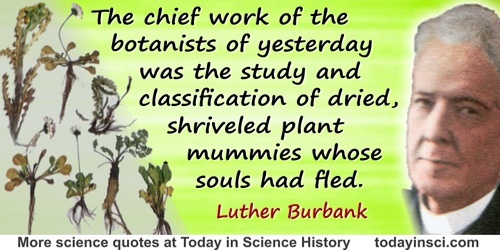
The chief work of the botanists of yesterday was the study and classification of dried, shriveled plant mummies whose souls had fled.
From Paper (18 Jun 1901), read before the California Academy of Sciences, published in 'The Making of New Flowers', American Gardening (13 Jul 1901), 22, No. 342, 489.
The climate of Colorado contains more of the essential elements which effectively promote health than that of any other country. These requisites are found in the chemical composition of the atmosphere; in the dry, pure, clean, soft, yet stimulating breezes which quicken circulation and multiply the corpuscles of the blood; in the tonic effect and exhilarating influence of the ozone; in the flood of its life-giving germ-destroying sunshine …
From F.H. Faus, 'Pike’s Peak Region Calls', Rock Island Magazine (Aug 1920), 15, No. 8, 4.
The ravages committed by man subvert the relations and destroy the balance which nature had established between her organized and her inorganic creations; and she avenges herself upon the intruder, by letting loose upon her defaced provinces destructive energies hitherto kept in check by organic forces destined to be his best auxiliaries, but which he has unwisely dispersed and driven from the field of action. When the forest is gone, the great reservoir of moisture stored up in its vegetable mould is evaporated, and returns only in deluges of rain to wash away the parched dust into which that mould has been converted. The well-wooded and humid hills are turned to ridges of dry rock, which encumbers the low grounds and chokes the watercourses with its debris, and–except in countries favored with an equable distribution of rain through the seasons, and a moderate and regular inclination of surface–the whole earth, unless rescued by human art from the physical degradation to which it tends, becomes an assemblage of bald mountains, of barren, turfless hills, and of swampy and malarious plains. There are parts of Asia Minor, of Northern Africa, of Greece, and even of Alpine Europe, where the operation of causes set in action by man has brought the face of the earth to a desolation almost as complete as that of the moon; and though, within that brief space of time which we call “the historical period,” they are known to have been covered with luxuriant woods, verdant pastures, and fertile meadows, they are now too far deteriorated to be reclaimable by man, nor can they become again fitted for human use, except through great geological changes, or other mysterious influences or agencies of which we have no present knowledge, and over which we have no prospective control. The earth is fast becoming an unfit home for its noblest inhabitant, and another era of equal human crime and human improvidence, and of like duration with that through which traces of that crime and that improvidence extend, would reduce it to such a condition of impoverished productiveness, of shattered surface, of climatic excess, as to threaten the depravation, barbarism, and perhaps even extinction of the species.
Man and Nature, (1864), 42-3.
There are those who say that the human kidney was created to keep the blood pure, or more precisely, to keep our internal environment in an ideal balanced state. This I must deny. I grant that the human kidney is a marvelous organ, but I cannot grant that it was purposefully designed to excrete urine or to regulate the composition of the blood or to subserve the physiological welfare of Homo sapiens in any sense. Rather I contend that the human kidney manufactures the kind of urine that it does, and it maintains the blood in the composition which that fluid has, because this kidney has a certain functional architecture; and it owes that architecture not to design or foresight or to any plan, but to the fact that the earth is an unstable sphere with a fragile crust, to the geologic revolutions that for six hundred million years have raised and lowered continents and seas, to the predacious enemies, and heat and cold, and storms and droughts; to the unending succession of vicissitudes that have driven the mutant vertebrates from sea into fresh water, into desiccated swamps, out upon the dry land, from one habitation to another, perpetually in search of the free and independent life, perpetually failing, for one reason or another, to find it.
From Fish to Philosopher (1953), 210-1.
There can be no doubt that science is in many ways the natural enemy of language. Language, either literary or colloquial, demands a rich store of living and vivid words—words that are “thoughtpictures,” and appeal to the senses, and also embody our feelings about the objects they describe. But science cares nothing about emotion or vivid presentation; her ideal is a kind of algebraic notation, to be used simply as an instrument of analysis; and for this she rightly prefers dry and abstract terms, taken from some dead language, and deprived of all life and personality.
In The English Language (1912), 124-125.
There is in the chemist a form of thought by which all ideas become visible in the mind as strains of an imagined piece of music. This form of thought is developed in Faraday in the highest degree, whence it arises that to one who is not acquainted with this method of thinking, his scientific works seem barren and dry, and merely a series of researches strung together, while his oral discourse when he teaches or explains is intellectual, elegant, and of wonderful clearness.
Autobiography, 257-358. Quoted in William H. Brock, Justus Von Liebig (2002), 9.
There is probably no other science which presents such different appearances to one who cultivates it and to one who does not, as mathematics. To this person it is ancient, venerable, and complete; a body of dry, irrefutable, unambiguous reasoning. To the mathematician, on the other hand, his science is yet in the purple bloom of vigorous youth, everywhere stretching out after the “attainable but unattained” and full of the excitement of nascent thoughts; its logic is beset with ambiguities, and its analytic processes, like Bunyan’s road, have a quagmire on one side and a deep ditch on the other and branch off into innumerable by-paths that end in a wilderness.
In 'The Theory of Transformation Groups', (A review of Erster Abschnitt, Theorie der Transformationsgruppen (1888)), Bulletin New York Mathematical Society (1893), 2 (First series), 61.
This Academy [at Lagado] is not an entire single Building, but a Continuation of several Houses on both Sides of a Street; which growing waste, was purchased and applied to that Use.
I was received very kindly by the Warden, and went for many Days to the Academy. Every Room hath in it ' one or more Projectors; and I believe I could not be in fewer than five Hundred Rooms.
The first Man I saw was of a meagre Aspect, with sooty Hands and Face, his Hair and Beard long, ragged and singed in several Places. His Clothes, Shirt, and Skin were all of the same Colour. He had been Eight Years upon a Project for extracting Sun-Beams out of Cucumbers, which were to be put into Vials hermetically sealed, and let out to warm the Air in raw inclement Summers. He told me, he did not doubt in Eight Years more, that he should be able to supply the Governor's Gardens with Sunshine at a reasonable Rate; but he complained that his Stock was low, and interested me to give him something as an Encouragement to Ingenuity, especially since this had been a very dear Season for Cucumbers. I made him a small Present, for my Lord had furnished me with Money on purpose, because he knew their Practice of begging from all who go to see them.
I saw another at work to calcine Ice into Gunpowder; who likewise shewed me a Treatise he had written concerning the Malleability of Fire, which he intended to publish.
There was a most ingenious Architect who had contrived a new Method for building Houses, by beginning at the Roof, and working downwards to the Foundation; which he justified to me by the life Practice of those two prudent Insects the Bee and the Spider.
In another Apartment I was highly pleased with a Projector, who had found a device of plowing the Ground with Hogs, to save the Charges of Plows, Cattle, and Labour. The Method is this: In an Acre of Ground you bury at six Inches Distance, and eight deep, a quantity of Acorns, Dates, Chestnuts, and other Masts or Vegetables whereof these Animals are fondest; then you drive six Hundred or more of them into the Field, where in a few Days they will root up the whole Ground in search of their Food, and make it fit for sowing, at the same time manuring it with their Dung. It is true, upon Experiment they found the Charge and Trouble very great, and they had little or no Crop. However, it is not doubted that this Invention may be capable of great Improvement.
I had hitherto seen only one Side of the Academy, the other being appropriated to the Advancers of speculative Learning.
Some were condensing Air into a dry tangible Substance, by extracting the Nitre, and letting the acqueous or fluid Particles percolate: Others softening Marble for Pillows and Pin-cushions. Another was, by a certain Composition of Gums, Minerals, and Vegetables outwardly applied, to prevent the Growth of Wool upon two young lambs; and he hoped in a reasonable Time to propagate the Breed of naked Sheep all over the Kingdom.
I was received very kindly by the Warden, and went for many Days to the Academy. Every Room hath in it ' one or more Projectors; and I believe I could not be in fewer than five Hundred Rooms.
The first Man I saw was of a meagre Aspect, with sooty Hands and Face, his Hair and Beard long, ragged and singed in several Places. His Clothes, Shirt, and Skin were all of the same Colour. He had been Eight Years upon a Project for extracting Sun-Beams out of Cucumbers, which were to be put into Vials hermetically sealed, and let out to warm the Air in raw inclement Summers. He told me, he did not doubt in Eight Years more, that he should be able to supply the Governor's Gardens with Sunshine at a reasonable Rate; but he complained that his Stock was low, and interested me to give him something as an Encouragement to Ingenuity, especially since this had been a very dear Season for Cucumbers. I made him a small Present, for my Lord had furnished me with Money on purpose, because he knew their Practice of begging from all who go to see them.
I saw another at work to calcine Ice into Gunpowder; who likewise shewed me a Treatise he had written concerning the Malleability of Fire, which he intended to publish.
There was a most ingenious Architect who had contrived a new Method for building Houses, by beginning at the Roof, and working downwards to the Foundation; which he justified to me by the life Practice of those two prudent Insects the Bee and the Spider.
In another Apartment I was highly pleased with a Projector, who had found a device of plowing the Ground with Hogs, to save the Charges of Plows, Cattle, and Labour. The Method is this: In an Acre of Ground you bury at six Inches Distance, and eight deep, a quantity of Acorns, Dates, Chestnuts, and other Masts or Vegetables whereof these Animals are fondest; then you drive six Hundred or more of them into the Field, where in a few Days they will root up the whole Ground in search of their Food, and make it fit for sowing, at the same time manuring it with their Dung. It is true, upon Experiment they found the Charge and Trouble very great, and they had little or no Crop. However, it is not doubted that this Invention may be capable of great Improvement.
I had hitherto seen only one Side of the Academy, the other being appropriated to the Advancers of speculative Learning.
Some were condensing Air into a dry tangible Substance, by extracting the Nitre, and letting the acqueous or fluid Particles percolate: Others softening Marble for Pillows and Pin-cushions. Another was, by a certain Composition of Gums, Minerals, and Vegetables outwardly applied, to prevent the Growth of Wool upon two young lambs; and he hoped in a reasonable Time to propagate the Breed of naked Sheep all over the Kingdom.
Gulliver's Travels (1726, Penguin ed. 1967), Part III, Chap. 5, 223.
Unless you make yourself equal to God, you cannot understand God: for the like is not intelligible save to the like. Make yourself grow to a greatness beyond measure, by a bound free yourself from the body; raise yourself above all time, become Eternity; then you will understand God. Believe that nothing is impossible for you, think yourself immortal and capable of understanding all, all arts, all sciences, the nature of every living being. Mount higher than the highest height; descend lower than the lowest depth. Draw into yourself all sensations of everything created, fire and water, dry and moist, imagining that you are everywhere, on earth, in the sea, in the sky, that you are not yet born, in the maternal womb, adolescent, old, dead, beyond death. If you embrace in your thought all things at once, times, places, substances, qualities, quantities, you may understand God.
Quoted in F. A. Yales, Giordano Bruno and the Hermetic Tradition (1964), 198.
We maintain that there are two exhalations, one vaporous the other smoky, and these correspond to two kinds of bodies that originate in the earth, things quarried and things mined. The heat of the dry exhalation is the cause of all things quarried. Such are the kinds of stones that cannot be melted, and realgar, and ochre, and ruddle, and sulphur, and the other things of that kind, most things quarried being either coloured lye or, like cinnabar, a stone compounded of it. The vaporous exhalation is the cause of all things mined—things which are either fusible or malleable such as iron, copper, gold.
Meteorology, 378a, 19-28. In Jonathan Barnes (ed.), The Complete Works of Aristotle (1984), Vol. I, 607.
We never know the Worth of Water till the Well is Dry.
Proverb collected by Fuller, No. 5451 in Gnomologia: Adagies and Proverbs: Wise Sentences and Witty Sayings, Ancient and Modern, Foreign and British (1732), 237. Compare with Benjamin Franklin, published later, “When the well’s dry, we know the worth of water”, in Poor Richard’s Almanac (1757, 1900), 23.
What shall be done with nature to reclaim
The herbless, treeless waste? those dead seas past,
Dried summer lands, deserts and “antres vast,”
The earth’s reproach, her barrenness and shame.
Can human toil and foresight help the same?
Science, of soils declares with grand forecast,
Last shall be first, and first shall be the last
To come to fruit in Irrigation’s name!
The herbless, treeless waste? those dead seas past,
Dried summer lands, deserts and “antres vast,”
The earth’s reproach, her barrenness and shame.
Can human toil and foresight help the same?
Science, of soils declares with grand forecast,
Last shall be first, and first shall be the last
To come to fruit in Irrigation’s name!
In 'Arid Lands', Poems of Expansion (1898), 108.
When I arrived in California to join the faculty of the New University which opened in October 1891, it was near the end of the dry season and probably no rain had fallen for three or four months. The bare cracked adobe fields surrounding the new buildings ... offered a decidedly unpromising outlook... A month or two later, however, there was a magical transformation. With the advent of the autumn rains the whole country quickly turned green, and a profusion of liverworts such as I had never seen before appeared on the open ground... I soon realized that right in my own backyard, so to speak, was a wealth of material such as I had never imagined would be my good fortune to encounter. ... Such an invitation to make a comprehensive study of the structure and development of the liverworts could not be resisted; and the next three years were largely devoted to this work which finally resulted in the publication of 'The Mosses and Ferns' in 1895.
In The Structure and Development of Mosses and Ferns (Archegoniatae) (1905, 3rd ed. 1918, rev. 1928). Cited in William C. Steere, Obituary, 'Douglas Houghton Campbell', American Bryological and Lichenological Society, The Bryologist (1953), 131.
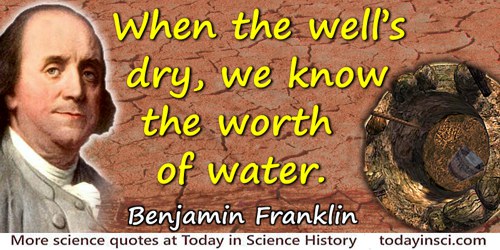
When the well’s dry, we know the worth of water.
In Poor Richard’s Almanac (1757, 1900), 23. Published earlier (1732) by Thomas Fuller as: “We never know the worth of water ’til the well is dry.” Proverb collected by Thomas Fuller in Gnomologia: Adagies and Proverbs: Wise Sentences and Witty Sayings, Ancient and Modern, Foreign and British (1732), 237.
Why Become Extinct? Authors with varying competence have suggested that dinosaurs disappeared because the climate deteriorated (became suddenly or slowly too hot or cold or dry or wet), or that the diet did (with too much food or not enough of such substances as fern oil; from poisons in water or plants or ingested minerals; by bankruptcy of calcium or other necessary elements). Other writers have put the blame on disease, parasites, wars, anatomical or metabolic disorders (slipped vertebral discs, malfunction or imbalance of hormone and endocrine systems, dwindling brain and consequent stupidity, heat sterilization, effects of being warm-blooded in the Mesozoic world), racial old age, evolutionary drift into senescent overspecialization, changes in the pressure or composition of the atmosphere, poison gases, volcanic dust, excessive oxygen from plants, meteorites, comets, gene pool drainage by little mammalian egg-eaters, overkill capacity by predators, fluctuation of gravitational constants, development of psychotic suicidal factors, entropy, cosmic radiation, shift of Earth’s rotational poles, floods, continental drift, extraction of the moon from the Pacific Basin, draining of swamp and lake environments, sunspots, God’s will, mountain building, raids by little green hunters in flying saucers, lack of standing room in Noah’s Ark, and palaeoweltschmerz.
'Riddles of the Terrible Lizards', American Scientist (1964) 52, 231.
Why is geometry often described as “cold” and “dry?” One reason lies in its inability to describe the shape of a cloud, a mountain, a coastline, or a tree. Clouds are not spheres, mountains are not cones, coastlines are not circles, and bark is not smooth, nor does lightning travel in a straight line… Nature exhibits not simply a higher degree but an altogether different level of complexity.
From The Fractal Geometry of Nature (1977, 1983), Introduction, xiii.
Why should we grope among the dry bones of the past, or put the living generation into masquerade out of its faded wardrobe? … There are new lands, new men, new thoughts.
From 'Introduction' in his first published book (at first, anonymously), Nature (1836), 5-6.
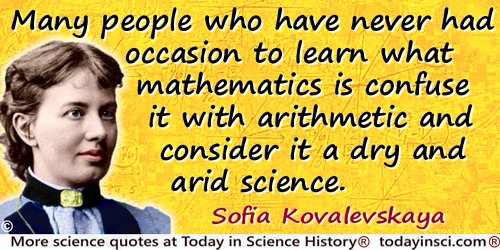
You are surprised at my working simultaneously in literature and in mathematics. Many people who have never had occasion to learn what mathematics is confuse it with arithmetic and consider it a dry and arid science. In actual fact it is the science which demands the utmost imagination. One of the foremost mathematicians of our century says very justly that it is impossible to be a mathematician without also being a poet in spirit. It goes without saying that to understand the truth of this statement one must repudiate the old prejudice by which poets are supposed to fabricate what does not exist, and that imagination is the same as “making things up”. It seems to me that the poet must see what others do not see, and see more deeply than other people. And the mathematician must do the same.
In letter (1890), quoted in S. Kovalevskaya and Beatrice Stillman (trans. and ed.), Sofia Kovalevskaya: A Russian Childhood (2013), 35. Translated the Russian edition of Vospominaniya detstva (1974).
You may drink the ocean dry; you may uproot from its base the mountain Meru: you may swallow fire. But more difficult than all these, oh Good One! is control over the mind.
Quoted in Kim Lim (ed.), 1,001 Pearls of Spiritual Wisdom: Words to Enrich, Inspire, and Guide Your Life (2014), 258.
 In science it often happens that scientists say, 'You know that's a really good argument; my position is mistaken,' and then they would actually change their minds and you never hear that old view from them again. They really do it. It doesn't happen as often as it should, because scientists are human and change is sometimes painful. But it happens every day. I cannot recall the last time something like that happened in politics or religion.
(1987) --
In science it often happens that scientists say, 'You know that's a really good argument; my position is mistaken,' and then they would actually change their minds and you never hear that old view from them again. They really do it. It doesn't happen as often as it should, because scientists are human and change is sometimes painful. But it happens every day. I cannot recall the last time something like that happened in politics or religion.
(1987) -- 





