Drug Quotes (61 quotes)
[Mercurial medicines] affect the human constitution in a peculiar manner, taking, so to speak, an iron grasp of all its systems, and penetrating even to the bones, by which they not only change the healthy action of its vessels, and general structure, but greatly impair and destroy its energies; so that their abuse is rarely overcome. When the tone of the stomach, intestines, or nervous system generally, has been once injured by this mineral ... it could seldom be restored.
Quoted in Wooster Beach, A Treatise on Anatomy, Physiology, and Health (1848), 177.
[Society's rights to employ the scopolamine (“truth serum”) drug supersede those of a criminal.] It therefore stands to reason, that where there is a safe and humane method existing to evoke the truth from the consciousness of a suspect society is entitled to have that truth.
Quoted from presentation at the first annual meeting of the Eastern Society of Anesthetists at the Hotel McAlpin, as reported in '“Truth Serum” Test Proves Its Power', New York Times (22 Oct 1924), 14.
[William Gull] endeavoured, above all things, to study the natural history of disease, uncomplicated by the action of unnecessary drugs, and he resented all useless interference with the course of nature. He would say of meddlesome poly-pharmacy—“Fools rush in, where angels fear to tread.”
Stated in Sir William Withey Gull and Theodore Dyke Acland (ed.), A Collection of the Published Writings of William Withey Gull (1896), xxv-xxvi.
[Advice to would-be trippers, simply:] Go to the meadows, go to the garden, go to the woods. Open your eyes!
In Keith Colquhoun and Ann Wroe, Economist Book of Obituaries (2008), 161.
[On the use of scopolamine in criminology], If it is permissible for a state to take life, liberty and property because of crime, it can be made legal to obtain information from a suspected criminal by the use of a drug. If the use of bloodhounds is legal, the use of scopolamine can be made legal.
From paper read at the Section on State Medicine and Public Hygiene of the State Medical Association of Texas at El Paso (11 May 1922), 'The Use Of Scopolamine In Criminology', published in Texas State Journal of Medicine (Sep 1922). Reprinted in The American Journal of Police Science (Jul-Aug 1931), 2, No. 4, 328.
Je suis médecin. Je tiens boutique de mensonges. Je soulage, je console. Peut-on consoler et soulager sans mentir? … Les femmes et les médecins savent seuls combien le mensonge est nécessaire et bienfaisant aux hommes.
I am a physician. I keep a drug-shop of lies. I give relief, consolation. Can one console and relieve without lying? … Only women and doctors know how necessary and how helpful lies are to men.
I am a physician. I keep a drug-shop of lies. I give relief, consolation. Can one console and relieve without lying? … Only women and doctors know how necessary and how helpful lies are to men.
From the fictional Dr. Trublet in Histoire Comique (1900), 171-172. As translated in Lewis P. Shanks, Anatole France (1919), 165.
~~[Misattributed; NOT by Collins]~~ Hypochondriacs squander large sums of time in search of nostrums by which they vainly hope they may get more time to squander.
This appears in Charles Caleb Colton, Lacon: Or Many Things in Few Words, Addressed to Those who Think (1823), Vol. 1, 99. Since Mortimer Collins was born in 1827, four years after the Colton publication, Collins cannot be the author. Nevertheless, it is widely seen misattributed to Collins, for example in Peter McDonald (ed.), Oxford Dictionary of Medical Quotations (2004), 27. Even seen attributed to Peter Ouspensky (born 1878), in Encarta Book of Quotations (2000). See the Charles Caleb Colton Quotes page on this website. The quote appears on this page to include it with this caution of misattribution.
A barbarous practice, the inconsistency, folly, and injury of which no words can sufficiently describe.
Condemning the use of mercurial medicines.
Condemning the use of mercurial medicines.
Quoted in Wooster Beach, A Treatise on Anatomy, Physiology, and Health (1848), 177.
A discovery is like falling in love and reaching the top of a mountain after a hard climb all in one, an ecstasy not induced by drugs but by the revelation of a face of nature that no one has seen before and that often turns out to be more subtle and wonderful than anyone had imagined.
'True Science', review of Peter Medawar, Advice to a Young Scientist (1980). In The London Review of Books (Mar 1981), 6.
A drug is a substance which, if injected into a rabbit, produces a paper.
Quoted in Albert Szent-Gyorgyi, 'Some Reminiscences of My Life as a Scientist', International Journal of Quantum Biology Symposium (1976), 3, 7.
A fool who, after plain warning, persists in dosing himself with dangerous drugs should be free to do so, for his death is a benefit to the race in general.
…...
A man who cannot work without his hypodermic needle is a poor doctor. The amount of narcotic you use is inversely proportional to your skill.
Martin H. Fischer, Howard Fabing (ed.) and Ray Marr (ed.), Fischerisms (1944).
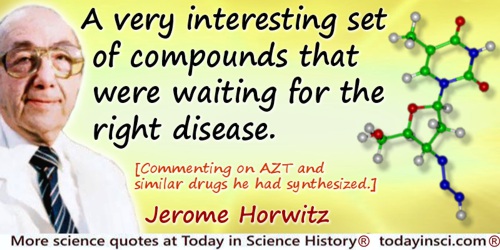
A very interesting set of compounds that were waiting for the right disease.
[Commenting on AZT and similar drugs he had synthesized.]
[Commenting on AZT and similar drugs he had synthesized.]
Quoted in 'Jerome Horwitz, AZT Creator, Dies at 93', New York Times (21 Sep 2012).
According to the estimate of a prominent advertising firm, above 90 per cent, of the earning capacity of the prominent nostrums is represented by their advertising. And all this advertising is based on the well-proven theory of the public's pitiable ignorance and gullibility in the vitally important matter of health.
'The Fundamental Fakes', Collier's Weekly (17 Feb 1906). Reprinted in The Great American Fraud (1907), 55.
AZT stood up and said, 'Stop your pessimism. Stop your sense of futility. Go back to the lab. Go back to development. Go back to clinical trials. Things will work.'
[On the impact of AZT emerging as the long-sought first significant AIDS drug.]
[On the impact of AZT emerging as the long-sought first significant AIDS drug.]
As quoted in Emily Langer, 'Researcher Jerome P. Horwitz, 93, created AZT, the first approved treatment for HIV/AIDS' Washington Post (19 Sep 2012). The article was excerpted on blogs, sometimes referring to this quote by saying "AZT was more a cure for fatalism than for AIDS."
Cheap drugs would be dear if they were cheap and nasty. Nasty to the palate many drugs are bound to be; but worse is the nastiness of bad quality.
As quoted in Charles Margerison, Amazing People of England: Inspirational Stories (2010), 270.
Chemically induced hallucinations, delusions and raptures may be frightening or wonderfully gratifying; in either case they are in the nature of confidence tricks played on one’s own nervous system.
In 'Return Trip to Nirvana', Sunday Telegraph (12 Mar 1961), as collected in Kaleidoscope: Essays from Drinkers of Infinity, and The Heel of Achilles and Later Pieces and Stories (1981), 80 (source cited on p.72, footnote).
Creation is a drug I can't do without.
Quoted in Gladwin Hill, 'Most Colossal of All', New York Times (12 Aug 1956), 179.
Despair is better treated with hope, not dope.
Lancet (1958), 1, 954.
Dissections daily convince us of our ignorance of disease, and cause us to blush at our prescriptions. What mischief have we done under the belief of false facts and false theories! We have assisted in multiplying diseases; we have done more; we have increased their mortality. ... I am pursuing Truth, and am indifferent whither I am led, if she is my only leader.
From a public lecture by Rush. Quoted by Isaac Jennings, in Medical Reform; a Treatise on Man's Physical Being and Disorders (1847), 33.
Doctor, no medicine.—We are machines made to live—organized expressly for that purpose.—Such is our nature.—Do not counteract the living principle.—Leave it at liberty to defend itself, and it will do better than your drugs.
As given in Tryon Edwards (ed.), A Dictionary of Thoughts (1908), 339.
Drugs are not always necessary. Belief in recovery always is.
Anatomy of an Illness As Perceived by the Patient: Reflections on Healing (2005), 55.
Everything is poisonous, nothing is poisonous, it is all a matter of dose.
In Pathologie expérimenta1e (1872), 72. From the original French, “Tout est poison, rien n’est poison, tout est une question de dose.”
For some men of great courage and adventure, inactivity was a slow death. Would a man like Gibson ever have adjusted back to peacetime life? One can imagine it would have been a somewhat empty existence after all he had been through. Facing death had become his drug. He had seen countless friends and comrades perish in the great crusade. Perhaps something in him even welcomed the inevitability he had always felt that before the war ended he would join them in their Bomber Command Valhalla. He had pushed his luck beyond all limits and he knew it. But that was the kind of man he was… A man of great courage, inspiration and leadership. A man born for war… but born to fall in war.
Wallis wrote after the death of Guy Gibson, leader of the successful Dambusters raid by the 617 Squadron. Gibson was killed a year later when his airplane crashed returning from a night-time sortie over Germany. As quoted in W. B. Bartlett, Dam Busters: In the Words of the Bomber Crews (2011, 2013), 272-273.
Half the modern drugs could well be thrown out the window except that the birds might eat them
Martin H. Fischer, Howard Fabing (ed.) and Ray Marr (ed.), Fischerisms (1944).
How far do you go to preserve individual human life? … I mean, what are we to do with the NHS? How can you put a value in pounds, shillings and pence on an individual’s life? There was a case with a bowel cancer drug – if you gave that drug, which costs several thousand pounds, it continued life for six weeks on. How can you make that decision?
Answering “What is the most difficult ethical dilemma facing science today?” NHS is the British National Health Service, which has the difficulty of how to best allocate limited funding resources. From 'Interview: Of Mind and Matter: David Attenborough Meets Richard Dawkins', The Guardian (11 Sep 2010).
I believe that the medical treatment of the various abnormal conditions arising in infants is in the future to be largely dietetic rather than by means of drugs.
Preface to the First Edition (Oct 1895). In Pediatrics: the hygienic and medical treatment of children (5th. ed., 1906), ix.
I despise people who depend on these things [heroin and cocaine]. If you really want a mind-altering experience, look at a tree.
Quoted in interview by Tim Adams, 'This much I know: A.C. Grayling', The Observer (4 Jul 2009).
I don’t use drugs, my dreams are frightening enough.
As given, without citation, in G. Kleiser, Dictionary of Proverbs (2005), 77.
I never found it easy. People say I was lucky twice but I resent that. We stuck with [cimetidine] for four years with no progress until we eventually succeeded. It was not luck, it was bloody hard work.
[Rejecting that drug discovery was easier in the past.]
[Rejecting that drug discovery was easier in the past.]
Quoted in Andrew Jack, "An Acute Talent for Innovation", Financial Times (1 Feb 2009).
I wish I had my beta-blockers handy.
[Comment when told that he had won a Nobel prize, referring to the drug he discovered for the treatment of heart disease.]
[Comment when told that he had won a Nobel prize, referring to the drug he discovered for the treatment of heart disease.]
As quoted in Obituary, The Times (24 Mar 2010)
If every drug in the world were abolished a physician would still be a useful member of society.
As quoted in Sir William Withey Gull and Theodore Dyke Acland (ed.), A Collection of the Published Writings of William Withey Gull (1896), xxv.
If you could see what I almost daily see in my practice … persons … in the very last stages of wretched existence, emaciated to a skeleton, with both tables of the skull almost completely perforated in many places, half the nose gone, with rotten jaws, ulerated throats, breaths most pestiferous more intolerable than poisonous upas, limbs racked with the pains of the Inquisition, minds as imbecile as the puling babe, a grievous burden to themselves and a disgusting spectacle to others, you would exclaim as I have often done, 'O! the lamentable want of science that dictates the abuse (use) of that noxious drug calomel!'
[Calomel is the mercury compound, Hg2Cl2.]
[Calomel is the mercury compound, Hg2Cl2.]
Quoted in Wooster Beach, A Treatise on Anatomy, Physiology, and Health (1848), 177.
In many cases, mathematics is an escape from reality. The mathematician finds his own monastic niche and happiness in pursuits that are disconnected from external affairs. Some practice it as if using a drug. Chess sometimes plays a similar role. In their unhappiness over the events of this world, some immerse themselves in a kind of self-sufficiency in mathematics. (Some have engaged in it for this reason alone.)
In Adventures of a Mathematician (1976), 120.
In my opinion, the American “war on drugs” represents merely a new variation in humanity’s age-old passion to “purge” itself of its “impurities” by staging vast dramas of scapegoat persecutions. In the past, we have witnessed religious or “holy” wars waged against people who professed the wrong faith; … now we are witnessing a medical or “therapeutic” war, waged against people who use the wrong drugs.
From 'The Morality of Drug Controls', collected in Ronald Hamowy (ed.), Dealing with Drugs: Consequences of Government Control (1987), 329.
In the fight which we have to wage incessantly against ignorance and quackery among the masses and follies of all sorts among the classes, diagnosis, not drugging, is our chief weapon of offence. Lack of systematic personal training in the methods of the recognition of disease leads to the misapplication of remedies, to long courses of treatment when treatment is useless, and so directly to that lack of confidence in our methods which is apt to place us in the eyes of the public on a level with empirics and quacks.
Address to the Canadian Medical Association, Montreal (17 Sep 1902), 'Chauvinism in Medicine', published in The Montreal Medical Journal (1902), 31, 267. Collected in Aequanimitas, with Other Addresses to Medical Students, Nurses and Practitioners of Medicine (1904), 299.
In university, people spend their time talking about how they can raise money. In the drug company, they talk about their research.
— Magazine
By an unnamed pharmacologist comparing changing jobs from academia for industry, as given in 'Feedback', New Scientist (7 May 1987), 65.

It is important to go into work you would like to do. Then it doesn't seem like work. You sometimes feel it's almost too good to be true that someone will pay you for enjoying yourself. I've been very fortunate that my work led to useful drugs for a variety of serious illnesses. The thrill of seeing people get well who might otherwise have died of diseases like leukemia, kidney failure, and herpes virus encephalitis cannot be described in words.
From her lecture notes.
It might be argued that a genetically enhanced athlete, like a drug-enhanced one, would have an unfair advantage over his unenhanced competitors. But the fairness argument against enhancement has a fatal flaw: it has always been the case that some athletes are better endowed genetically than others, and yet we do not consider this to undermine the fairness of competitive sports. From the standpoint of fairness, enhanced genetic differences would be no worse than natural ones, assuming they were safe and made available to all. If genetic enhancement in sports is morally objectionable, it must be for reasons other than fairness.
Michael J. Sandel, 'The Case Against Perfection', The Atlantic Monthly (Apr 2004).
Medical men do not know the drugs they use, nor their prices.
De Erroribus Medicorum.
My opinion is, that more harm than good is done by physicians; and I am convinced, that, had I left my patients to nature, instead of prescribing drugs, more would have been saved.
Quoted by E.T.M. Hurlbut, 'Homeopathy, Hygiene, and Opium,' Address at Annual Meeting of the Nebraska State Homeopathic Medical Association, 19 May 1874. In William Riddle Childs, et al., Pamphlets - Homeopathic (1851), Vol. 6, 3.
Nor can it be supposed that the diversity of chemical structure and process stops at the boundary of the species, and that within that boundary, which has no real finality, rigid uniformity reigns. Such a conception is at variance with any evolutionary conception of the nature and origin of species. The existence of chemical individuality follows of necessity from that of chemical specificity, but we should expect the differences between individuals to be still more subtle and difficult of detection. Indications of their existence are seen, even in man, in the various tints of skin, hair, and eyes, and in the quantitative differences in those portions of the end-products of metabolism which are endogenous and are not affected by diet, such as recent researches have revealed in increasing numbers. Even those idiosyncrasies with regard to drugs and articles of food which are summed up in the proverbial saying that what is one man's meat is another man's poison presumably have a chemical basis.
Inborn Errors of Metabolism: The Croonian Lectures delivered before the Royal College of Physicians of London, in June, 1908 (1909), 2-3.
Of course, Behaviourism “works.” So does torture. Give me a no-nonsense, down-to-earth behaviourist, a few drugs, and simple electrical appliances, and in six months I will have him reciting the Athanasian Creed in public.
A Certain World: A Commonplace Book (1971),33.
One cannot help a man to come to accept his impending death if he remains in severe pain, one cannot give spiritual counsel to a woman who is vomiting, or help a wife and children say their goodbyes to a father who is so drugged that he cannot respond.
'The Principles of Symptom Control', in Ina Ajemian, Balfour M. Mount. (eds.) The R.V.H. Manual on Palliative/Hospice Care (1980), 176.
Opium is the only drug to' be rely'd on—all the boasted nostrums only take up time, and as the disease [is] often of short duration, or of small quantity, they have gain'd credit which they do not deserve.
Quoted in Desmond King-Hele, Erasmus Darwin: A Life of Unequalled Achievement (1999), 161.
Philosophy, like medicine, has plenty of drugs, few good remedies, and hardly any specific cures.
Maximes et pensées (1796), Vol. 1, No. 17.
Remember the Three Princes of Serendip who went out looking for treasure? They didn't find what they were looking for, but they kept finding things just as valuable. That's serendipity, and our business [drugs] is full of it.
'What the Doctor Ordered&#-30;, Time (18 Aug 1952)
The Chinese … use fossil teeth as one of their principal medicines. Some Chinese families have for centuries been in the business of “mining” fossils to supply the drug trade.
The name of medicine is thought to have been given from 'moderation', modus, that is, from a due proportion, which advises that things be done not to excess, but 'little by little', paulatim. For nature is pained by surfeit but rejoices in moderation. Whence also those who take drugs and antidotes constantly, or to the point of saturation, are sorely vexed, for every immoderation brings not health but danger.
Etymologies [c.600], Book IV, chapter 2, quoted in E. Grant (ed.), A Source Book in Medieval Science (1974), trans. W. D. Sharpe (1964), 701.
The Nobel Prize is fine, but the drugs I've developed are rewards in themselves.
Quoted in the New York Times (18 Oct 1988).
The progress of synthesis, or the building up of natural materials from their constituent elements, proceeds apace. Even some of the simpler albuminoids, a class of substances of great importance in the life process, have recently been artificially prepared. ... Innumerable entirely new compounds have been produced in the last century. The artificial dye-stuffs, prepared from materials occurring in coal-tar, make the natural colours blush. Saccharin, which is hundreds of times sweeter than sugar, is a purely artificial substance. New explosives, drugs, alloys, photographic substances, essences, scents, solvents, and detergents are being poured out in a continuous stream.
In Matter and Energy (1912), 45-46.
The road to a clinic goes through the pathologic museum and not through the apothecary's shop.
Quoted without further citation in The New Encyclopedia Britannica (1986), Vol. 5, 566.
The techniques have galloped ahead of the concepts. We have moved away from studying the complexity of the organism; from processes and organisation to composition.
[Commenting that growing use of new technologies and techniques, from molecular biology to genomics, has proved a mixed blessing.]
[Commenting that growing use of new technologies and techniques, from molecular biology to genomics, has proved a mixed blessing.]
Quoted in Andrew Jack, "An Acute Talent for Innovation", Financial Times (1 Feb 2009).
There is only one reason why men become addicted to drugs — they are weak men. Only strong men are cured, and they cure themselves.
Martin H. Fischer, Howard Fabing (ed.) and Ray Marr (ed.), Fischerisms (1944).
There is only one reason why men become addicted to drugs, they are weak me. Only strong men are cured, and they cure themselves.
Martin H. Fischer, Howard Fabing (ed.) and Ray Marr (ed.), Fischerisms (1944).
Throw out opium, which the Creator himself seems to prescribe, for we often see the scarlet poppy growing in the cornfields, as if it were foreseen that wherever there is hunger to be fed there must also be a pain to be soothed; throw out a few specifics which our art did not discover, and it is hardly needed to apply; throw out wine, which is a food, and the vapors which produce the miracle of anaesthesia, and I firmly believe that if the whole materia medica, as now used, could be sunk to the bottom of the sea, it would be all the better for mankind,—and all the worse for the fishes.
From Address to Annual Meeting of Massachusetts Medical Society (30 May 1860), 'Currents and Counter-Currents in Medical Science'. Collected in The Writings of Oliver Wendell Holmes: Medical Essays, 1842-1882 (1891), 202-203. [Note: “materia medica” is a term for pharmaceuticals (medical drugs) collectively.]
Tobacco has not yet been fully tried before the bar of science. But the tribunal has been prepared and the gathering of evidence has begun and when the final verdict is rendered, it will appear that tobacco is evil and only evil; that as a drug it is far more deadly than alcohol, killing in a dose a thousand times smaller, and that it does not possess a single one of the quasi merits of alcohol.
In Tobaccoism: or, How Tobacco Kills (1922), Preface, 8.
Tobacco, in its various forms, is one of the most mischievous of all drugs. There is perhaps no other drug which injures the body in so many ways and so universally as does tobacco. Some drugs offer a small degree of compensation for the evil effects which they produce; but tobacco has not a single redeeming feature and gives nothing in return.
In Tobaccoism: or, How Tobacco Kills (1922), Preface, 7.
Tranquilizers to overcome angst, pep pills to wake us up, life pills to ensure blissful sterility. I will lift up my ears unto the pills whence cometh my help.
New Statesman (3 Aug 1962). In Thelma C. Altshuler, Martha M. McDonough and Audrey J. Roth, Prose as Ewxperience (2007), 5.
We can make an exception of opium “which the creator seems to prescribe, as we often see the scarlet poppy growing in the corn fields” but all other receipts of Omniscience must be condemned. The purple fox-glove, the many-tinted veratrum the lilac stramonium they are all “'noxious” but a little opium it helps the imagination.
[Criticizing the medical use of noxious psychoactive drugs.]
[Criticizing the medical use of noxious psychoactive drugs.]
'Dr. Holmes vs. the Medical Profession', a summary of his address to the Anniversary Meeting of the Massachusetts Medical Society (May 1860), in Maryland and Virginia Medical Journal reprinted in American Medical Gazette and Journal of Health? (Oct 1860), 11, 757.
We cannot step aside and say that we have achieved our goal by inventing a new drug or a new way by which to treat presently incurable diseases, a new way to help those who suffer from malnutrition, or the creation of ideal balanced diets on a worldwide scale. We cannot rest till the way has been found, with our help, to bring our finest achievement to everyone.
Address to the Medical College of Virginia, Richmond (1 Dec 1950).
 In science it often happens that scientists say, 'You know that's a really good argument; my position is mistaken,' and then they would actually change their minds and you never hear that old view from them again. They really do it. It doesn't happen as often as it should, because scientists are human and change is sometimes painful. But it happens every day. I cannot recall the last time something like that happened in politics or religion.
(1987) --
In science it often happens that scientists say, 'You know that's a really good argument; my position is mistaken,' and then they would actually change their minds and you never hear that old view from them again. They really do it. It doesn't happen as often as it should, because scientists are human and change is sometimes painful. But it happens every day. I cannot recall the last time something like that happened in politics or religion.
(1987) -- 




