Dogma Quotes (49 quotes)
“Normal” science, in Kuhn’s sense, exists. It is the activity of the non-revolutionary, or more precisely, the not-too-critical professional: of the science student who accepts the ruling dogma of the day… in my view the 'normal' scientist, as Kuhn describes him, is a person one ought to be sorry for… He has been taught in a dogmatic spirit: he is a victim of indoctrination… I can only say that I see a very great danger in it and in the possibility of its becoming normal… a danger to science and, indeed, to our civilization. And this shows why I regard Kuhn’s emphasis on the existence of this kind of science as so important.
In Imre Lakatos and A. Musgrave (eds.), 'Normal Science and its Dangers', Criticism and the Growth of Knowledge (1970), 52-53.
A central lesson of science is that to understand complex issues (or even simple ones), we must try to free our minds of dogma and to guarantee the freedom to publish, to contradict, and to experiment. Arguments from authority are unacceptable.
Billions and Billions: Thoughts on Life and Death at the Brink of the Millenium (1998), 190.
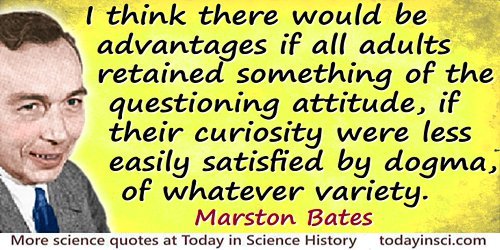
All children are curious and I wonder by what process this trait becomes developed in some and suppressed in others. I suspect again that schools and colleges help in the suppression insofar as they meet curiosity by giving the answers, rather than by some method that leads from narrower questions to broader questions. It is hard to satisfy the curiosity of a child, and even harder to satisfy the curiosity of a scientist, and methods that meet curiosity with satisfaction are thus not apt to foster the development of the child into the scientist. I don't advocate turning all children into professional scientists, although I think there would be advantages if all adults retained something of the questioning attitude, if their curiosity were less easily satisfied by dogma, of whatever variety.
The Nature of Natural History (1950, 1990), 256-257.
Every progress that a church makes in the construction of its dogmas leads to a further taming of the free spirit; every new dogma … narrows the circle of free thought. … Science, on the other hand, liberates with every step of its development, it opens up new paths to thought … In other words, it allows the individual to be truly free.
Translated from the original German, “Jeder Fortschritt, den eine Kirche in dem Aufbau ihrer Dogmen macht, führt zu einer weiter gehenden Bändigung des freien Geistes; jedes neue Dogma …
verengt den Kreis des freien Denkens. … Die Naturwissenschaft umgekehrt befreit mit jedem Schritte ihrer Entwicklung, sie eröffnet dem Gedanken neue Bahnen … Sie gestattet, mit anderen Worten, dem Einzelnen in vollem Masse wahr zu sein.” In Speech to the 24th meeting of the German Naturalists and Physicians at Rostock 'Ueber die Aufgaben der Naturwissenschaften in dem neuen nationalen Leben Deutschlands', (On the tasks of the natural sciences in the new
national life of Germany), published in Chemisches Zentralblatt (11 Oct 1871), No. 41, 654-655. English version by Webmaster using Google translate.
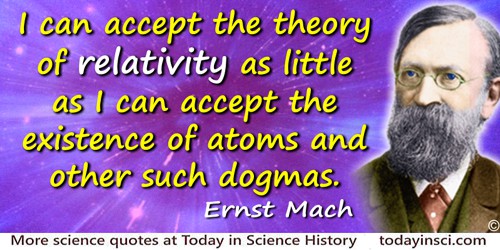
I can accept the theory of relativity as little as I can accept the existence of atoms and other such dogmas.
Professor of Physics at the University of Vienna, 1913, in The Book of Heroic Failures by Stephen Pile (1979).
I can still recall vividly how Freud said to me, “My dear Jung, promise me never to abandon the sexual theory. That is the most essential thing of all. You see, we must make a dogma of it, an unshakable bulwark” … In some astonishment I asked him, “A bulwark-against what?” To which he replied, “Against the black tide of mud”—and here he hesitated for a moment, then added—“of occultism.”
Memories, Dreams, Reflections (1963), 147-8.
I think it’s time we recognized the Dark Ages are over. Galileo and Copernicus have been proven right. The world is in fact round; the Earth does revolve around the sun. I believe God gave us intellect to differentiate between imprisoning dogma and sound ethical science, which is what we must do here today.
Debating federal funding for stem cell research as Republican Representative (CT).
Debating federal funding for stem cell research as Republican Representative (CT).
In Eve Herold, George Daley, Stem Cell Wars (2007), 57.
Ideologues of all persuasions think they know how the economy will respond to the Administration’s strange mixture of Lafferism and monetarism. Indeed, their self-confidence is so vast, and their ability to rationalize so crafty, that one cannot imagine a scenario for the next few years, that they would regard as falsifying their dogma. The failure of any prediction can always be blamed on quirky political decisions or unforeseen historical events.
In 'Mathematical Games: The Laffer Curve', Scientific American (Dec 1981), 245, No. 6, 30. Collected in The Night Is Large: Collected Essays, 1938-1995 (1997), 135.
If entomologists have things backward, their errors have spawned a host of others central to modern evolutionary science. … E.O. Wilson is … the founder of a rich and fruitful discipline—sociobiology. And sociobiology has … helped lay the groundwork for the dogma of the “selfish gene.”
In 'The Embryonic Meme', Global Brain: The Evolution of Mass Mind from the Big Bang to the 21st Century (2000), 34.
In the endeavor to clearly comprehend and explain the functions of the combination of forces called “brain,” the physiologist is hindered and troubled by the views of the nature of those cerebral forces which the needs of dogmatic theology have imposed on mankind.
In 'General Conclusions, Anatomy of the Vertebrates (1868, 2011), Vol. 3, Chap 40, 823. Excerpt in Noah Porter (ed.), Half Hours with Modern Scientists (1872), 71.
In the modern world, science and society often interact in a perverse way. We live in a technological society, and technology causes political problems. The politicians and the public expect science to provide answers to the problems. Scientific experts are paid and encouraged to provide answers. The public does not have much use for a scientist who says, “Sorry, but we don’t know.” The public prefers to listen to scientists who give confident answers to questions and make confident predictions of what will happen as a result of human activities. So it happens that the experts who talk publicly about politically contentious questions tend to speak more clearly than they think. They make confident predictions about the future, and end up believing their own predictions. Their predictions become dogmas which they do not question. The public is led to believe that the fashionable scientific dogmas are true, and it may sometimes happen that they are wrong. That is why heretics who question the dogmas are needed.
Frederick S. Pardee Distinguished Lecture (Oct 2005), Boston University. Collected in 'Heretical Thoughts About Science and Society', A Many-Colored Glass: Reflections on the Place of Life in the Universe (2007), 43-44.
In the past we see that periods of great intellectual activity have followed certain events which have acted by freeing the mind from dogma, extending the domain in which knowledge can be sought, and stimulating the imagination. … [For example,] the development of the cell theory and the theory of evolution.
From address, 'A Medical Retrospect'. Published in Yale Medical Journal (Oct 1910), 17, No. 2, 59.
It is ironical that, in the very field in which Science has claimed superiority to Theology, for example—in the abandoning of dogma and the granting of absolute freedom to criticism—the positions are now reversed. Science will not tolerate criticism of special relativity, while Theology talks freely about the death of God, religionless Christianity, and so on.
In 'Preface', Science at the Crossroads (1972), 13.
It is rigid dogma that destroys truth; and, please notice, my emphasis is not on the dogma, but on the rigidity. When men say of any question, “This is all there is to be known or said of the subject; investigation ends here,” that is death. It may be that the mischief comes not from the thinker but for the use made of his thinking by late-comers. Aristotle, for example, gave us our scientific technique … yet his logical propositions, his instruction in sound reasoning which was bequeathed to Europe, are valid only within the limited framework of formal logic, and, as used in Europe, they stultified the minds of whole generations of mediaeval Schoolmen. Aristotle invented science, but destroyed philosophy.
Dialogues of Alfred North Whitehead, as recorded by Lucien Price (1954, 2001), 165.
Many orthodox people speak as though it were the business of sceptics to disprove received dogmas rather than of dogmatists to prove them. This is, of course, a mistake.
In unpublished manuscript, 'Is There a God', (5 Mar 1952) written for the magazine, Illustrated. Collected in Bertrand Russell, John G. Slater (ed.) and Peter Köllner (ed.) The Collected Papers of Bertrand Russell: Volume II: Last Philosophical Testament: 1943-68 (1997), 547.
My own thinking (and that of many of my colleagues) is based on two general principles, which I shall call the Sequence Hypothesis and the Central Dogma. The direct evidence for both of them is negligible, but I have found them to be of great help in getting to grips with these very complex problems. I present them here in the hope that others can make similar use of them. Their speculative nature is emphasized by their names. It is an instructive exercise to attempt to build a useful theory without using them. One generally ends in the wilderness.
The Sequence Hypothesis
This has already been referred to a number of times. In its simplest form it assumes that the specificity of a piece of nucleic acid is expressed solely by the sequence of its bases, and that this sequence is a (simple) code for the amino acid sequence of a particular protein...
The Central Dogma
This states that once 'information' has passed into protein it cannot get out again. In more detail, the transfer of information from nucleic acid to nucleic acid, or from nucleic acid to protein may be possible, but transfer from protein to protein, or from protein to nucleic acid is impossible. Information means here the precise determination of sequence, either of bases in the nucleic acid or of amino acid residues in the protein. This is by no means universally held—Sir Macfarlane Burnet, for example, does not subscribe to it—but many workers now think along these lines. As far as I know it has not been explicitly stated before.
The Sequence Hypothesis
This has already been referred to a number of times. In its simplest form it assumes that the specificity of a piece of nucleic acid is expressed solely by the sequence of its bases, and that this sequence is a (simple) code for the amino acid sequence of a particular protein...
The Central Dogma
This states that once 'information' has passed into protein it cannot get out again. In more detail, the transfer of information from nucleic acid to nucleic acid, or from nucleic acid to protein may be possible, but transfer from protein to protein, or from protein to nucleic acid is impossible. Information means here the precise determination of sequence, either of bases in the nucleic acid or of amino acid residues in the protein. This is by no means universally held—Sir Macfarlane Burnet, for example, does not subscribe to it—but many workers now think along these lines. As far as I know it has not been explicitly stated before.
'On Protein Synthesis', Symposia of the Society for Experimental Biology: The Biological Replication of Macromolecules, 1958, 12, 152-3.
Never was there a dogma more calculated to foster indolence, and to blunt the keen edge of curiosity, than ... [the] assumption of the discordance between the former and the existing causes of change.
Principles of Geology(1830-3), Vol. 3, 2-3.
Now any dogma, based primarily on faith and emotionalism, is a dangerous weapon to use on others, since it is almost impossible to guarantee that the weapon will never be turned on the user.
In The Foundation Trilogy (1951), 155.
Outside the practice of science itself, scientists have sometimes been the greatest offenders in adhering to dogmatic ideas against all the evidence.
Science and the Human Imagination: Aspects of the History and Logic of Physical Science (1955).
Religion has been compelled by science to give up one after another of its dogmas—of those assumed cognitions which it could not substantiate. In the mean time, Science substituted for the personalities to which Religion ascribed phenomena certain metaphysical entities; and in doing this it trespassed on the province of religion; since it classed among the things which it comprehended certain forms of the incomprehensible.
In First Principles (1864), 109.
Religious creeds are a great obstacle to any full sympathy between the outlook of the scientist and the outlook which religion is so often supposed to require … The spirit of seeking which animates us refuses to regard any kind of creed as its goal. It would be a shock to come across a university where it was the practice of the students to recite adherence to Newton's laws of motion, to Maxwell's equations and to the electromagnetic theory of light. We should not deplore it the less if our own pet theory happened to be included, or if the list were brought up to date every few years. We should say that the students cannot possibly realise the intention of scientific training if they are taught to look on these results as things to be recited and subscribed to. Science may fall short of its ideal, and although the peril scarcely takes this extreme form, it is not always easy, particularly in popular science, to maintain our stand against creed and dogma.
Swarthmore Lecture (1929), Science and the Unseen World (1929), 54-56.
Science gives us the grounds of premises from which religious truths are to be inferred; but it does not set about inferring them, much less does it reach the inference; that is not its province. It brings before us phenomena, and it leaves us, if we will, to call them works of design, wisdom, or benevolence; and further still, if we will, to proceed to confess an Intelligent Creator. We have to take its facts, and to give them a meaning, and to draw our own conclusions from them. First comes Knowledge, then a view, then reasoning, then belief. This is why Science has so little of a religious tendency; deductions have no power of persuasion. The heart is commonly reached, not through the reason, but through the imagination, by means of direct impressions, by the testimony of facts and events, by history, by description. Persons influence us, voices melt us, looks subdue us, deeds inflame us. Many a man will live and die upon a dogma; no man will be a martyr for a conclusion.
Letter collected in Tamworth Reading Room: Letters on an Address Delivered by Sir Robert Peel, Bart., M.P. on the Establishment of a Reading Room at Tamworth (1841), 32. Excerpted in John Henry Newman, An Essay in Aid of a Grammar of Assent (1870), 89 & 94 footnote.
Science is a body of truths which offers clear and certain knowledge about the real world and is therefore superior to tradition philosophy religion dogma and superstition which offer shadowy knowledge about an ideal world.
Need primary source (can you help?).
Science is properly more scrupulous than dogma. Dogma gives a charter to mistake, but the very breath of science is a contest with mistake, and must keep the conscience alive.
In Middlemarch: A Study of Provincial Life (1873), 255.
The belief in the immortality of the human soul is a dogma which is in hopeless contradiction with the most solid empirical truths of modern science.
In Wonders of Life (1904), 66.
The central dogma, enunciated by Crick in 1958 and the keystone of molecular biology ever since, is likely to prove a considerable over-simplification. That is the heretical but inescapable conclusion stemming from experiments done in the past few months in two laboratories in the United States.
'News and Views', Nature, 1970, 226, 1198.
The dogma of Christianity gets worn away before the advances of science. Religion will have to make more and more concessions. Gradually the myths crumble.
In Adolf Hitler, Hugh Redwald Trevor-Roper, translated by Norman Cameron and R.H. Stevens, '14 October 1941', Secret Conversations (1941 - 1944) (1953), 49-50.
The dogma of the Ghost in the Machine ... maintains that there exist both bodies and minds; that there occur physical processes and mental processes; that there are mechanical causes of corporeal movements and mental causes of corporeal movements.
The Concept of Mind (1949), 22.
The dogma of the impossibility of determining the atomic constitution of substances, which until recently was advocated with such fervor by the most able chemists, is beginning to be abandoned and forgotten; and one can predict that the day is not far in the future when a sufficient collection of facts will permit determination of the internal architecture of molecules. A series of experiments directed toward such a goal is the object of this paper.
The individual feels the futility of human desires and aims and the sublimity and marvelous order which reveal themselves both in nature and in the world of thought. Individual existence impresses him as a sort of prison and he wants to experience the universe as a single significant whole. The beginnings of cosmic religious feeling already appear at an early stage of development, e.g., in many of the Psalms of David and in some of the Prophets. Buddhism, as we have learned especially from the wonderful writings of Schopenhauer, contains a much stronger element of this. The religious geniuses of all ages have been distinguished by this kind of religious feeling, which knows no dogma and no God conceived in man’s image; so that there can be no church whose central teachings are based on it. Hence it is precisely among the heretics of every age that we find men who were filled with this highest kind of religious feeling and were in many cases regarded by their contemporaries as atheists, sometimes also as saints. Looked at in this light, men like Democritus, Francis of Assisi, and Spinoza are closely akin to one another.
In 'Religion and Science', New York Times Magazine (9 Nov 1930), 136. Collected in Cal Seelig (ed.), Ideas and Opinions (1954, 1982), 38.
The mere man of pleasure is miserable in old age, and the mere drudge in business is but little better, whereas, natural philosophy, mathematical and mechanical science, are a continual source of tranquil pleasure, and in spite of the gloomy dogmas of priests and of superstition, the study of these things is the true theology; it teaches man to know and admire the Creator, for the principles of science are in the creation, and are unchangeable and of divine origin.
Age of Reason (1794, 1818), 35.
The mind God is looking for in man is a doubting, questioning mind, not a dogmatic mind; dogmatic reasoning is wrong reasoning. Dogmatic reason ties a huge rock to a man’s foot and stops him forever from advancing.
From the play Galileo Galilei (2001) .
The most dangerous tendency of the modern world is the way in which bogus theories are given the force of dogma.
The Lord of History (1958), 103.
The most powerful drive in the ascent of man is his pleasure in his own skill. He loves to do what he does well and, having done it well, he loves to do it better. You see it in his science. You see it in the magnificence with which he carves and builds, the loving care, the gaiety, the effrontery. The monuments are supposed to commemorate kings and religions, heroes, dogmas, but in the end the man they commemorate is the builder.
The Ascent of Man (1973), 116.
The ordinary naturalist is not sufficiently aware that when dogmatizing on what species are, he is grappling with the whole question of the organic world & its connection with the time past & with Man; that it involves the question of Man & his relation to the brutes, of instinct, intelligence & reason, of Creation, transmutation & progressive improvement or development. Each set of geological questions & of ethnological & zool. & botan. are parts of the great problem which is always assuming a new aspect.
Leonard G. Wilson (ed.), Sir Charles Lyell's Scientific Journals on the Species Question (1970), 164.
The physician would be even worse off than he is, if not for the occasional emergence of common sense which breaks through dogmas with intuitive freshness.
In Robots Or Gods: An Essay on Craft and Mind (1931), 62.
The possibility that the infective agent may not contain nucleic acid and consist only of a peptide or peptide-polysaccharide complex which has replication properties within susceptible cells is intriguing. If peptides, short-chain proteins, or peptide/fatty-acid/ polysaccharide complexes activate nucleic-acid template activity in the host genes to produce identical infective particles, this would invalidate the accepted dogma of present-day molecular biology in which D.N.A. and R.N.A. templates control all biological activity.
'Scrapie: An Infective Peptide?', The Lancet (1972), i, 748.
The Principle of Uncertainty is a bad name. In science or outside of it we are not uncertain; our knowledge is merely confined, within a certain tolerance. We should call it the Principle of Tolerance. And I propose that name in two senses: First, in the engineering sense, science has progressed, step by step, the most successful enterprise in the ascent of man, because it has understood that the exchange of information between man and nature, and man and man, can only take place with a certain tolerance. But second, I also use the word, passionately, about the real world. All knowledge, all information between human beings, can only be exchanged within a play of tolerance. And that is true whether the exchange is in science, or in literature, or in religion, or in politics, or in any form of thought that aspires to dogma. It’s a major tragedy of my lifetime and yours that scientists were refining, to the most exquisite precision, the Principle of Tolerance, and turning their backs on the fact that all around them, tolerance was crashing to the ground beyond repair. The Principle of Uncertainty or, in my phrase, the Principle of Tolerance, fixed once for all the realization that all knowledge is limited. It is an irony of history that at the very time when this was being worked out there should rise, under Hitler in Germany and other tyrants elsewhere, a counter-conception: a principle of monstrous certainty. When the future looks back on the 1930s it will think of them as a crucial confrontation of culture as I have been expounding it, the ascent of man, against the throwback to the despots’ belief that they have absolute certainty. It is said that science will dehumanize people and turn them into numbers. That is false: tragically false. Look for yourself. This is the concentration camp and crematorium at Auschwitz. This is where people were turned into numbers. Into this pond were flushed the ashes of four million people. And that was not done by gas. It was done by arrogance. It was done by dogma. It was done by ignorance. When people believe that they have absolute knowledge, with no test in reality this is how they behave. This is what men do when they aspire to the knowledge of gods. Science is a very human form of knowledge. We are always at the brink of the known; we always feel forward for what is to be hoped. Every judgment in science stands on the edge of error, and is personal. Science is a tribute to what we can know although we are fallible. In the end, the words were said by Oliver Cromwell: “I beseech you, in the bowels of Christ: Think it possible you may be mistaken.” We have to cure ourselves of the itch for absolute knowledge and power. We have to close the distance between the push-button order and the human act. We have to touch people. [Referring to Heisenberg’s Uncertainty Principle.]
'Knowledge or Certainty,' episode 11, The Ascent of Man (1972), BBC TV series.
The professor may choose familiar topics as a starting point. The students collect material, work problems, observe regularities, frame hypotheses, discover and prove theorems for themselves. … the student knows what he is doing and where he is going; he is secure in his mastery of the subject, strengthened in confidence of himself. He has had the experience of discovering mathematics. He no longer thinks of mathematics as static dogma learned by rote. He sees mathematics as something growing and developing, mathematical concepts as something continually revised and enriched in the light of new knowledge. The course may have covered a very limited region, but it should leave the student ready to explore further on his own.
In A Concrete Approach to Abstract Algebra (1959), 1-2.
There are four classes of Idols which beset men’s minds. To these for distinction’s sake I have assigned names,—calling the first class Idols of the Tribe; the second, Idols of the Cave; the third, Idols of the Market Place; the fourth, Idols of the Theatre …
The Idols of the Tribe have their foundation in human nature itself, and in the tribe or race of men. For it is a false assertion that the sense of man is the measure of things. On the contrary, all perceptions as well of the sense as of the mind are according to the measure of the individual and not according to the measure of the universe. And the human understanding is like a false mirror, which, receiving rays irregularly, distorts and discolours the nature of things by mingling its own nature with it.
The Idols of the Cave are the idols of the individual man. For every one (besides the errors common to human nature in general) has a cave or den of his own, which refracts and discolours the light of nature; owing either to his own proper and peculiar nature; or to his education and conversation with others; or to the reading of books, and the authority of those whom he esteems and admires; or to the differences of impressions, accordingly as they take place in a mind preoccupied and predisposed or in a mind indifferent and settled; or the like.
There are also Idols formed by the intercourse and association of men with each other, which I call Idols of the Market-place, on account of the commerce and consort of men there. For it is by discourse that men associate; and words are imposed according to the apprehension of the vulgar, and therefore the ill and unfit choice of words wonderfully obstructs the understanding. Nor do the definitions or explanations where with in some things learned men are wont to guard and defend themselves, by any means set the matter right. But words plainly force and overrule the understanding, and throw all into confusion, and lead men away into numberless empty controversies and idle fancies.
Lastly, there are Idols which have immigrated into men’s minds from the various dogmas of philosophies, and also from wrong laws of demonstration. These I call Idols of the Theatre; because in my judgment all the received systems are but so many stage-plays, representing worlds of their own creation after an unreal and scenic fashion.
The Idols of the Tribe have their foundation in human nature itself, and in the tribe or race of men. For it is a false assertion that the sense of man is the measure of things. On the contrary, all perceptions as well of the sense as of the mind are according to the measure of the individual and not according to the measure of the universe. And the human understanding is like a false mirror, which, receiving rays irregularly, distorts and discolours the nature of things by mingling its own nature with it.
The Idols of the Cave are the idols of the individual man. For every one (besides the errors common to human nature in general) has a cave or den of his own, which refracts and discolours the light of nature; owing either to his own proper and peculiar nature; or to his education and conversation with others; or to the reading of books, and the authority of those whom he esteems and admires; or to the differences of impressions, accordingly as they take place in a mind preoccupied and predisposed or in a mind indifferent and settled; or the like.
There are also Idols formed by the intercourse and association of men with each other, which I call Idols of the Market-place, on account of the commerce and consort of men there. For it is by discourse that men associate; and words are imposed according to the apprehension of the vulgar, and therefore the ill and unfit choice of words wonderfully obstructs the understanding. Nor do the definitions or explanations where with in some things learned men are wont to guard and defend themselves, by any means set the matter right. But words plainly force and overrule the understanding, and throw all into confusion, and lead men away into numberless empty controversies and idle fancies.
Lastly, there are Idols which have immigrated into men’s minds from the various dogmas of philosophies, and also from wrong laws of demonstration. These I call Idols of the Theatre; because in my judgment all the received systems are but so many stage-plays, representing worlds of their own creation after an unreal and scenic fashion.
From Novum Organum (1620), Book 1, Aphorisms 39, 41-44. Translated as The New Organon: Aphorisms Concerning the Interpretation of Nature and the Kingdom of Man), collected in James Spedding, Robert Ellis and Douglas Heath (eds.), The Works of Francis Bacon (1857), Vol. 4, 53-55.
There must be no barriers to freedom of inquiry. There is no place for dogma in science. The scientist is free, and must be free to ask any question, to doubt any assertion, to seek for any evidence, to correct any errors. ... Our political life is also predicated on openness. We know that the only way to avoid error is to detect it and that the only way to detect it is to be free to inquire. And we know that as long as men are free to ask what they must, free to say what they think, free to think what they will, freedom can never be lost, and science can never regress.
Life (10 Oct 1949), 136.
Thinking must never submit itself, neither to a dogma, nor to a party, nor to a passion, nor to an interest, nor to a preconceived idea, nor to whatever it may be, if not to facts themselves, because, for it, to submit would be to cease to be.
…...
Those who have handled sciences have been either men of experiment or men of dogmas. The men of experiment are like the ant; they only collect and use; the reasoners resemble spiders, who make cobwebs out of their own substance. But the bee takes a middle course; it gathers its material from the flowers of the garden and of the field, but transforms and digests it by a power of its own. Not unlike this is the true business of philosophy; for it neither relies solely or chiefly on the powers of the mind, nor does it take the matter which it gathers from natural history and mechanical experiments and lay it up in the memory whole, as it finds it; but lays it up in the understanding altered and digested. Therefore from a closer and purer league between these two faculties, the experimental and the rational (such as has never yet been made), much may be hoped.
From Novum Organum (1620), Book 1, Aphorism 95. Translated as The New Organon: Aphorisms Concerning the Interpretation of Nature and the Kingdom of Man), collected in James Spedding, Robert Ellis and Douglas Heath (eds.), The Works of Francis Bacon (1857), Vol. 4, 92-3.
Truth can only be found by the human intellect, exercised in perfect freedom, and trained to submit itself to the facts of nature. This is the essence of the Scientific Method, which is the exact opposite of the Theological Method. Science teaches men to think with absolute independence of all arbitrary authority, but to submit all their thoughts to the test of actual experiences of Nature. Christianity teaches them to think only according to its own foregone dogmatic conclusions, and to stick to these dogmatic conclusion in defiance of all possible experience.
Leading article in Francis Ellingwood Abbot (ed.), The Index (1 Jan 1880), Volume 11, No. 523, 1.
We 20th century people, regardless of our field, are so biased in our thinking about what it takes to cross an ocean that we get carried away by dogma even when it contradicts known facts. I had to cross the ocean three times on a raft and undergo a number of other empirical experiments to find out how far our modern ideas are from reality.
In Miroslav Náplava, 'Legenda jménem Thor Heyerdahl', Lidé a Země (1998), No. 9, 570. ('A legend named Thor Heyerdahl', People and Earth), as expressed by Google translate.
We should first look at the evidence that DNA itself is not the direct template that orders amino acid sequences. Instead, the genetic information of DNA is transferred to another class of molecules which then serve as the protein templates. These intermediate templates are molecules of ribonucleic acid (RNA), large polymeric molecules chemically very similar to DNA. Their relation to DNA and protein is usually summarized by the central dogma, a How scheme for genetic information first proposed some twenty years ago.
In Molecular Biology of the Gene (1965), 281-282.
Were it my business to understand physic, would not the safe way be to consult nature herself in the history of diseases and their cures, than espouse the principles of the dogmatists, methodists, or chemists?
In Essay Concerning Human Understanding (1796, 20th ed.), Vol. 2, Book 4, 383.
Who runs may read the scroll which reason has placed as a warning over the human menageries: “chained, not tamed.” And yet who can doubt that the leaven of science, working in the individual, leavens in some slight degree the whole social fabric. Reason is at least free, or nearly so; the shackles of dogma have been removed, and faith herself, freed from a morganatic alliance, finds in the release great gain.
Address to the Wistar Institute of Anatomy and Biology of the University of Pennsylvania (1894). Collected in 'The Leaven of Science', Aequanimitas (1904), 100. A “morganatic” alliance is one between persons of unequal rank, the noble and the common.
Why should we limit by dogma or otherwise man’s liberty to select his food and drink? … the great practical rule of life in regard of human diet will not be found in enforcing limitation of the sources of food which Nature has abundantly provided.
In Eating and Living: Diet in Relation to Age and Activity (1885), 16-17.
 In science it often happens that scientists say, 'You know that's a really good argument; my position is mistaken,' and then they would actually change their minds and you never hear that old view from them again. They really do it. It doesn't happen as often as it should, because scientists are human and change is sometimes painful. But it happens every day. I cannot recall the last time something like that happened in politics or religion.
(1987) --
In science it often happens that scientists say, 'You know that's a really good argument; my position is mistaken,' and then they would actually change their minds and you never hear that old view from them again. They really do it. It doesn't happen as often as it should, because scientists are human and change is sometimes painful. But it happens every day. I cannot recall the last time something like that happened in politics or religion.
(1987) --