Dog Quotes (72 quotes)
“Try another Subtraction sum. Take a bone from a dog: what remains?” [asked the Red Queen]
Alice considered. “The bone wouldn't remain, of course, if I took it—and the dog wouldn’t remain; it would come to bite me—and I’m sure I shouldn’t remain!”
“Then you think nothing would remain?” said the Red Queen.
“I think that’s the answer.”
“Wrong, as usual,” said the Red Queen, “the dog's temper would remain.”
Alice considered. “The bone wouldn't remain, of course, if I took it—and the dog wouldn’t remain; it would come to bite me—and I’m sure I shouldn’t remain!”
“Then you think nothing would remain?” said the Red Queen.
“I think that’s the answer.”
“Wrong, as usual,” said the Red Queen, “the dog's temper would remain.”
Through the Looking Glass and What Alice Found There (1871, 1897), 190-191.
[1665-08-22] I went on a walk to Greenwich, on my way seeing a coffin with a dead body in it, dead of plague. It lay in an open yeard. ... It was carried there last night, and the parish has not told anyone to bury it. This disease makes us more cruel to one another than we are to dogs.
Diary of Samuel Pepys (22 Aug 1665)
[Colonel Ross:] “Is there any point to which you would wish to draw my attention?”
[Sherlock Holmes:] “To the curious incident of the dog in the night-time.”
“The dog did nothing in the night-time.”
“That was the curious incident.”
[Sherlock Holmes:] “To the curious incident of the dog in the night-time.”
“The dog did nothing in the night-time.”
“That was the curious incident.”
Fiction from 'XIII—The Adventure of the Silver Blaze', Adventures of Sherlock Holmes, in The Strand Magazine: An Illustrated Monthly (Dec 1892), Vol. 4, 656-657.
Macbeth: How does your patient, doctor?
Doctor: Not so sick, my lord,
As she is troubled with thick-coming fancies,
That keep her from her rest.
Macbeth: Cure her of that.
Canst thou not minister to a mind diseased,
Pluck from the memory a rooted sorrow,
Raze out the written troubles of the brain,
And with some sweet oblivious antidote
Cleanse the stuffed bosom of that perilous stuff
Which weighs upon the heart?
Doctor: Therein the patient
Must minister to himself.
Macbeth: Throw physic to the dogs; I'll none of it.
Doctor: Not so sick, my lord,
As she is troubled with thick-coming fancies,
That keep her from her rest.
Macbeth: Cure her of that.
Canst thou not minister to a mind diseased,
Pluck from the memory a rooted sorrow,
Raze out the written troubles of the brain,
And with some sweet oblivious antidote
Cleanse the stuffed bosom of that perilous stuff
Which weighs upon the heart?
Doctor: Therein the patient
Must minister to himself.
Macbeth: Throw physic to the dogs; I'll none of it.
Macbeth (1606), V, iii.
A Native American elder once described his own inner struggles in this manner: Inside of me there are two dogs. One of the dogs is mean and evil. The other dog is good. The mean dog fights the good dog all the time. When asked which dog wins, he reflected for a moment and replied, The one I feed the most.
Widely found in varied accounts, so is most likely proverbial. Seen misattributed (?) to George Bernard Shaw, but Webmaster has not yet found a primary source as verification.
Active conservation [of gorillas] involves simply going out into the forest, on foot, day after day after day, attempting to capture poachers, killing—regretfully—poacher dogs, which spread rabies within the park, and cutting down traps.
Interview at her camp in Rwanda (May 1985). As quoted in article from Times Wire Services, 'Naturalist Dian Fossey Slain at Camp in Rwanda: American Was Expert on Mountain Gorillas; Assailants Hunted', Los Angeles Times (29 Dec 1985). The newspaper states the interview was one of the last she gave, and the report said using “continuous anti-poaching surveillance…only her patrols adequately protected the apes.”
As a career, the business of an orthodox preacher is about as successful as that of a celluloid dog chasing an asbestos cat through hell.
A Thousand & One Epigrams: Selected from the Writings of Elbert Hubbard (1911), 110. Celluloid, an early plastic, known by that name since 1872 and used for early film stock, is noted for its flammability.
At the present time all property is personal; the man owns his own ponies and other belongings he has personally acquired; the woman owns her horses, dogs, and all the lodge equipments; children own their own articles; and parents do not control the possessions of their children. There is no family property as we use the term. A wife is as independent as the most independent man in our midst. If she chooses to give away or sell all of her property, there is no one to gainsay her.
Speech on 'The Legal Conditions of Indian Women', delivered to Evening Session (Thur 29 Mar 1888), collected in Report of the International Council of Women: Assembled by the National Woman Suffrage Association, Washington, D.C., U.S. of America, March 25 to April 1, 1888 (1888), Vol. 1, 239-240.
But, you might say, “none of this shakes my belief that 2 and 2 are 4.” You are quite right, except in marginal cases—and it is only in marginal cases that you are doubtful whether a certain animal is a dog or a certain length is less than a meter. Two must be two of something, and the proposition “2 and 2 are 4” is useless unless it can be applied. Two dogs and two dogs are certainly four dogs, but cases arise in which you are doubtful whether two of them are dogs. “Well, at any rate there are four animals,” you may say. But there are microorganisms concerning which it is doubtful whether they are animals or plants. “Well, then living organisms,” you say. But there are things of which it is doubtful whether they are living organisms or not. You will be driven into saying: “Two entities and two entities are four entities.” When you have told me what you mean by “entity,” we will resume the argument.
In Basic Writings, 1903-1959 (1961), 108.
Chief Seattle, of the Indians that inhabited the Seattle area, wrote a wonderful paper that has to do with putting oneself in tune with the universe. He said, “Why should I lament the disappearance of my people! All things end, and the white man will find this out also.” And this goes for the universe. One can be at peace with that. This doesn’t mean that one shouldn’t participate in efforts to correct the situation. But underlying the effort to change must be an “at peace.” To win a dog sled race is great. To lose is okay too.
In Diane K. Osbon (ed.), A Joseph Campbell Companion: Reflections on the Art of Living (Collected Works of Joseph Campbell) (1991, 1995), 98-99.
Complicated things, everywhere, deserve a very special kind of explanation. We want to know how they came into existence and why they are so complicated. The explanation, … is likely to be broadly the same for complicated things everywhere in the universe; the same for us, for chimpanzees, worms, oak trees and monsters from outer space. On the other hand, it will not be the same for what I shall call ‘simple’ things, such as rocks, clouds, rivers, galaxies and quarks. These are the stuff of physics. Chimps and dogs and bats and cockroaches and people and worms and dandelions and bacteria and galactic aliens are the stuff of biology.
In The Blind Watchmaker (1986, 1996), 1.
Computers and rocket ships are examples of invention, not of understanding. … All that is needed to build machines is the knowledge that when one thing happens, another thing happens as a result. It’s an accumulation of simple patterns. A dog can learn patterns. There is no “why” in those examples. We don’t understand why electricity travels. We don’t know why light travels at a constant speed forever. All we can do is observe and record patterns.
In God's Debris: A Thought Experiment (2004), 22.
Consider the eighth category, which deals with stones. Wilkins divides them into the following classifications: ordinary (flint, gravel, slate); intermediate (marble, amber, coral); precious (pearl, opal); transparent (amethyst, sapphire); and insoluble (coal, clay, and arsenic). The ninth category is almost as alarming as the eighth. It reveals that metals can be imperfect (vermilion, quicksilver); artificial (bronze, brass); recremental (filings, rust); and natural (gold, tin, copper). The whale appears in the sixteenth category: it is a viviparous, oblong fish. These ambiguities, redundances, and deficiencies recall those attributed by Dr. Franz Kuhn to a certain Chinese encyclopedia entitled Celestial Emporium of Benevolent Knowledge. On those remote pages it is written that animals are divided into (a) those that belong to the Emperor, (b) embalmed ones, (c) those that are trained, (d) suckling pigs, (e) mermaids, (f) fabulous ones, (g) stray dogs, (h) those that are included in this classification, (i) those that tremble as if they were mad, (j) innumerable ones, (k) those drawn with a very fine camel's hair brush, (l) others, (m) those that have just broken a flower vase, (n) those that resemble flies from a distance.
Other Inquisitions 1937-1952 (1964), trans. Ruth L. C. Simms, 103.
Curiosity that inborn property of man, daughter of ignorance and mother of knowledge when wonder wakens our minds, has the habit, wherever it sees some extraordinary phenomenon of nature, a comet for example, a sun-dog, or a midday star, of asking straightway what it means.
In The New Science (3rd ed., 1744), Book 1, Para. 189, as translated by Thomas Goddard Bergin and Max Harold Fisch, The New Science of Giambattista Vico (1948), 64.
Diabetus. Ligate pancreatic ducts of dog. Keep dogs alive till acini degenerate leaving Islets. Try to isolate the internal secretion of these to try to relieve glycosurea.
His first inspiration for his future research, while preparing a lecture on the pancreas, and recorded in his notebook. Entry, dated 31 October 1920, in Notebook held by Toronto Academy of Medicine. As quoted in Michael Bliss, The Discovery of Insulin (1982, 1992), 53.
EFFECT, n. The second of two phenomena which always occur together in the same order. The first, called a Cause, is said to generate the other—which is no more sensible than it would be for one who has never seen a dog except in pursuit of a rabbit to declare the rabbit the cause of the dog.
The Cynic's Word Book (1906), 86. Later published as The Devil's Dictionary.
Essentially only one thing in life interests us: our psychical constitution, the mechanism of which was and is wrapped in darkness. All human resources, art, religion, literature, philosophy and historical sciences, all of them join in bringing lights in this darkness. But man has still another powerful resource: natural science with its strictly objective methods. This science, as we all know, is making huge progress every day. The facts and considerations which I have placed before you at the end of my lecture are one out of numerous attempts to employ a consistent, purely scientific method of thinking in the study of the mechanism of the highest manifestations of life in the dog, the representative of the animal kingdom that is man's best friend.
'Physiology of Digestion', Nobel Lecture (12 Dec 1904). In Nobel Lectures: Physiology or Medicine 1901-1921 (1967), 134
For my own part I would as soon be descended from that heroic little monkey, who braved his dreaded enemy in order to save the life of his keeper; or from that old baboon, who, descending from the mountains, carried away in triumph his young comrade from a crowd of astonished dogs—as from a savage who delights to torture his enemies, offers up bloody sacrifices, practices infanticide without remorse, treats his wives like slaves, knows no decency, and is haunted by the grossest superstitions.
The Descent of Man (1871), Vol. 2, 404-5.
GEOLOGY, n. The science of the earth's crust —to which, doubtless, will be added that of its interior whenever a man shall come up garrulous out of a well. The geological formations of the globe already noted are catalogued thus: The Primary, or lower one, consists of rocks, bones of mired mules, gas-pipes, miners' tools, antique statues minus the nose, Spanish doubloons and ancestors. The Secondary is largely made up of red worms and moles. The Tertiary comprises railway tracks, patent pavements, grass, snakes, mouldy boots, beer bottles, tomato cans, intoxicated citizens, garbage, anarchists, snap-dogs and fools.
The Collected Works of Ambrose Bierce (1911), Vol. 7, The Devil's Dictionary, 115.
I cannot anyhow be contented to view this wonderful universe, and especially the nature of man, and to conclude that everything is the result of brute force. I am inclined to look at everything as resulting from designed laws, with the details, whether good or bad, left to the working out of what we call chance. Not that this notion at all satisfies me. I feel most deeply that the whole subject is too profound for the human intellect. A dog might as well speculate on the mind of Newton. Let each man hope and believe what he can.
Letter to Asa Gray (22 May 1860). In Charles Darwin and Francis Darwin (ed.), Charles Darwin: His Life Told in an Autobiographical Chapter, and in a Selected Series of His Published Letters (1892), 236.
I have a friendly feeling towards pigs generally, and consider them the most intelligent of beasts, not excepting the elephant and the anthropoid ape—the dog is not to be mentioned in this connection. I also like his disposition and attitude towards all other creatures, especially man. He is not suspicious, or shrinkingly submissive, like horses, cattle, and sheep; nor an impudent devil-may-care like the goat; nor hostile like the goose; nor condescending like the cat; nor a flattering parasite like the dog. He views us from a totally different, a sort of democratic, standpoint as fellow-citizens and brothers, and takes it for granted, or grunted, that we understand his language, and without servility or insolence he has a natural, pleasant, camerados-all or hail-fellow-well-met air with us.
In The Book of a Naturalist (1919), 295-296.
In 1810, the Triumph man-of-war and Phipps schooner received on board several tons of quicksilver, saved from the wreck of a vessel near Cadiz. In consequence of the rolling of the bags the mercury escaped, and the whole of the crews became more or less affected. In the space of three weeks, two hundred men were salivated, two died, and all the animals—cats, dogs, sheep, fowls, a canary bird, nay, even the rats, mice and cockroaches were destroyed.
[The leather bags of mercury had been salvaged and stored without the original wooden cases. Some were stowed in sleeping quarters, and the in same hold as spirit rations.]
[The leather bags of mercury had been salvaged and stored without the original wooden cases. Some were stowed in sleeping quarters, and the in same hold as spirit rations.]
The Edinburgh Medical And Surgical Journal, 6. Quoted in Alva Curtis, A Fair Examination and Criticism of All the Medical Systems in Vogue (1855), 38. For more information on the incident, see John Emsley, The Elements of Murder (2006), 38-9.
In 1906 I indulged my temper by hurling invectives at Neo-Darwinians in the following terms. “I really do not wish to be abusive [to Neo-Darwinians]; but when I think of these poor little dullards, with their precarious hold of just that corner of evolution that a blackbeetle can understand—with their retinue of twopenny-halfpenny Torquemadas wallowing in the infamies of the vivisector’s laboratory, and solemnly offering us as epoch-making discoveries their demonstrations that dogs get weaker and die if you give them no food; that intense pain makes mice sweat; and that if you cut off a dog’s leg the three-legged dog will have a four-legged puppy, I ask myself what spell has fallen on intelligent and humane men that they allow themselves to be imposed on by this rabble of dolts, blackguards, imposters, quacks, liars, and, worst of all, credulous conscientious fools.”
In Back to Methuselah: A Metabiological Pentateuch (1921), lxi
In a manner of speaking, I can no longer hold my chemical water. I must tell you that I can make urea without the use of kidneys of any animal, be it man or dog. Ammonium cyanate is urea.
Letter from Wohler to Berzelius (22 Feb 1828). In O. Wallach (ed.), Briefwechsel zwischen J. Berzelius und F. Wohler (1901), Vol. 1, 206. Trans. W. H. Brock.
In man, then, let us take the amount that is extruded by the individual beats, and that cannot return into the heart because of the barrier set in its way by the valves, as half an ounce, or three drachms, or at least one drachm. In half an hour the heart makes over a thousand beats; indeed, in some individuals, and on occasion, two, three, or four thousand. If you multiply the drachms per beat by the number of beats you will see that in half an hour either a thousand times three drachms or times two drachms, or five hundred ounces, or other such proportionate quantity of blood has been passed through the heart into the arteries, that is, in all cases blood in greater amount than can be found in the whole of the body. Similarly in the sheep or the dog. Let us take it that one scruple passes in a single contraction of the heart; then in half an hour a thousand scruples, or three and a half pounds of blood, do so. In a body of this size, as I have found in the sheep, there is often not more than four pounds of blood.
In the above sort of way, by calculating the amount of blood transmitted [at each heart beat] and by making a count of the beats, let us convince ourselves that the whole amount of the blood mass goes through the heart from the veins to the arteries and similarly makes the pulmonary transit.
Even if this may take more than half an hour or an hour or a day for its accomplishment, it does nevertheless show that the beat of the heart is continuously driving through that organ more blood than the ingested food can supply, or all the veins together at any time contain.
In the above sort of way, by calculating the amount of blood transmitted [at each heart beat] and by making a count of the beats, let us convince ourselves that the whole amount of the blood mass goes through the heart from the veins to the arteries and similarly makes the pulmonary transit.
Even if this may take more than half an hour or an hour or a day for its accomplishment, it does nevertheless show that the beat of the heart is continuously driving through that organ more blood than the ingested food can supply, or all the veins together at any time contain.
De Motu Cordis (1628), The Circulation of the Blood and Other Writings, trans. Kenneth J. Franklin (1957), Chapter 9, 62-3.
In the dog two conditions were found to produce pathological disturbances by functional interference, namely, an unusually acute clashing of the excitatory and inhibitory processes, and the influence of strong and extraordinary stimuli. In man precisely similar conditions constitute the usual causes of nervous and psychic disturbances. Different conditions productive of extreme excitation, such as intense grief or bitter insults, often lead, when the natural reactions are inhibited by the necessary restraint, to profound and prolonged loss of balance in nervous and psychic activity.
Ivan Pavlov and G. V. Anrep (ed., trans.), Conditioned Reflexes—An Investigation of the Physiological Activity of the Cerebral Cortex (1927), 397.
Intravenous injections of extract from dog’s pancreas, removed from seven to ten weeks after ligation of the ducts, invariably exercises a reducing influence upon the percentage sugar of the blood and the amount of sugar excreted in the urine … the extent and duration of the reduction varies directly with the amount of extract injected.
Frederick Grant Banting and Charles Herbert Best, 'The Internal Secretion of the Pancreas', Journal of Laboratory and Clinical Medicine, 1922, 7, 251-266.
Is man a peculiar organism? Does he originate in a wholly different way from a dog, bird, frog, or fish? and does he thereby justify those who assert that he has no place in nature, and no real relationship with the lower world of animal life? Or does he develop from a similar embryo, and undergo the same slow and gradual progressive modifications? The answer is not for an instant doubtful, and has not been doubtful for the last thirty years. The mode of man’s origin and the earlier stages of his development are undoubtedly identical with those of the animals standing directly below him in the scale; without the slightest doubt, he stands in this respect nearer the ape than the ape does to the dog. (1863)
As quoted in Ernst Haeckel and E. Ray Lankester (trans.) as epigraph for Chap. 12, The History of Creation (1886), Vol. 1, 364.
It doesn’t take a scientist to realize that a chimpanzee or a dog is an intelligent animal. Instead, it takes a bigoted human to suggest that it’s not.
In The Omni Interviews (1984), 73.
It is a better world with some buffalo left in it, a richer world with some gorgeous canyons unmarred by signboards, hot-dog stands, super highways, or high-tension lines, undrowned by power or irrigation reservoirs. If we preserved as parks only those places that have no economic possibilities, we would have no parks. And in the decades to come, it will not be only the buffalo and the trumpeter swan who need sanctuaries. Our own species is going to need them too.
It needs them now.
Conclusion of essay 'The Marks of Human Passage', collected in This is Dinosaur: Echo Park Country and its Magic Rivers (1955), 17.
It is clear that we cannot go up another two orders of magnitude as we have climbed the last five. If we did, we should have two scientists for every man, woman, child, and dog in the population, and we should spend on them twice as much money as we had. Scientific doomsday is therefore less than a century distant.
Little Science, Big Science (1963), 19.
It is curious to reflect on how history repeats itself the world over. Why, I remember the same thing was done when I was a boy on the Mississippi River. There was a proposition in a township there to discontinue public schools because they were too expensive. An old farmer spoke up and said if they stopped the schools they would not save anything, because every time a school was closed a jail had to be built.
It's like feeding a dog on his own tail. He'll never get fat. I believe it is better to support schools than jails.
It's like feeding a dog on his own tail. He'll never get fat. I believe it is better to support schools than jails.
Address at a meeting of the Berkeley Lyceum, New York (23 Nov 1900). Mark Twain's Speeches (2006), 69-70.
It is not enough to teach man a specialty. Through it he may become a kind of useful machine, but not a harmoniously developed personality. It is essential that the student acquire an understanding of and a lively feeling for values. He must acquire a vivid sense of the beautiful and of the morally good. Otherwise he—with his specialized knowledge—more closely resembles a well-trained dog than a harmoniously developed person.
From interview with Benjamin Fine, 'Einstein Stresses Critical Thinking', New York Times (5 Oct 1952), 37.
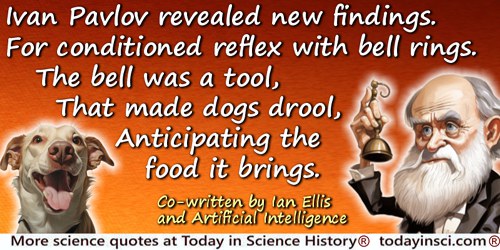
Ivan Pavlov revealed new findings,
For conditioned reflex with bell rings.
The bell was a tool,
That made dogs drool,
Anticipating the food it brings.
For conditioned reflex with bell rings.
The bell was a tool,
That made dogs drool,
Anticipating the food it brings.
Co-written by Artificial Intelligence with much editing by Webmaster.
Jealousy was plainly exhibited when I fondled a large doll, and when I weighed his infant sister, he being then 15? months old. Seeing how strong a feeling of jealousy is in dogs, it would probably be exhibited by infants at any earlier age than just specified if they were tried in a fitting manner
Mind
Life is like a dogsled team. If you ain’t the lead dog, the scenery never changes.
…...
Man is the Reasoning Animal. Such is the claim. I think it is open to dispute. Indeed, my experiments have proven to me that he is the Unreasoning Animal. … It seems plain to me that whatever he is he is not a reasoning animal. His record is the fantastic record of a maniac. I consider that the strongest count against his intelligence is the fact that with that record back of him he blandly sets himself up as the head animal of the lot: whereas by his own standards he is the bottom one.
In truth, man is incurably foolish. Simple things which the other animals easily learn, he is incapable of learning. Among my experiments was this. In an hour I taught a cat and a dog to be friends. I put them in a cage. In another hour I taught them to be friends with a rabbit. In the course of two days I was able to add a fox, a goose, a squirrel and some doves. Finally a monkey. They lived together in peace; even affectionately.
Next, in another cage I confined an Irish Catholic from Tipperary, and as soon as he seemed tame I added a Scotch Presbyterian from Aberdeen. Next a Turk from Constantinople; a Greek Christian from Crete; an Armenian; a Methodist from the wilds of Arkansas; a Buddhist from China; a Brahman from Benares. Finally, a Salvation Army Colonel from Wapping. Then I stayed away two whole days. When I came back to note results, the cage of Higher Animals was all right, but in the other there was but a chaos of gory odds and ends of turbans and fezzes and plaids and bones and flesh—not a specimen left alive. These Reasoning Animals had disagreed on a theological detail and carried the matter to a Higher Court.
In truth, man is incurably foolish. Simple things which the other animals easily learn, he is incapable of learning. Among my experiments was this. In an hour I taught a cat and a dog to be friends. I put them in a cage. In another hour I taught them to be friends with a rabbit. In the course of two days I was able to add a fox, a goose, a squirrel and some doves. Finally a monkey. They lived together in peace; even affectionately.
Next, in another cage I confined an Irish Catholic from Tipperary, and as soon as he seemed tame I added a Scotch Presbyterian from Aberdeen. Next a Turk from Constantinople; a Greek Christian from Crete; an Armenian; a Methodist from the wilds of Arkansas; a Buddhist from China; a Brahman from Benares. Finally, a Salvation Army Colonel from Wapping. Then I stayed away two whole days. When I came back to note results, the cage of Higher Animals was all right, but in the other there was but a chaos of gory odds and ends of turbans and fezzes and plaids and bones and flesh—not a specimen left alive. These Reasoning Animals had disagreed on a theological detail and carried the matter to a Higher Court.
In Mark Twain and Bernard DeVoto (ed.), Letters from the Earth: Uncensored Writings (1962), 180-181. [Note: As a humorous, irreverent consideration of Man and Christianity, these essays (written c.1909) remained unpublished for over 50 years after Twain’s death (1910), because his daughter and literary executor (Clara Clemens Samossoud) felt that some of the pieces did not accurately represent her father’s beliefs, but eventually, she consented to their publication.]
MEDICINE, n. A stone flung down the Bowery to kill a dog in Broadway.
The Collected Works of Ambrose Bierce (1911), Vol. 7, The Devil's Dictionary, 215.
Men cannot help feeling a little ashamed of their cousin-german the Ape. His close yet grotesque and clumsy semblance of the human form is accompanied by no gleams of higher instinct. Our humble friend the dog, our patient fellow-labourer the horse, are nearer to us in this respect. The magnanimous and sagacious elephant, doomed though he be to all fours, is godlike compared with this spitefully ferocious creature. Strangely enough, too, the most repulsive and ferocious of all apekind, the recently discovered Gorilla is, the comparative anatomist assures us, nearest to us all: the most closely allied in structure to the human form.
In 'Our Nearest Relation', All Year Round (28 May 1859), 1, No. 5, 112. Charles Dickens was both the editor and publisher of this magazine. The author of the article remains unknown. The articles were by custom printed without crediting the author. Biographers have been able to use extant office records to identify various authors of other articles, but not this specific one. Dickens and Richard Owen were friends; they read each other’s work. Owen is known to have found at least a little time to write a few articles for Dickens’ magazines. Owen had given a talk at the Royal Institution (4 Feb 1859) titled 'On the Gorilla.' This would suggest why Dickens may have had a definite interest in publishing on this subject, regardless of who in fact wrote the article.
Oh Diamond! Diamond! thou little knowest the mischief done! [Apocryphal]
Purportedly a rebuke to his pet dog, Diamond, which, in Newton's absence, upset a candle and set alight the papers recording much of Newton's work and 'destroyed the almost finished labours of some years'. The only source for this is Thomas Maude, in his poem, Wensley-Dale; or, Rural Contemplation (1780) written a half-century after Newton's death. According to D. Gjertsen, in The Newton Handbook (1986), 177, Maude's story must be regarded as baseless since no corroboration of such a dog's action exists in the writings of Newton's associates at the time.
Once you have learned to fly your plane, it is far less fatiguing to fly than it is to drive a car. You don’t have to watch every second for cats, dogs, children, lights, road signs, ladies with baby carriages and citizens who drive out in the middle of the block against the lights... Nobody who has not been up in the sky on a glorious morning can possibly imagine the way a pilot feels in free heaven.
…...
One never finds fossil bones bearing no resemblance to human bones. Egyptian mummies, which are at least three thousand years old, show that men were the same then. The same applies to other mummified animals such as cats, dogs, crocodiles, falcons, vultures, oxen, ibises, etc. Species, therefore, do not change by degrees, but emerged after the new world was formed. Nor do we find intermediate species between those of the earlier world and those of today's. For example, there is no intermediate bear between our bear and the very different cave bear. To our knowledge, no spontaneous generation occurs in the present-day world. All organized beings owe their life to their fathers. Thus all records corroborate the globe's modernity. Negative proof: the barbaritY of the human species four thousand years ago. Positive proof: the great revolutions and the floods preserved in the traditions of all peoples.
'Note prese al Corso di Cuvier. Corso di Geologia all'Ateneo nel 1805', quoted in Pietro Corsi, The Age of Lamarck, trans. J. Mandelbaum (1988), 183.
One only passes from the darkness of ignorance to the enlightenment of science if one re-reads with ever-increasing love the works of the ancients. Let the dogs bark, let the pigs grunt! I will nonetheless be a disciple of the ancients. All my care will be for them and the dawn will see me studying them.
In Le Goff, Les Intellectuels ou moyen age (1957), 14
PHYSICIAN, n. One upon whom we set our hopes when ill and our dogs when well.
The Collected Works of Ambrose Bierce (1911), Vol. 7, The Devil's Dictionary, 252.
Since Pawlow [Pavlov] and his pupils have succeeded in causing the secretion of saliva in the dog by means of optic and acoustic signals, it no longer seems strange to us that what the philosopher terms an 'idea' is a process which can cause chemical changes in the body.
The Mechanistic Conception of Life (1912), 63.
So in regard to mental qualities, their transmission is manifest in our dogs, horses and other domestic animals. Besides special tastes and habits, general intelligence, courage, bad and good tempers. etc., are certainly transmitted.
The Descent of Man
The argument of the ‘long view’ may be correct in some meaninglessly abstract sense, but it represents a fundamental mistake in categories and time scales. Our only legitimate long view extends to our children and our children’s children’s children–hundreds or a few thousands of years down the road. If we let the slaughter continue, they will share a bleak world with rats, dogs, cockroaches, pigeons, and mosquitoes. A potential recovery millions of years later has no meaning at our appropriate scale.
…...
The beaver is an animal which has feet like those of a goose for swimming and front teeth like a dog, since it frequently walks on land. It is called the castor from “castration,” but not because it castrates itself as Isodore says, but because it is especially sought for castration purposes. As has been ascertained frequently in our regions, it is false that when it is bothered by a hunter, it castrates itself with its teeth and hurls its musk [castoreum] away and that if one has been castrated on another occasion by a hunter, it raises itself up and shows that it lacks its musk.
De Animalibus (On Animals) [1258/62], Book XXII, tract 2, chapter 1 (22), trans. K. F. Kitchell Jr. and I. M. Resnick (1999), Vol. 2, 1467.
The British Mathematical Colloquium consists of three days of mathematics with no dogs and no wives.
Quoted in Des MacHale, Comic Sections (1993)
The dog [in Pavlov’s experiments] does not continue to salivate whenever it hears a bell unless sometimes at least an edible offering accompanies the bell. But there are innumerable instances in human life where a single association, never reinforced, results in the establishment of a life-long dynamic system. An experience associated only once with a bereavement, an accident, or a battle, may become the center of a permanent phobia or complex, not in the least dependent on a recurrence of the original shock.
Personality: A Psychological Interpretation(1938), 199.
The dog writhing in the gutter, its back broken by a passing car, knows what it is to be alive. So too with the aged elk of the far north woods, slowly dying in the bitter cold of winter. The asphalt upon which the dog lies knows no pain. The snow upon which the elk has collapsed knows not the cold. But living beings do. … Are you conscious? Then you can feel more pain. … Perhaps we even suffer more than the dumb animals.
In The Symbiotic Universe: Life and Mind in the Cosmos (1988), 194-195. As quoted and cited in Robert E. Zinser, The Fascinated God: What Science Says to Faith and Faith to Scientists (2003), 521.
The experiment of transfusing the blood of one dog into another was made before the Society by Mr King and Mr Thomas Coxe, upon a little mastiff and a spaniel, with very good success, the former bleeding to death, and the latter receiving the blood of the other, and emitting so much of his own as to make him capable of receiving the other.
From the Minutes of the Royal Society recording the first blood transfusion (14 Nov 1666). Quoted in Marjorie Hope Nicolson, Pepys's Diary and the New Science (1965), 70.
The great liability of the engineer compared to men of other professions is that his works are out in the open where all can see them. … He cannot, like the architects, cover his failures with trees and vines. … If his works do not work, he is damned. That is the phantasmagoria that haunts his nights and dogs his days. He comes from the job at the end of the day resolved to calculate it again.
Reprint of his 1916 statement in 'Engineering as a Profession', Engineer’s Week (1954).
The great pleasure of a dog is that you may make a fool of yourself with him and not only will he not scold you, but he will make a fool of himself too.
Samuel Butler, Henry Festing Jones (ed.), The Note-Books of Samuel Butler (1917), 220.
The laboratory was an unattractive half basement and low ceilinged room with an inner dark room for the galvanometer and experimental animals. It was dark, crowded with equipment and uninviting. Into it came patients for electrocardiography, dogs for experiments, trays with coffee and buns for lunch. It was hot and dusty in summer and cold in winter. True a large fire burnt brightly in the winter but anyone who found time to warm his backside at it was not beloved by [Sir Thomas] Lewis. It was no good to try and look out of the window for relaxation, for it was glazed with opaque glass. The scientific peaks were our only scenery, and it was our job to try and find the pathways to the top.
— Magazine
'Tribute to Sir Thomas Lewis', University College Hospital Magazine (1955), 40, 71.
The late James McNeil Whistler had a French poodle of which he was extravagantly fond. This poodle was seized with an affection of the throat, and Whistler had the audacity to send for the great throat specialist, Mackenzie. Sir Morell, when he saw that he had been called to treat a dog, didn't like it much, it was plain. But he said nothing. He prescribed, pocketed a big fee, and drove away.
The next day he sent posthaste for Whistler. And Whistler, thinking he was summoned on some matter connected with his beloved dog, dropped his work and rushed like the wind to Mackenzie's. On his arrival Sir Morell said, gravely: “How do you do, Mr. Whistler? I wanted to see you about having my front door painted.”
The next day he sent posthaste for Whistler. And Whistler, thinking he was summoned on some matter connected with his beloved dog, dropped his work and rushed like the wind to Mackenzie's. On his arrival Sir Morell said, gravely: “How do you do, Mr. Whistler? I wanted to see you about having my front door painted.”
Attributed or merely a legend. This anecdote wording is from 'Turn About Is Fair Play', Collier's (26 Mar 1904), 32, No. 26, 24, the earliest version the Webmaster has found so far. It has been variously reworded and printed in a number of books and magazines over the decades since, and is still circulated in the present day. The wording of Mackenzie's remark changes from one version to another, but remains true to the sense of it. In Medical Record (4 Jan 1913), 83, No. 1, 46, a reprinted column from The Universal Medical Record says: “‘X’ relates that he ‘has recently been watching through the weekly papers, of a story anent the artist Whistler and Sir mrell Mackenzie, which, curiously enough, starting in Paris, has now reached the American medical Journals and seems embarked on a long and active career. ... Mr. Ben Trovato, the eminent raconteur, seems for the moment at fault. Still, the natural history of such legends as this leads us to suppose that the story of the laryngologist and the poodle will continue to circulate, till after having served its day it ‘falls on sleep,’ later to be revived by the journalists of the next generation about some heroes of to-day.” Examples of other versions are in La Vulgarisation scientifique: revue mensuelle illustrée (1906); Don C. Seitz Whistler Stories (1913); Lewis C. Henry, Humorous Anecdotes About Famous People (1948); Graeme Garden The Best Medicine (1984); The Reader's Digest (1986), 128, Nos. 765-769, 40. So, in fact, this anecdote has, indeed, been revived for over a century, but is still narrated about Whistler and Mackenzie. Meanwhile, the column in the Medical Record mentioned above comments: “Why Whistler—whose brother, by-the-bye, was almost equally celebrated in the same department of medicine—should have desired the services of a laryngologist for his poodle, heaven only knows.” So, whether to regard this as entirely legend, or perhaps having some foundation of truth, the Webmaster cannot say, but would like to hear from anyone with more historical background to add.
The legends of fieldwork locate all important sites deep in inaccessible jungles inhabited by fierce beasts and restless natives, and surrounded by miasmas of putrefaction and swarms of tsetse flies. (Alternative models include the hundredth dune after the death of all camels, or the thousandth crevasse following the demise of all sled dogs.)
In Wonderful Life: The Burgess Shale and the Nature of History (1990), 65.
The more I see of men, the better I like my dog.
Webmaster has seen this quote attributed, without citation, to Blaise Pascal, in Howard W. Eves, Return to Mathematical Circles, (1988). Also seen attributed to Frederick the Great (said to have greyhounds). Until Webmaster finds an authentic primary source to verify it, it probably is best regarded as Anonymou. Can you help?
The other experiment (which I shall hardly, I confess, make again, because it was cruel) was with a dog, which, by means of a pair of bellows, wherewith I filled his lungs, and suffered them to empty again, I was able to preserve alive as long as I could desire, after I had wholly opened the thorax, and cut off all the ribs, and opened the belly. Nay, I kept him alive above an hour after I had cut off the pericardium and the mediastinum, and had handled and turned his lungs and heart and all the other parts of its body, as I pleased. My design was to make some enquiries into the nature of respiration. But though I made some considerable discovery of the necessity of fresh air, and the motion of the lungs for the continuance of the animal life, yet I could not make the least discovery in this of what I longed for, which was, to see, if I could by any means discover a passage of the air of the lungs into either the vessels or the heart; and I shall hardly be induced to make any further trials of this kind, because of the torture of this creature: but certainly the enquiry would be very noble, if we could any way find a way so to stupify the creature, as that it might not be sensible.
Letter from Robert Hooke to Robert Boyle (10 Nov 1664). In M. Hunter, A. Clericuzio and L. M. Principe (eds.), The Correspondence of Robert Boyle (2001), Vol. 2, 399.
The truth is, Pavlov’s dog trained Pavlov to ring this bell just before the dog salivated.
Brain Droppings (1998), 187.
The value the world sets upon motives is often grossly unjust and inaccurate. Consider, for example, two of them: mere insatiable curiosity and the desire to do good. The latter is put high above the former, and yet it is the former that moves some of the greatest men the human race has yet produced: the scientific investigators. What animates a great pathologist? Is it the desire to cure disease, to save life? Surely not, save perhaps as an afterthought. He is too intelligent, deep down in his soul, to see anything praiseworthy in such a desire. He knows by life-long observation that his discoveries will do quite as much harm as good, that a thousand scoundrels will profit to every honest man, that the folks who most deserve to be saved will probably be the last to be saved. No man of self-respect could devote himself to pathology on such terms. What actually moves him is his unquenchable curiosity–his boundless, almost pathological thirst to penetrate the unknown, to uncover the secret, to find out what has not been found out before. His prototype is not the liberator releasing slaves, the good Samaritan lifting up the fallen, but the dog sniffing tremendously at an infinite series of rat-holes.
In 'Types of Men: The Scientist', Prejudices (1923), 269-70.
This is the question
Marry
Children—(if it Please God)—Constant companion (& friend in old age) who will feel interested in one—object to be beloved and played with—better than a dog anyhow. Home, & someone to take care of house—Charms of music and female chit-chat.—These things good for one’s health.—but terrible loss of time.—
My God, it is Intolerable to think of spending ones whole life, like a neuter bee, working, working—& nothing after all.—No, no, won’t do. Imagine living all one’s day solitary in smoky dirty London House.—Only picture to yourself a nice soft wife on a sofa with good fire, & books & music perhaps-—Compare this vision with the dingy reality of Grt. Marlbro’ Street.
Not Marry
Freedom to go where one liked—choice of Society and little of it. —Conversation of clever men at clubs—Not forced to visit relatives, & to bend in every trifle. —to have the expense and anxiety of children—perhaps quarreling—Loss of time. —cannot read in the Evenings—fatness & idleness—Anxiety & responsibility—less money for books &c—if many children forced to gain one’s bread. —(but then it is very bad for ones health to work too much)
Perhaps my wife won’t like London; then the sentence is banishment & degradation into indolent, idle fool.
Marry—Marry—Marry Q.E.D.
It being proved necessary to Marry When? Soon or late?
Marry
Children—(if it Please God)—Constant companion (& friend in old age) who will feel interested in one—object to be beloved and played with—better than a dog anyhow. Home, & someone to take care of house—Charms of music and female chit-chat.—These things good for one’s health.—but terrible loss of time.—
My God, it is Intolerable to think of spending ones whole life, like a neuter bee, working, working—& nothing after all.—No, no, won’t do. Imagine living all one’s day solitary in smoky dirty London House.—Only picture to yourself a nice soft wife on a sofa with good fire, & books & music perhaps-—Compare this vision with the dingy reality of Grt. Marlbro’ Street.
Not Marry
Freedom to go where one liked—choice of Society and little of it. —Conversation of clever men at clubs—Not forced to visit relatives, & to bend in every trifle. —to have the expense and anxiety of children—perhaps quarreling—Loss of time. —cannot read in the Evenings—fatness & idleness—Anxiety & responsibility—less money for books &c—if many children forced to gain one’s bread. —(but then it is very bad for ones health to work too much)
Perhaps my wife won’t like London; then the sentence is banishment & degradation into indolent, idle fool.
Marry—Marry—Marry Q.E.D.
It being proved necessary to Marry When? Soon or late?
Notes on Marriage, July 1838. In F. Burkhardt and S. Smith (eds.), The Correspondence of Charles Darwin 1837-1843 (1986), Vol. 2, 444.
To my deep mortification my father once said to me, “You care for nothing but shooting, dogs, and rat-catching, and you will be a disgrace to yourself and all your family.”
Despite this, perhaps rare, angry or unjust outburst, Darwin regarded his father as “the kindest man I ever knew and whose memory I love with all my heart.” In Charles Darwin and Francis Darwin (ed.), 'Autobiography', The Life and Letters of Charles Darwin (1887, 1896), Vol. 1, 30.
To wage war with Marchand or anyone else again will benefit nobody and bring little profit to science. You consume yourself in this way, you ruin your liver and eventually your nerves with Morrison pills. Imagine the year 1900 when we have disintegrated into carbonic acid, ammonia and water and our bone substance is perhaps once more a constituent of the bones of the dog who defiles our graves. Who will then worry his head as to whether we have lived in peace or anger, who then will know about your scientific disputes and of your sacrifice of health and peace of mind for science? Nobody. But your good ideas and the discoveries you have made, cleansed of all that is extraneous to the subject, will still be known and appreciated for many years to come. But why am I trying to advise the lion to eat sugar.
Letter from Wohler to Liebig (9 Mar 1843). In A. W. Hofmann (ed.), Aus Justus Liebigs und Friedrich Wohlers Briefwechsel (1888), Vol. 1, 224. Trans. Ralph Oesper, The Human Side of Scientists (1975), 205.
Visualize yourself confronted with the task of killing, one after the other, a cabbage, a fly, a fish, a lizard, a guinea pig, a cat, a dog, a monkey and a baby chimpanzee. In the unlikely case that you should experience no greater inhibitions in killing the chimpanzee than in destroying the cabbage or the fly, my advice to you is to commit suicide at your earliest possible convenience, because you are a weird monstrosity and a public danger.
'The Enmity Between Generations and Its Probable Ethological Causes'. In Richard I. Evans, Konrad Lorenz: The Man and his Ideas (1975), 227.
Watching baseball under the lights is like observing dogs indoors, at a pedigree show. In both instances, the environment is too controlled to suit the species.
Baseball The Difference between Night and Day Christian Science Monitor, 3 Apr 85
We do not belong to this material world that science constructs for us. We are not in it; we are outside. We are only spectators. The reason why we believe that we are in it, that we belong to the picture, is that our bodies are in the picture. Our bodies belong to it. Not only my own body, but those of my friends, also of my dog and cat and horse, and of all the other people and animals. And this is my only means of communicating with them.
…...
We must painfully acknowledge that, precisely because of its great intellectual developments, the best of man's domesticated animals—the dog—most often becomes the victim of physiological experiments. Only dire necessity can lead one to experiment on cats—on such impatient, loud, malicious animals. During chronic experiments, when the animal, having recovered from its operation, is under lengthy observation, the dog is irreplaceable; moreover, it is extremely touching. It is almost a participant in the experiments conducted upon it, greatly facilitating the success of the research by its understanding and compliance.
'Vivisection' (1893), as translated in Daniel P. Todes, Pavlov’s Physiology Factory: Experiment, Interpretation, Laboratory Enterprise (2002), 123.
What a weak, credulous, incredulous, unbelieving, superstitious, bold, frightened, what a ridiculous world ours is, as far as concerns the mind of man. How full of inconsistencies, contradictions and absurdities it is. I declare that taking the average of many minds that have recently come before me … I should prefer the obedience, affections and instinct of a dog before it.
Letter to C. Schoenbein (25 Jul 1853). In Georg W.A. Kahlbaum and Francis V. Darbishire (eds.), The Letters of Faraday and Schoenbein, 1836-1862 (1899), 215.
What animates a great pathologist? Is it the desire to cure disease, to save life? Surely not, save perhaps as an afterthought. He is too intelligent, deep in his soul, to see anything praiseworthy in such a desire. He knows from life-long observation that his discoveries will do quite as much harm as good, that a thousand scoundrels will profit to every honest man, that the folks who most deserve to be saved will probably be the last to be saved. ... What actually moves him is his unquenchable curiosity—his boundless, almost pathological thirst to penetrate the unknown, to uncover the secret, to find out what has not been found out before. ... [like] the dog sniffing tremendously at an infinite series of rat-holes. ... And yet he stands in the very front rank of the race
In 'The Scientist', Prejudices: third series (1922), 269-70.
Why should a lobster be any more ridiculous than a dog? ... or a cat, or a gazelle, or a lion, or any other animal one chooses to take for a walk? I have a liking for lobsters. They are peaceful, serious creatures. ... Goethe had an aversion to dogs, and he wasn't mad. They know the secrets of the sea, they don't bark.
[By walking a lobster at the end of a blue silk ribbon in the gardens of the Palais-Royal, he mocked middle-class pretensions, but caused concern for his sanity.]
[By walking a lobster at the end of a blue silk ribbon in the gardens of the Palais-Royal, he mocked middle-class pretensions, but caused concern for his sanity.]
Quoted by his friend, Théophile Gautier, in Portraits et souvenirs littéraires (1875). In Théophile Gautier, My Fantoms, translated by Richard Holmes (1976), 150.
You say Beasts are Machines like Watches? But put the Machine called a Dog, and the Machine called a Bitch to one another for some time, and there may result another little Machine; whereas two Watches might be together all their Life-time, without ever producing a third Watch. Now Madam de B— and I think, according to our Philosophy, that all things which being but two, are endued with the Virtue of making themselves three, are of a much higher Nature than a Machine.
'Letter XI to Mr. C: Upon his studying the Philosophy of Descartes', Letters of Gallantry (1685), trans. Mr Ozell (1715), 25.
 In science it often happens that scientists say, 'You know that's a really good argument; my position is mistaken,' and then they would actually change their minds and you never hear that old view from them again. They really do it. It doesn't happen as often as it should, because scientists are human and change is sometimes painful. But it happens every day. I cannot recall the last time something like that happened in politics or religion.
(1987) --
In science it often happens that scientists say, 'You know that's a really good argument; my position is mistaken,' and then they would actually change their minds and you never hear that old view from them again. They really do it. It doesn't happen as often as it should, because scientists are human and change is sometimes painful. But it happens every day. I cannot recall the last time something like that happened in politics or religion.
(1987) -- 




