Doctor Quotes (191 quotes)
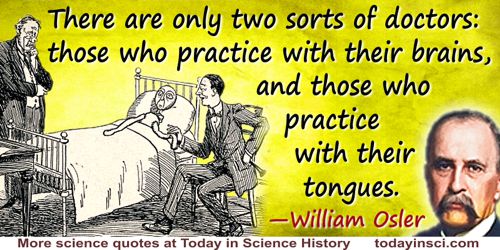
Candidate for medical degree being examined in the subject of “Bedside Manner” — Punch (22 Apr 1914) (source)
… man-midwifery, with other “indecencies,” is a great system of fashionable prostitution; a primary school of infamy—as the fashionable hotel and parlor wine glass qualify candidates for the two-penny grog-shop and the gutter.
Man-midwifery Exposed and Corrected (1848)
…the ideal doctor would be a man endowed with profound knowledge of life and of the soul, intuitively divining any suffering or disorder of whatever kind, and restoring peace by his mere presence.
Amiel's Journal The Journal Intime of Henri-Frederic Amiel (22 Aug 1873), trans. By Mrs Humphry Ward (1889), Vol 2., 153.
[A friend at Cambridge] told me that Helmholtz had been a medical doctor before he became a physicist. It thereupon occurred to me that Helmholtz had eaten the meal of life in the wrong order, and that I would like to spend the first half of my life under the strict discipline of physics, and afterwards to apply that training to researches on living things.
As quoted in Stephen A. Richardson 'Lewis Fry Richardson (1881-1953): A Personal Biography', Conflict Resolution (Sep 1957), 1, No. 3, 301.
Air Force Chief of Staff: Doctor, what do you think of our new creation, the … Corporation?
von Kármán: Why, General, I think that corporation has already had an effect on the whole industry.
Air Force Chief of Staff: I’m delighted. What effect is that?
von Kármán: Why, they’ve upset the salary schedule of the whole industry.
von Kármán: Why, General, I think that corporation has already had an effect on the whole industry.
Air Force Chief of Staff: I’m delighted. What effect is that?
von Kármán: Why, they’ve upset the salary schedule of the whole industry.
As quoted by William R. Sears in 'Some Recollections of Theodore von Kármán', Address to the Symposium in Memory of Theodore von Kármán, Society for Industrial and Applied Mathematics, National Meeting (13-14 May 1964), Washington, D.C. Printed in Journal of the Society for Industrial and Applied Mathematics (Mar 1965), 13>, No. 1, 181. These are likely not verbatim words of Karman, but as recollected by Sears, giving an example of von Kármán’s willingness to speak truth to power.
Je le pansai, Dieu le guérit
I dressed him, and God healed him.
I dressed him, and God healed him.
Quoted in Francis Randolph Packard, The Voyages Made Into Divers Places: The Journey to Turin in 1536', Life and Times of Ambroise Paré 1510-1590: With a New Translation (1921),160. Also translated as, “I treated him, God cured him.”
Je suis médecin. Je tiens boutique de mensonges. Je soulage, je console. Peut-on consoler et soulager sans mentir? … Les femmes et les médecins savent seuls combien le mensonge est nécessaire et bienfaisant aux hommes.
I am a physician. I keep a drug-shop of lies. I give relief, consolation. Can one console and relieve without lying? … Only women and doctors know how necessary and how helpful lies are to men.
I am a physician. I keep a drug-shop of lies. I give relief, consolation. Can one console and relieve without lying? … Only women and doctors know how necessary and how helpful lies are to men.
From the fictional Dr. Trublet in Histoire Comique (1900), 171-172. As translated in Lewis P. Shanks, Anatole France (1919), 165.
Les médecins les plus savans en théorie sont rarement les plus habile practiciens.
The doctors most learned in theory are seldom the most skilled practitioners.
The doctors most learned in theory are seldom the most skilled practitioners.
Maxim No. 281 in Maximes, Réflexions et Pensées Diverses (1819), 236.
Mahomet’s tombe at Mecha is said strangely to hang up, attracted by some invisible Loadstone, but the Memory of this Doctor will never fall to the ground, which his incomparable Book ‘De Magnete’ will support to Eternity.
In The History of the The Worthies of England (1662, 1840), Vol. 1, 515.
Medicus enim nihil aliud est quam animi consolatio
A doctor is nothing more than consolation for the spirit.
A doctor is nothing more than consolation for the spirit.
Satyricon, Cap. 42. In Iain Bamforth, The Body in the Library (2003), 298.
Medicus naturae minister, non magister
The doctor is the servant, not master for teaching Nature.
The doctor is the servant, not master for teaching Nature.
In Alfred J. Schauer, Ethics in Medicine (2001), 119.
Macbeth: How does your patient, doctor?
Doctor: Not so sick, my lord,
As she is troubled with thick-coming fancies,
That keep her from her rest.
Macbeth: Cure her of that.
Canst thou not minister to a mind diseased,
Pluck from the memory a rooted sorrow,
Raze out the written troubles of the brain,
And with some sweet oblivious antidote
Cleanse the stuffed bosom of that perilous stuff
Which weighs upon the heart?
Doctor: Therein the patient
Must minister to himself.
Macbeth: Throw physic to the dogs; I'll none of it.
Doctor: Not so sick, my lord,
As she is troubled with thick-coming fancies,
That keep her from her rest.
Macbeth: Cure her of that.
Canst thou not minister to a mind diseased,
Pluck from the memory a rooted sorrow,
Raze out the written troubles of the brain,
And with some sweet oblivious antidote
Cleanse the stuffed bosom of that perilous stuff
Which weighs upon the heart?
Doctor: Therein the patient
Must minister to himself.
Macbeth: Throw physic to the dogs; I'll none of it.
Macbeth (1606), V, iii.
A certain author defines a doctor to be a man who writes prescriptions till the patient either dies or is cured by nature.
The Reflector: Representing Human Affairs As They Are (1750). In The Pocket Lacon (1839), Vol. 1, 59.

A disease which new and obscure to you, Doctor, will be known only after death; and even then not without an autopsy will you examine it with exacting pains. But rare are those among the extremely busy clinicians who are willing or capable of doing this correctly.
In Atrocis, nee Descipti Prius, Morbi Historia as translated in Bulletin of the Medical Library Association (1944), 43, 217.
A doctor can bury his mistakes but an architect can only advise his client to plant vines.
…...
A doctor is a man who writes prescriptions till the patient either dies or is cured by nature.
…...
A doctor is the only man who can suffer from good health.
In Edward Jewitt Wheeler, et al., The Literary Digest (1931),13.
A doctor must work eighteen hours a day and seven days a week. If you cannot console yourself to this, get out of the profession
Martin H. Fischer, Howard Fabing (ed.) and Ray Marr (ed.), Fischerisms (1944).
A doctor who cannot take a good history and a patient who cannot give one are in danger of giving and receiving bad treatment.
In Paul Dudley White , Clues in the Diagnosis and Treatment of Heart Disease (1956), Introduction.
A doctor who doesn’t say too many foolish things is a patient half-cured. (1921)
'Le Côté de Guermantes', À la recherche du temps perdu (1913-27).
A doctor whose breath smells has no right to medical opinion.
A doctor’s reputation is made by the number of eminent men who die under his care.
Statement (14 Sep 1950) at age 94 to his doctor. As quoted in Michael Holroyd, Bernard Shaw: The Lure of Fantasy: Vol. 3: 1918-1951 (1991).
A man who cannot work without his hypodermic needle is a poor doctor. The amount of narcotic you use is inversely proportional to your skill.
Martin H. Fischer, Howard Fabing (ed.) and Ray Marr (ed.), Fischerisms (1944).
A physician’s subject of study is necessarily the patient, and his first field for observation is the hospital. But if clinical observation teaches him to know the form and course of diseases, it cannot suffice to make him understand their nature; to this end he must penetrate into the body to find which of the internal parts are injured in their functions. That is why dissection of cadavers and microscopic study of diseases were soon added to clinical observation. But to-day these various methods no longer suffice; we must push investigation further and, in analyzing the elementary phenomena of organic bodies, must compare normal with abnormal states. We showed elsewhere how incapable is anatomy alone to take account of vital phenenoma, and we saw that we must add study of all physico-chemical conditions which contribute necessary elements to normal or pathological manifestations of life. This simple suggestion already makes us feel that the laboratory of a physiologist-physician must be the most complicated of all laboratories, because he has to experiment with phenomena of life which are the most complex of all natural phenomena.
From An Introduction to the Study of Experimental Medicine (1865), as translated by Henry Copley Greene (1957), 140-141.
A reference to the two sorts of doctors is also found in the Republic: “Now you know that when patients do not require medicine, but have only to be put under a regimen, the inferior sort of practitioner is deemed to be good enough; but when medicine has to be given, then the doctor should be more of a man.”
Osler is referring to Plato’s Dialogues, iii, 153. In Address (1893) to the Johns Hopkins Hospital Historical Club, 'Physic and Physicians as Depicted in Plato', collected in Aequanimitas: With Other Addresses to Medical Students, Nurses and Practitioners of Medicine (1904), 70.
A smart mother makes often a better diagnosis than a poor doctor.
…...
A wealthy doctor who can help a poor man, and will not without a fee, has less sense of humanity than a poor ruffian who kills a rich man to supply his necessities. It is something monstrous to consider a man of a liberal education tearing out the bowels of a poor family by taking for a visit what would keep them a week.
In The Tatler: Or, Lucubrations of Isaac Bickerstaff, Esq (8 Oct 1709), collected in Harrison’s British Classicks (1785), Vol. 3, No. 78, 220. Isaac Bickerstaff was the nom de plume used by Richard Steele, who published it—with uncredited contributions from Joseph Addison under the same invented name. The original has no authorship indicated for the item, but (somehow?) later publications attribute it to Addison. For example, in Samuel Austin Allibone (ed.), Prose Quotations from Socrates to Macaulay (1876), 535.
A young doctor makes a humpy churchyard.
In H. Pullar-Strecker, Proverbs for Pleasure (1954), 193.
Alfred Nobel - pitiable half-creature, should have been stifled by humane doctor when he made his entry yelling into life. Greatest merits: Keeps his nails clean and is never a burden to anyone. Greatest fault: Lacks family, cheerful spirits, and strong stomach. Greatest and only petition: Not to be buried alive. Greatest sin: Does not worship Mammon. Important events in his life: None.
Letter (1887) from Alfred to his brother, Ludwig. In Erik Bergengre, Alfred Nobel: the Man and His Work (1960), 177.
All sorts of computer errors are now turning up. You'd be surprised to know the number of doctors who claim they are treating pregnant men.
Official of the Quebec Health Insurance Board, on Use of Computers in Quebec Province's Comprehensive Medical-care system. F. 19, 4:5. In Barbara Bennett and Linda Amster, Who Said What (and When, and Where, and How) in 1971: December-June, 1971 (1972), Vol. 1, 38. (Later sources cite Isaac Asimov.)
Almost every major systematic error which has deluded men for thousands of years relied on practical experience. Horoscopes, incantations, oracles, magic, witchcraft, the cures of witch doctors and of medical practitioners before the advent of modern medicine, were all firmly established through the centuries in the eyes of the public by their supposed practical successes. The scientific method was devised precisely for the purpose of elucidating the nature of things under more carefully controlled conditions and by more rigorous criteria than are present in the situations created by practical problems.
Personal Knowledge (1958), 183.
An alcoholic has been lightly defined as a man who drinks more than his own doctor.
Journal of the American Medical Association (1962), 181, 393.
An epidemiologist is a doctor broken down by age and sex.
And it has been sarcastically said, that there is a wide difference between a good physician and a bad one, but a small difference between a good physician and no physician at all; by which it is meant to insinuate, that the mischievous officiousness of art does commonly more than counterbalance any benefit derivable from it.
Elements of Medical Logic (1819), 8-9.
And let me adde, that he that throughly understands the nature of Ferments and Fermentations, shall probably be much better able than he that Ignores them, to give a fair account of divers Phænomena of severall diseases (as well Feavers and others) which will perhaps be never throughly understood, without an insight into the doctrine of Fermentation.
Essay 2, 'Offering some Particulars relating to the Pathologicall Part of Physick', in the Second Part of Some Considerations Touching The Usefulnesse of Naturall Philosophy (1663, 1664), 43.
As a doctor, as a man of science, I can tell you there is no such thing as curses Everything just happens as a question of probability. The statistical likelihood of a specific event.
…...
As every circumstance relating to so capital a discovery as this (the greatest, perhaps, that has been made in the whole compass of philosophy, since the time of Sir Isaac Newton) cannot but give pleasure to all my readers, I shall endeavour to gratify them with the communication of a few particulars which I have from the best authority. The Doctor [Benjamin Franklin], after having published his method of verifying his hypothesis concerning the sameness of electricity with the matter lightning, was waiting for the erection of a spire in Philadelphia to carry his views into execution; not imagining that a pointed rod, of a moderate height, could answer the purpose; when it occurred to him, that, by means of a common kite, he could have a readier and better access to the regions of thunder than by any spire whatever. Preparing, therefore, a large silk handkerchief, and two cross sticks, of a proper length, on which to extend it, he took the opportunity of the first approaching thunder storm to take a walk into a field, in which there was a shed convenient for his purpose. But dreading the ridicule which too commonly attends unsuccessful attempts in science, he communicated his intended experiment to no body but his son, who assisted him in raising the kite.
The kite being raised, a considerable time elapsed before there was any appearance of its being electrified. One very promising cloud passed over it without any effect; when, at length, just as he was beginning to despair of his contrivance, he observed some loose threads of the hempen string to stand erect, and to avoid one another, just as if they had been suspended on a common conductor. Struck with this promising appearance, he inmmediately presented his knuckle to the key, and (let the reader judge of the exquisite pleasure he must have felt at that moment) the discovery was complete. He perceived a very evident electric spark. Others succeeded, even before the string was wet, so as to put the matter past all dispute, and when the rain had wetted the string, he collected electric fire very copiously. This happened in June 1752, a month after the electricians in France had verified the same theory, but before he had heard of any thing that they had done.
The kite being raised, a considerable time elapsed before there was any appearance of its being electrified. One very promising cloud passed over it without any effect; when, at length, just as he was beginning to despair of his contrivance, he observed some loose threads of the hempen string to stand erect, and to avoid one another, just as if they had been suspended on a common conductor. Struck with this promising appearance, he inmmediately presented his knuckle to the key, and (let the reader judge of the exquisite pleasure he must have felt at that moment) the discovery was complete. He perceived a very evident electric spark. Others succeeded, even before the string was wet, so as to put the matter past all dispute, and when the rain had wetted the string, he collected electric fire very copiously. This happened in June 1752, a month after the electricians in France had verified the same theory, but before he had heard of any thing that they had done.
The History and Present State of Electricity, with Original Experiments (1767, 3rd ed. 1775), Vol. 1, 216-7.
As for science and religion, the known and admitted facts are few and plain enough. All that the parsons say is unproved. All that the doctors say is disproved. That’s the only difference between science and religion…
In Manalive (1912), 146.
As he approached the place where a meeting of doctors was being held, he saw some elegant limousines and remarked, “The surgeons have arrived.” Then he saw some cheaper cars and said, “The physicians are here, too.” ... And when he saw a row of overshoes inside, under the hat rack, he is reported to have remarked, “Ah, I see there are laboratory men here.”
The Way of an Investigator (1945, 1965), 207.
As with eggs, there is no such thing as a poor doctor, doctors are either good or bad.
In Russell L. Cecil and Robert F. Leob, 'Diseases of the Ductless Glands,' Textbook of Medicine (9th ed.), Introduction.
Better to hunt in fields, for health unbought, Than fee the doctor for a nauseous draught, The wise, for cure, on exercise depend; God never made his work for man to mend.
'To my Honoured Kinsman, John Dryden', The English Poets (1901), Vol. 2, 491.
Beware of the young Doctor, & the old Barber.
In Poor Richard's Almanack (1733).
Building goes on briskly at the therapeutic Tower of Babel; what one recommends another condemns; what one gives in large doses another scarce dares to prescribe in small doses; and what one vaunts as a novelty another thinks not worth rescuing from merited oblivion. All is confusion, contradiction, inconceivable chaos. Every country, every place, almost every doctor, have their own pet remedies, without which they imagine their patients can not be cured; and all this changes every year, aye every mouth.
Weekly Medical Gazette, of Vienna
By medicine life may be prolong’d, yet death
Will seize the Doctor too.
Will seize the Doctor too.
Cymbeline (1609, publ. 1623), Act 5, Scene 5. In Charles Knight (ed.), The Works of William Shakspere (1868), 605.
Direct observation of the testimony of the earth … is a matter of the laboratory, of the field naturalist, of indefatigable digging among the ancient archives of the earth’s history. If Mr. Bryan, with an open heart and mind, would drop all his books and all the disputations among the doctors and study first hand the simple archives of Nature, all his doubts would disappear; he would not lose his religion; he would become an evolutionist.
'Evolution and Religion', New York Times (5 Mar 1922), 91. Written in response to an article a few days earlier in which William Jennings Bryan challenged the theory of evolution as lacking proof.
Doctor Johnson said, that in sickness there were three things that were material; the physician, the disease, and the patient: and if any two of these joined, then they get the victory; for, Ne Hercules quidem contra duos [Not even Hercules himself is a match for two]. If the physician and the patient join, then down goes the disease; for then the patient recovers: if the physician and the disease join, that is a strong disease; and the physician mistaking the cure, then down goes the patient: if the patient and the disease join, then down goes the physician; for he is discredited.
In 'A Collection of Apophthegms, New and Old' (1625). As given in Essays, Moral, Economical, and Political: A New Edition, With the Latin Quotations Translated (1813), No. 147, 308. The doctor is identified Ben Johnson by Forbes Winslow in his notes appended to Physic and Physicians (1842). Notes section, 39. Perhaps he means poet and playwright of stage comedy, Ben Jonson (1572-1637), also referred to in the book as “Benjamin Johnson” and once as “Dr. Johnson.” Note that Francis Bacon (1561-1626) died well before the life of writer Dr. Samuel Johnson (1709-1784).
Doctor says he would be a very sick man if were still alive today.
Doctor Thomas …
Said, “Cancer’s a funny thing.
Nobody knows what the cause is,
Though some pretend they do;
It’s like some hidden assassin
Waiting to strike at you.
Childless women get it.
And men when they retire;
It’s as if there had to be some outlet
For their foiled creative fire.”
Said, “Cancer’s a funny thing.
Nobody knows what the cause is,
Though some pretend they do;
It’s like some hidden assassin
Waiting to strike at you.
Childless women get it.
And men when they retire;
It’s as if there had to be some outlet
For their foiled creative fire.”
In 'Miss Gee', in Collected Shorter Poems, 1930-1944 (1950), 242.
Doctor, no medicine.—We are machines made to live—organized expressly for that purpose.—Such is our nature.—Do not counteract the living principle.—Leave it at liberty to defend itself, and it will do better than your drugs.
As given in Tryon Edwards (ed.), A Dictionary of Thoughts (1908), 339.
DOCTOR. Always preceded by “The good”. Among men, in familiar conversation, “Oh! balls, doctor!” Is a wizard when he enjoys your confidence, a jack-ass when you're no longer on terms. All are materialists: “you can't probe for faith with a scalpel.”
The Dictionary of Accepted Ideas (1881), trans. Jaques Barzun (1968), 30.
Doctors and Clergymen. A physician’s physiology has much the same relation to his power of healing as a cleric’s divinity has to his power of influencing conduct.
Samuel Butler, Henry Festing Jones (ed.), The Note-Books of Samuel Butler (1917), 216.
Doctors are just the same as lawyers; the only difference is that lawyers merely rob you, whereas doctors rob you and kill you, too.
ĵIvanovĵ (1887), Act I.
Doctors are men who prescribe medicines of which they know little, to cure diseases of which they know less, in human beings of whom they know nothing. (1760)
In Robert Allan Weinberg, The Biology of Cancer (2006), 726. (Note: Webmaster has not yet found this quote, in this wording, in a major quotation reference book. If you know a primary print source, or correction, please contact Webmaster.)
Doctors can do almost anything nowadays, can't they, unless they kill you while they're trying to cure you.
Endless Night (2002), 117.
Doctors coin money when they do procedures—family practice doesn’t have any procedures. A urologist has cystoscopies, a gastroenterologist has gastroscopies, a dermatologist has biopsies. They can do three or four of those and make five or six hundred dollars in a single day. We get nothing for the use of our time to understand the lives of our patients. Technology is rewarded in medicine, it seems to me, and not thinking.
Quoted in John McPhee, 'Heirs of General Practice,' New Yorker (23 Jul 1984), 40-85. In David Barton Smith and Arnold D. Kaluzny, The White Labyrinth (2000), 227.
Doctors have been exposed—you always will be exposed—to the attacks of those persons who consider their own undisciplined emotions more important than the world's most bitter agonies—the people who would limit and cripple and hamper research because they fear research may be accompanied by a little pain and suffering.
Doctors (1908), 28-9.
Doctors in all ages have made fortunes by killing their patients by means of their cures. The difference in psychiatry is that is the death of the soul.
From Address (Jul 1967), 'The Obvious', to the Congress on the Dialectics of Liberation, London, collected in David Cooper, The Dialectics of Liberation (2015), 19.
Doctors think a lot of patients are cured who have simply quit in disgust.
…...
Don't go to the doctor with every distemper, nor to the lawyer with every quarrel, nor to the pot for every thirst.
In Poor Richard's Almanack (1737).
Don't live in a town where there are no doctors.
In Richard Alan Krieger, Civilization's Quotations (2002), 313.
Don't misinform your Doctor nor your Lawyer.
In Poor Richard's Almanack (1737).
Dr Bell fell down the well
And broke his collar bone
Doctors should attend the sick
And leave the well alone.
And broke his collar bone
Doctors should attend the sick
And leave the well alone.
During his Zurich stay the woman doctor, Paulette Brubacher, asked the whereabouts of his [Einstein's] laboratory. With a smile he took a fountain pen out of his breast pocket and said: 'here'.
C. Seelig, Albert Einstein: A Documentary Biography (1956), 154.
Fifty years ago the successful doctor was said to need three things; a top hat to give him Authority, a paunch to give him Dignity, and piles to give him an Anxious Expression.
Lancet (1951), 1, 169.
For between true Science, and erroneous Doctrines, Ignorance is in the middle. Naturall sense and imagination, are not subject to absurdity. Nature it selfe cannot erre: and as men abound in copiousnesses of language; so they become more wise, or more mad than ordinary. Nor is it possible without Letters for any man to become either excellently wise, or (unless his memory be hurt by disease, or ill constitution of organs) excellently foolish. For words are wise men's counters, they do but reckon by them; but they are the money of fools that value them by the authority of an Aristotle, a Cicero, or a Thomas, or any other Doctor whatsoever, if but a man.
Leviathan (1651), ed. C. B. Macpherson (1968), Part 1, Chapter 4, 106.
For many doctors the achievement of a published article is a tedious duty to be surmounted as a necessary hurdle in a medical career.
British Medical Journal (1958), 2, 502
For the most part, Western medicine doctors are not healers, preventers, listeners, or educators. But they're damned good at saving a life and the other aspects kick the beam. It's about time we brought some balance back to the scale.
From earliest memory I wanted to be a surgeon, possibly influenced by the qualities of our family doctor who cared for our childhood ailments.
In Tore Frängsmyr and Jan E. Lindsten (eds.), Nobel Lectures: Physiology Or Medicine: 1981-1990 (1993), 555.
Give me a dozen healthy infants, well-formed, and my own specified world to bring them up in and I’ll guarantee to take any one at random and train him to become any type of specialist I might select—doctor, lawyer, artist, merchant-chief and, yes, even beggar-man and thief, regardless of his talents, penchants, tendencies, abilities, vocations, and race of his ancestors. (1930)
Behaviorism (1998), 82.
God and the Doctor we alike adore
But only when in danger, not before;
The danger o’er, both are alike requited,
God is forgotten, and the Doctor slighted.
But only when in danger, not before;
The danger o’er, both are alike requited,
God is forgotten, and the Doctor slighted.
…...
God heals, and the Doctor takes the Fees.
In Poor Richard's Almanack (1744). Note: q.v. John Ray, “God healeth and the physician hath the thanks.”
Happy is the doctor who is called in at the decline of an illness.
In Richard Alan Krieger, Civilization's Quotations (2002), 313.
He’s a Fool that makes his Doctor his Heir.
In Poor Richard's Almanack (1733). See the Francis Bacon page for: Male secum agit æger, medicum qui hæredem ficit. That sick man does ill for himself, who makes his physician his heir. (1625)
Heaven defend me from a busy doctor.
Welsh Proverb. In Henry Louis Mencken, A New Dictionary of Quotations (1942), 299.
Heraclitus son of Bloson (or, according to some, of Herakon) of Ephesus. This man was at his prime in the 69th Olympiad. He grew up to be exceptionally haughty and supercilious, as is clear also from his book, in which he says: “Learning of many things does not teach intelligence; if so it would have taught Hesiod and Pythagoras, and again Xenophanes and Hecataeus.” … Finally he became a misanthrope, withdrew from the world, and lived in the mountains feeding on grasses and plants. However, having fallen in this way into a dropsy he came down to town and asked the doctors in a riddle if they could make a drought out of rainy weather. When they did not understand he buried himself in a cow-stall, expecting that the dropsy would be evaporated off by the heat of the manure; but even so he failed to effect anything, and ended his life at the age of sixty.
Diogenes Laertius 9.1. In G. S. Kirk, E. Raven, and M. Schofield (eds.), The Presocratic philosophers: A Critical History with a Selection of Texts (1983), 181.
Histology is an exotic meal, but can be as repulsive as a dose of medicine for students who are obliged to study it, and little loved by doctors who have finished their study of it all too hastily. Taken compulsorily in large doses it is impossible to digest, but after repeated tastings in small draughts it becomes completely agreeable and even addictive. Whoever possesses a refined sensitivity for artistic manifestations will appreciate that, in the science of histology, there exists an inherent focus of aesthetic emotions.
Opening remarks of paper, 'Art and Artifice in the Science of Histology' (1933), reprinted in Histopathology (1993), 22, 515-525. Quoted in Ross, Pawlina and Barnash, Atlas of Descriptive Histology (2009).
I am just laboring in the vineyard. I am at the operating table, and I make my rounds. I believe there is a cross-fertilization between writing and surgery. If I withdraw from surgery, I would not have another word to write. Having become a writer makes me a better doctor.
[Reply to reporter's question whether he would rather be a full-time writer instead of a surgeon.]
[Reply to reporter's question whether he would rather be a full-time writer instead of a surgeon.]
Quoted in Thomas Lask, 'Publishing:Surgeon and Incisive Writer', New York Times (28 Sep 1979), C24.
I am patriot enough to take pains to bring this usefull invention [smallpox inoculation] into fashion in England, and I should not fail to write to some of our Doctors very particularly about it, if I knew anyone of 'em that I thought had Virtue enough to destroy such a considerable branch of Revenue for the good of Mankind, but that Distemper is too beneficial to them not to expose to all their Resentment the hardy wight that should undertake to put an end to it.
Letter to Sarah Chiswell (1 Apr 1717). In Robert Halsband (ed.), The Complete Letters of the Lady Mary Wortley Montagu (1965), Vol. 1, 339.
I am sorry the infernal Divinities, who visit mankind with diseases, and are therefore at perpetual war with Doctors, should have prevented my seeing all you great Men at Soho to-day-Lord! what inventions, what wit, what rhetoric, metaphysical, mechanical and pyrotecnical, will be on the wing, bandy'd like a shuttlecock from one to another of your troop of philosophers! while poor I, I by myself I, imprizon'd in a post chaise, am joggled, and jostled, and bump'd, and bruised along the King's high road, to make war upon a pox or a fever!
Letter to Matthew Boulton, 5 April 1778. Quoted in Desmond King-Hele (ed.), The Letters of Erasmus Darwin (1981), 84.
I despise Birth-Control first because it is ... an entirely meaningless word; and is used so as to curry favour even with those who would first recoil from its real meaning. The proceeding these quack doctors recommend does not control any birth. ... But these people know perfectly well that they dare not write the plain word Birth-Prevention, in any one of the hundred places where they write the hypocritical word Birth-Control. They know as well as I do that the very word Birth-Prevention would strike a chill into the public... Therefore they use a conventional and unmeaning word, which may make the quack medicine sound more innocuous. ... A child is the very sign and sacrament of personal freedom. He is a fresh will added to the wills of the world; he is something that his parents have freely chosen to produce ... he is their own creative contribution to creation.
In 'Babies and Distributism', The Well and the Shadows (1935). Collected in G. K. Chesterton and Dale Ahlquist (ed.), In Defense of Sanity: The Best Essays of G.K. Chesterton (2011), 272.
I got the bill for my surgery. Now I know what those doctors were wearing masks for.
I know of nothing more laughable than a doctor who does not die of old age.
Letter to Charles Augustin Ferriol, comte d'Argental (1767). In Raymond C. Rowe, Joseph Chamberlain, A Spoonful of Sugar (2007), 243.
I look upon a good physician, not so properly as a servant to nature, as one, that is a counsellor and friendly assistant, who, in his patient’s body, furthers those motions and other things, that he judges conducive to the welfare and recovery of it; but as to those, that he perceives likely to be hurtful, either by increasing the disease, or otherwise endangering the patient, he thinks it is his part to oppose or hinder, though nature do manifestly enough seem to endeavour the exercising or carrying on those hurtful motions.
Quoted In Barbara Kaplan (ed.) Divulging of Useful Truths in Physick: The Medical Agenda of Robert Boyle (1993), 125.
I love doctors and hate their medicine.
In Horace Traubel, With Walt Whitman in Camden (1906), Vol. 1, 433.
I refrained from writing another one, thinking to myself: Never mind, I will prove that I am able to become a greater scientist than some of you, even without the title of doctor.
Reaction when his thesis (1922) on rocket experiments was rejected as too cursory. In Astronautics (1959), 4, No. 6, 103.
I remember being with my grandmother and mother and my uncle came in and asked what I wanted to be when grew up. I said ‘A doctor,’ which took him aback. He was expecting me to say ‘nurse’ or ‘actress.’ And my mother and grandmother laughed like, ‘Kids say the darndest things.’ I grew up in a time when women were not expected to do anything interesting.
As quoted in Anna Azvolinsky, 'Fearless About Folding', The Scientist (Jan 2016).
I tell [medical students] that they are the luckiest persons on earth to be in medical school, and to forget all this worry about H.M.O.’s and keep your eye on helping the patient. It’s the best time ever to be a doctor because you can heal and treat conditions that were untreatable even a couple of years ago.
From Cornelia Dean, 'A Conversation with Joseph E. Murray', New York Times (25 Sep 2001), F5.
I think it’s a very valuable thing for a doctor to learn how to do research, to learn how to approach research, something there isn't time to teach them in medical school. They don't really learn how to approach a problem, and yet diagnosis is a problem; and I think that year spent in research is extremely valuable to them.
On mentoring a medical student.
On mentoring a medical student.
Quoted in interview by Mary Ellen Avery (1997)
I wanted some new names to express my facts in Electrical science without involving more theory than I could help & applied to a friend Dr Nicholl [his doctor], who has given me some that I intend to adopt for instance, a body decomposable by the passage of the Electric current, I call an ‘electrolyte’ and instead of saying that water is electro chemically decomposed I say it is ‘electrolyzed’. The intensity above which a body is decomposed beneath which it conducts without decomposition I call the ‘Electrolyte intensity’ &c &c. What have been called: the poles of the battery I call the electrodes they are not merely surfaces of metal, but even of water & air, to which the term poles could hardly apply without receiving a new sense. Electrolytes must consist of two parts which during the electrolization, are determined the one in the one direction, and the other towards the poles where they are evolved; these evolved substances I call zetodes, which are therefore the direct constituents of electrolites.
Letter to William Whewell (24 Apr 1834). In Frank A. J. L. James (ed.), The Correspondence of Michael Faraday: Volume 2, 1832-1840 (1993), 176.
I wondher why ye can always read a doctor's bill an’ ye niver can read his purscription.
'Drugs', Mr. Dooley Says (1910). In The Speaker: A Quarterly Magazine (1913), Vol. 8, 147.
I would not for a moment have you suppose that I am one of those idiots who scorns Science, merely because it is always twisting and turning, and sometimes shedding its skin, like the serpent that is [the doctors'] symbol.
From 'Can a Doctor Be a Humanist?' (1984). Collected in The Merry Heart: Reflections of Reading, Writing and the World of Books (1997), 98.
If a hundred or a thousand people, all of the same age, of the same constitution and habits, were suddenly seized by the same illness, and one half of them were to place themselves under the care of doctors, such as they are in our time, whilst the other half entrusted themselves to Nature and to their own discretion, I have not the slightest doubt that there would be more cases of death amongst the former, and more cases of recovery among the latter.
…...
If I were a medical man, I should prescribe a holiday to any patient who considered his work important.
In The Conquest of Happiness (1930), 74.
If my doctor told me I had only six minutes to live, I wouldn’t brood. I’d type a little faster.
Life (1984).
If the doctor cures, the sun sees it; but if he kills, the earth hides it.
In John Wade, Select Proverbs of all Nations (1824), 124.
If the patient dies, the doctor has killed him; if he gets well, the saints have saved him.
In H. Pullar-Strecker, Proverbs for Pleasure (1954), 194.
If you are too smart to pay the doctor, you had better be too smart to get ill.
African proverb, Transvaal
If you have a lawsuit, and you get one bad lawyer, you lose your suit, but you can appeal; but if you have one bad doctor, and he kills you, then there can be no appeal.
In Stephen Wickes and Jonathan Dickinson, History of Medicine in New Jersey: And of Its Medical Men, from the Settlement of the Province to A.D. 1800 (1879), 143.
Illness is the most heeded of doctors: to goodness and wisdom we only make promises; pain we obey.
…...
In 1684 Dr Halley came to visit him at Cambridge, after they had been some time together, the Dr asked him what he thought the Curve would be that would be described by the Planets supposing the force of attraction towards the Sun to be reciprocal to the square of their distance from it. Sr Isaac replied immediately that it would be an Ellipsis, the Doctor struck with joy & amazement asked him how he knew it, why saith he I have calculated it, whereupon Dr Halley asked him for his calculation without any farther delay. Sr Isaac looked among his papers but could not find it, but he promised him to renew it, & then to send it him.
[Recollecting Newton's account of the meeting after which Halley prompted Newton to write The Principia. When asking Newton this question, Halley was aware, without revealing it to Newton that Robert Hooke had made this hypothesis of plantary motion a decade earlier.]
[Recollecting Newton's account of the meeting after which Halley prompted Newton to write The Principia. When asking Newton this question, Halley was aware, without revealing it to Newton that Robert Hooke had made this hypothesis of plantary motion a decade earlier.]
Quoted in Richard Westfall, Never at Rest: A Biography of Isaac Newton (1980), 403.
In the United States, I am often addressed as a doctor. I should like to point out, however, that I am not such and shall never think of becoming one.
In Astronautics (1959), 4, No. 6, 103. Also As quoted in Arthur C. Clarke, The Coming of the Space Age: Famous Accounts of Man’s Probing of the Probing of the Universe (1967), 118.
In those days in the South, the only professional jobs that seemed to be open to a black man were a teacher, a preacher, a doctor or a lawyer.
About his youth. Quoted in Johns Hopkins University News Release (9 Jan 2003) on jh.edu web site.
It is a mathematical fact that fifty percent of all doctors graduate in the bottom half of their class.
It is the doctors who desert the dying and there is so much to be learned about pain.
Quoted in Journal of the Royal Society of Medicine (2001), 94, 430.
It is with mathematics not otherwise than it is with music, painting or poetry. Anyone can become a lawyer, doctor or chemist, and as such may succeed well, provided he is clever and industrious, but not every one can become a painter, or a musician, or a mathematician: general cleverness and industry alone count here for nothing.
In Ueber die Anlage zur Mathematik (1900), 5. As translated in Robert Édouard Moritz, Memorabilia Mathematica; Or, The Philomath’s Quotation-Book (1914), 184.
Joy and Temperance and Repose
Slam the door on the doctor’s nose.
Slam the door on the doctor’s nose.
Translated by Longfellow as a poetic aphorism from the Sinngedichte of Frifjjrich von Logau (17th century), Poems (1856), 253.
Let no one suppose that the words doctor and patient can disguise from the parties the fact that they are employer and employee.
In 'Preface on Doctors', The Doctor's Dilemma (1909, 1911), lxxxi.
Look around you: there is not a doctor who desires the health of his friends, not a soldier who desires peace for his country.
— Philemon
In Gustave Jules Witkowski, 'The Sicilian', The Evil that Has Been Said of Doctors (1889), 4-5.
Make it compulsory for a doctor using a brass plate to have inscribed on it, in addition to the letters indicating his qualifications, the words “Remember that I too am mortal.”
In 'Preface on Doctors', The Doctor’s Dilemma (1909, 1911), xci.
Many a diabetic has stayed alive by stealing the bread denied him by his doctor.
Martin H. Fischer, Howard Fabing (ed.) and Ray Marr (ed.), Fischerisms (1944).
Medicine is the one place where all the show is stripped of the human drama. You, as doctors, will be in a position to see the human race stark naked—not only physically, but mentally and morally as well.
Martin H. Fischer, Howard Fabing (ed.) and Ray Marr (ed.), Fischerisms (1944).
Medicine, poor science! Doctors, poor philosophers! Patients, poor victims!
…...
Mother: He’s been depressed. All of a sudden, he can’t do anything.
Doctor: Why are you depressed, Alvy?
Mother: Tell Dr. Flicker. It’s something he read.
Doctor: Something he read, huh?
Alvy: The universe is expanding.
Doctor: The universe is expanding?
Alvy: Well, the universe is everything, and if it’s expanding, someday it will break apart and that would be the end of everything!
Mother: What is that your business? He stopped doing his homework.
Alvy: What’s the point?
Doctor: Why are you depressed, Alvy?
Mother: Tell Dr. Flicker. It’s something he read.
Doctor: Something he read, huh?
Alvy: The universe is expanding.
Doctor: The universe is expanding?
Alvy: Well, the universe is everything, and if it’s expanding, someday it will break apart and that would be the end of everything!
Mother: What is that your business? He stopped doing his homework.
Alvy: What’s the point?
With co-author Marshall Brickman, Annie Hall (1973).
Neurosis has an abosolute genius for malingering. There is no illness which cannot counterfeit perfectly … If it is capable of deceiving the doctor, how should it fail to deceive the patient.
'Le Côté de Guermantes', À la recherche du temps perdu (1913-27).
Never go to a doctor whose office plants have died.
In Dr. N Sreedharan, Quotations of Wit and Wisdom (2007), 18.
No man, not even a doctor, ever gives any other definition of what a nurse should be than this—“devoted and obedient.” This definition would do just as well for a porter. It might even do for a horse. It would not do for a policeman.
Notes on Nursing: what it is and what it is not (1860), 200.
No man is a good doctor who has never been sick himself.
Chinese proverb.
Nobody supposes that doctors are less virtuous than judges; but a judge whose salary and reputation depended on whether the verdict was for plaintiff or defendant, prosecutor or prisoner, would be as little trusted as a general in the pay of the enemy.
…...
Nor bring, to see me cease to live,
Some doctor full of phrase and fame,
To shake his sapient head, and give
The ill he cannot cure a name.
Some doctor full of phrase and fame,
To shake his sapient head, and give
The ill he cannot cure a name.
'A Wish' (1867). In Kenneth Allot (ed.), Matthew Arnold: A Selection (1954), 194.
Not one amongst the doctors, as you'll see
For his own friends desires to prescribe.
For his own friends desires to prescribe.
— Philemon
Fabulae Incertae, Fragment 46, A. In William Shepard Walsh, The International Encyclopedia of Prose and Poetical Quotations from the Literature of the World (1921), 197.
Now of the difficulties bound up with the public in which we doctors work, I hesitate to speak in a mixed audience. Common sense in matters medical is rare, and is usually in inverse ratio to the degree of education.
'Teaching and Thinking' (1894). In Aequanimitas with Other Addresses to Medical Students, Nurses and Practitioners of Medicine (1904), 131.
Oddly enough, eccentrics are happier and healthier than conformists. A study of 1,000 people found that eccentrics visit a doctor an average of just once every eight years, while conformists go twice a year. Eccentrics apparently enjoy better health because they feel less pressured to follow society’s rules, said the researcher who did the study at Royal Edinburgh Hospital in Scotland.
Eccentrics (1995).Study results in SELF magazine - 1992 National Enquirer.
One of the great achievements of the 1950s and 1960s was a [TV] series called Your Life in Their Hands, which dealt with medical science. It presented the scientific evidence for the connection between tobacco and cancer, against the entrenched opposition, all of which you can quite easily imagine. … The “television doctor” … presented the evidence of the connection between the two over and over again on television. A lot of people tried to stop it, but he carried on. It ruined his career, I suspect, in the medical sense, but he stuck to his guns. It’s one of early television’s badges of honour.
From interview with Brian Cox and Robert Ince, in 'A Life Measured in Heartbeats', New Statesman (21 Dec 2012), 141, No. 5138, 32.
Only the doctor and the judge have the right to inflict the death penalty without receiving the same.
— Philemon
In 'The Sicilian.' Fragment preserved by Stobaeus, Florigelium. In Gustave Jules Witkowski, The Evil that Has Been Said of Doctors (1889), 4-5.
Perhaps today there is a greater kindness of tone, as there is greater ingenuity of expression to make up for the fact that all the real, solid, elemental jests against doctors were uttered some one or two thousand years ago.
In 'The Evil Spoken of Physicians', The Proceedings of the Charaka Club (1902), 1, 80.
Physical misery is great everywhere out here [Africa]. Are we justified in shutting our eyes and ignoring it because our European newspapers tell us nothing about it? We civilised people have been spoilt. If any one of us is ill the doctor comes at once. Is an operation necessary, the door of some hospital or other opens to us immediately. But let every one reflect on the meaning of the fact that out here millions and millions live without help or hope of it. Every day thousands and thousands endure the most terrible sufferings, though medical science could avert them. Every day there prevails in many and many a far-off hut a despair which we could banish. Will each of my readers think what the last ten years of his family history would have been if they had been passed without medical or surgical help of any sort? It is time that we should wake from slumber and face our responsibilities!
In On the Edge of the Primeval Forest, trans. C. T. Campion (1948, 1998), 126-127.
Physicians are some of them so pleasing and conformable to the humour of the patient, as they press not the true cure of the disease : and some other are so regular in proceeding according to art for the disease, as they respect not sufficiently the condition of the patient.
XXX. Of Regimen of Health,' Essays (1597). In Francis Bacon and Basil Montagu, The Works of Francis Bacon, Lord Chancellor of England (1852), 39.
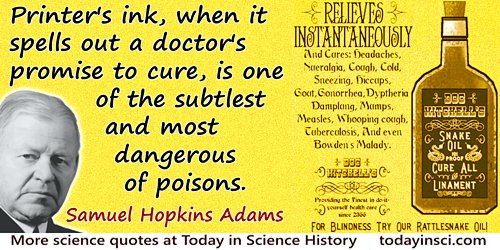
Printer’s ink, when it spells out a doctor’s promise to cure, is one of the subtlest and most dangerous of poisons.
In 'The Sure-Cure School,' Collier’s Weekly (14 Jul 1906). Reprinted in The Great American Fraud (1907), 84.
Qualified scientists in Washington believe that the atom-blasting of Japan is the start toward heating plants the size of telephone booths for great factories, and motor-car trips of 1,000 hours on one gram of fuel. One expert estimated that with a few grams of uranium it might be possible to power the Queen Mary from Europe to the U.S. and back again. One of America’s leading scientists, Doctor Vollrath, said that the new discovery brings man’s attempt to reach the moon within bounds of possibility.
The Maple Leaf (8 Aug 1945), 4.
Science affects the average man and woman in two ways already. He or she benefits by its application driving a motor-car or omnibus instead of a horse-drawn vehicle, being treated for disease by a doctor or surgeon rather than a witch, and being killed with an automatic pistol or shell in place of a dagger or a battle-axe.
'The Scientific Point of View' In R.C. Prasad (ed.), Modern Essays: Studying Language Through Literature (1987), 26.
Science, that gives man hope to live without lies
Or blast himself off the earth; curb science
Until morality catches up?
But look:
At present morality is running rapidly retrograde.
You’d have to turn science, too, back to the witch doctors,
the myth drunkards. Besides that,
Morality is not an end in itself; truth is an end.
To seek the truth is
better than good works, better than survival
Holier than innocence, and higher than love.
Or blast himself off the earth; curb science
Until morality catches up?
But look:
At present morality is running rapidly retrograde.
You’d have to turn science, too, back to the witch doctors,
the myth drunkards. Besides that,
Morality is not an end in itself; truth is an end.
To seek the truth is
better than good works, better than survival
Holier than innocence, and higher than love.
Poem, 'Curb Science?', in The Collected Poetry of Robinson Jeffers: 1938-1962 (1988), 199. The poem was suppressed until 1977.
Scientists should not be allowed to torture animals to death; let doctors experiment on journalists and politicians.
In Dounia B. Christiani (trans., ed.), The Wild Duck (1968), 83. Also seen translated as: “It is inexcusable for scientists to torture animals; let them make their experiments on journalists and politicians.”
Since the days of Hippocrates, our father, the aphorism has been the literary vehicle of the doctor… Laymen have stolen the trick from time to time, but the aphorism remains the undisputed contribution of the doctor to literature.
[Coauthor with Ray Marr]
[Coauthor with Ray Marr]
In Howard Fabing and Ray Marr (eds.), Fischerisms. Cited in epigraph, Robert Taylor, White Coat Tales: Medicine's Heroes, Heritage, and Misadventures (2010), 119.
Sir Isaac Newton and Dr. Bentley met accidentally in London, and on Sir Isaac’s inquiring what philosophical pursuits were carrying on at Cambridge, the doctor replied—None—for when you go a hunting Sir Isaac, you kill all the game; you have left us nothing to pursue.—Not so, said the philosopher, you may start a variety of game in every bush if you will but take the trouble to beat for it.
From Richard Watson, Chemical Essays (1786, 1806), Vol. 4, 257-258. No citation given, so—assuming it is more or less authentic—Webmaster offers this outright guess. Watson was the source of another anecdote about Newton (see “I find more sure marks…”). Thus, one might by pure speculation wonder if this quote was passed along in the same way. Was this another anecdote relayed to Watson by his former teacher, Dr. Robert Smith (Master of Trinity House), who might have been told this by Newton himself? Perhaps we’ll never know, but if you know a primary source, please contact Webmaster.
Somewhere between 1900 and 1912 in this country, according to one sober medical scientist [Henderson] a random patient, with a random disease, consulting a doctor chosen at random had, for the first time in the history of mankind, a better than fifty-fifty chance of profiting from the encounter.
Quoted in New England Journal of Medicine (1964), 270, 449.
Specialists never contribute anything to their specialty; Helmholtz wasn’t an eye-specialist, but a German army doctor who invented the ophthalmoscope one Saturday afternoon when there wasn’t anything else to do. Incidentally, he rewrote whole chapters of physics, so that the physicists only know him as one of their own. Robert Mayer wasn’t a physicist, but another country doctor; and Pasteur, who made bacteriology, was a tanner’s son or a chemist, as you will.
In Fischerisms (1930), 7.
The attempt of the engineers and the doctors who have worked on the design of the capsule interior has been to give the impression, to create the fact, of roominess in a confined space.
Describing the Mercury capsule in Life (14 Sep 1959), 38.
The blunders of a doctor are felt not by himself but by others.
— Ar-Rumi
Attributed.
The custom of giving patients appointments weeks in advance, during which time their illness may become seriously aggravated, seems to me to fall short of the ideal doctor-patient relationship.
…...
The dedicated doctor knows that he must be both scientist and humanitarian; his most agonizing decisions lie in the field of human relations.
Inaugural address to the AMA (Jun 1957). Quoted in obituary, New York Times (31 Mar 1971), 49.
The doctor is the servant and the interpreter of nature. Whatever he thinks or does, if he follows not in nature’s footsteps he will never be able to control her.
De Praxi Medica (1696), Introduction.
The doctor knows that it is the prescription slip itself, even more than what is written on it, that is often the vital ingredient for enabling a patient to get rid of whatever is ailing him.
Anatomy of an Illness As Perceived by the Patient: Reflections on Healing (2005), 55.
The doctor listens in with a stethoscope and hears sounds of a warpath Indian drum.
…...
The doctor may also learn more about the illness from the way the patient tells the story than from the story itself.
…...
The fact that the general incidence of leukemia has doubled in the last two decades may be due, partly, to the increasing use of x-rays for numerous purposes. The incidence of leukemia in doctors, who are likely to be so exposed, is twice that of the general public. In radiologists … the incidence is ten times greater.
(1965). In Isaac Asimov’s Book of Science and Nature Quotations (1988), 233.
The first [quality] to be named must always be the power of attention, of giving one's whole mind to the patient without the interposition of anything of oneself. It sounds simple but only the very greatest doctors ever fully attain it. … The second thing to be striven for is intuition. This sounds an impossibility, for who can control that small quiet monitor? But intuition is only interference from experience stored and not actively recalled. … The last aptitude I shall mention that must be attained by the good physician is that of handling the sick man's mind.
In 'Art and Science in Medicine', The Collected Papers of Wilfred Trotter, FRS (1941), 98.

The forest doctors of the Amazon say each plant has its “song”, and that to know how to use the plant you must listen to its voice.
In 'Fifty Years On, the Silence of Rachel Carson’s Spring Consumes Us', The Guardian (25 Sep 2012).
The Governor was strong upon
The Regulation Act:
The Doctor said that Death was but
A scientific fact:
And twice a day the Chaplain called,
And left a little tract.
The Regulation Act:
The Doctor said that Death was but
A scientific fact:
And twice a day the Chaplain called,
And left a little tract.
The Ballad of Reading Gaol (1901), 6.
The great doctors all got their education off dirt pavements and poverty—not marble floors and foundations.
Martin H. Fischer, Howard Fabing (ed.) and Ray Marr (ed.), Fischerisms (1944).
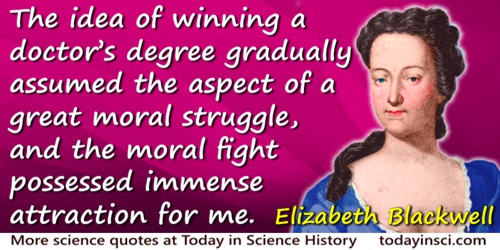
The idea of winning a doctor’s degree gradually assumed the aspect of a great moral struggle, and the moral fight possessed immense attraction for me.
In Pioneer Work in Opening the Medical Profession to Women (1895), 29.
The ideal doctor is patient.
…...
The introduction of men into the lying in chamber in place of female attendants, has increased the suffering and dangers of childbearing women, and brought multiplied injuries and fatalities upon mothers and children; it violates the sensitive feelings of husbands and wives and causes an untold amount of domestic misery. The unlimited intimacy between a male profession and the female population silently and effectually wears away female delicacy and professional morality, and tends probably more than any other cause in existence, to undermine the foundation of public virtue.
Man-midwifery Exposed and Corrected (1848) quoted in The Male Midwife and the Female Doctor: The Gynecology Controversy in Nineteenth Century America Charles Rosenburg and Carroll Rovenberg Smith (Editors) publ. Arno, 1974.
The late James McNeil Whistler had a French poodle of which he was extravagantly fond. This poodle was seized with an affection of the throat, and Whistler had the audacity to send for the great throat specialist, Mackenzie. Sir Morell, when he saw that he had been called to treat a dog, didn't like it much, it was plain. But he said nothing. He prescribed, pocketed a big fee, and drove away.
The next day he sent posthaste for Whistler. And Whistler, thinking he was summoned on some matter connected with his beloved dog, dropped his work and rushed like the wind to Mackenzie's. On his arrival Sir Morell said, gravely: “How do you do, Mr. Whistler? I wanted to see you about having my front door painted.”
The next day he sent posthaste for Whistler. And Whistler, thinking he was summoned on some matter connected with his beloved dog, dropped his work and rushed like the wind to Mackenzie's. On his arrival Sir Morell said, gravely: “How do you do, Mr. Whistler? I wanted to see you about having my front door painted.”
Attributed or merely a legend. This anecdote wording is from 'Turn About Is Fair Play', Collier's (26 Mar 1904), 32, No. 26, 24, the earliest version the Webmaster has found so far. It has been variously reworded and printed in a number of books and magazines over the decades since, and is still circulated in the present day. The wording of Mackenzie's remark changes from one version to another, but remains true to the sense of it. In Medical Record (4 Jan 1913), 83, No. 1, 46, a reprinted column from The Universal Medical Record says: “‘X’ relates that he ‘has recently been watching through the weekly papers, of a story anent the artist Whistler and Sir mrell Mackenzie, which, curiously enough, starting in Paris, has now reached the American medical Journals and seems embarked on a long and active career. ... Mr. Ben Trovato, the eminent raconteur, seems for the moment at fault. Still, the natural history of such legends as this leads us to suppose that the story of the laryngologist and the poodle will continue to circulate, till after having served its day it ‘falls on sleep,’ later to be revived by the journalists of the next generation about some heroes of to-day.” Examples of other versions are in La Vulgarisation scientifique: revue mensuelle illustrée (1906); Don C. Seitz Whistler Stories (1913); Lewis C. Henry, Humorous Anecdotes About Famous People (1948); Graeme Garden The Best Medicine (1984); The Reader's Digest (1986), 128, Nos. 765-769, 40. So, in fact, this anecdote has, indeed, been revived for over a century, but is still narrated about Whistler and Mackenzie. Meanwhile, the column in the Medical Record mentioned above comments: “Why Whistler—whose brother, by-the-bye, was almost equally celebrated in the same department of medicine—should have desired the services of a laryngologist for his poodle, heaven only knows.” So, whether to regard this as entirely legend, or perhaps having some foundation of truth, the Webmaster cannot say, but would like to hear from anyone with more historical background to add.
The main thing that induces me to question the safeness of the vulgar methodus medendi in many cases is the consideration of the nature of those Helps they usually employ, and some of which are honoured with the title of Generous Remedies. These helps are Bleeding, Vomiting, Purging, Sweating, and Spitting, of which I briefly observe in General, that they are sure to weaken or discompose when they are imployed, but do not certainly cure afterwards.
RSMS 199, Folio 177v. Michael Hunter identfies as passages or a suppressed work, Considerations and Doubts Touching the Vulgar Method of Physick. Quoted In Barbara Kaplan (ed.), Divulging of Useful Truths in Physick: The Medical Agenda of Robert Boyle (1993), 138.
The mark of a true doctor is usually illegible.
In Eugene E. Brussell, Webster's New World Dictionary of Quotable Definitions (2006), 151
The men you see waiting in the lobbies of doctors’ offices are, in a vast majority of cases, suffering through poisoning caused by an excess of food.
In Love, Life and Work (), 129.
The most tragic thing in the world is a sick doctor.
…...
The native hospital in Tunis was the focal point of my research. Often, when going to the hospital, I had to step over the bodies of typhus patients who were awaiting admission to the hospital and had fallen exhausted at the door. We had observed a certain phenomenon at the hospital, of which no one recognized the significance, and which drew my attention. In those days typhus patients were accommodated in the open medical wards. Before reaching the door of the wards they spread contagion. They transmitted the disease to the families that sheltered them, and doctors visiting them were also infected. The administrative staff admitting the patients, the personnel responsible for taking their clothes and linen, and the laundry staff were also contaminated. In spite of this, once admitted to the general ward the typhus patient did not contaminate any of the other patients, the nurses or the doctors. I took this observation as my guide. I asked myself what happened between the entrance to the hospital and the wards. This is what happened: the typhus patient was stripped of his clothes and linen, shaved and washed. The contagious agent was therefore something attached to his skin and clothing, something which soap and water could remove. It could only be the louse. It was the louse.
'Investigations on Typhus', Nobel lecture, 1928. In Nobel Lectures: Physiology or Medicine 1922-1941 (1965), 181.
The only incurable diseases are those the doctor’s don’t know how to cure.
As quoted in book review, T.A. Boyd, 'Charles F. Kettering: Prophet of Progress', Science (30 Jan 1959), 255.
The ordinary patient goes to his doctor because he is in pain or some other discomfort and wants to be comfortable again; he is not in pursuit of the ideal of health in any direct sense. The doctor on the other hand wants to discover the pathological condition and control it if he can. The two are thus to some degree at cross purposes from the first, and unless the affair is brought to an early and happy conclusion this diversion of aims is likely to become more and more serious as the case goes on.
Address, opening of 1932-3 session of U.C.H. Medical School (4 Oct 1932), 'Art and Science in Medicine', The Collected Papers of Wilfred Trotter, FRS (1941), 98.
The person most often late for a doctor's appointment is the doctor himself.
In Bob Phillips, Phillips' Book of Great Thoughts and Funny Sayings (1993), 99
The safest thing for a patient is to be in the hands of a man engaged in teaching medicine. In order to be a teacher of medicine the doctor must always be a student.
Proceedings of the Staff Meetings of the Mayo Clinic (1927).
The superior doctor prevents sickness; The mediocre doctor attends to impending sickness; The inferior doctor treats actual sickness.
Chinese Proverb. In North Manchurian Plague Prevention Service Reports (1925-1926) (1926), 292, 305.
The surest way to health, say what they will,
Is never to suppose we shall be ill;
Most of the ills which we poor mortals know
From doctors and imagination flow.
Is never to suppose we shall be ill;
Most of the ills which we poor mortals know
From doctors and imagination flow.
In 'Night: An Epistle to Robert Lloyd', Poems of Charles Churchill (1822), Vol. 1, 98.
The threat of a neglected cold is for doctors what the threat of purgatory is for priests—a gold mine.
In Sébastien-Roch-Nicolas Chamfort and William Stanley Merwin, Products of the Perfected Civilization: Selected Writings of Chamfort (1969), 154.
The time to talk about it [genetic engineering to improve a baby's genes] in schools and churches and magazines and debate societies is now. If you wait, five years from now the gene doctor will be hanging out the MAKE A SMARTER BABY sign down the street.
'If We Have It, Do We Use It?', Time magazine (13 Sep 1999).
The unlucky doctor treats the head of a disease; the lucky doctor its tail.
Chinese proverb.
The watchmaker to whom one gives a watch that does not run will take it all apart and will examine each of the pieces until he finds out which one is damaged. The physician to whom one presents a patient cannot dissect him to establish the diagnosis. The physicist resembles a doctor, not a watchmaker.
In Revue des Questions Scientifiques, 1897.
The young doctor should look about early for an avocation, a pastime, that will take him away from patients, pills and potions. … No man is really happy or safe without one, and it makes precious little difference what the outside interest may be—botany, beetles or butterflies, roses, tulips or irises, fishing, mountaineering or antiquities—anything will do so long as he straddles a hobby and rides it hard.
In 'The Medical Library in Post-Graduate Work', British Medical Journal (1909), 2, 927.
There are only two classes of mankind in the world - doctors and patients.
…...
There are only two sorts of doctors: those who practice with their brains, and those who practice with their tongues.
Address to McGill Medical School (1 Oct 1894), 'Teaching and Thinking', collected in Aequanimitas: With Other Addresses to Medical Students, Nurses and Practitioners of Medicine (1904), 131.
There’s more old Drunkards than old Doctors.
In Poor Richard’s Almanack (1736). Compare Thomas Fuller, published earlier, “There are more old Drunkards than old Physicians. Proverb collected as No. 4858 in Gnomologia: Adagies and Proverbs, Wise Sentences and Witty Sayings (1732), 210. The quote appears centuries earlier by François Rabelais (1596), as translated to English: “A hundred devils leap into my body, if there be not more old drunkards than old physicians.” See the François Rabelais quotes page on this website.
Two-thirds of all preachers, doctors and lawyers are hanging on to the coat tails of progress, shouting, whoa! while a good many of the rest are busy strewing banana peels along the line of march.
In Elbert Hubbard (ed. and publ.), The Philistine (May 1908), 26, No. 6, 151.
Very few [doctors] are men of science in any very serious sense; they're men of technique.
Interview with Tom Harpur, 'You Should Face Up to Your Death, Says Author', Toronto Star (15 Nov 1975). Collected in Robertson Davies and J. Madison Davis (eds.) Conversations with Robertson Davies (1989), 157.
Western doctors are like poor plumbers. They treat a splashing tube by cleaning up the water. These plumbers are extremely apt at drying up the water, constantly inventing new, expensive, and refined methods of drying up water. Somebody should teach them how to close the tap.
What Doctor is there, who while he treats a disease unknown to him, might be at ease, until he had clearly perceived the nature of this disease and its hidden causes?
When a doctor arrives to attend some patient of the working class, he ought not to feel his pulse the moment he enters, as is nearly always done without regard to the circumstances of the man who lies sick; he should not remain standing while he considers what he ought to do, as though the fate of a human being were a mere trifle; rather let him condescend to sit down for awhile.
De Morbis Artificum Diatriba (1713) Trans. by W.C. Wright in A.L. Birmingham, Classics of Medicine Library (1983). Quoted in Edward J. Huth and T. J. Murray. Medicine in Quotations: Views of Health and Disease Through the Ages (2006), 288.
When a doctor arrives to attend some patient of the working class...let him condescend to sit down...if not on a gilded chair...one a three-legged stool... He should question the patient carefully... So says Hippocrates in his work 'Affections.' I may venture to add one more question: What occupation does he follow?
De Morbis Artificum Diatriba (1713) Trans. by W.C. Wright in A.L. Birmingham, Classics of Medicine Library (1983). Quoted in Edward J. Huth and T. J. Murray. Medicine in Quotations: Views of Health and Disease Through the Ages (2006), 276.
When a doctor does go wrong he is the first of criminals. He has nerve and he has knowledge.
The Adventure of the Speckled Band. In The Strand Magazine (1892), 3, 154.
When a man lacks mental balance in pneumonia he is said to be delirious. When he lacks mental balance without the pneumonia, he is pronounced insane by all smart doctors.
Martin H. Fischer, Howard Fabing (ed.) and Ray Marr (ed.), Fischerisms (1944).
When I went to the scientific doctor
I realised what a lust there was in him to wreak his so-called science on me
and reduce me to the level of a thing.
So I said: Good-morning! and left him.
I realised what a lust there was in him to wreak his so-called science on me
and reduce me to the level of a thing.
So I said: Good-morning! and left him.
'Scientific Doctor', David Herbert Lawrence, The Works of D.H. Lawrence (1994), 513.
When men die of disease they are said to die from natural causes. When they recover (and mostly they do) the doctor gets the credit of curing them.
…...
While reading in a textbook of chemistry, … I came across the statement, “nitric acid acts upon copper.” I was getting tired of reading such absurd stuff and I determined to see what this meant. Copper was more or less familiar to me, for copper cents were then in use. I had seen a bottle marked “nitric acid” on a table in the doctor’s office where I was then “doing time.” I did not know its peculiarities, but I was getting on and likely to learn. The spirit of adventure was upon me. Having nitric acid and copper, I had only to learn what the words “act upon” meant … I put one of them [cent] on the table, opened the bottle marked “nitric acid”; poured some of the liquid on the copper; and prepared to make an observation. But what was this wonderful thing which I beheld? The cent was already changed, and it was no small change either. A greenish blue liquid foamed and fumed over the cent and over the table. The air in the neighborhood of the performance became colored dark red. A great colored cloud arose. This was disagreeable and suffocating—how should I stop this? I tried to get rid of the objectionable mess by picking it up and throwing it out of the window, which I had meanwhile opened. I learned another fact—nitric acid not only acts upon copper but it acts upon fingers. The pain led to another unpremeditated experiment. I drew my fingers across my trousers and another fact was discovered. Nitric acid acts upon trousers. Taking everything into consideration, that was the most impressive experiment, and, relatively, probably the most costly experiment I have ever performed.
In F.H. Getman, The Life of Ira Remsen (1940), 9.
Who could believe an ant in theory?
A giraffe in blueprint?
Ten thousand doctors of what’s possible
Could reason half the jungle out of being.
A giraffe in blueprint?
Ten thousand doctors of what’s possible
Could reason half the jungle out of being.
In The Achievement of John Ciardi: A Comprehensive Selection of His Poems (1969), 73.
Who ever saw a doctor use the prescription of his colleague without cutting out or adding something?
The Complete Essays of Montaigne, trans. Donald M. Frame (1958), 584.
Who shall decide, when Doctors disagree?
'Moral Essays', Epistle III, to Allen Lord Bathurst (1733). In John Butt (ed.), The Poems of Alexander Pope (1965), 570.
Why have … so many … eminently furnished for professional success, seen fit to give up all their professional prospects and take the almost monastic vows of the devotee to science? Doctor Louis Agassiz, Doctor Asa Gray, Doctor Jeffries Wyman, were all duly qualified to exercise the healing art. They each left its beaten road for the several paths to which they found themselves called.
Noting how these scientists (respectively biologist, botanist, anatomist) first trained to be physicians. In 'Professor Jeffries Wyman: A Memorial Outline', The Atlantic Monthly (Nov 1874), 620.
With us ther was a DOCTOUR OF PHISIK;
In al the world ne was ther noon hym lik,
To speak of phisik and of surgerye,
For he was grounded in astronomye.
He kepte his pacient a fuI greet deel
In houres by his magyk natureel.
Wel koude he fortunen the ascendent
Of his ymages for his pacient.
He knew the cause of everich maladye,
Were it of hoot, or cooled, or moyste, or drye,
And where they engendred, and of what humour.
In al the world ne was ther noon hym lik,
To speak of phisik and of surgerye,
For he was grounded in astronomye.
He kepte his pacient a fuI greet deel
In houres by his magyk natureel.
Wel koude he fortunen the ascendent
Of his ymages for his pacient.
He knew the cause of everich maladye,
Were it of hoot, or cooled, or moyste, or drye,
And where they engendred, and of what humour.
Fragment I, General Prologue. In Larry D. Benson (ed.), The Riverside Chaucer (1988), 30.
You are still sending to the apothecaries and still crying out to fetch Master Doctor to me; but our apothecary’s shop is our garden and our doctor a good clove of garlic.
In The Great Frost of January 1608, originally published in the English Garner (1877-1890). Collected in Edward arber and Thomas Seccombe (eds.), Social England Illustrated: A Collection of XVIIth Century Abstracts (1903), 167.
You have chosen the most fascinating and dynamic profession there is, a profession with the highest potential for greatness, since the physician’s daily work is wrapped up in the subtle web of history. Your labors are linked with those of your colleagues who preceded you in history, and those who are now working all over the world. It is this spiritual unity with our colleagues of all periods and all countries that has made medicine so universal and eternal. For this reason we must study and try to imitate the lives of the “Great Doctors” of history.
epilogue to A Prelude to Medical History
You Surgeons of London, who puzzle your Pates,
To ride in your Coaches, and purchase Estates,
Give over, for Shame, for your Pride has a Fall,
And ye Doctress of Epsom has outdone you all.
Dame Nature has given her a doctor's degree,
She gets all the patients and pockets the fee;
So if you don't instantly prove it a cheat,
She'll loll in a chariot whilst you walk the street.
Cautioning doctors about the quack bone-setter, Mrs. Mapp (d. 22 Dec 1737), who practiced in Epsom town once a week, arriving in a coach-and-four.
To ride in your Coaches, and purchase Estates,
Give over, for Shame, for your Pride has a Fall,
And ye Doctress of Epsom has outdone you all.
Dame Nature has given her a doctor's degree,
She gets all the patients and pockets the fee;
So if you don't instantly prove it a cheat,
She'll loll in a chariot whilst you walk the street.
Cautioning doctors about the quack bone-setter, Mrs. Mapp (d. 22 Dec 1737), who practiced in Epsom town once a week, arriving in a coach-and-four.
Verses from a song in a comedy at the Lincoln's Inn Fields Theatre, called The Husband's Relief, or The Female Bone-setter and the Worm-doctor. In Robert Chambers, The Book of Days (1832), 729.
You tell your doctor, that y’are ill
and what does he, but write a bill?
Of which you need not read one letter;
The worse the scrawl, the dose the better,
For if you knew but what you take,
Though you recover, he must break.
and what does he, but write a bill?
Of which you need not read one letter;
The worse the scrawl, the dose the better,
For if you knew but what you take,
Though you recover, he must break.
In Alma Canto III. Collected in Poems on Several Occasions (1709), 262.
 In science it often happens that scientists say, 'You know that's a really good argument; my position is mistaken,' and then they would actually change their minds and you never hear that old view from them again. They really do it. It doesn't happen as often as it should, because scientists are human and change is sometimes painful. But it happens every day. I cannot recall the last time something like that happened in politics or religion.
(1987) --
In science it often happens that scientists say, 'You know that's a really good argument; my position is mistaken,' and then they would actually change their minds and you never hear that old view from them again. They really do it. It doesn't happen as often as it should, because scientists are human and change is sometimes painful. But it happens every day. I cannot recall the last time something like that happened in politics or religion.
(1987) --