Distance Quotes (173 quotes)
… for it is very probable, that the motion of gravity worketh weakly, both far from the earth, and also within the earth: the former because the appetite of union of dense bodies with the earth, in respect of the distance, is more dull: the latter, because the body hath in part attained its nature when it is some depth in the earth.
[Foreshadowing Newton's Universal Law of Gravitation (1687)]
[Foreshadowing Newton's Universal Law of Gravitation (1687)]
Sylva Sylvarum; or a Natural History in Ten Centuries (1627), Century 1, Experiment 33. Collected in The Works of Francis Bacon (1826), Vol 1, 255.
…reality is a system, completely ordered and fully intelligible, with which thought in its advance is more and more identifying itself. We may look at the growth of knowledge … as an attempt by our mind to return to union with things as they are in their ordered wholeness…. and if we take this view, our notion of truth is marked out for us. Truth is the approximation of thought to reality … Its measure is the distance thought has travelled … toward that intelligible system … The degree of truth of a particular proposition is to be judged in the first instance by its coherence with experience as a whole, ultimately by its coherence with that further whole, all comprehensive and fully articulated, in which thought can come to rest.
In The Nature of Thought (1921), Vol II, 264.
“I see nobody on the road,” said Alice.
“I only wish I had such eyes,” the King remarked in a fretful tone. “To be able to see Nobody! And at that distance too! Why, it’s as much as I can do to see real people, by this light.”
“I only wish I had such eyes,” the King remarked in a fretful tone. “To be able to see Nobody! And at that distance too! Why, it’s as much as I can do to see real people, by this light.”
Through the Looking Glass and What Alice Found There (1871, 1950), 53.
“In order to ascertain the height of the tree I must be in such a position that the top of the tree is exactly in a line with the top of a measuring-stick—or any straight object would do, such as an umbrella—which I shall secure in an upright position between my feet. Knowing then that the ratio that the height of the tree bears to the length of the measuring stick must equal the ratio that the distance from my eye to the base of the tree bears to my height, and knowing (or being able to find out) my height, the length of the measuring stick and the distance from my eye to the base of the tree, I can, therefore, calculate the height of the tree.”
“What is an umbrella?”
“What is an umbrella?”
In Mr. Fortune’s Maggot (1927), 175.
“Progress” was synonymous with distance from nature. The adults, who set the pace of progress from nature, were so absorbed by their own ability to invent and to alter the existing world, that they hurried headlong, with no design for the ultimate structure. A man-made environment was the obvious goal, but who was the responsible architect? No one in my country. Not even the king of Great Britain or the president of America. Each inventor and producer who worked on building tomorrow’s world just threw in a brick or a cogwheel wherever he cared to, and it was up to us of the next generation to find out what the result would be.
In Ch. 1, 'Farewell to Civilization', Fatu-Hiva (1974), 4.
[1665-12-31] Thus ends this year ... It is true we have gone through great melancholy because of the great plague, and I put to great charges by it, by keeping my family long at Woolwich, and myself and another part of my family, my clerks, at my charge at Greenwich ... But now the plague is abated almost to nothing ... But many of such as I know very well, dead. Yet to our great joy, the town fills apace, and shops begin to open again. Pray God continue the plague's decrease - for that keeps the Court away from the place of business, and so all goes to wrack as to public matters, they at this distance not thinking of it.
Diary of Samuel Pepys (31 Dec 1665)
[After the flash of the atomic bomb test explosion] Fermi got up and dropped small pieces of paper … a simple experiment to measure the energy liberated by the explosion … [W]hen the front of the shock wave arrived (some seconds after the flash) the pieces of paper were displaced a few centimeters in the direction of propagation of the shock wave. From the distance of the source and from the displacement of the air due to the shock wave, he could calculate the energy of the explosion. This Fermi had done in advance having prepared himself a table of numbers, so that he could tell immediately the energy liberated from this crude but simple measurement. … It is also typical that his answer closely approximated that of the elaborate official measurements. The latter, however, were available only after several days’ study of the records, whereas Fermi had his within seconds.
In Enrico Fermi: Physicist (1970), 147-148.
[The internet] ought to be like clay, rather than a sculpture that you observe from a distance.
From archive interview (Nov 1999) rebroadcast on PBS radio program Science Friday (14 Mar 2014).
Qu. 31. Have not the small Particles of Bodies certain Powers, Virtues or Forces, by which they act at a distance, not only upon the Rays of Light for reflecting, refracting and reflecting them, but also upon one another for producing a great part of the Phænomena of Nature?
From Opticks, (1704, 2nd ed. 1718), Book 3, Query 31, 350.
Surtout l’astronomie et l’anatomie sont les deux sciences qui nous offrent le plus sensiblement deux grands caractères du Créateur; l’une, son immensité, par les distances, la grandeur, et le nombre des corps célestes; l’autre, son intelligence infinie, par la méchanique des animaux.
Above all, astronomy and anatomy are the two sciences which present to our minds most significantly the two grand characteristics of the Creator; the one, His immensity, by the distances, size, and number of the heavenly bodies; the other, His infinite intelligence, by the mechanism of animate beings.
Above all, astronomy and anatomy are the two sciences which present to our minds most significantly the two grand characteristics of the Creator; the one, His immensity, by the distances, size, and number of the heavenly bodies; the other, His infinite intelligence, by the mechanism of animate beings.
Original French and translation in Craufurd Tait Ramage (ed.) Beautiful Thoughts from French and Italian Authors (1866), 119-120.
~~[Unverified]~~ The strongest affection and utmost zeal should, I think, promote the studies concerned with the most beautiful objects. This is the discipline that deals with the universe’s divine revolutions, the stars’ motions, sizes, distances, risings and settings . . . for what is more beautiful than heaven?
Seen spreading across the web, only in recent years. As yet, Webmaster cannot identify a trustworthy primary source, is therefore presently skeptical, and meanwhile labels the quote as unverified.
A game is on, at the other end of this infinite distance, and heads or tails will turn up. What will you wager? According to reason you cannot leave either; according to reason you cannot leave either undone... Yes, but wager you must; there is no option, you have embarked on it. So which will you have. Come. Since you must choose, let us see what concerns you least. You have two things to lose: truth and good, and two things to stake: your reason and your will, your knowledge and your happiness. And your nature has two things to shun: error and misery. Your reason does not suffer by your choosing one more than the other, for you must choose. That is one point cleared. But your happiness? Let us weigh gain and loss in calling heads that God is. Reckon these two chances: if you win, you win all; if you lose, you lose naught. Then do not hesitate, wager that He is.
Pensées (1670), Section I, aphorism 223. In H. F. Stewart (ed.), Pascal's Pensées (1950), 117-119.
A mouse can fall down a mine shaft a third of a mile deep without injury. A rat falling the same distance would break his bones; a man would simply splash ... Elephants have their legs thickened to an extent that seems disproportionate to us, but this is necessary if their unwieldly bulk is to be moved at all ... A 60-ft. man would weigh 1000 times as much as a normal man, but his thigh bone would have its area increased by only 100 times ... Consequently such an unfortunate monster would break his legs the moment he tried to move.
Expressing, in picturesque terms, the strength of an organism relative to its bulk.
Expressing, in picturesque terms, the strength of an organism relative to its bulk.
Address at the annual congress of the British Association for the Advancement of Science. Quoted in 'On the Itchen', Time Magazine (Mon. 14 Sep 1925).
A poet is, after all, a sort of scientist, but engaged in a qualitative science in which nothing is measurable. He lives with data that cannot be numbered, and his experiments can be done only once. The information in a poem is, by definition, not reproducible. ... He becomes an equivalent of scientist, in the act of examining and sorting the things popping in [to his head], finding the marks of remote similarity, points of distant relationship, tiny irregularities that indicate that this one is really the same as that one over there only more important. Gauging the fit, he can meticulously place pieces of the universe together, in geometric configurations that are as beautiful and balanced as crystals.
In The Medusa and the Snail: More Notes of a Biology Watcher (1974, 1995), 107.
According to Herr Cook's observation, the inhabitants of New Guinea have something they set light to which burns up almost like gunpowder. They also put it into hollow staves, and from a distance you could believe they are shooting. But it does not produce so much as a bang. Presumably they are trying to imitate the Europeans. They have failed to realize its real purpose.
Aphorism 27 in Notebook D (1773-1775), as translated by R.J. Hollingdale in Aphorisms (1990). Reprinted as The Waste Books (2000), 48.
After I had addressed myself to this very difficult and almost insoluble problem, the suggestion at length came to me how it could be solved with fewer and much simpler constructions than were formerly used, if some assumptions (which are called axioms) were granted me. They follow in this order.
There is no one center of all the celestial circles or spheres.
The center of the earth is not the center of the universe, but only of gravity and of the lunar sphere.
All the spheres revolve about the sun as their mid-point, and therefore the sun is the center of the universe.
The ratio of the earth’s distance from the sun to the height of the firmament is so much smaller than the ratio of the earth’s radius to its distance from the sun that the distance from the earth to the sun is imperceptible in comparison with the height of the firmament.
Whatever motion appears in the firmament arises not from any motion of the firmament, but from the earth’s motion. The earth together with its circumjacent elements performs a complete rotation on its fixed poles in a daily motion, while the firmament and highest heaven abide unchanged.
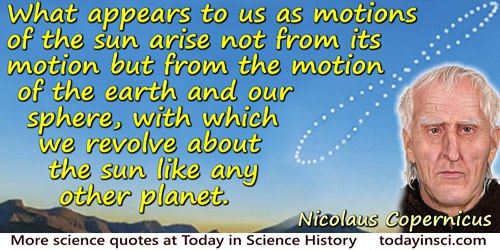
What appears to us as motions of the sun arise not from its motion but from the motion of the earth and our sphere, with which we revolve about the sun like any other planet. The earth has, then, more than one motion.
The apparent retrograde and direct motion of the planets arises not from their motion but from the earth’s. The motion of the earth alone, therefore, suffices to explain so many apparent inequalities in the heavens.
There is no one center of all the celestial circles or spheres.
The center of the earth is not the center of the universe, but only of gravity and of the lunar sphere.
All the spheres revolve about the sun as their mid-point, and therefore the sun is the center of the universe.
The ratio of the earth’s distance from the sun to the height of the firmament is so much smaller than the ratio of the earth’s radius to its distance from the sun that the distance from the earth to the sun is imperceptible in comparison with the height of the firmament.
Whatever motion appears in the firmament arises not from any motion of the firmament, but from the earth’s motion. The earth together with its circumjacent elements performs a complete rotation on its fixed poles in a daily motion, while the firmament and highest heaven abide unchanged.
What appears to us as motions of the sun arise not from its motion but from the motion of the earth and our sphere, with which we revolve about the sun like any other planet. The earth has, then, more than one motion.
The apparent retrograde and direct motion of the planets arises not from their motion but from the earth’s. The motion of the earth alone, therefore, suffices to explain so many apparent inequalities in the heavens.
'The Commentariolus', in Three Copernican Treatises (c.1510), trans. E. Rosen (1939), 58-9.
All things are made of atoms—little particles that move around in perpetual motion, attracting each other when they are a little distance apart, but repelling upon being squeezed into one another. In that one sentence ... there is an enormous amount of information about the world.
His suggestion that the most valuable information on scientific knowledge in a single sentence using the fewest words is to state the atomic hypothesis.
His suggestion that the most valuable information on scientific knowledge in a single sentence using the fewest words is to state the atomic hypothesis.
Six Easy Pieces (1995), 4.
And if you want the exact moment in time, it was conceived mentally on 8th March in this year one thousand six hundred and eighteen, but submitted to calculation in an unlucky way, and therefore rejected as false, and finally returning on the 15th of May and adopting a new line of attack, stormed the darkness of my mind. So strong was the support from the combination of my labour of seventeen years on the observations of Brahe and the present study, which conspired together, that at first I believed I was dreaming, and assuming my conclusion among my basic premises. But it is absolutely certain and exact that the proportion between the periodic times of any two planets is precisely the sesquialterate proportion of their mean distances.
Harmonice Mundi, The Harmony of the World (1619), book V, ch. 3. Trans. E. J. Aiton, A. M. Duncan and J. V. Field (1997), 411.
Any opinion as to the form in which the energy of gravitation exists in space is of great importance, and whoever can make his opinion probable will have, made an enormous stride in physical speculation. The apparent universality of gravitation, and the equality of its effects on matter of all kinds are most remarkable facts, hitherto without exception; but they are purely experimental facts, liable to be corrected by a single observed exception. We cannot conceive of matter with negative inertia or mass; but we see no way of accounting for the proportionality of gravitation to mass by any legitimate method of demonstration. If we can see the tails of comets fly off in the direction opposed to the sun with an accelerated velocity, and if we believe these tails to be matter and not optical illusions or mere tracks of vibrating disturbance, then we must admit a force in that direction, and we may establish that it is caused by the sun if it always depends upon his position and distance.
Letter to William Huggins (13 Oct 1868). In P. M. Hannan (ed.), The Scientific Letters and Papers of James Clerk Maxwell (1995), Vol. 2, 1862-1873, 451-2.
As he sat alone in a garden, he [Isaac Newton in 1666, age 24] fell into a speculation on the power of gravity; that as this power is not found sensibly diminished at the remotest distance from the centre of the earth to which we can rise, neither at the tops of the loftiest buildings, nor even on the summits of the highest mountains, it appeared to him reasonable to conclude that this power must extend much further than was usually thought: why not as high as the moon? said he to himself; and if so, her motion must be influenced by it; perhaps she is retained in her orbit thereby.
View of Newton's Philosophy (1728), preface. In William Whewell, History of the Inductive Sciences (1847), Vol. 2, 166. Pemberton's narrative is based on firsthand conversations with Newton himself.
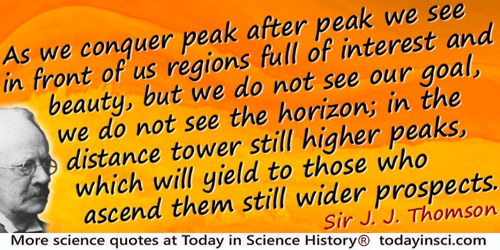
As we conquer peak after peak we see in front of us regions full of interest and beauty, but we do not see our goal, we do not see the horizon; in the distance tower still higher peaks, which will yield to those who ascend them still wider prospects, and deepen the feeling, the truth of which is emphasised by every advance in science, that “Great are the Works of the Lord.”
In Presidential Address to the British Association, as quoted in Arthur L. Foley, 'Recent Developments in Physical Science, The Popular Science Monthly (1910), 456.
Ask a follower of Bacon what [science] the new philosophy, as it was called in the time of Charles the Second, has effected for mankind, and his answer is ready; “It has lengthened life; it has mitigated pain; it has extinguished diseases; it has increased the fertility of the soil; it has given new securities to the mariner; it has furnished new arms to the warrior; it has spanned great rivers and estuaries with bridges of form unknown to our fathers; it has guided the thunderbolt innocuously from heaven to earth; it has lighted up the night with the splendour of the day; it has extended the range of the human vision; it has multiplied the power of the human muscles; it has accelerated motion; it has annihilated distance; it has facilitated intercourse, correspondence, all friendly offices, all dispatch of business; it has enabled man to descend to the depths of the sea, to soar into the air, to penetrate securely into the noxious recesses of the earth, to traverse the land in cars which whirl along without horses, to cross the ocean in ships which run ten knots an hour against the wind. These are but a part of its fruits, and of its first-fruits; for it is a philosophy which never rests, which has never attained, which is never perfect. Its law is progress. A point which yesterday was invisible is its goal to-day, and will be its starting-point to-morrow.”
From essay (Jul 1837) on 'Francis Bacon' in Edinburgh Review. In Baron Thomas Babington Macaulay and Lady Trevelyan (ed.) The Works of Lord Macaulay Complete (1871), Vol. 6, 222.
Astronomy teaches the correct use of the sun and the planets. These may be put on a frame of little sticks and turned round. This causes the tides. Those at the ends of the sticks are enormously far away. From time to time a diligent searching of the sticks reveals new planets. The orbit of the planet is the distance the stick goes round in going round. Astronomy is intensely interesting; it should be done at night, in a high tower at Spitzbergen. This is to avoid the astronomy being interrupted. A really good astronomer can tell when a comet is coming too near him by the warning buzz of the revolving sticks.
In Literary Lapses (1928), 128.
At a distance in the meadow I hear still, at long intervals, the hurried commencement of the bobolink s strain, the bird just dashing into song, which is as suddenly checked, as it were, by the warder of the seasons, and the strain is left incomplete forever. Like human beings they are inspired to sing only for a short season.
(29 Jun 1851). In Henry David Thoreau and Bradford Torrey (ed.), The Writings of Henry Thoreau: Journal: II: 1850-September 15, 1851 (1906), 275.
At lunch Francis [Crick] winged into the Eagle to tell everyone within hearing distance that we had found the secret of life.
Purported remark made at The Eagle pub (28 Feb 1953), near the Cavendish Laboratory in Cambridge, to celebrate the fact that they, Crick and Watson, had unravelled the structure of DNA. Stated by James Watson in The Double Helix: A Personal Account of the Discovery of the Structure of DNA (1968, 1998), 197. However Francis Crick, in What Mad Pursuit (1990), 77, writes that was “according to Jim,” but “of that I have no recollection.” Nevertheless, some quote collections report this incident with a direct quote as “We have discovered the secret of life!”
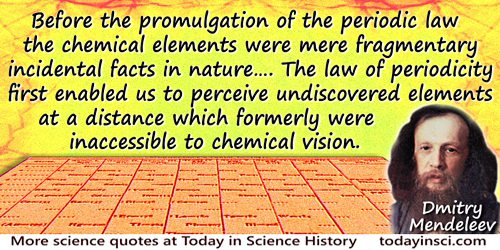
Before the promulgation of the periodic law the chemical elements were mere fragmentary incidental facts in nature; there was no special reason to expect the discovery of new elements, and the new ones which were discovered from time to time appeared to be possessed of quite novel properties. The law of periodicity first enabled us to perceive undiscovered elements at a distance which formerly were inaccessible to chemical vision, and long ere they were discovered new elements appeared before our eyes possessed of a number of well-defined properties.
In Faraday Lecture, delivered before the Fellows of the Chemical Society in the Theatre of the Royal Institution (4 Jun 1889), printed in Professor Mendeléeff, 'The Periodic Law of the Chemical Elements', Transactions of the Chemical Society (1889), 55, 648.
Beyond these are other suns, giving light and life to systems, not a thousand, or two thousand merely, but multiplied without end, and ranged all around us, at immense distances from each other, attended by ten thousand times ten thousand worlds, all in rapid motion; yet calm, regular and harmonious—all space seems to be illuminated, and every particle of light a world. ... all this vast assemblages of suns and worlds may bear no greater proportion to what lies beyond the utmost boundaries of human vision, than a drop of water to the ocean.
In The Geography of the Heavens and Class-Book of Astronomy (1874), 148 That knowledge is not happiness.
But if the heavens are moved by a daily movement, it is necessary to assume in the principal bodies of the universe and in the heavens two ways of movement which are contrary to each other: one from east to west and the other from west to east, as has often been said. And with this, it is proper to assume an excessively great speed, for anyone who reckons and considers well the height of distance of the heavens and the magnitude of these and of their circuit, if such a circuit were made in a day, could not imagine or conceive how marvelously and excessively swift would be the movement of the heavens, and how unbelievable and unthinkable.
In Isaac Asimov and Jason A. Shulman (eds.), Isaac Asimov’s Book of Science and Nature Quotations (1988), 329. Webmaster so far has been unable to locate the primary source (can you help?)
But if you have seen the soil of India with your own eyes and meditate on its nature - if you consider the rounded stones found in the earth however deeply you dig, stones that are huge near the mountains and where the rivers have a violent current; stones that are of smaller size at greater distance from the mountains, and where the streams flow more slowly; stones that appear pulverised in the shape of sand where the streams begin to stagnate near their mouths and near the sea - if you consider all this, you could scarcely help thinking that India has once been a sea which by degrees has been filled up by the alluvium of the streams.
Alberuni's India, trans. E. C. Sachau (1888), Vol. 1, 198.
But in the heavens we discover by their light, and by their light alone, stars so distant from each other that no material thing can ever have passed from one to another; and yet this light, which is to us the sole evidence of the existence of these distant worlds, tells us also that each of them is built up of molecules of the same kinds as those which we find on earth. A molecule of hydrogen, for example, whether in Sirius or in Arcturus, executes its vibrations in precisely the same time. Each molecule, therefore, throughout the universe, bears impressed on it the stamp of a metric system as distinctly as does the metre of the Archives at Paris, or the double royal cubit of the Temple of Karnac ... the exact quantity of each molecule to all others of same kind gives it, as Sir John Herschel has well said, the essential character of a manufactured article and precludes the idea of its being external and self-existent.
'Molecules', 1873. In W. D. Niven (ed.), The Scientific Papers of James Clerk Maxwell (1890), Vol. 2, 375-6.
By such deductions the law of gravitation is rendered probable, that every particle attracts every other particle with a force which varies inversely as the square of the distance. The law thus suggested is assumed to be universally true.
In Isaac Newton and Percival Frost (ed.) Newton's Principia: Sections I, II, III (1863), 217.
Can imagination picture what the future of this invention is to be! … We may talk by light to any visible distance without any conducting wire.
Letter to his father (26 Feb 1880), describing his photophone research. Transcript with Bell Papers, Library of Congress.
Children are told that an apple fell on Isaac Newton’s head and he was led to state the law of gravity. This, of course, is pure foolishness. What Newton discovered was that any two particles in the universe attract each other with a force that is proportional to the product of their masses and inversely proportional to the square of the distance between them. This is not learned from a falling apple, but by observing quantities of data and developing a mathematical theory that can be verified by additional data. Data gathered by Galileo on falling bodies and by Johannes Kepler on motions of the planets were invaluable aids to Newton. Unfortunately, such false impressions about science are not universally outgrown like the Santa Claus myth, and some people who don’t study much science go to their graves thinking that the human race took until the mid-seventeenth century to notice that objects fall.
In How to Tell the Liars from the Statisticians (1983), 127.
Consider now the Milky Way. Here also we see an innumerable dust, only the grains of this dust are no longer atoms but stars; these grains also move with great velocities, they act at a distance one upon another, but this action is so slight at great distances that their trajectories are rectilineal; nevertheless, from time to time, two of them may come near enough together to be deviated from their course, like a comet that passed too close to Jupiter. In a word, in the eyes of a giant, to whom our Suns were what our atoms are to us, the Milky Way would only look like a bubble of gas.
Science and Method (1908), trans. Francis Maitland (1914), 254-5.
Consider the eighth category, which deals with stones. Wilkins divides them into the following classifications: ordinary (flint, gravel, slate); intermediate (marble, amber, coral); precious (pearl, opal); transparent (amethyst, sapphire); and insoluble (coal, clay, and arsenic). The ninth category is almost as alarming as the eighth. It reveals that metals can be imperfect (vermilion, quicksilver); artificial (bronze, brass); recremental (filings, rust); and natural (gold, tin, copper). The whale appears in the sixteenth category: it is a viviparous, oblong fish. These ambiguities, redundances, and deficiencies recall those attributed by Dr. Franz Kuhn to a certain Chinese encyclopedia entitled Celestial Emporium of Benevolent Knowledge. On those remote pages it is written that animals are divided into (a) those that belong to the Emperor, (b) embalmed ones, (c) those that are trained, (d) suckling pigs, (e) mermaids, (f) fabulous ones, (g) stray dogs, (h) those that are included in this classification, (i) those that tremble as if they were mad, (j) innumerable ones, (k) those drawn with a very fine camel's hair brush, (l) others, (m) those that have just broken a flower vase, (n) those that resemble flies from a distance.
Other Inquisitions 1937-1952 (1964), trans. Ruth L. C. Simms, 103.
Curves that have no tangents are the rule. … Those who hear of curves without tangents, or of functions without derivatives, often think at first that Nature presents no such complications. … The contrary however is true. … Consider, for instance, one of the white flakes that are obtained by salting a solution of soap. At a distance its contour may appear sharply defined, but as we draw nearer its sharpness disappears. The eye can no longer draw a tangent at any point. … The use of a magnifying glass or microscope leaves us just as uncertain, for fresh irregularities appear every time we increase the magnification. … An essential characteristic of our flake … is that we suspect … that any scale involves details that absolutely prohibit the fixing of a tangent.
(1906). As quoted “in free translation” in Benoit B. Mandelbrot, The Fractal Geometry of Nature (1977, 1983), 7.
Discoveries are always accidental; and the great use of science is by investigating the nature of the effects produced by any process or contrivance, and of the causes by which they are brought about, to explain the operation and determine the precise value of every new invention. This fixes as it were the latitude and longitude of each discovery, and enables us to place it in that part of the map of human knowledge which it ought to occupy. It likewise enables us to use it in taking bearings and distances, and in shaping our course when we go in search of new discoveries.
In The Complete Works of Count Rumford (1876), Vol. 4, 270.
Does it not seem as if Algebra had attained to the dignity of a fine art, in which the workman has a free hand to develop his conceptions, as in a musical theme or a subject for a painting? It has reached a point where every properly developed algebraical composition, like a skillful landscape, is expected to suggest the notion of an infinite distance lying beyond the limits of the canvas.
In 'Lectures on the Theory of Reciprocants', Lecture XXI, American Journal of Mathematics (Jul 1886), 9, No. 3, 136.
Each volcano is an independent machine—nay, each vent and monticule is for the time being engaged in its own peculiar business, cooking as it were its special dish, which in due time is to be separately served. We have instances of vents within hailing distance of each other pouring out totally different kinds of lava, neither sympathizing with the other in any discernible manner nor influencing other in any appreciable degree.
In Report on the Geology of the High Plateaus of Utah (1880), 115.
Every appearance in nature corresponds to some state of the mind, and that state of the mind can only be described by presenting that natural appearance as its picture. An enraged man is a lion, a cunning man is a fox, a firm man is a rock, a learned man is a torch. A lamb is innocence; a snake is subtle spite; flowers express to us the delicate affections. Light and darkness are our familiar expressions for knowledge and ignorance ; and heat for love. Visible distance behind and before us, is respectively our image of memory and hope.
In essay, 'Language', collected in Nature: An Essay ; And, Lectures on the Times (1844), 23-24.
Every new theory as it arises believes in the flush of youth that it has the long sought goal; it sees no limits to its applicability, and believes that at last it is the fortunate theory to achieve the 'right' answer. This was true of electron theory—perhaps some readers will remember a book called The Electrical Theory of the Universe by de Tunzelman. It is true of general relativity theory with its belief that we can formulate a mathematical scheme that will extrapolate to all past and future time and the unfathomed depths of space. It has been true of wave mechanics, with its first enthusiastic claim a brief ten years ago that no problem had successfully resisted its attack provided the attack was properly made, and now the disillusionment of age when confronted by the problems of the proton and the neutron. When will we learn that logic, mathematics, physical theory, are all only inventions for formulating in compact and manageable form what we already know, like all inventions do not achieve complete success in accomplishing what they were designed to do, much less complete success in fields beyond the scope of the original design, and that our only justification for hoping to penetrate at all into the unknown with these inventions is our past experience that sometimes we have been fortunate enough to be able to push on a short distance by acquired momentum.
The Nature of Physical Theory (1936), 136.
Everything is determined … by forces over which we have no control. It is determined for the insect as well as the star. Human beings, vegetables, or cosmic dust—we all dance to a mysterious tune, intoned in the distance by an invisible piper.
In interview, George Sylvester Viereck, 'What Life Means to Einstein', The Saturday Evening Post (26 Oct 1929), 117.
Evolution has no long-term goal. There is no long-distance target, no final perfection to serve as a criterion for selection, although human vanity cherishes the absurd notion that our species is the final goal of evolution.
The Blind Watchmaker (1996), 50.
Exper. I. I made a small hole in a window-shutter, and covered it with a piece of thick paper, which I perforated with a fine needle. For greater convenience of observation I placed a small looking-glass without the window-shutter, in such a position as to reflect the sun's light, in a direction nearly horizontal, upon the opposite wall, and to cause the cone of diverging light to pass over a table on which were several little screens of card-paper. I brought into the sunbeam a slip of card, about one-thirtieth of an inch in breadth, and observed its shadow, either on the wall or on other cards held at different distances. Besides the fringes of colour on each side of the shadow, the shadow itself was divided by similar parallel fringes, of smaller dimensions, differing in number, according to the distance at which the shadow was observed, but leaving the middle of the shadow always white. Now these fringes were the joint effects of the portions of light passing on each side of the slip of card and inflected, or rather diffracted, into the shadow. For, a little screen being placed a few inches from the card, so as to receive either edge of the shadow on its margin, all the fringes which had before been observed in the shadow on the wall, immediately disappeared, although the light inflected on the other side was allowed to retain its course, and although this light must have undergone any modification that the proximity of the other edge of the slip of card might have been capable of occasioning... Nor was it for want of a sufficient intensity of light that one of the two portions was incapable of producing the fringes alone; for when they were both uninterrupted, the lines appeared, even if the intensity was reduced to one-tenth or one-twentieth.
'Experiments and Calculations Relative to Physical Optics' (read in 1803), Philosophical Transactions (1804), 94, 2-3.
First, [Newton’s Law of Universal Gravitation] is mathematical in its expression…. Second, it is not exact; Einstein had to modify it…. There is always an edge of mystery, always a place where we have some fiddling around to do yet…. But the most impressive fact is that gravity is simple…. It is simple, and therefore it is beautiful…. Finally, comes the universality of the gravitational law and the fact that it extends over such enormous distances…
In The Character of Physical Law (1965, 2001), 33.
Food production is now so energy-intensive that more carbon is emitted providing a person with enough calories to walk to the shops than a car would emit over the same distance.
Citing calculations made by environmentalist author, Chris Goodall.
Citing calculations made by environmentalist author, Chris Goodall.
'Walking to the shops damages planet more than going by car', in The Times (4 Aug 2007)
For some months the astronomer Halley and other friends of Newton had been discussing the problem in the following precise form: what is the path of a body attracted by a force directed toward a fixed point, the force varying in intensity as the inverse of the distance? Newton answered instantly, “An ellipse.” “How do you know?” he was asked. “Why, I have calculated it.” Thus originated the imperishable Principia, which Newton later wrote out for Halley. It contained a complete treatise on motion.
In The Handmaiden of the Sciences (1937), 37.
For terrestrial vertebrates, the climate in the usual meteorological sense of the term would appear to be a reasonable approximation of the conditions of temperature, humidity, radiation, and air movement in which terrestrial vertebrates live. But, in fact, it would be difficult to find any other lay assumption about ecology and natural history which has less general validity. … Most vertebrates are much smaller than man and his domestic animals, and the universe of these small creatures is one of cracks and crevices, holes in logs, dense underbrush, tunnels, and nests—a world where distances are measured in yards rather than miles and where the difference between sunshine and shadow may be the difference between life and death. Actually, climate in the usual sense of the term is little more than a crude index to the physical conditions in which most terrestrial animals live.
From 'Interaction of physiology and behavior under natural conditions', collected in R.I. Bowman (ed.), The Galapagos (1966), 40.
Four circles to the kissing come,
The smaller are the benter.
The bend is just the inverse of
The distance from the centre.
Though their intrigue left Euclid dumb
There’s now no need for rule of thumb.
Since zero bend’s a dead straight line
And concave bends have minus sign,
The sum of squares of all four bends
Is half the square of their sum.
The smaller are the benter.
The bend is just the inverse of
The distance from the centre.
Though their intrigue left Euclid dumb
There’s now no need for rule of thumb.
Since zero bend’s a dead straight line
And concave bends have minus sign,
The sum of squares of all four bends
Is half the square of their sum.
In poem, 'The Kiss Precise', Nature (20 Jun 1936), 137, 1021, as quoted, cited, explained and illustrated in Martin Gardner, The Colossal Book of Mathematics: Classic Puzzles, Paradoxes, and Problems (2001), 139-141.
From our home on the Earth, we look out into the distances and strive to imagine the sort of world into which we were born. Today, we have reached far into space. Our immediate neighborhood we know rather intimately. But with increasing distance our knowledge fades … The search will continue. The urge is older than history. It is not satisfied and will not be suppressed.
In 'From Our Home On The Earth', The Land (1946), 5, 145. As cited on the webpage of the Edwin Powell Hubble Papers.
Generally speaking, geologists seem to have been much more intent on making little worlds of their own, than in examining the crust of that which they inhabit. It would be much more desirable that facts should be placed in the foreground and theories in the distance, than that theories should be brought forward at the expense of facts. So that, in after times, when the speculations of the present day shall have passed away, from a greater accumulation of information, the facts may be readily seized and converted to account.
Sections and Views Illustrative of Geological Phenomena (1830), iv.
Gold is found in our own part of the world; not to mention the gold extracted from the earth in India by the ants, and in Scythia by the Griffins. Among us it is procured in three different ways; the first of which is in the shape of dust, found in running streams. … A second mode of obtaining gold is by sinking shafts or seeking among the debris of mountains …. The third method of obtaining gold surpasses the labors of the giants even: by the aid of galleries driven to a long distance, mountains are excavated by the light of torches, the duration of which forms the set times for work, the workmen never seeing the light of day for many months together.
In Pliny and John Bostock (trans.), The Natural History of Pliny (1857), Vol. 6, 99-101.
He [Lord Bacon] appears to have been utterly ignorant of the discoveries which had just been made by Kepler’s calculations … he does not say a word about Napier’s Logarithms, which had been published only nine years before and reprinted more than once in the interval. He complained that no considerable advance had been made in Geometry beyond Euclid, without taking any notice of what had been done by Archimedes and Apollonius. He saw the importance of determining accurately the specific gravities of different substances, and himself attempted to form a table of them by a rude process of his own, without knowing of the more scientific though still imperfect methods previously employed by Archimedes, Ghetaldus and Porta. He speaks of the εὕρηκα of Archimedes in a manner which implies that he did not clearly appreciate either the problem to be solved or the principles upon which the solution depended. In reviewing the progress of Mechanics, he makes no mention either of Archimedes, or Stevinus, Galileo, Guldinus, or Ghetaldus. He makes no allusion to the theory of Equilibrium. He observes that a ball of one pound weight will fall nearly as fast through the air as a ball of two, without alluding to the theory of acceleration of falling bodies, which had been made known by Galileo more than thirty years before. He proposed an inquiry with regard to the lever,—namely, whether in a balance with arms of different length but equal weight the distance from the fulcrum has any effect upon the inclination—though the theory of the lever was as well understood in his own time as it is now. … He speaks of the poles of the earth as fixed, in a manner which seems to imply that he was not acquainted with the precession of the equinoxes; and in another place, of the north pole being above and the south pole below, as a reason why in our hemisphere the north winds predominate over the south.
From Spedding’s 'Preface' to De Interpretations Naturae Proœmium, in The Works of Francis Bacon (1857), Vol. 3, 511-512. [Note: the Greek word “εὕρηκα” is “Eureka” —Webmaster.]
His mind illumined the Past and the Future and wrought greatly for the present. By his genius distant lands converse and men sail unafraid upon the deep.
— Epitaph
Inscription on the tomb of Reginald and Helen Fessenden in Bermuda. In Frederick Seitz, The Cosmic Inventor: Reginald Aubrey Fessenden (1866-1932) (1999), 61, being Transactions of the American Philosophical Society, Held at Philadelphia For Promoting Useful Knowledge, Vol. 86, Pt. 6.
I am truly a ‘lone traveler’ and have never belonged to my country, my home, my friends, or even my immediate family, with my whole heart; in the face of all these ties, I have never lost a sense of distance and a need for solitude.
…...
I cannot judge my work while I am doing it. I have to do as painters do, stand back and view it from a distance, but not too great a distance. How great? Guess.
Quoted without citation in W.H. Auden and L. Kronenberger (eds.) The Viking Book of Aphorisms (1966), 291. Webmaster has tried without success to locate a primary source. Can you help?
I cannot seriously believe in it [quantum theory] because the theory cannot be reconciled with the idea that physics should represent a reality in time and space, free from spooky actions at a distance [spukhafte Fernwirkungen].
Letter to Max Born (3 Mar 1947). In Born-Einstein Letters (1971), 158.
I never got tired of watching the radar echo from an aircraft as it first appeared as a tiny blip in the noise on the cathode-ray tube, and then grew slowly into a big deflection as the aircraft came nearer. This strange new power to “see” things at great distances, through clouds or darkness, was a magical extension of our senses. It gave me the same thrill that I felt in the early days of radio when I first heard a voice coming out of a horn...
In Boffin: A Personal Story of the Early Days of Radar, Radio Astronomy and Quantum Optics (1991), 9.
I think that in order to achieve progress in the study of language and human cognitive faculties in general it is necessary first to establish 'psychic distance' from the 'mental facts' to which Köhler referred, and then to explore the possibilities for developing explanatory theories... We must recognize that even the most familiar phenomena require explanation and that we have no privileged access to the underlying mechanisms, no more so than in physiology or physics.
Language and Mind (1972, enlarged edition), 26.
I think that the event which, more than anything else, led me to the search for ways of making more powerful radio telescopes, was the recognition, in 1952, that the intense source in the constellation of Cygnus was a distant galaxy—1000 million light years away. This discovery showed that some galaxies were capable of producing radio emission about a million times more intense than that from our own Galaxy or the Andromeda nebula, and the mechanisms responsible were quite unknown. ... [T]he possibilities were so exciting even in 1952 that my colleagues and I set about the task of designing instruments capable of extending the observations to weaker and weaker sources, and of exploring their internal structure.
From Nobel Lecture (12 Dec 1974). In Stig Lundqvist (ed.), Nobel Lectures, Physics 1971-1980 (1992), 187.
If it is possible to have a linear unit that depends on no other quantity, it would seem natural to prefer it. Moreover, a mensural unit taken from the earth itself offers another advantage, that of being perfectly analogous to all the real measurements that in ordinary usage are also made upon the earth, such as the distance between two places or the area of some tract, for example. It is far more natural in practice to refer geographical distances to a quadrant of a great circle than to the length of a pendulum.
'Histoire'. Histoire et Memoires de l’Academie Royale des Science de Paris (1788/1791), 9-10. In Charles Coulston Gillispie, Pierre-Simon Laplace, 1749-1827: A Life in Exact Science (2nd Ed., 2000), 151.
If the atoms in [a] decimetre cube of lead were all put into a chain side by side the same distance apart as they are in the normal lead, the strings of atoms so formed would reach over six million million miles.
In Lecture (1936) on 'Forty Years of Atomic Theory', collected in Needham and Pagel (eds.) in Background to Modern Science: Ten Lectures at Cambridge Arranged by the History of Science Committee, (1938), 99.
If the expansion of the space of the universe is uniform in all directions, an observer located in anyone of the galaxies will see all other galaxies running away from him at velocities proportional to their distances from the observer.
The Creation of the Universe (1952), 31.
If you can fill the unforgiving minute
With sixty seconds’ worth of distance run,
Yours is the Earth and everything that’s in it,
And—which is more—you’ll be a Man, my son.
With sixty seconds’ worth of distance run,
Yours is the Earth and everything that’s in it,
And—which is more—you’ll be a Man, my son.
In 'If', Rewards and Fairies (1910), 182.
In 1684 Dr Halley came to visit him at Cambridge, after they had been some time together, the Dr asked him what he thought the Curve would be that would be described by the Planets supposing the force of attraction towards the Sun to be reciprocal to the square of their distance from it. Sr Isaac replied immediately that it would be an Ellipsis, the Doctor struck with joy & amazement asked him how he knew it, why saith he I have calculated it, whereupon Dr Halley asked him for his calculation without any farther delay. Sr Isaac looked among his papers but could not find it, but he promised him to renew it, & then to send it him.
[Recollecting Newton's account of the meeting after which Halley prompted Newton to write The Principia. When asking Newton this question, Halley was aware, without revealing it to Newton that Robert Hooke had made this hypothesis of plantary motion a decade earlier.]
[Recollecting Newton's account of the meeting after which Halley prompted Newton to write The Principia. When asking Newton this question, Halley was aware, without revealing it to Newton that Robert Hooke had made this hypothesis of plantary motion a decade earlier.]
Quoted in Richard Westfall, Never at Rest: A Biography of Isaac Newton (1980), 403.
In all cases of the motion of free material points under the influence of their attractive and repulsive forces, whose intensity depends solely upon distance, the loss in tension is always equal to the gain in vis viva, and the gain in the former equal to the loss in the latter. Hence the sum of the existing tensions and vires vivae is always constant. In this most general form we can distinguish our law as the principle of the conservation of force.
'On the Conservation of Force; a Physical Memoir'. In John Tyndall and William Francis (eds.), Scientific Memoirs: Natural Philosophy (1853), 121.
In August, 1896, I exposed the sodium flame to large magnetic forces by placing it between the poles of a strong electromagnet. Again I studied the radiation of the flame by means of Rowland's mirror, the observations being made in the direction perpendicular to the lines of force. Each line, which in the absence of the effect of the magnetic forces was very sharply defined, was now broadened. This indicated that not only the original oscillations, but also others with greater and again others with smaller periods of oscillation were being radiated by the flame. The change was however very small. In an easily produced magnetic field it corresponded to a thirtieth of the distance between the two sodium lines, say two tenths of an Angstrom, a unit of measure whose name will always recall to physicists the meritorious work done by the father of my esteemed colleague.
'Light Radiation in a Magnetic Field', Nobel Lecture, 2 May 1903. In Nobel Lectures: Physics 1901-1921 (1967), 34-5.
In comparison with the great size of the earth the protrusion of mountains is not sufficient to deprive it of its spherical shape or to invalidate measurements based on its spherical shape. For Eratosthenes shows that the perpendicular distance from the highest mountain tops to the lowest regions is ten stades [c.5,000-5,500 feet]. This he shows with the help of dioptras which measure magnitudes at a distance.
Simplicius, Commentary On Aristotle's De Caelo, pp. 549.32-550.4 (Heiberg). Quoted in Morris R. Cohen and I. E. Drabkin, A Sourcebook in Greek Science (1948), 160 n.2.
In one department of his [Joseph Black’s] lecture he exceeded any I have ever known, the neatness and unvarying success with which all the manipulations of his experiments were performed. His correct eye and steady hand contributed to the one; his admirable precautions, foreseeing and providing for every emergency, secured the other. I have seen him pour boiling water or boiling acid from a vessel that had no spout into a tube, holding it at such a distance as made the stream’s diameter small, and so vertical that not a drop was spilt. While he poured he would mention this adaptation of the height to the diameter as a necessary condition of success. I have seen him mix two substances in a receiver into which a gas, as chlorine, had been introduced, the effect of the combustion being perhaps to produce a compound inflammable in its nascent state, and the mixture being effected by drawing some string or wire working through the receiver's sides in an air-tight socket. The long table on which the different processes had been carried on was as clean at the end of the lecture as it had been before the apparatus was planted upon it. Not a drop of liquid, not a grain of dust remained.
In Lives of Men of Letters and Science, Who Flourished in the Time of George III (1845), 346-7.
In the beginning of the year 1665 I found the Method of approximating series & the Rule for reducing any dignity of any Bionomial into such a series. The same year in May I found the method of Tangents of Gregory & Slusius, & in November had the direct method of fluxions & the next year in January had the Theory of Colours & in May following I had entrance into ye inverse method of fluxions. And the same year I began to think of gravity extending to ye orb of the Moon & (having found out how to estimate the force with wch [a] globe revolving within a sphere presses the surface of the sphere) from Keplers rule of the periodic times of the Planets being in sesquialterate proportion of their distances from the center of their Orbs, I deduced that the forces wch keep the Planets in their Orbs must [be] reciprocally as the squares of their distances from the centers about wch they revolve: & thereby compared the force requisite to keep the Moon in her Orb with the force of gravity at the surface of the earth, & found them answer pretty nearly. All this was in the two plague years of 1665-1666. For in those days I was in the prime of my age for invention & minded Mathematicks & Philosophy more then than at any time since.
Quoted in Richard Westfall, Never at Rest: A Biography of Isaac Newton (1980), 143.
In the distance tower still higher peaks which will yield to those who ascend them still wider prospects, and deepen the feeling whose truth is emphasized by every advance in science: that “Great are the Works of the Lord.”
From Inaugural Address to the Annual Meeting of the British Association for the Advancement of Science at Winnipeg. Collected in 'The British Association at Winnipeg',Nature (26 Aug 1909), 81. No. 2078, 257.
In the year 1666 he retired again from Cambridge... to his mother in Lincolnshire & whilst he was musing in a garden it came into his thought that the power of gravity (wch brought an apple from the tree to the ground) was not limited to a certain distance from the earth but that this power must extend much farther than was usually thought. Why not as high as the moon said he to himself & if so that must influence her motion & perhaps retain her in her orbit, whereupon he fell a calculating what would be the effect of that supposition but being absent from books & taking the common estimate in use among Geographers & our seamen before Norwood had measured the earth, that 60 English miles were contained in one degree of latitude on the surface of the Earth his computation did not agree with his theory & inclined him then to entertain a notion that together with the force of gravity there might be a mixture of that force wch the moon would have if it was carried along in a vortex.
[The earliest account of Newton, gravity and an apple.]
[The earliest account of Newton, gravity and an apple.]
Memorandum of a conversation with Newton in August 1726. Quoted in Richard Westfall, Never at Rest: A Biography of Isaac Newton (1980), 154.
It has the property of detonating very violently in certain circumstances. On one occasion a small amount of ether solution of pyroglycerin condensed in a glass bowl. ... When the bowl was heated over a spirit lamp, an extremely violent explosion occurred, which shattered it into small fragments. On another occasion a drop was heated in a test-tube, and exploded with such violence that the glass splinters cut deep into my face and hands, and hurt other people who were standing some distance off in the room.
[Describing early experiments on his discovery of nitroglycerin.]
[Describing early experiments on his discovery of nitroglycerin.]
From speech to the Royal Academy of Turin (1847). In Robert Shaplen, 'Annals of Science, Adventures of a Pacifist,' The New Yorker (15 Mar 1958), 49.
It is better to trust in the Rock of Ages, than to know the age of the rocks; it is better for one to know that he is close to the Heavenly Father, than to know how far the stars in the heavens are apart.
In chapter, 'The Origin of Man', In His Image (1922), 93.
It is by the aid of iron that we construct houses, cleave rocks, and perform so many other useful offices of life. But it is with iron also that wars, murders, and robberies are effected, and this, not only hand to hand, but from a distance even, by the aid of missiles and winged weapons, now launched from engines, now hurled by the human arm, and now furnished with feathery wings. This last I regard as the most criminal artifice that has been devised by the human mind; for, as if to bring death upon man with still greater rapidity, we have given wings to iron and taught it to fly. ... Nature, in conformity with her usual benevolence, has limited the power of iron, by inflicting upon it the punishment of rust; and has thus displayed her usual foresight in rendering nothing in existence more perishable, than the substance which brings the greatest dangers upon perishable mortality.
Natural History of Pliny, translation (1857, 1898) by John Bostock and H. T. Riley, 205-6.
It is difficult to give an idea of the vast extent of modern mathematics. The word “extent” is not the right one: I mean extent crowded with beautiful detail—not an extent of mere uniformity such as an objectless plain, but of a tract of beautiful country seen at first in the distance, but which will bear to be rambled through and studied in every detail of hillside and valley, stream, rock, wood, and flower.
President’s address (1883) to the British Association for the Advancement of Science, in The Collected Mathematical Papers (1895), Vol. 8, xxii.
It is going to be necessary that everything that happens in a finite volume of space and time would have to be analyzable with a finite number of logical operations. The present theory of physics is not that way, apparently. It allows space to go down into infinitesimal distances, wavelengths to get infinitely great, terms to be summed in infinite order, and so forth; and therefore, if this proposition [that physics is computer-simulatable] is right, physical law is wrong.
International Journal of Theoretical Physics (1982), 21 Nos. 6-7, 468. Quoted in Brian Rotman, Mathematics as Sign (2000), 82.
It is inconceivable, that inanimate brute matter should, without the mediation of something else, which is not material, operate upon and affect other matter without mutual contact … That gravity should be innate, inherent, and essential to matter, so that one body may act upon another at a distance, through a vacuum, without the mediation of anything else, by and through which their action and force may be conveyed from one to another, is to me so great an absurdity, that I believe no man who has in philosophical matters a competent faculty of thinking, can ever fall into it. Gravity must be caused by an agent, acting constantly according to certain laws; but whether this agent be material or immaterial, I have left to the consideration of my readers.
Third letter to Bentley, 25 Feb 1693. Quoted in The Works of Richard Bentley, D.D. (1838), Vol. 3, 212-3.
It is natural for man to relate the units of distance by which he travels to the dimensions of the globe that he inhabits. Thus, in moving about the earth, he may know by the simple denomination of distance its proportion to the whole circuit of the earth. This has the further advantage of making nautical and celestial measurements correspond. The navigator often needs to determine, one from the other, the distance he has traversed from the celestial arc lying between the zeniths at his point of departure and at his destination. It is important, therefore, that one of these magnitudes should be the expression of the other, with no difference except in the units. But to that end, the fundamental linear unit must be an aliquot part of the terrestrial meridian. ... Thus, the choice of the metre was reduced to that of the unity of angles.
Lecture at the École Normale to the Year III (Apr 1795), Oeuvres Completes de Laplace (1878-1912), Vol. 14, 141. In Charles Coulston Gillispie, Dictionary of Scientific Biography (1978), Vol. 15, 335.
It is not necessary to probe into the nature of things, as was done by those whom the Greeks call physici; nor need we be in alarm lest the Christian should be ignorant of the force and number of the elements—the motion, and order, and eclipses of the heavenly bodies; the form of the heavens; the species and the natures of animals, plants, stones, fountains, rivers, mountains; about chronology and distances; the signs of coming storms; and a thousand other things which those philosophers either have found out, or think they have found out. … It is enough for the Christian to believe that the only cause of all created things, whether heavenly or earthly … is the goodness of the Creator, the one true God.
In Marcus Dods (ed.), J.F. Shaw (trans.), The Enchiridion of Augustine, Chap. 9, collected in The Works of Aurelius Augustine, Bishop of Hippo: A new translation (1873), Vol. 9, 180-181. The physici are natural philosophers.
It is the individual only who is timeless. Societies, cultures, and civilizations - past and present - are often incomprehensible to outsiders, but the individual’s hunger, anxieties, dreams, and preoccupations have remained unchanged through the millennia. Thus, we are up against the paradox that the individual who is more complex, unpredictable, and mysterious than any communal entity is the one nearest to our understanding; so near that even the interval of millennia cannot weaken our feeling of kinshiIf in some manner the voice of an individual reaches us from the remotest distance of time, it is a timeless voice speaking about ourselves.
In Reflections on the Human Condition (1973), 97.
It must … be admitted that very simple relations … exist between the volumes of gaseous substances and the numbers of simple or compound molecules which form them. The first hypothesis to present itself in this connection, and apparently even the only admissible one, is the supposition that the number of integral molecules in any gases is always the same for equal volumes, or always proportional to the volumes. Indeed, if we were to suppose that the number of molecules contained in a given volume were different for different gases, it would scarcely be possible to conceive that the law regulating the distance of molecules could give in all cases relations so simple as those which the facts just detailed compel us to acknowledge between the volume and the number of molecules.
In 'Essay on a Manner of Determining the Relative Masses of the Elementary Molecules of Bodies, and the Proportions in which they enter into these Compounds', Journal de Physique, 1811, 73, 58-76. In Foundations of the Molecular Theory; Alembic Club Reprints, Number 4 (1923), 28-9.
It was astonishing that for some considerable distance around the mould growth the staphococcal colonies were undergoing lysis. What had formerly been a well-grown colony was now a faint shadow of its former self...I was sufficiently interested to pursue the subject.
[Sep 1928, the first observation of penicillin. Lysis is the dissolution or destruction of cells.]
[Sep 1928, the first observation of penicillin. Lysis is the dissolution or destruction of cells.]
Sarah R. Riedman and Elton T. Gustafson, Portraits of Nobel Laureates in Medicine and Physiology (1964), 72.
It’s humbling to realise that the developmental gulf between a miniscule ant colony and our modern human civilisation is only a tiny fraction of the distance between a Type 0 and a Type III civilisation – a factor of 100 billion billion, in fact. Yet we have such a highly regarded view of ourselves, we believe a Type III civilisation would find us irresistible and would rush to make contact with us. The truth is, however, they may be as interested in communicating with humans as we are keen to communicate with ants.
'Star Makers', Cosmos (Feb 2006).
Just as the spectroscope opened up a new astronomy by enabling the astronomer to determine some of the constituents of which distant stars are composed, so the seismograph, recording the unfelt motion of distant earthquakes, enables us to see into the earth and determine its nature with as great a certainty, up to a certain point, as if we could drive a tunnel through it and take samples of the matter passed through.
'The Constitution of the Interior of the Earth, as Revealed by Earthquakes', Quarterly Journal of the Geological Society (1906), 62, 456.
Kepler’s suggestion of gravitation with the inverse distance, and Bouillaud’s proposed substitution of the inverse square of the distance, are things which Newton knew better than his modern readers. I have discovered two anagrams on his name, which are quite conclusive: the notion of gravitation was not new; but Newton went on.
In Budget of Paradoxes (1872), 82.
Let us hope that the advent of a successful flying machine, now only dimly foreseen and nevertheless thought to be possible, will bring nothing but good into the world; that it shall abridge distance, make all parts of the globe accessible, bring men into closer relation with each other, advance civilization, and hasten the promised era in which there shall be nothing but peace and goodwill among all men.
Concluding paragraph, Progress in Flying Machines (1894), 269.
Locksley Hall, that in the distance overlooks the sandy tracts.
And the hollow ocean-ridges roaring into cataracts.
Many a night from yonder ivied casement, ere I went to rest,
Did I look on great Orion sloping slowly to the west.
Many a night I saw the Pleiads, rising thro’ the mellow shade.
Glitter like a swarm of fireflies tangled in a silver braid.
And the hollow ocean-ridges roaring into cataracts.
Many a night from yonder ivied casement, ere I went to rest,
Did I look on great Orion sloping slowly to the west.
Many a night I saw the Pleiads, rising thro’ the mellow shade.
Glitter like a swarm of fireflies tangled in a silver braid.
From 'Locksley Hall' (1842), collected in Alfred Tennyson and William James Rolfe (ed.) The Poetic and Dramatic Works of Alfred, Lord Tennyson (1898), 90.
Looking at these stars suddenly dwarfed my own troubles and all the gravities of terrestrial life. I thought of their unfathomable distance, and the slow inevitable drift of their movements out of the unknown past into the unknown future.
In The Time Machine (1898), 144.
Magnitude may be compared to the power output in kilowatts of a [radio] broadcasting station; local intensity, on the Mercalli or similar scale, is then comparable to the signal strength noted on a receiver at a given locality. Intensity, like signal strength, will generally fall off with distance from the source; it will also depend on local conditions at the point of observation, and to some extent on the conditions along the path from source to that point.
From interview in the Earthquake Information Bulletin (Jul-Aug 1971), 3, No. 4, as abridged in article on USGS website.
MAGNITUDE, n. Size. Magnitude being purely relative, nothing is large and nothing small. If everything in the universe were increased in bulk one thousand diameters nothing would be any larger than it was before, but if one thing remained unchanged all the others would be larger than they had been. To an understanding familiar with the relativity of magnitude and distance the spaces and masses of the astronomer would be no more impressive than those of the microscopist. For anything we know to the contrary, the visible universe may be a small part of an atom, with its component ions, floating in the life-fluid (luminiferous ether) of some animal. Possibly the wee creatures peopling the corpuscles of our own blood are overcome with the proper emotion when contemplating the unthinkable distance from one of these to another.
The Collected Works of Ambrose Bierce (1911), Vol. 7, The Devil's Dictionary, 209.
Mr Hooke sent, in his next letter [to Sir Isaac Newton] the whole of his Hypothesis, scil that the gravitation was reciprocall to the square of the distance: ... This is the greatest Discovery in Nature that ever was since the World's Creation. It was never so much as hinted by any man before. I wish he had writt plainer, and afforded a little more paper.
Brief Lives (1680), edited by Oliver Lawson Dick (1949), 166-7.
My steamboat voyage to Albany and back, has turned out rather more favorable than I had calculated. The distance from New York to Albany is one hundred and fifty miles; I ran it up in thirty-two hours, and down in thirty. I had a light breeze against me the whole way, both going and coming, and the voyage has been performed wholly by, the power of the steam engine. I overtook many sloops and schooners beating to windward and parted with them as if they had been at anchor. The power of propelling boats by steam is now fully proved.
Letter to Joel Barlow, Philadelphia, from New York (22 Aug 1807), in The Literary Magazine, and American Register for 1807 (1808), Vol. 8, No. 47, 96.
Now do you not see that the eye embraces the beauty of the whole world? It counsels and corrects all the arts of mankind... it is the prince of mathematics, and the sciences founded on it are absolutely certain. It has measured the distances and sizes of the stars it has discovered the elements and their location... it has given birth to architecture and to perspective and to the divine art of painting.
…...
Occasionally and frequently the exercise of the judgment ought to end in absolute reservation. It may be very distasteful, and great fatigue, to suspend a conclusion; but as we are not infallible, so we ought to be cautious; we shall eventually find our advantage, for the man who rests in his position is not so far from right as he who, proceeding in a wrong direction, is ever increasing his distance.
Lecture at the Royal Institution, 'Observations on the Education of the Judgment'. Collected in Edward Livingston Youmans (ed)., Modern Culture (1867), 219.
October 9, 1863
Always, however great the height of the balloon, when I have seen the horizon it has roughly appeared to be on the level of the car though of course the dip of the horizon is a very appreciable quantity or the same height as the eye. From this one might infer that, could the earth be seen without a cloud or anything to obscure it, and the boundary line of the plane approximately the same height as the eye, the general appearance would be that of a slight concavity; but I have never seen any part of the surface of the earth other than as a plane.
Towns and cities, when viewed from the balloon are like models in motion. I shall always remember the ascent of 9th October, 1863, when we passed over London about sunset. At the time when we were 7,000 feet high, and directly over London Bridge, the scene around was one that cannot probably be equalled in the world. We were still so low as not to have lost sight of the details of the spectacle which presented itself to our eyes; and with one glance the homes of 3,000,000 people could be seen, and so distinct was the view, that every large building was easily distinguishable. In fact, the whole of London was visible, and some parts most clearly. All round, the suburbs were also very distinct, with their lines of detached villas, imbedded as it were in a mass of shrubs; beyond, the country was like a garden, its fields, well marked, becoming smaller and smaller as the eye wandered farther and farther away.
Again looking down, there was the Thames, throughout its whole length, without the slightest mist, dotted over its winding course with innumerable ships and steamboats, like moving toys. Gravesend was visible, also the mouth of the Thames, and the coast around as far as Norfolk. The southern shore of the mouth of the Thames was not so clear, but the sea beyond was seen for many miles; when at a higher elevation, I looked for the coast of France, but was unable to see it. On looking round, the eye was arrested by the garden-like appearance of the county of Kent, till again London claimed yet more careful attention.
Smoke, thin and blue, was curling from it, and slowly moving away in beautiful curves, from all except one part, south of the Thames, where it was less blue and seemed more dense, till the cause became evident; it was mixed with mist rising from the ground, the southern limit of which was bounded by an even line, doubtless indicating the meeting of the subsoils of gravel and clay. The whole scene was surmounted by a canopy of blue, everywhere free from cloud, except near the horizon, where a band of cumulus and stratus extended all round, forming a fitting boundary to such a glorious view.
As seen from the earth, the sunset this evening was described as fine, the air being clear and the shadows well defined; but, as we rose to view it and its effects, the golden hues increased in intensity; their richness decreased as the distance from the sun increased, both right and left; but still as far as 90º from the sun, rose-coloured clouds extended. The remainder of the circle was completed, for the most part, by pure white cumulus of well-rounded and symmetrical forms.
I have seen London by night. I have crossed it during the day at the height of four miles. I have often admired the splendour of sky scenery, but never have I seen anything which surpassed this spectacle. The roar of the town heard at this elevation was a deep, rich, continuous sound the voice of labour. At four miles above London, all was hushed; no sound reached our ears.
Always, however great the height of the balloon, when I have seen the horizon it has roughly appeared to be on the level of the car though of course the dip of the horizon is a very appreciable quantity or the same height as the eye. From this one might infer that, could the earth be seen without a cloud or anything to obscure it, and the boundary line of the plane approximately the same height as the eye, the general appearance would be that of a slight concavity; but I have never seen any part of the surface of the earth other than as a plane.
Towns and cities, when viewed from the balloon are like models in motion. I shall always remember the ascent of 9th October, 1863, when we passed over London about sunset. At the time when we were 7,000 feet high, and directly over London Bridge, the scene around was one that cannot probably be equalled in the world. We were still so low as not to have lost sight of the details of the spectacle which presented itself to our eyes; and with one glance the homes of 3,000,000 people could be seen, and so distinct was the view, that every large building was easily distinguishable. In fact, the whole of London was visible, and some parts most clearly. All round, the suburbs were also very distinct, with their lines of detached villas, imbedded as it were in a mass of shrubs; beyond, the country was like a garden, its fields, well marked, becoming smaller and smaller as the eye wandered farther and farther away.
Again looking down, there was the Thames, throughout its whole length, without the slightest mist, dotted over its winding course with innumerable ships and steamboats, like moving toys. Gravesend was visible, also the mouth of the Thames, and the coast around as far as Norfolk. The southern shore of the mouth of the Thames was not so clear, but the sea beyond was seen for many miles; when at a higher elevation, I looked for the coast of France, but was unable to see it. On looking round, the eye was arrested by the garden-like appearance of the county of Kent, till again London claimed yet more careful attention.
Smoke, thin and blue, was curling from it, and slowly moving away in beautiful curves, from all except one part, south of the Thames, where it was less blue and seemed more dense, till the cause became evident; it was mixed with mist rising from the ground, the southern limit of which was bounded by an even line, doubtless indicating the meeting of the subsoils of gravel and clay. The whole scene was surmounted by a canopy of blue, everywhere free from cloud, except near the horizon, where a band of cumulus and stratus extended all round, forming a fitting boundary to such a glorious view.
As seen from the earth, the sunset this evening was described as fine, the air being clear and the shadows well defined; but, as we rose to view it and its effects, the golden hues increased in intensity; their richness decreased as the distance from the sun increased, both right and left; but still as far as 90º from the sun, rose-coloured clouds extended. The remainder of the circle was completed, for the most part, by pure white cumulus of well-rounded and symmetrical forms.
I have seen London by night. I have crossed it during the day at the height of four miles. I have often admired the splendour of sky scenery, but never have I seen anything which surpassed this spectacle. The roar of the town heard at this elevation was a deep, rich, continuous sound the voice of labour. At four miles above London, all was hushed; no sound reached our ears.
Travels in the Air (1871), 99-100.
Of all inventions, the alphabet and the printing press alone excepted, those inventions which abridge distance have done most for the civilisation of our species.
In The History of England From the Accession of James the Second (1849), Vol. 1, 365. [This quote was shown at the entrance of the Transportation Building at the World’s Columbian Exposition, Chicago (1893).]
On the day of Cromwell’s death, when Newton was sixteen, a great storm raged all over England. He used to say, in his old age, that on that day he made his first purely scientific experiment. To ascertain the force of the wind, he first jumped with the wind and then against it; and, by comparing these distances with the extent of his own jump on a calm day, he was enabled to compute the force of the storm. When the wind blew thereafter, he used to say it was so many feet strong.
In 'Sir Isaac Newton', People’s Book of Biography: Or, Short Lives of the Most Interesting Persons of All Ages and Countries (1868), 248.
One point at which our magicians attempt their sleight-of-hand is when they slide quickly from the Hubble, redshift-distance relation to redshift-velocity of expansion. There are now five or six whole classes of objects that violate this absolutely basic assumption. It really gives away the game to realize how observations of these crucial objects have been banned from the telescope and how their discussion has met with desperate attempts at suppression.
In 'Letters: Wrangling Over the Bang', Science News (27 Jul 1991), 140, No. 4, 51. Also quoted in Roy C. Martin, Astronomy on Trial: A Devastating and Complete Repudiation of the Big Bang Fiasco (1999), Appendix I, 217.
Others consider us superior because of our cultured ways and intellectual tendencies; our technology lets us drive cars, use word processors and travel great distances by air. Some of us live in air-conditioned houses and we are entertained by the media. We think that we are more intelligent than stone-agers, yet how many modern humans could live successfully in caves, or would know how to light wood fires for cooking, or make clothes and shoes from animal skins or bows and arrows good enough to keep their families fed?
In The Revenge of Gaia: Earth’s Climate Crisis & The Fate of Humanity (2006, 2007), 185
Our knowledge of stars and interstellar matter must be based primarily on the electromagnetic radiation which reaches us. Nature has thoughtfully provided us with a universe in which radiant energy of almost all wave lengths travels in straight lines over enormous distances with usually rather negligible absorption.
In 'Flying Telescopes', Bulletin of the Atomic Scientists (May 1961), Vol. 17, No. 5, 191.
Our ultimate analysis of space leads us not to a “here” and a “there,” but to an extension such as that which relates “here” and “there.” To put the conclusion rather crudely—space is not a lot of points close together; it is a lot of distances interlocked.
The Mathematical Theory of Relativity (1923), 10.
Pauling was shocked by the freedom with which the X-ray crystallographers of the time, including particularly Astbury, played with the intimate chemical structure of their models. They seemed to think that if the atoms were arranged in the right order and about the right distance apart, that was all that mattered, that no further restrictions need to be put on them.
Quoted by John Law in 'The Case of X-ray Protein Crystallography', collected in Gerard Lemaine (ed.), Perspectives on the Emergence of Scientific Disciplines, 1976, 140.
Professor Ayrton said that we were gradually coming within thinkable distance of the realization of a prophecy he had ventured to make four years before, of a time when, if a person wanted to call to a friend he knew not where, he would call in a very loud electromagnetic voice, heard by him who had the electromagnetic ear, silent to him who had it not. “Where are you?” he would say. A small reply would come, “I am at the bottom of a coalmine, or crossing the Andes, or in the middle of the Atlantic.” Or, perhaps in spite of all the calling, no reply would come, and the person would then know that his friend was dead. Think of what this would mean ... a real communication from a distance based on true physical laws.
[His prophecy of cell phones, as a comment on Marconi's paper, 'Syntonic Wireless Telegraphy,' read before the Society of Arts, 15 May 1901, about his early radio signal experiments.]
[His prophecy of cell phones, as a comment on Marconi's paper, 'Syntonic Wireless Telegraphy,' read before the Society of Arts, 15 May 1901, about his early radio signal experiments.]
From Engineering Magazine (Jul 1901) as described in 'Marconi and his Transatlantic Signal', The Century Illustrated Monthly Magazine (1902), Vol. 63, 782.
Radio has become one of the world’s great social forces; it educates, informs, and entertains. Distance has been annihilated. … The face of the moon has felt the ping of a radar pulse and echoed it back in two seconds to revive predictions of interplanetary communications.
In address (Fall 1946) at a dinner in New York to commemorate the 40 years of Sarnoff’s service in the radio field, 'Institute News and Radio Notes: The Past and Future of Radio', Proceedings of the Institute of Radio Engineers (I.R.E.), (May 1947), 35, No. 5, 498. [In 1946, foreshadowing the communications from interplanetary probes like Voyager and others. —Webmaster]
Science and knowledge are subject, in their extension and increase, to laws quite opposite to those which regulate the material world. Unlike the forces of molecular attraction, which cease at sensible distances; or that of gravity, which decreases rapidly with the increasing distance from the point of its origin; the farther we advance from the origin of our knowledge, the larger it becomes, and the greater power it bestows upon its cultivators, to
add new fields to its dominions.
In 'Future Prospects', On the Economy of Machinery and Manufactures (1st ed., 1832), chap. 32, 277-278.
Science boasts of the distance of its stars; of the terrific remoteness of the things of which it has to speak. But poetry and religion always insist upon the proximity, the almost menacing closeness of the things with which they are concerned. Always the Kingdom of Heaven is “At Hand.”
'A Glimpse of My Country', The Daily News. Collected in Tremendous Trifles (1920), 277.
Science no longer is in the position of observer of nature, but rather recognizes itself as part of the interplay between man and nature. The scientific method ... changes and transforms its object: the procedure can no longer keep its distance from the object.
The Representation of Nature in Contemporary Physics', Symbolism in Religion and Literature (1960), 231. Cited in John J. Stuhr, Philosophy and the Reconstruction of Culture (1993), 139.
Scripture and Nature agree in this, that all things were covered with water; how and when this aspect began, and how long it lasted, Nature says not, Scripture relates. That there was a watery fluid, however, at a time when animals and plants were not yet to be found, and that the fluid covered all things, is proved by the strata of the higher mountains, free from all heterogeneous material. And the form of these strata bears witness to the presence of a fluid, while the substance bears witness to the absence of heterogeneous bodies. But the similarity of matter and form in the strata of mountains which are different and distant from each other, proves that the fluid was universal.
The Prodromus of Nicolaus Steno's Dissertation Concerning a Solid Body enclosed by Process of Nature within a Solid (1669), trans. J. G. Winter (1916), 263-4.
Since, then, there is no objection to the mobility of the Earth, I think it must now be considered whether several motions are appropriate for it, so that it can be regarded as one of the wandering stars. For the fact that it is not the centre of all revolutions is made clear by the apparent irregular motion of the wandering stars, and their variable distances from the Earth, which cannot be understood in a circle having the same centre as the Earth.
'Book One. Chapter IX. Whether several motions can be attributed to the Earth, and on the centre of the universe', in Copernicus: On the Revolutions of the Heavenly Spheres (1543), trans. A. M. Duncan (1976), 46.
So far as modern science is concerned, we have to abandon completely the idea that by going into the realm of the small we shall reach the ultimate foundations of the universe. I believe we can abandon this idea without any regret. The universe is infinite in all directions, not only above us in the large but also below us in the small. If we start from our human scale of existence and explore the content of the universe further and further, we finally arrive, both in the large and in the small, at misty distances where first our senses and then even our concepts fail us.
To the German Society of Scientists and Physicists, Braunschweig, Germany (Sep 1896). As quoted in Anton Z. Capri, Quips, Quotes, and Quanta: An Anecdotal History of Physics (2011), 20. Wiechert was reporting his measurement of the mass of the moving particles in a cathode ray beam (electrons).
So numerous are the objects which meet our view in the heavens, that we cannot imagine a point of space where some light would not strike the eye;—innumerable stars, thousands of double and multiple systems, clusters in one blaze with their tens of thousands of stars, and the nebulae amazing us by the strangeness of their forms and the incomprehensibility of their nature, till at last, from the limit of our senses, even these thin and airy phantoms vanish in the distance.
On the Connexion of the Physical Sciences (1858), 420.
Suppose that you are in love with a lady on Neptune and that she returns the sentiment. It will be some consolation for the melancholy separation if you can say to yourself at some possibly pre-arranged moment, “She is thinking of me now.” Unfortunately a difficulty has arisen because we have had to abolish Now. There is no absolute Now, but only the various relative Nows, differing according to their reckoning of different observers and covering the whole neutral wedge which at the distance of Neptune is about eight hours thick. She will have to think of you continuously for eight hours on end in order to circumvent the ambiguity “Now.”
In The Nature of the Physical World (1929), 49.
Suppose you were given a watch, a tube to sight with and a string, and then asked to determine the distance to the nearest star. Or you were asked the chemical composition, pressure or temperature of the Sun. A hundred or more years ago, these questions seemed impossible. Now astronomers are answering them all the time, and they believe their answers. Why? Because there are many parallel ways and tests, and they all give the same answers.
As quoted in John Noble Wilford, 'Sizing up the Cosmos: An Astronomers Quest', New York Times (12 Mar 1991), C10.
TELEPHONE, n. An invention of the devil which abrogates some of the advantages of making a disagreeable person keep his distance.
The Collected Works of Ambrose Bierce (1911), Vol. 7, The Devil's Dictionary, 341.
The blue distance, the mysterious Heavens, the example of birds and insects flying everywhere, are always beckoning Humanity to rise into the air.
In The Successes of Air Balloons in the 19th Century (1901), 1.
The canyon country does not always inspire love. To many it appears barren, hostile, repellent—a fearsome, mostly waterless land of rock and heat, sand dunes and quicksand. cactus, thornbush, scorpion, rattlesnake, and agoraphobic distances. To those who see our land in that manner, the best reply is, yes, you are right, it is a dangerous and terrible place. Enter at your own risk. Carry water. Avoid the noon-day sun. Try to ignore the vultures. Pray frequently.
The Journey Home
The cases of action at a distance are becoming, in a physical point of view, daily more and more important. Sound, light, electricity, magnetism, gravitation, present them as a series.
The nature of sound and its dependence on a medium we think we understand, pretty well. The nature of light as dependent on a medium is now very largely accepted. The presence of a medium in the phenomena of electricity and magnetism becomes more and more probable daily. We employ ourselves, and I think rightly, in endeavouring to elucidate the physical exercise of these forces, or their sets of antecedents and consequents, and surely no one can find fault with the labours which eminent men have entered upon in respect of light, or into which they may enter as regards electricity and magnetism. Then what is there about gravitation that should exclude it from consideration also? Newton did not shut out the physical view, but had evidently thought deeply of it; and if he thought of it, why should not we, in these advanced days, do so too?
The nature of sound and its dependence on a medium we think we understand, pretty well. The nature of light as dependent on a medium is now very largely accepted. The presence of a medium in the phenomena of electricity and magnetism becomes more and more probable daily. We employ ourselves, and I think rightly, in endeavouring to elucidate the physical exercise of these forces, or their sets of antecedents and consequents, and surely no one can find fault with the labours which eminent men have entered upon in respect of light, or into which they may enter as regards electricity and magnetism. Then what is there about gravitation that should exclude it from consideration also? Newton did not shut out the physical view, but had evidently thought deeply of it; and if he thought of it, why should not we, in these advanced days, do so too?
Letter to E. Jones, 9 Jun 1857. In Michael Faraday, Bence Jones (ed.), The Life and Letters of Faraday (1870), Vol. 2, 387.
The demonstration that no possible combination of known substances, known forms of machinery and known forms of force, can be united in a practical machine by which men shall fly along distances through the air, seems to the writer as complete as it is possible for the demonstration to be.
Side-lights on Astronomy and Kindred Fields of Popular Science (1906), 345.
The discovery of the steam-engine owed its birth, like most human inventions, to rude attempts which have been attributed to different persons, while the real author is not certainly known. … There is almost as great a distance between the first apparatus in which the expansive force of steam was displayed and the existing machine, as between the first raft that man ever made and the modern vessel.
As translated in Reflections on the Motive Power of Heat and on Machines Fitted to Develop Power (1890, Rev. 1897), 41. Edited by R. H. Thurston, from the original French, Réflexions sur la Puissance Motrice du Feu (1824).
The evening was calm, the calmest we had known above the North Col. The smooth, outward dipping slabs glowed in the fast setting sun and, at an immense distance beneath, clouds concealed the valleys and lesser peaks. There was nothing to obstruct the tremendous prospect. Seen from Everest, great peaks that dominate the climber as he toils along the East Rongbuk Glacier, and up the slopes of the North Col, show like insignificant ripples at the base of a great ocean roller. Even the North Peak was but a stepping-stone to quick-footed vision.
…...
The exaggerated politeness touches on pride, because it keeps people at a distance.
From the original French, “La politesse exagérée touche à l’orgueil, parce qu’elle tient les gens à distance,” in Actes de l'Académie Nationale des Sciences, Belles-Lettres et Arts de Bordeaux (1872), 479. Translation by Webmaster using Google translate.
The explorations of space end on a note of uncertainty. And necessarily so. … We know our immediate neighborhood rather intimately. With increasing distance our knowledge fades, and fades rapidly. Eventually, we reach the dim boundary—the utmost limits of our telescopes. There, we measure shadows, and we search among ghostly errors of measurement for landmarks that are scarcely more substantial. The search will continue. Not until the empirical resources are exhausted, need we pass on to the dreamy realms of speculation.
From conclusion of The Silliman Memorial Lectures Series delivered at Yale University (Fall 1935). Collected in The Realm of the Nebulae: The Silliman Memorial Lectures Series (1936), 201-202.
The generalized theory of relativity has furnished still more remarkable results. This considers not only uniform but also accelerated motion. In particular, it is based on the impossibility of distinguishing an acceleration from the gravitation or other force which produces it. Three consequences of the theory may be mentioned of which two have been confirmed while the third is still on trial: (1) It gives a correct explanation of the residual motion of forty-three seconds of arc per century of the perihelion of Mercury. (2) It predicts the deviation which a ray of light from a star should experience on passing near a large gravitating body, the sun, namely, 1".7. On Newton's corpuscular theory this should be only half as great. As a result of the measurements of the photographs of the eclipse of 1921 the number found was much nearer to the prediction of Einstein, and was inversely proportional to the distance from the center of the sun, in further confirmation of the theory. (3) The theory predicts a displacement of the solar spectral lines, and it seems that this prediction is also verified.
Studies in Optics (1927), 160-1.
The great object of all knowledge is to enlarge and purify the soul, to fill the mind with noble contemplations, to furnish a refined pleasure, and to lead our feeble reason from the works of nature up to its great Author and Sustainer. Considering this as the ultimate end of science, no branch of it can surely claim precedence of Astronomy. No other science furnishes such a palpable embodiment of the abstractions which lie at the foundation of our intellectual system; the great ideas of time, and space, and extension, and magnitude, and number, and motion, and power. How grand the conception of the ages on ages required for several of the secular equations of the solar system; of distances from which the light of a fixed star would not reach us in twenty millions of years, of magnitudes compared with which the earth is but a foot-ball; of starry hosts—suns like our own—numberless as the sands on the shore; of worlds and systems shooting through the infinite spaces.
Oration at Inauguration of the Dudley Astronomical Observatory, Albany (28 Jul 1856). Text published as The Uses of Astronomy (1856), 36.
The idea of an atom has been so constantly associated with incredible assumptions of infinite strength, absolute rigidity, mystical actions at a distance, and individuality, that chemists and many other reasonable naturalists of modern times, losing all patience with it, have dismissed it to the realms of metaphysics, and made it smaller than ‘anything we can conceive.’ But if atoms are inconceivably small, why are not all chemical actions infinitely swift? Chemistry is powerless to deal with this question, and many others of paramount importance, if barred by the hardness of its fundamental assumptions, from contemplating the atom as a real portion of matter occupying a finite space, and forming not an immeasurably small constituent of any palpable body.
Sir William Thomson and Peter Guthrie Tait, A Treatise on Natural Philosophy (1883), Vol. I, Part 2, 495.
The land! That is where our roots are. There is the basis of our physical life. The farther we get away from the land, the greater our insecurity. From the land comes everything that supports life, everything we use for the service of physical life. The land has not collapsed or shrunk in either extent or productivity. It is there waiting to honor all the labor we are willing to invest in it, and able to tide us across any dislocation of economic conditions.
Advice during the Great Depression, placed in an advertisement, 'Henry Ford on Self-Help', Literary Digest (29 Jun 1932), 113, No. 12, 29, and various other magazines.
The measure of the Moon’s distance involves no principle more abstruse than the measure of the distance of a tree on the opposite bank of a river. The principles of construction of the best Astronomical instruments are as simple and as closely referred to matters of common school-education and familiar experience, as are those of the common globes, the steam-engine, or the turning-lathe; the details are usually less complicated.
In 'Introduction' to Popular Astronomy: A Series of Lectures Delivered at Ipswich (5th ed., 1866), viii.
The more important fundamental laws and facts of physical science have all been discovered, and these are now so firmly established that the possibility of their ever being supplanted in consequence of new discoveries is exceedingly remote. Nevertheless, it has been found that there are apparent exceptions to most of these laws, and this is particularly true when the observations are pushed to a limit, i.e., whenever the circumstances of experiment are such that extreme cases can be examined. Such examination almost surely leads, not to the overthrow of the law, but to the discovery of other facts and laws whose action produces the apparent exceptions. As instances of such discoveries, which are in most cases due to the increasing order of accuracy made possible by improvements in measuring instruments, may be mentioned: first, the departure of actual gases from the simple laws of the so-called perfect gas, one of the practical results being the liquefaction of air and all known gases; second, the discovery of the velocity of light by astronomical means, depending on the accuracy of telescopes and of astronomical clocks; third, the determination of distances of stars and the orbits of double stars, which depend on measurements of the order of accuracy of one-tenth of a second-an angle which may be represented as that which a pin's head subtends at a distance of a mile. But perhaps the most striking of such instances are the discovery of a new planet or observations of the small irregularities noticed by Leverrier in the motions of the planet Uranus, and the more recent brilliant discovery by Lord Rayleigh of a new element in the atmosphere through the minute but unexplained anomalies found in weighing a given volume of nitrogen. Many other instances might be cited, but these will suffice to justify the statement that “our future discoveries must be looked for in the sixth place of decimals.”
In Light Waves and Their Uses (1903), 23-4. Michelson had some years earlier referenced “an eminent physicist” that he did not name who had “remarked that the future truths of physical science are to be looked for in the sixth place of decimals,” near the end of his Convocation Address at the Dedication of the Ryerson Physical Laboratory at the University of Chicago, 'Some of the Objects and Methods of Physical Science' (4 Jul 1894), published in University of Chicago Quarterly Calendar (Aug 1894), 3, No.2, 15. Also
The most stable arrangement for an assemblage of molecules is one in which the component atoms and groups are packed together so that (a) the distances between neighbors are close to the equilibrium distance, (b) each atom or group has as many close neighbors as possible, and (c) there are no large unoccupied regions. In other words, each structure tends to be as 'close-packed' as possible, consistent with the 'sizes' of its component atoms or groups.
'The Structure of Fibrous Proteins', Chemical Reviews (1943), 32, 198.
The most striking impression was that of an overwhelming bright light. I had seen under similar conditions the explosion of a large amount—100 tons—of normal explosives in the April test, and I was flabbergasted by the new spectacle. We saw the whole sky flash with unbelievable brightness in spite of the very dark glasses we wore. Our eyes were accommodated to darkness, and thus even if the sudden light had been only normal daylight it would have appeared to us much brighter than usual, but we know from measurements that the flash of the bomb was many times brighter than the sun. In a fraction of a second, at our distance, one received enough light to produce a sunburn. I was near Fermi at the time of the explosion, but I do not remember what we said, if anything. I believe that for a moment I thought the explosion might set fire to the atmosphere and thus finish the earth, even though I knew that this was not possible.
In Enrico Fermi: Physicist (1970), 147.
The mountains too, at a distance, appear airy masses and smooth, but seen near at hand they are rough.
Diogenes Laertius, trans. Charles Duke Yonge, The Lives and Opinions of Eminent Philosophers (1901), 411.
The present state of the system of nature is evidently a consequence of what it was in the preceding moment, and if we conceive of an intelligence that at a given instant comprehends all the relations of the entities of this universe, it could state the respective position, motions, and general affects of all these entities at any time in the past or future. Physical astronomy, the branch of knowledge that does the greatest honor to the human mind, gives us an idea, albeit imperfect, of what such an intelligence would be. The simplicity of the law by which the celestial bodies move, and the relations of their masses and distances, permit analysis to follow their motions up to a certain point; and in order to determine the state of the system of these great bodies in past or future centuries, it suffices for the mathematician that their position and their velocity be given by observation for any moment in time. Man owes that advantage to the power of the instrument he employs, and to the small number of relations that it embraces in its calculations. But ignorance of the different causes involved in the production of events, as well as their complexity, taken together with the imperfection of analysis, prevents our reaching the same certainty about the vast majority of phenomena. Thus there are things that are uncertain for us, things more or less probable, and we seek to compensate for the impossibility of knowing them by determining their different degrees of likelihood. So it was that we owe to the weakness of the human mind one of the most delicate and ingenious of mathematical theories, the science of chance or probability.
'Recherches, 1º, sur l'Intégration des Équations Différentielles aux Différences Finies, et sur leur Usage dans la Théorie des Hasards' (1773, published 1776). In Oeuvres complètes de Laplace, 14 Vols. (1843-1912), Vol. 8, 144-5, trans. Charles Coulston Gillispie, Pierre-Simon Laplace 1749-1827: A Life in Exact Science (1997), 26.
The Principle of Uncertainty is a bad name. In science or outside of it we are not uncertain; our knowledge is merely confined, within a certain tolerance. We should call it the Principle of Tolerance. And I propose that name in two senses: First, in the engineering sense, science has progressed, step by step, the most successful enterprise in the ascent of man, because it has understood that the exchange of information between man and nature, and man and man, can only take place with a certain tolerance. But second, I also use the word, passionately, about the real world. All knowledge, all information between human beings, can only be exchanged within a play of tolerance. And that is true whether the exchange is in science, or in literature, or in religion, or in politics, or in any form of thought that aspires to dogma. It’s a major tragedy of my lifetime and yours that scientists were refining, to the most exquisite precision, the Principle of Tolerance, and turning their backs on the fact that all around them, tolerance was crashing to the ground beyond repair. The Principle of Uncertainty or, in my phrase, the Principle of Tolerance, fixed once for all the realization that all knowledge is limited. It is an irony of history that at the very time when this was being worked out there should rise, under Hitler in Germany and other tyrants elsewhere, a counter-conception: a principle of monstrous certainty. When the future looks back on the 1930s it will think of them as a crucial confrontation of culture as I have been expounding it, the ascent of man, against the throwback to the despots’ belief that they have absolute certainty. It is said that science will dehumanize people and turn them into numbers. That is false: tragically false. Look for yourself. This is the concentration camp and crematorium at Auschwitz. This is where people were turned into numbers. Into this pond were flushed the ashes of four million people. And that was not done by gas. It was done by arrogance. It was done by dogma. It was done by ignorance. When people believe that they have absolute knowledge, with no test in reality this is how they behave. This is what men do when they aspire to the knowledge of gods. Science is a very human form of knowledge. We are always at the brink of the known; we always feel forward for what is to be hoped. Every judgment in science stands on the edge of error, and is personal. Science is a tribute to what we can know although we are fallible. In the end, the words were said by Oliver Cromwell: “I beseech you, in the bowels of Christ: Think it possible you may be mistaken.” We have to cure ourselves of the itch for absolute knowledge and power. We have to close the distance between the push-button order and the human act. We have to touch people. [Referring to Heisenberg’s Uncertainty Principle.]
'Knowledge or Certainty,' episode 11, The Ascent of Man (1972), BBC TV series.
The rich man, gasping for breath … feels at last the impotence of gold; that death which he dreaded at a distance as an enemy, he now hails when he is near, as a friend; a friend that alone can bring the peace his treasures cannot purchase, and remove the pain his physicians cannot cure.
In Lacon: Or Many Things in Few Words, Addressed to Those who Think (1832), 125. [Part of this quote (after the semicolon) is often seen attributed to Mortimer Collins, who was born in 1827. That date makes it clearly impossible for Collins to be the author of this quote, published in 1832 by Colton.]
The sea is not all that responds to the moon. Twice a day the solid earth bobs up and down, as much as a foot. That kind of force and that kind of distance are more than enough to break hard rock. Wells will flow faster during lunar high tides.
Annals of the Former World
The sky looks very blue. Is that its real color, or is it because it is so far away and has no end? [For whether the blue of the sky is its real colour, or only the result of distance without end.] [Is this immense blue of the sky its true color or is it the effect of infinite distance?]
As translated from the Chinese original by Burton Watson in The Complete Works Of Chuang Tzu (1968, 2013), 1. In first brackets, as translated by Herbert A. Giles in Chuang Tzŭ: Mystic, Moralist, and Social Reformer (1889), 1-2. In second brackets, as translated to English from a version in Spanish on website page at frasesypensamientos.com.ar.
The Sun is no lonelier than its neighbors; indeed, it is a very common-place star,—dwarfish, though not minute,—like hundreds, nay thousands, of others. By accident the brighter component of Alpha Centauri (which is double) is almost the Sun's twin in brightness, mass, and size. Could this Earth be transported to its vicinity by some supernatural power, and set revolving about it, at a little less than a hundred million miles' distance, the star would heat and light the world just as the Sun does, and life and civilization might go on with no radical change. The Milky Way would girdle the heavens as before; some of our familiar constellations, such as Orion, would be little changed, though others would be greatly altered by the shifting of the nearer stars. An unfamiliar brilliant star, between Cassiopeia and Perseus would be—the Sun. Looking back at it with our telescopes, we could photograph its spectrum, observe its motion among the stars, and convince ourselves that it was the same old Sun; but what had happened to the rest of our planetary system we would not know.
The Solar System and its Origin (1935), 2-3.
The theory that gravitational attraction is inversely proportional to the square of the distance leads by remorseless logic to the conclusion that the path of a planet should be an ellipse, … It is this logical thinking that is the real meat of the physical sciences. The social scientist keeps the skin and throws away the meat. … His theorems no more follow from his postulates than the hunches of a horse player follow logically from the latest racing news. The result is guesswork clad in long flowing robes of gobbledygook.
In Science is a Sacred Cow (1950), 149-150.
The universe seems to me infinitely strange and foreign. At such a moment I gaze upon it with a mixture of anguish and euphoria; separate from the universe, as though placed at a certain distance outside it; I look and I see pictures, creatures that move in a kind of timeless time and spaceless space, emitting sounds that are a kind of language I no longer understand or ever register.
‘Interviews: Brief Notes for Radio’, Notes and Counter-Notes: Writings on the Theatre (1964), 136.
The unprecedented identification of the spectrum of an apparently stellar object in terms of a large red-shift suggests either of the two following explanations.
The stellar object is a star with a large gravitational red-shift. Its radius would then be of the order of 10km. Preliminary considerations show that it would be extremely difficult, if not impossible, to account for the occurrence of permitted lines and a forbidden line with the same red-shift, and with widths of only 1 or 2 per cent of the wavelength.
The stellar object is the nuclear region of a galaxy with a cosmological red-shift of 0.158, corresponding to an apparent velocity of 47,400 km/sec. The distance would be around 500 megaparsecs, and the diameter of the nuclear region would have to be less than 1 kiloparsec. This nuclear region would be about 100 times brighter optically than the luminous galaxies which have been identified with radio sources thus far. If the optical jet and component A of the radio source are associated with the galaxy, they would be at a distance of 50 kiloparsecs implying a time-scale in excess of 105 years. The total energy radiated in the optical range at constant luminosity would be of the order of 1059 ergs.
Only the detection of irrefutable proper motion or parallax would definitively establish 3C 273 as an object within our Galaxy. At the present time, however, the explanation in terms of an extragalactic origin seems more direct and less objectionable.
The stellar object is a star with a large gravitational red-shift. Its radius would then be of the order of 10km. Preliminary considerations show that it would be extremely difficult, if not impossible, to account for the occurrence of permitted lines and a forbidden line with the same red-shift, and with widths of only 1 or 2 per cent of the wavelength.
The stellar object is the nuclear region of a galaxy with a cosmological red-shift of 0.158, corresponding to an apparent velocity of 47,400 km/sec. The distance would be around 500 megaparsecs, and the diameter of the nuclear region would have to be less than 1 kiloparsec. This nuclear region would be about 100 times brighter optically than the luminous galaxies which have been identified with radio sources thus far. If the optical jet and component A of the radio source are associated with the galaxy, they would be at a distance of 50 kiloparsecs implying a time-scale in excess of 105 years. The total energy radiated in the optical range at constant luminosity would be of the order of 1059 ergs.
Only the detection of irrefutable proper motion or parallax would definitively establish 3C 273 as an object within our Galaxy. At the present time, however, the explanation in terms of an extragalactic origin seems more direct and less objectionable.
'3C 273: A Star-like Object with Large Red-Shift', Nature (1963), 197, 1040.
The very closest stars would require many years to visit, even traveling at the speed of light, which is impossible according to Einstein's theory of relativity. Today's fastest spaceships would require 200,000 years to travel to Alpha Centauri, our closest bright star. The energy required to send a hundred colonists to another star, as Frank Drake has pointed out, would be enough to meet the energy needs of the entire United States over a human lifetime. And these estimates are regarding nearby stars. When we consider the distances across the entire galaxy, and between galaxies, interstellar travel seems absolutely untenable.
As co-author with his son, Marshall Fisher, in Strangers in the Night: a Brief History of Life on Other Worlds (1998).
The view of the Earth from the Moon fascinated me - a small disk, 240,000 miles away… Raging nationalistic interests, famines, wars, pestilence don’t show from that distance.
…...
The weight of any heavy body of known weight at a particular distance from the center of the world varies according to the variation of its distance therefrom: so that as often as it is removed from the center, it becomes heavier, and when brought near to it, is lighter. On this account, the relation of gravity to gravity is as the relation of distance to distance from the center.
From Book of the Balance of Wisdom. As cited in an epigraph in Charles W. Misner, Kip S. Thorne and John Archibald Wheeler, Gravity (1973), 37.
The world’s first spaceship, Vostok (East), with a man on board was launched into orbit from the Soviet Union on April 12, 1961. The pilot space-navigator of the satellite-spaceship Vostok is a citizen of the U.S.S.R., Flight Major Yuri Gagarin.
The launching of the multistage space rocket was successful and, after attaining the first escape velocity and the separation of the last stage of the carrier rocket, the spaceship went in to free flight on around-the-earth orbit. According to preliminary data, the period of revolution of the satellite spaceship around the earth is 89.1 min. The minimum distance from the earth at perigee is 175 km (108.7 miles) and the maximum at apogee is 302 km (187.6 miles), and the angle of inclination of the orbit plane to the equator is 65º 4’. The spaceship with the navigator weighs 4725 kg (10,418.6 lb), excluding the weight of the final stage of the carrier rocket.
The first man in space was announced by the Soviet newsagency Tass on 12 April 1961, 9:59 a.m. Moscow time.
The launching of the multistage space rocket was successful and, after attaining the first escape velocity and the separation of the last stage of the carrier rocket, the spaceship went in to free flight on around-the-earth orbit. According to preliminary data, the period of revolution of the satellite spaceship around the earth is 89.1 min. The minimum distance from the earth at perigee is 175 km (108.7 miles) and the maximum at apogee is 302 km (187.6 miles), and the angle of inclination of the orbit plane to the equator is 65º 4’. The spaceship with the navigator weighs 4725 kg (10,418.6 lb), excluding the weight of the final stage of the carrier rocket.
The first man in space was announced by the Soviet newsagency Tass on 12 April 1961, 9:59 a.m. Moscow time.
— Tass
Quoted in John David Anderson, Jr., Hypersonic and High Temperature Gas Dynamics (2000), 2.
Think of the image of the world in a convex mirror. ... A well-made convex mirror of moderate aperture represents the objects in front of it as apparently solid and in fixed positions behind its surface. But the images of the distant horizon and of the sun in the sky lie behind the mirror at a limited distance, equal to its focal length. Between these and the surface of the mirror are found the images of all the other objects before it, but the images are diminished and flattened in proportion to the distance of their objects from the mirror. ... Yet every straight line or plane in the outer world is represented by a straight line or plane in the image. The image of a man measuring with a rule a straight line from the mirror, would contract more and more the farther he went, but with his shrunken rule the man in the image would count out exactly the same results as in the outer world, all lines of sight in the mirror would be represented by straight lines of sight in the mirror. In short, I do not see how men in the mirror are to discover that their bodies are not rigid solids and their experiences good examples of the correctness of Euclidean axioms. But if they could look out upon our world as we look into theirs without overstepping the boundary, they must declare it to be a picture in a spherical mirror, and would speak of us just as we speak of them; and if two inhabitants of the different worlds could communicate with one another, neither, as far as I can see, would be able to convince the other that he had the true, the other the distorted, relation. Indeed I cannot see that such a question would have any meaning at all, so long as mechanical considerations are not mixed up with it.
In 'On the Origin and Significance of Geometrical Axioms,' Popular Scientific Lectures< Second Series (1881), 57-59. In Robert Édouard Moritz, Memorabilia Mathematica (1914), 357-358.
This Academy [at Lagado] is not an entire single Building, but a Continuation of several Houses on both Sides of a Street; which growing waste, was purchased and applied to that Use.
I was received very kindly by the Warden, and went for many Days to the Academy. Every Room hath in it ' one or more Projectors; and I believe I could not be in fewer than five Hundred Rooms.
The first Man I saw was of a meagre Aspect, with sooty Hands and Face, his Hair and Beard long, ragged and singed in several Places. His Clothes, Shirt, and Skin were all of the same Colour. He had been Eight Years upon a Project for extracting Sun-Beams out of Cucumbers, which were to be put into Vials hermetically sealed, and let out to warm the Air in raw inclement Summers. He told me, he did not doubt in Eight Years more, that he should be able to supply the Governor's Gardens with Sunshine at a reasonable Rate; but he complained that his Stock was low, and interested me to give him something as an Encouragement to Ingenuity, especially since this had been a very dear Season for Cucumbers. I made him a small Present, for my Lord had furnished me with Money on purpose, because he knew their Practice of begging from all who go to see them.
I saw another at work to calcine Ice into Gunpowder; who likewise shewed me a Treatise he had written concerning the Malleability of Fire, which he intended to publish.
There was a most ingenious Architect who had contrived a new Method for building Houses, by beginning at the Roof, and working downwards to the Foundation; which he justified to me by the life Practice of those two prudent Insects the Bee and the Spider.
In another Apartment I was highly pleased with a Projector, who had found a device of plowing the Ground with Hogs, to save the Charges of Plows, Cattle, and Labour. The Method is this: In an Acre of Ground you bury at six Inches Distance, and eight deep, a quantity of Acorns, Dates, Chestnuts, and other Masts or Vegetables whereof these Animals are fondest; then you drive six Hundred or more of them into the Field, where in a few Days they will root up the whole Ground in search of their Food, and make it fit for sowing, at the same time manuring it with their Dung. It is true, upon Experiment they found the Charge and Trouble very great, and they had little or no Crop. However, it is not doubted that this Invention may be capable of great Improvement.
I had hitherto seen only one Side of the Academy, the other being appropriated to the Advancers of speculative Learning.
Some were condensing Air into a dry tangible Substance, by extracting the Nitre, and letting the acqueous or fluid Particles percolate: Others softening Marble for Pillows and Pin-cushions. Another was, by a certain Composition of Gums, Minerals, and Vegetables outwardly applied, to prevent the Growth of Wool upon two young lambs; and he hoped in a reasonable Time to propagate the Breed of naked Sheep all over the Kingdom.
I was received very kindly by the Warden, and went for many Days to the Academy. Every Room hath in it ' one or more Projectors; and I believe I could not be in fewer than five Hundred Rooms.
The first Man I saw was of a meagre Aspect, with sooty Hands and Face, his Hair and Beard long, ragged and singed in several Places. His Clothes, Shirt, and Skin were all of the same Colour. He had been Eight Years upon a Project for extracting Sun-Beams out of Cucumbers, which were to be put into Vials hermetically sealed, and let out to warm the Air in raw inclement Summers. He told me, he did not doubt in Eight Years more, that he should be able to supply the Governor's Gardens with Sunshine at a reasonable Rate; but he complained that his Stock was low, and interested me to give him something as an Encouragement to Ingenuity, especially since this had been a very dear Season for Cucumbers. I made him a small Present, for my Lord had furnished me with Money on purpose, because he knew their Practice of begging from all who go to see them.
I saw another at work to calcine Ice into Gunpowder; who likewise shewed me a Treatise he had written concerning the Malleability of Fire, which he intended to publish.
There was a most ingenious Architect who had contrived a new Method for building Houses, by beginning at the Roof, and working downwards to the Foundation; which he justified to me by the life Practice of those two prudent Insects the Bee and the Spider.
In another Apartment I was highly pleased with a Projector, who had found a device of plowing the Ground with Hogs, to save the Charges of Plows, Cattle, and Labour. The Method is this: In an Acre of Ground you bury at six Inches Distance, and eight deep, a quantity of Acorns, Dates, Chestnuts, and other Masts or Vegetables whereof these Animals are fondest; then you drive six Hundred or more of them into the Field, where in a few Days they will root up the whole Ground in search of their Food, and make it fit for sowing, at the same time manuring it with their Dung. It is true, upon Experiment they found the Charge and Trouble very great, and they had little or no Crop. However, it is not doubted that this Invention may be capable of great Improvement.
I had hitherto seen only one Side of the Academy, the other being appropriated to the Advancers of speculative Learning.
Some were condensing Air into a dry tangible Substance, by extracting the Nitre, and letting the acqueous or fluid Particles percolate: Others softening Marble for Pillows and Pin-cushions. Another was, by a certain Composition of Gums, Minerals, and Vegetables outwardly applied, to prevent the Growth of Wool upon two young lambs; and he hoped in a reasonable Time to propagate the Breed of naked Sheep all over the Kingdom.
Gulliver's Travels (1726, Penguin ed. 1967), Part III, Chap. 5, 223.
This part of optics [perspectiva], when well understood, shows us how we may make things a very long way off appear to be placed very close, and large near things appear very small, and how we may make small things placed at a distance appear as large as we want, so that it is possible for us to read the smallest letters at an incredible distance, or to count sand, or grain, or seeds, or any sort of minute objects.
Describing the use of a lens for magnification.
Describing the use of a lens for magnification.
De iride, in Baur, Die philosophischen Werke, 74.
This success permits us to hope that after thirty or forty years of observation on the new Planet [Neptune], we may employ it, in its turn, for the discovery of the one following it in its order of distances from the Sun. Thus, at least, we should unhappily soon fall among bodies invisible by reason of their immense distance, but whose orbits might yet be traced in a succession of ages, with the greatest exactness, by the theory of Secular Inequalities.
[Following the success of the confirmation of the existence of the planet Neptune, he considered the possibility of the discovery of a yet further planet.]
[Following the success of the confirmation of the existence of the planet Neptune, he considered the possibility of the discovery of a yet further planet.]
In John Pringle Nichol, The Planet Neptune: An Exposition and History (1848), 90.
Thus far I have explained the phenomena of the heavens and of our sea by the force of gravity, but I have not yet assigned a cause to gravity. Indeed, this force arises from some cause that penetrates as far as the centers of the sun and planets without any diminution of its power to act, and that acts not in proportion to the quantity of the surfaces of the particles on which it acts (as mechanical causes are wont to do) but in proportion to the quantity of solid matter, and whose action is extended everywhere to immense distances, always decreasing as the squares of the distances.
The Principia: Mathematical Principles of Natural Philosophy (1687), 3rd edition (1726), trans. I. Bernard Cohen and Anne Whitman (1999), General Scholium, 943.
To most people, I fancy, the stars are beautiful; but if you asked why, they would be at a loss to reply, until they remembered what they had heard about astronomy, and the great size and distance and possible habitation of those orbs. ... [We] persuade ourselves that the power of the starry heavens lies in the suggestion of astronomical facts.
In The Sense of Beauty: Being the Outlines of Aesthetic Theory (1896), 100-101.
To set foot on the soil of the asteroids, to lift by hand a rock from the Moon, to observe Mars from a distance of several tens of kilometers, to land on its satellite or even on its surface, what can be more fantastic? From the moment of using rocket devices a new great era will begin in astronomy: the epoch of the more intensive study of the firmament.
(1896). As quoted in Firmin Joseph Krieger, Behind the Sputniks: A Survey of Soviet Space Science (1958), 23.
To suppose that the eye, with all its inimitable contrivances for adjusting the focus to different distances, for admitting different amounts of light, and for the correction of spherical and chromatic aberration, could have been formed by natural selection, seems, I freely confess, absurd in the highest possible degree. When it was first said that the sun stood still and the world turned round, the common sense of mankind declared the doctrine false; but the old saying of Vox populi, vox Dei, as every philosopher knows, cannot be trusted in science. Reason tells me, that if numerous gradations from a perfect and complex eye to one very imperfect and simple, each grade being useful to its possessor, can be shown to exist; if further, the eye does vary ever so slightly, and the variations be inherited, which is certainly the case; and if any variation or modification in the organ be ever useful to an animal under changing conditions of life, then the difficulty of believing that a perfect and complex eye could be formed by natural selection, though insuperable by our imagination, can hardly be considered real.
On The Origin of Species by Means of Natural Selection (1859, 1882), 143-144.
To the east was our giant neighbor Makalu, unexplored and unclimbed, and even on top of Everest the mountaineering instinct was sufficient strong to cause me to spend some moments conjecturing as to whether a route up that mountain might not exist. Far away across the clouds the great bulk of Kangchenjunga loomed on the horizon. To the west, Cho Oyu, our old adversary from 1952, dominated the scene and we could see the great unexplored ranges of Nepal stretching off into the distance. The most important photograph, I felt, was a shot down the north ridge, showing the North Col and the old route that had been made famous by the struggles of those great climbers of the 1920s and 1930s. I had little hope of the results being particularly successful, as I had a lot of difficulty in holding the camera steady in my clumsy gloves, but I felt that they would at least serve as a record. After some ten minutes of this, I realized that I was becoming rather clumsy-fingered and slow-moving, so I quickly replaced my oxygen set and experience once more the stimulating effect of even a few liters of oxygen. Meanwhile, Tenzing had made a little hole in the snow and in it he placed small articles of food – a bar of chocolate, a packet of biscuits and a handful of lollies. Small offerings, indeed, but at least a token gifts to the gods that all devoted Buddhists believe have their home on this lofty summit. While we were together on the South Col two days before, Hunt had given me a small crucifix that he had asked me to take to the top. I, too, made a hole in the snow and placed the crucifix beside Tenzing’s gifts.
As quoted in Whit Burnett, The Spirit of Adventure: The Challenge (1955), 349.
To work our railways, even to their present extent, there must be at least 5,000 locomotive engines; and supposing an engine with its tender to measure only 35 feet, it will be seen, that the whole number required to work our railway system would extend, in one straight line, over 30 miles, or the whole distance from London to Chatham.
From 'Railway System and its Results' (Jan 1856) read to the Institution of Civil Engineers, reprinted in Samuel Smiles, Life of George Stephenson (1857), 512.
Truth … and if mine eyes
Can bear its blaze, and trace its symmetries,
Measure its distance, and its advent wait,
I am no prophet—I but calculate.
Can bear its blaze, and trace its symmetries,
Measure its distance, and its advent wait,
I am no prophet—I but calculate.
From poem, 'The Prospects of the Future', collected in The Poetical Works of Charles Mackay: Now for the First Time Collected Complete in One Volume (1876), 447.
Unfortunately, the study of organic remains is beset with two evils, which, though of an opposite character, do not neutralize each other so much as at first sight might be anticipated: the one consisting of a strong desire to find similar organic remains in supposed equivalent deposits, even at great distances; the other being an equally strong inclination to discover new species, often as it would seem for the sole purpose of appending the apparently magical word nobis.
In Geological Manual (1832), Preface, iii.
We are like the inhabitants of an isolated valley in New Guinea who communicate with societies in neighboring valleys (quite different societies, I might add) by runner and by drum. When asked how a very advanced society will communicate, they might guess by an extremely rapid runner or by an improbably large drum. They might not guess a technology beyond their ken. And yet, all the while, a vast international cable and radio traffic passes over them, around them, and through them... We will listen for the interstellar drums, but we will miss the interstellar cables. We are likely to receive our first messages from the drummers of the neighboring galactic valleys - from civilizations only somewhat in our future. The civilizations vastly more advanced than we, will be, for a long time, remote both in distance and in accessibility. At a future time of vigorous interstellar radio traffic, the very advanced civilizations may be, for us, still insubstantial legends.
…...
We are not alone in the universe, and do not bear alone the whole burden of life and what comes of it. Life is a cosmic event—so far as we know the most complex state of organization that matter has achieved in our cosmos. It has come many times, in many places—places closed off from us by impenetrable distances, probably never to be crossed even with a signal. As men we can attempt to understand it, and even somewhat to control and guide its local manifestations. On this planet that is our home, we have every reason to wish it well. Yet should we fail, all is not lost. Our kind will try again elsewhere.
In 'The Origin of Life', Scientific American (Aug 1954), 191, No. 2, 53.
We come now to the question: what is a priori certain or necessary, respectively in geometry (doctrine of space) or its foundations? Formerly we thought everything; nowadays we think nothing. Already the distance-concept is logically arbitrary; there need be no things that correspond to it, even approximately.
In article he wrote, 'Space-Time', for Encyclopaedia Britannica (14th ed., 1929), Vol. 21, 106.
We may produce at will, from a sending station. an electrical effect in any particular region of the globe; we may determine the relative position or course of a moving object, such as a vessel at sea, the distance traversed by the same, or its speed.
In 'The Problem of Increasing Human Energy', Century Illustrated Monthly Magazine (Jun 1900), 60, 208-209.
We suppose ... that the constituent molecules of any simple gas whatever (i.e., the molecules which are at such a distance from each other that they cannot exercise their mutual action) are not formed of a solitary elementary molecule, but are made up of a certain number of these molecules united by attraction to form a single one.
'Essay on a Manner of Determining the Relative Masses of the Elementary Molecules of Bodies, and the Proportions in which they enter into these Compounds', Journal de Physique, 1811, 73, 58-76. In Foundations of the Molecular Theory: Alembic Club Reprints, Number 4 (1923), 31.
Were the succession of stars endless, then the background of the sky would present us an uniform luminosity, like that displayed by the Galaxy—since there could be absolutely no point, in all that background, at which would not exist a star. The only mode, therefore, in which, under such a state of affairs, we could comprehend the voids which our telescopes find in innumerable directions, would be by supposing the distance of the invisible background so immense that no ray from it has yet been able to reach us at all.
'Eureka: An Essay on the Material and Spiritual Universe' (1848). Collected in The Works of the Late Edgar Allan Poe (1857), Vol. 2, 183.
What astronomy has done for space, geology has done for time; the one gives us the idea of infinite distance and magnitude in the starry heavens—the other, of almost infinite duration of time in the immense cycles of changes which our own planet has undergone.
In The Geological Survey of California: An Address Delivered Before the Legislature of California … March 12th, 1861 by J.D. Whitney (1861), 8.
When an element A has an affinity for another substance B, I see no mechanical reason why it should not take as many atoms of B as are presented to it, and can possibly come into contact with it (which may probably be 12 in general), except so far as the repulsion of the atoms of B among themselves are more than a match for the attraction of an atom of A. Now this repulsion begins with 2 atoms of B to 1 atom of A, in which case the 2 atoms of B are diametrically opposed; it increases with 3 atoms of B to 1 of A, in which case the atoms are only 120° asunder; with 4 atoms of B it is still greater as the distance is then only 90; and so on in proportion to the number of atoms. It is evident from these positions, that, as far as powers of attraction and repulsion are concerned (and we know of no other in chemistry), binary compounds must first be formed in the ordinary course of things, then ternary and so on, till the repulsion of the atoms of B (or A, whichever happens to be on the surface of the other), refuse to admit any more.
Observations on Dr. Bostock's Review of the Atomic Principles of Chemistry', Nicholson's Journal, 1811, 29, 147.
When autumn returns with its long anticipated holidays, and preparations are made for a scamper in some distant locality, hammer and notebook will not occupy much room in the portmanteau, and will certainly be found most entertaining company.
In The Story of a Boulder: or, Gleanings from the Note-book of a Field Geologist (1858), viii.
When I was eight, I played Little League. I was on first; I stole third; I went straight across. Earlier that week, I learned that the shortest distance between two points was a direct line. I took advantage of that knowledge.
In Comic Relief (1996).
When the boy begins to understand that the visible point is preceded by an invisible point, that the shortest distance between two points is conceived as a straight line before it is ever drawn with the pencil on paper, he experiences a feeling of pride, of satisfaction. And justly so, for the fountain of all thought has been opened to him, the difference between the ideal and the real, potentia et actu, has become clear to him; henceforth the philosopher can reveal him nothing new, as a geometrician he has discovered the basis of all thought.
In Sprüche in Reimen. Sprüche in Prosa. Ethisches (1850), Vol. 3, 214. As translated in Robert Édouard Moritz, Memorabilia Mathematica; Or, The Philomath’s Quotation-Book (1914), 67. From the original German, “Wenn der knabe zu begreifen anfängt, daß einem sichtbaren Punkte ein unsichtbarer vorhergehen müsse, daß der nächste Weg zwischen zwei Punkten schon als Linie gedacht werde, ehe sie mit dem Bleistift aufs Papier gezogen wird, so fühlt er einen gewissen Stolz, ein Behagen. Und nicht mit Unrecht; denn ihm ist die Quelle alles Denkens aufgeschlossen, Idee und Verwirklichtes, potentia et actu, ist ihm klargeworden; der Philosoph entdeckt ihm nichts Neues; dem Geometer war von seiner Seite der Grund alles Denkens aufgegangen.” The Latin phrase, “potentia et actu” means “potentiality and actuality”.
When the great truth accidentally revealed and experimentally confirmed is fully recognized, that this planet, with all its appalling immensity, is to electric currents virtually no more than a small metal ball and that by this fact many possibilities, each baffling imagination and of incalculable consequence, are rendered absolutely sure of accomplishment; when the first plant is inaugurated and it is shown that a telegraphic message, almost as secret and non-interferable as a thought, can be transmitted to any terrestrial distance, the sound of the human voice, with all its intonations and inflections, faithfully and instantly reproduced at any other point of the globe, the energy of a waterfall made available for supplying light, heat or motive power, anywhere—on sea, or land, or high in the air—humanity will be like an ant heap stirred up with a stick: See the excitement coming!
In 'The Transmission of Electric Energy Without Wires', Electrical World and Engineer (5 Mar 1904), 43, No. 10, 431.
When wireless is perfectly applied the whole earth will be converted into a huge brain, which in fact it is, all things being particles of a real and rhythmic whole. We shall be able to communicate with one another instantly, irrespective of distance. Not only this, but through television and telephony we shall see and hear one another as perfectly as though we were face to face, despite intervening distances of thousands of miles; and the instruments through which we shall be able to do this will be amazingly simple compared with our present telephone. A man will be able to carry one in his vest pocket.
From interview by John B. Kennedy, in 'When Woman is Boss', Collier’s Magazine (30 Jan 1926), 17.
With these developments we have every reason to anticipate that in a time not very distant most telegraphic messages across the oceans will be transmitted without cables. For short distances we need a “wireless” telephone, which requires no expert operators.
In 'The Problem of Increasing Human Energy', Century Illustrated Monthly Magazine (Jun 1900), 209. Collected My Inventions: And Other Writings (2016), 123.
Without distance there is no dialogue between the two.
Quoted in Kim Lim (ed.), 1,001 Pearls of Spiritual Wisdom: Words to Enrich, Inspire, and Guide Your Life (2014), 153
Years ago I used to worry about the degree to which I specialized. Vision is limited enough, yet I was not really working on vision, for I hardly made contact with visual sensations, except as signals, nor with the nervous pathways, nor the structure of the eye, except the retina. Actually my studies involved only the rods and cones of the retina, and in them only the visual pigments. A sadly limited peripheral business, fit for escapists. But it is as though this were a very narrow window through which at a distance, one can only see a crack of light. As one comes closer the view grows wider and wider, until finally looking through the same narrow window one is looking at the universe. It is like the pupil of the eye, an opening only two to three millimetres across in daylight, but yielding a wide angle of view, and manoeuvrable enough to be turned in all directions. I think this is always the way it goes in science, because science is all one. It hardly matters where one enters, provided one can come closer, and then one does not see less and less, but more and more, because one is not dealing with an opaque object, but with a window.
In Scientific American, 1960s, attributed.
 In science it often happens that scientists say, 'You know that's a really good argument; my position is mistaken,' and then they would actually change their minds and you never hear that old view from them again. They really do it. It doesn't happen as often as it should, because scientists are human and change is sometimes painful. But it happens every day. I cannot recall the last time something like that happened in politics or religion.
(1987) --
In science it often happens that scientists say, 'You know that's a really good argument; my position is mistaken,' and then they would actually change their minds and you never hear that old view from them again. They really do it. It doesn't happen as often as it should, because scientists are human and change is sometimes painful. But it happens every day. I cannot recall the last time something like that happened in politics or religion.
(1987) --