Discovery Quotes (841 quotes)
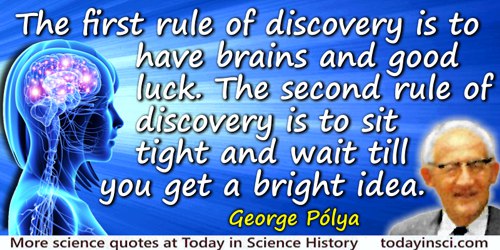
… however useful the words may have been in the past, they have now become handicaps to the further development of knowledge. Words like botany and zoology imply that plants and animals are quite different things. … But the differences rapidly become blurred when we start looking at the world through a microscope. … The similarities between plants and animals became more important than their differences with the discoveries that both were built up of cells, had sexual reproduction,… nutrition and respiration … and with the development of evolutionary theory.
In The Forest and the Sea (1960), 7.
... we ought to have saints' days to commemorate the great discoveries which have been made for all mankind, and perhaps for all time—or for whatever time may be left to us. Nature ... is a prodigal of pain. I should like to find a day when we can take a holiday, a day of jubilation when we can fête good Saint Anaesthesia and chaste and pure Saint Antiseptic. ... I should be bound to celebrate, among others, Saint Penicillin...
Speech at Guildhall, London (10 Sep 1947). Collected in Winston Churchill and Randolph Spencer Churchill (ed.), Europe Unite: Speeches, 1947 and 1948 (1950), 138.
...I believe there exists, & I feel within me, an instinct for the truth, or knowledge or discovery, of something of the same nature as the instinct of virtue, & that our having such an instinct is reason enough for scientific researches without any practical results ever ensuing from them.
The Correspondence of Charles Darwin, Vol. 4. (1847-50)
...neither is it possible to discover the more remote and deeper parts of any science, if you stand but upon the level of the same science, and ascend not to a higher science.
Francis Bacon, Basil Montagu (Ed.), The Works of Francis Bacon (1852), Vol. 1, 173.
“Does one error disappear only to make room for another?” … [L]et us look at the science of astronomy. How grand and magnificent have been the discoveries in that field of knowledge. What victories over error have been achieved by the telescope. That instrument did … bring down and dispel vast clouds of error, both in respect of the sky and of our planet. It must be confessed, too, that it took something from the importance of our planet. The idea that all the hosts of heaven are mere appendages to this earth is no longer entertained by average men, and … [almost no men] now stand by the old theory for which the church proposed to murder Galileo. Men are compelled to admit that the Genesis by Moses is less trustworthy as to the time of creating the heavens and the earth than are the rocks and the stars.
From speech (20 Nov 1883) delivered to the Bethel Literary and Historical Association, Washington D.C.,'It Moves, or Philosophy of Reform', collected in The Essential Douglass: Selected Writings and Speeches (2016), 290.
“On doit etre etonné ([Abbé Raynal]says) que l'Amerique n’ait pas encore produit un bon poëte, un habile mathematicien, un homme de génie dans un seul art, ou une seule science.” …“America has not yet produced one good poet.” When we shall have existed as a people as long as the Greeks did before they produced a Homer, the Romans a Virgil, the French a Racine and Voltaire, the English a Shakespeare and Milton, should this reproach be still true, we will enquire from what unfriendly causes it has proceeded, that the other countries of Europe and quarters of the earth shall not have inscribed any name in the roll of poets. But neither has America produced “one able mathematician, one man of genius in a single art or a single science.” … In physics we have produced a [Benjamin] Franklin, than whom no one of the present age has made more important discoveries, nor has enriched philosophy with more, or more ingenious solutions of the phaenomena, of nature. … [The quadrant invented by Godfrey, an American also, and with the aid of which the European nations traverse the globe, is called Hadley’s quadrant.] … We have supposed Mr. [David] Rittenhouse second to no astronomer living: that in genius he must be the first, because he is self-taught. As an artist he has exhibited as great a proof of mechanical genius as the world has ever produced. … We therefore suppose, that this reproach is as unjust as it is unkind; and that, of the geniuses which adorn the present age, America contributes its full share. [Compared to the much larger populations of European countries.]
The reference given by Jefferson for the original reproach by Abbé Raynal, an ellipsis above, is “7. Hist. Philos. p. 92. ed. Maestricht. 1774”. The original remark written in French, translates as: “One must be amazed that America has not yet produced a good poet, an able mathematician, one man of genius in a single art, or a single science.” Jefferson uses parts of it in English, to introduce his rebuttal. From Thomas Jefferson, Notes on the State of Virginia (1787), 107-110. A footnote adds that: “In a later edition of the Abbé Raynal’s work, he has withdrawn his censure…”
“Yes,” he said. “But these things (the solutions to problems in solid geometry such as the duplication of the cube) do not seem to have been discovered yet.” “There are two reasons for this,” I said. “Because no city holds these things in honour, they are investigated in a feeble way, since they are difficult; and the investigators need an overseer, since they will not find the solutions without one. First, it is hard to get such an overseer, and second, even if one did, as things are now those who investigate these things would not obey him, because of their arrogance. If however a whole city, which did hold these things in honour, were to oversee them communally, the investigators would be obedient, and when these problems were investigated continually and with eagerness, their solutions would become apparent.”
— Plato
In The Republic 7 528bc, trans. R.W. Sharples.
[About research with big particle accelerators such as the Large Hadron Collider.] I think the primary justification for this sort of science that we do is fundamental human curiosity. ... It's true, of course, that every previous generation that's made some breakthrough in understanding nature has seen those discoveries translated into new technologies, new possibilities for the human race. That may well happen with the Higgs boson. Quite frankly, at the moment I don't see how you can use the Higgs boson for anything useful.
As quoted in Alan Boyle, 'Discovery of Doom? Collider Stirs Debate', article (8 Sep 2008) on a msnbc.com web page.
[As a youth, fiddling in my home laboratory] I discovered a formula for the frequency of a resonant circuit which was 2π x sqrt(LC) where L is the inductance and C the capacitance of the circuit. And there was π, and where was the circle? … I still don’t quite know where that circle is, where that π comes from.
From address to the National Science Teachers’ Association convention (Apr 1966), 'What Is Science?', collected in Richard Phillips Feynman and Jeffrey Robbins (ed.), The Pleasure of Finding Things Out: The Best Short Works of Richard P. Feynman (1999, 2005), 177.
[At DuPont,] I was very fortunate that I worked under men who were very much interested in making discoveries and inventions. They were very much interested in what they were doing, and they left me alone. And I was able to experiment on my own, and I found this very stimulating. It appealed to the creative person in me.
From transcript for video interview (2007, published Aug 2012), 'Stephanie Kwolek: Curiosity and the Discovery of Kevlar', in the series Women in Chemistry, on Chemical Heritage Foundation website.
[Chemistry] laboratory work was my first challenge. ... I still carry the scars of my first discovery—that test-tubes are fragile.
Edward Teller with Judith L. Shoolery, Memoirs: A Twentieth-Century Journey in Science and Politics (2001), 42.
[Concerning] phosphorescent bodies, and in particular to uranium salts whose phosphorescence has a very brief duration. With the double sulfate of uranium and potassium ... I was able to perform the following experiment: One wraps a Lumière photographic plate with a bromide emulsion in two sheets of very thick black paper, such that the plate does not become clouded upon being exposed to the sun for a day. One places on the sheet of paper, on the outside, a slab of the phosphorescent substance, and one exposes the whole to the sun for several hours. When one then develops the photographic plate, one recognizes that the silhouette of the phosphorescent substance appears in black on the negative. If one places between the phosphorescent substance and the paper a piece of money or a metal screen pierced with a cut-out design, one sees the image of these objects appear on the negative. One can repeat the same experiments placing a thin pane of glass between the phosphorescent substance and the paper, which excludes the possibility of chemical action due to vapors which might emanate from the substance when heated by the sun's rays. One must conclude from these experiments that the phosphorescent substance in question emits rays which pass through the opaque paper and reduces silver salts.
[Although the sun is irrelevant, and he misinterprets the role of phosphorescence, he has discovered the effect of radioactivity.]
[Although the sun is irrelevant, and he misinterprets the role of phosphorescence, he has discovered the effect of radioactivity.]
Read at French Academy of Science (24 Feb 1896). In Comptes Rendus (1896), 122, 420. As translated by Carmen Giunta on the Classic Chemistry web site.
[D]iscovery should come as an adventure rather than as the result of a logical process of thought. Sharp, prolonged thinking is necessary that we may keep on the chosen road but it does not itself necessarily lead to discovery. The investigator must be ready and on the spot when the light comes from whatever direction.
Letter to Dr. E. B. Krumhaar (11 Oct 1933), in Journal of Bacteriology (Jan 1934), 27, No. 1, 19.
[Davy's] March of Glory, which he has run for the last six weeks—within which time by the aid and application of his own great discovery, of the identity of electricity and chemical attractions, he has placed all the elements and all their inanimate combinations in the power of man; having decomposed both the Alkalies, and three of the Earths, discovered as the base of the Alkalies a new metal... Davy supposes there is only one power in the world of the senses; which in particles acts as chemical attractions, in specific masses as electricity, & on matter in general, as planetary Gravitation... when this has been proved, it will then only remain to resolve this into some Law of vital Intellect—and all human knowledge will be Science and Metaphysics the only Science.
In November 1807 Davy gave his famous Second Bakerian Lecture at the Royal Society, in which he used Voltaic batteries to “decompose, isolate and name” several new chemical elements, notably sodium and potassium.
In November 1807 Davy gave his famous Second Bakerian Lecture at the Royal Society, in which he used Voltaic batteries to “decompose, isolate and name” several new chemical elements, notably sodium and potassium.
Letter to Dorothy Wordsworth, 24 November 1807. In Earl Leslie Griggs (ed.), The Collected Letters of Samuel Taylor Coleridge (1956), Vol. 3, 38.
[Edison] definitely ended the distinction between the theoretical man of science and the practical man of science, so that today we think of scientific discoveries in connection with their possible present or future application to the needs of man. He took the old rule-of-thumb methods out of industry and substituted exact scientific knowledge, while, on the other hand, he directed scientific research into useful channels.
In My Friend Mr. Edison (1930). Quoted in Dyson Carter, If You Want to Invent (1939), 110.
[I doubt that in today's world, I and Francis Crick would ever have had our Eureka moment.] I recently went to my staircase at Clare College, Cambridge and there were women there! he said, with an enormous measure of retrospective sexual frustration. There have been a lot of convincing studies recently about the loss of productivity in the Western male. It may be that entertainment culture now is so engaging that it keeps people satisfied. We didn't have that. Science was much more fun than listening to the radio. When you are 16 or 17 and in that inherently semi-lonely period when you are deciding whether to be an intellectual, many now don't bother.
(Response when asked how he thought the climate of scientific research had changed since he made his discovery of the structure of life in 1953.)
(Response when asked how he thought the climate of scientific research had changed since he made his discovery of the structure of life in 1953.)
Quoted by Tim Adams in 'The New Age of Ignorance', The Observer (30 Jun 2007).
[In the case of research director, Willis R. Whitney, whose style was to give talented investigators as much freedom as possible, you may define “serendipity” as] the art of profiting from unexpected occurrences. When you do things in that way you get unexpected results. Then you do something else and you get unexpected results in another line, and you do that on a third line and then all of a sudden you see that one of these lines has something to do with the other. Then you make a discovery that you never could have made by going on a direct road.
Quoted in Guy Suits, 'Willis Rodney Whitney', National Academy of Sciences, Biographical Memoirs (1960), 355.
[Isaac Newton] regarded the Universe as a cryptogram set by the Almighty—just as he himself wrapt the discovery of the calculus in a cryptogram when he communicated with Leibniz. By pure thought, by concentration of mind, the riddle, he believed, would be revealed to the initiate.
In 'Newton, the Man' (1946). In Geoffrey Keynes (ed.), Essays in Biography, 2nd edition (1951), 314.
[It] is not the nature of things for any one man to make a sudden, violent discovery; science goes step by step and every man depends on the work of his predecessors. When you hear of a sudden unexpected discovery—a bolt from the blue—you can always be sure that it has grown up by the influence of one man or another, and it is the mutual influence which makes the enormous possibility of scientific advance. Scientists are not dependent on the ideas of a single man, but on the combined wisdom of thousands of men, all thinking of the same problem and each doing his little bit to add to the great structure of knowledge which is gradually being erected.
Concluding remark in Lecture ii (1936) on 'Forty Years of Physics', revised and prepared for publication by J.A. Ratcliffe, collected in Needham and Pagel (eds.), Background to Modern Science: Ten Lectures at Cambridge Arranged by the History of Science Committee, (1938), 73-74. Note that the words as prepared for publication may not be verbatim as spoken in the original lecture by the then late Lord Rutherford.
[J.J.] Sylvester’s methods! He had none. “Three lectures will be delivered on a New Universal Algebra,” he would say; then, “The course must be extended to twelve.” It did last all the rest of that year. The following year the course was to be Substitutions-Théorie, by Netto. We all got the text. He lectured about three times, following the text closely and stopping sharp at the end of the hour. Then he began to think about matrices again. “I must give one lecture a week on those,” he said. He could not confine himself to the hour, nor to the one lecture a week. Two weeks were passed, and Netto was forgotten entirely and never mentioned again. Statements like the following were not unfrequent in his lectures: “I haven’t proved this, but I am as sure as I can be of anything that it must be so. From this it will follow, etc.” At the next lecture it turned out that what he was so sure of was false. Never mind, he kept on forever guessing and trying, and presently a wonderful discovery followed, then another and another. Afterward he would go back and work it all over again, and surprise us with all sorts of side lights. He then made another leap in the dark, more treasures were discovered, and so on forever.
As quoted by Florian Cajori, in Teaching and History of Mathematics in the United States (1890), 265-266.
[M]y work, which I’ve done for a long time, was not pursued in order to gain the praise I now enjoy, but chiefly from a craving after knowledge, which I notice resides in me more than in most other men. And therewithal, whenever I found out anything remarkable, I have thought it my duty to put down my discovery on paper, so that all ingenious people might be informed thereof.
Letter (27 Jun 1716) thanking the University of Louvain for ending him a medal designed in honour of his research. (Leeuwenhoek was then in his 84th year.) As cited by Charles-Edward Amory Winslow in The Conquest of Epidemic Disease: A Chapter in the History of Ideas (), 156.
[Mathematics is] the study of ideal constructions (often applicable to real problems), and the discovery thereby of relations between the parts of these constructions, before unknown.
In 'Mathematics', Century Dictionary.
[Misquotation? Probably not by Einstein.] We owe a lot to the Indians, who taught us how to count, without which no worthwhile scientific discovery could have been made.
Webmaster doubts that this is a true Albert Einstein quote, having been unable to find it in any major collection of quotations (although it is seen widely quoted) and has been unable to find any source or citation elsewhere. The quote seems of the notable kind that, were it valid, it would have surely have been included in a major collection of Einstein quotes. Nor has it been found attributed to someone else. So, since it is impossible to prove a negative, Webmaster can only caution anyone using this quote that it seems to be an orphan. To provide this warning is the reason it is included here. Neither can it be found attributed to someone else. Otherwise, remember the words of Studs Terkel: “I like quoting Einstein. Know why? Because nobody dares contradict you.” in ‘Voice of America’, The Guardian (1 Mar 2002). If you have knowledge of a primary source, please contact the Webmaster.
[On the practical applications of particle physics research with the Large Hadron Collider.] Sometimes the public says, “What's in it for Numero Uno? Am I going to get better television reception? Am I going to get better Internet reception?” Well, in some sense, yeah. … All the wonders of quantum physics were learned basically from looking at atom-smasher technology. … But let me let you in on a secret: We physicists are not driven to do this because of better color television. … That's a spin-off. We do this because we want to understand our role and our place in the universe.
As quoted in Alan Boyle, 'Discovery of Doom? Collider Stirs Debate', article (8 Sep 2008) on a msnbc.com web page. The article writer included the information that Kaku noted that past discoveries from the world of particle physics ushered in many of the innovations we enjoy today, ranging from satellite communications and handheld media players to medical PET scanners (which put antimatter to practical use)."
[The more science discovers and] the more comprehension it gives us of the mechanisms of existence, the more clearly does the mystery of existence itself stand out.
Julian Huxley and Aldous Huxley, Aldous Huxley, 1894-1963: A Memorial Volume (1965), 21.
[This] may prove to be the beginning of some embracing generalization, which will throw light, not only on radioactive processes, but on elements in general and the Periodic Law.... Chemical homogeneity is no longer a guarantee that any supposed element is not a mixture of several of different atomic weights, or that any atomic weight is not merely a mean number.
From Chemical Society's Annual Reports (1910), Vol. 7, 285. As quoted in Francis Aston in Lecture (1936) on 'Forty Years of Atomic Theory', collected in Needham and Pagel (eds.) in Background to Modern Science: Ten Lectures at Cambridge Arranged by the History of Science Committee, (1938), 100. Cited in Alfred Walter Stewart, Recent Advances in Physical and Inorganic Chemistry (1920), 198.
[Urbain Jean Joseph] Le Verrier—without leaving his study, without even looking at the sky—had found the unknown planet [Neptune] solely by mathematical calculation, and, as it were, touched it with the tip of his pen!
In Camille Flammarion, Astronomy (1914), 171.
[Pechblende] einer eigenthümlichen, selbstständigen metallischen Substanz bestehe. Es fallen folglich auch deren bisherige Benennungen, als: Ресhblende Eisenpecherz, hinweg, welche nun durch einen neuen ausschliessend bezeichnenden Namen zu ersetzen sind. Ich habe dazu den Namen: Uranerz (Uranium) erwählt; zu einigem Andenken, dass die chemische Ausfindung dieses neuen Metallkörpers in die Epoche der astronomischen. Entdeckung des Planeten Uranus gefallen sei.
[Pitchblende] consists of a peculiar, distinct, metallic substance. Therefore its former denominations, pitch-blende, pitch-iron-ore, &c. are no longer applicable, and must be supplied by another more appropriate name.—I have chosen that of uranite, (Uranium), as a kind of memorial, that the chemical discovery of this new metal happened in the period of the astronomical discovery of the new planet Uranus.
[Pitchblende] consists of a peculiar, distinct, metallic substance. Therefore its former denominations, pitch-blende, pitch-iron-ore, &c. are no longer applicable, and must be supplied by another more appropriate name.—I have chosen that of uranite, (Uranium), as a kind of memorial, that the chemical discovery of this new metal happened in the period of the astronomical discovery of the new planet Uranus.
In original German edition, Beiträge Zur Chemischen Kenntniss Der Mineralkörper (1797), Vol. 2, 215. English edition, translator not named, Analytical Essays Towards Promoting the Chemical Knowledge of Mineral Substances (1801), 491. The new planet was discovered on 13 Mar 1781 by William Herschel, who originally named it Georgium Sidus (George's Star) to honour King George III.
[Probably not a direct quote] Experimental confirmation of a prediction is merely a measurement. An experiment disproving a prediction is a discovery.
Attributed. Found without source, for example, in Jon, Michael and Deborah Fripp, Speaking of Science: Notable Quotes on Science, Engineering, and the Environment. The quote appears to be a rephrasing of: “There are two possible outcomes: If the result confirms the hypothesis, then you’ve made a measurement. If the result is contrary to the hypothesis, then you’ve made a discovery”, as seen elsewhere on this page. Webmaster has been unable to find an original source for a direct quote either wording.

Connaître, découvrir, communiquer—telle est, au fond, notre honorable destinée.
To get to know, to discover, to publish—this is the destiny of a scientist.
To get to know, to discover, to publish—this is the destiny of a scientist.
From 'De L’Utiliteé des Pensions', Œuvres complètes de François Arago (1855), Vol. 3, 621. Translation as given in Alan L. MacKay in A Harvest of a Quiet Eye (1977), 10.
Deviner avant de démontrer! Ai-je besoin de rappeler que c'est ainsi que se sont faites toutes les découvertes importantes.
Guessing before proving! Need I remind you that it is so that all important discoveries have been made?
Guessing before proving! Need I remind you that it is so that all important discoveries have been made?
La valeur de la science. In Anton Bovier, Statistical Mechanics of Disordered Systems (2006), 218.
Die Natur hates sich nicht angelegen sein lassen, uns die Auffindung ihrer Gesetze bequem zu machen.
Nature did not deem it her business to make the discovery of her laws easy for us.
Nature did not deem it her business to make the discovery of her laws easy for us.
English translation as in The Collected Papers of Albert Einstein, (1987), Vol. 5, 202. Also seen translated elsewhere as “Nature has not made it a priority for us to discover its laws,” or “Nature did not care to comfort us with the discovery of its laws.” Original German in letter from Prague to Erwin Freundlich (1 Sep 1911). Freundlich was an assistant at the Royal Observatory of Prussia in Berlin wishing to investigate the bending of starlight by the gravitational field of Jupiter, but Einstein pointed out it was not massive enough for a detectable effect. Einstein in the letter also lamented “If only we had an orderly planet larger than Jupiter!”
Discovery always carries an honorific connotation. It is the stamp of approval on a finding of lasting value. Many laws and theories have come and gone in the history of science, but they are not spoken of as discoveries. Kepler is said to have discovered the laws of planetary motion named after him, but no the many other 'laws' which he formulated. ... Theories are especially precarious, as this century profoundly testifies. World views can and do often change. Despite these difficulties, it is still true that to count as a discovery a finding must be of at least relatively permanent value, as shown by its inclusion in the generally accepted body of scientific knowledge.
Discovery in the Physical Sciences (1969). In Rodney P. Carlisle, Scientific American Inventions and Discoveries (2004), 179.
Dogbert: Scientists have discovered the gene that makes some people love golf.
Dilbert: How can they tell it’s the golf gene?
Dogbert: It’s plaid and it lies.
Dilbert: How can they tell it’s the golf gene?
Dogbert: It’s plaid and it lies.
Dilbert comic strip (28 Oct 1989).
Et j’espère que nos neveux me sauront gré, non seulement des choses que j'ai ici expliquées, mais aussi de celles que j'ai omises volontairement, afin de leur laisser le plaisir de les inventer.
I hope that posterity will judge me kindly, not only as to the things which I have explained, but also as to those which I have intentionally omitted so as to leave to others the pleasure of discovery.
I hope that posterity will judge me kindly, not only as to the things which I have explained, but also as to those which I have intentionally omitted so as to leave to others the pleasure of discovery.
Concluding remark in Géométrie (1637), as translated by David Eugene Smith and Marcia L. Latham, in The Geometry of René Descartes (1925, 1954), 240.
Eureka! Eureka!
I have found it!
I have found it!
Attributed. Supposed to have been his cry, jumping naked from his bath and running in the streets, excited by a discovery about water displacement that solved a problem about the purity of a gold crown. Archimedes probably never uttered the phrase in that way. We have no written record by Archimedes about the Eureka! story. The earliest reference is by Vitruvius, a Roman writer, in the introduction of his ninth book of architecture, c. 1st Century B.C. Being nearly 200 years after the presumed event, his story of Archimedes is likely exaggerated. See the Vitruvius quote here.
La nature veut que dans certains temps les hommes se succèdent les uns aux autres par le moyen de la mort; il leur est permis de se défendre contr’elle jusqu’à un certain point; mais passé cela, on aura beau faire de nouvelles découvertes dans l’Anatomie, on aura beau pénétrer de plus en plus dans les secrets de la structure du corps humain, on ne prendra point la Nature pour dupe, on mourra comme à l’ordinaire.
Nature intends that at fixed periods men should succeed each other by the instrumentality of death. They are allowed to keep it at bay up to a certain point; but when that is passed, it will be of no use to make new discoveries in anatomy, or to penetrate more and more into the secrets of the structure of the human body; we shall never outwit nature, we shall die as usual.
Nature intends that at fixed periods men should succeed each other by the instrumentality of death. They are allowed to keep it at bay up to a certain point; but when that is passed, it will be of no use to make new discoveries in anatomy, or to penetrate more and more into the secrets of the structure of the human body; we shall never outwit nature, we shall die as usual.
In 'Dialogue 5: Dialogues De Morts Anciens', Nouveaux Dialogues des Morts (2nd Ed., 1683), Vol. 1, 154-155. As translated in Craufurd Tait Ramage, Beautiful Thoughts from French and Italian Authors (1866), 113.
Le seul véritable voyage ... ce ne serait pas d’aller vers de nouveaux paysages, mais d’avoir d’autres yeux, de voir l’univers avec les yeux d’un autre, de cent autres, de voir les cent univers que chacun d’eux voit …
The only true voyage of discovery … would be not to visit new landscapes, but to possess other eyes, to see the universe through the eyes of another, of a hundred others, to see the hundred universes that each of them sees.
[Also often seen translated in the shortened form: 'The only real voyage of discovery consists not in seeing new landscapes, but in having new eyes.']
The only true voyage of discovery … would be not to visit new landscapes, but to possess other eyes, to see the universe through the eyes of another, of a hundred others, to see the hundred universes that each of them sees.
[Also often seen translated in the shortened form: 'The only real voyage of discovery consists not in seeing new landscapes, but in having new eyes.']
'La Prisonnière', À la recherche du temps perdu (1913-27). In Roger Shattuck, Proust (1974), 131.
Neue Phaenomena zu erklären, dieses macht meine Sorgen aus, und wie froh ist der Forscher, wenn er das so fleissig Gesuche findet, eine Ergötzung wobei das Herz lacht.
To explain new phenomena, that is my task; and how happy is the scientist when he finds what he so diligently sought, a pleasure that gladdens the heart.
To explain new phenomena, that is my task; and how happy is the scientist when he finds what he so diligently sought, a pleasure that gladdens the heart.
Letter to Johan Gahn. Original German quote in Mary Elivira Weeks, The Discovery of the Elements (1934), 153, citing Nordenskiöld, Scheeles nachgelassene Briefe und Aufzeichnungen (1892), 151. Translation in Mary Elvira Weeks and Henry M. Leicester (ed.)The Discovery of the Elements (6th ed. 1956), 223.
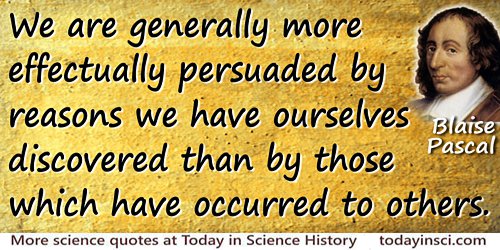
On se persuade mieux, pour l’ordinaire, par les raisons qu’on a soi-même trouvées, que par celles qui sont venues dans l’esprit des autres.
We are generally more effectually persuaded by reasons we have ourselves discovered than by those which have occurred to others.
We are generally more effectually persuaded by reasons we have ourselves discovered than by those which have occurred to others.
Pensées (1670), Section 1, aphorism 18. In H. F. Stewart (ed.), Pascal's Pensées (1950), 11. Original French text in Pensées de Pascal: publiées dans leur texte authentique (1866), Vol. 1, 99.
Question: Explain why, in order to cook food by boiling, at the top of a high mountain, you must employ a different method from that used at the sea level.
Answer: It is easy to cook food at the sea level by boiling it, but once you get above the sea level the only plan is to fry it in its own fat. It is, in fact, impossible to boil water above the sea level by any amount of heat. A different method, therefore, would have to be employed to boil food at the top of a high mountain, but what that method is has not yet been discovered. The future may reveal it to a daring experimentalist.
Answer: It is easy to cook food at the sea level by boiling it, but once you get above the sea level the only plan is to fry it in its own fat. It is, in fact, impossible to boil water above the sea level by any amount of heat. A different method, therefore, would have to be employed to boil food at the top of a high mountain, but what that method is has not yet been discovered. The future may reveal it to a daring experimentalist.
Genuine student answer* to an Acoustics, Light and Heat paper (1880), Science and Art Department, South Kensington, London, collected by Prof. Oliver Lodge. Quoted in Henry B. Wheatley, Literary Blunders (1893), 178-9, Question 11. (*From a collection in which Answers are not given verbatim et literatim, and some instances may combine several students' blunders.)
~~[Misattributed ?]~~ Mathematical discoveries, like springtime violets in the woods, have their season which no human can hasten or retard.
Webmaster believes this quote is likely a misattributed paraphrase. The subject quote is as given in Israel Kleiner, 'Thinking the Unthinkable: The Story of Complex Numbers (with a Moral)', Mathematics Teacher (Oct 1988), 81, No. 7, 590. In Kleiner’s paper, alongside the quote is a citation, thus: “(Kline 1972)?” Notice the appended question mark. The reference at the end of the paper gives: Morris Kline, Mathematical Thought from Ancient to Modern Times (1972), but without page number. Webmaster checked a later edition, Vol. 3 (1990), 861, in which Kline has an epigraph, with different wording about violets, attributed - not to János - but to his father, “Wolfgang Bolyai” (who is also known as Farkas Bolyai). Translator Abe Shenitzer wrote an ambiguous passage in Herbert Meschkowski, NonEuclidean Geometry (1964), 33. In a discussion posted in the NCTM online Math Forum in 1998, Shenitzer clarified that the proper reading is that the “violet talk” is a simile used in advice given by the father to his son. Note that in the passage, János (Johann/John) reports about that advice in narrative form. Thus, one should also note that even in the original language, perhaps the father’s words are not verbatim. See Farkas Bolyai Quotes on another page of this website.
230(231-1) ... is the greatest perfect number known at present, and probably the greatest that ever will be discovered; for; as they are merely curious without being useful, it is not likely that any person will attempt to find a number beyond it.
In An Elementary Investigation of the Theory of Numbers (1811), 43. The stated number, which evaluates as 2305843008139952128 was discovered by Euler in 1772 as the eighth known perfect number. It has 19 digits. By 2013, the 48th perfect number found had 34850340 digits.
A discovery in science, or a new theory, even when it appears most unitary and most all-embracing, deals with some immediate element of novelty or paradox within the framework of far vaster, unanalysed, unarticulated reserves of knowledge, experience, faith, and presupposition. Our progress is narrow; it takes a vast world unchallenged and for granted. This is one reason why, however great the novelty or scope of new discovery, we neither can, nor need, rebuild the house of the mind very rapidly. This is one reason why science, for all its revolutions, is conservative. This is why we will have to accept the fact that no one of us really will ever know very much. This is why we shall have to find comfort in the fact that, taken together, we know more and more.
Science and the Common Understanding (1954), 53-4.
A discovery is generally an unforeseen relation not included in theory.
From An Introduction to the Study of Experimental Medicine (1865), as translated by Henry Copley Greene (1957), 38.
A discovery is like falling in love and reaching the top of a mountain after a hard climb all in one, an ecstasy not induced by drugs but by the revelation of a face of nature that no one has seen before and that often turns out to be more subtle and wonderful than anyone had imagined.
'True Science', review of Peter Medawar, Advice to a Young Scientist (1980). In The London Review of Books (Mar 1981), 6.
A discovery must be, by definition, at variance with existing knowledge. During my lifetime, I made two. Both were rejected offhand by the popes of the field. Had I predicted these discoveries in my applications, and had those authorities been my judges, it is evident what their decisions would have been.
In 'Dionysians and Apollonians', Science (2 Jun 1972), 176, 966. Reprinted in Mary Ritchie Key, The Relationship of Verbal and Nonverbal Communication (1980), 318.
A drop from the nose of Fleming, who had a cold, fell onto an agar plate where large yellow colonies of a contaminant had grown, and lysosyme was discovered. He made this important discovery because when he saw that the colonies of the contaminant were fading, his mind went straight to the right cause of the phenomenon he was observing—that the drop from his nose contained a lytic substance. And also immediately, he thought that this substance might be present in many secretions and tissues of the body. And he found this was so—the substance was in tears, saliva, leucocytes, skin, fingernails, mother's milk—thus very widely distributed in amounts and also in plants.
Personal recollections of Alexander Fleming by Lady Amelia Fleming. Quoted in Molecular Cloning (2001), Vol. 1, 153.
A famous name has this peculiarity that it becomes gradually smaller especially in natural sciences where each succeeding discovery invariably overshadows what precedes.
H. S. Van Klooster, 'Van't Hoff (1852-1911) in Retrospect', Journal of Chemical Education (1952), 29, 376.
A few days afterwards, I went to him [the same actuary referred to in another quote] and very gravely told him that I had discovered the law of human mortality in the Carlisle Table, of which he thought very highly. I told him that the law was involved in this circumstance. Take the table of the expectation of life, choose any age, take its expectation and make the nearest integer a new age, do the same with that, and so on; begin at what age you like, you are sure to end at the place where the age past is equal, or most nearly equal, to the expectation to come. “You don’t mean that this always happens?”—“Try it.” He did try, again and again; and found it as I said. “This is, indeed, a curious thing; this is a discovery!” I might have sent him about trumpeting the law of life: but I contented myself with informing him that the same thing would happen with any table whatsoever in which the first column goes up and the second goes down.
In Budget of Paradoxes (1872), 172.
A few months after a devastating defeat at Fredericksburg,… President Abraham Lincoln signed into law an act creating the National Academy of Sciences—in the midst of civil war. Lincoln refused to accept that our nation’s sole purpose was mere survival. He created this academy, founded the land grant colleges, and began the work of the transcontinental railroad, believing that we must add—and I quote—“the fuel of interest to the fire of genius in the discovery … of new and useful things.”
Speech to the National Academy of Sciences Annual Meeting (27 Apr 2009).
A good method of discovery is to imagine certain members of a system removed and then see how what is left would behave: for example, where would we be if iron were absent from the world: this is an old example.
Aphorism 258 in Notebook J (1789-1793), as translated by R. J. Hollingdale in Aphorisms (1990). Reprinted as The Waste Books (2000), 181.
A great discovery solves a great problem, but there is a grain of discovery in the solution of any problem. Your problem may be modest, but if it challenges your curiosity and brings into play your inventive faculties, and if you solve it by your own means, you may experience the tension and enjoy the triumph of discovery.
From Preface to the first printing, reprinted in How to Solve It: A New Aspect of Mathematical Method (2004), v.
A lot of prizes have been awarded for showing the universe is not as simple as we might have thought.
In A Brief History of Time, (1988, 1998), 80.
A man of genius makes no mistakes. His errors are volitional and are the portals of discovery.
In Ulysses (1920), 190.
A mathematical truth is timeless, it does not come into being when we discover it. Yet its discovery is a very real event, it may be an emotion like a great gift from a fairy.
In 'Science and Religion', Mind and Matter (1958), collected in What is Life?: With Mind and Matter and Autobiographical Sketches (2012), 142.
A mathematician’s work is mostly a tangle of guesswork, analogy, wishful thinking and frustration, and proof, far from being the core of discovery, is more often than not a way of making sure that our minds are not playing tricks.
In Rota's 'Introduction' written (1980) to preface Philip J. Davis and Reuben Hersh, The Mathematical Experience (1981, 2012), xxii.
A moment’s consideration of this case shows what a really great advance in the theory and practise of breeding has been obtained through the discovery of Mendel’s law. What a puzzle this case would have presented to the biologist ten years ago! Agouti crossed with chocolate gives in the second filial generation (not in the first) four varieties, viz., agouti, chocolate, black and cinnamon. We could only have shaken our heads and looked wise (or skeptical).
Then we had no explanation to offer for such occurrences other than the “instability of color characters under domestication,” the “effects of inbreeding,” “maternal impressions.” Serious consideration would have been given to the proximity of cages containing both black and cinnamon-agouti mice.
Now we have a simple, rational explanation, which anyone can put to the test. We are able to predict the production of new varieties, and to produce them.
We must not, of course, in our exuberance, conclude that the powers of the hybridizer know no limits. The result under consideration consists, after all, only in the making of new combinations of unit characters, but it is much to know that these units exist and that all conceivable combinations of them are ordinarily capable of production. This valuable knowledge we owe to the discoverer and to the rediscoverers of Mendel’s law.
Then we had no explanation to offer for such occurrences other than the “instability of color characters under domestication,” the “effects of inbreeding,” “maternal impressions.” Serious consideration would have been given to the proximity of cages containing both black and cinnamon-agouti mice.
Now we have a simple, rational explanation, which anyone can put to the test. We are able to predict the production of new varieties, and to produce them.
We must not, of course, in our exuberance, conclude that the powers of the hybridizer know no limits. The result under consideration consists, after all, only in the making of new combinations of unit characters, but it is much to know that these units exist and that all conceivable combinations of them are ordinarily capable of production. This valuable knowledge we owe to the discoverer and to the rediscoverers of Mendel’s law.
'New Colour Variety of the Guinea Pig', Science, 1908, 28, 250-252.
A new era of ocean exploration can yield discoveries that will help inform everything from critical medical advances to sustainable forms of energy. Consider that AZT, an early treatment for HIV, is derived from a Caribbean reef sponge, or that a great deal of energy—from offshore wind, to OTEC (ocean thermal energy conservation), to wind and wave energy—is yet untapped in our oceans.
In 'Why Exploring the Ocean is Mankind’s Next Giant Leap', contributed to CNN 'Lightyears Blog' (13 Mar 2012).
A number of years ago, when I was a freshly-appointed instructor, I met, for the first time, a certain eminent historian of science. At the time I could only regard him with tolerant condescension.
I was sorry of the man who, it seemed to me, was forced to hover about the edges of science. He was compelled to shiver endlessly in the outskirts, getting only feeble warmth from the distant sun of science-in-progress; while I, just beginning my research, was bathed in the heady liquid heat up at the very center of the glow.
In a lifetime of being wrong at many a point, I was never more wrong. It was I, not he, who was wandering in the periphery. It was he, not I, who lived in the blaze.
I had fallen victim to the fallacy of the “growing edge;” the belief that only the very frontier of scientific advance counted; that everything that had been left behind by that advance was faded and dead.
But is that true? Because a tree in spring buds and comes greenly into leaf, are those leaves therefore the tree? If the newborn twigs and their leaves were all that existed, they would form a vague halo of green suspended in mid-air, but surely that is not the tree. The leaves, by themselves, are no more than trivial fluttering decoration. It is the trunk and limbs that give the tree its grandeur and the leaves themselves their meaning.
There is not a discovery in science, however revolutionary, however sparkling with insight, that does not arise out of what went before. “If I have seen further than other men,” said Isaac Newton, “it is because I have stood on the shoulders of giants.”
I was sorry of the man who, it seemed to me, was forced to hover about the edges of science. He was compelled to shiver endlessly in the outskirts, getting only feeble warmth from the distant sun of science-in-progress; while I, just beginning my research, was bathed in the heady liquid heat up at the very center of the glow.
In a lifetime of being wrong at many a point, I was never more wrong. It was I, not he, who was wandering in the periphery. It was he, not I, who lived in the blaze.
I had fallen victim to the fallacy of the “growing edge;” the belief that only the very frontier of scientific advance counted; that everything that had been left behind by that advance was faded and dead.
But is that true? Because a tree in spring buds and comes greenly into leaf, are those leaves therefore the tree? If the newborn twigs and their leaves were all that existed, they would form a vague halo of green suspended in mid-air, but surely that is not the tree. The leaves, by themselves, are no more than trivial fluttering decoration. It is the trunk and limbs that give the tree its grandeur and the leaves themselves their meaning.
There is not a discovery in science, however revolutionary, however sparkling with insight, that does not arise out of what went before. “If I have seen further than other men,” said Isaac Newton, “it is because I have stood on the shoulders of giants.”
Adding A Dimension: Seventeen Essays on the History of Science (1964), Introduction.
A political law or a scientific truth may be perilous to the morals or the faith of individuals; but it cannot on this ground be resisted by the Church. … A discovery may be made in science which will shake the faith of thousands; yet religion cannot regret it or object to it. The difference in this respect between a true and a false religion is, that one judges all things by the standard of their truth, the other by the touchstone of its own interests. A false religion fears the progress of all truth; a true religion seeks and recognises truth wherever it can be found.
From 'Cardinal Wiseman and the Home and Foreign Review' (1862), collected in John Emerich Edward Dalberg Acton Baron Acton, John Neville Figgis (ed.) and Reginald Vere Laurence (ed.), The History of Freedom and Other Essays (1907), 449-450. The Darwinian controversy was at its height when this was written.
A possible explanation for the observed excess noise is the one given by Dicke, Peebles, Roll, and Wilkinson (1965) in a companion letter in this issue.
[The low-key announcement of the detection of the cosmic microwave background radiation which is the afterglow of the Big Bang. Co-author with Robert Wilson. They received the 1978 Nobel Prize for their discovery.]
[The low-key announcement of the detection of the cosmic microwave background radiation which is the afterglow of the Big Bang. Co-author with Robert Wilson. They received the 1978 Nobel Prize for their discovery.]
'A measurement of excess antenna temperature at 4080 Mc/s'. In Astrophysical Journal (1965). Reprinted in R. B. Partridge, 3 K the cosmic microwave background radiation? (1995), Appendix A, 355.
A scientifically unimportant discovery is one which, however true and however interesting for other reasons, has no consequences for a system of theory with which scientists in that field are concerned.
The Structure of Social Action (1937), Vol. 1, 7.
A young person who reads a science book is confronted with a number of facts, x = ma … ma - me² … You never see in the scientific books what lies behind the discovery—the struggle and the passion of the person, who made that discovery.
From 'Asking Nature', collected in Lewis Wolpert and Alison Richards (eds.), Passionate Minds: The Inner World of Scientists (1997), 197.
About eight days ago I discovered that sulfur in burning, far from losing weight, on the contrary, gains it; it is the same with phosphorus; this increase of weight arises from a prodigious quantity of air that is fixed during combustion and combines with the vapors. This discovery, which I have established by experiments, that I regard as decisive, has led me to think that what is observed in the combustion of sulfur and phosphorus may well take place in the case of all substances that gain in weight by combustion and calcination; and I am persuaded that the increase in weight of metallic calxes is due to the same cause... This discovery seems to me one of the most interesting that has been made since Stahl and since it is difficult not to disclose something inadvertently in conversation with friends that could lead to the truth I have thought it necessary to make the present deposit to the Secretary of the Academy to await the time I make my experiments public.
Sealed note deposited with the Secretary of the French Academy 1 Nov 1772. Oeuvres de Lavoisier, Correspondance, Fasc. II. 1770-75 (1957), 389-90. Adapted from translation by A. N. Meldrum, The Eighteenth-Century Revolution in Science (1930), 3.
About the year 1772, being then an apprentice to a wheel-wright, or wagon maker, I laboured to discover some means of propelling land carriages without animal power. … one of my brothers [told me of] blacksmith’s boys, who, for amusement, had stopped up the touch hole of a gun barrel, then put in about a gill of water, and rammed down a tight wad; after which they put the breech in the smith’s fire, when it discharged itself with as loud a crack as if it had been loaded with powder. It immediately occurred to me, that here was the power to propel any wagon, if I could only apply it.
From 'On the Origin of Steam Boats and Steam Wagons', Thomas Cooper (ed.), The Emporium of Arts and Sciences (Feb 1814), 2, No. 2, 205.
Accurate and minute measurement seems to the non-scientific imagination, a less lofty and dignified work than looking for something new. But nearly all the grandest discoveries of science have been but the rewards of accurate measurement and patient long-continued labour in the minute sifting of numerical results.
Presidential inaugural address, to the General Meeting of the British Association, Edinburgh (2 Aug 1871). In Report of the Forty-First Meeting of the British Association for the Advancement of Science (1872), xci.
After all, most men are incapable of deciding for themselves, and have got to have a leader somewhere. If the new discoveries in mass suggestion enable us to make government easier, not only political, but moral and aesthetic, why not welcome them like other useful inventions? Why should science be limited to improvements in our control over nature, and exclude the most important part of our environment, our fellows? Get on the inside, join, as I used to be told, some party, and learn where the ropes come down within your reach. Adopt the high calling of Manipulator and save the State.
Such Machiavellis are not confined to Russia and Italy; one may find them all about even in this Land of the Free. … Still there remains in me a strange misgiving about making use of one’s fellows through an appeal to their weaknesses, even when all you do is to select their objects for them. In the elegant diction of Mr. Mencken, and in spite of the great weight of his authority, a government of the boobs, for the boobs and by the boobs to me still has its morbid charms.
Such Machiavellis are not confined to Russia and Italy; one may find them all about even in this Land of the Free. … Still there remains in me a strange misgiving about making use of one’s fellows through an appeal to their weaknesses, even when all you do is to select their objects for them. In the elegant diction of Mr. Mencken, and in spite of the great weight of his authority, a government of the boobs, for the boobs and by the boobs to me still has its morbid charms.
In Learned Hand and Irving Dilliard (ed.), The Spirit of Liberty: Papers and Addresses of Learned Hand (1952), 36.
After long reflection in solitude and meditation, I suddenly had the idea, during the year 1923, that the discovery made by Einstein in 1905 should be generalised by extending it to all material particles and notably to electrons.
Preface to his re-edited 1924 Ph.D. Thesis, Recherches sur la théorie des quanta (1963), 4. In Steve Adams, Frontiers (2000), 13.
After seeking in vain for the construction of a perpetual motion machine, the relations were investigated which must subsist between the forces of nature if such a machine is to be impossible; and this inverted question led to the discovery of the law of the conservation of energy, which, again, explained the impossibility of perpetual motion in the sense originally intended.
Opening of Lecture (1900), 'Mathematische Probleme' (Mathematical Problems), to the International Congress of Mathematicians, Paris. From the original German reprinted in David Hilbert: Gesammelte Abhandlungen (Collected Treatises, 1970), Vol. 3. For full citation, see the quote that begins, “This conviction of the solvability…”, on the David Hilbert Quotes page on this website.
After the discovery of spectral analysis no one trained in physics could doubt the problem of the atom would be solved when physicists had learned to understand the language of spectra. So manifold was the enormous amount of material that has been accumulated in sixty years of spectroscopic research that it seemed at first beyond the possibility of disentanglement. An almost greater enlightenment has resulted from the seven years of Röntgen spectroscopy, inasmuch as it has attacked the problem of the atom at its very root, and illuminates the interior. What we are nowadays hearing of the language of spectra is a true 'music of the spheres' in order and harmony that becomes ever more perfect in spite of the manifold variety. The theory of spectral lines will bear the name of Bohr for all time. But yet another name will be permanently associated with it, that of Planck. All integral laws of spectral lines and of atomic theory spring originally from the quantum theory. It is the mysterious organon on which Nature plays her music of the spectra, and according to the rhythm of which she regulates the structure of the atoms and nuclei.
Atombau und Spektrallinien (1919), viii, Atomic Structure and Spectral Lines, trans. Henry L. Brose (1923), viii.
All creation is a mine, and every man a miner.
The whole earth, and all within it, upon it, and round about it, including himself … are the infinitely various “leads” from which, man, from the first, was to dig out his destiny.
The whole earth, and all within it, upon it, and round about it, including himself … are the infinitely various “leads” from which, man, from the first, was to dig out his destiny.
Opening sentences of lecture 'Discoveries and Inventions', (1860) in Discoveries and Inventions (1915).
All fossil anthropoids found hitherto have been known only from mandibular or maxillary fragments, so far as crania are concerned, and so the general appearance of the types they represented had been unknown; consequently, a condition of affairs where virtually the whole face and lower jaw, replete with teeth, together with the major portion of the brain pattern, have been preserved, constitutes a specimen of unusual value in fossil anthropoid discovery. Here, as in Homo rhodesiensis, Southern Africa has provided documents of higher primate evolution that are amongst the most complete extant. Apart from this evidential completeness, the specimen is of importance because it exhibits an extinct race of apes intermediate between living anthropoids and man ... Whether our present fossil is to be correlated with the discoveries made in India is not yet apparent; that question can only be solved by a careful comparison of the permanent molar teeth from both localities. It is obvious, meanwhile, that it represents a fossil group distinctly advanced beyond living anthropoids in those two dominantly human characters of facial and dental recession on one hand, and improved quality of the brain on the other. Unlike Pithecanthropus, it does not represent an ape-like man, a caricature of precocious hominid failure, but a creature well advanced beyond modern anthropoids in just those characters, facial and cerebral, which are to be anticipated in an extinct link between man and his simian ancestor. At the same time, it is equally evident that a creature with anthropoid brain capacity and lacking the distinctive, localised temporal expansions which appear to be concomitant with and necessary to articulate man, is no true man. It is therefore logically regarded as a man-like ape. I propose tentatively, then, that a new family of Homo-simidæ be created for the reception of the group of individuals which it represents, and that the first known species of the group be designated Australopithecus africanus, in commemoration, first, of the extreme southern and unexpected horizon of its discovery, and secondly, of the continent in which so many new and important discoveries connected with the early history of man have recently been made, thus vindicating the Darwinian claim that Africa would prove to be the cradle of mankind.
'Australopithicus africanus: The Man-Ape of South Africa', Nature, 1925, 115, 195.
All great achievements in science start from intuitive knowledge, namely, in axioms, from which deductions are then made. … Intuition is the necessary condition for the discovery of such axioms.
In Conversations with Einstein by Alexander Moszkowski (1970).
All great discoveries are made by men whose feelings run ahead of their thinking.
'Sermons. III. Coming to the Truth'. In Anna L. Ward, A Dictionary of Quotations in Prose from American and Foreign Authors (1889), 585, No. 1190
All great scientists have, in a certain sense, been great artists; the man with no imagination may collect facts, but he cannot make great discoveries.
From The Grammar of Science (1892), 37.
All human affairs follow nature's great analogue, the growth of vegetation. There are three periods of growth in every plant. The first, and slowest, is the invisible growth by the root; the second and much accelerated is the visible growth by the stem; but when root and stem have gathered their forces, there comes the third period, in which the plant quickly flashes into blossom and rushes into fruit.
The beginnings of moral enterprises in this world are never to be measured by any apparent growth. ... At length comes the sudden ripeness and the full success, and he who is called in at the final moment deems this success his own. He is but the reaper and not the labourer. Other men sowed and tilled and he but enters into their labours.
The beginnings of moral enterprises in this world are never to be measured by any apparent growth. ... At length comes the sudden ripeness and the full success, and he who is called in at the final moment deems this success his own. He is but the reaper and not the labourer. Other men sowed and tilled and he but enters into their labours.
Life Thoughts (1858), 20.
All human discoveries seem to be made only for the purpose of confirming more strongly the truths come from on high, and contained in the sacred writings.
Quoted in Marcel de Serres, 'On the Physical Facts in the Bible Compared with the Discoveries of the Modern Sciences', The Edinburgh New Philosophical Journal (1845), Vol. 38, 260.
All knowledge is profitable; profitable in its ennobling effect on the character, in the pleasure it imparts in its acquisition, as well as in the power it gives over the operations of mind and of matter. All knowledge is useful; every part of this complex system of nature is connected with every other. Nothing is isolated. The discovery of to-day, which appears unconnected with any useful process, may, in the course of a few years, become the fruitful source of a thousand inventions.
In 'Report of the Secretary', Sixth Annual Report of the Board of Regents of the Smithsonian Institution for 1851 (1852), 10.
All science is concerned with the relationship of cause and effect. Each scientific discovery increases man’s ability to predict the consequences of his actions and thus his ability to control future events.
…...
All that concerns the Mediterranean is of the deepest interest to civilized man, for the history of its progress is the history of the development of the world; the memory of the great men who have lived and died around its banks; the recollection of the undying works that have come thence to delight us for ever; the story of patient research and brilliant discoveries connected with every physical phenomenon presented by its waves and currents, and with every order of creatures dwelling in and around its waters.
From Literary Papers (1855), 106. As quoted in On Early Explorations in the Mediterranean.In George Wilson and Archibald Geikie, Memoir of Edward Forbes F.R.S. (1861), 279. Geike introduces the Forbes quote as “the recollection of these, his earliest explorations in the Mediterranean,” as written down years later.
All the modern higher mathematics is based on a calculus of operations, on laws of thought. All mathematics, from the first, was so in reality; but the evolvers of the modern higher calculus have known that it is so. Therefore elementary teachers who, at the present day, persist in thinking about algebra and arithmetic as dealing with laws of number, and about geometry as dealing with laws of surface and solid content, are doing the best that in them lies to put their pupils on the wrong track for reaching in the future any true understanding of the higher algebras. Algebras deal not with laws of number, but with such laws of the human thinking machinery as have been discovered in the course of investigations on numbers. Plane geometry deals with such laws of thought as were discovered by men intent on finding out how to measure surface; and solid geometry with such additional laws of thought as were discovered when men began to extend geometry into three dimensions.
In Lectures on the Logic of Arithmetic (1903), Preface, 18-19.
All the truths of mathematics are linked to each other, and all means of discovering them are equally admissible.
In article by Jean Itard, 'Legendre, Adrien-Marie', in Charles Coulston Gillespie (ed.), Dictionary of Scientific Biography (1973), Vol. 8, 142.
Almost all great advances have sprung originally from disinterested motives. Scientific discoveries have been made for their own sake and not for their utilization, and a race of men without a disinterested love of knowledge would never have achieved our present scientific technique. … Faraday, Maxwell, and Hertz, so far as can be discovered, never for a moment considered the possibility of any practical application of their investigations.
In The Scientific Outlook (1931), 152-153.
Almost all the greatest discoveries in astronomy have resulted from what we have elsewhere termed Residual Phenomena, of a qualitative or numerical kind, of such portions of the numerical or quantitative results of observation as remain outstanding and unaccounted for, after subducting and allowing for all that would result from the strict application of known principles.
Outlines of Astronomy (1876), 626.
Although Rick [Richard Smalley] made enormous contributions to science, I believe his worldwide contributions in making so many of us aware of the huge energy problem is even greater and longer-lasting than the beautiful science that he discovered.
As quoted in Eric Berger, Houston Chronicle (28 Oct 2005).
An apple falls in front of Newton, a pot boils before Papin, a flaming sheet of paper floats before the eyes of Montgolfier. At intervals a discovery bursts forth like a mine explosion in the deeps of science, and a whole ledge of prejudice crumbles, and the living rock of truth is suddenly laid bare.
In Victor Hugo and Lorenzo O'Rourke (trans.) Victor Hugo’s Intellectual Autobiography: (Postscriptum de ma vie) (1907), 323-324.
An experiment is an observation that can be repeated, isolated and varied. The more frequently you can repeat an observation, the more likely are you to see clearly what is there and to describe accurately what you have seen. The more strictly you can isolate an observation, the easier does your task of observation become, and the less danger is there of your being led astray by irrelevant circumstances, or of placing emphasis on the wrong point. The more widely you can vary an observation, the more clearly will the uniformity of experience stand out, and the better is your chance of discovering laws.
In A Text-Book of Psychology (1909), 20.
An inventor is an opportunist, one who takes occasion by the hand; who, having seen where some want exists, successfully applies the right means to attain the desired end. The means may be largely, or even wholly, something already known, or there may be a certain originality or discovery in the means employed. But in every case the inventor uses the work of others. If I may use a metaphor, I should liken him to the man who essays the conquest of some virgin alp. At the outset he uses the beaten track, and, as he progresses in the ascent, he uses the steps made by those who have preceded him, whenever they lead in the right direction; and it is only after the last footprints have died out that he takes ice-axe in hand and cuts the remaining steps, few or many, that lift him to the crowning height which is his goal.
In Kenneth Raydon Swan, Sir Joseph Swan (1946), 44.
Analysis and natural philosophy owe their most important discoveries to this fruitful means, which is called induction. Newton was indebted to it for his theorem of the binomial and the principle of universal gravity.
In Frederick Wilson Truscott (trans.) and Frederick Lincoln Emory (trans.), A Philosophical Essay on Probabilities (1902), 176.
Anatomists have ever been engaged in contention. And indeed, if a man has not such a degree of enthusiasm, and love of the art, as will make him impatient of unreasonable opposition and of encroachments upon his discoveries and his reputation, he will hardly become considerable in Anatomy or in any branch of natural knowledge.
Medical Commentaries (1764), Introduction, iii. In Charles Coulston Gillespie (ed.), Dictionary of Scientific Biography (1972), Vol. 6, 569.
Another argument of hope may be drawn from this–that some of the inventions already known are such as before they were discovered it could hardly have entered any man's head to think of; they would have been simply set aside as impossible. For in conjecturing what may be men set before them the example of what has been, and divine of the new with an imagination preoccupied and colored by the old; which way of forming opinions is very fallacious, for streams that are drawn from the springheads of nature do not always run in the old channels.
Translation of Novum Organum, XCII. In Francis Bacon, James Spedding, The Works of Francis Bacon (1864), Vol. 8, 128.
Any scientist of any age who wants to make important discoveries must study important problems. Dull or piffling problems yield dull or piffling answers. It is not not enough that a problem should be “interesting.” … The problem must be such that it matters what the answer is—whether to science generally or to mankind.
From 'What Shall I Do Research On?', Advice to a Young Scientist (1979), 13.
Applied research generates improvements, not breakthroughs. Great scientific advances spring from pure research. Even scientists renowned for their “useful” applied discoveries often achieved success only when they abandoned their ostensible applied-science goal and allowed their minds to soar—as when Alexander Fleming, “just playing about,” refrained from throwing away green molds that had ruined his experiment, studied them, and discovered penicillin. Or when C. A. Clarke, a physician affiliated with the University of Liverpool, became intrigued in the 1950s by genetically created color patterns that emerged when he cross-bred butterflies as a hobby. His fascination led him—“by the pleasant route of pursuing idle curiosity”—to the successful idea for preventing the sometimes fatal anemia that threatened babies born of a positive-Rhesus-factor father and a negative-Rhesus-factor mother.
In Jacques Cousteau and Susan Schiefelbein, The Human, the Orchid, and the Octopus: Exploring and Conserving Our Natural World (2007), 214-215.
Archimedes had discovered the truth about several important natural laws, but more significant—at least from Galileo’s standpoint—was Archimedes’s discovery of a way for a scientist to solve problems: first separating what he truly wants to solve from irrelevant externals and then attacking the core of the problem with boldness and imagination. Galileo realized that this approach was suitable for his own studies.
In Galileo and Newton (1964), 23.
Archimedes said Eureka,
Cos in English he weren't too aversed in,
when he discovered that the volume of a body in the bath,
is equal to the stuff it is immersed in,
That is the law of displacement,
Thats why ships don't sink,
Its a shame he weren't around in 1912,
The Titanic would have made him think.
Cos in English he weren't too aversed in,
when he discovered that the volume of a body in the bath,
is equal to the stuff it is immersed in,
That is the law of displacement,
Thats why ships don't sink,
Its a shame he weren't around in 1912,
The Titanic would have made him think.
From lyrics of song Sod’s Law.
Ardent desire for knowledge, in fact, is the one motive attracting and supporting investigators in their efforts; and just this knowledge, really grasped and yet always flying before them, becomes at once their sole torment and their sole happiness. Those who do not know the torment of the unknown cannot have the joy of discovery which is certainly the liveliest that the mind of man can ever feel.
From An Introduction to the Study of Experimental Medicine (1927, 1957), 221-222, as translated by Henry Copley Greene. From the original French by Claude Bernard: “Le désir ardent de la connaissance est l’unique mobile qui attire et soutient l’investigateur dans ses efforts; et c’est précisément cette connaissance qu’il saisit réellement et qui fuit cependant toujours devant lui, qui devient à la fois son seul tourment et son seul bonheur. Celui qui ne connaît pas les tourments de l’inconnu doit ignorer les joies de la découverte qui sont certainement les plus vives que l’esprit de l’homme puisse jamais ressentir.” (1865), 388. A Google translation gives: “The ardent desire for knowledge is the only motive which attracts and sustains the inquirer in his efforts; and it is precisely this knowledge which he really grasps and which nevertheless always flees before him, which becomes at the same time his only torment and his only happiness. He who does not know the torments of the unknown must ignore the joys of discovery which are certainly the most vivid that the mind of man can ever experience.”
Aristotle discovered all the half-truths which were necessary to the creation of science.
From Dialogue XLII in Alfred North Whitehead and Lucien Price (ed.), Dialogues of Alfred North Whitehead (1954, 1977), 344.
Arithmetic must be discovered in just the same sense in which Columbus discovered the West Indies, and we no more create numbers than he created the Indians.
The Principles of Mathematics (1903), 451.
Art is more godlike than science. Science discovers; art creates.
As given, without citation, in Maturin Murray Ballo, Edge-Tools of Speech (1851), 25. Also in a fictional conversation in novel by Baron Edward Bulwer Lytton, Zanoni (1842), 89.
Art, science, discovery and invention, startle and bewilder us at every turn, by their rapid, vast and wonderful achievements. These forces have made men lords where they were vassals, masters where they were slaves, and kings where they were subjects. They have abolished the limitations of time and space and have brought the ends of the earth together.
From speech (20 Nov 1883) delivered to the Bethel Literary and Historical Association, Washington D.C.,'It Moves, or Philosophy of Reform' , collected in The Speeches of Frederick Douglass (2018), 387.
As a boy I had liked both drawing and physics, and I always abhorred the role of being a spectator. In 1908, when I was 15, I designed, built and flew a toy model airplane which won the then-famous James Gordon Bennett Cup. By 16 I had discovered that design could be fun and profitable, and this lesson has never been lost on me.
On the official Raymond Loewry website.
As every circumstance relating to so capital a discovery as this (the greatest, perhaps, that has been made in the whole compass of philosophy, since the time of Sir Isaac Newton) cannot but give pleasure to all my readers, I shall endeavour to gratify them with the communication of a few particulars which I have from the best authority. The Doctor [Benjamin Franklin], after having published his method of verifying his hypothesis concerning the sameness of electricity with the matter lightning, was waiting for the erection of a spire in Philadelphia to carry his views into execution; not imagining that a pointed rod, of a moderate height, could answer the purpose; when it occurred to him, that, by means of a common kite, he could have a readier and better access to the regions of thunder than by any spire whatever. Preparing, therefore, a large silk handkerchief, and two cross sticks, of a proper length, on which to extend it, he took the opportunity of the first approaching thunder storm to take a walk into a field, in which there was a shed convenient for his purpose. But dreading the ridicule which too commonly attends unsuccessful attempts in science, he communicated his intended experiment to no body but his son, who assisted him in raising the kite.
The kite being raised, a considerable time elapsed before there was any appearance of its being electrified. One very promising cloud passed over it without any effect; when, at length, just as he was beginning to despair of his contrivance, he observed some loose threads of the hempen string to stand erect, and to avoid one another, just as if they had been suspended on a common conductor. Struck with this promising appearance, he inmmediately presented his knuckle to the key, and (let the reader judge of the exquisite pleasure he must have felt at that moment) the discovery was complete. He perceived a very evident electric spark. Others succeeded, even before the string was wet, so as to put the matter past all dispute, and when the rain had wetted the string, he collected electric fire very copiously. This happened in June 1752, a month after the electricians in France had verified the same theory, but before he had heard of any thing that they had done.
The kite being raised, a considerable time elapsed before there was any appearance of its being electrified. One very promising cloud passed over it without any effect; when, at length, just as he was beginning to despair of his contrivance, he observed some loose threads of the hempen string to stand erect, and to avoid one another, just as if they had been suspended on a common conductor. Struck with this promising appearance, he inmmediately presented his knuckle to the key, and (let the reader judge of the exquisite pleasure he must have felt at that moment) the discovery was complete. He perceived a very evident electric spark. Others succeeded, even before the string was wet, so as to put the matter past all dispute, and when the rain had wetted the string, he collected electric fire very copiously. This happened in June 1752, a month after the electricians in France had verified the same theory, but before he had heard of any thing that they had done.
The History and Present State of Electricity, with Original Experiments (1767, 3rd ed. 1775), Vol. 1, 216-7.
![Robert Fulton quote: As the component parts of all new machines may be said to be old[,] it is a nice discriminating judgment,](https://todayinsci.com/F/Fulton_Robert/FultonRobert-Mechanic500x250px.jpg)
As the component parts of all new machines may be said to be old[,] it is a nice discriminating judgment, which discovers that a particular arrangement will produce a new and desired effect. ... Therefore, the mechanic should sit down among levers, screws, wedges, wheels, etc. like a poet among the letters of the alphabet, considering them as the exhibition of his thoughts; in which a new arrangement transmits a new idea to the world.
A Treatise on the Improvement of Canal Navigation (1796), preface, x.
Astronomy is older than physics. In fact, it got physics started by showing the beautiful simplicity of the motion of the stars and planets, the understanding of which was the beginning of physics. But the most remarkable discovery in all of astronomy is that the stars are made of atoms of the same kind as those on the earth.
In 'Astronomy', The Feynman Lectures on Physics (1961), Vol. 1, 3-6.
Astronomy is perhaps the science whose discoveries owe least to chance, in which human understanding appears in its whole magnitude, and through which man can best learn how small he is.
Aphorism 23 in Notebook C (1772-1773), as translated by R.J. Hollingdale in Aphorisms (1990). Reprinted as The Waste Books (2000), 35.
Astronomy may be revolutionized more than any other field of science by observations from above the atmosphere. Study of the planets, the Sun, the stars, and the rarified matter in space should all be profoundly influenced by measurements from balloons, rockets, probes and satellites. ... In a new adventure of discovery no one can foretell what will be found, and it is probably safe to predict that the most important new discovery that will be made with flying telescopes will be quite unexpected and unforeseen. (1961)
Opening and closing of 'Flying Telescopes', Bulletin of the Atomic Scientists (May 1961), Vol. 17, No. 5, 191 and 194.
At last have made wonderful discovery in valley; a magnificent tomb with seals intact; re-covered same for your arrival; congratulations.
Telegram (6 Nov 1922) sent to Lord Carnarvon. In The Discovery of the Tomb of Tutankhamen (1923, 1977), 90.
At lunch Francis [Crick] winged into the Eagle to tell everyone within hearing distance that we had found the secret of life.
Purported remark made at The Eagle pub (28 Feb 1953), near the Cavendish Laboratory in Cambridge, to celebrate the fact that they, Crick and Watson, had unravelled the structure of DNA. Stated by James Watson in The Double Helix: A Personal Account of the Discovery of the Structure of DNA (1968, 1998), 197. However Francis Crick, in What Mad Pursuit (1990), 77, writes that was “according to Jim,” but “of that I have no recollection.” Nevertheless, some quote collections report this incident with a direct quote as “We have discovered the secret of life!”
At the Egyptian city of Naucratis there was a famous old god whose name was Theuth; the bird which is called the Ibis was sacred to him, and he was the inventor of many arts, such as arithmetic and calculation and geometry and astronomy and draughts and dice, but his great discovery was the use of letters.
— Plato
In the Phaedrus. Collected in Plato the Teacher (1897), 171. A footnote gives that Naucratis was a city in the Delta of Egypt, on a branch of the Nile.
At the moment I am occupied by an investigation with Kirchoff which does not allow us to sleep. Kirchoff has made a totally unexpected discovery, inasmuch as he has found out the cause for the dark lines in the solar spectrum and can produce these lines artificially intensified both in the solar spectrum and in the continuous spectrum of a flame, their position being identical with that of Fraunhofer’s lines. Hence the path is opened for the determination of the chemical composition of the Sun and the fixed stars.
Letter to H.E. Roscoe (Nov 1859). In The Life and Experiences of Sir Henry Enfield Roscoe (1906), 81.
At the moment I am occupied by an investigation with Kirchoff which does not allow us to sleep. Kirchoff has made a totally unexpected discovery, inasmuch as he has found out the cause for the dark lines in the solar spectrum and can produce these lines artificially intensified both in the solar spectrum and in the continuous spectrum of a flame, their position being identical with that of Fraunhofer’s lines. Hence the path is opened for the determination of the chemical composition of the Sun and the fixed stars.
Letter to H.E. Roscoe (Nov 1859). In The Life and Experiences of Sir Henry Enfield Roscoe (1906), 71.
At the voice of comparative anatomy, every bone, and fragment of a bone, resumed its place. I cannot find words to express the pleasure I have in seeing, as I discovered one character, how all the consequences, which I predicted from it, were successively confirmed; the feet were found in accordance with the characters announced by the teeth; the teeth in harmony with those indicated beforehand by the feet; the bones of the legs and thighs, and every connecting portion of the extremities, were found set together precisely as I had arranged them, before my conjectures were verified by the discovery of the parts entire: in short, each species was, as it were, reconstructed from a single one of its component elements.
Geology and Mineralogy (1836), Vol. I, 83-4.
At this point, however, I have no intention whatever of criticizing the false teachings of Galen, who is easily first among the professors of dissection, for I certainly do not wish to start off by gaining a reputation for impiety toward him, the author of all good things, or by seeming insubordinate to his authority. For I am well aware how upset the practitioners (unlike the followers of Aristotle) invariably become nowadays, when they discover in the course of a single dissection that Galen has departed on two hundred or more occasions from the true description of the harmony, function, and action of the human parts, and how grimly they examine the dissected portions as they strive with all the zeal at their command to defend him. Yet even they, drawn by their love of truth, are gradually calming down and placing more faith in their own not ineffective eyes and reason than in Galen’s writings.
From De Humani Corporis Fabrica Libri Septem: (1543), Book I, iv, as translated by William Frank Richardson, in On The Fabric of the Human Body: Book I: The Bones and Cartilages (1998), Preface, liv.
Before the promulgation of the periodic law the chemical elements were mere fragmentary incidental facts in nature; there was no special reason to expect the discovery of new elements, and the new ones which were discovered from time to time appeared to be possessed of quite novel properties. The law of periodicity first enabled us to perceive undiscovered elements at a distance which formerly were inaccessible to chemical vision, and long ere they were discovered new elements appeared before our eyes possessed of a number of well-defined properties.
In Faraday Lecture, delivered before the Fellows of the Chemical Society in the Theatre of the Royal Institution (4 Jun 1889), printed in Professor Mendeléeff, 'The Periodic Law of the Chemical Elements', Transactions of the Chemical Society (1889), 55, 648.
Behind and permeating all our scientific activity, whether in critical analysis or in discovery, there is an elementary and overwhelming faith in the possibility of grasping the real world with out concepts, and, above all, faith in the truth over which we have no control but in the service of which our rationality stands or falls. Faith and intrinsic rationality are interlocked with one another
Christian Theology of Scientific Culture (1981), 63. In Vinoth Ramachandra, Subverting Global Myths: Theology and the Public Issues Shaping our World (2008), 187.
Being also in accord with Goethe that discoveries are made by the age and not by the individual, I should consider the instances to be exceedingly rare of men who can be said to be living before their age, and to be the repository of knowledge quite foreign to the thought of the time. The rule is that a number of persons are employed at a particular piece of work, but one being a few steps in advance of the others is able to crown the edifice with his name, or, having the ability to generalise already known facts, may become in time to be regarded as their originator. Therefore it is that one name is remembered whilst those of coequals have long been buried in obscurity.
In Historical Notes on Bright's Disease, Addison's Disease, and Hodgkin's Disease', Guy's Hospital Reports (1877), 22, 259-260.
Being in love with the one parent and hating the other are among the essential constituents of the stock of psychical impulses which is formed at that time and which is of such importance in determining the symptoms of the later neurosis... This discovery is confirmed by a legend that has come down to us from classical antiquity: a legend whose profound and universal power to move can only be understood if the hypothesis I have put forward in regard to the psychology of children has an equally universal validity. What I have in mind is the legend of King Oedipus and Sophocles' drama which bears his name.
The Interpretation of Dreams (1900), In James Strachey (ed.) The Standard Edition of the Complete Psychological Works of Sigmund Freud (1953), Vol. 4, 260-1.
Brutes by their natural instinct have produced many discoveries, whereas men by discussion and the conclusions of reason have given birth to few or none.
Novum Organum, LXXIII
But in practical affairs, particularly in politics, men are needed who combine human experience and interest in human relations with a knowledge of science and technology. Moreover, they must be men of action and not contemplation. I have the impression that no method of education can produce people with all the qualities required. I am haunted by the idea that this break in human civilization, caused by the discovery of the scientific method, may be irreparable.
— Max Born
My Life & My Views (1968), 57-8.
But it is just this characteristic of simplicity in the laws of nature hitherto discovered which it would be fallacious to generalize, for it is obvious that simplicity has been a part cause of their discovery, and can, therefore, give no ground for the supposition that other undiscovered laws are equally simple.
From Herbert Spencer lecture delivered at Oxford (1914) 'On Scientific Method in Philosophy', collected in Mysticism and Logic and Other Essays (1919), 102.
But just as astronomy succeeded astrology, following Kepler's discovery of planetary regularities, the discoveries of these many principles in empirical explorations of intellectual processes in machines should lead to a science, eventually.
[Co-author with South African mathematician, Seymour Papert (1928- )]
[Co-author with South African mathematician, Seymour Papert (1928- )]
Artificial Intelligence (1973), 25.
But medicine has long had all its means to hand, and has discovered both a principle and a method, through which the discoveries made during a long period are many and excellent, while full discovery will be made, if the inquirer be competent, conduct his researches with knowledge of the discoveries already made, and make them his starting-point. But anyone who, casting aside and rejecting all these means, attempts to conduct research in any other way or after another fashion, and asserts that he has found out anything, is and has been victim of deception.
Ancient Medicine, in Hippocrates, trans. W. H. S. Jones (1923), Vol. I, 15.
But neither thirty years, nor thirty centuries, affect the clearness, or the charm, of Geometrical truths. Such a theorem as “the square of the hypotenuse of a right-angled triangle is equal to the sum of the squares of the sides” is as dazzlingly beautiful now as it was in the day when Pythagoras first discovered it, and celebrated its advent, it is said, by sacrificing a hecatomb of oxen—a method of doing honour to Science that has always seemed to me slightly exaggerated and uncalled-for. One can imagine oneself, even in these degenerate days, marking the epoch of some brilliant scientific discovery by inviting a convivial friend or two, to join one in a beefsteak and a bottle of wine. But a hecatomb of oxen! It would produce a quite inconvenient supply of beef.
Written without pseudonym as Charles L. Dodgson, in Introduction to A New Theory of Parallels (1888, 1890), xvi. Note: a hecatomb is a great public sacrifice, originally of a hundred oxen.
But nothing of a nature foreign to the duties of my profession [clergyman] engaged my attention while I was at Leeds so much as the, prosecution of my experiments relating to electricity, and especially the doctrine of air. The last I was led into a consequence of inhabiting a house adjoining to a public brewery, where first amused myself with making experiments on fixed air [carbon dioxide] which found ready made in the process of fermentation. When I removed from that house, I was under the necessity making the fixed air for myself; and one experiment leading to another, as I have distinctly and faithfully noted in my various publications on the subject, I by degrees contrived a convenient apparatus for the purpose, but of the cheapest kind. When I began these experiments I knew very little of chemistry, and had in a manner no idea on the subject before I attended a course of chymical lectures delivered in the Academy at Warrington by Dr. Turner of Liverpool. But I have often thought that upon the whole, this circumstance was no disadvantage to me; as in this situation I was led to devise an apparatus and processes of my own, adapted to my peculiar views. Whereas, if I had been previously accustomed to the usual chemical processes, I should not have so easily thought of any other; and without new modes of operation I should hardly have discovered anything materially new.
Memoirs of Dr. Joseph Priestley, in the Year 1795 (1806), Vol. 1, 61-2.
But why, it has been asked, did you go there [the Antarctic]? Of what use to civilization can this lifeless continent be? ... [Earlier] expeditions contributed something to the accumulating knowledge of the Antarctic ... that helps us thrust back further the physical and spiritual shadows enfolding our terrestrial existence. Is it not true that one of the strongest and most continuously sustained impulses working in civilization is that which leads to discovery? As long as any part of the world remains obscure, the curiosity of man must draw him there, as the lodestone draws the mariner's needle, until he comprehends its secret.
In 'Hoover Presents Special Medal to Byrd...', New York Times (21 Jun 1930), 1.
But, contrary to the lady’s prejudices about the engineering profession, the fact is that quite some time ago the tables were turned between theory and applications in the physical sciences. Since World War II the discoveries that have changed the world are not made so much in lofty halls of theoretical physics as in the less-noticed labs of engineering and experimental physics. The roles of pure and applied science have been reversed; they are no longer what they were in the golden age of physics, in the age of Einstein, Schrödinger, Fermi and Dirac.
'The Age of Computing: a Personal Memoir', Daedalus (1992), 121, 120.
By and large it is uniformly true in mathematics that there is a time lapse between a mathematical discovery and the moment when it is useful; and that this lapse of time can be anything from 30 to 100 years, in some cases even more.
From Address (1954) to Princeton Alumni, 'The Role of Mathematics in the Sciences and in Society', published in A.H. Taub (ed.), John von Neumann: Collected Works (1963), Vol. 6, 489. As quoted and cited in Rosemary Schmalz,Out of the Mouths of Mathematicians: A Quotation Book for Philomaths (1993), 123.
By research in pure science I mean research made without any idea of application to industrial matters but solely with the view of extending our knowledge of the Laws of Nature. I will give just one example of the ‘utility’ of this kind of research, one that has been brought into great prominence by the War—I mean the use of X-rays in surgery. Now, not to speak of what is beyond money value, the saving of pain, or, it may be, the life of the wounded, and of bitter grief to those who loved them, the benefit which the state has derived from the restoration of so many to life and limb, able to render services which would otherwise have been lost, is almost incalculable. Now, how was this method discovered? It was not the result of a research in applied science starting to find an improved method of locating bullet wounds. This might have led to improved probes, but we cannot imagine it leading to the discovery of X-rays. No, this method is due to an investigation in pure science, made with the object of discovering what is the nature of Electricity. The experiments which led to this discovery seemed to be as remote from ‘humanistic interest’ —to use a much misappropriated word—as anything that could well be imagined. The apparatus consisted of glass vessels from which the last drops of air had been sucked, and which emitted a weird greenish light when stimulated by formidable looking instruments called induction coils. Near by, perhaps, were great coils of wire and iron built up into electro-magnets. I know well the impression it made on the average spectator, for I have been occupied in experiments of this kind nearly all my life, notwithstanding the advice, given in perfect good faith, by non-scientific visitors to the laboratory, to put that aside and spend my time on something useful.
In Speech made on behalf of a delegation from the Conjoint Board of Scientific Studies in 1916 to Lord Crewe, then Lord President of the Council. In George Paget Thomson, J. J. Thomson and the Cavendish Laboratory in His Day (1965), 167-8.
Chance … in the accommodation peculiar to sensorimotor intelligence, plays the same role as in scientific discovery. It is only useful to the genius and its revelations remain meaningless to the unskilled.
In The Origin of Intelligence in the Child (1936), trans. Margaret Cook (1953), 303.
Chemistry is not a primitive science like geometry and astronomy; it is constructed from the debris of a previous scientific formation; a formation half chimerical and half positive, itself found on the treasure slowly amassed by the practical discoveries of metallurgy, medicine, industry and domestic economy. It has to do with alchemy, which pretended to enrich its adepts by teaching them to manufacture gold and silver, to shield them from diseases by the preparation of the panacea, and, finally, to obtain for them perfect felicity by identifying them with the soul of the world and the universal spirit.
From Les Origines de l’Alchimie (1885), 1-2. Translation as quoted in Harry Shipley Fry, 'An Outline of the History of Chemistry Symbolically Represented in a Rookwood Fountain', The Journal of Industrial and Engineering Chemistry (1 Sep 1922), 14, No. 9, 868. From the original French, “La Chimie n’est pas une science primitive, comme la géométrie ou l’astronomie; elle s’est constituée sur les débris d’une formation scientifique antérieure; formation demi-chimérique et demi-positive, fondée elle-même sur le trésor lentement amassé des découvertes pratiques de la métallurgie, de la médecine, de l’industrie et de l’économie domestique. Il s’agit de l’alchimie, qui prétendait à la fois enrichir ses adeptes en leur apprenant à fabriquer l’or et l’argent, les mettre à l’abri des maladies par la préparation de la panacée, enfin leur procurer le bonheur parfait en les identifiant avec l’âme du monde et l’esprit universel.”
Chemistry teaches us to regard under one aspect, as various types of combustion or oxidation, the burning of a candle, the rusting of metals, the physiological process of respiration, and the explosion of gunpowder. In each process there is the one common fact that oxygen enters into new chemical combinations. Similarly to the physicist, the fall of the traditional apple of Newton, the revolution of the earth and planets round the sun, the apparitions of comets, and the ebb and flow of the tides are all phases of the universal law of gravitation. A race ignorant of the nature of combustion or of the law of gravitation, and ignorant of the need of such generalisations, could not be considered to have advanced far along the paths of scientific discovery.
In 'The Discovery of Radioactivity: Radioactivity, a New Science', The Interpretation of Radium and the Structure of the Atom (4th ed., 1920), 1.
Chemists must unite in order to force upon the reluctant world the power of their discoveries.
Shortly after World War I. Quoted, as a memory of Pope, in Sir William Jackson Pope Memorial Lecture by Leslie H. Lampitt, 'Sir William Jackson Pope: His Influence on Scientific Organisation' Journal of the Royal Society of Arts (31 Jan 1947), 95, No. 4736, 174. Webmaster notes that this is given as a memory, and the wording therefore may not be verbatim.
Complexity is the prodigy of the world. Simplicity is the sensation of the universe. Behind complexity, there is always simplicity to be revealed. Inside simplicity, there is always complexity to be discovered
— Gang Yu
In course Syllabus for 'Algorithm Design and Implementations' (2004) on mccombs.utexas.edu web site.
Concerned to reconstruct past ideas, historians must approach the generation that held them as the anthropologist approaches an alien culture. They must, that is, be prepared at the start to find that natives speak a different language and map experience into different categories from those they themselves bring from home. And they must take as their object the discovery of those categories and the assimilation of the corresponding language.
'Revisiting Planck', Historical Studies in the Physical Sciences (1984), 14, 246.
Consider a cow. A cow doesn’t have the problem-solving skill of a chimpanzee, which has discovered how to get termites out of the ground by putting a stick into a hole. Evolution has developed the brain’s ability to solve puzzles, and at the same time has produced in our brain a pleasure of solving problems.
In John Tierney, 'For Decades, Puzzling People With Mathematics', New York Times (20 Oct 2009), D2.
Considering that, among all those who up to this time made discoveries in the sciences, it was the mathematicians alone who had been able to arrive at demonstrations—that is to say, at proofs certain and evident—I did not doubt that I should begin with the same truths that they have investigated, although I had looked for no other advantage from them than to accustom my mind to nourish itself upon truths and not to be satisfied with false reasons.
In Discourse upon Method, Part 2, in Henry A. Torrey (ed., trans. )Philosophy of Descartes in Extracts from His Writings , (1892), 47-48.
Copernicus and Lobatchewsky were both of Slavic origin. Each of them has brought about a revolution in scientific ideas so great that it can only be compared with that wrought by the other. And the reason of the transcendent importance of these two changes is that they are changes in the conception of the Cosmos. … Now the enormous effect of the Copernican system, and of the astronomical discoveries that have followed it, is … the change effected by Copernicus in the idea of the universe. But there was left another to be made. For the laws of space and motion…. So, you see, there is a real parallel between the work of Copernicus and … the work of Lobatchewsky.
In 'The Postulates of Time And Space', Lectures and Essays (1901) Vol. 1, 354-359.
Cosmology is a science which has only a few observable facts to work with. The discovery of the cosmic microwave background radiation added one—the present radiation temperature of the universe. This, however, was a significant increase in our knowledge since it requires a cosmology with a source for the radiation at an early epoch and is a new probe of that epoch. More sensitive measurements of the background radiation in the future will allow us to discover additional facts about the universe.
'Discovery of the Cosmic Microwave Background', in B. Bertotti (ed.) Modern Cosmology in Retrospect (1990), 304.
CREATION OF LIFE.
The Startling Discovery of Prof. Loeb.
Lower Animals Produced by Chemical Means.
Process May Apply to the Human Species.
Immaculate Conception is Explained.
Wonderful Experiments Conducted at Woods Hole.
The Startling Discovery of Prof. Loeb.
Lower Animals Produced by Chemical Means.
Process May Apply to the Human Species.
Immaculate Conception is Explained.
Wonderful Experiments Conducted at Woods Hole.
The Boston Herald (26 Nov 1899), 17.
Creativity in science, as in the arts, cannot be organized. It arises spontaneously from individual talent. Well-run laboratories can foster it, but hierarchical organization, inflexible, bureaucratic rules, and mounds of futile paperwork can kill it. Discoveries cannot be planned; they pop up, like Puck, in unexpected corners.
In 'Preface', I Wish I’d Made You Angry Earlier: Essays on Science, Scientists, and Humanity (1998), ix.
Debate is an art form. It is about the winning of arguments. It is not about the discovery of truth. There are certain rules and procedures to debate that really have nothing to do with establishing fact–which creationists have mastered. Some of those rules are: never say anything positive about your own position because it can be attacked, but chip away at what appear to be the weaknesses in your opponent’s position. They are good at that. I don’t think I could beat the creationists at debate. I can tie them. But in courtrooms they are terrible, because in courtrooms you cannot give speeches. In a courtroom you have to answer direct questions about the positive status of your belief. We destroyed them in Arkansas. On the second day of the two-week trial we had our victory party!
…...
Deductivism in mathematical literature and inductivism in scientific papers are simply the postures we choose to be seen in when the curtain goes up and the public sees us. The theatrical illusion is shattered if we ask what goes on behind the scenes. In real life discovery and justification are almost always different processes.
Induction and Intuition in Scientific Thought (1969), 26.
Development of Western science is based on two great achievements: the invention of the formal logical system (in Euclidean geometry) by the Greek philosophers, and the discovery of the possibility to find out causal relationships by systematic experiment (during the Renaissance). In my opinion, one has not to be astonished that the Chinese sages have not made these steps. The astonishing thing is that these discoveries were made at all.
Letter to J. S. Switzer, 23 Apr 1953, Einstein Archive 61-381. Quoted in Alice Calaprice, The Quotable Einstein (1996), 180.
Discoveries are always accidental; and the great use of science is by investigating the nature of the effects produced by any process or contrivance, and of the causes by which they are brought about, to explain the operation and determine the precise value of every new invention. This fixes as it were the latitude and longitude of each discovery, and enables us to place it in that part of the map of human knowledge which it ought to occupy. It likewise enables us to use it in taking bearings and distances, and in shaping our course when we go in search of new discoveries.
In The Complete Works of Count Rumford (1876), Vol. 4, 270.
Discoveries are not generally made in the order of their scientific arrangement: their connexions and relations are made out gradually; and it is only when the fermentation of invention has subsided that the whole clears into simplicity and order.
In 'The Equilibrium of Forces on a Point', Elementary Treatise on Mechanics (1819), Vol. 1, Preface, iii.
Discoveries that are anticipated are seldom the most valuable. … It’s the scientist free to pilot his vessel across hidden shoals into open seas who gives the best value.
From 'Why Our Scientific Discoveries Need to Surprise Us', in The Globe and Mail (1 Oct 2011).
Discovery begins by finding the discoverer.
From chapter 'Jottings from a Note-book', in Canadian Stories (1918), 169.
Discovery consists of seeing what everybody has seen and thinking what nobody has thought.
Attributed. For example in I.J. Good, The Scientist Speculates (1963), 15. However, this seems to be a variant of a much earlier quote by Arthur Schopenhauer: “The task is, not so much to see what no one has seen yet; but to think what nobody has thought yet, about that which everybody sees.” See the Arthur Schopenhauer Quotes web page on this site for the original German and citation.
Discovery follows discovery, each both raising and answering questions, each ending a long search, and each providing the new instruments for a new search.
In 'Prospects in the Arts and Sciences,' in Fifty Famous Essays (1964).
Do not expect to be hailed as a hero when you make your great discovery. More likely you will be a ratbag—maybe failed by your examiners. Your statistics, or your observations, or your literature study, or your something else will be patently deficient. Do not doubt that in our enlightened age the really important advances are and will be rejected more often than acclaimed. Nor should we doubt that in our own professional lifetime we too will repudiate with like pontifical finality the most significant insight ever to reach our desk.
Theories of the Earth and Universe (1988), 365.
Doubtless the reasoning faculty, the mind, is the leading and characteristic attribute of the human race. By the exercise of this, man arrives at the properties of the natural bodies. This is science, properly and emphatically so called. It is the science of pure mathematics; and in the high branches of this science lies the truly sublime of human acquisition. If any attainment deserves that epithet, it is the knowledge, which, from the mensuration of the minutest dust of the balance, proceeds on the rising scale of material bodies, everywhere weighing, everywhere measuring, everywhere detecting and explaining the laws of force and motion, penetrating into the secret principles which hold the universe of God together, and balancing worlds against worlds, and system against system. When we seek to accompany those who pursue studies at once so high, so vast, and so exact; when we arrive at the discoveries of Newton, which pour in day on the works of God, as if a second fiat had gone forth from his own mouth; when, further, we attempt to follow those who set out where Newton paused, making his goal their starting-place, and, proceeding with demonstration upon demonstration, and discovery upon discovery, bring new worlds and new systems of worlds within the limits of the known universe, failing to learn all only because all is infinite; however we may say of man, in admiration of his physical structure, that “in form and moving he is express and admirable,” it is here, and here without irreverence, we may exclaim, “In apprehension how like a god!” The study of the pure mathematics will of course not be extensively pursued in an institution, which, like this [Boston Mechanics’ Institute], has a direct practical tendency and aim. But it is still to be remembered, that pure mathematics lie at the foundation of mechanical philosophy, and that it is ignorance only which can speak or think of that sublime science as useless research or barren speculation.
In Works (1872), Vol. 1, 180.
During the eighteenth and nineteenth centuries we can see the emergence of a tension that has yet to be resolved, concerning the attitude of scientists towards the usefulness of science. During this time, scientists were careful not to stress too much their relationships with industry or the military. They were seeking autonomy for their activities. On the other hand, to get social support there had to be some perception that the fruits of scientific activity could have useful results. One resolution of this dilemma was to assert that science only contributed at the discovery stage; others, industrialists for example, could apply the results. ... Few noted the ... obvious paradox of this position; that, if scientists were to be distanced from the 'evil' effects of the applications of scientific ideas, so too should they receive no credit for the 'good' or socially beneficial, effects of their activities.
Co-author with Philip Gummett (1947- ), -British social scientist
Co-author with Philip Gummett (1947- ), -British social scientist
Science, Technology and Society Today (1984), Introduction, 4.
During the time that [Karl] Landsteiner gave me an education in the field of imununology, I discovered that he and I were thinking about the serologic problem in very different ways. He would ask, What do these experiments force us to believe about the nature of the world? I would ask, What is the most. simple and general picture of the world that we can formulate that is not ruled by these experiments? I realized that medical and biological investigators were not attacking their problems the same way that theoretical physicists do, the way I had been in the habit of doing.
‘Molecular Disease’, Pfizer Spectrum (1958), 6:9, 234.
E.W. Goodpasture showed that the virus of fowl pox could be grown in the tissues of the developing chick embryo. Nearly all the later practical advances in the control of virus diseases in man and animals sprang from this single discovery.
In 'Filterable Viruses', Encyclopaedia Britannica (1954), Vol. 9, 237. As quoted and cited by Esmond R. Long, 'Ernest William Goodpasture', National Academy of Sciences Biographical Memoirs (1965), 122.
Each discovery of science … adds a rung to a ladder of knowledge whose end is not in sight because we are building the ladder as we go along. As far as I can tell, as we assemble and ascend this ladder, we will forever uncover the secrets of the universe—one by one.
In magazine article, 'The Beginning of Science', Natural History (Mar 2001). Collected in Death by Black Hole: And Other Cosmic Quandaries (2007), 20.
Earlier this week … scientists announced the completion of a task that once seemed unimaginable; and that is, the deciphering of the entire DNA sequence of the human genetic code. This amazing accomplishment is likely to affect the 21st century as profoundly as the invention of the computer or the splitting of the atom affected the 20th century. I believe that the 21st century will be the century of life sciences, and nothing makes that point more clearly than this momentous discovery. It will revolutionize medicine as we know it today.
Senate Session, Congressional Record (29 Jun 2000) Vol. 146, No 85, S6050.
Einstein’s space is no closer to reality than Van Gogh’s sky. The glory of science is not in a truth more absolute than the truth of Bach or Tolstoy, but in the act of creation itself. The scientist’s discoveries impose his own order on chaos, as the composer or painter imposes his; an order that always refers to limited aspects of reality, and is based on the observer's frame of reference, which differs from period to period as a Rembrandt nude differs from a nude by Manet.
In The Act of Creation (1964), 252.
Either one or the other [analysis or synthesis] may be direct or indirect. The direct procedure is when the point of departure is known-direct synthesis in the elements of geometry. By combining at random simple truths with each other, more complicated ones are deduced from them. This is the method of discovery, the special method of inventions, contrary to popular opinion.
Ampère gives this example drawn from geometry to illustrate his meaning for “direct synthesis” when deductions following from more simple, already-known theorems leads to a new discovery. In James R. Hofmann, André-Marie Ampère (1996), 159. Cites Académie des Sciences Ampère Archives, box 261.
Engineering or Technology is the making of things that did not previously exist, whereas science is the discovering of things that have long existed.
The Tower and the Bridge: The New Art of Structural Engineering (1983), 9.
Engineers apply the theories and principles of science and mathematics to research and develop economical solutions to practical technical problems. Their work is the link between scientific discoveries and commercial applications. Engineers design products, the machinery to build those products, the factories in which those products are made, and the systems that ensure the quality of the product and efficiency of the workforce and manufacturing process. They design, plan, and supervise the construction of buildings, highways, and transit systems. They develop and implement improved ways to extract, process, and use raw materials, such as petroleum and natural gas. They develop new materials that both improve the performance of products, and make implementing advances in technology possible. They harness the power of the sun, the earth, atoms, and electricity for use in supplying the Nation’s power needs, and create millions of products using power. Their knowledge is applied to improving many things, including the
quality of health care, the safety of food products, and the efficient operation of financial systems.
Bureau of Labor Statistics, Occupational Outlook Handbook (2000) as quoted in Charles R. Lord. Guide to Information Sources in Engineering (2000), 5. This definition has been revised and expanded over time in different issues of the Handbook.
Equations seem like treasures, spotted in the rough by some discerning individual, plucked and examined, placed in the grand storehouse of knowledge, passed on from generation to generation. This is so convenient a way to present scientific discovery, and so useful for textbooks, that it can be called the treasure-hunt picture of knowledge.
The Great Equations: Breakthroughs in Science: from Pythagoras to Heisenberg (2009), 17.
Even a wise experiment when made by a fool generally leads to a false conclusion, but that fools’ experiments conducted by a genius often prove to be leaps through the dark into great discoveries.
Commenting on Charles Darwin’s “fool’s experiments”, in 'Charles Robert Darwin', collected in C.D. Warner (ed.), Library of the World’s Best Literature Ancient and Modern (1896), Vol. 2, 4391-4392.
Even mistaken hypotheses and theories are of use in leading to discoveries. This remark is true in all the sciences. The alchemists founded chemistry by pursuing chimerical problems and theories which are false. In physical science, which is more advanced than biology, we might still cite men of science who make great discoveries by relying on false theories. It seems, indeed, a necessary weakness of our mind to be able to reach truth only across a multitude of errors and obstacles.
An Introduction to the Study of Experimental Medicine (1865, translation 1927, 1957), 170.
Ever since celestial mechanics in the skillful hands of Leverrier and Adams led to the world-amazed discovery of Neptune, a belief has existed begotten of that success that still other planets lay beyond, only waiting to be found.
…...
Every new body of discovery is mathematical in form, because there is no other guidance we can have.
(1931). As quoted, without citation, in Eric Temple Bell, 'They Say, What They Say, Let Them Say', Men of Mathematics (1937, 2014), Vol. 2, xvii. Webmaster has searched, but not yet found a primary source. Can you help?
Every discovery in science is a tacit criticism of things as they are. That is why the wise man is invariably called a fool.
Martin H. Fischer, Howard Fabing (ed.) and Ray Marr (ed.), Fischerisms (1944).
Every discovery opens a new field for investigation of facts, shows us the imperfection of our theories. It has justly been said, that the greater the circle of light, the greater the boundary of darkness by which it is surrounded.
Humphry Davy and John Davy, 'Consolations in Travel—Dialogue V—The Chemical Philosopher', The Collected Works of Sir Humphry Davy (1840), Vol. 9, 362.
Every discovery, every enlargement of the understanding, begins as an imaginative preconception of what the truth might be. The imaginative preconception—a “hypothesis”—arises by a process as easy or as difficult to understand as any other creative act of mind; it is a brainwave, an inspired guess, a product of a blaze of insight. It comes anyway from within and cannot be achieved by the exercise of any known calculus of discovery.
In Advice to a Young Scientist (1979), 84.
Every great anthropologic and paleontologic discovery fits into its proper place, enabling us gradually to fill out, one after another, the great branching lines of human ascent and to connect with the branches definite phases of industry and art. This gives us a double means of interpretation, archaeological and anatomical. While many branches and links in the chain remain to be discovered, we are now in a position to predict with great confidence not only what the various branches will be like but where they are most like to be found.
In Henry Fairfield Osborn, 'Osborn States the Case For Evolution', New York Times (12 Jul 1925), XX1
Every new discovery of science is a further 'revelation' of the order which God has built into His universe.
Magazine, Look (5 Apr 1955), 30.
Every science has for its basis a system of principles as fixed and unalterable as those by which the universe is regulated and governed. Man cannot make principles; he can only discover them.
In The Age of Reason (1794, 1834), 30-31.
Every time a significant discovery is being made one sets in motion a tremendous activity in laboratories and industrial enterprises throughout the world. It is like the ant who suddenly finds food and walks back to the anthill while sending out material called food attracting substance. The other ants follow the path immediately in order to benefit from the finding and continue to do so as long as the supply is rich.
Nobel Banquet speech (10 Dec 1982). In Wilhelm Odelberg (ed.), Les Prix Nobel. The Nobel Prizes 1982 (1983)
Everything that we call Invention or Discovery in the higher sense of the word is the serious exercise and activity of an original feeling for truth, which, after a long course of silent cultivation, suddenly flashes out into fruitful knowledge.
In The Maxims and Reflections of Goethe (1906), 193.
Facts, and facts alone, are the foundation of science... When one devotes oneself to experimental research it is in order to augment the sum of known facts, or to discover their mutual relations.
Precis elementaire de Physiologie (1816), ii. Trans. J. M. D. Olmsted, François Magendie: Pioneer in Experimental Physiology and Scientific Medicine in XIX Century France (1944), 62.
Failure is, in a sense, the highway to success, inasmuch as every discovery of what is false leads us to seek earnestly after what is true.
…...
Far from attempting to control science, few among the general public even seem to recognize just what “science” entails. Because lethal technologies seem to spring spontaneously from scientific discoveries, most people regard dangerous technology as no more than the bitter fruit of science, the real root of all evil.
In Jacques Cousteau and Susan Schiefelbein, The Human, the Orchid, and the Octopus: Exploring and Conserving Our Natural World (2007), 181.
Few people doubt that the Apollo missions to the Moon as well as the precursory Mercury and Gemini missions not only had a valuable role for the United States in its Cold War with the Soviet Union but also lifted the spirits of humankind. In addition, the returned samples of lunar surface material fueled important scientific discoveries.
In 'Is Human Spaceflight Obsolete?', Issues in Science and Technology (Summer 2004).
First... a new theory is attacked as absurd; then it is admitted to be true, but obvious and insignificant; finally it is seen to be so important that its adversaries claim that they themselves discovered it.
'Pragmatism's Conception of Truth', in Pragmatism: A New Name for some Old Ways of Thinking, Popular Lectures on Philosophy (1907), 198.
Following the example of Archimedes who wished his tomb decorated with his most beautiful discovery in geometry and ordered it inscribed with a cylinder circumscribed by a sphere, James Bernoulli requested that his tomb be inscribed with his logarithmic spiral together with the words, “Eadem mutata resurgo,” a happy allusion to the hope of the Christians, which is in a way symbolized by the properties of that curve.
From 'Eloge de M. Bernoulli', Oeuvres de Fontenelle, t. 5 (1768), 112. As translated in Robert Édouard Moritz, Memorabilia Mathematica; Or, The Philomath’s Quotation-Book (1914), 143-144. [The Latin phrase, Eadem numero mutata resurgo means as “Though changed, I arise again exactly the same”. —Webmaster]
For FRICTION is inevitable because the Universe is FULL of God's works.
For the PERPETUAL MOTION is in all works of Almighty GOD.
For it is not so in the engines of man, which are made of dead materials, neither indeed can be.
For the Moment of bodies, as it is used, is a false term—bless God ye Speakers on the Fifth of November.
For Time and Weight are by their several estimates.
For I bless GOD in the discovery of the LONGITUDE direct by the means of GLADWICK.
For the motion of the PENDULUM is the longest in that it parries resistance.
For the WEDDING GARMENTS of all men are prepared in the SUN against the day of acceptation.
For the wedding Garments of all women are prepared in the MOON against the day of their purification.
For CHASTITY is the key of knowledge as in Esdras, Sir Isaac Newton & now, God be praised, in me.
For Newton nevertheless is more of error than of the truth, but I am of the WORD of GOD.
For the PERPETUAL MOTION is in all works of Almighty GOD.
For it is not so in the engines of man, which are made of dead materials, neither indeed can be.
For the Moment of bodies, as it is used, is a false term—bless God ye Speakers on the Fifth of November.
For Time and Weight are by their several estimates.
For I bless GOD in the discovery of the LONGITUDE direct by the means of GLADWICK.
For the motion of the PENDULUM is the longest in that it parries resistance.
For the WEDDING GARMENTS of all men are prepared in the SUN against the day of acceptation.
For the wedding Garments of all women are prepared in the MOON against the day of their purification.
For CHASTITY is the key of knowledge as in Esdras, Sir Isaac Newton & now, God be praised, in me.
For Newton nevertheless is more of error than of the truth, but I am of the WORD of GOD.
From 'Jubilate Agno' (c.1758-1763), in N. Callan (ed.), The Collected Poems of Christopher Smart (1949), Vol. 1, 276.
For my part, I too much value the pursuit of truth and the discovery of any new fact in nature, to avoid inquiry because it appears to clash with prevailing opinions.
In 'Experimental Investigation of a New Force', The Quarterly Journal of Science, and Annals of Astronomy, Biology, Geology, Industrial Arts, Manufactures, and Technology (Jul 1871), New Series, 1, 341.
For now we see through a glass, darkly; but then face to face: now I know in part; but then shall I know…
— Bible
In The Bible, King James Version, 1 Corinthians 13:12.
Foreshadowings of the principles and even of the language of [the infinitesimal] calculus can be found in the writings of Napier, Kepler, Cavalieri, Pascal, Fermat, Wallis, and Barrow. It was Newton's good luck to come at a time when everything was ripe for the discovery, and his ability enabled him to construct almost at once a complete calculus.
In History of Mathematics (3rd Ed., 1901), 366.
Fractal is a word invented by Mandelbrot to bring together under one heading a large class of objects that have [played] … an historical role … in the development of pure mathematics. A great revolution of ideas separates the classical mathematics of the 19th century from the modern mathematics of the 20th. Classical mathematics had its roots in the regular geometric structures of Euclid and the continuously evolving dynamics of Newton. Modern mathematics began with Cantor’s set theory and Peano’s space-filling curve. Historically, the revolution was forced by the discovery of mathematical structures that did not fit the patterns of Euclid and Newton. These new structures were regarded … as “pathological,” .… as a “gallery of monsters,” akin to the cubist paintings and atonal music that were upsetting established standards of taste in the arts at about the same time. The mathematicians who created the monsters regarded them as important in showing that the world of pure mathematics contains a richness of possibilities going far beyond the simple structures that they saw in Nature. Twentieth-century mathematics flowered in the belief that it had transcended completely the limitations imposed by its natural origins.
Now, as Mandelbrot points out, … Nature has played a joke on the mathematicians. The 19th-century mathematicians may not have been lacking in imagination, but Nature was not. The same pathological structures that the mathematicians invented to break loose from 19th-century naturalism turn out to be inherent in familiar objects all around us.
Now, as Mandelbrot points out, … Nature has played a joke on the mathematicians. The 19th-century mathematicians may not have been lacking in imagination, but Nature was not. The same pathological structures that the mathematicians invented to break loose from 19th-century naturalism turn out to be inherent in familiar objects all around us.
From 'Characterizing Irregularity', Science (12 May 1978), 200, No. 4342, 677-678. Quoted in Benoit Mandelbrot, The Fractal Geometry of Nature (1977, 1983), 3-4.
From a long view of the history of mankind—seen from, say, ten thousand years from now—there can be little doubt that the most significant event of the 19th century will be judged as Maxwell’s discovery of the laws of electrodynamics. The American Civil War will pale into provincial insignificance in comparison with this important scientific event of the same decade.
In The Feynman Lectures on Physics (1964), Vol. 2, page 1-11.
From whence it is obvious to conclude that, since our Faculties are not fitted to penetrate into the internal Fabrick and real Essences of Bodies; but yet plainly discover to us the Being of a GOD, and the Knowledge of our selves, enough to lead us into a full and clear discovery of our Duty, and great Concernment, it will become us, as rational Creatures, to imploy those Faculties we have about what they are most adapted to, and follow the direction of Nature, where it seems to point us out the way.
An Essay Concerning Human Understanding (1690). Edited by Peter Nidditch (1975), Book 4, Chapter 12, Section 11, 646.
Furnished as all Europe now is with Academies of Science, with nice instruments and the spirit of experiment, the progress of human knowledge will be rapid and discoveries made of which we have at present no conception. I begin to be almost sorry I was born so soon, since I cannot have the happiness of knowing what will be known a hundred years hence.
…...
Generalisations which are fruitful because they reveal in a single general principle the rationale of a great many particular truths, the connections and common origins of which had not previously been seen, are found in all the sciences, and particularly in mathematics. Such generalisations are the most important of all, and their discovery is the work of genius.
From Essai sur les Fondements de nos Connaissances et sur les Caractères de la Critique Philosophique (1851), 28, as translated by Merritt H Moore in An Essay on the Foundations of Our Knowledge (1956), 24. From the original French: “Il y a dans toutes les sciences, et en mathématiques particulièrement, des généralisations fécondes, parce qu’elles nous montrent dans une vérité générale la raison d’une multitude de vérités particulières dont les liens et la commune origine n’étaient point aperçus. De telles généralisations sont des découvertes du génie, et les plus importantes de toutes.”
God was always invented to explain mystery. God is always invented to explain those things that you do not understand. Now, when you finally discover how something works … you don't need him anymore. But … you leave him to create the universe because we haven't figured that out yet.
Interview, collected in Paul C. W. Davies and Julian R. Brown (eds.) Superstrings: A Theory of Everything? (1988), 208-209.
Gold and iron at the present day, as in ancient times, are the rulers of the world; and the great events in the world of mineral art are not the discovery of new substances, but of new and rich localities of old ones.
Lecture (26 Npv 1851), to the London Society of Arts, 'The General Bearing of the Great Exhibition on the Progress of Art and Science', collected in Lectures on the Results of the Great Exhibition of 1851' (1852), 3.
Grand telegraphic discovery today … Transmitted vocal sounds for the first time ... With some further modification I hope we may be enabled to distinguish … the “timbre” of the sound. Should this be so, conversation viva voce by telegraph will be a fait accompli.
Postscript (P.S.) on page 3 of letter to Sarah Fuller (1 Jul 1875). Bell Papers, Library of Congress.
Great discoveries and improvements invariably involve the cooperation of many minds. I may be given credit for having blazed the trail but when I look at the subsequent developments I feel the credit is due to others rather than to myself
Great discoveries are made accidentally less often than the populace likes to think.
Referring to the accidental discovery of X-rays, in A History of Science and Its Relations with Philosophy and Religion (1931), 382.
Great inventions are never, and great discoveries are seldom, the work of any one mind. Every great invention is really an aggregation of minor inventions, or the final step of a progression. It is not usually a creation, but a growth, as truly so as is the growth of the trees in the forest.
In 'The Growth of the Steam-Engine', The Popular Science Monthly (Nov 1877), 17.
Great scientific discoveries have been made by men seeking to verify quite erroneous theories about the nature of things.
From 'Wordsworth in the Tropics', in Life and Letters and the London Mercury (1928), Vol. 1, 349.
Guido was as much enchanted by the rudiments of algebra as he would have been if I had given him an engine worked by steam, with a methylated spirit lamp to heat the boiler; more enchanted, perhaps for the engine would have got broken, and, remaining always itself, would in any case have lost its charm, while the rudiments of algebra continued to grow and blossom in his mind with an unfailing luxuriance. Every day he made the discovery of something which seemed to him exquisitely beautiful; the new toy was inexhaustible in its potentialities.
In Young Archimedes: And Other Stories (1924), 299. The fictional character, Guido, is a seven year old boy. Methylated spirit is an alcohol fuel.
Half a century ago Oswald (1910) distinguished classicists and romanticists among the scientific investigators: the former being inclined to design schemes and to use consistently the deductions from working hypotheses; the latter being more fit for intuitive discoveries of functional relations between phenomena and therefore more able to open up new fields of study. Examples of both character types are Werner and Hutton. Werner was a real classicist. At the end of the eighteenth century he postulated the theory of “neptunism,” according to which all rocks including granites, were deposited in primeval seas. It was an artificial scheme, but, as a classification system, it worked quite satisfactorily at the time. Hutton, his contemporary and opponent, was more a romanticist. His concept of “plutonism” supposed continually recurrent circuits of matter, which like gigantic paddle wheels raise material from various depths of the earth and carry it off again. This is a very flexible system which opens the mind to accept the possible occurrence in the course of time of a great variety of interrelated plutonic and tectonic processes.
In 'The Scientific Character of Geology', The Journal of Geology (Jul 1961), 69, No. 4, 456-7.
He [Lord Bacon] appears to have been utterly ignorant of the discoveries which had just been made by Kepler’s calculations … he does not say a word about Napier’s Logarithms, which had been published only nine years before and reprinted more than once in the interval. He complained that no considerable advance had been made in Geometry beyond Euclid, without taking any notice of what had been done by Archimedes and Apollonius. He saw the importance of determining accurately the specific gravities of different substances, and himself attempted to form a table of them by a rude process of his own, without knowing of the more scientific though still imperfect methods previously employed by Archimedes, Ghetaldus and Porta. He speaks of the εὕρηκα of Archimedes in a manner which implies that he did not clearly appreciate either the problem to be solved or the principles upon which the solution depended. In reviewing the progress of Mechanics, he makes no mention either of Archimedes, or Stevinus, Galileo, Guldinus, or Ghetaldus. He makes no allusion to the theory of Equilibrium. He observes that a ball of one pound weight will fall nearly as fast through the air as a ball of two, without alluding to the theory of acceleration of falling bodies, which had been made known by Galileo more than thirty years before. He proposed an inquiry with regard to the lever,—namely, whether in a balance with arms of different length but equal weight the distance from the fulcrum has any effect upon the inclination—though the theory of the lever was as well understood in his own time as it is now. … He speaks of the poles of the earth as fixed, in a manner which seems to imply that he was not acquainted with the precession of the equinoxes; and in another place, of the north pole being above and the south pole below, as a reason why in our hemisphere the north winds predominate over the south.
From Spedding’s 'Preface' to De Interpretations Naturae Proœmium, in The Works of Francis Bacon (1857), Vol. 3, 511-512. [Note: the Greek word “εὕρηκα” is “Eureka” —Webmaster.]
He is not a true man of science who does not bring some sympathy to his studies, and expect to learn something by behavior as well as by application. It is childish to rest in the discovery of mere coincidences, or of partial and extraneous laws.
In A Week on the Concord and Merrimack Rivers (1862), 381.
His [Faraday’s] third great discovery is the Magnetization of Light, which I should liken to the Weisshorn among mountains—high, beautiful, and alone.
In Faraday as a Discoverer (1868), 146.
Hitherto the conception of chemical transmission at nerve endings and neuronal synapses, originating in Loewi’s discovery, and with the extension that the work of my colleagues has been able to give to it, can claim one practical result, in the specific, though alas only short, alleviation of the condition of myasthenia gravis, by eserine and its synthetic analogues.
'Some recent extensions of the chemical transmission of the effects of nerve impulses', Nobel Lecture, 12 December 1936. In Nobel Lectures: Physiology or Medicine 1922-1941 (1965), 412-3.
How did I discover saccharin? Well, it was partly by accident and partly by study. I had worked a long time on the compound radicals and substitution products of coal tar... One evening I was so interested in my laboratory that I forgot about my supper till quite late, and then rushed off for a meal without stopping to wash my hands. I sat down, broke a piece of bread, and put it to my lips. It tasted unspeakably sweet. I did not ask why it was so, probably because I thought it was some cake or sweetmeat. I rinsed my mouth with water, and dried my moustache with my napkin, when, to my surprise the napkin tasted sweeter than the bread. Then I was puzzled. I again raised my goblet, and, as fortune would have it, applied my mouth where my fingers had touched it before. The water seemed syrup. It flashed on me that I was the cause of the singular universal sweetness, and I accordingly tasted the end of my thumb, and found it surpassed any confectionery I had ever eaten. I saw the whole thing at once. I had discovered some coal tar substance which out-sugared sugar. I dropped my dinner, and ran back to the laboratory. There, in my excitement, I tasted the contents of every beaker and evaporating dish on the table.
Interview with American Analyst. Reprinted in Pacific Record of Medicine and Surgery (1886), 1, No. 3, 78.
How many discoveries are reserved for the ages to come when our memory shall be no more, for this world of ours contains matter for investigation for all generations.
From Quaestiones Naturales as translated in Charles Singer, From Magic to Science (1958), 57.
How much is our knowledge of bacteria due to the discovery of the aniline dyes on the one hand and the discovery by Weigert that bacteria had a selective affinity for certain of these?
From address, 'A Medical Retrospect'. Published in Yale Medical Journal (Oct 1910), 17, No. 2, 61.
How strange it would be if the final theory were to be discovered in our lifetimes! The discovery of the final laws of nature will mark a discontinuity in human intellectual history, the sharpest that has occurred since the beginning of modern science in the seventeenth century. Can we now imagine what that would be like?
In Dreams of a Final Theory (1992), 235.
I am awaiting the day when people remember the fact that discovery does not work by deciding what you want and then discovering it.
In 'How Not to Create Tigers', Physics Today (Aug 1999), 52, No. 8, 12. Collected in Why Quark Rhymes with Pork: And Other Scientific Diversions (2012), 150.
I am confident that if we recommit ourselves to discovery; if we support science education to create the next generation of scientists and engineers right here in America; if we have the vision to believe and invest in things unseen, then we can lead the world into a new future of peace and prosperity.
From weekly Democratic address as President-Elect, online video (20 Dec 2008), announcing his selection of science and technology advisers. C-Span video 282995-102.
I am one of those who think, like Nobel, that humanity will draw more good than evil from new discoveries.
In Pierre Biquard, Frédéric Joliot-Curie: the Man and his Theories (1966), 11.
I am persuaded that there is not in the nature of science anything unfavourable to religious feelings, and if I were not so persuaded I should be much puzzled to account for our being invested, as we so amply are, with the facilities that lead us to the discovery of scientific truth. It would be strange if our Creator should be found to be urging us on in a career which tended to be a forgetfulness of him.
Letter to H. J. Rose (19 Nov 1826). Quoted in I. Todhunter (ed.), William Whewell: An Account of His Writings with Selections From His Literary and Scientific Correspondence (1876), Vol. 2, 76.
I believe myself to possess a most singular combination of qualities exactly fitted to make me pre-eminently a discoverer of the hidden realities of nature… the belief has been forced upon me…
Firstly: Owing to some peculiarity in my nervous system, I have perceptions of some things, which no one else has… and intuitive perception of… things hidden from eyes, ears, & ordinary senses…
Secondly: my sense reasoning faculties;
Thirdly: my concentration faculty, by which I mean the power not only of throwing my whole energy & existence into whatever I choose, but also of bringing to bear on anyone subject or idea, a vast apparatus from all sorts of apparently irrelevant & extraneous sources…
Well, here I have written what most people would call a remarkably mad letter; & yet certainly one of the most logical, sober-minded, cool, pieces of composition, (I believe), that I ever framed.
Firstly: Owing to some peculiarity in my nervous system, I have perceptions of some things, which no one else has… and intuitive perception of… things hidden from eyes, ears, & ordinary senses…
Secondly: my sense reasoning faculties;
Thirdly: my concentration faculty, by which I mean the power not only of throwing my whole energy & existence into whatever I choose, but also of bringing to bear on anyone subject or idea, a vast apparatus from all sorts of apparently irrelevant & extraneous sources…
Well, here I have written what most people would call a remarkably mad letter; & yet certainly one of the most logical, sober-minded, cool, pieces of composition, (I believe), that I ever framed.
Lovelace Papers, Bodleian Library, Oxford University, 42, folio 12 (6 Feb 1841). As quoted and cited in Dorothy Stein (ed.), 'This First Child of Mine', Ada: A Life and a Legacy (1985), 86.
I believe that in every person is a kind of circuit which resonates to intellectual discovery—and the idea is to make that resonance work
Quoted by Dennis Meredith, in 'Carl Sagan's Cosmic Connection and Extraterrestrial Life-Wish', Science Digest (Jun 1979), 85, 37. Reproduced in Carl Sagan and Tom Head (editor), Conversations With Sagan (2006), 54.
I can see him [Sylvester] now, with his white beard and few locks of gray hair, his forehead wrinkled o’er with thoughts, writing rapidly his figures and formulae on the board, sometimes explaining as he wrote, while we, his listeners, caught the reflected sounds from the board. But stop, something is not right, he pauses, his hand goes to his forehead to help his thought, he goes over the work again, emphasizes the leading points, and finally discovers his difficulty. Perhaps it is some error in his figures, perhaps an oversight in the reasoning. Sometimes, however, the difficulty is not elucidated, and then there is not much to the rest of the lecture. But at the next lecture we would hear of some new discovery that was the outcome of that difficulty, and of some article for the Journal, which he had begun. If a text-book had been taken up at the beginning, with the intention of following it, that text-book was most likely doomed to oblivion for the rest of the term, or until the class had been made listeners to every new thought and principle that had sprung from the laboratory of his mind, in consequence of that first difficulty. Other difficulties would soon appear, so that no text-book could last more than half of the term. In this way his class listened to almost all of the work that subsequently appeared in the Journal. It seemed to be the quality of his mind that he must adhere to one subject. He would think about it, talk about it to his class, and finally write about it for the Journal. The merest accident might start him, but once started, every moment, every thought was given to it, and, as much as possible, he read what others had done in the same direction; but this last seemed to be his real point; he could not read without finding difficulties in the way of understanding the author. Thus, often his own work reproduced what had been done by others, and he did not find it out until too late.
A notable example of this is in his theory of cyclotomic functions, which he had reproduced in several foreign journals, only to find that he had been greatly anticipated by foreign authors. It was manifest, one of the critics said, that the learned professor had not read Rummer’s elementary results in the theory of ideal primes. Yet Professor Smith’s report on the theory of numbers, which contained a full synopsis of Kummer’s theory, was Professor Sylvester’s constant companion.
This weakness of Professor Sylvester, in not being able to read what others had done, is perhaps a concomitant of his peculiar genius. Other minds could pass over little difficulties and not be troubled by them, and so go on to a final understanding of the results of the author. But not so with him. A difficulty, however small, worried him, and he was sure to have difficulties until the subject had been worked over in his own way, to correspond with his own mode of thought. To read the work of others, meant therefore to him an almost independent development of it. Like the man whose pleasure in life is to pioneer the way for society into the forests, his rugged mind could derive satisfaction only in hewing out its own paths; and only when his efforts brought him into the uncleared fields of mathematics did he find his place in the Universe.
A notable example of this is in his theory of cyclotomic functions, which he had reproduced in several foreign journals, only to find that he had been greatly anticipated by foreign authors. It was manifest, one of the critics said, that the learned professor had not read Rummer’s elementary results in the theory of ideal primes. Yet Professor Smith’s report on the theory of numbers, which contained a full synopsis of Kummer’s theory, was Professor Sylvester’s constant companion.
This weakness of Professor Sylvester, in not being able to read what others had done, is perhaps a concomitant of his peculiar genius. Other minds could pass over little difficulties and not be troubled by them, and so go on to a final understanding of the results of the author. But not so with him. A difficulty, however small, worried him, and he was sure to have difficulties until the subject had been worked over in his own way, to correspond with his own mode of thought. To read the work of others, meant therefore to him an almost independent development of it. Like the man whose pleasure in life is to pioneer the way for society into the forests, his rugged mind could derive satisfaction only in hewing out its own paths; and only when his efforts brought him into the uncleared fields of mathematics did he find his place in the Universe.
In Florian Cajori, Teaching and History of Mathematics in the United States (1890), 266-267.
I conclude that, while it is true that science cannot decide questions of value, that is because they cannot be intellectually decided at all, and lie outside the realm of truth and falsehood. Whatever knowledge is attainable, must be attained by scientific methods; and what science cannot discover, mankind cannot know.
Religion and Science (1935), 243.
I consider then, that generally speaking, to render a reason of an effect or Phaenomenon, is to deduce It from something else in Nature more known than it self, and that consequently there may be divers kinds of Degrees of Explication of the same thing. For although such Explications be the most satisfactory to the Understanding, wherein ’tis shewn how the effect is produc’d by the more primitive and Catholick Affection of Matter, namely bulk, shape and motion, yet are not these Explications to be despis’d, wherein particular effects are deduc’d from the more obvious and familiar Qualities or States of Bodies, … For in the search after Natural Causes, every new measure of Discovery does both instinct and gratifie the Understanding.
Physiological Essays (1669), 20.
I do not seek, I find.
Pablo Picasso and José María Faerna (ed.), Picasso (1995), 5.
I do not think that G. H. Hardy was talking nonsense when he insisted that the mathematician was discovering rather than creating, nor was it wholly nonsense for Kepler to exult that he was thinking God's thoughts after him. The world for me is a necessary system, and in the degree to which the thinker can surrender his thought to that system and follow it, he is in a sense participating in that which is timeless or eternal.
'Reply to Lewis Edwin Hahn', The Philosophy of Brand Blanshard (1980), 901.
I do not want to write beyond this point, because those days when I studied relentlessly are nostalgic to me; and on the other hand, I am sad when I think how I have become increasingly preoccupied with matters other than study.
Explaining why he went no further in his autobiography than 1934, the year he published his paper describing his great discovery, the meson theory. From the original Japanese autobiography Tabibito, translated as The Traveler (1982), 207.
I don’t believe medical discoveries are doing much to advance human life. As fast as we create ways to extend it we are inventing ways to shorten it.
What They Said (1970), 374.
I doubt that Fleming could have obtained a grant for the discovery of penicillin on that basis [a requirement for highly detailed research plans] because he could not have said, 'I propose to have an accident in a culture so that it will be spoiled by a mould falling on it, and I propose to recognize the possibility of extracting an antibiotic from this mould.'
Remarks to the Canadian Senate on Science Policy, in From Dream to Discovery: On Being a Scientist (1964). In Ken G. Smith (ed.) and Michael A. Hitt (ed), Great Minds in Management: the Theory of Process Development (2005), 368
I had fallen in love with a young man..., and we were planning to get married. And then he died of subacute bacterial endocarditis... Two years later with the advent of penicillin, he would have been saved. It reinforced in my mind the importance of scientific discovery...
Quoted in Susan Ambrose et al., Journeys of Women in Science and Engineering: No Universal Constants (1997)
I had made up my mind to find that for which I was searching even if it required the remainder of my life. After innumerable failures I finally uncovered the principle for which I was searching, and I was astounded at its simplicity. I was still more astounded to discover the principle I had revealed not only beneficial in the construction of a mechanical hearing aid but it served as well as means of sending the sound of the voice over a wire. Another discovery which came out of my investigation was the fact that when a man gives his order to produce a definite result and stands by that order it seems to have the effect of giving him what might be termed a second sight which enables him to see right through ordinary problems. What this power is I cannot say; all I know is that it exists and it becomes available only when a man is in that state of mind in which he knows exactly what he wants and is fully determined not to quit until he finds it.
As quoted, without citation, in Mack R. Douglas, Making a Habit of Success: How to Make a Habit of Succeeding, How to Win With High Self-Esteem (1966, 1994), 38. Note: Webmaster is dubious of a quote which seems to appear in only one source, without a citation, decades after Bell’s death. If you know a primary source, please contact Webmaster.
I happen to have discovered a direct relation between magnetism and light, also electricity and light, and the field it opens is so large and I think rich.
Letter to Christian Schönbein (13 Nov 1845), The Letters of Faraday and Schoenbein, 1836-1862 (1899), 148.
I have always tried to fit knowledge that I acquired into my understanding of the world. … When something comes along that I don’t understand, that I can’t fit in, that bothers me, I think about it, mull over it, and perhaps ultimately do some work with it. That’s perhaps the reason that I’ve been able to make discoveries in molecular biology.
From interview with Neil A. Campbell, in 'Crossing the Boundaries of Science', BioScience (Dec 1986), 36, No. 11, 739.
I have been speculating last night what makes a man a discoverer of undiscovered things; and a most perplexing problem it is. Many men who are very clever - much cleverer than the discoverers - never originate anything.
A Century of Family Letters, 1792-1896
I have been trying to point out that in our lives chance may have an astonishing influence and, if I may offer advice to the young laboratory worker, it would be this—never neglect an extraordinary appearance or happening. It may be—usually is, in fact—a false alarm that leads to nothing, but may on the other hand be the clue provided by fate to lead you to some important advance.
Lecture at Harvard University. Quoted in Joseph Sambrook, David W. Russell, Molecular Cloning (2001), Vol. 1, 153.
I have never done anything 'useful'. No discovery of mine has made, or is likely to make, directly or indirectly, for good or ill, the least difference to the amenity of the world... Judged by all practical standards, the value of my mathematical life is nil; and outside mathematics it is trivial anyhow. I have just one chance of escaping a verdict of complete triviality, that I may be judged to have created something worth creating. And that I have created something is undeniable: the question is about its value.
A Mathematician's Apology (1940), 90-1.
I have never done anything “useful.” No discovery of mine has made, or is likely to make, directly or indirectly, for good or ill, the least difference to the amenity of the world... Judged by all practical standards, the value of my mathematical life is nil; and outside mathematics it is trivial anyhow. I have just one chance of escaping a verdict of complete triviality, that I may be judged to have created something worth creating. And that I have created something is undeniable: the question is about its value. [The things I have added to knowledge do not differ from] the creations of the other artists, great or small, who have left some kind of memorial beind them.
Concluding remarks in A Mathmatician's Apology (1940, 2012), 150-151.
I have not yet lost a feeling of wonder, and of delight, that this delicate motion should reside in all the things around us, revealing itself only to him who looks for it. I remember, in the winter of our first experiments, just seven years ago, looking on snow with new eyes. There the snow lay around my doorstep—great heaps of protons quietly precessing in the earth’s magnetic field. To see the world for a moment as something rich and strange is the private reward of many a discovery.
Opening remark, Nobel Lecture (11 Dec 1952).
I have often pondered over the roles of knowledge or experience, on the one hand, and imagination or intuition, on the other, in the process of discovery. I believe that there is a certain fundamental conflict between the two, and knowledge, by advocating caution, tends to inhibit the flight of imagination. Therefore, a certain naivete, unburdened by conventional wisdom, can sometimes be a positive asset.
In R. Langlands, 'Harish-Chandra', Biographical Memoirs of Fellows of the Royal Society (1985), Vol. 31, 206.
I have rather, however, been desirous of discovering new facts and new relations dependent on magneto-electric induction, than of exalting the force of those already obtained; being assured that the latter would find their full development hereafter.
Read 12 Jan 1832, reprinted from Philosophical Transactions of 1831-1828, in 'Second Series', Experimental Researches in Electricity: Volume 1 (1839), 47.
I have witnessed a most remarkable drama here, one which to me as a German was very unexpected, and quite shocking. I saw the famous M. Lavoisier hold a ceremonial auto-da-fe of phlogiston in the Arsenal. His wife... served as the sacrificial priestess, and Stahl appeared as the advocatus diaboli to defend phlogiston. In the end, poor phlogiston was burned on the accusation of oxygen. Do you not think I have made a droll discovery? Everything is literally true. I will not say whether the cause of phlogiston is now irretrievably lost, or what I think about the issue. But I am glad that this spectacle was not presented in my fatherland.
Letter to Chemische Annalen, 1789, 1, 519. Quoted (in English translation) in K. Hufbauer, The Formation of the German Chemical Community (1982), 96.
I know of nothing so pleasant to minds as the discovery of anything which is at once new and valuable; for nothing which so lightens and sweetens toil, as the hopeful pursuit of such discovery.
In The Wit & Wisdom of Abraham Lincoln by James C. Humes (1996).
I looked for it [heavy hydrogen, deuterium] because I thought it should exist. I didn't know it would have industrial applications or be the basic for the most powerful weapon ever known [the nuclear bomb] … I thought maybe my discovery might have the practical value of, say, neon in neon signs.
[He was awarded the 1931 Nobel Prize in Chemistry for discovering deuterium.]
[He was awarded the 1931 Nobel Prize in Chemistry for discovering deuterium.]
Quoted in 'Moon-Struck Scientist,' New York Times (27 Apr 1961), 42.
I must consider the organizer as more important than the discoverer.
Lebenslinien, Part 3 (1927), 435.
I never found it easy. People say I was lucky twice but I resent that. We stuck with [cimetidine] for four years with no progress until we eventually succeeded. It was not luck, it was bloody hard work.
[Rejecting that drug discovery was easier in the past.]
[Rejecting that drug discovery was easier in the past.]
Quoted in Andrew Jack, "An Acute Talent for Innovation", Financial Times (1 Feb 2009).
I see no good reason why the views given this volume [The Origin of Species] should shock the religious feelings of any one. It is satisfactory, as showing how transient such impressions are, to remember that the greatest discovery ever made by man, namely, the law of attraction of gravity, was also attacked by Leibnitz, “as subversive of natural, and inferentially of revealed, religion.”
The Origin of Species (1909), 520.
I still find it hard to believe how far we have come, from the time I first flew on Friendship 7 and the Discovery flight. I go from being crammed into a capsule the size of a telephone booth to a place where I could live and work in space. … Amazing.
As quoted by Howard Wilkinson in 'John Glenn Had the Stuff U.S. Heroes are Made of', The Cincinnati Enquirer (20 Feb 2002).
I suppose that I tend to be optimistic about the future of physics. And nothing makes me more optimistic than the discovery of broken symmetries. In the seventh book of the Republic, Plato describes prisoners who are chained in a cave and can see only shadows that things outside cast on the cave wall. When released from the cave at first their eyes hurt, and for a while they think that the shadows they saw in the cave are more real than the objects they now see. But eventually their vision clears, and they can understand how beautiful the real world is. We are in such a cave, imprisoned by the limitations on the sorts of experiments we can do. In particular, we can study matter only at relatively low temperatures, where symmetries are likely to be spontaneously broken, so that nature does not appear very simple or unified. We have not been able to get out of this cave, but by looking long and hard at the shadows on the cave wall, we can at least make out the shapes of symmetries, which though broken, are exact principles governing all phenomena, expressions of the beauty of the world outside.
In Nobel Lecture (8 Dec 1989), 'Conceptual Foundations of the Unified Theory of Weak and Electromagnetic Interactions.' Nobel Lectures: Physics 1971-1980 (1992), 556.
I thank God that I was not made a dexterous manipulator, for the most important of my discoveries have been suggested to me by my failures.
In Joseph William Mellor, Modern Inorganic Chemistry (1927). Quoted earlier in books by Samuel Smiles.
I think a strong claim can be made that the process of scientific discovery may be regarded as a form of art. This is best seen in the theoretical aspects of Physical Science. The mathematical theorist builds up on certain assumptions and according to well understood logical rules, step by step, a stately edifice, while his imaginative power brings out clearly the hidden relations between its parts. A well constructed theory is in some respects undoubtedly an artistic production. A fine example is the famous Kinetic Theory of Maxwell. ... The theory of relativity by Einstein, quite apart from any question of its validity, cannot but be regarded as a magnificent work of art.
Responding to the toast, 'Science!' at the Royal Academy of the Arts in 1932.)
Responding to the toast, 'Science!' at the Royal Academy of the Arts in 1932.)
Quoted in Lawrence Badash, 'Ernest Rutherford and Theoretical Physics,' in Robert Kargon and Peter Achinstein (eds.) Kelvin's Baltimore Lectures and Modern Theoretical Physics: Historical and Philosophical Perspectives (1987), 352.
I think chemistry is being frittered away by the hairsplitting of the organic chemists; we have new compounds discovered, which scarcely differ from the known ones and when discovered are valueless—very illustrations perhaps of their refinements in analysis, but very little aiding the progress of true science.
Letter to William Grove (5 Jan 1845), The Letters of Faraday and Schoenbein, 1836-1862 (1899), Footnote, 209.
I think my greatest achievement will be my discovery that black holes are not entirely black, [because that is critical to] understanding how paradoxes between quantum mechanics and general relativity can be resolved.
As quoted, without citation, by Karma Allen, 'Famed Physicist Stephen Hawking Dies 55 Years After Being Given 2 Years to Live' (14 Mar 2018), on abcnews.go.com webpage.
I think that the difference between pure and applied mathematics is social rather than scientific. A pure mathematician is paid for making mathematical discoveries. An applied mathematician is paid for the solution of given problems.
When Columbus set sail, he was like an applied mathematician, paid for the search of the solution of a concrete problem: find a way to India. His discovery of the New World was similar to the work of a pure mathematician.
When Columbus set sail, he was like an applied mathematician, paid for the search of the solution of a concrete problem: find a way to India. His discovery of the New World was similar to the work of a pure mathematician.
In S.H. Lui, 'An Interview with Vladimir Arnol’d', Notices of the AMS (Apr 1997) 44, No. 4, 438. Reprinted from the Hong Kong Mathematics Society (Feb 1996).
I think that the discovery of antimatter was perhaps the biggest jump of all the big jumps in physics in our century.
From 'Development of Concepts in the History of Quantum Theory', in Jagdish Mehra (ed.) The Physicist's Concept of Nature (1973), Vol. 1972, 271.
I think that the event which, more than anything else, led me to the search for ways of making more powerful radio telescopes, was the recognition, in 1952, that the intense source in the constellation of Cygnus was a distant galaxy—1000 million light years away. This discovery showed that some galaxies were capable of producing radio emission about a million times more intense than that from our own Galaxy or the Andromeda nebula, and the mechanisms responsible were quite unknown. ... [T]he possibilities were so exciting even in 1952 that my colleagues and I set about the task of designing instruments capable of extending the observations to weaker and weaker sources, and of exploring their internal structure.
From Nobel Lecture (12 Dec 1974). In Stig Lundqvist (ed.), Nobel Lectures, Physics 1971-1980 (1992), 187.
I think the next [21st] century will be the century of complexity. We have already discovered the basic laws that govern matter and understand all the normal situations. We don’t know how the laws fit together, and what happens under extreme conditions. But I expect we will find a complete unified theory sometime this century. The is no limit to the complexity that we can build using those basic laws.
[Answer to question: Some say that while the twentieth century was the century of physics, we are now entering the century of biology. What do you think of this?]
[Answer to question: Some say that while the twentieth century was the century of physics, we are now entering the century of biology. What do you think of this?]
'"Unified Theory" Is Getting Closer, Hawking Predicts', interview in San Jose Mercury News (23 Jan 2000), 29A. Answer quoted in Ashok Sengupta, Chaos, Nonlinearity, Complexity: The Dynamical Paradigm of Nature (2006), vii. Question included in Hans-Joachim Schellnhuber, Nicholas Stern and Mario Molina , Global Sustainability: a Nobel Cause (2010), 13. Cite from Brent Davis and Dennis J. Sumara, Complexity and Education: Inquiries Into Learning, Teaching, and Research (2006), 171.
I think there will always be something interesting left to be discovered.
From interview with Neil A. Campbell, in 'Crossing the Boundaries of Science', BioScience (Dec 1986), 36, No. 11, 739.
I took a good clear piece of Cork and with a Pen-knife sharpen'd as keen as a Razor, I cut a piece of it off, and thereby left the surface of it exceeding smooth, then examining it very diligently with a Microscope, me thought I could perceive it to appear a little porous; but I could not so plainly distinguish them, as to be sure that they were pores, much less what Figure they were of: But judging from the lightness and yielding quality of the Cork, that certainly the texture could not be so curious, but that possibly, if I could use some further diligence, I might find it to be discernable with a Microscope, I with the same sharp Penknife, cut off from the former smooth surface an exceeding thin piece of it with a deep plano-convex Glass, I could exceedingly plainly perceive it to be all perforated and porous, much like a Honey-comb, but that the pores of it were not regular; yet it was not unlike a Honey-comb in these particulars.
First, in that it had a very little solid substance, in comparison of the empty cavity that was contain'd between, ... for the Interstitia or walls (as I may so call them) or partitions of those pores were neer as thin in proportion to their pores as those thin films of Wax in a Honey-comb (which enclose and constitute the sexangular cells) are to theirs.
Next, in that these pores, or cells, were not very deep, but constituted of a great many little Boxes, separated out of one continued long pore, by certain Diaphragms...
I no sooner discerned these (which were indeed the first microscopical pores I ever saw, and perhaps, that were ever seen, for I had not met with any Writer or Person, that had made any mention of them before this) but me thought I had with the discovery of them, presently hinted to me the true and intelligible reason of all the Phænomena of Cork.
First, in that it had a very little solid substance, in comparison of the empty cavity that was contain'd between, ... for the Interstitia or walls (as I may so call them) or partitions of those pores were neer as thin in proportion to their pores as those thin films of Wax in a Honey-comb (which enclose and constitute the sexangular cells) are to theirs.
Next, in that these pores, or cells, were not very deep, but constituted of a great many little Boxes, separated out of one continued long pore, by certain Diaphragms...
I no sooner discerned these (which were indeed the first microscopical pores I ever saw, and perhaps, that were ever seen, for I had not met with any Writer or Person, that had made any mention of them before this) but me thought I had with the discovery of them, presently hinted to me the true and intelligible reason of all the Phænomena of Cork.
Micrographia, or some Physiological Descriptions of Minute Bodies made by Magnifying Glasses with Observations and Inquiries thereupon (1665), 112-6.
I want to see a generation of psychologists who can stand alongside the best of all the other scientists, not making any pretence to having discovered the master key to all knowledge.
From archive recording (3 Jun 1959) with to John C. Kenna, giving his recollection of his farewell speech to Cambridge Psychological Society (4 Mar 1952), in which he gave a summary of points he considered to be basic requirements for a good experimental psychologist. From transcription of recording held at British Psychological Society History of Psychology Centre, London, as abridged on thepsychologist.bps.org.uk website.
I want to stay as close to the edge as I can without going over. Out on the edge you see all kinds of things you can't see from the center.
Player Piano (1999), 84. In Gary William Flake, The Computational Beauty of Nature (2000), 327.
I was working with a Crookes tube covered by a shield of black cardboard. A piece of barium platino-cyanide paper lay on the bench there. I had been passing a current through the tube, and I noticed a peculiar black line across the paper. …
The effect was one which could only be produced in ordinary parlance by the passage of light. No light could come from the tube because the shield which covered it was impervious to any light known even that of the electric arc. …
I did not think; I investigated. …
I assumed that the effect must have come from the tube since its character indicated that it could come from nowhere else. … It seemed at first a new kind of invisible light. It was clearly something new something unrecorded. …
There is much to do, and I am busy, very busy. [Describing to a journalist the discovery of X-rays that he had made on 8 Nov 1895.]
The effect was one which could only be produced in ordinary parlance by the passage of light. No light could come from the tube because the shield which covered it was impervious to any light known even that of the electric arc. …
I did not think; I investigated. …
I assumed that the effect must have come from the tube since its character indicated that it could come from nowhere else. … It seemed at first a new kind of invisible light. It was clearly something new something unrecorded. …
There is much to do, and I am busy, very busy. [Describing to a journalist the discovery of X-rays that he had made on 8 Nov 1895.]
In H.J.W. Dam in 'The New Marvel in Photography", McClure's Magazine (Apr 1896), 4:5, 413.
I was working with these very long-chain … extended-chain polymers, where you had a lot of benzene rings in them. … Transforming a polymer solution from a liquid to a fiber requires a process called spinning. … We spun it and it spun beautifully. It [Kevlar] was very strong and very stiff—unlike anything we had made before. I knew that I had made a discovery. I didn’t shout “Eureka!” but I was very excited, as was the whole laboratory excited, and management was excited, because we were looking for something new. Something different. And this was it.
From transcript for video interview (2007, published Aug 2012), 'Stephanie Kwolek: Curiosity and the Discovery of Kevlar', in the series Women in Chemistry, on Chemical Heritage Foundation website.
I went to the woods because I wished to live deliberately, to front only the essential facts of life, and see if I could not learn what it had to teach, and not, when I came to die, discover that I had not lived.
Walden (1854), 143.
I will ask you to mark again that rather typical feature of the development of our subject; how so much progress depends on the interplay of techniques, discoveries and new ideas, probably in that order of decreasing importance.
This is the original quote, which gave rise to the commonly seen misstated shortened quote as: “Progress in science depends on new techniques, new discoveries and new ideas, probably in that order”—with the qualifying words “interplay” and “decreasing importance” omitted. From Brenner’s own handwritten notes of a Speech (20 Mar 1980), 'Biology in the 1980s', at the Friedrich Miescher Institute in Basel, Switzerland. Reproduced in his article 'Life sentences: Detective Rummage investigates', The Scientist (19 Aug 2002), 16, No. 16, 15. He reflects on the original wording of the quote, from his notes that he “came across”, while rummaging through “the piles of papers that I have accumulated,” (hence “Detective Rummage” in the title). See more on the commonly seen misstated shortened quote also on the Sydney Brenner Quotes web page of this site, beginning, “Progress in science…”.
I will be sufficiently rewarded if when telling it to others you will not claim the discovery as your own, but will say it was mine.
— Thales
…...
I will insist particularly upon the following fact, which seems to me quite important and beyond the phenomena which one could expect to observe: The same [double sulfate of uranium and potassium] crystalline crusts, arranged the same way [as reported to the French academy on 24 Feb 1896] with respect to the photographic plates, in the same conditions and through the same screens, but sheltered from the excitation of incident rays and kept in darkness, still produce the same photographic images … [when kept from 26 Feb 1896] in the darkness of a bureau drawer. … I developed the photographic plates on the 1st of March, expecting to find the images very weak. Instead the silhouettes appeared with great intensity.
It is important to observe that it appears this phenomenon must not be attributed to the luminous radiation emitted by phosphorescence … One hypothesis which presents itself to the mind naturally enough would be to suppose that these rays, whose effects have a great similarity to the effects produced by the rays studied by M. Lenard and M. Röntgen, are invisible rays …
[Having eliminated phosphorescence as a cause, he has further revealed the effect of the as yet unknown radioactivity.]
It is important to observe that it appears this phenomenon must not be attributed to the luminous radiation emitted by phosphorescence … One hypothesis which presents itself to the mind naturally enough would be to suppose that these rays, whose effects have a great similarity to the effects produced by the rays studied by M. Lenard and M. Röntgen, are invisible rays …
[Having eliminated phosphorescence as a cause, he has further revealed the effect of the as yet unknown radioactivity.]
Read at French Academy of Science (2 Mar 1896). In Comptes Rendus (1896), 122, 501. As translated by Carmen Giunta on the Classic Chemistry web site.
I’ve never made a discovery myself, unless by accident. If you write glibly, you fool people. When I first met Asimov, I asked him if he was a professor at Boston University. He said no and … asked me where I got my Ph.D. I said I didn’t have one and he looked startled. “You mean you’re in the same racket I am,” he said, “you just read books by the professors and rewrite them?” That’s really what I do.
Quoted in Sally Helgeson, 'Every Day', Bookletter (6 Dec 1976), 3, No. 8, 3. As quoted and cited in Dana Richards, 'Martin Gardner: A “Documentary”', collected in Elwyn R. Berlekamp and Tom Rodgers (ed.) The Mathemagician and Pied Puzzler: A Collection in Tribute to Martin Gardner (1999), 8-9.
If a given scientist had not made a given discovery, someone else would have done so a little later. Johann Mendel dies unknown after having discovered the laws of heredity: thirty-five years later, three men rediscover them. But the book that is not written will never be written. The premature death of a great scientist delays humanity; that of a great writer deprives it.
Pensées d'un Biologiste (1939). Translated in The Substance of Man (1962), 89.
If a little less time was devoted to the translation of letters by Julius Caesar describing Britain 2000 years ago and a little more time was spent on teaching children how to describe (in simple modern English) the method whereby ethylene was converted into polythene in 1933 in the ICI laboratories at Northwich, and to discussing the enormous social changes which have resulted from this discovery, then I believe that we should be training future leaders in this country to face the world of tomorrow far more effectively than we are at the present time.
Quoted in an Obituary, D. P. Craig, Biographical Memoirs of Fellows of the Royal Society (1972), 18, 461.
If any human being earnestly desire to push on to new discoveries instead of just retaining and using the old; to win victories over Nature as a worker rather than over hostile critics as a disputant; to attain, in fact, clear and demonstrative knowlegde instead of attractive and probable theory; we invite him as a true son of Science to join our ranks.
Novum Organum (1620), 34, Preface.
If he [Faraday] had allowed his vision to be disturbed by considerations regarding the practical use of his discoveries, those discoveries would never have been made by him.
In Faraday as a Discoverer (1868), 43. Introducing a quote by Faraday explaining his preference to focus on research, and letting others find applications: “I have rather rather been desirous of discovering new facts and new relations dependent on magneto-electric induction, than of exalting the force of those already obtained; being assured that the latter would find their full development hereafter.” (1831). For that source, see Michael Faraday Quotations.
If Louis Pasteur were to come out of his grave because he heard that the cure for cancer still had not been found, NIH would tell him, “Of course we'll give you assistance. Now write up exactly what you will be doing during the three years of your grant.” Pasteur would say, “Thank you very much,” and would go back to his grave. Why? Because research means going into the unknown. If you know what you are going to do in science, then you are stupid! This is like telling Michelangelo or Renoir that he must tell you in advance how many reds and how many blues he will buy, and exactly how he will put those colors together.
Interview for Saturday Evening Post (Jan/Feb 1981), 30.
If others would but reflect on mathematical truths as deeply and as continuously as I have, they would make my discoveries.
As quoted, without citation, in Eric Temple Bell, Men of Mathematics (1945), 254.
If people think that the parts are treated like commodities, bought and sold, they may be much less willing to give. Bodies aren't the same as Coca-Cola cans.
Commenting on the discovery of five human heads in a leaking package by a parcel carrier company during transit from Philadelphia to Denver.
Commenting on the discovery of five human heads in a leaking package by a parcel carrier company during transit from Philadelphia to Denver.
Lindsey Grunson, 'Signs of Traffic in Cadavers Seen, Raising Ethical Issues', New York Times (25 Sep 1986), A14.
If the question were, “What ought to be the next objective in science?” my answer would be the teaching of science to the young, so that when the whole population grew up there would be a far more general background of common sense, based on a knowledge of the real meaning of the scientific method of discovering truth.
Marion Savin Selections from the Scientific Correspondence of Elihu Thomson (1971), v.
If Watson and I had not discovered the [DNA] structure, instead of being revealed with a flourish it would have trickled out and that its impact would have been far less. For this sort of reason Stent had argued that a scientific discovery is more akin to a work of art than is generally admitted. Style, he argues, is as important as content. I am not completely convinced by this argument, at least in this case.
What Mad Pursuit (1990), 76.
If we do discover a complete unified theory, it should be in time understandable in broad principle by everyone, not just a few scientists. Then we shall all, philosophers, scientists and just ordinary people, be able to take part in the discussion of why it is that we and the universe exist. If we find the answer to that, it would be the ultimate triumph of human reason—for then we would know the mind of God.
A Brief History of Time (1988), 191.
If we have learned one thing from the history of invention and discovery, it is that, in the long run—and often in the short one—the most daring prophecies seem laughably conservative.
In The Exploration of Space (1951), 111.
If we make a couple of discoveries here and there we need not believe things will go like this for ever. An acrobat can leap higher than a farm-hand, and one acrobat higher than another, yet the height no man can overleap is still very low. Just as we hit water when we dig in the earth, so we discover the incomprehensible sooner or later.
Aphorisms, trans. R. J. Hollingdale (1990), 92.
If you know you're right, you don't care. You know that sooner or later, it will come out in the wash.
When asked about the long delay in recognition for her discovery.
When asked about the long delay in recognition for her discovery.
Quoted in Thomson Gale (Online), 'Barbara McClintock', World of Biology. Also quoted in Claudia Wallis, 'Honoring a Modern Mendel', Time (24 Oct 1983), 43-4.
If you wish to learn from the theoretical physicist anything about the methods which he uses, I would give you the following piece of advice: Don’t listen to his words, examine his achievements. For to the discoverer in that field, the constructions of his imagination appear so necessary and so natural that he is apt to treat them not as the creations of his thoughts but as given realities.
In Herbert Spencer Lecture at Oxford (10 Jun 1933), 'On the Methods of Theoretical Physics'. Printed inPhilosophy of Science (Apr 1934), 1, No. 2, 163.
Imagination is the Discovering Faculty, pre-eminently. … It is that which feels & discovers what is, the REAL which we see not, which exists not for our senses. … Mathematical science shows what is. It is the language of unseen relations between things. … Imagination too shows what is. … Hence she is or should be especially cultivated by the truly Scientific, those who wish to enter into the worlds around us!
Lovelace Papers, Bodleian Library, Oxford University, 175, folio 199, journal entry for 5 Jan 1841. As quoted and cited in Dorothy Stein (ed.), 'In Time I Will Do All, I Dare Say', Ada: A Life and a Legacy (1985), 128.
Imagination, as well as reason, is necessary to perfection of the philosophical mind. A rapidity of combination, a power of perceiving analogies, and of comparing them by facts, is the creative source of discovery. Discrimination and delicacy of sensation, so important in physical research, are other words for taste; and the love of nature is the same passion, as the love of the magnificent, the sublime and the beautiful.
In Parallels Between Art and Science (1807).
Imagine the people who believe such things and who are not ashamed to ignore, totally, all the patient findings of thinking minds through all the centuries since the Bible was written. And it is these ignorant people, the most uneducated, the most unimaginative, the most unthinking among us, who would make themselves the guides and leaders of us all; who would force their feeble and childish beliefs on us; who would invade our schools and libraries and homes. I personally resent it bitterly.
In The Roving Mind (1983), 26.
In 1900, [Hugo] de Vries studied mutations. He found a patch of evening primrose of different types, and he studied how they inherited their characteristics. And he worked out the laws of genetics. Two other guys worked out the laws of genetics at the same time, a guy called Charles Carrinse, who was a German (de Vries was a Dutchman) and Eric Von Chennark, who was an Austrian. All three worked out the laws of genetics in 1900. All three looked through the literature, having done so just to see what had been done before. All three discovered that in 1867 Gregor Mendel had worked out the laws of genetics and people hadn’t paid any attention then. All three reported their findings as confirmation of what Mendel had found. Not one of the three attempted to say that it was original with him, once he discovered Mendel. And that’s the sort of thing you just don’t find outside of science.
From PBS TV interview with Bill Moyers.
In 1906 I indulged my temper by hurling invectives at Neo-Darwinians in the following terms. “I really do not wish to be abusive [to Neo-Darwinians]; but when I think of these poor little dullards, with their precarious hold of just that corner of evolution that a blackbeetle can understand—with their retinue of twopenny-halfpenny Torquemadas wallowing in the infamies of the vivisector’s laboratory, and solemnly offering us as epoch-making discoveries their demonstrations that dogs get weaker and die if you give them no food; that intense pain makes mice sweat; and that if you cut off a dog’s leg the three-legged dog will have a four-legged puppy, I ask myself what spell has fallen on intelligent and humane men that they allow themselves to be imposed on by this rabble of dolts, blackguards, imposters, quacks, liars, and, worst of all, credulous conscientious fools.”
In Back to Methuselah: A Metabiological Pentateuch (1921), lxi
In 1945 J.A. Ratcliffe … suggested that I [join his group at Cavendish Laboratory, Cambridge] to start an investigation of the radio emission from the Sun, which had recently been discovered accidentally with radar equipment. … [B]oth Ratcliffe and Sir Lawrence Bragg, then Cavendish Professor, gave enormous support and encouragement to me. Bragg’s own work on X-ray crystallography involved techniques very similar to those we were developing for “aperture synthesis,” and he always showed a delighted interest in the way our work progressed.
From Autobiography in Wilhelm Odelberg (ed.), Les Prix Nobel en 1974/Nobel Lectures (1975)
In a lot of scientists, the ratio of wonder to skepticism declines in time. That may be connected with the fact that in some fields—mathematics, physics, some others—the great discoveries are almost entirely made by youngsters.
Quoted in interview with magazine staff, Psychology Today (Jan 1996).
In addition to this it [mathematics] provides its disciples with pleasures similar to painting and music. They admire the delicate harmony of the numbers and the forms; they marvel when a new discovery opens up to them an unexpected vista; and does the joy that they feel not have an aesthetic character even if the senses are not involved at all? … For this reason I do not hesitate to say that mathematics deserves to be cultivated for its own sake, and I mean the theories which cannot be applied to physics just as much as the others.
(1897) From the original French, “Et surtout, leurs adeptes y trouvent des jouissances analogues á celles que donnent la peinture et la musique. Ils admirent la délicate harmonie des nombres et des formes; ils s’émerveillent quand une découverte nouvelle leur ouvre une perspective inattendue; et la joie qu’ils éprouvent ainsi n’a-t-elle pas le caractère esthétique, bien que les sens n’y prennent aucune part?...C’est pourquoi je n’hésite pas à dire que les mathématiques méritent d’être cultivées pour elles-mêmes et que les théories qui ne peuvent être appliquées á la physique doivent l’être comme les autres.” Address read for him at the First International Congress of Mathematicians in Zurich: '‘Sur les rapports de l’analyse pure et de la physique', in Proceedings of that Congress 81-90, (1898). Also published as 'L’Analyse et la Physique', in La Valeur de la Science (1905), 137-151. As translated in Armand Borel, 'On the Place of Mathematics in Culture', in Armand Borel: Œvres: Collected Papers (1983), Vol. 4, 420-421.
In all times and epochs the greatest happiness for man has been to take part in new discoveries.
First;Enter;Cosmos;Single-Handed;Unprecedented;Duel;Nature;Dream
In an age of egoism, it is so difficult to persuade man that of all studies, the most important is that of himself. This is because egoism, like all passions, is blind. The attention of the egoist is directed to the immediate needs of which his senses give notice, and cannot be raised to those reflective needs that reason discloses to us; his aim is satisfaction, not perfection. He considers only his individual self; his species is nothing to him. Perhaps he fears that in penetrating the mysteries of his being he will ensure his own abasement, blush at his discoveries, and meet his conscience. True philosophy, always at one with moral science, tells a different tale. The source of useful illumination, we are told, is that of lasting content, is in ourselves. Our insight depends above all on the state of our faculties; but how can we bring our faculties to perfection if we do not know their nature and their laws! The elements of happiness are the moral sentiments; but how can we develop these sentiments without considering the principle of our affections, and the means of directing them? We become better by studying ourselves; the man who thoroughly knows himself is the wise man. Such reflection on the nature of his being brings a man to a better awareness of all the bonds that unite us to our fellows, to the re-discovery at the inner root of his existence of that identity of common life actuating us all, to feeling the full force of that fine maxim of the ancients: 'I am a man, and nothing human is alien to me.'
Considerations sur les diverses méthodes à suivre dans l'observation des peuples sauvages (1800) The Observation of Savage Peoples, trans. F. C. T. Moore (1969), 61.
In chemistry, our theories are crutches; to show that they are valid, they must be used to walk... A theory established with the help of twenty facts must explain thirty, and lead to the discovery of ten more.
Leçons sur la Philosophie Chimique (1837), 60. Trans. S. Kapoor, 'Dumas and Organic Classification', Ambix, 1969, 16, 4.
In completing one discovery we never fail to get an imperfect knowledge of others.
Experiments and Observations on Different Kinds of Air (1774), vii.
In design, people like Buckminster Fuller amazed me at the levels at which he could think. He could think molecularly. And he could think at the almost galactic scale. And the idea that somebody could actually talk about molecules and talk about buildings and structures and talk about space just amazed me. As I get older–I’ll be 60 next year–what I’ve discovered is that I find myself in those three realms too.
In interview with Kerry A. Dolan, 'William McDonough On Cradle-to-Cradle Design', Forbes (4 Aug 2010)
In experimenting on the arc, my aim was not so much to add to the large number of isolated facts that had already been discovered, as to form some idea of the bearing of these upon one another, and thus to arrive at a clear conception of what takes place in each part of the arc and carbons at every moment. The attempt to correlate all the known phenomena, and to bind them together into one consistent whole, led to the deduction of new facts, which, when duly tested by experiment, became parts of the growing body, and, themselves, opened up fresh questions, to be answered in their turn by experiment.
In The Electric Arc (1902), Preface, iii. Ayrton described the growth of her published work on the electric arc, from a series of articles in The Electrician in 1895-6, to the full book, which “has attained to its present proportions almost with the growth of an organic body.”
In fact, many of the finest discoveries … are made in museum drawers. Some of the most important natural sites require no more than a pleasant stroll or a leisurely drive; you can almost walk to Mazon Creek from downtown Chicago.
In Wonderful Life: The Burgess Shale and the Nature of History (1990), 65.
In mathematics as in other fields, to find one self lost in wonder at some manifestation is frequently the half of a new discovery.
In Werke, Bd. 8 (1897), 233.
In mathematics, which is but a mirror of the society in which it thrives or suffers, the pre-Athenian period is one of colorful men and important discoveries. Sparta, like most militaristic states before and after it, produced nothing. Athens, and the allied Ionians, produced a number of works by philosophers and mathematicians; some good, some controversial, some grossly overrated.
In A History of Pi (1970), 34.
In my estimation it was obvious that Jansky had made a fundamental and very important discovery. Furthermore, he had exploited it to the limit of his equipment facilities. If greater progress were to be made it would be necessary to construct new and different equipment especially designed to measure the cosmic static.
Reber explaining his own motivation to build the first radio telescope.
In my first publication I might have claimed that I had come to the conclusion, as a result of serious study of the literature and deep thought, that valuable antibacterial substances were made by moulds and that I set out to investigate the problem. That would have been untrue and I preferred to tell the truth that penicillin started as a chance observation. My only merit is that I did not neglect the observation and that I pursued the subject as a bacteriologist. My publication in 1929 was the starting-point of the work of others who developed penicillin especially in the chemical field.
'Penicillin', Nobel Lecture, 11 Dec 1945. In Nobel Lectures: Physiology or Medicine 1942-1962 (1964), 83.
In my personal view, a failure to discover unimagined objects and answer unasked questions, once HST functions properly, would indicate a lack of imagination in stocking the Universe on the part of the Deity.
In Hubble Space Telescope flaw: hearing before the Committee on Science, Space, and Technology, U.S. House of Representatives, One Hundred First Congress, second session, July 13, 1990 (1990), 105.
In natural history, great discovery often requires a map to a hidden mine filled with gems then easily gathered by conventional tools, not a shiny new space-age machine for penetrating previously inaccessible worlds.
…...
In neurophysiology we have none of those vast tidal waves of discovery which shake the world to its foundations and which have such incalculable consequences for good or evil.
From Speech (10 Dec 1963) at the Nobel Banquet in Stockholm, Sweden. Collected inGöran Liljestrand (ed.), Les Prix Nobel en 1963, (1964).
In physical science in most cases a new discovery means that by some new idea, new instrument, or some new and better use of an old one, Nature has been wooed in some new way.
In 'The History of a Star', The Nineteenth Century (Nov 1889), 26, No. 153, 785.
In physical science the discovery of new facts is open to every blockhead with patience, manual dexterity, and acute senses; it is less effectually promoted by genius than by co-operation, and more frequently the result of accident than of design.
In Review of 'An Account of the Life, Lectures, and Writings of William Cullen, M.D. Professor of the Practice of Physic in the University of Edinburgh', The Edinburgh Review (1832), 55, 461.
In physics, there are many discoveries already made, too powerful to be safe, too unmanageable to be subservient.
Reflection 328, in Lacon: or Many things in Few Words; Addressed to Those Who Think (1820), 155.
In physiology, as in all other sciences, no discovery is useless, no curiosity misplaced or too ambitious, and we may be certain that every advance achieved in the quest of pure knowledge will sooner or later play its part in the service of man.
The Linacre Lecture on the Law of the Heart (1918), 147.
In recent years several new particles have been discovered which are currently assumed to be “elementary,” that is, essentially structureless. The probability that all such particles should be really elementary becomes less and less as their number increases. It is by no means certain that nucleons, mesons, electrons, neutrinos are all elementary particles.
Opening statement, Enrico Fermi and C.N. Yang, 'Are Mesons Elementary Particles?', Physical Review (1949), 76, 1739. As cited in James Gleick, Genius: The Life and Science of Richard Feynman (1992), 283.
In Science, it is when we take some interest in the great discoverers and their lives that it becomes endurable, and only when we begin to trace the development of ideas that it becomes fascinating.
Quoted in Robert J. Scully, The Demon and the Quantum (2007), 5.
In scientific investigations it is grievously wrong to pander to the public’s impatience for results, or to let them think that for discovery it is necessary only to set up a great manufactory and a system of mass production. If in treatment team work is effective, in research it is the individual who counts first and above all. No great thought has ever sprung from anything but a single mind, suddenly conceiving. Throughout the whole world there has been too violent a forcing of the growth of ideas; too feverish a rush to perform experiments and publish conclusions. A year of vacation for calm detachment with all the individual workers thinking it all over in a desert should be proclaimed.
In Viewless Winds: Being the Recollections and Digressions of an Australian Surgeon (1939), 286.
In scientific matters ... the greatest discoverer differs from the most arduous imitator and apprentice only in degree, whereas he differs in kind from someone whom nature has endowed for fine art. But saying this does not disparage those great men to whom the human race owes so much in contrast to those whom nature has endowed for fine art. For the scientists' talent lies in continuing to increase the perfection of our cognitions and on all the dependent benefits, as well as in imparting that same knowledge to others; and in these respects they are far superior to those who merit the honour of being called geniuses. For the latter's art stops at some point, because a boundary is set for it beyond which it cannot go and which has probably long since been reached and cannot be extended further.
The Critique of Judgement (1790), trans. J. C. Meredith (1991), 72.
In some strange way, any new fact or insight that I may have found has not seemed to me as a “discovery” of mine, but rather something that had always been there and that I had chanced to pick up.
Truth and Beauty: Aesthetics and Motivations in Science (1987, 1990), Preface, ix.
In symbols one observes an advantage in discovery which is greatest when they express the exact nature of a thing briefly and, as it were, picture it; then indeed the labor of thought is wonderfully diminished.
In letter to Tschirnhaus. As quoted in George F. Simmons Calculus Gems (1992), 156, citing Dirk Jan Struik, 281-282.
In that memorable year, 1822: Oersted, a Danish physicist, held in his hands a piece of copper wire, joined by its extremities to the two poles of a Volta pile. On his table was a magnetized needle on its pivot, and he suddenly saw (by chance you will say, but chance only favours the mind which is prepared) the needle move and take up a position quite different from the one assigned to it by terrestrial magnetism. A wire carrying an electric current deviates a magnetized needle from its position. That, gentlemen, was the birth of the modern telegraph.
Le hasard favorise l’esprit preparé
Le hasard favorise l’esprit preparé
Inaugural Address as newly appointed Professor and Dean (Sep 1854) at the opening of the new Faculté des Sciences at Lille (7 Dec 1854). In René Vallery-Radot, The Life of Pasteur, translated by Mrs. R. L. Devonshire (1919), 76.
In that pure enjoyment experienced on approaching to the ideal, in that eagerness to draw aside the veil from the hidden truth, and even in that discord which exists between the various workers, we ought to see the surest pledges of further scientific success. Science thus advances, discovering new truths, and at the same time obtaining practical results.
In The Principles of Chemistry (1891), Vol. 1, preface, footnote, ix, as translated from the Russian 5th edition by George Kamensky, edited by A. J. Greenaway.
In the discovery of hidden things and the investigation of hidden causes, stronger reasons are obtained from sure experiments and demonstrated arguments than from probable conjectures and the opinions of philosophical speculators of the common sort...
De Magnete (1600). In William Gilbert and P. Fleury Mottelay (trans.), William Gilbert of Colchester, physician of London: On the load stone and magnetic bodies (1893), xlvii.
In the discovery of lemmas the best aid is a mental aptitude for it. For we may see many who are quick at solutions and yet do not work by method ; thus Cratistus in our time was able to obtain the required result from first principles, and those the fewest possible, but it was his natural gift which helped him to the discovery.
— Proclus
As given in Euclid, The Thirteen Books of Euclid's Elements, translated from the text of Johan Ludvig Heiberg by Sir Thomas Little Heath, Vol. 1, Introduction and Books 1,2 (1908), 133. The passage also states that Proclus gives the definition of the term lemma as a proposition not proved beforehand. Glenn Raymond Morrow in A Commentary on the First Book of Euclid's Elements (1992), 165, states nothing more seems to be known of Cratistus.
In the history of physics, there have been three great revolutions in thought that first seemed absurd yet proved to be true. The first proposed that the earth, instead of being stationary, was moving around at a great and variable speed in a universe that is much bigger than it appears to our immediate perception. That proposal, I believe, was first made by Aristarchos two millenia ago ... Remarkably enough, the name Aristarchos in Greek means best beginning.
[The next two revolutions occurred ... in the early part of the twentieth century: the theory of relativity and the science of quantum mechanics...]
[The next two revolutions occurred ... in the early part of the twentieth century: the theory of relativity and the science of quantum mechanics...]
Edward Teller with Judith L. Shoolery, Memoirs: A Twentieth-Century Journey in Science and Politics (2001), 562.
In the history of the discovery of zero will always stand out as one of the greatest single achievements of the human race.
Number: the Language of Science (1930), 35.
In the infancy of physical science, it was hoped that some discovery might be made that would enable us to emancipate ourselves from the bondage of gravity, and, at least, pay a visit to our neighbour the moon. The poor attempts of the aeronaut have shewn the hopelessness of the enterprise. The success of his achievement depends on the buoyant power of the atmosphere, but the atmosphere extends only a few miles above the earth, and its action cannot reach beyond its own limits. The only machine, independent of the atmosphere, we can conceive of, would be one on the principle of the rocket. The rocket rises in the air, not from the resistance offered by the atmosphere to its fiery stream, but from the internal reaction. The velocity would, indeed, be greater in a vacuum than in the atmosphere, and could we dispense with the comfort of breathing air, we might, with such a machine, transcend the boundaries of our globe, and visit other orbs.
God's Glory in the Heavens (1862, 3rd Ed. 1867) 3-4.
In the twenties the late Dr. Glenn Frank, an eminent social scientist, developed a new statement of the scientific code, which has been referred to as the “Five Fingers of the Scientific Method.” It may be outlined as follows: find the facts; filter the facts; focus the facts; face the facts; follow the facts. The facts or truths are found by experimentation; the motivation is material. The facts are filtered by research into the literature; the motivation is material. The facts are focused by the publication of results; again the motivation is material. Thus the first three-fifths of the scientific method have a material motivation. It is about time scientists acknowledge that there is more to the scientific convention than the material aspect. Returning to the fourth and fifth fingers of Dr. Frank's conception of the scientific method, the facts should be faced by the proper interpretation of them for society. In other words, a scientist must assume social responsibility for his discoveries, which means that he must have a moral motivation. Finally, in the fifth definition of the scientific method, the facts are to be followed by their proper application to everyday life in society, which means moral motivation through responsibility to society.
From 'Scientists and Society', American Scientist (Jul 1954), 42, No. 3, 495.
In the world’s history certain inventions and discoveries occurred of peculiar value, on account of their great efficiency in facilitating all other inventions and discoveries. Of these were the art of writing and of printing, the discovery of America, and the introduction of patent laws. The date of the first … is unknown; but it certainly was as much as fifteen hundred years before the Christian era; the second—printing—came in 1436, or nearly three thousand years after the first. The others followed more rapidly—the discovery of America in 1492, and the first patent laws in 1624.
Lecture 'Discoveries, Inventions and Improvements' (22 Feb 1860) in John George Nicolay and John Hay (eds.), Complete Works of Abraham Lincoln (1894), Vol. 5, 109-10.
In war, science has proven itself an evil genius; it has made war more terrible than it ever was before. Man used to be content to slaughter his fellowmen on a single plane—the earth’s surface. Science has taught him to go down into the water and shoot up from below and to go up into the clouds and shoot down from above, thus making the battlefield three times as bloody as it was before; but science does not teach brotherly love. Science has made war so hellish that civilization was about to commit suicide; and now we are told that newly discovered instruments of destruction will make the cruelties of the late war seem trivial in comparison with the cruelties of wars that may come in the future.
Proposed summation written for the Scopes Monkey Trial (1925), in Genevieve Forbes Herrick and John Origen Herrick, The Life of William Jennings Bryan (1925), 405. This speech was prepared for delivery at the trial, but was never heard there, as both sides mutually agreed to forego arguments to the jury.
Indeed, nothing more beautifully simplifying has ever happened in the history of science than the whole series of discoveries culminating about 1914 which finally brought practically universal acceptance to the theory that the material world contains but two fundamental entities, namely, positive and negative electrons, exactly alike in charge, but differing widely in mass, the positive electron—now usually called a proton—being 1850 times heavier than the negative, now usually called simply the electron.
Time, Matter and Values (1932), 46. Cited in Karl Raimund Popper and William Warren Bartley (ed.), Quantum Theory and theSchism in Physics (1992), 37.
Infidels are intellectual discoverers. They sail the unknown seas and find new isles and continents in the infinite realms of thought. An Infidel is one who has found a new fact, who
has an idea of his own, and who in the mental sky has seen another star. He is an intellectual capitalist, and for that reason excites the envy and hatred of the theological pauper.
In 'The Great Infidels', The Works of Robert G. Ingersoll (1902), Vol. 3, 309.
Instead of dismissing professors for finding something out, let us rather discharge those who do not. Let each teacher understand that investigation is not dangerous for him; that his bread is safe, no matter how much truth he may discover, and that his salary will not be reduced, simply because he finds that the ancient Jews did not know the entire history of the world.
In Some Mistakes of Moses (1879), 27.
Inventions and discoveries are of two kinds. The one which we owe to chance, such as those of the mariner’s compass, gunpowder, and in general almost all the discoveries we have made in the arts. The other which we owe to genius: and here we ought to understand by the word discovery, a new combination, or a new relation perceived between certain objects or ideas. A person obtains the title of a man of genius, if the ideas which result from this combination form one grand whole, are fruitful in truths, and are of importance with respect to mankind.
From the original French, “Les inventions ou les découvertes sont de deux espèces. Il en est que nous devons au hazard; telles sont la boussole, la poudre à canon, & généralement presque toutes les découvertes que nous avons faites dans les arts. Il en est d'autres que nous devons au génie: &, par ce mot de découverte, on doit alors entendre une nouvelle combinaison, un rapport nouveau aperçu entre certains objets ou certaines idées. On obtient le titre d'homme de génie, si les idées qui résultent de ce rapport forment un grand ensemble, sont fécondes en vérités & intéressantes pour l'humanité,” in 'Du Génie', L’Esprit (1758), Discourse 4, 476. English version from Claude Adrien Helvétius and William Mudford (trans.), 'Of Genius', De l’Esprit or, Essays on the Mind and its several Faculties (1759), Essay 4, Chap. 1, 241-242.
Investigating the conditions under which mutations occur … requires studies of mutation frequency under various methods of handling the organisms. As yet, extremely little has been done along this line. That is because, in the past, a mutation was considered a windfall, and the expression “mutation frequency” would have seemed a contradiction in terms. To attempt to study it would have seemed as absurd as to study the conditions affecting the distribution of dollar bills on the sidewalk. You were simply fortunate if you found one. … Of late, however, we may say that certain very exceptional banking houses have been found, in front of which the dollars fall more frequently—in other words, specially mutable genes have been discovered, that are beginning to yield abundant data at the hands of Nilsson-Ehle, Zeleny, Emerson, Anderson and others.
In 'Variation Due to Change in the Individual Gene', The American Naturalist (Jan-Feb 1922), 56, No. 642, 44.
Is evolution a theory, a system or a hypothesis? It is much more: it is a general condition to which all theories, all hypotheses, all systems must bow and which they must satisfy henceforth if they are to be thinkable and true. Evolution is a light illuminating all facts, a curve that all lines must follow. ... The consciousness of each of us is evolution looking at itself and reflecting upon itself....Man is not the center of the universe as once we thought in our simplicity, but something much more wonderful—the arrow pointing the way to the final unification of the world in terms of life. Man alone constitutes the last-born, the freshest, the most complicated, the most subtle of all the successive layers of life. ... The universe has always been in motion and at this moment continues to be in motion. But will it still be in motion tomorrow? ... What makes the world in which we live specifically modern is our discovery in it and around it of evolution. ... Thus in all probability, between our modern earth and the ultimate earth, there stretches an immense period, characterized not by a slowing-down but a speeding up and by the definitive florescence of the forces of evolution along the line of the human shoot.
In The Phenomenon of Man (1975), pp 218, 220, 223, 227, 228, 277.
Is it not true that electricity, and all the prodigies it has hitherto discovered, have only served to excite curiosity?
Letter to Jean le Rond D'Alembert (7 Jan 1768). Collected in Correspondence: Letters Between Frederick II and M. D’Alembert (1789), 79, as translated by Thomas Holcroft.
Is it not true that the doctrine of attraction and gravity has done nothing but astonish our imagination? Is it not true that all chemical discoveries have done only the same?
Letter to Jean le Rond D'Alembert (7 Jan 1768). Collected in Correspondence: Letters Between Frederick II and M. D’Alembert (1789), 79, as translated by Thomas Holcroft.
Isolated, so-called “pretty theorems” have even less value in the eyes of a modern mathematician than the discovery of a new “pretty flower” has to the scientific botanist, though the layman finds in these the chief charm of the respective Sciences.
In Die Entwickelung der Mathematik in den letzten Jahrhunderten (1869), 19. As translated in Robert Édouard Moritz, Memorabilia Mathematica; Or, The Philomath’s Quotation-book (1914), 92. From the original German, “Einzelne, sogenannte „hübsche Sätze“ haben an und für sich in den Augen eines modernen Mathematikers noch weniger Werth, als für den wissenschaftlichen Botaniker die Entdeckung einer neuen „hübschen Blume“, obgleich dem Laien gerade hierin der Hauptreiz der betreffenden Wissenschaft zu liegen pflegt.”
It [buckyballs, C60 by Richard Smalley] was an absolutely electrifying discovery. Within a year or two, you couldn’t pick up a chemistry journal without one-third of the articles being about fullerenes.
As quoted in Eric Berger, Houston Chronicle (28 Oct 2005).
It can happen to but few philosophers, and but at distant intervals, to snatch a science, like Dalton, from the chaos of indefinite combination, and binding it in the chains of number, to exalt it to rank amongst the exact. Triumphs like these are necessarily 'few and far between.'
Reflections on the Decline of Science in England (1830), 22.
It cannot be that axioms established by argumentation should avail for the discovery of new works, since the subtlety of nature is greater many times over than the subtlety of argument. But axioms duly and orderly formed from particulars easily discover the way to new particulars, and thus render sciences active.
From Novum Organum (1620), Book 1, Aphorism 24. Translated as The New Organon: Aphorisms Concerning the Interpretation of Nature and the Kingdom of Man), collected in James Spedding, Robert Ellis and Douglas Heath (eds.), The Works of Francis Bacon (1857), Vol. 4, 51.
It has been asserted … that the power of observation is not developed by mathematical studies; while the truth is, that; from the most elementary mathematical notion that arises in the mind of a child to the farthest verge to which mathematical investigation has been pushed and applied, this power is in constant exercise. By observation, as here used, can only be meant the fixing of the attention upon objects (physical or mental) so as to note distinctive peculiarities—to recognize resemblances, differences, and other relations. Now the first mental act of the child recognizing the distinction between one and more than one, between one and two, two and three, etc., is exactly this. So, again, the first geometrical notions are as pure an exercise of this power as can be given. To know a straight line, to distinguish it from a curve; to recognize a triangle and distinguish the several forms—what are these, and all perception of form, but a series of observations? Nor is it alone in securing these fundamental conceptions of number and form that observation plays so important a part. The very genius of the common geometry as a method of reasoning—a system of investigation—is, that it is but a series of observations. The figure being before the eye in actual representation, or before the mind in conception, is so closely scrutinized, that all its distinctive features are perceived; auxiliary lines are drawn (the imagination leading in this), and a new series of inspections is made; and thus, by means of direct, simple observations, the investigation proceeds. So characteristic of common geometry is this method of investigation, that Comte, perhaps the ablest of all writers upon the philosophy of mathematics, is disposed to class geometry, as to its method, with the natural sciences, being based upon observation. Moreover, when we consider applied mathematics, we need only to notice that the exercise of this faculty is so essential, that the basis of all such reasoning, the very material with which we build, have received the name observations. Thus we might proceed to consider the whole range of the human faculties, and find for the most of them ample scope for exercise in mathematical studies. Certainly, the memory will not be found to be neglected. The very first steps in number—counting, the multiplication table, etc., make heavy demands on this power; while the higher branches require the memorizing of formulas which are simply appalling to the uninitiated. So the imagination, the creative faculty of the mind, has constant exercise in all original mathematical investigations, from the solution of the simplest problems to the discovery of the most recondite principle; for it is not by sure, consecutive steps, as many suppose, that we advance from the known to the unknown. The imagination, not the logical faculty, leads in this advance. In fact, practical observation is often in advance of logical exposition. Thus, in the discovery of truth, the imagination habitually presents hypotheses, and observation supplies facts, which it may require ages for the tardy reason to connect logically with the known. Of this truth, mathematics, as well as all other sciences, affords abundant illustrations. So remarkably true is this, that today it is seriously questioned by the majority of thinkers, whether the sublimest branch of mathematics,—the infinitesimal calculus—has anything more than an empirical foundation, mathematicians themselves not being agreed as to its logical basis. That the imagination, and not the logical faculty, leads in all original investigation, no one who has ever succeeded in producing an original demonstration of one of the simpler propositions of geometry, can have any doubt. Nor are induction, analogy, the scrutinization of premises or the search for them, or the balancing of probabilities, spheres of mental operations foreign to mathematics. No one, indeed, can claim preeminence for mathematical studies in all these departments of intellectual culture, but it may, perhaps, be claimed that scarcely any department of science affords discipline to so great a number of faculties, and that none presents so complete a gradation in the exercise of these faculties, from the first principles of the science to the farthest extent of its applications, as mathematics.
In 'Mathematics', in Henry Kiddle and Alexander J. Schem, The Cyclopedia of Education, (1877.) As quoted and cited in Robert Édouard Moritz, Memorabilia Mathematica; Or, The Philomath’s Quotation-book (1914), 27-29.
It has been found experimentally that the ratio of the amounts of adenine to thymine, and the ratio of guanine to cytosine, are always very close to unity for deoxyribose nucleic acid.
[Co-author with Francis Crick]
[Co-author with Francis Crick]
In 'Molecular Structure of Nucleic Acids', Nature (1953), 171, 737.
It has not escaped our notice that the specific pairing we have postulated immediately suggests a possible copying mechanism for the genetic material.
[Concluding remark in the paper by Watson and Crick announcing discovery of the structure of DNA.]
[Concluding remark in the paper by Watson and Crick announcing discovery of the structure of DNA.]
In J.D. Watson and F.H.C. Crick, 'A Structure for Deoxyribose Nucleic Acid,' Letter in Nature (25 Apr 1953), 171, 738. Quoted in Francis Crick, What Mad Pursuit (1990), 66.
It has often been said that, to make discoveries, one must be ignorant. This opinion, mistaken in itself, nevertheless conceals a truth. It means that it is better to know nothing than to keep in mind fixed ideas based on theories whose confirmation we constantly seek, neglecting meanwhile everything that fails to agree with them.
From An Introduction to the Study of Experimental Medicine (1865), as translated by Henry Copley Greene (1957), 37.
It has the property of detonating very violently in certain circumstances. On one occasion a small amount of ether solution of pyroglycerin condensed in a glass bowl. ... When the bowl was heated over a spirit lamp, an extremely violent explosion occurred, which shattered it into small fragments. On another occasion a drop was heated in a test-tube, and exploded with such violence that the glass splinters cut deep into my face and hands, and hurt other people who were standing some distance off in the room.
[Describing early experiments on his discovery of nitroglycerin.]
[Describing early experiments on his discovery of nitroglycerin.]
From speech to the Royal Academy of Turin (1847). In Robert Shaplen, 'Annals of Science, Adventures of a Pacifist,' The New Yorker (15 Mar 1958), 49.
It is a happy world after all. The air, the earth, the water teem with delighted existence. In a spring noon, or a summer evening, on whichever side I turn my eyes, myriads of happy beings crowd upon my view. “The insect youth are on the wing.” Swarms of new-born flies are trying their pinions in the air. Their sportive motions, their wanton mazes, their gratuitous activity testify their joy and the exultation they feel in their lately discovered faculties … The whole winged insect tribe, it is probable, are equally intent upon their proper employments, and under every variety of constitution, gratified, and perhaps equally gratified, by the offices which the author of their nature has assigned to them.
Natural Theology: or, Evidences of the Existence and Attributes of The Deity, Collected from the Appearances of Nature (1802), 490-1.
It is a matter of primary importance in the cultivation of those sciences in which truth is discoverable by the human intellect that the investigator should be free, independent, unshackled in his movement; that he should be allowed and enabled to fix his mind intently, nay, exclusively, on his special object, without the risk of being distracted every other minute in the process and progress of his inquiry by charges of temerariousness, or by warnings against extravagance or scandal.
In The Idea of a University Defined and Illustrated (1905), 471.
It is a remarkable fact that the second law of thermodynamics has played in the history of science a fundamental role far beyond its original scope. Suffice it to mention Boltzmann’s work on kinetic theory, Planck’s discovery of quantum theory or Einstein’s theory of spontaneous emission, which were all based on the second law of thermodynamics.
From Nobel lecture, 'Time, Structure and Fluctuations', in Tore Frängsmyr and Sture Forsén (eds.), Nobel Lectures, Chemistry 1971-1980, (1993), 263.
It is a very strange thing to reflect that but for the invention of Professor Haber the Germans could not have continued the War after their original stack of nitrates was exhausted. The invention of this single man has enabled them, utilising the interval in which their accumulations were used up, not only to maintain an almost unlimited supply of explosives for all purposes, but to provide amply for the needs of agriculture in chemical manures. It is a remarkable fact, and shows on what obscure and accidental incidents the fortunes of possible the whole world may turn in these days of scientific discovery.
[During World War I, Fritz Haber and Karl Bosch invented a large scale process to cause the direct combination of hydrogen and nitrogen gases to chemically synthesize ammonia, thus providing a replacement for sodium nitrate in the manufacture of explosives and fertilizers.]
[During World War I, Fritz Haber and Karl Bosch invented a large scale process to cause the direct combination of hydrogen and nitrogen gases to chemically synthesize ammonia, thus providing a replacement for sodium nitrate in the manufacture of explosives and fertilizers.]
Parliamentary debate (25 Apr 1918). In Winston Churchill, Richard Langworth (ed.), Churchill by Himself: The Definitive Collection of Quotations (2008), 469.
by Winston Churchill, Richard Langworth
It is admitted by all that a finished or even a competent reasoner is not the work of nature alone; the experience of every day makes it evident that education develops faculties which would otherwise never have manifested their existence. It is, therefore, as necessary to learn to reason before we can expect to be able to reason, as it is to learn to swim or fence, in order to attain either of those arts. Now, something must be reasoned upon, it matters not much what it is, provided it can be reasoned upon with certainty. The properties of mind or matter, or the study of languages, mathematics, or natural history, may be chosen for this purpose. Now of all these, it is desirable to choose the one which admits of the reasoning being verified, that is, in which we can find out by other means, such as measurement and ocular demonstration of all sorts, whether the results are true or not. When the guiding property of the loadstone was first ascertained, and it was necessary to learn how to use this new discovery, and to find out how far it might be relied on, it would have been thought advisable to make many passages between ports that were well known before attempting a voyage of discovery. So it is with our reasoning faculties: it is desirable that their powers should be exerted upon objects of such a nature, that we can tell by other means whether the results which we obtain are true or false, and this before it is safe to trust entirely to reason. Now the mathematics are peculiarly well adapted for this purpose, on the following grounds:
1. Every term is distinctly explained, and has but one meaning, and it is rarely that two words are employed to mean the same thing.
2. The first principles are self-evident, and, though derived from observation, do not require more of it than has been made by children in general.
3. The demonstration is strictly logical, taking nothing for granted except self-evident first principles, resting nothing upon probability, and entirely independent of authority and opinion.
4. When the conclusion is obtained by reasoning, its truth or falsehood can be ascertained, in geometry by actual measurement, in algebra by common arithmetical calculation. This gives confidence, and is absolutely necessary, if, as was said before, reason is not to be the instructor, but the pupil.
5. There are no words whose meanings are so much alike that the ideas which they stand for may be confounded. Between the meaning of terms there is no distinction, except a total distinction, and all adjectives and adverbs expressing difference of degrees are avoided.
1. Every term is distinctly explained, and has but one meaning, and it is rarely that two words are employed to mean the same thing.
2. The first principles are self-evident, and, though derived from observation, do not require more of it than has been made by children in general.
3. The demonstration is strictly logical, taking nothing for granted except self-evident first principles, resting nothing upon probability, and entirely independent of authority and opinion.
4. When the conclusion is obtained by reasoning, its truth or falsehood can be ascertained, in geometry by actual measurement, in algebra by common arithmetical calculation. This gives confidence, and is absolutely necessary, if, as was said before, reason is not to be the instructor, but the pupil.
5. There are no words whose meanings are so much alike that the ideas which they stand for may be confounded. Between the meaning of terms there is no distinction, except a total distinction, and all adjectives and adverbs expressing difference of degrees are avoided.
In On the Study and Difficulties of Mathematics (1898), chap. 1.
It is by logic that we prove, but by intuition that we discover.
In Science and Method (1908) translated by Francis Maitland (1914, 2007), 129.
It is characteristic of our age to endeavour to replace virtues by technology. That is to say, wherever possible we strive to use methods of physical or social engineering to achieve goals which our ancestors thought attainable only by the training of character. Thus, we try so far as possible to make contraception take the place of chastity, and anaesthetics to take the place of fortitude; we replace resignation by insurance policies and munificence by the Welfare State. It would be idle romanticism to deny that such techniques and institutions are often less painful and more efficient methods of achieving the goods and preventing the evils which unaided virtue once sought to achieve and avoid. But it would be an equal and opposite folly to hope that the take-over of virtue by technology may one day be complete, so that the necessity for the laborious acquisition of the capacity for rational choice by individuals can be replaced by the painless application of the fruits of scientific discovery over the whole field of human intercourse and enterprise.
'Mental Health in Plato's Republic', in The Anatomy of the Soul: Historical Essays in the Philosophy of Mind (1973), 26.
It is folly to use as one's guide in the selection of fundamental science the criterion of utility. Not because (scientists)... despise utility. But because. .. useful outcomes are best identified after the making of discoveries, rather than before.
Concerning the allocation of research funds.
Concerning the allocation of research funds.
Speech to the Canadian Society for the Weizmann Institute of Science, Toronto (2 Jun 1996)
It is high time that laymen abandoned the misleading belief that scientific enquiry is a cold dispassionate enterprise, bleached of imaginative qualities, and that a scientist is a man who turns the handle of discovery; for at every level of endeavour scientific research is a passionate undertaking and the Promotion of Natural Knowledge depends above all on a sortee into what can be imagined but is not yet known.
The Times Literary Supplement (London), 1963 October 25 (p. 850)
It is impossible not to feel stirred at the thought of the emotions of man at certain historic moments of adventure and discovery—Columbus when he first saw the Western shore, Pizarro when he stared at the Pacific Ocean, Franklin when the electric spark came from the string of his kite, Galileo when he first turned his telescope to the heavens. Such moments are also granted to students in the abstract regions of thought, and high among them must be placed the morning when Descartes lay in bed and invented the method of co-ordinate geometry.
Quoted in James Roy Newman, The World of Mathematics (2000), Vol. 1, 239.
It is in the exploration of this vast deep-sea region that the finest field for submarine discovery yet remains.
In The Natural History of the European Seas (1859), 27.
It is interesting to transport one’s self back to the times when Astronomy began; to observe how discoveries were connected together, how errors have got mixed up with truth, have delayed the knowledge of it, and retarded its progress; and, after having followed the various epochs and traversed every climate, finally to contemplate the edifice founded on the labours of successive centuries and of various nations.
Description of Bailly’s plan when writing his history of astronomy books, quoted by François Arago, trans. by William Henry Smyth, Baden Powell and Robert Grant, in 'Bailly', Biographies of Distinguished Scientific Men (1859), Vol. 1, 114. Arago first presented this biography of Bailly when he read it to the Academy of Sciences (26 Feb 1844).
It is like the difference between a specialist and a philosopher. A specialist is someone who knows more and more about less and less until at last he knows everything about nothing. A philosopher is someone who knows less and less about more and more until at last he knows nothing about everything. Physics is now too philosophical. In my work I would like to reverse the process, and to try to limit the things to be found out and to make some modest discoveries which may later be useful.
As quoted in Robert Coughlan, 'Dr. Edward Teller’s Magnificent Obsession', Life (6 Sep 1954), 74.
It is no way derogatory to Newton, or Kepler, or Galileo, that Science in these days should have advanced far beyond them. Rather is this itself their crown of glory. Their works are still bearing fruit, and will continue to do so. The truths which they discovered are still living in our knowledge, pregnant with infinite consequences.
Co-author with his brother Augustus William Hare Guesses At Truth, By Two Brothers: Second Edition: With Large Additions (1848), Second Series, 251. (The volume is introduced as “more than three fourths new.” This quote is identified as by Julius; Augustus had died in 1833.)
It is not enough to discover and prove a useful truth previously unknown, but that it is necessary also to be able to propagate it and get it recognized.
Philosophie Zoologique (1809), Vol. 2, 450, trans. Hugh Elliot (1914), 404
It is not merely as an investigator and discoverer, but as a high-principled and unassuming man, that Scheele merits our warmest admiration. His aim and object was the discovery of truth. The letters of the man reveal to us in the most pleasant way his high scientific ideal, his genuinely philosophic temper, and his simple mode of thought. “It is the truth alone that we desire to know, and what joy there is in discovering it!” With these words he himself characterizes his own efforts.
From History of Chemistry (1899). As quoted in Victor Robinson, Pathfinders in Medicine (1912), 121.
It is not therefore the business of philosophy, in our present situation in the universe, to attempt to take in at once, in one view, the whole scheme of nature; but to extend, with great care and circumspection, our knowledge, by just steps, from sensible things, as far as our observations or reasonings from them will carry us, in our enquiries concerning either the greater motions and operations of nature, or her more subtile and hidden works. In this way Sir Isaac Newton proceeded in his discoveries.
An Account of Sir Isaac Newton's Philosophical Discoveries, in Four Books (1748), 19.
It is not, indeed, strange that the Greeks and Romans should not have carried ... any ... experimental science, so far as it has been carried in our time; for the experimental sciences are generally in a state of progression. They were better understood in the seventeenth century than in the sixteenth, and in the eighteenth century than in the seventeenth. But this constant improvement, this natural growth of knowledge, will not altogether account for the immense superiority of the modern writers. The difference is a difference not in degree, but of kind. It is not merely that new principles have been discovered, but that new faculties seem to be exerted. It is not that at one time the human intellect should have made but small progress, and at another time have advanced far; but that at one time it should have been stationary, and at another time constantly proceeding. In taste and imagination, in the graces of style, in the arts of persuasion, in the magnificence of public works, the ancients were at least our equals. They reasoned as justly as ourselves on subjects which required pure demonstration.
History (May 1828). In Samuel Austin Allibone, Prose Quotations from Socrates to Macaulay (1880), 36.
It is notorious that the same discovery is frequently made simultaneously and quite independently, by different persons. Thus, to speak of only a few cases in late years, the discoveries of photography, of electric telegraphy, and of the planet Neptune through theoretical calculations, have all their rival claimants. It would seem, that discoveries are usually made when the time is ripe for them—that is to say, when the ideas from which they naturally flow are fermenting in the minds of many men.
Hereditary Genius (1869), 192.
It is only when science asks why, instead of simply describing how, that it becomes more than technology. When it asks why, it discovers Relativity. When it only shows how, it invents the atom bomb, and then puts its hands over its eye and says, 'My God what have I done?
The Stalin in Soul (1973). Quoted in Gary Westfahl, Science Fiction Quotations (2005), 322.
It is probable that all heavy matter possesses—latent and bound up with the structure of the atom—a similar quantity of energy to that possessed by radium. If it could be tapped and controlled, what an agent it would be in shaping the world's destiny! The man who puts his hand on the lever by which a parsimonious nature regulates so jealously the output of this store of energy would possess a weapon by which he could destroy the Earth if he chose.
A prescient remark on atomic energy after the discovery of radioactivity, but decades before the harnessing of nuclear fission in an atomic bomb became a reality.
A prescient remark on atomic energy after the discovery of radioactivity, but decades before the harnessing of nuclear fission in an atomic bomb became a reality.
Lecture to the Corps of Royal Engineers, Britain (19040. In Rodney P. Carlisle, Scientific American Inventions and Discoveries (2004), 373.
It is remarkable that when great discoveries are effected, their simplicity always seems to detract from their originality: on these occasions we are reminded of the egg of Columbus!
Curiosities of Literature (1824), Vol. 3, 277-278.
It is the lone worker who makes the first advance in a subject: the details may be worked out by a team, but the prime idea is due to the enterprise, thought, and perception of an individual.
In a speech at Edinburgh University (1951). As cited in John Bartlett, Bartlett’s Familiar Quotations (18th ed., 2012), 647.
It is the modest, not the presumptuous, inquirer who makes a real and safe progress in the discovery of divine truths. One follows Nature and Nature’s God; that is, he follows God in his works and in his word.
Letter to Alexander Pope. As cited in John Bartlett, Familiar Quotations (1875, 10th ed., 1919), 304. The quote has a footnote to compare from Pope’s philosophical poem, Essay on Man (1733-34), epistle iv, lines 331-32: “Slave to no sect, who takes no private road, But looks through Nature up to Nature’s God.”
It is the technologist who is transforming at least the outward trappings of modern civilization and no hard and fast line can or should be drawn between those who apply science, and in the process make discoveries, and those who pursue what is sometimes called basic science.
Presidential Address to the Anniversary Meeting (30 Nov 1964) in the Proceedings of the Royal Society of London. Series A, Mathematical and Physical Sciences (5 Jan 1965), 283, No. 1392, xiii.
It is the truth alone that we desire to know and what a joy there is in discovering it.
Epigraph, without citation, in Victor Robinson, Pathfinders in Medicine (1912), 121. (Chapter originally printed as an article by Robinson in the Alumni Journal of the New York College of Pharmacy.)
It is they who hold the secret of the mysterious property of the mind by which error ministers to truth, and truth slowly but irrevocably prevails. Theirs is the logic of discovery, the demonstration of the advance of knowledge and the development of ideas, which as the earthly wants and passions of men remain almost unchanged, are the charter of progress, and the vital spark in history.
Lecture, 'The Study of History' (11 Jun 1895) delivered at Cambridge, published as A Lecture on The Study of History (1895), 54-55.
It is this ideal of progress through cumulative effort rather than through genius—progress by organised effort, progress which does not wait for some brilliant stroke, some lucky discovery, or the advent of some superman, has been the chief gift of science to social philosophy.
Address to 48th annual summer convention of the American Institute of Electriccal Engineers, Cleveland (21 Jun 1932), abridged in 'The Rôle of the Engineer', The Electrical Journal (1932), 109, 223.
It is to geometry that we owe in some sort the source of this discovery [of beryllium]; it is that [science] that furnished the first idea of it, and we may say that without it the knowledge of this new earth would not have been acquired for a long time, since according to the analysis of the emerald by M. Klaproth and that of the beryl by M. Bindheim one would not have thought it possible to recommence this work without the strong analogies or even almost perfect identity that Citizen Haüy found for the geometrical properties between these two stony fossils.
Haüy used the geometry of cleavage to reveal the underlying crystal structure, and thus found the emeral and beryl were geometrically identical. In May Elvira Weeks, The Discovery of the Elements (1934), 153, citing Mellor, Comprehensive Treatise on Inorganic and Theoretical Chemistry (1923), 204-7.
It is well to observe the force and virtue and consequence of discoveries, and these are to be seen nowhere more conspicuously than in those three which were unknown to the ancients, and of which the origins, although recent, are obscure and inglorious; namely, printing, gunpowder, and the magnet. For these three have changed the whole face and state of things throughout the world; the first in literature, the second in warfare, the third in navigation; whence have followed innumerable changes, insomuch that no empire, no sect, no star seems to have exerted greater power and influence in human affairs than these mechanical discoveries.
From Novum Organum (1620), Book 1, Aphorism 129. Translated as The New Organon: Aphorisms Concerning the Interpretation of Nature and the Kingdom of Man), collected in James Spedding, Robert Ellis and Douglas Heath (eds.), The Works of Francis Bacon (1857), Vol. 4, 114.
It is worth noting that the notation facilitates discovery. This, in a most wonderful way, reduces the mind's labour.
In Eberhard Zeidler, Applied Functional Analysis: main principles and their applications (1995), 225.
It takes fifty years from the discovery of a principle in medicine to its adoption in practice.
In Jess M. Brallier, Medical Wit & Wisdom (1993), 29.
It was a great step in science when men became convinced that, in order to understand the nature of things, they must begin by asking, not whether a thing is good or bad, noxious or beneficial, but of what kind it is? And how much is there of it? Quality and Quantity were then first recognised as the primary features to be observed in scientific inquiry.
'Address to the Mathematical and Physical Sections of the British Association, Liverpool, 15 Sep 1870', The Scientific Papers of James Clerk Maxwell (1890 edition, reprint 2003), Vol. 2, 217.
It was a stroke of luck. The only credit you can claim is not ignoring your stroke of luck.
Reply to reporters asking “Tell us how you made this great discovery” of fullerene molecules, quoted in Eric Berger, 'Legendary Rice Professor Robert Curl Retiring', Houston Chronicle (29 Jun 2008).
It was quite the most incredible event that has ever happened to me in my life. It was almost as incredible as if you fired a 15-inch shell at a piece of tissue paper and it came back and hit you.
[Recalling in 1936 the discovery of the nucleus in 1909, when some alpha particles were observed instead of travelling through a very thin gold foil were seen to rebound backward, as if striking something much more massive than the particles themselves.]
[Recalling in 1936 the discovery of the nucleus in 1909, when some alpha particles were observed instead of travelling through a very thin gold foil were seen to rebound backward, as if striking something much more massive than the particles themselves.]
Quoted in Abraham Pais, Inward Bound (1986), 189, from E. N. da C. Andrade, Rutherford and the nature of the atom, (1964) 111.
It would be impossible, it would be against the scientific spirit. … Physicists should always publish their researches completely. If our discovery has a commercial future that is a circumstance from which we should not profit. If radium is to be used in the treatment of disease, it is impossible for us to take advantage of that.
In a discussion with her husband, Pierre, about the patenting of radium, in Marie Curie by Eve Curie (1939).
It would be rash to say that nothing remains for discovery or improvement even in elementary mathematics, but it may be safely asserted that the ground has been so long and so thoroughly explored as to hold out little hope of profitable return for a casual adventurer.
In 'Private Study of Mathematics', Conflict of Studies and other Essays (1873), 73.
It would be rash to say that nothing remains for discovery or improvement even in elementary mathematics, but it may be safely asserted that the ground has been so long and so thoroughly explored as to hold out little hope of profitable return for a casual adventurer.
In 'Private Study of Mathematics', Conflict of Studies and other Essays (1873), 73.
It’s almost a sort of fairy story tale, just what a novelist would write about a discovery.
[Describing how the original idea on the principle of the maser came to him.]
[Describing how the original idea on the principle of the maser came to him.]
Interview (2 Feb 1991), 'Creating the Light Fantastic', Academy of Achievement web site.
Joy of discovery is real, and it is one of our rewards. So too is the approval of our work by our peers.
Speech at the Nobel Banquet (10 Dec 1983) for his Nobel Prize in Chemistry. In Wilhelm Odelberg (ed.), Les Prix Nobel: The Nobel Prizes (1984), 43.
Just as a tree constitutes a mass arranged in a definite manner, in which, in every single part, in the leaves as in the root, in the trunk as in the blossom, cells are discovered to be the ultimate elements, so is it also with the forms of animal life. Every animal presents itself as a sum of vital unities, every one of which manifests all the characteristics of life. The characteristics and unity of life cannot be limited to anyone particular spot in a highly developed organism (for example, to the brain of man), but are to be found only in the definite, constantly recurring structure, which every individual element displays. Hence it follows that the structural composition of a body of considerable size, a so-called individual, always represents a kind of social arrangement of parts, an arrangement of a social kind, in which a number of individual existences are mutually dependent, but in such a way, that every element has its own special action, and, even though it derive its stimulus to activity from other parts, yet alone effects the actual performance of its duties.
In Lecture I, 'Cells and the Cellular Theory' (1858), Rudolf Virchow and Frank Chance (trans.) ,Cellular Pathology (1860), 13-14.
Just by studying mathematics we can hope to make a guess at the kind of mathematics that will come into the physics of the future ... If someone can hit on the right lines along which to make this development, it m may lead to a future advance in which people will first discover the equations and then, after examining them, gradually learn how to apply the ... My own belief is that this is a more likely line of progress than trying to guess at physical pictures.
'The Evolution of the Physicist's Picture of Nature', Scientific American, May 1963, 208, 47. In Steve Adams, Frontiers (2000), 57.
Kepler’s discovery would not have been possible without the doctrine of conics. Now contemporaries of Kepler—such penetrating minds as Descartes and Pascal—were abandoning the study of geometry ... because they said it was so UTTERLY USELESS. There was the future of the human race almost trembling in the balance; for had not the geometry of conic sections already been worked out in large measure, and had their opinion that only sciences apparently useful ought to be pursued, the nineteenth century would have had none of those characters which distinguish it from the ancien régime.
From 'Lessons from the History of Science: The Scientific Attitude' (c.1896), in Collected Papers (1931), Vol. 1, 32.
Kepler’s laws, although not rigidly true, are sufficiently near to the truth to have led to the discovery of the law of attraction of the bodies of the solar system. The deviation from complete accuracy is due to the facts, that the planets are not of inappreciable mass, that, in consequence, they disturb each other's orbits about the Sun, and, by their action on the Sun itself, cause the periodic time of each to be shorter than if the Sun were a fixed body, in the subduplicate ratio of the mass of the Sun to the sum of the masses of the Sun and Planet; these errors are appreciable although very small, since the mass of the largest of the planets, Jupiter, is less than 1/1000th of the Sun's mass.
In Isaac Newton and Percival Frost (ed.) Newton’s Principia: Sections I, II, III (1863), 216.
Knowing the plumbing of the universe, intricate and awe-inspiring though that plumbing might be, is a far cry from discovering its purpose.
The Science of God: The Convergence of Scientific and Biblical Wisdom (1997, 2009), 18.
Knowledge once gained casts a faint light beyond its own immediate boundaries. There is no discovery so limited as not to illuminate something beyond itself.
In 'On the Methods and Tendencies of Physical Investigation', Scientific Addresses (1870), 7.
Laboratory and discovery are related terms. Do away with laboratories, and the physical sciences will be become the image of the sterility of death.
Laboratoires et découvertes sont des termes corrélatifs. Supprimez les laboratoires, les sciences physiques deviendront l’image de la stérilité et de la mort.
Laboratoires et découvertes sont des termes corrélatifs. Supprimez les laboratoires, les sciences physiques deviendront l’image de la stérilité et de la mort.
In article 'The Budget of Science', Revue des Cours Scientifiques (1 Feb 1868) and published as a pamphlet, Some Reflections on Science in France. As translated in Patrice Debré and Elborg Forster (trans.), Louis Pasteur (2000), 143. Original French quote in René Vallery-Radot, La Vie de Pasteur (1900), 215. Note: Pasteur was fighting for a new laboratory building, but funding had been withdrawn—yet many millions were being spent to build an opera house. The full article, which was scorching, had been first sent to the newspaper, Moniteur in early Jan 1868, but it was declined as too politically controversial. Napoleon III was notified, and he was sympathetic. Other translations include: “Laboratories and discoveries are correlative terms. If you suppress laboratories, physical science will become stricken with barrenness and death.” In René Vallery-Radot and Mrs R. L. Devonshire (trans.) The Life of Pasteur (1902), 199.
Lately, however, on abandoning the brindled and grey mosquitos and commencing similar work on a new, brown species, of which I have as yet obtained very few individuals, I succeeded in finding in two of them certain remarkable and suspicious cells containing pigment identical in appearance to that of the parasite of malaria. As these cells appear to me to be very worthy of attention … I think it would be advisable to place on record a brief description both of the cells and of the mosquitos.
In 'On Some Peculiar Pigmented Cells Found in Two Mosquitoes Fed on Malarial Blood', British Medical Journal (18 Dec 1897), 1786. Ross continued this study and identified how malaria was transmitted.
Laws of Serendi[ity:
(1) In order to discover anything, you must be looking for something.
(2) If you wish to make an improved product, you must already be engaged in making an inferior one.
(1) In order to discover anything, you must be looking for something.
(2) If you wish to make an improved product, you must already be engaged in making an inferior one.
In Dr. N Sreedharan, Quotations of Wit and Wisdom (2007), 18.
Learning how to access a continuity of common sense can be one of your most efficient accomplishments in this decade. Can you imagine common sense surpassing science and technology in the quest to unravel the human stress mess? In time, society will have a new measure for confirming truth. It’s inside the people-not at the mercy of current scientific methodology. Let scientists facilitate discovery, but not invent your inner truth.
…...
Leave the beaten track occasionally and dive into the woods. Every time you do so you will be certain to find something that you have never seen before. Of course, it will be a little thing, but do not ignore it. Follow it up, explore all around it: one discovery will lead to another, and before you know it, you will have something worth thinking about to occupy your mind. All really big discoveries are the results of thought.
Address (22 May 1914) to the graduating class of the Friends’ School, Washington, D.C. Printed in 'Discovery and Invention', The National Geographic Magazine (1914), 25, 650.
Leibnitz’s discoveries lay in the direction in which all modern progress in science lies, in establishing order, symmetry, and harmony, i.e., comprehensiveness and perspicuity,—rather than in dealing with single problems, in the solution of which followers soon attained greater dexterity than himself.
In Leibnitz (1884), 112.
Let us keep the discoveries and indisputable measurements of physics. But ... A more complete study of the movements of the world will oblige us, little by little, to turn it upside down; in other words, to discover that if things hold and hold together, it is only by reason of complexity, from above.
In Teilhard de Chardin and Bernard Wall (trans.), The Phenomenon of Man (1959, 2008), 43. Originally published in French as Le Phénomene Humain (1955).
Like buried treasures, the outposts of the universe have beckoned to the adventurous from immemorial times. Princes and potentates, political or industrial, equally with men of science, have felt the lure of the uncharted seas of space, and through their provision of instrumental means the sphere of exploration has made new discoveries and brought back permanent additions to our knowledge of the heavens.
From article by Hale in Harper's Magazine, 156, (1928), 639-646, in which he urged building a 200-inch optical telescope. Cited in Kenneth R. Lang, Parting the Cosmic Veil (2006), 82 and 210. Also in George Ellery Hale, Signals From the Stars (1931), 1.
Long intervals frequently elapse between the discovery of new principles in science and their practical application… Those intellectual qualifications, which give birth to new principles or to new methods, are of quite a different order from those which are necessary for their practical application.
Reflections on the Decline of Science in England (1830), 16.
Look around when you have got your first mushroom or made your first discovery: they grow in clusters.
In How to Solve It: A New Aspect of Mathematical Method (2004), 225.
Look at those animals and remember the greatest scientists in the world have never discovered how to make grass into milk.
As quoted in Dorothy Caruso, Enrico Caruso: His Life and Death (1963), 41.
Looking back … over the long and labyrinthine path which finally led to the discovery [of the quantum theory], I am vividly reminded of Goethe’s saying that men will always be making mistakes as long as they are striving after something.
From Nobel Prize acceptance speech (2 Jun 1920), as quoted and translated by James Murphy in 'Introduction: Max Planck: a Biographical Sketch', in Max Planck and James Murphy (trans.), Where is Science Going (1932), 23. This passage of Planck’s speech is translated very differently for the Nobel Committee. See elsewhere on this web page, beginning, “When I look back…”.
Man carries the world in his head, the whole astronomy and chemistry suspended in a thought. Because the history of nature is charactered in his brain, therefore he is the prophet and discoverer of her secrets. Every known fact in natural science was divined by the presentiment of somebody, before it was actually verified.
Essay, 'Nature', in Ralph Waldo Emerson, Alfred Riggs Ferguson (ed.) and Jean Ferguson Carr (ed.), The Collected Works of Ralph Waldo Emerson, Volume III, Essays: Second Series (1984), 106-107.
Man is still by instinct a predatory animal given to devilish aggression.
The discoveries of science have immensely increased productivity of material things. They have increased the standards of living and comfort. They have eliminated infinite drudgery. They have increased leisure. But that gives more time for devilment.
The work of science has eliminated much disease and suffering. It has increased the length of life. That, together with increase in productivity, has resulted in vastly increased populations. Also it increased the number of people engaged in devilment.
The discoveries of science have immensely increased productivity of material things. They have increased the standards of living and comfort. They have eliminated infinite drudgery. They have increased leisure. But that gives more time for devilment.
The work of science has eliminated much disease and suffering. It has increased the length of life. That, together with increase in productivity, has resulted in vastly increased populations. Also it increased the number of people engaged in devilment.
Address delivered to Annual Meeting of the York Bible Class, Toronto, Canada (22 Nov 1938), 'The Imperative Need for Moral Re-armament', collected in America's Way Forward (1939), 50.
Many discoveries must have been stillborn or smothered at birth. We know only those which survived.
The Art of Scientific Investigation (1950), 65.
Many people know everything they know in the way we know the solution of a riddle after we have read it or been told it, and that is the worst kind of knowledge and the kind least to be cultivated; we ought rather to cultivate that kind of knowledge which enables us to discover for ourselves in case of need that which others have to read or be told of in order to know it.
Aphorism 89 in Notebook D (1773-1775), as translated by R.J. Hollingdale in Aphorisms (1990). Reprinted as The Waste Books (2000), 58.
Many successful investigators were not trained in the branch of science in which they made their most brilliant discoveries: Pasteur, Metchnikoff and Galvani are well-known examples. A sheepman named J.H.W. Mules, who had no scientific training, discovered a means of preventing blowfly
attack in sheep in Australia when many scientists had failed.
In W.I.B. Beveridge, The Art of Scientific Investigation (1957), 2.
Marxism is sociobiology without biology … Although Marxism was formulated as the enemy of ignorance and superstition, to the extent that it has become dogmatic it has faltered in that commitment and is now mortally threatened by the discoveries of human sociobiology.
In On Human Nature (1978), 191.
Mathematical discoveries, like springtime violets in the woods, have their season which no human can hasten or retard.
Quoted in E.T. Bell, The Development of Mathematics (1945).
Mathematical discoveries, small or great … are never born of spontaneous generation. They always presuppose a soil seeded with preliminary knowledge and well prepared by labour, both conscious and subconscious.
As given, without citation, in Eric Temple Bell, Men of Mathematics (1937), 548.
Mathematics is not only one of the most valuable inventions—or discoveries—of the human mind, but can have an aesthetic appeal equal to that of anything in art. Perhaps even more so, according to the poetess who proclaimed, “Euclid alone hath looked at beauty bare.”
From 'The Joy of Maths'. Collected in Arthur C. Clarke, Greetings, Carbon-Based Bipeds!: Collected Essays, 1934-1998, 460.
May every young scientist remember … and not fail to keep his eyes open for the possibility that an irritating failure of his apparatus to give consistent results may once or twice in a lifetime conceal an important discovery.
Commenting on the discovery of thoron gas because one of Rutherford’s students had found his measurements of the ionizing property of thorium were variable. His results even seemed to relate to whether the laboratory door was closed or open. After considering the problem, Rutherford realized a radioactive gas was emitted by thorium, which hovered close to the metal sample, adding to its radioactivity—unless it was dissipated by air drafts from an open door. (Thoron was later found to be argon.)
Commenting on the discovery of thoron gas because one of Rutherford’s students had found his measurements of the ionizing property of thorium were variable. His results even seemed to relate to whether the laboratory door was closed or open. After considering the problem, Rutherford realized a radioactive gas was emitted by thorium, which hovered close to the metal sample, adding to its radioactivity—unless it was dissipated by air drafts from an open door. (Thoron was later found to be argon.)
In Barbara Lovett Cline, Men Who Made a New Physics (1987), 21.
Medicinal discovery,
It moves in mighty leaps,
It leapt straight past the common cold
And gave it us for keeps.
It moves in mighty leaps,
It leapt straight past the common cold
And gave it us for keeps.
'Oh no! I got a cold', Some of Me Poetry (1976).
Men cannot help feeling a little ashamed of their cousin-german the Ape. His close yet grotesque and clumsy semblance of the human form is accompanied by no gleams of higher instinct. Our humble friend the dog, our patient fellow-labourer the horse, are nearer to us in this respect. The magnanimous and sagacious elephant, doomed though he be to all fours, is godlike compared with this spitefully ferocious creature. Strangely enough, too, the most repulsive and ferocious of all apekind, the recently discovered Gorilla is, the comparative anatomist assures us, nearest to us all: the most closely allied in structure to the human form.
In 'Our Nearest Relation', All Year Round (28 May 1859), 1, No. 5, 112. Charles Dickens was both the editor and publisher of this magazine. The author of the article remains unknown. The articles were by custom printed without crediting the author. Biographers have been able to use extant office records to identify various authors of other articles, but not this specific one. Dickens and Richard Owen were friends; they read each other’s work. Owen is known to have found at least a little time to write a few articles for Dickens’ magazines. Owen had given a talk at the Royal Institution (4 Feb 1859) titled 'On the Gorilla.' This would suggest why Dickens may have had a definite interest in publishing on this subject, regardless of who in fact wrote the article.
Men of science belong to two different types—the logical and the intuitive. Science owes its progress to both forms of minds. Mathematics, although a purely logical structure, nevertheless makes use of intuition. Among the mathematicians there are intuitives and logicians, analysts and geometricians. Hermite and Weierstrass were intuitives. Riemann and Bertrand, logicians. The discoveries of intuition have always to be developed by logic.
In Man the Unknown (1935), 123.
Men who have excessive faith in their theories or ideas are not only ill prepared for making discoveries; they also make very poor observations. Of necessity, they observe with a preconceived idea, and when they devise an experiment, they can see, in its results,only a confirmation of their theory. In this way they distort observation and often neglect very important facts because they do not further their aim.
From An Introduction to the Study of Experimental Medicine (1927, 1957), as translated by Henry Copley Greene (1957), 38. From the original French by Claude Bernard: “Les hommes qui ont une foi excessive dans leurs théories ou dans leurs idées sont non-seulement mal disposés pour faire des découvertes, mais ils font aussi de très-mauvaises observations. Ils observent nécessairement avec une idée préconçue, et quand ils ont institué une expérience, ils ne veulent voir dans ses résultats qu'une confirmation de leur théorie. Ils défigurent ainsi l'observation et négligent souvent des faits très-importants, parce qu’ils ne concourent pas à leur but.” (1865), 68. A Google translation gives: “Men who have excessive faith in their theories or in their ideas are not only ill disposed to make discoveries, but they also make very bad observations. They necessarily observe with a preconceived idea, and when they have instituted an experiment, they only want to see in its results a confirmation of their theory. They thus disfigure observation and often neglect very important facts, because they do not contribute to their end.”
Men will gather knowledge no matter what the consequences. Science will go on whether we are pessimistic or optimistic, as I am. More interesting discoveries than we can imagine will be made, and I am awaiting them, full of curiosity and enthusiasm.
'Dr Linus Pauling, Atomic Architect', Science Illustrated (1948), 3, 40.
Modern cytological work involves an intricacy of detail, the significance of which can be appreciated by the specialist alone; but Miss Stevens had a share in a discovery of importance, and her work will be remembered for this, when the minutiae of detailed investigations that she carried out have become incorporated in the general body of the subject.
In obituary, 'The Scientific Work of Miss N.M. Steves', Science (11 Oct 1912), 36, No. 928, 468.
Modern discoveries have not been made by large collections of facts, with subsequent discussion, separation, and resulting deduction of a truth thus rendered perceptible. A few facts have suggested an hypothesis, which means a supposition, proper to explain them. The necessary results of this supposition are worked out, and then, and not till then, other facts are examined to see if their ulterior results are found in Nature.
In A Budget of Paradoxes (1872), 55.
Modern neurosis began with the discoveries of Copernicus. Science made men feel small by showing him that the earth was not the center of the universe. He retaliated … through the conquest of nature, the invention of machines, the industrial revolution. … In the course of these compensatory activities, he unwittingly destroyed the home, replacing it with the factory as the center of his life.
In essay, 'Tyranny of the Orgasm' (Apr 1947), collected in On The Contrary (1961), 168.
More discoveries have arisen from intense observation of very limited material than from statistics applied to large groups. The value of the latter lies mainly in testing hypotheses arising from the former. While observing one should cultivate a speculative, contemplative attitude of mind and search for clues to be followed up. Training in observation follows the same principles as training in any activity. At first one must do things consciously and laboriously, but with practice the activities gradually become automatic and unconscious and a habit is established. Effective scientific observation also requires a good background, for only by being familiar with the usual can we notice something as being unusual or unexplained.
The Art of Scientific Investigation (1950), 101.
More than ever before in the history of science and invention, it is safe now to say what is possible and what is impossible. No one would claim for a moment that during the next five hundred years the accumulated stock of knowledge of geography will increase as it has during the last five hundred In the same way it may safely be affirmed that in electricity the past hundred years is not likely to be duplicated in the next, at least as to great, original, and far-reaching discoveries, or novel and almost revolutionary applications.
In A Century of Electricity (1890), 223.
Most of the crackpot papers which are submitted to The Physical Review are rejected, not because it is impossible to understand them, but because it is possible. Those which are impossible to understand are usually published. When the great innovation appears, it will almost certainly be in a muddled, incomplete and confusing form. To the discoverer himself it will be only half-understood; to everybody else it will be a mystery. For any speculation which does not at first glance look crazy, there is no hope.
In 'Innovation in Physics', Scientific American (Sep 1958), 199. Collected in From Eros to Gaia (1993).
Most, if not all, of the great ideas of modern mathematics have had their origin in observation. Take, for instance, the arithmetical theory of forms, of which the foundation was laid in the diophantine theorems of Fermat, left without proof by their author, which resisted all efforts of the myriad-minded Euler to reduce to demonstration, and only yielded up their cause of being when turned over in the blow-pipe flame of Gauss’s transcendent genius; or the doctrine of double periodicity, which resulted from the observation of Jacobi of a purely analytical fact of transformation; or Legendre’s law of reciprocity; or Sturm’s theorem about the roots of equations, which, as he informed me with his own lips, stared him in the face in the midst of some mechanical investigations connected (if my memory serves me right) with the motion of compound pendulums; or Huyghen’s method of continued fractions, characterized by Lagrange as one of the principal discoveries of that great mathematician, and to which he appears to have been led by the construction of his Planetary Automaton; or the new algebra, speaking of which one of my predecessors (Mr. Spottiswoode) has said, not without just reason and authority, from this chair, “that it reaches out and indissolubly connects itself each year with fresh branches of mathematics, that the theory of equations has become almost new through it, algebraic geometry transfigured in its light, that the calculus of variations, molecular physics, and mechanics” (he might, if speaking at the present moment, go on to add the theory of elasticity and the development of the integral calculus) “have all felt its influence”.
In 'A Plea for the Mathematician', Nature, 1, 238 in Collected Mathematical Papers, Vol. 2, 655-56.
Mr Hooke sent, in his next letter [to Sir Isaac Newton] the whole of his Hypothesis, scil that the gravitation was reciprocall to the square of the distance: ... This is the greatest Discovery in Nature that ever was since the World's Creation. It was never so much as hinted by any man before. I wish he had writt plainer, and afforded a little more paper.
Brief Lives (1680), edited by Oliver Lawson Dick (1949), 166-7.
Much of the work we do as scientists involves filling in the details about matters that are basically understood already, or applying standard techniques to new specific cases. But occasionally there is a question that offers an opportunity for a really major discovery.
In Tyrannosaurus Rex and the Crater of Doom (1997), 42.
My eureka moment was in the dead of night, the early hours of the morning, on a cold, cold night, and my feet were so cold, they were aching. But when the result poured out of the charts, you just forget all that. You realize instantly how significant this is—what it is you’ve really landed on—and it’s great!
[About her discovery of the first pulsar radio signals.]
[About her discovery of the first pulsar radio signals.]
From BBC TV program, Journeys in Time and Space: Invisible Universe (28 Feb 2001).
My original decision to devote myself to science was a direct result of the discovery which has never ceased to fill me with enthusiasm since my early youth—the comprehension of the far from obvious fact that the laws of human reasoning coincide with the laws governing the sequences of the impressions we receive from the world about us; that, therefore, pure reasoning can enable man to gain an insight into the mechanism of the latter. In this connection, it is of paramount importance that the outside world is something independent from man, something absolute, and the quest for the laws which apply to this absolute appeared to me as the most sublime scientific pursuit in life.
'A Scientific Autobiography' (1948), in Scientific Autobiography and Other Papers, trans. Frank Gaynor (1950), 13.
My view of the matter, for what it is worth, is that there is no such thing as a logical method of having new ideas, or a logical reconstruction of this process. My view may be expressed by saying that every discovery contains an “irrational element,” or “a creative intuition,” in Bergson's sense. In a similar way Einstein speaks of the “search for those highly universal laws … from which a picture of the world can be obtained by pure deduction. There is no logical path.” he says, “leading to these … laws. They can only be reached by intuition, based upon something like an intellectual love (Einfühlung) of the objects of experience.”
In The Logic of Scientific Discovery: Logik Der Forschung (1959, 2002), 8.
Naturally, some intriguing thoughts arise from the discovery that the three chief particles making up matter—the proton, the neutron, and the electron—all have antiparticles. Were particles and antiparticles created in equal numbers at the beginning of the universe? If so, does the universe contain worlds, remote from ours, which are made up of antiparticles?
In The Intelligent Man's Guide to the Physical Sciences (1960, 1968), 222. Also in Isaac Asimov’s Book of Science and Nature Quotations (1988), 138.
Nature is nowhere accustomed more openly to display her secret mysteries than in cases where she shows tracings of her workings apart from the beaten paths; nor is there any better way to advance the proper practice of medicine than to give our minds to the discovery of the usual law of nature, by careful investigation of cases of rarer forms of disease.
Letter IX, to John Vlackveld (24 Apr 1657), in The Circulation of the Blood (2006), 200.
Nearly all the great inventions which distinguish the present century are the results, immediately or remotely, of the application of scientific principles to practical purposes, and in most cases these applications have been suggested by the student of nature, whose primary object was the discovery of abstract truth.
In 'Report of the Secretary', Annual Report of the Board of Regents of the Smithsonian Institution for 1859 (1860), 15.
New discoveries in science and their flow of new inventions will continue to create a thousand new frontiers for those who still would adventure.
From Commencement Address at Ohio Wesleyan University, Delaware, Ohio (11 Jun 1949), 'Give Us Self-Reliance – or Give Us Security', on hoover.archives.gov website.
Newton could not admit that there was any difference between him and other men, except in the possession of such habits as … perseverance and vigilance. When he was asked how he made his discoveries, he answered, “by always thinking about them;” and at another time he declared that if he had done anything, it was due to nothing but industry and patient thought: “I keep the subject of my inquiry constantly before me, and wait till the first dawning opens gradually, by little and little, into a full and clear light.”
In History of the Inductive Sciences, Bk. 7, chap, 1, sect. 5.
Newton supposed that the case of the planet was similar to that of [a ball spun around on the end of an elastic string]; that it was always pulled in the direction of the sun, and that this attraction or pulling of the sun produced the revolution of the planet, in the same way that the traction or pulling of the elastic string produces the revolution of the ball. What there is between the sun and the planet that makes each of them pull the other, Newton did not know; nobody knows to this day; and all we are now able to assert positively is that the known motion of the planet is precisely what would be produced if it were fastened to the sun by an elastic string, having a certain law of elasticity. Now observe the nature of this discovery, the greatest in its consequences that has ever yet been made in physical science:—
I. It begins with an hypothesis, by supposing that there is an analogy between the motion of a planet and the motion of a ball at the end of a string.
II. Science becomes independent of the hypothesis, for we merely use it to investigate the properties of the motion, and do not trouble ourselves further about the cause of it.
I. It begins with an hypothesis, by supposing that there is an analogy between the motion of a planet and the motion of a ball at the end of a string.
II. Science becomes independent of the hypothesis, for we merely use it to investigate the properties of the motion, and do not trouble ourselves further about the cause of it.
'On Some of the Conditions of Mental Development,' a discourse delivered at the Royal Institution, 6 Mar 1868, in Leslie Stephen and Frederick Pollock (eds.), Lectures and Essays, by the Late William Kingdon Clifford (1886), 56.
Next came the patent laws. These began in England in 1624, and in this country with the adoption of our Constitution. Before then any man [might] instantly use what another man had invented, so that the inventor had no special advantage from his own invention. The patent system changed this, secured to the inventor for a limited time exclusive use of his inventions, and thereby added the fuel of interest to the fire of genius in the discovery and production of new and useful things.
Lecture 'Discoveries, Inventions and Improvements' (22 Feb 1860) in John George Nicolay and John Hay (eds.), Complete Works of Abraham Lincoln (1894), Vol. 5, 113. In Eugene C. Gerhart, Quote it Completely! (1998), 802.
No anatomist ever discovered a system of organization, calculated to produce pain and disease; or, in explaining the parts of the human body, ever said, this is to irritate; this is to inflame; this duct is to convey the gravel to the kidneys; this gland to secrete the humour which forms the gout: if by chance he come at a part of which he knows not the use, the most he can say is, that it is useless; no one ever suspects that it is put there to incommode, to annoy, or torment.
The Principles of Moral and Political Philosophy (1785), Vol. 1, 79.
No discovery is the work of accident.
Aphorism 3, 'Aphorisms Concerning Science', The Philosophy of the Inductive Sciences (1840), Vol. 1, xxxvii.
No discovery of mine has made, or is likely to make, directly or indirectly, for good or ill, the least difference to the amenity of the world.
In A Mathematician’s Apology (1941, reprint with Foreward by C.P. Snow 1992), 150.
No known theory can be distorted so as to provide even an approximate explanation [of wave-particle duality]. There must be some fact of which we are entirely ignorant and whose discovery may revolutionize our views of the relations between waves and ether and matter. For the present we have to work on both theories. On Mondays, Wednesdays, and Fridays we use the wave theory; on Tuesdays, Thursdays, and Saturdays we think in streams of flying energy quanta or corpuscles.
'Electrons and Ether Waves', The Robert Boyle Lecture 1921, Scientific Monthly, 1922, 14, 158.
No man of science wants merely to know. He acquires knowledge to appease his passion for discovery. He does not discover in order to know, he knows in order to discover.
In 'Technical Education and Its Relation to Science and Literature', The Aims of Education: & Other Essays (1917), 74.
No mathematician now-a-days sets any store on the discovery of isolated theorems, except as affording hints of an unsuspected new sphere of thought, like meteorites detached from some undiscovered planetary orb of speculation.
In Notes to the Exeter Association Address, Collected Mathematical Papers (1908), Vol. 2, 715.
No one believes an hypothesis except its originator but everyone believes an experiment except the experimenter. Most people are ready to believe something based on experiment but the experimenter knows the many little things that could have gone wrong in the experiment. For this reason the discoverer of a new fact seldom feels quite so confident of it as others do. On the other hand other people are usually critical of an hypothesis, whereas the originator identifies himself with it and is liable to become devoted to it.
The Art of Scientific Investigation (1950), 47.
No one can take from us the joy of the first becoming aware of something, the so-called discovery. But if we also demand the honor, it can be utterly spoiled for us, for we are usually not the first. What does discovery mean, and who can say that he has discovered this or that? After all it’s pure idiocy to brag about priority; for it’s simply unconscious conceit, not to admit frankly that one is a plagiarist.
Epigraph to Lancelot Law Whyte, The Unconscious before Freud (1960).
No one for a moment can pretend that printing is so great a discovery as writing, or algebra as a language.
Lothair (1879), preface, xvii.
No one has ever had an idea in a dress suit.
Widely seen, but always without citation, for example, in Obzor (1977), 38, 10. If you know the primary source, please contact Webmaster.
No-one really thought of fission before its discovery.
Oral History Interview with Thomas S. Kuhn where Otto Robert Frisch was also present (12 May 1963), Archive for the History of Quantum Physics, 18-20. Ruth Sime, Lise Meitner: A Life in Physics (1996), 371.
None of the great discoveries was made by a “specialist” or a “researcher.”
Martin H. Fischer, Howard Fabing (ed.) and Ray Marr (ed.), Fischerisms (1944).
Not that we may not, to explain any Phenomena of Nature, make use of any probable Hypothesis whatsoever: Hypotheses, if they are well made, are at least great helps to the Memory, and often direct us to new discoveries. But my Meaning is, that we should not take up anyone too hastily, (which the Mind, that would always penetrate into the Causes of Things, and have Principles to rest on, is very apt to do,) till we have very well examined Particulars, and made several Experiments, in that thing which we would explain by our Hypothesis, and see whether it will agree to them all; whether our Principles will carry us quite through, and not be as inconsistent with one Phenomenon of Nature, as they seem to accommodate and explain another.
An Essay Concerning Human Understanding (1690). Edited by Peter Nidditch (1975), Book 4, Chapter 12, Section 13, 648.
Nothing that you do in science is guaranteed to result in benefits for mankind. Any discovery, I believe, is morally neutral and it can be turned either to constructive ends or destructive ends. That’s not the fault of science.
Quoted by Jeremy Pearce in 'Arthur Galston, Agent Orange Researcher, Is Dead at 88', New York Times (23 Jun 2008), B6.
Nurse, it was I who discovered that leeches have red blood.
(1832). Attributed - on his deathbed when the nurse came to apply leeches. In Barnaby Conrad, Famous Last Words (1961), 78.
Oersted would never have made his great discovery of the action of galvanic currents on magnets had he stopped in his researches to consider in what manner they could possibly be turned to practical account; and so we would not now be able to boast of the wonders done by the electric telegraphs. Indeed, no great law in Natural Philosophy has ever been discovered for its practical implications, but the instances are innumerable of investigations apparently quite useless in this narrow sense of the word which have led to the most valuable results.
From Silvanus Phillips Thompson, 'Introductory Lecture to the Course on Natural Philosophy', The Life of Lord Kelvin (1910), Vol. 1, Appendix to Chap. 5, 249.
Oh! But I have better news for you, Madam, if you have any patriotism as citizen of this world and wish its longevity. Mr. Herschel has found out that our globe is a comely middle-aged personage, and has not so many wrinkles as seven stars, who are evidently our seniors. Nay, he has discovered that the Milky Way is not only a mob of stars, but that there is another dairy of them still farther off, whence, I conclude, comets are nothing but pails returning from milking, instead of balloons filled with inflammable air.
Letter to the Countess of Upper Ossory (4 Jul 1785) in W. S. Lewis (ed.), Horace Walpole's Correspondence with the Countess of Upper Ossory (1965), Vol. 33, 474.
Ohm found that the results could be summed up in such a simple law that he who runs may read it, and a schoolboy now can predict what a Faraday then could only guess at roughly. By Ohm's discovery a large part of the domain of electricity became annexed by Coulomb's discovery of the law of inverse squares, and completely annexed by Green's investigations. Poisson attacked the difficult problem of induced magnetisation, and his results, though differently expressed, are still the theory, as a most important first approximation. Ampere brought a multitude of phenomena into theory by his investigations of the mechanical forces between conductors supporting currents and magnets. Then there were the remarkable researches of Faraday, the prince of experimentalists, on electrostatics and electrodynamics and the induction of currents. These were rather long in being brought from the crude experimental state to a compact system, expressing the real essence. Unfortunately, in my opinion, Faraday was not a mathematician. It can scarely be doubted that had he been one, he would have anticipated much later work. He would, for instance, knowing Ampere's theory, by his own results have readily been led to Neumann’s theory, and the connected work of Helmholtz and Thomson. But it is perhaps too much to expect a man to be both the prince of experimentalists and a competent mathematician.
From article 'Electro-magnetic Theory II', in The Electrician (16 Jan 1891), 26, No. 661, 331.
On certain occasions, the eyes of the mind can supply the want of the most powerful telescopes, and lead to astronomical discoveries of the highest importance.
In François Arago, trans. by William Henry Smyth, Baden Powell and Robert Grant, 'Laplace', Biographies of Distinguished Scientific Men (1859), Vol. 1, 347. This comment refers to the ability of a mathematician to describe a circumstance before an actual observation confirms it.
On opening the incubator I experienced one of those rare moments of intense emotion which reward the research worker for all his pains: at first glance I saw that the broth culture, which the night before had been very turbid was perfectly clear: all the bacteria had vanished…as for my agar spread it was devoid of all growth and what caused my emotion was that in a flash I understood: what causes my spots was in fact an invisible microbe, a filterable virus, but a virus parasitic on bacteria. Another thought came to me also, If this is true, the same thing will have probably occurred in the sick man. In his intestine, as in my test-tube, the dysentery bacilli will have dissolved away under the action of their parasite. He should now be cured.
In Allan Chase, Magic Shots: A Human and Scientific Account of the Long and Continuing Struggle to Eradicated Infectious Diseases by Vaccination (1982), 249-250. Also in Allan J. Tobin and Jennie Dusheck, Asking About Life (2005), 206.
One hardly knows where, in the history of science, to look for an important movement that had its effective start in so pure and simple an accident as that which led to the building of the great Washington telescope, and went on to the discovery of the satellites of Mars.
In The Reminiscences of an Astronomer (1903), Vol. 3, 128.
One morning a great noise proceeded from one of the classrooms [of the Braunsberger gymnasium] and on investigation it was found that Weierstrass, who was to give the recitation, had not appeared. The director went in person to Weierstrass’ dwelling and on knocking was told to come in. There sat Weierstrass by a glimmering lamp in a darkened room though it was daylight outside. He had worked the night through and had not noticed the approach of daylight. When the director reminded him of the noisy throng of students who were waiting for him, his only reply was that he could impossibly interrupt his work; that he was about to make an important discovery which would attract attention in scientific circles.
In Karl Weierstrass: Jahrbuch der Deutschen Mathematiker Vereinigung (1897), 6), 88-89. As quoted, cited and translated in Robert Édouard Moritz, Memorabilia Mathematica; Or, The Philomath’s Quotation-Book (1914), 180.
One must be wary in attributing scientific discovery wholly to any one person. Almost every discovery has a long and precarious history. Someone finds a bit here, another a bit there. A third step succeeds later and thus onward till a genius pieces the bits together and makes the decisive contribution. Science, like the Mississippi, begins in a tiny rivulet in the distant forest. Gradually other streams swell its volume. And the roaring river that bursts the dikes is formed from countless sources.
In 'The Usefulness of Useless Knowledge', Harper’s (Jun/Nov 1939), No. 179, 549
One must credit an hypothesis with all that has had to be discovered in order to demolish it.
Pensées d'un Biologiste (1939). Translated in The Substance of Man (1962), 89.
One of my complaints is that you’ve got far more scientists than ever before but the pace of discovery has not increased. Why? Because they’re all busy just filling in the details of what they think is the standard story. And the youngsters, the people with different ideas have just as big a fight as ever and normally it takes decades for science to correct itself. But science does correct itself and that’s the reason why science is such a glorious thing for our species.
From transcript of Interview (16 Aug 2007) by Robyn Williams, 'InConversation', Australian Broadcasting Corporation.
One of the greatest discoveries a man makes, one of his great surprises, is to find he can do what he was afraid he couldn’t do.
…...
One of the most impressive discoveries was the origin of the energy of the stars, that makes them continue to burn. One of the men who discovered this was out with his girl friend the night after he realized that nuclear reactions must be going on in the stars in order to make them shine.
She said “Look at how pretty the stars shine!”
He said, “Yes, and right now I am the only man in the world who knows why they shine.”
She merely laughed at him. She was not impressed with being out with the only man who, at that moment, knew why stars shine. Well, it is sad to be alone, but that is the way it is in this world.
She said “Look at how pretty the stars shine!”
He said, “Yes, and right now I am the only man in the world who knows why they shine.”
She merely laughed at him. She was not impressed with being out with the only man who, at that moment, knew why stars shine. Well, it is sad to be alone, but that is the way it is in this world.
…...
One sometimes finds what one is not looking for.
Quoted, without source, in Calyampudi Radhakrishna Rao, Statistics and Truth (1989), 23.
Only puny secrets need protection. Great discoveries are protected by public incredulity.
In Take Today: The Executive as Dropout (1972), 92.
Only those works which are well-written will pass to posterity: the amount of knowledge, the uniqueness of the facts, even the novelty of the discoveries are no guarantees of immortality ... These things are exterior to a man but style is the man himself.
'Discours prononcé dans l'Académie française, Le Samedi 25 Aout 1753', Histoire Naturelle, Générale et Particulière, Avec la Description du Cabinet du Roi (1753), Vol. 7, xvi-xvii.
Organization is simply the means by which the acts of ordinary men can be made to add up to extraordinary results. To this idea of progress that does not wait on some lucky break, some chance discovery, or some rare stroke of genius, but instead is achieved through systematic, cumulative effort, the engineer has contributed brilliantly.
In A Professional Guide for Young Engineers (1949, 1967), 36.
Our experience up to date justifies us in feeling sure that in Nature is actualized the ideal of mathematical simplicity. It is my conviction that pure mathematical construction enables us to discover the concepts and the laws connecting them, which gives us the key to understanding nature… In a certain sense, therefore, I hold it true that pure thought can grasp reality, as the ancients dreamed.
In Herbert Spencer Lecture at Oxford (10 Jun 1933), 'On the Methods of Theoretical Physics'. Printed in Discovery (Jul 1933), 14, 227. Also quoted in Stefano Zambelli and Donald A. R. George, Nonlinearity, Complexity and Randomness in Economics (2012).
Our highest claim to respect, as a nation, rests not in the gold, nor in the iron and the coal, nor in inventions and discoveries, nor in agricultural productions, nor in our wealth, grown so great that a war debt of billions fades out under ministrations of the revenue collector without fretting the people; nor, indeed, in all these combined. That claim finds its true elements in our systems of education and of unconstrained religious worship; in our wise and just laws, and the purity of their administration; in the conservative spirit with which the minority submits to defeat in a hotly-contested election; in a free press; in that broad humanity which builds hospitals and asylums for the poor, sick, and insane on the confines of every city; in the robust, manly, buoyant spirit of a people competent to admonish others and to rule themselves; and in the achievements of that people in every department of thought and learning.
From his opening address at an annual exhibition of the Brooklyn Industrial Institute. As quoted in biographical preface by T. Bigelow to Austin Abbott (ed.), Official Report of the Trial of Henry Ward Beecher (1875), Vol. 1, xiv.
Our novice runs the risk of failure without additional traits: a strong inclination toward originality, a taste for research, and a desire to experience the incomparable gratification associated with the act of discovery itself.
From Reglas y Consejos sobre Investigacíon Cientifica: Los tónicos de la voluntad. (1897), as translated by Neely and Larry W. Swanson, in Advice for a Young Investigator (1999), 48.
Our present work sets forth mathematical principles of philosophy. For the basic problem of philosophy seems to be to discover the forces of nature from the phenomena of motions and then to demonstrate the other phenomena from these forces. It is to these ends that the general propositions in books 1 and 2 are directed, while in book 3 our explanation of the system of the world illustrates these propositions.
The Principia: Mathematical Principles of Natural Philosophy (1687), 3rd edition (1726), trans. I. Bernard Cohen and Anne Whitman (1999), Preface to the first edition, 382.
Parkinson's Law is a purely scientific discovery, inapplicable except in theory to the politics of the day. It is not the business of the botanist to eradicate the weeds. Enough for him if he can tell us just how fast they grow.
Parkinson's Law or the Pursuit of Progress (1958), 15.
Peer reviewers go for orthodoxy ... Many of the great 19th-century discoveries were made by men who had independent wealth—Charles Darwin is the prototype. They trusted themselves.
[Commenting that the anonymous peer review process is the enemy of scientific creativity]
[Commenting that the anonymous peer review process is the enemy of scientific creativity]
Quoted in Andrew Jack, "An Acute Talent for Innovation", Financial Times (1 Feb 2009).
People who have read a great deal seldom make great discoveries. I do not say this to excuse laziness, for invention presupposes an extensive contemplation of things on one's own account; one must see for oneself more than let oneself be told.
Aphorism 85 in Notebook E (1775-1776), as translated by R.J. Hollingdale in Aphorisms (1990). Reprinted as The Waste Books (2000), 77.
Perfect concordance among reformers is not to be expected; and men who are honestly struggling towards the light cannot hope to attain at one bound to the complete truth. There is always a danger lest the fascination of a new discovery should lead us too far. Men of science, being human, are apt, like lovers, to exaggerate the perfections and be a little blind to the faults of the object of their choice.
'The Anniversary Address of the President', Quarterly Journal of the Geological Society of London, 1885, 41, 55.
Perspective is a most subtle discovery in mathematical studies, for by means of lines it causes to appear distant that which is near, and large that which is small.
Attributed.
Philosophy is not a science of things in general, but a science that investigates the presuppositions of experience and discovers the nature of the first principle.
Epigram to 'Philosophy in Outline', The Journal of Speculative Philosophy (Jul 1883), 17, No. 3, 296.
Physical investigation, more than anything besides, helps to teach us the actual value and right use of the Imagination—of that wondrous faculty, which, left to ramble uncontrolled, leads us astray into a wilderness of perplexities and errors, a land of mists and shadows; but which, properly controlled by experience and reflection, becomes the noblest attribute of man; the source of poetic genius, the instrument of discovery in Science, without the aid of which Newton would never have invented fluxions, nor Davy have decomposed the earths and alkalies, nor would Columbus have found another Continent.
Presidential Address to Anniversary meeting of the Royal Society (30 Nov 1859), Proceedings of the Royal Society of London (1860), 10, 165.
Physics was always the master-science. The behaviour of matter and energy, which was its theme, underlay all action in the world. In time astronomy, chemistry, geology and even biology became extensions of physics. Moreover, its discoveries found ready application, whether in calculating the tides, creating television or releasing nuclear energy. For better or worse, physics made a noise in the world. But the abiding reason for its special status was that it posed the deepest questions to nature.
In The Key to the Universe: Report on the New Physics (1977), 14.
Poetry, mythology, and religion represent the world as man would like to have it, while science represents the world as he gradually comes to discover it.
In The Modern Temper: a Study and a Confession (1929), 6.
Poets are always ahead of science; all the great discoveries of science have been stated before in poetry.
In Epigrams of Oscar Wilde (2007), 71.
Practical discoveries are not made only by practical men.
In 'The Creative Mind', Science and Human Values (1956, 1972), 9.
Priestley [said] that each discovery we make shows us many others that should be made.
From An Introduction to the Study of Experimental Medicine (1865), as translated by Henry Copley Greene (1957), 222.
Professor Bethe … is a man who has this characteristic: If there’s a good experimental number you’ve got to figure it out from theory. So, he forced the quantum electrodynamics of the day to give him an answer [for the experimentally measured Lamb-shift of hydrogen], … and thus, made
the most important discovery in the history of the theory of quantum electrodynamics. He worked this out on the train from Ithaca, New York to Schenectady.
Bethe calculated, what Lamb had experimentally just measured, for the separation of the 2S½ and 2P½ of hydrogen. Both theory and measurement yielded about one thousand megacycles for the Lamb-shift. Feynman was at the time associated with Bethe at Cornell. In Feynman’s Nobel Prize Lecture (11 Dec 1965), 'The Development of the Space-Time View of Quantum Electrodynamics'. Collected in Stig Lundqvist, Nobel Lectures: Physics, 1963-1970 (1998), 170.
Progress in science depends on new techniques, new discoveries and new ideas, probably in that order.
As quoted in Miranda Robinson, 'Biology in the 1980s, Plus or Minus a Decade', Nature (5 Jun 1980), 285, 358-359. Note that Robinson gave her (slightly flawed) recollection of the quote from Brenner’s Speech (20 Mar 1980), 'Biology in the 1980s', Friedrich Miescher Institute Basel, Switzerland. Note that in other sources the journal date is stated incorrectly as 5 May 1980, for example, in Alan Mackay, A Dictionary of Scientific Quotations (1991), 39. See the original quote also on the Sydney Brenner Quotes web page of this site, beginning, “I will ask you…”
Progress on modern lines is a necessity. We cannot afford to ignore scientific discoveries which have almost vivified material nature. Past ideals were for past times. We must adapt ourselves to the everlasting conditions of existence or be content to be left behind in the race for material prosperity.
Speech (10 Mar 1912) at Bangalore Central College Day Meeting, collected in Speeches: 1910-11 to 1916-17: by Sir Mokshagundam Visvesvaraya (1917), 30.
Psychiatry's chief contribution to philosophy is the discovery that the toilet is the seat of the soul.
Perspectives (1966). In Rhoda Thomas Tripp, The International Thesaurus of Quotations (1970), 517.
Pure mathematics is, in its way, the poetry of logical ideas. One seeks the most general ideas of operation which will bring together in simple, logical and unified form the largest possible circle of formal relationships. In this effort toward logical beauty spiritual formulas are discovered necessary for the deeper penetration into the laws of nature.
In letter (1 May 1935), Letters to the Editor, 'The Late Emmy Noether: Professor Einstein Writes in Appreciation of a Fellow-Mathematician', New York Times (4 May 1935), 12.
Qualified scientists in Washington believe that the atom-blasting of Japan is the start toward heating plants the size of telephone booths for great factories, and motor-car trips of 1,000 hours on one gram of fuel. One expert estimated that with a few grams of uranium it might be possible to power the Queen Mary from Europe to the U.S. and back again. One of America’s leading scientists, Doctor Vollrath, said that the new discovery brings man’s attempt to reach the moon within bounds of possibility.
The Maple Leaf (8 Aug 1945), 4.
Reflexion is careful and laborious thought, and watchful attention directed to the agreeable effect of one’s plan. Invention, on the other hand, is the solving of intricate problems and the discovery of new principles by means of brilliancy and versatility.
In De Architectura, Book 1, Chap 2, Sec. 2. As translated in Morris Hicky Morgan (trans.), Vitruvius: The Ten Books on Architecture (1914), 14.
Rejoice when other scientists do not believe what you know to be true. It will give you extra time to work on it in peace. When they start claiming that they have discovered it before you, look for a new project.
'Resolution and Reconstitution of Biological Pathways from 1919 to 1984', Federation Proceedings (1983), 12, 2902.
Relations between authors and referees are, of course, almost always strained. Authors are convinced that the malicious stupidity of the referee is alone preventing them from laying their discoveries before an admiring world. Referees are convinced that authors are too arrogant and obtuse to recognize blatant fallacies in their own reasoning, even when these have been called to their attention with crystalline lucidity. All physicists know this, because all physicists are both authors and referees, but it does no good. The ability of one person to hold both views is an example of what Bohr called complementarity.
In Boojums All the Way Through: Communicating Science in a Prosaic Age (1990), 19-20.
Research is industrial prospecting. The oil prospectors use every scientific means to find new paying wells. Oil is found by each one of a number of methods. My own group of men are prospecting in a different field, using every possible scientific means. We believe there are still things left to be discovered. We have only stumbled upon a few barrels of physical laws from the great pool of knowledge. Some day we are going to hit a gusher.
'Industrial Prospecting', an address to the Founder Societies of Engineers (20 May 1935). In National Research Council, Reprint and Circular Series of the National Research Council (1933), No. 107, 1.
Researchers keep identifying new species, but they have no idea about the life cycle of a given species or its other hosts. They cut open an animal and find a new species. Where did it come from? What effect does it have on its host? What is its next host? They don't know and they don't have time to find out, because there are too many other species waiting to be discovered and described.
Talk at Columbia University, 'The Power of Parasites.'
Scholars should always receive with thanks new suppositions about things, provided they possess some tincture of sense; another head may often make an important discovery prompted by nothing more than such a stimulus: the generally accepted way of explaining a thing no longer had any effect on his brain and could communicate to it no new notion.
Aphorism 81 in Notebook D (1773-1775), as translated by R.J. Hollingdale in Aphorisms (1990). Reprinted as The Waste Books (2000), 56.
Science arises from the discovery of Identity amid Diversity.
The Principles of Science: A Treatise on Logic and Scientific Method (1874), 1.
Science discovery is an irrational act. It’s an intuition which turns out to be reality at the end of it. I see no difference between a scientist developing a marvellous discovery and an artist making a painting
From 'Asking Nature', collected in Lewis Wolpert and Alison Richards (eds.), Passionate Minds: The Inner World of Scientists (1997), 197.
Science has now been for a long time—and to an ever-increasing extent—a collective enterprise. Actually, new results are always, in fact, the work of specific individuals; but, save perhaps for rare exceptions, the value of any result depends on such a complex set of interrelations with past discoveries and possible future researches that even the mind of the inventor cannot embrace the whole.
In Oppression and Liberty (1955, 1958), 109.
Science is a game—but a game with reality, a game with sharpened knives … If a man cuts a picture carefully into 1000 pieces, you solve the puzzle when you reassemble the pieces into a picture; in the success or failure, both your intelligences compete. In the presentation of a scientific problem, the other player is the good Lord. He has not only set the problem but also has devised the rules of the game—but they are not completely known, half of them are left for you to discover or to deduce. The experiment is the tempered blade which you wield with success against the spirits of darkness—or which defeats you shamefully. The uncertainty is how many of the rules God himself has permanently ordained, and how many apparently are caused by your own mental inertia, while the solution generally becomes possible only through freedom from its limitations.
Quoted in Walter Moore, Schrödinger: Life and Thought (1989), 348.
Science is a human activity, and the best way to understand it is to understand the individual human beings who practise it. Science is an art form and not a philosophical method. The great advances in science usually result from new tools rather than from new doctrines. ... Every time we introduce a new tool, it always leads to new and unexpected discoveries, because Nature's imagination is richer
than ours.
Concluding remark from 'The Scientist As Rebel' American Mathemtical Monthly (1996), 103, 805. Reprinted in The Scientist as Rebel (2006), 17-18, identified as originally written for a lecture (1992), then published as an essay in the New York Review.
Science is a speculative enterprise. The validity of a new idea and the significance of a new experimental finding are to be measured by the consequences—consequences in terms of other ideas and other experiments. Thus conceived, science is not a quest for certainty; it is rather a quest which is successful only to the degree that it is continuous.
In Science and Common Sense (1951), 25-26.
Science is best defined as a careful, disciplined, logical search for knowledge about any and all aspects of the universe, obtained by examination of the best available evidence and always subject to correction and improvement upon discovery of better evidence. What's left is magic. And it doesn't work.
The Mask of Nostradamus: The Prophecies of the World’s Most Famous Seer (1993), 66.
Science is Christian, not when it condemns itself to the letter of things, but when, in the infinitely little, it discovers as many mysteries and as much depth and power as in the infinitely great.
In Fourth Lecture, 'The Roman Church and Science: Galileo', (7 May 1844). Collected in Edgar Quinet and C. Cocks (trans.), Ultramontanism: Or, The Roman Church and Modern Society (1845), 73.
Science is not a system of certain, or -established, statements; nor is it a system which steadily advances towards a state of finality... And our guesses are guided by the unscientific, the metaphysical (though biologically explicable) faith in laws, in regularities which we can uncover—discover. Like Bacon, we might describe our own contemporary science—'the method of reasoning which men now ordinarily apply to nature'—as consisting of 'anticipations, rash and premature' and as 'prejudices'.
The Logic of Scientific Discovery (1959), 278.
Science is the organised attempt of mankind to discover how things work as causal systems. The scientific attitude of mind is an interest in such questions. It can be contrasted with other attitudes, which have different interests; for instance the magical, which attempts to make things work not as material systems but as immaterial forces which can be controlled by spells; or the religious, which is interested in the world as revealing the nature of God.
In The Scientific Attitude (1941), Foreword, 9.
Science starts with preconception, with the common culture, and with common sense. It moves on to observation, is marked by the discovery of paradox, and is then concerned with the correction of preconception. It moves then to use these corrections for the designing of further observation and for more refined experiment. And as it moves along this course the nature of the evidence and experience that nourish it becomes more and more unfamiliar; it is not just the language that is strange [to common culture].
From 'The Growth of Science and the Structure of Culture', Daedalus (Winter 1958), 87, No. 1, 67.
Science unfolded her treasures and her secrets to the desperate demands of men, and placed in their hands agencies and apparatus almost decisive in their character.
Reflecting on the outcome of World War I, and an ominous future.
Reflecting on the outcome of World War I, and an ominous future.
The Second World War: The Gathering Storm (1948, 1986), Vol. 1, 35. Quoting himself from his earlier book, The Aftermath: Being a Sequel to The World Crisis (1929).
Science will continue to surprise us with what it discovers and creates; then it will astound us by devising new methods to surprise us. At the core of science’s self-modification is technology. New tools enable new structures of knowledge and new ways of discovery. The achievement of science is to know new things; the evolution of science is to know them in new ways. What evolves is less the body of what we know and more the nature of our knowing.
'Speculations on the Future of Science'. In Clifford A. Pickover, Archimedes to Hawking: Laws of Science and the Great Minds Behind Them (2008), 172.
Scientific development depends in part on a process of non-incremental or revolutionary change. Some revolutions are large, like those associated with the names of Copernicus, Newton, or Darwin, but most are much smaller, like the discovery of oxygen or the planet Uranus. The usual prelude to changes of this sort is, I believed, the awareness of anomaly, of an occurrence or set of occurrences that does not fit existing ways of ordering phenomena. The changes that result therefore require 'putting on a different kind of thinking-cap', one that renders the anomalous lawlike but that, in the process, also transforms the order exhibited by some other phenomena, previously unproblematic.
The Essential Tension (1977), xvii.
Scientific discovery and scientific knowledge have been achieved only by those who have gone in pursuit of them without any practical purpose whatsoever in view.
The New Science (1959), 93.
Scientific discovery consists in the interpretation for our own convenience of a system of existence which has been made with no eye to our convenience at all.
The Human Use of Human Beings: Cybernetics and Society (1950), 137.
Scientific discovery is a private event, and the delight that accompanies it, or the despair of finding it illusory does not travel.
In Hypothesis and Imagination.
Scientific discovery, or the formulation of scientific theory, starts in with the unvarnished and unembroidered evidence of the senses. It starts with simple observation—simple, unbiased, unprejudiced, naive, or innocent observation—and out of this sensory evidence, embodied in the form of simple propositions or declarations of fact, generalizations will grow up and take shape, almost as if some process of crystallization or condensation were taking place. Out of a disorderly array of facts, an orderly theory, an orderly general statement, will somehow emerge.
In 'Is the Scientific Paper Fraudulent?', The Saturday Review (1 Aug 1964), 42.
Scientific practice is above all a story-telling practice. ... Biology is inherently historical, and its form of discourse is inherently narrative. ... Biology as a way of knowing the world is kin to Romantic literature, with its discourse about organic form and function. Biology is the fiction appropriate to objects called organisms; biology fashions the facts “discovered” about organic beings.
Primate Visions: Gender, Race and Nature in the World of Modern Science(1989), 4-5.
Scientific progress is the discovery of a more and more comprehensive simplicity... The previous successes give us confidence in the future of science: we become more and more conscious of the fact that the universe is cognizable.
In O. Godart and M. Heller (eds.), Cosmology of Lemaitre (1985), 162.
Scientific research is one of the most exciting and rewarding of occupations. It is like a voyage of discovery into unknown lands, seeking not for new territory but for new knowledge. It should appeal to those with a good sense of adventure.
From Nobel Banquet Speech (10 Dec 1980).
Scientific subjects do not progress necessarily on the lines of direct usefulness. Very many applications of the theories of pure mathematics have come many years, sometimes centuries, after the actual discoveries themselves. The weapons were at hand, but the men were not able to use them.
In Perry, Teaching of Mathematics (1902), 35.
Scientific truth is universal, because it is only discovered by the human brain and not made by it, as art is.
In On Aggression (2002), 279.
Scientific wealth tends to accumulate according to the law of compound interest. Every addition to knowledge of the properties of matter supplies the physical scientist with new instrumental means for discovering and interpreting phenomena of nature, which in their turn afford foundations of fresh generalisations, bringing gains of permanent value into the great storehouse of natural philosophy.
From Inaugural Address of the President to British Association for the Advancement of Science, Edinburgh (2 Aug 1871). Printed in The Chemical News (4 Aug 1871), 24, No. 610., 53.
Scientifically, the comet was a bonanza, due both to its impressive performance and to the long lead-time provided by its early discovery. Much of the science concerning Hale-Bopp was tied into questions of our own origins. The comet helped establish connections between material present in interstellar clouds and material delivered by comets to the early Earth.
In 'Hale-Bopp + 10', Astronomy (Jul 2005), 33, No. 7, 76-79.
Scientists are going to discover many subtle genetic factors in the makeup of human beings. Those discoveries will challenge the basic concepts of equality on which our society is based. Once we can say that there are differences between people that are easily demonstrable at the genetic level, then society will have to come to grips with understanding diversity—and we are not prepared for that.
(1983).
Scientists come in two varieties, hedgehogs and foxes. I borrow this terminology from Isaiah Berlin (1953), who borrowed it from the ancient Greek poet Archilochus. Archilochus told us that foxes know many tricks, hedgehogs only one. Foxes are broad, hedgehogs are deep. Foxes are interested in everything and move easily from one problem to another. Hedgehogs are only interested in a few problems that they consider fundamental, and stick with the same problems for years or decades. Most of the great discoveries are made by hedgehogs, most of the little discoveries by foxes. Science needs both hedgehogs and foxes for its healthy growth, hedgehogs to dig deep into the nature of things, foxes to explore the complicated details of our marvelous universe. Albert Einstein and Edwin Hubble were hedgehogs. Charley Townes, who invented the laser, and Enrico Fermi, who built the first nuclear reactor in Chicago, were foxes.
In 'The Future of Biotechnology', A Many-Colored Glass: Reflections on the Place of Life in the Universe (2007), 1.
Scientists still do not appear to understand sufficiently that all earth sciences must contribute evidence toward unveiling the state of our planet in earlier times, and that the truth of the matter can only be reached by combing all this evidence. ... It is only by combing the information furnished by all the earth sciences that we can hope to determine 'truth' here, that is to say, to find the picture that sets out all the known facts in the best arrangement and that therefore has the highest degree of probability. Further, we have to be prepared always for the possibility that each new discovery, no matter what science furnishes it, may modify the conclusions we draw.
The Origins of Continents and Oceans
Shortly after electrons were discovered it was thought that atoms were like little solar systems, made up of a … nucleus and electrons, which went around in “orbits,” much like the planets … around the sun. If you think that’s the way atoms are, then you’re back in 1910.
In QED: The Strange Theory of Light and Matter (1985, 2006), 84.
Should a scientist consider possible ramifications of his research and their effects on society,…? Answer: I think it is impossible for anybody, scientist or not, to foresee the ramifications. We might say that that is a definition of basic science. Vide Einstein’s discovery of 1905 of the equivalence of mass and energy and the development of atomic weaponry. … CONSIDER RAMIFICATIONS? IMPOSSIBLE.
In 'Homo Scientificus According to Beckett," collected in William Beranek, Jr. (ed.)Science, Scientists, and Society, (1972), 135. Excerpted in Ann E. Kammer, Science, Sex, and Society (1979), 277.
Simultaneous discovery is utterly commonplace, and it was only the rarity of scientists, not the inherent improbability of the phenomenon, that made it remarkable in the past. Scientists on the same road may be expected to arrive at the same destination, often not far apart.
From review '[Arthur] Koestler’s Theory of the Creative Act: “The Act of Creation”', in New Statesman (19 Jun 1964). According to Michael Scammell in his biography (Koestler: The Literary and Political Odyssey of a Twentieth-Century Skeptic (2009), 491 and 654), Medawar eviscerated the book as “amateurish” with “overstretched metaphors” and “fatuous epigrams” while Koestler’s psychological insights were “in the style of the nineteenth century.” The review, with follow-ups, were reprinted in Medawar’s The Art of the Soluble: Creativity and Originality in Science (1967), 85-98.
Since the discovery of oxygen the civilised world has undergone a revolution in manners and customs. The knowledge of the composition of the atmosphere, of the solid crust of the earth, of water, and of their influence upon the life of plants and animals, was linked to that discovery. The successful pursuit of innumerable trades and manufactures, the profitable separation of metals from their ores, also stand in the closest connection therewith.
Familiar Letters on Chemistry (1851), 5.
Since the discovery of secret things and in the investigation of hidden causes, stronger reasons are obtained from sure experiments and demonstrated arguments than from probable conjectures and the opinions of philosophical speculators of the common sort; therefore to the end that the noble substance of that great loadstone, our common mother (the earth), still quite unknown, and also the forces extraordinary and exalted of this globe may the better be understood, we have decided first to begin with the common stony and ferruginous matter, and magnetic bodies, and the parts of the earth that we may handle and may perceive with the senses; then to proceed with plain magnetic experiments, and to penetrate to the inner parts of the earth.
On the Loadstone and Magnetic Bodies and on the Great Magnet the Earth: A New Physiology, Demonstrated with many Arguments and Experiments (1600), trans. P. Fleury Mottelay (1893), Author’s Preface, xlvii.
Sir H. Davy's greatest discovery was Michael Faraday.
'Michael Faraday', in Paul Harvey (ed.), The Oxford Companion to English Literature (1932), 279.
So why fret and care that the actual version of the destined deed was done by an upper class English gentleman who had circumnavigated the globe as a vigorous youth, lost his dearest daughter and his waning faith at the same time, wrote the greatest treatise ever composed on the taxonomy of barnacles, and eventually grew a white beard, lived as a country squire just south of London, and never again traveled far enough even to cross the English Channel? We care for the same reason that we love okapis, delight in the fossil evidence of trilobites, and mourn the passage of the dodo. We care because the broad events that had to happen, happened to happen in a certain particular way. And something unspeakably holy –I don’t know how else to say this–underlies our discovery and confirmation of the actual details that made our world and also, in realms of contingency, assured the minutiae of its construction in the manner we know, and not in any one of a trillion other ways, nearly all of which would not have included the evolution of a scribe to record the beauty, the cruelty, the fascination, and the mystery.
…...
Soccer ball C60 quickly became a sort of “Rosetta Stone” leading to the discovery of a new world of geodesic structures of pure carbon built on the nanometer scale.
From Nobel Lecture (7 Dec 1996), 'Discovering the Fullerenes', collected in Ingmar Grenthe (ed.), Nobel Lectures, Chemistry 1996-2000 (2003).
Socrates said, our only knowledge was
“To know that nothing could be known;” a pleasant
Science enough, which levels to an ass
Each Man of Wisdom, future, past, or present.
Newton, (that Proverb of the Mind,) alas!
Declared, with all his grand discoveries recent,
That he himself felt only “like a youth
Picking up shells by the great Ocean—Truth.”
“To know that nothing could be known;” a pleasant
Science enough, which levels to an ass
Each Man of Wisdom, future, past, or present.
Newton, (that Proverb of the Mind,) alas!
Declared, with all his grand discoveries recent,
That he himself felt only “like a youth
Picking up shells by the great Ocean—Truth.”
From poem, 'Don Juan,' (1822), canto 7, verse V. In Lord Byron, Don Juan: Cantos VI, VII and VIII (1823), 67.
Some months ago we discovered that certain light elements emit positrons under the action of alpha particles. Our latest experiments have shown a very striking fact: when an aluminium foil is irradiated on a polonium preparation [alpha ray emitter], the emission of positrons does not cease immediately when the active preparation is removed: the foil remains radioactive and the emission of radiation decays exponentially as for an ordinary radio-element. We observed the same phenomenon with boron and magnesium.
[Co-author with Irène Joliot-Curie. This one-page paper reported their discovery of artificial radioactivity for which they were awarded the 1935 Nobel Prize for Chemistry.]
[Co-author with Irène Joliot-Curie. This one-page paper reported their discovery of artificial radioactivity for which they were awarded the 1935 Nobel Prize for Chemistry.]
Letter to the Editor, 'Artificial Production of a New Kind of Radio-Element'(10 Jan 1934) published in Nature (1934), 133, 201-2. Cited in Mauro Dardo, Nobel Laureates and Twentieth-Century Physics (2004), 187.
Sometime in my early teens, I started feeling an inner urgency, ups and downs of excitement and frustration, caused by such unlikely occupations as reading Granville’s course of calculus ... I found this book in the attic of a friend’s apartment. Among other standard stuff, it contained the notorious epsilon-delta definition of continuous functions. After struggling with this definition for some time (it was the hot Crimean summer, and I was sitting in the shadow of a dusty apple tree), I got so angry that I dug a shallow grave for the book between the roots, buried it there, and left in disdain. Rain started in an hour. I ran back to the tree and exhumed the poor thing. Thus, I discovered that I loved it, regardless.
'Mathematics as Profession and vocation', in V. Arnold et al. (eds.), Mathematics: Frontiers and Perspectives (2000), 153. Reprinted in Mathematics as Metaphor: Selected Essays of Yuri I. Manin (2007), 79.

Speaking one day to Monsieur de Buffon, on the present ardor of chemical inquiry, he affected to consider chemistry but as cookery, and to place the toils of the laboratory on the footing with those of the kitchen. I think it, on the contrary, among the most useful of sciences, and big with future discoveries for the utility and safety of the human race.
Letter to Rev. James Madison (Paris, 19 Jul 1788). In Thomas Jefferson and John P. Foley (ed.), The Jeffersonian Cyclopedia (1900), 135. From H.A. Washington, The Writings of Thomas Jefferson (1853-54). Vol 2, 431.
Speculations apparently the most unprofitable have almost invariably been those from which the greatest practical applications have emanated.
In Dionysius Lardner (ed.), Cabinet Cyclopaedia, Vol 1, Preliminary Discourse on the Study of Natural Philosophy (1831), 11.
Standard mathematics has recently been rendered obsolete by the discovery that for years we have been writing the numeral five backward. This has led to reevaluation of counting as a method of getting from one to ten. Students are taught advanced concepts of Boolean algebra, and formerly unsolvable equations are dealt with by threats of reprisals.
Getting Even (1978), 44.
Surely something is wanting in our conception of the universe. We know positive and negative electricity, north and south magnetism, and why not some extra terrestrial matter related to terrestrial matter, as the source is to the sink. … Worlds may have formed of this stuff, with element and compounds possessing identical properties with our own, indistinguishable from them until they are brought into each other’s vicinity. … Astronomy, the oldest and most juvenile of the sciences, may still have some surprises in store. May anti-matter be commended to its care! … Do dreams ever come true?
[Purely whimsical prediction long before the 1932 discovery of the positron, the antiparticle of the electron.]
[Purely whimsical prediction long before the 1932 discovery of the positron, the antiparticle of the electron.]
'Potential Matter—A Holiday Dream', Letter to the Editor, Nature (18 Aug 1898), 58, No. 1503, 367. Quoted in Edward Robert Harrison, Cosmology: the Science of the Universe (2000), 433.
Take an arrow, and hold it in flame for the space of ten pulses, and when it cometh forth you shall find those parts of the arrow which were on the outsides of the flame more burned, blacked, and turned almost to coal, whereas the midst of the flame will be as if the fire had scarce touched it. This is an instance of great consequence for the discovery of the nature of flame; and sheweth manifestly, that flame burneth more violently towards the sides than in the midst.
Observing, but not with the knowledge, that a flame burns at its outside in contact with air, and there is no combustion within the flame which is not mixed with air. In Sylva Sylvarum; or a Natural History in Ten Centuries (1627), Century 1, Experiment 32. Collected in The Works of Francis Bacon (1740), Vol 3, 9.
Taken as a story of human achievement, and human blindness, the discoveries in the sciences are among the great epics.
Epigraph in Richard Rhodes, The Making of the Atomic Bomb (1986), 8.
Talent deals with the actual, with discovered and realized truths, any analyzing, arranging, combining, applying positive knowledge, and, in action, looking to precedents. Genius deals with the possible, creates new combinations, discovers new laws, and acts from an insight into new principles.
In 'Genius', Wellman’s Miscellany (Dec 1871), 4, No. 6, 203.
Tedious as it may appear to some to dwell on the discovery of odds and ends that have, no doubt, been thrown away by the owner as rubbish ... yet it is by the study of such trivial details that Archaeology is mainly dependent for determining the date of earthworks. ... Next to coins fragments of pottery afford the most reliable of all evidence ... In my judgement, a fragment of pottery, if it throws light on the history of our own country and people, is of more interest to the scientific collector of evidence in England, than even a work of art and merit that is associated only with races that we are remotely connected with.
On the importance of pottery to an archaeologist.
On the importance of pottery to an archaeologist.
Excavations in Bokerly and Wansdyke, vol. 3, ix-30. Quoted in Cambridge Antiquarian Society, Proceedings (1895), vol. 8, 180.
That's all right, but you still haven't found out what makes the bath water gargle when you pull the plug out.
[Remark to a scientist who was showing him around the National Physical Laboratory.]
[Remark to a scientist who was showing him around the National Physical Laboratory.]
Quoted in Laura Ward, Foolish Words: The Most Stupid Words Ever Spoken (2003), 30.
The ‘mad idea’ which will lie at the basis of a future fundamental physical theory will come from a realization that physical meaning has some mathematical form not previously associated with reality. From this point of view the problem of the ‘mad idea’ is the problem of choosing, not of generating, the right idea. One should not understand that too literally. In the 1960s it was said (in a certain connection) that the most important discovery of recent years in physics was the complex numbers. The author [Yuri Manin] has something like that in mind.
Mathematics and Physics (1981), Foreward. Reprinted in Mathematics as Metaphor: Selected Essays of Yuri I. Manin (2007), 90.
The act of discovery, the act of being confronted with a new phenomenon, is a very passionate and very exciting moment in everyone’s life. It’s the reward for many, many years of effort and, also, of failures.
From 'Asking Nature', collected in Lewis Wolpert and Alison Richards (eds.), Passionate Minds: The Inner World of Scientists (1997), 197.
The actions of bad men produce only temporary evil, the actions of good men only temporary good ; and eventually the good and the evil altogether subside, are neutralized by subsequent generations, absorbed by the incessant movements of future ages. But the discoveries of great men never leave us; they are immortal; they contain those eternal truths which survive the shock of empires, outlive the struggles of rival creeds, and witness the decay of successive religions.
In History of Civilization in England (1858), Vol. 1, 206.
The actual evolution of mathematical theories proceeds by a process of induction strictly analogous to the method of induction employed in building up the physical sciences; observation, comparison, classification, trial, and generalisation are essential in both cases. Not only are special results, obtained independently of one another, frequently seen to be really included in some generalisation, but branches of the subject which have been developed quite independently of one another are sometimes found to have connections which enable them to be synthesised in one single body of doctrine. The essential nature of mathematical thought manifests itself in the discernment of fundamental identity in the mathematical aspects of what are superficially very different domains. A striking example of this species of immanent identity of mathematical form was exhibited by the discovery of that distinguished mathematician … Major MacMahon, that all possible Latin squares are capable of enumeration by the consideration of certain differential operators. Here we have a case in which an enumeration, which appears to be not amenable to direct treatment, can actually be carried out in a simple manner when the underlying identity of the operation is recognised with that involved in certain operations due to differential operators, the calculus of which belongs superficially to a wholly different region of thought from that relating to Latin squares.
In Presidential Address British Association for the Advancement of Science, Sheffield, Section A,
Nature (1 Sep 1910), 84, 290.
The advances of biology during the past 20 years have been breathtaking, particularly in cracking the mystery of heredity. Nevertheless, the greatest and most difficult problems still lie ahead. The discoveries of the 1970‘s about the chemical roots of memory in nerve cells or the basis of learning, about the complex behavior of man and animals, the nature of growth, development, disease and aging will be at least as fundamental and spectacular as those of the recent past.
As quoted in 'H. Bentley Glass', New York Times (12 Jan 1970), 96.
The aim of research is the discovery of the equations which subsist between the elements of phenomena.
In Popular Scientific Lectures (1910), 205.
The aim of science is to discover and illuminate truth. And that, I take it, is the aim of literature, whether biography or history or fiction. It seems to me, then, that there can be no separate literature of science.
Address upon receiving National Book Award at reception, Hotel Commodore, New York (27 Jan 1952). As cited in Linda Lear, Rachel Carson: Witness for Nature (1997), 219.
The alchemists in their search for gold discovered other things [of greater value].
With the phrase “of greater value” in James Wood, Dictionary of Quotations from Ancient and Modern, English and Foreign Sources (1893), 415. The more specific description '—gunpowder, china, medicines, the laws of nature' is given for 'of greater value' in Counsels and Maxims: Being the Second Part of Arthur Schopenhauer's Aphorismen Zur Lebensweisheit translated by Thomas Bailey Saunders (2nd Ed., 1890), 16.
The alternative to the Big Bang is not, in my opinion, the steady state; it is instead the more general theory of continuous creation. Continuous creation can occur in bursts and episodes. These mini-bangs can produce all the wonderful element-building that Fred Hoyle discovered and contributed to cosmology. This kind of element and galaxy formation can take place within an unbounded, non-expanding universe. It will also satisfy precisely the Friedmann solutions of general relativity. It can account very well for all the facts the Big Bang explains—and also for those devastating, contradictory observations which the Big Bang must, at all costs, pretend are not there
In 'Letters: Wrangling Over the Bang', Science News (27 Jul 1991), 140, No. 4, 51. Also quoted in Roy C. Martin, Astronomy on Trial: A Devastating and Complete Repudiation of the Big Bang Fiasco (1999), Appendix I, 217.
The basis of the discovery is imagination, careful reasoning and experimentation where the use of knowledge created by those who came before is an important component.
Nobel Banquet speech (10 Dec 1982). In Wilhelm Odelberg (ed.), Les Prix Nobel. The Nobel Prizes 1982 (1983)
The beginning of civilisation is the discovery of some useful arts, by which men acquire property, comforts, or luxuries. The necessity or desire of preserving them leads to laws and social institutions. The discovery of peculiar arts gives superiority to particular nations ... to subjugate other nations, who learn their arts, and ultimately adopt their manners;— so that in reality the origin as well as the progress and improvement of civil society is founded in mechanical and chemical inventions.
Consolations In Travel; or, the Last Days of a Philosopher (1830), 228.
The belief that mathematics, because it is abstract, because it is static and cold and gray, is detached from life, is a mistaken belief. Mathematics, even in its purest and most abstract estate, is not detached from life. It is just the ideal handling of the problems of life, as sculpture may idealize a human figure or as poetry or painting may idealize a figure or a scene. Mathematics is precisely the ideal handling of the problems of life, and the central ideas of the science, the great concepts about which its stately doctrines have been built up, are precisely the chief ideas with which life must always deal and which, as it tumbles and rolls about them through time and space, give it its interests and problems, and its order and rationality. That such is the case a few indications will suffice to show. The mathematical concepts of constant and variable are represented familiarly in life by the notions of fixedness and change. The concept of equation or that of an equational system, imposing restriction upon variability, is matched in life by the concept of natural and spiritual law, giving order to what were else chaotic change and providing partial freedom in lieu of none at all. What is known in mathematics under the name of limit is everywhere present in life in the guise of some ideal, some excellence high-dwelling among the rocks, an “ever flying perfect” as Emerson calls it, unto which we may approximate nearer and nearer, but which we can never quite attain, save in aspiration. The supreme concept of functionality finds its correlate in life in the all-pervasive sense of interdependence and mutual determination among the elements of the world. What is known in mathematics as transformation—that is, lawful transfer of attention, serving to match in orderly fashion the things of one system with those of another—is conceived in life as a process of transmutation by which, in the flux of the world, the content of the present has come out of the past and in its turn, in ceasing to be, gives birth to its successor, as the boy is father to the man and as things, in general, become what they are not. The mathematical concept of invariance and that of infinitude, especially the imposing doctrines that explain their meanings and bear their names—What are they but mathematicizations of that which has ever been the chief of life’s hopes and dreams, of that which has ever been the object of its deepest passion and of its dominant enterprise, I mean the finding of the worth that abides, the finding of permanence in the midst of change, and the discovery of a presence, in what has seemed to be a finite world, of being that is infinite? It is needless further to multiply examples of a correlation that is so abounding and complete as indeed to suggest a doubt whether it be juster to view mathematics as the abstract idealization of life than to regard life as the concrete realization of mathematics.
In 'The Humanization of Teaching of Mathematics', Science, New Series, 35, 645-46.
The best patient is a millionaire with a positive Wassermann [antibody test for syphilis]. In Carl Malmberg , 140 Million Patients (1947), 30. Medical proverb before the discovery of antibiotics.
The better educated we are and the more acquired information we have, the better prepared shall we find our minds for making great and fruitful discoveries.
In An Introduction to the Study of Experimental Medicine (1927, 1957), 38, as translated by Henry Copley Greene. From the original French by Claude Bernard: “Plus on est instruit, plus on possède de connaissances antérieures, mieux on aura l’esprit disposé pour faire des découvertes grandes et fécondes.” (1865), 67. A Google translation gives: “The more educated one is, the more prior knowledge one possesses, the better disposed one’s mind will be to make great and fruitful discoveries.”
The body of science is not, as it is sometimes thought, a huge coherent mass of facts, neatly arranged in sequence, each one attached to the next by a logical string. In truth, whenever we discover a new fact it involves the elimination of old ones. We are always, as it turns out, fundamentally in error.
In 'On Science and Certainty', Discover Magazine (Oct 1980)
The breaking up of the terrestrial globe, this it is we witness. It doubtless began a long time ago, and the brevity of human life enables us to contemplate it without dismay. It is not only in the great mountain ranges that the traces of this process are found. Great segments of the earth's crust have sunk hundreds, in some cases, even thousands, of feet deep, and not the slightest inequality of the surface remains to indicate the fracture; the different nature of the rocks and the discoveries made in mining alone reveal its presence. Time has levelled all.
The Face of the Earth (1904), Vol. 1, 604.
The business of their weekly Meetings shall be, To order, take account, consider, and discourse of Philosophical Experiments, and Observations: to read, hear, and discourse upon Letters, Reports, and other Papers containing Philosophical matters, as also to view, and discourse upon the productions and rarities of Nature, and Art: and to consider what to deduce from them, or how they may be improv'd for use, or discovery.
'An Abstract of the Statutes of the Royal Society', in Thomas Sprat, History of the Royal Society (1667), 145.
The capital ... shall form a fund, the interest of which shall be distributed annually as prizes to those persons who shall have rendered humanity the best services during the past year. ... One-fifth to the person having made the most important discovery or invention in the science of physics, one-fifth to the person who has made the most eminent discovery or improvement in chemistry, one-fifth to the one having made the most important discovery with regard to physiology or medicine, one-fifth to the person who has produced the most distinguished idealistic work of literature, and one-fifth to the person who has worked the most or best for advancing the fraternization of all nations and for abolishing or diminishing the standing armies as well as for the forming or propagation of committees of peace.
From will (27 Nov 1895), in which he established the Nobel Prizes, as translated in U.S. Dept. of Commerce, Consular Reports, Issues 156-159 (1897), 331.
The century after the Civil War was to be an Age of Revolution—of countless, little-noticed revolutions, which occurred not in the halls of legislatures or on battlefields or on the barricades but in homes and farms and factories and schools and stores, across the landscape and in the air—so little noticed because they came so swiftly, because they touched Americans everywhere and every day. Not merely the continent but human experience itself, the very meaning of community, of time and space, of present and future, was being revised again and again, a new democratic world was being invented and was being discovered by Americans wherever they lived.
In The Americans: The Democratic Experience (1973, 1974), ix.
The chemist works along his own brilliant line of discovery and exposition; the astronomer has his special field to explore; the geologist has a well-defined sphere to occupy. It is manifest, however, that not one of these men can tell the whole tale, and make a complete story of creation. Another man is wanted. A man who, though not necessarily going into formal science, sees the whole idea, and speaks of it in its unity. This man is the theologian. He is not a chemist, an astronomer, a geologist, a botanist——he is more: he speaks of circles, not of segments; of principles, not of facts; of causes and purposes rather than of effects and appearances. Not that the latter are excluded from his study, but that they are so wisely included in it as to be put in their proper places.
In The People's Bible: Discourses Upon Holy Scripture: Vol. 1. Genesis (1885), 120.
The Chinese, who aspire to be thought an enlightened nation, to this day are ignorant of the circulation of the blood; and even in England the man who made that noble discovery lost all his practice in the consequence of his ingenuity; and Hume informs us that no physician in the United Kingdom who had attained the age of forty ever submitted to become a convert to Harvey’s theory, but went on preferring numpsimus to sumpsimus to the day of his death.
Reflection 352, in Lacon: or Many things in Few Words; Addressed to Those Who Think (1820), 164-165.
The claims of certain so-called scientific men as to 'science overthrowing religion' are as baseless as the fears of certain sincerely religious men on the same subject. The establishment of the doctrine of evolution in out time offers no more justification for upsetting religious beliefs than the discovery of the facts concerning the solar system a few centuries ago. Any faith sufficiently robust to stand the—surely very slight—strain of admitting that the world is not flat and does not move round the sun need have no apprehensions on the score of evolution, and the materialistic scientists who gleefully hail the discovery of the principle of evolution as establishing their dreary creed might with just as much propriety rest it upon the discovery of the principle of gravity.
'The Search for Truth in a Reverent Spirit', (originally published in The Outlook, 2 Dec 1911). In The Works of Theodore Roosevelt (1913), Vol. 26, 256.
The Columbia is lost; there are no survivors. … In an age when space flight has come to seem almost routine, it is easy to overlook the dangers of travel by rocket, and the difficulties of navigating the fierce outer atmosphere of the Earth. These astronauts knew the dangers, and they faced them willingly, knowing they had a high and noble purpose in life. Because of their courage and daring idealism, we will miss them all the more. … The cause in which they died will continue. Mankind is led into the darkness beyond our world by the inspiration of discovery and the longing to understand. Our journey into space will go on.
Address to the Nation on the Space Shuttle Columbia tragedy, from the Cabinet Room (1 Feb 2003). In William J. Federer, A Treasury of Presidential Quotations (2004), 437.

The Commissioner of Patents may be likened to a wine merchant. He has in his office the wine of human progress of every kind and quality—wine, one may say, produced from the fermentation of the facts of the world through the yeast of human effort. Sometimes the yeast is “wild” and sometimes the “must” is poor, and while it all lies there shining with its due measure of the sparkle of divine effort, it is but occasionally that one finds a wine whose bouquet is the result of a pure culture on the true fruit of knowledge. But it is this true, pure wine of discovery that is alone of lasting significance.
In Some Chemical Problems of Today (1911), 108.
The conception of correspondence plays a great part in modern mathematics. It is the fundamental notion in the science of order as distinguished from the science of magnitude. If the older mathematics were mostly dominated by the needs of mensuration, modern mathematics are dominated by the conception of order and arrangement. It may be that this tendency of thought or direction of reasoning goes hand in hand with the modern discovery in physics, that the changes in nature depend not only or not so much on the quantity of mass and energy as on their distribution or arrangement.
In History of European Thought in the Nineteenth Century (1903), Vol. 2, 736.
The Dark Ages may return—the Stone Age may return on the gleaming wings of Science; and what might now shower immeasureable material blessings upon mankind may even bring about its total destruction. Beware! I say. Time may be short.
Referring to the discovery of atomic energy.
Referring to the discovery of atomic energy.
“Iron Curtain” speech at Fulton, Missouri (5 Mar 1946). Maxims and Reflections (1947), 164.
The day will come when, after harnessing space, the winds, the tides, and gravitation, we shall harness for God the energies of love. And on that day, for the second time in the history of the world, we shall have discovered fire.
From 'The Evolution of Chastity' (Feb 1934), as translated by René Hague in Toward the Future (1975), 86-87.
The deep study of nature is the most fruitful source of mathematical discoveries. By offering to research a definite end, this study has the advantage of excluding vague questions and useless calculations; besides it is a sure means of forming analysis itself and of discovering the elements which it most concerns us to know, and which natural science ought always to conserve.
Théorie Analytique de la Chaleur, Discours Préliminaire. Translation as in Robert Édouard Moritz, Memorabilia Mathematica; Or, The Philomath's Quotation-book (1914), 89.
The discoveries of Darwin, himself a magnificent field naturalist, had the remarkable effect of sending the whole zoological world flocking indoors, where they remained hard at work for fifty years or more, and whence they are now beginning to put forth cautious heads into the open air.
(1960)
The discoveries of Newton have done more for England and for the race, than has been done by whole dynasties of British monarchs; and we doubt not that in the great mathematical birth of 1853, the Quaternions of Hamilton, there is as much real promise of benefit to mankind as in any event of Victoria’s reign.
In 'Imagination in Mathematics', North American Review, 85, 228.
The discoveries of science, the works of art are explorations—more, are explosions, of a hidden likeness. The discoverer or artist presents in them two aspects of nature and fuses them into one. This is the act of creation, in which an original thought is born, and it is the same act in original science and original art.
From Science and Human Values (1956), 30.
The discovery [of the neutron] is of the greatest interest and importance—possibly the greatest since the artificial disintegration of the atom.
In 'Discovers Neutron, Embryonic Matter', New York Times (28 Feb 1932), 1. James Chadwick’s announcement of the discovery of the neutron in a Letter to the Editor in Nature was published the day before.
The discovery in 1846 of the planet Neptune was a dramatic and spectacular achievement of mathematical astronomy. The very existence of this new member of the solar system, and its exact location, were demonstrated with pencil and paper; there was left to observers only the routine task of pointing their telescopes at the spot the mathematicians had marked.
In J.R. Newman (ed.), 'Commentary on John Couch Adams', The World of Mathematics (1956), 820.
The discovery of a new dish does more for the happiness of mankind than the discovery of a star.
The Philosopher in the Kitchen (1825), Aphorism ix.
The discovery of agriculture was the first big step toward a civilized life.
In Evolution and Ethics (1947), 79.
The discovery of an interaction among the four hemes made it obvious that they must be touching, but in science what is obvious is not necessarily true. When the structure of hemoglobin was finally solved, the hemes were found to lie in isolated pockets on the surface of the subunits. Without contact between them how could one of them sense whether the others had combined with oxygen? And how could as heterogeneous a collection of chemical agents as protons, chloride ions, carbon dioxide, and diphosphoglycerate influence the oxygen equilibrium curve in a similar way? It did not seem plausible that any of them could bind directly to the hemes or that all of them could bind at any other common site, although there again it turned out we were wrong. To add to the mystery, none of these agents affected the oxygen equilibrium of myoglobin or of isolated subunits of hemoglobin. We now know that all the cooperative effects disappear if the hemoglobin molecule is merely split in half, but this vital clue was missed. Like Agatha Christie, Nature kept it to the last to make the story more exciting. There are two ways out of an impasse in science: to experiment or to think. By temperament, perhaps, I experimented, whereas Jacques Monod thought.
From essay 'The Second Secret of Life', collected in I Wish I'd Made You Angry Earlier (1998), 263-5.
The discovery of natural law is a meeting with God.
Philosophie der Technik (1927), 31. In Marike Finlay, Powermatics: a discursive critique of new communications technology (1987), 68. Finlay's translation uses the word 'technics' in place of 'the discovery of natural law.'
The discovery of one star is the promise of another.
Pleasures, Objects, and Advantages of Literature (1855), 151.
The discovery of reverse transcriptase was sobering for me: a momentous secret of nature, mine for the taking, had eluded me. But I was also exhilarated because reverse transcriptase offered new handles on the replication of retroviruses, handles that I seized and deployed with a vengeance.
In 'J. Michael Bishop: Biographical', website of nobelprize.org.
The discovery of the conic sections, attributed to Plato, first threw open the higher species of form to the contemplation of geometers. But for this discovery, which was probably regarded in Plato’s tune and long after him, as the unprofitable amusement of a speculative brain, the whole course of practical philosophy of the present day, of the science of astronomy, of the theory of projectiles, of the art of navigation, might have run in a different channel; and the greatest discovery that has ever been made in the history of the world, the law of universal gravitation, with its innumerable direct and indirect consequences and applications to every department of human research and industry, might never to this hour have been elicited.
In 'A Probationary Lecture on Geometry, Collected Mathematical Papers, Vol. 2 (1908), 7.
The discovery of the famous original [Rosetta Stone] enabled Napoleon’s experts to begin the reading of Egypt’s ancient literature. In like manner the seismologists, using the difficult but manageable Greek of modern physics, are beginning the task of making earthquakes tell the nature of the earth’s interior and translating into significant speech the hieroglyphics written by the seismograph.
The discovery of the laws of definite proportions is one of the most important and wonderful among the great and brilliant achievements of modern chemistry. It is sufficient of itself to convince any reasoning mind, that order and system pervade the universe, and that the minutest atoms of matter, and the vast orbs that move round the heavens are equally under the control of the invariable laws of the creator.
Elements of Chemistry (1845), 84.
The discovery of the steam-engine owed its birth, like most human inventions, to rude attempts which have been attributed to different persons, while the real author is not certainly known. … There is almost as great a distance between the first apparatus in which the expansive force of steam was displayed and the existing machine, as between the first raft that man ever made and the modern vessel.
As translated in Reflections on the Motive Power of Heat and on Machines Fitted to Develop Power (1890, Rev. 1897), 41. Edited by R. H. Thurston, from the original French, Réflexions sur la Puissance Motrice du Feu (1824).
The discovery of the telephone has made us acquainted with many strange phenomena. It has enabled us, amongst other things, to establish beyond a doubt the fact that electric currents actually traverse the earth’s crust. The theory that the earth acts as a great reservoir for electricity may be placed in the physicist's waste-paper basket, with phlogiston, the materiality of light, and other old-time hypotheses.
From Recent Progress in Telephony: British Association Report (1882). Excerpted in John Joseph Fahie, A History of Wireless Telegraphy (1902), 136.
The discovery of truth by slow, progressive meditation is talent. Intuition of the truth, not preceded by perceptible meditation, is genius.
Aphorism 93 (1787), in Aphorisms on Man. Translated from the original manuscript of the Rev. John Caspar Lavater (3rd ed. 1790), 36.
The discovery that DNA is the stuff of genes can be traced to Oswald Avery, a practitioner who wanted to learn how bacteria cause pneumonia.
In Banquet Speech, 'The Nobel Prize in Physiology or Medicine 1985', on website nobelprize.org. Published in Les Prix Nobel, 1985: Nobel Prizes, Presentations, Biographies and Lectures (1986).
The discovery that these soccer-ball-like molecules can be made in large quantities will have an effect on chemistry like the sowing of a bucket of flower seeds—the results will spring up everywhere from now on. I’d be surprised if we don’t see thousands of new fullerene compounds in the next few years, some of which are almost certain to have important uses.
As quoted in Malcolm W. Browne, 'Bizarre New Class of Molecules Spawns Its Own Branch of Chemistry', New York Times (25 Dec 1990), Late Edition (East Coast), L37.
The discovery that viral genes cause cancer was made by Peyton Rous, a medical pathologist whose imagination was aroused when a chicken breeder brought him a hen with a tumor.
In Banquet Speech, 'The Nobel Prize in Physiology or Medicine 1985', on website nobelprize.org. Published in Les Prix Nobel, 1985: Nobel Prizes, Presentations, Biographies and Lectures (1986).
The discovery which has been pointed to by theory is always one of profound interest and importance, but it is usually the close and crown of a long and fruitful period, whereas the discovery which comes as a puzzle and surprise usually marks a fresh epoch and opens a new chapter in science.
Becquerel Memorial Lecture, Journal of the Chemical Society, Transactions (1912), 101(2), 2005. Quoted by Simon Flexnor in 'The Scientific Career for Women', a commencement address at Bryn Mawr College (2 Jun 1921), The Scientific Monthly (Aug 1921), 13, 98.
The earth’s becoming at a particular period the residence of human beings, was an era in the moral, not in the physical world, that our study and contemplation of the earth, and the laws which govern its animate productions, ought no more to be considered in the light of a disturbance or deviation from the system, than the discovery of the satellites of Jupiter should be regarded as a physical event in the history of those heavenly bodies, however influential they may have become from that time in advancing the progress of sound philosophy among men.
In Principles of Geology, Being an Attempt to Explain the Former Changes of the of the Earth’s Surface, by Reference to Causes Now in Operation(1830), Vol. 1, 163.
The effect of a concept-driven revolution is to explain old things in new ways. The effect of a tool-driven revolution is to discover new things that have to be explained.
In Imagined Worlds (1997), 50-51.
The essence of knowledge is generalization. That fire can be produced by rubbing wood in a certain way is a knowledge derived by generalization from individual experiences; the statement means that rubbing wood in this way will always produce fire. The art of discovery is therefore the art of correct generalization. ... The separation of relevant from irrelevant factors is the beginning of knowledge.
The Rise of Scientific Philosophy (1951), 5.
The exciting about science and discovery, as much as how far we have come, is how far we still have to go. If we know what we do now, then the future truly is ours.
…...
The final discovery is the discovery of knowledge.
Quotations: Superultramodern Science and Philosophy (2005).
The first rule of discovery is to have brains and good luck. The second rule of discovery is to sit tight and wait till you get a bright idea.
In How to Solve It: A New Aspect of Mathematical Method (2004), 172.
The first step in finding the solution to a problem often involves discovering a problem with the existing solution.
The first steps in the path of discovery, and the first approximate measures, are those which add most to the existing knowledge of mankind.
Reflections on the Decline of Science in England (1830), 167.
The folly of mistaking a paradox for a discovery, a metaphor for a proof, a torrent of verbiage for a spring of capital truths, and oneself for an oracle, is inborn in us.
In John Bartlett, Familiar Quotations: A Collection of Passages, Phrases, and Proverbs Traced (1968), 857.
The footsteps of Nature are to be trac'd, not only in her ordinary course, but when she seems to be put to her shifts, to make many doublings and turnings, and to use some kind of art in endeavouring to avoid our discovery.
Micrographia (1665, reprint 2008), 17.
The forces of nature, such as electricity for instance, were not discovered by men who started out with the set purpose of adapting them for utilitarian purposes. Scientific discovery and scientific knowledge have been achieved only by those who have gone in pursuit of it without any practical purpose whatsoever in view. … Heinrich Hertz, for instance, never dreamt that his discoveries would have been developed by Marconi and finally evolved into a system of wireless telegraphy.
In Max Planck and James Vincent Murphy (trans.), Where Is Science Going? (1932), 138.
The fun in science lies not in discovering facts, but in discovering new ways of thinking about them. The test which we apply to these ideas is this—do they enable us to fit the facts to each other, and see that more and more of them can be explained by fewer and fewer fundamental laws.
In concluding paragraph of essay, 'The Atom', collected in A Short History of Science (1951, 1959), 124. This essay was broadcast earlier (17 Mar 1950), by Bragg, on BBC Home Service radio 'For the Schools: Talks for Sixth Forms: The History of Science'. It was fifteenth in a series of sixteen talks. The book publishes the original scripts, with a note that “Each author has been free to revise his Talk for publication, but the original spoken version has been retained with only slight variations.” Webmaster has, as yet, not confirmed if the quote in the book varied from the exact words broadcast.
The fundamental biological variant is DNA. That is why Mendel's definition of the gene as the unvarying bearer of hereditary traits, its chemical identification by Avery (confirmed by Hershey), and the elucidation by Watson and Crick of the structural basis of its replicative invariance, are without any doubt the most important discoveries ever made in biology. To this must be added the theory of natural selection, whose certainty and full significance were established only by those later theories.
In Jacques Monod and Austryn Wainhouse (trans.), Chance and Necessity: An Essay on the Natural Philosophy of Modern Biology (1971), 104.
The future mathematician ... should solve problems, choose the problems which are in his line, meditate upon their solution, and invent new problems. By this means, and by all other means, he should endeavor to make his first important discovery: he should discover his likes and dislikes, his taste, his own line.
How to Solve it: A New Aspect of Mathematical Method (1957), 206.
The general knowledge of our author [Leonhard Euler] was more extensive than could well be expected, in one who had pursued, with such unremitting ardor, mathematics and astronomy as his favorite studies. He had made a very considerable progress in medical, botanical, and chemical science. What was still more extraordinary, he was an excellent scholar, and possessed in a high degree what is generally called erudition. He had attentively read the most eminent writers of ancient Rome; the civil and literary history of all ages and all nations was familiar to him; and foreigners, who were only acquainted with his works, were astonished to find in the conversation of a man, whose long life seemed solely occupied in mathematical and physical researches and discoveries, such an extensive acquaintance with the most interesting branches of literature. In this respect, no doubt, he was much indebted to an uncommon memory, which seemed to retain every idea that was conveyed to it, either from reading or from meditation.
In Philosophical and Mathematical Dictionary (1815), 493-494.
The glory of science is not that it discovers “truth”; rather it advances inexorably by discovering and correcting error.
In Francis Bello, Lawrence Lessing and George A.W. Boehm, Great American Scientists (1960, 1961), 116.
The great mathematicians have acted on the principle “Divinez avant de demontrer”, and it is certainly true that almost all important discoveries are made in this fashion.
In 'The Present Problems in Geometry', Bulletin American Mathematical Society, 11, 285. [The French phrase has the sense of “Guess before proving”. —Webmaster]
The great object of human thought is the discovery of truth or, in other words, to arrive at conceptions and expressions of things which shall agree with the nature of things.
Lecture (c. 1840s) on 'Geology and Revelation', in Joseph Henry and Arthur P. Molella et al. (eds.), A Scientist in American Life: Essays and Lectures of Joseph Henry (1980), 24.
The great obstacle to discovering the shape of the earth, the continents, and the oceans was not ignorance, but the illusion of knowledge.
The Discoverers (1985), 86.
The great revelation of the quantum theory was that features of discreteness were discovered in the Book of Nature, in a context in which anything other than continuity seemed to be absurd according to the views held until then.
What is Life? (1944), 48.
The greatest discoveries of surgery are anaesthesia, asepsis, and roentgenology—and none was made by a surgeon.
Martin H. Fischer, Howard Fabing (ed.) and Ray Marr (ed.), Fischerisms (1944).
The greatest obstacle to discovery is not ignorance—it is the illusion of knowledge.
From interview, Carol Krucoff, 'The 6 O’Clock Scholar: Librarian of Congress Daniel Boorstin And His Love Affair With Books', The Washington Post (29 Jan 1984), K8.
The greatest of all spectral classifiers, Antonia Maury had two strikes on her: the biggest one was, she was a woman. A woman had no chance at anything in astronomy except at Harvard in the 1880’s and 1890’s. And even there, things were rough. It now turns out that her director, E.C. Pickering, did not like the way she classified; she then refused to change to suit him; and after her great publication in Harvard Annals 28 (1897), she left Harvard—and in a sense, astronomy. ... I would say the most remarkable phenomenological investigation in modern astronomy is Miss Maury’s work in Harvard Annals 28. She didn’t have anything astrophysical to go on. Investigations between 1890 and 1900 were the origin of astrophysics. But these were solar, mostly. And there Miss Maury was on the periphery. I’ve seen pictures of groups, where she’d be standing away a little bit to one side of the other people, a little bit in the background. It was a very sad thing. When Hertzsprung wrote Pickering to congratulate him on Miss Maury’s work that had led to Hertzsprung’s discovery of super giants, Pickering is supposed to have replied that Miss Maury’s work was wrong — could not possibly be correct.
'Oral History Transcript: Dr. William Wilson Morgan' (8 Aug 1978) in the Niels Bohr Library & Archives.
The greatest reward lies in making the discovery; recognition can add little or nothing to that.
As quoted, without citation, in Howard Whitley Eves, Mathematical Circles Squared (1972), 148.
The history of Science is not a mere record of isolated discoveries; it is a narrative of the conflict of two contending powers, the expansive force of the human intellect on one side, and the compression arising from traditionary faith and human interests on the other.
In History of the Conflict Between Religion and Science (1875), vi.
The history of the knowledge of the phenomena of life and of the organized world can be divided into two main periods. For a long time anatomy, and particularly the anatomy of the human body, was the α and ω of scientific knowledge. Further progress only became possible with the discovery of the microscope. A long time had yet to pass until through Schwann the cell was established as the final biological unit. It would mean bringing coals to Newcastle were I to describe here the immeasurable progress which biology in all its branches owes to the introduction of this concept of the cell concept. For this concept is the axis around which the whole of the modern science of life revolves.
Nobel Lecture (11 Dec 1908) 'Partial Cell Functions.' Collected in Nobel Lectures: Physiology or Medicine 1901-1921 (1967), 304.
The hypothesis that man is not free is essential to the application of scientific method to the study of human behavior. The free inner man who is held responsible for the behavior of the external biological organism is only a prescientific substitute for the kinds of causes which are discovered in the course of a scientific analysis.
In Science and Human Behavior (1953), 447.
The important thing in science is not so much to obtain new facts as to discover new ways of thinking about them.
This is a paraphrase from Bragg’s actual quote, beginning: “The fun in science lies not in discovering facts…” (q.v.) included with citation elsewhere on this web page. The paraphrased quote is as given in Alan Lindsay Mackay, A Dictionary of Scientific Quotations (1991), 38. It is cited by Mackay as collected from Arthur Koestler and J.R. Smithies, Beyond Reductionism (1958), 115. It is mentioned therein without quotation marks. Webmaster finds the source is actually: Arthur Koestler and John Raymond Smythies (eds.), Beyond Reductionism: New Perspectives in the Life Sciences: Proceedings of the Alpbach Symposium (1968) (1969, 1971), 115. (This corrects date from 1958 to 1968, and the spelling of Smythies name.)
The incessant call in this country for practical results and the confounding of mechanical inventions with scientific discoveries has a very prejudicial influence on science. … A single scientific principle may include a thousand applications and is therefore though if not of immediate use of vastly more importance even in a practical view.
Presidential address to the American Association for the Advancement of Science (22 Aug 1850),The Papers of Joseph Henry, Vol. 8, 101-102.
The indescribable pleasure—which pales the rest of life's joys—is abundant compensation for the investigator who endures the painful and persevering analytical work that precedes the appearance of the new truth, like the pain of childbirth. It is true to say that nothing for the scientific scholar is comparable to the things that he has discovered. Indeed, it would be difficult to find an investigator willing to exchange the paternity of a scientific conquest for all the gold on earth. And if there are some who look to science as a way of acquiring gold instead of applause from the learned, and the personal satisfaction associated with the very act of discovery, they have chosen the wrong profession.
From Reglas y Consejos sobre Investigacíon Cientifica: Los tónicos de la voluntad. (1897), as translated by Neely and Larry W. Swanson, in Advice for a Young Investigator (1999), 50.
The influence of electricity in producing decompositions, although of inestimable value as an instrument of discovery in chemical inquiries, can hardly be said to have been applied to the practical purposes of life, until the same powerful genius [Davy] which detected the principle, applied it, by a singular felicity of reasoning, to arrest the corrosion of the copper-sheathing of vessels. … this was regarded as by Laplace as the greatest of Sir Humphry's discoveries.
Reflections on the Decline of Science in England (1830), 16.
The intellect has little to do on the road to discovery. There comes a leap in consciousness, call it intuition or what you will, and the solution comes to you and you don’t know why or how.
Quoted in Forbes (15 Sep 1974). In Larry Chang, Wisdom for the Soul (2006), 179.
The intellectual craves a social order in which uncommon people perform uncommon tasks every day. He wants a society throbbing with dedication, reverence, and worshiHe sees it as scandalous that the discoveries of science and the feats of heroes should have as their denouement the comfort and affluence of common folk. A social order run by and for the people is to him a mindless organism motivated by sheer physiologism.
In 'Concerning Individual Freedom', The Ordeal of Change (1963, 1990), 100.
The intricate edifice of verifiable fact and tested theory that has been patiently created in just a brief few hundred years is man’s most solid achievement on earth.
In Francis Bello, Lawrence Lessing and George A.W. Boehm, Great American Scientists (1960, 1961), 117.
The intrinsic character of mathematical research and knowledge is based essentially on three properties: first, on its conservative attitude towards the old truths and discoveries of mathematics; secondly, on its progressive mode of development, due to the incessant acquisition of new knowledge on the basis of the old; and thirdly, on its self-sufficiency and its consequent absolute independence.
In Mathematical Essays and Recreations (1898), 87.
The landed classes neglected technical education, taking refuge in classical studies; as late as 1930, for example, long after Ernest Rutherford at Cambridge had discovered the atomic nucleus and begun transmuting elements, the physics laboratory at Oxford had not been wired for electricity. Intellectuals neglect technical education to this day.
Describing C.P. Snow’s observations on the neglect of technical education in Visions of Technology (1999), 23.
The language of analysis, most perfect of all, being in itself a powerful instrument of discoveries, its notations, especially when they are necessary and happily conceived, are so many germs of new calculi.
From Theorie Analytique des Probabilités (1812), 7. As translated in Robert Édouard Moritz, Memorabilia Mathematica; Or, The Philomath’s Quotation-book (1914), 200. From the original French, “La langue de l’Analyse, la plus parfaite de toutes, étant par elle-même un puissant instrument de découvertes, ses notations, lorsqu’elles sont nécessaires et heureusement imaginées, sont autant de germes de nouveaux calculs.”
The law of gravitation is indisputably and incomparably the greatest scientific discovery ever made, whether we look at the advance which it involved, the extent of truth disclosed, or the fundamental and satisfactory nature of this truth.
In History of the Inductive Sciences, Bk. 7, chap. 8, sect. 6.
The laws of nature, as we understand them, are the foundation of our knowledge in natural things. So much as we know of them has been developed by the successive energies of the highest intellects, exerted through many ages. After a most rigid and scrutinizing examination upon principle and trial, a definite expression has been given to them; they have become, as it were, our belief or trust. From day to day we still examine and test our expressions of them. We have no interest in their retention if erroneous. On the contrary, the greatest discovery a man could make would be to prove that one of these accepted laws was erroneous, and his greatest honour would be the discovery.
Experimental researches in chemistry and physics (1859), 469.
The life and soul of science is its practical application, and just as the great advances in mathematics have been made through the desire of discovering the solution of problems which were of a highly practical kind in mathematical science, so in physical science many of the greatest advances that have been made from the beginning of the world to the present time have been made in the earnest desire to turn the knowledge of the properties of matter to some purpose useful to mankind.
From 'Electrical Units of Measurement', a lecture delivered at the Institution of Civil Engineers, London (3 May 1883), Popular Lectures and Addresses Vol. 1 (1891), 86-87.
The major credit I think Jim and I deserve … is for selecting the right problem and sticking to it. It’s true that by blundering about we stumbled on gold, but the fact remains that we were looking for gold. Both of us had decided, quite independently of each other, that the central problem in molecular biology was the chemical structure of the gene. … We could not see what the answer was, but we considered it so important that we were determined to think about it long and hard, from any relevant point of view.
In What Mad Pursuit (1990), 74-75.
The man imbued with the proper spirit of science does not seek for immediate pecuniary reward from the practical applications of his discoveries, but derives sufficient gratification from his pursuit and the consciousness of enlarging the bounds of human contemplation, and the magnitude of human power, and leaves to others to gather the golden fruit he may strew along his pathway.
In Letter (3 Feb 1873) to the Committee of Arrangements, in Proceedings of the Farewell Banquet to Professor Tyndall (4 Feb 1873), 19. Reprinted as 'On the Importance of the Cultivation of Science', The Popular Science Monthly (1873), Vol. 2, 645.
The mathematician is entirely free, within the limits of his imagination, to construct what worlds he pleases. What he is to imagine is a matter for his own caprice; he is not thereby discovering the fundamental principles of the universe nor becoming acquainted with the ideas of God. If he can find, in experience, sets of entities which obey the same logical scheme as his mathematical entities, then he has applied his mathematics to the external world; he has created a branch of science.
Aspects of Science: Second Series (1926), 92.
The methods of science may be described as the discovery of laws, the explanation of laws by theories, and the testing of theories by new observations. A good analogy is that of the jigsaw puzzle, for which the laws are the individual pieces, the theories local patterns suggested by a few pieces, and the tests the completion of these patterns with pieces previously unconsidered. … The scientist likes to fancy … that sufficient pieces may be assembled to indicate eventually the entire pattern of the puzzle, and thus to reveal the structure and behavior of the physical universe as it appears to man.
The Nature of Science and Other Lectures (1954), 11.
The mind can proceed only so far upon what it knows and can prove. There comes a point where the mind takes a higher plane of knowledge, but can never prove how it got there. All great discoveries have involved such a leap
As recollected from a visit some months earlier, and quoted in William Miller, 'Old Man’s Advice to Youth: “Never Lose a Holy Curiosity”', Life (2 May 1955), 64.
The momentous laws of induction between currents and between currents and magnets were discovered by Michael Faraday in 1831-32. Faraday was asked: “What is the use of this discovery?” He answered: “What is the use of a child—it grows to be a man.” Faraday’s child has grown to be a man and is now the basis of all the modern applications of electricity.
In An Introduction to Mathematics (1911), 34-35.
The more important fundamental laws and facts of physical science have all been discovered, and these are now so firmly established that the possibility of their ever being supplanted in consequence of new discoveries is exceedingly remote.
In Light Waves and Their Uses (1903), 23-4.
The more important fundamental laws and facts of physical science have all been discovered, and these are now so firmly established that the possibility of their ever being supplanted in consequence of new discoveries is exceedingly remote. Nevertheless, it has been found that there are apparent exceptions to most of these laws, and this is particularly true when the observations are pushed to a limit, i.e., whenever the circumstances of experiment are such that extreme cases can be examined. Such examination almost surely leads, not to the overthrow of the law, but to the discovery of other facts and laws whose action produces the apparent exceptions. As instances of such discoveries, which are in most cases due to the increasing order of accuracy made possible by improvements in measuring instruments, may be mentioned: first, the departure of actual gases from the simple laws of the so-called perfect gas, one of the practical results being the liquefaction of air and all known gases; second, the discovery of the velocity of light by astronomical means, depending on the accuracy of telescopes and of astronomical clocks; third, the determination of distances of stars and the orbits of double stars, which depend on measurements of the order of accuracy of one-tenth of a second-an angle which may be represented as that which a pin's head subtends at a distance of a mile. But perhaps the most striking of such instances are the discovery of a new planet or observations of the small irregularities noticed by Leverrier in the motions of the planet Uranus, and the more recent brilliant discovery by Lord Rayleigh of a new element in the atmosphere through the minute but unexplained anomalies found in weighing a given volume of nitrogen. Many other instances might be cited, but these will suffice to justify the statement that “our future discoveries must be looked for in the sixth place of decimals.”
In Light Waves and Their Uses (1903), 23-4. Michelson had some years earlier referenced “an eminent physicist” that he did not name who had “remarked that the future truths of physical science are to be looked for in the sixth place of decimals,” near the end of his Convocation Address at the Dedication of the Ryerson Physical Laboratory at the University of Chicago, 'Some of the Objects and Methods of Physical Science' (4 Jul 1894), published in University of Chicago Quarterly Calendar (Aug 1894), 3, No.2, 15. Also
The more original a discovery, the more obvious it seems afterward.
In The Act of Creation (1964), 120.
The most important discoveries will provide answers to questions that we do not yet know how to ask and will concern objects that we can not yet imagine.
In Hubble Space Telescope flaw: hearing before the Committee on Science, Space, and Technology, U.S. House of Representatives, One Hundred First Congress, second session, July 13, 1990 (1990), 105.
The most important thing accomplished by the ultimate discovery of the 3° K radiation background (Penzias and Wilson, 1965) was to force all of us to take seriously the idea that there was an early universe.
In The First Three Minutes: A Modern View of the Origin of the Universe (1977, 1993), 131-132. (As first printed, the degree symbol was included with the unit K.)
The most remarkable discovery ever made by scientists was science itself.
…...
The most remarkable discovery made by scientists is science itself. The discovery must be compared in importance with the invention of cave-painting and of writing. Like these earlier human creations, science is an attempt to control our surroundings by entering into them and understanding them from inside. And like them, science has surely made a critical step in human development which cannot be reversed. We cannot conceive a future society without science.
In Scientific American (Sep 1958). As cited in '50, 100 & 150 years ago', Scientific American (Sep 2008), 299, No. 3, 14.
The most suggestive and notable achievement of the last century is the discovery of Non-Euclidean geometry.
In George Edward Martin, The Foundations of Geometry and the Non-Euclidean Plane (1982), 72.
The native hospital in Tunis was the focal point of my research. Often, when going to the hospital, I had to step over the bodies of typhus patients who were awaiting admission to the hospital and had fallen exhausted at the door. We had observed a certain phenomenon at the hospital, of which no one recognized the significance, and which drew my attention. In those days typhus patients were accommodated in the open medical wards. Before reaching the door of the wards they spread contagion. They transmitted the disease to the families that sheltered them, and doctors visiting them were also infected. The administrative staff admitting the patients, the personnel responsible for taking their clothes and linen, and the laundry staff were also contaminated. In spite of this, once admitted to the general ward the typhus patient did not contaminate any of the other patients, the nurses or the doctors. I took this observation as my guide. I asked myself what happened between the entrance to the hospital and the wards. This is what happened: the typhus patient was stripped of his clothes and linen, shaved and washed. The contagious agent was therefore something attached to his skin and clothing, something which soap and water could remove. It could only be the louse. It was the louse.
'Investigations on Typhus', Nobel lecture, 1928. In Nobel Lectures: Physiology or Medicine 1922-1941 (1965), 181.
The nineteenth century which prides itself upon the invention of steam and evolution, might have derived a more legitimate title to fame from the discovery of pure mathematics.
In International Monthly (1901), 4, 83.
The nineteenth century, which prided itself upon the invention of steam and evolution, might have derived a more legitimate title to fame from the discovery of pure mathematics.
In 'Recent Work on the Principles of Mathematics', The International Monthly (Jul-Dec 1901), 4, 83.
The only true voyage of discovery, the only fountain of Eternal Youth, would be not to visit strange lands but to possess other eyes, to behold the universe through the eyes of another, of a hundred others, to behold the hundred universes that each of them beholds, that each of them is.
From La Prisonnière (1923), a volume in the series of novels À la Recherche du Temps Perdu (Remembrance of Things Past). Translated by C.K. Moncrief as The Captive (1929, 1949), 70-71. This text is often seen paraphrased as “The real voyage of discovery consists not in seeing new sights, but in looking with new eyes.” [Note that the context refers to the “eyes” of artists (including composers), and their ability to transport the viewer or listener with “a pair of wings, … which would enable us to traverse infinite space” to see new vistas through their art.]
The origin of a science is usually to be sought for not in any systematic treatise, but in the investigation and solution of some particular problem. This is especially the case in the ordinary history of the great improvements in any department of mathematical science. Some problem, mathematical or physical, is proposed, which is found to be insoluble by known methods. This condition of insolubility may arise from one of two causes: Either there exists no machinery powerful enough to effect the required reduction, or the workmen are not sufficiently expert to employ their tools in the performance of an entirely new piece of work. The problem proposed is, however, finally solved, and in its solution some new principle, or new application of old principles, is necessarily introduced. If a principle is brought to light it is soon found that in its application it is not necessarily limited to the particular question which occasioned its discovery, and it is then stated in an abstract form and applied to problems of gradually increasing generality.
Other principles, similar in their nature, are added, and the original principle itself receives such modifications and extensions as are from time to time deemed necessary. The same is true of new applications of old principles; the application is first thought to be merely confined to a particular problem, but it is soon recognized that this problem is but one, and generally a very simple one, out of a large class, to which the same process of investigation and solution are applicable. The result in both of these cases is the same. A time comes when these several problems, solutions, and principles are grouped together and found to produce an entirely new and consistent method; a nomenclature and uniform system of notation is adopted, and the principles of the new method become entitled to rank as a distinct science.
Other principles, similar in their nature, are added, and the original principle itself receives such modifications and extensions as are from time to time deemed necessary. The same is true of new applications of old principles; the application is first thought to be merely confined to a particular problem, but it is soon recognized that this problem is but one, and generally a very simple one, out of a large class, to which the same process of investigation and solution are applicable. The result in both of these cases is the same. A time comes when these several problems, solutions, and principles are grouped together and found to produce an entirely new and consistent method; a nomenclature and uniform system of notation is adopted, and the principles of the new method become entitled to rank as a distinct science.
In A Treatise on Projections (1880), Introduction, xi. Published as United States Coast and Geodetic Survey, Treasury Department Document, No. 61.
The other experiment (which I shall hardly, I confess, make again, because it was cruel) was with a dog, which, by means of a pair of bellows, wherewith I filled his lungs, and suffered them to empty again, I was able to preserve alive as long as I could desire, after I had wholly opened the thorax, and cut off all the ribs, and opened the belly. Nay, I kept him alive above an hour after I had cut off the pericardium and the mediastinum, and had handled and turned his lungs and heart and all the other parts of its body, as I pleased. My design was to make some enquiries into the nature of respiration. But though I made some considerable discovery of the necessity of fresh air, and the motion of the lungs for the continuance of the animal life, yet I could not make the least discovery in this of what I longed for, which was, to see, if I could by any means discover a passage of the air of the lungs into either the vessels or the heart; and I shall hardly be induced to make any further trials of this kind, because of the torture of this creature: but certainly the enquiry would be very noble, if we could any way find a way so to stupify the creature, as that it might not be sensible.
Letter from Robert Hooke to Robert Boyle (10 Nov 1664). In M. Hunter, A. Clericuzio and L. M. Principe (eds.), The Correspondence of Robert Boyle (2001), Vol. 2, 399.
The philosopher of science is not much interested in the thought processes which lead to scientific discoveries; he looks for a logical analysis of the completed theory, including the establishing its validity. That is, he is not interested in the context of discovery, but in the context of justification.
'The Philosophical Significance of the Theory of Relativity' (1938). Collected in P.A. Schillp (ed.). Albert Einstein: Philosopher-Scientist (1949, 1970), 292. Cited in G. Holton, Thematic Origins of Scientific Thought (1973), 7.
The philosopher of science is not much interested in the thought processes which lead to scientific discoveries; he looks for a logical analysis of the completed theory, including the relationships establishing its validity. That is, he is not interested in the context of discovery, but in the context of justification.
In'The Philosophical Significance of the Theory of Relativity' (1949), collected in P.A. Schilpp (ed), Albert Einstein: Philosopher-Scientist (1969), 292. As quoted and cited in Stanley Goldberg, Understanding Relativity: Origin and Impact of a Scientific Revolution (1984, 2013), 306.
The phosphorous smell which is developed when electricity (to speak the profane language) is passing from the points of a conductor into air, or when lightning happens to fall upon some terrestrial object, or when water is electrolysed, has been engaging my attention the last couple of years, and induced me to make many attempts at clearing up that mysterious phenomenon. Though baffled for a long time, at last, I think, I have succeeded so far as to have got the clue which will lead to the discovery of the true cause of the smell in question.
[His first reference to investigating ozone, for which he is remembered.]
[His first reference to investigating ozone, for which he is remembered.]
Letter to Michael Faraday (4 Apr 1840), The Letters of Faraday and Schoenbein, 1836-1862 (1899), 73. This letter was communicated to the Royal Society on 7 May, and an abstract published in the Philosophical Magazine.
The pre-Darwinian age had come to be regarded as a Dark Age in which men still believed that the book of Genesis was a standard scientific treatise, and that the only additions to it were Galileo’s demonstration of Leonardo da Vinci’s simple remark that the earth is a moon of the sun, Newton’s theory of gravitation, Sir Humphry Davy's invention of the safety-lamp, the discovery of electricity, the application of steam to industrial purposes, and the penny post.
Back to Methuselah: a Metabiological Pentateuch (1921), viii.
The principal goal of education is to create men who are capable of doing new things, not simply of repeating what other generations have done—men who are creative, inventive, and discovers. The second goal of education is to form minds which can be critical, can verify, and not accept everything they are offered.
From remarks at a conference on cognitive development, Cornell University (1964). In Philip Hampson Taylor, New Directions in Curriculum Studies (1979), 90.
The principles now being discovered at work in the brain may provide, in the future, machines even more powerful than those we can at present foresee.
In 'Preface to the Galaxy Books Edition', Doubt And Certainty In Science: A Biologist’s Reflections on the Brain (1959, 1968), v. The printed text of the series of BBC radio Reith Lectures (1950).
The principles which constituted the triumph of the preceding stages of the science, may appear to be subverted and ejected by the later discoveries, but in fact they are, (so far as they were true), taken up into the subsequent doctrines and included in them. They continue to be an essential part of the science. The earlier truths are not expelled but absorbed, not contradicted but extended; and the history of each science, which may thus appear like a succession of revolutions, is, in reality, a series of developments.
In History of the Inductive Sciences (1837) Vol. 1, 10.
The problem is not to find the best or most efficient method to proceed to a discovery, but to find any method at all.
In his Nobel Prize Lecture (11 Dec 1965), 'The Development of the Space-Time View of Quantum Electrodynamics'. Collected in Stig Lundqvist, Nobel Lectures: Physics, 1963-1970 (1998), 177.
The process of discovery is very simple. An unwearied and systematic application of known laws to nature, causes the unknown to reveal themselves. Almost any mode of observation will be successful at last, for what is most wanted is method.
In A Week on the Concord and Merrimack Rivers (1862), 382.
The process of scientific discovery is, in effect, a continual flight from wonder.
…...
The progress of science depends less than is usually believed on the efforts and performance of the individual genius ... many important discoveries have been made by men of ordinary talents, simply because chance had made them, at the proper time and in the proper place and circumstances, recipients of a body of doctrines, facts and techniques that rendered almost inevitable the recognition of an important phenomenon. It is surprising that some historian has not taken malicious pleasure in writing an anthology of 'one discovery' scientists. Many exciting facts have been discovered as a result of loose thinking and unimaginative experimentation, and described in wrappings of empty words. One great discovery does not betoken a great scientist; science now and then selects insignificant standard bearers to display its banners.
Louis Pasteur, Free Lance of Science (1986), 368
The progress of Science is generally regarded as a kind of clean, rational advance along a straight ascending line; in fact it has followed a zig-zag course, at times almost more bewildering than the evolution of political thought. The history of cosmic theories, in particular, may without exaggeration be called a history of collective obsessions and controlled schizophrenias; and the manner in which some of the most important individual discoveries were arrived at reminds one more of a sleepwalker’s performance than an electronic brain’s.
From 'Preface', in The Sleepwalkers: A History of Man’s Changing Vision of the Universe (1959), 15.
The progress of the art of rational discovery depends in a great part upon the art of characteristic (ars characteristica). The reason why people usually seek demonstrations only in numbers and lines and things represented by these is none other than that there are not, outside of numbers, convenient characters corresponding to the notions.
Translated by Gerhard from Philosophische Schriften, 8, 198. As quoted in Robert Édouard Moritz, Memorabilia Mathematica; Or, The Philomath’s Quotation-Book (1914), 205.
The pure scientist discovers the universe. The applied scientist exploits existing scientific discoveries to create a usable product.
In Jacques Cousteau and Susan Schiefelbein, The Human, the Orchid, and the Octopus: Exploring and Conserving Our Natural World (2007), 181.
The real achievement in discoveries … is seeing an analogy where no one saw one before. … The essence of discovery is that unlikely marriage of … previously unrelated forms of reference or universes of discourse, whose union will solve the previously insoluble problem.
In Act of Creation (1964), 201.
The real value of science is in the getting, and those who have tasted the pleasure of discovery alone know what science is. A problem solved is dead. A world without problems to be solved would be devoid of science.
In Matter and Energy (1912), 18.
The Reason of making Experiments is, for the Discovery of the Method of Nature, in its Progress and Operations. Whosoever, therefore doth rightly make Experiments, doth design to enquire into some of these Operations; and, in order thereunto, doth consider what Circumstances and Effects, in the Experiment, will be material and instructive in that Enquiry, whether for the confirming or destroying of any preconceived Notion, or for the Limitation and Bounding thereof, either to this or that Part of the Hypothesis, by allowing a greater Latitude and Extent to one Part, and by diminishing or restraining another Part within narrower Bounds than were at first imagin'd, or hypothetically supposed. The Method therefore of making Experiments by the Royal Society I conceive should be this.
First, To propound the Design and Aim of the Curator in his present Enquiry.
Secondly, To make the Experiment, or Experiments, leisurely, and with Care and Exactness.
Thirdly, To be diligent, accurate, and curious, in taking Notice of, and shewing to the Assembly of Spectators, such Circumstances and Effects therein occurring, as are material, or at least, as he conceives such, in order to his Theory .
Fourthly, After finishing the Experiment, to discourse, argue, defend, and further explain, such Circumstances and Effects in the preceding Experiments, as may seem dubious or difficult: And to propound what new Difficulties and Queries do occur, that require other Trials and Experiments to be made, in order to their clearing and answering: And farther, to raise such Axioms and Propositions, as are thereby plainly demonstrated and proved.
Fifthly, To register the whole Process of the Proposal, Design, Experiment, Success, or Failure; the Objections and Objectors, the Explanation and Explainers, the Proposals and Propounders of new and farther Trials; the Theories and Axioms, and their Authors; and, in a Word the history of every Thing and Person, that is material and circumstantial in the whole Entertainment of the said Society; which shall be prepared and made ready, fairly written in a bound Book, to be read at the Beginning of the Sitting of the Society: The next Day of their Meeting, then to be read over and further discoursed, augmented or diminished, as the Matter shall require, and then to be sign'd by a certain Number of the Persons present, who have been present, and Witnesses of all the said Proceedings, who, by Subscribing their names, will prove undoubted testimony to Posterity of the whole History.
First, To propound the Design and Aim of the Curator in his present Enquiry.
Secondly, To make the Experiment, or Experiments, leisurely, and with Care and Exactness.
Thirdly, To be diligent, accurate, and curious, in taking Notice of, and shewing to the Assembly of Spectators, such Circumstances and Effects therein occurring, as are material, or at least, as he conceives such, in order to his Theory .
Fourthly, After finishing the Experiment, to discourse, argue, defend, and further explain, such Circumstances and Effects in the preceding Experiments, as may seem dubious or difficult: And to propound what new Difficulties and Queries do occur, that require other Trials and Experiments to be made, in order to their clearing and answering: And farther, to raise such Axioms and Propositions, as are thereby plainly demonstrated and proved.
Fifthly, To register the whole Process of the Proposal, Design, Experiment, Success, or Failure; the Objections and Objectors, the Explanation and Explainers, the Proposals and Propounders of new and farther Trials; the Theories and Axioms, and their Authors; and, in a Word the history of every Thing and Person, that is material and circumstantial in the whole Entertainment of the said Society; which shall be prepared and made ready, fairly written in a bound Book, to be read at the Beginning of the Sitting of the Society: The next Day of their Meeting, then to be read over and further discoursed, augmented or diminished, as the Matter shall require, and then to be sign'd by a certain Number of the Persons present, who have been present, and Witnesses of all the said Proceedings, who, by Subscribing their names, will prove undoubted testimony to Posterity of the whole History.
'Dr Hooke's Method of Making Experiments' (1664-5). In W. Derham (ed.), Philosophical Experiments and Observations Of the Late Eminent Dr. Robert Hooke, F.R.S. And Geom. Prof. Gresh. and Other Eminent Virtuoso's in his Time (1726), 26-8.
The remotest discoveries of the Chemist, the Botanist, or the Mineralogist, will be as proper objects of the Poet’s art as any upon which it can be employed, if the time should ever come when these things shall be familiar to us, and the relations under which they are contemplated by the followers of these respective sciences shall be manifestly and palpably material to us as enjoying and suffering beings.
In W. J. B. Owen (ed.), Preface to the Lyrical Ballads (1800, 1957), 124-125.
The reputation of science which ought to be the most lasting, as synonymous with truth, is often the least so. One discovery supersedes another; and the progress of light throws the past into obscurity. What is become of the Blacks, the Lavoisiers, the Priestleys, in chemistry? … When any set of men think theirs the only science worth studying, and themselves the only infallible persons in it, it is a sign how frail the traces are of past excellence in it.
Characteristics: In the Manner of Rochefoucault's Maxims (1837), 148-149.
The researcher might be tempted again and again to abandon his efforts as vain and fruitless, except that every now and then a light strikes across his path which furnishes him with irrefutable proof that, after all his mistakes in taking one by-path after another, he has at least made one step forward towards the discovery of the truth that he is seeking.
From Nobel Prize acceptance speech (2 Jun 1920), as quoted and translated by James Murphy in 'Introduction: Max Planck: a Biographical Sketch' to Max Planck (trans.), Where is Science Going (1932), 24. This passage of Planck’s speech is translated very differently for the Nobel Committee. See elsewhere on this web page, beginning, “The whole strenuous…”.
The role of hypothesis in research can be discussed more effectively if we consider first some examples of discoveries which originated from hypotheses. One of the best illustrations of such a discovery is provided by the story of Christopher Columbus’ voyage; it has many of the features of a classic discovery in science. (a) He was obsessed with an idea—that since the world is round he could reach the Orient by sailing West, (b) the idea was by no means original, but evidently he had obtained some additional evidence from a sailor blown off his course who claimed to have reached land in the west and returned, (c) he met great difficulties in getting someone to provide the money to enable him to test his idea as well as in the actual carrying out of the experimental voyage, (d) when finally he succeeded he did not find the expected new route, but instead found a whole new world, (e) despite all evidence to the contrary he clung to the bitter end to his hypothesis and believed that he had found the route to the Orient, (f) he got little credit or reward during his lifetime and neither he nor others realised the full implications of his discovery, (g) since his time evidence has been brought forward showing that he was by no means the first European to reach America.
The Art of Scientific Investigation (1950), 41.
The science of Humboldt is one thing, poetry is another thing. The poet to-day, notwithstanding all the discoveries of science, and the accumulated... ?
The Columbia World of Quotations. 1996
The scientific discovery appears first as the hypothesis of an analogy; and science tends to become independent of the hypothesis.
'On Some of the Conditions of Mental Development,' a discourse delivered at the Royal Institution, 6 Mar 1868, in Leslie Stephen and Frederick Pollock (eds.), Lectures and Essays, by the Late William Kingdon Clifford (1886), 57.
The scientist takes off from the manifold observations of predecessors, and shows his intelligence, if any, by his ability to discriminate between the important and the negligible, by selecting here and there the significant steppingstones that will lead across the difficulties to new understanding. The one who places the last stone and steps across to the terra firma of accomplished discovery gets all the credit.
In As I Remember Him (1940).
The seeds of discoveries presented to us by chance will remain barren, if attention do not render them fruitful.
From the original French, “Les semences des découvertes présentées à tous par le hazard, sont stériles, si l’attention ne les séconde,” in De l'Homme, de ses Facultés Intellectuelles, et de son Éducation (1773), Tome 1, Discours 3, Chap. 3, 269. English version from Claude Adrien Helvétius and W. Hooper (trans.), 'On Man and his Education', A Treatise on Man, His Intellectual Faculties and His Education: A Posthumous Work of M. Helvetius (1777), Vol. 1, Essay 3, Chap. 3, 261.
The seeds of great discoveries are constantly floating around us, but they only take root in minds well-prepared to receive them.
From presidential address (24 Nov 1877) to the Philosophical Society of Washington. As cited by L.A. Bauer in his retiring president address (5 Dec 1908), 'The Instruments and Methods of Research', published in Philosophical Society of Washington Bulletin, 15, 103. Reprinted in William Crookes (ed.) The Chemical News and Journal of Industrial Science (30 Jul 1909), 59.
The sequence of theorist, experimenter, and discovery has occasionally been compared to the sequence of farmer, pig, truffle. The farmer leads the pig to an area where there might be truffles. The pig searches diligently for the truffles. Finally, he locates one, and just as he is about to devour it, the farmer snatches it away.
In Leon Lederman and Dick Teresi, The God Particle: If the Universe is the Answer, What is the
Question (1993, 2006), 16.
The skein of human continuity must often become this tenuous across the centuries (hanging by a thread, in the old cliché), but the circle remains unbroken if I can touch the ink of Lavoisier’s own name, written by his own hand. A candle of light, nurtured by the oxygen of his greatest discovery, never burns out if we cherish the intellectual heritage of such unfractured filiation across the ages. We may also wish to contemplate the genuine physical thread of nucleic acid that ties each of us to the common bacterial ancestor of all living creatures, born on Lavoisier’s ancienne terre more than 3.5 billion years ago—and never since disrupted, not for one moment, not for one generation. Such a legacy must be worth preserving from all the guillotines of our folly.
From The Lying Stones of Marrakech (2000, 2011), 114, previously published in an article in Natural History Magazine. Gould was writing about tangibly having Lavoisier’s signature on proof plates bought at an auction. (The plates were made to accompany Lavoisier’s sole geological article of 1789.)
The story of scientific discovery has its own epic unity—a unity of purpose and endeavour—the single torch passing from hand to hand through the centuries; and the great moments of science when, after long labour, the pioneers saw their accumulated facts falling into a significant order—sometimes in the form of a law that revolutionised the whole world of thought—have an intense human interest, and belong essentially to the creative imagination of poetry.
In Prefactory Note, Watchers of the Sky (1922), v.
The sun of science has yet penetrated but through the outer fold of Nature’s majestic robe.
In 'Future Prospects', On the Economy of Machinery and Manufactures (1st ed., 1832), chap. 32, 281.
The suppression of uncomfortable ideas may be common in religion or in politics, but it is not the path to knowledge; it has no in the endeavor of science. We do not know in advance who will discover fundamental insights.
In Cosmos (1985), 74.
The thing about electronic games is that they are basically repetitive. After a while, the children get bored. They need something different. [Meccano construction toy kits] offer creativity, a notion of mechanics, discovery of the world around you.
As quoted in by Hugh Schofield in web article 'Meccano Revives French Production' (23 Dec 2010).
The totality of life, known as the biosphere to scientists and creation to theologians, is a membrane of organisms wrapped around Earth so thin it cannot be seen edgewise from a space shuttle, yet so internally complex that most species composing it remain undiscovered. The membrane is seamless. From Everest's peak to the floor of the Mariana Trench, creatures of one kind or another inhabit virtually every square inch of the planetary surface.
In 'Vanishing Before Our Eyes', Time (26 Apr 2000). Also in The Future of Life (2002), 3.
The traditional disputes of philosophers are, for the most part, as unwarranted as they are unfruitful. The surest way to end them is to establish beyond question what should be the purpose and method of a philosophical enquiry. And this is by no means so difficult a task as the history of philosophy would lead one to suppose. For if there are any questions which science leaves it to philosophy to answer, a straightforward process of elimination must lead to their discovery.
Language, Truth and Logic (1960), 33.
The trick in discovering evolutionary laws is the same as it is in discovering laws of physics or chemistry—namely, finding the right level of generalization to make prediction possible. We do not try to find a law that says when and where explosions will occur. We content ourselves with saying that certain sorts of compounds are explosive under the right conditions, and we predict that explosions will occur whenever those conditions are realized.
In 'Paleoanthropology: Science or Mythical Charter?', Journal of Anthropological Research (Summer 2002), 58, No. 2, 193.
The true method of discovery is like the flight of an aeroplane. It starts from the ground of particular observation; it makes a flight in the thin air of imaginative generalization; and it again lands for renewed observation rendered acute by rational interpretation.
Gifford lectures delivered in the University of Edinburgh during the session 1927-28. Process and Reality: An Essay in Cosmology (1929, 1979), 5.
The truly awesome intellectuals in our history have not merely made discoveries; they have woven variegated, but firm, tapestries of comprehensive coverage. The tapestries have various fates: Most burn or unravel in the foot steps of time and the fires of later discovery. But their glory lies in their integrity as unified structures of great complexity and broad implication.
…...
The uncertainty where to look for the next opening of discovery brings the pain of conflict and the debility of indecision.
In Appendix, 'Art of Discovery', Logic: Deduction (1870), Vol. 2, 422.
The underlying concepts that unlock nature must be shown to arise early and in the simplest cultures of man from his basic and specific faculties. And the development of science which joins them in more and more complex conjunctions must be seen to be equally human: discoveries are made by men, not merely by minds, so that they are alive and charged with individuality.
In 'Foreward', The Ascent of Man, (1973), 13-14.
The University of Cambridge, in accordance with that law of its evolution, by which, while maintaining the strictest continuity between the successive phases of its history, it adapts itself with more or less promptness to the requirements of the times, has lately instituted a course of Experimental Physics.
'Introductory Lecture on Experimental Physics', (1871). In W. D. Niven (ed.), The Scientific Papers of James Clerk Maxwell (1890), Vol. 2, 241.Course;Experiment;Cambridge;History;Promptness;Adapt;Requirement
The use of every organ has been discovered by starting from the assumption that it must have been some use.
In History of the Inductive Sciences (1857), Vol. 3, 385.
The value the world sets upon motives is often grossly unjust and inaccurate. Consider, for example, two of them: mere insatiable curiosity and the desire to do good. The latter is put high above the former, and yet it is the former that moves some of the greatest men the human race has yet produced: the scientific investigators. What animates a great pathologist? Is it the desire to cure disease, to save life? Surely not, save perhaps as an afterthought. He is too intelligent, deep down in his soul, to see anything praiseworthy in such a desire. He knows by life-long observation that his discoveries will do quite as much harm as good, that a thousand scoundrels will profit to every honest man, that the folks who most deserve to be saved will probably be the last to be saved. No man of self-respect could devote himself to pathology on such terms. What actually moves him is his unquenchable curiosity–his boundless, almost pathological thirst to penetrate the unknown, to uncover the secret, to find out what has not been found out before. His prototype is not the liberator releasing slaves, the good Samaritan lifting up the fallen, but the dog sniffing tremendously at an infinite series of rat-holes.
In 'Types of Men: The Scientist', Prejudices (1923), 269-70.
The various reasons which we have enumerated lead us to believe that the new radio-active substance contains a new element which we propose to give the name of radium.
Marie Curie, Pierre Curie and Gustave Bémont, 'Sur une Nouvelle Substance Fortement Radio-Active, Contenue dans las Pechblende', (On a new, strongly radio-active substance, contained in pitchblende), Comptes Rendus (1898). 127, 1217. In Joseph E. Harmon and Alan G. Gross (editors), The Scientific Literature (2007), 151.
The visible universe is subject to quantification, and is so by necessity. … Between you and me only reason will be the judge … since you proceed according to the rational method, so shall I. … I will also give reason and take it. … This generation has an innate vice. It can’t accept anything that has been discovered by a contemporary!
As quoted in James Burke, The Day the Universe Changed (1985), 41. Burke also quotes the first sentence in The Axemaker's Gift (1995), 112, but after the first ellipsis, is substituted “If you wish to hear more from me, give and take reason, because I am not the kind of man to satisfy his hunger on the picture of a steak!”
The voyage of discovery lies not in seeking new horizons, but in seeing with new eyes.
A commonly seen, loose paraphrase shortened from text in La Prisonnière (1923), a volume in the series of novels À la Recherche du Temps Perdu (Remembrance of Things Past). Translated by C.K. Moncrief as The Captive (1929, 1949), 70-71. For more context, see the longer quote which begins, “The only true voyage of discovery,…” on the Marcel Proust Quotes page of this website.
The way a child discovers the world constantly replicates the way science began. You start to notice what’s around you, and you get very curious about how things work. How things interrelate. It’s as simple as seeing a bug that intrigues you. You want to know where it goes at night; who its friends are; what it eats.
In David Chronenberg and Chris Rodley (ed.), Chronenberg on Chronenberg (1992), 5.
The whole history of physics proves that a new discovery is quite likely lurking at the next decimal place.
In 'The Romance of the Next Decimal Place', Science (1 Jan 1932), 75, No. 1931, 3.
The whole inherent pride of human nature revolts at the idea that the lord of the creation is to be treated like any other natural object. No sooner does the naturalist discover the resemblance of some higher mammals, such as the ape, to man, than there is a general outcry against the presumptuous audacity that ventures to touch man in his inmost sanctuary. The whole fraternity of philosophers, who have never seen monkeys except in zoological gardens, at once mount the high horse, and appeal to the mind, the soul, to reason, to consciousness, and to all the rest of the innate faculties of man, as they are refracted in their own philosophical prisms.
From Carl Vogt and James Hunt (ed.), Lectures on Man: His Place in Creation, and in the History of the Earth (1861), 10.
The whole value of science consists in the power which it confers upon us of applying to one object the knowledge acquired from like objects; and it is only so far, therefore, as we can discover and register resemblances that we can turn our observations to account.
Principles of Science: A Treatise on Logic and Scientific Method (1874, 2nd ed., 1913), 1.
The winds, the sea, and the moving tides are what they are. If there is wonder and beauty and majesty in them, science will discover these qualities. If they are not there, science cannot create them. If there is poetry in my book about the sea, it is not because I deliberately put it there, but because no one could write truthfully about the sea and leave out the poetry.
Address upon receiving National Book Award at reception, Hotel Commodore, New York (27 Jan 1952). As cited in Linda Lear, Rachel Carson: Witness for Nature (1997), 219. She was referring to her book being recognized, The Sea Around Us.
The wisest man could ask no more of fate
Than to be simple, modest, manly, true,
Safe from the many, honored by the few;
Nothing to count in world, or church, or state,
But inwardly in secret to be great;
To feel mysterious nature ever new,
To touch, if not to grasp, her endless clue,
And learn by each discovery how to wait,
To widen knowledge and escape the praise;
Wisely to teach because more wise to learn;
To toil for science, not to draw men’s gate,
But for her love of self denial stern;
That such a man could spring from our decays
Fans the soul’s nobler faith until it burn.
Than to be simple, modest, manly, true,
Safe from the many, honored by the few;
Nothing to count in world, or church, or state,
But inwardly in secret to be great;
To feel mysterious nature ever new,
To touch, if not to grasp, her endless clue,
And learn by each discovery how to wait,
To widen knowledge and escape the praise;
Wisely to teach because more wise to learn;
To toil for science, not to draw men’s gate,
But for her love of self denial stern;
That such a man could spring from our decays
Fans the soul’s nobler faith until it burn.
Elegy to Dr. Leidy for introduction to the inauguration of the Joseph Leidy Memorial Lectureship. As published in 'The Joseph Leidy Lecture: Introduction by the Provost of the University of Pennsylvania', Science (30 May 1913), 37, No. 961, 809.
The work of science does not consist of creation but of the discovery of true thoughts.
From the first chapter of an unfinished book, The Thought: A Logical Inquiry (1918), collected in Arthur Sullivan (ed.), Logicism and the Philosophy of Language: Selections from Frege and Russell (2003), 215.
The world always makes the assumption that the exposure of an error is identical with the discovery of truth that the error and truth are simply opposite. They are nothing of the sort. What the world turns to, when it is cured on one error, is usually simply another error, and maybe one worse than the first one.
…...
The world of mathematics and theoretical physics is hierarchical. That was my first exposure to it. There's a limit beyond which one cannot progress. The differences between the limiting abilities of those on successively higher steps of the pyramid are enormous. I have not seen described anywhere the shock a talented man experiences when he finds, late in his academic life, that there are others enormously more talented than he. I have personally seen more tears shed by grown men and women over this discovery than I would have believed possible. Most of those men and women shift to fields where they can compete on more equal terms
Alvarez: Adventures of a Physicist (1987), 20.
The worth of a new idea is invariably determined, not by the degree of its intuitiveness—which incidentally, is to a major extent a matter of experience and habit—but by the scope and accuracy of the individual laws to the discovery of which it eventually leads.
In Scientific Autobiography and Other Papers (1968), 109-110.
The year 1896 … marked the beginning of what has been aptly termed the heroic age of Physical Science. Never before in the history of physics has there been witnessed such a period of intense activity when discoveries of fundamental importance have followed one another with such bewildering rapidity.
In 'The Electrical Structure of Matter', Reports of the British Association for the Advancement of Science (1924), C2.
There are … two fields for human thought and action—the actual and the possible, the realized and the real. In the actual, the tangible, the realized, the vast proportion of mankind abide. The great, region of the possible, whence all discovery, invention, creation proceed, and which is to the actual as a universe to a planet, is the chosen region of genius. As almost every thing which is now actual was once only possible, as our present facts and axioms were originally inventions or discoveries, it is, under God, to genius that we owe our present blessings. In the past, it created the present; in the present, it is creating the future.
In 'Genius', Wellman’s Miscellany (Dec 1871), 4, No. 6, 202.
There are almost unlimited possibilities for making discoveries and to uncover the unknown. It is in the nature of the discovery that it can not be planned or programmed. On the contrary it consists of surprises and appears many times in the most unexpected places.
Nobel Banquet speech (10 Dec 1982). In Wilhelm Odelberg (ed.), Les Prix Nobel. The Nobel Prizes 1982 (1983)
There are and can be only two ways of searching into and discovering truth. The one flies from the senses and particulars to the most general axioms, and from these principles, the truth of which it takes for settled and immovable, proceeds to judgment and to the discovery of middle axioms. And this way is now in fashion. The other derives axioms from the senses and particulars, rising by a gradual and unbroken ascent, so that it arrives at the most general axioms last of all. This is the true way, but as yet untried.
From Novum Organum (1620), Book 1, Aphorism 20. Translated as The New Organon: Aphorisms Concerning the Interpretation of Nature and the Kingdom of Man), collected in James Spedding, Robert Ellis and Douglas Heath (eds.), The Works of Francis Bacon (1857), Vol. 4, 50.
There are no shortcuts to moral insight. Nature is not intrinsically anything that can offer comfort or solace in human terms–if only because our species is such an insignificant latecomer in a world not constructed for us. So much the better. The answers to moral dilemmas are not lying out there, waiting to be discovered. They reside, like the kingdom of God, within us–the most difficult and inaccessible spot for any discovery or consensus.
…...
There are those whose sole claim to profundity is the discovery of exceptions to the rules.
Maxim 2838 in Maxims for a Modern Man (1965), 321.
There are three kinds of physicists, as we know, namely the machine builders, the experimental physicists, and the theoretical physicists. If we compare those three classes, we find that the machine builders are the most important ones, because if they were not there, we could not get to this small-scale region. If we compare this with the discovery of America, then, I would say, the machine builders correspond to the captains and ship builders who really developed the techniques at that time. The experimentalists were those fellows on the ships that sailed to the other side of the world and then jumped upon the new islands and just wrote down what they saw. The theoretical physicists are those fellows who stayed back in Madrid and told Columbus that he was going to land in India.
As quoted, without source, in Heinz R. Pagels, 'The Voyage Into Matter', The Cosmic Code: Quantum Physics as the Language of Nature (1982), Part 2, 198.
There are three stages in the development of science: First, there is the observation of things and facts—the scientists map out and inventory the objects in each department of Nature; secondly, the interrelations are investigated, and this leads to a knowledge of forces and influences which produce or modify those objects…. This is the dynamic stage, the discovery of forces and laws connecting each fact with all other facts, and each province of Nature with all other provinces of Nature. The goal of this second stage of science is to make each fact in Nature throw light on all the other facts, and thus to illuminate each by all. … Science in its third and final stage learns to know everything in Nature as a part of a process which it studies in the history of its development. When it comes to see each thing in the perspective of its evolution, it knows it and comprehends it.
In Psychologic Foundations of Education: An Attempt to Show the Genesis of the Higher Faculties of the Mind (1907), 378.
There are two kinds of equality, one potential and the other actual, one theoretical and the other practical. We should not be satisfied by merely quoting the doctrine of equality as laid down in the Declaration of Independence, but we should give it practical illustration. We have to do as well as to be. If we had built great ships, sailed around the world, taught the science of navigation, discovered far-off islands, capes, and continents, enlarged the boundaries of human knowledge, improved the conditions of man’s existence, brought valuable contributions of art, science, and literature, revealed great truths, organized great states, administered great governments, defined the laws of the universe, formulated systems of mental and moral philosophy, invented railroads, steam engines, mowing machines, sewing machines, taught the sun to take pictures, the lightning to carry messages, we then might claim, not only potential and theoretical equality, but actual and practical equality.
From Speech (16 Apr 1889) delivered to the Bethel Literary and Historical Society, Washington D.C., 'The Nation’s Problem'. Collected in Philip S. Foner, Yuval Taylor (eds.), Frederick Douglass: Selected Speeches and Writings (2000), 731.
There are two possible outcomes: If the result confirms the hypothesis, then you’ve made a measurement. If the result is contrary to the hypothesis, then you’ve made a discovery.
Attributed. Found in various sources, but without citation, for example in Nancy Trautmann, Assessing Toxic Risk: Teacher Edition (2001), 29. Also rephrased as “Experimental confirmation of a prediction is merely a measurement. An experiment disproving a prediction is a discovery,” as given elsewhere on this page. Webmaster has been unable to find an original source for a direct quote with either wording. If you know the primary source, please contact Webmaster.
There are, I believe, very few maxims in philosophy that have laid firmer hold upon the mind, than that air, meaning atmospherical air (free from various foreign matters, which were always supposed to be dissolved, and intermixed with it) is a simple elementary substance, indestructible, and unalterable, at least as much so as water is supposed to be. In the course of my enquiries, I was, however, soon satisfied that atmospherical air is not an unalterable thing; for that the phlogiston with which it becomes loaded from bodies burning in it, and animals breathing it, and various other chemical processes, so far alters and depraves it, as to render it altogether unfit for inflammation, respiration, and other purposes to which it is subservient; and I had discovered that agitation in water, the process of vegetation, and probably other natural processes, by taking out the superfluous phlogiston, restore it to its original purity.
'On Dephlogisticated Air, and the Constitution of the Atmosphere', in The Discovery of Oxygen, Part I, Experiments by Joseph Priestley 1775 (Alembic Club Reprint, 1894), 6.
There has been a very large number of mutations discovered in the laboratory races of Drosophila melanogaster Meigen…. It…would be of considerable interest to get an idea of how these mutations compare with the differences between wild species of Drosophila.
In The North American Species of Drosophila (1921), 1.
There has been no discovery like it in the history of man. It puts into man’s hands the key to using the fundamental energy of the universe.
Address to New Europe Group meeting on the third anniversary of the Hiroshima bomb. Quoted in New Europe Group, In Commemoration of Professor Frederick Soddy (1956), 7.
There is a difference between discovery and invention. A discovery brings to light what existed before, but what was not known; an invention is the contrivance of something that did not exist before.
First line of 'How Discoveries Are Made', Cassell’s Magazine, Illustrated (May 1908), 629.
There is a great deal of emotional satisfaction in the elegant demonstration, in the elegant ordering of facts into theories, and in the still more satisfactory, still more emotionally exciting discovery that the theory is not quite right and has to be worked over again, very much as any other work of art—a painting, a sculpture has to be worked over in the interests of aesthetic perfection. So there is no scientist who is not to some extent worthy of being described as artist or poet.
'Scientist and Citizen', Speech to the Empire Club of Canada (29 Jan 1948), The Empire Club of Canada Speeches (29 Jan 1948), 209-221.
There is beauty in discovery. There is mathematics in music, a kinship of science and poetry in the description of nature, and exquisite form in a molecule. Attempts to place different disciplines in different camps are revealed as artificial in the face of the unity of knowledge. All illiterate men are sustained by the philosopher, the historian, the political analyst, the economist, the scientist, the poet, the artisan, and the musician.
From address (1958), upon being appointed Chancellor of the University of California.
There is no logical staircase running from the physics of 10-28 cm. to the physics of 1028 light-years.
Patterns of Discovery (1958), 157.
There is no logical way to the discovery of these elemental laws. There is only the way of intuition, which is helped by a feeling for the order lying behind the appearance.
In the 'Introduction' he wrote for Max Planck’s book, Where is Science Going (c.1932), 12, translated by James Murphy.
There is no reason why the history and philosophy of science should not be taught in such a way as to bring home to all pupils the grandeur of science and the scope of its discoveries.
New Perspectives in Physics (1962), 195.
There is nothing new to be discovered in physics now. All that remains is more and more precise measurement.
Webmaster has searched for a primary print source without success. Walter Isaacson likewise found no direct evidence, as he reports in Einstein (2007), 575. However, these sentences are re-quoted in a variety of books and other sources (often citing them as a remark reportedly made by Kelvin in an Address at the British Association for the Advancement of Science in 1900). Although the quote appears noteworthy, it is not included in the major biographical work, the two volumes by Silvanus P. Thomson, The Life of Lord Kelvin (1976). The quote is included here so that this caveat should be read with it.
There is probably nothing more sublime than discontent transmuted into a work of art, a scientific discovery, and so on.
In Working and Thinking on the Waterfront: A Journal, June 1958-May 1959 (1969), 65.
There is something breathtaking about the basic laws of crystals. They are in no sense a discovery of the human mind; they just “are” — they exist quite independently of us.
(Jan 1967). As quoted in Michele Emmer and Doris Schattschneider, M.C. Escher’s Legacy: A Centennial Celebration (2007), 102.
There may be instances of mere accidental discovery; but, setting these aside, the great advances made in the inductive sciences are, for the most part, preceded by a more or less probable hypothesis. The imagination, having some small light to guide it, goes first. Further observation, experiment, and reason follow.
Presidential Address to Anniversary meeting of the Royal Society (30 Nov 1859), Proceedings of the Royal Society of London (1860), 10, 166.
There may be some interest in one of my own discoveries in physics, entitled, “A Method of Approximating the Importance of a Given Physicist.” Briefly stated, after elimination of all differentials, the importance of a physicist can be measured by observation in the lobby of a building where the American Physical Society is in session. The importance of a given physicist varies inversely with his mean free path as he moves from the door of the meeting-room toward the street. His progress, of course, is marked by a series of scattering collisions with other physicists, during which he remains successively in the orbit of other individuals for a finite length of time. A good physicist has a mean free path of 3.6 ± 0.3 meters. The shortest m.f.p. measured in a series of observations between 1445 and 1947 was that of Oppenheimer (New York, 1946), the figure being 2.7 centimeters. I know. I was waiting for him on the street.
In 'A Newsman Looks at Physicists', Physics Today (May 1948), 1, No. 1, 33.
There may be times when what is most needed is, not so much a new discovery or a new idea as a different “slant”; I mean a comparatively slight readjustment in our way of looking at the things and ideas on which attention is already fixed.
In Saving the Appearances (1957), 11.
There must be some bond of union between mass and the chemical elements; and as the mass of a substance is ultimately expressed (although not absolutely, but only relatively) in the atom, a functional dependence should exist and be discoverable between the individual properties of the elements and their atomic weights. But nothing, from mushrooms to a scientific dependence can be discovered without looking and trying. So I began to look about and write down the elements with their atomic weights and typical properties, analogous elements and like atomic weights on separate cards, and soon this convinced me that the properties of the elements are in periodic dependence upon their atomic weights; and although I had my doubts about some obscure points, yet I have never doubted the universality of this law, because it could not possibly be the result of chance.
Principles of Chemistry (1905), Vol. 2, 18.
There was one quality of mind which seemed to be of special and extreme advantage in leading him [Charles Darwin] to make discoveries. It was the power of never letting exceptions pass unnoticed. Everybody notices a fact as an exception when it is striking or frequent, but he had a special instinct for arresting an exception. A point apparently slight and unconnected with his present work is passed over by many a man almost unconsciously with some half-considered explanation, which is in fact no explanation. It was just these things that he seized on to make a start from. In a certain sense there is nothing special in this procedure, many discoveries being made by means of it. I only mention it because, as I watched him at work, the value of this power to an experimenter was so strongly impressed upon me.
In Charles Darwin: His Life Told in an Autobiographical Chapter, and in a Selected Series of his Published Letters (1908), 94-95.
There was, I think, a feeling that the best science was that done in the simplest way. In experimental work, as in mathematics, there was “style” and a result obtained with simple equipment was more elegant than one obtained with complicated apparatus, just as a mathematical proof derived neatly was better than one involving laborious calculations. Rutherford's first disintegration experiment, and Chadwick's discovery of the neutron had a “style” that is different from that of experiments made with giant accelerators.
From 'Physics in a University Laboratory Before and After World War II', Proceedings of the Royal Society of London, Series A, (1975), 342, 463. As cited in Alan McComas, Galvani's Spark: The Story of the Nerve Impulse (2011), 107.
They are ill discoverers that think there is no land, when they can see nothing but sea.
The Advancement of Learning (1605) in James Spedding, Robert Ellis and Douglas Heath (eds.), The Works of Francis Bacon (1887-1901), Vol. 3, 355.
They may say what they like; everything is organized matter. The tree is the first link of the chain; man is the last. Men are young; the earth is old. Vegetable and animal chemistry are still in their infancy. Electricity, galvanism,—what discoveries in a few years!
…...
Thinking is merely the comparing of ideas, discerning relations of likeness and of difference between ideas, and drawing inferences. It is seizing general truths on the basis of clearly apprehended particulars. It is but generalizing and particularizing. Who will deny that a child can deal profitably with sequences of ideas like: How many marbles are 2 marbles and 3 marbles? 2 pencils and 3 pencils? 2 balls and 3 balls? 2 children and 3 children? 2 inches and 3 inches? 2 feet and 3 feet? 2 and 3? Who has not seen the countenance of some little learner light up at the end of such a series of questions with the exclamation, “Why it’s always that way. Isn’t it?” This is the glow of pleasure that the generalizing step always affords him who takes the step himself. This is the genuine life-giving joy which comes from feeling that one can successfully take this step. The reality of such a discovery is as great, and the lasting effect upon the mind of him that makes it is as sure as was that by which the great Newton hit upon the generalization of the law of gravitation. It is through these thrills of discovery that love to learn and intellectual pleasure are begotten and fostered. Good arithmetic teaching abounds in such opportunities.
In Arithmetic in Public Education (1909), 13. As quoted and cited in Robert Édouard Moritz, Memorabilia Mathematica; Or, The Philomath’s Quotation-book (1914), 68.
This [discovery of a cell-free yeast extract] will make him famous, even though he has no talent for chemistry.
Baeyer to Willstatter. Quoted in R. Willstatter, From My Life (1965), trans. J. S. Froton.
This day relenting God
Hath placed within my hand
A wondrous thing; and God
Be praised. At His command,
Seeking His secret deeds
With tears and toiling breath,
I find thy cunning seeds,
O million-murdering Death.
I know this little thing
A myriad men will save.
O Death, where is thy sting?
Thy victory, O Grave?
Poem he wrote following the discovery that the malaria parasite was carried by the amopheline mosquito.
Hath placed within my hand
A wondrous thing; and God
Be praised. At His command,
Seeking His secret deeds
With tears and toiling breath,
I find thy cunning seeds,
O million-murdering Death.
I know this little thing
A myriad men will save.
O Death, where is thy sting?
Thy victory, O Grave?
Poem he wrote following the discovery that the malaria parasite was carried by the amopheline mosquito.
From a privately printed book of verse, anonymously published, by R.R., In Exile (1906). As cited by S. Weir Mitchell, in 'The Literary Side of a Physician’s Life—Ronald Ross as a Poet', Journal of the American Medical Association (7 Sep 1907), 49, No. 10, 853. In his book, Ronald Ross stated “These verses were written in India between the years 1891 and 1899, as a means of relief after the daily labors of a long, scientific research.”
This discovery [of fullerenes] is principally about the way that carbon condenses, it’s genius for forming clusters.
From Nobel Lecture (7 Dec 1996), 'Discovering the Fullerenes', collected in Ingmar Grenthe (ed.), Nobel Lectures, Chemistry 1996-2000 (2003).
This discovery, indeed, is almost of that kind which I call serendipity, a very expressive word, which as I have nothing better to tell you, I shall endeavour to explain to you: you will understand it better by the derivation than by the definition. I once read a silly fairy tale, called The Three Princes of Serendip: as their highnesses travelled, they were always making discoveries, by accidents and sagacity, of things which they were not in quest of: for instance, one of them discovered that a mule blind of the right eye had travelled the same road lately, because the grass was eaten only on the left side, where it was worse than on the right—now do you understand serendipity?
Letter to Sir Horace Mann (28 Jan 1754), in W. S. Lewis, Warren Hunting Smith and George L. Lam (eds.), Horace Walpole's Correspondence with Sir Horace Mann (1960), Vol. 20, 407-408.
This fundamental discovery that all bodies owe their origin to arrangements of single initial corpuscular type is the beacon that lights the history of the universe to our eyes. In its own way, matter obeyed from the beginning that great law of biology to which we shall have to recur time and time again, the law of “complexification.”
In Teilhard de Chardin and Bernard Wall (trans.), The Phenomenon of Man (1959, 2008), 48. Originally published in French as Le Phénomene Humain (1955).
This investigation has yielded an unanticipated result that reaction of cyanic acid with ammonia gives urea, a noteworthy result in as much as it provides an example of the artificial production of an organic, indeed a so-called animal, substance from inorganic substances.
[The first report of the epoch-making discovery, that an organic compound can be produced from inorganic substances.]
[The first report of the epoch-making discovery, that an organic compound can be produced from inorganic substances.]
In 'On the Artificial Formation of Urea'. In J.C. Poggendorff's Annalen der Physik und Chemie (1828), 88, 253. Alternate translation in 'Über Künstliche Bildung des
Hamstoffs', Annalen der Physik und Chemie (1828), 12, 253, as translated in Quarterly Journal of Science (Apr-Jun 1828), 25, 491. Collected in Henry Marshall Leicester and Herbert S. Klickstein, A Source Book in Chemistry, 1400-1900 (1951), 310.
This is my religion: I am filled with Wonder at the outcome of 4 billion years of evolution here on our speck in the universe and Hope regarding our opportunity to improve the lives of those around us through basic science discoveries and their translation to clinical practice.
In Acceptance Remarks, 2016 Lasker Awards Ceremony, published in 'Oxygen Sensing – An Essential Process for Survival', on laskerfoundation.org website.
This is only one step in a much larger project. I discovered (no, not me: my team) the function of sugar nucleotides in cell metabolism. I want others to understood this, but it is not easy to explain: this is not a very noteworthy deed, and we hardly know even a little.
[replying when asked about the significance of his Nobel prize-winning achievement.]
[replying when asked about the significance of his Nobel prize-winning achievement.]
As quoted in John H. Exto, Crucible of Science: The Story of the Cori Laboratory (2013), 52.
This marvellous experimental method eliminates certain facts, brings forth others, interrogates nature, compels it to reply and stops only when the mind is fully satisfied. The charm of our studies, the enchantment of science, is that, everywhere and always, we can give the justification of our principles and the proof of our discoveries.
As quoted in René Dubos, Louis Pasteur, Free Lance of Science (1960, 1986), 377.
This missing science of heredity, this unworked mine of knowledge on the borderland of biology and anthropology, which for all practical purposes is as unworked now as it was in the days of Plato, is, in simple truth, ten times more important to humanity than all the chemistry and physics, all the technical and indsutrial science that ever has been or ever will be discovered.
Mankind in the Making (1903), 72.
This property of human languages—their resistance to algorithmic processing— is perhaps the ultimate reason why only mathematics can furnish an adequate language for physics. It is not that we lack words for expressing all this E = mc² and ∫eiS(Φ)DΦ … stuff … , the point is that we still would not be able to do anything with these great discoveries if we had only words for them. … Miraculously, it turns out that even very high level abstractions can somehow reflect reality: knowledge of the world discovered by physicists can be expressed only in the language of mathematics.
In 'Mathematical Knowledge: Internal, Social, And Cultural Aspects', Mathematics As Metaphor: Selected Essays (2007), 5.
This success permits us to hope that after thirty or forty years of observation on the new Planet [Neptune], we may employ it, in its turn, for the discovery of the one following it in its order of distances from the Sun. Thus, at least, we should unhappily soon fall among bodies invisible by reason of their immense distance, but whose orbits might yet be traced in a succession of ages, with the greatest exactness, by the theory of Secular Inequalities.
[Following the success of the confirmation of the existence of the planet Neptune, he considered the possibility of the discovery of a yet further planet.]
[Following the success of the confirmation of the existence of the planet Neptune, he considered the possibility of the discovery of a yet further planet.]
In John Pringle Nichol, The Planet Neptune: An Exposition and History (1848), 90.
This therefore is Mathematics:
She reminds you of the invisible forms of the soul;
She gives life to her own discoveries;
She awakens the mind and purifies the intellect;
She brings light to our intrinsic ideas;
She abolishes oblivion and ignorance which are ours by birth...
She reminds you of the invisible forms of the soul;
She gives life to her own discoveries;
She awakens the mind and purifies the intellect;
She brings light to our intrinsic ideas;
She abolishes oblivion and ignorance which are ours by birth...
— Proclus
Quoted in Benjamin Franklin Finkel, Mathematical Association of America, The American Mathematical Monthly (1947), Vol. 54, 425.
This whole period was a golden age of immunology, an age abounding in important synthetic discoveries all over the world, a time we all thought it was good to be alive. We, who were working on these problems, all knew each other and met as often as we could to exchange ideas and hot news from the laboratory.
In Memoir of a Thinking Radish: An Autobiography (1986), 135.
Those who are fruitful in useful inventions and discoveries, in the practical mechanical arts, are men, not only of the greatest utility, but possess an understanding, which should be most highly estimated.
From 'Artist and Mechanic', The Artist & Tradesman’s Guide: Embracing Some Leading Facts & Principles of Science, and a Variety of Matter Adapted to the Wants of the Artist, Mechanic, Manufacturer, and Mercantile Community (1827), 143.
Those who would legislate against the teaching of evolution should also legislate against gravity, electricity and the unreasonable velocity of light, and also should introduce a clause to prevent the use of the telescope, the microscope and the spectroscope or any other instrument of precision which may in the future be invented, constructed or used for the discovery of truth.
In 'Science and Civilization', Prescott Evening Courier (3 Nov 1925), 6.
Those whose lives are so filled with the romance of discovery, whose years are a holiday of exploration, … their work itself is adequate reward, they have more happiness already than their share.
In speech at Nobel Banquet, Stockholm (10 Dec 1923). Collected in Carl Gustaf Santesson (ed.), Les Prix Nobel en 1921-1922 (1923).
Though Hippocrates understood not the Circulation of the Blood, yet by accurately observing the Effects of the Disease, which he looked upon as an unknown Entity, and by remarking the Endeavours of Nature, by which the Disease tended to either Health or Recovery, did from thence deduce a proper Method of Cure, namely by assisting the salutary Endeavours of Nature, and by resisting those of the Disease; and thus Hippocrates, ignorant of the Causes, cured Disease as well as ourselves, stocked with so many Discoveries.
In Dr. Boerhaave's Academical Lectures on the Theory of Physic (1746), Vol. 6, 352.
Through countless dimensions, riding high the winds of intellectual adventure and filled with the zest of discovery, the mathematician tracks the heavens for harmony and eternal verity.
In The American Mathematical Monthly (1949), 56, 19. Excerpted in John Ewing (ed,), A Century of Mathematics: Through the Eyes of the Monthly (1996), 186.
Through the discovery of Buchner, Biology was relieved of another fragment of mysticism. The splitting up of sugar into CO2 and alcohol is no more the effect of a 'vital principle' than the splitting up of cane sugar by invertase. The history of this problem is instructive, as it warns us against considering problems as beyond our reach because they have not yet found their solution.
The Dynamics of Living Matter (1906), 22.
To a man of an impatient disposition, like James Gray, it became clear that in view of the very large number of known species many more generations of scientists could be kept occupied as sedate, taxonomic filing clerks by painstaking description and comparison of structures. This sort of existence was not for him; it lacked the excitement of discovery, and was not likely to make the principles or mechanisms underlying the process of evolution any more plausible.
In obituary, 'James Gray, 14 October 1891 - 14 December 1975', Biographical Memoirs of Fellows of the Royal Society (1 Nov 1978), 24.
To arrive at the simplest truth, as Newton knew and practiced, requires years of contemplation. Not activity Not reasoning. Not calculating. Not busy behaviour of any kind. Not reading. Not talking. Not making an effort. Not thinking. Simply bearing in mind what it is one needs to know. And yet those with the courage to tread this path to real discovery are not only offered practically no guidance on how to do so, they are actively discouraged and have to set about it in secret, pretending meanwhile to be diligently engaged in the frantic diversions and to conform with the deadening personal opinions which are continually being thrust upon them.
In 'Appendix 1', The Laws of Form (1969), 110.
To be astonished at anything is the first movement of the mind towards discovery.
In Louis Descour, trans. by A.F. & B.H. Wedd, Pasteur and His Work (1922), 16.
To come very near to a true theory, and to grasp its precise application, are two different things, as the history of science teaches us. Everything of importance has been said before by someone who did not discover it.
In The Organisation of Thought (1917), 127. Collected in The Interpretation of Science: Selected Essays (1961), 33.
To cosmologists that [the universe is expanding] is the most amazing scientific discovery ever made. … It’s an audacious quest that is unparalleled in human inquiry. … We have entered what once was the ethereal realm only of speculative philosophers.
As quoted in John Noble Wilford, 'Sizing up the Cosmos: An Astronomers Quest', New York Times (12 Mar 1991), C10.
To discover a Conception of the mind which will justly represent a train of observed facts is, in some measure, a process of conjecture, ... and the business of conjecture is commonly conducted by calling up before our minds several suppositions, selecting that one which most agrees with what we know of the observed facts. Hence he who has to discover the laws of nature may have to invent many suppositions before he hits upon the right one; and among the endowments which lead to his success, we must reckon that fertility of invention which ministers to him such imaginary schemes, till at last he finds the one which conforms to the true order of nature.
Philosophy of the Inductive Sciences (1847), Vol. 2, 54.
To discover the laws of operative power in material productions, whether formed by man or brought into being by Nature herself, is the work of a science, and is indeed what we more especially term Science.
Lecture (26 Nov 1851), to the London Society of Arts, 'The General Bearing of the Great Exhibition on the Progress of Art and Science', collected in Lectures on the Results of the Great Exhibition of 1851' (1852), 7.
To err is to be as though truth did not exist. To lay bare the error to oneself and others is retrospective discovery.
In The Maxims and Reflections of Goethe (1906), 186.
To him who devotes his life to science, nothing can give more happiness than increasing the number of discoveries, but his cup of joy is full when the results of his studies immediately find practical applications.
As quoted in René J. Dubos, Louis Pasteur, Free Lance of Science (1960, 1986), 85.
To make a discovery is not necessarily the same as to understand a discovery.
Inward Bound: Of Matter and Forces in the Physical World (1986), 134.
To me there never has been a higher source of honour or distinction than that connected with advances in science. I have not possessed enough of the eagle in my character to make a direct flight to the loftiest altitudes in the social world; and I certainly never endeavored to reach those heights by using the creeping powers of the reptile, who in ascending, generally chooses the dirtiest path, because it is the easiest.
Consolations in Travel (1830), Dialogue 5, The Chemical Philosopher, 225.
To study men, we must look close by; to study man, we must learn to look afar; if we are to discover essential characteristics, we must first observe differences.
Essai sur l'origine des langues (1781), 384
To the Victorian scientist, science was the pursuit of truth about Nature. In imagination, each new truth discovered could be ticked off on a list kept perhaps in a celestial planning office, so reducing by one the total number of truths to be discovered. But the practising scientist now knows that he is dealing with a living, growing thing. His task is never done.
Opening remark in article 'Musical Acoustics Today', New Scientist (1 Nov 1962), 16 No. 311, 256.
To wage war with Marchand or anyone else again will benefit nobody and bring little profit to science. You consume yourself in this way, you ruin your liver and eventually your nerves with Morrison pills. Imagine the year 1900 when we have disintegrated into carbonic acid, ammonia and water and our bone substance is perhaps once more a constituent of the bones of the dog who defiles our graves. Who will then worry his head as to whether we have lived in peace or anger, who then will know about your scientific disputes and of your sacrifice of health and peace of mind for science? Nobody. But your good ideas and the discoveries you have made, cleansed of all that is extraneous to the subject, will still be known and appreciated for many years to come. But why am I trying to advise the lion to eat sugar.
Letter from Wohler to Liebig (9 Mar 1843). In A. W. Hofmann (ed.), Aus Justus Liebigs und Friedrich Wohlers Briefwechsel (1888), Vol. 1, 224. Trans. Ralph Oesper, The Human Side of Scientists (1975), 205.
To what heights would science now be raised if Archimedes had made that discovery [of decimal number notation]!
As quoted, without citation, in Eric Temple Bell, Men of Mathematics (1937), 256.
Today, nothing is unusual about a scientific discovery's being followed soon after by a technical application: The discovery of electrons led to electronics; fission led to nuclear energy. But before the 1880's, science played almost no role in the advances of technology. For example, James Watt developed the first efficient steam engine long before science established the equivalence between mechanical heat and energy.
Edward Teller with Judith L. Shoolery, Memoirs: A Twentieth-Century Journey in Science and Politics (2001), 42.
Truly the gods have not from the beginning revealed all things to mortals, but by long seeking, mortals discover what is better.
Fragment B18, from Diels and Kranz Die Fragmente der Vorsokratiker, as translated by Kathleen Freeman in Ancilla to the Pre-Socratic Philosophers (1948, 1983), 22.
Truth is something that we can attempt to doubt, and then perhaps, after much exertion, discover that part of the doubt is not justified.
Quoted in Bill Becker, 'Pioneer of the Atom', New York Times Sunday Magazine (20 Oct 1957), 52.
Truth travels down from the heights of philosophy to the humblest walks of life, and up from the simplest perceptions of an awakened intellect to the discoveries which almost change the face of the world. At every stage of its progress it is genial, luminous, creative. When first struck out by some distinguished and fortunate genius, it may address itself only to a few minds of kindred power. It exists then only in the highest forms of science; it corrects former systems, and authorizes new generalizations. Discussion, controversy begins; more truth is elicited, more errors exploded, more doubts cleared up, more phenomena drawn into the circle, unexpected connexions of kindred sciences are traced, and in each step of the progress, the number rapidly grows of those who are prepared to comprehend and carry on some branches of the investigation,— till, in the lapse of time, every order of intellect has been kindled, from that of the sublime discoverer to the practical machinist; and every department of knowledge been enlarged, from the most abstruse and transcendental theory to the daily arts of life.
In An Address Delivered Before the Literary Societies of Amherst College (25 Aug 1835), 16-17.
TRUTH, n. An ingenious compound of desirability and appearance. Discovery of truth is the sole purpose of philosophy, which is the most ancient occupation of the human mind and has a fair prospect of existing with increasing activity to the end of time.
The Collected Works of Ambrose Bierce (1911), Vol. 7, The Devil's Dictionary, 352.
Two roads diverged in a wood, and I
I took the one less traveled by,
And that has made all the difference.
I took the one less traveled by,
And that has made all the difference.
In poem, 'The Road Not Taken', Mountain Interval (1916), 9.
Under the Providence of God, our means of education are the grand machinery by which the 'raw material' of human nature can be worked up into inventors and discoverers, into skilled artisans and scientific farmers, into scholars and jurists, into the founders of benevolent institutions, and the great expounders of ethical and theological science.
Annual Reports of the Secretary of the Board of Education of Massachusetts for the years 1845-1848, Life and Works of Horace Mann (1891), Vol. 4, 228.
Unless you expect the unexpected you will never find it, for it is hard to discover and hard to attain.
As quoted in Peter Pešic, Labyrinth: A Search for the Hidden Meaning of Science (2001), 2.
Vaccination was discovered, and, like all new discoveries, had at the first to maintain a vigorous battle for existence. It was condemned by the church as a cunning device of the devil to defeat the judgments of God. Nevertheless, it has triumphed, and is now adopted by the best instructed of all nations.
From speech (20 Nov 1883) delivered to the Bethel Literary and Historical Association, Washington D.C.,'It Moves, or Philosophy of Reform', collected in The Essential Douglass: Selected Writings and Speeches (2016), 290.
We … are profiting not only by the knowledge, but also by the ignorance, not only by the discoveries, but also by the errors of our forefathers; for the march of science, like that of time, has been progressing in the darkness, no less than in the light.
Reflection 490, in Lacon: Or Many Things in Few Words, Addressed to Those who Think (1832), 202.
We all know we fall. Newton’s discovery was that the moon falls, too—and by the same rule that we do.
Epigraph in Isaac Asimov’s Book of Science and Nature Quotations (1988), 112.
We are profoundly ignorant about nature. Indeed, I regard this as the major discovery of the past hundred years of biology. It is, in its way, an illuminating piece of news.
Essay, 'The Hazards of Science', collected in The Medusa and the Snail: More Notes of a Biology Watcher (1979), 73.
We are very lucky to be living in an age in which we are still making discoveries. It is like the discovery of America—you only discover it once. The age in which we live is the age in which we are discovering the fundamental laws of nature, and that day will never come again. It is very exciting, it is marvelous, but this excitement will have to go.
From transcript of the seventh Messenger Lecture, Cornell University (1964), 'Seeking New Laws.' Published in The Character of Physical Law (1965, reprint 2001), 172.
We can distinguish three groups of scientific men. In the first and very small group we have the men who discover fundamental relations. Among these are van’t Hoff, Arrhenius and Nernst. In the second group we have the men who do not make the great discovery but who see the importance and bearing of it, and who preach the gospel to the heathen. Ostwald stands absolutely at the head of this group. The last group contains the rest of us, the men who have to have things explained to us.
'Ostwald', Journal of Chemical Education, 1933, 10, 612, as cited by Erwin N. Hiebert and Hans-Gunther Korber in article on Ostwald in Charles Coulston Gillespie (ed.), Dictionary of Scientific Biography Supplement 1, Vol 15-16, 466, which also says Wilder Bancroft "received his doctorate under Ostwald in 1892."
We do not live in a time when knowledge can be extended along a pathway smooth and free from obstacles, as at the time of the discovery of the infinitesimal calculus, and in a measure also when in the development of projective geometry obstacles were suddenly removed which, having hemmed progress for a long time, permitted a stream of investigators to pour in upon virgin soil. There is no longer any browsing along the beaten paths; and into the primeval forest only those may venture who are equipped with the sharpest tools.
In 'Mathematisches und wissenschaftliches Denken', Jahresbericht der Deutschen Mathematiker Vereinigung, Bd. 11, 55. In Robert Édouard Moritz, Memorabilia Mathematica; Or, The Philomath’s Quotation-book (1914), 91.
We have all heard of the puzzle given to Archimedes…. His finding that the crown was of gold was a discovery; but he invented the method of determining the density of solids. Indeed, discoverers must generally be inventors; though inventors are not necessarily discoverers.
From 'How Discoveries Are Made', Cassell's Magazine, Illustrated (May 1908), 629.
We have seen so many, and those of his [Leeuwenhoek] most surprising discoveries, so perfectly confirmed by great numbers of the most curious and judicious Observers, that there can surely be no reason to distrust his accuracy in those others which have not yet been so frequently or carefully examined.
In 'Account of Mr. Leeuwenhoek’s Microscopes', Philosophical Transactions (Nov-Dec 1723), No. 380, Sec. 6, 453. At the time of writing, Folkes was the Royal Society vice-president.
We knew that DNA was important. We knew it was an important molecule. And we knew that its shape was likely to be important. But we didn’t realise I think just how important it would be. Put in other words, we didn’t realise that the shape would give us a clue to the replication mechanism. And this turned out to be really an unexpected dividend from finding out what the shape was.
From Transcript of BBC TV program, The Prizewinners (1962).
We learn wisdom from failure much more than from success. We often discover what will do, by finding out what will not do; and probably he who never made a mistake never made a discovery.
In Self-help: With Illustrations of Character and Conduct (1859, 1861), 349.
We may best hope to understand the nature and conditions of real knowledge, by studying the nature and conditions of the most certain and stable portions of knowledge which we already possess: and we are most likely to learn the best methods of discovering truth, by examining how truths, now universally recognised, have really been discovered.
In The Philosophy of the Inductive Sciences (1840), Vol. I, 3-4.
We must not forget that when radium was discovered no one knew that it would prove useful in hospitals. The work was one of pure science. And this is a proof that scientific work must not be considered from the point of view of the direct usefulness of it. It must be done for itself, for the beauty of science, and then there is always the chance that a scientific discovery may become like the radium a benefit for humanity.
Lecture at Vassar College, Poughkeepsie, New York (14 May 1921). In Cambridge Editorial Partnership, Speeches that Changed the World, 53.
We must not, however, reject all discoveries of secrets and all new inventions. It is with them as with theatrical pieces, there may be one good out of a thousand.
In A Philosophical Dictionary (1824), Vol. 1, 66.
We often frame our understanding of what the [Hubble] space telescope will do in terms of what we expect to find, and actually it would be terribly anticlimactic if in fact we find what we expect to find. … The most important discoveries will provide answers to questions that we do not yet know how to ask and will concern objects we have not yet imagined.
As quoted in Timothy Ferris, 'The Space Telescope: A Sign of Intelligent Life', New York Times (29 Apr 1990), A1.
We pass with admiration along the great series of mathematicians, by whom the science of theoretical mechanics has been cultivated, from the time of Newton to our own. There is no group of men of science whose fame is higher or brighter. The great discoveries of Copernicus, Galileo, Newton, had fixed all eyes on those portions of human knowledge on which their successors employed their labors. The certainty belonging to this line of speculation seemed to elevate mathematicians above the students of other subjects; and the beauty of mathematical relations and the subtlety of intellect which may be shown in dealing with them, were fitted to win unbounded applause. The successors of Newton and the Bernoullis, as Euler, Clairaut, D’Alembert, Lagrange, Laplace, not to introduce living names, have been some of the most remarkable men of talent which the world has seen.
In History of the Inductive Sciences, Vol. 1, Bk. 4, chap. 6, sect. 6.
We speak erroneously of “artificial” materials, “synthetics”, and so forth. The basis for this erroneous terminology is the notion that Nature has made certain things which we call natural, and everything else is “man-made”, ergo artificial. But what one learns in chemistry is that Nature wrote all the rules of structuring; man does not invent chemical structuring rules; he only discovers the rules. All the chemist can do is find out what Nature permits, and any substances that are thus developed or discovered are inherently natural. It is very important to remember that.
From 'The Comprehensive Man', Ideas and Integrities: A Spontaneous Autobiographical Disclosure (1963), 75-76.
We wish to suggest a structure for the salt of deoxyribose nucleic acid (DNA). This structure has novel features which are of considerable biological interest.
[Opening remark in the paper by Watson and Crick announcing discovery of the structure of DNA.]
[Opening remark in the paper by Watson and Crick announcing discovery of the structure of DNA.]
In J.D. Watson and F.H.C. Crick, 'A Structure for Deoxyribose Nucleic Acid,' Letter in Nature (25 Apr 1953), 171, 737. Quoted in Diane Dowdey, The Researching Reader: Source-based Writings Across the Disciplines (1990), 203.
What animates a great pathologist? Is it the desire to cure disease, to save life? Surely not, save perhaps as an afterthought. He is too intelligent, deep in his soul, to see anything praiseworthy in such a desire. He knows from life-long observation that his discoveries will do quite as much harm as good, that a thousand scoundrels will profit to every honest man, that the folks who most deserve to be saved will probably be the last to be saved. ... What actually moves him is his unquenchable curiosity—his boundless, almost pathological thirst to penetrate the unknown, to uncover the secret, to find out what has not been found out before. ... [like] the dog sniffing tremendously at an infinite series of rat-holes. ... And yet he stands in the very front rank of the race
In 'The Scientist', Prejudices: third series (1922), 269-70.
What caused me to undertake the catalog was the nebula I discovered above the southern horn of Taurus on September 12, 1758, while observing the comet of that year. ... This nebula had such a resemblance to a comet in its form and brightness that I endeavored to find others, so that astronomers would not confuse these same nebulae with comets just beginning to shine. I observed further with suitable refractors for the discovery of comets, and this is the purpose I had in mind in compiling the catalog.
After me, the celebrated Herschel published a catalog of 2000 which he has observed. This unveiling the sky, made with instruments of great aperture, does not help in the perusal of the sky for faint comets. Thus my object is different from his, and I need only nebulae visible in a telescope of two feet [focal length].
After me, the celebrated Herschel published a catalog of 2000 which he has observed. This unveiling the sky, made with instruments of great aperture, does not help in the perusal of the sky for faint comets. Thus my object is different from his, and I need only nebulae visible in a telescope of two feet [focal length].
Connaissance des Temps for 1800/1801. In Charles Coulston Gillespie (ed.), Dictionary of Scientific Biography (1974), Vol. 9, 330.
What has been learned in physics stays learned. People talk about scientific revolutions. The social and political connotations of revolution evoke a picture of a body of doctrine being rejected, to be replaced by another equally vulnerable to refutation. It is not like that at all. The history of physics has seen profound changes indeed in the way that physicists have thought about fundamental questions. But each change was a widening of vision, an accession of insight and understanding. The introduction, one might say the recognition, by man (led by Einstein) of relativity in the first decade of this century and the formulation of quantum mechanics in the third decade are such landmarks. The only intellectual casualty attending the discovery of quantum mechanics was the unmourned demise of the patchwork quantum theory with which certain experimental facts had been stubbornly refusing to agree. As a scientist, or as any thinking person with curiosity about the basic workings of nature, the reaction to quantum mechanics would have to be: “Ah! So that’s the way it really is!” There is no good analogy to the advent of quantum mechanics, but if a political-social analogy is to be made, it is not a revolution but the discovery of the New World.
From Physics Survey Committee, U.S. National Academy of Sciences, National
Research Council, 'The Nature of Physics', in report Physics in Perspective (1973), 61-62. As cited in I. Bernard Cohen, Revolution in Science (1985), 554-555.
What hopes filled me when I discovered that there were laws behind so many obscure phenomena!
In Speech (27 Dec 1892) at the Golden Jubilee celebration for Pasteur's 70th birthday. As translated in Nature (1893), 47, 205.
What I want to stress is that the pre-condition of scientific discovery is a society which does not demand “usefulness” from the scientist, but grants him the liberty which he needs for concentration and for the conscientious detailed work without which creation is impossible.
In 'Science Needs Freedom', World Digest (1943), 55, 50. As cited in John R. Baker, Science and the Planned State (1945), 42-43 and 115, footnote 98.
What is peculiar and new to the [19th] century, differentiating it from all its predecessors, is its technology. It was not merely the introduction of some great isolated inventions. It is impossible not to feel that something more than that was involved. … The process of change was slow, unconscious, and unexpected. In the nineteeth century, the process became quick, conscious, and expected. … The whole change has arisen from the new scientific information. Science, conceived not so much in its principles as in its results, is an obvious storehouse of ideas for utilisation. … Also, it is a great mistake to think that the bare scientific idea is the required invention, so that it has only to be picked up and used. An intense period of imaginative design lies between. One element in the new method is just the discovery of how to set about bridging the gap between the scientific ideas, and the ultimate product. It is a process of disciplined attack upon one difficulty after another This discipline of knowledge applies beyond technology to pure science, and beyond science to general scholarship. It represents the change from amateurs to professionals. … But the full self-conscious realisation of the power of professionalism in knowledge in all its departments, and of the way to produce the professionals, and of the importance of knowledge to the advance of technology, and of the methods by which abstract knowledge can be connected with technology, and of the boundless possibilities of technological advance,—the realisation of all these things was first completely attained in the nineteeth century.
In Science and the Modern World (1925, 1997), 96.
What is the true end and aim of science but the discovery of the ultimate power—a seeking after God through the study his ways?
…...
What made von Liebig and his students “different” from other chemists was their effort to apply their fundamental discoveries to the development of specific chemical processes and products.
In 'The Origins of Academic Chemical Engineering', collected in Nicholas A. Peppas (ed.), One Hundred Years of Chemical Engineering: From Lewis M. Norton (M.I.T. 1888) to Present (2012), 2.
What matters in science is the body of findings and generalizations available today: a time-defined cross-section of the process of scientific discovery. I see the advance of science as self-erasing in the sense that only those elements survive that have become part of the active body of knowledge.
In A Slot Machine, A Broken Test Tube (1985), 123.
What of the future of this adventure? What will happen ultimately? We are going along guessing the laws; how many laws are we going to have to guess? I do not know. Some of my colleagues say that this fundamental aspect of our science will go on; but I think there will certainly not be perpetual novelty, say for a thousand years. This thing cannot keep on going so that we are always going to discover more and more new laws … It is like the discovery of America—you only discover it once. The age in which we live is the age in which we are discovering the fundamental laws of nature, and that day will never come again. Of course in the future there will be other interests … but there will not be the same things that we are doing now … There will be a degeneration of ideas, just like the degeneration that great explorers feel is occurring when tourists begin moving in on a territory.
In The Character of Physical Law (1965, 1994), 166.
What opposite discoveries we have seen!
(Signs of true genius, and of empty pockets.)
One makes new noses, one a guillotine,
One breaks your bones, one sets them in their sockets;
But vaccination certainly has been
A kind antithesis to Congreve's rockets, ...
(Signs of true genius, and of empty pockets.)
One makes new noses, one a guillotine,
One breaks your bones, one sets them in their sockets;
But vaccination certainly has been
A kind antithesis to Congreve's rockets, ...
Don Juan (1819, 1858), Canto I, CCXXIX, 35. Referring to Edward Jenner's work on vaccination (started 14 May 1796), later applied by Napoleon who caused his soldiers to be vaccinated. Sir William Congreve's shells, invented in 1804, proved very effective at the battle of Leipzig (1813).
What Pasteur and Langmuir believed—and what history has shown—is that both epidemiologists and laboratory scientists can make independent discoveries that have significant scientific impact, but collaboration across these disciplines has a synergistic effect, yielding public health data that are stronger than either discipline can provide alone
These words are not quoted directly from Walter R. Dowdle, but are a paraphrase of an explanation of an epigraph attributed to him: [“Alexander Langmuir was quoted in the early 1960s instructing incoming Epidemic Intelligence Service (EIS) officers that the only need for the laboratory in an outbreak investigation was to ‘prove their conclusions were right.’— Walter R. Dowdle (2011)”], to Chap. 9, M. Shannon Keckler, Reynolds M. Salerno, and Michael W. Shaw, 'Optimizing Epidemiology–Laboratory Collaborations' in Centers for Disease Control and Prevention, The CDC Field Epidemiology Manual (2018), 188. These authors paraphrased and expanded on a footnoted reference for which Dowdle was the corresponding author: “Langmuir’s point was not to denigrate the laboratory but to emphasize the power of an investigation based on a solid clinical case definition and established field epidemiologic principles,” in Walter R. Dowdle, Leonard W. Mayer, Karen K. Steinberg, Neelam D. Ghiya and Tanja Popovic (co-authors), 'CDC Laboratory Contributions to Public Health', Morbidity and Mortality Weekly Report, Supplements (7 Oct 2011), 60, 27. [This epigraph was complemented by another: “Sans laboratoires les savants sont des soldats sans armes.”. Without laboratories men of science are soldiers without arms. — Louis Pasteur (1923).]
What struck me most in England was the perception that only those works which have a practical tendency awake attention and command respect, while the purely scientific, which possess far greater merit are almost unknown. And yet the latter are the proper source from which the others flow. Practice alone can never lead to the discovery of a truth or a principle. In Germany it is quite the contrary. Here in the eyes of scientific men no value, or at least but a trifling one, is placed upon the practical results. The enrichment of science is alone considered worthy attention.
Letter to Michael Faraday (19 Dec 1844). In Bence Jones (ed.), The life and letters of Faraday (1870), Vol. 2, 188-189.
What the scientists have always found by physical experiment was an a priori orderliness of nature, or Universe always operating at an elegance level that made the discovering scientist’s working hypotheses seem crude by comparison. The discovered reality made the scientists’ exploratory work seem relatively disorderly.
As quoted by L.L. Larison Cudmore in The Center of Life: A Natural History of the Cell (1977), xi.
What we have to discover for ourselves leaves behind in our mind a pathway that can be used on another occasion.
Aphorism 26 in Notebook C (1772-1773), as translated by R.J. Hollingdale in Aphorisms (1990). Reprinted as The Waste Books (2000), 36.
What, in fact, is mathematical discovery? It does not consist in making new combinations with mathematical entities that are already known. That can be done by anyone, and the combinations that could be so formed would be infinite in number, and the greater part of them would be absolutely devoid of interest. Discovery consists precisely in not constructing useless combinations, but in constructing those that are useful, which are an infinitely small minority. Discovery is discernment, selection.
In Science et Méthode (1920), 48, as translated by Francis Maitland, in Science and Method (1908, 1952), 50-51. Also seen elsewhere translated with “invention” in place of “discovery”.
Wheeler hopes that we can discover, within the context of physics, a principle that will enable the universe to come into existence “of its own accord.” In his search for such a theory, he remarks: “No guiding principle would seem more powerful than the requirement that it should provide the universe with a way to come into being.” Wheeler likened this 'self-causing' universe to a self-excited circuit in electronics.
In God and the New Physics (1984), 39. Wheeler quotation footnoted 'From the Black Hole', in H. Woolf (Ed.),Some Strangeness in the Proportion (1980).
When adults first become conscious of something new, they usually either attack or try to escape from it ... Attack includes such mild forms as ridicule, and escape includes merely putting out of mind.
The Art of Scientific Investigation (1950), 65.
When all the discoveries [relating to the necessities and some to the pastimes of life] were fully developed, the sciences which relate neither to pleasure nor yet to the necessities of life were invented, and first in those places where men had leisure. Thus the mathematical sciences originated in the neighborhood of Egypt, because there the priestly class was allowed leisure.
In Metaphysics, 1-981b, as translated by Hugh Tredennick (1933). Also seen translated as “Now that practical skills have developed enough to provide adequately for material needs, one of these sciences which are not devoted to utilitarian ends [mathematics] has been able to arise in Egypt, the priestly caste there having the leisure necessary for disinterested research.”
When Archimedes jumped out of his bath one morning and cried Eureka he obviously had not worked out the whole principle on which the specific gravity of various bodies could be determined j and undoubtedly there were people who laughed at his first attempts. That is perhaps why most scientific pioneers are so slow to disclose the nature of their first insights when they believe themselves to be on a track of a new discovery.
In Max Planck and James Vincent Murphy (trans.), Where Is Science Going? (1932), 177.
When first discovered, [aluminum was a precious metal that] cost about 270 dollars a pound; then it fell to 27 dollars, and today a pound of aluminum is worth about nine dollars.
Answering the question, “Is not aluminum rather expensive?” to a fictional moon shot committee. In Jules Verne, Aaron Parrett (ed.) and Edward Roth (trans.), From the Earth to the Moon (1865, 2005), 50. In the original French edition, the costs were given in francs as about 1500, 150 and 48.75, respectively.
When Franklin drew the lightning from the clouds, he little dreamed that in the evolution of science his discovery would illuminate the torch of Liberty for France and America. The rays from this beacon, lighting this gateway to the continent, will welcome the poor and the persecuted with the hope and promise of homes and citizenship.
Speech at unveiling of the Statue of Liberty, New York. In E.S. Werner (ed.), Werner's Readings and Recitations (1908), 108.
When Galileo caused balls, the weights of which he had himself previously determined, to roll down an inclined plane; when Torricelli made the air carry a weight which he had calculated beforehand to be equal to that of a definite volume of water; or in more recent times, when Stahl changed metal into lime, and lime back into metal, by withdrawing something and then restoring it, a light broke upon all students of nature. They learned that reason has insight only into that which it produces after a plan of its own, and that it must not allow itself to be kept, as it were, in nature's leading-strings, but must itself show the way with principles of judgement based upon fixed laws, constraining nature to give answer to questions of reason's own determining. Accidental observations, made in obedience to no previously thought-out plan, can never be made to yield a necessary law, which alone reason is concerned to discover.
Critique of Pure Reason (1781), trans. Norman Kemp Smith (1929), 20.
When I investigate and when I discover that the forces of the heavens and the planets are within ourselves, then truly I seem to be living among the gods.
In Francesco De Sanctis, History of Italian literature (1959), Vol. 1, 418.
When physiologists revealed the existence and functions of hormones they not only gave increased opportunities for the activities of biochemists but in particular gave a new charter to biochemical thought, and with the discovery of vitamins that charter was extended.
'Biological Thought and Chemical Thought: A Plea for Unification', Linacre Lecture, Cambridge (6 May 1938), published in Lancet (1938),2, 1201.
When the most abstract and “useless” disciplines have been cultivated for a time, they are often seized upon as practical tools by other departments of science. I conceive that this is no accident, as if one bought a top hat for a wedding, and discovered later when a fire broke out, that it could be used as a water bucket.
In James R. Newman (ed.), 'Commentary on The Use of a Top Hat as a Water Bucket', The World of Mathematics (1956), Vol.4, 2051.
When they have discovered truth in nature they fling it into a book, where it is in even worse hands.
Aphorism 62 in Notebook E (1775-1776), as translated by R.J. Hollingdale in Aphorisms (1990). Reprinted as The Waste Books (2000), 73.
When you believe you have found an important scientific fact, and are feverishly curious to publish it, constrain yourself for days, weeks, years sometimes, fight yourself, try and ruin your own experiments, and only proclaim your discovery after having exhausted all contrary hypotheses. But when, after so many efforts you have at last arrived at a certainty, your joy is one of the greatest which can be felt by a human soul.
From Speech (14 Nov 1888) at the Inauguration of the Pasteur Institute, as translated in René Vallery-Radot and Mrs R.L. Devonshire (trans.), The Life of Pasteur (1915), 443.
When you start in science, you are brainwashed into believing how careful you must be, and how difficult it is to discover things. There’s something that might be called the “graduate student syndrome”; graduate students hardly believe they can make a discovery.
Quotation supplied by Professor Francis Crick.
When you’re really shipwrecked, you do really find what you want. When you’re really on a desert island, you never find it a desert. If we were really besieged in this garden we’d find a hundred English birds and English berries that we never knew were here.
In Manalive (1912), 58.
When young Galileo, then a student at Pisa, noticed one day during divine service a chandelier swinging backwards and forwards, and convinced himself, by counting his pulse, that the duration of the oscillations was independent of the arc through which it moved, who could know that this discovery would eventually put it in our power, by means of the pendulum, to attain an accuracy in the measurement of time till then deemed impossible, and would enable the storm-tossed seaman in the most distant oceans to determine in what degree of longitude he was sailing?
Hermann von Helmholtz, Edmund Atkinson (trans.), Popular Lectures on Scientific Subjects: First Series (1883), 29.
When... the biologist is confronted with the fact that in the organism the parts are so adapted to each other as to give rise to a harmonious whole; and that the organisms are endowed with structures and instincts calculated to prolong their life and perpetuate their race, doubts as to the adequacy of a purely physiochemical viewpoint in biology may arise. The difficulties besetting the biologist in this problem have been rather increased than diminished by the discovery of Mendelian heredity, according to which each character is transmitted independently of any other character. Since the number of Mendelian characters in each organism is large, the possibility must be faced that the organism is merely a mosaic of independent hereditary characters. If this be the case the question arises: What moulds these independent characters into a harmonious whole? The vitalist settles this question by assuming the existence of a pre-established design for each organism and of a guiding 'force' or 'principle' which directs the working out of this design. Such assumptions remove the problem of accounting for the harmonious character of the organism from the field of physics or chemistry. The theory of natural selection invokes neither design nor purpose, but it is incomplete since it disregards the physiochemical constitution of living matter about which little was known until recently.
The Organism as a Whole: From a Physiochemical Viewpoint (1916), v-vi.
Whenever science makes a discovery, the devil grabs it while the angels are debating the best way to use it.
In 1913: America Between Two Worlds (1962), 203.
Whereas there is nothing more necessary for promoting the improvement of Philosophical Matters, than the communicating to such, as apply their Studies and Endeavours that way, such things as are discovered or put in practice by others; it is therefore thought fit to employ the Press, as the most proper way to gratifie those, whose engagement in such Studies, and delight in the advancement of Learning and profitable Discoveries, doth entitle them to the knowledge of what this Kingdom, or other parts of the World, do, from time to time, afford as well of the progress of the Studies, Labours, and attempts of the Curious and learned in things of this kind, as of their compleat Discoveries and performances: To the end, that such Productions being clearly and truly communicated, desires after solid and usefull knowledge may be further entertained, ingenious Endeavours and Undertakings cherished, and those, addicted to and conversant in such matters, may be invited and encouraged to search, try, and find out new things, impart their knowledge to one another, and contribute what they can to the Grand design of improving Natural knowledge, and perfecting all Philosophical Arts, and Sciences. All for the Glory of God, the Honour and Advantage of these Kingdoms, and the Universal Good of Mankind.
'Introduction', Philosophical Transactions (1665), 1, 1-2.
Whether one show one's self a man of genius in science or compose a song, the only point is, whether the thought, the discovery, the deed, is living and can live on.
In James Wood, Dictionary of Quotations from Ancient and Modern, English and Foreign Sources (1893), 549:41.
While natural selection drives Darwinian evolution, the growth of human culture is largely Lamarckian: new generations of humans inherit the acquired discoveries of generations past, enabling cosmic insight to grow slowly, but without limit.
In magazine article, 'The Beginning of Science', Natural History (Mar 2001). Collected in Death by Black Hole: And Other Cosmic Quandaries (2007), 20.
While the vaccine discovery was progressive, the joy I felt at the prospect before me of being the instrument destined to take away from the world one of its greatest calamities [smallpox], blended with the fond hope of enjoying independence and domestic peace and happiness, was often so excessive that, in pursuing my favourite subject among the meadows, I have sometimes found myself in a kind of reverie.
John Baron, The Life of Dr. Jenner (1827), 140.
While working with staphylococcus variants a number of culture-plates were set aside on the laboratory bench and examined from time to time. In the examinations these plates were necessarily exposed to the air and they became contaminated with various micro-organisms. It was noticed that around a large colony of a contaminating mould the staphylococcus colonies became transparent and were obviously undergoing lysis. Subcultures of this mould were made and experiments conducted with a view to ascertaining something of the properties of the bacteriolytic substance which had evidently been formed in the mould culture and which had diffused into the surrounding medium. It was found that broth in which the mould had been grown at room temperature for one or two weeks had acquired marked inhibitory, bacteriocidal and bacteriolytic properties to many of the more common pathogenic bacteria.
'On the Antibacterial Action of Cultures of a Penicillium, with Special Reference to their Use in the Isolation of B. Influenzae', British Journal of Experimental Pathology, 1929, 10, 226.
While, on the one hand, the end of scientific investigation is the discovery of laws, on the other, science will have reached its highest goal when it shall have reduced ultimate laws to one or two, the necessity of which lies outside the sphere of our cognition. These ultimate laws—in the domain of physical science at least—will be the dynamical laws of the relations of matter to number, space, and time. The ultimate data will be number, matter, space, and time themselves. When these relations shall be known, all physical phenomena will be a branch of pure mathematics.
'Address to the section of Mathematical and Physical Science', Reports of the British Association for the Advancement of Science (1895), 595.
Who never walks save where he see men's tracks makes no discoveries.
In Kathrina, her Life and Mine in a Poem (1895), 220.
Whoever wishes to acquire a deep acquaintance with Nature must observe that there are analogies which connect whole branches of science in a parallel manner, and enable us to infer of one class of phenomena what we know of another. It has thus happened on several occasions that the discovery of an unsuspected analogy between two branches of knowledge has been the starting point for a rapid course of discovery.
Principles of Science: A Treatise on Logic and Scientific Method (1874, 2nd ed., 1913), 631.
Why, sir, there is every probability that you will soon be able to tax it!
Said to William Gladstone, the Chancellor of the Exchequer, when he asked about the practical worth of electricity.
Said to William Gladstone, the Chancellor of the Exchequer, when he asked about the practical worth of electricity.
Quoted in R. A. Gregory, Discovery, Or The Spirit and Service of Science (1916), 3.
Why, then, are we surprised that comets, such a rare spectacle in the universe, are not known, when their return is at vast intervals?. … The time will come when diligent research over long periods will bring to light things which now lie hidden. A single lifetime, even though entirely devoted to the sky, would not be enough for the investigation of so vast a subject … And so this knowledge will be unfolded only through long successive ages. There will come a time when our descendants will be amazed that we did not know things that are so plain to them …. Many discoveries are reserved for ages still to come, when memory of us will have been effaced. Our universe is a sorry little affair unless it has in it something for every age to investigate … Nature does not reveal her mysteries once and for all. Someday there will be a man who will show in what regions comets have their orbit, why they travel so remote from other celestial bodies, how large they are and what sort they are.
Natural Questions, Book 7. As translated by Thomas H. Corcoran in Seneca in Ten Volumes: Naturales Quaestiones II (1972), 279 and 293.
Will fluorine ever have practical applications?
It is very difficult to answer this question. I may, however, say in all sincerity that I gave this subject little thought when I undertook my researches, and I believe that all the chemists whose attempts preceded mine gave it no more consideration.
A scientific research is a search after truth, and it is only after discovery that the question of applicability can be usefully considered.
It is very difficult to answer this question. I may, however, say in all sincerity that I gave this subject little thought when I undertook my researches, and I believe that all the chemists whose attempts preceded mine gave it no more consideration.
A scientific research is a search after truth, and it is only after discovery that the question of applicability can be usefully considered.
Proceedings of the Royal Institution (1897). In Annual Report of the Board of Regents of the Smithsonian Institution to July 1897 (1898), 261.
With the discovery and study of Cathode rays, Röntgen rays and Radioactivity a new era has begun in Physics.
In Conduction of Electricity through Gases (1903), vi.
Without the discovery of uniformities there can be no concepts, no classifications, no formulations, no principles, no laws; and without these no science can exist.
Co-editor with American psychologist Henry Murray (1893-1988)
Co-editor with American psychologist Henry Murray (1893-1988)
'Personality Formation: the Determinants'. In Clyde Kluckhohn and Henry A. Murray (eds.), Personality in Nature, Society, and Culture (1949), 37-8.
Without theory, practice is but routine born of habit. Theory alone can bring forth and develop the spirit of invention. ... [Do not] share the opinion of those narrow minds who disdain everything in science which has not an immediate application. ... A theoretical discovery has but the merit of its existence: it awakens hope, and that is all. But let it be cultivated, let it grow, and you will see what it will become.
Inaugural Address as newly appointed Professor and Dean (Sep 1854) at the opening of the new Faculté des Sciences at Lille (7 Dec 1854). In René Vallery-Radot, The Life of Pasteur, translated by Mrs. R. L. Devonshire (1919), 76.
Wonder [admiratio astonishment, marvel] is a kind of desire for knowledge. The situation arises when one sees an effect and does not know its cause, or when the cause of the particular effect is one that exceeds his power of understanding. Hence, wonder is a cause of pleasure insofar as there is annexed the hope of attaining understanding of that which one wants to know. ... For desire is especially aroused by the awareness of ignorance, and consequently a man takes the greatest pleasure in those things which he discovers for himself or learns from the ground up.
From Summa Theologiae Question 32, 'The Causes of Pleasure,' Article 8, 'Is Pleasure Caused by Wondering.'(1a2ae 32.8). As translated in James Vincent Cunningham, Tragic Effect and Tragic Process in Some Plays of Shakespeare (1945). Also in The Collected Essays of J.V. Cunningham (1976), 72-73.
Wonder was the motive that led people to philosophy ... wonder is a kind of desire in knowledge. It is the cause of delight because it carries with it the hope of discovery.
In a summarized form, from Summa Theologiae (1266-73), I-II, Q.32.a.8.
Yet, in holding scientific research and discovery in respect, as we should, we must also be alert to the equal and opposite danger that public policy could itself become the captive of a scientific-technological elite.
Farewell Address as U.S. President (1961). In Diane Ravitch, The American Reader (2000), 538.
You can hardly imagine how I am struggling to exert my poetical ideas just now for the discovery of analogies & remote figures respecting the earth, Sun & all sorts of things—for I think it is the true way (corrected by judgement) to work out a discovery.
Letter to C. Schrenbein, 13th Nov, 1845. In Frank A. J. L. James (ed.), The Correspondence of Michael Faraday (1996), Vol. 3, 428.
You have to have a lot of ideas. First, if you want to make discoveries, it’s a good thing to have good ideas. And second, you have to have a sort of sixth sense—the result of judgment and experience—which ideas are worth following up. I seem to have the first thing, a lot of ideas, and I also seem to have good judgment as to which are the bad ideas that I should just ignore, and the good ones, that I’d better follow up.
As quoted by Nancy Rouchette, The Journal of NIH Research (Jul 1990), 2, 63. Reprinted in Linus Pauling, Barclay Kamb, Linus Pauling: Selected Scientific Papers, Vol. 2, Biomolecular Sciences (2001), 1101.
You may perceive something of the distinction which I think necessary to keep in view between art and science, between the artist and the man of knowledge, or the philosopher. The man of knowledge, the philosopher, is he who studies and acquires knowledge in order to improve his own mind; and with a desire of extending the department of knowledge to which he turns his attention, or to render it useful to the world, by discoveries, or by inventions, which may be the foundation of new arts, or of improvements in those already established. Excited by one or more of these motives, the philosopher employs himself in acquiring knowledge and in communicating it. The artist only executes and practises what the philosopher or man of invention has discovered or contrived, while the business of the trader is to retail the productions of the artist, exchange some of them for others, and transport them to distant places for that purpose.
From the first of a series of lectures on chemistry, collected in John Robison (ed.), Lectures on the Elements of Chemistry: Delivered in the University of Edinburgh (1807), Vol. 1, 3.
You must not blame us scientists for the use which war technicians have put our discoveries.
From interview, 'Is the Atom Terror Exaggerated?', Saturday Evening Post (1946). As cited in Patricia Rife, Lise Meitner and the Dawn of the Nuclear Age (1999), 255.
Younger scientists cannot freely express their opinions without risking their ability to apply for grants or publish papers. Much worse than this, few of them can now follow that strange and serendipitous path that leads to deep discovery. They are not constrained by political or theological tyrannies, but by the ever-clinging hands of the jobsworths that form the vast tribe of the qualified but hampering middle management and the safety officials that surround them.
In The Revenge of Gaia: Earth’s Climate Crisis & The Fate of Humanity (2006, 2007), 93.
 In science it often happens that scientists say, 'You know that's a really good argument; my position is mistaken,' and then they would actually change their minds and you never hear that old view from them again. They really do it. It doesn't happen as often as it should, because scientists are human and change is sometimes painful. But it happens every day. I cannot recall the last time something like that happened in politics or religion.
(1987) --
In science it often happens that scientists say, 'You know that's a really good argument; my position is mistaken,' and then they would actually change their minds and you never hear that old view from them again. They really do it. It doesn't happen as often as it should, because scientists are human and change is sometimes painful. But it happens every day. I cannot recall the last time something like that happened in politics or religion.
(1987) --