Dinosaur Quotes (26 quotes)
Dinosaur: I plan to use punctuated equilibrium to turn this zit into a third eye.
Catbert: That's not a natural advantage. You'd better stay away from the fitter dinosaurs.
Catbert: That's not a natural advantage. You'd better stay away from the fitter dinosaurs.
Dilbert comic strip (30 Aug 2002).
A lot of scientific papers do deal with matters of atheoretical fact ... for example, whenever somebody finds a new “world's largest dinosaur,” which has only slightly more scientific relevance than shooting the record moose. In short, not everything that gets published in scientific journals bears the distinctive hallmarks of science.
In 'Paleoanthropology: Science or Mythical Charter?', Journal of Anthropological Research (Summer 2002), 58, No. 2, 186.
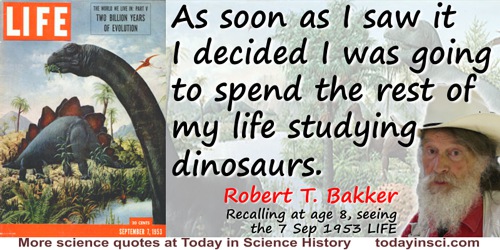
As soon as I saw it I decided I was going to spend the rest of my life studying dinosaurs.
Recalling his reaction, at age 8, when he saw Rudolph Zallinger’s mural of dinosaurs, the cover story of the 7 Sep 1953 Life magazine.
Behold the mighty dinosaur,
Famous in prehistoric lore,
Not only for his power and strength
But for his intellectual length.
You will observe by these remains
The creature had two sets of brains—
One in his head (the usual place),
The other at his spinal base.
Thus he could reason 'A priori'
As well as 'A posteriori'.
No problem bothered him a bit
He made both head and tail of it.
So wise was he, so wise and solemn,
Each thought filled just a spinal column.
If one brain found the pressure strong
It passed a few ideas along.
If something slipped his forward mind
'Twas rescued by the one behind.
And if in error he was caught
He had a saving afterthought.
As he thought twice before he spoke
He had no judgment to revoke.
Thus he could think without congestion
Upon both sides of every question.
Oh, gaze upon this model beast
Defunct ten million years at least.
Famous in prehistoric lore,
Not only for his power and strength
But for his intellectual length.
You will observe by these remains
The creature had two sets of brains—
One in his head (the usual place),
The other at his spinal base.
Thus he could reason 'A priori'
As well as 'A posteriori'.
No problem bothered him a bit
He made both head and tail of it.
So wise was he, so wise and solemn,
Each thought filled just a spinal column.
If one brain found the pressure strong
It passed a few ideas along.
If something slipped his forward mind
'Twas rescued by the one behind.
And if in error he was caught
He had a saving afterthought.
As he thought twice before he spoke
He had no judgment to revoke.
Thus he could think without congestion
Upon both sides of every question.
Oh, gaze upon this model beast
Defunct ten million years at least.
'The Dinosaur: A Poem' (1912). In E. H. Colbert (ed.), The Dinosaur Book (1951), 78.
Considered in its entirety, psychoanalysis won’t do. It is an end product, moreover, like a dinosaur or a zeppelin, no better theory can ever be erected on its ruins, which will remain for ever one of the saddest and strangest of all landmarks in the history of twentieth century thought.
From 'Further Comments on Psychoanalysis', The Hope of Progress: A Scientist Looks at Problems in Philosophy, Literature and Science (1973), 69.
How I hate the man who talks about the “brute creation”, with an ugly emphasis on Brute. Only Christians are capable of it. As for me, I am proud of my close kinship with other animals. I take a jealous pride in my Simian ancestry. I like to think that I was once a magnificent hairy fellow living in the trees and that my frame has come down through geological time via sea jelly and worms and Amphioxus, Fish, Dinosaurs, and Apes. Who would exchange these for the pallid couple in the Garden of Eden?
In W.N.P. Barbellion, The Journal of a Disappointed Man (1919), 27-28.
I like people. I like animals, too—whales and quail, dinosaurs and dodos. But I like human beings especially, and I am unhappy that the pool of human germ plasm, which determines the nature of the human race, is deteriorating.
[Stating his alarm for the effect of radioactive fallout on human heredity. The article containing the quote was published three days after he was awarded the 1962 Nobel Peace Prize.]
[Stating his alarm for the effect of radioactive fallout on human heredity. The article containing the quote was published three days after he was awarded the 1962 Nobel Peace Prize.]
Quoted in The New York Times (13 Oct 1962), 179.
If one small and odd lineage of fishes had not evolved fins capable of bearing weight on land (though evolved for different reasons in lakes and seas,) terrestrial vertebrates would never have arisen. If a large extraterrestrial object—the ultimate random bolt from the blue—had not triggered the extinction of dinosaurs 65 million years ago, mammals would still be small creatures, confined to the nooks and crannies of a dinosaur's world, and incapable of evolving the larger size that brains big enough for self-consciousness require. If a small and tenuous population of protohumans had not survived a hundred slings and arrows of outrageous fortune (and potential extinction) on the savannas of Africa, then Homo sapiens would never have emerged to spread throughout the globe. We are glorious accidents of an unpredictable process with no drive to complexity, not the expected results of evolutionary principles that yearn to produce a creature capable of understanding the mode of its own necessary construction.
Full House: The Spread of Excellence from Plato to Darwin (1996), 216.
If the human race ever stops acting on the basis of what it thinks it knows, paralyzed by fear that its knowledge may be wrong, then Homo sapiens will be making its application for membership in the dinosaur club.
To Plant a Seed (1972). In Gary Westfahl, Science Fiction Quotations: From the Inner Mind to the Outer Limits (2006), 2.
It is only at the beginning of the age of the dinosaurs that the deep sea, hitherto bare of organisms, was finally invaded by life.
(1965). In Isaac Asimov’s Book of Science and Nature Quotations (1988), 136.
Not since the Lord himself showed his stuff to Ezekiel in the valley of dry bones had anyone shown such grace and skill in the reconstruction of animals from disarticulated skeletons. Charles R. Knight, the most celebrated of artists in the reanimation of fossils, painted all the canonical figures of dinosaurs that fire our fear and imagination to this day.
In Wonderful Life: the Burgess Shale and the Nature of History (1990), 23. First sentence of chapter one.
Of all extinct life-forms, dinosaurs are the most popular. Why that should be is not clear.
Epigraph in Isaac Asimov’s Book of Science and Nature Quotations (1988), 202.
Psychoanalytic theory is the most stupendous intellectual confidence trick of the twentieth century and a terminal product as well—something akin to a dinosaur or zeppelin in the history of ideas, a vast structure of radically unsound design and with no posterity.
'Victims of Psychiatry', The New York Review of Books (23 Jan 1975), 21. Cited in David E. Stannard, Shrinking History: On Freud and the Failure of Psychohistory (1980), 150.
The biggest animal that has ever lived on our planet: a blue whale. … It’s far bigger than even the biggest dinosaur. Its tongue weighs as much as an elephant. Its heart is the size of a car. And some of its blood vessels are so wide that you could swim down them.
Narration from 'Introduction' of the BBC TV series The Blue Planet (2001), Ep. 1. Text accompanies 'Blue whale breach', video clip on BBC website.
The combination of such characters, some, as the sacral ones, altogether peculiar among Reptiles, others borrowed, as it were, from groups now distinct from each other, and all manifested by creatures far surpassing in size the largest of existing reptiles, will, it is presumed, be deemed sufficient ground for establishing a distinct tribe or sub-order of Saurian Reptiles, for which I would propose the name of Dinosauria.
'Report on British Fossil Reptiles', Report of the Eleventh Meeting of the British Association for the Advancement of Science (1842), 103.
The extinctions ongoing worldwide promise to be at least as great as the mass extinction that occurred at the end of the age of dinosaurs.
Quoted in Jamie Murphy and Andrea Dorfman, 'The Quiet Apocalypse,' Time (13 Oct 1986).
The freely roaming dinosaurs, I like to remember, had no plumbing.
From Of Stars and Men: The Human Response to an Expanding Universe (1958), 24.
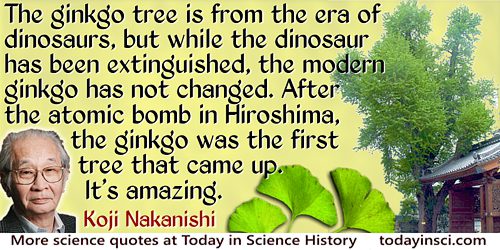
The ginkgo tree is from the era of dinosaurs, but while the dinosaur has been extinguished, the modern ginkgo has not changed. After the atomic bomb in Hiroshima, the ginkgo was the first tree that came up. It’s amazing.
As quoted in Columbia University Press Release, On Campus (21 Feb 2013).
To connect the dinosaurs, creatures of interest to everyone but the veriest dullard, with a spectacular extraterrestrial event like the deluge of meteors … seems a little like one of those plots that a clever publisher might concoct to guarantee enormous sales. All the Alvarez-Raup theories lack is some sex and the involvement of the Royal family and the whole world would be paying attention to them.
In The Canberra Times (20 May 1984).
Traditional dinosaur theory is full of short circuits. Like the antiquated wiring in an old house, the details sputter and burn out when specific parts are tested.
The Dinosaur Heresies (1986), 27.
Tyrannosaurus was truly the Schwarzenegger of dinosaurs.
In The New York Times, July 3, 1990.
We have very strong physical and chemical evidence for a large impact; this is the most firmly established part of the whole story. There is an unquestionable mass extinction at this time, and in the fossil groups for which we have the best record, the extinction coincides with the impact to a precision of a centimeter or better in the stratigraphic record. This exact coincidence in timing strongly argues for a causal relationship.
Referring to the theory that he, and his father (physicist Luis W. Alvarez), held that dinosaurs abruptly went extinct as a result of a 6-mile-wide asteroid or comet struck the earth. In American Geophysical Union, EOS (2 Sep 1986), as quoted and cited in John Noble Wilford, 'New Data Extend Era of Dinosaurs' New York Times (9 Nov 1986), A41.
When I was a small boy [my father] used to sit me on his lap and read to me from the [Encyclopaedia] Britannica … say, about … the Tyrannosaurus rex, and it would say something like, “This dinosaur is twenty-five feet high and its head is six feet across.” My father would stop reading and say, “Now, let’s see what that means. That would mean that if he stood in our front yard, he would be tall enough to put his head through our window up here.” (We were on the second floor.) “But his head would be too wide to fit in the window.” Everything he read to me he would translate as best he could into some reality. …
In 'The Making of a Scientist', What Do You Care What Other People Think?": Further Adventures of a Curious Character (2001), 12-13. I learned from my father to translate: everything I read I try to figure out what it really means, what it’s really saying.
Why Become Extinct? Authors with varying competence have suggested that dinosaurs disappeared because the climate deteriorated (became suddenly or slowly too hot or cold or dry or wet), or that the diet did (with too much food or not enough of such substances as fern oil; from poisons in water or plants or ingested minerals; by bankruptcy of calcium or other necessary elements). Other writers have put the blame on disease, parasites, wars, anatomical or metabolic disorders (slipped vertebral discs, malfunction or imbalance of hormone and endocrine systems, dwindling brain and consequent stupidity, heat sterilization, effects of being warm-blooded in the Mesozoic world), racial old age, evolutionary drift into senescent overspecialization, changes in the pressure or composition of the atmosphere, poison gases, volcanic dust, excessive oxygen from plants, meteorites, comets, gene pool drainage by little mammalian egg-eaters, overkill capacity by predators, fluctuation of gravitational constants, development of psychotic suicidal factors, entropy, cosmic radiation, shift of Earth’s rotational poles, floods, continental drift, extraction of the moon from the Pacific Basin, draining of swamp and lake environments, sunspots, God’s will, mountain building, raids by little green hunters in flying saucers, lack of standing room in Noah’s Ark, and palaeoweltschmerz.
'Riddles of the Terrible Lizards', American Scientist (1964) 52, 231.
Why the dinosaurs died out is not known, but it is supposed to be because they had minute brains and devoted themselves to the growth of weapons of offense in the shape of numerous horns. However that may be, it was not through their line that life developed.
In 'Men versus. Insects' (1933), collected in In Praise of Idleness and Other Essays (1935), 199.
You will never convince some palaeontologists that an impact killed the dinosaurs unless you find a dinosaur skeleton with a crushed skull and a ring of iridium round the hole.
Quoted in 'Extinction Wars' by Stell Weisburd, Science News (1 Feb 1986), 77.
 In science it often happens that scientists say, 'You know that's a really good argument; my position is mistaken,' and then they would actually change their minds and you never hear that old view from them again. They really do it. It doesn't happen as often as it should, because scientists are human and change is sometimes painful. But it happens every day. I cannot recall the last time something like that happened in politics or religion.
(1987) --
In science it often happens that scientists say, 'You know that's a really good argument; my position is mistaken,' and then they would actually change their minds and you never hear that old view from them again. They really do it. It doesn't happen as often as it should, because scientists are human and change is sometimes painful. But it happens every day. I cannot recall the last time something like that happened in politics or religion.
(1987) -- 




