Difference Quotes (357 quotes)
… however useful the words may have been in the past, they have now become handicaps to the further development of knowledge. Words like botany and zoology imply that plants and animals are quite different things. … But the differences rapidly become blurred when we start looking at the world through a microscope. … The similarities between plants and animals became more important than their differences with the discoveries that both were built up of cells, had sexual reproduction,… nutrition and respiration … and with the development of evolutionary theory.
In The Forest and the Sea (1960), 7.
… it may happen that small differences in the initial conditions produce very great ones in the final phenomena.
Science and Method (1908) translated by Francis Maitland (2003), 68.
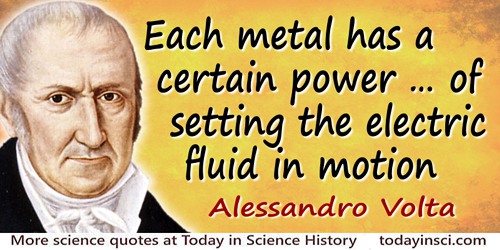
...each metal has a certain power, which is different from metal to metal, of setting the electric fluid in motion...
Le Opere, Vol. 1, 149. In Giuliano Pancaldi, Volta: Science and Culture in the Age of Enlightenment (2005), 190.
...for the animals, which we resemble and which would be our equals if we did not have reason, do not reflect upon the actions or the passions of their external or internal senses, and do not know what is color, odor or sound, or if there is any differences between these objects, to which they are moved rather than moving themselves there. This comes about by the force of the impression that the different objects make on their organs and on their senses, for they cannot discern if it is more appropriate to go and drink or eat or do something else, and they do not eat or drink or do anything else except when the presence of objects or the animal imagination [l'imagination brutalle], necessitates them and transports them to their objects, without their knowing what they do, whether good or bad; which would happen to us just as to them if we were destitute of reason, for they have no enlightenment except what they must have to take their nourishment and to serve us for the uses to which God has destined them.
[Arguing the uniqueness of man by regarding animals to be merely automatons.].
[Arguing the uniqueness of man by regarding animals to be merely automatons.].
Les Préludes de l'Harmonie Universelle (1634), 135-139. In Charles Coulston Gillespie (ed.), Dictionary of Scientific Biography (1974), Vol. 9, 318.
...I have always maintained that, excepting fools, men did not differ much in intellect, only in zeal and hard work; and I still think there is an eminently important difference.
letter cit. R. Pearson (1914-1930) in The Life, Letters and Labours of Francis Galton
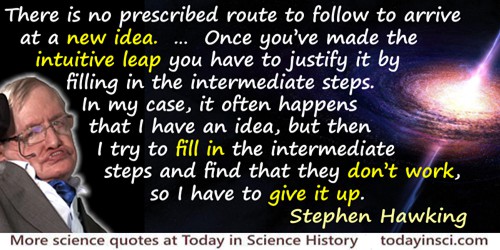
…there is no prescribed route to follow to arrive at a new idea. You have to make the intuitive leap. But the difference is that once you’ve made the intuitive leap you have to justify it by filling in the intermediate steps. In my case, it often happens that I have an idea, but then I try to fill in the intermediate steps and find that they don’t work, so I have to give it up.
In Michael Harwood, 'The Universe and Dr. Hawking', New York Times Magazine (23 Jan 1983), 53.
…we are all inclined to ... direct our inquiry not by the matter itself, but by the views of our opponents; and, even when interrogating oneself, one pushes the inquiry only to the point at which one can no longer offer any opposition. Hence a good inquirer will be one who is ready in bringing forward the objections proper to the genus, and that he will be when he has gained an understanding of the differences.
'On the Heavens', The Works of Aristotle editted by William David Ross and John Alexander Smith (1930), Vol. 2, 15.
…winds are produced by differences of air temperature, and hence density, between two regions of earth.
Lecture to the Accademia della Crusca. Quoted in Archana Srinivasan, Great Inventors (2007), 29.
[About the great synthesis of atomic physics in the 1920s:] It was a heroic time. It was not the doing of any one man; it involved the collaboration of scores of scientists from many different lands. But from the first to last the deeply creative, subtle and critical spirit of Niels Bohr guided, restrained, deepened and finally transmuted the enterprise.
Quoted in Bill Becker, 'Pioneer of the Atom', New York Times Sunday Magazine (20 Oct 1957), 54.
[In my early youth, walking with my father,] “See that bird?” he says. “It’s a Spencer’s warbler.” (I knew he didn’t know the real name.) “Well, in Italian, it’s a Chutto Lapittida. In Portuguese, it’s a Bom da Peida. In Chinese, it’s a Chung-long-tah, and in Japanese, it’s a Katano Tekeda. You can know the name of that bird in all the languages of the world, but when you’re finished, you’ll know absolutely nothing whatever about the bird. You’ll only know about humans in different places, and what they call the bird. So let’s look at the bird and see what it’s doing—that’s what counts.” (I learned very early the difference between knowing the name of something and knowing something.)
In 'The Making of a Scientist', What Do You Care What Other People Think?": Further Adventures of a Curious Character (2001), 13-14.
[It] may be laid down as a general rule that, if the result of a long series of precise observations approximates a simple relation so closely that the remaining difference is undetectable by observation and may be attributed to the errors to which they are liable, then this relation is probably that of nature.
'Mémoire sur les Inégalites Séculaires des Planètes et des Satellites' (I 785, published 1787). In Oeuvres completes de Laplace, 14 Vols. (1843-1912), Vol. 11, 57, trans. Charles Coulston Gillispie, Pierre-Simon Laplace 1749-1827: A Life in Exact Science (1997), 130.
[Very doubtful attribution.] The purpose of anthropology is to make the world safe for human differences.
This likely misquote is included here to caution: do NOT blindly accept it. Webmaster has so far been unable to find any primary source for this viral alleged quote. It is often seen, but never with a citation. Or worse, with a citation to another source which fails to give a citation at all. ApostateAbe, 'Stop this Ruth Benedict misquote', Reddit (c.Dec 2017) directly challenges the quote: “Ruth Benedict never said it, not in any of her published writings. It seems to be merely myth. It is never specifically cited, nor does it make historical sense.” So, if you know an authentic primary source, please contact Webmaster.
[We] can easily distinguish what relates to Mathematics in any question from that which belongs to the other sciences. But as I considered the matter carefully it gradually came to light that all those matters only were referred to Mathematics in which order and measurements are investigated, and that it makes no difference whether it be in numbers, figures, stars, sounds or any other object that the question of measurement arises. I saw consequently that there must be some general science to explain that element as a whole which gives rise to problems about order and measurement, restricted as these are to no special subject matter. This, I perceived was called “Universal Mathematics,” not a far-fetched asignation, but one of long standing which has passed into current use, because in this science is contained everything on account of which the others are called parts of Mathematics.
Rules for the Direction of the Mind (written 1628). As translated by Elizabeth Sanderson Haldane and George Robert Thomson Ross in The Philosophical Works of Descartes (1911, 1931), 13.
Question: Explain how to determine the time of vibration of a given tuning-fork, and state what apparatus you would require for the purpose.
Answer: For this determination I should require an accurate watch beating seconds, and a sensitive ear. I mount the fork on a suitable stand, and then, as the second hand of my watch passes the figure 60 on the dial, I draw the bow neatly across one of its prongs. I wait. I listen intently. The throbbing air particles are receiving the pulsations; the beating prongs are giving up their original force; and slowly yet surely the sound dies away. Still I can hear it, but faintly and with close attention; and now only by pressing the bones of my head against its prongs. Finally the last trace disappears. I look at the time and leave the room, having determined the time of vibration of the common “pitch” fork. This process deteriorates the fork considerably, hence a different operation must be performed on a fork which is only lent.
Answer: For this determination I should require an accurate watch beating seconds, and a sensitive ear. I mount the fork on a suitable stand, and then, as the second hand of my watch passes the figure 60 on the dial, I draw the bow neatly across one of its prongs. I wait. I listen intently. The throbbing air particles are receiving the pulsations; the beating prongs are giving up their original force; and slowly yet surely the sound dies away. Still I can hear it, but faintly and with close attention; and now only by pressing the bones of my head against its prongs. Finally the last trace disappears. I look at the time and leave the room, having determined the time of vibration of the common “pitch” fork. This process deteriorates the fork considerably, hence a different operation must be performed on a fork which is only lent.
Genuine student answer* to an Acoustics, Light and Heat paper (1880), Science and Art Department, South Kensington, London, collected by Prof. Oliver Lodge. Quoted in Henry B. Wheatley, Literary Blunders (1893), 176-7, Question 4. (*From a collection in which Answers are not given verbatim et literatim, and some instances may combine several students' blunders.)
Question: Explain why, in order to cook food by boiling, at the top of a high mountain, you must employ a different method from that used at the sea level.
Answer: It is easy to cook food at the sea level by boiling it, but once you get above the sea level the only plan is to fry it in its own fat. It is, in fact, impossible to boil water above the sea level by any amount of heat. A different method, therefore, would have to be employed to boil food at the top of a high mountain, but what that method is has not yet been discovered. The future may reveal it to a daring experimentalist.
Answer: It is easy to cook food at the sea level by boiling it, but once you get above the sea level the only plan is to fry it in its own fat. It is, in fact, impossible to boil water above the sea level by any amount of heat. A different method, therefore, would have to be employed to boil food at the top of a high mountain, but what that method is has not yet been discovered. The future may reveal it to a daring experimentalist.
Genuine student answer* to an Acoustics, Light and Heat paper (1880), Science and Art Department, South Kensington, London, collected by Prof. Oliver Lodge. Quoted in Henry B. Wheatley, Literary Blunders (1893), 178-9, Question 11. (*From a collection in which Answers are not given verbatim et literatim, and some instances may combine several students' blunders.)
Question: What is the difference between a “real” and a “virtual” image? Give a drawing showing the formation of one of each kind.
Answer: You see a real image every morning when you shave. You do not see virtual images at all. The only people who see virtual images are those people who are not quite right, like Mrs. A. Virtual images are things which don't exist. I can't give you a reliable drawing of a virtual image, because I never saw one.
Answer: You see a real image every morning when you shave. You do not see virtual images at all. The only people who see virtual images are those people who are not quite right, like Mrs. A. Virtual images are things which don't exist. I can't give you a reliable drawing of a virtual image, because I never saw one.
Genuine student answer* to an Acoustics, Light and Heat paper (1880), Science and Art Department, South Kensington, London, collected by Prof. Oliver Lodge. Quoted in Henry B. Wheatley, Literary Blunders (1893), 177-8, Question 6. (*From a collection in which Answers are not given verbatim et literatim, and some instances may combine several students' blunders.)
That was excellently observ'd, say I, when I read a Passage in an Author, where his Opinion agrees with mine. When we differ, there I pronounce him to be mistaken.
In 'Thoughts On Various Subjects' (1727), collected in The Works of Jonathan Swift (1746), Vol. 1, 318.
There is no such thing as a Scientific Mind. Scientists are people of very dissimilar temperaments doing different things in very different ways. Among scientists are collectors, classifiers, and compulsive tidiers-up; many are detectives by temperament and many are explorers; some are artists and others artisans. There are poet-scientists and philosopher-scientists and even a few mystics.
The Art of the Soluble: Creativity and Originality in Science (1967). Reprinted in Pluto’s Republic (1982), 116.
A … difference between most system-building in the social sciences and systems of thought and classification of the natural sciences is to be seen in their evolution. In the natural sciences both theories and descriptive systems grow by adaptation to the increasing knowledge and experience of the scientists. In the social sciences, systems often issue fully formed from the mind of one man. Then they may be much discussed if they attract attention, but progressive adaptive modification as a result of the concerted efforts of great numbers of men is rare.
The Study of Man (1941), 19-20.
A black hole has no hair.
[Summarizing the simplicity of a black hole, which shows only three characteristics to the outside world (mass, charge, spin) and comparing the situation to a room full of bald-pated people who had one characteristic in common, but no differences in hair length, style or color for individual variations.]
[Summarizing the simplicity of a black hole, which shows only three characteristics to the outside world (mass, charge, spin) and comparing the situation to a room full of bald-pated people who had one characteristic in common, but no differences in hair length, style or color for individual variations.]
In Geons, Black Holes, and Quantum Foam (2000), 297. Quote introduced previously as the No-Hair Theorem in Charles W. Misner, Kip S. Thorne and John Wheeler, Gravitation (1973).
A DNA sequence for the genome of bacteriophage ΦX174 of approximately 5,375 nucleotides has been determined using the rapid and simple “plus and minus” method. The sequence identifies many of the features responsible for the production of the proteins of the nine known genes of the organism, including initiation and termination sites for the proteins and RNAs. Two pairs of genes are coded by the same region of DNA using different reading frames.
[Paper co-author]
[Paper co-author]
Frederick Sanger, et al., 'Nucleotide Sequence of Bacteriophage ΦX174 DNA', Nature (1977), 265, 687.
A man who sets out to justify his existence and his activities has to distinguish two different questions. The first is whether the work which he does is worth doing; and the second is why he does it (whatever its value may be).
In A Mathematician's Apology (1940, 2012), 66.
A mathematician thinks that two points are enough to define a straight line, while a physicist wants more data.
A political law or a scientific truth may be perilous to the morals or the faith of individuals; but it cannot on this ground be resisted by the Church. … A discovery may be made in science which will shake the faith of thousands; yet religion cannot regret it or object to it. The difference in this respect between a true and a false religion is, that one judges all things by the standard of their truth, the other by the touchstone of its own interests. A false religion fears the progress of all truth; a true religion seeks and recognises truth wherever it can be found.
From 'Cardinal Wiseman and the Home and Foreign Review' (1862), collected in John Emerich Edward Dalberg Acton Baron Acton, John Neville Figgis (ed.) and Reginald Vere Laurence (ed.), The History of Freedom and Other Essays (1907), 449-450. The Darwinian controversy was at its height when this was written.
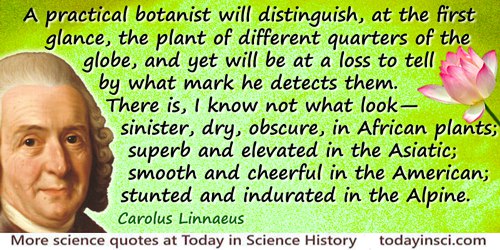
A practical botanist will distinguish, at the first glance, the plant of different quarters of the globe, and yet will be at a loss to tell by what mark he detects them. There is, I know not what look—sinister, dry, obscure, in African plants; superb and elevated in the Asiatic; smooth and cheerful in the American; stunted and indurated in the Alpine.
Quoted in William Whewell, History of the Inductive Sciences (1847), Vol. 3, 355-356, citing ‘Philosophia Botanica’ (1751), 171.
A study of Dr. [Florence] Sabin’s work shows the greatness of her achievement and the character of her mind. She has dealt with the primary and fundamental problem of the cell—the unit of plant and animal life. All through her investigations she has followed the cell, seeking the secret of differentiations by newer and finer methods, both physical and chemical. Always through her work runs the great strong, continuous cord of cell differentiations. This is one of the great concepts of man, for all life begins as a single cell. I have known and followed Dr. Sabin’s work since her student days, and have lately been more closely associated with her in her tuberculosis studies. She is all in mind and spirit and ideals that man or woman ever accomplishes. She belongs to the great students of both sexes, for when these have the brains and the will to work I see little difference.
In Genevieve Parkhurst, 'Dr. Sabin, Scientist: Winner Of Pictorial Review’s Achievement Award', Pictorial Review (Jan 1930), 2.
A theory is the more impressive the greater the simplicity of its premises is, the more different kinds of things it relates, and the more extended is its area of applicability. Therefore the deep impression which classical thermodynamics made upon me. It is the only physical theory of universal content concerning which I am convinced that within the framework of the applicability of its basic concepts, it will never be overthrown.
Autobiographical Notes (1946), 33. Quoted in Gerald Holton and Yehuda Elkana, Albert Einstein: Historical and Cultural Perspectives (1997), 227.
A topologist is one who doesn’t know the difference between a doughnut and a coffee cup.
In General Topology (1955), 88, footnote.
Across the road from my cabin was a huge clear-cut—hundreds of acres of massive spruce stumps interspersed with tiny Douglas firs—products of what they call “Reforestation,” which I guess makes the spindly firs en masse a “Reforest,” which makes an individual spindly fir a “Refir,” which means you could say that Weyerhauser, who owns the joint, has Refir Madness, since they think that sawing down 200-foot-tall spruces and replacing them with puling 2-foot Refirs is no different from farming beans or corn or alfalfa. They even call the towering spires they wipe from the Earth’s face forever a “crop”--as if they’d planted the virgin forest! But I'm just a fisherman and may be missing some deeper significance in their nomenclature and stranger treatment of primordial trees.
In David James Duncan, The River Why (1983), 71.
Adam, the first man, didn’t know anything about the nucleus but Dr. George Gamow, visiting professor from George Washington University, pretends he does. He says for example that the nucleus is 0.00000000000003 feet in diameter. Nobody believes it, but that doesn't make any difference to him.
He also says that the nuclear energy contained in a pound of lithium is enough to run the United States Navy for a period of three years. But to get this energy you would have to heat a mixture of lithium and hydrogen up to 50,000,000 degrees Fahrenheit. If one has a little stove of this temperature installed at Stanford, it would burn everything alive within a radius of 10,000 miles and broil all the fish in the Pacific Ocean.
If you could go as fast as nuclear particles generally do, it wouldn’t take you more than one ten-thousandth of a second to go to Miller's where you could meet Gamow and get more details.
He also says that the nuclear energy contained in a pound of lithium is enough to run the United States Navy for a period of three years. But to get this energy you would have to heat a mixture of lithium and hydrogen up to 50,000,000 degrees Fahrenheit. If one has a little stove of this temperature installed at Stanford, it would burn everything alive within a radius of 10,000 miles and broil all the fish in the Pacific Ocean.
If you could go as fast as nuclear particles generally do, it wouldn’t take you more than one ten-thousandth of a second to go to Miller's where you could meet Gamow and get more details.
'Gamow interviews Gamow' Stanford Daily, 25 Jun 1936. In Helge Kragh, Cosmology and Controversy: The Historica1 Development of Two Theories of the Universe (1996), 90.
After death, life reappears in a different form and with different laws. It is inscribed in the laws of the permanence of life on the surface of the earth and everything that has been a plant and an animal will be destroyed and transformed into a gaseous, volatile and mineral substance.
Quoted in Patrice Debré, Louis Pasteur, trans. Elborg Forster (1994), 110.
Alcmaeon was the first to define the difference between man and animals, saying that man differs from the latter in the fact that he alone has the power of understanding.
On Sense Perceptions, section 25. In Edwin Clarke and C. D. O'Malley, The Human Brain and Spinal Cord (1968), 3.
All known living bodies are sharply divided into two special kingdoms, based upon the essential differences which distinguish animals from plants, and in spite of what has been said, I am convinced that these two kingdoms do not really merge into one another at any point.
In Jean Lamarck and Hugh Elliot (trans.), Zoological Philosophy: An Exposition with Regard to the Natural History of Animals (1914), 51.
All living forms are the results of physical influences which are still in operation, and vary only in degree and direction
Entry for Gottfried Reinhold Treviranus in Encyclopedia Britannica (1911), Vol. 27, 256.
All things are the same except for the differences, and different except for the similarities.
'Penetrating the Rhetoric', The Vision of the Anointed (1996), 102.
Almost everyone... seems to be quite sure that the differences between the methodologies of history and of the natural sciences are vast. For, we are assured, it is well known that in the natural sciences we start from observation and proceed by induction to theory. And is it not obvious that in history we proceed very differently? Yes, I agree that we proceed very differently. But we do so in the natural sciences as well.
In both we start from myths—from traditional prejudices, beset with error—and from these we proceed by criticism: by the critical elimination of errors. In both the role of evidence is, in the main, to correct our mistakes, our prejudices, our tentative theories—that is, to play a part in the critical discussion, in the elimination of error. By correcting our mistakes, we raise new problems. And in order to solve these problems, we invent conjectures, that is, tentative theories, which we submit to critical discussion, directed towards the elimination of error.
In both we start from myths—from traditional prejudices, beset with error—and from these we proceed by criticism: by the critical elimination of errors. In both the role of evidence is, in the main, to correct our mistakes, our prejudices, our tentative theories—that is, to play a part in the critical discussion, in the elimination of error. By correcting our mistakes, we raise new problems. And in order to solve these problems, we invent conjectures, that is, tentative theories, which we submit to critical discussion, directed towards the elimination of error.
The Myth of the Framework: In Defence of Science and Rationality (1993), 140.
Although few expressions are more commonly used in writing about science than “science revolution,” there is a continuing debate as to the propriety of applying the concept and term “revolution” to scientific change. There is, furthermore, a wide difference of opinion as to what may constitute a revolution. And although almost all historians would agree that a genuine alteration of an exceptionally radical nature (the Scientific Revolution) occurred in the sciences at some time between the late fifteenth (or early sixteenth) century and the end of the seventeenth century, the question of exactly when this revolution occurred arouses as much scholarly disagreement as the cognate question of precisely what it was.
The Newtonian Revolution (1980), 3.
An amoeba never is torn apart through indecision, though, for even if two parts of the amoeba are inclined to go in different directions, a choice is always made. We could interpret this as schizophrenia or just confusion, but it could also be a judicious simultaneous sampling of conditions, in order to make a wise choice of future direction.
In The Center of Life: A Natural History of the Cell (1977, 1978), 73.
An incidental remark from a German colleague illustrates the difference between Prussian ways and our own. He had apparently been studying the progress of our various crews on the river, and had been struck with the fact that though the masters in charge of the boats seemed to say and do very little, yet the boats went continually faster and faster, and when I mentioned Dr. Young’s book to him, he made the unexpected but suggestive reply: “Mathematics in Prussia! Ah, sir, they teach mathematics in Prussia as you teach your boys rowing in England: they are trained by men who have been trained by men who have themselves been trained for generations back.”
In John Perry (ed.), Discussion on the Teaching of Mathematics (1901), 43. The discussion took place on 14 Sep 1901 at the British Association at Glasgow, during a joint meeting of the mathematics and physics sections with the education section. The proceedings began with an address by John Perry. Langley related this anecdote during the Discussion which followed.
An infinity of these tiny animals defoliate our plants, our trees, our fruits... they attack our houses, our fabrics, our furniture, our clothing, our furs ... He who in studying all the different species of insects that are injurious to us, would seek means of preventing them from harming us, would seek to cause them to perish, proposes for his goal important tasks indeed.
In J. B. Gough, 'Rene-Antoine Ferchault de Réaumur', in Charles Gillispie (ed.), Dictionary of Scientific Biography (1975), Vol. 11, 332.
Analogue. A part or organ in one animal which has the same function as another part or organ in a different animal.
'Glossary', Lectures on the Comparative Anatomy and Physiology of the Invertebrate Animals Delivered at the Royal College of Surgeons in 1843 (1843), 374.
Analogy is a wonderful, useful and most important form of thinking, and biology is saturated with it. Nothing is worse than a horrible mass of undigested facts, and facts are indigestible unless there is some rhyme or reason to them. The physicist, with his facts, seeks reason; the biologist seeks something very much like rhyme, and rhyme is a kind of analogy.... This analogizing, this fine sweeping ability to see likenesses in the midst of differences is the great glory of biology, but biologists don't know it.... They have always been so fascinated and overawed by the superior prestige of exact physical science that they feel they have to imitate it.... In its central content, biology is not accurate thinking, but accurate observation and imaginative thinking, with great sweeping generalizations.
In Science is a Sacred Cow (1950), 98-100.
And from this such small difference of eight minutes [of arc] it is clear why Ptolemy, since he was working with bisection [of the linear eccentricity], accepted a fixed equant point… . For Ptolemy set out that he actually did not get below ten minutes [of arc], that is a sixth of a degree, in making observations. To us, on whom Divine benevolence has bestowed the most diligent of observers, Tycho Brahe, from whose observations this eight-minute error of Ptolemy’s in regard to Mars is deduced, it is fitting that we accept with grateful minds this gift from God, and both acknowledge and build upon it. So let us work upon it so as to at last track down the real form of celestial motions (these arguments giving support to our belief that the assumptions are incorrect). This is the path I shall, in my own way, strike out in what follows. For if I thought the eight minutes in [ecliptic] longitude were unimportant, I could make a sufficient correction (by bisecting the [linear] eccentricity) to the hypothesis found in Chapter 16. Now, because they could not be disregarded, these eight minutes alone will lead us along a path to the reform of the whole of Astronomy, and they are the matter for a great part of this work.
Astronomia Nova, New Astronomy (1609), ch. 19, 113-4, Johannes Kepler Gesammelte Werke (1937-), Vol. 3, 177-8.
And it has been sarcastically said, that there is a wide difference between a good physician and a bad one, but a small difference between a good physician and no physician at all; by which it is meant to insinuate, that the mischievous officiousness of art does commonly more than counterbalance any benefit derivable from it.
Elements of Medical Logic (1819), 8-9.
And yet I think that the Full House model does teach us to treasure variety for its own sake–for tough reasons of evolutionary theory and nature’s ontology, and not from a lamentable failure of thought that accepts all beliefs on the absurd rationale that disagreement must imply disrespect. Excellence is a range of differences, not a spot. Each location on the range can be occupied by an excellent or an inadequate representative– and we must struggle for excellence at each of these varied locations. In a society driven, of ten unconsciously, to impose a uniform mediocrity upon a former richness of excellence–where McDonald’s drives out the local diner, and the mega-Stop & Shop eliminates the corner Mom and Pop–an understanding and defense of full ranges as natural reality might help to stem the tide and preserve the rich raw material of any evolving system: variation itself.
…...
And, in this case, science could learn an important lesson from the literati–who love contingency for the same basic reason that scientists tend to regard the theme with suspicion. Because, in contingency lies the power of each person, to make a difference in an unconstrained world bristling with possibilities, and nudgeable by the smallest of unpredictable inputs into markedly different channels spelling either vast improvement or potential disaster.
…...
Animals, even plants, lie to each other all the time, and we could restrict the research to them, putting off the real truth about ourselves for the several centuries we need to catch our breath. What is it that enables certain flowers to resemble nubile insects, or opossums to play dead, or female fireflies to change the code of their flashes in order to attract, and then eat, males of a different species?
In Late Night Thoughts on Listening to Mahler's Ninth Symphony(1984), 131.
Another diversity of Methods is according to the subject or matter which is handled; for there is a great difference in delivery of the Mathematics, which are the most abstracted of knowledges, and Policy, which is the most immersed…, yet we see how that opinion, besides the weakness of it, hath been of ill desert towards learning, as that which taketh the way to reduce learning to certain empty and barren generalities; being but the very husks and shells of sciences, all the kernel being forced out and expulsed with the torture and press of the method.
Advancement of Learning, Book 2. In James Spedding, The Works of Francis Bacon (1863), Vol. 6, 292-293. Peter Pešić, explains that 'By Mathematics, he had in mind a sterile and rigid scheme of logical classifications, called dichotomies in his time,' inLabyrinth: A Search for the Hidden Meaning of Science (2001), 73.
Anthropology has reached that point of development where the careful investigation of facts shakes our firm belief in the far-reaching theories that have been built up. The complexity of each phenomenon dawns on our minds, and makes us desirous of proceeding more cautiously. Heretofore we have seen the features common to all human thought. Now we begin to see their differences. We recognize that these are no less important than their similarities, and the value of detailed studies becomes apparent. Our aim has not changed, but our method must change. We are still searching for the laws that govern the growth of human culture, of human thought; but we recognize the fact that before we seek for what is common to all culture, we must analyze each culture by careful and exact methods, as the geologist analyzes the succession and order of deposits, as the biologist examines the forms of living matter. We see that the growth of human culture manifests itself in the growth of each special culture. Thus we have come to understand that before we can build up the theory of the growth of all human culture, we must know the growth of cultures that we find here and there among the most primitive tribes of the Arctic, of the deserts of Australia, and of the impenetrable forests of South America; and the progress of the civilization of antiquity and of our own times. We must, so far as we can, reconstruct the actual history of mankind, before we can hope to discover the laws underlying that history.
The Jesup North Pacific Expedition: Memoir of the American Museum of Natural History (1898), Vol. 1, 4.
Any experiment may be regarded as forming an individual of a 'population' of experiments which might be performed under the same conditions. A series of experiments is a sample drawn from this population.
Now any series of experiments is only of value in so far as it enables us to form a judgment as to the statistical constants of the population to which the experiments belong. In a great number of cases the question finally turns on the value of a mean, either directly, or as the mean difference between the two qualities.
If the number of experiments be very large, we may have precise information as to the value of the mean, but if our sample be small, we have two sources of uncertainty:— (I) owing to the 'error of random sampling' the mean of our series of experiments deviates more or less widely from the mean of the population, and (2) the sample is not sufficiently large to determine what is the law of distribution of individuals.
Now any series of experiments is only of value in so far as it enables us to form a judgment as to the statistical constants of the population to which the experiments belong. In a great number of cases the question finally turns on the value of a mean, either directly, or as the mean difference between the two qualities.
If the number of experiments be very large, we may have precise information as to the value of the mean, but if our sample be small, we have two sources of uncertainty:— (I) owing to the 'error of random sampling' the mean of our series of experiments deviates more or less widely from the mean of the population, and (2) the sample is not sufficiently large to determine what is the law of distribution of individuals.
'The Probable Error of a Mean', Biometrika, 1908, 6, 1.
As an empiricist I continue to think of the conceptual scheme of science as a tool, ultimately, for predicting future experience in the light of past experience. Physical objects are conceptually imported into the situation as convenient intermediaries—not by definition in terms of experience, but simply as irreducible posits comparable, epistemologically, to the gods of Homer. For my part I do, qua lay physicist, believe in physical objects and not in Homer's gods; and I consider it a scientific error to believe otherwise. But in point of epistemological footing the physical objects and the gods differ only in degree and not in kind. Both sorts of entities enter our conception only as cultural posits. The myth of physical objects is epistemologically superior to most in that it has proved more efficacious than other myths as a device for working a manageable structure into the flux of experience.
From A Logical Point of View (1953), 44. [Note: “qua” means “in the character or role of,” thus “qua lay physicist” means “in the role of lay physicist,” or perhaps even (?) “putting on my lay physicist hat.” —Webmaster]
As for science and religion, the known and admitted facts are few and plain enough. All that the parsons say is unproved. All that the doctors say is disproved. That’s the only difference between science and religion…
In Manalive (1912), 146.
Believe me, this planet has put up with much worse than us. It’s been through earthquakes, volcanoes, plate tectonics, solar flares, sun-spots, magnetic storms, pole reversals, planetary floods, worldwide fires, tidal waves, wind and water erosion, cosmic rays, ice ages, and hundreds of thousands of years of bombardment by comets, asteroids, and meteors. And people think a few plastic bags and aluminum cans are going to make a difference?
In Napalm and Silly Putty (2002), 97.
Besides accustoming the student to demand, complete proof, and to know when he has not obtained it, mathematical studies are of immense benefit to his education by habituating him to precision. It is one of the peculiar excellencies of mathematical discipline, that the mathematician is never satisfied with à peu près. He requires the exact truth. Hardly any of the non-mathematical sciences, except chemistry, has this advantage. One of the commonest modes of loose thought, and sources of error both in opinion and in practice, is to overlook the importance of quantities. Mathematicians and chemists are taught by the whole course of their studies, that the most fundamental difference of quality depends on some very slight difference in proportional quantity; and that from the qualities of the influencing elements, without careful attention to their quantities, false expectation would constantly be formed as to the very nature and essential character of the result produced.
In An Examination of Sir William Hamilton’s Philosophy (1878), 611. [The French phrase, à peu près means “approximately”. —Webmaster]
Biological determinism is, in its essence, a theory of limits. It takes the current status of groups as a measure of where they should and must be ... We inhabit a world of human differences and predilections, but the extrapolation of these facts to theories of rigid limits is ideology.
The Mismeasure of Man (1981), 28-9.
Break the chains of your prejudices and take up the torch of experience, and you will honour nature in the way she deserves, instead of drawing derogatory conclusions from the ignorance in which she has left you. Simply open your eyes and ignore what you cannot understand, and you will see that a labourer whose mind and knowledge extend no further than the edges of his furrow is no different essentially from the greatest genius, as would have been proved by dissecting the brains of Descartes and Newton; you will be convinced that the imbecile or the idiot are animals in human form, in the same way as the clever ape is a little man in another form; and that, since everything depends absolutely on differences in organisation, a well-constructed animal who has learnt astronomy can predict an eclipse, as he can predict recovery or death when his genius and good eyesight have benefited from some time at the school of Hippocrates and at patients' bedsides.
Machine Man (1747), in Ann Thomson (ed.), Machine Man and Other Writings (1996), 38.
But it will be found... that one universal law prevails in all these phenomena. Where two portions of the same light arrive in the eye by different routes, either exactly or very nearly in the same direction, the appearance or disappearance of various colours is determined by the greater or less difference in the lengths of the paths.
Lecture XIV. 'Of Physical Optics'. In A Syllabus of a Course of Lectures on Natural and Experimental Philosophy (1802), 112-4.
Certain students of genetics inferred that the Mendelian units responsible for the selected character were genes producing only a single effect. This was careless logic. It took a good deal of hammering to get rid of this erroneous idea. As facts accumulated it became evident that each gene produces not a single effect, but in some cases a multitude of effects on the characters of the individual. It is true that in most genetic work only one of these character-effects is selected for study—the one that is most sharply defined and separable from its contrasted character—but in most cases minor differences also are recognizable that are just as much the product of the same gene as is the major effect.
'The Relation of Genetics to Physiology and Medicine', Nobel Lecture (4 Jun 1934). In Nobel Lectures, Physiology or Medicine 1922-1941 (1965), 317.
Decision differs from willfulness as atmospheric pressure from the fitful wind.
From chapter 'Jottings from a Note-book', in Canadian Stories (1918), 170.
Deductivism in mathematical literature and inductivism in scientific papers are simply the postures we choose to be seen in when the curtain goes up and the public sees us. The theatrical illusion is shattered if we ask what goes on behind the scenes. In real life discovery and justification are almost always different processes.
Induction and Intuition in Scientific Thought (1969), 26.
Differences between individuals are the raw materials for evolutionary change and for the evolution of adaptations, yet of course most physiologists treat these differences as noise that is to be filtered out. From the standpoint of physiological ecology, the traditional emphasis of physiologists on central tendencies rather than on variance has some unhappy consequences. Variation is not just noise; it is also the stuff of evolution and a central attribute of living systems. The physiological differences between individuals in the same species or population, and also the patterns of variation in different groups, must not be ignored.
From 'Interspecific comparison as a tool for ecological physiologists', collected in M.E. Feder, A.F. Bennett, W.W. Burggren, and R.B. Huey, (eds.), New Directions in Ecological Physiology (1987), 32-33,
Doctors are just the same as lawyers; the only difference is that lawyers merely rob you, whereas doctors rob you and kill you, too.
ĵIvanovĵ (1887), Act I.
Doctors in all ages have made fortunes by killing their patients by means of their cures. The difference in psychiatry is that is the death of the soul.
From Address (Jul 1967), 'The Obvious', to the Congress on the Dialectics of Liberation, London, collected in David Cooper, The Dialectics of Liberation (2015), 19.
Does anyone believe that the difference between the Lebesgue and Riemann integrals can have physical significance, and that whether say, an airplane would or would not fly could depend on this difference? If such were claimed, I should not care to fly in that plane.
Paraphrased from American Mathematics Monthly (1998) 105, 640-50. Quoted in John De Pillis, 777 Mathematical Conversation Starters (2004), 136.
During the time that [Karl] Landsteiner gave me an education in the field of imununology, I discovered that he and I were thinking about the serologic problem in very different ways. He would ask, What do these experiments force us to believe about the nature of the world? I would ask, What is the most. simple and general picture of the world that we can formulate that is not ruled by these experiments? I realized that medical and biological investigators were not attacking their problems the same way that theoretical physicists do, the way I had been in the habit of doing.
‘Molecular Disease’, Pfizer Spectrum (1958), 6:9, 234.
Einstein, twenty-six years old, only three years away from crude privation, still a patent examiner, published in the Annalen der Physik in 1905 five papers on entirely different subjects. Three of them were among the greatest in the history of physics. One, very simple, gave the quantum explanation of the photoelectric effect—it was this work for which, sixteen years later, he was awarded the Nobel prize. Another dealt with the phenomenon of Brownian motion, the apparently erratic movement of tiny particles suspended in a liquid: Einstein showed that these movements satisfied a clear statistical law. This was like a conjuring trick, easy when explained: before it, decent scientists could still doubt the concrete existence of atoms and molecules: this paper was as near to a direct proof of their concreteness as a theoretician could give. The third paper was the special theory of relativity, which quietly amalgamated space, time, and matter into one fundamental unity.
This last paper contains no references and quotes no authority. All of them are written in a style unlike any other theoretical physicist’s. They contain very little mathematics. There is a good deal of verbal commentary. The conclusions, the bizarre conclusions, emerge as though with the greatest of ease: the reasoning is unbreakable. It looks as though he had reached the conclusions by pure thought, unaided, without listening to the opinions of others. To a surprisingly large extent, that is precisely what he had done.
This last paper contains no references and quotes no authority. All of them are written in a style unlike any other theoretical physicist’s. They contain very little mathematics. There is a good deal of verbal commentary. The conclusions, the bizarre conclusions, emerge as though with the greatest of ease: the reasoning is unbreakable. It looks as though he had reached the conclusions by pure thought, unaided, without listening to the opinions of others. To a surprisingly large extent, that is precisely what he had done.
In Variety of Men (1966), 100-101. First published in Commentary magazine.
Euclid always contemplates a straight line as drawn between two definite points, and is very careful to mention when it is to be produced beyond this segment. He never thinks of the line as an entity given once for all as a whole. This careful definition and limitation, so as to exclude an infinity not immediately apparent to the senses, was very characteristic of the Greeks in all their many activities. It is enshrined in the difference between Greek architecture and Gothic architecture, and between Greek religion and modern religion. The spire of a Gothic cathedral and the importance of the unbounded straight line in modern Geometry are both emblematic of the transformation of the modern world.
In Introduction to Mathematics (1911), 119.
Even the humblest creature has to know how to react to the difference between food and toxin if it's to survive. ... Life and some level of intelligent behavior—discerning and doing what's best for one's survival—appear to go hand in hand.
In Life Everywhere: the Maverick Science of Astrobiology (2002), 140.
Every arsenate has its corresponding phosphate, composed according to the same proportions, combined with the same amount of water of crystallization, and endowed with the same physical properties: in fact, the two series of salts differ in no respect, except that the radical of the acid in one series in phosphorus, while in the other it is arsenic.
The experimental clue he used forming his law of isomerism. Originally published in 'Om Förhållandet emellan chemiska sammansättningen och krystallformen hos Arseniksyrade och Phosphorsyrade Salter', (On the Relation between the Chemical Composition and Crystal Form of Salts of Arsenic and Phosphoric Acids), Kungliga Svenska vetenskapsakademiens handlingar (1821), 4. Translation as shown in Joseph William Mellor, A Comprehensive Treatise on Inorganic and Theoretical Chemistry (1922), Vol. 1, 652. A very similar translation (“the same physical properties” is replaced with “nearly equal solubilities in water and acids”) is in F. Szabadváry article on 'Eilhard Mitscherlich' in Charles Coulston Gillispie (ed.), Dictionary of Scientific Biography (1974), Vol. 9, 424; perhaps from J.R. Partington, A History of Chemistry, Vol. 4 (1964), 210.
Every complete set of chromosomes contains the full code; so there are, as a rule, two copies of the latter in the fertilized egg cell, which forms the earliest stage of the future individual. In calling the structure of the chromosome fibres a code-script we mean that the all-penetrating mind, once conceived by Laplace, to which every causal connection lay immediately open, could tell from their structure whether the egg would develop, under suitable conditions, into a black cock or into a speckled hen, into a fly or a maize plant, a rhododendron, a beetle, a mouse or a woman. To which we may add, that the appearances of the egg cells are very often remarkably similar; and even when they are not, as in the case of the comparatively gigantic eggs of birds and reptiles, the difference is not so much in the relevant structures as in the nutritive material which in these cases is added for obvious reasons.
But the term code-script is, of course, too narrow. The chromosome structures are at the same time instrumental in bringing about the development they foreshadow. They are law-code and executive power?or, to use another simile, they are architect's plan and builder’s craft-in one.
But the term code-script is, of course, too narrow. The chromosome structures are at the same time instrumental in bringing about the development they foreshadow. They are law-code and executive power?or, to use another simile, they are architect's plan and builder’s craft-in one.
In What is Life? : The Physical Aspect of the Living Cell (1944), 20-21.
Experiments in geology are far more difficult than in physics and chemistry because of the greater size of the objects, commonly outside our laboratories, up to the earth itself, and also because of the fact that the geologic time scale exceeds the human time scale by a million and more times. This difference in time allows only direct observations of the actual geologic processes, the mind having to imagine what could possibly have happened in the past.
In 'The Scientific Character of Geology', The Journal of Geology (Jul 1961), 69, No. 4, 455-6.
Facts and theories are different things, not rungs in a hierarchy of increasing certainty. Facts are the world's data. Theories are structures of ideas that explain and interpret facts. Facts do not go away while scientists debate rival theories for explaining them. Einstein's theory of gravitation replaced Newton's, but apples did not suspend themselves in mid-air pending the outcome.
'Evolution as Fact and Theory', in Hen's Teeth and Horse's Toes (1983, 1994), Chap. 19.
Finally in a large population, divided and subdivided into partially isolated local races of small size, there is a continually shifting differentiation among the latter (intensified by local differences in selection but occurring under uniform and static conditions) which inevitably brings about an indefinitely continuing, irreversible, adaptive, and much more rapid evolution of the species. Complete isolation in this case, and more slowly in the preceding, originates new species differing for the most part in nonadaptive parallel orthogenetic lines, in accordance with the conditions. It is suggested, in conclusion, that the differing statistical situations to be expected among natural species are adequate to account for the different sorts of evolutionary processes which have been described, and that, in particular, conditions in nature are often such as to bring about the state of poise among opposing tendencies on which an indefinitely continuing evolutionary process depends.
In 'Evolution In Mendelian Populations', Genetics, (1931), 16, 158.
For myself, I found that I was fitted for nothing so well as for the study of Truth; as having a mind nimble and versatile enough to catch the resemblances of things (which is the chief point) , and at the same time steady enough to fix and distinguish their subtler differences; as being gifted by nature with desire to seek, patience to doubt, fondness to meditate, slowness to assert, readiness to reconsider, carefulness to dispose and set in order; and as being a man that neither affects what is new nor admires what is old, and that hates every kind of imposture. So I thought my nature had a kind of familiarity and relationship with Truth.
From 'Progress of philosophical speculations. Preface to intended treatise De Interpretatione Naturæ (1603), in Francis Bacon and James Spedding (ed.), Works of Francis Bacon (1868), Vol. 3, 85.
For terrestrial vertebrates, the climate in the usual meteorological sense of the term would appear to be a reasonable approximation of the conditions of temperature, humidity, radiation, and air movement in which terrestrial vertebrates live. But, in fact, it would be difficult to find any other lay assumption about ecology and natural history which has less general validity. … Most vertebrates are much smaller than man and his domestic animals, and the universe of these small creatures is one of cracks and crevices, holes in logs, dense underbrush, tunnels, and nests—a world where distances are measured in yards rather than miles and where the difference between sunshine and shadow may be the difference between life and death. Actually, climate in the usual sense of the term is little more than a crude index to the physical conditions in which most terrestrial animals live.
From 'Interaction of physiology and behavior under natural conditions', collected in R.I. Bowman (ed.), The Galapagos (1966), 40.
From a pragmatic point of view, the difference between living against a background of foreigness (an indifferent Universe) and one of intimacy (a benevolent Universe) means the difference between a general habit of wariness and one of trust.
…...
Gentlemen, everyone in this room knows the difference between a live horse and a dead horse. Pray, therefore, let us cease flogging the latter.
(in conversation)
Geology differs from physics, chemistry, and biology in that the possibilities for experiment are limited.
In 'The Scientific Character of Geology', The Journal of Geology (Jul 1961), 69, No. 4, 453.
Geology has its peculiar difficulties, from which all other sciences are exempt. Questions in chemistry may be settled in the laboratory by experiment. Mathematical and philosophical questions may be discussed, while the materials for discussion are ready furnished by our own intellectual reflections. Plants, animals and minerals, may be arranged in the museum, and all questions relating to their intrinsic principles may be discussed with facility. But the relative positions, the shades of difference, the peculiar complexions, whether continuous or in subordinate beds, are subjects of enquiry in settling the character of rocks, which can be judged of while they are in situ only.
A Geological and Agricultural Survey of the District Adjoining the Erie Canal (1824), 8.
GOOSE, n. A bird that supplies quills for writing. These, by some occult process of nature, are penetrated and suffused with various degrees of the bird's intellectual energies and emotional character, so that when inked and drawn mechanically across paper by a person called an "author," there results a very fair and accurate transcript of the fowl's thought and feeling. The difference in geese, as discovered by this ingenious method, is considerable: many are found to have only trivial and insignificant powers, but some are seen to be very great geese indeed.
The Collected Works of Ambrose Bierce (1911), Vol. 7, The Devil's Dictionary, 119-120.
Had you or I been born at the Bay of Soldania, possibly our Thoughts, and Notions, had not exceeded those brutish ones of the Hotentots that inhabit there: And had the Virginia King Apochancana, been educated in England, he had, perhaps been as knowing a Divine, and as good a Mathematician as any in it. The difference between him, and a more improved English-man, lying barely in this, That the exercise of his Facilities was bounded within the Ways, Modes, and Notions of his own Country, and never directed to any other or farther Enquiries.
An Essay Concerning Human Understanding (1690). Edited by Peter Nidditch (1975), Book I, Chapter 4, Section 12, 92.
Haemoglobin is a very large molecule by ordinary standards, containing about ten thousand atoms, but the chances are that your haemoglobin and mine are identical, and significantly different from that of a pig or horse. You may be impressed by how much human beings differ from one another, but if you were to look into the fine details of the molecules of which they are constructed, you would be astonished by their similarity.
In Of Molecules and Men (1966, 2004), 6.
Hardly a pure science, history is closer to animal husbandry than it is to mathematics, in that it involves selective breeding. The principal difference between the husbandryman and the historian is that the former breeds sheep or cows or such, and the latter breeds (assumed) facts. The husbandryman uses his skills to enrich the future; the historian uses his to enrich the past. Both are usually up to their ankles in bullshit.
Another Roadside Attraction (1990), 127.
His [Sherlock Holmes] ignorance was as remarkable as his knowledge. … he was ignorant of the Copernican Theory and of the composition of the Solar System. … “But the Solar System!" I protested. “What the deuce is it to me?” he interrupted impatiently; “you say that we go round the sun. If we went round the moon it would not make a pennyworth of difference to me or to my work.”
In 'The Science Of Deduction', A Study In Scarlet (1887, 1904), 15-16.
Historically, Statistics is no more than State Arithmetic, a system of computation by which differences between individuals are eliminated by the taking of an average. It has been used—indeed, still is used—to enable rulers to know just how far they may safely go in picking the pockets of their subjects.
In Facts from Figures (1951), 1.
Homologue. The same organ in different animals under every variety of form and function.
'Glossary', Lectures on the Comparative Anatomy and Physiology of the Invertebrate Animals Delivered at the Royal College of Surgeons in 1843 (1843), 379.
However, if we consider that all the characteristics which have been cited are only differences in degree of structure, may we not suppose that this special condition of organization of man has been gradually acquired at the close of a long period of time, with the aid of circumstances which have proved favorable? What a subject for reflection for those who have the courage to enter into it!
In Recherches sur l'Organization des corps vivans (1802), as translated in Alpheus Spring Packard, Lamarck, the Founder of Evolution: His Life and Work (1901), 363. Packard's italics.
I am above the forest region, amongst grand rocks & such a torrent as you see in Salvator Rosa's paintings vegetation all a scrub of rhodods. with Pines below me as thick & bad to get through as our Fuegian Fagi on the hill tops, & except the towering peaks of P. S. [perpetual snow] that, here shoot up on all hands there is little difference in the mt scenery—here however the blaze of Rhod. flowers and various colored jungle proclaims a differently constituted region in a naturalists eye & twenty species here, to one there, always are asking me the vexed question, where do we come from?
Letter to Charles Darwin (24 Jun 1849). Quoted in The Correspondence of Charles Darwin (1988), Vol. 4, 1847-1850, 242.
I am afraid all we can do is to accept the paradox and try to accommodate ourselves to it, as we have done to so many paradoxes lately in modern physical theories. We shall have to get accustomed to the idea that the change of the quantity R, commonly called the 'radius of the universe', and the evolutionary changes of stars and stellar systems are two different processes, going on side by side without any apparent connection between them. After all the 'universe' is an hypothesis, like the atom, and must be allowed the freedom to have properties and to do things which would be contradictory and impossible for a finite material structure.
Kosmos (1932), 133.
I am stealing the golden vessels of the Egyptians to build a tabernacle to my God from them, far far away from the boundaries of Egypt. If you forgive me, I shall rejoice; if you are enraged with me, I shall bear it. See, I cast the die, and I write the book. Whether it is to be read by the people of the present or of the future makes no difference: let it await its reader for a hundred years, if God himself has stood ready for six thousand years for one to study him.
Harmonice Mundi, The Harmony of the World (1619), end of Introduction to Book V. Trans. E. J. Aiton, A. M. Duncan and J. V. Field (1997), 391.
I believe in “intelligence,” and I believe also that there are inherited differences in intellectual ability, but I do not believe that intelligence is a simple scalar endowment that can be quantified by attaching a single figure to it—an I.Q. or the like.
In Advice to a Young Scientist (1979), 25. Footnoted with reference to his own earlier review article of books about IQ, in which he stated “misgivings about whether it is indeed possible to attach a single-number valuation to an endowment as complex and as various as intelligence.” That review was titled 'Unnatural Science', in New York Review of Books (3 Feb 1977), 24, No. 1, 13,
I consider the differences between man and animals in propensities, feelings, and intellectual faculties, to be the result of the same cause as that which we assign for the variations in other functions, viz. difference of organization; and that the superiority of man in rational endowments is not greater than the more exquisite, complicated, and perfectly developed structure of his brain, and particularly of his ample cerebral hemispheres, to which the rest of the animal kingdom offers no parallel, nor even any near approximation, is sufficient to account for.
Lectures on Physiology, Zoology, and the Natural History of Man (1819), 237.
I do see the difference now between me and other men. When a disaster happens, I act and they make excuses.
Letter (1861) to Miss H. Bonham Carter, transcribed in Edward Cook, The Life of Florence Nightingale (1913, 1914), Vol. 1, 506. The “disaster” that resulted in this remark was when her dressing-room was flooded by a bad pipe from a water cistern. She had first been given an excuse that it resulted from a frost, but she persisted until the real cause was determined and remedied.
I have always found small mammals enough like ourselves to feel that I could understand what their lives would be like, and yet different enough to make it a sort of adventure and exploration to see what they were doing.
Echoes of Bats and Men (1959), 2.
I have never done anything 'useful'. No discovery of mine has made, or is likely to make, directly or indirectly, for good or ill, the least difference to the amenity of the world... Judged by all practical standards, the value of my mathematical life is nil; and outside mathematics it is trivial anyhow. I have just one chance of escaping a verdict of complete triviality, that I may be judged to have created something worth creating. And that I have created something is undeniable: the question is about its value.
A Mathematician's Apology (1940), 90-1.
I have never done anything “useful.” No discovery of mine has made, or is likely to make, directly or indirectly, for good or ill, the least difference to the amenity of the world... Judged by all practical standards, the value of my mathematical life is nil; and outside mathematics it is trivial anyhow. I have just one chance of escaping a verdict of complete triviality, that I may be judged to have created something worth creating. And that I have created something is undeniable: the question is about its value. [The things I have added to knowledge do not differ from] the creations of the other artists, great or small, who have left some kind of memorial beind them.
Concluding remarks in A Mathmatician's Apology (1940, 2012), 150-151.
I noticed affixed to a laboratory door the following words: “Les théories passent. Le Grenouille reste. [The theories pass. The frog remains.] —Jean Rostand, Carnets d’un biologiste.” There is a risk that in the less severe discipline of criticism the result may turn out to be different; the theories will remain but the frog may disappear.
In An Appetite for Poetry (1989), 5.
I should like to compare this rearrangement which the proteins undergo in the animal or vegetable organism to the making up of a railroad train. In their passage through the body parts of the whole may be left behind, and here and there new parts added on. In order to understand fully the change we must remember that the proteins are composed of Bausteine united in very different ways. Some of them contain Bausteine of many kinds. The multiplicity of the proteins is determined by many causes, first through the differences in the nature of the constituent Bausteine; and secondly, through differences in the arrangement of them. The number of Bausteine which may take part in the formation of the proteins is about as large as the number of letters in the alphabet. When we consider that through the combination of letters an infinitely large number of thoughts may be expressed, we can understand how vast a number of the properties of the organism may be recorded in the small space which is occupied by the protein molecules. It enables us to understand how it is possible for the proteins of the sex-cells to contain, to a certain extent, a complete description of the species and even of the individual. We may also comprehend how great and important the task is to determine the structure of the proteins, and why the biochemist has devoted himself with so much industry to their analysis.
'The Chemical Composition of the Cell', The Harvey Lectures (1911), 7, 45.
I then began to study arithmetical questions without any great apparent result, and without suspecting that they could have the least connexion with my previous researches. Disgusted at my want of success, I went away to spend a few days at the seaside, and thought of entirely different things. One day, as I was walking on the cliff, the idea came to me, again with the same characteristics of conciseness, suddenness, and immediate certainty, that arithmetical transformations of indefinite ternary quadratic forms are identical with those of non-Euclidian geometry.
Science and Method (1908), trans. Francis Maitland (1914), 53-4.
I think chemistry is being frittered away by the hairsplitting of the organic chemists; we have new compounds discovered, which scarcely differ from the known ones and when discovered are valueless—very illustrations perhaps of their refinements in analysis, but very little aiding the progress of true science.
Letter to William Grove (5 Jan 1845), The Letters of Faraday and Schoenbein, 1836-1862 (1899), Footnote, 209.
I think that the difference between pure and applied mathematics is social rather than scientific. A pure mathematician is paid for making mathematical discoveries. An applied mathematician is paid for the solution of given problems.
When Columbus set sail, he was like an applied mathematician, paid for the search of the solution of a concrete problem: find a way to India. His discovery of the New World was similar to the work of a pure mathematician.
When Columbus set sail, he was like an applied mathematician, paid for the search of the solution of a concrete problem: find a way to India. His discovery of the New World was similar to the work of a pure mathematician.
In S.H. Lui, 'An Interview with Vladimir Arnol’d', Notices of the AMS (Apr 1997) 44, No. 4, 438. Reprinted from the Hong Kong Mathematics Society (Feb 1996).
I think we are beginning to suspect that man is not a tiny cog that doesn’t really make much difference to the running of the huge machine but rather that there is a much more intimate tie between man and the universe than we heretofore suspected. … [Consider if] the particles and their properties are not somehow related to making man possible. Man, the start of the analysis, man, the end of the analysis—because the physical world is, in some deep sense, tied to the human being.
In The Intellectual Digest (Jun 1973), as quoted and cited in Mark Chandos, 'Philosophical Essay: Story Theory", Kosmoautikon: Exodus From Sapiens (2015).
I think we are living in a new time. I think that the ways of working when there was not the current widespread questioning of what science does are no longer applicable. Besides, there is a difference between the sort of research you do when you’re developing something for the first time and the sort of thing you have to do to make sure it continues to work—and the two different sorts of research are done best by different sorts of people. And, just as with basic science, one needs confirmatory experiments. One can’t just have one group saying “yes they’re safe, yes they’re safe, take our word for it, we made them and we know they’re safe”. Someone else, quite independent, needs to take a look, do the confirmatory experiment. Duplication in this case can do nothing but good.
From interview with Graham Chedd, 'The Lady Gets Her Way', New Scientist (5 Jul 1973), 59, No. 853, 16.
I want to note that, because there is the aforementioned difference between mountain and mountain, it will be appropriate, to avoid confusion, to distinguish one [type] from another by different terms; so I shall call the first Primary and the second Secondary.
From De’ Crostacei e degli altri Marini Corpi che si truovano su’ monti (1740), 263, as translated by Ezio Vaccari, from the original Italian, “Qui sol piacemi notare, che, giacchè tra monti e monti v’è l'accennata differenza, farà bene, per ischifar la confusione , distinguere gli uni dagli altri con differenti vocaboli; e perciò i primi Primarie, i secondi Secondarie monti per me si appelleranno.”
I well know what a spendidly great difference there is [between] a man and a bestia when I look at them from a point of view of morality. Man is the animal which the Creator has seen fit to honor with such a magnificent mind and has condescended to adopt as his favorite and for which he has prepared a nobler life; indeed, sent out for its salvation his only son; but all this belongs to another forum; it behooves me like a cobbler to stick to my last, in my own workshop, and as a naturalist to consider man and his body, for I know scarcely one feature by which man can be distinguished from apes, if it be not that all the apes have a gap between their fangs and their other teeth, which will be shown by the results of further investigation.
T. Fredbärj (ed.), Menniskans Cousiner (Valda Avhandlingar av Carl von Linné nr, 21) (1955), 4. Trans. Gunnar Broberg, 'Linnaeus's Classification of Man', in Tore Frängsmyr (ed.), Linnaeus: The Man and his Work (1983), 167.
I would beg the wise and learned fathers (of the church) to consider with all diligence the difference which exists between matters of mere opinion and matters of demonstration. ... [I]t is not in the power of professors of the demonstrative sciences to alter their opinions at will, so as to be now of one way of thinking and now of another. ... [D]emonstrated conclusions about things in nature of the heavens, do not admit of being altered with the same ease as opinions to what is permissible or not, under a contract, mortgage, or bill of exchange.
Letter to Cristina di Lorena, Grand Duchess of Tuscany (the mother of his patron Cosmo), 1615. Quoted in Sedley Taylor, 'Galileo and Papal Infallibility' (Dec 1873), in Macmillan's Magazine: November 1873 to April 1874 (1874) Vol 29, 94.
I would clarify that by ‘animal’ I understand a being that has feeling and that is capable of exercising life functions through a principle called soul; that the soul uses the body's organs, which are true machines, by virtue of its being the principal cause of the action of each of the machine's parts; and that although the placement that these parts have with respect to one another does scarcely anything else through the soul's mediation than what it does in pure machines, the entire machine nonetheless needs to be activated and guided by the soul in the same way as an organ, which, although capable of rendering different sounds through the placement of the parts of which it is composed, nonetheless never does so except through the guidance of the organist.
'La Mechanique des Animaux', in Oeuvres Diverses de Physique et de Mechanique (1721), Vol. 1, 329. Quoted in Jacques Roger, Keith R. Benson (ed.), Robert Ellrich (trans.), The Life Sciences in Eighteenth-Century French Thought, (1997), 273-4.
I’ll teach you differences.
King Lear (1605-6), I, iv.
If [a man's] wit be not apt to distinguish or find differences, let him study the schoolmen; for they are cymini sectores, [splitters of hairs,]
Translation in Francis Bacon, James Spedding (ed.) et al., Works of Francis Bacon (1858) Vol. 6, 498. (Note: The translation of cymini sectores, 'splitters of hairs,' is provided in the translated work cited. 'If [a man's]' has been added to clarify context of this quote from that work.)
If it [a hypothesis] disagrees with experiment, it’s wrong. In that simple statement, is the key to science: it doesn’t make any difference how beautiful your guess is; it doesn’t make any difference how smart you are, who made the guess, or what his name is—if it disagrees with experiment, it’s wrong; that’s all there is to it.
Verbatim from Lecture No. 7, 'Seeking New Laws', Messenger Lectures, Cornell, (1964) in video and transcript online at caltech.edu website. Also in Christopher Sykes, No Ordinary Genius: The Illustrated Richard Feynman (1994), 143. This quote continues one elsewhere on the Richard Feynman Quotations webpage, which begins: “In general, we look for a new law by…”.
If molecules can be structurally identical and yet possess dissimilar properties, this can be explained only on the ground that the difference is due to a different arrangement of the atoms in space.
In Annalen der Chemie (1873), 166, 47, translated in A. Ihde, The Development of Modern Chemistry (1964), 326.

If some nuclear properties of the heavy elements had been a little different from what they turned out to be, it might have been impossible to build a bomb.
In Enrico Fermi: Physicist (1970), 149.
If you confine yourself to this Skinnerian technique, you study nothing but the learning apparatus and you leave out everything that is different in octopi, crustaceans, insects and vertebrates. In other words, you leave out everything that makes a pigeon a pigeon, a rat a rat, a man a man, and, above all, a healthy man healthy and a sick man sick.
'Some Psychological Concepts and Issues. A Discussion between Konrad Lorenz and Richard I Evans'. In Richard I. Evans, Konrad Lorenz: The Man and his Ideas (1975), 60.
If you walk along the street you will encounter a number of scientific problems. Of these, about 80 per cent are insoluble, while 19½ per cent are trivial. There is then perhaps half a per cent where skill, persistence, courage, creativity and originality can make a difference. It is always the task of the academic to swim in that half a per cent, asking the questions through which some progress can be made.
'The Making of a Scientist', Journal of the Royal Society of Arts, June 1983, 406.
In theory there is no difference between theory and practice; but in practice, there is.
Attributed. Although widely seen, a reliable source is never cited. If you know a primary print source, please contact Webmaster. Occasionally also seen attributed to Yogi Berra, Chuck Reid, Grant Gainey or Jerry Percell. The earliest example found by Webmaster is in Walter J. Savitch, An Introduction to the Art and Science of Programming (1986), where it is merely attributed as "Remark overheard at a computer science conference."
In 1905, a physicist measuring the thermal conductivity of copper would have faced, unknowingly, a very small systematic error due to the heating of his equipment and sample by the absorption of cosmic rays, then unknown to physics. In early 1946, an opinion poller, studying Japanese opinion as to who won the war, would have faced a very small systematic error due to the neglect of the 17 Japanese holdouts, who were discovered later north of Saipan. These cases are entirely parallel. Social, biological and physical scientists all need to remember that they have the same problems, the main difference being the decimal place in which they appear.
In William G. Cochran, Frederick Mosteller and John W. Tukey, 'Principles of Sampling', Journal of the American Statistical Society, 1954, 49, 31. Collected in Selected Papers of Frederick Mosteller (2006), 290.
In a certain sense I made a living for five or six years out of that one star [υ Sagittarii] and it is still a fascinating, not understood, star. It’s the first star in which you could clearly demonstrate an enormous difference in chemical composition from the sun. It had almost no hydrogen. It was made largely of helium, and had much too much nitrogen and neon. It’s still a mystery in many ways … But it was the first star ever analysed that had a different composition, and I started that area of spectroscopy in the late thirties.
Oral History Transcript of interview with Dr. Jesse Greenstein by Paul Wright (31 Jul 1974), on website of American Institute of Physics, about his research on strange shell stars. As quoted in J. B. Hearnshaw, The Analysis of Starlight: One Hundred and Fifty Years of Astronomical Spectroscopy (1986, 1990), 362. Hearnshaw footnoted that Berman earlier analysed the peculiar star R CrB (1935).
In all matters of opinion and science ... the difference between men is ... oftener found to lie in
generals than in particulars; and to be less in reality than in appearance. An explication of the
terms commonly ends the controversy, and the disputants are surprised to find that they had been
quarrelling, while at bottom they agreed in their judgement.
Dissertation IV, 'Of the Standard of Taste', Four Dissertations (1757), 204.
In an enterprise such as the building of the atomic bomb the difference between ideas, hopes, suggestions and theoretical calculations, and solid numbers based on measurement, is paramount. All the committees, the politicking and the plans would have come to naught if a few unpredictable nuclear cross sections had been different from what they are by a factor of two.
Epigraph in Richard Rhodes, The Making of the Atomic Bomb (1986), 8.
In early times, when the knowledge of nature was small, little attempt was made to divide science into parts, and men of science did not specialize. Aristotle was a master of all science known in his day, and wrote indifferently treatises on physics or animals. As increasing knowledge made it impossible for any one man to grasp all scientific subjects, lines of division were drawn for convenience of study and of teaching. Besides the broad distinction into physical and biological science, minute subdivisions arose, and, at a certain stage of development, much attention was, given to methods of classification, and much emphasis laid on the results, which were thought to have a significance beyond that of the mere convenience of mankind.
But we have reached the stage when the different streams of knowledge, followed by the different sciences, are coalescing, and the artificial barriers raised by calling those sciences by different names are breaking down. Geology uses the methods and data of physics, chemistry and biology; no one can say whether the science of radioactivity is to be classed as chemistry or physics, or whether sociology is properly grouped with biology or economics. Indeed, it is often just where this coalescence of two subjects occurs, when some connecting channel between them is opened suddenly, that the most striking advances in knowledge take place. The accumulated experience of one department of science, and the special methods which have been developed to deal with its problems, become suddenly available in the domain of another department, and many questions insoluble before may find answers in the new light cast upon them. Such considerations show us that science is in reality one, though we may agree to look on it now from one side and now from another as we approach it from the standpoint of physics, physiology or psychology.
But we have reached the stage when the different streams of knowledge, followed by the different sciences, are coalescing, and the artificial barriers raised by calling those sciences by different names are breaking down. Geology uses the methods and data of physics, chemistry and biology; no one can say whether the science of radioactivity is to be classed as chemistry or physics, or whether sociology is properly grouped with biology or economics. Indeed, it is often just where this coalescence of two subjects occurs, when some connecting channel between them is opened suddenly, that the most striking advances in knowledge take place. The accumulated experience of one department of science, and the special methods which have been developed to deal with its problems, become suddenly available in the domain of another department, and many questions insoluble before may find answers in the new light cast upon them. Such considerations show us that science is in reality one, though we may agree to look on it now from one side and now from another as we approach it from the standpoint of physics, physiology or psychology.
In article 'Science', Encyclopedia Britannica (1911), 402.
In Euclid each proposition stands by itself; its connection with others is never indicated; the leading ideas contained in its proof are not stated; general principles do not exist. In modern methods, on the other hand, the greatest importance is attached to the leading thoughts which pervade the whole; and general principles, which bring whole groups of theorems under one aspect, are given rather than separate propositions. The whole tendency is toward generalization. A straight line is considered as given in its entirety, extending both ways to infinity, while Euclid is very careful never to admit anything but finite quantities. The treatment of the infinite is in fact another fundamental difference between the two methods. Euclid avoids it, in modern mathematics it is systematically introduced, for only thus is generality obtained.
In 'Geometry', Encyclopedia Britannica (9th edition).
In inorganic chemistry the radicals are simple; in organic chemistry they are compounds—that is the sole difference.
Joint paper with Liebig, but written by Dumas, Comptes Rendus 1837, 5, 567. Trans. J. R. Partington, A History of Chemistry, Vol. 4, 351.
In my opinion the separation of the c- and ac-stars is the most important advancement in stellar classification since the trials by Vogel and Secchi ... To neglect the c-properties in classifying stellar spectra, I think, is nearly the same thing as if a zoologist, who has detected the deciding differences between a whale and a fish, would continue classifying them together.
Letter to Edward Pickering (22 Jul 1908). In Charles Coulston Gillespie (ed.), Dictionary of Scientific Biography (1974), Vol. 9, 194.
In order that an inventory of plants may be begun and a classification of them correctly established, we must try to discover criteria of some sort for distinguishing what are called “species”. After a long and considerable investigation, no surer criterion for determining species had occurred to me than distinguishing features that perpetuate themselves in propagation from seed. Thus, no matter what variations occur in the individuals or the species, if they spring from the seed of one and the same plant, they are accidental variations and not such as to distinguish a species. For these variations do not perpetuate themselves in subsequent seeding. Thus, for example, we do not regard caryophylli with full or multiple blossoms as a species distinct from caryophylli with single blossoms, because the former owe their origin to the seed of the latter and if the former are sown from their own seed, they once more produce single-blossom caryophylli. But variations that never have as their source seed from one and the same species may finally be regarded as distinct species. Or, if you make a comparison between any two plants, plants which never spring from each other's seed and never, when their seed is sown, are transmuted one into the other, these plants finally are distinct species. For it is just as in animals: a difference in sex is not enough to prove a difference of species, because each sex is derived from the same seed as far as species is concerned and not infrequently from the same parents; no matter how many and how striking may be the accidental differences between them; no other proof that bull and cow, man and woman belong to the same species is required than the fact that both very frequently spring from the same parents or the same mother. Likewise in the case of plants, there is no surer index of identity of species than that of origin from the seed of one and the same plant, whether it is a matter of individuals or species. For animals that differ in species preserve their distinct species permanently; one species never springs from the seed of another nor vice versa.
— John Ray
Historia Plantarum (1686), Vol. 1, 40. Trans. Edmund Silk. Quoted in Barbara G. Beddall, 'Historical Notes on Avian Classification', Systematic Zoology (1957), 6, 133-4.
In physics we have dealt hitherto only with periodic crystals. To a humble physicist’s mind, these are very interesting and complicated objects; they constitute one of the most fascinating and complex material structures by which inanimate nature puzzles his wits. Yet, compared with the aperiodic crystal, they are rather plain and dull. The difference in structure is of the same kind as that between an ordinary wallpaper in which the same pattern is repeated again and again in regular periodicity and a masterpiece of embroidery, say a Raphael tapestry, which shows no dull repetition, but an elaborate, coherent, meaningful design traced by the great master.
…...
In so far as such developments utilise the natural energy running to waste, as in water power, they may be accounted as pure gain. But in so far as they consume the fuel resources of the globe they are very different. The one is like spending the interest on a legacy, and the other is like spending the legacy itself. ... [There is] a still hardly recognised coming energy problem.
Matter and Energy (1911), 139.
In some sense, there’s nothing as impractical as astronomy. You could take away the whole astronomical universe, and most people wouldn’t know the difference—except for the sun and maybe the moon.
In interview, Rushworth M. Kidder, 'Grounded in Space Science', Christian Science Monitor (22 Dec 1989).
In the 1920s, there was a dinner at which the physicist Robert W. Wood was asked to respond to a toast … “To physics and metaphysics.” Now by metaphysics was meant something like philosophy—truths that you could get to just by thinking about them. Wood took a second, glanced about him, and answered along these lines: The physicist has an idea, he said. The more he thinks it through, the more sense it makes to him. He goes to the scientific literature, and the more he reads, the more promising the idea seems. Thus prepared, he devises an experiment to test the idea. The experiment is painstaking. Many possibilities are eliminated or taken into account; the accuracy of the measurement is refined. At the end of all this work, the experiment is completed and … the idea is shown to be worthless. The physicist then discards the idea, frees his mind (as I was saying a moment ago) from the clutter of error, and moves on to something else. The difference between physics and metaphysics, Wood concluded, is that the metaphysicist has no laboratory.
In 'Wonder and Skepticism', Skeptical Enquirer (Jan-Feb 1995), 19, No. 1.
In the discussion of the. energies involved in the deformation of nuclei, the concept of surface tension of nuclear matter has been used and its value had been estimated from simple considerations regarding nuclear forces. It must be remembered, however, that the surface tension of a charged droplet is diminished by its charge, and a rough estimate shows that the surface tension of nuclei, decreasing with increasing nuclear charge, may become zero for atomic numbers of the order of 100. It seems therefore possible that the uranium nucleus has only small stability of form, and may, after neutron capture, divide itself into two nuclei of roughly equal size (the precise ratio of sizes depending on liner structural features and perhaps partly on chance). These two nuclei will repel each other and should gain a total kinetic energy of c. 200 Mev., as calculated from nuclear radius and charge. This amount of energy may actually be expected to be available from the difference in packing fraction between uranium and the elements in the middle of the periodic system. The whole 'fission' process can thus be described in an essentially classical way, without having to consider quantum-mechanical 'tunnel effects', which would actually be extremely small, on account of the large masses involved.
[Co-author with Otto Robert Frisch]
[Co-author with Otto Robert Frisch]
Lise Meitner and O. R. Frisch, 'Disintegration of Uranium by Neutrons: a New Type of Nuclear Reaction', Nature (1939), 143, 239.
In the dog two conditions were found to produce pathological disturbances by functional interference, namely, an unusually acute clashing of the excitatory and inhibitory processes, and the influence of strong and extraordinary stimuli. In man precisely similar conditions constitute the usual causes of nervous and psychic disturbances. Different conditions productive of extreme excitation, such as intense grief or bitter insults, often lead, when the natural reactions are inhibited by the necessary restraint, to profound and prolonged loss of balance in nervous and psychic activity.
Ivan Pavlov and G. V. Anrep (ed., trans.), Conditioned Reflexes—An Investigation of the Physiological Activity of the Cerebral Cortex (1927), 397.
In the medical field [scientific ignorance] could lead to horrendous results. People who don’t understand the difference between a controlled experiment and claims by some quack may die as a result of not taking medical science seriously. One of the most damaging examples of pseudoscience is false memory syndrome. I’m on the board of a foundation exposing this problem.
As quoted by Lawrence Toppman, 'Mastermind', The Charlotte Observer (20 Jun 1993), 6E. As quoted and cited in Dana Richards, 'Martin Gardner: A “Documentary”', collected in Elwyn R. Berlekamp and Tom Rodgers (ed.) The Mathemagician and Pied Puzzler: A Collection in Tribute to Martin Gardner (1999), 11.
In the past, you wouldn’t have had any problem in getting a countryman to explain the difference between a blackbird and a song thrush, but you might have that difficulty with a kid now. Equally, if you asked a chap about gorillas in the 19th-century, he wouldn’t have heard of the creatures, but today an urban boy knows all about them.
Explaining how the success of nature documentaries may result in children who know more about gorillas than the wildlife in their own gardens. As reported by Adam Lusher in 'Sir David Attenborough', Daily Mail (28 Feb 2014).
Is man a peculiar organism? Does he originate in a wholly different way from a dog, bird, frog, or fish? and does he thereby justify those who assert that he has no place in nature, and no real relationship with the lower world of animal life? Or does he develop from a similar embryo, and undergo the same slow and gradual progressive modifications? The answer is not for an instant doubtful, and has not been doubtful for the last thirty years. The mode of man’s origin and the earlier stages of his development are undoubtedly identical with those of the animals standing directly below him in the scale; without the slightest doubt, he stands in this respect nearer the ape than the ape does to the dog. (1863)
As quoted in Ernst Haeckel and E. Ray Lankester (trans.) as epigraph for Chap. 12, The History of Creation (1886), Vol. 1, 364.
It doesn't seem to me that this fantastically marvelous universe, this tremendous range of time and space and different kinds of animals, and all the different planets, and all these atoms with all their motions, and so on, all this complicated thing can merely be a stage so that God can watch human beings struggle for good and evil—which is the view that religion has. The stage is too big for the drama.
'Viewpoint' Interview (with Bill Stout) for Los Angeles KNXT television station (1 May 1959), printed in Michelle Feynman (ed.) Perfectly Reasonable Deviations (from the Beaten Track) (2006), Appendix I, 426. Also quoted in James Gleick, Genius: The Life and Science of Richard Feynman (1992), 372. Gleick adds that KNXT “felt obliged to suppress” the interview. It was not broadcast until after Feynman, asked to redo the interview, wrote back with a letter objecting to “a direct censorship of the expression of my views.”
It has been asserted … that the power of observation is not developed by mathematical studies; while the truth is, that; from the most elementary mathematical notion that arises in the mind of a child to the farthest verge to which mathematical investigation has been pushed and applied, this power is in constant exercise. By observation, as here used, can only be meant the fixing of the attention upon objects (physical or mental) so as to note distinctive peculiarities—to recognize resemblances, differences, and other relations. Now the first mental act of the child recognizing the distinction between one and more than one, between one and two, two and three, etc., is exactly this. So, again, the first geometrical notions are as pure an exercise of this power as can be given. To know a straight line, to distinguish it from a curve; to recognize a triangle and distinguish the several forms—what are these, and all perception of form, but a series of observations? Nor is it alone in securing these fundamental conceptions of number and form that observation plays so important a part. The very genius of the common geometry as a method of reasoning—a system of investigation—is, that it is but a series of observations. The figure being before the eye in actual representation, or before the mind in conception, is so closely scrutinized, that all its distinctive features are perceived; auxiliary lines are drawn (the imagination leading in this), and a new series of inspections is made; and thus, by means of direct, simple observations, the investigation proceeds. So characteristic of common geometry is this method of investigation, that Comte, perhaps the ablest of all writers upon the philosophy of mathematics, is disposed to class geometry, as to its method, with the natural sciences, being based upon observation. Moreover, when we consider applied mathematics, we need only to notice that the exercise of this faculty is so essential, that the basis of all such reasoning, the very material with which we build, have received the name observations. Thus we might proceed to consider the whole range of the human faculties, and find for the most of them ample scope for exercise in mathematical studies. Certainly, the memory will not be found to be neglected. The very first steps in number—counting, the multiplication table, etc., make heavy demands on this power; while the higher branches require the memorizing of formulas which are simply appalling to the uninitiated. So the imagination, the creative faculty of the mind, has constant exercise in all original mathematical investigations, from the solution of the simplest problems to the discovery of the most recondite principle; for it is not by sure, consecutive steps, as many suppose, that we advance from the known to the unknown. The imagination, not the logical faculty, leads in this advance. In fact, practical observation is often in advance of logical exposition. Thus, in the discovery of truth, the imagination habitually presents hypotheses, and observation supplies facts, which it may require ages for the tardy reason to connect logically with the known. Of this truth, mathematics, as well as all other sciences, affords abundant illustrations. So remarkably true is this, that today it is seriously questioned by the majority of thinkers, whether the sublimest branch of mathematics,—the infinitesimal calculus—has anything more than an empirical foundation, mathematicians themselves not being agreed as to its logical basis. That the imagination, and not the logical faculty, leads in all original investigation, no one who has ever succeeded in producing an original demonstration of one of the simpler propositions of geometry, can have any doubt. Nor are induction, analogy, the scrutinization of premises or the search for them, or the balancing of probabilities, spheres of mental operations foreign to mathematics. No one, indeed, can claim preeminence for mathematical studies in all these departments of intellectual culture, but it may, perhaps, be claimed that scarcely any department of science affords discipline to so great a number of faculties, and that none presents so complete a gradation in the exercise of these faculties, from the first principles of the science to the farthest extent of its applications, as mathematics.
In 'Mathematics', in Henry Kiddle and Alexander J. Schem, The Cyclopedia of Education, (1877.) As quoted and cited in Robert Édouard Moritz, Memorabilia Mathematica; Or, The Philomath’s Quotation-book (1914), 27-29.
It has long been known that one horse can run faster than another—but which one? Differences are crucial.
In 'From the Notebooks of Lazarus Long', Time Enough for Love: The Lives of Lazarus Long (1973), 257.
It is admitted by all that a finished or even a competent reasoner is not the work of nature alone; the experience of every day makes it evident that education develops faculties which would otherwise never have manifested their existence. It is, therefore, as necessary to learn to reason before we can expect to be able to reason, as it is to learn to swim or fence, in order to attain either of those arts. Now, something must be reasoned upon, it matters not much what it is, provided it can be reasoned upon with certainty. The properties of mind or matter, or the study of languages, mathematics, or natural history, may be chosen for this purpose. Now of all these, it is desirable to choose the one which admits of the reasoning being verified, that is, in which we can find out by other means, such as measurement and ocular demonstration of all sorts, whether the results are true or not. When the guiding property of the loadstone was first ascertained, and it was necessary to learn how to use this new discovery, and to find out how far it might be relied on, it would have been thought advisable to make many passages between ports that were well known before attempting a voyage of discovery. So it is with our reasoning faculties: it is desirable that their powers should be exerted upon objects of such a nature, that we can tell by other means whether the results which we obtain are true or false, and this before it is safe to trust entirely to reason. Now the mathematics are peculiarly well adapted for this purpose, on the following grounds:
1. Every term is distinctly explained, and has but one meaning, and it is rarely that two words are employed to mean the same thing.
2. The first principles are self-evident, and, though derived from observation, do not require more of it than has been made by children in general.
3. The demonstration is strictly logical, taking nothing for granted except self-evident first principles, resting nothing upon probability, and entirely independent of authority and opinion.
4. When the conclusion is obtained by reasoning, its truth or falsehood can be ascertained, in geometry by actual measurement, in algebra by common arithmetical calculation. This gives confidence, and is absolutely necessary, if, as was said before, reason is not to be the instructor, but the pupil.
5. There are no words whose meanings are so much alike that the ideas which they stand for may be confounded. Between the meaning of terms there is no distinction, except a total distinction, and all adjectives and adverbs expressing difference of degrees are avoided.
1. Every term is distinctly explained, and has but one meaning, and it is rarely that two words are employed to mean the same thing.
2. The first principles are self-evident, and, though derived from observation, do not require more of it than has been made by children in general.
3. The demonstration is strictly logical, taking nothing for granted except self-evident first principles, resting nothing upon probability, and entirely independent of authority and opinion.
4. When the conclusion is obtained by reasoning, its truth or falsehood can be ascertained, in geometry by actual measurement, in algebra by common arithmetical calculation. This gives confidence, and is absolutely necessary, if, as was said before, reason is not to be the instructor, but the pupil.
5. There are no words whose meanings are so much alike that the ideas which they stand for may be confounded. Between the meaning of terms there is no distinction, except a total distinction, and all adjectives and adverbs expressing difference of degrees are avoided.
In On the Study and Difficulties of Mathematics (1898), chap. 1.
It is clear that there is some difference between ends: some ends are energeia [energy], while others are products which are additional to the energeia.
[The first description of the concept of energy.]
[The first description of the concept of energy.]
In Cutler J. Cleveland and Christopher G. Morris, Dictionary of Energy (2009), 572, with this added: Energeia has traditionally been translated as “activity” or “actuality” some modern texts render it more literally as “in work&rqduo; or “being at work”.
It is easy without any very profound logical analysis to perceive the difference between a succession of favorable deviations from the laws of chance, and on the other hand, the continuous and cumulative action of these laws. It is on the latter that the principle of Natural Selection relies.
In The Genetical Theory of Natural Selection (1930), 37. Reprinted as A Complete Variorum Edition (2003), 37.
It is like the difference between a specialist and a philosopher. A specialist is someone who knows more and more about less and less until at last he knows everything about nothing. A philosopher is someone who knows less and less about more and more until at last he knows nothing about everything. Physics is now too philosophical. In my work I would like to reverse the process, and to try to limit the things to be found out and to make some modest discoveries which may later be useful.
As quoted in Robert Coughlan, 'Dr. Edward Teller’s Magnificent Obsession', Life (6 Sep 1954), 74.
It is natural for man to relate the units of distance by which he travels to the dimensions of the globe that he inhabits. Thus, in moving about the earth, he may know by the simple denomination of distance its proportion to the whole circuit of the earth. This has the further advantage of making nautical and celestial measurements correspond. The navigator often needs to determine, one from the other, the distance he has traversed from the celestial arc lying between the zeniths at his point of departure and at his destination. It is important, therefore, that one of these magnitudes should be the expression of the other, with no difference except in the units. But to that end, the fundamental linear unit must be an aliquot part of the terrestrial meridian. ... Thus, the choice of the metre was reduced to that of the unity of angles.
Lecture at the École Normale to the Year III (Apr 1795), Oeuvres Completes de Laplace (1878-1912), Vol. 14, 141. In Charles Coulston Gillispie, Dictionary of Scientific Biography (1978), Vol. 15, 335.
It is not always the magnitude of the differences observed between species that must determine specific distinctions, but the constant preservation of those differences in reproduction.
'Espece', Encyclopédie Methodique Botanique (1773-1789), Vol. 2, 396. In Pietro Corsi, The Age of Lamarck: Evolutionary Theories in France 1790- 1830, trans. J. Mandelbaum, (1988), 43.
It is not only a decided preference for synthesis and a complete denial of general methods which characterizes the ancient mathematics as against our newer Science [modern mathematics]: besides this extemal formal difference there is another real, more deeply seated, contrast, which arises from the different attitudes which the two assumed relative to the use of the concept of variability. For while the ancients, on account of considerations which had been transmitted to them from the Philosophie school of the Eleatics, never employed the concept of motion, the spatial expression for variability, in their rigorous system, and made incidental use of it only in the treatment of phonoromically generated curves, modern geometry dates from the instant that Descartes left the purely algebraic treatment of equations and proceeded to investigate the variations which an algebraic expression undergoes when one of its variables assumes a continuous succession of values.
In 'Untersuchungen über die unendlich oft oszillierenden und unstetigen Functionen', Ostwald’s Klassiker der exacten Wissenschaften (1905), No. 153, 44-45. As translated in Robert Édouard Moritz, Memorabilia Mathematica; Or, The Philomath’s Quotation-book (1914), 115. From the original German, “Nicht allein entschiedene Vorliebe für die Synthese und gänzliche Verleugnung allgemeiner Methoden charakterisiert die antike Mathematik gegenüber unserer neueren Wissenschaft; es gibt neben diesem mehr äußeren, formalen, noch einen tiefliegenden realen Gegensatz, welcher aus der verschiedenen Stellung entspringt, in welche sich beide zu der wissenschaftlichen Verwendung des Begriffes der Veränderlichkeit gesetzt haben. Denn während die Alten den Begriff der Bewegung, des räumlichen Ausdruckes der Veränderlichkeit, aus Bedenken, die aus der philosophischen Schule der Eleaten auf sie übergegangen waren, in ihrem strengen Systeme niemals und auch in der Behandlung phoronomisch erzeugter Kurven nur vorübergehend verwenden, so datiert die neuere Mathematik von dem Augenblicke, als Descartes von der rein algebraischen Behandlung der Gleichungen dazu fortschritt, die Größenveränderungen zu untersuchen, welche ein algebraischer Ausdruck erleidet, indem eine in ihm allgemein bezeichnete Größe eine stetige Folge von Werten durchläuft.”
It is not, indeed, strange that the Greeks and Romans should not have carried ... any ... experimental science, so far as it has been carried in our time; for the experimental sciences are generally in a state of progression. They were better understood in the seventeenth century than in the sixteenth, and in the eighteenth century than in the seventeenth. But this constant improvement, this natural growth of knowledge, will not altogether account for the immense superiority of the modern writers. The difference is a difference not in degree, but of kind. It is not merely that new principles have been discovered, but that new faculties seem to be exerted. It is not that at one time the human intellect should have made but small progress, and at another time have advanced far; but that at one time it should have been stationary, and at another time constantly proceeding. In taste and imagination, in the graces of style, in the arts of persuasion, in the magnificence of public works, the ancients were at least our equals. They reasoned as justly as ourselves on subjects which required pure demonstration.
History (May 1828). In Samuel Austin Allibone, Prose Quotations from Socrates to Macaulay (1880), 36.
It is presumed that there exists a great unity in nature, in respect of the adequacy of a single cause to account for many different kinds of consequences.
In Theoretical Philosophy, 1755-1770, trans. and ed. By David Walford (2003), 155.
It might be argued that a genetically enhanced athlete, like a drug-enhanced one, would have an unfair advantage over his unenhanced competitors. But the fairness argument against enhancement has a fatal flaw: it has always been the case that some athletes are better endowed genetically than others, and yet we do not consider this to undermine the fairness of competitive sports. From the standpoint of fairness, enhanced genetic differences would be no worse than natural ones, assuming they were safe and made available to all. If genetic enhancement in sports is morally objectionable, it must be for reasons other than fairness.
Michael J. Sandel, 'The Case Against Perfection', The Atlantic Monthly (Apr 2004).
It need scarcely be pointed out that with such a mechanism complete isolation of portion of a species should result relatively rapidly in specific differentiation, and one that is not necessarily adaptive. The effective intergroup competition leading to adaptive advance may be between species rather than races. Such isolation is doubtless usually geographic in character at the outset but may be clinched by the development of hybrid sterility. The usual difference of the chromosome complements of related species puts the importance of chromosome aberration as an evolutionary process beyond question, but, as I see it, this importance is not in the character differences which they bring (slight in balanced types), but rather in leading to the sterility of hybrids and thus making permanent the isolation of two groups.
How far do the observations of actual species and their subdivisions conform to this picture? This is naturally too large a subject for more than a few suggestions.
That evolution involves non-adaptive differentiation to a large extent at the subspecies and even the species level is indicated by the kinds of differences by which such groups are actually distinguished by systematics. It is only at the subfamily and family levels that clear-cut adaptive differences become the rule. The principal evolutionary mechanism in the origin of species must thus be an essentially nonadaptive one.
How far do the observations of actual species and their subdivisions conform to this picture? This is naturally too large a subject for more than a few suggestions.
That evolution involves non-adaptive differentiation to a large extent at the subspecies and even the species level is indicated by the kinds of differences by which such groups are actually distinguished by systematics. It is only at the subfamily and family levels that clear-cut adaptive differences become the rule. The principal evolutionary mechanism in the origin of species must thus be an essentially nonadaptive one.
In Proceedings of the Sixth International Congress of Genetics: Ithaca, New York, 1932 (1932) Vol. 1, 363-364.
It will be found that those contained in one article [class of nebulae], are so closely allied to those in the next, that there is perhaps not so much difference between them, if I may use the comparison, as there would be in an annual description of the human figure, were it given from the birth of a child till he comes to be a man in his prime.
'Astronomical Observations... ' Philosophical Transactions (1811), 101, 271.
It will be noticed that the fundamental theorem proved above bears some remarkable resemblances to the second law of thermodynamics. Both are properties of populations, or aggregates, true irrespective of the nature of the units which compose them; both are statistical laws; each requires the constant increase of a measurable quantity, in the one case the entropy of a physical system and in the other the fitness, measured by m, of a biological population. As in the physical world we can conceive the theoretical systems in which dissipative forces are wholly absent, and in which the entropy consequently remains constant, so we can conceive, though we need not expect to find, biological populations in which the genetic variance is absolutely zero, and in which fitness does not increase. Professor Eddington has recently remarked that “The law that entropy always increases—the second law of thermodynamics—holds, I think, the supreme position among the laws of nature.” It is not a little instructive that so similar a law should hold the supreme position among the biological sciences. While it is possible that both may ultimately be absorbed by some more general principle, for the present we should note that the laws as they stand present profound differences—-(1) The systems considered in thermodynamics are permanent; species on the contrary are liable to extinction, although biological improvement must be expected to occur up to the end of their existence. (2) Fitness, although measured by a uniform method, is qualitatively different for every different organism, whereas entropy, like temperature, is taken to have the same meaning for all physical systems. (3) Fitness may be increased or decreased by changes in the environment, without reacting quantitatively upon that environment. (4) Entropy changes are exceptional in the physical world in being irreversible, while irreversible evolutionary changes form no exception among biological phenomena. Finally, (5) entropy changes lead to a progressive disorganization of the physical world, at least from the human standpoint of the utilization of energy, while evolutionary changes are generally recognized as producing progressively higher organization in the organic world.
The Genetical Theory of Natural Selection (1930), 36.
It’s intriguing that the chair is mostly empty space and the thing that stops you going through it is vibrations or energy fields. But it’s also fascinating that, because we’re animals that evolved to survive, what solidity is to most of us is something you can’t walk through. Also, the science of the future may be vastly different from the science of today, and you have to have the humility to admit when you don’t know. But instead of filling that vacuum with goblins or spirits, I think you should say, “Science is working on it.”
Commenting on string theory. From 'Interview: Of Mind and Matter: David Attenborough Meets Richard Dawkins', The Guardian (11 Sep 2010).
It’s misleading to suppose there’s any basic difference between education & entertainment. This distinction merely relieves people of the responsibility of looking into the matter.
In 'Classroom Without Walls', Explorations (May 1957), No. 7. Collected in Edmund Carpenter and Marshall McLuhan (eds.), Explorations in Communication, an Anthology (1960), 3.
J. J. Sylvester was an enthusiastic supporter of reform [in the teaching of geometry]. The difference in attitude on this question between the two foremost British mathematicians, J. J. Sylvester, the algebraist, and Arthur Cayley, the algebraist and geometer, was grotesque. Sylvester wished to bury Euclid “deeper than e’er plummet sounded” out of the schoolboy’s reach; Cayley, an ardent admirer of Euclid, desired the retention of Simson’s Euclid. When reminded that this treatise was a mixture of Euclid and Simson, Cayley suggested striking out Simson’s additions and keeping strictly to the original treatise.
In History of Elementary Mathematics (1910), 285.
Just think of the differences today. A young person gets interested in chemistry and is given a chemical set. But it doesn't contain potassium cyanide. It doesn't even contain copper sulfate or anything else interesting because all the interesting chemicals are considered dangerous substances. Therefore, these budding young chemists don't get a chance to do anything engrossing with their chemistry sets. As I look back, I think it is pretty remarkable that Mr. Ziegler, this friend of the family, would have so easily turned over one-third of an ounce of potassium cyanide to me, an eleven-year-old boy.
In Barbara Marinacci, Linus Pauling In His Own Words (1995), 29.
Knowing is not understanding. There is a great difference between knowing and understanding: you can know a lot about something and not really understand it.
Language is a guide to 'social reality.' Though language is not ordinarily thought of as essential interest to the students of social science, it powerfully conditions all our thinking about social problems and processes. Human beings do not live in the objective world alone, nor alone in the world of social activity as ordinarily understood, but are very much at the mercy of the particular language which has become the medium of expression for their society. It is quite an illusion to imagine that one adjusts to reality essentially without the use of language and that language is merely an incidental means of solving specific problems of communication or reflection. The fact of the matter is that the 'real world' is to a large extent unconsciously built up on the language habits of the group. No two languages are ever sufficiently similar to be considered as representing the same social reality. The worlds in which different societies live are distinct worlds, not merely the same world with different labels attached.
'The Status of Linguistics as a Science', Language (1929), 5, 207-14. In David Mandelbaum (ed.), Selected Writings of Edward Sapir in Language, Culture, and Personality (1949), 162.
Looking back over the last thousand years, one can divide the development of the machine and the machine civilization into three successive but over-lapping and interpenetrating phases: eotechnic, paleotechnic, neotechnic … Speaking in terms of power and characteristic materials, the eotechnic phase is a water-and-wood complex: the paleotechnic phase is a coal-and-wood complex… The dawn-age of our modern technics stretches roughly from the year 1000 to 1750. It did not, of course, come suddenly to an end in the middle of the eighteenth century. A new movement appeared in industrial society which had been gathering headway almost unnoticed from the fifteenth century on: after 1750 industry passed into a new phase, with a different source of power, different materials, different objectives.
Technics and Civilisation (1934), 109.
Mathematics as an expression of the human mind reflects the active will, the contemplative reason, and the desire for aesthetic perfection. Its basic elements are logic and intuition, analysis and construction, generality and individuality. Though different traditions may emphasize different aspects, it is only the interplay of these antithetic forces and the struggle for their synthesis that constitute the life, usefulness, and supreme value of mathematical science.
As co-author with Herbert Robbins, in What Is Mathematics?: An Elementary Approach to Ideas and Methods (1941, 1996), x.
Metals are the great agents by which we can examine the recesses of nature; and their uses are so multiplied, that they have become of the greatest importance in every occupation of life. They are the instruments of all our improvements, of civilization itself, and are even subservient to the progress of the human mind towards perfection. They differ so much from each other, that nature seems to have had in view all the necessities of man, in order that she might suit every possible purpose his ingenuity can invent or his wants require.
From 'Classification of Simple Bodies', The Artist & Tradesman’s Guide: Embracing Some Leading Facts & Principles of Science, and a Variety of Matter Adapted to the Wants of the Artist, Mechanic, Manufacturer, and Mercantile Community (1827), 16.
Mineral substances vary greatly in color, transparency, luster, brilliance, odor, taste, and other properties which are shown by their strength and weakness, shape, and form. They do not have the variety of origins that we find not only in living matter but also in original matter. Moreover they have not been classified like the latter on the basis of the place where they pass their life since mineral substances lack life and with rare exceptions are found only within the earth. They do not have the differences in characters and actions which nature has given to living things alone. Great differences are not the essential features of minerals as they are of living and original matter.
De Natura Fossilium (1546), trans. M. C. and J. A. Bandy (1955), 1.
Most educated people are aware that we're the outcome of nearly 4 billion years of Darwinian selection, but many tend to think that humans are somehow the culmination. Our sun, however, is less than halfway through its lifespan. It will not be humans who watch the sun's demise, 6 billion years from now. Any creatures that then exist will be as different from us as we are from bacteria or amoebae.
Lecture (2006), reprinted as 'Dark Materials'. As cited in J.G. Ballard, 'The Catastrophist', collected in Christopher Hitchens, Arguably: Selected Essays (2011), 353
My experiments with single traits all lead to the same result: that from the seeds of hybrids, plants are obtained half of which in turn carry the hybrid trait (Aa), the other half, however, receive the parental traits A and a in equal amounts. Thus, on the average, among four plants two have the hybrid trait Aa, one the parental trait A, and the other the parental trait a. Therefore, 2Aa+ A +a or A + 2Aa + a is the empirical simple series for two differing traits.
Letter to Carl Nägeli, 31 Dec 1866. In Curt Stern and Eva R. Sherwood (eds.), The Origin of Genetics: A Mendel Source Book (1966), 63.
My mother made me a scientist without ever intending to. Every other Jewish mother in Brooklyn would ask her child after school, “So? Did you learn anything today?” But not my mother. … “Izzy,” she would say, “did you ask a good question today?” That difference - asking good questions - made me become a scientist.
In letters column of New York Times (19 Jan 1988) from Donald Sheff, who quoted what his friend, Arthur Sackler, received in answer, upon asking Rabi why he became a scientist.
Natural Science treats of motion and force. Many of its teachings remain as part of an educated man's permanent equipment in life.
Such are:
(a) The harder you shove a bicycle the faster it will go. This is because of natural science.
(b) If you fall from a high tower, you fall quicker and quicker and quicker; a judicious selection of a tower will ensure any rate of speed.
(c) If you put your thumb in between two cogs it will go on and on, until the wheels are arrested, by your suspenders. This is machinery.
(d) Electricity is of two kinds, positive and negative. The difference is, I presume, that one kind comes a little more expensive, but is more durable; the other is a cheaper thing, but the moths get into it.
Such are:
(a) The harder you shove a bicycle the faster it will go. This is because of natural science.
(b) If you fall from a high tower, you fall quicker and quicker and quicker; a judicious selection of a tower will ensure any rate of speed.
(c) If you put your thumb in between two cogs it will go on and on, until the wheels are arrested, by your suspenders. This is machinery.
(d) Electricity is of two kinds, positive and negative. The difference is, I presume, that one kind comes a little more expensive, but is more durable; the other is a cheaper thing, but the moths get into it.
In Literary Lapses (1918), 130.
Natural selection based on the differential multiplication of variant types cannot exist before there is material capable of replicating itself and its own variations, that is, before the origination of specifically genetic material or gene-material.
'Genetic Nucleic Acid', Perspectives in Biology and Medicine (1961), 5, 7.
Naturally, there is always a great diversity of opinion about a popular subject when it is not well understood. We all know how true this is of social, ethical and religious subjects, upon which no two persons ever really agree. The exact sciences, however, admit of no differences of opinion.
In The Science of Poetry and the Philosophy of Language (1910), x.
Nature has put itself the problem how to catch in flight light streaming to the earth and to store the most elusive of all powers in rigid form. To achieve this aim, it has covered the crust of earth with organisms which in their life processes absorb the light of the sun and use this power to produce a continuously accumulating chemical difference. ... The plants take in one form of power, light; and produce another power, chemical difference.
In pamphlet, The Organic Motion in its Relation to Metabolism (1845), as translated in Eugene Rabinowitch, Govindjee, Photosynthesis (1969), 9.
Nature knows no difference between weeds and flowers.
City Aphorisms, Second Selection (1985).
Nature, displayed in its full extent, presents us with an immense tableau, in which all the order of beings are each represented by a chain which sustains a continuous series of objects, so close and so similar that their difference would be difficult to define. This chain is not a simple thread which is only extended in length, it is a large web or rather a network, which, from interval to interval, casts branches to the side in order to unite with the networks of another order.
'Les Oiseaux Qui Ne Peuvent Voler', Histoire Naturelle des Oiseaux (1770), Vol. I, 394. Trans. Phillip R. Sloan.
Never leave an unsolved difficulty behind. I mean, don’t go any further in that book till the difficulty is conquered. In this point, Mathematics differs entirely from most other subjects. Suppose you are reading an Italian book, and come to a hopelessly obscure sentence—don’t waste too much time on it, skip it, and go on; you will do very well without it. But if you skip a mathematical difficulty, it is sure to crop up again: you will find some other proof depending on it, and you will only get deeper and deeper into the mud.
From letter to Edith Rix with hints for studying (about Mar 1885), in Stuart Dodgson Collingwood, The Life and Letters of Lewis Carroll (1898), 241.
Newton could not admit that there was any difference between him and other men, except in the possession of such habits as … perseverance and vigilance. When he was asked how he made his discoveries, he answered, “by always thinking about them;” and at another time he declared that if he had done anything, it was due to nothing but industry and patient thought: “I keep the subject of my inquiry constantly before me, and wait till the first dawning opens gradually, by little and little, into a full and clear light.”
In History of the Inductive Sciences, Bk. 7, chap, 1, sect. 5.
No discovery of mine has made, or is likely to make, directly or indirectly, for good or ill, the least difference to the amenity of the world.
In A Mathematician’s Apology (1941, reprint with Foreward by C.P. Snow 1992), 150.
No history of civilization can be tolerably complete which does not give considerable space to the explanation of scientific progress. If we had any doubts about this, it would suffice to ask ourselves what constitutes the essential difference between our and earlier civilizations. Throughout the course of history, in every period, and in almost every country, we find a small number of saints, of great artists, of men of science. The saints of to-day are not necessarily more saintly than those of a thousand years ago; our artists are not necessarily greater than those of early Greece; they are more likely to be inferior; and of course, our men of science are not necessarily more intelligent than those of old; yet one thing is certain, their knowledge is at once more extensive and more accurate. The acquisition and systematization of positive knowledge is the only human activity which is truly cumulative and progressive. Our civilization is essentially different from earlier ones, because our knowledge of the world and of ourselves is deeper, more precise, and more certain, because we have gradually learned to disentangle the forces of nature, and because we have contrived, by strict obedience to their laws, to capture them and to divert them to the gratification of our own needs.
Introduction to the History of Science (1927), Vol. 1, 3-4.
No physiologist who calmly considers the question in connection with the general truths of his science, can long resist the conviction that different parts of the cerebrum subserve different kinds of mental action. Localization of function is the law of all organization whatever: separateness of duty is universally accompanied with separateness of structure: and it would be marvellous were an exception to exist in the cerebral hemispheres.
The Principles of Psychology (1855), 607.
Nor can it be supposed that the diversity of chemical structure and process stops at the boundary of the species, and that within that boundary, which has no real finality, rigid uniformity reigns. Such a conception is at variance with any evolutionary conception of the nature and origin of species. The existence of chemical individuality follows of necessity from that of chemical specificity, but we should expect the differences between individuals to be still more subtle and difficult of detection. Indications of their existence are seen, even in man, in the various tints of skin, hair, and eyes, and in the quantitative differences in those portions of the end-products of metabolism which are endogenous and are not affected by diet, such as recent researches have revealed in increasing numbers. Even those idiosyncrasies with regard to drugs and articles of food which are summed up in the proverbial saying that what is one man's meat is another man's poison presumably have a chemical basis.
Inborn Errors of Metabolism: The Croonian Lectures delivered before the Royal College of Physicians of London, in June, 1908 (1909), 2-3.
Not every collision,
not every punctilious trajectory
by which billiard-ball complexes
arrive at their calculable meeting places
lead to reaction. ...
Men (and women) are not
as different from molecules
as they think.
not every punctilious trajectory
by which billiard-ball complexes
arrive at their calculable meeting places
lead to reaction. ...
Men (and women) are not
as different from molecules
as they think.
Hoffmann, as a chemist-turned-poet is making the analogy of random intermolecular interactions to those of humans. From poem, 'Men and Molecules', The Metamict State (1984), 43. Cited as an epigraph in William L. Masterton and Cecile N. Hurley Chemistry: Principles and Reactions, Updated Edition (2005), 282.
Not one of them [formulae] can be shown to have any existence, so that the formula of one of the simplest of organic bodies is confused by the introduction of unexplained symbols for imaginary differences in the mode of combination of its elements… It would be just as reasonable to describe an oak tree as composed of blocks and chips and shavings to which it may be reduced by the hatchet, as by Dr Kolbe’s formula to describe acetic acid as containing the products which may be obtained from it by destructive influences. A Kolbe botanist would say that half the chips are united with some of the blocks by the force parenthesis; the other half joined to this group in a different way, described by a buckle; shavings stuck on to these in a third manner, comma; and finally, a compound of shavings and blocks united together by a fourth force, juxtaposition, is joined to the main body by a fifth force, full stop.
'On Dr. Kolbe's Additive Formulae', Quarterly Journal of the Chemical Society (1855), 7, 133-4.
Now that we locate them [genes] in the chromosomes are we justified in regarding them as material units; as chemical bodies of a higher order than molecules? Frankly, these are questions with which the working geneticist has not much concern himself, except now and then to speculate as to the nature of the postulated elements. There is no consensus of opinion amongst geneticists as to what the genes are—whether they are real or purely fictitious—because at the level at which the genetic experiments lie, it does not make the slightest difference whether the gene is a hypothetical unit, or whether the gene is a material particle. In either case the unit is associated with a specific chromosome, and can be localized there by purely genetic analysis. Hence, if the gene is a material unit, it is a piece of chromosome; if it is a fictitious unit, it must be referred to a definite location in a chromosome—the same place as on the other hypothesis. Therefore, it makes no difference in the actual work in genetics which point of view is taken. Between the characters that are used by the geneticist and the genes that his theory postulates lies the whole field of embryonic development.
'The Relation of Genetics to Physiology and Medicine', Nobel Lecture (4 Jun 1934). In Nobel Lectures, Physiology or Medicine 1922-1941 (1965), 315.
Obviously everyone wants to be successful, but I want to be looked back on as being very innovative, very trusted and ethical and ultimately making a big difference in the world.
Concerning philanthropy and investment in alternative energy research. In Tim Walker, 'Sergey Brin: Engine Driver', Independent (15 Jan 2010).
Of all the sciences that pertain to reason, Metaphysics and Geometry are those in which imagination plays the greatest part. … Imagination acts no less in a geometer who creates than in a poet who invents. It is true that they operate differently on their object. The first shears it down and analyzes it, the second puts it together and embellishes it. … Of all the great men of antiquity, Archimedes is perhaps the one who most deserves to be placed beside Homer.
From the original French: “La Métaphysique & la Géométrie sont de toutes les Sciences qui appartiennent à la raison, celles où l’imagination à le plus de part. … L’imagination dans un Géometre qui crée, n’agit pas moins que dans un Poëte qui invente. Il est vrai qu’ils operent différemment sur leur objet; le premier le dépouille & l’analyse, le second le compose & l’embellit. … De tous les grands hommes de l’antiquité, Archimede est peut-être celui qui mérite le plus d’être placé à côté d’Homere.” In Discours Preliminaire de L'Encyclopedie (1751), xvi. As translated by Richard N. Schwab and Walter E. Rex, Preliminary Discourse to the Encyclopedia of Diderot (1963, 1995), xxxvi. A footnote states “Note that ‘geometer’ in d’Alembert’s definition is a term that includes all mathematicians and is not strictly limited to practitioners of geometry alone.” Also seen in a variant extract and translation: “Thus metaphysics and mathematics are, among all the sciences that belong to reason, those in which imagination has the greatest role. I beg pardon of those delicate spirits who are detractors of mathematics for saying this …. The imagination in a mathematician who creates makes no less difference than in a poet who invents…. Of all the great men of antiquity, Archimedes may be the one who most deserves to be placed beside Homer.” This latter translation may be from The Plan of the French Encyclopædia: Or Universal Dictionary of Arts, Sciences, Trades and Manufactures (1751). Webmaster has not yet been able to check for a verified citation for this translation. Can you help?
On consideration, it is not surprising that Darwin's finches should recognize their own kind primarily by beak characters. The beak is the only prominent specific distinction, and it features conspicuously both in attacking behaviour, when the birds face each other and grip beaks, and also in courtship, when food is passed from the beak of the male to the beak of the female. Hence though the beak differences are primarily correlated with differences in food, secondarily they serve as specific recognition marks, and the birds have evolved behaviour patterns to this end.
Darwin's Finches (1947), 54.
Once a molecule is asymmetric, its extension proceeds also in an asymmetrical sense. This concept completely eliminates the difference between natural and artificial synthesis. The advance of science has removed the last chemical hiding place for the once so highly esteemed vis vitalis.
‘Synthesen in der Zuckergruppe', Berichte der deutschen Chemischen Gesellschaft, 1894, 27, 3189.
One of my guiding principles is don’t do anything that other people are doing. Always do something a little different if you can. The concept is that if you do it a little differently there is a greater potential for reward than if you the same thing that other people are doing. I think that this kind of goal for one’s work, having obviously the maximum risk, would have the maximum reward no matter what the field may be.
In transcript of a video history interview with Seymour Cray by David K. Allison at the National Museum of American History, Smithsonian Institution, (9 May 1995), 29.
One of the differences between the natural and the social sciences is that in the natural sciences, each succeeding generation stands on the shoulders of those that have gone before, while in the social sciences, each generation steps in the faces of its predecessors.
Skinner's Theory of Teaching Machines (1959), 167.
One of the main purposes of scientific inference is to justify beliefs which we entertain already; but as a rule they are justified with a difference. Our pre-scientific general beliefs are hardly ever without exceptions; in science, a law with exceptions can only be tolerated as a makeshift. Scientific laws, when we have reason to think them accurate, are different in form from the common-sense rules which have exceptions: they are always, at least in physics, either differential equations, or statistical averages. It might be thought that a statistical average is not very different from a rule with exceptions, but this would be a mistake. Statistics, ideally, are accurate laws about large groups; they differ from other laws only in being about groups, not about individuals. Statistical laws are inferred by induction from particular statistics, just as other laws are inferred from particular single occurrences.
The Analysis of Matter (1927), 191.
One of the most poetic facts I know about the universe is that essentially every atom in your body was once inside a star that exploded. Moreover, the atoms in your left hand probably came from a different star than did those in your right. We are all, literally, star children, and our bodies made of stardust.
In A Universe from Nothing: Why There Is Something Rather than Nothin (2012, pb 2013), 17.
One of the principal obstacles to the rapid diffusion of a new idea lies in the difficulty of finding suitable expression to convey its essential point to other minds. Words may have to be strained into a new sense, and scientific controversies constantly resolve themselves into differences about the meaning of words. On the other hand, a happy nomenclature has sometimes been more powerful than rigorous logic in allowing a new train of thought to be quickly and generally accepted.
Opening Address to the Annual Meeting of the British Association by Prof. Arthur Schuster, in Nature (4 Aug 1892), 46, 325.
One thought I cannot forbear suggesting: we have long known that “one star differeth from another star in glory;” we have now the strongest evidence that they also differ in constituent materials,—some of them perhaps having no elements to be found in some other. What then becomes of that homogeneity of original diffuse matter which is almost a logical necessity of the nebular hypothesis?
L.M. Rutherfurd, 'Astronomical Observations with the Spectroscope' (4 Dec 1862), American Journal of Science and Arts (May 1863), 2nd Series, 35, No. 103, 77. His obituarist, John K. Rees, wrote (1892) “This paper was the first published work on star spectra.”
One would have to have been brought up in the “spirit of militarism” to understand the difference between Hiroshima and Nagasaki on the one hand, and Auschwitz and Belsen on the other. The usual reasoning is the following: the former case is one of warfare, the latter of cold-blooded slaughter. But the plain truth is that the people involved are in both instances nonparticipants, defenseless old people, women, and children, whose annihilation is supposed to achieve some political or military objective.… I am certain that the human race is doomed, unless its instinctive detestation of atrocities gains the upper hand over the artificially constructed judgment of reason.
— Max Born
In The Born-Einstein Letters: Correspondence Between Albert Einstein and Max Born (1971), 205. Born’s commentary (at age 86) added for the book, printed after letter to Albert Einstein, 8 Nov 1953.
Owing to his lack of knowledge, the ordinary man cannot attempt to resolve conflicting theories of conflicting advice into a single organized structure. He is likely to assume the information available to him is on the order of what we might think of as a few pieces of an enormous jigsaw puzzle. If a given piece fails to fit, it is not because it is fraudulent; more likely the contradictions and inconsistencies within his information are due to his lack of understanding and to the fact that he possesses only a few pieces of the puzzle. Differing statements about the nature of things, differing medical philosophies, different diagnoses and treatments—all of these are to be collected eagerly and be made a part of the individual's collection of puzzle pieces. Ultimately, after many lifetimes, the pieces will fit together and the individual will attain clear and certain knowledge.
'Strategies of Resort to Curers in South India', contributed in Charles M. Leslie (ed.), Asian Medical Systems: A Comparative Study (1976), 185.
Perhaps the central problem we face in all of computer science is how we are to get to the situation where we build on top of the work of others rather than redoing so much of it in a trivially different way.
From Turing Award lecture (1968), 'One Man's View of Computer Science', collected in ACM Turing Award Lectures: The First Twenty Years, 1966 to 1985 (1987), 216. ACM is the Association for Computing Machinery. The lecture is also published in Journal of the ACM (Jan 1969), 16, No. 1, 10.
Perhaps we see equations as simple because they are easily expressed in terms of mathematical notation already invented at an earlier stage of development of the science, and thus what appears to us as elegance of description really reflects the interconnectedness of Nature's laws at different levels.
Nobel Banquet Speech (10 Dec 1969), in Wilhelm Odelberg (ed.),Les Prix Nobel en 1969 (1970).
Persecution is used in theology, not in arithmetic, because in arithmetic there is knowledge, but in theology there is only opinion. So whenever you find yourself getting angry about a difference of opinion, be on your guard, you will probably find, on examination, that your belief is going beyond what the evidence warrants?
In An Outline of Intellectual Rubbish (1943), 22.

Progress in every country depends mainly on the education of its people. Without education, we are a nation of children. The difference between one man and another, apart from birth and social position, consists in the extent of knowledge, general and practical, acquired by him. We may safely assume that man in all countries within certain limits start with the same degree of intelligence. A civilised nation is distinguished from an uncivilised one by the extent of its acquired intelligence and skill.
Epigraph for the chapter by R.K. Murfi, 'Visvesvaraya', collected in Remembering Our Leaders: Volume 2 (1989), 46. Partly quoted in V.S. Narayana Rao, Mokshagundam Visvesvaraya: His Life and Work (1973), 33.
Proposition VIII. When two Undulations, from different Origins, coincide either perfectly or very nearly in Direction, their joint effect is a Combination of the Motions belonging to each.
'On the Theory of Light and Colours' (read in 1801), Philosophical Transactions (1802), 92, 34.
Run the tape again, and let the tiny twig of Homo sapiens expire in Africa. Other hominids may have stood on the threshold of what we know as human possibilities, but many sensible scenarios would never generate our level of mentality. Run the tape again, and this time Neanderthal perishes in Europe and Homo erectus in Asia (as they did in our world). The sole surviving human stock, Homo erectus in Africa, stumbles along for a while, even prospers, but does not speciate and therefore remains stable. A mutated virus then wipes Homo erectus out, or a change in climate reconverts Africa into inhospitable forest. One little twig on the mammalian branch, a lineage with interesting possibilities that were never realized, joins the vast majority of species in extinction. So what? Most possibilities are never realized, and who will ever know the difference? Arguments of this form lead me to the conclusion that biology's most profound insight into human nature, status, and potential lies in the simple phrase, the embodiment of contingency: Homo sapiens is an entity, not a tendency.
Wonderful Life (1989), 320.
Satire is a composition of salt and mercury; and it depends upon the different mixture and preparation of those ingredients, that it comes out a noble medicine, or a rank poison.
In Tryon Edwards (ed.), A Dictionary of Thoughts (1908), 502.
Science and common sense differ as cultivated fruits differ from wild fruits. Science sows its seeds of inquiry, and gathers the fruit. Common sense picks the fruit, such as it, is by the wayside. Common sense has no fields or orchards of knowledge.
In Sir William Withey Gull and Theodore Dyke Acland (ed.), A Collection of the Published Writings of William Withey Gull (1896), lvi.
Science and technology, and the various forms of art, all unite humanity in a single and interconnected system. As science progresses, the worldwide cooperation of scientists and technologists becomes more and more of a special and distinct intellectual community of friendship, in which, in place of antagonism, there is growing up a mutually advantageous sharing of work, a coordination of efforts, a common language for the exchange of information, and a solidarity, which are in many cases independent of the social and political differences of individual states.
In The Medvedev Papers (1970).
Science discovery is an irrational act. It’s an intuition which turns out to be reality at the end of it. I see no difference between a scientist developing a marvellous discovery and an artist making a painting
From 'Asking Nature', collected in Lewis Wolpert and Alison Richards (eds.), Passionate Minds: The Inner World of Scientists (1997), 197.
Science does not have a moral dimension. It is like a knife. If you give it to a surgeon or a murderer, each will use it differently.
Quoted in Bob Seidensticker, Future Hype: The Myths of Technology Change (2006), 11. Contact Webmaster if you know the primary source.
Science has been arranging, classifying, methodizing, simplifying, everything except itself. It has made possible the tremendous modern development of power of organization which has so multiplied the effective power of human effort as to make the differences from the past seem to be of kind rather than of degree. It has organized itself very imperfectly. Scientific men are only recently realizing that the principles which apply to success on a large scale in transportation and manufacture and general staff work to apply them; that the difference between a mob and an army does not depend upon occupation or purpose but upon human nature; that the effective power of a great number of scientific men may be increased by organization just as the effective power of a great number of laborers may be increased by military discipline.
'The Need for Organization in Scientific Research', in Bulletin of the National Research Council: The National Importance of Scientific and Industrial Research (Oct 1919), Col 1, Part 1, No. 1, 8.
Science is able to make cooperate catholics and mechanics, students and Nobel prize winners, because a common faith distributes the functions of workmanship despite all differences of rational formulation.
In 'The Scientific Grammar of Michael Faraday’s Diaries', Part I, 'The Classic of Science', A Classic and a Founder (1937), collected in Rosenstock-Huessy Papers (1981), Vol. 1, 8.
Science is beautiful when it makes simple explanations of phenomena or connections between different observations. Examples include the double helix in biology, and the fundamental equations of physics.
[Answer to question: What are the things you find most beautiful in science?]
[Answer to question: What are the things you find most beautiful in science?]
'Stephen Hawking: "There is no heaven; it's a fairy story"', interview in newspaper The Guardian (15 May 2011).
Science is the organised attempt of mankind to discover how things work as causal systems. The scientific attitude of mind is an interest in such questions. It can be contrasted with other attitudes, which have different interests; for instance the magical, which attempts to make things work not as material systems but as immaterial forces which can be controlled by spells; or the religious, which is interested in the world as revealing the nature of God.
In The Scientific Attitude (1941), Foreword, 9.
Science is, according to Mach, nothing but the comparison and orderly arrangement of factually given contents of our consciousness, in accord with certain gradually acquired points of view and methods. Therefore, physics and psychology differ from each other not so much in the subject matter, but rather only in the points of view of the arrangement and connection of the various topics.
Translation from obituary, 'Ernst Mach', Physikalische Zeitschrift (1 Apr 1916), 102. From the original German text: “Nach Mach ist Wissenschaft nichts anderes, als Vergleichung und Ordnung der uns tatsächlich gegebenen Bewußtseinsinhalte nach gewissen, von uns allmählich ertasteten Gesichtspunkten und Methoden. Physik und Psychologie unterscheiden sich also voneinander nicht in dem Gegenstände, sondern nur in den Gesichtspunkten der Anordnung und Verknüpfung des Stoffes.”
Science predicts that many different kinds of universe will be spontaneously created out of nothing. It is a matter of chance which we are in.
[Answer to question: You've said there is no reason to invoke God to light the blue touchpaper. Is our existence all down to luck?]
[Answer to question: You've said there is no reason to invoke God to light the blue touchpaper. Is our existence all down to luck?]
'Stephen Hawking: "There is no heaven; it's a fairy story"', interview in newspaper The Guardian (15 May 2011).
Science progresses not because scientists as a whole are passionately open-minded but because different scientists are passionately closed-minded about different things.
—Scientific Literacy and the Myth of the Scientific Method (1992)
Scientists are going to discover many subtle genetic factors in the makeup of human beings. Those discoveries will challenge the basic concepts of equality on which our society is based. Once we can say that there are differences between people that are easily demonstrable at the genetic level, then society will have to come to grips with understanding diversity—and we are not prepared for that.
(1983).
Scientists, therefore, are responsible for their research, not only intellectually but also morally. This responsibility has become an important issue in many of today's sciences, but especially so in physics, in which the results of quantum mechanics and relativity theory have opened up two very different paths for physicists to pursue. They may lead us—to put it in extreme terms—to the Buddha or to the Bomb, and it is up to each of us to decide which path to take.
In The Turning Point: Science, Society, and the Rising Culture (1983), 87.
Several of the young people here [at the fifth White House Science Fair] are first-generation Americans. Their parents came here, in part, so their kids could develop their talents and make a difference in the world. … America is going to be stronger and smarter and healthier, and a much more interesting place because of you.
From remarks at the fifth White House Science Fair, in Press Release (23 Mar 2015).
Several times every day I observed the portions of the polyp with a magnifying glass. On the 4th December, that is to say on the ninth day after having cut the polyp, I seemed in the morning to be able to perceive, on the edges of the anterior end of the second part (the part that had neither head nor arms), three little points arising from those edges. They immediately made me think of the horns that serve as the legs and arms of the polyp. Nevertheless I did not want to decide at once that these were actually arms that were beginning to grow. Throughout the next day I continually observed these points: this excited me extremely, and awaited with impatience the moment when I should know with certainty what they were. At last, on the following day, they were so big that there was no longer any room for doubt that they were actually arms growing at the anterior extremity of this second part. The next day two more arms started to grow out, and a few days later three more. The second part thus had eight of them, and they were all in a short time as long as those of the first part, that is to say as long as those the polyp possessed before it was cut. I then no longer found any difference between the second part and a polyp that had never been cut. I had remarked the same thing about the first part since the day after the operation. When I observed them with the magnifying glass with all the attention of which I was capable, each of the two appeared perceptibly to be a complete polyp, and they performed all the functions that were known to me: they extended, contracted, and walked.
Mémoires, pour servir à l'histoire d'un genre de polyps d'eau douce à bras en forme de cornes (1744), 7-16. Trans. John R. Baker, in Abraham Trembley of Geneva: Scientist and Philosopher 1710-1784 (1952), 32.
She [Rosalind Franklin] discovered in a series of beautifully executed researches the fundamental distinction between carbons that turned on heating into graphite and those that did not. Further she related this difference to the chemical constitution of the molecules from which carbon was made. She was already a recognized authority in industrial physico-chemistry when she chose to abandon this work in favour of the far more difficult and more exciting fields of biophysics.
Comment in The Times, 19 Apr 1958, shortly after Franklin's death. In Jenifer Glynn, 'Rosalind Franklin', in E. Shils and C. Blacker (eds.), Cambridge Women: Twelve Portraits (1996), 206.
Since biological change occurs slowly and cultural changes occur in every generation, it is futile to try to explain the fleeting phenomena of culture by a racial constant. We can often explain them—in terms of contact with other peoples, of individual genius, of geography—but not by racial differences.
An Introduction to Cultural Anthropology (1934), 9.
So, Fabricius, I already have this: that the most true path of the planet [Mars] is an ellipse, which Dürer also calls an oval, or certainly so close to an ellipse that the difference is insensible.
Letter to David Fabricius (11 Oct 1605). Johannes Kepler Gesammelte Werke (1937- ), Vol. 15, letter 358, l. 390-92, p. 249.
Some see a clear line between genetic enhancement and other ways that people seek improvement in their children and themselves. Genetic manipulation seems somehow worse—more intrusive, more sinister—than other ways of enhancing performance and seeking success. But, morally speaking, the difference is less significant than it seems. Bioengineering gives us reason to question the low-tech, high-pressure child-rearing practices we commonly accept. The hyperparenting familiar in our time represents an anxious excess of mastery and dominion that misses the sense of life as a gift. This draws it disturbingly close to eugenics... Was the old eugenics objectionable only insofar as it was coercive? Or is there something inherently wrong with the resolve to deliberately design our progeny’s traits... But removing coercion does not vindicate eugenics. The problem with eugenics and genetic engineering is that they represent a one-sided triumph of willfulness over giftedness, of dominion over reverence, of molding over beholding.
Michael J. Sandel, 'The Case Against Perfection', The Atlantic Monthly (Apr 2004).
Statistical accounts are to be referred to as a dictionary by men of riper years, and by young men as a grammar, to teach them the relations and proportions of different statistical subjects, and to imprint them on the mind at a time when the memory is capable of being impressed in a lasting and durable manner, thereby laying the foundation for accurate and valuable knowledge.
In The Statistical Breviary: Shewing, on a Principle Entirely New, the Resources of Every State and Kingdom in Europe (1801), 5-6.
Taking … the mathematical faculty, probably fewer than one in a hundred really possess it, the great bulk of the population having no natural ability for the study, or feeling the slightest interest in it*. And if we attempt to measure the amount of variation in the faculty itself between a first-class mathematician and the ordinary run of people who find any kind of calculation confusing and altogether devoid of interest, it is probable that the former could not be estimated at less than a hundred times the latter, and perhaps a thousand times would more nearly measure the difference between them.
[* This is the estimate furnished me by two mathematical masters in one of our great public schools of the proportion of boys who have any special taste or capacity for mathematical studies. Many more, of course, can be drilled into a fair knowledge of elementary mathematics, but only this small proportion possess the natural faculty which renders it possible for them ever to rank high as mathematicians, to take any pleasure in it, or to do any original mathematical work.]
[* This is the estimate furnished me by two mathematical masters in one of our great public schools of the proportion of boys who have any special taste or capacity for mathematical studies. Many more, of course, can be drilled into a fair knowledge of elementary mathematics, but only this small proportion possess the natural faculty which renders it possible for them ever to rank high as mathematicians, to take any pleasure in it, or to do any original mathematical work.]
In Darwinism, chap. 15.
That mathematics “do not cultivate the power of generalization,”; … will be admitted by no person of competent knowledge, except in a very qualified sense. The generalizations of mathematics, are, no doubt, a different thing from the generalizations of physical science; but in the difficulty of seizing them, and the mental tension they require, they are no contemptible preparation for the most arduous efforts of the scientific mind. Even the fundamental notions of the higher mathematics, from those of the differential calculus upwards are products of a very high abstraction. … To perceive the mathematical laws common to the results of many mathematical operations, even in so simple a case as that of the binomial theorem, involves a vigorous exercise of the same faculty which gave us Kepler’s laws, and rose through those laws to the theory of universal gravitation. Every process of what has been called Universal Geometry—the great creation of Descartes and his successors, in which a single train of reasoning solves whole classes of problems at once, and others common to large groups of them—is a practical lesson in the management of wide generalizations, and abstraction of the points of agreement from those of difference among objects of great and confusing diversity, to which the purely inductive sciences cannot furnish many superior. Even so elementary an operation as that of abstracting from the particular configuration of the triangles or other figures, and the relative situation of the particular lines or points, in the diagram which aids the apprehension of a common geometrical demonstration, is a very useful, and far from being always an easy, exercise of the faculty of generalization so strangely imagined to have no place or part in the processes of mathematics.
In An Examination of Sir William Hamilton’s Philosophy (1878), 612-13.
The ancestors of the higher animals must be regarded as one-celled beings, similar to the Amœbæ which at the present day occur in our rivers, pools, and lakes. The incontrovertible fact that each human individual develops from an egg, which, in common with those of all animals, is a simple cell, most clearly proves that the most remote ancestors of man were primordial animals of this sort, of a form equivalent to a simple cell. When, therefore, the theory of the animal descent of man is condemned as a “horrible, shocking, and immoral” doctrine, tho unalterable fact, which can be proved at any moment under the microscope, that the human egg is a simple cell, which is in no way different to those of other mammals, must equally be pronounced “horrible, shocking, and immoral.”
Translated from his Ueber die Entstehung und den Stammbaum des Menschengeschlechts, (1873), Vol. 2, as an epigraph to Chap. 6, The Evolution of Man, (1879), Vol 1, 120-121.
The Animal and Vegetable Kingdoms are to nearly join’d, that if you will take the lowest of one, and the highest of the other, there will scarce be perceived any great difference between them.
In An Essay Concerning Humane Understanding (1689, 1706, 5th ed.), 381.
The assumptions of population thinking are diametrically opposed to those of the typologist. The populationist stresses the uniqueness of everything in the organic world. What is true for the human species,–that no two individuals are alike, is equally true for all other species of animals and plants ... All organisms and organic phenomena are composed of unique features and can be described collectively only in statistical terms. Individuals, or any kind of organic entities, form populations of which we can determine the arithmetic mean and the statistics of variation. Averages are merely statistical abstractions, only the individuals of which the populations are composed have reality. The ultimate conclusions of the population thinker and of the typologist are precisely the opposite. For the typologist, the type (eidos) is real and the variation. an illusion, while for the populationist the type (average) is an abstraction and only the variation is real. No two ways of looking at nature could be more different.
Darwin and the Evolutionary Theory in Biology (1959), 2.
The best class of scientific mind is the same as the best class of business mind. The great desideratum in either case is to know how much evidence is enough to warrant action. It is as unbusiness-like to want too much evidence before buying or selling as to be content with too little. The same kind of qualities are wanted in either case. The difference is that if the business man makes a mistake, he commonly has to suffer for it, whereas it is rarely that scientific blundering, so long as it is confined to theory, entails loss on the blunderer. On the contrary it very often brings him fame, money and a pension. Hence the business man, if he is a good one, will take greater care not to overdo or underdo things than the scientific man can reasonably be expected to take.
Samuel Butler, Henry Festing Jones (ed.), The Note-Books of Samuel Butler (1917), 217.
The breaking up of the terrestrial globe, this it is we witness. It doubtless began a long time ago, and the brevity of human life enables us to contemplate it without dismay. It is not only in the great mountain ranges that the traces of this process are found. Great segments of the earth's crust have sunk hundreds, in some cases, even thousands, of feet deep, and not the slightest inequality of the surface remains to indicate the fracture; the different nature of the rocks and the discoveries made in mining alone reveal its presence. Time has levelled all.
The Face of the Earth (1904), Vol. 1, 604.
The chemical differences among various species and genera of animals and plants are certainly as significant for the history of their origins as the differences in form. If we could define clearly the differences in molecular constitution and functions of different kinds of organisms, there would be possible a more illuminating and deeper understanding of question of the evolutionary reactions of organisms than could ever be expected from morphological considerations.
'Uber das Vorkommen von Haemoglobin in den Muskeln der Mollusken und die Verbreitung desselben in den lebenden Organismen', Pflügers Archiv für die gesamte Physiologie des Menschen und der Tiere, 1871, 4, 318-9. Trans. Joseph S. Fruton, Proteins, Enzymes, Genes: The Interplay of Chemistry and Biology (1999), 270.
The conflict that exists today is no more than an old-style struggle for power, once again presented to mankind in semireligious trappings. The difference is that, this time, the development of atomic power has imbued the struggle with a ghostly character; for both parties know and admit that, should the quarrel deteriorate into actual war, mankind is doomed.
Address he was writing, left unfinished when he died (Apr 1955).
The Darwinian movement has made no difference to mankind, except that, instead of talking unphilosophically about philosophy, they now talk unscientifically about science.
In The Club of Queer Trades (1903, 1905), 241.
The Darwinian process of continued interplay of a random and a selective process is not intermediate between pure chance and pure determinism, but qualitatively utterly different from either in its consequences.
In 'Comments on the Preliminary Working Papers of Eden and Waddington'. In P. Moorhead and M. Kaplan (eds.), Mathematical Challenges to the Neo-Darwinian Interpretation of Evolution (1967), 117.
The determination of the relationship and mutual dependence of the facts in particular cases must be the first goal of the Physicist; and for this purpose he requires that an exact measurement may be taken in an equally invariable manner anywhere in the world… Also, the history of electricity yields a well-known truth—that the physicist shirking measurement only plays, different from children only in the nature of his game and the construction of his toys.
In 'Mémoire sur la mesure de force de l'électricité', Journal de Physique (1782), 21, 191. English version by Google Translate tweaked by Webmaster. From the original French, “La determination de la relation & de la dépendance mutuelle de ces données dans certains cas particuliers, doit être le premier but du Physicien; & pour cet effet, il falloit one mesure exacte qui indiquât d’une manière invariable & égale dans tous les lieux de la terre, le degré de l'électricité au moyen duquel les expéiences ont été faites… Aussi, l’histoire de l'électricité prouve une vérité suffisamment reconnue; c’est que le Physicien sans mesure ne fait que jouer, & qu’il ne diffère en cela des enfans, que par la nature de son jeu & la construction de ses jouets.”
The development of the nucleoplasm during ontogeny may be to some extent compared to an army composed of corps, which are made up of divisions, and these of brigades, and so on. The whole army may be taken to represent the nucleoplasm of the germ-cell: the earliest cell-division … may be represented by the separation of the two corps, similarly formed but with different duties: and the following celldivisions by the successive detachment of divisions, brigades, regiments, battalions, companies, etc.; and as the groups become simpler so does their sphere of action become limited.
In 'The Continuity of the Germ-plasm as the Foundation of a Theory of Heredity' (1885), Essays upon Heredity and Kindred Biological Problems (1891), Vol. 1, 195.
The difference between a good observer and one who is not good is that the former is quick to take a hint from the facts, from his early efforts to develop skill in handling them, and quick to acknowledge the need to revise or alter the conceptual framework of his thinking. The other—the poor observer—continues dogmatically onward with his original thesis, lost in a maze of correlations, long after the facts have shrieked in protest against the interpretation put upon them.
In The Social Problems of an Industrial Civilization (1945).
The difference between a successful and an unsuccessful business man lies often in the greater accuracy of the former’s guesses. Statistics are no substitution for judgment. Their use is to check and discipline the judgments on which in the last resort business decisions depend.
In report on a speech delivered to a business group (Sep 1930), in 'Production Prices and Depression: Professor Clay on the Trade Outlook', Evening Sentinel (Staffordshire, 13 Oct 1930), 5. As cited on the quoteinvestigator.com website.
The difference between a vision and a hallucination is how many people you can get to believe they see it, too.
From 'Quotable Spaf' on his faculty webpage at purdue.com with note that it is his own original aphorism.
The difference between an ordinary mind and the mind of Newton consists principally in this, that the one is capable of a more continuous attention than the other,—that a Newton is able, without fatigue, to connect inference with inference in one long series towards a determinate end; while the man of inferior capacity is soon obliged to break or let full the thread which lie had begun to spin.
In Lectures on Metaphysics and Logic (1860), Vol. 1, 178.
The difference between electricity and electronics is the difference between a toaster and a television set.
Epigraph in Isaac Asimov’s Book of Science and Nature Quotations (1988), 68.
The difference between genius and stupidity is that genius has its limits.
In Lily Splane, Quantum Consciousness (2004), 310
The difference between intelligence and education is this: intelligence will make you a good living.
The difference between myth and science is the difference between divine inspiration of “unaided reason” (as Bertrand Russell put it) on the one hand and theories developed in observational contact with the real world on the other. It is the difference between the belief in prophets and critical thinking, between Credo quia absurdum (I believe because it is absurd–Tertullian) and De omnibus est dubitandum (Everything should be questioned–Descartes). To try to write a grand cosmical drama leads necessarily to myth. To try to let knowledge substitute ignorance in increasingly large regions of space and time is science.
In 'Cosmology: Myth or Science?' Journal of Astrophysics and Astronomy (1984), 5, 79-98.
The difference between science and Congress is that in science facts mean everything and the illusions mean nothing. And in politics, it’s just the opposite.
Seen attributed on the NPR website to perhaps congressman Rush Holt (Verification pending). Also seen recalled by NPR’s Ira Flatow as: “I think it was Rush Holt who was quoted when he got into Congress, his saying, when I was a scientist, facts meant everything and illusions meant nothing. When I became a politician, illusions meant everything and facts meant nothing.” From program transcript for Science Friday (11 May 2012).
The difference between science and the fuzzy subjects is that science requires reasoning while those other subjects merely require scholarship.
In Time Enough For Love: the Lives of Lazarus Long (1973), 366.
The difference between the amoeba and Einstein is that, although both make use of the method of trial and error elimination, the amoeba dislikes erring while Einstein is intrigued by it.
In Objective Knowledge: An Evolutionary Approach (1972), 70. As cited in Alexander Naraniecki, Returning to Karl Popper: A Reassessment of his Politics and Philosophy (2014), 89, footnote.
The difference between the impossible and the possible lies in not giving up.
…...
The difference between the long-term average of the graph and the ice age, 12,000 years ago, is just over 3°C. The IPCC 2001 report suggests that the line of the hockey stick graph might rise a further 5°C during this century. This is about twice as much as the temperature change from the ice age to pre-industrial times.
In The Revenge of Gaia: Earth’s Climate Crisis & The Fate of Humanity (2006, 2007), 67.
The difference between try and triumph is a little umph.
…...
The difference between what the most and the least learned people know is inexpressibly trivial in relation to that which is unknown.
…...
The divisions of science are not like different lines that meet in one angle, but rather like the branches of trees that join in one trunk.
The Works of Francis Bacon (1815), Vol. 6, 68.
The elementary parts of all tissues are formed of cells in an analogous, though very diversified manner, so that it may be asserted, that there is one universal principle of development for the elementary parts of organisms, however different, and that this principle is the formation of cells.
Mikroskopische Untersuchungen über die Uebereinstimmung in der Struktur und dem Wachsthum der Thiere und Pflanzen (1839). Microscopic Researches into the Accordance in the Structure and Growth of Animals and Plants, trans. Henry Smith (1847), 165.
The energy liberated when substrates undergo air oxidation is not liberated in one large burst, as was once thought, but is released in stepwise fashion. At least six separate steps seem to be involved. The process is not unlike that of locks in a canal. As each lock is passed in the ascent from a lower to a higher level a certain amount of energy is expended. Similarly, the total energy resulting from the oxidation of foodstuffs is released in small units or parcels, step by step. The amount of free energy released at each step is proportional to the difference in potential of the systems comprising the several steps.
'Oxidative Mechanisms in Animal Tissues', A Symposium on Respiratory Enzymes (1942), 22.
The essential difference, which we meet in entering the realm of spirit and mind, seems to hang round the word “Ought.”
Swarthmore Lecture (1929) at Friends’ House, London, printed in Science and the Unseen World (1929), 54.
The fertilized ovum of a mouse and a whale look much alike, but differences quickly show up in the course of their development. If we could study their molecules with the naked eyes, we would see the differences from the start.
Epigraph in Isaac Asimov’s Book of Science and Nature Quotations (1988), 73.
The fertilized ovum of a mouse and a whale look much alike, but differences quickly show up in the course of their development. If we could study their molecules with the naked eyes, we would see the differences from the start.
Epigraph in Isaac Asimov’s Book of Science and Nature Quotations (1988), 73.
The fundamental characteristic of the scientific method is honesty. In dealing with any question, science asks no favors. ... I believe that constant use of the scientific method must in the end leave its impress upon him who uses it. ... A life spent in accordance with scientific teachings would be of a high order. It would practically conform to the teachings of the highest types of religion. The motives would be different, but so far as conduct is concerned the results would be practically identical.
Address as its retiring president, to the American Association for the Advancement of Science, St. Louis (28 Dec 1903). 'Scientific Investigation and Progress', Nature 928 Jan 1904), 69:1787, 309.
The fundamental problem in the origin of species is not the origin of differences in appearance, since these arise at the level of the geographical race, but the origin of genetic segregation. The test of species-formation is whether, when two forms meet, they interbreed and merge, or whether they keep distinct.
Darwin's Finches (1947), 129.
The great difference between science and technology is a difference of initial attitude. The scientific man follows his method whithersoever it may take him. He seeks acquaintance with his subjectmatter, and he does not at all care about what he shall find, what shall be the content of his knowledge when acquaintance-with is transformed into knowledge-about. The technologist moves in another universe; he seeks the attainment of some determinate end, which is his sole and obsessing care; and he therefore takes no heed of anything that he cannot put to use as means toward that end.
Systematic Psychology: Prolegomena (1929), 66.
The greater intellect one has, the more originality one finds in men. Ordinary persons find no difference between men.
In Pascal’s Pensées (1958), 4.
The greater intellect one has, the more originality one finds in men. Ordinary persons find no difference between men.
In Pensées (1670), Section 7, No. 1. As translated in Blaise Pascal and W.F. Trotter (trans.), 'Thoughts', No. 7, collected in Charles W. Eliot (ed.), The Harvard Classics (1910), Vol. 48, 10. Also seen translated as, “The more intelligent one is, the more men of originality one finds. Ordinary people find no difference between men.” From the original French, “A mesure qu’on a plus d’esprit, on trouve qu’il y a plus d’hommes originaux. Les gens du commun ne trouvent pas de différence entre les hommes,” in Ernest Havet (ed.), Pensées de Pascal (1892), 205.
The historian of science may be tempted to claim that when paradigms change, the world itself changes with them. Led by a new paradigm, scientists adopt new instruments and look in new places. even more important, during revolutions, scientists see new and different things when looking with familiar instruments in places they have looked before. It is rather as if the professional community had been suddenly transported to another planet where familiar objects are seen in a different light and are joined by unfamiliar ones as well.
In The Structure of Scientific Revolutions (1962, 2nd ed. 1970). Excerpt 'Revolutions as Changes of World View', in Joseph Margolis and Jacques Catudal, The Quarrel between Invariance and Flux (2001), 35-36.
The information reported in this section [about the two different forms, A and B, of DNA] was very kindly reported to us prior to its publication by Drs Wilkins and Franklin. We are most heavily indebted in this respect to the Kings College Group, and we wish to point out that without this data the formation of the picture would have been most unlikely, if not impossible.
[Co-author with Francis Crick]
[Co-author with Francis Crick]
In 'The Complementary Structure of Deoxyribonucleic Acid', Proceedings of the Royal Society of London, Series A (1954), 223, 82, footnote.
The literature of science is filled with answers found when the question propounded had an entirely different direction and end.
In John Steinbeck and Edward Flanders Ricketts Sea of Cortez: a Leisurely Journal of Travel and Research (1941), 179.
The major difference between a thing that might go wrong and a thing that cannot possibly go wrong is that when a thing that cannot possibly go wrong goes wrong, it usually turns out to be impossible to get at and repair.
Mostly Harmless
The mathematicians are well acquainted with the difference between pure science, which has only to do with ideas, and the application of its laws to the use of life, in which they are constrained to submit to the imperfections of matter and the influence of accidents.
In Samuel Johnson and W. Jackson Bate (Ed.), ',The Rambler, No. 14, Saturday, 5 May 1750.' The Selected Essays from the Rambler, Adventurer, and Idler (1968), 40.
The metaphysical philosopher from his point of view recognizes mathematics as an instrument of education, which strengthens the power of attention, develops the sense of order and the faculty of construction, and enables the mind to grasp under the simple formulae the quantitative differences of physical phenomena.
In Dialogues of Plato (1897), Vol. 2, 78.
The more I see of uncivilized people, the better I think of human nature and the essential differences between civilized and savage men seem to disappear.
From letter (May 1855), printed in My Life: A Record of Events and Opinions (1905), Vol. 1, 342-343.
The morphological characteristics of plant and animal species form the chief subject of the descriptive natural sciences and are the criteria for their classification. But not until recently has it been recognized that in living organisms, as in the realm of crystals, chemical differences parallel the variation in structure.
The Specificity of Serological Reactions (1936), 3.

The most fundamental difference between compounds of low molecular weight and macromolecular compounds resides in the fact that the latter may exhibit properties that cannot be deduced from a close examination of the low molecular weight materials. Not very different structures can be obtained from a few building blocks; but if 10,000 or 100,000 blocks are at hand, the most varied structures become possible, such as houses or halls, whose special structure cannot be predicted from the constructions that are possible with only a few building blocks... Thus, a chromosome can be viewed as a material whose macromolecules possess a well defined arrangement, like a living room in which each piece of furniture has its place and not, as in a warehouse, where the pieces of furniture are placed together in a heap without design.
Quoted, without citation, in Ralph E. Oesper (ed.), The Human Side of Scientists (1975), 175.
The most ominous conflict of our time is the difference of opinion, of outlook, between men of letters, historians, philosophers, the so-called humanists, on the one side and scientists on the other. The gap cannot but increase because of the intolerance of both and the fact that science is growing by leaps and bounds.
The History of Science and the New Humanism (1931), 69.Omnious;Conflict;Difference;Opinion;Outlook;Men OfLetters;Historian;Philosopher;Humanist;So-Called;Scientist;Gap;Intolerance;Fact;Growth;Leap;Bound
The most striking difference … from our way of expressing things is in the identification of the direction in which rivers flow: the Nubian custom is exactly the opposite of our own. The people say the Nile goes to the mountains, not: it comes from the mountains…
In August Petermann, Petermann’s Geographische Mittheilungen (1871), 135. As quoted and cited in Kathrin Fritsch, '"You Have Everything Confused And Mixed Up…!" Georg Schweinfurth, Knowledge And Cartography Of Africa In The 19th Century', History in Africa (2009), 36, 91.
The natural history of these islands is eminently curious, and well deserves attention. Most of the organic productions are aboriginal creations, found nowhere else; there is even a difference between the inhabitants of the different islands; yet all show a marked relationship with those of America, though separated from that continent by an open space of ocean, between 500 and 600 miles in width. The archipelago is a little world within itself, or rather a satellite attached to America, whence it has derived a few stray colonists, and has received the general character of its indigenous productions. Considering the small size of these islands, we feel the more astonished at the number of their aboriginal beings, and at their confined range. Seeing every height crowned with its crater, and the boundaries of most of the lava-streams still distinct, we are led to believe that within a period, geologically recent, the unbroken ocean was here spread out. Hence, both in space and time, we seem to be brought somewhere near to that great fact—that mystery of mysteries—the first appearance of new beings on this earth.
Journal of Researches into the Natural History and Geology of the Countries Visited During the Voyage of H.M.S. Beagle Round the World, 2nd edn. (1845), 377-8.
The only difference between a problem and a solution is that people understand the solution.
The only difference between elements and compounds consists in the supposed impossibility of proving the so-called elements to be compounds.
'Faraday Lecture: Elements and Compounds', Journal of the Chemical Society (1904), 85, 520.
The origin of species is therefore simply the evolution of some difference—any difference at all—that prevents the production of fertile hybrids between populations under natural conditions.
In 'Biodiversity Rising', The Diversity of Life (1992), 56.
The peculiar character of mathematical truth is, that it is necessarily and inevitably true; and one of the most important lessons which we learn from our mathematical studies is a knowledge that there are such truths, and a familiarity with their form and character.
This lesson is not only lost, but read backward, if the student is taught that there is no such difference, and that mathematical truths themselves are learned by experience.
This lesson is not only lost, but read backward, if the student is taught that there is no such difference, and that mathematical truths themselves are learned by experience.
In Thoughts on the Study of Mathematics. Principles of English University Education (1838).
The phenomenon of emergence takes place at critical points of instability that arise from fluctuations in the environment, amplified by feedback loops. Emergence results in the creation of novelty, and this novelty is often qualitatively different from the phenomenon out of which it emerged.
In The Hidden Connections (2002), 116-117.
The picture of scientific method drafted by modern philosophy is very different from traditional conceptions. Gone is the ideal of a universe whose course follows strict rules, a predetermined cosmos that unwinds itself like an unwinding clock. Gone is the ideal of the scientist who knows the absolute truth. The happenings of nature are like rolling dice rather than like revolving stars; they are controlled by probability laws, not by causality, and the scientist resembles a gambler more than a prophet. He can tell you only his best posits—he never knows beforehand whether they will come true. He is a better gambler, though, than the man at the green table, because his statistical methods are superior. And his goal is staked higher—the goal of foretelling the rolling dice of the cosmos. If he is asked why he follows his methods, with what title he makes his predictions, he cannot answer that he has an irrefutable knowledge of the future; he can only lay his best bets. But he can prove that they are best bets, that making them is the best he can do—and if a man does his best, what else can you ask of him?
The Rise of Scientific Philosophy (1951, 1973), 248-9. Collected in James Louis Jarrett and Sterling M. McMurrin (eds.), Contemporary Philosophy: A Book of Readings (1954), 376.
The Post Office Committee of the House has referred to a sub-committee all the bills authorizing the building or buying of telegraph lines for the purpose of establishing a postal telegraph—that is, of sending mails by electricity … All is done by contract … with the carriage of mails by steam power [railroads] … It does not appear why there should be any difference of principle because of the substitution of electricity for steam.
[Foreshadowing email.]
[Foreshadowing email.]
In 'Mails by Electricity', New York Times (26 Apr 1884), 4. A previous proposal for U.S. Government ownership of a test postal telegraph received an adverse Report of the House Post Office Committee, reported in 'Postal Telegraph', New York Times (25 Feb 1869).
The present state of the system of nature is evidently a consequence of what it was in the preceding moment, and if we conceive of an intelligence that at a given instant comprehends all the relations of the entities of this universe, it could state the respective position, motions, and general affects of all these entities at any time in the past or future. Physical astronomy, the branch of knowledge that does the greatest honor to the human mind, gives us an idea, albeit imperfect, of what such an intelligence would be. The simplicity of the law by which the celestial bodies move, and the relations of their masses and distances, permit analysis to follow their motions up to a certain point; and in order to determine the state of the system of these great bodies in past or future centuries, it suffices for the mathematician that their position and their velocity be given by observation for any moment in time. Man owes that advantage to the power of the instrument he employs, and to the small number of relations that it embraces in its calculations. But ignorance of the different causes involved in the production of events, as well as their complexity, taken together with the imperfection of analysis, prevents our reaching the same certainty about the vast majority of phenomena. Thus there are things that are uncertain for us, things more or less probable, and we seek to compensate for the impossibility of knowing them by determining their different degrees of likelihood. So it was that we owe to the weakness of the human mind one of the most delicate and ingenious of mathematical theories, the science of chance or probability.
'Recherches, 1º, sur l'Intégration des Équations Différentielles aux Différences Finies, et sur leur Usage dans la Théorie des Hasards' (1773, published 1776). In Oeuvres complètes de Laplace, 14 Vols. (1843-1912), Vol. 8, 144-5, trans. Charles Coulston Gillispie, Pierre-Simon Laplace 1749-1827: A Life in Exact Science (1997), 26.
The primitive history of the species is all the more fully retained in its germ-history in proportion as the series of embryonic forms traversed is longer; and it is more accurately retained the less the mode of life of the recent forms differs from that of the earlier, and the less the peculiarities of the several embryonic states must be regarded as transferred from a later to an earlier period of life, or as acquired independently. (1864)
As translated and quoted in Ernst Haeckel and E. Ray Lankester (trans.) as epigraph for Chap. 13, The History of Creation (1886), Vol. 1, 406.
The relationships of free and latent heat set forth in the language of the materialistic theory remain the same if in place of the quantity of matter we put the constant quantity of motion in accordance with the laws of mechanics. The only difference enters where it concerns the generations of heat through other motive forces and where it concerns the equivalent of heat that can be produced by a particular quantity of a mechanical or electrical force.
'Wärme, physiologisch', Handwörterbuch der medicinischen Wissenschaften (1845). In Timothy Lenoir, The Strategy of Life (1982), 203.
The routine produces. But each day, nevertheless, when you try to get started you have to transmogrify, transpose yourself; you have to go through some kind of change from being a normal human being, into becoming some kind of slave.
I simply don’t want to break through that membrane. I’d do anything to avoid it. You have to get there and you don’t want to go there because there’s so much pressure and so much strain and you just want to stay on the outside and be yourself. And so the day is a constant struggle to get going.
And if somebody says to me, You’re a prolific writer—it seems so odd. It’s like the difference between geological time and human time. On a certain scale, it does look like I do a lot. But that’s my day, all day long, sitting there wondering when I’m going to be able to get started. And the routine of doing this six days a week puts a little drop in a bucket each day, and that’s the key. Because if you put a drop in a bucket every day, after three hundred and sixty-five days, the bucket’s going to have some water in it.
I simply don’t want to break through that membrane. I’d do anything to avoid it. You have to get there and you don’t want to go there because there’s so much pressure and so much strain and you just want to stay on the outside and be yourself. And so the day is a constant struggle to get going.
And if somebody says to me, You’re a prolific writer—it seems so odd. It’s like the difference between geological time and human time. On a certain scale, it does look like I do a lot. But that’s my day, all day long, sitting there wondering when I’m going to be able to get started. And the routine of doing this six days a week puts a little drop in a bucket each day, and that’s the key. Because if you put a drop in a bucket every day, after three hundred and sixty-five days, the bucket’s going to have some water in it.
https://www.theparisreview.org/interviews/5997/john-mcphee-the-art-of-nonfiction-no-3-john-mcphee
The rudest numerical scales, such as that by which the mineralogists distinguish different degrees of hardness, are found useful. The mere counting of pistils and stamens sufficed to bring botany out of total chaos into some kind of form. It is not, however, so much from counting as from measuring, not so much from the conception of number as from that of continuous quantity, that the advantage of mathematical treatment comes. Number, after all, only serves to pin us down to a precision in our thoughts which, however beneficial, can seldom lead to lofty conceptions, and frequently descend to pettiness.
On the Doctrine of Chances, with Later Reflections (1878), 61-2.
The same algebraic sum of positive and negative charges in the nucleus, when the arithmetical sum is different, gives what I call “isotopes” or “isotopic elements,” because they occupy the same place in the periodic table. They are chemically identical, and save only as regards the relatively few physical properties which depend upon atomic mass directly, physically identical also. Unit changes of this nuclear charge, so reckoned algebraically, give the successive places in the periodic table. For any one “place” or any one nuclear charge, more than one number of electrons in the outer-ring system may exist, and in such a case the element exhibits variable valency. But such changes of number, or of valency, concern only the ring and its external environment. There is no in- and out-going of electrons between ring and nucleus.
Concluding paragraph of 'Intra-atomic Charge', Nature (1913), 92, 400. Collected in Alfred Romer, Radiochemistry and the Discovery of Isotopes (1970), 251-252.
The significance of a fact is relative to [the general body of scientific] knowledge. To say that a fact is significant in science, is to say that it helps to establish or refute some general law; for science, though it starts from observation of the particular, is not concerned essentially with the particular, but with the general. A fact, in science, is not a mere fact, but an instance. In this the scientist differs from the artist, who, if he deigns to notice facts at all, is likely to notice them in all their particularity.
In The Scientific Outlook (1931, 2009), 38.
The skeletal striated muscle cell of amphibia therefore resembles the cardiac striated muscle cell in the property of “all or none” contraction. The difference which renders it possible to obtain 'submaximal' contractions from a whole skeletal muscle but not from a whole heart is not a difference in the functional capabilities of the two types of cell; it depends upon the fact that cardiac muscle cells are connected one with another, whereas skeletal muscle cells are isolated by their sarcolemma. The 'submaximal' contraction of a skeletal muscle is the maximal contraction of less than all its fibres.
'The “All or None” Contraction of the Amphibian Skeletal Muscle Fibre', Journal of Physiology (1909), 38, 133.
The starting point of Darwin’s theory of evolution is precisely the existence of those differences between individual members of a race or species which morphologists for the most part rightly neglect. The first condition necessary, in order that any process of Natural Selection may begin among a race, or species, is the existence of differences among its members; and the first step in an enquiry into the possible effect of a selective process upon any character of a race must be an estimate of the frequency with which individuals, exhibiting any given degree of abnormality with respect to that, character, occur. The unit, with which such an enquiry must deal, is not an individual but a race, or a statistically representative sample of a race; and the result must take the form of a numerical statement, showing the relative frequency with which the various kinds of individuals composing the race occur.
Biometrika: A Joumal for the Statistical Study of Biological Problems (1901), 1, 1-2.
The technologists claim that if everything works [in a nuclear fission reactor] according to their blueprints, fission energy will be a safe and very attractive solution to the energy needs of the world. ... The real issue is whether their blueprints will work in the real world and not only in a “technological paradise.”...
Opponents of fission energy point out a number of differences between the real world and the “technological paradise.” ... No acts of God can be permitted.
Opponents of fission energy point out a number of differences between the real world and the “technological paradise.” ... No acts of God can be permitted.
'Energy and Environment', Bulletin of the Atomic Scientists (May 1972), 6.
The theory here developed is that mega-evolution normally occurs among small populations that become preadaptive and evolve continuously (without saltation, but at exceptionally rapid rates) to radically different ecological positions. The typical pattern involved is probably this: A large population is fragmented into numerous small isolated lines of descent. Within these, inadaptive differentiation and random fixation of mutations occur. Among many such inadaptive lines one or a few are preadaptive, i.e., some of their characters tend to fit them for available ecological stations quite different from those occupied by their immediate ancestors. Such groups are subjected to strong selection pressure and evolve rapidly in the further direction of adaptation to the new status. The very few lines that successfully achieve this perfected adaptation then become abundant and expand widely, at the same time becoming differentiated and specialized on lower levels within the broad new ecological zone.
Tempo and Mode in Evolution (1944), 123.
The thing about electronic games is that they are basically repetitive. After a while, the children get bored. They need something different. [Meccano construction toy kits] offer creativity, a notion of mechanics, discovery of the world around you.
As quoted in by Hugh Schofield in web article 'Meccano Revives French Production' (23 Dec 2010).
The traditional mathematics professor of the popular legend is absentminded. He usually appears in public with a lost umbrella in each hand. He prefers to face a blackboard and to turn his back on the class. He writes a, he says b, he means c, but it should be d. Some of his sayings are handed down from generation to generation:
“In order to solve this differential equation you look at it till a solution occurs to you.”
“This principle is so perfectly general that no particular application of it is possible.”
“Geometry is the science of correct reasoning on incorrect figures.”
“My method to overcome a difficulty is to go round it.”
“What is the difference between method and device? A method is a device which you used twice.”
“In order to solve this differential equation you look at it till a solution occurs to you.”
“This principle is so perfectly general that no particular application of it is possible.”
“Geometry is the science of correct reasoning on incorrect figures.”
“My method to overcome a difficulty is to go round it.”
“What is the difference between method and device? A method is a device which you used twice.”
In How to Solve It: A New Aspect of Mathematical Method (2004), 208.
The transition from a paradigm in crisis to a new one from which a new tradition of normal science can emerge is far from a cumulative process, one achieved by an articulation or extension of the old paradigm. Rather it is a reconstruction of the field from new fundamentals, a reconstruction that changes some of the field's most elementary theoretical generalizations as well as many of its paradigm methods and applications. During the transition period there will be a large but never complete overlap between the problems that can be solved by the old and by the new paradigm. But there will also be a decisive difference in the modes of solution. When the transition is complete, the profession will have changed its view of the field, its methods, and its goals.
The Structure of Scientific Revolutions (1962), 84-5.
The vernal equinox is a cosmic event that transcends geographical boundaries and cultural differences. It’s a reminder of the universal principles of physics and astronomy that govern our planet’s journey through space.
A fictional quote imagined in the style of a theoretical physicist and cosmologist (19 Mar 2024).
The world of mathematics and theoretical physics is hierarchical. That was my first exposure to it. There's a limit beyond which one cannot progress. The differences between the limiting abilities of those on successively higher steps of the pyramid are enormous. I have not seen described anywhere the shock a talented man experiences when he finds, late in his academic life, that there are others enormously more talented than he. I have personally seen more tears shed by grown men and women over this discovery than I would have believed possible. Most of those men and women shift to fields where they can compete on more equal terms
Alvarez: Adventures of a Physicist (1987), 20.
The zoologist is delighted by the differences between animals, whereas the physiologist would like all animals to work in fundamentally the same way.
Chance and Design: Reminiscences of Science in Peace and War (1992), 66.
There are four classes of Idols which beset men’s minds. To these for distinction’s sake I have assigned names,—calling the first class Idols of the Tribe; the second, Idols of the Cave; the third, Idols of the Market Place; the fourth, Idols of the Theatre …
The Idols of the Tribe have their foundation in human nature itself, and in the tribe or race of men. For it is a false assertion that the sense of man is the measure of things. On the contrary, all perceptions as well of the sense as of the mind are according to the measure of the individual and not according to the measure of the universe. And the human understanding is like a false mirror, which, receiving rays irregularly, distorts and discolours the nature of things by mingling its own nature with it.
The Idols of the Cave are the idols of the individual man. For every one (besides the errors common to human nature in general) has a cave or den of his own, which refracts and discolours the light of nature; owing either to his own proper and peculiar nature; or to his education and conversation with others; or to the reading of books, and the authority of those whom he esteems and admires; or to the differences of impressions, accordingly as they take place in a mind preoccupied and predisposed or in a mind indifferent and settled; or the like.
There are also Idols formed by the intercourse and association of men with each other, which I call Idols of the Market-place, on account of the commerce and consort of men there. For it is by discourse that men associate; and words are imposed according to the apprehension of the vulgar, and therefore the ill and unfit choice of words wonderfully obstructs the understanding. Nor do the definitions or explanations where with in some things learned men are wont to guard and defend themselves, by any means set the matter right. But words plainly force and overrule the understanding, and throw all into confusion, and lead men away into numberless empty controversies and idle fancies.
Lastly, there are Idols which have immigrated into men’s minds from the various dogmas of philosophies, and also from wrong laws of demonstration. These I call Idols of the Theatre; because in my judgment all the received systems are but so many stage-plays, representing worlds of their own creation after an unreal and scenic fashion.
The Idols of the Tribe have their foundation in human nature itself, and in the tribe or race of men. For it is a false assertion that the sense of man is the measure of things. On the contrary, all perceptions as well of the sense as of the mind are according to the measure of the individual and not according to the measure of the universe. And the human understanding is like a false mirror, which, receiving rays irregularly, distorts and discolours the nature of things by mingling its own nature with it.
The Idols of the Cave are the idols of the individual man. For every one (besides the errors common to human nature in general) has a cave or den of his own, which refracts and discolours the light of nature; owing either to his own proper and peculiar nature; or to his education and conversation with others; or to the reading of books, and the authority of those whom he esteems and admires; or to the differences of impressions, accordingly as they take place in a mind preoccupied and predisposed or in a mind indifferent and settled; or the like.
There are also Idols formed by the intercourse and association of men with each other, which I call Idols of the Market-place, on account of the commerce and consort of men there. For it is by discourse that men associate; and words are imposed according to the apprehension of the vulgar, and therefore the ill and unfit choice of words wonderfully obstructs the understanding. Nor do the definitions or explanations where with in some things learned men are wont to guard and defend themselves, by any means set the matter right. But words plainly force and overrule the understanding, and throw all into confusion, and lead men away into numberless empty controversies and idle fancies.
Lastly, there are Idols which have immigrated into men’s minds from the various dogmas of philosophies, and also from wrong laws of demonstration. These I call Idols of the Theatre; because in my judgment all the received systems are but so many stage-plays, representing worlds of their own creation after an unreal and scenic fashion.
From Novum Organum (1620), Book 1, Aphorisms 39, 41-44. Translated as The New Organon: Aphorisms Concerning the Interpretation of Nature and the Kingdom of Man), collected in James Spedding, Robert Ellis and Douglas Heath (eds.), The Works of Francis Bacon (1857), Vol. 4, 53-55.
There are no better terms available to describe the difference between the approach of the natural and the social sciences than to call the former ‘objective’ and the latter ‘subjective.’ ... While for the natural scientist the contrast between objective facts and subjective opinions is a simple one, the distinction cannot as readily be applied to the object of the social sciences. The reason for this is that the object, the ‘facts’ of the social sciences are also opinions—not opinions of the student of the social phenomena, of course, but opinions of those whose actions produce the object of the social scientist.
…...
There are no physicists in the hottest parts of hell, because the existence of a ‘‘hottest part’’ implies a temperature difference, and any marginally competent physicist would immediately use this to run a heat engine and make some other part of hell comfortably cool. This is obviously impossible.
…...
There has been a very large number of mutations discovered in the laboratory races of Drosophila melanogaster Meigen…. It…would be of considerable interest to get an idea of how these mutations compare with the differences between wild species of Drosophila.
In The North American Species of Drosophila (1921), 1.
There is a difference between discovery and invention. A discovery brings to light what existed before, but what was not known; an invention is the contrivance of something that did not exist before.
First line of 'How Discoveries Are Made', Cassell’s Magazine, Illustrated (May 1908), 629.
There is a finite number of species of plants and animals—even of insects—upon the earth. … Moreover, the universality of the genetic code, the common character of proteins in different species, the generality of cellular structure and cellular reproduction, the basic similarity of energy metabolism in all species and of photosynthesis in green plants and bacteria, and the universal evolution of living forms through mutation and natural selection all lead inescapably to a conclusion that, although diversity may be great, the laws of life, based on similarities, are finite in number and comprehensible to us in the main even now.
Presidential Address (28 Dec 1970) to the American Association for the Advancement of Science. 'Science: Endless Horizons or Golden Age?', Science (8 Jan 1971), 171, No. 3866, 24.
There is a fundamental difference between religion, which is based on authority, [and] science, which is based on observation and reason. Science will win because it works.
From Interview with Diane Sawyer, answering her question if there was a way to reconcile religion and science. As quoted in ABC News, 'Stephen Hawking on Religion: “Science Will Win”' (4 Jun 2010), on abcnews.go.com website.
There is as much difference between a collection of mentally free citizens and a community molded by modern methods of propaganda as there is between a heap of raw materials and a battleship.
From An Outline of Intellectual Rubbish (1937, 1943), 9. Collected in The Basic Writings of Bertrand Russell (2009), 61.
There is little difference in people, but that little difference makes a big difference. The little difference is attitude. The big difference is weather it is positive or negative.
…...
There is more evidence to prove that saltiness [of the sea] is due to the admixture of some substance ... It is this stuff which makes salt water heavy (it weighs more than fresh water) and thick. The difference in consistency is such that ships with the same cargo very nearly sink in a river when they are quite fit to navigate in the sea. This circumstance has before now caused loss to shippers freighting their ships in a river. That the thicker consistency is due to an admixture of something is proved by the fact that if you make strong brine by the admixture of salt, eggs, even when they are full, float in it. It almost becomes like mud; such a quantity of earthy matter is there in the sea.
[Aristotle recognised the different density of fresh (river) or salty (sea) water. He describes an experiment using an egg (which sinks in fresh water) that floats in a strong brine solution.]
[Aristotle recognised the different density of fresh (river) or salty (sea) water. He describes an experiment using an egg (which sinks in fresh water) that floats in a strong brine solution.]
Meteorology (350 B.C.), Book II, translated by E. W. Webster. Internet Classics Archive, (classics.mit.edu).
There is no difference between Time and any of the three dimensions of Space except that our consciousness moves along it.
In The Time Machine (1898), 8.
There is no fundamental difference between man and the higher animals in their mental faculties ... The lower animals, like man, manifestly feel pleasure and pain, happiness, and misery.
…...
There is no fundamental difference in the ways of thinking of primitive and civilized man. A close connection between race and personality has never been established.
The Mind of Primitive Man (1938), preface, v.
There is nothing human in the whole round of nature. All nature, all the universe that we can see, is absolutely indifferent to us, and except to us human life is of no more value than grass. If the entire human race perished at this hour, what difference would it make to the earth? What would the earth care? As much as for the extinct dodo, or for the fate of the elephant now going.
In Chap. 4, The Story of My Heart: My Autobiography (1883), 57.
There is nothing in which the birds differ more from man than the way in which they can build and yet leave a landscape as it was before.
In The Blue Lion, and Other Essays (1923), 29.
There is only one law of Nature—the second law of thermodynamics—which recognises a distinction between past and future more profound than the difference of plus and minus. It stands aloof from all the rest. … It opens up a new province of knowledge, namely, the study of organisation; and it is in connection with organisation that a direction of time-flow and a distinction between doing and undoing appears for the first time.
In The Nature of the Physical World (1928, 2005), 67-68.
There is something irreversible about acquiring knowledge; and the simulation of the search for it differs in a most profound way from the reality.
In Physics in the Contemporary World (1949), 20.
There is still a difference between something and nothing, but it is purely geometrical and there is nothing behind the geometry.
In The Mathematical Magic Show (1977), 21.
There iz this difference between genius and common sense in a fox: Common sense iz governed bi circumstances, but circumstances iz governed by genius.
In The Complete Works of Josh Billings (1876), 116.
These differences, they say, are three: shape, arrangement, and position; because they hold that what is differs only in contour, inter-contact, inclination.
Quoted in Aristotle, Metaphysics A 4 985b 13-16. Trans. Hugh Tredennick (1933), Vol. 1, 31.
Thinking is merely the comparing of ideas, discerning relations of likeness and of difference between ideas, and drawing inferences. It is seizing general truths on the basis of clearly apprehended particulars. It is but generalizing and particularizing. Who will deny that a child can deal profitably with sequences of ideas like: How many marbles are 2 marbles and 3 marbles? 2 pencils and 3 pencils? 2 balls and 3 balls? 2 children and 3 children? 2 inches and 3 inches? 2 feet and 3 feet? 2 and 3? Who has not seen the countenance of some little learner light up at the end of such a series of questions with the exclamation, “Why it’s always that way. Isn’t it?” This is the glow of pleasure that the generalizing step always affords him who takes the step himself. This is the genuine life-giving joy which comes from feeling that one can successfully take this step. The reality of such a discovery is as great, and the lasting effect upon the mind of him that makes it is as sure as was that by which the great Newton hit upon the generalization of the law of gravitation. It is through these thrills of discovery that love to learn and intellectual pleasure are begotten and fostered. Good arithmetic teaching abounds in such opportunities.
In Arithmetic in Public Education (1909), 13. As quoted and cited in Robert Édouard Moritz, Memorabilia Mathematica; Or, The Philomath’s Quotation-book (1914), 68.
This example illustrates the differences in the effects which may be produced by research in pure or applied science. A research on the lines of applied science would doubtless have led to improvement and development of the older methods—the research in pure science has given us an entirely new and much more powerful method. In fact, research in applied science leads to reforms, research in pure science leads to revolutions, and revolutions, whether political or industrial, are exceedingly profitable things if you are on the winning side.
In Lord Rayleigh, The Life of Sir J. J. Thomson (1943), 199
This is the element that distinguishes applied science from basic. Surprise is what makes the difference. When you are organized to apply knowledge, set up targets, produce a usable product, you require a high degree of certainty from the outset. All the facts on which you base protocols must be reasonably hard facts with unambiguous meaning. The challenge is to plan the work and organize the workers so that it will come out precisely as predicted. For this, you need centralized authority, elaborately detailed time schedules, and some sort of reward system based on speed and perfection. But most of all you need the intelligible basic facts to begin with, and these must come from basic research. There is no other source. In basic research, everything is just the opposite. What you need at the outset is a high degree of uncertainty; otherwise it isn’t likely to be an important problem. You start with an incomplete roster of facts, characterized by their ambiguity; often the problem consists of discovering the connections between unrelated pieces of information. You must plan experiments on the basis of probability, even bare possibility, rather than certainty.
The Planning of Science, The Lives of a Cell: Notes of a Biology Watcher, (1974) .
This method is, to define as the number of a class the class of all classes similar to the given class. Membership of this class of classes (considered as a predicate) is a common property of all the similar classes and of no others; moreover every class of the set of similar classes has to the set of a relation which it has to nothing else, and which every class has to its own set. Thus the conditions are completely fulfilled by this class of classes, and it has the merit of being determinate when a class is given, and of being different for two classes which are not similar. This, then, is an irreproachable definition of the number of a class in purely logical terms.
The Principles of Mathematics (1903), 115.
This speaker reminds me of my childhood in Budapest. There were gypsy magicians who came to town to entertain us children. But as I recollect, there was one important difference: the gypsy only seemed to violate the laws of nature, he never really violated them!
As quoted by William R. Sears in 'Some Recollections of Theodore von Kármán', Address to the Symposium in Memory of Theodore von Kármán, Society for Industrial and Applied Mathematics, National Meeting (13-14 May 1964), Washington, D.C. Printed in Journal of the Society for Industrial and Applied Mathematics (Mar 1965), 13>, No. 1, 178. These are likely not verbatim words of Karman, but as recollected by Sears giving an example of von Kármán’s biting anecdotes at public meetings when criticizing a paper he thought really misleading “pseudoscience.”
Three ways have been taken to account for it [racial differences]: either that they are the posterity of Ham, who was cursed; or that God at first created two kinds of men, one black and another white; or that by the heat of the sun the skin is scorched, and so gets the sooty hue. This matter has been much canvassed among naturalists, but has never been brought to any certain issue.
In James Boswell, London Journal, 1762-1763, as First Published in 1950 from the Original Manuscript (1956), 251.
Through the Middle Ages and down to the late eighteenth century, many philosophers, most men of science, and, indeed, most educated men, were to accept without question—the conception of the universe as a Great Chain of Being, composed of an immense, or—by the strict but seldom rigorously applied logic of the principle of continuity—of an infinite number of links ranging in hierarchical order from the meagerest kind of existents, which barely escape non-existence, through 'every possible' grade up to the ens perfectissimum—or, in a somewhat more orthodox version, to the highest possible kind of creature, between which and the Absolute Being the disparity was assumed to be infinite—every one of them differing from that immediately above and that immediately below it by the 'least possible' degree of difference.
The Great Chain of Being (1936), 59.
Throughout history, engineers have served their neighbours, their towns and their countries by making tools, machines and countless other things that improve every aspect of life. From information technology to medical science and mining, from building roads to space travel, engineers are working to make a difference to our standard of living, and with it our health, wealth and happiness.
From a speech by The Queen at The Queen Elizabeth Prize for Engineering (25 Jun 2013).
Throughout history, engineers have served their neighbours, their towns and their countries by making tools, machines and countless other things that improve every aspect of life. From information technology to medical science and mining, from building roads to space travel, engineers are working to make a difference to our standard of living, and with it our health, wealth and happiness. At its heart, engineering is about using science to find creative, practical solutions. It is a noble profession.
In Speech (25 Jun 2013), for the 2013 Queen Elizabeth Prize for Engineering.
To apply an experimental test would be to show ignorance of the difference between human nature and divine.
— Plato
In Timaeus and Critias (1971), 95, as translated by H.D.P. (Desmond) Lee.
To study men, we must look close by; to study man, we must learn to look afar; if we are to discover essential characteristics, we must first observe differences.
Essai sur l'origine des langues (1781), 384
Truth and falsity, indeed understanding, is not necessarily something purely intellectual, remote from feelings and attitudes. ... It is in the total conduct of men rather than in their statements that truth or falsehood lives, more in what a man does, in his real reaction to other men and to things, in his will to do them justice, to live at one with them. Here lies the inner connection between truth and justice. In the realm of behavior and action, the problem recurs as to the difference between piece and part.
From 'On Truth', collected in Mary Henle (ed.), Documents of Gestalt Psychology (1961), 28.
Two roads diverged in a wood, and I
I took the one less traveled by,
And that has made all the difference.
I took the one less traveled by,
And that has made all the difference.
In poem, 'The Road Not Taken', Mountain Interval (1916), 9.
We all know, from what we experience with and within ourselves, that our conscious acts spring from our desires and our fears. Intuition tells us that that is true also of our fellows and of the higher animals. We all try to escape pain and death, while we seek what is pleasant. We are all ruled in what we do by impulses; and these impulses are so organized that our actions in general serve for our self preservation and that of the race. Hunger, love, pain, fear are some of those inner forces which rule the individual’s instinct for self preservation. At the same time, as social beings, we are moved in the relations with our fellow beings by such feelings as sympathy, pride, hate, need for power, pity, and so on. All these primary impulses, not easily described in words, are the springs of man’s actions. All such action would cease if those powerful elemental forces were to cease stirring within us. Though our conduct seems so very different from that of the higher animals, the primary instincts are much alike in them and in us. The most evident difference springs from the important part which is played in man by a relatively strong power of imagination and by the capacity to think, aided as it is by language and other symbolical devices. Thought is the organizing factor in man, intersected between the causal primary instincts and the resulting actions. In that way imagination and intelligence enter into our existence in the part of servants of the primary instincts. But their intervention makes our acts to serve ever less merely the immediate claims of our instincts.
…...
We are all but recent leaves on the same old tree of life and if this life has adapted itself to new functions and conditions, it uses the same old basic principles over and over again. There is no real difference between the grass and the man who mows it.
In Free Radical by R.W. Moss (1988).
We are all ready to be savage in some cause. The difference between a good man and a bad one is the choice of the cause.
From Letter (24 Dec 1895)) to To E. L. Godkin, collected in Henry James (ed.), The Letters of William James (1920), Vol. 2, 28.
We are at our human finest, dancing with our minds, when there are more choices than two. Sometimes there are ten, even twenty different ways to go, all but one bound to be wrong, and the richness of the selection in such situations can lift us onto totally new ground.
In The Medusa and the Snail: More Notes of a Biology Watcher (1974, 1979), 39.
We believe that when men reach beyond this planet, they should leave their national differences behind them.
…...
We intend to say something about the structure of the atom but lack a language in which we can make ourselves understood. We are in much the same position as a sailor, marooned on a remote island where conditions differ radically from anything he has ever known and where, to make things worse, the natives speak a completely alien tongue.
In conversation during first meeting with Werner Heisenberg (summer 1920), as quoted in William H. Cropper, Great Physicists: The Life and Times of Leading Physicists from Galileo to Hawking (2001), 249-250.
We need to be realistic. There is very little we can do now to stop the ice from disappearing from the North Pole in the Summer. And we probably cannot prevent the melting of the permafrost and the resulting release of methane. In addition, I fear that we may be too late to help the oceans maintain their ability to absorb carbon dioxide. But there is something we can do—and it could make the whole difference and buy us time to develop the necessary low carbon economies. We can halt the destruction of the world’s rainforests—and even restore parts of them—in order to ensure that the forests do what they are so good at—in other words storing carbon naturally. This is a far easier, cheaper and quicker option than imagining we can rely on as yet unproven technology to capture carbon at a cost of some $50 per tonne or, for that matter, imagining we can achieve what is necessary through plantation timber.
Presidential Lecture (3 Nov 2008) at the Presidential Palace, Jakarta, Indonesia. On the Prince of Wales website.
We no more deny the essential value of religion because we hold most religions false, and most professors of religion liars, than we deny that of science because we can see no great difference between men of science and theologians.
Geoffrey Keynes and Brian Hill (eds.), Samuel Butler’s Notebooks (1951), 194.
We set out, therefore, with the supposition that an organised body is not produced by a fundamental power which is guided in its operation by a definite idea, but is developed, according to blind laws of necessity, by powers which, like those of inorganic nature, are established by the very existence of matter. As the elementary materials of organic nature are not different from those of the inorganic kingdom, the source of the organic phenomena can only reside in another combination of these materials, whether it be in a peculiar mode of union of the elementary atoms to form atoms of the second order, or in the arrangement of these conglomerate molecules when forming either the separate morphological elementary parts of organisms, or an entire organism.
Mikroskopische Untersuchungen über die Uebereinstimmung in der Struktur und dem Wachsthum der Thiere und Pflanzen (1839). Microscopic Researches into the Accordance in the Structure and Growth of Animals and Plants, trans. Henry Smith (1847), 190-1.
We shall find everywhere, that the several Species are linked together, and differ but in almost insensible degrees. And when we consider the infinite Power and Wisdom of the Maker, we have reason to think, that it is suitable to the magnificent Harmony of the Universe, and the great Design and infinite Goodness of the Architect, that the Species of Creatures should also, by gentle degrees, ascend upward from us toward his infinite Perfection, as we see they gradually descend from us downwards.
In An Essay Concerning Humane Understanding (1689, 1706, 5th ed.), 381.
We think of Euclid as of fine ice; we admire Newton as we admire the peak of Teneriffe. Even the intensest labors, the most remote triumphs of the abstract intellect, seem to carry us into a region different from our own—to be in a terra incognita of pure reasoning, to cast a chill on human glory.
In Estimates of Some Englishmen and Scotchmen (1856), 411-412
We wish to put forward a radically different structure for the salt of deoxyribose nucleic acid. This structure has two helical chains each coiled round the same axis (see diagram).
[Co-author with Francis Crick]
[Co-author with Francis Crick]
From James Watson and Francis Crick, 'Molecular Structure of Nucleic Acids: A Structure for Deoxyribose Nucleic Acid', Nature (25 Apr 1953), 171, No. 4356, 737.
What caused me to undertake the catalog was the nebula I discovered above the southern horn of Taurus on September 12, 1758, while observing the comet of that year. ... This nebula had such a resemblance to a comet in its form and brightness that I endeavored to find others, so that astronomers would not confuse these same nebulae with comets just beginning to shine. I observed further with suitable refractors for the discovery of comets, and this is the purpose I had in mind in compiling the catalog.
After me, the celebrated Herschel published a catalog of 2000 which he has observed. This unveiling the sky, made with instruments of great aperture, does not help in the perusal of the sky for faint comets. Thus my object is different from his, and I need only nebulae visible in a telescope of two feet [focal length].
After me, the celebrated Herschel published a catalog of 2000 which he has observed. This unveiling the sky, made with instruments of great aperture, does not help in the perusal of the sky for faint comets. Thus my object is different from his, and I need only nebulae visible in a telescope of two feet [focal length].
Connaissance des Temps for 1800/1801. In Charles Coulston Gillespie (ed.), Dictionary of Scientific Biography (1974), Vol. 9, 330.
What difference is there between a smoker and a suicide, except that the one takes longer to kill himself than the other.
Dic Tnickene Trunkenheit (Drunk without Drinking) (1658). Quoted in Count Egon Corti, A History of Smoking, translated from the German by Paul England (1931), 119.
What made von Liebig and his students “different” from other chemists was their effort to apply their fundamental discoveries to the development of specific chemical processes and products.
In 'The Origins of Academic Chemical Engineering', collected in Nicholas A. Peppas (ed.), One Hundred Years of Chemical Engineering: From Lewis M. Norton (M.I.T. 1888) to Present (2012), 2.
What makes planets go around the sun? At the time of Kepler, some people answered this problem by saying that there were angels behind them beating their wings and pushing the planets around an orbit. As you will see, the answer is not very far from the truth. The only difference is that the angels sit in a different direction and their wings push inward.
In The Character of Physical Law (1965), 18.
When ever we turn in these days of iron, steam and electricity we find that Mathematics has been the pioneer. Were its back bone removed, our material civilization would inevitably collapse. Modern thought and belief would have been altogether different, had Mathematics not made the various sciences exact.
The Teaching of Mathematics in the Elementary and the Secondary School (1907), 13.
When George Washington was President of the United States the land transportation here or elsewhere did not differ materially either in manner or magnitude from that of ancient Egypt four thousand years before.
In paper 'Stephenson and Transportation' (1916), collected in Francis Edgar Stanley, Theories Worth Having and Other Papers (1919), 62.
When the boy begins to understand that the visible point is preceded by an invisible point, that the shortest distance between two points is conceived as a straight line before it is ever drawn with the pencil on paper, he experiences a feeling of pride, of satisfaction. And justly so, for the fountain of all thought has been opened to him, the difference between the ideal and the real, potentia et actu, has become clear to him; henceforth the philosopher can reveal him nothing new, as a geometrician he has discovered the basis of all thought.
In Sprüche in Reimen. Sprüche in Prosa. Ethisches (1850), Vol. 3, 214. As translated in Robert Édouard Moritz, Memorabilia Mathematica; Or, The Philomath’s Quotation-Book (1914), 67. From the original German, “Wenn der knabe zu begreifen anfängt, daß einem sichtbaren Punkte ein unsichtbarer vorhergehen müsse, daß der nächste Weg zwischen zwei Punkten schon als Linie gedacht werde, ehe sie mit dem Bleistift aufs Papier gezogen wird, so fühlt er einen gewissen Stolz, ein Behagen. Und nicht mit Unrecht; denn ihm ist die Quelle alles Denkens aufgeschlossen, Idee und Verwirklichtes, potentia et actu, ist ihm klargeworden; der Philosoph entdeckt ihm nichts Neues; dem Geometer war von seiner Seite der Grund alles Denkens aufgegangen.” The Latin phrase, “potentia et actu” means “potentiality and actuality”.
When the sun is covered by clouds, objects are less conspicuous, because there is little difference between the light and shade of the trees and the buildings being illuminated by the brightness of the atmosphere which surrounds the objects in such a way that the shadows are few, and these few fade away so that their outline is lost in haze.
…...
When two plants, constantly different in one or several traits, are crossed, the traits they have in common are transmitted unchanged to the hybrids and their progeny, as numerous experiments have proven; a pair of differing traits, on the other hand, are united in the hybrid to form a new trait, which usually is subject to changes in the hybrids' progeny.
'Experiments on Plant Hybrids' (1865). In Curt Stern and Eva R. Sherwood (eds.), The Origin of Genetics: A Mendel Source Book (1966), 5.
When two texts, or two assertions, perhaps two ideas, are in contradiction, be ready to reconcile them rather than cancel one by the other; regard them as two different facets, or two successive stages, of the same reality, a reality convincingly human just because it is too complex.
In Gary William Flake, The Computational Beauty of Nature (2000), 427.
Whenever you look at a piece of work and you think the fellow was crazy, then you want to pay some attention to that. One of you is likely to be, and you had better find out which one it is. It makes an awful lot of difference.
Wherefore also these Kinds [elements] occupied different places even before the universe was organised and generated out of them. Before that time, in truth, all these were in a state devoid of reason or measure, but when the work of setting in order this Universe was being undertaken, fire and water and earth and air, although possessing some traces of their known nature, were yet disposed as everything is likely to be in the absence of God; and inasmuch as this was then their natural condition, God began by first marking them out into shapes by means of forms and numbers.
— Plato
Timaeus 53ab, trans. R. G. Bury, in Plato: Timaeus, Critias, Cleitophon, Menexenus, Epistles (1929), 125-7.
While playing the part of the detective the investigator follows clues, but having captured his alleged fact, he turns judge and examines the case by means of logically arranged evidence. Both functions are equally essential but they are different.
In The Art of Scientific Investigation (1950, 1957), 92.
Why, in God's name, in our days, is there such a great difference between a physician and a surgeon? The physicians have abandoned operative procedures and the laity, either, as some say, because they disdain to operate with their hands, or rather, as I think, because they do not know how to perform operation. Indeed, this abuse is so inveterate that the common people look upon it as impossible for the same person to understand both surgery and medicine.
Chirurgia Magna (1296, printed 1479). In Henry Ebenezer Handerson, Gilbertus Anglicus (1918), 77.
Wit and Wisdom differ; Wit is upon the sudden turn, Wisdom is in bringing about ends.
In John Selden, Richard Milward (ed.), 'Wit', Table-Talk of John Selden (1689), 60.
With crystals we are in a situation similar to an attempt to investigate an optical grating merely from the spectra it produces... But a knowledge of the positions and intensities of the spectra does not suffice for the determination of the structure. The phases with which the diffracted waves vibrate relative to one another enter in an essential way. To determine a crystal structure on the atomic scale, one must know the phase differences between the different interference spots on the photographic plate, and this task may certainly prove to be rather difficult.
Physikalische Zeitschrift (1913), 14. Translated in Walter Moore, Schrödinger. Life and Thought (1989), 73.
With moth cytochrome C there are 30 differences and 74 identities. With bread yeast and humans, there are about 45 amino acids that are different and about 59 that are identical. Think how close together man and this other organism, bread yeast, are. What is the probability that in 59 positions the same choice out of 20 possibilities would have been made by accident? It is impossibly small. There is, there must be, a developmental explanation of this. The developmental explanation is that bread yeast and man have a common ancestor, perhaps two billion years ago. And so we see that not only are all men brothers, but men and yeast cells, too, are at least close cousins, to say nothing about men and gorillas or rhesus monkeys. It is the duty of scientists to dispel ignorance of such relationships.
'The Social Responsibilities of Scientists and Science', The Science Teacher (1933), 33, 15.
Without any doubt, the regularity which astronomy shows us in the movements of the comets takes place in all phenomena. The trajectory of a simple molecule of air or vapour is regulated in a manner as certain as that of the planetary orbits; the only difference between them is that which is contributed by our ignorance. Probability is relative in part to this ignorance, and in part to our knowledge.
Philosophical Essay on Probabilities (1814), 5th edition (1825), trans. Andrew I. Dale (1995), 3.
You cannot get through a single day without having an impact on the world around you. What you do makes a difference, and you have to decide what kind of difference you want to make.
…...
You make experiments and I make theories. Do you know the difference? A theory is something nobody believes, except the person who made it. An experiment is something everybody believes, except the person who made it.
Remark to Hermann F. Mark.
Remark to Hermann F. Mark.
As related by Herman F. Mark to the author. Quoted in Gerald Holton, The Advancement of Science, and Its Burdens, (1986), 13.
You see, wire telegraph is a kind of a very, very long cat. You pull his tail in New York and his head is meowing in Los Angeles. Do you understand this? And radio operates exactly the same way: you send signals here, they receive them there. The only difference is that there is no cat.
When asked to describe radio
When asked to describe radio
…...
 In science it often happens that scientists say, 'You know that's a really good argument; my position is mistaken,' and then they would actually change their minds and you never hear that old view from them again. They really do it. It doesn't happen as often as it should, because scientists are human and change is sometimes painful. But it happens every day. I cannot recall the last time something like that happened in politics or religion.
(1987) --
In science it often happens that scientists say, 'You know that's a really good argument; my position is mistaken,' and then they would actually change their minds and you never hear that old view from them again. They really do it. It doesn't happen as often as it should, because scientists are human and change is sometimes painful. But it happens every day. I cannot recall the last time something like that happened in politics or religion.
(1987) -- 





.jpg)