Diet Quotes (57 quotes)
[In treating the sick], the first thing to consider is the provision of fresh air, clean water, and a healthy diet.
As quoted in Robert Taylor, White Coat Tales: Medicine's Heroes, Heritage, and Misadventures (2010), 124.
Error of confounding cause and effect.—There is no more dangerous error than confounding consequence with cause: I call it the intrinsic depravity of reason. … I take an
example: everybody knows the book of the celebrated Comaro, in which he recommends his spare diet as a recipe for a long and happy life,—for a virtuous life also. Few books have been read so much… I believe hardly any book … has caused so much harm, has shortened so many lives, as this well-meant curiosity. The source of this mischief is in confounding consequence with cause. The candid Italian saw in his diet the cause of his long life, while the prerequisite to long life, the extraordinary slowness of the metabolic process, small consumption, was the cause of his spare diet. He was not at liberty to eat little or much; his frugality—was not of “free will;” he became sick when he ate more.
From 'The Four Great Errors', The Twilight of the Idols (1888), collected in Thomas Common (trans.), The Works of Friedrich Nietzsche (1896), Vol. 11, 139.
A fat kitchin, a lean Will.
In Poor Richard's Almanack (1733).
A light supper, a good night’s sleep, and a fine morning have often made a hero of the same man, who, by indigestion, a restless night, and a rainy morning would have proved a coward.
An objective measure of the effects upon blood production was the chief basis of our conclusions that by feeding liver, significant improvement had been obtained.
From Nobel Prize Lecture (12 Dec 1934), collected in Nobel Lectures, Physiology or Medicine 1922-1941 (1965).
Beautiful soup!
Who cares for fish
Game, or any other dish?
Who would not give all else for two
Pennyworth only of beautiful soup?
Who cares for fish
Game, or any other dish?
Who would not give all else for two
Pennyworth only of beautiful soup?
But, further, no animal can live upon a mixture of pure protein, fat and carbohydrate, and even when the necessary inorganic material is carefully supplied, the animal still cannot flourish. The animal body is adjusted to live either upon plant tissues or the tissues of other animals, and these contain countless substances other than the proteins, carbohydrates and fats... In diseases such as rickets, and particularly in scurvy, we have had for long years knowledge of a dietetic factor; but though we know how to benefit these conditions empirically, the real errors in the diet are to this day quite obscure. They are, however, certainly of the kind which comprises these minimal qualitative factors that I am considering.
'The Analyst and the Medical Man', The Analyst (1906), 31, 395-6.
Cheese and salt meat, should be sparingly eat.
In Poor Richard's Almanack (1733).
Diets were invented of the church, the workhouse and the hospital. They were started for the punishment of the spirit and have ended in the punishment of the body.
Martin H. Fischer, Howard Fabing (ed.) and Ray Marr (ed.), Fischerisms (1944).
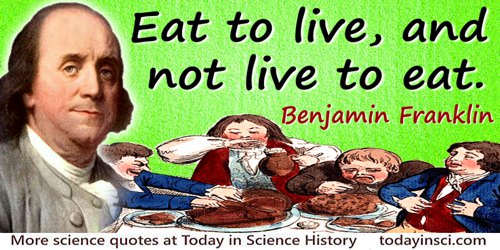
Eat to live, and not live to eat.
In Poor Richard’s Almanack (1733).
Even the taking of medicine serves to make time go on with less heaviness. I have a sort of genius for physic and always had great entertainment in observing the changes of the human body and the effects produced by diet, labor, rest, and physical operations.
Every man should eat and drink and enjoy the fruit of all his labor; it is the gift of God.
— Bible
(circa 725 B.C.)
Forests and trees make significant direct contributions to the nutrition of poor households ... [as] rural communities in Central Africa obtained a critical portion of protein and fat in their diets through hunting wildlife from in and around forests. The five to six million tonnes of bushmeat eaten yearly in the Congo Basin is roughly equal to the total amount of beef produced annually in Brazil – without the accompanying need to clear huge swathes of forest for cattle.
In 'Forests and food security: What we know and need to know', Forest News online blog by the Center for International Forestry Research (20 Apr 2011).
Gluttony is the source of all our infirmities, and the fountain of all our diseases. As a lamp is choked by a superabundance of oil, a fire extinguished by excess of fuel, so is the natural health of the body destroyed by intemperate diet.
In Louis Klopsch, Many Thoughts of Many Minds (1896), 110.
He that takes medicine and neglects to diet himself wastes the skill of the physician.
Chinese proverb.
I believe that the medical treatment of the various abnormal conditions arising in infants is in the future to be largely dietetic rather than by means of drugs.
Preface to the First Edition (Oct 1895). In Pediatrics: the hygienic and medical treatment of children (5th. ed., 1906), ix.
I use the word nursing for want of a better. It has been limited to signify little more than the administration of medicines and the application of poultices. It ought to signify the proper use of fresh air, light, warmth, cleanliness, quiet, and the proper selection and administration of diet—all at the least expense of vital power to the patient.
Notes on Nursing: What it is and what it is not (1860), 2.
I wished to show that Pythagoras, the first founder of the vegetable regimen, was at once a very great physicist and a very great physician; that there has been no one of a more cultured and discriminating humanity; that he was a man of wisdom and of experience; that his motive in commending and introducing the new mode of living was derived not from any extravagant superstition, but from the desire to improve the health and the manners of men.
From Dell Vitto Pitagorico (1743), (The Pythagorean Diet: for the Use of the Medical Faculty), as translated quotes in Howard Williams, The Ethics of Diet: A Catena of Authorities Deprecatory of the Practice of Flesh-Eating (1883), 158.
If the poor overweight jogger only knew how far he had to run to work off the calories in a crust of bread he might find it better in terms of pound per mile to go to a massage parlor.
In M. P. Singh, Quote Unquote: A Handbook of Quotations (2007), 131.
If we sink to the biochemical level, then the human being has lost a great many synthetic abilities possessed by other species and, in particular, by plants and microorganisms. Our loss of ability to manufacture a variety of vitamins makes us dependent on our diet and, therefore, on the greater synthetic versatility of other creatures. This is as much a “degenerative” change as the tapeworm’s abandonment of a stomach it no longer needs, but since we are prejudiced in our own favor, we don’t mention it.
In 'The Modern Demonology' (Jan 1962). Collected in Asimov on Physics (1976), 150.
In general, mankind, since the improvement of cookery, eat about twice as much as nature requires.
Louis Klopsch, Many Thoughts of Many Minds (1896), 67.
Increasingly, our leaders must deal with dangers that threaten the entire world, where an understanding of those dangers and the possible solutions depend on a good grasp of science. The ozone layer, the greenhouse effect, acid rain, questions of diet and of heredity--all require scientific literacy. Can Americans choose the proper leaders and support the proper programs if they are scientifically illiterate?
articles.latimes.com/1989-03-31/news/vw-543_1_scientific-literacy
Increasingly, our leaders must deal with dangers that threaten the entire world, where an understanding of those dangers and the possible solutions depends on a good grasp of science. The ozone layer, the greenhouse effect, acid rain, questions of diet and heredity. All require scientific literacy. Can Americans choose the proper leaders and support the proper programs if they themselves are scientifically illiterate? The whole premise of democracy is that it is safe to leave important questions to the court of public opinion—but is it safe to leave them to the court of public ignorance?
In Los Angeles Times (31 Mar 1989).
Insulin is not a cure for diabetes; it is a treatment. It enables the diabetic to burn sufficient carbohydrates, so that proteins and fats may be added to the diet in sufficient quantities to provide energy for the economic burdens of life.
'Diabetes and Insulin', Nobel Lecture, 15 September 1925. In Nobel Lectures: Physiology or Medicine, 1922-1941 (1965), 68.
It is more important to pave the way for the child to want to know than to put him on a diet of facts he is not ready to assimilate.
In The Sense of Wonder (1956, 1965), 45.

Many dishes many diseases,
Many medicines few cures.
Many medicines few cures.
In Poor Richard’s Almanack (1734).
No disease that can be treated by diet should be treated by any other means.
As quoted in Robert Taylor, White Coat Tales: Medicine's Heroes, Heritage, and Misadventures (2010), 124.
Nor can it be supposed that the diversity of chemical structure and process stops at the boundary of the species, and that within that boundary, which has no real finality, rigid uniformity reigns. Such a conception is at variance with any evolutionary conception of the nature and origin of species. The existence of chemical individuality follows of necessity from that of chemical specificity, but we should expect the differences between individuals to be still more subtle and difficult of detection. Indications of their existence are seen, even in man, in the various tints of skin, hair, and eyes, and in the quantitative differences in those portions of the end-products of metabolism which are endogenous and are not affected by diet, such as recent researches have revealed in increasing numbers. Even those idiosyncrasies with regard to drugs and articles of food which are summed up in the proverbial saying that what is one man's meat is another man's poison presumably have a chemical basis.
Inborn Errors of Metabolism: The Croonian Lectures delivered before the Royal College of Physicians of London, in June, 1908 (1909), 2-3.
Nothing will benefit human health and increase chances for survival of life on Earth as much as the evolution to a vegetarian diet.
…...
On the 20th of May 1747, I took twelve patients in the scurvy, on board the Salisbury at sea. Their cases were as similar as I could have them. They all in general had putrid gums, the spots and lassitude, with weakness of their knees. They lay together in one place, being a proper apartment for the sick in the fore-hold; and had one diet common to all, viz, water-gruel sweetened with sugar in the morning; fresh mutton-broth often times for dinner; at other times puddings, boiled biscuit with sugar, &c.; and for supper, barley and raisins, rice and currents, sago and wine, or the like.
Two of these were ordered each a quart of cider a-day. Two others took twenty-five gutta of elixir vitriol three times a-day, upon an empty stomach; using a gargle strongly acidulated with it for their mouths. Two others took two spoonfuls of vinegar three times a-day, upon an empty stomach; having their gruels and their other food well acidulated with it, as also the gargle for their mouth. Two of the worst patients, with the tendons in the ham rigid, (a symptom none of the rest had), were put under a course of sea-water. Of this they drank half a pint every day, and sometimes more or less as it operated, by way of gentle physics. The others had each two oranges and one lemon given them every day. These they eat with greediness, at different times, upon an empty stomach. They continued but six days under this course, having consumed the quantity that could be spared. The two remaining patients, took the bigness of a nutmeg three times a-day, of an electuary recommended by an hospital-surgeon, made of garlic, mustard-seed, rad. raphan. balsam of Peru, and gum myrrh; using for common drink, barley-water well acidulated with tamarinds; by a decoction of which, with the addition of cremor tartar, they were gently purged three or four times during the course.
The consequence was, that the most sudden and visible good effects were perceived from the use of the oranges and lemons; one of those who had taken them, being at the end of six days fit for duty. …
Next to the oranges, I thought the cider had the best effects.
Two of these were ordered each a quart of cider a-day. Two others took twenty-five gutta of elixir vitriol three times a-day, upon an empty stomach; using a gargle strongly acidulated with it for their mouths. Two others took two spoonfuls of vinegar three times a-day, upon an empty stomach; having their gruels and their other food well acidulated with it, as also the gargle for their mouth. Two of the worst patients, with the tendons in the ham rigid, (a symptom none of the rest had), were put under a course of sea-water. Of this they drank half a pint every day, and sometimes more or less as it operated, by way of gentle physics. The others had each two oranges and one lemon given them every day. These they eat with greediness, at different times, upon an empty stomach. They continued but six days under this course, having consumed the quantity that could be spared. The two remaining patients, took the bigness of a nutmeg three times a-day, of an electuary recommended by an hospital-surgeon, made of garlic, mustard-seed, rad. raphan. balsam of Peru, and gum myrrh; using for common drink, barley-water well acidulated with tamarinds; by a decoction of which, with the addition of cremor tartar, they were gently purged three or four times during the course.
The consequence was, that the most sudden and visible good effects were perceived from the use of the oranges and lemons; one of those who had taken them, being at the end of six days fit for duty. …
Next to the oranges, I thought the cider had the best effects.
A Treatise of the Scurvy (1753), 191-193. Quoted in Carleton Ellis and Annie Louise Macleod, Vital Factors of Foods: Vitamins and Nutrition (1922), 229-230.
One of the commonest dietary superstitions of the day is a belief in instinct as a guide to dietary excellence ... with a corollary that the diets of primitive people are superior to diets approved by science ... [and even] that light might be thrown on the problems of human nutrition by study of what chimpanzees eat in their native forests. ... Such notions are derivative of the eighteenth-century fiction of the happy and noble savage.
Nutrition and Public Health', League of Nations Health Organization Quarterly Bulletin (1935) 4, 323–474. In Kenneth J. Carpenter, 'The Work of Wallace Aykroyd: International Nutritionist and Author', The Journal of Nutrition (2007), 137, 873-878.
Simple diet is best.
Louis Klopsch, Many Thoughts of Many Minds (1896), 67.
Stripping down to essentials is the essence of mathematics. … Reduction to essentials is what makes…a mathematician. … He doesn’t need roughage in his diet if he is a mathematician.
From Lecture (28 Nov 1957) in the Queen’s University, Belfast, 'Is the Study of its History a Brake on the Progress of Science', printed in Hermethena (1958), 19, 25.
Study of the patients’ diets was begun in 1915 in an attempt to determine if some sort of dietary deficiency could be found. The similarity of certain symptoms and signs of pernicious anemia to those in pellagra, sprue, and beriberi was appreciated.
From Nobel Prize Lecture (12 Dec 1934), collected in Nobel Lectures, Physiology or Medicine 1922-1941 (1965).
The best physicians are Dr. Diet, Dr. Quiet and Dr. Merryman.
The evidence from both approaches, statistical and experimental, does not appear sufficiently significant to me to warrant forsaking the pleasure of smoking. As a matter of fact, if the investigations had been pointed toward some material that I thoroughly dislike, such as parsnips, I still would not feel that evidence of the type presented constituted a reasonable excuse for eliminating the things from my diet. I will still continue to smoke, and if the tobacco companies cease manufacturing their product, I will revert to sweet fern and grape leaves.
Introduction in Eric Northrup, Science Looks at Smoking (1957), 34.
The first rule to proper diet? Ask them what they want and then give it to them. There are few exceptions.
Martin H. Fischer, Howard Fabing (ed.) and Ray Marr (ed.), Fischerisms (1944).
The frying pan you should give to your enemy. Food should not be prepared in fat. Our bodies are adapted to a stone age diet of roots and vegetables.
The growth curves of the famous Hopkins' rats are familiar to anyone who has ever opened a textbook of physiology. One recalls the proud ascendant curve of the milk-fed group which suddenly turns downwards as the milk supplement is removed, and the waning curve of the other group taking its sudden milk-assisted upward spring, until it passes its fellow now abruptly on the decline. 'Feeding experiments illustrating the importance of accessory factors in normal dietaries', Jour. Physiol., 1912, xliv, 425, ranks aesthetically beside the best stories of H. G. Wells.
Vitamins and Other Dietary Essentials (1933), 46.
The only way we are going to reduce disease, is to go backward to the diets and lifestyles of our ancestors.
The symptoms or the sufferings generally considered to be inevitable and incident to the disease are very often not symptoms of the disease at all, but of something quite different—of the want of fresh air, or of light, or of warmth, or of quiet, or of cleanliness, or of punctuality and care in the administration of diet, of each or of all of these.
In Notes on Nursing: What It Is and What It Is Not (1859), 5.
The vulgar opinion, then, which, on health reasons, condemns vegetable food and so much praises animal food, being so ill-founded, I have always thought it well to oppose myself to it, moved both by experience and by that refined knowledge of natural things which some study and conversation with great men have given me. And perceiving now that such my constancy has been honoured by some learned and wise physicians with their authoritative adhesion (della autorevole sequela), I have thought it my duty publicly to diffuse the reasons of the Pythagorean diet, regarded as useful in medicine, and, at the same time, as full of innocence, of temperance, and of health. And it is none the less accompanied with a certain delicate pleasure, and also with a refined and splendid luxury (non è privo nemmeno d’una certa delicate voluttà e d’un lusso gentile e splendido ancora), if care and skill be applied in selection and proper supply of the best vegetable food, to which the fertility and the natural character of our beautiful country seem to invite us. For my part I have been so much the more induced to take up this subject, because I have persuaded myself that I might be of service to intending diet-reformers, there not being, to my knowledge, any book of which this is the sole subject, and which undertakes exactly to explain the origin and the reasons of it.
From Dell Vitto Pitagorico (1743), (The Pythagorean Diet: for the Use of the Medical Faculty), as translated quotes in Howard Williams, The Ethics of Diet: A Catena of Authorities Deprecatory of the Practice of Flesh-Eating (1883), 158.
There is no existing ‘standard of protein intake’ that is based on the sure ground of experimental evidence. ... Between the two extremes of a very high and a very low protein intake it is difficult to prove that one level of intake is preferable to another. ... Physiologists, in drawing up dietary standards, are largely influenced by the dietary habits of their time and country.
Nutrition and Public Health', League of Nations Health Organization Quarterly Bulletin (1935) 4, 323–474. In Kenneth J. Carpenter, 'The Work of Wallace Aykroyd: International Nutritionist and Author', The Journal of Nutrition (2007), 137, 873-878.
There is no more wild, free, vigorous growth of the forest, but everything is in pots or rows like a rococo garden... The pupil is in the age of spontaneous variation which at no period of life is so great. He does not want a standardized, overpeptonized mental diet. It palls on his appetite.
Hall, GS (1904b). Adolescence: Its psychology and its relations to physiology, anthropology, sociology, sex, crime, religion and education (1904), Vol. 2, 509.
There was a golden period that I look back upon with great regret, in which the cheapest of experimental animals were medical students. Graduate students were even better. In the old days, if you offered a graduate student a thiamine-deficient diet, he gladly went on it, for that was the only way he could eat. Science is getting to be more and more difficult.
In talk, 'Origin of Death' (1970).
Things sweet to taste prove in digestion sour.
Louis Klopsch, Many Thoughts of Many Minds (1896), 67.

To lengthen thy Life, lessen thy Meals.
In Poor Richard's Almanack (1733).
Use now and then a little Exercise a quarter of an Hour before Meals, as to swing a Weight, or swing your Arms about with a small Weight in each Hand; to leap, or the like, for that stirs the Muscles of the Breast.
In Poor Richard's Almanack (1742).
We are all dietetic sinners; only a small percent of what we eat nourishes us, the balance goes to waste and loss of energy .
William Bennett Bean (ed.), Sir William Osler: Aphorisms from his Bedside Teachings and Writings, No. 191 (1950), 96.
We cannot step aside and say that we have achieved our goal by inventing a new drug or a new way by which to treat presently incurable diseases, a new way to help those who suffer from malnutrition, or the creation of ideal balanced diets on a worldwide scale. We cannot rest till the way has been found, with our help, to bring our finest achievement to everyone.
Address to the Medical College of Virginia, Richmond (1 Dec 1950).
We do not ask what hope of gain makes a little bird warble, since we know that it takes delight in singing because it is for that very singing that the bird was made, so there is no need to ask why the human mind undertakes such toil in seeking out these secrets of the heavens. ... And just as other animals, and the human body, are sustained by food and drink, so the very spirit of Man, which is something distinct from Man, is nourished, is increased, and in a sense grows up on this diet of knowledge, and is more like the dead than the living if it is touched by no desire for these things.
Mysterium Cosmographicum. Translated by A. M. Duncan in The Secret of the Universe (1981), 55.
Well loved he garlic, onions, and eke leeks,
And for to drinken strong wine, red as blood.
And for to drinken strong wine, red as blood.
When I behold a fashionable table set out in all its magnificence, I fancy that I see gouts and dropsies, fevers and lethargies, with other innumerable distempers lying in ambuscade among the dishes. Nature delights in the most plain and simple diet. Every animal but man keeps to one dish. Herbs are the food of this species, fish of that, and flesh of a third. Man falls upon everything that comes in his way; not the smallest fruit or excrescence of the earth, scarce a berry or a mushroom can escape him.
Spectator, No. 195. In Samuel Austin Allibone, Prose Quotations from Socrates to Macaulay (1880), 363.
When you think about flying, it’s nuts really. Here you are at about 40,000 feet, screaming along at 700 miles an hour and you’re sitting there drinking Diet Pepsi and eating peanuts. It just doesn’t make any sense.
…...
Why Become Extinct? Authors with varying competence have suggested that dinosaurs disappeared because the climate deteriorated (became suddenly or slowly too hot or cold or dry or wet), or that the diet did (with too much food or not enough of such substances as fern oil; from poisons in water or plants or ingested minerals; by bankruptcy of calcium or other necessary elements). Other writers have put the blame on disease, parasites, wars, anatomical or metabolic disorders (slipped vertebral discs, malfunction or imbalance of hormone and endocrine systems, dwindling brain and consequent stupidity, heat sterilization, effects of being warm-blooded in the Mesozoic world), racial old age, evolutionary drift into senescent overspecialization, changes in the pressure or composition of the atmosphere, poison gases, volcanic dust, excessive oxygen from plants, meteorites, comets, gene pool drainage by little mammalian egg-eaters, overkill capacity by predators, fluctuation of gravitational constants, development of psychotic suicidal factors, entropy, cosmic radiation, shift of Earth’s rotational poles, floods, continental drift, extraction of the moon from the Pacific Basin, draining of swamp and lake environments, sunspots, God’s will, mountain building, raids by little green hunters in flying saucers, lack of standing room in Noah’s Ark, and palaeoweltschmerz.
'Riddles of the Terrible Lizards', American Scientist (1964) 52, 231.
Why should we limit by dogma or otherwise man’s liberty to select his food and drink? … the great practical rule of life in regard of human diet will not be found in enforcing limitation of the sources of food which Nature has abundantly provided.
In Eating and Living: Diet in Relation to Age and Activity (1885), 16-17.
Wouldst thou enjoy a long Life, a healthy Body, and a vigorous Mind, and be acquainted also with the wonderful Works of God? labour in the first place to bring thy Appetite into Subjection to Reason.
In Poor Richard's Almanack (1742).
 In science it often happens that scientists say, 'You know that's a really good argument; my position is mistaken,' and then they would actually change their minds and you never hear that old view from them again. They really do it. It doesn't happen as often as it should, because scientists are human and change is sometimes painful. But it happens every day. I cannot recall the last time something like that happened in politics or religion.
(1987) --
In science it often happens that scientists say, 'You know that's a really good argument; my position is mistaken,' and then they would actually change their minds and you never hear that old view from them again. They really do it. It doesn't happen as often as it should, because scientists are human and change is sometimes painful. But it happens every day. I cannot recall the last time something like that happened in politics or religion.
(1987) -- 





