Development Quotes (444 quotes)
… however useful the words may have been in the past, they have now become handicaps to the further development of knowledge. Words like botany and zoology imply that plants and animals are quite different things. … But the differences rapidly become blurred when we start looking at the world through a microscope. … The similarities between plants and animals became more important than their differences with the discoveries that both were built up of cells, had sexual reproduction,… nutrition and respiration … and with the development of evolutionary theory.
In The Forest and the Sea (1960), 7.
... one of the main functions of an analogy or model is to suggest extensions of the theory by considering extensions of the analogy, since more is known about the analogy than is known about the subject matter of the theory itself … A collection of observable concepts in a purely formal hypothesis suggesting no analogy with anything would consequently not suggest either any directions for its own development.
'Operational Definition and Analogy in Physical Theories', British Journal for the Philosophy of Science (Feb 1952), 2, No. 8, 291.
[Concerning] the usual contempt with which an orthodox analytic group treats all outsiders and strangers ... I urge you to think of the young psychoanalysts as your colleagues, collaborators and partners and not as spies, traitors and wayward children. You can never develop a science that way, only an orthodox church.
Letter to a colleague (Nov 1960). In Colin Wilson, New Pathways in Psychology: Maslow and the Post-Freudian Revolution (1972, 2001), 154.
[Heisenberg's seminal 1925 paper initiating quantum mechanics marked] one of the great jumps—perhaps the greatest—in the development of twentieth century physics.
In Abraham Pais, Niels Bohr's Times: in Physics, Philosophy, and Polity (1991), 276. Cited in Mauro Dardo, Nobel Laureates and Twentieth-Century Physics (2004), 179.
[Misquotation; not by Einstein.] If only I had known, I should have become a watchmaker. [Apparently remorseful for his role in the development of the atom bomb.]
Although often seen cited as “Attributed” New Statesman (16 Apr 1965), Ralph Keyes in The Quote Verifier: Who Said What, Where, and When (2006), 53, states “Einstein said no such thing.” See the similar quote about a plumber.
[Other than fossils,] the most important of these other records of creation is, without doubt, ontogeny, that is, the history of the developmment of the organic individual (embryology and motamorphology). It briefly repeats in great and marked features the series of forms which the ancestors of the respective individuals have passed through from the beginning of their tribe. We have designated the palaeontological history of the development of the ancestors of a living form as the history of a tribe, or phylogeny, and we may therefore thus enunciate this exceedingly important biogenetic fundamental principle: “Ontogeny is a short and quick repetition, or recapitulation, of Phylogeny, determined by the laws of Inheritance and Adaptation.”
In Ernst Haeckel and E. Ray Lankester (trans.), The History of Creation (1876), Vol. 2, 33. Seen shortened to “Ontogeny recapitulates phylogeny.” This was Haeckel's (incorrect) answer to the vexing question of his time: what is the relationship between individual development (ontogeny) and the evolution of species and lineages (phylogeny)?
[T]here are some common animal behaviors that seem to favor the development of intelligence, behaviors that might lead to brainy beasts on many worlds. Social interaction is one of them. If you're an animal that hangs out with others, then there's clearly an advantage in being smart enough to work out the intentions of the guy sitting next to you (before he takes your mate or your meal). And if you're clever enough to outwit the other members of your social circle, you'll probably have enhanced opportunity to breed..., thus passing on your superior intelligence. ... Nature—whether on our planet or some alien world—will stumble into increased IQ sooner or later.
Seth Shostak, Alex Barnett, Cosmic Company: the Search for Life in the Universe (2003), 62 & 67.
[T]here is little chance that aliens from two societies anywhere in the Galaxy will be culturally close enough to really 'get along.' This is something to ponder as you watch the famous cantina scene in Star Wars. ... Does this make sense, given the overwhelmingly likely situation that galactic civilizations differ in their level of evolutionary development by thousands or millions of years? Would you share drinks with a trilobite, an ourang-outang, or a saber-toothed tiger? Or would you just arrange to have a few specimens stuffed and carted off to the local museum?
Quoted in 'Do Aliens Exist in the Milky Way', PBS web page for WGBH Nova, 'Origins.'
[The original development of the Spinning Mule was a] continual endeavour to realise a more perfect principle of spinning; and though often baffled, I as often renewed the attempt, and at length succeeded to my utmost desire, at the expense of every shilling I had in the world.
'Extract from a manuscript document circulated by Crompton about the year 1809 or 1810', reprinted in The Basis of Mr. Samuel Crompton’s Claims to a Second Remuneration for his Discovery of the Mule Spinning Machine, (1868), 29.
[The surplus of basic knowledge of the atomic nucleus was] largely used up [during the war with the atomic bomb as the dividend.] We must, without further delay restore this surplus in preparation for the important peacetime job for the nucleus - power production. ... Many of the proposed applications of atomic power - even for interplanetary rockets - seem to be within the realm of possibility provided the economic factor is ruled out completely, and the doubtful physical and chemical factors are weighted heavily on the optimistic side. ... The development of economic atomic power is not a simple extrapolation of knowledge gained during the bomb work. It is a new and difficult project to reach a satisfactory answer. Needless to say, it is vital that the atomic policy legislation now being considered by the congress recognizes the essential nature of this peacetime job, and that it not only permits but encourages the cooperative research-engineering effort of industrial, government and university laboratories for the task. ... We must learn how to generate the still higher energy particles of the cosmic rays - up to 1,000,000,000 volts, for they will unlock new domains in the nucleus.
Addressing the American Institute of Electrical Engineering, in New York (24 Jan 1946). In Schenectady Gazette (25 Jan 1946),
[The] structural theory is of extreme simplicity. It assumes that the molecule is held together by links between one atom and the next: that every kind of atom can form a definite small number of such links: that these can be single, double or triple: that the groups may take up any position possible by rotation round the line of a single but not round that of a double link: finally that with all the elements of the first short period [of the periodic table], and with many others as well, the angles between the valencies are approximately those formed by joining the centre of a regular tetrahedron to its angular points. No assumption whatever is made as to the mechanism of the linkage. Through the whole development of organic chemistry this theory has always proved capable of providing a different structure for every different compound that can be isolated. Among the hundreds of thousands of known substances, there are never more isomeric forms than the theory permits.
Presidential Address to the Chemical Society (16 Apr 1936), Journal of the Chemical Society (1936), 533.
[Wernher von Braun] is a human leader whose eyes and thoughts have always been turned toward the stars. It would be foolish to assign rocketry success to one person totally. Components must necessarily be the work of many minds; so must successive stages of development. But because Wernher von Braun joins technical ability, passionate optimism, immense experience and uncanny organizing ability in the elusive power to create a team, he is the greatest human element behind today’s rocketry success
Quoted in 'Reach For The Stars', Time (17 Feb 1958), 71, 25.
[Zoophytes (Protists, or simple life forms) are] the primitive types from which all the organisms of the higher classes had arisen by gradual development.
Entry for Gottfried Reinhold Treviranus in Encyclopedia Britannica (1911), Vol. 27, 255-256.
Lehre von den Ursachen der organischen Gestaltungen.
Developmental mechanics... is the doctrine of the causes of organic forms.
Developmental mechanics... is the doctrine of the causes of organic forms.
Archiv fur Entwickelungsmechanik der Organismen (1895), 1.
That the general characters of the big group to which the embryo belongs appear in development earlier than the special characters. In agreement with this is the fact that the vesicular form is the most general form of all; for what is common in a greater degree to all animals than the opposition of an internal and an external surface?
The less general structural relations are formed after the more general, and so on until the most special appear.
The embryo of any given form, instead of passing through the state of other definite forms, on the contrary separates itself from them.
Fundamentally the embryo of a higher animal form never resembles the adult of another animal form, but only its embryo.
The less general structural relations are formed after the more general, and so on until the most special appear.
The embryo of any given form, instead of passing through the state of other definite forms, on the contrary separates itself from them.
Fundamentally the embryo of a higher animal form never resembles the adult of another animal form, but only its embryo.
Über Entwicklungsgeschichte der Thiere: Beobachtung und Reflexion (1828), 224. Trans. E. S. Russell, Form and Function: A Contribution to the History of Animal Morphology (1916), 125-6.
A celebrated author and divine has written to me that “he has gradually learnt to see that it is just as noble a conception of the Deity to believe that He created a few original forms capable of self-development into other and needful forms, as to believe that He required a fresh act of creation to supply the voids caused by the action of His laws.”
In Origin of Species (1860), 417.
A closer look at the course followed by developing theory reveals for a start that it is by no means as continuous as one might expect, but full of breaks and at least apparently not along the shortest logical path. Certain methods often afforded the most handsome results only the other day, and many might well have thought that the development of science to infinity would consist in no more than their constant application. Instead, on the contrary, they suddenly reveal themselves as exhausted and the attempt is made to find other quite disparate methods. In that event there may develop a struggle between the followers of the old methods and those of the newer ones. The former's point of view will be termed by their opponents as out-dated and outworn, while its holders in turn belittle the innovators as corrupters of true classical science.
In 'On the Development of the Methods of Theoretical Physics in Recent Times', Populäre Schriften, Essay 14. Address (22 Sep 1899) to the Meeting of Natural Scientists at Munich. Collected in Brian McGuinness (ed.), Ludwig Boltzmann: Theoretical Physics and Philosophical Problems, Selected Writings (1974), 79.
A complete theory of evolution must acknowledge a balance between ‘external’ forces of environment imposing selection for local adaptation and ‘internal’ forces representing constraints of inheritance and development. Vavilov placed too much emphasis on internal constraints and downgraded the power of selection. But Western Darwinians have erred equally in practically ignoring (while acknowledging in theory) the limits placed on selection by structure and development–what Vavilov and the older biologists would have called ‘laws of form.’
…...
A major scientific advancement would be the development of cigarette ashes that would match the color of the rug.
In E.C. McKenzie, 14,000 Quips and Quotes for Speakers, Writers, Editors, Preachers, and Teachers (1990), 85.
A multidisciplinary study group ... estimated that it would be 1980 before developments in artificial intelligence make it possible for machines alone to do much thinking or problem solving of military significance. That would leave, say, five years to develop man-computer symbiosis and 15 years to use it. The 15 may be 10 or 500, but those years should be intellectually the most creative and exciting in the history of mankind.
From article 'Man-Computer Symbiosis', in IRE Transactions on Human Factors in Electronics (Mar 1960), Vol. HFE-1, 4-11.
A new species develops if a population which has become geographically isolated from its parental species acquires during this period of isolation characters which promote or guarantee reproductive isolation when the external barriers break down.
Systematics and the Origin of Species: From the Viewpoint of a Zoologist (1942), 155.
A noteworthy and often-remarked similarity exists between the facts and methods of geology and those of linguistic study. The science of language is, as it were, the geology of the most modern period, the Age of the Man, having for its task to construct the history of development of the earth and its inhabitants from the time when the proper geological record remains silent … The remains of ancient speech are like strata deposited in bygone ages, telling of the forms of life then existing, and of the circumstances which determined or affected them; while words are as rolled pebbles, relics of yet more ancient formations, or as fossils, whose grade indicates the progress of organic life, and whose resemblances and relations show the correspondence or sequence of the different strata; while, everywhere, extensive denudation has marred the completeness of the record, and rendered impossible a detailed exhibition of the whole course of development.
In Language and the Study of Language (1867), 47.
A science is said to be useful if its development tends to accentuate the existing inequalities in the distribution of wealth, or more directly promotes the destruction of human life.
In A Mathematician's Apology (1940, reprint with Foreward by C.P. Snow 1992), 113. Note that Hardy wrote these words while World War II was raging.
A science or an art may be said to be “useful” if its development increases, even indirectly, the material well-being and comfort of men, it promotes happiness, using that word in a crude and commonplace way.
In A Mathematician's Apology (1940, 2012), 115.
A sound Physics of the Earth should include all the primary considerations of the earth's atmosphere, of the characteristics and continual changes of the earth's external crust, and finally of the origin and development of living organisms. These considerations naturally divide the physics of the earth into three essential parts, the first being a theory of the atmosphere, or Meteorology, the second, a theory of the earth's external crust, or Hydrogeology, and the third, a theory of living organisms, or Biology.
Hydrogéologie (1802), trans. A. V. Carozzi (1964), 18.
A teacher of mathematics has a great opportunity. If he fills his allotted time with drilling his students in routine operations he kills their interest, hampers their intellectual development, and misuses his opportunity. But if he challenges the curiosity of his students by setting them problems proportionate to their knowledge, and helps them to solve their problems with stimulating questions, he may give them a taste for, and some means of, independent thinking.
In How to Solve It (1948), Preface.
A vast technology has been developed to prevent, reduce, or terminate exhausting labor and physical damage. It is now dedicated to the production of the most trivial conveniences and comfort.
Reflections on Behaviorism and Society (1978), 6.
Absorbed in the special investigation, I paid no heed to the edifice which was meanwhile unconsciously building itself up. Having however completed the comparison of the fossil species in Paris, I wanted, for the sake of an easy revision of the same, to make a list according to their succession in geological formations, with a view of determining the characteristics more exactly and bringing them by their enumeration into bolder relief. What was my joy and surprise to find that the simplest enumeration of the fossil fishes according to their geological succession was also a complete statement of the natural relations of the families among themselves; that one might therefore read the genetic development of the whole class in the history of creation, the representation of the genera and species in the several families being therein determined; in one word, that the genetic succession of the fishes corresponds perfectly with their zoological classification, and with just that classification proposed by me.
Quoted in Elizabeth Cary Agassiz (ed.), Louis Agassiz: His Life and Correspondence (1885), Vol. I, 203-4.
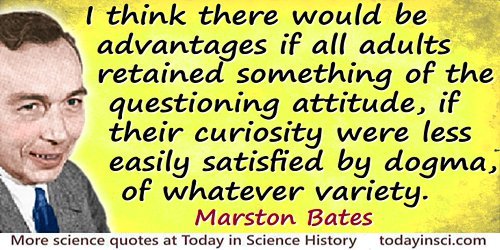
All children are curious and I wonder by what process this trait becomes developed in some and suppressed in others. I suspect again that schools and colleges help in the suppression insofar as they meet curiosity by giving the answers, rather than by some method that leads from narrower questions to broader questions. It is hard to satisfy the curiosity of a child, and even harder to satisfy the curiosity of a scientist, and methods that meet curiosity with satisfaction are thus not apt to foster the development of the child into the scientist. I don't advocate turning all children into professional scientists, although I think there would be advantages if all adults retained something of the questioning attitude, if their curiosity were less easily satisfied by dogma, of whatever variety.
The Nature of Natural History (1950, 1990), 256-257.
All geologic history is full of the beginning and the ends of species–of their first and last days; but it exhibits no genealogies of development.
Lecture to the Edinburgh Philosophical Institution, 'Geology in its Bearings on the Two Theologies, Part 1', collected in The Testimony of the Rocks: or, Geology in Its Bearings on the Two Theologies, Natural and Revealed (1857), 220.
All I ever aim to do is to put the Development hypothesis in the same coach as the creation one. It will only be a question of who is to ride outside & who in after all.
Letter to Asa Gray (31 May 1859). Quoted in A. Hunter Dupree, Asa Gray: American Botanist, Friend of Darwin (1988), 265. Originally published as Asa Gray: 1810-1888 (1959).
All that concerns the Mediterranean is of the deepest interest to civilized man, for the history of its progress is the history of the development of the world; the memory of the great men who have lived and died around its banks; the recollection of the undying works that have come thence to delight us for ever; the story of patient research and brilliant discoveries connected with every physical phenomenon presented by its waves and currents, and with every order of creatures dwelling in and around its waters.
From Literary Papers (1855), 106. As quoted in On Early Explorations in the Mediterranean.In George Wilson and Archibald Geikie, Memoir of Edward Forbes F.R.S. (1861), 279. Geike introduces the Forbes quote as “the recollection of these, his earliest explorations in the Mediterranean,” as written down years later.
All that is valuable in human society depends upon the opportunity for development accorded the individual.
…...
Although with the majority of those who study and practice in these capacities [engineers, builders, surveyors, geographers, navigators, hydrographers, astronomers], secondhand acquirements, trite formulas, and appropriate tables are sufficient for ordinary purposes, yet these trite formulas and familiar rules were originally or gradually deduced from the profound investigations of the most gifted minds, from the dawn of science to the present day. … The further developments of the science, with its possible applications to larger purposes of human utility and grander theoretical generalizations, is an achievement reserved for a few of the choicest spirits, touched from time to time by Heaven to these highest issues. The intellectual world is filled with latent and undiscovered truth as the material world is filled with latent electricity.
In Orations and Speeches, Vol. 3 (1870), 513.
Among all highly civilized peoples the golden age of art has always been closely coincident with the golden age of the pure sciences, particularly with mathematics, the most ancient among them.
This coincidence must not be looked upon as accidental, but as natural, due to an inner necessity. Just as art can thrive only when the artist, relieved of the anxieties of existence, can listen to the inspirations of his spirit and follow in their lead, so mathematics, the most ideal of the sciences, will yield its choicest blossoms only when life’s dismal phantom dissolves and fades away, when the striving after naked truth alone predominates, conditions which prevail only in nations while in the prime of their development.
This coincidence must not be looked upon as accidental, but as natural, due to an inner necessity. Just as art can thrive only when the artist, relieved of the anxieties of existence, can listen to the inspirations of his spirit and follow in their lead, so mathematics, the most ideal of the sciences, will yield its choicest blossoms only when life’s dismal phantom dissolves and fades away, when the striving after naked truth alone predominates, conditions which prevail only in nations while in the prime of their development.
From Die Entwickelung der Mathematik im Zusammenhange mit der Ausbreitung der Kultur (1893), 4. As translated in Robert Édouard Moritz, Memorabilia Mathematica; Or, The Philomath’s Quotation-Book (1914), 191-192. From the original German, “Bei allen Kulturvölkern ist die Blüthezeit der Kunst auch immer zeitlich eng verbunden mit einer Blüthezeit der reinen Wissenschaften, insbesondere der ältesten unter ihnen, der Mathematik.
Dieses Zusammentreffen dürfte auch nicht ein zufälliges, sondern ein natürliches, ein Ergebniss innerer Notwendigkeit sein. Wie die Kunst nur gedeihen kann, wenn der Künstler, unbekümmert um die Bedrängnisse des Daseins, den Eingebungen seines Geistes lauschen und ihnen folgen kann, so kann die idealste Wissenschaft, die Mathematik, erst dann ihre schönsten Blüthen treiben, wenn des Erdenlebens schweres Traumbild sinkt und sinkt und sinkt, wenn das Streben nach der nackten Wahrheit allein bestimmend ist, was nur bei Nationen in der Vollkraft ihrer Entwickelung vorkommt.”
Dieses Zusammentreffen dürfte auch nicht ein zufälliges, sondern ein natürliches, ein Ergebniss innerer Notwendigkeit sein. Wie die Kunst nur gedeihen kann, wenn der Künstler, unbekümmert um die Bedrängnisse des Daseins, den Eingebungen seines Geistes lauschen und ihnen folgen kann, so kann die idealste Wissenschaft, die Mathematik, erst dann ihre schönsten Blüthen treiben, wenn des Erdenlebens schweres Traumbild sinkt und sinkt und sinkt, wenn das Streben nach der nackten Wahrheit allein bestimmend ist, was nur bei Nationen in der Vollkraft ihrer Entwickelung vorkommt.”
An announcement of [Christopher] Zeeman’s lecture at Northwestern University in the spring of 1977 contains a quote describing catastrophe theory as the most important development in mathematics since the invention of calculus 300 years ago.
In book review of Catastrophe Theory: Collected Papers, 1972-1977, in Bulletin of the American Mathematical Society (Nov 1978), 84, No. 6, 1360. Reprinted in Stephen Smale, Roderick Wong(ed.), The Collected Papers of Stephen Smale (2000), Vol. 2, 814.
An inducement must be offered to those who are engaged in the industrial exploitation of natural sources of power, as waterfalls, by guaranteeing greater returns on the capital invested than they can secure by local development of the property.
In 'The Problem of Increasing Human Energy', Century Illustrated Monthly Magazine (Jun 1900), 210. Collected in My Inventions: And Other Writings (2016), 125.
And yet in a funny way our lack of success led to our breakthrough; because, since we could not get a cell line off the shelf doing what we wanted, we were forced to construct it. And the original experiment ... developed into a method for the production of hybridomas ... [which] was of more importance than our original purpose.
From Nobel Lecture (8 Dec 1984), collected in Tore Frängsmyr and Jan Lindsten (eds.), Nobel Lectures in Physiology Or Medicine: 1981-1990 (1993), 256-257.
Anthropology has reached that point of development where the careful investigation of facts shakes our firm belief in the far-reaching theories that have been built up. The complexity of each phenomenon dawns on our minds, and makes us desirous of proceeding more cautiously. Heretofore we have seen the features common to all human thought. Now we begin to see their differences. We recognize that these are no less important than their similarities, and the value of detailed studies becomes apparent. Our aim has not changed, but our method must change. We are still searching for the laws that govern the growth of human culture, of human thought; but we recognize the fact that before we seek for what is common to all culture, we must analyze each culture by careful and exact methods, as the geologist analyzes the succession and order of deposits, as the biologist examines the forms of living matter. We see that the growth of human culture manifests itself in the growth of each special culture. Thus we have come to understand that before we can build up the theory of the growth of all human culture, we must know the growth of cultures that we find here and there among the most primitive tribes of the Arctic, of the deserts of Australia, and of the impenetrable forests of South America; and the progress of the civilization of antiquity and of our own times. We must, so far as we can, reconstruct the actual history of mankind, before we can hope to discover the laws underlying that history.
The Jesup North Pacific Expedition: Memoir of the American Museum of Natural History (1898), Vol. 1, 4.
Any successful international negotiation for reducing emissions must be based on four principles: the precautionary principle, the principle of sustainable development, the polluter-pays principle and the principle of equity. The strength of 'contraction and convergence' is that it satisfies all these principles.
In The Independent (10 Aug 2003).
As an individual opinion of mine, perhaps not as yet shared by many, I may be permitted to state, by the way, that I consider pure Mathematics to be only one branch of general Logic, the branch originating from the creation of Number, to the economical virtues of which is due the enormous development that particular branch has been favored with in comparison with the other branches of Logic that until of late almost remained stationary.
In Lecture (10 Aug 1898) present in German to the First International Congress of Mathematicians in Zürich, 'On Pasigraphy: Its Present State and the Pasigraphic Movement in Italy'. As translated and published in The Monist (1899), 9, No. 1, 46.
As I show you this liquid, I too could tell you, 'I took my drop of water from the immensity of creation, and I took it filled with that fecund jelly, that is, to use the language of science, full of the elements needed for the development of lower creatures. And then I waited, and I observed, and I asked questions of it, and I asked it to repeat the original act of creation for me; what a sight it would be! But it is silent! It has been silent for several years, ever since I began these experiments. Yes! And it is because I have kept away from it, and am keeping away from it to this moment, the only thing that it has not been given to man to produce, I have kept away from it the germs that are floating in the air, I have kept away from it life, for life is the germ, and the germ is life.'
Quoted in Patrice Debré, Louis Pasteur, trans. Elborg Forster (1994), 169.
As long as a branch of science offers an abundance of problems, so long it is alive; a lack of problems foreshadows extinction or the cessation of independent development.
In 'Mathematical Problems', Bulletin American Mathematical Society, 8, 438.
As regards religion, on the other hand, one is generally agreed that it deals with goals and evaluations and, in general, with the emotional foundation of human thinking and acting, as far as these are not predetermined by the inalterable hereditary disposition of the human species. Religion is concerned with man’s attitude toward nature at large, with the establishing of ideals for the individual and communal life, and with mutual human relationship. These ideals religion attempts to attain by exerting an educational influence on tradition and through the development and promulgation of certain easily accessible thoughts and narratives (epics and myths) which are apt to influence evaluation and action along the lines of the accepted ideals.
Replying to the Liberal Ministers’ Club of New York City. Published in >The Christian Register, (Jun 1948). As given in Albert Einstein, Cal Seelig (ed.) and Sonja Bargmann (trans., ed.), Ideas and Opinions (1954, 2010), 50.
As the Director of the Theoretical Division of Los Alamos, I participated at the most senior level in the World War II Manhattan Project that produced the first atomic weapons.
Now, at age 88, I am one of the few remaining such senior persons alive. Looking back at the half century since that time, I feel the most intense relief that these weapons have not been used since World War II, mixed with the horror that tens of thousands of such weapons have been built since that time—one hundred times more than any of us at Los Alamos could ever have imagined.
Today we are rightly in an era of disarmament and dismantlement of nuclear weapons. But in some countries nuclear weapons development still continues. Whether and when the various Nations of the World can agree to stop this is uncertain. But individual scientists can still influence this process by withholding their skills.
Accordingly, I call on all scientists in all countries to cease and desist from work creating, developing, improving and manufacturing further nuclear weapons - and, for that matter, other weapons of potential mass destruction such as chemical and biological weapons.
[On the occasion of the 50th Anniversary of Hiroshima.]
Now, at age 88, I am one of the few remaining such senior persons alive. Looking back at the half century since that time, I feel the most intense relief that these weapons have not been used since World War II, mixed with the horror that tens of thousands of such weapons have been built since that time—one hundred times more than any of us at Los Alamos could ever have imagined.
Today we are rightly in an era of disarmament and dismantlement of nuclear weapons. But in some countries nuclear weapons development still continues. Whether and when the various Nations of the World can agree to stop this is uncertain. But individual scientists can still influence this process by withholding their skills.
Accordingly, I call on all scientists in all countries to cease and desist from work creating, developing, improving and manufacturing further nuclear weapons - and, for that matter, other weapons of potential mass destruction such as chemical and biological weapons.
[On the occasion of the 50th Anniversary of Hiroshima.]
Letter, Bulletin of the Atomic Scientists (Nov 1995), 51:6, 3.
As to rocket ships flying between America and Europe, I believe it is worth seriously trying for. Thirty years ago persons who were developing flying were laughed at as mad, and that scorn hindered aviation. Now we heap similar ridicule upon stratoplane or rocket ships for trans-Atlantic flights.
Predicting high-altitude jet aircraft for routine long-distance travel. As quoted by Gobind Behari Lal, Universal Service Science Editor, as printed in 'Prof. Piccard Reaches U.S.', Syracuse Journal (13 Jan 1933), 4.
At first sight nothing seems more obvious than that everything has a beginning and an end, and that everything can be subdivided into smaller parts. Nevertheless, for entirely speculative reasons the philosophers of Antiquity, especially the Stoics, concluded this concept to be quite unnecessary. The prodigious development of physics has now reached the same conclusion as those philosophers, Empedocles and Democritus in particular, who lived around 500 B.C. and for whom even ancient man had a lively admiration.
'Development of the Theory of Electrolytic Dissociation', Nobel Lecture, 11 December 1903. In Nobel Lectures: Chemistry 1901-1921 (1966), 45.
AZT stood up and said, 'Stop your pessimism. Stop your sense of futility. Go back to the lab. Go back to development. Go back to clinical trials. Things will work.'
[On the impact of AZT emerging as the long-sought first significant AIDS drug.]
[On the impact of AZT emerging as the long-sought first significant AIDS drug.]
As quoted in Emily Langer, 'Researcher Jerome P. Horwitz, 93, created AZT, the first approved treatment for HIV/AIDS' Washington Post (19 Sep 2012). The article was excerpted on blogs, sometimes referring to this quote by saying "AZT was more a cure for fatalism than for AIDS."
Basic research is not the same as development. A crash program for the latter may be successful; but for the former it is like trying to make nine women pregnant at once in the hope of getting a baby in a month’s time.
In New Scientist, November 18, 1976.
Because intelligence is our own most distinctive feature, we may incline to ascribe superior intelligence to the basic primate plan, or to the basic plan of the mammals in general, but this point requires some careful consideration. There is no question at all that most mammals of today are more intelligent than most reptiles of today. I am not going to try to define intelligence or to argue with those who deny thought or consciousness to any animal except man. It seems both common and scientific sense to admit that ability to learn, modification of action according to the situation, and other observable elements of behavior in animals reflect their degrees of intelligence and permit us, if only roughly, to compare these degrees. In spite of all difficulties and all the qualifications with which the expert (quite properly) hedges his conclusions, it also seems sensible to conclude that by and large an animal is likely to be more intelligent if it has a larger brain at a given body size and especially if its brain shows greater development of those areas and structures best developed in our own brains. After all, we know we are intelligent, even though we wish we were more so.
In The Meaning of Evolution: A Study of the History of Life and of its Significance for Man (1949), 78.
Before an experiment can be performed, it must be planned—the question to nature must be formulated before being posed. Before the result of a measurement can be used, it must be interpreted—nature's answer must be understood properly. These two tasks are those of the theorist, who finds himself always more and more dependent on the tools of abstract mathematics. Of course, this does not mean that the experimenter does not also engage in theoretical deliberations. The foremost classical example of a major achievement produced by such a division of labor is the creation of spectrum analysis by the joint efforts of Robert Bunsen, the experimenter, and Gustav Kirchoff, the theorist. Since then, spectrum analysis has been continually developing and bearing ever richer fruit.
'The Meaning and Limits of Exact Science', Science (30 Sep 1949), 110, No. 2857, 325. Advance reprinting of chapter from book Max Planck, Scientific Autobiography (1949), 110.
Besides electrical engineering theory of the transmission of messages, there is a larger field [cybernetics] which includes not only the study of language but the study of messages as a means of controlling machinery and society, the development of computing machines and other such automata, certain reflections upon psychology and the nervous system, and a tentative new theory of scientific method.
In Cybernetics (1948).
Books are the carriers of civilization. Without books, history is silent, literature dumb, science crippled, thought and speculation at a standstill. Without books the development of civilization would have been impossible. They are engines of change, windows on the world, “lighthouses,” (as a poet said), “erected in the sea of time.”
In Authors League Bulletin (1979). As city in Charles Francis (ed.), Wisdom Well Said (2009), 48.
But I think that in the repeated and almost entire changes of organic types in the successive formations of the earth—in the absence of mammalia in the older, and their very rare appearance (and then in forms entirely. unknown to us) in the newer secondary groups—in the diffusion of warm-blooded quadrupeds (frequently of unknown genera) through the older tertiary systems—in their great abundance (and frequently of known genera) in the upper portions of the same series—and, lastly, in the recent appearance of man on the surface of the earth (now universally admitted—in one word, from all these facts combined, we have a series of proofs the most emphatic and convincing,—that the existing order of nature is not the last of an uninterrupted succession of mere physical events derived from laws now in daily operation: but on the contrary, that the approach to the present system of things has been gradual, and that there has been a progressive development of organic structure subservient to the purposes of life.
'Address to the Geological Society, delivered on the Evening of the 18th of February 1831', Proceedings of the Geological Society (1834), 1, 305-6.
But notwithstanding these Arguments are so convictive and demonstrative, its marvellous to see how some Popish Authors (Jesuites especially) strain their wits to defend their Pagan Master Aristotle his Principles. Bullialdus speaks of a Florentine Physitian, that all the Friends he had could ever perswade him once to view the Heavens through a Telescope, and he gave that reason for his refusal, because he was afraid that then his Eyes would make him stagger concerning the truth of Aristotle’s Principles, which he was resolved he would not call into question. It were well, if these Men had as great veneration for the Scripture as they have, for Aristotles (if indeed they be his) absurd Books de cælo Sed de his satis.
(Indicating a belief that the Roman Catholic church impeded the development of modern science.)
(Indicating a belief that the Roman Catholic church impeded the development of modern science.)
Kometographia, Or a Discourse Concerning Comets (Boston 1684). Quoted in Michael Garibaldi Hall, The Last American Puritan: The Life of Increase Mather, 1639-1723 (1988), 167.
But science is the great instrument of social change, all the greater because its object is not change but knowledge, and its silent appropriation of this dominant function, amid the din of political and religious strife, is the most vital of all the revolutions which have marked the development of modern civilisation.
Decadence: Henry Sidgwick Memorial Lecture (1908), 55-6.
Chromosomes … [contain] some kind of code-script the entire pattern of the individual’s future development and of its functioning in the mature state. Every complete set of chromosomes contains the full code.
In What is Life? : The Physical Aspect of the Living Cell (1944), 20.
Connected by innumerable ties with abstract science, Physiology is yet in the most intimate relation with humanity; and by teaching us that law and order, and a definite scheme of development, regulate even the strangest and wildest manifestations of individual life, she prepares the student to look for a goal even amidst the erratic wanderings of mankind, and to believe that history offers something more than an entertaining chaos—a journal of a toilsome, tragi-comic march nowither.
In 'Educational Value of Natural History Sciences', Lay Sermons, Addresses, and Reviews (1870), 97.
Conservation means development as much as it does protection. I recognize the right and duty of this generation to develop and use the natural resources of our land; but I do not recognize the right to waste them, or to rob, by wasteful use, the generations that come after us.
'The New Nationalism', speech at Osawatomie, Kansas, 31 Aug 1910. In Richard D. Heffner, A Documentary History of the United States: Seventh Revised Edition (2002), 272. This is one of the quotations inscribed in the Roosevelt Memorial rotunda at the American Museum of Natural History.
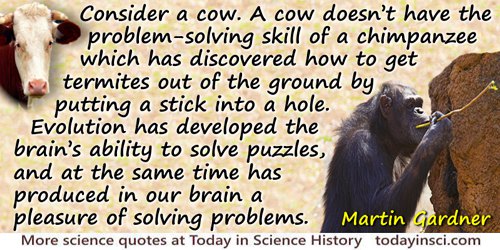
Consider a cow. A cow doesn’t have the problem-solving skill of a chimpanzee, which has discovered how to get termites out of the ground by putting a stick into a hole. Evolution has developed the brain’s ability to solve puzzles, and at the same time has produced in our brain a pleasure of solving problems.
In John Tierney, 'For Decades, Puzzling People With Mathematics', New York Times (20 Oct 2009), D2.
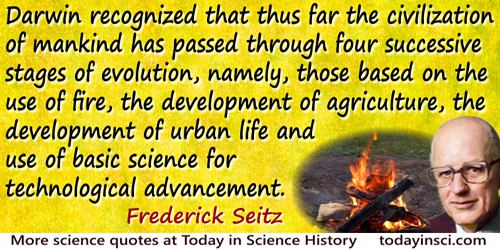
Darwin recognized that thus far the civilization of mankind has passed through four successive stages of evolution, namely, those based on the use of fire, the development of agriculture, the development of urban life and the use of basic science for technological advancement.
In The Science Matrix: The Journey, Travails, Triumphs (1992, 2012), 86.
Darwin’s book is very important and serves me as a basis in natural science for the class struggle in history. One has to put up with the crude English method of development, of course. Despite all deficiencies not only is the death-blow dealt here for the first time to “teleology” in the natural sciences, but their rational meaning is empirically explained.
Marx to Lasalle, 16 Jan 1861. In Marx-Engels Selected Correspondence, 1846-95, trans. Donna Torr (1934), 125.
Despite its importance to navigation, fishing, oil and gas development, and maritime safety, our understanding of how the Gulf system works remains extremely limited.
In 'Opinion: Why we can’t forget the Gulf', CNN (16 Apr 2015).
Developing countries can leapfrog several stages in the development process through the application of bio-technology in agriculture.
In Arbind Prasad and Jagdish Prasad, Development Planning for Agriculture: Policies, Economic Implications, Inputs, Production and Marketing (1994), 93.
Development of Western science is based on two great achievements: the invention of the formal logical system (in Euclidean geometry) by the Greek philosophers, and the discovery of the possibility to find out causal relationships by systematic experiment (during the Renaissance). In my opinion, one has not to be astonished that the Chinese sages have not made these steps. The astonishing thing is that these discoveries were made at all.
Letter to J. S. Switzer, 23 Apr 1953, Einstein Archive 61-381. Quoted in Alice Calaprice, The Quotable Einstein (1996), 180.
Developmental Biology, in capitals, is the wave of the future. The creeping reductionism of biochemistry and molecular biology has taken over the cell and heredity, and looks covetously toward the heights of development and evolution. Recent literature is last year. Ancient literature is a decade ago. The rest is history, doubtfully alive. There is no time and often no opportunity to find and study the work of experimental biologists of 50 or 100 years ago, yet that was a time when the world was fresh.
Developmental biology was a lowercase phrase that graduated about 1950 and had previously lived under the cloak of Experimental Zoology
Developmental biology was a lowercase phrase that graduated about 1950 and had previously lived under the cloak of Experimental Zoology
In obituary by Charles R. Scriver, Biographical Memoirs of Fellows of the Royal Society (Nov 1999), 45, 33.
Do you realize we’ve got 250 million years of coal? But coal has got environmental hazards to it, but there’s—I’m convinced, and I know that we—technology can be developed so we can have zero-emissions coal-fired electricity plants.
Remarks at the Associated Builders and Contractors National Legislative Conference (8 Jun 2005). The White house corrected “250 million years” to “250 years” in a footnote to the printed record, 41 WCPD 956 in 'Administration of George W. Bush', 959.
Does life belong to what we know as matter, or is it an independent principle inserted into matter at some suitable epoch when the physical conditions became such as to permit the development of life?
In Fragments of Science for Unscientific People: A Series of Detached Essays (1871), 158.
Dr. Wallace, in his Darwinism, declares that he can find no ground for the existence of pure scientists, especially mathematicians, on the hypothesis of natural selection. If we put aside the fact that great power in theoretical science is correlated with other developments of increasing brain-activity, we may, I think, still account for the existence of pure scientists as Dr. Wallace would himself account for that of worker-bees. Their function may not fit them individually to survive in the struggle for existence, but they are a source of strength and efficiency to the society which produces them.
In Grammar of Science (1911), Part, 1, 221.
During its development the animal passes through all stages of the animal kingdom. The foetus is a representation of all animal classes in time.
In Lorenz Oken, trans. by Alfred Tulk, Elements of Physiophilosophy (1847), 491.
During my span of life science has become a matter of public concern and the l'art pour l'art standpoint of my youth is now obsolete. Science has become an integral and most important part of our civilization, and scientific work means contributing to its development. Science in our technical age has social, economic, and political functions, and however remote one's own work is from technical application it is a link in the chain of actions and decisions which determine the fate of the human race. I realized this aspect of science in its full impact only after Hiroshima.
— Max Born
My Life & My Views (1968), 49.
During the 1930s, Nazi oppression drove numerous scientists to Great Britain and the United States, and they were a key factor in the development of the nuclear bomb—a development widely touted in the United States as based on “Yankee know-how.” Except that virtually all the Yankees had foreign accents.
In 'Combatting U.S. Scientific Illiteracy', Los Angeles Times (31 Mar 1989).
During the half-century that has elapsed since the enunciation of the cell-theory by Schleiden and Schwann, in 1838-39, it has became ever more clearly apparent that the key to all ultimate biological problems must, in the last analysis, be sought in the cell. It was the cell-theory that first brought the structure of plants and animals under one point of view by revealing their common plan of organization. It was through the cell-theory that Kolliker and Remak opened the way to an understanding of the nature of embryological development, and the law of genetic continuity lying at the basis of inheritance. It was the cell-theory again which, in the hands of Virchaw and Max Schultze, inaugurated a new era in the history of physiology and pathology, by showing that all the various functions of the body, in health and in disease, are but the outward expression of cell-activities. And at a still later day it was through the cell-theory that Hertwig, Fol, Van Beneden, and Strasburger solved the long-standing riddle of the fertilization of the egg, and the mechanism of hereditary transmission. No other biological generalization, save only the theory of organic evolution, has brought so many apparently diverse phenomena under a common point of view or has accomplished more far the unification of knowledge. The cell-theory must therefore be placed beside the evolution-theory as one of the foundation stones of modern biology.
In The Cell in Development and Inheritance (1896), 1.
During the war years I worked on the development of radar and other radio systems for the R.A.F. and, though gaining much in engineering experience and in understanding people, rapidly forgot most of the physics I had learned.
From Autobiography in Wilhelm Odelberg (ed.), Les Prix Nobel en 1974/Nobel Lectures (1975)
Dust consisting of fine fibers of asbestos, which are insoluble and virtually indestructible, may become a public health problem in the near future. At a recent international conference on the biological effects of asbestos sponsored by the New York Academy of Sciences, participants pointed out on the one hand that workers exposed to asbestos dust are prone in later life to develop lung cancer, and on the other hand that the use of this family of fibrous silicate compounds has expanded enormously during the past few decades. A laboratory curiosity 100 years ago, asbestos today is a major component of building materials.
— Magazine
In Scientific American (Sep 1964). As cited in '50, 100 & 150 Years Ago', Scientific American (Dec 2014), 311, No. 6, 98.
Each new scientific development is due to the pressure of some social need. Of course … insatiable curiosity … is still nothing but a response either to an old problem of nature, or to one arising from new social circumstances.
In 'The Teaching of the History of Science', The Scientific Monthly (Sep 1918), 194.
Even the development of the steam engine owed but little to the advancement of science.
Science and Common Sense (1951), 299-300.
Events and developments, such as … the Copernican Revolution, … occurred only because some thinkers either decided not to be bound by certain “obvious” methodological rules, or because they unwittingly broke them.
Against Method: Outline of an Anarchistic Theory of Knowledge (1975, 1993), 14.
Every complete set of chromosomes contains the full code; so there are, as a rule, two copies of the latter in the fertilized egg cell, which forms the earliest stage of the future individual. In calling the structure of the chromosome fibres a code-script we mean that the all-penetrating mind, once conceived by Laplace, to which every causal connection lay immediately open, could tell from their structure whether the egg would develop, under suitable conditions, into a black cock or into a speckled hen, into a fly or a maize plant, a rhododendron, a beetle, a mouse or a woman. To which we may add, that the appearances of the egg cells are very often remarkably similar; and even when they are not, as in the case of the comparatively gigantic eggs of birds and reptiles, the difference is not so much in the relevant structures as in the nutritive material which in these cases is added for obvious reasons.
But the term code-script is, of course, too narrow. The chromosome structures are at the same time instrumental in bringing about the development they foreshadow. They are law-code and executive power?or, to use another simile, they are architect's plan and builder’s craft-in one.
But the term code-script is, of course, too narrow. The chromosome structures are at the same time instrumental in bringing about the development they foreshadow. They are law-code and executive power?or, to use another simile, they are architect's plan and builder’s craft-in one.
In What is Life? : The Physical Aspect of the Living Cell (1944), 20-21.
Every mathematical discipline goes through three periods of development: the naive, the formal, and the critical.
Quoted in R Remmert, Theory of complex functions (New York, 1989).
Every progress that a church makes in the construction of its dogmas leads to a further taming of the free spirit; every new dogma … narrows the circle of free thought. … Science, on the other hand, liberates with every step of its development, it opens up new paths to thought … In other words, it allows the individual to be truly free.
Translated from the original German, “Jeder Fortschritt, den eine Kirche in dem Aufbau ihrer Dogmen macht, führt zu einer weiter gehenden Bändigung des freien Geistes; jedes neue Dogma …
verengt den Kreis des freien Denkens. … Die Naturwissenschaft umgekehrt befreit mit jedem Schritte ihrer Entwicklung, sie eröffnet dem Gedanken neue Bahnen … Sie gestattet, mit anderen Worten, dem Einzelnen in vollem Masse wahr zu sein.” In Speech to the 24th meeting of the German Naturalists and Physicians at Rostock 'Ueber die Aufgaben der Naturwissenschaften in dem neuen nationalen Leben Deutschlands', (On the tasks of the natural sciences in the new
national life of Germany), published in Chemisches Zentralblatt (11 Oct 1871), No. 41, 654-655. English version by Webmaster using Google translate.
Everything that the human race has done and thought is concerned with the satisfaction of deeply felt needs and the assuagement of pain. One has to keep this constantly in mind if one wishes to understand spiritual movements and their development. Feeling and longing are the motive force behind all human endeavor and human creation, in however exalted a guise the latter may present themselves to us.
In Essay, 'On Religion and Science' as collected in Ideas And Opinions. (2010), 35 [where it is cited as “Written expressly for the New York Times Magazine” (9 Nov 1930), “pp. (1-4). The German
text was published in the Berliner Tageblatt” (11 Nov 1930).] Also seen in New York Times archive newspaper image as: “Everything that men do or think concerns the satisfaction of the needs they feel or the escape from pain. This must be kept in mind when we seek to understand spiritual or intellectual movements and the way in which they develop. For feeling and longing are the motive forces of all human striving and productivity—however nobly these latter may display themselves to us,” in 'Religion and Science', New York Times Magazine (9 Nov 1930), 1. [It is a puzzle that these are two totally different paragraphs (albeit with the same gist): one quoted and cited in a book, and one from a direct image from NYT archive (timesmachine). Yet the first claims to have been “expressly written” for the cited newspaper article, which does not match that wording in the image record of the actual newspaper. However, the printed book title page states: Based on Mein Welttrild, edited by Cal Seelig, and other sources. New translations and revisions by Sonja Bargmann. So perhaps (at a guess) the first version of the quote shown above is a translation from the German newspaper? —Webmaster]
Exercise in the most rigorous thinking that is possible will of its own accord strengthen the sense of truth and right, for each advance in the ability to distinguish between correct and false thoughts, each habit making for rigour in thought development will increase in the sound pupil the ability and the wish to ascertain what is right in life and to defend it.
In Anleitung zum mathematischen Unterricht in den höheren Schulen (1906), 28.
Exobiology—a curious development in view of the fact that this “science” has yet to demonstrate that its subject matter exists!
In This View of Life: The World of the Evolutionist (1964), 254.
Experience is never at fault; it is only your judgment that is in error in promising itself such results from experience as are not caused by our experiments. For having given a beginning, what follows from it must necessarily be a natural development of such a beginning, unless it has been subject to a contrary influence, while, if it is affected by any contrary influence, the result which ought to follow from the aforesaid beginning will be found to partake of this contrary influence in a greater or less degree in proportion as the said influence is more or less powerful than the aforesaid beginning.
'Philosophy', in The Notebooks of Leonardo da Vinci, trans. E. MacCurdy (1938), Vol. 1, 70.
Fertilization of mammalian eggs is followed by successive cell divisions and progressive differentiation, first into the early embryo and subsequently into all of the cell types that make up the adult animal. Transfer of a single nucleus at a specific stage of development, to an enucleated unfertilized egg, provided an opportunity to investigate whether cellular differentiation to that stage involved irreversible genetic modification. The first offspring to develop from a differentiated cell were born after nuclear transfer from an embryo-derived cell line that had been induced to became quiescent. Using the same procedure, we now report the birth of live lambs from three new cell populations established from adult mammary gland, fetus and embryo. The fact that a lamb was derived from an adult cell confirms that differentiation of that cell did not involve the irreversible modification of genetic material required far development to term. The birth of lambs from differentiated fetal and adult cells also reinforces previous speculation that by inducing donor cells to became quiescent it will be possible to obtain normal development from a wide variety of differentiated cells.
[Co-author of paper announcing the cloned sheep, ‘Dolly’.]
[Co-author of paper announcing the cloned sheep, ‘Dolly’.]
In I. Wilmut, A. E. Schnieke, J. McWhir, et al., 'Viable Offspring Derived from Petal and Adult Mammalian Cells', Nature (1997), 385, 810.
Few will deny that even in the first scientific instruction in mathematics the most rigorous method is to be given preference over all others. Especially will every teacher prefer a consistent proof to one which is based on fallacies or proceeds in a vicious circle, indeed it will be morally impossible for the teacher to present a proof of the latter kind consciously and thus in a sense deceive his pupils. Notwithstanding these objectionable so-called proofs, so far as the foundation and the development of the system is concerned, predominate in our textbooks to the present time. Perhaps it will be answered, that rigorous proof is found too difficult for the pupil’s power of comprehension. Should this be anywhere the case,—which would only indicate some defect in the plan or treatment of the whole,—the only remedy would be to merely state the theorem in a historic way, and forego a proof with the frank confession that no proof has been found which could be comprehended by the pupil; a remedy which is ever doubtful and should only be applied in the case of extreme necessity. But this remedy is to be preferred to a proof which is no proof, and is therefore either wholly unintelligible to the pupil, or deceives him with an appearance of knowledge which opens the door to all superficiality and lack of scientific method.
In 'Stücke aus dem Lehrbuche der Arithmetik', Werke, Bd. 2 (1904), 296.
First Law
In every animal which has not passed the limit of its development, a more frequent and continuous use of any organ gradually strengthens, develops and enlarges that organ, and gives it a power proportional to the length of time it has been so used; while the permanent disuse of any organ imperceptibly weakens and deteriorates it, and progressively diminishes its functional capacity, until it finally disappears.
In every animal which has not passed the limit of its development, a more frequent and continuous use of any organ gradually strengthens, develops and enlarges that organ, and gives it a power proportional to the length of time it has been so used; while the permanent disuse of any organ imperceptibly weakens and deteriorates it, and progressively diminishes its functional capacity, until it finally disappears.
Philosophie Zoologique (1809), Vol. 1, 235, trans. Hugh Elliot (1914), 113.
First, as concerns the success of teaching mathematics. No instruction in the high schools is as difficult as that of mathematics, since the large majority of students are at first decidedly disinclined to be harnessed into the rigid framework of logical conclusions. The interest of young people is won much more easily, if sense-objects are made the starting point and the transition to abstract formulation is brought about gradually. For this reason it is psychologically quite correct to follow this course.
Not less to be recommended is this course if we inquire into the essential purpose of mathematical instruction. Formerly it was too exclusively held that this purpose is to sharpen the understanding. Surely another important end is to implant in the student the conviction that correct thinking based on true premises secures mastery over the outer world. To accomplish this the outer world must receive its share of attention from the very beginning.
Doubtless this is true but there is a danger which needs pointing out. It is as in the case of language teaching where the modern tendency is to secure in addition to grammar also an understanding of the authors. The danger lies in grammar being completely set aside leaving the subject without its indispensable solid basis. Just so in Teaching of Mathematics it is possible to accumulate interesting applications to such an extent as to stunt the essential logical development. This should in no wise be permitted, for thus the kernel of the whole matter is lost. Therefore: We do want throughout a quickening of mathematical instruction by the introduction of applications, but we do not want that the pendulum, which in former decades may have inclined too much toward the abstract side, should now swing to the other extreme; we would rather pursue the proper middle course.
Not less to be recommended is this course if we inquire into the essential purpose of mathematical instruction. Formerly it was too exclusively held that this purpose is to sharpen the understanding. Surely another important end is to implant in the student the conviction that correct thinking based on true premises secures mastery over the outer world. To accomplish this the outer world must receive its share of attention from the very beginning.
Doubtless this is true but there is a danger which needs pointing out. It is as in the case of language teaching where the modern tendency is to secure in addition to grammar also an understanding of the authors. The danger lies in grammar being completely set aside leaving the subject without its indispensable solid basis. Just so in Teaching of Mathematics it is possible to accumulate interesting applications to such an extent as to stunt the essential logical development. This should in no wise be permitted, for thus the kernel of the whole matter is lost. Therefore: We do want throughout a quickening of mathematical instruction by the introduction of applications, but we do not want that the pendulum, which in former decades may have inclined too much toward the abstract side, should now swing to the other extreme; we would rather pursue the proper middle course.
In Ueber den Mathematischen Unterricht an den hoheren Schulen; Jahresbericht der Deutschen Mathematiker Vereinigung, Bd. 11, 131.
For nearly twelve years I travelled and lived mostly among uncivilised or completely savage races, and I became convinced that they all possessed good qualities, some of them in a very remarkable degree, and that in all the great characteristics of humanity they are wonderfully like ourselves. Some, indeed, among the brown Polynesians especially, are declared by numerous independent and unprejudiced observers, to be physically, mentally, and intellectually our equals, if not our superiors; and it has always seemed to me one of the disgraces of our civilisation that these fine people have not in a single case been protected from contamination by the vices and follies of our more degraded classes, and allowed to develope their own social and political organislll under the advice of some of our best and wisest men and the protection of our world-wide power. That would have been indeed a worthy trophy of our civilisation. What we have actually done, and left undone, resulting in the degradation and lingering extermination of so fine a people, is one of the most pathetic of its tragedies.
In 'The Native Problem in South Africa and Elsewhere', Independent Review (1906), 11, 182.
For the past 10 years I have had the interesting experience of observing the development of Parkinson's syndrome on myself. As a matter of fact, this condition does not come under my special medical interests or I would have had it solved long ago. … The condition has its compensations: one is not yanked from interesting work to go to the jungles of Burma ... one avoids all kinds of deadly committee meetings, etc.
Article for his 25th anniversary class report. In Barry G. Firkin, Judith A. Whitworth, Dictionary of Medical Eponyms (1996), 5.
Fractal is a word invented by Mandelbrot to bring together under one heading a large class of objects that have [played] … an historical role … in the development of pure mathematics. A great revolution of ideas separates the classical mathematics of the 19th century from the modern mathematics of the 20th. Classical mathematics had its roots in the regular geometric structures of Euclid and the continuously evolving dynamics of Newton. Modern mathematics began with Cantor’s set theory and Peano’s space-filling curve. Historically, the revolution was forced by the discovery of mathematical structures that did not fit the patterns of Euclid and Newton. These new structures were regarded … as “pathological,” .… as a “gallery of monsters,” akin to the cubist paintings and atonal music that were upsetting established standards of taste in the arts at about the same time. The mathematicians who created the monsters regarded them as important in showing that the world of pure mathematics contains a richness of possibilities going far beyond the simple structures that they saw in Nature. Twentieth-century mathematics flowered in the belief that it had transcended completely the limitations imposed by its natural origins.
Now, as Mandelbrot points out, … Nature has played a joke on the mathematicians. The 19th-century mathematicians may not have been lacking in imagination, but Nature was not. The same pathological structures that the mathematicians invented to break loose from 19th-century naturalism turn out to be inherent in familiar objects all around us.
Now, as Mandelbrot points out, … Nature has played a joke on the mathematicians. The 19th-century mathematicians may not have been lacking in imagination, but Nature was not. The same pathological structures that the mathematicians invented to break loose from 19th-century naturalism turn out to be inherent in familiar objects all around us.
From 'Characterizing Irregularity', Science (12 May 1978), 200, No. 4342, 677-678. Quoted in Benoit Mandelbrot, The Fractal Geometry of Nature (1977, 1983), 3-4.
From that night on, the electron—up to that time largely the plaything of the scientist—had clearly entered the field as a potent agent in the supplying of man's commercial and industrial needs… The electronic amplifier tube now underlies the whole art of communications, and this in turn is at least in part what has made possible its application to a dozen other arts. It was a great day for both science and industry when they became wedded through the development of the electronic amplifier tube.
The Autobiography of Robert A. Millikan (1951), 136.
From the level of pragmatic, everyday knowledge to modern natural science, the knowledge of nature derives from man’s primary coming to grips with nature; at the same time it reacts back upon the system of social labour and stimulates its development.
…...
From the point of view of the pure morphologist the recapitulation theory is an instrument of research enabling him to reconstruct probable lines of descent; from the standpoint of the student of development and heredity the fact of recapitulation is a difficult problem whose solution would perhaps give the key to a true understanding of the real nature of heredity.
Form and Function: A Contribution to the History of Animal Morphology (1916), 312-3.
Generality of points of view and of methods, precision and elegance in presentation, have become, since Lagrange, the common property of all who would lay claim to the rank of scientific mathematicians. And, even if this generality leads at times to abstruseness at the expense of intuition and applicability, so that general theorems are formulated which fail to apply to a single special case, if furthermore precision at times degenerates into a studied brevity which makes it more difficult to read an article than it was to write it; if, finally, elegance of form has well-nigh become in our day the criterion of the worth or worthlessness of a proposition,—yet are these conditions of the highest importance to a wholesome development, in that they keep the scientific material within the limits which are necessary both intrinsically and extrinsically if mathematics is not to spend itself in trivialities or smother in profusion.
In Die Entwickdung der Mathematik in den letzten Jahrhunderten (1884), 14-15.
Great discoveries and improvements invariably involve the cooperation of many minds. I may be given credit for having blazed the trail but when I look at the subsequent developments I feel the credit is due to others rather than to myself
Heredity is to-day the central problem of biology. This problem may be approached from many sides—that of the breeder, the experimenter, the statistician, the physiologist, the embryologist, the cytologist—but the mechanism of heredity can be studied best by the investigation of the germ cells and their development.
From Address of the vice-president and chairman of Section F, Zoology, American Association for the Advancement of Science, Chicago Meeting (1907-8). Published in 'The Mechanism of Heredity', Science (17 Jan 1908), 27, No. 691, 89-90.
Heredity proposes and development disposes.
'Postscript: D’Arcy Thompson and Growth and Form'. From Ruth D’Arcy Thompson, D’Arcy Wentworth Thompson: The Scholar Naturalist 1860-1948 (1958), 225.
How fascinating it has been for me to watch over the years the many developments in laboratories over the world, which followed from asking one simple question, namely what is the physical significance of broken symmetry in superconductors?
Concluding remark of Nobel Lecture, 'The Discovery of Tunnelling Supercurrents' (12 Dec 1973), on nobelprize.org website.
How many and how curious problems concern the commonest of the sea-snails creeping over the wet sea-weed! In how many points of view may its history be considered! There are its origin and development, the mystery of its generation, the phenomena of its growth, all concerning each apparently insignificant individual; there is the history of the species, the value of its distinctive marks, the features which link it with the higher and lower creatures, the reason why it takes its stand where we place it in the scale of creation, the course of its distribution, the causes of its diffusion, its antiquity or novelty, the mystery (deepest of mysteries) of its first appearance, the changes of the outline of continents and of oceans which have taken place since its advent, and their influence on its own wanderings.
On the Natural History of European Seas. In George Wilson and Archibald Geikie, Memoir of Edward Forbes F.R.S. (1861), 547-8.
Humanity certainly needs practical men, who get the most out of their work, and, without forgetting the general good, safeguard their own interests. But humanity also needs dreamers, for whom the disinterested development of an enterprise is so captivating that it becomes impossible for them to devote their care to their own material profit. Without the slightest doubt, these dreamers do not deserve wealth, because they do not desire it. Even so, a well-organised society should assure to such workers the efficient means of accomplishing their task, in a life freed from material care and freely consecrated to research.
In Eve Curie, Madame Curie: A Biography by Eve Curie (1938, 2007), 344.
I am afraid I shall have to give up my trade; I am far too inert to keep up with organic chemistry, it is becoming too much for me, though I may boast of having contributed something to its development. The modern system of formulae is to me quite repulsive.
Letter to Christian Schönbein (21 May 1862), The Letters of Faraday and Schoenbein, 1836-1862 (1899), footnote, 225.
I am glad that Dr. Chadwick has stuck to the view that it [the neutron] is a combination of a proton and electron. Some people have said it was a new kind of ultimate particle. It was really too much to believe—that a new ultimate particle should exist with its mass so conveniently close to that of the proton and electron combined. It was nothing but a bad joke played on its creator and on the rest of us. Still, there is no doubt this neutron business is going to have many developments.
As reported in article on the York Meeting of the British Association for the Advancement of Science by Ferdinand Kuhn Jr., 'Finds Two Particles Make Up Neutrons', New York Times (6 Sep 1932), 12.
I am more of a sponge than an inventor. I absorb ideas from every source. I take half-matured schemes for mechanical development and make them practical. I am a sort of middleman between the long-haired and impractical inventor and the hard-headed businessman who measures all things in terms of dollars and cents. My principal business is giving commercial value to the brilliant but misdirected ideas of others.
…...
I believe natural beauty has a necessary place in the spiritual development of any individual or any society. I believe that whenever we substitute something man-made and artificial for a natural feature of the earth, we have retarded some part of man’s spiritual growth.
As quoted in Linda Lear, Rachel Carson: Witness for Nature (1997), 259.
I believe that certain erroneous developments in particle theory ... are caused by a misconception by some physicists that it is possible to avoid philosophical arguments altogether. Starting with poor philosophy, they pose the wrong questions. It is only a slight exaggeration to say that good physics has at times been spoiled by poor philosophy.
In 'The Nature of Elementary Particles', collected in Elena Castellani, Interpreting Bodies: Classical and Quantum Objects in Modern Physics (1998), 211. From Physics Today (1976), 29, No. 3, 32.
I believe that the most important psychological issue is the development of androgyny as an alternative to the outworn gender stereotypes.
Contemporary Authors, 2002.
I came here to help make America more competitive and prosperous by developing an energy policy that increases conservation, promotes cleaner technologies, encourages development of renewables and enhances domestic production of gas and oil.
…...
I can see him [Sylvester] now, with his white beard and few locks of gray hair, his forehead wrinkled o’er with thoughts, writing rapidly his figures and formulae on the board, sometimes explaining as he wrote, while we, his listeners, caught the reflected sounds from the board. But stop, something is not right, he pauses, his hand goes to his forehead to help his thought, he goes over the work again, emphasizes the leading points, and finally discovers his difficulty. Perhaps it is some error in his figures, perhaps an oversight in the reasoning. Sometimes, however, the difficulty is not elucidated, and then there is not much to the rest of the lecture. But at the next lecture we would hear of some new discovery that was the outcome of that difficulty, and of some article for the Journal, which he had begun. If a text-book had been taken up at the beginning, with the intention of following it, that text-book was most likely doomed to oblivion for the rest of the term, or until the class had been made listeners to every new thought and principle that had sprung from the laboratory of his mind, in consequence of that first difficulty. Other difficulties would soon appear, so that no text-book could last more than half of the term. In this way his class listened to almost all of the work that subsequently appeared in the Journal. It seemed to be the quality of his mind that he must adhere to one subject. He would think about it, talk about it to his class, and finally write about it for the Journal. The merest accident might start him, but once started, every moment, every thought was given to it, and, as much as possible, he read what others had done in the same direction; but this last seemed to be his real point; he could not read without finding difficulties in the way of understanding the author. Thus, often his own work reproduced what had been done by others, and he did not find it out until too late.
A notable example of this is in his theory of cyclotomic functions, which he had reproduced in several foreign journals, only to find that he had been greatly anticipated by foreign authors. It was manifest, one of the critics said, that the learned professor had not read Rummer’s elementary results in the theory of ideal primes. Yet Professor Smith’s report on the theory of numbers, which contained a full synopsis of Kummer’s theory, was Professor Sylvester’s constant companion.
This weakness of Professor Sylvester, in not being able to read what others had done, is perhaps a concomitant of his peculiar genius. Other minds could pass over little difficulties and not be troubled by them, and so go on to a final understanding of the results of the author. But not so with him. A difficulty, however small, worried him, and he was sure to have difficulties until the subject had been worked over in his own way, to correspond with his own mode of thought. To read the work of others, meant therefore to him an almost independent development of it. Like the man whose pleasure in life is to pioneer the way for society into the forests, his rugged mind could derive satisfaction only in hewing out its own paths; and only when his efforts brought him into the uncleared fields of mathematics did he find his place in the Universe.
A notable example of this is in his theory of cyclotomic functions, which he had reproduced in several foreign journals, only to find that he had been greatly anticipated by foreign authors. It was manifest, one of the critics said, that the learned professor had not read Rummer’s elementary results in the theory of ideal primes. Yet Professor Smith’s report on the theory of numbers, which contained a full synopsis of Kummer’s theory, was Professor Sylvester’s constant companion.
This weakness of Professor Sylvester, in not being able to read what others had done, is perhaps a concomitant of his peculiar genius. Other minds could pass over little difficulties and not be troubled by them, and so go on to a final understanding of the results of the author. But not so with him. A difficulty, however small, worried him, and he was sure to have difficulties until the subject had been worked over in his own way, to correspond with his own mode of thought. To read the work of others, meant therefore to him an almost independent development of it. Like the man whose pleasure in life is to pioneer the way for society into the forests, his rugged mind could derive satisfaction only in hewing out its own paths; and only when his efforts brought him into the uncleared fields of mathematics did he find his place in the Universe.
In Florian Cajori, Teaching and History of Mathematics in the United States (1890), 266-267.
I consider it extremely doubtful whether the happiness of the human race has been enhanced by the technical and industrial developments that followed in the wake of rapidly progressing natural science.
…...
I feel the development of space should continue. It is of tremendous importance. … Along with this development of space, which is really a flowering of civilization toward the stars, you might say, we must protect the surface of the earth. That’s even more important. Our environment on the surface is where man lives.
In 'Reactions to Man’s Landing on the Moon Show Broad Variations in Opinions', The New York Times (21 Jul 1969), 6.
I have decided today that the United States should proceed at once with the development of an entirely new type of space transportation system designed to help transform the space frontier of the 1970s into familiar territory, easily accessible for human endeavor in the 1980s and ’90s.
This system will center on a space vehicle that can shuttle repeatedly from Earth to orbit and back. It will revolutionize transportation into near space, by routinizing it. It will take the astronomical costs out of astronautics. In short, it will go a long way toward delivering the rich benefits of practical space utilization and the valuable spin-offs from space efforts into the daily lives of Americans and all people.
Statement by President Nixon (5 Jan 1972).
I have no doubt that it is possible to give a new direction to technological development, a direction that shall lead it back to the real needs of man, and that also means: to the actual size of man. Man is small, and, therefore, small is beautiful. To go
Small is Beautiful (1973).
I have rather, however, been desirous of discovering new facts and new relations dependent on magneto-electric induction, than of exalting the force of those already obtained; being assured that the latter would find their full development hereafter.
Read 12 Jan 1832, reprinted from Philosophical Transactions of 1831-1828, in 'Second Series', Experimental Researches in Electricity: Volume 1 (1839), 47.
I have said that mathematics is the oldest of the sciences; a glance at its more recent history will show that it has the energy of perpetual youth. The output of contributions to the advance of the science during the last century and more has been so enormous that it is difficult to say whether pride in the greatness of achievement in this subject, or despair at his inability to cope with the multiplicity of its detailed developments, should be the dominant feeling of the mathematician. Few people outside of the small circle of mathematical specialists have any idea of the vast growth of mathematical literature. The Royal Society Catalogue contains a list of nearly thirty- nine thousand papers on subjects of Pure Mathematics alone, which have appeared in seven hundred serials during the nineteenth century. This represents only a portion of the total output, the very large number of treatises, dissertations, and monographs published during the century being omitted.
In Presidential Address British Association for the Advancement of Science, Sheffield, Section A,
Nature (1 Sep 1910), 84, 285.
I learned a lot of different things from different schools. MIT is a very good place…. It has developed for itself a spirit, so that every member of the whole place thinks that it’s the most wonderful place in the world—it’s the center, somehow, of scientific and technological development in the United States, if not the world … and while you don’t get a good sense of proportion there, you do get an excellent sense of being with it and in it, and having motivation and desire to keep on…
From Surely You’re Joking, Mr. Feynman!: Adventures of a Curious Character (1985), 51.
I presume that few who have paid any attention to the history of the Mathematical Analysis, will doubt that it has been developed in a certain order, or that that order has been, to a great extent, necessary—being determined, either by steps of logical deduction, or by the successive introduction of new ideas and conceptions, when the time for their evolution had arrived. And these are the causes that operate in perfect harmony. Each new scientific conception gives occasion to new applications of deductive reasoning; but those applications may be only possible through the methods and the processes which belong to an earlier stage.
Explaining his choice for the exposition in historical order of the topics in A Treatise on Differential Equations (1859), Preface, v-vi.
I sometimes ask myself how it came about that I was the one to develop the theory of relativity. The reason, I think, is that a normal adult never stops to think about the problem of space and time. These are things which he has thought of as a child. But my intellectual development was retarded, as a result of which I began to wonder about space and time only when I had already grown up.
In Ronald W. Clark, Einstein: The Life and Times (1971), 10.
I think that the formation of [DNA's] structure by Watson and Crick may turn out to be the greatest developments in the field of molecular genetics in recent years.
‘Discussion des rapports de M Pauling’, Rep. Institut International de Chemie Solvay: Conference on Proteins, 6-14 April 1953 (1953), 113.
I think, considering what they have had to fight against, that women have been wonderful. I see no end to their development in science, as in the arts and professions and in business, if they have the will to work.
In Genevieve Parkhurst, 'Dr. Sabin, Scientist: Winner Of Pictorial Review’s Achievement Award', Pictorial Review (Jan 1930), 71.
I uphold my own rights, and therefore I also recognize the rights of others. This is the principle I act upon in life, in politics and in science. We owe it to ourselves to defend our rights, for it is the only guarantee for our individual development, and for our influence upon the community at large. Such a defence is no act of vain ambition, and it involves no renunciation of purely scientific aims. For, if we would serve science, we must extend her limits, not only as far as our own knowledge is concerned, but in the estimation of others.
Cellular Pathology, translated by Frank Chance (1860), x.
I will ask you to mark again that rather typical feature of the development of our subject; how so much progress depends on the interplay of techniques, discoveries and new ideas, probably in that order of decreasing importance.
This is the original quote, which gave rise to the commonly seen misstated shortened quote as: “Progress in science depends on new techniques, new discoveries and new ideas, probably in that order”—with the qualifying words “interplay” and “decreasing importance” omitted. From Brenner’s own handwritten notes of a Speech (20 Mar 1980), 'Biology in the 1980s', at the Friedrich Miescher Institute in Basel, Switzerland. Reproduced in his article 'Life sentences: Detective Rummage investigates', The Scientist (19 Aug 2002), 16, No. 16, 15. He reflects on the original wording of the quote, from his notes that he “came across”, while rummaging through “the piles of papers that I have accumulated,” (hence “Detective Rummage” in the title). See more on the commonly seen misstated shortened quote also on the Sydney Brenner Quotes web page of this site, beginning, “Progress in science…”.
I would much prefer to have Goddard interested in real scientific development than to have him primarily interested in more spectacular achievements [Goddard’s rocket research] of less real value.
Letter to Harry Guggenheim of the Guggenheim Foundation (May 1936). As quoted in Robert L. Weber, A Random Walk in Science (1973), 67.
I would... establish the conviction that Chemistry, as an independent science, offers one of the most powerful means towards the attainment of a higher mental cultivation; that the study of Chemistry is profitable, not only inasmuch as it promotes the material interests of mankind, but also because it furnishes us with insight into those wonders of creation which immediately surround us, and with which our existence, life, and development, are most closely connected.
Familiar Letters on Chemistry (1859), 4th edn., 1.
I'd climb in the car as it went down the assembly line and introduce myself. Then I'd ask for ideas.
[How, as Ford manager of development for the Taurus car, he sought input from Ford production employees.]
[How, as Ford manager of development for the Taurus car, he sought input from Ford production employees.]
Quoted in Business Week, Issues 3015-3023 (1987). In Robert H. Waterman, The Renewal Factor (1988), 147.
If I wished to express the basic principle of my ideas in a somewhat strongly worded sentence, I would say that man, in his bodily development, is a primate fetus that has become sexually mature [einen zur Geschlechsreife gelangten Primatenfetus].
Das Problem der Menschwerdung (1926), 8. Trans. in Stephen Jay Gould, Ontogeny and Phylogeny (1977), 361.
If necessity is the mother of invention, scientifically developed production is the mother of scientific research.
In 'Scientific Research in the Engineering Schools', Electrical World (1920), 75, 150.
If on occasion Mr. Casson exhibits an insularity of judgment when it comes to the evaluation of the contribution made by various men to the development of modern anthropology, he may be forgiven upon the ground that, where anthropology is concerned, he is only following an old English custom!
In 'Review: The Discovery of Man by Stanley Casson', Isis (Jun 1941), 33, No. 2, 302.
If Russia is to be a great power, it will be, not because of its nuclear potential, faith in God or the president, or Western investment, but thanks to the labor of the nation, faith in knowledge and science and the maintenance and development of scientific potential and education.
Quoted in Darryl J. Leiter, Sharon Leiter, A to Z of physicists (2003), 3.
If the historical development of science has indeed sometimes pricked our vanity, it has not plunged us into an abyss of immorality ... it has liberated us from misconceptions, and thereby aided us in our moral progress.
…...

If the present arrangements of society will not admit of woman’s free development, then society must be remodelled, and adapted to the great wants of humanity.
From letter (12 Aug 1848) to Emily Collins, reproduced in Elizabeth Cady Stanton, Susan Brownell Anthony, Matilda Joslyn Gage, History of Woman Suffrage (1881), Vol. 1, 91.
If the task of scientific methodology is to piece together an account of what scientists actually do, then the testimony of biologists should be heard with specially close attention. Biologists work very close to the frontier between bewilderment and understanding.
Biology is complex, messy and richly various, like real life; it travels faster nowadays than physics or chemistry (which is just as well, since it has so much farther to go), and it travels nearer to the ground. It should therefore give us a specially direct and immediate insight into science in the making.
Biology is complex, messy and richly various, like real life; it travels faster nowadays than physics or chemistry (which is just as well, since it has so much farther to go), and it travels nearer to the ground. It should therefore give us a specially direct and immediate insight into science in the making.
Induction and Intuition in Scientific Thought (1969), 1.
If the world has begun with a single quantum, the notions of space and would altogether fail to have any meaning at the beginning; they would only begin to have a sensible meaning when the original quantum had been divided into a sufficient number of quanta. If this suggestion is correct, the beginning of the world happened a little before the beginning of space and time. I think that such a beginning of the world is far enough from the present order of Nature to be not at all repugnant. It may be difficult to follow up the idea in detail as we are not yet able to count the quantum packets in every case. For example, it may be that an atomic nucleus must be counted as a unique quantum, the atomic number acting as a kind of quantum number. If the future development of quantum theory happens to turn in that direction, we could conceive the beginning of the universe in the form of a unique atom, the atomic weight of which is the total mass of the universe. This highly unstable atom would divide in smaller and smaller atoms by a kind of super-radioactive process.
In a seminal short letter (457 words), 'The Beginning of the World from the Point of View of Quantum Theory', Nature (9 May 1931), 127, 706.
If we consider that part of the theory of relativity which may nowadays in a sense be regarded as bone fide scientific knowledge, we note two aspects which have a major bearing on this theory. The whole development of the theory turns on the question of whether there are physically preferred states of motion in Nature (physical relativity problem). Also, concepts and distinctions are only admissible to the extent that observable facts can be assigned to them without ambiguity (stipulation that concepts and distinctions should have meaning). This postulate, pertaining to epistemology, proves to be of fundamental importance.
'Fundamental ideas and problems of the theory of relativity', Lecture delivered to the Nordic Assembly of Naturalists at Gothenburg, 11 Jul 1923. In Nobel Physics 1901-1921 (1998), 482.
If we define 'thought collective' as a community of persons mutually exchanging ideas or maintaining intellectual interaction, we will find by implication that it also provides the special 'carrier' for the historical development of any field of thought, as well as for the given stock of knowledge and level of culture. This we have designated thought style.
Genesis and the Development of a Scientific Fact (1935), 39.
If we turn to the problems to which the calculus owes its origin, we find that not merely, not even primarily, geometry, but every other branch of mathematical physics—astronomy, mechanics, hydrodynamics, elasticity, gravitation, and later electricity and magnetism—in its fundamental concepts and basal laws contributed to its development and that the new science became the direct product of these influences.
Opening of Presidential Address (27 Apr 1907) to the American Mathematical Society, 'The Calculus in Colleges and Technical Schools', published in Bulletin of the American Mathematical Society (Jun 1907), 13, 449.
If we wish to imitate the physical sciences, we must not imitate them in their contemporary, most developed form; we must imitate them in their historical youth, when their state of development was comparable to our own at the present time. Otherwise we should behave like boys who try to copy the imposing manners of full-grown men without understanding their raison d’être, also without seeing that in development one cannot jump over intermediate and preliminary phases.
Gestalt Psychology (1929), 32.
If we would indicate an idea … striving to remove the barriers which prejudice and limited views of every kind have erected among men, and to treat all mankind, without reference to religion, nation, or color, as one fraternity, one great community, fitted for the attainment of one object, the unrestrained development of the physical powers. This is the ultimate and highest aim of society.
In Ueber die Kawi-Sprache, Vol. 3, 426. As quoted in Alexander von Humboldt, Cosmos: A Sketch of a Physical Description of the Universe (1850), Vol. 1, 358, as translated by Elise C. Otté.
In a great number of the cosmogonic myths the world is said to have developed from a great water, which was the prime matter. In many cases, as for instance in an Indian myth, this prime matter is indicated as a solution, out of which the solid earth crystallized out.
In Theories of Solutions (1912), 1.
In answer to the question, “Was the development of the atomic bomb by the United States necessary?” I reply unequivocally, “Yes.” To the question, “Is atomic energy a force for good or for evil?” I can only say, “As mankind wills it.”
Final statements in And Now It Can Be Told: The Story Of The Manhattan Project (1962), 415.
In consequence of Darwin's reformed Theory of Descent, we are now in a position to establish scientifically the groundwork of a non-miraculous history of the development of the human race. ... If any person feels the necessity of conceiving the coming into existence of this matter as the work of a supernatural creative power, of the creative force of something outside of matter, we have nothing to say against it. But we must remark, that thereby not even the smallest advantage is gained for a scientific knowledge of nature. Such a conception of an immaterial force, which as the first creates matter, is an article of faith which has nothing whatever to do with human science.
In Ernst Haeckel and E. Ray Lankester (trans.), The History of Creation (1880), Vol. 1, 6-9.
In early times, when the knowledge of nature was small, little attempt was made to divide science into parts, and men of science did not specialize. Aristotle was a master of all science known in his day, and wrote indifferently treatises on physics or animals. As increasing knowledge made it impossible for any one man to grasp all scientific subjects, lines of division were drawn for convenience of study and of teaching. Besides the broad distinction into physical and biological science, minute subdivisions arose, and, at a certain stage of development, much attention was, given to methods of classification, and much emphasis laid on the results, which were thought to have a significance beyond that of the mere convenience of mankind.
But we have reached the stage when the different streams of knowledge, followed by the different sciences, are coalescing, and the artificial barriers raised by calling those sciences by different names are breaking down. Geology uses the methods and data of physics, chemistry and biology; no one can say whether the science of radioactivity is to be classed as chemistry or physics, or whether sociology is properly grouped with biology or economics. Indeed, it is often just where this coalescence of two subjects occurs, when some connecting channel between them is opened suddenly, that the most striking advances in knowledge take place. The accumulated experience of one department of science, and the special methods which have been developed to deal with its problems, become suddenly available in the domain of another department, and many questions insoluble before may find answers in the new light cast upon them. Such considerations show us that science is in reality one, though we may agree to look on it now from one side and now from another as we approach it from the standpoint of physics, physiology or psychology.
But we have reached the stage when the different streams of knowledge, followed by the different sciences, are coalescing, and the artificial barriers raised by calling those sciences by different names are breaking down. Geology uses the methods and data of physics, chemistry and biology; no one can say whether the science of radioactivity is to be classed as chemistry or physics, or whether sociology is properly grouped with biology or economics. Indeed, it is often just where this coalescence of two subjects occurs, when some connecting channel between them is opened suddenly, that the most striking advances in knowledge take place. The accumulated experience of one department of science, and the special methods which have been developed to deal with its problems, become suddenly available in the domain of another department, and many questions insoluble before may find answers in the new light cast upon them. Such considerations show us that science is in reality one, though we may agree to look on it now from one side and now from another as we approach it from the standpoint of physics, physiology or psychology.
In article 'Science', Encyclopedia Britannica (1911), 402.
In future times Tait will be best known for his work in the quaternion analysis. Had it not been for his expositions, developments and applications, Hamilton’s invention would be today, in all probability, a mathematical curiosity.
In Bibliotheca Mathematica (1903), 3, 189. As cited in Robert Édouard Moritz, Memorabilia Mathematica; Or, The Philomath’s Quotation-Book (1914), 178. [Note: Tait is Peter Guthrie Tait; Hamilton is Sir William Rowan Hamilton. —Webmaster]
In its earliest development knowledge is self-sown. Impressions force themselves upon men’s senses whether they will or not, and often against their will. The amount of interest in which these impressions awaken is determined by the coarser pains and pleasures which they carry in their train or by mere curiosity; and reason deals with the materials supplied to it as far as that interest carries it, and no further. Such common knowledge is rather brought than sought; and such ratiocination is little more than the working of a blind intellectual instinct. It is only when the mind passes beyond this condition that it begins to evolve science. When simple curiosity passes into the love of knowledge as such, and the gratification of the æsthetic sense of the beauty of completeness and accuracy seems more desirable that the easy indolence of ignorance; when the finding out of the causes of things becomes a source of joy, and he is accounted happy who is successful in the search, common knowledge passes into what our forefathers called natural history, whence there is but a step to that which used to be termed natural philosophy, and now passes by the name of physical science.
In this final state of knowledge the phenomena of nature are regarded as one continuous series of causes and effects; and the ultimate object of science is to trace out that series, from the term which is nearest to us, to that which is at the farthest limit accessible to our means of investigation.
The course of nature as it is, as it has been, and as it will be, is the object of scientific inquiry; whatever lies beyond, above, or below this is outside science. But the philosopher need not despair at the limitation on his field of labor; in relation to the human mind Nature is boundless; and, though nowhere inaccessible, she is everywhere unfathomable.
In this final state of knowledge the phenomena of nature are regarded as one continuous series of causes and effects; and the ultimate object of science is to trace out that series, from the term which is nearest to us, to that which is at the farthest limit accessible to our means of investigation.
The course of nature as it is, as it has been, and as it will be, is the object of scientific inquiry; whatever lies beyond, above, or below this is outside science. But the philosopher need not despair at the limitation on his field of labor; in relation to the human mind Nature is boundless; and, though nowhere inaccessible, she is everywhere unfathomable.
The Crayfish: an Introduction to the Study of Zoölogy (1880), 2-3. Excerpted in Popular Science (Apr 1880), 16, 789-790.
In Man the brain presents an ascensive step in development, higher and more strongly marked than that by which the preceding subclass was distinguished from the one below it. Not only do the cerebral hemispheres overlap the olfactory lobes and cerebellum, but they extend in advance of the one, and further back than the other. Their posterior development is so marked, that anatomists have assigned to that part the character of a third lobe; it is peculiar to the genus Homo, and equally peculiar is the 'posterior horn of the lateral ventricle,' and the 'hippocampus minor,' which characterize the hind lobe of each hemisphere. The superficial grey matter of the cerebrum, through the number and depth of the convolutions, attains its maximum of extent in Man. Peculiar mental powers are associated with this highest form of brain, and their consequences wonderfully illustrate the value of the cerebral character; according to my estimate of which, I am led to regard the genus Homo, as not merely a representative of a distinct order, but of a distinct subclass of the Mammalia, for which I propose a name of 'ARCHENCEPHALA.'
'On the Characters, Principles of Division, and Primary Groups of the Class MAMMALIA' (1857), Journal of the Proceedings of the Linnean Society of London (1858), 2, 19-20.
In mathematics two ends are constantly kept in view: First, stimulation of the inventive faculty, exercise of judgment, development of logical reasoning, and the habit of concise statement; second, the association of the branches of pure mathematics with each other and with applied science, that the pupil may see clearly the true relations of principles and things.
In 'Aim of the Mathematical Instruction', International Commission on Teaching of Mathematics, American Report: United States Bureau of Education: Bulletin 1912, No. 4, 7.
In physics we deal with states of affairs much simpler than those of psychology and yet we again and again learn that our task is not to investigate the essence of things—we do not at all know what this would mean&mash;but to develop those concepts that allow us to speak with each other about the events of nature in a fruitful manner.
Letter to H.P.E. Hansen (20 Jul 1935), Niels Bohr Archive. In Jan Faye, Henry J. Folse, Niels Bohr and Contemporary Philosophy (1994), 83.
In Science, it is when we take some interest in the great discoverers and their lives that it becomes endurable, and only when we begin to trace the development of ideas that it becomes fascinating.
Quoted in Robert J. Scully, The Demon and the Quantum (2007), 5.
In so far as such developments utilise the natural energy running to waste, as in water power, they may be accounted as pure gain. But in so far as they consume the fuel resources of the globe they are very different. The one is like spending the interest on a legacy, and the other is like spending the legacy itself. ... [There is] a still hardly recognised coming energy problem.
Matter and Energy (1911), 139.
In systemic searches for embryonic lethal mutants of Drosophila melanogaster we have identified 15 loci which when mutated alter the segmental patterns of the larva. These loci probably represent the majority of such genes in Drosophila. The phenotypes of the mutant embryos indicate that the process of segmentation involves at least three levels of spatial organization: the entire egg as developmental unit, a repeat unit with the length of two segments, and the individual segment.
[Co-author with American physiologist Eric Wieshaus (1947-)]
[Co-author with American physiologist Eric Wieshaus (1947-)]
'Mutations Affecting Segment Number and Polarity in Drosophila', Nature, 1980, 287, 795.
In the animal world we have seen that the vast majority of species live in societies, and that they find in association the best arms for the struggle for life: understood, of course, in its wide Darwinian sense—not as a struggle for the sheer means of existence, but as a struggle against all natural conditions unfavourable to the species. The animal species, in which individual struggle has been reduced to its narrowest limits, and the practice of mutual aid has attained the greatest development, are invariably the most numerous, the most prosperous, and the most open to further progress. The mutual protection which is obtained in this case, the possibility of attaining old age and of accumulating experience, the higher intellectual development, and the further growth of sociable habits, secure the maintenance of the species, its extension, and its further progressive evolution. The unsociable species, on the contrary, are doomed to decay.
Mutual Aid: A Factor of Evolution (1902), 293.
In the beginning (if there was such a thing), God created Newton’s laws of motion together with the necessary masses and forces. This is all; everything beyond this follows from the development of appropriate mathematical methods by means of deduction.
Autobiographical Notes (1946), 19. In Albert Einstein, Alice Calaprice, Freeman Dyson , The Ultimate Quotable Einstein (2011), 397.
In the course of individual development, inherited characters appear, in general, earlier than adaptive ones, and the earlier a certain character appears in ontogeny, the further back must lie in time when it was acquired by its ancestors.
Allgemeine Entwickelungsgeschichte der Organismen (1866), Vol. 2, 298. Trans. Stephen Jay Gould, Ontogeny and Phylogeny (1977), 81.
In the history of scientific development the personal aspects of the process are usually omitted or played down to emphasize that the thing discovered is independent of the discoverer and that the result can be checked. But, as Einstein has pointed out, scientific concepts are 'created in the minds of men,' and in some way the nonprofessional aspects of life and mind are inevitably related to the professional.
American Institute of Physics, Center for History of Physics Newsletter (Fall 2004).
In the past we see that periods of great intellectual activity have followed certain events which have acted by freeing the mind from dogma, extending the domain in which knowledge can be sought, and stimulating the imagination. … [For example,] the development of the cell theory and the theory of evolution.
From address, 'A Medical Retrospect'. Published in Yale Medical Journal (Oct 1910), 17, No. 2, 59.
In the secondary schools mathematics should be a part of general culture and not contributory to technical training of any kind; it should cultivate space intuition, logical thinking, the power to rephrase in clear language thoughts recognized as correct, and ethical and esthetic effects; so treated, mathematics is a quite indispensable factor of general education in so far as the latter shows its traces in the comprehension of the development of civilization and the ability to participate in the further tasks of civilization.
The purposes of instruction in mathematics in secondary schools formulated by the German Society for the Advancement of Instruction. From Unterrichtsblätter fur Mathematik und Naturwissenschaft (1904), 128. As translated in Robert Édouard Moritz, Memorabilia Mathematica; Or, The Philomath’s Quotation-Book (1914), 72-73.
In time, manufacturing will to a great extent follow the sun.
[Speculating that with development of solar power the deserts would become great industrial areas.]
[Speculating that with development of solar power the deserts would become great industrial areas.]
As quoted in Rene Bache, 'Harnessing the Sun', Popular Mechanics (Apr 1928), 602.
Included in this ‘almost nothing,’ as a kind of geological afterthought of the last few million years, is the first development of self-conscious intelligence on this planet–an odd and unpredictable invention of a little twig on the mammalian evolutionary bush. Any definition of this uniqueness, embedded as it is in our possession of language, must involve our ability to frame the world as stories and to transmit these tales to others. If our propensity to grasps nature as story has distorted our perceptions, I shall accept this limit of mentality upon knowledge, for we receive in trade both the joys of literature and the core of our being.
…...
Indeed the modern developments of mathematics constitute not only one of the most impressive, but one of the most characteristic, phenomena of our age. It is a phenomenon, however, of which the boasted intelligence of a “universalized” daily press seems strangely unaware; and there is no other great human interest, whether of science or of art, regarding which the mind of the educated public is permitted to hold so many fallacious opinions and inferior estimates.
In Lectures on Science, Philosophy and Arts (1908), 8.
Indeed, while Nature is wonderfully inventive of new structures, her conservatism in holding on to old ones is still more remarkable. In the ascending line of development she tries an experiment once exceedingly thorough, and then the question is solved for all time. For she always takes time enough to try the experiment exhaustively. It took ages to find how to build a spinal column or brain, but when the experiment was finished she had reason to be, and was, satisfied.
In The Whence and Whither of Man; a Brief History of his Origin and Development through Conformity to Environment; being the Morse Lectures of 1895. (1896), 173. The Morse lectureship was founded by Prof. Samuel F.B. Morse in 1865 at Union Theological Seminary, the lectures to deal with “the relation of the Bible to any of the sciences.”
Industry is far more efficient than the university in making use of scientific developments for the public good.
Reported in 1981, as a co-founder of Genentech, Inc., a company to offer gene-splicing products.
Reported in 1981, as a co-founder of Genentech, Inc., a company to offer gene-splicing products.
'Shaping Life in the Lab'. In Time (9 Mar 1981).
Inventions that are not made, like babies that are not born, are rarely missed. In the absence of new developments, old ones may seem very impressive for quite a long while.
The Affluent Society (1958), 127.
Is it not evident, that if the child is at any epoch of his long period of helplessness inured into any habit or fixed form of activity belonging to a lower stage of development, the tendency will be to arrest growth at that standpoint and make it difficult or next to impossible to continue the growth of the child?
In 'The Old Psychology vs. the New', Journal of Pedagogy (1894), 8, 76.
Is man a peculiar organism? Does he originate in a wholly different way from a dog, bird, frog, or fish? and does he thereby justify those who assert that he has no place in nature, and no real relationship with the lower world of animal life? Or does he develop from a similar embryo, and undergo the same slow and gradual progressive modifications? The answer is not for an instant doubtful, and has not been doubtful for the last thirty years. The mode of man’s origin and the earlier stages of his development are undoubtedly identical with those of the animals standing directly below him in the scale; without the slightest doubt, he stands in this respect nearer the ape than the ape does to the dog. (1863)
As quoted in Ernst Haeckel and E. Ray Lankester (trans.) as epigraph for Chap. 12, The History of Creation (1886), Vol. 1, 364.
Is pure science to be regarded as overall beneficial to society? Answer: It depends much on what you consider benefits. If you look at health, long life, transportation, communication, education, you might be tempted to say yes. If you look at the enormous social-economic dislocations, at the prospect of an immense famine in India, brought on by the advances of public health science and nutrition science, at strains on our psyches due to the imbalance between technical developments and our limited ability to adjust to the pace of change, you might be tempted to say no. Clearly, the present state of the world—to which science has contributed much—leaves a great deal to be desired, and much to be feared. So I write down … SCIENCE BENEFICIAL? DOUBTFUL.
In 'Homo Scientificus According to Beckett," collected in William Beranek, Jr. (ed.)Science, Scientists, and Society, (1972), 135. Excerpted in Ann E. Kammer, Science, Sex, and Society (1979), 276.
It appears unlikely that the role of the genes in development is to be understood so long as the genes are considered as dictatorial elements in the cellular economy. It is not enough to know what a gene does when it manifests itself. One must also know the mechanisms determining which of the many gene-controlled potentialities will be realized.
'The Role of the Cytoplasm in Heredity', in William D. McElroy and Bentley Glass (eds.), A Symposium on the Chemical Basis of Heredity (1957), 162.
It appears, nevertheless, that all such simple solutions of the problem of vertebrate ancestry are without warrant. They arise from a very common tendency of the mind, against which the naturalist has to guard himself,—a tendency which finds expression in the very widespread notion that the existing anthropoid apes, and more especially the gorilla, must be looked upon as the ancestors of mankind, if once the doctrine of the descent of man from ape-like forefathers is admitted. A little reflexion suffices to show that any given living form, such as the gorilla, cannot possibly be the ancestral form from which man was derived, since ex-hypothesi that ancestral form underwent modification and development, and in so doing, ceased to exist.
'Vertebrata', entry in Encyclopaedia Britannica, 9th edition (1899), Vol. 24, 180.
It has been the final aim of Lie from the beginning to make progress in the theory of differential equations; as subsidiary to this may be regarded both his geometrical developments and the theory of continuous groups.
In Lectures on Mathematics (1911), 24.
It is a natural inquiry to ask—To what most nearly are these new phenomena [the newly-born science of radioactivity and the spontaneous disintegration of elements] correlated? Is it possible to give, by the help of an analogy to familiar phenomena, any correct idea of the nature of this new phenomenon “Radioactivity”? The answer may surprise those who hold to the adage that there is nothing new under the sun. Frankly, it is not possible, because in these latest developments science has broken fundamentally new ground, and has delved one distinct step further down into the foundations of knowledge.
In The Interpretation of Radium: Being the Substance of Six Free Popular Lectures Delivered at the University of Glasgow (1909, 1912), 2. The original lectures of early 1908, were greatly edited, rearranged and supplemented by the author for the book form.
It is above all the duty of the methodical text-book to adapt itself to the pupil’s power of comprehension, only challenging his higher efforts with the increasing development of his imagination, his logical power and the ability of abstraction. This indeed constitutes a test of the art of teaching, it is here where pedagogic tact becomes manifest. In reference to the axioms, caution is necessary. It should be pointed out comparatively early, in how far the mathematical body differs from the material body. Furthermore, since mathematical bodies are really portions of space, this space is to be conceived as mathematical space and to be clearly distinguished from real or physical space. Gradually the student will become conscious that the portion of the real space which lies beyond the visible stellar universe is not cognizable through the senses, that we know nothing of its properties and consequently have no basis for judgments concerning it. Mathematical space, on the other hand, may be subjected to conditions, for instance, we may condition its properties at infinity, and these conditions constitute the axioms, say the Euclidean axioms. But every student will require years before the conviction of the truth of this last statement will force itself upon him.
In Methodisches Lehrbuch der Elementar-Mathemalik (1904), Teil I, Vorwort, 4-5.
It is also vital to a valuable education that independent critical thinking be developed in the young human being, a development that is greatly jeopardized by overburdening with too much and too varied subjects. Overburdening necessarily leads to superficiality.
From interview with Benjamin Fine, 'Einstein Stresses Critical Thinking', New York Times (5 Oct 1952), 37. [Here, “superficiality” has been inserted as a correction for a typo, “superciality”, in the original text. —Webmaster]
It is as great a mistake to maintain that a high development of the imagination is not essential to progress in mathematical studies as to hold with Ruskin and others that science and poetry are antagonistic pursuits.
In Sphere of Science (1898), 107.
It is clear, from these considerations, that the three methods of classifying mankind—that according to physical characters, according to language, and according to culture—all reflect the historical development of races from different standpoints; and that the results of the three classifications are not comparable, because the historical facts do not affect the three classes of phenomena equally. A consideration of all these classes of facts is needed when we endeavour to reconstruct the early history of the races of mankind.
'Summary of the Work of the Committee in British Columbia', Report of the Sixty-Eighth Meeting of the British Association for the Advancement of Science, 1899, 670.
It is clear, then, that the idea of a fixed method, or of a fixed theory of rationality, rests on too naive a view of man and his social surroundings. To those who look at the rich material provided by history, and who are not intent on impoverishing it in order to please their lower instincts, their craving for intellectual security in the form of clarity, precision, “objectivity”, “truth”, it will become clear that there is only one principle that can be defended under all circumstances and in all stages of human development. It is the principle: anything goes.
Against Method: Outline of an Anarchistic Theory of Knowledge (1975, 1993), 18-19.
It is easy to follow in the sacred writings of the Jewish people the development of the religion of fear into the moral religion, which is carried further in the New Testament. The religions of all civilized peoples, especially those of the Orient, are principally moral religions. An important advance in the life of a people is the transformation of the religion of fear into the moral religion.
…...
It is more important to have beauty in one's equations than to have them fit experiment... It seems that if one is working from the point of view of getting beauty in one's equations, and if one has really a sound insight, one is on a sure line of progress. If there is not complete agreement between the results of one's work and experiment, one should not allow oneself to be too discouraged, because the discrepancy may well be due to minor features that are not properly taken into account and that will get cleared up with further developments of the theory.
In 'The Evolution of the Physicist’s Picture of Nature', Scientific American, May 1963, 208, 47.
It is most interesting to observe into how small a field the whole of the mysteries of nature thus ultimately resolve themselves. The inorganic has one final comprehensive law, GRAVITATION. The organic, the other great department of mundane things, rests in like manner on one law, and that is,—DEVELOPMENT. Nor may even these be after all twain, but only branches of one still more comprehensive law, the expression of that unity which man's wit can scarcely separate from Deity itself.
Vestiges of the Natural History of Creation (1844), 360.
It is now widely realized that nearly all the “classical” problems of molecular biology have either been solved or will be solved in the next decade. The entry of large numbers of American and other biochemists into the field will ensure that all the chemical details of replication and transcription will be elucidated. Because of this, I have long felt that the future of molecular biology lies in the extension of research to other fields of biology, notably development and the nervous system.
Letter to Max Perua, 5 June 1963. Quoted in William B. Wood (ed.), The Nematode Caenorhabditis Elegans (1988), x-xi.
It is often held that scientific hypotheses are constructed, and are to be constructed, only after a detailed weighing of all possible evidence bearing on the matter, and that then and only then may one consider, and still only tentatively, any hypotheses. This traditional view however, is largely incorrect, for not only is it absurdly impossible of application, but it is contradicted by the history of the development of any scientific theory. What happens in practice is that by intuitive insight, or other inexplicable inspiration, the theorist decides that certain features seem to him more important than others and capable of explanation by certain hypotheses. Then basing his study on these hypotheses the attempt is made to deduce their consequences. The successful pioneer of theoretical science is he whose intuitions yield hypotheses on which satisfactory theories can be built, and conversely for the unsuccessful (as judged from a purely scientific standpoint).
Co-author with Raymond Arthur Lyttleton, in 'The Internal Constitution of the Stars', Occasional Notes of the Royal Astronomical Society 1948, 12, 90.
It is still false to conclude that man is nothing but the highest animal, or the most progressive product of organic evolution. He is also a fundamentally new sort of animal and one in which, although organic evolution continues on its way, a fundamentally new sort of evolution has also appeared. The basis of this new sort of evolution is a new sort of heredity, the inheritance of learning. This sort of heredity appears modestly in other mammals and even lower in the animal kingdom, but in man it has incomparably fuller development and it combines with man's other characteristics unique in degree with a result that cannot be considered unique only in degree but must also be considered unique in kind.
In The Meaning of Evolution: A Study of the History of Life and of its Significance for Man (1949), 286.
It is strongly suspected that a NEWTON or SHAKESPEARE excels other mortals only by a more ample development of the anterior cerebral lobes, by having an extra inch of brain in the right place.
Lectures on Physiology, Zoology, and the Natural History of Man (1819), 110.
It is they who hold the secret of the mysterious property of the mind by which error ministers to truth, and truth slowly but irrevocably prevails. Theirs is the logic of discovery, the demonstration of the advance of knowledge and the development of ideas, which as the earthly wants and passions of men remain almost unchanged, are the charter of progress, and the vital spark in history.
Lecture, 'The Study of History' (11 Jun 1895) delivered at Cambridge, published as A Lecture on The Study of History (1895), 54-55.
It need scarcely be pointed out that with such a mechanism complete isolation of portion of a species should result relatively rapidly in specific differentiation, and one that is not necessarily adaptive. The effective intergroup competition leading to adaptive advance may be between species rather than races. Such isolation is doubtless usually geographic in character at the outset but may be clinched by the development of hybrid sterility. The usual difference of the chromosome complements of related species puts the importance of chromosome aberration as an evolutionary process beyond question, but, as I see it, this importance is not in the character differences which they bring (slight in balanced types), but rather in leading to the sterility of hybrids and thus making permanent the isolation of two groups.
How far do the observations of actual species and their subdivisions conform to this picture? This is naturally too large a subject for more than a few suggestions.
That evolution involves non-adaptive differentiation to a large extent at the subspecies and even the species level is indicated by the kinds of differences by which such groups are actually distinguished by systematics. It is only at the subfamily and family levels that clear-cut adaptive differences become the rule. The principal evolutionary mechanism in the origin of species must thus be an essentially nonadaptive one.
How far do the observations of actual species and their subdivisions conform to this picture? This is naturally too large a subject for more than a few suggestions.
That evolution involves non-adaptive differentiation to a large extent at the subspecies and even the species level is indicated by the kinds of differences by which such groups are actually distinguished by systematics. It is only at the subfamily and family levels that clear-cut adaptive differences become the rule. The principal evolutionary mechanism in the origin of species must thus be an essentially nonadaptive one.
In Proceedings of the Sixth International Congress of Genetics: Ithaca, New York, 1932 (1932) Vol. 1, 363-364.
It required unusual inquisitiveness to pursue the development of scientific curiosities such as charged pith balls, the voltaic cell, and the electrostatic machine. Without such endeavors and the evolution of associated instrumentation, initially of purely scientific interest, most of the investigations that lead to the basic equations of electromagnetism would have been missed. … We would have been deprived of electromagnetic machinery as well as knowledge of electromagnetic waves.
From The Science Matrix: The Journey, Travails, Triumphs (1992, 1998), 14.
It’s humbling to realise that the developmental gulf between a miniscule ant colony and our modern human civilisation is only a tiny fraction of the distance between a Type 0 and a Type III civilisation – a factor of 100 billion billion, in fact. Yet we have such a highly regarded view of ourselves, we believe a Type III civilisation would find us irresistible and would rush to make contact with us. The truth is, however, they may be as interested in communicating with humans as we are keen to communicate with ants.
'Star Makers', Cosmos (Feb 2006).
Just as a tree constitutes a mass arranged in a definite manner, in which, in every single part, in the leaves as in the root, in the trunk as in the blossom, cells are discovered to be the ultimate elements, so is it also with the forms of animal life. Every animal presents itself as a sum of vital unities, every one of which manifests all the characteristics of life. The characteristics and unity of life cannot be limited to anyone particular spot in a highly developed organism (for example, to the brain of man), but are to be found only in the definite, constantly recurring structure, which every individual element displays. Hence it follows that the structural composition of a body of considerable size, a so-called individual, always represents a kind of social arrangement of parts, an arrangement of a social kind, in which a number of individual existences are mutually dependent, but in such a way, that every element has its own special action, and, even though it derive its stimulus to activity from other parts, yet alone effects the actual performance of its duties.
In Lecture I, 'Cells and the Cellular Theory' (1858), Rudolf Virchow and Frank Chance (trans.) ,Cellular Pathology (1860), 13-14.
Just as in the animal and vegetable kingdoms, an individual comes into being, so to speak, grows, remains in being, declines and passes on, will it not be the same for entire species? If our faith did not teach us that animals left the Creator's hands just as they now appear and, if it were permitted to entertain the slightest doubt as to their beginning and their end, may not a philosopher, left to his own conjectures, suspect that, from time immemorial, animal life had its own constituent elements, scattered and intermingled with the general body of matter, and that it happened when these constituent elements came together because it was possible for them to do so; that the embryo formed from these elements went through innumerable arrangements and developments, successively acquiring movement, feeling, ideas, thought, reflection, consciousness, feelings, emotions, signs, gestures, sounds, articulate sounds, language, laws, arts and sciences; that millions of years passed between each of these developments, and there may be other developments or kinds of growth still to come of which we know nothing; that a stationary point either has been or will be reached; that the embryo either is, or will be, moving away from this point through a process of everlasting decay, during which its faculties will leave it in the same way as they arrived; that it will disappear for ever from nature-or rather, that it will continue to exist there, but in a form and with faculties very different from those it displays at this present point in time? Religion saves us from many deviations, and a good deal of work. Had religion not enlightened us on the origin of the world and the universal system of being, what a multitude of different hypotheses we would have been tempted to take as nature's secret! Since these hypotheses are all equally wrong, they would all have seemed almost equally plausible. The question of why anything exists is the most awkward that philosophy can raise- and Revelation alone provides the answer.
Thoughts on the Interpretation of Nature and Other Philosophical Works (1753/4), ed. D. Adams (1999), Section LVIII, 75-6.
Just by studying mathematics we can hope to make a guess at the kind of mathematics that will come into the physics of the future ... If someone can hit on the right lines along which to make this development, it m may lead to a future advance in which people will first discover the equations and then, after examining them, gradually learn how to apply the ... My own belief is that this is a more likely line of progress than trying to guess at physical pictures.
'The Evolution of the Physicist's Picture of Nature', Scientific American, May 1963, 208, 47. In Steve Adams, Frontiers (2000), 57.
Kirchhoff’s whole tendency, and its true counterpart, the form of his presentation, was different [from Maxwell’s “dramatic bulk”]. … He is characterized by the extreme precision of his hypotheses, minute execution, a quiet rather than epic development with utmost rigor, never concealing a difficulty, always dispelling the faintest obscurity. … he resembled Beethoven, the thinker in tones. — He who doubts that mathematical compositions can be beautiful, let him read his memoir on Absorption and Emission … or the chapter of his mechanics devoted to Hydrodynamics.
In Ceremonial Speech (15 Nov 1887) celebrating the 301st anniversary of the Karl-Franzens-University Graz. Published as Gustav Robert Kirchhoff: Festrede zur Feier des 301. Gründungstages der Karl-Franzens-Universität zu Graz (1888), 30, as translated in Robert Édouard Moritz, Memorabilia Mathematica; Or, The Philomath’s Quotation-book (1914), 187. From the original German, “Kirchhoff … seine ganze Richtung war eine andere, und ebenso auch deren treues Abbild, die Form seiner Darstellung. … Ihn charakterisirt die schärfste Präcisirung der Hypothesen, feine Durchfeilung, ruhige mehr epische Fortentwicklung mit eiserner Consequenz ohne Verschweigung irgend einer Schwierigkeit, unter Aufhellung des leisesten Schattens. … er glich dem Denker in Tönen: Beethoven. – Wer in Zweifel zieht, dass mathematische Werke künstlerisch schön sein können, der lese seine Abhandlung über Absorption und Emission oder den der Hydrodynamik gewidmeten Abschnitt seiner Mechanik.” The memoir reference is Gesammelte Abhandlungen (1882), 571-598.
Lakatos realized and admitted that the existing standards of rationality, standards of logic included, were too restrictive and would have hindered science had they been applied with determination. He therefore permitted the scientist to violate them (he admits that science is not “rational” in the sense of these standards). However, he demanded that research programmes show certain features in the long run—they must be progressive. … I have argued that this demand no longer restricts scientific practice. Any development agrees with it.
In Science in a Free Society (1978), 15.
Leaving aside genetic surgery applied humans, I foresee that the coming century will place in our hands two other forms of biological technology which are less dangerous but still revolutionary enough to transform the conditions of our existence. I count these new technologies as powerful allies in the attack on Bernal's three enemies. I give them the names “biological engineering” and “self-reproducing machinery.” Biological engineering means the artificial synthesis of living organisms designed to fulfil human purposes. Self-reproducing machinery means the imitation of the function and reproduction of a living organism with non-living materials, a computer-program imitating the function of DNA and a miniature factory imitating the functions of protein molecules. After we have attained a complete understanding of the principles of organization and development of a simple multicellular organism, both of these avenues of technological exploitation should be open to us.
From 3rd J.D. Bernal Lecture, Birkbeck College London (16 May 1972), The World, the Flesh and the Devil (1972), 6. Collected in The Scientist as Rebel (2006), 292. (The World, the Flesh & the Devil: An Enquiry into the Future of the Three Enemies of the Rational Soul is the title of a book by J. D Bernal, a scientist who pioneered X-ray crystallography.)
Let us ... consider the ovum [egg] as a physical system. Its potentialities are prodigious and one's first impulse is to expect that such vast potentialities would find expression in complexity of
structure. But what do we find? The substance is clouded with particles, but these can be
centrifuged away leaving it optically structureless but still capable of development.... On the
surface of the egg there is a fine membrane, below it fluid of high viscosity, next fluid of
relatively low viscosity, and within this the nucleus, which in the resting stage is simply a bag
of fluid enclosed in a delicate membrane.... The egg's simplicity is not that of a machine or a
crystal, but that of a nebula. Gathered into it are units relatively simple but capable by their
combinations of forming a vast number of dynamical systems...
As guest of honour, closing day address (Jun 1928), Sixth Colloid Symposium, Toronto, Canada, 'Living Matter', printed in Harry Boyer Weiser (ed.), Colloid Symposium Monograph (1928), Vol. 6, 15. Quoted in Joseph Needham, Chemical Embryology (1931), Vol. 1, 612-613.
Let us only imagine that birds had studied their own development and that it was they in turn who investigated the structure of the adult mammal and of man. Wouldn’t their physiological textbooks teach the following? “Those four and two-legged animals bear many resemblances to embryos, for their cranial bones are separated, and they have no beak, just as we do in the first live or six days of incubation; their extremities are all very much alike, as ours are for about the same period; there is not a single true feather on their body, rather only thin feather-shafts, so that we, as fledglings in the nest, are more advanced than they shall ever be … And these mammals that cannot find their own food for such a long time after their birth, that can never rise freely from the earth, want to consider themselves more highly organized than we?”
Über Entwicklungsgeschichte der Thiere: Beobachtung und Reflexion (1828), 203. Trans. Stephen Jay Gould, Ontogeny and Phylogeny (1977), 54.
Little can be understood of even the simplest phenomena of nature without some knowledge of mathematics, and the attempt to penetrate deeper into the mysteries of nature compels simultaneous development of the mathematical processes.
In Teaching of Mathematics in the Elementary and the Secondary School (1906), 16.
Looking back over the last thousand years, one can divide the development of the machine and the machine civilization into three successive but over-lapping and interpenetrating phases: eotechnic, paleotechnic, neotechnic … Speaking in terms of power and characteristic materials, the eotechnic phase is a water-and-wood complex: the paleotechnic phase is a coal-and-wood complex… The dawn-age of our modern technics stretches roughly from the year 1000 to 1750. It did not, of course, come suddenly to an end in the middle of the eighteenth century. A new movement appeared in industrial society which had been gathering headway almost unnoticed from the fifteenth century on: after 1750 industry passed into a new phase, with a different source of power, different materials, different objectives.
Technics and Civilisation (1934), 109.
Man … begins life as an ambiguous speck of matter which can in no way be distinguished from the original form of the lowest animal or plant. He next becomes a cell; his life is precisely that of the animalcule. Cells cluster round this primordial cell, and the man is so far advanced that he might be mistaken for an undeveloped oyster; he grows still more, and it is clear that he might even be a fish; he then passes into a stage which is common to all quadrupeds, and next assumes a form which can only belong to quadrupeds of the higher type. At last the hour of birth approaches; coiled within the dark womb he sits, the image of an ape; a caricature of the man that is to be. He is born, and for some time he walks only on all fours; he utters only inarticulate sounds; and even in his boyhood his fondness for climbing trees would seem to be a relic of the old arboreal life.
In The Martyrdom of Man (1876), 393.
Man has risen, not fallen. He can choose to develop his capacities as the highest animal and to try to rise still farther, or he can choose otherwise. The choice is his responsibility, and his alone. There is no automatism that will carry him upward without choice or effort and there is no trend solely in the right direction. Evolution has no purpose; man must supply this for himself. The means to gaining right ends involve both organic evolution and human evolution, but human choice as to what are the right ends must be based on human evolution.
The Meaning of Evolution: A Study of the History of Life and of its Significance for Man (1949), 310.
Man is the summit, the crown of nature's development, and must comprehend everything that has preceded him, even as the fruit includes within itself all the earlier developed parts of the plant. In a word, Man must represent the whole world in miniature.
In Lorenz Oken, trans. by Alfred Tulk, Elements of Physiophilosophy (1847), 2.
Mathematical knowledge is not—as all Cambridge men are surely aware—the result of any special gift. It is merely the development of those conceptions of form and number which every human being possesses; and any person of average intellect can make himself a fair mathematician if he will only pay continuous attention; in plain English, think enough about the subject.
'Science', a lecture delivered at the Royal Institution. The Works of Charles Kingsley (1880), 241.
Mathematical knowledge, therefore, appears to us of value not only in so far as it serves as means to other ends, but for its own sake as well, and we behold, both in its systematic external and internal development, the most complete and purest logical mind-activity, the embodiment of the highest intellect-esthetics.
In 'Ueber Wert und angeblichen Unwert der Mathematik', Jahresbericht der Deutschen Mathematiker Vereinigung, Bd. 13, 381.
Mathematics in its widest signification is the development of all types of formal, necessary, deductive reasoning.
In Universal Algebra (1898), Preface, vi.
Mathematics is perfectly free in its development and is subject only to the obvious consideration, that its concepts must be free from contradictions in themselves, as well as definitely and orderly related by means of definitions to the previously existing and established concepts.
In Grundlagen einer allgemeinen Manigfaltigkeitslehre (1883), Sect. 8.
Mathematics, among all school subjects, is especially adapted to further clearness, definite brevity and precision in expression, although it offers no exercise in flights of rhetoric. This is due in the first place to the logical rigour with which it develops thought, avoiding every departure from the shortest, most direct way, never allowing empty phrases to enter. Other subjects excel in the development of expression in other respects: translation from foreign languages into the mother tongue gives exercise in finding the proper word for the given foreign word and gives knowledge of laws of syntax, the study of poetry and prose furnish fit patterns for connected presentation and elegant form of expression, composition is to exercise the pupil in a like presentation of his own or borrowed thoughtsand their development, the natural sciences teach description of natural objects, apparatus and processes, as well as the statement of laws on the grounds of immediate sense-perception. But all these aids for exercise in the use of the mother tongue, each in its way valuable and indispensable, do not guarantee, in the same manner as mathematical training, the exclusion of words whose concepts, if not entirely wanting, are not sufficiently clear. They do not furnish in the same measure that which the mathematician demands particularly as regards precision of expression.
In Anleitung zum mathematischen Unterricht in höheren Schulen (1906), 17.
Melvin Calvin was a fearless scientist, totally unafraid to venture into new fields such as hot atom chemistry, carcinogenesis, chemical evolution and the origin of life, organic geochemistry, immunochemistry, petroleum production from plants, farming, Moon rock analysis, and development of novel synthetic biomembrane models for plant photosystems.
Co-author with Andrew A. Benson, 'Melvin Calvin', Biographical Memoirs of the US National Academy of Science.
Men are only so good as their technical developments allows them to be.
Inside the Whale and Other Essays, "Charles Dickens," (1940).
Monotremes oviparous, ovum meroblastic.
The platypus and the echidna lay eggs which, having considerable yolk, lead to the development of the embryo above the yolkmass.
The platypus and the echidna lay eggs which, having considerable yolk, lead to the development of the embryo above the yolkmass.
Cablegram sent to The British Association for the Advancement of Science in Montreal, 1884. Quoted In H. Burrell, The Platypus (1927), 45.
Morphological information has provided the greatest single source of data in the formulation and development of the theory of evolution and that even now, when the preponderance of work is experimental, the basis for interpretation in many areas of study remains the form and relationships of structures.
'Morphology, Paleontology, and Evolution', in Sol Tax (ed.), Evolution After Darwin, Vol. 1, The Evolution of Life (1960), 524.
Most great national observatories, like Greenwich or Washington, are the perfected development of that kind of astronomy of which the builders of Stonehenge represent the infancy.
In The New Astronomy (1888), 2.
Most of the work performed by a development engineer results in failure. The occasional visit of success provides just the excitement an engineer needs to face work the following day.
In Tore Frängsmyr (ed.), Les Prix Nobel. The Nobel Prizes 2002 (2003), 193.
Most, if not all, of the great ideas of modern mathematics have had their origin in observation. Take, for instance, the arithmetical theory of forms, of which the foundation was laid in the diophantine theorems of Fermat, left without proof by their author, which resisted all efforts of the myriad-minded Euler to reduce to demonstration, and only yielded up their cause of being when turned over in the blow-pipe flame of Gauss’s transcendent genius; or the doctrine of double periodicity, which resulted from the observation of Jacobi of a purely analytical fact of transformation; or Legendre’s law of reciprocity; or Sturm’s theorem about the roots of equations, which, as he informed me with his own lips, stared him in the face in the midst of some mechanical investigations connected (if my memory serves me right) with the motion of compound pendulums; or Huyghen’s method of continued fractions, characterized by Lagrange as one of the principal discoveries of that great mathematician, and to which he appears to have been led by the construction of his Planetary Automaton; or the new algebra, speaking of which one of my predecessors (Mr. Spottiswoode) has said, not without just reason and authority, from this chair, “that it reaches out and indissolubly connects itself each year with fresh branches of mathematics, that the theory of equations has become almost new through it, algebraic geometry transfigured in its light, that the calculus of variations, molecular physics, and mechanics” (he might, if speaking at the present moment, go on to add the theory of elasticity and the development of the integral calculus) “have all felt its influence”.
In 'A Plea for the Mathematician', Nature, 1, 238 in Collected Mathematical Papers, Vol. 2, 655-56.
My father had read to me [as a young boy] from Charles Darwin’s Origin of Species, Descent of Man, and The Voyage of the Beagle, which I had then finished reading for myself, and, although not a trained scholar, I thought Darwin was right. It was the only plausible explanation of man’s long and tortuous journey to his present physical and mental development.
In John Scopes and James Presley, Center of the Storm: Memoirs of John T. Scopes (1967), 53.
My present and most fixed opinion regarding the nature of alcoholic fermentation is this: The chemical act of fermentation is essentially a phenomenon correlative with a vital act, beginning and ending with the latter. I believe that there is never any alcoholic fermentation without their being simultaneously the organization, development, multiplication of the globules, or the pursued, continued life of globules which are already formed.
In 'Memoire sur la fermentation alcoolique', Annales de Chemie et de Physique (1860), 58:3, 359-360, as translated in Joseph S. Fruton, Proteins, Enzymes, Genes: The Interplay of Chemistry and Biology (1999), 137.

My whole life is devoted unreservedly to the service of my sex. The study and practice of medicine is in my thought but one means to a great end, for which my very soul yearns with intensest passionate emotion, of which I have dreamed day and night, from my earliest childhood, for which I would offer up my life with triumphant thanksgiving, if martyrdom could secure that glorious end:— the true ennoblement of woman, the full harmonious development of her unknown nature, and the consequent redemption of the whole human race.
From letter (12 Aug 1848) replying to Emily Collins, reproduced in Elizabeth Cady Stanton, Susan Brownell Anthony and Matilda Joslyn Gage, History of Woman Suffrage (1881), Vol. 1, 91. Blackwell was at the time a student at the medical college of Geneva, N.Y.
Nature is disordered, powerful and chaotic, and through fear of the chaos we impose system on it. We abhor complexity, and seek to simplify things whenever we can by whatever means we have at hand. We need to have an overall explanation of what the universe is and how it functions. In order to achieve this overall view we develop explanatory theories which will give structure to natural phenomena: we classify nature into a coherent system which appears to do what we say it does.
In Day the Universe Changed (1985), 11.
Nature! … Incessant life, development, and movement are in her, but she advances not. She changes for ever and ever, and rests not a moment. Quietude is inconceivable to her, and she has laid her curse upon rest. She is firm. Her steps are measured, her exceptions rare, her laws unchangeable.
As quoted by T.H. Huxley, in Norman Lockyer (ed.), 'Nature: Aphorisms by Goethe', Nature (1870), 1, 9.
No irrational exaggeration of the claims of Mathematics can ever deprive that part of philosophy of the property of being the natural basis of all logical education, through its simplicity, abstractness, generality, and freedom from disturbance by human passion. There, and there alone, we find in full development the art of reasoning, all the resources of which, from the most spontaneous to the most sublime, are continually applied with far more variety and fruitfulness than elsewhere;… The more abstract portion of mathematics may in fact be regarded as an immense repository of logical resources, ready for use in scientific deduction and co-ordination.
In Auguste Comte and Harriet Martineau (trans.), Positive Philosophy (1854), Vol. 2, 528-529.
No matter how we twist and turn we shall always come back to the cell. The eternal merit of Schwann does not lie in his cell theory that has occupied the foreground for so long, and perhaps will soon be given up, but in his description of the development of the various tissues, and in his demonstration that this development (hence all physiological activity) is in the end traceable back to the cell. Now if pathology is nothing but physiology with obstacles, and diseased life nothing but healthy life interfered with by all manner of external and internal influences then pathology too must be referred back to the cell.
In 'Cellular-Pathologie', Archiv für pathologische Anatomie und Physiologie und fur klinische Medizin (1855), 8, 13-14, as translated in LellandJ. Rather, 'Cellular Pathology', Disease, Life, and Man: Selected Essays by Rudolf Virchow (1958), 81.
No one shall expel us from the paradise which Cantor has created for us.
Expressing the importance of Cantor's set theory in the development of mathematics.
Expressing the importance of Cantor's set theory in the development of mathematics.
In George Edward Martin, The Foundations of Geometry and the Non-Euclidean Plane (1982), 33.
No organization engaged in any specific field of work ever invents any important developers in that field, or adopts any important development in that field until forced to do so by outside competition.
Aphorism listed Frederick Seitz, The Cosmic Inventor: Reginald Aubrey Fessenden (1866-1932) (1999), 54, being Transactions of the American Philosophical Society, Held at Philadelphia For Promoting Useful Knowledge, Vol. 86, Pt. 6.
No true geologist holds by the development hypothesis;—it has been resigned to sciolists and smatterers;—and there is but one other alternative. They began to be, through the miracle of creation. From the evidence furnished by these rocks we are shut down either to belief in miracle, or to something else infinitely harder of reception, and as thoroughly unsupported by testimony as it is contrary to experience. Hume is at length answered by the severe truths of the stony science.
The Foot-prints of the Creator: Or, The Asterolepis of Stromness (1850, 1859), 301.
Nothing could have been worse for the development of my mind than Dr. Butler's school, as it was strictly classical, nothing else being taught, except a little ancient geography and history. The school as a means of education to me was simply a blank. During my whole life I have been singularly incapable of mastering any language. Especial attention was paid to versemaking, and this I could never do well. I had many friends, and got together a good collection of old verses, which by patching together, sometimes aided by other boys, I could work into any subject.
In Charles Darwin and Francis Darwin (ed.), Charles Darwin: His Life Told in an Autobiographical Chapter, and in a Selected Series of His Published Letters (1892), 8.
Nothing is less predictable than the development of an active scientific field.
From interview with Henry Spall, as in an abridged version of Earthquake Information Bulletin (Jan-Feb 1980), 12, No. 1, that is on the USGS website.
Now that we locate them [genes] in the chromosomes are we justified in regarding them as material units; as chemical bodies of a higher order than molecules? Frankly, these are questions with which the working geneticist has not much concern himself, except now and then to speculate as to the nature of the postulated elements. There is no consensus of opinion amongst geneticists as to what the genes are—whether they are real or purely fictitious—because at the level at which the genetic experiments lie, it does not make the slightest difference whether the gene is a hypothetical unit, or whether the gene is a material particle. In either case the unit is associated with a specific chromosome, and can be localized there by purely genetic analysis. Hence, if the gene is a material unit, it is a piece of chromosome; if it is a fictitious unit, it must be referred to a definite location in a chromosome—the same place as on the other hypothesis. Therefore, it makes no difference in the actual work in genetics which point of view is taken. Between the characters that are used by the geneticist and the genes that his theory postulates lies the whole field of embryonic development.
'The Relation of Genetics to Physiology and Medicine', Nobel Lecture (4 Jun 1934). In Nobel Lectures, Physiology or Medicine 1922-1941 (1965), 315.
Now, in the development of our knowledge of the workings of Nature out of the tremendously complex assemblage of phenomena presented to the scientific inquirer, mathematics plays in some respects a very limited, in others a very important part. As regards the limitations, it is merely necessary to refer to the sciences connected with living matter, and to the ologies generally, to see that the facts and their connections are too indistinctly known to render mathematical analysis practicable, to say nothing of the complexity.
From article 'Electro-magnetic Theory II', in The Electrician (16 Jan 1891), 26, No. 661, 331.
Now, rather than human development occurring in a matrix of natural landscape, natural areas occur in a matrix of human-dominated landscape.
[Co-author with J. Scheck]
[Co-author with J. Scheck]
As cited in Anthony B. Anderson and Clinton N. Jenkins, Applying Nature's Design: Corridors As A Strategy For Biodiversity Conservation (2006), 1.
Now, we propose in the first place to show, that this law of organic progress is the law of all progress. Whether it be in the development of the Earth, in the development in Life upon its surface, in the development of Society, of Government, of Manufactures, of Commerce, of Language, Literature, Science, Art, this same evolution of the simple into the complex, through a process of continuous differentiation, holds throughout. From the earliest traceable cosmical changes down to the latest results of civilization, we shall find that the transformation of the homogeneous into the heterogeneous is that in which Progress essentially consists.
'Progress: Its Law and Cause', Westminster Review (1857), 67, 446-7.
One day when the whole family had gone to a circus to see some extraordinary performing apes, I remained alone with my microscope, observing the life in the mobile cells of a transparent star-fish larva, when a new thought suddenly flashed across my brain. It struck me that similar cells might serve in the defence of the organism against intruders. Feeling that there was in this something of surpassing interest, I felt so excited that I began striding up and down the room and even went to the seashore in order to collect my thoughts.
I said to myself that, if my supposition was true, a splinter introduced into the body of a star-fish larva, devoid of blood-vessels or of a nervous system, should soon be surrounded by mobile cells as is to be observed in a man who runs a splinter into his finger. This was no sooner said than done.
There was a small garden to our dwelling, in which we had a few days previously organised a 'Christmas tree' for the children on a little tangerine tree; I fetched from it a few rose thorns and introduced them at once under the skin of some beautiful star-fish larvae as transparent as water.
I was too excited to sleep that night in the expectation of the result of my experiment, and very early the next morning I ascertained that it had fully succeeded.
That experiment formed the basis of the phagocyte theory, to the development of which I devoted the next twenty-five years of my life.
I said to myself that, if my supposition was true, a splinter introduced into the body of a star-fish larva, devoid of blood-vessels or of a nervous system, should soon be surrounded by mobile cells as is to be observed in a man who runs a splinter into his finger. This was no sooner said than done.
There was a small garden to our dwelling, in which we had a few days previously organised a 'Christmas tree' for the children on a little tangerine tree; I fetched from it a few rose thorns and introduced them at once under the skin of some beautiful star-fish larvae as transparent as water.
I was too excited to sleep that night in the expectation of the result of my experiment, and very early the next morning I ascertained that it had fully succeeded.
That experiment formed the basis of the phagocyte theory, to the development of which I devoted the next twenty-five years of my life.
In Olga Metchnikoff, Life of Elie Metchnikoff 1845-1916 (1921), 116-7.
One would have to have completely forgotten the history of science so as not to remember that the desire to know nature has had the most constant and the happiest influence on the development of mathematics.
In Henri Poincaré and George Bruce Halsted (trans.), The Value of Science: Essential Writings of Henri Poincare (1907), 79.
Only the individual can think, and thereby create new values for society–nay, even set up new moral standards to which the life of the community conforms. Without creative, independently thinking and judging personalities the upward development of society is as unthinkable as the development of the individual personality without the nourishing soil of the community.
…...
Organic life, we are told, has developed gradually from the protozoan to the philosopher, and this development, we are assured, is indubitably an advance. Unfortunately it is the philosopher, not the protozoon, who gives us this assurance.
From Herbert Spencer lecture delivered at Oxford (1914) 'On Scientific Method in Philosophy', collected in Mysticism and Logic and Other Essays (1919), 106.
Ostwald was a great protagonist and an inspiring teacher. He had the gift of saying the right thing in the right way. When we consider the development of chemistry as a whole, Ostwald's name like Abou ben Adhem's leads all the rest ... Ostwald was absolutely the right man in the right place. He was loved and followed by more people than any chemist of our time.
'Ostwald', Journal of Chemical Education, 1933, 10, 612, as cited by Erwin N. Hiebert and Hans-Gunther Korber in article on Ostwald in Charles Coulston Gillespie (ed.), Dictionary of Scientific Biography Supplement 1, Vol 15-16, 466, which also says Wilder Bancroft "received his doctorate under Ostwald in 1892."
Our contemporary culture, primed by population growth and driven by technology, has created problems of environmental degradation that directly affect all of our senses: noise, odors and toxins which bring physical pain and suffering, and ugliness, barrenness, and homogeneity of experience which bring emotional and psychological suffering and emptiness. In short, we are jeopardizing our human qualities by pursuing technology as an end rather than a means. Too often we have failed to ask two necessary questions: First, what human purpose will a given technology or development serve? Second, what human and environmental effects will it have?
Report of the Subcommittee on Air and Water Pollution (7 Aug 1969). 'Environmental Quality: Summary and Discussion of Major Provisions', U.S. Environmental Protection Agency, Legal Compilation, (Jan 1973), Water, Vol. 3, 1365. EPA website.
Our machines have often approached perfection; but no similar development has been visible in the education of men.
As reported in 'Humanities Head', Time (8 Jun 1942), 39, No. 23, 63.
Our oceans are facing innumerable threats-from overfishing and pollution to ocean acidification and invasive species-yet we haven’t had a blueprint for its use and development, incredible as that seems.
In 'A Blueprint for Our Blue Home', Huffington Post (18 Jul 2011).
Our school education ignores, in a thousand ways, the rules of healthy development; and the results … are gained very generally at the cost of physical and mental health.
Lecture (2 Dec 1959) delivered in Clinton Hall, New York City. Published in 'Medicine as a Profession for Women', The English Woman’s Journal (1 May 1860), 5, No. 27, 148. (Prepared together with Emily Blackwell.) The Blackwells recognized the connection between health and learning. They also wanted that teachers (of whom 90% were women) should “diffuse among women the physiological and sanitary knowledge which they will need.”
Our science, in contrast with others, is not founded on a single period of human history, but has accompanied the development of culture through all its stages. Mathematics is as much interwoven with Greek culture as with the most modern problems in Engineering. She not only lends a hand to the progressive natural sciences but participates at the same time in the abstract investigations of logicians and philosophers.
In Klein und Riecke: Ueber angewandte Mathematik und Physik (1900), 228.
Out of all possible universes, the only one which can exist, in the sense that it can be known, is simply the one which satisfies the narrow conditions necessary for the development of intelligent life.
From In the Centre of Immensities: Creation (1979), as cited in Bill Swainson, The Encarta Book of Quotations (2000), 579.
Perhaps we see equations as simple because they are easily expressed in terms of mathematical notation already invented at an earlier stage of development of the science, and thus what appears to us as elegance of description really reflects the interconnectedness of Nature's laws at different levels.
Nobel Banquet Speech (10 Dec 1969), in Wilhelm Odelberg (ed.),Les Prix Nobel en 1969 (1970).
Physics, owing to the simplicity of its subject matter, has reached a higher state of development than any other science. (1931)
In The Scientific Outlook (1931, 2009), 42.
Physio-philosophy has to show how, and in accordance indeed with what laws, the Material took its origin; and, therefore, how something derived its existence from nothing. It has to portray the first periods of the world's development from nothing; how the elements and heavenly bodies originated; in what method by self-evolution into higher and manifold forms, they separated into minerals, became finally organic, and in Man attained self-consciousness.
In Lorenz Oken, trans. by Alfred Tulk, Elements of Physiophilosophy (1847), 1.
Possibly the most pregnant recent development in molecular biology is the realization that the beginnings of life are closely associated with the interactions of proteins and nucleic acids.
'X-ray and Related Studies of the Structure of the Proteins and Nucleic Acids', PhD Thesis, University of Leeds (1939), 63. As quoted in Robert Cecil Olby, The Path to the Double Helix: The Discovery of DNA (1974), 70.
Psychogenesis has led to man. Now it effaces itself, relieved or absorbed by another and a higher function—the engendering and subsequent development of the mind, in one word noogenesis. When for the first time in a living creature instinct perceived itself in its own mirror, the whole world took a pace forward.
In Teilhard de Chardin and Bernard Wall (trans.), The Phenomenon of Man (1959, 2008), 181. Originally published in French as Le Phénomene Humain (1955).
Publicity floodlights are not always favorable for the development of sciences.
In L'analyse structurale en géologie', Actualité scientifique, Sciences de la Terre (1951), 55-64, trans. Albert V. and Marguerite Carozzi.
Religion will not regain its old power until it can face change in the same spirit as does science. Its principles may be eternal, but the expression of those principles requires continual development.
In 'Religion and Science', The Atlantic (Aug 1925).
Research into the prehistory of China has only just begun… Certain stages of development appear in the full daylight, but in others we can only grope our way to the truth! At other times there is impenetrable darkness.
In 'Foreword', J. Gunnar Andersson and E. Classen (trans.), Children of the Yellow Earth; Studies in Prehistoric China (1934).
Savages have often been likened to children, and the comparison is not only correct but also highly instructive. Many naturalists consider that the early condition of the individual indicates that of the race,—that the best test of the affinities of a species are the stages through which it passes. So also it is in the case of man; the life of each individual is an epitome of the history of the race, and the gradual development of the child illustrates that of the species.
Pre-historic Times, as Illustrated by Ancient Remains, and the Manners and Customs of Modern Savages, (2nd. ed. 1869, 1878), 583.
Science advances, not by the accumulation of new facts … but by the continuous development of new concepts.
In A Dictionary of Scientific Quotations by Alan L. Mackay (1991).
Science does not mean an idle resting upon a body of certain knowledge; it means unresting endeavor and continually progressing development toward an end which the poetic intuition may apprehend, but which the intellect can never fully grasp.
In The Philosophy of Physics (1936). Collected in The New Science: 3 Complete Works (1959), 290.
Science has been arranging, classifying, methodizing, simplifying, everything except itself. It has made possible the tremendous modern development of power of organization which has so multiplied the effective power of human effort as to make the differences from the past seem to be of kind rather than of degree. It has organized itself very imperfectly. Scientific men are only recently realizing that the principles which apply to success on a large scale in transportation and manufacture and general staff work to apply them; that the difference between a mob and an army does not depend upon occupation or purpose but upon human nature; that the effective power of a great number of scientific men may be increased by organization just as the effective power of a great number of laborers may be increased by military discipline.
'The Need for Organization in Scientific Research', in Bulletin of the National Research Council: The National Importance of Scientific and Industrial Research (Oct 1919), Col 1, Part 1, No. 1, 8.
Science has done more for the development of western civilization in one hundred years than Christianity did in eighteen hundred years.
From essay, 'Religious Truth', collected in The Writings of John Burrows, Volume XVII, The Light of Day (1904), 166.
Science is a progressive activity. The outstanding peculiarity of man is that he stumbled onto the possibility of progressive activities. Such progress, the accumulation of experience from generation to generation, depended first on the development of language, then of writing and finally of printing. These allowed the accumulation of tradition and of knowledge, of the whole aura of cultural inheritance that surrounds us. This has so conditioned our existence that it is almost impossible for us to stop and examine the nature of our culture. We accept it as we accept the air we breathe; we are as unconscious of our culture as a fish, presumably, is of water.
In The Nature of Natural History (1950, 1961), 4.
Science is intimately integrated with the whole social structure and cultural tradition. They mutually support one other—only in certain types of society can science flourish, and conversely without a continuous and healthy development and application of science such a society cannot function properly.
The Social System (1951, 1977), Chap. 8, 111. As a functionalist, Parsons argued that social practices had to be studied in terms of their function in maintaining society.
Science is not gadgetry. The desirable adjuncts of modern living, although in many instances made possible by science, certainly do not constitute science. Basic scientific knowledge often (but not always) is a prerequisite to such developments, but technology primarily deserves the credit for having the financial courage, the ingenuity, and the driving energy to see to it that so-called ‘pure knowledge’ is in fact brought to the practical service of man. And it should also be recognized that those who have the urge to apply knowledge usefully have themselves often made significant contribution to pure knowledge and have even more often served as a stimulation to the activities of a pure researcher.
Warren Weaver (1894–1978), U.S. mathematician, scientist, educator. Science and Imagination, ch. 1, Basic Books (1967).
Science is nothing but developed perception, interpreted intent, common sense rounded out, and minutely articulated.
The Life of Reason: Reason in Science (1906), 307.
Scientific development depends in part on a process of non-incremental or revolutionary change. Some revolutions are large, like those associated with the names of Copernicus, Newton, or Darwin, but most are much smaller, like the discovery of oxygen or the planet Uranus. The usual prelude to changes of this sort is, I believed, the awareness of anomaly, of an occurrence or set of occurrences that does not fit existing ways of ordering phenomena. The changes that result therefore require 'putting on a different kind of thinking-cap', one that renders the anomalous lawlike but that, in the process, also transforms the order exhibited by some other phenomena, previously unproblematic.
The Essential Tension (1977), xvii.
Scientific method is not just a method which it has been found profitable to pursue in this or that abstruse subject for purely technical reasons. It represents the only method of thinking that has proved fruitful in any subject—that is what we mean when we call it scientific. It is not a peculiar
development of thinking for highly specialized ends; it is thinking, so far as thought has become conscious of its proper ends and of the equipment indispensable for success in their pursuit ... When our schools truly become laboratories of knowledge-making, not mills fitted out with information-hoppers, there will no longer be need to discuss the place of science in education.
Address to Section L, Education, of the American Association for the Advancement of Science, at Boston (1909), 'Science as Subject-Matter and as Method'. Published in Science (28 Jan 1910), N.S. Vol. 31, No. 787, 127.
Scientific modes of thought cannot be developed and become generally accepted unless people renounce their primary, unreflecting, and spontaneous attempt to understand all their experience in terms of its purpose and meaning for themselves. The development that led to more adequate knowledge and increasing control of nature was therefore, considered from one aspect, also a development toward greater self-control by men.
The Civilizing Process: The Development of Manners—Changes in the Code of Conduct and Feeling in Early Modern Times (1939), trans. Edmund Jephcott (1978), 225. Originally published as Über den Prozess der Zivilisation.
Scientists alone can establish the objectives of their research, but society, in extending support to science, must take account of its own needs. As a layman, I can suggest only with diffidence what some of the major tasks might be on your scientific agenda, but … First, I would suggest the question of the conservation and development of our natural resources. In a recent speech to the General Assembly of the United Nations, I proposed a world-wide program to protect land and water, forests and wildlife, to combat exhaustion and erosion, to stop the contamination of water and air by industrial as well as nuclear pollution, and to provide for the steady renewal and expansion of the natural bases of life.
From Address to the Centennial Convocation of the National Academy of Sciences (22 Oct 1963), 'A Century of Scientific Conquest'. Online at The American Presidency Project.
Shall an invention be patented or donated to the public freely? I have known some well-meaning scientific men to look askance at the patenting of inventions, as if it were a rather selfish and ungracious act, essentially unworthy. The answer is very simple. Publish an invention freely, and it will almost surely die from lack of interest in its development. It will not be developed and the world will not be benefited. Patent it, and if valuable, it will be taken up and developed into a business.
Address as M.I.T. acting president, to the graduating class (11 Jun 1920). Published in Massachusetts Institute of Technology, Technology Review (Jul 1920), 22, 420.
Should a scientist consider possible ramifications of his research and their effects on society,…? Answer: I think it is impossible for anybody, scientist or not, to foresee the ramifications. We might say that that is a definition of basic science. Vide Einstein’s discovery of 1905 of the equivalence of mass and energy and the development of atomic weaponry. … CONSIDER RAMIFICATIONS? IMPOSSIBLE.
In 'Homo Scientificus According to Beckett," collected in William Beranek, Jr. (ed.)Science, Scientists, and Society, (1972), 135. Excerpted in Ann E. Kammer, Science, Sex, and Society (1979), 277.
Signs and symptoms indicate the present, past and future states of the three states of the body (health, illness, neutrality). According to Galen, knowledge of the present state is of advantage only to the patient as it helps him to follow the proper course of management. Knowledge of the past state is useful only to the physician inasmuch as its disclosure by him to the patient brings him a greater respect for his professional advice. Knowledge of the future state is useful to both. It gives an opportunity to the patient to be forewarned to adopt necessary preventative measures and it enhances the reputation of the physician by correctly forecasting the future developments.
— Avicenna
'The Signs and Symptoms (Diagnosis): General Remarks,' in The Canon of Medicine, adapted by L. Bakhtiar (1999), 259.
Since the seventeenth century, physical intuition has served as a vital source for mathematical porblems and methods. Recent trends and fashions have, however, weakened the connection between mathematics and physics; mathematicians, turning away from their roots of mathematics in intuition, have concentrated on refinement and emphasized the postulated side of mathematics, and at other times have overlooked the unity of their science with physics and other fields. In many cases, physicists have ceased to appreciate the attitudes of mathematicians. This rift is unquestionably a serious threat to science as a whole; the broad stream of scientific development may split into smaller and smaller rivulets and dry out. It seems therefore important to direct our efforts towards reuniting divergent trends by classifying the common features and interconnections of many distinct and diverse scientific facts.
As co-author with David Hilbert, in Methods of Mathematical Physics (1937, 1989), Preface, v.
Sir Edward Bullard maintains that the recent upsurge of keenness in oceanography is correlated with the development of modern sea-sick remedies.
In 'Man Explores the Sea', Journal of the Royal Society of Arts (Sep 1963), 111, No. 5086, Footnote, 786.
Some people will tell you “the hell with the environment” and others say “to hell with industrial development.” They're both wrong.
As quoted by Advocate News Service in 'Budget by Air Board Pleases State Salons', reporting budget hearings before Texas State House and Senate committees, before which Barden said that Texas must have a “balancing” of environmental and industrial growth needs. In The Victoria Advocate (30 Jan 1977), 5A.
Sometimes scientists change their minds. New developments cause a rethink. If this bothers you, consider how much damage is being done to the world by people for whom new developments do not cause a rethink.
In Terry Pratchett, Ian Stewart and Jack Cohen, revised introductory section, 'The Story Starts Here', The Science of Discworld (Rev. ed. 2002), 14, PPS. The section is initialed by all three coauthors. Which of them wrote which lines, is not designated.
Sooner or later for good or ill, a united mankind, equipped with science and power, will probably turn its attention to the other planets, not only for economic exploitation, but also as possible homes for man... The goal for the solar system would seem to be that it should become an interplanetary community of very diverse worlds... each contributing to the common experience its characteristic view of the universe. Through the pooling of this wealth of experience, through this “commonwealth of worlds,” new levels of mental and spiritual development should become possible, levels at present quite inconceivable to man.
…...
Spaceflights can’t be stopped. This isn't the work of any one man or even a group of men. It is a historical process which mankind is carrying out in accordance with the natural laws of human development.
As quoted in Space World (1974), 10.
Step by step we cross great eras in the development of thought: there is no sudden gigantic stride; a theory proceeds by slow evolution until it dominates or is destroyed.
In 'Theory of Phlogiston', The London, Edinburgh, and Dublin Philosophical Magazine and Journal of Science (Jan 1868), 35, 28-29.
That no generally applicable law of the formulation and development of hybrids has yet been successfully formulated can hardly astonish anyone who is acquainted with the extent of the task and who can appreciate the difficulties with which experiments of this kind have to contend.
'Experiments on Plant Hybrids' (1865). In Curt Stern and Eva R. Sherwood (eds.), The Origin of Genetics: A Mendel Source Book (1966), 2.
That special substance according to whose mass and degree of development all the creatures of this world take rank in the scale of creation, is not bone, but brain.
The Foot-prints of the Creator: Or, The Asterolepis of Stromness (1850, 1859), 160.
That which lies before the human race is a constant struggle to maintain and improve, in opposition to State of Nature, the State of Art of an organized polity; in which, and by which, man may develop a worthy civilization
'Prolegomena', Evolution and Ethics, and Other Essays (1897), 45.
The “British Association for the Promotion of Science,” … is almost necessary for the purposes of science. The periodical assemblage of persons, pursuing the same or différent branches of knowledge, always produces an excitement which is favourable to the development of new ideas; whilst the long period of repose which succeeds, is advantageous for the prosecution of the reasonings or the experiments then suggested; and the récurrence of the meeting in the succeeding year, will stimulate the activity of the inquirer, by the hope of being then enabled to produce the successful result of his labours.
In 'Future Prospects', On the Economy of Machinery and Manufactures (1st ed., 1832), chap. 32, 274. Note: The British Association for the Advancement of Science held its first meeting at York in 1831, the year before the first publication of this book in 1832.
The advance of science is not comparable to the changes of a city, where old edifices are pitilessly torn down to give place to new, but to the continuous evolution of zoologic types which develop ceaselessly and end by becoming unrecognisable to the common sight, but where an expert eye finds always traces of the prior work of the centuries past. One must not think then that the old-fashioned theories have been sterile and vain.
The Value of Science (1905), in The Foundations of Science: Science and Hypothesis, The Value of Science, Science and Method(1946), trans. by George Bruce Halsted, 208.
The advances of biology during the past 20 years have been breathtaking, particularly in cracking the mystery of heredity. Nevertheless, the greatest and most difficult problems still lie ahead. The discoveries of the 1970‘s about the chemical roots of memory in nerve cells or the basis of learning, about the complex behavior of man and animals, the nature of growth, development, disease and aging will be at least as fundamental and spectacular as those of the recent past.
As quoted in 'H. Bentley Glass', New York Times (12 Jan 1970), 96.
The animal kingdom exhibits a series of mental developments which may be regarded as antecedents to the mental development of man, for the mental life of animals shows itself to be throughout, in its elements and in the general laws governing the combination of the elements, the same as the mental life of man.
Outline of Psychology (1902)
The brain can be developed just the same as the muscles can be developed, if one will only take the pains to train the mind to think. Why do so many men never amount to anything? Because they don't think!
As quoted from an interview by B.C. Forbes in The American Magazine (Jan 1921), 10.
The calculus was the first achievement of modern mathematics and it is difficult to overestimate its importance. I think it defines more unequivocally than anything else the inception of modern mathematics; and the system of mathematical analysis, which is its logical development, still constitutes the greatest technical advance in exact thinking.
In 'The Mathematician', Works of the Mind (1947), 1, No. 1. Collected in James Roy Newman (ed.), The World of Mathematics (1956), Vol. 4, 2055.
The child asks, “What is the moon, and why does it shine?” “What is this water and where does it run?” “What is this wind?” “What makes the waves of the sea?” “Where does this animal live, and what is the use of this plant?” And if not snubbed and stunted by being told not to ask foolish questions, there is no limit to the intellectual craving of a young child; nor any bounds to the slow, but solid, accretion of knowledge and development of the thinking faculty in this way. To all such questions, answers which are necessarily incomplete, though true as far as they go, may be given by any teacher whose ideas represent real knowledge and not mere book learning; and a panoramic view of Nature, accompanied by a strong infusion of the scientific habit of mind, may thus be placed within the reach of every child of nine or ten.
In 'Scientific Education', Lay Sermons, Addresses, and Reviews (1870), 71.
https://books.google.com/books?id=13cJAAAAIAAJ
Thomas Henry Huxley - 1870
The conception that antibodies, which should protect against disease, are also responsible for the disease, sounds at first absurd. This has as its basis the fact that we are accustomed to see in disease only the harm done to the organism and to see in the antibodies solely antitoxic [protective] substances. One forgets too easily that the disease represents only a stage in the development of immunity, and that the organism often attains the advantage of immunity only by means of disease. ... Serum sickness represents, so to speak, an unnatural (artificial) form of disease.
C. von Pirquet and B. Schick, Die Serumkrankheit (1906), trans B. Schick, Serum Sickness (1951), 119-20.
The conflict that exists today is no more than an old-style struggle for power, once again presented to mankind in semireligious trappings. The difference is that, this time, the development of atomic power has imbued the struggle with a ghostly character; for both parties know and admit that, should the quarrel deteriorate into actual war, mankind is doomed.
Address he was writing, left unfinished when he died (Apr 1955).
The day when the scientist, no matter how devoted, may make significant progress alone and without material help is past. This fact is most self-evident in our work. Instead of an attic with a few test tubes, bits of wire and odds and ends, the attack on the atomic nucleus has required the development and construction of great instruments on an engineering scale.
Nobel Prize banquet speech (29 Feb 1940)
The development doctrines are doing much harm on both sides of the Atlantic, especially among intelligent mechanics, and a class of young men engaged in the subordinate departments of trade and the law. And the harm thus considerable in amount must be necessarily more than considerable in degree. For it invariably happens, that when persons in these walks become materialists, they become turbulent subjects and bad men.
The Foot-prints of the Creator: Or, The Asterolepis of Stromness (1850, 1859), Preface, vi.
The development of abstract methods during the past few years has given mathematics a new and vital principle which furnishes the most powerful instrument for exhibiting the essential unity of all its branches.
In Lectures on Fundamental Concepts of Algebra and Geometry (1911), 225.
The development of an organism … may be considered as the execution of a 'developmental program' present in the fertilized egg. … A central task of developmental biology is to discover the underlying algorithm from the course of development.
Aristid Lindenmayer and Grzegorz Rozenberg, Automata, Languages, Development (1976), v.
The development of civilization and industry in general has always shown itself so active in the destruction of forests that everything that has been done for their conservation and production is completely insignificant in comparison.
…...
The development of habits is necessary for the individual, and hence for the race, but it stops development along new lines.
From 'Helmholtz Memorial Lecture' (Jan 1896), printed in Journal of the Chemistry Society (1896), 886.
The development of mathematics is largely a natural, not a purely logical one: mathematicians are continually answering questions suggested by astronomers or physicists; many essential mathematical theories are but the reflex outgrowth from physical puzzles.
In 'The Teaching of the History of Science', The Scientific Monthly (Sep 1918), 194.
The development of mathematics toward greater precision has led, as is well known, to the formalization of large tracts of it, so that one can prove any theorem using nothing but a few mechanical rules... One might therefore conjecture that these axioms and rules of inference are sufficient to decide any mathematical question that can at all be formally expressed in these systems. It will be shown below that this is not the case, that on the contrary there are in the two systems mentioned relatively simple problems in the theory of integers that cannot be decided on the basis of the axioms.
'On Formally Undecidable Propositions of Principia Mathematica and Related Systems I' (193 1), in S. Feferman (ed.), Kurt Gödel Collected Works: Publications 1929-1936 (1986), Vol. I, 145.
The development of science has produced an industrial revolution which has brought different peoples in such close contact with one another through colonization and commerce that no matter how some nations may still look down upon others, no country can harbor the illusion that its career is decided wholly within itself.
In Democracy and Education: An Introduction to the Philosophy of Education (1916), 337.
The development of statistics are causing history to be rewritten. Till recently the historian studied nations in the aggregate, and gave us only the story of princes, dynasties, sieges, and battles. Of the people themselves—the great social body with life, growth, sources, elements, and laws of its own—he told us nothing. Now statistical inquiry leads him into the hovels, homes, workshops, mines, fields, prisons, hospitals, and all places where human nature displays its weakness and strength. In these explorations he discovers the seeds of national growth and decay, and thus becomes the prophet of his generation.
Speech (16 Dec 1867) given while a member of the U.S. House of Representatives, introducing resolution for the appointment of a committee to examine the necessities for legislation upon the subject of the ninth census to be taken the following year. Quoted in John Clark Ridpath, The Life and Work of James A. Garfield (1881), 217.
The development of the nucleoplasm during ontogeny may be to some extent compared to an army composed of corps, which are made up of divisions, and these of brigades, and so on. The whole army may be taken to represent the nucleoplasm of the germ-cell: the earliest cell-division … may be represented by the separation of the two corps, similarly formed but with different duties: and the following celldivisions by the successive detachment of divisions, brigades, regiments, battalions, companies, etc.; and as the groups become simpler so does their sphere of action become limited.
In 'The Continuity of the Germ-plasm as the Foundation of a Theory of Heredity' (1885), Essays upon Heredity and Kindred Biological Problems (1891), Vol. 1, 195.
The development of the Vertebrate proceeds from an axis upward, in two layers, which coalesce at the edges, and also downward, in two layers, which likewise coalesce at the edges. Thus two main tubes are formed, one above the other. During the formation of these, the embryo separates into strata, so that the two main tubes are composed of subordinate tubes which enclose each other as fundamental organs, and are capable of developing into all the organs.
As translated and quoted in Ernst Haeckel and E. Ray Lankester (trans.) as epigraph for Chap. 10, The History of Creation (1886), Vol. 1, 244. Alternate translation: “Vertebrate development consists in the formation, in the median plane, of four leaflets two of which are above the axis and two below. During this evolution the germ subdivides in layers, and this has the effect of dividing the primordial tubes into secondary masses. The latter, included in the other masses, are the fundamental organs with the faculty of forming all the other organs.” in François Jacob, The Logic of Life (1993), 121-122.
The difficulties connected with my criterion of demarcation (D) are important, but must not be exaggerated. It is vague, since it is a methodological rule, and since the demarcation between science and nonscience is vague. But it is more than sharp enough to make a distinction between many physical theories on the one hand, and metaphysical theories, such as psychoanalysis, or Marxism (in its present form), on the other. This is, of course, one of my main theses; and nobody who has not understood it can be said to have understood my theory.
The situation with Marxism is, incidentally, very different from that with psychoanalysis. Marxism was once a scientific theory: it predicted that capitalism would lead to increasing misery and, through a more or less mild revolution, to socialism; it predicted that this would happen first in the technically highest developed countries; and it predicted that the technical evolution of the 'means of production' would lead to social, political, and ideological developments, rather than the other way round.
But the (so-called) socialist revolution came first in one of the technically backward countries. And instead of the means of production producing a new ideology, it was Lenin's and Stalin's ideology that Russia must push forward with its industrialization ('Socialism is dictatorship of the proletariat plus electrification') which promoted the new development of the means of production.
Thus one might say that Marxism was once a science, but one which was refuted by some of the facts which happened to clash with its predictions (I have here mentioned just a few of these facts).
However, Marxism is no longer a science; for it broke the methodological rule that we must accept falsification, and it immunized itself against the most blatant refutations of its predictions. Ever since then, it can be described only as nonscience—as a metaphysical dream, if you like, married to a cruel reality.
Psychoanalysis is a very different case. It is an interesting psychological metaphysics (and no doubt there is some truth in it, as there is so often in metaphysical ideas), but it never was a science. There may be lots of people who are Freudian or Adlerian cases: Freud himself was clearly a Freudian case, and Adler an Adlerian case. But what prevents their theories from being scientific in the sense here described is, very simply, that they do not exclude any physically possible human behaviour. Whatever anybody may do is, in principle, explicable in Freudian or Adlerian terms. (Adler's break with Freud was more Adlerian than Freudian, but Freud never looked on it as a refutation of his theory.)
The point is very clear. Neither Freud nor Adler excludes any particular person's acting in any particular way, whatever the outward circumstances. Whether a man sacrificed his life to rescue a drowning, child (a case of sublimation) or whether he murdered the child by drowning him (a case of repression) could not possibly be predicted or excluded by Freud's theory; the theory was compatible with everything that could happen—even without any special immunization treatment.
Thus while Marxism became non-scientific by its adoption of an immunizing strategy, psychoanalysis was immune to start with, and remained so. In contrast, most physical theories are pretty free of immunizing tactics and highly falsifiable to start with. As a rule, they exclude an infinity of conceivable possibilities.
The situation with Marxism is, incidentally, very different from that with psychoanalysis. Marxism was once a scientific theory: it predicted that capitalism would lead to increasing misery and, through a more or less mild revolution, to socialism; it predicted that this would happen first in the technically highest developed countries; and it predicted that the technical evolution of the 'means of production' would lead to social, political, and ideological developments, rather than the other way round.
But the (so-called) socialist revolution came first in one of the technically backward countries. And instead of the means of production producing a new ideology, it was Lenin's and Stalin's ideology that Russia must push forward with its industrialization ('Socialism is dictatorship of the proletariat plus electrification') which promoted the new development of the means of production.
Thus one might say that Marxism was once a science, but one which was refuted by some of the facts which happened to clash with its predictions (I have here mentioned just a few of these facts).
However, Marxism is no longer a science; for it broke the methodological rule that we must accept falsification, and it immunized itself against the most blatant refutations of its predictions. Ever since then, it can be described only as nonscience—as a metaphysical dream, if you like, married to a cruel reality.
Psychoanalysis is a very different case. It is an interesting psychological metaphysics (and no doubt there is some truth in it, as there is so often in metaphysical ideas), but it never was a science. There may be lots of people who are Freudian or Adlerian cases: Freud himself was clearly a Freudian case, and Adler an Adlerian case. But what prevents their theories from being scientific in the sense here described is, very simply, that they do not exclude any physically possible human behaviour. Whatever anybody may do is, in principle, explicable in Freudian or Adlerian terms. (Adler's break with Freud was more Adlerian than Freudian, but Freud never looked on it as a refutation of his theory.)
The point is very clear. Neither Freud nor Adler excludes any particular person's acting in any particular way, whatever the outward circumstances. Whether a man sacrificed his life to rescue a drowning, child (a case of sublimation) or whether he murdered the child by drowning him (a case of repression) could not possibly be predicted or excluded by Freud's theory; the theory was compatible with everything that could happen—even without any special immunization treatment.
Thus while Marxism became non-scientific by its adoption of an immunizing strategy, psychoanalysis was immune to start with, and remained so. In contrast, most physical theories are pretty free of immunizing tactics and highly falsifiable to start with. As a rule, they exclude an infinity of conceivable possibilities.
'The Problem of Demarcation' (1974). Collected in David Miller (ed.) Popper Selections (1985), 127-128.
The efforts of most human-beings are consumed in the struggle for their daily bread, but most of those who are, either through fortune or some special gift, relieved of this struggle are largely absorbed in further improving their worldly lot. Beneath the effort directed toward the accumulation of worldly goods lies all too frequently the illusion that this is the most substantial and desirable end to be achieved; but there is, fortunately, a minority composed of those who recognize early in their lives that the most beautiful and satisfying experiences open to humankind are not derived from the outside, but are bound up with the development of the individual's own feeling, thinking and acting. The genuine artists, investigators and thinkers have always been persons of this kind. However inconspicuously the life of these individuals runs its course, none the less the fruits of their endeavors are the most valuable contributions which one generation can make to its successors.
In letter (1 May 1935), Letters to the Editor, 'The Late Emmy Noether: Professor Einstein Writes in Appreciation of a Fellow-Mathematician', New York Times (4 May 1935), 12.
The elementary parts of all tissues are formed of cells in an analogous, though very diversified manner, so that it may be asserted, that there is one universal principle of development for the elementary parts of organisms, however different, and that this principle is the formation of cells.
Mikroskopische Untersuchungen über die Uebereinstimmung in der Struktur und dem Wachsthum der Thiere und Pflanzen (1839). Microscopic Researches into the Accordance in the Structure and Growth of Animals and Plants, trans. Henry Smith (1847), 165.
The elements of human nature are the learning rules, emotional reinforcers, and hormonal feedback loops that guide the development of social behaviour into certain channels as opposed to others. Human nature is not just the array of outcomes attained in existing societies. It is also the potential array that might be achieved through conscious design by future societies. By looking over the realized social systems of hundreds of animal species and deriving the principles by which these systems have evolved, we can be certain that all human choices represent only a tiny subset of those theoretically possible. Human nature is, moreover, a hodgepodge of special genetic adaptations to an environment largely vanished, the world of the IceAge hunter-gatherer.
In On Human Nature (1978), 196.
The embryos of mammals, of birds, lizards, and snakes are, in their earliest states, exceedingly like one another, both as a whole and in the mode of development of their parts, indeed we can often distinguish such embryos only by their size. I have two little embryos in spirit [alcohol] to which I have omitted to attach the names. I am now quite unable to say to what class they belong.
The employment of mathematical symbols is perfectly natural when the relations between magnitudes are under discussion; and even if they are not rigorously necessary, it would hardly be reasonable to reject them, because they are not equally familiar to all readers and because they have sometimes been wrongly used, if they are able to facilitate the exposition of problems, to render it more concise, to open the way to more extended developments, and to avoid the digressions of vague argumentation.
From Recherches sur les Principes Mathématiques de la Théorie des Richesses (1838), as translated by Nathaniel T. Bacon in 'Preface', Researches Into Mathematical Principles of the Theory of Wealth (1897), 3-4. From the original French, “L’emploi des signes mathématiques est chose naturelle toutes les fois qu'il s'agit de discuter des relations entre des grandeurs ; et lors même qu’ils ne seraient pas rigoureusement nécessaires, s’ils peuvent faciliter l’exposition, la rendre plus concise, mettre sur la voie de développements plus étendus, prévenir les écarts d’une vague argumentation, il serait peu philosophique de les rebuter, parce qu'ils ne sont pas également familiers à tous les lecteurs et qu'on s'en est quelquefois servi à faux.”
The essence of engineering consists not so much in the mere construction of the spectacular layouts or developments, but in the invention required—the analysis of the problem, the design, the solution by the mind which directs it all.
As quoted, “he said to the writer in effect,” Robert Fletcher, 'William Hood '67, Chief Engineer of the Southern Pacific Railroad Lines, Dartmouth Alumni Magazine (1919), Vol. 11, 223.
The estimate we form of the intellectual capacity of our race, is founded on an examination of those productions which have resulted from the loftiest flights of individual genius, or from the accumulated labors of generations of men, by whose long-continued exertions a body of science has been raised up, surpassing in its extent the creative powers of any individual, and demanding for its development a length of time, to which no single life extends.
In The Ninth Bridgewater Treatise: A Fragment (1838), 30.
The extraordinary development of mathematics in the last century is quite unparalleled in the long history of this most ancient of sciences. Not only have those branches of mathematics which were taken over from the eighteenth century steadily grown, but entirely new ones have sprung up in almost bewildering profusion, and many of them have promptly assumed proportions of vast extent.
In The History of Mathematics in the Nineteenth Century', Congress of Arts and Sciences (1905), Vol. 1, 474. As cited and wuoted in Robert Édouard Moritz, Memorabilia Mathematica; Or, The Philomath’s Quotation-book (1914), 110.
The extraordinary development of modern science may be her undoing. Specialism, now a necessity, has fragmented the specialities themselves in a way that makes the outlook hazardous. The workers lose all sense of proportion in a maze of minutiae.
'The Old Humanities and the New Science' (1919). In G. L. Keynes (ed.), Selected Writings of Sir William Osler (1951), 27.
The fact that death from cancer is on the increase is not only a problem of medicine, but its at the same time testifies to the wonderful efficiency of medical science... [as it] enables more persons top live long enough to develop some kind of cancer in old and less resistant tissues.
Charles H. Mayo and William A. Hendricks, 'Carcinoma of the Right Segment of the Colon', presented to Southern Surgical Assoc. (15 Dec 1925). In Annals of Surgery (Mar 1926), 83, 357.
The fact that no limits exist to the destructiveness of this weapon [the “Super”, i.e. the hydrogen bomb] makes its very existence and the knowledge of its construction a danger to humanity as a whole. It is necessarily an evil thing considered in any light. For these reasons, we believe it important for the President of the United States to tell the American public and the world what we think is wrong on fundamental ethical principles to initiate the development of such a weapon.
Enrico Fermi and I.I. Rabi, 'Minority Report of the General Advisory Committee', United States Atomic Energy Commission: In the Matter of J. Robert Oppenheimer: Transcript of Hearing before Personnel Security Board, Washington, D.C. April 12th 1954—May 6th 1954 (1954), 79-80.
The fateful question for the human species seems to me to be whether and to what extent their cultural development will succeed in mastering the disturbance of their communal life by the human instinct of aggression and self-destruction … One thing only do I know for certain and that is that man's judgements of value follow directly from his wihes for happiness—that, accordingly, they are an attempt to support his illusions with arguments. (1930)
Civilization and its Discontents (2005), 154.
The fertilized ovum of a mouse and a whale look much alike, but differences quickly show up in the course of their development. If we could study their molecules with the naked eyes, we would see the differences from the start.
Epigraph in Isaac Asimov’s Book of Science and Nature Quotations (1988), 73.
The fertilized ovum of a mouse and a whale look much alike, but differences quickly show up in the course of their development. If we could study their molecules with the naked eyes, we would see the differences from the start.
Epigraph in Isaac Asimov’s Book of Science and Nature Quotations (1988), 73.
The fundamental hypothesis of genetic epistemology is that there is a parallelism between the progress made in the logical and rational organization of knowledge and the corresponding formative psychological processes. With that hypothesis, the most fruitful, most obvious field of study would be the reconstituting of human history—the history of human thinking in prehistoric man. Unfortunately, we are not very well informed in the psychology of primitive man, but there are children all around us, and it is in studying children that we have the best chance of studying the development of logical knowledge, physical knowledge, and so forth.
'Genetic Epistemology', Columbia Forum (1969), 12, 4.
The golden age of mathematics—that was not the age of Euclid, it is ours. Ours is the age when no less than six international congresses have been held in the course of nine years. It is in our day that more than a dozen mathematical societies contain a growing membership of more than two thousand men representing the centers of scientific light throughout the great culture nations of the world. It is in our time that over five hundred scientific journals are each devoted in part, while more than two score others are devoted exclusively, to the publication of mathematics. It is in our time that the Jahrbuch über die Fortschritte der Mathematik, though admitting only condensed abstracts with titles, and not reporting on all the journals, has, nevertheless, grown to nearly forty huge volumes in as many years. It is in our time that as many as two thousand books and memoirs drop from the mathematical press of the world in a single year, the estimated number mounting up to fifty thousand in the last generation. Finally, to adduce yet another evidence of a similar kind, it requires not less than seven ponderous tomes of the forthcoming Encyclopaedie der Mathematischen Wissenschaften to contain, not expositions, not demonstrations, but merely compact reports and bibliographic notices sketching developments that have taken place since the beginning of the nineteenth century.
In Lectures on Science, Philosophy and Art (1908), 8.
The great age of the earth will appear greater to man when he understands the origin of living organisms and the reasons for the gradual development and improvement of their organization. This antiquity will appear even greater when he realizes the length of time and the particular conditions which were necessary to bring all the living species into existence. This is particularly true since man is the latest result and present climax of this development, the ultimate limit of which, if it is ever reached, cannot be known.
Hydrogéologie (1802), trans. A. V. Carozzi (1964), 77.
The great basic thought that the world is not to be comprehended as a complex of ready-made things, but as a complex of processes, in which the things apparently stable no less than their mind-images in our heads, the concepts, go through an uninterrupted change of coming into being and passing away, in which, in spite of all seeming accidents and of all temporary retrogression, a progressive development asserts itself in the end—this great fundamental thought has, especially since the time of Hegel, so thoroughly permeated ordinary consciousness that in this generality it is scarcely ever contradicted.
Ludwig Feuerbach and the Outcome of Classical German Philosophy (1886). C. P. Dutt (ed.) (1934), 54.
The great purpose of school can be realized better in dark, airless, ugly places … It is to master the physical self, to transcend the beauty of nature. School should develop the power to withdraw from the external world.
As quoted in various 21st century books, each time cited only as from the The Philosophy of Education (1906), with no page number. For example, in John Taylor Gatto, A Different Kind of Teacher: Solving the Crisis of American Schooling (2000), 61. Note: Webmaster is suspicious of the attribution of this quote. The Library of Congress lists no such title by Harris in 1906. The LOC does catalog this title by Harris for 1893, which is a 9-page pamphlet printing the text of a series of five lectures. These lectures do not contain this quote. William Torrey Harris was editor of the International Education Series of books, of which Vol. 1 was the translation by Anna Callender Bracket of The Philosophy of Education by Johann Karl Friedrich Rosenkranz (2nd ed. rev. 1886). The translation was previously published in The Journal of Speculative Philosophy (1872, -73, -74), Vols vi-viii. Webmaster does not find the quote in that book, either. Webmaster has so far been unable to verify this quote, in these words, or even find the quote in any 19th or 20th century publication (which causes more suspicion). If you have access to the primary source for this quote, please contact Webmaster.
The great testimony of history shows how often in fact the development of science has emerged in response to technological and even economic needs, and how in the economy of social effort, science, even of the most abstract and recondite kind, pays for itself again and again in providing the basis for radically new technological developments. In fact, most people—when they think of science as a good thing, when they think of it as worthy of encouragement, when they are willing to see their governments spend substance upon it, when they greatly do honor to men who in science have attained some eminence—have in mind that the conditions of their life have been altered just by such technology, of which they may be reluctant to be deprived.
In 'Contemporary World', Bulletin of the Atomic Scientists (Feb 1948), 4, 67.
The greatest enemy, however, to true arithmetic work is found in so-called practical or illustrative problems, which are freely given to our pupils, of a degree of difficulty and complexity altogether unsuited to their age and mental development. … I am, myself, no bad mathematician, and all the reasoning powers with which nature endowed me have long been as fully developed as they are ever likely to be; but I have, not infrequently, been puzzled, and at times foiled, by the subtle logical difficulty running through one of these problems, given to my own children. The head-master of one of our Boston high schools confessed to me that he had sometimes been unable to unravel one of these tangled skeins, in trying to help his own daughter through her evening’s work. During this summer, Dr. Fairbairn, the distinguished head of one of the colleges of Oxford, England, told me that not only had he himself encountered a similar difficulty, in the case of his own children, but that, on one occasion, having as his guest one of the first mathematicians of England, the two together had been completely puzzled by one of these arithmetical conundrums.
Address before the Grammar-School Section of the Massachusetts Teachers’ Association (25 Nov 1887), 'The Teaching of Arithmetic in the Boston Schools', printed The Academy (Jan 1888).
Collected in Francis Amasa Walker, Discussions in Education (1899), 253.
The history of our enterprise…is one of evolution. We started by printing one letter at a time and justifying the sentences afterwards; then we impressed into papier maché one word at a time, justified it, and made a type from it by after process. Next we impressed a whole line and justified it, still leaving the production of the type as a second operation; but now we compose a line, justify and cast it all in one machine and by one operator.
From short Speech at the Chamberlain Hotel, Washington, D.C. (Feb 1885), concluding the exhibition of his own Linotype invention. As given in Carl Schlesinger (ed.), 'Mr. Mergenthaler’s Speech', The Biography of Ottmar Merganthaler: Inventor of the Linotype (1989), 20. [Describing the evolution of his Linotype invention. The word “justifying”, when used specifically for typesetting, refers to increasing the spaces between words to achieve a uniform overall line length for each row in a column. —Webmaster]
The history of science is the study of the development of science—just as one studies the development of a plant or an animal—from its very birth.
In 'The History of Science', The Monist (July 1916), 26, No. 3, 321.
The History of the World is nothing but the development of the Idea of Freedom.
From Vorlesungen über die philosophie der weltgeschichte (1837), as translated from the Third German Edition by J. Sibree (1857), in The Philosophy of History (1857, 1861), 476.
The idea that the bumps or depressions on a man's head indicate the presence or absence of certain moral characteristics in his mental equipment is one of the absurdities developed from studies in this field that has long since been discarded by science. The ideas of the phrenologist Gall, however ridiculous they may now seem in the light of a century's progress, were nevertheless destined to become metamorphosed into the modern principles of cerebral localization.
From 'Looking for "The Face Within the Face" in Man', in the New York Times, 4 Mar 1906, SM page 3.
The ideal chemist of the future will be an investigator, one who dares to think and work with an independent freedom not permissible heretofore, unfolding before our very eyes a veritable mystic maze of new and useful products from material almost or quite beneath our feet and now considered of little or no value. This is the work of the creative research chemist, and it is to this group of workers that the whole civilized world must look for its greatest development.
From opening of Address at Third Session on 'Chemistry and Peace', New York (1939). Excerpted in Glenn Clarke, The Man Who Talks With the Flowers: The Intimate Life Story of Dr. George Washington Carver (1939), 62.
The importance of C.F. Gauss for the development of modern physical theory and especially for the mathematical fundament of the theory of relativity is overwhelming indeed; also his achievement of the system of absolute measurement in the field of electromagnetism. In my opinion it is impossible to achieve a coherent objective picture of the world on the basis of concepts which are taken more or less from inner psychological experience.
Quoted in G. Waldo Dunnington, Carl Friedrich Gauss: Titan of Science (2004), 350.
The individual feels the futility of human desires and aims and the sublimity and marvelous order which reveal themselves both in nature and in the world of thought. Individual existence impresses him as a sort of prison and he wants to experience the universe as a single significant whole. The beginnings of cosmic religious feeling already appear at an early stage of development, e.g., in many of the Psalms of David and in some of the Prophets. Buddhism, as we have learned especially from the wonderful writings of Schopenhauer, contains a much stronger element of this. The religious geniuses of all ages have been distinguished by this kind of religious feeling, which knows no dogma and no God conceived in man’s image; so that there can be no church whose central teachings are based on it. Hence it is precisely among the heretics of every age that we find men who were filled with this highest kind of religious feeling and were in many cases regarded by their contemporaries as atheists, sometimes also as saints. Looked at in this light, men like Democritus, Francis of Assisi, and Spinoza are closely akin to one another.
In 'Religion and Science', New York Times Magazine (9 Nov 1930), 136. Collected in Cal Seelig (ed.), Ideas and Opinions (1954, 1982), 38.
The inherent unpredictability of future scientific developments—the fact that no secure inference can be drawn from one state of science to another—has important implications for the issue of the limits of science. It means that present-day science cannot speak for future science: it is in principle impossible to make any secure inferences from the substance of science at one time about its substance at a significantly different time. The prospect of future scientific revolutions can never be precluded. We cannot say with unblinking confidence what sorts of resources and conceptions the science of the future will or will not use. Given that it is effectively impossible to predict the details of what future science will accomplish, it is no less impossible to predict in detail what future science will not accomplish. We can never confidently put this or that range of issues outside “the limits of science”, because we cannot discern the shape and substance of future science with sufficient clarity to be able to say with any assurance what it can and cannot do. Any attempt to set “limits” to science—any advance specification of what science can and cannot do by way of handling problems and solving questions—is destined to come to grief.
The Limits of Science (1984), 102-3.
The instinct to command others, in its primitive essence, is a carnivorous, altogether bestial and savage instinct. Under the influence of the mental development of man, it takes on a somewhat more ideal form and becomes somewhat ennobled, presenting itself as the instrument of reason and the devoted servant of that abstraction, or political fiction, which is called the public good. But in its essence it remains just as baneful, and it becomes even more so when, with the application of science, it extends its scope and intensifies the power of its action. If there is a devil in history, it is this power principle.
In Mikhail Aleksandrovich Bakunin, Grigorii Petrovich Maksimov, Max Nettlau, The political philosophy of Bakunin (1953), 248.
The intrinsic character of mathematical research and knowledge is based essentially on three properties: first, on its conservative attitude towards the old truths and discoveries of mathematics; secondly, on its progressive mode of development, due to the incessant acquisition of new knowledge on the basis of the old; and thirdly, on its self-sufficiency and its consequent absolute independence.
In Mathematical Essays and Recreations (1898), 87.
The ionosphere had been critical in the development of atomic and molecular physics. … The upper regions of the atmosphere are a rich showcase of phenomena based on non-equilibrium energy distributions for both protons and electrons.
From 'Edward Uhler Condon, A Personal Recollection', presented at the Fourth International Conference on Atomic Physics, published in the Proceedings of this conference by G. zu Pulitz et al. (eds.), Atomic Physics (1975), Vol. 4, as collected in Asim O. Barut, Halis Odabasi and Alwyn van der Merwe (eds.), Selected Popular Writings of E.U. Condon (1991), 2.
The Jewish scriptures admirably illustrate the development from the religion of fear to moral religion, a development continued in the New Testament. The religions of all civilized peoples, especially the peoples of the Orient, are primarily moral religions. The development from a religion of fear to moral religion is a great step in peoples’ lives. And yet, that primitive religions are based entirely on fear and the religions of civilized peoples purely on morality is a prejudice against which we must be on our guard. The truth is that all religions are a varying blend of both types, with this differentiation: that on the higher levels of social life the religion of morality predominates.
…...
The laws of Coexistence;—the adaptation of structure to function; and to a certain extent the elucidation of natural affinities may be legitimately founded upon the examination of fully developed species;—But to obtain an insight into the laws of development,—the signification or bedeutung, of the parts of an animal body demands a patient examination of the successive stages of their development, in every group of Animals.
'Lecture Four, 9 May 1837', The Hunterian Lectures in Comparative Anatomy, May-June 1837, ed. Phillip Reid Sloan (1992), 191.
The life work of the engineer consists in the systematic application of natural forces and the systematic development of natural resources in the service of man.
Paper presented (15 Nov 1905) to the Association of American Agricultural Colleges and Experiment Stations, Washington, D.C., Proceedings of the 19th Annual Convention of the Association of American Agricultural Colleges and Experiment Stations (1906), Vol. 19-24, 90. Initials only given in this paper for H.W. Tyler (of Massachussetts); Webmaster tentatively matched with Harry Walter Tyler of M.I.T.
The maintenance of biological diversity requires special measures that extend far beyond the establishment of nature reserves. Several reasons for this stand out. Existing reserves have been selected according to a number of criteria, including the desire to protect nature, scenery, and watersheds, and to promote cultural values and recreational opportunities. The actual requirements of individual species, populations, and communities have seldom been known, nor has the available information always been employed in site selection and planning for nature reserves. The use of lands surrounding nature reserves has typically been inimical to conservation, since it has usually involved heavy use of pesticides, industrial development, and the presence of human settlements in which fire, hunting, and firewood gathering feature as elements of the local economy.
The Fragmented Forest: Island Biogeography Theory and the Preservation of Biotic Diversity (1984), xii.
The mathematic, then, is an art. As such it has its styles and style periods. It is not, as the layman and the philosopher (who is in this matter a layman too) imagine, substantially unalterable, but subject like every art to unnoticed changes form epoch to epoch. The development of the great arts ought never to be treated without an (assuredly not unprofitable) side-glance at contemporary mathematics.
In Oswald Spengler and Charles Francis Atkinson (trans.), The Decline of the West (1926), 62.
The mathematical intellectualism is henceforth a positive doctrine, but one that inverts the usual doctrines of positivism: in place of originating progress in order, dynamics in statics, its goal is to make logical order the product of intellectual progress. The science of the future is not enwombed, as Comte would have had it, as Kant had wished it, in the forms of the science already existing; the structure of these forms reveals an original dynamism whose onward sweep is prolonged by the synthetic generation of more and more complicated forms. No speculation on number considered as a category a priori enables one to account for the questions set by modern mathematics … space affirms only the possibility of applying to a multiplicity of any elements whatever, relations whose type the intellect does not undertake to determine in advance, but, on the contrary, it asserts their existence and nourishes their unlimited development.
As translated in James Byrnie Shaw, Lectures on the Philosophy of Mathematics (1918), 193. From Léon Brunschvicg, Les Étapes de La Philosophie Mathématique (1912), 567-568, “L’intellectualisme mathématique est désormais une doctrine positive, mais qui intervertira les formules habituelles du positivisme: au lieu de faire sortir le progrès de l’ordre, ou le dynamique du statique, il tend à faire de l'ordre logique le produit du progrès intellectuel. La science à venir n'est pas enfermée, comme l’aurait voulu Comte, comme le voulait déjà Kant, dans les formes de la science déjà faite; la constitution de ces formes révèle un dynamisme originel dont l’élan se prolonge par la génération synthétique de notions de plus en plus compliquées. Aucune spéculation sur le nombre, considéré comme catégorie a priori, ne permet de rendre compte des questions qui se sont posées pour la mathématique moderne … … l’espace ne fait qu'affirmer la possibilité d'appliquer sur une multiplicité d’éléments quelconques des relations dont l’intelligence ne cherche pas à déterminer d’avance le type, dont elle constate, au contraire, dont elle suscite le développement illimité.”
The mathematician lives in a purely conceptual sphere, and mathematics is but the higher development of Symbolic Logic.
In Recent Development of Physical Science (1904), 34. The second half of the sentence appears in Robert Édouard Moritz, Memorabilia Mathematica (1914), 206.
The moment you encounter string theory and realise that almost all of the major developments in physics over the last hundred years emerge—and emerge with such elegance—from such a simple starting point, you realise that this incredibly compelling theory is in a class of its own.
…...
The more an idea is developed, the more concise becomes its expression: the more a tree is pruned, the better is the fruit.
Collected in J. de Finod (ed., trans.) A Thousand Flashes of French Wit, Wisdom, and Wickedness (1880), 66, printed citation showing “Alfred Bougeart”. Webmaster has not yet found the primary source for this quote, but has found books with the author name printed on the title page as sometimes Bougeart, others as Bougeard, but references therein to "other books by" have some of the same titles in common. If you know the primary source of this quote, please contact Webmaster.
The most remarkable discovery made by scientists is science itself. The discovery must be compared in importance with the invention of cave-painting and of writing. Like these earlier human creations, science is an attempt to control our surroundings by entering into them and understanding them from inside. And like them, science has surely made a critical step in human development which cannot be reversed. We cannot conceive a future society without science.
In Scientific American (Sep 1958). As cited in '50, 100 & 150 years ago', Scientific American (Sep 2008), 299, No. 3, 14.
The nation behaves well if it treats the natural resources as assets which it must turn over to the next generation increased, and not impaired in value. Conservation means development as much as it does protection.
Speech before Colorado Livestock Association, Denver, Colorado, 29 Aug 1910. The New Nationalism (1910), 52. In Suzy Platt, Respectfully Quoted (1993), 64. This is one of the quotations inscribed in the Roosevelt Memorial rotunda at the American Museum of Natural History. It is also in the artwork on Cox Corridor II, first floor House wing, U.S. Capitol.
The nucleus cannot operate without a cytoplasmic field in which its peculiar powers may came into play; but this field is created and moulded by itself. Both are necessary to development; the nucleus alone suffices for the inheritance of specific possibilities of development.
The Cell in Development and Inheritance (1896), 327.
The ordinary naturalist is not sufficiently aware that when dogmatizing on what species are, he is grappling with the whole question of the organic world & its connection with the time past & with Man; that it involves the question of Man & his relation to the brutes, of instinct, intelligence & reason, of Creation, transmutation & progressive improvement or development. Each set of geological questions & of ethnological & zool. & botan. are parts of the great problem which is always assuming a new aspect.
Leonard G. Wilson (ed.), Sir Charles Lyell's Scientific Journals on the Species Question (1970), 164.
The participation in the general development of the mental powers without special reference to his future vocation must be recognized as the essential aim of mathematical instruction.
In Anleitung zum Mathematischen Unterricht an höheren Schulen (1906), 12.
The planned and orderly development and conservation of our natural resources is the first duty of the United States. It is the only form of insurance that will certainly protect us against disasters that lack of foresight has repeatedly brought down on nations since passed away.
In 'The Conservation of Natural Resources', The Outlook (12 Oct 1907), 87, 294.
The point [is] largely scientific in character …[concerning] the methods which can be invented or adopted or discovered to enable the Earth to control the Air, to enable defence from the ground to exercise control—indeed dominance—upon aeroplanes high above its surface. … science is always able to provide something. We were told that it was impossible to grapple with submarines, but methods were found … Many things were adopted in war which we were told were technically impossible, but patience, perseverance, and above all the spur of necessity under war conditions, made men’s brains act with greater vigour, and science responded to the demands.
[Remarks made in the House of Commons on 7 June 1935. His speculation was later proved correct with the subsequent development of radar during World War II, which was vital in the air defence of Britain.]
[Remarks made in the House of Commons on 7 June 1935. His speculation was later proved correct with the subsequent development of radar during World War II, which was vital in the air defence of Britain.]
Quoting himself in The Second World War: The Gathering Storm (1948, 1986), Vol. 1, 134.
The present gigantic development of the mathematical faculty is wholly unexplained by the theory of natural selection, and must be due to some altogether distinct cause.
In Darwinism, chap. 15.
The presentation of mathematics where you start with definitions, for example, is simply wrong. Definitions aren't the places where things start. Mathematics starts with ideas and general concepts, and then definitions are isolated from concepts. Definitions occur somewhere in the middle of a progression or the development of a mathematical concept. The same thing applies to theorems and other icons of mathematical progress. They occur in the middle of a progression of how we explore the unknown.
Interview for website of the Mathematical Association of America.
The principal result of my investigation is that a uniform developmental principle controls the individual elementary units of all organisms, analogous to the finding that crystals are formed by the same laws in spite of the diversity of their forms.
Mikroskopische Untersuchungen über die Uebereinstimmung in der Struktur und dem Wachsthum der Thiue und Pflanzen (1839). Microscopic Researches into the Accordance in the Structure and Growth of Animals and Plants, trans. Henry Smith (1847), 1.
The principles which constituted the triumph of the preceding stages of the science, may appear to be subverted and ejected by the later discoveries, but in fact they are, (so far as they were true), taken up into the subsequent doctrines and included in them. They continue to be an essential part of the science. The earlier truths are not expelled but absorbed, not contradicted but extended; and the history of each science, which may thus appear like a succession of revolutions, is, in reality, a series of developments.
In History of the Inductive Sciences (1837) Vol. 1, 10.
The progressive development of man is vitally dependent on invention. It is the most important product of his creative brain. Its ultimate purpose is the complete mastery of mind over the material world, the harnessing of the forces of nature to human needs. This is the difficult task of the inventor.
Opening lines of 'My Early Life, Part 1 of 'My Inventions', first of a series of articles in Electrical Experimenter (May 1919), 7, No. 73, 16. Collected in 'My Early Life', My Inventions: And Other Writings (2016), 1.
The publication in 1859 of the Origin of Species by Charles Darwin made a marked epoch in my own mental development, as it did in that of human thought generally. Its effect was to demolish a multitude of dogmatic barriers by a single stroke, and to arouse a spirit of rebellion against all ancient authorities whose positive and unauthenticated statements were contradicted by modern science.
Memories of My Life (1908), 287.
The purpose of science is to develop, without prejudice or preconception of any kind, a knowledge of the facts, the laws, and the processes of nature. The even more important task of religion, on the other hand, is to develop the consciences, the ideals, and the aspirations of mankind.
'A Joint Statement Upon the Relations of Science and Religion' formulated by Millikan (1923), signed by forty-five leaders of religion, science and human affairs. Reproduced in Bulletin of the American Association of University Professors (May 1923), 9, No. 5, 47. Included in Science and Life (1924), 86. (Note the context in time: the contemporary social climate by 1925 led to the Butler Act banning the teaching of evolution in Tennessee schools and the resulting trial of John Scopes.)
The purpose of the history of science is to establish the genesis and the development of scientific facts and ideas, taking into account all intellectual exchanges and all influences brought into play by the very progress of civilization. It is indeed a history of civilization considered from its highest point of view. The center of interest is the evolution of science, but general history remains always in the background.
In 'The History of Science', The Monist (July 1916), 26, No. 3, 333.
The purpose of the present course is the deepening and development of difficulties underlying contemporary theory...
…...
The question whether atoms exist or not... belongs rather to metaphysics. In chemistry we have only to decide whether the assumption of atoms is an hypothesis adapted to the explanation of chemical phenomena... whether a further development of the atomic hypothesis promises to advance our knowledge of the mechanism of chemical phenomena... I rather expect that we shall some day find, for what we now call atoms, a mathematico-mechanical explanation, which will render an account of atomic weight, of atomicity, and of numerous other properties of the so-called atoms.
Laboratory (1867), 1, 303.
The real question is, Did God use evolution as His plan? If it could be shown that man, instead of being made in the image of God, is a development of beasts we would have to accept it, regardless of its effort, for truth is truth and must prevail. But when there is no proof we have a right to consider the effect of the acceptance of an unsupported hypothesis.
'God and Evolution', New York Times (26 Feb 1922), 84. Rebuttals were printed a few days later from Henry Fairfield Osborn and Edwin Grant Conklin.
The same society which receives the rewards of technology must, as a cooperating whole, take responsibility for control. To deal with these new problems will require a new conservation. We must not only protect the countryside and save it from destruction, we must restore what has been destroyed and salvage the beauty and charm of our cities. Our conservation must be not just the classic conservation of protection and development, but a creative conservation of restoration and innovation. Its concern is not with nature alone, but with the total relation between man and the world around him. Its object is not just man's welfare, but the dignity of man's spirit.
In his 'Message to Congress on Conservation and Restoration of Natural Beauty' written to Congress (8 Feb 1965). It was a broad initiative aimed at beautifying America, guaranteeing water and air quality, and preserving natural areas. In Lyndon B. Johnson: Containing the Public Messages, Speeches, and Statements of the President (1965), Vol.1, 156.
United States. President (1963-1969 : Johnson), Lyndon Baines Johnson, United States. Office of the Federal Register - 1970
The scientific method is the only authentic means at our command for getting at the significance of our everyday experiences of the world in which we live. It means that scientific method provides a working pattern of the way in which and the conditions under which experiences are used to lead ever onward and outward. … Consequently, whatever the level of experience, we have no choice but either to operate in accord with the pattern it provides or else to neglect the place of intelligence in the development and control of a living and moving experience.
In Experience And Education (1938), 88.
The steady progress of physics requires for its theoretical formulation a mathematics which get continually more advanced. ... it was expected that mathematics would get more and more complicated, but would rest on a permanent basis of axioms and definitions, while actually the modern physical developments have required a mathematics that continually shifts its foundation and gets more abstract. Non-euclidean geometry and noncommutative algebra, which were at one time were considered to be purely fictions of the mind and pastimes of logical thinkers, have now been found to be very necessary for the description of general facts of the physical world. It seems likely that this process of increasing abstraction will continue in the future and the advance in physics is to be associated with continual modification and generalisation of the axioms at the base of mathematics rather than with a logical development of any one mathematical scheme on a fixed foundation.
Introduction to a paper on magnetic monopoles, 'Quantised singularities in the electromagnetic field', Proceedings of the Royal Society of Lonndon (1931), A, 133 60. In Helge Kragh, Dirac: a Scientific Biography (1990), 208.
The supreme task of the physicist is to arrive at those universal elementary laws from which the cosmos can be built up by pure deduction. There is no logical path to these laws; only intuition, resting on sympathetic understanding of experience, can reach them. In this methodological uncertainty, one might suppose that there were any number of possible systems of theoretical physics all equally well justified; and this opinion is no doubt correct, theoretically. But the development of physics has shown that at any given moment, out of all conceivable constructions, a single one has always proved itself decidedly superior to all the rest.
Address (1918) for Max Planck's 60th birthday, at Physical Society, Berlin, 'Principles of Research' in Essays in Science (1934), 4.
The test of a theory is its ability to cope with all the relevant phenomena, not its a priori 'reasonableness'. The latter would have proved a poor guide in the development of science, which often makes progress by its encounter with the totally unexpected and initially extremely puzzling.
'From DAMTP [Department of Applied Mathematics and Theoretical Physics] to Westcott House', Cambridge Review (1981), 103, 61.
The theory here developed is that mega-evolution normally occurs among small populations that become preadaptive and evolve continuously (without saltation, but at exceptionally rapid rates) to radically different ecological positions. The typical pattern involved is probably this: A large population is fragmented into numerous small isolated lines of descent. Within these, inadaptive differentiation and random fixation of mutations occur. Among many such inadaptive lines one or a few are preadaptive, i.e., some of their characters tend to fit them for available ecological stations quite different from those occupied by their immediate ancestors. Such groups are subjected to strong selection pressure and evolve rapidly in the further direction of adaptation to the new status. The very few lines that successfully achieve this perfected adaptation then become abundant and expand widely, at the same time becoming differentiated and specialized on lower levels within the broad new ecological zone.
Tempo and Mode in Evolution (1944), 123.
The theory of the earth is the science which describes and explains changes that the terrestrial globe has undergone from its beginning until today, and which allows the prediction of those it shall undergo in the future. The only way to understand these changes and their causes is to study the present-day state of the globe in order to gradually reconstruct its earlier stages, and to develop probable hypotheses on its future state. Therefore, the present state of the earth is the only solid base on which the theory can rely.
In Albert V. Carozzi, 'Forty Years of Thinking in Front of the Alps: Saussure's (1796) Unpublished Theory of the Earth', Earth Sciences History (1989), 8 136.
The thesis which I venture to sustain, within limits, is simply this, that the savage state in some measure represents an early condition of mankind, out of which the higher culture has gradually been developed or evolved, by processes still in regular operation as of old, the result showing that, on the whole, progress has far prevailed over relapse.
In Primitive Culture (1871), Vol. 1, 28.
The three of us have worked on the development of the small and totally harmless fruit fly, Drosophila. This animal has been extremely cooperative in our hands - and has revealed to us some of its innermost secrets and tricks for developing from a single celled egg to a complex living being of great beauty and harmony. ... None of us expected that our work would be so successful or that our findings would ever have relevance to medicine.
Nobel Banquet Speech, 10 Dec 1995
The time has come to link ecology to economic and human development. When you have seen one ant, one bird, one tree, you have not seen them all. What is happening to the rain forests of Madagascar and Brazil will affect us all.
Quoted in Jamie Murphy and Andrea Dorfman, 'The Quiet Apocalypse,' Time (13 Oct 1986).
The traditional boundaries between various fields of science are rapidly disappearing and what is more important science does not know any national borders. The scientists of the world are forming an invisible network with a very free flow of scientific information - a freedom accepted by the countries of the world irrespective of political systems or religions. ... Great care must be taken that the scientific network is utilized only for scientific purposes - if it gets involved in political questions it loses its special status and utility as a nonpolitical force for development.
Banquet speech accepting Nobel Prize in Physiology or Medicine (10 Dec 1982). In Wilhelm Odelberg (editor) Les Prix Nobel. The Nobel Prizes 1982 (1983)
The underlying concepts that unlock nature must be shown to arise early and in the simplest cultures of man from his basic and specific faculties. And the development of science which joins them in more and more complex conjunctions must be seen to be equally human: discoveries are made by men, not merely by minds, so that they are alive and charged with individuality.
In 'Foreward', The Ascent of Man, (1973), 13-14.
The union of philosophical and mathematical productivity, which besides in Plato we find only in Pythagoras, Descartes and Leibnitz, has always yielded the choicest fruits to mathematics; To the first we owe scientific mathematics in general, Plato discovered the analytic method, by means of which mathematics was elevated above the view-point of the elements, Descartes created the analytical geometry, our own illustrious countryman discovered the infinitesimal calculus—and just these are the four greatest steps in the development of mathematics.
In Geschichte der Mathematik im Altertum und im Mittelalter (1874), 149-150. As translated in Robert Édouard Moritz, Memorabilia Mathematica; Or, The Philomath’s Quotation-book (1914), 210. From the original German, “Die Verbindung philosophischer und mathematischer Productivität, wie wir sie ausser in Platon wohl nur noch in Pythagoras, Descartes, Leibnitz vorfinden, hat der Mathematik immer die schönsten Früchte gebracht: Ersterem verdanken wir die wissenschaftliche Mathematik überhaupt, Platon erfand die analytische Methode, durch welche sich die Mathematik über den Standpunct der Elemente erhob, Descartes schuf die analytische Geometrie, unser berühmter Landsmann den Infinitesimalcalcül—und eben daß sind die vier grössten Stufen in der Entwickelung der Mathematik.”
The universality of parasitism as an offshoot of the predatory habit negatives the position taken by man that it is a pathological phenomenon or a deviation from the normal processes of nature. The pathological manifestations are only incidents in a developing parasitism. As human beings intent on maintaining man's domination over nature we may regard parasitism as pathological insofar as it becomes a drain upon human resources. In our efforts to protect ourselves we may make every kind of sacrifice to limit, reduce, and even eliminate parasitism as a factor in human life. Science attempts to define the terms on which this policy of elimination may or may not succeed. We must first of all thoroughly understand the problem, put ourselves in possession of all the facts in order to estimate the cost. Too often it has been assumed that parasitism was abnormal and that it needed only a slight force to reestablish what was believed to be a normal equilibrium without parasitism. On the contrary, biology teaches us that parasitism is a normal phenomenon and if we accept this view we shall be more ready to pay the price of freedom as a permanent and ever recurring levy of nature for immunity from a condition to which all life is subject. The greatest victory of man over nature in the physical realm would undoubtedly be his own delivery from the heavy encumbrance of parasitism with which all life is burdened.
Parasitism and Disease (1934), 4.
The unprecedented development of science and technology... so rapid that it is said that 90 per cent of the scientists which this country has ever produced are still living today.
Reflections on Medicine and Humanism: Linacre Lecture (1963), 328.
The whole of the developments and operations of analysis are now capable of being executed by machinery ... As soon as an Analytical Engine exists, it will necessarily guide the future course of science.
Passages From the Life of a Philosopher (1864), 136-137.
The wreath of cigarette smoke which curls about the head of the growing lad holds his brain in an iron grip which prevents it from growing and his mind from developing just as surely as the iron shoe does the foot of the Chinese girl.
In Hudson Maxim and Clifton Johnson, 'Smoking, Swearing, and Perfumery', Hudson Maxim: Reminiscences and Comments (1924), 234. The quote is as reported by Clifton Johnson, based on interviews with Hudson Maxim.
The year 1918 was the time of the great influenza epidemic, the schools were closed. And this was when, as far as I can remember, the first explicitly strong interest in astronomy developed ... I took a piece of bamboo, and sawed a piece in the middle of each end, to put a couple of spectacle lenses in it. Well, the Pleiades looked nice because the stars were big. I thought I was looking at stars magnified. Well, they weren’t. It was a little thing with two lenses at random on each end, and all you got were extra focal images, big things, but I thought I was looking at star surfaces. I was 12 years old.
'Oral History Transcript: Dr. William Wilson Morgan' (8 Aug 1978) in the Niels Bohr Library & Archives.
The Zebra fish is a vertebrate like us, but unlike mammals, you can get at the embryo which grows fast and hatches within three days. The fish lays lots of transparent eggs, so you have a lot of material to work with. One can watch everything developing: the formation of the nervous system, eyes, brain, and body. … We can see that embryo, follow its growth, and see effects of mutations immediately.
From interview with Anthony Liversidge, in 'Walter Gilbert', Omni (Nov 1992), 15, No. 2.
There are three stages in the development of science: First, there is the observation of things and facts—the scientists map out and inventory the objects in each department of Nature; secondly, the interrelations are investigated, and this leads to a knowledge of forces and influences which produce or modify those objects…. This is the dynamic stage, the discovery of forces and laws connecting each fact with all other facts, and each province of Nature with all other provinces of Nature. The goal of this second stage of science is to make each fact in Nature throw light on all the other facts, and thus to illuminate each by all. … Science in its third and final stage learns to know everything in Nature as a part of a process which it studies in the history of its development. When it comes to see each thing in the perspective of its evolution, it knows it and comprehends it.
In Psychologic Foundations of Education: An Attempt to Show the Genesis of the Higher Faculties of the Mind (1907), 378.
There are two processes which we adopt consciously or unconsciously when we try to prophesy. We can seek a period in the past whose conditions resemble as closely as possible those of our day, and presume that the sequel to that period will, save for some minor alterations, be similar. Secondly, we can survey the general course of development in our immediate past, and endeavor to prolong it into the near future. The first is the method the historian; the second that of the scientist. Only the second is open to us now, and this only in a partial sphere.
From 'Fifty Years Hence', Strand Magazine (Dec 1931). Reprinted in Popular Mechanics (Mar 1932), 57, No. 3, 393.
There is an influence which is getting strong and stronger day by day, which shows itself more and more in all departments of human activity, and influence most fruitful and beneficial—the influence of the artist. It was a happy day for the mass of humanity when the artist felt the desire of becoming a physician, an electrician, an engineer or mechanician or—whatnot—a mathematician or a financier; for it was he who wrought all these wonders and grandeur we are witnessing. It was he who abolished that small, pedantic, narrow-grooved school teaching which made of an aspiring student a galley-slave, and he who allowed freedom in the choice of subject of study according to one's pleasure and inclination, and so facilitated development.
'Roentgen Rays or Streams', Electrical Review (12 Aug 1896). Reprinted in The Nikola Tesla Treasury (2007), 307.
By Nikola Tesla
There is no foundation in geological facts, for the popular theory of the successive development of the animal and vegetable world, from the simplest to the most perfect forms.
Principles of Geology (1830-3), Vol. 1, 153.
There is perhaps no science of which the development has been carried so far, which requires greater concentration and will power, and which by the abstract height of the qualities required tends more to separate one from daily life.
In 'Provisional Report of the American Subcommittee of the International Commission on Teaching of Mathematics', Bulletin American Society (Nov 1910), 97.
There is romance, the genuine glinting stuff, in typewriters, and not merely in their development from clumsy giants into agile dwarfs, but in the history of their manufacture, which is filled with raids, battles, lonely pioneers, great gambles, hope, fear, despair, triumph. If some of our novels could be written by the typewriters instead of on them, how much better they would be.
English Journey (1934), 123.
There is thus a possibility that the ancient dream of philosophers to connect all Nature with the properties of whole numbers will some day be realized. To do so physics will have to develop a long way to establish the details of how the correspondence is to be made. One hint for this development seems pretty obvious, namely, the study of whole numbers in modern mathematics is inextricably bound up with the theory of functions of a complex variable, which theory we have already seen has a good chance of forming the basis of the physics of the future. The working out of this idea would lead to a connection between atomic theory and cosmology.
From Lecture delivered on presentation of the James Scott prize, (6 Feb 1939), 'The Relation Between Mathematics And Physics', printed in Proceedings of the Royal Society of Edinburgh (1938-1939), 59, Part 2, 129.
There is, I conceive, no contradiction in believing that mind is at once the cause of matter and of the development of individualised human minds through the agency of matter. And when, further on, [Mr Frederick F. Cook] asks, ‘Does mortality give consciousness to spirit, or does spirit give consciousness for a limited period to mortality?’ I would reply, ‘Neither the one nor the other; but, mortality is the means by which a permanent individuality is given to spirit.’
In 'Harmony of Spiritualism and Science', Light (1885), 5, 352.
There were those who protested that the action of setting up NDRC was an end run, a grab by which a small company of scientists and engineers, acting outside established channels, got hold of the authority and money for the program of developing new weapons. That, in fact, is exactly what it was.
About the National Defense Research Committee, that was subsumed into the U.S. Office of Scientific Research and Development (OSRD), which Bush headed. As quoted in Pieces of the Action (1970), 31.
There’s no question in my mind that the capability of [the space shuttle] to put 65,000 pounds in low earth orbit—to put payloads up there cheaper than we’ve been able to do it before, not having to throw away the booster—will absolutely revolutionize the way we do business here on earth in ways that we just can’t imagine. It will help develop science and technology. With the space shuttle—when we get it operational—we’ll be able to do in 5 or 10 years what it would take us 20 to 30 years to do otherwise in science and technology development.
Interview for U.S. News & World Report (13 Apr 1981), 56.
Therefore, these [geotectonic] models cannot be expected to assume that the deeper parts of the earth’s crust were put together and built in a simpler way. The myth about the increasing simplicity with depth results from a general pre-scientific trend according to which the unknown or little known has to be considered simpler than the known. Many examples of this myth occur in the history of geology as, for instance, the development of views on the nature of the seafloor from the past to the present.
In 'Stockwerktektonik und Madelle van Esteinsdifferentiation', in Geotektonisches Symposium zu Ehren von Hans Stille, als Festschrift zur Vollendung seines 80, Lebensjahres (1956), 17, trans. Albert V. and Marguerite Carozzi.
This example illustrates the differences in the effects which may be produced by research in pure or applied science. A research on the lines of applied science would doubtless have led to improvement and development of the older methods—the research in pure science has given us an entirely new and much more powerful method. In fact, research in applied science leads to reforms, research in pure science leads to revolutions, and revolutions, whether political or industrial, are exceedingly profitable things if you are on the winning side.
In Lord Rayleigh, The Life of Sir J. J. Thomson (1943), 199
This spontaneous emergence of order at critical points of instability, which is often referred to simply as “emergence,” is one of the hallmarks of life. It has been recognized as the dynamic origin of development, learning, and evolution. In other words, creativity—the generation of new forms—is a key property of all living systems.
From 'Complexity and Life', in Fritjof Capra, Alicia Juarrero, Pedro Sotolongo (eds.) Reframing Complexity: Perspectives From the North and South (2007), 16.
Thought and science follow their own law of development; they are slowly elaborated in the growth and forward pressure of humanity, in what Shakespeare calls
...The prophetic soul,
Of the wide world dreaming on things to come.
...The prophetic soul,
Of the wide world dreaming on things to come.
St. Paul and Protestantism (1875), 155.
Thought-economy is most highly developed in mathematics, that science which has reached the highest formal development, and on which natural science so frequently calls for assistance. Strange as it may seem, the strength of mathematics lies in the avoidance of all unnecessary thoughts, in the utmost economy of thought-operations. The symbols of order, which we call numbers, form already a system of wonderful simplicity and economy. When in the multiplication of a number with several digits we employ the multiplication table and thus make use of previously accomplished results rather than to repeat them each time, when by the use of tables of logarithms we avoid new numerical calculations by replacing them by others long since performed, when we employ determinants instead of carrying through from the beginning the solution of a system of equations, when we decompose new integral expressions into others that are familiar,—we see in all this but a faint reflection of the intellectual activity of a Lagrange or Cauchy, who with the keen discernment of a military commander marshalls a whole troop of completed operations in the execution of a new one.
In Populär-wissenschafliche Vorlesungen (1903), 224-225.
To emphasize this opinion that mathematicians would be unwise to accept practical issues as the sole guide or the chief guide in the current of their investigations, ... let me take one more instance, by choosing a subject in which the purely mathematical interest is deemed supreme, the theory of functions of a complex variable. That at least is a theory in pure mathematics, initiated in that region, and developed in that region; it is built up in scores of papers, and its plan certainly has not been, and is not now, dominated or guided by considerations of applicability to natural phenomena. Yet what has turned out to be its relation to practical issues? The investigations of Lagrange and others upon the construction of maps appear as a portion of the general property of conformal representation; which is merely the general geometrical method of regarding functional relations in that theory. Again, the interesting and important investigations upon discontinuous two-dimensional fluid motion in hydrodynamics, made in the last twenty years, can all be, and now are all, I believe, deduced from similar considerations by interpreting functional relations between complex variables. In the dynamics of a rotating heavy body, the only substantial extension of our knowledge since the time of Lagrange has accrued from associating the general properties of functions with the discussion of the equations of motion. Further, under the title of conjugate functions, the theory has been applied to various questions in electrostatics, particularly in connection with condensers and electrometers. And, lastly, in the domain of physical astronomy, some of the most conspicuous advances made in the last few years have been achieved by introducing into the discussion the ideas, the principles, the methods, and the results of the theory of functions. … the refined and extremely difficult work of Poincare and others in physical astronomy has been possible only by the use of the most elaborate developments of some purely mathematical subjects, developments which were made without a thought of such applications.
In Presidential Address British Association for the Advancement of Science, Section A, (1897), Nature, 56, 377.
To teach effectively a teacher must develop a feeling for his subject; he cannot make his students sense its vitality if he does not sense it himself. He cannot share his enthusiasm when he has no enthusiasm to share. How he makes his point may be as important as the point he makes; he must personally feel it to be important.
Mathematical Methods in Science (1963, 1977), 1.
Undeveloped though the science [of chemistry] is, it already has great power to bring benefits. Those accruing to physical welfare are readily recognized, as in providing cures, improving the materials needed for everyday living, moving to ameliorate the harm which mankind by its sheer numbers does to the environment, to say nothing of that which even today attends industrial development. And as we continue to improve our understanding of the basic science on which applications increasingly depend, material benefits of this and other kinds are secured for the future.
Speech at the Nobel Banquet (10 Dec 1983) for his Nobel Prize in Chemistry. In Wilhelm Odelberg (ed.), Les Prix Nobel: The Nobel Prizes (1984), 43.
We are apt to consider that invention is the result of spontaneous action of some heavenborn genius, whose advent we must patiently wait for, but cannot artificially produce. It is unquestionable, however, that education, legal enactments, and general social conditions have a stupendous influence on the development of the originative faculty present in a nation and determine whether it shall be a fountain of new ideas or become simply a purchaser from others of ready-made inventions.
Epigraph, without citation, in Roger Cullisin, Patents, Inventions and the Dynamics of Innovation: A Multidisciplinary Study (2007), ix.
We are as remote from adequate explanation of the nature and causes of mechanical evolution of the hard parts of animals as we were when Aristotle first speculated on this subject … I think it is possible that we may never fathom all the causes of mechanical evolution or of the origin of new mechanical characters, but shall have to remain content with observing the modes of mechanical evolution, just as embryologists and geneticists are observing the modes of development, from the fertilized ovum to the mature individual, without in the least understanding either the cause or the nature of the process of development which goes on under their eyes every day
From 'Orthogenesis as observed from paleontological evidence beginning in the year 1889', American Naturalist (1922) 56, 141-142. As quoted and cited in 'G.G. Simpson, Paleontology, and the Modern Synthesis', collected in Ernst Mayr, William B. Provine (eds.), The Evolutionary Synthesis: Perspectives on the Unification of Biology (1998), 171.
We are concerned to understand the motivation for the development of pure mathematics, and it will not do simply to point to aesthetic qualities in the subject and leave it at that. It must be remembered that there is far more excitement to be had from creating something than from appreciating it after it has been created. Let there be no mistake about it, the fact that the mathematician is bound down by the rules of logic can no more prevent him from being creative than the properties of paint can prevent the artist. … We must remember that the mathematician not only finds the solutions to his problems, he creates the problems themselves.
In A Signpost to Mathematics (1951), 19. As quoted and cited in William L. Schaaf, 'Memorabilia Mathematica', The Mathematics Teacher (Mar 1957), 50, No. 3, 230. Note that this paper incorrectly attributes “A.H. Head”.
We are just beginning to understand how molecular reaction systems have found a way to “organize themselves”. We know that processes of this nature ultimately led to the life cycle, and that (for the time being?) Man with his central nervous system, i.e. his memory, his mind, and his soul, stands at the end of this development and feels compelled to understand this development. For this purpose he must penetrate into the smallest units of time and space, which also requires new ideas to make these familiar concepts from physics of service in understanding what has, right into our century, appeared to be beyond the confines of space and time.
Answering “Where Now?” as the conclusion of his Nobel Lecture (11 Dec 1967) on 'Immeasurably Fast Reactions', published in Nobel Lectures, Chemistry 1963-1970 (1972).
We are led to think of diseases as isolated disturbances in a healthy body, not as the phases of certain periods of bodily development.
The Significance of Skin Affections in the Classification of Disease', St. Georges Hospital Reports (1867), Vol. 2, 189.
We are now witnessing, after the slow fermentation of fifty years, a concentration of technical power aimed at the essential determinants of heredity, development and disease. This concentration is made possible by the common function of nucleic acids as the molecular midwife of all reproductive particles. Indeed it is the nucleic acids which, in spite of their chemical obscurity, are giving to biology a unity which has so far been lacking, a chemical unity.
Nucleic Acid (1947), 266-7.
We begin with the hypothesis that any subject can be taught effectively in some intellectually honest form to any child at any stage of development.
The Process of Education (1960), 31.
We can trace the development of a nervous system, and correlate with it the parallel phenomena of sensation and thought. We see with undoubting certainty that they go hand in hand. But we try to soar in a vacuum the moment we seek to comprehend the connexion between them … Man the object is separated by an impassable gulf from man the subject.
In 'Address Delivered Before The British Association Assembled at Belfast' (19 Aug 1874), in Fragments of Science for Unscientific People: A Series of Detached Essays, Lectures, and Reviews (1892), Vol. 2, 194-195.
We cannot hope to build a better world without improving the individual. Toward this end, each of us must work for his own highest development, accepting at the same time his share of responsibility in the general life of humanity—our particular duty being to aid those to whom we think we can be most useful.
Quoted in Eve Curie Labouisse and Eve Curie, trans. by Vincent Sheean, Madame Curie (1937), 53.
We cannot see how the evidence afforded by the unquestioned progressive development of organised existence—crowned as it has been by the recent creation of the earth's greatest wonder, MAN, can be set aside, or its seemingly necessary result withheld for a moment. When Mr. Lyell finds, as a witty friend lately reported that there had been found, a silver-spoon in grauwacke, or a locomotive engine in mica-schist, then, but not sooner, shall we enrol ourselves disciples of the Cyclical Theory of Geological formations.
Review of Murchison's Silurian System, Quarterly Review (1839), 64, 112-3.
We do not draw conclusions with our eyes, but with our reasoning powers, and if the whole of the rest of living nature proclaims with one accord from all sides the evolution of the world of organisms, we cannot assume that the process stopped short of Man. But it follows also that the factors which brought about the development of Man from his Simian ancestry must be the same as those which have brought about the whole of evolution.
Translation of Weismann's work in German, by John Arthur Thomson and Margaret R. Thomson, The Evolution Theory (1904), Vol. 2, 393.
We do not inhabit a perfected world where natural selection ruthlessly scrutinizes all organic structures and then molds them for optimal utility. Organisms inherit a body form and a style of embryonic development; these impose constraint s upon future change and adaptation. In many cases, evolutionary pathways reflect inherited patterns more than current environmental demands. These inheritances constrain, but they also provide opportunity. A potentially minor genetic change ... entails a host of complex, nonadaptive consequences ... What ‘play’ would evolution have if each structure were built for a restricted purpose and could be used for nothing else? How could humans learn to write if our brain had not evolved for hunting, social cohesion, or whatever, and could not transcend the adaptive boundaries of its original purpose?
…...
We do not live in a time when knowledge can be extended along a pathway smooth and free from obstacles, as at the time of the discovery of the infinitesimal calculus, and in a measure also when in the development of projective geometry obstacles were suddenly removed which, having hemmed progress for a long time, permitted a stream of investigators to pour in upon virgin soil. There is no longer any browsing along the beaten paths; and into the primeval forest only those may venture who are equipped with the sharpest tools.
In 'Mathematisches und wissenschaftliches Denken', Jahresbericht der Deutschen Mathematiker Vereinigung, Bd. 11, 55. In Robert Édouard Moritz, Memorabilia Mathematica; Or, The Philomath’s Quotation-book (1914), 91.
We have also here an acting cause to account for that balance so often observed in nature,—a deficiency in one set of organs always being compensated by an increased development of some others—powerful wings accompanying weak feet, or great velocity making up for the absence of defensive weapons; for it has been shown that all varieties in which an unbalanced deficiency occurred could not long continue their existen The action of this principle is exactly like that of the centrifugal governor of the steam engine, which checks and corrects any irregularities almost before they become evident; and in like manner no unbalanced deficiency in the animal kingdom can ever reach any conspicuous magnitude, because it would make itself felt at the very first step, by rendering existence difficult and extinction almost sure soon to follow.
In 'On the Tendency of Varieties to Depart Indefinitely from the Original Type', Journal of the Proceedings of the Linnean Society, Zoology (1858), 3, 61-62.
We have corrupted the term research to mean study and experiment and development toward selected objectives, and we have even espoused secret and classified projects. This was not the old meaning of university research. We need a new term, or the revival of a still older one, to refer to the dedicated activities of the scholar, the intensive study of special aspects of a subject for its own sake, motivated by the love of knowledge and truth.
In 'Technology and National Research Policy', Bulletin of the Atomic Scientists (Oct 1953), 292.
We have decided to call the entire field of control and communication theory, whether in the machine or in the animal, by the name Cybernetics, which we form from the Greek … for steersman. In choosing this term, we wish to recognize that the first significant paper on feedback mechanisms is an article on governors, which was published by Clerk Maxwell in 1868, and that governor is derived from a Latin corruption … We also wish to refer to the fact that the steering engines of a ship are indeed one of the earliest and best-developed forms of feedback mechanisms.
In Cybernetics (1948), 19.
We know enough to be sure that the scientific achievements of the next fifty years will be far greater, more rapid, and more surprising, than those we have already experienced. … Wireless telephones and television, following naturally upon the their present path of development, would enable their owner to connect up to any room similarly equipped and hear and take part in the conversation as well as if he put his head in through the window.
From 'Fifty Years Hence', Strand Magazine (Dec 1931). Reprinted in Popular Mechanics (Mar 1932), 57, No. 3, 394-396.
We know that nature invariably uses the same materials in its operations. Its ingeniousness is displayed only in the variation of form. Indeed, as if nature had voluntarily confined itself to using only a few basic units, we observe that it generally causes the same elements to reappear, in the same number, in the same circumstances, and in the same relationships to one another. If an organ happens to grow in an unusual manner, it exerts a considerable influence on adjacent parts, which as a result fail to reach their standard degree of development.
'Considérations sur les pieces de la tête osseuse des animaux vertebras, et particulièrement sur celle du crane des oiseaux', Annales du Museum d'Histoire Naturelle, 1807, 10, 343. Trans. J. Mandelbaum. Quoted in Pietro Corsi, The Age of Lamarck (1988), 232.
We may now give the following more precise expression to our chief law of biogeny:— The evolution of the foetus (or ontogenesis) is a condensed and abbreviated recapitulation of the evolution of the stem (or phylogenesis); and this recapitulation is the more complete in proportion as the original development (or palingenesis) is preserved by a constant heredity; on the other hand, it becomes less complete in proportion as a varying adaptation to new conditions increases the disturbing factors in the development (or cenogenesis).
The Evolution of Man. Translated from the 5th edition of Anthropogenie by Joseph McCabe (1910), 8.
We may therefore say in the future, strictly within the limits of observation, that in certain respects the fossil species of a class traverse in their historical succession metamorphoses similar to those which the embryos undergo in themselves. … The development of a class in the history of the earth offers, in many respects, the greatest analogy with the development of an individual at different periods of his life. The demonstration of this truth is one of the most beautiful results of modern paleontology.
From Embryologie des Salmones, collected in L. Agassiz, Poissons d'Eau Douce de l’Europe Centrale (1842), 260. Translated by Webmaster using Google Translate, from the original French, “On pourra donc dire à l'avenir, en restant rigoureusement dans les limites de l'observation, qu'à certains égards, les espèces fossiles d'une classe parcourent dans leur succession historique des métamorphoses semblables à celles que subissent les embryons en se développant … Le développement d’une classe dans l’histoire de la terre offre, à divers égards, la plus grande analogie avec le dévelopment d’un individu aux différentes époques de sa vie. La démonstration de cette vérité est un des plus beaux résultat de la paléontologie moderne.”
We may, I think, draw a yet higher and deeper teaching from the phenomena of degeneration. We seem to learn from it the absolute necessity of labour and effort, of struggle and difficulty, of discomfort and pain, as the condition of all progress, whether physical or mental, and that the lower the organism the more need there is of these ever-present stimuli, not only to effect progress, but to avoid retrogression. And if so, does not this afford us the nearest attainable solution of the great problem of the origin of evil? What we call evil is the essential condition of progress in the lower stages of the development of conscious organisms, and will only cease when the mind has become so thoroughly healthy, so well balanced, and so highly organised, that the happiness derived from mental activity, moral harmony, and the social affections, will itself be a sufficient stimulus to higher progress and to the attainment of a more perfect life.
In 'Two Darwinian Essays', Nature (1880), 22, 142.
We may... have to relinquish the notion, explicit or implicit, that changes of paradigm carry scientists and those who learn from them closer and closer to the truth... The developmental process described in this essay has been a process of evolution from primitive beginnings—a process whose successive stages are characterized by an increasingly detailed and refined understanding of nature. But nothing that has been or will be said makes it a process of evolution toward anything.
The Structure of Scientific Revolutions (1962), 169-70.
We must painfully acknowledge that, precisely because of its great intellectual developments, the best of man's domesticated animals—the dog—most often becomes the victim of physiological experiments. Only dire necessity can lead one to experiment on cats—on such impatient, loud, malicious animals. During chronic experiments, when the animal, having recovered from its operation, is under lengthy observation, the dog is irreplaceable; moreover, it is extremely touching. It is almost a participant in the experiments conducted upon it, greatly facilitating the success of the research by its understanding and compliance.
'Vivisection' (1893), as translated in Daniel P. Todes, Pavlov’s Physiology Factory: Experiment, Interpretation, Laboratory Enterprise (2002), 123.
We must remember that all our [models of flying machine] inventions are but developments of crude ideas; that a commercially successful result in a practically unexplored field cannot possibly be got without an enormous amount of unremunerative work. It is the piled-up and recorded experience of many busy brains that has produced the luxurious travelling conveniences of to-day, which in no way astonish us, and there is no good reason for supposing that we shall always be content to keep on the agitated surface of the sea and air, when it is possible to travel in a superior plane, unimpeded by frictional disturbances.
Paper to the Royal Society of New South Wales (4 Jun 1890), as quoted in Octave Chanute, Progress in Flying Machines (1894), 2226.
We need to be realistic. There is very little we can do now to stop the ice from disappearing from the North Pole in the Summer. And we probably cannot prevent the melting of the permafrost and the resulting release of methane. In addition, I fear that we may be too late to help the oceans maintain their ability to absorb carbon dioxide. But there is something we can do—and it could make the whole difference and buy us time to develop the necessary low carbon economies. We can halt the destruction of the world’s rainforests—and even restore parts of them—in order to ensure that the forests do what they are so good at—in other words storing carbon naturally. This is a far easier, cheaper and quicker option than imagining we can rely on as yet unproven technology to capture carbon at a cost of some $50 per tonne or, for that matter, imagining we can achieve what is necessary through plantation timber.
Presidential Lecture (3 Nov 2008) at the Presidential Palace, Jakarta, Indonesia. On the Prince of Wales website.
We set out, therefore, with the supposition that an organised body is not produced by a fundamental power which is guided in its operation by a definite idea, but is developed, according to blind laws of necessity, by powers which, like those of inorganic nature, are established by the very existence of matter. As the elementary materials of organic nature are not different from those of the inorganic kingdom, the source of the organic phenomena can only reside in another combination of these materials, whether it be in a peculiar mode of union of the elementary atoms to form atoms of the second order, or in the arrangement of these conglomerate molecules when forming either the separate morphological elementary parts of organisms, or an entire organism.
Mikroskopische Untersuchungen über die Uebereinstimmung in der Struktur und dem Wachsthum der Thiere und Pflanzen (1839). Microscopic Researches into the Accordance in the Structure and Growth of Animals and Plants, trans. Henry Smith (1847), 190-1.
We speak erroneously of “artificial” materials, “synthetics”, and so forth. The basis for this erroneous terminology is the notion that Nature has made certain things which we call natural, and everything else is “man-made”, ergo artificial. But what one learns in chemistry is that Nature wrote all the rules of structuring; man does not invent chemical structuring rules; he only discovers the rules. All the chemist can do is find out what Nature permits, and any substances that are thus developed or discovered are inherently natural. It is very important to remember that.
From 'The Comprehensive Man', Ideas and Integrities: A Spontaneous Autobiographical Disclosure (1963), 75-76.
We spend long hours discussing the curious situation that the two great bodies of biological knowledge, genetics and embryology, which were obviously intimately interrelated in development, had never been brought together in any revealing way. An obvious difficulty was that the most favorable organisms for genetics, Drosophila as a prime example, were not well suited for embryological study, and the classical objects of embryological study, sea urchins and frogs as examples, were not easily investigated genetically. What might we do about it? There were two obvious approaches: one to learn more about the genetics of an embryologically favourable organism, the other to better understand the development of Drosophila. We resolved to gamble up to a year of our lives on the latter approach, this in Ephrussi’s laboratory in Paris which was admirably equipped for tissue culture, tissue or organ transplantation, and related techniques.
In 'Recollections', Annual Review of Biochemistry, 1974, 43, 6.
What is important is the gradual development of a theory, based on a careful analysis of the ... facts. ... Its first applications are necessarily to elementary problems where the result has never been in doubt and no theory is actually required. At this early stage the application serves to corroborate the theory. The next stage develops when the theory is applied to somewhat more complicated situations in which it may already lead to a certain extent beyond the obvious and familiar. Here theory and application corroborate each other mutually. Beyond lies the field of real success: genuine prediction by theory. It is well known that all mathematized sciences have gone through these successive stages of evolution.
'Formulation of the Economic Problem' in Theory of Games and Economic Behavior (1964), 8. Reprinted in John Von Neumann, F. Bródy (ed.) and Tibor Vámos (ed.), The Neumann Compendium (2000), 416.
What made von Liebig and his students “different” from other chemists was their effort to apply their fundamental discoveries to the development of specific chemical processes and products.
In 'The Origins of Academic Chemical Engineering', collected in Nicholas A. Peppas (ed.), One Hundred Years of Chemical Engineering: From Lewis M. Norton (M.I.T. 1888) to Present (2012), 2.
When every fact, every present or past phenomenon of that universe, every phase of present or past life therein, has been examined, classified, and co-ordinated with the rest, then the mission of science will be completed. What is this but saying that the task of science can never end till man ceases to be, till history is no longer made, and development itself ceases?
From The Grammar of Science (1892), 15.
When I arrived in California to join the faculty of the New University which opened in October 1891, it was near the end of the dry season and probably no rain had fallen for three or four months. The bare cracked adobe fields surrounding the new buildings ... offered a decidedly unpromising outlook... A month or two later, however, there was a magical transformation. With the advent of the autumn rains the whole country quickly turned green, and a profusion of liverworts such as I had never seen before appeared on the open ground... I soon realized that right in my own backyard, so to speak, was a wealth of material such as I had never imagined would be my good fortune to encounter. ... Such an invitation to make a comprehensive study of the structure and development of the liverworts could not be resisted; and the next three years were largely devoted to this work which finally resulted in the publication of 'The Mosses and Ferns' in 1895.
In The Structure and Development of Mosses and Ferns (Archegoniatae) (1905, 3rd ed. 1918, rev. 1928). Cited in William C. Steere, Obituary, 'Douglas Houghton Campbell', American Bryological and Lichenological Society, The Bryologist (1953), 131.
When I look back to … the long and ever tortuous path which led [to quantum theory], finally, to its disclosure, the whole development seems to me to provide a fresh illustration of the long-since proved saying of Goethe’s that man errs as long as he strives.
From Nobel Prize Lecture (2 Jun 1920), 'The Genesis and Present State of Development of the Quantum Theory', Nobel Lectures, Physics 1901-1921 (1967), and on the nobelprize.org web site. This passage of Planck’s speech is translated very differently by James Murphy in 'Introduction: Max Planck: a Biographical Sketch' to Max Planck (trans.), Where is Science Going (1932), 23. See elsewhere on this web page, beginning, “Looking back…”.
When men are engaged in war and conquest, the tools of science become as dangerous as a razor in the hands of a child of three. We must not condemn man because his inventiveness and patient conquest of the forces of nature are being exploited for false and destructive purposes. Rather, we should remember that the fate of mankind hinges entirely upon man’s moral development.
In 'I Am an American' (22 Jun 1940), Einstein Archives 29-092. Excerpted in David E. Rowe and Robert J. Schulmann, Einstein on Politics: His Private Thoughts and Public Stands on Nationalism, Zionism, War, Peace, and the Bomb (2007), 470. The British Library Sound Archive holds a recording of this statement by Einstein. It was during a radio broadcast for the Immigration and Naturalization Service, interviewed by a State Department Official. Einstein spoke following an examination on his application for American citizenship in Trenton, New Jersey. The attack on Pearl Harbor and America’s declaration of war on Japan was still over a year in the future.
When Ramanujan was sixteen, he happened upon a copy of Carr’s Synopsis of Mathematics. This chance encounter secured immortality for the book, for it was this book that suddenly woke Ramanujan into full mathematical activity and supplied him essentially with his complete mathematical equipment in analysis and number theory. The book also gave Ramanujan his general direction as a dealer in formulas, and it furnished Ramanujan the germs of many of his deepest developments.
In Mathematical Circles Squared (1972), 158. George Shoobridge Carr (1837-1914) wrote his Synopsis of Elementary Results in Mathematics in 1886.
When you look at the companies that have really won customers over in technology—say, Apple and Google—you find that they spend billions of dollars on R&D [research and development] each year, often spending that much on a product before they ever make a dime back in profits. Unfortunately, in the environment, I don’t see as much willingness to invest heavily in R&D as I do in consumer technology. And that’s a pity.
From interview with Mark Tercek, 'Q&A With Ramez Naam: Dialogues on the Environment', Huffington Post (1 Jul 2013).
Where a cell arises, there a cell must have previously existed (omnis cellula e cellula), just as an animal can spring only from an animal, a plant only from a plant. In this manner, although there are still a few spots in the body where absolute demonstration has not yet been afforded, the principle is nevertheless established, that in the whole series of living things, whether they be entire plants or animal organisms, or essential constituents of the same, an eternal law of continuous development prevails.
In Lecture II 'Physiological Tissues' (17 Feb 1858), as translated by Frank Chance in Cellular Pathology: As Based Upon Physiological and Pathological Histology. Twenty Lectures Delivered in the Pathological Institute of Berlin During the Months of February, March and April, 1858 (1860), 27-28.
Where speculation ends—in real life—there real, positive science begins: the representation of the practical activity, of the practical process of development of men. Empty talk about consciousness ceases, and real knowledge has to take its place.
In David McLellan (ed.), 'The Premisses of the Material Method', Karl Marx: Selected Writings (2000), 181.
While natural science up to the end of the last century was predominantly a collecting science, a science of finished things, in our century it is essentially a classifying science, a science of processes, of the origin and development of these things and of the interconnection which binds these processes into one great whole.
Speaking of the 18th (last) and 19th (our) centuries, in Ludwig Feuerbach and the Outcome of Classical German Philosophy (1886, 1941).
Who does not know Maxwell’s dynamic theory of gases? At first there is the majestic development of the variations of velocities, then enter from one side the equations of condition and from the other the equations of central motions, higher and higher surges the chaos of formulas, suddenly four words burst forth: “Put n = 5.” The evil demon V disappears like the sudden ceasing of the basso parts in music, which hitherto wildly permeated the piece; what before seemed beyond control is now ordered as by magic. There is no time to state why this or that substitution was made, he who cannot feel the reason may as well lay the book aside; Maxwell is no program-musician who explains the notes of his composition. Forthwith the formulas yield obediently result after result, until the temperature-equilibrium of a heavy gas is reached as a surprising final climax and the curtain drops.
In Ceremonial Speech (15 Nov 1887) celebrating the 301st anniversary of the Karl-Franzens-University Graz. Published as Gustav Robert Kirchhoff: Festrede zur Feier des 301. Gründungstages der Karl-Franzens-Universität zu Graz (1888), 29-30, as translated in Robert Édouard Moritz, Memorabilia Mathematica; Or, The Philomath’s Quotation-book (1914), 187. From the original German, “Wer kennt nicht seine dynamische Gastheorie? – Zuerst entwickeln sich majestätisch die Variationen der Geschwindigkeiten, dann setzen von der einen Seite die Zustands-Gleichungen, von der anderen die Gleichungen der Centralbewegung ein, immer höher wogt das Chaos der Formeln; plötzlich ertönen die vier Worte: „Put n=5.“Der böse Dämon V verschwindet, wie in der Musik eine wilde, bisher alles unterwühlende Figur der Bässe plötzlich verstummt; wie mit einem Zauberschlage ordnet sich, was früher unbezwingbar schien. Da ist keine Zeit zu sagen, warum diese oder jene Substitution gemacht wird; wer das nicht fühlt, lege das Buch weg; Maxwell ist kein Programmmusiker, der über die Noten deren Erklärung setzen muss. Gefügig speien nun die Formeln Resultat auf Resultat aus, bis überraschend als Schlusseffect noch das Wärme-Gleichgewicht eines schweren Gases gewonnen wird und der Vorhang sinkt.” A condensed alternate translation also appears on the Ludwig Boltzmann Quotes page of this website.
Who of us would not be glad to lift the veil behind which the future lies hidden; to cast a glance at the next advances of our science and at the secrets of its development during future centuries? What particular goals will there be toward which the leading mathematical spirits of coming generations will strive? What new methods and new facts in the wide and rich field of mathematical thought will the new centuries disclose?
Opening of Lecture (1900), 'Mathematische Probleme' (Mathematical Problems), to the International Congress of Mathematicians, Paris. From the original German reprinted in David Hilbert: Gesammelte Abhandlungen (Collected Treatises, 1970), Vol. 3. For full citation, see the quote that begins, “This conviction of the solvability…”, on the David Hilbert Quotes page on this website.
Why Become Extinct? Authors with varying competence have suggested that dinosaurs disappeared because the climate deteriorated (became suddenly or slowly too hot or cold or dry or wet), or that the diet did (with too much food or not enough of such substances as fern oil; from poisons in water or plants or ingested minerals; by bankruptcy of calcium or other necessary elements). Other writers have put the blame on disease, parasites, wars, anatomical or metabolic disorders (slipped vertebral discs, malfunction or imbalance of hormone and endocrine systems, dwindling brain and consequent stupidity, heat sterilization, effects of being warm-blooded in the Mesozoic world), racial old age, evolutionary drift into senescent overspecialization, changes in the pressure or composition of the atmosphere, poison gases, volcanic dust, excessive oxygen from plants, meteorites, comets, gene pool drainage by little mammalian egg-eaters, overkill capacity by predators, fluctuation of gravitational constants, development of psychotic suicidal factors, entropy, cosmic radiation, shift of Earth’s rotational poles, floods, continental drift, extraction of the moon from the Pacific Basin, draining of swamp and lake environments, sunspots, God’s will, mountain building, raids by little green hunters in flying saucers, lack of standing room in Noah’s Ark, and palaeoweltschmerz.
'Riddles of the Terrible Lizards', American Scientist (1964) 52, 231.
Why did I decide to undertake my doctorate research in the exotic field of boron hydrides? As it happened, my girl friend, Sarah Baylen, soon to become my wife, presented me with a graduation gift, Alfred Stock's book, The Hydrides of Boron and Silicon. I read this book and became interested in the subject. How did it happen that she selected this particular book? This was the time of the Depression. None of us had much money. It appears she selected as her gift the most economical chemistry book ($2.06) available in the University of Chicago bookstore. Such are the developments that can shape a career.
'From Little Acorns Through to Tall Oaks From Boranes Through Organoboranes', Nobel Lecture (8 Dec) 1979. In Nobel Lectures: Chemistry, 1971-1980 (1993), 341.
Why do they [Americans] quarrel, why do they hate Negroes, Indians, even Germans, why do they not have science and poetry commensurate with themselves, why are there so many frauds and so much nonsense? I cannot soon give a solution to these questions ... It was clear that in the United States there was a development not of the best, but of the middle and worst sides of European civilization; the notorious general voting, the tendency to politics... all the same as in Europe. A new dawn is not to be seen on this side of the ocean.
The Oil Industry in the North American State of Pennsylvania and in the Caucasus (1877). Translated by H. M. Leicester, from the original in Russian, in 'Mendeleev's Visit to America', Journal of Chemical Education (1957), 34, 333.
Why it is that animals, instead of developing in a simple and straightforward way, undergo in the course of their growth a series of complicated changes, during which they often acquire organs which have no function, and which, after remaining visible for a short time, disappear without leaving a trace ... To the Darwinian, the explanation of such facts is obvious. The stage when the tadpole breathes by gills is a repetition of the stage when the ancestors of the frog had not advanced in the scale of development beyond a fish.
In The Works of Francis Maitland Balfour (1885), Vol. 1, 702.
With an interest almost amounting to anxiety, geologists will watch the development of researches which may result in timing the strata and the phases of evolutionary advance; and may even-going still further back—give us reason to see in the discrepancy between denudative and radioactive methods, glimpses of past aeons, beyond that day of regeneration which at once ushered in our era of life, and, for all that went before, was 'a sleep and a forgetting'.
Radioactivity and Geology (1909), 250-1.
With moth cytochrome C there are 30 differences and 74 identities. With bread yeast and humans, there are about 45 amino acids that are different and about 59 that are identical. Think how close together man and this other organism, bread yeast, are. What is the probability that in 59 positions the same choice out of 20 possibilities would have been made by accident? It is impossibly small. There is, there must be, a developmental explanation of this. The developmental explanation is that bread yeast and man have a common ancestor, perhaps two billion years ago. And so we see that not only are all men brothers, but men and yeast cells, too, are at least close cousins, to say nothing about men and gorillas or rhesus monkeys. It is the duty of scientists to dispel ignorance of such relationships.
'The Social Responsibilities of Scientists and Science', The Science Teacher (1933), 33, 15.
With NMR we don’t touch the cell at all. We can follow it through time, watch its development.
Describing the benefits of the newly developed nuclear magnetic resonance imaging microscope. As quoted in L. Davis, 'Seeing the Cell and Letting it Live', Science News (19 Jul 1986), 130, No. 3, 39. Reference to Letter, James B. Aguayo, et al.,'Nuclear Magnetic Resonance Imaging of a Single Cell', Nature (10 Jul 1986), 322, 190–191, which announced the first NMR images of a single cell.
With respect of the development of physiological love, it is probable that its nucleus is always to be found in an individual fetich (charm) which a person of one sex exercises over a person of the opposite sex.
Psychopathia Sexualis: With Special Reference to Contrary Sexual Instinct: A Medico-Legal Study (1886), trans. Charles Gilbert Chaddock (1892), 17.
With the extension of mathematical knowledge will it not finally become impossible for the single investigator to embrace all departments of this knowledge? In answer let me point out how thoroughly it is ingrained in mathematical science that every real advance goes hand in hand with the invention of sharper tools and simpler methods which, at the same time, assist in understanding earlier theories and in casting aside some more complicated developments.
In 'Mathematical Problems', Lecture at the International Congress of Mathematics, Paris, (8 Aug 1900). Translated by Dr. Maby Winton Newson in Bulletin of the American Mathematical Society (1902), 8, 479. As quoted and cited in Robert Édouard Moritz, Memorabilia Mathematica; Or, The Philomath's Quotation-book (1914), 94-95. It is reprinted in Jeremy Gray, The Hilbert Challenge (2000), 282.
With these developments we have every reason to anticipate that in a time not very distant most telegraphic messages across the oceans will be transmitted without cables. For short distances we need a “wireless” telephone, which requires no expert operators.
In 'The Problem of Increasing Human Energy', Century Illustrated Monthly Magazine (Jun 1900), 209. Collected My Inventions: And Other Writings (2016), 123.
Without an acquaintance with chemistry, the statesman must remain a stranger to the true vital interests of the state, to the means of its organic development and improvement; ... The highest economic or material interests of a country, the increased and more profitable production of food for man and animals, ... are most closely linked with the advancement and diffusion of the natural sciences, especially of chemistry.
Familiar Letters on Chemistry (1851), 3rd edn., 19.
Without theory, practice is but routine born of habit. Theory alone can bring forth and develop the spirit of invention. ... [Do not] share the opinion of those narrow minds who disdain everything in science which has not an immediate application. ... A theoretical discovery has but the merit of its existence: it awakens hope, and that is all. But let it be cultivated, let it grow, and you will see what it will become.
Inaugural Address as newly appointed Professor and Dean (Sep 1854) at the opening of the new Faculté des Sciences at Lille (7 Dec 1854). In René Vallery-Radot, The Life of Pasteur, translated by Mrs. R. L. Devonshire (1919), 76.
You know, all is development. The principle is perpetually going on. First, there was nothing, then there was something; then—I forget the next—I think there were shells, then fishes; then we came—let me see—did we come next? Never mind that; we came at last. And at the next change there will be something very superior to us—something with wings. Ah! That's it: we were fishes, and I believe we shall be crows.
Tancred: or, The New Crusade (1847), 124.
 In science it often happens that scientists say, 'You know that's a really good argument; my position is mistaken,' and then they would actually change their minds and you never hear that old view from them again. They really do it. It doesn't happen as often as it should, because scientists are human and change is sometimes painful. But it happens every day. I cannot recall the last time something like that happened in politics or religion.
(1987) --
In science it often happens that scientists say, 'You know that's a really good argument; my position is mistaken,' and then they would actually change their minds and you never hear that old view from them again. They really do it. It doesn't happen as often as it should, because scientists are human and change is sometimes painful. But it happens every day. I cannot recall the last time something like that happened in politics or religion.
(1987) --