Determine Quotes (154 quotes)
… the embryological record, as it is usually presented to us, is both imperfect and misleading. It may be compared to an ancient manuscript, with many of the sheets lost, others displaced, and with spurious passages interpolated by a later hand. … Like the scholar with his manuscript, the embryologist has by a process of careful and critical examination to determine where the gaps are present, to detect the later insertions, and to place in order what has been misplaced.
A Treatise on Comparative Embryology (1885), Vol. 1, 3-4.
...while science gives us implements to use, science alone does not determine for what ends they will be employed. Radio is an amazing invention. Yet now that it is here, one suspects that Hitler never could have consolidated his totalitarian control over Germany without its use. One never can tell what hands will reach out to lay hold on scientific gifts, or to what employment they will be put. Ever the old barbarian emerges, destructively using the new civilization.
In 'The Real Point of Conflict between Science and Religion', collected in Living Under Tension: Sermons On Christianity Today (1941), 142.
[Haunted by the statistic that the best predictor of SAT scores is family income:] Where you were born, into what family you are born, what their resources are, are to a large extent are going to determine the quality of education you receive, beginning in preschool and moving all the way up through college.
And what this is going to create in America is a different kind of aristocracy that's going to be self-perpetuating, unless we find ways to break that juggernaut.
... I think what that really reflects is the fact that resources, and not wealth necessarily, but just good middle-class resources, can buy quality of experience for children.
And what this is going to create in America is a different kind of aristocracy that's going to be self-perpetuating, unless we find ways to break that juggernaut.
... I think what that really reflects is the fact that resources, and not wealth necessarily, but just good middle-class resources, can buy quality of experience for children.
In a segment from PBS TV program, Newshour (9 Sep 2013).
[In mathematics] we behold the conscious logical activity of the human mind in its purest and most perfect form. Here we learn to realize the laborious nature of the process, the great care with which it must proceed, the accuracy which is necessary to determine the exact extent of the general propositions arrived at, the difficulty of forming and comprehending abstract concepts; but here we learn also to place confidence in the certainty, scope and fruitfulness of such intellectual activity.
In Ueber das Verhältnis der Naturwissenschaften zur Gesammtheit der Wissenschaft, Vorträge und Reden (1896), Bd. 1, 176. Also seen translated as “In mathematics we see the conscious logical activity of our mind in its purest and most perfect form; here is made manifest to us all the labor and the great care with which it progresses, the precision which is necessary to determine exactly the source of the established general theorems, and the difficulty with which we form and comprehend abstract conceptions; but we also learn here to have confidence in the certainty, breadth, and fruitfulness of such intellectual labor”, in Robert Édouard Moritz, Memorabilia Mathematica; Or, The Philomath’s Quotation-book (1914), 20. From the original German, “Hier sehen wir die bewusste logische Thätigkeit unseres Geistes in ihrer reinsten und vollendetsten Form; wir können hier die ganze Mühe derselben kennen lernen, die grosse Vorsicht, mit der sie vorschreiten muss, die Genauigkeit, welche nöthig ist, um den Umfang der gewonnenen allgemeinen Sätze genau zu bestimmen, die Schwierigkeit, abstracte Begriffe zu bilden und zu verstehen; aber ebenso auch Vertrauen fassen lernen in die Sicherheit, Tragweite und Fruchtbarkeit solcher Gedankenarbeit.”
[Mathematics] has for its object the indirect measurement of magnitudes, and it proposes to determine magnitudes by each other, according to the precise relations which exist between them.
In The Positive Philosophy of Auguste Comte, translated by Harriet Martineau, (1896), Vol. 1, 40.
[Someone] remarked to me once: Physicians should not say, I have cured this man, but, This man didn’t die in my care. In physics too one might say, For such and such a phenomenon I have determined causes whose absurdity cannot finally be proved, instead of saying, I have explained it.
As quoted in Joseph Peter Stern, Lichtenberg: A Doctrine of Scattered Occasions: Reconstructed From His Aphorisms and Reflections (1959), 297.
[T]he phenomena of animal life correspond to one another, whether we compare their rank as determined by structural complication with the phases of their growth, or with their succession in past geological ages; whether we compare this succession with their relative growth, or all these different relations with each other and with the geographical distribution of animals upon the earth. The same series everywhere!
In Essay on Classification (1851), 196.
[To identify ancient sites] The primary requirement is a human skeleton or artifacts that are clearly the work of humans. Next, this evidence must lie in situ within undisturbed geological deposits. The artifacts should be directly associated with stratigraphy. Finally, the minimum age of the site must be determined by a direct link with fossils of known age or with material that has been reliably dated.
As quoted in Sharman Apt Russell, When the Land Was Young: Reflections on American Archaeology (2001), 22.
“Pieces” almost always appear 'as parts' in whole processes. ... To sever a “'part” from the organized whole in which it occurs—whether it itself be a subsidiary whole or an “element”—is a very real process usually involving alterations in that “part”. Modifications of a part frequently involve changes elsewhere in the whole itself. Nor is the nature of these alterations arbitrary, for they too are determined by whole-conditions.
From 'Untersuchungen zur Lehre von der Gestalt, I', Psychol. Forsch. (1922), 1, 47-58. As translated in 'The General Theoretical Situation' (1922), collected in W. D. Ellis (ed.), A Source Book of Gestalt Psychology (1938, 1967), Vol. 2, 14.
Question: Explain how to determine the time of vibration of a given tuning-fork, and state what apparatus you would require for the purpose.
Answer: For this determination I should require an accurate watch beating seconds, and a sensitive ear. I mount the fork on a suitable stand, and then, as the second hand of my watch passes the figure 60 on the dial, I draw the bow neatly across one of its prongs. I wait. I listen intently. The throbbing air particles are receiving the pulsations; the beating prongs are giving up their original force; and slowly yet surely the sound dies away. Still I can hear it, but faintly and with close attention; and now only by pressing the bones of my head against its prongs. Finally the last trace disappears. I look at the time and leave the room, having determined the time of vibration of the common “pitch” fork. This process deteriorates the fork considerably, hence a different operation must be performed on a fork which is only lent.
Answer: For this determination I should require an accurate watch beating seconds, and a sensitive ear. I mount the fork on a suitable stand, and then, as the second hand of my watch passes the figure 60 on the dial, I draw the bow neatly across one of its prongs. I wait. I listen intently. The throbbing air particles are receiving the pulsations; the beating prongs are giving up their original force; and slowly yet surely the sound dies away. Still I can hear it, but faintly and with close attention; and now only by pressing the bones of my head against its prongs. Finally the last trace disappears. I look at the time and leave the room, having determined the time of vibration of the common “pitch” fork. This process deteriorates the fork considerably, hence a different operation must be performed on a fork which is only lent.
Genuine student answer* to an Acoustics, Light and Heat paper (1880), Science and Art Department, South Kensington, London, collected by Prof. Oliver Lodge. Quoted in Henry B. Wheatley, Literary Blunders (1893), 176-7, Question 4. (*From a collection in which Answers are not given verbatim et literatim, and some instances may combine several students' blunders.)
Une même expression, dont les géomètres avaient considéré les propriétés abstraites, … représente'aussi le mouvement de la lumière dans l’atmosphère, quelle détermine les lois de la diffusion de la chaleur dans la matière solide, et quelle entre dans toutes les questions principales de la théorie des probabilités.
The same expression whose abstract properties geometers had considered … represents as well the motion of light in the atmosphere, as it determines the laws of diffusion of heat in solid matter, and enters into all the chief problems of the theory of probability.
The same expression whose abstract properties geometers had considered … represents as well the motion of light in the atmosphere, as it determines the laws of diffusion of heat in solid matter, and enters into all the chief problems of the theory of probability.
From Théorie Analytique de la Chaleur (1822), translated by Alexander Freeman in The Analytical Theory of Heat (1878), 7.
A principle of induction would be a statement with the help of which we could put inductive inferences into a logically acceptable form. In the eyes of the upholders of inductive logic, a principle of induction is of supreme importance for scientific method: “... this principle”, says Reichenbach, “determines the truth of scientific theories. To eliminate it from science would mean nothing less than to deprive science of the power to decide the truth or falsity of its theories. Without it, clearly, science would no longer have the right to distinguish its theories from the fanciful and arbitrary creations of the poet’s mind.” Now this principle of induction cannot be a purely logical truth like a tautology or an analytic statement. Indeed, if there were such a thing as a purely logical principle of induction, there would be no problem of induction; for in this case, all inductive inferences would have to be regarded as purely logical or tautological transformations, just like inferences in inductive logic. Thus the principle of induction must be a synthetic statement; that is, a statement whose negation is not self-contradictory but logically possible. So the question arises why such a principle should be accepted at all, and how we can justify its acceptance on rational grounds.
…...
A railroad may have to be carried over a gorge or arroya. Obviously it does not need an Engineer to point out that this may be done by filling the chasm with earth, but only a Bridge Engineer is competent to determine whether it is cheaper to do this or to bridge it, and to design the bridge which will safely and most cheaply serve.
From Address on 'Industrial Engineering' at Purdue University (24 Feb 1905). Reprinted by Yale & Towne Mfg Co of New York and Stamford, Conn. for the use of students in its works.
A touchstone to determine the actual worth of an “intellectual”—find out how he feels about astrology.
In Time Enough for Love: The Lives of Lazarus Long (1973), 268.
A very small cause which escapes our notice determines a considerable effect that we cannot fail to see, and then we say that the effect is due to chance. If we knew exactly the laws of nature and the situation of the universe at the initial moment, we could predict exactly the situation of that same universe at a succeeding moment.
In 'Chance', Science et Méthode (1908). Quoted in Richard Kautz, Chaos: The Science of Predictable Random Motion (2011), 167 as translated in Science and Method by F. Maitland (1918).
Ability is what you’re capable of doing. Motivation determines what you do. Attitude determines how well you do it.
…...
Activity bears fruit in habit, and the kind of activity determines the quality of the habit.
As quoted in William W. Speer, Primary Arithmetic: First Year, for the Use of Teachers (1902), 3.
Admit for a moment, as a hypothesis, that the Creator had before his mind a projection of the whole life-history of the globe, commencing with any point which the geologist may imagine to have been a fit commencing point, and ending with some unimaginable acme in the indefinitely distant future. He determines to call this idea into actual existence, not at the supposed commencing point, but at some stage or other of its course. It is clear, then, that at the selected stage it appears, exactly as it would have appeared at that moment of its history, if all the preceding eras of its history had been real.
Omphalos: An Attempt to Untie the Geological Knot (1857), 351.
All the different classes of beings which taken together make up the universe are, in the ideas of God who knows distinctly their essential gradations, only so many ordinates of a single curve so closely united that it would be impossible to place others between any two of them, since that would imply disorder and imperfection. Thus men are linked with the animals, these with the plants and these with the fossils which in turn merge with those bodies which our senses and our imagination represent to us as absolutely inanimate. And, since the law of continuity requires that when the essential attributes of one being approximate those of another all the properties of the one must likewise gradually approximate those of the other, it is necessary that all the orders of natural beings form but a single chain, in which the various classes, like so many rings, are so closely linked one to another that it is impossible for the senses or the imagination to determine precisely the point at which one ends and the next begins?all the species which, so to say, lie near the borderlands being equivocal, at endowed with characters which might equally well be assigned to either of the neighboring species. Thus there is nothing monstrous in the existence zoophytes, or plant-animals, as Budaeus calls them; on the contrary, it is wholly in keeping with the order of nature that they should exist. And so great is the force of the principle of continuity, to my thinking, that not only should I not be surprised to hear that such beings had been discovered?creatures which in some of their properties, such as nutrition or reproduction, might pass equally well for animals or for plants, and which thus overturn the current laws based upon the supposition of a perfect and absolute separation of the different orders of coexistent beings which fill the universe;?not only, I say, should I not be surprised to hear that they had been discovered, but, in fact, I am convinced that there must be such creatures, and that natural history will perhaps some day become acquainted with them, when it has further studied that infinity of living things whose small size conceals them for ordinary observation and which are hidden in the bowels of the earth and the depth of the sea.
Lettre Prétendue de M. De Leibnitz, à M. Hermann dont M. Koenig a Cité le Fragment (1753), cxi-cxii, trans. in A. O. Lovejoy, Great Chain of Being: A Study of the History of an Idea (1936), 144-5.
Although gravity is by far the weakest force of nature, its insidious and cumulative action serves to determine the ultimate fate not only of individual astronomical objects but of the entire cosmos. The same remorseless attraction that crushes a star operates on a much grander scale on the universe as a whole.
In The Last Three Minutes (1994).
An idealist believes the short run doesn’t count. A cynic believes the long run doesn’t matter. A realist believes that what is done or left undone in the short run determines the long run.
From column 'Thoughts at Large,' Chicago Sun-Times. Quoted in Reader’s Digest (May 1979).
Any conception which is definitely and completely determined by means of a finite number of specifications, say by assigning a finite number of elements, is a mathematical conception. Mathematics has for its function to develop the consequences involved in the definition of a group of mathematical conceptions. Interdependence and mutual logical consistency among the members of the group are postulated, otherwise the group would either have to be treated as several distinct groups, or would lie beyond the sphere of mathematics.
In 'Mathematics', Encyclopedia Britannica (9th ed.).
Any experiment may be regarded as forming an individual of a 'population' of experiments which might be performed under the same conditions. A series of experiments is a sample drawn from this population.
Now any series of experiments is only of value in so far as it enables us to form a judgment as to the statistical constants of the population to which the experiments belong. In a great number of cases the question finally turns on the value of a mean, either directly, or as the mean difference between the two qualities.
If the number of experiments be very large, we may have precise information as to the value of the mean, but if our sample be small, we have two sources of uncertainty:— (I) owing to the 'error of random sampling' the mean of our series of experiments deviates more or less widely from the mean of the population, and (2) the sample is not sufficiently large to determine what is the law of distribution of individuals.
Now any series of experiments is only of value in so far as it enables us to form a judgment as to the statistical constants of the population to which the experiments belong. In a great number of cases the question finally turns on the value of a mean, either directly, or as the mean difference between the two qualities.
If the number of experiments be very large, we may have precise information as to the value of the mean, but if our sample be small, we have two sources of uncertainty:— (I) owing to the 'error of random sampling' the mean of our series of experiments deviates more or less widely from the mean of the population, and (2) the sample is not sufficiently large to determine what is the law of distribution of individuals.
'The Probable Error of a Mean', Biometrika, 1908, 6, 1.
Applied science, purposeful and determined, and pure science, playful and freely curious, continuously support and stimulate each other. The great nation of the future will be the one which protects the freedom of pure science as much as it encourages applied science.
From a radio talk, collected in Warren Weaver (ed.), The Scientists Speak (1946)
Both social and biosocial factors are necessary to interpret crosscultural studies, with the general proviso that one’s research interest determines which elements, in what combinations, are significant for the provision of understanding.
…...
But here I stop–short of any deterministic speculation that attributes specific behaviors to the possession of specific altruist or opportunist genes. Our genetic makeup permits a wide range of behaviors–from Ebenezer Scrooge before to Ebenezer Scrooge after. I do not believe that the miser hoards through opportunist genes or that the philanthropist gives because nature endowed him with more than the normal complement of altruist genes. Upbringing, culture, class, status, and all the intangibles that we call ‘free will,’ determine how we restrict our behaviors from the wide spectrum–extreme altruism to extreme selfishness–that our genes permit.
…...
But how is one to determine what is pleasing to God? ... Whatever is unpleasant to man is pleasant to God. The test is the natural instinct of man. If there arises within one’s dark recesses a hot desire to do this or that, then it is the paramount duty of a Christian to avoid doing this or that. And if, on the contrary, one cherishes an abhorrence of the business, then one must tackle it forthwith, all the time shouting ‘Hallelujah!’ A simple enough religion, surely–simple, satisfying and idiotic.
…...
By what process of reasoning should the State of Texas be more concerned in the conviction of the guilty than in the acquittal of the innocent? [Urging the use of scopolamine “truth serum” to determine innocence.]
From paper read at the Section on State Medicine and Public Hygiene of the State Medical Association of Texas at El Paso (11 May 1922), 'The Use Of Scopolamine In Criminology', published in Texas State Journal of Medicine (Sep 1922). Reprinted in The American Journal of Police Science (Jul-Aug 1931), 2, No. 4, 328.
Controlled research … endeavors to pick out of the web of nature’s activities some single strand and trace it towards its origin and its terminus and determine its relation to other strands.
In 'The Influence of Research in Bringing into Closer Relationship the Practice of Medicine and Public Health Activities', American Journal of Medical Sciences (Dec 1929), No. 178.
Discoveries are always accidental; and the great use of science is by investigating the nature of the effects produced by any process or contrivance, and of the causes by which they are brought about, to explain the operation and determine the precise value of every new invention. This fixes as it were the latitude and longitude of each discovery, and enables us to place it in that part of the map of human knowledge which it ought to occupy. It likewise enables us to use it in taking bearings and distances, and in shaping our course when we go in search of new discoveries.
In The Complete Works of Count Rumford (1876), Vol. 4, 270.
During my span of life science has become a matter of public concern and the l'art pour l'art standpoint of my youth is now obsolete. Science has become an integral and most important part of our civilization, and scientific work means contributing to its development. Science in our technical age has social, economic, and political functions, and however remote one's own work is from technical application it is a link in the chain of actions and decisions which determine the fate of the human race. I realized this aspect of science in its full impact only after Hiroshima.
— Max Born
My Life & My Views (1968), 49.
Equations are Expressions of Arithmetical Computation, and properly have no place in Geometry, except as far as Quantities truly Geometrical (that is, Lines, Surfaces, Solids, and Proportions) may be said to be some equal to others. Multiplications, Divisions, and such sort of Computations, are newly received into Geometry, and that unwarily, and contrary to the first Design of this Science. For whosoever considers the Construction of a Problem by a right Line and a Circle, found out by the first Geometricians, will easily perceive that Geometry was invented that we might expeditiously avoid, by drawing Lines, the Tediousness of Computation. Therefore these two Sciences ought not to be confounded. The Ancients did so industriously distinguish them from one another, that they never introduced Arithmetical Terms into Geometry. And the Moderns, by confounding both, have lost the Simplicity in which all the Elegance of Geometry consists. Wherefore that is Arithmetically more simple which is determined by the more simple Equation, but that is Geometrically more simple which is determined by the more simple drawing of Lines; and in Geometry, that ought to be reckoned best which is geometrically most simple.
In 'On the Linear Construction of Equations', Universal Arithmetic (1769), Vol. 2, 470.
Even though the realms of religion and science in themselves are clearly marked off from each other, nevertheless there exist between the two strong reciprocal relationships and dependencies. Though religion may be that which determines the goal, it has, nevertheless, learned from science, in the broadest sense, what means will contribute to the attainment of the goals it has set up. But science can only be created by those who are thoroughly imbued with the aspiration toward truth and understanding. This source of feeling, however, springs from the sphere of religion. To this there also belongs the faith in the possibility that the regulations valid for the world of existence are rational, that is, comprehensible to reason. I cannot conceive of a genuine scientist without that profound faith. The situation may be expressed by an image: science without religion is lame, religion without science is blind.
From paper 'Science, Philosophy and Religion', prepared for initial meeting of the Conference on Science, Philosophy and Religion in Their Relation to the Democratic Way of Life, at the Jewish Theological Seminary of America, New York City (9-11 Sep 1940). Collected in Albert Einstein: In His Own Words (2000), 212.
Every species of plant and animal is determined by a pool of germ plasm that has been most carefully selected over a period of hundreds of millions of years. We can understand now why it is that mutations in these carefully selected organisms almost invariably are detrimental.The situation can be suggested by a statement by Dr. J.B.S. Haldane: “My clock is not keeping perfect time. It is conceivable that it will run better if I shoot a bullet through it; but it is much more probable that it will stop altogether.” Professor George Beadle, in this connection, has asked: “What is the chance that a typographical error would improve Hamlet?”
In No More War! (1958), Chap. 4, 53.
Everything is determined … by forces over which we have no control. It is determined for the insect as well as the star. Human beings, vegetables, or cosmic dust—we all dance to a mysterious tune, intoned in the distance by an invisible piper.
In interview, George Sylvester Viereck, 'What Life Means to Einstein', The Saturday Evening Post (26 Oct 1929), 117.
Experimental investigation, to borrow a phrase employed by Kepler respecting the testing of hypotheses, is “a very great thief of time.” Sometimes it costs many days to determine a fact that can be stated in a line.
In preface to Scientific Memoirs (1878), xi.
Fear, rage and pain, and the pangs of hunger are all primitive experiences which human beings share with the lower animals. These experiences are properly classed as among the most powerful that determine the action of men and beasts
From Bodily Changes in Pain, Hunger, Fear, and Rage: An Account of Recent Researches into the Function of Emotional Excitement (1915), vii.
Finding the world would not accommodate to his theory, he wisely determined to accommodate the theory to the world.
Under the pseudonym of Diedrich Knickerbocker, in A History of New York (1809). Collected in The Works of Washington Irving (1840), Vol. 1, 24.
For Linnaeus, Homo sapiens was both special and not special ... Special and not special have come to mean nonbiological and biological, or nurture and nature. These later polarizations are nonsensical. Humans are animals and everything we do lies within our biological potential ... the statement that humans are animals does not imply that our specific patterns of behavior and social arrangements are in any way directly determined by our genes. Potentiality and determination are different concepts.
…...
Fractals are patterns which occur on many levels. This concept can be applied to any musical parameter. I make melodic fractals, where the pitches of a theme I dream up are used to determine a melodic shape on several levels, in space and time. I make rhythmic fractals, where a set of durations associated with a motive get stretched and compressed and maybe layered on top of each other. I make loudness fractals, where the characteristic loudness of a sound, its envelope shape, is found on several time scales. I even make fractals with the form of a piece, its instrumentation, density, range, and so on. Here I’ve separated the parameters of music, but in a real piece, all of these things are combined, so you might call it a fractal of fractals.
Interview (1999) on The Discovery Channel. As quoted by Benoit B. Manelbrot and Richard Hudson in The (Mis)Behaviour of Markets: A Fractal View of Risk, Ruin and Reward (2010), 133.
Gauss was not the son of a mathematician; Handel’s father was a surgeon, of whose musical powers nothing is known; Titian was the son and also the nephew of a lawyer, while he and his brother, Francesco Vecellio, were the first painters in a family which produced a succession of seven other artists with diminishing talents. These facts do not, however, prove that the condition of the nerve-tracts and centres of the brain, which determine the specific talent, appeared for the first time in these men: the appropriate condition surely existed previously in their parents, although it did not achieve expression. They prove, as it seems to me, that a high degree of endowment in a special direction, which we call talent, cannot have arisen from the experience of previous generations, that is, by the exercise of the brain in the same specific direction.
In 'On Heredity', Essays upon Heredity and Kindred Biological Problems (1889), Vol. 1, 96.
Given a situation, a system with a Leerstelle [a gap], whether a given completion (Lueckenfuellung) does justice to the structure, is the “right” one, is often determined by the structure of the system, the situation. There are requirements, structurally determined; there are possible in pure cases unambiguous decisions as to which completion does justice to the situation, which does not, which violates the requirements and the situation.
From 'Some Problems in the Theory of Ethics', collected in Mary Henle (ed.), Documents of Gestalt Psychology (1961), 36.
He [Lord Bacon] appears to have been utterly ignorant of the discoveries which had just been made by Kepler’s calculations … he does not say a word about Napier’s Logarithms, which had been published only nine years before and reprinted more than once in the interval. He complained that no considerable advance had been made in Geometry beyond Euclid, without taking any notice of what had been done by Archimedes and Apollonius. He saw the importance of determining accurately the specific gravities of different substances, and himself attempted to form a table of them by a rude process of his own, without knowing of the more scientific though still imperfect methods previously employed by Archimedes, Ghetaldus and Porta. He speaks of the εὕρηκα of Archimedes in a manner which implies that he did not clearly appreciate either the problem to be solved or the principles upon which the solution depended. In reviewing the progress of Mechanics, he makes no mention either of Archimedes, or Stevinus, Galileo, Guldinus, or Ghetaldus. He makes no allusion to the theory of Equilibrium. He observes that a ball of one pound weight will fall nearly as fast through the air as a ball of two, without alluding to the theory of acceleration of falling bodies, which had been made known by Galileo more than thirty years before. He proposed an inquiry with regard to the lever,—namely, whether in a balance with arms of different length but equal weight the distance from the fulcrum has any effect upon the inclination—though the theory of the lever was as well understood in his own time as it is now. … He speaks of the poles of the earth as fixed, in a manner which seems to imply that he was not acquainted with the precession of the equinoxes; and in another place, of the north pole being above and the south pole below, as a reason why in our hemisphere the north winds predominate over the south.
From Spedding’s 'Preface' to De Interpretations Naturae Proœmium, in The Works of Francis Bacon (1857), Vol. 3, 511-512. [Note: the Greek word “εὕρηκα” is “Eureka” —Webmaster.]
Hence, a generative grammar must be a system of rules that can iterate to generate an indefinitely large number of structures. This system of rules can be analyzed into the three major components of a generative grammar: the syntactic, phonological, and semantic components... the syntactic component of a grammar must specify, for each sentence, a deep structure that determines its semantic interpretation and a surface structure that determines its phonetic interpretation. The first of these is interpreted by the semantic component; the second, by the phonological component.
Aspects of the Theory of Syntax (1965), 15-6.
I am particularly concerned to determine the probability of causes and results, as exhibited in events that occur in large numbers, and to investigate the laws according to which that probability approaches a limit in proportion to the repetition of events. That investigation deserves the attention of mathematicians because of the analysis required. It is primarily there that the approximation of formulas that are functions of large numbers has its most important applications. The investigation will benefit observers in identifying the mean to be chosen among the results of their observations and the probability of the errors still to be apprehended. Lastly, the investigation is one that deserves the attention of philosophers in showing how in the final analysis there is a regularity underlying the very things that seem to us to pertain entirely to chance, and in unveiling the hidden but constant causes on which that regularity depends. It is on the regularity of the main outcomes of events taken in large numbers that various institutions depend, such as annuities, tontines, and insurance policies. Questions about those subjects, as well as about inoculation with vaccine and decisions of electoral assemblies, present no further difficulty in the light of my theory. I limit myself here to resolving the most general of them, but the importance of these concerns in civil life, the moral considerations that complicate them, and the voluminous data that they presuppose require a separate work.
Philosophical Essay on Probabilities (1825), trans. Andrew I. Dale (1995), Introduction.
I cannot but be astonished that Sarsi should persist in trying to prove by means of witnesses something that I may see for myself at any time by means of experiment. Witnesses are examined in doutbful matters which are past and transient, not in those which are actual and present. A judge must seek by means of witnesses to determine whether Peter injured John last night, but not whether John was injured, since the judge can see that for himself.
'The Assayer' (1623), trans. Stillman Drake, Discoveries and Opinions of Galileo (1957), 271.
I concluded that I might take as a general rule the principle that all things which we very clearly and obviously conceive are true: only observing, however, that there is some difficulty in rightly determining the objects which we distinctly conceive.
In Discours de la Méthode (1637), as translated by J. Veitch, A Discourse on Method (1912), 27.
I do not personally want to believe that we already know the equations that determine the evolution and fate of the universe; it would make life too dull for me as a scientist. … I hope, and believe, that the Space Telescope might make the Big Bang cosmology appear incorrect to future generations, perhaps somewhat analogous to the way that Galileo’s telescope showed that the earth-centered, Ptolemaic system was inadequate.
From 'The Space Telescope (the Hubble Space Telescope): Out Where the Stars Do Not Twinkle', in NASA Authorization for Fiscal Year 1978: Hearings before the Committee on Commerce, Science and Transportation, United States Senate, 95th Congress, first session on S.365 (1977), 124. This was testimony to support of authorization for NASA beginning the construction of the Space Telescope, which later became known as the Hubble Space Telescope.
I imagined in the beginning, that a few experiments would determine the problem; but experience soon convinced me, that a very great number indeed were necessary before such an art could be brought to any tolerable degree of perfection.
Upon pursuing the ''
Upon pursuing the ''
Preface to An Essay on Combustion with a View to a New Art of Dyeing and Painting (1794), iii. In Marilyn Bailey Ogilvie and Joy Dorothy Harvey, The Biographical Dictionary of Women in Science (2000), 478.
I know a good many men of great learning—that is, men born with an extraordinary eagerness and capacity to acquire knowledge. One and all, they tell me that they can't recall learning anything of any value in school. All that schoolmasters managed to accomplish with them was to test and determine the amount of knowledge that they had already acquired independently—and not infrequently the determination was made clumsily and inaccurately.
In Prejudices: third series (1922), 261.
For a longer excerpt, see H. L. Mencken's Recollections of School Algebra.
For a longer excerpt, see H. L. Mencken's Recollections of School Algebra.
I like people. I like animals, too—whales and quail, dinosaurs and dodos. But I like human beings especially, and I am unhappy that the pool of human germ plasm, which determines the nature of the human race, is deteriorating.
[Stating his alarm for the effect of radioactive fallout on human heredity. The article containing the quote was published three days after he was awarded the 1962 Nobel Peace Prize.]
[Stating his alarm for the effect of radioactive fallout on human heredity. The article containing the quote was published three days after he was awarded the 1962 Nobel Peace Prize.]
Quoted in The New York Times (13 Oct 1962), 179.
I should like to compare this rearrangement which the proteins undergo in the animal or vegetable organism to the making up of a railroad train. In their passage through the body parts of the whole may be left behind, and here and there new parts added on. In order to understand fully the change we must remember that the proteins are composed of Bausteine united in very different ways. Some of them contain Bausteine of many kinds. The multiplicity of the proteins is determined by many causes, first through the differences in the nature of the constituent Bausteine; and secondly, through differences in the arrangement of them. The number of Bausteine which may take part in the formation of the proteins is about as large as the number of letters in the alphabet. When we consider that through the combination of letters an infinitely large number of thoughts may be expressed, we can understand how vast a number of the properties of the organism may be recorded in the small space which is occupied by the protein molecules. It enables us to understand how it is possible for the proteins of the sex-cells to contain, to a certain extent, a complete description of the species and even of the individual. We may also comprehend how great and important the task is to determine the structure of the proteins, and why the biochemist has devoted himself with so much industry to their analysis.
'The Chemical Composition of the Cell', The Harvey Lectures (1911), 7, 45.
If we assume that there is only one enzyme present to act as an oxidizing agent, we must assume for it as many different degrees of activity as are required to explain the occurrence of the various colors known to mendelize (three in mice, yellow, brown, and black). If we assume that a different enzyme or group of enzymes is responsible for the production of each pigment we must suppose that in mice at least three such enzymes or groups of enzymes exist. To determine which of these conditions occurs in mice is not a problem for the biologist, but for the chemist. The biologist must confine his attention to determining the number of distinct agencies at work in pigment formation irrespective of their chemical nature. These agencies, because of their physiological behavior, the biologist chooses to call 'factors,' and attempts to learn what he can about their functions in the evolution of color varieties.
Experimental Studies of the Inheritance of Color in Mice (1913), 17-18.
If we view mathematical speculations with reference to their use, it appears that they should be divided into two classes. To the first belong those which furnish some marked advantage either to common life or to some art, and the value of such is usually determined by the magnitude of this advantage. The other class embraces those speculations which, though offering no direct advantage, are nevertheless valuable in that they extend the boundaries of analysis and increase our resources and skill. Now since many investigations, from which great advantage may be expected, must be abandoned solely because of the imperfection of analysis, no small value should be assigned to those speculations which promise to enlarge the field of anaylsis.
In Novi Comm. Petr., Vol. 4, Preface.
In a sense [for the Copenhagen Interpretation], the observer picks what happens. One of the unsolved questions is whether the observer’s mind or will somehow determines the choice, or whether it is simply a case of sticking in a thumb and pulling out a plum at random.
…...
In all likelihood, it is the local conditions of society, which determine the form of the disease, and we can so far think of it as a fairly general result, that the simplest form is the more common, the more paltry and unbalanced the food, and the worse the dwellings are.
From the original German, “Aller Wahrscheinlichkeit nach sind es die lokalen Verhältnisse der Gesellschaft, welche die Form der Krankheit bestimmen, und wir können bis jetzt als ein ziemlich allgemeines Resultathinstellen, daß die einfache Form umso häufiger ist, je armseliger und einseitiger die Nahrungsmittel und je schlechter die Wohnungen sind,” in 'Mittheilungen über die in Oberschlesien herrschende Typhus-Epidemie', R. Virchow and B. Reinhardt, Archiv für pathologische Anatomie und Physiologie und für klinische Medicin (1848), 2, No. 2, 248. English version by Webmaster with Google translate.
In the application of inductive logic to a given knowledge situation, the total evidence available must be used as a basis for determining the degree of confirmation.
In Logical Foundations of Probability (1950, 1962), 211.
In the case of chemical investigations known as decompositions or analyses, it is first important to determine exactly what ingredients you are dealing with, or chemically speaking, what substances are contained in a given mixture or composite. For this purpose we use reagents, i.e., substances that possess certain properties and characteristics, which we well know from references or personal experience, such that the changes which they bring about or undergo, so to say the language that they speak thereby inform the researcher that this or that specific substance is present in the mixture in question.
From Zur Farben-Chemie Musterbilder für Freunde des Schönen und zum Gebrauch für Zeichner, Maler, Verzierer und Zeugdrucker [On Colour Chemistry...] (1850), Introduction. Translation tweaked by Webmaster from version in Herbert and W. Roesky and Klaud Möckel, translated by T.N. Mitchell and W.E. Russey, Chemical Curiosities: Spectacular Experiments and Inspired Quotes (1996), 1. From the original German, “Bei solchen chemischen Untersuchungen, die man zersetzende oder zergliedernde nennt, kommt es zunächst darauf an, zu ermitteln, mit welchen Stoffen man es zu thun hat, oder um chemisch zu reden, welche Stoffe in einem bestimmten Gemenge oder Gemisch enthalten sind. Hierzu bedient man sich sogenannter gegenwirkender Mittel, d. h. Stoffe, die bestimmte Eigenschaften und Eigenthümlichkeiten besitzen und die man aus Ueberlieferung oder eigner Erfahrung genau kennt, so daß die Veränderungen, welche sie bewirken oder erleiden, gleichsam die Sprache sind, mit der sie reden und dadurch dem Forscher anzeigen, daß der und der bestimmte Stoff in der fraglichen Mischung enthalten sei.”
In the following pages I offer nothing more than simple facts, plain arguments, and common sense; and have no other preliminaries to settle with the reader, than that he will divest himself of prejudice and repossession, and suffer his reason and feelings to determine for themselves; and that he will put on, or rather that he will not put off, the true character of man, and generously enlarge his view beyond the present day.
In Common Sense: Addressed to the Inhabitants of America (1792), 15.
In the patient who succumbed, the cause of death was evidently something which was not found in the patient who recovered; this something we must determine, and then we can act on the phenomena or recognize and foresee them accurately. But not by statistics shall we succeed in this; never have statistics taught anything, and never can they teach anything about the nature of the phenomenon.
From An Introduction to the Study of Experimental Medicine (1865), as translated by Henry Copley Greene (1957), 138.
In this respect mathematics fails to reproduce with complete fidelity the obvious fact that experience is not composed of static bits, but is a string of activity, or the fact that the use of language is an activity, and the total meanings of terms are determined by the matrix in which they are embedded.
In The Nature of Physical Theory (1936), 58.
It is in this mutual dependence of the functions and the aid which they reciprocally lend one another that are founded the laws which determine the relations of their organs and which possess a necessity equal to that of metaphysical or mathematical laws, since it is evident that the seemly harmony between organs which interact is a necessary condition of existence of the creature to which they belong and that if one of these functions were modified in a manner incompatible with the modifications of the others the creature could no longer continue to exist.
Leçons d' anatomie comparée, Vol. I, 47. Trans. William Coleman, Georges Cuvier Zoologist: A Study in the History of Evolution Theory (1964), 67-8.
It is natural for man to relate the units of distance by which he travels to the dimensions of the globe that he inhabits. Thus, in moving about the earth, he may know by the simple denomination of distance its proportion to the whole circuit of the earth. This has the further advantage of making nautical and celestial measurements correspond. The navigator often needs to determine, one from the other, the distance he has traversed from the celestial arc lying between the zeniths at his point of departure and at his destination. It is important, therefore, that one of these magnitudes should be the expression of the other, with no difference except in the units. But to that end, the fundamental linear unit must be an aliquot part of the terrestrial meridian. ... Thus, the choice of the metre was reduced to that of the unity of angles.
Lecture at the École Normale to the Year III (Apr 1795), Oeuvres Completes de Laplace (1878-1912), Vol. 14, 141. In Charles Coulston Gillispie, Dictionary of Scientific Biography (1978), Vol. 15, 335.
It is not always the magnitude of the differences observed between species that must determine specific distinctions, but the constant preservation of those differences in reproduction.
'Espece', Encyclopédie Methodique Botanique (1773-1789), Vol. 2, 396. In Pietro Corsi, The Age of Lamarck: Evolutionary Theories in France 1790- 1830, trans. J. Mandelbaum, (1988), 43.
It is not the amount of oxygen that determines flammability, but its proportion in the mixture with nitrogen. About 40 per cent of the nitrogen on Earth is now buried in the crust; perhaps in the Cretaceous that nitrogen had not yet been buried and existed in the air and so kept the proportion of oxygen safer for trees [from greatly intensified forest fires].
In The Revenge of Gaia: Earth’s Climate Crisis & The Fate of Humanity (2006, 2007), 27.
It is now necessary to indicate more definitely the reason why mathematics not only carries conviction in itself, but also transmits conviction to the objects to which it is applied. The reason is found, first of all, in the perfect precision with which the elementary mathematical concepts are determined; in this respect each science must look to its own salvation .... But this is not all. As soon as human thought attempts long chains of conclusions, or difficult matters generally, there arises not only the danger of error but also the suspicion of error, because since all details cannot be surveyed with clearness at the same instant one must in the end be satisfied with a belief that nothing has been overlooked from the beginning. Every one knows how much this is the case even in arithmetic, the most elementary use of mathematics. No one would imagine that the higher parts of mathematics fare better in this respect; on the contrary, in more complicated conclusions the uncertainty and suspicion of hidden errors increases in rapid progression. How does mathematics manage to rid itself of this inconvenience which attaches to it in the highest degree? By making proofs more rigorous? By giving new rules according to which the old rules shall be applied? Not in the least. A very great uncertainty continues to attach to the result of each single computation. But there are checks. In the realm of mathematics each point may be reached by a hundred different ways; and if each of a hundred ways leads to the same point, one may be sure that the right point has been reached. A calculation without a check is as good as none. Just so it is with every isolated proof in any speculative science whatever; the proof may be ever so ingenious, and ever so perfectly true and correct, it will still fail to convince permanently. He will therefore be much deceived, who, in metaphysics, or in psychology which depends on metaphysics, hopes to see his greatest care in the precise determination of the concepts and in the logical conclusions rewarded by conviction, much less by success in transmitting conviction to others. Not only must the conclusions support each other, without coercion or suspicion of subreption, but in all matters originating in experience, or judging concerning experience, the results of speculation must be verified by experience, not only superficially, but in countless special cases.
In Werke [Kehrbach] (1890), Bd. 5, 105. As quoted, cited and translated in Robert Édouard Moritz, Memorabilia Mathematica; Or, The Philomath’s Quotation-Book (1914), 19.
It is terrifying to think how much research is needed to determine the truth of even the most unimportant fact.
Attributed.
It is the care we bestow on apparently trifling, unattractive detail and very troublesome minutiae which determines the result.
As quoted in William Bulloch, Obituary, 'Theobald Smith', Journal of Pathology and Bacteriology (May 1935), 40, No. 3, 621-625.
It seems to me that the view toward which we are tending is that the specificity in gene action is always a chemical specificity, probably the production of enzymes which guide metabolic processes along particular channels. A given array of genes thus determines the production of a particular kind of protoplasm with particular properties—such, for example, as that of responding to surface forces by the formation of a special sort of semipermeable membrane, and that of responding to trivial asymmetries in the play of external stimuli by polarization, with consequent orderly quantitative gradients in all physiologic processes. Different genes may now be called into play at different points in this simple pattern, either through the local formation of their specific substrates for action, or by activation of a mutational nature. In either case the pattern becomes more complex and qualitatively differentiated. Successive interactions of differentiated regions and the calling into play of additional genes may lead to any degree of complexity of pattern in the organism as a largely self-contained system. The array of genes, assembled in the course of evolution, must of course be one which determines a highly selfregulatory system of reactions. On this view the genes are highly specific chemically, and thus called into play only under very specific conditions; but their morphological effects, if any, rest on quantitative influences of immediate or remote products on growth gradients, which are resultants of all that has gone on before in the organism.
In 'Genetics of Abnormal Growth in the Guinea Pig', Cold Spring Harbor Symposia on Quantitative Biology (1934), 2, 142.
Just as it will never be successfully challenged that the French language, progressively developing and growing more perfect day by day, has the better claim to serve as a developed court and world language, so no one will venture to estimate lightly the debt which the world owes to mathematicians, in that they treat in their own language matters of the utmost importance, and govern, determine and decide whatever is subject, using the word in the highest sense, to number and measurement.
In 'Sprüche in Prosa', Natur, III, 868.
Just as the spectroscope opened up a new astronomy by enabling the astronomer to determine some of the constituents of which distant stars are composed, so the seismograph, recording the unfelt motion of distant earthquakes, enables us to see into the earth and determine its nature with as great a certainty, up to a certain point, as if we could drive a tunnel through it and take samples of the matter passed through.
'The Constitution of the Interior of the Earth, as Revealed by Earthquakes', Quarterly Journal of the Geological Society (1906), 62, 456.
Just as, in civil History, one consults title-deeds, one studies coins, one deciphers ancient inscriptions, in order to determine the epochs of human revolutions and to fix the dates of moral [i.e. human] events; so, in Natural History, one must excavate the archives of the world, recover ancient monuments from the depths of the earth, collect their remains, and assemble in one body of proofs all the evidence of physical changes that enable us to reach back to the different ages of Nature. This, then, is the order of the times indicated by facts and monuments: these are six epochs in the succession of the first ages of Nature; six spaces of duration, the limits of which although indeterminate are not less real; for these epochs are not like those of civil History ... that we can count and measure exactly; nevertheless we can compare them with each other and estimate their relative duration.
'Des Époques de la Nature', Histoire Naturelle, Générale et Particulière contenant les Époques de la Nature (1778), Supplement Vol. 9, 1-2, 41. Trans. Martin J. Rudwick.
Let me suggest to you a simple test one can apply to scientific activities to determine whether or not they can constitute the practice of physics. Is what you are doing beautiful? Many beautiful things are created without the use of physical knowledge, but I know of no really worthwhile physics that isn’t beautiful. Indeed, one of the most distressing symptoms of scientific illiteracy is the impression so often given to school children that science is a mechanistic activity subject to algorithmic description.
In 'Physics and the APS in 1979', Physics Today (Apr 1980), 33, No. 4, 50.
Let us now discuss the extent of the mathematical quality in Nature. According to the mechanistic scheme of physics or to its relativistic modification, one needs for the complete description of the universe not merely a complete system of equations of motion, but also a complete set of initial conditions, and it is only to the former of these that mathematical theories apply. The latter are considered to be not amenable to theoretical treatment and to be determinable only from observation.
From Lecture delivered on presentation of the James Scott prize, (6 Feb 1939), 'The Relation Between Mathematics And Physics', printed in Proceedings of the Royal Society of Edinburgh (1938-1939), 59, Part 2, 125.
Life is not determined by consciousness, but consciousness by life.
As co-author with Friedrich Engels, The German Ideology, (written 1845-1846). Edited by R. Pascal (1938), 15.
̈Machines which do not receive their motion from heat, those which have for a motor the force of men or of animal, a waterfall, an air current, etc., can be studied even to their smallest details by the mechanical theory. All cases are foreseen, all imaginable movements are referred to these general principles, firmly established, and applicable under all circumstances. This is the character of a complete theory. A similar theory is evidently needed for heat-engines. A similar theory is evidently needed for heat-engines. We shall have it only when the laws of Physics shall be extended enough, generalized enough, to make known beforehand all of the effects of heat acting in a determined manner on any body.
As translated in Reflections on the Motive Power of Heat and on Machines Fitted to Develop Power (1890, Rev. 1897), 44. Edited by R. H. Thurston, from the original French, Réflexions sur la Puissance Motrice du Feu (1824).
Man, in his quest for knowledge and progress, is determined and cannot be deterred. The exploration of space will go ahead, whether we join in or not, and it is one of the great adventures of all time, and no nation which expects to be the leader of other nations can expect to stay behind in this race for space.
Address at Rice University in Houston (12 Sep 1962). On website of John F. Kennedy Presidential Library and Museum.
Mathematics pursues its own course unrestrained, not indeed with an unbridled licence which submits to no laws, but rather with the freedom which is determined by its own nature and in conformity with its own being.
In Die Entwickelung der Mathematik in den letzten Jahrhunderten (1869), 20. As translated in Robert Édouard Moritz, Memorabilia Mathematica; Or, The Philomath’s Quotation-book (1914), 12. From the original German, “Die Mathematik folgt frei ihren eigenen Bahnen; zwar nicht mit der zügellosen Freiheit, die keinen Gesetzen unterliegt, sondern mit der Freiheit, die sich aus ihrer Natur heraus und mit ihr in Uebereinstimmung selbst determinirt.”
Moreover, I am now well-informed about that part of the country to be traversed, as I can acquire the most exact information from the Nubian leaders, who are truly well-versed in regional knowledge, and thus supported in my route I could determine positions with the greatest certainty. I could not do this before, as one only learns how to interpret the statements of the Nubians by undertaking such a journey.
In August Petermann, Petermann’s Geographische Mittheilungen (1871), 16. As quoted and cited in Kathrin Fritsch, '"You Have Everything Confused And Mixed Up…!" Georg Schweinfurth, Knowledge And Cartography Of Africa In The 19th Century', History in Africa (2009), 36, 94. Fritsch comments on his changed “acknowledgement of the quality of indigenous knowledge.”
Mutations merely furnish random raw material for evolution, and rarely, if ever determine the course of the process.
From 'Fisher and Ford on the Sewall Wright Effect', American Scientist (Jul 1951), 39, No. 3, 452. Collected in Sewall Wright and William B. Provine, Evolution: Selected Papers (1986), 515.
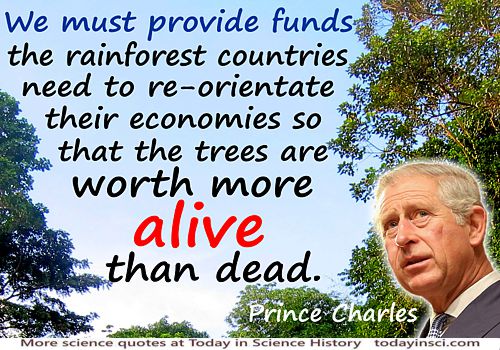
My Rainforests Project … has three main elements. Firstly, to determine how much funding the rainforest countries need to re-orientate their economies so that the trees are worth more alive than dead.
Presidential Lecture (3 Nov 2008) at the Presidential Palace, Jakarta, Indonesia. On the Prince of Wales website.
Nature in her unfathomable designs had mixed us of clay and flame, of brain and mind, that the two things hang indubitably together and determine each other’s being but how or why, no mortal may ever know.
Principles of Psychology (1918), 200.
Nature proceeds little by little from things lifeless to animal life in such a way that it is impossible to determine the exact line of demarcation, nor on which side thereof an intermediate form should lie. Thus, next after lifeless things comes the plant, and of plants one will differ from another as to its amount of apparent vitality; and, in a word, the whole genus of plants, whilst it is devoid of life as compared with an animal, is endowed with life as compared with other corporeal entities. Indeed, as we just remarked, there is observed in plants a continuous scale of ascent towards the animal. So, in the sea, there are certain objects concerning which one would be at a loss to determine whether they be animal or vegetable. For instance, certain of these objects are fairly rooted, and in several cases perish if detached.
History of Animals, 588b, 4-14. In Jonathan Barnes (ed.) The Complete Works of Aristotle (1984), Vol. 1, 922.
No part of the world can be truly understood without a knowledge of its garment of vegetation, for this determines not only the nature of the animal inhabitants but also the occupations of the majority of human beings.
The Red Man's Continent: A Chronicle of Aboriginal America (1919), 88.
Now it is by a fiction that the purchaser pays the mutation tax. In fact, it is always the seller who pays it. The buyer compares the money that he spends with the advantage that he gains, and this comparison determines it. If he did not make money out of it he would not buy it. When the registration tax did not exist, the purchaser had to pay the same sum for the same purpose, and this sum went into the pocket of the seller.
From Appendix A, 'Extracts From the Unpublished Writings of Carnot', Reflections on the Motive Power of Heat (1890, 2nd ed. 1897), 214-215.
One always finds among men who are reputed to be reasonable some evidence of this tendency to inquire into the reason of things; of this desire to know not simply how things are, but why they are one way rather than another; and, consequently, of this awareness of a relation which is not gained through the senses, this notion of an abstract bond by virtue of which one thing is subordinated to another which determines and explains it.
From Essai sur les Fondements de nos Connaissances et sur les Caractères de la Critique Philosophique (1851), 21, as translated by Merritt H Moore in An Essay on the Foundations of Our Knowledge (1956), 18. From the original French: “Toujours est-il que, chez tous les hommes réputés raisonnables, on retrouve, à certains degrés, cette tendance à s’enquérir de la raison des choses; ce désir de connaître, non pas seulement comment les choses sont, mais pourquoi elles sont de telle façon plutôt que d’une autre; et, partant, cette intelligence d’un rapport qui ne tombe pas sous les sens; cette notion d’un lien abstrait en vertu duquel une chose est subordonnée à une autre qui la détermine et qui l’explique.”
Our papers have been making a great deal of American “know-how” ever since we had the misfortune to discover the atomic bomb. There is one quality more important than know-how” and we cannot accuse the United States of any undue amount of it. This is “know-what,” by which we determine not only how to accomplish our purposes, but what our purposes are to be.
In The Human Use of Human Beings: Cybernetics and Society (1950), 210.
Philosophy stands in need of a science which shall determine the possibility, principles, and extent of human knowledge à priori.
Critique of Pure Reason, translated by John Miller Dow Meiklejohn (1899), 4.
Physicists speak of the particle representation or the wave representation. Bohr's principle of complementarity asserts that there exist complementary properties of the same object of knowledge, one of which if known will exclude knowledge of the other. We may therefore describe an object like an electron in ways which are mutually exclusive—e.g., as wave or particle—without logical contradiction provided we also realize that the experimental arrangements that determine these descriptions are similarly mutually exclusive. Which experiment—and hence which description one chooses—is purely a matter of human choice.
The Cosmic Code: Quantum Physics as the Language of Nature (1982), 94.
Plants, generally speaking, meet the impact of the terrestrial environment head on, although of course they in turn modify the physical environment by adventitious group activity. The individual plant cannot select its habitat; its location is largely determined by the vagaries of the dispersal of seeds or spores and is thus profoundly affected by chance. Because of their mobility and their capacity for acceptance or rejection terrestrial animals, in contrast, can and do actively seek out and utilize the facets of the environment that allow their physiological capacities to function adequately. This means that an animal by its behavior can fit the environment to its physiology by selecting situations in which its physiological capacities can cope with physical conditions. If one accepts this idea, it follows that there is no such thing as The Environment, for there exist as many different terrestrial environments as there are species of animals.
From 'The role of physiology in the distribution of terrestrial vertebrates', collected in C.L. Hubbs (ed.), Zoogeography: Publ. 51 (1958), 84.
Public health is purchasable. Within a few natural and important limitations any community can determine its own health.
Quantum mechanics and relativity, taken together, are extraordinarily restrictive, and they therefore provide us with a great logical machine. We can explore with our minds any number of possible universes consisting of all kinds of mythical particles and interactions, but all except a very few can be rejected on a priori grounds because they are not simultaneously consistent with special relativity and quantum mechanics. Hopefully in the end we will find that only one theory is consistent with both and that theory will determine the nature of our particular universe.
As quoted in John D. Barrow, The Universe that Discovered Itself (2000), 360.
Research may start from definite problems whose importance it recognizes and whose solution is sought more or less directly by all forces. But equally legitimate is the other method of research which only selects the field of its activity and, contrary to the first method, freely reconnoitres in the search for problems which are capable of solution. Different individuals will hold different views as to the relative value of these two methods. If the first method leads to greater penetration it is also easily exposed to the danger of unproductivity. To the second method we owe the acquisition of large and new fields, in which the details of many things remain to be determined and explored by the first method.
In Zum Gedächtniss an Julius Plucker', Göttinger Abhandlungen (1871), 16, Mathematische Classe, 6.
Salt water when it turns into vapour becomes sweet, and the vapour does not form salt water when it condenses again. This I know by experiment. The same thing is true in every case of the kind: wine and all fluids that evaporate and condense back into a liquid state become water. They all are water modified by a certain admixture, the nature of which determines their flavour.
[Aristotle describing his distillation experiment.]
[Aristotle describing his distillation experiment.]
Meteorology (350 B.C.), Book II, translated by E. W. Webster. Internet Classics Archive, (classics.mit.edu).
Science cannot determine origin, and so cannot determine destiny. As it presents only a sectional view of creation, it gives only a sectional view of everything in creation.
…...
Science through its physical technological consequences is now determining the relations which human beings, severally and in groups, sustain to one another. If it is incapable of developing moral techniques which will also determine those relations, the split in modern culture goes so deep that not only democracy but all civilized values are doomed.
In Freedom and Culture (1939).
Scientists still do not appear to understand sufficiently that all earth sciences must contribute evidence toward unveiling the state of our planet in earlier times, and that the truth of the matter can only be reached by combing all this evidence. ... It is only by combing the information furnished by all the earth sciences that we can hope to determine 'truth' here, that is to say, to find the picture that sets out all the known facts in the best arrangement and that therefore has the highest degree of probability. Further, we have to be prepared always for the possibility that each new discovery, no matter what science furnishes it, may modify the conclusions we draw.
The Origins of Continents and Oceans
Study of the patients’ diets was begun in 1915 in an attempt to determine if some sort of dietary deficiency could be found. The similarity of certain symptoms and signs of pernicious anemia to those in pellagra, sprue, and beriberi was appreciated.
From Nobel Prize Lecture (12 Dec 1934), collected in Nobel Lectures, Physiology or Medicine 1922-1941 (1965).
Suppose you were given a watch, a tube to sight with and a string, and then asked to determine the distance to the nearest star. Or you were asked the chemical composition, pressure or temperature of the Sun. A hundred or more years ago, these questions seemed impossible. Now astronomers are answering them all the time, and they believe their answers. Why? Because there are many parallel ways and tests, and they all give the same answers.
As quoted in John Noble Wilford, 'Sizing up the Cosmos: An Astronomers Quest', New York Times (12 Mar 1991), C10.
The … publicity is always the same; only the blanks need to be filled in: “It was announced today by scientists at [Harvard, Vanderbilt, Stanford] Medical School that a gene responsible for [some, many, a common form of] [schizophrenia, Alzheimer’s, arterio-sclerosis, prostate cancer] has been located and its DNA sequence determined. This exciting research, say scientists, is the first step in what may eventually turn out to be a possible cure for this disease.”
From review, 'Billions and Billions of Demons', of the book, The Demon-Haunted World: Science as a Candle in the Dark, by Carl Sagan, in New York Review of Books (9 Jan 1997).
The application of botanical and zoological evidence to determine the relative age of rocks—this chronometry of the earth's surface which was already present to the lofty mind of Hooke—indicates one of the most glorious epochs of modern geognosy, which has finally, on the Continent at least, been emancipated from the way of Semitic doctrines. Palaeontological investigations have imparted a vivifying breath of grace and diversity to the science of the solid structure of the earth.
Cosmos: A Sketch of a Physical Description of the Universe (1845-62), trans. E. C. Due (1849), Vol. 1, 272.
The assumptions of population thinking are diametrically opposed to those of the typologist. The populationist stresses the uniqueness of everything in the organic world. What is true for the human species,–that no two individuals are alike, is equally true for all other species of animals and plants ... All organisms and organic phenomena are composed of unique features and can be described collectively only in statistical terms. Individuals, or any kind of organic entities, form populations of which we can determine the arithmetic mean and the statistics of variation. Averages are merely statistical abstractions, only the individuals of which the populations are composed have reality. The ultimate conclusions of the population thinker and of the typologist are precisely the opposite. For the typologist, the type (eidos) is real and the variation. an illusion, while for the populationist the type (average) is an abstraction and only the variation is real. No two ways of looking at nature could be more different.
Darwin and the Evolutionary Theory in Biology (1959), 2.
The axioms of geometry are—according to my way of thinking—not arbitrary, but sensible. statements, which are, in general, induced by space perception and are determined as to their precise content by expediency.
In George Edward Martin, The Foundations of Geometry and the Non-Euclidean Plane (1982), 142.
The basic thesis of gestalt theory might be formulated thus: there are contexts in which what is happening in the whole cannot be deduced from the characteristics of the separate pieces, but conversely; what happens to a part of the whole is, in clearcut cases, determined by the laws of the inner structure of its whole.
Lecture at the Kantgesellschaft (Kant Society), Berlin (17 Dec 1924), 'Über Gestalttheorie', as taken down in shorthand. Translated by N. Nairn-Allison in Social Research (1944), 11, 84.
The best and safest way of philosophising seems to be, first to enquire diligently into the properties of things, and to establish those properties by experiences [experiments] and then to proceed slowly to hypotheses for the explanation of them. For hypotheses should be employed only in explaining the properties of things, but not assumed in determining them; unless so far as they may furnish experiments.
Letter to the French Jesuit, Gaston Pardies. Translation from the original Latin, as in Richard S. Westfall, Never at Rest: a Biography of Isaac Newton (1983), 242.
The chemists who uphold dualism are far from being agreed among themselves; nevertheless, all of them in maintaining their opinion, rely upon the phenomena of chemical reactions. For a long time the uncertainty of this method has been pointed out: it has been shown repeatedly, that the atoms put into movement during a reaction take at that time a new arrangement, and that it is impossible to deduce the old arrangement from the new one. It is as if, in the middle of a game of chess, after the disarrangement of all the pieces, one of the players should wish, from the inspection of the new place occupied by each piece, to determine that which it originally occupied.
Chemical Method (1855), 18.
The conditions that direct the order of the whole of the living world around us, are marked by their persistence in improving the birthright of successive generations. They determine, at much cost of individual comfort, that each plant and animal shall, on the general average, be endowed at its birth with more suitable natural faculties than those of its representative in the preceding generation.
In 'The Observed Order of Events', Inquiries Into Human Faculty and Its Development (1882), 229.
The dexterous management of terms and being able to fend and prove with them, I know has and does pass in the world for a great part of learning; but it is learning distinct from knowledge, for knowledge consists only in perceiving the habitudes and relations of ideas one to another, which is done without words; the intervention of sounds helps nothing to it. And hence we see that there is least use of distinction where there is most knowledge: I mean in mathematics, where men have determined ideas with known names to them; and so, there being no room for equivocations, there is no need of distinctions.
In Conduct of the Understanding, Sect. 31.
The diversity of life is extraordinary. There is said to be a million or so different kinds of living animals, and hundreds of thousands of kinds of plants. But we don’t need to think of the world at large. It is amazing enough to stop and look at a forest or at a meadow—at the grass and trees and caterpillars and hawks and deer. How did all these different kinds of things come about; what forces governed their evolution; what forces maintain their numbers and determine their survival or extinction; what are their relations to each other and to the physical environment in which they live? These are the problems of natural history.
In The Nature of Natural History (1950), 8.
The experiment serves two purposes, often independent one from the other: it allows the observation of new facts, hitherto either unsuspected, or not yet well defined; and it determines whether a working hypothesis fits the world of observable facts.
In Louis Pasteur, Free Lance of Science (1960), 362.
The first principle of architectural beauty is that the essential lines of a construction be determined by a perfect appropriateness to its use.
From translation in J. Harriss, The Tallest Tower: Eiffel and the Belle Epoque (1975), 20, as quoted and cited by David P. Billington, 'Bridges and the New Art of Structural Engineering,' in National Research Council (U.S.). Transportation Research Board Subcommittee on Bridge Aesthetics, Bridge Aesthetics Around the World (1991), 67. From the original French in interview of Eiffel by Paul Bourde, in the newspaper Le Temps (14 Feb 1887). Reprinted in 'Au Jour le Jour: Les Artistes Contre la Tour Eiffel', Gazette Anecdotique, Littéraire, Artistique et Bibliographique (Feb 1887), 126, and in Gustave Eiffel, Travaux Scientifiques Exécutés à la Tour de 300 Mètres de 1889 à 1900 (1900), 14. “Le premier principe de l'esthétique architecturale est que les lignes essentielles d’un monument soient déterminées par la parfaite appropriation à sa destination.”
The fundamental activity of medical science is to determine the ultimate causation of disease.
Speech, Guild of Public Pharmacists (18 Jan 1933), 'De Minimis', The Lancet (1933), 1, 287-90. As cited in Edward J. Huth and T. J. Murray, Medicine in Quotations: Views of Health and Disease Through the Ages (2006), 247 and 512.
The hypotheses which we accept ought to explain phenomena which we have observed. But they ought to do more than this; our hypotheses ought to foretell phenomena which have not yet been observed; ... because if the rule prevails, it includes all cases; and will determine them all, if we can only calculate its real consequences. Hence it will predict the results of new combinations, as well as explain the appearances which have occurred in old ones. And that it does this with certainty and correctness, is one mode in which the hypothesis is to be verified as right and useful.
Philosophy of the Inductive Sciences (1847), Vol. 2, 62-63.
The idea of making a fault a subject of study and not an object to be merely determined has been the most important step in the course of my methods of observation. If I have obtained some new results it is to this that I owe it.
'Notice sur les Travaux Scientifiques de Marcel Bertrand' (1894). In Geological Society of London, The Quarterly Journal of the Geological Society of London (May 1908), 64, li.
The ingenuity and effective logic that enabled chemists to determine complex molecular structures from the number of isomers, the reactivity of the molecule and of its fragments, the freezing point, the empirical formula, the molecular weight, etc., is one of the outstanding triumphs of the human mind.
'Trends in Chemistry', Chemical Engineering News, 7 Jan 1963, 5.
The man or corporation who has not determined at the outset to do good to others while doing good to himself will fail in the end.
As quoted in Edward J. Wheeler (ed.), 'The Demeanor of John D. Rockefeller, Jr., Under Fire,' Current Opinion (Jul 1914), 57, No. 1, 21. This quote was one out of a collation in the article, “from his many talks to the Bible Class he formerly conducted and from various interviews.”
The man who is thoroughly convinced of the universal operation of the law of causation cannot for a moment entertain the idea of a being who interferes in the course of events–provided, of course, that he takes the hypothesis of causality really seriously. He has no use for the religion of fear and equally little for social or moral religion. A God who rewards and punishes is inconceivable to him for the simple reason that a man’s actions are determined by necessity, external and internal, so that in God’s eyes he cannot be responsible, any more than an inanimate object is responsible for the motions it undergoes. Science has therefore been charged with undermining morality, but the charge is unjust. A man’s ethical behavior should be based effectually on sympathy, education, and social ties and needs; no religious basis is necessary. Man would indeed be in a poor way if he had to be restrained by fear of punishment and hopes of reward after death.
From 'Religion And Science', as collected in Ideas And Opinions (1954), 39, given its source as: “Written expressly for the New York Times Magazine. Appeared there November 9, 1930 (pp. 1-4). The German text was published in the Berliner Tageblatt, November 11, 1930.” The NYT Magazine article in full, is reprinted in Edward H. Cotton (ed.), Has Science Discovered God? A Symposium of Modern Scientific Opinion (1931), 101. This original version directly from the magazine has significantly different wording, beginning, “For anyone who is pervaded with the sense of causal law….” See this alternate form on the Albert Einstein Quotes page on this website. As for why the difference, Webmaster speculates the book form editor perhaps used a revised translation from Einstein’s German article.
The mathematical intellectualism is henceforth a positive doctrine, but one that inverts the usual doctrines of positivism: in place of originating progress in order, dynamics in statics, its goal is to make logical order the product of intellectual progress. The science of the future is not enwombed, as Comte would have had it, as Kant had wished it, in the forms of the science already existing; the structure of these forms reveals an original dynamism whose onward sweep is prolonged by the synthetic generation of more and more complicated forms. No speculation on number considered as a category a priori enables one to account for the questions set by modern mathematics … space affirms only the possibility of applying to a multiplicity of any elements whatever, relations whose type the intellect does not undertake to determine in advance, but, on the contrary, it asserts their existence and nourishes their unlimited development.
As translated in James Byrnie Shaw, Lectures on the Philosophy of Mathematics (1918), 193. From Léon Brunschvicg, Les Étapes de La Philosophie Mathématique (1912), 567-568, “L’intellectualisme mathématique est désormais une doctrine positive, mais qui intervertira les formules habituelles du positivisme: au lieu de faire sortir le progrès de l’ordre, ou le dynamique du statique, il tend à faire de l'ordre logique le produit du progrès intellectuel. La science à venir n'est pas enfermée, comme l’aurait voulu Comte, comme le voulait déjà Kant, dans les formes de la science déjà faite; la constitution de ces formes révèle un dynamisme originel dont l’élan se prolonge par la génération synthétique de notions de plus en plus compliquées. Aucune spéculation sur le nombre, considéré comme catégorie a priori, ne permet de rendre compte des questions qui se sont posées pour la mathématique moderne … … l’espace ne fait qu'affirmer la possibilité d'appliquer sur une multiplicité d’éléments quelconques des relations dont l’intelligence ne cherche pas à déterminer d’avance le type, dont elle constate, au contraire, dont elle suscite le développement illimité.”
The nature of armies is determined by the nature of the civilization in which they exist.
From Captain Sir Basil Liddell Hart, The Ghost of Napoleon (1933). Cited in Peter G. Tsouras (ed.), The Book of Military Quotation (1992, 2005), 36.
The night before Easter Sunday of that year (1920) I awoke, turned on the light, and jotted down a few notes on a tiny slip of thin paper. Then I fell asleep again. It occurred to me at six o’clock in the morning that during the night I had written down something most important, but I was unable to decipher the scrawl. The next night, at three o’clock, the idea returned. It was the design of an experiment to determine whether the hypothesis of chemical transmission that I had uttered seventeen years ago was correct. I got up immediately, went to the laboratory, and performed a simple experiment on a frog heart according to the nocturnal design. I have to describe this experiment briefly since its results became the foundation of the theory of chemical transmission of the nervous impulse. The hearts of two frogs were isolated, the first with its nerves, the second without. Both hearts were attached to Straub cannulas filled with a little Ringer solution. The vagus nerve of the first heart was stimulated for a few minutes. Then the Ringer solution that had been in the first heart during the stimulation of the vagus was transferred to the second heart. It slowed and its beats diminished just as if its vagus had been stimulated. Similarly, when the accelerator nerve was stimulated and the Ringer from this period transferred, the second heart speeded up and its beats increased. These results unequivocally proved that the nerves do not influence the heart directly but liberate from their terminals specific chemical substances which, in their turn, cause the well-known modifications of the function of the heart characteristic of the stimulation of its nerves.
'An Autobiographic Sketch', Perspectives in Biology and Medicine (1960), 4, 17.
The number of humble-bees in any district depends in a great degree on the number of field-mice, which destroy their combs and nests; and Mr. H. Newman, who has long attended to the habits of humble-bees, ... says “Near villages and small towns I have found the nests of humble-bees more numerous than elsewhere, which I attribute to the number of cats that destroy the mice.” Hence it is quite credible that the presence of a feline animal in large numbers in a district might determine, through the intervention first of mice and then of bees, the frequency of certain flowers in that district!
From On the Origin of Species by Means of Natural Selection; or, The Preservation of Favoured Races in the Struggle for Life (1861), 72.
The Ocean Health Index is like a thermometer of ocean health, which will allow us to determine how the patient is doing. The Index will be a measure of whether our policies are working, or whether we need new solutions.
As quoted in press release (14 Aug 2012), 'Ocean Health Index Provides First-Ever Global Benchmark of 171 Coastal Regions', on web page of Conservation International, conservation.org.
The opinion appears to be gaining ground that this very general conception of functionality, born on mathematical ground, is destined to supersede the narrower notion of causation, traditional in connection with the natural sciences. As an abstract formulation of the idea of determination in its most general sense, the notion of functionality includes and transcends the more special notion of causation as a one-sided determination of future phenomena by means of present conditions; it can be used to express the fact of the subsumption under a general law of past, present, and future alike, in a sequence of phenomena. From this point of view the remark of Huxley that Mathematics “knows nothing of causation” could only be taken to express the whole truth, if by the term “causation” is understood “efficient causation.” The latter notion has, however, in recent times been to an increasing extent regarded as just as irrelevant in the natural sciences as it is in Mathematics; the idea of thorough-going determinancy, in accordance with formal law, being thought to be alone significant in either domain.
In Presidential Address British Association for the Advancement of Science, Sheffield, Section A,
Nature (1 Sep 1910), 84, 290.
The owner of the means of production is in a position to purchase the labor power of the worker. By using the means of production, the worker produces new goods which become the property of the capitalist. The essential point about this process is the relation between what the worker produces and what he is paid, both measured in terms of real value. In so far as the labor contract is free what the worker receives is determined not by the real value of the goods he produces, but by his minimum needs and by the capitalists’ requirements for labor power in relation to the number of workers competing for jobs. It is important to understand that even in theory the payment of the worker is not determined by the value of his product.
…...
The present rate of progress [in X-ray crystallography] is determined, not so much by the lack of problems to investigate or the limited power of X-ray analysis, as by the restricted number of investigators who have had a training in the technique of the new science, and by the time it naturally takes for its scientific and technical importance to become widely appreciated.
Concluding remark in Lecture (1936) on 'Forty Years of Crystal Physics', collected in Needham and Pagel (eds.) in Background to Modern Science: Ten Lectures at Cambridge Arranged by the History of Science Committee, (1938), 89.
The present state of the system of nature is evidently a consequence of what it was in the preceding moment, and if we conceive of an intelligence that at a given instant comprehends all the relations of the entities of this universe, it could state the respective position, motions, and general affects of all these entities at any time in the past or future. Physical astronomy, the branch of knowledge that does the greatest honor to the human mind, gives us an idea, albeit imperfect, of what such an intelligence would be. The simplicity of the law by which the celestial bodies move, and the relations of their masses and distances, permit analysis to follow their motions up to a certain point; and in order to determine the state of the system of these great bodies in past or future centuries, it suffices for the mathematician that their position and their velocity be given by observation for any moment in time. Man owes that advantage to the power of the instrument he employs, and to the small number of relations that it embraces in its calculations. But ignorance of the different causes involved in the production of events, as well as their complexity, taken together with the imperfection of analysis, prevents our reaching the same certainty about the vast majority of phenomena. Thus there are things that are uncertain for us, things more or less probable, and we seek to compensate for the impossibility of knowing them by determining their different degrees of likelihood. So it was that we owe to the weakness of the human mind one of the most delicate and ingenious of mathematical theories, the science of chance or probability.
'Recherches, 1º, sur l'Intégration des Équations Différentielles aux Différences Finies, et sur leur Usage dans la Théorie des Hasards' (1773, published 1776). In Oeuvres complètes de Laplace, 14 Vols. (1843-1912), Vol. 8, 144-5, trans. Charles Coulston Gillispie, Pierre-Simon Laplace 1749-1827: A Life in Exact Science (1997), 26.
The process of natural selection has been summed up in the phrase “survival of the fittest.” This, however, tells only part of the story. “Survival of the existing” in many cases covers more of the truth. For in hosts of cases the survival of characters rests not on any special usefulness or fitness, but on the fact that individuals possessing these characters have inhabited or invaded a certain area. The principle of utility explains survivals among competing structures. It rarely accounts for qualities associated with geographic distribution.
The nature of animals which first colonize a district must determine what the future fauna will be. From their specific characters, which are neither useful nor harmful, will be derived for the most part the specific characters of their successors.
It is not essential to the meadow lark that he should have a black blotch on the breast or the outer tail-feather white. Yet all meadow larks have these characters just as all shore larks have the tiny plume behind the ear. Those characters of the parent stock, which may be harmful in the new relations, will be eliminated by natural selection. Those especially helpful will be intensified and modified, but the great body of characters, the marks by which we know the species, will be neither helpful nor hurtful. These will be meaningless streaks and spots, variations in size of parts, peculiar relations of scales or hair or feathers, little matters which can neither help nor hurt, but which have all the persistence heredity can give.
The nature of animals which first colonize a district must determine what the future fauna will be. From their specific characters, which are neither useful nor harmful, will be derived for the most part the specific characters of their successors.
It is not essential to the meadow lark that he should have a black blotch on the breast or the outer tail-feather white. Yet all meadow larks have these characters just as all shore larks have the tiny plume behind the ear. Those characters of the parent stock, which may be harmful in the new relations, will be eliminated by natural selection. Those especially helpful will be intensified and modified, but the great body of characters, the marks by which we know the species, will be neither helpful nor hurtful. These will be meaningless streaks and spots, variations in size of parts, peculiar relations of scales or hair or feathers, little matters which can neither help nor hurt, but which have all the persistence heredity can give.
Foot-notes to Evolution. A Series of Popular Addresses on the Evolution of Life (1898), 218.
The scientist is not responsible for the laws of nature, but it is a scientist’s job to find out how these laws operate. It is the scientist’s job to find ways in which these laws can serve the human will. However, it is not the scientist’s job to determine whether a hydrogen bomb should be used. …
In A Passion for Science edited by L. Wolpert and A. Richards (1988).
The scientist is not responsible for the laws of nature. It is his job to find out how these laws operate. It is the scientist’s job to find the ways in which these laws can serve the human will. However, it is not the scientist’s job to determine whether a hydrogen bomb should be constructed, whether it should be used, or how it should be used. This responsibility rests with the American people and with their chosen representatives.
In 'Back to the Laboratories', Bulletin of the Atomic Scientists (Mar 1950), 6, No. 3, 71. Quoted in L. Wolpert and A. Richards (eds.), A Passion for Science (1988), 9, but incorrectly attributed to Robert Oppenheimer.
The scientist knows very well that he is approaching ultimate truth only in an asymptotic curve and is barred from ever reaching it; but at the same time he is proudly aware of being indeed able to determine whether a statement is a nearer or a less near approach to the truth.
In On Aggression (1966, 2002), 279.
The specific character of the greater part of the toxins which are known to us (I need only instance such toxins as those of tetanus and diphtheria) would suggest that the substances produced for effecting the correlation of organs within the body, through the intermediation of the blood stream, might also belong to this class, since here also specificity of action must be a distinguishing characteristic. These chemical messengers, however, or 'hormones' (from όρμάω, I excite or arouse), as we might call them, have to be carried from the organ where they are produced to the organ which they affect by means of the blood stream and the continually recurring physiological needs of the organism must determine their repeated production and circulation through the body.
'The Chemical Correlation of the Functions of the Body', The Lancet (1905), ii, 340.
The statistical method is required in the interpretation of figures which are at the mercy of numerous influences, and its object is to determine whether individual influences can be isolated and their effects measured. The essence of the method lies in the determination that we are really comparing like with like, and that we have not overlooked a relevant factor which is present in Group A and absent from Group B. The variability of human beings in their illnesses and in their reactions to them is a fundamental reason for the planned clinical trial and not against it.
Principles of Medical Statistics (1971), 13.
The true value of a human being is determined primarily by the measure and the sense in which he has attained to liberation from the self.
…...
The truth is that other systems of geometry are possible, yet after all, these other systems are not spaces but other methods of space measurements. There is one space only, though we may conceive of many different manifolds, which are contrivances or ideal constructions invented for the purpose of determining space.
In Science (1903), 18, 106. In Robert Édouard Moritz, Memorabilia Mathematica (1914), 352.
The truth may be puzzling. It may take some work to grapple with. It may be counterintuitive. It may contradict deeply held prejudices. It may not be consonant with what we desperately want to be true. But our preferences do not determine what's true. We have a method, and that method helps us to reach not absolute truth, only asymptotic approaches to the truth—never there, just closer and closer, always finding vast new oceans of undiscovered possibilities. Cleverly designed experiments are the key.
In 'Wonder and Skepticism', Skeptical Enquirer (Jan-Feb 1995), 19, No. 1.
The worth of a new idea is invariably determined, not by the degree of its intuitiveness—which incidentally, is to a major extent a matter of experience and habit—but by the scope and accuracy of the individual laws to the discovery of which it eventually leads.
In Scientific Autobiography and Other Papers (1968), 109-110.
There is no failure for the man who realizes his power, who never knows when he is beaten; there is no failure for the determined endeavor; the unconquerable will. There is no failure for the man who gets up every time he falls, who rebounds like a rubber ball, who persist when everyone else gives up, who pushes on when everyone else turns back.
…...
There really are not any spheres in the heavens ... Those which have been devised by the experts to save the appearances exist only in the imagination, for the purpose of enabling the mind to conceive the motion which the heavenly bodies trace in their course and, by the aid of geometry, to determine the motion numerically through the use of arithmetic.
J. L. E. Dreyer (ed.), Opera Omnia (1913-29), Vol. 4, 222. Trans. Edward Rosen, 'Nicholas Copernicus', in Charles C. Gillispie (ed.), Dictionary of Scientific Biography (1971), Vol. 3, 409.
This theme of mutually invisible life at widely differing scales bears an important implication for the ‘culture wars’ that supposedly now envelop our universities and our intellectual discourse in general ... One side of this false dichotomy features the postmodern relativists who argue that all culturally bound modes of perception must be equally valid, and that no factual truth therefore exists. The other side includes the benighted, old-fashioned realists who insist that flies truly have two wings, and that Shakespeare really did mean what he thought he was saying. The principle of scaling provides a resolution for the false parts of this silly dichotomy. Facts are facts and cannot be denied by any rational being. (Often, facts are also not at all easy to determine or specify–but this question raises different issues for another time.) Facts, however, may also be highly scale dependent–and the perceptions of one world may have no validity or expression in the domain of another. The one-page map of Maine cannot recognize the separate boulders of Acadia, but both provide equally valid representations of a factual coastline.
The World as I See It (1999)
Thus one becomes entangled in contradictions if one speaks of the probable position of the electron without considering the experiment used to determine it ... It must also be emphasized that the statistical character of the relation depends on the fact that the influence of the measuring device is treated in a different manner than the interaction of the various parts of the system on one another. This last interaction also causes changes in the direction of the vector representing the system in the Hilbert space, but these are completely determined. If one were to treat the measuring device as a part of the system—which would necessitate an extension of the Hilbert space—then the changes considered above as indeterminate would appear determinate. But no use could be made of this determinateness unless our observation of the measuring device were free of indeterminateness. For these observations, however, the same considerations are valid as those given above, and we should be forced, for example, to include our own eyes as part of the system, and so on. The chain of cause and effect could be quantitatively verified only if the whole universe were considered as a single system—but then physics has vanished, and only a mathematical scheme remains. The partition of the world into observing and observed system prevents a sharp formulation of the law of cause and effect. (The observing system need not always be a human being; it may also be an inanimate apparatus, such as a photographic plate.)
The Physical Principles of the Quantum Theory, trans. Carl Eckart and Frank C. Hoyt (1949), 58.
To regulate something always requires two opposing factors. You cannot regulate by a single factor. To give an example, the traffic in the streets could not be controlled by a green light or a red light alone. It needs a green light and a red light as well. The ratio between retine and promine determines whether there is any motion, any growth, or not. Two different inclinations have to be there in readiness to make the cells proliferate.
In Ralph W. Moss, Free Radical (1988), 186.
To vary the compression of the muscle therefore, and so to swell and shrink it, there needs nothing but to change the consistency of the included ether… . Thus may therefore the soul, by determining this ethereal animal spirit or wind into this or that nerve, perhaps with as much ease as air is moved in open spaces, cause all the motions we see in animals.
From 'An Hypothesis explaining the Properties of Light, discoursed of in my several Papers', in Thomas Birch, The History of the Royal Society (1757), Vol. 3, 252. This was from Newton’s Second Paper on Color and Light, read at the Royal Society (9 Dec 1675).
Trying to determine the structure of a protein by UV spectroscopy was like trying to determine the structure of a piano by listening to the sound it made while being dropped down a flight of stairs.
…...
Two kinds of symbol must surely be distinguished. The algebraic symbol comes naked into the world of mathematics and is clothed with value by its masters. A poetic symbol—like the Rose, for Love, in Guillaume de Lorris—comes trailing clouds of glory from the real world, clouds whose shape and colour largely determine and explain its poetic use. In an equation, x and y will do as well as a and b; but the Romance of the Rose could not, without loss, be re-written as the Romance of the Onion, and if a man did not see why, we could only send him back to the real world to study roses, onions, and love, all of them still untouched by poetry, still raw.
C.S. Lewis and E.M. Tillyard, The Personal Heresy: A Controversy (1936), 97.
We are apt to consider that invention is the result of spontaneous action of some heavenborn genius, whose advent we must patiently wait for, but cannot artificially produce. It is unquestionable, however, that education, legal enactments, and general social conditions have a stupendous influence on the development of the originative faculty present in a nation and determine whether it shall be a fountain of new ideas or become simply a purchaser from others of ready-made inventions.
Epigraph, without citation, in Roger Cullisin, Patents, Inventions and the Dynamics of Innovation: A Multidisciplinary Study (2007), ix.
We are too prone to make technological instruments the scapegoats for the sins of those who wield them. The products of modern science are not in themselves good or bad; it is the way they are used that determines their value.
Acceptance speech for an honorary degree from the University of Notre Dame. In Marshall McLuhan, Understanding Media: the Extensions of Man? (2nd Ed.,1964), 11.
We have here spoken of the prediction of facts of the same kind as those from which our rule was collected. But the evidence in favour of our induction is of a much higher and more forcible character when it enables us to explain and determine cases of a kind different from those which were contemplated in the formation of our hypothesis. The instances in which this has occurred, indeed, impress us with a conviction that the truth of our hypothesis is certain. No accident could give rise to such an extraordinary coincidence. No false supposition could, after being adjusted to one class of phenomena, so exactly represent a different class, when the agreement was unforeseen and contemplated. That rules springing from remote and unconnected quarters should thus leap to the same point, can only arise from that being where truth resides.
In The Philosophy of the Inductive Sciences (1840), Vol. 2, 230.
We may produce at will, from a sending station. an electrical effect in any particular region of the globe; we may determine the relative position or course of a moving object, such as a vessel at sea, the distance traversed by the same, or its speed.
In 'The Problem of Increasing Human Energy', Century Illustrated Monthly Magazine (Jun 1900), 60, 208-209.
We must not forget … that “influence” is not a simple, but on the contrary, a very complex, bilateral relation. We are not influenced by everything we read or learn. In one sense, and perhaps the deepest, we ourselves determine the influences we are submitting to; our intellectual ancestors are by no means given to, but are freely chosen by, us.
In From the Closed World to the Infinite Universe (1957) 5-6.
We must somehow keep the dreams of space exploration alive, for in the long run they will prove to be of far more importance to the human race than the attainment of material benefits. Like Darwin, we have set sail upon an ocean: the cosmic sea of the Universe. There can be no turning back. To do so could well prove to be a guarantee of extinction. When a nation, or a race or a planet turns its back on the future, to concentrate on the present, it cannot see what lies ahead. It can neither plan nor prepare for the future, and thus discards the vital opportunity for determining its evolutionary heritage and perhaps its survival.
…...
When I worked on the polio vaccine, I had a theory. Experiments were done to determine what might or might not occur. I guided each one by imagining myself in the phenomenon in which I was interested. The intuitive realm is constantly active—the realm of imagination guides my thinking.
From interview with James Reston, Jr., in Pamela Weintraub (ed.), The Omni Interviews (1984), 98. Previously published in magazine, Omni (May 1982).
When it is not in our power to determine what is true, we ought to act according to what is most probable.
In Discours de la Méthode: Troisième partie, collected in Oeuvres Philosophiques de Descartes (1835), 23. As quoted and translated in Joseph William Mellor, Higher Mathematics for Students of Chemistry and Physics (1901), 416. From the original French, “Lorsqu’il n’est pas eu notre pouvoir de discerner les plus vraies opinions, nous devons suivre les plus probables.”
When young Galileo, then a student at Pisa, noticed one day during divine service a chandelier swinging backwards and forwards, and convinced himself, by counting his pulse, that the duration of the oscillations was independent of the arc through which it moved, who could know that this discovery would eventually put it in our power, by means of the pendulum, to attain an accuracy in the measurement of time till then deemed impossible, and would enable the storm-tossed seaman in the most distant oceans to determine in what degree of longitude he was sailing?
Hermann von Helmholtz, Edmund Atkinson (trans.), Popular Lectures on Scientific Subjects: First Series (1883), 29.
With crystals we are in a situation similar to an attempt to investigate an optical grating merely from the spectra it produces... But a knowledge of the positions and intensities of the spectra does not suffice for the determination of the structure. The phases with which the diffracted waves vibrate relative to one another enter in an essential way. To determine a crystal structure on the atomic scale, one must know the phase differences between the different interference spots on the photographic plate, and this task may certainly prove to be rather difficult.
Physikalische Zeitschrift (1913), 14. Translated in Walter Moore, Schrödinger. Life and Thought (1989), 73.
 In science it often happens that scientists say, 'You know that's a really good argument; my position is mistaken,' and then they would actually change their minds and you never hear that old view from them again. They really do it. It doesn't happen as often as it should, because scientists are human and change is sometimes painful. But it happens every day. I cannot recall the last time something like that happened in politics or religion.
(1987) --
In science it often happens that scientists say, 'You know that's a really good argument; my position is mistaken,' and then they would actually change their minds and you never hear that old view from them again. They really do it. It doesn't happen as often as it should, because scientists are human and change is sometimes painful. But it happens every day. I cannot recall the last time something like that happened in politics or religion.
(1987) -- 





