Desire Quotes (219 quotes)
[Regarding evolution believers:] Their business is not with the possible, but the actual—not with a world which might be, but with a world that is. This they explore with a courage not unmixed with reverence, and according to methods which, like the quality of a tree, are tested by their fruits. They have but one desire—to know the truth. They have but one fear—to believe a lie.
'Scientific Use of the Imagination', Discourse Delivered Before the British Association at Liverpool, (16 Sep 1870). Fragments of Science for Unscientific People: A Series of Detached Essays, Lectures, and Reviews (1892), Vol. 2, 134.
[T]he human desire to escape the flesh, which took one form in asceticism, might take another form in the creation of machines. Thus, the wish to rise above the bestial body manifested itself not only in angels but in mechanical creatures. Certainly, once machines existed, humans clearly attached to them feelings of escape from the flesh.
The Fourth Discontinuity: The Co-Evolution of Humans and Machines (1993), 218.
[The original development of the Spinning Mule was a] continual endeavour to realise a more perfect principle of spinning; and though often baffled, I as often renewed the attempt, and at length succeeded to my utmost desire, at the expense of every shilling I had in the world.
'Extract from a manuscript document circulated by Crompton about the year 1809 or 1810', reprinted in The Basis of Mr. Samuel Crompton’s Claims to a Second Remuneration for his Discovery of the Mule Spinning Machine, (1868), 29.
[Tom Bombadil is] an exemplar, a particular embodying of pure (real) natural science: the spirit that desires knowledge of other things, their history and nature, because they are ‘other’ and wholly independent of the enquiring mind, a spirit coeval with the rational mind, and entirely unconcerned with ‘doing’ anything with the knowledge: Zoology and Botany not Cattle-breeding or Agriculture. Even the Elves hardly show this: they are primarily artists.
From Letter draft to Peter Hastings (manager of a Catholic bookshop in Oxford, who wrote about his enthusiasm for Lord of the Rings) (Sep 1954). In Humphrey Carpenter (ed.) assisted by Christopher Tolkien, The Letters of J.R.R. Tolkien (1995, 2014), 192, Letter No. 153.
[Recalling Professor Ira Remsen's remarks (1895) to a group of his graduate students about to go out with their degrees into the world beyond the university:]
He talked to us for an hour on what was ahead of us; cautioned us against giving up the desire to push ahead by continued study and work. He warned us against allowing our present accomplishments to be the high spot in our lives. He urged us not to wait for a brilliant idea before beginning independent research, and emphasized the fact the Lavoisier's first contribution to chemistry was the analysis of a sample of gypsum. He told us that the fields in which the great masters had worked were still fruitful; the ground had only been scratched and the gleaner could be sure of ample reward.
He talked to us for an hour on what was ahead of us; cautioned us against giving up the desire to push ahead by continued study and work. He warned us against allowing our present accomplishments to be the high spot in our lives. He urged us not to wait for a brilliant idea before beginning independent research, and emphasized the fact the Lavoisier's first contribution to chemistry was the analysis of a sample of gypsum. He told us that the fields in which the great masters had worked were still fruitful; the ground had only been scratched and the gleaner could be sure of ample reward.
Quoted in Frederick Hutton Getman, The Life of Ira Remsen (1980), 73.
Mon royaume est de la dimension de l’univers, et mon désir n’a pas de bornes. Je vais toujours, affranchissant l’esprit et pesant les mondes, sans haine, sans peur, sans pitié, sans amour, et sans Dieu. On m’appelle la Science.
My kingdom is of the dimension of the universe and my desire has no bounds. I am going about always to free the spirit and weigh the worlds, without hatred, without fear, without pity and without God. They call me Science.
My kingdom is of the dimension of the universe and my desire has no bounds. I am going about always to free the spirit and weigh the worlds, without hatred, without fear, without pity and without God. They call me Science.
French passage from La Tentation de Saint-Antoine (1874) in Œvres Complètes de Gustave Flaubert (1885), 222. English translation by Ernest Tristan and G.F. Monkshood, The Temptation of Saint Anthony (1910), 254.
Yet ar ther fibicches in forceres
Of fele raennes makyng,
Experimentz of alkenamye
The peple to deceyve;
If thow thynke to do-wel,
Deel therwith nevere.
There are many men, also, who makes use of strange devices,
Alchemical experiments for the deception of others:
If you desire to do well, have no dealings with these.
Of fele raennes makyng,
Experimentz of alkenamye
The peple to deceyve;
If thow thynke to do-wel,
Deel therwith nevere.
There are many men, also, who makes use of strange devices,
Alchemical experiments for the deception of others:
If you desire to do well, have no dealings with these.
In William Langland and B. Thomas Wright (ed.) The Vision and Creed of Piers Ploughman (1842), 186. Modern translation by Terrence Tiller in Piers Plowman (1981, 1999), 94.
A crowd is not merely impulsive and mobile. Like a savage, it is not prepared to admit that anything can come between its desire and the realisation of its desire.
From Psychologie des Foules (1895), 26. English text in The Crowd: A Study of the Popular Mind (1897), Book 1, Chap. 2, 19. Original French text: “La foule n’est pas seulement impulsive et mobile. Comme le sauvage, elle n’admet pas que quelque chose puisse s’interposer entre son désir et la réalisation de ce désir.”
A desire to take medicine is, perhaps, the great feature which distinguishes man from other animals.
'Recent Advances in Medicine', Science (1891), 17, 170.
A human being is part of the whole, called by us “Universe”; a part limited in time and space. He experiences himself, his thoughts and feelings as something separated from the rest—a kind of optical delusion of his consciousness. This delusion is a kind of prison for us, restricting us to our personal desires and to affection for a few persons nearest us. Our task must be to free ourselves from this prison by widening our circle of compassion to embrace all living creatures and the whole of nature in its beauty. Nobody is able to achieve this completely but the striving for such achievement is, in itself, a part of the liberation and a foundation for inner security.
In Letter (4 Mar 1950), replying to a grieving father over the loss of a young son. In Dear Professor Einstein: Albert Einstein’s Letters to and from Children (2002), 184.
A large part of mathematics which becomes useful developed with absolutely no desire to be useful, and in a situation where nobody could possibly know in what area it would become useful; and there were no general indications that it ever would be so.
From Address (1954) to Princeton Alumni, 'The Role of Mathematics in the Sciences and in Society', published in A.H. Taub (ed.), John von Neumann: Collected Works (1963), Vol. 6, 489. As quoted and cited in Rosemary Schmalz,Out of the Mouths of Mathematicians: A Quotation Book for Philomaths (1993), 123.
A person who is religiously enlightened appears to me to be one who has, to the best of his ability, liberated himself from the fetters of his selfish desires and is preoccupied with thoughts, feelings, and aspirations to which he clings because of their superpersonal value. It seems to me that what is important is the force of this superpersonal content and the depth of the conviction concerning its overpowering meaningfulness, regardless of whether any attempt is made to unite this content with a divine Being, for otherwise it would not be possible to count Buddha and Spinoza as religious personalities. Accordingly, a religious person is devout in the sense that he has no doubt of the significance and loftiness of those superpersonal objects and goals which neither require nor are capable of rational foundation. They exist with the same necessity and matter-of-factness as he himself. In this sense religion is the age-old endeavor of mankind to become clearly and completely conscious of these values and goals and constantly to strengthen and extend their effect. If one conceives of religion and science according to these definitions then a conflict between them appears impossible. For science can only ascertain what is, but not what should be, and outside of its domain value judgments of all kinds remain necessary.
…...
A smattering of everything is worth little. It is a fallacy to suppose that an encyclopaedic knowledge is desirable. The mind is made strong, not through much learning, but by the thorough possession of something.
Lecture at a teaching laboratory on Penikese Island, Buzzard's Bay. Quoted from the lecture notes by David Starr Jordan, Science Sketches (1911), 145.
Academies have been instituted to guard the avenues of their languages, to retain fugitives, and repulse intruders; but their vigilance and activity have hitherto been vain; sounds are too volatile and subtile for legal restraints; to enchain syllables, and to lash the wind, are equally the undertakings of pride, unwilling to measure its desires by its strength.
From Dictionary of the English Language (1818), Vol. 1, Preface, xxiii. Note: Subtile means subtle.
Add to this the pride of achievement; the desire to rank among the successful souls on earth, and we have the factors which have brought some of the ablest of human beings into the limelight that revealed them to an admiring world, as leaders and examples.
Quoted, without citation, in front matter to T. A. Edison Foundation, Lewis Howard Latimer: A Black Inventor: a Biography and Related Experiments You Can Do (1973). If you know the primary source, please contact Webmaster.
All men by nature desire knowledge.
…...
All men by nature desire to know.
Metaphysics, 980a, 21. In Jonathan Barnes (ed.), The Complete Works of Aristotle (1984), Vol. 2, 1552.
All progress is based upon a universal innate desire of every organism to live beyond its means.
…...
Among our sensations it is difficult not to confuse what comes from the part of objects with what comes from the part of our senses. … Supposing this, one clearly sees that it is not easy to say much about colors,… and that all one can expect in such a difficult subject is to give some general rules and to derive from them consequences that can be of some use in the arts and satisfy somewhat the natural desire we have to render account of everything that appears to us.
'De la Nature des Couleurs', collected in Oeuvres (1717), 196–197.
An inventor is an opportunist, one who takes occasion by the hand; who, having seen where some want exists, successfully applies the right means to attain the desired end. The means may be largely, or even wholly, something already known, or there may be a certain originality or discovery in the means employed. But in every case the inventor uses the work of others. If I may use a metaphor, I should liken him to the man who essays the conquest of some virgin alp. At the outset he uses the beaten track, and, as he progresses in the ascent, he uses the steps made by those who have preceded him, whenever they lead in the right direction; and it is only after the last footprints have died out that he takes ice-axe in hand and cuts the remaining steps, few or many, that lift him to the crowning height which is his goal.
In Kenneth Raydon Swan, Sir Joseph Swan (1946), 44.
And therefore, sir, as you desire to live,
A day or two before your laxative,
Take just three worms, nor under nor above,
Because the gods unequal numbers love.
These digestives prepare you for your purge,
Of fumetery, centaury, and spurge;
And of ground-ivy add a leaf or two.
All which within our yard or garden grow.
Eat these, and be, my lord, of better cheer:
Your father’s son was never born to fear.
A day or two before your laxative,
Take just three worms, nor under nor above,
Because the gods unequal numbers love.
These digestives prepare you for your purge,
Of fumetery, centaury, and spurge;
And of ground-ivy add a leaf or two.
All which within our yard or garden grow.
Eat these, and be, my lord, of better cheer:
Your father’s son was never born to fear.
And this grey spirit yearning in desire, To follow knowledge like a sinking star, beyond the utmost bound of human thought.
From poem, 'Ulysses', collected in The Complete Poetical Works of Tennyson (1909), Vol. 2, 89.
Ardent desire for knowledge, in fact, is the one motive attracting and supporting investigators in their efforts; and just this knowledge, really grasped and yet always flying before them, becomes at once their sole torment and their sole happiness. Those who do not know the torment of the unknown cannot have the joy of discovery which is certainly the liveliest that the mind of man can ever feel.
From An Introduction to the Study of Experimental Medicine (1927, 1957), 221-222, as translated by Henry Copley Greene. From the original French by Claude Bernard: “Le désir ardent de la connaissance est l’unique mobile qui attire et soutient l’investigateur dans ses efforts; et c’est précisément cette connaissance qu’il saisit réellement et qui fuit cependant toujours devant lui, qui devient à la fois son seul tourment et son seul bonheur. Celui qui ne connaît pas les tourments de l’inconnu doit ignorer les joies de la découverte qui sont certainement les plus vives que l’esprit de l’homme puisse jamais ressentir.” (1865), 388. A Google translation gives: “The ardent desire for knowledge is the only motive which attracts and sustains the inquirer in his efforts; and it is precisely this knowledge which he really grasps and which nevertheless always flees before him, which becomes at the same time his only torment and his only happiness. He who does not know the torments of the unknown must ignore the joys of discovery which are certainly the most vivid that the mind of man can ever experience.”
Art includes everything that stimulates the desire to live; science, everything that sharpens the desire to know. Art, even the most disinterested, the most disembodied, is the auxiliary of life.
Rémy de Gourmont and Glenn Stephen Burne (ed.), Selected Writings (1966), 170.
As long as museums and universities send out expeditions to bring to light new forms of living and extinct animals and new data illustrating the interrelations of organisms and their environments, as long as anatomists desire a broad comparative basis human for anatomy, as long as even a few students feel a strong curiosity to learn about the course of evolution and relationships of animals, the old problems of taxonomy, phylogeny and evolution will gradually reassert themselves even in competition with brilliant and highly fruitful laboratory studies in cytology, genetics and physiological chemistry.
'Genetics Versus Paleontology', The American Naturalist, 1917, 51, 623.
![Robert Fulton quote: As the component parts of all new machines may be said to be old[,] it is a nice discriminating judgment,](https://todayinsci.com/F/Fulton_Robert/FultonRobert-Mechanic500x250px.jpg)
As the component parts of all new machines may be said to be old[,] it is a nice discriminating judgment, which discovers that a particular arrangement will produce a new and desired effect. ... Therefore, the mechanic should sit down among levers, screws, wedges, wheels, etc. like a poet among the letters of the alphabet, considering them as the exhibition of his thoughts; in which a new arrangement transmits a new idea to the world.
A Treatise on the Improvement of Canal Navigation (1796), preface, x.
At present we begin to feel impatient, and to wish for a new state of chemical elements. For a time the desire was to add to the metals, now we wish to diminish their number. They increase upon us continually, and threaten to enclose within their ranks the bounds of our fair fields of chemical science. The rocks of the mountain and the soil of the plain, the sands of the sea and the salts that are in it, have given way to the powers we have been able to apply to them, but only to be replaced by metals.
In his 16th Lecture of 1818, in Bence Jones, The Life and Letters of Faraday (1870), Vol. 1, 256-257.
At the origin, the [space travel] pioneers of the greatest adventure of all times were motivated by the drive to explore, by the pure spirit of conquest, by the lofty desire to open up new fields to human genius. … From their exceptional journeys, they all came back with the revelation of beauty. Beauty of the black sky, beauty and variety of our planet, beauty of the Earth seen from the Moon, girdled by a scintillating belt of equatorial thunderstorms. They all emphasize that our planet is one, that borderlines are artificial, that humankind is one single community on board spaceship Earth. They all insist that this fragile gem is at our mercy and that we must all endeavor to protect it.
Written for 'Foreword' to Kevin W. Kelley (ed.), The Home Planet (1988), paragraphs 6-7 (unpaginated).
At the outset do not be worried about this big question—Truth. It is a very simple matter if each one of you starts with the desire to get as much as possible. No human being is constituted to know the truth, the whole truth, and nothing but the truth; and even the best of men must be content with fragments, with partial glimpses, never the full fruition. In this unsatisfied quest the attitude of mind, the desire, the thirst—a thirst that from the soul must arise!—the fervent longing, are the be-all and the end-all.
'The Student Life' (1905). In G. L. Keynes (ed.), Selected Writings of Sir William Osler (1951), 172.
Books have always a secret influence on the understanding; we cannot at pleasure obliterate ideas; he that reads books of science, thogh without any fixed desire of improvement, will grow more knowing…
In Samuel Johnson and W. Jackson Bate (Ed.), ',The Adventurer, No. 137, Tuesday, 26 Febraury 1754.' The Selected Essays from the Rambler, Adventurer, and Idler (1968), 273.
But Chinese civilization has the overpowering beauty of the wholly other, and only the wholly other can inspire the deepest love and the profoundest desire to learn.
The Grand Titration (1969), 176.
But for the persistence of a student of this university in urging upon me his desire to study with me the modern algebra I should never have been led into this investigation; and the new facts and principles which I have discovered in regard to it (important facts, I believe), would, so far as I am concerned, have remained still hidden in the womb of time. In vain I represented to this inquisitive student that he would do better to take up some other subject lying less off the beaten track of study, such as the higher parts of the calculus or elliptic functions, or the theory of substitutions, or I wot not what besides. He stuck with perfect respectfulness, but with invincible pertinacity, to his point. He would have the new algebra (Heaven knows where he had heard about it, for it is almost unknown in this continent), that or nothing. I was obliged to yield, and what was the consequence? In trying to throw light upon an obscure explanation in our text-book, my brain took fire, I plunged with re-quickened zeal into a subject which I had for years abandoned, and found food for thoughts which have engaged my attention for a considerable time past, and will probably occupy all my powers of contemplation advantageously for several months to come.
In Johns Hopkins Commemoration Day Address, Collected Mathematical Papers, Vol. 3, 76.
But how is one to determine what is pleasing to God? ... Whatever is unpleasant to man is pleasant to God. The test is the natural instinct of man. If there arises within one’s dark recesses a hot desire to do this or that, then it is the paramount duty of a Christian to avoid doing this or that. And if, on the contrary, one cherishes an abhorrence of the business, then one must tackle it forthwith, all the time shouting ‘Hallelujah!’ A simple enough religion, surely–simple, satisfying and idiotic.
…...
But the greatest error of all the rest is the mistaking or misplacing of the last or farthest end of knowledge: for men have entered into a desire of learning and knowledge, sometimes upon a natural curiosity and inquisitive appetite; sometimes to entertain their minds with variety and delight; sometimes for ornament and reputation; and sometimes to enable them to victory of wit and contradiction; and most times for lucre and profession; and seldom sincerely to give a true account of their gift of reason, to the benefit and use of men...
The First Book of Francis Bacon of the Proficience and Advancement of Learning (1605). In Francis Bacon and Basil Montagu, The Works of Francis Bacon, Lord Chancellor of England (1852), 174
Champions aren’t made in gyms. Champions are made from something they have deep inside them—a desire, a dream, a vision. They have to have last-minute stamina, they have to be a little faster, they have to have the skill and the will. But the will must be stronger than the skill.
As co-author with Richard Durham, in The Greatest: My Own Story (1975), 365.
Education must be subversive if it is to be meaningful. By this I mean that it must challenge all the things we take for granted, examine all accepted assumptions, tamper with every sacred cow, and instil a desire to question and doubt.
As quoted, without citation, in Ronald William Clark, The Life of Bertrand Russell (1976), 423.
Euler was a believer in God, downright and straightforward. The following story is told by Thiebault, in his Souvenirs de vingt ans de séjour à Berlin, … Thiebault says that he has no personal knowledge of the truth of the story, but that it was believed throughout the whole of the north of Europe. Diderot paid a visit to the Russian Court at the invitation of the Empress. He conversed very freely, and gave the younger members of the Court circle a good deal of lively atheism. The Empress was much amused, but some of her counsellors suggested that it might be desirable to check these expositions of doctrine. The Empress did not like to put a direct muzzle on her guest’s tongue, so the following plot was contrived. Diderot was informed that a learned mathematician was in possession of an algebraical demonstration of the existence of God, and would give it him before all the Court, if he desired to hear it. Diderot gladly consented: though the name of the mathematician is not given, it was Euler. He advanced toward Diderot, and said gravely, and in a tone of perfect conviction:
Monsieur, (a + bn) / n = x, donc Dieu existe; repondez!
Diderot, to whom algebra was Hebrew, was embarrassed and disconcerted; while peals of laughter rose on all sides. He asked permission to return to France at once, which was granted.
Diderot, to whom algebra was Hebrew, was embarrassed and disconcerted; while peals of laughter rose on all sides. He asked permission to return to France at once, which was granted.
In Budget of Paradoxes (1878), 251. [The declaration in French expresses, “therefore God exists; please answer!” This Euler-Diderot anecdote, as embellished by De Morgan, is generally regarded as entirely fictional. Diderot before he became an encyclopedist was an accomplished mathematician and fully capable of recognizing—and responding to—the absurdity of an algebraic expression in proving the existence of God. See B.H. Brown, 'The Euler-Diderot Anecdote', The American Mathematical Monthly (May 1942), 49, No. 5, 392-303. —Webmaster.]
Every man has his little weakness. It often takes the form of a desire to get something for nothing.
Aphorism in The Philistine (Apr 1905), 20, No. 5, 160.
Every son of science feels a strong & disinterested desire of promoting it in every part of the earth.
In letter (3 Feb 1803) from Jefferson in Washington to Marc Auguste Pictet.
Everything material which is the subject of knowledge has number, order, or position; and these are her first outlines for a sketch of the universe. If our feeble hands cannot follow out the details, still her part has been drawn with an unerring pen, and her work cannot be gainsaid. So wide is the range of mathematical sciences, so indefinitely may it extend beyond our actual powers of manipulation that at some moments we are inclined to fall down with even more than reverence before her majestic presence. But so strictly limited are her promises and powers, about so much that we might wish to know does she offer no information whatever, that at other moments we are fain to call her results but a vain thing, and to reject them as a stone where we had asked for bread. If one aspect of the subject encourages our hopes, so does the other tend to chasten our desires, and he is perhaps the wisest, and in the long run the happiest, among his fellows, who has learned not only this science, but also the larger lesson which it directly teaches, namely, to temper our aspirations to that which is possible, to moderate our desires to that which is attainable, to restrict our hopes to that of which accomplishment, if not immediately practicable, is at least distinctly within the range of conception.
From Presidential Address (Aug 1878) to the British Association, Dublin, published in the Report of the 48th Meeting of the British Association for the Advancement of Science (1878), 31.
Everything that comes into being seeks room for itself and desires duration: hence it drives something else from its place and shortens its duration.
In The Maxims and Reflections of Goethe (1906), 199.
Extremely hazardous is the desire to explain everything, and to supply whatever appears a gap in history—for in this propensity lies the first cause and germ of all those violent and arbitrary hypotheses which perplex and pervert the science of history far more than the open avowal of our ignorance, or the uncertainty of our knowledge: hypotheses which give an oblique direction, or an exaggerated and false extension, to a view of the subject originally not incorrect.
In Friedrich von Schlegel and James Burton Robertson (trans.), The Philosophy of History (1835), 12.
Fashion is the science of appearances, and it inspires one with the desire to seem rather than to be.
…...
First get a clear notion of what you desire to accomplish and then in all probability you will succeed in doing it.
As quoted in Joseph Wickham Roe, English and American Tool Builders (1916), 48-49.
For myself, I found that I was fitted for nothing so well as for the study of Truth; as having a mind nimble and versatile enough to catch the resemblances of things (which is the chief point) , and at the same time steady enough to fix and distinguish their subtler differences; as being gifted by nature with desire to seek, patience to doubt, fondness to meditate, slowness to assert, readiness to reconsider, carefulness to dispose and set in order; and as being a man that neither affects what is new nor admires what is old, and that hates every kind of imposture. So I thought my nature had a kind of familiarity and relationship with Truth.
From 'Progress of philosophical speculations. Preface to intended treatise De Interpretatione Naturæ (1603), in Francis Bacon and James Spedding (ed.), Works of Francis Bacon (1868), Vol. 3, 85.
For science, in so far as it is a substitute for religion, and reason, in so far as it is a substitute for faith, have always foundered. Science will be able to satisfy in an increasing measure, and in fact does satisfy, our increasing logical and intellectual needs, our desire to know and understand the truth; but science does not satisfy the needs of our heart and our will, our hunger for immortality—far from satisfying it, it contradicts it.
From Miguel Unamuno and J. E. Crawford Flitch (trans.), Essays and Soliloquies (1926), 209.
From my earliest childhood I nourished and cherished the desire to make a creditable journey in a new country, and write such a respectable account of its natural history as should give me a niche amongst the scientific explorers of the globe I inhabit, and hand my name down as a useful contributor of original matter.
Letter to Charles Darwin (1854), in Francis Darwin, More Letters of Charles Darwin (1903).
From the freedom to explore comes the joy of learning. From knowledge acquired by personal initiative arises the desire for more knowledge. And from mastery of the novel and beautiful world awaiting every child comes self-confidence.
In The Creation: An Appeal to Save Life on Earth (2010), 147.
Further, it will not be amiss to distinguish the three kinds and, as it were, grades of ambition in mankind. The first is of those who desire to extend their own power in their native country, a vulgar and degenerate kind. The second is of those who labor to extend the power and dominion of their country among men. This certainly has more dignity, though not less covetousness. But if a man endeavor to establish and extend the power and dominion of the human race itself over the universe, his ambition (if ambition it can be called) is without doubt both a more wholesome and a more noble thing than the other two. Now the empire of man over things depends wholly on the arts and sciences. For we cannot command nature except by obeying her.
From Novum Organum (1620), Book 1, Aphorism 129. Translated as The New Organon: Aphorisms Concerning the Interpretation of Nature and the Kingdom of Man), collected in James Spedding, Robert Ellis and Douglas Heath (eds.), The Works of Francis Bacon (1857), Vol. 4, 114.
Geology is rapidly taking its place as an introduction to the higher history of man. If the author has sought to exalt a favorite science, it has been with the desire that man—in whom geological history had its consummation, the prophecies of the successive ages their fulfilment—might better comprehend his own nobility and the true purpose of his existence.
Concluding remark in Preface (1 Nov 1862), in Manual of Geology, Treating of the Principles of the Science (1863), ix.
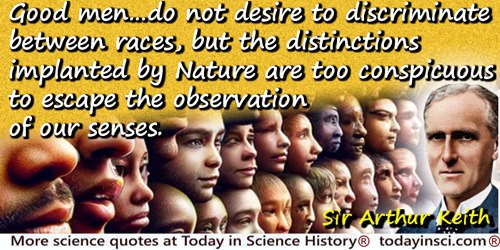
Good men, whether they be Christians or rationalists, do not desire to discriminate between races, but the distinctions implanted by Nature are too conspicuous to escape the observation of our senses.
In Essays on Human Evolution (1946). 66.
Good sense is, of all things among men, the most equally distributed ; for every one thinks himself so abundantly provided with it, that those even who are the most difficult to satisfy in everything else, do not usually desire a larger measure of this quality than they already possess.
In Discours de la Méthode (1637), Part 1. English version as given in John Veitch (trans.), The Method, Meditations, and Selections from the Principles of Descartes (1880), 3. Also seen translated as “Of all things, good sense is the most fairly distributed: everyone thinks he is so well supplied with it that even those who are the hardest to satisfy in every other respect never desire more of it than they already have,” or “Good sense is of all things in the world the most equally distributed, for everybody thinks he is so well supplied with it that even those most difficult to please in all other matters never desire more of it than they already possess.” From the original French, “Le bon sens est la chose du monde la mieux partagée; car chacun pense en être si bien pourvu, que ceux même qui sont les plus difficiles à contenter en toute autre chose n'ont point coutume d'en désirer plus qu'ils en ont.”
He that desires to learn Truth should teach himself by Facts and Experiments; by which means he will learn more in a Year than by abstract reasoning in an Age.
In Academical Lectures on the Theory of Physic (1751), Vol. 1. As quoted in Thomas Steele Hall, A Source Book in Animal Biology (1951), 485.
He that desireth to acquire any art or science seeketh first those means by which that art or science is obtained.
In An Apology For the True Christian Divinity (1825), 15.
How was your flight? Well, aeronautically it was a great success. Socially, it left quite a bit to be desired.
…...
However absurd it may seem, I do in all seriousness hereby declare that I am animated mainly by philanthropic motives. I desire to do good to my fellow creatures, even to the Cui bonos.
In Electrical Papers (1882), Vol. I; Preface, vi-vii.

Humanity certainly needs practical men, who get the most out of their work, and, without forgetting the general good, safeguard their own interests. But humanity also needs dreamers, for whom the disinterested development of an enterprise is so captivating that it becomes impossible for them to devote their care to their own material profit. Without the slightest doubt, these dreamers do not deserve wealth, because they do not desire it. Even so, a well-organised society should assure to such workers the efficient means of accomplishing their task, in a life freed from material care and freely consecrated to research.
In Eve Curie, Madame Curie: A Biography by Eve Curie (1938, 2007), 344.
Hypochondriac symptoms commonly occur and may, if no discernible cause for the symptom is found, be due to exaggerated needs for attention and other psychological desires.
In Benjamin B. Wolman (editor), Handbook of Clinical Psychology (1965), 830-1.
I also suspect that many workers in this field [molecular biology] and related fields have been strongly motivated by the desire, rarely actually expressed, to refute vitalism.
British Medical Bulletin (1965). In Maurice B. Strauss, Familiar Medical Quotations (1968), 653.
I am desirous of making a special library of vertebrate palaeontology so far as my means will permit.
In letter (1853) to Spencer F. Baird. As quoted, without source citation, in Henry Fairfield Osborn, 'Biographical Memoir of Joseph Leidy', collected in National Academy of Sciences, Biographical Memoirs: Volume 7 (1913), 346. Sadly, Leidy could not join a fossil hunting expedition, because he had to cover the lectures of Dr. Horner, professor of anatomy, who was seriously ill.
I believe with Schopenhauer that one of the strongest motives that lead men to art and science is escape from everyday life with its painful crudity and hopeless dreariness, from the fetters of one’s own ever shifting desires. A finely tempered nature longs to escape from personal life into the world of objective perception and thought; this desire may be compared with the townsman’s irresistible longing to escape from his noisy, cramped surroundings into the silence of high mountains, where the eye ranges freely through the still, pure air and fondly traces out the restful contours apparently built for eternity.
Address at The Physical Society, Berlin (1918) for Max Planck’s 60th birthday, 'Principles of Research', collected in Essays in Science (1934) 2.
I bet it would have been a lot of fun to work with Einstein. What I really respect about Einstein is his desire to throw aside all conventional modes and just concentrate on what seems to be the closest we can get to an accurate theory of nature.
As quoted by Christina Couch, '10 Questions for Alan Guth, Pioneer of the Inflationary Model of the Universe' (7 Jan 2016) on the website for NPR radio program Science Friday.
I cannot find anything showing early aptitude for acquiring languages; but that he [Clifford] had it and was fond of exercising it in later life is certain. One practical reason for it was the desire of being able to read mathematical papers in foreign journals; but this would not account for his taking up Spanish, of which he acquired a competent knowledge in the course of a tour to the Pyrenees. When he was at Algiers in 1876 he began Arabic, and made progress enough to follow in a general way a course of lessons given in that language. He read modern Greek fluently, and at one time he was furious about Sanskrit. He even spent some time on hieroglyphics. A new language is a riddle before it is conquered, a power in the hand afterwards: to Clifford every riddle was a challenge, and every chance of new power a divine opportunity to be seized. Hence he was likewise interested in the various modes of conveying and expressing language invented for special purposes, such as the Morse alphabet and shorthand. … I have forgotten to mention his command of French and German, the former of which he knew very well, and the latter quite sufficiently; …
In paper, 'William Kingdon Clifford', The Fortnightly Review (1879), 31, 671. Published in advance of Leslie Stephen and Frederick Pollock (eds.), Clifford’s Lectures and Essays (1879), Vol. 1, Introduction, 9. The 'Introduction' was written by Pollock.
I do believe that a scientist is a freelance personality. We’re driven by an impulse which is one of curiosity, which is one of the basic instincts that a man has. So we are … driven … not by success, but by a sort of passion, namely the desire of understanding better, to possess, if you like, a bigger part of the truth. I do believe that science, for me, is very close to art.
From 'Asking Nature', collected in Lewis Wolpert and Alison Richards (eds.), Passionate Minds: The Inner World of Scientists (1997), 197.
I do not forget that Medicine and Veterinary practice are foreign to me. I desire judgment and criticism upon all my contributions. Little tolerant of frivolous or prejudiced contradiction, contemptuous of that ignorant criticism which doubts on principle, I welcome with open arms the militant attack which has a method of doubting and whose rule of conduct has the motto “More light.”
In Louis Pasteur and Harold Clarence Ernst (trans), The Germ Theory and Its Application to Medicine and Surgery, Chap. 12. Reprinted in Charles W. Eliot (ed.), The Harvard Classics:
Scientific Papers: Physiology, Medicine, Surgery, Geology (1897, 1910), Vol. 38, 401-402. Cited as read before French Academy of Science (20 Apr 1878), published in Comptes Rendus de l’Académie des Sciences, 84, 1037-43.
I have indeed lived and worked to my taste either in art or science. What more could a man desire? Knowledge has always been my goal. There is much that I shall leave behind undone…but something at least I was privileged to leave for the world to use, if it so intends…As the Latin poet said I will leave the table of the living like a guest who has eaten his fill. Yes, if I had another life to spend, I certainly would not waste it. But that cannot be, so why complain?
Letter to R. C. Craw, quoted in Tuatara (1984) Vol. 27 (1): 5-7
I have no desire to write my own biography, as long as I have strength and means to do better work.
Passages From the Life of a Philosopher (1864), vii.
I have no other wish than a close fusion with nature, and I desire no other fate than to have worked and lived in harmony with her laws.
…...
I learned a lot of different things from different schools. MIT is a very good place…. It has developed for itself a spirit, so that every member of the whole place thinks that it’s the most wonderful place in the world—it’s the center, somehow, of scientific and technological development in the United States, if not the world … and while you don’t get a good sense of proportion there, you do get an excellent sense of being with it and in it, and having motivation and desire to keep on…
From Surely You’re Joking, Mr. Feynman!: Adventures of a Curious Character (1985), 51.
I read … that the celebrated Amontons, using a thermometer of his own invention, had discovered that water boils at a fixed degree of heat. I was at once inflamed with a great desire to make for myself a thermometer of the same sort, so that I might with my own eyes perceive this beautiful phenomenon of nature.
From 'Experimenta circa gradum caloris liquorum nonnullorum ebullientium instituta', Philosophical Transactions (1724), 33, 1, as translated in William Francis Magie, A Source Book in Physics (1935), 131.
I recall my own emotions: I had just been initiated into the mysteries of the complex number. I remember my bewilderment: here were magnitudes patently impossible and yet susceptible of manipulations which lead to concrete results. It was a feeling of dissatisfaction, of restlessness, a desire to fill these illusory creatures, these empty symbols, with substance. Then I was taught to interpret these beings in a concrete geometrical way. There came then an immediate feeling of relief, as though I had solved an enigma, as though a ghost which had been causing me apprehension turned out to be no ghost at all, but a familiar part of my environment.
In Tobias Dantzig and Joseph Mazur (ed.), 'The Two Realities', Number: The Language of Science (1930, ed. by Joseph Mazur 2007), 254.
I sell here, Sir, what all the world desires to have—POWER.
About the improved steam engine invented by James Watt and brought into production at Boulton’s manufactory.
About the improved steam engine invented by James Watt and brought into production at Boulton’s manufactory.
Entry for Friday 22 March 1776. In George Birkbeck-Hill (ed.), Boswell’s Life of Johnson (1934-50), Vol. 2, 459.
I will simply express my strong belief, that that point of self-education which consists in teaching the mind to resist its desires and inclinations, until they are proved to be right, is the most important of all, not only in things of natural philosophy, but in every department of dally life.
'Observations On Mental Education', a lecture before the Prince Consort and the Royal Institution, 6 May 1854. Experimental researches in chemistry and physics (1859), 477.
I wished to show that Pythagoras, the first founder of the vegetable regimen, was at once a very great physicist and a very great physician; that there has been no one of a more cultured and discriminating humanity; that he was a man of wisdom and of experience; that his motive in commending and introducing the new mode of living was derived not from any extravagant superstition, but from the desire to improve the health and the manners of men.
From Dell Vitto Pitagorico (1743), (The Pythagorean Diet: for the Use of the Medical Faculty), as translated quotes in Howard Williams, The Ethics of Diet: A Catena of Authorities Deprecatory of the Practice of Flesh-Eating (1883), 158.
If a child left school at ten, knowing nothing of detailed information, but knowing the pleasure that comes from agreeable music, from reading, from making things, from finding things out, it would be better off than a man who left university at twenty-two, full of facts but without any desire to enquire further into such dry domains.
In Mathematician's Delight (1943), 9.
If any human being earnestly desire to push on to new discoveries instead of just retaining and using the old; to win victories over Nature as a worker rather than over hostile critics as a disputant; to attain, in fact, clear and demonstrative knowlegde instead of attractive and probable theory; we invite him as a true son of Science to join our ranks.
Novum Organum (1620), 34, Preface.
If history and science have taught us anything, it is that passion and desire are not the same as truth. The human mind evolved to believe in the gods. It did not evolve to believe in biology.
Consilience: The Unity of Knowledge (1998, 1999), 286
If I’d been born in space, I would desire to visit the beautiful Earth more than to visit space. It’s a wonderful planet.
…...
If one could continually satisfy his desires, he would never have time to desire. Happiness then is necessarily composed of alternatives. It could not exist at a constant level.
From Appendix A, 'Extracts From the Unpublished Writings of Carnot', Reflections on the Motive Power of Heat (1890, 2nd ed. 1897), 210.
If one were not animated with the desire to discover laws, they would escape the most enlightened attention.
Maurice Crosland, Gay-Lussac, Scientist and Bourgeois (1978), 54.
If the human race wants to go to hell in a basket, technology can help it get there by jet. It won’t change the desire or the direction, but it can greatly speed the passage.
In a speech at Wake Forest University, Winston-Salem, North Carolina, April 25, 1967.
If you would make a man happy, do not add to his possessions but subtract from the sum of his desires.
Quoted, without citation, in Harris Elliott Kirk, A Man of Property: Or, The Jacob Saga (1935), 45. Also in Howard W. Eves, Return to Mathematical Circles, (1988), 68.
Imagination is the beginning of creation. You imagine what you desire, you will what you imagine and at last you create what you will.
From Back to Methuselah: A Metabiological Pentateuch (1921), 9.
In early life I had felt a strong desire to devote myself to the experimental study of nature; and, happening to see a glass containing some camphor, portions of which had been caused to condense in very beautiful crystals on the illuminated side, I was induced to read everything I could obtain respecting the chemical and mechanical influences of light, adhesion, and capillary attraction.
In preface to Scientific Memoirs (1878), xii.
In history an additional result is commonly produced by human actions beyond that which they aim at and obtain—that which they immediately recognize and desire. They gratify their own interest; but something further is thereby accomplished, latent in the actions in question, though not present to their consciousness, and not included in their design. … This may be called the cunning of reason.
From Vorlesungen über die philosophie der weltgeschichte (1837), as translated from the Third German Edition by J. Sibree (1857), in The Philosophy of History (1857, 1861), 28-29 & 34. Hegel coined the expression List der Vernunft translated as the cunning of reason. In Hegel’s philosophical view, the expression represents a process by which a certain purpose is realized in the history of mankind that is not conscious to the acting man.
In matters of science, curiosity gratified begets not indolence, but new desires.
Theory of the Earth, with Proofs and Illustrations, Vol. 3, ed. Archibald Geikie (1899), 16.
In order to imbue civilization with sound principles and enliven it with the spirit of the gospel, it is not enough to be illumined with the gift of faith and enkindled with the desire of forwarding a good cause. For this end it is necessary to take an active part in the various organizations and influence them from within. And since our present age is one of outstanding scientific and technical progress and excellence, one will not be able to enter these organizations and work effectively from within unless he is scientifically competent, technically capable and skilled in the practice of his own profession.
Encyclical (10 Apr 1963). In Pacem in Terris, Pt. 5, 50
In other branches of science, where quick publication seems to be so much desired, there may possibly be some excuse for giving to the world slovenly or ill-digested work, but there is no such excuse in mathematics. The form ought to be as perfect as the substance, and the demonstrations as rigorous as those of Euclid. The mathematician has to deal with the most exact facts of Nature, and he should spare no effort to render his interpretation worthy of his subject, and to give to his work its highest degree of perfection. “Pauca sed matura” was Gauss’s motto.
In Presidential Address British Association for the Advancement of Science, Section A, (1890), Nature, 42, 467. [The Latin motto translates as “Few, but ripe”. —Webmaster]
In the last fifteen years we have witnessed an event that, I believe, is unique in the history of the natural sciences: their subjugation to and incorporation into the whirls and frenzies of disgusting publicity and propaganda. This is no doubt symptomatic of the precarious position assigned by present-day society to any form of intellectual activity. Such intellectual pursuits have at all times been both absurd and fragile; but they become ever more ludicrous when, as is now true of science, they become mass professions and must, as homeless pretentious parasites, justify their right to exist in a period devoted to nothing but the rapid consumption of goods and amusements. These sciences were always a divertissement in the sense in which Pascal used the word; but what is their function in a society living under the motto lunam et circenses? Are they only a band of court jesters in search of courts which, if they ever existed, have long lost their desire to be amused?
Voices in the Labyrinth: Nature, Man, and Science (1979), 27.
In the next twenty centuries … humanity may begin to understand its most baffling mystery—where are we going? The earth is, in fact, traveling many thousands of miles per hour in the direction of the constellation Hercules—to some unknown destination in the cosmos. Man must understand his universe in order to understand his destiny. Mystery, however, is a very necessary ingredient in our lives. Mystery creates wonder and wonder is the basis for man’s desire to understand. Who knows what mysteries will be solved in our lifetime, and what new riddles will become the challenge of the new generation? Science has not mastered prophesy. We predict too much for the next year yet far too little for the next ten. Responding to challenges is one of democracy’s great strengths. Our successes in space can be used in the next decade in the solution of many of our planet’s problems.
In a speech to a Joint Meeting of the Two Houses of Congress to Receive the Apollo 11 Astronauts (16 Sep 1969), in the Congressional Record.
It is an irony of fate that I myself have been the recipient of excessive admiration and reverence from my fellow-beings, through no fault, and no merit, of my own. The cause of this may well be the desire, unattainable for many, to understand the few ideas to which I have with my feeble powers attained through ceaseless struggle. I am quite aware that for any organisation to reach its goals, one man must do the thinking and directing and generally bear the responsibility. But the led must not be coerced, they must be able to choose their leader.
In 'What I Believe', Forum and Century (1930), 84, 193-194.
It is easy to overlook this thought that life just is. As humans we are inclined to feel that life must have a point. We have plans and aspirations and desires. We want to take constant advantage of the intoxicating existence we’ve been endowed with. But what’s life to a lichen? Yet its impulse to exist, to be, is every bit as strong as ours-arguably even stronger. If I were told that I had to spend decades being a furry growth on a rock in the woods, I believe I would lose the will to go on. Lichens don’t. Like virtually all living things, they will suffer any hardship; endure any insult, for a moment’s additions existence. Life, in short just wants to be.
…...
It is not merely as an investigator and discoverer, but as a high-principled and unassuming man, that Scheele merits our warmest admiration. His aim and object was the discovery of truth. The letters of the man reveal to us in the most pleasant way his high scientific ideal, his genuinely philosophic temper, and his simple mode of thought. “It is the truth alone that we desire to know, and what joy there is in discovering it!” With these words he himself characterizes his own efforts.
From History of Chemistry (1899). As quoted in Victor Robinson, Pathfinders in Medicine (1912), 121.

It is notorious that the desire to live increases as life itself shortens.
In Charlas de Café: pensamientos, anécdotas y confidencias (1920). (Café Chats: Thoughts, Anecdotes and Confidences). As translated in Peter McDonald (ed.) Oxford Dictionary of Medical Quotations (2004), 83.
It is the desire for explanations that are at once systematic and controllable by factual evidence that generates science; and it is the organization and classification of knowledge on the basis of explanatory principles that is the distinctive goal of the sciences.
The Structure of Science (1961), 4.
It is the truth alone that we desire to know and what a joy there is in discovering it.
Epigraph, without citation, in Victor Robinson, Pathfinders in Medicine (1912), 121. (Chapter originally printed as an article by Robinson in the Alumni Journal of the New York College of Pharmacy.)
It is very desirable to have a word to express the Availability for work of the heat in a given magazine; a term for that possession, the waste of which is called Dissipation. Unfortunately the excellent word Entropy, which Clausius has introduced in this connexion, is applied by him to the negative of the idea we most naturally wish to express. It would only confuse the student if we were to endeavour to invent another term for our purpose. But the necessity for some such term will be obvious from the beautiful examples which follow. And we take the liberty of using the term Entropy in this altered sense ... The entropy of the universe tends continually to zero.
Sketch of Thermodynamics (1868), 100-2.
It is with our entire past ... that we desire, will and act ... from this survival of the past it follows that consciousness cannot go through the same state twice. The circumstances may still be the same, but they will act no longer on the same person ... that is why our duration is irreversible.
Creative Evolution (1911), trans. Arthur Mitchell, 6.
It must happen that in some cases the author is not understood, or is very imperfectly understood; and the question is what is to be done. After giving a reasonable amount of attention to the passage, let the student pass on, reserving the obscurity for future efforts. … The natural tendency of solitary students, I believe, is not to hurry away prematurely from a hard passage, but to hang far too long over it; the just pride that does not like to acknowledge defeat, and the strong will that cannot endure to be thwarted, both urge to a continuance of effort even when success seems hopeless. It is only by experience we gain the conviction that when the mind is thoroughly fatigued it has neither the power to continue with advantage its course in .an assigned direction, nor elasticity to strike out a new path; but that, on the other hand, after being withdrawn for a time from the pursuit, it may return and gain the desired end.
In 'Private Study of Mathematics', Conflict of Studies and other Essays (1873), 68.
It you’re bored with life-if you don’t get up every morning with a burning desire to do things-you don’t have enough goals.
…...
It’s not for glory that Soviet cosmonauts are in this assault on the cosmos; they are motivated by a limitless love for and devotion to their country, the Party and the people, and by a desire to help Soviet scientists to discover the secrets of the universe.
In First Man in Space: The Life and Achievement of Yuri Gagarin: a Collection (1984), 104. Cited as written as a foreword of a book at the request of the author.
J. J. Sylvester was an enthusiastic supporter of reform [in the teaching of geometry]. The difference in attitude on this question between the two foremost British mathematicians, J. J. Sylvester, the algebraist, and Arthur Cayley, the algebraist and geometer, was grotesque. Sylvester wished to bury Euclid “deeper than e’er plummet sounded” out of the schoolboy’s reach; Cayley, an ardent admirer of Euclid, desired the retention of Simson’s Euclid. When reminded that this treatise was a mixture of Euclid and Simson, Cayley suggested striking out Simson’s additions and keeping strictly to the original treatise.
In History of Elementary Mathematics (1910), 285.
Just as eating contrary to the inclination is injurious to the health, so study without desire sports the memory, and it retains nothing that it takes in.
…...
Knowledge always desires increase; it is like fire which must first be kindled by some external agent, but which will afterward propagate itself.
…...
Lies are crafted to match the hopes and desires and the fears of the intended listener… truth, on the other hand, is what it is, neither what you want it to be, nor what you are afraid it will be. So that is why lies are always more believable than the truth.
In 'Why We Believe Lies' (2011), on web site geoffreylandis.com.
Living with my Indian friends I found I was a stranger in my native land. As time went on, the outward aspect of nature remained the same, but change was wrought in me. I learned to hear the echoes of a time when every living thing even the sky had a voice. That voice devoutly heard by the ancient people of America I desired to make audible to others.
On the plaque over her cremated remains in the patio of the Art Museum at Sante Fe. Edited by William Henry Homes from the preface she wrote in her last book, a small collection of Indian Games and Dances (1915). As stated in concluding pages of Joan T. Mark, A Stranger in Her Native Land: Alice Fletcher and the American Indians (1988), 354-355.
Logic teaches us that on such and such a road we are sure of not meeting an obstacle; it does not tell us which is the road that leads to the desired end. For this, it is necessary to see the end from afar, and the faculty which teaches us to see is intuition. Without it, the geometrician would be like a writer well up in grammar but destitute of ideas.
…...
Look around you: there is not a doctor who desires the health of his friends, not a soldier who desires peace for his country.
— Philemon
In Gustave Jules Witkowski, 'The Sicilian', The Evil that Has Been Said of Doctors (1889), 4-5.
Man has an intense desire for assured knowledge.
Quoted in P. A. Schilpp (ed.), The Philosophy of Bertrand Russell (1971), Vol. 1, 285.
Man is an eating animal, a drinking animal, and a sleeping animal, and one placed in a material world, which alone furnishes all the human animal can desire. He is gifted besides with knowing faculties, practically to explore and to apply the resources of this world to his use. These are realities. All else is nothing; conscience and sentiment are mere figments of the imagination. Man has but five gates of knowledge, the five senses; he can know nothing but through them; all else is a vain fancy, and as for the being of a God, the existence of a soul, or a world to come, who can know anything about them? Depend upon it, my dear madam, these are only the bugbears by which men of sense govern fools.
Attributed to Darwin by Mary Anne Schimmelpennick. Quoted in Christiana C. Hankin (ed.) Life of Mary Anne Schimmelpenninck (1858), Vol. I, 241-2.
Man is full of desires: he loves only those who can satisfy them all. “This man is a good mathematician,” someone will say. But I have no concern for mathematics; he would take me for a proposition. “That one is a good soldier.” He would take me for a besieged town. I need, that is to say, a decent man who can accommodate himself to all my desires in a general sort of way.
From Pensées (1670), Sect. 6, Aphorism 18. As translated in W.H. Auden and L. Kronenberger (eds.) The Viking Book of Aphorisms (1966), 199. From the original French, “L’homme est plein de besoins: il n’aime que ceux qui peuvent les remplir tous. ‘C’est un bon mathématicien,’ dira-t-on. Mais je n’ai que faire de mathématiques; il me prendroit pour une proposition. ‘C’est un bon guerrier.’ Il me prendroit pour une place assiégée. Il faut donc un honnête homme qui puisse s’accommoder à tous mes besoins généralement,” in Oeuvres Complètes de Blaise Pascal (1858), Vol. 1, 276.
Man is occupied and has been persistently occupied since his separate evolution, with three kinds of struggle: first with the massive unintelligent forces of nature, heat and cold, winds, rivers, matter and energy; secondly, with the things closer to him, animals and plants, his own body, its health and disease; and lastly, with his desires and fears, his imaginations and stupidities.
In The World, the Flesh and the Devil (1929).
Many will, no doubt, prefer to retain old unsystematic names as far as possible, but it is easy to see that the desire to avoid change may carry us too far in this direction; it will undoubtedly be very inconvenient to the present generation of chemists to abandon familiar and cherished names, but nevertheless it may be a wise course to boldly face the difficulty, rather than inflict on coming generations a partially illogical and unsystematic nomenclature.
'International Conference on Chemical Nomenclature', Nature (19 May 1892), 46, 57.
Mathematics as an expression of the human mind reflects the active will, the contemplative reason, and the desire for aesthetic perfection. Its basic elements are logic and intuition, analysis and construction, generality and individuality. Though different traditions may emphasize different aspects, it is only the interplay of these antithetic forces and the struggle for their synthesis that constitute the life, usefulness, and supreme value of mathematical science.
As co-author with Herbert Robbins, in What Is Mathematics?: An Elementary Approach to Ideas and Methods (1941, 1996), x.
Men desire nothing so much as to make themselves envied.
From Appendix A, 'Extracts From the Unpublished Writings of Carnot', Reflections on the Motive Power of Heat (1890, 2nd ed. 1897), 208.
My belief (is) that one should take a minimum of care and preparation over first experiments. If they are unsuccessful one is not then discouraged since many possible reasons for failure can be thought of, and improvements can be made. Much can often be learned by the repetition under different conditions, even if the desired result is not obtained. If every conceivable precaution is taken at first, one is often too discouraged to proceed at all.
Nobel Lectures in Chemistry (1999), Vol. 3, 364.
My kingdom is as wide as the universe, and my desire has no limits. I am always going about enfranchising the mind and weighing the worlds, without hate, without fear, without love, and without God. I am called Science.
From La Tentation de Saint-Antoine (1874), as The Temptation of Saint Anthony, collected in The Complete Works of Gustave Flaubert (1904), 141.
My kingdom is as wide as the world, and my desire has no limit. I go forward always, freeing spirits and weighing worlds, without fear, without compassion, without love, and without God. Men call me science.
From La Tentation de Saint-Antoine (The Temptation of Saint Anthony) (1874), as translated, without citation, in Isaac Asimov, Isaac Asimov’s Book Science and Nature Quotations (1988), 247.
My kingdom is vast as the universe; and my desire knows no limits. I go on forever,—freeing minds, weighing worlds,—without hatred, without fear, without pity, without love, and without God. Men call me Science!
From La Tentation de Saint-Antoine (1874), as translated by Lafcadio Hearn, The Temptation of Saint Anthony (1911), 218-219.
Mystery creates wonder and wonder is the basis of man’s desire to understand.
In a speech to Congress (16 Sep 1969). This is part of a longer quote given on the Neil Armstrong Quotes page of this website, beginning “In the next twenty centuries….”
Nature being capricious and taking pleasure in creating and producing a continuous sucession of lives and forms because she knows that they serve to increase her terrestrial substance, is more ready and swift in her creating than time is in destroying, and therefore she has ordained that many animals shall serve as food one for the other; and as this does not satisfy her desire she sends forth frequently certain noisome and pestilential vapours and continual plagues upon the vast accumulations and herds of animals and especially upon human beings who increase very rapidly because other animals do not feed upon them.
'Philosophy', in The Notebooks of Leonardo da Vinci, trans. E. MacCurdy (1938), Vol. 1 80.
Nature! … We obey her laws even when we rebel against them; we work with her even when we desire to work against her.
As quoted by T.H. Huxley, in Norman Lockyer (ed.), 'Nature: Aphorisms by Goethe', Nature (1870), 1, 10.
No body can desire more ardently than myself to concur in whatever may promote useful science, and I view no science with more partiality than Natural history.
Letter (24 May 1807) from Jefferson in Washington to G.C. de la Coste.
Not every one of our desires can be immediately gratified. We’ve got to learn to wait patiently for our dreams to come true, especially on the path we’ve chosen. But while we wait, we need to prepare symbolically a place for our hopes and dreams.
…...
Not one amongst the doctors, as you'll see
For his own friends desires to prescribe.
For his own friends desires to prescribe.
— Philemon
Fabulae Incertae, Fragment 46, A. In William Shepard Walsh, The International Encyclopedia of Prose and Poetical Quotations from the Literature of the World (1921), 197.
Not only is the state of nature hostile to the state of art of the garden; but the principle of the horticultural process, by which the latter is created and maintained, is antithetic to that of the cosmic process. The characteristic feature of the latter is the intense and unceasing competition of the struggle for existence. The characteristic of the former is the elimination of that struggle, by the removal of the conditions which give rise to it. The tendency of the cosmic process is to bring about the adjustment of the forms of plant life to the current conditions; the tendency of the horticultural process is the adjustment of the conditions to the needs of the forms of plant life which the gardener desires to raise.
'Evolution and Ethics-Prolegomena' (1894). In Collected Essays (1894), Vol. 9, 13.
Nothing can so quickly blur and distort the facts as desire—the wish to use the facts for some purpose of your own—and nothing can so surely destroy the truth. As soon as the witness wants to prove something he is no longer impartial and his evidence is no longer to be trusted.
From 'Getting at the Truth', The Saturday Review (19 Sep 1953), 36, No. 38, 12. Excerpted in Meta Riley Emberger and Marian Ross Hall, Scientific Writing (1955), 400.
Nothing retains less of desire in art, in science, than this will to industry, booty, possession.
Mad Love (1937) translated by Mary Ann Caws (1988), 25.
On the Enquirer I specialized in news of organized labor. … The dock and timber workers and the migratory farm laborers…were drawn to communism. The California State Legislature had passed a strong bill defining criminal syndicalism and making it a felony. The politicians were looking for a place to use it. On November 9, 1919, I was the only reporter from a conservative paper to cover the organization meeting of the Communist Labor Party of California, as it was then called. I wrote lurid and sensational stories about this small group of…persons, which resulted in indictments against them, and which required that I had to testify against them, in trial after trial, over the next several years. In this connection I became aware of open boasting by a police detective of his having framed some of the defendants in a matter where I knew the facts to be otherwise. The effect of this involvement on me was to wipe out any desire to be…[a] newspaperman; so I entered the university and went into physical science largely as a means of escape from the corruption of the world, in addition to the fact that I was genuinely interested in physical science.
As a high school student in Oakland, California, Condon had rival interests in journalism and science, and became a reporter for the Oakland Enquirer. That had a lasting effect on his attitude toward government and society. As described in his autobiographical 'Reminiscences of a Life in and out of Quantum Mechanics', Proceedings of the International Symposium on Atomic, Molecular, Solid State Theory and Quantum Biology, Sanibel Island, Florida' (22 Jan 1973), published in International Journal of Quantum Chemistry (1973), 7, 7-22; collected in Asim O. Barut, Halis Odabasi and Alwyn van der Merwe (eds.), Selected Popular Writings of E.U. Condon (1991), 316-317.
One always finds among men who are reputed to be reasonable some evidence of this tendency to inquire into the reason of things; of this desire to know not simply how things are, but why they are one way rather than another; and, consequently, of this awareness of a relation which is not gained through the senses, this notion of an abstract bond by virtue of which one thing is subordinated to another which determines and explains it.
From Essai sur les Fondements de nos Connaissances et sur les Caractères de la Critique Philosophique (1851), 21, as translated by Merritt H Moore in An Essay on the Foundations of Our Knowledge (1956), 18. From the original French: “Toujours est-il que, chez tous les hommes réputés raisonnables, on retrouve, à certains degrés, cette tendance à s’enquérir de la raison des choses; ce désir de connaître, non pas seulement comment les choses sont, mais pourquoi elles sont de telle façon plutôt que d’une autre; et, partant, cette intelligence d’un rapport qui ne tombe pas sous les sens; cette notion d’un lien abstrait en vertu duquel une chose est subordonnée à une autre qui la détermine et qui l’explique.”
One of the strongest motives that lead men to art and science is escape from everyday life with its painful crudity and hopeless dreariness, from the fetters of one's own ever-shifting desires. A finely tempered nature longs to escape from the personal life into the world of objective perception and thought.
Albert Einstein and Walter Shropshire (ed.), The Joys of Research (1981), 40.
One would have to have completely forgotten the history of science so as not to remember that the desire to know nature has had the most constant and the happiest influence on the development of mathematics.
In Henri Poincaré and George Bruce Halsted (trans.), The Value of Science: Essential Writings of Henri Poincare (1907), 79.
Our novice runs the risk of failure without additional traits: a strong inclination toward originality, a taste for research, and a desire to experience the incomparable gratification associated with the act of discovery itself.
From Reglas y Consejos sobre Investigacíon Cientifica: Los tónicos de la voluntad. (1897), as translated by Neely and Larry W. Swanson, in Advice for a Young Investigator (1999), 48.
Our treasure lies in the beehives of our knowledge. We are perpetually on our way thither, being by nature winged insects and honey gatherers of the mind. The only thing that lies close to our heart is the desire to bring something home to the hive.
The Genealogy of Morals (1887), as translated by Francis Golffing (1956), 149. In another translation, by Maudemarie Clark and Alan J. Swensen, it appears as: “It has rightly been said: ‘where your treasure is, there will your heart be also’; our treasure is where the beehives of our knowledge stand. We are forever underway towards them, as born winged animals and honey-gathers of the spirit, concerned will all our heart about only one thing—"bringing home" something.”
Prof. Sarabhai had the keen desire that India must be independent in rocket manufacturing, hence he was always full of zeal to do something new.
As given in narrative form by Mahesh Sharma, P. Bhalla and P.K. Das, in 'Prof. Vikram Sarabhai in the Opinion of Dr. Kalam', Pride Of The Nation: Dr. A.P.J. Abdul Kalam (2004), 46.
Religion is, in reality, living. Our religion is not what we profess, or what we say, or what we proclaim; our religion is what we do, what we desire, what we seek, what we dream about, what we fantasize, what we think—all these things.
Quoted in Kim Lim (ed.), 1,001 Pearls of Spiritual Wisdom: Words to Enrich, Inspire, and Guide Your Life (2014), 21
Religious leaders and men of science have the same ideals; they want to understand and explain the universe of which they are part; they both earnestly desire to solve, if a solution be ever possible, that great riddle: Why are we here?
Concerning Man's Origin (1927), viii.
Rivers are roads which move, and which carry us whither we desire to go.
In Pensées. As translated by W.F. Trotter in Blaise Pascal: Thoughts, Letters, and Minor Works (1910), 13.
Science has taught us to think the unthinkable. Because when nature is the guide—rather than a priori prejudices, hopes, fears or desires—we are forced out of our comfort zone. One by one, pillars of classical logic have fallen by the wayside as science progressed in the 20th century, from Einstein's realization that measurements of space and time were not absolute but observer-dependent, to quantum mechanics, which not only put fundamental limits on what we can empirically know but also demonstrated that elementary particles and the atoms they form are doing a million seemingly impossible things at once.
In op-ed, 'A Universe Without Purpose', Los Angeles Times (1 Apr 2012).
Science is not the enemy of humanity but one of the deepest expressions of the human desire to realize that vision of infinite knowledge. Science shows us that the visible world is neither matter nor spirit; the visible world is the invisible organization of energy.
The Cosmic Code (1982), 348.
Science itself, no matter whether it is the search for truth or merely the need to gain control over the external world, to alleviate suffering, or to prolong life, is ultimately a matter of feeling, or rather, of desire—the desire to know or the desire to realize.
In New Perspectives in Physics (1962), 196.
Science only means knowledge; and for [Greek] ancients it did only mean knowledge. Thus the favorite science of the Greeks was Astronomy, because it was as abstract as Algebra. ... We may say that the great Greek ideal was to have no use for useful things. The Slave was he who learned useful things; the Freeman was he who learned useless things. This still remains the ideal of many noble men of science, in the sense they do desire truth as the great Greeks desired it; and their attitude is an external protest against vulgarity of utilitarianism.
'About Beliefs', in As I was Saying: A Book of Essays (1936), 65-66. Collected in G. K. Chesterton and Dale Ahlquist (ed.), In Defense of Sanity: The Best Essays of G.K. Chesterton (2011), 318.
Science, illuminating ray!
Fair mental beam, extend thy sway, And shine from pole to pole!
From thy accumulated store,
O'er every mind thy riches pour, Excite from low desires to soar, And dignify the soul.
Fair mental beam, extend thy sway, And shine from pole to pole!
From thy accumulated store,
O'er every mind thy riches pour, Excite from low desires to soar, And dignify the soul.
'Botany', I. From Poems on Conchology and Botany (1831), 176.
Some proofs command assent. Others woo and charm the intellect. They evoke delight and an overpowering desire to say, 'Amen, Amen'.
Quoted in H. E. Hunter, The Divine Proportion (1970), 6; but with no footnote identifying primary source.
Some say the world will end in fire,
Some say in ice.
From what I've tasted of desire
I hold with those who favor fire
But if I had to perish twice,
I think I know enough of hate
To say that for destruction ice
Is also great
And would suffice. - Robert Frost
Some say in ice.
From what I've tasted of desire
I hold with those who favor fire
But if I had to perish twice,
I think I know enough of hate
To say that for destruction ice
Is also great
And would suffice. - Robert Frost
Poem, 'Fire and Ice', collected in New Hampshire (1923). First published in Harper’s Magazine (Dec 1920).
Sometimes I am a little unkind to all my many friends in education … by saying that from the time it learns to talk every child makes a dreadful nuisance of itself by asking “Why?.” To stop this nuisance society has invented a marvellous system called education which, for the majority of people, brings to an end their desire to ask that question. The few failures of this system are known as scientists.
'The Making of a Scientist', Journal of the Royal Society of Arts, June 1983, 403.
Strong, deeply rooted desire is the starting point of all achievement. Just as the electron is the last unit of matter discernible to the scientist. DESIRE is the seed of all achievement; the starting place, back of which there is nothing, or at least there is nothing of which we have any knowledge.
…...
Suppose then I want to give myself a little training in the art of reasoning; suppose I want to get out of the region of conjecture and probability, free myself from the difficult task of weighing evidence, and putting instances together to arrive at general propositions, and simply desire to know how to deal with my general propositions when I get them, and how to deduce right inferences from them; it is clear that I shall obtain this sort of discipline best in those departments of thought in which the first principles are unquestionably true. For in all our thinking, if we come to erroneous conclusions, we come to them either by accepting false premises to start with—in which case our reasoning, however good, will not save us from error; or by reasoning badly, in which case the data we start from may be perfectly sound, and yet our conclusions may be false. But in the mathematical or pure sciences,—geometry, arithmetic, algebra, trigonometry, the calculus of variations or of curves,— we know at least that there is not, and cannot be, error in our first principles, and we may therefore fasten our whole attention upon the processes. As mere exercises in logic, therefore, these sciences, based as they all are on primary truths relating to space and number, have always been supposed to furnish the most exact discipline. When Plato wrote over the portal of his school. “Let no one ignorant of geometry enter here,” he did not mean that questions relating to lines and surfaces would be discussed by his disciples. On the contrary, the topics to which he directed their attention were some of the deepest problems,— social, political, moral,—on which the mind could exercise itself. Plato and his followers tried to think out together conclusions respecting the being, the duty, and the destiny of man, and the relation in which he stood to the gods and to the unseen world. What had geometry to do with these things? Simply this: That a man whose mind has not undergone a rigorous training in systematic thinking, and in the art of drawing legitimate inferences from premises, was unfitted to enter on the discussion of these high topics; and that the sort of logical discipline which he needed was most likely to be obtained from geometry—the only mathematical science which in Plato’s time had been formulated and reduced to a system. And we in this country [England] have long acted on the same principle. Our future lawyers, clergy, and statesmen are expected at the University to learn a good deal about curves, and angles, and numbers and proportions; not because these subjects have the smallest relation to the needs of their lives, but because in the very act of learning them they are likely to acquire that habit of steadfast and accurate thinking, which is indispensable to success in all the pursuits of life.
In Lectures on Teaching (1906), 891-92.
Take note, theologians, that in your desire to make matters of faith out of propositions relating to the fixity of sun and earth you run the risk of eventually having to condemn as heretics those who would declare the earth to stand still and the sun to change position—eventually, I say, at such a time as it might be physically or logically proved that the earth moves and the sun stands still.
Note added by Galileo in the preliminary leaves of his copy of Dialogue on the Great World Systems (1632).
That which, to the anatomist, is the end,—is, to the sculptor, the means. The former desires details, for their own sake; the latter, that by means of them, he may kindle his work with life, and stamp it with beauty.
In 'Sculpture', The True and the Beautiful in Nature, Art, Morals, and Religion (1872), 205.
The authority of those who profess to teach is often a positive hindrance to those who desire to learn.
In De Natura Deorum: Academica (c. 45 B.C.), as translated to English (1933), 13.
The beginning of civilisation is the discovery of some useful arts, by which men acquire property, comforts, or luxuries. The necessity or desire of preserving them leads to laws and social institutions. The discovery of peculiar arts gives superiority to particular nations ... to subjugate other nations, who learn their arts, and ultimately adopt their manners;— so that in reality the origin as well as the progress and improvement of civil society is founded in mechanical and chemical inventions.
Consolations In Travel; or, the Last Days of a Philosopher (1830), 228.
The church attributes to God all human passions—anger, desire for vengeance, curiosity, tyranny, partiality, idleness.
From Appendix A, 'Extracts From the Unpublished Writings of Carnot', Reflections on the Motive Power of Heat (1890, 2nd ed. 1897), 216
The combination of some data and an aching desire for an answer does not ensure that a reasonable answer can be extracted from a given body of data.
In 'Sunset Salvo', The American Statistician (Feb 1986), 40, No. 1, 74-75.
The desire for guidance, love, and support prompts men to form the social or moral conception of God. This is the God of Providence, who protects, disposes, rewards, and punishes; the God who, according to the limits of the believer’s outlook, loves and cherishes the life of the tribe or of the human race, or even or life itself; the comforter in sorrow and unsatisfied longing; he who preserves the souls of the dead. This is the social or moral conception of God.
…...
The desire for truth so prominent in the quest of science, a reaching out of the spirit from its isolation to something beyond, a response to beauty in nature and art, an Inner Light of conviction and guidance—are these as much a part of our being as our sensitivity to sense impressions?
Swarthmore Lecture (1929) at Friends’ House, London, printed in Science and the Unseen World (1929), 42-43.
The desire to economize time and mental effort in arithmetical computations, and to eliminate human liability to error is probably as old as the science of arithmetic itself.
Opening of proposal submitted to I.B.M., 'Proposed Automatic Calculating Machine' (1937). As quoted by I. Bernard Cohen, in Howard Aiken: Portrait of a Computer Pioneer (2000), 63.
The desire to fly after the fashion of the birds is an idea handed down to us by our ancestors who, in their grueling travels across trackless lands in prehistoric times, looked enviously on the birds soaring freely through space, at full speed, above all obstacles, on the infinite highway of the air.
In The Papers of Wilbur and Orville Wright: Including the Chanute-Wright Letters (1953), 934.
The desire to reach for the sky runs deep in our human psyche.
…...
The desire to understand the world and the desire to reform it are the two great engines of progress.
In Marriage and Morals (1929), 301.
The difficulty really is psychological and exists in the perpetual torment that results from your saying to yourself, “But how can it be like that?” which is a reflection of uncontrolled but utterly vain desire to see it in terms of something familiar. … If you will simply admit that maybe [Nature] does behave like this, you will find her a delightful, entrancing thing. Do not keep saying to yourself, if you can possible avoid it, "But how can it be like that?" because you will get 'down the drain', into a blind alley from which nobody has escaped. Nobody knows how it can be like that.
[About wave-particle duality.]
[About wave-particle duality.]
'Probability abd Uncertainty—the Quantum Mechanical View of Nature', the sixth of his Messenger Lectures (1964), Cornell University. Collected in The Character of Physical Law (1967), 129.
The enthusiasm of Sylvester for his own work, which manifests itself here as always, indicates one of his characteristic qualities: a high degree of subjectivity in his productions and publications. Sylvester was so fully possessed by the matter which for the time being engaged his attention, that it appeared to him and was designated by him as the summit of all that is important, remarkable and full of future promise. It would excite his phantasy and power of imagination in even a greater measure than his power of reflection, so much so that he could never marshal the ability to master his subject-matter, much less to present it in an orderly manner.
Considering that he was also somewhat of a poet, it will be easier to overlook the poetic flights which pervade his writing, often bombastic, sometimes furnishing apt illustrations; more damaging is the complete lack of form and orderliness of his publications and their sketchlike character, … which must be accredited at least as much to lack of objectivity as to a superfluity of ideas. Again, the text is permeated with associated emotional expressions, bizarre utterances and paradoxes and is everywhere accompanied by notes, which constitute an essential part of Sylvester’s method of presentation, embodying relations, whether proximate or remote, which momentarily suggested themselves. These notes, full of inspiration and occasional flashes of genius, are the more stimulating owing to their incompleteness. But none of his works manifest a desire to penetrate the subject from all sides and to allow it to mature; each mere surmise, conceptions which arose during publication, immature thoughts and even errors were ushered into publicity at the moment of their inception, with utmost carelessness, and always with complete unfamiliarity of the literature of the subject. Nowhere is there the least trace of self-criticism. No one can be expected to read the treatises entire, for in the form in which they are available they fail to give a clear view of the matter under contemplation.
Sylvester’s was not a harmoniously gifted or well-balanced mind, but rather an instinctively active and creative mind, free from egotism. His reasoning moved in generalizations, was frequently influenced by analysis and at times was guided even by mystical numerical relations. His reasoning consists less frequently of pure intelligible conclusions than of inductions, or rather conjectures incited by individual observations and verifications. In this he was guided by an algebraic sense, developed through long occupation with processes of forms, and this led him luckily to general fundamental truths which in some instances remain veiled. His lack of system is here offset by the advantage of freedom from purely mechanical logical activity.
The exponents of his essential characteristics are an intuitive talent and a faculty of invention to which we owe a series of ideas of lasting value and bearing the germs of fruitful methods. To no one more fittingly than to Sylvester can be applied one of the mottos of the Philosophic Magazine:
“Admiratio generat quaestionem, quaestio investigationem investigatio inventionem.”
Considering that he was also somewhat of a poet, it will be easier to overlook the poetic flights which pervade his writing, often bombastic, sometimes furnishing apt illustrations; more damaging is the complete lack of form and orderliness of his publications and their sketchlike character, … which must be accredited at least as much to lack of objectivity as to a superfluity of ideas. Again, the text is permeated with associated emotional expressions, bizarre utterances and paradoxes and is everywhere accompanied by notes, which constitute an essential part of Sylvester’s method of presentation, embodying relations, whether proximate or remote, which momentarily suggested themselves. These notes, full of inspiration and occasional flashes of genius, are the more stimulating owing to their incompleteness. But none of his works manifest a desire to penetrate the subject from all sides and to allow it to mature; each mere surmise, conceptions which arose during publication, immature thoughts and even errors were ushered into publicity at the moment of their inception, with utmost carelessness, and always with complete unfamiliarity of the literature of the subject. Nowhere is there the least trace of self-criticism. No one can be expected to read the treatises entire, for in the form in which they are available they fail to give a clear view of the matter under contemplation.
Sylvester’s was not a harmoniously gifted or well-balanced mind, but rather an instinctively active and creative mind, free from egotism. His reasoning moved in generalizations, was frequently influenced by analysis and at times was guided even by mystical numerical relations. His reasoning consists less frequently of pure intelligible conclusions than of inductions, or rather conjectures incited by individual observations and verifications. In this he was guided by an algebraic sense, developed through long occupation with processes of forms, and this led him luckily to general fundamental truths which in some instances remain veiled. His lack of system is here offset by the advantage of freedom from purely mechanical logical activity.
The exponents of his essential characteristics are an intuitive talent and a faculty of invention to which we owe a series of ideas of lasting value and bearing the germs of fruitful methods. To no one more fittingly than to Sylvester can be applied one of the mottos of the Philosophic Magazine:
“Admiratio generat quaestionem, quaestio investigationem investigatio inventionem.”
In Mathematische Annalen (1898), 50, 155-160. As translated in Robert Édouard Moritz, Memorabilia Mathematica; Or, The Philomath’s Quotation-book (1914), 176-178.
The essential characteristic of science is the simple idea of attempting “to ascertain objective truth without regard to personal desires.”
The Nature of Science and Other Lectures (1954), 8.
The first three men in the world were a gardener, a ploughman, and a grazier; and if any object that the second of these was a murderer, I desire him to consider that as soon as he was so, he quitted our profession, and turned builder.
The great object I desire to accomplish by this institution [the Cooper Institute], is to open the avenues of scientific knowledge to the youth of our country, so unfolding the volume of Nature, that the young may see the beauties of creation.
Speech (17 Sep 1853), laying the foundation stone of the Cooper Institute, in New York Times (19 Sep 1853), 3. The article clarifies that although the ceremony was spoken of as the laying of the corner-stone, the basement stories were already completed at that time.
The greatest scientists have always looked on scientific materialism as a kind of religion, as a mythology. They are impelled by a great desire to explore mystery, to celebrate mystery in the universe, to open it up, to read the stars, to find the deeper meaning.
In Pamela Weintraub (ed.), 'E. O. Wilson', The Omni Interviews (1984), 231.
The hybridoma technology was a by-product of basic research. Its success in practical applications is to a large extent the result of unexpected and unpredictable properties of the method. It thus represents another clear-cut example of the enormous practical impact of an investment in research which might not have been considered commercially worthwhile, or of immediate medical relevance. It resulted from esoteric speculations, for curiosity’s sake, only motivated by a desire to understand nature.
From Nobel Lecture (8 Dec 1984), collected in Tore Frängsmyr and Jan Lindsten (eds.), Nobel Lectures in Physiology Or Medicine: 1981-1990 (1993), 267-268.
The individual feels the futility of human desires and aims and the sublimity and marvelous order which reveal themselves both in nature and in the world of thought. Individual existence impresses him as a sort of prison and he wants to experience the universe as a single significant whole. The beginnings of cosmic religious feeling already appear at an early stage of development, e.g., in many of the Psalms of David and in some of the Prophets. Buddhism, as we have learned especially from the wonderful writings of Schopenhauer, contains a much stronger element of this. The religious geniuses of all ages have been distinguished by this kind of religious feeling, which knows no dogma and no God conceived in man’s image; so that there can be no church whose central teachings are based on it. Hence it is precisely among the heretics of every age that we find men who were filled with this highest kind of religious feeling and were in many cases regarded by their contemporaries as atheists, sometimes also as saints. Looked at in this light, men like Democritus, Francis of Assisi, and Spinoza are closely akin to one another.
In 'Religion and Science', New York Times Magazine (9 Nov 1930), 136. Collected in Cal Seelig (ed.), Ideas and Opinions (1954, 1982), 38.
The King saw them with no common satisfaction, expressing his desire in no particular to have yt Stellar fish engraven and printed. We wish very much, Sir, yt you could procure for us a particular description of yesd Fish, viz. whether it be common there; what is observable in it when alive; what colour it then hath; what kind of motion in the water; what use it maketh of all that curious workmanship, wch Nature hath adorn'd it with?
Letter to John Winthrop, Jr. (26 Mar 1670), concerning specimens provided by Winthrop to the Society. In A. Rupert Hall & Marie Boas Hall (eds.), The Correspondence of Henry Oldenburg (1969), Vol. 6, 594.
The life and soul of science is its practical application, and just as the great advances in mathematics have been made through the desire of discovering the solution of problems which were of a highly practical kind in mathematical science, so in physical science many of the greatest advances that have been made from the beginning of the world to the present time have been made in the earnest desire to turn the knowledge of the properties of matter to some purpose useful to mankind.
From 'Electrical Units of Measurement', a lecture delivered at the Institution of Civil Engineers, London (3 May 1883), Popular Lectures and Addresses Vol. 1 (1891), 86-87.
The maintenance of biological diversity requires special measures that extend far beyond the establishment of nature reserves. Several reasons for this stand out. Existing reserves have been selected according to a number of criteria, including the desire to protect nature, scenery, and watersheds, and to promote cultural values and recreational opportunities. The actual requirements of individual species, populations, and communities have seldom been known, nor has the available information always been employed in site selection and planning for nature reserves. The use of lands surrounding nature reserves has typically been inimical to conservation, since it has usually involved heavy use of pesticides, industrial development, and the presence of human settlements in which fire, hunting, and firewood gathering feature as elements of the local economy.
The Fragmented Forest: Island Biogeography Theory and the Preservation of Biotic Diversity (1984), xii.
The most striking characteristic of the written language of algebra and of the higher forms of the calculus is the sharpness of definition, by which we are enabled to reason upon the symbols by the mere laws of verbal logic, discharging our minds entirely of the meaning of the symbols, until we have reached a stage of the process where we desire to interpret our results. The ability to attend to the symbols, and to perform the verbal, visible changes in the position of them permitted by the logical rules of the science, without allowing the mind to be perplexed with the meaning of the symbols until the result is reached which you wish to interpret, is a fundamental part of what is called analytical power. Many students find themselves perplexed by a perpetual attempt to interpret not only the result, but each step of the process. They thus lose much of the benefit of the labor-saving machinery of the calculus and are, indeed, frequently incapacitated for using it.
In 'Uses of Mathesis', Bibliotheca Sacra (Jul 1875), 32, 505.
The motive for the study of mathematics is insight into the nature of the universe. Stars and strata, heat and electricity, the laws and processes of becoming and being, incorporate mathematical truths. If language imitates the voice of the Creator, revealing His heart, mathematics discloses His intellect, repeating the story of how things came into being. And Value of Mathematics, appealing as it does to our energy and to our honor, to our desire to know the truth and thereby to live as of right in the household of God, is that it establishes us in larger and larger certainties. As literature develops emotion, understanding, and sympathy, so mathematics develops observation, imagination, and reason.
In A Theory of Motives, Ideals and Values in Education (1907), 406.
The nature of the connexion between the mind and nervous matter has ever been, and must continue to be, the deepest mystery in physiology; and they who study the laws of Nature, as ordinances of God, will regard it as one of those secrets of his counsels ‘which Angels desire to look into.’
[Co-author with William Bowman]
[Co-author with William Bowman]
In Robert Todd and William Bowman, The Physiological Anatomy and Physiology of Man (1845), Vol. 1, 262. Bowman was a British surgeon (1816-1892).
The origin of all science is the desire to know causes, and the origin of all false science and imposture is the desire to accept false causes rather than none; or, which is the same thing, in the unwillingness to acknowledge our own ignorance.
From 'Burke and the Edinburgh Phrenologists', The Atlas (15 Feb 1829). Collected in William Hazlitt and Percival Presland Howe (ed.), New Writings by William Hazlitt (2nd Ed., 1925), 117.
The other experiment (which I shall hardly, I confess, make again, because it was cruel) was with a dog, which, by means of a pair of bellows, wherewith I filled his lungs, and suffered them to empty again, I was able to preserve alive as long as I could desire, after I had wholly opened the thorax, and cut off all the ribs, and opened the belly. Nay, I kept him alive above an hour after I had cut off the pericardium and the mediastinum, and had handled and turned his lungs and heart and all the other parts of its body, as I pleased. My design was to make some enquiries into the nature of respiration. But though I made some considerable discovery of the necessity of fresh air, and the motion of the lungs for the continuance of the animal life, yet I could not make the least discovery in this of what I longed for, which was, to see, if I could by any means discover a passage of the air of the lungs into either the vessels or the heart; and I shall hardly be induced to make any further trials of this kind, because of the torture of this creature: but certainly the enquiry would be very noble, if we could any way find a way so to stupify the creature, as that it might not be sensible.
Letter from Robert Hooke to Robert Boyle (10 Nov 1664). In M. Hunter, A. Clericuzio and L. M. Principe (eds.), The Correspondence of Robert Boyle (2001), Vol. 2, 399.
The part of the soul which desires meats and drinks and the other things of which it has need by reason of the bodily nature, they (the gods) placed between the midriff and the boundary of the navel, contriving in all this region a sort of manager for the food of the body, and that there they bound it down like a wild animal which was chained up with man, and must be nourished if man is to exist.
— Plato
In Plato and B. Jowett (trans.), The Dialogues of Plato: Republic (3rd ed., 1892), Vol. 3, 492.
The particular ‘desire’ of the Eregion Elves—an ‘allegory’ if you like of a love of machinery, and technical devices—is also symbolised by their special friendship with the Dwarves of Moria.
From Letter draft to Peter Hastings (manager of a Catholic bookshop in Oxford, who wrote about his enthusiasm for Lord of the Rings) (Sep 1954). In Humphrey Carpenter (ed.) assisted by Christopher Tolkien, The Letters of J.R.R. Tolkien (1995, 2014), 190, Letter No. 153.
The problems of the infinite have challenged man’s mind and have fired his imagination as no other single problem in the history of thought. The infinite appears both strange and familiar, at times beyond our grasp, at times easy and natural to understand. In conquering it, man broke the fetters that bound him to earth. All his faculties were required for this conquest—his reasoning powers, his poetic fancy, his desire to know.
With co-author James R Newman, in 'Beyond the Google', Mathematics and the Imagination (1940), 35.
The real problem in speech is not precise language. The problem is clear language. The desire is to have the idea clearly communicated to the other person. [But] precise language is not precise in any sense if you deal with the real objects of the world, and is overly pedantic and quite confusing to use it unless there are some special subtleties which have to be carefully distinguished.
Criticizing “overly pedantic” language in proposed textbooks for a modified arithmetic course for grades 1-8 in California schools. In article, 'New Textbooks for the ‘New’ Mathematics', Engineering and Science (Mar 1965), 28, No. 6. Collected in Perfectly Reasonable Deviations from the Beaten Track: The Letters of Richard Feynman (2008), 454. He was writing as a member of the California State Curriculum Committee
The result of all these experiments has given place to a new division of the parts of the human body, which I shall follow in this short essay, by distinguishing those which are susceptible of Irritability and Sensibility, from those which are not. But the theory, why some parts of the human body are endowed with these properties, while others are not, I shall not at all meddle with. For I am persuaded that the source of both lies concealed beyond the reach of the knife and microscope, beyond which I do not chuse to hazard many conjectures, as I have no desire of teaching what I am ignorant of myself. For the vanity of attempting to guide others in paths where we find ourselves in the dark, shews, in my humble opinion, the last degree of arrogance and ignorance.
'A Treatise on the Sensible and Irritable Parts of Animals' (Read 1752). Trans. 1755 and reprinted in Bulletin of the Institute of the History of Medicine, 1936, 4(2), 657-8.
The scientific attitude of mind involves a sweeping away of all other desires in the interest of the desire to know.
Mysticism and Logic: And Other Essays (1919), 44.
The theory of the method of knowing which is advanced in these pages may be termed pragmatic. ... Only that which has been organized into our disposition so as to enable us to adapt the environment to our needs and adapt our aims and desires to the situation in which we live is really knowledge.
Democracy and Education: an Introduction to the Philosophy of Education (1916), 400.
The trained nurse has given nursing the human, or shall we say, the divine touch, and made the hospital desirable for patients with serious ailments regardless of their home advantages.
Collected Papers of the Mayo Clinic and Mayo Foundation (1913).
The value the world sets upon motives is often grossly unjust and inaccurate. Consider, for example, two of them: mere insatiable curiosity and the desire to do good. The latter is put high above the former, and yet it is the former that moves some of the greatest men the human race has yet produced: the scientific investigators. What animates a great pathologist? Is it the desire to cure disease, to save life? Surely not, save perhaps as an afterthought. He is too intelligent, deep down in his soul, to see anything praiseworthy in such a desire. He knows by life-long observation that his discoveries will do quite as much harm as good, that a thousand scoundrels will profit to every honest man, that the folks who most deserve to be saved will probably be the last to be saved. No man of self-respect could devote himself to pathology on such terms. What actually moves him is his unquenchable curiosity–his boundless, almost pathological thirst to penetrate the unknown, to uncover the secret, to find out what has not been found out before. His prototype is not the liberator releasing slaves, the good Samaritan lifting up the fallen, but the dog sniffing tremendously at an infinite series of rat-holes.
In 'Types of Men: The Scientist', Prejudices (1923), 269-70.
The voice of the intelligence … is drowned out by the roar of fear. It is ignored by the voice of desire. It is contradicted by the voice of shame. It is biased by hate and extinguished by anger. Most of all it is silenced by ignorance.
The Progressive Oct 55
The weakness of men in comparison with women lies in the great intensity of their sexual desires. Man becomes dependent upon woman, and the more, the weaker and more sensual he becomes; and this just in proportion as he becomes neuropathic.
Psychopathia Sexualis: With Special Reference to Contrary Sexual Instinct: A Medico-Legal Study (1886), trans. Charles Gilbert Chaddock (1892), 14.
There are people who possess not so much genius as a certain talent for perceiving the desires of the century, or even of the decade, before it has done so itself.
Aphorism 70 in Notebook D (1773-1775), as translated by R.J. Hollingdale in Aphorisms (1990). Reprinted as The Waste Books (2000), 55.
There is an influence which is getting strong and stronger day by day, which shows itself more and more in all departments of human activity, and influence most fruitful and beneficial—the influence of the artist. It was a happy day for the mass of humanity when the artist felt the desire of becoming a physician, an electrician, an engineer or mechanician or—whatnot—a mathematician or a financier; for it was he who wrought all these wonders and grandeur we are witnessing. It was he who abolished that small, pedantic, narrow-grooved school teaching which made of an aspiring student a galley-slave, and he who allowed freedom in the choice of subject of study according to one's pleasure and inclination, and so facilitated development.
'Roentgen Rays or Streams', Electrical Review (12 Aug 1896). Reprinted in The Nikola Tesla Treasury (2007), 307.
By Nikola Tesla
There is no art or science that is too difficult for industry to attain to; it is the gift of tongues, and makes a man understood and valued in all countries, and by all nations; it is the philosopher's stone, that turns all metals, and even stones, into gold, and suffers not want to break into its dwelling; it is the northwest passage, that brings the merchant's ships as soon to him as he can desire: in a word, it conquers all enemies, and makes fortune itself pay contribution.
'Essay on Industry' (1670). In Thomas Henry Lister, Life and Administration of Edward, first Earl of Clarendon (1838), Vol. 2, 566.
There is no greater impediment to progress in the sciences than the desire to see it take place too quickly.
Aphorism 72 in Notebook K, as translated by R.J. Hollingdale in Aphorisms (1990).
There is one thing even more vital to science than intelligent methods; and that is, the sincere desire to find out the truth, whatever it may be.
Pragmatism as a Principle and Method of Right Thinking (1997), 266.
There prevails among men of letters, an opinion, that all appearance of science is particularly hateful to Women; and that therefore whoever desires to be well received in female assemblies, 'must qualify himself by a total rejection of all that is serious, rational, or important; must consider argument or criticism as perpetually interdicted; and devote all his attention to trifles, and all his eloquence to compliment.
The Rambler, Number 173, 12 Nov 1751. In W. J. Bate and Albrecht B. Strauss (eds.), The Rambler (1969), Vol. 3, 152-3.
These machines [used in the defense of the Syracusans against the Romans under Marcellus] he [Archimedes] had designed and contrived, not as matters of any importance, but as mere amusements in geometry; in compliance with king Hiero’s desire and request, some time before, that he should reduce to practice some part of his admirable speculation in science, and by accommodating the theoretic truth to sensation and ordinary use, bring it more within the appreciation of people in general. Eudoxus and Archytas had been the first originators of this far-famed and highly-prized art of mechanics, which they employed as an elegant illustration of geometrical truths, and as means of sustaining experimentally, to the satisfaction of the senses, conclusions too intricate for proof by words and diagrams. As, for example, to solve the problem, so often required in constructing geometrical figures, given the two extremes, to find the two mean lines of a proportion, both these mathematicians had recourse to the aid of instruments, adapting to their purpose certain curves and sections of lines. But what with Plato’s indignation at it, and his invectives against it as the mere corruption and annihilation of the one good of geometry,—which was thus shamefully turning its back upon the unembodied objects of pure intelligence to recur to sensation, and to ask help (not to be obtained without base supervisions and depravation) from matter; so it was that mechanics came to be separated from geometry, and, repudiated and neglected by philosophers, took its place as a military art.
— Plutarch
In John Dryden (trans.), Life of Marcellus.
These were errors in thinking which caused me two years of hard work before at last, in 1915, I recognised them as such. … The final results appear almost simple; any intelligent undergraduate can understand them without much trouble. But the years of searching in the dark for a truth that one feels, but cannot express; the intense desire and the alternations of confidence and misgiving, until one breaks through to clarity and understanding, are only known to him who has himself experienced them.
From address, 'Notes on the Origin of the General Theory of Relativity', part of the collection of essays in Mein Weltbild (1934), translated from the original German. This translation as quoted in W.I.B. Beveridge, The Art of Scientific Investigation (1957), 60. Another translation is given on this web page, beginning: “These were errors of thought…”.
They who clamor loudest for freedom are often the ones least likely to be happy in a free society. The frustrated, oppressed by their shortcomings, blame their failure on existing restraints. Actually, their innermost desire is for an end to the “free for all.” They want to eliminate free competition and the ruthless testing to which the individual is continually subjected in a free society.
In The True Believer: Thoughts on the Nature of Mass Movements (1951), 32.
This leads us to ask for the reasons which call for this new theory of transmutation. The beginning of things must needs lie in obscurity, beyond the bounds of proof, though within those of conjecture or of analogical inference. Why not hold fast to the customary view, that all species were directly, instead of indirectly, created after their respective kinds, as we now behold them,--and that in a manner which, passing our comprehension, we intuitively refer to the supernatural? Why this continual striving after “the unattained and dim,”—these anxious endeavors, especially of late years, by naturalists and philosophers of various schools and different tendencies, to penetrate what one of them calls “the mystery of mysteries,” the origin of species? To this, in general, sufficient answer may be found in the activity of the human intellect, “the delirious yet divine desire to know,” stimulated as it has been by its own success in unveiling the laws and processes of inorganic Nature,—in the fact that the principal triumphs of our age in physical science have consisted in tracing connections where none were known before, in reducing heterogeneous phenomena to a common cause or origin, in a manner quite analogous to that of the reduction of supposed independently originated species to a common ultimate origin,—thus, and in various other ways, largely and legitimately extending the domain of secondary causes. Surely the scientific mind of an age which contemplates the solar system as evolved from a common, revolving, fluid mass,— which, through experimental research, has come to regard light, heat, electricity, magnetism, chemical affinity, and mechanical power as varieties or derivative and convertible forms of one force, instead of independent species,—which has brought the so-called elementary kinds of matter, such as the metals, into kindred groups, and raised the question, whether the members of each group may not be mere varieties of one species,—and which speculates steadily in the direction of the ultimate unity of matter, of a sort of prototype or simple element which may be to the ordinary species of matter what the protozoa or component cells of an organism are to the higher sorts of animals and plants,—the mind of such an age cannot be expected to let the old belief about species pass unquestioned.
— Asa Gray
'Darwin on the Origin of Species', The Atlantic Monthly (Jul 1860), 112-3. Also in 'Natural Selection Not Inconsistent With Natural Theology', Darwiniana: Essays and Reviews Pertaining to Darwinism (1876), 94-95.
Thus it might be said, that the vegetable is only the sketch, nor rather the ground-work of the animal; that for the formation of the latter, it has only been requisite to clothe the former with an apparatus of external organs, by which it might be connected with external objects.
From hence it follows, that the functions of the animal are of two very different classes. By the one (which is composed of an habitual succession of assimilation and excretion) it lives within itself, transforms into its proper substance the particles of other bodies, and afterwards rejects them when they are become heterogeneous to its nature. By the other, it lives externally, is the inhabitant of the world, and not as the vegetable of a spot only; it feels, it perceives, it reflects on its sensations, it moves according to their influence, and frequently is enabled to communicate by its voice its desires, and its fears, its pleasures, and its pains.
The aggregate of the functions of the first order, I shall name the organic life, because all organized beings, whether animal or vegetable, enjoy it more or less, because organic texture is the sole condition necessary to its existence. The sum of the functions of the second class, because it is exclusively the property of the animal, I shall denominate the animal life.
From hence it follows, that the functions of the animal are of two very different classes. By the one (which is composed of an habitual succession of assimilation and excretion) it lives within itself, transforms into its proper substance the particles of other bodies, and afterwards rejects them when they are become heterogeneous to its nature. By the other, it lives externally, is the inhabitant of the world, and not as the vegetable of a spot only; it feels, it perceives, it reflects on its sensations, it moves according to their influence, and frequently is enabled to communicate by its voice its desires, and its fears, its pleasures, and its pains.
The aggregate of the functions of the first order, I shall name the organic life, because all organized beings, whether animal or vegetable, enjoy it more or less, because organic texture is the sole condition necessary to its existence. The sum of the functions of the second class, because it is exclusively the property of the animal, I shall denominate the animal life.
Physiological Researches on Life and Death (1815), trans. P. Gold, 22-3.
To be at once a Scholar and a Wanderer is to indulge the least congruous desires, in the same hour to gratify the last refinement of intellectual curiosity and to obey a call from the first rude state of nature. For the “wandering fever” is in a sense a temptation of original sin, still heard across the ages, and the scholar finds a subtle joy in returning to the wilderness rather in spite than because of being a scholar.
In A Wandering Scholar in the Levant (1896), 1-2.
To believe that if we could have but this or that we would be happy is to suppress the realization that the cause of our unhappiness is in our inadequate and blemished selves. Excessive desire is thus a means of suppressing our sense of worthlessness.
In The Passionate State of Mind (1955), aph. 6.
To this I may add another form of temptation, manifold in its dangers … There exists in the soul … a cupidity which does not take delight in the carnal pleasure but in perceptions acquired through the flesh. It is a vain inquisitiveness dignified with the title of knowledge and science. As this is rooted in the appetite for knowing, and as among the senses the eyes play a leading role in acquiring knowledge, the divine word calls it “the lust of the eyes” (I John, 2: 16) … To satisfy this diseased craving … people study the operations of nature, which lie beyond our grasp when there is no advantage in knowing and the investigators simply desire knowledge for its own sake. This motive is again at work if, using a perverted science for the same end, people try to achieve things by magical arts.
From Confessions (c.397), Book X, Chap. 35 (54-55), as given in Henry Chadwick, Confessions: A New Translation by Henry Chadwick (1991), 210-212.
True and constant vigour of body is the effect of health, which is much better preserved with watery, herbaceous, frugal, and tender food, than with vinous, abundant, hard, and gross flesh (che col cameo vinoso ed unto abundante e duro). And in a sound body, a clear intelligence, and desire to suppress the mischievous inclinations (voglie dannose), and to conquer the irrational passions, produces true worth.
From Dell Vitto Pitagorico (1743), (The Pythagorean Diet: for the Use of the Medical Faculty), as translated quotes in Howard Williams, The Ethics of Diet: A Catena of Authorities Deprecatory of the Practice of Flesh-Eating (1883), 158.
Tyndall, ... I must remain plain Michael Faraday to the last; and let me now tell you, that if accepted the honour which the Royal Society desires to confer upon me, I would not answer for the integrity of my intellect for a single year.
On being offered the Presidency of the Royal Society.
On being offered the Presidency of the Royal Society.
John Tyndall, Faraday as a Discoverer (1868), 157-8.
Unfortunately, the study of organic remains is beset with two evils, which, though of an opposite character, do not neutralize each other so much as at first sight might be anticipated: the one consisting of a strong desire to find similar organic remains in supposed equivalent deposits, even at great distances; the other being an equally strong inclination to discover new species, often as it would seem for the sole purpose of appending the apparently magical word nobis.
In Geological Manual (1832), Preface, iii.
Vanity is so anchored in the heart of man … and wishes to have his admirers. … Those who write against it want to have the glory of having written well, and those who read it desire the glory of having read it. I who write this have perhaps this desire, and perhaps those who will read it….
In Pensées (1670), Section 2, No. 3. As translated in Blaise Pascal and W.F. Trotter (trans.), 'Thoughts', No. 150, collected in Charles W. Eliot (ed.), The Harvard Classics (1910), Vol. 48, 60. A similar translation is in W.H. Auden and L. Kronenberger (eds.) The Viking Book of Aphorisms (1966), 40. From the original French, “La vanité est si ancrée dans le cœur de l’homme … et veut avoir ses admirateurs;… Ceux qui écrivent contre veulent avoir la gloire d’avoir bien écrit; et ceux qui le lisent veulent avoir la gloire de l’avoir lu; et moi qui écris ceci, ai peut-être cette envie; et peut-être que ceux qui le liront…” in Ernest Havet (ed.), Pensées de Pascal (1892), 122.
Various accounts of Empedocles’ death are given in ancient sources. His enemies said that his desire to be thought a god led him to throw himself into the crater of Mount Etna so that he might vanish from the world completely and thus lead men to believe he had achieved apotheosis. Unfortunately the volcano defeated his design by throwing out one of the philosopher’s sandals.
As described in Clifton Fadiman (ed.), André Bernard (ed.), Bartlett's Book of Anecdotes (2000), 193, citing Oxford Classical Dictionary.
We all know, from what we experience with and within ourselves, that our conscious acts spring from our desires and our fears. Intuition tells us that that is true also of our fellows and of the higher animals. We all try to escape pain and death, while we seek what is pleasant. We are all ruled in what we do by impulses; and these impulses are so organized that our actions in general serve for our self preservation and that of the race. Hunger, love, pain, fear are some of those inner forces which rule the individual’s instinct for self preservation. At the same time, as social beings, we are moved in the relations with our fellow beings by such feelings as sympathy, pride, hate, need for power, pity, and so on. All these primary impulses, not easily described in words, are the springs of man’s actions. All such action would cease if those powerful elemental forces were to cease stirring within us. Though our conduct seems so very different from that of the higher animals, the primary instincts are much alike in them and in us. The most evident difference springs from the important part which is played in man by a relatively strong power of imagination and by the capacity to think, aided as it is by language and other symbolical devices. Thought is the organizing factor in man, intersected between the causal primary instincts and the resulting actions. In that way imagination and intelligence enter into our existence in the part of servants of the primary instincts. But their intervention makes our acts to serve ever less merely the immediate claims of our instincts.
…...
We do not ask what hope of gain makes a little bird warble, since we know that it takes delight in singing because it is for that very singing that the bird was made, so there is no need to ask why the human mind undertakes such toil in seeking out these secrets of the heavens. ... And just as other animals, and the human body, are sustained by food and drink, so the very spirit of Man, which is something distinct from Man, is nourished, is increased, and in a sense grows up on this diet of knowledge, and is more like the dead than the living if it is touched by no desire for these things.
Mysterium Cosmographicum. Translated by A. M. Duncan in The Secret of the Universe (1981), 55.
We have reason not to be afraid of the machine, for there is always constructive change, the enemy of machines, making them change to fit new conditions.
We suffer not from overproduction but from undercirculation. You have heard of technocracy. I wish I had those fellows for my competitors. I'd like to take the automobile it is said they predicted could be made now that would last fifty years. Even if never used, this automobile would not be worth anything except to a junkman in ten years, because of the changes in men's tastes and ideas. This desire for change is an inherent quality in human nature, so that the present generation must not try to crystallize the needs of the future ones.
We have been measuring too much in terms of the dollar. What we should do is think in terms of useful materials—things that will be of value to us in our daily life.
We suffer not from overproduction but from undercirculation. You have heard of technocracy. I wish I had those fellows for my competitors. I'd like to take the automobile it is said they predicted could be made now that would last fifty years. Even if never used, this automobile would not be worth anything except to a junkman in ten years, because of the changes in men's tastes and ideas. This desire for change is an inherent quality in human nature, so that the present generation must not try to crystallize the needs of the future ones.
We have been measuring too much in terms of the dollar. What we should do is think in terms of useful materials—things that will be of value to us in our daily life.
In 'Quotation Marks: Against Technocracy', New York Times (1 Han 1933), E4.
We need go back only a few centuries to find the great mass of people depending on religion for the satisfaction of practically all their wishes. From rain out of the sky to good health on earth, they sought their desires at the altars of their gods. Whether they wanted large families, good crops, freedom from pestilence, or peace of mind, they conceived themselves as dependent on the favor of heaven. Then science came with its alternative, competitive method of getting what we want. That is science’s most important attribute. As an intellectual influence it is powerful enough, but as a practical way of achieving man’s desires it is overwhelming.
In 'The Real Point of Conflict between Science and Religion', collected in Living Under Tension: Sermons On Christianity Today (1941), 140-141.
What animates a great pathologist? Is it the desire to cure disease, to save life? Surely not, save perhaps as an afterthought. He is too intelligent, deep in his soul, to see anything praiseworthy in such a desire. He knows from life-long observation that his discoveries will do quite as much harm as good, that a thousand scoundrels will profit to every honest man, that the folks who most deserve to be saved will probably be the last to be saved. ... What actually moves him is his unquenchable curiosity—his boundless, almost pathological thirst to penetrate the unknown, to uncover the secret, to find out what has not been found out before. ... [like] the dog sniffing tremendously at an infinite series of rat-holes. ... And yet he stands in the very front rank of the race
In 'The Scientist', Prejudices: third series (1922), 269-70.
When I observe the luminous progress and expansion of natural science in modern times, I seem to myself like a traveller going eastwards at dawn, and gazing at the growing light with joy, but also with impatience; looking forward with longing to the advent of the full and final light, but, nevertheless, having to turn away his eyes when the sun appeared, unable to bear the splendour he had awaited with so much desire.
In The Maxims and Reflections of Goethe (1906), 197-198.
When we survey our lives and endeavours we soon observe that almost the whole of our actions and desires are bound up with the existence of other human beings. We see that our whole nature resembles that of the social animals. We eat food that others have grown, wear clothes that others have made, live in houses that others have built. The greater part of our knowledge and beliefs has been communicated to us by other people through the medium of a language which others have created. Without language our mental capacities would be poor indeed, comparable to those of the higher animals; we have, therefore, to admit that we owe our principal advantage over the beasts to the fact of living in human society. The individual, if left alone from birth would remain primitive and beast-like in his thoughts and feelings to a degree that we can hardly conceive. The individual is what he is and has the significance that he has not so much in virtue of his individuality, but rather as a member of a great human society, which directs his material and spiritual existence from the cradle to the grave.
In 'Society and Personality', The World As I See It (1935, 2007), 8.
Whereas there is nothing more necessary for promoting the improvement of Philosophical Matters, than the communicating to such, as apply their Studies and Endeavours that way, such things as are discovered or put in practice by others; it is therefore thought fit to employ the Press, as the most proper way to gratifie those, whose engagement in such Studies, and delight in the advancement of Learning and profitable Discoveries, doth entitle them to the knowledge of what this Kingdom, or other parts of the World, do, from time to time, afford as well of the progress of the Studies, Labours, and attempts of the Curious and learned in things of this kind, as of their compleat Discoveries and performances: To the end, that such Productions being clearly and truly communicated, desires after solid and usefull knowledge may be further entertained, ingenious Endeavours and Undertakings cherished, and those, addicted to and conversant in such matters, may be invited and encouraged to search, try, and find out new things, impart their knowledge to one another, and contribute what they can to the Grand design of improving Natural knowledge, and perfecting all Philosophical Arts, and Sciences. All for the Glory of God, the Honour and Advantage of these Kingdoms, and the Universal Good of Mankind.
'Introduction', Philosophical Transactions (1665), 1, 1-2.
Without meaning to belittle the wonders of science, I do not think they can absolve mankind of suffering, desire, madness, and death.
In a speech at Northwestern Medical School, June 1987.
Wonder [admiratio astonishment, marvel] is a kind of desire for knowledge. The situation arises when one sees an effect and does not know its cause, or when the cause of the particular effect is one that exceeds his power of understanding. Hence, wonder is a cause of pleasure insofar as there is annexed the hope of attaining understanding of that which one wants to know. ... For desire is especially aroused by the awareness of ignorance, and consequently a man takes the greatest pleasure in those things which he discovers for himself or learns from the ground up.
From Summa Theologiae Question 32, 'The Causes of Pleasure,' Article 8, 'Is Pleasure Caused by Wondering.'(1a2ae 32.8). As translated in James Vincent Cunningham, Tragic Effect and Tragic Process in Some Plays of Shakespeare (1945). Also in The Collected Essays of J.V. Cunningham (1976), 72-73.
Wonder [admiratio astonishment, marvel] is a kind of desire for knowledge. The situation arises when one sees an effect and does not know its cause, or when the cause of the particular effect is one that exceeds his power of understanding. Hence, wonder is a cause of pleasure insofar as there is annexed the hope of attaining understanding of that which one wants to know. ... For desire is especially aroused by the awareness of ignorance, and consequently a man takes the greatest pleasure in those things which he discovers for himself or learns from the ground up.
From Summa Theologiae Question 32, 'The Causes of Pleasure,' Article 8, 'Is Pleasure Caused by Wondering.'(1a2ae 32.8). As translated in James Vincent Cunningham, Tragic Effect and Tragic Process in Some Plays of Shakespeare (1945). Also in The Collected Essays of J.V. Cunningham (1976), 72-73.
Wonder was the motive that led people to philosophy ... wonder is a kind of desire in knowledge. It is the cause of delight because it carries with it the hope of discovery.
In a summarized form, from Summa Theologiae (1266-73), I-II, Q.32.a.8.
You may perceive something of the distinction which I think necessary to keep in view between art and science, between the artist and the man of knowledge, or the philosopher. The man of knowledge, the philosopher, is he who studies and acquires knowledge in order to improve his own mind; and with a desire of extending the department of knowledge to which he turns his attention, or to render it useful to the world, by discoveries, or by inventions, which may be the foundation of new arts, or of improvements in those already established. Excited by one or more of these motives, the philosopher employs himself in acquiring knowledge and in communicating it. The artist only executes and practises what the philosopher or man of invention has discovered or contrived, while the business of the trader is to retail the productions of the artist, exchange some of them for others, and transport them to distant places for that purpose.
From the first of a series of lectures on chemistry, collected in John Robison (ed.), Lectures on the Elements of Chemistry: Delivered in the University of Edinburgh (1807), Vol. 1, 3.
 In science it often happens that scientists say, 'You know that's a really good argument; my position is mistaken,' and then they would actually change their minds and you never hear that old view from them again. They really do it. It doesn't happen as often as it should, because scientists are human and change is sometimes painful. But it happens every day. I cannot recall the last time something like that happened in politics or religion.
(1987) --
In science it often happens that scientists say, 'You know that's a really good argument; my position is mistaken,' and then they would actually change their minds and you never hear that old view from them again. They really do it. It doesn't happen as often as it should, because scientists are human and change is sometimes painful. But it happens every day. I cannot recall the last time something like that happened in politics or religion.
(1987) -- 





