Dependence Quotes (47 quotes)
Dogbert: So, Since Columbus is dead, you have no evidence that the earth is round.
Dilbert: Look. You can Ask Senator John Glenn. He orbited the earth when he was an astronaut.
Dogbert: So, your theory depends on the honesty of politicians.
Dilbert: Yes... no, wait...
Dilbert: Look. You can Ask Senator John Glenn. He orbited the earth when he was an astronaut.
Dogbert: So, your theory depends on the honesty of politicians.
Dilbert: Yes... no, wait...
Dilbert comic strip (10 Oct 1989).
Question: If you were to pour a pound of molten lead and a pound of molten iron, each at the temperature of its melting point, upon two blocks of ice, which would melt the most ice, and why?
Answer: This question relates to diathermancy. Iron is said to be a diathermanous body (from dia, through, and thermo, I heat), meaning that it gets heated through and through, and accordingly contains a large quantity of real heat. Lead is said to be an athermanous body (from a, privative, and thermo, I heat), meaning that it gets heated secretly or in a latent manner. Hence the answer to this question depends on which will get the best of it, the real heat of the iron or the latent heat of the lead. Probably the iron will smite furthest into the ice, as molten iron is white and glowing, while melted lead is dull.
Answer: This question relates to diathermancy. Iron is said to be a diathermanous body (from dia, through, and thermo, I heat), meaning that it gets heated through and through, and accordingly contains a large quantity of real heat. Lead is said to be an athermanous body (from a, privative, and thermo, I heat), meaning that it gets heated secretly or in a latent manner. Hence the answer to this question depends on which will get the best of it, the real heat of the iron or the latent heat of the lead. Probably the iron will smite furthest into the ice, as molten iron is white and glowing, while melted lead is dull.
Genuine student answer* to an Acoustics, Light and Heat paper (1880), Science and Art Department, South Kensington, London, collected by Prof. Oliver Lodge. Quoted in Henry B. Wheatley, Literary Blunders (1893), 180-1, Question 14. (*From a collection in which Answers are not given verbatim et literatim, and some instances may combine several students' blunders.)
A prolonged war in which a nation takes part is bound to impoverish the breed, since the character of the breed depends on the men who are left.
As given in David Starr Jordan, War and the Breed: The Relation of War to the Downfall of Nations (1915), 178.
A single tree by itself is dependent upon all the adverse chances of shifting circumstances. The wind stunts it: the variations in temperature check its foliage: the rains denude its soil: its leaves are blown away and are lost for the purpose of fertilisation. You may obtain individual specimens of line trees either in exceptional circumstances, or where human cultivation had intervened. But in nature the normal way in which trees flourish is by their association in a forest. Each tree may lose something of its individual perfection of growth, but they mutually assist each other in preserving the conditions of survival. The soil is preserved and shaded; and the microbes necessary for its fertility are neither scorched, nor frozen, nor washed away. A forest is the triumph of the organisation of mutually dependent species.
In Science and the Modern World (1926), 296-7.
All the scientist creates in a fact is the language in which he enunciates it. If he predicts a fact, he will employ this language, and for all those who can speak and understand it, his prediction is free from ambiguity. Moreover, this prediction once made, it evidently does not depend upon him whether it is fulfilled or not.
The Value of Science (1905), in The Foundations of Science: Science and Hypothesis, The Value of Science, Science and Method(1946), trans. by George Bruce Halsted, 332.
Before an experiment can be performed, it must be planned—the question to nature must be formulated before being posed. Before the result of a measurement can be used, it must be interpreted—nature's answer must be understood properly. These two tasks are those of the theorist, who finds himself always more and more dependent on the tools of abstract mathematics. Of course, this does not mean that the experimenter does not also engage in theoretical deliberations. The foremost classical example of a major achievement produced by such a division of labor is the creation of spectrum analysis by the joint efforts of Robert Bunsen, the experimenter, and Gustav Kirchoff, the theorist. Since then, spectrum analysis has been continually developing and bearing ever richer fruit.
'The Meaning and Limits of Exact Science', Science (30 Sep 1949), 110, No. 2857, 325. Advance reprinting of chapter from book Max Planck, Scientific Autobiography (1949), 110.
Chemistry has the same quickening and suggestive influence upon the algebraist as a visit to the Royal Academy, or the old masters may be supposed to have on a Browning or a Tennyson. Indeed it seems to me that an exact homology exists between painting and poetry on the one hand and modern chemistry and modern algebra on the other. In poetry and algebra we have the pure idea elaborated and expressed through the vehicle of language, in painting and chemistry the idea enveloped in matter, depending in part on manual processes and the resources of art for its due manifestation.
Attributed.
Chemistry is the study of material transformations. Yet a knowledge of the rate, or time dependence, of chemical change is of critical importance for the successful synthesis of new materials and for the utilization of the energy generated by a reaction. During the past century it has become clear that all macroscopic chemical processes consist of many elementary chemical reactions that are themselves simply a series of encounters between atomic or molecular species. In order to understand the time dependence of chemical reactions, chemical kineticists have traditionally focused on sorting out all of the elementary chemical reactions involved in a macroscopic chemical process and determining their respective rates.
'Molecular Beam Studies of Elementary Chemical Processes', Nobel Lecture, 8 Dec 1986. In Nobel Lectures: Chemistry 1981-1990 (1992), 320.
Civilization is in no immediate danger of running out of energy or even just out of oil. But we are running out of environment—that is, out of the capacity of the environment to absorb energy's impacts without risk of intolerable disruption—and our heavy dependence on oil in particular entails not only environmental but also economic and political liabilities.
Power to the People: How the Coming Energy Revolution will Transform an Industry, Change our Lives, and Maybe Even Save the Planet (2003).
Deaths, births, and marriages, considering how much they are separately dependent on the freedom of the human will, should seem to be subject to no law according to which any calculation could be made beforehand of their amount; and yet the yearly registers of these events in great countries prove that they go on with as much conformity to the laws of nature as the oscillations of the weather.
'Idea of a Universal history on a Cosmo-Political Plan' (1784). As translated by Thomas De Quinsey in The London Magazine (Oct 1824), 10, 385. Reprinted in 1859 by De Quincey in Vol. 8 of his Collective Edition of his writings.
Four elements, hydrogen, carbon, oxygen and nitrogen, also provide an example of the astonishing togetherness of our universe. They make up the “organic” molecules that constitute living organisms on a planet, and the nuclei of these same elements interact to generate the light of its star. Then the organisms on the planet come to depend wholly on that starlight, as they must if life is to persist. So it is that all life on the Earth runs on sunlight. [Referring to photosynthesis]
In lecture, 'Life and Mind in the Universe', versions of which George Wald delivered throughout the 1980s. On the website of his son, Elijah Wald, who states it was the last of his father’s major lectures.
Heavy dependence on direct observation is essential to biology not only because of the complexity of biological phenomena, but because of the intervention of natural selection with its criterion of adequacy rather than perfection. In a system shaped by natural selection it is inevitable that logic will lose its way.
In 'Scientific innovation and creativity: a zoologist’s point of view', American Zoologist (1982), 22, 229.
I have attempted to form a judgment as to the conditions for evolution based on the statistical consequences of Mendelian heredity. The most general conclusion is that evolution depends on a certain balance among its factors. There must be a gene mutation, but an excessive rate gives an array of freaks, not evolution; there must be selection, but too severe a process destroys the field of variability, and thus the basis for further advance; prevalence of local inbreeding within a species has extremely important evolutionary consequences, but too close inbreeding leads merely to extinction. A certain amount of crossbreeding is favorable but not too much. In this dependence on balance the species is like a living organism. At all levels of organization life depends on the maintenance of a certain balance among its factors.
In Proceedings of the Sixth International Congress of Genetics: Ithaca, New York, 1932 (1932) Vol. 1, 365.
I have long held an opinion, almost amounting to conviction, in common I believe with many other lovers of natural knowledge, that the various forms under which the forces of matter are made manifest have one common origin; or, in other words, are so directly related and mutually dependent, that they are convertible, as it were, one into another, and possess equivalents of power in their action.
Paper read to the Royal Institution (20 Nov 1845). 'On the Magnetization of Light and the Illumination of Magnetic Lines of Force', Series 19. In Experimental Researches in Electricity (1855), Vol. 3, 1. Reprinted from Philosophical Transactions (1846), 1.
I have mentioned mathematics as a way to settle in the mind a habit of reasoning closely and in train; not that I think it necessary that all men should be deep mathematicians, but that, having got the way of reasoning which that study necessarily brings the mind to, they might be able to transfer it to other parts of knowledge, as they shall have occasion. For in all sorts of reasoning, every single argument should be managed as a mathematical demonstration; the connection and dependence of ideas should be followed till the mind is brought to the source on which it bottoms, and observes the coherence all along; …
In The Conduct of the Understanding, Sect. 7.
I have now reached the point where I may indicate briefly what to me constitutes the essence of the crisis of our time. It concerns the relationship of the individual to society. The individual has become more conscious than ever of his dependence upon society. But he does not experience this dependence as a positive asset, as an organic tie, as a protective force, but rather as a threat to his natural rights, or even to his economic existence. Moreover, his position in society is such that the egotistical drives of his make-up are constantly being accentuated, while his social drives, which are by nature weaker, progressively deteriorate. All human beings, whatever their position in society, are suffering from this process of deterioration. Unknowingly prisoners of their own egotism, they feel insecure, lonely, and deprived of the naive, simple, and unsophisticated enjoyment of life. Man can find meaning in life, short and perilous as it is, only through devoting himself to society.
…...
In the year 2000, the solar water heater behind me, which is being dedicated today, will still be here supplying cheap, efficient energy. A generation from now, this solar heater can either be a curiosity, a museum piece, an example of a road not taken, or it can be just a small part of one of the greatest and most exciting adventures ever undertaken by the American people: harnessing the power of the Sun to enrich our lives as we move away from our crippling dependence on foreign oil.
[The next President, Republican Ronald Reagan, removed the solar panels and gutted renewable energy research budgets. The road was not taken, nationally, in the eight years of his presidency. Several of the panels are, indeed, now in museums. Most were bought as government surplus and put to good use on a college roof.]
[The next President, Republican Ronald Reagan, removed the solar panels and gutted renewable energy research budgets. The road was not taken, nationally, in the eight years of his presidency. Several of the panels are, indeed, now in museums. Most were bought as government surplus and put to good use on a college roof.]
Speech, at dedication of solar panels on the White House roof, 'Solar Energy Remarks Announcing Administration Proposals' (20 Jun 1979).
Increasingly, our leaders must deal with dangers that threaten the entire world, where an understanding of those dangers and the possible solutions depends on a good grasp of science. The ozone layer, the greenhouse effect, acid rain, questions of diet and heredity. All require scientific literacy. Can Americans choose the proper leaders and support the proper programs if they themselves are scientifically illiterate? The whole premise of democracy is that it is safe to leave important questions to the court of public opinion—but is it safe to leave them to the court of public ignorance?
In Los Angeles Times (31 Mar 1989).
It is in this mutual dependence of the functions and the aid which they reciprocally lend one another that are founded the laws which determine the relations of their organs and which possess a necessity equal to that of metaphysical or mathematical laws, since it is evident that the seemly harmony between organs which interact is a necessary condition of existence of the creature to which they belong and that if one of these functions were modified in a manner incompatible with the modifications of the others the creature could no longer continue to exist.
Leçons d' anatomie comparée, Vol. I, 47. Trans. William Coleman, Georges Cuvier Zoologist: A Study in the History of Evolution Theory (1964), 67-8.
It is true that physics gives a wonderful training in precise, logical thinking-about physics. It really does depend upon accurate reproducible experiments, and upon framing hypotheses with the greatest possible freedom from dogmatic prejudice. And if these were the really important things in life, physics would be an essential study for everybody.
In Science is a Sacred Cow (1950), 90-91.
Knowledge is never the exclusive possession of any favoured race; the whole world is inter-dependent and a constant stream of thought had through ages enriched the common heritage of mankind.
From 'Sir J.C. Bose’s Address', Benares Hindu University 1905-1935 (1936), 423-424.
Mathematics has often been characterized as the most conservative of all sciences. This is true in the sense of the immediate dependence of new upon old results. All the marvellous new advancements presuppose the old as indispensable steps in the ladder. … Inaccessibility of special fields of mathematics, except by the regular way of logically antecedent acquirements, renders the study discouraging or hateful to weak or indolent minds.
In Number and its Algebra (1896), 136.
Mathematics, as much as music or any other art, is one of the means by which we rise to a complete self-consciousness. The significance of mathematics resides precisely in the fact that it is an art; by informing us of the nature of our own minds it informs us of much that depends on our minds.
In Aspects of Science: Second Series (1926), 94.
More dependence must be placed on facts than on reasonings, which must agree with facts.
Cited as De Gener. Animal., III., 10, 760. 639 in George Henry Lewes, Aristotle: A Chapter from the History of Science including analyses of Aristotle's scientific writings (1864),
My internal and external life depend so much on the work of others that I must make an extreme effort to give as much as I receive.
Quoted, without citation, in Floyd Merrell, Unthinking Thinking: Jorge Luis Borges, Mathematics, and the New Physics, 241. Webmaster has not found any other source for this quote, and cautions doubt about its authenticity. If you know a primary source, please contact Webmaster.
My passion for social justice has often brought me into conflict with people, as did my aversion to any obligation and dependence I do not regard as absolutely necessary. I always have a high regard for the individual and have an insuperable distaste for violence and clubmanship.
…...
Our civil rights have no dependence on our religious opinions, any more than our opinions in physics or geometry.
In A Bill for Establishing Religious Freedom (State of Virginia, 1779). Jefferson declared he had drafted it in 1777, but it was not until he had just taken office as governor of Virginia that the Bill was presented to the General Assembly of Virginia, by Harvie, on 12 Jun 1779. It was not passed, though a broadside was printed (privately?) and circulated for the consideration of the people. It was eventually passed 16 Dec 1785.
Presumably, technology has made man increasingly independent of his environment. But, in fact, technology has merely substituted nonrenewable resources for renewables, which is more an increase than a decrease in dependence.
Steady-State Economics (1977).
Satire is a composition of salt and mercury; and it depends upon the different mixture and preparation of those ingredients, that it comes out a noble medicine, or a rank poison.
In Tryon Edwards (ed.), A Dictionary of Thoughts (1908), 502.
Science has taught us to think the unthinkable. Because when nature is the guide—rather than a priori prejudices, hopes, fears or desires—we are forced out of our comfort zone. One by one, pillars of classical logic have fallen by the wayside as science progressed in the 20th century, from Einstein's realization that measurements of space and time were not absolute but observer-dependent, to quantum mechanics, which not only put fundamental limits on what we can empirically know but also demonstrated that elementary particles and the atoms they form are doing a million seemingly impossible things at once.
In op-ed, 'A Universe Without Purpose', Los Angeles Times (1 Apr 2012).
Sciences distinguished have a dependence upon universal knowledge, to be augmented, and rectified by the superior light thereof; as well as the parts and members of a science have upon the maxims of the same science, and the mutual light and consent which one part receiveth of another.
From 'Interpretatio Naturæ' ('Of The Interpretation of Nature'), collected in The Works Of Francis Bacon (1803), Vol. 2, 140.
Suppose it were perfectly certain that the life and fortune of every one of us would, one day or other, depend upon his winning or losing a game of chess. Don't you think that we should all consider it to be a primary duty to learn at least the names and the moves of the pieces; to have a notion of a gambit, and a keen eye for all the means of giving and getting out of check? Do you not think that we should look with a disapprobation amounting to scorn upon the father who allowed his son, or the state which allowed its members, to grow up without knowing a pawn from a knight?
Yet, it is a very plain and elementary truth that the life, the fortune, and the happiness of every one of us, and, more or less, of those who are connected with us, do depend upon our knowing something of the rules of a game infinitely more difficult and complicated than chess. It is a game which has been played for untold ages, every man and woman of us being one of the two players in a game of his or her own. The chess-board is the world, the pieces are the phenomena of the universe, the rules of the game are what we call the laws of nature. The player on the other side is hidden from us. We know that his play is always fair, just, and patient. But also we know, to our cost, that he never overlooks a mistake, or makes the smallest allowance for ignorance. To the man who plays well the highest stakes are paid with that sort of overflowing generosity with which the strong shows delight in strength. And one who plays ill is checkmated—without haste, but without remorse.
Yet, it is a very plain and elementary truth that the life, the fortune, and the happiness of every one of us, and, more or less, of those who are connected with us, do depend upon our knowing something of the rules of a game infinitely more difficult and complicated than chess. It is a game which has been played for untold ages, every man and woman of us being one of the two players in a game of his or her own. The chess-board is the world, the pieces are the phenomena of the universe, the rules of the game are what we call the laws of nature. The player on the other side is hidden from us. We know that his play is always fair, just, and patient. But also we know, to our cost, that he never overlooks a mistake, or makes the smallest allowance for ignorance. To the man who plays well the highest stakes are paid with that sort of overflowing generosity with which the strong shows delight in strength. And one who plays ill is checkmated—without haste, but without remorse.
Address to the South London Working Men’s College. 'A Liberal Education; and Where to Find It', in David Masson, (ed.), Macmillan’s Magazine (Mar 1868), 17, 369. Also in 'A Liberal Education and Where to Find it' (1868). In Collected Essays (1893), Vol. 3, 82.
Surgical knowledge depends on long practice, not from speculations.
'Letter to Borghese' (27 Jul 1689), quoted in H.B. Adelmann (ed.), The Correspondence of Marcello Malpighi (1975), Vol. 4, 1486.
The cases of action at a distance are becoming, in a physical point of view, daily more and more important. Sound, light, electricity, magnetism, gravitation, present them as a series.
The nature of sound and its dependence on a medium we think we understand, pretty well. The nature of light as dependent on a medium is now very largely accepted. The presence of a medium in the phenomena of electricity and magnetism becomes more and more probable daily. We employ ourselves, and I think rightly, in endeavouring to elucidate the physical exercise of these forces, or their sets of antecedents and consequents, and surely no one can find fault with the labours which eminent men have entered upon in respect of light, or into which they may enter as regards electricity and magnetism. Then what is there about gravitation that should exclude it from consideration also? Newton did not shut out the physical view, but had evidently thought deeply of it; and if he thought of it, why should not we, in these advanced days, do so too?
The nature of sound and its dependence on a medium we think we understand, pretty well. The nature of light as dependent on a medium is now very largely accepted. The presence of a medium in the phenomena of electricity and magnetism becomes more and more probable daily. We employ ourselves, and I think rightly, in endeavouring to elucidate the physical exercise of these forces, or their sets of antecedents and consequents, and surely no one can find fault with the labours which eminent men have entered upon in respect of light, or into which they may enter as regards electricity and magnetism. Then what is there about gravitation that should exclude it from consideration also? Newton did not shut out the physical view, but had evidently thought deeply of it; and if he thought of it, why should not we, in these advanced days, do so too?
Letter to E. Jones, 9 Jun 1857. In Michael Faraday, Bence Jones (ed.), The Life and Letters of Faraday (1870), Vol. 2, 387.
The dependence on computers is merely the most recent—and the most extreme—example of how man relies on technology in order to escape the burden of acting as an independent agent. It helps him avoid the task of giving meaning to his life, of deciding and pursuing what is truly valuable.
From interview with New Age journal (1985), as quoted in obituary (2008) on M.I.T. News website.
The determination of the relationship and mutual dependence of the facts in particular cases must be the first goal of the Physicist; and for this purpose he requires that an exact measurement may be taken in an equally invariable manner anywhere in the world… Also, the history of electricity yields a well-known truth—that the physicist shirking measurement only plays, different from children only in the nature of his game and the construction of his toys.
In 'Mémoire sur la mesure de force de l'électricité', Journal de Physique (1782), 21, 191. English version by Google Translate tweaked by Webmaster. From the original French, “La determination de la relation & de la dépendance mutuelle de ces données dans certains cas particuliers, doit être le premier but du Physicien; & pour cet effet, il falloit one mesure exacte qui indiquât d’une manière invariable & égale dans tous les lieux de la terre, le degré de l'électricité au moyen duquel les expéiences ont été faites… Aussi, l’histoire de l'électricité prouve une vérité suffisamment reconnue; c’est que le Physicien sans mesure ne fait que jouer, & qu’il ne diffère en cela des enfans, que par la nature de son jeu & la construction de ses jouets.”
The majority of mathematical truths now possessed by us presuppose the intellectual toil of many centuries. A mathematician, therefore, who wishes today to acquire a thorough understanding of modern research in this department, must think over again in quickened tempo the mathematical labors of several centuries. This constant dependence of new truths on old ones stamps mathematics as a science of uncommon exclusiveness and renders it generally impossible to lay open to uninitiated readers a speedy path to the apprehension of the higher mathematical truths. For this reason, too, the theories and results of mathematics are rarely adapted for popular presentation … This same inaccessibility of mathematics, although it secures for it a lofty and aristocratic place among the sciences, also renders it odious to those who have never learned it, and who dread the great labor involved in acquiring an understanding of the questions of modern mathematics. Neither in the languages nor in the natural sciences are the investigations and results so closely interdependent as to make it impossible to acquaint the uninitiated student with single branches or with particular results of these sciences, without causing him to go through a long course of preliminary study.
In Mathematical Essays and Recreations (1898), 32.
The meaning of human life and the destiny of man cannot be separable from the meaning and destiny of life in general. 'What is man?' is a special case of 'What is life?' Probably the human species is not intelligent enough to answer either question fully, but even such glimmerings as are within our powers must be precious to us. The extent to which we can hope to understand ourselves and to plan our future depends in some measure on our ability to read the riddles of the past. The present, for all its awesome importance to us who chance to dwell in it, is only a random point in the long flow of time. Terrestrial life is one and continuous in space and time. Any true comprehension of it requires the attempt to view it whole and not in the artificial limits of any one place or epoch. The processes of life can be adequately displayed only in the course of life throughout the long ages of its existence.
The Meaning of Evolution: A Study of the History of Life and of its Significance for Man (1949), 9.
The more we learn of science, the more we see that its wonderful mysteries are all explained by a few simple laws so connected together and so dependent upon each other, that we see the same mind animating them all.
Sermon (c. 13 Jan. 1895), Mukwonago, Wisconsin, published in Olympia Brown and Gwendolen B. Willis (ed.), Olympia Brown, An Autobiography (1960). Reprinted in Annual Journal of the Universalist Historical Society (1963), vol. 4, 103.
The nicest constitutions of government are often like the finest pieces of clock-work, which, depending on so many motions, are therefore more subject to be out of order.
'Thoughts On Various Subjects', The Works of Alexander Pope (1806), Vol. 6, 406.
The philosophy of mathematics still consists essentially in discerning the rational order of dependence of as many abstract truths as the sagacity of inventive minds has successfully and laboriously discovered, often by very roundabout means.
From Essai sur les Fondements de nos Connaissances et sur les Caractères de la Critique Philosophique (1851), Vol. 2, 235, as translated by Merritt H Moore in An Essay on the Foundations of Our Knowledge (1956), 475. From the original French: “La philosophie des mathématiques consiste encore essentiellement à discerner l'ordre et la dépendance rationnelle de tant de vérités abstraites que la sagacité des inventeurs a successivement et laborieusement découvertes, souvent par des voies si détournées.”
The seventeenth century witnessed the birth of modern science as we know it today. This science was something new, based on a direct confrontation of nature by experiment and observation. But there was another feature of the new science—a dependence on numbers, on real numbers of actual experience.
From The Triumph of Numbers: How Counting Shaped Modern Life (2005), 37.
There must be some bond of union between mass and the chemical elements; and as the mass of a substance is ultimately expressed (although not absolutely, but only relatively) in the atom, a functional dependence should exist and be discoverable between the individual properties of the elements and their atomic weights. But nothing, from mushrooms to a scientific dependence can be discovered without looking and trying. So I began to look about and write down the elements with their atomic weights and typical properties, analogous elements and like atomic weights on separate cards, and soon this convinced me that the properties of the elements are in periodic dependence upon their atomic weights; and although I had my doubts about some obscure points, yet I have never doubted the universality of this law, because it could not possibly be the result of chance.
Principles of Chemistry (1905), Vol. 2, 18.
This new force, which was unknown until now, is common to organic and inorganic nature. I do not believe that this is a force entirely independent of the electrochemical affinities of matter; I believe, on the contrary, that it is only a new manifestation, but since we cannot see their connection and mutual dependence, it will be easier to designate it by a separate name. I will call this force catalytic force. Similarly, I will call the decomposition of bodies by this force catalysis, as one designates the decomposition of bodies by chemical affinity analysis.
In'Some Ideas on a New Force which Acts in Organic Compounds', Annales chimie physiques, 1836, 61, 146. Translated in Henry M. Leicester and Herbert S. Klickstein, A Source Book in Chemistry 1400-1900 (1952), 267.
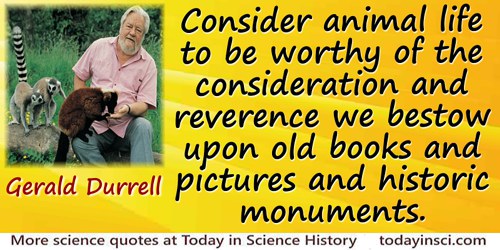
Until we consider animal life to be worthy of the consideration and reverence we bestow upon old books and pictures and historic monuments, there will always be the animal refugee living a precarious life on the edge of extermination, dependent for existence on the charity of a few human beings.
In Encounters With Animals (1970), 105.
We set sail on this new sea because there is new knowledge to be gained, and new rights to be won, and they must be won and used for the progress of all people. For space science, like nuclear science and technology, has no conscience of its own. Whether it will become a force for good or ill depends on man, and only if the United States occupies a position of preeminence can we help decide whether this new ocean will be a sea of peace or a new terrifying theater of war.
Address at Rice University in Houston (12 Sep 1962). On website of John F. Kennedy Presidential Library and Museum. [This go-to-the-moon speech was largely written by presidential advisor and speechwriter Ted Sorensen.]
We used to be a source of fuel; we are increasingly becoming a sink. These supplies of foreign liquid fuel are no doubt vital to our industry, but our ever-increasing dependence upon them ought to arouse serious and timely reflection. The scientific utilisation, by liquefaction, pulverisation and other processes, or our vast and magnificent deposits of coal, constitutes a national object of prime importance.
Parliamentary Debate (24 Apr 1928). Quoted in Winston Churchill and Richard Langworth (ed.), Churchill by Himself: The Definitive Collection of Quotations (2008), 469.
 In science it often happens that scientists say, 'You know that's a really good argument; my position is mistaken,' and then they would actually change their minds and you never hear that old view from them again. They really do it. It doesn't happen as often as it should, because scientists are human and change is sometimes painful. But it happens every day. I cannot recall the last time something like that happened in politics or religion.
(1987) --
In science it often happens that scientists say, 'You know that's a really good argument; my position is mistaken,' and then they would actually change their minds and you never hear that old view from them again. They really do it. It doesn't happen as often as it should, because scientists are human and change is sometimes painful. But it happens every day. I cannot recall the last time something like that happened in politics or religion.
(1987) -- 





.jpg)
