Dead Quotes (65 quotes)
[Archimedes] is said to have requested his friends and relations that when he was dead, they would place over his tomb a sphere containing a cylinder, inscribing it with the ratio which the containing solid bears to the contained.
— Plutarch
In John Dryden (trans.), Life of Marcellus.
A dead cow or sheep lying in a pasture is recognized as carrion. The same sort of a carcass dressed and hung up in a butcher's stall passes as food.
This quote is consistent in sentiment with others documented as by Kellogg, but Webmaster has so far not found the original source for this one. If you know the primary source of this quote, please contact Webmaster.
A hundred times every day I remind myself that my inner and outer life depends on the labors of other men, living and dead, and that I must exert myself in order to give in the measure as I have received and am still receiving.
…...
A philosopher is a fool who torments himself while he is alive, to be talked of after he is dead.
As translated, without citation, in Familiar Short Sayings of Great Men: With Historical and Explanatory Notes (1887), 6.
A short, broad man of tremendous vitality, the physical type of Hereward, the last of the English, and his brother-in-arms, Winter, Sylvester’s capacious head was ever lost in the highest cloud-lands of pure mathematics. Often in the dead of night he would get his favorite pupil, that he might communicate the very last product of his creative thought. Everything he saw suggested to him something new in the higher algebra. This transmutation of everything into new mathematics was a revelation to those who knew him intimately. They began to do it themselves. His ease and fertility of invention proved a constant encouragement, while his contempt for provincial stupidities, such as the American hieroglyphics for π and e, which have even found their way into Webster’s Dictionary, made each young worker apply to himself the strictest tests.
In Florian Cajori, Teaching and History of Mathematics in the United States (1890), 265.
Abstract as it is, science is but an outgrowth of life. That is what the teacher must continually keep in mind. … Let him explain … science is not a dead system—the excretion of a monstrous pedantism—but really one of the most vigorous and exuberant phases of human life.
In 'The Teaching of the History of Science', The Scientific Monthly (Sep 1918), 195-196.
All programs on jungles had previously been filmed from the bottom up, with dead leaves and a dead animal or two. Suddenly, I realized that it’s at the top that everything is blossoming and populating and having a ball. So, I wrote it from the top. The director happened to be a young, ludicrously athletic fellow who decided to film me up a 200-foot kapok tree on a rope. Sheer vanity from elder to younger led me to say yes. At 5 feet off the ground it’s interesting. At 10 feet you say, “Hmmm a bit high.” At 50 feet it’s exhausting and at 90 feet terrifying because you realize that no one can get to you if you decide you don’t like it. To get down you have to retie all the ropes. You don’t just come down. I was so petrified I had forgotten I’d left my radio on, so everyone down below was falling about with laughter listening to me praying and swearing to myself in terror. By the time I came down I had recovered my cool and was going around saying it had all been fine without realizing they’d all heard me.
In Justine de Lacy, 'Around the World With Attenborough', New York Times (27 Jan 1985), Sec. 2, 25.
All science, even the divine science, is a sublime detective story. Only it is not set to detect why a man is dead; but the darker secret of why he is alive.
From 'What Do They Think', The Thing: Why I Am Catholic (1929), 78. In Collected Works (1990), Vol. 3, 191.
Books are not absolutely dead things, but do contain a potency of life in them to be as active as that soul was whose progeny they are.
In Areopagitica: A speech of Mr John Milton for the Liberty of Unlicenced printing to the Parliament of England (23 Nov 1644), 4.
But psychoanalysis has taught that the dead—a dead parent, for example—can be more alive for us, more powerful, more scary, than the living. It is the question of ghosts.
Quoted in 'Jacques Derrida,' by Mitchell Stephens, New York Times Magazine (January 23, 1994).
Conservation is now a dead word. … You can’t conserve what you haven’t got. That’s why we are for restoration.
Speaking to Sarasota Wellesley Club about the goal for the Friends of the Everglades (1982). As quoted in Jack E. Davis, An Everglades Providence: Marjory Stoneman Douglas (2009), 512. She promoted restoring the massive disruptions to the ecosystems following the Corps of Engineers colossal, ill-conceived Everglades drainage project begun in 1948.
Cuvier … brings the void to life again, without uttering abracadabras, he excavates a fragment of gypsum, spies a footprint and shouts: “Look!” And suddenly the marbles are teeming with creatures, the dead come to life again, the world turns!
From 'La Peau de Chagrin' (1831). As translated as by Helen Constantine The Wild Ass’s Skin (2012), 19.
Dead archaeology is the driest dust that blows.
In Archaeology from the Earth (1954), Preface, v.
Dead is when the chemists take over the subject.
Lecture at Stanford, 'Is Spectroscopy Dead?', as quoted in Steven Chu and Charles H. Townes, 'Arthur Schawlow', Biographical Memoirs of the National Academy of Sciences (2003), Vol. 83, 202.
Do you not know that a man is not dead while his name is still spoken?
In Going Postal (2004, 2009), 101.
Euclidean mathematics assumes the completeness and invariability of mathematical forms; these forms it describes with appropriate accuracy and enumerates their inherent and related properties with perfect clearness, order, and completeness, that is, Euclidean mathematics operates on forms after the manner that anatomy operates on the dead body and its members. On the other hand, the mathematics of variable magnitudes—function theory or analysis—considers mathematical forms in their genesis. By writing the equation of the parabola, we express its law of generation, the law according to which the variable point moves. The path, produced before the eyes of the student by a point moving in accordance to this law, is the parabola.
If, then, Euclidean mathematics treats space and number forms after the manner in which anatomy treats the dead body, modern mathematics deals, as it were, with the living body, with growing and changing forms, and thus furnishes an insight, not only into nature as she is and appears, but also into nature as she generates and creates,—reveals her transition steps and in so doing creates a mind for and understanding of the laws of becoming. Thus modern mathematics bears the same relation to Euclidean mathematics that physiology or biology … bears to anatomy.
If, then, Euclidean mathematics treats space and number forms after the manner in which anatomy treats the dead body, modern mathematics deals, as it were, with the living body, with growing and changing forms, and thus furnishes an insight, not only into nature as she is and appears, but also into nature as she generates and creates,—reveals her transition steps and in so doing creates a mind for and understanding of the laws of becoming. Thus modern mathematics bears the same relation to Euclidean mathematics that physiology or biology … bears to anatomy.
In Die Mathematik die Fackelträgerin einer neuen Zeit (1889), 38. As translated in Robert Édouard Moritz, Memorabilia Mathematica; Or, The Philomath’s Quotation-book (1914), 112-113.
Everything is always in trouble at the frontier. Any science that is not in this kind of trouble is dead.
As quoted in John Noble Wilford, 'Sizing up the Cosmos: An Astronomers Quest', New York Times (12 Mar 1991), C10.
For FRICTION is inevitable because the Universe is FULL of God's works.
For the PERPETUAL MOTION is in all works of Almighty GOD.
For it is not so in the engines of man, which are made of dead materials, neither indeed can be.
For the Moment of bodies, as it is used, is a false term—bless God ye Speakers on the Fifth of November.
For Time and Weight are by their several estimates.
For I bless GOD in the discovery of the LONGITUDE direct by the means of GLADWICK.
For the motion of the PENDULUM is the longest in that it parries resistance.
For the WEDDING GARMENTS of all men are prepared in the SUN against the day of acceptation.
For the wedding Garments of all women are prepared in the MOON against the day of their purification.
For CHASTITY is the key of knowledge as in Esdras, Sir Isaac Newton & now, God be praised, in me.
For Newton nevertheless is more of error than of the truth, but I am of the WORD of GOD.
For the PERPETUAL MOTION is in all works of Almighty GOD.
For it is not so in the engines of man, which are made of dead materials, neither indeed can be.
For the Moment of bodies, as it is used, is a false term—bless God ye Speakers on the Fifth of November.
For Time and Weight are by their several estimates.
For I bless GOD in the discovery of the LONGITUDE direct by the means of GLADWICK.
For the motion of the PENDULUM is the longest in that it parries resistance.
For the WEDDING GARMENTS of all men are prepared in the SUN against the day of acceptation.
For the wedding Garments of all women are prepared in the MOON against the day of their purification.
For CHASTITY is the key of knowledge as in Esdras, Sir Isaac Newton & now, God be praised, in me.
For Newton nevertheless is more of error than of the truth, but I am of the WORD of GOD.
From 'Jubilate Agno' (c.1758-1763), in N. Callan (ed.), The Collected Poems of Christopher Smart (1949), Vol. 1, 276.
For geologists ... the word 'plate' is in somewhat the same position as 'skyscraper'. It is a dead (or almost dead) metaphor. Geologists know (or they think they know) what plates are, almost as well as the commuter knows what a skyscraper is.
Thinking About the Earth (1996), 307.
Four circles to the kissing come,
The smaller are the benter.
The bend is just the inverse of
The distance from the centre.
Though their intrigue left Euclid dumb
There’s now no need for rule of thumb.
Since zero bend’s a dead straight line
And concave bends have minus sign,
The sum of squares of all four bends
Is half the square of their sum.
The smaller are the benter.
The bend is just the inverse of
The distance from the centre.
Though their intrigue left Euclid dumb
There’s now no need for rule of thumb.
Since zero bend’s a dead straight line
And concave bends have minus sign,
The sum of squares of all four bends
Is half the square of their sum.
In poem, 'The Kiss Precise', Nature (20 Jun 1936), 137, 1021, as quoted, cited, explained and illustrated in Martin Gardner, The Colossal Book of Mathematics: Classic Puzzles, Paradoxes, and Problems (2001), 139-141.
Gentlemen, everyone in this room knows the difference between a live horse and a dead horse. Pray, therefore, let us cease flogging the latter.
(in conversation)
God is dead not because He doesn’t exist, but because we live, play, procreate, govern, and die as though He doesn’t.
Quoted in Kim Lim (ed.), 1,001 Pearls of Spiritual Wisdom: Words to Enrich, Inspire, and Guide Your Life (2014), 30
God is dead, ... And we have killed him.
…...
God is love… . We wouldn’t recognize that love. It might even look like hate. It would be enough to scare us—God’s love. It set fire to a bush in the desert, didn’t it, and smashed open graves and set the dead walking in the dark.
Quoted in Kim Lim (ed.), 1,001 Pearls of Spiritual Wisdom: Words to Enrich, Inspire, and Guide Your Life (2014), 143
He who neglects learning in his youth loses the past and is dead for the future
…...
How strange is the lot of us mortals! Each of us is here for a brief sojourn; for what purpose he knows not, though he sometimes thinks he senses it. But without deeper reflection one knows from daily life that one exists for other people–first of all for those upon whose smiles and well-being our own happiness is wholly dependent, and then for the many, unknown to us, to whose destinies we are bound by the ties of sympathy. A hundred times every day I remind myself that my inner and outer life are based on the labors of other men, living and dead, and that I must exert myself in order to give in the same measure as I have received and am still receiving.
…...
Human personality resembles a coral reef: a large hard/dead structure built and inhabited by tiny soft/live animals. The hard/dead part of our personality consists of habits, memories, and compulsions and will probably be explained someday by some sort of extended computer metaphor. The soft/live part of personality consists of moment-to-moment direct experience of being. This aspect of personality is familiar but somewhat ineffable and has eluded all attempts at physical explanation.
Quoted in article 'Nick Herbert', in Gale Cengage Learning, Contemporary Authors Online (2002).
I trade both with the living and the dead for the enrichment of our native language.
If one has left this entire system to itself for an hour, one would say that the cat still lives if meanwhile no atom has decayed. The psi-function of the entire system would express this by having in it the living and dead cat (pardon the expression) mixed or smeared out in equal parts.
…...
It is possible to state as a general principle that the mesodermic phagocytes, which originally (as in the sponges of our days) acted as digestive cells, retained their role to absorb the dead or weakened parts of the organism as much as different foreign intruders.
'Uber die Pathologische Bedeutung der Intracellularen Verduung', Fortschritte der Medizin (1884), 17, 558-569. Trans. Alfred I. Tauber and Leon Chernyak, Metchnikoff and the Origins of Immunology (1991), 141.
It seems better that a scientist should compile his own bibliography than that he should leave the work for another to do after he is dead.
It would indeed be a great delusion, if we stated that those sports of Nature [we find] enclosed in rocks are there by chance or by some vague creative power. Ah, that would be superficial indeed! In reality, those shells, which once were alive in water and are now dead and decomposed, were made thus by time not Nature; and what we now find as very hard, figured stone, was once soft mud and which received the impression of the shape of a shell, as I have frequently demonstrated.
La vana speculazione disingannata del senso (1670), trans. Ezio Vaccari, 83-4.
Many luckless people imagine that romance is dead: some, overcivilised, fondly suppose that there never was romance: a poet tells us that romance is unrecognised though really present: but scientists can meet him daily, walking at large and undisguised in the world.
In speech at Nobel Banquet, Stockholm (10 Dec 1923). Collected in Carl Gustaf Santesson (ed.), Les Prix Nobel en 1921-1922 (1923).
Medical statistics will be our standard of measurement: we will weigh life for life and see where the dead lie thicker, among the workers or among the privileged.
Inaugurating his journal, Die Medizinische Reform (1848), 182, in which he asked scholars to collect medical statistics. (The Medical Reform.) As quoted in Paul Farmer, Infections and Inequalities: The Modern Plagues (2001), 1. Cited in David L. Brunsma, Keri E. Iyall Smith and Brian K. Gran (eds.), Institutions Unbound: Social Worlds and Human Rights (2016), 10 & 207 footnote.
Mr. Darwin in the Zoological Gardens. Frank Darwin told me his father was once standing near the hippopotamus cage when a little boy and girl, aged four and five, came up. The hippopotamus shut his eyes for a minute. “That bird’s dead,” said the little girl; “come along.”
Samuel Butler, Henry Festing Jones (ed.), The Note-Books of Samuel Butler (1917), 243. Francis Darwin was a son of Charles Darwin.
My Rainforests Project … has three main elements. Firstly, to determine how much funding the rainforest countries need to re-orientate their economies so that the trees are worth more alive than dead.
Presidential Lecture (3 Nov 2008) at the Presidential Palace, Jakarta, Indonesia. On the Prince of Wales website.
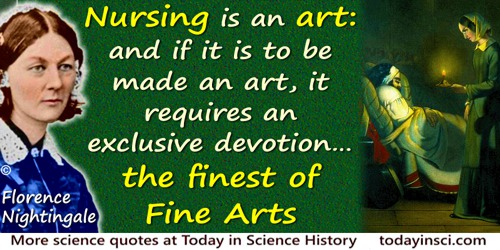
Nursing is an art: and if it is to be made an art, it requires an exclusive devotion as hard a preparation as any painter’s or sculptor’s work; for what is the having to do with dead canvas or dead marble, compared with having to do with the living body, the temple of God’s spirit? It is one of the Fine Arts: I had almost said, the finest of Fine Arts.
First published as a eulogy to an unnamed nurse in 'Una and the Lion', Good Words (1 Jun 1868), 360-366. Reprinted in Una and the Lion (1871), 6.
On the afternoon of October 19, 1899, I climbed a tall cherry tree and, armed with a saw which I still have, and a hatchet, started to trim the dead limbs from the cherry tree. It was one of the quiet, colorful afternoons of sheer beauty which we have in October in New England, and as I looked towards the fields at the east, I imagined how wonderful it would be to make some device which had even the possibility of ascending to Mars. I was a different boy when I descended the tree from when I ascended for existence at last seemed very purposive.
In The Papers of Robert H. Goddard: 1898-1924 (1970), 9.
Once the hatch was opened, I turned the lock handle and bright rays of sunlight burst through it. I opened the hatch and dust from the station flew in like little sparklets, looking like tiny snowflakes on a frosty day. Space, like a giant vacuum cleaner, began to suck everything out. Flying out together with the dust were some little washers and nuts that dad got stuck somewhere; a pencil flew by.
My first impression when I opened the hatch was of a huge Earth and of the sense of unreality concerning everything that was going on. Space is very beautiful. There was the dark velvet of the sky, the blue halo of the Earth and fast-moving lakes, rivers, fields and clouds clusters. It was dead silence all around, nothing whatever to indicate the velocity of the flight… no wind whistling in your ears, no pressure on you. The panorama was very serene and majestic.
My first impression when I opened the hatch was of a huge Earth and of the sense of unreality concerning everything that was going on. Space is very beautiful. There was the dark velvet of the sky, the blue halo of the Earth and fast-moving lakes, rivers, fields and clouds clusters. It was dead silence all around, nothing whatever to indicate the velocity of the flight… no wind whistling in your ears, no pressure on you. The panorama was very serene and majestic.
…...
Only dead mathematics can be taught where the attitude of competition prevails: living mathematics must always be a communal possession.
In Mary Everest Boole: Collected Works (1931), Vol. 3, 1008.
Our dead are never dead to us until we have forgotten them.
In Adam Bede (1859, 1860), 89.
People still do not understand that a live fish is more valuable than a dead one, and that destructive fishing techniques are taking a wrecking ball to biodiversity.
In 'Can We Stop Killing Our Oceans Now, Please?', Huffington Post (14 Aug 2013).
Recollections [his autobiographical work] might possibly interest my children or their children. I know that it would have interested me greatly to have read even so short and dull a sketch of the mind of my grandfather, written by himself, and what he thought and did, and how he worked. I have attempted to write the following account of myself as if I were a dead man in another world looking back at my own life. Nor have I found this difficult, for life is nearly over with me.
Religions die when they are proved to be true. Science is the record of dead religions.
In 'Phrases and Philosophies', The Writings of Oscar Wilde:Epigrams: Phrases and Philosophies for the Use of the Young (1907), 141.
Sarcophagus is a stone that devours dead bodies, for in Greek σάρκος means “flesh” and φαγώ “eating”. Some of the ancients first made coffins for the dead of this stone because in the space of thirty days it consumed the dead… . For this reason stone monuments are called sarcophagi.
From De Mineralibus (c.1261-1263), as translated by Dorothy Wyckoff, Book of Minerals (1967), 116.
Scientific observers at Sheldon described … [how even] more pitiful was the mute testimony of the dead ground squirrels, which “exhibited a characteristic attitude in death. The back was bowed, and the forelegs with the toes of the feet tightly clenched were drawn close to the thorax … The head and neck were outstretched and the mouth often contained dirt, suggesting that the dying animal had been biting at the ground.”
In 'Needless Havoc', Silent Spring (1962), 99. [Note: Summarizing Carson (pp 92-93), for several years from 1954, Sheldon, in eastern Illinois, was subjected to extensive spraying of dieldrin (50 times more poisonous than DDT) by the Agriculture Departments of the U.S. and Illinois, to attempt to eradicate the Japanese beetle along the line of its invasive advance into Illinois. The dieldrin used was roughly equivalent to 150 pounds of DDT per acre. —Webmaster]
The desire for guidance, love, and support prompts men to form the social or moral conception of God. This is the God of Providence, who protects, disposes, rewards, and punishes; the God who, according to the limits of the believer’s outlook, loves and cherishes the life of the tribe or of the human race, or even or life itself; the comforter in sorrow and unsatisfied longing; he who preserves the souls of the dead. This is the social or moral conception of God.
…...
The fact is that no species has ever had such wholesale control over anything on earth, living or dead, as we now have. That lays upon us, whether we like it or not, an awesome responsibility. In our hands now lies not only our own future but that of all other living creatures with whom we share the earth.
As quoted, without source, in Kate Ng, 'David Attenborough turns 95: His best quotes on nature, sustainability and humankind', Independent (8 May 2021).
The ground of science was littered with the corpses of dead unified theories.
From Disturbing the Universe (1979), 62.
The living and dead look well together in woods. Trees receive a most beautiful burial.
Nature takes fallen trees gently to her bosom—at rest from storms. They seem to have been called home out of the sky to sleep now.
In Linnie Marsh Wolfe (ed.), John of the Mountains: The Unpublished Journals of John Muir (1938 1979), 313. Entered in journal while on sled trip exploring Muir Glacier, its boundaries and tributaries; Hemlock Mountain (11-21 Jul 1890).
The living will envy the dead.
[Speaking of nuclear war.]
[Speaking of nuclear war.]
Attributed. No verification of any form of this quote has been found in the speeches or writings of Khrushchev. An Associated Press article (4 Aug 1979) about hearings on the Salt II referred to senators quoting Khrshchev in these words. This form of the quote has since been widely circulated, for example, in the Washington Post (20 Mar 1981), A23. Senator Frank Church, chairman of the Senate Committee on Foreign Relations, in a hearing (11 July 1979) attributed Khrushchev as saying “the survivors would envy the dead”. The senator repeated this remark at another hearing five days later. (Recorded in The Salt II Treaty, hearings before the Committee on Foreign Relations, U.S. Senate, 96th Congress (1979), 1st session, Pt. 1, 333, and Pt. 2, 27). The quote about &;dquo;survicors” was also given in Ed Zuckerman, 'Hiding from the Bomb—Again', Harper’s Magazine (Aug 1979), 36. A copy of that issue, in circulation before its cover date, was in the Library of Congress, stamped 12 Jul 1979. In Respectfully Quoted: A Dictionary of Quotations (1989), 239.
The Moon is a white strange world, great, white, soft-seeming globe in the night sky, and what she actually communicates to me across space I shall never fully know. But the Moon that pulls the tides, and the Moon that controls the menstrual periods of women, and the Moon that touches the lunatics, she is not the mere dead lump of the astronomist.... When we describe the Moon as dead, we are describing the deadness in ourselves. When we find space so hideously void, we are describing our own unbearable emptiness.
…...
The most beautiful and deepest experience a man can have is the sense of the mysterious. It is the underlying principle of religion as well as all serious endeavour in art and science. He who never had this experience seems to me, if not dead, then at least blind. To sense that behind anything that can be experienced there is a something that our mind cannot grasp and whose beauty and sublimity reaches us only indirectly and as a feeble reflection, this is religiousness.
…...
The science of alchemy I like very well. I like it not only for the profits it brings in melting metals, in decocting, preparing, extracting, and distilling herbs, roots; I like it also for the sake of the allegory and secret signification, which is exceedingly fine, touching the resurrection of the dead at the last day.
In The Table Talk (1569).
The simple fact is that the world is not paying for the services the forests provide. At the moment, they are worth more dead than alive–for soya, for beef, for palm oil and for logging, feeding the demand from other countries. … I think we need to be clear that the drivers of rainforest destruction do not originate in the rainforest nations, but in the more developed countries which, unwittingly or not, have caused climate change.
Presidential Lecture (3 Nov 2008) at the Presidential Palace, Jakarta, Indonesia. On the Prince of Wales website.
There can be no doubt that science is in many ways the natural enemy of language. Language, either literary or colloquial, demands a rich store of living and vivid words—words that are “thoughtpictures,” and appeal to the senses, and also embody our feelings about the objects they describe. But science cares nothing about emotion or vivid presentation; her ideal is a kind of algebraic notation, to be used simply as an instrument of analysis; and for this she rightly prefers dry and abstract terms, taken from some dead language, and deprived of all life and personality.
In The English Language (1912), 124-125.
There is no waste in functioning natural ecosystems. All organisms, dead or alive, are potential sources of food for other organisms. A caterpillar eats a leaf; a robin eats the caterpillar; a hawk eats the robin. When the plant, caterpillar, robin, and hawk die, they are in turn consumed by decomposers.
From Resource Conservation and Management (1990), 101.
To argue with a man who has renounced the use and authority of reason ... is like administering medicines to the dead.
In 'The American Crisis', No. V., to Gen. Sir William Howe (1 Mar 1778), collected in The Political and Miscellaneous Works of Thomas Paine (1819), 58.
To expect a personality to survive the disintegration of the brain is like expecting a cricket club to survive when all of its members are dead.
…...
To render aid to the worthless is sheer waste. Rain does not freshen the Dead Sea, but only enables it to dissolve more salt.
From chapter 'Jottings from a Note-Book', in Canadian Stories (1918), 172.
We do not ask what hope of gain makes a little bird warble, since we know that it takes delight in singing because it is for that very singing that the bird was made, so there is no need to ask why the human mind undertakes such toil in seeking out these secrets of the heavens. ... And just as other animals, and the human body, are sustained by food and drink, so the very spirit of Man, which is something distinct from Man, is nourished, is increased, and in a sense grows up on this diet of knowledge, and is more like the dead than the living if it is touched by no desire for these things.
Mysterium Cosmographicum. Translated by A. M. Duncan in The Secret of the Universe (1981), 55.
We inhabit a dead ember swimming wide in the blank of space, dizzily spinning as it swims, and lighted up from several million miles away by a more horrible hell-fire than was ever conceived by the theological imagination. Yet the dead ember is a green, commodious dwelling-place; and the reverberation of this hell-fire ripens flower and fruit and mildly warms us on summer eves upon the lawn.
In Lay Morals, collected in Works: Letters and Miscellanies of Robert Louis Stevenson: Sketches, Criticism, Etc. (1898) Vol. 22, 552.
Well the first War of the Machines seems to be drawing to its final inconclusive chapter—leaving, alas, everyone the poorer, many bereaved or maimed and millions dead, and only one thing triumphant: the Machines. As the servants of the Machines are becoming a privileged class, the Machines are going to be enormously more powerful. What’s their next move?
Concluding remarks from Letter to his son Christopher (30 Jan 1945). In Humphrey Carpenter (ed.) assisted by Christopher Tolkien, The Letters of J.R.R. Tolkien (1995, 2014), 112, Letter No. 96.
Without publication, science is dead.
In editorial, 'The Social Process of Science', Science (1988), 231, No. 4735, 121. The editorial was excerpted from a Lecture at Moscow State University, Moscow, U.S.S.R. (25 Nov 1985) for conferral of the degree Doctor Honoris Causa.
You need a plan for everything, whether it’s building a cathedral or a chicken coop. Without a plan you’ll postpone living until you’re dead.
In 'John Goddard: 108 Adventures Down, 19 To Go', Life magazine (1986), 9, 22.
 In science it often happens that scientists say, 'You know that's a really good argument; my position is mistaken,' and then they would actually change their minds and you never hear that old view from them again. They really do it. It doesn't happen as often as it should, because scientists are human and change is sometimes painful. But it happens every day. I cannot recall the last time something like that happened in politics or religion.
(1987) --
In science it often happens that scientists say, 'You know that's a really good argument; my position is mistaken,' and then they would actually change their minds and you never hear that old view from them again. They really do it. It doesn't happen as often as it should, because scientists are human and change is sometimes painful. But it happens every day. I cannot recall the last time something like that happened in politics or religion.
(1987) -- 





