Damage Quotes (38 quotes)
[Science] dissipates errors born of ignorance about our true relations with nature, errors the more damaging in that the social order should rest only on those relations. TRUTH! JUSTICE! Those are the immutable laws. Let us banish the dangerous maxim that it is sometimes useful to depart from them and to deceive or enslave mankind to assure its happiness.
Exposition du Système du Monde (1796), 2, 312, trans. Charles Coulston Gillispie, Pierre-Simon Laplace 1749-1827: A Life in Exact Science (1997), 175.
[Shawn Lawrence Otto describes the damaging] strategy used to undermine science in the interest of those industries where science has pointed out the dangers of their products to individuals and human life in general … [It was] used a generation ago by the tobacco industry… First they manufacture uncertainty by raising doubts about even the most indisputable scientific evidence. Then they launder information by using seemingly independent front organizations to promote their desired message and thereby confuse the public. And finally they recruit unscrupulous scientific spokespeople to misrepresent peer-reviewed scientific findings and cherry-pick facts in an attempt to persuade the media and the public that there is still serious debate among scientists on the issue at hand.
In 'Science Is Politics', Huffington Post (28 May 2014).
[About the demand of the Board of Regents of the University of California that professors sign non-Communist loyalty oaths or lose their jobs within 65 days.] No conceivable damage to the university at the hands of hypothetical Communists among us could possibly have equaled the damage resulting from the unrest, ill-will and suspicion engendered by this series of events.
As quoted in 'Professors in West Call Oath “Indignity”', New York Times (26 Feb 1950), 38.
A vast technology has been developed to prevent, reduce, or terminate exhausting labor and physical damage. It is now dedicated to the production of the most trivial conveniences and comfort.
Reflections on Behaviorism and Society (1978), 6.
Accountants and second-rate business school jargon are in the ascendant. Costs, which rise rapidly, and are easily ascertained and comprehensible, now weigh more heavily in the scales than the unquantifiable and unpredictable values and future material progress. Perhaps science will only regain its lost primacy as peoples and government begin to recognize that sound scientific work is the only secure basis for the construction of policies to ensure the survival of Mankind without irreversible damage to Planet Earth.
In New Scientist, March 3, 1990.
Bad science contributes to the steady dumbing down of our nation. Crude beliefs get transmitted to political leaders and the result is considerable damage to society. We see this happening now in the rapid rise of the religious right and how it has taken over large segments of the Republican Party.
As quoted in Kendrick Frazier, 'A Mind at Play: An Interview with Martin Gardner', Skeptical Inquirer (Mar/Apr 1998), 22, No. 2, 37.
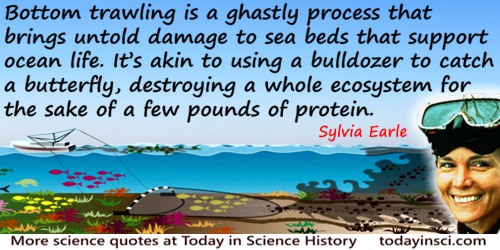
Bottom trawling is a ghastly process that brings untold damage to sea beds that support ocean life. It’s akin to using a bulldozer to catch a butterfly, destroying a whole ecosystem for the sake of a few pounds of protein. We wouldn’t do this on land, so why do it in the oceans?
In 'Can We Stop Killing Our Oceans Now, Please?', Huffington Post (14 Aug 2013).
Domesticated salmon, after several generations, are fat, listless things that are good at putting on weight, not swimming up fast-moving rivers. When they get into a river and breed with wild fish, they can damage the wild fish's prospects of surviving to reproduce.
In The End of the Line: How Overfishing is Changing the World and what We Eat (2004), 312.
However dangerous might be the shock of a comet, it might be so slight, that it would only do damage at the part of the Earth where it actually struck; perhaps even we might cry quits if while one kingdom were devastated, the rest of the Earth were to enjoy the rarities which a body which came from so far might bring it. Perhaps we should be very surprised to find that the debris of these masses that we despised were formed of gold and diamonds; but who would be the most astonished, we, or the comet-dwellers, who would be cast on our Earth? What strange being each would find the other!
From 'Lettre sur la comète', Œuvres de M. Maupertuis (1752), 203. As quoted in Carl Sagan, Broca's Brain: Reflections on the Romance of Science (1979), 95-96.
I can certainly wish for new, large, and properly constructed instruments, and enough of them, but to state where and by what means they are to be procured, this I cannot do. Tycho Brahe has given Mastlin an instrument of metal as a present, which would be very useful if Mastlin could afford the cost of transporting it from the Baltic, and if he could hope that it would travel such a long way undamaged… . One can really ask for nothing better for the observation of the sun than an opening in a tower and a protected place underneath.
As quoted in James Bruce Ross and Mary Martin McLaughlin, The Portable Renaissance Reader (1968), 605.
I do not think there should be a limit on the rig's liability, because they are sitting on top of unlimited amounts of oil, and thus, there could be an explosion occur that could do untold damage. ... The amount of damage that an offshore oil rig can do is infinite.
Senate Floor Debate, 135 Cong. Rec. S9689-S9716 (3 Aug 1989). Reproduced in Russell V. Randle, Oil Pollution Deskbook (1991), 432.
I have no patience with attempts to identify science with measurement, which is but one of its tools, or with any definition of the scientist which would exclude a Darwin, a Pasteur or a Kekulé. The scientist is a practical man and his are practical aims. He does not seek the ultimate but the proximate. He does not speak of the last analysis but rather of the next approximation. His are not those beautiful structures so delicately designed that a single flaw may cause the collapse of the whole. The scientist builds slowly and with a gross but solid kind of masonry. If dissatisfied with any of his work, even if it be near the very foundations, he can replace that part without damage to the remainder. On the whole, he is satisfied with his work, for while science may never be wholly right it certainly is never wholly wrong; and it seems to be improving from decade to decade.
The Anatomy of Science (1926), 6-7.
If coal plants release mercury—and mercury is a neurotoxin that damages children's brains—then reducing the amount of mercury in emissions doesn’t stop that. It just says, “We’ll tell you at what rate you can dispense death.”
In interview article, 'Designing For The Future', Newsweek (15 May 2005).
If we continue on our current course, the damage that has been the defining feature of my lifetime will be eclipsed by the damage coming in the next. … Science predicts that were I born today, I would be witness to the 2030s—The Amazon Rainforest, cut down until it can no longer produce enough moisture, degrades into a dry savannah, bringing catastrophic species loss—and altering the global water cycle.
From narration to Netflix TV program, A Life on Our Planet: My Witness Statement and a Vision for the Future (4 Oct 2020).
Imagine life as a game in which you are juggling five balls in the air. You name them - work, family, health, friends, and spirit - and you’re keeping all of these in the air. You will soon understand that work is a rubber ball. If you drop it, it will bounce back. But the other four balls - family, health, friends, and spirit are made of glass. If you drop one of these, they will be irrevocably scuffed, marked, nicked, damaged, or even shattered. They will never be the same. You must understand that and strive for balance in your life.
…...
In former times, … when ships buffeted by storms threw a portion of their cargo overboard, it was recognized that those whose goods were sacrificed had a claim in equity to indemnification at the expense of those whose goods were safely delivered. The value of the lost goods was paid for by agreement between all those whose merchandise had been in the same ship. This sea damage to cargo in transit was known as “havaria” and the word came naturally to be applied to the compensation money which each individual was called upon to pay. From this Latin word derives our modern word average.
In 'On the Average', Facts From Figures (1951), Chap. 4, 34.
In the medical field [scientific ignorance] could lead to horrendous results. People who don’t understand the difference between a controlled experiment and claims by some quack may die as a result of not taking medical science seriously. One of the most damaging examples of pseudoscience is false memory syndrome. I’m on the board of a foundation exposing this problem.
As quoted by Lawrence Toppman, 'Mastermind', The Charlotte Observer (20 Jun 1993), 6E. As quoted and cited in Dana Richards, 'Martin Gardner: A “Documentary”', collected in Elwyn R. Berlekamp and Tom Rodgers (ed.) The Mathemagician and Pied Puzzler: A Collection in Tribute to Martin Gardner (1999), 11.
In the tissues generally, and in such a cavity as the abdomen, the pressure is everywhere and practically always very nearly atmospheric, and must be so, because the integuments give way very easily to any excess of pressure, whether positive or negative.
In The Anatomy and Physiology of Capillaries (1922), 244.
It is a fair question whether the results of these things have induced among us in a large class of well-to-do people, with little muscular activity, a habit of excessive eating [particularly fats and sweets] and may be responsible for great damage to health, to say nothing of the purse.
L.A. Maynard citing Wilbur O. Atwater in a biographical sketch, Journal of Nutrition (1962) 78, 3. Quoted in Ira Wolinsky, Nutrition in Exercise and Sport (1998), 36.
Man is wreaking a damage far greater than Vesuvius. The moment of Pompeii’s destruction was also the moment of its preservation. The public needs to understand that unless constant efforts are taken to arrest the decay, the site will, within decades crumble to nothing.
Expressing concern about the deterioration of Pompeii, in T. Hurley, P. Medcalf, et al., Antiquity 3 (2005), 65.
Perfect clarity would profit the intellect but damage the will.
In Pensées (1670), Section 12, No. 3. As translated in W.H. Auden and L. Kronenberger (eds.) The Viking Book of Aphorisms (1966), 347. From the original French, “La clarté parfaite ne servirait qu’à l’esprit, et nuirait à la volonté,” in Pensées de Blaise Pascal (1847),
Pervasive depletion and overuse of water supplies, the high capital cost of new large water projects, rising pumping costs and worsening ecological damage call for a shift in the way water is valued, used and managed.
From a study Postel wrote for Worldwatch Institute, quoted in New York Times (22 Sep 1985), 19.
Prolonged commitment to mathematical exercises in economics can be damaging. It leads to the atrophy of judgement and intuition which are indispensable for real solutions and, on occasion, leads also to a habit of mind which simply excludes the mathematically inconvenient factors from consideration.
In Economics, Peace, and Laughter (1981), 41, footnote.
She is a reflection of comfortable middle-class values that do not take seriously the continuing unemployment. What I particularly regret is that she does not take seriously the intellectual decline. Having given up the Empire and the mass production of industrial goods, Britain's future lay in its scientific and artistic pre-eminence. Mrs Thatcher will be long remembered for the damage she has done.
On Mrs Margaret H. Thatcher.
On Mrs Margaret H. Thatcher.
The Guardian, 15 Oct 1988.
Sometimes scientists change their minds. New developments cause a rethink. If this bothers you, consider how much damage is being done to the world by people for whom new developments do not cause a rethink.
In Terry Pratchett, Ian Stewart and Jack Cohen, revised introductory section, 'The Story Starts Here', The Science of Discworld (Rev. ed. 2002), 14, PPS. The section is initialed by all three coauthors. Which of them wrote which lines, is not designated.
Technocrats are turning us into daredevils. The haphazard gambles they are imposing on us too often jeopardize our safety for goals that do not advance the human cause but undermine it. By staking our lives on their schemes, decision makers are not meeting the mandate of a democratic society; they are betraying it. They are not ennobling us; they are victimizing us. And, in acquiescing to risks that have resulted in irreversible damage to the environment, we ourselves are not only forfeiting our own rights as citizens. We are, in turn, victimizing the ultimate nonvolunteers: the defenseless, voiceless—voteless—children of the future.
In Jacques Cousteau and Susan Schiefelbein, The Human, the Orchid, and the Octopus: Exploring and Conserving Our Natural World (2007), 85.
The big damages come if the climate sensitivity to greenhouse gases turns out to be high [causing greater global warming than current projections.] Then it’s not a bullet headed at us, but a thermonuclear warhead.
Quoted by Justin Gillis in 'Temperature Rising: Clouds’ Effect on Climate Change Is Last Bastion for Dissenters', New York Times (1 May 2012), A1.
The first business of a teacher … should be to excite … curiosity. … This process saves a student from being (as many are) intellectually damaged by having a very good memory.
From Annotation to Essay 50, 'Of Studies', in Bacon’s Essays: With Annotations (1856), 446.
The great question of the seventies is, shall we surrender to our surroundings, or shall we make our peace with nature and begin to make reparations for the damage we have done to our air, our land, our water? Restoring nature to its natural state is a cause beyond party and beyond factions. It has become a common cause of all the people of this country [America].
In State of the Union Address (22 Jan 1970).
The great rapidity with which we add carbon gases to the air is as damaging as is the quantity.
From Lecture at the Royal Society, 'Climate Change on a Living Earth' (29 Oct 2007). As quoted on jameslovelock.org website.
The most important and urgent problems of the technology of today are no longer the satisfactions of the primary needs or of archetypal wishes, but the reparation of the evils and damages by technology of yesterday.
Innovations: Scientific Technological and Social (1970), 9.
The oppressive weight of disaster and tragedy in our lives does not arise from a high percentage of evil among the summed total of all acts, but from the extraordinary power of exceedingly rare incidents of depravity to inflict catastrophic damage, especially in our technological age when airplanes can become powerful bombs. (An even more evil man, armed only with a longbow, could not have wreaked such havoc at the Battle of Agincourt in 1415.)
…...
There are, and always have been, destructive pseudo-scientific notions linked to race and religion; these are the most widespread and damaging. Hopefully, educated people can succeed in shedding light into these areas of prejudice and ignorance, for as Voltaire once said: “Men will commit atrocities as long as they believe absurdities.”
From an article in a periodical of Miami-Dade Junior College by Bernard Sussman, 'Exclusive Interview with Martin Gardner', Southwind (Fall 1968), 3, No. 1, 7-11. As quoted and cited in Dana Richards, 'Martin Gardner: A “Documentary”', collected in Elwyn R. Berlekamp and Tom Rodgers (ed.) The Mathemagician and Pied Puzzler: A Collection in Tribute to Martin Gardner (1999), 11.
There is a moral or metaphysical part of nature as well as a physical. A man who denies this is deep in the mire of folly. ’Tis the crown and glory of organic science that it does through final cause, link material and moral; and yet does not allow us to mingle them in our first conception of laws, and our classification of such laws, whether we consider one side of nature or the other. You have ignored this link; and, if I do not mistake your meaning, you have done your best in one or two pregnant cases to break it. Were it possible (which, thank God, it is not) to break it, humanity, in my mind, would suffer a damage that might brutalize it, and sink the human race into a lower grade of degradation than any into which it has fallen since its written records tell us of its history.
Letter to Charles Darwin (Nov 1859). In Charles Darwin and Francis Darwin (ed.), Charles Darwin: His Life Told in an Autobiographical Chapter, and in a Selected Series of His Published Letters (1892), 217.
There is, in fact, no reason whatever for believing that such a game as, say, football improves the health of those who play it. On the contrary, there is every reason for believing that it is deleterious. The football player is not only exposed constantly to a risk of grave injury, often of an irremediable kind; he is also damaged in his normal physiological processes by the excessive strains of the game, and the exposure that goes with playing it. … The truth is that athletes, as a class, are not above the normal in health, but below it. … Some are crippled on the field, but more succumb to the mere wear and tear.
From American Mercury (Jun 1931). Collected in A Mencken Chrestomathy (1949, 1956), 370-371.
There was some doubt whether the heat shield had been damaged … This could have been a bad day all the way around if this had been the case.
From post-flight news conference at Cape Canaveral (24 Feb 1962). 'Transcript of Glenn's News Conference Relating His Experiences on Orbital Flight', New York Times (24 Feb 1962), 14.
This alleged damage which the small radioactivity is causing—supposedly cancer and leukemia—has not been proved, to the best of my knowledge, by decent and clear statistics. It is possible that there is damage. It is even possible, to my mind, that there is no damage; and there is the possibility, further, that very small amounts of radioactivity are helpful.
From debate (20 Feb 1958) between Linus Pauling and Edward Teller on WQED-TV, San Francisco. Transcript published as Fallout and Disarmament: The Pauling-Teller Debate (1958). Reprinted in 'Fallout and Disarmament: A Debate between Linus Pauling and Edward Teller', Daedalus (Spring 1958), 87, No. 2, 155.
We woke periodically throughout the night to peel off leeches. In the light of the head torch, the ground was a sea of leeches - black, slithering, standing up on one end to sniff the air and heading inexorably our way to feed. Our exposed faces were the main problem, with leeches feeding off our cheeks and becoming entangled in our hair. I developed a fear of finding one feeding in my ear, and that it would become too large to slither out, causing permanent damage.
Kinabalu Escape: The Soldiers’ Story
 In science it often happens that scientists say, 'You know that's a really good argument; my position is mistaken,' and then they would actually change their minds and you never hear that old view from them again. They really do it. It doesn't happen as often as it should, because scientists are human and change is sometimes painful. But it happens every day. I cannot recall the last time something like that happened in politics or religion.
(1987) --
In science it often happens that scientists say, 'You know that's a really good argument; my position is mistaken,' and then they would actually change their minds and you never hear that old view from them again. They really do it. It doesn't happen as often as it should, because scientists are human and change is sometimes painful. But it happens every day. I cannot recall the last time something like that happened in politics or religion.
(1987) -- 




