DNA Quotes (81 quotes)
[About the structure of DNA] [T]he whole business was like a child's toy that you could buy at the dime store, all built in this wonderful way that you could explain in Life magazine so that really a five-year-old can understand what's going on...This was the greatest surprise for everyone.
Quoted in Horace Freeland Judson, Eighth Day of Creation (1979)
[Our work on the structure of DNA] was fairly fast, but you know, we were lucky. One must remember, it was based on the X-ray work done here in London started off by Morris Wilkins and carried on by Rosalind Franklin, and we wouldn’t have got to the stage of at least having a molecular model, if it hadn't been for their work.
Quoted and cited from BBC radio (1999) in transcript of Australian ABC radio program PM (30 Jul 2004) on the ABC website.
[Professor Pauling] confesses that he had harboured the feeling that sooner or later he would be the one to get the DNA structure; and although he was pleased with the double-helix, he ‘rather wished the idea had been his’.
‘The Need to Understand’, New Scientist (1971), 50, 755.
A DNA sequence for the genome of bacteriophage ΦX174 of approximately 5,375 nucleotides has been determined using the rapid and simple “plus and minus” method. The sequence identifies many of the features responsible for the production of the proteins of the nine known genes of the organism, including initiation and termination sites for the proteins and RNAs. Two pairs of genes are coded by the same region of DNA using different reading frames.
[Paper co-author]
[Paper co-author]
Frederick Sanger, et al., 'Nucleotide Sequence of Bacteriophage ΦX174 DNA', Nature (1977), 265, 687.
A moral principle in genetic testing is that it should always be done with the consent of the individual. No one wants someone snooping into his DNA.
Quoted in S.C. Gwynne, 'Genes and Money', Time magazine (12 Apr 1999).
All living things need their instruction manual (even nonliving things like viruses) and that is all they need, carried in one very small suitcase.
In The Center of Life: A Natural History of the Cell (1977, 1978), 8.
All of today’s DNA, strung through all the cells of the earth, is simply an extension and elaboration of [the] first molecule.
In The Medusa and the Snail: More Notes of a Biology Watcher (1974, 1979), 27.
And now the announcement of Watson and Crick about DNA. This is for me the real proof of the existence of God.
As quoted in 'Playboy Interview: Salvador Dalí, a candid conversation with the flamboyantly eccentric grand vizier of surrealism', Playboy Magazine (Jul 1964). Also in Alan Lindsay Mackay, A Dictionary of Scientific Quotations (1991), 66.
At lunch Francis [Crick] winged into the Eagle to tell everyone within hearing distance that we had found the secret of life.
Purported remark made at The Eagle pub (28 Feb 1953), near the Cavendish Laboratory in Cambridge, to celebrate the fact that they, Crick and Watson, had unravelled the structure of DNA. Stated by James Watson in The Double Helix: A Personal Account of the Discovery of the Structure of DNA (1968, 1998), 197. However Francis Crick, in What Mad Pursuit (1990), 77, writes that was “according to Jim,” but “of that I have no recollection.” Nevertheless, some quote collections report this incident with a direct quote as “We have discovered the secret of life!”
Conclusion: Big helix in several chains, phosphates on outside, phosphate-phosphate inter-helical bonds disrupted by water. Phosphate links available to proteins.
Underlined in typewritten lecture notes, with handwritten annotations, as report (7 Feb 1952) on 'Colloquium November 1951'. As given in Anne Sayre, Rosalind Franklin and DNA (1975), 128.
DNA neither cares nor knows. DNA just is. And we dance to its music.
River Out of Eden: A Darwinian View of Life(1995), 133.
DNA that used to have some function way back in evolution but currently does not (and might possibly be revived if, say, an ancient parasite reappeared), DNA that controls how genes switch their protein manufacturing on and off, DNA that controls those, and so on. Some may actually be genuine junk. And some (so the joke goes) may encode a message like ‘It was me, I’m God, I existed all along, ha ha.’
With co-author Jack Cohen. In Terry Pratchett, Ian Stewart and Jack Cohen, Chap. 26, 'The Descent of Darwin', The Science of Discworld (1999), 193. Pratchett wrote the fantasy story told in the odd-numbered chapters. Following each, relevant real science is provided by his co-authors, Stewart and Cohen, in the even-numbered chapters (such as Chap. 26), but which of the two wrote which lines, is not designated. As the biologist, perhaps it was Jack Cohen who wrote this.
DNA was the first three-dimensional Xerox machine.
From paper presented at Laramie College of Commerce and Industry, University of Wyoming, 'Energy and the Environment' (Jan 1976), 2, as quoted in Richard P. Beilock (ed.) Illustrating Economics: Beasts, Ballads and Aphorisms (1980, 2010), 160.
Earlier this week … scientists announced the completion of a task that once seemed unimaginable; and that is, the deciphering of the entire DNA sequence of the human genetic code. This amazing accomplishment is likely to affect the 21st century as profoundly as the invention of the computer or the splitting of the atom affected the 20th century. I believe that the 21st century will be the century of life sciences, and nothing makes that point more clearly than this momentous discovery. It will revolutionize medicine as we know it today.
Senate Session, Congressional Record (29 Jun 2000) Vol. 146, No 85, S6050.
Every book is a quotation; and every house is a quotation out of all forests and mines and stone-quarries; and every man is a quotation from all his ancestors.
Epigraph for chapter 'Quotation and Originality', in Letters and Social Aims (1875, 1917), 176.
Finally one should add that in spite of the great complexity of protein synthesis and in spite of the considerable technical difficulties in synthesizing polynucleotides with defined sequences it is not unreasonable to hope that all these points will be clarified in the near future, and that the genetic code will be completely established on a sound experimental basis within a few years.
From Nobel Lecture (11 Dec 1962), 'On the Genetic Code'. Collected in Nobel Lectures: Physiology or Medicine 1942-1962 (1964), 808.
Genetics as a whole is the great over-hyped science, and geneticists know that even if they don't say it. All that genetics really is is anatomy plus an enormous research group grant. It's what anatomists did in the fifteenth century-looking at the heart and seeing how it worked. Now, we are doing the same with DNA
Quoted by Sean O'Hagan, in 'End of sperm report', The Observer (14 Sep 2002).
I am terribly proud of—I was born in Cambridge in 1952 and my initials are DNA!
In The Salmon of Doubt: Hitchhiking the Galaxy One Last Time (2002), 126.
I think she [Rosalind Franklin] was a good experimentalist but certainly not of the first rank. She was simply not in the same class as Eigen or Bragg or Pauling, nor was she as good as Dorothy Hodgkin. She did not even select DNA to study. It was given to her. Her theoretical crystallography was very average.
Letter to Charlotte Friend (18 Sep 1979). In Francis Harry Compton Crick Papers, Wellcome Library for the History and Understanding of Medicine.
I think that the formation of [DNA's] structure by Watson and Crick may turn out to be the greatest developments in the field of molecular genetics in recent years.
‘Discussion des rapports de M Pauling’, Rep. Institut International de Chemie Solvay: Conference on Proteins, 6-14 April 1953 (1953), 113.
If the double helix was so important, how come you didn’t work on it?
Eva Helen Pauling to her husband, Linus Pauling, when the Nobel Prize was awarded to Crick, Watson and Wilkins, at a History of Science conference (1990). Quote contributed by W. H. Brock, in W. F.Bynum and Roy Porter (eds.), Oxford Dictionary of Scientific Quotations (2005), 485.
If the results of the present study on the chemical nature of the transforming principle are confirmed, then nucleic acids must be regarded as possessing biological specificity the chemical basis of which is as yet undetermined.
Oswald T. Avery (1877-1955), Colin Macleod (1909-72) and Maclyn McCarty (1911-2005), ‘Studies in the Chemical Nature of the Substance Inducing Transformation of Pneumococcal Types', Journal of Experimental Medicine 1944, 79, 155.
If Watson and I had not discovered the [DNA] structure, instead of being revealed with a flourish it would have trickled out and that its impact would have been far less. For this sort of reason Stent had argued that a scientific discovery is more akin to a work of art than is generally admitted. Style, he argues, is as important as content. I am not completely convinced by this argument, at least in this case.
What Mad Pursuit (1990), 76.
In a purely technical sense, each species of higher organism—beetle, moss, and so forth, is richer in information than a Caravaggio painting, Mozart symphony, or any other great work of art. Consider the typical case of the house mouse, Mus musculus. Each of its cells contains four strings of DNA, each of which comprises about a billion nucleotide pairs organized into a hundred thousand structural nucleotide pairs, organized into a hundred thousand structural genes. … The full information therein, if translated into ordinary-sized printed letters, would just about fill all 15 editions of the Encyclopaedia Britannica published since 1768.
'The Biological Diversity Crisis: A Challenge to Science', Issues in Science and Technology (Fall 1985), 2:1, 22. Reprinted in Nature Revealed: Selected Writings, 1949-2006 (2006), 622.
In Cairo, I secured a few grains of wheat that had slumbered for more than thirty centuries in an Egyptian tomb. As I looked at them this thought came into my mind: If one of those grains had been planted on the banks of the Nile the year after it grew, and all its lineal descendants had been planted and replanted from that time until now, its progeny would to-day be sufficiently numerous to feed the teeming millions of the world. An unbroken chain of life connects the earliest grains of wheat with the grains that we sow and reap. There is in the grain of wheat an invisible something which has power to discard the body that we see, and from earth and air fashion a new body so much like the old one that we cannot tell the one from the other.…This invisible germ of life can thus pass through three thousand resurrections.
In In His Image (1922), 33.
It has been found experimentally that the ratio of the amounts of adenine to thymine, and the ratio of guanine to cytosine, are always very close to unity for deoxyribose nucleic acid.
[Co-author with Francis Crick]
[Co-author with Francis Crick]
In 'Molecular Structure of Nucleic Acids', Nature (1953), 171, 737.
It has been stated that the research should be discontinued because it involved “meddling with evolution.” Homo sapiens has been meddling with evolution in many ways and for a long time. We started in a big way when we domesticated plants and animals. We continue every time we alter the environment. In general, recombinant DNA research docs not seem to represent a significant increase in the risks associated with such meddling—although it may significantly increase the rate at which we meddle.
In letter to the Board of Directors of Friends of the Earth, published in The Coevolutionary Quarterly (Spring 1978), as abstracted and cited in New Scientist (6 Jul 1978), 35.
It has not escaped our notice that the specific pairing we have postulated immediately suggests a possible copying mechanism for the genetic material.
[Concluding remark in the paper by Watson and Crick announcing discovery of the structure of DNA.]
[Concluding remark in the paper by Watson and Crick announcing discovery of the structure of DNA.]
In J.D. Watson and F.H.C. Crick, 'A Structure for Deoxyribose Nucleic Acid,' Letter in Nature (25 Apr 1953), 171, 738. Quoted in Francis Crick, What Mad Pursuit (1990), 66.
It is raining DNA outside. On the bank of the Oxford canal at the bottom of my garden is a large willow tree, and it is pumping downy seeds into the air. ... [spreading] DNA whose coded characters spell out specific instructions for building willow trees that will shed a new generation of downy seeds. … It is raining instructions out there; it’s raining programs; it’s raining tree-growing, fluff-spreading, algorithms. That is not a metaphor, it is the plain truth. It couldn’t be any plainer if it were raining floppy discs.
The Blind Watchmaker (1986), 111.
It is, I believe, justifiable to make the generalization that anything an organic chemist can synthesize can be made without him. All he does is increase the probability that given reactions will “go”. So it is quite reasonable to assume that given sufficient time and proper conditions, nucleotides, amino acids, proteins, and nucleic acids will arise by reactions that, though less probable, are as inevitable as those by which the organic chemist fulfills his predictions. So why not self-duplicating virus-like systems capable of further evolution?
The Place of Genetics in Modern Biology (1959),18.
It just so happens that during the 1950s, the first great age of molecular biology, the English schools of Oxford and particularly of Cambridge produced more than a score of graduates of quite outstanding ability—much more brilliant, inventive, articulate and dialectically skillful than most young scientists; right up in the Jim Watson class. But Watson had one towering advantage over all of them: in addition to being extremely clever he had something important to be clever about.
From the postscript to 'Lucky Jim', New York Review of Books (28 Mar 1968). Also collected in 'Lucky Jim', Pluto’s Republic (1982), 275. Also excerpted in Richard Dawkins (ed.), The Oxford Book of Modern Science Writing (2008), 186.
It seems a miracle that young children easily learn the language of any environment into which they were born. The generative approach to grammar, pioneered by Chomsky, argues that this is only explicable if certain deep, universal features of this competence are innate characteristics of the human brain. Biologically speaking, this hypothesis of an inheritable capability to learn any language means that it must somehow be encoded in the DNA of our chromosomes. Should this hypothesis one day be verified, then lingusitics would become a branch of biology.
'The Generative Grammar of the Immune System', Nobel Lecture, 8 Dec 1984. In Nobel Lectures: Physiology or Medicine 1981-1990 (1993), 223.
Leaving aside genetic surgery applied humans, I foresee that the coming century will place in our hands two other forms of biological technology which are less dangerous but still revolutionary enough to transform the conditions of our existence. I count these new technologies as powerful allies in the attack on Bernal's three enemies. I give them the names “biological engineering” and “self-reproducing machinery.” Biological engineering means the artificial synthesis of living organisms designed to fulfil human purposes. Self-reproducing machinery means the imitation of the function and reproduction of a living organism with non-living materials, a computer-program imitating the function of DNA and a miniature factory imitating the functions of protein molecules. After we have attained a complete understanding of the principles of organization and development of a simple multicellular organism, both of these avenues of technological exploitation should be open to us.
From 3rd J.D. Bernal Lecture, Birkbeck College London (16 May 1972), The World, the Flesh and the Devil (1972), 6. Collected in The Scientist as Rebel (2006), 292. (The World, the Flesh & the Devil: An Enquiry into the Future of the Three Enemies of the Rational Soul is the title of a book by J. D Bernal, a scientist who pioneered X-ray crystallography.)
My own thinking (and that of many of my colleagues) is based on two general principles, which I shall call the Sequence Hypothesis and the Central Dogma. The direct evidence for both of them is negligible, but I have found them to be of great help in getting to grips with these very complex problems. I present them here in the hope that others can make similar use of them. Their speculative nature is emphasized by their names. It is an instructive exercise to attempt to build a useful theory without using them. One generally ends in the wilderness.
The Sequence Hypothesis
This has already been referred to a number of times. In its simplest form it assumes that the specificity of a piece of nucleic acid is expressed solely by the sequence of its bases, and that this sequence is a (simple) code for the amino acid sequence of a particular protein...
The Central Dogma
This states that once 'information' has passed into protein it cannot get out again. In more detail, the transfer of information from nucleic acid to nucleic acid, or from nucleic acid to protein may be possible, but transfer from protein to protein, or from protein to nucleic acid is impossible. Information means here the precise determination of sequence, either of bases in the nucleic acid or of amino acid residues in the protein. This is by no means universally held—Sir Macfarlane Burnet, for example, does not subscribe to it—but many workers now think along these lines. As far as I know it has not been explicitly stated before.
The Sequence Hypothesis
This has already been referred to a number of times. In its simplest form it assumes that the specificity of a piece of nucleic acid is expressed solely by the sequence of its bases, and that this sequence is a (simple) code for the amino acid sequence of a particular protein...
The Central Dogma
This states that once 'information' has passed into protein it cannot get out again. In more detail, the transfer of information from nucleic acid to nucleic acid, or from nucleic acid to protein may be possible, but transfer from protein to protein, or from protein to nucleic acid is impossible. Information means here the precise determination of sequence, either of bases in the nucleic acid or of amino acid residues in the protein. This is by no means universally held—Sir Macfarlane Burnet, for example, does not subscribe to it—but many workers now think along these lines. As far as I know it has not been explicitly stated before.
'On Protein Synthesis', Symposia of the Society for Experimental Biology: The Biological Replication of Macromolecules, 1958, 12, 152-3.
Natural selection based on the differential multiplication of variant types cannot exist before there is material capable of replicating itself and its own variations, that is, before the origination of specifically genetic material or gene-material.
'Genetic Nucleic Acid', Perspectives in Biology and Medicine (1961), 5, 7.
One can say, looking at the papers in this symposium, that the elucidation of the genetic code is indeed a great achievement. It is, in a sense, the key to molecular biology because it shows how the great polymer languages, the nucleic acid language and the protein language, are linked together.
'The Genetic Code: Yesterday, Today, Tomorrow', Cold Spring Harbour Symposium on Quantitative Biology, 1966, 31, 9.
Parasites are not only incredibly diverse; they are also incredibly successful. There are parasitic stretches of DNA in your own genes, some of which are called retrotransposons. Many of the parasitic stretches were originally viruses that entered our DNA. Most of them don't do us any harm. They just copy and insert themselves in other parts of our DNA, basically replicating themselves. Sometimes they hop into other species and replicate themselves in a new host. According to one estimate, roughly one-third to one-half of all human DNA is basically parasitic.
Talk at Columbia University, 'The Power of Parasites.'
Plasma seems to have the kinds of properties one would like for life. It’s somewhat like liquid water—unpredictable and thus able to behave in an enormously complex fashion. It could probably carry as much information as DNA does. It has at least the potential for organizing itself in interesting ways.
Quoted in T.A. Heppenheimer, 'After The Sun Dies', Omni (1986), 8, No. 11, 38.
Possibly the most pregnant recent development in molecular biology is the realization that the beginnings of life are closely associated with the interactions of proteins and nucleic acids.
'X-ray and Related Studies of the Structure of the Proteins and Nucleic Acids', PhD Thesis, University of Leeds (1939), 63. As quoted in Robert Cecil Olby, The Path to the Double Helix: The Discovery of DNA (1974), 70.
Rather than believe that Watson and Crick made the DNA structure, I would rather stress that the structure made Watson and Crick.
In What Mad Pursuit: A Personal View of Scientific Discovery (1988), 76.
Recently, we’ve reported that we have made all five bases, the compounds that spell out the instructions for all life and are a part of the nucleic acids, RNA and DNA. Not only did we make all five bases but we found them in a meteorite! So that these two things coming together really assure us that the molecules necessary for life can be found in the absence of life. This was the biggest stumbling block.
In Space World (1985), 5, 25.
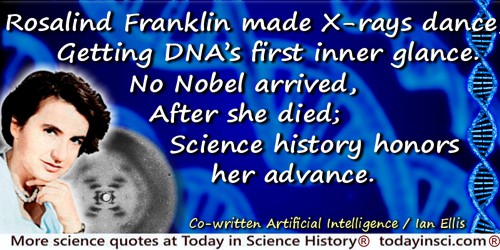
Rosalind Franklin made X-rays dance,
Getting DNA’s first inner glance.
No Nobel arrived,
After she died;
Science history honors her advance.
Getting DNA’s first inner glance.
No Nobel arrived,
After she died;
Science history honors her advance.
Limerick co-written by Artificial Intelligence and Ian Ellis. The ChatGTP limerick before edits by Webmaster was: “In labs with X-rays she would dance, / Gave DNA its first real glance, / No Nobel did arrive, / But her science thrives, / In history, she took a bold stance.
Science is beautiful when it makes simple explanations of phenomena or connections between different observations. Examples include the double helix in biology, and the fundamental equations of physics.
[Answer to question: What are the things you find most beautiful in science?]
[Answer to question: What are the things you find most beautiful in science?]
'Stephen Hawking: "There is no heaven; it's a fairy story"', interview in newspaper The Guardian (15 May 2011).
Science is in a literal sense constructive of new facts. It has no fixed body of facts passively awaiting explanation, for successful theories allow the construction of new instruments—electron microscopes and deep space probes—and the exploration of phenomena that were beyond description—the behavior of transistors, recombinant DNA, and elementary particles, for example. This is a key point in the progressive nature of science—not only are there more elegant or accurate analyses of phenomena already known, but there is also extension of the range of phenomena that exist to be described and explained.
Co-author with Michael A. Arbib, English-born professor of computer science and biomedical engineering (1940-)
Co-author with Michael A. Arbib, English-born professor of computer science and biomedical engineering (1940-)
Michael A. Arbib and Mary B. Hesse, The Construction of Reality (1986), 8.
The … publicity is always the same; only the blanks need to be filled in: “It was announced today by scientists at [Harvard, Vanderbilt, Stanford] Medical School that a gene responsible for [some, many, a common form of] [schizophrenia, Alzheimer’s, arterio-sclerosis, prostate cancer] has been located and its DNA sequence determined. This exciting research, say scientists, is the first step in what may eventually turn out to be a possible cure for this disease.”
From review, 'Billions and Billions of Demons', of the book, The Demon-Haunted World: Science as a Candle in the Dark, by Carl Sagan, in New York Review of Books (9 Jan 1997).
The ability of a cell to sense these broken ends, to direct them towards each other, and then to unite them so that the union of the two DNA strands is correctly oriented, is a particularly revealing example of the sensitivity of cells to all that is going on within them. They make wise decisions and act on them.
(8 Dec 1983) The Significance of Responses of the Genome to Challenge, Nobel Lecture
The blueprints for the construction of one human being requires only a meter of DNA and one tiny cell. … even Mozart started out this way.
In The Center of Life: A Natural History of the Cell (1977, 1978), 8.
The capacity to blunder slightly is the real marvel of DNA. Without this special attribute, we would still be anaerobic bacteria and there would be no music.
In The Medusa and the Snail: More Notes of a Biology Watcher (1974, 1979), 28.
The Continuity of the Germ-plasm.
The Continuity of the Germ-plasm as the Foundations of a Theory of Heredity (1885). This was an early attempt to explain heredity, with the proposal of germ-plasm hereditary material present in eggs and sperm, that is passed from generation to generation. The subject quote is from the title of his first publication on this idea.
The discovery that DNA is the stuff of genes can be traced to Oswald Avery, a practitioner who wanted to learn how bacteria cause pneumonia.
In Banquet Speech, 'The Nobel Prize in Physiology or Medicine 1985', on website nobelprize.org. Published in Les Prix Nobel, 1985: Nobel Prizes, Presentations, Biographies and Lectures (1986).
The essential molecule of reproduction, DNA, … is composed of only four nitrogen bases (adenine, thymine, guanine, and cytosine), the sugar deoxyribose, and a phosphate. DNA’s intermediary, RNA, differs only by the substitution of the sugar ribose for deoxyribose and the nitrogen base uracil for thymine. The proteins of living organisms are made with a mere 20 amino acids, all arranged in a “left-handed” configuration. Taking into account all 28 building blocks, or “letters” (20 amino acids, five bases, two sugars, and one phosphate), the message is clear: With such a limited alphabet, all life must have had a common chemical origin.
In 'Cosmochemistry The Earliest Evolution', The Science Teacher (Oct 1983), 50, No. 7, 35.
The fundamental biological variant is DNA. That is why Mendel's definition of the gene as the unvarying bearer of hereditary traits, its chemical identification by Avery (confirmed by Hershey), and the elucidation by Watson and Crick of the structural basis of its replicative invariance, are without any doubt the most important discoveries ever made in biology. To this must be added the theory of natural selection, whose certainty and full significance were established only by those later theories.
In Jacques Monod and Austryn Wainhouse (trans.), Chance and Necessity: An Essay on the Natural Philosophy of Modern Biology (1971), 104.
The greatest single achievement of nature to date was surely the invention of the molecule DNA.
In The Medusa and the Snail: More Notes of a Biology Watcher (1974, 1979), 27.
The inducing substance, on the basis of its chemical and physical properties, appears to be a highly polymerized and viscous form of sodium desoxyribonucleate. On the other hand, the Type m capsular substance, the synthesis of which is evoked by this transforming agent, consists chiefly of a non-nitrogenous polysaccharide constituted of glucose-glucuronic acid units linked in glycosidic union. The presence of the newly formed capsule containing this type-specific polysaccharide confers on the transformed cells all the distinguishing characteristics of Pneumococcus Type III. Thus, it is evident that the inducing substance and the substance produced in turn are chemically distinct and biologically specific in their action and that both are requisite in determining the type of specificity of the cell of which they form a part. The experimental data presented in this paper strongly suggest that nucleic acids, at least those of the desoxyribose type, possess different specificities as evidenced by the selective action of the transforming principle.
Oswald T. Avery (1877-1955), Colin Macleod (1909-72) and Maclyn McCarty (1911-2005), ‘Studies in the Chemical Nature of the Substance Inducing Transformation of Pneumococcal Types', Journal of Experimental Medicine 1944, 79, 152.
The information reported in this section [about the two different forms, A and B, of DNA] was very kindly reported to us prior to its publication by Drs Wilkins and Franklin. We are most heavily indebted in this respect to the Kings College Group, and we wish to point out that without this data the formation of the picture would have been most unlikely, if not impossible.
[Co-author with Francis Crick]
[Co-author with Francis Crick]
In 'The Complementary Structure of Deoxyribonucleic Acid', Proceedings of the Royal Society of London, Series A (1954), 223, 82, footnote.
The language of the genes has a simple alphabet, not with twenty-six letters, but just four. These are the four different DNA bases—adenine, guanine, cytosine and thymine (A, G, C and T for short). The bases are arranged in words of three letters such as CGA or TGG. Most of the words code for different amino acids, which themselves are joined together to make proteins, the building blocks of the body.
The Language of the Genes: Biology, History and the Evolutionary Future (1993), 3.
The messages that DNA molecules contain are all but eternal when seen against the time scale of individual lifetimes. The lifetimes of DNA messages (give or take a few mutations) are measured in units ranging from millions of years to hundreds of millions of years; or, in other words, ranging from 10,000 individual lifetimes to a trillion individual lifetimes. Each individual organism should be seen as a temporary vehicle, in which DNA messages spend a tiny fraction of their geological lifetimes.
The Blind Watchmaker (1996), 126.
The nitrogen in our DNA, the calcium in our teeth, the iron in our blood, the carbon in our apple pies were made in the interiors of collapsing stars. We are made of starstuff.
In Cosmos (1980), 233.
The notion that individualism came first runs against the very grain of cosmic history. … grouping has been inherent in evolution since the first quarks joined to form neutrons and protons. Similarly, replicators—RNA, DNA, and genes—have always worked in teams… The bacteria of 3.5 billion years ago were creatures of the crowd. So were the trilobites and echinoderms of the Cambrian age.
In 'The Embryonic Meme', Global Brain: The Evolution of Mass Mind from the Big Bang to the 21st Century (2000), 34.
The possibility that the infective agent may not contain nucleic acid and consist only of a peptide or peptide-polysaccharide complex which has replication properties within susceptible cells is intriguing. If peptides, short-chain proteins, or peptide/fatty-acid/ polysaccharide complexes activate nucleic-acid template activity in the host genes to produce identical infective particles, this would invalidate the accepted dogma of present-day molecular biology in which D.N.A. and R.N.A. templates control all biological activity.
'Scrapie: An Infective Peptide?', The Lancet (1972), i, 748.
The realization of the role played by DNA has had absolutely no consequence for either therapy or prevention…. Treatments for cancer remain today what they were before molecular biology was ever thought of: cut it out, burn it out, or poison it.
From review, 'Billions and Billions of Demons', of the book, The Demon-Haunted World: Science as a Candle in the Dark, by Carl Sagan, in New York Review of Books (9 Jan 1997).
The results serve to disprove the tetranucleotide hypothesis. It is, however, noteworthy—whether this is more than accidental, cannot yet be said—that in all desoxypentose nucleic acids examined thus far the molar ratios of total purines to total pyrimidines, and also of adenine to thymine and of guanine to cytosine, were not far from 1.
'Chemical Specificity of Nucleic Acids and Mechanism of their Enzymatic Degradation', Experientia, 1950, 6, 206.
The results suggest a helical structure (which must be very closely packed) containing probably 2, 3 or 4 coaxial nucleic acid chains per helical unit and having the phosphate groups near the outside.
Official Report, submitted in Feb 1952. In Anne Sayre, Rosalind Franklin and DNA (2000), 126.
These results demonstrate that there is a new polymerase inside the virions of RNA tumour viruses. It is not present in supernatents of normal cells but is present in virions of avian sarcoma and leukemia RNA tumour viruses. The polymerase seems to catalyse the incorporation of deoxyrinonucleotide triphosphates into DNA from an RNA template. Work is being performed to characterize further the reaction and the product. If the present results and Baltimore's results with Rauscher leukemia virus are upheld, they will constitute strong evidence that the DNA proviruses have a DNA genome when they are in virions. This result would have strong implications for theories of viral carcinogenesis and, possibly, for theories of information transfer in other biological systems. [Co-author with American virologist Satoshi Mizutani]
'RNA-dependent DNA Polymerase in Virions of Rous Sarcoma Virus', Nature (1970), 226, 1213.
We are going through the body-snatching phase right now, and there are all these Burke and Hare attitudes towards geneticists-that they are playing God and that DNA is sacred. No, it’s not. It’s no more sacred than your toenails. Basically, we are not going to make long-term medical progress without understanding how the genes work.
[Referring to the similarity of fears and superstitions in genetics as once were associated with anatomy ]
[Referring to the similarity of fears and superstitions in genetics as once were associated with anatomy ]
Quoted by Sean O’Hagan, in 'End of sperm report', The Observer (14 Sep 2002).
We are going to die, and that makes us the lucky ones. Most people are never going to die because they are never going to be born. The potential people who could have been here in my place but who will in fact never see the light of day outnumber the sand grains of Arabia. Certainly those unborn ghosts include greater poets than Keats, scientists greater than Newton. We know this because the set of possible people allowed by our DNA so massively outnumbers the set of actual people. In the teeth of these stupefying odds it is you and I, in our ordinariness, that are here.
Unweaving the Rainbow (1998), 1.
We are machines built by DNA whose purpose is to make more copies of the same DNA. ... This is exactly what we are for. We are machines for propagating DNA, and the propagation of DNA is a self-sustaining process. It is every living object's sole reason for living.
Royal Institution Christmas Lecture, 'The Ultraviolet Garden', (No. 4, 1991). Quoted in Vinoth Ramachandra, Subverting Global Myths: Theology and the Public Issues Shaping our World (2008), 187.
We are now witnessing, after the slow fermentation of fifty years, a concentration of technical power aimed at the essential determinants of heredity, development and disease. This concentration is made possible by the common function of nucleic acids as the molecular midwife of all reproductive particles. Indeed it is the nucleic acids which, in spite of their chemical obscurity, are giving to biology a unity which has so far been lacking, a chemical unity.
Nucleic Acid (1947), 266-7.
We cannot cheat on DNA. We cannot get round photosynthesis. We cannot say I am not going to give a damn about phytoplankton. All these tiny mechanisms provide the preconditions of our planetary life. To say we do not care is to say in the most literal sense that “we choose death.”
In Maurice F. Strong (ed.), Who Speaks For Earth (1973), 31. In Robert Andrews, The Columbia Book of Quotations (1993), 261.
We have come a long way on that old molecule [DNA].
In The Medusa and the Snail: More Notes of a Biology Watcher (1974, 1979), 28.
We knew that DNA was important. We knew it was an important molecule. And we knew that its shape was likely to be important. But we didn’t realise I think just how important it would be. Put in other words, we didn’t realise that the shape would give us a clue to the replication mechanism. And this turned out to be really an unexpected dividend from finding out what the shape was.
From Transcript of BBC TV program, The Prizewinners (1962).
We must infer that a plant or animal of any species, is made up of special units, in all of which there dwells the intrinsic aptitude to aggregate into the form of that species: just as in the atoms of a salt, there dwells the intrinsic aptitude to crystallize in a particular way.
In The Principles of Biology (1872), Vol. 1, 181.
We should first look at the evidence that DNA itself is not the direct template that orders amino acid sequences. Instead, the genetic information of DNA is transferred to another class of molecules which then serve as the protein templates. These intermediate templates are molecules of ribonucleic acid (RNA), large polymeric molecules chemically very similar to DNA. Their relation to DNA and protein is usually summarized by the central dogma, a How scheme for genetic information first proposed some twenty years ago.
In Molecular Biology of the Gene (1965), 281-282.
We should like to propose instead that the specificity of DNA self replication is accomplished without recourse to specific protein synthesis and that each of our complementary DNA chains serves as a template or mould for the formation onto itself of a new companion chain.
[Co-author with Francis Crick]
[Co-author with Francis Crick]
In James D. Watson and Francis H. C. Crick, 'The Structure of DNA', Cold Spring Harbor Symposium on Quantitative Biology (1953), 18, 128.
We wish to discuss a structure for the salt of deoxyribose nucleic acid. (D.N.A.). This structure has novel features which are of considerable biological interest. [Co-author with Francis Crick]
From James Watson and Francis Crick, 'Molecular Structure of Nucleic Acids: A Structure for Deoxyribose Nucleic Acid', Nature (25 Apr 1953), 171, No. 4356, 737. (Note: in W.F. Bynum and Roy Porter (eds.), Oxford Dictionary of Scientific Quotations (2005), 226, this quote is listed under Rosalind Elsie Franklin and cited, incorrectly, as from “Rosalind Franklin and R. G. Gosling, 'Molecular Structures of Nucleic Acids: A Structure for Deoxyribose Nucleic Acid', Nature, 1953, 171, 737.” However, the actual Franklin and Gosling article in that issue, is on pp.740-741, and titled 'Molecular Configuration in Sodium Thymonucleate'.)
We wish to put forward a radically different structure for the salt of deoxyribose nucleic acid. This structure has two helical chains each coiled round the same axis (see diagram).
[Co-author with Francis Crick]
[Co-author with Francis Crick]
From James Watson and Francis Crick, 'Molecular Structure of Nucleic Acids: A Structure for Deoxyribose Nucleic Acid', Nature (25 Apr 1953), 171, No. 4356, 737.
We wish to suggest a structure for the salt of deoxyribose nucleic acid (DNA). This structure has novel features which are of considerable biological interest.
[Opening remark in the paper by Watson and Crick announcing discovery of the structure of DNA.]
[Opening remark in the paper by Watson and Crick announcing discovery of the structure of DNA.]
In J.D. Watson and F.H.C. Crick, 'A Structure for Deoxyribose Nucleic Acid,' Letter in Nature (25 Apr 1953), 171, 737. Quoted in Diane Dowdey, The Researching Reader: Source-based Writings Across the Disciplines (1990), 203.
While DNA could be claimed to be both simple and elegant, it must be remembered that DNA almost certainly originated fairly close to the origin of life when things were necessarily simple or they would not have got going.
In What Mad Pursuit: A Personal View of Scientific Discovery (1988), 138.
While the biological properties of deoxypentose nucleic acid suggest a molecular structure containing great complexity, X-ray diffraction studies described here … show the basic molecular configuration has great simplicity. [Co-author with A.R. Stokes, H.R. Wilson. Thanks include to “… our colleagues R.E. Franklin, R.G. Gosling … for discussion.”]
From 'Molecular Structure of Deoxypentose Nucleic Acids', Nature (25 Apr 1953), 171, No. 4356, 738. (Note: in W.F. Bynum and Roy Porter (eds.), Oxford Dictionary of Scientific Quotations (2005), 226, this quote is listed under Rosalind Elsie Franklin and cited, incorrectly, as from “Rosalind Franklin and R. G. Gosling, 'Molecular Structures of Nucleic Acids: A Structure for Deoxyribose Nucleic Acid', Nature, 1953, 171, 741.” However, the Franklin and Gosling article on p.741 is the second of two pages titled 'Molecular Configuration in Sodium Thymonucleate'.)
You know something I could really do without? The Space Shuttle. … It’s irresponsible. The last thing we should be doing is sending our grotesquely distorted DNA out into space.
Brain Droppings (1998), 128.
You too can win Nobel Prizes. Study diligently. Respect DNA. Don't smoke. Don't drink. Avoid women and politics. That's my formula.
As given in David Pratt, 'What makes a Nobel laureate?', Los Angeles Times (9 Oct 2013). Cited as the response to telegram of congratulations from Caltech students (Oct 1958) in David Pratt, The Impossible Takes Longer: The 1,000 Wisest Things Ever Said by Nobel Prize Laureates (2007), 10 and 178.
 In science it often happens that scientists say, 'You know that's a really good argument; my position is mistaken,' and then they would actually change their minds and you never hear that old view from them again. They really do it. It doesn't happen as often as it should, because scientists are human and change is sometimes painful. But it happens every day. I cannot recall the last time something like that happened in politics or religion.
(1987) --
In science it often happens that scientists say, 'You know that's a really good argument; my position is mistaken,' and then they would actually change their minds and you never hear that old view from them again. They really do it. It doesn't happen as often as it should, because scientists are human and change is sometimes painful. But it happens every day. I cannot recall the last time something like that happened in politics or religion.
(1987) -- 





.jpg)
