Creativity Quotes (84 quotes)
…comparing the capacity of computers to the capacity of the human brain, I’ve often wondered, where does our success come from? The answer is synthesis, the ability to combine creativity and calculation, art and science, into whole that is much greater than the sum of its parts.
In How Life Imitates Chess: Making the Right Moves, from the Board to the Boardroom (2007), 4.
[About the great synthesis of atomic physics in the 1920s:] It was a heroic time. It was not the doing of any one man; it involved the collaboration of scores of scientists from many different lands. But from the first to last the deeply creative, subtle and critical spirit of Niels Bohr guided, restrained, deepened and finally transmuted the enterprise.
Quoted in Bill Becker, 'Pioneer of the Atom', New York Times Sunday Magazine (20 Oct 1957), 54.
[At DuPont,] I was very fortunate that I worked under men who were very much interested in making discoveries and inventions. They were very much interested in what they were doing, and they left me alone. And I was able to experiment on my own, and I found this very stimulating. It appealed to the creative person in me.
From transcript for video interview (2007, published Aug 2012), 'Stephanie Kwolek: Curiosity and the Discovery of Kevlar', in the series Women in Chemistry, on Chemical Heritage Foundation website.
[Fritz Haber's] greatness lies in his scientific ideas and in the depth of his searching. The thought, the plan, and the process are more important to him than the completion. The creative process gives him more pleasure than the yield, the finished piece. Success is immaterial. “Doing it was wonderful.” His work is nearly always uneconomical, with the wastefulness of the rich.
In Richard Willstätter, Arthur Stoll (ed. of the original German) and Lilli S. Hornig (trans.), From My Life: The Memoirs of Richard Willstätter (1958), 268.
![James Dyson quote: [M]anufacturing, science and engineering are … incredibly creative. I’d venture to say more so than creative](https://todayinsci.com/D/Dyson_James/DysonJames-Creative500x250px.jpg)
[M]anufacturing, science and engineering are … incredibly creative. I’d venture to say more so than creative advertising agencies and things that are known as the creative industries.
Interview by Melanie D.G. Kaplan, 'James Dyson: Why we need to re-focus on the old economy' posted on smartplanet.com (3 Nov 2010).
Pour inventor il faut penser à côté.
To invent you must think aside
To invent you must think aside
In Calyampudi Radhakrishna Rao, Statistics and Truth (1997), 31.
A “critic” is a man who creates nothing and thereby feels qualified to judge the work of creative men. There is logic in this; he is unbiased—he hates all creative people equally.
In Time Enough for Love: The Lives of Lazarus Long (1973), 365.

A life that stood out as a gospel of self-forgetting service.
He could have added fortune to fame but caring for neither he found happiness and honor in being helpful to the world.
The centre of his world was the south where he was born in slavery some 79 years ago and where he did his work as a creative scientist.
He could have added fortune to fame but caring for neither he found happiness and honor in being helpful to the world.
The centre of his world was the south where he was born in slavery some 79 years ago and where he did his work as a creative scientist.
Epitaph on tombstone at Tuskegee University Campus Cemetery, Alabama.
Americans have always believed that—within the law—all kinds of people should be allowed to take the initiative in all kinds of activities. And out of that pluralism has come virtually all of our creativity. Freedom is real only to the extent that there are diverse alternatives.
Speech to the Council on Foundations (16 May 1979). In 'Infinite Variety: The Nonprofit Sector', Grant's Magazine (1979), Vol. 2-3, 17.
Another of my hobby-horses is the advantage of ignorance, in that it encourages creativity, both in the young and the old.
From Catastrophe Theory: Selected Papers, 1972-1977 (1977), 611. As quoted in a Review by: Hector J. Sussmann, SIAM Review (Apr 1979), 21, No. 2, 269.
Any artist or novelist would understand—some of us do not produce their best when directed. We expect the artist, the novelist and the composer to lead solitary lives, often working at home. While a few of these creative individuals exist in institutions or universities, the idea of a majority of established novelists or painters working at the “National Institute for Painting and Fine Art” or a university “Department of Creative Composition” seems mildly amusing. By contrast, alarm greets the idea of a creative scientist working at home. A lone scientist is as unusual as a solitary termite and regarded as irresponsible or worse.
Homage to Gala: The Life of an Independent Scholar (2000), 2.
Anybody can make the simple complicated. Creativity is making the complicated simple.
In David Pressman. Patent it Yourself (2008), 37.
As I review the nature of the creative drive in the inventive scientists that have been around me, as well as in myself, I find the first event is an urge to make a significant intellectual contribution that can be tangible embodied in a product or process.
Quoted in New York Times (2 Mar 1991), 1 and 29.
As never before, the work of the engineer is basic to the kind of society to which our best efforts are committed. Whether it be city planning, improved health care in modern facilities, safer and more efficient transportation, new techniques of communication, or better ways to control pollution and dispose of wastes, the role of the engineer—his initiative, creative ability, and hard work—is at the root of social progress.
Remarks for National Engineers Week (1971). As quoted in Consulting Engineer (1971), 36, 18.
At their best, at their most creative, science and engineering are attributes of liberty—noble expressions of man’s God-given right to investigate and explore the universe without fear of social or political or religious reprisals.
From 'Sarnoff Honored by I.R.E.', in Department of Information of the Radio Corporation of America, Radio Age: Research, Manufacturing, Communications, Broadcasting (Apr 1953), 12, No. 2, 32.
Conditions for creativity are to be puzzled; to concentrate; to accept conflict and tension; to be born everyday; to feel a sense of self.
Quoted in David Stokes, Nicholas Wilson and Martha Mador, Entrepreneurship (2009), 190 without further citation. If you know the primary source, please contact Webmaster.
Could Hamlet have been written by a committee, or the “Mona Lisa” painted by a club? Could the New Testament have been composed as a conference report? Creative ideas do not spring from groups. They spring from individuals. The divine spark leaps from the finger of God to the finger of Adam, whether it takes ultimate shape in a law of physics or a law of the land, a poem or a policy, a sonata or a mechanical computer.
Baccalaureate address (9 Jun 1957), Yale University. In In the University Tradition (1957), 156.
Creation is a drug I can't do without.
Quoted in Gladwin Hill, 'Most Colossal of All', New York Times (12 Aug 1956), 179.
Creative geniuses are a slap-happy lot. Treat Them with respect.
In The Novel (1991), 53.
Creative people are like a wet towel You wring them out and pick up another one.
In John N. Ingham and Lynne B. FeldmanContemporary American Business Leaders: a Biographical Dictionary (2002), 73.
Creativity comes from trust. Trust your instincts. And never hope more than you work.
In Starting From Scratch: A Different Kind of Writers’ Manual (1988), xi.
Creativity in science, as in the arts, cannot be organized. It arises spontaneously from individual talent. Well-run laboratories can foster it, but hierarchical organization, inflexible, bureaucratic rules, and mounds of futile paperwork can kill it. Discoveries cannot be planned; they pop up, like Puck, in unexpected corners.
In 'Preface', I Wish I’d Made You Angry Earlier: Essays on Science, Scientists, and Humanity (1998), ix.
Creativity is a double-edged sword. The more ideas we have, the less likely we are to stay loyal to one. So the creative mind ends up jumping from idea to idea, and none of them happen.
In 'Author Q&A: Art in Action', Newsweek (7 Jun 2010), 10.
Creativity is the basis of all innovation, and although it is doubtful that it can be taught, creativity should be nurtured in those who have it.
From keynote address, 'Will Innovation Flourish in the Future?' (2002), as adapted for Opinion article in The Industrial Physicist (Dec-Jan 2003-03), 8, No. 6, 23. The address was presented at Conference, 'Infrastructure for e-Business, e-Education, e-Science, and e-Medicine', at Scuola Superiore G. Reiss Romoli in L’Aquila, Italy (Jul 29-Aug 4, 2002).
Creativity is what cannot wait, cannot stop, cannot backstep: faster or slower, it always goes ahead—through, alongside, above, regardless of crises or systems.
In a speech at Brown University, March 11, 1979.
Creativity makes a leap, then looks to see where it is.
City Aphorisms, Eighth Selection (1991).
Every creative act is a sudden cessation of stupidity.
Quoted in Alix Kerr, 'What It Took: Intuition, Goo,' Life (25 Jan 1963), 54, No. 4, 86.
Excessive bureaucracy is distracting, time-consuming, and destructive to creativity.
From keynote address, 'Will Innovation Flourish in the Future?' (2002), as adapted for Opinion article in The Industrial Physicist (Dec-Jan 2003-03), 8, No. 6, 24. The address was presented at Conference, 'Infrastructure for e-Business, e-Education, e-Science, and e-Medicine', at Scuola Superiore G. Reiss Romoli in L’Aquila, Italy (Jul 29-Aug 4, 2002).
Faced with the admitted difficulty of managing the creative process, we are doubling our efforts to do so. Is this because science has failed to deliver, having given us nothing more than nuclear power, penicillin, space travel, genetic engineering, transistors, and superconductors? Or is it because governments everywhere regard as a reproach activities they cannot advantageously control? They felt that way about the marketplace for goods, but trillions of wasted dollars later, they have come to recognize the efficiency of this self-regulating system. Not so, however, with the marketplace for ideas.
Quoted in Martin Moskovits (ed.), Science and Society, the John C. Polanyi Nobel Lareates Lectures (1995), 8.
For [Richard] Feynman, the essence of the scientific imagination was a powerful and almost painful rule. What scientists create must match reality. It must match what is already known. Scientific creativity is imagination in a straitjacket.
In Genius: The Life and Science of Richard Feynman (1992), 324.
For three million years we were hunter-gatherers, and it was through the evolutionary pressures of that way of life that a brain so adaptable and so creative eventually emerged. Today we stand with the brains of hunter-gatherers in our heads, looking out on a modern world made comfortable for some by the fruits of human inventiveness, and made miserable for others by the scandal of deprivation in the midst of plenty.
Co-author with American science writer Roger Amos Lewin (1946), Origins: What New Discoveries Reveal about the Emergence of our Species and its Possible Future (1977), 249.
I despise Birth-Control first because it is ... an entirely meaningless word; and is used so as to curry favour even with those who would first recoil from its real meaning. The proceeding these quack doctors recommend does not control any birth. ... But these people know perfectly well that they dare not write the plain word Birth-Prevention, in any one of the hundred places where they write the hypocritical word Birth-Control. They know as well as I do that the very word Birth-Prevention would strike a chill into the public... Therefore they use a conventional and unmeaning word, which may make the quack medicine sound more innocuous. ... A child is the very sign and sacrament of personal freedom. He is a fresh will added to the wills of the world; he is something that his parents have freely chosen to produce ... he is their own creative contribution to creation.
In 'Babies and Distributism', The Well and the Shadows (1935). Collected in G. K. Chesterton and Dale Ahlquist (ed.), In Defense of Sanity: The Best Essays of G.K. Chesterton (2011), 272.
I do not seek, I find.
Pablo Picasso and José María Faerna (ed.), Picasso (1995), 5.
I have long aspired to make our company a noble prototype of industry, penetrating in science, reliable in engineering, creative in aesthetics and wholesomely prosperous in economics.
In Alan R. Earls and Nasrin Rohani, Polaroid (2005), 7.
I once had the honour of hearing the great molecular biologist Jacques Monod talking about creativity in science. I have forgotten his exact words, but he said approximately that, when trying to think through a chemical problem, he would ask himself what he would do if he were an electron.
In 'Introduction to the 30th Anniversary Edition', The Selfish Gene: 30th Anniversary Edition (1976, 2006), xi.
If arithmetical skill is the measure of intelligence, then computers have been more intelligent than all human beings all along. If the ability to play chess is the measure, then there are computers now in existence that are more intelligent than any but a very few human beings. However, if insight, intuition, creativity, the ability to view a problem as a whole and guess the answer by the “feel” of the situation, is a measure of intelligence, computers are very unintelligent indeed. Nor can we see right now how this deficiency in computers can be easily remedied, since human beings cannot program a computer to be intuitive or creative for the very good reason that we do not know what we ourselves do when we exercise these qualities.
In Machines That Think (1983).
If the scientist has during the whole of his life observed carefully, trained himself to be on the look out for analogy, and possessed himself of relevant knowledge, then the ‘instrument of feeling’ … will become a powerful divining rod … in creative science feeling plays a leading part.
In An Anatomy of Inspiration: And An Essay on the Creative Mood (1948), 96.
If you walk along the street you will encounter a number of scientific problems. Of these, about 80 per cent are insoluble, while 19½ per cent are trivial. There is then perhaps half a per cent where skill, persistence, courage, creativity and originality can make a difference. It is always the task of the academic to swim in that half a per cent, asking the questions through which some progress can be made.
'The Making of a Scientist', Journal of the Royal Society of Arts, June 1983, 406.
In the context of biological research one can reasonably identify creativity with the capacity 1 to ask new and incisive questions, 2 to form new hypotheses, 3 to examine old questions in new ways or with new techniques, and 4 to perceive previously unnoticed relationships.
In 'Scientific innovation and creativity: a zoologist’s point of view', American Zoologist (1982), 22, 231.
Intelligence is not creative; judgment is not creative. If a sculptor is nothing but skill and mind, his hands will be without genius.
Translation by Lewis Galantière of Pilote de Guerre (1941) as Flight to Arras (1942, 2008), 130. A different translation is found in Jason Merchey, Values of the Wise: Humanity's Highest Aspirations (2004), 240: “Neither intelligence nor judgment are creative. If a scupltor is nothing but science and intelligence, his hands will have no talent.”
Ironically one’s scientific obsolescence is a direct result of the creativity of his peers.
In 'Scientific innovation and creativity: a zoologist’s point of view', American Zoologist (1982), 22, 229.
It is the tension between creativity and skepticism that has produced the stunning and unexpected findings of science.
In Broca’s Brain: Reflections on the Romance of Science (1974, 1986), 73.
Long intervals frequently elapse between the discovery of new principles in science and their practical application… Those intellectual qualifications, which give birth to new principles or to new methods, are of quite a different order from those which are necessary for their practical application.
Reflections on the Decline of Science in England (1830), 16.
Making the simple complicated is commonplace; making the complicated simple, awesomely simple, that’s creativity.
As quoted, without citation, in Richard D Pepperman, The Eye is Quicker (2004), xv.
Mathematicians go mad, and cashiers; but creative artists very seldom. I am not, as will be seen, in any sense attacking logic: I only say that the danger does lie in logic, not in imagination.
In Orthodoxy (1908), 27.
Mathematics is not a contemplative but a creative subject.
In A Mathematician's Apology (1940, 2012), 43.
Most advances in science come when a person for one reason or another is forced to change fields.
Viewing a new field with fresh eyes, and bringing prior knowledge, results in creativity.
Viewing a new field with fresh eyes, and bringing prior knowledge, results in creativity.
Quoted in Roger Von Oech, A Whack on the Side of the Head (1982), 71. (Berger is credited in the Introduction in a listed of people providing ideas and suggestions.) In Cheryl Farr, Jim Rhode, Newsletters, Patients and You (1985), 142.
My work always tried to unite the true with the beautiful, but when I had to choose one or the other, I usually chose the beautiful.
As quoted by Freeman Dyson in Obituary for Hermann Weyl in Nature (10 Mar 1956). In James Roy Newman, The World of Mathematics (2000), Vol. 3, 1831.
No Geologist worth anything is permanently bound to a desk or laboratory, but the charming notion that true science can only be based on unbiased observation of nature in the raw is mythology. Creative work, in geology and anywhere else, is interaction and synthesis: half-baked ideas from a bar room, rocks in the field, chains of thought from lonely walks, numbers squeezed from rocks in a laboratory, numbers from a calculator riveted to a desk, fancy equipment usually malfunctioning on expensive ships, cheap equipment in the human cranium, arguments before a road cut.
An Urchin in the Storm (1988), 98.
Our brains seem to be organised to make random comparisons of the contents of our memories. Daydreaming allows the process to go into free fall. Suddenly, there is a new idea, born with intense excitement. We cannot organise this process but we can distort or even defeat it.
[Commenting that creativity is not a method that can be learnt and taught.]
[Commenting that creativity is not a method that can be learnt and taught.]
Quoted in Andrew Jack, "An Acute Talent for Innovation", Financial Times (1 Feb 2009).
Peer reviewers go for orthodoxy ... Many of the great 19th-century discoveries were made by men who had independent wealth—Charles Darwin is the prototype. They trusted themselves.
[Commenting that the anonymous peer review process is the enemy of scientific creativity]
[Commenting that the anonymous peer review process is the enemy of scientific creativity]
Quoted in Andrew Jack, "An Acute Talent for Innovation", Financial Times (1 Feb 2009).
Persons possessing great intellect and a capacity for excelling in the creative arts and also in the sciences are generally likely to have heavier brains than the ordinary individual. Arguing from this we might expect to find a corresponding lightness in the brain of the criminal, but this is not always the case ... Many criminals show not a single anomaly in their physical or mental make-up, while many persons with marked evidences of morphological aberration have never exhibited the criminal tendency.
Every attempt to prove crime to be due to a constitution peculiar only to criminals has failed signally. It is because most criminals are drawn from the ranks of the low, the degraded, the outcast, that investigators were ever deceived into attempting to set up a 'type' of criminal. The social conditions which foster the great majority of crimes are more needful of study and improvement.
From study of known normal brains we have learned that there is a certain range of variation. No two brains are exactly alike, and the greatest source of error in the assertions of Benedict and Lombroso has been the finding of this or that variation in a criminal’s brains, and maintaining such to be characteristic of the 'criminal constitution,' unmindful of the fact that like variations of structure may and do exist in the brains of normal, moral persons.
Every attempt to prove crime to be due to a constitution peculiar only to criminals has failed signally. It is because most criminals are drawn from the ranks of the low, the degraded, the outcast, that investigators were ever deceived into attempting to set up a 'type' of criminal. The social conditions which foster the great majority of crimes are more needful of study and improvement.
From study of known normal brains we have learned that there is a certain range of variation. No two brains are exactly alike, and the greatest source of error in the assertions of Benedict and Lombroso has been the finding of this or that variation in a criminal’s brains, and maintaining such to be characteristic of the 'criminal constitution,' unmindful of the fact that like variations of structure may and do exist in the brains of normal, moral persons.
Address to the American Association for the Advancement of Science in Philadelphia (28 Dec 1904), as quoted in 'Americans of Future Will Have Best Brains', New York Times (29 Dec 1904), 6.
Psychiatrist David Shainberg argued that mental illness, which appears chaotic, is actually the reverse. Mental illness occurs when images of the self become rigid and closed, restricting an open creative response to the world.[Co-author with David Peat]
In John F. Briggs and David Peat, Seven Life Lessons of Chaos: Spiritual Wisdom from the Science of Change (1999, 2000), 29. A footnote gives the source of this idea as from David Shainberg, The Transforming Self: New Dimensions in Psychoanalytic Process (1973).
Technical skill is mastery of complexity while creativity is mastery of simplicity.
In Catastrophe Theory: selected papers, 1972-1977 (1977).
The creative life [is] the only one for a serious man.
In A Mathematician's Apology (1940, 2012), 53.
The estimate we form of the intellectual capacity of our race, is founded on an examination of those productions which have resulted from the loftiest flights of individual genius, or from the accumulated labors of generations of men, by whose long-continued exertions a body of science has been raised up, surpassing in its extent the creative powers of any individual, and demanding for its development a length of time, to which no single life extends.
In The Ninth Bridgewater Treatise: A Fragment (1838), 30.
The field of scientific abstraction encompasses independent kingdoms of ideas and of experiments and within these, rulers whose fame outlasts the centuries. But they are not the only kings in science. He also is a king who guides the spirit of his contemporaries by knowledge and creative work, by teaching and research in the field of applied science, and who conquers for science provinces which have only been raided by craftsmen.
While president of the German Chemical Society, making memorial remarks dedicated to the deceased Professor Lunge (Jan 1923). As quoted in Richard Willstätter, Arthur Stoll (ed. of the original German) and Lilli S. Hornig (trans.), From My Life: The Memoirs of Richard Willstätter (1958), 174-175.
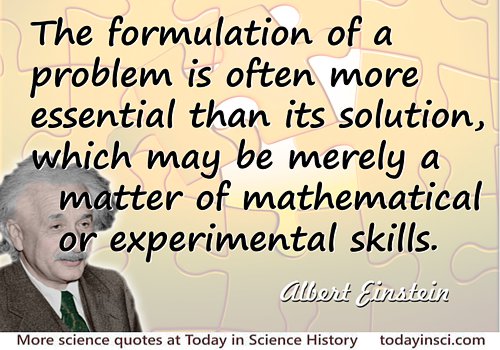
The formulation of a problem is often more essential than its solution, which may be merely a matter of mathematical or experimental skill. To raise new questions, new possibilities, to regard old problems from a new angle requires creative imagination and marks real advances in science.
In Albert Einstein and Léopold Infeld, The Evolution of Physics: The Growth of Ideas from Early Concepts to Relativity and Quanta (1938, 1966), 92.
The future is uncertain… but this uncertainty is at the very heart of human creativity.
Quoted in Petruska Clarkson, The Transpersonal Relationship in Psychotherapy (2002), 87, cited in footnote as from “A (very) brief history of certainty. Network – The Scientific and Medical Network Review (Winter 1995), 7.
The invention of IQ did a great disservice to creativity in education. ... Individuality, personality, originality, are too precious to be meddled with by amateur psychiatrists whose patterns for a “wholesome personality” are inevitably their own.
In speech, 'Education for Creativity in the Sciences', Conference at New York University, Washington Square. As quoted by Gene Currivan in 'I.Q. Tests Called Harmful to Pupil', New York Times (16 Jun 1963), 66.
The next time you make an assumption, see what happens when you do the opposite.
As originally composed on Twitter. Posted on the copyblogger web page 'What's the Ultimate Creativity Killer', 21 May 2008.
The principal goal of education is to create men who are capable of doing new things, not simply of repeating what other generations have done—men who are creative, inventive, and discovers. The second goal of education is to form minds which can be critical, can verify, and not accept everything they are offered.
From remarks at a conference on cognitive development, Cornell University (1964). In Philip Hampson Taylor, New Directions in Curriculum Studies (1979), 90.
The same society which receives the rewards of technology must, as a cooperating whole, take responsibility for control. To deal with these new problems will require a new conservation. We must not only protect the countryside and save it from destruction, we must restore what has been destroyed and salvage the beauty and charm of our cities. Our conservation must be not just the classic conservation of protection and development, but a creative conservation of restoration and innovation. Its concern is not with nature alone, but with the total relation between man and the world around him. Its object is not just man's welfare, but the dignity of man's spirit.
In his 'Message to Congress on Conservation and Restoration of Natural Beauty' written to Congress (8 Feb 1965). It was a broad initiative aimed at beautifying America, guaranteeing water and air quality, and preserving natural areas. In Lyndon B. Johnson: Containing the Public Messages, Speeches, and Statements of the President (1965), Vol.1, 156.
United States. President (1963-1969 : Johnson), Lyndon Baines Johnson, United States. Office of the Federal Register - 1970
The secret to creativity is knowing how to hide your sources.
…...
The spark of a genius exists in the brain of the truly creative man from the hour of his birth. True genius is always inborn and never cultivated, let alone learned.
Mein Kampf (1925-26), American Edition (1943), 212-13. In William Lawrence Shirer, The Rise and Fall of the Third Reich (1990), 110.
The structure known, but not yet accessible by synthesis, is to the chemist what the unclimbed mountain, the uncharted sea, the untilled field, the unreached planet, are to other men … The unique challenge which chemical synthesis provides for the creative imagination and the skilled hand ensures that it will endure as long as men write books, paint pictures, and fashion things which are beautiful, or practical, or both.
In 'Art and Science in the Synthesis of Organic Compounds: Retrospect and Prospect', in Maeve O'Connor (ed.), Pointers and Pathways in Research (1963), 41.
The theoretical idea … does not arise apart from and independent of experience; nor can it be derived from experience by a purely logical procedure. It is produced by a creative act. Once a theoretical idea has been acquired, one does well to hold fast to it until it leads to an untenable conclusion.
'On the Generalized Theory of Gravitation', Scientific American (Apr 1950). Collected in David H. Levy (ed.), The Scientific American Book of the Cosmos (2000), 14.
The thing about electronic games is that they are basically repetitive. After a while, the children get bored. They need something different. [Meccano construction toy kits] offer creativity, a notion of mechanics, discovery of the world around you.
As quoted in by Hugh Schofield in web article 'Meccano Revives French Production' (23 Dec 2010).
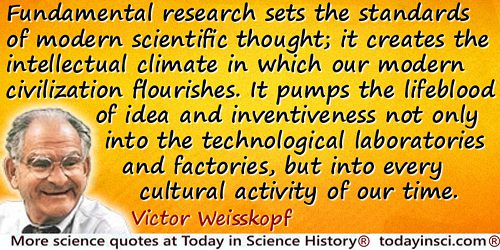
The value of fundamental research does not lie only in the ideas it produces. There is more to it. It affects the whole intellectual life of a nation by determining its way of thinking and the standards by which actions and intellectual production are judged. If science is highly regarded and if the importance of being concerned with the most up-to-date problems of fundamental research is recognized, then a spiritual climate is created which influences the other activities. An atmosphere of creativity is established which penetrates every cultural frontier. Applied sciences and technology are forced to adjust themselves to the highest intellectual standards which are developed in the basic sciences. This influence works in many ways: some fundamental students go into industry; the techniques which are applied to meet the stringent requirements of fundamental research serve to create new technological methods. The style, the scale, and the level of scientific and technical work are determined in pure research; that is what attracts productive people and what brings scientists to those countries where science is at the highest level. Fundamental research sets the standards of modern scientific thought; it creates the intellectual climate in which our modern civilization flourishes. It pumps the lifeblood of idea and inventiveness not only into the technological laboratories and factories, but into every cultural activity of our time. The case for generous support for pure and fundamental science is as simple as that.
In 'Why Pure Science?' in Bulletin of the Atomic Scientists, 1965.
Theorists tend to peak at an early age; the creative juices tend to gush very early and start drying up past the age of fifteen—or so it seems. They need to know just enough; when they’re young they haven’t accumulated the intellectual baggage.
In Leon Lederman and Dick Teresi, The God Particle: If the Universe is the Answer, What is the
Question (1993), 16.
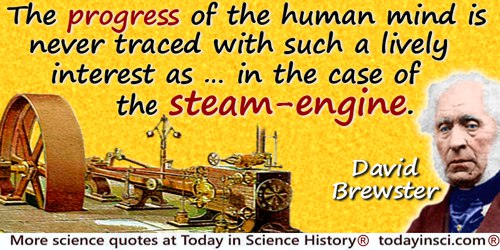
There are many points in the history of an invention which the inventor himself is apt to overlook as trifling, but in which posterity never fail to take a deep interest. The progress of the human mind is never traced with such a lively interest as through the steps by which it perfects a great invention; and there is certainly no invention respecting which this minute information will be more eagerly sought after, than in the case of the steam-engine.
Quoted in The Origin and Progress of the Mechanical Inventions of James Watt (1854), Vol.1, 4.
There is a case for saying that the creation of new aesthetic forms has been the most fundamentally productive of all forms of human activity. Whoever creates new artistic conventions has found methods of interchange between people about matters which were incommunicable before. The capacity to do this has been the basis of the whole of human history.
An Introduction to the Study of Man (1971), 519. As quoted and cited in Andrée Grau, 'Dance as Part of the Infrastructure of Social Life', The World of Music (1995), 37, No. 2, 45.
There is a popular cliché ... which says that you cannot get out of computers any more than you have put in..., that computers can only do exactly what you tell them to, and that therefore computers are never creative. This cliché is true only in a crashingly trivial sense, the same sense in which Shakespeare never wrote anything except what his first schoolteacher taught him to write—words.
In The Blind Watchmaker: Why the Evidence of Evolution Reveals a Universe Without Design (1966, 1986), 64. Excerpted in Richard Dawkins, ‘Creation and Natural Selection’. New Scientist (25 Sep 1986), 111, 38.
There is a theory that creativity arises when individuals are out of sync with their environment. To put it simply, people who fit in with their communities have insufficient motivation to risk their psyches in creating something truly new, while those who are out of sync are driven by the constant need to prove their worth.
In 'Beyond the Soapsuds Universe', Discover Magazine (1997). The author explains (in a blog found online) that this “idea comes from a theory by Mihaly Csikszentmihalyi, who wrote a book called Flow: the Psychology of Optimal Experience. You do need someone to come in from outside. One of the theories about why mathematicians do their best work when they’re young is because they’re not yet educated enough to know what seems obviously wrong. So they try new things.”
There’s probably 5000 times more solar energy than the humans will ever need. We could cover our highways with solar collectors to make ribbons of energy, and I think that it’s really the largest job creation program in the history of the planet that’s in front of us. It’s a celebration of the abundance of human creativity combined with the abundance of the natural world.
In audio segment, 'William McDonough: Godfather of Green', WNYC, Studio 360 broadcast on NPR radio (18 Mar 2008) and archived on the station website.
This brings me to the final point of my remarks, the relation between creativity and aging, a topic with which I have had substantial experience. Scientific research, until it has gone through the grueling and sometimes painful process of publication, is just play, and play is characteristic of young vertebrates, particularly young mammals. In some ways, scientific creativity is related to the exuberant behavior of young mammals. Indeed, creativity seems to be a natural characteristic of young humans. If one is fortunate enough to be associated with a university, even as one ages, teaching allows one to contribute to, and vicariously share, in the creativity of youth.”
In 'Integrative Biology: An Organismic Biologist’s Point of View', Integrative and Comparative Biology (2005), 45, 331.
This characteristic of modern experiments–that they consist principally of measurements,–is so prominent, that the opinion seems to have got abroad, that in a few years all the great physical constants will have been approximately estimated, and that the only occupation which will then be left to men of science will be to carry these measurements to another place of decimals … But we have no right to think thus of the unsearchable riches of creation, or of the untried fertility of those fresh minds into which these riches will continue to be poured.
Maxwell strongly disagreed with the prominent opinion, and was attacking it. Thus, he was saying he did not believe in such a future of merely making “measurements to another place of decimals.” In 'Introductory Lecture on Experimental Physics', (Oct 1871). In W.D. Niven (ed.), The Scientific Papers of James Clerk Maxwell (1890), Vol. 2, 244. Note that his reference to making measurements to another place of decimals is often seen extracted as a short quote without the context showing - obscuring the fact that he actually despised that opinion.
This spontaneous emergence of order at critical points of instability, which is often referred to simply as “emergence,” is one of the hallmarks of life. It has been recognized as the dynamic origin of development, learning, and evolution. In other words, creativity—the generation of new forms—is a key property of all living systems.
From 'Complexity and Life', in Fritjof Capra, Alicia Juarrero, Pedro Sotolongo (eds.) Reframing Complexity: Perspectives From the North and South (2007), 16.
Through science or an artform—through creativity—the individual genius seems to live at the exhilarating edge of what it means to have our human mind.
In Fire in the Crucible: Understanding the Process of Creative Genius (2002), Prologue, xiii.
To be creative, scientists need libraries and laboratories and the company of other scientists; certainly a quiet and untroubled life is a help. A scientist's work is in no way deepened or made more cogent by privation, anxiety, distress, or emotional harassment. To be sure, the private lives of scientists may be strangely and even comically mixed up, but not in ways that have any special bearing on the nature and quality of their work. If a scientist were to cut off an ear, no one would interpret such an action as evidence of an unhappy torment of creativity; nor will a scientist be excused any bizarrerie, however extravagant, on the grounds that he is a scientist, however brilliant.
In Advice to a Young Scientist (1979), 40.
Until its results have gone through the painful process of publication, preferably in a refereed journal of high standards, scientific research is just play. Publication is an indispensable part of science. “Publish or perish” is not an indictment of the system of academia; it is a partial prescription for creativity and innovation. Sustained and substantial publication favors creativity. Novelty of conception has a large component of unpredictability. ... One is often a poor judge of the relative value of his own creative efforts. An artist’s ranking of his own works is rarely the same as that of critics or of history. Most scientists have had similar experiences. One’s supply of reprints for a pot-boiler is rapidly exhausted, while a major monograph that is one’s pride and joy goes unnoticed. The strategy of choice is to increase the odds favoring creativity by being productive.
In 'Scientific innovation and creativity: a zoologist’s point of view', American Zoologist (1982), 22, 233-234.
Very few people do anything creative after the age of thirty-five. The reason is that very few people do anything creative before the age of thirty-five.
Atrributed, without citation, in Richard V. Eastman, Discovery Workbook: Why Didn't I Think Of That, 6. If you known a primary source, please contact Webmaster.
We have refused to recognize the creativity of youth. We don’t want our children to write poetry or go to the stars. We want them to go steady, get married and have four children.
As quoted in interview with Frances Glennon, 'Student and Teacher of Human Ways', Life (14 Sep 1959), 147.
Young people should be given good support and freedom in their research. They are the greatest source of scientific creativity because they are not as committed to existing scientific orthodoxy, and they have the energy and enthusiasm to push new ideas.
From keynote address, 'Will Innovation Flourish in the Future?' (2002), as adapted for Opinion article in The Industrial Physicist (Dec-Jan 2003-03), 8, No. 6, 24. The address was presented at Conference, 'Infrastructure for e-Business, e-Education, e-Science, and e-Medicine', at Scuola Superiore G. Reiss Romoli in L’Aquila, Italy (Jul 29-Aug 4, 2002).
 In science it often happens that scientists say, 'You know that's a really good argument; my position is mistaken,' and then they would actually change their minds and you never hear that old view from them again. They really do it. It doesn't happen as often as it should, because scientists are human and change is sometimes painful. But it happens every day. I cannot recall the last time something like that happened in politics or religion.
(1987) --
In science it often happens that scientists say, 'You know that's a really good argument; my position is mistaken,' and then they would actually change their minds and you never hear that old view from them again. They really do it. It doesn't happen as often as it should, because scientists are human and change is sometimes painful. But it happens every day. I cannot recall the last time something like that happened in politics or religion.
(1987) -- 





.jpg)