Creation Quotes (351 quotes)
...it is not to be taken in the sense of our day, which we reckon by the course of the sun; but it must have another meaning, applicable to the
three days mentioned before the creation of the heavenly bodies.
three days mentioned before the creation of the heavenly bodies.
iv.26
...That day in the account of creation, or those days that are numbers according to its recurrence, are beyond the experience and knowledge of us mortal earthbound men. And if we are able to make any effort towards an understanding of those days, we ought not to rush forward with an ill considered opinion, as if no other reasonable and plausible interpretation could be offered.
iv.44
...the remark attributed to Mrs. [Agatha] Christie that 'the older you get, the more interesting you become to an archaeologist,' was the creation of some pundit whose neck Mrs. Christie would be glad to wring if he would care to identify himself—she neither made the remark nor does she consider it particularly complimentary or amusing.
Gordon Ramsey, Agatha Christie: Mistress of Mystery (1967), 23. In Russell H. Fitzgibbon, The Agatha Christie Companion 1980), 22.
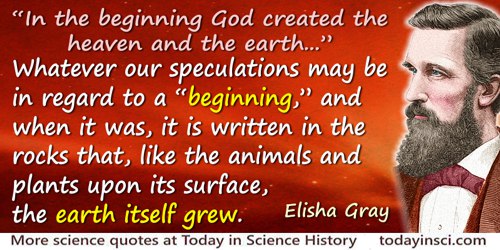
“In the beginning God created the heaven and the earth…” Whatever our speculations may be in regard to a “beginning,” and when it was, it is written in the rocks that, like the animals and plants upon its surface, the earth itself grew.
In Nature's Miracles: Familiar Talks on Science (1899), Vol. 1, 1.
“Time’s noblest offspring is the last.” This line of Bishop Berkeley’s expresses the real cause of the belief in progress in the animal creation.
Leonard G. Wilson (ed.), Sir Charles Lyell’s Scientific Journals on the Species Question (1970), 162.
[Coleridge] selected an instance of what was called the sublime, in DARWIN, who imagined the creation of the universe to have taken place in a moment, by the explosion of a mass of matter in the womb, or centre of space. In one and the same instant of time, suns and planets shot into systems in every direction, and filled and spangled the illimitable void! He asserted this to be an intolerable degradation—referring, as it were, all the beauty and harmony of nature to something like the bursting of a barrel of gunpowder! that spit its combustible materials into a pock-freckled creation!
In Seamus Perry (eds.), Coleridge’s Responses: Vol. 1: Coleridge on Writers and Writing (2007), 338-339.
[In the beginning, before creation] There was neither Aught nor Naught, no air nor sky beyond. …
[There was only]
A self-supporting mass beneath, and energy above.
Who knows, who ever told, from whence this vast creation rose?
No gods had yet been born—who then can e’er the truth disclose?
[There was only]
A self-supporting mass beneath, and energy above.
Who knows, who ever told, from whence this vast creation rose?
No gods had yet been born—who then can e’er the truth disclose?
— Rigveda
In Rigveda. In John Robson, Hinduism and Its Relations to Christianity (1893), 17.
[Other than fossils,] the most important of these other records of creation is, without doubt, ontogeny, that is, the history of the developmment of the organic individual (embryology and motamorphology). It briefly repeats in great and marked features the series of forms which the ancestors of the respective individuals have passed through from the beginning of their tribe. We have designated the palaeontological history of the development of the ancestors of a living form as the history of a tribe, or phylogeny, and we may therefore thus enunciate this exceedingly important biogenetic fundamental principle: “Ontogeny is a short and quick repetition, or recapitulation, of Phylogeny, determined by the laws of Inheritance and Adaptation.”
In Ernst Haeckel and E. Ray Lankester (trans.), The History of Creation (1876), Vol. 2, 33. Seen shortened to “Ontogeny recapitulates phylogeny.” This was Haeckel's (incorrect) answer to the vexing question of his time: what is the relationship between individual development (ontogeny) and the evolution of species and lineages (phylogeny)?
[Pavel Yablochkov’s electric lamp is] the starting point for the creation of a new branch of industry.
In 'Opasnosti elektricheskogo osveshcheniia', Elektrichestvo 4 (1890): 68. 2. As quoted in Loren Graham, Lonely Ideas: Can Russia Compete? (2013), 176.
[T]he human desire to escape the flesh, which took one form in asceticism, might take another form in the creation of machines. Thus, the wish to rise above the bestial body manifested itself not only in angels but in mechanical creatures. Certainly, once machines existed, humans clearly attached to them feelings of escape from the flesh.
The Fourth Discontinuity: The Co-Evolution of Humans and Machines (1993), 218.
[There was] in some of the intellectual leaders a great aspiration to demonstrate that the universe ran like a piece of clock-work, but this was was itself initially a religious
aspiration. It was felt that there would be something defective in Creation itself—something not quite worthy of God—unless the whole system of the universe could be shown to be interlocking, so that it carried the pattern of reasonableness and orderliness. Kepler, inaugurating the scientist’s quest for a mechanistic universe in the seventeenth century, is significant here—his mysticism, his music of the spheres, his rational deity demand a system which has the beauty of a piece of mathematics.
In The Origins of Modern Science (1950), 105.
[About describing atomic models in the language of classical physics:] We must be clear that when it comes to atoms, language can be used only as in poetry. The poet, too, is not nearly so concerned with describing facts as with creating images and establishing mental connections.
As quoted by Werner Heisenberg, as translated by Arnold J. Pomerans, in Physics and Beyond: Encounters and Conversations (1971), 41. The words are not verbatim, but as later recollected by Werner Heisenberg describing his early encounter with Bohr in 1920.
A l’aide de ces sciences expérimentales actives, l’homme devient un inventeur de phénomènes, un véritable contremaître de la création; et l'on ne saurait, sous ce rapport, assigner de limites à la puissance qu’il peut acquérir sur la nature, par les progrès futurs des sciences expérimentales
With the aid of these active experimental sciences man becomes an inventor of phenomena, a real foreman of creation; and under this head we cannot set limits to the power that he may gain over nature through future progress of the experimental sciences.
With the aid of these active experimental sciences man becomes an inventor of phenomena, a real foreman of creation; and under this head we cannot set limits to the power that he may gain over nature through future progress of the experimental sciences.
Original French text in Introduction à l'Étude de la Médecine Expérimentale (1898), 32. English version from An Introduction to the Study of Experimental Medicine (1865), as translated by Henry Copley Greene (1957), 18.
Air Force Chief of Staff: Doctor, what do you think of our new creation, the … Corporation?
von Kármán: Why, General, I think that corporation has already had an effect on the whole industry.
Air Force Chief of Staff: I’m delighted. What effect is that?
von Kármán: Why, they’ve upset the salary schedule of the whole industry.
von Kármán: Why, General, I think that corporation has already had an effect on the whole industry.
Air Force Chief of Staff: I’m delighted. What effect is that?
von Kármán: Why, they’ve upset the salary schedule of the whole industry.
As quoted by William R. Sears in 'Some Recollections of Theodore von Kármán', Address to the Symposium in Memory of Theodore von Kármán, Society for Industrial and Applied Mathematics, National Meeting (13-14 May 1964), Washington, D.C. Printed in Journal of the Society for Industrial and Applied Mathematics (Mar 1965), 13>, No. 1, 181. These are likely not verbatim words of Karman, but as recollected by Sears, giving an example of von Kármán’s willingness to speak truth to power.
Ante mare, et terras, et quod tegit omnia caelum, unus erat toto naturae vultus in orbe, quem dixere chaos: rudis indigestaque moles; nec quicquam, nisi pondus iners; congestaque eodem non bene iunctarum discordia, semina rerum.
Before there was the sea, the earth and the sky canopy, Nature presented the same aspect throughout the world, which men called Chaos: a raw, disorganized bulk; nothing but an inert mass; a jumbled heap of primordial things.
Before there was the sea, the earth and the sky canopy, Nature presented the same aspect throughout the world, which men called Chaos: a raw, disorganized bulk; nothing but an inert mass; a jumbled heap of primordial things.
The original Latin text of Ovid’s Metamorphoses, Book 1, lines 5-9, in which he described the Creation of the universe. It is freely translated by Webmaster blending several sources. See, for example, Locke (trans.), The First Book of Ovid's Metamorphoses, with a Literal Interlinear Translation (1828), 2, or Mary Innes (trans.), The Metamorphoses of Ovid (1955), 29.
Dilbert: Wow! According to my computer simulation, it should be possible to create new life forms from common household chemicals
Dogbert: This raises some thorny issues.
Dilbert: You mean legal, ethical and religious issues?
Dogbert: I was thinking about parking spaces.
Dogbert: This raises some thorny issues.
Dilbert: You mean legal, ethical and religious issues?
Dogbert: I was thinking about parking spaces.
Dilbert comic strip (31 May 1989).
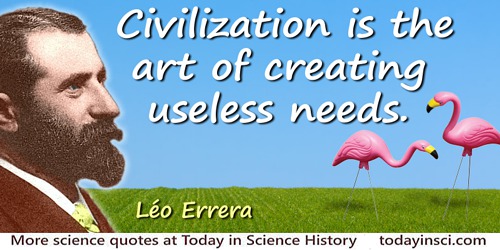
La civilisation, c'est l'art de se créer des besoins inutiles.
Civilization is the art of creating useless needs.
Civilization is the art of creating useless needs.
In Recueil d'Œuvres de Léo Errera: Botanique Générale (1908), 198. Google translation by Webmaster.
Le génie crée, le talent reproduit.
Genius creates, talent repeats.
Genius creates, talent repeats.
In Pailles et Poutres (1877), collected in La Pensées Française: Anthologie des Auteurs de Maximes du XVie Siècle a nos Jours (1921), 295. Alternative translations could be "talent reproduces" or "talent copies."
Numero pondere et mensura Deus omnia condidit.
God created everything by number, weight and measure.
God created everything by number, weight and measure.
On more than one occasion, Newton wrote these Latin words as his autograph, with his signature below. A photo of one example, dated “London 11 Sep 1722,” can be seen in I. Hargitta (ed.), Symmetry 2: Unifying Human Understanding (2014), 837. Reprinted from M. and B. Rozsondai, 'Symmetry Aspects of Bookbindings', Computers Math. Applic. (1989), 17, No. 4-6, 837. On this piece of paper, Newton dedicated these words to a Hungarian student, Ferenc Páriz Pápai Jr., whose album is now held by the Department of Manuscripts and Rare Books of the Library of the Hungarian Academy of Sciences (Shelf-number Tort. naplók, kis 8⁰ 6). The sentiment existed long before Newton used it. In the Bible, Wisdom of Solomon, 11:20, it appears as “Pondere, mensura, numero Deus omnia fecit,” (Vulgate) which the King James Version translates as “thou hast ordered all things in measure and number and weight.” Another Newton signed autograph with his Latin quote, dated 13 Jul 1716, sold (4 Apr 1991) for DM 9500 (about $31,000). See Dept of English, Temple University, The Scriblerian and the Kit-Cats (1991), 24-25, 230. A few years later, the sale (31 Mar 1998) of Newton's autograph cost the buyer $46,000. See Frank Ryan, Darwin's Blind Spot: Evolution Beyond Natural Selection (2002), 11-12. Other authors, including mathematicians, used the same Biblical passage. In Gilles Personne de Roberval's Aristarchi Samii de Mundi Systemate (1644), he frequently uses the abbreviation “P.N.E.M.” standing for “Pondere, mensura et mensura.” It was adopted as the motto of the Smeatonian Society of Engineers as “Omnia in Numero Pondere et Mensura.”
A ... hypothesis may be suggested, which supposes the word 'beginning' as applied by Moses in the first of the Book of Genesis, to express an undefined period of time which was antecedent to the last great change that affected the surface of the earth, and to the creation of its present animal and vegetable inhabitants; during which period a long series of operations and revolutions may have been going on, which, as they are wholly unconnected with the history of the human race, are passed over in silence by the sacred historian, whose only concern with them was largely to state, that the matter of the universe is not eternal and self-existent but was originally created by the power of the Almighty.
Vindiciae Geologicae (1820), 31-2.
A body of work such as Pasteur’s is inconceivable in our time: no man would be given a chance to create a whole science. Nowadays a path is scarcely opened up when the crowd begins to pour in.
Pensées d’un Biologiste (1939). Translated in The Substance of Man (1962), Chap. 6.
A celebrated author and divine has written to me that “he has gradually learnt to see that it is just as noble a conception of the Deity to believe that He created a few original forms capable of self-development into other and needful forms, as to believe that He required a fresh act of creation to supply the voids caused by the action of His laws.”
In Origin of Species (1860), 417.
A Frenchman who arrives in London, will find Philosophy, like every Thing else, very much chang’d there. He had left the World a plenum, and he now finds it a vacuum. At Paris the Universe is seen, compos’d of Vortices of subtile Matter; but nothing like it is seen in London. In France, ‘tis the Pressure of the Moon that causes the Tides; but in England ‘tis the Sea that gravitates towards the Moon; so what when you think that the Moon should make it flood with us, those Gentlemen fancy it should be Ebb, which, very unluckily, cannot be prov’d. For to be able to do this, ‘tis necessary the Moon and the Tides should have been enquir’d into, at the very instant of the Creation.
Letter XIV. 'On DesCartes and Sir Isaac Newton', in Letters Concerning the English Nation (1733), 109-110.
A great deal of the universe does not need any explanation. Elephants, for instance. Once molecules have learnt to compete and to create other molecules in their own image, elephants, and things resembling elephants, will in due course be found roaming around the countryside ... Some of the things resembling elephants will be men.
The Creation (1981), 3.
A paradigm is an all-encompassing idea, a model providing a way of looking at the world such that an array of diverse observations is united under one umbrella of belief, and a series of related questions are thus answered. Paradigms provide broad understanding, a certain “comfort level,” the psychological satisfaction associated with a mystery solved. What is important here, and perhaps surprising at first glance, is that a paradigm need not have much to do with reality. It does not have to be factual. It just needs to be satisfying to those whom it serves. For example, all creation myths, including the Judeo-Christian story of Adam and Eve in the Garden of Eden, are certainly paradigms, at least to those who subscribe to the particular faith that generated the myth.
From John Krichter, The Balance of Nature: Ecology's Enduring Myth (2009), 20.
A principle of induction would be a statement with the help of which we could put inductive inferences into a logically acceptable form. In the eyes of the upholders of inductive logic, a principle of induction is of supreme importance for scientific method: “... this principle”, says Reichenbach, “determines the truth of scientific theories. To eliminate it from science would mean nothing less than to deprive science of the power to decide the truth or falsity of its theories. Without it, clearly, science would no longer have the right to distinguish its theories from the fanciful and arbitrary creations of the poet’s mind.” Now this principle of induction cannot be a purely logical truth like a tautology or an analytic statement. Indeed, if there were such a thing as a purely logical principle of induction, there would be no problem of induction; for in this case, all inductive inferences would have to be regarded as purely logical or tautological transformations, just like inferences in inductive logic. Thus the principle of induction must be a synthetic statement; that is, a statement whose negation is not self-contradictory but logically possible. So the question arises why such a principle should be accepted at all, and how we can justify its acceptance on rational grounds.
…...
Absorbed in the special investigation, I paid no heed to the edifice which was meanwhile unconsciously building itself up. Having however completed the comparison of the fossil species in Paris, I wanted, for the sake of an easy revision of the same, to make a list according to their succession in geological formations, with a view of determining the characteristics more exactly and bringing them by their enumeration into bolder relief. What was my joy and surprise to find that the simplest enumeration of the fossil fishes according to their geological succession was also a complete statement of the natural relations of the families among themselves; that one might therefore read the genetic development of the whole class in the history of creation, the representation of the genera and species in the several families being therein determined; in one word, that the genetic succession of the fishes corresponds perfectly with their zoological classification, and with just that classification proposed by me.
Quoted in Elizabeth Cary Agassiz (ed.), Louis Agassiz: His Life and Correspondence (1885), Vol. I, 203-4.
According to the Boshongo people of central Africa, in the beginning, there was only darkness, water, and the great god Bumba. One day Bumba, in pain from a stomach ache, vomited up the sun. The sun dried up some of the water, leaving land. Still in pain, Bumba vomited up the moon, the stars, and then some animals. The leopard, the crocodile, the turtle, and finally, man. This creation myth, like many others, tries to answer the questions we all ask. Why are we here? Where did we come from?
Lecture (1987), 'The Origin of the Universe', collected in Black Holes And Baby Universes And Other Essays (1993), 99.
Acts of creation are ordinarily reserved for gods and poets, but humbler folk may circumvent this restriction if they know how. To plant a pine, for example, one need be neither god nor poet; one need only own a shovel. By virtue of this curious loophole in the rules, any clodhopper may say: Let there be a tree—and there will be one.
In 'December: Pines above the Snow', A Sand County Almanac, and Sketches Here and There (1949, 1987), 81.
After what has been premised, I think we may lay down the following Conclusions. First, It is plain Philosophers amuse themselves in vain, when they inquire for any natural efficient Cause, distinct from a Mind or Spirit. Secondly, Considering the whole Creation is the Workmanship of a wise and good Agent, it should seem to become Philosophers, to employ their Thoughts (contrary to what some hold) about the final Causes of Things: And I must confess, I see no reason, why pointing out the various Ends, to which natural Things are adapted and for which they were originally with unspeakable Wisdom contrived, should not be thought one good way of accounting for them, and altogether worthy a Philosopher.
A Treatise Concerning the Principles of Human Knowledge [first published 1710], (1734), 126-7.
All creation is a mine, and every man a miner.
The whole earth, and all within it, upon it, and round about it, including himself … are the infinitely various “leads” from which, man, from the first, was to dig out his destiny.
The whole earth, and all within it, upon it, and round about it, including himself … are the infinitely various “leads” from which, man, from the first, was to dig out his destiny.
Opening sentences of lecture 'Discoveries and Inventions', (1860) in Discoveries and Inventions (1915).
All I ever aim to do is to put the Development hypothesis in the same coach as the creation one. It will only be a question of who is to ride outside & who in after all.
Letter to Asa Gray (31 May 1859). Quoted in A. Hunter Dupree, Asa Gray: American Botanist, Friend of Darwin (1988), 265. Originally published as Asa Gray: 1810-1888 (1959).
All material Things seem to have been composed of the hard and solid Particles … variously associated with the first Creation by the Counsel of an intelligent Agent. For it became him who created them to set them in order: and if he did so, it is unphilosophical to seek for any other Origin of the World, or to pretend that it might arise out of a Chaos by the mere Laws of Nature.
From Opticks (1704, 2nd ed., 1718), 377-378.
All the scientist creates in a fact is the language in which he enunciates it. If he predicts a fact, he will employ this language, and for all those who can speak and understand it, his prediction is free from ambiguity. Moreover, this prediction once made, it evidently does not depend upon him whether it is fulfilled or not.
The Value of Science (1905), in The Foundations of Science: Science and Hypothesis, The Value of Science, Science and Method(1946), trans. by George Bruce Halsted, 332.
All things are from water and all things are resolved into water.
— Thales
Aetius 1.3.1., in H. Diels, Doxographi Graeci (1879), 276. Trans. R. W. Sharples.
All those things [scientific research] which you would think would recommend me to the trustees my opponent is using against me. I am shamefully abused as being an atheist, an infidel. It has been positively asserted that I seek to make proselytes to infidelity, and that in my writings I have tried to prove that geology overthrows the Mosaic account of the creation. You may judge of my feelings.”
In letter (1853) to Spencer F. Baird, describing competing for the opening for chair of anatomy. As quoted, without detailed source citation, in Henry Fairfield Osborn, 'Biographical Memoir of Joseph Leidy', collected in National Academy of Sciences, Biographical Memoirs: Volume 7 (1913), 346.
Almighty God, to whose efficacious Word all things owe their original, abounding in his own glorious Essence with infinite goodness and fecundity, did in the beginning Create Man after his own likeness, Male and Female, created he them; the true distinction of which Sexes, consists merely in the different site of those parts of the body, wherein Generation necessarily requires a Diversity: for both Male and Female he impartially endued with the same, and altogether indifferent form of Soul, the Woman being possess’d of no less excellent Faculties of Mind, Reason, and Speech, than the Man, and equally with him aspiring to those Regions of Bliss and Glory, where there shall be no exception of Sex.
In Female Pre-eminence: Or, The Dignity and Excellency of that Sex above the Male, translation (1670).
Although we are mere sojourners on the surface of the planet, chained to a mere point in space, enduring but for a moment of time, the human mind is not only enabled to number worlds beyond the unassisted ken of mortal eye, but to trace the events of indefinite ages before the creation of our race, and is not even withheld from penetrating into the dark secrets of the ocean, or the interior of the solid globe; free, like the spirit which the poet described as animating the universe.
In Principles of Geology (1830).
Among the older records, we find chapter after chapter of which we can read the characters, and make out their meaning: and as we approach the period of man’s creation, our book becomes more clear, and nature seems to speak to us in language so like our own, that we easily comprehend it. But just as we begin to enter on the history of physical changes going on before our eyes, and in which we ourselves bear a part, our chronicle seems to fail us—a leaf has been torn out from nature's record, and the succession of events is almost hidden from our eyes.
Letter 1 to William Wordsworth. Quoted in the appendix to W. Wordsworth, A Complete Guide to the Lakes, Comprising Minute Direction for the Tourist, with Mr Wordsworth's Description of the Scenery of the County and Three Letters upon the Geology of the Lake District (1842), 14.
An Individual, whatever species it might be, is nothing in the Universe. A hundred, a thousand individuals are still nothing. The species are the only creatures of Nature, perpetual creatures, as old and as permanent as it. In order to judge it better, we no longer consider the species as a collection or as a series of similar individuals, but as a whole independent of number, independent of time, a whole always living, always the same, a whole which has been counted as one in the works of creation, and which, as a consequence, makes only a unity in Nature.
'De la Nature: Seconde Vue', Histoire Naturelle, Générale et Particulière, Avec la Description du Cabinet du Roi (1765), Vol. 13, i. Trans. Phillip R. Sloan.
An inventive age
Has wrought, if not with speed of magic, yet
To most strange issues. I have lived to mark
A new and unforeseen creation rise
From out the labours of a peaceful Land:
Wielding her potent enginery to frame
And to produce, with appetite as keen
As that of war, which rests not night or day.
Has wrought, if not with speed of magic, yet
To most strange issues. I have lived to mark
A new and unforeseen creation rise
From out the labours of a peaceful Land:
Wielding her potent enginery to frame
And to produce, with appetite as keen
As that of war, which rests not night or day.
In The Excursion (1814). In The Works of William: Wordsworth (1994), Book 8, 875.
And God said, “Let the earth put forth vegetation, plants yielding seed, and fruit trees bearing fruit in which is their seed, each according to its kind.” And God saw that it was good. And there was evening and there was morning, a third day.
— Bible
(circa 725 B.C.)
And God saw everything that He had made, and, behold, it was very good.
— Bible
From Genesis, I, 31, in The Holy Bible (1756), 2.
And I believe there are many Species in Nature, which were never yet taken notice of by Man, and consequently of no use to him, which yet we are not to think were created in vain; but it’s likely … to partake of the overflowing Goodness of the Creator, and enjoy their own Beings. But though in this sense it be not true, that all things were made for Man; yet thus far it is, that all the Creatures in the World may be some way or other useful to us, at least to exercise our Wits and Understandings, in considering and contemplating of them, and so afford us Subject of Admiring and Glorifying their and our Maker. Seeing them, we do believe and assert that all things were in some sense made for us, we are thereby obliged to make use of them for those purposes for which they serve us, else we frustrate this End of their Creation.
— John Ray
The Wisdom of God Manifested in the Works of the Creation (1691), 169-70.
And so many think incorrectly that everything was created by the Creator in the beginning as it is seen, that not only the mountains, valleys, and waters, but also various types of minerals occurred together with the rest of the world, and therefore it is said that it is unnecessary to investigate the reasons why they differ in their internal properties and their locations. Such considerations are very dangerous for the growth of all the sciences, and hence for natural knowledge of the Earth, particularly the art of mining, though it is very easy for those clever people to be philosophers, having learnt by heart the three words 'God so created' and to give them in reply in place of all reasons.
About the Layers of the Earth and other Works on Geology (1757), trans. A. P. Lapov (1949), 55.
Are God and Nature then at strife,
That Nature lends such evil dreams?
So careful of the type she seems,
So careless of the single life; ...
'So careful of the type', but no.
From scarped cliff and quarried stone
She cries, 'A thousand types are gone:
I care for nothing, all shall go' ...
Man, her last work, who seemed so fair,
Such splendid purpose in his eyes,
Who rolled the psalm to wintry skies,
Who built him fanes of fruitless prayer,
Who trusted God was love indeed
And love Creation's final law—
Tho’ Nature red in tooth and claw
With ravine, shrieked against his creed...
That Nature lends such evil dreams?
So careful of the type she seems,
So careless of the single life; ...
'So careful of the type', but no.
From scarped cliff and quarried stone
She cries, 'A thousand types are gone:
I care for nothing, all shall go' ...
Man, her last work, who seemed so fair,
Such splendid purpose in his eyes,
Who rolled the psalm to wintry skies,
Who built him fanes of fruitless prayer,
Who trusted God was love indeed
And love Creation's final law—
Tho’ Nature red in tooth and claw
With ravine, shrieked against his creed...
In Memoriam A. H. H. (1850), Cantos 56-57. Collected in Alfred Tennyson and William James Rolfe (ed.) The Poetic and Dramatic works of Alfred, Lord Tennyson (1898), 176.
Aristotle discovered all the half-truths which were necessary to the creation of science.
From Dialogue XLII in Alfred North Whitehead and Lucien Price (ed.), Dialogues of Alfred North Whitehead (1954, 1977), 344.
Arithmetic must be discovered in just the same sense in which Columbus discovered the West Indies, and we no more create numbers than he created the Indians.
The Principles of Mathematics (1903), 451.
As an individual opinion of mine, perhaps not as yet shared by many, I may be permitted to state, by the way, that I consider pure Mathematics to be only one branch of general Logic, the branch originating from the creation of Number, to the economical virtues of which is due the enormous development that particular branch has been favored with in comparison with the other branches of Logic that until of late almost remained stationary.
In Lecture (10 Aug 1898) present in German to the First International Congress of Mathematicians in Zürich, 'On Pasigraphy: Its Present State and the Pasigraphic Movement in Italy'. As translated and published in The Monist (1899), 9, No. 1, 46.
As I show you this liquid, I too could tell you, 'I took my drop of water from the immensity of creation, and I took it filled with that fecund jelly, that is, to use the language of science, full of the elements needed for the development of lower creatures. And then I waited, and I observed, and I asked questions of it, and I asked it to repeat the original act of creation for me; what a sight it would be! But it is silent! It has been silent for several years, ever since I began these experiments. Yes! And it is because I have kept away from it, and am keeping away from it to this moment, the only thing that it has not been given to man to produce, I have kept away from it the germs that are floating in the air, I have kept away from it life, for life is the germ, and the germ is life.'
Quoted in Patrice Debré, Louis Pasteur, trans. Elborg Forster (1994), 169.
As to Bell’s talking telegraph, it only creates interest in scientific circles, and, as a toy it is beautiful; but … its commercial value will be limited.
Letter to William D. Baldwin, his attorney (1 Nov 1876). Telephone Investigating Committee, House of Representatives, United States 49th Congress, 1st Session, Miscellaneous Documents (1886), No. 355, 1186.
At first, the sea, the earth, and the heaven, which covers all things, were the only face of nature throughout the whole universe, which men have named Chaos; a rude and undigested mass, and nothing more than an inert weight, and the discordant atoms of things not harmonizing, heaped together in the same spot.
Describing the creation of the universe from chaos, at the beginning of Book I of Metamorphoses, lines 5-9. As translated by Henry T. Riley, The Metamorphoses of Ovid, Vol I: Books I-VII (1858), 1-2. Riley footnoted: “A rude and undigested mass.—Ver. 7. This is very similar to the words of the Scriptures, ‘And the earth was without form and void,’ Genesis, ch. i. ver. 2.”
At the end of the book [Zoonomia] he sums up his [Erasmus Darwin] views in the following sentences: “The world has been evolved, not created: it has arisen little by little from a small beginning, and has increased through the activity of the elemental forces embodied in itself, and so has rather grown than come into being at an almighty word.” “What a sublime idea of the infinite might of the great Architect, the Cause of all causes, the Father of all fathers, the Ens Entium! For if we would compare the Infinite, it would surely require a greater Infinite to cause the causes of effects than to produce the effects themselves.”
[This is a restatement, not a verbatim quote of the original words of Erasmus Darwin, who attributed the idea he summarized to David Hume.]
[This is a restatement, not a verbatim quote of the original words of Erasmus Darwin, who attributed the idea he summarized to David Hume.]
In August Weismann, John Arthur Thomson (trans.), Margaret R. Thomson (trans.) The Evolution Theory (1904), Vol. 1, 17-18. The verbatim form of the quote from Zoonomia, in context, can be seen on the webpage here for Erasmus Darwin. Later authors have quoted from Weismann's translated book, and given the reworded passage as a direct quote by Erasmus Darwin. Webmaster has found a verbatim form in Zoonomia (1794), but has been unable to find the wording used by Weismann in any primary source by Erasmus Darwin. The rewording is perhaps due to the translation of the quote into German for Weismann's original book, Vorträge über Descendenztheorie (1902) followed by another translation for the English edition.
Before an experiment can be performed, it must be planned—the question to nature must be formulated before being posed. Before the result of a measurement can be used, it must be interpreted—nature's answer must be understood properly. These two tasks are those of the theorist, who finds himself always more and more dependent on the tools of abstract mathematics. Of course, this does not mean that the experimenter does not also engage in theoretical deliberations. The foremost classical example of a major achievement produced by such a division of labor is the creation of spectrum analysis by the joint efforts of Robert Bunsen, the experimenter, and Gustav Kirchoff, the theorist. Since then, spectrum analysis has been continually developing and bearing ever richer fruit.
'The Meaning and Limits of Exact Science', Science (30 Sep 1949), 110, No. 2857, 325. Advance reprinting of chapter from book Max Planck, Scientific Autobiography (1949), 110.
Before the seas and lands had been created, before the sky that covers everything, Nature displayed a single aspect only throughout the cosmos; Chaos was its name, a shapeless, unwrought mass of inert bulk and nothing more, with the discordant seeds of disconnected elements all heaped together in anarchic disarray.
Describing the creation of the universe from chaos, at the beginning of Book I of Metamorphoses, lines 5-9. As translated in Charles Martin (trans.), Metamorphoses (2004), 15.
Both the man of science and the man of art live always at the edge of mystery, surrounded by it; both always, as to the measure of their creation, have had to do with the harmonization of what is new with what is familiar, with the balance between novelty and synthesis, with the struggle to make partial order in total chaos.
Address at the close of the year-long Bicentennial Celebration of Columbia University (26 Dec 54). Printed in 'Prospects in the Arts and Sciences', Bulletin of the Atomic Scientists (Feb 1955), 52.
But if anyone, well seen in the knowledge, not onely of Sacred and exotick History, but of Astronomical Calculation, and the old Hebrew Kalendar, shall apply himself to these studies, I judge it indeed difficult, but not impossible for such a one to attain, not onely the number of years, but even, of dayes from the Creation of the World.
In 'Epistle to the Reader', The Annals of the World (1658). As excerpted in Wallen Yep, Man Before Adam: A Correction to Doctrinal Theology, "The Missing Link Found" (2002), 18.
But the dreams about the modes of creation, enquiries whether our globe has been formed by the agency of fire or water, how many millions of years it has cost Vulcan or Neptune to produce what the fiat of the Creator would effect by a single act of will, is too idle to be worth a single hour of any man’s life.
Letter (2 May 1826) to Doctor John P. Emmet. Collected in The Writings of Thomas Jefferson (1854), Vol. 7, 443.
But to proceed; as in order and place, so also in matter of her Creation, Woman far excells Man. things receive their value from the matter they are made of, and the excellent skill of their maker: Pots of common clay must not contend with China-dishes, nor pewter utensils vye dignity with those of silver…. Woman was not composed of any inanimate or vile dirt, but of a more refined and purified substance, enlivened and actuated by a Rational Soul, whose operations speak it a beam, or bright ray of Divinity.
In Female Pre-eminence: Or, The Dignity and Excellency of that Sex above the Male, translation (1670).
But we have reason to think that the annihilation of work is no less a physical impossibility than its creation, that is, than perpetual motion.
'On the Change of Refrangibility of Light' (1852). In Mathematical and Physical Papers (1901), Vol. 3, 397.
Calculation touches, at most, certain phenomena of organic destruction. Organic creation, on the contrary, the evolutionary phenomena which properly constitute life, we cannot in any way subject to a mathematical treatment.
In Creative Evolution (1911).
Chance alone is at the source of every innovaton, of all creation in the biosphere. Pure chance, only chance, absolute but blind liberty is at the root of the prodigious edifice that is evolution... It today is the sole conceivable hypothesis, the only one that squares with observed and tested fact.
Stating life began by the chance collision of particles of nucleic acid in the “prebiotic soup.”
Stating life began by the chance collision of particles of nucleic acid in the “prebiotic soup.”
In Jacques Monod and Austryn Wainhouse (trans.), Chance and Necessity: An Essay on the Natural Philosophy of Modern Biology (1971), 112-113.
Change requires experimentation. But no problem can be solved by the same consciousness that created it. Our job is to dream—and to make those dreams happen.
In interview article, 'Designing For The Future', Newsweek (15 May 2005).
Chemical analysis and synthesis go no farther than to the separation of particles one from another, and to their reunion. No new creation or destruction of matter is within the reach of chemical agency. We might as well attempt to introduce a new planet into the solar system, or to annihilate one already in existence, as to create or destroy a particle of hydrogen.
A New System of Chemical Philosophy (1808), Vol. 1, 212.
Creation came out of chaos, is surrounded by chaos, and will end in chaos.
Given in Kathleen McAuliffe, 'Get Smart: Controlling Chaos,' Omni (1990), 12, No. 5, 43. As quoted and cited in Information Technology, It’s for everyone!: Proceedings of the LITA Third National Conference, Library and Information Technology Association, Denver, September 13-16, 1992 (1992), 202.
Creation is a drug I can't do without.
Quoted in Gladwin Hill, 'Most Colossal of All', New York Times (12 Aug 1956), 179.
CREATION OF LIFE.
The Startling Discovery of Prof. Loeb.
Lower Animals Produced by Chemical Means.
Process May Apply to the Human Species.
Immaculate Conception is Explained.
Wonderful Experiments Conducted at Woods Hole.
The Startling Discovery of Prof. Loeb.
Lower Animals Produced by Chemical Means.
Process May Apply to the Human Species.
Immaculate Conception is Explained.
Wonderful Experiments Conducted at Woods Hole.
The Boston Herald (26 Nov 1899), 17.
Creation science has not entered the curriculum for a reason so simple and so basic that we often forget to mention it: because it is false, and because good teachers understand why it is false. What could be more destructive of that most fragile yet most precious commodity in our entire intellectual heritage—good teaching—than a bill forcing our honorable teachers to sully their sacred trust by granting equal treatment to a doctrine not only known to be false, but calculated to undermine any general understanding of science as an enterprise?.
In 'The Verdict on Creationism' The Sketical Inquirer (Winter 1987/88), 12, 186.
Creationists have also changed their name ... to intelligent design theorists who study 'irreducible complexity' and the 'abrupt appearance' of life—yet more jargon for 'God did it.' ... Notice that they have no interest in replacing evolution with native American creation myths or including the Code of Hammarabi alongside the posting of the Ten Commandments in public schools.
'75 Years and Still No Peace'. Humanist (Sep 2000)
Damn the Solar System. Bad light; planets too distant; pestered with comets; feeble contrivance; could make a better myself.
Attributed.
Darwin abolished special creations, contributed the Origin of Species and hitched all life together in one unbroken procession of Siamese Twins, the whole evolved by natural and orderly processes from one microscopic parent germ.
'The Secret History of Eddypus', in Mark Twain and David Ketterer (ed.), Tales of Wonder (2003), 223.
Domesticated biotechnology, once it gets into the hands of housewives and children, will give us an explosion of diversity of new living creatures … New lineages will proliferate to replace those that monoculture farming and deforestation have destroyed. Designing genomes will be a personal thing, a new art form as creative as painting or sculpture. Few of the new creations will be masterpieces, but a great many will bring joy to their creators and variety to our fauna and flora.
In 'Our Biotech Future', The New York Review of Books (2007). As quoted and cited in Kenneth Brower, 'The Danger of Cosmic Genius', The Atlantic (Dec 2010).
During cycles long anterior to the creation of the human race, and while the surface of the globe was passing from one condition to another, whole races of animals–each group adapted to the physical conditions in which they lived–were successively created and exterminated.
Siluria (1854), 5.
Each worldview was a cultural product, but evolution is true and separate creation is not ... Worldviews are social constructions, and they channel the search for facts. But facts are found and knowledge progresses, however fitfully. Fact and theory are intertwined, and all great scientists understand the interaction.
…...
Earlier theories … were based on the hypothesis that all the matter in the universe was created in one big bang at a particular time in the remote past. [Coining the “big bang” expression.]
From microfilmed Speaker's Copy of a radio script held at the BBC Written Archive Centre, for Hoyle's radio talk on the BBC Third Programme (28 Mar 1949). The date and time of the broadcast, 6:30pm, are given in that week’s Radio Times. The quote, with these references given in footnotes, in Simon Mitton, Fred Hoyle: A Life in Science (2011), 127-128 and 332. The text of the talk, the first printed use of the “big bang” expression, in the BBC’s The Listener magazine (7 Apr 1949), Vol.41, 568.
Einstein’s space is no closer to reality than Van Gogh’s sky. The glory of science is not in a truth more absolute than the truth of Bach or Tolstoy, but in the act of creation itself. The scientist’s discoveries impose his own order on chaos, as the composer or painter imposes his; an order that always refers to limited aspects of reality, and is based on the observer's frame of reference, which differs from period to period as a Rembrandt nude differs from a nude by Manet.
In The Act of Creation (1964), 252.
Even now, the imprisoned winds which the earliest poet made the Grecian warrior bear for the protection of his fragile bark; or those which, in more modern times, the Lapland wizards sold to the deluded sailors;—these, the unreal creations of fancy or of fraud, called, at the command of science, from their shadowy existence, obey a holier spell: and the unruly masters of the poet and the seer become the obedient slaves of civilized man.
In 'Future Prospects', On the Economy of Machinery and Manufactures (1st ed., 1832), chap. 32, 280.
Every thoughtful man who hopes for the creation of a contemporary culture knows that this hinges on one central problem: to find a coherent relation between science and the humanities.
With co-author Bruce Mazlish, in The Western Intellectual Tradition (1960).
Everything in nature is a puzzle until it finds its solution in man, who solves it in some way with God, and so completes the circle of creation.
The Appeal to Life (1891), 315.
Everything that the human race has done and thought is concerned with the satisfaction of deeply felt needs and the assuagement of pain. One has to keep this constantly in mind if one wishes to understand spiritual movements and their development. Feeling and longing are the motive force behind all human endeavor and human creation, in however exalted a guise the latter may present themselves to us.
In Essay, 'On Religion and Science' as collected in Ideas And Opinions. (2010), 35 [where it is cited as “Written expressly for the New York Times Magazine” (9 Nov 1930), “pp. (1-4). The German
text was published in the Berliner Tageblatt” (11 Nov 1930).] Also seen in New York Times archive newspaper image as: “Everything that men do or think concerns the satisfaction of the needs they feel or the escape from pain. This must be kept in mind when we seek to understand spiritual or intellectual movements and the way in which they develop. For feeling and longing are the motive forces of all human striving and productivity—however nobly these latter may display themselves to us,” in 'Religion and Science', New York Times Magazine (9 Nov 1930), 1. [It is a puzzle that these are two totally different paragraphs (albeit with the same gist): one quoted and cited in a book, and one from a direct image from NYT archive (timesmachine). Yet the first claims to have been “expressly written” for the cited newspaper article, which does not match that wording in the image record of the actual newspaper. However, the printed book title page states: Based on Mein Welttrild, edited by Cal Seelig, and other sources. New translations and revisions by Sonja Bargmann. So perhaps (at a guess) the first version of the quote shown above is a translation from the German newspaper? —Webmaster]
For me, the idea of a creation is not conceivable without invoking the necessity of design. One cannot be exposed to the law and order of the universe without concluding that there must be design and purpose behind it all.
In letter to California State board of Education (14 Sep 1972).
Games are among the most interesting creations of the human mind, and the analysis of their structure is full of adventure and surprises. Unfortunately there is never a lack of mathematicians for the job of transforming delectable ingredients into a dish that tastes like a damp blanket.
In J.R. Newman (ed.), 'Commentary on Games and Puzzles', The World of Mathematics (1956), Vol. 4, 2414.
Genetics has enticed a great many explorers during the past two decades. They have labored with fruit-flies and guinea-pigs, with sweet peas and corn, with thousands of animals and plants in fact, and they have made heredity no longer a mystery but an exact science to be ranked close behind physics and chemistry in definiteness of conception. One is inclined to believe, however, that the unique magnetic attraction of genetics lies in the vision of potential good which it holds for mankind rather than a circumscribed interest in the hereditary mechanisms of the lowly species used as laboratory material. If man had been found to be sharply demarcated from the rest of the occupants of the world, so that his heritage of physical form, of physiological function, and of mental attributes came about in a superior manner setting him apart as lord of creation, interest in the genetics of the humbler organisms—if one admits the truth—would have flagged severely. Biologists would have turned their attention largely to the ways of human heredity, in spite of the fact that the difficulties encountered would have rendered progress slow and uncertain. Since this was not the case, since the laws ruling the inheritance of the denizens of the garden and the inmates of the stable were found to be applicable to prince and potentate as well, one could shut himself up in his laboratory and labor to his heart's content, feeling certain that any truth which it fell to his lot to discover had a real human interest, after all.
Mankind at the Crossroads (1923), v-vi.
Geology differs as widely from cosmogony, as speculations concerning the creation of man differ from history.
Principles of Geology (1830-3), Vol. 1, 4.
Geology does better in reclothing dry bones and revealing lost creations, than in tracing veins of lead and beds of iron; astronomy better in opening to us the houses of heaven than in teaching navigation; surgery better in investigating organiation than in setting limbs; only it is ordained that, for our encouragement, every step we make in science adds something to its practical applicabilities.
Modern Painters (1852), Part 3, 8-9.
Geology fully proves that organic creation passed through a series of stages before the highest vegetable and animal forms appeared.
Explanations (1845), 31
Geology may seem to be audacious in its attempts to unveil the mysteries of creation. Yet what it reveals are only some of the methods by which the Creator has performed his will; and many deeper mysteries it leaves untouched.
In 'Concluding Remarks', A Text-book of Geology: Designed for Schools and Academies (1863), 336.
Geometry, which before the origin of things was coeternal with the divine mind and is God himself (for what could there be in God which would not be God himself?), supplied God with patterns for the creation of the world, and passed over to Man along with the image of God; and was not in fact taken in through the eyes.
Harmonice Mundi, The Harmony of the World (1619), book IV, ch. 1. Trans. E. J. Aiton, A. M. Duncan and J. V. Field (1997), 304.
God created man in his own image, says the Bible; the philosophers do the exact opposite, they create God in theirs.
Aphorism 48 in Notebook D (1773-1775), as translated by R.J. Hollingdale in Aphorisms (1990). Reprinted as The Waste Books (2000), 51.
God has not revealed all things to man and has entrusted us with but a fragment of His mighty work. But He who directs all things, who has established and laid the foundation of the world, who has clothed Himself with Creation, He is greater and better than that which He has wrought. Hidden from our eyes, He can only be reached by the spirit.
From Quaestiones Naturales as translated in Charles Singer, From Magic to Science (1958), 57.
God has ordered all his Creation by Weight and Measure.
Written over the door of the world's first instructional laboratory, founded at Giessen, 1824.
Written over the door of the world's first instructional laboratory, founded at Giessen, 1824.
As given in Patterns of Survival: An Anatomy of Life (1938), 2. It is based on a line from the Bible in Wisdom of Solomon, Chap. 11, Verse 20. Webmaster presumes this is the English translation, but Liebig used the dictum written in German. Contact webmaster if you know the specific wording of the original.
God made everything out of nothing. But the nothingness shows through.
Mauvaises pensées et autres (1942). In Bill Swainson and Anne H. Soukhanov. Encarta Book of Quotations (2000), 951.
God used beautiful mathematics in creating the world.
Quoted in Behram Kursunoglu and Eugene Paul Wigner, Paul Adrien Maurice Dirac (1990), Preface, xv.
God was always invented to explain mystery. God is always invented to explain those things that you do not understand. Now, when you finally discover how something works … you don't need him anymore. But … you leave him to create the universe because we haven't figured that out yet.
Interview, collected in Paul C. W. Davies and Julian R. Brown (eds.) Superstrings: A Theory of Everything? (1988), 208-209.
Great inventions are never, and great discoveries are seldom, the work of any one mind. Every great invention is really an aggregation of minor inventions, or the final step of a progression. It is not usually a creation, but a growth, as truly so as is the growth of the trees in the forest.
In 'The Growth of the Steam-Engine', The Popular Science Monthly (Nov 1877), 17.
Had I been present at the Creation, I would have given some useful hints for the better ordering of the universe.
Remarking on the complexity of Ptolemaic model of the universe after it was explained to him.
Footnote: Carlyle says, in his History of Frederick the Great, book ii. chap. vii. that this saying of Alphonso about Ptolemy's astronomy, 'that it seemed a crank machine; that it was pity the Creator had not taken advice,' is still remembered by mankind, — this and no other of his many sayings.
Remarking on the complexity of Ptolemaic model of the universe after it was explained to him.
Footnote: Carlyle says, in his History of Frederick the Great, book ii. chap. vii. that this saying of Alphonso about Ptolemy's astronomy, 'that it seemed a crank machine; that it was pity the Creator had not taken advice,' is still remembered by mankind, — this and no other of his many sayings.
In John Bartlett and Nathan Haskell Dole (Ed.), Familiar Quotations: A Collection of Passages, Phrases, and Proverbs Traced to Their Sources (1914), 954.
He who has mastered the Darwinian theory, he who recognizes the slow and subtle process of evolution as the way in which God makes things come to pass, … sees that in the deadly struggle for existence that has raged throughout countless aeons of time, the whole creation has been groaning and travailing together in order to bring forth that last consummate specimen of God’s handiwork, the Human Soul
In The Destiny of Man Viewed in the Light of his Origin (1884), 32. Collected in Studies in Religion (1902), 19–20.
Historians constantly rewrite history, reinterpreting (reorganizing) the records of the past. So, too, when the brain's coherent responses become part of a memory, they are organized anew as part of the structure of consciousness. What makes them memories is that they become part of that structure and thus form part of the sense of self; my sense of self derives from a certainty that my experiences refer back to me, the individual who is having them. Hence the sense of the past, of history, of memory, is in part the creation of the self.
The Strange, Familiar, and Forgotten: An Anatomy of Consciousness (1995), 87.
Hitherto, no rival hypothesis has been proposed as a substitute for the doctrine of transmutation; for 'independent creation,' as it is often termed, or the direct intervention of the Supreme Cause, must simply be considered as an avowal that we deem the question to lie beyond the domain of science.
The Antiquity of Man (1863), 421.
Hogwash! … On our way to the moon, and on the moon, I worked as hard as John Young and it took me another six years before I found out the truth about God. In the days of Apollo and long afterwards I still believed in the theory of evolution and rejected the Biblical creation story. [Commenting on an American reporter’s printed intimation that Lunar Module pilots “had less things to do and had time to look out the spaceship’s window, or to explore the surroundings. Afterwards they could not cope with what they had seen, felt and experienced.”]
As quoted in Colin Burgess, Footprints in the Dust: The Epic Voyages of Apollo, 1969-1975 (2010), 422. Burgess introduced the quote with: “Charles Moss Duke Jr. has always been wrongly labeled as the astronaut who found God during his Apollo 16 mission, but even though he did eventually become a born-again Christian, this life-altering epiphany came some years after the event.” Burgess explained that Duke dislikes “misinformed characterizations of himself and his Apollo colleagues and of the religious impact of his own lunar mission.” [The ellipsis in the subject quote spans from one paragraph to the next in Burgess’ book. The ellipsis was added by Webmaster, on the assumption that the word “Hogwash!” belongs with the statement in the following paragraph.]
How I hate the man who talks about the “brute creation”, with an ugly emphasis on Brute. Only Christians are capable of it. As for me, I am proud of my close kinship with other animals. I take a jealous pride in my Simian ancestry. I like to think that I was once a magnificent hairy fellow living in the trees and that my frame has come down through geological time via sea jelly and worms and Amphioxus, Fish, Dinosaurs, and Apes. Who would exchange these for the pallid couple in the Garden of Eden?
In W.N.P. Barbellion, The Journal of a Disappointed Man (1919), 27-28.
How many and how curious problems concern the commonest of the sea-snails creeping over the wet sea-weed! In how many points of view may its history be considered! There are its origin and development, the mystery of its generation, the phenomena of its growth, all concerning each apparently insignificant individual; there is the history of the species, the value of its distinctive marks, the features which link it with the higher and lower creatures, the reason why it takes its stand where we place it in the scale of creation, the course of its distribution, the causes of its diffusion, its antiquity or novelty, the mystery (deepest of mysteries) of its first appearance, the changes of the outline of continents and of oceans which have taken place since its advent, and their influence on its own wanderings.
On the Natural History of European Seas. In George Wilson and Archibald Geikie, Memoir of Edward Forbes F.R.S. (1861), 547-8.
How often might a man, after he had jumbled a set of letters in a bag, fling them out upon the ground before they would fall into an exact poem, yea, or so much as make a good discourse in prose. And may not a little book be as easily made by chance as this great volume of the world.
In The Works of the Most Reverend Dr. John Tillotson (1714), 15.
However far the calculating reason of the mathematician may seem separated from the bold flight of the artist’s phantasy, it must be remembered that these expressions are but momentary images snatched arbitrarily from among the activities of both. In the projection of new theories the mathematician needs as bold and creative a phantasy as the productive artist, and in the execution of the details of a composition the artist too must calculate dispassionately the means which are necessary for the successful consummation of the parts. Common to both is the creation, the generation, of forms out of mind.
From Die Entwickelung der Mathematik im Zusammenhange mit der Ausbreitung der Kultur (1893), 4. As translated in Robert Édouard Moritz, Memorabilia Mathematica; Or, The Philomath’s Quotation-Book (1914), 185. From the original German, “Wie weit auch der rechnende Verstand des Mathematikers von dem kühnen Fluge der Phantasie des Künstlers getrennt zu sein scheint, so bezeichnen diese Ausdrücke doch blosse Augenblicksbilder, die willkürlich aus der Thätigkeit Beider herausgerissen sind. Bei dem Entwurfe neuer Theorieen bedarf der Mathematiker einer ebenso kühnen und schöpferischen Phantasie wie der schaffende Künstler, und bei der Ausführung der Einzelheiten eines Werkes muss auch der Künstler kühl alle Mittel berechnen, welche zum Gelingen der Theile erforderlich sind. Gemeinsam ist Beiden die Hervorbringung, die Erzeugung der Gebilde aus dem Geiste.”
However far the mathematician’s calculating senses seem to be separated from the audacious flight of the artist’s imagination, these manifestations refer to mere instantaneous images, which have been arbitrarily torn from the operation of both. In designing new theories, the mathematician needs an equally bold and inspired imagination as creative as the artist, and in carrying out the details of a work the artist must unemotionally reckon all the resources necessary for the success of the parts. Common to both is the fabrication, the creation of the structure from the intellect.
From Die Entwickelung der Mathematik im Zusammenhange mit der Ausbreitung der Kultur (1893), 4. Translated by Webmaster using online resources. From the original German, “Wie weit auch der rechnende Verstand des Mathematikers von dem kühnen Fluge der Phantasie des Künstlers getrennt zu sein scheint, so bezeichnen diese Ausdrücke doch blosse Augenblicksbilder, die willkürlich aus der Thätigkeit Beider herausgerissen sind. Bei dem Entwurfe neuer Theorieen bedarf der Mathematiker einer ebenso kühnen und schöpferischen Phantasie wie der schaffende Künstler, und bei der Ausführung der Einzelheiten eines Werkes muss auch der Künstler kühl alle Mittel berechnen, welche zum Gelingen der Theile erforderlich sind. Gemeinsam ist Beiden die Hervorbringung, die Erzeugung der Gebilde aus dem Geiste.”
However, before we come to [special] creation, which puts an end to all discussion: I think we should try everything else.
De Stella Nova, On the New Star (1606), Chapter 22, in Johannes Kepler Gesammelte Werke (1937-), Vol. 1, 257, ll. 23-4.
Humanities are inseparable from human creations, whether these be philosophic, scientific, technical, or artistic and literary. They exist in everything to which men have imparted their virtues or vices, their joys or sufferings. There are blood and tears in geometry as well as in art, blood and tears but also innumerable joys, the purest that men can experience themselves or share with others.
In A History of Science: Hellenistic Science and Culture in the Last Three Centuries B.C. (1959), ix.
Humanity, in the course of time, had to endure from the hands of science two great outrages against its naive self-love. The first was when humanity discovered that our earth was not the center of the universe…. The second occurred when biological research robbed man of his apparent superiority under special creation, and rebuked him with his descent from the animal kingdom, and his ineradicable animal nature.
From a series of 28 lectures for laymen, Part Three, 'General Theory of the Neurons', Lecture 18, 'Traumatic Fixation—the Unconscious' collected in Sigmund Freud and G. Stanley Hall (trans.), A General Introduction to Psychoanalysis (1920), 246-247.
I am a creationist and an evolutionist. Evolution is God's, or Nature's method of creation. Creation is not an event that happened in 4004 BC; it is a process that began some 10 billion years ago and is still under way.
In 'Nothing in Biology Makes Sense Except in the Light of Evolution', The American Biology Teacher (Mar 1973), 125-129.
I assume that each organism which the Creator educed was stamped with an indelible specific character, which made it what it was, and distinguished it from everything else, however near or like. I assume that such character has been, and is, indelible and immutable; that the characters which distinguish species now, were as definite at the first instant of their creation as now and are as distinct now as they were then. If any choose to maintain... that species were gradually bought to their present maturity from humbler forms... he is welcome to his hypothesis, but I have nothing to do with it.
Omphalos: An Attempt to Untie the Geological Knot (1857), 111.
I beheld the wretch—the miserable monster whom I had created.
In Frankenstein (1818, 1823), 100.
I believe that mathematical reality lies outside us, that our function is to discover or observe it, and that the theorems which we prove, and which we describe grandiloquently as our “creations,” are simply the notes of our observations.
In A Mathematician's Apology (1940, reprint with Foreward by C.P. Snow 1992), 113.
I cannot imagine a God who rewards and punishes the objects of his creation, whose purposes are modeled after our own–a God, in short, who is but a reflection of human frailty. Neither can I believe that the individual survives the death of his body, although feeble souls harbor such thoughts through fear or ridiculous egotism. It is enough for me to contemplate the mystery of conscious life perpetuating itself through all eternity, to reflect upon the marvelous structure of the universe which we can dimly perceive, and to try humbly to comprehend even an infinitesimal part of the intelligence manifested in nature.
From 'What I Believe: Living Philosophies XIII', Forum and Century (Oct 1930), 84, No. 4, 194. Article in full, reprinted in Edward H. Cotton (ed.), Has Science Discovered God? A Symposium of Modern Scientific Opinion (1931), 97.
I consider [H. G. Wells], as a purely imaginative writer, to be deserving of very high praise, but our methods are entirely different. I have always made a point in my romances of basing my so-called inventions upon a groundwork of actual fact, and of using in their construction methods and materials which are not entirely without the pale of contemporary engineering skill and knowledge. ... The creations of Mr. Wells, on the other hand, belong unreservedly to an age and degree of scientific knowledge far removed from the present, though I will not say entirely beyond the limits of the possible.
Gordon Jones, 'Jules Verne at Home', Temple Bar (Jun 1904), 129, 670.
I despise Birth-Control first because it is ... an entirely meaningless word; and is used so as to curry favour even with those who would first recoil from its real meaning. The proceeding these quack doctors recommend does not control any birth. ... But these people know perfectly well that they dare not write the plain word Birth-Prevention, in any one of the hundred places where they write the hypocritical word Birth-Control. They know as well as I do that the very word Birth-Prevention would strike a chill into the public... Therefore they use a conventional and unmeaning word, which may make the quack medicine sound more innocuous. ... A child is the very sign and sacrament of personal freedom. He is a fresh will added to the wills of the world; he is something that his parents have freely chosen to produce ... he is their own creative contribution to creation.
In 'Babies and Distributism', The Well and the Shadows (1935). Collected in G. K. Chesterton and Dale Ahlquist (ed.), In Defense of Sanity: The Best Essays of G.K. Chesterton (2011), 272.

I do not think there is any thrill that can go through the human heart like that felt by the inventor as he sees some creation of the brain unfolding to success... Such emotions make a man forget food, sleep, friends, love, everything.
Quoted by Cleveland Moffitt, 'A Talk With Tesla', Atlanta Constitution (7 Jun 1896)
I don’t understand why people insist on pitting concepts of evolution and creation against each other. Why can’t they see that spiritualism and science are one? That bodies evolve and souls evolve and the universe is a fluid package that marries them both in a wonderful package called a human being.
The Art of Racing in the Rain. Quoted in Kim Lim (ed.), 1,001 Pearls of Spiritual Wisdom: Words to Enrich, Inspire, and Guide Your Life (2014), 43
I have never done anything “useful.” No discovery of mine has made, or is likely to make, directly or indirectly, for good or ill, the least difference to the amenity of the world... Judged by all practical standards, the value of my mathematical life is nil; and outside mathematics it is trivial anyhow. I have just one chance of escaping a verdict of complete triviality, that I may be judged to have created something worth creating. And that I have created something is undeniable: the question is about its value. [The things I have added to knowledge do not differ from] the creations of the other artists, great or small, who have left some kind of memorial beind them.
Concluding remarks in A Mathmatician's Apology (1940, 2012), 150-151.
I now think the answer is very simple: it’s true. God did create the universe about 13.7 billion years ago, and of necessity has involved Himself with His creation ever since. The purpose of this universe is something that only God knows for sure, but it is increasingly clear to modern science that the universe was exquisitely fine-tuned to enable human life.
In Letter (May 2005), sent to the Hope College 2005 Alumni Banquet, read in lieu of accepting an award in person, because of declining health from cancer.
I pray every day and I think everybody should. I don’t think you can be up here and look out the window as I did the first day and look out at the Earth from this vantage point. We’re not so high compared to people who went to the moon and back. But to look out at this kind of creation out here and not believe in God is, to me, impossible. It just strengthens my faith.
From NASA transcript of News Conference by downlink from Space Shuttle Discovery during its STS-95 Mission in Earth orbit (5 Nov 1998). In response to question from Paul Hoveston of USA Today asking John Glenn about how the space flight strengthened his faith and if he had any time to pray in orbit.
I prefer a God who once and for all impressed his will upon creation, to one who continually busied about modifying what he had already done.
Attributed. As stated in W.F. Bynum and Roy Porter, Oxford Dictionary of Scientific Quotations (2005), 575.
I still think that to the unprejudiced, the fossil record of plants is in favor of special creation.
This is too often seen distorted by creationists in this form, without the larger context. In isolation, it does not represent the position of the author.—Webmaster. The more complete quote from the author’s work is: “The theory of evolution is not merely the theory of the origin of species but the only explanation of the fact that organisms can be classified into this [taxonomic] hierarchy of natural affinity. Much evidence can be adduced in favor of the theory of evolution—from biology, bio-geography, and paleontology; but I still think that, to the unprejudiced, the fossil record of plants is in favor of special creation.” From article, 'Evolution', collected in Anna Macgillivray Macleod and Leslie Samuel Cobley (eds.), Contemporary Botanical Thought (1961). A longer quote, making clear that Corner “was by no means arguing in any way for special creation, or against evolution❞ is given in 'E. J. H. Corner' at https://www.bionity.com/en/encyclopedia/E._J._H._Corner.html
I thank thee, O Lord, our Creator, that thou hast permitted me to look at the beauty in thy work of creation; I exult in the works of thy hands. See, I have completed the work to which I felt called; I have earned interest from the talent that thou hast given me. I have proclaimed the glory of thy works to the people who will read these demonstrations, to the extent that the limitations of my spirit would allow.
From Harmonia Mundi (1619), as cited in Philip Davis with Reuben Hersh, in The Mathematical Experience (1981), 111.
I think it would be a very rash presumption to think that nowhere else in the cosmos has nature repeated the strange experiment which she has performed on earth—that the whole purpose of creation has been staked on this one planet alone. It is probable that dotted through the cosmos there are other suns which provide the energy for life to attendant planets. It is apparent, however, that planets with just the right conditions of temperature, oxygen, water and atmosphere necessary for life are found rarely.
But uncommon as a habitable planet may be, non-terrestrial life exists, has existed and will continue to exist. In the absence of information, we can only surmise that the chance that it surpasses our own is as good as that it falls below our level.
But uncommon as a habitable planet may be, non-terrestrial life exists, has existed and will continue to exist. In the absence of information, we can only surmise that the chance that it surpasses our own is as good as that it falls below our level.
As quoted by H. Gordon Garbedian in 'Ten Great Riddles That Call For Solution by Scientists', New York Times (5 Oct 1930), XX4. Garbedian gave no citation to a source for Shapley’s words. However, part of this quote is very similar to that of Sir Arthur Eddington: “It would indeed be rash to assume that nowhere else has Nature repeated the strange experiment which she has performed on the earth,” from 'Man’s Place in the Universe', Harper’s Magazine (Oct 1928), 157 573.
I undertake my scientific research with the confident assumption that the earth follows the laws of nature which God established at creation. … My studies are performed with the confidence that God will not capriciously confound scientific results by “slipping in” a miracle.
Quoted in Lenny Flank, Deception by Design: The Intelligent Design Movement in America (2007), 81. Also seen as cited from Arthur Newell Strahler, Science and Earth History: the Evolution/Creation Controversy (1987), 40-41.
I want us to save the creation—not just care about it, but to save it.
From transcript of PBS TV program 'Religion and Ethics' (17 Nov 2006).
I was there when Abbe Georges Lemaître first proposed this [Big Bang] theory. ... There is no rational reason to doubt that the universe has existed indefinitely, for an infinite time. .... It is only myth that attempts to say how the universe came to be, either four thousand or twenty billion years ago.
[Expressing his belief that the Big Bang is a myth devised to explain creation. He said he heard Lemaître (who was, at the time both a member of the Catholic hierarchy and an accomplished scientist) say in private that this theory was a way to reconcile science with St. Thomas Aquinas' theological dictum of creatio ex nihilo—creation out of nothing.]
[Expressing his belief that the Big Bang is a myth devised to explain creation. He said he heard Lemaître (who was, at the time both a member of the Catholic hierarchy and an accomplished scientist) say in private that this theory was a way to reconcile science with St. Thomas Aquinas' theological dictum of creatio ex nihilo—creation out of nothing.]
Quoted in Anthony L. Peratt, 'Dean of the Plasma Dissidents', Washington Times, supplement: The World and I (May 1988),196.
I would... establish the conviction that Chemistry, as an independent science, offers one of the most powerful means towards the attainment of a higher mental cultivation; that the study of Chemistry is profitable, not only inasmuch as it promotes the material interests of mankind, but also because it furnishes us with insight into those wonders of creation which immediately surround us, and with which our existence, life, and development, are most closely connected.
Familiar Letters on Chemistry (1859), 4th edn., 1.
I’ll deal with the most difficult problem first. Creation ex nihilo. The adipose argument is that “God did it.” That of course is the lazy man’s elixir. Sort of a cocktail made up of a swig of credulity and a teaspoon full of unwillingness to think. In short, it’s an explanation that avoids explanation.
From transcript of debate (Apr 1998) with William Lane Craig at the Carter Presidential Center, Atlanta, Georgia, 'What is the evidence for/against the existence of God?' on reasonablefaith.org website.
If God did create the world by a word, the word would have been hydrogen.
Attributed, without source, in Johns S. Rigden, Hydrogen: The Essential Element (2003), 6. If you know the primary source, please contact Webmaster.
If I had to define life in a single phrase, I should clearly express my thought of throwing into relief one characteristic which, in my opinion, sharply differentiates biological science. I should say: life is creation.
From An Introduction to the Study of Experimental Medicine (1865), as translated by Henry Copley Greene (1957), 93.
If the Lord Almighty had consulted me before embarking upon his creation, I should have recommended something simpler.
Remarking on the complexity of Ptolemaic model of the universe after it was explained to him.
Remarking on the complexity of Ptolemaic model of the universe after it was explained to him.
(circa 1250 A.D.) As atttributed, in John Esten Keller, Alfonso X, El Sabio (1967), Preface.
If there is no intelligence in the universe, then the universe has created something greater than itself—for it has created you and me.
In 'If A Man Die, Shall He Live again?', More Power To You: Fifty Editorials From Every Week (1917), 219.
If there really is God who created the entire universe with all of its glories, and He decides to deliver a message to humanity, He will not use, as His messenger, a person on cable TV with a bad hairstyle.
From newspaper column '25 Things I Have Learned in 50 Years' (Oct 1998), collected in Dave Barry Turns Fifty (2010), 185.
If to be the Author of new things, be a crime; how will the first Civilizers of Men, and makers of Laws, and Founders of Governments escape? Whatever now delights us in the Works of Nature, that excells the rudeness of the first Creation, is New. Whatever we see in Cities, or Houses, above the first wildness of Fields, and meaness of Cottages, and nakedness of Men, had its time, when this imputation of Novelty, might as well have bin laid to its charge. It is not therefore an offence, to profess the introduction of New things, unless that which is introduc'd prove pernicious in itself; or cannot be brought in, without the extirpation of others, that are better.
The History of the Royal Society (1667), 322.
If we consider what science already has enabled men to know—the immensity of space, the fantastic philosophy of the stars, the infinite smallness of the composition of atoms, the macrocosm whereby we succeed only in creating outlines and translating a measure into numbers without our minds being able to form any concrete idea of it—we remain astounded by the enormous machinery of the universe.
Address (10 Sep 1934) to the International Congress of Electro-Radio Biology, Venice. In Associated Press, 'Life a Closed Book, Declares Marconi', New York Times (11 Sep 1934), 15.
If we take a survey of our own world … our portion in the immense system of creation, we find every part of it, the earth, the waters, and the air that surround it, filled, and as it were crouded with life, down from the largest animals that we know of to the smallest insects the naked eye can behold, and from thence to others still smaller, and totally invisible without the assistance of the microscope. Every tree, every plant, every leaf, serves not only as an habitation, but as a world to some numerous race, till animal existence becomes so exceedingly refined, that the effluvia of a blade of grass would be food for thousands.
In The Age of Reason: Being an Investigation of True and Fabulous Theology (27 Jan O.S. 1794), 60. The word “crouded” is as it appears in the original.
If we were capable of following the progress of increase of the number of the parts of the most perfect animal, as they first formed in succession, from the very first to its state of full perfection, we should probably be able to compare it with some one of the incomplete animals themselves, of every order of animals in the Creation, being at no stage different from some of the inferior orders; or, in other words, if we were to take a series of animals, from the more imperfect to the perfect, we should probably find an imperfect animal, corresponding with some stage of the most perfect.
R. Owen (ed.), John Hunter's Observations on Animal Development (1841), 14.
If you look at a tree and think of it as a design assignment, it would be like asking you to make something that makes oxygen, sequesters carbon, fixes nitrogen, distills water, provides habitat for hundreds of species, accrues solar energy’s fuel, makes complex sugars and food, changes colors with the seasons, creates microclimates, and self-replicates.
In audio segment, 'William McDonough: Godfather of Green', WNYC, Studio 360 broadcast on NPR radio (18 Mar 2008) and archived on the station website.
If you want to find out anything from the theoretical physicists about the methods they use, I advise you to stick closely to one principle: don't listen to their words, fix your attention on their deeds. To him who is a discoverer in this field the products of his imagination appear so necessary and natural that he regards them, and would like to have them regarded by others, not as creations of thought but as given realities.
From 'On the Method of Theoretical Physics', in Essays in Science (1934, 2004), 12.
If you wish to learn from the theoretical physicist anything about the methods which he uses, I would give you the following piece of advice: Don’t listen to his words, examine his achievements. For to the discoverer in that field, the constructions of his imagination appear so necessary and so natural that he is apt to treat them not as the creations of his thoughts but as given realities.
In Herbert Spencer Lecture at Oxford (10 Jun 1933), 'On the Methods of Theoretical Physics'. Printed inPhilosophy of Science (Apr 1934), 1, No. 2, 163.
If you're overfishing at the top of the food chain, and acidifying the ocean at the bottom, you're creating a squeeze that could conceivably collapse the whole system.
As quoted by Mark Bittman in 'What's Worse Than an Oil Spill?', New York Times (20 Apr 2011), A23.
Imagination comes first in both artistic and scientific creations, but in science there is only one answer and that has to be correct.
In 'Discoverers of the Double Helix', The Daily Telegraph (27 Apr 1987), in Max Perutz (ed.), Is Science Necessary: Essays on Science and Scientists (1991), 182.
Imagination is the beginning of creation. You imagine what you desire, you will what you imagine and at last you create what you will.
From Back to Methuselah: A Metabiological Pentateuch (1921), 9.
In a strange way, Marcion understood the situation better than the more conventional followers of the church, for Lucifer is merely one of the faces of a larger force. Evil is a by-product, a component, of creation.
In 'Who is Lucifer?', The Lucifer Principle: A Scientific Expedition Into the Forces of History (1997), 2.
In arms and science tis the same
Our rival’s hurts create our fame.
Our rival’s hurts create our fame.
'Alma, or, The Progress of the Mind', in The Poetical Works of Matthew Prior (1779) Vol. 1, 358, Canto 1, line 196.
In consequence of Darwin's reformed Theory of Descent, we are now in a position to establish scientifically the groundwork of a non-miraculous history of the development of the human race. ... If any person feels the necessity of conceiving the coming into existence of this matter as the work of a supernatural creative power, of the creative force of something outside of matter, we have nothing to say against it. But we must remark, that thereby not even the smallest advantage is gained for a scientific knowledge of nature. Such a conception of an immaterial force, which as the first creates matter, is an article of faith which has nothing whatever to do with human science.
In Ernst Haeckel and E. Ray Lankester (trans.), The History of Creation (1880), Vol. 1, 6-9.
In my opinion there is no other salvation for civilization and even for the human race than the creation of a world government with security on the basis of law. As long as there are sovereign states with their separate armaments and armament secrets, new world wars cannot be avoided.
Interview comment reported in 'For a World Government: Einstein Says This is Only Way to Save Mankind', New York Times (15 Sep 1945), 11.
In scientific study, or, as I prefer to phrase it, in creative scholarship, the truth is the single end sought; all yields to that. The truth is supreme, not only in the vague mystical sense in which that expression has come to be a platitude, but in a special, definite, concrete sense. Facts and the immediate and necessary inductions from facts displace all pre-conceptions, all deductions from general principles, all favourite theories. Previous mental constructions are bowled over as childish play-structures by facts as they come rolling into the mind. The dearest doctrines, the most fascinating hypotheses, the most cherished creations of the reason and of the imagination perish from a mind thoroughly inspired with the scientific spirit in the presence of incompatible facts. Previous intellectual affections are crushed without hesitation and without remorse. Facts are placed before reasonings and before ideals, even though the reasonings and the ideals be more beautiful, be seemingly more lofty, be seemingly better, be seemingly truer. The seemingly absurd and the seemingly impossible are sometimes true. The scientific disposition is to accept facts upon evidence, however absurd they may appear to our pre-conceptions.
The Ethical Functions of Scientific Study: An Address Delivered at the Annual Commencement of the University of Michigan, 28 June 1888, 7-8.
In the beginning God created Heaven and Earth … Which beginning of time, according to our Cronologie, fell upon the entrance of the night preceding the twenty third day of Octob. in the year of the Julian Calendar, 710 [or 4004 B.C.]. Upon the first day therefore of the world, or Octob. 23. being our Sunday, God, together with the highest Heaven, created the Angels. Then having finished, as it were, the roofe of this building, he fell in hand with the foundation of this wonderfull Fabrick of the World, he fashioned this lowermost Globe, consisting of the Deep, and of the Earth; all the Quire of Angels singing together and magnifying his name therefore … And when the Earth was void and without forme, and darknesse covered the face of the Deepe, on the very middle of the first day, the light was created; which God severing from the darknesses, called the one day, and the other night.
In 'Annals of the Old Testament', The Annals of the World (1658), excerpted in Louis A. Ruprecht, God Gardened East: A Gardener's Meditation on the Dynamics of Genesis (2008), 53-54.
In the beginning God created the heaven and earth. And the earth was waste and void; and darkness was upon the face of the deep: and the spirit of God moved upon the face of the waters. … God said, “Let there be a vault in the waters to divide the waters in two.” And so it was. God made the vault, and it divided the waters above the vault from the waters under the vault. God called the vault “heaven.”
— Bible
Genesis 1:1 in The Holy Bible Containing the Old and New Testaments Translated Out of the Original Tongues. Printed for the Universities of Oxford and Cambridge (1895), 1.
In the course of centuries the naïve self-love of men has had to submit to two major blows at the hands of science. The first was when they learnt that our earth was not the centre of the universe but only a tiny fragment of a cosmic system of scarcely imaginable vastness… the second blow fell when biological research destroyed man’s supposedly privileged place in creation and proved his descent from the animal kingdom and his ineradicable animal nature… But human megalomania will have suffered its third and most wounding blow from the psychological research of the present time which seeks to prove to the ego that it is not even master in its own house, but must content itself with scanty information of what is going on unconsciously in its mind.
Introductory Lectures on Psychoanalyis (1916), in James Strachey (ed.), The Standard Edition of the Complete Psychological Works of Sigmund Freud (1963), Vol. 16, 284-5.
In this great celestial creation, the catastrophy of a world, such as ours, or even the total dissolution of a system of worlds, may possibly be no more to the great Author of Nature, than the most common accident in life with us, and in all probability such final and general Doomsdays may be as frequent there, as even Birthdays or mortality with us upon the earth. This idea has something so cheerful in it, that I know I can never look upon the stars without wondering why the whole world does not become astronomers; and that men endowed with sense and reason should neglect a science they are naturally so much interested in, and so capable of enlarging their understanding, as next to a demonstration must convince them of their immortality, and reconcile them to all those little difficulties incident to human nature, without the least anxiety. All this the vast apparent provision in the starry mansions seem to promise: What ought we then not to do, to preserve our natural birthright to it and to merit such inheritance, which alas we think created all to gratify alone a race of vain-glorious gigantic beings, while they are confined to this world, chained like so many atoms to a grain of sand.
In The Universe and the Stars: Being an Original Theory on the Visible Creation, Founded on the Laws of Nature (1750, 1837), 132.
Infinite space cannot be conceived by anybody; finite but unbounded space is difficult to conceive but not impossible. … [We] are using a conception of space which must have originated a million years ago and has become rather firmly imbedded in human thought. But the space of Physics ought not to be dominated by this creation of the dawning mind of an enterprising ape."
In The Nature of the Physical World (1929), 80-81.
Intellectual work is an act of creation. It is as if the mental image that is studied over a period of time were to sprout appendages like an ameba—outgrowths that extend in all directions while avoiding one obstacle after another—before interdigitating with related ideas.
From Reglas y Consejos sobre Investigacíon Cientifica: Los tónicos de la voluntad. (1897), as translated by Neely and Larry W. Swanson, in Advice for a Young Investigator (1999), 34.
It appears that all that can be, is. The Creator’s hand does not appear to have been opened in order to give existence to a certain determinate number of species, but it seems that it has thrown out all at once a world of relative and non-relative creatures, an infinity of harmonic and contrary combinations and a perpetuity of destructions and replacements. What idea of power is not given us by this spectacle! What feeling of respect for its Author is not inspired in us by this view of the universe!
In 'Premier Discours: De la Manière d'Étudier et de Traiter l'Histoire naturelle', Histoire Naturelle, Generale et Particulière, Avec la Description du Cabinet du Roi (1749), Vol. I, 11. Trans. Phillip R. Sloan.
It is a right, yes a duty, to search in cautious manner for the numbers, sizes, and weights, the norms for everything [God] has created. For He himself has let man take part in the knowledge of these things ... For these secrets are not of the kind whose research should be forbidden; rather they are set before our eyes like a mirror so that by examining them we observe to some extent the goodness and wisdom of the Creator.
Epitome of Copernican Astronomy. In Michael B. Foster, Mystery and Philosophy, 61. Cited by Max Casper and Doris Hellman, trans., ed. Kepler (1954), 381. Cited by Gerald J. Galgan, Interpreting the Present: Six Philosophical Essays (1993), 105.
Gerald J. Galgan
It is for such inquiries the modern naturalist collects his materials; it is for this that he still wants to add to the apparently boundless treasures of our national museums, and will never rest satisfied as long as the native country, the geographical distribution, and the amount of variation of any living thing remains imperfectly known. He looks upon every species of animal and plant now living as the individual letters which go to make up one of the volumes of our earth’s history; and, as a few lost letters may make a sentence unintelligible, so the extinction of the numerous forms of life which the progress of cultivation invariably entails will necessarily render obscure this invaluable record of the past. It is, therefore, an important object, which governments and scientific institutions should immediately take steps to secure, that in all tropical countries colonised by Europeans the most perfect collections possible in every branch of natural history should be made and deposited in national museums, where they may be available for study and interpretation. If this is not done, future ages will certainly look back upon us as a people so immersed in the pursuit of wealth as to be blind to higher considerations. They will charge us with having culpably allowed the destruction of some of those records of Creation which we had it in our power to preserve; and while professing to regard every living thing as the direct handiwork and best evidence of a Creator, yet, with a strange inconsistency, seeing many of them perish irrecoverably from the face of the earth, uncared for and unknown.
In 'On the Physical Geography of the Malay Archipelago', Journal of the Royal Geographical Society (1863), 33, 234.
It is most interesting to observe into how small a field the whole of the mysteries of nature thus ultimately resolve themselves. The inorganic has one final comprehensive law, GRAVITATION. The organic, the other great department of mundane things, rests in like manner on one law, and that is,—DEVELOPMENT. Nor may even these be after all twain, but only branches of one still more comprehensive law, the expression of that unity which man's wit can scarcely separate from Deity itself.
Vestiges of the Natural History of Creation (1844), 360.
It is not enough that you should understand about applied science in order that your work may increase man's blessings. Concern for man himself and his fate must always form the chief interest of all technical endeavours... in order that the creations of our minds shall be a blessing and not a curse to mankind. Never forget this in the midst of your diagrams and equations.
Address to students of the California Institute of Technology, Pasadena, California (16 Feb 1931). In New York Times (17 Feb 1931), p. 6.
It is not necessary to probe into the nature of things, as was done by those whom the Greeks call physici; nor need we be in alarm lest the Christian should be ignorant of the force and number of the elements—the motion, and order, and eclipses of the heavenly bodies; the form of the heavens; the species and the natures of animals, plants, stones, fountains, rivers, mountains; about chronology and distances; the signs of coming storms; and a thousand other things which those philosophers either have found out, or think they have found out. … It is enough for the Christian to believe that the only cause of all created things, whether heavenly or earthly … is the goodness of the Creator, the one true God.
In Marcus Dods (ed.), J.F. Shaw (trans.), The Enchiridion of Augustine, Chap. 9, collected in The Works of Aurelius Augustine, Bishop of Hippo: A new translation (1873), Vol. 9, 180-181. The physici are natural philosophers.
It is not surprising, in view of the polydynamic constitution of the genuinely mathematical mind, that many of the major heros of the science, men like Desargues and Pascal, Descartes and Leibnitz, Newton, Gauss and Bolzano, Helmholtz and Clifford, Riemann and Salmon and Plücker and Poincaré, have attained to high distinction in other fields not only of science but of philosophy and letters too. And when we reflect that the very greatest mathematical achievements have been due, not alone to the peering, microscopic, histologic vision of men like Weierstrass, illuminating the hidden recesses, the minute and intimate structure of logical reality, but to the larger vision also of men like Klein who survey the kingdoms of geometry and analysis for the endless variety of things that flourish there, as the eye of Darwin ranged over the flora and fauna of the world, or as a commercial monarch contemplates its industry, or as a statesman beholds an empire; when we reflect not only that the Calculus of Probability is a creation of mathematics but that the master mathematician is constantly required to exercise judgment—judgment, that is, in matters not admitting of certainty—balancing probabilities not yet reduced nor even reducible perhaps to calculation; when we reflect that he is called upon to exercise a function analogous to that of the comparative anatomist like Cuvier, comparing theories and doctrines of every degree of similarity and dissimilarity of structure; when, finally, we reflect that he seldom deals with a single idea at a tune, but is for the most part engaged in wielding organized hosts of them, as a general wields at once the division of an army or as a great civil administrator directs from his central office diverse and scattered but related groups of interests and operations; then, I say, the current opinion that devotion to mathematics unfits the devotee for practical affairs should be known for false on a priori grounds. And one should be thus prepared to find that as a fact Gaspard Monge, creator of descriptive geometry, author of the classic Applications de l’analyse à la géométrie; Lazare Carnot, author of the celebrated works, Géométrie de position, and Réflections sur la Métaphysique du Calcul infinitesimal; Fourier, immortal creator of the Théorie analytique de la chaleur; Arago, rightful inheritor of Monge’s chair of geometry; Poncelet, creator of pure projective geometry; one should not be surprised, I say, to find that these and other mathematicians in a land sagacious enough to invoke their aid, rendered, alike in peace and in war, eminent public service.
In Lectures on Science, Philosophy and Art (1908), 32-33.
It is really laughable to see what different ideas are prominent in various naturalists’ minds, when they speak of “species”; in some, resemblance is everything and descent of little weight—in some, resemblance seems to go for nothing, and Creation the reigning idea—in some, descent is the key,—in some, sterility an unfailing test, with others it is not worth a farthing. It all comes, I believe, from trying to define the undefinable.
Letter to J. D. Hooker (24 Dec 1856). In Francis Darwin, The Life and Letters of Charles Darwin (1888), 446.
It seems probable to me that God, in the beginning, formed matter in solid, massy, hard, impenetrable, moveable particles, of such sizes and figures, and with such other properties, and in such proportions to space, as most conduced to the end for which He formed them; and that these primitive particles, being solids, are incomparably harder than any porous bodies compounded of them, even so very hard as never to wear or break in pieces; no ordinary power being able to divide what God had made one in the first creation.
From Opticks (1704, 2nd ed., 1718), 375-376.
It would indeed be a great delusion, if we stated that those sports of Nature [we find] enclosed in rocks are there by chance or by some vague creative power. Ah, that would be superficial indeed! In reality, those shells, which once were alive in water and are now dead and decomposed, were made thus by time not Nature; and what we now find as very hard, figured stone, was once soft mud and which received the impression of the shape of a shell, as I have frequently demonstrated.
La vana speculazione disingannata del senso (1670), trans. Ezio Vaccari, 83-4.
It would not become physical science to see in its self created, changeable, economical tools, molecules and atoms, realities behind phenomena... The atom must remain a tool for representing phenomena.
'The Economical Nature of Physics' (1882), in Popular Scientific Lectures, trans. Thomas J. McConnack (1910), 206-7.
Know then thyself, presume not God to scan;
The proper study of Mankind is Man.
Plac'd on this isthmus of a middle state,
A being darkly wise, and rudely great:
With too much knowledge for the Sceptic side,
With too much weakness for the Stoic's pride,
He hangs between; in doubt to act, or rest;
In doubt to deem himself a God, or Beast;
In doubt his Mind or Body to prefer,
Born but to die, and reas'ning but to err;
Alike in ignorance, his reason such,
Whether he thinks too little, or too much:
Chaos of Thought and Passion, all confus'd;
Still by himself abus'd, or disabus'd;
Created half to rise, and half to fall;
Great lord of all things, yet a prey to all;
Sole judge of Truth, in endless Error hurl'd:
The glory, jest, and riddle of the world!
... Superior beings, when of late they saw
A mortal Man unfold all Nature's law,
Admir'd such wisdom in an earthly shape,
And shew'd a NEWTON as we shew an Ape.
The proper study of Mankind is Man.
Plac'd on this isthmus of a middle state,
A being darkly wise, and rudely great:
With too much knowledge for the Sceptic side,
With too much weakness for the Stoic's pride,
He hangs between; in doubt to act, or rest;
In doubt to deem himself a God, or Beast;
In doubt his Mind or Body to prefer,
Born but to die, and reas'ning but to err;
Alike in ignorance, his reason such,
Whether he thinks too little, or too much:
Chaos of Thought and Passion, all confus'd;
Still by himself abus'd, or disabus'd;
Created half to rise, and half to fall;
Great lord of all things, yet a prey to all;
Sole judge of Truth, in endless Error hurl'd:
The glory, jest, and riddle of the world!
... Superior beings, when of late they saw
A mortal Man unfold all Nature's law,
Admir'd such wisdom in an earthly shape,
And shew'd a NEWTON as we shew an Ape.
'An Essay on Man' (1733-4), Epistle II. In John Butt (ed.), The Poems of Alexander Pope (1965), 516-7.
Know, oh Brother (May God assist thee and us by the Spirit from Him) that God, Exalted Be His Praise, when He created all creatures and brought all things into being, arranged them and brought them into existence by a process similar to the process of generation of numbers from one, so that the multiplicity [of numbers] should be a witness to his Oneness, and their classification and order an indication of the perfection of His wisdom in creation. And this would be a witness to the fact, too, that they [creatures] are related to Him who created them, in the same way as the numbers are related to the One which is prior to two, and which is the principle, origin and source of numbers, as we have shown in our treatise on arithmetic.
Rasa'il. In Seyyed Hossein Nasr, Science and Civilisation in Islam (1968), 155-6.
Laws, written, if not on stone tables, yet on the azure of infinitude, in the inner heart of God’s creation, certain as life, certain as death, are there, and thou shalt not disobey them.
In James Wood, Dictionary of Quotations from Ancient and Modern, English and Foreign Sources (1893), 232:11.
Leibnitz believed he saw the image of creation in his binary arithmetic in which he employed only two characters, unity and zero. Since God may be represented by unity, and nothing by zero, he imagined that the Supreme Being might have drawn all things from nothing, just as in the binary arithmetic all numbers are expressed by unity with zero. This idea was so pleasing to Leibnitz, that he communicated it to the Jesuit Grimaldi, President of the Mathematical Board of China, with the hope that this emblem of the creation might convert to Christianity the reigning emperor who was particularly attached to the sciences.
In 'Essai Philosophique sur les Probabiliés', Oeuvres (1896), t. 7, 119.
Leo Szilard’s Ten Commandments:
1. Recognize the connections of things and the laws of conduct of men, so that you may know what you are doing.
2. Let your acts be directed towards a worthy goal, but do not ask if they will reach it; they are to be models and examples, not means to an end.
3. Speak to all men as you do to yourself, with no concern for the effect you make, so that you do not shut them out from your world; lest in isolation the meaning of life slips out of sight and you lose the belief in the perfection of the creation.
4. Do not destroy what you cannot create.
5. Touch no dish, except that you are hungry.
6. Do not covet what you cannot have.
7. Do not lie without need.
8. Honor children. Listen reverently to their words and speak to them with infinite love.
9. Do your work for six years; but in the seventh, go into solitude or among strangers, so that the memory of your friends does not hinder you from being what you have become.
10. Lead your life with a gentle hand and be ready to leave whenever you are called.
1. Recognize the connections of things and the laws of conduct of men, so that you may know what you are doing.
2. Let your acts be directed towards a worthy goal, but do not ask if they will reach it; they are to be models and examples, not means to an end.
3. Speak to all men as you do to yourself, with no concern for the effect you make, so that you do not shut them out from your world; lest in isolation the meaning of life slips out of sight and you lose the belief in the perfection of the creation.
4. Do not destroy what you cannot create.
5. Touch no dish, except that you are hungry.
6. Do not covet what you cannot have.
7. Do not lie without need.
8. Honor children. Listen reverently to their words and speak to them with infinite love.
9. Do your work for six years; but in the seventh, go into solitude or among strangers, so that the memory of your friends does not hinder you from being what you have become.
10. Lead your life with a gentle hand and be ready to leave whenever you are called.
Circulated by Mrs. Szilard in July 1964, in a letter to their friends (translated by Dr. Jacob
Bronowski). As printed in Robert J. Levine, Ethics and Regulation of Clinical Research (1988), 431.
Liebig himself seems to have occupied the role of a gate, or sorting-demon, such as his younger contemporary Clerk Maxwell once proposed, helping to concentrate energy into one favored room of the Creation at the expense of everything else.
Gravity's Rainbow (1973), 411.
Linnaeus had it constantly in mind:“The closer we get to know the creatures around us, the clearer is the understanding we obtain of the chain of nature, and its harmony and system, according to which all things appear to have been created.”
In 'The Two Faces of Linnaeus', in Tore Frängsmyr (ed.), Linnaeus: The Man and his Work (1983, 1994), 16. Quoted in David Weinberger, Everything is Miscellaneous (2007), 241.
Little could Plato have imagined, when, indulging his instinctive love of the true and beautiful for their own sakes, he entered upon these refined speculations and revelled in a world of his own creation, that he was writing the grammar of the language in which it would be demonstrated in after ages that the pages of the universe are written.
From Lecture (4 Dec 1854) delivered to the Gresham Committee and the members of the Common Council of the City of London, 'A Probationary Lecture on Geometry', collected in Collected Mathematical Papers of James Joseph Sylvester (1908), Vol. 2, 7.
Man is a noisome bacillus whom Our Heavenly Father created because he was disappointed in the monkey.
In Bernard DeVoto, Mark Twain in Eruption: Hitherto Unpublished Pages About Men and Events(1922, 1940), xxvii.
Man is naturally metaphysical and arrogant, and is thus capable of believing that the ideal creations of his mind, which express his feelings, are identical with reality. From this it follows that the experimental method is not really natural to him.
Mankind has gone very far into an artificial world of his own creation. He has sought to insulate himself, in his cities of steel and concrete, from the realities of earth and water and the growing seed. Intoxicated with a sense of his own power, he seems to be going farther and farther into more experiments for the destruction of himself and his world.
From speech upon receiving the John Burroughs Medal (Apr 1952) in New York, awarded for her book, The Sea Around Us. As collected in Rachel Carson and Linda Lear (ed.), 'Design for Nature Writing', Lost Woods: The Discovered Writing of Rachel Carson (1998, 2011), 94.
Many Species of Animals have been lost out of the World, which Philosophers and Divines are unwilling to admit, esteeming the Destruction of anyone Species a Dismembring of the Universe, and rendring the World imperfect; whereas they think the Divine Providence is especially concerned, and solicitous to secure and preserve the Works of the Creation. And truly so it is, as appears, in that it was so careful to lodge all Land Animals in the Ark at the Time of the general Deluge; and in that, of all Animals recorded in Natural Histories, we cannot say that there hath been anyone Species lost, no not of the most infirm, and most exposed to Injury and Ravine. Moreover, it is likely, that as there neither is nor can be any new Species of Animals produced, all proceeding from Seeds at first created; so Providence, without which one individual Sparrow falls not to the ground, doth in that manner watch over all that are created, that an entire Species shall not be lost or destroyed by any Accident. Now, I say, if these Bodies were sometimes the Shells and Bones of Fish, it will thence follow, that many Species have been lost out of the World... To which I have nothing to reply, but that there may be some of them remaining some where or other in the Seas, though as yet they have not come to my Knowledge. Far though they may have perished, or by some Accident been destroyed out of our Seas, yet the Race of them may be preserved and continued still in others.
— John Ray
Three Physico-Theological Discourses (1713), Discourse II, 'Of the General Deluge, in the Days of Noah; its Causes and Effects', 172-3.
![Martin Gardner quote: Mathematics, a creation of the mind, so accurately fits the outside world. … [There is a] fantastic amount](https://todayinsci.com/G/Gardner_Martin/GardnerMartin-Formulas500x250px.jpg)
Mathematics, a creation of the mind, so accurately fits the outside world. … [There is a] fantastic amount of uniformity in the universe. The formulas of physics are compressed descriptions of nature's weird repetitions. The accuracy of those formulas, coupled with nature’s tireless ability to keep doing everything the same way, gives them their incredible power.
In book review, 'Adventures Of a Mathematician: The Man Who Invented the H-Bomb', New York Times (9 May 1976), 201. The book is a biography of Stanislaw Ulam, and this is Gardner’s description of one of Ulam’s reflections on nature and mathematics.
Modern mathematics, that most astounding of intellectual creations, has projected the mind’s eye through infinite time and the mind’s hand into boundless space.
In 'What Knowledge is of Most Worth?', Presidential address to the National Education Association, Denver, Colorado (9 Jul 1895). In Educational Review (Sep 1895), 10, 108.
Most people … do not know that when the white man came Honolulu was a treeless, sandy plain, with a fringe of cocoanut trees along the shore. Honolulu, as it is to-day, is the creation of the foreigner. It is his handiwork. Walk into one of the numerous yards where plants and trees and vines are growing, as though on their native soil, and you will find that every one of them has been imported within a comparatively recent period. … Here is the rubber tree, the banyan, the baobab, the litchee, the avocado, the mango, and palms innumerable.
In John Leavitt Stevens and W.B. Oleson, 'Honolulu, and Other Places of Interest', Picturesque Hawaii (1894), 50.
Mr Hooke sent, in his next letter [to Sir Isaac Newton] the whole of his Hypothesis, scil that the gravitation was reciprocall to the square of the distance: ... This is the greatest Discovery in Nature that ever was since the World's Creation. It was never so much as hinted by any man before. I wish he had writt plainer, and afforded a little more paper.
Brief Lives (1680), edited by Oliver Lawson Dick (1949), 166-7.
Natural causes, as we know, are at work, which tend to modify, if they do not at length destroy, all the arrangements and dimensions of the earth and the whole solar system. But though in the course of ages catastrophes have occurred and may yet occur in the heavens, though ancient systems may be dissolved and new systems evolved out of their ruins, the molecules [i.e. atoms] out of which these systems are built—the foundation stones of the material universe—remain unbroken and unworn. They continue to this day as they were created—perfect in number and measure and weight.
Lecture to the British Association at Bradford, 'Molecules', Nature (1873), 8, 437-441. Reprinted in James Clerk Maxwell and W. D. Niven, editor, The Scientific Papers of James Clerk Maxwell (2003), 377.
By
Nature being capricious and taking pleasure in creating and producing a continuous sucession of lives and forms because she knows that they serve to increase her terrestrial substance, is more ready and swift in her creating than time is in destroying, and therefore she has ordained that many animals shall serve as food one for the other; and as this does not satisfy her desire she sends forth frequently certain noisome and pestilential vapours and continual plagues upon the vast accumulations and herds of animals and especially upon human beings who increase very rapidly because other animals do not feed upon them.
'Philosophy', in The Notebooks of Leonardo da Vinci, trans. E. MacCurdy (1938), Vol. 1 80.
Nature is no great mother who has borne us. She is our creation. It is our brain that she quickens to life. Things are because we see them, and what we see, and how we see it, depends on the Arts that have influenced us. To look at a thing is very different from seeing a thing. One does not see anything until one sees its beauty.
In 'Decay of Lying', The Writings of Oscar Wilde: Epigrams, Phrases and Philosophies For the Use of the Young (1907), 7.
Nature never makes excellent things, for mean or no uses: and it is hardly to be conceived, that our infinitely wise Creator, should make so admirable a Faculty, as the power of Thinking, that Faculty which comes nearest the Excellency of his own incomprehensible Being, to be so idlely and uselesly employ’d, at least 1/4 part of its time here, as to think constantly, without remembering any of those Thoughts, without doing any good to it self or others, or being anyway useful to any other part of Creation.
An Essay Concerning Human Understanding (1690). Edited by Peter Nidditch (1975), Book 2, Chapter 1, Section 15, 113.
Nature when more shy in one, hath more freely confest and shewn herself in another; and a Fly sometimes hath given greater light towards the true knowledge of the structure and the uses of the Parts in Humane Bodies, than an often repeated dissection of the same might have done … We must not therefore think the meanest of the Creation vile or useless, since that in them in lively Characters (if we can but read) we may find the knowledge of a Deity and ourselves … In every Animal there is a world of wonders; each is a Microcosme or a world in it self.
Phocrena, or the Anatomy of a Porpess, dissected at Gresham College: With a Prreliminary Discourse Concerning Anatomy, and a Natural History of Animals (1680), 2-3.
No one must think that Newton’s great creation can be overthrown in any real sense by this [Theory of Relativity] or by any other theory. His clear and wide ideas will for ever retain their significance as the foundation on which our modern conceptions of physics have been built.
In 'Time, Space, and Gravitation', The Times (28 Nov 1919). Excerpted in David E. Rowe and Robert J. Schulmann, Einstein on Politics: His Private Thoughts and Public Stands on Nationalism, Zionism, War, Peace, and the Bomb (2007), 104.
No one shall expel us from the paradise which Cantor has created for us.
Expressing the importance of Cantor's set theory in the development of mathematics.
Expressing the importance of Cantor's set theory in the development of mathematics.
In George Edward Martin, The Foundations of Geometry and the Non-Euclidean Plane (1982), 33.
No subject of philosophical inquiry within the limits of human investigation is more calculated to excite admiration and to awaken curiosity than fire; and there is certainly none more extensively useful to mankind. It is owing, no doubt, to our being acquainted with it from our infancy, that we are not more struck with its appearance, and more sensible of the benefits we derive from it. Almost every comfort and convenience which man by his ingenuity procures for himself is obtained by its assistance; and he is not more distinguished from the brute creation by the use of speech, than by his power over that wonderful agent.
In The Complete Works of Count Rumford (1876), Vol. 4, 3-4.
No true geologist holds by the development hypothesis;—it has been resigned to sciolists and smatterers;—and there is but one other alternative. They began to be, through the miracle of creation. From the evidence furnished by these rocks we are shut down either to belief in miracle, or to something else infinitely harder of reception, and as thoroughly unsupported by testimony as it is contrary to experience. Hume is at length answered by the severe truths of the stony science.
The Foot-prints of the Creator: Or, The Asterolepis of Stromness (1850, 1859), 301.
None of us deny evolution. We know it and study it with pleasure. Catholic universities do not see anything in evolution to prevent a Christian accepting it, but with the reservation that the great problem of the origin of the world and of the creation of man is the secret of God. The Catholic church accepts what science gives it on condition that science reports facts which can be proved, for it is a fact that there is no scientific truth which can contradict eternal truth.
The position of the Catholic Church on the theory of evolution, as stated by Monseigneur Piette, as he introduced the next speaker Dr. Thomas Hunt Morgan, professor of experimental zoology at Columbia University. As given in The School of Education Record of the University of North Dakota (Jun 1926), Vol.11, No. 9, 72.
Nothing can be unworthy of being investigated by man, which was thought worthy of being created by God.
In 'Report of the Secretary', Seventh Annual Report of the Board of Regents of the Smithsonian Institution for 1852 (1853), 15.
Nothing is lost and nothing is created in the operations of art as those of nature.
Pasteur Vallery-Radot (ed.), Correspondance de Pasteur 1840-1895 (1940), Vol. 1, 326. Quoted in Patrice Debré, Louis Pasteur, trans. Elborg Forster (1994), 90.
O comfortable allurement, O ravishing perswasion, to deal with a Science, whose subject is so Auncient, so pure, so excellent, so surmounting all creatures... By Numbers propertie ... we may... arise, clime, ascend, and mount up (with Speculative winges) in spirit, to behold in the Glas of creation, the Forme of Formes, the Exemplar Number of all things Numerable... Who can remaine, therefore, unpersuaded, to love, allow, and honor the excellent sciehce of Arithmatike?
— John Dee
'Mathematicall Preface', in H. Billingsley, trans. The Elements of Geometry of the most Aunceint Philosopher Euclide of Megara (1570), in J. L. Hellbron, Weighing Imponderables and Other Quantitative Science around 1800 (1993), 2.
Of … habitable worlds, such as the Earth, all which we may suppose to be of a terrestrial or terraqueous nature, and filled with beings of the human species, subject to mortality, it may not be amiss in this place to compute how many may he conceived within our finite view every clear Star-light night. … In all together then we may safely reckon 170,000,000, and yet be much within compass, exclusive Of the Comets which I judge to be by far the most numerous part of the creation.
In The Universe and the Stars: Being an Original Theory on the Visible Creation, Founded on the Laws of Nature (1750, 1837), 131-132.
Oh, most magnificent and noble Nature!
Have I not worshipped thee with such a love
As never mortal man before displayed?
Adored thee in thy majesty of visible creation,
And searched into thy hidden and mysterious ways
As Poet, as Philosopher, as Sage?
Have I not worshipped thee with such a love
As never mortal man before displayed?
Adored thee in thy majesty of visible creation,
And searched into thy hidden and mysterious ways
As Poet, as Philosopher, as Sage?
A late fragment, probably written when he knew he was dying, in Fragmentary Remains (1858), 14.
On the way back [from the moon] we had an EVA [extra-vehicular activity, or spacewalk] I had a chance to look around while I was outside and Earth was off to the right, 180,000 miles away, a little thin sliver of blue and white like a new moon surrounded by this blackness of space. Back over my left shoulder was almost a full moon. I didn’t feel like I was a participant. It was like sitting in the last row of the balcony, looking down at all of that play going on down there. I had that insignificant feeling of the immensity of this, God’s creation.
Reflecting on his participation on the Apollo 16 moon mission. Contributed to Kevin W. Kelley (ed.), The Home Planet (1988), unpaginated, with photo 55.
Once I found out the secret of the universe. I have forgotten what it was, but I know that the Creator does not take Creation seriously, for I remember that He sat in Space with all His work in front of Him and laughed.
In The Hashish Man, collected in E.F. Bleiler (ed.), Gods, Men and Ghosts: The Best Supernatural Fiction of Lord Dunsany (1972), 158.
One [idea] was that the Universe started its life a finite time ago in a single huge explosion, and that the present expansion is a relic of the violence of this explosion. This big bang idea seemed to me to be unsatisfactory even before detailed examination showed that it leads to serious difficulties.
In radio talk on the BBC Third Programme, as subsequently printed in the BBC’s The Listener magazine (9 Mar 1950), Vol.43, 420. This was his further use of the term “big bang” that he first expressed in a radio talk on 28 Mar 1949.
One can truly say that the irresistible progress of natural science since the time of Galileo has made its first halt before the study of the higher parts of the brain, the organ of the most complicated relations of the animal to the external world. And it seems, and not without reason, that now is the really critical moment for natural science; for the brain, in its highest complexity—the human brain—which created and creates natural science, itself becomes the object of this science.
Natural Science and Brain (1909), 120.
Only a few years ago, it was generally supposed that by crossing two somewhat different species or varieties a mongrel might be produced which might, or more likely might not, surpass its parents. The fact that crossing was only the first step and that selection from the numerous variations secured in the second and a few succeeding generations was the real work of new plant creation had never been appreciated; and to-day its significance is not fully understood either by breeders or even by many scientific investigators along these very lines.
From Paper read at the Annual Meeting of the American Breeders’ Association, at Columbia, Mo. (5-8 January 1909). In 'Another Mode of Species Forming', Popular Science Monthly (Sep 1909), 75, 264-265.
Our ignorance is God; what we know is science. When we abandon the doctrine that some infinite being created matter and force, and enacted a code of laws for their government ... the real priest will then be, not the mouth-piece of some pretended deity, but the interpreter of nature.
In The Gods, and Other Lectures, (1874), 56.
Our remote ancestors tried to interpret nature in terms of anthropomorphic concepts of their own creation and failed. The efforts of our nearer ancestors to interpret nature on engineering lines proved equally inadequate. Nature refused to accommodate herself to either of these man-made moulds. On the other hand, our efforts to interpret nature in terms of the concepts of pure mathematics have, so far, proved brilliantly successful. It would now seem to be beyond dispute that in some way nature is more closely allied to the concepts of pure mathematics than to those of biology or of engineering, and…the mathematical interpretation…fits objective nature incomparably better than the two previously tried.
In The Mysterious Universe (1930, Rev. Ed. 1942), 158.
Out of man’s mind in free play comes the creation Science. It renews itself, like the generations, thanks to an activity which is the best game of homo ludens: science is in the strictest and best sense a glorious entertainment.
Science: The Glorious Entertainment (1964), 110.
Part of the strength of science is that it has tended to attract individuals who love knowledge and the creation of it.
Just as important to the integrity of science have been the unwritten rules of the game. These provide recognition and approbation for work which is imaginative and accurate, and apathy or criticism for the trivial or inaccurate. … Thus, it is the communication process which is at the core of the vitality and integrity of science.
Just as important to the integrity of science have been the unwritten rules of the game. These provide recognition and approbation for work which is imaginative and accurate, and apathy or criticism for the trivial or inaccurate. … Thus, it is the communication process which is at the core of the vitality and integrity of science.
Editorial, 'The Roots of Scientific Integrity', Science (1963), 3561. In Bulletin of the Atomic Scientists (May 1965), 29.
Peter Atkins, in his wonderful book Creation Revisited, uses a … personification when considering the refraction of a light beam, passing into a medium of higher refractive index which slows it down. The beam behaves as if trying to minimize the time taken to travel to an end point. Atkins imagines it as a lifeguard on a beach racing to rescue a drowning swimmer. Should he head straight for the swimmer? No, because he can run faster than he can swim and would be wise to increase the dry-land proportion of his travel time. Should he run to a point on the beach directly opposite his target, thereby minimizing his swimming time? Better, but still not the best. Calculation (if he had time to do it) would disclose to the lifeguard an optimum intermediate angle, yielding the ideal combination of fast running followed by inevitably slower swimming. Atkins concludes:
That is exactly the behaviour of light passing into a denser medium. But how does light know, apparently in advance, which is the briefest path? And, anyway, why should it care?
He develops these questions in a fascinating exposition, inspired by quantum theory.
That is exactly the behaviour of light passing into a denser medium. But how does light know, apparently in advance, which is the briefest path? And, anyway, why should it care?
He develops these questions in a fascinating exposition, inspired by quantum theory.
In 'Introduction to the 30th Anniversary Edition', The Selfish Gene: 30th Anniversary Edition (1976, 2006), xi-xii.
Physical concepts are free creations of the human mind, and are not, however it may seem, uniquely determined by the external world. In our endeavour to understand reality we are somewhat like a man trying to understand the mechanism of a closed watch. He sees the face and the moving hands, even hears its ticking, but he has no way of opening the case. If he is ingenious he may form some picture of a mechanism which could be responsible for all the things he observes, but he may never be quite sure his picture is the only one which could explain his observations. He will never be able to compare his picture with the real mechanism and he cannot even imagine the possibility or the meaning of such a comparison. But he certainly believes that, as his knowledge increases, his picture of reality will become simpler and simpler and will explain a wider and wider range of his sensuous impressions. He may also believe in the existence of the ideal limit of knowledge and that it is approached by the human mind. He may call this ideal limit the objective truth.
Albert Einstein and Leopold Infeld, The Evolution of Physics (1938), 33.
Physio-philosophy has to show how, and in accordance indeed with what laws, the Material took its origin; and, therefore, how something derived its existence from nothing. It has to portray the first periods of the world's development from nothing; how the elements and heavenly bodies originated; in what method by self-evolution into higher and manifold forms, they separated into minerals, became finally organic, and in Man attained self-consciousness.
In Lorenz Oken, trans. by Alfred Tulk, Elements of Physiophilosophy (1847), 1.
Plant breeding to be successful must be conducted like architecture. Definite plans must be carefully laid for the proposed creation; suitable materials selected with judgment, and these must he securely placed in their proper order and position.
From Paper read at the Annual Meeting of the American Breeders’ Association, at Columbia, Mo. (5-8 January 1909). In 'Another Mode of Species Forming', Popular Science Monthly (Sep 1909), 75, 265.
Poets need be in no degree jealous of the geologists. The stony science, with buried creations for its domains, and half an eternity charged with its annals, possesses its realms of dim and shadowy fields, in which troops of fancies already walk like disembodied ghosts in the old fields of Elysium, and which bid fair to be quite dark and uncertain enough for all the purposes of poesy for centuries to come.
Lecture Third, collected in Popular Geology: A Series of Lectures Read Before the Philosophical Institution of Edinburgh, with Descriptive Sketches from a Geologist's Portfolio (1859), 127.
Probably every physicist would believe in a creation [of the universe] if the Bible had not unfortunately said something about it many years ago and made it seem old fashioned.
'Continuous Creation and the Edge of Space', New Republic (1951), 124, 21-2.
Prophetic of infidel times, and indicating the unsoundness of our general education, “The Vestiges of the Natural History of Creation,” has started into public favour with a fair chance of poisoning the fountains of science, and sapping the foundations of religion.
Review of the 4th edition of Chambers’ Book, 'Vestiges of the Natural History of Creation', The North British Review, 1845, 3, 471.
Science and technology, like all original creations of the human spirit, are unpredictable. If we had a reliable way to label our toys good and bad, it would be easy to regulate technology wisely. But we can rarely see far enough ahead to know which road leads to damnation. Whoever concerns himself with big technology, either to push it forward or to stop it, is gambling in human lives.
In Disturbing the Universe (1979), 7.
Science cannot determine origin, and so cannot determine destiny. As it presents only a sectional view of creation, it gives only a sectional view of everything in creation.
…...
Science conducts us, step by step, through the whole range of creation, until we arrive, at length, at God.
…...
Science is a capital or fund perpetually reinvested; it accumulates, rolls up, is carried forward by every new man. Every man of science has all the science before him to go upon, to set himself up in business with. What an enormous sum Darwin availed himself of and reinvested! Not so in literature; to every poet, to every artist, it is still the first day of creation, so far as the essentials of his task are concerned. Literature is not so much a fund to be reinvested as it is a crop to be ever new-grown.
Indoor Studies, vol. 12, Collected Works, Houghton (1913).
Science is simply the classification of the common knowledge of the common people. It is bringing together the things we all know and putting them together so we can use them. This is creation and finds its analogy in Nature, where the elements are combined in certain ways to give us fruits or flowers or grain.
In Elbert Hubbard (ed. and publ.), The Philistine (Dec 1907), 26, 10.
Science predicts that many different kinds of universe will be spontaneously created out of nothing. It is a matter of chance which we are in.
[Answer to question: You've said there is no reason to invoke God to light the blue touchpaper. Is our existence all down to luck?]
[Answer to question: You've said there is no reason to invoke God to light the blue touchpaper. Is our existence all down to luck?]
'Stephen Hawking: "There is no heaven; it's a fairy story"', interview in newspaper The Guardian (15 May 2011).
Scientists like myself merely use their gifts to show up that which already exists, and we look small compared to the artists who create works of beauty out of themselves. If a good fairy came and offered me back my youth, asking me which gifts I would rather have, those to make visible a thing which exists but which no man has ever seen before, or the genius needed to create, in a style of architecture never imagined before, the great Town Hall in which we are dining tonight, I might be tempted to choose the latter.
Nobel Banquet Speech (10 Dec 1962).
See, thro' this air, this ocean, and this earth,
All matter quick, and bursting into birth.
Above, how high progressive life may go!
Around, how wide! how deep extend below!
Vast chain of being, which from God began,
Natures ethereal, human, angel, man,
Beast, bird, fish, insect! what no eye can see,
No glass can reach! from Infinite to thee,
From thee to Nothing—On superior pow'rs
Were we to press, inferior might on ours:
Or in the full creation leave a void,
Where, one step broken, the great scale's destroy'd:
From Nature's chain whatever link you strike,
Tenth or ten thousandth, breaks the chain alike.
All matter quick, and bursting into birth.
Above, how high progressive life may go!
Around, how wide! how deep extend below!
Vast chain of being, which from God began,
Natures ethereal, human, angel, man,
Beast, bird, fish, insect! what no eye can see,
No glass can reach! from Infinite to thee,
From thee to Nothing—On superior pow'rs
Were we to press, inferior might on ours:
Or in the full creation leave a void,
Where, one step broken, the great scale's destroy'd:
From Nature's chain whatever link you strike,
Tenth or ten thousandth, breaks the chain alike.
'An Essay on Man' (1733-4), Epistle I. In John Butt (ed.), The Poems of Alexander Pope (1965), 513.
Simple molecules combine to make powerful chemicals. Simple cells combine to make powerful life-forms. Simple electronics combine to make powerful computers. Logically, all things are created by a combination of simpler, less capable components. Therefore, a supreme being must be in our future, not our origin. What if “God” is the consciousness that will be created when enough of us are connected by the Internet?!!
Thoughts by character Dogbert in Dilbert cartoon strip (11 Feb 1996).
Since as the Creation is, so is the Creator also magnified, we may conclude in consequence of an infinity, and an infinite all-active power, that as the visible creation is supposed to be full of siderial systems and planetary worlds, so on, in like similar manner, the endless Immensity is an unlimited plenum of creations not unlike the known Universe.… That this in all probability may be the real case, is in some degree made evident by the many cloudy spots, just perceivable by us, as far without our starry Regions, in which tho’ visibly luminous spaces, no one Star or particular constituent body can possibly be distinguished; those in all likelyhood may be external creation, bordering upon the known one, too remote for even our Telescopes to reach.
In The Universe and the Stars: Being an Original Theory on the Visible Creation, Founded on the Laws of Nature (1750, 1837), 143-144.
Since religion intrinsically rejects empirical methods, there should never be any attempt to reconcile scientific theories with religion. [An infinitely old universe, always evolving may not be compatible with the Book of Genesis. However, religions such as Buddhism get along without having any explicit creation mythology and are in no way contradicted by a universe without a beginning or end.] Creatio ex nihilo, even as religious doctrine, only dates to around AD 200. The key is not to confuse myth and empirical results, or religion and science.
Quoted in Anthony L. Peratt, 'Dean of the Plasma Dissidents', Washington Times, supplement: The World and I (May 1988),196.
So far from science being irreligious, as many think, it is the neglect of science that is irreligious—it is the refusal to study the surrounding creation that is irreligious.
'What Knowledge is of Most Worth'. Lectures in Education delivered at the Royal Institution (1855). In The Westminster Review (Jul 1859), 22. Collected in Essays on Education and Kindred Subjects (1911), 41.
So God created the great sea monsters and every living creature that moves, with which the waters swarm, according to their kinds.
— Bible
(circa 725 B.C.)
So much goes into doing a transplant operation. All the way from preparing the patient, to procuring the donor. It’s like being an astronaut. The astronaut gets all the credit, he gets the trip to the moon, but he had nothing to do with the creation of the rocket, or navigating the ship. He's the privileged one who gets to drive to the moon. I feel that way in some of these more difficult operations, like the heart transplant.
So out of the ground the Lord God formed every beast of the field and every bird of the air, and brought them to the man to see what he would call them; and whatever the man called every living creature, that was its name. The man gave names to all cattle, and to the birds of the air, and to every beast of the field… .
— Bible
(circa 725 B.C.)
So says the most ancient book of the Earth; thus it is written on its leaves of marble, lime, sand, slate, and clay: ... that our Earth has fashioned itself, from its chaos of substances and powers, through the animating warmth of the creative spirit, to a peculiar and original whole, by a series of preparatory revolutions, till at last the crown of its creation, the exquisite and tender creature man, was enabled to appear.
Outlines of a Philosophy of the History of Man (1803). Translated from 1784 Original, Vol. I, Book 10, 465-6.
Some of Feynman’s ideas about cosmology have a modern ring. A good example is his attitude toward the origin of matter. The idea of continuous matter creation in the steady state cosmology does not seriously offend him (and he notes … that the big bang cosmology has a problem just as bad, to explain where all the matter came from in the beginning). … He emphasizes that the total energy of the universe could really be zero, and that matter creation is possible because the rest energy of the matter is actually canceled by its gravitational potential energy. “It is exciting to think that it costs nothing to create a new particle, …”
In John Preskill and Kip S. Thorne, 'Foreword to Feynman Lectures on Gravitation' (15 May 1995). Feynman delivered his lectures in 1962–63.
Sooner or later in every talk, [David] Brower describes the creation of the world. He invites his listeners to consider the six days of Genesis as a figure of speech for what has in fact been 4 billion years. On this scale, one day equals something like six hundred and sixty-six million years, and thus, all day Monday and until Tuesday noon, creation was busy getting the world going. Life began Tuesday noon, and the beautiful organic wholeness of it developed over the next four days. At 4 p.m. Saturday, the big reptiles came on. At three minutes before midnight on the last day, man appeared. At one-fourth of a second before midnight Christ arrived. At one-fortieth of a second before midnight, the Industrial Revolution began. We are surrounded with people who think that what we have been doing for that one-fortieth of a second can go on indefinitely. They are considered normal, but they are stark. raving mad.
In Encounters with the Archdruid (1971), 79-80.
That John Thomas Scopes, heretofore on the 24th day of April, 1925, in the county aforesaid, then and there unlawfully did wilfully teach in the public schools of Rhea County, Tennessee, which said public schools are supported in part, or in whole by the public school fund of the State, a certain theory or theories that denied the story of the divine creation of man as taught in the Bible, but did teach instead thereof, that man is descended from a lower order of animals, he, the said John Thomas Scopes, being at the time, and prior thereto, a teacher in the public schools of Rhea County, Tennessee, as foresaid, against the peace and dignity of the State.
Text of the indictment of John Scopes for teaching evolution. As given in John Scopes and James Presley, Center of the Storm: Memoirs of John T. Scopes (1967),
That mathematics “do not cultivate the power of generalization,”; … will be admitted by no person of competent knowledge, except in a very qualified sense. The generalizations of mathematics, are, no doubt, a different thing from the generalizations of physical science; but in the difficulty of seizing them, and the mental tension they require, they are no contemptible preparation for the most arduous efforts of the scientific mind. Even the fundamental notions of the higher mathematics, from those of the differential calculus upwards are products of a very high abstraction. … To perceive the mathematical laws common to the results of many mathematical operations, even in so simple a case as that of the binomial theorem, involves a vigorous exercise of the same faculty which gave us Kepler’s laws, and rose through those laws to the theory of universal gravitation. Every process of what has been called Universal Geometry—the great creation of Descartes and his successors, in which a single train of reasoning solves whole classes of problems at once, and others common to large groups of them—is a practical lesson in the management of wide generalizations, and abstraction of the points of agreement from those of difference among objects of great and confusing diversity, to which the purely inductive sciences cannot furnish many superior. Even so elementary an operation as that of abstracting from the particular configuration of the triangles or other figures, and the relative situation of the particular lines or points, in the diagram which aids the apprehension of a common geometrical demonstration, is a very useful, and far from being always an easy, exercise of the faculty of generalization so strangely imagined to have no place or part in the processes of mathematics.
In An Examination of Sir William Hamilton’s Philosophy (1878), 612-13.
That special substance according to whose mass and degree of development all the creatures of this world take rank in the scale of creation, is not bone, but brain.
The Foot-prints of the Creator: Or, The Asterolepis of Stromness (1850, 1859), 160.
The alternative to the Big Bang is not, in my opinion, the steady state; it is instead the more general theory of continuous creation. Continuous creation can occur in bursts and episodes. These mini-bangs can produce all the wonderful element-building that Fred Hoyle discovered and contributed to cosmology. This kind of element and galaxy formation can take place within an unbounded, non-expanding universe. It will also satisfy precisely the Friedmann solutions of general relativity. It can account very well for all the facts the Big Bang explains—and also for those devastating, contradictory observations which the Big Bang must, at all costs, pretend are not there
In 'Letters: Wrangling Over the Bang', Science News (27 Jul 1991), 140, No. 4, 51. Also quoted in Roy C. Martin, Astronomy on Trial: A Devastating and Complete Repudiation of the Big Bang Fiasco (1999), Appendix I, 217.
The American, by nature, is optimistic. He is experimental, an inventor and a builder who builds best when called upon to build greatly. Arouse his will to believe in himself, give him a great goal to believe in, and he will create the means to reach it.
Given with date 1 Jan 1960 in Brian M. Thomsen, The Dream That Will Not Die: Inspiring Words of John, Robert, and Edward Kennedy (2010), 79. Webmaster has not seen a primary document for this quote. Although it is widely circulated, the origin is usually never cited. If you know the primary source, please contact Webmaster.
The analogies between science and art are very good as long as you are talking about the creation and the performance. The creation is certainly very analogous. The aesthetic pleasure of the craftsmanship of performance is also very strong in science.
As quoted in Robert S. Root-Bernstein, Michele M. Root-Bernstein, Sparks of Genius: The Thirteen Thinking Tools of the World's Most Creative People (2013), 11.
The ancients had a taste, let us say rather a passion, for the marvellous, which caused … grouping together the lofty deeds of a great number of heroes, whose names they have not even deigned to preserve, and investing the single personage of Hercules with them. … In our own time the public delight in blending fable with history. In every career of life, in the pursuit of science especially, they enjoy a pleasure in creating Herculeses.
In François Arago, trans. by William Henry Smyth, Baden Powell and Robert Grant, 'Fourier', Biographies of Distinguished Scientific Men (1859), Vol. 1, 408. This comment indicates that a single scientist or inventor may be held as the exemplar, such as James Watt and the steam-engine, although groundwork was laid by predecessors.
The capacity to be puzzled is … the premise of all creation, be it in art or in science.
In 'The Creative Attitude,' Creativity and Its Cultivation edited by Harold H. Anderson (1959).
The chemist works along his own brilliant line of discovery and exposition; the astronomer has his special field to explore; the geologist has a well-defined sphere to occupy. It is manifest, however, that not one of these men can tell the whole tale, and make a complete story of creation. Another man is wanted. A man who, though not necessarily going into formal science, sees the whole idea, and speaks of it in its unity. This man is the theologian. He is not a chemist, an astronomer, a geologist, a botanist——he is more: he speaks of circles, not of segments; of principles, not of facts; of causes and purposes rather than of effects and appearances. Not that the latter are excluded from his study, but that they are so wisely included in it as to be put in their proper places.
In The People's Bible: Discourses Upon Holy Scripture: Vol. 1. Genesis (1885), 120.
The concept of an independent system is a pure creation of the imagination. For no material system is or can ever be perfectly isolated from the rest of the world. Nevertheless it completes the mathematician’s “blank form of a universe” without which his investigations are impossible. It enables him to introduce into his geometrical space, not only masses and configurations, but also physical structure and chemical composition. Just as Newton first conclusively showed that this is a world of masses, so Willard Gibbs first revealed it as a world of systems.
The Order of Nature: An Essay (1917), 126.
The creation of a science, like that of a world, demands more than a single day; but when our successors write the history of our science, I am convinced that they will say that the work of Suess marks the end of the first day, when there was light.
As translated to English, in Karl Alfred von Zittel, History of Geology and Palæontology to the End of the Nineteenth Century (1901), 321, from Bertrand’s Preface to the French translation by Emile de Margerie of Éduard Seuss, Das Antlitz der Erde (The Face of the Earth). The quote is the concluding sentence of La Face de la Terre (1897), Preface, xvi: “Il faut savoir attendre; la création d’une science, comme celle d’un monde, demande plus d’un jour; mais quand nos successeurs écriront l’histoire de la nôtre, ils diront, j’en suis persuadé, que l’œuvre de M. Suess marque dans cette histoire la fin du premier jour, celui où la lumière fut.”
The creation of a thousand forests is in one acorn.
From 'History', collected in Essays (1838, 1876), First Series, Essay 1, 11.
The days of the Mosaic creation are not to be strictly construed as implying the same length of time which is at present occupied by a single revolution of our globe, but PERIODS of a much longer extent.
Vindiciae Geologicae (1820),32.
The discoveries of science, the works of art are explorations—more, are explosions, of a hidden likeness. The discoverer or artist presents in them two aspects of nature and fuses them into one. This is the act of creation, in which an original thought is born, and it is the same act in original science and original art.
From Science and Human Values (1956), 30.
The dispute between evolutionists and creation scientists offers textbook writers and teachers a wonderful opportunity to provide students with insights into the philosophy and methods of science. … What students really need to know is … how scientists judge the merit of a theory. Suppose students were taught the criteria of scientific theory evaluation and then were asked to apply these criteria … to the two theories in question. Wouldn’t such a task qualify as authentic science education? … I suspect that when these two theories are put side by side, and students are given the freedom to judge their merit as science, creation theory will fail ignominiously (although natural selection is far from faultless). … It is not only bad science to allow disputes over theory to go unexamined, but also bad education.
In Building a Bridge to the 18th Century: How the Past Can Improve Our Future (1999), 168.
The earliest signs of living things, announcing as they do a high complexity of organization, entirely exclude the hypothesis of a transmutation from lower to higher grades of being. The first fiat of Creation which went forth, doubtlessly ensured the perfect adaptation of animals to the surrounding media; and thus, whilst the geologist recognizes a beginning, he can see in the innumerable facts of the eye of the earliest crustacean, the same evidences of Omniscience as in the completion of the vertebrate form.
Siluria (1854), 469.
The Earth reminded us of a Christmas tree ornament hanging in the blackness of space. As we got farther and farther away it diminished in size. Finally it shrank to the size of a marble, the most beautiful marble you can imagine. That beautiful, warm, living object looked so fragile, so delicate, that if you touched it with a finger it would crumble and fall apart. Seeing this has to change a man, has to make a man appreciate the creation of God and the love of God.
…...
The Earth Speaks, clearly, distinctly, and, in many of the realms of Nature, loudly, to William Jennings Bryan, but he fails to hear a single sound. The earth speaks from the remotest periods in its wonderful life history in the Archaeozoic Age, when it reveals only a few tissues of its primitive plants. Fifty million years ago it begins to speak as “the waters bring forth abundantly the moving creatures that hath life.” In successive eons of time the various kinds of animals leave their remains in the rocks which compose the deeper layers of the earth, and when the rocks are laid bare by wind, frost, and storm we find wondrous lines of ascent invariably following the principles of creative evolution, whereby the simpler and more lowly forms always precede the higher and more specialized forms.
The earth speaks not of a succession of distinct creations but of a continuous ascent, in which, as the millions of years roll by, increasing perfection of structure and beauty of form are found; out of the water-breathing fish arises the air-breathing amphibian; out of the land-living amphibian arises the land-living, air-breathing reptile, these two kinds of creeping things resembling each other closely. The earth speaks loudly and clearly of the ascent of the bird from one kind of reptile and of the mammal from another kind of reptile.
This is not perhaps the way Bryan would have made the animals, but this is the way God made them!
The earth speaks not of a succession of distinct creations but of a continuous ascent, in which, as the millions of years roll by, increasing perfection of structure and beauty of form are found; out of the water-breathing fish arises the air-breathing amphibian; out of the land-living amphibian arises the land-living, air-breathing reptile, these two kinds of creeping things resembling each other closely. The earth speaks loudly and clearly of the ascent of the bird from one kind of reptile and of the mammal from another kind of reptile.
This is not perhaps the way Bryan would have made the animals, but this is the way God made them!
The Earth Speaks to Bryan (1925), 5-6. Osborn wrote this book in response to the Scopes Monkey Trial, where William Jennings Bryan spoke against the theory of evolution. They had previously been engaged in the controversy about the theory for several years. The title refers to a Biblical verse from the Book of Job (12:8), “Speak to the earth and it shall teach thee.”
The Epicureans, according to whom animals had no creation, doe suppose that by mutation of one into
another, they were first made; for they are the substantial part of the world; like as Anaxagoras and
Euripides affirme in these tearmes: nothing dieth, but in changing as they doe one for another they show sundry formes.
— Plutarch
Fom Morals, translated by Philemon Holland, The Philosophie, Commonlie Called, the Moral Written by the Learned Philosopher Plutarch of Chæronea (1603), 846. As cited in Harris Hawthorne Wilder, History of the Human Body (1909), 26.
The epoch of intense cold which preceded the present creation has been only a temporary oscillation of the earth’s temperature, more important than the century-long phases of cooling undergone by the Alpine valleys. It was associated with the disappearance of the animals of the diluvial epoch of the geologists, as still demonstrated by the Siberian mammoths; it preceded the uplifting of the Alps and the appearance of the present-day living organisms, as demonstrated by the moraines and the existence of fishes in our lakes. Consequently, there is complete separation between the present creation and the preceding ones, and if living species are sometimes almost identical to those buried inside the earth, we nevertheless cannot assume that the former are direct descendants of the latter or, in other words, that they represent identical species.
From Discours de Neuchâtel (1837), as translated by Albert V. Carozzi in Studies on Glaciers: Preceded by the Discourse of Neuchâtel (1967), lviii.
The ether is not a fantastic creation of the speculative philosopher; it is as essential to us as the air we breathe.
In 'Address of the President of the British Association for the Advancement of Science', Science (27 Aug 1909), 30, 267.
The Europeans and the Americans are not throwing $10 billion down this gigantic tube for nothing. We're exploring the very forefront of physics and cosmology with the Large Hadron Collider because we want to have a window on creation, we want to recreate a tiny piece of Genesis to unlock some of the greatest secrets of the universe.
Quoted by Alexander G. Higgins (AP), in 'Particle Collider: Black Hole or Crucial Machine', The Journal Gazette (7 Aug 2009).
The existence of an extensive Science of Mathematics, requiring the highest scientific genius in those who contributed to its creation, and calling for the most continued and vigorous exertion of intellect in order to appreciate it when created, etc.
In System of Logic, Bk. 2, chap. 4, sect. 4.
The farther researches we make into this admirable scene of things, the more beauty and harmony we see in them: And the stronger and clearer convictions they give us, of the being, power and wisdom of the divine Architect, who has made all things to concur with a wonderful conformity, in carrying on, by various and innumerable combinations of matter, such a circulation of causes, and effects, as was necessary to the great ends of nature. And since we are assured that the all-wise Creator has observed the most exact proportions, of number, weight and measure, in the make of all things; the most likely way therefore, to get any insight into the nature of those parts of the creation, which come within our observation, must in all reason be to number, weigh and measure. And we have much encouragement to pursue this method, of searching into the nature of things, from the great success that has attended any attempts of this kind.
Vegetable Staticks (1727), xxxi.
The feudal model of agriculture collided, first, with environmental limits and then with a massive external shock – the Black Death. After that, there was a demographic shock: too few workers for the land, which raised their wages and made the old feudal obligation system impossible to enforce. The labour shortage also forced technological innovation. The new technologies that underpinned the rise of merchant capitalism were the ones that stimulated commerce (printing and accountancy), the creation of tradeable wealth (mining, the compass and fast ships) and productivity (mathematics and the scientific method).
In 'The End of Capitalism Has Begun', The Guardian (17 Jul 2015) (online).
The first entirely vital action, so termed because it is not effected outside the influence of life, consists in the creation of the glycogenic material in the living hepatic tissue. The second entirely chemical action, which can be effected outside the influence of life, consists in the transformation of the glycogenic material into sugar by means of a ferment.
Sur le Méchanisme de la Fonction du Sucre dans Ie Foie (1857), 583. Translated in Joseph S. Fruton, Proteins, Enzymes, Genes: The Interplay of Chemistry and Biology (1999), 340.
The generalizations of science sweep on in ever-widening circles, and more aspiring flights, through a limitless creation.
In 'The Darwinian Hypothesis: Darwin on the Origin of Species', Man's Place in Nature and Other Essays (1910), 337.
The genesis of mathematical creation is a problem which should intensely interest the psychologist.
In 'Mathematical Creation', The Value of Science, collected in Henri Poincaré and George bruce Halsted (trans.), The Foundations of Science (1913), 383.
The genotypic constitution of a gamete or a zygote may be parallelized with a complicated chemico-physical structure. This reacts exclusively in consequence of its realized state, but not in consequence of the history of its creation. So it may be with the genotypical constitution of gametes and zygotes: its history is without influence upon its reactions, which are determined exclusively by its actual nature. The genotype-conception is thus an 'ahistoric' view of the reactions of living beings—of course only as far as true heredity is concerned. This view is an analog to the chemical view, as already pointed out; chemical compounds have no compromising ante-act, H2O is always H2O, and reacts always in the same manner, whatsoever may be the 'history' of its formation or the earlier states of its elements. I suggest that it is useful to emphasize this 'radical' ahistoric genotype-conception of heredity in its strict antagonism to the transmission—or phenotype-view.
'The Genotype Conception of Heredity', The American Naturalist (1911), 45, 129.
The great object I desire to accomplish by this institution [the Cooper Institute], is to open the avenues of scientific knowledge to the youth of our country, so unfolding the volume of Nature, that the young may see the beauties of creation.
Speech (17 Sep 1853), laying the foundation stone of the Cooper Institute, in New York Times (19 Sep 1853), 3. The article clarifies that although the ceremony was spoken of as the laying of the corner-stone, the basement stories were already completed at that time.
The greatest spiritual revolutionary Western history, Saint Francis, proposed what he thought was an alternative Christian view of nature and man’s relation to it: he tried to substitute the idea of the equality of creatures, including man, for the idea of man’s limitless rule of creation. He failed. Both our present science and our present technology are so tinctured with orthodox Christian arrogance toward nature that no solution for our ecologic crisis can be expected from them alone. Since the roots of our trouble are so largely religious, the remedy must also be essentially religious, whether we call it that or not. We must rethink and refeel our nature and destiny. The profoundly religious, but heretical, sense of the primitive Franciscans for the spiritual autonomy of all parts of nature may point a direction. I propose Francis as a patron saint for ecologists.
In The Historical Roots of our Ecologic Crisis (1967), 1207.
The highest wisdom has one science—the science of the All—the universal science which explains all creation, and the place man occupies in it.
As translated from the Russian by Nathan Haskell Dole, in War and Peace (1868, 1889), Vol. 1, 73.
The hypothesis of the connexion of the first limestone beds with the commencement of organic life upon our planet is supported by the fact, that in these beds we find the first remains of the bodies of animated creatures.
Vestiges of the Natural History of Creation (1844), 57.
The hypothetical character of continual creation has been pointed out, but why is it more of a hypothesis to say that creation is taking place now than that it took place in the past? On the contrary, the hypothesis of continual creation is more fertile in that it answers more questions and yields more results, and results that are, at least in principle, observable. To push the entire question of creation into the past is to restrict science to a discussion of what happened after creation while forbidding it to examine creation itself. This is a counsel of despair to be taken only if everything else fails.
From Cosmology (), 152.
The Judeo-Christian tradition describes the beginning of the world in a way that is surprisingly similar to the scientific model. Previously, it seemed scientifically unsound to have light created before the sun. The present scientific view does indeed assume the early universe to be filled with various kinds of radiation long before the sun was created.
In concluding paragraph of 'The Origin of the Universe: An introduction to Recent Theoretical Developments That are Linking Cosmology and Particle Physics', American Scientist (Sep-Oct 1983), 71, No. 5, 480.
The knife is the most permanent, the most immortal, the most ingenious of man's creations. The knife was a guillotine; the knife is a universal means of resolving all knots...
We (1924), translated by Clarence Brown (1993), 113.
The knowledge of Natural-History, being Observation of Matters of Fact, is more certain than most others, and in my slender Opinion, less subject to Mistakes than Reasonings, Hypotheses, and Deductions are; ... These are things we are sure of, so far as our Senses are not fallible; and which, in probability, have been ever since the Creation, and will remain to the End of the World, in the same Condition we now find them.
A Voyage to the Islands Madera, Barbados, Nieves, S. Christophers and Jamaica: With the Natural History of the Herbs and Trees, Four-footed Beasts, Fishes, Birds, Insects, Reptiles, &c. of the Last of those Islands (1707), Vol. 1, 1.
The late Mr. David Hume, in his posthumous works, places the powers of generation much above those of our boasted reason; and adds, that reason can only make a machine, as a clock or a ship, but the power of generation makes the maker of the machine; … he concludes, that the world itself might have been generated, rather than created; that is, it might have been gradually produced from very small beginnings, increasing by the activity of its inherent principles, rather than by a sudden evolution of the whole by the Almighty fiat.—What a magnificent idea of the infinite power of THE GREAT ARCHITECT! THE CAUSE OF CAUSES! PARENT OF PARENTS! ENS ENTIUM!
For if we may compare infinities, it would seem to require a greater infinity of power to cause the causes of effects, than to cause the effects themselves.
For if we may compare infinities, it would seem to require a greater infinity of power to cause the causes of effects, than to cause the effects themselves.
'Generation', Zoonomia (1794), Vol. 1, 509. Note that this passage was restated in a 1904 translation of a book by August Weismann. That rewording was given in quotation marks and attributed to Erasumus Darwin without reference to David Hume. In the reworded form, it is seen in a number of later works as a direct quote made by Erasmus Darwin. For that restated form see the webpage for August Weismann. Webmaster has checked the quotation on this webpage in the original Zoonomia, and is the only verbatim form found so far.
The law of conservation rigidly excludes both creation and annihilation. Waves may change to ripples, and ripples to waves,—magnitude may be substituted for number, and number for magnitude,—asteroids may aggregate to suns, suns may resolve themselves into florae and faunae, and florae and faunae melt in air,—the flux of power is eternally the same. It rolls in music through the ages, and all terrestrial energy,—the manifestations of life, as well as the display of phenomena, are but the modulations of its rhythm.
Conclusion to lecture 12 (10 Apr 1862) at the Royal Institution, collected in Heat Considered as a Mode of Motion: Being a Course of Twelve Lectures (1863), 449.
The laws of physics must provide a mechanism for the universe to come into being.
As restated in Alan Lindsay Mackay, A Dictionary of Scientific Quotations (1991), 260. Compare with P.C.W. Davies, God and the New Physics (1984), 39, for quotation footnoted from J.A. Wheeler, 'Genesis and observership', Foundational Problems in the Special Science (1977), 39.
The lightning fell and the storm raged, and strata were deposited and uptorn and bent back, and Chaos moved from beneath, to create and flavor the fruit on your table to-day.
In 'Perpetual Forces', North American Review (1877), No. 125. Collected in Ralph Waldo Emerson and James Elliot Cabot (ed.), Lectures and Biographical Sketches (1883), 60.
The man is not of the woman; but the woman of the man. Neither was the man created for the woman; but the woman for the man.
— Bible
(circa 325 A.D.)
The mathematician is entirely free, within the limits of his imagination, to construct what worlds he pleases. What he is to imagine is a matter for his own caprice; he is not thereby discovering the fundamental principles of the universe nor becoming acquainted with the ideas of God. If he can find, in experience, sets of entities which obey the same logical scheme as his mathematical entities, then he has applied his mathematics to the external world; he has created a branch of science.
Aspects of Science: Second Series (1926), 92.
The Mathematics are usually considered as being the very antipodes of Poesy. Yet Mathesis and Poesy are of the closest kindred, for they are both works of imagination. Poetry is a creation, a making, a fiction; and the Mathematics have been called, by an admirer of them, the sublimest and the most stupendous of fictions. It is true, they are not only μάθησις learning, but ποίησις, a creation.
From a review of William Rowan Hamilton’s, Lectures on Quaternions (1853), in 'The Imagination in Mathematics', The North American Review (Jul 1857), 85, No. 176, 229. Also in Robert Édouard Moritz, Memorabilia Mathematica; Or, The Philomath’s Quotation-book (1914), 189. The original text has “Poetry is a creation…” but the latter text gives “Poesy is a creation…”.
The meaning of life is contained in every single expression of life. It is present in the infinity of forms and phenomena that exist in all of creation.
…...
The mental process by which hypotheses are suggested is obscure. Ordinarily they flash into consciousness without premonition, and it would he easy to ascribe them to a mysterious intuition or creative faculty; but this would contravene one of the broadest generalizations of modern psychology. Just as in the domain of matter nothing is created from nothing, just as in the domain of life there is no spontaneous generation, so in the domain of mind there are no ideas which do not owe their existence to antecedent ideas which stand in the relation of parent to child.
In Address (11 Dec 1895) as President of the Geological Society, 'The Origin of Hypotheses, illustrated by the Discussion of a Topographical Problem', printed as Presidential Address of Grove Karl Gilbert (1896), 4. Also collected in Science (1896), 3, 2.
The mere man of pleasure is miserable in old age, and the mere drudge in business is but little better, whereas, natural philosophy, mathematical and mechanical science, are a continual source of tranquil pleasure, and in spite of the gloomy dogmas of priests and of superstition, the study of these things is the true theology; it teaches man to know and admire the Creator, for the principles of science are in the creation, and are unchangeable and of divine origin.
Age of Reason (1794, 1818), 35.
The mind of man may be compared to a musical instrument with a certain range of notes, beyond which in both directions we have an infinitude of silence. The phenomena of matter and force lie within our intellectual range, and as far as they reach we will at all hazards push our inquiries. But behind, and above, and around all, the real mystery of this universe [Who made it all?] lies unsolved, and, as far as we are concerned, is incapable of solution.
In 'Matter and Force', Fragments of Science for Unscientific People (1871), 93.
The Modern Theory of Functions—that stateliest of all the pure creations of the human intellect.
In Lectures on Science, Philosophy and Art (1908), 16.
The most remarkable discovery made by scientists is science itself. The discovery must be compared in importance with the invention of cave-painting and of writing. Like these earlier human creations, science is an attempt to control our surroundings by entering into them and understanding them from inside. And like them, science has surely made a critical step in human development which cannot be reversed. We cannot conceive a future society without science.
In Scientific American (Sep 1958). As cited in '50, 100 & 150 years ago', Scientific American (Sep 2008), 299, No. 3, 14.
The mystery of creation is not within the range of [Nature’s] legitimate territory; [Nature] says nothing, but she points upwards.
In History of the Inductive Sciences (1837), Vol. 3, 588.
The natural history of these islands is eminently curious, and well deserves attention. Most of the organic productions are aboriginal creations, found nowhere else; there is even a difference between the inhabitants of the different islands; yet all show a marked relationship with those of America, though separated from that continent by an open space of ocean, between 500 and 600 miles in width. The archipelago is a little world within itself, or rather a satellite attached to America, whence it has derived a few stray colonists, and has received the general character of its indigenous productions. Considering the small size of these islands, we feel the more astonished at the number of their aboriginal beings, and at their confined range. Seeing every height crowned with its crater, and the boundaries of most of the lava-streams still distinct, we are led to believe that within a period, geologically recent, the unbroken ocean was here spread out. Hence, both in space and time, we seem to be brought somewhere near to that great fact—that mystery of mysteries—the first appearance of new beings on this earth.
Journal of Researches into the Natural History and Geology of the Countries Visited During the Voyage of H.M.S. Beagle Round the World, 2nd edn. (1845), 377-8.
The notion of evolution predicts the nested pattern of relationships we find in the living world; supernatural creation, on the other hand, predicts nothing. It is concepts of this latter kind that are truly untestable.
In The Monkey in the Mirror: Essays on the Science of What Makes Us Human (2003), 15.
The oldest empires,—what we called venerable antiquity, now that we have true measures of duration, show like creations of yesterday. … The old six thousand years of chronology become a kitchen clock,—no more a measure of time than an hour-glass or an egg-glass,—since the duration of geologic periods has come into view.
In 'Progress of Culture', an address read to the Phi Beta Kappa Society at Cambridge, 18 July 1867. Collected in Works of Ralph Waldo Emerson (1883), 475.
The ordinary naturalist is not sufficiently aware that when dogmatizing on what species are, he is grappling with the whole question of the organic world & its connection with the time past & with Man; that it involves the question of Man & his relation to the brutes, of instinct, intelligence & reason, of Creation, transmutation & progressive improvement or development. Each set of geological questions & of ethnological & zool. & botan. are parts of the great problem which is always assuming a new aspect.
Leonard G. Wilson (ed.), Sir Charles Lyell's Scientific Journals on the Species Question (1970), 164.
The organic creation, as we now see it ... was not placed upon the earth at once:—it observed a PROGRESS.
Explanations (1845), 30.
The phenomenon of emergence takes place at critical points of instability that arise from fluctuations in the environment, amplified by feedback loops. Emergence results in the creation of novelty, and this novelty is often qualitatively different from the phenomenon out of which it emerged.
In The Hidden Connections (2002), 116-117.
The plan followed by nature in producing animals clearly comprises a predominant prime cause. This endows animal life with the power to make organization gradually more complex, and to bring increasing complexity and perfection not only to the total organization but also to each individual apparatus when it comes to be established by animal life. This progressive complication of organisms was in effect accomplished by the said principal cause in all existing animals. Occasionally a foreign, accidental, and therefore variable cause has interfered with the execution of the plan, without, however, destroying it. This has created gaps in the series, in the form either of terminal branches that depart from the series in several points and alter its simplicity, or of anomalies observable in specific apparatuses of various organisms.
Histoire Naturelle des Animaux sans Vertèbres (1815-22), Vol. 1, 133. In Pietro Corsi, The Age of Lamarck: Evolutionary Theories in France 1790-1830, trans. J. Mandelbaum (1988), 189.
The programmer, like the poet, works only slightly removed from pure thought-stuff. He builds his castles in the air, from air, creating by exertion of the imagination. Few media of creation are so flexible, so easy to polish and rework, so readily capable of realizing grand conceptual structures.…
Yet the program construct, unlike the poet's words, is real in the sense that it moves and works, producing visible outputs separate from the construct itself. […] The magic of myth and legend has come true in our time. One types the correct incantation on a keyboard, and a display screen comes to life, showing things that never were nor could be.
Yet the program construct, unlike the poet's words, is real in the sense that it moves and works, producing visible outputs separate from the construct itself. […] The magic of myth and legend has come true in our time. One types the correct incantation on a keyboard, and a display screen comes to life, showing things that never were nor could be.
In The Mythical Man-Month: Essays on Software Engineering (1975), 7.
The question now at issue, whether the living species are connected with the extinct by a common bond of descent, will best be cleared up by devoting ourselves to the study of the actual state of the living world, and to those monuments of the past in which the relics of the animate creation of former ages are best preserved and least mutilated by the hand of time.
The Antiquity of Man (1863), 470.
The ravages committed by man subvert the relations and destroy the balance which nature had established between her organized and her inorganic creations; and she avenges herself upon the intruder, by letting loose upon her defaced provinces destructive energies hitherto kept in check by organic forces destined to be his best auxiliaries, but which he has unwisely dispersed and driven from the field of action. When the forest is gone, the great reservoir of moisture stored up in its vegetable mould is evaporated, and returns only in deluges of rain to wash away the parched dust into which that mould has been converted. The well-wooded and humid hills are turned to ridges of dry rock, which encumbers the low grounds and chokes the watercourses with its debris, and–except in countries favored with an equable distribution of rain through the seasons, and a moderate and regular inclination of surface–the whole earth, unless rescued by human art from the physical degradation to which it tends, becomes an assemblage of bald mountains, of barren, turfless hills, and of swampy and malarious plains. There are parts of Asia Minor, of Northern Africa, of Greece, and even of Alpine Europe, where the operation of causes set in action by man has brought the face of the earth to a desolation almost as complete as that of the moon; and though, within that brief space of time which we call “the historical period,” they are known to have been covered with luxuriant woods, verdant pastures, and fertile meadows, they are now too far deteriorated to be reclaimable by man, nor can they become again fitted for human use, except through great geological changes, or other mysterious influences or agencies of which we have no present knowledge, and over which we have no prospective control. The earth is fast becoming an unfit home for its noblest inhabitant, and another era of equal human crime and human improvidence, and of like duration with that through which traces of that crime and that improvidence extend, would reduce it to such a condition of impoverished productiveness, of shattered surface, of climatic excess, as to threaten the depravation, barbarism, and perhaps even extinction of the species.
Man and Nature, (1864), 42-3.
The science of pure mathematics … may claim to be the most original creation of the human spirit.
In Science and the Modern World: Lowell Lectures, 1925 (1925), 29.
The stakes are immense, the task colossal, the time is short. But we may hope–we must hope–that man’s own creation, man’s own genius, will not destroy him. Scholars, indeed all men, must move forward in the faith of that philosopher who held that there is no problem the human reason can propound which the human reason cannot reason out.
From 'Is Einstein Right?', in William Allison Shimer (ed.), The American Scholar (1946), 15, 476. Reprinted in American Thought 1947 (1947), 196. Gauss is commenting on an article by Einstein about the challenges following the creation of the atomic bomb, 'The Real Problem Is in the Hearts of Men', New York Times Magazine (23 Jun 1946), SM4.
The tendency of modern physics is to resolve the whole material universe into waves, and nothing but waves. These waves are of two kinds: bottled-up waves, which we call matter, and unbottled waves, which we call radiation or light. If annihilation of matter occurs, the process is merely that of unbottling imprisoned wave-energy and setting it free to travel through space. These concepts reduce the whole universe to a world of light, potential or existent, so that the whole story of its creation can be told with perfect accuracy and completeness in the six words: 'God said, Let there be light'.
In The Mysterious Universe (1930, 1932), 97-98
The totality of life, known as the biosphere to scientists and creation to theologians, is a membrane of organisms wrapped around Earth so thin it cannot be seen edgewise from a space shuttle, yet so internally complex that most species composing it remain undiscovered. The membrane is seamless. From Everest's peak to the floor of the Mariana Trench, creatures of one kind or another inhabit virtually every square inch of the planetary surface.
In 'Vanishing Before Our Eyes', Time (26 Apr 2000). Also in The Future of Life (2002), 3.
The variety of minds served the economy of nature in many ways. The Creator, who designed the human brain for activity, had insured the restlessness of all minds by enabling no single one to envisage all the qualities of the creation. Since no one by himself could aspire to a serene knowledge of the whole truth, all men had been drawn into an active, exploratory and cooperative attitude.
In The Lost World of Thomas Jefferson (1948, 1993), 125.
The way to solve the conflict between human values and technological needs is not to run away from technology, that’s impossible. The way to resolve the conflict is to break down the barriers of dualistic thought that prevent a real understanding of what technology is—not an exploitation of nature, but a fusion of nature and the human spirit into a new kind of creation that transcends both.
In Zen and the Art of Motorcycle Maintenance (1974).
The web is more a social creation than a technical one. I designed it for a social effect—to help people work together—and not as a technical toy. The ultimate goal of the Web is to support and improve our weblike existence in the world. We clump into families, associations, and companies. We develop trust across the miles and distrust around the corner.
Weaving The Web: The Original Design and Ultimate Destiny of the World Wide Web (2004), 123.
The whole inherent pride of human nature revolts at the idea that the lord of the creation is to be treated like any other natural object. No sooner does the naturalist discover the resemblance of some higher mammals, such as the ape, to man, than there is a general outcry against the presumptuous audacity that ventures to touch man in his inmost sanctuary. The whole fraternity of philosophers, who have never seen monkeys except in zoological gardens, at once mount the high horse, and appeal to the mind, the soul, to reason, to consciousness, and to all the rest of the innate faculties of man, as they are refracted in their own philosophical prisms.
From Carl Vogt and James Hunt (ed.), Lectures on Man: His Place in Creation, and in the History of the Earth (1861), 10.
The work of science does not consist of creation but of the discovery of true thoughts.
From the first chapter of an unfinished book, The Thought: A Logical Inquiry (1918), collected in Arthur Sullivan (ed.), Logicism and the Philosophy of Language: Selections from Frege and Russell (2003), 215.
The world of ideas which it [mathematics] discloses or illuminates, the contemplation of divine beauty and order which it induces, the harmonious connexion of its parts, the infinite hierarchy and absolute evidence of the truths with which it is concerned, these, and such like, are the surest grounds of the title of mathematics to human regard, and would remain unimpeached and unimpaired were the plan of the universe unrolled like a map at our feet, and the mind of man qualified to take in the whole scheme of creation at a glance.
In Presidential Address to British Association (19 Aug 1869), 'A Plea for the Mathematician', published in Nature (6 Jan 1870), 1, 262. Collected in Collected Mathematical Papers (1908), Vol. 2, 659.
The world was created on 22nd October, 4004 BC at six o’clock in the evening.
This quote is definitely not verbatim wording, but a commonly seen synopsis giving the date of creation Ussher worked out from scripture chronology. Full text from which this paraphrase is condensed comes from Annals of the World Oxford (1658), and starts, “In the beginning…” on the James Usher Quotes page of this website. Also seen cited as Bishop of Armagh, Chronologia Sacra (1660), 45.
There are … two fields for human thought and action—the actual and the possible, the realized and the real. In the actual, the tangible, the realized, the vast proportion of mankind abide. The great, region of the possible, whence all discovery, invention, creation proceed, and which is to the actual as a universe to a planet, is the chosen region of genius. As almost every thing which is now actual was once only possible, as our present facts and axioms were originally inventions or discoveries, it is, under God, to genius that we owe our present blessings. In the past, it created the present; in the present, it is creating the future.
In 'Genius', Wellman’s Miscellany (Dec 1871), 4, No. 6, 202.
There are four classes of Idols which beset men’s minds. To these for distinction’s sake I have assigned names,—calling the first class Idols of the Tribe; the second, Idols of the Cave; the third, Idols of the Market Place; the fourth, Idols of the Theatre …
The Idols of the Tribe have their foundation in human nature itself, and in the tribe or race of men. For it is a false assertion that the sense of man is the measure of things. On the contrary, all perceptions as well of the sense as of the mind are according to the measure of the individual and not according to the measure of the universe. And the human understanding is like a false mirror, which, receiving rays irregularly, distorts and discolours the nature of things by mingling its own nature with it.
The Idols of the Cave are the idols of the individual man. For every one (besides the errors common to human nature in general) has a cave or den of his own, which refracts and discolours the light of nature; owing either to his own proper and peculiar nature; or to his education and conversation with others; or to the reading of books, and the authority of those whom he esteems and admires; or to the differences of impressions, accordingly as they take place in a mind preoccupied and predisposed or in a mind indifferent and settled; or the like.
There are also Idols formed by the intercourse and association of men with each other, which I call Idols of the Market-place, on account of the commerce and consort of men there. For it is by discourse that men associate; and words are imposed according to the apprehension of the vulgar, and therefore the ill and unfit choice of words wonderfully obstructs the understanding. Nor do the definitions or explanations where with in some things learned men are wont to guard and defend themselves, by any means set the matter right. But words plainly force and overrule the understanding, and throw all into confusion, and lead men away into numberless empty controversies and idle fancies.
Lastly, there are Idols which have immigrated into men’s minds from the various dogmas of philosophies, and also from wrong laws of demonstration. These I call Idols of the Theatre; because in my judgment all the received systems are but so many stage-plays, representing worlds of their own creation after an unreal and scenic fashion.
The Idols of the Tribe have their foundation in human nature itself, and in the tribe or race of men. For it is a false assertion that the sense of man is the measure of things. On the contrary, all perceptions as well of the sense as of the mind are according to the measure of the individual and not according to the measure of the universe. And the human understanding is like a false mirror, which, receiving rays irregularly, distorts and discolours the nature of things by mingling its own nature with it.
The Idols of the Cave are the idols of the individual man. For every one (besides the errors common to human nature in general) has a cave or den of his own, which refracts and discolours the light of nature; owing either to his own proper and peculiar nature; or to his education and conversation with others; or to the reading of books, and the authority of those whom he esteems and admires; or to the differences of impressions, accordingly as they take place in a mind preoccupied and predisposed or in a mind indifferent and settled; or the like.
There are also Idols formed by the intercourse and association of men with each other, which I call Idols of the Market-place, on account of the commerce and consort of men there. For it is by discourse that men associate; and words are imposed according to the apprehension of the vulgar, and therefore the ill and unfit choice of words wonderfully obstructs the understanding. Nor do the definitions or explanations where with in some things learned men are wont to guard and defend themselves, by any means set the matter right. But words plainly force and overrule the understanding, and throw all into confusion, and lead men away into numberless empty controversies and idle fancies.
Lastly, there are Idols which have immigrated into men’s minds from the various dogmas of philosophies, and also from wrong laws of demonstration. These I call Idols of the Theatre; because in my judgment all the received systems are but so many stage-plays, representing worlds of their own creation after an unreal and scenic fashion.
From Novum Organum (1620), Book 1, Aphorisms 39, 41-44. Translated as The New Organon: Aphorisms Concerning the Interpretation of Nature and the Kingdom of Man), collected in James Spedding, Robert Ellis and Douglas Heath (eds.), The Works of Francis Bacon (1857), Vol. 4, 53-55.
There are those who say that the human kidney was created to keep the blood pure, or more precisely, to keep our internal environment in an ideal balanced state. This I must deny. I grant that the human kidney is a marvelous organ, but I cannot grant that it was purposefully designed to excrete urine or to regulate the composition of the blood or to subserve the physiological welfare of Homo sapiens in any sense. Rather I contend that the human kidney manufactures the kind of urine that it does, and it maintains the blood in the composition which that fluid has, because this kidney has a certain functional architecture; and it owes that architecture not to design or foresight or to any plan, but to the fact that the earth is an unstable sphere with a fragile crust, to the geologic revolutions that for six hundred million years have raised and lowered continents and seas, to the predacious enemies, and heat and cold, and storms and droughts; to the unending succession of vicissitudes that have driven the mutant vertebrates from sea into fresh water, into desiccated swamps, out upon the dry land, from one habitation to another, perpetually in search of the free and independent life, perpetually failing, for one reason or another, to find it.
From Fish to Philosopher (1953), 210-1.
There exists, if I am not mistaken, an entire world which is the totality of mathematical truths, to which we have access only with our mind, just as a world of physical reality exists, the one like the other independent of ourselves, both of divine creation.
As quoted, without citation, in the original French, “Il existe, si je ne me trompe, tout un monde qui est l'ensemble des vérités mathématiques, dans lequel nous n’avons accès que par l'intelligence, comme existe le monde des réalités physiques; l’un et l’autre indépendants de nous, tous deux de création divine,” in Gaston Darboux, 'La Vie et l’Oeuvre de Charles Hermite', La Revue du Mois (10 Jan 1906), 46. As translated in Armand Borel, 'On the Place of Mathematics in Culture', in Armand Borel: Œvres: Collected Papers (1983), Vol. 4, 428.
There is, then, one great purpose for man and for us today, and that is to try to discover man’s purpose by every means in our power. That is the ultimate relevance of science, and not only of science, but of every branch of learning which can improve our understanding. In the words of Tolstoy, “The highest wisdom has but one science, the science of the whole, the science explaining the Creation and man’s place in it.”
In The Times, June 21,1975.
There’s probably 5000 times more solar energy than the humans will ever need. We could cover our highways with solar collectors to make ribbons of energy, and I think that it’s really the largest job creation program in the history of the planet that’s in front of us. It’s a celebration of the abundance of human creativity combined with the abundance of the natural world.
In audio segment, 'William McDonough: Godfather of Green', WNYC, Studio 360 broadcast on NPR radio (18 Mar 2008) and archived on the station website.
These works [the creation of the world] are recorded to have been completed in six days … because six is a perfect number … [and] the perfection of the works was signified by the number six.
From De Civitate Dei (early 400s), as translated by Marcus Dods, collected in The Works of Aurelius Augustine (1871), Vol. 1: 'Of the Perfection of the Number Six, which is the First of the Numbers Which is Composed of its Aliquot Parts', The City of God, Book 11, sect. 30, 474. Also seen translated as “Six is a number perfect in itself, and not because God created the world in six days; rather the contrary is true. God created the world in six days because this number is perfect, and it would remain perfect, even if the work of the six days did not exist.” [Note: 6 can be exactly divided (excluding itself) by 1, 2 or 3. It is a perfect number because those possible divisors also add up to a sum of 6.]
This characteristic of modern experiments–that they consist principally of measurements,–is so prominent, that the opinion seems to have got abroad, that in a few years all the great physical constants will have been approximately estimated, and that the only occupation which will then be left to men of science will be to carry these measurements to another place of decimals … But we have no right to think thus of the unsearchable riches of creation, or of the untried fertility of those fresh minds into which these riches will continue to be poured.
Maxwell strongly disagreed with the prominent opinion, and was attacking it. Thus, he was saying he did not believe in such a future of merely making “measurements to another place of decimals.” In 'Introductory Lecture on Experimental Physics', (Oct 1871). In W.D. Niven (ed.), The Scientific Papers of James Clerk Maxwell (1890), Vol. 2, 244. Note that his reference to making measurements to another place of decimals is often seen extracted as a short quote without the context showing - obscuring the fact that he actually despised that opinion.
This compassion, or sympathy with the pains of others, ought also to extend to the brute creation, as far as our necessities will admit; for we cannot exist long without the destruction of other animal or vegetable beings either in their mature or embryon state. Such is the condition of mortality, that the first law of nature is “eat, or be eaten.” Hence for the preservation of our existence we may be supposed to have a natural right to kill those brute creatures, which we want to eat, or which want to eat us; but to destroy even insects wantonly shows an unreflecting mind, or a depraved heart.
In A Plan for the Conduct of Female Education in Boarding Schools (1797), 48.
This is the greatest week in the history of the world since the Creation, because as a result of what happened in this week, the world is bigger, infinitely, and also … as a result of what you have done, the world has never been closer together before.
Referring to their successful landing on the Moon, as he spoke to the returning Apollo 11 astronauts, through a window in their mobile quarantine unit, on the rescue ship USS Hornet (24 Jul 1969).
This is the most beautiful and satisfactory explanation of creation to which I have ever listened,?
[Having attended Lemaitre’s seminar at Caltech on the ‘cosmic egg’, the mass of all the Universe at its origination. (Dec 1932).]
[Having attended Lemaitre’s seminar at Caltech on the ‘cosmic egg’, the mass of all the Universe at its origination. (Dec 1932).]
In David Michael Harland, The Big Bang (), 136.
This prime matter which is proper for the form of the Elixir is taken from a single tree which grows in the lands of the West. It has two branches, which are too high for whoso seeks to eat the fruit thereof to reach them without labour and trouble; and two other branches, but the fruit of these is drier and more tanned than that of the two preceding. The blossom of one of the two is red [corresponding to gold], and the blossom of the second is between white and black [corresponding to silver]. Then there are two other branches weaker and softer than the four preceding, and the blossom of one of them is black [referring to iron] and the other between white and yellow [probably tin]. And this tree grows on the surface of the ocean [the material prima from which all metals are formed] as plants grow on the surface of the earth. This is the tree of which whosoever eats, man and jinn obey him; it is also the tree of which Adam (peace be upon him!) was forbidden to eat, and when he ate thereof he was transformed from his angelic form to human form. And this tree may be changed into every animal shape.
'Cultivation of Gold', trans. E. J. Holmyard (1923), 23. Quoted and annotated in Seyyed Hossein Nasr, Science and Civilization in Islam (1968), 279.
This world was once a fluid haze of light,
Till toward the centre set the starry tides,
And eddied into suns, that wheeling cast
The planets: then the monster, then the man.
Till toward the centre set the starry tides,
And eddied into suns, that wheeling cast
The planets: then the monster, then the man.
&039;The Princess&039; (1847), part 2, collected in Alfred Tennyson and William James Rolfe (ed.) The Poetic and Dramatic Works of Alfred, Lord Tennyson (1898), 124.
Thus there can be no doubt that the world was not created in time but with time. An event in time happens after one time and before another, after the past and before the future. But at the time of creation there could have been no past, because there was nothing created to provide the change and movement which is the condition of time.
De Civitate Dei (The City of God) [413-426], Book XI, chapter 6, trans. H. Bettenson (1972), 436.
Thus there is everywhere testimony of the same mind, [there is] no place in creation for the introduction of laws varying from the original design. All is one grand unity.
Sermon (c. 13 Jan. 1895), Mukwonago, Wisconsin, published in Olympia Brown and Gwendolen B. Willis (ed.), Olympia Brown, An Autobiography (1960). Reprinted in Annual Journal of the Universalist Historical Society (1963), vol. 4, 103.
To Nature nothing can be added; from Nature nothing can be taken away; the sum of her energies is constant, and the utmost man can do in the pursuit of physical truth, or in the applications of physical knowledge, is to shift the constituents of the never-varying total. The law of conservation rigidly excludes both creation and annihilation. Waves may change to ripples, and ripples to waves; magnitude may be substituted for number, and number for magnitude; asteroids may aggregate to suns, suns may resolve themselves into florae and faunae, and floras and faunas melt in air: the flux of power is eternally the same. It rolls in music through the ages, and all terrestrial energy—the manifestations of life as well as the display of phenomena—are but the modulations of its rhythm.
Conclusion of Heat Considered as a Mode of Motion: Being a Course of Twelve Lectures Delivered at the Royal Institution of Great Britain in the Season of 1862 (1863), 449.
Underneath all the various theories which are only created to be destroyed; underneath all the hypotheses which one century regards as disclosing the secret mechanism and hidden spring of the universe—and which the following century breaks to pieces as children’s toys—may be recognized the slow progress, slow but incessant, of mathematical physics.
Quote translated from 'Les Théories de l’Optique', Revue des Deux Mondes (1 May 1894), Vol. 123, 125; in 'What is Science', compiled by Mrs. H.O. Ward, in J. M. Stoddart (ed.), The New Science Review: A Miscellany of Modern Thought and Discovery (Oct 1894), Vol. 1, No. 2, 173. From the original French, “Sous les théories qui ne s’élèvent que pour être abuttues, sous les hypothèses qu’un siècle contemple comme le mécanisme secret et le ressort caché de l’Univers, et que le siècle suivant brise comme des jouets d’enfant, se poursuit le progrès lent, mais incessant, de la physique mathématique.” Note: in the New Science Review, the author is incorrectly identified as “Duhene.”
Undoubtedly, the capstone of every mathematical theory is a convincing proof of all of its assertions. Undoubtedly, mathematics inculpates itself when it foregoes convincing proofs. But the mystery of brilliant productivity will always be the posing of new questions, the anticipation of new theorems that make accessible valuable results and connections. Without the creation of new viewpoints, without the statement of new aims, mathematics would soon exhaust itself in the rigor of its logical proofs and begin to stagnate as its substance vanishes. Thus, in a sense, mathematics has been most advanced by those who distinguished themselves by intuition rather than by rigorous proofs.
As quoted in Hermann Weyl, Unterrichtsblätter für Mathematik und Naturwissenschaften (1932), 38, 177-188. As translated by Abe Shenitzer, in 'Part I. Topology and Abstract Algebra as Two Roads of Mathematical Comprehension', The American Mathematical Monthly (May 1995), 102, No. 7, 453.
We cannot see how the evidence afforded by the unquestioned progressive development of organised existence—crowned as it has been by the recent creation of the earth's greatest wonder, MAN, can be set aside, or its seemingly necessary result withheld for a moment. When Mr. Lyell finds, as a witty friend lately reported that there had been found, a silver-spoon in grauwacke, or a locomotive engine in mica-schist, then, but not sooner, shall we enrol ourselves disciples of the Cyclical Theory of Geological formations.
Review of Murchison's Silurian System, Quarterly Review (1839), 64, 112-3.
We cannot step aside and say that we have achieved our goal by inventing a new drug or a new way by which to treat presently incurable diseases, a new way to help those who suffer from malnutrition, or the creation of ideal balanced diets on a worldwide scale. We cannot rest till the way has been found, with our help, to bring our finest achievement to everyone.
Address to the Medical College of Virginia, Richmond (1 Dec 1950).
We come no nearer the infinitude of the creative power of God, if we enclose the space of its revelation within a sphere described with the radius of the Milky Way, than if we were to limit it to a ball an inch in diameter. All that is finite, whatever has limits and a definite relation to unity, is equally far removed from the infinite... Eternity is not sufficient to embrace the manifestations of the Supreme Being, if it is not combined with the infinitude of space.
'Universal Natural History and Theory of the Heavens' (1755), part 2, ch.7. In W. Hastie (ed. and trans.), Kant's Cosmogony: As in his Essay on the Retardation of the Rotation of the Earth and his Natural History and Theory of the Heavens (1900), 139-40.
We do not ask for what useful purpose the birds do sing, for song is their pleasure since they were created for singing. Similarly, we ought not to ask why the human mind troubles to fathom the secrets of the heavens ... The diversity of the phenomena of Nature is so great, and the treasures hidden in the heavens so rich, precisely in order that the human mind shall never be lacking in fresh nourishment.
From Mysterium Cosmographicum. Quote as translated in Carl Sagan, Cosmos (1980, 1985), 32.
We have already considered with disfavour the possibility of the universe having been planned by a biologist or an engineer; from the intrinsic evidence of his creation, the Great Architect of the Universe now begins to appear as a pure mathematician.
The Mysterious Universe (1930), 134.
We have enslaved the rest of the animal creation, and have treated our distant cousins in fur and feathers so badly that beyond doubt, if they were able to formulate a religion, they would depict the Devil in human form.
From Romanes Lecture (27 May 1920), 'The Idea of Progress', collected in Outspoken Essays: Second Series (1922), 167.
We have theories of races and of functions, but scarcely yet a remote approach to an idea of creation. We are now so far from the road to truth, that religious teachers dispute and hate each other, and speculative men are esteemed unsound and frivolous.
In 'Introduction', Nature: Addresses, and Lectures (1849), 2.
We may lay it down as an incontestible axiom, that, in all the operations of art and nature, nothing is created; an equal quantity of matter exists both before and after the experiment; the quality and quantity of the elements remain precisely the same; and nothing takes place beyond changes and modifications in the combination of these elements. Upon this principle the whole art of performing chemical experiments depends: We must always suppose an exact equality between the elements of the body examined and those of the products of its analysis.
Elements of Chemistry trans. Robert. Kerr, (1790, 5th Ed. 1802), Vol. 1, 226.
We may, perhaps, imagine that the creation was finished long ago. But that would be quite wrong. It continues still more magnificently, and at the highest levels of the world.
In The Divine Milieu (1927, 1968), 62.
We shall find sufficient reason to conclude, that the visible creation … is but an inconsiderable part of the whole. Many other and various orders of things unknown to, and inconceivable by us, may, and probably do exist, in the unlimited regions of space.
From Oration (24 Feb 1775) delivered to the American Philosophical Society, Philadelphia, collected in William Barton, Memoirs of the Life of David Rittenhouse (1813), 575.
We shall therefore take an appropriately correct view of the origin of our life, if we consider our own embryos to have sprung immediately from those embryos whence our parents were developed, and these from the embryos of their parents, and so on for ever. We should in this way look on the nature of mankind, and perhaps on that of the whole animated creation, as one Continuous System, ever pushing out new branches in all directions, that variously interlace, and that bud into separate lives at every point of interlacement.
'Hereditary Talent and Character', Macmillan's Magazine, 1865, 12, 322.
We should scarcely be excused in concluding this essay without calling the reader's attention to the beneficent and wise laws established by the author of nature to provide for the various exigencies of the sublunary creation, and to make the several parts dependent upon each other, so as to form one well-regulated system or whole.
'Experiments and Observations to Determine whether the Quantity of Rain and Dew is Equal to the Quantity of Water carried off by the Rivers and Raised by Evaporation', Memoirs Manchester Literary and Philosophical Society, 1803, 5, part 2, 372.
Well, it [evolution] is a theory, it is a scientific theory only, and it has in recent years been challenged in the world of science and is not yet believed in the scientific community to be as infallible as it once was believed. But if it was going to be taught in the schools, then I think that also the biblical theory of creation, which is not a theory but the biblical story of creation, should also be taught.
Responding to a question, during his 1980 Presidential Campaign, whether he agreed with the teaching of evolution in schools. Quoted in New Scientist (9 Oct 1980), 136.
What I want to stress is that the pre-condition of scientific discovery is a society which does not demand “usefulness” from the scientist, but grants him the liberty which he needs for concentration and for the conscientious detailed work without which creation is impossible.
In 'Science Needs Freedom', World Digest (1943), 55, 50. As cited in John R. Baker, Science and the Planned State (1945), 42-43 and 115, footnote 98.
What is terrorism? Terrorism in some sense is a reaction against the creation of a type one [planet-wide advanced] civilization. Now most terrorists cannot articulate this. … What they’re reacting to is not modernism. What they’re reacting to is the fact that we’re headed toward a multicultural tolerant scientific society and that is what they don’t want. They don’t want science. They want a theocracy. They don’t want multiculturalism. They want monoculturalism. So instinctively they don’t like the march toward a type one civilization. Now which tendency will win? I don’t know, but I hope that we emerge as a type one civilization.
From transcript of online video interview (29 Sep 2010) with Paul Hoffman, 'What is the likelihood that mankind will destroy itself?', on bigthink.com website.
What is the Chaos? It is the Order destroyed during Creation.
Unkempt Thoughts (1962), 53.
What really interests me is whether God had any choice in the creation of the world.
…...
What we believe, endorse, agree with, and depend on is representable and, increasingly, represented on the Web. We all have to ensure that the society we build with the Web is the sort we intend.
Weaving The Web: The Original Design and Ultimate Destiny of the World Wide Web (2004), 123.
What we see in history is not a transformation, a passing of one race into another, but entirely new and perfect creations, which the ever-youthful productivity of nature sends forth from the invisible realm of Hades.
Translated from Das Besdändige in den Menschenrassen und die Spielweite ihrer Veränderlichkeit (1868), 26. As cited, with quotation marks, in Houston Stewart Chamberlain, The Foundations of the Nineteenth Century (1911), Vol. 1, 272. Note: Webmaster cannot find and recognize the original quote in German in the Bastian source book, and especially cannot find it on page 26.
When Science from Creation's face
Enchantment's veil withdraws
What lovely visions yield their place
To cold material laws.
Enchantment's veil withdraws
What lovely visions yield their place
To cold material laws.
'To the Rainbow.' In Samuel Rogers, Thomas Campbell, et al, The Poetical Works of Rogers, Campbell, J. Montgomery, Lamb, and Kirke White (1830), 153.
When you can dump a load of bricks on a corner lot, and let me watch them arrange themselves into a house — when you can empty a handful of springs and wheels and screws on my desk, and let me see them gather themselves together into a watch — it will be easier for me to believe that all these thousands of worlds could have been created, balanced, and set to moving in their separate orbits, all without any directing intelligence at all.
In 'If A Man Die, Shall He Live again?', More Power To You: Fifty Editorials From Every Week (1917), 218-219.
When you study natural science and the miracles of creation, if you don’t turn into a mystic you are not a natural scientist.
Quoted in Kim Lim (ed.), 1,001 Pearls of Spiritual Wisdom: Words to Enrich, Inspire, and Guide Your Life (2014), 39
Where could the naturalist seek for more telling documents of the history of creation than in the fossils themselves?
Taschenbuch für Gesammte Mineralogie, 1813, 7, 2.
Where we reach the sphere of mathematics we are among processes which seem to some the most inhuman of all human activities and the most remote from poetry. Yet it is just here that the artist has the fullest scope for his imagination. … We are in the imaginative sphere of art, and the mathematician is engaged in a work of creation which resembles music in its orderliness, … It is not surprising that the greatest mathematicians have again and again appealed to the arts in order to find some analogy to their own work. They have indeed found it in the most varied arts, in poetry, in painting, and in sculpture, although it would certainly seem that it is in music, the most abstract of all the arts, the art of number and time, that we find the closest analogy.
In The Dance of Life (1923), 138-139.
Who then can calculate the path of the molecule? how do we know that the creations of worlds are not determined by the fall of grains of sand?
Victor Hugo and Charles E. Wilbour (trans.), Les Misérables (1862), 41.
Who then understands the reciprocal flux and reflux of the infinitely great and the infinitely small, the echoing of causes in the abysses of being, and the avalanches of creation?
Victor Hugo and Charles E. Wilbour (trans.), Les Misérables (1862), 41.
Why waste words? Geometry existed before the Creation, is co-eternal with the mind of God, is God himself (what exists in God that is not God himself?); geometry provided God with a model for the Creation and was implanted into man, together with God’s own likeness—and not merely conveyed to his mind through the eyes.
From Harmonice Mundi, Lib. IV, Cap. I, Gesammelte Werke, Vol. VI, as quoted and cited in an epigraph, Jagdish Mehra, Einstein, Hilbert, and The Theory of Gravitation: Historical Origins (1974), 1.
Words are to the Anthropologist what rolled pebbles are to the Geologist—Battered relics of past ages often containing within them indelible records capable of intelligible interpretion—and when we see what amount of change 2000 years has been able to produce in the languages of Greece & Italy or 1000 in those of Germany, France & Spain we naturally begin to ask how long a period must have lapsed since the Chinese, the Hebrew, the Delaware & the Malesass had a point in common with the German & Italian & each other.—Time! Time! Time!—we must not impugn the Scripture Chronology, but we must interpret it in accordance with whatever shall appear on fair enquiry to be the truth for there cannot be two truths. And really there is scope enough: for the lives of the Patriarchs may as reasonably be extended to 5000 or 50000 years apiece as the days of Creation to as many thousand millions of years.
Letter to Charles Lyell, 20 Feb 1836, In Walter F. Cannon, 'The Impact of Uniformitarianism', Proceedings of the American Philosophical Society, 1961, 105, 308.
You know the formula m over naught equals infinity, m being any positive number? [m/0 = ∞]. Well, why not reduce the equation to a simpler form by multiplying both sides by naught? In which case you have m equals infinity times naught [m = ∞ × 0]. That is to say, a positive number is the product of zero and infinity. Doesn't that demonstrate the creation of the Universe by an infinite power out of nothing? Doesn't it?
In Point Counter Point (1928), 162.
Your true inventor has a yen to invent, just as a painter or musician is impelled to create something in his art. I began wanting to invent when I was in short pants. At the age of eight—and that was forty years ago—I invented a rock-thrower. Later I found that the Romans had done a much better job some two thousand years before me.
Attributed to an unnamed “holder of many patents,” as quoted by Stacy V. Jones, in You Ought to Patent That (1962), 21.
 In science it often happens that scientists say, 'You know that's a really good argument; my position is mistaken,' and then they would actually change their minds and you never hear that old view from them again. They really do it. It doesn't happen as often as it should, because scientists are human and change is sometimes painful. But it happens every day. I cannot recall the last time something like that happened in politics or religion.
(1987) --
In science it often happens that scientists say, 'You know that's a really good argument; my position is mistaken,' and then they would actually change their minds and you never hear that old view from them again. They really do it. It doesn't happen as often as it should, because scientists are human and change is sometimes painful. But it happens every day. I cannot recall the last time something like that happened in politics or religion.
(1987) --