Courage Quotes (83 quotes)
Courageous Quotes
Courageous Quotes

“Daddy,” she says, “which came first, the chicken or the egg?”
Steadfastly, even desperately, we have been refusing to commit ourselves. But our questioner is insistent. The truth alone will satisfy her. Nothing less. At long last we gather up courage and issue our solemn pronouncement on the subject: “Yes!”
So it is here.
“Daddy, is it a wave or a particle?”
“Yes.”
“Daddy, is the electron here or is it there?”
“Yes.”
“Daddy, do scientists really know what they are talking about?”
“Yes!”
Steadfastly, even desperately, we have been refusing to commit ourselves. But our questioner is insistent. The truth alone will satisfy her. Nothing less. At long last we gather up courage and issue our solemn pronouncement on the subject: “Yes!”
So it is here.
“Daddy, is it a wave or a particle?”
“Yes.”
“Daddy, is the electron here or is it there?”
“Yes.”
“Daddy, do scientists really know what they are talking about?”
“Yes!”
The Strange Story of the Quantum (1947), 156-7.
[E.H.] Moore was presenting a paper on a highly technical topic to a large gathering of faculty and graduate students from all parts of the country. When half way through he discovered what seemed to be an error (though probably no one else in the room observed it). He stopped and re-examined the doubtful step for several minutes and then, convinced of the error, he abruptly dismissed the meeting—to the astonishment of most of the audience. It was an evidence of intellectual courage as well as honesty and doubtless won for him the supreme admiration of every person in the group—an admiration which was in no wise diminished, but rather increased, when at a later meeting he announced that after all he had been able to prove the step to be correct.
In Obituary, 'Eliakim Hastings Moore', The American Mathematical Monthly (Apr 1933), 40, 191.
[Intellectual courage is] the quality that allows one to believe in one's judgement in the face of disappointment and widespread skepticism. Intellectual courage is even rarer than physical courage.
'A Scientist and the World He Lives In', Speech to the Empire Club of Canada (27 Nov 1986) in C. Frank Turner and Tim Dickson (eds.), The Empire Club of Canada Speeches 1986-1987 (1987), 149-161.
[Regarding evolution believers:] Their business is not with the possible, but the actual—not with a world which might be, but with a world that is. This they explore with a courage not unmixed with reverence, and according to methods which, like the quality of a tree, are tested by their fruits. They have but one desire—to know the truth. They have but one fear—to believe a lie.
'Scientific Use of the Imagination', Discourse Delivered Before the British Association at Liverpool, (16 Sep 1870). Fragments of Science for Unscientific People: A Series of Detached Essays, Lectures, and Reviews (1892), Vol. 2, 134.
[Technical courage means the] physician-scientist must be brave enough to adopt new methods. It is far too easy to learn one technique and then to repeat the same experiment over and over. In this fashion one can write many papers, receive large research grants, and remain solidly rooted in the middle of a scientific field. But the true innovator has the confidence to drop one set of experimental crutches and leap to another when he or she must move forward.
In Banquet Speech, 'The Nobel Prize in Physiology or Medicine 1985', on website nobelprize.org. Published in Les Prix Nobel, 1985: Nobel Prizes, Presentations, Biographies and Lectures (1986).
[Thomas Henry] Huxley, I believe, was the greatest Englishman of the Nineteenth Century—perhaps the greatest Englishman of all time. When one thinks of him, one thinks inevitably of such men as Goethe and Aristotle. For in him there was that rich, incomparable blend of intelligence and character, of colossal knowledge and high adventurousness, of instinctive honesty and indomitable courage which appears in mankind only once in a blue moon. There have been far greater scientists, even in England, but there has never been a scientist who was a greater man.
'Thomas Henry Huxley.' In the Baltimore Evening Sun (4 May 1925). Reprinted in A Second Mencken Chrestomathy: A New Selection from the Writings of America's Legendary Editor, Critic, and Wit (2006), 157.
Enlightenment is man’s emergence from his self-incurred immaturity. Immaturity is the inability to use one's own understanding without the guidance of another. This immaturity is self-incurred if its cause is not lack of understanding, but lack of resolution and courage to use it without the guidance of another. The motto of enlightenment is therefore: Sapere aude! Have courage to use your own understanding!
'An Answer to the Question: What is Enlightenment?', (1784). In Hans Reiss (ed.), Kant: Political Writings, trans. H. B. Nisbet (1970), 54.
Ich have auf eine geringe Vermutung eine gefährliche Reise gewagt und erblicke schon die Vorgebirge neuer Länder. Diejenigen, welche die Herzhaftigheit haben die Untersuchung fortzusetzen, werden sie betreten.
Upon a slight conjecture [on the origin of the solar system] I have ventured on a dangerous journey and I already behold the foothills of new lands. Those who have the courage to continue the search will set foot on them.
Upon a slight conjecture [on the origin of the solar system] I have ventured on a dangerous journey and I already behold the foothills of new lands. Those who have the courage to continue the search will set foot on them.
From Allgemeine Naturgeschichte und Theorie des Himmels (Natural History and Theory of the Heavens (1755). As quoted in D. ter Haar and A.G.W. Cameron, 'Historical Review of Theories of the Origin of the Solar System', collected in Robert Jastrow and A. G. W. Cameron (eds.), Origin of the Solar System: Proceedings of a Conference Held at the Goddard Institute for Space Studies, New York, January 23-24, 1962, (1963), 3.
'Cosmogonical Hypotheses' (1913), collected in Harlow Shapley, Source Book in Astronomy, 1900-1950 (1960), 347.
A greater gain to the world … than all the growth of scientific knowledge is the growth of the scientific spirit, with its courage and serenity, its disciplined conscience, its intellectual morality, its habitual response to any disclosure of the truth.
In The Religion of an Educated Man (1903), 54.
A world that did not lift a finger when Hitler was wiping out six million Jewish men, women, and children is now saying that the Jewish state of Israel will not survive if it does not come to terms with the Arabs. My feeling is that no one in this universe has the right and the competence to tell Israel what it has to do in order to survive. On the contrary, it is Israel that can tell us what to do. It can tell us that we shall not survive if we do not cultivate and celebrate courage, if we coddle traitors and deserters, bargain with terrorists, court enemies, and scorn friends.
In Before the Sabbath (1979), 6.
All our dreams can come true, if we have the courage to pursue them.
…...
An undertaking of great magnitude and importance, the successful accomplishment of which, in so comparatively short a period, notwithstanding the unheard of unestimable difficulties and impediments which had to be encountered and surmounted, in an almost unexplored and uninhabited wilderness … evinced on your part a moral courage and an undaunted spirit and combination of science and management equally exciting our admiration and deserving our praise.
(In recognition of his achievement building the Rideau Canal.)
(In recognition of his achievement building the Rideau Canal.)
— John By
Address by the Montreal Committee of Trade. Quoted in 'John By', University of Toronto Press, Dictionary of Canadian Biography (1966), vol.7, 130.
And science, we should insist, better than other discipline, can hold up to its students and followers an ideal of patient devotion to the search to objective truth, with vision unclouded by personal or political motive, not tolerating any lapse from precision or neglect of any anomaly, fearing only prejudice and preconception, accepting nature’s answers humbly and with courage, and giving them to the world with an unflinching fidelity. The world cannot afford to lose such a contribution to the moral framework of its civilisation.
Concluding statements of Pilgrim Trust Lecture (22 Oct 1946) delivered at National Academy of Science Washington, DC. Published in 'The Freedom of Science', Proceedings of the American Philosophical Society (25 Feb 1947), 91, No. 1, 72.
Any intelligent fool can make things bigger, more complex, and more violent. It takes a touch of genius - and a lot of courage - to move in the opposite direction.
…...
Any man who says he doesn’t like applause and recognition is either a fool or a liar. You learn from mistakes, but success gives you the courage to go on and do even more.
As quoted in Lawrence K. Altman, 'Christiaan Barnard, 78, Surgeon For First Heart Transplant, Dies', New York Times (3 Sep 2001)
At bottom each “exact” science is, and must be speculative, and its chief tool of research, too rarely used with both courage and judgement, is the regulated imagination.
In Igneous Rocks and their Origin (1914), Introduction, xxi.
Courage and perseverance have a magical talisman, before which difficulties disappear and obstacles vanish into air.
From An Oration, Delivered at Plymouth, December 22, 1802, at the Anniversary Commemoration of the First Landing of our Ancestors at that Place (1802), 13.
Courage is like love; it must have hope to nourish it.
…...
Courage is not the lack of fear. It is acting in spite of it.
…...
Courage is the ability to ignore your options.
In The Well-Spoken Thesaurus (2011).
Courage is the first of human qualities because it is the quality which guarantees the others.
…...
Courage is the price that
Life exacts for granting peace.
The soul that knows it not, knows no release
From little things:
Knows not the livid loneliness of fear,
Nor mountain heights where bitter joy can hear
The sound of wings.
Life exacts for granting peace.
The soul that knows it not, knows no release
From little things:
Knows not the livid loneliness of fear,
Nor mountain heights where bitter joy can hear
The sound of wings.
From poem 'Courage' (1927), opening lines, included in magazine article by Marion Perkins, 'Who Is Amelia Earhart?', Survey (1 Jul 1928), 60. Quoted as epigraph, and cited in Mary S. Lovell, The Sound of Wings: The Life of Amelia Earhart (1989), ix.
Darwin grasped the philosophical bleakness with his characteristic courage. He argued that hope and morality cannot, and should not, be passively read in the construction of nature. Aesthetic and moral truths, as human concepts, must be shaped in human terms, not ‘discovered’ in nature. We must formulate these answers for ourselves and then approach nature as a partner who can answer other kinds of questions for us–questions about the factual state of the universe, not about the meaning of human life. If we grant nature the independence of her own domain–her answers unframed in human terms–then we can grasp her exquisite beauty in a free and humble way. For then we become liberated to approach nature without the burden of an inappropriate and impossible quest for moral messages to assuage our hopes and fears. We can pay our proper respect to nature’s independence and read her own ways as beauty or inspiration in our different terms.
…...
Even in Europe a change has sensibly taken place in the mind of man. Science has liberated the ideas of those who read and reflect, and the American example has kindled feelings of right in the people. An insurrection has consequently begun of science talents and courage against rank and birth, which have fallen into contempt. It has failed in its first effort, because the mobs of the cities, the instrument used for its accomplishment, debased by ignorance, poverty and vice, could not be restrained to rational action. But the world will soon recover from the panic of this first catastrophe.
Letter to John Adams (Monticello, 1813). In Thomas Jefferson and John P. Foley (ed.), The Jeffersonian Cyclopedia (1900), 49. From Paul Leicester Ford (ed.), The Writings of Thomas Jefferson (1892-99). Vol 4, 439.
Everyone has talent. What is rare is the courage to follow that talent to dark place where it leads.
…...
For some men of great courage and adventure, inactivity was a slow death. Would a man like Gibson ever have adjusted back to peacetime life? One can imagine it would have been a somewhat empty existence after all he had been through. Facing death had become his drug. He had seen countless friends and comrades perish in the great crusade. Perhaps something in him even welcomed the inevitability he had always felt that before the war ended he would join them in their Bomber Command Valhalla. He had pushed his luck beyond all limits and he knew it. But that was the kind of man he was… A man of great courage, inspiration and leadership. A man born for war… but born to fall in war.
Wallis wrote after the death of Guy Gibson, leader of the successful Dambusters raid by the 617 Squadron. Gibson was killed a year later when his airplane crashed returning from a night-time sortie over Germany. As quoted in W. B. Bartlett, Dam Busters: In the Words of the Bomber Crews (2011, 2013), 272-273.
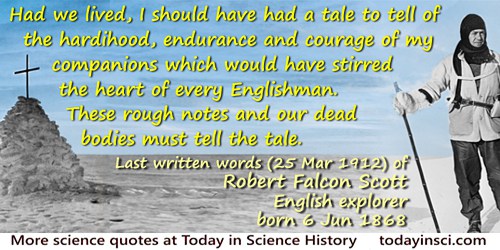
Had we lived, I should have had a tale to tell of the hardihood, endurance and courage of my companions which would have stirred the heart of every Englishman. These rough notes and our dead bodies must tell the tale, but surely, a great rich country like ours will see that those who are dependent on us are properly provided for.
[Final words in a 'Message to the Public' left written in his diary dated 25 March 1912, shortly before he died on the Ross Ice Barrier, Antarctica. When searchers found his body, on 12 Nov 1912, Scott was discovered sitting upright against the pole of the tent with the diary behind his head, as if for a pillow.]
[Final words in a 'Message to the Public' left written in his diary dated 25 March 1912, shortly before he died on the Ross Ice Barrier, Antarctica. When searchers found his body, on 12 Nov 1912, Scott was discovered sitting upright against the pole of the tent with the diary behind his head, as if for a pillow.]
Final words in a 'Message to the Public' left written in his diary dated 25 March 1912, shortly before he died on the Ross Ice Barrier, Antarctica. In Logan Marshall, The Story of Polar Conquest: The Complete History of Arctic and Antarctic (1913), 24-25.
by Logan Marshall - Polar regions - 1913
He who is not courageous enough to take risks will accomplish nothing in life.
In Ebony (1984), 40, 140.
Hope is the bedrock of this nation. The belief that our destiny will not be written for us, but by us, by all those men and women who are not content to settle for the world as it is, who have the courage to remake the world as it should be.
From address to supporters after the Iowa Caucuses, as provided by Congressional Quarterly via The Associated Press, published in New York Times (3 Jan 2008).
How can Life grant us boon of living, compensate
For dull grey ugliness and pregnant hate
Unless we dare
The soul’s dominion? Each time we make a choice, we pay
With courage to behold the restless day,
And count it fair.
For dull grey ugliness and pregnant hate
Unless we dare
The soul’s dominion? Each time we make a choice, we pay
With courage to behold the restless day,
And count it fair.
From poem 'Courage' (1927), second half, included in magazine article by Marion Perkins, 'Who Is Amelia Earhart?', Survey (1 Jul 1928), 60. Quoted as epigraph, and cited in Mary S. Lovell, The Sound of Wings: The Life of Amelia Earhart (1989), ix.
However, if we consider that all the characteristics which have been cited are only differences in degree of structure, may we not suppose that this special condition of organization of man has been gradually acquired at the close of a long period of time, with the aid of circumstances which have proved favorable? What a subject for reflection for those who have the courage to enter into it!
In Recherches sur l'Organization des corps vivans (1802), as translated in Alpheus Spring Packard, Lamarck, the Founder of Evolution: His Life and Work (1901), 363. Packard's italics.
I decided that life rationally considered seemed pointless and futile, but it is still interesting in a variety of ways, including the study of science. So why not carry on, following the path of scientific hedonism? Besides, I did not have the courage for the more rational procedure of suicide.
Life of a Scientist (1989), 24.
I feel that to be a director of a laboratory should not be, by definition, a permanent mission. People should have the courage to step down and go back to science. I believe you will never have a good director of a scientific laboratory unless that director knows he is prepared to become a scientist again. … I gave my contribution; I spent five years of my life to work hard for other people’s interest. … It’s time to go back to science again. I have some wonderful ideas, I feel I’m re-born.
From 'Asking Nature', collected in Lewis Wolpert and Alison Richards (eds.), Passionate Minds: The Inner World of Scientists (1997), 202.
I have had three personal ideals. One, to do the day’s work well and not to bother about tomorrow.… The second ideal has been to act the Golden Rule, as far as in me lay, towards my professional brethren and towards the patients committed to my care. And the third has been to cultivate such a measure of equanimity as would enable me to bear success with humility, the affection of my friends without pride, and to be ready when the day of sorrow and grief came to meet it with the courage befitting a man.
Remarks at farewell dinner given by the profession of the United States and Canada, New York (20 May 1905). Published as 'L’Envoi', No. 22 in Aequanimitas and other Addresses (1904, 1906), 473.
I have long recognized the theory and aesthetic of such comprehensive display: show everything and incite wonder by sheer variety. But I had never realized how power fully the decor of a cabinet museum can promote this goal until I saw the Dublin [Natural History Museum] fixtures redone right ... The exuberance is all of one piece–organic and architectural. I write this essay to offer my warmest congratulations to the Dublin Museum for choosing preservation–a decision not only scientifically right, but also ethically sound and decidedly courageous. The avant-garde is not an exclusive locus of courage; a principled stand within a reconstituted rear unit may call down just as much ridicule and demand equal fortitude. Crowds do not always rush off in admirable or defendable directions.
…...
I have never looked upon ease and happiness as ends in themselves–this critical basis I call the ideal of a pigsty. The ideals that have lighted my way, and time after time have given me new courage to face life cheerfully, have been Kindness, Beauty, and Truth. Without the sense of kinship with men of like mind, without the occupation with the objective world, the eternally unattainable in the field of art and scientific endeavors, life would have seemed empty to me. The trite objects of human efforts–possessions, outward success, luxury–have always seemed to me contemptible.
In 'What I Believe,' Forum and Century (1930).
I realized that my prior projects were just finger warm-ups. Now I have to tackle complexity itself. But it took long, before I had assembled the courage to do so.
…...
I said, that Superstition was the child of Fear, and Fear the child of Ignorance; and you might expect me to say antithetically, that Science was the child of Courage, and Courage the child of Knowledge.
Opening of 'Science', a lecture delivered at the Royal Institution, published in Fraser's Magazine (Jul 1866), 74, 15.
I think we need someone in a responsible political position to have the courage to say, “Let’s terminate human spaceflight.”
Advocating for robotic missions.
If mankind is to profit freely from the small and sporadic crop of the heroically gifted it produces, it will have to cultivate the delicate art of handling ideas. Psychology is now able to tell us with reasonable assurance that the most influential obstacle to freedom of thought and to new ideas is fear; and fear which can with inimitable art disguise itself as caution, or sanity, or reasoned skepticism, or on occasion even as courage.
'The Commemoration of Great Men', Hunterian Oration, Royal College of Surgeons (15 Feb 1952) British Medical Journal (20 Feb 1932), 1, 317-20. The Collected Papers of Wilfred Trotter, FRS (1941), 30.
If you walk along the street you will encounter a number of scientific problems. Of these, about 80 per cent are insoluble, while 19½ per cent are trivial. There is then perhaps half a per cent where skill, persistence, courage, creativity and originality can make a difference. It is always the task of the academic to swim in that half a per cent, asking the questions through which some progress can be made.
'The Making of a Scientist', Journal of the Royal Society of Arts, June 1983, 406.
In [David] Douglas's success in life ... his great activity, undaunted courage, singular abstemiousness, and energetic zeal, at once pointed him out as an individual eminently calculated to do himself credit as a scientific traveler.
In 'Extracts from A Brief Memoir of the Life of David Douglas' (1834), in W.F. Wilson (ed.), David Douglas, Botanist at Hawaii (1919), 12.
It takes someone with a vision of the possibilities to attain new levels of experience. Someone with the courage to live his dreams.
…...
It’s only through honesty and courage that science can work at all. The Ptolemaic understanding of the solar system was undermined and corrected by the constant pressure of more and more honest reporting.
In essay, 'The Origin of the Universe,' 6. Written after hearing Stephen Hawking's lecture (2006) at Oxford, about the origin of the universe.
Many races of living creatures must have been unable to continue their breed: for in the case of every species that now exists, either craft, or courage, or speed, has from the beginning of its existence protected and preserved it.
March 24, 1672. I saw the surgeon cut off the leg of a wounded sailor, the stout and gallant man enduring it with incredible patience without being bound to his chair as usual on such painful occasions. I had hardly courage enough to be present. Not being cut off high enough, the gangrene prevailed, and the second operation cost the poor creature his life.
Mathematics … engages, it fructifies, it quickens, compels attention, is as circumspect as inventive, induces courage and self-confidence as well as modesty and submission to truth. It yields the essence and kernel of all things, is brief in form and overflows with its wealth of content. It discloses the depth and breadth of the law and spiritual element behind the surface of phenomena; it impels from point to point and carries within itself the incentive toward progress; it stimulates the artistic perception, good taste in judgment and execution, as well as the scientific comprehension of things.
In Die Mathematik die Fackelträgerin einer neuen Zeit (1889), 40. As translated in Robert Édouard Moritz, Memorabilia Mathematica; Or, The Philomath’s Quotation-book (1914), 49.
Modesty. Never think you know all. Though others may flatter you, retain the courage to say, “I am ignorant”.
Translation of a note, 'Bequest of Pavlov to the Academic Youth of his Country', written a few days before his death for a student magazine, The Generation of the Victors. As published in 'Pavlov and the Spirit of Science', Nature (4 Apr 1936), 137, 572.
My dear child, be not afraid of the pains and be not afraid, be as tough and confident as you can and let not your courage flag and your hope fail. I assure you, with God’s help it will go better than you think! Just hang on tight with both hands so you tremble not. It will soon pass. You will see that Our Dear Lord will soon help you. How quickly a pain passes! Who should let his courage flag so quickly, for God’s help is at hand.
Given as an example of how to reassure a woman giving birth as labor begins. In Justine Siegemund and Lynne Tatlock (trans.), The Court Midwife (2007), 158.
My life as a surgeon-scientist, combining humanity and science, has been fantastically rewarding. In our daily patients we witness human nature in the raw–fear, despair, courage, understanding, hope, resignation, heroism. If alert, we can detect new problems to solve, new paths to investigate.
In Tore Frängsmyr and Jan E. Lindsten (eds.), Nobel Lectures: Physiology Or Medicine: 1981-1990 (1993), 565.
Nature knows no political boundaries. She puts living creatures on this globe and watches the free play of forces. She then confers the master's right on her favourite child, the strongest in courage and industry ... The stronger must dominate and not blend with the weaker, thus sacrificing his own greatness. Only the born weakling can view this as cruel.
Mein Kampf (1925-26), American Edition (1943), 134-5. In William Lawrence Shirer, The Rise and Fall of the Third Reich (1990), 86.
Observation, Reason, Human Understanding, Courage; these make the physician.
In Fischerisms (1930), 7.
One of the characteristics of successful scientists is having courage. Once you get your courage up and believe that you can do important problems, then you can. If you think you can't, almost surely you are not going to.
'You and Your Research', Bell Communications Research Colloquium Seminar, 7 Mar 1986.
Personality is the supreme realization of the innate idiosyncrasy of a living being. It is an act of high courage flung in the face of life.
In The Development of Personality (1953), 171.
https://books.google.com/books?id=
Carl Gustav Jung - 195
Rachel Carson was the best thing America is capable of producing: a modest person, concerned, courageous, and profoundly right—all at the same time. Troubled by knowledge of an emerging threat to the web of life, she took pains to become informed, summoned her courage, breached her confines, and conveyed a diligently constructed message with eloquence enough to catalyze a new social movement. Her life addressed the promise and premise of being truly human.
In his Foreward to Rachel Carson, The Sea Around Us (1950, 2003), xvi.
Science is a great many things, … but in the end they all return to this: Science is the acceptance of what works and the rejection of what does not. That needs more courage than we might think.
From The Common Sense of Science (1951), 148.
Science is not gadgetry. The desirable adjuncts of modern living, although in many instances made possible by science, certainly do not constitute science. Basic scientific knowledge often (but not always) is a prerequisite to such developments, but technology primarily deserves the credit for having the financial courage, the ingenuity, and the driving energy to see to it that so-called ‘pure knowledge’ is in fact brought to the practical service of man. And it should also be recognized that those who have the urge to apply knowledge usefully have themselves often made significant contribution to pure knowledge and have even more often served as a stimulation to the activities of a pure researcher.
Warren Weaver (1894–1978), U.S. mathematician, scientist, educator. Science and Imagination, ch. 1, Basic Books (1967).
Self-possession without self-sufficiency. Courage without effrontery.
From Appendix A, 'Extracts From the Unpublished Writings of Carnot', Reflections on the Motive Power of Heat (1890, 2nd ed. 1897), 206
So in regard to mental qualities, their transmission is manifest in our dogs, horses and other domestic animals. Besides special tastes and habits, general intelligence, courage, bad and good tempers. etc., are certainly transmitted.
The Descent of Man
Sometimes my courage fails me and I think I ought to stop working, live in the country and devote myself to gardening. But I am held by a thousand bonds, and I don't know when I shall be able to arrange things otherwise. Nor do I know whether, even by writing scientific books, I could live without the laboratory.
Letter to her sister Bronya, September 1927. In Eve Curie, Madame Curie (1938), 388.
Suppose…a boy thrown upon his own choice, fresh from the limitations of a schoolroom, to believe that science is an epitome of human desires. There is so much to fire his imagination and lend eagerness to his pursuit, that it is no wonder if he thinks it. Men of today are so astounded with the advance of empirical observation beyond what their fathers had accomplished, they have results that would so have exceeded even their predecessors’ fancy, that they go mad in the search for scientific truth, and shall not the rasher judgment of a boy be likewise moved? The mere ideals strain his imagination and extend his view into the eternities, backward or forward. His power is absolute, he is the only real prophet, the prophet who after his baptism of patience and of faith finds the whole world at his feet, if only he has the determination and the courage to make it his. The contempt with which the prophet may regard the loose and inaccurate babblings of other men who have less scope and make less splendid promises, is after all excusable when his prophecies are found so often true and his results so useful.
In Learned Hand and Irving Dilliard (ed.), The Spirit of Liberty: Papers and Addresses of Learned Hand (1952), 4.
The Principia Mathematica developed an overall scheme of the universe, one far more elegant and enlightening than any the ancients had devised. And the Newtonian scheme was based on a set of assumptions, so few and so simple, developed through so clear and so enticing a line of mathematics that conservatives could scarcely find the heart and courage to fight it.
In Entry 231, 'Newton, Sir Isaac', Asimov’s Biographical Encyclopedia of Science and Technology (2nd rev ed., 1982), 152.
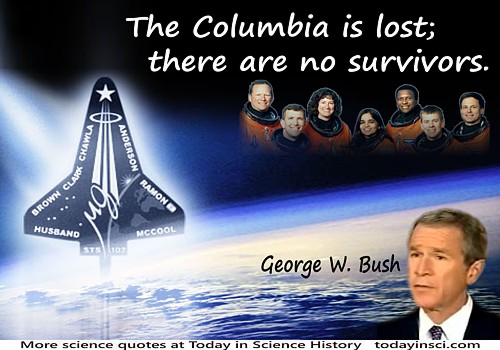
The Columbia is lost; there are no survivors. … In an age when space flight has come to seem almost routine, it is easy to overlook the dangers of travel by rocket, and the difficulties of navigating the fierce outer atmosphere of the Earth. These astronauts knew the dangers, and they faced them willingly, knowing they had a high and noble purpose in life. Because of their courage and daring idealism, we will miss them all the more. … The cause in which they died will continue. Mankind is led into the darkness beyond our world by the inspiration of discovery and the longing to understand. Our journey into space will go on.
Address to the Nation on the Space Shuttle Columbia tragedy, from the Cabinet Room (1 Feb 2003). In William J. Federer, A Treasury of Presidential Quotations (2004), 437.
The enchanting charms of this sublime science reveal only to those who have the courage to go deeply into it. But when a woman, who because of her sex and our prejudices encounters infinitely more obstacles that an man in familiarizing herself with complicated problems, succeeds nevertheless in surmounting these obstacles and penetrating the most obscure parts of them, without doubt she must have the noblest courage, quite extraordinary talents and superior genius.
in a letter to Sophie Germain (c.April 1807)
The future does not belong to those who are content with today, apathetic toward common problems and their fellow man alike, timid and fearful in the face of bold projects and new ideas. Rather, it will belong to those who can blend passion, reason and courage in a personal commitment to the great enterprises and ideals of American society.
…...
The rigid electron is in my view a monster in relation to Maxwell's equations, whose innermost harmony is the principle of relativity... the rigid electron is no working hypothesis, but a working hindrance. Approaching Maxwell's equations with the concept of the rigid electron seems to me the same thing as going to a concert with your ears stopped up with cotton wool. We must admire the courage and the power of the school of the rigid electron which leaps across the widest mathematical hurdles with fabulous hypotheses, with the hope to land safely over there on experimental-physical ground.
In Arthur I. Miller, Albert Einstein's Special Theory of Relativity (1981), 350.
The root of the matter the thing I mean is love, Christian love, or compassion. If you feel this, you have a motive for existence, a guide for action, a reason for courage, an imperative necessity for intellectual honesty.
…...
The understanding of a complex problem such as atherosclerosis requires the tools of basic science. We are fortunate to live at a time when the methods of basic science are so powerful that they can be applied directly to clinical problems. … [T]he two attributes that are required – basic training and technical courage.
In Banquet Speech, 'The Nobel Prize in Physiology or Medicine 1985', on website nobelprize.org. Published in Les Prix Nobel, 1985: Nobel Prizes, Presentations, Biographies and Lectures (1986).
The world we know at present is in no fit state to take over the dreariest little meteor ... If we have the courage and patience, the energy and skill, to take us voyaging to other planets, then let us use some of these to tidy up and civilize this earth. One world at a time, please.
Column in the London News Chronicle as quoted in article, 'Notions in Motion,' Time (24 Nov 1952).
This car of mine, I am tickled to death with it. The machine is nearly everything, its power, stability and balance. The driver, allowing for his experience and courage, is much less.
[Referring to the Bluebird racing car in which he broke the speed record on 5 Feb 1931.]
[Referring to the Bluebird racing car in which he broke the speed record on 5 Feb 1931.]
Quoted in 'Campbell Drive Auto 245 Miles an Hour, Four Miles a Minute, a World Speed Record', New York Times (6 Feb 1931), 1.
Those afraid of the universe as it really is, those who pretend to nonexistent knowledge and envision a Cosmos centered on human beings will prefer the fleeting comforts of superstition. They avoid rather than confront the world. But those with the courage to explore the weave and structure of the Cosmos, even where it differs profoundly from their wishes and prejudices, will penetrate its deepest mysteries.
Cosmos (1985), 275.
To arrive at the simplest truth, as Newton knew and practiced, requires years of contemplation. Not activity Not reasoning. Not calculating. Not busy behaviour of any kind. Not reading. Not talking. Not making an effort. Not thinking. Simply bearing in mind what it is one needs to know. And yet those with the courage to tread this path to real discovery are not only offered practically no guidance on how to do so, they are actively discouraged and have to set about it in secret, pretending meanwhile to be diligently engaged in the frantic diversions and to conform with the deadening personal opinions which are continually being thrust upon them.
In 'Appendix 1', The Laws of Form (1969), 110.
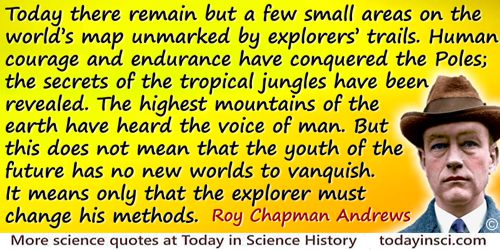
Today there remain but a few small areas on the world’s map unmarked by explorers’ trails. Human courage and endurance have conquered the Poles; the secrets of the tropical jungles have been revealed. The highest mountains of the earth have heard the voice of man. But this does not mean that the youth of the future has no new worlds to vanquish. It means only that the explorer must change his methods.
On the Trail of Ancient Man (1926), 5.
Unconscious, perhaps, of the remote tendency of his own labours, he [Joseph Black] undermined that doctrine of material heat, which he seemed to support. For, by his advocacy of latent heat, he taught that its movements constantly battle, not only some of our senses, but all of them; and that, while our feelings make us believe that heat is lost, our intellect makes us believe that it is not lost. Here, we have apparent destructability, and real indestructibility. To assert that a body received heat without its temperature rising, was to make the understanding correct the touch, and defy its dictates. It was a bold and beautiful paradox, which required courage as well as insight to broach, and the reception of which marks an epoch in the human mind, because it was an immense step towards idealizing matter into force.
History of Civilization in England (1861), Vol. 2, 494.
We cannot expect in the immediate future that all women who seek it will achieve full equality of opportunity. But if women are to start moving towards that goal, we must believe in ourselves or no one else will believe in us; we must match our aspirations with the competence, courage and determination to succeed.
From a speech given to students in Stockholm, Sweden, Oct 1977 as quoted in The Decade of Women (1980) by Suzanne Levine and Harriet Lyons
We have only indirect means of knowing the courage and activity of the Neanderthals in the chase, through the bones of animals hunted for food which are found intermingled with the flints around their ancient hearths.
In 'Customs of the Chase and of cave Life', Men of the Old Stone Age: Their Environment, Life and Art (1921), 211.
What Art was to the ancient world, Science is to the modern: the distinctive faculty. In the minds of men the useful has succeeded to the beautiful. … There are great truths to tell, if we had either the courage to announce them or the temper to receive them.
In Coningsby: or the New Generation (1844), Vol. 2, Book 4, Chap. 1, 2.
What do all of these pioneers [Archibald Garrod, Oswald Avery, Peyton Rous] have in common? First, they were physicians who were trained in basic science. To them, it was not a question of physiology or medicine. To them, medicine was physiology. Second, they showed technical courage in using the most advanced scientific methods to solve medical problems.
In Banquet Speech, 'The Nobel Prize in Physiology or Medicine 1985', on website nobelprize.org. Published in Les Prix Nobel, 1985: Nobel Prizes, Presentations, Biographies and Lectures (1986).
What I then got hold of, something frightful and dangerous, a problem with horns but not necessarily a bull, in any case a new problem—today I should say that it was the problem of science itself, science considered for the first time as problematic, as questionable. But the book in which my youthful courage and suspicion found an outlet—what an impossible book had to result from a task so uncongenial to youth! Constructed from a lot of immature, overgreen personal experiences, all of them close to the limits of communication, presented in the context of art—for the problem of science cannot be recognized in the context of science—a book perhaps for artists who also have an analytic and retrospective penchant (in other words, an exceptional type of artist for whom one might have to look far and wide and really would not care to look) …
In The Birth of Tragedy (1872). Collected in Friedrich Nietzsche and Walter Kaufmann (trans.), The Birth of Tragedy and The Case of Wagner (1967), 18.
Wheeler’s First Moral Principle: Never make a calculation until you know the answer. Make an estimate before every calculation, try a simple physical argument (symmetry! invariance! conservation!) before every derivation, guess the answer to every paradox and puzzle. Courage: No one else needs to know what the guess is. Therefore make it quickly, by instinct. A right guess reinforces this instinct. A wrong guess brings the refreshment of surprise. In either case life as a spacetime expert, however long, is more fun!
In E.F. Taylor and J.A. Wheeler, Spacetime Physics (1992), 20.
When you surround the enemy, leave a way out. Desperation breeds courage.
— Sun Tzu
In Sun Tzu and Jeff Mcneill (trans.), The Art of War by Sun Tzu: New Modern Edition (2012), Chap. 7, 18.
You are wrong all along the line—wrong in your logic, wrong in your statecraft, wrong in your arithmetic, wrong even in your demagogy—right only in having at last the candour and courage to avow your true opinions.
From Speech in the House, (20 Feb 1907), 150.
You cannot see the Grand Canyon in one view, as if it were a changeless spectacle from which a curtain might be lifted, but to see it you have to toil from month to month through its labyrinths. It is a region more difficult to traverse than the Alps or the Himalayas, but if strength and courage are sufficient for the task, by a year’s toil a concept of sublimity can be obtained never again to be equaled or the hither side of Paradise.
In Canyons of the Colorado (1895), 397.
 In science it often happens that scientists say, 'You know that's a really good argument; my position is mistaken,' and then they would actually change their minds and you never hear that old view from them again. They really do it. It doesn't happen as often as it should, because scientists are human and change is sometimes painful. But it happens every day. I cannot recall the last time something like that happened in politics or religion.
(1987) --
In science it often happens that scientists say, 'You know that's a really good argument; my position is mistaken,' and then they would actually change their minds and you never hear that old view from them again. They really do it. It doesn't happen as often as it should, because scientists are human and change is sometimes painful. But it happens every day. I cannot recall the last time something like that happened in politics or religion.
(1987) -- 




