Country Quotes (271 quotes)
… the United States was not built by those who waited and rested and wished to look behind them. This country was conquered by those who moved forward, and so will space.
From Address at Rice Stadium (12 Sep 1962). On website of John F. Kennedy Presidential Library and Museum. [This go-to-the-moon speech was largely written by presidential advisor and speechwriter Ted Sorensen.]
“Bitzer,” said Thomas Gradgrind. “Your definition of a horse.”
“Quadruped. Graminivorous. Forty teeth; namely, twenty-four grinders, four eye-teeth, and twelve incisive. Sheds coat in the Spring; in marshy countries, sheds hoofs, too. Hoofs hard, but requiring to be shod with iron. Age known by marks in mouth.” Thus (and much more) Bitzer.
“Now girl number twenty,” said Mr. Gradgrind. “You know what a horse is.”
“Quadruped. Graminivorous. Forty teeth; namely, twenty-four grinders, four eye-teeth, and twelve incisive. Sheds coat in the Spring; in marshy countries, sheds hoofs, too. Hoofs hard, but requiring to be shod with iron. Age known by marks in mouth.” Thus (and much more) Bitzer.
“Now girl number twenty,” said Mr. Gradgrind. “You know what a horse is.”
Spoken by fictional character Thomas Gringrind in his schoolroom with pupil Bitzer, Hard Times, published in Household Words (1 Apr 1854), Vol. 36, 3.
“Progress” was synonymous with distance from nature. The adults, who set the pace of progress from nature, were so absorbed by their own ability to invent and to alter the existing world, that they hurried headlong, with no design for the ultimate structure. A man-made environment was the obvious goal, but who was the responsible architect? No one in my country. Not even the king of Great Britain or the president of America. Each inventor and producer who worked on building tomorrow’s world just threw in a brick or a cogwheel wherever he cared to, and it was up to us of the next generation to find out what the result would be.
In Ch. 1, 'Farewell to Civilization', Fatu-Hiva (1974), 4.
“That’s another thing we’ve learned from your Nation,” said Mein Herr, “map-making. But we’ve carried it much further than you. What do you consider the largest map that would be really useful?”
“About six inches to the mile.”
“Only six inches!” exclaimed Mein Herr. “We very soon got to six yards to the mile. Then we tried a hundred yards to the mile. And then came the grandest idea of all! We actually made a map of the country, on the scale of a mile to the mile!”
“Have you used it much?” I enquired.
“It has never been spread out, yet,” said Mein Herr: “the farmers objected: they said it would cover the whole country, and shut out the sunlight! So we now use the country itself, as its own map, and I assure you it does nearly as well.”
“About six inches to the mile.”
“Only six inches!” exclaimed Mein Herr. “We very soon got to six yards to the mile. Then we tried a hundred yards to the mile. And then came the grandest idea of all! We actually made a map of the country, on the scale of a mile to the mile!”
“Have you used it much?” I enquired.
“It has never been spread out, yet,” said Mein Herr: “the farmers objected: they said it would cover the whole country, and shut out the sunlight! So we now use the country itself, as its own map, and I assure you it does nearly as well.”
From Sylvie and Bruno Concluded (1893), 169.
[Before the time of Benjamin Peirce it never occurred to anyone that mathematical research] was one of the things for which a mathematical department existed. Today it is a commonplace in all the leading universities. Peirce stood alone—a mountain peak whose absolute height might be hard to measure, but which towered above all the surrounding country.
In 'The Story of Mathematics at Harvard', Harvard Alumni Bulletin (3 Jan 1924), 26, 376. Cited by R. C. Archibald in 'Benjamin Peirce: V. Biographical Sketch', The American Mathematical Monthly (Jan 1925), 32, No. 1, 10.
[E.H.] Moore was presenting a paper on a highly technical topic to a large gathering of faculty and graduate students from all parts of the country. When half way through he discovered what seemed to be an error (though probably no one else in the room observed it). He stopped and re-examined the doubtful step for several minutes and then, convinced of the error, he abruptly dismissed the meeting—to the astonishment of most of the audience. It was an evidence of intellectual courage as well as honesty and doubtless won for him the supreme admiration of every person in the group—an admiration which was in no wise diminished, but rather increased, when at a later meeting he announced that after all he had been able to prove the step to be correct.
In Obituary, 'Eliakim Hastings Moore', The American Mathematical Monthly (Apr 1933), 40, 191.
[Having already asserted his opposition to communism in every respect by signing the regents' oath, his answer to a question why a non-Communist professor should refuse to take a non-Communist oath as a condition of University employment was that to do so would imply it was] up to an accused person to clear himself. ... That sort of thing is going on in Washington today and is a cause of alarm to thoughtful citizens. It is the method used in totalitarian countries. It sounds un-American to people who don’t like to be pushed around. If someone says I ought to do a certain thing the burden should be on him to show I why I should, not on me to show why I should not.
As quoted in 'Educator Scores Oath For Faculty', New York Times (16 Apr 1950), 31.
![Samuel F. B. Morse quote: [It would not be long] ere the whole surface of this country would be channelled for those nerves whic](https://todayinsci.com/M/Morse_Samuel/MorseSamuel-Country500x250px.jpg)
[It would not be long] ere the whole surface of this country would be channelled for those nerves which are to diffuse, with the speed of thought, a knowledge of all that is occurring throughout the land, making, in fact, one neighborhood of the whole country.
Samuel F.B. Morse: His Letters and Journals (1914), vol. 2, 85.
[My] numberless observations... made on the Strata... [have] made me confident of their uniformity throughout this Country & [have] led me to conclude that the same regularity... will be found to extend to every part of the Globe for Nature has done nothing by piecemeal. [T]here is no inconsistency in her productions. [T]he Horse never becomes an Ass nor the Crab an Apple by any intermixture or artificial combination whatever[. N]or will the Oak ever degenerate into an Ash or an Ash into an Elm. [H]owever varied by Soil or Climate the species will still be distinct on this ground. [T]hen I argue that what is found here may be found elsewhere[.] When proper allowances are made for such irregularities as often occur and the proper situation and natural agreement is well understood I am satisfied there will be no more difficulty in ascertaining the true quality of the Strata and the place of its possition [sic] than there is now in finding the true Class and Character of Plants by the Linean [sic] System.
Natural Order of the Strata in England and Wales Accurately Delineated and Described, unpublished manuscript, Department of Geology, University of Oxford, 1801, f. 7v.
[We] do not learn for want of time,
The sciences that should become our country.
The sciences that should become our country.
In Henry V (1599), Act 5, Scene 2, line 59-60.
Quelquefois, par exemple, je me figure que je suis suspendu en l’air, et que j’y demeure sans mouvement, pendant que la Terre tourne sous moi en vingt-quatre heures. Je vois passer sous mes yeux tous ces visages différents, les uns blancs, les autres noirs, les autres basanés, les autres olivâtres. D’abord ce sont des chapeaux et puis des turbans, et puis des têtes chevelues, et puis des têtes rasées; tantôt des villes à clochers, tantôt des villes à longues aiguilles qui ont des croissants, tantôt des villes à tours de porcelaine, tantôt de grands pays qui n’ont que des cabanes; ici de vastes mers, là des déserts épouvantables; enfin, toute cette variété infinie qui est sur la surface de la Terre.
Sometimes, for instance, I imagine that I am suspended in the air, and remain there motionless, while the earth turns under me in four-and-twenty hours. I see pass beneath me all these different countenances, some white, others black, others tawny, others olive-colored. At first they wear hats, and then turbans, then heads with long hair, then heads shaven; sometimes towns with steeples, sometimes towns with long spires, which have crescents, sometimes towns with porcelain towers, sometimes extensive countries that have only huts; here wide seas; there frightful deserts; in short, all this infinite variety on the surface of the earth.
Sometimes, for instance, I imagine that I am suspended in the air, and remain there motionless, while the earth turns under me in four-and-twenty hours. I see pass beneath me all these different countenances, some white, others black, others tawny, others olive-colored. At first they wear hats, and then turbans, then heads with long hair, then heads shaven; sometimes towns with steeples, sometimes towns with long spires, which have crescents, sometimes towns with porcelain towers, sometimes extensive countries that have only huts; here wide seas; there frightful deserts; in short, all this infinite variety on the surface of the earth.
In 'Premier Soir', Entretiens Sur La Pluralité Des Mondes (1686, 1863), 43. French and translation in Craufurd Tait Ramage, Beautiful Thoughts from French and Italian Authors (1866), 117-118.
Wij zien daar den wereldburger Christiaan Huygens, den man, die als devies had kunnen voeren “the World is my country, to promote Science my religion.”
We see there the cosmopolitan Christiaan Huygens, the man whose motto could have been “the World is my country, to promote Science my religion."
We see there the cosmopolitan Christiaan Huygens, the man whose motto could have been “the World is my country, to promote Science my religion."
Original Dutch from Spinoza en Zijn Kring (1896), 258. The title translates as Spinosa and his Circle. English by Webmaster using Google Translate. Notice that this clearly indicates that Meinsma, using the words “had kunnen” (might have been) created the fictitious motto to describe Huygens. Thus it is a false attribution when the motto is seen some sources as being a quote directly by Christiaan Huygens. Notice that the author Meinsma and Huygens were both Dutch, but the Dutch text gives the motto in English, a clue to its real source. Meinsma likely adapted it from the well-known quote, “The world is my country, and to do good is my religion,” the common paraphrase of “My country is the world, and my religion is to do good,” as written by Thomas Paine in Rights of Man: Being an Answer to Mr. Burke's Attack on the French Revolution (1791, 1792), 50.
~~[need primary source]~~ One of the most frightening things in the Western world and in this country in particular is the number of people who believe in things that are scientifically false. If someone tells me that the earth is less than 10000 years old in my opinion he should see a psychiatrist.
As quoted, without citation, in Joan Konner, The Atheist’s Bible: An Illustrious Collection of Irreverent Thought (2007), 46. Webmaster is dubious about authenticity, and as yet, has been unable to find a reliable primary source - can you help?
1095 … Then after Easter on the eve of St. Ambrose, which is on 4 April [recte 3 April], almost everywhere in this country and almost the whole night, stars in very large numbers were seen to fall from heaven, not by ones or twos, but in such quick succession that they could not be counted.
In The Anglo-Saxon Chronicle, as translated in The Anglo-Saxon Chronicle, Issue 1624 (1975), 230. The Chronicle is the work of many successive hands at several monasteries across England. For the date recorded, This meteor shower could have been a display of the Lyrids (according to The Starseeker, reprinted in O. Vrazell, 'Astronomical Observations in the Anglo Saxon Chronicle', Journal of the Royal Astronomical Society of Canada Newsletter (Aug 1984), 78, 57.
A country grows in history not only because of the heroism of its troops on the field of battle, it grows also when it turns to justice and to right for the conservation of its interests.
…...
A man should abandon that country wherein there is neither respect, nor employment, nor connections, nor the advancement of science.
In Charles Wilkins (trans.) Fables and Proverbs from the Sanskrit: being the Hitopadesa (1885), 62.
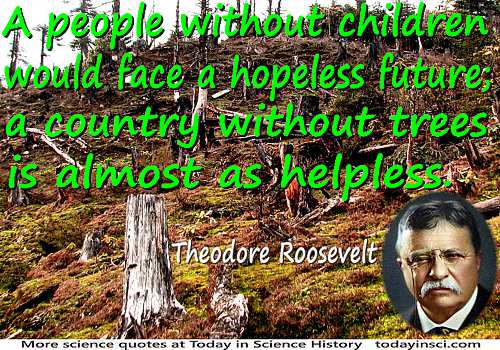
A people without children would face a hopeless future; a country without trees is almost as helpless.
Letter to the School Children of the United States, Arbor Day (15 Apr 1907), in Presidential Addresses and State Papers (1910), Vol. 6, 1208.
A study of Disease—of Pestilences methodically prepared and deliberately launched upon man and beast—is certainly being pursued in the laboratories of more than one great country. Blight to destroy crops, Anthrax to slay horses and cattle, Plague to poison not armies but whole districts—such are the lines along which military science is remorselessly advancing.
'Shall We All Commit Suicide?'. Pall Mall (Sep 1924). Reprinted in Thoughts and Adventures (1932), 250.
A terrible wilderness of mountainous country constitutes the immediate environment of St. Paul’s. It is a precipitous cliff into the abyss, a gate of hell, more horrible than the fantasy of Dante could express it.
St. Paul’s Monastery is located 300-km southeast of Cairo, on the southern edge of a desert mountain range, adjacent to the Gulf of Suez
A visitor to Niels Bohr's country cottage, noticing a horseshoe hanging on the wall, teasing the eminent scientist about this ancient superstition. “Can it be true that you, of all people, believe it will bring you luck?'
'Of course not,' replied Bohr, 'but I understand it brings you luck whether you believe it or not.'”
'Of course not,' replied Bohr, 'but I understand it brings you luck whether you believe it or not.'”
As described in Clifton Fadiman (ed.), André Bernard (ed.), Bartlett's Book of Anecdotes (2000), 68.
According to the system of modern economists, it would be desirable that the government should interfere as little as possible in the commerce and industry of the country. Nevertheless we cannot deny that in certain circumstances this intervention is very useful.
From Appendix A, 'Extracts From the Unpublished Writings of Carnot', Reflections on the Motive Power of Heat (1890, 2nd ed. 1897), 211.
Alexander is said to have asked Menæchmus to teach him geometry concisely, but Menæchmus replied: “O king, through the country there are royal roads and roads for common citizens, but in geometry there is one road for all.”
As quoted in Robert Édouard Moritz, Memorabilia Mathematica; Or, The Philomath’s Quotation-Book (1914), 152-153, citing Stobaeus, Edition Wachsmuth (1884), Ecl. II, 30.
All men and women are born, live suffer and die; what distinguishes us one from another is our dreams, whether they be dreams about worldly or unworldly things, and what we do to make them come about... We do not choose to be born. We do not choose our parents. We do not choose our historical epoch, the country of our birth, or the immediate circumstances of our upbringing. We do not, most of us, choose to die; nor do we choose the time and conditions of our death. But within this realm of choicelessness, we do choose how we live.
…...
Although I have several agents who know the Niam-Niam country, I did not dare to make anything of their unreliable statements before I could orient myself. These Nubians are unpredictable to a high degree, they have a very poor memory for names and practically no human idea of the points of the compass; the agents of the merchants of Khartoum who are entrusted with such great journeys are to the last man absolute liars, braggarts and habitual fibbers.
In August Petermann, Petermann’s Geographische Mittheilungen (1870), 20. As quoted and cited in Kathrin Fritsch, '"You Have Everything Confused And Mixed Up…!" Georg Schweinfurth, Knowledge And Cartography Of Africa In The 19th Century', History in Africa (2009), 36, 93-94. Fritsch comments how at that point in his travels, thus far, Schweinfurth “did not appear to understand their geographical orientation and with his European prejudice he chose to view all Nubians as braggarts and liars.
America has never been united by blood or birth or soil. We are bound by ideals that move us beyond our backgrounds, lift us above our interests and teach us what it means to be citizens. Every child must be taught these principles. Every citizen must uphold them. And every immigrant, by embracing these ideals, makes our country more, not less, American.
…...
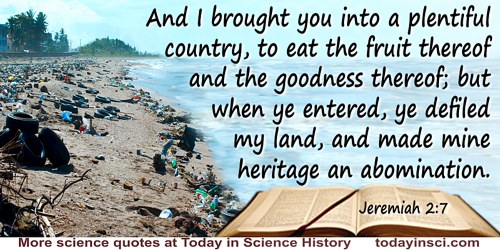
And I brought you into a plentiful country, to eat the fruit thereof and the goodness thereof; but when ye entered, ye defiled my land, and made mine heritage an abomination.
— Bible
Jeremiah 2:7, King James Bible.
Any country that wants to make full use of all its potential scientists and technologists … must not expect to get the women quite so simply as it gets the men. It seems to me that marriage and motherhood are at least as socially important as military service. Government regulations are framed to ensure (in the United Kingdom) that a man returning to work from military service is not penalized by his absence. Is it utopian, then, to suggest that any country that really wants a woman to return to a scientific career when her children no longer need her physical presence should make special arrangements to encourage her to do so?
In Impact of Science on Society (1970), 20 58. Commenting how for men who went to war, their jobs were held for them pending their return.
Anybody who really wants to abolish war must resolutely declare himself in favor of his own country’s committing a portion of its sovereignty in favor of international institutions.
…...
Architecture has its political Use; publick Buildings being the Ornament of a Country; it establishes a Nation, draws People and Commerce; makes the People love their native Country, which Passion is the Original of all great Actions in a Common-wealth…. Architecture aims at Eternity.
In Charles Henry Bellenden Ker, Sir Christopher Wren (1828), 1.
As for France and England, with all their pre-eminence in science, the one is a den of robbers, and the other of pirates. If science produces no better fruits than tyranny, murder, rapine, and destitution of national morality, I would rather wish our country to be ignorant, honest, and estimable as our neighboring savages are.
Letter (21 Jan 1812) to John Adams. Collected in Thomas Jefferson Randolph (ed.), Memoirs, Correspondence and Private Papers (1829), Vol. 4, 173.
As for what I have done as a poet, I take no pride in whatever. Excellent poets have lived at the same time with me, poets more excellent lived before me, and others will come after me. But that in my country I am the only person who knows the truth in the difficult science of colors—of that, I say, I am not a little proud, and here have a consciousness of superiority to many.
Wed 18 Feb 1829. Johann Peter Eckermann, Conversations with Goethe, ed. J. K. Moorhead and trans. J. Oxenford, (1971), 302.
As I looked down, I saw a large river meandering slowly along for miles, passing from one country to another without stopping. I also saw huge forests, extending along several borders. And I watched the extent of one ocean touch the shores of separate continents. Two words leaped to mind as I looked down on all this: commonality and interdependence. We are one world.
…...
Ask not what your country can do for you; but what you can do for your country.
In Presidential Inaugural Address (20 Jan 1961). Collected in Let the Word Go Forth: The Speeches, Statements, and Writings of John F. Kennedy (1988), 14.
Bradley is one of the few basketball players who have ever been appreciatively cheered by a disinterested away-from-home crowd while warming up. This curious event occurred last March, just before Princeton eliminated the Virginia Military Institute, the year’s Southern Conference champion, from the NCAA championships. The game was played in Philadelphia and was the last of a tripleheader. The people there were worn out, because most of them were emotionally committed to either Villanova or Temple-two local teams that had just been involved in enervating battles with Providence and Connecticut, respectively, scrambling for a chance at the rest of the country. A group of Princeton players shooting basketballs miscellaneously in preparation for still another game hardly promised to be a high point of the evening, but Bradley, whose routine in the warmup time is a gradual crescendo of activity, is more interesting to watch before a game than most players are in play. In Philadelphia that night, what he did was, for him, anything but unusual. As he does before all games, he began by shooting set shots close to the basket, gradually moving back until he was shooting long sets from 20 feet out, and nearly all of them dropped into the net with an almost mechanical rhythm of accuracy. Then he began a series of expandingly difficult jump shots, and one jumper after another went cleanly through the basket with so few exceptions that the crowd began to murmur. Then he started to perform whirling reverse moves before another cadence of almost steadily accurate jump shots, and the murmur increased. Then he began to sweep hook shots into the air. He moved in a semicircle around the court. First with his right hand, then with his left, he tried seven of these long, graceful shots-the most difficult ones in the orthodoxy of basketball-and ambidextrously made them all. The game had not even begun, but the presumably unimpressible Philadelphians were applauding like an audience at an opera.
A Sense of Where You Are: Bill Bradley at Princeton
Büchsel in his reminiscences from the life of a country parson relates that he sought his recreation in Lacroix’s Differential Calculus and thus found intellectual refreshment for his calling. Instances like this make manifest the great advantage which occupation with mathematics affords to one who lives remote from the city and is compelled to forego the pleasures of art. The entrancing charm of mathematics, which captivates every one who devotes himself to it, and which is comparable to the fine frenzy under whose ban the poet completes his work, has ever been incomprehensible to the spectator and has often caused the enthusiastic mathematician to be held in derision. A classic illustration is the example of Archimedes….
From Die Entwickelung der Mathematik im Zusammenhange mit der Ausbreitung der Kultur (1893), 22. As translated in Robert Édouard Moritz, Memorabilia Mathematica; Or, The Philomath’s Quotation-Book (1914), 186. From the original German, “Wenn Büchsel in seinen Erinnerungen aus dem Leben eines Landgeistlichen erzählt, dass er in der Differentialrechnung von Lacroix Erholung gesucht und geistige Erfrischung ftir seinen Beruf gefunden habe, so erkennen wir darin den grossen Vorzug, den die Beschaftigung mit der Mathematik für jemanden hat, der fern von einer Stadt lebt und auf ihre Kunstgenüsse verzichten muss. Der berückende Zauber der
Mathematik, dem jeder unterliegt, der sich ihr ergiebt, und der dem holden Wahnsinn vergleichbar ist, unter dessen Bann der Dichter sein Work vollendet, ist dem betrachtenden Mitmenschen immer unbegreiflich gewesen und hat den begeisterten Mathematiker oft zum Gespött werden lassen. Als klassisches Beispiel wird jedem Schüler Archimedes…”
Buffon, who, with all his theoretical ingenuity and extraordinary eloquence, I suspect had little actual information in the science on which he wrote so admirably For instance, he tells us that the cow sheds her horns every two years; a most palpable error. ... It is wonderful that Buffon who lived so much in the country at his noble seat should have fallen into such a blunder I suppose he has confounded the cow with the deer.
In The Life of Samuel Johnson, LL.D. (1826), Vol. 3, 70, footnote.
Building goes on briskly at the therapeutic Tower of Babel; what one recommends another condemns; what one gives in large doses another scarce dares to prescribe in small doses; and what one vaunts as a novelty another thinks not worth rescuing from merited oblivion. All is confusion, contradiction, inconceivable chaos. Every country, every place, almost every doctor, have their own pet remedies, without which they imagine their patients can not be cured; and all this changes every year, aye every mouth.
Weekly Medical Gazette, of Vienna
But here it may be objected, that the present Earth looks like a heap of Rubbish and Ruines; And that there are no greater examples of confusion in Nature than Mountains singly or jointly considered; and that there appear not the least footsteps of any Art or Counsel either in the Figure and Shape, or Order and Disposition of Mountains and Rocks. Wherefore it is not likely they came so out of God's hands ... To which I answer, That the present face of the Earth with all its Mountains and Hills, its Promontaries and Rocks, as rude and deformed as they appear, seems to me a very beautiful and pleasant object, and with all the variety of Hills, and Valleys, and Inequalities far more grateful to behold, than a perfectly level Countrey without any rising or protuberancy, to terminate the sight: As anyone that hath but seen the Isle of Ely, or any the like Countrey must need acknowledge.
— John Ray
Miscellaneous Discourses Concerning the Dissolution and Changes of the World (1692), 165-6.
But we must take other steps, such as increasing conservation, developing an ethanol industry, and increasing CAFE standards if we are to make our country safer by cutting our reliance on foreign oil.
…...
By encouraging conservation, increasing investments in clean, renewable sources of energy, and promoting increased domestic production of oil and gas, we can build a more secure future for our country.
…...
Changes That Have Occurred in the Globe: When we have seen with our own eyes a mountain progressing into a plain; that is to say, an immense boulder separating from this mountain and covering the fields; an entire castle broken into pieces over the ground; a river swallowed up which then bursts out from its abyss; clear marks of a vast amount of water having once flooded regions now inhabited, and a hundred vestiges of other transformations, then we are much more willing to believe that great changes altered the face of the earth, than a Parisian lady who knows only that the place where her house was built was once a cultivated field. However, a lady from Naples who has seen the buried ruins of Herculaneum, is much less subject to the bias which leads us to believe that everything has always been as it is today.
From article 'Changements arrivées dans le globe', in Dictionnaire philosophique (1764), collected in Œuvres Complètes de Voltaire (1878), Vol. 2, 427-428. Translated by Ian Ellis, from the original French: “Changements arrivées dans le globe: Quand on a vu de ses yeux une montagne s’avancer dans une plaine, c’est-à-dire un immense rocher de cette montagne se détacher et couvrir des champs, un château tout entier enfoncé dans la terre, un fleuve englouti qui sort ensuite de son abîme, des marques indubitables qu’un vaste amas d’eau inondait autrefois un pays habité aujourd’hui, et cent vestiges d’autres révolutions, on est alors plus disposé à croire les grands changements qui ont altéré la face du monde, que ne l’est une dame de Paris qui sait seulement que la place où est bâtie sa maison était autrefois un champ labourable. Mais une dame de Naples, qui a vu sous terre les ruines d’Herculanum, est encore moins asservie au préjugé qui nous fait croire que tout a toujours été comme il est aujourd’hui.”
Climate change threatens every corner of our country, every sector of our economy and the health and future of every child. We are already seeing its impacts and we know the poorest and most vulnerable people in the United States and around the world will suffer most of all.
In Hillary Clinton, 'Hillary Clinton: America Must Lead at Paris Climate Talks', Time (29 Nov 2015).
Considerable obstacles generally present themselves to the beginner, in studying the elements of Solid Geometry, from the practice which has hitherto uniformly prevailed in this country, of never submitting to the eye of the student, the figures on whose properties he is reasoning, but of drawing perspective representations of them upon a plane. ...I hope that I shall never be obliged to have recourse to a perspective drawing of any figure whose parts are not in the same plane.
Quoted in Adrian Rice, 'What Makes a Great Mathematics Teacher?' The American Mathematical Monthly, (June-July 1999), 540.
Defenders of the short-sighted men who in their greed and selfishness will, if permitted, rob our country of half its charm by their reckless extermination of all useful and beautiful wild things sometimes seek to champion them by saying the “the game belongs to the people.” So it does; and not merely to the people now alive, but to the unborn people. The “greatest good for the greatest number” applies to the number within the womb of time, compared to which those now alive form but an insignificant fraction. Our duty to the whole, including the unborn generations, bids us restrain an unprincipled present-day minority from wasting the heritage of these unborn generations. The movement for the conservation of wild life and the larger movement for the conservation of all our natural resources are essentially democratic in spirit, purpose, and method.
'Bird Reserves at the Mouth of the Mississippi', A Book-Lover's Holidays in the Open (1920), 300-301.
Descriptive anatomy is to physiology what geography is to history, and just as it is not enough to know the typography of a country to understand its history, so also it is not enough to know the anatomy of organs to understand their functions.
Lectures on the Phenomena of Life Common to Animals and Plants (1878), trans. Hebbel E. Hoff, Roger Guillemin and Lucienne Guillemin (1974), 7.
Developing countries can leapfrog several stages in the development process through the application of bio-technology in agriculture.
In Arbind Prasad and Jagdish Prasad, Development Planning for Agriculture: Policies, Economic Implications, Inputs, Production and Marketing (1994), 93.
Early in my school days a boy had a copy of the “Wonders of the World,” which I often read, and disputed with other boys about the veracity of some of the statements; and I believe that this book first gave me a wish to travel in remote countries, which was ultimately fulfilled by the voyage of the Beagle.
In Charles Darwin and Francis Darwin (ed.), 'Autobiography', The Life and Letters of Charles Darwin (1887, 1896), Vol. 1, 31.
EMBALM, v.t. To cheat vegetation by locking up the gases upon which it feeds. By embalming their dead and thereby deranging the natural balance between animal and vegetable life, the Egyptians made their once fertile and populous country barren and incapable of supporting more than a meagre crew. The modern metallic burial casket is a step in the same direction, and many a dead man who ought now to be ornamenting his neighbor's lawn as a tree, or enriching his table as a bunch of radishes, is doomed to a long inutility. We shall get him after awhile if we are spared, but in the meantime the violet and rose are languishing for a nibble at his glutæus maximus.
The Cynic's Word Book (1906), 90. Also published later as The Devil's Dictionary.
Every utterance from government - from justifying 90-day detention to invading other countries [and] to curtailing civil liberties - is about the dangers of religious division and fundamentalism. Yet New Labour is approving new faith schools hand over fist. We have had the grotesque spectacle of a British prime minister, on the floor of the House of Commons, defending - like some medieval crusader - the teaching of creationism in the science curriculum at a sponsor-run school whose running costs are wholly met from the public purse.
In The Guardian (10 Apr 2006).
Everybody likes to hear about a man laying down his life for his country, but nobody wants to hear about a country giving her shirt for her planet.
In 'The Wild Flag', The New Yorker (9 Sep 1944), 35. Quote collected in In the Words of E.B. White: Quotations from America’s Most Companionable of Writers (2011), 150.
For mining I cannot say much good except that its operations are generally short-lived. The extractable wealth is taken and the shafts, the tailings, and the ruins left, and in a dry country such as the American West the wounds men make in the earth do not quickly heal.
Letter (3 Dec 1960) written to David E. Pesonen of the Outdoor Recreation Resources Review Commission. Collected in 'Coda: Wilderness Letter', The Sound of Mountain Water: The Changing American West (1969), 151.
Fortunately science, like that nature to which it belongs, is neither limited by time nor by space. It belongs to the world, and is of no country and of no age. The more we know, the more we feel our ignorance; the more we feel how much remains unknown; and in philosophy, the sentiment of the Macedonian hero can never apply,– there are always new worlds to conquer.
…...
Fragments of the natural method must be sought with the greatest care. This is the first and last desideratum among botanists.
Nature makes no jumps.
[Natura non facit saltus]
All taxa show relationships on all sides like the countries on a map of the world.
Nature makes no jumps.
[Natura non facit saltus]
All taxa show relationships on all sides like the countries on a map of the world.
Philosophia Botanica (1751), aphorism 77. Trans. Frans A. Stafleu, Linnaeus and the Linnaeans: The Spreading of their Ideas in Systematic Botany, 1735-1789 (1971), 45.
From my earliest childhood I nourished and cherished the desire to make a creditable journey in a new country, and write such a respectable account of its natural history as should give me a niche amongst the scientific explorers of the globe I inhabit, and hand my name down as a useful contributor of original matter.
Letter to Charles Darwin (1854), in Francis Darwin, More Letters of Charles Darwin (1903).
Further, it will not be amiss to distinguish the three kinds and, as it were, grades of ambition in mankind. The first is of those who desire to extend their own power in their native country, a vulgar and degenerate kind. The second is of those who labor to extend the power and dominion of their country among men. This certainly has more dignity, though not less covetousness. But if a man endeavor to establish and extend the power and dominion of the human race itself over the universe, his ambition (if ambition it can be called) is without doubt both a more wholesome and a more noble thing than the other two. Now the empire of man over things depends wholly on the arts and sciences. For we cannot command nature except by obeying her.
From Novum Organum (1620), Book 1, Aphorism 129. Translated as The New Organon: Aphorisms Concerning the Interpretation of Nature and the Kingdom of Man), collected in James Spedding, Robert Ellis and Douglas Heath (eds.), The Works of Francis Bacon (1857), Vol. 4, 114.
Geology ... offers always some material for observation. ... [When] spring and summer come round, how easily may the hammer be buckled round the waist, and the student emerge from the dust of town into the joyous air of the country, for a few delightful hours among the rocks.
In The Story of a Boulder: or, Gleanings from the Note-book of a Field Geologist (1858), viii.
Gifford Pinchot is the man to whom the nation owes most for what has been accomplished as regards the preservation of the natural resources of our country. He led, and indeed during its most vital period embodied, the fight for the preservation through use of our forests … He was the foremost leader in the great struggle to coordinate all our social and governmental forces in the effort to secure the adoption of a rational and far-seeing policy for securing the conservation of all our national resources. … I believe it is but just to say that among the many, many public officials who under my administration rendered literally invaluable service to the people of the United States, he, on the whole, stood first.
'The Natural Resources of the Nation' Autobiography (1913), ch. 11. Quoted in Douglas M. Johnston, The International Law of Fisheries (1987), 44
Good people are seldom fully recognised during their lifetimes, and here, there are serious problems of corruption. One day it will be realised that my findings should have been acknowledged.
It was difficult, but she always smiled when asked why she went on when recognition eluded her in her own country.
It was difficult, but she always smiled when asked why she went on when recognition eluded her in her own country.
Quoted in obituary by Anthony Tucker, 'Alice Stewart', The Guardian newspaper (28 Jun 2002).
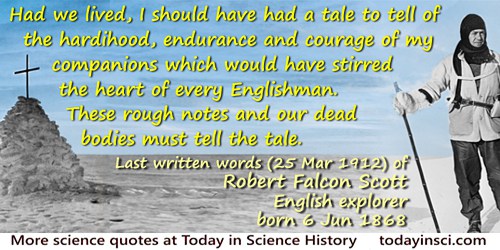
Had we lived, I should have had a tale to tell of the hardihood, endurance and courage of my companions which would have stirred the heart of every Englishman. These rough notes and our dead bodies must tell the tale, but surely, a great rich country like ours will see that those who are dependent on us are properly provided for.
[Final words in a 'Message to the Public' left written in his diary dated 25 March 1912, shortly before he died on the Ross Ice Barrier, Antarctica. When searchers found his body, on 12 Nov 1912, Scott was discovered sitting upright against the pole of the tent with the diary behind his head, as if for a pillow.]
[Final words in a 'Message to the Public' left written in his diary dated 25 March 1912, shortly before he died on the Ross Ice Barrier, Antarctica. When searchers found his body, on 12 Nov 1912, Scott was discovered sitting upright against the pole of the tent with the diary behind his head, as if for a pillow.]
Final words in a 'Message to the Public' left written in his diary dated 25 March 1912, shortly before he died on the Ross Ice Barrier, Antarctica. In Logan Marshall, The Story of Polar Conquest: The Complete History of Arctic and Antarctic (1913), 24-25.
by Logan Marshall - Polar regions - 1913
Had you or I been born at the Bay of Soldania, possibly our Thoughts, and Notions, had not exceeded those brutish ones of the Hotentots that inhabit there: And had the Virginia King Apochancana, been educated in England, he had, perhaps been as knowing a Divine, and as good a Mathematician as any in it. The difference between him, and a more improved English-man, lying barely in this, That the exercise of his Facilities was bounded within the Ways, Modes, and Notions of his own Country, and never directed to any other or farther Enquiries.
An Essay Concerning Human Understanding (1690). Edited by Peter Nidditch (1975), Book I, Chapter 4, Section 12, 92.
He who joyfully marches to music in rank and file has already earned my contempt. He has been given a large brain by mistake, since for him the spinal cord would fully suffice. This disgrace to civilisation should be done away with at once. Heroism at command, senseless brutality, deplorable love-of-country stance, how violently I hate all this, how despicable and ignoble war is; I would rather be torn to shreds than be part of so base an action! It is my conviction that killing under the cloak of war is nothing but an act of murder.
…...
I am not a lover of lawns; … the least interesting adjuncts of the country-house. … Rather would I see daisies in their thousands, ground ivy, hawkweed, and even the hated plantain with tall stems, and dandelions with splendid flowers and fairy down, than the too-well-tended lawn.
In The Book of a Naturalist (1919), 337.
I am sorry that the distinguished leader of the Republican Party in the House states that he is not versed in botany and publicly admits that he does not know anything of these terms or what it is all about; but, Mr. Chairman, it is indeed a sad day for the people of this country when we must close the doors of the laboratories doing research work for the people of the United States.
Speaking (28 Dec 1932) as a member of the 72nd Congress, early in the Great Depression, in opposition to an attempt to eliminate a small amount from the agricultural appropriation bill. As quoted in 'Mayor-Elect La Guardia on Research', Science (1933), New Series, 78, No. 2031, 511.
I am the most travelled of all my contemporaries; I have extended my field of enquiry wider than anybody else, I have seen more countries and climes, and have heard more speeches of learned men. No one has surpassed me in the composition of lines, according to demonstration, not even the Egyptian knotters of ropes, or geometers.
In Alan L. Mackay, A Dictionary of Scientific Quotations (1992, 1994), 71.
I am truly a ‘lone traveler’ and have never belonged to my country, my home, my friends, or even my immediate family, with my whole heart; in the face of all these ties, I have never lost a sense of distance and a need for solitude.
…...
I believe [the Department of Energy] should be judged not by the money we direct to a particular State or district, company, university or national lab, but by the character of our decisions. The Department of Energy serves the country as a Department of Science, a Department of Innovation, and a Department of Nuclear Security.
In letter (1 Feb 2013) to Energy Department employees announcing his decision not to serve a second term.
I call upon the scientific community in our country, those who gave us nuclear weapons, to turn their great talents now to the cause of mankind and world peace, to give us the means of rendering those nuclear weapons impotent and obsolete.
About his proposed Strategic Defense Initiative, later to be known as 'Star Wars.')
About his proposed Strategic Defense Initiative, later to be known as 'Star Wars.')
National address (23 Mar 1983)
I felt an awesome responsibility, and I took the responsibility very seriously, of being a role model and opening another door to black Americans, but the important thing is not that I am black, but that I did a good job as a scientist and an astronaut. There will be black astronauts flying in later missions … and they, too, will be people who excel, not simply who are black … who can ably represent their people, their communities, their country.
I gang my own gait and have never belonged to my country, my home, my friends, or even my immediate family, with my whole heart; in the face of all these ties I have never lost an obstinate sense of detachment, of the need for solitude–a feeling which increases with the years.
…...
I have always assumed, and I now assume, that he [Robert Oppenheimer] is loyal to the United States. I believe this, and I shall believe it until I see very conclusive proof to the opposite. … [But] I thoroughly disagreed with him in numerous issues and his actions frankly appeared to me confused and complicated. To this extent I feel that I would like to see the vital interests of this country in hands which I understand better, and therefore trust more.
After Teller paid tribute to Oppenheimer’s talents, especially his “very outstanding achievement” as the wartime organizer and director of Los Alamos, Teller continued his testimony to the Gray board hearings (28 Apr 1954) in the Atomic Energy Commission building, “In the Matter of J. Robert Oppenheimer.” The subject quotes were excerpted from Teller’s answers to their questions. As given in Robert Coughlan, 'Dr. Edward Teller’s Magnificent Obsession', Life (6 Sep 1954), 72-74.
I have been branded with folly and madness for attempting what the world calls impossibilities, and even from the great engineer, the late James Watt, who said ... that I deserved hanging for bringing into use the high-pressure engine. This has so far been my reward from the public; but should this be all, I shall be satisfied by the great secret pleasure and laudable pride that I feel in my own breast from having been the instrument of bringing forward new principles and new arrangements of boundless value to my country, and however much I may be straitened in pecuniary circumstances, the great honour of being a useful subject can never be taken from me, which far exceeds riches.
From letter to Davies Gilbert, written a few months before Trevithick's last illness. Quoted in Francis Trevithick, Life of Richard Trevithick: With an Account of his Inventions (1872), Vol. 2, 395-6.
I have no fault to find with those who teach geometry. That science is the only one which has not produced sects; it is founded on analysis and on synthesis and on the calculus; it does not occupy itself with the probable truth; moreover it has the same method in every country.
In Oeuvres de Frederic Le Grand edited by J.D.E. Preuss (1849), Vol. 7, 100. In Robert Édouard Moritz, Memorabilia Mathematica (1917), 310.
I have now said enough to show you that it is indispensable for this country to have a scientific education in connexion with manufacturers, if we wish to outstrip the intellectual competition which now, happily for the world, prevails in all departments of industry. As surely as darkness follows the setting of the sun, so surely will England recede as a manufacturing nation, unless her industrial population become much more conversant with science than they are now.
In 'The Study of Abstract Science Essential to the Progress of Industry', Records of the School of Mines (1852) 1, 48.
I have presented the periodic table as a kind of travel guide to an imaginary country, of which the elements are the various regions. This kingdom has a geography: the elements lie in particular juxtaposition to one another, and they are used to produce goods, much as a prairie produces wheat and a lake produces fish. It also has a history. Indeed, it has three kinds of history: the elements were discovered much as the lands of the world were discovered; the kingdom was mapped, just as the world was mapped, and the relative positions of the elements came to take on a great significance; and the elements have their own cosmic history, which can be traced back to the stars.
In The Periodic Kingdom: A Journey Into the Land of the Chemical Elements (1995), Preface, viii.
I have started that which the country will not willingly let die.
In Letter to his father, quoted in W. J. Humphries, 'Cleveland Abbe', part of National Academy of Science: Biographical Memoirs: Vol. VIII (1919), 478. Humphries comments “Professor Abbe’s justifiable enthusiasm over his success in foretelling the coming of storms may be inferred from [this] letter.” The larger context is the goal of establishing a national weather forecasting service with a wide network of reporting stations collecting weather data.
I kind of like scientists, in a funny way. … I'm kind of interested in genetics though. I think I would have liked to have met Gregor Mendel. Because he was a monk who just sort of figured this stuff out on his own. That's a higher mind, that’s a mind that's connected. … But I would like to know about Mendel, because I remember going to the Philippines and thinking “this is like Mendel’s garden” because it had been invaded by so many different countries over the years, and you could see the children shared the genetic traits of all their invaders over the years, and it made for this beautiful varietal garden.
Answering question: “If you could go back in time and have a conversation with one person, who would it be and why?” by Anniedog03 during an Internet Reddit AMA (Ask Me Anything) online session (17 Jan 2014).
I knew, however, that it would cost ten times what I had available in order to build a molecular beam machine. I decided to follow a byway, rather than the highway. It is a procedure I have subsequently recommended to beginning scientists in this country, where research strategy is best modelled on that used by Wolfe at the Plains of Abraham.
(British General James Wolfe defeated the French defending Quebec in 1759 after scaling a cliff for a surprise attack.)
(British General James Wolfe defeated the French defending Quebec in 1759 after scaling a cliff for a surprise attack.)
'A Scientist and the World He Lives In', Speech to the Empire Club of Canada (27 Nov 1986) in C. Frank Turner and Tim Dickson (eds.), The Empire Club of Canada Speeches 1986-1987 (1987), 149-161.
I know Teddy Kennedy had fun at the Democratic convention when he said that I said that trees and vegetation caused 80 percent of the air pollution in this country. ... Well, now he was a little wrong about what I said. I didn't say 80 percent. I said 92 percent—93 percent, pardon me. And I didn’t say air pollution, I said oxides of nitrogen. Growing and decaying vegetation in this land are responsible for 93 percent of the oxides of nitrogen. ... If we are totally successful and can eliminate all the manmade oxides of nitrogen, we’ll still have 93 percent as much as we have in the air today.
[Reagan reconfirming his own pathetic lack of understanding of air pollutants.]
[Reagan reconfirming his own pathetic lack of understanding of air pollutants.]
Address to senior citizens at Sea World, Orlando, Florida (9 Oct 1980). As quoted later in Douglas E. Kneeland, 'Teamsters Back Republican', New York Times (10 Oct 1980), D14.
I think we may picture those domains where understanding exists, whether in physics, chemistry, biology, psychology, economics or any other discipline as cultivated valleys in a formidably mountainous country. We may recognise in principle that we all inhabit the same world but in practice we do well to cultivate our own valleys, with an occasional assault on the more accessible foothills, rather than to build roads in a vain attempt at colonisation.
From Inaugural Lecture as Cavendish Professor of Physics, Cambridge, as quoted in Gordon L. Glegg, The Development of Design (1981), 1-2.
I would like to see us continue to explore space. There's just a lot for us to keep learning. I think it’s a good investment, so on my list of things that I want our country to invest in—in terms of research and innovation and science, basic science, exploring space, exploring our oceans, exploring our genome—we’re at the brink of all kinds of new information. Let's not back off now!
At Town Hall Meeting, Dover, New Hampshire (16 Jul 2015). As quoted in Clare Foran, 'Hillary Clinton: I Wanted to Be an Astronaut', National Journal (16 Jul 2015).
I would never use a long word, even, where a short one would answer the purpose. I know there are professors in this country who “ligate” arteries. Other surgeons only tie them, and it stops the bleeding just as well.
'Scholastic and Bedside Teaching: An Introductory Lecture to the Medical Class of Harvard University, November 6, 1867'. Collected in Medical Essays 1842-1882 (1891), 302.
I would not have it inferred ... that I am, as yet, an advocate for the hypothesis of chemical life. The doctrine of the vitality of the blood, stands in no need of aid from that speculative source. If it did, I would certainly abandon it. For, notwithstanding the fashionableness of the hypothesis in Europe, and the ascendancy it has gained over some minds in this country [USA], it will require stubborn facts to convince me that man with all his corporeal and intellectual attributes is nothing but hydro-phosphorated oxyde of azote ... When the chemist declares, that the same laws which direct the crystallization of spars, nitre and Glauber's salts, direct also the crystallization of man, he must pardon me if I neither understand him, nor believe him.
Medical Theses (1805), 391-2, footnote.
I wouldn’t miss this opportunity for anything. For the chance to work on these conservation issues, to serve my country, to work for this president, I’d do it all over again, every single minute.
…...
If a little less time was devoted to the translation of letters by Julius Caesar describing Britain 2000 years ago and a little more time was spent on teaching children how to describe (in simple modern English) the method whereby ethylene was converted into polythene in 1933 in the ICI laboratories at Northwich, and to discussing the enormous social changes which have resulted from this discovery, then I believe that we should be training future leaders in this country to face the world of tomorrow far more effectively than we are at the present time.
Quoted in an Obituary, D. P. Craig, Biographical Memoirs of Fellows of the Royal Society (1972), 18, 461.
If agriculture goes wrong, nothing else will have a chance to go right in the country.
Quoted as “He had a strong belief” in Journal of Plantation Crops (2002), 30-33, 72. Also in Combating Hunger and Achieving Food Security (2016), 86, ending with wording “in our country”, referring to India.
If science has no country, the scientist should have one, and ascribe to it the influence which his works may have in this world.
Address at the Inauguration of the Pasteur Institute (14 Nov 1888). In René Vallery-Radot, The Life of Pasteur, translated by Mrs. R. L. Devonshire (1919), 443.
If the kind of controversy which so often springs up between modernism and traditionalism in religion were applied to more commonplace affairs of life we might see some strange results. …It arises, let us say, from a passage in an obituary notice which mentions that the deceased had loved to watch the sunsets from his peaceful country home.. …it is forgotten that what the deceased man looked out for each evening was an experience and not a creed.
Swarthmore Lecture (1929) at Friends’ House, London, printed in Science and the Unseen World (1929), 84-85.
If we are to follow in the wake of other countries in the pursuit of material prosperity, we must give up aimless activities and bring our ideals into line with the standards of the West, namely, to spread education in all grades, multiply occupations and increase production and wealth. All other activities should conform themselves to the economic ideal.
Speech (16 Mar 1912), at Central College Bangalore Visvesvaraya. Collected in Speeches: 1910-11 to 1916-17: by Sir Mokshagundam Visvesvaraya (1917), 23.
Imperceptibly a change had been wrought in me until I no longer felt alone in a strange, silent country. I had learned to hear the echoes of a time when every living thing upon this land and even the varied overshadowing skies had its voice, a voice that was attentively heard and devoutly heeded by the ancient people of America. Henceforth, to me the plants, the trees, the clouds and all things had become vocal with human hopes, fears and supplications.
From Preface, Indian Games and Dances with Native Songs (1915), v.
In 1786, I found that in Germany they were engaged in a species of political inquiry, to which they had given the name of Statistics;… an inquiry for the purpose of ascertaining the political strength of a country, or questions respecting matters of state;… as I thought that a new word, might attract public attention, I resolved on adopting it, and I hope that it is now completely naturalised and incorporated with our language.
In Statistical Account of Scotland: Drawn Up from the Communications of the Ministers of the Different Parishes, Volume 20 (1798), xiii-xiv.
In 1891, during the Presidency of William Henry Harrison [Benjamin Harrison], electric lights were first installed in the White House, the residence of the leaders of our country. At that time, commercial electricity was not economically feasible, but President Harrison wanted to affirm his confidence in the technological capability of our country.
Speech, at dedication of solar panels on the White House roof, 'Solar Energy Remarks Announcing Administration Proposals' (20 Jun 1979).
In England, more than in any other country, science is felt rather than thought. … A defect of the English is their almost complete lack of systematic thinking. Science to them consists of a number of successful raids into the unknown.
The Social Function of Science (1939), 197.
In every section of the entire area where the word science may properly be applied, the limiting factor is a human one. We shall have rapid or slow advance in this direction or in that depending on the number of really first-class men who are engaged in the work in question. ... So in the last analysis, the future of science in this country will be determined by our basic educational policy.
Quoted in Vannevar Bush, Science, the Endless Frontier: A Report to the President, July 1945. In Transactions of the Kansas Academy of Science: Volumes 48-49, 246.
In my opinion it is not right to bring politics into scientific matters, nor should individuals be held responsible for the government of the country to which they happen to belong.
In Einstein: A Centenary Volume edited by A. P. French (1979).
In my opinion the English excel in the art of writing text-books for mathematical teaching; as regards the clear exposition of theories and the abundance of excellent examples, carefully selected, very few books exist in other countries which can compete with those of Salmon and many other distinguished English authors that could be named.
In Projective Geometry (1886), Preface.
In the Choice of … Things, neglect not any, tho’ the most ordinary and trivial; the Commonest Peble or Flint, Cockle or Oyster-shell, Grass, Moss, Fern or Thistle, will be as useful, and as proper to be gathered and sent, as any the rarest production of the Country. Only take care to choose of each the fairest of its kind, and such as are perfect or whole.
In Brief Instructions for Making Observations in all Parts of the World (1696), 10.
In the country of the blind the one-eyed man is lucky to escape with his life.
In The Decline and Fall of Science (1976), 171.
In this country all a man need to do is to attain a little eminence and immediately he begins to talk. Usually his eminence is financial, and the greater this eminence the more he talks and the further his voice reaches. I don't blame the rich people for talking; many of them don’t know what else to do with themselves. The fault is with these who listen. If no one would listen
no harm would he done. But the American people are willing to listen to any one who has attained prominence. The main fact is that we've heard a man's name a great many times; that makes us ready to accept whatever he says. … We listen to the one who talks the most and loudest.
As quoted in 'Electricity Will Keep The World From Freezing Up', New York Times (12 Nov 1911), SM4.
In this country, science is almost exclusively prosecuted by those engaged in the laborious and exhaustive employment of imparting instruction. Science among us brings comparatively little emolument and is accompanied with but little honor.
In Letter (3 Feb 1873) to the Committee of Arrangements, in Proceedings of the Farewell Banquet to Professor Tyndall (4 Feb 1873), 19. Reprinted as 'On the Importance of the Cultivation of Science', The Popular Science Monthly (1873), Vol. 2, 646.
Instead of disbursing her annual millions for these dye stuffs, England will, beyond question, at no distant day become herself the greatest coloring producing country in the world; nay, by the very strangest of revolutions she may ere long send her coal-derived blues to indigo-growing India, her tar-distilled crimson to cochineal-producing Mexico, and her fossil substitutes for quercitron and safflower to China, Japan and the other countries whence these articles are now derived.
From 'Report on the Chemical Section of the Exhibition of 1862.' As quoted in Sir Frederick Abel, 'The Work of the Imperial Institute' Nature (28 Apr 1887), 35, No. 913, 620. Abel called the display of the first dye-products derived from coal tar at the Exhibition of 1862, “one of the features of greatest novelty.”
It [the value of building Fermilab’s first accelerator] only has to do with the respect with which we regard one another, the dignity of men, our love of culture. It has to do with those things. It has nothing to do with the military, I am sorry. … It has to do with: Are we good painters, good sculptors, great poets? I mean all the things that we really venerate and honor in our country and are patriotic about. In that sense, this new knowledge has all to do with honor and country but it has nothing to do directly with defending our country except to help make it worth defending.
In testimony to a Congressional Committee, answering a question on how the new accelerator will affect the nation’s security (17 Apr 1968). On record in AEC Authorizing Legislation, Fiscal Year 1970: Part 1.
It did not take atomic weapons to make man want peace. But the atomic bomb was the turn of the screw. The atomic bomb made the prospect of future war unendurable. It has led us up those last few steps to the mountain pass; and beyond there is a different country.
Commencement address (1946). As quoted in book review (of Richard Rhodes, The Making of the Atomic Bomb), by William J. Broad, ‘The Men Who Made the Sun Rise', New York Times Book Review (8 Feb 1987), 39. Cited as from 'The Atomic Bomb and College Education' (1946), in Bartlett's Familiar Quotations (18th ed., 2014).
as quoted, without citation, in . Please contact Webmaster if you know a primary source.
It is clear that the degradation of the position of the scientist as an independent worker and thinker to that of a morally irresponsible stooge in a science-factory has ‘proceeded even more rapidly and devastatingly than I had expected. This subordination of those who ought to think to those who have the administrative power is ruinous for the morale of the scientist, and quite to the same extent it is ruinous to the quality of the subjective scientific output of the country.
In 'A Rebellious Scientist after Two Years', Bulletin of the Atomic Scientists, (1948), 4, 338.
It is difficult to give an idea of the vast extent of modern mathematics. The word “extent” is not the right one: I mean extent crowded with beautiful detail—not an extent of mere uniformity such as an objectless plain, but of a tract of beautiful country seen at first in the distance, but which will bear to be rambled through and studied in every detail of hillside and valley, stream, rock, wood, and flower.
President’s address (1883) to the British Association for the Advancement of Science, in The Collected Mathematical Papers (1895), Vol. 8, xxii.
It is for such inquiries the modern naturalist collects his materials; it is for this that he still wants to add to the apparently boundless treasures of our national museums, and will never rest satisfied as long as the native country, the geographical distribution, and the amount of variation of any living thing remains imperfectly known. He looks upon every species of animal and plant now living as the individual letters which go to make up one of the volumes of our earth’s history; and, as a few lost letters may make a sentence unintelligible, so the extinction of the numerous forms of life which the progress of cultivation invariably entails will necessarily render obscure this invaluable record of the past. It is, therefore, an important object, which governments and scientific institutions should immediately take steps to secure, that in all tropical countries colonised by Europeans the most perfect collections possible in every branch of natural history should be made and deposited in national museums, where they may be available for study and interpretation. If this is not done, future ages will certainly look back upon us as a people so immersed in the pursuit of wealth as to be blind to higher considerations. They will charge us with having culpably allowed the destruction of some of those records of Creation which we had it in our power to preserve; and while professing to regard every living thing as the direct handiwork and best evidence of a Creator, yet, with a strange inconsistency, seeing many of them perish irrecoverably from the face of the earth, uncared for and unknown.
In 'On the Physical Geography of the Malay Archipelago', Journal of the Royal Geographical Society (1863), 33, 234.
It is science alone that can solve the problems of hunger and poverty, of insanitation and literacy, of superstition and tradition, of vast resources running to waste, of a rich country inhabited by starving people. ... The future belongs to science and to those who make friends with science.
Address to the Indian Institute of Science, Proceedings of the National Institute of Science of India (1960), 27, 564, cited in Mary Midgley, The myths We live By (2004), 14., x. In Vinoth Ramachandra, Subverting Global Myths: Theology and the Public Issues Shaping our World (2008), 172.
It is science alone that can solve the problems of hunger and poverty, of insanitation and illiteracy, of superstition and deadening custom and tradition, of vast resources running to waste, of a rich country inhabited by starving people… Who indeed could afford to ignore science today? At every turn we have to seek its aid … the future belongs to science and those who make friends with science.
From address to the Indian Science Congress (26 Dec 1937). As cited in M.J. Vinod and Meena Deshpande, Contemporary Political Theory (2013), 507. An earlier, longer version of the quote is in Atma Ram, 'The Making of Optical Glass in India: Its Lessons for Industrial Development', Proceedings of the National Institute of Sciences of India (1961), 27, 564-5.
It is the constant attempt in this country [Canada] to make fundamental science responsive to the marketplace. Because technology needs science, it is tempting to require that scientific projects be justified in terms of the worth of the technology they can be expected to generate. The effect of applying this criterion is, however, to restrict science to developed fields where the links to technology are most evident. By continually looking for a short-term payoff we disqualify the sort of science that … attempts to answer fundamental questions, and, having answered them, suggests fundamentally new approaches in the realm of applications.
'A Scientist and the World He Lives In', Speech to the Empire Club of Canada (27 Nov 1986) in C. Frank Turner and Tim Dickson (eds.), The Empire Club of Canada Speeches 1986-1987 (1987), 149-161.
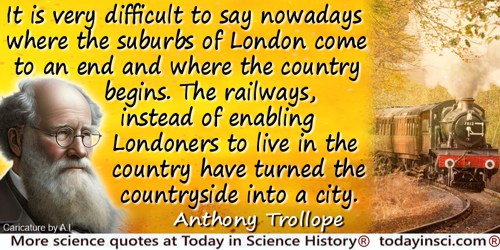
It is very difficult to say nowadays where the suburbs of London come to an end and where the country begins. The railways, instead of enabling Londoners to live in the country have turned the countryside into a city.
In The Three Clerks (1857, 1904), 30-31.
It isn’t important in which sea or lake you observe a slick of pollution, or in the forests of which country a fire breaks out, or on which continent a hurricane arises. You are standing guard over the whole of our Earth.
In Jack Hassard and Julie Weisberg, Environmental Science on the Net: The Global Thinking Project (1999), 23.
It seems to me that it had no other rationale than to show that we are not simply the country of entertainers, but also that of engineers and builders called from across the world to build bridges, viaducts, stations and major monuments of modern industry, the Eiffel Tower deserves to be treated with more consideration.
English version by Webmaster using Google Translate, from the original French, “Il me semble que, n’eût elle pas d’autre raison d’être que de montrer que nous ne sommes pas simplement le pays des amuseurs, mais aussi celui des ingénieurs et des constructeurs qu’on appelle de toutes les régions du monde pour édifier les ponts, les viaducs, les gares et les grands monuments de l’industrie moderne, la Tour Eiffel mériterait d’être traitée avec plus de consideration.” From interview of Eiffel by Paul Bourde, in the newspaper Le Temps (14 Feb 1887). Reprinted in 'Au Jour le Jour: Les Artistes Contre la Tour Eiffel', Gazette Anecdotique, Littéraire, Artistique et Bibliographique (Feb 1887), 126-127, and in Gustave Eiffel, Travaux Scientifiques Exécutés à la Tour de 300 Mètres de 1889 à 1900 (1900), 16. Also quoted in review of the Gustave Eiffel’s book La Tour Eiffel (1902), in Nature (30 Jan 1902), 65, 292.
It’s not for glory that Soviet cosmonauts are in this assault on the cosmos; they are motivated by a limitless love for and devotion to their country, the Party and the people, and by a desire to help Soviet scientists to discover the secrets of the universe.
In First Man in Space: The Life and Achievement of Yuri Gagarin: a Collection (1984), 104. Cited as written as a foreword of a book at the request of the author.
Leaders who assert they will not concede one square meter of national territory to an invader should think of the hundreds of square kilometers of topsoil eroded from their countries each year.
Quoted, without source, in Epigraph in P. G. Dhar Chakrabarti (ed.), People, Planet, and Progress Beyond 2015 (2017), 33. [Please contact Webmaster if you know the primary source.]
Let no one mistake it for comedy, farcical though it may be in all its details. It serves notice on the country that Neanderthal man is organizing in these forlorn backwaters of the land, led by a fanatic, rid of sense and devoid of conscience.
[Commenting on the Scopes Monkey Trial, while reporting for the Baltimore Sun.]
[Commenting on the Scopes Monkey Trial, while reporting for the Baltimore Sun.]
In Michael Shermer, Why Darwin Matters (2006), 26.
Look around you: there is not a doctor who desires the health of his friends, not a soldier who desires peace for his country.
— Philemon
In Gustave Jules Witkowski, 'The Sicilian', The Evil that Has Been Said of Doctors (1889), 4-5.
Martin Gardner is one of the greatest intellects produced in this country in this century.
As quoted in Kendrick Frazier, 'A Mind at Play: An Interview with Martin Gardner', Skeptical Inquirer (Mar/Apr 1998), 22, No. 2, 36.
Mathematics knows no races or geographic boundaries; for mathematics, the cultural world is one country.
In H. Eves, Mathematical Circles Squared (1972). As cited in Anton Zettl, Sturm-Liouville Theory (2005), 171.
Maxwell, like every other pioneer who does not live to explore the country he opened out, had not had time to investigate the most direct means of access to the country, or the most systematic way of exploring it. This has been reserved for Oliver Heaviside to do. Maxwell’s treatise is cumbered with the débris of his brilliant lines of assault, of his entrenched camps, of his battles. Oliver Heaviside has cleared those away, has opened up a direct route, has made a broad road, and has explored a considerable tract of country.
Book Review of Heaviside’s Electrical Papers in The Electrician (11 Aug 1893). Collected in Joseph Larmore (ed.), The Scientific Writings of the Late George Francis FitzGerald (1902), 294.
Modern civilisation rests upon physical science; take away her gifts to our own country, and our position among the leading nations of the world is gone to-morrow; for it is physical science only that makes intelligence and moral energy stronger than brute force
By Thomas Henry Huxley and Henrietta A. Huxley (ed.), Aphorisms and Reflections (1908), 80.
Most kids can't understand why a country that makes atomic bombs would ban fireworks.
In E.C. McKenzie, 14,000 Quips and Quotes for Speakers, Writers, Editors, Preachers, and Teachers (1990), 24.
My father, and the father of my father, pitched their tents here before me. … For twelve hundred years have the true believers—and, praise be to God! all true wisdom is with them alone—been settled in this country, and not one of them ever heard of a palace underground. Neither did they who went before them. But lo! here comes a Frank from many days’ journey off, and he walks up to the very place, and he takes a stick … and makes a line here, and makes a line there. Here, says he, is the palace; there, says he, is the gate; and he shows us what has been all our lives beneath our feet, without our having known anything about it. Wonderful! Wonderful! Is it by books, is it by magic, is it by your prophets, that you have learnt wisdom?
(c. 1850) To Austin Layard, the English archaeologist who discovered and excavated Nineveh and Nimrud, 1845-1861.
My theory of electrical forces is that they are called into play in insulating media by slight electric displacements, which put certain small portions of the medium into a state of distortion which, being resisted by the elasticity of the medium, produces an electromotive force ... I suppose the elasticity of the sphere to react on the electrical matter surrounding it, and press it downwards.
From the determination by Kohlrausch and Weber of the numerical relation between the statical and magnetic effects of electricity, I have determined the elasticity of the medium in air, and assuming that it is the same with the luminiferous ether I have determined the velocity of propagation of transverse vibrations.
The result is
193088 miles per second
(deduced from electrical & magnetic experiments).
Fizeau has determined the velocity of light
= 193118 miles per second
by direct experiment.
This coincidence is not merely numerical. I worked out the formulae in the country, before seeing Webers [sic] number, which is in millimetres, and I think we have now strong reason to believe, whether my theory is a fact or not, that the luminiferous and the electromagnetic medium are one.
From the determination by Kohlrausch and Weber of the numerical relation between the statical and magnetic effects of electricity, I have determined the elasticity of the medium in air, and assuming that it is the same with the luminiferous ether I have determined the velocity of propagation of transverse vibrations.
The result is
193088 miles per second
(deduced from electrical & magnetic experiments).
Fizeau has determined the velocity of light
= 193118 miles per second
by direct experiment.
This coincidence is not merely numerical. I worked out the formulae in the country, before seeing Webers [sic] number, which is in millimetres, and I think we have now strong reason to believe, whether my theory is a fact or not, that the luminiferous and the electromagnetic medium are one.
Letter to Michael Faraday (19 Oct 1861). In P. M. Harman (ed.), The Scientific Letters and Papers of James Clerk Maxwell (1990), Vol. 1, 1846-1862, 684-6.
Nature crying out and speaking to country people in these words: Clown, wherefore dost thou behold the heavens? Why dost thou seek after the stars? When thou art now werry with short sleep, the nights are troublesome to thee. So I scatter little stars in the grass, and I shew them in the evening when thy labour is ended, and thou art miraculously allured to look upon them when thous passest by: Dost thou not see how a light like fire is covered when she closeth her wings, and she carrieth both night and day with her.
In Thomas Moffett, 'Glow-Worms', The Theater of Insects.
Next came the patent laws. These began in England in 1624, and in this country with the adoption of our Constitution. Before then any man [might] instantly use what another man had invented, so that the inventor had no special advantage from his own invention. The patent system changed this, secured to the inventor for a limited time exclusive use of his inventions, and thereby added the fuel of interest to the fire of genius in the discovery and production of new and useful things.
Lecture 'Discoveries, Inventions and Improvements' (22 Feb 1860) in John George Nicolay and John Hay (eds.), Complete Works of Abraham Lincoln (1894), Vol. 5, 113. In Eugene C. Gerhart, Quote it Completely! (1998), 802.
No country in the world is so much indebted for its progress in power and intelligence to science than ours, and yet no country does so little to encourage or advance it.
Address (2 Jun 1874) at the Laying of the Cornerstone of the American Museum of Natural History, in Fifth and Sixth Annual Reports of the American Museum of Natural History (1 Dec 1874), 47.
No history of civilization can be tolerably complete which does not give considerable space to the explanation of scientific progress. If we had any doubts about this, it would suffice to ask ourselves what constitutes the essential difference between our and earlier civilizations. Throughout the course of history, in every period, and in almost every country, we find a small number of saints, of great artists, of men of science. The saints of to-day are not necessarily more saintly than those of a thousand years ago; our artists are not necessarily greater than those of early Greece; they are more likely to be inferior; and of course, our men of science are not necessarily more intelligent than those of old; yet one thing is certain, their knowledge is at once more extensive and more accurate. The acquisition and systematization of positive knowledge is the only human activity which is truly cumulative and progressive. Our civilization is essentially different from earlier ones, because our knowledge of the world and of ourselves is deeper, more precise, and more certain, because we have gradually learned to disentangle the forces of nature, and because we have contrived, by strict obedience to their laws, to capture them and to divert them to the gratification of our own needs.
Introduction to the History of Science (1927), Vol. 1, 3-4.
No science is immune to the infection of politics and the corruption of power. … The time has come to consider how we might bring about a separation, as complete as possible, between Science and Government in all countries. I call this the disestablishment of science, in the same sense in which the churches have been disestablished and have become independent of the state.
In 'The Disestablishment of Science', Encounter (Jul 1971), 15.
Not enough of our society is trained how to understand and interpret quantitative information. This activity is a centerpiece of science literacy to which we should all strive—the future health, wealth, and security of our democracy depend on it. Until that is achieved, we are at risk of making under-informed decisions that affect ourselves, our communities, our country, and even the world.
From email message, as published on Huffington Post website (5 Feb 2015).
Nothing can be more improving to a young naturalist, than a journey in a distant country.
Journal of Researches: into the Natural History and Geology of the Countries Visited During the Voyage of H.M.S. Beagle Round the World (1839), ch. XXIII, 607.
Now, at Suiattle Pass, Brower was still talking about butterflies. He said he had raised them from time to time and had often watched them emerge from the chrysalis—first a crack in the case, then a feeler, and in an hour a butterfly. He said he had felt that he wanted to help, to speed them through the long and awkward procedure; and he had once tried. The butterflies came out with extended abdomens, and their wings were balled together like miniature clenched fists. Nothing happened. They sat there until they died. ‘I have never gotten over that,’ he said. ‘That kind of information is all over in the country, but it’s not in town.”
…...
October 9, 1863
Always, however great the height of the balloon, when I have seen the horizon it has roughly appeared to be on the level of the car though of course the dip of the horizon is a very appreciable quantity or the same height as the eye. From this one might infer that, could the earth be seen without a cloud or anything to obscure it, and the boundary line of the plane approximately the same height as the eye, the general appearance would be that of a slight concavity; but I have never seen any part of the surface of the earth other than as a plane.
Towns and cities, when viewed from the balloon are like models in motion. I shall always remember the ascent of 9th October, 1863, when we passed over London about sunset. At the time when we were 7,000 feet high, and directly over London Bridge, the scene around was one that cannot probably be equalled in the world. We were still so low as not to have lost sight of the details of the spectacle which presented itself to our eyes; and with one glance the homes of 3,000,000 people could be seen, and so distinct was the view, that every large building was easily distinguishable. In fact, the whole of London was visible, and some parts most clearly. All round, the suburbs were also very distinct, with their lines of detached villas, imbedded as it were in a mass of shrubs; beyond, the country was like a garden, its fields, well marked, becoming smaller and smaller as the eye wandered farther and farther away.
Again looking down, there was the Thames, throughout its whole length, without the slightest mist, dotted over its winding course with innumerable ships and steamboats, like moving toys. Gravesend was visible, also the mouth of the Thames, and the coast around as far as Norfolk. The southern shore of the mouth of the Thames was not so clear, but the sea beyond was seen for many miles; when at a higher elevation, I looked for the coast of France, but was unable to see it. On looking round, the eye was arrested by the garden-like appearance of the county of Kent, till again London claimed yet more careful attention.
Smoke, thin and blue, was curling from it, and slowly moving away in beautiful curves, from all except one part, south of the Thames, where it was less blue and seemed more dense, till the cause became evident; it was mixed with mist rising from the ground, the southern limit of which was bounded by an even line, doubtless indicating the meeting of the subsoils of gravel and clay. The whole scene was surmounted by a canopy of blue, everywhere free from cloud, except near the horizon, where a band of cumulus and stratus extended all round, forming a fitting boundary to such a glorious view.
As seen from the earth, the sunset this evening was described as fine, the air being clear and the shadows well defined; but, as we rose to view it and its effects, the golden hues increased in intensity; their richness decreased as the distance from the sun increased, both right and left; but still as far as 90º from the sun, rose-coloured clouds extended. The remainder of the circle was completed, for the most part, by pure white cumulus of well-rounded and symmetrical forms.
I have seen London by night. I have crossed it during the day at the height of four miles. I have often admired the splendour of sky scenery, but never have I seen anything which surpassed this spectacle. The roar of the town heard at this elevation was a deep, rich, continuous sound the voice of labour. At four miles above London, all was hushed; no sound reached our ears.
Always, however great the height of the balloon, when I have seen the horizon it has roughly appeared to be on the level of the car though of course the dip of the horizon is a very appreciable quantity or the same height as the eye. From this one might infer that, could the earth be seen without a cloud or anything to obscure it, and the boundary line of the plane approximately the same height as the eye, the general appearance would be that of a slight concavity; but I have never seen any part of the surface of the earth other than as a plane.
Towns and cities, when viewed from the balloon are like models in motion. I shall always remember the ascent of 9th October, 1863, when we passed over London about sunset. At the time when we were 7,000 feet high, and directly over London Bridge, the scene around was one that cannot probably be equalled in the world. We were still so low as not to have lost sight of the details of the spectacle which presented itself to our eyes; and with one glance the homes of 3,000,000 people could be seen, and so distinct was the view, that every large building was easily distinguishable. In fact, the whole of London was visible, and some parts most clearly. All round, the suburbs were also very distinct, with their lines of detached villas, imbedded as it were in a mass of shrubs; beyond, the country was like a garden, its fields, well marked, becoming smaller and smaller as the eye wandered farther and farther away.
Again looking down, there was the Thames, throughout its whole length, without the slightest mist, dotted over its winding course with innumerable ships and steamboats, like moving toys. Gravesend was visible, also the mouth of the Thames, and the coast around as far as Norfolk. The southern shore of the mouth of the Thames was not so clear, but the sea beyond was seen for many miles; when at a higher elevation, I looked for the coast of France, but was unable to see it. On looking round, the eye was arrested by the garden-like appearance of the county of Kent, till again London claimed yet more careful attention.
Smoke, thin and blue, was curling from it, and slowly moving away in beautiful curves, from all except one part, south of the Thames, where it was less blue and seemed more dense, till the cause became evident; it was mixed with mist rising from the ground, the southern limit of which was bounded by an even line, doubtless indicating the meeting of the subsoils of gravel and clay. The whole scene was surmounted by a canopy of blue, everywhere free from cloud, except near the horizon, where a band of cumulus and stratus extended all round, forming a fitting boundary to such a glorious view.
As seen from the earth, the sunset this evening was described as fine, the air being clear and the shadows well defined; but, as we rose to view it and its effects, the golden hues increased in intensity; their richness decreased as the distance from the sun increased, both right and left; but still as far as 90º from the sun, rose-coloured clouds extended. The remainder of the circle was completed, for the most part, by pure white cumulus of well-rounded and symmetrical forms.
I have seen London by night. I have crossed it during the day at the height of four miles. I have often admired the splendour of sky scenery, but never have I seen anything which surpassed this spectacle. The roar of the town heard at this elevation was a deep, rich, continuous sound the voice of labour. At four miles above London, all was hushed; no sound reached our ears.
Travels in the Air (1871), 99-100.
One day in the year 1666 Newton had gone to the country, and seeing the fall of an apple, [as his niece (Mme Conduit) told me,] let himself be led into a deep meditation on the cause which thus draws every object along a line whose extension would pass almost through the center of the Earth.
From the original French, “Un jour, en l'année 1666, Newton, retiré à la campagne, et voyant tomber des fruits d’un arbre, à ce que m'a conté sa nièce, (Mme Conduit) se laissa aller à une méditation profonde sur la cause qui entraîne ainsi tous les corps dans une ligne qui, si elle était prolongée, passerait à peu près par le centre de la Terre,” in Éléments de Philosophie de Newton, Part 1, Chap. 3, in Oeuvres Completes de Voltaire (1785), Vol. 31, 175. Translation as given in an epigraph, in Charles W. Misner, Kip S. Thorn and John Archibald Wheeler, Gravitation (1970, 1973), 47. An alternate translation is: “One day in the year 1666, Newton went into the country, and seeing fruit fall from a tree (as his niece, Madame Conduit, has informed me), entered into a profound train of thought as to the causes which could lead to such a drawing together or attraction.” As given in Robert Chambers (ed.), The Book of Days: A Miscellany of Popular Antiquities in Connection with the Calendar (1888), Vol. 2, 757. (Note: Voltaire originally published his Éléments in 1738, but Webmaster could not find the above quote in it.)
One summer day, while I was walking along the country road on the farm where I was born, a section of the stone wall opposite me, and not more than three or four yards distant, suddenly fell down. Amid the general stillness and immobility about me the effect was quite startling. ... It was the sudden summing up of half a century or more of atomic changes in the material of the wall. A grain or two of sand yielded to the pressure of long years, and gravity did the rest.
Under the Apple-Trees (1916), 105.
One tragic example of the loss of forests and then water is found in Ethiopia. The amount of its forested land has decreased from 40 to 1 percent in the last four decades. Concurrently, the amount of rainfall has declined to the point where the country is rapidly becoming a wasteland.
— Al Gore
Earth in the Balance: Ecology and the Human Spirit (2006), 107.
Optimism is a good characteristic, but if carried to an excess, it becomes foolishness. We are prone to speak of the resources of this country as inexhaustible; this is not so.
Seventh Annual Message to Congress, 3 Dec, 1907. In In Presidential Addresses and State Papers (1910), Vol. 12, 1541.
Our country is now at war and the only way out is forward. I would not change one word I have spoken against war but that is no longer the issue. We must now stand together.
As quoted in 'David Starr Jordan Dies at Age of 80', New York Times (20 Sep 1931), N6.
Our country will never be filled with great institutions of learning until there is an absolute divorce between Church and School.
In Some Mistakes of Moses (1879), 27.
People are generally observ’d to live a less time, and less healthfully in Cities, than in the Country; to which difference, ’tis likely, that the eating unwholesom Gardenage may contribute.
In The Horse-Hoeing Husbandry (1733), 19.
Producing food for 6.2 billion people, adding a population of 80 million more a year, is not simple. We better develop an ever improved science and technology, including the new biotechnology, to produce the food that’s needed for the world today. In response to the fraction of the world population that could be fed if current farmland was convered to organic-only crops: “We are 6.6 billion people now. We can only feed 4 billion. I don’t see 2 billion volunteers to disappear.” In response to extreme critics: “These are utopian people that live on Cloud 9 and come into the third world and cause all kinds of confusion and negative impacts on the developing countries.”
…...
Professor von Pirquet has come to this country exactly at the right time to aid us. He has shown us how to detect tuberculosis before it has become so developed as to be contagious and has so taken hold of the individual as to be recognized by any other means. In thousands of cases I for my part am unable to detect tuberculosis in infancy or early childhood without the aid of the tuberculin test which Prof. von Pirquet has shown to be the best. He has taught us how by tubercular skin tests, to detect it. ... What Dr. von Pirquet has done already will make his name go down to posterity as one of the great reformers in tuberculin tests and as one who has done an immense amount of good to humanity. The skin test in twenty-four hours will show you whether the case is tubercular.
Discussion on 'The Relation of Tuberculosis to Infant Mortality', read at the third mid-year meeting of the American Academy of Medicine, New Haven, Conn, (4 Nov 1909). In Bulletin of the American Academy of Medicine (1910), 11, 78.

Progress in every country depends mainly on the education of its people. Without education, we are a nation of children. The difference between one man and another, apart from birth and social position, consists in the extent of knowledge, general and practical, acquired by him. We may safely assume that man in all countries within certain limits start with the same degree of intelligence. A civilised nation is distinguished from an uncivilised one by the extent of its acquired intelligence and skill.
Epigraph for the chapter by R.K. Murfi, 'Visvesvaraya', collected in Remembering Our Leaders: Volume 2 (1989), 46. Partly quoted in V.S. Narayana Rao, Mokshagundam Visvesvaraya: His Life and Work (1973), 33.
Proprietors, becoming cultivators to escape the taxes, would settle in the country, where their presence would disseminate intelligence and comfort; their revenues, before spent unprofitably, would then pay expenses and improvements on their property.
From Appendix A, 'Extracts From the Unpublished Writings of Carnot', Reflections on the Motive Power of Heat (1890, 2nd ed. 1897), 213.
Quite distinct from the theoretical question of the manner in which mathematics will rescue itself from the perils to which it is exposed by its own prolific nature is the practical problem of finding means of rendering available for the student the results which have been already accumulated, and making it possible for the learner to obtain some idea of the present state of the various departments of mathematics. … The great mass of mathematical literature will be always contained in Journals and Transactions, but there is no reason why it should not be rendered far more useful and accessible than at present by means of treatises or higher text-books. The whole science suffers from want of avenues of approach, and many beautiful branches of mathematics are regarded as difficult and technical merely because they are not easily accessible. … I feel very strongly that any introduction to a new subject written by a competent person confers a real benefit on the whole science. The number of excellent text-books of an elementary kind that are published in this country makes it all the more to be regretted that we have so few that are intended for the advanced student. As an example of the higher kind of text-book, the want of which is so badly felt in many subjects, I may mention the second part of Prof. Chrystal’s Algebra published last year, which in a small compass gives a great mass of valuable and fundamental knowledge that has hitherto been beyond the reach of an ordinary student, though in reality lying so close at hand. I may add that in any treatise or higher text-book it is always desirable that references to the original memoirs should be given, and, if possible, short historic notices also. I am sure that no subject loses more than mathematics by any attempt to dissociate it from its history.
In Presidential Address British Association for the Advancement of Science, Section A (1890), Nature, 42, 466.
Relatively few benefits have flowed to the people who live closest to the more than 3,000 protected areas that have been established in tropical countries during the past 50 years. For this reason, the preservation of biodiversity is often thought of as something that poor people are asked to do to fulfill the wishes of rich people living in comfort thousands of miles away.
…...
Science cannot stop while ethics catches up ... and nobody should expect scientists to do all the thinking for the country.
To the 116th meeting of the American Association for the Advancement of Science, New York City (26-31 Dec 1949), as quoted in Life magazine (9 Jan 1950), 28, No. 2, 17.
Science in England is not a profession: its cultivators are scarcely recognised even as a class. Our language itself contains no single term by which their occupation can be expressed. We borrow a foreign word [Savant] from another country whose high ambition it is to advance science, and whose deeper policy, in accord with more generous feelings, gives to the intellectual labourer reward and honour, in return for services which crown the nation with imperishable renown, and ultimately enrich the human race.
The Exposition of 1851: Or the Views of Industry, Science and Government of England (1851), 171.
Science knows no country because knowledge belongs to humanity, and is the torch which illuminates the world. Science is the highest personification of the nation because that nation will remain the first which carries the furthest the works of thought and intelligence.
From banquet Toast (1876), at the International Congress of Sericulture, Milan, Italy, as translated in René Dubos, Louis Pasteur, Free Lance of Science (1960), 85. Banquet date identified in Maurice B. Strauss, Familiar Medical Quotations (1968), 519.
Science knows no politics. Are we in this frenzy of [the Depression] economy, brought about by those who control the wealth of this country, seeking to put a barrier on science and research for the paltry sum of $39,113 out of an appropriation of $100,000,000?
Speaking (28 Dec 1932) as a member of the 72nd Congress, early in the Great Depression, in opposition to an attempt to eliminate a small amount from the agricultural appropriation bill. As quoted in 'Mayor-Elect La Guardia on Research', Science (1933), New Series, 78, No. 2031, 510-511. Also in A. Hunter Dupree, under subtitle 'Impact of the Great Depression' in Science in the Federal Government: A History of Policies and Activities to 1940, 344.
Science, the partisan of no country, but the beneficent patroness of all, has liberally opened a temple where all may meet. Her influence on the mind, like the sun on the chilled earth, has long been preparing it for higher cultivation and further improvement. The philosopher of one country sees not an enemy in the philosopher of another; he takes his seat in the temple of science, and asks not who sits beside him.
In Letter to the Abbé Reynal, on the 'Affairs of North America in which the Mistakes in the Abbé’s Account of the Revolution of America are Corrected and Cleared Up', collected in The Works of Thomas Paine (1797), Vol. 1, 295. Originally published in the Pennsylvania magazine (1775).
So why fret and care that the actual version of the destined deed was done by an upper class English gentleman who had circumnavigated the globe as a vigorous youth, lost his dearest daughter and his waning faith at the same time, wrote the greatest treatise ever composed on the taxonomy of barnacles, and eventually grew a white beard, lived as a country squire just south of London, and never again traveled far enough even to cross the English Channel? We care for the same reason that we love okapis, delight in the fossil evidence of trilobites, and mourn the passage of the dodo. We care because the broad events that had to happen, happened to happen in a certain particular way. And something unspeakably holy –I don’t know how else to say this–underlies our discovery and confirmation of the actual details that made our world and also, in realms of contingency, assured the minutiae of its construction in the manner we know, and not in any one of a trillion other ways, nearly all of which would not have included the evolution of a scribe to record the beauty, the cruelty, the fascination, and the mystery.
…...
Something will have gone out of us as a people if we ever let the remaining wilderness be destroyed; if we permit the last virgin forests to be turned into comic books and plastic cigarette cases; if we drive the few remaining members of the wild species into zoos or to extinction; if we pollute the last clean air and dirty the last clean streams and push our paved roads through the last of the silence, so that never again will Americans be free in their own country from the noise, the exhausts, the stinks of human and automotive waste.
Letter (3 Dec 1960) written to David E. Pesonen of the Outdoor Recreation Resources Review Commission. Collected in 'Coda: Wilderness Letter', The Sound of Mountain Water: The Changing American West (1969), 146.
Sometimes my courage fails me and I think I ought to stop working, live in the country and devote myself to gardening. But I am held by a thousand bonds, and I don't know when I shall be able to arrange things otherwise. Nor do I know whether, even by writing scientific books, I could live without the laboratory.
Letter to her sister Bronya, September 1927. In Eve Curie, Madame Curie (1938), 388.
Somewhere between 1900 and 1912 in this country, according to one sober medical scientist [Henderson] a random patient, with a random disease, consulting a doctor chosen at random had, for the first time in the history of mankind, a better than fifty-fifty chance of profiting from the encounter.
Quoted in New England Journal of Medicine (1964), 270, 449.
Specialists never contribute anything to their specialty; Helmholtz wasn’t an eye-specialist, but a German army doctor who invented the ophthalmoscope one Saturday afternoon when there wasn’t anything else to do. Incidentally, he rewrote whole chapters of physics, so that the physicists only know him as one of their own. Robert Mayer wasn’t a physicist, but another country doctor; and Pasteur, who made bacteriology, was a tanner’s son or a chemist, as you will.
In Fischerisms (1930), 7.
Speculative genius should from time to time arise, inflamed by the love of truth alone. Such a one, we may be sure, would dive into the deepest mysteries of nature, whatever be the spirit of his country or his age.
In Alexis de Tocqueville and Henry Reeve (trans.), Democracy in America (1840, 1899), Vol. 2, 47.
Such an atmosphere is un-American, the most un-American thing we have to contend with today. It is the climate of a totalitarian country in which scientists are expected to change their theories to match changes in the police state's propaganda line.
[Stinging rebuke of J. Parnell Thomas, Chairman, House Committee on Un-American activities, who had attacked Dr. Condon (1 Mar 1948) as a weak link in American atomic security.]
[Stinging rebuke of J. Parnell Thomas, Chairman, House Committee on Un-American activities, who had attacked Dr. Condon (1 Mar 1948) as a weak link in American atomic security.]
Opening address (13 Sep 1953) at the annual meeting of the American Association for the Advancement of Science where Condon would be elected as the new AAAS president. Obituary, New York Times (27 Mar 1974), 46.
Suppose then I want to give myself a little training in the art of reasoning; suppose I want to get out of the region of conjecture and probability, free myself from the difficult task of weighing evidence, and putting instances together to arrive at general propositions, and simply desire to know how to deal with my general propositions when I get them, and how to deduce right inferences from them; it is clear that I shall obtain this sort of discipline best in those departments of thought in which the first principles are unquestionably true. For in all our thinking, if we come to erroneous conclusions, we come to them either by accepting false premises to start with—in which case our reasoning, however good, will not save us from error; or by reasoning badly, in which case the data we start from may be perfectly sound, and yet our conclusions may be false. But in the mathematical or pure sciences,—geometry, arithmetic, algebra, trigonometry, the calculus of variations or of curves,— we know at least that there is not, and cannot be, error in our first principles, and we may therefore fasten our whole attention upon the processes. As mere exercises in logic, therefore, these sciences, based as they all are on primary truths relating to space and number, have always been supposed to furnish the most exact discipline. When Plato wrote over the portal of his school. “Let no one ignorant of geometry enter here,” he did not mean that questions relating to lines and surfaces would be discussed by his disciples. On the contrary, the topics to which he directed their attention were some of the deepest problems,— social, political, moral,—on which the mind could exercise itself. Plato and his followers tried to think out together conclusions respecting the being, the duty, and the destiny of man, and the relation in which he stood to the gods and to the unseen world. What had geometry to do with these things? Simply this: That a man whose mind has not undergone a rigorous training in systematic thinking, and in the art of drawing legitimate inferences from premises, was unfitted to enter on the discussion of these high topics; and that the sort of logical discipline which he needed was most likely to be obtained from geometry—the only mathematical science which in Plato’s time had been formulated and reduced to a system. And we in this country [England] have long acted on the same principle. Our future lawyers, clergy, and statesmen are expected at the University to learn a good deal about curves, and angles, and numbers and proportions; not because these subjects have the smallest relation to the needs of their lives, but because in the very act of learning them they are likely to acquire that habit of steadfast and accurate thinking, which is indispensable to success in all the pursuits of life.
In Lectures on Teaching (1906), 891-92.
Technology and production can be great benefactors of man, but they are mindless instruments, and if undirected they careen along with a momentum of their own. In our country, they pulverize everything in their path—the landscape, the natural environment,
The Greening of America (1970).
Tedious as it may appear to some to dwell on the discovery of odds and ends that have, no doubt, been thrown away by the owner as rubbish ... yet it is by the study of such trivial details that Archaeology is mainly dependent for determining the date of earthworks. ... Next to coins fragments of pottery afford the most reliable of all evidence ... In my judgement, a fragment of pottery, if it throws light on the history of our own country and people, is of more interest to the scientific collector of evidence in England, than even a work of art and merit that is associated only with races that we are remotely connected with.
On the importance of pottery to an archaeologist.
On the importance of pottery to an archaeologist.
Excavations in Bokerly and Wansdyke, vol. 3, ix-30. Quoted in Cambridge Antiquarian Society, Proceedings (1895), vol. 8, 180.
That a country, [England], eminently distinguished for its mechanical and manufacturing ingenuity, should be indifferent to the progress of inquiries which form the highest departments of that knowledge on whose more elementary truths its wealth and rank depend, is a fact which is well deserving the attention of those who shall inquire into the causes that influence the progress of nations.
Reflections on the Decline of Science in England and on Some of its Causes (1830), 1.
That reminds me to remark, in passing, that the very first official thing I did, in my administration—and it was on the first day of it, too—was to start a patent office; for I knew that a country without a patent office and good patent laws was just a crab, and couldn't travel any way but sideways or backways.
A Connecticut Yankee in King Arthur's Court (1889), Chap. 9. In David Pressman. Patent it Yourself (2008), 9.
That the enthusiasm which characterizes youth should lift its parricide hands against freedom and science would be such a monstrous phenomenon as I cannot place among possible things in this age and country.
[Expressing confidence in the next generation to preserve the freedom of the human mind, and of the press, which grew out of America's Declaration of Independence.]
[Expressing confidence in the next generation to preserve the freedom of the human mind, and of the press, which grew out of America's Declaration of Independence.]
Letter to a student, William Green Mumford (18 Jun 1799), In Merrill D. Peterson, Thomas Jefferson and the New Nation (1970), 616.
The British Medical Association is a club of London physicians and surgeons who once a year visit and patronize their professional friends in the country.
Medical Times and Gazette (18 Jan 1870), 37.
The bushels of rings taken from the fingers of the slain at the battle of Cannæ, above two thousand years ago, are recorded; … but the bushels of corn produced in England at this day, or the number of the inhabitants of the country, are unknown, at the very time that we are debating that most important question, whether or not there is sufficient substance for those who live in the kingdom.
In The Statistical Breviary: Shewing, on a Principle Entirely New, the Resources of Every State and Kingdom in Europe (1801), 7-8.
The canyon country does not always inspire love. To many it appears barren, hostile, repellent—a fearsome, mostly waterless land of rock and heat, sand dunes and quicksand. cactus, thornbush, scorpion, rattlesnake, and agoraphobic distances. To those who see our land in that manner, the best reply is, yes, you are right, it is a dangerous and terrible place. Enter at your own risk. Carry water. Avoid the noon-day sun. Try to ignore the vultures. Pray frequently.
The Journey Home
The chief instrument of American statistics is the census, which should accomplish a two-fold object. It should serve the country by making a full and accurate exhibit of the elements of national life and strength, and it should serve the science of statistics by so exhibiting general results that they may be compared with similar data obtained by other nations.
Speech (16 Dec 1867) given while a member of the U.S. House of Representatives, introducing resolution for the appointment of a committee to examine the necessities for legislation upon the subject of the ninth census to be taken the following year. Quoted in John Clark Ridpath, The Life and Work of James A. Garfield (1881), 219.
The choice of technology, whether for a rich or a poor country, is probably the most important decision to be made.
quoted in Conservation Foundation Letter (Oct 1976).
The continued destruction of mangrove swamps in poor countries to provide shrimp for people living in rich countries is simply the market operating in a vacuum untroubled by ethics.
In The End of the Line: How Overfishing Is Changing the World and What We Eat (2008), 300.
The cult of individual personalities is always, in my view, unjustified. To be sure, nature distributes her gifts variously among her children. But there are plenty of the well-endowed ones too, thank God, and I am firmly convinced that most of them live quiet, unregarded lives. It strikes me as unfair, and even in bad taste, to select a few of them for boundless admiration, attributing superhuman powers of mind and character to them. This has been my fate, and the contrast between the popular estimate of my powers and achievements and the reality is simply grotesque. The consciousness of this extraordinary state of affairs would be unbearable but for one great consoling thought: it is a welcome symptom in an age which is commonly denounced as materialistic, that it makes heroes of men whose ambitions lie wholly in the intellectual and moral sphere. This proves that knowledge and justice are ranked above wealth and power by a large section of the human race. My experience teaches me that this idealistic outlook is particularly prevalent in America, which is usually decried as a particularly materialistic country.
From Mein Weltbild, as translated by Alan Harris (trans.), 'Some Notes on my American Impressions', The World as I See It (1956, 1993), 37-38.
The dangers of atomic war are underrated. It would be hard on little, concentrated countries like England. In the United States, we have lots of space.
Chicago Tribune (23 Feb 1950).
The development of science has produced an industrial revolution which has brought different peoples in such close contact with one another through colonization and commerce that no matter how some nations may still look down upon others, no country can harbor the illusion that its career is decided wholly within itself.
In Democracy and Education: An Introduction to the Philosophy of Education (1916), 337.
The double horror of two Japanese city names [Hiroshima and Nagasaki] grew for me into another kind of double horror; an estranging awareness of what the United States was capable of, the country that five years before had given me its citizenship; a nauseating terror at the direction the natural sciences were going. Never far from an apocalyptic vision of the world, I saw the end of the essence of mankind an end brought nearer, or even made, possible, by the profession to which I belonged. In my view, all natural sciences were as one; and if one science could no longer plead innocence, none could.
Heraclitean Fire: Sketches from a Life before Nature (1978), 3.
The education explosion is producing a vast number of people who want to live significant, important lives but lack the ability to satisfy this craving for importance by individual achievement. The country is being swamped with nobodies who want to be somebodies.
From address to employees of the Phillips Petroleum Co. In Bartlesville, Oklahoma, excerpted in the Franklin, Indiana, The Daily Journal (23 Jan 1978), 2.
The end of the eighteenth and the beginning of the nineteenth century were remarkable for the small amount of scientific movement going on in this country, especially in its more exact departments. ... Mathematics were at the last gasp, and Astronomy nearly so—I mean in those members of its frame which depend upon precise measurement and systematic calculation. The chilling torpor of routine had begun to spread itself over all those branches of Science which wanted the excitement of experimental research.
Quoted in Sophia Elizabeth De Morgan, Memoir of Augustus De Morgan (1882), 41
The explosive component in the contemporary scene is not the clamor of the masses but the self-righteous claims of a multitude of graduates from schools and universities. This army of scribes is clamoring for a society in which planning, regulation, and supervision are paramount and the prerogative of the educated. They hanker for the scribe’s golden age, for a return to something like the scribe-dominated societies of ancient Egypt, China, and Europe of the Middle Ages. There is little doubt that the present trend in the new and renovated countries toward social regimentation stems partly from the need to create adequate employment for a large number of scribes. And since the tempo of the production of the literate is continually increasing, the prospect is of ever-swelling bureaucracies.
In 'Scribe, Writer, and Rebel', The Ordeal of Change (1963), 109.
The first day or so we all pointed to our countries. The third or fourth day we were pointing to our continents. By the fifth day we were aware of only one Earth.
…...
The future of humanity is uncertain, even in the most prosperous countries, and the quality of life deteriorates; and yet I believe that what is being discovered about the infinitely large and the infinitely small is sufficient to absolve this end of the century and millennium. What a very few are acquiring in knowledge of the physical world will perhaps cause this period not to be judged as a pure return to barbarism.
In 'News from the Sky', Other People’s Trades (1989), 23-24.
The gentleman [Mr. Taber] from New York says [agricultural research] is all foolish. Yes; it was foolish when Burbank was experimenting with wild cactus. It was foolish when the Wright boys went down to Kitty Hawk and had a contraption there that they were going to fly like birds. It was foolish when Robert Fulton tried to put a boiler into a sail boat and steam it up the Hudson. It was foolish when one of my ancestors thought the world was round and discovered this country so that the gentleman from New York could become a Congressman. (Laughter.) ... Do not seek to stop progress; do not seek to put the hand of politics on these scientific men who are doing a great work. As the gentleman from Texas points out, it is not the discharge of these particular employees that is at stake, it is all the work of investigation, of research, of experimentation that has been going on for years that will be stopped and lost.
Speaking (28 Dec 1932) as a member of the 72nd Congress, early in the Great Depression, in opposition to an attempt to eliminate a small amount from the agricultural appropriation bill. As quoted in 'Mayor-Elect La Guardia on Research', Science (1933), New Series, 78, No. 2031, 511.
The Grand Cañon of the Colorado is a great innovation in modern ideas of scenery, and in our conceptions of the grandeur, beauty, and power of nature. As with all great innovations it is not to be comprehended in a day or a week, nor even in a month. It must be dwelt upon and studied, and the study must comprise the slow acquisition of the meaning and spirit of that marvelous scenery which characterizes the Plateau Country, and of which the great chasm is the superlative manifestation.
In Tertiary History of the Grand Cañon District: With Atlas (1882), Vol. 2, 141.
The great object I desire to accomplish by this institution [the Cooper Institute], is to open the avenues of scientific knowledge to the youth of our country, so unfolding the volume of Nature, that the young may see the beauties of creation.
Speech (17 Sep 1853), laying the foundation stone of the Cooper Institute, in New York Times (19 Sep 1853), 3. The article clarifies that although the ceremony was spoken of as the laying of the corner-stone, the basement stories were already completed at that time.
The greatest service which can be rendered any country is to add an useful plant to its culture; especially, a bread grain; next in value to bread is oil.
In Memoir, Correspondence, and Miscellanies from the Papers of T. Jefferson (1829), Vol. 1, 144.
The handling of our forests as a continuous, renewable resource means permanent employment and stability to our country life. The forests are also needed for mitigating extreme climatic fluctuations, holding the soil on the slopes, retaining the moisture in the ground, and controlling the equable flow of water in our streams.
From 'A Presidential Statement on Receipt of the Award of the Schlich Forestry Medal' (29 Jan 1935) in Public Papers of the Presidents of the United States: F.D. Roosevelt, 1935, Volume 4 (1938), 65. Roosevelt was awarded the medal by the Society of American Foresters. This quote continues with the line “The forests are the ‘lungs’ of our land….”
The history of this country was made largely by people who wanted to be left alone. Those who could not thrive when left to themselves never felt at ease in America.
In Reflections on the Human Condition (1973), 34.
The incessant call in this country for practical results and the confounding of mechanical inventions with scientific discoveries has a very prejudicial influence on science. … A single scientific principle may include a thousand applications and is therefore though if not of immediate use of vastly more importance even in a practical view.
Presidential address to the American Association for the Advancement of Science (22 Aug 1850),The Papers of Joseph Henry, Vol. 8, 101-102.
The Indian may now become a free man; free from the thralldom of the tribe; free from the domination of the reservation system; free to enter into the body of our citizens. This bill may therefore be considered as the Magna Carta of the Indians of our country.
On the General Allotment Act (The Dawes Severalty Act) passed 8 Feb 1887. The Act had tragic negative consequences for Indian tribal life. Quoted from David Phillips Hansen, Native Americans, The Mainline Church, and the Quest for Interracial Justice (2017), 62.
The larger our great cities grow, the more irresistible becomes the attraction which they exert on the children of the country, who are fascinated by them, as the birds are fascinated by the lighthouse or the moths by the candle.
In The Task of Social Hygiene (1912), 178.
The largest land animal is the elephant, and it is the nearest to man in intelligence: it understands the language of its country and obeys orders, remembers duties that it has been taught, is pleased by affection and by marks of honour, nay more it possesses virtues rare even in man, honesty, wisdom, justice, also respect for the stars and reverence for the sun and moon.
Natural History, 8, I. Trans. H. Rackham, Pliny: Natural History (1947), Vol. 3, 3.
The magnitude of the railway works undertaken in this country will be still more clearly exhibited, if you consider the extent of the Earth-Works. Taking them at an average of 70,000 cubic yards to a mile, they will measure 550,000,000 cubic yards. What does this represent? We are accustomed to regard St. Paul’s as a test for height and space; but by the side of the pyramid of earth these works would rear, St. Paul’s would be but as a pigmy by a giant. Imagine a mountain half a mile in diameter at its base, and soaring into the clouds one mile and a half in height;—that would be the size of the mountain of earth which these earth-works would form.
From 'Railway System and its Results' (Jan 1856) read to the Institution of Civil Engineers, reprinted in Samuel Smiles, Life of George Stephenson (1857), 512.
The man who has grit enough to bring about the afforestation or the irrigation of a country is not less worthy of honor than its conqueror.
As given in David Starr Jordan, War and the Breed: The Relation of War to the Downfall of Nations (1915), 83.
The most humble research scientist in the Department of Agriculture is at this time contributing more to this country than the most useful member of Congress.
Speaking (29 Dec 1932) as a member of the 72nd Congress, early in the Great Depression, in opposition to curtailing the agricultural appropriation. As quoted in 'Mayor-Elect La Guardia on Research', Science (1933), New Series, 78, No. 2031, 511. Also in A. Hunter Dupree, under subtitle 'Impact of the Great Depression' in Science in the Federal Government: A History of Policies and Activities to 1940, 344.
The most important object of Civil Engineering is to improve the means of production and of traffic in states, both for external and internal trade. It is applied in the construction and management of roads, bridges, railroads, aqueducts, canals, river navigation, docks and storehouses, for the convenience of internal intercourse and exchange; and in the construction of ports, harbours, moles, breakwaters and lighthouses; and in the navigation by artificial power for the purposes of commerce. It is applied to the protection of property where natural powers are the sources of injury, as by embankments forthe defence of tracts of country from the encroachments of the sea, or the overflowing of rivers; it also directs the means of applying streams and rivers to use, either as powers to work machines, or as supplies for the use of cities and towns, or for irrigation; as well as the means of removing noxious accumulations, as by the drainage of towns and districts to ... secure the public health.
1828
The Nubians never remember the native name for a river; thus their statements are of little value to geographical criticism. Hence they never speak of the River Bah or Ibba, for example, but always say the “Penio’s river,” because this is the name of the district head whose seat is on this river. In other places they are quite helpless…. This is a dreadful fact. Were the well-traveled and well-informed Arab leaders able to remember the names of the rivers, it would be wonderfully easy to draw a map of the entire country.
In August Petermann, Petermann’s Geographische Mittheilungen (1871), 137. As quoted and cited in Kathrin Fritsch, '"You Have Everything Confused And Mixed Up…!" Georg Schweinfurth, Knowledge And Cartography Of Africa In The 19th Century', History in Africa (2009), 36, 92.
The opening of a foreign trade, by making them acquainted with new objects, or tempting them by the easier acquisition of things which they had not previously thought attainable, sometimes works a sort of industrial revolution in a country whose resources were previously undeveloped for want of energy and ambition in the people; inducing those who were satisfied with scanty comforts and little work to work harder for the gratification of their new tastes, and even to save, and accumulate capital, for the still more complete satisfaction of those tastes at a future time.
In Principles of Political Economy, with Some of Their Applications to Social Philosophy Vol. 1 (1873), Vol. 1, 351.
The past is a foreign country: they do things differently there.
Opening sentence of Prologue, in The Go-Between (1953), 9.
The progression of physical science is much more connected with your prosperity than is usually imagined. You owe to experimental philosophy some of the most important and peculiar of your advantages. It is not by foreign conquests chiefly that you are become great, but by a conquest of nature in your own country.
From an introductory lecture to a course on electro-chemical science in 1809, quoted in 'Extracts' in J. Davy (ed.), The Collected Works of Sir Humphry Davy (1839-40), Vol. 8, 358.
The ratio between supervisory and producing personnel is always highest where the intellectuals are in power. In a Communist country it takes half the population to supervise the other half.
In The Temper of Our Time (1967), 70.
The ruthless destruction of their forests by the Chinese is one of the reasons why famine and plague today hold this nation in their sinister grasp. Denudation, wherever practiced, leaves naked soil; floods and erosion follow, and when the soil is gone men must also go—and the process does not take long. The great plains of Eastern China were centuries ago transformed from forest into agricultural land. The mountain plateau of Central China have also within a few hundred years been utterly devastated of tree growth, and no attempt made at either natural or artificial reforestation. As a result, the water rushes off the naked slopes in veritable floods, gullying away the mountain sides, causing rivers to run muddy with yellow soil, and carrying enormous masses of fertile earth to the sea. Water courses have also changed; rivers become uncontrollable, and the water level of the country is lowered perceptibly. In consequence, the unfortunate people see their crops wither and die for lack of water when it is most needed.
Statement (11 May 1921) by United States Department of Agriculture (USDA) concerning the famine in China in seven out of every ten years. Reported in 'Blames Deforestation: Department of Agriculture Ascribes Chinese Famine to it', New York Times (12 May 1921), 12.
The Secretary of the Navy [Josephus Daniels] has decided that the science of aerial navigation has reached that point where aircraft must form a large part of our naval force for offensive and defensive operations. Nearly all countries having a Navy are giving attention to this subject. This country has not fully realized the value of aeronautics in preparation for war, but it is believed we should take our proper place.
Statement on the future of U.S. Naval Aviation made on the eve of World War I.
Statement on the future of U.S. Naval Aviation made on the eve of World War I.
News release, U.S. Navy Department, 10 Jan 1914. In Aviation in the United States Navy (1965), 5. In Kevin L. Falk, Why Nations Put to Sea (2000), 48.
The silence of a shut park does not sound like the country silence; it is tense and confined.
The Death of the Heart (1938).
The strata of the earth are frequently very much bent, being raised in some places, and depressed in others, and this sometimes with a very quick ascent or descent; but as these ascents and descents, in a great measure, compensate one another, if we take a large extent of country together, we may look upon the whole set of strata, as lying nearly horizontally. What is very remarkable, however, in their situation, is, that from most, if not all, large tracts of high and mountainous countries, the strata lie in a situation more inclined to the horizon, than the country itself, the mountainous countries being generally, if not always, formed out of the lower strata of earth. This situation of the strata may be not unaptly represented in the following manner. Let a number of leaves of paper, of several different sorts or colours, be pasted upon one another; then bending them up together into a ridge in the middle, conceive them to be reduced again to a level surface, by a plane so passing through them, as to cut off all the part that had been raised; let the middle now be again raised a little, and this will be a good general representation of most, if not of all, large tracts of mountainous countries, together with the parts adjacent, throughout the whole world.
'Conjectures Concerning the Cause, and Observations upon the Phenomena of Earthquakes', Philosophical Transactions of the Royal Society of London (1760), 51, 584-5.
The traditional boundaries between various fields of science are rapidly disappearing and what is more important science does not know any national borders. The scientists of the world are forming an invisible network with a very free flow of scientific information - a freedom accepted by the countries of the world irrespective of political systems or religions. ... Great care must be taken that the scientific network is utilized only for scientific purposes - if it gets involved in political questions it loses its special status and utility as a nonpolitical force for development.
Banquet speech accepting Nobel Prize in Physiology or Medicine (10 Dec 1982). In Wilhelm Odelberg (editor) Les Prix Nobel. The Nobel Prizes 1982 (1983)
The United States is the most powerful technically advanced country in the world to-day. Its influence on the shaping of international relations is absolutely incalculable. But America is a large country and its people have so far not shown much interest in great international problems, among which the problem of disarmament occupies first place today. This must be changed, if only in the essential interests of the Americans. The last war has shown that there are no longer any barriers between the continents and that the destinies of all countries are closely interwoven. The people of this country must realize that they have a great responsibility in the sphere of international politics. The part of passive spectator is unworthy of this country and is bound in the end to lead to disaster all round.
…...
The unprecedented development of science and technology... so rapid that it is said that 90 per cent of the scientists which this country has ever produced are still living today.
Reflections on Medicine and Humanism: Linacre Lecture (1963), 328.
The value of fundamental research does not lie only in the ideas it produces. There is more to it. It affects the whole intellectual life of a nation by determining its way of thinking and the standards by which actions and intellectual production are judged. If science is highly regarded and if the importance of being concerned with the most up-to-date problems of fundamental research is recognized, then a spiritual climate is created which influences the other activities. An atmosphere of creativity is established which penetrates every cultural frontier. Applied sciences and technology are forced to adjust themselves to the highest intellectual standards which are developed in the basic sciences. This influence works in many ways: some fundamental students go into industry; the techniques which are applied to meet the stringent requirements of fundamental research serve to create new technological methods. The style, the scale, and the level of scientific and technical work are determined in pure research; that is what attracts productive people and what brings scientists to those countries where science is at the highest level. Fundamental research sets the standards of modern scientific thought; it creates the intellectual climate in which our modern civilization flourishes. It pumps the lifeblood of idea and inventiveness not only into the technological laboratories and factories, but into every cultural activity of our time. The case for generous support for pure and fundamental science is as simple as that.
In 'Why Pure Science?' in Bulletin of the Atomic Scientists, 1965.
The vulgar opinion, then, which, on health reasons, condemns vegetable food and so much praises animal food, being so ill-founded, I have always thought it well to oppose myself to it, moved both by experience and by that refined knowledge of natural things which some study and conversation with great men have given me. And perceiving now that such my constancy has been honoured by some learned and wise physicians with their authoritative adhesion (della autorevole sequela), I have thought it my duty publicly to diffuse the reasons of the Pythagorean diet, regarded as useful in medicine, and, at the same time, as full of innocence, of temperance, and of health. And it is none the less accompanied with a certain delicate pleasure, and also with a refined and splendid luxury (non è privo nemmeno d’una certa delicate voluttà e d’un lusso gentile e splendido ancora), if care and skill be applied in selection and proper supply of the best vegetable food, to which the fertility and the natural character of our beautiful country seem to invite us. For my part I have been so much the more induced to take up this subject, because I have persuaded myself that I might be of service to intending diet-reformers, there not being, to my knowledge, any book of which this is the sole subject, and which undertakes exactly to explain the origin and the reasons of it.
From Dell Vitto Pitagorico (1743), (The Pythagorean Diet: for the Use of the Medical Faculty), as translated quotes in Howard Williams, The Ethics of Diet: A Catena of Authorities Deprecatory of the Practice of Flesh-Eating (1883), 158.
The World is my Country, Science my Religion.
…...
Then we'll work a hundred years without physics and chemistry.
[Response shouted back to Carl Bosch (then still head of IG Farben), who had tried to advise him that if Jewish scientists were forced to leave the country both physics and chemistry would be set back 100 years.]
[Response shouted back to Carl Bosch (then still head of IG Farben), who had tried to advise him that if Jewish scientists were forced to leave the country both physics and chemistry would be set back 100 years.]
At first meeting between Bosch and Hitler (Mar 1933). As quoted in Joseph Borkin, (1978), 57. Pat Choate in Hot Property: The Stealing of Ideas in an Age of Globalization (2005), states the result that “A month after that meeting, the ninety-day-old Nazi-led government adopted a law that forbade anyone of ‘non-Aryan descent’ from working in the German civil service, including state-run universities. ... Within a year, almost 20 percent of Germany's mathematicians and physicists were dismissed from university positions.”
There appears to be a total absence of place names [in southern Sudan]; there are indeed names for regions, areas, but all hamlets (there are scarcely any villages) bear the name of their headman or district head…, which is as ephemeral as the existence of the bearer himself in this unquiet country. Furthermore, residences are shifted every few years, in order to have fresh farmland; added to this the frequent wars, many deaths etc. In contrast, all bodies of water, even the most insignificant ditches, are permanently named. These will be the only guides if future travelers follow my path in this country or wish to trace it.
On the diffuse difficulties and contradictions in placing permanent names on the maps was making. In August Petermann, Petermann’s Geographische Mittheilungen (1871), 137. As quoted and cited in Kathrin Fritsch, '"You Have Everything Confused And Mixed Up…!" Georg Schweinfurth, Knowledge And Cartography Of Africa In The 19th Century', History in Africa (2009), 36, 91.
There can be no greater issue than that of conservation in this country. Just as we must conserve our men, women and children, so we must conserve the resources of the land on which they live. We must conserve the soil so that our children shall have a land that is more and not less fertile than our fathers dwelt in. We must conserve the forests, not by disuse, but by use, making them more valuable at the same time that we use them. We must conserve the mines. Moreover, we must insure so far as possible the use of certain types of great natural resources for the benefit of the people as a whole.
Confession of Faith Speech, Progressive National Convention, Chicago, Illinois, 6 Aug 1912. In Marion Mills Miller (Ed.) Great Debates in American History (1913), Vol. 10, 111-112.
There is no art or science that is too difficult for industry to attain to; it is the gift of tongues, and makes a man understood and valued in all countries, and by all nations; it is the philosopher's stone, that turns all metals, and even stones, into gold, and suffers not want to break into its dwelling; it is the northwest passage, that brings the merchant's ships as soon to him as he can desire: in a word, it conquers all enemies, and makes fortune itself pay contribution.
'Essay on Industry' (1670). In Thomas Henry Lister, Life and Administration of Edward, first Earl of Clarendon (1838), Vol. 2, 566.
There is no existing ‘standard of protein intake’ that is based on the sure ground of experimental evidence. ... Between the two extremes of a very high and a very low protein intake it is difficult to prove that one level of intake is preferable to another. ... Physiologists, in drawing up dietary standards, are largely influenced by the dietary habits of their time and country.
Nutrition and Public Health', League of Nations Health Organization Quarterly Bulletin (1935) 4, 323–474. In Kenneth J. Carpenter, 'The Work of Wallace Aykroyd: International Nutritionist and Author', The Journal of Nutrition (2007), 137, 873-878.
There is no field of biological inquiry in which the influence of the Origin of Species is not traceable; the foremost men of science in every country are either avowed champions of its leading doctrines, or at any rate abstain from opposing them; a host of young and ardent investigators seek for and find inspiration and guidance in Mr. Darwin’s great work; and the general doctrine of Evolution, to one side of which it gives expression, finds in the phenomena of biology a firm base of operations whence it may conduct its conquest of the whole realm of nature.
From Lecture (19 Mar 1880) delivered at the Royal Institute 'The Coming of Age of The Origin of Species', printed in John Michels (ed.), Science (3 Jul 1880), 1, 15.
There is no part of the country where in the summer you cannot get a sufficient supply of the best specimens. Teach your children to bring them in for themselves. Take your text from the brooks, not from the booksellers.
Lecture at a teaching laboratory on Penikese Island, Buzzard's Bay. Quoted from the lecture notes by David Starr Jordan, Science Sketches (1911), 146-147.
There is not, we believe, a single example of a medicine having been received permanently into the Materia Medica upon the sole ground of its physical, chemical, or physiological properties. Nearly every one has become a popular remedy before being adopted or even tried by physicians; by far the greater number were first employed in countries which were and are now in a state of scientific ignorance....
Therapeutics and Materia Medica (2006), 31
There is nothing which can better deserve your patronage, than the promotion of Science and Literature. Knowledge is in every country the surest basis of publick happiness.
First Annual Message to Congress on the State of the Union (8 Jan 1790).
There is scarce any one invention, which this nation has produced in our age, but it has some way or other been set forward by his assistance. ... He is indeed a man born for the good of mankind, and for the honour of his country. ... So I may thank God, that Dr. Wilkins was an Englishman, for wherever he had lived, there had been the chief seat of generous knowledge and true philosophy.
In Micrographia, Preface. Cited in Charles Coulston Gillispie, Dictionary of Scientific Biography (1976), Vol. 14, 369-370.
There isn’t one, not one, instance where it’s known what pattern of neural connectivity realizes a certain cognitive content, inate or learned, in either the infant’s nervous system or the adult’s. To be sure, our brains must somehow register the contents of our mental states. The trouble is: Nobody knows how—by what neurological means—they do so. Nobody can look at the patterns of connectivity (or of anything else) in a brain and figure out whether it belongs to somebody who knows algebra, or who speaks English, or who believes that Washington was the Father of his country.
In Critical Condition: Polemic Essays on Cognitive science and the Philosophy of the Mind (1988), 269-71. In Vinoth Ramachandra, Subverting Global Myths: Theology and the Public Issues Shaping our World (2008), 180.
These are some of the things wilderness can do for us. That is the reason we need to put into effect, for its preservation, some other principle that the principles of exploitation or “usefulness” or even recreation. We simply need that wild country available to us, even if we never do more than drive to its edge and look in. For it can be a means of reassuring ourselves of our sanity as creatures, a part of the geography of hope.
Letter (3 Dec 1960) written to David E. Pesonen of the Outdoor Recreation Resources Review Commission. Collected in 'Coda: Wilderness Letter', The Sound of Mountain Water: The Changing American West (1969), 153.
This country will not be a permanently good place for any of us to live in unless we make it a reasonably good place for all of us to live in.
Speech at the Auditorium, Chicago, Illinois, 17 Jun 1912. In Social Justice and Popular Rule reprinted in Politics and People (1974), 316-317.
This is the kingdom of the chemical elements, the substances from which everything tangible is made. It is not an extensive country, for it consists of only a hundred or so regions (as we shall often term the elements), yet it accounts for everything material in our actual world. From the hundred elements that are at the center of our story, all planets, rocks, vegetation, and animals are made. These elements are the basis of the air, the oceans, and the Earth itself. We stand on the elements, we eat the elements, we are the elements. Because our brains are made up of elements, even our opinions are, in a sense, properties of the elements and hence inhabitants of the kingdom.
In 'The Terrain', The Periodic Kingdom: A Journey Into the Land of the Chemical Elements (1995), 3.
This new knowledge has all to do with honor and country but it has nothing to do directly with defending our country except to help make it worth defending.
Explaining the value of building Fermilab’s first accelerator in testimony to Congressional Joint Committee on Atomic Energy (17 Apr 1969).
This will end the mythology of the dumb little Dutch boy with his stupid finger in the dike to save his country.
On completion of new, technologically advanced sea barrier in the Netherlands
On completion of new, technologically advanced sea barrier in the Netherlands
NY Times 5 Oct 86
Those who came before us made certain that this country rode the first waves of the industrial revolution, the first waves of modern invention, and the first wave of nuclear power, and this generation does not intend to founder in the backwash of the coming age of space. We mean to be a part of it—we mean to lead it.
Address at Rice University in Houston (12 Sep 1962). On website of John F. Kennedy Presidential Library and Museum. [This go-to-the-moon speech was largely written by presidential advisor and speechwriter Ted Sorensen.]
Though rich in places, Britain as a whole is one of the most nature-depleted countries in the world.
From narration to BBC TV documentary, 'Saving Our Wild Isles', Wild Isles (2023), Ep. 6. As quoted in Barbara Ellen, 'Review: The week in TV: Wild Isles', The Guardian, (19 Mar 2023), on theguardian.com website.
Throughout history, engineers have served their neighbours, their towns and their countries by making tools, machines and countless other things that improve every aspect of life. From information technology to medical science and mining, from building roads to space travel, engineers are working to make a difference to our standard of living, and with it our health, wealth and happiness.
From a speech by The Queen at The Queen Elizabeth Prize for Engineering (25 Jun 2013).
Throughout history, engineers have served their neighbours, their towns and their countries by making tools, machines and countless other things that improve every aspect of life. From information technology to medical science and mining, from building roads to space travel, engineers are working to make a difference to our standard of living, and with it our health, wealth and happiness. At its heart, engineering is about using science to find creative, practical solutions. It is a noble profession.
In Speech (25 Jun 2013), for the 2013 Queen Elizabeth Prize for Engineering.
To a person uninstructed in natural history, his country or sea-side stroll is a walk through a gallery filled with wonderful works of art, nine-tenths of which have their faces turned to the wall. Teach him something of natural history, and you place in his hands a catalogue of those which are worth turning around. Surely our innocent pleasures are not so abundant in this life, that we can afford to despise this or any other source of them.
On the Educational Value of the Natural History Sciences' (1854). In Collected Essays (1893). Vol. 3, 63.
To Archimedes once came a youth intent upon knowledge.
Said he “Initiate me into the Science divine,
Which to our country has borne glorious fruits in abundance,
And which the walls of the town ’gainst the Sambuca protects.”
“Callst thou the science divine? It is so,” the wise man responded;
“But so it was, my son, ere the state by her service was blest.
Would’st thou have fruit of her only? Mortals with that can provide thee,
He who the goddess would woo, seek not the woman in her.”
Said he “Initiate me into the Science divine,
Which to our country has borne glorious fruits in abundance,
And which the walls of the town ’gainst the Sambuca protects.”
“Callst thou the science divine? It is so,” the wise man responded;
“But so it was, my son, ere the state by her service was blest.
Would’st thou have fruit of her only? Mortals with that can provide thee,
He who the goddess would woo, seek not the woman in her.”
Poem, 'Archimedes und der Schuler', collected in Gedichte von Friedrich Schiller (1807), Vol. 1, 149. English version 'Archimedes and the Student', in Edgar A. Bowring (trans.), The Poems of Schiller (1875), 262-263. From the original German: Zu Archimedes kam einst ein wissbegieriger Jüngling. / “Weihe mich,” sprach er zu ihm, “ein in die gottliche Kunst, / Die so herrliche Frucht dem Vaterlande getragen, / Und die Mauern der Stadt vor der Sambuca beschützt!” / “Gottlieb nennst du die Kunst? Sie ists,” versetzte der Weise; / “Aber das war sie, mein Sohn, eh sie dem Staat noch gedient. / Willst du nur Früchte von ihr, die kann auch die Sterbliche zeugen; / Wer um die Göttin freit, suche in ihr nicht das Weib.” [Note: “Sambuca” is the name of a machine used in sieges, employed by Marcellus against Syracuse.]
To build a road is so much simpler than to think of what the country really needs. A roadless marsh is seemingly as worthless to the alphabetical conservationist as an undrained one was to the empire-builders. Solitude, the one natural resource still undowered of alphabets, is so far recognized as valuable only by ornithologists and cranes. Thus always does history, whether or marsh or market place, end in paradox. The ultimate value in these marshes is wildness, and the crane is wildness incarnate.
In 'Wisconsin', A Sand County Almanac, and Sketches Here and There (1949, 1987), 101.
To judge in this [utilitarian] way demonstrates … how small, narrow and indolent our minds are; it shows a disposition always to calculate the reward before the work, a cold heart and a lack of feeling for everything that is great and honours mankind. Unfortunately one cannot deny that such a mode of thinking is common in our age, and I am convinced that this is closely connected with the catastrophes which have befallen many countries in recent times; do not mistake me, I do not talk of the general lack of concern for science, but of the source from which all this has come, of the tendency to look out everywhere for one’s advantage and to relate everything to one’s physical well being, of indifference towards great ideas, of aversion to any effort which derives from pure enthusiasm.
Epigraph before title page, T. W. Körner, The Pleasures of Counting (1996).
To prove to an indignant questioner on the spur of the moment that the work I do was useful seemed a thankless task and I gave it up. I turned to him with a smile and finished, “To tell you the truth we don’t do it because it is useful but because it’s amusing.” The answer was thought of and given in a moment: it came from deep down in my soul, and the results were as admirable from my point of view as unexpected. My audience was clearly on my side. Prolonged and hearty applause greeted my confession. My questioner retired shaking his head over my wickedness and the newspapers next day, with obvious approval, came out with headlines “Scientist Does It Because It’s Amusing!” And if that is not the best reason why a scientist should do his work, I want to know what is. Would it be any good to ask a mother what practical use her baby is? That, as I say, was the first evening I ever spent in the United States and from that moment I felt at home. I realised that all talk about science purely for its practical and wealth-producing results is as idle in this country as in England. Practical results will follow right enough. No real knowledge is sterile. The most useless investigation may prove to have the most startling practical importance: Wireless telegraphy might not yet have come if Clerk Maxwell had been drawn away from his obviously “useless” equations to do something of more practical importance. Large branches of chemistry would have remained obscure had Willard Gibbs not spent his time at mathematical calculations which only about two men of his generation could understand. With this faith in the ultimate usefulness of all real knowledge a man may proceed to devote himself to a study of first causes without apology, and without hope of immediate return.
From lecture to a scientific society in Philadelphia on “The Mechanism of the Muscle” given by invitation after he received a Nobel Prize for that work. The quote is Hill’s response to a post-talk audience question asking disapprovingly what practical use the speaker thought there was in his research. The above quoted answer, in brief, is—for the intellectual curiosity. As quoted about Hill by Bernard Katz in his own autobiographical chapter, 'Sir Bernard Katz', collected in Larry R. Squire (ed.), The History of Neuroscience in Autobiography (1996), Vol. 1, 350-351. Two excerpts from the above have been highlighted as standalone quotes here in this same quote collection for A. V. Hill. They begin “All talk about science…” and “The most useless investigation may prove…”.
To the north [of Armenia] lies Zorzania [Georgia], near the confines of which there is a fountain of oil which discharges so great a quantity as to furnish loading for many camels. The use made of it is not for the purpose of food, but as an unguent for the cure of cutaneous distempers in men and cattle, as well as other complaints, and it is also good for burning. In the surrounding country no other [oil] is used in their lamps, and people come from distant parts to procure it.
[An early Western report of petroleum seepage. He visited the city of Baku, Azerbaijan in 1264.]
[An early Western report of petroleum seepage. He visited the city of Baku, Azerbaijan in 1264.]
In The Travels of Marco Polo (c.1300, trans. reprint 2007), 21-22. Eastern records of petroleum use date back many centuries earlier.
Today the earth speaks with resonance and clearness and every ear in every civilized country of the world is attuned to its wonderful message of the creative evolution of man, except the ear of William Jennings Bryan; he alone remains stone-deaf, he alone by his own resounding voice drowns the eternal speech of nature.
In The Earth Speaks to Bryan (1925), 8.
Today we are on the eve of launching a new industry, based on imagination, on scientific research and accomplishment. … Now we add radio sight to sound. It is with a feeling of humbleness that I come to this moment of announcing the birth in this country of a new art so important in its implications that it is bound to affect all society. It is an art which shines like a torch of hope in the troubled world. It is a creative force which we must learn to utilize for the benefit of all mankind. This miracle of engineering skill which one day will bring the world to the home also brings a new American industry to serve man’s material welfare … [Television] will become an important factor in American economic life.
Address at dedication of RCA Exhibit Building, New York World Fair before unveiling the RCA television exhibit (20 Apr 1939). In RCA Review: A Technical Journal (1938), Vols 3-4, 4.
As quoted in Marcy Carsey and Tom Werner, 'Father of Broadcasting: David Sarnoff (Time 100)', Time (7 Dec 1998), 152, No. 23, 88; and in Eugene Lyons, David Sarnoff: A Biography (1966), 216.
Two extreme views have always been held as to the use of mathematics. To some, mathematics is only measuring and calculating instruments, and their interest ceases as soon as discussions arise which cannot benefit those who use the instruments for the purposes of application in mechanics, astronomy, physics, statistics, and other sciences. At the other extreme we have those who are animated exclusively by the love of pure science. To them pure mathematics, with the theory of numbers at the head, is the only real and genuine science, and the applications have only an interest in so far as they contain or suggest problems in pure mathematics.
Of the two greatest mathematicians of modern tunes, Newton and Gauss, the former can be considered as a representative of the first, the latter of the second class; neither of them was exclusively so, and Newton’s inventions in the science of pure mathematics were probably equal to Gauss’s work in applied mathematics. Newton’s reluctance to publish the method of fluxions invented and used by him may perhaps be attributed to the fact that he was not satisfied with the logical foundations of the Calculus; and Gauss is known to have abandoned his electro-dynamic speculations, as he could not find a satisfying physical basis. …
Newton’s greatest work, the Principia, laid the foundation of mathematical physics; Gauss’s greatest work, the Disquisitiones Arithmeticae, that of higher arithmetic as distinguished from algebra. Both works, written in the synthetic style of the ancients, are difficult, if not deterrent, in their form, neither of them leading the reader by easy steps to the results. It took twenty or more years before either of these works received due recognition; neither found favour at once before that great tribunal of mathematical thought, the Paris Academy of Sciences. …
The country of Newton is still pre-eminent for its culture of mathematical physics, that of Gauss for the most abstract work in mathematics.
Of the two greatest mathematicians of modern tunes, Newton and Gauss, the former can be considered as a representative of the first, the latter of the second class; neither of them was exclusively so, and Newton’s inventions in the science of pure mathematics were probably equal to Gauss’s work in applied mathematics. Newton’s reluctance to publish the method of fluxions invented and used by him may perhaps be attributed to the fact that he was not satisfied with the logical foundations of the Calculus; and Gauss is known to have abandoned his electro-dynamic speculations, as he could not find a satisfying physical basis. …
Newton’s greatest work, the Principia, laid the foundation of mathematical physics; Gauss’s greatest work, the Disquisitiones Arithmeticae, that of higher arithmetic as distinguished from algebra. Both works, written in the synthetic style of the ancients, are difficult, if not deterrent, in their form, neither of them leading the reader by easy steps to the results. It took twenty or more years before either of these works received due recognition; neither found favour at once before that great tribunal of mathematical thought, the Paris Academy of Sciences. …
The country of Newton is still pre-eminent for its culture of mathematical physics, that of Gauss for the most abstract work in mathematics.
In History of European Thought in the Nineteenth Century (1903), 630.
Upon the education of the people of this country the fate of this country depends.
Speech (15 Jun 1874), in the House of Commons, Motion for a Select Committee, HC Deb 15 June 1874 vol 219 cc1618.
Water is the most precious, limited natural resource we have in this country… But because water belongs to no one—except the people—special interests, including government polluters, use it as their private sewers.
In Nader’s Foreword to David Zwick, Marcy Benstock and Ralph Nader, Water wasteland: Ralph Nader's Study Group Report on Water Pollution (1971), xiii.
We affirm the neutrality of Science ... Science is of no country. ... But if Science has no country, the scientist must keep in mind all that may work towards the glory of his country. In every great scientist will be found a great patriot.
Address at the International Medical Congress, Palace of Industry, Copenhagen (10 Aug 1884). In René Vallery-Radot, The Life of Pasteur, translated by Mrs. R. L. Devonshire (1919), 399.
We are fishing out the top of the food chain, and it’s pretty crucial because about 200 million people depend on fish and fishing for their livelihood, and about a billion people, mostly in poorer countries, depend on fish for their protein. So this is a big problem. Good news is, it’s fixable.
From transcript of PBS TV interview by Tavis Smiley (28 Mar 2011).
We are in the presence of a recruiting drive systematically and deliberately undertaken by American business, by American universities, and to a lesser extent, American government, often initiated by talent scouts specially sent over here to buy British brains and preempt them for service of the U.S.A. … I look forward earnestly to the day when some reform of the American system of school education enables them to produce their own scientists so that, in an amiable free trade of talent, there may be adequate interchange between our country and theirs, and not a one-way traffic.
Speaking as Britain's Minister of Science in the House of Lords (27 Feb 1963). In 'The Manhunters: British Minister Blames American Recruiters for Emigration of Scientists', Science Magazine (8 Mar 1963), 893. See also the reply from the leader of the Labour Party, Harold Wilson, by using the link below.
We believe the substance we have extracted from pitch-blende contains a metal not yet observed, related to bismuth by its analytical properties. If the existence of this new metal is confirmed we propose to call it polonium, from the name of the original country of one of us.
Proceedings of the Academy of Science (18 July 1898). In Eve Curie, Madame Curie (1937, 2007), 161.
We have increased conservation spending, enacted legislation that enables us to clean up and redevelop abandoned brownfields sites across the country, and implemented new clean water standards that will protect us from arsenic.
…...
We may fairly judge of the commercial prosperity of a country from the amount of sulphuric acid it consumes.
Familiar Lectures on Chemistry (1843).
We must have a relentless commitment to producing a meaningful, comprehensive energy package aimed at conservation, alleviating the burden of energy prices on consumers, decreasing our country’s dependency on foreign oil, and increasing electricity grid reliability.
…...
We must reject the false choice between combating climate change and fostering strong economic growth. If any country can prove that, it’s the United States.
In Hillary Clinton, 'Hillary Clinton: America Must Lead at Paris Climate Talks', Time (29 Nov 2015).
We simply need that wild country available to us, even if we never do more than drive to its edge and look in. For it can be a means of reassuring ourselves of our sanity as creatures, a part of the geography of hope.
Conclusion of Letter (3 Dec 1960) written to David E. Pesonen of the Outdoor Recreation Resources Review Commission. Collected in 'Coda: Wilderness Letter', The Sound of Mountain Water: The Changing American West (1969), 153.
We take for granted the need to escape the self. Yet the self can also be a refuge. In totalitarian countries the great hunger is for private life. Absorption in the minutiae of an individual existence is the only refuge from the apocalyptic madhouse staged by maniacal saviors of humanity.
In Reflections on the Human Condition (1973), 35.
We talk about our high standard of living in this country. What we have is a high standard of work. Usually the peaks of civilization have been periods when a large proportion of the population had time to live. I don’t think we’re doing this today. I think the people who could live are still spending their time and supplementary resources on making a living.
As quoted in interview with Frances Glennon, 'Student and Teacher of Human Ways', Life (14 Sep 1959), 147.
Were I to make the announcement and to run, the reasons I would run is because I have a great belief in this country [America]. … There’s more natural resources than any nation in the world; the greatest education population in the world; the greatest technology of any country in the world; the greatest capacity for innovation in the world; and the greatest political system in the world.
Answer to “Why do you want to be President,” interview with Roger Mudd, CBS TV documentary (12 Oct 1979). In Jim Lehrer and James Lehrer, Tension City: Inside the Presidential Debates (2011), 184.
What do we plant when we plant the tree?
We plant the ship, which will cross the sea.
We plant the mast to carry the sails;
We plant the planks to withstand the gales—
The keel, the keelson, and beam and knee;
We plant the ship when we plant the tree.
What do we plant when we plant the tree?
We plant the houses for you and me.
We plant the rafters, the shingles, the floors,
We plant the studding, the lath, the doors,
The beams and siding, all parts that be;
We plant the house when we plant the tree.
What do we plant when we plant the tree?
A thousand things that we daily see;
We plant the spire that out-towers the crag,
We plant the staff for our country's flag,
We plant the shade, from the hot sun free;
We plant all these when we plant the tree.
We plant the ship, which will cross the sea.
We plant the mast to carry the sails;
We plant the planks to withstand the gales—
The keel, the keelson, and beam and knee;
We plant the ship when we plant the tree.
What do we plant when we plant the tree?
We plant the houses for you and me.
We plant the rafters, the shingles, the floors,
We plant the studding, the lath, the doors,
The beams and siding, all parts that be;
We plant the house when we plant the tree.
What do we plant when we plant the tree?
A thousand things that we daily see;
We plant the spire that out-towers the crag,
We plant the staff for our country's flag,
We plant the shade, from the hot sun free;
We plant all these when we plant the tree.
(Feb 1890) In The Poems of Henry Abbey (1895), 262.
What is a foreign country to those who have science?
In Charles Wilkins (trans.) Fables and Proverbs from the Sanskrit: being the Hitopadesa (1885), 102.
What this country needs is radicals who will stay that way regardless of the creeping years.
Whatever the skill of any country may be in the sciences, it is from its excellence in polite learning alone that it must expect a character from posterity.
Essays, on Miscellaneous Subjects (1818), 198.
When I arrived in California to join the faculty of the New University which opened in October 1891, it was near the end of the dry season and probably no rain had fallen for three or four months. The bare cracked adobe fields surrounding the new buildings ... offered a decidedly unpromising outlook... A month or two later, however, there was a magical transformation. With the advent of the autumn rains the whole country quickly turned green, and a profusion of liverworts such as I had never seen before appeared on the open ground... I soon realized that right in my own backyard, so to speak, was a wealth of material such as I had never imagined would be my good fortune to encounter. ... Such an invitation to make a comprehensive study of the structure and development of the liverworts could not be resisted; and the next three years were largely devoted to this work which finally resulted in the publication of 'The Mosses and Ferns' in 1895.
In The Structure and Development of Mosses and Ferns (Archegoniatae) (1905, 3rd ed. 1918, rev. 1928). Cited in William C. Steere, Obituary, 'Douglas Houghton Campbell', American Bryological and Lichenological Society, The Bryologist (1953), 131.
When I asked Sir Isaac how the study of the mathematics flourished in England, he said, “Not so much as it has done here; but more than it does in any other country.”
As recalled and recorded in Joseph Spence and Edmund Malone (ed.) Anecdotes, Observations, and Characters of Books and Men (1858), 160.
When Lord Kelvin was in this country [U.S.], he said that nothing interested him so much as Mr. Hewitt's work and his vacuum lamp.
Referring to the mercury lamp invention.
Referring to the mercury lamp invention.
Quoting Kelvin in McClure's Magazine (Jun 1903). In Albert Shaw (Ed.), The American Monthly Review of Reviews (1903), 27, 724.
When the ability to have movement across social class becomes virtually impossible, I think it is the beginning of the end of a country. And because education is so critical to success in this country, if we don't figure out a way to create greater mobility across social class, I do think it will be the beginning of the end.
In a segment from PBS TV program, Newshour (9 Sep 2013).
Which do I consider my greatest invention? … I like the phonograph best … because I love music. And then it has brought so much joy into millions of homes all over this country, and, indeed, all over the world.
As quoted from an interview by B.C. Forbes in The American Magazine (Jan 1921), 86.
While the method of the natural sciences is... analytic, the method of the social sciences is better described as compositive or synthetic. It is the so-called wholes, the groups of elements which are structurally connected, which we learn to single out from the totality of observed phenomena... Insofar as we analyze individual thought in the social sciences the purpose is not to explain that thought, but merely to distinguish the possible types of elements with which we shall have to reckon in the construction of different patterns of social relationships. It is a mistake... to believe that their aim is to explain conscious action ... The problems which they try to answer arise only insofar as the conscious action of many men produce undesigned results... If social phenomena showed no order except insofar as they were consciously designed, there would indeed be no room for theoretical sciences of society and there would be, as is often argued, only problems of psychology. It is only insofar as some sort of order arises as a result of individual action but without being designed by any individual that a problem is raised which demands a theoretical explanation... people dominated by the scientistic prejudice are often inclined to deny the existence of any such order... it can be shown briefly and without any technical apparatus how the independent actions of individuals will produce an order which is no part of their intentions... The way in which footpaths are formed in a wild broken country is such an instance. At first everyone will seek for himself what seems to him the best path. But the fact that such a path has been used once is likely to make it easier to traverse and therefore more likely to be used again; and thus gradually more and more clearly defined tracks arise and come to be used to the exclusion of other possible ways. Human movements through the region come to conform to a definite pattern which, although the result of deliberate decision of many people, has yet not be consciously designed by anyone.
…...
Whoever could make two ears of corn or two blades of grass to grow upon a spot of ground where only one grew before, would deserve better of mankind, and do more essential service to his country, than the whole race of politicians put together.
In 'Voyage to Brobdingnag', Travels into Several Remote Nations of the World (1726), Vol. 1, Pt. 2, 129. Compare later remark by See Henry Augustus Rowland, beginning “He who makes two blades of grass grow…” on the Henry Augustus Rowland Quotes page of this website.
Without an acquaintance with chemistry, the statesman must remain a stranger to the true vital interests of the state, to the means of its organic development and improvement; ... The highest economic or material interests of a country, the increased and more profitable production of food for man and animals, ... are most closely linked with the advancement and diffusion of the natural sciences, especially of chemistry.
Familiar Letters on Chemistry (1851), 3rd edn., 19.
Without the cultivation of the earth, [man] is, in all countries, a savage. Until he gives up the chase, and fixes himself in some place and seeks a living from the earth, he is a roaming barbarian. When tillage begins, other arts follow. The farmers, therefore, are the founders of human civilization.
Address to the Legislature of Massachussetts, Boston, On the Agriculture of England (13 Jan 1840). Collected in The Works of Daniel Webster (1851), Vol. 1, 457.
Words learned by rote a parrot may rehearse,
But talking is not always to converse;
Not more distinct from harmony divine,
The constant creaking of a country sign.
But talking is not always to converse;
Not more distinct from harmony divine,
The constant creaking of a country sign.
Yes, gentlemen, give me the map of any country, its configuration, its climate, its waters, its winds, and the whole of its physical geography; give me its natural productions, its flora, its zoology, &c., and I pledge myself to tell you, a priori, what will be the quality of man in history:—not accidentally, but necessarily; not at any particular epoch, but in all; in short, —what idea he is called to represent.
Introduction to the History of Philosophy (1832), trans. by Henning Gotfried Linberg, 240.
You have chosen the most fascinating and dynamic profession there is, a profession with the highest potential for greatness, since the physician’s daily work is wrapped up in the subtle web of history. Your labors are linked with those of your colleagues who preceded you in history, and those who are now working all over the world. It is this spiritual unity with our colleagues of all periods and all countries that has made medicine so universal and eternal. For this reason we must study and try to imitate the lives of the “Great Doctors” of history.
epilogue to A Prelude to Medical History
You have heard of the new chemical nomenclature endeavored to be introduced by Lavoisier, Fourcroy, &c. Other chemists of this country, of equal note, reject it, and prove in my opinion that it is premature, insufficient and false. These latter are joined by the British chemists; and upon the whole, I think the new nomenclature will be rejected, after doing more harm than good. There are some good publications in it, which must be translated into the ordinary chemical language before they will be useful.
Letter to Dr. Currie (Paris, 1788). In Thomas Jefferson and John P. Foley (ed.), The Jeffersonian Cyclopedia (1900), 135. From H.A. Washington, The Writings of Thomas Jefferson (1853-54). Vol 2, 544.
You will be able to appreciate the influence of such an Engine on the future progress of science. I live in a country which is incapable of estimating it.
To an unidentified American, Burndy Library, as quoted inAnthony Hyman, Charles Babbage: Pioneer of the Computer (1985), 135.
You will be able to appreciate the influence of such an Engine on the future progress of science. I live in a country which is incapable of estimating it.
To an unidentified American, Burndy Library, as quoted inAnthony Hyman, Charles Babbage: Pioneer of the Computer (1985), 135.
You, in this country [the USA], are subjected to the British insularity in weights and measures; you use the foot, inch and yard. I am obliged to use that system, but must apologize to you for doing so, because it is so inconvenient, and I hope Americans will do everything in their power to introduce the French metrical system. ... I look upon our English system as a wickedly, brain-destroying system of bondage under which we suffer. The reason why we continue to use it, is the imaginary difficulty of making a change, and nothing else; but I do not think in America that any such difficulty should stand in the way of adopting so splendidly useful a reform.
Journal of the Franklin Institute, Nov 1884, 118, 321-341
Young men, … Live in the serene peace of laboratories and libraries. Say to yourselves first:
“What have I done for my instruction?” and, as you gradually advance, “What have I done for my country?”
Acceptance speech (27 Dec 1892) when awarded a 70th birthday commemorative medal by the Academy of Sciences in the great theatre of the Sorbonne, as translated in René Vallery-Radot and Mrs R.L. Devonshire (trans.), The Life of Pasteur (1902), Vol. 2, 297-298. Pasteur addressed an audience that included “deep masses of students” and “boys from the lycées.”
Your Grace will no doubt have learnt from the weekly reports of one Marco Antonio Bragadini, called Mamugnano. … He is reported to be able to turn base metal into gold… . He literally throws gold about in shovelfuls. This is his recipe: he takes ten ounces of quicksilver, puts it into the fire, and mixes it with a drop of liquid, which he carries in an ampulla. Thus it promptly turns into good gold. He has no other wish but to be of good use to his country, the Republic. The day before yesterday he presented to the Secret Council of Ten two ampullas with this liquid, which have been tested in his absence. The first test was found to be successful and it is said to have resulted in six million ducats. I doubt not but that this will appear mighty strange to your Grace.
'The Famous Alchemist Bragadini. From Vienna on the 1st day of November 1589'. As quoted in George Tennyson Matthews (ed.) News and Rumor in Renaissance Europe: The Fugger Newsletters (1959), 173. A handwritten collection of news reports (1568-1604) by the powerful banking and merchant house of Fugger in Ausburg.
 In science it often happens that scientists say, 'You know that's a really good argument; my position is mistaken,' and then they would actually change their minds and you never hear that old view from them again. They really do it. It doesn't happen as often as it should, because scientists are human and change is sometimes painful. But it happens every day. I cannot recall the last time something like that happened in politics or religion.
(1987) --
In science it often happens that scientists say, 'You know that's a really good argument; my position is mistaken,' and then they would actually change their minds and you never hear that old view from them again. They really do it. It doesn't happen as often as it should, because scientists are human and change is sometimes painful. But it happens every day. I cannot recall the last time something like that happened in politics or religion.
(1987) -- 





.jpg)

