Cosmology Quotes (26 quotes)
[The science of cosmology is] closest to the soul because it has to do with origins, and that somehow generates strong opinions.
As quoted in John Noble Wilford, 'Sizing up the Cosmos: An Astronomers Quest', New York Times (12 Mar 1991), C10.
A human without a cosmology is like a pebble lying near the top of a great mountain, in contact with its little indentation in the dirt and pebbles immediately surrounding it, but oblivious to its stupendous view.
As co-author with Nancy Ellen Abrams, in The View from the Center of the Universe: Discovering Our Extraordinary Place in the Cosmos (2006), 84.
An observer situated in a nebula and moving with the nebula will observe the same properties of the universe as any other similarly situated observer at any time.
'Review of Cosmology', Monthly Notices of the Royal Astronomical Society, 1948, 108, 107.
As a general scientific principle, it is undesirable to depend crucially on what is unobservable to explain what is observable, as happens frequently in Big Bang cosmology.
In Arp, H.C., G. Burbidge, F. Hoyle, J.V. Narlikar, and N.C. Wickramasinghe, 'The Extragalactic Universe: An Alternative View,' Nature (30 Aug 1990), 346, No. 6287, 812.
Cosmology does, I think, affect the way that we perceive humanity’s role in nature. One thing we’ve learnt from astronomy is that the future lying ahead is more prolonged than the past. Even our sun is less than halfway through its life.
…...
Cosmology is a science which has only a few observable facts to work with. The discovery of the cosmic microwave background radiation added one—the present radiation temperature of the universe. This, however, was a significant increase in our knowledge since it requires a cosmology with a source for the radiation at an early epoch and is a new probe of that epoch. More sensitive measurements of the background radiation in the future will allow us to discover additional facts about the universe.
'Discovery of the Cosmic Microwave Background', in B. Bertotti (ed.) Modern Cosmology in Retrospect (1990), 304.
Cosmology, for centuries consisting of speculation based on a minimum of observational evidence and a maximum of philosophical predilection, became in the twentieth century an observational science, its theories now subject to verification or refutation to a degree previously unimaginable.
Opening sentence in 'Philosophical Values and Observation in Edwin Hubble's Choice of a Model of the Universe', Historical Studies in the Physical Sciences (1982), 13, No. 1, 41.
For a long time it has been known that the first systems of representations with which men have pictured to themselves the world and themselves were of religious origin. There is no religion that is not a cosmology at the same time that it is a speculation upon divine things. If philosophy and the sciences were born of religion, it is because religion began by taking the place of the sciences and philosophy.
The Elementary Forms of the Religious Life (1912), trans. J. W. Swain (2nd edition 1976), 9.
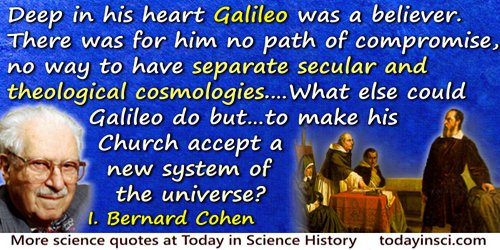
His conflict with the Catholic Church arose because deep in his heart Galileo was a believer. There was for him no path of compromise, no way to have separate secular and theological cosmologies. If the Copernican system was true as he believed, what else could Galileo do but fight with every weapon he had in his arsenal of logic, rhetoric, scientific observation, mathematical theory, and cunning insight, to make his Church accept a new system of the universe?
In The Birth of a New Physics (1960, rev. ed. 1985), 125.
Human consciousness is just about the last surviving mystery. A mystery is a phenomenon that people don’t know how to think about—yet. There have been other great mysteries: the mystery of the origin of the universe, the mystery of life and reproduction, the mystery of the design to be found in nature, the mysteries of time, space, and gravity. These were not just areas of scientific ignorance, but of utter bafflement and wonder. We do not yet have the final answers to any of the questions of cosmology and particle physics, molecular genetics and evolutionary theory, but we do know how to think about them. The mysteries haven't vanished, but they have been tamed. They no longer overwhelm our efforts to think about the phenomena, because now we know how to tell the misbegotten questions from the right questions, and even if we turn out to be dead wrong about some of the currently accepted answers, we know how to go about looking for better answers. With consciousness, however, we are still in a terrible muddle. Consciousness stands alone today as a topic that often leaves even the most sophisticated thinkers tongue-tied and confused. And, as with all the earlier mysteries, there are many who insist—and hope—that there will never be a demystification of consciousness.
Consciousness Explained (1991), 21-22.
I am always surprised when a young man tells me he wants to work at cosmology. I think of cosmology as something that happens to one, not something one can choose.
In Presidential Address (8 Feb 1963), Quarterly Journal of the Royal Astronomical Society (Mar 1963), 4, 185.
I do not personally want to believe that we already know the equations that determine the evolution and fate of the universe; it would make life too dull for me as a scientist. … I hope, and believe, that the Space Telescope might make the Big Bang cosmology appear incorrect to future generations, perhaps somewhat analogous to the way that Galileo’s telescope showed that the earth-centered, Ptolemaic system was inadequate.
From 'The Space Telescope (the Hubble Space Telescope): Out Where the Stars Do Not Twinkle', in NASA Authorization for Fiscal Year 1978: Hearings before the Committee on Commerce, Science and Transportation, United States Senate, 95th Congress, first session on S.365 (1977), 124. This was testimony to support of authorization for NASA beginning the construction of the Space Telescope, which later became known as the Hubble Space Telescope.
I think that physics is the most important—indeed the only—means we have of finding out the origins and fundamentals of our universe, and this is what interests me most about it. I believe that as science advances religion necessarily recedes, and this is a process I wish to encourage, because I consider that, on the whole, the influence of religion is malign.
Quoted in Contemporary Authors Online Gale (2007)
In a sense cosmology contains all subjects because it is the story of everything, including biology, psychology and human history. In that single sense it can be said to contain an explanation also of time's arrow. But this is not what is meant by those who advocate the cosmological explanation of irreversibility. They imply that in some way the time arrow of cosmology imposes its sense on the thermodynamic arrow. I wish to disagree with this view. The explanation assumes that the universe is expanding. While this is current orthodoxy, there is no certainty about it. The red-shifts might be due to quite different causes. For example, when light passes through the expanding clouds of gas it will be red-shifted. A large number of such clouds might one day be invoked to explain these red shifts. It seems an odd procedure to attempt to 'explain' everyday occurrences, such as the diffusion of milk into coffee, by means of theories of the universe which are themselves less firmly established than the phenomena to be explained. Most people believe in explaining one set of things in terms of others about which they are more certain, and the explanation of normal irreversible phenomena in terms of the cosmological expansion is not in this category.
'Thermodynamics, Cosmology) and the Physical Constants', in J. T. Fraser (ed.), The Study of Time III (1973), 117-8.
In general I would be cautious against … plays of fancy and would not make way for their reception into scientific astronomy, which must have quite a different character. Laplace’s cosmogenic hypotheses belong in that class. Indeed, I do not deny that I sometimes amuse myself in a similar manner, only I would never publish the stuff. My thoughts about the inhabitants of celestial bodies, for example, belong in that category. For my part, I am (contrary to the usual opinion) convinced … that the larger the cosmic body, the smaller are the inhabitants and other products. For example, on the sun trees, which in the same ratio would be larger than ours, as the sun exceeds the earth in magnitude, would not be able to exist, for on account of the much greater weight on the surface of the sun, all branches would break themselves off, in so far as the materials are not of a sort entirely heterogeneous with those on earth.
Letter to Heinrich Schumacher (7 Nov 1847). Quoted in G. Waldo Dunnington, Carl Friedrich Gauss: Titan of Science (2004), 411.
It feels unacceptable to many people even to think of having a cosmology based on science. … They see fanciful origin stories as spicing up the culture. … Aspects of many origin stories can enrich our understanding of the scientific picture, but they cannot take its place.
As co-author with Nancy Ellen Abrams, in The View from the Center of the Universe: Discovering Our Extraordinary Place in the Cosmos (2006), 85.
It has been suggested that thermodynamic irreversibility is due to cosmological expansion.
'Thermodynamics, Cosmology, and the Physical Constants', in J. T. Fraser (ed.), The Study of Time III (1973), 117-8.
It’s a common occurrence in a forefront area of science, where the questions are tough and the measurements extremely difficult. You have different groups using different methods and they get different answers. You see it all the time, and the public rarely notices. But when it happens to be in cosmology, it makes headlines.
As quoted in John Moble Wilford, 'Astronomers Debate Conflicting Answers for the Age of the Universe', New York Times (27 Dec 1994), C9.
My view, the skeptical one, holds that we may be as far away from an understanding of elementary particles as Newton's successors were from quantum mechanics. Like them, we have two tremendous tasks ahead of us. One is to study and explore the mathematics of the existing theories. The existing quantum field-theories may or may not be correct, but they certainly conceal mathematical depths which will take the genius of an Euler or a Hamilton to plumb. Our second task is to press on with the exploration of the wide range of physical phenomena of which the existing theories take no account. This means pressing on with experiments in the fashionable area of particle physics. Outstanding among the areas of physics which have been left out of recent theories of elementary particles are gravitation and cosmology
In Scientific American (Sep 1958). As cited in '50, 100 & 150 years ago', Scientific American (Sep 2008), 299, No. 3, 14.
Painting is but one single small mode of expressing my own cosmology, which enables me, through my genius and paranoia, to create a synthesis of nature impossible even for the scientist, because the scientist is too much involved in his specialization.
As quoted in 'Playboy Interview: Salvador Dalí, a candid conversation with the flamboyantly eccentric grand vizier of surrealism', Playboy Magazine (Jul 1964), 46, 48. Quoted and cited in Michael R. Taylor, 'God and the Atom: Salvador Dalí’s Mystical Manifesto and the Contested Origins of Nuclear Painting', Avant-garde Studies (Fall 2016), No. 2, 10.
Philosophically, I liked the steady-state cosmology. So I thought that we should report our results as a simple measurement; the measurement might be true after the cosmology was no longer true!
Remarking on the measurement he made with Arno Penzias of the 3 K cosmic background radiation. From Proceedings of workshop, National Radio Astronomy Observatory, Green Bank, West Virginia (4-6 May 1983), 'Discovery of the Cosmic Microwave Background', Serendipitous Discoveries in Radio Astronomy (1983), 195. Also collected in B. Bertotti (ed.) Modern Cosmology in Retrospect (1990), 303.
Some of Feynman’s ideas about cosmology have a modern ring. A good example is his attitude toward the origin of matter. The idea of continuous matter creation in the steady state cosmology does not seriously offend him (and he notes … that the big bang cosmology has a problem just as bad, to explain where all the matter came from in the beginning). … He emphasizes that the total energy of the universe could really be zero, and that matter creation is possible because the rest energy of the matter is actually canceled by its gravitational potential energy. “It is exciting to think that it costs nothing to create a new particle, …”
In John Preskill and Kip S. Thorne, 'Foreword to Feynman Lectures on Gravitation' (15 May 1995). Feynman delivered his lectures in 1962–63.
The alternative to the Big Bang is not, in my opinion, the steady state; it is instead the more general theory of continuous creation. Continuous creation can occur in bursts and episodes. These mini-bangs can produce all the wonderful element-building that Fred Hoyle discovered and contributed to cosmology. This kind of element and galaxy formation can take place within an unbounded, non-expanding universe. It will also satisfy precisely the Friedmann solutions of general relativity. It can account very well for all the facts the Big Bang explains—and also for those devastating, contradictory observations which the Big Bang must, at all costs, pretend are not there
In 'Letters: Wrangling Over the Bang', Science News (27 Jul 1991), 140, No. 4, 51. Also quoted in Roy C. Martin, Astronomy on Trial: A Devastating and Complete Repudiation of the Big Bang Fiasco (1999), Appendix I, 217.
The difference between myth and science is the difference between divine inspiration of “unaided reason” (as Bertrand Russell put it) on the one hand and theories developed in observational contact with the real world on the other. It is the difference between the belief in prophets and critical thinking, between Credo quia absurdum (I believe because it is absurd–Tertullian) and De omnibus est dubitandum (Everything should be questioned–Descartes). To try to write a grand cosmical drama leads necessarily to myth. To try to let knowledge substitute ignorance in increasingly large regions of space and time is science.
In 'Cosmology: Myth or Science?' Journal of Astrophysics and Astronomy (1984), 5, 79-98.
The Europeans and the Americans are not throwing $10 billion down this gigantic tube for nothing. We're exploring the very forefront of physics and cosmology with the Large Hadron Collider because we want to have a window on creation, we want to recreate a tiny piece of Genesis to unlock some of the greatest secrets of the universe.
Quoted by Alexander G. Higgins (AP), in 'Particle Collider: Black Hole or Crucial Machine', The Journal Gazette (7 Aug 2009).
There is thus a possibility that the ancient dream of philosophers to connect all Nature with the properties of whole numbers will some day be realized. To do so physics will have to develop a long way to establish the details of how the correspondence is to be made. One hint for this development seems pretty obvious, namely, the study of whole numbers in modern mathematics is inextricably bound up with the theory of functions of a complex variable, which theory we have already seen has a good chance of forming the basis of the physics of the future. The working out of this idea would lead to a connection between atomic theory and cosmology.
From Lecture delivered on presentation of the James Scott prize, (6 Feb 1939), 'The Relation Between Mathematics And Physics', printed in Proceedings of the Royal Society of Edinburgh (1938-1939), 59, Part 2, 129.
 In science it often happens that scientists say, 'You know that's a really good argument; my position is mistaken,' and then they would actually change their minds and you never hear that old view from them again. They really do it. It doesn't happen as often as it should, because scientists are human and change is sometimes painful. But it happens every day. I cannot recall the last time something like that happened in politics or religion.
(1987) --
In science it often happens that scientists say, 'You know that's a really good argument; my position is mistaken,' and then they would actually change their minds and you never hear that old view from them again. They really do it. It doesn't happen as often as it should, because scientists are human and change is sometimes painful. But it happens every day. I cannot recall the last time something like that happened in politics or religion.
(1987) --