Contradiction Quotes (70 quotes)
.…yes, sitting on the bank of the Kibali itself and philosophizing about river systems with the much-traveled Abu Ssamat and his people, … I caught him out there and then in blatant contradictions and inaccuracies. Well then, I finally said, quite beside myself, so show me how you speak of rivers: here is the Kibali, show me with your hand: where does it come from and in what direction does it flow? To which all pointed eastwards and said: it is flowing in that direction, and then pointing west: it comes from there, that is how we say it. I could have gone through the roof. No, I cried, you Moslem, you have everything confused and mixed up, what must it be like inside your heads!
In August Petermann, Petermann’s Geographische Mittheilungen (1871), 135. As quoted and cited in Kathrin Fritsch, '"You Have Everything Confused And Mixed Up…!" Georg Schweinfurth, Knowledge And Cartography Of Africa In The 19th Century', History in Africa (2009), 36, 94. Fritsch comments on their misunderstandings caused by “different spatial conceptions [and] language barriers.”
[1157] The man who blames the supreme certainty of mathematics feeds on confusion, and can never silence the contradictions of sophistical sciences which lead to an eternal quackery.
W. An. III. 241 a. From the original Italian: “Chi biasima la soma certezza della matematica, si pasce di confusione mai porrà silentio alle contraditioni delle soffistiche sciētie, colle quali s’inpara vno eterno gridore.” English and Italian in Jean Paul Richter (trans.), 'Philosophical Maxims: Of Mechanics', The Literary Works of Leonardo da Vinci (1883), Vol. 1, Part 2, 289, Aphorism 1157. [Note: Da Vinci writes ē=en.] Also translated beginning, “Those who condemn…”. Also seen translated as “Whoever despises the high wisdom of mathematics nourishes himself on delusion and will never still the sophistic sciences whose only product is an eternal uproar,” in Nicholas J. Rose Mathematical Maxims and Minims (1988).
[Eratosthenes] ... is a mathematician among geographers, and yet a geographer among mathematicians; and consequently on both sides he offers his opponents occasions for contradiction.
H. L. Jones (ed.), The Geography of Strabo (1917), Vol. 1, 359-61.
[We need not think] that there is any Contradiction, when Philosophy teaches that to be done by Nature; which Religion, and the Sacred Scriptures, teach us to be done by God: no more, than to say, That the balance of a Watch is moved by the next Wheel, is to deny that Wheel, and the rest, to be moved by the Spring; and that both the Spring, and all the other Parts, are caused to move together by the Maker of them. So God may be truly the Cause of This Effect, although a Thousand other Causes should be supposed to intervene: For all Nature is as one Great Engine, made by, and held in His Hand.
'An Idea of a Philosophical History of Plants', in The Anatomy of Plants With an Idea of a Philosophical History of Plants and Several Other Lectures Read Before the Royal Society (1682),80.
That the Sun will not rise Tomorrow is no less intelligible a Proposition and implies no more contradiction than the Affirmation that it will rise. We should in vain, therefore, attempt to demonstrate its falsehood.
An Enquiry Concerning Human Understanding (1748), 48.
A “pacifist male” is a contradiction in terms. Most self-described “pacifists” are not pacific; they simply assume false colors. When the wind changes, they hoist the Jolly Roger.
In 'From the Notebooks of Lazarus Long', Time Enough for Love: The Lives of Lazarus Long (1973), 258.
A contradiction (between science and religion) is out of the question. What follows from science are, again and again, clear indications of God’s activity which can be so strongly perceived that Kepler dared to say (for us it seems daring, not for him) that he could ‘almost touch God with his hand in the Universe.’
…...
And do you know what “the world” is to me? Shall I show it to you in my mirror? This world: a monster of energy, without beginning, without end; a firm, iron magnitude of force that does not grow bigger or smaller, that does not expend itself but only transforms itself; as a whole, of unalterable size, a household without expenses or losses, but likewise without increase or income; enclosed by “nothingness”' as by a boundary; not by something blurry or wasted, not something endlessly extended, but set in a definite space as a definite force, and not a space that might be “empty” here or there, but rather as force throughout, as a play of forces and waves of forces, at the same time one and many, increasing here and at the same time decreasing there; a sea of forces flowing and rushing together, eternally changing, eternally flooding back, with tremendous years of recurrence, with an ebb and a flood of its forms; out of the simplest forms striving toward the most complex, out of the stillest, most rigid, coldest forms toward the hottest, most turbulent, most self-contradictory, and then again returning home to the simple out of this abundance, out of the play of contradictions back to the joy of concord, still affirming itself in this uniformity of its courses and its years, blessing itself as that which must return eternally, as a becoming that knows no satiety, no disgust, no weariness: this, my Dionysian world of the eternally self-creating, the eternally self-destroying, this mystery world of the twofold voluptuous delight, my “beyond good and evil,” without goal, unless the joy of the circle itself is a goal; without will, unless a ring feels good will toward itself-do you want a name for this world? A solution for all its riddles? A light for you, too, you best-concealed, strongest, most intrepid, most midnightly men?—This world is the will to power—and nothing besides! And you yourselves are also this will to power—and nothing besides!
The Will to Power (Notes written 1883-1888), book 4, no. 1067. Trans. W. Kaufmann and R. J. Hollingdale and ed. W. Kaufmann (1968), 549-50.
At the heart of science is an essential balance between two seemingly contradictory attitudes—an openness to new ideas, no matter how bizarre or counterintuitive they may be, and the most ruthless skeptical scrutiny of all ideas, old and new. This is how deep truths are winnowed from deep nonsense.
The Demon-Haunted World: Science as a Candle in the Dark (1997), 304.
Both the physicist and the mystic want to communicate their knowledge, and when they do so with words their statements are paradoxical and full of logical contradictions.
In The Tao of Physics (1975), 46.
Building goes on briskly at the therapeutic Tower of Babel; what one recommends another condemns; what one gives in large doses another scarce dares to prescribe in small doses; and what one vaunts as a novelty another thinks not worth rescuing from merited oblivion. All is confusion, contradiction, inconceivable chaos. Every country, every place, almost every doctor, have their own pet remedies, without which they imagine their patients can not be cured; and all this changes every year, aye every mouth.
Weekly Medical Gazette, of Vienna
But the greatest error of all the rest is the mistaking or misplacing of the last or farthest end of knowledge: for men have entered into a desire of learning and knowledge, sometimes upon a natural curiosity and inquisitive appetite; sometimes to entertain their minds with variety and delight; sometimes for ornament and reputation; and sometimes to enable them to victory of wit and contradiction; and most times for lucre and profession; and seldom sincerely to give a true account of their gift of reason, to the benefit and use of men...
The First Book of Francis Bacon of the Proficience and Advancement of Learning (1605). In Francis Bacon and Basil Montagu, The Works of Francis Bacon, Lord Chancellor of England (1852), 174
Chemistry is yet, indeed, a mere embryon. Its principles are contested; experiments seem contradictory; their subjects are so minute as to escape our senses; and their result too fallacious to satisfy the mind. It is probably an age too soon to propose the establishment of a system.
Letter to Rev. James Madison (Paris, 19 Jul 1788). In Thomas Jefferson and John P. Foley (ed.), The Jeffersonian Cyclopedia (1900), 135. From H.A. Washington, The Writings of Thomas Jefferson (1853-54). Vol 2, 431.
Common-sense contents itself with the unreconciled contradiction, laughs when it can, and weeps when it must, and makes, in short, a practical compromise, without trying a theoretical solution.
From Essay, 'German Pessimism', a book review (of Der Modern Pessimismus by Edmund Pfleiderer) in Nation (7 Oct 1875), 21, No. 536, 233. Reprinted in Ralph Barton Perry (ed.), Collected Essays and Reviews by William James (1920), 17.
Contradiction is not a sign of falsity, nor the lack of contradiction a sign of truth.
From Pensées as translated in W.H. Auden and L. Kronenberger (eds.) The Viking Book of Aphorisms (1966), 325. From the original French, “Ni la contradiction n’est marque de fausseté ni l’incontradiction n’est marque de vérité,” in 'Pensées', Oeuvres Complètes (1864), Vol. 1, 261.
Coterminous with space and coeval with time is the kingdom of Mathematics; within this range her dominion is supreme; otherwise than according to her order nothing can exist; in contradiction to her laws nothing takes place. On her mysterious scroll is to be found written for those who can read it that which has been, that which is, and that which is to come.
From Presidential Address (Aug 1878) to the British Association, Dublin, published in the Report of the 48th Meeting of the British Association for the Advancement of Science (1878), 31.
Disinterestedness is as great a puzzle and paradox as ever. Indeed, strictly speaking, it is a species of irrationality, or insanity, as regards the individual’s self; a contradiction of the most essential nature of a sentient being, which is to move to pleasure and from pain.
In On the Study of Character: Including an Estimate of Phrenology (1861), 202.
Does there truly exist an insuperable contradiction between religion and science? Can religion be superseded by science? The answers to these questions have, for centuries, given rise to considerable dispute and, indeed, bitter fighting. Yet, in my own mind there can be no doubt that in both cases a dispassionate consideration can only lead to a negative answer. What complicates the solution, however, is the fact that while most people readily agree on what is meant by “science,” they are likely to differ on the meaning of “religion.”
Replying to the Liberal Ministers’ Club of New York City. Published in >The Christian Register, (Jun 1948). As given in Ideas and Opinions (1954, 2010), 49-50.
Every definition implies an axiom, since it asserts the existence of the object defined. The definition then will not be justified, from the purely logical point of view, until we have ‘proved’ that it involves no contradiction either in its terms or with the truths previously admitted.
…...
Facts are certainly the solid and true foundation of all sectors of nature study ... Reasoning must never find itself contradicting definite facts; but reasoning must allow us to distinguish, among facts that have been reported, those that we can fully believe, those that are questionable, and those that are false. It will not allow us to lend faith to those that are directly contrary to others whose certainty is known to us; it will not allow us to accept as true those that fly in the face of unquestionable principles.
Memoires pour Servir a l'Histoire des Insectes (1736), Vol. 2, xxxiv. Quoted in Jacques Roger, The Life Sciences in Eighteenth-Century French Thought, ed. Keith R. Benson and trans. Robert Ellrich (1997), 165.
Geometrical axioms are neither synthetic a priori conclusions nor experimental facts. They are conventions: our choice, amongst all possible conventions, is guided by experimental facts; but it remains free, and is only limited by the necessity of avoiding all contradiction. ... In other words, axioms of geometry are only definitions in disguise.
That being so what ought one to think of this question: Is the Euclidean Geometry true?
The question is nonsense. One might as well ask whether the metric system is true and the old measures false; whether Cartesian co-ordinates are true and polar co-ordinates false.
That being so what ought one to think of this question: Is the Euclidean Geometry true?
The question is nonsense. One might as well ask whether the metric system is true and the old measures false; whether Cartesian co-ordinates are true and polar co-ordinates false.
In George Edward Martin, The Foundations of Geometry and the Non-Euclidean Plane (1982), 110.
He [Louis Pasteur] imagined further experiments, to bring more light, for contradictions excited him to new investigations.
As quoted in René J. Dubos, Louis Pasteur, Free Lance of Science (1960, 1986), 76.
I am afraid all we can do is to accept the paradox and try to accommodate ourselves to it, as we have done to so many paradoxes lately in modern physical theories. We shall have to get accustomed to the idea that the change of the quantity R, commonly called the 'radius of the universe', and the evolutionary changes of stars and stellar systems are two different processes, going on side by side without any apparent connection between them. After all the 'universe' is an hypothesis, like the atom, and must be allowed the freedom to have properties and to do things which would be contradictory and impossible for a finite material structure.
Kosmos (1932), 133.
I am convinced that an important stage of human thought will have been reached when the physiological and the psychological, the objective and the subjective, are actually united, when the tormenting conflicts or contradictions between my consciousness and my body will have been factually resolved or discarded.
Physiology of the Higher Nervous Activity (1932), 93-4.
I am convinced that this is the only means of advancing science, of clearing the mind from a confused heap of contradictory observations, that do but perplex and puzzle the Student, when he compares them, or misguide him if he gives himself up to their authority; but bringing them under one general head, can alone give rest and satisfaction to an inquisitive mind.
From 'A Discourse Delivered to the Students of the Royal Academy, on the Distribution of Prizes' (11 Dec 1770), in Seven Discourses Delivered in the Royal Academy (1778), 98.
I do not forget that Medicine and Veterinary practice are foreign to me. I desire judgment and criticism upon all my contributions. Little tolerant of frivolous or prejudiced contradiction, contemptuous of that ignorant criticism which doubts on principle, I welcome with open arms the militant attack which has a method of doubting and whose rule of conduct has the motto “More light.”
In Louis Pasteur and Harold Clarence Ernst (trans), The Germ Theory and Its Application to Medicine and Surgery, Chap. 12. Reprinted in Charles W. Eliot (ed.), The Harvard Classics:
Scientific Papers: Physiology, Medicine, Surgery, Geology (1897, 1910), Vol. 38, 401-402. Cited as read before French Academy of Science (20 Apr 1878), published in Comptes Rendus de l’Académie des Sciences, 84, 1037-43.
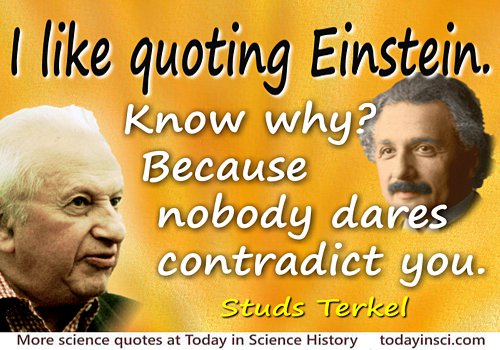
I like quoting Einstein. … Because nobody dares contradict you.
From interview reported by Oliver Burkeman, 'Voice of America', The Guardian (1 Mar 2002) newspaper.
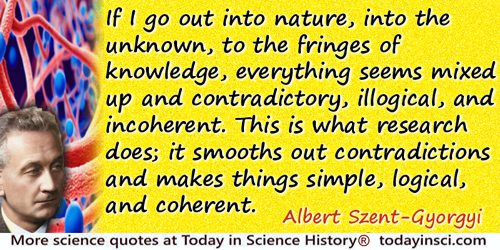
If I go out into nature, into the unknown, to the fringes of knowledge, everything seems mixed up and contradictory, illogical, and incoherent. This is what research does; it smooths out contradictions and makes things simple, logical, and coherent.
In 'Dionysians and Apollonians', Science (2 Jun 1972), 176, 966. Reprinted in Mary Ritchie Key, The Relationship of Verbal and Nonverbal Communication (1980), 318.
In formal logic a contradiction is the signal of a defeat, but in the evolution of real knowledge it marks the first step in progress toward a victory. This is one great reason for the utmost toleration of variety of opinion. Once and forever, this duty of toleration has been summed up in the words, “Let both grow together until the harvest.”
In 'Religion and Science', The Atlantic (Aug 1925).
In these researches I followed the principles of the experimental method that we have established, i.e., that, in presence of a well-noted, new fact which contradicts a theory, instead of keeping the theory and abandoning the fact, I should keep and study the fact, and I hastened to give up the theory.
From An Introduction to the Study of Experimental Medicine (1865), as translated by Henry Copley Greene (1957), 164.
Investigating the conditions under which mutations occur … requires studies of mutation frequency under various methods of handling the organisms. As yet, extremely little has been done along this line. That is because, in the past, a mutation was considered a windfall, and the expression “mutation frequency” would have seemed a contradiction in terms. To attempt to study it would have seemed as absurd as to study the conditions affecting the distribution of dollar bills on the sidewalk. You were simply fortunate if you found one. … Of late, however, we may say that certain very exceptional banking houses have been found, in front of which the dollars fall more frequently—in other words, specially mutable genes have been discovered, that are beginning to yield abundant data at the hands of Nilsson-Ehle, Zeleny, Emerson, Anderson and others.
In 'Variation Due to Change in the Individual Gene', The American Naturalist (Jan-Feb 1922), 56, No. 642, 44.
It is indeed an Opinion strangely prevailing amongst Men, that Houses, Mountains, Rivers, and in a word all sensible Objects have an Existence Natural or Real, distinct from their being perceived by the Understanding. But with how great an Assurance and Acquiescence soever this Principle may be entertained in the World; yet whoever shall find in his Heart to call it in Question, may, if I mistake not, perceive it to involve a manifest Contradiction. For what are the forementioned Objects but the things we perceive by Sense, and what do we perceive besides our own Ideas or Sensations; and is it not plainly repugnant that anyone of these or any Combination of them should exist unperceived?
A Treatise Concerning the Principles of Human Knowledge [first published 1710], (1734),38.
It is madness and a contradiction to expect that things which were never yet performed should be effected, except by means hitherto untried.
Novum Organum (1620), Part 1, Sec. 1, Aphorism 6. In The Works of Franics Bacon (1815), Vol. 4, 4.
Life is order, death is disorder. A fundamental law of Nature states that spontaneous chemical changes in the universe tend toward chaos. But life has, during milliards of years of evolution, seemingly contradicted this law. With the aid of energy derived from the sun it has built up the most complicated systems to be found in the universe—living organisms. Living matter is characterized by a high degree of chemical organisation on all levels, from the organs of large organisms to the smallest constituents of the cell. The beauty we experience when we enjoy the exquisite form of a flower or a bird is a reflection of a microscopic beauty in the architecture of molecules.
The Nobel Prize for Chemistry: Introductory Address'. Nobel Lectures: Chemistry 1981-1990 (1992), 69.
Man alone amongst the animals speaks and has gestures and expression which we call rational, because he alone has reason in him. And if anyone should say in contradiction that certain birds talk, as seems to be the case with some, especially the magpie and the parrot, and that certain beasts have expression or gestures, as the ape and some others seem to have, I answer that it is not true that they speak, nor that they have gestures, because they have no reason, from which these things need proceed; nor do they purpose to signify anything by them, but they merely reproduce what they see and hear.
In 'The Third Treatise', The Convivio of Dante Alighieri (1903), Chap. 7, 175. This footnoted: Compare De Vulgari Eloquentia, Book 1, Chap 2: 43-65.
Mathematicians assume the right to choose, within the limits of logical contradiction, what path they please in reaching their results.
In A Letter to American Teachers of History (1910), Introduction, v.
Mathematics is perfectly free in its development and is subject only to the obvious consideration, that its concepts must be free from contradictions in themselves, as well as definitely and orderly related by means of definitions to the previously existing and established concepts.
In Grundlagen einer allgemeinen Manigfaltigkeitslehre (1883), Sect. 8.
Modern music, headstrong, wayward, tragically confused as to what to say and how to say it, has mounted its horse, as the joke goes, and ridden off in all directions. If we require of an art that it be unified as a whole and expressed in a universal language known to all, if it must be a consistent symbolization of the era, then modern music is a disastrous failure. It has many voices, many symbolizations. It it known to one, unknown to another. But if an art may be as variable and polyvocal as the different individuals and emotional regions from which it comes in this heterogeneous modern world, then the diversity and contradiction of modern music may be acceptable.
In Art Is Action: A Discussion of Nine Arts in a Modern World (1939), 81.
Our confused wish finds expression in the confused question as to the nature of force and electricity. But the answer which we want is not really an answer to this question. It is not by finding out more and fresh relations and connections that it can be answered; but by removing the contradictions existing between those already known, and thus perhaps by reducing their number. When these painful contradictions are removed, the question as to the nature of force will not have been answered; but our minds, no longer vexed, will cease to ask illegitimate questions.
Principles of Mechanics (1899), 7-8.
Our reasonings are grounded upon two great principles, that of contradiction, in virtue of which we judge false that which involves a contradiction, and true that which is opposed or contradictory to the false.
The Monadology and Other Philosophical Writings (1714), trans. Robert Latta (1898) 235.
Owing to his lack of knowledge, the ordinary man cannot attempt to resolve conflicting theories of conflicting advice into a single organized structure. He is likely to assume the information available to him is on the order of what we might think of as a few pieces of an enormous jigsaw puzzle. If a given piece fails to fit, it is not because it is fraudulent; more likely the contradictions and inconsistencies within his information are due to his lack of understanding and to the fact that he possesses only a few pieces of the puzzle. Differing statements about the nature of things, differing medical philosophies, different diagnoses and treatments—all of these are to be collected eagerly and be made a part of the individual's collection of puzzle pieces. Ultimately, after many lifetimes, the pieces will fit together and the individual will attain clear and certain knowledge.
'Strategies of Resort to Curers in South India', contributed in Charles M. Leslie (ed.), Asian Medical Systems: A Comparative Study (1976), 185.
Physicists speak of the particle representation or the wave representation. Bohr's principle of complementarity asserts that there exist complementary properties of the same object of knowledge, one of which if known will exclude knowledge of the other. We may therefore describe an object like an electron in ways which are mutually exclusive—e.g., as wave or particle—without logical contradiction provided we also realize that the experimental arrangements that determine these descriptions are similarly mutually exclusive. Which experiment—and hence which description one chooses—is purely a matter of human choice.
The Cosmic Code: Quantum Physics as the Language of Nature (1982), 94.
Placed as the fossils are in their several tiers of burial-places the one over the other; we have in them true witnesses of successive existences, whilst the historian of man is constantly at fault as to dates and even the sequence of events, to say nothing of the contradicting statements which he is forced to reconcile.
Siluria (1872), 476.
Reason is man’s faculty for grasping the world by thought, in contradiction to intelligence, which is man’s ability to manipulate the world with the help of thought. Reason is man’s instrument for arriving at the truth, intelligence is man's instrument for manipulating the world more successfully; the former is essentially human, the latter belongs to the animal part of man.
In The Sane Society (1955), 64.
Scientists have thick skins. They do not abandon a theory merely because facts contradict it.
In Radio Lecture (30 Jun 1973) broadcast by the Open University, collected in Imre Lakatos, John Worrall (ed.) and Gregory Currie (ed.), 'Introduction: Science and Pseudoscience', The Methodology of Scientific Research Programmes (1978, 1980), Vol. 1, 4.
Surround truth with bitter denial and contradiction and you furnish it with the soil for its permanent growth.
As quoted in A.V. Morganstern, 'Misokainia', The Medico-legal Journal (1906), 24, 439. Caveat emptor! Webmaster has not yet been able to find this wording in a primary source by Carlyle, and reserves judgment on its authenticity. It is included here as an interesting aphorism, even if the authorship is uncertain. Perhaps Carlisle expressed the idea in a longer quote, which has been popularly summarized as shown here. If you know the primary source, please contact Webmaster.
The belief in the immortality of the human soul is a dogma which is in hopeless contradiction with the most solid empirical truths of modern science.
In Wonders of Life (1904), 66.
The contradictory experiments of chemists leave us at liberty to conclude what we please. My conclusion is, that art has not yet invented sufficient aids to enable such subtle bodies [air, light, &c.] to make a well-defined impression on organs as blunt as ours; that it is laudable to encourage investigation but to hold back conclusion.
Letter to Rev. James Madison (Paris, 19 Jul 1788). In Thomas Jefferson and John P. Foley (ed.), The Jeffersonian Cyclopedia (1900), 135. From H.A. Washington, The Writings of Thomas Jefferson (1853-54). Vol 2, 431.
The framing of hypotheses is, for the enquirer after truth, not the end, but the beginning of his work. Each of his systems is invented, not that he may admire it and follow it into all its consistent consequences, but that he may make it the occasion of a course of active experiment and observation. And if the results of this process contradict his fundamental assumptions, however ingenious, however symmetrical, however elegant his system may be, he rejects it without hesitation. He allows no natural yearning for the offspring of his own mind to draw him aside from the higher duty of loyalty to his sovereign, Truth, to her he not only gives his affections and his wishes, but strenuous labour and scrupulous minuteness of attention.
Philosophy of the Inductive Sciences (1847), Vol. 2, 57.
The living being is stable. It must be so in order not to be destroyed, dissolved, or disintegrated by the colossal forces, often adverse, which surround it. By apparent contradiction it maintains its stability only if it is excitable and capable of modifying itself according to external stimuli and adjusting its response to the stimulation. In a sense it is stable because it is modifiable—the slight instability is the necessary condition for the true stability of the organism.
In Dictionnaire de Physiologie (1900), Vol. 4, 72. English as quoted in Walter Bradford Cannon, The Wisdom of the Body (1932), 21, with French source citation footnoted on 26.
The major religions on the Earth contradict each other left and right. You can’t all be correct. And what if all of you are wrong? It’s a possibility, you know. You must care about the truth, right? Well, the way to winnow through all the differing contentions is to be skeptical. I’m not any more skeptical about your religious beliefs than I am about every new scientific idea I hear about. But in my line of work, they’re called hypotheses, not inspiration and not revelation.
Contact (1997), 162.
The more experiences and experiments accumulate in the exploration of nature, the more precarious the theories become. But it is not always good to discard them immediately on this account. For every hypothesis which once was sound was useful for thinking of previous phenomena in the proper interrelations and for keeping them in context. We ought to set down contradictory experiences separately, until enough have accumulated to make building a new structure worthwhile.
Lichtenberg: Aphorisms & Letters (1969), 61.
The tree of life should perhaps be called the coral of life, base of branches dead; so that passages cannot be seen—this again offers contradiction to constant succession of germs in progress.
P. H. Barrett et al. (eds.), Charles Darwin's Notebooks1836-1844: Geology, Transmutation of the Species, Metaphysical Enquiries, (1987), Notebook B, 25-6.
The truth may be puzzling. It may take some work to grapple with. It may be counterintuitive. It may contradict deeply held prejudices. It may not be consonant with what we desperately want to be true. But our preferences do not determine what's true. We have a method, and that method helps us to reach not absolute truth, only asymptotic approaches to the truth—never there, just closer and closer, always finding vast new oceans of undiscovered possibilities. Cleverly designed experiments are the key.
In 'Wonder and Skepticism', Skeptical Enquirer (Jan-Feb 1995), 19, No. 1.
The whole question of imagination in science is often misunderstood by people in other disciplines. They try to test our imagination in the following way. They say, “Here is a picture of some people in a situation. What do you imagine will happen next?” When we say, “I can’t imagine,” they may think we have a weak imagination. They overlook the fact that whatever we are allowed to imagine in science must be consistent with everything else we know; that the electric fields and the waves we talk about are not just some happy thoughts which we are free to make as we wish, but ideas which must be consistent with all the laws of physics we know. We can’t allow ourselves to seriously imagine things which are obviously in contradiction to the laws of nature. And so our kind of imagination is quite a difficult game. One has to have the imagination to think of something that has never been seen before, never been heard of before. At the same time the thoughts are restricted in a strait jacket, so to speak, limited by the conditions that come from our knowledge of the way nature really is. The problem of creating something which is new, but which is consistent with everything which has been seen before, is one of extreme difficulty
In The Feynman Lectures in Physics (1964), Vol. 2, Lecture 20, p.20-10 to p.20-11.
The world is a contradiction; the universe a paradox.
…...
There are hidden contradictions in the minds of people who “love Nature” while deploring the “artificialities” with which “Man has spoiled ‘Nature.’” The obvious contradiction lies in their choice of words, which imply that Man and his artifacts are not part of “Nature”—but beavers and their dams are.
In Time Enough for Love: The Lives of Lazarus Long (1973), 263.
There is unquestionably a contradiction between an efficient technological machine and the flowering of human nature, of the human personality.
From interview (10 Nov 1964), with Walter Wager, in Walter Wager (ed.), The Playwrights Speak (1967), 11.
There is, I conceive, no contradiction in believing that mind is at once the cause of matter and of the development of individualised human minds through the agency of matter. And when, further on, [Mr Frederick F. Cook] asks, ‘Does mortality give consciousness to spirit, or does spirit give consciousness for a limited period to mortality?’ I would reply, ‘Neither the one nor the other; but, mortality is the means by which a permanent individuality is given to spirit.’
In 'Harmony of Spiritualism and Science', Light (1885), 5, 352.
Those [scientists] who dislike entertaining contradictory thoughts are unlikely to enrich their science with new ideas.
Attributed. (If you know a primary source, please contact webmaster.)
Thus one becomes entangled in contradictions if one speaks of the probable position of the electron without considering the experiment used to determine it ... It must also be emphasized that the statistical character of the relation depends on the fact that the influence of the measuring device is treated in a different manner than the interaction of the various parts of the system on one another. This last interaction also causes changes in the direction of the vector representing the system in the Hilbert space, but these are completely determined. If one were to treat the measuring device as a part of the system—which would necessitate an extension of the Hilbert space—then the changes considered above as indeterminate would appear determinate. But no use could be made of this determinateness unless our observation of the measuring device were free of indeterminateness. For these observations, however, the same considerations are valid as those given above, and we should be forced, for example, to include our own eyes as part of the system, and so on. The chain of cause and effect could be quantitatively verified only if the whole universe were considered as a single system—but then physics has vanished, and only a mathematical scheme remains. The partition of the world into observing and observed system prevents a sharp formulation of the law of cause and effect. (The observing system need not always be a human being; it may also be an inanimate apparatus, such as a photographic plate.)
The Physical Principles of the Quantum Theory, trans. Carl Eckart and Frank C. Hoyt (1949), 58.
We do not know how the scientists of the next century will define energy or in what strange jargon they will discuss it. But no matter what language the physicists use they will not come into contradiction with Blake. Energy will remain in some sense the lord and giver of life, a reality transcending our mathematical descriptions. Its nature lies at the heart of the mystery of our existence as animate beings in an inanimate universe.
In 'Energy in the Universe,' Scientific American, September 1971 [See William Blake].
We may summarize … the fundamental characteristics and limitations of mathematics as follows: mathematics is ultimately an experimental science, for freedom from contradiction cannot be proved, but only postulated and checked by observation, and similarly existence can only be postulated and checked by observation. Furthermore, mathematics requires the fundamental device of all thought, of analyzing experience into static bits with static meanings.
In The Nature of Physical Theory (1936), 58.
What a chimera ... is man ! What a novelty, what a monster, what a chaos, what a subject of contradiction, what a prodigy! A judge of all things, feeble worm of the earth, depository of the truth, cloacae of uncertainty and error, the glory and the shame of the universe!
…...
What a weak, credulous, incredulous, unbelieving, superstitious, bold, frightened, what a ridiculous world ours is, as far as concerns the mind of man. How full of inconsistencies, contradictions and absurdities it is. I declare that taking the average of many minds that have recently come before me … I should prefer the obedience, affections and instinct of a dog before it.
Letter to C. Schoenbein (25 Jul 1853). In Georg W.A. Kahlbaum and Francis V. Darbishire (eds.), The Letters of Faraday and Schoenbein, 1836-1862 (1899), 215.
When two texts, or two assertions, perhaps two ideas, are in contradiction, be ready to reconcile them rather than cancel one by the other; regard them as two different facets, or two successive stages, of the same reality, a reality convincingly human just because it is too complex.
In Gary William Flake, The Computational Beauty of Nature (2000), 427.
When we meet a fact which contradicts a prevailing theory, we must accept the fact and abandon the theory, even when the theory is supported by great names and generally accepted.
From An Introduction to the Study of Experimental Medicine (1927, 1957), 164, as translated by Henry Copley Greene. From the original French by Claude Bernard: “Quand le fait qu’on rencontre est en opposition avec une théorie régnante, il faut accepter le fait et abandonner la théorie, lors même que celle-ci, soutenue par de grands noms, est généralement adoptée.” (1865), 287-288. A Google translation gives: “When the fact one encounters is in opposition to a reigning theory, one must accept the fact and abandon the theory, even when the latter, supported by great names, is generally adopted.”
When we trace the history of psychology we are led into a labyrinth of fanciful opinions, contradictions, and absurdities intermixed with some truths.
In Francis Crick, The Astonishing Hypothesis: the Scientific Search for the Soul (1995), 35.
Wherever possible, scientists experiment. Which experiments suggest themselves often depends on which theories currently prevail. Scientists are intent of testing those theories to the breaking point. They do not trust what is intuitively obvious. That the Earth is flat was once obvious. That heavy bodies fall faster than light ones was once obvious. That bloodsucking leeches cure most diseases was once obvious. That some people are naturally and by divine decree slaves was once obvious. That there is such a place as the center of the Universe, and that the Earth sits in that exalted spot was once obvious. That there is an absolute standard of rest was once obvious. The truth may be puzzling or counterintuitive. It may contradict deeply held beliefs. Experiment is how we get a handle on it.
In The Demon-Haunted World: Science As A Candle in the Dark (1995), 36.
You can't really discover the most interesting conflicts and problems in a subject until you've tried to write about them. At that point, one discovers discontinuities in the data, perhaps, or in one's own thinking; then the act of writing forces you to work harder to resolve these contradictions.
From Robert S. Grumet, 'An Interview with Anthony F. C. Wallace', Ethnohistory (Winter 1998), 45, No. 1, 109.
 In science it often happens that scientists say, 'You know that's a really good argument; my position is mistaken,' and then they would actually change their minds and you never hear that old view from them again. They really do it. It doesn't happen as often as it should, because scientists are human and change is sometimes painful. But it happens every day. I cannot recall the last time something like that happened in politics or religion.
(1987) --
In science it often happens that scientists say, 'You know that's a really good argument; my position is mistaken,' and then they would actually change their minds and you never hear that old view from them again. They really do it. It doesn't happen as often as it should, because scientists are human and change is sometimes painful. But it happens every day. I cannot recall the last time something like that happened in politics or religion.
(1987) --