Contemporary Quotes (33 quotes)
Contemporary attitudes—as reflected in science fiction films—remain ambivalent, that the scientist is treated as both satanist and savior.
From essay 'The Imagination of Disaster', collected in Against Interpretation and Other Essays (1966, 2001), 218.
Half a century ago Oswald (1910) distinguished classicists and romanticists among the scientific investigators: the former being inclined to design schemes and to use consistently the deductions from working hypotheses; the latter being more fit for intuitive discoveries of functional relations between phenomena and therefore more able to open up new fields of study. Examples of both character types are Werner and Hutton. Werner was a real classicist. At the end of the eighteenth century he postulated the theory of “neptunism,” according to which all rocks including granites, were deposited in primeval seas. It was an artificial scheme, but, as a classification system, it worked quite satisfactorily at the time. Hutton, his contemporary and opponent, was more a romanticist. His concept of “plutonism” supposed continually recurrent circuits of matter, which like gigantic paddle wheels raise material from various depths of the earth and carry it off again. This is a very flexible system which opens the mind to accept the possible occurrence in the course of time of a great variety of interrelated plutonic and tectonic processes.
In 'The Scientific Character of Geology', The Journal of Geology (Jul 1961), 69, No. 4, 456-7.
I am the most travelled of all my contemporaries; I have extended my field of enquiry wider than anybody else, I have seen more countries and climes, and have heard more speeches of learned men. No one has surpassed me in the composition of lines, according to demonstration, not even the Egyptian knotters of ropes, or geometers.
In Alan L. Mackay, A Dictionary of Scientific Quotations (1992, 1994), 71.
I like a deep and difficult investigation when I happen to have made it easy to myself, if not to all others; and there is a spirit of gambling in this, whether, as by the cast of a die, a calculation è perte de vue shall bring out a beautiful and perfect result or shall be wholly thrown away. Scientific investigations are a sort of warfare carried on in the closet or on the couch against all one’s contemporaries and predecessors; I have often gained a signal victory when I have been half asleep, but more frequently have found, upon being thoroughly awake, that the enemy had still the advantage of me, when I thought I had him fast in a corner, and all this you see keeps me alive.
Letter to Hudson Gurney, quoted in George Peacock, The Life of Thomas Young (1855), 239.
It is clear that the twentieth century is the most disturbed century within the memory of humanity. Any contemporary of ours who wants peace and comfort above all has chosen a bad time to be born.
In 'On the New Germany', Manchester Guardian (22 Mar 1933). Also seen paraphrased as, “Anyone desiring a quiet life has done badly to be born in the twentieth century.”
It is the duty of every man of good will to strive steadfastly in his own little world to make this teaching of pure humanity a living force, so far as he can. If he makes an honest attempt in this direction without being crushed and trampled under foot by his contemporaries, he may consider himself and the community to which he belongs lucky.
…...
It is therefore easy to see why the churches have always fought science and persecuted its devotees. On the other hand, I maintain that the cosmic religious feeling is the strongest and noblest motive for scientific research. Only those who realize the immense efforts and, above all, the devotion without which pioneer work in theoretical science cannot be achieved are able to grasp the strength of the emotion out of which alone such work, remote as it is from the immediate realities of life, can issue. What a deep conviction of the rationality of the universe and what a yearning to understand, were it but a feeble reflection of the mind revealed in this world, Kepler and Newton must have had to enable them to spend years of solitary labor in disentangling the principles of celestial mechanics! Those whose acquaintance with scientific research is derived chiefly from its practical results easily develop a completely false notion of the mentality of the men who, surrounded by a skeptical world, have shown the way to kindred spirits scattered wide through the world and through the centuries. Only one who has devoted his life to similar ends can have a vivid realization of what has inspired these men and given them the strength to remain true to their purpose in spite of countless failures. It is cosmic religious feeling that gives a man such strength. A contemporary has said, not unjustly, that in this materialistic age of ours the serious scientific workers are the only profoundly religious people.
…...
It was not noisy prejudice that caused the work of Mendel to lie dead for thirty years, but the sheer inability of contemporary opinion to distinguish between a new idea and nonsense.
In 'The Commemoration of Great Men', British Medical Journal (20 Feb 1932). In The Adelphi (1932), 4, 480, and in The Collected Papers of Wilfred Trotter, FRS (1941), 27.
Kepler’s discovery would not have been possible without the doctrine of conics. Now contemporaries of Kepler—such penetrating minds as Descartes and Pascal—were abandoning the study of geometry ... because they said it was so UTTERLY USELESS. There was the future of the human race almost trembling in the balance; for had not the geometry of conic sections already been worked out in large measure, and had their opinion that only sciences apparently useful ought to be pursued, the nineteenth century would have had none of those characters which distinguish it from the ancien régime.
From 'Lessons from the History of Science: The Scientific Attitude' (c.1896), in Collected Papers (1931), Vol. 1, 32.
Money, mechanization, algebra. The three monsters of contemporary civilization. Complete analogy.
In Gravity and Grace (1952), 209.
My story [Lord of the Rings] is not an allegory of Atomic power, but of Power (exerted for Domination). Nuclear physics can be used for that purpose. But they need not be. They need not be used at all. If there is any contemporary reference in my story at all it is to what seems to me the most widespread assumption of our time: that if a thing can be done, it must be done. This seems to me wholly false.
From Letter draft to Joanna de Bortadano (Apr 1956). In Humphrey Carpenter (ed.) assisted by Christopher Tolkien, The Letters of J.R.R. Tolkien (1995, 2014), 246, Letter No. 186.
Narration by flashback is now used by almost all novelists… The method of the sleuth does have some relation to contemporary science as well as to art. One of the procedures in modern chemical research, for example, is to take a compound or a chemical reaction and then to work backwards from that to the formula which will produce that compound or reaction.
In The Mechanical Bride: Folklore of Industrial Man (1967), 106.
No scientist or student of science, need ever read an original work of the past. As a general rule, he does not think of doing so. Rutherford was one of the greatest experimental physicists, but no nuclear scientist today would study his researches of fifty years ago. Their substance has all been infused into the common agreement, the textbooks, the contemporary papers, the living present.
Attempting to distinguish between science and the humanities in which original works like Shakespeare's must be studied verbatim. 'The Case of Leavis and the Serious Case', (1970), reprinted in Public Affairs (1971), 94.
Our contemporary culture, primed by population growth and driven by technology, has created problems of environmental degradation that directly affect all of our senses: noise, odors and toxins which bring physical pain and suffering, and ugliness, barrenness, and homogeneity of experience which bring emotional and psychological suffering and emptiness. In short, we are jeopardizing our human qualities by pursuing technology as an end rather than a means. Too often we have failed to ask two necessary questions: First, what human purpose will a given technology or development serve? Second, what human and environmental effects will it have?
Report of the Subcommittee on Air and Water Pollution (7 Aug 1969). 'Environmental Quality: Summary and Discussion of Major Provisions', U.S. Environmental Protection Agency, Legal Compilation, (Jan 1973), Water, Vol. 3, 1365. EPA website.
Science is not a system of certain, or -established, statements; nor is it a system which steadily advances towards a state of finality... And our guesses are guided by the unscientific, the metaphysical (though biologically explicable) faith in laws, in regularities which we can uncover—discover. Like Bacon, we might describe our own contemporary science—'the method of reasoning which men now ordinarily apply to nature'—as consisting of 'anticipations, rash and premature' and as 'prejudices'.
The Logic of Scientific Discovery (1959), 278.
The attitude of the intellectual community toward America is shaped not by the creative few but by the many who for one reason or another cannot transmute their dissatisfaction into a creative impulse, and cannot acquire a sense of uniqueness and of growth by developing and expressing their capacities and talents. There is nothing in contemporary America that can cure or alleviate their chronic frustration. They want power, lordship, and opportunities for imposing action. Even if we should banish poverty from the land, lift up the Negro to true equality, withdraw from Vietnam, and give half of the national income as foreign aid, they will still see America as an air-conditioned nightmare unfit for them to live in.
In 'Some Thoughts on the Present', The Temper of Our Time (1967), 107.
The complexity of contemporary biology has led to an extreme specialization, which has inevitably been followed by a breakdown in communication between disciplines. Partly as a result of this, the members of each specialty tend to feel that their own work is fundamental and that the work of other groups, although sometimes technically ingenious, is trivial or at best only peripheral to an understanding of truly basic problems and issues. There is a familiar resolution to this problem but it is sometimes difficulty to accept emotionally. This is the idea that there are a number of levels of biological integration and that each level offers problems and insights that are unique to it; further, that each level finds its explanations of mechanism in the levels below, and its significances in the levels above it.
From 'Interaction of physiology and behavior under natural conditions', collected in R.I. Bowman (ed.), The Galapagos (1966), 39.
The explosive component in the contemporary scene is not the clamor of the masses but the self-righteous claims of a multitude of graduates from schools and universities. This army of scribes is clamoring for a society in which planning, regulation, and supervision are paramount and the prerogative of the educated. They hanker for the scribe’s golden age, for a return to something like the scribe-dominated societies of ancient Egypt, China, and Europe of the Middle Ages. There is little doubt that the present trend in the new and renovated countries toward social regimentation stems partly from the need to create adequate employment for a large number of scribes. And since the tempo of the production of the literate is continually increasing, the prospect is of ever-swelling bureaucracies.
In 'Scribe, Writer, and Rebel', The Ordeal of Change (1963), 109.
The field of scientific abstraction encompasses independent kingdoms of ideas and of experiments and within these, rulers whose fame outlasts the centuries. But they are not the only kings in science. He also is a king who guides the spirit of his contemporaries by knowledge and creative work, by teaching and research in the field of applied science, and who conquers for science provinces which have only been raided by craftsmen.
While president of the German Chemical Society, making memorial remarks dedicated to the deceased Professor Lunge (Jan 1923). As quoted in Richard Willstätter, Arthur Stoll (ed. of the original German) and Lilli S. Hornig (trans.), From My Life: The Memoirs of Richard Willstätter (1958), 174-175.
The great masters of modern analysis are Lagrange, Laplace, and Gauss, who were contemporaries. It is interesting to note the marked contrast in their styles. Lagrange is perfect both in form and matter, he is careful to explain his procedure, and though his arguments are general they are easy to follow. Laplace on the other hand explains nothing, is indifferent to style, and, if satisfied that his results are correct, is content to leave them either with no proof or with a faulty one. Gauss is as exact and elegant as Lagrange, but even more difficult to follow than Laplace, for he removes every trace of the analysis by which he reached his results, and studies to give a proof which while rigorous shall be as concise and synthetical as possible.
In History of Mathematics (3rd Ed., 1901), 468.
The individual feels the futility of human desires and aims and the sublimity and marvelous order which reveal themselves both in nature and in the world of thought. Individual existence impresses him as a sort of prison and he wants to experience the universe as a single significant whole. The beginnings of cosmic religious feeling already appear at an early stage of development, e.g., in many of the Psalms of David and in some of the Prophets. Buddhism, as we have learned especially from the wonderful writings of Schopenhauer, contains a much stronger element of this. The religious geniuses of all ages have been distinguished by this kind of religious feeling, which knows no dogma and no God conceived in man’s image; so that there can be no church whose central teachings are based on it. Hence it is precisely among the heretics of every age that we find men who were filled with this highest kind of religious feeling and were in many cases regarded by their contemporaries as atheists, sometimes also as saints. Looked at in this light, men like Democritus, Francis of Assisi, and Spinoza are closely akin to one another.
In 'Religion and Science', New York Times Magazine (9 Nov 1930), 136. Collected in Cal Seelig (ed.), Ideas and Opinions (1954, 1982), 38.
The man of true genius never lives before his time, he never undertakes impossibilities, and always embarks on his enterprise at the suitable place and period. Though he may catch a glimpse of the coming light as it gilds the mountain top long before it reaches the eyes of his contemporaries, and he may hazard a prediction as to the future, he acts with the present.
Closing Address (19 Mar 1858) at the Exhibition of the Metropolitan Mechanics' Institute, of Washington. Published as a pamphlet by the M.M. Institute (1853). Collected in Smithsonian Miscellaneous Collections, Vol. 30.
The mathematic, then, is an art. As such it has its styles and style periods. It is not, as the layman and the philosopher (who is in this matter a layman too) imagine, substantially unalterable, but subject like every art to unnoticed changes form epoch to epoch. The development of the great arts ought never to be treated without an (assuredly not unprofitable) side-glance at contemporary mathematics.
In Oswald Spengler and Charles Francis Atkinson (trans.), The Decline of the West (1926), 62.
The purpose of the present course is the deepening and development of difficulties underlying contemporary theory...
…...
The tool which serves as intermediary between theory and practice, between thought and observation, is mathematics; it is mathematics which builds the linking bridges and gives the ever more reliable forms. From this it has come about that our entire contemporary culture, inasmuch as it is based on the intellectual penetration and the exploitation of nature, has its foundations in mathematics. Already Galileo said: one can understand nature only when one has learned the language and the signs in which it speaks to us; but this language is mathematics and these signs are mathematical figures.
Radio broadcast (8 Sep 1930). As quoted in Michael Fitzgerald and Ioan James, The Mind of the Mathematician (2007), 6-7.
The visible universe is subject to quantification, and is so by necessity. … Between you and me only reason will be the judge … since you proceed according to the rational method, so shall I. … I will also give reason and take it. … This generation has an innate vice. It can’t accept anything that has been discovered by a contemporary!
As quoted in James Burke, The Day the Universe Changed (1985), 41. Burke also quotes the first sentence in The Axemaker's Gift (1995), 112, but after the first ellipsis, is substituted “If you wish to hear more from me, give and take reason, because I am not the kind of man to satisfy his hunger on the picture of a steak!”
There are few enough people with sufficient independence to see the weaknesses and follies of their contemporaries and remain themselves untouched by them. And these isolated few usually soon lose their zeal for putting things to rights when they have come face to face with human obduracy. Only to a tiny minority is it given to fascinate their generation by subtle humour and grace and to hold the mirror up to it by the impersonal agency of art. To-day I salute with sincere emotion the supreme master of this method, who has delighted–and educated–us all.
…...
There is something sublime in the secrecy in which the really great deeds of the mathematician are done. No popular applause follows the act; neither contemporary nor succeeding generations of the people understand it. The geometer must be tried by his peers, and those who truly deserve the title of geometer or analyst have usually been unable to find so many as twelve living peers to form a jury. Archimedes so far outstripped his competitors in the race, that more than a thousand years elapsed before any man appeared, able to sit in judgment on his work, and to say how far he had really gone. And in judging of those men whose names are worthy of being mentioned in connection with his,—Galileo, Descartes, Leibnitz, Newton, and the mathematicians created by Leibnitz and Newton’s calculus,—we are forced to depend upon their testimony of one another. They are too far above our reach for us to judge of them.
In 'Imagination in Mathematics', North American Review, 86, 223.
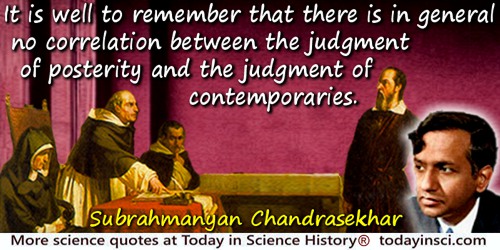
This [Nobel Prize makes] a huge perturbation in my life [and] is not something which I have particularly liked … in many ways I would have much preferred not to have received it … it is well to remember that there is in general no correlation between the judgment of posterity and the judgment of contemporaries.
From Kameshwar C. Wall, 'Conversations with Chandra', Chandra: A Biography of S. Chandrasekhar (1991), 296-298.
To appeal to contemporary man to revert, in this twentieth century, to a pagan-like nature worship in order to restrain technology from further encroachment and devastation of the resources of nature, is a piece of atavistic nonsense.
Faith and Doubt (1971).
Today the invention of a new machine, however noteworthy to industry, would, as a hobby, be trite stuff.… A hobby is a defiance of the contemporary. It is an assertion of those permanent values which the momentary eddies of social evolution have contravened or overlooked. If this is true, then we may also say that every hobbyist is inherently a radical, and that his tribe is inherently a minority.
From 'A Man’s Leisure Time' (1920), collected in Luna B. Leopold (ed.) Round River: From the Journals of Aldo Leopold (1953, 1972), 4.
Very few people realize the enormous bulk of contemporary mathematics. Probably it would be easier to learn all the languages of the world than to master all mathematics at present known. The languages could, I imagine, be learnt in a lifetime; mathematics certainly could not. Nor is the subject static.
In 'The Extent of Mathematics', Prelude to Mathematics (1955), 11.
When the Romans besieged the town [Sicily] (in 212 to 210 B.C.), he [Archimedes] is said to have burned their ships by concentrating on them, by means of mirrors, the sun’s rays. The story is highly improbable, but is good evidence of the reputation which he had gained among his contemporaries for his knowledge of optics.
In An Introduction to Mathematics (1911), 37.
 In science it often happens that scientists say, 'You know that's a really good argument; my position is mistaken,' and then they would actually change their minds and you never hear that old view from them again. They really do it. It doesn't happen as often as it should, because scientists are human and change is sometimes painful. But it happens every day. I cannot recall the last time something like that happened in politics or religion.
(1987) --
In science it often happens that scientists say, 'You know that's a really good argument; my position is mistaken,' and then they would actually change their minds and you never hear that old view from them again. They really do it. It doesn't happen as often as it should, because scientists are human and change is sometimes painful. But it happens every day. I cannot recall the last time something like that happened in politics or religion.
(1987) -- 




