Contact Quotes (67 quotes)
[Presently, science undergraduates] do not learn to write clearly and briefly, marshalling their points in due and aesthetically satisfying order, and eliminating inessentials. They are inept at those turns of phrase or happy analogy which throw a flying bridge across a chasm of misunderstanding and make contact between mind and mind.
From essay in Thomas Rice Henn, The Apple and the Spectroscope: Being Lectures on Poetry Designed (in the Main) for Science Students (1951), 142.
~~[Unverified]~~ Through steady observation and a meaningful contact with the divined order of the world’s structure, arranged by God’s wisdom,–who would not be guided to admire the Builder who creates all!
As quoted, without citation, in Adam Mabry, Life and Doctrine: How the Truth and Grace of Christian Story Change Everything (2001, 2014), 17. Also seen, without citation, in Katherine Katsanis, 'In This Age of Science And Technology, How Can we Accept The Reality of Miracles?', Orthodox Observer (Sep 1997), 21, attributed to Nikolai Copernicus. As yet, Webmaster cannot identify a trustworthy primary source, is therefore presently skeptical, and meanwhile labels the quote as unverified.
A human without a cosmology is like a pebble lying near the top of a great mountain, in contact with its little indentation in the dirt and pebbles immediately surrounding it, but oblivious to its stupendous view.
As co-author with Nancy Ellen Abrams, in The View from the Center of the Universe: Discovering Our Extraordinary Place in the Cosmos (2006), 84.
A species consists of a group of populations which replace each other geographically or ecologically and of which the neighboring ones integrate or hybridise wherever they are in contact or which are potentially capable of doing so (with one or more of the populations) in those cases where contact is prevented by geographical or ecological barriers.
'Speciation Phenomena in Birds', The American Naturalist (1940), 74, 256.
Anyone who has had actual contact with the making of the inventions that built the radio art knows that these inventions have been the product of experiment and work based on physical reasoning, rather than on the mathematicians' calculations and formulae. Precisely the opposite impression is obtained from many of our present day text books and publications.
Attributed.
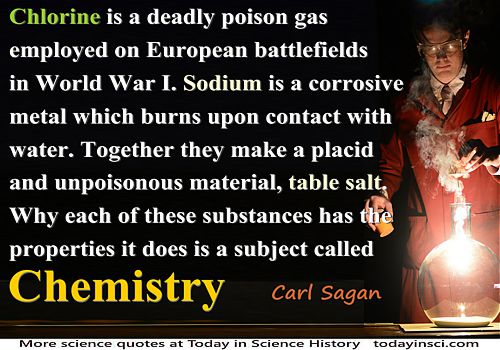
Chlorine is a deadly poison gas employed on European battlefields in World War I. Sodium is a corrosive metal which burns upon contact with water. Together they make a placid and unpoisonous material, table salt. Why each of these substances has the properties it does is a subject called chemistry.
In Broca's Brain: The Romance of Science (1979), 18, footnote.
Contact light.
…...
Contact means the exchange of specific knowledge, ideas, or at least of findings, definite facts. But what if no exchange is possible? If an elephant is not a giant microbe, the ocean is not a giant brain.
As translated from the French by Joanna Kilmartin and Steve Cox, in Solaris (2002), 145.
Decades spent in contact with science and its vehicles have directed my mind and senses to areas beyond their reach. I now see scientific accomplishments as a path, not an end; a path leading to and disappearing in mystery. Science, in fact, forms many paths branching from the trunk of human progress; and on every periphery they end in the miraculous. Following these paths far enough, one must eventually conclude that science itself is a miracle—like the awareness of man arising from and then disappearing in the apparent nothingness of space. Rather than nullifying religion and proving that “God is dead,” science enhances spiritual values by revealing the magnitudes and minitudes—from cosmos to atom—through which man extends and of which he is composed.
A Letter From Lindbergh', Life (4 Jul 1969), 60B. In Eugene C. Gerhart, Quote it Completely! (1998), 409.
Every mathematician knows it is impossible to understand an elementary course in thermodynamics. The reason is that the thermodynamics is based—as Gibbs has explicitly proclaimed—on a rather complicated mathematical theory, on the contact geometry. Contact geometry is one of the few “simple geometries” of the so-called Cartan’s list, but it is still mostly unknown to the physicist.
The first sentence is often seen standing alone as a quote, to imply thermodynamics is a chimera beyond reach. When read in the full context, the point is that thermodynamics becomes possible to understand in an advanced course. It includes a reference to the work of mathematician Élie Cartan. From 'Contact Geometry: The Geometrical Method of Gibbs’ Thermodynamics', collected in D. Caldi and G. Mostow, (eds.) Proceedings of the Gibbs Symposium: Yale University, May 15-17, 1989, (1990), 163.
For many of us, water simply flows from a faucet, and we think little about it beyond this point of contact. We have lost a sense of respect for the wild river, for the complex workings of a wetland, for the intricate web of life that water supports.
Last Oasis: Facing Water Scarcity (1997), 184.
His genius was in asking the right questions and seeing explanations that did not readily occur to others. He loved and lived science and was an inspiration to all who came in contact with him.
Co-author with Marilyn Taylor and Robert E. Connick, obituary, 'Melvin Calvin', Proceedings of the American Philosophical Society (Dec 2000), 144, No. 4, 457.
I came from Paris in the Spring of 1884, and was brought in intimate contact with him [Thomas Edison]. We experimented day and night, holidays not excepted. His existence was made up of alternate periods of work and sleep in the laboratory. He had no hobby, cared for no sport or amusement of any kind and lived in utter disregard of the most elementary rules of hygiene. There can be no doubt that, if he had not married later a woman of exceptional intelligence, who made it the one object of her life to preserve him, he would have died many years ago from consequences of sheer neglect. So great and uncontrollable was his passion for work.
As quoted in 'Tesla Says Edison Was an Empiricist', The New York Times (19 Oct 1931), 25.
I can’t work well under the conditions at Bell Labs. Walter [Brattain] and I are looking at a few questions relating to point-contact transistors, but [William] Shockley keeps all the interesting problems for himself.
From conversation with Frederick Seitz as quoted in Lillian Hoddeson, 'John Bardeen: A Place to Win Two Nobel Prizes and Make a Hole in One', collected in Lillian Hoddeson (ed.), No Boundaries: University of Illinois Vignettes (2004), Chap. 16, 242.
I feel very strongly indeed that a Cambridge education for our scientists should include some contact with the humanistic side. The gift of expression is important to them as scientists; the best research is wasted when it is extremely difficult to discover what it is all about ... It is even more important when scientists are called upon to play their part in the world of affairs, as is happening to an increasing extent.
From essay in Thomas Rice Henn, The Apple and the Spectroscope: Being Lectures on Poetry Designed (in the Main) for Science Students (1951), 142.
I have a boundless admiration for the solitary genius which enabled [Hermann Oberth] to bring into focus all of the essential elements of a gigantic concept, together with the human greatness which allowed him, in shy reserve, to bear with equanimity the “crucify hims” as well as the “hosannas” of public opinion. I myself owe him a debt of gratitude not only for being the guiding light of my life, but also for my first contact with the theoretical and practical aspects of rocket technology and space travel.
Primary source needed for verification. (Can you help?)
I have been much amused at ye singular φενόμενα [phenomena] resulting from bringing of a needle into contact with a piece of amber or resin fricated on silke clothe. Ye flame putteth me in mind of sheet lightning on a small—how very small—scale.
Letter to Dr. Law (15 Dec 1716) as quoted in Norman Lockyer, (ed.), Nature (25 May 1881), 24, 39. The source refers to it as an unpublished letter. Newton's comment relating the spark of static electricity with lightning long predates the work of Benjamin Franklin.
I have no doubt that it is a part of the destiny of the human race, in its gradual improvement, to leave off eating animals, as surely as the savage tribes have left off eating each other, when they came in contact with the more civilised.
In Walden: or, Life in the Woods (1854, 1899), 226.
I know of no department of natural science more likely to reward a man who goes into it thoroughly than anthropology. There is an immense deal to be done in the science pure and simple, and it is one of those branches of inquiry which brings one into contact with the great problems of humanity in every direction.
…...
I will now direct the attention of scientists to a previously unnoticed cause which brings about the metamorphosis and decomposition phenomena which are usually called decay, putrefaction, rotting, fermentation and moldering. This cause is the ability possessed by a body engaged in decomposition or combination, i.e. in chemical action, to give rise in a body in contact with it the same ability to undergo the same change which it experiences itself.
Annalen der Pharmacie 1839, 30, 262. Trans. W. H. Brock.
If we are correct in understanding how evolution actually works, and provided we can survive the complications of war, environmental degradation, and possible contact with interstellar planetary travelers, we will look exactly the same as we do now. We won’t change at all. The species is now so widely dispersed that it is not going to evolve, except by gradualism.
In Pamela Weintraub, The Omni Interviews (1984), 75.
If we ever establish contact with intelligent aliens living on a planet around a distant star … They would be made of similar atoms to us. They could trace their origins back to the big bang 13.7 billion years ago, and they would share with us the universe's future. However, the surest common culture would be mathematics.
In 'Take Me to Your Mathematician', New Scientist (14 Feb 2009), 201, No. 2695.
If, then, the motion of every particle of matter in the universe were precisely reversed at any instant, the course of nature would be simply reversed for ever after. The bursting bubble of foam at the foot of a waterfall would reunite and descend into the water; the thermal motions would reconcentrate their energy, and throw the mass up the fall in drops re-forming into a close column of ascending water. Heat which had been generated by the friction of solids and dissipated by conduction, and radiation, and radiation with absorption, would come again to the place of contact, and throw the moving body back against the force to which it had previously yielded. Boulders would recover from the mud materials required to rebuild them into their previous jagged forms, and would become reunited to the mountain peak from which they had formerly broken away. And if also the materialistic hypothesis of life were true, living creatures would grow backwards, with conscious knowledge of the future but no memory of the past, and would become again unborn.
In 'The Kinetic Theory of the Dissipation of Energy', Nature (1874), 9, 442.
In the present state of our knowledge, it would be useless to attempt to speculate on the remote cause of the electrical energy, or the reason why different bodies, after being brought into contact, should be found differently electrified; its relation to chemical affinity is, however, sufficiently evident. May it not be identical with it, and an essential property of matter?
Bakerian Lecture, 'On Some Chemical Agencies of Electricity', Philosophical Transactions of the Royal Society, 1807, 97, 39.
It is inconceivable, that inanimate brute matter should, without the mediation of something else, which is not material, operate upon and affect other matter without mutual contact … That gravity should be innate, inherent, and essential to matter, so that one body may act upon another at a distance, through a vacuum, without the mediation of anything else, by and through which their action and force may be conveyed from one to another, is to me so great an absurdity, that I believe no man who has in philosophical matters a competent faculty of thinking, can ever fall into it. Gravity must be caused by an agent, acting constantly according to certain laws; but whether this agent be material or immaterial, I have left to the consideration of my readers.
Third letter to Bentley, 25 Feb 1693. Quoted in The Works of Richard Bentley, D.D. (1838), Vol. 3, 212-3.
It was found after many troublesome experiments that when the vacuum within the lamp globe was good, and the contact between the carbon and the conductor which supported it sufficient, there was no blackening of the globes, and no appreciable wasting away of the carbons. Thus was swept away a pernicious error, which, like a misleading finger post proclaiming “No road this way,” tended to bar progress along a good thoroughfare. It only remained to perfect the details of the lamp, to find the best material from which to form the carbon, and to fix this material in the lamp in the best manner. These points, I think, I have now satisfactorily settled, and you see the result in the lamp before me on the table.
In Lecture (20 Oct 1880) at Newcastle-Upon-Tyne, as quoted in United States Courts of Appeals Reports: Cases Adjudged in the United States Circuit Court of Appeals (1894), Vol. 11, 419-420.
It’s humbling to realise that the developmental gulf between a miniscule ant colony and our modern human civilisation is only a tiny fraction of the distance between a Type 0 and a Type III civilisation – a factor of 100 billion billion, in fact. Yet we have such a highly regarded view of ourselves, we believe a Type III civilisation would find us irresistible and would rush to make contact with us. The truth is, however, they may be as interested in communicating with humans as we are keen to communicate with ants.
'Star Makers', Cosmos (Feb 2006).
LEAD, n. A heavy blue-gray metal much used ... as a counterpoise to an argument of such weight that it turns the scale of debate the wrong way. An interesting fact in the chemistry of international controversy is that at the point of contact of two patriotisms lead is precipitated in great quantities.
[Referring to bullets.]
[Referring to bullets.]
The Collected Works of Ambrose Bierce (1911), Vol. 7, The Devil's Dictionary, 187.
Many thanks for the sending me the book Biology of the Striped Skunk ... Frankly, I doubt whether I shall read it or not, unless I happen to have some intimate contact with a skunk which may induce me to learn more about him.
Undated letter to a member of the Natural History Survey. In D. S. Tarbell and A. Tarbell, Roger Adams, Scientist and Statesman (1981), 192.
Moving parts in rubbing contact require lubrication to avoid excessive wear. Honorifics and formal politeness provide lubrication where people rub together.
In Time Enough for Love: The Lives of Lazarus Long (1973), 265.
My passionate sense of social justice and social responsibility has always contrasted oddly with my pronounced lack of need for direct contact with other human beings and human communities.
…...
No plan survives contact with the enemy.
…...
Our knowledge must always be limited, but the knowable is limitless. The greater the sphere of our knowledge the greater the surface of contact with our infinite ignorance.
Conclusion of the James Forrest Lecture (3 May 1894) at an Extra Meeting of the Institution of Civil Engineers, 'The Relation of Mathematics to Engineering', collected in Minutes of Proceedings of the Institution of Civil Engineers (1894), 347.
Our laboratory work involved close contact with many non-clinical scientists. Sir Peter Medawar, 1960 Nobel Laureate, was a frequent visitor to our lab and to the hospital. He once commented, after visiting an early renal transplant patient, that it was the first time he had been in a hospital ward.
In Tore Frängsmyr and Jan E. Lindsten (eds.), Nobel Lectures: Physiology Or Medicine: 1981-1990 (1993), 556.
Our studies have shown that all cases of typhoid of this type have arisen by contact, that is, carried directly from one person to another. There was no trace of a connection to drinking water.
'Die Bekämpfing des Typhus', Veröffentlichungen aus dem Gebiete des Militär-Sanitätswesens (1903), 21. Quoted in English in Thomas D. Brock, Robert Koch: A Life in Medicine and Bacteriology (1988), 256.
PROJECTILE, n. The final arbiter in international disputes. Formerly these disputes were settled by physical contact of the disputants, with such simple arguments as the rudimentary logic of the times could supply —the sword, the spear, and so forth. With the growth of prudence in military affairs the projectile came more and more into favor, and is now held in high esteem by the most courageous. Its capital defect is that it requires personal attendance at the point of propulsion.
The Collected Works of Ambrose Bierce (1911), Vol. 7, The Devil's Dictionary, 268.
Science has thus, most unexpectedly, placed in our hands a new power of great but unknown energy. It does not wake the winds from their caverns; nor give wings to water by the urgency of heat; nor drive to exhaustion the muscular power of animals; nor operate by complicated mechanism; nor summon any other form of gravitating force, but, by the simplest means—the mere contact of metallic surfaces of small extent, with feeble chemical agents, a power everywhere diffused through nature, but generally concealed from our senses, is mysteriously evolved, and by circulation in insulated wires, it is still more mysteriously augmented, a thousand and a thousand fold, until it breaks forth with incredible energy.
Comment upon 'The Notice of the Electro-Magnetic Machine of Mr. Thomas Davenport, of Brandon, near Rutland, Vermont, U.S.', The Annals of Electricity, Magnetism, & Chemistry; and Guardian of Experimental Science (1838), 2, 263.
Since biological change occurs slowly and cultural changes occur in every generation, it is futile to try to explain the fleeting phenomena of culture by a racial constant. We can often explain them—in terms of contact with other peoples, of individual genius, of geography—but not by racial differences.
An Introduction to Cultural Anthropology (1934), 9.
Sometimes I think the surest sign that intelligent life exists elsewhere in the universe is that it has never tried to contact us.
Dialog by Calvin (fictional character) in syndicated newspaper comic strip Calvin and Hobbes. Collected in Scientific Progress Goes “Boink!” (1991), 29.
Take an arrow, and hold it in flame for the space of ten pulses, and when it cometh forth you shall find those parts of the arrow which were on the outsides of the flame more burned, blacked, and turned almost to coal, whereas the midst of the flame will be as if the fire had scarce touched it. This is an instance of great consequence for the discovery of the nature of flame; and sheweth manifestly, that flame burneth more violently towards the sides than in the midst.
Observing, but not with the knowledge, that a flame burns at its outside in contact with air, and there is no combustion within the flame which is not mixed with air. In Sylva Sylvarum; or a Natural History in Ten Centuries (1627), Century 1, Experiment 32. Collected in The Works of Francis Bacon (1740), Vol 3, 9.
The development of science has produced an industrial revolution which has brought different peoples in such close contact with one another through colonization and commerce that no matter how some nations may still look down upon others, no country can harbor the illusion that its career is decided wholly within itself.
In Democracy and Education: An Introduction to the Philosophy of Education (1916), 337.
The difference between myth and science is the difference between divine inspiration of “unaided reason” (as Bertrand Russell put it) on the one hand and theories developed in observational contact with the real world on the other. It is the difference between the belief in prophets and critical thinking, between Credo quia absurdum (I believe because it is absurd–Tertullian) and De omnibus est dubitandum (Everything should be questioned–Descartes). To try to write a grand cosmical drama leads necessarily to myth. To try to let knowledge substitute ignorance in increasingly large regions of space and time is science.
In 'Cosmology: Myth or Science?' Journal of Astrophysics and Astronomy (1984), 5, 79-98.
The discovery of an interaction among the four hemes made it obvious that they must be touching, but in science what is obvious is not necessarily true. When the structure of hemoglobin was finally solved, the hemes were found to lie in isolated pockets on the surface of the subunits. Without contact between them how could one of them sense whether the others had combined with oxygen? And how could as heterogeneous a collection of chemical agents as protons, chloride ions, carbon dioxide, and diphosphoglycerate influence the oxygen equilibrium curve in a similar way? It did not seem plausible that any of them could bind directly to the hemes or that all of them could bind at any other common site, although there again it turned out we were wrong. To add to the mystery, none of these agents affected the oxygen equilibrium of myoglobin or of isolated subunits of hemoglobin. We now know that all the cooperative effects disappear if the hemoglobin molecule is merely split in half, but this vital clue was missed. Like Agatha Christie, Nature kept it to the last to make the story more exciting. There are two ways out of an impasse in science: to experiment or to think. By temperament, perhaps, I experimented, whereas Jacques Monod thought.
From essay 'The Second Secret of Life', collected in I Wish I'd Made You Angry Earlier (1998), 263-5.
The divine tape recorder holds a million scenarios, each perfectly sensible. Little quirks at the outset, occurring for no particular reason, unleash cascades of consequences that make a particular feature seem inevitable in retrospect. But the slightest early nudge contacts a different groove, and history veers into another plausible channel, diverging continually from its original pathway. The end results are so different, the initial perturbation so apparently trivial.
…...

The fascination of any search after truth lies not in the attainment, which at best is found to be very relative, but in the pursuit, where all the powers of the mind and character are brought into play and are absorbed by the task. One feels oneself in contact with something that is infinite and one finds joy that is beyond expression in sounding the abyss of science and the secrets of the infinite mind.
In Isabel Fothergill Smith, The Stone Lady: a Memoir of Florence Bascom (1981). Cited in Earth Sciences History: Journal of the History of the Earth Sciences Society (992), Vols. 11-12, 39.
The man of science multiples the points of contact between man and nature.
The Garden of Epicurus (1894) translated by Alfred Allinson, in The Works of Anatole France in an English Translation (1920), 49.
The man who proportions the several parts of a mill, uses the same scientific principles [mechanics], as if he had the power of constructing an universe; but as he cannot give to matter that invisible agency, by which all the component parts of the immense machine of the universe have influence upon each other, and set in motional unison together without any apparent contact, and to which man has given the name of attraction, gravitation, and repulsion, he supplies the place of that agency by the humble imitation of teeth and cogs. All the parts of man’s microcosm must visibly touch.
In The Age of Reason: Being an Investigation of True and Fabulous Theology (27 Jan O.S. 1794), 42-43.
The mathematician is in much more direct contact with reality. … [Whereas] the physicist’s reality, whatever it may be, has few or none of the attributes which common sense ascribes instinctively to reality. A chair may be a collection of whirling electrons.
In A Mathematician's Apology (1940, 2012), 128.
The reciprocal relationship of epistemology and science is of noteworthy kind. They are dependent on each other. Epistemology without contact with science becomes an empty scheme. Science without epistemology is–insofar as it is thinkable at all–primitive and muddled.
In Ralph Keyesr, The Quote Verifier, 51-52.
The ridge of the Lammer-muir hills... consists of primary micaceous schistus, and extends from St Abb's head westward... The sea-coast affords a transverse section of this alpine tract at its eastern extremity, and exhibits the change from the primary to the secondary strata... Dr HUTTON wished particularly to examine the latter of these, and on this occasion Sir JAMES HALL and I had the pleasure to accompany him. We sailed in a boat from Dunglass ... We made for a high rocky point or head-land, the SICCAR ... On landing at this point, we found that we actually trode [sic] on the primeval rock... It is here a micaceous schistus, in beds nearly vertical, highly indurated, and stretching from S.E. to N. W. The surface of this rock... has thin covering of red horizontal sandstone laid over it, ... Here, therefore, the immediate contact of the two rocks is not only visible, but is curiously dissected and laid open by the action of the waves... On us who saw these phenomena for the first time, the impression will not easily be forgotten. The palpable evidence presented to us, of one of the most extraordinary and important facts in the natural history of the earth, gave a reality and substance to those theoretical speculations, which, however probable had never till now been directly authenticated by the testimony of the senses... What clearer evidence could we have had of the different formation of these rocks, and of the long interval which separated their formation, had we actually seen them emerging from the bosom of the deep? ... The mind seemed to grow giddy by looking so far into the abyss of time; and while we listened with earnestness and admiration to the philosopher who was now unfolding to us the order and series of these wonderful events, we became sensible how much farther reason may sometimes go than imagination can venture to follow.
'Biographical Account of the Late Dr James Hutton, F.R.S. Edin.' (read 1803), Transactions of the Royal Society of Edinburgh (1805), 5, 71-3.
The rigid career path of a professor at a modern university is that One Must Build the Big Research Group, recruit doctoral students more vigorously than the head football coach, bombard the federal agencies with grant applications more numerous than the pollen falling from the heavens in spring, and leave the paper writing and the research to the postdocs, research associates, and students who do all the bench work and all the computer programming. A professor is chained to his previous topics by his Big Group, his network of contacts built up laboriously over decades, and the impossibility of large funding except in areas where the grantee has grown the group from a corner of the building to an entire floor. The senior tenure-track faculty at a research university–the “silverbacks” in anthropological jargon–are bound by invisible chains stronger than the strongest steel to a narrow range of what the Prevailing Consensus agrees are Very Important Problems. The aspiring scientist is confronted with the reality that his mentors are all business managers.
In his Foreword to Cornelius Lanczos, Discourse on Fourier Series, ix-x.
Their specific effect on the glucosides might thus be explained by assuming that the intimate contact between the molecules necessary for the release of the chemical reaction is possible only with similar geometrical configurations. To give an illustration I will say that enzyme and glucoside must fit together like lock and key in order to be able to exercise a chemical action on each other. This concept has undoubtedly gained in probability and value for stereochemical research, after the phenomenon itself was transferred from the biological to the purely chemical field. It is an extension of the theory of asymmetry without being a direct consequence of it: for the conviction that the geometrical structure of the molecule even for optical isomers exercises such a great influence on the chemical affinities, in my opinion could only be gained by new actual observations.
'Einfluss der Configuration auf die wirkung der Enzyme', Berichte der deutschen Chemischen Gesellschaft, 1894, 27, 2985-93. Trans. B. Holmstedt and G. Liljestrand (eds.) Readings in Pharmacology (1963), 251.
There have, however, always been men of high and disciplined spirituality who have insisted on their direct experience of something greater than themselves. Their conviction of the reality of a spiritual life apart from and transcending the life of the body may not lend itself to scientific proof or disproof; nevertheless the remarkable transformation in personality seen in those who rightfully lay claim to such experience is as objective as tomorrow's sunrise. Millions of lesser men draw strength from the contacts they can make through prayer and meditation with this aspect of the inner life.
at a convention of scientists in 1967 at the University of Notre Dame
There seems no limit to research, for as been truly said, the more the sphere of knowledge grows, the larger becomes the surface of contact with the unknown.
from A History of Science and Its Relations with Philosophy and Religion (1929, 4th Ed., 1948), 500.
These differences, they say, are three: shape, arrangement, and position; because they hold that what is differs only in contour, inter-contact, inclination.
Quoted in Aristotle, Metaphysics A 4 985b 13-16. Trans. Hugh Tredennick (1933), Vol. 1, 31.
This whole theory of electrostatics constitutes a group of abstract ideas and general propositions, formulated in the clear and precise language of geometry and algebra, and connected with one another by the rules of strict logic. This whole fully satisfies the reason of a French physicist and his taste for clarity, simplicity and order. The same does not hold for the Englishman. These abstract notions of material points, force, line of force, and equipotential surface do not satisfy his need to imagine concrete, material, visible, and tangible things. 'So long as we cling to this mode of representation,' says an English physicist, 'we cannot form a mental representation of the phenomena which are really happening.' It is to satisfy the need that he goes and creates a model.
The French or German physicist conceives, in the space separating two conductors, abstract lines of force having no thickness or real existence; the English physicist materializes these lines and thickens them to the dimensions of a tube which he will fill with vulcanised rubber. In place of a family of lines of ideal forces, conceivable only by reason, he will have a bundle of elastic strings, visible and tangible, firmly glued at both ends to the surfaces of the two conductors, and, when stretched, trying both to contact and to expand. When the two conductors approach each other, he sees the elastic strings drawing closer together; then he sees each of them bunch up and grow large. Such is the famous model of electrostatic action imagined by Faraday and admired as a work of genius by Maxwell and the whole English school.
The employment of similar mechanical models, recalling by certain more or less rough analogies the particular features of the theory being expounded, is a regular feature of the English treatises on physics. Here is a book* [by Oliver Lodge] intended to expound the modern theories of electricity and to expound a new theory. In it are nothing but strings which move around pulleys, which roll around drums, which go through pearl beads, which carry weights; and tubes which pump water while others swell and contract; toothed wheels which are geared to one another and engage hooks. We thought we were entering the tranquil and neatly ordered abode of reason, but we find ourselves in a factory.
*Footnote: O. Lodge, Les Théories Modernes (Modern Views on Electricity) (1889), 16.
The French or German physicist conceives, in the space separating two conductors, abstract lines of force having no thickness or real existence; the English physicist materializes these lines and thickens them to the dimensions of a tube which he will fill with vulcanised rubber. In place of a family of lines of ideal forces, conceivable only by reason, he will have a bundle of elastic strings, visible and tangible, firmly glued at both ends to the surfaces of the two conductors, and, when stretched, trying both to contact and to expand. When the two conductors approach each other, he sees the elastic strings drawing closer together; then he sees each of them bunch up and grow large. Such is the famous model of electrostatic action imagined by Faraday and admired as a work of genius by Maxwell and the whole English school.
The employment of similar mechanical models, recalling by certain more or less rough analogies the particular features of the theory being expounded, is a regular feature of the English treatises on physics. Here is a book* [by Oliver Lodge] intended to expound the modern theories of electricity and to expound a new theory. In it are nothing but strings which move around pulleys, which roll around drums, which go through pearl beads, which carry weights; and tubes which pump water while others swell and contract; toothed wheels which are geared to one another and engage hooks. We thought we were entering the tranquil and neatly ordered abode of reason, but we find ourselves in a factory.
*Footnote: O. Lodge, Les Théories Modernes (Modern Views on Electricity) (1889), 16.
The Aim and Structure of Physical Theory (1906), 2nd edition (1914), trans. Philip P. Wiener (1954), 70-1.
Those who knew that the judgements of many centuries had reinforced the opinion that the Earth is placed motionless in the middle of heaven, as though at its centre, if I on the contrary asserted that the Earth moves, I hesitated for a long time whether to bring my treatise, written to demonstrate its motion, into the light of day, or whether it would not be better to follow the example of the Pythagoreans and certain others, who used to pass on the mysteries of their philosophy merely to their relatives and friends, not in writing but by personal contact, as the letter of Lysis to Hipparchus bears witness. And indeed they seem to me to have done so, not as some think from a certain jealousy of communicating their doctrines, but so that their greatest splendours, discovered by the devoted research of great men, should not be exposed to the contempt of those who either find it irksome to waste effort on anything learned, unless it is profitable, or if they are stirred by the exhortations and examples of others to a high-minded enthusiasm for philosophy, are nevertheless so dull-witted that among philosophers they are like drones among bees.
'To His Holiness Pope Paul III', in Copernicus: On the Revolutions of the Heavenly Spheres (1543), trans. A. M. Duncan (1976), 24.
To pick a hole–say in the 2nd law of Ωcs, that if two things are in contact the hotter cannot take heat from the colder without external agency.
Now let A & B be two vessels divided by a diaphragm and let them contain elastic molecules in a state of agitation which strike each other and the sides. Let the number of particles be equal in A & B but let those in A have equal velocities, if oblique collisions occur between them their velocities will become unequal & I have shown that there will be velocities of all magnitudes in A and the same in B only the sum of the squares of the velocities is greater in A than in B.
When a molecule is reflected from the fixed diaphragm CD no work is lost or gained.
If the molecule instead of being reflected were allowed to go through a hole in CD no work would be lost or gained, only its energy would be transferred from the one vessel to the other.
Now conceive a finite being who knows the paths and velocities of all the molecules by simple inspection but who can do no work, except to open and close a hole in the diaphragm, by means of a slide without mass.
Let him first observe the molecules in A and when lie sees one coming the square of whose velocity is less than the mean sq. vel. of the molecules in B let him open a hole & let it go into B. Next let him watch for a molecule in B the square of whose velocity is greater than the mean sq. vel. in A and when it comes to the hole let him draw and slide & let it go into A, keeping the slide shut for all other molecules.
Then the number of molecules in A & B are the same as at first but the energy in A is increased and that in B diminished that is the hot system has got hotter and the cold colder & yet no work has been done, only the intelligence of a very observant and neat fingered being has been employed. Or in short if heat is the motion of finite portions of matter and if we can apply tools to such portions of matter so as to deal with them separately then we can take advantage of the different motion of different portions to restore a uniformly hot system to unequal temperatures or to motions of large masses. Only we can't, not being clever enough.
Now let A & B be two vessels divided by a diaphragm and let them contain elastic molecules in a state of agitation which strike each other and the sides. Let the number of particles be equal in A & B but let those in A have equal velocities, if oblique collisions occur between them their velocities will become unequal & I have shown that there will be velocities of all magnitudes in A and the same in B only the sum of the squares of the velocities is greater in A than in B.
When a molecule is reflected from the fixed diaphragm CD no work is lost or gained.
If the molecule instead of being reflected were allowed to go through a hole in CD no work would be lost or gained, only its energy would be transferred from the one vessel to the other.
Now conceive a finite being who knows the paths and velocities of all the molecules by simple inspection but who can do no work, except to open and close a hole in the diaphragm, by means of a slide without mass.
Let him first observe the molecules in A and when lie sees one coming the square of whose velocity is less than the mean sq. vel. of the molecules in B let him open a hole & let it go into B. Next let him watch for a molecule in B the square of whose velocity is greater than the mean sq. vel. in A and when it comes to the hole let him draw and slide & let it go into A, keeping the slide shut for all other molecules.
Then the number of molecules in A & B are the same as at first but the energy in A is increased and that in B diminished that is the hot system has got hotter and the cold colder & yet no work has been done, only the intelligence of a very observant and neat fingered being has been employed. Or in short if heat is the motion of finite portions of matter and if we can apply tools to such portions of matter so as to deal with them separately then we can take advantage of the different motion of different portions to restore a uniformly hot system to unequal temperatures or to motions of large masses. Only we can't, not being clever enough.
Letter to Peter Guthrie Tait (11 Dec 1867). In P. M. Harman (ed.), The Scientific Letters and Papers of James Clerk Maxwell (1995), Vol. 2, 331-2.
Voice is a flowing breath of air, perceptible to the hearing by contact. It moves in an endless number of circular rounds, like the innumerably increasing circular waves which appear when a stone is thrown into smooth water, and which keep on spreading indefinitely from the centre.
In De Architectura, Book 5, Chap 1, Sec. 6. As translated in Morris Hicky Morgan (trans.), Vitruvius: The Ten Books on Architecture (1914), 138.
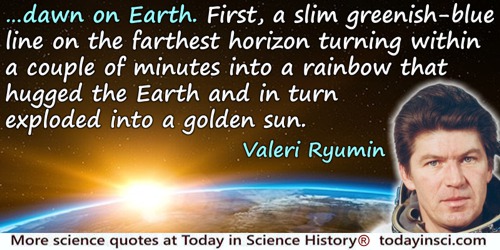
We entered into shadow. Contact with Moscow was gone. Japan floated by beneath us and I could clearly see its cities ablaze with lights. We left Japan behind to face the dark emptiness of the Pacific Ocean. No moon. Only stars, bright and far away. I gripped the handle like a man hanging onto a streetcar. Very slowly, agonizingly, half an hour passed, and with that, dawn on Earth. First, a slim greenish-blue line on the farthest horizon turning within a couple of minutes into a rainbow that hugged the Earth and in turn exploded into a golden sun. You’re out of your mind, I told myself, hanging onto a ship in space, and to your life, and getting ready to admire a sunrise.
…...
What a splendid perspective contact with a profoundly different civilization might provide! In a cosmic setting vast and old beyond ordinary human understanding we are a little lonely, and we ponder the ultimate significance, if any, of our tiny but exquisite blue planet, the Earth… In the deepest sense the search for extraterrestrial intelligence is a search for ourselves.
…...
When Aloisio Galvani first stimulated the nervous fiber by the accidental contact of two heterogeneous metals, his contemporaries could never have anticipated that the action of the voltaic pile would discover to us, in the alkalies, metals of a silvery luster, so light as to swim on water, and eminently inflammable; or that it would become a powerful instrument of chemical analysis, and at the same time a thermoscope and a magnet.
In 'Introduction' Cosmos: A Sketch of a Physical Description of the Universe (1860), Vol. 1, 52, as translated by E.C. Otté.
When an element A has an affinity for another substance B, I see no mechanical reason why it should not take as many atoms of B as are presented to it, and can possibly come into contact with it (which may probably be 12 in general), except so far as the repulsion of the atoms of B among themselves are more than a match for the attraction of an atom of A. Now this repulsion begins with 2 atoms of B to 1 atom of A, in which case the 2 atoms of B are diametrically opposed; it increases with 3 atoms of B to 1 of A, in which case the atoms are only 120° asunder; with 4 atoms of B it is still greater as the distance is then only 90; and so on in proportion to the number of atoms. It is evident from these positions, that, as far as powers of attraction and repulsion are concerned (and we know of no other in chemistry), binary compounds must first be formed in the ordinary course of things, then ternary and so on, till the repulsion of the atoms of B (or A, whichever happens to be on the surface of the other), refuse to admit any more.
Observations on Dr. Bostock's Review of the Atomic Principles of Chemistry', Nicholson's Journal, 1811, 29, 147.
While speaking, M. Bertrand is always in motion; now he seems in combat with some outside enemy, now he outlines with a gesture of the hand the figures he studies. Plainly he sees and he is eager to paint, this is why he calls gesture to his aid. With M. Hermite, it is just the opposite; his eyes seem to shun contact with the world; it is not without, it is within he seeks the vision of truth.
From La Valeur de la Science (1904), 14, as translated by George Bruce Halsted (trans.), in The Value of Science (1907), 16. From the French, “Tout en parlant, M. Bertrand est toujours en action; tantôt il semble aux prises avec quelque ennemi extérieur, tantôt il dessine d'un geste de la main les figures qu’il étudie. Évidemment, il voit et il cherche à peindre, c’est pour cela qu’il appelle le geste à son secours. Pour M. Hermite, c’est tout le contraire; ses yeux semblent fuir le contact du monde; ce n’est pas au dehors, c’est au dedans qu’il cherche la vision de la vérité.”
With science fiction I think we are preparing ourselves for contact with them, whoever they may be.
Interview in article by Dean Lamanna, 'It's No Act—He's into UFOs' in UFO Magazine (U.S. Edition, 1994), 9:4.
Years ago I used to worry about the degree to which I specialized. Vision is limited enough, yet I was not really working on vision, for I hardly made contact with visual sensations, except as signals, nor with the nervous pathways, nor the structure of the eye, except the retina. Actually my studies involved only the rods and cones of the retina, and in them only the visual pigments. A sadly limited peripheral business, fit for escapists. But it is as though this were a very narrow window through which at a distance, one can only see a crack of light. As one comes closer the view grows wider and wider, until finally looking through the same narrow window one is looking at the universe. It is like the pupil of the eye, an opening only two to three millimetres across in daylight, but yielding a wide angle of view, and manoeuvrable enough to be turned in all directions. I think this is always the way it goes in science, because science is all one. It hardly matters where one enters, provided one can come closer, and then one does not see less and less, but more and more, because one is not dealing with an opaque object, but with a window.
In Scientific American, 1960s, attributed.
Yet I also appreciate that we cannot win this battle to save species and environments without forging an emotional bond between ourselves and nature as well–for we will not fight to save what we do not love (but only appreciate in some abstract sense). So let them all continue–the films, the books, the television programs, the zoos, the little half acre of ecological preserve in any community, the primary school lessons, the museum demonstrations, even ... the 6:00 A.M. bird walks. Let them continue and expand because we must have visceral contact in order to love. We really must make room for nature in our hearts.
…...
 In science it often happens that scientists say, 'You know that's a really good argument; my position is mistaken,' and then they would actually change their minds and you never hear that old view from them again. They really do it. It doesn't happen as often as it should, because scientists are human and change is sometimes painful. But it happens every day. I cannot recall the last time something like that happened in politics or religion.
(1987) --
In science it often happens that scientists say, 'You know that's a really good argument; my position is mistaken,' and then they would actually change their minds and you never hear that old view from them again. They really do it. It doesn't happen as often as it should, because scientists are human and change is sometimes painful. But it happens every day. I cannot recall the last time something like that happened in politics or religion.
(1987) -- 





