Conservation Quotes (188 quotes)
“Conservation” (the conservation law) means this … that there is a number, which you can calculate, at one moment—and as nature undergoes its multitude of changes, this number doesn't change. That is, if you calculate again, this quantity, it'll be the same as it was before. An example is the conservation of energy: there's a quantity that you can calculate according to a certain rule, and it comes out the same answer after, no matter what happens, happens.
'The Great Conservation Principles', The Messenger Series of Lectures, No. 3, Cornell University, 1964. From transcript of BBC programme (11 Dec 1964).
[Ignorance] of the principle of conservation of energy … does not prevent inventors without background from continually putting forward perpetual motion machines… Also, such persons undoubtedly have their exact counterparts in the fields of art, finance, education, and all other departments of human activity… persons who are unwilling to take the time and to make the effort required to find what the known facts are before they become the champions of unsupported opinions—people who take sides first and look up facts afterward when the tendency to distort the facts to conform to the opinions has become well-nigh irresistible.
From Evolution in Science and Religion (1927), 58-59. An excerpt from the book including this quote appears in 'New Truth and Old', Christian Education (Apr 1927), 10, No. 7, 394-395.
[Richard Nixon] is the kind of politician who would cut down a redwood tree, and then mount the stump and make a speech for conservation.
Campaign speech (1956). Quoted in Jean H. Baker, The Stevensons: A Biography of an American Family (1997), 328.
Jean H. Baker - 1997
Question: State what are the conditions favourable for the formation of dew. Describe an instrument for determining the dew point, and the method of using it.
Answer: This is easily proved from question 1. A body of gas as it ascends expands, cools, and deposits moisture; so if you walk up a hill the body of gas inside you expands, gives its heat to you, and deposits its moisture in the form of dew or common sweat. Hence these are the favourable conditions; and moreover it explains why you get warm by ascending a hill, in opposition to the well-known law of the Conservation of Energy.
Answer: This is easily proved from question 1. A body of gas as it ascends expands, cools, and deposits moisture; so if you walk up a hill the body of gas inside you expands, gives its heat to you, and deposits its moisture in the form of dew or common sweat. Hence these are the favourable conditions; and moreover it explains why you get warm by ascending a hill, in opposition to the well-known law of the Conservation of Energy.
Genuine student answer* to an Acoustics, Light and Heat paper (1880), Science and Art Department, South Kensington, London, collected by Prof. Oliver Lodge. Quoted in Henry B. Wheatley, Literary Blunders (1893), 179, Question 12. (*From a collection in which Answers are not given verbatim et literatim, and some instances may combine several students' blunders.)
A country grows in history not only because of the heroism of its troops on the field of battle, it grows also when it turns to justice and to right for the conservation of its interests.
…...
A grove of giant redwoods or sequoias should be kept just as we keep a great or beautiful cathedral. The extermination of the passenger pigeon meant that mankind was just so much poorer; exactly as in the case of the destruction of the cathedral at Rheims. And to lose the chance to see frigate-birds soaring in circles above the storm, or a file of pelicans winging their way homeward across the crimson afterglow of the sunset, or a myriad terns flashing in the bright light of midday as they hover in a shifting maze above the beach—why, the loss is like the loss of a gallery of the masterpieces of the artists of old time.
In A Book-Lover's Holidays in the Open (1916), 316-317.
A new era of ocean exploration can yield discoveries that will help inform everything from critical medical advances to sustainable forms of energy. Consider that AZT, an early treatment for HIV, is derived from a Caribbean reef sponge, or that a great deal of energy—from offshore wind, to OTEC (ocean thermal energy conservation), to wind and wave energy—is yet untapped in our oceans.
In 'Why Exploring the Ocean is Mankind’s Next Giant Leap', contributed to CNN 'Lightyears Blog' (13 Mar 2012).
A State without the means of some change is without the means of its conservation.
…...
Active conservation [of gorillas] involves simply going out into the forest, on foot, day after day after day, attempting to capture poachers, killing—regretfully—poacher dogs, which spread rabies within the park, and cutting down traps.
Interview at her camp in Rwanda (May 1985). As quoted in article from Times Wire Services, 'Naturalist Dian Fossey Slain at Camp in Rwanda: American Was Expert on Mountain Gorillas; Assailants Hunted', Los Angeles Times (29 Dec 1985). The newspaper states the interview was one of the last she gave, and the report said using “continuous anti-poaching surveillance…only her patrols adequately protected the apes.”
After 16 months of teaching, consulting, fellowship, and special project activities on matters ranging from conservation to healthcare to international trade, Gov. Ventura appointed me to the Minnesota Court of Appeals.
…...
After seeking in vain for the construction of a perpetual motion machine, the relations were investigated which must subsist between the forces of nature if such a machine is to be impossible; and this inverted question led to the discovery of the law of the conservation of energy, which, again, explained the impossibility of perpetual motion in the sense originally intended.
Opening of Lecture (1900), 'Mathematische Probleme' (Mathematical Problems), to the International Congress of Mathematicians, Paris. From the original German reprinted in David Hilbert: Gesammelte Abhandlungen (Collected Treatises, 1970), Vol. 3. For full citation, see the quote that begins, “This conviction of the solvability…”, on the David Hilbert Quotes page on this website.
All conservation of wildness is self-defeating, for to cherish we must see and fondle, and when enough have seen and fondled, there is no wilderness left to cherish.
In 'Wisconsin', A Sand County Almanac, and Sketches Here and There (1949, 1987), 101.
And by the influence of heat, light, and electrical powers, there is a constant series of changes [in animal and vegetal substances]; matter assumes new forms, the destruction of one order of beings tends to the conservation of another, solution and consolidation, decay and renovation, are connected, and whilst the parts of the system, continue in a state of fluctuation and change, the order and harmony of the whole remain unalterable.
The Elements of Agricultural Chemistry (1813), in J. Davy (ed.) The Collected Works of Sir Humphry Davy(1839-40), Vol 7, 182.
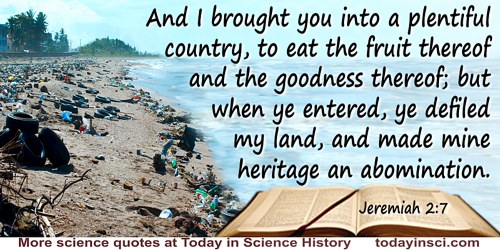
And I brought you into a plentiful country, to eat the fruit thereof and the goodness thereof; but when ye entered, ye defiled my land, and made mine heritage an abomination.
— Bible
Jeremiah 2:7, King James Bible.
And thus Nature will be very conformable to her self and very simple, performing all the great Motions of the heavenly Bodies by the Attraction of Gravity which intercedes those Bodies, and almost all the small ones of their Particles by some other attractive and repelling Powers which intercede the Particles. The Vis inertiae is a passive Principle by which Bodies persist in their Motion or Rest, receive Motion in proportion to the Force impressing it, and resist as much as they are resisted. By this Principle alone there never could have been any Motion in the World. Some other Principle was necessary for putting Bodies into Motion; and now they are in Motion, some other Principle is necessary for conserving the Motion.
From Opticks, (1704, 2nd ed. 1718), Book 3, Query 31, 372-3.
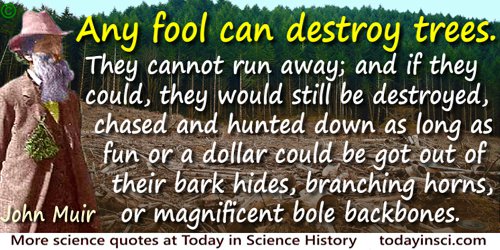
Any fool can destroy trees. They cannot run away; and if they could, they would still be destroyed,—chased and hunted down as long as fun or a dollar could be got out of their bark hides, branching horns, or magnificent bole backbones. Few that fell trees plant them; nor would planting avail much towards getting back anything like the noble primeval forests. During a man’s life only saplings can be grown, in the place of the old trees—tens of centuries old—that have been destroyed.
In 'The American Forests', Atlantic Monthly (Aug 1897), Vol. 80, 157.
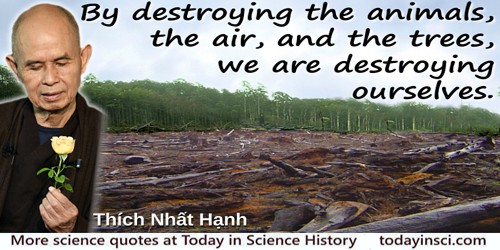
Birds’ songs express joy, beauty, and purity, and evoke in us vitality and love. So many beings in the universe love us unconditionally. The trees, the water, and the air don’t ask anything of us; they just love us. Even though we need this kind of love, we continue to destroy them. By destroying the animals, the air, and the trees, we are destroying ourselves. We must learn to practice unconditional love for all beings so that the animals, the air, the trees, and the minerals can continue to be themselves.
In Love in Action: Writings on Nonviolent Social Change (1993), 131-132.
But we must take other steps, such as increasing conservation, developing an ethanol industry, and increasing CAFE standards if we are to make our country safer by cutting our reliance on foreign oil.
…...
By encouraging conservation, increasing investments in clean, renewable sources of energy, and promoting increased domestic production of oil and gas, we can build a more secure future for our country.
…...
Change—and extinctions—are inevitable. There are many things totally out of our control. I think we have to come up with a formula that will enable us to preserve biodiversity without necessarily managing it in the sense of trying to freeze it in time. It can't be kept as we first knew it.
From interview with Scott Harris, 'Conversations: Richard Leakey (July-Aug '96)' originally on website of emagazine.com.
Conservation and rural-life policies are really two sides of the same policy; and down at the bottom this policy rests upon the fundamental law that neither man nor nation can prosper unless, in dealing with the present, thought is steadily given for the future.
'Rural Life' (originally published in The Outlook, 27 Aug 1910). In The Works of Theodore Roosevelt. Vol. 16: American Problems (1926), 146.
Conservation is a bird that flies faster than the shot we aim at it.
In Aldo Leopold and Luna B. Leopold, Round River (1972), 145.
Conservation is a state of harmony between men and land.
In essay "Conservation' (1953), Collected in Aldo Leopold and Luna B. Leopold, Round River (1972), 145.
Conservation is an American value, and it is lacking from this bill.
…...
Conservation is getting nowhere because it is incompatible with our Abrahamic concept of land. We abuse land because we regard it as a commodity belonging to us. When we see land as a community to which we belong, we may begin to use it with love and respect. There is no other way for land to survive the impact of mechanized man, nor for us to reap from it the esthetic harvest it is capable, under science, of contributing to culture.
In 'Foreword', A Sand County Almanac, and Sketches Here and There (1949, 1987), viii.
Conservation is now a dead word. … You can’t conserve what you haven’t got. That’s why we are for restoration.
Speaking to Sarasota Wellesley Club about the goal for the Friends of the Everglades (1982). As quoted in Jack E. Davis, An Everglades Providence: Marjory Stoneman Douglas (2009), 512. She promoted restoring the massive disruptions to the ecosystems following the Corps of Engineers colossal, ill-conceived Everglades drainage project begun in 1948.
Conservation is the foresighted utilization, preservation. And/or renewal of forest, waters, lands and minerals, for the greatest good of the greatest number for the longest time.
In Breaking New Ground (1947, 1998), 505.
Conservation means development as much as it does protection. I recognize the right and duty of this generation to develop and use the natural resources of our land; but I do not recognize the right to waste them, or to rob, by wasteful use, the generations that come after us.
'The New Nationalism', speech at Osawatomie, Kansas, 31 Aug 1910. In Richard D. Heffner, A Documentary History of the United States: Seventh Revised Edition (2002), 272. This is one of the quotations inscribed in the Roosevelt Memorial rotunda at the American Museum of Natural History.
Conservation means the wise use of the earth and its resources for the lasting good of men.
In Breaking New Ground (1947, 1998), 505.
Conservation must come before recreation.
In The Times (5 Jul 1989).
Conservation of energy also protects our environment.
…...
Dam Hetch Hetchy! As well dam for water-tanks the people’s cathedrals and churches, for no holier temple has ever been consecrated by the heart of man.
[Muir was aghast that the Hetch Hetchy Valley in Yosemite was to be flooded by the O'Shaughnessy Dam to provide water for San Francisco. Muir lost this land conservation battle; the dam was completed in 1914.]
[Muir was aghast that the Hetch Hetchy Valley in Yosemite was to be flooded by the O'Shaughnessy Dam to provide water for San Francisco. Muir lost this land conservation battle; the dam was completed in 1914.]
Closing remark in The Yosemite (1912), 262.
Defenders of the short-sighted men who in their greed and selfishness will, if permitted, rob our country of half its charm by their reckless extermination of all useful and beautiful wild things sometimes seek to champion them by saying the “the game belongs to the people.” So it does; and not merely to the people now alive, but to the unborn people. The “greatest good for the greatest number” applies to the number within the womb of time, compared to which those now alive form but an insignificant fraction. Our duty to the whole, including the unborn generations, bids us restrain an unprincipled present-day minority from wasting the heritage of these unborn generations. The movement for the conservation of wild life and the larger movement for the conservation of all our natural resources are essentially democratic in spirit, purpose, and method.
'Bird Reserves at the Mouth of the Mississippi', A Book-Lover's Holidays in the Open (1920), 300-301.
Do not great Bodies conserve their heat the longest, their parts heating one another, and may not great dense and fix'd Bodies, when heated beyond a certain degree, emit Light so copiously, as by the Emission and Re-action of its Light, and the Reflexions and Refractions of its Rays within its Pores to grow still hotter, till it comes to a certain period of heat, such as is that of the Sun?
Opticks (1704), Book 3, Query II, 135.

Energy conservation is the foundation of energy independence.
Title of press release (22 Sep 2005), 'Energy Conservation Is the Foundation of Energy Independence' on co-sponsoring the Energy Efficiency Cornerstone Act.
Engineering is the science of economy, of conserving the energy, kinetic and potential, provided and stored up by nature for the use of man. It is the business of engineering to utilize this energy to the best advantage, so that there may be the least possible waste.
(1908). Quoted, without source, in Appendix A, 'Some Definitions of Engineering' in Theodore Jesse Hoover and John Charles Lounsbury Fish, The Engineering Profession (1941), 463.
Environmentalism opposes reckless innovation and makes conservation the central order of business.
…...
Every cent we earn from Crocodile Hunter goes straight back into conservation. Every single cent.
…...
Every one of us can do something to protect and care for our planet. We have to live in such a way that a future will be possible for our children and our grandchildren. Our own life has to be. Our own life has to be our message.
In The World We Have: A Buddhist Approach to Peace and Ecology (2008), i.
Everybody likes to hear about a man laying down his life for his country, but nobody wants to hear about a country giving her shirt for her planet.
In 'The Wild Flag', The New Yorker (9 Sep 1944), 35. Quote collected in In the Words of E.B. White: Quotations from America’s Most Companionable of Writers (2011), 150.
Few problems are less recognized, but more important than, the accelerating disappearance of the earth’s biological resources. In pushing other species to extinction, humanity is busy sawing off the limb on which it is perched.
In Ashton Applewhite, William R. Evans and Andrew Frothingham, And I Quote (2003)
For a modern ruler the laws of conservation and transformation of energy, when the vivifing stream takes its source, the ways it wends its course in nature, and how, under wisdom and knowledge, it may be intertwined with human destiny, instead of careering headlong to the ocean, are a study at least as pregnant with consequences to life as any lesson taught by the long unscientific history of man.
Science and Life (1920), 5.
Gifford Pinchot is the man to whom the nation owes most for what has been accomplished as regards the preservation of the natural resources of our country. He led, and indeed during its most vital period embodied, the fight for the preservation through use of our forests … He was the foremost leader in the great struggle to coordinate all our social and governmental forces in the effort to secure the adoption of a rational and far-seeing policy for securing the conservation of all our national resources. … I believe it is but just to say that among the many, many public officials who under my administration rendered literally invaluable service to the people of the United States, he, on the whole, stood first.
'The Natural Resources of the Nation' Autobiography (1913), ch. 11. Quoted in Douglas M. Johnston, The International Law of Fisheries (1987), 44
Gifford Pinchot points out that in colonial and pioneer days the forest was a foe and an obstacle to the settler. It had to be cleared away... But [now] as a nation we have not yet come to have a proper respect for the forest and to regard it as an indispensable part of our resources—one which is easily destroyed but difficult to replace; one which confers great benefits while it endures, but whose disappearance is accompanied by a train of evil consequences not readily foreseen and positively irreparable.
Concluding remark, in 'A Country that has Used up its Trees', The Outlook (24 Mar 1906), 82, 700. The topic of the article is the extensive deforestation in China, its consequences, and that America must avoid such massive problems.
Having to squeeze the last drop of utility out of the land has the same desperate finality as having to chop up the furniture to keep warm.
…...
Here are the facts we confront. No one is against conservation. No one is against alternative fuel sources.
…...
Here I most violently want you to
Avoid one fearful error, a vicious flaw.
Don’t think that our bright eyes were made that we
Might look ahead; that hips and knees and ankles
So intricately bend that we might take
Big strides, and the arms are strapped to the sturdy shoulders
And hands are given for servants to each side
That we might use them to support our lives.
All other explanations of this sort
Are twisted, topsy-turvy logic, for
Nothing what is born produces its own use.
Sight was not born before the light of the eyes,
Nor were words and pleas created before the tongue
Rather the tongue’s appearance long preceded
Speech, and the ears were formed far earlier than
The sound first heard. To sum up, all the members
Existed, I should think, before their use,
So use has not caused them to have grown.
Avoid one fearful error, a vicious flaw.
Don’t think that our bright eyes were made that we
Might look ahead; that hips and knees and ankles
So intricately bend that we might take
Big strides, and the arms are strapped to the sturdy shoulders
And hands are given for servants to each side
That we might use them to support our lives.
All other explanations of this sort
Are twisted, topsy-turvy logic, for
Nothing what is born produces its own use.
Sight was not born before the light of the eyes,
Nor were words and pleas created before the tongue
Rather the tongue’s appearance long preceded
Speech, and the ears were formed far earlier than
The sound first heard. To sum up, all the members
Existed, I should think, before their use,
So use has not caused them to have grown.
In On the Nature of Things (1995), Book IV, lines 823-842, 145 as translated by Anthony M. Esolen.
Humanity need do very little further mining. The … present scrap resources of almost all metals adequate to take care of all humanity’s forward needs.
In Critical Path (1982), 208.
Humanity stands ... before a great problem of finding new raw materials and new sources of energy that shall never become exhausted. In the meantime we must not waste what we have, but must leave as much as possible for coming generations.
Chemistry in Modern Life (1925), trans. Clifford Shattuck-Leonard, vii.
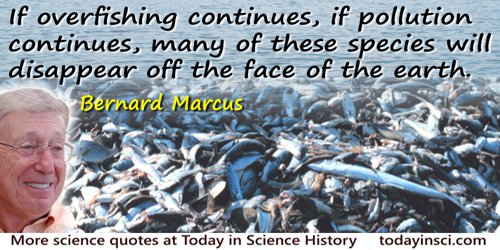
I am concerned about the air we breathe and the water we drink. If overfishing continues, if pollution continues, many of these species will disappear off the face of the earth.
I am glad that the life of pandas is so dull by human standards, for our efforts at conservation have little moral value if we preserve creatures only as human ornaments; I shall be impressed when we show solicitude for warty toads and slithering worms.
…...
I believe citizens are beginning to realize that their birthright, a healthy ecosystem, has been stolen, and they want it back.
In The End of the Line: How Overfishing is Changing the World and what We Eat (2004), 317.
I believe sustainable use is the greatest propaganda in wildlife conservation at the moment.
…...
I came here to help make America more competitive and prosperous by developing an energy policy that increases conservation, promotes cleaner technologies, encourages development of renewables and enhances domestic production of gas and oil.
…...
I can’t pretend that I got involved with filming the natural world fifty years ago because I had some great banner to carry about conservation — not at all, I always had a huge pleasure in just watching the natural world and seeing what happens.
As quoted in Jack Shepherd, "David Attenborough: 15 of the naturalist’s best quotes: In celebration of his 94th birthday", Independent (8 May 2017), on independent.co.uk website.
I fully support the goal of species protection and conservation and believe that recovery and ultimately delisting of species should be the U.S. Fish and Wildlife Service’s top priority under ESA.
…...
I have long been active in and supportive of conservation and historical preservation causes.
…...
I plead for conservation of human culture, which is much more fragile than nature herself. We needn’t destroy other cultures with the force of our own.
…...
I sort of kept my hand in writing and went to work for the Sierra Club in ‘52, walked the plank there in ‘69, founded Friends of the Earth and the League of Conservation Voters after that.
…...
I think that our cooperative conservation approaches get people to sit down and grapple with problem solving.
…...
I think, too, that we've got to recognize that where the preservation of a natural resource like the redwoods is concerned, that there is a common sense limit. I mean, if you've looked at a hundred thousand acres or so of trees—you know, a tree is a tree, how many more do you need to look at?
Speech, pandering for support, while candidate for governor of California, to the Western Wood Products Association, San Francisco (12 Mar 1966), opposing expansion of Redwood National Park. Commonly seen paraphrased as “If you’ve seen one redwood tree, you’ve seen them all,” but Reagan did not himself express this wording.
I wouldn’t miss this opportunity for anything. For the chance to work on these conservation issues, to serve my country, to work for this president, I’d do it all over again, every single minute.
…...
I’m a little different from all those conservation types.
…...
I’m doing my part, building plants at a record rate, having historic conservation levels. The only people not doing their part is the federal government that is siding with the energy companies against the interests of the people of California.
…...
If … you reward people for behavior that’s actually bad … then you’re going to encourage that behavior. Today, our [conservation] incentives aren’t set up well-you can make a lot of money burning fossil fuels, digging up wetlands, pumping fossil water out of aquifers that will take 10,000 years to recharge, overfishing species in international waters that are close to collapse, and so on.
From interview with Mark Tercek, 'Q&A With Ramez Naam: Dialogues on the Environment', Huffington Post (1 Jul 2013).
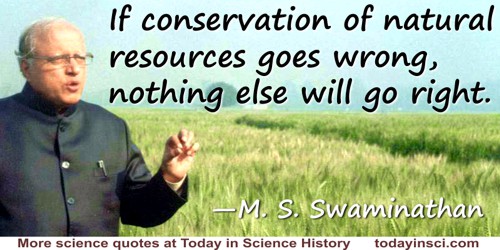
If conservation of natural resources goes wrong, nothing else will go right.
Quoted in India Today (Apr 2008), 33, No 16, 130.
If I were emperor of the world, I would put the pedal to the floor on energy efficiency and conservation for the next decade.
Interview with Reuters (2007). Quoted in Ayesha Rascoe, 'Obama energy pick strong green voice: experts' on Reuters website (posted 11 Dec 2008).
If we can get kids talking about conservation and doing it, they can have a great influence on their parents by lecturing them and pointing the finger.
…...
If you want to achieve conservation, the first thing you have to do is persuade people that the natural world is precious, beautiful, worth saving and complex. If people don’t understand that and don’t believe that in their hearts, conservation doesn't stand a chance. That’s the first step, and that is what I do.
From interview with Michael Bond, 'It’s a Wonderful Life', New Scientist (14 Dec 2002), 176, No. 2373, 48.
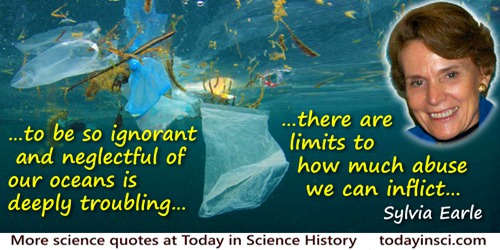
In a world that is rightly so concerned about climate change and the atmosphere, to be so ignorant and neglectful of our oceans is deeply troubling. However, … having woken up to this living disaster and having realized that there are limits to how much abuse we can inflict, it’s not too late to turn things around.
In 'Can We Stop Killing Our Oceans Now, Please?', Huffington Post (14 Aug 2013).
In addition to the clean coal provisions, the energy conference agreement contains provisions instrumental in helping increase conservation and lowering consumption.
…...
In addition, each barrel of oil we save through conservation further decreases our dangerous reliance on unstable Middle East oil.
…...
In addition, the oil royalties the Federal Government does not collect from big oil will starve the Land and Water Conservation Fund of critical financial resources.
— Ron Kind
…...
In all cases of the motion of free material points under the influence of their attractive and repulsive forces, whose intensity depends solely upon distance, the loss in tension is always equal to the gain in vis viva, and the gain in the former equal to the loss in the latter. Hence the sum of the existing tensions and vires vivae is always constant. In this most general form we can distinguish our law as the principle of the conservation of force.
'On the Conservation of Force; a Physical Memoir'. In John Tyndall and William Francis (eds.), Scientific Memoirs: Natural Philosophy (1853), 121.
In our attempt to make conservation easy, we have made it trivial.
In 'Substitutes for a Land Ethic', A Sand County Almanac, and Sketches Here and There (1949, 1987), 210.
In our day grand generalizations have been reached. The theory of the origin of species is but one of them. Another, of still wider grasp and more radical significance, is the doctrine of the Conservation of Energy, the ultimate philosophical issues of which are as yet but dimly seem-that doctrine which “binds nature fast in fate” to an extent not hitherto recognized, exacting from every antecedent its equivalent consequent, and bringing vital as well as physical phenomena under the dominion of that law of causal connexion which, so far as the human understanding has yet pierced, asserts itself everywhere in nature.
'Address Delivered Before The British Association Assembled at Belfast', (19 Aug 1874). Fragments of Science for Unscientific People: A Series of Detached Essays, Lectures, and Reviews (1892), Vol. 2, 1801.
In the end, we conserve only what we love. We will love only what we understand. We will understand only what we are taught.
…...
In the vestibule of the Manchester Town Hall are placed two life-sized marble statues facing each other. One of these is that of John Dalton … the other that of James Prescott Joule. … Thus honour is done to Manchester’s two greatest sons—to Dalton, the founder of modern Chemistry and of the Atomic Theory, and the laws of chemical-combining proportions; to Joule, the founder of modern Physics and the discoverer of the Law of Conservation of Energy. The one gave to the world the final and satisfactory proof … that in every kind of chemical change no loss of matter occurs; the other proved that in all the varied modes of physical change, no loss of energy takes place.
In John Dalton and the Rise of Modern Chemistry (1895), 7.
In years gone by, we would just take, take, take from the oceans but today we realize this is not an option, that the oceans keep us alive, and that we need to tread more carefully. This is now both a governance issue and a choice issue.
In 'Can We Stop Killing Our Oceans Now, Please?', Huffington Post (14 Aug 2013).
Individual thinkers since the days of Ezekiel and Isaiah have asserted that the despoliation of land is not only inexpedient but wrong. Society, however, has not yet affirmed their belief. I regard the present conservation movement as the embryo of such an affirmation.
In 'The Ethical Sequence', A Sand County Almanac, and Sketches Here and There (1949, 1987), 203.
It all began with utter, indeed addictive, fascination with other forms of life. That led me through concern about what humanity is doing to the biology of the planet, to consideration of ecosystems and global cycles. That in turn has led to very practical concerns about how people should relate to nature. Yet the original fascination with jewel-like bits of natural science is always there.
Giving his own reason, in 'Seventy-Five Reasons to Become a Scientist', American Scientist (Sep-Oct 1988), 76, No. 5, 450.
It is fashionable nowadays to talk about the endless riches of the sea. The ocean is regarded as a sort of bargain basement, but I don’t agree with that estimate. People don’t realize that water in the liquid state is very rare in the universe. Away from earth it is usually a gas. This moisture is a blessed treasure, and it is our basic duty, if we don’t want to commit suicide, to preserve it.
As quoted by Nancy Hicks in 'Cousteau’s Philosophy of the Sea Helps Him Get Another Medal', New York Times (25 Oct 1970), 54.
It is folly to think that we can destroy one species and ecosystem after another and not affect humanity. When we save species, we’re actually saving ourselves.
On the 'About' page of his web site.
Just as Americans have discovered the hidden energy costs in a multitude of products—in refrigerating a steak, for example, on its way to the butcher—they are about to discover the hidden water costs. Beginning with the water that irrigated the corn that was fed to the steer, the steak may have accounted for 3,500 gallons. The water that goes into a 1,000-pound steer would float a destroyer. It takes 14,935 gallons of water to grow a bushel of wheat, 60,000 gallons to produce a ton of steel, 120 gallons to put a single egg on the breakfast table.
From 'The Browning of America: Drought, Waste and Pollution Threaten a Water Shortage', Newsweek (23 Feb 1981), 26-30. In long excerpt in William Shurtleff and Akiko Aoyagi, History of Soymilk and Other Non-Dairy Milks (1226-2013) (2013), 1126-1127.
Last year, I co-sponsored the Highlands Conservation Act and in a bipartisan effort we passed the bill through Congress.
…...
Let us get rid immediately of the notion that all you have to do is keep a little patch of the old growth somewhere, and then you can do whatever you want with the rest. That is a very dangerous and false notion.
From On Human Nature (2000). As quoted in John H. Morgan, Naturally Good: A Behavioral History of Moral Development (2005), 252.
Many Americans are trying to conserve energy as never before—they're now burning their morning toast on only one side.
In E.C. McKenzie, 14,000 Quips and Quotes for Speakers, Writers, Editors, Preachers, and Teachers (1990), 156.
Many people think that conservation is just about saving fluffy animals—what they don’t realise is that we’re trying to prevent the human race from committing suicide … We have declared war on the biological world, the world that supports us … At the moment the human race is in the position of a man sawing off the tree branch he is sitting on.
As quoted in Douglass Botting, Gerald Durrell: The Authorized Biography (1999), 194.
More and more, as it becomes necessary to preserve the game, let us hope that the camera will largely supplant the rifle.
Introduction to Allen Grant Wallihan, Camera Shots at Big Game (1901), 11.
Mostly, I spend my time being a mother to my two children, working in my organic garden, raising masses of sweet peas, being passionately involved in conservation, recycling and solar energy.
…...
Natural history museums have rewritten their agendas to focus on the study and conservation of ecosystems and biotas.
In 'Foreword: Biodiversity at the Close of the Century', The Diversity of Life (New ed., 1999), 15.
Natural species are the library from which genetic engineers can work. Genetic engineers don’t make new genes, they rearrange existing ones.
Speaking as World Wildlife Fund Executive Vice President, stating the need to conserve biodiversity, even plants and animals having no immediate use, as a unique repository of genes for possible future bioengineering applications. Quoted in Jamie Murphy and Andrea Dorfman, `The Quiet Apocalypse,' Time (13 Oct 1986), 128, No. 15, 80.
Nature abhors a hero. For one thing, he violates the law of conservation of energy. For another, how can it be the survival of the fittest when the fittest keeps putting himself in situations where he is most likely to be creamed?
…...
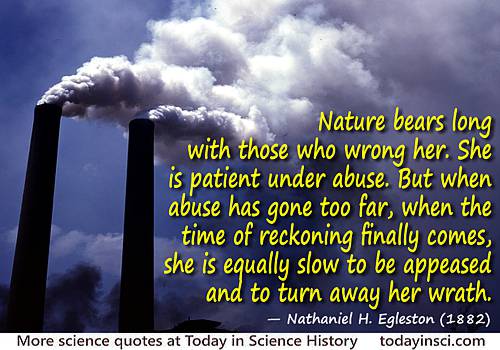
Nature bears long with those who wrong her. She is patient under abuse. But when abuse has gone too far, when the time of reckoning finally comes, she is equally slow to be appeased and to turn away her wrath.
'What We Owe to the Trees', Harper's New Monthly Magazine (Apr 1882), 46, No. 383, 686.
Nature clasps all her creatures in a universal embrace; there is not one of them which she has not plainly furnished with all means necessary to the conservation of its being.
The Essays of Michel de Montaigne, Book 2, Chapter 12, 'Apology for Raymond Sebond', trans. M. A. Screech (1991), 509.
No creature is too bulky or formidable for man's destructive energies—none too minute and insignificant for his keen detection and skill of capture. It was ordained from the beginning that we should be the masters and subduers of all inferior animals. Let us remember, however, that we ourselves, like the creatures we slay, subjugate, and modify, are the results of the same Almighty creative will—temporary sojourners here, and co-tenants with the worm and the whale of one small planet. In the exercise, therefore, of those superior powers that have been intrusted to us, let us ever bear in mind that our responsibilities are heightened in proportion.
Lecture to the London Society of Arts, 'The Raw Materials of the Animal Kingdom', collected in Lectures on the Results of the Great Exhibition of 1851' (1852), 131.
Nobody in the world of policy appears to be asking what is best for society, wild fish or farmed fish. And what sort of farmed fish, anyway? Were this question to be asked, and answered honestly, we might find that our interests lay in prioritizing wild fish and making their ecosystems more productive by leaving them alone enough of the time.
In The End of the Line: How Overfishing Is Changing the World and What We Eat (2008), 313.
Now, the downside to conservation is that so much is done for the public, which almost always mars the environment that one wanted to conserve.
…...
Only after the last tree has been cut down. Only after the last river has been poisoned. Only after the last fish has been caught. Only then will you find that money cannot be eaten.
— Cree
Cree Indian prophecy. Quoted by the United Nations Director for the Environment at a conference in Geneva. Recalled by a writer in Ann: Zoologische wetenschappen Issues 275-276 (1984), 16.
Optimism is a good characteristic, but if carried to an excess, it becomes foolishness. We are prone to speak of the resources of this country as inexhaustible; this is not so.
Seventh Annual Message to Congress, 3 Dec, 1907. In In Presidential Addresses and State Papers (1910), Vol. 12, 1541.
Pauli … asked me to tell him what was happening in America. I told him that Mrs. Wu is trying to measure whether parity is conserved. He answered me: “Mrs. Wu is wasting her time. I would bet you a large sum that parity is conserved.” When this letter came I already knew that parity is violated. I could have sent a telegram to Pauli that the bet was accepted. But I wrote him a letter. He said: “I could never let it out that this is possible. I am glad that we did not actually do the bet because I can risk to lose my reputation, but I cannot risk losing my capital.”
In Discussion after paper presented by Chien-Shiung Wu to the International Conference on the History of Original Ideas and Basic Discoveries, Erice, Sicily (27 Jul-4 Aug 1994), 'Parity Violation' collected in Harvey B. Newman, Thomas Ypsilantis (eds.), History of Original Ideas and Basic Discoveries in Particle Physics (1996), 381.
People are not going to care about animal conservation unless they think that animals are worthwhile.
…...
Plans to protect air and water, wilderness and wildlife are in fact plans to protect man.
…...
Scientists alone can establish the objectives of their research, but society, in extending support to science, must take account of its own needs. As a layman, I can suggest only with diffidence what some of the major tasks might be on your scientific agenda, but … First, I would suggest the question of the conservation and development of our natural resources. In a recent speech to the General Assembly of the United Nations, I proposed a world-wide program to protect land and water, forests and wildlife, to combat exhaustion and erosion, to stop the contamination of water and air by industrial as well as nuclear pollution, and to provide for the steady renewal and expansion of the natural bases of life.
From Address to the Centennial Convocation of the National Academy of Sciences (22 Oct 1963), 'A Century of Scientific Conquest'. Online at The American Presidency Project.
Seeing therefore the variety of Motion which we find in the World is always decreasing, there is a necessity of conserving and recruiting it by active Principles, such as are the cause of Gravity, by which Planets and Comets keep their Motions in their Orbs, and Bodies acquire great Motion in falling; and the cause of Fermentation, by which the Heart and Blood of Animals are kept in perpetual Motion and Heat; the inward Parts of the Earth are constantly warm'd, and in some places grow very hot; Bodies burn and shine, Mountains take fire, the Caverns of the Earth are blown up, and the Sun continues violently hot and lucid, and warms all things by his Light. For we meet with very little Motion in the World, besides what is owing to these active Principles.
From Opticks, (1704, 2nd ed. 1718), Book 3, Query 31, 375.
So, my tactic with conservation of apex predators is to get people excited and take them to where they live.
…...
Something will have gone out of us as a people if we ever let the remaining wilderness be destroyed; if we permit the last virgin forests to be turned into comic books and plastic cigarette cases; if we drive the few remaining members of the wild species into zoos or to extinction; if we pollute the last clean air and dirty the last clean streams and push our paved roads through the last of the silence, so that never again will Americans be free in their own country from the noise, the exhausts, the stinks of human and automotive waste.
Letter (3 Dec 1960) written to David E. Pesonen of the Outdoor Recreation Resources Review Commission. Collected in 'Coda: Wilderness Letter', The Sound of Mountain Water: The Changing American West (1969), 146.
Strict conservation of energy in the elementary process had thus been confirmed also by a negative experiment.
…...
Teapot Dome involved the conservation of the oil resources of the United States, especially those situated upon the public lands.
…...
Television, films, and newspapers are forms of pollution for us and our children. They sow seeds of violence and anxiety in us and pollute our consciousness, just as we destroy our environment by farming with chemicals, clear-cutting the trees, and polluting the water. We need to protect the ecology of the Earth and the ecology of the mind, or this kind of violence and recklessness will spill over into even more areas of life.
In Love in Action: Writings on Nonviolent Social Change (1993), 132.
The ages have been at work on it and man can only mar it.
…...
The Arctic has a call that is compelling. The distant mountains [of the Brooks Range in Alaska] make one want to go on and on over the next ridge and over the one beyond. The call is that of a wilderness known only to a few…. This last American wilderness must remain sacrosanct.
…...
The commissioners of the treasury moved the king, for the relief of his estate, to disafforest some forests of his, explaining themselves of such forests as lay out of the way, not near any of the king’s houses, nor in the course of his progress; whereof he should never have use nor pleasure. “Why,” saith the king, “do you think that Solomon had use and pleasure of all his three hundred concubines?”
In 'A Collection of Apophthegms, New and Old' (1625). As given in Essays, Moral, Economical, and Political: A New Edition, With the Latin Quotations Translated (1813), No. 9, 262. King James I was named in the preceding Apophthegm No. 3.
The conservation of natural resources is the fundamental problem. Unless we solve that problem it will avail us little to solve all others.
'Our National Inland Waterways Policy', Address to the Deep Waterway Convention, Memphis, Tennessee, 4 Oct 1907. In American Waterways (1908), 9.
The development of civilization and industry in general has always shown itself so active in the destruction of forests that everything that has been done for their conservation and production is completely insignificant in comparison.
…...
The farmer is a poor creature who skins the land and leaves it worthless to his children. The farmer is a good farmer who, having enabled the land to support himself and to provide for the education of his children, leaves it to them a little better than he found it himself.
'The New Nationalism', speech st Osawatomie, Kansas, 31 Aug 1910. In Donald Davidson (Ed.) The Wisdom of Theodore Roosevelt (2003), 18.
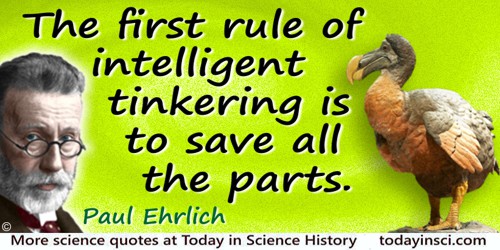
The first rule of intelligent tinkering is to save all the parts.
With co-author John P. Holdren, in Saturday Review (5 June 1971), 54, 59. Ehrlich is making his own paraphrase of an earlier quote, citing Aldo Leopold: “To keep every cog and wheel is the first precaution of intelligent tinkering.” See the Aldo Leopold Quotes page of this website. These refer to the importance of supporting an ecosystem by keeping all its parts - saving all the species.
The good news is that Americans will, in increasing numbers, begin to value and protect the vast American Landscape. The bad news is that they may love it to death.
The American Land
The great question of the seventies is, shall we surrender to our surroundings, or shall we make our peace with nature and begin to make reparations for the damage we have done to our air, our land, our water? Restoring nature to its natural state is a cause beyond party and beyond factions. It has become a common cause of all the people of this country [America].
In State of the Union Address (22 Jan 1970).
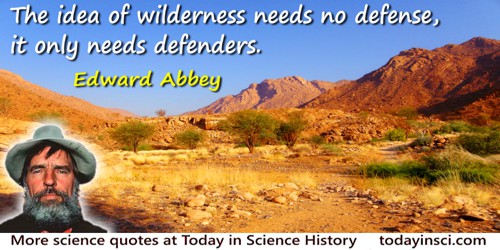
https://www.publicdomainpictures.net/en/view-image.php?image=46191&picture=rocky-desert-landscape (source)
The idea of wilderness needs no defense, it only needs defenders.
In 'Shadows from the Big Woods', The Journey Home: Some Words in Defense of the American West (1977), 229.
The idea that our natural resources were inexhaustible still obtained, and there was as yet no real knowledge of their extent and condition. The relation of the conservation of natural resources to the problems of National welfare and National efficiency had not yet dawned on the public mind. The reclamation of arid public lands in the West was still a matter for private enterprise alone; and our magnificent river system, with its superb possibilities for public usefulness, was dealt with by the National Government not as a unit, but as a disconnected series of pork-barrel problems, whose only real interest was in their effect on the re-election or defeat of a Congressman here and there —a theory which, I regret to say, still obtains.
The Works of Theodore Roosevelt. Vol. 20: Theodore Roosevelt, An Autobiography (1926), 386.
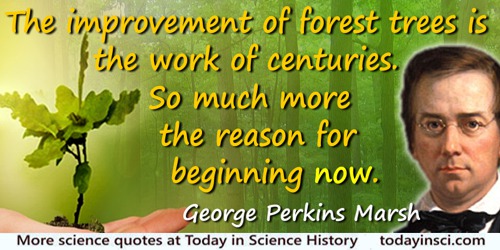
The improvement of forest trees is the work of centuries. So much more the reason for beginning now.
Letter to C. S. Sargent, 12 Jun 1879. In David Lowenthal, George Perkins Marsh: Versatile Vermonter (1958), 255.
The law of conservation of energy tells us we can't get something for nothing, but we refuse to believe it.
In Isaac Asimov's Book of Science and Nature Quotations (1988), 75.
The law of conservation rigidly excludes both creation and annihilation. Waves may change to ripples, and ripples to waves,—magnitude may be substituted for number, and number for magnitude,—asteroids may aggregate to suns, suns may resolve themselves into florae and faunae, and florae and faunae melt in air,—the flux of power is eternally the same. It rolls in music through the ages, and all terrestrial energy,—the manifestations of life, as well as the display of phenomena, are but the modulations of its rhythm.
Conclusion to lecture 12 (10 Apr 1862) at the Royal Institution, collected in Heat Considered as a Mode of Motion: Being a Course of Twelve Lectures (1863), 449.
The law of the conservation of energy is already known, viz. that the sum of the actual and potential energies in the universe is unchangeable.
'On the General Law of the Transformation of Energy', Philosophical Magazine (1853), 5, 106.
The long fight to save wild beauty represents democracy at its best. It requires citizens to practice the hardest of virtues — self-restraint.
In Circle of the Seasons: The Journal of a Naturalist's Year (1953), 24.
The maintenance of biological diversity requires special measures that extend far beyond the establishment of nature reserves. Several reasons for this stand out. Existing reserves have been selected according to a number of criteria, including the desire to protect nature, scenery, and watersheds, and to promote cultural values and recreational opportunities. The actual requirements of individual species, populations, and communities have seldom been known, nor has the available information always been employed in site selection and planning for nature reserves. The use of lands surrounding nature reserves has typically been inimical to conservation, since it has usually involved heavy use of pesticides, industrial development, and the presence of human settlements in which fire, hunting, and firewood gathering feature as elements of the local economy.
The Fragmented Forest: Island Biogeography Theory and the Preservation of Biotic Diversity (1984), xii.
The most important environmental issue is one that is rarely mentioned, and that is the lack of a conservation ethic in our culture.
…...
The nation behaves well if it treats the natural resources as assets which it must turn over to the next generation increased, and not impaired in value. Conservation means development as much as it does protection.
Speech before Colorado Livestock Association, Denver, Colorado, 29 Aug 1910. The New Nationalism (1910), 52. In Suzy Platt, Respectfully Quoted (1993), 64. This is one of the quotations inscribed in the Roosevelt Memorial rotunda at the American Museum of Natural History. It is also in the artwork on Cox Corridor II, first floor House wing, U.S. Capitol.
The only level of the hierarchy [of biological communities] that is both necessary and sufficient to meet all objectives is the ecosystem or some higher-level approach. The strategy selected should not only ensure the conservation of spotted owls, but all the intricate linkages that are associated with natural populations of spotted owls in naturally functioning ecosystems. Many of these are as yet unknown.
In The Fragmented Forest: Island Biogeography Theory and the Preservation of Biotic Diversity (1984), 107.
The only thing we know for sure about the future is that it will be radically different from the past. In the face of this enormous uncertainty, the least we can do for future generations is to pass on as many of the planet’s resources as possible.
In The Sinking Ark: A New Look at the Problem of Disappearing Species (1979), 189.
The outgrowth of conservation, the inevitable result, is national efficiency.
In The Fight for Conservation (1910), 50.
The planned and orderly development and conservation of our natural resources is the first duty of the United States. It is the only form of insurance that will certainly protect us against disasters that lack of foresight has repeatedly brought down on nations since passed away.
In 'The Conservation of Natural Resources', The Outlook (12 Oct 1907), 87, 294.
The practices we now call conservation are, to a large extent, local alleviations of biotic pain. They are necessary, but they must not be confused with cures. The art of land doctoring is being practiced with vigor, but the science of land health is yet to be born.
In 'Wilderness for Science', A Sand County Almanac, and Sketches Here and There (1949, 1987), 195-196.
The preservation of a few samples of undeveloped territory is one of the most clamant issues before us today. Just a few more years of hesitation and the only trace of that wilderness which has exerted such a fundamental influence in molding American character will lie in the musty pages of pioneer books. … To avoid this catastrophe demands immediate action.
…...
The problem, then, is how to bring about a striving for harmony with land among a people many of whom have forgotten there is any such thing as land, among whom education and culture have become almost synonymous with landlessness. This is the problem of conservation education.
In 'Conservation' (1938), collected in Luna B. Leopold (ed.), Round River: From the Journals of Aldo Leopold (1966, 1972), 155.
The ravages committed by man subvert the relations and destroy the balance which nature had established between her organized and her inorganic creations; and she avenges herself upon the intruder, by letting loose upon her defaced provinces destructive energies hitherto kept in check by organic forces destined to be his best auxiliaries, but which he has unwisely dispersed and driven from the field of action. When the forest is gone, the great reservoir of moisture stored up in its vegetable mould is evaporated, and returns only in deluges of rain to wash away the parched dust into which that mould has been converted. The well-wooded and humid hills are turned to ridges of dry rock, which encumbers the low grounds and chokes the watercourses with its debris, and–except in countries favored with an equable distribution of rain through the seasons, and a moderate and regular inclination of surface–the whole earth, unless rescued by human art from the physical degradation to which it tends, becomes an assemblage of bald mountains, of barren, turfless hills, and of swampy and malarious plains. There are parts of Asia Minor, of Northern Africa, of Greece, and even of Alpine Europe, where the operation of causes set in action by man has brought the face of the earth to a desolation almost as complete as that of the moon; and though, within that brief space of time which we call “the historical period,” they are known to have been covered with luxuriant woods, verdant pastures, and fertile meadows, they are now too far deteriorated to be reclaimable by man, nor can they become again fitted for human use, except through great geological changes, or other mysterious influences or agencies of which we have no present knowledge, and over which we have no prospective control. The earth is fast becoming an unfit home for its noblest inhabitant, and another era of equal human crime and human improvidence, and of like duration with that through which traces of that crime and that improvidence extend, would reduce it to such a condition of impoverished productiveness, of shattered surface, of climatic excess, as to threaten the depravation, barbarism, and perhaps even extinction of the species.
Man and Nature, (1864), 42-3.
The same society which receives the rewards of technology must, as a cooperating whole, take responsibility for control. To deal with these new problems will require a new conservation. We must not only protect the countryside and save it from destruction, we must restore what has been destroyed and salvage the beauty and charm of our cities. Our conservation must be not just the classic conservation of protection and development, but a creative conservation of restoration and innovation. Its concern is not with nature alone, but with the total relation between man and the world around him. Its object is not just man's welfare, but the dignity of man's spirit.
In his 'Message to Congress on Conservation and Restoration of Natural Beauty' written to Congress (8 Feb 1965). It was a broad initiative aimed at beautifying America, guaranteeing water and air quality, and preserving natural areas. In Lyndon B. Johnson: Containing the Public Messages, Speeches, and Statements of the President (1965), Vol.1, 156.
United States. President (1963-1969 : Johnson), Lyndon Baines Johnson, United States. Office of the Federal Register - 1970
The Sierra Club is a very good and a very powerful force for conservation and, as a matter of fact, has grown faster since I left than it was growing while I was there! It must be doing something right.
…...
The typical nature photograph shows a butterfly on a pretty flower. The conservation photograph shows the same thing, but with a bulldozer coming at it in the background.
As quoted in Jaymi Heimbuch, 'How One Photographer's Foolishness is Saving Endangered Wildlife' (23 Jan 2014) on Mother Nature Network webpage.
The United States would be better off if we had less conversation and more conservation.
In E.C. McKenzie, 14,000 Quips and Quotes for Speakers, Writers, Editors, Preachers, and Teachers (1990), 21.
The university’s business is the conservation of useless knowledge; and what the university itself apparently fails to see is that this enterprise is not only noble but indispensable as well, that society can not exist unless it goes on.
…...
There can be no greater issue than that of conservation in this country. Just as we must conserve our men, women and children, so we must conserve the resources of the land on which they live. We must conserve the soil so that our children shall have a land that is more and not less fertile than our fathers dwelt in. We must conserve the forests, not by disuse, but by use, making them more valuable at the same time that we use them. We must conserve the mines. Moreover, we must insure so far as possible the use of certain types of great natural resources for the benefit of the people as a whole.
Confession of Faith Speech, Progressive National Convention, Chicago, Illinois, 6 Aug 1912. In Marion Mills Miller (Ed.) Great Debates in American History (1913), Vol. 10, 111-112.
There is a conservation of matter and of energy, there may be a conservation of life; or if not of life, of something which transcends life.
Christopher: A Study in Human Personality (1918), 68.
There is a curious illusion today that nature is both wise and good. The awful truth is that nature is a bitch from the human point of view I care about the whooping crane a little. I would even give $10 to save the whooping crane. The whooping crane doesn’t give a damn about me.
From paper presented at Laramie College of Commerce and Industry, University of Wyoming, 'Energy and the Environment' (Jan 1976), 12, as quoted in Kenneth Ewart Boulding and Richard P. Beilock (ed.), Illustrating Economics: Beasts, Ballads and Aphorisms (1980, 2009), 153.
There is deposited in them [plants] an enormous quantity of potential energy [Spannkräfte], whose equivalent is provided to us as heat in the burning of plant substances. So far as we know at present, the only living energy [lebendige Kraft] absorbed during plant growth are the chemical rays of sunlight… Animals take up oxygen and complex oxidizable compounds made by plants, release largely as combustion products carbonic acid and water, partly as simpler reduced compounds, thus using a certain amount of chemical potential energy to produce heat and mechanical forces. Since the latter represent a relatively small amount of work in relation to the quantity of heat, the question of the conservation of energy reduces itself roughly to whether the combustion and transformation of the nutritional components yields the same amount of heat released by animals.
Wissenschaftliche Abhandlungen (1847), 66. Trans. Joseph S. Fruton, Proteins, Enzymes, Genes: The Interplay of Chemistry and Biology (1999), 247.
There is nothing more certain in nature than that it is impossible for any body to be utterly annihilated.
[Stating the conservation of matter.]
[Stating the conservation of matter.]
Sylva Sylvarum; or a Natural History in Ten Centuries (1627), Century 1, Experiment 100. Collected in The Works of Francis Bacon (1826), Vol 1, 285.
This country will not be a permanently good place for any of us to live in unless we make it a reasonably good place for all of us to live in.
Speech at the Auditorium, Chicago, Illinois, 17 Jun 1912. In Social Justice and Popular Rule reprinted in Politics and People (1974), 316-317.
This is the way federal land management should work. Cooperation, not confrontation, should be the hallmark of conservation efforts.
…...
This isn’t just about today, this about generations to come. And you’ve got a chance to be the greatest conservation President since Theodore Roosevelt, and I think he’s done it.
From transcript, 'Exit Interview: Bruce Babbit', PBS Newshour (5 Jan 2001). On pbs.org website.
This man, one of the chief architects of the atomic bomb, so the story runs, was out wandering in the woods one day with a friend when he came upon a small tortoise. Overcome with pleasurable excitement, he took up the tortoise and started home, thinking to surprise his children with it. After a few steps he paused and surveyed the tortoise doubtfully.
“What's the matter?” asked his friend.
Without responding, the great scientist slowly retraced his steps as precisely as possible, and gently set the turtle down on the exact spot from which he had taken him.
Then he turned solemnly to his friend. “It just struck me,” he said, “that, perhaps for one man, I have tampered enough with the universe.” He turned, and left the turtle to wander on its way.
“What's the matter?” asked his friend.
Without responding, the great scientist slowly retraced his steps as precisely as possible, and gently set the turtle down on the exact spot from which he had taken him.
Then he turned solemnly to his friend. “It just struck me,” he said, “that, perhaps for one man, I have tampered enough with the universe.” He turned, and left the turtle to wander on its way.
From Benjamin Franklin Lecture (1958) at the University of Pennsylvania, printed as 'The Ethic of the Group', in Robert Ernest Spiller, Social Control in a Free Society (1958), 37. Also in The Firmament of Time (1960), 148. Eiseley states that because he cannot vouch for the authenticity of the story, he would not name the scientist, though he hopes “with all his heart that it is true. If it is not, then it ought to be, for it illustrates well what I mean by a growing self-awareness, as sense of responsibility about the universe.”
Those who nod sagely and quote the tragedy of the commons in relation to environmental problems from pollution of the atmosphere to poaching of national parks tend to forget that Garrett Hardin revised his conclusions many times…. He recognized, most importantly, that anarchy did not prevail on the common pastures of medieval England in the way he had described…. “A managed commons, though it may have other defects, is not automatically subject to the tragic fate of the unmanaged commons,” wrote Hardin…. At sea, where a common exists in most waters… None of Hardin’s requirements for a successfully managed common is fulfilled by high-seas fishery regimes.
In The End of the Line: How Overfishing is Changing the World and what We Eat (2004), 153-155.
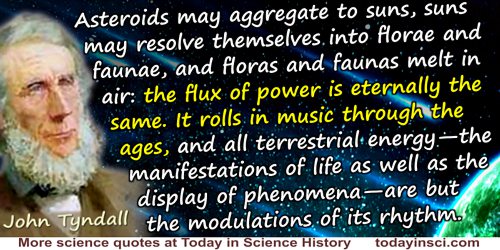
To Nature nothing can be added; from Nature nothing can be taken away; the sum of her energies is constant, and the utmost man can do in the pursuit of physical truth, or in the applications of physical knowledge, is to shift the constituents of the never-varying total. The law of conservation rigidly excludes both creation and annihilation. Waves may change to ripples, and ripples to waves; magnitude may be substituted for number, and number for magnitude; asteroids may aggregate to suns, suns may resolve themselves into florae and faunae, and floras and faunas melt in air: the flux of power is eternally the same. It rolls in music through the ages, and all terrestrial energy—the manifestations of life as well as the display of phenomena—are but the modulations of its rhythm.
Conclusion of Heat Considered as a Mode of Motion: Being a Course of Twelve Lectures Delivered at the Royal Institution of Great Britain in the Season of 1862 (1863), 449.
To preach conservation at such a time, when all our resources, national and otherwise are being sacrificed in unprecedented measure, might seem to some anomalous, even ironical. ... But we firmly believe, and now are more acutely aware than ever, that conservation is basically related to the peace of the world and the future of the race.
Breaking New Ground
To restore stability to our planet, therefore, we must restore its biodiversity, the very thing we have removed. It is the only way out of this crisis that we ourselves have created. We must rewild the world!
As quoted, without source, in Kate Ng, 'David Attenborough turns 95: His best quotes on nature, sustainability and humankind', Independent (8 May 2021).
To save every cog and wheel is the first precaution of intelligent tinkering.
From 'Conservation' (c.1938), Round River: From the Journals of Aldo Leopold (1953), 146-147. Collected in The Essential Aldo Leopold: Quotations and Commentaries (1999), 142.
True conservation provides for wise use by the general public. The American people do not want our resources preserved for the exclusive use of the wealthy. These land and water resources belong to the people, and people of all income levels should have easy access to them.
As quoted, without source citation, in John Eggink, Managing Energy Costs: A Behavioral and Non-Technical Approach (2007), 217.
Twenty centuries of “progress” have brought the average citizen a vote, a national anthem, a Ford, a bank account, and a high opinion of himself, but not the capacity to live in high density without befouling and denuding his environment, nor a conviction that such capacity, rather than such density, is the true test of whether he is civilized.
In Game Management (1933), 423.
Unless we [practice conservation], those who come after us will have to pay the price of misery, degradation, and failure for the progress and prosperity of our day.
In The Fight for Conservation (1910), 3-4.
We are at a unique stage in our history. Never before have we had such an awareness of what we are doing to the planet, and never before have we had the power to do something about that. Surely we all have a responsibility to care for our blue planet. The future of humanity and indeed, all life on earth, now depends on us.
As quoted, without source, in Kate Ng, 'David Attenborough turns 95: His best quotes on nature, sustainability and humankind', Independent (8 May 2021).
We are consuming our forests three times faster than they are being reproduced. Some of the richest timber lands of this continent have already been destroyed, and not replaced, and other vast areas are on the verge of destruction. Yet forests, unlike mines, can be so handled as to yield the best results of use, without exhaustion, just like grain fields.
Address to the Deep Waterway Convention, Memphis, Tennessee (4 Oct 1907), 'Our National Inland Waterways Policy'. In American Waterways (1908), 9.
We do not inherit the Earth from our ancestors, we borrow it from our children.
Widely seen quoted in various sources, attributed to various origins (Native Indian proverb, or Amish, or Kenyan, etc.). For example, in the Canadian House of Commons Debates, Official Report (1987), Vol. 5, 6088, it is given a “The Haidas said…” Webmaster has so far found no earlier example. This suggests its origin is relatively recent, and not an ancient proverb. If you know of an earlier source, please contact Webmaster.
We have a right to expect that the best trained, the best educated men on the Pacific slope, the Rocky Mountains, and great plains States will take the lead in the preservation and right use of forests, in securing the right use of waters, and in seeing that our land policy is not twisted from its original purpose, but is perpetuated by amendment, by change when such change is necessary in the life of that purpose, the purpose being to turn the public domain into farms each to be the property of the man who actually tills it and makes his home in it.
Address at Leland Stanford, Jr., University, Palo Alto, California, 12 May 1903. Addresses and Presidential Messages of Theodore Roosevelt, 1902-1904 (1904), 198.
We have increased conservation spending, enacted legislation that enables us to clean up and redevelop abandoned brownfields sites across the country, and implemented new clean water standards that will protect us from arsenic.
…...
We have one great guiding principle which, like the pillar of cloud by day, and the pillar of fire by night, will conduct us, as Moses and the Israelites were once conducted, to an eminence from which we can survey the promised scientific future. That principle is the conservation of energy.
In 'What is Electricity?', Popular Science Monthly (Nov 1884), 26, 77.
We have vastly increased the amount of funding that is available for conservation partnerships.
…...
We must be part not only of the human community, but of the whole community; we must acknowledge some sort of oneness not only with our neighbors, our countrymen and our civilization but also some respect for the natural as well as for the man-made community. Ours is not only “one world” in the sense usually implied by that term. It is also “one earth”. Without some acknowledgement of that fact, men can no more live successfully than they can if they refuse to admit the political and economic interdependency of the various sections of the civilized world. It is not a sentimental but a grimly literal fact that unless we share this terrestrial globe with creatures other than ourselves, we shall not be able to live on it for long.
The Voice of the Desert (1956), 194-5.
We must have a relentless commitment to producing a meaningful, comprehensive energy package aimed at conservation, alleviating the burden of energy prices on consumers, decreasing our country’s dependency on foreign oil, and increasing electricity grid reliability.
…...
We need a number of solutions - we need more efficiency and conservation. Efficiency is a big one. I think car companies need to do a lot better in producing more efficient cars. They have the technology, we just need to demand them as consumers.
…...
We need to respect the oceans and take care of them as if our lives depended on it. Because they do.
In 'Can We Stop Killing Our Oceans Now, Please?', Huffington Post (14 Aug 2013).
We of an older generation can get along with what we have, though with growing hardship; but in your full manhood and womanhood you will want what nature once so bountifully supplied and man so thoughtlessly destroyed; and because of that want you will reproach us, not for what we have used, but for what we have wasted...So any nation which in its youth lives only for the day, reaps without sowing, and consumes without husbanding, must expect the penalty of the prodigal whose labor could with difficulty find him the bare means of life.
'Arbor Day: A Message to the School-Children of the United States', 15 Apr 1907. In Presidential Addresses and State Papers (1910), Vol. 11, 1207-8.
We shall be ready, I think, to practice conservation when “farmer plants tamarack” is no longer news.
In Aldo Leopold and Luna B. Leopold, Round River (1972), 64.
We shall never achieve harmony with land, any more than we shall achieve justice or liberty for people. In these higher aspirations the important thing is not to achieve, but to strive.
In 'Conservation' (1938), collected in Luna B. Leopold (ed.), Round River: From the Journals of Aldo Leopold (1966, 1972), 155.
We want them to use the education to be leaders in their community with an understanding of ecology and conservation for the wild outdoors far beyond their legislators back home. We expect these people to he a grain of sand on the beach of future leadership.
…...
Well, there’s no doubt about the fact that, that higher energy prices lead to greater conservation, greater energy efficiency, and they also, of course, play a useful role on the supply side. They encourage more exploration, and they make non-conventional fuels more attractive in the marketplace. So it’s not entirely without a silver lining.
In transcript, 'Treasury Secretary Snow Optimistic on Economy', PBS Newshour (23 Mar 2005), on pbs.org website. Quoted in Gene Beck, 'Production Tax Credits', Grid Parity: The Art of Financing Renewable Energy Projects in the U.S. (2014).
What’s near and dear to my heart is cooperative conservation.
…...
Wheeler’s First Moral Principle: Never make a calculation until you know the answer. Make an estimate before every calculation, try a simple physical argument (symmetry! invariance! conservation!) before every derivation, guess the answer to every paradox and puzzle. Courage: No one else needs to know what the guess is. Therefore make it quickly, by instinct. A right guess reinforces this instinct. A wrong guess brings the refreshment of surprise. In either case life as a spacetime expert, however long, is more fun!
In E.F. Taylor and J.A. Wheeler, Spacetime Physics (1992), 20.
When I came home not a single acre of Government, state, or private timberland was under systematic forest management anywhere on the most richly timbered of all continents. … When the Gay Nineties began, the common word for our forests was 'inexhaustible.' To waste timber was a virtue and not a crime. There would always be plenty of timber. … The lumbermen … regarded forest devastation as normal and second growth as a delusion of fools. … And as for sustained yield, no such idea had ever entered their heads. The few friends the forest had were spoken of, when they were spoken of at all, as impractical theorists, fanatics, or ‘denudatics,’ more or less touched in the head. What talk there was about forest protection was no more to the average American that the buzzing of a mosquito, and just about as irritating.
In Breaking New Ground (1947, 1998), 27.
When not protected by law, by popular favor or superstition, or by other special circumstances, [birds] yield very readily to the influences of civilization, and, though the first operations of the settler are favorable to the increase of many species, the great extension of rural and of mechanical industry is, in a variety of ways, destructive even to tribes not directly warred upon by man.
In Man and Nature, (1864), 93-93.
When you leave intact as many species as possible, in a major habitat, whether it’s a pond or a bay or a forest somewhere, the better it functions. And the better it functions, the better it serves.
From interview with National Geographic, in Andrew Revkin, 'Conservation Legend Has Big Plans For Future', on nationalgeographic.com website.
When you realize the value of all life, you dwell on what is past and concentrate more on the preservation of the future.
Her last diary entry. As quoted in Camilla De la Bédoyère, No One Loved Gorillas More: Dian Fossey’s Letters From the Mist (2005), 178.
Who would be a better source of information about the forests than aborigines themselves because they have lived off the forest for most of their lives. The forests have provided the aborigines with food, medicine and shelter among other things and yet, the aborigines have never abused or ravaged the forest the way others have.
Keynote address yesterday at the 21st IUFRO World Congress (International Union of Forestry Research Organisations), Kuala Lumpur, Malaysia. As quoted in Lee Shi-lan 'Utilise Knowledge of Aborigines for the Conservation of Forests', New Straits Times (14 Aug 2000), 8.
Who, foe to Nature, hears the gen’ral groan,
Murders their species, and betrays his own.
Murders their species, and betrays his own.
In 'Epistle III', Essay on Man,: Being the First Book of Ethic Epistles (1734), 46.
Why then be concerned about the conservation of wildlife when for all practical purposes we would be much better off if humans and their domestic animals and pets were the only living creatures on the face of the earth? There is no obvious and demolishing answer to this rather doubtful logic although in practice the destruction of all wild animals would certainly bring devastating changes to our existence on this planet as we know it today… The trouble is that everything in nature is completely interdependent. Tinker with one part of it and the repercussions ripple out in all directions… Wildlife—and that includes everything from microbes to blue whales and from a fungus to a redwood tree—has been so much part of life on the earth that we are inclined to take its continued existence for granted… Yet the wildlife of the world is disappearing, not because of a malicious and deliberate policy of slaughter and extermination, but simply because of a general and widespread ignorance and neglect.
World Wildlife Fund Dinner, York, (1969). As quoted and cited in 'The Mirror of a Duke', The Dorset Eye on dorseteye.com website
Wilderness is an anchor to windward. Knowing it is there, we can also know that we are still a rich nation, tending our resources as we should—not a people in despair searching every last nook and cranny of our land for a board of lumber, a barrel of oil, a blade of grass, or a tank of water.
From 'Statement of Hon. Stewart L. Udall, Secretary of the Department of the Interior', in Hearings before the Committee on Interior and Insular Affairs, United States Senate, Eighty-Eighth Congress, First Session on S.4, A Bill to Establish a National Wilderness Preservation System for the Permanent Good of the Whole People and For Other Purposes (28 Feb-1 Mar 1963), 19. Udall read a statement he attributed to “the chairman of this committee” [which was Anderson P. Clinton] from “an article that he [Anderson] wrote a year or two ago about wilderness legislation.” So, this lengthy citation is a secondary source. This quote can be found elsewhere attributed to Udall, which is an error; Udall was only reading into the record words written earlier by Anderson Clinton. If a reader can identify the primary source—the article by Anderson Clinton—please contact Webmaster to improve this citation.
Wildlife management consists mainly of raising more animals for hunters to shoot.
From interview collected in Pamela Weintraub (ed.), The Omni Interviews (1984), 78.
World-wide practice of Conservation and the fair and continued access by all nations to the resources they need are the two indispensable foundations of continuous plenty and of permanent peace.
…...
You could write the story of man’s growth in terms of his epic concerns with water.
Opening sentence of 'Our Need For Water', United States Department of Agriculture, The Yearbook of Agriculture, 1955 (1955), 1.
 In science it often happens that scientists say, 'You know that's a really good argument; my position is mistaken,' and then they would actually change their minds and you never hear that old view from them again. They really do it. It doesn't happen as often as it should, because scientists are human and change is sometimes painful. But it happens every day. I cannot recall the last time something like that happened in politics or religion.
(1987) --
In science it often happens that scientists say, 'You know that's a really good argument; my position is mistaken,' and then they would actually change their minds and you never hear that old view from them again. They really do it. It doesn't happen as often as it should, because scientists are human and change is sometimes painful. But it happens every day. I cannot recall the last time something like that happened in politics or religion.
(1987) -- 









.jpg)