Conflict Quotes (78 quotes)
... semantics ... is a sober and modest discipline which has no pretensions of being a universal patent-medicine for all the ills and diseases of mankind, whether imaginary or real. You will not find in semantics any remedy for decayed teeth or illusions of grandeur or class conflict. Nor is semantics a device for establishing that everyone except the speaker and his friends is speaking nonsense
In 'The Semantic Conception of Truth and the Foundations of Semantics', collected in
Leonard Linsky (ed.), Semantics and the Philosophy of Language: A Collection of Readings (1952), 17.
“Endow scientific research and we shall know the truth, when and where it is possible to ascertain it;” but the counterblast is at hand: “To endow research is merely to encourage the research for endowment; the true man of science will not be held back by poverty, and if science is of use to us, it will pay for itself.” Such are but a few samples of the conflict of opinion which we find raging around us.
From The Grammar of Science (1892), 5.
(1) A robot may not injure a human being, or, through inaction, allow a human being to come to harm.
(2) A robot must obey the orders given it by human beings except where such orders would conflict with the first law.
(3) A robot must protect its own existence as long as such protection does not conflict with the First or Second Law.
(2) A robot must obey the orders given it by human beings except where such orders would conflict with the first law.
(3) A robot must protect its own existence as long as such protection does not conflict with the First or Second Law.
'The Three Laws of Robotics', in I, Robot (1950), Frontispiece.
[Godfrey H. Hardy] personified the popular idea of the absent-minded professor. But those who formed the idea that he was merely an absent-minded professor would receive a shock in conversation, where he displayed amazing vitality on every subject under the sun. ... He was interested in the game of chess, but was frankly puzzled by something in its nature which seemed to come into conflict with his mathematical principles.
In 'Prof. G. H. Hardy: A Mathematician of Genius,' Obituary The Times.
[My] parents had steadily preached integrity and tolerance and independence of mind. Reading was always a pleasant pastime and that brought no conflict. In high school it opened new worlds for which I had been thirsting. How better can a boy develop an independent mind than by reading the great masters of the past and thinking over them?
Recalling his high school reading of library books. In John Scopes and James Presley, Center of the Storm: Memoirs of John T. Scopes (1967), 19.
A conflict arises when a religious community insists on the absolute truthfulness of all statements recorded in the Bible. This means an intervention on the part of religion into the sphere of science; this is where the struggle of the Church against the doctrines of Galileo and Darwin belongs. On the other hand, representatives of science have often made an attempt to arrive at fundamental judgments with respect to values and ends on the basis of scientific method, and in this way have set themselves in opposition to religion. These conflicts have all sprung from fatal errors.
From an Address (19 May 1939) at Princeton Theological Seminary, 'Science and Religion', collected in Ideas And Opinions (1954, 2010), 45.
A person who is religiously enlightened appears to me to be one who has, to the best of his ability, liberated himself from the fetters of his selfish desires and is preoccupied with thoughts, feelings, and aspirations to which he clings because of their superpersonal value. It seems to me that what is important is the force of this superpersonal content and the depth of the conviction concerning its overpowering meaningfulness, regardless of whether any attempt is made to unite this content with a divine Being, for otherwise it would not be possible to count Buddha and Spinoza as religious personalities. Accordingly, a religious person is devout in the sense that he has no doubt of the significance and loftiness of those superpersonal objects and goals which neither require nor are capable of rational foundation. They exist with the same necessity and matter-of-factness as he himself. In this sense religion is the age-old endeavor of mankind to become clearly and completely conscious of these values and goals and constantly to strengthen and extend their effect. If one conceives of religion and science according to these definitions then a conflict between them appears impossible. For science can only ascertain what is, but not what should be, and outside of its domain value judgments of all kinds remain necessary.
…...
All science has God as its author and giver. Much is heard of the conflict between science and religion, and of the contrast between sacred and secular. There may be aspects of truth to which religion is the gate, as indeed there are aspects of truth to which particular sciences are the gate. But if there be a Creator, and if truth be one of his attributes, then everything that is true can claim his authorship, and every search for truth can claim his authority.
In Margaret Duggan (ed.), Through the Year with Michael Ramsey: Devotional Readings for Every Day (1975).
All the remedies for all the types of conflicts are alike in that they begin by finding the facts rather than by starting a fight.
As quoted, M.Guy Mellon in Presidential Address, Purdue University. Printed in Proceedings of the Indiana Academy of Science (1943), 52, 12.
Are we using science in ways that it wasn't intended to, in which case we should be a little careful, or are we using faith in ways that faith wasn't really designed for? There are certain questions that are better answered by one approach than the other, and if you start mixing that up, then you end up in … conflict.
From video of interview with Huffington post reporter at the 2014 Davos Annual Meeting, World Economic Forum (25 Jan 2014). On web page 'Dr. Francis Collins: “There Is An Uneasiness” About Evolution'
At this stage you must admit that whatever is seen to be sentient is nevertheless composed of atoms that are insentient. The phenomena open to our observation so not contradict this conclusion or conflict with it. Rather they lead us by the hand and compel us to believe that the animate is born, as I maintain, of the insentient.
In On the Nature of the Universe, translated by R. E. Latham (1951, 1994), 59.
By no amount of reasoning can we altogether eliminate all contingency from our world. Moreover, pure speculation alone will not enable us to get a determinate picture of the existing world. We must eliminate some of the conflicting possibilities, and this can be brought about only by experiment and observation.
Reason and Nature: an Essay on the Meaning of Scientific Method? (2nd Ed., 1964), 82.
Conditions for creativity are to be puzzled; to concentrate; to accept conflict and tension; to be born everyday; to feel a sense of self.
Quoted in David Stokes, Nicholas Wilson and Martha Mador, Entrepreneurship (2009), 190 without further citation. If you know the primary source, please contact Webmaster.
Conflicts between men are almost always a matter of frontiers. The astronauts now have destroyed what looked like an unsurmountable frontier. They have shown us that we cannot any longer think in limited terms. There are no limitations left. We can think in terms of the universe now.
In 'Reactions to Man’s Landing on the Moon Show Broad Variations in Opinions', The New York Times (21 Jul 1969), 6.
Does the evolutionary doctrine clash with religious faith? It does not. It is a blunder to mistake the Holy Scriptures for elementary textbooks of astronomy, geology, biology, and anthropology. Only if symbols are construed to mean what they are not intended to mean can there arise imaginary, insoluble conflicts. ... the blunder leads to blasphemy: the Creator is accused of systematic deceitfulness.
In 'Nothing in Biology Makes Sense Except in the Light of Evolution', The American Biology Teacher (Mar 1973), 125-129.
Every great scientific truth goes through three states: first, people say it conflicts with the Bible; next, they say it has been discovered before; lastly, they say they always believed it.
Attributed; it does not appear directly in this form in any writings by Agassiz. This version of the quote comes from the Saturday Evening Post (1890), as cited in Ralph Keyes, The Quote Verifier (2006), 226. Since the quote was not printed within quotation marks, it is unlikely that this is a verbatim statement. Keyes discusses variations of the “three stages of truth” that have been attributed to a various other authors, but provides some substantiation with examples of similar quotes linked to Agassiz as related in second-person accounts.
Flowers are restful to look at. They have neither emotions nor conflicts.
Unverified despite trying. Please contact webmaster if you can identify a primary source.
For, the great enemy of knowledge is not error, but inertness. All that we want is discussion, and then we are sure to do well, no matter what our blunders may be. One error conflicts with another; each destroys its opponent, and truth is evolved.
In History of Civilization in England (1861), Vol. 2, 408.
Fortunately analysis is not the only way to resolve inner conflicts. Life itself still remains a very effective therapist.
Our Inner Conflicts: A Constructive Theory of Neurosis (1945, 1999), 240.
History is primarily a socio-psychological science. In the conflict between the old and the new tendencies in historical investigation... we are at the turn of the stream, the parting of the ways in historical science.
Historical Development and Present Character of the Science of History (1906), 111.
I am convinced that an important stage of human thought will have been reached when the physiological and the psychological, the objective and the subjective, are actually united, when the tormenting conflicts or contradictions between my consciousness and my body will have been factually resolved or discarded.
Physiology of the Higher Nervous Activity (1932), 93-4.
I came into the room, which was half dark, and presently spotted Lord Kelvin in the audience and realised that I was in for trouble at the last part of my speech dealing with the age of the earth, where my views conflicted with his. To my relief, Kelvin fell fast asleep, but as I came to the important point, I saw the old bird sit up, open an eye and cock a baleful glance at me! Then a sudden inspiration came, and I said Lord Kelvin had limited the age of the earth, provided no new source was discovered. That prophetic utterance refers to what we are now considering tonight, radium! Behold! the old boy beamed upon me.
The italicized phrase refers to “no new source” of energy. Concerning a Lecture by Rutherford, at the Royal Institution, dealing with the energy of subterranean radium, which had an effect prolonging the heat of the Earth. Arthur S. Eve wrote that Rutherford “used to tell humorous stories about this lecture long afterwards:” — followed by the subject quote above, as its own paragraph. As given in Arthur S. Eve, Rutherford: Being the Life and Letters of the Rt. Hon. Lord Rutherford, O.M. (1939), 107. The story lacks quotation marks, and thus should be regarded as perhaps Eve’s own words giving a faithful recollection, rather than Rutherford’s verbatim words. (However, note that the style used throughout the book is to omit quotation marks from their own separate paragraph.)
I can remember … starting to gather all sorts of things like rocks and beetles when I was about nine years old. There was no parental encouragement—nor discouragement either—nor any outside influence that I can remember in these early stages. By about the age of twelve, I had settled pretty definitely on butterflies, largely I think because the rocks around my home were limited to limestone, while the butterflies were varied, exciting, and fairly easy to preserve with household moth-balls. … I was fourteen, I remember, when … I decided to be scientific, caught in some net of emulation, and resolutely threw away all of my “childish” specimens, mounted haphazard on “common pins” and without “proper labels.” The purge cost me a great inward struggle, still one of my most vivid memories, and must have been forced by a conflict between a love of my specimens and a love for orderliness, for having everything just exactly right according to what happened to be my current standards.
In The Nature of Natural History (1950, 1990), 255.
I despair of persuading people to drop the familiar and comforting tactic of dichotomy. Perhaps, instead, we might expand the framework of debates by seeking other dichotomies more appropriate than, or simply different from, the conventional divisions. All dichotomies are simplifications, but the rendition of a conflict along differing axes of several orthogonal dichotomies might provide an amplitude of proper intellectual space without forcing us to forgo our most comforting tool of thought.
…...
I have no trouble publishing in Soviet astrophysical journals, but my work is unacceptable to the American astrophysical journals.
[Referring to the trouble he had with the peer reviewers of Anglo-American astrophysical journals because his ideas often conflicted with the generally accepted or “standard"” theories.]
[Referring to the trouble he had with the peer reviewers of Anglo-American astrophysical journals because his ideas often conflicted with the generally accepted or “standard"” theories.]
Quoted in Anthony L. Peratt, 'Dean of the Plasma Dissidents', Washington Times, supplement: The World and I (May 1988),197.
I have often pondered over the roles of knowledge or experience, on the one hand, and imagination or intuition, on the other, in the process of discovery. I believe that there is a certain fundamental conflict between the two, and knowledge, by advocating caution, tends to inhibit the flight of imagination. Therefore, a certain naivete, unburdened by conventional wisdom, can sometimes be a positive asset.
In R. Langlands, 'Harish-Chandra', Biographical Memoirs of Fellows of the Royal Society (1985), Vol. 31, 206.
I submit a body of facts which cannot be invalidated. My opinions may be doubted, denied, or approved, according as they conflict or agree with the opinions of each individual who may read them; but their worth will be best determined by the foundation on which they rest—the incontrovertible facts.
Experiments and Observations on the Gastric Juice, and the Physiology of Digestion (1833), Preface.
If the great story of the last century was the conflict among various political ideologies—communism, fascism and democracy—then the great narrative of this century will be the changes wrought by astonishing scientific breakthroughs
Atlanta Journal-Constitution, column also distributed by United Press Syndicate, American Know-How Hobbled by Know-Nothings (9 Aug 2005). In Eve Herold, George Daley, Stem Cell Wars (2007), 21.
If we knew all the laws of Nature, we should need only one fact or the description of one actual phenomenon to infer all the particular results at that point. Now we know only a few laws, and our result is vitiated, not, of course, by any confusion or irregularity in Nature, but by our ignorance of essential elements in the calculation. Our notions of law and harmony are commonly confined to those instances which we detect, but the harmony which results from a far greater number of seemingly conflicting, but really concurring, laws which we have not detected, is still more wonderful. The particular laws are as our points of view, as to the traveler, a mountain outline varies with every step, and it has an infinite number of profiles, though absolutely but one form. Even when cleft or bored through, it is not comprehended in its entireness.
In Walden (1878), 311.
If we ought not to fear mortal truth, still less should we dread scientific truth. In the first place it can not conflict with ethics? But if science is feared, it is above all because it can give no happiness? Man, then, can not be happy through science but today he can much less be happy without it.
Henri Poincaré and George Bruce Halsted (trans.), The Value of Science (1907), 12.
If you dream of something worth doing and then simply go to work on it and don't think anything of personalities, or emotional conflicts, or of money, or of family distractions; if you think of, detail by detail, what you have to do next, it is a wonderful dream even though the end is a long way off, for there are about five thousand steps to be taken before we realize it; and [when you] start taking the first ten, and ... twenty after that, it is amazing how quickly you get through through the four thousand [nine hundred] and ninety. The last ten steps you never seem to work out. But you keep on coming nearer to giving the world something.
Victor K. McElheny, Insisting on the Impossible (1999), 1.
If, in the course of a thousand or two thousand years, science arrives at the necessity of renewing its points of view, that will not mean that science is a liar. Science cannot lie, for it’s always striving, according to the momentary state of knowledge, to deduce what is true. When it makes a mistake, it does so in good faith. It’s Christianity that’s the liar. It’s in perpetual conflict with itself.
In Adolf Hitler, Hugh Redwald Trevor-Roper, translated by Norman Cameron and R. H. Stevens, '14 October 1941', Secret Conversations (1941 - 1944) (1953), 51
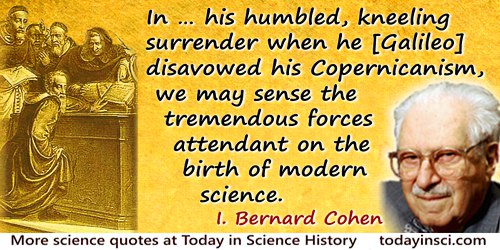
In … his humbled, kneeling surrender when he disavowed his Copernicanism, we may sense the tremendous forces attendant on the birth of modern science.
In The Birth of a New Physics (1960, rev. ed. 1985), 126.
In these days of conflict between ancient and modern studies, there must surely be something to be said for a study which did not begin with Pythagoras, and will not end with Einstein, but is the oldest and the youngest of all.
In A Mathematician's Apology (1940, 2012), 76.
Is not Cuvier the great poet of our era? Byron has given admirable expression to certain moral conflicts, but our immortal naturalist has reconstructed past worlds from a few bleached bones; has rebuilt cities, like Cadmus, with monsters’ teeth; has animated forests with all the secrets of zoology gleaned from a piece of coal; has discovered a giant population from the footprints of a mammoth.
From 'La Peau de Chagrin' (1831). As translated by Ellen Marriage in The Wild Ass’s Skin (1906), 21-22.
It appears, according to the reported facts, that the electric conflict is not restricted to the conducting wire, but that it has a rather extended sphere of activity around it … the nature of the circular action is such that movements that it produces take place in directions precisely contrary to the two extremities of a given diameter. Furthermore, it seems that the circular movement, combined with the progressive movement in the direction of the length of the conjunctive wire, should form a mode of action which is exerted as a helix around this wire as an axis.
Recherches sur l’identité des forces chimiques et électriques (1813), 248. In James R. Hofmann, André-Marie Ampère (1996), 231.
It has been said that science is opposed to, and in conflict with revelation. But the history of the former shown that the greater its progress, and the more accurate its investigations and results, the more plainly it is seen not only not to clash with the Latter, but in all things to confirm it. The very sciences from which objections have been brought against religion have, by their own progress, removed those objections, and in the end furnished fall confirmation of the inspired Word of God.
…...
It is certainly true in the United States that there is an uneasiness about certain aspects of science, particularly evolution, because it conflicts, in some people’s minds, with their sense of how we all came to be. But you know, if you are a believer in God, it’s hard to imagine that God would somehow put this incontrovertible evidence in front of us about our relationship to other living organisms and expect us to disbelieve it. I mean, that doesn't make sense at all.
From video of interview with Huffington post reporter at the 2014 Davos Annual Meeting, World Economic Forum (25 Jan 2014). On web page 'Dr. Francis Collins: “There Is An Uneasiness” About Evolution'
It is scientists, not sceptics, who are most willing to consider explanations that conflict with their own. And far from quashing dissent, it is the scientists, not the sceptics, who do most to acknowledge gaps in their studies and point out the limitations of their data—which is where sceptics get much of the mud they fling at the scientists. By contrast, the [sceptics] are not trying to build a theory of anything. They have set the bar much lower, and are happy muddying the waters.
Editorial, Nature (28 Jul 2011), 475, 423-424.
It is this mythical, or rather this symbolic, content of the religious traditions which is likely to come into conflict with science. This occurs whenever this religious stock of ideas contains dogmatically fixed statements on subjects which be long in the domain of science. Thus, it is of vital importance for the preservation of true religion that such conflicts be avoided when they arise from subjects which, in fact, are not really essential for the pursuance of the religious aims.
…...
Man is a creature composed of countless millions of cells: a microbe is composed of only one, yet throughout the ages the two have been in ceaseless conflict.
…...
Many consider that the conflict of religion and science is a temporary phase, and that in due course the two mighty rivers of human understanding will merge into an even mightier Amazon of comprehension. I take the opposite view, that reconciliation is impossible. I consider that Science is mightier than the Word, and that the river of religion will (or, at least, should) atrophy and die.
In 'Religion - The Antithesis to Science', Chemistry & Industry (Feb 1997).
Modern Physics impresses us particularly with the truth of the old doctrine which teaches that there are realities existing apart from our sense-perceptions, and that there are problems and conflicts where these realities are of greater value for us than the richest treasures of the world of experience.
In The Universe in the Light of Modern Physics (1931), 107.
Modern war, even from the consideration of physical welfare, is not creative. Soldiers and civilians alike are supposed to put on mental khaki. … War means the death of that fertile war which consists of the free, restless conflict of ideas. The war which matters is that of the scientist with nature; of the farmer with the tawny desert; of … philosopher against … mob stupidity. Such war is creative. … Inventions that further life and joy; freedom; new knowledge, whether Luther Burbank’s about the breeding of fruits or Einstein's about relativity; great cathedrals and Beethoven's music: these modern mechanical war can destroy but never produce. At its most inventive height, war creates the Maxim gun, the submarine, disseminable germs of disease, life-blasting gases. Spiritually and intellectually, modern war is not creative.
From ‘The Stagnation of War’, in Allen D. Hole (ed.) The Messenger of Peace (Nov 1924), 49, No. 11, 162-163.
My passion for social justice has often brought me into conflict with people, as did my aversion to any obligation and dependence I do not regard as absolutely necessary. I always have a high regard for the individual and have an insuperable distaste for violence and clubmanship.
…...
Neurosis is the result of a conflict between the ego and its id, whereas psychosis is the analogous outcome of a similar disturbance in the relation between the ego and the external world.
Neurosis and Psychosis (1924), in James Strachey (ed.), The Standard Edition of the Complete Psychological Works of Sigmund Freud (1961), Vol. 19, 149.
Owing to his lack of knowledge, the ordinary man cannot attempt to resolve conflicting theories of conflicting advice into a single organized structure. He is likely to assume the information available to him is on the order of what we might think of as a few pieces of an enormous jigsaw puzzle. If a given piece fails to fit, it is not because it is fraudulent; more likely the contradictions and inconsistencies within his information are due to his lack of understanding and to the fact that he possesses only a few pieces of the puzzle. Differing statements about the nature of things, differing medical philosophies, different diagnoses and treatments—all of these are to be collected eagerly and be made a part of the individual's collection of puzzle pieces. Ultimately, after many lifetimes, the pieces will fit together and the individual will attain clear and certain knowledge.
'Strategies of Resort to Curers in South India', contributed in Charles M. Leslie (ed.), Asian Medical Systems: A Comparative Study (1976), 185.
Pavlov’s data on the two fundamental antagonistic nervous processes—stimulation and inhibition—and his profound generalizations regarding them, in particular, that these processes are parts of a united whole, that they are in a state of constant conflict and constant transition of the one to the other, and his views on the dominant role they play in the formation of the higher nervous activity—all those belong to the most established natural—scientific validation of the Marxist dialectal method. They are in complete accord with the Leninist concepts on the role of the struggle between opposites in the evolution, the motion of matter.
In E. A. Asratyan, I. P. Pavlov: His Life and Work (1953), 153.
Science and faith have discovered a common territory which they possess, not as rivals, but as allies. … Thus the most alarming intellectual conflict of the last generation has already become of merely historical interest to the thought of to-day.
In The Religion of an Educated Man (1903), 5.
Science cannot resolve moral conflicts, but it can help to more accurately frame the debates about those conflicts.
The Dreams of Reason: The Computer and the Rise of the Sciences of Complexity (1988). In Vicki Cassman, Human Remains (2008), 69.
Scientists are supposed to make predictions, probably to prove they are human and can be as mistaken as anyone else. Long-range predictions are better to make because the audience to whom the prediction was made is no longer around to ask questions. The alternative... is to make conflicting predictions, so that one prediction may prove right.
'Fossils—The How and Why of Collecting and Storing', Proceedings of the Biological Society of Washington (1969), 82, 597.
Surely there’s no problem with having several conflicting theories of evolution? Eventually the fittest will survive.
Comment by Pete Bibby following an article, 'Scientists Are Still Fleshing Out Darwin’s Theory of Evolution', The Guardian (1 Jul 2022).
The ‘paradox’ is only a conflict between reality and your feeling of what reality ‘ought to be’.
…...
The “conflict” between the fundamental realities of Religion and the established facts of Science, is seen to be unreal as soon as Religion and Science each recognises the true borders of its dominion.
…...

The body is a cell state in which every cell is a citizen. Disease is merely the conflict of the citizens of the state brought about by the action of external forces. (1858)
From Die Cellularpathologie (1858). As cited in Alan Lindsay Mackay, A Dictionary of Scientific Quotations (1991), 250. Although widely quoted in this form, Webmaster has not yet been able to pin down the source of the translation in these few words. (It might be in Rudolph Virchow translated by Lelland J. Rather, Disease, Life, and Man: Selected Essays (1958), 142-9.) If you know the exact citation to the primary source, please contact Webmaster.
The comparatively small progress toward universal acceptance made by the metric system seems to be due not altogether to aversion to a change of units, but also to a sort of irrepressible conflict between the decimal and binary systems of subdivision.
[Remarking in 1892 (!) that although decimal fractions were introduced about 1585, America retains measurements in halves, quarters, eights and sixteenths in various applications such as fractions of an inch, the compass or used by brokers.]
[Remarking in 1892 (!) that although decimal fractions were introduced about 1585, America retains measurements in halves, quarters, eights and sixteenths in various applications such as fractions of an inch, the compass or used by brokers.]
'Octonary Numeration', Bulletin of the New York Mathematical Society (1892),1, 1.
The complexity of the world is the outcome of huge numbers of sometimes conflicting simple events.
In 'Religion - The Antithesis to Science', Chemistry & Industry (Feb 1997).
The conflict of theories, leading, as it eventually must, to the survival of the fittest, is advantageous.
In Address (11 Dec 1895) as President of the Geological Society, 'The Origin of Hypotheses, illustrated by the Discussion of a Topographical Problem', printed as Presidential Address of Grove Karl Gilbert (1896), 4. Also collected in Science (1896), 3, 2.
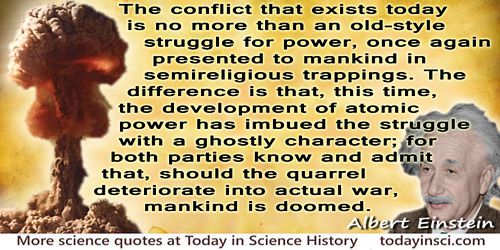
The conflict that exists today is no more than an old-style struggle for power, once again presented to mankind in semireligious trappings. The difference is that, this time, the development of atomic power has imbued the struggle with a ghostly character; for both parties know and admit that, should the quarrel deteriorate into actual war, mankind is doomed.
Address he was writing, left unfinished when he died (Apr 1955).
The history of Science is not a mere record of isolated discoveries; it is a narrative of the conflict of two contending powers, the expansive force of the human intellect on one side, and the compression arising from traditionary faith and human interests on the other.
In History of the Conflict Between Religion and Science (1875), vi.
The humanities and science are not in inherent conflict but have become separated in the twentieth century. Now their essential unity must be re-emphasized so that 20th Century multiplicity may become 20th Century unity.
As quoted in 'Humanities Head', Time (8 Jun 1942), 39, No. 23, 63.
The main source of the present-day conflicts between the spheres of religion and of science lies in this concept of a personal God.
…...
The most ominous conflict of our time is the difference of opinion, of outlook, between men of letters, historians, philosophers, the so-called humanists, on the one side and scientists on the other. The gap cannot but increase because of the intolerance of both and the fact that science is growing by leaps and bounds.
The History of Science and the New Humanism (1931), 69.Omnious;Conflict;Difference;Opinion;Outlook;Men OfLetters;Historian;Philosopher;Humanist;So-Called;Scientist;Gap;Intolerance;Fact;Growth;Leap;Bound
The person who thinks there can be any real conflict between science and religion must be either very young in science or very ignorant in religion.
In Tryon Edwards. A Dictionary of Thoughts (1908), 506.
The resolution of revolutions is selection by conflict within the scientific community of the fittest way to practice future science. The net result of a sequence of such revolutionary selections, separated by periods of normal research, is the wonderfully adapted set of instruments we call modern scientific knowledge.
The Structure of Scientific Revolutions (1962), 171.
The so-called science of psychology is now in chaos, with no sign that order is soon to be restored. It is hard to find two of its professors who agree, and when the phenomenon is encountered it usually turns out that one of them is not a psychologist at all, but simply a teacher of psychology. … Not even anthropology offers a larger assortment of conflicting theories, or a more gaudy band of steaming and blood-sweating professors.
From book review (of Psychology: A Simplification) in American Mercury (Jul 1927), 582-583. Collected in A Mencken Chrestomathy (1949, 1956), 317.

The Superfund legislation set up a system of insurance premiums collected from the chemical industry to clean up toxic wastes. This new program may prove to be as far-reaching and important as any accomplishment of my administration. The reduction of the threat to America's health and safety from thousands of toxic-waste sites will continue to be an urgent but bitterly fought issue—another example for the conflict between the public welfare and the profits of a few private despoilers of our nation's environment.
Keeping Faith: Memoirs of a President (1980), 591.

The threat to America's health and safety from thousands of toxic-waste sites will continue to be an urgent but bitterly fought issue—another example for the conflict between the public welfare and the profits of a few private despoilers of our nation’s environment.
In Keeping Faith: Memoirs of a President (1980), 591.
The totality of our so-called knowledge or beliefs, from the most casual matters of geography and history to the profoundest laws of atomic physics or even of pure mathematics and logic, is a man-made fabric which impinges on experience only along the edges. Or, to change the figure, total science is like a field of force whose boundary conditions are experience. A conflict with experience at the periphery occasions readjustments in the interior of the field. Truth values have to be redistributed over some of our statements. Reevaluation of some statements entails reevaluation of others, because of their logical interconnections—the logical laws being in turn simply certain further statements of the system, certain further elements of the field.
'Two Dogmas of Experience,' in Philosophical Review (1951). Reprinted in From a Logical Point of View (1953), 42.
The uncertainty where to look for the next opening of discovery brings the pain of conflict and the debility of indecision.
In Appendix, 'Art of Discovery', Logic: Deduction (1870), Vol. 2, 422.
The way to solve the conflict between human values and technological needs is not to run away from technology, that’s impossible. The way to resolve the conflict is to break down the barriers of dualistic thought that prevent a real understanding of what technology is—not an exploitation of nature, but a fusion of nature and the human spirit into a new kind of creation that transcends both.
In Zen and the Art of Motorcycle Maintenance (1974).
The world over which early man wandered was to him the theatre of a never-ending conflict, in which were arrayed against him impassable seas, unscalable mountains, gloomy forests peopled by deadly beasts of prey, raging streams and foaming torrents, each and all the haunts of spirits luring him to doom.
In 'The Relations of Geology', Scottish Geographical Magazine (Aug 1902), 19, No. 8, 395-396.
There can be no real conflict between the two Books of the Great Author. Both are revelations made by Him to man,—the earlier telling of God-made harmonies coming up from the deep past, and rising to their height when man appeared, the later teaching man's relations to his Maker, and speaking of loftier harmonies in the eternal future.
Conclusion of 'Cosmogony', the last chapter in Manual of Geology, Treating of the Principles of the Science (1863), 746.
We have not done the things that are necessary to lower emissions because these things fundamentally conflict with deregulated capitalism… We are stuck because the actions that would give us the best chance of averting catastrophe–and would benefit the vast majority–are extremely threatening to an elite minority that has a stranglehold over our economy, our political process, and most of our major media outlets.
From This Changes Everything: Capitalism vs. the Climate (2014), 18.
We make a lot of mistakes in the environmental space. … We don’t do a good-enough job of asking, “What are the fundamentals of telling a good story?” And that is not statistics, it’s usually not science, or at least complex science. It’s people stories. … It’s got to have adventure, it’s got to be funny, it’s got to pull my heart strings, it’s got to have conflict, setting, character. It’s a story. And if it doesn’t have those things, it can be the best-meaning story in the world, and nobody’s going to buy it.
From interview with Dan Conover, 'A Conversation with Philippe Cousteau Jr.', Charleston City Paper (27 Jul 2012).
When experimental results are found to be in conflict with those of an earlier investigator, the matter is often taken too easily and disposed of for an instance by pointing out a possible source of error in the experiments of the predessessor, but without enquiring whether the error, if present, would be quantitatively sufficient to explain the discrepancy. I think that disagreement with former results should never be taken easily, but every effort should be made to find a true explanation. This can be done in many more cases than it actually is; and as a result, it can be done more easily by the man “on the spot” who is already familiar with the essential details. But it may require a great deal of imagination, and very often it will require supplementary experiments.
From 'August Krogh' in Festkrift Københavns Universitet 1950 (1950), 18, as cited by E. Snorrason, 'Krogh, Schack August Steenberg', in Charles Coulton Gillispie (ed.), Dictionary of Scientific Biography (1973), Vol 7, 501. The DSB quote is introduced, “All his life Krogh was more interested in physical than in chemiical problems in biology, and he explained his critical attitude thus.”
When rich men are thus brought to regard themselves as trustees, and poor men learn to be industrious, economical, temperate, self-denying, and diligent in the acquisition of knowledge, then the deplorable strife between capital and labor, tending to destroy their fundamental, necessary, and irrefragable harmony will cease, and the world will no longer be afflicted with such unnatural industrial conflicts as we have seen during the past century...
Address (31 May 1871) to the 12th annual commencement at the Cooper Union, honoring his 80th birthday, in New York City Mission and Tract Society, Annual report of the New York City Mission and Tract Society (1872), 69.
You can't really discover the most interesting conflicts and problems in a subject until you've tried to write about them. At that point, one discovers discontinuities in the data, perhaps, or in one's own thinking; then the act of writing forces you to work harder to resolve these contradictions.
From Robert S. Grumet, 'An Interview with Anthony F. C. Wallace', Ethnohistory (Winter 1998), 45, No. 1, 109.
 In science it often happens that scientists say, 'You know that's a really good argument; my position is mistaken,' and then they would actually change their minds and you never hear that old view from them again. They really do it. It doesn't happen as often as it should, because scientists are human and change is sometimes painful. But it happens every day. I cannot recall the last time something like that happened in politics or religion.
(1987) --
In science it often happens that scientists say, 'You know that's a really good argument; my position is mistaken,' and then they would actually change their minds and you never hear that old view from them again. They really do it. It doesn't happen as often as it should, because scientists are human and change is sometimes painful. But it happens every day. I cannot recall the last time something like that happened in politics or religion.
(1987) -- 





