Condition Quotes (366 quotes)
… certain conditions under which the observable thing is perceived are tacitly assumed ... for the possibility that we deal with hallucinations or a dream can never be excluded.
In The Language of Modern Physics (1956).
… it may happen that small differences in the initial conditions produce very great ones in the final phenomena.
Science and Method (1908) translated by Francis Maitland (2003), 68.
…it ought to be remembered that there is nothing more difficult to take in hand, more perilous to conduct, or more uncertain in its success, than to take the lead in the introduction of a new order of things. Because the innovator has for enemies all those who have done well under the old conditions, and lukewarm defenders in those who may do well under the new.
The Prince (1532). W. K. Marriott (translator) and Rob McMahon (editor), The Prince (2008), 71.
...the life of the planet began the long, slow process of modulating and regulating the physical conditions of the planet. The oxygen in today's atmosphere is almost entirely the result of photosynthetic living, which had its start with the appearance of blue-green algae among the microorganisms.
In Late Night Thoughts on Listening to Mahler's Ninth Symphony(1984), 74.
“Men die of the diseases which they have studied most,” remarked the surgeon, snipping off the end of a cigar with all his professional neatness and finish. “It’s as if the morbid condition was an evil creature which, when it found itself closely hunted, flew at the throat of its pursuer. If you worry the microbes too much they may worry you. I’ve seen cases of it, and not necessarily in microbic diseases either. There was, of course, the well-known instance of Liston and the aneurism; and a dozen others that I could mention.”
First lines of 'The Surgeon Talks', in Round the Red Lamp: Being Facts and Fancies of Medical Life (1894), 316.
[A]s you know, scientific education is fabulously neglected … This is an evil that is inherited, passed on from generation to generation. The majority of educated persons are not interested in science, and are not aware that scientific knowledge forms part of the idealistic background of human life. Many believe—in their complete ignorance of what science really is—that it has mainly the ancillary task of inventing new machinery, or helping to invent it, for improving our conditions of life. They are prepared to leave this task to the specialists, as they leave the repairing of their pipes to the plumber. If persons with this outlook decide upon the curriculum of our children, the result is necessarily such as I have just described it.
Opening remarks of the second of four public lectures for the Dublin Institute for Advanced Studies at University College, Dublin (Feb 1950), The Practical Achievements of Science Tending to Obliterate its True Import', collected in Science and Humanism: Physics in Our Time (1951). Reprinted in 'Nature and the Greeks' and 'Science and Humanism' (1996), 113.
[An audience conditioned by a lifetime of television-watching is so corrupted that] their standards have been systematically lowered over the years. These guys sit in front of their sets and the gamma rays eat the white cells of their brains out!
Spoken by character Isaac Davis (played by Woody Allen) in the movie, Manhattan (1979). Quoted in Eighteen Woody Allen Films Analyzed (2000), 63. Woody Allen directed the movie, which he co-wrote with Marshall Brickman.
[Certain students] suppose that because science has penetrated the structure of the atom it can solve all the problems of the universe. ... They are known in every ... college as the most insufferable, cocksure know-it-alls. If you want to talk to them about poetry, they are likely to reply that the "emotive response" to poetry is only a conditioned reflex .... If they go on to be professional scientists, their sharp corners are rubbed down, but they undergo no fundamental change. They most decidedly are not set apart from the others by their intellectual integrity and faith, and their patient humility in front of the facts of nature.... They are uneducated, in the fullest sense of the word, and they certainly are no advertisement for the claims of science teachers.
In Science is a Sacred Cow (1950), 18-19.
[Having already asserted his opposition to communism in every respect by signing the regents' oath, his answer to a question why a non-Communist professor should refuse to take a non-Communist oath as a condition of University employment was that to do so would imply it was] up to an accused person to clear himself. ... That sort of thing is going on in Washington today and is a cause of alarm to thoughtful citizens. It is the method used in totalitarian countries. It sounds un-American to people who don’t like to be pushed around. If someone says I ought to do a certain thing the burden should be on him to show I why I should, not on me to show why I should not.
As quoted in 'Educator Scores Oath For Faculty', New York Times (16 Apr 1950), 31.
[Janos] Bolyai when in garrison with cavalry officers, was provoked by thirteen of them and accepted all their challenges on condition that he be permitted after each duel to play a bit on his violin. He came out victor from his thirteen duels, leaving his thirteen adversaries on the square.
In János Bolyai, Science Absolute of Space, translated from the Latin by George Bruce Halsted (1896), Translator's Introduction, xxix.
[To the cultures of Asia and the continent of Africa] it is the Western impact which has stirred up the winds of change and set the processes of modernization in motion. Education brought not only the idea of equality but also another belief which we used to take for granted in the West—the idea of progress, the idea that science and technology can be used to better human conditions. In ancient society, men tended to believe themselves fortunate if tomorrow was not worse than today and anyway, there was little they could do about it.
Lecture at State University of Iowa (6 Apr 1961). In Barbara Ward, The Unity of the Free World (1961), 12.
'Causation' has been popularly used to express the condition of association, when applied to natural phenomena. There is no philosophical basis for giving it a wider meaning than partial or absolute association. In no case has it been proved that there is an inherent necessity in the laws of nature. Causation is correlation... [P]erfect correlation, when based upon sufficient experience, is causation in the scientific sense.
'Correlation, Causation and Wright's Theory of "Path Coefficients"', Genetics (7 May 1922), 7, 259-61.
“Pieces” almost always appear 'as parts' in whole processes. ... To sever a “'part” from the organized whole in which it occurs—whether it itself be a subsidiary whole or an “element”—is a very real process usually involving alterations in that “part”. Modifications of a part frequently involve changes elsewhere in the whole itself. Nor is the nature of these alterations arbitrary, for they too are determined by whole-conditions.
From 'Untersuchungen zur Lehre von der Gestalt, I', Psychol. Forsch. (1922), 1, 47-58. As translated in 'The General Theoretical Situation' (1922), collected in W. D. Ellis (ed.), A Source Book of Gestalt Psychology (1938, 1967), Vol. 2, 14.
Die Religion ist der Seufzer der bedrängten Kreatur, das Gemüt einer herzlosen Welt, wie sie der Geist geistloser Zustände ist. Sie ist das Opium des Volks. Die Aufhebung der Religion als des illusorischen Glücks des Volks ist die Forderung seines wirklichen Glücks.
Religion is the sigh of the oppressed creature, the heart of a heartless world, just as it is the spirit of spiritless conditions. It is the opium of the people. To abolish religion as the illusory happiness of the people is to demand their real happiness.
Religion is the sigh of the oppressed creature, the heart of a heartless world, just as it is the spirit of spiritless conditions. It is the opium of the people. To abolish religion as the illusory happiness of the people is to demand their real happiness.
'Zur Kritik der Hegelschen Rechtsphilosophie. Einleitung' (1844), Karl Marx Fredrich Engels (1964), 378-9.
Question: State what are the conditions favourable for the formation of dew. Describe an instrument for determining the dew point, and the method of using it.
Answer: This is easily proved from question 1. A body of gas as it ascends expands, cools, and deposits moisture; so if you walk up a hill the body of gas inside you expands, gives its heat to you, and deposits its moisture in the form of dew or common sweat. Hence these are the favourable conditions; and moreover it explains why you get warm by ascending a hill, in opposition to the well-known law of the Conservation of Energy.
Answer: This is easily proved from question 1. A body of gas as it ascends expands, cools, and deposits moisture; so if you walk up a hill the body of gas inside you expands, gives its heat to you, and deposits its moisture in the form of dew or common sweat. Hence these are the favourable conditions; and moreover it explains why you get warm by ascending a hill, in opposition to the well-known law of the Conservation of Energy.
Genuine student answer* to an Acoustics, Light and Heat paper (1880), Science and Art Department, South Kensington, London, collected by Prof. Oliver Lodge. Quoted in Henry B. Wheatley, Literary Blunders (1893), 179, Question 12. (*From a collection in which Answers are not given verbatim et literatim, and some instances may combine several students' blunders.)
The constancy of the internal environment is the condition for free and independent life: the mechanism that makes it possible is that which assured the maintenance, with the internal environment, of all the conditions necessary for the life of the elements.
Lectures on the Phenomena of Life Common to Animals and Plants (1878), trans. Hebbel E. Hoff, Roger Guillemin and Lucienne Guillemin (1974), 84.
~~[Misattributed]~~ Time and space are modes by which we think and not conditions in which we live.
Although seen in later years in various sources as a direct quote by Einstein, it apparently is not. This statement first appears as these authors’ own commentary about Einstein’s relativity theory, as given by Dimitri Marianoff and Palma Wayne, Einstein: An Intimate Study of a Great Man (1944), 62.
A chemical compound once formed would persist for ever, if no alteration took place in surrounding conditions. But to the student of Life the aspect of nature is reversed. Here, incessant, and, so far as we know, spontaneous change is the rule, rest the exception—the anomaly to be accounted for. Living things have no inertia and tend to no equilibrium.
From Address (22 Jul 1854) delivered at St. Martin’s Hall, published as a pamphlet (1854), 7, and collected in 'Educational Value of Natural History Sciences', Lay Sermons, Addresses, and Reviews (1870), 75.
A good physiological experiment like a good physical one requires that it should present anywhere, at any time, under identical conditions, the same certain and unequivocal phenomena that can always be confirmed.
Bestätigung des Bell'schen Lehrsatzes, dass die doppelten Wurzeln der Rückenmarksnerven verschiedene Functionen haben, durch neue nod entscheidende Experimente' (1831). Trans. Edwin Clarke and C. D. O'Malley, The Human Brain and Spinal Cord (1968), 304.
A laboratory is only a place where one may better set up and control conditions.
Martin H. Fischer, Howard Fabing (ed.) and Ray Marr (ed.), Fischerisms (1944).
A modern branch of mathematics, having achieved the art of dealing with the infinitely small, can now yield solutions in other more complex problems of motion, which used to appear insoluble. This modern branch of mathematics, unknown to the ancients, when dealing with problems of motion, admits the conception of the infinitely small, and so conforms to the chief condition of motion (absolute continuity) and thereby corrects the inevitable error which the human mind cannot avoid when dealing with separate elements of motion instead of examining continuous motion. In seeking the laws of historical movement just the same thing happens. The movement of humanity, arising as it does from innumerable human wills, is continuous. To understand the laws of this continuous movement is the aim of history. … Only by taking an infinitesimally small unit for observation (the differential of history, that is, the individual tendencies of man) and attaining to the art of integrating them (that is, finding the sum of these infinitesimals) can we hope to arrive at the laws of history.
War and Peace (1869), Book 11, Chap. 1.
A philosopher once said, “It is necessary for the very existence of science that the same conditions always produce the same results”. Well, they do not.
In Character of Physical Law (1965), 147.
A physician’s subject of study is necessarily the patient, and his first field for observation is the hospital. But if clinical observation teaches him to know the form and course of diseases, it cannot suffice to make him understand their nature; to this end he must penetrate into the body to find which of the internal parts are injured in their functions. That is why dissection of cadavers and microscopic study of diseases were soon added to clinical observation. But to-day these various methods no longer suffice; we must push investigation further and, in analyzing the elementary phenomena of organic bodies, must compare normal with abnormal states. We showed elsewhere how incapable is anatomy alone to take account of vital phenenoma, and we saw that we must add study of all physico-chemical conditions which contribute necessary elements to normal or pathological manifestations of life. This simple suggestion already makes us feel that the laboratory of a physiologist-physician must be the most complicated of all laboratories, because he has to experiment with phenomena of life which are the most complex of all natural phenomena.
From An Introduction to the Study of Experimental Medicine (1865), as translated by Henry Copley Greene (1957), 140-141.
A proposal…to bore a hole in the crust of the Earth and discover the conditions deep down below the surface…may remind us that the most secret places of Nature are, perhaps, not 10 to the n-th miles above our heads, but 10 miles below our feet.
From Presidential address to Section A of the British Association at Cardiff (24 Aug 1920). Published in 'The Internal Constitution of the Stars', The Observatory: A Monthly Review of Astronomy (Oct 1920), 43, No. 557, 341.
A single tree by itself is dependent upon all the adverse chances of shifting circumstances. The wind stunts it: the variations in temperature check its foliage: the rains denude its soil: its leaves are blown away and are lost for the purpose of fertilisation. You may obtain individual specimens of line trees either in exceptional circumstances, or where human cultivation had intervened. But in nature the normal way in which trees flourish is by their association in a forest. Each tree may lose something of its individual perfection of growth, but they mutually assist each other in preserving the conditions of survival. The soil is preserved and shaded; and the microbes necessary for its fertility are neither scorched, nor frozen, nor washed away. A forest is the triumph of the organisation of mutually dependent species.
In Science and the Modern World (1926), 296-7.
A week or so after I learned that I was to receive the Miller Award, our president, Marty Morton, phoned and asked me if I would utter a few words of scientific wisdom as a part of the ceremony. Unfortunately for me, and perhaps for you, I agreed to do so. In retrospect I fear that my response was a serious error, because I do not feel wise. I do not know whether to attribute my response to foolhardiness, to conceit, to an inordinate susceptibility to flattery, to stupidity, or to some combination of these unfortunate attributes all of which I have been told are recognizable in my personality. Personally, I tend to favor stupidity, because that is a condition over which I have little control.
Bartholomew, April 1993, unpublished remarks when receiving the Miller Award from the Cooper Ornithological Society.
According to my derivative hypothesis, a change takes place first in the structure of the animal, and this, when sufficiently advanced, may lead to modifications of habits… . “Derivation” holds that every species changes, in time, by virtue of inherent tendencies thereto. “Natural Selection” holds that no such change can take place without the influence of altered external circumstances educing or selecting such change… . The hypothesis of “natural selection” totters on the extension of a conjectural condition, explanatory of extinction to the majority of organisms, and not known or observed to apply to the origin of any species.
In On the Anatomy of Vertebrates (1868), Vol. 3, 808.
After having produced aquatic animals of all ranks and having caused extensive variations in them by the different environments provided by the waters, nature led them little by little to the habit of living in the air, first by the water's edge and afterwards on all the dry parts of the globe. These animals have in course of time been profoundly altered by such novel conditions; which so greatly influenced their habits and organs that the regular gradation which they should have exhibited in complexity of organisation is often scarcely recognisable.
Hydrogéologie (1802), trans. A. V. Carozzi (1964), 69-70.
All fossil anthropoids found hitherto have been known only from mandibular or maxillary fragments, so far as crania are concerned, and so the general appearance of the types they represented had been unknown; consequently, a condition of affairs where virtually the whole face and lower jaw, replete with teeth, together with the major portion of the brain pattern, have been preserved, constitutes a specimen of unusual value in fossil anthropoid discovery. Here, as in Homo rhodesiensis, Southern Africa has provided documents of higher primate evolution that are amongst the most complete extant. Apart from this evidential completeness, the specimen is of importance because it exhibits an extinct race of apes intermediate between living anthropoids and man ... Whether our present fossil is to be correlated with the discoveries made in India is not yet apparent; that question can only be solved by a careful comparison of the permanent molar teeth from both localities. It is obvious, meanwhile, that it represents a fossil group distinctly advanced beyond living anthropoids in those two dominantly human characters of facial and dental recession on one hand, and improved quality of the brain on the other. Unlike Pithecanthropus, it does not represent an ape-like man, a caricature of precocious hominid failure, but a creature well advanced beyond modern anthropoids in just those characters, facial and cerebral, which are to be anticipated in an extinct link between man and his simian ancestor. At the same time, it is equally evident that a creature with anthropoid brain capacity and lacking the distinctive, localised temporal expansions which appear to be concomitant with and necessary to articulate man, is no true man. It is therefore logically regarded as a man-like ape. I propose tentatively, then, that a new family of Homo-simidæ be created for the reception of the group of individuals which it represents, and that the first known species of the group be designated Australopithecus africanus, in commemoration, first, of the extreme southern and unexpected horizon of its discovery, and secondly, of the continent in which so many new and important discoveries connected with the early history of man have recently been made, thus vindicating the Darwinian claim that Africa would prove to be the cradle of mankind.
'Australopithicus africanus: The Man-Ape of South Africa', Nature, 1925, 115, 195.
All great achievements in science start from intuitive knowledge, namely, in axioms, from which deductions are then made. … Intuition is the necessary condition for the discovery of such axioms.
In Conversations with Einstein by Alexander Moszkowski (1970).
All men and women are born, live suffer and die; what distinguishes us one from another is our dreams, whether they be dreams about worldly or unworldly things, and what we do to make them come about... We do not choose to be born. We do not choose our parents. We do not choose our historical epoch, the country of our birth, or the immediate circumstances of our upbringing. We do not, most of us, choose to die; nor do we choose the time and conditions of our death. But within this realm of choicelessness, we do choose how we live.
…...
All parts of the material universe are in constant motion and though some of the changes may appear to be cyclical, nothing ever exactly returns, so far as human experience extends, to precisely the same condition.
Address (Jul 1874) at the grave of Joseph Priestley, in Joseph Henry and Arthur P. Molella, et al. (eds.), A Scientist in American Life: Essays and Lectures of Joseph Henry (1980), 119.
All sedentary workers ... suffer from the itch, are a bad colour, and in poor condition ... for when the body is not kept moving the blood becomes tainted, its waste matter lodges in the skin, and the condition of the whole body deteriorates. (1700)
All the conditions of happiness are realized in the life of the man of science.
The Conquest of Happiness (1930), 146.
All things appear and disappear because of the concurrence of causes and conditions. Nothing ever exists entirely alone; everything is in relationship to everything else.
In Dwight Goddard, Buddha, Truth, and Brotherhood (1934), 44.
Almost every major systematic error which has deluded men for thousands of years relied on practical experience. Horoscopes, incantations, oracles, magic, witchcraft, the cures of witch doctors and of medical practitioners before the advent of modern medicine, were all firmly established through the centuries in the eyes of the public by their supposed practical successes. The scientific method was devised precisely for the purpose of elucidating the nature of things under more carefully controlled conditions and by more rigorous criteria than are present in the situations created by practical problems.
Personal Knowledge (1958), 183.
Among all highly civilized peoples the golden age of art has always been closely coincident with the golden age of the pure sciences, particularly with mathematics, the most ancient among them.
This coincidence must not be looked upon as accidental, but as natural, due to an inner necessity. Just as art can thrive only when the artist, relieved of the anxieties of existence, can listen to the inspirations of his spirit and follow in their lead, so mathematics, the most ideal of the sciences, will yield its choicest blossoms only when life’s dismal phantom dissolves and fades away, when the striving after naked truth alone predominates, conditions which prevail only in nations while in the prime of their development.
This coincidence must not be looked upon as accidental, but as natural, due to an inner necessity. Just as art can thrive only when the artist, relieved of the anxieties of existence, can listen to the inspirations of his spirit and follow in their lead, so mathematics, the most ideal of the sciences, will yield its choicest blossoms only when life’s dismal phantom dissolves and fades away, when the striving after naked truth alone predominates, conditions which prevail only in nations while in the prime of their development.
From Die Entwickelung der Mathematik im Zusammenhange mit der Ausbreitung der Kultur (1893), 4. As translated in Robert Édouard Moritz, Memorabilia Mathematica; Or, The Philomath’s Quotation-Book (1914), 191-192. From the original German, “Bei allen Kulturvölkern ist die Blüthezeit der Kunst auch immer zeitlich eng verbunden mit einer Blüthezeit der reinen Wissenschaften, insbesondere der ältesten unter ihnen, der Mathematik.
Dieses Zusammentreffen dürfte auch nicht ein zufälliges, sondern ein natürliches, ein Ergebniss innerer Notwendigkeit sein. Wie die Kunst nur gedeihen kann, wenn der Künstler, unbekümmert um die Bedrängnisse des Daseins, den Eingebungen seines Geistes lauschen und ihnen folgen kann, so kann die idealste Wissenschaft, die Mathematik, erst dann ihre schönsten Blüthen treiben, wenn des Erdenlebens schweres Traumbild sinkt und sinkt und sinkt, wenn das Streben nach der nackten Wahrheit allein bestimmend ist, was nur bei Nationen in der Vollkraft ihrer Entwickelung vorkommt.”
Dieses Zusammentreffen dürfte auch nicht ein zufälliges, sondern ein natürliches, ein Ergebniss innerer Notwendigkeit sein. Wie die Kunst nur gedeihen kann, wenn der Künstler, unbekümmert um die Bedrängnisse des Daseins, den Eingebungen seines Geistes lauschen und ihnen folgen kann, so kann die idealste Wissenschaft, die Mathematik, erst dann ihre schönsten Blüthen treiben, wenn des Erdenlebens schweres Traumbild sinkt und sinkt und sinkt, wenn das Streben nach der nackten Wahrheit allein bestimmend ist, was nur bei Nationen in der Vollkraft ihrer Entwickelung vorkommt.”
An amoeba never is torn apart through indecision, though, for even if two parts of the amoeba are inclined to go in different directions, a choice is always made. We could interpret this as schizophrenia or just confusion, but it could also be a judicious simultaneous sampling of conditions, in order to make a wise choice of future direction.
In The Center of Life: A Natural History of the Cell (1977, 1978), 73.
An honest man, armed with all the knowledge available to us now, could only state that in some sense, the origin of life appears at the moment to be almost a miracle, so many are the conditions which would have had to have been satisfied to get it going. But this should not be taken to imply that there are good reasons to believe that it could not have started on the earth by a perfectly reasonable sequence of fairly ordinary chemical reactions. The plain fact is that the time available was too long, the many microenvironments on the earth’s surface too diverse, the various chemical possibilities too numerous and our own knowledge and imagination too feeble to allow us to be able to unravel exactly how it might or might not have happened such a long time ago, especially as we have no experimental evidence from that era to check our ideas against.
In Life Itself: Its Origin and Nature (1981), 88.
And if this were so in all cases, the principle would be established, that sometimes conditions can be treated by things opposite to those from which they arose, and sometimes by things like to those from which they arose.
Places in Man, in Hippocrates, trans. P. Potter (1995), Vol. 8, 87.
And when statesmen or others worry him [the scientist] too much, then he should leave with his possessions. With a firm and steadfast mind one should hold under all conditions, that everywhere the earth is below and the sky above and to the energetic man, every region is his fatherland.
Attributed (1597). As quoted, without citation, in Morris Herbert Goran, Science and Anti-science, (1974), 13.
Any experiment may be regarded as forming an individual of a 'population' of experiments which might be performed under the same conditions. A series of experiments is a sample drawn from this population.
Now any series of experiments is only of value in so far as it enables us to form a judgment as to the statistical constants of the population to which the experiments belong. In a great number of cases the question finally turns on the value of a mean, either directly, or as the mean difference between the two qualities.
If the number of experiments be very large, we may have precise information as to the value of the mean, but if our sample be small, we have two sources of uncertainty:— (I) owing to the 'error of random sampling' the mean of our series of experiments deviates more or less widely from the mean of the population, and (2) the sample is not sufficiently large to determine what is the law of distribution of individuals.
Now any series of experiments is only of value in so far as it enables us to form a judgment as to the statistical constants of the population to which the experiments belong. In a great number of cases the question finally turns on the value of a mean, either directly, or as the mean difference between the two qualities.
If the number of experiments be very large, we may have precise information as to the value of the mean, but if our sample be small, we have two sources of uncertainty:— (I) owing to the 'error of random sampling' the mean of our series of experiments deviates more or less widely from the mean of the population, and (2) the sample is not sufficiently large to determine what is the law of distribution of individuals.
'The Probable Error of a Mean', Biometrika, 1908, 6, 1.
Anyone of common mental and physical health can practice scientific research. … Anyone can try by patient experiment what happens if this or that substance be mixed in this or that proportion with some other under this or that condition. Anyone can vary the experiment in any number of ways. He that hits in this fashion on something novel and of use will have fame. … The fame will be the product of luck and industry. It will not be the product of special talent.
In Essays of a Catholic Layman in England (1931).
Apart from the hostile influence of man, the organic and the inorganic world are … bound together by such mutual relations and adaptations as secure, if not the absolute permanence and equilibrium of both … at least a very slow and gradual succession of changes in those conditions. But man is everywhere a disturbing agent. Wherever he plants his foot, the harmonies of nature are turned to discords.
In Man and Nature, (1864), 35-36.
As geologists, we learn that it is not only the present condition of the globe that has been suited to the accommodation of myriads of living creatures, but that many former states also have been equally adapted to the organization and habits of prior races of beings. The disposition of the seas, continents, and islands, and the climates have varied; so it appears that the species have been changed, and yet they have all been so modelled, on types analogous to those of existing plants and animals, as to indicate throughout a perfect harmony of design and unity of purpose. To assume that the evidence of the beginning or end of so vast a scheme lies within the reach of our philosophical inquiries, or even of our speculations, appears to us inconsistent with a just estimate of the relations which subsist between the finite powers of man and the attributes of an Infinite and Eternal Being.
Concluding remark, Principles of Geology(1833), Vol. 3, 384-5.
As he [Clifford] spoke he appeared not to be working out a question, but simply telling what he saw. Without any diagram or symbolic aid he described the geometrical conditions on which the solution depended, and they seemed to stand out visibly in space. There were no longer consequences to be deduced, but real and evident facts which only required to be seen. … So whole and complete was his vision that for the time the only strange thing was that anybody should fail to see it in the same way. When one endeavored to call it up again, and not till then, it became clear that the magic of genius had been at work, and that the common sight had been raised to that higher perception by the power that makes and transforms ideas, the conquering and masterful quality of the human mind which Goethe called in one word das Dämonische.
In Leslie Stephen and Frederick Pollock (eds.), Lectures and Essays by William Kingdon Clifford(1879), Vol. 1, Introduction, 4-5.
As soon as the circumstances of an experiment are well known, we stop gathering statistics. … The effect will occur always without exception, because the cause of the phenomena is accurately defined. Only when a phenomenon includes conditions as yet undefined,Only when a phenomenon includes conditions as yet undefined, can we compile statistics. … we must learn therefore that we compile statistics only when we cannot possibly help it; for in my opinion, statistics can never yield scientific truth.
From An Introduction to the Study of Experimental Medicine (1865), as translated by Henry Copley Greene (1957), 134-137.
As to what Simplicius said last, that to contend whether the parts of the Sun, Moon, or other celestial body, separated from their whole, should naturally return to it, is a vanity, for that the case is impossible, it being clear by the demonstrations of Aristotle that the celestial bodies are impassible, impenetrable, unpartable, etc., I answer that none of the conditions whereby Aristotle distinguishes the celestial bodies from the elementary has any foundation other than what he deduces from the diversity of their natural motions; so that, if it is denied that the circular motion is peculiar to celestial bodies, and affirmed instead that it is agreeable to all naturally moveable bodies, one is led by necessary confidence to say either that the attributes of generated or ungenerated, alterable or unalterable, partable or unpartable, etc., equally and commonly apply to all bodies, as well to the celestial as to the elementary, or that Aristotle has badly and erroneously deduced those from the circular motion which he has assigned to celestial bodies.
Dialogue on the Great World Systems (1632). Revised and Annotated by Giorgio De Santillana (1953), 45.
As usual, the author in his thorough, unobjective fashion has marshalled up all the good, indifferent and bad arguments ... I offer the following detailed comments ... though I realize that many of them will arouse him to a vigorous, if not violent rebuttal. In order to preserve the pH of Dr. Brown's digestive system I would not require a rebuttal as a condition of publication...
With heartiest greetings of the season to you and yours! Jack Roberts
PS The above comments should (help) to reduce your winter heating bill!
Jack Roberts' referee's report on Herbert Charles Brown's paper with Rachel Kornblum on the role of steric strain in carbonium ion reactions.
With heartiest greetings of the season to you and yours! Jack Roberts
PS The above comments should (help) to reduce your winter heating bill!
Jack Roberts' referee's report on Herbert Charles Brown's paper with Rachel Kornblum on the role of steric strain in carbonium ion reactions.
As quoted by D. A. Davenport, in 'On the Comparative Unimportance of the Invective Effect', Chemtech (Sep 1987), 17, 530.
Astronomy, as the science of cyclical motions, has nothing in common with Geology. But look at Astronomy where she has an analogy with Geology; consider our knowledge of the heavens as a palaetiological science;—as the study of a past condition, from which the present is derived by causes acting in time. Is there no evidence of a beginning, or of a progress?
In History of the Inductive Sciences (1857), Vol. 3, 516.
At that time, the river at Westminster was in such an abominable condition that they were obliged to close the windows of the Houses of Parliament and there was a talk of Parliament having to shift to other quarters altogether. What was the cause of it? The drains of London were pouring down their filth into the river at low water. There was no outflow from them at high water. The tide kept the sewage up the drains then; but when the tide had been running out for hours and the water in the river began to run low, then the drains began to pour out their sewage and of course when the tide came in again it was all swept up by the stream. When the tide ebbed it all came down and so it kept oscillating up and down the river, while more filth was continuously adding to it until the Thames became absolutely pestilential.
In 'Representative Men at Home; Sir Joseph Bazalgette, C.B.,at Wimbledon', Cassell's Saturday Journal (30 Aug 1890), 1160-1. As quoted and cited in Ph.D. Thesis by Stephen Halliday, 'Sir Joseph Bazalgette and the Main Drainage of London' (Dec 1977), 3.
Bacteria are highly adaptable. They frequently change both morphologically and functionally. Their virulence is also an essentially fluctuating property, that increases or diminishes according to the conditions to which the pathogenic organism is subjected.
In Studies in Immunity (1909), 1.
Biologists have long attempted by chemical means to induce in higher organisms predictable and specific changes which thereafter could be transmitted in series as hereditary characters. Among microorganisms the most striking example of inheritable and specific alterations in cell structure and function that can be experimentally induced and are reproducible under well defined and adequately controlled conditions is the transformation of specific types of Pneumococcus.
Oswald T. Avery (1877-1955), Colin Macleod (1909-72) and Maclyn McCarty (1911-2005), 'Studies on the Chemical Nature of the Substance Inducing Transformation of Pneumococcal Types', Journal of Experimental Medicine 1944, 79, 137.
Blaming others, or outside conditions for one’s own misbehavior may be the child’s privilege; if an adult denies responsibility for his actions, it is another step towards personality disintegration.
In Informed Heart: Autonomy in a Mass Age (1960), 192.
But weightier still are the contentment which comes from work well done, the sense of the value of science for its own sake, insatiable curiosity, and, above all, the pleasure of masterly performance and of the chase. These are the effective forces which move the scientist. The first condition for the progress of science is to bring them into play.
from his preface to Claude Bernard's 'Experimental Medicine'
But, further, no animal can live upon a mixture of pure protein, fat and carbohydrate, and even when the necessary inorganic material is carefully supplied, the animal still cannot flourish. The animal body is adjusted to live either upon plant tissues or the tissues of other animals, and these contain countless substances other than the proteins, carbohydrates and fats... In diseases such as rickets, and particularly in scurvy, we have had for long years knowledge of a dietetic factor; but though we know how to benefit these conditions empirically, the real errors in the diet are to this day quite obscure. They are, however, certainly of the kind which comprises these minimal qualitative factors that I am considering.
'The Analyst and the Medical Man', The Analyst (1906), 31, 395-6.
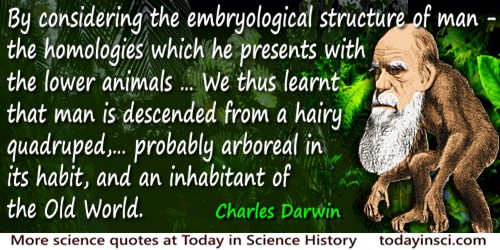
By considering the embryological structure of man - the homologies which he presents with the lower animals - the rudiments which he retains - and the reversions to which he is liable, we can partly recall in imagination the former condition of our early progenitors; and we can approximately place them in their proper position in the zoological series. We thus learnt that man is descended from a hairy quadruped, furnished with a tail and pointed ears, probably arboreal in its habit, and an inhabitant of the Old World. This creature, if its whole structure had been examined by a naturalist, would have been classed among the Quadrumana, as surely as would be the common and still more ancient progenitor of the Old and New World monkeys.
The Descent of Man (1871), Vol. 2, 389.
By natural selection our mind has adapted itself to the conditions of the external world. It has adopted the geometry most advantageous to the species or, in other words, the most convenient. Geometry is not true, it is advantageous.
Science and Hypothesis (1902), in The Foundations of Science: Science and Hypothesis, The Value of Science, Science and Method(1946), trans. by George Bruce Halsted, 91.
Can one think that because we are engineers, beauty does not preoccupy us or that we do not try to build beautiful, as well as solid and long lasting structures? Aren’t the genuine functions of strength always in keeping with unwritten conditions of harmony? … Besides, there is an attraction, a special charm in the colossal to which ordinary theories of art do not apply.
As translated in Henry Petroski, Remaking the World: Adventures in Engineering (1998), 173. From the original French in interview of Eiffel by Paul Bourde, in the newspaper Le Temps (14 Feb 1887). Quoted in 'Au Jour le Jour: Les Artistes Contre la Tour Eiffel', Gazette Anecdotique, Littéraire, Artistique et Bibliographique (Feb 1887), 126, and in Gustave Eiffel, Travaux Scientifiques Exécutés à la Tour de 300 Mètres de 1889 à 1900 (1900), 14. “Parce que nous sommes des ingénieurs, croit-on donc que la beauté ne nous préoccupe pas dans nos constructions et qu'en même temps que nous faisons solide et durable nous ne nous efforçons pas rletfaire élégant? Est-ce que les véritables conditions de la force ne sont pas toujours conformes aux conditions secrètes de l'harmonie?.… Il y a du reste dans le colossal une attraction, un charme propre auxquels les théories d'art ordinaires ne sont guère applicables.
Certainty is the most vivid condition of ignorance and the most necessary condition for knowledge.
Quotations: Superultramodern Science and Philosophy (2005), 2
Chance throws peculiar conditions in everyone's way. If we apply intelligence, patience and special vision, we are rewarded with new creative breakthroughs.
Told to his Harvard students. As quoted, without citation, by Marcus Bach, 'Serendiptiy in the Business World', in The Rotarian (Oct 1981), 139, No. 4, 40. If you know a primary source, please contact Webmaster.
Conditions for creativity are to be puzzled; to concentrate; to accept conflict and tension; to be born everyday; to feel a sense of self.
Quoted in David Stokes, Nicholas Wilson and Martha Mador, Entrepreneurship (2009), 190 without further citation. If you know the primary source, please contact Webmaster.
Consider the plight of a scientist of my age. I graduated from the University of California at Berkeley in 1940. In the 41 years since then the amount of biological information has increased 16 fold; during these 4 decades my capacity to absorb new information has declined at an accelerating rate and now is at least 50% less than when I was a graduate student. If one defines ignorance as the ratio of what is available to be known to what is known, there seems no alternative to the conclusion that my ignorance is at least 25 times as extensive as it was when I got my bachelor’s degree. Although I am sure that my unfortunate condition comes as no surprise to my students and younger colleagues, I personally find it somewhat depressing. My depression is tempered, however, by the fact that all biologists, young or old, developing or senescing, face the same melancholy situation because of an interlocking set of circumstances.
In 'Scientific innovation and creativity: a zoologist’s point of view', American Zoologist (1982), 22, 228.
Considering the difficulties represented by the lack of water, by extremes of temperature, by the full force of gravity unmitigated by the buoyancy of water, it must be understood that the spread to land of life forms that evolved to meet the conditions of the ocean represented the greatest single victory won by life over the inanimate environment.
(1965). In Isaac Asimov’s Book of Science and Nature Quotations (1988), 194.
Constant, or free, life is the third form of life; it belongs to the most highly organized animals. In it, life is not suspended in any circumstance, it unrolls along a constant course, apparently indifferent to the variations in the cosmic environment, or to the changes in the material conditions that surround the animal. Organs, apparatus, and tissues function in an apparently uniform manner, without their activity undergoing those considerable variations exhibited by animals with an oscillating life. This because in reality the internal environment that envelops the organs, the tissues, and the elements of the tissues does not change; the variations in the atmosphere stop there, so that it is true to say that physical conditions of the environment are constant in the higher animals; it is enveloped in an invariable medium, which acts as an atmosphere of its own in the constantly changing cosmic environment. It is an organism that has placed itself in a hot-house. Thus the perpetual changes in the cosmic environment do not touch it; it is not chained to them, it is free and independent.
Lectures on the Phenomena of Life Common to Animals and Plants (1878), trans. Hebbel E. Hoff, Roger Guillemin and Lucienne Guillemin (1974), 83.
Courtship, properly understood, is the process whereby both the male and the female are brought into that state of sexual tumescence which is a more or less necessary condition for sexual intercourse. The play of courtship cannot, therefore, be considered to be definitely brought to an end by the ceremony of marriage; it may more properly be regarded as the natural preliminary to every act of coitus.
Studies in the Psychology of Sex (1921), Vol. 3, 239.
Culture in its higher forms is a delicate plant which depends on a complicated set of conditions and is wont to flourish only in a few places at any given time.
From Mein Weltbild, as translated by Alan Harris (trans.), 'Politics and Pacifism: Culture and Prosperity', The World as I See It (1956, 1993), 74.
Disease is largely a removable evil. It continues to afflict humanity, not only because of incomplete knowledge of its causes and lack of individual and public hygiene, but also because it is extensively fostered by harsh economic and industrial conditions and by wretched housing in congested communities. ... The reduction of the death rate is the principal statistical expression and index of human social progress. It means the saving and lengthening of lives of thousands of citizens, the extension of the vigorous working period well into old age, and the prevention of inefficiency, misery, and suffering. These advances can be made by organized social effort. Public health is purchasable. (1911)
Quoted in Evelynn Maxine Hammonds, Childhood's Deadly Scourge: The Campaign to Control Diphtheria in New York City, 1880-1930(1999), 221.
Disease is not something personal and special, but only a manifestation of life under modified conditions, operating according to the same laws as apply to the living body at all times, from the first moment until death.
In Ian F. McNeely, Medicine on a Grand Scale: Rudolf Virchow, Liberalism, and the Public Health (2002), 26.
Does life belong to what we know as matter, or is it an independent principle inserted into matter at some suitable epoch when the physical conditions became such as to permit the development of life?
In Fragments of Science for Unscientific People: A Series of Detached Essays (1871), 158.
Dreams are renewable. No matter what our age or condition, there are still untapped possibilities within us and new beauty waiting to be born.
…...
During cycles long anterior to the creation of the human race, and while the surface of the globe was passing from one condition to another, whole races of animals–each group adapted to the physical conditions in which they lived–were successively created and exterminated.
Siluria (1854), 5.
Ecological differentiation is the necessary condition for coexistence.
'The Competitive Exclusion Principle', Science, 1960,131, 1296.
Education, then, beyond all other devices of human origin, is the great equalizer of the conditions of men–the balance-wheel of the social machinery.
Twelfth Report of the Secretary of the Massachusetts Board of Education (1948). Life and Works of Horace Mann (1891), Vol. 4, 251.
Effects vary with the conditions which bring them to pass, but laws do not vary. Physiological and pathological states are ruled by the same forces; they differ only because of the special conditions under which the vital laws manifest themselves.
From An Introduction to the Study of Experimental Medicine (1865), as translated by Henry Copley Greene (1957),10.
Engineering is the science and art of efficient dealing with materials and forces … it involves the most economic design and execution … assuring, when properly performed, the most advantageous combination of accuracy, safety, durability, speed, simplicity, efficiency, and economy possible for the conditions of design and service.
As coauthor with Frank W. Skinner, and Harold E. Wessman, Vocational Guidance in Engineering Lines (1933), 6.
Ere long intelligence—transmitted without wires—will throb through the earth like a pulse through a living organism. The wonder is that, with the present state of knowledge and the experiences gained, no attempt is being made to disturb the electrostatic or magnetic condition of the earth, and transmit, if nothing else, intelligence.
Electrical Engineer (24 Jun 1892), 11, 609.
Even today a good many distinguished minds seem unable to accept or even to understand that from a source of noise natural selection alone and unaided could have drawn all the music of the biosphere. In effect natural selection operates upon the products of chance and can feed nowhere else; but it operates in a domain of very demanding conditions, and from this domain chance is barred. It is not to chance but to these conditions that eveloution owes its generally progressive cource, its successive conquests, and the impresssion it gives of a smooth and steady unfolding.
In Jacques Monod and Austryn Wainhouse (trans.), Chance and Necessity: An Essay on the Natural Philosophy of Modern Biology (1971), 118-119.
Every complete set of chromosomes contains the full code; so there are, as a rule, two copies of the latter in the fertilized egg cell, which forms the earliest stage of the future individual. In calling the structure of the chromosome fibres a code-script we mean that the all-penetrating mind, once conceived by Laplace, to which every causal connection lay immediately open, could tell from their structure whether the egg would develop, under suitable conditions, into a black cock or into a speckled hen, into a fly or a maize plant, a rhododendron, a beetle, a mouse or a woman. To which we may add, that the appearances of the egg cells are very often remarkably similar; and even when they are not, as in the case of the comparatively gigantic eggs of birds and reptiles, the difference is not so much in the relevant structures as in the nutritive material which in these cases is added for obvious reasons.
But the term code-script is, of course, too narrow. The chromosome structures are at the same time instrumental in bringing about the development they foreshadow. They are law-code and executive power?or, to use another simile, they are architect's plan and builder’s craft-in one.
But the term code-script is, of course, too narrow. The chromosome structures are at the same time instrumental in bringing about the development they foreshadow. They are law-code and executive power?or, to use another simile, they are architect's plan and builder’s craft-in one.
In What is Life? : The Physical Aspect of the Living Cell (1944), 20-21.
Experiments may be of two kinds: experiments of simple fact, and experiments of quantity. ...[In the latter] the conditions will ... vary, not in quality, but quantity, and the effect will also vary in quantity, so that the result of quantitative induction is also to arrive at some mathematical expression involving the quantity of each condition, and expressing the quantity of the result. In other words, we wish to know what function the effect is of its conditions. We shall find that it is one thing to obtain the numerical results, and quite another thing to detect the law obeyed by those results, the latter being an operation of an inverse and tentative character.
Principles of Science: A Treatise on Logic and Scientific Method (1874, 1892), 439.
Faced with a new mutation in an organism, or a fundamental change in its living conditions, the biologist is frequently in no position whatever to predict its future prospects. He has to wait and see. For instance, the hairy mammoth seems to have been an admirable animal, intelligent and well-accoutered. Now that it is extinct, we try to understand why it failed. I doubt that any biologist thinks he could have predicted that failure. Fitness and survival are by nature estimates of past performance.
In Scientific American (Sep 1958). As cited in '50, 100 & 150 years ago', Scientific American (Sep 2008), 299, No. 3, 14.
Finally in a large population, divided and subdivided into partially isolated local races of small size, there is a continually shifting differentiation among the latter (intensified by local differences in selection but occurring under uniform and static conditions) which inevitably brings about an indefinitely continuing, irreversible, adaptive, and much more rapid evolution of the species. Complete isolation in this case, and more slowly in the preceding, originates new species differing for the most part in nonadaptive parallel orthogenetic lines, in accordance with the conditions. It is suggested, in conclusion, that the differing statistical situations to be expected among natural species are adequate to account for the different sorts of evolutionary processes which have been described, and that, in particular, conditions in nature are often such as to bring about the state of poise among opposing tendencies on which an indefinitely continuing evolutionary process depends.
In 'Evolution In Mendelian Populations', Genetics, (1931), 16, 158.
For nature by the same cause, provided it remain in the same condition, always produces the same effect, so that either coming-to-be or passing-away will always result.
On Generation and Corruption, 336a, 27-9. In Jonathan Barnes (ed.), The Complete Works of Aristotle (1984), Vol. I, 551.
For terrestrial vertebrates, the climate in the usual meteorological sense of the term would appear to be a reasonable approximation of the conditions of temperature, humidity, radiation, and air movement in which terrestrial vertebrates live. But, in fact, it would be difficult to find any other lay assumption about ecology and natural history which has less general validity. … Most vertebrates are much smaller than man and his domestic animals, and the universe of these small creatures is one of cracks and crevices, holes in logs, dense underbrush, tunnels, and nests—a world where distances are measured in yards rather than miles and where the difference between sunshine and shadow may be the difference between life and death. Actually, climate in the usual sense of the term is little more than a crude index to the physical conditions in which most terrestrial animals live.
From 'Interaction of physiology and behavior under natural conditions', collected in R.I. Bowman (ed.), The Galapagos (1966), 40.
For the evolution of science by societies the main requisite is the perfect freedom of communication between each member and anyone of the others who may act as a reagent.
The gaseous condition is exemplified in the soiree, where the members rush about confusedly, and the only communication is during a collision, which in some instances may be prolonged by button-holing.
The opposite condition, the crystalline, is shown in the lecture, where the members sit in rows, while science flows in an uninterrupted stream from a source which we take as the origin. This is radiation of science. Conduction takes place along the series of members seated round a dinner table, and fixed there for several hours, with flowers in the middle to prevent any cross currents.
The condition most favourable to life is an intermediate plastic or colloidal condition, where the order of business is (1) Greetings and confused talk; (2) A short communication from one who has something to say and to show; (3) Remarks on the communication addressed to the Chair, introducing matters irrelevant to the communication but interesting to the members; (4) This lets each member see who is interested in his special hobby, and who is likely to help him; and leads to (5) Confused conversation and examination of objects on the table.
I have not indicated how this programme is to be combined with eating.
The gaseous condition is exemplified in the soiree, where the members rush about confusedly, and the only communication is during a collision, which in some instances may be prolonged by button-holing.
The opposite condition, the crystalline, is shown in the lecture, where the members sit in rows, while science flows in an uninterrupted stream from a source which we take as the origin. This is radiation of science. Conduction takes place along the series of members seated round a dinner table, and fixed there for several hours, with flowers in the middle to prevent any cross currents.
The condition most favourable to life is an intermediate plastic or colloidal condition, where the order of business is (1) Greetings and confused talk; (2) A short communication from one who has something to say and to show; (3) Remarks on the communication addressed to the Chair, introducing matters irrelevant to the communication but interesting to the members; (4) This lets each member see who is interested in his special hobby, and who is likely to help him; and leads to (5) Confused conversation and examination of objects on the table.
I have not indicated how this programme is to be combined with eating.
Letter to William Grylls Adams (3 Dec 1873). In P. M. Harman (ed.), The Scientific Letters and Papers of James Clerk Maxwell (1995), Vol. 2, 1862-1873, 949-50.
For the mind is so intimately dependent upon the condition and relation of the organs of the body, that if any means can ever be found to render men wiser and more ingenious than hitherto, I believe that it is in medicine they must be sought for. It is true that the science of medicine, as it now exists, contains few things whose utility is very remarkable.
In A Discourse on Method (1637) as translated by John Veitch, Everyman’s Library: Philosophy & Theology: A Discourse on Method, Etc. (1912, 1916), 49-50. A later translation of this quote begins “Even the mind…” on this web page.
For the past 10 years I have had the interesting experience of observing the development of Parkinson's syndrome on myself. As a matter of fact, this condition does not come under my special medical interests or I would have had it solved long ago. … The condition has its compensations: one is not yanked from interesting work to go to the jungles of Burma ... one avoids all kinds of deadly committee meetings, etc.
Article for his 25th anniversary class report. In Barry G. Firkin, Judith A. Whitworth, Dictionary of Medical Eponyms (1996), 5.
For thousands of years men have striven and suffered and begotten and woman have brought forth in pain. A hundred years ago, perhaps, another man sat on this spot; like you he gazed with awe and yearning in his heart at the dying light on the glaciers. Like you he was begotten of man and born of woman. He felt pain and brief joy as you do. Was he someone else? Was it not you yourself? What is this Self of yours? What was the necessary condition for making the thing conceived this time into you, just you and not someone else?
In Seek for the Road (1925). Quoted in Ken Wilber, Quantum Questions (1984), 96-97.
Freudian psychoanalytical theory is a mythology that answers pretty well to Levi-Strauss's descriptions. It brings some kind of order into incoherence; it, too, hangs together, makes sense, leaves no loose ends, and is never (but never) at a loss for explanation. In a state of bewilderment it may therefore bring comfort and relief … give its subject a new and deeper understanding of his own condition and of the nature of his relationship to his fellow men. A mythical structure will be built up around him which makes sense and is believable-in, regardless of whether or not it is true.
From 'Science and Literature', The Hope of Progress: A Scientist Looks at Problems in Philosophy, Literature and Science (1973), 29.
Gauss was not the son of a mathematician; Handel’s father was a surgeon, of whose musical powers nothing is known; Titian was the son and also the nephew of a lawyer, while he and his brother, Francesco Vecellio, were the first painters in a family which produced a succession of seven other artists with diminishing talents. These facts do not, however, prove that the condition of the nerve-tracts and centres of the brain, which determine the specific talent, appeared for the first time in these men: the appropriate condition surely existed previously in their parents, although it did not achieve expression. They prove, as it seems to me, that a high degree of endowment in a special direction, which we call talent, cannot have arisen from the experience of previous generations, that is, by the exercise of the brain in the same specific direction.
In 'On Heredity', Essays upon Heredity and Kindred Biological Problems (1889), Vol. 1, 96.
Generality of points of view and of methods, precision and elegance in presentation, have become, since Lagrange, the common property of all who would lay claim to the rank of scientific mathematicians. And, even if this generality leads at times to abstruseness at the expense of intuition and applicability, so that general theorems are formulated which fail to apply to a single special case, if furthermore precision at times degenerates into a studied brevity which makes it more difficult to read an article than it was to write it; if, finally, elegance of form has well-nigh become in our day the criterion of the worth or worthlessness of a proposition,—yet are these conditions of the highest importance to a wholesome development, in that they keep the scientific material within the limits which are necessary both intrinsically and extrinsically if mathematics is not to spend itself in trivialities or smother in profusion.
In Die Entwickdung der Mathematik in den letzten Jahrhunderten (1884), 14-15.
Geology got into the hands of the theoreticians who were conditioned by the social and political history of their day more than by observations in the field. … We have allowed ourselves to be brainwashed into avoiding any interpretation of the past that involves extreme and what might be termed “catastrophic” processes. However, it seems to me that the stratigraphical record is full of examples of processes that are far from “normal” in the usual sense of the word. In particular we must conclude that sedimentation in the past has often been very rapid indeed and very spasmodic. This may be called the “Phenomenon of the Catastrophic Nature of the Stratigraphic Record.”
In The Nature of the Stratigraphical Record (3rd ed., 1993), 70.
Germs of a theory, though in their present condition they are vague and formless … may be said to resemble stones in the quarry, rough and unhewn, but which may some time become corner-stones, columns, and entablatures in the future edifice.
In Report on the Geology of the High Plateaus of Utah (1880), 114.
GNU, n. An animal of South Africa, which in its domesticated state resembles a horse, a buffalo and a stag. In its wild condition it is something like a thunderbolt, an earthquake and a cyclone.
The Collected Works of Ambrose Bierce (1911), Vol. 7, The Devil's Dictionary, 119.
Groves hated the weather, and the weathermen; they represented chaos and the messengers of chaos. Weather violated boundaries, ignored walls and gates, failed to adhere to deadlines, disobeyed orders. Weather caused delays. The weather forecasters had opposed the [atomic bomb] test date for months—it was set within a window of unfavorable conditions: thunderstorms, rain, high winds, inversion layers. Groves had overridden them. … Groves saw it as a matter of insubordination when the weather forecasters refused to forecast good weather for the test.
In Atomic Spaces: Living on the Manhattan Project (1999), 312. For the attitude of Groves toward the weather see his, 'Some Recollections of July 16, 1945', Bulletin of the Atomic Scientists (Jun 1970), 26, No. 6, 27.
Harvard Law: Under the most rigorously controlled conditions of pressure, temperature, humidity, and other variables, the organism will do as it damn well pleases.
The Coevolution Quarterly, Nos. 8-12 (1975), 138.
He that could teach mathematics well, would not be a bad teacher in any of [physics, chemistry, biology or psychology] unless by the accident of total inaptitude for experimental illustration; while the mere experimentalist is likely to fall into the error of missing the essential condition of science as reasoned truth; not to speak of the danger of making the instruction an affair of sensation, glitter, or pyrotechnic show.
In Education as a Science (1879), 298.
He will manage the cure best who has foreseen what is to happen from the present state of matters.
In 'The Book of Prognostics', Part 1 (400 BC), as translated by Francis Adams, The Genuine Works of Hippocrates (1849), Vol. 1, 113. Also seen translated as “He will manage the cure best who foresees what is to happen from the present condition of the patient.”
Hitherto the conception of chemical transmission at nerve endings and neuronal synapses, originating in Loewi’s discovery, and with the extension that the work of my colleagues has been able to give to it, can claim one practical result, in the specific, though alas only short, alleviation of the condition of myasthenia gravis, by eserine and its synthetic analogues.
'Some recent extensions of the chemical transmission of the effects of nerve impulses', Nobel Lecture, 12 December 1936. In Nobel Lectures: Physiology or Medicine 1922-1941 (1965), 412-3.
Hitler is living—or shall I say sitting?—on the empty stomach of Germany. As soon as economic conditions improve, Hitler will sink into oblivion. He dramatizes impossible extremes in an amateurish manner.
In Cosmic Religion: With Other Opinions and Aphorisms (1931), 105. Also quoted in book review, 'Einstein Obiter Dicta', Time (6 Oct 1930), 16, No. 14, 18.
How greatly would the heroes and statesmen of antiquity have despised the labours of that man who devoted his life to investigate the properties of the magnet! Little could they anticipate that this humble mineral was destined to change the very form and condition of human society in every quarter of the globe.
In 'Observations on the Study of Mineralogy', The Philosophical Magazine and Journal (Jul 1819), 54, 46. Slightly edited and used by Joseph Henry in 'Introductory Lecture on Chemistry' (Jan-Mar 1832), The Papers of Joseph Henry, Vol. 1, 396.
However, if we consider that all the characteristics which have been cited are only differences in degree of structure, may we not suppose that this special condition of organization of man has been gradually acquired at the close of a long period of time, with the aid of circumstances which have proved favorable? What a subject for reflection for those who have the courage to enter into it!
In Recherches sur l'Organization des corps vivans (1802), as translated in Alpheus Spring Packard, Lamarck, the Founder of Evolution: His Life and Work (1901), 363. Packard's italics.
Hubble's observations suggested that there was a time, called the big bang, when the universe was infinitesimally small and infinitely dense. Under such conditions all the laws of science, and therefore all ability to predict the future, would break down. If there were events earlier than this time, then they could not affect what happens at the present time. Their existence can be ignored because it would have no observational consequences. One may say that time had a beginning at the big bang, in the sense that earlier times simply would not be defined. It should be emphasized that this beginning in time is very different from those that had been considered previously. In an unchanging universe a beginning in time is something that has to be imposed by some being outside the universe; there is no physical necessity for a beginning. One can imagine that God created the universe at literally any time in the past. On the other hand, if the universe is expanding, there may be physical reasons why there had to be a beginning. One could still imagine that God created the universe at the instant of the big bang, or even afterwards in just such a way as to make it look as though there had been a big bang, but it would be meaningless to suppose that it was created before the big bang. An expanding universe does not preclude a creator, but it does place limits on when he might have carried out his job!
A Brief History of Time: From the Big Bang to Black Holes (1988), 8-9.
I believe that the medical treatment of the various abnormal conditions arising in infants is in the future to be largely dietetic rather than by means of drugs.
Preface to the First Edition (Oct 1895). In Pediatrics: the hygienic and medical treatment of children (5th. ed., 1906), ix.
I believe that, as men occupied with the study and treatment of disease, we cannot have too strong a conviction that the problems presented to us are physical problems, which perhaps we may never solve, but still admitting of solution only in one way, namely, by regarding them as part of an unbroken series, running up from the lowest elementary conditions of matter to the highest composition of organic structure.
From Address (7 Aug 1868), the Hunterian Oration, 'Clinical Observation in Relation to medicine in Modern Times' delivered to a meeting of the British Medical Association, Oxford. Collected in Sir William Withey Gull and Theodore Dyke Acland (ed.), A Collection of the Published Writings of William Withey Gull (1896), 4.
I can’t work well under the conditions at Bell Labs. Walter [Brattain] and I are looking at a few questions relating to point-contact transistors, but [William] Shockley keeps all the interesting problems for himself.
From conversation with Frederick Seitz as quoted in Lillian Hoddeson, 'John Bardeen: A Place to Win Two Nobel Prizes and Make a Hole in One', collected in Lillian Hoddeson (ed.), No Boundaries: University of Illinois Vignettes (2004), Chap. 16, 242.
I have attempted to form a judgment as to the conditions for evolution based on the statistical consequences of Mendelian heredity. The most general conclusion is that evolution depends on a certain balance among its factors. There must be a gene mutation, but an excessive rate gives an array of freaks, not evolution; there must be selection, but too severe a process destroys the field of variability, and thus the basis for further advance; prevalence of local inbreeding within a species has extremely important evolutionary consequences, but too close inbreeding leads merely to extinction. A certain amount of crossbreeding is favorable but not too much. In this dependence on balance the species is like a living organism. At all levels of organization life depends on the maintenance of a certain balance among its factors.
In Proceedings of the Sixth International Congress of Genetics: Ithaca, New York, 1932 (1932) Vol. 1, 365.
I have presented principles of philosophy that are not, however, philosophical but strictly mathematical—that is, those on which the study of philosophy can be based. These principles are the laws and conditions of motions and of forces, which especially relate to philosophy.
... It still remains for us to exhibit system of the world from these same principles.
I have taken your advice, and the names used are anode cathode anions cations and ions; the last I shall have but little occasion for. I had some hot objections made to them here and found myself very much in the condition of the man with his son and ass who tried to please every body; but when I held up the shield of your authority, it was wonderful to observe how the tone of objection melted away.
Letter to William Whewell, 15 May 1834. In Frank A. J. L. James (ed.), The Correspondence of Michael Faraday (1993), Vol. 2, 186.
I hope you enjoy the absence of pupils … the total oblivion of them for definite intervals is a necessary condition for doing them justice at the proper time.
Letter to Lewis Campbell (21 Apr 1862). In P.M. Harman (ed.), The Scientific Letters and Papers of James Clerk Maxwell (1990), Vol. 1, 712.
I should object to any experimentation which can justly be called painful, for the purpose of elementary instruction ... [but I regret] a condition of the law which permits a boy to troll for pike, or set lines with live frog bait, for idle amusement; and, at the same time, lays the teacher of that boy open to the penalty of fine and imprisonment, if he uses the same animal for the purpose of exhibiting one of the most beautiful and instructive of physiological spectacles, the circulation in the web of the foot. ... [Maybe the frog is] inconvenienced by being wrapped up in a wet rag, and having his toes tied out ... But you must not inflict the least pain on a vertebrated animal for scientific purposes (though you may do a good deal in that way for gain or for sport) without due licence of the Secretary of State for the Home Department, granted under the authority of the Vivisection Act.
... [Yet, in] 1877, two persons may be charged with cruelty to animals. One has impaled a frog, and suffered the creature to writhe about in that condition for hours; the other has pained the animal no more than one of us would be pained by tying strings round his fingers, and keeping him in the position of a hydropathic patient. The first offender says, 'I did it because I find fishing very amusing,' and the magistrate bids him depart in peace; nay, probably wishes him good sport. The second pleads, 'I wanted to impress a scientific truth, with a distinctness attainable in no other way, on the minds of my scholars,' and the magistrate fines him five pounds.
I cannot but think that this is an anomalous and not wholly creditable state of things.
... [Yet, in] 1877, two persons may be charged with cruelty to animals. One has impaled a frog, and suffered the creature to writhe about in that condition for hours; the other has pained the animal no more than one of us would be pained by tying strings round his fingers, and keeping him in the position of a hydropathic patient. The first offender says, 'I did it because I find fishing very amusing,' and the magistrate bids him depart in peace; nay, probably wishes him good sport. The second pleads, 'I wanted to impress a scientific truth, with a distinctness attainable in no other way, on the minds of my scholars,' and the magistrate fines him five pounds.
I cannot but think that this is an anomalous and not wholly creditable state of things.
'On Elementary Instruction in Physiology'. Science and Culture (1882), 92.
I sometimes hear preachers speak of the sad condition of men who live without God in the world, but a scientist who lives without God in the world seems to me worse off than ordinary men.
As quoted in E.P. Whipple, 'Recollections of Agassiz', in Henry Mills Alden (ed.), Harper's New Monthly Magazine (June 1879), 59, 103.
I tell [medical students] that they are the luckiest persons on earth to be in medical school, and to forget all this worry about H.M.O.’s and keep your eye on helping the patient. It’s the best time ever to be a doctor because you can heal and treat conditions that were untreatable even a couple of years ago.
From Cornelia Dean, 'A Conversation with Joseph E. Murray', New York Times (25 Sep 2001), F5.
I think it would be a very rash presumption to think that nowhere else in the cosmos has nature repeated the strange experiment which she has performed on earth—that the whole purpose of creation has been staked on this one planet alone. It is probable that dotted through the cosmos there are other suns which provide the energy for life to attendant planets. It is apparent, however, that planets with just the right conditions of temperature, oxygen, water and atmosphere necessary for life are found rarely.
But uncommon as a habitable planet may be, non-terrestrial life exists, has existed and will continue to exist. In the absence of information, we can only surmise that the chance that it surpasses our own is as good as that it falls below our level.
But uncommon as a habitable planet may be, non-terrestrial life exists, has existed and will continue to exist. In the absence of information, we can only surmise that the chance that it surpasses our own is as good as that it falls below our level.
As quoted by H. Gordon Garbedian in 'Ten Great Riddles That Call For Solution by Scientists', New York Times (5 Oct 1930), XX4. Garbedian gave no citation to a source for Shapley’s words. However, part of this quote is very similar to that of Sir Arthur Eddington: “It would indeed be rash to assume that nowhere else has Nature repeated the strange experiment which she has performed on the earth,” from 'Man’s Place in the Universe', Harper’s Magazine (Oct 1928), 157 573.
I think that space flight is a condition of Nature that comes into effect when an intelligent species reaches the saturation point of its planetary habitat combined with a certain level of technological ability... I think it is a built-in gene-directed drive for the spreading of the species and its continuation.
…...
I think the next [21st] century will be the century of complexity. We have already discovered the basic laws that govern matter and understand all the normal situations. We don’t know how the laws fit together, and what happens under extreme conditions. But I expect we will find a complete unified theory sometime this century. The is no limit to the complexity that we can build using those basic laws.
[Answer to question: Some say that while the twentieth century was the century of physics, we are now entering the century of biology. What do you think of this?]
[Answer to question: Some say that while the twentieth century was the century of physics, we are now entering the century of biology. What do you think of this?]
'"Unified Theory" Is Getting Closer, Hawking Predicts', interview in San Jose Mercury News (23 Jan 2000), 29A. Answer quoted in Ashok Sengupta, Chaos, Nonlinearity, Complexity: The Dynamical Paradigm of Nature (2006), vii. Question included in Hans-Joachim Schellnhuber, Nicholas Stern and Mario Molina , Global Sustainability: a Nobel Cause (2010), 13. Cite from Brent Davis and Dennis J. Sumara, Complexity and Education: Inquiries Into Learning, Teaching, and Research (2006), 171.
I will insist particularly upon the following fact, which seems to me quite important and beyond the phenomena which one could expect to observe: The same [double sulfate of uranium and potassium] crystalline crusts, arranged the same way [as reported to the French academy on 24 Feb 1896] with respect to the photographic plates, in the same conditions and through the same screens, but sheltered from the excitation of incident rays and kept in darkness, still produce the same photographic images … [when kept from 26 Feb 1896] in the darkness of a bureau drawer. … I developed the photographic plates on the 1st of March, expecting to find the images very weak. Instead the silhouettes appeared with great intensity.
It is important to observe that it appears this phenomenon must not be attributed to the luminous radiation emitted by phosphorescence … One hypothesis which presents itself to the mind naturally enough would be to suppose that these rays, whose effects have a great similarity to the effects produced by the rays studied by M. Lenard and M. Röntgen, are invisible rays …
[Having eliminated phosphorescence as a cause, he has further revealed the effect of the as yet unknown radioactivity.]
It is important to observe that it appears this phenomenon must not be attributed to the luminous radiation emitted by phosphorescence … One hypothesis which presents itself to the mind naturally enough would be to suppose that these rays, whose effects have a great similarity to the effects produced by the rays studied by M. Lenard and M. Röntgen, are invisible rays …
[Having eliminated phosphorescence as a cause, he has further revealed the effect of the as yet unknown radioactivity.]
Read at French Academy of Science (2 Mar 1896). In Comptes Rendus (1896), 122, 501. As translated by Carmen Giunta on the Classic Chemistry web site.
If a mathematician of the past, an Archimedes or even a Descartes, could view the field of geometry in its present condition, the first feature to impress him would be its lack of concreteness. There are whole classes of geometric theories which proceed not only without models and diagrams, but without the slightest (apparent) use of spatial intuition. In the main this is due, to the power of the analytic instruments of investigations as compared with the purely geometric.
In 'The Present Problems in Geometry', Bulletin American Mathematical Society (1906), 286.
If a single cell, under appropriate conditions, becomes a man in the space of a few years, there can surely be no difficulty in understanding how, under appropriate conditions, a cell may, in the course of untold millions of years, give origin to the human race.
Principles of Biology (1865, 1872), 350.
If any spiritualistic medium can do stunts, there is no more need for special conditions than there is for a chemist to turn down lights, start operations with a hymn, and ask whether there's any chemical present that has affinity with something named Hydrogen.
Lo! (1932). In The Complete Books of Charles Fort (1975), 575.
If experiments are performed thousands of times at all seasons and in every place without once producing the effects mentioned by your philosophers, poets, and historians, this will mean nothing and we must believe their words rather our own eyes? But what if I find for you a state of the air that has all the conditions you say are required, and still the egg is not cooked nor the lead ball destroyed? Alas! I should be wasting my efforts... for all too prudently you have secured your position by saying that 'there is needed for this effect violent motion, a great quantity of exhalations, a highly attenuated material and whatever else conduces to it.' This 'whatever else' is what beats me, and gives you a blessed harbor, a sanctuary completely secure.
'The Assayer' (1623), trans. Stillman Drake, Discoveries and Opinions of Galileo (1957), 273.
If one of these people, in whom the chance-worship of our remoter ancestors thus strangely survives, should be within reach of the sea when a heavy gale is blowing, let him betake himself to the shore and watch the scene. Let him note the infinite variety of form and size of the tossing waves out at sea; or against the curves of their foam-crested breakers, as they dash against the rocks; let him listen to the roar and scream of the shingle as it is cast up and torn down the beach; or look at the flakes of foam as they drive hither and thither before the wind: or note the play of colours, which answers a gleam of sunshine as it falls upon their myriad bubbles. Surely here, if anywhere, he will say that chance is supreme, and bend the knee as one who has entered the very penetralia of his divinity. But the man of science knows that here, as everywhere, perfect order is manifested; that there is not a curve of the waves, not a note in the howling chorus, not a rainbow-glint on a bubble, which is other than a necessary consequence of the ascertained laws of nature; and that with a sufficient knowledge of the conditions, competent physico-mathematical skill could account for, and indeed predict, every one of these 'chance' events.
In 'On the Reception of the Origin of Species'. In Francis Darwin (ed.), The Life and Letters of Charles Darwin, Including an Autobiographical Chapter (1888), Vol. 2, 200-1.
If some great Power would agree to make me always think what is true and do what is right, on condition of being turned into a sort of clock and wound up every morning before I got out of bed, I should instantly close with the offer.
'On Descartes' "Discourse Touching the Method of Using One's Reason Rightly and of Seeking Scientific Truth'" (1870). In Collected Essays (1893), Vol. 1, 192-3.
If the Commission is to enquire into the conditions “to be observed,” it is to be presumed that they will give the result of their enquiries; or, in other words, that they will lay down, or at least suggest, “rules” and “conditions to be (hereafter) observed” in the construction of bridges, or, in other words, embarrass and shackle the progress of improvement to-morrow by recording and registering as law the prejudices or errors of to-day.
[Objecting to any interference by the State with the freedom of civil engineers in the conduct of their professional work.]
[Objecting to any interference by the State with the freedom of civil engineers in the conduct of their professional work.]
Letter (13 Mar 1848) to the Royal Commission on the Application of Iron in Railway Structures. Collected in The Life of Isambard Kingdom Brunel, Civil Engineer (1870), 487. The above verbatim quote may be the original source of the following statement as seen in books and on the web without citation: “I am opposed to the laying down of rules or conditions to be observed in the construction of bridges lest the progress of improvement tomorrow might be embarrassed or shackled by recording or registering as law the prejudices or errors of today.” Webmaster has not yet found a primary source for his latter form, and suspects it may be a synopsis, rather than a verbatim quote. If you know of such a primary source, please inform Webmaster.
If the world may be thought of as a certain definite quantity of force and as a certain definite number of centers of force—and every other representation remains indefinite and therefore useless—it follows that, in the great dice game of existence, it must pass through calculable number of combinations. In infinite time, every possible combination would at some time or another be realized; more: it would be realized an infinite number of times. And since between every combination and its next recurrence all other possible combinations would have to take place, and each of these combination conditions of the entire sequence of combinations in the same series, a circular movement of absolutely identical series is thus demonstrated: the world as a circular movement that has already repeated itself infinitely often and plays its game in infinitum. This conception is not simply a mechanistic conception; for if it were that, it would not condition an infinite recurrence of identical cases, but a final state. Because the world has not reached this, mechanistic theory must be considered an imperfect and merely provisional hypothesis.
The Will to Power (Notes written 1883-1888), book 4, no. 1066. Trans. W. Kaufmann and R. J. Hollingdale and ed. W. Kaufmann (1968), 549.
If we assume that there is only one enzyme present to act as an oxidizing agent, we must assume for it as many different degrees of activity as are required to explain the occurrence of the various colors known to mendelize (three in mice, yellow, brown, and black). If we assume that a different enzyme or group of enzymes is responsible for the production of each pigment we must suppose that in mice at least three such enzymes or groups of enzymes exist. To determine which of these conditions occurs in mice is not a problem for the biologist, but for the chemist. The biologist must confine his attention to determining the number of distinct agencies at work in pigment formation irrespective of their chemical nature. These agencies, because of their physiological behavior, the biologist chooses to call 'factors,' and attempts to learn what he can about their functions in the evolution of color varieties.
Experimental Studies of the Inheritance of Color in Mice (1913), 17-18.

If we can abstract pathogenicity and hygiene from our notion of dirt, we are left with the old definition of dirt as matter out of place. This is a very suggestive approach. It implies two conditions: a set of ordered relations and a contravention of that order. Dirt then, is never a unique, isolated event.
In Purity and Danger: An Analysis of the Concepts of Pollution and Taboo (1966), 35.
If we wish to foresee the future of mathematics, our proper course is to study the history and present condition of the science.
Science and Method (1914, 2003), 25.
If you ask a person, “What were you thinking?” you may get an answer that is richer and more revealing of the human condition than any stream of thoughts a novelist could invent. I try to see through people’s faces into their minds and listen through their words into their lives, and what I find there is beyond imagining.
…...
If, again with the light of science, we trace forward into the future the condition of our globe, we are compelled to admit that it cannot always remain in its present condition; that in time, the store of potential energy which now exists in the sun and in the bodies of celestial space which may fall into it will be dissipated in radiant heat, and consequently the earth, from being the theatre of life, intelligence, of moral emotions, must become a barren waste.
Address (Jul 1874) at the grave of Joseph Priestley, in Joseph Henry and Arthur P. Molella, et al. (eds.), A Scientist in American Life: Essays and Lectures of Joseph Henry (1980), 120.
In a scientific journal, a major consideration is whether the book reviewed has made a contribution to medical science. Cynics may well say that they know of no psychiatric text that would meet such conditions, and they may be right.
— Myre Sim
In book review by Myre Sim, about 'Ending the Cycle of Abuse', The Canadian Journal of Psychiatry (May 1997), 42:4, 425.
In all likelihood, it is the local conditions of society, which determine the form of the disease, and we can so far think of it as a fairly general result, that the simplest form is the more common, the more paltry and unbalanced the food, and the worse the dwellings are.
From the original German, “Aller Wahrscheinlichkeit nach sind es die lokalen Verhältnisse der Gesellschaft, welche die Form der Krankheit bestimmen, und wir können bis jetzt als ein ziemlich allgemeines Resultathinstellen, daß die einfache Form umso häufiger ist, je armseliger und einseitiger die Nahrungsmittel und je schlechter die Wohnungen sind,” in 'Mittheilungen über die in Oberschlesien herrschende Typhus-Epidemie', R. Virchow and B. Reinhardt, Archiv für pathologische Anatomie und Physiologie und für klinische Medicin (1848), 2, No. 2, 248. English version by Webmaster with Google translate.
In India, rice is grown below sea level in Kuttanad in Kerala and at above 3,000 meters in Kashmir and Himachal Pradesh. The importance of rice as the mainstay of a sustainable food security system will grow during this century because of climate change. No other cereal has the resilience of rice to grow under a wide range of growing conditions.
In 'Science and Shaping the Future of Rice', collected in Pramod K. Aggarwal et al. (eds.), 206 International Rice Congress: Science, Technology, and Trade for Peace and Prosperity (2007), 4.
In its earliest development knowledge is self-sown. Impressions force themselves upon men’s senses whether they will or not, and often against their will. The amount of interest in which these impressions awaken is determined by the coarser pains and pleasures which they carry in their train or by mere curiosity; and reason deals with the materials supplied to it as far as that interest carries it, and no further. Such common knowledge is rather brought than sought; and such ratiocination is little more than the working of a blind intellectual instinct. It is only when the mind passes beyond this condition that it begins to evolve science. When simple curiosity passes into the love of knowledge as such, and the gratification of the æsthetic sense of the beauty of completeness and accuracy seems more desirable that the easy indolence of ignorance; when the finding out of the causes of things becomes a source of joy, and he is accounted happy who is successful in the search, common knowledge passes into what our forefathers called natural history, whence there is but a step to that which used to be termed natural philosophy, and now passes by the name of physical science.
In this final state of knowledge the phenomena of nature are regarded as one continuous series of causes and effects; and the ultimate object of science is to trace out that series, from the term which is nearest to us, to that which is at the farthest limit accessible to our means of investigation.
The course of nature as it is, as it has been, and as it will be, is the object of scientific inquiry; whatever lies beyond, above, or below this is outside science. But the philosopher need not despair at the limitation on his field of labor; in relation to the human mind Nature is boundless; and, though nowhere inaccessible, she is everywhere unfathomable.
In this final state of knowledge the phenomena of nature are regarded as one continuous series of causes and effects; and the ultimate object of science is to trace out that series, from the term which is nearest to us, to that which is at the farthest limit accessible to our means of investigation.
The course of nature as it is, as it has been, and as it will be, is the object of scientific inquiry; whatever lies beyond, above, or below this is outside science. But the philosopher need not despair at the limitation on his field of labor; in relation to the human mind Nature is boundless; and, though nowhere inaccessible, she is everywhere unfathomable.
The Crayfish: an Introduction to the Study of Zoölogy (1880), 2-3. Excerpted in Popular Science (Apr 1880), 16, 789-790.
In one department of his [Joseph Black’s] lecture he exceeded any I have ever known, the neatness and unvarying success with which all the manipulations of his experiments were performed. His correct eye and steady hand contributed to the one; his admirable precautions, foreseeing and providing for every emergency, secured the other. I have seen him pour boiling water or boiling acid from a vessel that had no spout into a tube, holding it at such a distance as made the stream’s diameter small, and so vertical that not a drop was spilt. While he poured he would mention this adaptation of the height to the diameter as a necessary condition of success. I have seen him mix two substances in a receiver into which a gas, as chlorine, had been introduced, the effect of the combustion being perhaps to produce a compound inflammable in its nascent state, and the mixture being effected by drawing some string or wire working through the receiver's sides in an air-tight socket. The long table on which the different processes had been carried on was as clean at the end of the lecture as it had been before the apparatus was planted upon it. Not a drop of liquid, not a grain of dust remained.
In Lives of Men of Letters and Science, Who Flourished in the Time of George III (1845), 346-7.
In order to comprehend and fully control arithmetical concepts and methods of proof, a high degree of abstraction is necessary, and this condition has at times been charged against arithmetic as a fault. I am of the opinion that all other fields of knowledge require at least an equally high degree of abstraction as mathematics,—provided, that in these fields the foundations are also everywhere examined with the rigour and completeness which is actually necessary.
In 'Die Theorie der algebraischen Zahlkorper', Vorwort, Jahresbericht der Deutschen Mathematiker Vereinigung, Bd. 4.
In order to translate a sentence from English into French two things are necessary. First, we must understand thoroughly the English sentence. Second, we must be familiar with the forms of expression peculiar to the French language. The situation is very similar when we attempt to express in mathematical symbols a condition proposed in words. First, we must understand thoroughly the condition. Second, we must be familiar with the forms of mathematical expression.
In How to Solve It: A New Aspect of Mathematical Method (2004), 174.
In summary, very large populations may differentiate rapidly, but their sustained evolution will be at moderate or slow rates and will be mainly adaptive. Populations of intermediate size provide the best conditions for sustained progressive and branching evolution, adaptive in its main lines, but accompanied by inadaptive fluctuations, especially in characters of little selective importance. Small populations will be virtually incapable of differentiation or branching and will often be dominated by random inadaptive trends and peculiarly liable to extinction, but will be capable of the most rapid evolution as long as this is not cut short by extinction.
Tempo and Mode in Evolution (1944), 70-1.
In the animal world we have seen that the vast majority of species live in societies, and that they find in association the best arms for the struggle for life: understood, of course, in its wide Darwinian sense—not as a struggle for the sheer means of existence, but as a struggle against all natural conditions unfavourable to the species. The animal species, in which individual struggle has been reduced to its narrowest limits, and the practice of mutual aid has attained the greatest development, are invariably the most numerous, the most prosperous, and the most open to further progress. The mutual protection which is obtained in this case, the possibility of attaining old age and of accumulating experience, the higher intellectual development, and the further growth of sociable habits, secure the maintenance of the species, its extension, and its further progressive evolution. The unsociable species, on the contrary, are doomed to decay.
Mutual Aid: A Factor of Evolution (1902), 293.
In the dog two conditions were found to produce pathological disturbances by functional interference, namely, an unusually acute clashing of the excitatory and inhibitory processes, and the influence of strong and extraordinary stimuli. In man precisely similar conditions constitute the usual causes of nervous and psychic disturbances. Different conditions productive of extreme excitation, such as intense grief or bitter insults, often lead, when the natural reactions are inhibited by the necessary restraint, to profound and prolonged loss of balance in nervous and psychic activity.
Ivan Pavlov and G. V. Anrep (ed., trans.), Conditioned Reflexes—An Investigation of the Physiological Activity of the Cerebral Cortex (1927), 397.
Inventive genius requires pleasurable mental activity as a condition for its vigorous exercise. “Necessity is the mother of invention” is a silly proverb. “Necessity is the mother of futile dodges” is much closer to the truth. The basis of growth of modern invention is science, and science is almost wholly the outgrowth of pleasurable intellectual curiosity.
In 'Technical Education and Its Relation to Science and Literature', The Aims of Education and Other Essays (1917), 69.
Investigating the conditions under which mutations occur … requires studies of mutation frequency under various methods of handling the organisms. As yet, extremely little has been done along this line. That is because, in the past, a mutation was considered a windfall, and the expression “mutation frequency” would have seemed a contradiction in terms. To attempt to study it would have seemed as absurd as to study the conditions affecting the distribution of dollar bills on the sidewalk. You were simply fortunate if you found one. … Of late, however, we may say that certain very exceptional banking houses have been found, in front of which the dollars fall more frequently—in other words, specially mutable genes have been discovered, that are beginning to yield abundant data at the hands of Nilsson-Ehle, Zeleny, Emerson, Anderson and others.
In 'Variation Due to Change in the Individual Gene', The American Naturalist (Jan-Feb 1922), 56, No. 642, 44.
Is evolution a theory, a system or a hypothesis? It is much more: it is a general condition to which all theories, all hypotheses, all systems must bow and which they must satisfy henceforth if they are to be thinkable and true. Evolution is a light illuminating all facts, a curve that all lines must follow. ... The consciousness of each of us is evolution looking at itself and reflecting upon itself....Man is not the center of the universe as once we thought in our simplicity, but something much more wonderful—the arrow pointing the way to the final unification of the world in terms of life. Man alone constitutes the last-born, the freshest, the most complicated, the most subtle of all the successive layers of life. ... The universe has always been in motion and at this moment continues to be in motion. But will it still be in motion tomorrow? ... What makes the world in which we live specifically modern is our discovery in it and around it of evolution. ... Thus in all probability, between our modern earth and the ultimate earth, there stretches an immense period, characterized not by a slowing-down but a speeding up and by the definitive florescence of the forces of evolution along the line of the human shoot.
In The Phenomenon of Man (1975), pp 218, 220, 223, 227, 228, 277.
Is science visionary? Is it not the hardest-headed intellectual discipline we know? How, then, does science look at this universe? Always as a bundle of possibilities. Habitually the scientist looks at this universe and every area in it as a bundle of possibilities, with no telling what might come if we fulfilled the conditions. Thomas Edison was no dreamer. He was a seer. The possibilities that he brought out were factually there. They were there before he saw them. They would have been there if he never had seen them. Always the possibilities are part of the actualities in any given situation.
In 'Don't Lose Faith in Human Possibilities', collected in Living Under Tension: Sermons On Christianity Today (1941), 15.
It appears, then, to be a condition of a genuinely scientific hypothesis, that it be not destined always to remain an hypothesis, but be certain to be either proved or disproved by.. .comparison with observed facts.
A System of Logic, Ratiocinative and Inductive (1858), 293.
It has often been said that, if the human species fails to make a go of it here on the Earth, some other species will take over the running. In the sense of developing intelligence this is not correct. We have, or soon will have, exhausted the necessary physical prerequisites so far as this planet is concerned. With coal gone, oil gone, high-grade metallic ores gone, no species however competent can make the long climb from primitive conditions to high-level technology. This is a one-shot affair. If we fail, this planetary system fails so far as intelligence is concerned. The same will be true of other planetary systems. On each of them there will be one chance, and one chance only.
In Of Men and Galaxies (1964, 2005), 61.
It is a peculiar feature in the fortune of principles of such high elementary generality and simplicity as characterise the laws of motion, that when they are once firmly established, or supposed to be so, men turn with weariness and impatience from all questionings of the grounds and nature of their authority. We often feel disposed to believe that truths so clear and comprehensive are necessary conditions, rather than empirical attributes of their subjects: that they are legible by their own axiomatic light, like the first truths of geometry, rather than discovered by the blind gropings of experience.
In An Introduction to Dynamics (1832), x.
It is a strange fact, characteristic of the incomplete state of our present knowledge, that totally opposing conclusions are drawn about prehistoric conditions on our planet, depending on whether the problem is approached from the biological or the geophysical viewpoint.
In The Origins of Continents and Oceans (4th ed. 1929), trans. John Biram (1966), 5.
It is above all the duty of the methodical text-book to adapt itself to the pupil’s power of comprehension, only challenging his higher efforts with the increasing development of his imagination, his logical power and the ability of abstraction. This indeed constitutes a test of the art of teaching, it is here where pedagogic tact becomes manifest. In reference to the axioms, caution is necessary. It should be pointed out comparatively early, in how far the mathematical body differs from the material body. Furthermore, since mathematical bodies are really portions of space, this space is to be conceived as mathematical space and to be clearly distinguished from real or physical space. Gradually the student will become conscious that the portion of the real space which lies beyond the visible stellar universe is not cognizable through the senses, that we know nothing of its properties and consequently have no basis for judgments concerning it. Mathematical space, on the other hand, may be subjected to conditions, for instance, we may condition its properties at infinity, and these conditions constitute the axioms, say the Euclidean axioms. But every student will require years before the conviction of the truth of this last statement will force itself upon him.
In Methodisches Lehrbuch der Elementar-Mathemalik (1904), Teil I, Vorwort, 4-5.
It is an error to imagine that evolution signifies a constant tendency to increased perfection. That process undoubtedly involves a constant remodeling of the organism in adaptation to new conditions; but it depends on the nature of those conditions whether the direction of the modifications effected shall be upward or downward.
'The Struggle for Existence in Human Society' (1888). In Collected Essays (1894), Vol. 9, 199.
It is certainly true that all physical phenomena are subject to strictly mathematical conditions, and mathematical processes are unassailable in themselves. The trouble arises from the data employed. Most phenomena are so highly complex that one can never be quite sure that he is dealing with all the factors until the experiment proves it. So that experiment is rather the criterion of mathematical conclusions and must lead the way.
In Matter, Ether, Motion (1894), 89.
It is even harder to realize that this present universe has evolved from an unspeakably unfamiliar early condition, and faces a future extinction of endless cold or intolerable heat. The more the universe seems comprehensible, the more it seems pointless.
The First Three Minutes: A Modern View of the Origin of the Universe (1977, 1993), 154.
It is hard to imagine while strenuously walking in the heart of an equatorial rain forest, gasping for every breath in a stifling humid sauna, how people could have ever adapted to life under these conditions. It is not just the oppressive climate - the tall forest itself is dark, little light reaching the floor from the canopy, and you do not see any animals. It is a complete contrast to the herbivore-rich dry savannahs of tropical Africa. Yet there are many animals here, evident by the loud, continual noise of large cryptic insects and the constant threat of stepping on a deadly king cobra. This was my first impression of the rain forest in Borneo.
The Humans Who Went Extinct
It is in this mutual dependence of the functions and the aid which they reciprocally lend one another that are founded the laws which determine the relations of their organs and which possess a necessity equal to that of metaphysical or mathematical laws, since it is evident that the seemly harmony between organs which interact is a necessary condition of existence of the creature to which they belong and that if one of these functions were modified in a manner incompatible with the modifications of the others the creature could no longer continue to exist.
Leçons d' anatomie comparée, Vol. I, 47. Trans. William Coleman, Georges Cuvier Zoologist: A Study in the History of Evolution Theory (1964), 67-8.
It is interesting to contemplate an entangled bank, clothed with many plants of many kinds, with birds singing on the bushes, with various insects flitting about, and with worms crawling through the damp earth, and to reflect that these elaborately constructed forms, so different from each other, and dependent on each other in so complex a manner, have all been produced by laws acting around us. These laws, taken in the largest sense, being Growth with Reproduction; Inheritance which is almost implied by reproduction; Variability from the indirect and direct action of the external conditions of life, and from use and disuse; a Ratio of Increase so high as to lead to a Struggle for Life, and as a consequence to Natural Selection, entailing Divergence of Character and the Extinction of less-improved forms.
Concluding remarks in final chapter, The Origin of Species (1859), 490.
It is my belief that the basic knowledge that we're providing to the world will have a profound impact on the human condition and the treatments for disease and our view of our place on the biological continuum.
From Text of Remarks on the Completion of the First Survey of the First Survey of the Entire Human Genome Project (26 Jun 2000).
It is not the organs—that is, the character and form of the animal’s bodily parts—that have given rise to its habits and particular structures. It is the habits and manner of life and the conditions in which its ancestors lived that have in the course of time fashioned its bodily form, its organs and qualities.
In Jean Lamarck and Hugh Elliot (trans.) Zoological Philosophy: An Exposition with Regard to the Natural History of Animals (1914), 114.
It is of priceless value to the human race to know that the sun will supply the needs of the earth, as to light and heat, for millions of years; that the stars are not lanterns hung out at night, but are suns like our own; and that numbers of them probably have planets revolving around them, perhaps in many cases with inhabitants adapted to the conditions existing there. In a sentence, the main purpose of the science is to learn the truth about the stellar universe; to increase human knowledge concerning our surroundings, and to widen the limits of intellectual life.
In 'The Nature of the Astronomer’s Work', North American Review (Jun 1908), 187, No. 631, 915.
It is often said that all the conditions for the first production of a living being are now present, which could ever have been present. But if (and oh what a big if) we could conceive in some warm little pond with all sort of ammonia and phosphoric salts—light, heat, electricity present, that a protein compound was chemically formed, ready to undergo still more complex changes, at the present such matter would be instantly devoured, or absorbed, which would not have been the case before living creatures were formed.
Letter (1 Feb 1871) to Joseph Dalton Hooker. In The Life and Letters of Charles Darwin (1888), Vol. 3, 18.
It is often said that all the conditions for the first production of a living organism are now present, which could have ever been present. But if (and oh! what a big if!) we could conceive in some warm pond, with all sorts of ammonia and phosphoric salts, light, heat, electricity, &c., present, that a proteine compound was chemically formed ready to undergo still more complex changes, at the present day such matter would be instantly devoured or absorbed, which would not have been the case before living creatures were formed.
Letter; as quoted in The Origin of Life by J.D. Bernal (1967) publ.Weidenfeld and Nicholson, London
It is tautological to say that an organism is adapted to its environment. It is even tautological to say that an organism is physiologically adapted to its environment. However, just as in the case of many morphological characters, it is unwarranted to conclude that all aspects of the physiology of an organism have evolved in reference to a specific milieu. It is equally gratuitous to assume that an organism will inevitably show physiological specializations in its adaptation to a particular set of conditions. All that can be concluded is that the functional capacities of an organism are sufficient to have allowed persistence within its environment. On one hand, the history of an evolutionary line may place serious constraints upon the types of further physiological changes that are readily feasible. Some changes might require excessive restructuring of the genome or might involve maladaptive changes in related functions. On the other hand, a taxon which is successful in occupying a variety of environments may be less impressive in individual physiological capacities than one with a far more limited distribution.
In W.R. Dawson, G.A. Bartholomew, and A.F. Bennett, 'A Reappraisal of the Aquatic Specializations of the Galapagos Marine Iguana (Amblyrhynchus cristatus)', Evolution (1977), 31, 891.
It is the destiny of wine to be drunk, and it is the destiny of glucose to be oxidized. But it was not oxidized immediately: its drinker kept it in his liver for more than a week, well curled up and tranquil, as a reserve aliment for a sudden effort; an effort that he was forced to make the following Sunday, pursuing a bolting horse. Farewell to the hexagonal structure: in the space of a few instants the skein was unwound and became glucose again, and this was dragged by the bloodstream all the way to a minute muscle fiber in the thigh, and here brutally split into two molecules of lactic acid, the grim harbinger of fatigue: only later, some minutes after, the panting of the lungs was able to supply the oxygen necessary to quietly oxidize the latter. So a new molecule of carbon dioxide returned to the atmosphere, and a parcel of the energy that the sun had handed to the vine-shoot passed from the state of chemical energy to that of mechanical energy, and thereafter settled down in the slothful condition of heat, warming up imperceptibly the air moved by the running and the blood of the runner. 'Such is life,' although rarely is it described in this manner: an inserting itself, a drawing off to its advantage, a parasitizing of the downward course of energy, from its noble solar form to the degraded one of low-temperature heat. In this downward course, which leads to equilibrium and thus death, life draws a bend and nests in it.
The Periodic Table (1975), trans. Raymond Rosenthal (1984), 192-3.
It is told of Faraday that he refused to be called a physicist; he very much disliked the new name as being too special and particular and insisted on the old one, philosopher, in all its spacious generality: we may suppose that this was his way of saying that he had not over-ridden the limiting conditions of class only to submit to the limitation of a profession.
Commentary (Jun 1962), 33, 461-77. Cited by Sydney Ross in Nineteenth-Century Attitudes: Men of Science (1991), 11.
It is usual to say that the two sources of experience are Observation and Experiment. When we merely note and record the phenomena which occur around us in the ordinary course of nature we are said to observe. When we change the course of nature by the intervention of our will and muscular powers, and thus produce unusual combinations and conditions of phenomena, we are said to experiment. [Sir John] Herschel has justly remarked that we might properly call these two modes of experience passive and active observation. In both cases we must certainly employ our senses to observe, and an experiment differs from a mere observation in the fact that we more or less influence the character of the events which we observe. Experiment is thus observation plus alteration of conditions.
Principles of Science: A Treatise on Logic and Scientific Method (1874, 2nd ed., 1913), 400.
It is, I believe, justifiable to make the generalization that anything an organic chemist can synthesize can be made without him. All he does is increase the probability that given reactions will “go”. So it is quite reasonable to assume that given sufficient time and proper conditions, nucleotides, amino acids, proteins, and nucleic acids will arise by reactions that, though less probable, are as inevitable as those by which the organic chemist fulfills his predictions. So why not self-duplicating virus-like systems capable of further evolution?
The Place of Genetics in Modern Biology (1959),18.
It may metaphorically be said that natural selection is daily and hourly scrutinising, throughout the world, the slightest variations; rejecting those that are bad, preserving and adding up all that are good; silently and insensibly working, whenever and wherever opportunity offers, at the improvement of each organic being in relation to its organic and inorganic conditions of life. We see nothing of these slow changes in progress, until the hand of time has marked the lapse of ages...
The Origin of Species (1870), 80.
It must never be forgotten that education is not a process of packing articles in a trunk. Such a simile is entirely inapplicable. It is, of course, a process completely of its own peculiar genus. Its nearest analogue is the assimilation of food by a living organism: and we all know how necessary to health is palatable food under suitable conditions.
In 'The Rhythmic Claims of Freedom and Discipline', The Aims of Education and Other Essays (1929), 42.
It seems to me that the view toward which we are tending is that the specificity in gene action is always a chemical specificity, probably the production of enzymes which guide metabolic processes along particular channels. A given array of genes thus determines the production of a particular kind of protoplasm with particular properties—such, for example, as that of responding to surface forces by the formation of a special sort of semipermeable membrane, and that of responding to trivial asymmetries in the play of external stimuli by polarization, with consequent orderly quantitative gradients in all physiologic processes. Different genes may now be called into play at different points in this simple pattern, either through the local formation of their specific substrates for action, or by activation of a mutational nature. In either case the pattern becomes more complex and qualitatively differentiated. Successive interactions of differentiated regions and the calling into play of additional genes may lead to any degree of complexity of pattern in the organism as a largely self-contained system. The array of genes, assembled in the course of evolution, must of course be one which determines a highly selfregulatory system of reactions. On this view the genes are highly specific chemically, and thus called into play only under very specific conditions; but their morphological effects, if any, rest on quantitative influences of immediate or remote products on growth gradients, which are resultants of all that has gone on before in the organism.
In 'Genetics of Abnormal Growth in the Guinea Pig', Cold Spring Harbor Symposia on Quantitative Biology (1934), 2, 142.
It’s becoming clear that in a sense the cosmos provides the only laboratory where sufficiently extreme conditions are ever achieved to test new ideas on particle physics. The energies in the Big Bang were far higher than we can ever achieve on Earth. So by looking at evidence for the Big Bang, and by studying things like neutron stars, we are in effect learning something about fundamental physics.
From editted transcript of BBC Radio 3 interview, collected in Lewis Wolpert and Alison Richards, A Passion For Science (1988), 33.
Kriegman says … “Think binary. When matter meets antimatter, both vanish, into pure energy. But both existed; I mean, there was a condition we’ll call ‘existence.’ Think of one and minus one. Together they add up to zero, nothing, nada, niente, right? Picture them together, then picture them separating—peeling apart. … Now you have something, you have two somethings, where once you had nothing.”
In Roger's Version (1986), 304.
Language is a guide to 'social reality.' Though language is not ordinarily thought of as essential interest to the students of social science, it powerfully conditions all our thinking about social problems and processes. Human beings do not live in the objective world alone, nor alone in the world of social activity as ordinarily understood, but are very much at the mercy of the particular language which has become the medium of expression for their society. It is quite an illusion to imagine that one adjusts to reality essentially without the use of language and that language is merely an incidental means of solving specific problems of communication or reflection. The fact of the matter is that the 'real world' is to a large extent unconsciously built up on the language habits of the group. No two languages are ever sufficiently similar to be considered as representing the same social reality. The worlds in which different societies live are distinct worlds, not merely the same world with different labels attached.
'The Status of Linguistics as a Science', Language (1929), 5, 207-14. In David Mandelbaum (ed.), Selected Writings of Edward Sapir in Language, Culture, and Personality (1949), 162.
Law springs from experiment, but not immediately. Experiment is individual, the law deduced from it is general; experiment is only approximate, the law is precise, or at least pretends to be. Experiment is made under conditions always complex, the enunciation of the law eliminates these complications. This is what is called ‘correcting the systematic errors’.
From La Valeur de la Science (1904), 142, as translated by George Bruce Halsted (trans.), in The Value of Science (1907), 77. From the French, “La loi sort de l’expérience, mais elle n’en sort pas immédiatement. L’expérience est individuelle, la loi qu’on en tire est générale, l’expérience n’est qu’approchée, la loi est précise ou du moins prétend l’élre. L’expérience se fait dans des conditions toujours complexes, l’énoncé de la loi élimine ces complications. C’est ce qu’on appelle ‘corriger les erreurs systématiques’.”
Leaving aside genetic surgery applied humans, I foresee that the coming century will place in our hands two other forms of biological technology which are less dangerous but still revolutionary enough to transform the conditions of our existence. I count these new technologies as powerful allies in the attack on Bernal's three enemies. I give them the names “biological engineering” and “self-reproducing machinery.” Biological engineering means the artificial synthesis of living organisms designed to fulfil human purposes. Self-reproducing machinery means the imitation of the function and reproduction of a living organism with non-living materials, a computer-program imitating the function of DNA and a miniature factory imitating the functions of protein molecules. After we have attained a complete understanding of the principles of organization and development of a simple multicellular organism, both of these avenues of technological exploitation should be open to us.
From 3rd J.D. Bernal Lecture, Birkbeck College London (16 May 1972), The World, the Flesh and the Devil (1972), 6. Collected in The Scientist as Rebel (2006), 292. (The World, the Flesh & the Devil: An Enquiry into the Future of the Three Enemies of the Rational Soul is the title of a book by J. D Bernal, a scientist who pioneered X-ray crystallography.)
Let me tell you how at one time the famous mathematician Euclid became a physician. It was during a vacation, which I spent in Prague as I most always did, when I was attacked by an illness never before experienced, which manifested itself in chilliness and painful weariness of the whole body. In order to ease my condition I took up Euclid’s Elements and read for the first time his doctrine of ratio, which I found treated there in a manner entirely new to me. The ingenuity displayed in Euclid’s presentation filled me with such vivid pleasure, that forthwith I felt as well as ever.
Selbstbiographie (1875), 20. In Robert Édouard Moritz, Memorabilia Mathematica; Or, The Philomath's Quotation-book (1914), 146.
Let people who have to observe sickness and death look back and try to register in their observation the appearances which have preceded relapse, attack or death, and not assert that there were none, or that there were not the right ones. A want of the habit of observing conditions and an inveterate habit of taking averages are each of them often equally misleading.
Notes on Nursing: What it is, and What it is Not (1860), 67.
Let us now discuss the extent of the mathematical quality in Nature. According to the mechanistic scheme of physics or to its relativistic modification, one needs for the complete description of the universe not merely a complete system of equations of motion, but also a complete set of initial conditions, and it is only to the former of these that mathematical theories apply. The latter are considered to be not amenable to theoretical treatment and to be determinable only from observation.
From Lecture delivered on presentation of the James Scott prize, (6 Feb 1939), 'The Relation Between Mathematics And Physics', printed in Proceedings of the Royal Society of Edinburgh (1938-1939), 59, Part 2, 125.
Life is not a miracle. It is a natural phenomenon, and can be expected to appear whenever there is a planet whose conditions duplicate those of the earth.
[Stating his belief that planets supporting life cannot be rare.]
[Stating his belief that planets supporting life cannot be rare.]
Lecture at New York Academy of Medicine. Quoted in article, 'Life Begins,' Time (24 Nov 1952).
Life is the dynamical condition of the organism.
In George Henry Lewes, Aristotle (1864), 230.
Life spirals laboriously upward to higher and even higher levels, paying for every step.
As quoted in Mark Davidson, Uncommon Sense: The Life and Thought of Ludwig Von Bertalanffy (1901-1972), Father of General Systems Theory (1983), 220. Robert G.B. Reid follow this with an explanatory comment—Death was the price of the multicellular condition; pain the price of nervous integration; anxiety the price of consciousness—in Evolutionary Theory: The Unfinished Synthesis (1985), 236. Reid’s comment was not made in quotation marks. However, Bertanffy’s actually quote was concatenated with Reid's comment and attributed only to Bertanffy, in Michael Dowd, Thank God for Evolution: How the Marriage of Science and Religion (2008), 93, and subsequently requoted thusly by later authors.
Magnitude may be compared to the power output in kilowatts of a [radio] broadcasting station; local intensity, on the Mercalli or similar scale, is then comparable to the signal strength noted on a receiver at a given locality. Intensity, like signal strength, will generally fall off with distance from the source; it will also depend on local conditions at the point of observation, and to some extent on the conditions along the path from source to that point.
From interview in the Earthquake Information Bulletin (Jul-Aug 1971), 3, No. 4, as abridged in article on USGS website.
Man has two conditions of existence in the body. Hardly two creatures can be less alike than an infant and a man. The whole fetal state is a preparation for birth ... The human brain, in its earlier stage, resembles that of a fish: as it is developed, it resembles more the cerebral mass of a reptile; in its increase, it is like that of a bird, and slowly, and only after birth, does it assume the proper form and consistence of the human encephalon.
Attributed.
Mankind always takes up only such problems as it can solve; since, looking at the matter more closely, we will always find that the problem itself arises only when the material conditions necessary for its solution already exist or are at least in the process of formation.
In Karl Marx and N.I. Stone (trans.), A Contribution to the Critique of Political Economy (1904), 12.
Marxists are more right than wrong when they argue that the problems scientists take up, the way they go about solving them, and even the solutions they are inclined to accept, are conditioned by the intellectual, social, and economic environments in which they live and work.
In Mankind Evolving: The Evolution of the Human Species, 128. As cited in Ted Woods & Alan Grant, Reason in Revolt - Dialectical Philosophy and Modern Science (2003), Vol. 2, 183.
Mathematical science is in my opinion an indivisible whole, an organism whose vitality is conditioned upon the connection of its parts. For with all the variety of mathematical knowledge, we are still clearly conscious of the similarity of the logical devices, the relationship of the ideas in mathematics as a whole and the numerous analogies in its different departments.
In 'Mathematical Problems', Bulletin American Mathematical Society, 8, 478.
Modern civilization depends on science … James Smithson was well aware that knowledge should not be viewed as existing in isolated parts, but as a whole, each portion of which throws light on all the other, and that the tendency of all is to improve the human mind, and give it new sources of power and enjoyment … narrow minds think nothing of importance but their own favorite pursuit, but liberal views exclude no branch of science or literature, for they all contribute to sweeten, to adorn, and to embellish life … science is the pursuit above all which impresses us with the capacity of man for intellectual and moral progress and awakens the human intellect to aspiration for a higher condition of humanity.
[Joseph Henry was the first Secretary of the Smithsonian Institution, named after its benefactor, James Smithson.]
[Joseph Henry was the first Secretary of the Smithsonian Institution, named after its benefactor, James Smithson.]
The first clause is inscribed on the National Museum of American History, Washington, D.C. In Library of Congress, Respectfully Quoted: A Dictionary of Quotations (1989), 313. From 'On the Smithsonian Institution', (Aug 1853), Proceedings of the Third Session of the American Association for the Advancement of Education (1854), 101.
Mr. [Granville T.] Woods says that he has been frequently refused work because of the previous condition of his race, but he has had great determination and will and never despaired because of disappointments. He always carried his point by persistent efforts. He says the day is past when colored boys will be refused work only because of race prejudice. There are other causes. First, the boy has not the nerve to apply for work after being refused at two or three places. Second, the boy should have some knowledge of mechanics. The latter could be gained at technical schools, which should be founded for the purpose. And these schools must sooner or later be established, and thereby, we should be enabled to put into the hands of our boys and girls the actual means of livelihood.
From William J. Simmons, Men of Mark: Eminent, Progressive and Rising (1887), 108.
My belief (is) that one should take a minimum of care and preparation over first experiments. If they are unsuccessful one is not then discouraged since many possible reasons for failure can be thought of, and improvements can be made. Much can often be learned by the repetition under different conditions, even if the desired result is not obtained. If every conceivable precaution is taken at first, one is often too discouraged to proceed at all.
Nobel Lectures in Chemistry (1999), Vol. 3, 364.
My experiments proved that the radiation of uranium compounds ... is an atomic property of the element of uranium. Its intensity is proportional to the quantity of uranium contained in the compound, and depends neither on conditions of chemical combination, nor on external circumstances, such as light or temperature.
... The radiation of thorium has an intensity of the same order as that of uranium, and is, as in the case of uranium, an atomic property of the element.
It was necessary at this point to find a new term to define this new property of matter manifested by the elements of uranium and thorium. I proposed the word radioactivity which has since become generally adopted; the radioactive elements have been called radio elements.
... The radiation of thorium has an intensity of the same order as that of uranium, and is, as in the case of uranium, an atomic property of the element.
It was necessary at this point to find a new term to define this new property of matter manifested by the elements of uranium and thorium. I proposed the word radioactivity which has since become generally adopted; the radioactive elements have been called radio elements.
In Pierre Curie, with the Autobiographical Notes of Marie Curie, trans. Charlotte and Vernon Kellogg (1923), 96. Also in reprint (2012) 45-46.
My scientific work is motivated by an irresistible longing to understand the secrets of nature and by no other feeling. My love for justice and striving to contribute towards the improvement of human conditions are quite independent from my scientific interests.
In Helen Dukas and Banesh Hoffman, Albert Einstein, the Human Side: New Glipses from his Archives (1971) 18. In Vladimir Burdyuzha, The Future of Life and the Future of Our Civilization (2006), 374.
No hypothesis concerning the nature of this 'something' shall be advanced thereby or based thereon. Therefore it appears as most simple to use the last syllable 'gen' taken from Darwin's well-known word pangene since it alone is of interest to use, in order thereby to replace the poor, more ambiguous word, 'Anlage'. Thus, we will say for 'das pangene' and 'die pangene' simply 'Das Gen' and 'Die Gene,' The word Gen is fully free from every hypothesis; it expresses only the safely proved fact that in any case many properties of organisms are conditioned by separable and hence independent 'Zustiinde,' 'Grundlagen,' 'Anlagen'—in short what we will call 'just genes'—which occur specifically in the gametes.
Elemente der Exakten Erblichkeitslehre (1909), 124. Trans. G. E. Allen and quoted in G. E. Allen, Thomas Hunt Morgan: The Man and His Science (1978), 209-10 (Footnote 79).
None of us deny evolution. We know it and study it with pleasure. Catholic universities do not see anything in evolution to prevent a Christian accepting it, but with the reservation that the great problem of the origin of the world and of the creation of man is the secret of God. The Catholic church accepts what science gives it on condition that science reports facts which can be proved, for it is a fact that there is no scientific truth which can contradict eternal truth.
The position of the Catholic Church on the theory of evolution, as stated by Monseigneur Piette, as he introduced the next speaker Dr. Thomas Hunt Morgan, professor of experimental zoology at Columbia University. As given in The School of Education Record of the University of North Dakota (Jun 1926), Vol.11, No. 9, 72.
Not only in antiquity but in our own times also laws have been passed...to secure good conditions for workers; so it is right that the art of medicine should contribute its portion for the benefit and relief of those for whom the law has shown such foresight...[We] ought to show peculiar zeal...in taking precautions for their safety. I for one have done all that lay in my power, and have not thought it beneath me to step into workshops of the meaner sort now and again and study the obscure operations of mechanical arts.
De Morbis Artificum Diatriba (1713). Translation by W.C.Wright, in A.L.Birmingham Classics of Medicine Library (1983). Quoted in Edward J. Huth, T. J. Murray (eds.), Medicine in Quotations: Views of Health and Disease Through the Ages
Not only is the state of nature hostile to the state of art of the garden; but the principle of the horticultural process, by which the latter is created and maintained, is antithetic to that of the cosmic process. The characteristic feature of the latter is the intense and unceasing competition of the struggle for existence. The characteristic of the former is the elimination of that struggle, by the removal of the conditions which give rise to it. The tendency of the cosmic process is to bring about the adjustment of the forms of plant life to the current conditions; the tendency of the horticultural process is the adjustment of the conditions to the needs of the forms of plant life which the gardener desires to raise.
'Evolution and Ethics-Prolegomena' (1894). In Collected Essays (1894), Vol. 9, 13.
Of all the supervised conditions for life offered man, those under U.S.A.’s constitution have proved the best. Wherefore, be sure when you start modifying, corrupting or abrogating it.
Often in evolutionary processes a species must adapt to new conditions in order to survive. Today the atomic bomb has altered profoundly the nature of the world as we know it, and the human race consequently finds itself in a new habitat to which it must adapt its thinking.
…...
On one occasion, when he was giving a dinner to some friends at the university, he left the table to get them a bottle of wine; but, on his way to the cellar, he fell into reflection, forgot his errand and his company, went to his chamber, put on his surplice, and proceeded to the chapel. Sometimes he would go into the street half dressed, and on discovering his condition, run back in great haste, much abashed. Often, while strolling in his garden, he would suddenly stop, and then run rapidly to his room, and begin to write, standing, on the first piece of paper that presented itself. Intending to dine in the public hall, he would go out in a brown study, take the wrong turn, walk a while, and then return to his room, having totally forgotten the dinner. Once having dismounted from his horse to lead him up a hill, the horse slipped his head out of the bridle; but Newton, oblivious, never discovered it till, on reaching a tollgate at the top of the hill, he turned to remount and perceived that the bridle which he held in his hand had no horse attached to it. His secretary records that his forgetfulness of his dinner was an excellent thing for his old housekeeper, who “sometimes found both dinner and supper scarcely tasted of, which the old woman has very pleasantly and mumpingly gone away with”. On getting out of bed in the morning, he has been discovered to sit on his bedside for hours without dressing himself, utterly absorbed in thought.
In 'Sir Isaac Newton', People’s Book of Biography: Or, Short Lives of the Most Interesting Persons of All Ages and Countries (1868), 257.
On our planet, all objects are subject to continual and inevitable changes which arise from the essential order of things. These changes take place at a variable rate according to the nature, condition, or situation of the objects involved, but are nevertheless accomplished within a certain period of time. Time is insignificant and never a difficulty for Nature. It is always at her disposal and represents an unlimited power with which she accomplishes her greatest and smallest tasks.
Hydrogéologie (1802), trans. A. V. Carozzi (1964), 61.
Organs, faculties, powers, capacities, or whatever else we call them; grow by use and diminish from disuse, it is inferred that they will continue to do so. And if this inference is unquestionable, then is the one above deduced from it—that humanity must in the end become completely adapted to its conditions—unquestionable also. Progress, therefore, is not an accident, but a necessity.
Social Statics: Or, The Conditions Essential to Human Happiness Specified, and the First of them Developed (1851), 65.
Our problem is that the climate crisis hatched in our laps at a moment in history when political and social conditions were uniquely hostile to a problem of this nature and magnitude—that moment being the tail end of the go-go ’80s, the blastoff point for the crusade to spread deregulated capitalism around the world. Climate change is a collective problem demanding collective action the likes of which humanity has never actually accomplished. Yet it entered mainstream consciousness in the midst of an ideological war being waged on the very idea of the collective sphere.
In 'The Change Within: The Obstacles We Face Are Not Just External', The Nation (12 May 2014).
Out of all possible universes, the only one which can exist, in the sense that it can be known, is simply the one which satisfies the narrow conditions necessary for the development of intelligent life.
From In the Centre of Immensities: Creation (1979), as cited in Bill Swainson, The Encarta Book of Quotations (2000), 579.
Perhaps the majority of paleontologists of the present time, who believe in orthogenesis, the irreversibility of evolution and the polyphyletic origin families, will assume that a short molar must keep on getting shorter, that it can never get longer and then again grow relatively shorter and therefore that Propliopithecus with its extremely short third molar and Dryopithecus its long m3 are alike excluded from ancestry of the Gorilla, in which the is a slight retrogression in length of m3. After many years reflection and constant study of the evolution of the vertebrates however, I conclude that 'orthogenesis' should mean solely that structures and races evolve in a certain direction, or toward a certain goal, only until the direction of evolution shifts toward some other goal. I believe that the 'irreversibility of evolution' means only that past changes irreversibly limit and condition future possibilities, and that, as a matter of experience, if an organ is once lost the same (homogenous) organ can be regained, although nature is fertile in substituting imitations. But this not mean, in my judgement, that if one tooth is smaller than its fellows it will in all cases continue to grow smaller.
'Studies on the Evolution of the Primates’, Bulletin of the American Museum of Natural History, 1916, 35, 307.
Persons possessing great intellect and a capacity for excelling in the creative arts and also in the sciences are generally likely to have heavier brains than the ordinary individual. Arguing from this we might expect to find a corresponding lightness in the brain of the criminal, but this is not always the case ... Many criminals show not a single anomaly in their physical or mental make-up, while many persons with marked evidences of morphological aberration have never exhibited the criminal tendency.
Every attempt to prove crime to be due to a constitution peculiar only to criminals has failed signally. It is because most criminals are drawn from the ranks of the low, the degraded, the outcast, that investigators were ever deceived into attempting to set up a 'type' of criminal. The social conditions which foster the great majority of crimes are more needful of study and improvement.
From study of known normal brains we have learned that there is a certain range of variation. No two brains are exactly alike, and the greatest source of error in the assertions of Benedict and Lombroso has been the finding of this or that variation in a criminal’s brains, and maintaining such to be characteristic of the 'criminal constitution,' unmindful of the fact that like variations of structure may and do exist in the brains of normal, moral persons.
Every attempt to prove crime to be due to a constitution peculiar only to criminals has failed signally. It is because most criminals are drawn from the ranks of the low, the degraded, the outcast, that investigators were ever deceived into attempting to set up a 'type' of criminal. The social conditions which foster the great majority of crimes are more needful of study and improvement.
From study of known normal brains we have learned that there is a certain range of variation. No two brains are exactly alike, and the greatest source of error in the assertions of Benedict and Lombroso has been the finding of this or that variation in a criminal’s brains, and maintaining such to be characteristic of the 'criminal constitution,' unmindful of the fact that like variations of structure may and do exist in the brains of normal, moral persons.
Address to the American Association for the Advancement of Science in Philadelphia (28 Dec 1904), as quoted in 'Americans of Future Will Have Best Brains', New York Times (29 Dec 1904), 6.
Philosophers no longer write for the intelligent, only for their fellow professionals. The few thousand academic philosophers in the world do not stint themselves: they maintain more than seventy learned journals. But in the handful that cover more than one subdivision of philosophy, any given philosopher can hardly follow more than one or two articles in each issue. This hermetic condition is attributed to “technical problems” in the subject. Since William James, Russell, and Whitehead, philosophy, like history, has been confiscated by scholarship and locked away from the contamination of general use.
In The Culture We Deserve (1989), 9.
Physicians are some of them so pleasing and conformable to the humour of the patient, as they press not the true cure of the disease : and some other are so regular in proceeding according to art for the disease, as they respect not sufficiently the condition of the patient.
XXX. Of Regimen of Health,' Essays (1597). In Francis Bacon and Basil Montagu, The Works of Francis Bacon, Lord Chancellor of England (1852), 39.
Physicists like to think that all you have to do is say, these are the conditions, now what happens next?
In Messenger Lecture (1964), at Cornell University, 'The Distinction of Past and Future', collected in The Character of Physical Law (1967, 2017), 114.
Plants, generally speaking, meet the impact of the terrestrial environment head on, although of course they in turn modify the physical environment by adventitious group activity. The individual plant cannot select its habitat; its location is largely determined by the vagaries of the dispersal of seeds or spores and is thus profoundly affected by chance. Because of their mobility and their capacity for acceptance or rejection terrestrial animals, in contrast, can and do actively seek out and utilize the facets of the environment that allow their physiological capacities to function adequately. This means that an animal by its behavior can fit the environment to its physiology by selecting situations in which its physiological capacities can cope with physical conditions. If one accepts this idea, it follows that there is no such thing as The Environment, for there exist as many different terrestrial environments as there are species of animals.
From 'The role of physiology in the distribution of terrestrial vertebrates', collected in C.L. Hubbs (ed.), Zoogeography: Publ. 51 (1958), 84.
Professor [Max] Planck, of Berlin, the famous originator of the Quantum Theory, once remarked to me that in early life he had thought of studying economics, but had found it too difficult! Professor Planck could easily master the whole corpus of mathematical economics in a few days. He did not mean that! But the amalgam of logic and intuition and the wide knowledge of facts, most of which are not precise, which is required for economic interpretation in its highest form is, quite truly, overwhelmingly difficult for those whose gift mainly consists in the power to imagine and pursue to their furthest points the implications and prior conditions of comparatively simple facts which are known with a high degree of precision.
'Alfred Marshall: 1842-1924' (1924). In Geoffrey Keynes (ed.), Essays in Biography (1933), 191-2
Progress on modern lines is a necessity. We cannot afford to ignore scientific discoveries which have almost vivified material nature. Past ideals were for past times. We must adapt ourselves to the everlasting conditions of existence or be content to be left behind in the race for material prosperity.
Speech (10 Mar 1912) at Bangalore Central College Day Meeting, collected in Speeches: 1910-11 to 1916-17: by Sir Mokshagundam Visvesvaraya (1917), 30.
Proof that a given condition always precedes or accompanies a phenomenon does not warrant concluding with certainty that a given condition is the immediate cause of that phenomenon. It must still be established that when this condition is removed, the phenomen will no longer appear.
From An Introduction to the Study of Experimental Medicine (1865), as translated by Henry Copley Greene (1957), 55.
Real science exists, then, only from the moment when a phenomenon is accurately defined as to its nature and rigorously determined in relation to its material conditions, that is, when its law is known. Before that, we have only groping and empiricism.
From An Introduction to the Study of Experimental Medicine (1865), as translated by Henry Copley Greene (reprint 1999), 74.
Regardless of communication between man and man, speech is a necessary condition for the thinking of the individual in solitary seclusion. In appearance, however, language develops only socially, and man understands himself only once he has tested the intelligibility of his words by trial upon others.
On Language (1836), trans. Peter Heath (1988), 56.
Religion and science ... constitute deep-rooted and ancient efforts to find richer experience and deeper meaning than are found in the ordinary biological and social satisfactions. As pointed out by Whitehead, religion and science have similar origins and are evolving toward similar goals. Both started from crude observations and fanciful concepts, meaningful only within a narrow range of conditions for the people who formulated them of their limited tribal experience. But progressively, continuously, and almost simultaneously, religious and scientific concepts are ridding themselves of their coarse and local components, reaching higher and higher levels of abstraction and purity. Both the myths of religion and the laws of science, it is now becoming apparent, are not so much descriptions of facts as symbolic expressions of cosmic truths.
'On Being Human,' A God Within, Scribner (1972).
Remember that [scientific thought] is the guide of action; that the truth which it arrives at is not that which we can ideally contemplate without error, but that which we may act upon without fear; and you cannot fail to see that scientific thought is not an accompaniment or condition of human progress, but human progress itself.
'Aims and Instruments of Scientific Thought,' a lecture delivered to the British Association on 19 Aug 1872. In Leslie Stephen and Frederick Pollock (eds.), Lectures and Essays, by the Late William Kingdon Clifford (1886), 109.
Savages have often been likened to children, and the comparison is not only correct but also highly instructive. Many naturalists consider that the early condition of the individual indicates that of the race,—that the best test of the affinities of a species are the stages through which it passes. So also it is in the case of man; the life of each individual is an epitome of the history of the race, and the gradual development of the child illustrates that of the species.
Pre-historic Times, as Illustrated by Ancient Remains, and the Manners and Customs of Modern Savages, (2nd. ed. 1869, 1878), 583.
Science bestowed immense new powers on man, and, at the same time, created conditions which were largely beyond his comprehension.
Science can be introduced to children well or poorly. If poorly, children can be turned away from science; they can develop a lifelong antipathy; they will be in a far worse condition than if they had never been introduced to science at all.
[Unverified. Please contact Webmaster if you can identify the primary source.]
Science has radically changed the conditions of human life on earth. It has expanded our knowledge and our power but not our capacity to use them with wisdom.
In Old Myths and New Realities (1964).
Science is a Differential Equation. Religion is a Boundary Condition.
Comment made on a postcard sent to Robin O. Gandy. Reproduced in Andrew Hodges, Alan Turing: The Enigma (1983), 513.
Science is a progressive activity. The outstanding peculiarity of man is that he stumbled onto the possibility of progressive activities. Such progress, the accumulation of experience from generation to generation, depended first on the development of language, then of writing and finally of printing. These allowed the accumulation of tradition and of knowledge, of the whole aura of cultural inheritance that surrounds us. This has so conditioned our existence that it is almost impossible for us to stop and examine the nature of our culture. We accept it as we accept the air we breathe; we are as unconscious of our culture as a fish, presumably, is of water.
In The Nature of Natural History (1950, 1961), 4.
Science is feasible when the variables are few and can be enumerated; when their combinations are distinct and clear. We are tending toward the condition of science and aspiring to do it. The artist works out his own formulas; the interest of science lies in the art of making science.
In Moralités (1932). Reprinted in J. Matthews (ed.), Collected Works (1970). As cited in Robert Andrews (ed.), The Columbia Dictionary of Quotations (1993), 810.
Science is rooted in the will to truth. With the will to truth it stands or falls. Lower the standard even slightly and science becomes diseased at the core. Not only science, but man. The will to truth, pure and unadulterated, is among the essential conditions of his existence; if the standard is compromised he easily becomes a kind of tragic caricature of himself.
Opening statement in 'On Truth', Social Research (May 1934), 1, No. 2, 135.
Scientific physiology has the task of determining the functions of the animal body and deriving them as a necessary consequence from its elementary conditions.
Lehrbuch der Physiologie des Menschens (1852), Vol 1, 1. Trans. Paul F. Cranefield, 'The Organic Physics of 1847 and the Biophysics of Today', Journal of the History of Medicine and Allied Sciences (1957), 12, 410.
Since nothing can exist that does not fulfil the conditions which render its existence possible, the different parts each being must be co-ordinated in such a way as to render possible the existence of the being as a whole, not only in itself, but also in its relations with other beings, and the analysis of these conditions often leads to general laws which are as certain as those which are derived from calculation or from experiment.
Le Règne Animal distribué d' Après son Organisation (1817), 6. Translated in E. S. Russell, Form and Function: A Contribution to the History of Animal Morphology (1916), 34.
Since the stomach gives no obvious external sign of its workings, investigators of gastric movements have hitherto been obliged to confine their studies to pathological subjects or to animals subjected to serious operative interference. Observations made under these necessarily abnormal conditions have yielded a literature which is full of conflicting statements and uncertain results. The only sure conclusion to be drawn from this material is that when the stomach receives food, obscure peristaltic contractions are set going, which in some way churn the food to a liquid chyme and force it into the intestines. How imperfectly this describes the real workings of the stomach will appear from the following account of the actions of the organ studied by a new method. The mixing of a small quantity of subnitrate of bismuth with the food allows not only the contractions of the gastric wall, but also the movements of the gastric contents to be seen with the Röntgen rays in the uninjured animal during normal digestion.
In 'The Movements of the Stomach Studied by Means of the Röntgen Rays,' American Journal of Physiology (1898), 1, 359-360.
Social reform aims to improve the condition of the poor by worsening the condition of the rich.
Someone with a fresh mind, one not conditioned by upbringing and environment, would doubtless look at science and the powerful reductionism that it inspires as overwhelmingly the better mode of understanding the world, and would doubtless scorn religion as sentimental wishful thinking.
Essay collected in John Cornwell (ed.), 'The Limitless Power of Science', Nature's Imagination: The Frontiers of Scientific Vision (1995), 123.
Spontaneous generation, to put the matter simply, takes place in smaller plants, especially in those that are annuals and herbaceous. But still it occasionally occurs too in larger plants whenever there is rainy weather or some peculiar condition of air or soil; for thus it is said that the silphium sprang up in Libya when a murky and heavy sort of wet weather condition occurred, and that the timber growth which is now there has come from some similar reason or other; for it was not there in former times.
De Causis Plantarum 1.5.1, in Robert Ewing Dengler (trans.) Theophrastus: De Causis Plantarum Book One: Text, Critical Apparatus, Translation, and Commentary, (1927), 31.
Strictly speaking, the observed death rate for the human condition is something like 93%—that is, around 93% of all humans have died. This means the death rate among humans who were not members of The Beatles is significantly higher than the 50% death rate among humans who were.
On website what-if.xkcd.com
Success is a science; if you have the conditions, you get the result.
In Epigrams of Oscar Wilde (2007), 68.
Such is the condition of organic nature! whose first law might be expressed in the words 'Eat or be eaten!' and which would seem to be one great slaughter-house, one universal scene of rapacity and injustice!
Phytologia (1800), 556.
Suicide is merely the product of the general condition of society, and that the individual felon only carries into effect what is a necessary consequence of preceding circumstances. In a given state of society, a certain number of persons must put an end to their own life. This is the general law; and the special question as to who shall commit the crime depends of course upon special laws; which, however, in their total action, must obey the large social law to which they are all subordinate. And the power of the larger law is so irresistible, that neither the love of life nor the fear of another world can avail any thing towards even checking its operation.
In History of Civilization in England (1857, 1904), 15-16.
Suppose [an] imaginary physicist, the student of Niels Bohr, is shown an experiment in which a virus particle enters a bacterial cell and 20 minutes later the bacterial cell is lysed and 100 virus particles are liberated. He will say: “How come, one particle has become 100 particles of the same kind in 20 minutes? That is very interesting. Let us find out how it happens! How does the particle get in to the bacterium? How does it multiply? Does it multiply like a bacterium, growing and dividing, or does it multiply by an entirely different mechanism ? Does it have to be inside the bacterium to do this multiplying, or can we squash the bacterium and have the multiplication go on as before? Is this multiplying a trick of organic chemistry which the organic chemists have not yet discovered ? Let us find out. This is so simple a phenomenon that the answers cannot be hard to find. In a few months we will know. All we have to do is to study how conditions will influence the multiplication. We will do a few experiments at different temperatures, in different media, with different viruses, and we will know. Perhaps we may have to break into the bacteria at intermediate stages between infection and lysis. Anyhow, the experiments only take a few hours each, so the whole problem can not take long to solve.”
[Eight years later] he has not got anywhere in solving the problem he set out to solve. But [he may say to you] “Well, I made a slight mistake. I could not do it in a few months. Perhaps it will take a few decades, and perhaps it will take the help of a few dozen other people. But listen to what I have found, perhaps you will be interested to join me.”
[Eight years later] he has not got anywhere in solving the problem he set out to solve. But [he may say to you] “Well, I made a slight mistake. I could not do it in a few months. Perhaps it will take a few decades, and perhaps it will take the help of a few dozen other people. But listen to what I have found, perhaps you will be interested to join me.”
From 'Experiments with Bacterial Viruses (Bacteriophages)', Harvey Lecture (1946), 41, 161-162. As cited in Robert Olby, The Path of the Double Helix: The Discovery of DNA (1974, 1994), 237.
That alone is worthy to be called Natural History, which investigates and records the condition of living things, of things in a state of nature; if animals, of living animals:— which tells of their 'sayings and doings,' their varied notes and utterances, songs and cries; their actions, in ease and under the pressure of circumstances; their affections and passions, towards their young, towards each other, towards other animals, towards man: their various arts and devices, to protect their progeny, to procure food, to escape from their enemies, to defend themselves from attacks; their ingenious resources for concealment; their stratagems to overcome their victims; their modes of bringing forth, of feeding, and of training, their offspring; the relations of their structure to their wants and habits; the countries in which they dwell; their connexion with the intimate world around them, mountain or plain, forest or field, barren heath or bushy dell, open savanna or wild hidden glen, river, lake, or sea:— this would be indeed zoology, i.e. the science of living creatures.
A Naturalist's Sojourn in Jamaica (1851), vi-vii.
The [mechanical] bird I have described ought to be able by the help of the wind to rise to a great height, and this will prove to be its safety; since even if… revolutions [of the winds] were to befall it, it would still have time to regain a condition of equilibrium; provided that its various parts have a great power of resistance, so that they can safely withstand the fury and violence of the descent, by the aid of the defenses which I have mentioned; and its joints should be made of strong tanned hide, and sewn with cords of strong raw silk. And let no one encumber himself with iron bands, for these are very soon broken at the joints or else they become worn out, and consequently it is well not to encumber oneself with them.
'Of the Bird’s Movement' from Sul Voio degli Uccelli, 8 [7] r. in Leonardo da Vinci's Notebooks, trans. E. MacCurdy (1906), 153-4.
The ability to imagine relations is one of the most indispensable conditions of all precise thinking. No subject can be named, in the investigation of which it is not imperatively needed; but it can be nowhere else so thoroughly acquired as in the study of mathematics.
In Darwinism and other Essays (1893), 296.
The activity characteristic of professional engineering is the design of structures, machines, circuits, or processes, or of combinations of these elements into systems or plants and the analysis and prediction of their performance and costs under specified working conditions.
1954
The analysis of Nature into its individual parts, the grouping of the different natural processes and natural objects in definite classes, the study of the internal anatomy of organic bodies in their manifold forms—these were the fundamental conditions of the gigantic strides in our knowledge of Nature which have been made during the last four hundred years. But this method of investigation has also left us as a legacy the habit of observing natural objects and natural processes in their isolation, detached from the whole vast interconnection of things; and therefore not in their motion, but in their repose; not as essentially changing, but fixed constants; not in their life, but in their death.
Herr Eugen Dühring's Revolution in Science (Anti-Dühring), First Publication (1878). Trans. Emile Burns and ed. C.P. Dutt (1935), 27-8.
The attainment of knowledge is the high and exclusive attribute of man, among the numberless myriads of animated beings, inhabitants of the terrestrial globe. On him alone is bestowed, by the bounty of the Creator of the universe, the power and the capacity of acquiring knowledge. Knowledge is the attribute of his nature which at once enables him to improve his condition upon earth, and to prepare him for the enjoyment of a happier existence hereafter.
Report, as chairman of a committee, on the establishment of the Smithsonian Institution (Jan 1836). In Josiah Quincy, Memoir of the life of John Quincy Adams (1858), 265.
The attitude of the intellectual community toward America is shaped not by the creative few but by the many who for one reason or another cannot transmute their dissatisfaction into a creative impulse, and cannot acquire a sense of uniqueness and of growth by developing and expressing their capacities and talents. There is nothing in contemporary America that can cure or alleviate their chronic frustration. They want power, lordship, and opportunities for imposing action. Even if we should banish poverty from the land, lift up the Negro to true equality, withdraw from Vietnam, and give half of the national income as foreign aid, they will still see America as an air-conditioned nightmare unfit for them to live in.
In 'Some Thoughts on the Present', The Temper of Our Time (1967), 107.
The cause, then, philosophically speaking, is the sum total of the conditions, positive and negative, taken together; the whole of the contingencies of every description, which being realized, the consequent invariably follows.
A System of Logic, Ratiocinative and Inductive (1858), 200.
The conditions of the earth’s core are starlike. From their study can physicists of the future tell us something more of the true nature of the stars?
The conditions that direct the order of the whole of the living world around us, are marked by their persistence in improving the birthright of successive generations. They determine, at much cost of individual comfort, that each plant and animal shall, on the general average, be endowed at its birth with more suitable natural faculties than those of its representative in the preceding generation.
In 'The Observed Order of Events', Inquiries Into Human Faculty and Its Development (1882), 229.
The constant conditions which are maintained in the body might be termed equilibria. That word, however, has come to have fairly exact meaning as applied to relatively simple physico-chemical states, in closed systems, where known forces are balanced. The coordinated physiological processes which maintain most of the steady states in the organism are so complex and so peculiar to living beings—involving, as they may, the brain and nerves, the heart, lungs, kidneys and spleen, all working cooperatively—that I have suggested a special designation for these states, homeostasis. The word does not imply something set and immobile, a stagnation. It means a condition—a condition which may vary, but which is relatively constant.
In The Wisdom of the Body (1932), 24.
The cooperative forces are biologically the more important and vital. The balance between the cooperative and altruistic tendencies and those which are disoperative and egoistic is relatively close. Under many conditions the cooperative forces lose. In the long run, however, the group centered, more altruistic drives are slightly stronger. … human altruistic drives are as firmly based on an animal ancestry as is man himself. Our tendencies toward goodness, such as they are, are as innate as our tendencies toward intelligence; we could do well with more of both.
In 'Where Angels Fear to Tread: A Contribution From General Sociology to Human Ethics', Science (11 Jun 1943), 97, No. 2528, 521.
The empirical domain of objective contemplation, and the delineation of our planet in its present condition, do not include a consideration of the mysterious and insoluble problems of origin and
existence.
In lecture, 'Organic Life', collected in Cosmos, the Elements of the Physical World (1849), 348, as translated by E.C. Otté. Also seen translated as “The mysterious and unsolved problem of how things came to be does not enter the empirical province of objective research, which is confined to a description of things as they are.”
The events of the past few years have led to a critical examination of the function of science in society. It used to be believed that the results of scientific investigation would lead to continuous progressive improvements in conditions of life; but first the War and then the economic crisis have shown that science can be used as easily for destructive and wasteful purposes, and voices have been raised demanding the cessation of scientific research as the only means of preserving a tolerable civilization. Scientists themselves, faced with these criticisms, have been forced to consider, effectively for the first time, how the work they are doing is connected around them. This book is an attempt to analyse this connection; to investigate how far scientists, individually and collectively, are responsible for this state of affairs, and to suggest what possible steps could be taken which would lead to a fruitful and not to a destructive utilization of science.
The Social Function of Science (1939), xlii.
The fact that this chain of life existed [at volcanic vents on the seafloor] in the black cold of the deep sea and was utterly independent of sunlight—previously thought to be the font of all Earth’s life—has startling ramifications. If life could flourish there, nurtured by a complex chemical process based on geothermal heat, then life could exist under similar conditions on planets far removed from the nurturing light of our parent star, the Sun.
Quoted in Peter Douglas Ward and Donald Brownlee, Rare Earth: Why Complex Life is Uncommon in the Universe (2000), 1, without citation.
The fertilized germ of one of the higher animals … is perhaps the most wonderful object in nature… . On the doctrine of reversion [atavism] … the germ becomes a far more marvelous object, for, besides the visible changes which it undergoes, we must believe that it is crowded with invisible characters … separated by hundreds or even thousands of generations from the present time: and these characters, like those written on paper with invisible ink, lie ready to be evolved whenever the organization is disturbed by certain known or unknown conditions.
The fundamental act of medical care is assumption of responsibility. Surgery has assumed responsibility for disease which is largely acute, local or traumatic. This is responsibility for the entire range of injuries and wounds, local infections, benign and malignant tumors, as well as a large fraction of those pathologic processes and anomalies which are localized in the organs of the body. The study of surgery is a study of these diseases, the conditions and details of their care.
Metabolic Care of the Surgical Patient (1959), Preface. In Loyal Davis, David C. Sabiston, Jr., David C. Sabiston, Frederick Christopher, Davis-Christopher Textbook of Surgery (1972), 19.
The genuine spirit of Mathesis is devout. No intellectual pursuit more truly leads to profound impressions of the existence and attributes of a Creator, and to a deep sense of our filial relations to him, than the study of these abstract sciences. Who can understand so well how feeble are our conceptions of Almighty Power, as he who has calculated the attraction of the sun and the planets, and weighed in his balance the irresistible force of the lightning? Who can so well understand how confused is our estimate of the Eternal Wisdom, as he who has traced out the secret laws which guide the hosts of heaven, and combine the atoms on earth? Who can so well understand that man is made in the image of his Creator, as he who has sought to frame new laws and conditions to govern imaginary worlds, and found his own thoughts similar to those on which his Creator has acted?
In 'The Imagination in Mathematics', North American Review, 85, 226.
The great age of the earth will appear greater to man when he understands the origin of living organisms and the reasons for the gradual development and improvement of their organization. This antiquity will appear even greater when he realizes the length of time and the particular conditions which were necessary to bring all the living species into existence. This is particularly true since man is the latest result and present climax of this development, the ultimate limit of which, if it is ever reached, cannot be known.
Hydrogéologie (1802), trans. A. V. Carozzi (1964), 77.
The great testimony of history shows how often in fact the development of science has emerged in response to technological and even economic needs, and how in the economy of social effort, science, even of the most abstract and recondite kind, pays for itself again and again in providing the basis for radically new technological developments. In fact, most people—when they think of science as a good thing, when they think of it as worthy of encouragement, when they are willing to see their governments spend substance upon it, when they greatly do honor to men who in science have attained some eminence—have in mind that the conditions of their life have been altered just by such technology, of which they may be reluctant to be deprived.
In 'Contemporary World', Bulletin of the Atomic Scientists (Feb 1948), 4, 67.
The idea that our natural resources were inexhaustible still obtained, and there was as yet no real knowledge of their extent and condition. The relation of the conservation of natural resources to the problems of National welfare and National efficiency had not yet dawned on the public mind. The reclamation of arid public lands in the West was still a matter for private enterprise alone; and our magnificent river system, with its superb possibilities for public usefulness, was dealt with by the National Government not as a unit, but as a disconnected series of pork-barrel problems, whose only real interest was in their effect on the re-election or defeat of a Congressman here and there —a theory which, I regret to say, still obtains.
The Works of Theodore Roosevelt. Vol. 20: Theodore Roosevelt, An Autobiography (1926), 386.
The integrals which we have obtained are not only general expressions which satisfy the differential equation, they represent in the most distinct manner the natural effect which is the object of the phenomenon… when this condition is fulfilled, the integral is, properly speaking, the equation of the phenomenon; it expresses clearly the character and progress of it, in the same manner as the finite equation of a line or curved surface makes known all the properties of those forms.
Théorie Analytique de la Chaleur (1822), Art. 428, trans. Ivor Grattan-Guinness.
The iron labor of conscious logical reasoning demands great perseverance and great caution; it moves on but slowly, and is rarely illuminated by brilliant flashes of genius. It knows little of that facility with which the most varied instances come thronging into the memory of the philologist or historian. Rather is it an essential condition of the methodical progress of mathematical reasoning that the mind should remain concentrated on a single point, undisturbed alike by collateral ideas on the one hand, and by wishes and hopes on the other, and moving on steadily in the direction it has deliberately chosen.
In Ueber das Verhältniss der Naturwissenschaften zur Gesammtheit der Wissenschaft, Vorträge und Reden (1896), Bd. 1, 178.
The knowledge of Natural-History, being Observation of Matters of Fact, is more certain than most others, and in my slender Opinion, less subject to Mistakes than Reasonings, Hypotheses, and Deductions are; ... These are things we are sure of, so far as our Senses are not fallible; and which, in probability, have been ever since the Creation, and will remain to the End of the World, in the same Condition we now find them.
A Voyage to the Islands Madera, Barbados, Nieves, S. Christophers and Jamaica: With the Natural History of the Herbs and Trees, Four-footed Beasts, Fishes, Birds, Insects, Reptiles, &c. of the Last of those Islands (1707), Vol. 1, 1.
The land! That is where our roots are. There is the basis of our physical life. The farther we get away from the land, the greater our insecurity. From the land comes everything that supports life, everything we use for the service of physical life. The land has not collapsed or shrunk in either extent or productivity. It is there waiting to honor all the labor we are willing to invest in it, and able to tide us across any dislocation of economic conditions.
Advice during the Great Depression, placed in an advertisement, 'Henry Ford on Self-Help', Literary Digest (29 Jun 1932), 113, No. 12, 29, and various other magazines.
The law is this: that each of our leading conceptions—each branch of our knowledge—passes successively through three different theoretical conditions: the Theological, or fictitious; the Metaphysical, or abstract; and the Scientific, or positive.
The Positive Philosophy, trans. Harriet Martineau (1853), Vol. 1, 1-2.
The laws and conditions of the production of wealth partake of the character of physical truths. There is nothing optional or arbitrary in them ... It is not so with the Distribution of Wealth. That is a matter of human institution solely. The things once there, mankind, individually or collectively, can do with them as they like.
Principles of Political Economy (1848), Book 2, 199.
The living being is stable. It must be so in order not to be destroyed, dissolved, or disintegrated by the colossal forces, often adverse, which surround it. By apparent contradiction it maintains its stability only if it is excitable and capable of modifying itself according to external stimuli and adjusting its response to the stimulation. In a sense it is stable because it is modifiable—the slight instability is the necessary condition for the true stability of the organism.
In Dictionnaire de Physiologie (1900), Vol. 4, 72. English as quoted in Walter Bradford Cannon, The Wisdom of the Body (1932), 21, with French source citation footnoted on 26.
The main steps of my argument may be summarized thus:
1. Organisms are highly coordinated structures.
2. Only certain avenues of change are compatible with their conditions of coordination.
3. The formative and selective action of these internal conditions is theoretically and empirically different from that of Darwinian selection.
4. Mutations in the mode of coordination of the genetic system lie outside the scope of the classical arguments purporting to show that natural selection is the only directive agency.
5. The coordinative conditions constitute a second directive agency.
1. Organisms are highly coordinated structures.
2. Only certain avenues of change are compatible with their conditions of coordination.
3. The formative and selective action of these internal conditions is theoretically and empirically different from that of Darwinian selection.
4. Mutations in the mode of coordination of the genetic system lie outside the scope of the classical arguments purporting to show that natural selection is the only directive agency.
5. The coordinative conditions constitute a second directive agency.
In Internal Factors in Evolution (1965), 73.
The major gift of science to the world is a mighty increase of power. Did science then create that power? Not a bit of it! Science discovered that power in the universe and set it free. Science found out the conditions, fulfilling which, the endless dynamic forces of the cosmos are liberated. Electricity is none of man’s making, but man has learned how to fulfill the conditions that release it. Atomic energy is a force that man did not create, but that some day man may liberate. Man by himself is still a puny animal; a gorilla is much the stronger. Man's significance lies in another realm—he knows how to fulfill conditions so that universal power not his own is set free. The whole universe as man now sees it is essentially a vast system of power waiting to be released.
In 'When Prayer Means Power', collected in Living Under Tension: Sermons On Christianity Today (1941), 78-79.
The modesty of women, which, in its most primitive form among animals, is based on sexual periodicity, is, with that periodicity, an essential condition of courtship.
Psychology of Sex (1933), 30.
The more clearly the immensely speculative nature of geological science is recognized, the easier it becomes to remodel our concepts of any inferred terrestrial conditions and processes in order to make outrages upon them not outrageous.
'The Value of Outrageous Geological Hypotheses', Science, 1926, 63, 466.
The more we study Art, the less we care for Nature. What Art really reveals to us is Nature’s lack of design, her curious crudities, her extraordinary monotony, her absolutely unfinished condition. … It is fortunate for us, however, that Nature is so imperfect, as otherwise we should have had no art at all. Art is our spirited protest, our gallant attempt to teach Nature her proper place. As for the infinite variety of Nature, that is a pure myth. It is not to be found in Nature herself. It resides in the imagination, or fancy, or cultivated blindness of the man who looks at her.
In 'Decay of Lying', The Writings of Oscar Wilde: Epigrams, Phrases and Philosophies For the Use of the Young (1907), 5.
The most striking impression was that of an overwhelming bright light. I had seen under similar conditions the explosion of a large amount—100 tons—of normal explosives in the April test, and I was flabbergasted by the new spectacle. We saw the whole sky flash with unbelievable brightness in spite of the very dark glasses we wore. Our eyes were accommodated to darkness, and thus even if the sudden light had been only normal daylight it would have appeared to us much brighter than usual, but we know from measurements that the flash of the bomb was many times brighter than the sun. In a fraction of a second, at our distance, one received enough light to produce a sunburn. I was near Fermi at the time of the explosion, but I do not remember what we said, if anything. I believe that for a moment I thought the explosion might set fire to the atmosphere and thus finish the earth, even though I knew that this was not possible.
In Enrico Fermi: Physicist (1970), 147.
The name chronic alcoholism applies to the collective symptoms of a disordered condition of the mental, motor, and sensory functions of the nervous system, these symptoms assuming a chronic form, and without their being immediately connected with any of those (organic) modifications of the central or peripheric portions of the nervous system which may be detected during life, or discovered after death by ocular inspection; such symptoms, moreover, affecting individuals who have persisted for a considerable length of time in the abuse of alcoholic liquors.
Published in Swedish in 1849. Translation quoted in William Marcet On Chronic Alcoholic Intoxication (1868), 21.
The nervous system is the most complex and delicate instrument on our planet, by means of which relations, connections are established between the numerous parts of the organism, as well as between the organism, as a highly complex system, and the innumerable, external influences. If the closing and opening of electric current is now regarded as an ordinary technical device, why should there be any objection to the idea that the same principle acts in this wonderful instrument? On this basis the constant connection between the external agent and the response of the organism, which it evokes, can be rightly called an unconditioned reflex, and the temporary connection—a conditioned reflex.
The Conditioned Reflex (1935), 249.
The only condition more appalling, less practical, than world government is the lack of it in this atomic age. Most of the scientists who produced the bomb admit that. Nationalism and the split atom cannot coexist in the planet.
In 'Talk of the Town', The New Yorker (1 Jun 1946), 17.
The only objections that have occurred to me are, 1st that you have loaded yourself with an unnecessary difficulty in adopting Natura non facit saltum so unreservedly. … And 2nd, it is not clear to me why, if continual physical conditions are of so little moment as you suppose, variation should occur at all. However, I must read the book two or three times more before I presume to begin picking holes.
Comments after reading Darwin's book, Origin of Species.]
Comments after reading Darwin's book, Origin of Species.]
Letter to Charles Darwin (23 Nov 1859). In Charles Darwin and Francis Darwin (ed.), Charles Darwin: His Life Told in an Autobiographical Chapter, and in a Selected Series of His Published Letters (1892), 214.
The opinion appears to be gaining ground that this very general conception of functionality, born on mathematical ground, is destined to supersede the narrower notion of causation, traditional in connection with the natural sciences. As an abstract formulation of the idea of determination in its most general sense, the notion of functionality includes and transcends the more special notion of causation as a one-sided determination of future phenomena by means of present conditions; it can be used to express the fact of the subsumption under a general law of past, present, and future alike, in a sequence of phenomena. From this point of view the remark of Huxley that Mathematics “knows nothing of causation” could only be taken to express the whole truth, if by the term “causation” is understood “efficient causation.” The latter notion has, however, in recent times been to an increasing extent regarded as just as irrelevant in the natural sciences as it is in Mathematics; the idea of thorough-going determinancy, in accordance with formal law, being thought to be alone significant in either domain.
In Presidential Address British Association for the Advancement of Science, Sheffield, Section A,
Nature (1 Sep 1910), 84, 290.
The ordinary patient goes to his doctor because he is in pain or some other discomfort and wants to be comfortable again; he is not in pursuit of the ideal of health in any direct sense. The doctor on the other hand wants to discover the pathological condition and control it if he can. The two are thus to some degree at cross purposes from the first, and unless the affair is brought to an early and happy conclusion this diversion of aims is likely to become more and more serious as the case goes on.
Address, opening of 1932-3 session of U.C.H. Medical School (4 Oct 1932), 'Art and Science in Medicine', The Collected Papers of Wilfred Trotter, FRS (1941), 98.
The origin of a science is usually to be sought for not in any systematic treatise, but in the investigation and solution of some particular problem. This is especially the case in the ordinary history of the great improvements in any department of mathematical science. Some problem, mathematical or physical, is proposed, which is found to be insoluble by known methods. This condition of insolubility may arise from one of two causes: Either there exists no machinery powerful enough to effect the required reduction, or the workmen are not sufficiently expert to employ their tools in the performance of an entirely new piece of work. The problem proposed is, however, finally solved, and in its solution some new principle, or new application of old principles, is necessarily introduced. If a principle is brought to light it is soon found that in its application it is not necessarily limited to the particular question which occasioned its discovery, and it is then stated in an abstract form and applied to problems of gradually increasing generality.
Other principles, similar in their nature, are added, and the original principle itself receives such modifications and extensions as are from time to time deemed necessary. The same is true of new applications of old principles; the application is first thought to be merely confined to a particular problem, but it is soon recognized that this problem is but one, and generally a very simple one, out of a large class, to which the same process of investigation and solution are applicable. The result in both of these cases is the same. A time comes when these several problems, solutions, and principles are grouped together and found to produce an entirely new and consistent method; a nomenclature and uniform system of notation is adopted, and the principles of the new method become entitled to rank as a distinct science.
Other principles, similar in their nature, are added, and the original principle itself receives such modifications and extensions as are from time to time deemed necessary. The same is true of new applications of old principles; the application is first thought to be merely confined to a particular problem, but it is soon recognized that this problem is but one, and generally a very simple one, out of a large class, to which the same process of investigation and solution are applicable. The result in both of these cases is the same. A time comes when these several problems, solutions, and principles are grouped together and found to produce an entirely new and consistent method; a nomenclature and uniform system of notation is adopted, and the principles of the new method become entitled to rank as a distinct science.
In A Treatise on Projections (1880), Introduction, xi. Published as United States Coast and Geodetic Survey, Treasury Department Document, No. 61.
The origin of species is therefore simply the evolution of some difference—any difference at all—that prevents the production of fertile hybrids between populations under natural conditions.
In 'Biodiversity Rising', The Diversity of Life (1992), 56.
The outlook seems grim. Natural selection under civilized conditions may lead mankind to evolve towards a state of genetic overspecialization for living in gadget-ridden environments. It is certainly up to man to decide whether this direction of his evolution is or is not desirable. If it is not, man has, or soon will have, the knowledge requisite to redirect the evolution of his species pretty much as he sees fit. Perhaps we should not be too dogmatic about this choice of direction. We may be awfully soft compared to paleolithic men when it comes to struggling, unaided by gadgets, with climatic difficulties and wild beasts. Most of us feel most of the time that this is not a very great loss. If our remote descendants grow to be even more effete than we are, they may conceivably be compensated by acquiring genotypes conducive to kindlier dispositions and greater intellectual capacities than those prevalent in mankind today.
[Co-author with American statistician Gordon Allen.]
[Co-author with American statistician Gordon Allen.]
Theodosius Dobzhansky and Gordon Allen, 'Does Natural Selection Continue to Operate in Modern Mankind?', American Anthropologist, 1956, 58 599.
The physician himself, if sick, actually calls in another physician, knowing that he cannot reason correctly if required to judge his own condition while suffering.
De Republica, iii.16.
The point [is] largely scientific in character …[concerning] the methods which can be invented or adopted or discovered to enable the Earth to control the Air, to enable defence from the ground to exercise control—indeed dominance—upon aeroplanes high above its surface. … science is always able to provide something. We were told that it was impossible to grapple with submarines, but methods were found … Many things were adopted in war which we were told were technically impossible, but patience, perseverance, and above all the spur of necessity under war conditions, made men’s brains act with greater vigour, and science responded to the demands.
[Remarks made in the House of Commons on 7 June 1935. His speculation was later proved correct with the subsequent development of radar during World War II, which was vital in the air defence of Britain.]
[Remarks made in the House of Commons on 7 June 1935. His speculation was later proved correct with the subsequent development of radar during World War II, which was vital in the air defence of Britain.]
Quoting himself in The Second World War: The Gathering Storm (1948, 1986), Vol. 1, 134.
The popular and scientific views of “race” no longer coincide. The word “race,” as applied scientifically to human groupings, has lost any sharpness of meaning. To-day it is hardly definable in scientific terms, except as an abstract concept which may, under certain conditions, very different from those now prevalent, have been realized approximately in the past and might, under certain other but equally different conditions, be realized in the distant future.
Co-author with British anthropologist Alfred Cort Haddon (1855-1940).
Co-author with British anthropologist Alfred Cort Haddon (1855-1940).
In Julian S. Huxley and A.C. Haddon, We Europeans: A survey of “Racial” Problems (1935), 107.
The powers which tend to preserve, and those which tend to change the condition of the earth's surface, are never in equilibrio; the latter are, in all cases, the most powerful, and, in respect of the former, are like living in comparison of dead forces. Hence the law of decay is one which suffers no exception: The elements of all bodies were once loose and unconnected, and to the same state nature has appointed that they should all return... TIME performs the office of integrating the infinitesimal parts of which this progression is made up; it collects them into one sum, and produces from them an amount greater than any that can be assigned.
Illustrations of the Huttonian Theory of the Earth (1802), 116-7.
The present state of the earth and of the organisms now inhabiting it, is but the last stage of a long and uninterrupted series of changes which it has undergone, and consequently, that to endeavour to explain and account for its present condition without any reference to those changes (as has frequently been done) must lead to very imperfect and erroneous conclusions.
In 'On the Law which has regulated the Introduction of New Species', The Annals and Magazine of Natural History (1855), 16, No. 93, 184.
The production of heat alone is not sufficient to give birth to the impelling power: it is necessary that there should also be cold; without it the heat would be useless. And in fact, if we should find about us only bodies as hot as our furnaces, how can we condense steam? What should we do with it if once produced? We should not presume that we might discharge it into the atmosphere, as is done in some engines; the atmosphere would not receive it. It does receive it under the actual condition of things only because…it is at a lower temperature, otherwise it…would be already saturated.
As translated in Reflections on the Motive Power of Heat and on Machines Fitted to Develop Power (1890, Rev. 1897), 46-47. Edited by R. H. Thurston, from the original French, Réflexions sur la Puissance Motrice du Feu (1824).
The progress of science has always been the result of a close interplay between our concepts of the universe and our observations on nature. The former can only evolve out of the latter and yet the latter is also conditioned greatly by the former. Thus in our exploration of nature, the interplay between our concepts and our observations may sometimes lead to totally unexpected aspects among already familiar phenomena.
'Weak Interactions and Nonconservation of Parity', Nobel Lecture, 11 Dec 1957. In Nobel Lectures: Physics 1942-1962 (1964), 417.
The quantum theory of gravity has opened up a new possibility, in which there would be no boundary to space-time and so there would be no need to specify the behaviour at the boundary. There would be no singularities at which the laws of science broke down and no edge of space-time at which one would have to appeal to God or some new law to set the boundary conditions for space-time. One could say: 'The boundary condition of the universe is that it has no boundary.' The universe would be completely self-contained and not affected by anything outside itself. It would neither be created nor destroyed. It would just BE.
A Brief History of Time: From the Big Bang to Black Holes (1988), 136.
The ravages committed by man subvert the relations and destroy the balance which nature had established between her organized and her inorganic creations; and she avenges herself upon the intruder, by letting loose upon her defaced provinces destructive energies hitherto kept in check by organic forces destined to be his best auxiliaries, but which he has unwisely dispersed and driven from the field of action. When the forest is gone, the great reservoir of moisture stored up in its vegetable mould is evaporated, and returns only in deluges of rain to wash away the parched dust into which that mould has been converted. The well-wooded and humid hills are turned to ridges of dry rock, which encumbers the low grounds and chokes the watercourses with its debris, and–except in countries favored with an equable distribution of rain through the seasons, and a moderate and regular inclination of surface–the whole earth, unless rescued by human art from the physical degradation to which it tends, becomes an assemblage of bald mountains, of barren, turfless hills, and of swampy and malarious plains. There are parts of Asia Minor, of Northern Africa, of Greece, and even of Alpine Europe, where the operation of causes set in action by man has brought the face of the earth to a desolation almost as complete as that of the moon; and though, within that brief space of time which we call “the historical period,” they are known to have been covered with luxuriant woods, verdant pastures, and fertile meadows, they are now too far deteriorated to be reclaimable by man, nor can they become again fitted for human use, except through great geological changes, or other mysterious influences or agencies of which we have no present knowledge, and over which we have no prospective control. The earth is fast becoming an unfit home for its noblest inhabitant, and another era of equal human crime and human improvidence, and of like duration with that through which traces of that crime and that improvidence extend, would reduce it to such a condition of impoverished productiveness, of shattered surface, of climatic excess, as to threaten the depravation, barbarism, and perhaps even extinction of the species.
Man and Nature, (1864), 42-3.
The recurrence of a phenomenon like Edison is not very likely. The profound change of conditions and the ever increasing necessity of theoretical training would seem to make it impossible. He will occupy a unique and exalted position in the history of his native land, which might well be proud of his great genius and undying achievements in the interest of humanity.
As quoted in 'Tesla Says Edison Was an Empiricist', The New York Times (19 Oct 1931), 25. In 1884, Tesla had moved to America to assist Edison in the designing of motors and generators.
The Requisites of a good Hypothesis are:
That It be Intelligible.
That It neither Assume nor Suppose anything Impossible, unintelligible, or demonstrably False.
That It be consistent with Itself.
That It be lit and sufficient to Explicate the Phaenomena, especially the chief.
That It be, at least, consistent, with the rest of the Phaenomena It particularly relates to, and do not contradict any other known Phaenomena of nature, or manifest Physical Truth.
The Qualities and Conditions of an Excellent Hypothesis are:
That It be not Precarious, but have sufficient Grounds In the nature of the Thing Itself or at least be well recommended by some Auxiliary Proofs.
That It be the Simplest of all the good ones we are able to frame, at least containing nothing that is superfluous or Impertinent.
That It be the only Hypothesis that can Explicate the Phaenomena; or at least, that do’s Explicate them so well.
That it enable a skilful Naturailst to foretell future Phaenomena by the Congruity or Incongruity to it; and especially the event of such Experlm’ts as are aptly devis’d to examine It, as Things that ought, or ought not, to be consequent to It.
That It be Intelligible.
That It neither Assume nor Suppose anything Impossible, unintelligible, or demonstrably False.
That It be consistent with Itself.
That It be lit and sufficient to Explicate the Phaenomena, especially the chief.
That It be, at least, consistent, with the rest of the Phaenomena It particularly relates to, and do not contradict any other known Phaenomena of nature, or manifest Physical Truth.
The Qualities and Conditions of an Excellent Hypothesis are:
That It be not Precarious, but have sufficient Grounds In the nature of the Thing Itself or at least be well recommended by some Auxiliary Proofs.
That It be the Simplest of all the good ones we are able to frame, at least containing nothing that is superfluous or Impertinent.
That It be the only Hypothesis that can Explicate the Phaenomena; or at least, that do’s Explicate them so well.
That it enable a skilful Naturailst to foretell future Phaenomena by the Congruity or Incongruity to it; and especially the event of such Experlm’ts as are aptly devis’d to examine It, as Things that ought, or ought not, to be consequent to It.
Boyle Papers, 37. Quoted In Barbara Kaplan (ed.), Divulging of Useful Truths in Physick:The Medical Agenda of Robert Boyle (1993), 50.
The responsibility for maintaining the composition of the blood in respect to other constituents devolves largely upon the kidneys. It is no exaggeration to say that the composition of the blood is determined not by what the mouth ingests but by what the kidneys keep; they are the master chemists of our internal environment, which, so to speak, they synthesize in reverse. When, among other duties, they excrete the ashes of our body fires, or remove from the blood the infinite variety of foreign substances which are constantly being absorbed from our indiscriminate gastrointestinal tracts, these excretory operations are incidental to the major task of keeping our internal environment in an ideal, balanced state. Our glands, our muscles, our bones, our tendons, even our brains, are called upon to do only one kind of physiological work, while our kidneys are called upon to perform an innumerable variety of operations. Bones can break, muscles can atrophy, glands can loaf, even the brain can go to sleep, without immediately endangering our survival, but when the kidneys fail to manufacture the proper kind of blood neither bone, muscle, gland nor brain can carry on.
'The Evolution of the Kidney', Lectures on the Kidney (1943), 3.
The role of the teacher is to create the conditions for invention rather than provide ready-made knowledge.
Quoted in Richard Saul Wurman, Information Anxiety 2 (2001), 240.
The school of Plato has advanced the interests of the race as much through geometry as through philosophy. The modern engineer, the navigator, the astronomer, built on the truths which those early Greeks discovered in their purely speculative investigations. And if the poetry, statesmanship, oratory, and philosophy of our day owe much to Plato’s divine Dialogues, our commerce, our manufactures, and our science are equally indebted to his Conic Sections. Later instances may be abundantly quoted, to show that the labors of the mathematician have outlasted those of the statesman, and wrought mightier changes in the condition of the world. Not that we would rank the geometer above the patriot, but we claim that he is worthy of equal honor.
In 'Imagination in Mathematics', North American Review, 85, 228.
The scientific method can teach us nothing else beyond how facts are related to, and conditioned by, each other. The aspiration toward such objective knowledge belongs to the highest of which man is capable…. Yet it is equally clear that knowledge of what is does not open the door directly to what should be. One, can have the clearest and most complete knowledge of is, and yet not be able to deduct from that what should be the goal of our human aspirations.
From an Address (19 May 1939) at Princeton Theological Seminary, 'Science and Religion', collected in Ideas And Opinions (1954, 2010), 41.
The scientific method is the only authentic means at our command for getting at the significance of our everyday experiences of the world in which we live. It means that scientific method provides a working pattern of the way in which and the conditions under which experiences are used to lead ever onward and outward. … Consequently, whatever the level of experience, we have no choice but either to operate in accord with the pattern it provides or else to neglect the place of intelligence in the development and control of a living and moving experience.
In Experience And Education (1938), 88.
The scientist, if he is to be more than a plodding gatherer of bits of information, needs to exercise an active imagination. The scientists of the past whom we now recognize as great are those who were gifted with transcendental imaginative powers, and the part played by the imaginative faculty of his daily life is as least as important for the scientist as it is for the worker in any other field—much more important than for most. A good scientist thinks logically and accurately when conditions call for logical and accurate thinking—but so does any other good worker when he has a sufficient number of well-founded facts to serve as the basis for the accurate, logical induction of generalizations and the subsequent deduction of consequences.
‘Imagination in Science’, Tomorrow (Dec 1943), 38-9. Quoted In Barbara Marinacci (ed.), Linus Pauling In His Own Words: Selected Writings, Speeches, and Interviews (1995), 82.
The starting point of Darwin’s theory of evolution is precisely the existence of those differences between individual members of a race or species which morphologists for the most part rightly neglect. The first condition necessary, in order that any process of Natural Selection may begin among a race, or species, is the existence of differences among its members; and the first step in an enquiry into the possible effect of a selective process upon any character of a race must be an estimate of the frequency with which individuals, exhibiting any given degree of abnormality with respect to that, character, occur. The unit, with which such an enquiry must deal, is not an individual but a race, or a statistically representative sample of a race; and the result must take the form of a numerical statement, showing the relative frequency with which the various kinds of individuals composing the race occur.
Biometrika: A Joumal for the Statistical Study of Biological Problems (1901), 1, 1-2.
The state of man is changeableness, ennui, anxiety.
Condition de l’homme, inconstance, ennui, inquietude.
Condition de l’homme, inconstance, ennui, inquietude.
From Pensées Art. vi, 46. In Craufurd Tait Ramage, Beautiful Thoughts from French and Italian Authors (1866), 239.
The steady states of the fluid matrix of the body are commonly preserved by physiological reactions, i.e., by more complicated processes than are involved in simple physico-chemical equilibria. Special designations, therefore, are appropriate:—“homeostasis” to designate stability of the organism; “homeostatic conditions,” to indicate details of the stability; and “homeostatic reactions,” to signify means for maintaining stability.
'Physiological Regulation of Normal States: Some Tentative Postulates Concerning Biological Homeostatics', 1926. Reprinted in L. L. Langley (ed.), Homeostasis: Origins of the Concept (1973), 246.
The still unanswered question is, do lions and tigers hybridize freely where they meet under natural conditions?
In 'Biodiversity Rising', The Diversity of Life (1992), 38.
The Struggle for Existence amongst all organic beings throughout the world, which inevitably follows from their high geometrical powers of increase ... This is the doctrine of Malthus, applied to the whole animal and vegetable kingdoms. As many more individuals of each species are born than can possibly survive; and as, consequently, there is a frequently recurring struggle for existence, it follows that any being, if it vary however slightly in any manner profitable to itself, under the complex and sometimes varying conditions of life, will have a better chance of surviving, and thus be naturally selected. From the strong principle of inheritance, any selected variety will tend to propagate its new and modified form.
From On the Origin of Species by Means of Natural Selection; or, The Preservation of Favoured Races in the Struggle for Life (1861), 12.
The synthesis of substances occurring in Nature, perhaps in greater measure than activities in any other area of organic chemistry, provides a measure of the conditions and powers of science.
'Synthesis', in A. Todd (ed.), Perspectives in Organic Chemistry (1956), 155.
The teacher can seldom afford to miss the questions: What is the unknown? What are the data? What is the condition? The student should consider the principal parts of the problem attentively, repeatedly, and from various sides.
In How to Solve It: A New Aspect of Mathematical Method (2004), 77
The thesis which I venture to sustain, within limits, is simply this, that the savage state in some measure represents an early condition of mankind, out of which the higher culture has gradually been developed or evolved, by processes still in regular operation as of old, the result showing that, on the whole, progress has far prevailed over relapse.
In Primitive Culture (1871), Vol. 1, 28.
The totality of our so-called knowledge or beliefs, from the most casual matters of geography and history to the profoundest laws of atomic physics or even of pure mathematics and logic, is a man-made fabric which impinges on experience only along the edges. Or, to change the figure, total science is like a field of force whose boundary conditions are experience. A conflict with experience at the periphery occasions readjustments in the interior of the field. Truth values have to be redistributed over some of our statements. Reevaluation of some statements entails reevaluation of others, because of their logical interconnections—the logical laws being in turn simply certain further statements of the system, certain further elements of the field.
'Two Dogmas of Experience,' in Philosophical Review (1951). Reprinted in From a Logical Point of View (1953), 42.
The trick in discovering evolutionary laws is the same as it is in discovering laws of physics or chemistry—namely, finding the right level of generalization to make prediction possible. We do not try to find a law that says when and where explosions will occur. We content ourselves with saying that certain sorts of compounds are explosive under the right conditions, and we predict that explosions will occur whenever those conditions are realized.
In 'Paleoanthropology: Science or Mythical Charter?', Journal of Anthropological Research (Summer 2002), 58, No. 2, 193.
The universality of parasitism as an offshoot of the predatory habit negatives the position taken by man that it is a pathological phenomenon or a deviation from the normal processes of nature. The pathological manifestations are only incidents in a developing parasitism. As human beings intent on maintaining man's domination over nature we may regard parasitism as pathological insofar as it becomes a drain upon human resources. In our efforts to protect ourselves we may make every kind of sacrifice to limit, reduce, and even eliminate parasitism as a factor in human life. Science attempts to define the terms on which this policy of elimination may or may not succeed. We must first of all thoroughly understand the problem, put ourselves in possession of all the facts in order to estimate the cost. Too often it has been assumed that parasitism was abnormal and that it needed only a slight force to reestablish what was believed to be a normal equilibrium without parasitism. On the contrary, biology teaches us that parasitism is a normal phenomenon and if we accept this view we shall be more ready to pay the price of freedom as a permanent and ever recurring levy of nature for immunity from a condition to which all life is subject. The greatest victory of man over nature in the physical realm would undoubtedly be his own delivery from the heavy encumbrance of parasitism with which all life is burdened.
Parasitism and Disease (1934), 4.
The velocity of light is one of the most important of the fundamental constants of Nature. Its measurement by Foucault and Fizeau gave as the result a speed greater in air than in water, thus deciding in favor of the undulatory and against the corpuscular theory. Again, the comparison of the electrostatic and the electromagnetic units gives as an experimental result a value remarkably close to the velocity of light–a result which justified Maxwell in concluding that light is the propagation of an electromagnetic disturbance. Finally, the principle of relativity gives the velocity of light a still greater importance, since one of its fundamental postulates is the constancy of this velocity under all possible conditions.
Studies in Optics (1927), 120.
The volumes, the surfaces, the lines—in one word, the structures that build a tectonic construction—do not represent the whole picture: there is also the movement that animated and still animates these bodies because the history continues and we live under no particular privileged conditions at any given time in this great process.
In Tectonics of Asia (1924, 1977), 2, trans. Albert V. and Marguerite Carozzi.
The whole question of imagination in science is often misunderstood by people in other disciplines. They try to test our imagination in the following way. They say, “Here is a picture of some people in a situation. What do you imagine will happen next?” When we say, “I can’t imagine,” they may think we have a weak imagination. They overlook the fact that whatever we are allowed to imagine in science must be consistent with everything else we know; that the electric fields and the waves we talk about are not just some happy thoughts which we are free to make as we wish, but ideas which must be consistent with all the laws of physics we know. We can’t allow ourselves to seriously imagine things which are obviously in contradiction to the laws of nature. And so our kind of imagination is quite a difficult game. One has to have the imagination to think of something that has never been seen before, never been heard of before. At the same time the thoughts are restricted in a strait jacket, so to speak, limited by the conditions that come from our knowledge of the way nature really is. The problem of creating something which is new, but which is consistent with everything which has been seen before, is one of extreme difficulty
In The Feynman Lectures in Physics (1964), Vol. 2, Lecture 20, p.20-10 to p.20-11.
The word 'statistic' is derived from the Latin status, which, in the middle ages, had become to mean 'state' in the political sense. 'Statistics', therefore, originally denoted inquiries into the condition of a state.
'Statistics' Encyclopedia Britannica (1911), Vol. 25, 806. In Anton Bovier, Statistical Mechanics of Disordered Systems (2006), 49.
There are two processes which we adopt consciously or unconsciously when we try to prophesy. We can seek a period in the past whose conditions resemble as closely as possible those of our day, and presume that the sequel to that period will, save for some minor alterations, be similar. Secondly, we can survey the general course of development in our immediate past, and endeavor to prolong it into the near future. The first is the method the historian; the second that of the scientist. Only the second is open to us now, and this only in a partial sphere.
From 'Fifty Years Hence', Strand Magazine (Dec 1931). Reprinted in Popular Mechanics (Mar 1932), 57, No. 3, 393.
There is no area in our minds reserved for superstition, such as the Greeks had in their mythology; and superstition, under cover of an abstract vocabulary, has revenged itself by invading the entire realm of thought. Our science is like a store filled with the most subtle intellectual devices for solving the most complex problems, and yet we are almost incapable of applying the elementary principles of rational thought. In every sphere, we seem to have lost the very elements of intelligence: the ideas of limit, measure, degree, proportion, relation, comparison, contingency, interdependence, interrelation of means and ends. To keep to the social level, our political universe is peopled exclusively by myths and monsters; all it contains is absolutes and abstract entities. This is illustrated by all the words of our political and social vocabulary: nation, security, capitalism, communism, fascism, order, authority, property, democracy. We never use them in phrases such as: There is democracy to the extent that… or: There is capitalism in so far as… The use of expressions like “to the extent that” is beyond our intellectual capacity. Each of these words seems to represent for us an absolute reality, unaffected by conditions, or an absolute objective, independent of methods of action, or an absolute evil; and at the same time we make all these words mean, successively or simultaneously, anything whatsoever. Our lives are lived, in actual fact, among changing, varying realities, subject to the casual play of external necessities, and modifying themselves according to specific conditions within specific limits; and yet we act and strive and sacrifice ourselves and others by reference to fixed and isolated abstractions which cannot possibly be related either to one another or to any concrete facts. In this so-called age of technicians, the only battles we know how to fight are battles against windmills.
From 'The Power of Words', collected in Siân Miles (ed.), Simone Weil: An Anthology (2000), 222-223.
There is no art so difficult as the art of observation: it requires a skillful, sober spirit and a well-trained experience, which can only be acquired by practice; for he is not an observer who only sees the thing before him with his eyes, but he who sees of what parts the thing consists, and in what connexion the parts stand to the whole. One person overlooks half from inattention; another relates more than he sees while he confounds it with that which he figures to himself; another sees the parts of the whole, but he throws things together that ought to be separated. ... When the observer has ascertained the foundation of a phenomenon, and he is able to associate its conditions, he then proves while he endeavours to produce the phenomena at his will, the correctness of his observations by experiment. To make a series of experiments is often to decompose an opinion into its individual parts, and to prove it by a sensible phenomenon. The naturalist makes experiments in order to exhibit a phenomenon in all its different parts. When he is able to show of a series of phenomena, that they are all operations of the same cause, he arrives at a simple expression of their significance, which, in this case, is called a Law of Nature. We speak of a simple property as a Law of Nature when it serves for the explanation of one or more natural phenomena.
'The Study of the Natural Sciences: An Introductory Lecture to the Course of Experimental Chemistry in the University of Munich, for the Winter Session of 1852-53,' as translated and republished in The Medical Times and Gazette (22 Jan 1853), N.S. Vol. 6, 82.
There is no instrument for measuring the pressure of the Ether, which is probably millions of times greater: it is altogether too uniform for direct apprehension. A deep-sea fish has probably no means of apprehending the existence of water, it is too uniformly immersed in it: and that is our condition in regard to the Ether.
Ether and Reality: A Series of Discourses on the Many Functions of the Ether of Space (1925), 28.
There must be vistas flying out beyond, that promise more than present conditions yield.
Quoted, without citation, in front matter to T. A. Edison Foundation, Lewis Howard Latimer: A Black Inventor: a Biography and Related Experiments You Can Do (1973). If you know the primary source, please contact Webmaster.
There was yet another disadvantage attaching to the whole of Newton’s physical inquiries, ... the want of an appropriate notation for expressing the conditions of a dynamical problem, and the general principles by which its solution must be obtained. By the labours of LaGrange, the motions of a disturbed planet are reduced with all their complication and variety to a purely mathematical question. It then ceases to be a physical problem; the disturbed and disturbing planet are alike vanished: the ideas of time and force are at an end; the very elements of the orbit have disappeared, or only exist as arbitrary characters in a mathematical formula
Address to the Mechanics Institute, 'An Address on the Genius and Discoveries of Sir Isaac Newton' (1835), excerpted in paper by Luis M. Laita, Luis de Ledesma, Eugenio Roanes-Lozano and
Alberto Brunori, 'George Boole, a Forerunner of Symbolic Computation', collected in John A. Campbell and Eugenio Roanes-Lozano (eds.), Artificial Intelligence and Symbolic Computation: International Conference AISC 2000 (2001), 3.
This compassion, or sympathy with the pains of others, ought also to extend to the brute creation, as far as our necessities will admit; for we cannot exist long without the destruction of other animal or vegetable beings either in their mature or embryon state. Such is the condition of mortality, that the first law of nature is “eat, or be eaten.” Hence for the preservation of our existence we may be supposed to have a natural right to kill those brute creatures, which we want to eat, or which want to eat us; but to destroy even insects wantonly shows an unreflecting mind, or a depraved heart.
In A Plan for the Conduct of Female Education in Boarding Schools (1797), 48.
This constitution we designate by the word genotype. The word is entirely independent of any hypothesis; it is fact, not hypothesis that different zygotes arising by fertilisation can thereby have different qualities, that, even under quite similar conditions of life, phenotypically diverse individuals can develop.
Elemente der Exakten Erblichkeitslehre (1909), 165-70. Trans. in Ernst Mayr, The Growth of Biological Thought: Diversity, Evolution and Inheritance (1982), 782.
This method is, to define as the number of a class the class of all classes similar to the given class. Membership of this class of classes (considered as a predicate) is a common property of all the similar classes and of no others; moreover every class of the set of similar classes has to the set of a relation which it has to nothing else, and which every class has to its own set. Thus the conditions are completely fulfilled by this class of classes, and it has the merit of being determinate when a class is given, and of being different for two classes which are not similar. This, then, is an irreproachable definition of the number of a class in purely logical terms.
The Principles of Mathematics (1903), 115.
Thus it might be said, that the vegetable is only the sketch, nor rather the ground-work of the animal; that for the formation of the latter, it has only been requisite to clothe the former with an apparatus of external organs, by which it might be connected with external objects.
From hence it follows, that the functions of the animal are of two very different classes. By the one (which is composed of an habitual succession of assimilation and excretion) it lives within itself, transforms into its proper substance the particles of other bodies, and afterwards rejects them when they are become heterogeneous to its nature. By the other, it lives externally, is the inhabitant of the world, and not as the vegetable of a spot only; it feels, it perceives, it reflects on its sensations, it moves according to their influence, and frequently is enabled to communicate by its voice its desires, and its fears, its pleasures, and its pains.
The aggregate of the functions of the first order, I shall name the organic life, because all organized beings, whether animal or vegetable, enjoy it more or less, because organic texture is the sole condition necessary to its existence. The sum of the functions of the second class, because it is exclusively the property of the animal, I shall denominate the animal life.
From hence it follows, that the functions of the animal are of two very different classes. By the one (which is composed of an habitual succession of assimilation and excretion) it lives within itself, transforms into its proper substance the particles of other bodies, and afterwards rejects them when they are become heterogeneous to its nature. By the other, it lives externally, is the inhabitant of the world, and not as the vegetable of a spot only; it feels, it perceives, it reflects on its sensations, it moves according to their influence, and frequently is enabled to communicate by its voice its desires, and its fears, its pleasures, and its pains.
The aggregate of the functions of the first order, I shall name the organic life, because all organized beings, whether animal or vegetable, enjoy it more or less, because organic texture is the sole condition necessary to its existence. The sum of the functions of the second class, because it is exclusively the property of the animal, I shall denominate the animal life.
Physiological Researches on Life and Death (1815), trans. P. Gold, 22-3.
Thus there can be no doubt that the world was not created in time but with time. An event in time happens after one time and before another, after the past and before the future. But at the time of creation there could have been no past, because there was nothing created to provide the change and movement which is the condition of time.
De Civitate Dei (The City of God) [413-426], Book XI, chapter 6, trans. H. Bettenson (1972), 436.
Thus we work not in the light of public opinion but in the secrecy of the chamber; and perhaps the best of us are apt at times to forget the delicacies and sincerities which under these conditions are essential to harmony and honour.
On Professional Education with Special Reference to Medicine (), 78.
Thus with every advance in our scientific knowledge new elements come up, often forcing us to recast our entire picture of physical reality. No doubt, theorists would much prefer to perfect and amend their theories rather than be obliged to scrap them continually. But this obligation is the condition and price of all scientific progress.
New Perspectives in Physics (1962), 31.
To give a causal explanation of an event means to deduce a statement which describes it, using as premises of the deduction one or more universal laws, together with certain singular statements, the initial conditions ... We have thus two different kinds of statement, both of which are necessary ingredients of a complete causal explanation. (1959)
The Logic of Scientific Discovery: Logik Der Forschung (1959, 2002), 38.
To prove that tuberculosis is caused by the invasion of bacilli, and that it is a parasitic disease primarily caused by the growth and multiplication of bacilli, it is necessary to isolate the bacilli from the body, to grow them in pure culture until they are freed from every disease product of the animal organism, and, by introducing isolated bacilli into animals, to reproduce the same morbid condition that is known to follow from inoculation with spontaneously developed tuberculous material.
'The Etiology of Tuberculosis' (1882), Essays of Robert Koch (1987), trans. K. Codell Carter, 87.
To regard such a positive mental science [psychology] as rising above the sphere of history, and establishing the permanent and unchanging laws of human nature, is therefore possible only to a person who mistakes the transient conditions of a certain historical age for the permanent conditions of human life.
The Idea of History (1946), 224.
To suppose that the eye, with all its inimitable contrivances for adjusting the focus to different distances, for admitting different amounts of light, and for the correction of spherical and chromatic aberration, could have been formed by natural selection, seems, I freely confess, absurd in the highest possible degree. When it was first said that the sun stood still and the world turned round, the common sense of mankind declared the doctrine false; but the old saying of Vox populi, vox Dei, as every philosopher knows, cannot be trusted in science. Reason tells me, that if numerous gradations from a perfect and complex eye to one very imperfect and simple, each grade being useful to its possessor, can be shown to exist; if further, the eye does vary ever so slightly, and the variations be inherited, which is certainly the case; and if any variation or modification in the organ be ever useful to an animal under changing conditions of life, then the difficulty of believing that a perfect and complex eye could be formed by natural selection, though insuperable by our imagination, can hardly be considered real.
On The Origin of Species by Means of Natural Selection (1859, 1882), 143-144.
To take one of the simplest cases of the dissipation of energy, the conduction of heat through a solid—consider a bar of metal warmer at one end than the other and left to itself. To avoid all needless complication, of taking loss or gain of heat into account, imagine the bar to be varnished with a substance impermeable to heat. For the sake of definiteness, imagine the bar to be first given with one half of it at one uniform temperature, and the other half of it at another uniform temperature. Instantly a diffusing of heat commences, and the distribution of temperature becomes continuously less and less unequal, tending to perfect uniformity, but never in any finite time attaining perfectly to this ultimate condition. This process of diffusion could be perfectly prevented by an army of Maxwell’s ‘intelligent demons’* stationed at the surface, or interface as we may call it with Prof. James Thomson, separating the hot from the cold part of the bar.
* The definition of a ‘demon’, according to the use of this word by Maxwell, is an intelligent being endowed with free will, and fine enough tactile and perceptive organisation to give him the faculty of observing and influencing individual molecules of matter.
* The definition of a ‘demon’, according to the use of this word by Maxwell, is an intelligent being endowed with free will, and fine enough tactile and perceptive organisation to give him the faculty of observing and influencing individual molecules of matter.
In 'The Kinetic Theory of the Dissipation of Energy', Nature (1874), 9, 442.
To-day, science has withdrawn into realms that are hardly understanded of the people. Biology means very largely histology, the study of the cell by difficult and elaborate microscopical processes. Chemistry has passed from the mixing of simple substances with ascertained reactions, to an experimentation of these processes under varying conditions of temperature, pressure, and electrification—all requiring complicated apparatus and the most delicate measurement and manipulation. Similarly, physics has outgrown the old formulas of gravity, magnetism, and pressure; has discarded the molecule and atom for the ion, and may in its recent generalizations be followed only by an expert in the higher, not to say the transcendental mathematics.
‘Exit the Amateur Scientist.’ Editorial, The Nation, 23 August 1906, 83, 160.
Traditions may be very important, but they can be extremely hampering as well, and whether or not tradition is of really much value I have never been certain. Of course when they are very fine, they do good, but it is very difficult of course ever to repeat the conditions under which good traditions are formed, so they may be and are often injurious and I think the greatest progress is made outside of traditions.
Quoted as the notations of an unnamed student in the auditorium when Councilman made impromptu biographical remarks at his last lecture as a teacher of undergraduates in medicine (19 Dec 1921). As quoted in obituary, 'William Thomas Councilman', by Harvey Cushing, Science (30 Jun 1933), 77, No. 2009, 613-618. Reprinted in National Academy Biographical Memoirs, Vol. 18, 159-160. The transcribed lecture was published privately in a 23-page booklet, A Lecture Delivered to the Second-Year Class of the Harvard Medical School at the Conclusion of the Course in Pathology, Dec. 19, 1921.
Unless our laboratory results are to give us artificialities, mere scientific curiosities, they must be subjected to interpretation by gradual re-approximation to conditions of life.
'Psychology and Social Practice', The Psychological Review, 1900, 7, 119.
Untruth naturally afflicts historical information. There are various reasons that make this unavoidable. One of them is partisanship for opinions and schools … Another reason making untruth unavoidable in historical information is reliance upon transmitters … Another reason is unawareness of the purpose of an event … Another reason is unfounded assumption as to the truth of a thing. … Another reason is ignorance of how conditions conform with reality … Another reason is the fact that people as a rule approach great and high-ranking persons with praise and encomiums … Another reason making untruth unavoidable—and this one is more powerful than all the reasons previously mentioned—is ignorance of the nature of the various conditions arising in civilization. Every event (or phenomenon), whether (it comes into being in connection with some) essence or (as the result of an) action, must inevitably possess a nature peculiar to its essence as well as to the accidental conditions that may attach themselves to it.
In Ibn Khaldûn, Franz Rosenthal (trans.) and N.J. Dawood (ed.), The Muqaddimah: An Introduction to History (1967, 1969), Vol. 1, 35-36.
Very few of us can now place ourselves in the mental condition in which even such philosophers as the great Descartes were involved in the days before Newton had announced the true laws of the motion of bodies.
'Introductory Lecture on Experimental Physics', 1871. In W. D. Niven (ed.), The Scientific Papers of James Clerk Maxwell (1890), Vol. 2, 241.
We are all but recent leaves on the same old tree of life and if this life has adapted itself to new functions and conditions, it uses the same old basic principles over and over again. There is no real difference between the grass and the man who mows it.
In Free Radical by R.W. Moss (1988).
We are apt to consider that invention is the result of spontaneous action of some heavenborn genius, whose advent we must patiently wait for, but cannot artificially produce. It is unquestionable, however, that education, legal enactments, and general social conditions have a stupendous influence on the development of the originative faculty present in a nation and determine whether it shall be a fountain of new ideas or become simply a purchaser from others of ready-made inventions.
Epigraph, without citation, in Roger Cullisin, Patents, Inventions and the Dynamics of Innovation: A Multidisciplinary Study (2007), ix.
We are ignorant of the Beyond because this ignorance is the condition sine qua non of our own life. Just as ice cannot know fire except by melting, by vanishing.
Journal, September 1890.
We are quite ignorant of the condition of energy in bodies generally. We know how much gas goes in, and how much comes out, and know whether at entrance and exit it is in the form of heat or of work. That is all.
Sketch of Thermodynamics (1877), 137.
We cannot idealize technology. Technology is only and always the reflection of our own imagination, and its uses must be conditioned by our own values. Technology can help cure diseases, but we can prevent a lot of diseases by old-fashioned changes in behavior.
Remarks at Knoxville Auditorium Coliseum, Knoxville, Tennessee (10 Oct 1996) while seeking re-election. American Presidency Project web page.
We developed a computer program, based on tests of a quarter-scale model of the lunar module, and we ran the program through some 400 different [moon] landing conditions.
From interview with Technology Review, quoted in Douglas Martin, 'Joseph Gavin, Who Helped Put First Man on Moon, Dies at 90', New York Times (4 Nov 2010).
We have before us the restoration of that ancient land whose name was a synonym for abundance, prosperity, and grandeur for many generations. Records as old as those of Egypt and as well attested tell of fertile lands and teeming populations, mighty kings and warriors, sages and wise men, over periods of thousands of years. ... A land such as this is worth resuscitating. Once we have apprehended the true cause of its present desolate and abandoned condition, we are on our way to restoring it to its ancient fertility. A land which so readily responded to ancient science, and gave a return which sufficed for the maintenance of a Persian Court in all its splendor, will surely respond to the efforts of modern science and return manifold the money and talent spent on its regeneration.
From The Restoration of the Ancient Irrigation Works on the Tigris: or, The Re-creation of Chaldea (1903), 30.
We have reason not to be afraid of the machine, for there is always constructive change, the enemy of machines, making them change to fit new conditions.
We suffer not from overproduction but from undercirculation. You have heard of technocracy. I wish I had those fellows for my competitors. I'd like to take the automobile it is said they predicted could be made now that would last fifty years. Even if never used, this automobile would not be worth anything except to a junkman in ten years, because of the changes in men's tastes and ideas. This desire for change is an inherent quality in human nature, so that the present generation must not try to crystallize the needs of the future ones.
We have been measuring too much in terms of the dollar. What we should do is think in terms of useful materials—things that will be of value to us in our daily life.
We suffer not from overproduction but from undercirculation. You have heard of technocracy. I wish I had those fellows for my competitors. I'd like to take the automobile it is said they predicted could be made now that would last fifty years. Even if never used, this automobile would not be worth anything except to a junkman in ten years, because of the changes in men's tastes and ideas. This desire for change is an inherent quality in human nature, so that the present generation must not try to crystallize the needs of the future ones.
We have been measuring too much in terms of the dollar. What we should do is think in terms of useful materials—things that will be of value to us in our daily life.
In 'Quotation Marks: Against Technocracy', New York Times (1 Han 1933), E4.
We intend to say something about the structure of the atom but lack a language in which we can make ourselves understood. We are in much the same position as a sailor, marooned on a remote island where conditions differ radically from anything he has ever known and where, to make things worse, the natives speak a completely alien tongue.
In conversation during first meeting with Werner Heisenberg (summer 1920), as quoted in William H. Cropper, Great Physicists: The Life and Times of Leading Physicists from Galileo to Hawking (2001), 249-250.
We know only a single science, the science of history. History can be contemplated from two sides, it can be divided into the history of nature and the history of mankind. However, the two sides are not to be divided off; as long as men exist the history of nature and the history of men are mutually conditioned.
Karl Marx and Frederick Engels, The German Ideology (1845-6), Vol. 1, 28. English translation 1965.
We live in a cultural milieu ... The idea that culture is our ecological niche is still applicable. The impact and force of natural selection on the human physique are conditioned by the dimensions of culture.
Interview with Pat Shipman, 21 January 1991. Quoted in Erik Trinkaus and Pat Shipman, The Neanderthals: Changing the Image of Mankind (1993), 334.
We may best hope to understand the nature and conditions of real knowledge, by studying the nature and conditions of the most certain and stable portions of knowledge which we already possess: and we are most likely to learn the best methods of discovering truth, by examining how truths, now universally recognised, have really been discovered.
In The Philosophy of the Inductive Sciences (1840), Vol. I, 3-4.
We may now give the following more precise expression to our chief law of biogeny:— The evolution of the foetus (or ontogenesis) is a condensed and abbreviated recapitulation of the evolution of the stem (or phylogenesis); and this recapitulation is the more complete in proportion as the original development (or palingenesis) is preserved by a constant heredity; on the other hand, it becomes less complete in proportion as a varying adaptation to new conditions increases the disturbing factors in the development (or cenogenesis).
The Evolution of Man. Translated from the 5th edition of Anthropogenie by Joseph McCabe (1910), 8.
We may, I think, draw a yet higher and deeper teaching from the phenomena of degeneration. We seem to learn from it the absolute necessity of labour and effort, of struggle and difficulty, of discomfort and pain, as the condition of all progress, whether physical or mental, and that the lower the organism the more need there is of these ever-present stimuli, not only to effect progress, but to avoid retrogression. And if so, does not this afford us the nearest attainable solution of the great problem of the origin of evil? What we call evil is the essential condition of progress in the lower stages of the development of conscious organisms, and will only cease when the mind has become so thoroughly healthy, so well balanced, and so highly organised, that the happiness derived from mental activity, moral harmony, and the social affections, will itself be a sufficient stimulus to higher progress and to the attainment of a more perfect life.
In 'Two Darwinian Essays', Nature (1880), 22, 142.
We must make the following remark: a proof, that after a certain time t1, the spheres must necessarily be mixed uniformly, whatever may be the initial distribution of states, cannot be given. This is in fact a consequence of probability theory, for any non-uniform distribution of states, no matter how improbable it may be, is still not absolutely impossible. Indeed it is clear that any individual uniform distribution, which might arise after a certain time from some particular initial state, is just as improbable as an individual non-uniform distribution; just as in the game of Lotto, any individual set of five numbers is as improbable as the set 1, 2, 3, 4, 5. It is only because there are many more uniform distributions than non-uniform ones that the distribution of states will become uniform in the course of time. One therefore cannot prove that, whatever may be the positions and velocities of the spheres at the beginning, the distributions must become uniform after a long time; rather one can only prove that infinitely many more initial states will lead to a uniform one after a definite length of time than to a non-uniform one. Loschmidt's theorem tells us only about initial states which actually lead to a very non-uniform distribution of states after a certain time t1; but it does not prove that there are not infinitely many more initial conditions that will lead to a uniform distribution after the same time. On the contrary, it follows from the theorem itself that, since there are infinitely many more uniform distributions, the number of states which lead to uniform distributions after a certain time t1, is much greater than the number that leads to non-uniform ones, and the latter are the ones that must be chosen, according to Loschmidt, in order to obtain a non-uniform distribution at t1.
From 'On the Relation of a General Mechanical Theorem to the Second Law of Thermodynamics' (1877), in Stephen G. Brush (ed.), Selected Readings in Physics (1966), Vol. 2, Irreversible Processes, 191-2.
We say that man is an egotist, and nevertheless his sweetest pleasures come to him through others. He only tastes them on condition of sharing them.
From Appendix A, 'Extracts From the Unpublished Writings of Carnot', Reflections on the Motive Power of Heat (1890, 2nd ed. 1897), 210.
We say that, in very truth the productive cause is a mineralizing power which is active in forming stones… . This power, existing in the particular material of stones, has two instruments according to different natural conditions.
One of these is heat, which is active in drawing out moisture and digesting the material and bringing about its solidification into the form of stone, in Earth that has been acted upon by unctuous moisture… .
The other instrument is in watery moist material that has been acted upon by earthy dryness; and this [instrument] is cold, which … is active in expelling moisture.
One of these is heat, which is active in drawing out moisture and digesting the material and bringing about its solidification into the form of stone, in Earth that has been acted upon by unctuous moisture… .
The other instrument is in watery moist material that has been acted upon by earthy dryness; and this [instrument] is cold, which … is active in expelling moisture.
From De Mineralibus (c.1261-1263), as translated by Dorothy Wyckoff, Book of Minerals (1967), 22.
What I want to stress is that the pre-condition of scientific discovery is a society which does not demand “usefulness” from the scientist, but grants him the liberty which he needs for concentration and for the conscientious detailed work without which creation is impossible.
In 'Science Needs Freedom', World Digest (1943), 55, 50. As cited in John R. Baker, Science and the Planned State (1945), 42-43 and 115, footnote 98.
What magnetism is, no-one knows. We can only think of it as a peculiar condition created in space by the motion of electricity. (1925)
As quoted by Stephen T. Keith and Pierre Quédec, in 'Magnetism and Magnetic Materials', an article collected in Out of the Crystal Maze: Chapters from The History of Solid State Physics (1992), 360.
Whatsoever therefore is consequent to a time of Warre, where every man is Enemy to every man; the same is consequent to the time, wherein men live without other security, than what their own strength, and their own invention shall furnish them withall. In such condition, there is no place for Industry; because the fruit thereof is uncertain: and consequently no Culture of the Earth; no Navigation, nor use of the commodities that may be imported by Sea; no commodious Building; no Instruments of moving, and removing, such things as require much force; no Knowledge of the face of the Earth; no account of Time; no Arts; no Letters; no Society; and which is worst of all, continual fear, and danger of violent death; And the life of man, solitary, poore, nasty, brutish, and short.
Leviathan (1651), ed. C. B. Macpherson (1968), Part 1, Chapter 13, 186.
When an observation is made on any atomic system that has been prepared in a given way and is thus in a given state, the result will not in general be determinate, i.e. if the experiment is repeated several times under identical conditions several different results may be obtained. If the experiment is repeated a large number of times it will be found that each particular result will be obtained a definite fraction of the total number of times, so that one can say there is a definite probability of its being obtained any time that the experiment is performed. This probability the theory enables one to calculate. (1930)
The Principles of Quantum Mechanics 4th ed. (1981), 13-14
When one considers in its length and in its breadth the importance of this question of the education of the nation's young, the broken lives, the defeated hopes, the national failures, which result from the frivolous inertia with which it is treated, it is difficult to restrain within oneself a savage rage. In the conditions of modern life the rule is absolute, the race which does not value trained intelligence is doomed. Not all your heroism, not all your social charm, not all your wit, not all your victories on land or at sea, can move back the finger of fate. To-day we maintain ourselves. To-morrow science will have moved forward yet one more step, and there will be no appeal from the judgment which will then be pronounced on the uneducated.
In 'Organisation of Thought', The Aims of Education: & Other Essays (1917), 22.
When two people are under the influence of the most violent, most insane, most delusive, and most transient of passions, they are required to swear that they will remain in that exalted, abnormal, and exhausting condition continuously until death do them part.
…...
Wherefore also these Kinds [elements] occupied different places even before the universe was organised and generated out of them. Before that time, in truth, all these were in a state devoid of reason or measure, but when the work of setting in order this Universe was being undertaken, fire and water and earth and air, although possessing some traces of their known nature, were yet disposed as everything is likely to be in the absence of God; and inasmuch as this was then their natural condition, God began by first marking them out into shapes by means of forms and numbers.
— Plato
Timaeus 53ab, trans. R. G. Bury, in Plato: Timaeus, Critias, Cleitophon, Menexenus, Epistles (1929), 125-7.
While the law [of competition] may be sometimes hard for the individual, it is best for the race, because it insures the survival of the fittest in every department. We accept and welcome, therefore, as conditions to which we must accommodate ourselves, great inequality of environment, the concentration of business, industrial and commercial, in the hands of a few, and the law of competition between these, as being not only beneficial, but essential for the future progress of the race.
Wealth (1899), 655.
While up to this time contrary sexual instinct has had but an anthropological, clinical, and forensic interest for science, now, as a result of the latest investigations, there is some thought of therapy in this incurable condition, which so heavily burdens its victims, socially, morally, and mentally. A preparatory step for the application of therapeutic measures is the exact differentiation of the acquired from the congenital cases; and among the latter again, the assignment of the concrete case to its proper position in the categories that have been established empirically.
Psychopathia Sexualis: With Special Reference to Contrary Sexual Instinct: A Medico-Legal Study (1886), trans. Charles Gilbert Chaddock (1892), 319.
While we maintain the unity of the human species, we at the same time repel the depressing assumption of superior and inferior races of men. There are nations more susceptible of cultivation, more highly civilized, more enobled by mental cultivation than others, but none in themselves nobler than others. All are in like degree designed for freedom; a freedom which, in the ruder conditions of society, belongs only to the individual, but which, in social states enjoying political institutions, appertains as a right to the whole body of the community.
In Cosmos: A Sketch of a Physical Description of the Universe (1850), Vol. 1, 358, as translated by E.C. Otté.
Who … is not familiar with Maxwell’s memoirs on his dynamical theory of gases? … from one side enter the equations of state; from the other side, the equations of motion in a central field. Ever higher soars the chaos of formulae. Suddenly we hear, as from kettle drums, the four beats “put n=5.” The evil spirit v vanishes; and … that which had seemed insuperable has been overcome as if by a stroke of magic … One result after another follows in quick succession till at last … we arrive at the conditions for thermal equilibrium together with expressions for the transport coefficients.
In Ceremonial Speech (15 Nov 1887) celebrating the 301st anniversary of the Karl-Franzens-University Graz. Published as Gustav Robert Kirchhoff: Festrede zur Feier des 301. Gründungstages der Karl-Franzens-Universität zu Graz (1888), 29, as translated in Michael Dudley Sturge, Statistical and Thermal Physics (2003), 343. A more complete alternate translation also appears on the Ludwig Boltzmann Quotes page of this website.
Who does not know Maxwell’s dynamic theory of gases? At first there is the majestic development of the variations of velocities, then enter from one side the equations of condition and from the other the equations of central motions, higher and higher surges the chaos of formulas, suddenly four words burst forth: “Put n = 5.” The evil demon V disappears like the sudden ceasing of the basso parts in music, which hitherto wildly permeated the piece; what before seemed beyond control is now ordered as by magic. There is no time to state why this or that substitution was made, he who cannot feel the reason may as well lay the book aside; Maxwell is no program-musician who explains the notes of his composition. Forthwith the formulas yield obediently result after result, until the temperature-equilibrium of a heavy gas is reached as a surprising final climax and the curtain drops.
In Ceremonial Speech (15 Nov 1887) celebrating the 301st anniversary of the Karl-Franzens-University Graz. Published as Gustav Robert Kirchhoff: Festrede zur Feier des 301. Gründungstages der Karl-Franzens-Universität zu Graz (1888), 29-30, as translated in Robert Édouard Moritz, Memorabilia Mathematica; Or, The Philomath’s Quotation-book (1914), 187. From the original German, “Wer kennt nicht seine dynamische Gastheorie? – Zuerst entwickeln sich majestätisch die Variationen der Geschwindigkeiten, dann setzen von der einen Seite die Zustands-Gleichungen, von der anderen die Gleichungen der Centralbewegung ein, immer höher wogt das Chaos der Formeln; plötzlich ertönen die vier Worte: „Put n=5.“Der böse Dämon V verschwindet, wie in der Musik eine wilde, bisher alles unterwühlende Figur der Bässe plötzlich verstummt; wie mit einem Zauberschlage ordnet sich, was früher unbezwingbar schien. Da ist keine Zeit zu sagen, warum diese oder jene Substitution gemacht wird; wer das nicht fühlt, lege das Buch weg; Maxwell ist kein Programmmusiker, der über die Noten deren Erklärung setzen muss. Gefügig speien nun die Formeln Resultat auf Resultat aus, bis überraschend als Schlusseffect noch das Wärme-Gleichgewicht eines schweren Gases gewonnen wird und der Vorhang sinkt.” A condensed alternate translation also appears on the Ludwig Boltzmann Quotes page of this website.
Why, it is asked, since the scientist, by means of classification and experiment, can predict the “action of the physical world, shall not the historian do as much for the moral world”! The analogy is false at many points; but the confusion arises chiefly from the assumption that the scientist can predict the action of the physical world. Certain conditions precisely given, the scientist can predict the result; he cannot say when or where in the future those conditions will obtain.
In 'A New Philosophy of History', The Dial (2 Sep 1915), 148. This is Becker’s review of a book by L. Cecil Jane, The Interpretation of History. Becker refutes Jane’s idea that the value of history lies in whether it consists in furnishing “some clue as to what the future will bring.”
With all reserve we advance the view that a supernova represents the transition of an ordinary star into a neutron star consisting mainly of neutrons. Such a star may possess a very small radius and an extremely high density. As neutrons can be packed much more closely than ordinary nuclei and electrons, the gravitational packing energy in a cold neutron star may become very large, and under certain conditions may far exceed the ordinary nuclear packing fractions...
[Co-author with Walter Baade]
[Co-author with Walter Baade]
Paper presented to American Physical Society meeting at Stanford (15-16 Dec 1933). Published in Physical Review (15 Jan 1934). Cited in P. Haensel, Paweł Haensel and A. Y. Potekhin, D. G. Yakovlev, Neutron Stars: Equation of State and Structure (2007), 2-3. Longer version of quote from Freeman Dyson, From Eros to Gaia (1992), 34. The theoretical prediction of neutron stars was made after analyzing observations of supernovae and proposed as an explanation of the enormous energy released in such explosions. It was written just two years after Chadwick discovered the neutron.
With the key of the secret he marches faster
From strength to strength, and for night brings day,
While classes or tribes too weak to master
The flowing conditions of life, give way.
From strength to strength, and for night brings day,
While classes or tribes too weak to master
The flowing conditions of life, give way.
From poem 'Rex' from one of his Poetry Notebooks, used as epigraph to 'Education', The Works of Ralph Waldo Emerson: Vol X: Lectures and Biographical Sketches (1883), 123.
Without the suitable conditions life could not exist. But both life and its conditions set forth the operations of inscrutable Power. We know not its origin; we know not its end. And the presumption, if not the degradation, rests with those who place upon the throne of the universe a magnified image of themselves, and make its doings a mere colossal imitation of their own.
In Forms of Water in Clouds and Rivers, Ice and Glaciers (1872), 125.
Yes indeed: the human mind, so blind and languid, shamefully and dishonourably wishes to hide, and yet does not wish anything to be concealed from itself. But it is repaid on the principle that while the human mind lies open to the truth, truth remains hidden from it. Yet even thus, in its miserable condition, it prefers to find joy in true rather than false things. It will be happy if it comes to find joy only in that truth by which all things are true—without any distraction interfering.
Confessions [c.397], Book X, chapter 23 (34), trans. H. Chadwick (1991), 200.
You can try many different conditions, but if you get a negative result, you never know if you’re getting closer or farther away.
Concerning his research for identification of transcription factors. As quoted in Farooq Ahmed, 'Profile of Gregg L. Semenza', Proceedings of the National Academy of Sciences of the United States of America (17 Aug 2010), 107, No. 33, 14522.
You have only to take in what you please and leave out what you please; to select your own conditions of time and place; to multiply and divide at discretion; and you can pay the National Debt in half an hour. Calculation is nothing but cookery.
(1849). Epigraph, without citation, in M.J. Moroney, Facts From Figures (1951), 334.
 In science it often happens that scientists say, 'You know that's a really good argument; my position is mistaken,' and then they would actually change their minds and you never hear that old view from them again. They really do it. It doesn't happen as often as it should, because scientists are human and change is sometimes painful. But it happens every day. I cannot recall the last time something like that happened in politics or religion.
(1987) --
In science it often happens that scientists say, 'You know that's a really good argument; my position is mistaken,' and then they would actually change their minds and you never hear that old view from them again. They really do it. It doesn't happen as often as it should, because scientists are human and change is sometimes painful. But it happens every day. I cannot recall the last time something like that happened in politics or religion.
(1987) -- 





