Concern Quotes (240 quotes)
Concerned Quotes, Concerning Quotes
Concerned Quotes, Concerning Quotes
[Concerning] mr Kirwan’s charming treatise on manures. Science never appears so beautiful as when applied to the uses of human life, nor any use of it so engaging as agriculture & domestic economy.
Letter (23 Mar 1798) from Jefferson in Philadelphia to William Strickland. In The Papers of Thomas Jefferson: 1 January 1798 to 31 January 1799 (2003), 211. Jefferson was thanking Strickland, who had sent him a copy of Kirwan’s treatise.
[Experimental Physicist] Phys. I know that it is often a help to represent pressure and volume as height and width on paper; and so geometry may have applications to the theory of gases. But is it not going rather far to say that geometry can deal directly with these things and is not necessarily concerned with lengths in space?
[Mathematician] Math. No. Geometry is nowadays largely analytical, so that in form as well as in effect, it deals with variables of an unknown nature. …It is literally true that I do not want to know the significance of the variables x, y, z, t that I am discussing. …
Phys. Yours is a strange subject. You told us at the beginning that you are not concerned as to whether your propositions are true, and now you tell us you do not even care to know what you are talking about.
Math. That is an excellent description of Pure Mathematics, which has already been given by an eminent mathematician [Bertrand Russell].
[Mathematician] Math. No. Geometry is nowadays largely analytical, so that in form as well as in effect, it deals with variables of an unknown nature. …It is literally true that I do not want to know the significance of the variables x, y, z, t that I am discussing. …
Phys. Yours is a strange subject. You told us at the beginning that you are not concerned as to whether your propositions are true, and now you tell us you do not even care to know what you are talking about.
Math. That is an excellent description of Pure Mathematics, which has already been given by an eminent mathematician [Bertrand Russell].
In Space, Time and Gravitation: An Outline of the General Relativity Theory (1920, 1921), 14.
[Molecular biology] is concerned particularly with the forms of biological molecules and with the evolution, exploitation and ramification of these forms in the ascent to higher and higher levels of organisation. Molecular biology is predominantly three-dimensional and structural—which does not mean, however, that it is merely a refinement of morphology. It must at the same time inquire into genesis and function.
From Harvey lecture (1951). As cited by John Law in 'The Case of X-ray Protein Crystallography', collected in Gerard Lemaine (ed.), Perspectives on the Emergence of Scientific Disciplines, 1976, 141.
[To give insight to statistical information] it occurred to me, that making an appeal to the eye when proportion and magnitude are concerned, is the best and readiest method of conveying a distinct idea.
In The Statistical Breviary: Shewing, on a Principle Entirely New, the Resources of Every State and Kingdom in Europe (1801), 2.
[About describing atomic models in the language of classical physics:] We must be clear that when it comes to atoms, language can be used only as in poetry. The poet, too, is not nearly so concerned with describing facts as with creating images and establishing mental connections.
As quoted by Werner Heisenberg, as translated by Arnold J. Pomerans, in Physics and Beyond: Encounters and Conversations (1971), 41. The words are not verbatim, but as later recollected by Werner Heisenberg describing his early encounter with Bohr in 1920.
Aux mathématiciens, il appartient de chercher le vrai; les philosophes doivent se contenter du probable
The concern of mathematicians is to seek the truth; philosophers must be content with the probable.
The concern of mathematicians is to seek the truth; philosophers must be content with the probable.
In 'Divers Opuscules' collected in Oeuvres de Vico (1835), Vol. 1, 159. Translation by Webmaster.
Branches or types are characterized by the plan of their structure,
Classes, by the manner in which that plan is executed, as far as ways and means are concerned,
Orders, by the degrees of complication of that structure,
Families, by their form, as far as determined by structure,
Genera, by the details of the execution in special parts, and
Species, by the relations of individuals to one another and to the world in which they live, as well as by the proportions of their parts, their ornamentation, etc.
Classes, by the manner in which that plan is executed, as far as ways and means are concerned,
Orders, by the degrees of complication of that structure,
Families, by their form, as far as determined by structure,
Genera, by the details of the execution in special parts, and
Species, by the relations of individuals to one another and to the world in which they live, as well as by the proportions of their parts, their ornamentation, etc.
Essay on Classification (1857). Contributions to the Natural History of the United States of America (1857), Vol. I, 170.
Nature and nurture are an inseparable blend of influences that work together to produce our behavior. A growing band of researchers are demonstrating that the bedrock of behaviors that make up the concerns of everyday life, such as sex, language, cooperation, and violence have been carved out by evolution over the eons, and this Stone Age legacy continues to influence modern life today.
In Stone Age Present: How Evolution Has Shaped Modern Life: From Sex, Violence and Language to Emotions, Morals and Communities, (1995), 25-26.
~~[Unverified]~~ The strongest affection and utmost zeal should, I think, promote the studies concerned with the most beautiful objects. This is the discipline that deals with the universe’s divine revolutions, the stars’ motions, sizes, distances, risings and settings . . . for what is more beautiful than heaven?
Seen spreading across the web, only in recent years. As yet, Webmaster cannot identify a trustworthy primary source, is therefore presently skeptical, and meanwhile labels the quote as unverified.
A ... hypothesis may be suggested, which supposes the word 'beginning' as applied by Moses in the first of the Book of Genesis, to express an undefined period of time which was antecedent to the last great change that affected the surface of the earth, and to the creation of its present animal and vegetable inhabitants; during which period a long series of operations and revolutions may have been going on, which, as they are wholly unconnected with the history of the human race, are passed over in silence by the sacred historian, whose only concern with them was largely to state, that the matter of the universe is not eternal and self-existent but was originally created by the power of the Almighty.
Vindiciae Geologicae (1820), 31-2.
A game is on, at the other end of this infinite distance, and heads or tails will turn up. What will you wager? According to reason you cannot leave either; according to reason you cannot leave either undone... Yes, but wager you must; there is no option, you have embarked on it. So which will you have. Come. Since you must choose, let us see what concerns you least. You have two things to lose: truth and good, and two things to stake: your reason and your will, your knowledge and your happiness. And your nature has two things to shun: error and misery. Your reason does not suffer by your choosing one more than the other, for you must choose. That is one point cleared. But your happiness? Let us weigh gain and loss in calling heads that God is. Reckon these two chances: if you win, you win all; if you lose, you lose naught. Then do not hesitate, wager that He is.
Pensées (1670), Section I, aphorism 223. In H. F. Stewart (ed.), Pascal's Pensées (1950), 117-119.
A large part of the training of the engineer, civil and military, as far as preparatory studies are concerned; of the builder of every fabric of wood or stone or metal designed to stand upon the earth, or bridge the stream, or resist or float upon the wave; of the surveyor who lays out a building lot in a city, or runs a boundary line between powerful governments across a continent; of the geographer, navigator, hydrographer, and astronomer,—must be derived from the mathematics.
In 'Academical Education', Orations and Speeches on Various Occasions (1870), Vol. 3, 513.
A person who is religiously enlightened appears to me to be one who has, to the best of his ability, liberated himself from the fetters of his selfish desires and is preoccupied with thoughts, feelings, and aspirations to which he clings because of their superpersonal value. It seems to me that what is important is the force of this superpersonal content and the depth of the conviction concerning its overpowering meaningfulness, regardless of whether any attempt is made to unite this content with a divine Being, for otherwise it would not be possible to count Buddha and Spinoza as religious personalities. Accordingly, a religious person is devout in the sense that he has no doubt of the significance and loftiness of those superpersonal objects and goals which neither require nor are capable of rational foundation. They exist with the same necessity and matter-of-factness as he himself. In this sense religion is the age-old endeavor of mankind to become clearly and completely conscious of these values and goals and constantly to strengthen and extend their effect. If one conceives of religion and science according to these definitions then a conflict between them appears impossible. For science can only ascertain what is, but not what should be, and outside of its domain value judgments of all kinds remain necessary.
…...
A scientifically unimportant discovery is one which, however true and however interesting for other reasons, has no consequences for a system of theory with which scientists in that field are concerned.
The Structure of Social Action (1937), Vol. 1, 7.
A theory is the more impressive the greater the simplicity of its premises is, the more different kinds of things it relates, and the more extended is its area of applicability. Therefore the deep impression which classical thermodynamics made upon me. It is the only physical theory of universal content concerning which I am convinced that within the framework of the applicability of its basic concepts, it will never be overthrown.
Autobiographical Notes (1946), 33. Quoted in Gerald Holton and Yehuda Elkana, Albert Einstein: Historical and Cultural Perspectives (1997), 227.
A. R. Todd
Thinks he’s God.
N. F. Mott
Says he’s not.
Thinks he’s God.
N. F. Mott
Says he’s not.
Quoted by William Lord in The Times (22 Jan 1997), remarking on the competitiveness between the Physics and Chemistry Departments at the University of Cambridge.
All fossil anthropoids found hitherto have been known only from mandibular or maxillary fragments, so far as crania are concerned, and so the general appearance of the types they represented had been unknown; consequently, a condition of affairs where virtually the whole face and lower jaw, replete with teeth, together with the major portion of the brain pattern, have been preserved, constitutes a specimen of unusual value in fossil anthropoid discovery. Here, as in Homo rhodesiensis, Southern Africa has provided documents of higher primate evolution that are amongst the most complete extant. Apart from this evidential completeness, the specimen is of importance because it exhibits an extinct race of apes intermediate between living anthropoids and man ... Whether our present fossil is to be correlated with the discoveries made in India is not yet apparent; that question can only be solved by a careful comparison of the permanent molar teeth from both localities. It is obvious, meanwhile, that it represents a fossil group distinctly advanced beyond living anthropoids in those two dominantly human characters of facial and dental recession on one hand, and improved quality of the brain on the other. Unlike Pithecanthropus, it does not represent an ape-like man, a caricature of precocious hominid failure, but a creature well advanced beyond modern anthropoids in just those characters, facial and cerebral, which are to be anticipated in an extinct link between man and his simian ancestor. At the same time, it is equally evident that a creature with anthropoid brain capacity and lacking the distinctive, localised temporal expansions which appear to be concomitant with and necessary to articulate man, is no true man. It is therefore logically regarded as a man-like ape. I propose tentatively, then, that a new family of Homo-simidæ be created for the reception of the group of individuals which it represents, and that the first known species of the group be designated Australopithecus africanus, in commemoration, first, of the extreme southern and unexpected horizon of its discovery, and secondly, of the continent in which so many new and important discoveries connected with the early history of man have recently been made, thus vindicating the Darwinian claim that Africa would prove to be the cradle of mankind.
'Australopithicus africanus: The Man-Ape of South Africa', Nature, 1925, 115, 195.
All knowledge resolves itself into probability. ... In every judgment, which we can form concerning probability, as well as concerning knowledge, we ought always to correct the first judgment deriv’d from the nature of the object, by another judgment, deriv’d from the nature of the understanding.
In A treatise of Human Nature (1888), 181-182.
All of us who are concerned for peace and triumph of reason and justice must be keenly aware how small an influence reason and honest good will exert upon events in the political field.
…...
All science is concerned with the relationship of cause and effect. Each scientific discovery increases man’s ability to predict the consequences of his actions and thus his ability to control future events.
…...
All that concerns the Mediterranean is of the deepest interest to civilized man, for the history of its progress is the history of the development of the world; the memory of the great men who have lived and died around its banks; the recollection of the undying works that have come thence to delight us for ever; the story of patient research and brilliant discoveries connected with every physical phenomenon presented by its waves and currents, and with every order of creatures dwelling in and around its waters.
From Literary Papers (1855), 106. As quoted in On Early Explorations in the Mediterranean.In George Wilson and Archibald Geikie, Memoir of Edward Forbes F.R.S. (1861), 279. Geike introduces the Forbes quote as “the recollection of these, his earliest explorations in the Mediterranean,” as written down years later.
All true science must aim at objective truth, and that means that the human observer must never allow himself to get emotionally mixed up with his subject-matter. His concern is to understand the universe, not to improve it. Detachment is obligatory.
From transcript of BBC radio Reith Lecture (12 Nov 1967), 'A Runaway World', on the bbc.co.uk website.
America, so far as her physical history is concerned, has been falsely denominated the New World. Hers was the first dry land lifted out of the waters, hers the first shore washed by the ocean that enveloped all the earth beside; and while Europe was represented only by islands rising here and there above the sea, America already stretched an unbroken line of land from Nova Scotia to the Far West.
Geological Sketches (1866), I.
Art and science coincide insofar as both aim to improve the lives of men and women. The latter normally concerns itself with profit, the former with pleasure. In the coming age, art will fashion our entertainment out of new means of productivity in ways that will simultaneously enhance our profit and maximize our pleasure.
Brecht’s positive vision of theater in the coming age of technology, expressed in Little Organon for the Theater (1949). In The Columbia World of Quotations (1996).
Art arises in those strange complexities of action that are called human beings. It is a kind of human behavior. As such it is not magic, except as human beings are magical. Nor is it concerned in absolutes, eternities, “forms,” beyond those that may reside in the context of the human being and be subject to his vicissitudes. Art is not an inner state of consciousness, whatever that may mean. Neither is it essentially a supreme form of communication. Art is human behavior, and its values are contained in human behavior.
In Art Is Action: A Discussion of Nine Arts in a Modern World (1939), 1.
As a scientist and geneticist I started to feel that science would probably soon reach the point where its interference into the life processes would be counterproductive if a properly designed governing policy was not implemented. A heavily overcrowded planet, ninety-five percent urbanized with nuclear energy as the main source of energy and with all aspects of life highly computerized, is not too pleasant a place for human life. The life of any individual soon will be predictable from birth to death. Medicine, able to cure almost everything, will make the load of accumulated defects too heavy in the next two or three centuries. The artificial prolongation of life, which looked like a very bright idea when I started research in aging about twenty-five years ago, has now lost its attractiveness for me. This is because I now know that the aging process is so multiform and complex that the real technology and chemistry of its prevention by artificial interference must be too complex and expensive. It would be the privilege of a few, not the method for the majority. I also was deeply concerned about the fact that most research is now either directly or indirectly related to military projects and objectives for power.
Quoted in 'Zhores A(leksandrovich) Medvedev', Contemporary Authors Online, Gale, 2002.
As for the place of mathematics in relation to other sciences, mathematics can be seen as a big warehouse full of shelves. Mathematicians put things on the shelves and guarantee that they are true. They also explain how to use them and how to reconstruct them. Other sciences come and help themselves from the shelves; mathematicians are not concerned with what they do with what they have taken. This metaphor is rather coarse, but it reflects the situation well enough.
From interview with Marc Kirch, 'My First Fifty years at the Collège de France', collected in Helge Holden and Ragni Piene, The Abel Prize: 2003-2007 The First Five Years (2009), 15-29.
As regards religion, on the other hand, one is generally agreed that it deals with goals and evaluations and, in general, with the emotional foundation of human thinking and acting, as far as these are not predetermined by the inalterable hereditary disposition of the human species. Religion is concerned with man’s attitude toward nature at large, with the establishing of ideals for the individual and communal life, and with mutual human relationship. These ideals religion attempts to attain by exerting an educational influence on tradition and through the development and promulgation of certain easily accessible thoughts and narratives (epics and myths) which are apt to influence evaluation and action along the lines of the accepted ideals.
Replying to the Liberal Ministers’ Club of New York City. Published in >The Christian Register, (Jun 1948). As given in Albert Einstein, Cal Seelig (ed.) and Sonja Bargmann (trans., ed.), Ideas and Opinions (1954, 2010), 50.
Astronomy concerns itself with the whole of the visible universe, of which our earth forms but a relatively insignificant part; while Geology deals with that earth regarded as an individual. Astronomy is the oldest of the sciences, while Geology is one of the newest. But the two sciences have this in common, that to both are granted a magnificence of outlook, and an immensity of grasp denied to all the rest.
Proceedings of the Geological Society of London (1903), 59, lxviii.
At times the mathematician has the passion of a poet or a conqueror, the rigor of his arguments is that of a responsible statesman or, more simply, of a concerned father, and his tolerance and resignation are those of an old sage; he is revolutionary and conservative, skeptical and yet faithfully optimistic.
— Max Dehn
Address (18 Jan 1928) at the University of Frankfurt am Main, Germany. Trans. by Abe Schenitzer, and published in 'The Mentality of the Mathematician: A Characterization', The Mathematical Intelligencer (1983), 5, No. 2. As quoted in Michael Fitzgerald and Ioan James, The Mind of the Mathematician (2007), 6.
Bohr’s standpoint, that a space-time description is impossible, I reject a limine. Physics does not consist only of atomic research, science does not consist only of physics, and life does not consist only of science. The aim of atomic research is to fit our empirical knowledge concerning it into our other thinking. All of this other thinking, so far as it concerns the outer world, is active in space and time. If it cannot be fitted into space and time, then it fails in its whole aim and one does not know what purpose it really serves.
Letter to Willy Wien (25 Aug 1926). Quoted in Walter Moore, Schrödinger: Life and Thought (1989), 226.
But for the persistence of a student of this university in urging upon me his desire to study with me the modern algebra I should never have been led into this investigation; and the new facts and principles which I have discovered in regard to it (important facts, I believe), would, so far as I am concerned, have remained still hidden in the womb of time. In vain I represented to this inquisitive student that he would do better to take up some other subject lying less off the beaten track of study, such as the higher parts of the calculus or elliptic functions, or the theory of substitutions, or I wot not what besides. He stuck with perfect respectfulness, but with invincible pertinacity, to his point. He would have the new algebra (Heaven knows where he had heard about it, for it is almost unknown in this continent), that or nothing. I was obliged to yield, and what was the consequence? In trying to throw light upon an obscure explanation in our text-book, my brain took fire, I plunged with re-quickened zeal into a subject which I had for years abandoned, and found food for thoughts which have engaged my attention for a considerable time past, and will probably occupy all my powers of contemplation advantageously for several months to come.
In Johns Hopkins Commemoration Day Address, Collected Mathematical Papers, Vol. 3, 76.
But the idea that any of the lower animals have been concerned in any way with the origin of man—is not this degrading? Degrading is a term, expressive of a notion of the human mind, and the human mind is liable to prejudices which prevent its notions from being invariably correct. Were we acquainted for the first time with the circumstances attending the production of an individual of our race, we might equally think them degrading, and be eager to deny them, and exclude them from the admitted truths of nature.
But the Presidence of that mighty Power … its particular Agency and Concern therein: and its Purpose and Design … will more evidently appear, when I shall have proved … That the said Earth, though not indifferently and alike fertil in all parts of it, was yet generally much more fertil than ours is … That its Soil was more luxuriant, and teemed forth its Productions in far greater plenty and abundance than the present Earth does … That when Man was fallen, and had abandoned his primitive Innocence, the Case was much altered: and a far different Scene of Things presented; that generous Vertue, masculine Bravery, and prudent Circumspection which he was before Master of, now deserting him … and a strange imbecility immediately seized and laid hold of him: he became pusillanimous, and was easily ruffled with every little Passion within: supine, and as openly exposed to any Temptation or Assault from without. And now these exuberant Productions of the Earth became a continued Decoy and Snare unto him.
In An Essay Toward A Natural History of the Earth (1695), 84-86.
But, you might say, “none of this shakes my belief that 2 and 2 are 4.” You are quite right, except in marginal cases—and it is only in marginal cases that you are doubtful whether a certain animal is a dog or a certain length is less than a meter. Two must be two of something, and the proposition “2 and 2 are 4” is useless unless it can be applied. Two dogs and two dogs are certainly four dogs, but cases arise in which you are doubtful whether two of them are dogs. “Well, at any rate there are four animals,” you may say. But there are microorganisms concerning which it is doubtful whether they are animals or plants. “Well, then living organisms,” you say. But there are things of which it is doubtful whether they are living organisms or not. You will be driven into saying: “Two entities and two entities are four entities.” When you have told me what you mean by “entity,” we will resume the argument.
In Basic Writings, 1903-1959 (1961), 108.
By what process of reasoning should the State of Texas be more concerned in the conviction of the guilty than in the acquittal of the innocent? [Urging the use of scopolamine “truth serum” to determine innocence.]
From paper read at the Section on State Medicine and Public Hygiene of the State Medical Association of Texas at El Paso (11 May 1922), 'The Use Of Scopolamine In Criminology', published in Texas State Journal of Medicine (Sep 1922). Reprinted in The American Journal of Police Science (Jul-Aug 1931), 2, No. 4, 328.
Chemists show us that strange property, catalysis, which enables a substance while unaffected itself to incite to union elements around it. So a host, or hostess, who may know but little of those concerned, may, as a social switchboard, bring together the halves of pairs of scissors, men who become life-long friends, men and women who marry and are happy husbands and wives.
From chapter 'Jottings from a Note-book', in Canadian Stories (1918), 179.
Concern should drive us into action, not into a depression.
The Collected Works of Karen Horney (1957), 154.
Concerned to reconstruct past ideas, historians must approach the generation that held them as the anthropologist approaches an alien culture. They must, that is, be prepared at the start to find that natives speak a different language and map experience into different categories from those they themselves bring from home. And they must take as their object the discovery of those categories and the assimilation of the corresponding language.
'Revisiting Planck', Historical Studies in the Physical Sciences (1984), 14, 246.
Definition of Mathematics.—It has now become apparent that the traditional field of mathematics in the province of discrete and continuous number can only be separated from the general abstract theory of classes and relations by a wavering and indeterminate line. Of course a discussion as to the mere application of a word easily degenerates into the most fruitless logomachy. It is open to any one to use any word in any sense. But on the assumption that “mathematics” is to denote a science well marked out by its subject matter and its methods from other topics of thought, and that at least it is to include all topics habitually assigned to it, there is now no option but to employ “mathematics” in the general sense of the “science concerned with the logical deduction of consequences from the general premisses of all reasoning.”
In article 'Mathematics', Encyclopedia Britannica (1911, 11th ed.), Vol. 17, 880. In the 2006 DVD edition of the encyclopedia, the definition of mathematics is given as “The science of structure, order, and relation that has evolved from elemental practices of counting, measuring, and describing the shapes of objects.” [Premiss is a variant form of “premise”. —Webmaster]
Do we really wish to replace the fateful but impartial workings of chance with the purposeful self-interested workings of human will?
Reported in 1981, expressing concern for the future of gene-splicing.
Reported in 1981, expressing concern for the future of gene-splicing.
'Shaping Life in the Lab'. In Time (9 Mar 1981).
During my span of life science has become a matter of public concern and the l'art pour l'art standpoint of my youth is now obsolete. Science has become an integral and most important part of our civilization, and scientific work means contributing to its development. Science in our technical age has social, economic, and political functions, and however remote one's own work is from technical application it is a link in the chain of actions and decisions which determine the fate of the human race. I realized this aspect of science in its full impact only after Hiroshima.
— Max Born
My Life & My Views (1968), 49.
During the three years which I spent at Cambridge my time was wasted, as far as the academical studies were concerned…. I attempted mathematics, … but I got on very slowly. The work was repugnant to me, chiefly from my not being able to see any meaning in the early steps in algebra. This impatience was very foolish…
In Charles Darwin and Francis Darwin (ed.), 'Autobiography', The Life and Letters of Charles Darwin (1887, 1896), Vol. 1, 40.
Each thing in the world has names or unnamed relations to everything else. Relations are infinite in number and kind. To be is to be related. It is evident that the understanding of relations is a major concern of all men and women. Are relations a concern of mathematics? They are so much its concern that mathematics is sometimes defined to be the science of relations.
In Mole Philosophy and Other Essays (1927), 94-95.
Education is the most sacred concern, indeed the only hope, of a nation.
In paper 'On Social Unrest', The Daily Mail (1912). Collected and cited in A Sheaf (1916), 198.
Engineering is the art of directing the great sources of power in nature for the use and the convenience of people. In its modern form engineering involves people, money, materials, machines, and energy. It is differentiated from science because it is primarily concerned with how to direct to useful and economical ends the natural phenomena which scientists discover and formulate into acceptable theories. Engineering therefore requires above all the creative imagination to innovate useful applications of natural phenomena. It seeks newer, cheaper, better means of using natural sources of energy and materials.
In McGraw Hill, Science and Technology Encyclopedia
Engineering, medicine, business, architecture and painting are concerned not with the necessary but with the contingent—not with how things are but with how they might be—in short, with design.
In The Sciences of the Artificial (1996), xii.
Enormous numbers of people are taken in, or at least beguiled and fascinated, by what seems to me to be unbelievable hocum, and relatively few are concerned with or thrilled by the astounding—yet true—facts of science, as put forth in the pages of, say, Scientific American.
Metamagical Themas (1985), 93.
Entropy theory, on the other hand, is not concerned with the probability of succession in a series of items but with the overall distribution of kinds of items in a given arrangement.
In Entropy and Art: An Essay on Disorder and Order (1974), 19.
Even environmentalists seem more concerned about the loss of a year or so of life expectation through cancer than they are about the degradation of the natural world by deforestation or greenhouse gases—something that could cause the death of our grandchildren.
In 'The Earth as a Living Organism', Essay collected in E. O. Wilson and F. M. Peter (eds.), Biodiversity (1988), Chap. 56, 489.
Every phenomenon, however trifling it be, has a cause, and a mind infinitely powerful, and infinitely well-informed concerning the laws of nature could have foreseen it from the beginning of the ages. If a being with such a mind existed, we could play no game of chance with him; we should always lose.
Science and Method (1908), trans. Francis Maitland (1914), 65.
Everything that the human race has done and thought is concerned with the satisfaction of deeply felt needs and the assuagement of pain. One has to keep this constantly in mind if one wishes to understand spiritual movements and their development. Feeling and longing are the motive force behind all human endeavor and human creation, in however exalted a guise the latter may present themselves to us.
In Essay, 'On Religion and Science' as collected in Ideas And Opinions. (2010), 35 [where it is cited as “Written expressly for the New York Times Magazine” (9 Nov 1930), “pp. (1-4). The German
text was published in the Berliner Tageblatt” (11 Nov 1930).] Also seen in New York Times archive newspaper image as: “Everything that men do or think concerns the satisfaction of the needs they feel or the escape from pain. This must be kept in mind when we seek to understand spiritual or intellectual movements and the way in which they develop. For feeling and longing are the motive forces of all human striving and productivity—however nobly these latter may display themselves to us,” in 'Religion and Science', New York Times Magazine (9 Nov 1930), 1. [It is a puzzle that these are two totally different paragraphs (albeit with the same gist): one quoted and cited in a book, and one from a direct image from NYT archive (timesmachine). Yet the first claims to have been “expressly written” for the cited newspaper article, which does not match that wording in the image record of the actual newspaper. However, the printed book title page states: Based on Mein Welttrild, edited by Cal Seelig, and other sources. New translations and revisions by Sonja Bargmann. So perhaps (at a guess) the first version of the quote shown above is a translation from the German newspaper? —Webmaster]
Few will deny that even in the first scientific instruction in mathematics the most rigorous method is to be given preference over all others. Especially will every teacher prefer a consistent proof to one which is based on fallacies or proceeds in a vicious circle, indeed it will be morally impossible for the teacher to present a proof of the latter kind consciously and thus in a sense deceive his pupils. Notwithstanding these objectionable so-called proofs, so far as the foundation and the development of the system is concerned, predominate in our textbooks to the present time. Perhaps it will be answered, that rigorous proof is found too difficult for the pupil’s power of comprehension. Should this be anywhere the case,—which would only indicate some defect in the plan or treatment of the whole,—the only remedy would be to merely state the theorem in a historic way, and forego a proof with the frank confession that no proof has been found which could be comprehended by the pupil; a remedy which is ever doubtful and should only be applied in the case of extreme necessity. But this remedy is to be preferred to a proof which is no proof, and is therefore either wholly unintelligible to the pupil, or deceives him with an appearance of knowledge which opens the door to all superficiality and lack of scientific method.
In 'Stücke aus dem Lehrbuche der Arithmetik', Werke, Bd. 2 (1904), 296.
First, as concerns the success of teaching mathematics. No instruction in the high schools is as difficult as that of mathematics, since the large majority of students are at first decidedly disinclined to be harnessed into the rigid framework of logical conclusions. The interest of young people is won much more easily, if sense-objects are made the starting point and the transition to abstract formulation is brought about gradually. For this reason it is psychologically quite correct to follow this course.
Not less to be recommended is this course if we inquire into the essential purpose of mathematical instruction. Formerly it was too exclusively held that this purpose is to sharpen the understanding. Surely another important end is to implant in the student the conviction that correct thinking based on true premises secures mastery over the outer world. To accomplish this the outer world must receive its share of attention from the very beginning.
Doubtless this is true but there is a danger which needs pointing out. It is as in the case of language teaching where the modern tendency is to secure in addition to grammar also an understanding of the authors. The danger lies in grammar being completely set aside leaving the subject without its indispensable solid basis. Just so in Teaching of Mathematics it is possible to accumulate interesting applications to such an extent as to stunt the essential logical development. This should in no wise be permitted, for thus the kernel of the whole matter is lost. Therefore: We do want throughout a quickening of mathematical instruction by the introduction of applications, but we do not want that the pendulum, which in former decades may have inclined too much toward the abstract side, should now swing to the other extreme; we would rather pursue the proper middle course.
Not less to be recommended is this course if we inquire into the essential purpose of mathematical instruction. Formerly it was too exclusively held that this purpose is to sharpen the understanding. Surely another important end is to implant in the student the conviction that correct thinking based on true premises secures mastery over the outer world. To accomplish this the outer world must receive its share of attention from the very beginning.
Doubtless this is true but there is a danger which needs pointing out. It is as in the case of language teaching where the modern tendency is to secure in addition to grammar also an understanding of the authors. The danger lies in grammar being completely set aside leaving the subject without its indispensable solid basis. Just so in Teaching of Mathematics it is possible to accumulate interesting applications to such an extent as to stunt the essential logical development. This should in no wise be permitted, for thus the kernel of the whole matter is lost. Therefore: We do want throughout a quickening of mathematical instruction by the introduction of applications, but we do not want that the pendulum, which in former decades may have inclined too much toward the abstract side, should now swing to the other extreme; we would rather pursue the proper middle course.
In Ueber den Mathematischen Unterricht an den hoheren Schulen; Jahresbericht der Deutschen Mathematiker Vereinigung, Bd. 11, 131.
For the holy Bible and the phenomena of nature proceed alike from the divine Word, the former as the dictate of the Holy Ghost and the latter as the observant executrix of God's commands. It is necessary for the Bible, in order to be accommodated to the understanding of every man, to speak many things which appear to differ from the absolute truth so far as the bare meaning of the words is concerned. But Nature, on the other hand, is inexorable and immutable; she never transgresses the laws imposed upon her, or cares a whit whether her abstruse reasons and methods of operation are understandable to men. For that reason it appears that nothing physical which sense-experience sets before our eyes, or which necessary demonstrations prove to us, ought to be called in question (much less condemned) upon the testimony of biblical passages which may have some different meaning beneath their words.
Letter to Madame Christina of Lorraine, Grand Duchess of Tuscany: Concerning the Use of Biblical Quotations in Matters of Science (1615), trans. Stillman Drake, Discoveries and Opinions of Galileo (1957), 182-3.
Frogs will eat red-flannel worms fed to them by biologists; this proves a great deal about both parties concerned.
Quoted in Joseph Wood Krutch, The Best of Two Worlds (1953), 105.
From the womb of darkness and cocoon of indifference is emerging a form of treatment that will eventually be added to the armamentarium of the alert and concerned physician.
Let's Live (Apr 1976). In Morton Walker and Hitendra H. Shah, Everything You Should Know About Chelation Therapy (1998), 15.

Future generations are unlikely to condone our lack of prudent concern for the integrity of the natural world that supports all life.
Silent Spring (1962), 13.
Historically [chemistry] arose from a constellation of interests: the empirically based technologies of early metallurgists, brewers, dyers, tanners, calciners and pharmacists; the speculative Greek philosphers' concern whether brute matter was invariant or transformable; the alchemists' real or symbolic attempts to achieve the transmutation of base metals into gold; and the iatrochemists' interst in the chemistry and pathology of animal and human functions. Partly because of the sheer complexity of chemical phenomena, the absence of criteria and standards of purity, and uncertainty over the definition of elements ... but above all because of the lack of a concept of the gaseous state of matter, chemistry remained a rambling, puzzling and chaotic area of natural philosophy until the middle of the eighteenth century.
The Chemical Tree: A History of Chemistry (2000), xxii.
How does it happen that a properly endowed natural scientist comes to concern himself with epistemology?
…...
How many and how curious problems concern the commonest of the sea-snails creeping over the wet sea-weed! In how many points of view may its history be considered! There are its origin and development, the mystery of its generation, the phenomena of its growth, all concerning each apparently insignificant individual; there is the history of the species, the value of its distinctive marks, the features which link it with the higher and lower creatures, the reason why it takes its stand where we place it in the scale of creation, the course of its distribution, the causes of its diffusion, its antiquity or novelty, the mystery (deepest of mysteries) of its first appearance, the changes of the outline of continents and of oceans which have taken place since its advent, and their influence on its own wanderings.
On the Natural History of European Seas. In George Wilson and Archibald Geikie, Memoir of Edward Forbes F.R.S. (1861), 547-8.
I agree with your remark about loving your enemy as far as actions are concerned. But for me the cognitive basis is the trust in an unrestricted causality. ‘I cannot hate him, because he must do what he does.’ That means for me more Spinoza than the prophets.
…...
I am an organic chemist, albeit one who adheres to the definition of organic chemistry given by the great Swedish chemist Berzelius, namely, the chemistry of substances found in living matter, and my science is one of the more abstruse insofar as it rests on concepts and employs a jargon neither of which is a part of everyday experience. Nevertheless, organic chemistry deals with matters of truly vital Importance and in some of its aspects with which I myself have been particularly concerned it may prove to hold the keys to Life itself.
In 'Synthesis in the Study of Nucleotides', Nobel Lecture, 11 December 1957. In Nobel Lectures: Chemistry 1942-1962 (1964), 522.
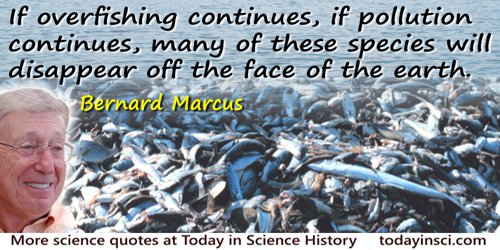
I am concerned about the air we breathe and the water we drink. If overfishing continues, if pollution continues, many of these species will disappear off the face of the earth.
I am concerned at the over-enthusiasm of unbridled reformers who initiate costly and frequently useless or even dangerous schemes. Progress is not synonymous with radicalism.
— Myre Sim
In 'Myre Sim', Gale, Contemporary Authors Online (2002).
I am particularly concerned to determine the probability of causes and results, as exhibited in events that occur in large numbers, and to investigate the laws according to which that probability approaches a limit in proportion to the repetition of events. That investigation deserves the attention of mathematicians because of the analysis required. It is primarily there that the approximation of formulas that are functions of large numbers has its most important applications. The investigation will benefit observers in identifying the mean to be chosen among the results of their observations and the probability of the errors still to be apprehended. Lastly, the investigation is one that deserves the attention of philosophers in showing how in the final analysis there is a regularity underlying the very things that seem to us to pertain entirely to chance, and in unveiling the hidden but constant causes on which that regularity depends. It is on the regularity of the main outcomes of events taken in large numbers that various institutions depend, such as annuities, tontines, and insurance policies. Questions about those subjects, as well as about inoculation with vaccine and decisions of electoral assemblies, present no further difficulty in the light of my theory. I limit myself here to resolving the most general of them, but the importance of these concerns in civil life, the moral considerations that complicate them, and the voluminous data that they presuppose require a separate work.
Philosophical Essay on Probabilities (1825), trans. Andrew I. Dale (1995), Introduction.
I believe in Spinoza’s God, Who reveals Himself in the lawful harmony of the world, not in a God Who concerns Himself with the fate and the doings of mankind.
Response to cablegram from Rabbi Herbert Goldstein of the International Synagogue in New York, asking “Do you believe in God?” As quoted in Victor J. Stenger, Has Science Found God? (2003), 91.
I came to realize that exaggerated concern about what others are doing can be foolish. It can paralyze effort, and stifle a good idea. One finds that in the history of science almost every problem has been worked out by someone else. This should not discourage anyone from pursuing his own path.
From Theodore von Karman and Lee Edson (ed.), The Wind and Beyond: Theodore von Karman, Pioneer in Aviation and Pathfinder in Science (1967).
I do not want to label myself a crystallographer as against a physicist and think indeed that though my research is concerned with crystals it is the physical side of it which attracts me.
In Letter (3 Jun 1929) to Ernest Rutherford, in Royal Society Archives, as quoted in David Phillips, Biographical Memoirs of Fellows of the Royal Society (Nov 1979), 25, 104.
I don’t play accurately—anyone can play accurately—but I play with wonderful expression. As far as the piano is concerned, sentiment is my forte. I keep science for life.
In 'Sebatian Melmoth', The Writings of Oscar Wilde: Epigrams, Phrases and Philosophies For the Use of the Young (1907), 87.
I find it sad, but all too human, that there are vast bureaucracies concerned about nuclear waste, huge organizations devoted to decommissioning nuclear power stations, but nothing comparable to deal with that truly malign waste, carbon dioxide.
In The Revenge of Gaia: Earth’s Climate Crisis & The Fate of Humanity (2006, 2007), 117-118.
I had a Meccano set with which I “played” endlessly. Meccano which was invented by Frank Hornby around 1900, is called Erector Set in the US. New toys (mainly Lego) have led to the extinction of Meccano and this has been a major disaster as far as the education of our young engineers and scientists is concerned. Lego is a technically trivial plaything and kids love it partly because it is so simple and partly because it is seductively coloured. However it is only a toy, whereas Meccano is a real engineering kit and it teaches one skill which I consider to be the most important that anyone can acquire: This is the sensitive touch needed to thread a nut on a bolt and tighten them with a screwdriver and spanner just enough that they stay locked, but not so tightly that the thread is stripped or they cannot be unscrewed. On those occasions (usually during a party at your house) when the handbasin tap is closed so tightly that you cannot turn it back on, you know the last person to use the washroom never had a Meccano set.
Nobel laureate autobiography in Les Prix Nobel/Nobel Lectures 1996 (1997), 189.
I have flown twice over Mount St. Helens out on our West Coast. I'm not a scientist and I don't know the figures, but I have a suspicion that that one little mountain has probably released more sulfur dioxide into the atmosphere of the world than has been released in the last ten years of automobile driving or things of that kind that people are so concerned about.
Address in Steubenville, Ohio (7 Oct 1980). As quoted in Douglas E. Kneeland, 'Teamsters Back Republican', New York Times (10 Oct 1980), D14. The article also stated that according to an E.P.A. spokesman, “all American manmade emissions of sulfur dioxide amounted to 81,000 tons a day, and the emissions from the volcano ranged from 500 to 2,000 tons a day.”
I have no doubt that certain learned men, now that the novelty of the hypotheses in this work has been widely reported—for it establishes that the Earth moves, and indeed that the Sun is motionless in the middle of the universe—are extremely shocked, and think that the scholarly disciplines, rightly established once and for all, should not be upset. But if they are willing to judge the matter thoroughly, they will find that the author of this work has committed nothing which deserves censure. For it is proper for an astronomer to establish a record of the motions of the heavens with diligent and skilful observations, and then to think out and construct laws for them, or rather hypotheses, whatever their nature may be, since the true laws cannot be reached by the use of reason; and from those assumptions the motions can be correctly calculated, both for the future and for the past. Our author has shown himself outstandingly skilful in both these respects. Nor is it necessary that these hypotheses should be true, nor indeed even probable, but it is sufficient if they merely produce calculations which agree with the observations. … For it is clear enough that this subject is completely and simply ignorant of the laws which produce apparently irregular motions. And if it does work out any laws—as certainly it does work out very many—it does not do so in any way with the aim of persuading anyone that they are valid, but only to provide a correct basis for calculation. Since different hypotheses are sometimes available to explain one and the same motion (for instance eccentricity or an epicycle for the motion of the Sun) an astronomer will prefer to seize on the one which is easiest to grasp; a philosopher will perhaps look more for probability; but neither will grasp or convey anything certain, unless it has been divinely revealed to him. Let us therefore allow these new hypotheses also to become known beside the older, which are no more probable, especially since they are remarkable and easy; and let them bring with them the vast treasury of highly learned observations. And let no one expect from astronomy, as far as hypotheses are concerned, anything certain, since it cannot produce any such thing, in case if he seizes on things constructed for another other purpose as true, he departs from this discipline more foolish than he came to it.
Although this preface would have been assumed by contemporary readers to be written by Copernicus, it was unsigned. It is now believed to have been written and added at press time by Andreas Osiander (who was then overseeing the printing of the book). It suggests the earth’s motion as described was merely a mathematical device, and not to be taken as absolute reality. Text as given in 'To the Reader on the Hypotheses in this Work', Copernicus: On the Revolutions of the Heavenly Spheres (1543), translated by Alistair Matheson Duncan (1976), 22-3. By adding this preface, Osiander wished to stave off criticism by theologians. See also the Andreas Osiander Quotes page of this website.
I have now reached the point where I may indicate briefly what to me constitutes the essence of the crisis of our time. It concerns the relationship of the individual to society. The individual has become more conscious than ever of his dependence upon society. But he does not experience this dependence as a positive asset, as an organic tie, as a protective force, but rather as a threat to his natural rights, or even to his economic existence. Moreover, his position in society is such that the egotistical drives of his make-up are constantly being accentuated, while his social drives, which are by nature weaker, progressively deteriorate. All human beings, whatever their position in society, are suffering from this process of deterioration. Unknowingly prisoners of their own egotism, they feel insecure, lonely, and deprived of the naive, simple, and unsophisticated enjoyment of life. Man can find meaning in life, short and perilous as it is, only through devoting himself to society.
…...
I must … explain how I was led to concern myself with the pathogenic protozoa. … I was sent to Algeria and put in charge of a department of the hospital at Bone. A large number of my patients had malarial fevers and I was naturally led to study these fevers of which I had only seen rare and benign forms in France.
From Nobel Lecture (11 Dec 1907), 'Protozoa as Causes of Diseases', collected in Nobel Lectures, Physiology or Medicine 1901-1921 (1967, 1999), 264.
I ought to say that one of our first joint researches, so far as publication was concerned, had the peculiar effect of freeing me forever from the wiles of college football, and if that is a defect, make the most of it! Dr. Noyes and I conceived an idea on sodium aluminate solutions on the morning of the day of a Princeton-Harvard game (as I recall it) that we had planned to attend. It looked as though a few days' work on freezing-point determinations and electrical conductivities would answer the question. We could not wait, so we gave up the game and stayed in the laboratory. Our experiments were successful. I think that this was the last game I have ever cared about seeing. I mention this as a warning, because this immunity might attack anyone. I find that I still complainingly wonder at the present position of football in American education.
Address upon receiving the Perkin Medal Award, 'The Big Things in Chemistry', The Journal of Industrial and Engineering Chemistry (Feb 1921), 13, No. 2, 162-163.
I see nothing wrong ethically with the idea of correcting single gene defects [through genetic engineering]. But I am concerned about any other kind of intervention, for anything else would be an experiment, [which would] impose our will on future generations [and take unreasonable chances] with their welfare ... [Thus] such intervention is beyond the scope of consideration.
in The Second Creation: Dolly and the Age of Biological Control
I speak as a planetary physician whose patient, the living Earth, complains of fever; I see the Earth’s declining health as our most important concern, our very lives depending upon a healthy Earth. Our concern for it must come first, because the welfare of the burgeoning mass of humanity demands a healthy planet.
In The Revenge of Gaia: Earth’s Climate Crisis & The Fate of Humanity (2006, 2007), 2.
I strongly oppose cloning, as do most Americans. We recoil at the idea of growing human beings for spare body parts or creating life for our convenience. And while we must devote enormous energy to conquering disease, it is equally important that we pay attention to the moral concerns raised by the new frontier of human embryo stem cell research. Even the most noble ends do not justify any means.
'Address to the Nation on Stem Cell Research', (9 Aug 2001) in Public Papers Of The Presidents Of The United States, George W. Bush, 2001 (2004), Book 2, 955.
I think, too, that we've got to recognize that where the preservation of a natural resource like the redwoods is concerned, that there is a common sense limit. I mean, if you've looked at a hundred thousand acres or so of trees—you know, a tree is a tree, how many more do you need to look at?
Speech, pandering for support, while candidate for governor of California, to the Western Wood Products Association, San Francisco (12 Mar 1966), opposing expansion of Redwood National Park. Commonly seen paraphrased as “If you’ve seen one redwood tree, you’ve seen them all,” but Reagan did not himself express this wording.
I uphold my own rights, and therefore I also recognize the rights of others. This is the principle I act upon in life, in politics and in science. We owe it to ourselves to defend our rights, for it is the only guarantee for our individual development, and for our influence upon the community at large. Such a defence is no act of vain ambition, and it involves no renunciation of purely scientific aims. For, if we would serve science, we must extend her limits, not only as far as our own knowledge is concerned, but in the estimation of others.
Cellular Pathology, translated by Frank Chance (1860), x.
I was unable to devote myself to the learning of this al-jabr [algebra] and the continued concentration upon it, because of obstacles in the vagaries of Time which hindered me; for we have been deprived of all the people of knowledge save for a group, small in number, with many troubles, whose concern in life is to snatch the opportunity, when Time is asleep, to devote themselves meanwhile to the investigation and perfection of a science; for the majority of people who imitate philosophers confuse the true with the false, and they do nothing but deceive and pretend knowledge, and they do not use what they know of the sciences except for base and material purposes; and if they see a certain person seeking for the right and preferring the truth, doing his best to refute the false and untrue and leaving aside hypocrisy and deceit, they make a fool of him and mock him.
A. P. Youschkevitch and B. A. Rosenfeld, 'Al-Khayyami', in C. C. Gillispie (ed.), Dictionary of Scientific Biography (1973), Vol. 7, 324.
I would like to start by emphasizing the importance of surfaces. It is at a surface where many of our most interesting and useful phenomena occur. We live for example on the surface of a planet. It is at a surface where the catalysis of chemical reactions occur. It is essentially at a surface of a plant that sunlight is converted to a sugar. In electronics, most if not all active circuit elements involve non-equilibrium phenomena occurring at surfaces. Much of biology is concerned with reactions at a surface.
'Surface properties of semiconductors', Nobel Lecture (11 Dec 1956). In Nobel Lectures, Physics 1942-1962 (1967), 377.
If God is as real as the shadow of the Great War on Armistice Day, need we seek further reason for making a place for God in our thoughts and lives? We shall not be concerned if the scientific explorer reports that he is perfectly satisfied that he has got to the bottom of things without having come across either.
Swarthmore Lecture (1929) at Friends’ House, London, printed in Science and the Unseen World (1929), 67.
If I’m concerned about what an electron does in an amorphous mass then I become an electron. I try to have that picture in my mind and to behave like an electron, looking at the problem in all its dimensions and scales.
Quoted in Timothy L. O’Brien, 'Not Invented here: Are U.S. Innovators Losing Their Competitive Edge?', New York Times (13 Nov 2005), B6.
If Nicolaus Copernicus, the distinguished and incomparable master, in this work had not been deprived of exquisite and faultless instruments, he would have left us this science far more well-established. For he, if anybody, was outstanding and had the most perfect understanding of the geometrical and arithmetical requisites for building up this discipline. Nor was he in any respect inferior to Ptolemy; on the contrary, he surpassed him greatly in certain fields, particularly as far as the device of fitness and compendious harmony in hypotheses is concerned. And his apparently absurd opinion that the Earth revolves does not obstruct this estimate, because a circular motion designed to go on uniformly about another point than the very center of the circle, as actually found in the Ptolemaic hypotheses of all the planets except that of the Sun, offends against the very basic principles of our discipline in a far more absurd and intolerable way than does the attributing to the Earth one motion or another which, being a natural motion, turns out to be imperceptible. There does not at all arise from this assumption so many unsuitable consequences as most people think.
From Letter (20 Jan 1587) to Christopher Rothman, chief astronomer of the Landgrave of Hesse. Webmaster seeks more information to better cite this source — please contact if you can furnish more. Webmaster originally found this quote introduced by an uncredited anonymous commentary explaining the context: “It was not just the Church that resisted the heliocentrism of Copernicus. Many prominent figures, in the decades following the 1543 publication of De Revolutionibus, regarded the Copernican model of the universe as a mathematical artifice which, though it yielded astronomical predictions of superior accuracy, could not be considered a true representation of physical reality.”
If on occasion Mr. Casson exhibits an insularity of judgment when it comes to the evaluation of the contribution made by various men to the development of modern anthropology, he may be forgiven upon the ground that, where anthropology is concerned, he is only following an old English custom!
In 'Review: The Discovery of Man by Stanley Casson', Isis (Jun 1941), 33, No. 2, 302.
If there are any gods whose chief concern is man, they cannot be very important gods.
In 'Space Flight and the Spirit of Man', Voices from Sky: Previews of the Coming Space Age (1965), 17.
If there be some who, though ignorant of all mathematics, take upon them to judge of these, and dare to reprove this work, because of some passage of Scripture, which they have miserably warped to their purpose, I regard them not, and even despise their rash judgment. … What I have done in this matter, I submit principally to your Holiness, and then to the judgment of all learned mathematicians. And that I may not seem to promise your Holiness more concerning the utility of this work than I am able to perform, I pass now to the work itself.
The dedication to Pope Paul III in the Preface of De Revolutionibus Orbium Coelestium, (On the Revolutions of Heavenly Spheres), originally written in Latin. As translated and quoted in Sarah K. Bolton, Famous Men of Science (1926), 7-8. Webmaster, as yet, has not found this quotation, in these words verbatim, as part of a complete book translation of the original Latin by Copernicus. However, it is consistent with other translations.
If you can modify a cell, it’s only a short step to modifying a mouse, and if you can modify a mouse, it’s only a step to modifying a higher animal, even man.
Reported in 1981, expressing concern for the future of gene-splicing.
Reported in 1981, expressing concern for the future of gene-splicing.
In 'Shaping Life in the Lab', Time (9 Mar 1981).
Imagine a room awash in gasoline, and there are two implacable enemies in that room. One of them has nine thousand matches. The other has seven thousand matches. Each of them is concerned about who's ahead, who's stronger. Well that's the kind of situation we are actually in. The amount of weapons that are available to the United States and the Soviet Union are so bloated, so grossly in excess of what's needed to dissuade the other, that if it weren't so tragic, it would be laughable. What is necessary is to reduce the matches and to clean up the gasoline.
From Sagan's analogy about the nuclear arms race and the need for disarmament, during a panel discussion in ABC News Viewpoint following the TV movie The Day After (20 Nov 1983). Transcribed by Webmaster from a video recording. It is seen misquoted in summary form as “The nuclear arms race is like two sworn enemies standing waist deep in gasoline, one with three matches, the other with five.”
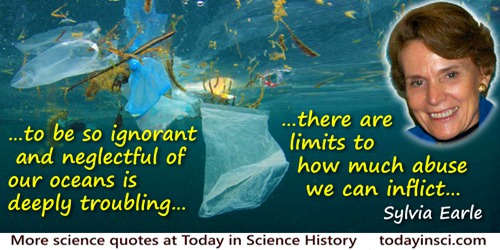
In a world that is rightly so concerned about climate change and the atmosphere, to be so ignorant and neglectful of our oceans is deeply troubling. However, … having woken up to this living disaster and having realized that there are limits to how much abuse we can inflict, it’s not too late to turn things around.
In 'Can We Stop Killing Our Oceans Now, Please?', Huffington Post (14 Aug 2013).
In fact, the thickness of the Earth's atmosphere, compared with the size of the Earth, is in about the same ratio as the thickness of a coat of shellac on a schoolroom globe is to the diameter of the globe. That's the air that nurtures us and almost all other life on Earth, that protects us from deadly ultraviolet light from the sun, that through the greenhouse effect brings the surface temperature above the freezing point. (Without the greenhouse effect, the entire Earth would plunge below the freezing point of water and we'd all be dead.) Now that atmosphere, so thin and fragile, is under assault by our technology. We are pumping all kinds of stuff into it. You know about the concern that chlorofluorocarbons are depleting the ozone layer; and that carbon dioxide and methane and other greenhouse gases are producing global warming, a steady trend amidst fluctuations produced by volcanic eruptions and other sources. Who knows what other challenges we are posing to this vulnerable layer of air that we haven't been wise enough to foresee?
In 'Wonder and Skepticism', Skeptical Enquirer (Jan-Feb 1995), 19, No. 1.
In my view, the only recourse for a scientist concerned about the social consequences of his work is to remain involved with it to the end.
'Science and Social Responsibility: A Case Study', Annals of the New York Academy of Science, 1972, 196, 223.
In order that an inventory of plants may be begun and a classification of them correctly established, we must try to discover criteria of some sort for distinguishing what are called “species”. After a long and considerable investigation, no surer criterion for determining species had occurred to me than distinguishing features that perpetuate themselves in propagation from seed. Thus, no matter what variations occur in the individuals or the species, if they spring from the seed of one and the same plant, they are accidental variations and not such as to distinguish a species. For these variations do not perpetuate themselves in subsequent seeding. Thus, for example, we do not regard caryophylli with full or multiple blossoms as a species distinct from caryophylli with single blossoms, because the former owe their origin to the seed of the latter and if the former are sown from their own seed, they once more produce single-blossom caryophylli. But variations that never have as their source seed from one and the same species may finally be regarded as distinct species. Or, if you make a comparison between any two plants, plants which never spring from each other's seed and never, when their seed is sown, are transmuted one into the other, these plants finally are distinct species. For it is just as in animals: a difference in sex is not enough to prove a difference of species, because each sex is derived from the same seed as far as species is concerned and not infrequently from the same parents; no matter how many and how striking may be the accidental differences between them; no other proof that bull and cow, man and woman belong to the same species is required than the fact that both very frequently spring from the same parents or the same mother. Likewise in the case of plants, there is no surer index of identity of species than that of origin from the seed of one and the same plant, whether it is a matter of individuals or species. For animals that differ in species preserve their distinct species permanently; one species never springs from the seed of another nor vice versa.
— John Ray
Historia Plantarum (1686), Vol. 1, 40. Trans. Edmund Silk. Quoted in Barbara G. Beddall, 'Historical Notes on Avian Classification', Systematic Zoology (1957), 6, 133-4.
In our concern for the whooping crane we are at once symbolizing and concealing a far deeper anxiety—namely, the prospective total extermination of all species.
In My Works and Days: A Personal Chronicle (1979), 452.
In scientific thought we adopt the simplest theory which will explain all the facts under consideration and enable us to predict new facts of the same kind. The catch in this criterion lies in the world “simplest.” It is really an aesthetic canon such as we find implicit in our criticisms of poetry or painting. The layman finds such a law as dx/dt = κ(d²x/dy²) much less simple than “it oozes,” of which it is the mathematical statement. The physicist reverses this judgment, and his statement is certainly the more fruitful of the two, so far as prediction is concerned. It is, however, a statement about something very unfamiliar to the plain man, namely the rate of change of a rate of change.
In 'Science and Theology as Art-Forms', Possible Worlds (1927), 227.
In the course of the last century science has become so dizzy with its successes, that it has forgotten to ask the pertinent questions—or refused to ask them under the pretext that they are meaningless, and in any case not the scientists concern.
In The Ghost in the Machine (1967), xi.
In the world of physics we watch a shadowgraph performance of the drama of familiar life. The shadow of my elbow rests on the shadow table as the shadow ink flows over the shadow paper. It is all symbolic, and as a symbol the physicist leaves it. ... The frank realization that physical science is concerned with a world of shadows is one of the most significant of recent advances.
In The Nature of the Physical World (1928, 2005), xiv-xv.
It all began with utter, indeed addictive, fascination with other forms of life. That led me through concern about what humanity is doing to the biology of the planet, to consideration of ecosystems and global cycles. That in turn has led to very practical concerns about how people should relate to nature. Yet the original fascination with jewel-like bits of natural science is always there.
Giving his own reason, in 'Seventy-Five Reasons to Become a Scientist', American Scientist (Sep-Oct 1988), 76, No. 5, 450.
It is a good thing for a physician to have prematurely grey hair and itching piles. The first makes him appear to know more than he does, and the second gives him an expression of concern which the patient interprets as being on his behalf.
…...
It is above all the duty of the methodical text-book to adapt itself to the pupil’s power of comprehension, only challenging his higher efforts with the increasing development of his imagination, his logical power and the ability of abstraction. This indeed constitutes a test of the art of teaching, it is here where pedagogic tact becomes manifest. In reference to the axioms, caution is necessary. It should be pointed out comparatively early, in how far the mathematical body differs from the material body. Furthermore, since mathematical bodies are really portions of space, this space is to be conceived as mathematical space and to be clearly distinguished from real or physical space. Gradually the student will become conscious that the portion of the real space which lies beyond the visible stellar universe is not cognizable through the senses, that we know nothing of its properties and consequently have no basis for judgments concerning it. Mathematical space, on the other hand, may be subjected to conditions, for instance, we may condition its properties at infinity, and these conditions constitute the axioms, say the Euclidean axioms. But every student will require years before the conviction of the truth of this last statement will force itself upon him.
In Methodisches Lehrbuch der Elementar-Mathemalik (1904), Teil I, Vorwort, 4-5.
It is an old saying, abundantly justified, that where sciences meet there growth occurs. It is true moreover to say that in scientific borderlands not only are facts gathered that [are] often new in kind, but it is in these regions that wholly new concepts arise. It is my own faith that just as the older biology from its faithful studies of external forms provided a new concept in the doctrine of evolution, so the new biology is yet fated to furnish entirely new fundamental concepts of science, at which physics and chemistry when concerned with the non-living alone could never arrive.
'Biological Thought and Chemical Thought: A Plea for Unification', Linacre Lecture, Cambridge (6 May 1938), published in Lancet (1938),2, 1204.
It is as true now, as it was in the days when Werner first drew his far-reaching inferences before his charmed listeners, that on the characteristic phenomena and varying distribution of the grand mineral masses of the rock-formations, almost all that concerns the relative habitability of a land depends.
In 'The Relations of Geology', Scottish Geographical Magazine (Aug 1902), 19, No. 8, 409.
It is clear that in maize, seemingly blending is really segregating inheritance, but with entire absence of dominance, and it seems probably that the same will be found to be true among rabbits and other mammals; failure to observe it hitherto is probably due to the fact that the factors concerned are numerous. For the greater the number of factors concerned, the more nearly will the result obtained approximate a complete and permanent blend. As the number of factors approaches infinity, the result will become identical with a permanent blend.
Heredity: In Relation to Evolution and Animal Breeding (1911), 138-9.
It is not enough that you should understand about applied science in order that your work may increase man's blessings. Concern for man himself and his fate must always form the chief interest of all technical endeavours... in order that the creations of our minds shall be a blessing and not a curse to mankind. Never forget this in the midst of your diagrams and equations.
Address to students of the California Institute of Technology, Pasadena, California (16 Feb 1931). In New York Times (17 Feb 1931), p. 6.
It is not improbable that some of the presentations which come before the mind in sleep may even be causes of the actions cognate to each of them. For as when we are about to act [in waking hours], or are engaged in any course of action, or have already performed certain actions, we often find ourselves concerned with these actions, or performing them, in a vivid dream.
In Mortimer Jerome Adler, Charles Lincoln Van Doren (eds.) Great Treasury of Western Thought: A Compendium of Important Statements on Man and His Institutions by the Great Thinkers in Western History (1977), 352
It is not therefore the business of philosophy, in our present situation in the universe, to attempt to take in at once, in one view, the whole scheme of nature; but to extend, with great care and circumspection, our knowledge, by just steps, from sensible things, as far as our observations or reasonings from them will carry us, in our enquiries concerning either the greater motions and operations of nature, or her more subtile and hidden works. In this way Sir Isaac Newton proceeded in his discoveries.
An Account of Sir Isaac Newton's Philosophical Discoveries, in Four Books (1748), 19.
It is now necessary to indicate more definitely the reason why mathematics not only carries conviction in itself, but also transmits conviction to the objects to which it is applied. The reason is found, first of all, in the perfect precision with which the elementary mathematical concepts are determined; in this respect each science must look to its own salvation .... But this is not all. As soon as human thought attempts long chains of conclusions, or difficult matters generally, there arises not only the danger of error but also the suspicion of error, because since all details cannot be surveyed with clearness at the same instant one must in the end be satisfied with a belief that nothing has been overlooked from the beginning. Every one knows how much this is the case even in arithmetic, the most elementary use of mathematics. No one would imagine that the higher parts of mathematics fare better in this respect; on the contrary, in more complicated conclusions the uncertainty and suspicion of hidden errors increases in rapid progression. How does mathematics manage to rid itself of this inconvenience which attaches to it in the highest degree? By making proofs more rigorous? By giving new rules according to which the old rules shall be applied? Not in the least. A very great uncertainty continues to attach to the result of each single computation. But there are checks. In the realm of mathematics each point may be reached by a hundred different ways; and if each of a hundred ways leads to the same point, one may be sure that the right point has been reached. A calculation without a check is as good as none. Just so it is with every isolated proof in any speculative science whatever; the proof may be ever so ingenious, and ever so perfectly true and correct, it will still fail to convince permanently. He will therefore be much deceived, who, in metaphysics, or in psychology which depends on metaphysics, hopes to see his greatest care in the precise determination of the concepts and in the logical conclusions rewarded by conviction, much less by success in transmitting conviction to others. Not only must the conclusions support each other, without coercion or suspicion of subreption, but in all matters originating in experience, or judging concerning experience, the results of speculation must be verified by experience, not only superficially, but in countless special cases.
In Werke [Kehrbach] (1890), Bd. 5, 105. As quoted, cited and translated in Robert Édouard Moritz, Memorabilia Mathematica; Or, The Philomath’s Quotation-Book (1914), 19.
It is said that the composing of the Lilavati was occasioned by the following circumstance. Lilavati was the name of the author’s daughter, concerning whom it appeared, from the qualities of the ascendant at her birth, that she was destined to pass her life unmarried, and to remain without children. The father ascertained a lucky hour for contracting her in marriage, that she might be firmly connected and have children. It is said that when that hour approached, he brought his daughter and his intended son near him. He left the hour cup on the vessel of water and kept in attendance a time-knowing astrologer, in order that when the cup should subside in the water, those two precious jewels should be united. But, as the intended arrangement was not according to destiny, it happened that the girl, from a curiosity natural to children, looked into the cup, to observe the water coming in at the hole, when by chance a pearl separated from her bridal dress, fell into the cup, and, rolling down to the hole, stopped the influx of water. So the astrologer waited in expectation of the promised hour. When the operation of the cup had thus been delayed beyond all moderate time, the father was in consternation, and examining, he found that a small pearl had stopped the course of the water, and that the long-expected hour was passed. In short, the father, thus disappointed, said to his unfortunate daughter, I will write a book of your name, which shall remain to the latest times—for a good name is a second life, and the ground-work of eternal existence.
In Preface to the Persian translation of the Lilavati by Faizi (1587), itself translated into English by Strachey and quoted in John Taylor (trans.) Lilawati, or, A Treatise on Arithmetic and Geometry by Bhascara Acharya (1816), Introduction, 3. [The Lilavati is the 12th century treatise on mathematics by Indian mathematician, Bhaskara Acharya, born 1114.]
It is the intact and functioning organism on which natural selection operates. Organisms are therefore the central element of concern to the biologist who aspires to a broad and integrated understanding of biology.
From 'Interspecific comparison as a tool for ecological physiologists', collected in M.E. Feder, A.F. Bennett, W.W. Burggren, and R.B. Huey, (eds.), New Directions in Ecological Physiology (1987), 15.
It is time that science, having destroyed the religious basis for morality, accepted the obligation to provide a new and rational basis for human behavior—a code of ethics concerned with man’s needs on earth, not his rewards in heaven.
In 'Toward a New Morality,' IEEE Spectrum, 1972.
It is, as Schrödinger has remarked, a miracle that in spite of the baffling complexity of the world, certain regularities in the events could be discovered. One such regularity, discovered by Galileo, is that two rocks, dropped at the same time from the same height, reach the ground at the same time. The laws of nature are concerned with such regularities.
In 'The Unreasonable Effectiveness of Mathematics in the Natural Sciences,' Communications in Pure and Applied Mathematics (Feb 1960), 13, No. 1 (February 1960). Collected in Eugene Paul Wigner, A.S. Wightman (ed.), Jagdish Mehra (ed.), The Collected Works of Eugene Paul Wigner (1955), Vol. 6, 537.
It was on the 25th November 1740 that I cut the first polyp. I put the two parts in a flat glass, which only contained water to the height of four to five lignes. It was thus easy for me to observe these portions of the polyp with a fairly powerful lens.
I shall indicate farther on the precautions I took in making my experiments on these cut polyps and the technique I adopted to cut them. It will suffice to say here that I cut the polyp concerned transversely, a little nearer the anterior than the posterior end. The first part was thus a little shorter than the second.
The instant that I cut the polyp, the two parts contracted so that at first they only appeared like two little grains of green matter at the bottom of the glass in which I put them—for green, as I have already said, is the colour of the first polyps that I possessed. The two parts expanded on the same day on which I separated them. They were very easy to distinguish from one another. The first had its anterior end adorned with the fine threads that serve the polyp as legs and arms, which the second had none.
The extensions of the first part was not the only sign of life that it gave on the same day that it was separated from the other. I saw it move its arms; and the next day, the first time I came to observe it, I found that it had changed its position; and shortly afterwards I saw it take a step. The second part was extended as on the previous day and in the same place. I shook the glass a little to see if it were still alive. This movement made it contract, from which I judged that it was alive. Shortly afterwards it extended again. On the following days I saw the same thing.
I shall indicate farther on the precautions I took in making my experiments on these cut polyps and the technique I adopted to cut them. It will suffice to say here that I cut the polyp concerned transversely, a little nearer the anterior than the posterior end. The first part was thus a little shorter than the second.
The instant that I cut the polyp, the two parts contracted so that at first they only appeared like two little grains of green matter at the bottom of the glass in which I put them—for green, as I have already said, is the colour of the first polyps that I possessed. The two parts expanded on the same day on which I separated them. They were very easy to distinguish from one another. The first had its anterior end adorned with the fine threads that serve the polyp as legs and arms, which the second had none.
The extensions of the first part was not the only sign of life that it gave on the same day that it was separated from the other. I saw it move its arms; and the next day, the first time I came to observe it, I found that it had changed its position; and shortly afterwards I saw it take a step. The second part was extended as on the previous day and in the same place. I shook the glass a little to see if it were still alive. This movement made it contract, from which I judged that it was alive. Shortly afterwards it extended again. On the following days I saw the same thing.
In Mémoires, pour servir à l'histoire d'un genre de polyps d'eau douce à bras en forme de cornes (1744), 7-16. Trans. John R. Baker, in Abraham Trembley of Geneva: Scientist and Philosopher 1710-1784 (1952), 31.
It was Plato, according to Sosigenes, who set this as a problem for those concerned with these things, through what suppositions of uniform and ordered movements the appearances concerning the movements of the wandering heavenly bodies could be preserved.
— Plato
Simplicius, On Aristotle's On the Heavens, 488.21. Trans. R. W. Sharples.
Leo Szilard’s Ten Commandments:
1. Recognize the connections of things and the laws of conduct of men, so that you may know what you are doing.
2. Let your acts be directed towards a worthy goal, but do not ask if they will reach it; they are to be models and examples, not means to an end.
3. Speak to all men as you do to yourself, with no concern for the effect you make, so that you do not shut them out from your world; lest in isolation the meaning of life slips out of sight and you lose the belief in the perfection of the creation.
4. Do not destroy what you cannot create.
5. Touch no dish, except that you are hungry.
6. Do not covet what you cannot have.
7. Do not lie without need.
8. Honor children. Listen reverently to their words and speak to them with infinite love.
9. Do your work for six years; but in the seventh, go into solitude or among strangers, so that the memory of your friends does not hinder you from being what you have become.
10. Lead your life with a gentle hand and be ready to leave whenever you are called.
1. Recognize the connections of things and the laws of conduct of men, so that you may know what you are doing.
2. Let your acts be directed towards a worthy goal, but do not ask if they will reach it; they are to be models and examples, not means to an end.
3. Speak to all men as you do to yourself, with no concern for the effect you make, so that you do not shut them out from your world; lest in isolation the meaning of life slips out of sight and you lose the belief in the perfection of the creation.
4. Do not destroy what you cannot create.
5. Touch no dish, except that you are hungry.
6. Do not covet what you cannot have.
7. Do not lie without need.
8. Honor children. Listen reverently to their words and speak to them with infinite love.
9. Do your work for six years; but in the seventh, go into solitude or among strangers, so that the memory of your friends does not hinder you from being what you have become.
10. Lead your life with a gentle hand and be ready to leave whenever you are called.
Circulated by Mrs. Szilard in July 1964, in a letter to their friends (translated by Dr. Jacob
Bronowski). As printed in Robert J. Levine, Ethics and Regulation of Clinical Research (1988), 431.
Logic is not concerned with human behavior in the same sense that physiology, psychology, and social sciences are concerned with it. These sciences formulate laws or universal statements which have as their subject matter human activities as processes in time. Logic, on the contrary, is concerned with relations between factual sentences (or thoughts). If logic ever discusses the truth of factual sentences it does so only conditionally, somewhat as follows: if such-and-such a sentence is true, then such-and-such another sentence is true. Logic itself does not decide whether the first sentence is true, but surrenders that question to one or the other of the empirical sciences.
Logic (1937). In The Language of Wisdom and Folly: Background Readings in Semantics (1967), 44.
Man is full of desires: he loves only those who can satisfy them all. “This man is a good mathematician,” someone will say. But I have no concern for mathematics; he would take me for a proposition. “That one is a good soldier.” He would take me for a besieged town. I need, that is to say, a decent man who can accommodate himself to all my desires in a general sort of way.
From Pensées (1670), Sect. 6, Aphorism 18. As translated in W.H. Auden and L. Kronenberger (eds.) The Viking Book of Aphorisms (1966), 199. From the original French, “L’homme est plein de besoins: il n’aime que ceux qui peuvent les remplir tous. ‘C’est un bon mathématicien,’ dira-t-on. Mais je n’ai que faire de mathématiques; il me prendroit pour une proposition. ‘C’est un bon guerrier.’ Il me prendroit pour une place assiégée. Il faut donc un honnête homme qui puisse s’accommoder à tous mes besoins généralement,” in Oeuvres Complètes de Blaise Pascal (1858), Vol. 1, 276.
Man is not a machine, ... although man most certainly processes information, he does not necessarily process it in the way computers do. Computers and men are not species of the same genus. .... No other organism, and certainly no computer, can be made to confront genuine human problems in human terms. ... However much intelligence computers may attain, now or in the future, theirs must always be an intelligence alien to genuine human problems and concerns.
Computer Power and Human Reason: From Judgment to Calculation, (1976) 203 and 223. Also excerpted in Ronald Chrisley (ed.), Artificial Intelligence: Critical Concepts (2000), Vol. 3, 313 and 321. Note that the second ellipsis spans 8 pages.
Man is not only part of a field, but a part and member of his group. When people are together, as when they are at work, then the most unnatural behavior, which only appears in late stages or abnormal cases, would be to behave as separate Egos. Under normal circumstances they work in common, each a meaningfully functioning part of the whole.
Lecture at the Kantgesellschaft (Kant Society), Berlin (17 Dec 1924), 'Über Gestalttheorie', as taken down in shorthand. Translated by N. Nairn-Allison in Social Research (1944), 11, 91.
Man may be excused for feeling some pride at having risen, though not through his own exertions, to the very summit of the organic scale; and the fact of his having thus risen, instead of having been aboriginally placed there, may give him hopes for a still higher destiny in the distant future. But we are not here concerned with hopes or fears, only with the truth as far as our reason allows us to discover it. I have given the evidence to the best of my ability; and we must acknowledge, as it seems to me, that man with all his noble qualities, with sympathy which feels for the most debased, with benevolence which extends not only to other men but to the humblest living creature, with his god-like intellect which has penetrated into the movements and constitution of the solar system—with all these exalted powers—Man still bears in his bodily frame the indelible stamp of his lowly origin.
Concluding remarks. The Descent of Man (1871), Vol. 2, 405.
Many persons have inquired concerning a recent message of mine that “a new type of thinking is essential if mankind is to survive and move to higher levels.”
From interview with Michael Amrine, 'The Real Problem is in the Hearts of Men', New York Times Magazine, (23 Jun 1946), 7. See more of the message from which Einstein quoted himself, see the longer quote that begins, “Our world faces a crisis as yet unperceived…,” on the Albert Einstein Quotes page of this website.
Many Species of Animals have been lost out of the World, which Philosophers and Divines are unwilling to admit, esteeming the Destruction of anyone Species a Dismembring of the Universe, and rendring the World imperfect; whereas they think the Divine Providence is especially concerned, and solicitous to secure and preserve the Works of the Creation. And truly so it is, as appears, in that it was so careful to lodge all Land Animals in the Ark at the Time of the general Deluge; and in that, of all Animals recorded in Natural Histories, we cannot say that there hath been anyone Species lost, no not of the most infirm, and most exposed to Injury and Ravine. Moreover, it is likely, that as there neither is nor can be any new Species of Animals produced, all proceeding from Seeds at first created; so Providence, without which one individual Sparrow falls not to the ground, doth in that manner watch over all that are created, that an entire Species shall not be lost or destroyed by any Accident. Now, I say, if these Bodies were sometimes the Shells and Bones of Fish, it will thence follow, that many Species have been lost out of the World... To which I have nothing to reply, but that there may be some of them remaining some where or other in the Seas, though as yet they have not come to my Knowledge. Far though they may have perished, or by some Accident been destroyed out of our Seas, yet the Race of them may be preserved and continued still in others.
— John Ray
Three Physico-Theological Discourses (1713), Discourse II, 'Of the General Deluge, in the Days of Noah; its Causes and Effects', 172-3.
Mathematical reasoning is deductive in the sense that it is based upon definitions which, as far as the validity of the reasoning is concerned (apart from any existential import), needs only the test of self-consistency. Thus no external verification of definitions is required in mathematics, as long as it is considered merely as mathematics.
In Universal Algebra (1898), Preface, vi.
Mathematics is concerned only with the enumeration and comparison of relations.
Quoted in E. T. Bell, The Development of Mathematics (1945).
Mathematics, from the earliest times to which the history of human reason can reach, has followed, among that wonderful people of the Greeks, the safe way of science. But it must not be supposed that it was as easy for mathematics as for logic, in which reason is concerned with itself alone, to find, or rather to make for itself that royal road. I believe, on the contrary, that there was a long period of tentative work (chiefly still among the Egyptians), and that the change is to be ascribed to a revolution, produced by the happy thought of a single man, whose experiments pointed unmistakably to the path that had to be followed, and opened and traced out for the most distant times the safe way of a science. The history of that intellectual revolution, which was far more important than the passage round the celebrated Cape of Good Hope, and the name of its fortunate author, have not been preserved to us. … A new light flashed on the first man who demonstrated the properties of the isosceles triangle (whether his name was Thales or any other name), for he found that he had not to investigate what he saw in the figure, or the mere concepts of that figure, and thus to learn its properties; but that he had to produce (by construction) what he had himself, according to concepts a priori, placed into that figure and represented in it, so that, in order to know anything with certainty a priori, he must not attribute to that figure anything beyond what necessarily follows from what he has himself placed into it, in accordance with the concept.
In Critique of Pure Reason, Preface to the Second Edition, (1900), 690.
Mathematics, too, is a language, and as concerns its structure and content it is the most perfect language which exists, superior to any vernacular; indeed, since it is understood by every people, mathematics may be called the language of languages. Through it, as it were, nature herself speaks; through it the Creator of the world has spoken, and through it the Preserver of the world continues to speak.
In Die Mathematik die Fackeltragerin einer neutn Zeit (1889), 5. As translated in Robert Édouard Moritz, Memorabilia Mathematica; Or, The Philomath’s Quotation-Book (1914), 194. From the original German, “Denn auch die Mathematik ist eine Sprache, und zwar nach Bau und Inhalt die vollkommenste Sprache, die es giebt, höher als jede Volkssprache; ja, weil alle Völker sie verstehen, kann sie die Sprache der Sprachen heißen. In ihr spricht sozusagen die Natur selbst, in ihr hat der Schöpfer der Welt geredet und in ihr redet noch immer ihr Erhalter.”
Much of the geographical work of the past hundred years... has either explicitly or implicitly taken its inspiration from biology, and in particular Darwin. Many of the original Darwinians, such as Hooker, Wallace, Huxley, Bates, and Darwin himself, were actively concerned with geographical exploration, and it was largely facts of geographical distribution in a spatial setting which provided Darwin with the germ of his theory.
'Darwin's Impact on Geography', Annals of the Association of American Geographers (1966), 56, 683.
My concern is not whether God is on our side; my greatest concern is to be on God’s side, for God is always right.
Quoted in Kim Lim (ed.), 1,001 Pearls of Spiritual Wisdom: Words to Enrich, Inspire, and Guide Your Life (2014), 155
My main reason for not relaxing into contented retirement is that like most of you I am deeply concerned about the probability of massively harmful climate change and the need to do something about it now.
From a talk at Geological Society of London, 'Conjectures of an Independent Scientist' (5 May 2011). As quoted on jameslovelock.org website.
Natural history is not only interesting to the individual, it ought to become a NATIONAL CONCERN, since it is a NATIONAL GOOD,—of this, agriculture, as it is the most important occupation, affords the most striking proof.
From Introduction to a Course of Lectures on Natural History: Delivered in the University of Pennsylvania, Nov. 16, 1799 (1800), 12.
Natural science is founded on minute critical views of the general order of events taking place upon our globe, corrected, enlarged, or exalted by experiments, in which the agents concerned are placed under new circumstances, and their diversified properties separately examined. The body of natural science, then, consists of facts; is analogy,—the relation of resemblance of facts by which its different parts are connected, arranged, and employed, either for popular use, or for new speculative improvements.
'Introductory Lecture to the Chemistry of Nature' (1807), in J. Davy (ed.), The Collected Works of Sir Humphry Davy (1839-40), Vol 8, 167-8.
Nature has provided two great gifts: life and then the diversity of living things, jellyfish and humans, worms and crocodiles. I don’t undervalue the investigation of commonalities but can’t avoid the conclusion that diversity has been relatively neglected, especially as concerns the brain.
From his autobiographical chapter, 'Theodore H. Bullock', in Larry R. Squire (ed.), The History of Science in Autobiography (1996), Vol. 1, 144.
Neither the absolute nor the relative size of the brain can be used to measure the degree of mental ability in animal or in man. So far as man is concerned, the weights of the brains or the volumes of the cranial cavities of a hundred celebrities of all branches of knowledge all over the world have been listed. … At the bottom of those lists are Gall, the famous phrenologist, Anatole France, the French novelist, and Gambetta, the French statesman, each with about 1,100 cc brain mass. The lists are topped by Dean Jonathan Swift, the English writer, Lord Byron, the English poet, and Turgenev, the Russian novelist, all with about 2,000 cc … Now our mental test! Had Turgenev really twice the mental ability of Anatole France?
In 'The Human Brain in the Light of Its Phylogenetic Development', Scientific Monthly (Aug 1948), 67, No. 2, 104-105. Collected in Sherwood Larned Washburn and Davida Wolffson (eds.), The Shorter Anthropological Papers of Franz Weidenreich Published in the Period 1939-1948: A Memorial Volume (1949), 18.
Nernst was a great admirer of Shakespeare, and it is said that in a conference concerned with naming units after appropriate persons, he proposed that the unit of rate of liquid flow should be called the falstaff.
'The Nemst Memorial Lecture', Journal of the Chemical Society (1953), Part 3, 2855.
No more harmful nonsense exists than the common supposition that deepest insight into great questions about the meaning of life or the structure of reality emerges most readily when a free, undisciplined, and uncluttered (read, rather, ignorant and uneducated) mind soars above mere earthly knowledge and concern.
…...
Nothing perhaps has so retarded the reception of the higher conclusions of Geology among men in general, as ... [the] instinctive parsimony of the human mind in matters where time is concerned.
Proceedings of the Geological Society of London (1903), 59, lxx.
Now that we locate them [genes] in the chromosomes are we justified in regarding them as material units; as chemical bodies of a higher order than molecules? Frankly, these are questions with which the working geneticist has not much concern himself, except now and then to speculate as to the nature of the postulated elements. There is no consensus of opinion amongst geneticists as to what the genes are—whether they are real or purely fictitious—because at the level at which the genetic experiments lie, it does not make the slightest difference whether the gene is a hypothetical unit, or whether the gene is a material particle. In either case the unit is associated with a specific chromosome, and can be localized there by purely genetic analysis. Hence, if the gene is a material unit, it is a piece of chromosome; if it is a fictitious unit, it must be referred to a definite location in a chromosome—the same place as on the other hypothesis. Therefore, it makes no difference in the actual work in genetics which point of view is taken. Between the characters that are used by the geneticist and the genes that his theory postulates lies the whole field of embryonic development.
'The Relation of Genetics to Physiology and Medicine', Nobel Lecture (4 Jun 1934). In Nobel Lectures, Physiology or Medicine 1922-1941 (1965), 315.
Of all the American scientists whose concern about the use of atomic weapons at Hiroshima and Nagasaki led them to devote themselves to the cause of peace, none was more dedicated nor more effective than [Edward] Condon. His efforts as Science Adviser to the Select Committee on Atomic Energy of the United States Senate after the war had much to do with the decision by the Congress to place government responsibility for atomic energy in a civilian rather than a military agency.
From 'Edward Uhler Condon, A Personal Recollection', presented at the Fourth International Conference on Atomic Physics, published in the Proceedings of this conference by G. zu Pulitz et al. (eds.), Atomic Physics (1975), Vol. 4, as collected in Asim O. Barut, Halis Odabasi and Alwyn van der Merwe (eds.), Selected Popular Writings of E.U. Condon (1991), 2. Branscomb added that there was a “price he paid for his relentless pursuit of this goal.”
Of these three essential factors, space might be said to be one with which biogeography is primarily concerned. However space necessarily interplays with time and form, therefore the three factors are as one of biogeographic concern.
Space, Time Form: The Biological Synthesis (1962, issued 1964)
On all levels primary, and secondary and undergraduate - mathematics is taught as an isolated subject with few, if any, ties to the real world. To students, mathematics appears to deal almost entirely with things whlch are of no concern at all to man.
In editorial in Focus, a Journal of the Mathematical Association of America (1986), quoted in obituary by Eric Pace, New York Times (11 Jun 1992).
Once the hatch was opened, I turned the lock handle and bright rays of sunlight burst through it. I opened the hatch and dust from the station flew in like little sparklets, looking like tiny snowflakes on a frosty day. Space, like a giant vacuum cleaner, began to suck everything out. Flying out together with the dust were some little washers and nuts that dad got stuck somewhere; a pencil flew by.
My first impression when I opened the hatch was of a huge Earth and of the sense of unreality concerning everything that was going on. Space is very beautiful. There was the dark velvet of the sky, the blue halo of the Earth and fast-moving lakes, rivers, fields and clouds clusters. It was dead silence all around, nothing whatever to indicate the velocity of the flight… no wind whistling in your ears, no pressure on you. The panorama was very serene and majestic.
My first impression when I opened the hatch was of a huge Earth and of the sense of unreality concerning everything that was going on. Space is very beautiful. There was the dark velvet of the sky, the blue halo of the Earth and fast-moving lakes, rivers, fields and clouds clusters. It was dead silence all around, nothing whatever to indicate the velocity of the flight… no wind whistling in your ears, no pressure on you. The panorama was very serene and majestic.
…...
One day a math-deficient frog was sitting on a tiny lily pad in a big pond—a lily pad that doubled in size each night—and on this day the pad covered just one-eighth of the pond. The frog still saw the vast majority of his beloved water and so was unconcerned. Then, just three days later, he woke to find the pond had vanished while he slept.
Epigraph, without citation, 'A sad cautionary tale for frogs with their heads in the sand.' in In Praise of Simple Physics: The Science and Mathematics behind Everyday Questions (2016), 11.
One reason which has led the organic chemist to avert his mind from the problems of Biochemistry is the obsession that the really significant happenings in the animal body are concerned in the main with substances of such high molecular weight and consequent vagueness of molecular structure as to make their reactions impossible of study by his available and accurate methods. There remains, I find, pretty widely spread, the feeling—due to earlier biological teaching—that, apart from substances which are obviously excreta, all the simpler products which can be found in cells or tissues are as a class mere objects, already too remote from the fundamental biochemical events to have much significance. So far from this being the case, recent progress points in the clearest way to the fact that the molecules with which a most important and significant part of the chemical dynamics of living tissues is concerned are of a comparatively simple character.
In 'The Dynamic Side of Biochemistry', Address (11 Sep 1913) in Report on the 83rd Meeting of the British Association for the Advancement of Science (1914), 657-8.
Only one rule in medical ethics need concern you - that action on your part which best conserves the interests of your patient.
Our credulity is greatest concerning the things we know least about. And since we know least about ourselves, we are ready to believe all that is said about us. Hence the mysterious power of both flattery and calumny.... It is thus with most of us: we are what other people say we are. We know ourselves chiefly by hearsay.
In The Passionate State of Mind (1955), 80.
Physiology is concerned with all those phenomena of life that present them selves to us in sense perception as bodily processes, and accordingly form part of that total environment which we name the external world.
Psychoanalysis is a science conducted by lunatics for lunatics. They are generally concerned with proving that people are irresponsible; and they certainly succeed in proving that some people are.
From Illustrated London News (23 Jun 1928). In Dale Ahlquist (ed.) The Universe According to G.K. Chesterton: A Dictionary of the Mad, Mundane and Metaphysical (2013), 93.
Pure mathematics … reveals itself as nothing but symbolic or formal logic. It is concerned with implications, not applications. On the other hand, natural science, which is empirical and ultimately dependent upon observation and experiment, and therefore incapable of absolute exactness, cannot become strictly mathematical. The certainty of geometry is thus merely the certainty with which conclusions follow from non-contradictory premises. As to whether these conclusions are true of the material world or not, pure mathematics is indifferent.
In 'Non-Euclidian Geometry of the Fourth Dimension', collected in Henry Parker Manning (ed.), The Fourth Dimension Simply Explained (1910), 58.
Pure mathematics is not concerned with magnitude. It is merely the doctrine of notation of relatively ordered thought operations which have become mechanical.
In Schriften (1901), Zweiter Teil, 282.
Quantum provides us with a striking illustration of the fact that though we can fully understand a connection … we can only speak of it in images and parables. We must be clear that when it comes to atoms, language can be used only as in poetry. The poet, too, is not nearly so concerned with describing facts as with creating images and establishing mental connections.
In conversation during first meeting with Werner Heisenberg (summer 1920), as quoted in Werner Heisenberg and Arnold J. Pomerans (trans.), Physics and Beyond: Encounters and Conversations (1971), 41. As cited in Philip Kuberski, The Forgèd Feature: Toward a Poetics of Uncertainty: New and Selected Essays (1995), 177-178.
Questions of personal priority, however interesting they may be to the persons concerned, sink into insignificance in the prospect of any gain of deeper insight into the secrets of nature.
As quoted in Silvanus Phillips Thompson, The Life of Lord Kelvin (1910), Vol. 2, 602.
Rachel Carson was the best thing America is capable of producing: a modest person, concerned, courageous, and profoundly right—all at the same time. Troubled by knowledge of an emerging threat to the web of life, she took pains to become informed, summoned her courage, breached her confines, and conveyed a diligently constructed message with eloquence enough to catalyze a new social movement. Her life addressed the promise and premise of being truly human.
In his Foreward to Rachel Carson, The Sea Around Us (1950, 2003), xvi.
Radioactivity is a new primary science owing allegiance neither to physics nor chemistry, as these sciences were understood before its advent, because it is concerned with a knowledge of the elementary atoms themselves of a character so fundamental and intimate that the old laws of physics and chemistry, concerned almost wholly with external relationships, do not suffice.
In 'The Discovery of Radioactivity: Radioactivity, a New Science', The Interpretation of Radium and the Structure of the Atom (4th ed., 1920), 2-3.
Restoring nature to its natural state … is a cause of particular concern to young Americans, because they more than we will reap the grim consequences of our failure to act on programs which are needed now if we are to prevent disaster later.
In State of the Union Address (22 Jan 1970).
Sauntering silently among the healthful groves, concerning yourself about every thing worthy a wise and good man?
— Horace
Epistle IV, to Albius Tibullus, translated by Christopher Smart in The Works of Horace (1861), 237. Also seen translated as, “To linger silently among the healthful woods, musing on such things as are worthy of a wise and good man.”
Science and technology, like all original creations of the human spirit, are unpredictable. If we had a reliable way to label our toys good and bad, it would be easy to regulate technology wisely. But we can rarely see far enough ahead to know which road leads to damnation. Whoever concerns himself with big technology, either to push it forward or to stop it, is gambling in human lives.
In Disturbing the Universe (1979), 7.
Science and Theology. We should endow neither; we should treat them as we treat conservatism and liberalism, encouraging both, so that they may keep watch upon one another, and letting them go in and out of power with the popular vote concerning them
Samuel Butler, Henry Festing Jones (ed.), The Note-Books of Samuel Butler (1917), 340.
Science asks no questions about the ontological pedigree or a priori character of a theory, but is content to judge it by its performance; and it is thus that a knowledge of nature, having all the certainty which the senses are competent to inspire, has been attained—a knowledge which maintains a strict neutrality toward all philosophical systems and concerns itself not with the genesis or a priori grounds of ideas.
Originally published in North American Review (1865). 'The Philosophy of Herbert Spencer,' repr. In Philosophical Writings of Chauncey Wright (1963), p. 8.
Science boasts of the distance of its stars; of the terrific remoteness of the things of which it has to speak. But poetry and religion always insist upon the proximity, the almost menacing closeness of the things with which they are concerned. Always the Kingdom of Heaven is “At Hand.”
'A Glimpse of My Country', The Daily News. Collected in Tremendous Trifles (1920), 277.
Science deals with judgments on which it is possible to obtain universal agreement. These judgments do not concern individual facts and events, but the invariable association of facts and events known as the laws of science. Agreement is secured by observation and experiment—impartial courts of appeal to which all men must submit if they wish to survive. The laws are grouped and explained by theories of ever increasing generality. The theories at first are ex post facto—merely plausible interpretations of existing bodies of data. However, they frequently lead to predictions that can be tested by experiments and observations in new fields, and, if the interpretations are verified, the theories are accepted as working hypotheses until they prove untenable. The essential requirements are agreement on the subject matter and the verification of predictions. These features insure a body of positive knowledge that can be transmitted from person to person, and that accumulates from generation to generation.
From manuscript on English Science in the Renaissance (1937), Edwin Hubble collection, Box 2, Huntington Library, San Marino, California. As cited by Norriss S. Hetherington in 'Philosophical Values and Observation in Edwin Hubble's Choice of a Model of the Universe', Historical Studies in the Physical Sciences (1982), 13, No. 1, 41. (Hetherington comments parenthetically that the references to court, judgment and appeal may be attributable to his prior experiences as a Rhodes Scholar reading Roman law at Oxford, and to a year's practice as an attorney in Louisville, Kentucky.)
Science develops best when its concepts and conclusions are integrated into the broader human culture and its concerns for ultimate meaning and value. Scientists cannot, therefore, hold themselves entirely aloof from the sorts of issues dealt with by philosophers and theologians. By devoting to these issues something of the energy and care they give to their research in science, they can help others realize more fully the human potentialities of their discoveries. They can also come to appreciate for themselves that these discoveries cannot be a genuine substitute for knowledge of the truly ultimate.
In Letter (1 Jun 1988) to Father George V. Coyne, Director of the Vatican Observatory. On vatican.va website.
Science is a capital or fund perpetually reinvested; it accumulates, rolls up, is carried forward by every new man. Every man of science has all the science before him to go upon, to set himself up in business with. What an enormous sum Darwin availed himself of and reinvested! Not so in literature; to every poet, to every artist, it is still the first day of creation, so far as the essentials of his task are concerned. Literature is not so much a fund to be reinvested as it is a crop to be ever new-grown.
Indoor Studies, vol. 12, Collected Works, Houghton (1913).
Science is complex and chilling. The mathematical language of science is understood by very few. The vistas it presents are scary—an enormous universe ruled by chance and impersonal rules, empty and uncaring, ungraspable and vertiginous. How comfortable to turn instead to a small world, only a few thousand years old, and under God's personal; and immediate care; a world in which you are His peculiar concern.
The 'Threat' of Creationism. In Ashley Montagu (ed.), Science and Creationism (1984), 192.
Science is concerned with what is possible while engineering is concerned with choosing, from among the many possible ways, one that meets a number of often poorly stated economic and practical objectives.
From Turing Award lecture (1968), 'One Man's View of Computer Science', collected in ACM Turing Award Lectures: The First Twenty Years, 1966 to 1985 (1987), 209. ACM is the Association for Computing Machinery. Also in Journal of the ACM (Jan 1969), 16, No. 1, 5.
Science starts with preconception, with the common culture, and with common sense. It moves on to observation, is marked by the discovery of paradox, and is then concerned with the correction of preconception. It moves then to use these corrections for the designing of further observation and for more refined experiment. And as it moves along this course the nature of the evidence and experience that nourish it becomes more and more unfamiliar; it is not just the language that is strange [to common culture].
From 'The Growth of Science and the Structure of Culture', Daedalus (Winter 1958), 87, No. 1, 67.
Science tries to answer the question: ‘How?’ How do cells act in the body? How do you design an airplane that will fly faster than sound? How is a molecule of insulin constructed? Religion, by contrast, tries to answer the question: ‘Why?’ Why was man created? Why ought I to tell the truth? Why must there be sorrow or pain or death? Science attempts to analyze how things and people and animals behave; it has no concern whether this behavior is good or bad, is purposeful or not. But religion is precisely the quest for such answers: whether an act is right or wrong, good or bad, and why.
Science and Imagination, ch. 4, Basic Books (1967).
Science, in its ultimate ideal, consists of a set of propositions arranged in a hierarchy, the lowest level of the hierarchy being concerned with particular facts, and the highest with some general law, governing everything in the universe. The various levels in the hierarchy have a two-fold logical connection, travelling one up, one down; the upward connection proceeds by induction, the downward by deduction.
In The Scientific Outlook (1931, 2009), 38.
Scientific method is concerned with efficient ways of generating knowledge.
In article Total Quality: Its Origins and its Future (1995), published at the Center for Quality and Productivity Improvement.
Secondly, the study of mathematics would show them the necessity there is in reasoning, to separate all the distinct ideas, and to see the habitudes that all those concerned in the present inquiry have to one another, and to lay by those which relate not to the proposition in hand, and wholly to leave them out of the reckoning. This is that which, in other respects besides quantity is absolutely requisite to just reasoning, though in them it is not so easily observed and so carefully practised. In those parts of knowledge where it is thought demonstration has nothing to do, men reason as it were in a lump; and if upon a summary and confused view, or upon a partial consideration, they can raise the appearance of a probability, they usually rest content; especially if it be in a dispute where every little straw is laid hold on, and everything that can but be drawn in any way to give color to the argument is advanced with ostentation. But that mind is not in a posture to find truth that does not distinctly take all the parts asunder, and, omitting what is not at all to the point, draws a conclusion from the result of all the particulars which in any way influence it.
In Conduct of the Understanding, Sect. 7.
So far as modern science is concerned, we have to abandon completely the idea that by going into the realm of the small we shall reach the ultimate foundations of the universe. I believe we can abandon this idea without any regret. The universe is infinite in all directions, not only above us in the large but also below us in the small. If we start from our human scale of existence and explore the content of the universe further and further, we finally arrive, both in the large and in the small, at misty distances where first our senses and then even our concepts fail us.
To the German Society of Scientists and Physicists, Braunschweig, Germany (Sep 1896). As quoted in Anton Z. Capri, Quips, Quotes, and Quanta: An Anecdotal History of Physics (2011), 20. Wiechert was reporting his measurement of the mass of the moving particles in a cathode ray beam (electrons).
So far as physics is concerned, time’s arrow is a property of entropy alone.
Gifford Lectures (1927), The Nature of the Physical World (1928), 80.
So far as the mere imparting of information is concerned, no university has had any justification for existence since the popularization of printing in the fifteenth century.
In 'Universities and Their Function', The Aims of Education & Other Essays (1917), 138-139.
Somewhere in the arrangement of this world there seems to be a great concern about giving us delight, which shows that, in the universe, over and above the meaning of matter and forces, there is a message conveyed through the magic touch of personality. ...
Is it merely because the rose is round and pink that it gives me more satisfaction than the gold which could buy me the necessities of life, or any number of slaves. ... Somehow we feel that through a rose the language of love reached our hearts.
Is it merely because the rose is round and pink that it gives me more satisfaction than the gold which could buy me the necessities of life, or any number of slaves. ... Somehow we feel that through a rose the language of love reached our hearts.
The Religion of Man (1931), 102. Quoted in H. E. Hunter, The Divine Proportion (1970), 6.
That ability to impart knowledge … what does it consist of? … a deep belief in the interest and importance of the thing taught, a concern about it amounting to a sort of passion. A man who knows a subject thoroughly, a man so soaked in it that he eats it, sleeps it and dreams it—this man can always teach it with success, no matter how little he knows of technical pedagogy. That is because there is enthusiasm in him, and because enthusiasm is almost as contagious as fear or the barber’s itch. An enthusiast is willing to go to any trouble to impart the glad news bubbling within him. He thinks that it is important and valuable for to know; given the slightest glow of interest in a pupil to start with, he will fan that glow to a flame. No hollow formalism cripples him and slows him down. He drags his best pupils along as fast as they can go, and he is so full of the thing that he never tires of expounding its elements to the dullest.
This passion, so unordered and yet so potent, explains the capacity for teaching that one frequently observes in scientific men of high attainments in their specialties—for example, Huxley, Ostwald, Karl Ludwig, Virchow, Billroth, Jowett, William G. Sumner, Halsted and Osler—men who knew nothing whatever about the so-called science of pedagogy, and would have derided its alleged principles if they had heard them stated.
This passion, so unordered and yet so potent, explains the capacity for teaching that one frequently observes in scientific men of high attainments in their specialties—for example, Huxley, Ostwald, Karl Ludwig, Virchow, Billroth, Jowett, William G. Sumner, Halsted and Osler—men who knew nothing whatever about the so-called science of pedagogy, and would have derided its alleged principles if they had heard them stated.
In Prejudices: third series (1922), 241-2.
For a longer excerpt, see H.L. Mencken on Teaching, Enthusiasm and Pedagogy.
For a longer excerpt, see H.L. Mencken on Teaching, Enthusiasm and Pedagogy.
That radioactive elements created by us are found in nature is an astounding event in the history of the earth. And of the Human race. To fail to consider its importance and its consequences would be a folly for which humanity would have to pay a terrible price. When public opinion has been created in the countries concerned and among all the nations, an opinion informed of the dangers involved in going on with the tests and led by the reason which this information imposes, then the statesmen may reach an agreement to stop the experiments.
In 'Excerpts from Message by Schweitzer', New York Times (24 Apr 1957), 4, translated from a letter issued by Schweitzer through the Nobel Committee, asking that public opinion demand an end to nuclear tests.
The big concern is that we’re starting to see a new normal, where fires, deforestation, drought and climate change are all interacting to make the Amazon more flammable.
As quoted in Brad Plumer, 'Tropical Forests Suffered Near-Record Tree Losses in 2017', New York Times (27 Jun 2018).
The contents of physics is the concern of physicists, its effect the concern of all men.
In '21 Points,' The Physicists (1962).
The deep study of nature is the most fruitful source of mathematical discoveries. By offering to research a definite end, this study has the advantage of excluding vague questions and useless calculations; besides it is a sure means of forming analysis itself and of discovering the elements which it most concerns us to know, and which natural science ought always to conserve.
Théorie Analytique de la Chaleur, Discours Préliminaire. Translation as in Robert Édouard Moritz, Memorabilia Mathematica; Or, The Philomath's Quotation-book (1914), 89.
The engineer is concerned to travel from the abstract to the concrete. He begins with an idea and ends with an object. He journeys from theory to practice. The scientist’s job is the precise opposite. He explores nature with his telescopes or microscopes, or much more sophisticated techniques, and feeds into a computer what he finds or sees in an attempt to define mathematically its significance and relationships. He travels from the real to the symbolic, from the concrete to the abstract. The scientist and the engineer are the mirror image of each other.
In The Development of Design (1981), 19-20.
The experimental verification of a theory concerning any natural phenomenon generally rests on the result of an integration.
Epigraph in Higher Mathematics for Students of Chemistry and Physics: With Special Reference to Practical Work (1902), Chap 4, 150.
The external world of physics has … become a world of shadows. In removing our illusions we have removed the substance, for indeed we have seen that substance is one of the greatest of our illusions. Later perhaps we may inquire whether in our zeal to cut out all that is unreal we may not have used the knife too ruthlessly. Perhaps, indeed, reality is a child which cannot survive without its nurse illusion. But if so, that is of little concern to the scientist, who has good and sufficient reasons for pursuing his investigations in the world of shadows and is content to leave to the philosopher the determination of its exact status in regard to reality.
In Introduction to The Nature of the Physical World (1928), xiv.
The focal points of our different reflections have been called “science”’ or “art” according to the nature of their “formal” objects, to use the language of logic. If the object leads to action, we give the name of “art” to the compendium of rules governing its use and to their technical order. If the object is merely contemplated under different aspects, the compendium and technical order of the observations concerning this object are called “science.” Thus metaphysics is a science and ethics is an art. The same is true of theology and pyrotechnics.
Definition of 'Art', Encyclopédie (1751). Translated by Nelly S. Hoyt and Thomas Cassirer (1965), 4.
The fundamental characteristic of the scientific method is honesty. In dealing with any question, science asks no favors. ... I believe that constant use of the scientific method must in the end leave its impress upon him who uses it. ... A life spent in accordance with scientific teachings would be of a high order. It would practically conform to the teachings of the highest types of religion. The motives would be different, but so far as conduct is concerned the results would be practically identical.
Address as its retiring president, to the American Association for the Advancement of Science, St. Louis (28 Dec 1903). 'Scientific Investigation and Progress', Nature 928 Jan 1904), 69:1787, 309.
The genotypic constitution of a gamete or a zygote may be parallelized with a complicated chemico-physical structure. This reacts exclusively in consequence of its realized state, but not in consequence of the history of its creation. So it may be with the genotypical constitution of gametes and zygotes: its history is without influence upon its reactions, which are determined exclusively by its actual nature. The genotype-conception is thus an 'ahistoric' view of the reactions of living beings—of course only as far as true heredity is concerned. This view is an analog to the chemical view, as already pointed out; chemical compounds have no compromising ante-act, H2O is always H2O, and reacts always in the same manner, whatsoever may be the 'history' of its formation or the earlier states of its elements. I suggest that it is useful to emphasize this 'radical' ahistoric genotype-conception of heredity in its strict antagonism to the transmission—or phenotype-view.
'The Genotype Conception of Heredity', The American Naturalist (1911), 45, 129.
The Greeks in the first vigour of their pursuit of mathematical truth, at the time of Plato and soon after, had by no means confined themselves to those propositions which had a visible bearing on the phenomena of nature; but had followed out many beautiful trains of research concerning various kinds of figures, for the sake of their beauty alone; as for instance in their doctrine of Conic Sections, of which curves they had discovered all the principal properties. But it is curious to remark, that these investigations, thus pursued at first as mere matters of curiosity and intellectual gratification, were destined, two thousand years later, to play a very important part in establishing that system of celestial motions which succeeded the Platonic scheme of cycles and epicycles. If the properties of conic sections had not been demonstrated by the Greeks and thus rendered familiar to the mathematicians of succeeding ages, Kepler would probably not have been able to discover those laws respecting the orbits and motions of planets which were the occasion of the greatest revolution that ever happened in the history of science.
In History of Scientific Ideas, Bk. 9, chap. 14, sect. 3.
The hype, skepticism and bewilderment associated with the Internet—concerns about new forms of crime, adjustments in social mores, and redefinition of business practices— mirror the hopes, fears, and misunderstandings inspired by the telegraph. Indeed, they are only to be expected. They are the direct consequences of human nature, rather than technology.
Given a new invention, there will always be some people who see only its potential to do good, while others see new opportunities to commit crime or make money. We can expect the same reactions to whatever new inventions appear in the twenty-first century.
Such reactions are amplified by what might be termed chronocentricity—the egotism that one’s own generation is poised on the very cusp of history. Today, we are repeatedly told that we are in the midst of a communications revolution. But the electric telegraph was, in many ways, far more disconcerting for the inhabitants of the time than today’s advances are for us. If any generation has the right to claim that it bore the full bewildering, world-shrinking brunt of such a revolution, it is not us—it is our nineteenth- century forebears.
Given a new invention, there will always be some people who see only its potential to do good, while others see new opportunities to commit crime or make money. We can expect the same reactions to whatever new inventions appear in the twenty-first century.
Such reactions are amplified by what might be termed chronocentricity—the egotism that one’s own generation is poised on the very cusp of history. Today, we are repeatedly told that we are in the midst of a communications revolution. But the electric telegraph was, in many ways, far more disconcerting for the inhabitants of the time than today’s advances are for us. If any generation has the right to claim that it bore the full bewildering, world-shrinking brunt of such a revolution, it is not us—it is our nineteenth- century forebears.
In The Victorian Internet (1998).
The imaginary expression √(-a) and the negative expression -b, have this resemblance, that either of them occurring as the solution of a problem indicates some inconsistency or absurdity. As far as real meaning is concerned, both are imaginary, since 0 - a is as inconceivable as √(-a).
The method of arithmetical teaching is perhaps the best understood of any of the methods concerned with elementary studies.
In Education as a Science (1879), 288.
The mind of man may be compared to a musical instrument with a certain range of notes, beyond which in both directions we have an infinitude of silence. The phenomena of matter and force lie within our intellectual range, and as far as they reach we will at all hazards push our inquiries. But behind, and above, and around all, the real mystery of this universe [Who made it all?] lies unsolved, and, as far as we are concerned, is incapable of solution.
In 'Matter and Force', Fragments of Science for Unscientific People (1871), 93.
The most important discoveries will provide answers to questions that we do not yet know how to ask and will concern objects that we can not yet imagine.
In Hubble Space Telescope flaw: hearing before the Committee on Science, Space, and Technology, U.S. House of Representatives, One Hundred First Congress, second session, July 13, 1990 (1990), 105.
The natural sciences are sometimes said to have no concern with values, nor to seek morality and goodness, and therefore belong to an inferior order of things. Counter-claims are made that they are the only living and dynamic studies... Both contentions are wrong. Language, Literature and Philosophy express, reflect and contemplate the world. But it is a world in which men will never be content to stay at rest, and so these disciplines cannot be cut off from the great searching into the nature of things without being deprived of life-blood.
Presidential Address to Classical Association, 1959. In E. J. Bowen's obituary of Hinshelwood, Chemistry in Britain (1967), Vol. 3, 536.
The natural scientist is concerned with a particular kind of phenomena … he has to confine himself to that which is reproducible … I do not claim that the reproducible by itself is more important than the unique. But I do claim that the unique exceeds the treatment by scientific method. Indeed it is the aim of this method to find and test natural laws…
In Aufsätze und Vorträge über Physik und Erkenntnistheorie (1961), 94. Quoted in Erhard Scheibe and Brigitte Falkenburg (ed), Between Rationalism and Empiricism: Selected Papers in the Philosophy of Physics (2001), 276
The nature of light is a subject of no material importance to the concerns of life or to the practice of the arts, but it is in many other respects extremely interesting.
Lecture 39, 'On the Nature of Light and Colours', A Course of Lectures on Natural Philosophy and the Mechanical Arts (1845), Vol. 1, 359.
The night spread out of the east in a great flood, quenching the red sunlight in a single minute. We wriggled by breathless degrees deep into our sleeping bags. Our sole thought was of comfort; we were not alive to the beauty or the grandeur of our position; we did not reflect on the splendor of our elevation. A regret I shall always have is that I did not muster up the energy to spend a minute or two stargazing. One peep I did make between the tent flaps into the night, and I remember dimly an appalling wealth of stars, not pale and remote as they appear when viewed through the moisture-laden air of lower levels, but brilliant points of electric blue fire standing out almost stereoscopically. It was a sight an astronomer would have given much to see, and here were we lying dully in our sleeping bags concerned only with the importance of keeping warm and comfortable.
…...
The nucleus has to take care of the inheritance of the heritable characters, while the surrounding cytoplasm is concerned with accommodation or adaptation to the environment.
Generelle Morphologie (1866), Vol. 1, 287-8. Trans. Ernst Mayr, The Growth of Biological Thought: Diversity, Evolution and Inheritance (1982), 672.
The processes concerned in simple descent are those of Family Variability and Reversion. It is well to define these words clearly. By family variability is meant the departure of the children of the same or similarly descended families from the ideal mean type of all of them. Reversion is the tendency of that ideal mean type to depart from the parent type, 'reverting' towards what may be roughly and perhaps fairly described as the average ancestral type. If family variability had been the only process in simple descent, the dispersion of the race would indefinitely increase with the number of the generations, but reversion checks this increase, and brings it to a standstill.
Typical Laws of Heredity (1877), 513.
The relationships of free and latent heat set forth in the language of the materialistic theory remain the same if in place of the quantity of matter we put the constant quantity of motion in accordance with the laws of mechanics. The only difference enters where it concerns the generations of heat through other motive forces and where it concerns the equivalent of heat that can be produced by a particular quantity of a mechanical or electrical force.
'Wärme, physiologisch', Handwörterbuch der medicinischen Wissenschaften (1845). In Timothy Lenoir, The Strategy of Life (1982), 203.
The road to the general, to the revelatory simplicities of science, lies through a concern with the particular, the circumstantial, the concrete, but a concern organized and directed in terms of … theoretical analysis … analyses of physical evolution, of the functioning of the nervous system, of social organization, of psychological process, of cultural patterning, and so on—and, most especially, in terms of the interplay among them. That is to say, the road lies, like any genuine Quest, through a terrifying complexity.
In 'The Impact of the Concept of Culture on the Concept of Man' (1966), The Interpretation of Cultures (1973).
The same algebraic sum of positive and negative charges in the nucleus, when the arithmetical sum is different, gives what I call “isotopes” or “isotopic elements,” because they occupy the same place in the periodic table. They are chemically identical, and save only as regards the relatively few physical properties which depend upon atomic mass directly, physically identical also. Unit changes of this nuclear charge, so reckoned algebraically, give the successive places in the periodic table. For any one “place” or any one nuclear charge, more than one number of electrons in the outer-ring system may exist, and in such a case the element exhibits variable valency. But such changes of number, or of valency, concern only the ring and its external environment. There is no in- and out-going of electrons between ring and nucleus.
Concluding paragraph of 'Intra-atomic Charge', Nature (1913), 92, 400. Collected in Alfred Romer, Radiochemistry and the Discovery of Isotopes (1970), 251-252.
The same society which receives the rewards of technology must, as a cooperating whole, take responsibility for control. To deal with these new problems will require a new conservation. We must not only protect the countryside and save it from destruction, we must restore what has been destroyed and salvage the beauty and charm of our cities. Our conservation must be not just the classic conservation of protection and development, but a creative conservation of restoration and innovation. Its concern is not with nature alone, but with the total relation between man and the world around him. Its object is not just man's welfare, but the dignity of man's spirit.
In his 'Message to Congress on Conservation and Restoration of Natural Beauty' written to Congress (8 Feb 1965). It was a broad initiative aimed at beautifying America, guaranteeing water and air quality, and preserving natural areas. In Lyndon B. Johnson: Containing the Public Messages, Speeches, and Statements of the President (1965), Vol.1, 156.
United States. President (1963-1969 : Johnson), Lyndon Baines Johnson, United States. Office of the Federal Register - 1970
The sciences throw an inexpressible grace over our compositions, even where they are not immediately concerned; as their effects are discernible where we least expect to find them.
'A Dialogue Concerning Oratory', The Works of Tacitus By Cornelius Tacitus (1854), Vol. 2, 439.
The scientific answer is relevant so far as concerns the sense-impressions… For the rest the human spirit must turn to the unseen world to which it itself belongs.
Swarthmore Lecture (1929) at Friends’ House, London, printed in Science and the Unseen World (1929), 43.
The significance of a fact is relative to [the general body of scientific] knowledge. To say that a fact is significant in science, is to say that it helps to establish or refute some general law; for science, though it starts from observation of the particular, is not concerned essentially with the particular, but with the general. A fact, in science, is not a mere fact, but an instance. In this the scientist differs from the artist, who, if he deigns to notice facts at all, is likely to notice them in all their particularity.
In The Scientific Outlook (1931, 2009), 38.
The subject may appear an insignificant one, but we shall see that it possesses some interest; and the maxim “de minimis lex non curat” [the law is not concerned with trifles] does not apply to science.
In The Formation of Vegetable Mould Through the Action of Worms, With Some Observations on Their Habits. (1881), 2.
The true men of action in our time, those who transform the world, are not the politicians and statesmen, but the scientists. Unfortunately poetry cannot celebrate them because their deeds are concerned with things, not persons, and are, therefore, speechless.
In 'The Poet and the City' (1962), collected in The Dyer’s Hand and Other Essays (1965), 81.
The value of fundamental research does not lie only in the ideas it produces. There is more to it. It affects the whole intellectual life of a nation by determining its way of thinking and the standards by which actions and intellectual production are judged. If science is highly regarded and if the importance of being concerned with the most up-to-date problems of fundamental research is recognized, then a spiritual climate is created which influences the other activities. An atmosphere of creativity is established which penetrates every cultural frontier. Applied sciences and technology are forced to adjust themselves to the highest intellectual standards which are developed in the basic sciences. This influence works in many ways: some fundamental students go into industry; the techniques which are applied to meet the stringent requirements of fundamental research serve to create new technological methods. The style, the scale, and the level of scientific and technical work are determined in pure research; that is what attracts productive people and what brings scientists to those countries where science is at the highest level. Fundamental research sets the standards of modern scientific thought; it creates the intellectual climate in which our modern civilization flourishes. It pumps the lifeblood of idea and inventiveness not only into the technological laboratories and factories, but into every cultural activity of our time. The case for generous support for pure and fundamental science is as simple as that.
In 'Why Pure Science?' in Bulletin of the Atomic Scientists, 1965.
The world of ideas which it [mathematics] discloses or illuminates, the contemplation of divine beauty and order which it induces, the harmonious connexion of its parts, the infinite hierarchy and absolute evidence of the truths with which it is concerned, these, and such like, are the surest grounds of the title of mathematics to human regard, and would remain unimpeached and unimpaired were the plan of the universe unrolled like a map at our feet, and the mind of man qualified to take in the whole scheme of creation at a glance.
In Presidential Address to British Association (19 Aug 1869), 'A Plea for the Mathematician', published in Nature (6 Jan 1870), 1, 262. Collected in Collected Mathematical Papers (1908), Vol. 2, 659.
The worst state of affairs is when science begins to concern itself with art.
…...
Then one day Lagrange took out of his pocket a paper which he read at the Académe, and which contained a demonstration of the famous Postulatum of Euclid, relative to the theory of parallels. This demonstration rested on an obvious paralogism, which appeared as such to everybody; and probably Lagrange also recognised it such during his lecture. For, when he had finished, he put the paper back in his pocket, and spoke no more of it. A moment of universal silence followed, and one passed immediately to other concerns.
Quoting Lagrange at a meeting of the class of mathematical and physical sciences at the Institut de France (3 Feb 1806) in Journal des Savants (1837), 84, trans. Ivor Grattan-Guinness.
There may be as many classifications of any series of natural, or of other, bodies, as they have properties or relations to one another, or to other things; or, again, as there are modes in which they may be regarded by the mind: so that, with respect to such classifications as we are here concerned with, it might be more proper to speak of a classification than of the classification of the animal kingdom.
In Lecture (Spring 1863) to the Royal College of Surgeons of England, 'On the Classification of Animals', Lectures on the Elements of Comparative Anatomy (1864), 1.
Through the ages, man's main concern was life after death. Today, for the first time, we find we must ask questions about whether there will be life before death.
The Crazy Ape (1970), 18.
To ask what qualities distinguish good from routine scientific research is to address a question that should be of central concern to every scientist. We can make the question more tractable by rephrasing it, “What attributes are shared by the scientific works which have contributed importantly to our understanding of the physical world—in this case the world of living things?” Two of the most widely accepted characteristics of good scientific work are generality of application and originality of conception. . These qualities are easy to point out in the works of others and, of course extremely difficult to achieve in one’s own research. At first hearing novelty and generality appear to be mutually exclusive, but they really are not. They just have different frames of reference. Novelty has a human frame of reference; generality has a biological frame of reference. Consider, for example, Darwinian Natural Selection. It offers a mechanism so widely applicable as to be almost coexistent with reproduction, so universal as to be almost axiomatic, and so innovative that it shook, and continues to shake, man’s perception of causality.
In 'Scientific innovation and creativity: a zoologist’s point of view', American Zoologist (1982), 22, 230.
To judge in this [utilitarian] way demonstrates … how small, narrow and indolent our minds are; it shows a disposition always to calculate the reward before the work, a cold heart and a lack of feeling for everything that is great and honours mankind. Unfortunately one cannot deny that such a mode of thinking is common in our age, and I am convinced that this is closely connected with the catastrophes which have befallen many countries in recent times; do not mistake me, I do not talk of the general lack of concern for science, but of the source from which all this has come, of the tendency to look out everywhere for one’s advantage and to relate everything to one’s physical well being, of indifference towards great ideas, of aversion to any effort which derives from pure enthusiasm.
Epigraph before title page, T. W. Körner, The Pleasures of Counting (1996).
To the average mathematician who merely wants to know his work is securely based, the most appealing choice is to avoid difficulties by means of Hilbert's program. Here one regards mathematics as a formal game and one is only concerned with the question of consistency ... . The Realist position is probably the one which most mathematicians would prefer to take. It is not until he becomes aware of some of the difficulties in set theory that he would even begin to question it. If these difficulties particularly upset him, he will rush to the shelter of Formalism, while his normal position will be somewhere between the two, trying to enjoy the best of two worlds.
In Axiomatic Set Theory (1971), 9-15. In Thomas Tymoczko, New Directions in the Philosophy of Mathematics: an Anthology (), 11-12.
To the pure geometer the radius of curvature is an incidental characteristic—like the grin of the Cheshire cat. To the physicist it is an indispensable characteristic. It would be going too far to say that to the physicist the cat is merely incidental to the grin. Physics is concerned with interrelatedness such as the interrelatedness of cats and grins. In this case the “cat without a grin” and the “grin without a cat” are equally set aside as purely mathematical phantasies.
In 'The Universe and the Atom' The Expanding Universe. (1933), 103.
True majorities, in a TV-dominated and anti-intellectual age, may need sound bites and flashing lights–and I am not against supplying such lures if they draw children into even a transient concern with science. But every classroom has one [Oliver] Sacks, one [Eric] Korn, or one [Jonathan] Miller, usually a lonely child with a passionate curiosity about nature, and a zeal that overcomes pressures for conformity. Do not the one in fifty deserve their institutions as well–magic places, like cabinet museums, that can spark the rare flames of genius?
…...
Truth is a dangerous word to incorporate within the vocabulary of science. It drags with it, in its train, ideas of permanence and immutability that are foreign to the spirit of a study that is essentially an historically changing movement, and that relies so much on practical examination within restricted circumstances. … Truth is an absolute notion that science, which is not concerned with any such permanency, had better leave alone.
In The Universe of Science (1933).
Unless the materials involved can be traced back to the material of common sense concern there is nothing whatever for scientific concern to be concerned with.
In 'Common Sense and Science: Their Respective Frames of Reference', The Journal of Philosophy (8 Apr 1948), 45, No. 8, 206.
Until that afternoon, my thoughts on planetary atmospheres had been wholly concerned with atmospheric analysis as a method of life detection and nothing more. Now that I knew the composition of the Martian atmosphere was so different from that of our own, my mind filled with wonderings about the nature of the Earth. If the air is burning, what sustains it at a constant composition? I also wondered about the supply of fuel and the removal of the products of combustion. It came to me suddenly, just like a flash of enlightenment, that to persist and keep stable, something must be regulating the atmosphere and so keeping it at its constant composition. Moreover, if most of the gases came from living organisms, then life at the surface must be doing the regulation.
Homage to Gaia: The Life of an Independent Scholar (2000), 253.
Very old and wide-spread is the opinion that forests have an important impact on rainfall. ... If forests enhance the amount and frequency of precipitation simply by being there, deforestation as part of agricultural expansion everywhere, must necessarily result in less rainfall and more frequent droughts. This view is most poignantly expressed by the saying: Man walks the earth and desert follows his steps! ... It is not surprising that under such circumstances the issue of a link between forests and climate has ... been addressed by governments. Lately, the Italian government has been paying special attention to reforestation in Italy and its expected improvement of the climate. ... It must be prevented that periods of heavy rainfall alternate with droughts. ...In the Unites States deforestation plays an important role as well and is seen as the cause for a reduction in rainfall. ... committee chairman of the American Association for Advancement of Science demands decisive steps to extend woodland in order to counteract the increasing drought. ... some serious concerns. In 1873, in Vienna, the congress for agriculture and forestry discussed the problem in detail; and when the Prussian house of representatives ordered a special commission to examine a proposed law pertaining to the preservation and implementation of forests for safeguarding, it pointed out that the steady decrease in the water levels of Prussian rivers was one of the most serious consequences of deforestation only to be rectified by reforestation programs. It is worth mentioning that ... the same concerns were raised in Russia as well and governmental circles reconsidered the issue of deforestation.
as quoted in Eduard Brückner - The Sources and Consequences of Climate Change and Climate Variability in Historical Times editted by N. Stehr and H. von Storch (2000)
Vision, in my view, is the cause of the greatest benefit to us, inasmuch as none of the accounts now given concerning the Universe would ever have been given if men had not seen the stars or the sun or the heavens. But as it is, the vision of day and night and of months and circling years has created the art of number and has given us not only the notion of Time but also means of research into the nature of the Universe. From these we have procured Philosophy in all its range, than which no greater boon ever has come or will come, by divine bestowal, unto the race of mortals.
— Plato
…...
We are concerned to understand the motivation for the development of pure mathematics, and it will not do simply to point to aesthetic qualities in the subject and leave it at that. It must be remembered that there is far more excitement to be had from creating something than from appreciating it after it has been created. Let there be no mistake about it, the fact that the mathematician is bound down by the rules of logic can no more prevent him from being creative than the properties of paint can prevent the artist. … We must remember that the mathematician not only finds the solutions to his problems, he creates the problems themselves.
In A Signpost to Mathematics (1951), 19. As quoted and cited in William L. Schaaf, 'Memorabilia Mathematica', The Mathematics Teacher (Mar 1957), 50, No. 3, 230. Note that this paper incorrectly attributes “A.H. Head”.
We are, of course, extremely concerned that if this did, in fact, happen, that there is going to be a tremendous public outcry, and we will be concerned with what the Congress does, … Obviously, we are concerned about there being a backlash against the medical applications of this technology, which have, of course, the potential to cure millions of patients.
…...
We often frame our understanding of what the [Hubble] space telescope will do in terms of what we expect to find, and actually it would be terribly anticlimactic if in fact we find what we expect to find. … The most important discoveries will provide answers to questions that we do not yet know how to ask and will concern objects we have not yet imagined.
As quoted in Timothy Ferris, 'The Space Telescope: A Sign of Intelligent Life', New York Times (29 Apr 1990), A1.
We praise the eighteenth century for concerning itself chiefly with analysis. The task remaining to the nineteenth is to discover the false syntheses which prevail, and to analyse their contents anew.
In The Maxims and Reflections of Goethe (1906), 198.
We should all be concerned about the future because we will have to spend the rest of our lives there.
We speak of it [astrology] as an extinct science; yet let but an eclipse of the sun happen, or a comet visit the evening sky, and in a moment we all believe in astrology. In vain do you tell the gazers on such spectacles that a solar eclipse is only the moon acting for the time as a candle-extinguisher to the sun, and give them bits of smoked glass to look through, and draw diagrams on the blackboard to explain it all. They listen composedly, and seem convinced, but in their secret hearts they are saying—“What though you can see it through a glass darkly, and draw it on a blackboard, does that show that it has no moral significance? You can draw a gallows or a guillotine, or write the Ten Commandments on a blackboard, but does that deprive them of meaning?” And so with the comet. No man will believe that the splendid stranger is hurrying through the sky solely on a momentous errand of his own. No! he is plainly signalling, with that flashing sword of his, something of importance to men,—something at all events that, if we could make it out, would be found of huge concern to us.
From 'Introductory Lecture on Technology for 1858-59', published as The Progress of the Telegraph (1859), 19-20.
WEATHER, n. The climate of an hour. A permanent topic of conversation among persons whom it does not interest, but who have inherited the tendency to chatter about it from naked arboreal ancestors whom it keenly concerned. The setting up of official weather bureaus and their maintenance in mendacity prove that even governments are accessible to suasion by the rude forefathers of the jungle.
The Collected Works of Ambrose Bierce (1911), Vol. 7, The Devil's Dictionary, 362-363.
What a weak, credulous, incredulous, unbelieving, superstitious, bold, frightened, what a ridiculous world ours is, as far as concerns the mind of man. How full of inconsistencies, contradictions and absurdities it is. I declare that taking the average of many minds that have recently come before me … I should prefer the obedience, affections and instinct of a dog before it.
Letter to C. Schoenbein (25 Jul 1853). In Georg W.A. Kahlbaum and Francis V. Darbishire (eds.), The Letters of Faraday and Schoenbein, 1836-1862 (1899), 215.
When an element A has an affinity for another substance B, I see no mechanical reason why it should not take as many atoms of B as are presented to it, and can possibly come into contact with it (which may probably be 12 in general), except so far as the repulsion of the atoms of B among themselves are more than a match for the attraction of an atom of A. Now this repulsion begins with 2 atoms of B to 1 atom of A, in which case the 2 atoms of B are diametrically opposed; it increases with 3 atoms of B to 1 of A, in which case the atoms are only 120° asunder; with 4 atoms of B it is still greater as the distance is then only 90; and so on in proportion to the number of atoms. It is evident from these positions, that, as far as powers of attraction and repulsion are concerned (and we know of no other in chemistry), binary compounds must first be formed in the ordinary course of things, then ternary and so on, till the repulsion of the atoms of B (or A, whichever happens to be on the surface of the other), refuse to admit any more.
Observations on Dr. Bostock's Review of the Atomic Principles of Chemistry', Nicholson's Journal, 1811, 29, 147.
When asked … [about] an underlying quantum world, Bohr would answer, “There is no quantum world. There is only an abstract quantum physical description. It is wrong to think that the task of physics is to find out how nature is. Physics concerns what we can say about Nature.”
As quoted in Aage Petersen, 'The Philosophy of Niels Bohr', Bulletin of the Atomic Scientists, 1963, 19, 12. Note: Bohr's remark, although in quotation marks, should not be regarded as a direct quote in these exact words. It is a generalised statement in Petersen’s words to represent Bohr’s viewpoint. This is explained in a footnote in Michael Frayn, The Human Touch (2007), 431 based on an article by N. David Mermin in Physics Today (Feb 2004).
When Galileo caused balls, the weights of which he had himself previously determined, to roll down an inclined plane; when Torricelli made the air carry a weight which he had calculated beforehand to be equal to that of a definite volume of water; or in more recent times, when Stahl changed metal into lime, and lime back into metal, by withdrawing something and then restoring it, a light broke upon all students of nature. They learned that reason has insight only into that which it produces after a plan of its own, and that it must not allow itself to be kept, as it were, in nature's leading-strings, but must itself show the way with principles of judgement based upon fixed laws, constraining nature to give answer to questions of reason's own determining. Accidental observations, made in obedience to no previously thought-out plan, can never be made to yield a necessary law, which alone reason is concerned to discover.
Critique of Pure Reason (1781), trans. Norman Kemp Smith (1929), 20.
Whereas at the outset geometry is reported to have concerned herself with the measurement of muddy land, she now handles celestial as well as terrestrial problems: she has extended her domain to the furthest bounds of space.
In The Story of Euclid. (1902) 14-15.
Whether statistics be an art or a science... or a scientific art, we concern ourselves little. It is the basis of social and political dynamics, and affords the only secure ground on which the truth or falsehood of the theories and hypotheses of that complicated science can be brought to the test.
Letters on the Theory of Probabilities (1846), trans. O. G. Downes (1849).
Why should a lobster be any more ridiculous than a dog? ... or a cat, or a gazelle, or a lion, or any other animal one chooses to take for a walk? I have a liking for lobsters. They are peaceful, serious creatures. ... Goethe had an aversion to dogs, and he wasn't mad. They know the secrets of the sea, they don't bark.
[By walking a lobster at the end of a blue silk ribbon in the gardens of the Palais-Royal, he mocked middle-class pretensions, but caused concern for his sanity.]
[By walking a lobster at the end of a blue silk ribbon in the gardens of the Palais-Royal, he mocked middle-class pretensions, but caused concern for his sanity.]
Quoted by his friend, Théophile Gautier, in Portraits et souvenirs littéraires (1875). In Théophile Gautier, My Fantoms, translated by Richard Holmes (1976), 150.
Why then be concerned about the conservation of wildlife when for all practical purposes we would be much better off if humans and their domestic animals and pets were the only living creatures on the face of the earth? There is no obvious and demolishing answer to this rather doubtful logic although in practice the destruction of all wild animals would certainly bring devastating changes to our existence on this planet as we know it today… The trouble is that everything in nature is completely interdependent. Tinker with one part of it and the repercussions ripple out in all directions… Wildlife—and that includes everything from microbes to blue whales and from a fungus to a redwood tree—has been so much part of life on the earth that we are inclined to take its continued existence for granted… Yet the wildlife of the world is disappearing, not because of a malicious and deliberate policy of slaughter and extermination, but simply because of a general and widespread ignorance and neglect.
World Wildlife Fund Dinner, York, (1969). As quoted and cited in 'The Mirror of a Duke', The Dorset Eye on dorseteye.com website
Yes, we have to divide up our time like that, between our politics and our equations. But to me our equations are far more important, for politics are only a matter of present concern. A mathematical equation stands forever.
…...
You could write the story of man’s growth in terms of his epic concerns with water.
Opening sentence of 'Our Need For Water', United States Department of Agriculture, The Yearbook of Agriculture, 1955 (1955), 1.
 In science it often happens that scientists say, 'You know that's a really good argument; my position is mistaken,' and then they would actually change their minds and you never hear that old view from them again. They really do it. It doesn't happen as often as it should, because scientists are human and change is sometimes painful. But it happens every day. I cannot recall the last time something like that happened in politics or religion.
(1987) --
In science it often happens that scientists say, 'You know that's a really good argument; my position is mistaken,' and then they would actually change their minds and you never hear that old view from them again. They really do it. It doesn't happen as often as it should, because scientists are human and change is sometimes painful. But it happens every day. I cannot recall the last time something like that happened in politics or religion.
(1987) -- 





