Conception Quotes (160 quotes)
… the reasoning process [employed in mathematics] is not different from that of any other branch of knowledge, … but there is required, and in a great degree, that attention of mind which is in some part necessary for the acquisition of all knowledge, and in this branch is indispensably necessary. This must be given in its fullest intensity; … the other elements especially characteristic of a mathematical mind are quickness in perceiving logical sequence, love of order, methodical arrangement and harmony, distinctness of conception.
In Treatise on Infinitesimal Calculus (1868), Vol. 8, 6.
[1665-06-07] ...This day, much against my will, I did in Drury Lane see two or three houses marked with a red cross upon the doors, and 'Lord have mercy upon us' writ there - which was a sad sight to me, being the first of that kind that to my remembrance I ever saw. It put me into an ill conception of myself and my smell, so that I was forced to buy some roll-tobacco to smell to and chaw - which took away the apprehension.
Diary of Samuel Pepys (7 Jun 1665)
[Culture] denotes an historically transmitted pattern of meanings embodied in symbols, a system of inherited conceptions expressed in symbolic forms, by means of which men communicate, perpetuate, and develop their knowledge about and attitudes toward life.
The Interpretation of Cultures (1977), 89.
A celebrated author and divine has written to me that “he has gradually learnt to see that it is just as noble a conception of the Deity to believe that He created a few original forms capable of self-development into other and needful forms, as to believe that He required a fresh act of creation to supply the voids caused by the action of His laws.”
In Origin of Species (1860), 417.
A force unconnected with matter, hovering loose over matter, is an utterly empty conception. In nitrogen, carbon, hydrogen, oxygen, in sulphur and phosphorus, their several properties have dwelt from all eternity.
As quoted in Ludwig Büchner, Force and Matter: Or, Principles of the Natural Order of the Universe (1891), 1.
A modern branch of mathematics, having achieved the art of dealing with the infinitely small, can now yield solutions in other more complex problems of motion, which used to appear insoluble. This modern branch of mathematics, unknown to the ancients, when dealing with problems of motion, admits the conception of the infinitely small, and so conforms to the chief condition of motion (absolute continuity) and thereby corrects the inevitable error which the human mind cannot avoid when dealing with separate elements of motion instead of examining continuous motion. In seeking the laws of historical movement just the same thing happens. The movement of humanity, arising as it does from innumerable human wills, is continuous. To understand the laws of this continuous movement is the aim of history. … Only by taking an infinitesimally small unit for observation (the differential of history, that is, the individual tendencies of man) and attaining to the art of integrating them (that is, finding the sum of these infinitesimals) can we hope to arrive at the laws of history.
War and Peace (1869), Book 11, Chap. 1.
A single kind of red cell is supposed to have an enormous number of different substances on it, and in the same way there are substances in the serum to react with many different animal cells. In addition, the substances which match each kind of cell are different in each kind of serum. The number of hypothetical different substances postulated makes this conception so uneconomical that the question must be asked whether it is the only one possible. ... We ourselves hold that another, simpler, explanation is possible.
Landsteiner and Adriano Sturli, 'Hamagglutinine normaler Sera', Wiener klinische Wochenschrift (1902), 15, 38-40. Trans. Pauline M. H. Mazumdar.
According to Democritus, atoms had lost the qualities like colour, taste, etc., they only occupied space, but geometrical assertions about atoms were admissible and required no further analysis. In modern physics, atoms lose this last property, they possess geometrical qualities in no higher degree than colour, taste, etc. The atom of modern physics can only be symbolized by a partial differential equation in an abstract multidimensional space. Only the experiment of an observer forces the atom to indicate a position, a colour and a quantity of heat. All the qualities of the atom of modern physics are derived, it has no immediate and direct physical properties at all, i.e. every type of visual conception we might wish to design is, eo ipso, faulty. An understanding of 'the first order' is, I would almost say by definition, impossible for the world of atoms.
Philosophic Problems of Nuclear Science, trans. F. C. Hayes (1952), 38.
Alas, your dear friend and servant is totally blind. Henceforth this heaven, this universe, which by wonderful observations I had enlarged by a hundred and a thousand times beyond the conception of former ages, is shrunk for me into the narrow space which I myself fill in it. So it pleases God; it shall therefore please me also.
In Letter, as quoted in Sir Oliver Lodge, Pioneers of Science (1905), 133.
All our knowledge derived from observation … is knowledge gotten at first hand. Hereby we see and know things as they are, or as they appear to us; we take the impressions of them on our minds from the original objects themselves which give a clearer and stronger conception of things.
In Interesting Anecdotes, Memoirs, Allegories, Essays, and Poetical Fragments (1793), Vols 3-4, Vol 4, 72.
All possible truth is practical. To ask whether our conception of chair or table corresponds to the real chair or table apart from the uses to which they may be put, is as utterly meaningless and vain as to inquire whether a musical tone is red or yellow. No other conceivable relation than this between ideas and things can exist. The unknowable is what I cannot react upon. The active part of our nature is not only an essential part of cognition itself, but it always has a voice in determining what shall be believed and what rejected.
The Muscular Perception of Space (1878), 446.
An eye critically nice will discern in every colour a tendency to some other colour, according as it is influenced by light, shade, depth or diluteness; nor is this the case only in the inherent colours of pigments, &c. but it is so also in the transient colours of the prism, &c. Hence blue in its depth inclines to purple; deep-yellow to orange, &c.; nor is it practicable to realize these colours to the satisfaction of the critical eye,-since perfect colours, like perfect geometrical figures, are pure ideals. My examples of colours are therefore quite as adequate to their office of illustrating and distinguishing, as the figure of an angle inclining to the acute or obtuse, instead of a perfect right angle, or middle form, would be in illustrating the conception of an angle in general.
In 'On Colors—In Answer to Mr. T. Hargreaves’s Strictures on the Work Entitled “Chromatics; or, An Essay on the Analogy and Harmony of Colours”', The Philosophical Magazine and Journal: Comprehending The Various Branches of Science, The Liberal and Fine Arts, Geology, Agriculture, Manufactures and Commerce (Oct 1817), 50, No. 234, 241.
Any conception which is definitely and completely determined by means of a finite number of specifications, say by assigning a finite number of elements, is a mathematical conception. Mathematics has for its function to develop the consequences involved in the definition of a group of mathematical conceptions. Interdependence and mutual logical consistency among the members of the group are postulated, otherwise the group would either have to be treated as several distinct groups, or would lie beyond the sphere of mathematics.
In 'Mathematics', Encyclopedia Britannica (9th ed.).
Aristotle, in spite of his reputation, is full of absurdities. He says that children should be conceived in the Winter, when the wind is in the North, and that if people marry too young the children will be female. He tells us that the blood of females is blacker then that of males; that the pig is the only animal liable to measles; that an elephant suffering from insomnia should have its shoulders rubbed with salt, olive-oil, and warm water; that women have fewer teeth than men, and so on. Nevertheless, he is considered by the great majority of philosophers a paragon of wisdom.
From An Outline of Intellectual Rubbish (1937, 1943), 19. Collected in The Basic Writings of Bertrand Russell (2009), 63.
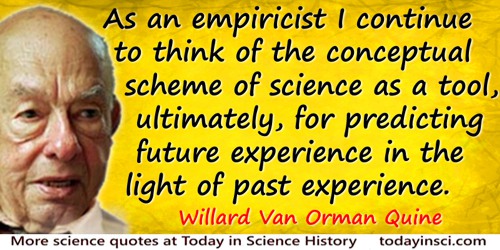
As an empiricist I continue to think of the conceptual scheme of science as a tool, ultimately, for predicting future experience in the light of past experience. Physical objects are conceptually imported into the situation as convenient intermediaries—not by definition in terms of experience, but simply as irreducible posits comparable, epistemologically, to the gods of Homer. For my part I do, qua lay physicist, believe in physical objects and not in Homer's gods; and I consider it a scientific error to believe otherwise. But in point of epistemological footing the physical objects and the gods differ only in degree and not in kind. Both sorts of entities enter our conception only as cultural posits. The myth of physical objects is epistemologically superior to most in that it has proved more efficacious than other myths as a device for working a manageable structure into the flux of experience.
From A Logical Point of View (1953), 44. [Note: “qua” means “in the character or role of,” thus “qua lay physicist” means “in the role of lay physicist,” or perhaps even (?) “putting on my lay physicist hat.” —Webmaster]
But when science, passing beyond its own limits, assumes to take the place of theology, and sets up its own conception of the order of Nature as a sufficient account of its cause, it is invading a province of thought to which it has no claim, and not unreasonably provokes the hostility of its best friends.
Presidential Address (14 Aug 1872) to the British Association for the Advancement of Science, Brighton, reprinted in The Journal of the Society of Arts (16 Aug 1872), 20, No. 1030, 799, penultimate sentence.
By Emerson scientific conceptions are continually transmuted into the finer forms and warmer hues of an ideal world. Our present theme is touched upon in the lines—
“The journeying atoms, primordial wholes
Firmly draw, firmly drive by their animate poles.”
“The journeying atoms, primordial wholes
Firmly draw, firmly drive by their animate poles.”
Referring to Ralph Walso Emerson’s couplet from his poem, 'The Sphinx'. Tyndall’s comment was first published in 'Martineau and Materialism', Popular Science Monthly (Dec 1875), 142. Later repeated in his Fragments of Science (5th ed., 1884), Introduction to Part II, 345.
Common to all these types is the anthropomorphic character of their conception of God. In general, only individuals of exceptional endowments, and exceptionally high-minded communities, rise to any considerable extent above this level. But there is a third stage of religious experience which belongs to all of them, even though it is rarely found in a pure form: I shall call it cosmic religious feeling. It is very difficult to elucidate this feeling to anyone who is entirely without it, especially as there is no anthropomorphic conception of God corresponding to it.
…...
Confined to its true domain, mathematical reasoning is admirably adapted to perform the universal office of sound logic: to induce in order to deduce, in order to construct. … It contents itself to furnish, in the most favorable domain, a model of clearness, of precision, and consistency, the close contemplation of which is alone able to prepare the mind to render other conceptions also as perfect as their nature permits. Its general reaction, more negative than positive, must consist, above all, in inspiring us everywhere with an invincible aversion for vagueness, inconsistency, and obscurity, which may always be really avoided in any reasoning whatsoever, if we make sufficient effort.
In Synthèse Subjective (1856), 98. As translated in Robert Édouard Moritz, Memorabilia Mathematica; Or, The Philomath’s Quotation-Book (1914), 202-203. From the original French, “Bornée à son vrai domaine, la raison mathématique y peut admirablement remplir l’office universel de la saine logique: induire pour déduire, afin de construire. … Elle se contente de former, dans le domaine le plus favorable, un type de clarté, de précision, et de consistance, dont la contemplation familière peut seule disposer l’esprit à rendre les autres conceptions aussi parfaites que le comporte leur nature. Sa réaction générale, plus négative que positive, doit surtout consister à nous inspirer partout une invincible répugnance pour le vague, l’incohérence, et l’obscurité, que nous pouvons réellement éviter envers des pensées quelconques, si nous y faisons assez d’efforts.”
Consciously and systematically Klein sought to enthrall me with the problems of mathematical physics, and to win me over to his conception of these problems as developed it in lecture courses in previous years. I have always regarded Klein as my real teacher only in things mathematical, but also in mathematical physics and in my conception of mechanics.
As quoted in Paul Forman and Armin Hermann, 'Sommerfeld, Arnold (Johannes Wilhelm)', Biography in Dictionary of Scientific Biography (1975), Vol. 12, 526. Cited from 'Autobiographische Skizze', Gesammelte Schriften, Vol 4, 673–682.
Copernicus and Lobatchewsky were both of Slavic origin. Each of them has brought about a revolution in scientific ideas so great that it can only be compared with that wrought by the other. And the reason of the transcendent importance of these two changes is that they are changes in the conception of the Cosmos. … Now the enormous effect of the Copernican system, and of the astronomical discoveries that have followed it, is … the change effected by Copernicus in the idea of the universe. But there was left another to be made. For the laws of space and motion…. So, you see, there is a real parallel between the work of Copernicus and … the work of Lobatchewsky.
In 'The Postulates of Time And Space', Lectures and Essays (1901) Vol. 1, 354-359.
CREATION OF LIFE.
The Startling Discovery of Prof. Loeb.
Lower Animals Produced by Chemical Means.
Process May Apply to the Human Species.
Immaculate Conception is Explained.
Wonderful Experiments Conducted at Woods Hole.
The Startling Discovery of Prof. Loeb.
Lower Animals Produced by Chemical Means.
Process May Apply to the Human Species.
Immaculate Conception is Explained.
Wonderful Experiments Conducted at Woods Hole.
The Boston Herald (26 Nov 1899), 17.
Dear Mr. Bell: … Sir Wm. Thomson … speaks with much enthusiasm of your achievement. What yesterday he would have declared impossible he has today seen realized, and he declares it the most wonderful thing he has seen in America. You speak of it as an embryo invention, but to him it seems already complete, and he declares that, before long, friends will whisper their secrets over the electric wire. Your undulating current he declares a great and happy conception.
Letter to Alexander Graham Bell (25 Jun 1876). Quoted in Alexander Graham Bell, The Bell Telephone: The Deposition of Alexander Graham Bell, in the Suit Brought by the United States to Annul the Bell Patents (1908), 101. Note: William Thomson is better known as Lord Kelvin.
Does it not seem as if Algebra had attained to the dignity of a fine art, in which the workman has a free hand to develop his conceptions, as in a musical theme or a subject for a painting? It has reached a point where every properly developed algebraical composition, like a skillful landscape, is expected to suggest the notion of an infinite distance lying beyond the limits of the canvas.
In 'Lectures on the Theory of Reciprocants', Lecture XXI, American Journal of Mathematics (Jul 1886), 9, No. 3, 136.
Every great advance in science has issued from a new audacity of imagination. What are now working conceptions, employed as a matter of course because they have withstood the tests of experiment and have emerged triumphant, were once speculative hypotheses.
'The Copernican Revolution', in The Quest for Certainty: A Study of the Relation of Knowledge and Action (1929), 294. Collected in John Dewey. Volume 4: The Later Works, 1925-1953: 1929 The Quest for Certainty (1984), 247. The first sentence is used as the motto of The Bronx High School of Science, New York.
Everything material which is the subject of knowledge has number, order, or position; and these are her first outlines for a sketch of the universe. If our feeble hands cannot follow out the details, still her part has been drawn with an unerring pen, and her work cannot be gainsaid. So wide is the range of mathematical sciences, so indefinitely may it extend beyond our actual powers of manipulation that at some moments we are inclined to fall down with even more than reverence before her majestic presence. But so strictly limited are her promises and powers, about so much that we might wish to know does she offer no information whatever, that at other moments we are fain to call her results but a vain thing, and to reject them as a stone where we had asked for bread. If one aspect of the subject encourages our hopes, so does the other tend to chasten our desires, and he is perhaps the wisest, and in the long run the happiest, among his fellows, who has learned not only this science, but also the larger lesson which it directly teaches, namely, to temper our aspirations to that which is possible, to moderate our desires to that which is attainable, to restrict our hopes to that of which accomplishment, if not immediately practicable, is at least distinctly within the range of conception.
From Presidential Address (Aug 1878) to the British Association, Dublin, published in the Report of the 48th Meeting of the British Association for the Advancement of Science (1878), 31.
For example, there are numbers of chemists who occupy themselves exclusively with the study of dyestuffs. They discover facts that are useful to scientific chemistry; but they do not rank as genuine scientific men. The genuine scientific chemist cares just as much to learn about erbium—the extreme rarity of which renders it commercially unimportant—as he does about iron. He is more eager to learn about erbium if the knowledge of it would do more to complete his conception of the Periodic Law, which expresses the mutual relations of the elements.
From 'Lessons from the History of Science: The Scientific Attitude' (c.1896), in Collected Papers (1931), Vol. 1, 20.
Furnished as all Europe now is with Academies of Science, with nice instruments and the spirit of experiment, the progress of human knowledge will be rapid and discoveries made of which we have at present no conception. I begin to be almost sorry I was born so soon, since I cannot have the happiness of knowing what will be known a hundred years hence.
…...
Genetics has enticed a great many explorers during the past two decades. They have labored with fruit-flies and guinea-pigs, with sweet peas and corn, with thousands of animals and plants in fact, and they have made heredity no longer a mystery but an exact science to be ranked close behind physics and chemistry in definiteness of conception. One is inclined to believe, however, that the unique magnetic attraction of genetics lies in the vision of potential good which it holds for mankind rather than a circumscribed interest in the hereditary mechanisms of the lowly species used as laboratory material. If man had been found to be sharply demarcated from the rest of the occupants of the world, so that his heritage of physical form, of physiological function, and of mental attributes came about in a superior manner setting him apart as lord of creation, interest in the genetics of the humbler organisms—if one admits the truth—would have flagged severely. Biologists would have turned their attention largely to the ways of human heredity, in spite of the fact that the difficulties encountered would have rendered progress slow and uncertain. Since this was not the case, since the laws ruling the inheritance of the denizens of the garden and the inmates of the stable were found to be applicable to prince and potentate as well, one could shut himself up in his laboratory and labor to his heart's content, feeling certain that any truth which it fell to his lot to discover had a real human interest, after all.
Mankind at the Crossroads (1923), v-vi.
Hitherto the conception of chemical transmission at nerve endings and neuronal synapses, originating in Loewi’s discovery, and with the extension that the work of my colleagues has been able to give to it, can claim one practical result, in the specific, though alas only short, alleviation of the condition of myasthenia gravis, by eserine and its synthetic analogues.
'Some recent extensions of the chemical transmission of the effects of nerve impulses', Nobel Lecture, 12 December 1936. In Nobel Lectures: Physiology or Medicine 1922-1941 (1965), 412-3.
I am further inclined to think, that when our views are sufficiently extended, to enable us to reason with precision concerning the proportions of elementary atoms, we shall find the arithmetical relation alone will not be sufficient to explain their mutual action, and that we shall be obliged to acquire a geometric conception of their relative arrangement in all three dimensions of solid extension.
Paper. Read to the Royal Society (28 Jan 1808), in 'On Super-acid and Sub-acid salts', Philosophical Transactions of the Royal Society of London, (1808), 98, 101.
I am much occupied with the investigation of the physical causes [of motions in the Solar System]. My aim in this is to show that the celestial machine is to be likened not to a divine organism but rather to a clockwork … insofar as nearly all the manifold movements are carried out by means of a single, quite simple magnetic force. This physical conception is to be presented through calculation and geometry.
Letter to Ilerwart von Hohenburg (10 Feb 1605) Quoted in Holton, Johannes Kepler's Universe: Its Physics and Metaphysics, 342, as cited by Hylarie Kochiras, Force, Matter, and Metaphysics in Newton's Natural Philosophy (2008), 57.
I ask any one who has adopted the calling of an engineer, how much time he lost when he left school, because he had to devote himself to pursuits which were absolutely novel and strange, and of which he had not obtained the remotest conception from his instructors? He had to familiarize himself with ideas of the course and powers of Nature, to which his attention had never been directed during his school-life, and to learn, for the first time, that a world of facts lies outside and beyond the world of words.
From After-Dinner Speech (Apr 1869) delivered before the Liverpool Philomathic Society, 'Scientific Education', collected in Lay Sermons, Addresses, and Reviews (1870), 63. Previously published in Macmillan’s Magazine.
I do not conceive of any manifestation of culture, of science, of art, as purposes in themselves. I think the purpose of science and culture is man.
In G. Barry Golson (ed.) The Playboy Interview (1981), 254.
I had no more conception of what it meant to be a forester than the man in the moon. ... But at least a forester worked in the woods and with the woods - and I loved the woods and everything about them.
Gifford's thoughts, when upon entering Yale (1885) his father asked 'How would you like to be a forester?'
Gifford's thoughts, when upon entering Yale (1885) his father asked 'How would you like to be a forester?'
In Breaking New Ground (1947, 1998), 2.
I have never had reason, up to now, to give up the concept which I have always stressed, that nerve cells, instead of working individually, act together, so that we must think that several groups of elements exercise a cumulative effect on the peripheral organs through whole bundles of fibres. It is understood that this concept implies another regarding the opposite action of sensory functions. However opposed it may seem to the popular tendency to individualize the elements, I cannot abandon the idea of a unitary action of the nervous system, without bothering if, by that, I approach old conceptions.
'The Neuron Doctrine-Theory and Facts', Nobel Lecture 11 Dec 1906. In Nobel Lectures: Physiology or Medicine 1901-1921 (1967), 216.
I have therefore tried to show the tendency displayed throughout history, by the most profound investigators, to pass from the world of the senses to a world where vision becomes spiritual, where principles are elaborated, and from which the explorer emerges with conceptions and conclusions, to be approved or rejected according as they coincide with sensible things.
Heat, A Mode of Motion (1880, 1915), 6th ed., viii.
I maintain that in every special natural doctrine only so much science proper is to be met with as mathematics; for… science proper, especially [science] of nature, requires a pure portion, lying at the foundation of the empirical, and based upon a priori knowledge of natural things. … To the possibility of a determinate natural thing, and therefore to cognise it à priori, is further requisite that the intuition corresponding à priori to the conception should be given; in other words, that the conception should be constructed. But the cognition of the reason through construction of conceptions is mathematical. A pure philosophy of nature in general, namely, one that only investigates what constitutes a nature in general, may thus be possible without mathematics; but a pure doctrine of nature respecting determinate natural things (corporeal doctrine and mental doctrine), is only possible by means of mathematics; and as in every natural doctrine only so much science proper is to be met with therein as there is cognition à priori, a doctrine of nature can only contain so much science proper as there is in it of applied mathematics.
From Preface to The Metaphysical Foundations of Natural Science (1786), as translated by Ernest Belford Boax, in Kant’s Prolegomena: And The Metaphysical Foundations of Natural Science (1883), 140.
I presume that few who have paid any attention to the history of the Mathematical Analysis, will doubt that it has been developed in a certain order, or that that order has been, to a great extent, necessary—being determined, either by steps of logical deduction, or by the successive introduction of new ideas and conceptions, when the time for their evolution had arrived. And these are the causes that operate in perfect harmony. Each new scientific conception gives occasion to new applications of deductive reasoning; but those applications may be only possible through the methods and the processes which belong to an earlier stage.
Explaining his choice for the exposition in historical order of the topics in A Treatise on Differential Equations (1859), Preface, v-vi.
I think, and I am not the only one who does, that it is important never to introduce any conception which may not be completely defined by a finite number of words. Whatever may be the remedy adopted, we can promise ourselves the joy of the physician called in to follow a beautiful pathological case [beau cas pathologique].
From address read at the general session of the Fourth International Congress of Mathematicians in Rome (10 Apr 1908). As translated in 'The Future of Mathematics: by Henri Poincaré', General Appendix, Annual Report of the Boars of Regents of The Smithsonian Institution: For the Year Ending June 1909 (1910), 140.
I trust ... I have succeeded in convincing you that modern chemistry is not, as it has so long appeared, an ever-growing accumulation of isolated facts, as impossible for a single intellect to co-ordinate as for a single memory to grasp.
The intricate formulae that hang upon these walls, and the boundless variety of phenomena they illustrate, are beginning to be for us as a labyrinth once impassable, but to which we have at length discovered the clue. A sense of mastery and power succeeds in our minds to the sort of weary despair with which we at first contemplated their formidable array. For now, by the aid of a few general principles, we find ourselves able to unravel the complexities of these formulae, to marshal the compounds which they represent in orderly series; nay, even to multiply their numbers at our will, and in a great measure to forecast their nature ere we have called them into existence. It is the great movement of modern chemistry that we have thus, for an hour, seen passing before us. It is a movement as of light spreading itself over a waste of obscurity, as of law diffusing order throughout a wilderness of confusion, and there is surely in its contemplation something of the pleasure which attends the spectacle of a beautiful daybreak, something of the grandeur belonging to the conception of a world created out of chaos.
The intricate formulae that hang upon these walls, and the boundless variety of phenomena they illustrate, are beginning to be for us as a labyrinth once impassable, but to which we have at length discovered the clue. A sense of mastery and power succeeds in our minds to the sort of weary despair with which we at first contemplated their formidable array. For now, by the aid of a few general principles, we find ourselves able to unravel the complexities of these formulae, to marshal the compounds which they represent in orderly series; nay, even to multiply their numbers at our will, and in a great measure to forecast their nature ere we have called them into existence. It is the great movement of modern chemistry that we have thus, for an hour, seen passing before us. It is a movement as of light spreading itself over a waste of obscurity, as of law diffusing order throughout a wilderness of confusion, and there is surely in its contemplation something of the pleasure which attends the spectacle of a beautiful daybreak, something of the grandeur belonging to the conception of a world created out of chaos.
Concluding remark for paper presented at the Friday Discourse of the the Royal Institution (7 Apr 1865). 'On the Combining Power of Atoms', Proceedings of the Royal Institution (1865), 4, No. 42, 416.
If any person thinks the examination of the rest of the animal kingdom an unworthy task, he must hold in like disesteem the study of man. For no one can look at the primordia of the human frame—blood, flesh, bones, vessels, and the like—without much repugnance. Moreover, in every inquiry, the examination of material elements and instruments is not to be regarded as final, but as ancillary to the conception of the total form. Thus, the true object of architecture is not bricks, mortar or timber, but the house; and so the principal object of natural philosophy is not the material elements, but their composition, and the totality of the form to which they are subservient, and independently of which they have no existence.
On Parts of Animals, Book 1, Chap 5, 645a, 26-36. In W. Ogle (trans.), Aristotle on the Parts of Animals (1882), 17. Alternate translations: “primodia” = “elements”; “Moreover ... Thus” = “Moreover, when anyone of the parts or structures, be it which it may, is under discussion, it must not be supposed that it is its material composition to which attention is being directed or which is the object of the discussion, but rather the total form. Similarly”; “form ... subservient, and” = “totality of the substance.” See alternate translation in Jonathan Barnes (ed.), The Complete Works of Aristotle (1984), Vol. 1, 1004.
If it were not for our conception of weights and measures we would stand in awe of the firefly as we do before the sun.
In Kahlil Gibran: The Collected Works (2007), 204.
If logical training is to consist, not in repeating barbarous scholastic formulas or mechanically tacking together empty majors and minors, but in acquiring dexterity in the use of trustworthy methods of advancing from the known to the unknown, then mathematical investigation must ever remain one of its most indispensable instruments. Once inured to the habit of accurately imagining abstract relations, recognizing the true value of symbolic conceptions, and familiarized with a fixed standard of proof, the mind is equipped for the consideration of quite other objects than lines and angles. The twin treatises of Adam Smith on social science, wherein, by deducing all human phenomena first from the unchecked action of selfishness and then from the unchecked action of sympathy, he arrives at mutually-limiting conclusions of transcendent practical importance, furnish for all time a brilliant illustration of the value of mathematical methods and mathematical discipline.
In 'University Reform', Darwinism and Other Essays (1893), 297-298.
If man were by nature a solitary animal, the passions of the soul by which he was conformed to things so as to have knowledge of them would be sufficient for him; but since he is by nature a political and social animal it was necessary that his conceptions be made known to others. This he does through vocal sound. Therefore there had to be significant vocal sounds in order that men might live together. Whence those who speak different languages find it difficult to live together in social unity.
As quoted in Jeffrey J. Maciejewski, Thomas Aquinas on Persuasion: Action, Ends, and Natural Rhetoric (2013), 36.
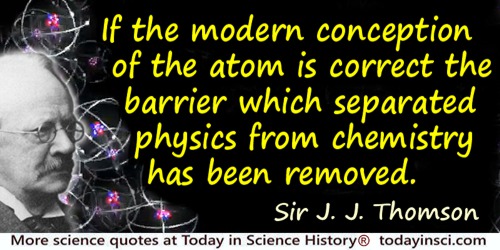
If the modern conception of the atom is correct the barrier which separated physics from chemistry has been removed.
The Electron in Chemistry (1923), Preface.
If the world may be thought of as a certain definite quantity of force and as a certain definite number of centers of force—and every other representation remains indefinite and therefore useless—it follows that, in the great dice game of existence, it must pass through calculable number of combinations. In infinite time, every possible combination would at some time or another be realized; more: it would be realized an infinite number of times. And since between every combination and its next recurrence all other possible combinations would have to take place, and each of these combination conditions of the entire sequence of combinations in the same series, a circular movement of absolutely identical series is thus demonstrated: the world as a circular movement that has already repeated itself infinitely often and plays its game in infinitum. This conception is not simply a mechanistic conception; for if it were that, it would not condition an infinite recurrence of identical cases, but a final state. Because the world has not reached this, mechanistic theory must be considered an imperfect and merely provisional hypothesis.
The Will to Power (Notes written 1883-1888), book 4, no. 1066. Trans. W. Kaufmann and R. J. Hollingdale and ed. W. Kaufmann (1968), 549.
If there were some solitary or feral man, the passions of the soul would be sufficient for him; by them he would be conformed to things in order that he might have knowledge of them. But because man is naturally political and social, there is need for one man to make his conceptions known to others, which is done with speech. So significant speech was needed if men were to live together. Which is why those of different tongues do not easily live together.
Sententia super libri Perihermeneias (Commentary on Aristotle’s On Interpretation) [1270-1271], Book I, lesson 2, number 2, trans. R. McInerny, quoted in R. McInerny (ed.) Thomas Aquinas, Selected Writings (1998), 460.
In consequence of Darwin's reformed Theory of Descent, we are now in a position to establish scientifically the groundwork of a non-miraculous history of the development of the human race. ... If any person feels the necessity of conceiving the coming into existence of this matter as the work of a supernatural creative power, of the creative force of something outside of matter, we have nothing to say against it. But we must remark, that thereby not even the smallest advantage is gained for a scientific knowledge of nature. Such a conception of an immaterial force, which as the first creates matter, is an article of faith which has nothing whatever to do with human science.
In Ernst Haeckel and E. Ray Lankester (trans.), The History of Creation (1880), Vol. 1, 6-9.
In every case the awakening touch has been the mathematical spirit, the attempt to count, to measure, or to calculate. What to the poet or the seer may appear to be the very death of all his poetry and all his visions—the cold touch of the calculating mind,—this has proved to be the spell by which knowledge has been born, by which new sciences have been created, and hundreds of definite problems put before the minds and into the hands of diligent students. It is the geometrical figure, the dry algebraical formula, which transforms the vague reasoning of the philosopher into a tangible and manageable conception; which represents, though it does not fully describe, which corresponds to, though it does not explain, the things and processes of nature: this clothes the fruitful, but otherwise indefinite, ideas in such a form that the strict logical methods of thought can be applied, that the human mind can in its inner chamber evolve a train of reasoning the result of which corresponds to the phenomena of the outer world.
In A History of European Thought in the Nineteenth Century (1896), Vol. 1, 314.
In experimenting on the arc, my aim was not so much to add to the large number of isolated facts that had already been discovered, as to form some idea of the bearing of these upon one another, and thus to arrive at a clear conception of what takes place in each part of the arc and carbons at every moment. The attempt to correlate all the known phenomena, and to bind them together into one consistent whole, led to the deduction of new facts, which, when duly tested by experiment, became parts of the growing body, and, themselves, opened up fresh questions, to be answered in their turn by experiment.
In The Electric Arc (1902), Preface, iii. Ayrton described the growth of her published work on the electric arc, from a series of articles in The Electrician in 1895-6, to the full book, which “has attained to its present proportions almost with the growth of an organic body.”
In general the position as regards all such new calculi is this That one cannot accomplish by them anything that could not be accomplished without them. However, the advantage is, that, provided such a calculus corresponds to the inmost nature of frequent needs, anyone who masters it thoroughly is able—without the unconscious inspiration of genius which no one can command—to solve the respective problems, yea, to solve them mechanically in complicated cases in which, without such aid, even genius becomes powerless. Such is the case with the invention of general algebra, with the differential calculus, and in a more limited region with Lagrange’s calculus of variations, with my calculus of congruences, and with Möbius’s calculus. Such conceptions unite, as it were, into an organic whole countless problems which otherwise would remain isolated and require for their separate solution more or less application of inventive genius.
Letter (15 May 1843) to Schumacher, collected in Carl Friedrich Gauss Werke (1866), Vol. 8, 298, as translated in Robert Édouard Moritz, Memorabilia Mathematica; Or, The Philomath's Quotation-book (1914), 197-198. From the original German, “Überhaupt verhält es sich mit allen solchen neuen Calculs so, dass man durch sie nichts leisten kann, was nicht auch ohne sie zu leisten wäre; der Vortheil ist aber der, dass, wenn ein solcher Calcul dem innersten Wesen vielfach vorkommender Bedürfnisse correspondirt, jeder, der sich ihn ganz angeeignet hat, auch ohne die gleichsam unbewussten Inspirationen des Genies, die niemand erzwingen kann, die dahin gehörigen Aufgaben lösen, ja selbst in so verwickelten Fällen gleichsam mechanisch lösen kann, wo ohne eine solche Hülfe auch das Genie ohnmächtig wird. So ist es mit der Erfindung der Buchstabenrechnung überhaupt; so mit der Differentialrechnung gewesen; so ist es auch (wenn auch in partielleren Sphären) mit Lagranges Variationsrechnung, mit meiner Congruenzenrechnung und mit Möbius' Calcul. Es werden durch solche Conceptionen unzählige Aufgaben, die sonst vereinzelt stehen, und jedesmal neue Efforts (kleinere oder grössere) des Erfindungsgeistes erfordern, gleichsam zu einem organischen Reiche.”
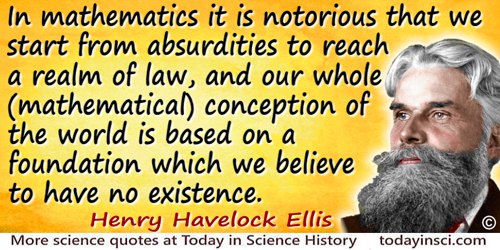
In mathematics it is notorious that we start from absurdities to reach a realm of law, and our whole (mathematical) conception of the world is based on a foundation which we believe to have no existence.
In The Dance of Life (1923), 86.
In order that the facts obtained by observation and experiment may be capable of being used in furtherance of our exact and solid knowledge, they must be apprehended and analysed according to some Conceptions which, applied for this purpose, give distinct and definite results, such as can be steadily taken hold of and reasoned from.
Philosophy of the Inductive Sciences (1840), Vol. 2, 205.
In our century the conceptions substitution and substitution group, transformation and transformation group, operation and operation group, invariant, differential invariant and differential parameter, appear more and more clearly as the most important conceptions of mathematics.
In Lapziger Berichte, No. 47 (1896), 261.
In scientific study, or, as I prefer to phrase it, in creative scholarship, the truth is the single end sought; all yields to that. The truth is supreme, not only in the vague mystical sense in which that expression has come to be a platitude, but in a special, definite, concrete sense. Facts and the immediate and necessary inductions from facts displace all pre-conceptions, all deductions from general principles, all favourite theories. Previous mental constructions are bowled over as childish play-structures by facts as they come rolling into the mind. The dearest doctrines, the most fascinating hypotheses, the most cherished creations of the reason and of the imagination perish from a mind thoroughly inspired with the scientific spirit in the presence of incompatible facts. Previous intellectual affections are crushed without hesitation and without remorse. Facts are placed before reasonings and before ideals, even though the reasonings and the ideals be more beautiful, be seemingly more lofty, be seemingly better, be seemingly truer. The seemingly absurd and the seemingly impossible are sometimes true. The scientific disposition is to accept facts upon evidence, however absurd they may appear to our pre-conceptions.
The Ethical Functions of Scientific Study: An Address Delivered at the Annual Commencement of the University of Michigan, 28 June 1888, 7-8.
In the conception of a machine or the product of a machine there is a point where one may leave off for parsimonious reasons, without having reached aesthetic perfection; at this point perhaps every mechanical factor is accounted for, and the sense of incompleteness is due to the failure to recognize the claims of the human agent. Aesthetics carries with it the implications of alternatives between a number of mechanical solutions of equal validity; and unless this awareness is present at every stage of the process … it is not likely to come out with any success in the final stage of design.
From 'The Esthetic Assimilation of the Machine', Technics and Civilization (1934), 349.
In the realm of science all attempts to find any evidence of supernatural beings, of metaphysical conceptions, as God, immortality, infinity, etc., thus far have failed, and if we are honest we must confess that in science there exists no God, no immortality, no soul or mind as distinct from the body.
In 'Religion and Modern Science', The Christian Register (16 Nov 1922), 101, 1089. The article is introduced as “the substance of an address to the Laymen’s League in All Soul’s Church (5 Nov 1922).
In the twenties the late Dr. Glenn Frank, an eminent social scientist, developed a new statement of the scientific code, which has been referred to as the “Five Fingers of the Scientific Method.” It may be outlined as follows: find the facts; filter the facts; focus the facts; face the facts; follow the facts. The facts or truths are found by experimentation; the motivation is material. The facts are filtered by research into the literature; the motivation is material. The facts are focused by the publication of results; again the motivation is material. Thus the first three-fifths of the scientific method have a material motivation. It is about time scientists acknowledge that there is more to the scientific convention than the material aspect. Returning to the fourth and fifth fingers of Dr. Frank's conception of the scientific method, the facts should be faced by the proper interpretation of them for society. In other words, a scientist must assume social responsibility for his discoveries, which means that he must have a moral motivation. Finally, in the fifth definition of the scientific method, the facts are to be followed by their proper application to everyday life in society, which means moral motivation through responsibility to society.
From 'Scientists and Society', American Scientist (Jul 1954), 42, No. 3, 495.
In this communication I wish first to show in the simplest case of the hydrogen atom (nonrelativistic and undistorted) that the usual rates for quantization can be replaced by another requirement, in which mention of “whole numbers” no longer occurs. Instead the integers occur in the same natural way as the integers specifying the number of nodes in a vibrating string. The new conception can be generalized, and I believe it touches the deepest meaning of the quantum rules.
'Quantisierung als Eigenwertproblem', Annalen der Physik (1926), 79, 361. Trans. Walter Moore, Schrödinger: Life and Thought (1989), 200-2.
Infinite space cannot be conceived by anybody; finite but unbounded space is difficult to conceive but not impossible. … [We] are using a conception of space which must have originated a million years ago and has become rather firmly imbedded in human thought. But the space of Physics ought not to be dominated by this creation of the dawning mind of an enterprising ape."
In The Nature of the Physical World (1929), 80-81.
It follows from the theory of relativity that mass and energy are both different manifestations of the same thing—a somewhat unfamiliar conception for the average man. Furthermore E=MC2, in which energy is put equal to mass multiplied with the square of the velocity of light, showed that a very small amount of mass may be converted into a very large amount of energy... the mass and energy were in fact equivalent.
As expressed in the Einstein film, produced by Nova Television (1979). Quoted in Alice Calaprice, The Quotable Einstein (1996), 183.
It has been asserted … that the power of observation is not developed by mathematical studies; while the truth is, that; from the most elementary mathematical notion that arises in the mind of a child to the farthest verge to which mathematical investigation has been pushed and applied, this power is in constant exercise. By observation, as here used, can only be meant the fixing of the attention upon objects (physical or mental) so as to note distinctive peculiarities—to recognize resemblances, differences, and other relations. Now the first mental act of the child recognizing the distinction between one and more than one, between one and two, two and three, etc., is exactly this. So, again, the first geometrical notions are as pure an exercise of this power as can be given. To know a straight line, to distinguish it from a curve; to recognize a triangle and distinguish the several forms—what are these, and all perception of form, but a series of observations? Nor is it alone in securing these fundamental conceptions of number and form that observation plays so important a part. The very genius of the common geometry as a method of reasoning—a system of investigation—is, that it is but a series of observations. The figure being before the eye in actual representation, or before the mind in conception, is so closely scrutinized, that all its distinctive features are perceived; auxiliary lines are drawn (the imagination leading in this), and a new series of inspections is made; and thus, by means of direct, simple observations, the investigation proceeds. So characteristic of common geometry is this method of investigation, that Comte, perhaps the ablest of all writers upon the philosophy of mathematics, is disposed to class geometry, as to its method, with the natural sciences, being based upon observation. Moreover, when we consider applied mathematics, we need only to notice that the exercise of this faculty is so essential, that the basis of all such reasoning, the very material with which we build, have received the name observations. Thus we might proceed to consider the whole range of the human faculties, and find for the most of them ample scope for exercise in mathematical studies. Certainly, the memory will not be found to be neglected. The very first steps in number—counting, the multiplication table, etc., make heavy demands on this power; while the higher branches require the memorizing of formulas which are simply appalling to the uninitiated. So the imagination, the creative faculty of the mind, has constant exercise in all original mathematical investigations, from the solution of the simplest problems to the discovery of the most recondite principle; for it is not by sure, consecutive steps, as many suppose, that we advance from the known to the unknown. The imagination, not the logical faculty, leads in this advance. In fact, practical observation is often in advance of logical exposition. Thus, in the discovery of truth, the imagination habitually presents hypotheses, and observation supplies facts, which it may require ages for the tardy reason to connect logically with the known. Of this truth, mathematics, as well as all other sciences, affords abundant illustrations. So remarkably true is this, that today it is seriously questioned by the majority of thinkers, whether the sublimest branch of mathematics,—the infinitesimal calculus—has anything more than an empirical foundation, mathematicians themselves not being agreed as to its logical basis. That the imagination, and not the logical faculty, leads in all original investigation, no one who has ever succeeded in producing an original demonstration of one of the simpler propositions of geometry, can have any doubt. Nor are induction, analogy, the scrutinization of premises or the search for them, or the balancing of probabilities, spheres of mental operations foreign to mathematics. No one, indeed, can claim preeminence for mathematical studies in all these departments of intellectual culture, but it may, perhaps, be claimed that scarcely any department of science affords discipline to so great a number of faculties, and that none presents so complete a gradation in the exercise of these faculties, from the first principles of the science to the farthest extent of its applications, as mathematics.
In 'Mathematics', in Henry Kiddle and Alexander J. Schem, The Cyclopedia of Education, (1877.) As quoted and cited in Robert Édouard Moritz, Memorabilia Mathematica; Or, The Philomath’s Quotation-book (1914), 27-29.
It is easy to obtain confirmations, or verifications, for nearly every theory—if we look for confirmations. Confirmations should count only if they are the result of risky predictions... A theory which is not refutable by any conceivable event is non-scientific. Irrefutability is not a virtue of a theory (as people often think) but a vice. Every genuine test of a theory is an attempt to falsify it, or refute it.
Conjectures and Refutations: The Growth of Scientific Knowledge (1963), 36.
It is interesting to note how many fundamental terms which the social sciences are trying to adopt from physics have as a matter of historical fact originated in the social field. Take, for instance, the notion of cause. The Greek aitia or the Latin causa was originally a purely legal term. It was taken over into physics, developed there, and in the 18th century brought back as a foreign-born kind for the adoration of the social sciences. The same is true of the concept of law of nature. Originally a strict anthropomorphic conception, it was gradually depersonalized or dehumanized in the natural sciences and then taken over by the social sciences in an effort to eliminate final causes or purposes from the study of human affairs. It is therefore not anomalous to find similar transformations in the history of such fundamental concepts of statistics as average and probability. The concept of average was developed in the Rhodian laws as to the distribution of losses in maritime risks. After astronomers began to use it in correcting their observations, it spread to other physical sciences; and the prestige which it thus acquired has given it vogue in the social field. The term probability, as its etymology indicates, originates in practical and legal considerations of probing and proving.
The Statistical View of Nature (1936), 327-8.
It is often said that experiments should be made without preconceived ideas. That is impossible. Not only would it make every experiment fruitless, but even if we wished to do so, it could not be done. Every man has his own conception of the world, and this he cannot so easily lay aside. We must, example, use language, and our language is necessarily steeped in preconceived ideas. Only they are unconscious preconceived ideas, which are a thousand times the most dangerous of all.
Science and Hypothesis (1902), trans. W.J.G. (1905), 143.
It is the nature of an hypothesis, when once a man has conceived it, that it assimilates every thing to itself, as proper nourishment; and, from the first moment of your begetting it, it generally grows the stronger by every thing you see, hear, read, or understand.
The Life and Opinions of Tristram Shandy Gentleman (1759-67), Penguin edition (1997), 121-122.
It is the symbolic language of mathematics only which has yet proved sufficiently accurate and comprehensive to demand familiarity with this conception of an inverse process.
In 'The Symbol of Division', Symbolic Logic (1894), 74, footnote.
It is true that I am the father [of the H-bomb] in the biological sense that I performed a necessary function and let nature take its course. After that a child had to be born. It might he robust or it might be stillborn, but something had to be born. The process of conception was by no means a pleasure: it was filled with difficulty and anxiety….
As quoted in Robert Coughlan, 'Dr. Edward Teller’s Magnificent Obsession', Life (6 Sep 1954), 72.
It would be foolish to give credit to Euclid for pangeometrical conceptions; the idea of geometry deifferent from the common-sense one never occurred to his mind. Yet, when he stated the fifth postulate, he stood at the parting of the ways. His subconscious prescience is astounding. There is nothing comperable to it in the whole history of science.
Ancient Science And Modern Civilization (1954, 1959), 28. In George Edward Martin, The Foundations of Geometry and the Non-Euclidean Plane (1982), 130.
Just as a physicist has to examine the telescope and galvanometer with which he is working; has to get a clear conception of what he can attain with them, and how they may deceive him; so, too, it seemed to me necessary to investigate likewise the capabilities of our power of thought.
'An Autobiographical Sketch' (1891). Trans. E. Atkinson, Popular Lectures on Scientific Subjects, Second Series, New Edition (1895), 284-5.
Let him look at that dazzling light hung aloft as an eternal lamp to lighten the universe; let him behold the earth, a mere dot compared with the vast circuit which that orb describes, and stand amazed to find that the vast circuit itself is but a very fine point compared with the orbit traced by the stars as they roll their course on high. But if our vision halts there, let imagination pass beyond; it will fail to form a conception long before Nature fails to supply material. The whole visible world is but an imperceptible speck in the ample bosom of Nature. No notion comes near it. Though we may extend our thought beyond imaginable space, yet compared with reality we bring to birth mere atoms. Nature is an infinite sphere whereof the centre is everywhere, the circumference nowhere. In short, imagination is brought to silence at the thought, and that is the most perceptible sign of the all-power of God.
Let man reawake and consider what he is compared with the reality of things; regard himself lost in this remote corner of Nature; and from the tiny cell where he lodges, to wit the Universe, weigh at their true worth earth, kingdoms, towns, himself. What is a man face to face with infinity?
Let man reawake and consider what he is compared with the reality of things; regard himself lost in this remote corner of Nature; and from the tiny cell where he lodges, to wit the Universe, weigh at their true worth earth, kingdoms, towns, himself. What is a man face to face with infinity?
Pensées (1670), Section 1, aphorism 43. In H. F. Stewart (ed.), Pascal’s Pensées (1950), 19.
Let us now declare the means whereby our understanding can rise to knowledge without fear of error. There are two such means: intuition and deduction. By intuition I mean not the varying testimony of the senses, nor the deductive judgment of imagination naturally extravagant, but the conception of an attentive mind so distinct and so clear that no doubt remains to it with regard to that which it comprehends; or, what amounts to the same thing, the self-evidencing conception of a sound and attentive mind, a conception which springs from the light of reason alone, and is more certain, because more simple, than deduction itself. …
It may perhaps be asked why to intuition we add this other mode of knowing, by deduction, that is to say, the process which, from something of which we have certain knowledge, draws consequences which necessarily follow therefrom. But we are obliged to admit this second step; for there are a great many things which, without being evident of themselves, nevertheless bear the marks of certainty if only they are deduced from true and incontestable principles by a continuous and uninterrupted movement of thought, with distinct intuition of each thing; just as we know that the last link of a long chain holds to the first, although we can not take in with one glance of the eye the intermediate links, provided that, after having run over them in succession, we can recall them all, each as being joined to its fellows, from the first up to the last. Thus we distinguish intuition from deduction, inasmuch as in the latter case there is conceived a certain progress or succession, while it is not so in the former; … whence it follows that primary propositions, derived immediately from principles, may be said to be known, according to the way we view them, now by intuition, now by deduction; although the principles themselves can be known only by intuition, the remote consequences only by deduction.
It may perhaps be asked why to intuition we add this other mode of knowing, by deduction, that is to say, the process which, from something of which we have certain knowledge, draws consequences which necessarily follow therefrom. But we are obliged to admit this second step; for there are a great many things which, without being evident of themselves, nevertheless bear the marks of certainty if only they are deduced from true and incontestable principles by a continuous and uninterrupted movement of thought, with distinct intuition of each thing; just as we know that the last link of a long chain holds to the first, although we can not take in with one glance of the eye the intermediate links, provided that, after having run over them in succession, we can recall them all, each as being joined to its fellows, from the first up to the last. Thus we distinguish intuition from deduction, inasmuch as in the latter case there is conceived a certain progress or succession, while it is not so in the former; … whence it follows that primary propositions, derived immediately from principles, may be said to be known, according to the way we view them, now by intuition, now by deduction; although the principles themselves can be known only by intuition, the remote consequences only by deduction.
In Rules for the Direction of the Mind, Philosophy of Descartes. [Torrey] (1892), 64-65.
Mathematical knowledge is not—as all Cambridge men are surely aware—the result of any special gift. It is merely the development of those conceptions of form and number which every human being possesses; and any person of average intellect can make himself a fair mathematician if he will only pay continuous attention; in plain English, think enough about the subject.
'Science', a lecture delivered at the Royal Institution. The Works of Charles Kingsley (1880), 241.
Mathematics … above all other subjects, makes the student lust after knowledge, fills him, as it were, with a longing to fathom the cause of things and to employ his own powers independently; it collects his mental forces and concentrates them on a single point and thus awakens the spirit of individual inquiry, self-confidence and the joy of doing; it fascinates because of the view-points which it offers and creates certainty and assurance, owing to the universal validity of its methods. Thus, both what he receives and what he himself contributes toward the proper conception and solution of a problem, combine to mature the student and to make him skillful, to lead him away from the surface of things and to exercise him in the perception of their essence. A student thus prepared thirsts after knowledge and is ready for the university and its sciences. Thus it appears, that higher mathematics is the best guide to philosophy and to the philosophic conception of the world (considered as a self-contained whole) and of one’s own being.
In Die Mathematik die Fackelträgerin einer neuen Zeit (1889), 40. As translated in Robert Édouard Moritz, Memorabilia Mathematica; Or, The Philomath’s Quotation-book (1914), 49.
Mathematics gives the young man a clear idea of demonstration and habituates him to form long trains of thought and reasoning methodically connected and sustained by the final certainty of the result; and it has the further advantage, from a purely moral point of view, of inspiring an absolute and fanatical respect for truth. In addition to all this, mathematics, and chiefly algebra and infinitesimal calculus, excite to a high degree the conception of the signs and symbols—necessary instruments to extend the power and reach of the human mind by summarizing an aggregate of relations in a condensed form and in a kind of mechanical way. These auxiliaries are of special value in mathematics because they are there adequate to their definitions, a characteristic which they do not possess to the same degree in the physical and mathematical [natural?] sciences.
There are, in fact, a mass of mental and moral faculties that can be put in full play only by instruction in mathematics; and they would be made still more available if the teaching was directed so as to leave free play to the personal work of the student.
There are, in fact, a mass of mental and moral faculties that can be put in full play only by instruction in mathematics; and they would be made still more available if the teaching was directed so as to leave free play to the personal work of the student.
In 'Science as an Instrument of Education', Popular Science Monthly (1897), 253.
Mathematics is that form of intelligence in which we bring the objects of the phenomenal world under the control of the conception of quantity.
Offered as a provision definition, in 'The Departments of Mathematics, and their Mutual Relations', Journal of Speculative Philosophy (Apr 1871), 5, No. 2, 164.
Mathematics—in a strict sense—is the abstract science which investigates deductively the conclusions implicit in the elementary conceptions of spatial and numerical relations.
In New English Dictionary as quoted in Robert Édouard Moritz, Memorabilia Mathematica; Or, The Philomath’s Quotation-Book (1914), 5. This definition of Mathematics appeared in Oxford English Dictionary (1933), as “The abstract science which investigates deductively the conclusions implicit in the elementary conceptions of spatial and numerical relations, and which includes as its main divisions geometry, arithmetic, and algebra.”
Modern physics has changed nothing in the great classical disciplines of, for instance, mechanics, optics, and heat. Only the conception of hitherto unexplored regions, formed prematurely from a knowledge of only certain parts of the world, has undergone a decisive transformation. This conception, however, is always decisive for the future course of research.
In Philosophical Problems of Nuclear Science: Eight Lectures (1952), 18.
No one must think that Newton’s great creation can be overthrown in any real sense by this [Theory of Relativity] or by any other theory. His clear and wide ideas will for ever retain their significance as the foundation on which our modern conceptions of physics have been built.
In 'Time, Space, and Gravitation', The Times (28 Nov 1919). Excerpted in David E. Rowe and Robert J. Schulmann, Einstein on Politics: His Private Thoughts and Public Stands on Nationalism, Zionism, War, Peace, and the Bomb (2007), 104.
Nor can it be supposed that the diversity of chemical structure and process stops at the boundary of the species, and that within that boundary, which has no real finality, rigid uniformity reigns. Such a conception is at variance with any evolutionary conception of the nature and origin of species. The existence of chemical individuality follows of necessity from that of chemical specificity, but we should expect the differences between individuals to be still more subtle and difficult of detection. Indications of their existence are seen, even in man, in the various tints of skin, hair, and eyes, and in the quantitative differences in those portions of the end-products of metabolism which are endogenous and are not affected by diet, such as recent researches have revealed in increasing numbers. Even those idiosyncrasies with regard to drugs and articles of food which are summed up in the proverbial saying that what is one man's meat is another man's poison presumably have a chemical basis.
Inborn Errors of Metabolism: The Croonian Lectures delivered before the Royal College of Physicians of London, in June, 1908 (1909), 2-3.
Not greatly moved with awe am I
To learn that we may spy
Five thousand firmaments beyond our own.
The best that's known
Of the heavenly bodies does them credit small.
View'd close, the Moon's fair ball
Is of ill objects worst,
A corpse in Night's highway, naked, fire-scarr'd, accurst;
And now they tell
That the Sun is plainly seen to boil and burst
Too horribly for hell.
So, judging from these two,
As we must do,
The Universe, outside our living Earth,
Was all conceiv'd in the Creator's mirth,
Forecasting at the time Man's spirit deep,
To make dirt cheap.
Put by the Telescope!
Better without it man may see,
Stretch'd awful in the hush'd midnight,
The ghost of his eternity.
To learn that we may spy
Five thousand firmaments beyond our own.
The best that's known
Of the heavenly bodies does them credit small.
View'd close, the Moon's fair ball
Is of ill objects worst,
A corpse in Night's highway, naked, fire-scarr'd, accurst;
And now they tell
That the Sun is plainly seen to boil and burst
Too horribly for hell.
So, judging from these two,
As we must do,
The Universe, outside our living Earth,
Was all conceiv'd in the Creator's mirth,
Forecasting at the time Man's spirit deep,
To make dirt cheap.
Put by the Telescope!
Better without it man may see,
Stretch'd awful in the hush'd midnight,
The ghost of his eternity.
'The Two Deserts' (1880-85). Poems, Introduction Basil Champneys (1906), 302.
Nothing has afforded me so convincing a proof of the unity of the Deity as these purely mental conceptions of numerical and mathematical science which have been by slow degrees vouchsafed to man, and are still granted in these latter times by the Differential Calculus, now superseded by the Higher Algebra, all of which must have existed in that sublimely omniscient Mind from eternity.
Martha Somerville (ed.) Personal Recollections, from Early Life to Old Age, of Mary Somerville (1874), 140-141.
Of all the conceptions of the human mind from unicorns to gargoyles to the hydrogen bomb perhaps the most fantastic is the black hole: a hole in space with a definite edge over which anything can fall and nothing can escape; a hole with a gravitational field so strong that even light is caught and held in its grip; a hole that curves space and warps time.
In Cosmology + I: Readings from Scientific American (1977), 63.
One could not be a successful scientist without realizing that, in contrast to the popular conception supported by newspapers and mothers of scientists, a goodly number of scientists are not only narrow-minded and dull, but also just stupid.
The Double Helix: A Personal Account of the Discovery of the Structure of DNA (1968, 1998), 14.
Our attention will focus on the institutional context of technological innovation rather than … individual inventors, for the actual course of work that leads to the conception and use of technology always involves a group that has worked for a considerable period of time on the basic idea before success is achieved.
In The Social Context of Innovation: Bureaucrats, Families, and Heroes in the Early Industrial Revolution as Foreseen in Bacon’s New Atlantis (1982, 2003), 3.
Our conception of a native protein molecule (showing specific properties) is the following. The molecule consists of one polypeptide chain which continues without interruption throughout the molecule (or, in certain cases, of two or more such chains); this chain is folded into a uniquely defined configuration, in which it is held by hydrogen bonds between the peptide nitrogen and oxygen atoms and also between the free amino and carboxyl groups of the diamino and dicarboxyl amino acid residues.
The characteristic specific properties of native proteins we attribute to their uniquely defined configurations.
The denatured protein molecule we consider to be characterized by the absence of a uniquely defined configuration.
[Co-author with American chemist, Linus Pauling (1901-94)]
The characteristic specific properties of native proteins we attribute to their uniquely defined configurations.
The denatured protein molecule we consider to be characterized by the absence of a uniquely defined configuration.
[Co-author with American chemist, Linus Pauling (1901-94)]
'On the Structure of Native, Denatured, and Coagulated Proteins', Proceedings of the National Academy of Sciences of the United States of America (1936), 22, 442-3.
Psychologists must cease to be content with the sterile and narrow conception of their science as the science of consciousness, and must boldly assert its claim to be the positive science of mind in all its aspects and modes of functining, or, as I would prefer to say, the positive science of conduct or behavior.
An Introduction to Social Psychology (1928), 13.
Science aims at constructing a world which shall be symbolic of the world of commonplace experience. It is not at all necessary that every individual symbol that is used should represent something in common experience or even something explicable in terms of common experience. The man in the street is always making this demand for concrete explanation of the things referred to in science; but of necessity he must be disappointed. It is like our experience in learning to read. That which is written in a book is symbolic of a story in real life. The whole intention of the book is that ultimately a reader will identify some symbol, say BREAD, with one of the conceptions of familiar life. But it is mischievous to attempt such identifications prematurely, before the letters are strung into words and the words into sentences. The symbol A is not the counterpart of anything in familiar life.
From 'Introduction', The Nature of the Physical World (1928), xiii.
Science can have a purifying effect on religion, freeing it from beliefs of a pre-scientific age and helping us to a truer conception of God. At the same time, I am far from believing that science will ever give us the answers to all our questions.
Essay 'Science Will Never Give Us the Answers to All Our Questions', collected in Henry Margenau, and Roy Abraham Varghese (eds.), Cosmos, Bios, Theos (1992), 65.
Science derives its conclusions by the laws of logic from our sense perceptions, Thus it does not deal with the real world, of which we know nothing, but with the world as it appears to our senses. … All our sense perceptions are limited by and attached to the conceptions of time and space. … Modern physics has come to the same conclusion in the relativity theory, that absolute space and absolute time have no existence, but, time and space exist only as far as things or events fill them, that is, are forms of sense perception.
In 'Religion and Modern Science', The Christian Register (16 Nov 1922), 101, 1089. The article is introduced as “the substance of an address to the Laymen’s League in All Soul’s Church (5 Nov 1922).
Science seems to me to teach in the highest and strongest manner the great truth which is embodied in the Christian conception of entire surrender to the will of God. Sit down before fact as a little child, be prepared to give up every preconceived notion, follow humbly wherever and to whatever abysses nature leads, or you shall learn nothing. I have only begun to learn content and peace of mind since I have resolved at all risks to do this.
Letter to Charles Kingsley (23 Sep 1860). In L. Huxley, The Life and Letters of Thomas Henry Huxley (1903), Vol. 1, 316.
Science, like life, feeds on its own decay. New facts burst old rules; then newly divined conceptions bind old and new together into a reconciling law.
The Will to Believe and Other Essays in Popular Philosophy, 1910
Surely it must be admitted that if the conceptions of Physics are presented to the beginner in erroneous language, there is a danger that in many instances these conceptions will never be properly acquired. And is not accurate language as cheap as inaccurate?
A paper read at the Association for the Improvement of Geometrical Teaching (19 Jan 1889), 'The Vices of our Scientific Education', in Nature (6 Jun 1889), 40, 128.
Surely something is wanting in our conception of the universe. We know positive and negative electricity, north and south magnetism, and why not some extra terrestrial matter related to terrestrial matter, as the source is to the sink. … Worlds may have formed of this stuff, with element and compounds possessing identical properties with our own, indistinguishable from them until they are brought into each other’s vicinity. … Astronomy, the oldest and most juvenile of the sciences, may still have some surprises in store. May anti-matter be commended to its care! … Do dreams ever come true?
[Purely whimsical prediction long before the 1932 discovery of the positron, the antiparticle of the electron.]
[Purely whimsical prediction long before the 1932 discovery of the positron, the antiparticle of the electron.]
'Potential Matter—A Holiday Dream', Letter to the Editor, Nature (18 Aug 1898), 58, No. 1503, 367. Quoted in Edward Robert Harrison, Cosmology: the Science of the Universe (2000), 433.
Taking a very gloomy view of the future of the human race, let us suppose that it can only expect to survive for two thousand millions years longer, a period about equal to the past age of the earth. Then, regarded as a being destined to live for three-score years and ten, humanity although it has been born in a house seventy years old, is itself only three days old. But only in the last few minutes has it become conscious that the whole world does not centre round its cradle and its trappings, and only in the last few ticks of the clock has any adequate conception of the size of the external world dawned upon it. For our clock does not tick seconds, but years; its minutes are the lives of men.
EOS: Or the Wider Aspects of Cosmology (1928), 12-3.
The Archetypal idea was manifested in the flesh, under divers such modifications, upon this planet, long prior to the existence of those animal species that actually exemplify it. To what natural laws or secondary causes the orderly succession and progression of such organic phaenomena may have been committed we as yet are ignorant. But if, without derogation of the Divine power, we may conceive the existence of such ministers, and personify them by the term 'Nature,' we learn from the past history of our globe that she has advanced with slow and stately steps, guided by the archetypal light, amidst the wreck of worlds, from the first embodiment of the Vertebrate idea under its old Ichthyic vestment, until it became arrayed in the glorious garb of the Human form.
On the Nature of Limbs (1849), 86.
The astronomers with all their hypotheses give us no satisfying or abiding conception of the Universe. We are left as bewildered as ever.
In 'Tea', The Doctor’s Notebook (1937), 224.
The combination in time and space of all these thoughtful conceptions [of Nature] exhibits not only thought, it shows also premeditation, power, wisdom, greatness, prescience, omniscience, providence. In one word, all these facts in their natural connection proclaim aloud the One God, whom man may know, adore, and love; and Natural History must in good time become the analysis of the thoughts of the Creator of the Universe….
In Essay on Classification (1851), 205.
The conception of correspondence plays a great part in modern mathematics. It is the fundamental notion in the science of order as distinguished from the science of magnitude. If the older mathematics were mostly dominated by the needs of mensuration, modern mathematics are dominated by the conception of order and arrangement. It may be that this tendency of thought or direction of reasoning goes hand in hand with the modern discovery in physics, that the changes in nature depend not only or not so much on the quantity of mass and energy as on their distribution or arrangement.
In History of European Thought in the Nineteenth Century (1903), Vol. 2, 736.
The conception of objective reality … has thus evaporated … into the transparent clarity of mathematics that represents no longer the behavior of particles but rather our knowledge of this behavior.
In 'The Representation of Nature in Contemporary Physics', Daedalus (1958), 87, 95-108. As cited in Karl Popper, Quantum Theory and the Schism in Physics (1992), 85.
The conception of the atom stems from the concepts of subject and substance: there has to be “something” to account for any action. The atom is the last descendant of the concept of the soul.
Epigraph, without citation, in Edward C. Stark, Essential Chemistry (1979), 97. Also without citation in Isaac Asimov and Jason A. Shulman (eds.), Isaac Asimov’s Book of Science and Nature Quotations (1988), 32. Webmaster has not yet been able to identify the primary source (can you help?).
The conception that antibodies, which should protect against disease, are also responsible for the disease, sounds at first absurd. This has as its basis the fact that we are accustomed to see in disease only the harm done to the organism and to see in the antibodies solely antitoxic [protective] substances. One forgets too easily that the disease represents only a stage in the development of immunity, and that the organism often attains the advantage of immunity only by means of disease. ... Serum sickness represents, so to speak, an unnatural (artificial) form of disease.
C. von Pirquet and B. Schick, Die Serumkrankheit (1906), trans B. Schick, Serum Sickness (1951), 119-20.
The desire for guidance, love, and support prompts men to form the social or moral conception of God. This is the God of Providence, who protects, disposes, rewards, and punishes; the God who, according to the limits of the believer’s outlook, loves and cherishes the life of the tribe or of the human race, or even or life itself; the comforter in sorrow and unsatisfied longing; he who preserves the souls of the dead. This is the social or moral conception of God.
…...
The enthusiasm of Sylvester for his own work, which manifests itself here as always, indicates one of his characteristic qualities: a high degree of subjectivity in his productions and publications. Sylvester was so fully possessed by the matter which for the time being engaged his attention, that it appeared to him and was designated by him as the summit of all that is important, remarkable and full of future promise. It would excite his phantasy and power of imagination in even a greater measure than his power of reflection, so much so that he could never marshal the ability to master his subject-matter, much less to present it in an orderly manner.
Considering that he was also somewhat of a poet, it will be easier to overlook the poetic flights which pervade his writing, often bombastic, sometimes furnishing apt illustrations; more damaging is the complete lack of form and orderliness of his publications and their sketchlike character, … which must be accredited at least as much to lack of objectivity as to a superfluity of ideas. Again, the text is permeated with associated emotional expressions, bizarre utterances and paradoxes and is everywhere accompanied by notes, which constitute an essential part of Sylvester’s method of presentation, embodying relations, whether proximate or remote, which momentarily suggested themselves. These notes, full of inspiration and occasional flashes of genius, are the more stimulating owing to their incompleteness. But none of his works manifest a desire to penetrate the subject from all sides and to allow it to mature; each mere surmise, conceptions which arose during publication, immature thoughts and even errors were ushered into publicity at the moment of their inception, with utmost carelessness, and always with complete unfamiliarity of the literature of the subject. Nowhere is there the least trace of self-criticism. No one can be expected to read the treatises entire, for in the form in which they are available they fail to give a clear view of the matter under contemplation.
Sylvester’s was not a harmoniously gifted or well-balanced mind, but rather an instinctively active and creative mind, free from egotism. His reasoning moved in generalizations, was frequently influenced by analysis and at times was guided even by mystical numerical relations. His reasoning consists less frequently of pure intelligible conclusions than of inductions, or rather conjectures incited by individual observations and verifications. In this he was guided by an algebraic sense, developed through long occupation with processes of forms, and this led him luckily to general fundamental truths which in some instances remain veiled. His lack of system is here offset by the advantage of freedom from purely mechanical logical activity.
The exponents of his essential characteristics are an intuitive talent and a faculty of invention to which we owe a series of ideas of lasting value and bearing the germs of fruitful methods. To no one more fittingly than to Sylvester can be applied one of the mottos of the Philosophic Magazine:
“Admiratio generat quaestionem, quaestio investigationem investigatio inventionem.”
Considering that he was also somewhat of a poet, it will be easier to overlook the poetic flights which pervade his writing, often bombastic, sometimes furnishing apt illustrations; more damaging is the complete lack of form and orderliness of his publications and their sketchlike character, … which must be accredited at least as much to lack of objectivity as to a superfluity of ideas. Again, the text is permeated with associated emotional expressions, bizarre utterances and paradoxes and is everywhere accompanied by notes, which constitute an essential part of Sylvester’s method of presentation, embodying relations, whether proximate or remote, which momentarily suggested themselves. These notes, full of inspiration and occasional flashes of genius, are the more stimulating owing to their incompleteness. But none of his works manifest a desire to penetrate the subject from all sides and to allow it to mature; each mere surmise, conceptions which arose during publication, immature thoughts and even errors were ushered into publicity at the moment of their inception, with utmost carelessness, and always with complete unfamiliarity of the literature of the subject. Nowhere is there the least trace of self-criticism. No one can be expected to read the treatises entire, for in the form in which they are available they fail to give a clear view of the matter under contemplation.
Sylvester’s was not a harmoniously gifted or well-balanced mind, but rather an instinctively active and creative mind, free from egotism. His reasoning moved in generalizations, was frequently influenced by analysis and at times was guided even by mystical numerical relations. His reasoning consists less frequently of pure intelligible conclusions than of inductions, or rather conjectures incited by individual observations and verifications. In this he was guided by an algebraic sense, developed through long occupation with processes of forms, and this led him luckily to general fundamental truths which in some instances remain veiled. His lack of system is here offset by the advantage of freedom from purely mechanical logical activity.
The exponents of his essential characteristics are an intuitive talent and a faculty of invention to which we owe a series of ideas of lasting value and bearing the germs of fruitful methods. To no one more fittingly than to Sylvester can be applied one of the mottos of the Philosophic Magazine:
“Admiratio generat quaestionem, quaestio investigationem investigatio inventionem.”
In Mathematische Annalen (1898), 50, 155-160. As translated in Robert Édouard Moritz, Memorabilia Mathematica; Or, The Philomath’s Quotation-book (1914), 176-178.
The genotypic constitution of a gamete or a zygote may be parallelized with a complicated chemico-physical structure. This reacts exclusively in consequence of its realized state, but not in consequence of the history of its creation. So it may be with the genotypical constitution of gametes and zygotes: its history is without influence upon its reactions, which are determined exclusively by its actual nature. The genotype-conception is thus an 'ahistoric' view of the reactions of living beings—of course only as far as true heredity is concerned. This view is an analog to the chemical view, as already pointed out; chemical compounds have no compromising ante-act, H2O is always H2O, and reacts always in the same manner, whatsoever may be the 'history' of its formation or the earlier states of its elements. I suggest that it is useful to emphasize this 'radical' ahistoric genotype-conception of heredity in its strict antagonism to the transmission—or phenotype-view.
'The Genotype Conception of Heredity', The American Naturalist (1911), 45, 129.
The genuine spirit of Mathesis is devout. No intellectual pursuit more truly leads to profound impressions of the existence and attributes of a Creator, and to a deep sense of our filial relations to him, than the study of these abstract sciences. Who can understand so well how feeble are our conceptions of Almighty Power, as he who has calculated the attraction of the sun and the planets, and weighed in his balance the irresistible force of the lightning? Who can so well understand how confused is our estimate of the Eternal Wisdom, as he who has traced out the secret laws which guide the hosts of heaven, and combine the atoms on earth? Who can so well understand that man is made in the image of his Creator, as he who has sought to frame new laws and conditions to govern imaginary worlds, and found his own thoughts similar to those on which his Creator has acted?
In 'The Imagination in Mathematics', North American Review, 85, 226.
The goddess of learning is fabled to have sprung full-grown from the brain of Zeus, but it is seldom that a scientific conception is born in its final form, or owns a single parent. More often it is the product of a series of minds, each in turn modifying the ideas of those that came before, and providing material for those that came after. The electron is no exception.
'Electronic Waves', Nobel Lecture (7 Jun 1938). Nobel Lectures: Physics 1922-1941 (1998), 397.
The Grand Cañon of the Colorado is a great innovation in modern ideas of scenery, and in our conceptions of the grandeur, beauty, and power of nature. As with all great innovations it is not to be comprehended in a day or a week, nor even in a month. It must be dwelt upon and studied, and the study must comprise the slow acquisition of the meaning and spirit of that marvelous scenery which characterizes the Plateau Country, and of which the great chasm is the superlative manifestation.
In Tertiary History of the Grand Cañon District: With Atlas (1882), Vol. 2, 141.
The great object of all knowledge is to enlarge and purify the soul, to fill the mind with noble contemplations, to furnish a refined pleasure, and to lead our feeble reason from the works of nature up to its great Author and Sustainer. Considering this as the ultimate end of science, no branch of it can surely claim precedence of Astronomy. No other science furnishes such a palpable embodiment of the abstractions which lie at the foundation of our intellectual system; the great ideas of time, and space, and extension, and magnitude, and number, and motion, and power. How grand the conception of the ages on ages required for several of the secular equations of the solar system; of distances from which the light of a fixed star would not reach us in twenty millions of years, of magnitudes compared with which the earth is but a foot-ball; of starry hosts—suns like our own—numberless as the sands on the shore; of worlds and systems shooting through the infinite spaces.
Oration at Inauguration of the Dudley Astronomical Observatory, Albany (28 Jul 1856). Text published as The Uses of Astronomy (1856), 36.
The great object of human thought is the discovery of truth or, in other words, to arrive at conceptions and expressions of things which shall agree with the nature of things.
Lecture (c. 1840s) on 'Geology and Revelation', in Joseph Henry and Arthur P. Molella et al. (eds.), A Scientist in American Life: Essays and Lectures of Joseph Henry (1980), 24.
The great truths with which it [mathematics] deals, are clothed with austere grandeur, far above all purposes of immediate convenience or profit. It is in them that our limited understandings approach nearest to the conception of that absolute and infinite, towards which in most other things they aspire in vain. In the pure mathematics we contemplate absolute truths, which existed in the divine mind before the morning stars sang together, and which will continue to exist there, when the last of their radiant host shall have fallen from heaven. They existed not merely in metaphysical possibility, but in the actual contemplation of the supreme reason. The pen of inspiration, ranging all nature and life for imagery to set forth the Creator’s power and wisdom, finds them best symbolized in the skill of the surveyor. "He meted out heaven as with a span;" and an ancient sage, neither falsely nor irreverently, ventured to say, that “God is a geometer”.
In Orations and Speeches (1870), Vol. 3, 614.
The idealistic tinge in my conception of the physical world arose out of mathematical researches on the relativity theory. In so far as I had any earlier philosophical views, they were of an entirely different complexion.
From the beginning I have been doubtful whether it was desirable for a scientist to venture so far into extra-scientific territory. The primary justification for such an expedition is that it may afford a better view of his own scientific domain.
From the beginning I have been doubtful whether it was desirable for a scientist to venture so far into extra-scientific territory. The primary justification for such an expedition is that it may afford a better view of his own scientific domain.
From 'Introduction', The Nature of the Physical World (1928), vi.
The influence of modern physics goes beyond technology. It extends to the realm of thought and culture where it has led to a deep revision in man’s conception of the universe and his relation to it
In The Tao of Physics (1975), 17.
The inherent unpredictability of future scientific developments—the fact that no secure inference can be drawn from one state of science to another—has important implications for the issue of the limits of science. It means that present-day science cannot speak for future science: it is in principle impossible to make any secure inferences from the substance of science at one time about its substance at a significantly different time. The prospect of future scientific revolutions can never be precluded. We cannot say with unblinking confidence what sorts of resources and conceptions the science of the future will or will not use. Given that it is effectively impossible to predict the details of what future science will accomplish, it is no less impossible to predict in detail what future science will not accomplish. We can never confidently put this or that range of issues outside “the limits of science”, because we cannot discern the shape and substance of future science with sufficient clarity to be able to say with any assurance what it can and cannot do. Any attempt to set “limits” to science—any advance specification of what science can and cannot do by way of handling problems and solving questions—is destined to come to grief.
The Limits of Science (1984), 102-3.
The law is this: that each of our leading conceptions—each branch of our knowledge—passes successively through three different theoretical conditions: the Theological, or fictitious; the Metaphysical, or abstract; and the Scientific, or positive.
The Positive Philosophy, trans. Harriet Martineau (1853), Vol. 1, 1-2.
The mathematical conception is, from its very nature, abstract; indeed its abstractness is usually of a higher order than the abstractness of the logician.
In 'Mathematics', Encyclopedia Britannica (1883), Vol. 15, 636.
The most important distinction between the two qualities [talent and genius] is this: one, in conception, follows mechanical processes; the other, vital. Talent feebly conceives objects with the senses and understanding; genius, fusing all its powers together in the alembic of an impassioned imagination, clutches every thing in the concrete, conceives objects as living realities, gives body to spiritual abstractions, and spirit to bodily appearances, and like
“A gate of steel
Fronting the sun, receives and renders back
His figure and his heat!”
“A gate of steel
Fronting the sun, receives and renders back
His figure and his heat!”
In 'Genius', Wellman’s Miscellany (Dec 1871), 4, No. 6, 203. The quotation at the end is from Wiliam Shakespeare, Tr. & Cress. iii, 3.
The opinion appears to be gaining ground that this very general conception of functionality, born on mathematical ground, is destined to supersede the narrower notion of causation, traditional in connection with the natural sciences. As an abstract formulation of the idea of determination in its most general sense, the notion of functionality includes and transcends the more special notion of causation as a one-sided determination of future phenomena by means of present conditions; it can be used to express the fact of the subsumption under a general law of past, present, and future alike, in a sequence of phenomena. From this point of view the remark of Huxley that Mathematics “knows nothing of causation” could only be taken to express the whole truth, if by the term “causation” is understood “efficient causation.” The latter notion has, however, in recent times been to an increasing extent regarded as just as irrelevant in the natural sciences as it is in Mathematics; the idea of thorough-going determinancy, in accordance with formal law, being thought to be alone significant in either domain.
In Presidential Address British Association for the Advancement of Science, Sheffield, Section A,
Nature (1 Sep 1910), 84, 290.
The origin of an adaptive structure and the purposes it comes to fulfill are only chance combinations. Purposefulness is a very human conception for usefulness. It is usefulness looked at backwards. Hard as it is to imagine, inconceivably hard it may appear to many, that there is no direct relation between the origin of useful variations and the ends they come to serve, yet the modern zoologist takes his stand as a man of science on this ground. He may admit in secret to his father confessor, the metaphysician, that his poor intellect staggers under such a supposition, but he bravely carries forward his work of investigation along the only lines that he has found fruitful.
'For Darwin', The Popular Science Monthly (1909), 74, 380.
The picture of scientific method drafted by modern philosophy is very different from traditional conceptions. Gone is the ideal of a universe whose course follows strict rules, a predetermined cosmos that unwinds itself like an unwinding clock. Gone is the ideal of the scientist who knows the absolute truth. The happenings of nature are like rolling dice rather than like revolving stars; they are controlled by probability laws, not by causality, and the scientist resembles a gambler more than a prophet. He can tell you only his best posits—he never knows beforehand whether they will come true. He is a better gambler, though, than the man at the green table, because his statistical methods are superior. And his goal is staked higher—the goal of foretelling the rolling dice of the cosmos. If he is asked why he follows his methods, with what title he makes his predictions, he cannot answer that he has an irrefutable knowledge of the future; he can only lay his best bets. But he can prove that they are best bets, that making them is the best he can do—and if a man does his best, what else can you ask of him?
The Rise of Scientific Philosophy (1951, 1973), 248-9. Collected in James Louis Jarrett and Sterling M. McMurrin (eds.), Contemporary Philosophy: A Book of Readings (1954), 376.
The Principle of Uncertainty is a bad name. In science or outside of it we are not uncertain; our knowledge is merely confined, within a certain tolerance. We should call it the Principle of Tolerance. And I propose that name in two senses: First, in the engineering sense, science has progressed, step by step, the most successful enterprise in the ascent of man, because it has understood that the exchange of information between man and nature, and man and man, can only take place with a certain tolerance. But second, I also use the word, passionately, about the real world. All knowledge, all information between human beings, can only be exchanged within a play of tolerance. And that is true whether the exchange is in science, or in literature, or in religion, or in politics, or in any form of thought that aspires to dogma. It’s a major tragedy of my lifetime and yours that scientists were refining, to the most exquisite precision, the Principle of Tolerance, and turning their backs on the fact that all around them, tolerance was crashing to the ground beyond repair. The Principle of Uncertainty or, in my phrase, the Principle of Tolerance, fixed once for all the realization that all knowledge is limited. It is an irony of history that at the very time when this was being worked out there should rise, under Hitler in Germany and other tyrants elsewhere, a counter-conception: a principle of monstrous certainty. When the future looks back on the 1930s it will think of them as a crucial confrontation of culture as I have been expounding it, the ascent of man, against the throwback to the despots’ belief that they have absolute certainty. It is said that science will dehumanize people and turn them into numbers. That is false: tragically false. Look for yourself. This is the concentration camp and crematorium at Auschwitz. This is where people were turned into numbers. Into this pond were flushed the ashes of four million people. And that was not done by gas. It was done by arrogance. It was done by dogma. It was done by ignorance. When people believe that they have absolute knowledge, with no test in reality this is how they behave. This is what men do when they aspire to the knowledge of gods. Science is a very human form of knowledge. We are always at the brink of the known; we always feel forward for what is to be hoped. Every judgment in science stands on the edge of error, and is personal. Science is a tribute to what we can know although we are fallible. In the end, the words were said by Oliver Cromwell: “I beseech you, in the bowels of Christ: Think it possible you may be mistaken.” We have to cure ourselves of the itch for absolute knowledge and power. We have to close the distance between the push-button order and the human act. We have to touch people. [Referring to Heisenberg’s Uncertainty Principle.]
'Knowledge or Certainty,' episode 11, The Ascent of Man (1972), BBC TV series.
The prohibition of science would be contrary to the Bible, which in hundreds of places teaches us how the greatness and the glory of God shine forth marvelously in all His works, and is to be read above all in the open book of the heavens. And let no one believe that the reading of the most exalted thoughts which are inscribed upon these pages is to be accomplished through merely staring up at the radiance of the stars. There are such profound secrets and such lofty conceptions that the night labors and the researches of hundreds and yet hundreds of the keenest minds, in investigations extending over thousands of years would not penetrate them, and the delight of the searching and finding endures forever.
As stated by William H. Hobbs, 'The Making of Scientific Theories,' Address of the president of Michigan Academy of Science at the Annual Meeting, Ann Arbor (28 Mar 1917) in Science (11 May 1917), N.S. 45, No. 1167, 443.
The publication of the Darwin and Wallace papers in 1858, and still more that of the 'Origin' in 1859, had the effect upon them of the flash of light, which to a man who has lost himself in a dark night, suddenly reveals a road which, whether it takes him straight home or not, certainly goes his way. That which we were looking for, and could not find, was a hypothesis respecting the origin of known organic forms, which assumed the operation of no causes but such as could be proved to be actually at work. We wanted, not to pin our faith to that or any other speculation, but to get hold of clear and definite conceptions which could be brought face to face with facts and have their validity tested. The 'Origin' provided us with the working hypothesis we sought.
'On the Reception of the Origin of Species'. In F. Darwin (ed.), The Life and Letters of Charles Darwin, Including an Autobiographical Chapter (1888), Vol 2, 197.
The respect which in all ages and countries has ever been paid to inventors seems, indeed, to rest on something more profound than mere gratitude for the benefits which they have been the means of conferring on mankind; and to imply, if it does not express, a consciousness that by the grand and original conceptions of their minds they approach somewhat more nearly than their fellows to the qualities and pre-eminence of a higher order of being.
The Origin and Progress of the Mechanical Inventions of James Watt (1854), Vol.1, 2.
The results have exhibited one striking feature which has been frequently emphasized, namely that at high pressures all twelve liquids become more nearly like each other. This suggests that it might be useful in developing a theory of liquids to arbitrarily construct a 'perfect liquid' and to discuss its properties. Certainly the conception of a 'perfect gas' has been of great service in the kinetic theory of gases; and the reason is that all actual gases approximate closely to the 'perfect gas.' In the same way, at high pressures all liquids approximate to one and the same thing, which may be called by analogy the 'perfect liquid.' It seems to offer at least a promising line of attack to discuss the properties of this 'perfect liquid,' and then to invent the simplest possible mechanism to explain them.
'Thermodynamic Properties of Twelve Liquids Between 200 and 800 and up to 1200 KGM. Per Sq. Cm.', Memoirs of the American Academy of Arts and Sciences, 1913, 49, 113.
The rudest numerical scales, such as that by which the mineralogists distinguish different degrees of hardness, are found useful. The mere counting of pistils and stamens sufficed to bring botany out of total chaos into some kind of form. It is not, however, so much from counting as from measuring, not so much from the conception of number as from that of continuous quantity, that the advantage of mathematical treatment comes. Number, after all, only serves to pin us down to a precision in our thoughts which, however beneficial, can seldom lead to lofty conceptions, and frequently descend to pettiness.
On the Doctrine of Chances, with Later Reflections (1878), 61-2.
The scientific theorist is not to be envied. For Nature, or more precisely experiment, is an inexorable and not very friendly judge of his work. It never says “Yes” to a theory. In the most favorable cases it says “Maybe,” and in the great majority of cases simply “No.” If an experiment agrees with a theory it means for the latter “Maybe,” and if it does not agree it means “No.” Probably every theory will someday experience its “No”—most theories, soon after conception.
In Albert Einstein: The Human Side by Helen Dukas and Banesh Hoffmann (1979).
The scientist is not much given to talking of the riddle of the universe. “Riddle” is not a scientific term. The conception of a riddle is “something which can he solved.” And hence the scientist does not use that popular phrase. We don’t know the why of anything. On that matter we are no further advanced than was the cavedweller. The scientist is contented if he can contribute something toward the knowledge of what is and how it is.
As quoted in 'Electricity Will Keep The World From Freezing Up', New York Times (12 Nov 1911), SM4.
The second great channel through which the impulse towards the control of procreation for the elevation of the race is entering into practical life is by the general adoption, by the educated—of methods for the prevention of conception except when conception is deliberately desired.
Studies in the Psychology of Sex (1913), Vol. 4, 588.
The self-fulfilling prophecy is, in the beginning, a false definition of the situation evoking a new behavior which makes the originally false conception come true. The specious validity of the self-fulfilling prophecy perpetuates a reign of error. For the prophet will cite the actual course of events as proof that he was right from the very beginning. … Such are the perversities of social logic.
In article, 'The Self-Fulfilling Prophecy', The Antioch Review (Summer 1948), 8, No. 2, 195-196. Included as Chap. 7 of Social Theory and Social Structure (1949), 181-195. Note: Merton coined the expression “self-fulfilling prophecy.”
The sight of day and night, and the months and the revolutions of the years, have created number and have given us conception of time, and the power of inquiring about the nature of the Universe.
— Plato
In Timaeus section 47a, as translated by Benjamin Jowett (1871, 1959), 29. The translation by W.R.M. Lamb gives this passage as “The vision of day and night and of months and circling years has created the art of number and has given us not only the notion of Time but also means of research into the nature of the Universe.”
The simplicity of nature is not to be measured by that of our conceptions. Infinitely varied in its effects, nature is simple only in its causes, and its economy consists in producing a great number of phenomena, often very complicated, by means of a small number of general laws.
Philosophical Essay on Probabilities (1825), trans. Andrew I. Dale (1995), book 1, chap. 14.
The study of abstract science … offers unbounded fields of pleasurable, healthful, and ennobling exercise to the restless intellect of man, expanding his powers and enlarging his conceptions of the wisdom, the energy, and the beneficence of the Great Ruler of the universe
In 'Report of the Secretary', Annual Report of the Board of Regents of the Smithsonian Institution for 1859 (1860), 17.
The symbol A is not the counterpart of anything in familiar life. To the child the letter A would seem horribly abstract; so we give him a familiar conception along with it. “A was an Archer who shot at a frog.” This tides over his immediate difficulty; but he cannot make serious progress with word-building so long as Archers, Butchers, Captains, dance round the letters. The letters are abstract, and sooner or later he has to realise it. In physics we have outgrown archer and apple-pie definitions of the fundamental symbols. To a request to explain what an electron really is supposed to be we can only answer, “It is part of the A B C of physics”.
In Introduction to The Nature of the Physical World (1928), xiv.
The terror of the thunderstorm led primitive man to the conception of a Supreme Being whose attribute was the thunderbolt. But when Franklin brought the lightning from the clouds and showed it to he a mere electric spark, when we learned to make the lightning harmless by the lightning-rod, and when finally we harnessed electricity to do our work, naturally our reverence for the thrower of the thunderbolt decayed. So the gods of experience vanished.
In 'Religion and Modern Science', The Christian Register (16 Nov 1922), 101, 1089. The article is introduced as “the substance of an address to the Laymen’s League in All Soul’s Church (5 Nov 1922).
The true mathematician is always a good deal of an artist, an architect, yes, of a poet. Beyond the real world, though perceptibly connected with it, mathematicians have intellectually created an ideal world, which they attempt to develop into the most perfect of all worlds, and which is being explored in every direction. None has the faintest conception of this world, except he who knows it.
In Jahresbericht der Deutschen Mathematiker Vereinigung, 32, 381. As translated in Robert Édouard Moritz, Memorabilia Mathematica; Or, The Philomath’s Quotation-Book (1914), 184.
The truly scientific mind is altogether unafraid of the new, and while having no mercy for ideas which have served their turn or shown their uselessness, it will not grudge to any unfamiliar conception its moment of full and friendly attention, hoping to expand rather than to minimize what small core of usefulness it may happen to contain.
In 'Observation and Experiment and Their Use in the Medical Sciences', British Medical Journal (1930), 2, 129-34. As cited in Edward J. Huth and T.J. Murray, Medicine in Quotations: Views of Health and Disease Through the Ages (2006), 357 and 512.
The two processes by which Science is constructed are the Explication of Conceptions and the Colligation of Facts.
Aphorism 1, 'Aphorisms Concerning Science', The Philosophy of the Inductive Sciences (1840), Vol. 1, xxxvii.
There are very few things of which we can acquire a conception through all five senses.
Aphorism 9 in Notebook B (1768-1771), as translated by R.J. Hollingdale in Aphorisms (1990). Reprinted as The Waste Books (2000), 17.
There is a moral or metaphysical part of nature as well as a physical. A man who denies this is deep in the mire of folly. ’Tis the crown and glory of organic science that it does through final cause, link material and moral; and yet does not allow us to mingle them in our first conception of laws, and our classification of such laws, whether we consider one side of nature or the other. You have ignored this link; and, if I do not mistake your meaning, you have done your best in one or two pregnant cases to break it. Were it possible (which, thank God, it is not) to break it, humanity, in my mind, would suffer a damage that might brutalize it, and sink the human race into a lower grade of degradation than any into which it has fallen since its written records tell us of its history.
Letter to Charles Darwin (Nov 1859). In Charles Darwin and Francis Darwin (ed.), Charles Darwin: His Life Told in an Autobiographical Chapter, and in a Selected Series of His Published Letters (1892), 217.
There was a time when we wanted to be told what an electron is. The question was never answered. No familiar conceptions can be woven around the electron; it belongs to the waiting list.
The Nature Of The Physical World (1928), 290.
This change in the conception of reality is the most profound and the most fruitful that physics has experienced since the time of Newton.
Refering to James Clerk Maxwell's contributions to physics.
Refering to James Clerk Maxwell's contributions to physics.
'Maxwell's Influence on the Development of the Conception of Physical Reality', James Clerk Maxwell: A Commemorative Volume 1831-1931 (1931), 71.
This work should commence with the conception of man, and should describe the nature of the womb, and how the child inhabits it, and in what stage it dwells there, and the manner of its quickening and feeding, and its growth, and what interval there is between one stage of growth and another, and what thing drives it forth from the body of the mother, and for what reason it sometimes emerges from the belly of its mother before the due time.
'Anatomy', in The Notebooks of Leonardo da Vinci, trans. E. MacCurdy (1938), Vol. 1, 139.
Through the Middle Ages and down to the late eighteenth century, many philosophers, most men of science, and, indeed, most educated men, were to accept without question—the conception of the universe as a Great Chain of Being, composed of an immense, or—by the strict but seldom rigorously applied logic of the principle of continuity—of an infinite number of links ranging in hierarchical order from the meagerest kind of existents, which barely escape non-existence, through 'every possible' grade up to the ens perfectissimum—or, in a somewhat more orthodox version, to the highest possible kind of creature, between which and the Absolute Being the disparity was assumed to be infinite—every one of them differing from that immediately above and that immediately below it by the 'least possible' degree of difference.
The Great Chain of Being (1936), 59.
To ask what qualities distinguish good from routine scientific research is to address a question that should be of central concern to every scientist. We can make the question more tractable by rephrasing it, “What attributes are shared by the scientific works which have contributed importantly to our understanding of the physical world—in this case the world of living things?” Two of the most widely accepted characteristics of good scientific work are generality of application and originality of conception. . These qualities are easy to point out in the works of others and, of course extremely difficult to achieve in one’s own research. At first hearing novelty and generality appear to be mutually exclusive, but they really are not. They just have different frames of reference. Novelty has a human frame of reference; generality has a biological frame of reference. Consider, for example, Darwinian Natural Selection. It offers a mechanism so widely applicable as to be almost coexistent with reproduction, so universal as to be almost axiomatic, and so innovative that it shook, and continues to shake, man’s perception of causality.
In 'Scientific innovation and creativity: a zoologist’s point of view', American Zoologist (1982), 22, 230.
To discover a Conception of the mind which will justly represent a train of observed facts is, in some measure, a process of conjecture, ... and the business of conjecture is commonly conducted by calling up before our minds several suppositions, selecting that one which most agrees with what we know of the observed facts. Hence he who has to discover the laws of nature may have to invent many suppositions before he hits upon the right one; and among the endowments which lead to his success, we must reckon that fertility of invention which ministers to him such imaginary schemes, till at last he finds the one which conforms to the true order of nature.
Philosophy of the Inductive Sciences (1847), Vol. 2, 54.
To say that mind is a product or function of protoplasm, or of its molecular changes, is to use words to which we can attach no clear conception. You cannot have, in the whole, what does not exist in any of the parts; and those who argue thus should put forth a definite conception of matter, with clearly enunciated properties, and show, that the necessary result of a certain complex arrangement of the elements or atoms of that matter, will be the production of self-consciousness. There is no escape from this dilemma—either all matter is conscious, or consciousness is something distinct from matter, and in the latter case, its presence in material forms is a proof of the existence of conscious beings, outside of, and independent of, what we term matter. The foregoing considerations lead us to the very important conclusion, that matter is essentially force, and nothing but force; that matter, as popularly understood, does not exist, and is, in fact, philosophically inconceivable. When we touch matter, we only really experience sensations of resistance, implying repulsive force; and no other sense can give us such apparently solid proofs of the reality of matter, as touch does. This conclusion, if kept constantly present in the mind, will be found to have a most important bearing on almost every high scientific and philosophical problem, and especially on such as relate to our own conscious existence.
In 'The Limits of Natural Selection as Applied to Man', last chapter of Contributions to the Theory of Natural Selection (1870), 365-366.
Tolstoi explains somewhere in his writings why, in his opinion, “Science for Science's sake” is an absurd conception. We cannot know all the facts since they are infinite in number. We must make a selection ... guided by utility ... Have we not some better occupation than counting the number of lady-birds in existence on this planet?
In Science and Method (1914, 2003), 15
Until its results have gone through the painful process of publication, preferably in a refereed journal of high standards, scientific research is just play. Publication is an indispensable part of science. “Publish or perish” is not an indictment of the system of academia; it is a partial prescription for creativity and innovation. Sustained and substantial publication favors creativity. Novelty of conception has a large component of unpredictability. ... One is often a poor judge of the relative value of his own creative efforts. An artist’s ranking of his own works is rarely the same as that of critics or of history. Most scientists have had similar experiences. One’s supply of reprints for a pot-boiler is rapidly exhausted, while a major monograph that is one’s pride and joy goes unnoticed. The strategy of choice is to increase the odds favoring creativity by being productive.
In 'Scientific innovation and creativity: a zoologist’s point of view', American Zoologist (1982), 22, 233-234.
Vision - It reaches beyond the thing that is, into the conception of what can be. Imagination gives you the picture. Vision gives you the impulse to make the picture your own.
…...
We live in a changing universe, and few things are changing faster than our conception of it.
…...
We, however, maintain … that all animals whatsoever, even the viviparous, and man himself not excepted, are produced from ova; that the first conception, from which the foetus proceeds in all, is an ovum of one description or another, as well as the seeds of all kinds of plants.
As translated by Robert Willis in The Works of William Harvey (1847), Vol. 7, 170. Harvey’s doctrine, given herein, has been summarized in later literature as: omne vivum ex ovo omnia, (all life from an egg). Also see the quote “Ex ova omnia,” elsewhere on this webpage.
What I may attempt is to dispel the feeling that in using the eye of the body or the eye of the soul, and incorporating what is thereby revealed in our conception of reality, we are doing something irrational and disobeying the leading of truth which as scientists we are pledged to serve.
Swarthmore Lecture (1929) at Friends’ House, London, printed in Science and the Unseen World (1929), 49.
What nature demands of us is not a quantum theory or a wave theory, instead nature demands of us a synthesis both conceptions, which, to be sure, until now still exceeds the powers of thought of the physicists.
Concluding remark in Lecture (23 Feb 1927) to Mathematisch-physikalische Arbeitsgemeinschaft, University of Berlin, reported in 'Theoretisches und Experimentelles zur Frage der Lichtentstehung', Zeitschr. f. ang. Chem., 40, 546. As translated and cited in Arthur I. Miller, Sixty-Two Years of Uncertainty: Historical, Philosophical, and Physical Inquiries into the Foundations of Quantum Mechanics (2012), 89 & 108.
What renders a problem definite, and what leaves it indefinite, may best be understood from mathematics. The very important idea of solving a problem within limits of error is an element of rational culture, coming from the same source. The art of totalizing fluctuations by curves is capable of being carried, in conception, far beyond the mathematical domain, where it is first learnt. The distinction between laws and co-efficients applies in every department of causation. The theory of Probable Evidence is the mathematical contribution to Logic, and is of paramount importance.
In Education as a Science (1879), 151-152.
When Hitler arrived in 1933, the tradition of scholarship in Germany was destroyed, almost overnight. … Europe was no longer hospitable to the imagination—and not just the scientific imagination. A whole conception of culture was in retreat…. Silence fell, as after the trial of Galileo. The great men went out into a threatened world. Max Born. Erwin Schrödinger. Albert Einstein. Sigmund Freud. Thomas Mann. Bertolt Brecht. Arturo Toscanini. Bruno Walter. Marc Chagall. Enrico Fermi. Leo Szilard….
In Ch. 11, 'Knowledge or Certainty', The Ascent of Man, (1973), 367.
When one ponders on the tremendous journey of evolution over the past three billion years or so, the prodigious wealth of structures it has engendered, and the extraordinarily effective teleonomic performances of living beings from bacteria to man, one may well find oneself beginning to doubt again whether all this could conceiveably be the product of an enormous lottery presided over by natural selection, blindly picking the rare winners from among numbers drawn at random. [Nevertheless,] a detailed review of the accumulated modern evidence [shows] that this conception alone is compatible with the facts.
In Jacques Monod and Austryn Wainhouse (trans.), Chance and Necessity: An Essay on the Natural Philosophy of Modern Biology (1971), 138.
When the greatest of American logicians, speaking of the powers that constitute the born geometrician, had named Conception, Imagination, and Generalization, he paused. Thereupon from one of the audience there came the challenge, “What of reason?” The instant response, not less just than brilliant, was: “Ratiocination—that is but the smooth pavement on which the chariot rolls.”
In Lectures on Science, Philosophy and Art (1908), 31.
Without the sensuous faculty no object would be given to us, without understanding no object would be thought. Thoughts without content are void, intuitions without conceptions, blind.
Critique of Pure Reason, translation by John Miller Dow Meiklejohn (1899), 45.
 In science it often happens that scientists say, 'You know that's a really good argument; my position is mistaken,' and then they would actually change their minds and you never hear that old view from them again. They really do it. It doesn't happen as often as it should, because scientists are human and change is sometimes painful. But it happens every day. I cannot recall the last time something like that happened in politics or religion.
(1987) --
In science it often happens that scientists say, 'You know that's a really good argument; my position is mistaken,' and then they would actually change their minds and you never hear that old view from them again. They really do it. It doesn't happen as often as it should, because scientists are human and change is sometimes painful. But it happens every day. I cannot recall the last time something like that happened in politics or religion.
(1987) --