Common Sense Quotes (140 quotes)
[I shall not] discuss scientific method, but rather the methods of scientists. We proceed by common sense and ingenuity. There are no rules, only the principles of integrity and objectivity, with a complete rejection of all authority except that of fact.
In Science in the Making (1957), 9.
Il senso comune è un giudizio senz'alcuna riflessione, comunemente sentito da tutto un ordine, da tutto un popolo, da tutta una Nazione, o da tutto il Gener Umano.
Common sense is judgment without reflection, shared by an entire class, an entire nation, or the entire human race.
Common sense is judgment without reflection, shared by an entire class, an entire nation, or the entire human race.
In The New Science (3rd ed., 1744), Book 1, Para. 142, as translated by Thomas Goddard Bergin and Max Harold Fisch, The New Science of Giambattista Vico (1948), 57.
Le bon sense n’est pas tel.
Common sense is not such.
Common sense is not such.
From script for the character Le Marquis, in play, Homme du Jour (1732), Act 1, Scene 5, Line 255. Translated by Webmaster using Google Translate. English title would be The Man of the Day. This quote represents both early 18th century and foreign language use of the well-known saying that common sense is not (common).
Nature, in the common sense, refers to essences unchanged by man; space, the air, the river, the leaf.
From 'Introduction' in his first published book (at first, anonymously), Nature (1836), 7.
~~[Doubtful attribution]~~ Today’s common sense is yesterday’s science.
Found stated without source, in Marcia Stubbs and Sylvan Barnet The Little, Brown Reader (1989), 806. [Webmaster, so far, has found no source, lacks additional examples, and doubts its attribution. (Can you help?) Meanwhile, as an aphorism it is interesting enough to find it a place here—and to add the caution to regard it as anonymous unless authenticated.]
~~[Not in his own words]~~ Common sense is the collection of prejudices acquired by age eighteen.
Attributed, no citation found, and probably not by Einstein. For example, it is found without citation in Albert Einstein, Jerry Mayer and John P. Holms, Bite-size Einstein (1996), 25. Listed under heading 'Probably Not by Einstein' by Alice Calaprice, The New Quotable Einstein (2005), 294. It probably morphed from a writer’s restatement of how he understood Einstein’s views, expressed in the writer’s own words, without quotation marks as: But as Einstein has pointed out, common sense is actually nothing more than a deposit of prejudices laid down in the mind prior to the age of eighteen. This statement appeared in Lincoln Barnett, 'The Universe and Dr. Einstein', Harper’s Magazine (May 1948), 473. The quoteinvestigator.com site gives more background, with the speculation on how eventually quotation marks crept in, and then propagated that way.
A commonsense interpretation of the facts suggests that a superintellect has monkeyed with physics, as well as with chemistry and biology, and that there are no blind forces worth speaking about in nature. The numbers one calculates from the facts seem to me so overwhelming as to put this conclusion almost beyond question.
In 'The Universe: Past and Present Reflections', Astrophysics and Relativity (1981), 70, 26.
A mathematical argument is, after all, only organized common sense, and it is well that men of science should not always expound their work to the few behind a veil of technical language, but should from time to time explain to a larger public the reasoning which lies behind their mathematical notation.
In The Tides and Kindred Phenomena in the Solar System: The Substance of Lectures Delivered in 1897 at the Lowell Institute, Boston, Massachusetts (1898), Preface, v.
Preface
A plain, reasonable working man supposes, in the old way which is also the common-sense way, that if there are people who spend their lives in study, whom he feeds and keeps while they think for him—then no doubt these men are engaged in studying things men need to know; and he expects of science that it will solve for him the questions on which his welfare, and that of all men, depends. He expects science to tell him how he ought to live: how to treat his family, his neighbours and the men of other tribes, how to restrain his passions, what to believe in and what not to believe in, and much else. And what does our science say to him on these matters?
It triumphantly tells him: how many million miles it is from the earth to the sun; at what rate light travels through space; how many million vibrations of ether per second are caused by light, and how many vibrations of air by sound; it tells of the chemical components of the Milky Way, of a new element—helium—of micro-organisms and their excrements, of the points on the hand at which electricity collects, of X rays, and similar things.
“But I don't want any of those things,” says a plain and reasonable man—“I want to know how to live.”
It triumphantly tells him: how many million miles it is from the earth to the sun; at what rate light travels through space; how many million vibrations of ether per second are caused by light, and how many vibrations of air by sound; it tells of the chemical components of the Milky Way, of a new element—helium—of micro-organisms and their excrements, of the points on the hand at which electricity collects, of X rays, and similar things.
“But I don't want any of those things,” says a plain and reasonable man—“I want to know how to live.”
In 'Modern Science', Essays and Letters (1903), 221-222.
A small overweight of knowledge is often a sore impediment to the movements of common sense.
In The Collected Works of Dr. P.M. Latham (1878), Vol. 2, 388.
Are the humanistic and scientific approaches different? Scientists can calculate the torsion of a skyscraper at the wing-beat of a bird, or 155 motions of the Moon and 500 smaller ones in addition. They move in academic garb and sing logarithms. They say, “The sky is ours”, like priests in charge of heaven. We poor humanists cannot even think clearly, or write a sentence without a blunder, commoners of “common sense”. We never take a step without stumbling; they move solemnly, ever unerringly, never a step back, and carry bell, book, and candle.
Quoting himself in Stargazers and Gravediggers: Memoirs to Worlds in Collision (2012), 212.
Common sense … has the very curious property of being more correct retrospectively than prospectively. It seems to me that one of the principal criteria to be applied to successful science is that its results are almost always obvious retrospectively; unfortunately, they seldom are prospectively. Common sense provides a kind of ultimate validation after science has completed its work; it seldom anticipates what science is going to discover.
Quoted in A. De Reuck, M. Goldsmith and J. Knight (eds.), Decision Making in National Science Policy (1968), 96.
Common sense … is to the judgment what genius is to the understanding.
In Igerne and Other Writings of Arthur Handly Marks (1897), 349.
Common sense … may be thought of as a series of concepts and conceptual schemes which have proved highly satisfactory for the practical uses of mankind. Some of those concepts and conceptual schemes were carried over into science with only a little pruning and whittling and for a long time proved useful. As the recent revolutions in physics indicate, however, many errors can be made by failure to examine carefully just how common sense ideas should be defined in terms of what the experimenter plans to do.
In Science and Common Sense (1951), 32-33.
Common sense always speaks too late. Common sense is the guy who tells you you ought to have had your brakes relined last week before you smashed a front end this week. Common sense is the Monday morning quarterback who could have won the ball game if he had been on the team. But he never is. He’s high up in the stands with a flask on his hip. Common sense is the little man in a grey suit who never makes a mistake in addition. But it’s always somebody else’s money he’s adding up.
In novel, Playback (1958), Chap. 14, 95.
Common Sense and Education: The more you think you have of one, the less you think you need of the other.
Given, without source, as an example of 'Clever Remark', or bon mot, in The Well-Spoken Thesaurus (2011), 109.
Common sense drives us to accept quantum theory in place of classical physics as more consistent with common sense. … When they are inspected, the explanations of classical physics fall apart, and they are seen to be mere superficial delusions, like film-sets.
In Creation Revisited: The Origin of Space, Time and the Universe (1992), 65.
Common sense in an uncommon degree is what the world calls wisdom.
In 'Hacket’s Life of Lord Keeper Williams', notes published in Henry Nelson Coleridge (ed.), The Literary Remains of Samuel Taylor Coleridge (1838), Vol. 3, 186.
Common sense is a fool when it expects fools to act with common sense.
In Letters of Horace Walpole, Earl of Orford, to Sir Horace Mann (31 Jul 1767), Vol. 1, 356.
Common sense is as rare as genius—is the basis of genius and experience is the hands and feet to every enterprise.
In essay, 'Experience', Essays: Second Series (1844), collected in Works of Ralph Waldo Emerson: Essays First and Second Series (1883), 97. A half-century later, Arthur Handly Marks incorporated the quote (without attribution) as “a first-rate article of common sense is as rare as genius”, in his Address (6 Jun 1892), 'Common Sense' at the Commencement of Prior Institute, Jasper, Tennessee, collected in Igerne and Other Writings of Arthur Handly Marks (1897), 348.
Common sense is in spite of, not as the result of, education.
“Anonymous” because although commonly seen attributed to Victor Hugo, the quote cannot be found in his works.
Common sense is not wrong in the view that is meaningful, appropriate and necessary to talk about the large objects of our daily experience …. Common sense is wrong only if it insists that what is familiar must reappear in what is unfamiliar.
In 'Uncommon Sense', collected in J. Robert Oppenheimer, Nicholas Metropolis (ed.) and Gian-Carlo Rota (ed.), Uncommon Sense (1984), 61.
Common sense is only the application of theories which have grown and been formulated unconsciously as result of experience.
From 'For Mans Use of God's Gifts', collected in Robert C. Goodpasture (ed.), Engineers and Ivory Towers (1952), 107.
Common sense is science exactly in so far as it fulfills the ideal of common sense; that is, sees facts as they are, or at any rate, without the distortion of prejudice, and reasons from them in accordance with the dictates of sound judgment. And science is simply common sense at its best, that is, rigidly accurate in observation, and merciless to fallacy in logic.
The Crayfish: an Introduction to the Study of Zoölogy (1880), 2. Excerpted in Popular Science (Apr 1880), 16, 789.
Common Sense is that which judges the things given to it by other senses.
…...
Common sense is that which tells us the world is flat.
As quoted in Samuel Ichiyé Hayakawa, Language in Thought and Action (1939, 1949), 31. Hayakawa clearly specified the quote was “recently defined by Stuart Chase”. Some later sources incorrectly attribute to Hayakawa alone. Others even attribute to Einstein.
Common sense is the favorite daughter of Reason, and altho thare are menny other wimmin more attraktive for a time, thare is nothing but death kan rob common sense ov her buty.
In The Complete Works of Josh Billings (1876), 214.
Common sense is the knack of seeing things as they are, and doing things as they ought to be done.
In Hialmer Day Gould, New Practical Spelling (1905), 13.
Common sense is the knack of seeing things as they are, and doing things as they ought to be done.
Appears in Tryon Edwards (ed.), A Dictionary of Thoughts: Being a Cyclopedia of Laconic Quotations (1891), 77, attributed, without citation, to Calvin Ellis Stowe. However, Webmaster, as yet, has not been able to find any primary source in a work by Stowe. Can you help?
Common sense is the measure of the possible; it is composed of experience and prevision; it is calculation applied to life.
Entry for 26 Dec 1852 in Amiel’s Journal: The Journal Intime of Henri-Frédéric Amiel, trans. Humphry Ward (1893), 34.
Common sense is the most widely shared commodity in the world, for every man is convinced that he is well supplied with it.
Epigraph in Ian Glynn, An Anatomy of Thought: The Origin and Machinery of the Mind (), Chap. 2, 7. A more freely translated version of the Descartes (longer) quote beginning, “Good sense is, of all things among men…” also on the René Descartes Quotes page on this website.
Common sense is the very antipodes of science.
In Systematic Psychology: Prolegomena (1972), 48.
Common sense is, of all kinds, the most uncommon.
In Hialmer Day Gould, New Practical Spelling (1905), 13.
Common sense iz instinkt, and instinkt don’t make enny blunders mutch, no more than a rat duz, in coming out, or going intew a hole, he hits the hole the fust time, and just fills it.
In The Complete Works of Josh Billings (1876), 79.
Common sense iz like biled vittles, it is good right from the pot, and it is good nex day warmed up.
In The Complete Works of Josh Billings (1876), 79.
Common sense kan be improved upon by edukashun—genius kan be too, sum, but not much.
In The Complete Works of Josh Billings (1876), 79.
Common sense needs to be renamed
Cause nowadays it’s rare.
Cause nowadays it’s rare.
From lyrics, 'Jme', on album Blam! (Released 4 Oct 2010).
Common sense, (which, in truth, is very uncommon) is the best sense I know of: abide by it; it will counsel you best.
From Letter (27 Sep 1748, O.S.) to his son, collected in Letters Written by Philip Dormer Stanhope, Earl of Chesterfield, to his son, Philip Stanhope (1777), Vol. 2, 65.
Common sense, the half-truths of a deceitful society, is honored as the honest truths of a frank world.
In Social Amnesia (1975), 25.
Communication of science as subject-matter has so far outrun in education the construction of a scientific habit of mind that to some extent the natural common sense of mankind has been interfered with to its detriment.
Address to Section L, Education, of the American Association for the Advancement of Science, at Boston (1909), 'Science as Subject-Matter and as Method'. Published in Science (28 Jan 1910), N.S. Vol. 31, No. 787, 126.
Consider the very roots of our ability to discern truth. Above all (or perhaps I should say “underneath all”), common sense is what we depend on—that crazily elusive, ubiquitous faculty we all have to some degree or other. … If we apply common sense to itself over and over again, we wind up building a skyscraper. The ground floor of the structure is the ordinary common sense we all have, and the rules for building news floors are implicit in the ground floor itself. However, working it all out is a gigantic task, and the result is a structure that transcends mere common sense.
In Metamagical Themas: Questing for the Essence of Mind and Pattern (1985), 93–94.
Devised with a maximum of erudition and a minimum of common sense.
Aphorism 56 in Notebook D (1773-1775), as translated by R.J. Hollingdale in Aphorisms (1990). Reprinted as The Waste Books (2000), 52.
Do not imagine that mathematics is harsh and crabbed, and repulsive to common sense. It is merely the etherealisation of common sense.
'The Six Gateways of Knowledge', Presidential Address to the Birmingham and Midland Institute, Birmingham (3 Oct 1883). In Popular Lectures and Addresses (1891), Vol. 1, 280.
Does not human decency demand that we study with respect and admiration the great men whose labours laid the foundations of modern science? … Commonsense and emotion, hand in hand, shout derision on anyone so foolish as to raise objections against the study of the history of science.
From Lecture (28 Nov 1957) in the Queen’s University, Belfast, 'Is the Study of its History a Brake on the Progress of Science', printed in Hermethena (1958), 19, 20.
Everybody gets so much information all day long that they lose their common sense.
In 'Reflection on the Atomic Bomb', Yale Poetry Review (Dec 1947). Reprinted in Robert Bartlett Haas (Ed.), Reflection on the Atomic Bomb: Volume One of the Previously Uncollected Writings of Gertrude Stein (1973), Vol. 1.
Experimental science can be thought of as an … extension of common sense.
In Science and Common Sense (1951), 32.
Fine sense and exalted sense are not half as useful as common sense.
'Thoughts On Various Subjects', The Works of Alexander Pope (1806), Vol. 6, 406.
Genius is the whistle of the locomotive, which with steaming shrieks indicates its progress, but common sense is the driving-wheel which moves the train.
In Igerne and Other Writings of Arthur Handly Marks (1897), 348.
Genius iz always in advance ov the times, and makes sum magnificent hits, but the world owes most ov its tributes to good hoss sense.
In The Complete Works of Josh Billings (1876), 79.
Gods are fragile things they may be killed by a whiff of science or a dose of common sense.
In Garry Poole, Judson Poling, MS Debra Poling, Do Science and the Bible Conflict? (), 64.
Good hard-pan sense iz the thing that will wash well, wear well, iron out without wrinkling, and take starch without kracking.
In The Complete Works of Josh Billings (1876), 78.
Good sense, which only is the gift of Heaven,
And though no science, fairly worth the seven.
And though no science, fairly worth the seven.
Moral Essays. Epistle iv. Line 43. In The Works of Alexander Pope (1824), Vol. 5, 385.
Good, old-fashioned common sense iz one ov the hardest things in the world to out-wit, out-argy, or beat in enny way, it iz az honest az a loaf ov good domestik bread, alwus in tune, either hot from the oven or 8 days old.
In The Complete Works of Josh Billings (1876), 78.
Honest investigation is but the application of common sense to the solution of the unknown. Science does not wait on Genius, but is the companion of Industry.
From address (1 Oct 1884), at inauguration of the Corcoran School of Science and Arts, Columbian University, Washington, D.C. Published in 'The Larger Import of Scientific Education', Popular Science Monthly (Feb 1885), 26, 453.
How quaint the way of paradox—
At common sense she gaily mocks.
At common sense she gaily mocks.
In libretto of The Pirates of Penzance, collected in Original Plays (1907), 328.
I am one of those philosophers who have held that that “the Common Sense view of the world” is in certain fundamental features, wholly true.
In 'A Defence of Common Sense', J.H. Muirhead (ed.), Contemporary British Philosophy (1925). Reprinted in Philosophical Papers of George Edward Moore (1959), 44.
I claim that relativity and the rest of modern physics is not complicated. It can be explained very simply. It is only unusual or, put another way, it is contrary to common sense.
In Edward Teller, Wendy Teller and Wilson Talley, Conversations on the Dark Secrets of Physics (1991, 2013), 2.
I do not know why these two expressions, good sense and common sense, are confounded. There is nothing less common than good sense.
From Appendix A, 'Extracts From the Unpublished Writings of Carnot', Reflections on the Motive Power of Heat (1890, 2nd ed. 1897), 208.
I don’t profess to be profound, but I do lay claim to common sense.
Fictional character, Miss Murstone, in 'My Holidays, Especially One Happy Afternoon', David Copperfield (1849-1850, 1878), Chap. 8, 70
I don’t think America can just drill itself out of its current energy situation. We don’t need to destroy the environment to meet our energy needs. We need smart, comprehensive, common-sense approaches that balance the need to increase domestic energy supplies with the need to maximize energy efficiency.
Statement on New Long-Term Energy Solutions (22 Mar 2001). In Bill Adler (ed.), The Wit and Wisdom of Ted Kennedy (2011).
I think, too, that we've got to recognize that where the preservation of a natural resource like the redwoods is concerned, that there is a common sense limit. I mean, if you've looked at a hundred thousand acres or so of trees—you know, a tree is a tree, how many more do you need to look at?
Speech, pandering for support, while candidate for governor of California, to the Western Wood Products Association, San Francisco (12 Mar 1966), opposing expansion of Redwood National Park. Commonly seen paraphrased as “If you’ve seen one redwood tree, you’ve seen them all,” but Reagan did not himself express this wording.
If a man can have only one kind of sense, let him have common sense. If he has that an uncommon sense too, he is not far from genius.
In Hialmer Day Gould, New Practical Spelling (1905), 13.
If common sense has not the brilliancy of the sun, it has the fixity of the stars.
In Hialmer Day Gould, New Practical Spelling (1905), 13.
If elephants didn’t exist, you couldn’t invent one. They belong to a small group of living things so unlikely they challenge credulity and common sense. Compared to them, we are primitive, hanging on to a stubborn, unspecialized, five-fingered state, clever but destructive. They are models of refinement, nature’s archangels, the oldest and largest land mammals, touchstones to our imagination
In Elephantoms: Tracking the Elephant (2002, 2003), 38.
If the question were, “What ought to be the next objective in science?” my answer would be the teaching of science to the young, so that when the whole population grew up there would be a far more general background of common sense, based on a knowledge of the real meaning of the scientific method of discovering truth.
Marion Savin Selections from the Scientific Correspondence of Elihu Thomson (1971), v.
In all spheres of science, art, skill, and handicraft it is never doubted that, in order to master them, a considerable amount of trouble must be spent in learning and in being trained. As regards philosophy, on the contrary, there seems still an assumption prevalent that, though every one with eyes and fingers is not on that account in a position to make shoes if he only has leather and a last, yet everybody understands how to philosophize straight away, and pass judgment on philosophy, simply because he possesses the criterion for doing so in his natural reason.
From Phänomenologie des Geistes (1807) as translated by J.B. Baillie in 'Preface', The Phenomenology of Mind (1910), Vol. 1, 67.
In its famous paradox, the equation of money and excrement, psychoanalysis becomes the first science to state what common sense and the poets have long known—that the essence of money is in its absolute worthlessness.
Life Against Death: the Psychoanalytical Meaning of History (1985), 254.
In practical talk, a man’s common sense means his good judgement, his freedom from eccentricity, his gumption.
In Lecture (1907/1908), 'Pragmatism and Common Sense', collected in 'Lecture 5: Pragmatism and Common Sense', Pragmatism: A New Name for Some Old Ways of Thinking (1907, 1910), 171.
In the following pages I offer nothing more than simple facts, plain arguments, and common sense; and have no other preliminaries to settle with the reader, than that he will divest himself of prejudice and repossession, and suffer his reason and feelings to determine for themselves; and that he will put on, or rather that he will not put off, the true character of man, and generously enlarge his view beyond the present day.
In Common Sense: Addressed to the Inhabitants of America (1792), 15.
In the whole history of the world there was never a race with less liking for abstract reasoning than the Anglo-Saxon. … Common-sense and compromise are believed in, logical deductions from philosophical principles are looked upon with suspicion, not only by legislators, but by all our most learned professional men.
In Teaching of Mathematics (1902), 20-21.
It is a strange irony that the principles of science should seem to deny the necessary conviction of common sense.
In The Order of Nature (1917), 92.
It is a thousand times better to have common sense without education than to have education without the sense.
In The Writings of Robert G. Ingersoll: Volume 1 (1896), 193.
It is impossible for us, who live in the latter ages of the world, to make observations in criticism, morality, or in any art or science, which have not been touched upon by others. We have little else left us but to represent the common sense of mankind in more strong, more beautiful, or more uncommon lights.
Spectator, No. 253. In Samuel Austin Allibone, Prose Quotations from Socrates to Macaulay (1880), 60.
It is inaccurate to say I hate everything. I am strongly in favor of common sense, common honesty, and common decency. This makes me forever ineligible for any public office.
…...
It is said, sometimes, that common sense is very rare.
From the original French, “On dit quelquefois, Le sens commun est fort rare.” in Dictionnaire Philosophique Portatif (1765), New Edition, Vol. 2, 276. As, translated in A Philosophical Dictionary: From the French of M. de Voltaire (1824), Vol. 2, 242.
It would be foolish to give credit to Euclid for pangeometrical conceptions; the idea of geometry deifferent from the common-sense one never occurred to his mind. Yet, when he stated the fifth postulate, he stood at the parting of the ways. His subconscious prescience is astounding. There is nothing comperable to it in the whole history of science.
Ancient Science And Modern Civilization (1954, 1959), 28. In George Edward Martin, The Foundations of Geometry and the Non-Euclidean Plane (1982), 130.
John Locke invented common sense, and only Englishmen have had it ever since!
As quoted by Gilbert Ryle from a conversation he had with Russell during travel on a train on Locke with Gilbert Ryle. Ryle recounted this to D.C. Dennett, who used it as a chapter epigraph in his Darwin's Dangerous Idea: Evolution and the Meaning of Life (1995), 26.
Learning how to access a continuity of common sense can be one of your most efficient accomplishments in this decade. Can you imagine common sense surpassing science and technology in the quest to unravel the human stress mess? In time, society will have a new measure for confirming truth. It’s inside the people-not at the mercy of current scientific methodology. Let scientists facilitate discovery, but not invent your inner truth.
…...
Many quite nefarious ideologies pass for common sense. For decades of American history, it was common sense in some quarters for white people to own slaves and for women not to vote. … If common sense sometimes preserves the social status quo, and that status quo sometimes treats unjust social hierarchies as natural, it makes good sense on such occasions to find ways of challenging common sense.
In 'A “Bad Writer” Bites Back', The New York Times (20 Mar 1999), A15.
Mathematics is often erroneously referred to as the science of common sense. Actually, it may transcend common sense and go beyond either imagination or intuition. It has become a very strange and perhaps frightening subject from the ordinary point of view, but anyone who penetrates into it will find a veritable fairyland, a fairyland which is strange, but makes sense, if not common sense.
With co-author James R. Newman, in Mathematics and the Imagination (1940), 359.
May the conscience and the common sense of the peoples be awakened, so that we may reach a new stage in the life of nations, where people will look back on war as an incomprehensible aberration of their forefathers!
…...
Menny people are limiting after uncommon sense, but they never find it a good deal; uncommon sense iz ov the nature of genius, and all genius iz the gift of God, and kant be had, like hens eggs, for the hunting.
In The Complete Works of Josh Billings (1876), 78.
Mere knowledge is comparatively worthless unless digested into practical wisdom and common sense as applied to the affairs of life.
As quoted, without citation, in John Walker, A Fork in the Road: Answers to Daily Dilemmas from the Teachings of Jesus Christ (2005), 71.
Nature is genius without common sense.
In On Love & Psychological Exercises: With Some Aphorisms & Other Essays (1998), 57.
Nothing astonishes men so much as common sense and plain dealing.
In Art (1841), collected in Nature and Art (1896), 40.
https://books.google.com/books?id=
Ralph Waldo Emerson - 1896
Nothing could be more obvious than that the earth is stable and unmoving, and that we are in the center of the universe. Modern Western science takes its beginning from the denial of this common sense axiom.
In The Discoverers (2011), 294.
Nothing is useless for the man of sense; he turns everything to account.
In Hialmer Day Gould, New Practical Spelling (1905), 13.
Now of the difficulties bound up with the public in which we doctors work, I hesitate to speak in a mixed audience. Common sense in matters medical is rare, and is usually in inverse ratio to the degree of education.
'Teaching and Thinking' (1894). In Aequanimitas with Other Addresses to Medical Students, Nurses and Practitioners of Medicine (1904), 131.
Nowadays most people die of a sort of creeping common sense, and discover when it is too late that the only things one never regrets are one’s mistakes.
In The Picture of Dorian Gray (1891), Ch. 3, 61.
Of plain, sound sense, life’s current coin is made; With that we drive the most substantial trade.
In Hialmer Day Gould, New Practical Spelling (1905), 13.
One of the main purposes of scientific inference is to justify beliefs which we entertain already; but as a rule they are justified with a difference. Our pre-scientific general beliefs are hardly ever without exceptions; in science, a law with exceptions can only be tolerated as a makeshift. Scientific laws, when we have reason to think them accurate, are different in form from the common-sense rules which have exceptions: they are always, at least in physics, either differential equations, or statistical averages. It might be thought that a statistical average is not very different from a rule with exceptions, but this would be a mistake. Statistics, ideally, are accurate laws about large groups; they differ from other laws only in being about groups, not about individuals. Statistical laws are inferred by induction from particular statistics, just as other laws are inferred from particular single occurrences.
The Analysis of Matter (1927), 191.
Plain English aint plain at all; it’s like common sense, the most oncommon thing in the world.
In Wise-Saws: Or, Sam Slick in Search of a Wife (1855), 126. Note: “oncommon” [sic].
Scholars should always receive with thanks new suppositions about things, provided they possess some tincture of sense; another head may often make an important discovery prompted by nothing more than such a stimulus: the generally accepted way of explaining a thing no longer had any effect on his brain and could communicate to it no new notion.
Aphorism 81 in Notebook D (1773-1775), as translated by R.J. Hollingdale in Aphorisms (1990). Reprinted as The Waste Books (2000), 56.
Science and common sense differ as cultivated fruits differ from wild fruits. Science sows its seeds of inquiry, and gathers the fruit. Common sense picks the fruit, such as it, is by the wayside. Common sense has no fields or orchards of knowledge.
In Sir William Withey Gull and Theodore Dyke Acland (ed.), A Collection of the Published Writings of William Withey Gull (1896), lvi.
Science is a first-rate piece of furniture for a man’s upper chamber, if he has common sense on the ground floor. But if a man hasn’t got plenty of good common sense, the more science he has the worse for his patient.
'The Poet at the Breakfast-Table', Chapter 5. The Atlantic Monthly (May 1872), 29, 607.
Science is not a substitute for common sense, but an extension of it.
'The Scope and Language of Science' (1954), reprinted in The British Journal for the Philosophy of Science (1957), 8, 2.
Science is nothing but developed perception, interpreted intent, common sense rounded out, and minutely articulated.
The Life of Reason: Reason in Science (1906), 307.
Science is simply common sense at its best—that is, rigidly accurate in observation, and merciless to fallacy in logic.
In The Crayfish: An Introduction to the Study of Zoology (1880), 2.
Science is, I believe, nothing but trained and organised common-sense, differing from the latter only as a veteran may differ from a raw recruit; and its methods differ from those of common-sense only so far as the guardsman's cut and thrust differ from the manner in which a savage wields his club.
Lecture at St. Martin's Hall (22 Jul 1854), printed as On the Educational Value of the Natural History Sciences (1854), 12.
Science is, I believe, nothing but trained and organized common sense.
Lecture (22 Jul 1854) delivered at St Martin’s Hall, published as a booklet, On the Educational Value of the Natural History Sciences (1854), 12.
Science starts with preconception, with the common culture, and with common sense. It moves on to observation, is marked by the discovery of paradox, and is then concerned with the correction of preconception. It moves then to use these corrections for the designing of further observation and for more refined experiment. And as it moves along this course the nature of the evidence and experience that nourish it becomes more and more unfamiliar; it is not just the language that is strange [to common culture].
From 'The Growth of Science and the Structure of Culture', Daedalus (Winter 1958), 87, No. 1, 67.
Science when well-digested is nothing but good sense and reason.
'Maxims, No. 43'. In Jehiel Keeler Hoyt, The Cyclopedia of Practical Quotations (1881, 1896), 538.
Scientific method is often defined as if it were a set procedure, to be learned, like a recipe, as if anyone could like a recipe, as if anyone could become a scientist simply by learning the method. This is as absurd ... [so I shall not] discuss scientific method, but rather the methods of scientists. We proceed by common sense and ingenuity. There are no rules, only the principles of integrity and objectivity, with a complete rejection of all authority except that of fact.
In Science in the Making (1957), 8.
Since the world is what it is, it is clear that valid reasoning from sound principles cannot lead to error; but a principle may be so nearly true as to deserve theoretical respect, and yet may lead to practical consequences which we feel to be absurd. There is therefore a justification for common sense in philosophy, but only as showing that our theoretical principles cannot be quite correct so long as their consequences are condemned by an appeal to common sense which we feel to be irresistible.
In A History of Western Philosophy, (1945, 1996), 553.
So-called “common sense” is definitely detrimental to an understanding of the quantum realm!
As given in an epigraph, without citation, in David M. Harland (ed.), The Big Bang: A View from the 21st Century (2003), ix.
Someday someone will write a pathology of experimental physics and bring to light all those swindles which subvert our reason, beguile our judgement and, what is worse, stand in the way of any practical progress. The phenomena must be freed once and for all from their grim torture chamber of empiricism, mechanism, and dogmatism; they must be brought before the jury of man's common sense.
Jeremy Naydler (ed.), Goethe On Science: An Anthology of Goethe's Scientific Writings (1996), 31.
The anxious precision of modern mathematics is necessary for accuracy, … it is necessary for research. It makes for clearness of thought and for fertility in trying new combinations of ideas. When the initial statements are vague and slipshod, at every subsequent stage of thought, common sense has to step in to limit applications and to explain meanings. Now in creative thought common sense is a bad master. Its sole criterion for judgment is that the new ideas shall look like the old ones, in other words it can only act by suppressing originality.
In Introduction to Mathematics (1911), 157.
The general mental qualification necessary for scientific advancement is that which is usually denominated “common sense,” though added to this, imagination, induction, and trained logic, either of common language or of mathematics, are important adjuncts.
From presidential address (24 Nov 1877) to the Philosophical Society of Washington. As cited by L.A. Bauer in his retiring president address (5 Dec 1908), 'The Instruments and Methods of Research', published in Philosophical Society of Washington Bulletin, 15, 103. Reprinted in William Crookes (ed.) The Chemical News and Journal of Industrial Science (30 Jul 1909), 59.
The history of science is the saga of nature defying common sense.
Quotations: Superultramodern Science and Philosophy (2005).
The mathematician is in much more direct contact with reality. … [Whereas] the physicist’s reality, whatever it may be, has few or none of the attributes which common sense ascribes instinctively to reality. A chair may be a collection of whirling electrons.
In A Mathematician's Apology (1940, 2012), 128.
The maxim of science is simply that of common sense—simple cases first; begin with seeing how the main force acts when there is as little as possible to impede it, and when you thoroughly comprehend that, add to it in succession the separate effects of each of the incumbering and interfering agencies.
Collected in The Works of Walter Bagehot (1889), Vol. 5, 319-320.
The only census of the senses, so far as I am aware, that ever before made them more than five, was the Irishman's reckoning of seven senses. I presume the Irishman's seventh sense was common sense; and I believe that the possession of that virtue by my countrymen—I speak as an Irishman.
In 'The Six Gateways of Knowledge', Presidential Address to the Birmingham and Midland Institute, Birmingham (3 Oct 1883), collected in Popular Lectures and Addresses (1891), Vol. 1, 260. Although biographies are found referring to Kelvin as being a Scottish scientist, because of his lifetime career spent in Glasgow, note that here Kelvin self-identifies as being Irish.
The original Marxist notion of ideology was conveniently forgotten because it inconveniently did not exempt common sense and empiricism from the charge of ideology.
In Social Amnesia (1975), 6-7.
The phrase is self-contradictory; “sense” is never “common”.
In Time Enough for Love: The Lives of Lazarus Long (1973), 47.
The physician would be even worse off than he is, if not for the occasional emergence of common sense which breaks through dogmas with intuitive freshness.
In Robots Or Gods: An Essay on Craft and Mind (1931), 62.
The scientific method is a potentiation of common sense, exercised with a specially firm determination not to persist in error if any exertion of hand or mind can deliver us from it. Like other exploratory processes, it can be resolved into a dialogue between fact and fancy, the actual and the possible; between what could be true and what is in fact the case. The purpose of scientific enquiry is not to compile an inventory of factual information, nor to build up a totalitarian world picture of Natural Laws in which every event that is not compulsory is forbidden. We should think of it rather as a logically articulated structure of justifiable beliefs about nature. It begins as a story about a Possible World—a story which we invent and criticise and modify as we go along, so that it ends by being, as nearly as we can make it, a story about real life.
Induction and Intuition in Scientific Thought (1969), 59.
The testimony of our common sense is suspect at high velocities.
…...
The theory of probabilities is at bottom nothing but common sense reduced to calculus; it enables us to appreciate with exactness that which accurate minds feel with a sort of instinct for which of times they are unable to account.
Introduction to Théorie Analytique des Probabilitiés
The theory of probabilities is at bottom only common sense reduced to calculation; it makes us appreciate with exactitude what reasonable minds feel by a sort of instinct, often without being able to account for it. … It is remarkable that [this] science, which originated in the consideration of games of chance, should have become the most important object of human knowledge.
From A Philosophical Essay on Probabilities. As given in epigraph, E.T. Bell, Men of Mathematics (2014), 71.
The theory of probabilities is basically only common sense reduced to a calculus. It makes one estimate accurately what right-minded people feel by a sort of instinct, often without being able to give a reason for it.
Philosophical Essay on Probabilities (1814), 5th edition (1825), trans. Andrew I. Dale (1995), 124.
The whole philosophy of medicine consists in working out the histories of diseases, and applying the remedies which may dispel them; and Experience is the sole guide. This we attain by … the suggestions of common sense rather than of speculation.
In The Works of Thomas Sydenham, (1850), Vol. 2, 182.
Then I had shown, in the same place, what the structure of the nerves and muscles of the human body would have to be in order for the animal spirits in the body to have the power to move its members, as one sees when heads, soon after they have been cut off, still move and bite the ground even though they are no longer alive; what changes must be made in the brain to cause waking, sleep and dreams; how light, sounds, odours, tastes, warmth and all the other qualities of external objects can impress different ideas on it through the senses; how hunger, thirst, and the other internal passions can also send their ideas there; what part of the brain should be taken as “the common sense”, where these ideas are received; what should be taken as the memory, which stores the ideas, and as the imagination, which can vary them in different ways and compose new ones and, by the same means, distribute the animal spirits to the muscles, cause the limbs of the body to move in as many different ways as our own bodies can move without the will directing them, depending on the objects that are present to the senses and the internal passions in the body. This will not seem strange to those who know how many different automata or moving machines can be devised by human ingenuity, by using only very few pieces in comparison with the larger number of bones, muscles, nerves, arteries, veins and all the other parts in the body of every animal. They will think of this body like a machine which, having been made by the hand of God, is incomparably better structured than any machine that could be invented by human beings, and contains many more admirable movements.
Discourse on Method in Discourse on Method and Related Writings (1637), trans. Desmond M. Clarke, Penguin edition (1999), Part 5, 39-40.
There is absolutely no common sense; it is common nonsense.
In 'Paradise (to be) Regained', The Democratic Review (Nov 1843), 461.
There is nobody so irritating as somebody with less intelligence and more sense than we have.
In Lily Splane, Quantum Consciousness (2004), 309
There is nothing more uncommon than common sense.
In Thomas Chalmers, 'On the Strength of the Evidences for a God in the Phenomena of Visible and External Nature', Natural Theology (1836, 1850), Vol. 1, Bk. II, Ch. III, Sect. 15, 276. With the introductory clause, “It has been said that…”, Chalmers made clear that he did not originate this saying himself. So attribution of this quote as originated by Thomas Chalmers is incorrect, as are various attributions to other people after 1836. There are also earlier instances of similar quotes, for example in 1748, when Lord Chesterfield wrote, “Common sense, (which, in truth, is very uncommon)…”. See the Lord Chester field Quotes page on this website.
There is nothing that haz bin diskovered yet, that iz so skarse as good Hoss sense, about 28 hoss power.
In The Complete Works of Josh Billings (1876), 78.
There iz this difference between genius and common sense in a fox: Common sense iz governed bi circumstances, but circumstances iz governed by genius.
In The Complete Works of Josh Billings (1876), 116.
To act with common sense according to the moment, is the best wisdom I know; and the best philosophy, to do one’s duties, take the world as it comes, submit respectfully to one’s lot, bless the Goodness that has given so much happiness with it, whatever it is, and despise affectation.
From Letter (27 May 1776) to Horace Mann, collected in Letters of Horace Walpole, Earl of Orford, to Sir Horace Mann (1843), Vol. 2, 378.
To suppose that the eye, with all its inimitable contrivances for adjusting the focus to different distances, for admitting different amounts of light, and for the correction of spherical and chromatic aberration, could have been formed by natural selection, seems, I freely confess, absurd in the highest possible degree. When it was first said that the sun stood still and the world turned round, the common sense of mankind declared the doctrine false; but the old saying of Vox populi, vox Dei, as every philosopher knows, cannot be trusted in science. Reason tells me, that if numerous gradations from a perfect and complex eye to one very imperfect and simple, each grade being useful to its possessor, can be shown to exist; if further, the eye does vary ever so slightly, and the variations be inherited, which is certainly the case; and if any variation or modification in the organ be ever useful to an animal under changing conditions of life, then the difficulty of believing that a perfect and complex eye could be formed by natural selection, though insuperable by our imagination, can hardly be considered real.
On The Origin of Species by Means of Natural Selection (1859, 1882), 143-144.
Unless the materials involved can be traced back to the material of common sense concern there is nothing whatever for scientific concern to be concerned with.
In 'Common Sense and Science: Their Respective Frames of Reference', The Journal of Philosophy (8 Apr 1948), 45, No. 8, 206.
We know that the probability of well-established induction is great, but, when we are asked to name its degree we cannot. Common sense tells us that some inductive arguments are stronger than others, and that some are very strong. But how much stronger or how strong we cannot express.
In A Treatise on Probability (1921), Chap. 22, 259.
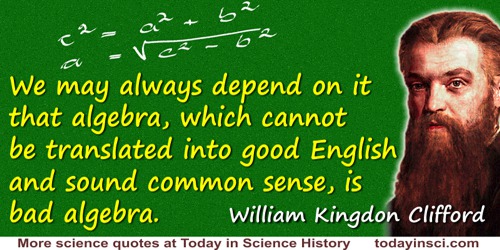
We may always depend on it that algebra, which cannot be translated into good English and sound common sense, is bad algebra.
In Common Sense in the Exact Sciences (1885), 21.
We shall therefore say that a program has common sense if it automatically deduces for itself a sufficient wide class of immediate consequences of anything it is told and what it already knows. ... Our ultimate objective is to make programs that learn from their experience as effectively as humans do.
'Programs with Common Sense', (probably the first paper on AI), delivered to the Teddington Conference on the Mechanization of Thought Processes (Dec 1958). Printed in National Physical Laboratory, Mechanisation of Thought Processes: Proceedings of a Symposium Held at the National Physical Laboratory on 24th, 25th, 26th and 27th November 1958 (1959), 78. Also Summary in John McCarthy and Vladimir Lifschitz (ed.), Formalizing Common Sense: Papers by John McCarthy (1990), 9-10.
What is common sense? That which attracts the least opposition: that which brings most agreeable and worthy results
In Sinner Sermons: A Selection of the Best Paragraphs of E. W. Howe (1926), 44.
What the founders of modern science, among them Galileo, had to do, was not to criticize and to combat certain faulty theories, and to correct or to replace them by better ones. They had to do something quite different. They had to destroy one world and to replace it by another. They had to reshape the framework of our intellect itself, to restate and to reform its concepts, to evolve a new approach to Being, a new concept of knowledge, a new concept of science—and even to replace a pretty natural approach, that of common sense, by another which is not natural at all.
In 'Galileo and Plato', Journal of the History of Ideas (1943), 405.
Whatever be the detail with which you cram your student, the chance of his meeting in after life exactly that detail is almost infinitesimal; and if he does meet it, he will probably have forgotten what you taught him about it. The really useful training yields a comprehension of a few general principles with a thorough grounding in the way they apply to a variety of concrete details. In subsequent practice the men will have forgotten your particular details; but they will remember by an unconscious common sense how to apply principles to immediate circumstances. Your learning is useless to you till you have lost your textbooks, burnt your lecture notes, and forgotten the minutiae which you learned by heart for the examination. What, in the way of detail, you continually require will stick in your memory as obvious facts like the sun and the moon; and what you casually require can be looked up in any work of reference. The function of a University is to enable you to shed details in favor of principles. When I speak of principles I am hardly even thinking of verbal formulations. A principle which has thoroughly soaked into you is rather a mental habit than a formal statement. It becomes the way the mind reacts to the appropriate stimulus in the form of illustrative circumstances. Nobody goes about with his knowledge clearly and consciously before him. Mental cultivation is nothing else than the satisfactory way in which the mind will function when it is poked up into activity.
In 'The Rhythm of Education', The Aims of Education: & Other Essays (1917), 41.
Whatever the common-sense of earlier generations may have held in this respect, modern common-sense holds that the scientist’s answer is the only ultimately true one. In the last resort enlightened common-sense sticks by the opaque truth and refuses to go behind the returns given by the tangible facts.
From 'The Place of Science in Modern Civilisation', American Journal of Sociology (Mar 1906), 11, collected in The Place of Science in Modern Civilisation and Other Essays (1919), 4.
When an accident at sea releases huge volumes of crude oil onto beaches, rocks and coves we see it as an environmental disaster, and not long ago we tried vainly to wash it away with detergents. Now, with greater common sense, we leave the clean-up to the natural organisms that regard the spillage as food.
In The Revenge of Gaia: Earth’s Climate Crisis & The Fate of Humanity (2006, 2007), 92.
When an apparent fact runs contrary to logic and common sense, it’s obvious that you have failed to interpret the fact correctly.
In Orphans of the Sky (1963, 1964), 169.
Yet as I cast my eye over the whole course of science I behold instances of false science, even more pretentious and popular than that of Einstein gradually fading into ineptitude under the searchlight; and I have no doubt that there will arise a new generation who will look with a wonder and amazement, deeper than now accompany Einstein, at our galaxy of thinkers, men of science, popular critics, authoritative professors and witty dramatists, who have been satisfied to waive their common sense in view of Einstein's absurdities.
In Elizabeth Dilling, A "Who's Who" and Handbook of Radicalism for Patriots (1934), 49.
 In science it often happens that scientists say, 'You know that's a really good argument; my position is mistaken,' and then they would actually change their minds and you never hear that old view from them again. They really do it. It doesn't happen as often as it should, because scientists are human and change is sometimes painful. But it happens every day. I cannot recall the last time something like that happened in politics or religion.
(1987) --
In science it often happens that scientists say, 'You know that's a really good argument; my position is mistaken,' and then they would actually change their minds and you never hear that old view from them again. They really do it. It doesn't happen as often as it should, because scientists are human and change is sometimes painful. But it happens every day. I cannot recall the last time something like that happened in politics or religion.
(1987) -- 





