Commercial Quotes (29 quotes)
Actors start off in commercials playing someone else, but when they’ve really made it they return to commercials playing themselves.
A “Shower Thought” posted on Reddit by BJntheRV (24 Oct 2021).
Aluminum has … a kind of “glamor” associated with it, due to two facts, the first being that it is really useful, durable and beautiful, combined with the other fact, which has little to do with its commercial importance, that its ores are more abundant than of any other metal and constitute a large portion of the earth’s crust.
In article by Chas. M. Hall, 'The Properties of Aluminum', Western Electrician (30 May 1891), 8, No. 22, 312.
Any demanding high technology tends to develop influential and dedicated constituencies of those who link its commercial success with both the public welfare and their own. Such sincerely held beliefs, peer pressures, and the harsh demands that the work i
Foreign Affairs (Oct 1976).
As to Bell’s talking telegraph, it only creates interest in scientific circles, and, as a toy it is beautiful; but … its commercial value will be limited.
Letter to William D. Baldwin, his attorney (1 Nov 1876). Telephone Investigating Committee, House of Representatives, United States 49th Congress, 1st Session, Miscellaneous Documents (1886), No. 355, 1186.
Electronic aids, particularly domestic computers, will help the inner migration, the opting out of reality. Reality is no longer going to be the stuff out there, but the stuff inside your head. It's going to be commercial and nasty at the same time, like 'Rite of Spring' in Disney's Fantasia ... our internal devils may destroy and renew us through the technological overload we've invoked.
Interview in Heavy Metal (Apr 1971). Reprinted in Re/Search, No. 8/9 (1984).
Engineers apply the theories and principles of science and mathematics to research and develop economical solutions to practical technical problems. Their work is the link between scientific discoveries and commercial applications. Engineers design products, the machinery to build those products, the factories in which those products are made, and the systems that ensure the quality of the product and efficiency of the workforce and manufacturing process. They design, plan, and supervise the construction of buildings, highways, and transit systems. They develop and implement improved ways to extract, process, and use raw materials, such as petroleum and natural gas. They develop new materials that both improve the performance of products, and make implementing advances in technology possible. They harness the power of the sun, the earth, atoms, and electricity for use in supplying the Nation’s power needs, and create millions of products using power. Their knowledge is applied to improving many things, including the
quality of health care, the safety of food products, and the efficient operation of financial systems.
Bureau of Labor Statistics, Occupational Outlook Handbook (2000) as quoted in Charles R. Lord. Guide to Information Sources in Engineering (2000), 5. This definition has been revised and expanded over time in different issues of the Handbook.
England was nothing, compared to continental nations until she had become commercial … until about the middle of the last century, when a number of ingenious and inventive men, without apparent relation to each other, arose in various parts of the kingdom, succeeded in giving an immense impulse to all the branches of the national industry; the result of which has been a harvest of wealth and prosperity, perhaps without a parallel in the history of the world.
In Lives of the Engineers (1862, 1874), xvii.
Great capitalists could not themselves cultivate vast extents of land, and not wanting to diminish their revenues by renting them, would be induced to sell portions suitable for cultivation by their new owners, and would then carry their money into new industrial and commercial enterprises.
From Appendix A, 'Extracts From the Unpublished Writings of Carnot', Reflections on the Motive Power of Heat (1890, 2nd ed. 1897), 213.
I am more of a sponge than an inventor. I absorb ideas from every source. I take half-matured schemes for mechanical development and make them practical. I am a sort of middleman between the long-haired and impractical inventor and the hard-headed businessman who measures all things in terms of dollars and cents. My principal business is giving commercial value to the brilliant but misdirected ideas of others.
…...
I distinguish two kinds of "applied" research: problem-solving research — government or commercially initiated, centrally managed and institutionally coupled to a plan for application of the results, useful science—investigator-initiated, competitively evaluated and widely communicated. Then we have basic science—useful also, also investigator-initiated, competitively evaluated and widely communicated.
In Confessions of a Technophile (1994), 31.
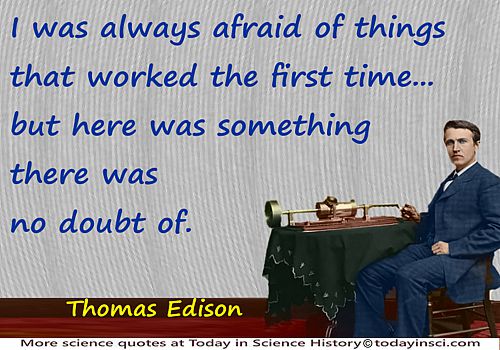
I was always afraid of things that worked the first time. Long experience proved that there were great drawbacks found generally before they could be got commercial; but here was something there was no doubt of.
[Recalling astonishment when his tin-foil cylinder phonograph first played back his voice recording of “Mary had a little lamb.”]
[Recalling astonishment when his tin-foil cylinder phonograph first played back his voice recording of “Mary had a little lamb.”]
Quoted in Frank Lewis Dyer, Thomas Commerford Martin, Edison: His Life and Inventions (1910), 208.
If texts are unified by a central logic of argument, then their pictorial illustrations are integral to the ensemble, not pretty little trifles included only for aesthetic or commercial value. Primates are visual animals, and (particularly in science) illustration has a language and set of conventions all its own.
…...
In 1891, during the Presidency of William Henry Harrison [Benjamin Harrison], electric lights were first installed in the White House, the residence of the leaders of our country. At that time, commercial electricity was not economically feasible, but President Harrison wanted to affirm his confidence in the technological capability of our country.
Speech, at dedication of solar panels on the White House roof, 'Solar Energy Remarks Announcing Administration Proposals' (20 Jun 1979).
It has been just so in all my inventions. The first step is an intuition—and comes with a burst, then difficulties arise. This thing that gives out and then that—“Bugs” as such little faults and difficulties are called show themselves and months of anxious watching, study and labor are requisite before commercial success—or failure—is certainly reached.
Describing his invention of a storage battery that involved 10,296 experiments. Note Edison’s use of the term “Bug” in the engineering research field for a mechanical defect greatly predates the use of the term as applied by Admiral Grace Murray Hopper to a computing defect upon finding a moth in the electronic mainframe.] Letter to Theodore Puskas (18 Nov 1878). In The Yale Book of Quotations (2006), 226.
It is not surprising, in view of the polydynamic constitution of the genuinely mathematical mind, that many of the major heros of the science, men like Desargues and Pascal, Descartes and Leibnitz, Newton, Gauss and Bolzano, Helmholtz and Clifford, Riemann and Salmon and Plücker and Poincaré, have attained to high distinction in other fields not only of science but of philosophy and letters too. And when we reflect that the very greatest mathematical achievements have been due, not alone to the peering, microscopic, histologic vision of men like Weierstrass, illuminating the hidden recesses, the minute and intimate structure of logical reality, but to the larger vision also of men like Klein who survey the kingdoms of geometry and analysis for the endless variety of things that flourish there, as the eye of Darwin ranged over the flora and fauna of the world, or as a commercial monarch contemplates its industry, or as a statesman beholds an empire; when we reflect not only that the Calculus of Probability is a creation of mathematics but that the master mathematician is constantly required to exercise judgment—judgment, that is, in matters not admitting of certainty—balancing probabilities not yet reduced nor even reducible perhaps to calculation; when we reflect that he is called upon to exercise a function analogous to that of the comparative anatomist like Cuvier, comparing theories and doctrines of every degree of similarity and dissimilarity of structure; when, finally, we reflect that he seldom deals with a single idea at a tune, but is for the most part engaged in wielding organized hosts of them, as a general wields at once the division of an army or as a great civil administrator directs from his central office diverse and scattered but related groups of interests and operations; then, I say, the current opinion that devotion to mathematics unfits the devotee for practical affairs should be known for false on a priori grounds. And one should be thus prepared to find that as a fact Gaspard Monge, creator of descriptive geometry, author of the classic Applications de l’analyse à la géométrie; Lazare Carnot, author of the celebrated works, Géométrie de position, and Réflections sur la Métaphysique du Calcul infinitesimal; Fourier, immortal creator of the Théorie analytique de la chaleur; Arago, rightful inheritor of Monge’s chair of geometry; Poncelet, creator of pure projective geometry; one should not be surprised, I say, to find that these and other mathematicians in a land sagacious enough to invoke their aid, rendered, alike in peace and in war, eminent public service.
In Lectures on Science, Philosophy and Art (1908), 32-33.
It is true that the trees are for human use. But these are aesthetic uses as well as commercial uses—uses for the spiritual wealth of all, as well as the material wealth of some.
In an early issue of the Sierra Club Bulletin. Quoted in Stephen Fox, John Muir and His Legacy (1981), 115. As cited in Bryan G. Norton, Toward Unity Among Environmentalists (), 32.
317
My second fixed idea is the uselessness of men above sixty years of age, and the incalculable benefit it would be in commercial, political, and in professional life, if as a matter of course, men stopped work at this age.
In farewell address, Johns Hopkins University, 'The Fixed Period', as quoted in Harvey Cushing, The Life of Sir William Osier (1925), vol. 1, 666. He was reflecting on his own intention to retire (now age 55) because he felt a teacher should have a fixed period of service. The title of his address was from an Anthony Trollope novel The Fixed Period which discussed the retiring of college teachers at age 60.
On CBS Radio the news of [Ed Murrow’s] death, reportedly from lung cancer, was followed by a cigarette commercial.
Prime Time: the Life of Edward R. Murrow (1969), 34.
Our commercial and mercantile law was no sudden invention. It was not the work of a day, or of one set of minds… In the incipient, the early existence of this system, a single maxim obtained force, others succeeded; one rule of right formed a nucleus around which other kindred rules might cling; the necessities of trade originated customs, customs ripened into law; a few feeble decisions of courts laid the foundation for others; the wisdom and experience of each succeeding generation improved upon the wisdom and experience of generations that were past; and thus the edifice arose, perfect in its parts, beautiful in its proportions.
From biographical preface by T. Bigelow to Austin Abbott (ed.), Official Report of the Trial of Henry Ward Beecher (1875), Vol. 1, xi-xii.
Perhaps it is better in this present world of ours that a revolutionary idea or invention instead of being helped and patted be hampered and ill-treated in its adolescence—by want of means, by selfish interest, pedantry, stupidity and ignorance; that it be attacked and stifled; that it pass through bitter trials and tribulations, through the heartless strife of commercial existence. ... So all that was great in the past was ridiculed, condemned, combatted, suppressed—only to emerge all the more powerfully, all the more triumphantly from the struggle.
'The Transmission of Electrical Energy Without Wires As a Means for Furthering Peace', Electrical World and Engineer (7 Jan 1905), 24. Reproduced in John T. Ratzlaff, editor, Tesla Said (1984), 86. Also reprinted in Nikola Tesla, Miscellaneous Writings (2007), 58.
The chief problem of the commercial farmers is overproduction. The chief problem of the low-income farmers is poverty.
In Public Papers of Nelson A. Rockefeller: Fifty-Third Governor of the State of New York (1959), Vol. 1, 1206.
The hybridoma technology was a by-product of basic research. Its success in practical applications is to a large extent the result of unexpected and unpredictable properties of the method. It thus represents another clear-cut example of the enormous practical impact of an investment in research which might not have been considered commercially worthwhile, or of immediate medical relevance. It resulted from esoteric speculations, for curiosity’s sake, only motivated by a desire to understand nature.
From Nobel Lecture (8 Dec 1984), collected in Tore Frängsmyr and Jan Lindsten (eds.), Nobel Lectures in Physiology Or Medicine: 1981-1990 (1993), 267-268.
The marriage of reason and nightmare which has dominated the 20th century has given birth to an ever more ambiguous world. Across the communications landscape move the specters of sinister technologies and the dreams that money can buy. Thermonuclear weapons systems and soft drink commercials coexist in an overlit realm ruled by advertising and pseudoevents, science and pornography. Over our lives preside the great twin leitmotifs of the 20th century—sex and paranoia.
Crash (1973, 1995), catalogue notes. In J. G. Ballard, The Kindness of Women (2007), 221.
The thoughts of Plato and Machiavelli... don't seem quite enough armor for a world beset with splitting the atoms, urban guerrillas, nineteen varieties of psychotherapists, amplified guitars, napalm, computers, astronauts, and an atmosphere polluted simultaneously with auto exhaust and TV commercials.
There is an insistent tendency among serious social scientists to think of any institution which features rhymed and singing commercials, intense and lachrymose voices urging highly improbable enjoyment, caricatures of the human esophagus in normal and impaired operation, and which hints implausibly at opportunities for antiseptic seduction as inherently trivial. This is a great mistake. The industrial system is profoundly dependent on commercial television and could not exist in its present form without it.
In The New Industrial State (1967), 208.
There is no plea which will justify the use of high-tension and alternating currents, either in a scientific or a commercial sense. They are employed solely to reduce investment in copper wire and real estate.
In 'The Dangers of Electric Lighting', North American Review (Nov 1889), 149, No. 396, 633.
We urgently need [the landmark National Ocean Policy] initiative, as we use our oceans heavily: Cargo ships crisscross the sea, carrying goods between continents. Commercial and recreational fishing boats chase fish just offshore. Cruise ships cruise. Oil and gas drilling continues, but hopefully we will add renewable energy projects as well. Without planning, however, these various industrial activities amount to what we call “ocean sprawl,” steamrolling the resources we rely upon for our livelihoods, food, fun, and even the air we breathe. While humankind relies on many of these industries, we also need to keep the natural riches that support them healthy and thriving. As an explorer, I know firsthand there are many places in the ocean so full of life that they should be protected.
In 'A Blueprint for Our Blue Home', Huffington Post (18 Jul 2011).
Will we ever again be able to view a public object with civic dignity, unencumbered by commercial messages? Must city buses be fully painted as movable ads, lampposts smothered, taxis festooned, even seats in concert halls sold one by one to donors and embellished in perpetuity with their names on silver plaques?
…...
Words change their meanings, just as organism s evolve. We would impose an enormous burden on our economy if we insisted on payment in cattle every time we identified a bonus as a pecuniary advantage (from the Latin pecus, or cattle, a verbal fossil from a former commercial reality).
…...
 In science it often happens that scientists say, 'You know that's a really good argument; my position is mistaken,' and then they would actually change their minds and you never hear that old view from them again. They really do it. It doesn't happen as often as it should, because scientists are human and change is sometimes painful. But it happens every day. I cannot recall the last time something like that happened in politics or religion.
(1987) --
In science it often happens that scientists say, 'You know that's a really good argument; my position is mistaken,' and then they would actually change their minds and you never hear that old view from them again. They really do it. It doesn't happen as often as it should, because scientists are human and change is sometimes painful. But it happens every day. I cannot recall the last time something like that happened in politics or religion.
(1987) -- 




