Combustion Quotes (22 quotes)
[When combustion occurs,] one body, at least, is oxygenated, and another restored, at the same time, to its combustible state... This view of combustion may serve to show how nature is always the same, and maintains her equilibrium by preserving the same quantities of air and water on the surface of our globe: for as fast as these are consumed in the various processes of combustion, equal quantities are formed, and rise regenerated like the Phoenix from her ashes.
Fulhame believed 'that water was the only source of oxygen, which oxygenates combustible bodies' and that 'the hydrogen of water is the only substance that restores bodies to their combustible state.'
Fulhame believed 'that water was the only source of oxygen, which oxygenates combustible bodies' and that 'the hydrogen of water is the only substance that restores bodies to their combustible state.'
An Essay on Combustion with a View to a New Art of Dyeing and Painting (1794), 179-180. In Marilyn Bailey Ogilvie and Joy Dorothy Harvey, The Biographical Dictionary of Women in Science (2000), 478.
About eight days ago I discovered that sulfur in burning, far from losing weight, on the contrary, gains it; it is the same with phosphorus; this increase of weight arises from a prodigious quantity of air that is fixed during combustion and combines with the vapors. This discovery, which I have established by experiments, that I regard as decisive, has led me to think that what is observed in the combustion of sulfur and phosphorus may well take place in the case of all substances that gain in weight by combustion and calcination; and I am persuaded that the increase in weight of metallic calxes is due to the same cause... This discovery seems to me one of the most interesting that has been made since Stahl and since it is difficult not to disclose something inadvertently in conversation with friends that could lead to the truth I have thought it necessary to make the present deposit to the Secretary of the Academy to await the time I make my experiments public.
Sealed note deposited with the Secretary of the French Academy 1 Nov 1772. Oeuvres de Lavoisier, Correspondance, Fasc. II. 1770-75 (1957), 389-90. Adapted from translation by A. N. Meldrum, The Eighteenth-Century Revolution in Science (1930), 3.
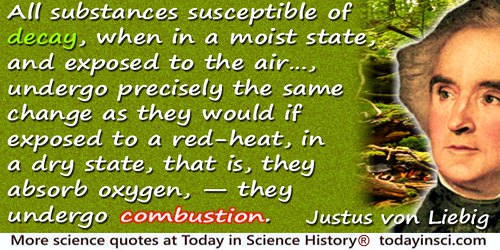
All substances susceptible of decay, when in a moist state, and exposed to the air and light at the common temperature, undergo precisely the same change as they would if exposed to a red-heat, in a dry state, that is, they absorb oxygen,—they undergo combustion.
Justus von Liebig and John Gardner (ed.), Familiar Letters on Chemistry: Second Series. The Philosophical Principles and General Laws of the Science (1844), 183.
Chemistry teaches us to regard under one aspect, as various types of combustion or oxidation, the burning of a candle, the rusting of metals, the physiological process of respiration, and the explosion of gunpowder. In each process there is the one common fact that oxygen enters into new chemical combinations. Similarly to the physicist, the fall of the traditional apple of Newton, the revolution of the earth and planets round the sun, the apparitions of comets, and the ebb and flow of the tides are all phases of the universal law of gravitation. A race ignorant of the nature of combustion or of the law of gravitation, and ignorant of the need of such generalisations, could not be considered to have advanced far along the paths of scientific discovery.
In 'The Discovery of Radioactivity: Radioactivity, a New Science', The Interpretation of Radium and the Structure of the Atom (4th ed., 1920), 1.
Combustible bodies do not reduce the metals by giving them phlogiston, as the Phlogistians suppose; nor buy uniting with, and separating their oxygen, as the Anti-phlogistians maintain.
Rejecting older theories of combustion.
Rejecting older theories of combustion.
Preface to An Essay on Combustion with a View to a New Art of Dyeing and Painting (1794), iv. In Marilyn Bailey Ogilvie and Joy Dorothy Harvey, The Biographical Dictionary of Women in Science (2000), 478.
For the first time there was constructed with this machine [locomotive engine] a self-acting mechanism in which the interplay of forces took shape transparently enough to discern the connection between the heat generated and the motion produced. The great puzzle of the vital force was also immediately solved for the physiologist in that it became evident that it is more than a mere poetic comparison when one conceives of the coal as the food of the locomotive and the combustion as the basis for its life.
'Leid und Freude in der Naturforschung', Die Gartenlaube (1870), 359. Trans. Kenneth L. Caneva, Robert Mayer and the Conservation of Energy (1993), 145.
For the same energy output as from coal or oil, methane combustion releases only half as much carbon dioxide. This implies that powering a nation entirely by gas reduces emissions of carbon dioxide by half. … The problem with [production leaks and other escapes of] … methane is that this substance is twenty-four times more potent a greenhouse gas than carbon dioxide.
In The Revenge of Gaia: Earth’s Climate Crisis & The Fate of Humanity (2006, 2007), 95.
For there are two modes of acquiring knowledge, namely, by reasoning and experience. Reasoning draws a conclusion and makes us grant the conclusion, but does not make the conclusion certain, nor does it remove doubt so that the mind may rest on the intuition of truth, unless the mind discovers it by the path of experience; since many have the arguments relating to what can be known, but because they lack experience they neglect the arguments, and neither avoid what is harmful nor follow what is good. For if a man who has never seen fire should prove by adequate reasoning that fire burns and injures things and destroys them, his mind would not be satisfied thereby, nor would he avoid fire, until he placed his hand or some combustible substance in the fire, so that he might prove by experience that which reasoning taught. But when he has had actual experience of combustion his mind is made certain and rests in the full light of truth. Therefore reasoning does not suffice, but experience does.
Opus Majus [1266-1268], Part VI, chapter I, trans. R. B. Burke, The Opus Majus of Roger Bacon (1928), Vol. 2, 583.
I have always considered that the substitution of the internal combustion engine for the horse marked a very gloomy milestone in the progress of mankind.
Speaking in the House of Commons (24 Jun 1952), as cited in Jack House (ed.), Winston Churchill, His Wit and Wisdom: Selections from His (1965), 115.
In every combustion there is disengagement of the matter of fire or of light. A body can burn only in pure air [oxygen]. There is no destruction or decomposition of pure air and the increase in weight of the body burnt is exactly equal to the weight of air destroyed or decomposed. The body burnt changes into an acid by addition of the substance that increases its weight. Pure air is a compound of the matter of fire or of light with a base. In combustion the burning body removes the base, which it attracts more strongly than does the matter of heat, which appears as flame, heat and light.
'Memoire sur la combustion en général', Mémoires de l'Académie des Sciences, 1777, 592. Reprinted in Oeuvres de Lavoisier (1864), Vol. 2, 225-33, trans. M. P. Crosland.
In one department of his [Joseph Black’s] lecture he exceeded any I have ever known, the neatness and unvarying success with which all the manipulations of his experiments were performed. His correct eye and steady hand contributed to the one; his admirable precautions, foreseeing and providing for every emergency, secured the other. I have seen him pour boiling water or boiling acid from a vessel that had no spout into a tube, holding it at such a distance as made the stream’s diameter small, and so vertical that not a drop was spilt. While he poured he would mention this adaptation of the height to the diameter as a necessary condition of success. I have seen him mix two substances in a receiver into which a gas, as chlorine, had been introduced, the effect of the combustion being perhaps to produce a compound inflammable in its nascent state, and the mixture being effected by drawing some string or wire working through the receiver's sides in an air-tight socket. The long table on which the different processes had been carried on was as clean at the end of the lecture as it had been before the apparatus was planted upon it. Not a drop of liquid, not a grain of dust remained.
In Lives of Men of Letters and Science, Who Flourished in the Time of George III (1845), 346-7.
It is arguable whether the human race have been gainers by the march of science beyond the steam engine. Electricity opens a field of infinite conveniences to ever greater numbers, but they may well have to pay dearly for them. But anyhow in my thought I stop short of the internal combustion engine which has made the world so much smaller. Still more must we fear the consequences of entrusting a human race so little different from their predecessors of the so-called barbarous ages such awful agencies as the atomic bomb. Give me the horse.
Address to the Royal College of Surgeons (10 Jul 1951). Collected in Stemming the Tide: Speeches 1951 and 1952 (1953), 91.
Now I must take you to a very interesting part of our subject—to the relation between the combustion of a candle and that living kind of combustion which goes on within us. In every one of us there is a living process of combustion going on very similar to that of a candle, and I must try to make that plain to you. For it is not merely true in a poetical sense—the relation of the life of man to a taper; and if you will follow, I think I can make this clear.
From the concluding lecture (8 Jan 1861) given to a juvenile audience at the Royal Institution, as published in A Course of Six Lectures on the Chemical History of a Candle (1861), 167.
Perhaps our and Gaia’s greatest error was the conscious abuse of fire. Cooking meat over a wood fire may have been acceptable, but the deliberate destruction of whole ecosystems by fire merely to drive out the animals within was surely our first great sin against the living Earth. It has haunted us ever since and combustion could now be our auto da fé, and the cause of our extinction.
In The Revenge of Gaia: Earth’s Climate Crisis & The Fate of Humanity (2006, 2007), 186.
Take an arrow, and hold it in flame for the space of ten pulses, and when it cometh forth you shall find those parts of the arrow which were on the outsides of the flame more burned, blacked, and turned almost to coal, whereas the midst of the flame will be as if the fire had scarce touched it. This is an instance of great consequence for the discovery of the nature of flame; and sheweth manifestly, that flame burneth more violently towards the sides than in the midst.
Observing, but not with the knowledge, that a flame burns at its outside in contact with air, and there is no combustion within the flame which is not mixed with air. In Sylva Sylvarum; or a Natural History in Ten Centuries (1627), Century 1, Experiment 32. Collected in The Works of Francis Bacon (1740), Vol 3, 9.
The attempted synthesis of paleontology and genetics, an essential part of the present study, may be particularly surprising and possibly hazardous. Not long ago, paleontologists felt that a geneticist was a person who shut himself in a room, pulled down the shades, watched small flies disporting themselves in milk bottles, and thought that he was studying nature. A pursuit so removed from the realities of life, they said, had no significance for the true biologist. On the other hand, the geneticists said that paleontology had no further contributions to make to biology, that its only point had been the completed demonstration of the truth of evolution, and that it was a subject too purely descriptive to merit the name 'science'. The paleontologist, they believed, is like a man who undertakes to study the principles of the internal combustion engine by standing on a street corner and watching the motor cars whiz by.
Tempo and Mode in Evolution (1944), 1.
The fact is, a biologist to-day [1928] is pretty much where an engineer would be if he knew even in detail the cycle of chemical changes which took place within an internal combustion engine but was wholly ignorant of the disposition of tho moving parts.
As guest of honour, closing day address (Jun 1928), Sixth Colloid Symposium, Toronto, Canada, 'Living Matter', printed in Harry Boyer Weiser (ed.), Colloid Symposium Monograph (1928), Vol. 6, 7.
The physiological combustion theory takes as its starting point the fundamental principle that the amount of heat that arises from the combustion of a given substance is an invariable quantity–i.e., one independent of the circumstances accompanying the combustion–from which it is more specifically concluded that the chemical effect of the combustible materials undergoes no quantitative change even as a result of the vital process, or that the living organism, with all its mysteries and marvels, is not capable of generating heat out of nothing.
Bemerkungen über das mechanische Aequivalent der Wärme [Remarks on the Mechanical Equivalent of Heat] (1851), 17-9. Trans. Kenneth L. Caneva, Robert Mayer and the Conservation of Energy (1993), 240.
There is deposited in them [plants] an enormous quantity of potential energy [Spannkräfte], whose equivalent is provided to us as heat in the burning of plant substances. So far as we know at present, the only living energy [lebendige Kraft] absorbed during plant growth are the chemical rays of sunlight… Animals take up oxygen and complex oxidizable compounds made by plants, release largely as combustion products carbonic acid and water, partly as simpler reduced compounds, thus using a certain amount of chemical potential energy to produce heat and mechanical forces. Since the latter represent a relatively small amount of work in relation to the quantity of heat, the question of the conservation of energy reduces itself roughly to whether the combustion and transformation of the nutritional components yields the same amount of heat released by animals.
Wissenschaftliche Abhandlungen (1847), 66. Trans. Joseph S. Fruton, Proteins, Enzymes, Genes: The Interplay of Chemistry and Biology (1999), 247.
To day we made the grand experiment of burning the diamond and certainly the phenomena presented were extremely beautiful and interesting… The Duke’s burning glass was the instrument used to apply heat to the diamond. It consists of two double convex lenses … The instrument was placed in an upper room of the museum and having arranged it at the window the diamond was placed in the focus and anxiously watched. The heat was thus continued for 3/4 of an hour (it being necessary to cool the globe at times) and during that time it was thought that the diamond was slowly diminishing and becoming opaque … On a sudden Sir H Davy observed the diamond to burn visibly, and when removed from the focus it was found to be in a state of active and rapid combustion. The diamond glowed brilliantly with a scarlet light, inclining to purple and, when placed in the dark, continued to burn for about four minutes. After cooling the glass heat was again applied to the diamond and it burned again though not for nearly so long as before. This was repeated twice more and soon after the diamond became all consumed. This phenomenon of actual and vivid combustion, which has never been observed before, was attributed by Sir H Davy to be the free access of air; it became more dull as carbonic acid gas formed and did not last so long.
Entry (Florence, 27 Mar 1814) in his foreign journal kept whilst on a continental tour with Sir Humphry Davy. In Michael Faraday, Bence Jones (ed.), The Life and Letters of Faraday (1870), Vol. 1, 119. Silvanus Phillips Thompson identifies the Duke as the Grand Duke of Tuscany, in Michael Faraday, His Life and Work (1901), 21.
Typical of the fundamental scientific problems whose solution should lead to important industrial consequences are, for example, the release of atomic energy, which experiment has shown to exist in quantities millions of times greater than is liberated by combustion.
An early speculation on using the amount of energy that could be released from uranium atoms. In a letter to Henry Ford (18 May 1931). He recorded earlier thoughts on the subject in his Research Notebook, entry for 23 Jul 1930, in Arthur H. Compton Notebooks, Washington University, St. Louis, and AIP. Cited by Stanley Coben, in 'The Scientific Establishment and the Transmission of Quantum Mechanics to the United States, 1919-32', The American Historical Review (Apr 1971), 76, No. 2, 466.
Until that afternoon, my thoughts on planetary atmospheres had been wholly concerned with atmospheric analysis as a method of life detection and nothing more. Now that I knew the composition of the Martian atmosphere was so different from that of our own, my mind filled with wonderings about the nature of the Earth. If the air is burning, what sustains it at a constant composition? I also wondered about the supply of fuel and the removal of the products of combustion. It came to me suddenly, just like a flash of enlightenment, that to persist and keep stable, something must be regulating the atmosphere and so keeping it at its constant composition. Moreover, if most of the gases came from living organisms, then life at the surface must be doing the regulation.
Homage to Gaia: The Life of an Independent Scholar (2000), 253.
 In science it often happens that scientists say, 'You know that's a really good argument; my position is mistaken,' and then they would actually change their minds and you never hear that old view from them again. They really do it. It doesn't happen as often as it should, because scientists are human and change is sometimes painful. But it happens every day. I cannot recall the last time something like that happened in politics or religion.
(1987) --
In science it often happens that scientists say, 'You know that's a really good argument; my position is mistaken,' and then they would actually change their minds and you never hear that old view from them again. They really do it. It doesn't happen as often as it should, because scientists are human and change is sometimes painful. But it happens every day. I cannot recall the last time something like that happened in politics or religion.
(1987) -- 




