Classification Quotes (102 quotes)
Branches or types are characterized by the plan of their structure,
Classes, by the manner in which that plan is executed, as far as ways and means are concerned,
Orders, by the degrees of complication of that structure,
Families, by their form, as far as determined by structure,
Genera, by the details of the execution in special parts, and
Species, by the relations of individuals to one another and to the world in which they live, as well as by the proportions of their parts, their ornamentation, etc.
Classes, by the manner in which that plan is executed, as far as ways and means are concerned,
Orders, by the degrees of complication of that structure,
Families, by their form, as far as determined by structure,
Genera, by the details of the execution in special parts, and
Species, by the relations of individuals to one another and to the world in which they live, as well as by the proportions of their parts, their ornamentation, etc.
Essay on Classification (1857). Contributions to the Natural History of the United States of America (1857), Vol. I, 170.
The classification of facts, the recognition of their sequence and relative significance is the function of science, and the habit of forming a judgment upon these facts unbiassed by personal feeling is characteristic of what may be termed the scientific frame of mind.
From The Grammar of Science (1892), 8.
A … difference between most system-building in the social sciences and systems of thought and classification of the natural sciences is to be seen in their evolution. In the natural sciences both theories and descriptive systems grow by adaptation to the increasing knowledge and experience of the scientists. In the social sciences, systems often issue fully formed from the mind of one man. Then they may be much discussed if they attract attention, but progressive adaptive modification as a result of the concerted efforts of great numbers of men is rare.
The Study of Man (1941), 19-20.
A first step in the study of civilization is to dissect it into details, and to classify these in their proper groups. Thus, in examining weapons, they are to be classed under spear, club, sling, bow and arrow, and so forth; among textile arts are to be ranged matting, netting, and several grades of making and weaving threads; myths are divided under such headings as myths of sunrise and sunset, eclipse-myths, earthquake-myths, local myths which account for the names of places by some fanciful tale, eponymic myths which account for the parentage of a tribe by turning its name into the name of an imaginary ancestor; under rites and ceremonies occur such practices as the various kinds of sacrifice to the ghosts of the dead and to other spiritual beings, the turning to the east in worship, the purification of ceremonial or moral uncleanness by means of water or fire. Such are a few miscellaneous examples from a list of hundreds … To the ethnographer, the bow and arrow is the species, the habit of flattening children’s skulls is a species, the practice of reckoning numbers by tens is a species. The geographical distribution of these things, and their transmission from region to region, have to be studied as the naturalist studies the geography of his botanical and zoological species.
In Primitive Culture (1871), Vol. 1, 7.
Absorbed in the special investigation, I paid no heed to the edifice which was meanwhile unconsciously building itself up. Having however completed the comparison of the fossil species in Paris, I wanted, for the sake of an easy revision of the same, to make a list according to their succession in geological formations, with a view of determining the characteristics more exactly and bringing them by their enumeration into bolder relief. What was my joy and surprise to find that the simplest enumeration of the fossil fishes according to their geological succession was also a complete statement of the natural relations of the families among themselves; that one might therefore read the genetic development of the whole class in the history of creation, the representation of the genera and species in the several families being therein determined; in one word, that the genetic succession of the fishes corresponds perfectly with their zoological classification, and with just that classification proposed by me.
Quoted in Elizabeth Cary Agassiz (ed.), Louis Agassiz: His Life and Correspondence (1885), Vol. I, 203-4.
And all their botany is Latin names.
As an antiquary of a new order, I have been obliged to learn the art of deciphering and restoring these remains, of discovering and bringing together, in their primitive arrangement, the scattered and mutilated fragments of which they are composed, of reproducing in all their original proportions and characters, the animals to which these fragments formerly belonged, and then of comparing them with those animals which still live on the surface of the earth; an art which is almost unknown, and which presupposes, what had scarcely been obtained before, an acquaintance with those laws which regulate the coexistence of the forms by which the different parts of organized being are distinguished.
'Preliminary discourse', to Recherches sur les Ossemens Fossiles (1812), trans. R. Kerr Essay on the Theory of the Earth (1813), 1-2.
As mineralogy constitutes a part of chemistry, it is clear that this arrangement [of minerals] must derive its principles from chemistry. The most perfect mode of arrangement would certainly be to allow bodies to follow each other according to the order of their electro-chemical properties, from the most electro-negative, oxygen, to the most electro-positive, potassium; and to place every compound body according to its most electro-positive ingredient.
An Attempt to Establish a Pure Scientific System of Mineralogy (1814), trans. J. Black, 48.
But no pursuit at Cambridge was followed with nearly so much eagerness or gave me so much pleasure as collecting beetles. It was the mere passion for collecting, for I did not dissect them, and rarely compared their external characters with published descriptions, but got them named anyhow. I will give a proof of my zeal: one day, on tearing off some old bark, I saw two rare beetles, and seized one in each hand; then I saw a third and new kind, which I could not bear to lose, so that I popped the one which I held in my right hand into my mouth. Alas! it ejected some intensely acrid fluid, which burnt my tongue so that I was forced to spit the beetle out, which was lost, as was the third one.
In Charles Darwin and Francis Darwin (ed.), Charles Darwin: His Life Told in an Autobiographical Chapter, and in a Selected Series of His Published Letters (1892), 20.
By the classification of any series of objects, is meant the actual or ideal arrangement together of those which are like and the separation of those which are unlike ; the purpose of this arrangement being to facilitate the operations of the mind in clearly conceiving and retaining in the memory the characters of the objects in question.
In 'Lecture I: On the Classification of Animals', Lectures on the Elements of Comparative Anatomy: On the ... - (1864), 1.
Classification is now a pejorative statement. You know, these classifiers look like “dumb fools.” I’m a classifier. But I’d like to use a word that includes more than what people consider is encompassed by classification. It is more than that, and it’s something which can be called phenomenology.
'Oral History Transcript: Dr. William Wilson Morgan' (8 Aug 1978) in the Niels Bohr Library & Archives.
Consider the eighth category, which deals with stones. Wilkins divides them into the following classifications: ordinary (flint, gravel, slate); intermediate (marble, amber, coral); precious (pearl, opal); transparent (amethyst, sapphire); and insoluble (coal, clay, and arsenic). The ninth category is almost as alarming as the eighth. It reveals that metals can be imperfect (vermilion, quicksilver); artificial (bronze, brass); recremental (filings, rust); and natural (gold, tin, copper). The whale appears in the sixteenth category: it is a viviparous, oblong fish. These ambiguities, redundances, and deficiencies recall those attributed by Dr. Franz Kuhn to a certain Chinese encyclopedia entitled Celestial Emporium of Benevolent Knowledge. On those remote pages it is written that animals are divided into (a) those that belong to the Emperor, (b) embalmed ones, (c) those that are trained, (d) suckling pigs, (e) mermaids, (f) fabulous ones, (g) stray dogs, (h) those that are included in this classification, (i) those that tremble as if they were mad, (j) innumerable ones, (k) those drawn with a very fine camel's hair brush, (l) others, (m) those that have just broken a flower vase, (n) those that resemble flies from a distance.
Other Inquisitions 1937-1952 (1964), trans. Ruth L. C. Simms, 103.
Embryology furnishes, also, the best measure of true affinities existing between animals.
Essay on Classification (1857). Contributions to the Natural History of the United States of America (1857), Vol. I, 85.
Ethnologists regard man as the primitive element of tribes, races, and peoples. The anthropologist looks at him as a member of the fauna of the globe, belonging to a zoölogical classification, and subject to the same laws as the rest of the animal kingdom. To study him from the last point of view only would be to lose sight of some of his most interesting and practical relations; but to be confined to the ethnologist’s views is to set aside the scientific rule which requires us to proceed from the simple to the compound, from the known to the unknown, from the material and organic fact to the functional phenomenon.
'Paul Broca and the French School of Anthropology'. Lecture delivered in the National Museum, Washington, D.C., 15 April 1882, by Dr. Robert Fletcher. In The Saturday Lectures (1882), 118.
Experiments on ornamental plants undertaken in previous years had proven that, as a rule, hybrids do not represent the form exactly intermediate between the parental strains. Although the intermediate form of some of the more striking traits, such as those relating to shape and size of leaves, pubescence of individual parts, and so forth, is indeed nearly always seen, in other cases one of the two parental traits is so preponderant that it is difficult or quite impossible, to detect the other in the hybrid. The same is true for Pisum hybrids. Each of the seven hybrid traits either resembles so closely one of the two parental traits that the other escapes detection, or is so similar to it that no certain distinction can be made. This is of great importance to the definition and classification of the forms in which the offspring of hybrids appear. In the following discussion those traits that pass into hybrid association entirely or almost entirely unchanged, thus themselves representing the traits of the hybrid, are termed dominating and those that become latent in the association, recessive. The word 'recessive' was chosen because the traits so designated recede or disappear entirely in the hybrids, but reappear unchanged in their progeny, as will be demonstrated later.
'Experiments on Plant Hybrids' (1865). In Curt Stern and Eva R. Sherwood (eds.), The Origin of Genetics: A Mendel Source Book (1966), 9.
Extinction has only separated groups: it has by no means made them; for if every form which has ever lived on this earth were suddenly to reappear, though it would be quite impossible to give definitions by which each group could be distinguished from other groups, as all would blend together by steps as fine as those between the finest existing varieties, nevertheless a natural classification, or at least a natural arrangement, would be possible.
From On the Origin of Species by Means of Natural Selection; or, The Preservation of Favoured Races in the Struggle for Life (1860), 431.
Fortunately Nature herself seems to have prepared for us the means of supplying that want which arises from the impossibility of making certain experiments on living bodies. The different classes of animals exhibit almost all the possible combinations of organs: we find them united, two and two, three and three, and in all proportions; while at the same time it may be said that there is no organ of which some class or some genus is not deprived. A careful examination of the effects which result from these unions and privations is therefore sufficient to enable us to form probable conclusions respecting the nature and use of each organ, or form of organ. In the same manner we may proceed to ascertain the use of the different parts of the same organ, and to discover those which are essential, and separate them from those which are only accessory. It is sufficient to trace the organ through all the classes which possess it, and to examine what parts constantly exist, and what change is produced in the respective functions of the organ, by the absence of those parts which are wanting in certain classes.
Letter to Jean Claude Mertrud. In Lectures on Comparative Anatomy (1802), Vol. I, xxiii--xxiv.
From whatever I have been able to observe up to this time the series of strata which form the visible crust of the earth appear to me classified in four general and successive orders. These four orders can be conceived to be four very large strata, as they really are, so that wherever they are exposed, they are disposed one above the other, always in the same order.
Quoted in Francesco Rodolico, 'Arduino', In Charles Coulston Gillispie (ed.), Dictionary of Scientific Biography (1970), Vol. 1, 234.
Geneticists believe that anthropologists have decided what a race is. Ethnologists assume that their classifications embody principles which genetic science has proved correct. Politicians believe that their prejudices have the sanction of genetic laws and the findings of physical anthropology to sustain them.
'The Concept of Race.' In Genetic Principles in Medicine and Social Science (1931), 122.
God created, Linnaeus ordered.
Quoting the witticism current in the late eighteenth century in 'The Two Faces of Linnaeus', in Tore Frängsmyr (ed.), Linnaeus: The Man and his Work (1983), 22.
Good luck is science not yet classified; just as the supernatural is the natural not yet understood.
In Elbert Hubbard (ed. and publ.), The Philistine (Dec 1907), 26, No. 1, 10.
Half a century ago Oswald (1910) distinguished classicists and romanticists among the scientific investigators: the former being inclined to design schemes and to use consistently the deductions from working hypotheses; the latter being more fit for intuitive discoveries of functional relations between phenomena and therefore more able to open up new fields of study. Examples of both character types are Werner and Hutton. Werner was a real classicist. At the end of the eighteenth century he postulated the theory of “neptunism,” according to which all rocks including granites, were deposited in primeval seas. It was an artificial scheme, but, as a classification system, it worked quite satisfactorily at the time. Hutton, his contemporary and opponent, was more a romanticist. His concept of “plutonism” supposed continually recurrent circuits of matter, which like gigantic paddle wheels raise material from various depths of the earth and carry it off again. This is a very flexible system which opens the mind to accept the possible occurrence in the course of time of a great variety of interrelated plutonic and tectonic processes.
In 'The Scientific Character of Geology', The Journal of Geology (Jul 1961), 69, No. 4, 456-7.
Hitherto the progress of science has been slow, and subject to constant error and revision. But as soon as physical research begins to go hand in hand with moral or psychical research, it will advance with a rapidity hitherto unimagined, each assisting and classifying the other.
As quoted by Mrs. H.O. Ward, without source, in The New Science Review: A Miscellany of Modern Thought and Discovery (1894), 173.
I contend that the continued racial classification of Homo sapiens represents an outmoded approach to the general problem of differentiation within a species. In other words, I reject a racial classification of humans for the same reasons that I prefer not to divide into subspecies the prodigiously variable West Indian land snails that form the subject of my own research.
…...
I maintain that the human mystery is incredibly demeaned by scientific reductionism, with its claim in promissory materialism to account eventually for all of the spiritual world in terms of patterns of neuronal activity. This belief must be classed as a superstition. ... We have to recognize that we are spiritual beings with souls existing in a spiritual world as well as material beings with bodies and brains existing in a material world.
In Evolution of the Brain: Creation of the Self (1991), 241.
I pull a flower from the woods,
A monster with a glass
Computes the stamens in a breath,
And has her in a class.
A monster with a glass
Computes the stamens in a breath,
And has her in a class.
I was just going to say, when I was interrupted, that one of the many ways of classifying minds is under the heads of arithmetical and algebraical intellects. All economical and practical wisdom is an extension or variation of the following arithmetical formula: 2+2=4. Every philosophical proposition has the more general character of the expression a+b=c. We are mere operatives, empirics, and egotists, until we learn to think in letters instead of figures.
The Autocrat of the Breakfast Table (1858), 1.
I would rather have a mineral ill-classified and well-described, than well-classified and ill-described.
In On the External Characters of Minerals (1774), xxix, trans. Albert V. and Marguerite CaroaL
In arranging the bodies in order of their electrical nature, there is formed an electro-chemical system which, in my opinion, is more fit than any other to give an idea of chemistry.
Essai sur le théorie des proportions chimiques (1819). Translated in Henry M. Leicester and Herbert S. Klickstein, A Source Book in Chemistry 1400-1900 (1952), 260.
In early times, when the knowledge of nature was small, little attempt was made to divide science into parts, and men of science did not specialize. Aristotle was a master of all science known in his day, and wrote indifferently treatises on physics or animals. As increasing knowledge made it impossible for any one man to grasp all scientific subjects, lines of division were drawn for convenience of study and of teaching. Besides the broad distinction into physical and biological science, minute subdivisions arose, and, at a certain stage of development, much attention was, given to methods of classification, and much emphasis laid on the results, which were thought to have a significance beyond that of the mere convenience of mankind.
But we have reached the stage when the different streams of knowledge, followed by the different sciences, are coalescing, and the artificial barriers raised by calling those sciences by different names are breaking down. Geology uses the methods and data of physics, chemistry and biology; no one can say whether the science of radioactivity is to be classed as chemistry or physics, or whether sociology is properly grouped with biology or economics. Indeed, it is often just where this coalescence of two subjects occurs, when some connecting channel between them is opened suddenly, that the most striking advances in knowledge take place. The accumulated experience of one department of science, and the special methods which have been developed to deal with its problems, become suddenly available in the domain of another department, and many questions insoluble before may find answers in the new light cast upon them. Such considerations show us that science is in reality one, though we may agree to look on it now from one side and now from another as we approach it from the standpoint of physics, physiology or psychology.
But we have reached the stage when the different streams of knowledge, followed by the different sciences, are coalescing, and the artificial barriers raised by calling those sciences by different names are breaking down. Geology uses the methods and data of physics, chemistry and biology; no one can say whether the science of radioactivity is to be classed as chemistry or physics, or whether sociology is properly grouped with biology or economics. Indeed, it is often just where this coalescence of two subjects occurs, when some connecting channel between them is opened suddenly, that the most striking advances in knowledge take place. The accumulated experience of one department of science, and the special methods which have been developed to deal with its problems, become suddenly available in the domain of another department, and many questions insoluble before may find answers in the new light cast upon them. Such considerations show us that science is in reality one, though we may agree to look on it now from one side and now from another as we approach it from the standpoint of physics, physiology or psychology.
In article 'Science', Encyclopedia Britannica (1911), 402.
In general, the more one augments the number of divisions of the productions of nature, the more one approaches the truth, since in nature only individuals exist, while genera, orders, and classes only exist in our imagination.
Histoire Naturelle (1749), trans. by John Lyon, The 'Initial Discourse' to Buffon’s Histoire Naturelle: The First Complete English Translation, Journal of the History of Biology, 9(1), 1976, 164.
In my opinion the separation of the c- and ac-stars is the most important advancement in stellar classification since the trials by Vogel and Secchi ... To neglect the c-properties in classifying stellar spectra, I think, is nearly the same thing as if a zoologist, who has detected the deciding differences between a whale and a fish, would continue classifying them together.
Letter to Edward Pickering (22 Jul 1908). In Charles Coulston Gillespie (ed.), Dictionary of Scientific Biography (1974), Vol. 9, 194.
In order that an inventory of plants may be begun and a classification of them correctly established, we must try to discover criteria of some sort for distinguishing what are called “species”. After a long and considerable investigation, no surer criterion for determining species had occurred to me than distinguishing features that perpetuate themselves in propagation from seed. Thus, no matter what variations occur in the individuals or the species, if they spring from the seed of one and the same plant, they are accidental variations and not such as to distinguish a species. For these variations do not perpetuate themselves in subsequent seeding. Thus, for example, we do not regard caryophylli with full or multiple blossoms as a species distinct from caryophylli with single blossoms, because the former owe their origin to the seed of the latter and if the former are sown from their own seed, they once more produce single-blossom caryophylli. But variations that never have as their source seed from one and the same species may finally be regarded as distinct species. Or, if you make a comparison between any two plants, plants which never spring from each other's seed and never, when their seed is sown, are transmuted one into the other, these plants finally are distinct species. For it is just as in animals: a difference in sex is not enough to prove a difference of species, because each sex is derived from the same seed as far as species is concerned and not infrequently from the same parents; no matter how many and how striking may be the accidental differences between them; no other proof that bull and cow, man and woman belong to the same species is required than the fact that both very frequently spring from the same parents or the same mother. Likewise in the case of plants, there is no surer index of identity of species than that of origin from the seed of one and the same plant, whether it is a matter of individuals or species. For animals that differ in species preserve their distinct species permanently; one species never springs from the seed of another nor vice versa.
— John Ray
Historia Plantarum (1686), Vol. 1, 40. Trans. Edmund Silk. Quoted in Barbara G. Beddall, 'Historical Notes on Avian Classification', Systematic Zoology (1957), 6, 133-4.
In the real changes which animals undergo during their embryonic growth, in those external transformations as well as in those structural modifications within the body, we have a natural scale to measure the degree or the gradation of those full grown animals which corresponds in their external form and in their structure, to those various degrees in the metamorphoses of animals, as illustrated by embryonic changes, a real foundation for zoological classification.
From Lecture 4, collected in Twelve Lectures on Comparative Embryology: Delivered Before the Lowell Institute in Boston: December and January 1848-9 (1849), 29.
In the year 1902 (while I was attempting to explain to an elementary class in chemistry some of the ideas involved in the periodic law) becoming interested in the new theory of the electron, and combining this idea with those which are implied in the periodic classification, I formed an idea of the inner structure of the atom which, although it contained certain crudities, I have ever since regarded as representing essentially the arrangement of electrons in the atom ... In accordance with the idea of Mendeleef, that hydrogen is the first member of a full period, I erroneously assumed helium to have a shell of eight electrons. Regarding the disposition in the positive charge which balanced the electrons in the neutral atom, my ideas were very vague; I believed I inclined at that time toward the idea that the positive charge was also made up of discrete particles, the localization of which determined the localization of the electrons.
Valence and the Structure of Atoms and Molecules (1923), 29-30.
Inanimate objects are classified scientifically into three categories—those that don't work, those that break down, and those that get lost. The goal of all inanimate objects is to resist man and ultimately to defeat him, and the three major classifications are based on the method each object uses to achieve its purpose
'Observer: The Plot Against People', New York Times (18 Jun 1968), 46.
It is clear, from these considerations, that the three methods of classifying mankind—that according to physical characters, according to language, and according to culture—all reflect the historical development of races from different standpoints; and that the results of the three classifications are not comparable, because the historical facts do not affect the three classes of phenomena equally. A consideration of all these classes of facts is needed when we endeavour to reconstruct the early history of the races of mankind.
'Summary of the Work of the Committee in British Columbia', Report of the Sixty-Eighth Meeting of the British Association for the Advancement of Science, 1899, 670.
It is some systematised exhibition of the whale in his broad genera, that I would now fain put before you. Yet is it no easy task. The classification of the constituents of a chaos, nothing less is here essayed. Listen to what the best and latest authorities have laid down.
“No branch of Zoology is so much involved as that which is entitled Cetology,” says Captain Scoresby, A.D. 1820.
“It is not my intention, were it in my power, to enter into the inquiry as to the true method of dividing the cetacea into groups and families. * * * Utter confusion exists among the historians of this animal” (sperm whale), says Surgeon Beale. A. D. 1839.
“Unfitness to pursue our research in the unfathomable waters.” “Impenetrable veil covering our knowledge of the cetacea.” “A field strewn with thorns.” “All these incomplete indications but serve to torture us naturalists.”
Thus speak of the whale, the great Cuvier, and John Hunter, and Lesson, those lights of zoology and anatomy. Nevertheless, though of real knowledges there be little, yet of books there are plenty; and so in some small degree, with cetology, or the science of whales. Many are the men, small and great, old and new, landsmen and seamen, who have at large or in little, written of the whale. Run over a few:— The Authors of the Bible; Aristotle; Pliny; Aldrovandi; Sir Thomas Browne; Gesner; Ray; Linnæus; Rondeletius; Willoughby; Green; Artedi; Sibbald; Brisson; Marten; Lacépède; Bonneterre; Desmarest; Baron Cuvier; Frederick Cuvier; John Hunter; Owen; Scoresby; Beale; Bennett; J. Ross Browne; the Author of Miriam Coffin; Olmstead; and the Rev. T. Cheever. But to what ultimate generalising purpose all these have written, the above cited extracts will show.
Of the names in this list of whale authors, only those following Owen ever saw living whales; and but one of them was a real professional harpooner and whaleman. I mean Captain Scoresby.
“No branch of Zoology is so much involved as that which is entitled Cetology,” says Captain Scoresby, A.D. 1820.
“It is not my intention, were it in my power, to enter into the inquiry as to the true method of dividing the cetacea into groups and families. * * * Utter confusion exists among the historians of this animal” (sperm whale), says Surgeon Beale. A. D. 1839.
“Unfitness to pursue our research in the unfathomable waters.” “Impenetrable veil covering our knowledge of the cetacea.” “A field strewn with thorns.” “All these incomplete indications but serve to torture us naturalists.”
Thus speak of the whale, the great Cuvier, and John Hunter, and Lesson, those lights of zoology and anatomy. Nevertheless, though of real knowledges there be little, yet of books there are plenty; and so in some small degree, with cetology, or the science of whales. Many are the men, small and great, old and new, landsmen and seamen, who have at large or in little, written of the whale. Run over a few:— The Authors of the Bible; Aristotle; Pliny; Aldrovandi; Sir Thomas Browne; Gesner; Ray; Linnæus; Rondeletius; Willoughby; Green; Artedi; Sibbald; Brisson; Marten; Lacépède; Bonneterre; Desmarest; Baron Cuvier; Frederick Cuvier; John Hunter; Owen; Scoresby; Beale; Bennett; J. Ross Browne; the Author of Miriam Coffin; Olmstead; and the Rev. T. Cheever. But to what ultimate generalising purpose all these have written, the above cited extracts will show.
Of the names in this list of whale authors, only those following Owen ever saw living whales; and but one of them was a real professional harpooner and whaleman. I mean Captain Scoresby.
Opening of Chap. 32, 'Cetology', in Moby Dick (1851, 1892), 126-127.
It is the desire for explanations that are at once systematic and controllable by factual evidence that generates science; and it is the organization and classification of knowledge on the basis of explanatory principles that is the distinctive goal of the sciences.
The Structure of Science (1961), 4.
It needs scarcely be pointed out that in placing Mathematics at the head of Positive Philosophy, we are only extending the application of the principle which has governed our whole Classification. We are simply carrying back our principle to its first manifestation. Geometrical and Mechanical phenomena are the most general, the most simple, the most abstract of all,— the most irreducible to others, the most independent of them; serving, in fact, as a basis to all others. It follows that the study of them is an indispensable preliminary to that of all others. Therefore must Mathematics hold the first place in the hierarchy of the sciences, and be the point of departure of all Education whether general or special.
In Auguste Comte and Harriet Martineau (trans.), The Positive Philosophy (1858), Introduction, Chap. 2, 50.
Know, oh Brother (May God assist thee and us by the Spirit from Him) that God, Exalted Be His Praise, when He created all creatures and brought all things into being, arranged them and brought them into existence by a process similar to the process of generation of numbers from one, so that the multiplicity [of numbers] should be a witness to his Oneness, and their classification and order an indication of the perfection of His wisdom in creation. And this would be a witness to the fact, too, that they [creatures] are related to Him who created them, in the same way as the numbers are related to the One which is prior to two, and which is the principle, origin and source of numbers, as we have shown in our treatise on arithmetic.
Rasa'il. In Seyyed Hossein Nasr, Science and Civilisation in Islam (1968), 155-6.
Knowledge = relation.
Explanation = classification.
The outward world a hieroglyph.
Explanation = classification.
The outward world a hieroglyph.
In Sir William Withey Gull and Theodore Dyke Acland (ed.), A Collection of the Published Writings of William Withey Gull (1896), lii.
Man is a classifying animal: in one sense it may be said that the whole process of speaking is nothing but distributing phenomena, of which no two are alike in every respect, into different classes on the strength of perceived similarities and dissimilarities. In the name-giving process we witness the same ineradicable and very useful tendency to see likenesses and to express similarity in the phenomena through similarity in name.
Language: Its Nature, Development and Origin (1922), 388-9.
Mathematics is the classification and study of all possible patterns.
In Prelude to Mathematics (1955), 12.
Most classifications, whether of inanimate objects or of organisms, are hierarchical. There are “higher” and “lower” categories, there are higher and lower ranks. What is usually overlooked is that the use of the term “hierarchy” is ambiguous, and that two fundamentally different kinds of arrangements have been designated as hierarchical. A hierarchy can be either exclusive or inclusive. Military ranks from private, corporal, sergeant, lieutenant, captain, up to general are a typical example of an exclusive hierarchy. A lower rank is not a subdivision of a higher rank; thus, lieutenants are not a subdivision of captains. The scala naturae, which so strongly dominated thinking from the sixteenth to the eighteenth century, is another good illustration of an exclusive hierarchy. Each level of perfection was considered an advance (or degradation) from the next lower (or higher) level in the hierarchy, but did not include it.
The Growth of Biological Thought: Diversity, Evolution and Inheritance (1982), 205-6.
My amateur interest in astronomy brought out the term “magnitude,” which is used for the brightness of a star.
From interview with Henry Spall, as in an abridged version of Earthquake Information Bulletin (Jan-Feb 1980), 12, No. 1, that is on the USGS website.
Natural bodies are divided into three kingdoms of nature: viz. the mineral, vegetable, and animal kingdoms. Minerals grow, Plants grow and live, Animals grow, live, and have feeling.
'Observations on the Three Kingdoms of Nature', Nos 14-15. Systema Naturae (1735). As quoted (translated) in Étienne Gilson, From Aristotle to Darwin and Back Again: A Journey in Final Causality (2009), 42-43.
Nature is disordered, powerful and chaotic, and through fear of the chaos we impose system on it. We abhor complexity, and seek to simplify things whenever we can by whatever means we have at hand. We need to have an overall explanation of what the universe is and how it functions. In order to achieve this overall view we develop explanatory theories which will give structure to natural phenomena: we classify nature into a coherent system which appears to do what we say it does.
In Day the Universe Changed (1985), 11.
Nature progresses by unknown gradations and consequently does not submit to our absolute division when passing by imperceptible nuances, from one species to another and often from one genus to another. Inevitably there are a great number of equivocal species and in-between specimens that one does not know where to place and which throw our general systems into turmoil.
Jean Piveteau (ed.), Oeuvres Philosophiques de Buffon (1965), 10. Trans. in Paul Farber, 'Buffon and the Concept of Species', in Journal of the History of Biology, 1972, 5, 260.
No occupation is more worthy of an intelligent and enlightened mind, than the study of Nature and natural objects; and whether we labour to investigate the structure and function of the human system, whether we direct our attention to the classification and habits of the animal kingdom, or prosecute our researches in the more pleasing and varied field of vegetable life, we shall constantly find some new object to attract our attention, some fresh beauties to excite our imagination, and some previously undiscovered source of gratification and delight.
In A Practical Treatise on the Cultivation of the Dahlia (1838), 1-2.
Nomenclature, the other foundation of botany, should provide the names as soon as the classification is made... If the names are unknown knowledge of the things also perishes... For a single genus, a single name.
Philosophia Botanica (1751), aphorism 210. Trans. Frans A. Stafleu, Linnaeus and the Linnaeans: The Spreading of their Ideas in Systematic Botany, 1735-1789 (1971), 80.
One of the petty ideas of philosophers is to elaborate a classification, a hierarchy of sciences. They all try it, and they are generally so fond of their favorite scheme that they are prone to attach an absurd importance to it. We must not let ourselves be misled by this. Classifications are always artificial; none more than this, however. There is nothing of value to get out of a classification of science; it dissembles more beauty and order than it can possibly reveal.
In 'The Teaching of the History of Science', The Scientific Monthly (Sep 1918), 194.
Rumour has it that the gardens of natural history museums are used for surreptitious burial of those intermediate forms between species which might disturb the orderly classifications of the taxonomist.
Darwin's Finches (1947), 23.
Science has been arranging, classifying, methodizing, simplifying, everything except itself. It has made possible the tremendous modern development of power of organization which has so multiplied the effective power of human effort as to make the differences from the past seem to be of kind rather than of degree. It has organized itself very imperfectly. Scientific men are only recently realizing that the principles which apply to success on a large scale in transportation and manufacture and general staff work to apply them; that the difference between a mob and an army does not depend upon occupation or purpose but upon human nature; that the effective power of a great number of scientific men may be increased by organization just as the effective power of a great number of laborers may be increased by military discipline.
'The Need for Organization in Scientific Research', in Bulletin of the National Research Council: The National Importance of Scientific and Industrial Research (Oct 1919), Col 1, Part 1, No. 1, 8.
Science is knowledge arranged and classified according to truth, facts, and the general laws of nature.
Interview in San Francisco Bulletin (22 Jan 1926). As cited in Michael C. and Linda Rose Thomsett, A Speaker's Treasury of Quotations: Maxims, Witticisms and Quips for Speeches and Presentations (2009), 102-103. Also in 'Science and Civilization', Prescott Evening Courier (3 Nov 1925), 6.
Science is not, as so many seem to think, something apart, which has to do with telescopes, retorts, and test-tubes, and especially with nasty smells, but it is a way of searching out by observation, trial and classification; whether the phenomena investigated be the outcome of human activities, or of the more direct workings of nature's laws. Its methods admit of nothing untidy or slip-shod; its keynote is accuracy and its goal is truth.
The University of Utopia (1918), 17.
Science is simply the classification of the common knowledge of the common people. It is bringing together the things we all know and putting them together so we can use them. This is creation and finds its analogy in Nature, where the elements are combined in certain ways to give us fruits or flowers or grain.
In Elbert Hubbard (ed. and publ.), The Philistine (Dec 1907), 26, 10.
Science is the systematic classification of experience.
The Physical Basis of Mind (1877), 4.
Scientists and Drapers. Why should the botanist, geologist or other-ist give himself such airs over the draper’s assistant? Is it because he names his plants or specimens with Latin names and divides them into genera and species, whereas the draper does not formulate his classifications, or at any rate only uses his mother tongue when he does? Yet how like the sub-divisions of textile life are to those of the animal and vegetable kingdoms! A few great families—cotton, linen, hempen, woollen, silk, mohair, alpaca—into what an infinite variety of genera and species do not these great families subdivide themselves? And does it take less labour, with less intelligence, to master all these and to acquire familiarity with their various habits, habitats and prices than it does to master the details of any other great branch of science? I do not know. But when I think of Shoolbred’s on the one hand and, say, the ornithological collections of the British Museum upon the other, I feel as though it would take me less trouble to master the second than the first.
Samuel Butler, Henry Festing Jones (ed.), The Note-Books of Samuel Butler (1917), 218.
Since disease originates in the elementary cell, the organization and microscopic functions of which reproduce the general organization exactly and in all its relationships, nothing is more suited to simplifying the work of classification and of systematic division than to take the elementary cell as the basis of division.
As quoted in article, Marc Klein,'François-Vincent Raspail', in Charles Coulston Gillispie (ed.), Dictionary of Scientific Biography (1975). Vol.11, 300-301.
Since the seventeenth century, physical intuition has served as a vital source for mathematical porblems and methods. Recent trends and fashions have, however, weakened the connection between mathematics and physics; mathematicians, turning away from their roots of mathematics in intuition, have concentrated on refinement and emphasized the postulated side of mathematics, and at other times have overlooked the unity of their science with physics and other fields. In many cases, physicists have ceased to appreciate the attitudes of mathematicians. This rift is unquestionably a serious threat to science as a whole; the broad stream of scientific development may split into smaller and smaller rivulets and dry out. It seems therefore important to direct our efforts towards reuniting divergent trends by classifying the common features and interconnections of many distinct and diverse scientific facts.
As co-author with David Hilbert, in Methods of Mathematical Physics (1937, 1989), Preface, v.
Suppose we loosely define a religion as any discipline whose foundations rest on an element of faith, irrespective of any element of reason which may be present. Quantum mechanics for example would be a religion under this definition. But mathematics would hold the unique position of being the only branch of theology possessing a rigorous demonstration of the fact that it should be so classified.
Concluding remark in 'Consistency and Completeness—A Résumé', The American Mathematical Monthly (May 1956), 63, No.5, 305.
Taxonomy (the science of classification) is often undervalued as a glorified form of filing—with each species in its folder, like a stamp in its prescribed place in an album; but taxonomy is a fundamental and dynamic science, dedicated to exploring the causes of relationships and similarities among organisms. Classifications are theories about the basis of natural order, not dull catalogues compiled only to avoid chaos.
Wonderful Life (1989), 98.
Taxonomy is often regarded as the dullest of subjects, fit only for mindless ordering and sometimes denigrated within science as mere “stamp collecting” (a designation that this former philatelist deeply resents). If systems of classification were neutral hat racks for hanging the facts of the world, this disdain might be justified. But classifications both reflect and direct our thinking. The way we order represents the way we think. Historical changes in classification are the fossilized indicators of conceptual revolutions.
In Hen’s Teeth and Horse’s Toes: Further Reflections in Natural History (1983, 2010), 72
The actual evolution of mathematical theories proceeds by a process of induction strictly analogous to the method of induction employed in building up the physical sciences; observation, comparison, classification, trial, and generalisation are essential in both cases. Not only are special results, obtained independently of one another, frequently seen to be really included in some generalisation, but branches of the subject which have been developed quite independently of one another are sometimes found to have connections which enable them to be synthesised in one single body of doctrine. The essential nature of mathematical thought manifests itself in the discernment of fundamental identity in the mathematical aspects of what are superficially very different domains. A striking example of this species of immanent identity of mathematical form was exhibited by the discovery of that distinguished mathematician … Major MacMahon, that all possible Latin squares are capable of enumeration by the consideration of certain differential operators. Here we have a case in which an enumeration, which appears to be not amenable to direct treatment, can actually be carried out in a simple manner when the underlying identity of the operation is recognised with that involved in certain operations due to differential operators, the calculus of which belongs superficially to a wholly different region of thought from that relating to Latin squares.
In Presidential Address British Association for the Advancement of Science, Sheffield, Section A,
Nature (1 Sep 1910), 84, 290.
The air of caricature never fails to show itself in the products of reason applied relentlessly and without correction. The observation of clinical facts would seem to be a pursuit of the physician as harmless as it is indispensable. [But] it seemed irresistibly rational to certain minds that diseases should be as fully classifiable as are beetles and butterflies. This doctrine … bore perhaps its richest fruit in the hands of Boissier de Sauvauges. In his Nosologia Methodica published in 1768 … this Linnaeus of the bedside grouped diseases into ten classes, 295 genera, and 2400 species.
In 'General Ideas in Medicine', The Lloyd Roberts lecture at House of the Royal Society of Medicine (30 Sep 1935), British Medical Journal (5 Oct 1935), 2, 609. In The Collected Papers of Wilfred Trotter, FRS (1941), 151.
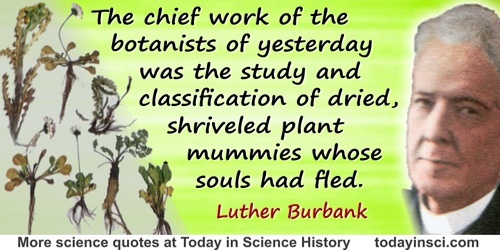
The chief work of the botanists of yesterday was the study and classification of dried, shriveled plant mummies whose souls had fled.
From Paper (18 Jun 1901), read before the California Academy of Sciences, published in 'The Making of New Flowers', American Gardening (13 Jul 1901), 22, No. 342, 489.
The classification of facts and the formation of absolute judgments upon the basis of this classification—judgments independent of the idiosyncrasies of the individual mind—essentially sum up the aim and method of modern science. The scientific man has above all things to strive at self-elimination in his judgments, to provide an argument which is as true for each individual mind as for his own.
From The Grammar of Science (1892), 7-8.
The classification of facts and the formation of absolute judgments upon the basis of this classification—judgments independent of the idiosyncrasies of the individual mind—is peculiarly the scope and method of modern science.
From The Grammar of Science (1892), 7.
The concepts and methods on which the classification of hominid taxa is based do not differ in principle from those used for other zoological taxa. Indeed, the classification of living human populations or of samples of fossil hominids is a branch of animal taxonomy.
Opening sentence of 'The Taxonomic Evaluation of Fossil Hominids' (1963). Collected in Sherwood L. Washburn, Classification and Human Evolution (1964), 332.
The ends of scientific classification are best answered, when the objects are formed into groups respecting which a greater number of general propositions can be made, and those propositions more important, than could be made respecting any other groups into which the same things could be distributed. ... A classification thus formed is properly scientific or philosophical, and is commonly called a Natural, in contradistinction to a Technical or Artificial, classification or arrangement.
A System of Logic, Ratiocinative and Inductive (1843), Vol. 2, Book 4, Chapter 7, 302-3.
The first step in wisdom is to know the things themselves; this notion consists in having a true idea of the objects; objects are distinguished and known by classifying them methodically and giving them appropriate names. Therefore, classification and name-giving will be the foundation of our science.
Systema Naturae (1735), trans. M. S. J. Engel-Ledeboer and H. Engel (1964), 19.
The first thing the intellect does with an object is to class it along with something else. But any object that is infinitely important to us and awakens our devotion feels to us also as if it must be sui generis and unique. Probably a crab would be filled with a sense of personal outrage if it could hear us class it without ado or apology as a crustacean, and thus dispose of it. 'I am no such thing,' it would say; 'I am MYSELF, MYSELF alone.
The Varieties of Religious Experience: A Study in Human Nature (1902), 9.
The greatest of all spectral classifiers, Antonia Maury had two strikes on her: the biggest one was, she was a woman. A woman had no chance at anything in astronomy except at Harvard in the 1880’s and 1890’s. And even there, things were rough. It now turns out that her director, E.C. Pickering, did not like the way she classified; she then refused to change to suit him; and after her great publication in Harvard Annals 28 (1897), she left Harvard—and in a sense, astronomy. ... I would say the most remarkable phenomenological investigation in modern astronomy is Miss Maury’s work in Harvard Annals 28. She didn’t have anything astrophysical to go on. Investigations between 1890 and 1900 were the origin of astrophysics. But these were solar, mostly. And there Miss Maury was on the periphery. I’ve seen pictures of groups, where she’d be standing away a little bit to one side of the other people, a little bit in the background. It was a very sad thing. When Hertzsprung wrote Pickering to congratulate him on Miss Maury’s work that had led to Hertzsprung’s discovery of super giants, Pickering is supposed to have replied that Miss Maury’s work was wrong — could not possibly be correct.
'Oral History Transcript: Dr. William Wilson Morgan' (8 Aug 1978) in the Niels Bohr Library & Archives.
The instinct for collecting, which began as in other animals as an adaptive property, could always in man spread beyond reason; it could become a hoarding mania. But in its normal form it provides a means of livelihood at the hunting and collecting stage of human evolution. It is then attached to a variety of rational aptitudes, above all in observing, classifying, and naming plants, animals and minerals, skills diversely displayed by primitive peoples. These skills with an instinctive beginning were the foundation of most of the civilised arts and sciences. Attached to other skills in advanced societies they promote the formation of museums and libraries; detached, they lead to acquisition and classification by eccentric individuals, often without any purpose or value at all.
As quoted in Richard Fifield, 'Cytologist Supreme', New Scientist (16 Apr 1981), 90, No. 1249, 179; citing C.D. Darlington, The Little Universe of Man (1978).
The modern system of elevating every minor group, however trifling the characters by which it is distinguished, to the rank of genus, evinces, we think, a want of appreciation of the true value of classification. The genus is the group which, in consequence of our system of nomenclature, is kept most prominently before the mind, and which has therefore most importance attached to it ... The rashness of some botanists is productive of still more detrimental effects to the science in the case of species; for though a beginner may pause before venturing to institute a genus, it rarely enters into his head to hesitate before proposing a new species.
(With Thomas Thomson) Flora Indica: A Systematic Account of the Plants of British India (1855),10-11.
The morning stars sang together.
And a person of delicate ear and nice judgment discussed the singing at length, and showed how and wherein one star differed from another, and which was great and which was not.
And still the morning stars sang together.
And a person of delicate ear and nice judgment discussed the singing at length, and showed how and wherein one star differed from another, and which was great and which was not.
And still the morning stars sang together.
'Classification' in Little Stings (1907, 1908), 83.
The morphological characteristics of plant and animal species form the chief subject of the descriptive natural sciences and are the criteria for their classification. But not until recently has it been recognized that in living organisms, as in the realm of crystals, chemical differences parallel the variation in structure.
The Specificity of Serological Reactions (1936), 3.
The names of the plants ought to be stable [certa], consequently they should be given to stable genera.
Philosophia Botanica (1751), aphorism 151. Trans. Frans A. Stafleu, Linnaeus and the Linnaeans: The Spreading of their Ideas in Systematic Botany, 1735-1789 (1971), 57.
The sciences of Natural History and Botany require so much time to be devoted to them that, however pleasing, they may be justly considered as improper objects for the man of business to pursue scientifically, so as to enter into the exact arrangement and classification of the different bodies of the animal, vegetable, and mineral kingdoms. But reading and personal observation will supply him with ample matter for reflection and admiration.
'On the Advantages of Literature and Philosophy in general and especially on the Consistency of Literary and Philosophical with Commercial Pursuits' (Read 3 Oct 1781). As quoted in Robert Angus Smith, A Centenary of Science in Manchester (1883), 79.
The star spectra present such varieties that it is difficult to point out any mode of classification. For the present, I divide them into three groups: first, those having many lines and bands and most nearly resembling the sun viz., Capella, β Geminorum, α Orionis, Aldeberan, γ Leonis, Arcturus, and β Pegasi. These are all reddish or golden stars. The second group, of which Sirius is the type, presents spectra wholly unlike that of the sun, and are white stars. The third group, comprising α Virginis, Rigel &c., are also white stars, but show no lines; perhaps they contain no mineral substance or are incandescent without flame.
L.M. Rutherfurd, 'Astronomical Observations with the Spectroscope' (4 Dec 1862), American Journal of Science and Arts (May 1863), 2nd Series, 35, No. 103, 77. His obituarist, Johns K. Rees, wrote (1892) “This paper was the first published work on star spectra.”
The three most effective incentives to human action may be … classified as creed, greed and dread. … In examining the scientist it is perhaps worth while to examine how far he is moved by these three incentives. I think that, rather peculiarly and rather exceptionally, he is very little moved by dread. … He is in fact essentially a person who has been taught he must be fearless in his dealing with facts.
'Scientist and Citizen', Speech to the Empire Club of Canada (29 Jan 1948), The Empire Club of Canada Speeches (29 Jan 1948), 209-221.
There have been many authorities who have asserted that the basis of science lies in counting or measuring, i.e. in the use of mathematics. Neither counting nor measuring can however be the most fundamental processes in our study of the material universe—before you can do either to any purpose you must first select what you propose to count or measure, which presupposes a classification.
Classification and Biology (1970), 2.
There is a moral or metaphysical part of nature as well as a physical. A man who denies this is deep in the mire of folly. ’Tis the crown and glory of organic science that it does through final cause, link material and moral; and yet does not allow us to mingle them in our first conception of laws, and our classification of such laws, whether we consider one side of nature or the other. You have ignored this link; and, if I do not mistake your meaning, you have done your best in one or two pregnant cases to break it. Were it possible (which, thank God, it is not) to break it, humanity, in my mind, would suffer a damage that might brutalize it, and sink the human race into a lower grade of degradation than any into which it has fallen since its written records tell us of its history.
Letter to Charles Darwin (Nov 1859). In Charles Darwin and Francis Darwin (ed.), Charles Darwin: His Life Told in an Autobiographical Chapter, and in a Selected Series of His Published Letters (1892), 217.
There is an integration of the present impressions with such past ones as they resemble, and a differentiation of them from such past ones as they do not resemble; and this comparison of present with past impressions, dependent on memory, implies classification, and is the germ of what we call Perception and Reasoning.
In Outlines of Cosmic Philosophy: Based on the Doctrine of Evolution (1874), Vol. 2, 155-156.
There is nothing distinctively scientific about the hypothetico-deductive process. It is not even distinctively intellectual. It is merely a scientific context for a much more general stratagem that underlies almost all regulative processes or processes of continuous control, namely feedback, the control of performance by the consequences of the act performed. In the hypothetico-deductive scheme the inferences we draw from a hypothesis are, in a sense, its logical output. If they are true, the hypothesis need not be altered, but correction is obligatory if they are false. The continuous feedback from inference to hypothesis is implicit in Whewell’s account of scientific method; he would not have dissented from the view that scientific behaviour can be classified as appropriately under cybernetics as under logic.
Induction and Intuition in Scientific Thought (1969), 54-5.
There may be as many classifications of any series of natural, or of other, bodies, as they have properties or relations to one another, or to other things; or, again, as there are modes in which they may be regarded by the mind: so that, with respect to such classifications as we are here concerned with, it might be more proper to speak of a classification than of the classification of the animal kingdom.
In Lecture (Spring 1863) to the Royal College of Surgeons of England, 'On the Classification of Animals', Lectures on the Elements of Comparative Anatomy (1864), 1.
These earthly godfathers of heaven’s lights
That give a name to every fixed star
Have no more profit of their shining nights
Than those that walk and wot not what they are.
That give a name to every fixed star
Have no more profit of their shining nights
Than those that walk and wot not what they are.
Dialog for Biron, written in Love’s Labour Lost (1598), Act 1, Scene 1, line 78-81.
Though, probably, no competent geologist would contend that the European classification of strata is applicable to all other parts of the globe, yet most, if not all geologists, write as though it were so.
'Illogical Geology', The Universal Review (1859), 2, 54.
We may therefore say in the future, strictly within the limits of observation, that in certain respects the fossil species of a class traverse in their historical succession metamorphoses similar to those which the embryos undergo in themselves. … The development of a class in the history of the earth offers, in many respects, the greatest analogy with the development of an individual at different periods of his life. The demonstration of this truth is one of the most beautiful results of modern paleontology.
From Embryologie des Salmones, collected in L. Agassiz, Poissons d'Eau Douce de l’Europe Centrale (1842), 260. Translated by Webmaster using Google Translate, from the original French, “On pourra donc dire à l'avenir, en restant rigoureusement dans les limites de l'observation, qu'à certains égards, les espèces fossiles d'une classe parcourent dans leur succession historique des métamorphoses semblables à celles que subissent les embryons en se développant … Le développement d’une classe dans l’histoire de la terre offre, à divers égards, la plus grande analogie avec le dévelopment d’un individu aux différentes époques de sa vie. La démonstration de cette vérité est un des plus beaux résultat de la paléontologie moderne.”
Western science is a product of the Apollonian mind: its hope is that by naming and classification, by the cold light of intellect, archaic night can be pushed back and defeated.
In Sexual Personae: Art and Decadence from Nefertiti to Emily Dickinson (1990), 5.
Whatever plan of classification, founded on the natural relations of the elements, be adopted, in the practical study of chemistry, it will always be found most advantageous to commence with the consideration of the great constituents of the ocean and the atmosphere.
Introducing sections on oxygen and hydrogen, in Elementary Chemistry, Theoretical and Practical (1854), 104.
When every fact, every present or past phenomenon of that universe, every phase of present or past life therein, has been examined, classified, and co-ordinated with the rest, then the mission of science will be completed. What is this but saying that the task of science can never end till man ceases to be, till history is no longer made, and development itself ceases?
From The Grammar of Science (1892), 15.
When we have amassed a great store of such general facts, they become the objects of another and higher species of classification, and are themselves included in laws which, as they dispose of groups, not individuals have a far superior degree of generality, till at length, by continuing the process, we arrive at axioms of the highest degree of generality of which science is capable. This process is what we mean by induction.
In A Preliminary Discourse on the Study of Natural Philosophy (1830), 102.
When we speak of the picture of nature in the exact science of our age, we do not mean a picture of nature so much as a picture of our relationships with nature. The old division of the world into objective processes in space and time and the mind in which these processes are mirrored … is no longer a suitable starting point for our understanding of modern science. Science, we find, is now focused on the network of relationships between man and nature, on the framework which makes us as living beings dependent parts of nature, and which we as human beings have simultaneously made the object of our thoughts and actions. Science no longer confronts nature as an objective observer, but sees itself as an actor in this interplay between man and nature. The scientific method of analysing, explaining and classifying has become conscious of its limitations, which arise out of the fact that by its intervention science alters and refashions the object of investigation. In other words, method and object can no longer be separated. The scientific world view has ceased to be a scientific view in the true sense of the word.
From Das Naturbild der Heutigen Physik (1955). Translated by Arnold J. Pomerans, The Physicist’s Conception of Nature (1958), 29. Compare a similar but original translation by O. T. Benfey, 'The Representation of Nature in Contemporary Physics', in Daedalus (Summer 1958), 87, No. 3, 107.
Where there is dirt there is a system. Dirt is the by-product of a systematic ordering and classification of matter, in so far as ordering involves rejecting inappropriate elements.
In Purity and Danger: An Analysis of the Concepts of Pollution and Taboo (1966), 35.
While natural science up to the end of the last century was predominantly a collecting science, a science of finished things, in our century it is essentially a classifying science, a science of processes, of the origin and development of these things and of the interconnection which binds these processes into one great whole.
Speaking of the 18th (last) and 19th (our) centuries, in Ludwig Feuerbach and the Outcome of Classical German Philosophy (1886, 1941).
Why should an hypothesis, suggested by a scientist, be accepted as true until its truth is established? Science should be the last to make such a demand because science to be truly science is classified knowledge; it is the explanation of facts. Tested by this definition, Darwinism is not science at all; it is guesses strung together.
In chapter, 'The Origin of Man', In His Image (1922), 94.
Why, it is asked, since the scientist, by means of classification and experiment, can predict the “action of the physical world, shall not the historian do as much for the moral world”! The analogy is false at many points; but the confusion arises chiefly from the assumption that the scientist can predict the action of the physical world. Certain conditions precisely given, the scientist can predict the result; he cannot say when or where in the future those conditions will obtain.
In 'A New Philosophy of History', The Dial (2 Sep 1915), 148. This is Becker’s review of a book by L. Cecil Jane, The Interpretation of History. Becker refutes Jane’s idea that the value of history lies in whether it consists in furnishing “some clue as to what the future will bring.”
Without preparing fluorine, without being able to separate it from the substances with which it is united, chemistry has been able to study and to analyze a great number of its compounds. The body was not isolated, and yet its place was marked in our classifications. This well demonstrates the usefulness of a scientific theory, a theory which is regarded as true during a certain time, which correlates facts and leads the mind to new hypotheses, the first causes of experimentation; which, little by little, destroy the theory itself, in order to replace it by another more in harmony with the progress of science.
[Describing the known history of fluorine compounds before his isolation of the element.]
[Describing the known history of fluorine compounds before his isolation of the element.]
'Fluorine', lecture at the Royal Institution (28 May 1897), translated from the French, in Proceedings of the Royal Institution (1897). In Annual Report of the Board of Regents of the Smithsonian Institution to July 1897 (1898), 262.
Without the discovery of uniformities there can be no concepts, no classifications, no formulations, no principles, no laws; and without these no science can exist.
Co-editor with American psychologist Henry Murray (1893-1988)
Co-editor with American psychologist Henry Murray (1893-1988)
'Personality Formation: the Determinants'. In Clyde Kluckhohn and Henry A. Murray (eds.), Personality in Nature, Society, and Culture (1949), 37-8.
You can find that sort of regularity in Stock Exchange quotations.
[Expressing his lack of confidence in reported regularities in the periodic classification of elements.]
[Expressing his lack of confidence in reported regularities in the periodic classification of elements.]
As quoted in Stanley I. Levy, 'Brauner Memorial Lecture', Journal of the Chemical Society (1935), Pt. 2, 1878. It has also been quoted as “One might just as well seek regularities in the figures of stock exchange bulletins” in L. Vlasov and D. Trifonov, trans. from Russian by David Sobolev, 107 Stories About Chemistry (1970).
 In science it often happens that scientists say, 'You know that's a really good argument; my position is mistaken,' and then they would actually change their minds and you never hear that old view from them again. They really do it. It doesn't happen as often as it should, because scientists are human and change is sometimes painful. But it happens every day. I cannot recall the last time something like that happened in politics or religion.
(1987) --
In science it often happens that scientists say, 'You know that's a really good argument; my position is mistaken,' and then they would actually change their minds and you never hear that old view from them again. They really do it. It doesn't happen as often as it should, because scientists are human and change is sometimes painful. But it happens every day. I cannot recall the last time something like that happened in politics or religion.
(1987) --