Claim Quotes (154 quotes)
[Certain students] suppose that because science has penetrated the structure of the atom it can solve all the problems of the universe. ... They are known in every ... college as the most insufferable, cocksure know-it-alls. If you want to talk to them about poetry, they are likely to reply that the "emotive response" to poetry is only a conditioned reflex .... If they go on to be professional scientists, their sharp corners are rubbed down, but they undergo no fundamental change. They most decidedly are not set apart from the others by their intellectual integrity and faith, and their patient humility in front of the facts of nature.... They are uneducated, in the fullest sense of the word, and they certainly are no advertisement for the claims of science teachers.
In Science is a Sacred Cow (1950), 18-19.
A famous anecdote concerning Cuvier involves the tale of his visitation from the devil—only it was not the devil but one of his students dressed up with horns on his head and shoes shaped like cloven hooves. This frightening apparition burst into Cuvier’s bedroom when he was fast asleep and claimed:
“Wake up thou man of catastrophes. I am the Devil. I have come to devour you!”
Cuvier studied the apparition carefully and critically said,
“I doubt whether you can. You have horns and hooves. You eat only plants.”
“Wake up thou man of catastrophes. I am the Devil. I have come to devour you!”
Cuvier studied the apparition carefully and critically said,
“I doubt whether you can. You have horns and hooves. You eat only plants.”
Quoted in Glyn Daniel, The Idea of Pre-History (1962), 34.
Il est impossible de contempler le spectacle de l’univers étoilé sans se demander comment il s’est formé: nous devions peut-être attendre pour chercher une solution que nous ayons patiemment rassemblé les éléments …mais si nous étions si raisonnables, si nous étions curieux sans impatience, il est probable que nous n’avions jamais créé la Science et que nous nous serions toujours contentés de vivre notre petite vie. Notre esprit a donc reclamé impérieusement cette solution bien avant qu’elle fut mûre, et alors qu’il ne possédait que de vagues lueurs, lui permettant de la deviner plutôt que de l’attendre.
It is impossible to contemplate the spectacle of the starry universe without wondering how it was formed: perhaps we ought to wait, and not look for a solution until have patiently assembled the elements … but if we were so reasonable, if we were curious without impatience, it is probable we would never have created Science and we would always have been content with a trivial existence. Thus the mind has imperiously laid claim to this solution long before it was ripe, even while perceived in only faint glimmers—allowing us to guess a solution rather than wait for it.
It is impossible to contemplate the spectacle of the starry universe without wondering how it was formed: perhaps we ought to wait, and not look for a solution until have patiently assembled the elements … but if we were so reasonable, if we were curious without impatience, it is probable we would never have created Science and we would always have been content with a trivial existence. Thus the mind has imperiously laid claim to this solution long before it was ripe, even while perceived in only faint glimmers—allowing us to guess a solution rather than wait for it.
From Leçons sur les Hypothèses Consmogoniques (1913) as cited in D. Ter Haar and A.G.W. Cameron, 'Historical Review of Theories of the Origin of the Solar System', collected in Robert Jastrow and A. G. W. Cameron (eds.), Origin of the Solar System: Proceedings of a Conference Held at the Goddard Institute for Space Studies, New York, January 23-24, 1962, (1963), 3.
'Cosmogonical Hypotheses' (1913), collected in Harlow Shapley, Source Book in Astronomy, 1900-1950 (1960), 347.
A common fallacy in much of the adverse criticism to which science is subjected today is that it claims certainty, infallibility and complete emotional objectivity. It would be more nearly true to say that it is based upon wonder, adventure and hope.
Quoted in E. J. Bowen's obituary of Hinshelwood, Chemistry in Britain (1967), Vol. 3, 536.
A frequent misunderstanding of my vision of Gaia is that I champion complacence, that I claim feedback will always protect the environment from any serious harm that humans might do. It is sometimes more crudely put as “Lovelock’s Gaia gives industry the green light to pollute at will.” The truth is almost diametrically opposite. Gaia, as I see her, is no doting mother tolerant of misdemeanors, nor is she some fragile and delicate damsel in danger from brutal mankind. She is stern and tough, always keeping the world warm and comfortable for those who obey the rules, but ruthless in her destruction of those who transgress. Her unconscious goal is a planet fit for life. If humans stand in the way of this, we shall be eliminated with as little pity as would be shown by the micro-brain of an intercontinental ballistic nuclear missile in full flight to its target.
In The Ages of Gaia: A Biography of Our Living Earth (1999), 199.
A thing is either alive or it isn’t; there is nothing that is almost alive. There is but the remotest possibility of the origin of life by spontaneous generation, and every likelihood that Arrhenius is right when he dares to claim that life is a cosmic phenomenon, something that drifts between the spheres, like light, and like light transiently descends upon those fit to receive it.
In An Almanac for Moderns (1935), 393.
All fossil anthropoids found hitherto have been known only from mandibular or maxillary fragments, so far as crania are concerned, and so the general appearance of the types they represented had been unknown; consequently, a condition of affairs where virtually the whole face and lower jaw, replete with teeth, together with the major portion of the brain pattern, have been preserved, constitutes a specimen of unusual value in fossil anthropoid discovery. Here, as in Homo rhodesiensis, Southern Africa has provided documents of higher primate evolution that are amongst the most complete extant. Apart from this evidential completeness, the specimen is of importance because it exhibits an extinct race of apes intermediate between living anthropoids and man ... Whether our present fossil is to be correlated with the discoveries made in India is not yet apparent; that question can only be solved by a careful comparison of the permanent molar teeth from both localities. It is obvious, meanwhile, that it represents a fossil group distinctly advanced beyond living anthropoids in those two dominantly human characters of facial and dental recession on one hand, and improved quality of the brain on the other. Unlike Pithecanthropus, it does not represent an ape-like man, a caricature of precocious hominid failure, but a creature well advanced beyond modern anthropoids in just those characters, facial and cerebral, which are to be anticipated in an extinct link between man and his simian ancestor. At the same time, it is equally evident that a creature with anthropoid brain capacity and lacking the distinctive, localised temporal expansions which appear to be concomitant with and necessary to articulate man, is no true man. It is therefore logically regarded as a man-like ape. I propose tentatively, then, that a new family of Homo-simidæ be created for the reception of the group of individuals which it represents, and that the first known species of the group be designated Australopithecus africanus, in commemoration, first, of the extreme southern and unexpected horizon of its discovery, and secondly, of the continent in which so many new and important discoveries connected with the early history of man have recently been made, thus vindicating the Darwinian claim that Africa would prove to be the cradle of mankind.
'Australopithicus africanus: The Man-Ape of South Africa', Nature, 1925, 115, 195.
All science has God as its author and giver. Much is heard of the conflict between science and religion, and of the contrast between sacred and secular. There may be aspects of truth to which religion is the gate, as indeed there are aspects of truth to which particular sciences are the gate. But if there be a Creator, and if truth be one of his attributes, then everything that is true can claim his authorship, and every search for truth can claim his authority.
In Margaret Duggan (ed.), Through the Year with Michael Ramsey: Devotional Readings for Every Day (1975).
All sorts of computer errors are now turning up. You'd be surprised to know the number of doctors who claim they are treating pregnant men.
Official of the Quebec Health Insurance Board, on Use of Computers in Quebec Province's Comprehensive Medical-care system. F. 19, 4:5. In Barbara Bennett and Linda Amster, Who Said What (and When, and Where, and How) in 1971: December-June, 1971 (1972), Vol. 1, 38. (Later sources cite Isaac Asimov.)
An article in Bioscience in November 1987 by Julie Ann Miller claimed the cortex was a “quarter-meter square.” That is napkin-sized, about ten inches by ten inches. Scientific American magazine in September 1992 upped the ante considerably with an estimate of 1½ square meters; that’s a square of brain forty inches on each side, getting close to the card-table estimate. A psychologist at the University of Toronto figured it would cover the floor of his living room (I haven’t seen his living room), but the prize winning estimate so far is from the British magazine New Scientist’s poster of the brain published in 1993 which claimed that the cerebral cortex, if flattened out, would cover a tennis court. How can there be such disagreement? How can so many experts not know how big the cortex is? I don’t know, but I’m on the hunt for an expert who will say the cortex, when fully spread out, will cover a football field. A Canadian football field.
In The Burning House: Unlocking the Mysteries of the Brain (1994, 1995), 11.
Any chemist reading this book can see, in some detail, how I have spent most of my mature life. They can become familiar with the quality of my mind and imagination. They can make judgements about my research abilities. They can tell how well I have documented my claims of experimental results. Any scientist can redo my experiments to see if they still work—and this has happened! I know of no other field in which contributions to world culture are so clearly on exhibit, so cumulative, and so subject to verification.
From Design to Discovery (1990), 119-20.
Authors have a greater right than any copyright, though it is generally unacknowledged or disregarded. They have a right to the reader’s civility. There are favorable hours for reading a book, as for writing it, and to these the author has a claim. Yet many people think that when they buy a book they buy with it the right to abuse the author.
In 'Table-Talk', The Poetical Works of Henry Wadsworth Longfellow: Volume 3 (1883), 1355.
But when science, passing beyond its own limits, assumes to take the place of theology, and sets up its own conception of the order of Nature as a sufficient account of its cause, it is invading a province of thought to which it has no claim, and not unreasonably provokes the hostility of its best friends.
Presidential Address (14 Aug 1872) to the British Association for the Advancement of Science, Brighton, reprinted in The Journal of the Society of Arts (16 Aug 1872), 20, No. 1030, 799, penultimate sentence.
By the worldly standards of public life, all scholars in their work are of course oddly virtuous. They do not make wild claims, they do not cheat, they do not try to persuade at any cost, they appeal neither to prejudice nor to authority, they are often frank about their ignorance, their disputes are fairly decorous, they do not confuse what is being argued with race, politics, sex or age, they listen patiently to the young and to the old who both know everything. These are the general virtues of scholarship, and they are peculiarly the virtues of science.
In Science and Human Values (1956).
Clinical science has as good a claim to the name and rights and self-subsistence of a science as any other department of biology.
Address by the President. Transactions of the Clinical Society of London (1870), 3, xxxii.
Do you remember what Darwin says about music? He claims that the power of producing and appreciating it existed among the human race long before the power of speech was arrived at. Perhaps that is why we are so subtly influenced by it. There are vague memories in our souls of those misty centuries when the world was in its childhood.
Spoken by character, Sherlock Holmes, in A Study in Scarlet (1887), Chap. 5. Collected in Works of Arthur Conan Doyle (1902), Vol. 11, 68-69.
Does anyone believe that the difference between the Lebesgue and Riemann integrals can have physical significance, and that whether say, an airplane would or would not fly could depend on this difference? If such were claimed, I should not care to fly in that plane.
Paraphrased from American Mathematics Monthly (1998) 105, 640-50. Quoted in John De Pillis, 777 Mathematical Conversation Starters (2004), 136.
Edmund Wilson attacked the pedantry of scholarly editions of literary classics, which (he claimed) took the pleasure out of reading. Extensive footnotes … spoiled the reader’s pleasure in the text. Wilson’s friend Lewis Mumford had compared footnote numbers … to “barbed wire” keeping the reader at arm’s length.
In Academic Instincts (2001), 39.
Even those to whom Providence has allotted greater strength of understanding, can expect only to improve a single science. In every other part of learning, they must be content to follow opinions, which they are not able to examine; and, even in that which they claim as peculiarly their own, can seldom add more than some small particle of knowledge, to the hereditary stock devolved to them from ancient times, the collective labour of a thousand intellects.
In Samuel Johnson and W. Jackson Bate (Ed.), ',The Rambler, No. 121, Tuesday, 14 May 1751.' The Selected Essays from the Rambler, Adventurer, and Idler (1968), 172.
Every new theory as it arises believes in the flush of youth that it has the long sought goal; it sees no limits to its applicability, and believes that at last it is the fortunate theory to achieve the 'right' answer. This was true of electron theory—perhaps some readers will remember a book called The Electrical Theory of the Universe by de Tunzelman. It is true of general relativity theory with its belief that we can formulate a mathematical scheme that will extrapolate to all past and future time and the unfathomed depths of space. It has been true of wave mechanics, with its first enthusiastic claim a brief ten years ago that no problem had successfully resisted its attack provided the attack was properly made, and now the disillusionment of age when confronted by the problems of the proton and the neutron. When will we learn that logic, mathematics, physical theory, are all only inventions for formulating in compact and manageable form what we already know, like all inventions do not achieve complete success in accomplishing what they were designed to do, much less complete success in fields beyond the scope of the original design, and that our only justification for hoping to penetrate at all into the unknown with these inventions is our past experience that sometimes we have been fortunate enough to be able to push on a short distance by acquired momentum.
The Nature of Physical Theory (1936), 136.
Every writer must reconcile, as best he may, the conflicting claims of consistency and variety, of rigour in detail and elegance in the whole. The present author humbly confesses that, to him, geometry is nothing at all, if not a branch of art.
Concluding remark in preface to Treatise on Algebraic Plane Curves (1931), x.
Evolution has encountered no intellectual trouble; no new arguments have been offered. Creationism is a home-grown phenomenon of American sociocultural history—a splinter movement … who believe that every word in the Bible must be literally true, whatever such a claim might mean.
Leonardo's Mountain of Clams and the Diet of Worms: Essays on Natural History (1998), 270.
Extraordinary claims require extraordinary evidence.
…...
First... a new theory is attacked as absurd; then it is admitted to be true, but obvious and insignificant; finally it is seen to be so important that its adversaries claim that they themselves discovered it.
'Pragmatism's Conception of Truth', in Pragmatism: A New Name for some Old Ways of Thinking, Popular Lectures on Philosophy (1907), 198.
Generality of points of view and of methods, precision and elegance in presentation, have become, since Lagrange, the common property of all who would lay claim to the rank of scientific mathematicians. And, even if this generality leads at times to abstruseness at the expense of intuition and applicability, so that general theorems are formulated which fail to apply to a single special case, if furthermore precision at times degenerates into a studied brevity which makes it more difficult to read an article than it was to write it; if, finally, elegance of form has well-nigh become in our day the criterion of the worth or worthlessness of a proposition,—yet are these conditions of the highest importance to a wholesome development, in that they keep the scientific material within the limits which are necessary both intrinsically and extrinsically if mathematics is not to spend itself in trivialities or smother in profusion.
In Die Entwickdung der Mathematik in den letzten Jahrhunderten (1884), 14-15.
Geologists claim that although the world is running out of oil, there is still a two-hundred-year supply of brake fluid.
In Napalm and Silly Putty (2002), 105.
Great thinkers build their edifices with subtle consistency. We do our intellectual forebears an enormous disservice when we dismember their visions and scan their systems in order to extract a few disembodied ‘gems’–thoughts or claims still accepted as true. These disarticulated pieces then become the entire legacy of our ancestors, and we lose the beauty and coherence of older systems that might enlighten us by their unfamiliarity–and their consequent challenge in our fallible (and complacent) modern world.
…...
Hitherto the conception of chemical transmission at nerve endings and neuronal synapses, originating in Loewi’s discovery, and with the extension that the work of my colleagues has been able to give to it, can claim one practical result, in the specific, though alas only short, alleviation of the condition of myasthenia gravis, by eserine and its synthetic analogues.
'Some recent extensions of the chemical transmission of the effects of nerve impulses', Nobel Lecture, 12 December 1936. In Nobel Lectures: Physiology or Medicine 1922-1941 (1965), 412-3.
I am not ... asserting that humans are either genial or aggressive by inborn biological necessity. Obviously, both kindness and violence lie with in the bounds of our nature because we perpetrate both, in spades. I only advance a structural claim that social stability rules nearly all the time and must be based on an overwhelmingly predominant (but tragically ignored) frequency of genial acts, and that geniality is therefore our usual and preferred response nearly all the time ... The center of human nature is rooted in ten thousand ordinary acts of kindness that define our days.
In Eight Little Piggies: Reflections in Natural History (1993), 282.
I am now convinced that we have recently become possessed of experimental evidence of the discrete or grained nature of matter, which the atomic hypothesis sought in vain for hundreds and thousands of years. The isolation and counting of gaseous ions, on the one hand, which have crowned with success the long and brilliant researches of J.J. Thomson, and, on the other, agreement of the Brownian movement with the requirements of the kinetic hypothesis, established by many investigators and most conclusively by J. Perrin, justify the most cautious scientist in now speaking of the experimental proof of the atomic nature of matter, The atomic hypothesis is thus raised to the position of a scientifically well-founded theory, and can claim a place in a text-book intended for use as an introduction to the present state of our knowledge of General Chemistry.
In Grundriss der allgemeinen Chemie (4th ed., 1909), Preface, as cited by Erwin N. Hiebert and Hans-Gunther Korber in article on Ostwald in Charles Coulston Gillespie (ed.), Dictionary of Scientific Biography Supplement 1, Vol 15-16, 464.
I cannot think of a single field in biology or medicine in which we can claim genuine understanding, and it seems to me the more we learn about living creatures, especially ourselves, the stranger life becomes.
In 'On Science and Certainty', Discover Magazine (Oct 1980).
I claim that many patterns of Nature are so irregular and fragmented, that, compared with Euclid—a term used in this work to denote all of standard geometry—Nature exhibits not simply a higher degree but an altogether different level of complexity … The existence of these patterns challenges us to study these forms that Euclid leaves aside as being “formless,” to investigate the morphology of the “amorphous.”
Cited as from Fractals: Form, Chance, and Dimension (1977), by J.W. Cannon, in review of The Fractal Geometry of Nature (1982) in The American Mathematical Monthly (Nov 1984), 91, No. 9, 594.
I claim that relativity and the rest of modern physics is not complicated. It can be explained very simply. It is only unusual or, put another way, it is contrary to common sense.
In Edward Teller, Wendy Teller and Wilson Talley, Conversations on the Dark Secrets of Physics (1991, 2013), 2.
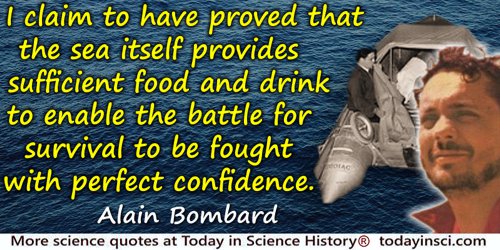
I claim to have proved that the sea itself provides sufficient food and drink to enable the battle for survival to be fought with perfect confidence.
In Bombard’s Voyage: Abridged from The Bombard Story (1959), 143.
I do not claim that intelligence, however defined, has no genetic basis–I regard it as trivially true, uninteresting, and unimportant that it does. The expression of any trait represents a complex interaction of heredity and environment ... a specific claim purporting to demonstrate a mean genetic deficiency in the intelligence of American blacks rests upon no new facts whatever and can cite no valid data in its support. It is just as likely that blacks have a genetic advantage over whites. And, either way, it doesn’t matter a damn. An individual can’t be judged by his group mean.
…...
I do not maintain that the chief value of the study of arithmetic consists in the lessons of morality that arise from this study. I claim only that, to be impressed from day to day, that there is something that is right as an answer to the questions with which one is able to grapple, and that there is a wrong answer—that there are ways in which the right answer can be established as right, that these ways automatically reject error and slovenliness, and that the learner is able himself to manipulate these ways and to arrive at the establishment of the true as opposed to the untrue, this relentless hewing to the line and stopping at the line, must color distinctly the thought life of the pupil with more than a tinge of morality. … To be neighborly with truth, to feel one’s self somewhat facile in ways of recognizing and establishing what is right, what is correct, to find the wrong persistently and unfailingly rejected as of no value, to feel that one can apply these ways for himself, that one can think and work independently, have a real, a positive, and a purifying effect upon moral character. They are the quiet, steady undertones of the work that always appeal to the learner for the sanction of his best judgment, and these are the really significant matters in school work. It is not the noise and bluster, not even the dramatics or the polemics from the teacher’s desk, that abide longest and leave the deepest and stablest imprint upon character. It is these still, small voices that speak unmistakably for the right and against the wrong and the erroneous that really form human character. When the school subjects are arranged on the basis of the degree to which they contribute to the moral upbuilding of human character good arithmetic will be well up the list.
In Arithmetic in Public Education (1909), 18. As quoted and cited in Robert Édouard Moritz, Memorabilia Mathematica; Or, The Philomath’s Quotation-book (1914), 69.
I don’t profess to be profound, but I do lay claim to common sense.
Fictional character, Miss Murstone, in 'My Holidays, Especially One Happy Afternoon', David Copperfield (1849-1850, 1878), Chap. 8, 70
I don’t think many people remember what life was like in those days. This was the era when the Russians were claiming superiority, and they could make a pretty good case—they put up Sputnik in ’57; they had already sent men into space to orbit the earth. There was this fear that perhaps communism was the wave of the future. The astronauts, all of us, really believed we were locked in a battle of democracy versus communism, where the winner would dominate the world.
As reported by Howard Wilkinson in 'John Glenn Had the Stuff U.S. Heroes are Made of', The Cincinnati Enquirer (20 Feb 2002).
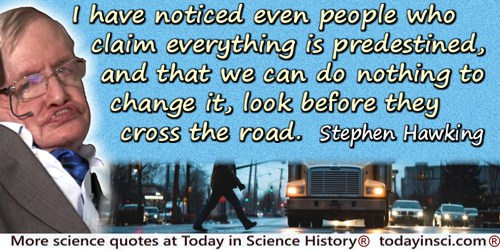
I have noticed even people who claim everything is predestined, and that we can do nothing to change it, look before they cross the road.
In Black Holes and Baby Universes and Other Essays (1993), 134.
I learnt very quickly that the only reason that would be accepted for not attending a committee meeting was that one already had a previous commitment to attend a meeting of another organization on the same day. I therefore invented a society, the Orion Society, a highly secret and very exclusive society that spawned a multitude of committees, sub-committees, working parties, evaluation groups and so on that, regrettably, had a prior claim on my attention. Soon people wanted to know more about this club and some even decided that they would like to join it. However, it was always made clear to them that applications were never entertained and that if they were deemed to qualify for membership they would be discreetly approached at the appropriate time.
Loose Ends from Current Biology (1997), 14.
I maintain that the human mystery is incredibly demeaned by scientific reductionism, with its claim in promissory materialism to account eventually for all of the spiritual world in terms of patterns of neuronal activity. This belief must be classed as a superstition. ... We have to recognize that we are spiritual beings with souls existing in a spiritual world as well as material beings with bodies and brains existing in a material world.
In Evolution of the Brain: Creation of the Self (1991), 241.
I think a strong claim can be made that the process of scientific discovery may be regarded as a form of art. This is best seen in the theoretical aspects of Physical Science. The mathematical theorist builds up on certain assumptions and according to well understood logical rules, step by step, a stately edifice, while his imaginative power brings out clearly the hidden relations between its parts. A well constructed theory is in some respects undoubtedly an artistic production. A fine example is the famous Kinetic Theory of Maxwell. ... The theory of relativity by Einstein, quite apart from any question of its validity, cannot but be regarded as a magnificent work of art.
Responding to the toast, 'Science!' at the Royal Academy of the Arts in 1932.)
Responding to the toast, 'Science!' at the Royal Academy of the Arts in 1932.)
Quoted in Lawrence Badash, 'Ernest Rutherford and Theoretical Physics,' in Robert Kargon and Peter Achinstein (eds.) Kelvin's Baltimore Lectures and Modern Theoretical Physics: Historical and Philosophical Perspectives (1987), 352.
I will be sufficiently rewarded if when telling it to others you will not claim the discovery as your own, but will say it was mine.
— Thales
…...
I would proclaim that the vast majority of what [say, Scientific American] is true—yet my ability to defend such a claim is weaker than I would like. And most likely the readers, authors, and editors of that magazine would be equally hard pressed to come up with cogent, non-technical arguments convincing a skeptic of this point, especially if pitted against a clever lawyer arguing the contrary. How come Truth is such a slippery beast?
Metamagical Themas (1985), 93.
If at this moment I am not a worn-out, debauched, useless carcass of a man, if it has been or will be my fate to advance the cause of science, if I feel that I have a shadow of a claim on the love of those about me, if in the supreme moment when I looked down into my boy’s grave my sorrow was full of submission and without bitterness, it is because these agencies have worked upon me, and not because I have ever cared whether my poor personality shall remain distinct forever from the All from whence it came and whither it goes.
And thus, my dear Kingsley, you will understand what my position is. I may be quite wrong, and in that case I know I shall have to pay the penalty for being wrong. But I can only say with Luther, “Gott helfe mir, ich kann nichts anders [God help me, I cannot do otherwise].”
And thus, my dear Kingsley, you will understand what my position is. I may be quite wrong, and in that case I know I shall have to pay the penalty for being wrong. But I can only say with Luther, “Gott helfe mir, ich kann nichts anders [God help me, I cannot do otherwise].”
In Letter (23 Sep 1860) to Charles Kingsley, Life and Letters of Thomas Henry Huxley (1901), 237.
If I have put the case of science at all correctly, the reader will have recognised that modern science does much more than demand that it shall be left in undisturbed possession of what the theologian and metaphysician please to term its “legitimate field.” It claims that the whole range of phenomena, mental as well as physical—the entire universe—is its field. It asserts that the scientific method is the sole gateway to the whole region of knowledge.
From The Grammar of Science (1892), 29-30.
If my theory of relativity is proven successful, Germany will claim me as a German and France will declare I am a citizen of the world. Should my theory prove untrue, France will say I am a German and Germany will declare I am a Jew.
In Speech (6 Apr 1922) to the French Philosophical Society, Sorbonne. Quoted in Alice Calaprice, The Quotable Einstein (1996), 8.
In a great number of programmes I’m not a scientist—I’m simply a commentator. So I should claim no virtue for the fact that [people] seem to trust me, if that is indeed the case. It’s simply that I very seldom talk about something they can’t see. If I say a lion is attacking a wildebeest, they can see it is; if I were to say something about a proton, it might be different.
As quoted in Bill Parry, 'Sir David Attenborough in Conversation', The Biologist (Jun 2010), 57, No. 2, 93.
In all our academies we attempt far too much. ... In earlier times lectures were delivered upon chemistry and botany as branches of medicine, and the medical student learned enough of them. Now, however, chemistry and botany are become sciences of themselves, incapable of comprehension by a hasty survey, and each demanding the study of a whole life, yet we expect the medical student to understand them. He who is prudent, accordingly declines all distracting claims upon his time, and limits himself to a single branch and becomes expert in one thing.
Quoted in Johann Hermann Baas, Henry Ebenezer Handerson (trans.), Outlines of the History of Medicine and the Medical Profession (1889), 842-843.
In former times, … when ships buffeted by storms threw a portion of their cargo overboard, it was recognized that those whose goods were sacrificed had a claim in equity to indemnification at the expense of those whose goods were safely delivered. The value of the lost goods was paid for by agreement between all those whose merchandise had been in the same ship. This sea damage to cargo in transit was known as “havaria” and the word came naturally to be applied to the compensation money which each individual was called upon to pay. From this Latin word derives our modern word average.
In 'On the Average', Facts From Figures (1951), Chap. 4, 34.
In my first publication I might have claimed that I had come to the conclusion, as a result of serious study of the literature and deep thought, that valuable antibacterial substances were made by moulds and that I set out to investigate the problem. That would have been untrue and I preferred to tell the truth that penicillin started as a chance observation. My only merit is that I did not neglect the observation and that I pursued the subject as a bacteriologist. My publication in 1929 was the starting-point of the work of others who developed penicillin especially in the chemical field.
'Penicillin', Nobel Lecture, 11 Dec 1945. In Nobel Lectures: Physiology or Medicine 1942-1962 (1964), 83.
In no subject is there a rule, compliance with which will lead to new knowledge or better understanding. Skilful observations, ingenious ideas, cunning tricks, daring suggestions, laborious calculations, all these may be required to advance a subject. Occasionally the conventional approach in a subject has to be studiously followed; on other occasions it has to be ruthlessly disregarded. Which of these methods, or in what order they should be employed is generally unpredictable. Analogies drawn from the history of science are frequently claimed to be a guide; but, as with forecasting the next game of roulette, the existence of the best analogy to the present is no guide whatever to the future. The most valuable lesson to be learnt from the history of scientific progress is how misleading and strangling such analogies have been, and how success has come to those who ignored them.
'Cosmology', in Arthur Beer (ed.), Vistas in Astronomy (1956), Vol. 2, 1722.
In science it is no crime to be wrong, unless you are (inappropriately) laying claim to truth. What matters is that science as a whole is a self-correcting mechanism in which both new and old notions are constantly under scrutiny. In other words, the edifice of scientific knowledge consists simply of a body of observations and ideas that have (so far) proven resistant to attack, and that are thus accepted as working hypotheses about nature.
In The Monkey in the Mirror: Essays on the Science of What Makes Us Human (2003), 9.
In the conception of a machine or the product of a machine there is a point where one may leave off for parsimonious reasons, without having reached aesthetic perfection; at this point perhaps every mechanical factor is accounted for, and the sense of incompleteness is due to the failure to recognize the claims of the human agent. Aesthetics carries with it the implications of alternatives between a number of mechanical solutions of equal validity; and unless this awareness is present at every stage of the process … it is not likely to come out with any success in the final stage of design.
From 'The Esthetic Assimilation of the Machine', Technics and Civilization (1934), 349.
In the course of the history of the earth innumerable events have occurred one after another, causing changes of states, all with certain lasting consequences. This is the basis of our developmental law, which, in a nutshell, claims that the diversity of phenomena is a necessary consequence of the accumulation of the results of all individual occurrences happening one after another... The current state of the earth, thus, constitutes the as yet most diverse final result, which of course represents not a real but only a momentary end-point.
Ober das Entwicklung der Erde, (1867), 5-6.
In the medical field [scientific ignorance] could lead to horrendous results. People who don’t understand the difference between a controlled experiment and claims by some quack may die as a result of not taking medical science seriously. One of the most damaging examples of pseudoscience is false memory syndrome. I’m on the board of a foundation exposing this problem.
As quoted by Lawrence Toppman, 'Mastermind', The Charlotte Observer (20 Jun 1993), 6E. As quoted and cited in Dana Richards, 'Martin Gardner: A “Documentary”', collected in Elwyn R. Berlekamp and Tom Rodgers (ed.) The Mathemagician and Pied Puzzler: A Collection in Tribute to Martin Gardner (1999), 11.
It follows from the supreme perfection of God, that in creating the universe has chosen the best possible plan, in which there is the greatest variety together with the greatest order; the best arranged ground, place, time; the most results produced in the most simple ways; the most of power, knowledge, happiness and goodness the creatures that the universe could permit. For since all the possibles in I understanding of God laid claim to existence in proportion to their perfections, the actual world, as the resultant of all these claims, must be the most perfect possible. And without this it would not be possible to give a reason why things have turned out so rather than otherwise.
The Principles of Nature and Grace (1714), The Philosophical Works of Leibnitz (1890), ed. G. M. Duncan, 213-4.
It has been asserted … that the power of observation is not developed by mathematical studies; while the truth is, that; from the most elementary mathematical notion that arises in the mind of a child to the farthest verge to which mathematical investigation has been pushed and applied, this power is in constant exercise. By observation, as here used, can only be meant the fixing of the attention upon objects (physical or mental) so as to note distinctive peculiarities—to recognize resemblances, differences, and other relations. Now the first mental act of the child recognizing the distinction between one and more than one, between one and two, two and three, etc., is exactly this. So, again, the first geometrical notions are as pure an exercise of this power as can be given. To know a straight line, to distinguish it from a curve; to recognize a triangle and distinguish the several forms—what are these, and all perception of form, but a series of observations? Nor is it alone in securing these fundamental conceptions of number and form that observation plays so important a part. The very genius of the common geometry as a method of reasoning—a system of investigation—is, that it is but a series of observations. The figure being before the eye in actual representation, or before the mind in conception, is so closely scrutinized, that all its distinctive features are perceived; auxiliary lines are drawn (the imagination leading in this), and a new series of inspections is made; and thus, by means of direct, simple observations, the investigation proceeds. So characteristic of common geometry is this method of investigation, that Comte, perhaps the ablest of all writers upon the philosophy of mathematics, is disposed to class geometry, as to its method, with the natural sciences, being based upon observation. Moreover, when we consider applied mathematics, we need only to notice that the exercise of this faculty is so essential, that the basis of all such reasoning, the very material with which we build, have received the name observations. Thus we might proceed to consider the whole range of the human faculties, and find for the most of them ample scope for exercise in mathematical studies. Certainly, the memory will not be found to be neglected. The very first steps in number—counting, the multiplication table, etc., make heavy demands on this power; while the higher branches require the memorizing of formulas which are simply appalling to the uninitiated. So the imagination, the creative faculty of the mind, has constant exercise in all original mathematical investigations, from the solution of the simplest problems to the discovery of the most recondite principle; for it is not by sure, consecutive steps, as many suppose, that we advance from the known to the unknown. The imagination, not the logical faculty, leads in this advance. In fact, practical observation is often in advance of logical exposition. Thus, in the discovery of truth, the imagination habitually presents hypotheses, and observation supplies facts, which it may require ages for the tardy reason to connect logically with the known. Of this truth, mathematics, as well as all other sciences, affords abundant illustrations. So remarkably true is this, that today it is seriously questioned by the majority of thinkers, whether the sublimest branch of mathematics,—the infinitesimal calculus—has anything more than an empirical foundation, mathematicians themselves not being agreed as to its logical basis. That the imagination, and not the logical faculty, leads in all original investigation, no one who has ever succeeded in producing an original demonstration of one of the simpler propositions of geometry, can have any doubt. Nor are induction, analogy, the scrutinization of premises or the search for them, or the balancing of probabilities, spheres of mental operations foreign to mathematics. No one, indeed, can claim preeminence for mathematical studies in all these departments of intellectual culture, but it may, perhaps, be claimed that scarcely any department of science affords discipline to so great a number of faculties, and that none presents so complete a gradation in the exercise of these faculties, from the first principles of the science to the farthest extent of its applications, as mathematics.
In 'Mathematics', in Henry Kiddle and Alexander J. Schem, The Cyclopedia of Education, (1877.) As quoted and cited in Robert Édouard Moritz, Memorabilia Mathematica; Or, The Philomath’s Quotation-book (1914), 27-29.
It has been said by a distinguished philosopher that England is “usually the last to enter into the general movement of the European mind.” The author of the remark probably meant to assert that a man or a system may have become famous on the continent, while we are almost ignorant of the name of the man and the claims of his system. Perhaps, however, a wider range might be given to the assertion. An exploded theory or a disadvantageous practice, like a rebel or a patriot in distress, seeks refuge on our shores to spend its last days in comfort if not in splendour.
Opening from essay, 'Elementary Geometry', included in The Conflict of Studies and Other Essays (1873), 136.
It is an occupational risk of biologists to claim, towards the end of their careers, that the problems which they have not solved are insoluble.
'Popper's World', The London Review of Books (18-31 August 1983), 12.
It is ironical that, in the very field in which Science has claimed superiority to Theology, for example—in the abandoning of dogma and the granting of absolute freedom to criticism—the positions are now reversed. Science will not tolerate criticism of special relativity, while Theology talks freely about the death of God, religionless Christianity, and so on.
In 'Preface', Science at the Crossroads (1972), 13.
It is often claimed that knowledge multiplies so rapidly that nobody can follow it. I believe this is incorrect. At least in science it is not true. The main purpose of science is simplicity and as we understand more things, everything is becoming simpler. This, of course, goes contrary to what everyone accepts.
Edward Teller, Wendy Teller, Wilson Talley, Conversations on the Dark Secrets of Physics (1991, 2002), 2.
It is sometimes asserted that a surgical operation is or should be a work of art … fit to rank with those of the painter or sculptor. … That proposition does not admit of discussion. It is a product of the intellectual innocence which I think we surgeons may fairly claim to possess, and which is happily not inconsistent with a quite adequate worldly wisdom.
Address, opening of 1932-3 session of U.C.H. Medical School (4 Oct 1932), 'Art and Science in Medicine', The Collected Papers of Wilfred Trotter, FRS (1941), 93.
It was a stroke of luck. The only credit you can claim is not ignoring your stroke of luck.
Reply to reporters asking “Tell us how you made this great discovery” of fullerene molecules, quoted in Eric Berger, 'Legendary Rice Professor Robert Curl Retiring', Houston Chronicle (29 Jun 2008).
It would be our worst enemy who would wish us to live only on the glories of the past and die off from the face of the earth in sheer passivity. By continuous achievement alone we can justify our great ancestry. We do not honour our ancestors by the false claim that they are omniscient and had nothing more to learn.
From 'Sir J.C. Bose’s Address', Benares Hindu University 1905-1935 (1936), 423. Collected in J. Lourdusamy, Science and National Consciousness in Bengal: 1870-1930 (2004), 106.
John Dalton was a very singular Man, a quaker by profession & practice: He has none of the manners or ways of the world. A tolerable mathematician He gained his livelihood I believe by teaching the mathematics to young people. He pursued science always with mathematical views. He seemed little attentive to the labours of men except when they countenanced or confirmed his own ideas... He was a very disinterested man, seemed to have no ambition beyond that of being thought a good Philosopher. He was a very coarse Experimenter & almost always found the results he required.—Memory & observation were subordinate qualities in his mind. He followed with ardour analogies & inductions & however his claims to originality may admit of question I have no doubt that he was one of the most original philosophers of his time & one of the most ingenious.
J. Z. Fullmer, 'Davy's Sketches of his Contemporaries', Chymia, 1967, 12, 133-134.
Just as it will never be successfully challenged that the French language, progressively developing and growing more perfect day by day, has the better claim to serve as a developed court and world language, so no one will venture to estimate lightly the debt which the world owes to mathematicians, in that they treat in their own language matters of the utmost importance, and govern, determine and decide whatever is subject, using the word in the highest sense, to number and measurement.
In 'Sprüche in Prosa', Natur, III, 868.
Man is the Reasoning Animal. Such is the claim. I think it is open to dispute. Indeed, my experiments have proven to me that he is the Unreasoning Animal. … It seems plain to me that whatever he is he is not a reasoning animal. His record is the fantastic record of a maniac. I consider that the strongest count against his intelligence is the fact that with that record back of him he blandly sets himself up as the head animal of the lot: whereas by his own standards he is the bottom one.
In truth, man is incurably foolish. Simple things which the other animals easily learn, he is incapable of learning. Among my experiments was this. In an hour I taught a cat and a dog to be friends. I put them in a cage. In another hour I taught them to be friends with a rabbit. In the course of two days I was able to add a fox, a goose, a squirrel and some doves. Finally a monkey. They lived together in peace; even affectionately.
Next, in another cage I confined an Irish Catholic from Tipperary, and as soon as he seemed tame I added a Scotch Presbyterian from Aberdeen. Next a Turk from Constantinople; a Greek Christian from Crete; an Armenian; a Methodist from the wilds of Arkansas; a Buddhist from China; a Brahman from Benares. Finally, a Salvation Army Colonel from Wapping. Then I stayed away two whole days. When I came back to note results, the cage of Higher Animals was all right, but in the other there was but a chaos of gory odds and ends of turbans and fezzes and plaids and bones and flesh—not a specimen left alive. These Reasoning Animals had disagreed on a theological detail and carried the matter to a Higher Court.
In truth, man is incurably foolish. Simple things which the other animals easily learn, he is incapable of learning. Among my experiments was this. In an hour I taught a cat and a dog to be friends. I put them in a cage. In another hour I taught them to be friends with a rabbit. In the course of two days I was able to add a fox, a goose, a squirrel and some doves. Finally a monkey. They lived together in peace; even affectionately.
Next, in another cage I confined an Irish Catholic from Tipperary, and as soon as he seemed tame I added a Scotch Presbyterian from Aberdeen. Next a Turk from Constantinople; a Greek Christian from Crete; an Armenian; a Methodist from the wilds of Arkansas; a Buddhist from China; a Brahman from Benares. Finally, a Salvation Army Colonel from Wapping. Then I stayed away two whole days. When I came back to note results, the cage of Higher Animals was all right, but in the other there was but a chaos of gory odds and ends of turbans and fezzes and plaids and bones and flesh—not a specimen left alive. These Reasoning Animals had disagreed on a theological detail and carried the matter to a Higher Court.
In Mark Twain and Bernard DeVoto (ed.), Letters from the Earth: Uncensored Writings (1962), 180-181. [Note: As a humorous, irreverent consideration of Man and Christianity, these essays (written c.1909) remained unpublished for over 50 years after Twain’s death (1910), because his daughter and literary executor (Clara Clemens Samossoud) felt that some of the pieces did not accurately represent her father’s beliefs, but eventually, she consented to their publication.]
Many have argued that a vacuum does not exist, others claim it exists only with difficulty in spite of the repugnance of nature; I know of no one who claims it easily exists without any resistance from nature.
Letter to Michelangelo Ricci (11 Jun 1644). Quoted in Archana Srinivasan, Great Inventors (2007), 27
Mathematics is not the discoverer of laws, for it is not induction; neither is it the framer of theories, for it is not hypothesis; but it is the judge over both, and it is the arbiter to which each must refer its claims; and neither law can rule nor theory explain without the sanction of mathematics.
In 'Linear Associative Algebra', American Journal of Mathematics (1881), 4, 97.
More than ever before in the history of science and invention, it is safe now to say what is possible and what is impossible. No one would claim for a moment that during the next five hundred years the accumulated stock of knowledge of geography will increase as it has during the last five hundred In the same way it may safely be affirmed that in electricity the past hundred years is not likely to be duplicated in the next, at least as to great, original, and far-reaching discoveries, or novel and almost revolutionary applications.
In A Century of Electricity (1890), 223.
No engineer can go upon a new work and not find something peculiar, that will demand his careful reflection, and the deliberate consideration of any advice that he may receive; and nothing so fully reveals his incapacity as a pretentious assumption of knowledge, claiming to understand everything.
In Railway Property: A Treatise on the Construction and Management of Railways (1866), 247.
No irrational exaggeration of the claims of Mathematics can ever deprive that part of philosophy of the property of being the natural basis of all logical education, through its simplicity, abstractness, generality, and freedom from disturbance by human passion. There, and there alone, we find in full development the art of reasoning, all the resources of which, from the most spontaneous to the most sublime, are continually applied with far more variety and fruitfulness than elsewhere;… The more abstract portion of mathematics may in fact be regarded as an immense repository of logical resources, ready for use in scientific deduction and co-ordination.
In Auguste Comte and Harriet Martineau (trans.), Positive Philosophy (1854), Vol. 2, 528-529.
No man who has not a decently skeptical mind can claim to be civilized. Euclid taught me that without assumptions there is no proof. Therefore, in any argument, examine the assumptions. Then, in the alleged proof, be alert for inexplicit assumptions. Euclid’s notorious oversights drove this lesson home. Thanks to him, I am (I hope!) immune to all propaganda, including that of mathematics itself.
In 'What Mathematics Has Meant to Me', Mathematics Magazine (Jan-Feb 1951), 24, 161.
No medieval schoolman has been singled out as a precursor more often than the French scholastic Nicole Oresme.This brilliant scholar has been credited with … the framing of Gresham’s law before Gresham, the invention of analytic geometry before Descartes, with propounding structural theories of compounds before nineteenth century organic chemists, with discovering the law of free fall before Galileo, and with advocating the rotation of the Earth before Copernicus. None of these claims is, in fact, true, although each is based on discussion by Oresme of some penetration and originality …
In Nicole Oresme and the Medieval Geometry of Quantities and Motions (1968).
Not long ago the head of what should be a strictly scientific department in one of the major universities commented on the odd (and ominous) phenomenon that persons who can claim to be scientists on the basis of the technical training that won them the degree of Ph.D. are now found certifying the authenticity of the painted rag that is called the “Turin Shroud” or adducing “scientific” arguments to support hoaxes about the “paranormal” or an antiquated religiosity. “You can hire a scientist [sic],” he said, “to prove anything.” He did not adduce himself as proof of his generalization, but he did boast of his cleverness in confining his own research to areas in which the results would not perturb the Establishment or any vociferous gang of shyster-led fanatics. If such is indeed the status of science and scholarship in our darkling age, Send not to ask for whom the bell tolls.
In 'The Price of the Head', Instauration Magazine (Mar 1980).
Now and then, in the course of the century, a great man of science, like Darwin; a great poet, like Keats; a fine critical spirit, like M. Renan; a supreme artist, like Flaubert, has been able to isolate himself, to keep himself out of reach of the clamorous claims of others, to stand “under the shelter of the wall,” as Plato puts it, and so to realise the perfection of what was in him, to his own incomparable gain, and to the incomparable and lasting gain of the whole world.
In Sebastian Melmoth (1908), 133-134.
October 9, 1863
Always, however great the height of the balloon, when I have seen the horizon it has roughly appeared to be on the level of the car though of course the dip of the horizon is a very appreciable quantity or the same height as the eye. From this one might infer that, could the earth be seen without a cloud or anything to obscure it, and the boundary line of the plane approximately the same height as the eye, the general appearance would be that of a slight concavity; but I have never seen any part of the surface of the earth other than as a plane.
Towns and cities, when viewed from the balloon are like models in motion. I shall always remember the ascent of 9th October, 1863, when we passed over London about sunset. At the time when we were 7,000 feet high, and directly over London Bridge, the scene around was one that cannot probably be equalled in the world. We were still so low as not to have lost sight of the details of the spectacle which presented itself to our eyes; and with one glance the homes of 3,000,000 people could be seen, and so distinct was the view, that every large building was easily distinguishable. In fact, the whole of London was visible, and some parts most clearly. All round, the suburbs were also very distinct, with their lines of detached villas, imbedded as it were in a mass of shrubs; beyond, the country was like a garden, its fields, well marked, becoming smaller and smaller as the eye wandered farther and farther away.
Again looking down, there was the Thames, throughout its whole length, without the slightest mist, dotted over its winding course with innumerable ships and steamboats, like moving toys. Gravesend was visible, also the mouth of the Thames, and the coast around as far as Norfolk. The southern shore of the mouth of the Thames was not so clear, but the sea beyond was seen for many miles; when at a higher elevation, I looked for the coast of France, but was unable to see it. On looking round, the eye was arrested by the garden-like appearance of the county of Kent, till again London claimed yet more careful attention.
Smoke, thin and blue, was curling from it, and slowly moving away in beautiful curves, from all except one part, south of the Thames, where it was less blue and seemed more dense, till the cause became evident; it was mixed with mist rising from the ground, the southern limit of which was bounded by an even line, doubtless indicating the meeting of the subsoils of gravel and clay. The whole scene was surmounted by a canopy of blue, everywhere free from cloud, except near the horizon, where a band of cumulus and stratus extended all round, forming a fitting boundary to such a glorious view.
As seen from the earth, the sunset this evening was described as fine, the air being clear and the shadows well defined; but, as we rose to view it and its effects, the golden hues increased in intensity; their richness decreased as the distance from the sun increased, both right and left; but still as far as 90º from the sun, rose-coloured clouds extended. The remainder of the circle was completed, for the most part, by pure white cumulus of well-rounded and symmetrical forms.
I have seen London by night. I have crossed it during the day at the height of four miles. I have often admired the splendour of sky scenery, but never have I seen anything which surpassed this spectacle. The roar of the town heard at this elevation was a deep, rich, continuous sound the voice of labour. At four miles above London, all was hushed; no sound reached our ears.
Always, however great the height of the balloon, when I have seen the horizon it has roughly appeared to be on the level of the car though of course the dip of the horizon is a very appreciable quantity or the same height as the eye. From this one might infer that, could the earth be seen without a cloud or anything to obscure it, and the boundary line of the plane approximately the same height as the eye, the general appearance would be that of a slight concavity; but I have never seen any part of the surface of the earth other than as a plane.
Towns and cities, when viewed from the balloon are like models in motion. I shall always remember the ascent of 9th October, 1863, when we passed over London about sunset. At the time when we were 7,000 feet high, and directly over London Bridge, the scene around was one that cannot probably be equalled in the world. We were still so low as not to have lost sight of the details of the spectacle which presented itself to our eyes; and with one glance the homes of 3,000,000 people could be seen, and so distinct was the view, that every large building was easily distinguishable. In fact, the whole of London was visible, and some parts most clearly. All round, the suburbs were also very distinct, with their lines of detached villas, imbedded as it were in a mass of shrubs; beyond, the country was like a garden, its fields, well marked, becoming smaller and smaller as the eye wandered farther and farther away.
Again looking down, there was the Thames, throughout its whole length, without the slightest mist, dotted over its winding course with innumerable ships and steamboats, like moving toys. Gravesend was visible, also the mouth of the Thames, and the coast around as far as Norfolk. The southern shore of the mouth of the Thames was not so clear, but the sea beyond was seen for many miles; when at a higher elevation, I looked for the coast of France, but was unable to see it. On looking round, the eye was arrested by the garden-like appearance of the county of Kent, till again London claimed yet more careful attention.
Smoke, thin and blue, was curling from it, and slowly moving away in beautiful curves, from all except one part, south of the Thames, where it was less blue and seemed more dense, till the cause became evident; it was mixed with mist rising from the ground, the southern limit of which was bounded by an even line, doubtless indicating the meeting of the subsoils of gravel and clay. The whole scene was surmounted by a canopy of blue, everywhere free from cloud, except near the horizon, where a band of cumulus and stratus extended all round, forming a fitting boundary to such a glorious view.
As seen from the earth, the sunset this evening was described as fine, the air being clear and the shadows well defined; but, as we rose to view it and its effects, the golden hues increased in intensity; their richness decreased as the distance from the sun increased, both right and left; but still as far as 90º from the sun, rose-coloured clouds extended. The remainder of the circle was completed, for the most part, by pure white cumulus of well-rounded and symmetrical forms.
I have seen London by night. I have crossed it during the day at the height of four miles. I have often admired the splendour of sky scenery, but never have I seen anything which surpassed this spectacle. The roar of the town heard at this elevation was a deep, rich, continuous sound the voice of labour. At four miles above London, all was hushed; no sound reached our ears.
Travels in the Air (1871), 99-100.
On the basis of the results recorded in this review, it can be claimed that the average sand grain has taken many hundreds of millions of years to lose 10 per cent. of its weight by abrasion and become subangular. It is a platitude to point to the slowness of geological processes. But much depends on the way things are put. For it can also be said that a sand grain travelling on the bottom of a river loses 10 million molecules each time it rolls over on its side and that representation impresses us with the high rate of this loss. The properties of quartz have led to the concentration of its grains on the continents, where they could now form a layer averaging several hundred metres thick. But to my mind the most astounding numerical estimate that follows from the present evaluations, is that during each and every second of the incredibly long geological past the number of quartz grains on earth has increased by 1,000 million.
'Sand-its Origin, Transportation, Abrasion and Accumulation', The Geological Society of South Africa (1959), Annexure to Volume 62, 31.
Once early in the morning, at two or three in the morning, when the master was asleep, the books in the library began to quarrel with each other as to which was the king of the library. The dictionary contended quite angrily that he was the master of the library because without words there would be no communication at all. The book of science argued stridently that he was the master of the library for without science there would have been no printing press or any of the other wonders of the world. The book of poetry claimed that he was the king, the master of the library, because he gave surcease and calm to his master when he was troubled. The books of philosophy, the economic books, all put in their claims, and the clamor was great and the noise at its height when a small low voice was heard from an old brown book lying in the center of the table and the voice said, “The Lord is my shepherd, I shall not want.” And all of the noise and the clamor in the library ceased, and there was a hush in the library, for all of the books knew who the real master of the library was.
'Ministers of Justice', address delivered to the Eighty-Second Annual Convention of the Tennessee Bar Association at Gatlinburg (5 Jun 1963). In Tennessee Law Review (Fall 1963), 31, No. 1, 19.
One can claim that chemical engineering was practiced even by the ancient Greeks and Romans when they were making soap or wine, or treating ores in Lavrion or Sicily.
In 'The Origins of Academic Chemical Engineering', collected in Nicholas A. Peppas, One Hundred Years of Chemical Engineering: From Lewis M. Norton (M.I.T. 1888) to Present (2012), 1.
One cannot ignore half of life for the purposes of science, and then claim that the results of science give a full and adequate picture of the meaning of life. All discussions of “life” which begin with a description of man's place on a speck of matter in space, in an endless evolutionary scale, are bound to be half-measures, because they leave out most of the experiences which are important to use as human beings.
In Religion and the Rebel (1957), 309.
Only when he has published his ideas and findings has the scientist made his contribution, and only when he has thus made it part of the public domain of scholarship can he truly lay claim to it as his own. For his claim resides only in the recognition accorded by peers in the social system of science through reference to his work.
In The Sociology of Science: An Episodic Memoir (1977), 47. As quoted and cited in David A. Kronick, The Literature of the Life Sciences: Reading, Writing, Research (1985), 89. This has been summarized as a paradox “the more freely the scientist gives his intellectual property away, the more securely it becomes his property” by Mengxiong Liu, in 'The Complexity of Citation Practice: A Review of Citation Studies', The Journal of Documentation (1993), 49, No. 4, 372.
Our highest claim to respect, as a nation, rests not in the gold, nor in the iron and the coal, nor in inventions and discoveries, nor in agricultural productions, nor in our wealth, grown so great that a war debt of billions fades out under ministrations of the revenue collector without fretting the people; nor, indeed, in all these combined. That claim finds its true elements in our systems of education and of unconstrained religious worship; in our wise and just laws, and the purity of their administration; in the conservative spirit with which the minority submits to defeat in a hotly-contested election; in a free press; in that broad humanity which builds hospitals and asylums for the poor, sick, and insane on the confines of every city; in the robust, manly, buoyant spirit of a people competent to admonish others and to rule themselves; and in the achievements of that people in every department of thought and learning.
From his opening address at an annual exhibition of the Brooklyn Industrial Institute. As quoted in biographical preface by T. Bigelow to Austin Abbott (ed.), Official Report of the Trial of Henry Ward Beecher (1875), Vol. 1, xiv.
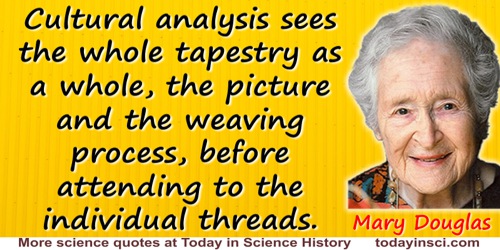
Our ultimate task is to find interpretative procedures that will uncover each bias and discredit its claims to universality. When this is done the eighteenth century can be formally closed and a new era that has been here a long time can be officially recognised. The individual human being, stripped of his humanity, is of no use as a conceptual base from which to make a picture of human society. No human exists except steeped in the culture of his time and place. The falsely abstracted individual has been sadly misleading to Western political thought. But now we can start again at a point where major streams of thought converge, at the other end, at the making of culture. Cultural analysis sees the whole tapestry as a whole, the picture and the weaving process, before attending to the individual threads.
As co-author with Baron Isherwood, The World of Goods: Towards an Anthropology of Consumption (1979, 2002), 41-42.
Perhaps I may without immodesty lay claim to the appellation of Mathematical Adam, as I believe that I have given more names (passed into general circulation) of the creatures of the mathematical reason than all the other mathematicians of the age combined.
In Nature (1887-1888), 87, 162. As quoted and cited in As cited in Robert Édouard Moritz, Memorabilia Mathematica; Or, The Philomath’s Quotation-Book (1914), 178
Professor Cayley has since informed me that the theorem about whose origin I was in doubt, will be found in Schläfli’s De Eliminatione. This is not the first unconscious plagiarism I have been guilty of towards this eminent man whose friendship I am proud to claim. A more glaring case occurs in a note by me in the Comptes Rendus, on the twenty-seven straight lines of cubic surfaces, where I believe I have followed (like one walking in his sleep), down to the very nomenclature and notation, the substance of a portion of a paper inserted by Schlafli in the Mathematical Journal, which bears my name as one of the editors upon the face.
In Philosophical Transactions of the Royal Society (1864), 642.
Psychologists … have found that people making an argument or a supposedly factual claim can manipulate us by the words they choose and the way they present their case. We can’t avoid letting language do our thinking for us, but we can become more aware of how and when language is steering us toward a conclusion that, upon reflection, we might choose to reject.
As co-author with Kathleen Hall Jamieson, in unSpun: Finding Facts in a World of Disinformation (2007), 70.
Psychologists must cease to be content with the sterile and narrow conception of their science as the science of consciousness, and must boldly assert its claim to be the positive science of mind in all its aspects and modes of functining, or, as I would prefer to say, the positive science of conduct or behavior.
An Introduction to Social Psychology (1928), 13.
Psychology appeared to be a jungle of confusing, conflicting, and arbitrary concepts. These pre-scientific theories doubtless contained insights which still surpass in refinement those depended upon by psychiatrists or psychologists today. But who knows, among the many brilliant ideas offered, which are the true ones? Some will claim that the statements of one theorist are correct, but others will favour the views of another. Then there is no objective way of sorting out the truth except through scientific research.
From The Scientific Analysis of Personality (1965), 14.
Science arouses a soaring sense of wonder. But so does pseudoscience. Sparse and poor popularizations of science abandon ecological niches that pseudoscience promptly fills. If it were widely understood that claims to knowledge require adequate evidence before they can be accepted, there would be no room for pseudoscience.
The Demon-Haunted World: Science as a Candle in the Dark (1996), 6.
Science can be the basis of an objective criticism of political power because it claims no power itself. Politics can afford the independence of science because science does not attempt to dictate its purposes.
In The Scientific Estate (1965), 191.
Science is a method for testing claims about the natural world, not an immutable compendium of absolute truths. The fundamentalists, by ‘knowing’ the answers before they start, and then forcing nature into the straitjacket of their discredited preconceptions, lie outside the domain of science–or of any honest intellectual inquiry.
…...
Science must be your passion. Remember that science claims a man’s whole life. Had he two lives they would not suffice. Science demands an undivided allegiance from its followers. In your work and in your research there must always be passion.
Translation of a note, 'Bequest of Pavlov to the Academic Youth of his Country', written a few days before his death for a student magazine, The Generation of the Victors. As published in 'Pavlov and the Spirit of Science', Nature (4 Apr 1936), 137, 572.
Scientific literacy is an intellectual vaccine against the claims of charlatans who would exploit ignorance.
…...
Some may claim that is it unscientific to speak of the operations of nature as “miracles.” But the point of the title lies in the paradox of finding so many wonderful things … subservient to the rule of law.
In Nature’s Miracles: Familiar Talks on Science (1899), Vol. 1, Introduction, v.
Some scientists claim that hydrogen because it is so plentiful is the basic building block of the universe. I dispute that. I say that there is more stupidity than hydrogen and that is the basic building block of the universe.
With co-writer Peter Occhiogrosso, in The Real Frank Zappa Book (1989), 239.
Some years ago John Kenneth Galbraith wrote in an essay on his efforts at writing a history of economics: “As one approaches the present, one is filled with a sense of hopelessness; in a year and possibly even a month, there is now more economic comment in the supposedly serious literature than survives from the whole of the thousand years commonly denominated as the Middle Ages … anyone who claims to be familiar with it all is a confessing liar.” I believe that all physicists would subscribe to the same sentiments regarding their own professional literature. I do at any rate.
In H. Henry Stroke, 'The Physical Review Then and Now', Physical Review: The First Hundred Years: a Selection of Seminal Papers and Commentaries, Vol. 1, 1.
Stay your rude steps, or e’er your feet invade
The Muses’ haunts,ye sons of War and Trade!
Nor you, ye legion fiends of Church and Law,
Pollute these pages with unhallow’d paw!
Debased, corrupted, grovelling, and confin’d,
No definitions touch your senseless mind;
To you no Postulates prefer their claim,
No ardent Axioms your dull souls inflame;
For you no Tangents touch, no Angles meet,
No Circles join in osculation sweet!
The Muses’ haunts,ye sons of War and Trade!
Nor you, ye legion fiends of Church and Law,
Pollute these pages with unhallow’d paw!
Debased, corrupted, grovelling, and confin’d,
No definitions touch your senseless mind;
To you no Postulates prefer their claim,
No ardent Axioms your dull souls inflame;
For you no Tangents touch, no Angles meet,
No Circles join in osculation sweet!
From poem, with co-authors John Hookham Frere, George Canning and George Ellis, The Loves of the Triangles: A Mathematical and Philosophical Poem, Canto I, collected in Poetry of the Anti-Jacobin (1854), 124.
Suppose there is something which a person cannot understand. He happens to notice the similarity of this something to some other thing which he understands quite well. By comparing them he may come to understand the thing which he could not understand up to that moment. If his understanding turns out to be appropriate and nobody else has ever come to such an understanding, he can claim that his thinking was really creative.
Creativity and Intuition: A Physicist Looks at East and West (1973), 114.
Surely the claim of mathematics to take a place among the liberal arts must now be admitted as fully made good. Whether we look at the advances made in modern geometry, in modern integral calculus, or in modern algebra, in each of these three a free handling of the material employed is now possible, and an almost unlimited scope is left to the regulated play of fancy. It seems to me that the whole of aesthetic (so far as at present revealed) may be regarded as a scheme having four centres, which may be treated as the four apices of a tetrahedron, namely Epic, Music, Plastic, and Mathematic. There will be found a common plane to every three of these, outside of which lies the fourth; and through every two may be drawn a common axis opposite to the axis passing through the other two. So far is certain and demonstrable. I think it also possible that there is a centre of gravity to each set of three, and that the line joining each such centre with the outside apex will intersect in a common point the centre of gravity of the whole body of aesthetic; but what that centre is or must be I have not had time to think out.
In 'Proof of the Hitherto Undemonstrated Fundamental Theorem of Invariants', Collected Mathematical Papers (1909), Vol. 3, 123.
That man is the noblest creature may also be inferred from the fact that no other creature has yet contested this claim.
Aphorism 58 in Notebook D (1773-1775), as translated by R.J. Hollingdale in Aphorisms (1990). Reprinted as The Waste Books (2000), 52.
The central task of science is to arrive, stage by stage, at a clearer comprehension of nature, but this does not mean, as it is sometimes claimed to mean, a search for mastery over nature.
In Late Night Thoughts on Listening to Mahler's Ninth Symphony(1984), 153.
The claims of certain so-called scientific men as to 'science overthrowing religion' are as baseless as the fears of certain sincerely religious men on the same subject. The establishment of the doctrine of evolution in out time offers no more justification for upsetting religious beliefs than the discovery of the facts concerning the solar system a few centuries ago. Any faith sufficiently robust to stand the—surely very slight—strain of admitting that the world is not flat and does not move round the sun need have no apprehensions on the score of evolution, and the materialistic scientists who gleefully hail the discovery of the principle of evolution as establishing their dreary creed might with just as much propriety rest it upon the discovery of the principle of gravity.
'The Search for Truth in a Reverent Spirit', (originally published in The Outlook, 2 Dec 1911). In The Works of Theodore Roosevelt (1913), Vol. 26, 256.
The explosive component in the contemporary scene is not the clamor of the masses but the self-righteous claims of a multitude of graduates from schools and universities. This army of scribes is clamoring for a society in which planning, regulation, and supervision are paramount and the prerogative of the educated. They hanker for the scribe’s golden age, for a return to something like the scribe-dominated societies of ancient Egypt, China, and Europe of the Middle Ages. There is little doubt that the present trend in the new and renovated countries toward social regimentation stems partly from the need to create adequate employment for a large number of scribes. And since the tempo of the production of the literate is continually increasing, the prospect is of ever-swelling bureaucracies.
In 'Scribe, Writer, and Rebel', The Ordeal of Change (1963), 109.
The great object of all knowledge is to enlarge and purify the soul, to fill the mind with noble contemplations, to furnish a refined pleasure, and to lead our feeble reason from the works of nature up to its great Author and Sustainer. Considering this as the ultimate end of science, no branch of it can surely claim precedence of Astronomy. No other science furnishes such a palpable embodiment of the abstractions which lie at the foundation of our intellectual system; the great ideas of time, and space, and extension, and magnitude, and number, and motion, and power. How grand the conception of the ages on ages required for several of the secular equations of the solar system; of distances from which the light of a fixed star would not reach us in twenty millions of years, of magnitudes compared with which the earth is but a foot-ball; of starry hosts—suns like our own—numberless as the sands on the shore; of worlds and systems shooting through the infinite spaces.
Oration at Inauguration of the Dudley Astronomical Observatory, Albany (28 Jul 1856). Text published as The Uses of Astronomy (1856), 36.
The historian of science may be tempted to claim that when paradigms change, the world itself changes with them. Led by a new paradigm, scientists adopt new instruments and look in new places. even more important, during revolutions, scientists see new and different things when looking with familiar instruments in places they have looked before. It is rather as if the professional community had been suddenly transported to another planet where familiar objects are seen in a different light and are joined by unfamiliar ones as well.
In The Structure of Scientific Revolutions (1962, 2nd ed. 1970). Excerpt 'Revolutions as Changes of World View', in Joseph Margolis and Jacques Catudal, The Quarrel between Invariance and Flux (2001), 35-36.
The history of acceptance of new theories frequently shows the following steps: At first the new idea is treated as pure nonsense, not worth looking at. Then comes a time when a multitude of contradictory objections are raised, such as: the new theory is too fancy, or merely a new terminology; it is not fruitful, or simply wrong. Finally a state is reached when everyone seems to claim that he had always followed this theory. This usually marks the last state before general acceptance.
In 'Field Theory and the Phase Space', collected in Melvin Herman Marx, Psychological Theory: Contemporary Readings (1951), 299.
The hype, skepticism and bewilderment associated with the Internet—concerns about new forms of crime, adjustments in social mores, and redefinition of business practices— mirror the hopes, fears, and misunderstandings inspired by the telegraph. Indeed, they are only to be expected. They are the direct consequences of human nature, rather than technology.
Given a new invention, there will always be some people who see only its potential to do good, while others see new opportunities to commit crime or make money. We can expect the same reactions to whatever new inventions appear in the twenty-first century.
Such reactions are amplified by what might be termed chronocentricity—the egotism that one’s own generation is poised on the very cusp of history. Today, we are repeatedly told that we are in the midst of a communications revolution. But the electric telegraph was, in many ways, far more disconcerting for the inhabitants of the time than today’s advances are for us. If any generation has the right to claim that it bore the full bewildering, world-shrinking brunt of such a revolution, it is not us—it is our nineteenth- century forebears.
Given a new invention, there will always be some people who see only its potential to do good, while others see new opportunities to commit crime or make money. We can expect the same reactions to whatever new inventions appear in the twenty-first century.
Such reactions are amplified by what might be termed chronocentricity—the egotism that one’s own generation is poised on the very cusp of history. Today, we are repeatedly told that we are in the midst of a communications revolution. But the electric telegraph was, in many ways, far more disconcerting for the inhabitants of the time than today’s advances are for us. If any generation has the right to claim that it bore the full bewildering, world-shrinking brunt of such a revolution, it is not us—it is our nineteenth- century forebears.
In The Victorian Internet (1998).
The less justified a man is in claiming excellence for his own self, the more ready he is to claim all excellence for his nation, his religion, his race or his holy cause.
In The True Believer: Thoughts on the Nature of Mass Movements (1951), 14.
The materialistic point of view in psychology can claim, at best, only the value of an heuristic hypothesis.
The mathematician of to-day admits that he can neither square the circle, duplicate the cube or trisect the angle. May not our mechanicians, in like manner, be ultimately forced to admit that aerial flight is one of that great class of problems with which men can never cope… I do not claim that this is a necessary conclusion from any past experience. But I do think that success must await progress of a different kind from that of invention.
[Written following Samuel Pierpoint Langley's failed attempt to launch his flying machine from a catapult device mounted on a barge in Oct 1903. The Wright Brother's success came on 17 Dec 1903.]
[Written following Samuel Pierpoint Langley's failed attempt to launch his flying machine from a catapult device mounted on a barge in Oct 1903. The Wright Brother's success came on 17 Dec 1903.]
'The Outlook for the Flying Machine'. The Independent: A Weekly Magazine (22 Oct 1903), 2509.
The natural sciences are sometimes said to have no concern with values, nor to seek morality and goodness, and therefore belong to an inferior order of things. Counter-claims are made that they are the only living and dynamic studies... Both contentions are wrong. Language, Literature and Philosophy express, reflect and contemplate the world. But it is a world in which men will never be content to stay at rest, and so these disciplines cannot be cut off from the great searching into the nature of things without being deprived of life-blood.
Presidential Address to Classical Association, 1959. In E. J. Bowen's obituary of Hinshelwood, Chemistry in Britain (1967), Vol. 3, 536.
The natural scientist is concerned with a particular kind of phenomena … he has to confine himself to that which is reproducible … I do not claim that the reproducible by itself is more important than the unique. But I do claim that the unique exceeds the treatment by scientific method. Indeed it is the aim of this method to find and test natural laws…
In Aufsätze und Vorträge über Physik und Erkenntnistheorie (1961), 94. Quoted in Erhard Scheibe and Brigitte Falkenburg (ed), Between Rationalism and Empiricism: Selected Papers in the Philosophy of Physics (2001), 276
The only universal attribute of scientific statements resides in their potential fallibility. If a claim cannot be disproven, it does not belong to the enterprise of science.
Leonardo's Mountain of Clams and the Diet of Worms: Essays on Natural History (1998), 155.
The opinion of Bacon on this subject [geometry] was diametrically opposed to that of the ancient philosophers. He valued geometry chiefly, if not solely, on account of those uses, which to Plato appeared so base. And it is remarkable that the longer Bacon lived the stronger this feeling became. When in 1605 he wrote the two books on the Advancement of Learning, he dwelt on the advantages which mankind derived from mixed mathematics; but he at the same time admitted that the beneficial effect produced by mathematical study on the intellect, though a collateral advantage, was “no less worthy than that which was principal and intended.” But it is evident that his views underwent a change. When near twenty years later, he published the De Augmentis, which is the Treatise on the Advancement of Learning, greatly expanded and carefully corrected, he made important alterations in the part which related to mathematics. He condemned with severity the pretensions of the mathematicians, “delidas et faslum mathematicorum.” Assuming the well-being of the human race to be the end of knowledge, he pronounced that mathematical science could claim no higher rank than that of an appendage or an auxiliary to other sciences. Mathematical science, he says, is the handmaid of natural philosophy; she ought to demean herself as such; and he declares that he cannot conceive by what ill chance it has happened that she presumes to claim precedence over her mistress.
In 'Lord Bacon', Edinburgh Review (Jul 1837). Collected in Critical and Miscellaneous Essays: Contributed to the Edinburgh Review (1857), Vol. 1, 395.

The path towards sustainable energy sources will be long and sometimes difficult. But America cannot resist this transition, we must lead it. We cannot cede to other nations the technology that will power new jobs and new industries, we must claim its promise. That’s how we will maintain our economic vitality and our national treasure—our forests and waterways, our crop lands and snow-capped peaks. That is how we will preserve our planet, commanded to our care by God. That’s what will lend meaning to the creed our fathers once declared.
In Second Inaugural Address (21 Jan 2013) at the United States Capitol.
The role of hypothesis in research can be discussed more effectively if we consider first some examples of discoveries which originated from hypotheses. One of the best illustrations of such a discovery is provided by the story of Christopher Columbus’ voyage; it has many of the features of a classic discovery in science. (a) He was obsessed with an idea—that since the world is round he could reach the Orient by sailing West, (b) the idea was by no means original, but evidently he had obtained some additional evidence from a sailor blown off his course who claimed to have reached land in the west and returned, (c) he met great difficulties in getting someone to provide the money to enable him to test his idea as well as in the actual carrying out of the experimental voyage, (d) when finally he succeeded he did not find the expected new route, but instead found a whole new world, (e) despite all evidence to the contrary he clung to the bitter end to his hypothesis and believed that he had found the route to the Orient, (f) he got little credit or reward during his lifetime and neither he nor others realised the full implications of his discovery, (g) since his time evidence has been brought forward showing that he was by no means the first European to reach America.
The Art of Scientific Investigation (1950), 41.
The school of Plato has advanced the interests of the race as much through geometry as through philosophy. The modern engineer, the navigator, the astronomer, built on the truths which those early Greeks discovered in their purely speculative investigations. And if the poetry, statesmanship, oratory, and philosophy of our day owe much to Plato’s divine Dialogues, our commerce, our manufactures, and our science are equally indebted to his Conic Sections. Later instances may be abundantly quoted, to show that the labors of the mathematician have outlasted those of the statesman, and wrought mightier changes in the condition of the world. Not that we would rank the geometer above the patriot, but we claim that he is worthy of equal honor.
In 'Imagination in Mathematics', North American Review, 85, 228.
The science [of mathematics] has grown to such vast proportion that probably no living mathematician can claim to have achieved its mastery as a whole.
In An Introduction to Mathematics (1911), 262.
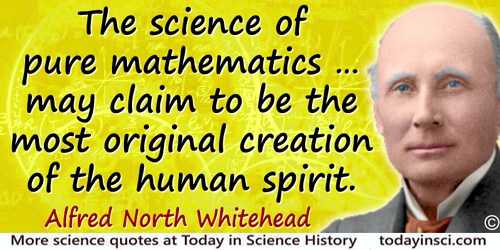
The science of pure mathematics … may claim to be the most original creation of the human spirit.
In Science and the Modern World: Lowell Lectures, 1925 (1925), 29.
The success of Apollo was mainly due to the fact that the project was conceived and honestly presented to the public as an international sporting event and not as a contribution to science. The order of priorities in Apollo was accurately reflected by the first item to be unloaded after each landing on the Moon's surface, the television camera. The landing, the coming and going of the astronauts, the exploring of the moon's surface, the gathering of Moon rocks and the earthward departure, all were expertly choreographed with the cameras placed in the right positions to make a dramatic show on television. This was to me the great surprise of the Apollo missions. There was nothing surprising in the fact that astronauts could walk on the Moon and bring home Moon rocks. There were no big scientific surprises in the chemistry of the Moon rocks or in the results of magnetic and seismic observations that the astronauts carried out. The big surprise was the quality of the public entertainment that the missions provided. I had never expected that we would see in real time astronauts hopping around in lunar gravity and driving their Rover down the Lincoln- Lee scarp to claim a lunar speed record of eleven miles per hour. Intensive television coverage was the driving force of Apollo. Von Braun had not imagined the possibilities of television when he decided that one kilohertz would be an adequate communication bandwidth for his Mars Project.
From a Danz lecture at University of Washington, 'Sixty Years of Space Science 1958-2018' (1988), collected in From Eros to Gaia (1992), Vol. 5, 52.
The supposed astronomical proofs of the theory [of relativity], as cited and claimed by Einstein, do not exist. He is a confusionist. The Einstein theory is a fallacy. The theory that ether does not exist, and that gravity is not a force but a property of space can only be described as a
crazy vagary, a disgrace to our age.
Quoted in Elizabeth Dilling, A "Who's Who" and Handbook of Radicalism for Patriots (1934), 49.
The technologists claim that if everything works [in a nuclear fission reactor] according to their blueprints, fission energy will be a safe and very attractive solution to the energy needs of the world. ... The real issue is whether their blueprints will work in the real world and not only in a “technological paradise.”...
Opponents of fission energy point out a number of differences between the real world and the “technological paradise.” ... No acts of God can be permitted.
Opponents of fission energy point out a number of differences between the real world and the “technological paradise.” ... No acts of God can be permitted.
'Energy and Environment', Bulletin of the Atomic Scientists (May 1972), 6.
The theory of punctuated equilibrium, proposed by Niles Eldredge and myself, is not, as so often misunderstood, a radical claim for truly sudden change, but a recognition that ordinary processes of speciation, properly conceived as glacially slow by the standard of our own life-span, do not resolve into geological time as long sequences of insensibly graded intermediates (the traditional, or gradualistic, view), but as geologically ‘sudden’ origins at single bedding planes.
…...
The true contrast between science and religion is that science unites the world and makes it possible for people of widely differing backgrounds to work together and to cooperate. Religion, on the other hand, by its very claim to know “The Truth” through “revelation,” is inherently divisive and a creator of separatism and hostility.
Conclusion to 'Uniting the World—Or Dividing It: Which Outlook Is Truly Universal, which Parochial in the Extreme?', Free Inquiry (Spring 1998), 18, No.2. Collected in Science and Religion: Are They Compatible?, 148. Not found in that article, a widely circulated, brief form of this idea is: “Religion divides us, while it is our human characteristics that bind us to each other.” but Webmaster has not yet confirmed any source for that form. If you know a primary source for it, please contact Webmaster.
The world is full of signals that we don’t perceive. Tiny creatures live in a different world of unfamiliar forces. Many animals of our scale greatly exceed our range of perception for sensations familiar to us ... What an imperceptive lot we are. Surrounded by so much, so fascinating and so real, that we do not see (hear, smell, touch, taste) in nature, yet so gullible and so seduced by claims for novel power that we mistake the tricks of mediocre magicians for glimpses of a psychic world beyond our ken. The paranormal may be a fantasy; it is certainly a haven for charlatans. But ‘parahuman’ powers of perception lie all about us in birds, bees, and bacteria.
…...
Theories cannot claim to be indestructible. They are only the plough which the ploughman uses to draw his furrow and which he has every right to discard for another one, of improved design, after the harvest. To be this ploughman, to see my labours result in the furtherance of scientific progress, was the height of my ambition, and now the Swedish Academy of Sciences has come, at this harvest, to add the most brilliant of crowns.
'The Method of Direct Hydrogenation by Catalysis', Nobel Lecture (11 Dec 1912). Noble Lectures in Chemistry 1901-1921 (1966), 230-1.
There are many arts and sciences of which a miner should not be ignorant. First there is Philosophy, that he may discern the origin, cause, and nature of subterranean things; for then he will be able to dig out the veins easily and advantageously, and to obtain more abundant results from his mining. Secondly there is Medicine, that he may be able to look after his diggers and other workman ... Thirdly follows astronomy, that he may know the divisions of the heavens and from them judge the directions of the veins. Fourthly, there is the science of Surveying that he may be able to estimate how deep a shaft should be sunk … Fifthly, his knowledge of Arithmetical Science should be such that he may calculate the cost to be incurred in the machinery and the working of the mine. Sixthly, his learning must comprise Architecture, that he himself may construct the various machines and timber work required underground … Next, he must have knowledge of Drawing, that he can draw plans of his machinery. Lastly, there is the Law, especially that dealing with metals, that he may claim his own rights, that he may undertake the duty of giving others his opinion on legal matters, that he may not take another man’s property and so make trouble for himself, and that he may fulfil his obligations to others according to the law.
In De Re Metallica (1556), trans. H.C. and L.H. Hoover (1950), 3-4.
There are science teachers who actually claim that they teach “a healthy skepticism.” They do not. They teach a profound gullibility, and their dupes, trained not to think for themselves, will swallow any egregious rot, provided it is dressed up with long words and an affectation of objectivity to make it sound scientific.
In Science is a Sacred Cow (1950), 189.
There are those whose sole claim to profundity is the discovery of exceptions to the rules.
Maxim 2838 in Maxims for a Modern Man (1965), 321.
There are three distinctions in the kinds of bodies, or three states, which have more especially claimed the attention of philosophical chemists; namely, those which are marked by the terms elastic fluids, liquids, and solids. A very familiar instance is exhibited to us in water, of a body, which, in certain circumstances, is capable of assuming all the three states. In steam we recognise a perfectly elastic fluid, in water, a perfect liquid, and in ice of a complete solid. These observations have tacitly led to the conclusion which seems universally adopted, that all bodies of sensible magnitude, whether liquid or solid, are constituted of a vast number of extremely small particles, or atoms of matter bound together by a force of attraction.
A New System of Chemical Philosophy (1808), Vol. 1, 141.
There have, however, always been men of high and disciplined spirituality who have insisted on their direct experience of something greater than themselves. Their conviction of the reality of a spiritual life apart from and transcending the life of the body may not lend itself to scientific proof or disproof; nevertheless the remarkable transformation in personality seen in those who rightfully lay claim to such experience is as objective as tomorrow's sunrise. Millions of lesser men draw strength from the contacts they can make through prayer and meditation with this aspect of the inner life.
at a convention of scientists in 1967 at the University of Notre Dame
There is no substitute for honest, thorough, scientific effort to get correct data (no matter how much of it clashes with preconceived ideas). There is no substitute for actually reaching a correct claim of reasoning. Poor data and good reasoning give poor results. Good data and poor reasoning give poor results. Poor data and poor reasoning give rotten results.
In 'Right Answers—A Short Guide for Obtaining Them,' Computers and Automation, September 1969.
This theory [the oxygen theory] is not as I have heard it described, that of the French chemists, it is mine (elle est la mienne); it is a property which I claim from my contemporaries and from posterity.
Memoires de Chimie (1805), Vol. 2, 87, trans. M. P. Crosland.
To know the history of science is to recognize the mortality of any claim to universal truth.
Reflections on Gender and Science, 1995
Truly grand and powerful theories … do not and cannot rest upon single observations. Evolution is an inference from thousands of independent sources, the only conceptual structure that can make unified sense of all this disparate information. The failure of a particular claim usually records a local error, not the bankruptcy of a central theory … If I mistakenly identify your father’s brother as your own dad, you don’t become genealogically rootless and created de novo. You still have a father; we just haven’t located him properly.
Leonardo’s Mountain of Clams and the Diet of Worms: Essays on Natural History (1998), 155.
Unless his mind soars above his daily pursuits, it is different techniques. In the same spirit, the woodsman might claim that there are only trees but no forest.
…...
Until now, physical theories have been regarded as merely models with approximately describe the reality of nature. As the models improve, so the fit between theory and reality gets closer. Some physicists are now claiming that supergravity is the reality, that the model and the real world are in mathematically perfect accord.
Superforce (1984, 1985), 149.
We all know, from what we experience with and within ourselves, that our conscious acts spring from our desires and our fears. Intuition tells us that that is true also of our fellows and of the higher animals. We all try to escape pain and death, while we seek what is pleasant. We are all ruled in what we do by impulses; and these impulses are so organized that our actions in general serve for our self preservation and that of the race. Hunger, love, pain, fear are some of those inner forces which rule the individual’s instinct for self preservation. At the same time, as social beings, we are moved in the relations with our fellow beings by such feelings as sympathy, pride, hate, need for power, pity, and so on. All these primary impulses, not easily described in words, are the springs of man’s actions. All such action would cease if those powerful elemental forces were to cease stirring within us. Though our conduct seems so very different from that of the higher animals, the primary instincts are much alike in them and in us. The most evident difference springs from the important part which is played in man by a relatively strong power of imagination and by the capacity to think, aided as it is by language and other symbolical devices. Thought is the organizing factor in man, intersected between the causal primary instincts and the resulting actions. In that way imagination and intelligence enter into our existence in the part of servants of the primary instincts. But their intervention makes our acts to serve ever less merely the immediate claims of our instincts.
…...
We claim to be more moral than other nations, and to conquer and govern and tax and plunder weaker peoples for their good! While robbing them we actually claim to be benefactors! And then we wonder, or profess to wonder, why other Governments hate us! Are they not fully justified in hating us? Is it surprising that they seek every means to annoy us, that they struggle to get navies to compete with us, and look forward to a time when some two or three of them may combine together and thoroughly humble and cripple us? And who can deny that any just Being, looking at all the nations of the earth with impartiality and thorough knowledge, would decide that we deserve to be humbled, and that it might do us good?
In 'Practical Politics', The Clarion (30 Sep 1904), 1.
We have made many glass vessels... with tubes two cubits long. These were filled with mercury, the open end was closed with the finger, and the tubes were then inverted in a vessel where there was mercury. We saw that an empty space was formed and that nothing happened in the vessel where this space was formed ... I claim that the force which keeps the mercury from falling is external and that the force comes from outside the tube. On the surface of the mercury which is in the bowl rests the weight of a column of fifty miles of air. Is it a surprise that into the vessel, in which the mercury has no inclination and no repugnance, not even the slightest, to being there, it should enter and should rise in a column high enough to make equilibrium with the weight of the external air which forces it up?
Quoted in Archana Srinivasan, Great Inventors (2007), 27-28.
We know the laws of trial and error, of large numbers and probabilities. We know that these laws are part of the mathematical and mechanical fabric of the universe, and that they are also at play in biological processes. But, in the name of the experimental method and out of our poor knowledge, are we really entitled to claim that everything happens by chance, to the exclusion of all other possibilities?
From Nobel Prize Lecture (Dec 1974), 'The Coming Age of the Cell'. Collected in Jan Lindsten (ed.) Nobel Lectures, Physiology or Medicine 1971-1980 (1992).
We may fairly claim for the study of Physics the recognition that it answers to an impulse implanted by nature in the constitution of man.
From 'On the Study of Physics', a Lecture delivered in the Royal Institution of Great Britain in the Spring of 1854. Collected in Fragments of Science for Unscientific People: A Series of Detached Essays, Lectures, and Reviews (1892), Vol. 1, 284.
Well, evolution is a theory. It is also a fact. And facts and theories are different things, not rungs in a hierarchy of increasing certainty. Facts are the world’s data. Theories are structures of ideas that explain and interpret facts. Facts do not go away while scientists debate rival theories for explaining them. Einstein’s theory of gravitation replaced Newton’s, but apples did not suspend themselves in mid-air pending the outcome. And human beings evolved from apelike ancestors whether they did so by Darwin’s proposed mechanism or by some other, yet to be discovered … Evolutionists make no claim for perpetual truth, though creationists often do (and then attack us for a style of argument that they themselves favor).
'Evolution as Fact and Theory', in Hen’s Teeth and Horse’s Toes: Further Reflections in Natural History (1983), 254-255.
Whatever lies beyond the limits of experience, and claims another origin than that of induction and deduction from established data, is illegitimate.
In Problems of Life and Mind (1874), Vol. 1, 17.
When [Erwin Schrödinger] went to the Solvay conferences in Brussels, he would walk from the station to the hotel where the delegates stayed, carrying all his luggage in a rucksack and looking so like a tramp that it needed a great deal of argument at the reception desk before he could claim a room.
Quoted in Robert L. Weber, Pioneers of Science: Nobel Prize Winners in Physics (1980), 100.
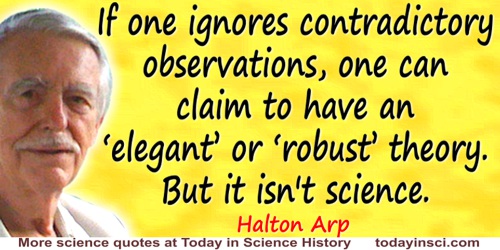
When Big Bang proponents make assertions such as … “the evidence taken together … hangs together beautifully,” they overlook observational facts that have been piling up for 25 years and that have now become overwhelming. Of course, if one ignores contradictory observations, one can claim to have an “elegant” or “robust” theory. But it isn’t science.
In 'Letters: Wrangling Over the Bang', Science News (27 Jul 1991), 140, No. 4, 51. Also quoted in Roy C. Martin, Astronomy on Trial: A Devastating and Complete Repudiation of the Big Bang Fiasco (1999), Appendix I, 217.
When one considers how hard it is to write a computer program even approaching the intellectual scope of a good paper, and how much greater time and effort have to be put in to make it “almost” formally correct, it is preposterous to claim that mathematics as we practice it is anywhere near formally correct.
In 'On Proof and Progress in Mathematics', For the Learning of Mathematics (Feb 1995), 15, No. 1, 33. Reprinted from Bulletin of the American Mathematical Society (1994), 30, No. 2, 170-171.
When, however, you see the specification, you will see that the fundamental principles are contained therein. I do not, however, claim even the credit of inventing it, as I do not believe a mere description of an idea that has never been reduced to practice—in the strict sense of that phrase—should be dignified with the name invention.
Letter (5 Mar 1877) to Alexander Graham Bell. Quoted in The Bell Telephone (1908), 168.
While DNA could be claimed to be both simple and elegant, it must be remembered that DNA almost certainly originated fairly close to the origin of life when things were necessarily simple or they would not have got going.
In What Mad Pursuit: A Personal View of Scientific Discovery (1988), 138.
Yesterday, a small white keel feather escaped from my goose and lodged in the bank boughs near the kitchen porch, where I spied it as I came home in the cold twilight. The minute I saw the feather, I was projected into May, knowing a barn swallow would be along to claim the prize and use it to decorate the front edge of its nest. Immediately, the December air seemed full of wings of swallows and the warmth of barns.
In 'Home-Coming' (10 Dec 1955), collected in Essays of E.B. White (1977), 12.
Yet is it possible in terms of the motion of atoms to explain how men can invent an electric motor, or design and build a great cathedral? If such achievements represent anything more than the requirements of physical law, it means that science must investigate the additional controlling factors, whatever they may be, in order that the world of nature may be adequately understood. For a science which describes only the motions of inanimate things but fails to include the actions of living organisms cannot claim universality.
The Human Meaning of Science (1940), 31.
Your printers have made but one blunder,
Correct it instanter, and then for the thunder!
We’ll see in a jiffy if this Mr S[pencer]
Has the ghost of a claim to be thought a good fencer.
To my vision his merits have still seemed to dwindle,
Since I have found him allied with the great Dr T[yndall]
While I have, for my part, grown cockier and cockier,
Since I found an ally in yourself, Mr L[ockyer]
And am always, in consequence, thoroughly willin’,
To perform in the pages of Nature's M[acmillan].
Correct it instanter, and then for the thunder!
We’ll see in a jiffy if this Mr S[pencer]
Has the ghost of a claim to be thought a good fencer.
To my vision his merits have still seemed to dwindle,
Since I have found him allied with the great Dr T[yndall]
While I have, for my part, grown cockier and cockier,
Since I found an ally in yourself, Mr L[ockyer]
And am always, in consequence, thoroughly willin’,
To perform in the pages of Nature's M[acmillan].
Postcard from Tait to Lockyer, editor of Nature, cited by H. Dingle, Nature (1969), 224, 829.
 In science it often happens that scientists say, 'You know that's a really good argument; my position is mistaken,' and then they would actually change their minds and you never hear that old view from them again. They really do it. It doesn't happen as often as it should, because scientists are human and change is sometimes painful. But it happens every day. I cannot recall the last time something like that happened in politics or religion.
(1987) --
In science it often happens that scientists say, 'You know that's a really good argument; my position is mistaken,' and then they would actually change their minds and you never hear that old view from them again. They really do it. It doesn't happen as often as it should, because scientists are human and change is sometimes painful. But it happens every day. I cannot recall the last time something like that happened in politics or religion.
(1987) -- 





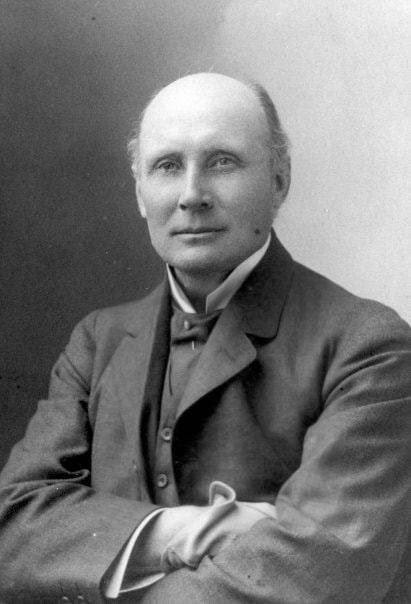
.jpg)