City Quotes (87 quotes)
... I should think that anyone who considered it more reasonable for the whole universe to move in order to let the Earth remain fixed would be more irrational than one who should climb to the top of your cupola just to get a view of the city and its environs, and then demand that the whole countryside should revolve around him so that he would not have to take the trouble to turn his head.
In Dialogue Concerning the Two Chief World Systems (1632).
...for our wisdom is better than the strength of men or of horses. ... nor is it right to prefer strength to excellent wisdom. For if there should be in the city [any athlete whose skill] is honoured more than strength ... the city would not on that account be any better governed.
Quoted in Arthur Fairbanks (ed. And trans.), The First Philosophers of Greece (1898), 73, fragment 19.
...the need for a garden of rare palms and vines and ornamental trees and shrubs which would be near enough to a growing city to form a quiet place where children with their elders could peer, as it were, into those fascinating jungles and palm glades of the tropics which have for generations stimulated the imaginations of American youth.
“Yes,” he said. “But these things (the solutions to problems in solid geometry such as the duplication of the cube) do not seem to have been discovered yet.” “There are two reasons for this,” I said. “Because no city holds these things in honour, they are investigated in a feeble way, since they are difficult; and the investigators need an overseer, since they will not find the solutions without one. First, it is hard to get such an overseer, and second, even if one did, as things are now those who investigate these things would not obey him, because of their arrogance. If however a whole city, which did hold these things in honour, were to oversee them communally, the investigators would be obedient, and when these problems were investigated continually and with eagerness, their solutions would become apparent.”
— Plato
In The Republic 7 528bc, trans. R.W. Sharples.
[1665-04-30] ...Great fear of the sicknesses here in the City, it being said that two or three houses are already shut up. God preserve us all.
Diary of Samuel Pepys (30 Apr 1665)
[1665-06-10] ...In the evening home to supper, and there to my great trouble hear that the plague is come into the City (though it hath these three or four weeks since its beginning been wholly out of the City); but where it begin but in my good friend and neighbour's, Dr Burnett in Fanchurch Street - which in both points troubles me mightily. To the office to finish my letters, and then home to bed, being troubled at the sickness ... and particularly how to put my things and estate in order, in case it should please God to call me away.
Diary of Samuel Pepys (10 Jun 1665)
[1665-08-31] Up, and after putting several things in order to my removal to Woolwich, the plague having a great increase this week beyond all expectation, of almost 2000 - making the general Bill 7000, odd 100 and the plague above 6000 .... Thus this month ends, with great sadness upon the public through the greateness of the plague, everywhere through the Kingdom almost. Every day sadder and sadder news of its increase. In the City died this week 7496; and all of them, 6102 of the plague. But it is feared that the true number of the dead this week is near 10000 - partly from the poor that cannot be taken notice of through the greatness of the number, and partly from the Quakers and others that will not have any bell ring for them. As to myself, I am very well; only, in fear of the plague, and as much of an Ague, by being forced to go early and late to Woolwich, and my family to lie there continually.
Diary of Samuel Pepys (31 August 1665)
[1665-09-14] ...my finding that although the Bill [total of dead] in general is abated, yet the City within the walls is encreasd and likely to continue so (and is close to our house there) - my meeting dead corps's of the plague, carried to be buried close to me at noonday through the City in Fanchurch-street - to see a person sick of the sores carried close by me by Grace-church in a hackney-coach - my finding the Angell tavern at the lower end of Tower-hill shut up; and more then that, the alehouse at the Tower-stairs; and more then that, that the person was then dying of the plague when I was last there, a little while ago at night, to write a short letter there, and I overheard the mistress of the house sadly saying to her husband somebody was very ill, but did not think it was of the plague - to hear that poor Payne my waterman hath buried a child and is dying himself - to hear that a labourer I sent but the other day to Dagenhams to know how they did there is dead of the plague and that one of my own watermen, that carried me daily, fell sick as soon as he had landed me on Friday morning last, when I had been all night upon the water ... is now dead of the plague - to hear ... that Mr Sidny Mountagu is sick of a desperate fever at my Lady Carteret's at Scott's hall - to hear that Mr. Lewes hath another daughter sick - and lastly, that both my servants, W Hewers and Tom Edwards, have lost their fathers, both in St. Sepulcher's parish, of the plague this week - doth put me into great apprehensions of melancholy, and with good reason. But I put off the thoughts of sadness as much as I can, and the rather to keep my wife in good heart and family also.
Diary of Samuel Pepys (14 Sep 1665)
[1665-11-09] ...The Bill of Mortality, to all our griefs, is encreased 399 this week, and the encrease general through the whole city and suburbs, which makes us all sad.
Diary of Samuel Pepys (9 Nov 1665)
[On suburbia] We’re bringing up our children in one-class areas. When they grow up and move to a city or go abroad, they’re not accustomed to variety and they get uncertain and insecure. We should bring up our children where they’re exposed to all types of people.
As quoted in interview with Frances Glennon, 'Student and Teacher of Human Ways', Life (14 Sep 1959), 147.
A large part of the training of the engineer, civil and military, as far as preparatory studies are concerned; of the builder of every fabric of wood or stone or metal designed to stand upon the earth, or bridge the stream, or resist or float upon the wave; of the surveyor who lays out a building lot in a city, or runs a boundary line between powerful governments across a continent; of the geographer, navigator, hydrographer, and astronomer,—must be derived from the mathematics.
In 'Academical Education', Orations and Speeches on Various Occasions (1870), Vol. 3, 513.
A man may be in as just possession of truth as of a city, and yet be forced to surrender.
In T. Chapman (ed.), Religio Medici (1643, 1831), part 1, sect. 6, 11.
All of the books in the world contain no more information than is broadcast as video in a single large American city in a single year. Not all bits have equal value.
…...
All things began in Order, so shall they end, and so shall they begin again, according to the Ordainer of Order, and the mystical mathematicks of the City of Heaven.
In 'Garden of Cyrus', Religio Medici and Other Writings (1909), 229.
Always design a thing by considering it in its next larger context—a chair in a room, a room in a house, a house in an environment, an environment in a city plan.
Time, July 2, 1956.
An old Scotch physician, for whom I had a great respect, and whom I frequently met professionally in the city, used to say, as we were entering the patient's room together, 'Weel, Mister Cooper, we ha' only twa things to keep in meend, and they'll searve us for here and herea'ter; one is always to have the fear of the Laird before our ees; that 'ill do for herea'ter; and t'other is to keep your booels open, and that will do for here.'
'Lecture 3, Treatment of Inflammation', The Lectures of Sir Astley Cooper (1825), Vol. 1, 58.Lectures on surgery, Lect. 3.
As a word, ecology has been so debased by recent political usage that many people employ it to identify anything good that happens far from cities and without human interference.
…...
As never before, the work of the engineer is basic to the kind of society to which our best efforts are committed. Whether it be city planning, improved health care in modern facilities, safer and more efficient transportation, new techniques of communication, or better ways to control pollution and dispose of wastes, the role of the engineer—his initiative, creative ability, and hard work—is at the root of social progress.
Remarks for National Engineers Week (1971). As quoted in Consulting Engineer (1971), 36, 18.
As our cities and suburbs relentlessly expand, those priceless open spaces needed for recreation areas accessible to their people are swallowed up—often forever. Unless we preserve these spaces while they are still available, we will have none to preserve. Therefore, I shall propose new financing methods for purchasing open space and parklands now, before they are lost to us.
In State of the Union Address (22 Jan 1970).
At the Egyptian city of Naucratis there was a famous old god whose name was Theuth; the bird which is called the Ibis was sacred to him, and he was the inventor of many arts, such as arithmetic and calculation and geometry and astronomy and draughts and dice, but his great discovery was the use of letters.
— Plato
In the Phaedrus. Collected in Plato the Teacher (1897), 171. A footnote gives that Naucratis was a city in the Delta of Egypt, on a branch of the Nile.
Büchsel in his reminiscences from the life of a country parson relates that he sought his recreation in Lacroix’s Differential Calculus and thus found intellectual refreshment for his calling. Instances like this make manifest the great advantage which occupation with mathematics affords to one who lives remote from the city and is compelled to forego the pleasures of art. The entrancing charm of mathematics, which captivates every one who devotes himself to it, and which is comparable to the fine frenzy under whose ban the poet completes his work, has ever been incomprehensible to the spectator and has often caused the enthusiastic mathematician to be held in derision. A classic illustration is the example of Archimedes….
From Die Entwickelung der Mathematik im Zusammenhange mit der Ausbreitung der Kultur (1893), 22. As translated in Robert Édouard Moritz, Memorabilia Mathematica; Or, The Philomath’s Quotation-Book (1914), 186. From the original German, “Wenn Büchsel in seinen Erinnerungen aus dem Leben eines Landgeistlichen erzählt, dass er in der Differentialrechnung von Lacroix Erholung gesucht und geistige Erfrischung ftir seinen Beruf gefunden habe, so erkennen wir darin den grossen Vorzug, den die Beschaftigung mit der Mathematik für jemanden hat, der fern von einer Stadt lebt und auf ihre Kunstgenüsse verzichten muss. Der berückende Zauber der
Mathematik, dem jeder unterliegt, der sich ihr ergiebt, und der dem holden Wahnsinn vergleichbar ist, unter dessen Bann der Dichter sein Work vollendet, ist dem betrachtenden Mitmenschen immer unbegreiflich gewesen und hat den begeisterten Mathematiker oft zum Gespött werden lassen. Als klassisches Beispiel wird jedem Schüler Archimedes…”
City after city, state after state, had essentially failed in their efforts to protect their air and their water, the land, the health of their citizens. By 1970, our city’ skylines were so polluted that in many places it was all but impossible to see from one city skyscraper to another. … We had rivers that were fouled with raw sewage and toxic chemicals. One actually caught on fire. There was a very famous photograph from my teenage years of the Cuyahoga River
burning. In fact, it was memorialized in a song at the time.
In 'Environmental Protection: Meeting the Challenges of the Twenty-First Century', Harvard Environmental Law Review (2001), 25, 329, 330-331. [In fact, the Cuyahoga River had caught fire several times over a number of decades, and there had been fires on other rivers. Webmaster]
City wisdom became almost entirely centered on the problems of human relationships, in contrast to the wisdom of any natural tribal group, where relationships with the rest of the animate and inanimate world are still given due place.
In Gaia, a New Look at Life on Earth (1979), 135.
During my stay in London I resided for a considerable time in Clapham Road in the neighbourhood of Clapham Common... One fine summer evening I was returning by the last bus 'outside' as usual, through the deserted streets of the city, which are at other times so full of life. I fell into a reverie (Träumerei), and 10, the atoms were gambolling before my eyes! Whenever, hitherto, these diminutive beings had appeared to me, they had always been in motion: but up to that time I had never been able to discern the nature of their motion. Now, however, I saw how, frequently, two smaller atoms united to form a pair: how the larger one embraced the two smaller ones: how still larger ones kept hold of three or even four of the smaller: whilst the whole kept whirling in a giddy dance. I saw how the larger ones formed a chain, dragging the smaller ones after them but only at the ends of the chain. I saw what our past master, Kopp, my highly honoured teacher and friend has depicted with such charm in his Molekular-Welt: but I saw it long before him. The cry of the conductor 'Clapham Road', awakened me from my dreaming: but I spent part of the night in putting on paper at least sketches of these dream forms. This was the origin of the 'Structural Theory'.
Kekule at Benzolfest in Berichte (1890), 23, 1302.
Facts may belong to the past history of mankind, to the social statistics of our great cities, to the atmosphere of the most distant stars, to the digestive organs of a worm, or to the life of a scarcely visible bacillus. It is not the facts themselves which form science, but the method in which they are dealt with.
From The Grammar of Science (1892), 15.
For the better part of my last semester at Garden City High, I constructed a physical pendulum and used it to make a “precision” measurement of gravity. The years of experience building things taught me skills that were directly applicable to the construction of the pendulum. Twenty-five years later, I was to develop a refined version of this measurement using laser-cooled atoms in an atomic fountain interferometer.
[Outcome of high school physics teacher, Thomas Miner, encouraging Chu's ambitious laboratory project.]
[Outcome of high school physics teacher, Thomas Miner, encouraging Chu's ambitious laboratory project.]
Autobiography in Gösta Ekspong (ed.), Nobel Lectures: Physics 1996-2000 (2002), 116.
He (Anaxagoras) is said to have been twenty years old at the time of Xerxes' crossing, and to have lived to seventy-two. Apollodorus says in his Chronicles that he was born in the seventieth Olympiad (500-497 B.C.) and died in the first year of the eighty-eighth (428/7). He began to be a philosopher at Athens in the archonship of Callias (456/5), at the age of twenty, as Demetrius Phalereus tells us in his Register of Archons, and they say he spent thirty years there. … There are different accounts given of his trial. Sotion, in his Succession of Philosophers, says that he was prosecuted by Cleon for impiety, because he maintained that the sun was a red hot mass of metal, and after that Pericles, his pupil, had made a speech in his defence, he was fined five talents and exiled. Satyrus in his Uves, on the other hand, says that the charge was brought by Thucydides in his political campaign against Pericles; and he adds that the charge was not only for the impiety but for Medism as well; and he was condemned to death in his absence. ... Finally he withdrew to Lampsacus, and there died. It is said that when the rulers of the city asked him what privilege he wished to be granted, he replied that the children should be given a holiday every year in the month in which he died. The custom is preserved to the present day. When he died the Lampsacenes buried him with full honours.
Diogenes Laërtius 2.7. In G. S. Kirk, J. E. Raven and M. Schofield (eds.), The Presocratic Philosophers: A Critical History with a Selection of Texts (1983), p. 353.
Here too all Forms of social Union find,
And hence let Reason, late, instruct mankind:
Here subterranean Works and Cities see,
There Towns aerial on the waving Tree.
Learn each small people’s Genius, Policies;
The Ants Republick, and the Realm of Bees;
How those in common all their stores bestow,
And Anarchy without confusion know.
And hence let Reason, late, instruct mankind:
Here subterranean Works and Cities see,
There Towns aerial on the waving Tree.
Learn each small people’s Genius, Policies;
The Ants Republick, and the Realm of Bees;
How those in common all their stores bestow,
And Anarchy without confusion know.
In 'Epistle III', Essay on Man,: Being the First Book of Ethic Epistles (1734), 47.
I believe it’s worth emphasizing that a scientist and a graduate student in college, and a kid in grammar school all can start with understanding something new by exploring even the simplest and most common forms of life you find right in the heart of the city. Along a fringe of a street, along the edges and into a city park, is a multitude of species, of associations, of phenomena going on that scientists themselves have not fully come to understand.
From interview with National Geographic, in Andrew Revkin, 'Conservation Legend Has Big Plans For Future', on nationalgeographic.com website.
I grew up in Brooklyn, New York … a city neighborhood that included houses, lampposts, walls, and bushes. But with an early bedtime in the winter, I could look out my window and see the stars, and the stars were not like anything else in my neighborhood. [At age 5] I didn’t know what they were.
[At age 9] my mother … said to me, “You have a library card now, and you know how to read. Take the streetcar to the library and get a book on stars.” … I stepped up to the big librarian and asked for a book on stars. … I sat down and found out the answer, which was something really stunning.I found out that the stars are glowing balls of gas. I also found out that the Sun is a star but really close and that the stars are all suns except really far away I didn’t know any physics or mathematics at that time, but I could imagine how far you’d have to move the Sun away from us till it was only as bright as a star. It was in that library, reading that book, that the scale of the universe opened up to me. There was something beautiful about it.
At that young age, I already knew that I’d be very happy if I could devote my life to finding out more about the stars and the planets that go around them. And it’s been my great good fortune to do just that.
[At age 9] my mother … said to me, “You have a library card now, and you know how to read. Take the streetcar to the library and get a book on stars.” … I stepped up to the big librarian and asked for a book on stars. … I sat down and found out the answer, which was something really stunning.I found out that the stars are glowing balls of gas. I also found out that the Sun is a star but really close and that the stars are all suns except really far away I didn’t know any physics or mathematics at that time, but I could imagine how far you’d have to move the Sun away from us till it was only as bright as a star. It was in that library, reading that book, that the scale of the universe opened up to me. There was something beautiful about it.
At that young age, I already knew that I’d be very happy if I could devote my life to finding out more about the stars and the planets that go around them. And it’s been my great good fortune to do just that.
Quoted in interview with Jack Rightmyer, in 'Stars in His Eyes', Highlights For Children (1 Jan 1997). Ages as given in Tom Head (ed.), Conversations with Carl Sagan (2006), x.
I have always liked horticulturists, people who make their living from orchards and gardens, whose hands are familiar with the feel of the bark, whose eyes are trained to distinguish the different varieties, who have a form memory. Their brains are not forever dealing with vague abstractions; they are satisfied with the romance which the seasons bring with them, and have the patience and fortitude to gamble their lives and fortunes in an industry which requires infinite patience, which raise hopes each spring and too often dashes them to pieces in fall. They are always conscious of sun and wind and rain; must always be alert lest they lose the chance of ploughing at the right moment, pruning at the right time, circumventing the attacks of insects and fungus diseases by quick decision and prompt action. They are manufacturers of a high order, whose business requires not only intelligence of a practical character, but necessitates an instinct for industry which is different from that required by the city dweller always within sight of other people and the sound of their voices. The successful horticulturist spends much time alone among his trees, away from the constant chatter of human beings.
I have long been interested in landscape history, and when younger and more robust I used to do much tramping of the English landscape in search of ancient field systems, drove roads, indications of prehistoric settlement. Towns and cities, too, which always retain the ghost of their earlier incarnations beneath today's concrete and glass.
From 'An Interview With Penelope Lively', in a Reading Guide to the book The Photograph on the publisher's Penguin website.
I thought that the wisdom of our City had certainly designed the laudable practice of taking and distributing these accompts [parish records of christenings and deaths] for other and greater uses than [merely casual comments], or, at least, that some other uses might be made of them; and thereupon I ... could, and (to be short) to furnish myself with as much matter of that kind ... the which when I had reduced into tables ... so as to have a view of the whole together, in order to the more ready comparing of one Year, Season, Parish, or other Division of the City, with another, in respect of all Burials and Christnings, and of all the Diseases and Casualties happening in each of them respectively...
Moreover, finding some Truths and not-commonly-believed opinions to arise from my meditations upon these neglected Papers, I proceeded further to consider what benefit the knowledge of the same would bring to the world, ... with some real fruit from those ayrie blossoms.
Moreover, finding some Truths and not-commonly-believed opinions to arise from my meditations upon these neglected Papers, I proceeded further to consider what benefit the knowledge of the same would bring to the world, ... with some real fruit from those ayrie blossoms.
From Natural and Political Observations Mentioned in a Following Index and Made upon Bills of Mortality (1662), Preface. Reproduced in Cornelius Walford, The Insurance Cyclopaedia (1871), Vol. 1, 286-287.
If an ancient city survives to become a modern city, like Naples, its readability in archaeological terms is enormously reduced. It’s a paradox of archaeology: you read the past best in its moments of trauma.
As quoted in Doug Stewart, 'Resurrecting Pompeii', Smithsonian Magazine (Feb 2006)
If any one should ask me what I consider the most distinctive, progressive feature of California, I should answer promptly, its cable-car system. And it is not alone its system which seems to have reached a point of perfection, but the amazing length of the ride that is given you for the chink of a nickel. I have circled this city of San Francisco, … for this smallest of Southern coins.
In Letters from California (1888), 33.
If to be the Author of new things, be a crime; how will the first Civilizers of Men, and makers of Laws, and Founders of Governments escape? Whatever now delights us in the Works of Nature, that excells the rudeness of the first Creation, is New. Whatever we see in Cities, or Houses, above the first wildness of Fields, and meaness of Cottages, and nakedness of Men, had its time, when this imputation of Novelty, might as well have bin laid to its charge. It is not therefore an offence, to profess the introduction of New things, unless that which is introduc'd prove pernicious in itself; or cannot be brought in, without the extirpation of others, that are better.
The History of the Royal Society (1667), 322.
In a sense, the galaxy hardest for us to see is our own. For one thing, we are imprisoned within it, while the others can be viewed as a whole from outside… . Furthermore, we are far out from the center, and to make matters worse, we lie in a spiral arm clogged with dust. In other words, we are on a low roof on the outskirts of the city on a foggy day.
In The Intelligent Man's Guide to the Physical Sciences (1960, 1968), 64. Also in Isaac Asimov’s Book of Science and Nature Quotations (1988), 185.
In Amsterdam the water is the mistress and the land the vassal, throughout the city there are as many canals and drawbridges as bracelets on a Gypsy’s bronzed arms.
In The Mirror of Souls, and Other Essays (1966), 335.
In the Mortality Bills, pneumonia is an easy second, to tuberculosis; indeed in many cities the death-rate is now higher and it has become, to use the phrase of Bunyan 'the captain of the men of death.'
'Medicine in the Nineteenth Century' (1904). In Aequanimitas with Other Addresses to Medical Students, Nurses and Practitioners of Medicine (1904), 260.
In the streets of a modern city the night sky is invisible; in rural districts, we move in cars with bright headlights. We have blotted out the heavens, and only a few scientists remain aware of stars and planets, meteorites and comets.
In 'On Comets', collected in In Praise of Idleness and Other Essays (1935), 224.
In this model, the sun is a very tiny speck of dust indeed—a speck less than a three-thousandth of an inch in diameter ... Think of the sun as something less than a speck of dust in a vast city, of the earth as less than a millionth part of such a speck of dust, and we have perhaps as vivid a picture as the mind can really grasp of the relation of our home in space to the rest of the universe.
In The Universe Around Us (1953), 96.
Is not Cuvier the greatest poet of our age? Of course Lord Byron has set down in fine words certain of our souls’ longings; but our immortal naturalist has reconstructed whole worlds out of bleached bones. Like Cadmus, he has rebuilt great cities from teeth, repopulated thousands of forests with all the mysteries of zoology from a few pieces of coal, discovered races of giants in the foot of a mammoth.
From 'La Peau de Chagrin' (1831). As translated as by Helen Constantine The Wild Ass’s Skin (2012), 19.
It is hard to tell what causes the pervasive timidity. One thinks of video-induced stupor, intake of tranquilizers, fear of not living to enjoy the many new possessions and toys, the example of our betters in cities and on campuses who high-mindedly surrender to threats of violence and make cowardice fashionable.
In 'Thoughts on the Present', First Things, Last Things (1971), 111.
It is sometimes helpful to differentiate between the God of Miracles and the God of Order. When scientists use the word God, they usually mean the God of Order. …The God of Miracles intervenes in our affairs, performs miracles, destroys wicked cities, smites enemy armies, drowns the Pharaoh's troops, and avenges the pure and noble. …This is not to say that miracles cannot happen, only that they are outside what is commonly called science.
In 'Conclusion', Hyperspace: A Scientific Odyssey Through Parallel Universes, Time Warps, and the Tenth Dimension (1995), 330-331.
It is the middle of the night when a glittering theatre of light suddenly appears in front of the Dhaka. Where, moments before there was only darkness, suddenly there are hundreds of columns of light. The sound of helicopters and car horns carry across to the ship on the breeze. There is the scent of rain after it has evaporated from warm streets. This is unmistakably Singapore, the small city-state at the most southern point of the Asiatic mainland. Singapore was built as a centre for world trade by the British over 250 years ago, and today, Singapore has the largest container harbour in the world. This is where the axes of world trade cross paths: from the Far East to Europe, from the Far East to Southeast Asia/the East, and from the Far East to Australia. Everything runs like clockwork here. Within five hours the Dhaka has been unloaded.
Made on Earth
It is very difficult to say nowadays where the suburbs of London come to an end and where the country begins. The railways, instead of enabling Londoners to live in the country have turned the countryside into a city.
In The Three Clerks (1857, 1904), 30-31.
Language is the city to the building of which every human being brought a stone.
Libraries will in the end become cities, said Leibniz.
Aphorism 29 in Notebook C (1772-1773), as translated by R.J. Hollingdale in Aphorisms (1990). Reprinted as The Waste Books (2000), 37.
Mankind has gone very far into an artificial world of his own creation. He has sought to insulate himself, in his cities of steel and concrete, from the realities of earth and water and the growing seed. Intoxicated with a sense of his own power, he seems to be going farther and farther into more experiments for the destruction of himself and his world.
From speech upon receiving the John Burroughs Medal (Apr 1952) in New York, awarded for her book, The Sea Around Us. As collected in Rachel Carson and Linda Lear (ed.), 'Design for Nature Writing', Lost Woods: The Discovered Writing of Rachel Carson (1998, 2011), 94.
May the Gods confound that man who first disclosed the hours, and who first, in fact, erected a sun-dial here; who, for wretched me, minced the day up into pieces. For when I was a boy, this stomach was the sun-dial, one much better and truer than all of these; when that used to warn me to eat. Except when there was nothing to eat. Now, even when there is something to eat, it’s not eaten, unless the sun chooses; and to such a degree now, in fact, is the city filled with sun-dials, that the greater part of the people are creeping along the streets shrunk up with famine.
— Plautus
A fragment, preserved in the works of Aulus Gellius, as translated by Henry Thomas Riley, in The Comedies of Plautus (1890), Vol. 2, 517.
May there not be methods of using explosive energy incomparably more intense than anything heretofore discovered? Might not a bomb no bigger than an orange be found to possess a secret power to destroy a whole block of buildings—nay, to concentrate the force of a thousand tons of cordite and blast a township at a stroke? Could not explosives even of the existing type be guided automatically in flying machines by wireless or other rays, without a human pilot, in ceaseless procession upon a hostile city, arsenal, camp or dockyard?
'Shall We All Commit Suicide?' Pall Mall (Sep 1924). Reprinted in Thoughts and Adventures (1932), 250.
My two Jamaican cousins … were studying engineering. “That’s where the money is,” Mom advised. … I was to be an engineering major, despite my allergy to science and math. … Those who preceded me at CCNY include the polio vaccine discoverer, Dr. Jonas Salk … and eight Nobel Prize winners. … In class, I stumbled through math, fumbled through physics, and did reasonably well in, and even enjoyed, geology. All I ever looked forward to was ROTC.
Explaining his original reason for going to the City College of New York, where he shortly turned to his military career, in My American Journey (1996), 23-26. ROTC is the Reserve Officers’ Training Corps (ROTC) school-based program of the U.S. military. From there, the self-described “C-average student out of middling Morris High School” went on to become a four-star general.
No one in his senses, or imbued with the slightest knowledge of physics, will ever think that the earth, heavy and unwieldy from its own weight and mass, staggers up and down around its own center and that of the sun; for at the slightest jar of the earth, we would see cities and fortresses, towns and mountains thrown down.
Universae Naturae Theatrum (1597). In Dorothy Stimson, The Gradual Acceptance of the Copernican Theory of the Universe (1917), 45.
Nothing afflicted Marcellus so much as the death of Archimedes, who was then, as fate would have it, intent upon working out some problem by a diagram, and having fixed his mind alike and his eyes upon the subject of his speculation, he never noticed the incursion of the Romans, nor that the city was taken. In this transport of study and contemplation, a soldier, unexpectedly coming up to him, commanded him to follow to Marcellus, which he declined to do before he had worked out his problem to a demonstration; the soldier, enraged, drew his sword and ran him through. Others write, that a Roman soldier, running upon him with a drawn sword, offered to kill him; and that Archimedes, looking back, earnestly besought him to hold his hand a little while, that he might not leave what he was at work upon inconclusive and imperfect; but the soldier, nothing moved by his entreaty, instantly killed him. Others again relate, that as Archimedes was carrying to Marcellus mathematical instruments, dials, spheres, and angles, by which the magnitude of the sun might be measured to the sight, some soldiers seeing him, and thinking that he carried gold in a vessel, slew him. Certain it is, that his death was very afflicting to Marcellus; and that Marcellus ever after regarded him that killed him as a murderer; and that he sought for his kindred and honoured them with signal favours.
— Plutarch
In John Dryden (trans.), Life of Marcellus.
Nothing afflicted Marcellus so much as the death of Archimedes, who was then, as fate would have it, intent upon working out some problem by a diagram, and having fixed his mind alike and his eyes upon the subject of his speculation, he never noticed the incursion of the Romans, nor that the city was taken. In this transport of study and contemplation, a soldier, unexpectedly coming up to him, commanded him to follow to Marcellus, which he declined to do before he had worked out his problem to a demonstration; the soldier, enraged, drew his sword and ran him through. Others write, that a Roman soldier, running upon him with a drawn sword, offered to kill him; and that Archimedes, looking back, earnestly besought him to hold his hand a little while, that he might not leave what he was at work upon inconclusive and imperfect; but the soldier, nothing moved by his entreaty, instantly killed him. Others again relate, that as Archimedes was carrying to Marcellus mathematical instruments, dials, spheres, and angles, by which the magnitude of the sun might be measured to the sight, some soldiers seeing him, and thinking that he carried gold in a vessel, slew him. Certain it is, that his death was very afflicting to Marcellus; and that Marcellus ever after regarded him that killed him as a murderer; and that he sought for his kindred and honoured them with signal favours.
— Plutarch
In John Dryden (trans.), Life of Marcellus.
Now the whole earth had one language and few words… . Then they said, Come, let us build ourselves a city, and a tower with its top in the heavens, and let us make a name for ourselves, lest we be scattered abroad upon the face of the whole earth.” And the Lord came down to see the city and the tower, which the sons of men had built. And the Lord said, “Behold, they are one people, and they have all one language; and this is only the beginning of what they will do; and nothing that they propose to do will now be impossible for them. Come, let us go down, and there confuse their language, that they may not understand one another’s speech.” So the Lord scattered them abroad from there over the face of all the earth, and they left off building the city. Therefore its name was called Babel, because there the Lord confused the language of all the earth… .
— Bible
(circa 725 B.C.)
Now, it may be stretching an analogy to compare epidemics of cholera—caused by a known agent—with that epidemic of violent crime which is destroying our cities. It is unlikely that our social problems can be traced to a single, clearly defined cause in the sense that a bacterial disease is ‘caused’ by a microbe. But, I daresay, social science is about as advanced in the late twentieth century as bacteriological science was in the mid nineteenth century. Our forerunners knew something about cholera; they sensed that its spread was associated with misdirected sewage, filth, and the influx of alien poor into crowded, urban tenements. And we know something about street crime; nowhere has it been reported that a member of the New York Stock Exchange has robbed ... at the point of a gun. Indeed, I am naively confident that an enlightened social scientist of the next century will be able to point out that we had available to us at least some of the clues to the cause of urban crime.
'Cholera at the Harvey,' Woods Hole Cantata: Essays on Science and Society (1985).
Now, over half of us live in an urban environment. My home, too, is here in the city of London. Looking down on this great metropolis, the ingenuity with which we continue to reshape the surface of our planet is very striking. It’s also very sobering, and reminds me of just how easy it is for us to lose our connection with the natural world.
In closing remarks of BBC TV Series, Planet Earth II (2016).
On the terrace of the Pepiniere, the 150 pupils of the Institut Chemique talk chemistry as they leave the auditoria and the laboratory. The echoes of the magnificent public garden of the city of Nancy make the words reverberate; coupling, condensation, grignardization. Moreover, their clothes stay impregnated with strong and characteristic odours; we follow the initiates of Hermes by their scent. In such an environment, how is it possible not to be productive?
Charles Courtot, 'Notice sur la vie de Victor Grignard', Bulletin Societé Chemie, 1936, 3, 1445. Trans. in Mary Jo Nye, Science in the Provinces (1986),184.
Our highest claim to respect, as a nation, rests not in the gold, nor in the iron and the coal, nor in inventions and discoveries, nor in agricultural productions, nor in our wealth, grown so great that a war debt of billions fades out under ministrations of the revenue collector without fretting the people; nor, indeed, in all these combined. That claim finds its true elements in our systems of education and of unconstrained religious worship; in our wise and just laws, and the purity of their administration; in the conservative spirit with which the minority submits to defeat in a hotly-contested election; in a free press; in that broad humanity which builds hospitals and asylums for the poor, sick, and insane on the confines of every city; in the robust, manly, buoyant spirit of a people competent to admonish others and to rule themselves; and in the achievements of that people in every department of thought and learning.
From his opening address at an annual exhibition of the Brooklyn Industrial Institute. As quoted in biographical preface by T. Bigelow to Austin Abbott (ed.), Official Report of the Trial of Henry Ward Beecher (1875), Vol. 1, xiv.
Our Milky Way is the dwelling; the nebulae are the city.
In Victor Hugo and Lorenzo O’Rourke (trans.) Victor Hugo’s Intellectual Autobiography: (Post-scriptum de ma vie) (1907), 243. From the original French: “Notre voie lactée est la cabane; les nébuleuses sont la ville.” In 'Choses de l'Infini', Post-scriptum de ma vie (1901), 223. [The French word, “cabane”, can be literally translated as “cabin”. In this context, the sense seems to be of a small dwelling, such as a frontier log cabin, or shack. Note that “nébuleuses” is written in the plural, collectively, to be “the city” in the singular. The preceding sentence is, “Herschel has counted more than two thousand nebulae.” (Technically, our Milky Way galaxy contains nebulae of its own, but in the quote, the nebulae could be regarded as those that exist throughout space beyond our galaxy.) —Webmaster]
People are generally observ’d to live a less time, and less healthfully in Cities, than in the Country; to which difference, ’tis likely, that the eating unwholesom Gardenage may contribute.
In The Horse-Hoeing Husbandry (1733), 19.
Science has gone down into the mines and coal-pits, and before the safety-lamp the Gnomes and Genii of those dark regions have disappeared… Sirens, mermaids, shining cities glittering at the bottom of quiet seas and in deep lakes, exist no longer; but in their place, Science, their destroyer, shows us whole coasts of coral reef constructed by the labours of minute creatures; points to our own chalk cliffs and limestone rocks as made of the dust of myriads of generations of infinitesimal beings that have passed away; reduces the very element of water into its constituent airs, and re-creates it at her pleasure.
Book review of Robert Hunt, Poetry of Science (1848), in the London Examiner (1848). Although uncredited in print, biographers identified his authorship from his original handwritten work. Collected in Charles Dickens and Frederic George Kitton (ed.) Old Lamps for New Ones: And Other Sketches and Essays (1897), 86-87.
Science, ships, policies, cities, factories, are not nothing,
Like a grand procession to music of distant bugles pouring, triumphantly moving, and grander heaving in sight,
They stand for realities—all is as it should be.
Like a grand procession to music of distant bugles pouring, triumphantly moving, and grander heaving in sight,
They stand for realities—all is as it should be.
In poem, 'As I Walk These Broad Majestic Days', Leaves of Grass (1892), 379.
Search your parks in all your cities, you’ll find no statues of committees.
…...
The advance of science is not comparable to the changes of a city, where old edifices are pitilessly torn down to give place to new, but to the continuous evolution of zoologic types which develop ceaselessly and end by becoming unrecognisable to the common sight, but where an expert eye finds always traces of the prior work of the centuries past. One must not think then that the old-fashioned theories have been sterile and vain.
The Value of Science (1905), in The Foundations of Science: Science and Hypothesis, The Value of Science, Science and Method(1946), trans. by George Bruce Halsted, 208.
The cities and mansions that people dream of are those in which they finally live.
In The Story of Utopias (1922), 11.
The city of Hiroshima stands as more than a monument to massive death and destruction. It stands as a living testament to the necessity for progress toward nuclear disarmament.
Speech (11 Jan 1978)). In Bill Adler (ed.), The Wit and Wisdom of Ted Kennedy (2011).
The double horror of two Japanese city names [Hiroshima and Nagasaki] grew for me into another kind of double horror; an estranging awareness of what the United States was capable of, the country that five years before had given me its citizenship; a nauseating terror at the direction the natural sciences were going. Never far from an apocalyptic vision of the world, I saw the end of the essence of mankind an end brought nearer, or even made, possible, by the profession to which I belonged. In my view, all natural sciences were as one; and if one science could no longer plead innocence, none could.
Heraclitean Fire: Sketches from a Life before Nature (1978), 3.
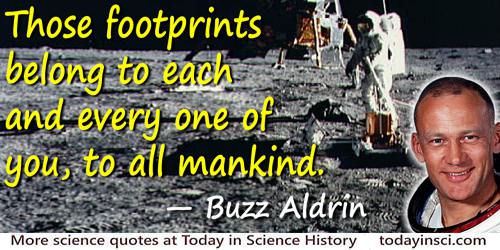
The honor you have given us goes not to us as a crew, but to ... all Americans, who believed, who persevered with us. What Apollo has begun we hope will spread out in many directions, not just in space, but underneath the seas, and in the cities to tell us unforgettably what we will and must do. There are footprints on the moon. Those footprints belong to each and every one of you, to all mankind. They are there because of the blood, sweat, and tears of millions of people. Those footprints are the symbol of true human spirit.
From his acceptance speech (13 Aug 1969) for the Medal of Freedom presented to him as one of the three astronauts on the first manned moon landing mission. In Leon Wagener, One Giant Leap: Neil Armstrong's Stellar American Journey (2004), 226.
The larger our great cities grow, the more irresistible becomes the attraction which they exert on the children of the country, who are fascinated by them, as the birds are fascinated by the lighthouse or the moths by the candle.
In The Task of Social Hygiene (1912), 178.
The physician should look upon the patient as a besieged city and try to rescue him with every means that art and science place at his command.
Attributed. Peter McDonald, In The Oxford Dictionary of Medical Quotations (2004), 2.
The same society which receives the rewards of technology must, as a cooperating whole, take responsibility for control. To deal with these new problems will require a new conservation. We must not only protect the countryside and save it from destruction, we must restore what has been destroyed and salvage the beauty and charm of our cities. Our conservation must be not just the classic conservation of protection and development, but a creative conservation of restoration and innovation. Its concern is not with nature alone, but with the total relation between man and the world around him. Its object is not just man's welfare, but the dignity of man's spirit.
In his 'Message to Congress on Conservation and Restoration of Natural Beauty' written to Congress (8 Feb 1965). It was a broad initiative aimed at beautifying America, guaranteeing water and air quality, and preserving natural areas. In Lyndon B. Johnson: Containing the Public Messages, Speeches, and Statements of the President (1965), Vol.1, 156.
United States. President (1963-1969 : Johnson), Lyndon Baines Johnson, United States. Office of the Federal Register - 1970
The time will come when people will travel in stages moved by steam engines, from city to city, almost as fast as birds fly,—fifteen or twenty miles an hour. Passing through the air with such velocity, changing the scene in such rapid succession, will be the most exhilarating exercise.
(about 1804). As quoted in Henry Howe, 'Oliver Evans', Memoirs of the Most Eminent American Mechanics: (1840), 80.
The worst city is that which is sheltered from the east winds and in which hot and cold winds blow.
As quoted in Robert Taylor, White Coat Tales: Medicine's Heroes, Heritage, and Misadventures (2010), 126.
There is no doubt that many expensive national projects may add to our prestige or serve science. But none of them must take precedence over human needs. As long as Congress does not revise its priorities, our crisis is not just material, it is a crisis of the spirit.
Considering the city of New York's financial shortfall.
Considering the city of New York's financial shortfall.
Letter as governor of New York to Mayor John V. Lindsay (24 Apr 1971), New York Times (25 Apr 1971), 69
This [the opening of the Vatican City radio station built by Marconi earlier in 1931] was a new demonstration of the harmony between science and religion that each fresh conquest of science ever more luminously confirms, so that one may say that those who speak of the incompatibility of science and religion either make science say that which it never said or make religion say that which it never taught.
Address to Pontifical Academy of Sciences (20 Dec 1931).In Associated Press, 'Pope Sees Harmony in Faith and Science', New York Times (21 Dec 1931), p.9. The pontiff said the opening of the radio station was “crowned by the publication of a radiophonic newspaper.”
To build up cities, an age is needed: but an hour destroys them.
Urbes constituit ætas: hora dissolvit.
Urbes constituit ætas: hora dissolvit.
Cited as from Quæstionum Naturalium, Book III. 27 in Kate Louise Roberts (ed.) Hoyt’s New Cyclopedia of Practical Quotations (1922), 798.
To the north [of Armenia] lies Zorzania [Georgia], near the confines of which there is a fountain of oil which discharges so great a quantity as to furnish loading for many camels. The use made of it is not for the purpose of food, but as an unguent for the cure of cutaneous distempers in men and cattle, as well as other complaints, and it is also good for burning. In the surrounding country no other [oil] is used in their lamps, and people come from distant parts to procure it.
[An early Western report of petroleum seepage. He visited the city of Baku, Azerbaijan in 1264.]
[An early Western report of petroleum seepage. He visited the city of Baku, Azerbaijan in 1264.]
In The Travels of Marco Polo (c.1300, trans. reprint 2007), 21-22. Eastern records of petroleum use date back many centuries earlier.
Today every city, town, or village is affected by it. We have entered the Neon Civilization and become a plastic world.. It goes deeper than its visual manifestations, it affects moral matters; we are engaged, as astrophysicists would say, on a decaying orbit.
On the official Raymond Loewry website.
Unlike the boundaries of the sea by the shorelines, the “ocean of air” laps at the border of every state, city, town and home throughout the world.
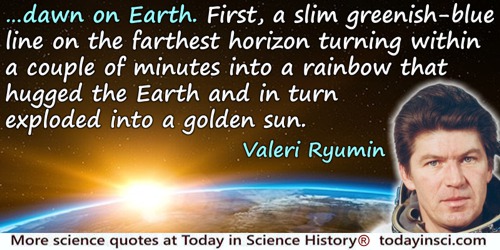
We entered into shadow. Contact with Moscow was gone. Japan floated by beneath us and I could clearly see its cities ablaze with lights. We left Japan behind to face the dark emptiness of the Pacific Ocean. No moon. Only stars, bright and far away. I gripped the handle like a man hanging onto a streetcar. Very slowly, agonizingly, half an hour passed, and with that, dawn on Earth. First, a slim greenish-blue line on the farthest horizon turning within a couple of minutes into a rainbow that hugged the Earth and in turn exploded into a golden sun. You’re out of your mind, I told myself, hanging onto a ship in space, and to your life, and getting ready to admire a sunrise.
…...
We thought of universities as the cathedrals of the modern world. In the middle ages, the cathedral was the center and symbol of the city. In the modern world, its place could be taken by the university.
L.A. Times (21 Jul 1999)
What Art was to the ancient world, Science is to the modern: the distinctive faculty. In the minds of men the useful has succeeded to the beautiful. Instead of the city of the Violet Crown, a Lancashire village has expanded into a mighty region of factories and warehouses. Yet, rightly understood, Manchester is as great a human exploit; as Athens.
In Coningsby: Or The New Generation (1844), Vol. 2, Book 4, Ch.1, 2.
What marvel is this? We begged you for drinkable springs,
O earth, and what is your lap sending forth?
Is there life in the deeps as well? A race yet unknown
Hiding under the lava? Are they who had fled returning?
Come and see, Greeks; Romans, come! Ancient Pompeii Is found again, the city of Hercules rises!
O earth, and what is your lap sending forth?
Is there life in the deeps as well? A race yet unknown
Hiding under the lava? Are they who had fled returning?
Come and see, Greeks; Romans, come! Ancient Pompeii Is found again, the city of Hercules rises!
Translation as given, without citation, as epigraph in C.W. Ceram, Gods, Graves, and Scholars: The Story of Archaeology (1986), 1. There are other translations of the Schiller’s original German, for example, in 'Pompeii and Herculaneum', Life of Schiller: Poetical Works (1902), 249.
What terrible questions we are learning to ask! The former men believed in magic, by which temples, cities, and men were swallowed up, and all trace of them gone. We are coming on the secret of a magic which sweeps out of men's minds all vestige of theism and beliefs which they and their fathers held and were framed upon.
In 'Illusions', The Atlantic Monthly (Nov 1858), 1, 60.
Will we ever again be able to view a public object with civic dignity, unencumbered by commercial messages? Must city buses be fully painted as movable ads, lampposts smothered, taxis festooned, even seats in concert halls sold one by one to donors and embellished in perpetuity with their names on silver plaques?
…...
 In science it often happens that scientists say, 'You know that's a really good argument; my position is mistaken,' and then they would actually change their minds and you never hear that old view from them again. They really do it. It doesn't happen as often as it should, because scientists are human and change is sometimes painful. But it happens every day. I cannot recall the last time something like that happened in politics or religion.
(1987) --
In science it often happens that scientists say, 'You know that's a really good argument; my position is mistaken,' and then they would actually change their minds and you never hear that old view from them again. They really do it. It doesn't happen as often as it should, because scientists are human and change is sometimes painful. But it happens every day. I cannot recall the last time something like that happened in politics or religion.
(1987) -- 





