Child Quotes (335 quotes)
... every step of the upward way is strewn with wreckage of body, mind, and morals.
Adolescence: Its Psychology and Its Relations to Physiology (1904), Vol. 1, xiv.
[1665-09-14] ...my finding that although the Bill [total of dead] in general is abated, yet the City within the walls is encreasd and likely to continue so (and is close to our house there) - my meeting dead corps's of the plague, carried to be buried close to me at noonday through the City in Fanchurch-street - to see a person sick of the sores carried close by me by Grace-church in a hackney-coach - my finding the Angell tavern at the lower end of Tower-hill shut up; and more then that, the alehouse at the Tower-stairs; and more then that, that the person was then dying of the plague when I was last there, a little while ago at night, to write a short letter there, and I overheard the mistress of the house sadly saying to her husband somebody was very ill, but did not think it was of the plague - to hear that poor Payne my waterman hath buried a child and is dying himself - to hear that a labourer I sent but the other day to Dagenhams to know how they did there is dead of the plague and that one of my own watermen, that carried me daily, fell sick as soon as he had landed me on Friday morning last, when I had been all night upon the water ... is now dead of the plague - to hear ... that Mr Sidny Mountagu is sick of a desperate fever at my Lady Carteret's at Scott's hall - to hear that Mr. Lewes hath another daughter sick - and lastly, that both my servants, W Hewers and Tom Edwards, have lost their fathers, both in St. Sepulcher's parish, of the plague this week - doth put me into great apprehensions of melancholy, and with good reason. But I put off the thoughts of sadness as much as I can, and the rather to keep my wife in good heart and family also.
Diary of Samuel Pepys (14 Sep 1665)
[A]s you know, scientific education is fabulously neglected … This is an evil that is inherited, passed on from generation to generation. The majority of educated persons are not interested in science, and are not aware that scientific knowledge forms part of the idealistic background of human life. Many believe—in their complete ignorance of what science really is—that it has mainly the ancillary task of inventing new machinery, or helping to invent it, for improving our conditions of life. They are prepared to leave this task to the specialists, as they leave the repairing of their pipes to the plumber. If persons with this outlook decide upon the curriculum of our children, the result is necessarily such as I have just described it.
Opening remarks of the second of four public lectures for the Dublin Institute for Advanced Studies at University College, Dublin (Feb 1950), The Practical Achievements of Science Tending to Obliterate its True Import', collected in Science and Humanism: Physics in Our Time (1951). Reprinted in 'Nature and the Greeks' and 'Science and Humanism' (1996), 113.
[About the structure of DNA] [T]he whole business was like a child's toy that you could buy at the dime store, all built in this wonderful way that you could explain in Life magazine so that really a five-year-old can understand what's going on...This was the greatest surprise for everyone.
Quoted in Horace Freeland Judson, Eighth Day of Creation (1979)
[American] Fathers are spending too much time taking care of babies. No other civilization ever let responsible and important men spend their time in this way. They should not be involved in household details. They should take the children on trips, explore with them and talk things over. Men today have lost something by turning towards the home instead of going out of it.
As quoted in interview with Frances Glennon, 'Student and Teacher of Human Ways', Life (14 Sep 1959), 147.
[American] Motherhood is like being a crack tennis player or ballet dancer—it lasts just so long, then it’s over. We’ve made an abortive effort to turn women into people. We’ve sent them to school and put them in slacks. But we’ve focused on wifehood and reproductivity with no clue about what to do with mother after the children have left home. We’ve found no way of using the resources of women in the 25 years of post-menopausal zest. As a result many women seem to feel they should live on the recognition and care of society.
As quoted in interview with Frances Glennon, 'Student and Teacher of Human Ways', Life (14 Sep 1959), 147.
[Concerning] the usual contempt with which an orthodox analytic group treats all outsiders and strangers ... I urge you to think of the young psychoanalysts as your colleagues, collaborators and partners and not as spies, traitors and wayward children. You can never develop a science that way, only an orthodox church.
Letter to a colleague (Nov 1960). In Colin Wilson, New Pathways in Psychology: Maslow and the Post-Freudian Revolution (1972, 2001), 154.
[Haunted by the statistic that the best predictor of SAT scores is family income:] Where you were born, into what family you are born, what their resources are, are to a large extent are going to determine the quality of education you receive, beginning in preschool and moving all the way up through college.
And what this is going to create in America is a different kind of aristocracy that's going to be self-perpetuating, unless we find ways to break that juggernaut.
... I think what that really reflects is the fact that resources, and not wealth necessarily, but just good middle-class resources, can buy quality of experience for children.
And what this is going to create in America is a different kind of aristocracy that's going to be self-perpetuating, unless we find ways to break that juggernaut.
... I think what that really reflects is the fact that resources, and not wealth necessarily, but just good middle-class resources, can buy quality of experience for children.
In a segment from PBS TV program, Newshour (9 Sep 2013).
[I]magine you want to know the sex of your unborn child. There are several approaches. You could, for example, do what the late film star ... Cary Grant did before he was an actor: In a carnival or fair or consulting room, you suspend a watch or a plumb bob above the abdomen of the expectant mother; if it swings left-right it's a boy, and if it swings forward-back it's a girl. The method works one time in two. Of course he was out of there before the baby was born, so he never heard from customers who complained he got it wrong. ... But if you really want to know, then you go to amniocentesis, or to sonograms; and there your chance of being right is 99 out of 100. ... If you really want to know, you go to science.
In 'Wonder and Skepticism', Skeptical Enquirer (Jan-Feb 1995), 19, No. 1.
[On mediocrity] What we have today is a retreat into low-level goodness. Men are all working hard building barbecues, being devoted to their wives and spending time with their children. Many of us feel, “We never had it so good!” After three wars and a depression, we’re impressed by the rising curve. All we want is it not to blow up.
As quoted in interview with Frances Glennon, 'Student and Teacher of Human Ways', Life (14 Sep 1959), 147.
[On suburbia] We’re bringing up our children in one-class areas. When they grow up and move to a city or go abroad, they’re not accustomed to variety and they get uncertain and insecure. We should bring up our children where they’re exposed to all types of people.
As quoted in interview with Frances Glennon, 'Student and Teacher of Human Ways', Life (14 Sep 1959), 147.
[Penguins] are extraordinarily like children, these little people of the Antarctic world, either like children, or like old men, full of their own importance and late for dinner, in their black tail-coats and white shirt-fronts — and rather portly withal.
In The Worst Journey in the World (1922), 64.
[Physicists] feel that the field of bacterial viruses is a fine playground for serious children who ask ambitious questions.
From 'Experiments with Bacterial Viruses (Bacteriophages)', Harvey Lecture (1946), 41, 161. As cited in Robert Olby, The Path of the Double Helix: The Discovery of DNA (1974, 1994), 237.
[Science] is sort of a game. Any fundamental advances in our field are made by looking at it with the smile of a child who plays a game.
As quoted in Lewis Wolpert and Alison Richards (eds.), Passionate Minds: The Inner World of Scientists (1997), 4.
![Sigmund Freud quote: [The child] takes his play very seriously and he expends large amounts of emotion on it. The opposite of pl](https://todayinsci.com/F/Freud_Sigmund/FreudSigmund-Play500x250px.jpg)
[The child] takes his play very seriously and he expends large amounts of emotion on it. The opposite of play is not what is serious but what is real.
Creative Writers and Day-Dreaming (1906), In James Strachey (ed.), The Standard Edition of the Complete Psychcological Works of Sigmund Freud (1959), Vol 9, 144.
[The teaching of Nature] is harsh and wasteful in its operation. Ignorance is visited as sharply as wilful disobedience—incapacity meets with the same punishment as crime. Nature’s discipline is not even a word and a blow, and the blow first; but the blow without the word. It is left to you to find out why your ears are boxed.
The object of what we commonly call education—that education in which man intervenes, and which I shall distinguish as artificial education—is to make good these defects in Nature’s methods; to prepare the child to receive Nature’s education, neither incapably, nor ignorantly, nor with wilful disobedience; and to understand the preliminary symptoms of her displeasure, without waiting for the box on the ear. In short, all artificial education ought to he an anticipation of natural education. And a liberal education is an artificial education, which has not only prepared a man to escape the great evils of disobedience to natural laws, but has trained him to appreciate and to seize upon the rewards, which Nature scatters with as free a hand as her penalties.
The object of what we commonly call education—that education in which man intervenes, and which I shall distinguish as artificial education—is to make good these defects in Nature’s methods; to prepare the child to receive Nature’s education, neither incapably, nor ignorantly, nor with wilful disobedience; and to understand the preliminary symptoms of her displeasure, without waiting for the box on the ear. In short, all artificial education ought to he an anticipation of natural education. And a liberal education is an artificial education, which has not only prepared a man to escape the great evils of disobedience to natural laws, but has trained him to appreciate and to seize upon the rewards, which Nature scatters with as free a hand as her penalties.
From Inaugural Address as Principal, South London Working Men’s College, in 'A Liberal Education; and Where to Find it', Macmillan's Magazine (Mar 1868), 17, 370.
[When I was a child] I grew up in Brooklyn, New York, and I was a street kid. … [T]here was one aspect of that environment that, for some reason, struck me as different, and that was the stars. … I could tell they were lights in the sky, but that wasn’t an explanation. I mean, what were they? Little electric bulbs on long black wires, so you couldn’t see what they were held up by? What were they? … My mother said to me, "Look, we’ve just got you a library card … get out a book and find the answer.” … It was in there. It was stunning. The answer was that the Sun was a star, except very far away. … The dazzling idea of a universe vast beyond imagining swept over me. … I sensed awe.
In 'Wonder and Skepticism', Skeptical Enquirer (Jan-Feb 1995), 19, No. 1.
[On Typhoid Fever] How often have I seen in past days, in the single narrow chamber of the day-labourer’s cottage, the father in the coffin, the mother in the sick-bed in muttering delirium, and nothing to relieve the desolation of the children but the devotion of some poor neighbour, who in too many cases paid the penalty of her kindness in becoming herself the victim of the same disorder.
As quoted by John Tyndall in Lecture (19 Oct 1876) to Glasgow Science Lectures Association. Printed in 'Address Delivered Before The British Association Assembled at Belfast', The Fortnightly Review (1 Nov 1876), 26 N.S., No. 119, 572.
Ces détails scientifiques qui effarouchent les fabricans d’un certain âge, ne seront qu’un
jeu pour leurs enfans, quand ils auront apprit dans leurs collèges un peu plus de mathématiques et un peu moins de Latin; un peu plus de Chimie, et un peu moins de Grec!
The scientific details which now terrify the adult manufacturer will be mere trifles to his children when they shall be taught at school, a little more Mathematics and a little less Latin, a little more Chemistry, and a little less Greek.
The scientific details which now terrify the adult manufacturer will be mere trifles to his children when they shall be taught at school, a little more Mathematics and a little less Latin, a little more Chemistry, and a little less Greek.
As quoted in 'Sketches From Life of Some Eminent Foreign Scientific Lecturers: Dumas', Magazine of Popular Science, and Journal of the Useful Arts (1836). Vol. 1, 177.
L’art d’enseigner n’est que l’art d’éveiller la curiosité des jeunes âmes pour la satisfaire ensuite.
The whole art of teaching is only the art of awakening the natural curiosity of young minds for the purpose of satisfying it afterwards.
The whole art of teaching is only the art of awakening the natural curiosity of young minds for the purpose of satisfying it afterwards.
The Crime of Sylvestre Bonnard (1894) translated by Lafcadio Hearn, in The Works of Anatole France in an English Translation (1920), 198.
Lepidoptera are for children to play with, pretty to look at, so some think. Give me the Coleoptera, and the kings of the Coleoptera are the beetles! Lepidoptera and Neuroptera for little folks; Coleoptera for men, sir!
In 'The Poet at the Breakfast Table: III', The Atlantic Monthly (Mar 1872), 29, 344.
Temporis fila.
Child of time.
A favourite expression of Linnaeus.
Child of time.
A favourite expression of Linnaeus.
Quoted in Tore Frängsmyr, 'Linnaeus as a Geologist', in Tore Frangsmyr (ed.), Linnaeus: The Man and his Work (1983), 143.
A child of the new generation
Refused to learn multiplication.
He said “Don’t conclude
That I’m stupid or rude;
I am simply without motivation.”
Refused to learn multiplication.
He said “Don’t conclude
That I’m stupid or rude;
I am simply without motivation.”
…...
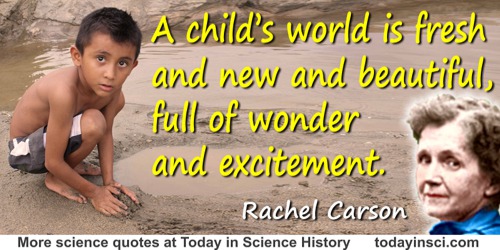
A child’s world is fresh and new and beautiful, full of wonder and excitement. It is our misfortune that for most of us that clear-eyed vision, that true instinct for what is beautiful and awe-inspiring, is dimmed and even lost before we reach adulthood.
In The Sense of Wonder (1956, 1998), 54.
A crystal is like a class of children arranged for drill, but standing at ease, so that while the class as a whole has regularity both in time and space, each individual child is a little fidgety!
In Crystals and X-Rays (1948), 22.
A drop of old tuberculin, which is an extract of tubercle bacilli, is put on the skin and then a small superficial scarification is made by turning, with some pressure, a vaccination lancet on the surface of the skin. The next day only those individuals show an inflammatory reaction at the point of vaccination who have already been infected with tuberculosis, whereas the healthy individuals show no reaction at all. Every time we find a positive reaction, we can say with certainty that the child is tuberculous.
'The Relation of Tuberculosis to Infant Mortality', read at the third mid-year meeting of the American Academy of Medicine, New Haven, Conn, (4 Nov 1909). In Bulletin of the American Academy of Medicine (1910), 11, 75.
A fair number of people who go on to major in astronomy have decided on it certainly by the time they leave junior high, if not during junior high. I think it’s somewhat unusual that way. I think most children pick their field quite a bit later, but astronomy seems to catch early, and if it does, it sticks.
From interview by Rebecca Wright, 'Oral History Transcript' (15 Sep 2000), on NASA website.
A first step in the study of civilization is to dissect it into details, and to classify these in their proper groups. Thus, in examining weapons, they are to be classed under spear, club, sling, bow and arrow, and so forth; among textile arts are to be ranged matting, netting, and several grades of making and weaving threads; myths are divided under such headings as myths of sunrise and sunset, eclipse-myths, earthquake-myths, local myths which account for the names of places by some fanciful tale, eponymic myths which account for the parentage of a tribe by turning its name into the name of an imaginary ancestor; under rites and ceremonies occur such practices as the various kinds of sacrifice to the ghosts of the dead and to other spiritual beings, the turning to the east in worship, the purification of ceremonial or moral uncleanness by means of water or fire. Such are a few miscellaneous examples from a list of hundreds … To the ethnographer, the bow and arrow is the species, the habit of flattening children’s skulls is a species, the practice of reckoning numbers by tens is a species. The geographical distribution of these things, and their transmission from region to region, have to be studied as the naturalist studies the geography of his botanical and zoological species.
In Primitive Culture (1871), Vol. 1, 7.
A torn jacket, is soon mended; but hard words bruise the heart of a child.
In 'Table-Talk', The Poetical Works of Henry Wadsworth Longfellow (1883), 1354.
A weird happening has occurred in the case of a lansquenet named Daniel Burghammer, of the squadron of Captain Burkhard Laymann Zu Liebenau, of the honorable Madrucci Regiment in Piadena, in Italy. When the same was on the point of going to bed one night he complained to his wife, to whom he had been married by the Church seven years ago, that he had great pains in his belly and felt something stirring therein. An hour thereafter he gave birth to a child, a girl. When his wife was made aware of this, she notified the occurrence at once. Thereupon he was examined and questioned. … He confessed on the spot that he was half man and half woman and that for more than seven years he had served as a soldier in Hungary and the Netherlands… . When he was born he was christened as a boy and given in baptism the name of Daniel… . He also stated that while in the Netherlands he only slept once with a Spaniard, and he became pregnant therefrom. This, however, he kept a secret unto himself and also from his wife, with whom he had for seven years lived in wedlock, but he had never been able to get her with child… . The aforesaid soldier is able to suckle the child with his right breast only and not at all on the left side, where he is a man. He has also the natural organs of a man for passing water. Both are well, the child is beautiful, and many towns have already wished to adopt it, which, however, has not as yet been arranged. All this has been set down and described by notaries. It is considered in Italy to be a great miracle, and is to be recorded in the chronicles. The couple, however, are to be divorced by the clergy.
'From Piadena in Italy, the 26th day of May 1601'. As quoted in George Tennyson Matthews (ed.) The Fugger Newsletter (1970), 247-248. A handwritten collection of news reports (1568-1604) by the powerful banking and merchant house of Fugger in Ausburg. This was footnoted in The Story of the Secret Service (1937), 698.
https://books.google.com/books?id=YfssAAAAMAAJ
Richard Wilmer Rowan - 1937
A wonderful exhilaration comes from holding in the mind the deepest questions we can ask. Such questions animate all scientists. Many students of science were first attracted to the field as children by popular accounts of important unsolved problems. They have been waiting ever since to begin working on a mystery. [With co-author Arthur Zajonc]
In George Greenstein and Arthur Zajonc, The Quantum Challenge: Modern Research on the Foundations of Quantum Mechanics (2006), xii.
A world that did not lift a finger when Hitler was wiping out six million Jewish men, women, and children is now saying that the Jewish state of Israel will not survive if it does not come to terms with the Arabs. My feeling is that no one in this universe has the right and the competence to tell Israel what it has to do in order to survive. On the contrary, it is Israel that can tell us what to do. It can tell us that we shall not survive if we do not cultivate and celebrate courage, if we coddle traitors and deserters, bargain with terrorists, court enemies, and scorn friends.
In Before the Sabbath (1979), 6.
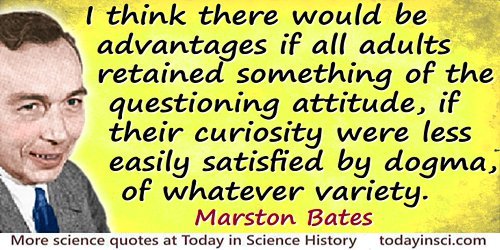
All children are curious and I wonder by what process this trait becomes developed in some and suppressed in others. I suspect again that schools and colleges help in the suppression insofar as they meet curiosity by giving the answers, rather than by some method that leads from narrower questions to broader questions. It is hard to satisfy the curiosity of a child, and even harder to satisfy the curiosity of a scientist, and methods that meet curiosity with satisfaction are thus not apt to foster the development of the child into the scientist. I don't advocate turning all children into professional scientists, although I think there would be advantages if all adults retained something of the questioning attitude, if their curiosity were less easily satisfied by dogma, of whatever variety.
The Nature of Natural History (1950, 1990), 256-257.
All my life through, the new sights of Nature made me rejoice like a child.
In Pierre Curie (1923), 162.
Although Lewis Carroll thought of The Hunting of the Snark as a nonsense ballad for children, it is hard to imagine—in fact one shudders to imagine—a child of today reading and enjoying it.
In 'Introduction', The Annotated Snark (1962), 11.
America has never been united by blood or birth or soil. We are bound by ideals that move us beyond our backgrounds, lift us above our interests and teach us what it means to be citizens. Every child must be taught these principles. Every citizen must uphold them. And every immigrant, by embracing these ideals, makes our country more, not less, American.
…...
Ampère was a mathematician of various resources & I think might rather be called excentric [sic] than original. He was as it were always mounted upon a hobby horse of a monstrous character pushing the most remote & distant analogies. This hobby horse was sometimes like that of a child ['s] made of heavy wood, at other times it resembled those [?] shapes [?] used in the theatre [?] & at other times it was like a hypogrif in a pantomime de imagie. He had a sort of faith in animal magnetism & has published some refined & ingenious memoirs to prove the identity of electricity & magnetism but even in these views he is rather as I said before excentric than original. He has always appeared to me to possess a very discursive imagination & but little accuracy of observation or acuteness of research.
'Davy’s Sketches of his Contemporaries', Chymia, 1967, 12, 135-6.
An extraterrestrial being, newly arrived on Earth - scrutinizing what we mainly present to our children in television, radio, movies, newspapers, magazines, the comics, and many books - might easily conclude that we are intent on teaching them murder, rape, cruelty, superstition, credulity and consumerism.
…...
Any child born into the hugely consumptionist way of life so common in the industrial world will have an impact that is, on average, many times more destructive than that of a child born in the developing world.
— Al Gore
Earth in the Balance: Ecology and the Human Spirit (2006), 308.
Aristotle, in spite of his reputation, is full of absurdities. He says that children should be conceived in the Winter, when the wind is in the North, and that if people marry too young the children will be female. He tells us that the blood of females is blacker then that of males; that the pig is the only animal liable to measles; that an elephant suffering from insomnia should have its shoulders rubbed with salt, olive-oil, and warm water; that women have fewer teeth than men, and so on. Nevertheless, he is considered by the great majority of philosophers a paragon of wisdom.
From An Outline of Intellectual Rubbish (1937, 1943), 19. Collected in The Basic Writings of Bertrand Russell (2009), 63.
As a child I read a lot, and I read everything. I’d go to the library and then stay up all night reading. I used to read under the desk in school … I read all of the books on science in the library and was frustrated when there was nothing left to read.
In 'A Personal Profile of Karen K. Uhlenbeck', collected in Susan Ambrose et al., Journeys of Women in Science and Engineering, No Universal Constants (1999).
As a child, I received instruction both in the Bible and in the Talmud. I am a Jew, but I am enthralled by the luminous figure of the Nazarene.
From 'What Life Means to Einstein', The Saturday Evening Post (26 Oct 1929), 117.
As I stood behind the coffin of my little son the other day, with my mind bent on anything but disputation, the officiating minister read, as part of his duty, the words, 'If the dead rise not again, let us eat and drink, for to-morrow we die.' I cannot tell you how inexpressibly they shocked me. Paul had neither wife nor child, or he must have known that his alternative involved a blasphemy against all that well best and noblest in human nature. I could have laughed with scorn. What! Because I am face to face with irreparable loss, because I have given back to the source from whence it came, the cause of a great happiness, still retaining through all my life the blessings which have sprung and will spring from that cause, I am to renounce my manhood, and, howling, grovel in bestiality? Why, the very apes know better, and if you shoot their young, the poor brutes grieve their grief out and do not immediately seek distraction in a gorge.
Letter to Charles Kingsley (23 Sep 1860). In L. Huxley, The Life and Letters of Thomas Henry Huxley (1903), Vol. 1, 318.
As to the need of improvement there can be no question whilst the reign of Euclid continues. My own idea of a useful course is to begin with arithmetic, and then not Euclid but algebra. Next, not Euclid, but practical geometry, solid as well as plane; not demonstration, but to make acquaintance. Then not Euclid, but elementary vectors, conjoined with algebra, and applied to geometry. Addition first; then the scalar product. Elementary calculus should go on simultaneously, and come into vector algebraic geometry after a bit. Euclid might be an extra course for learned men, like Homer. But Euclid for children is barbarous.
Electro-Magnetic Theory (1893), Vol. 1, 148. In George Edward Martin, The Foundations of Geometry and the Non-Euclidean Plane (1982), 130.
At the present time all property is personal; the man owns his own ponies and other belongings he has personally acquired; the woman owns her horses, dogs, and all the lodge equipments; children own their own articles; and parents do not control the possessions of their children. There is no family property as we use the term. A wife is as independent as the most independent man in our midst. If she chooses to give away or sell all of her property, there is no one to gainsay her.
Speech on 'The Legal Conditions of Indian Women', delivered to Evening Session (Thur 29 Mar 1888), collected in Report of the International Council of Women: Assembled by the National Woman Suffrage Association, Washington, D.C., U.S. of America, March 25 to April 1, 1888 (1888), Vol. 1, 239-240.
Because a child of one doubles its age after the passage of a single year, it can be said to be aging rapidly.
Speech at the Nobel Banquet (10 Dec 1983) for his Nobel Prize in Chemistry. In Wilhelm Odelberg (ed.), Les Prix Nobel: The Nobel Prizes (1984), 43.
Because of the way it came into existence, the solar system has only one-way traffic—like Piccadilly Circus. … If we want to make a model to scale, we must take a very tiny object, such as a pea, to represent the sun. On the same scale the nine planets will be small seeds, grains of sand and specks of dust. Even so, Piccadilly Circus is only just big enough to contain the orbit of Pluto. … The whole of Piccadilly Circus was needed to represent the space of the solar system, but a child can carry the whole substance of the model in its hand. All the rest is empty space.
In The Stars in Their Courses (1931, 1954), 49-50 & 89.
Being an only child is a disease in itself.
As quoted in Dorothy Stein, People who Count: Population and Politics, Women and Children (1995), 111, citing T.L. Smith (ed.) Aspects of Childhood Life and Education (1907).
Beware how you take away hope from any human being. Nothing is clearer than that the merciful Creator intends to blind most people as they pass down into the dark valley. Without very good reasons, temporal or spiritual, we should not interfere with his kind arrangements. It is the height of cruelty and the extreme of impertinence to tell your patient he must die, except you are sure that he wishes to know it, or that there is some particular cause for his knowing it. I should be especially unwilling to tell a child that it could not recover; if the theologians think it necessary, let them take the responsibility. God leads it by the hand to the edge of the precipice in happy unconsciousness, and I would not open its eyes to what he wisely conceals.
In Valedictory Address Delivered to the Medical Graduates at Harvard University, at the Annual Commencement, Wednesday, March 10, 1858) (1858), 14. Reprinted, as published in The Boston Medical and Surgical Journal (25 Mar 1858), 58, No. 8, 158.
Blaming others, or outside conditions for one’s own misbehavior may be the child’s privilege; if an adult denies responsibility for his actions, it is another step towards personality disintegration.
In Informed Heart: Autonomy in a Mass Age (1960), 192.
But for us, it’s different. Look again at that dot. That’s here. That’s home. That’s us. On it everyone you love, everyone you know, everyone you ever heard of, every human being who ever was, lived out their lives. The aggregate of our joy and suffering, thousands of confident religions, ideologies, and economic doctrines, every hunter and forager, every hero and coward, every creator and destroyer of civilization, every king and peasant, every young couple in love, every mother and father, hopeful child, inventor and explorer, every teacher of morals, every corrupt politician, every “superstar,” every “supreme leader,” every saint and sinner in the history of our species lived there - on a mote of dust suspended in a sunbeam.
…...
But poverty, though it does not prevent the generation, is extremely unfavourable to the rearing of children. The tender plant is produced, but in so cold a soil, and so severe a climate, soon withers and dies.
An Inquiry Into the Nature and Causes of the Wealth of Nations (1776). In The Works of Adam Smith (1812), Vol. 2, 120.
Chemistry works with an enormous number of substances, but cares only for some few of their properties; it is an extensive science. Physics on the other hand works with rather few substances, such as mercury, water, alcohol, glass, air, but analyses the experimental results very thoroughly; it is an intensive science. Physical chemistry is the child of these two sciences; it has inherited the extensive character from chemistry. Upon this depends its all-embracing feature, which has attracted so great admiration. But on the other hand it has its profound quantitative character from the science of physics.
In Theories of Solutions (1912), xix.
Chemistry: that most excellent child of intellect and art.
From presidential address to 1953 conference of Science Masters Association, Oxford, part of the Centenary Celbrations of the Chemical Society of London. As quoted in Charles Alfred Coulson, Science and Christian Belief (1956), 51.
Cherish you visions and your dreams as they are the children of your soul; the blue prints of your ultimate achievements.
…...
Child psychology and animal psychology are of relatively slight importance, as compared with the sciences which deal with the corresponding physiological problems of ontogeny and phylogeny.
Children [are] born with a zest for knowledge, aware that they must live in a future molded by science, but so often convinced by their culture that science is not for them.
In 'With Science on Our Side', Washington Post (9 Jan 1994).
Children are to be guided to make a beginning in all the arts and sciences without interference with their spontaneity, the instinct of imitation being so used as to give them order without constraining them.
In Friedrich Fröbel and Josephine Jarvis (trans.), 'American Preface', The Education of Man (1885), vi.
Children are told that an apple fell on Isaac Newton’s head and he was led to state the law of gravity. This, of course, is pure foolishness. What Newton discovered was that any two particles in the universe attract each other with a force that is proportional to the product of their masses and inversely proportional to the square of the distance between them. This is not learned from a falling apple, but by observing quantities of data and developing a mathematical theory that can be verified by additional data. Data gathered by Galileo on falling bodies and by Johannes Kepler on motions of the planets were invaluable aids to Newton. Unfortunately, such false impressions about science are not universally outgrown like the Santa Claus myth, and some people who don’t study much science go to their graves thinking that the human race took until the mid-seventeenth century to notice that objects fall.
In How to Tell the Liars from the Statisticians (1983), 127.
Children must be taught how to think, not what to think.
In 'Education for Choice', Coming of Age in Samoa (1928, 1961), 246.
Climate change threatens every corner of our country, every sector of our economy and the health and future of every child. We are already seeing its impacts and we know the poorest and most vulnerable people in the United States and around the world will suffer most of all.
In Hillary Clinton, 'Hillary Clinton: America Must Lead at Paris Climate Talks', Time (29 Nov 2015).
Complaint was made in 1901 that 'Not so much attention is paid to our children's minds as is paid to their feet.'
Quoted by A.V. Neale in The Advancement of Child Health (1964), 171.
Conformity-enforcing packs of vicious children and adults gradually shape the social complexes we know as religion, science, corporations, ethnic groups, and even nations. The tools of our cohesion include ridicule, rejection, snobbery, self-righteousness, assault, torture, and death by stoning, lethal injection, or the noose. A collective brain may sound warm and fuzzily New Age, but one force lashing it together is abuse.
In 'The Conformity Police', Global Brain: The Evolution of Mass Mind from the Big Bang to the 21st Century (2000), 89.
Constant muscular activity was natural for the child, and, therefore, the immense effort of the drillmaster teachers to make children sit still was harmful and useless.
Quoted in Bill McKibben, Maybe One: A Personal and Enviromental Argument for Single-Child Families (1998), 19.
Delusions are often functional. A mother’s opinions about her children’s beauty, intelligence, goodness, et cetera ad nauseam, keep her from drowning them at birth.
In 'From the Notebooks of Lazarus Long', Time Enough for Love: The Lives of Lazarus Long (1973), 257.
Do not … keep children to their studies by compulsion but by play. That will also better enable you to discern the natural capacities of each
— Plato
From The Republic 7 536e-537a, as translated by Paul Shorey (1930).
Domesticated biotechnology, once it gets into the hands of housewives and children, will give us an explosion of diversity of new living creatures … New lineages will proliferate to replace those that monoculture farming and deforestation have destroyed. Designing genomes will be a personal thing, a new art form as creative as painting or sculpture. Few of the new creations will be masterpieces, but a great many will bring joy to their creators and variety to our fauna and flora.
In 'Our Biotech Future', The New York Review of Books (2007). As quoted and cited in Kenneth Brower, 'The Danger of Cosmic Genius', The Atlantic (Dec 2010).
Dr. Paget was conducting a school examination, and in the course of his questions he happened to ask a small child the meaning of “Average.” He was utterly bewildered by the reply, “The thing that hens lay on,” until the child explained that he had read in a book that hens lay on an average so many eggs a year.
Anecdote jotted down by Lewis Carroll to possibly send to the magazine Punch, as given in Stuart Dodgson Collingwood, The Life and Letters of Lewis Carroll (1898), 157.
Education consists in co-operating with what is already inside a child's mind … The best way to learn geometry is to follow the road which the human race originally followed: Do things, make things, notice things, arrange things, and only then reason about things.
In Mathematician's Delight (1943), 27.
Education enlarges the child’s survey of the world in which he lives. Education stimulates and develops a child’s individuality. Education should harmonize the individual will and the institutional will.
As quoted, without citation, in 'What Is Education?', The Journal of Education (28 Sep 1905), 62, No. 13, 354.
Education is not a matter of getting facts and sowing them within brains, but that it is an attitude of mind that you teach children to find out for themselves
Interview with David Barrett, 'Attenborough: Children Don’t Know Enough About Nature', Daily Telegraph (17 Apr 2011).
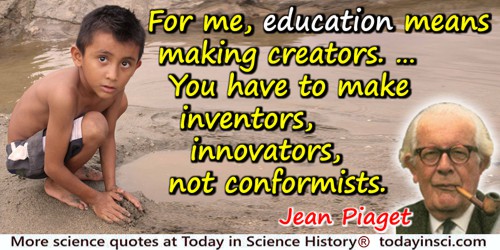
Education, for most people, means trying to lead the child to resemble the typical adult of his society. … But for me, education means making creators. … You have to make inventors, innovators, not conformists.
As quoted in Jean-Claude Bringuier and Basia Miler Gulati (trans.), Conversations with Jean Piaget (1980), 132.
Every inhabitant of this planet must contemplate the day when this planet may no longer be habitable. Every man, woman and child lives under a nuclear sword of Damocles, hanging by the slenderest of threads, capable of being cut at any moment by accident or miscalculation or by madness. The weapons of war must be abolished before they abolish us.
Address to the United Nations General Assembly, (25 Sep 1961). On U.S. Department of State website.
Every kid starts out as a natural-born scientist, and then we beat it out of them. A few trickle through the system with their wonder and enthusiasm for science intact.
Quoted in interview with magazine staff, Psychology Today (Jan 1996).
Every one of us can do something to protect and care for our planet. We have to live in such a way that a future will be possible for our children and our grandchildren. Our own life has to be. Our own life has to be our message.
In The World We Have: A Buddhist Approach to Peace and Ecology (2008), i.
Evolution is a hard, inescapable mistress. There is just no room for compassion or good sportsmanship. Too many organisms are born, so, quite simply, a lot of them are going to have to die because there isn't enough food and space to go around. You can be beautiful, fast and strong, but it might not matter. The only thing that does matter is, whether you leave more children carrying your genes than the next person leaves. It’s true whether you’re a prince, a frog, or an American elm.
From The Center of Life: A Natural History of the Cell (1977, 1978), 37.
Failure is so much more interesting because you learn from it. That’s what we should be teaching children at school, that being successful the first time, there’s nothing in it. There’s no interest, you learn nothing actually.
Interview with Carole Cadwalladr, The Observer (9 May 2014).
For nothing is fixed, forever and forever and forever, it is not fixed; the earth is always shifting, the light is always changing, the sea does not cease to grind down rock. Generations do not cease to be born, and we are responsible to them because we are the only witnesses they have. The sea rises, the light fails, lovers cling to each other, and children cling to us. The moment we cease to hold each other, the sea engulfs us and the light goes out.
…...
Forty years ago the philosopher Alfred North Whitehead thought it self-evident that you would get a good government if you took power out of the hands of the acquisitive and gave it to the learned and the cultivated. At present, a child in kindergarten knows better than that.
In Before the Sabbath (1979), 40-41.
From the freedom to explore comes the joy of learning. From knowledge acquired by personal initiative arises the desire for more knowledge. And from mastery of the novel and beautiful world awaiting every child comes self-confidence.
In The Creation: An Appeal to Save Life on Earth (2010), 147.
Genetics is to biology what atomic theory is to physics. Its principle is clear: that inheritance is based on particles and not on fluids. Instead of the essence of each parent mixing, with each child the blend of those who made him, information is passed on as a series of units. The bodies of successive generations transport them through time, so that a long-lost character may emerge in a distant descendant. The genes themselves may be older than the species that bear them.
Almost Like a Whale: The Origin of Species Updated (1999), 115.
God is a child; and when he began to play, he cultivated mathematics. It is the most godly of man’s games.
Said by the fictional character, mathematics teacher, Professor Hirt, in Das Blinde Spiel (The Blind Game, 1954), 253. As translated in an epigraph, Stanley Gudder, A Mathematical Journey (1976), 269. From the original German, “Gott ist ein Kind, und als er zu spielen begann, trieb er Mathematik. Die Mathematik ist göttlichste Spielerei unter den Menschen”, as quoted in Herbert Meschkowski, Hundert Jahre Mengenlehre (1973), 119.
Habit is thus the enormous fly-wheel of society, its most precious conservative agent. It alone is what keeps us all within the bounds of ordinance, and saves the children of fortune from the envious uprisings of the poor. It alone prevents the hardest and most repulsive walks of life from being deserted by those brought up to tread therein.
'The Laws of Habit', The Popular Science Monthly (Feb 1887), 447.
He [Heinrich Rose] looked upon the various substances that he was manipulating, as well as their reactions, under a thoroughly familial point of view: they were like so many children entrusted to his tutelage. Every time he explained simple, clear, well-defined phenomena, he assumed a jovial and smiling countenance; on the other hand, he almost got angry at certain mischievous bodies, the properties of which did not obey ordinary laws and troubled general theoretical views; in his eyes, this was unruly behavior.
As his student, about the lectures of Heinrich Rose, as quoted in entry by Stuart Pierson, 'Rose, Heinrich', in Charles Coulston Gillespie (ed.), Dictionary of Scientific Biography (1975), Vol.11, 541, citing Adolphe Remelé, 'Notice biographique sur le Professeur Henri Rose', in Moniteur Scientifique (1864), 2nd ser., 6, 385–389. [Remelé’s italics.]
He who would lead a Christ-like life is he who is perfectly and absolutely himself. He may be a great poet, or a great man of science, or a young student at the University, or one who watches sheep upon a moor, or a maker of dramas like Shakespeare, or a thinker about God, like Spinoza. or a child who plays in a garden, or a fisherman who throws his nets into the sea. It does not matter what he is as long as he realises the perfection of the soul that is within him.
In 'The Critic As Artist', Oscariana: Epigrams (1907), 27-28
Here are the most important pieces of advice that I’ve passed on to my children. One, remember to look up at the stars and not down at your feet. Two, never give up work. Work gives you meaning and purpose and life is empty without it. Three, if you are lucky enough to find love, remember it is rare and don’t throw it away.
From Interview with Diane Sawyer on ABC TV, World News Tonight (2010). As quoted in 'The Most Important Pieces of Advice Stephen Hawking Gave to his Children' (14 Mar 2018), on abcnews.go.com webpage.
Here is this vast, savage, howling mother of ours, Nature, lying all around, with such beauty, and such affection for her children, as the leopard; and yet we are so early weaned from her breast to society, to that, culture which is exclusively an interaction of man on man.
Remarking how society becomes divorces individuals from nature. In essay, Walking (1862). Collected in The Writings of Henry David Thoreau (1893), Vol. 9, 291.
How paramount the future is to the present when one is surrounded by children.
In Letter to C. D. Fox (7 Mar 1852), collected in Francis Darwin (ed.), The Life and Letters of Charles Darwin (1896), 350.
I am a naturalist rather than a scientist. Simply looking at a flower or a frog has always seemed to me to be just about the most interesting thing there is. Others say human beings are pretty interesting, which they are, but as a child you’re not interested in Auntie Flo’s psychology; you’re interested in how a dragonfly larva turns into a dragonfly.
From 'Interview: Of Mind and Matter: David Attenborough Meets Richard Dawkins', The Guardian (11 Sep 2010).
I am among those who think that science has great beauty. A scientist in his laboratory is not only a technician: he is also a child placed before natural phenomena which impress him like a fairy tale. We should not allow it to be believed that all scientific progress can be reduced to mechanisms, machines, gearings, even though such machinery has its own beauty.
During a debate in Madrid, ',The Future of Culture' (1933). In Eve Curie Labouisse, Eve Curie and Vincent Sheean, Madame Curie (1937), 341
I am the daughter of earth and water, And the nursling of the sky;
I pass through the pores of the ocean and shores;
I change, but I cannot die.
For after the rain when with never a stain,
The pavilion of Heaven is bare,
And the winds and sunbeams with their convex gleams,
Build up the blue dome of air,
I silently laugh at my own cenotaph, And out of the caverns of rain,
Like a child from the womb, like a ghost from the tomb,
I arise and unbuild it again.
I pass through the pores of the ocean and shores;
I change, but I cannot die.
For after the rain when with never a stain,
The pavilion of Heaven is bare,
And the winds and sunbeams with their convex gleams,
Build up the blue dome of air,
I silently laugh at my own cenotaph, And out of the caverns of rain,
Like a child from the womb, like a ghost from the tomb,
I arise and unbuild it again.
The Cloud (1820). In K. Raine (ed.), Shelley (1974), 289.
I am the only child of parents who weighed, measured, and priced everything; for whom what could not be weighed, measured, and priced, had no existence.
In Little Dorrit (1856), Vol 1, Chap. 2, 30.
I believe that the useful methods of mathematics are easily to be learned by quite young persons, just as languages are easily learned in youth. What a wondrous philosophy and history underlie the use of almost every word in every language—yet the child learns to use the word unconsciously. No doubt when such a word was first invented it was studied over and lectured upon, just as one might lecture now upon the idea of a rate, or the use of Cartesian co-ordinates, and we may depend upon it that children of the future will use the idea of the calculus, and use squared paper as readily as they now cipher. … When Egyptian and Chaldean philosophers spent years in difficult calculations, which would now be thought easy by young children, doubtless they had the same notions of the depth of their knowledge that Sir William Thomson might now have of his. How is it, then, that Thomson gained his immense knowledge in the time taken by a Chaldean philosopher to acquire a simple knowledge of arithmetic? The reason is plain. Thomson, when a child, was taught in a few years more than all that was known three thousand years ago of the properties of numbers. When it is found essential to a boy’s future that machinery should be given to his brain, it is given to him; he is taught to use it, and his bright memory makes the use of it a second nature to him; but it is not till after-life that he makes a close investigation of what there actually is in his brain which has enabled him to do so much. It is taken because the child has much faith. In after years he will accept nothing without careful consideration. The machinery given to the brain of children is getting more and more complicated as time goes on; but there is really no reason why it should not be taken in as early, and used as readily, as were the axioms of childish education in ancient Chaldea.
In Teaching of Mathematics (1902), 14.
I can remember … starting to gather all sorts of things like rocks and beetles when I was about nine years old. There was no parental encouragement—nor discouragement either—nor any outside influence that I can remember in these early stages. By about the age of twelve, I had settled pretty definitely on butterflies, largely I think because the rocks around my home were limited to limestone, while the butterflies were varied, exciting, and fairly easy to preserve with household moth-balls. … I was fourteen, I remember, when … I decided to be scientific, caught in some net of emulation, and resolutely threw away all of my “childish” specimens, mounted haphazard on “common pins” and without “proper labels.” The purge cost me a great inward struggle, still one of my most vivid memories, and must have been forced by a conflict between a love of my specimens and a love for orderliness, for having everything just exactly right according to what happened to be my current standards.
In The Nature of Natural History (1950, 1990), 255.
I despise Birth-Control first because it is ... an entirely meaningless word; and is used so as to curry favour even with those who would first recoil from its real meaning. The proceeding these quack doctors recommend does not control any birth. ... But these people know perfectly well that they dare not write the plain word Birth-Prevention, in any one of the hundred places where they write the hypocritical word Birth-Control. They know as well as I do that the very word Birth-Prevention would strike a chill into the public... Therefore they use a conventional and unmeaning word, which may make the quack medicine sound more innocuous. ... A child is the very sign and sacrament of personal freedom. He is a fresh will added to the wills of the world; he is something that his parents have freely chosen to produce ... he is their own creative contribution to creation.
In 'Babies and Distributism', The Well and the Shadows (1935). Collected in G. K. Chesterton and Dale Ahlquist (ed.), In Defense of Sanity: The Best Essays of G.K. Chesterton (2011), 272.
I don't grow up. In me is the small child of my early days.
As quoted on the website mcescher.com, without citation.
I grew up in Brooklyn, New York … a city neighborhood that included houses, lampposts, walls, and bushes. But with an early bedtime in the winter, I could look out my window and see the stars, and the stars were not like anything else in my neighborhood. [At age 5] I didn’t know what they were.
[At age 9] my mother … said to me, “You have a library card now, and you know how to read. Take the streetcar to the library and get a book on stars.” … I stepped up to the big librarian and asked for a book on stars. … I sat down and found out the answer, which was something really stunning.I found out that the stars are glowing balls of gas. I also found out that the Sun is a star but really close and that the stars are all suns except really far away I didn’t know any physics or mathematics at that time, but I could imagine how far you’d have to move the Sun away from us till it was only as bright as a star. It was in that library, reading that book, that the scale of the universe opened up to me. There was something beautiful about it.
At that young age, I already knew that I’d be very happy if I could devote my life to finding out more about the stars and the planets that go around them. And it’s been my great good fortune to do just that.
[At age 9] my mother … said to me, “You have a library card now, and you know how to read. Take the streetcar to the library and get a book on stars.” … I stepped up to the big librarian and asked for a book on stars. … I sat down and found out the answer, which was something really stunning.I found out that the stars are glowing balls of gas. I also found out that the Sun is a star but really close and that the stars are all suns except really far away I didn’t know any physics or mathematics at that time, but I could imagine how far you’d have to move the Sun away from us till it was only as bright as a star. It was in that library, reading that book, that the scale of the universe opened up to me. There was something beautiful about it.
At that young age, I already knew that I’d be very happy if I could devote my life to finding out more about the stars and the planets that go around them. And it’s been my great good fortune to do just that.
Quoted in interview with Jack Rightmyer, in 'Stars in His Eyes', Highlights For Children (1 Jan 1997). Ages as given in Tom Head (ed.), Conversations with Carl Sagan (2006), x.
I grew up in Japan and Hong Kong and then came to the States. Japan was a huge influence on me because, as a child, I would hear the oxcarts come and collect our sewage at night out of our house from the latrine and then take it off to the farms as fertilizer. And then the food would come back in oxcarts during the day. I always had this sort of “our poop became food” mental model. The idea of “waste equals food” was pretty inculcated, that everything was precious and the systems were coherent and cyclical.
In interview with Kerry A. Dolan, 'William McDonough On Cradle-to-Cradle Design', Forbes (4 Aug 2010)
I grew up in love with science, asking the same questions all children ask as they try to codify the world to find out what makes it work. “Who is the smartest person in the world?” and “Where is the tallest mountain in the world?” turned into questions like, “How big is the universe?” and “What is it that makes us alive?”
In Introduction to Isaac Asimov and Jason A. Shulman (eds.), Isaac Asimov’s Book of Science and Nature Quotations (1988), xix.
I had no books as a child. I had real machines, and I went out to work in the fields. I was driving farm machinery at five, and fixing it at age seven or eight. It’s no accident that I worked on Hubble 50 to 60 years later. My books were nature; it was very important to how I related to the Earth, and the Earth from space. No doubt when I go into space, I go back into the cool soil of Earth. I’m always thinking of it. Nature was my book. Other people come from that tradition - Emerson, Thoreau, and especially Whitman. Look at what they said in their philosophy - go out and have a direct relationship with nature.
When asked by Discover magazine what books helped inspire his passion as an astronaut.
When asked by Discover magazine what books helped inspire his passion as an astronaut.
'The 1998 Discover Science Gift Guide: Fantastic Voyages Children's Books That Mattered', Discover (Dec 1998).
I had this experience at the age of eight. My parents gave me a microscope. I don’t recall why, but no matter. I then found my own little world, completely wild and unconstrained, no plastic, no teacher, no books, no anything predictable. At first I did not know the names of the water-drop denizens or what they were doing. But neither did the pioneer microscopists. Like them, I graduated to looking at butterfly scales and other miscellaneous objects. I never thought of what I was doing in such a way, but it was pure science. As true as could be of any child so engaged, I was kin to Leeuwenhoek, who said that his work “was not pursued in order to gain the praise I now enjoy, but chiefly from a craving after knowledge, which I notice resides in me more that most other men.”
In The Creation: An Appeal to Save Life on Earth (2010), 143-144.
I hope you have not murdered too completely your own and my child.
Referring to their independently conceived ideas on the origin of species.
Referring to their independently conceived ideas on the origin of species.
Letter to A. R. Wallace, March 1869. In J. Marchant, Alfred Russel Wallace: Letters and Reminiscences (1916), Vol. 1, 240.
I kind of like scientists, in a funny way. … I'm kind of interested in genetics though. I think I would have liked to have met Gregor Mendel. Because he was a monk who just sort of figured this stuff out on his own. That's a higher mind, that’s a mind that's connected. … But I would like to know about Mendel, because I remember going to the Philippines and thinking “this is like Mendel’s garden” because it had been invaded by so many different countries over the years, and you could see the children shared the genetic traits of all their invaders over the years, and it made for this beautiful varietal garden.
Answering question: “If you could go back in time and have a conversation with one person, who would it be and why?” by Anniedog03 during an Internet Reddit AMA (Ask Me Anything) online session (17 Jan 2014).
I like to handle babies. You can learn a lot from the way they respond, the way they slide down your hips, the way they trust you. The first thing a child must learn is to trust.
As quoted in interview with Frances Glennon, 'Student and Teacher of Human Ways', Life (14 Sep 1959), 144.
I really see no harm which can come of giving our children a little knowledge of physiology. ... The instruction must be real, based upon observation, eked out by good explanatory diagrams and models, and conveyed by a teacher whose own knowledge has been acquired by a study of the facts; and not the mere catechismal parrot-work which too often usurps the place of elementary teaching.
Science and Culture (1882), 92.
I recognize that to view the Earth as if it were alive is just a convenient, but different, way of organizing the facts of the Earth. I am, of course, prejudiced in favour of Gaia and have filled my life for the past 25 years with the thought that the Earth might be in certain ways be alive—not as the ancients saw her, a sentient goddess with purpose and foresight—more like a tree. A tree that exists, never moving except to sway in the wind, yet endlessly conversing with the sunlight and the soil. Using sunlight and water and nutrients to grow and change. But all done so imperceptibly that, to me, the old oak tree on the green is the same as it was when I was a child.
In Healing Gaia: Practical Medicine for the Planet (1991), 12.
I said, that Superstition was the child of Fear, and Fear the child of Ignorance; and you might expect me to say antithetically, that Science was the child of Courage, and Courage the child of Knowledge.
Opening of 'Science', a lecture delivered at the Royal Institution, published in Fraser's Magazine (Jul 1866), 74, 15.
I sometimes ask myself how it came about that I was the one to develop the theory of relativity. The reason, I think, is that a normal adult never stops to think about the problem of space and time. These are things which he has thought of as a child. But my intellectual development was retarded, as a result of which I began to wonder about space and time only when I had already grown up.
In Ronald W. Clark, Einstein: The Life and Times (1971), 10.
I think every child born on this planet up to the age of about four or five is fascinated by the natural world. If they aren’t it’s because we deprive them of the opportunity. Over half the world’s population is urbanised and the thought that some children may grow up not looking at a pond or knowing how plants grow is a terrible thing. If you lose that delight and joy and intoxication, you’ve lost something hugely precious.
From interview with Alice Roberts, 'Attenborough: My Life on Earth', The Biologist (Aug 2015), 62, No. 4, 14.
I was 5 when I went up my first 10,000ft mountain, with my parents, and I have been climbing ever since.
From interview with Rudraneil Sengupta, 'Reinhold Messner: When You’re Alone, Fear is All on You', Mint (1 Mar 2014). A business newspaper in India, also online at livemint.com website.
I was a child in a time of hope. I grew up when the expectations for science were very high: in the thirties and forties. … There was a sense of optimism about science and the future.
In article, 'Wonder and Skepticism', Skeptical Inquirer (Jan/Feb 1995), 19, No. 1.
I was just so interested in what I was doing I could hardly wait to get up in the morning and get at it. One of my friends, a geneticist, said I was a child, because only children can't wait to get up in the morning to get at what they want to do.
Quoted in Evelyn Fox Keller, A Feeling for the Organism: The Life and Work of Barbara McClintock (1984), 70.
I won’t let anyone take us backward, deny our economy the benefits of harnessing a clean energy future, or force our children to endure the catastrophe that would result from unchecked climate change.
In Hillary Clinton, 'Hillary Clinton: America Must Lead at Paris Climate Talks', Time (29 Nov 2015)
I'm convinced that before the year 2000 is over, the first child will have been born on the moon.
Taped TV interview, broadcast on WMAL, Washington, (7 Jan 1972), as reported in 'Birth of Child on Moon Foreseen by von Braun', New York Times (7 Jan 1972), 14.
I’m not an atheist and I don’t think I can call myself a pantheist. We are in the position of a little child entering a huge library filled with books in many different languages. The child knows someone must have written those books. It doe s not know how. The child dimly suspects a mysterious order in the arrangement of the books but doesn’t know what it is. That, it seems to me, is the attitude of even the most intelligent human being toward God.
…...
If a child is constantly sick, it is due to overfeeding.
Chinese proverb.
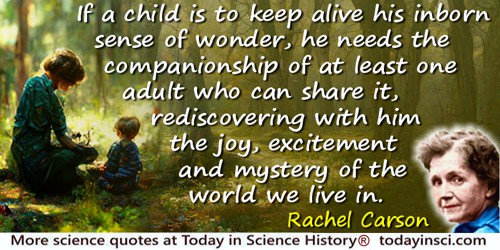
If a child is to keep alive his inborn sense of wonder, he needs the companionship of at least one adult who can share it, rediscovering with him the joy, excitement and mystery of the world we live in.
The Sense of Wonder, Harper & Row (1965)
If a child left school at ten, knowing nothing of detailed information, but knowing the pleasure that comes from agreeable music, from reading, from making things, from finding things out, it would be better off than a man who left university at twenty-two, full of facts but without any desire to enquire further into such dry domains.
In Mathematician's Delight (1943), 9.
If a teacher is full of his subject, and can induce enthusiasm in his pupils; if his facts are concrete and naturally connected, the amount of material that an average child can assimilate without injury is as astonishing as is the little that will fag him if it is a trifle above or below or remote from him, or taught dully or incoherently.
In The North American Review (Mar 1883), No. 316, 289.

If coal plants release mercury—and mercury is a neurotoxin that damages children's brains—then reducing the amount of mercury in emissions doesn’t stop that. It just says, “We’ll tell you at what rate you can dispense death.”
In interview article, 'Designing For The Future', Newsweek (15 May 2005).
If I had influence with the good fairy who is supposed to preside over the christening of all children, I should ask that her gift to each child in the world be a sense of wonder so indestructible that it would last throughout life, as an unfailing antidote against the boredom and disenchantment of later years, the sterile preoccupation with things that are artificial, the alienation from the sources of our strength.
In The Sense of Wonder (1956, 1984), 42-43. First published in 'Help Your Child to Wonder', Womans Home Companion (Jul 1956), 24-27 & 46-48.
If nature had arranged that husbands and wives should have children alternatively, there would never be more than three in a family.
Attributed without further citation. In Edmund Fuller, Thesaurus of Quotations (1941), 154.
If there be an order in which the human race has mastered its various kinds of knowledge, there will arise in every child an aptitude to acquire these kinds of knowledge in the same order. So that even were the order intrinsically indifferent, it would facilitate education to lead the individual mind through the steps traversed by the general mind. But the order is not intrinsically indifferent; and hence the fundamental reason why education should be a repetition of civilization in little.
Education: Intellectual, Moral and Physical (1861), 76.
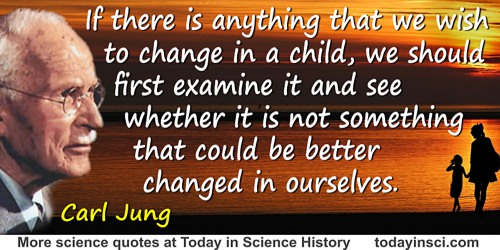
If there is anything that we wish to change in a child, we should first examine it and see whether it is not something that could be better changed in ourselves.
…...
If you talk to your children, you can help them to keep their lives together. If you talk to them skillfully, you can help them to build future dreams.
— Jim Rohn
…...
If you want to save your child from polio, you can pray or you can inoculate. ... Choose science.
The Demon-Haunted World (1996), 30.
If you want your children to be intelligent, read them fairy tales. If you want them to be more intelligent, read them more fairy tales.
…...
In our way of life … with every decision we make, we always keep in mind the seventh generation of children to come. … When we walk upon Mother Earth, we always plant our feet carefully, because we know that the faces of future generations are looking up at us from beneath the ground. We never forget them.
Earth Day Pledge (1993)
In the beginning was the myth. God, in his search for self-expression, invested the souls of Hindus, Greeks, and Germans with poetic shapes and continues to invest each child’s soul with poetry every day.
Quoted in Kim Lim (ed.), 1,001 Pearls of Spiritual Wisdom: Words to Enrich, Inspire, and Guide Your Life (2014), 8
In the case of a Christian clergyman, the tragic-comical is found in this: that the Christian religion demands love from the faithful, even love for the enemy. This demand, because it is indeed superhuman, he is unable to fulfill. Thus intolerance and hatred ring through the oily words of the clergyman. The love, which on the Christian side is the basis for the conciliatory attempt towards Judaism is the same as the love of a child for a cake. That means that it contains the hope that the object of the love will be eaten up.
…...
In the case of the Sun, we have a new understanding of the cosmological meaning of sacrifice. The Sun is, with each second, transforming four million tons of itself into light—giving itself over to become energy that we, with every meal, partake of. The Sun converts itself into a flow of energy that photosynthesis changes into plants that are consumed by animals. Humans have been feasting on the Sun’s energy stored in the form of wheat or maize or reindeer as each day the Sun dies as Sun and is reborn as the vitality of Earth. These solar flares are in fact the very power of the vast human enterprise. Every child of ours needs to learn the simple truth: she is the energy of the Sun. And we adults should organize things so her face shines with the same radiant joy.
In The Hidden Heart of the Cosmos: Humanity and the New Story (1996), 40-41.
Instead of being presented with stereotypes by age, sex, color, class, or religion, children must have the opportunity to learn that within each range, some people are loathsome and some are delightful.
In Twentieth Century Faith: Hope and Survival (1972), 61.
Instead of needing lots of children, we need high-quality children.
…...
Instruction ends in the schoolroom, but education ends only with life. A child is given to the universe to be educated.
Sermons Preached at Trinity Chapel, Brighton (1866), 271.
Is it not evident, that if the child is at any epoch of his long period of helplessness inured into any habit or fixed form of activity belonging to a lower stage of development, the tendency will be to arrest growth at that standpoint and make it difficult or next to impossible to continue the growth of the child?
In 'The Old Psychology vs. the New', Journal of Pedagogy (1894), 8, 76.
Is pure science to be considered as something potentially harmful? Answer: Most certainly! Every child knows that it is potentially exceedingly harmful. … The menace of blowing ourselves up by atom bombs, doing ourselves in by chemical or biological warfare, or by population explosion, is certainly with us. I consider the environment thing a trivial question, by comparison—like housekeeping. In any home, the dishes have to be washed, the floors swept, the beds made, and there must be rules as to who is allowed to produce how much stink and noise, and where in the house: When the garbage piles up, these questions become pressing. But they are momentary problems. Once the house is in order, you still want to live in it, not just sit around enjoying its orderliness. I would be sorry to see Caltech move heavily into this type of applied research. … SCIENCE POTENTIALLY HARMFUL? DEFINITELY.
In 'Homo Scientificus According to Beckett," collected in William Beranek, Jr. (ed.)Science, Scientists, and Society, (1972), 135. Excerpted in Ann E. Kammer, Science, Sex, and Society (1979), 277.
Is this your triumph—this your proud applause,
Children of Truth, and champions of her cause?
For this has Science search’d, on weary wing,
By shore and sea—each mute and living thing!
Children of Truth, and champions of her cause?
For this has Science search’d, on weary wing,
By shore and sea—each mute and living thing!
'Pleasures of Hope', Part 2. In Samuel Rogers, Thomas Campbell, et al, The Poetical Works of Rogers, Campbell, J. Montgomery, Lamb, and Kirke White (1830), 121.
It had the old double keyboard, an entirely different set of keys for capitals and figures, so that the paper seemed a long way off, and the machine was as big and solid as a battle cruiser. Typing was then a muscular activity. You could ache after it. If you were not familiar with those vast keyboards, your hand wandered over them like a child lost in a wood. The noise might have been that of a shipyard on the Clyde. You would no more have thought of carrying one of those grim structures as you would have thought of travelling with a piano.
[About his first typewriter.]
[About his first typewriter.]
English Journey (1934), 122-123.
It has been asserted … that the power of observation is not developed by mathematical studies; while the truth is, that; from the most elementary mathematical notion that arises in the mind of a child to the farthest verge to which mathematical investigation has been pushed and applied, this power is in constant exercise. By observation, as here used, can only be meant the fixing of the attention upon objects (physical or mental) so as to note distinctive peculiarities—to recognize resemblances, differences, and other relations. Now the first mental act of the child recognizing the distinction between one and more than one, between one and two, two and three, etc., is exactly this. So, again, the first geometrical notions are as pure an exercise of this power as can be given. To know a straight line, to distinguish it from a curve; to recognize a triangle and distinguish the several forms—what are these, and all perception of form, but a series of observations? Nor is it alone in securing these fundamental conceptions of number and form that observation plays so important a part. The very genius of the common geometry as a method of reasoning—a system of investigation—is, that it is but a series of observations. The figure being before the eye in actual representation, or before the mind in conception, is so closely scrutinized, that all its distinctive features are perceived; auxiliary lines are drawn (the imagination leading in this), and a new series of inspections is made; and thus, by means of direct, simple observations, the investigation proceeds. So characteristic of common geometry is this method of investigation, that Comte, perhaps the ablest of all writers upon the philosophy of mathematics, is disposed to class geometry, as to its method, with the natural sciences, being based upon observation. Moreover, when we consider applied mathematics, we need only to notice that the exercise of this faculty is so essential, that the basis of all such reasoning, the very material with which we build, have received the name observations. Thus we might proceed to consider the whole range of the human faculties, and find for the most of them ample scope for exercise in mathematical studies. Certainly, the memory will not be found to be neglected. The very first steps in number—counting, the multiplication table, etc., make heavy demands on this power; while the higher branches require the memorizing of formulas which are simply appalling to the uninitiated. So the imagination, the creative faculty of the mind, has constant exercise in all original mathematical investigations, from the solution of the simplest problems to the discovery of the most recondite principle; for it is not by sure, consecutive steps, as many suppose, that we advance from the known to the unknown. The imagination, not the logical faculty, leads in this advance. In fact, practical observation is often in advance of logical exposition. Thus, in the discovery of truth, the imagination habitually presents hypotheses, and observation supplies facts, which it may require ages for the tardy reason to connect logically with the known. Of this truth, mathematics, as well as all other sciences, affords abundant illustrations. So remarkably true is this, that today it is seriously questioned by the majority of thinkers, whether the sublimest branch of mathematics,—the infinitesimal calculus—has anything more than an empirical foundation, mathematicians themselves not being agreed as to its logical basis. That the imagination, and not the logical faculty, leads in all original investigation, no one who has ever succeeded in producing an original demonstration of one of the simpler propositions of geometry, can have any doubt. Nor are induction, analogy, the scrutinization of premises or the search for them, or the balancing of probabilities, spheres of mental operations foreign to mathematics. No one, indeed, can claim preeminence for mathematical studies in all these departments of intellectual culture, but it may, perhaps, be claimed that scarcely any department of science affords discipline to so great a number of faculties, and that none presents so complete a gradation in the exercise of these faculties, from the first principles of the science to the farthest extent of its applications, as mathematics.
In 'Mathematics', in Henry Kiddle and Alexander J. Schem, The Cyclopedia of Education, (1877.) As quoted and cited in Robert Édouard Moritz, Memorabilia Mathematica; Or, The Philomath’s Quotation-book (1914), 27-29.
It is admitted by all that a finished or even a competent reasoner is not the work of nature alone; the experience of every day makes it evident that education develops faculties which would otherwise never have manifested their existence. It is, therefore, as necessary to learn to reason before we can expect to be able to reason, as it is to learn to swim or fence, in order to attain either of those arts. Now, something must be reasoned upon, it matters not much what it is, provided it can be reasoned upon with certainty. The properties of mind or matter, or the study of languages, mathematics, or natural history, may be chosen for this purpose. Now of all these, it is desirable to choose the one which admits of the reasoning being verified, that is, in which we can find out by other means, such as measurement and ocular demonstration of all sorts, whether the results are true or not. When the guiding property of the loadstone was first ascertained, and it was necessary to learn how to use this new discovery, and to find out how far it might be relied on, it would have been thought advisable to make many passages between ports that were well known before attempting a voyage of discovery. So it is with our reasoning faculties: it is desirable that their powers should be exerted upon objects of such a nature, that we can tell by other means whether the results which we obtain are true or false, and this before it is safe to trust entirely to reason. Now the mathematics are peculiarly well adapted for this purpose, on the following grounds:
1. Every term is distinctly explained, and has but one meaning, and it is rarely that two words are employed to mean the same thing.
2. The first principles are self-evident, and, though derived from observation, do not require more of it than has been made by children in general.
3. The demonstration is strictly logical, taking nothing for granted except self-evident first principles, resting nothing upon probability, and entirely independent of authority and opinion.
4. When the conclusion is obtained by reasoning, its truth or falsehood can be ascertained, in geometry by actual measurement, in algebra by common arithmetical calculation. This gives confidence, and is absolutely necessary, if, as was said before, reason is not to be the instructor, but the pupil.
5. There are no words whose meanings are so much alike that the ideas which they stand for may be confounded. Between the meaning of terms there is no distinction, except a total distinction, and all adjectives and adverbs expressing difference of degrees are avoided.
1. Every term is distinctly explained, and has but one meaning, and it is rarely that two words are employed to mean the same thing.
2. The first principles are self-evident, and, though derived from observation, do not require more of it than has been made by children in general.
3. The demonstration is strictly logical, taking nothing for granted except self-evident first principles, resting nothing upon probability, and entirely independent of authority and opinion.
4. When the conclusion is obtained by reasoning, its truth or falsehood can be ascertained, in geometry by actual measurement, in algebra by common arithmetical calculation. This gives confidence, and is absolutely necessary, if, as was said before, reason is not to be the instructor, but the pupil.
5. There are no words whose meanings are so much alike that the ideas which they stand for may be confounded. Between the meaning of terms there is no distinction, except a total distinction, and all adjectives and adverbs expressing difference of degrees are avoided.
In On the Study and Difficulties of Mathematics (1898), chap. 1.
It is as natural to die as to be born; and to a little infant, perhaps, the one is as painful as the other.
‘Of Death’, Essays.
It is better to teach the child arithmetic and Latin grammar than rhetoric and moral philosophy, because they require exactitude of performance it is made certain that the lesson is mastered, and that power of performance is worth more than knowledge.
In Lecture on 'Education'. Collected in J.E. Cabot (ed.), The Complete Works of Ralph Waldo Emerson: Lectures and Biographical Sketches (1883), 145.
It is clear that we cannot go up another two orders of magnitude as we have climbed the last five. If we did, we should have two scientists for every man, woman, child, and dog in the population, and we should spend on them twice as much money as we had. Scientific doomsday is therefore less than a century distant.
Little Science, Big Science (1963), 19.
It is evident, therefore, that one of the most fundamental problems of psychology is that of investigating the laws of mental growth. When these laws are known, the door of the future will in a measure be opened; determination of the child's present status will enable us to forecast what manner of adult he will become.
In The Intelligence of School Children: How Children Differ in Ability, the Use of Mental Tests in School Grading and the Proper Education of Exceptional Children (1919), 136
It is good to realize that if love and peace can prevail on Earth, and if we can teach our children to honor nature’s gifts, the joys and beauties of the outdoors will be here forever.
…...
It is impossible for the strength of an elderly person to be great. Some physicians think that
children also do not have great strength, but they are mistaken in their opinion.
As quoted in Robert Taylor, White Coat Tales: Medicine's Heroes, Heritage, and Misadventures (2010), 125.
It is more important to pave the way for the child to want to know than to put him on a diet of facts he is not ready to assimilate.
In The Sense of Wonder (1956, 1965), 45.
It is not children who ought to read the words of Lewis Carroll; they are far better employed making mud-pies.
In 'The Library of the Nursery', in Lunacy and Letters (1958), 26.
It is not enough to say that we cannot know or judge because all the information is not in. The process of gathering knowledge does not lead to knowing. A child's world spreads only a little beyond his understanding while that of a great scientist thrusts outward immeasurably. An answer is invariably the parent of a great family of new questions. So we draw worlds and fit them like tracings against the world about us, and crumple them when we find they do not fit and draw new ones.
In John Steinbeck and Edward Flanders Ricketts, Sea of Cortez: a Leisurely Journal of Travel and Research (1941), 165-66.
President Clinton at the Human Genome Announcement at the White House (20 Jun 2000), with Francis S. Collins (left) and Craig Ventner. (source)
It is now conceivable that our children's children will know the term cancer only as a constellation of stars. [Speaking on the Human Genome Project's progress.]
From White House Announcement of the Completion of the First Survey of the Entire Human Genome Project, broadcast on the day of the publication of the first draft of the human genome. Quoted in transcript on the National Archives, Clinton White House web site, 'Text of Remarks on the Completion of the First Survey of the Entire Human Genome Project' (26 Jun 2000).
It is often assumed that because the young child is not competent to study geometry systematically he need be taught nothing geometrical; that because it would be foolish to present to him physics and mechanics as sciences it is useless to present to him any physical or mechanical principles.
An error of like origin, which has wrought incalculable mischief, denies to the scholar the use of the symbols and methods of algebra in connection with his early essays in numbers because, forsooth, he is not as yet capable of mastering quadratics! … The whole infant generation, wrestling with arithmetic, seek for a sign and groan and travail together in pain for the want of it; but no sign is given them save the sign of the prophet Jonah, the withered gourd, fruitless endeavor, wasted strength.
An error of like origin, which has wrought incalculable mischief, denies to the scholar the use of the symbols and methods of algebra in connection with his early essays in numbers because, forsooth, he is not as yet capable of mastering quadratics! … The whole infant generation, wrestling with arithmetic, seek for a sign and groan and travail together in pain for the want of it; but no sign is given them save the sign of the prophet Jonah, the withered gourd, fruitless endeavor, wasted strength.
From presidential address (9 Sep 1884) to the General Meeting of the American Social Science Association, 'Industrial Education', printed in Journal of Social Science (1885), 19, 121. Collected in Francis Amasa Walker, Discussions in Education (1899), 132.
It is only when a child has learned to hold still that it can be considered a creature of sense.
Aphorism as given by the fictional character Dezhnev Senior, in Fantastic Voyage II: Destination Brain (1987), 170.
It is sages and grey-haired philosophers who ought to sit up all night reading Alice in Wonderland in order to study that darkest problem of metaphysics, the borderland between reason and unreason, and the nature of the most erratic of spiritual forces, humour, which eternally dances between the two. That we do find a pleasure in certain long and elaborate stories, in certain complicated and curious forms of diction, which have no intelligible meaning whatever, is not a subject for children to play with; it is a subject for psychologists to go mad over.
In 'The Library of the Nursery', in Lunacy and Letters (1958), 26.
It is said that the composing of the Lilavati was occasioned by the following circumstance. Lilavati was the name of the author’s daughter, concerning whom it appeared, from the qualities of the ascendant at her birth, that she was destined to pass her life unmarried, and to remain without children. The father ascertained a lucky hour for contracting her in marriage, that she might be firmly connected and have children. It is said that when that hour approached, he brought his daughter and his intended son near him. He left the hour cup on the vessel of water and kept in attendance a time-knowing astrologer, in order that when the cup should subside in the water, those two precious jewels should be united. But, as the intended arrangement was not according to destiny, it happened that the girl, from a curiosity natural to children, looked into the cup, to observe the water coming in at the hole, when by chance a pearl separated from her bridal dress, fell into the cup, and, rolling down to the hole, stopped the influx of water. So the astrologer waited in expectation of the promised hour. When the operation of the cup had thus been delayed beyond all moderate time, the father was in consternation, and examining, he found that a small pearl had stopped the course of the water, and that the long-expected hour was passed. In short, the father, thus disappointed, said to his unfortunate daughter, I will write a book of your name, which shall remain to the latest times—for a good name is a second life, and the ground-work of eternal existence.
In Preface to the Persian translation of the Lilavati by Faizi (1587), itself translated into English by Strachey and quoted in John Taylor (trans.) Lilawati, or, A Treatise on Arithmetic and Geometry by Bhascara Acharya (1816), Introduction, 3. [The Lilavati is the 12th century treatise on mathematics by Indian mathematician, Bhaskara Acharya, born 1114.]
It is still believed, apparently, that there is some thing mysteriously laudable about achieving viable offspring. I have searched the sacred and profane scriptures, for many years, but have yet to find any ground for this notion. To have a child is no more creditable than to have rheumatism–and no more discreditable. Ethically, it is absolutely meaningless. And practically, it is mainly a matter of chance.
…...
It is true that I am the father [of the H-bomb] in the biological sense that I performed a necessary function and let nature take its course. After that a child had to be born. It might he robust or it might be stillborn, but something had to be born. The process of conception was by no means a pleasure: it was filled with difficulty and anxiety….
As quoted in Robert Coughlan, 'Dr. Edward Teller’s Magnificent Obsession', Life (6 Sep 1954), 72.
It is well-known that those who have charge of young infants, that it is difficult to feel sure when certain movements about their mouths are really expressive; that is when they really smile. Hence I carefully watched my own infants. One of them at the age of forty-five days, and being in a happy frame of mind, smiled... I observed the same thing on the following day: but on the third day the child was not quite well and there was no trace of a smile, and this renders it probable that the previous smiles were real.
The Expression of Emotions in Man and Animals
It must not be forgotten that although a high standard of morality gives a slight or no advantage to each individual man and his children over the other men of the same tribe, yet an advancement in the standard of morality will certainly give an immense advantage to one tribe over another.
…...
It often seems to me as if History was like a child’s box of letters, with which we can spell any word we please. We have only to pick out such letters as we want, arrange them as we like, and say nothing about those which do not suit our purpose.
Lecture delivered to the Royal Institution (5 Feb 1864), 'On the Science of History'. Collected in Notices of the Proceedings at the Meetings of the Members of the Royal Institution of Great Britain with Abstracts of the Discourses (1866), Vol. 4, 180.
It seems a miracle that young children easily learn the language of any environment into which they were born. The generative approach to grammar, pioneered by Chomsky, argues that this is only explicable if certain deep, universal features of this competence are innate characteristics of the human brain. Biologically speaking, this hypothesis of an inheritable capability to learn any language means that it must somehow be encoded in the DNA of our chromosomes. Should this hypothesis one day be verified, then lingusitics would become a branch of biology.
'The Generative Grammar of the Immune System', Nobel Lecture, 8 Dec 1984. In Nobel Lectures: Physiology or Medicine 1981-1990 (1993), 223.
It will be found that those contained in one article [class of nebulae], are so closely allied to those in the next, that there is perhaps not so much difference between them, if I may use the comparison, as there would be in an annual description of the human figure, were it given from the birth of a child till he comes to be a man in his prime.
'Astronomical Observations... ' Philosophical Transactions (1811), 101, 271.
It’s easier for a woman to go into a strange village than a man. If a strange man wanders in, the natives are afraid he’ll take their wives away, but a woman can work with the mothers and children.
Explaining her ability in observing Pacific Island cultures. As quoted in interview with Frances Glennon, 'Student and Teacher of Human Ways', Life (14 Sep 1959), 143.
It’s like trying to describe what you feel when you’re standing on the rim of the Grand Canyon or remembering your first love or the birth of your child. You have to be there to really know what it’s like.
As quoted on the nmspacemuseum.org website of the New Mexico Museum of Space History.
Jupiter is the largest of all the solar system’s planets, more than ten times bigger and three hundred times as massive as Earth. Jupiter is so immense it could swallow all the other planets easily. Its Great Red Spot, a storm that has raged for centuries, is itself wider than Earth. And the Spot is merely one feature visible among the innumerable vortexes and streams of Jupiter’s frenetically racing cloud tops. Yet Jupiter is composed mainly of the lightest elements, hydrogen and helium, more like a star than a planet. All that size and mass, yet Jupiter spins on its axis in less than ten hours, so fast that the planet is clearly not spherical: Its poles are noticeably flattened. Jupiter looks like a big, colorfully striped beach ball that’s squashed down as if some invisible child were sitting on it. Spinning that fast, Jupiter’s deep, deep atmosphere is swirled into bands and ribbons of multihued clouds: pale yellow, saffron orange, white, tawny yellow-brown, dark brown, bluish, pink and red. Titanic winds push the clouds across the face of Jupiter at hundreds of kilometers per hour.
— Ben Bova
Jupiter
Kids like their fossils. I’ve taken my godson fossil-hunting and there’s nothing more magical than finding a shiny shell and knowing you’re the first person to have seen it for 150 million years.
As reported by Adam Lusher in 'Sir David Attenborough', Daily Mail (28 Feb 2014).
Knowledge is like a knife. In the hands of a well-balanced adult it is an instrument for good of inestimable value; but in the hands of a child, an idiot, a criminal, a drunkard or an insane man, it may cause havoc, misery, suffering and crime. Science and religion have this in common, that their noble aims, their power for good, have often, with wrong men, deteriorated into a boomerang to the human race.
In 'Applied Chemistry', Science (22 Oct 1915), New Series, 42, No. 1086, 548.
Knowledge is necessary too. A child with great intuition could not grow up to become something worthwhile in life without some knowledge. However there comes a point in everyone’s life where only intuition can make the leap ahead, without knowing precisely how.
As recollected from a visit some months earlier, and quoted in William Miller, 'Old Man’s Advice to Youth: “Never Lose a Holy Curiosity”', Life (2 May 1955), 64.
Laplace would have found it child's-play to fix a ratio of progression in mathematical science between Descartes, Leibnitz, Newton and himself
The Education of Henry Adams: An Autobiography? (1918), 491.
Late children, early orphans.
Leo Szilard’s Ten Commandments:
1. Recognize the connections of things and the laws of conduct of men, so that you may know what you are doing.
2. Let your acts be directed towards a worthy goal, but do not ask if they will reach it; they are to be models and examples, not means to an end.
3. Speak to all men as you do to yourself, with no concern for the effect you make, so that you do not shut them out from your world; lest in isolation the meaning of life slips out of sight and you lose the belief in the perfection of the creation.
4. Do not destroy what you cannot create.
5. Touch no dish, except that you are hungry.
6. Do not covet what you cannot have.
7. Do not lie without need.
8. Honor children. Listen reverently to their words and speak to them with infinite love.
9. Do your work for six years; but in the seventh, go into solitude or among strangers, so that the memory of your friends does not hinder you from being what you have become.
10. Lead your life with a gentle hand and be ready to leave whenever you are called.
1. Recognize the connections of things and the laws of conduct of men, so that you may know what you are doing.
2. Let your acts be directed towards a worthy goal, but do not ask if they will reach it; they are to be models and examples, not means to an end.
3. Speak to all men as you do to yourself, with no concern for the effect you make, so that you do not shut them out from your world; lest in isolation the meaning of life slips out of sight and you lose the belief in the perfection of the creation.
4. Do not destroy what you cannot create.
5. Touch no dish, except that you are hungry.
6. Do not covet what you cannot have.
7. Do not lie without need.
8. Honor children. Listen reverently to their words and speak to them with infinite love.
9. Do your work for six years; but in the seventh, go into solitude or among strangers, so that the memory of your friends does not hinder you from being what you have become.
10. Lead your life with a gentle hand and be ready to leave whenever you are called.
Circulated by Mrs. Szilard in July 1964, in a letter to their friends (translated by Dr. Jacob
Bronowski). As printed in Robert J. Levine, Ethics and Regulation of Clinical Research (1988), 431.
Life thus forms a long, unbroken chain of generations, in which the child becomes the mother, and the effect becomes the cause.
In 'On the Mechanistic Interpretation of Life' (1858), Rudolf Virchow and Lelland J. Rather (trans.) , Disease, Life, and Man: Selected Essays by Rudolf Virchow (1958), 116.
Like children out on a treasure hunt, scientists don’t know what they will find.
In 'Preface', I Wish I’d Made You Angry Earlier: Essays on Science, Scientists, and Humanity (1998), x.
Lucy, dear child, mind your arithmetic. You know in the first sum of yours I ever saw there was a mistake. You had carried two (as a cab is licensed to do), and you ought, dear Lucy, to have carried but one. Is this a trifle? What would life be without arithmetic, but a scene of horrors.
Letter to a child (22 Jul 1835). In Sydney Smith, Saba Holland, with Sarah Austin (ed.), A Memoir of the Reverend Sydney Smith by his Daughter, Lady Holland (4th ed. 1855), Vol. 2, 364.
Man is no new-begot child of the ape, bred of a struggle for existence upon brutish lines—nor should the belief that such is his origin, oft dinned into his ears by scientists, influence his conduct. Were he to regard himself as an extremely ancient type, distinguished chiefly by the qualities of his mind, and to look upon the existing Primates as the failures of his line, as his misguided and brutish collaterals, rather than as his ancestors, I think it would be something gained for the ethical outlook of Homo—and also it would be consistent with present knowledge.
The Origin of Man (1918), a pamphlet published by The Society for the Promotion of Christian Knowledge, reprinted in Arthur Dendy (ed.), Animal Life and Human Progress (1919), 131.
Man’s unconscious… contains all the patterns of life and behaviour inherited from his ancestors, so that every human child, prior to consciousness, is possessed of a potential system of adapted psychic functioning.
The Basic Postulates of Analytical Psychology (1931), 186.
Many inventions are not suitable for the people at large because of their carelessness. Before a thing can be marketed to the masses, it must be made practically fool-proof. Its operation must be made extremely simple. That is one reason, I think, why the phonograph has been so universally adopted. Even a child can operate it. … Another reason is that people are far more willing to pay for being amused than for anything else.
As quoted from an interview by B.C. Forbes in The American Magazine (Jan 1921), 86.
Mathematics in its pure form, as arithmetic, algebra, geometry, and the applications of the analytic method, as well as mathematics applied to matter and force, or statics and dynamics, furnishes the peculiar study that gives to us, whether as children or as men, the command of nature in this its quantitative aspect; mathematics furnishes the instrument, the tool of thought, which we wield in this realm.
In Psychologic Foundations of Education (1898), 325.
Mathematics is like childhood diseases. The younger you get it, the better.
Quoted by Dudley Herschbach in 'Einstein as a Student', collected in Peter Galison (ed.), Gerald James Holton (ed.), Silvan S. Schweber (ed.), Einstein for the 21st Century: His Legacy in Science, Srt, and Modern Culture (2008), 236. The remark quoted was footnoted as heard by Dudley Herschbach many years earlier in a class by George Polya, but not found in print.
Memory is a child walking along a seashore. You never can tell what small pebble it will pick up
and store away among its treasured things.
In Marilyn R. Zuckerman, Incredibly American: Releasing the Heart of Quality (1992), 25.
Men fear Death, as children fear to go in the dark; and as that natural fear in children is increased with tales, so is the other.
Essays.
Men go into space to see whether it is the kind of place where other men, and their families and their children, can eventually follow them. A disturbingly high proportion of the intelligent young are discontented because they find the life before them intolerably confining. The moon offers a new frontier. It is as simple and splendid as that.
— Magazine
Editorial on the moon landing, The Economist (1969).
Men in most cases continue to be sexually competent until they are sixty years old, and if that limit be overpassed then until seventy years; and men have been actually known to procreate children at seventy years of age.
In The Works of Aristotle: Historia Animalium (350 BC), (The History of Animals), Book VII, Part 6, 585b5 translated in William David Ross and John Alexander Smith (eds.), D’Arcy Wentworth Thompson (trans.), (1910), Vol. 4, 4
Most children have a bug period, and I never grew out of mine.
In Naturalist (1994, 2006), 53.
Mostly, I spend my time being a mother to my two children, working in my organic garden, raising masses of sweet peas, being passionately involved in conservation, recycling and solar energy.
…...
My dear child, be not afraid of the pains and be not afraid, be as tough and confident as you can and let not your courage flag and your hope fail. I assure you, with God’s help it will go better than you think! Just hang on tight with both hands so you tremble not. It will soon pass. You will see that Our Dear Lord will soon help you. How quickly a pain passes! Who should let his courage flag so quickly, for God’s help is at hand.
Given as an example of how to reassure a woman giving birth as labor begins. In Justine Siegemund and Lynne Tatlock (trans.), The Court Midwife (2007), 158.
My grandfather opened the first chapter of his story, A Smile of the Walrus, with an old nursery rhyme, “Did you ever see a walrus smile all these many years? Why yes I’ve seen a walrus smile, but it was hidden by his tears.” As we open this new chapter in the battle against climate change, I fear that if we do not take action, then the smiles of our children, like the walrus, will be hidden by the tears they shed as they pay the consequences of our inaction, our apathy and our greed.
In 'What do the Arctic, a Thermostat and COP15 Have in Common?', Huffington Post (18 Mar 2010).
My interest in science was excited at age nine by an article on astronomy in National Geographic; the author was Donald Menzel of the Harvard Observatory. For the next few years, I regularly made star maps and snuck out at night to make observations from a locust tree in our back yard.
In Wilhelm Odelberg (ed.), Les Prix Nobel. The Nobel Prizes 1986 (1987).
My mother made me a scientist without ever intending to. Every other Jewish mother in Brooklyn would ask her child after school, “So? Did you learn anything today?” But not my mother. … “Izzy,” she would say, “did you ask a good question today?” That difference - asking good questions - made me become a scientist.
In letters column of New York Times (19 Jan 1988) from Donald Sheff, who quoted what his friend, Arthur Sackler, received in answer, upon asking Rabi why he became a scientist.
My mother, my dad and I left Cuba when I was two [January, 1959]. Castro had taken control by then, and life for many ordinary people had become very difficult. My dad had worked [as a personal bodyguard for the wife of Cuban president Batista], so he was a marked man. We moved to Miami, which is about as close to Cuba as you can get without being there. It’s a Cuba-centric society. I think a lot of Cubans moved to the US thinking everything would be perfect. Personally, I have to say that those early years were not particularly happy. A lot of people didn’t want us around, and I can remember seeing signs that said: “No children. No pets. No Cubans.” Things were not made easier by the fact that Dad had begun working for the US government. At the time he couldn’t really tell us what he was doing, because it was some sort of top-secret operation. He just said he wanted to fight against what was happening back at home. [Estefan’s father was one of the many Cuban exiles taking part in the ill-fated, anti-Castro Bay of Pigs invasion to overthrow dictator Fidel Castro.] One night, Dad disappeared. I think he was so worried about telling my mother he was going that he just left her a note. There were rumors something was happening back home, but we didn’t really know where Dad had gone. It was a scary time for many Cubans. A lot of men were involved—lots of families were left without sons and fathers. By the time we found out what my dad had been doing, the attempted coup had taken place, on April 17, 1961. Initially he’d been training in Central America, but after the coup attempt he was captured and spent the next two years as a political prisoner in Cuba. That was probably the worst time for my mother and me. Not knowing what was going to happen to Dad. I was only a kid, but I had worked out where my dad was. My mother was trying to keep it a secret, so she used to tell me Dad was on a farm. Of course, I thought that she didn’t know what had really happened to him, so I used to keep up the pretense that Dad really was working on a farm. We used to do this whole pretending thing every day, trying to protect each other. Those two years had a terrible effect on my mother. She was very nervous, just going from church to church. Always carrying her rosary beads, praying her little heart out. She had her religion, and I had my music. Music was in our family. My mother was a singer, and on my father’s side there was a violinist and a pianist. My grandmother was a poet.
…...
Nature does nothing without a purpose. In children may be observed the traces and seeds of what will one day be settled psychological habits, though psychologically a child hardly differs for the time being from an animal.
In D. W. Thompson (trans.), Historia Animalium, VIII, 1. Another translation of the first sentence is, “Nature does nothing uselessly.”
Nature knows no political boundaries. She puts living creatures on this globe and watches the free play of forces. She then confers the master's right on her favourite child, the strongest in courage and industry ... The stronger must dominate and not blend with the weaker, thus sacrificing his own greatness. Only the born weakling can view this as cruel.
Mein Kampf (1925-26), American Edition (1943), 134-5. In William Lawrence Shirer, The Rise and Fall of the Third Reich (1990), 86.
Nearly every subject has a shadow, or imitation. It would, I suppose, be quite possible to teach a deaf and dumb child to play the piano. When it played a wrong note, it would see the frown of its teacher, and try again. But it would obviously have no idea of what it was doing, or why anyone should devote hours to such an extraordinary exercise. It would have learnt an imitation of music. and it would fear the piano exactly as most students fear what is supposed to be mathematics.
In Mathematician's Delight (1943), 8.
Newton was not the first of the age of reason. He was the last of the magicians, the last of the Babylonians and Sumerians, the last great mind which looked out on the visible and intellectual world with the same eyes as those who began to build our intellectual inheritance rather less than 10,000 years ago. Isaac Newton, a posthumous child born with no father on Christmas Day, 1642, was the last wonder child to whom the Magi could do sincere and appropriate homage.
In 'Newton, the Man' (1946). In Geoffrey Keynes (ed.), Essays in Biography, 2nd edition (1951), 311.
No woman wants an abortion. Either she wants a child or she wishes to avoid pregnancy.
Letter to the Lancet
No, not a feminist. I’m a humanist. I’m neither one side nor the other. It’s about the human being. And wanting human beings to be better off so they don’t view children as an insurance for the future.
As quoted in Jack Shepherd, "David Attenborough: 15 of the naturalist’s best quotes: In celebration of his 94th birthday", Independent (8 May 2017), on independent.co.uk website.
Normal children often pass through stages of passionate cruelty, laziness, lying and thievery.
Adolescence (1904)
Not to know what has been transacted in former times is to be always a child. If no use is made of the labors of past ages, the world must remain always in the infancy of knowledge.
In Samuel Johnson and Arthur Murphy, The works of Samuel Johnson (1837), 237.
Nothing enrages me more than when people criticize my criticism of school by telling me that schools are not just places to learn math and spelling, they are places where children learn a vaguely defined thing called socialization. I know. I think schools generally do an effective and terribly damaging job of teaching children to be infantile, dependent, intellectually dishonest, passive and disrespectful to their own developmental capacities. (1981)
Quoted in K.P. Yaday and Malti Sundram, Encyclopaedia Of Child And Primary Education Development, Vol. 2, 99.
Now that we know nature thoroughly, a child can see that in making experiments we are simply paying nature compliments. It is no more than a ceremonial ritual. We know the answers in advance. We consult nature in the same way as great rulers consult their parliaments.
Aphorism 67 in Notebook E (1775-1776), as translated by R.J. Hollingdale in Aphorisms (1990). Reprinted as The Waste Books (2000), 73.
Nurses that attend lying-in women ought to have provided, and in order, every thing that may be necessary for the woman, accoucheur, midwife, and child; such as linnen and cloaths, well aired and warm, for the woman and the bed, which she must know how to prepare when there is occasion; together with nutmeg, sugar, spirit of hartshorn, vinegar, Hungary water, white or brown caudle ready made, and a glyster-pipe fitted.
In A Treatise on the Theory and Practice of Midwifery (1766), 444
Of all my inventions, I liked the phonograph best. Life’s most soothing things are sweet music and a child’s goodnight.
…...
Of all the intellectual faculties, judgment is the last to arrive at maturity. The child should give its attention either to subjects where no error is possible at all, such as mathematics, or to those in which there is no particular danger in making a mistake, such as languages, natural science, history, and so on.
In Arthur Schopenhauer and T. Bailey (ed., trans.) Essays of Arthur Schopenhauer (1902), 67.
Old age is but a second childhood.
In Aristophanes and Thomas Mitchell (trans.), 'The Clouds', The Comedies of Aristophanes (1822), 148.
Once you have learned to fly your plane, it is far less fatiguing to fly than it is to drive a car. You don’t have to watch every second for cats, dogs, children, lights, road signs, ladies with baby carriages and citizens who drive out in the middle of the block against the lights... Nobody who has not been up in the sky on a glorious morning can possibly imagine the way a pilot feels in free heaven.
…...
One looks back with appreciation to the brilliant teachers, but with gratitude to those who touched our human feelings. The curriculum is so much necessary raw material, but warmth is the vital element for the growing plant and for the soul of the child.
From The Gifted Child collected in Collected Works (1954, 1971), Vol. 17, 144. Translated from 'Der Begabt', Psychologie und Erziehung (1946).
One of the earliest questions asked by an intelligent child is: “What is this made of?” “What is that made of?” And the answer is generally more or less satisfactory. For example, if the question relates to butter, the reply may be, “From cream.” It may be explained, besides, that when cream is beaten up, or churned, the butter separates, leaving skim-milk behind. But the question has not been answered. The child may ask, “Was the butter in the milk before it was churned? or has it been made out of the milk by the churning?” Possibly the person to whom the question is addressed may know that the milk contained the butter in the state of fine globules, and that the process of churning breaks up the globules, and causes them to stick together. The original question has not really been answered; and indeed it is not an easy one to reply to. Precisely such questions suggested themselves to the people of old, and they led to many speculations.
Opening paragraph of Modern Chemistry (1900, rev. 1907), 1.
One of the most poetic facts I know about the universe is that essentially every atom in your body was once inside a star that exploded. Moreover, the atoms in your left hand probably came from a different star than did those in your right. We are all, literally, star children, and our bodies made of stardust.
In A Universe from Nothing: Why There Is Something Rather than Nothin (2012, pb 2013), 17.
One stops being a child when one realizes that telling one’s trouble does not make it better.
Diary entry for 31 Oct 1937, The Burning Brand: Diaries 1935-1950 (1961), 66.
Our children will attain to a far more fundamental insight into language, if we, when teaching them, connect the words more with the actual perception of the thing and the object. … Our language would then again become a true language of life, that is, born of life and producing life.
In Friedrich Fröbel and Josephine Jarvis (trans.), The Education of Man (1885), 145.
Our great mistake in education is ... the worship of book-learning—the confusion of instruction and education. We strain the memory instead of cultivating the mind. … We ought to follow exactly the opposite course with children—to give them a wholesome variety of mental food, and endeavour to cultivate their tastes, rather than to fill their minds with dry facts.
The Pleasures of Life (Appleton, 1887), 183-184, or (2007), 71.
Our purpose is to be able to measure the intellectual capacity of a child who is brought to us in order to know whether he is normal or retarded. ... We do not attempt to establish or prepare a prognosis and we leave unanswered the question of whether this retardation is curable, or even improveable. We shall limit ourselves to ascertaining the truth in regard to his present mental state.
Alfred Binet and Theodore Simon (1873-1961, French psychologist) 'New Methods for the Diagnosis of the Intellectual Level of Subnormals' (1905), in The Development of Intelligence in Children, trans. Elizabeth Kite (1916), 37.
People like you and I, though mortal of course like everyone else, do not grow old no matter how long we live...[We] never cease to stand like curious children before the great mystery into which we were born.
…...
People move out to the suburbs to make their lives and seek their dream, only too often to find that they are playing leapfrog with bulldozers, longing for the meadow that used to be the children’s paradise at the end of the street.
— Al Gore
As quoted in Time (1999), 153, 159. Also in Lecture (2 Dec 1998) to 1998 Democratic Leadership Council Annual Conference, Washington, D.C., collected in Joseph Kaufmann (ed.), The World According To Al Gore: An A-To-Z Compilation Of His Opinions, Positions and Public Statements (1999), 282.
People usually consider walking on water or in thin air a miracle. But I think the real miracle is not to walk either on water or in thin air, but to walk on earth. Every day we are engaged in a miracle which we don’t even recognize: a blue sky, white clouds, green leaves, the black, curious eyes of a child - our own two eyes. All is a miracle.
In The Miracle of Mindfulness: A Manual on Meditation (1987), 12.
Perhaps the earliest memories I have are of being a stubborn, determined child. Through the years my mother has told me that it was fortunate that I chose to do acceptable things, for if I had chosen otherwise no one could have deflected me from my path. ... The Chairman of the Physics Department, looking at this record, could only say 'That A- confirms that women do not do well at laboratory work'. But I was no longer a stubborn, determined child, but rather a stubborn, determined graduate student. The hard work and subtle discrimination were of no moment.
Autobiography, Nobel Foundation
Probably the most important skill that children learn is how to learn. … Too often we give children answers to remember rather than problems to solve. This is a mistake.
In 'Observing the Brain Through a Cat's Eyes', Saturday Review World (1974), 2, 132.

Progress in every country depends mainly on the education of its people. Without education, we are a nation of children. The difference between one man and another, apart from birth and social position, consists in the extent of knowledge, general and practical, acquired by him. We may safely assume that man in all countries within certain limits start with the same degree of intelligence. A civilised nation is distinguished from an uncivilised one by the extent of its acquired intelligence and skill.
Epigraph for the chapter by R.K. Murfi, 'Visvesvaraya', collected in Remembering Our Leaders: Volume 2 (1989), 46. Partly quoted in V.S. Narayana Rao, Mokshagundam Visvesvaraya: His Life and Work (1973), 33.
Quantum field theory, which was born just fifty years ago from the marriage of quantum mechanics with relativity, is a beautiful but not very robust child.
In Nobel Lecture (8 Dec 1989), 'Conceptual Foundations of the Unified Theory of Weak and Electromagnetic Interactions.'
Raising children is a creative endeavor, an art rather than a science.
A Good Enough Parent (1988), 14.
Recollections [his autobiographical work] might possibly interest my children or their children. I know that it would have interested me greatly to have read even so short and dull a sketch of the mind of my grandfather, written by himself, and what he thought and did, and how he worked. I have attempted to write the following account of myself as if I were a dead man in another world looking back at my own life. Nor have I found this difficult, for life is nearly over with me.
Remember that children, marriages, and flower gardens reflect the kind of care they get.
In Life’s Instructions for Wisdom, Success, and Happiness (2000),
Samoa culture demonstrates how much the tragic or the easy solution of the Oedipus situation depends upon the inter-relationship between parents and children, and is not created out of whole cloth by the young child’s biological impulses.
Male and Female: A Study of the Sexes in a Changing World (1949), 119.
Savages have often been likened to children, and the comparison is not only correct but also highly instructive. Many naturalists consider that the early condition of the individual indicates that of the race,—that the best test of the affinities of a species are the stages through which it passes. So also it is in the case of man; the life of each individual is an epitome of the history of the race, and the gradual development of the child illustrates that of the species.
Pre-historic Times, as Illustrated by Ancient Remains, and the Manners and Customs of Modern Savages, (2nd. ed. 1869, 1878), 583.
Science seems to me to teach in the highest and strongest manner the great truth which is embodied in the Christian conception of entire surrender to the will of God. Sit down before fact as a little child, be prepared to give up every preconceived notion, follow humbly wherever and to whatever abysses nature leads, or you shall learn nothing. I have only begun to learn content and peace of mind since I have resolved at all risks to do this.
Letter to Charles Kingsley (23 Sep 1860). In L. Huxley, The Life and Letters of Thomas Henry Huxley (1903), Vol. 1, 316.
scientist is a ... learned child. Others must outgrow it. Scientists can stay that way all their life.
…...
Scientists are the easiest to fool. ... They think in straight, predictable, directable, and therefore misdirectable, lines. The only world they know is the one where everything has a logical explanation and things are what they appear to be. Children and conjurors—they terrify me. Scientists are no problem; against them I feel quite confident.
Code of the Lifemaker (1983, 2000),Chapter 1.
Scientists have one thing in common with children: curiosity. To be a good scientist you must have kept this trait of childhood, and perhaps it is not easy to retain just one trait. A scientist has to be curious like a child; perhaps one can understand that there are other childish features he hasn't grown out of.
What Little I Remember (1979), 86.
Several of the young people here [at the fifth White House Science Fair] are first-generation Americans. Their parents came here, in part, so their kids could develop their talents and make a difference in the world. … America is going to be stronger and smarter and healthier, and a much more interesting place because of you.
From remarks at the fifth White House Science Fair, in Press Release (23 Mar 2015).
Some of my youthful readers are developing wonderful imaginations. This pleases me. Imagination has brought mankind through the Dark Ages to its present state of civilization. Imagination led Columbus to discover America. Imagination led Franklin to discover electricity. Imagination has given us the steam engine, the telephone, the talking-machine and the automobile, for these things had to be dreamed of before they became realities. So I believe that dreams—day dreams, you know, with your eyes wide open and your brain-machinery whizzing—are likely to lead to the betterment of the world. The imaginative child will become the imaginative man or woman most apt to create, to invent, and therefore to foster civilization. A prominent educator tells me that fairy tales are of untold value in developing imagination in the young. I believe it.
Opening paragraph of preface, 'To My Readers', The Lost Princess of Oz (1917), 13.
Some see a clear line between genetic enhancement and other ways that people seek improvement in their children and themselves. Genetic manipulation seems somehow worse—more intrusive, more sinister—than other ways of enhancing performance and seeking success. But, morally speaking, the difference is less significant than it seems. Bioengineering gives us reason to question the low-tech, high-pressure child-rearing practices we commonly accept. The hyperparenting familiar in our time represents an anxious excess of mastery and dominion that misses the sense of life as a gift. This draws it disturbingly close to eugenics... Was the old eugenics objectionable only insofar as it was coercive? Or is there something inherently wrong with the resolve to deliberately design our progeny’s traits... But removing coercion does not vindicate eugenics. The problem with eugenics and genetic engineering is that they represent a one-sided triumph of willfulness over giftedness, of dominion over reverence, of molding over beholding.
Michael J. Sandel, 'The Case Against Perfection', The Atlantic Monthly (Apr 2004).
Sometimes I am a little unkind to all my many friends in education … by saying that from the time it learns to talk every child makes a dreadful nuisance of itself by asking “Why?.” To stop this nuisance society has invented a marvellous system called education which, for the majority of people, brings to an end their desire to ask that question. The few failures of this system are known as scientists.
'The Making of a Scientist', Journal of the Royal Society of Arts, June 1983, 403.
Study and, in general, the pursuit of truth and beauty is a sphere of activity in which we are permitted to remain children all of our lives.
…...
Success is the child of audacity.
The Wonderous Tale of Alroy: The Rise of Iskander (1833), Vol. 2, 149.
Surely no child, and few adults, have ever watched a bird in flight without envy.
Isaac Asimov and Jason A. Shulman, Isaac Asimov’s Book of Science and Nature Quotations (1988), 3.
Thanks to the sharp eyes of a Minnesota man, it is possible that two identical snowflakes may finally have been observed. While out snowmobiling, Oley Skotchgaard noticed a snowflake that looked familiar to him. Searching his memory, he realized it was identical to a snowflake he had seen as a child in Vermont. Weather experts, while excited, caution that the match-up will be difficult to verify.
In Napalm and Silly Putty (2002), 105.
That’s the news from Lake Wobegon, where all the women are strong, all the men are good-looking, and all the children are above average.
Closing words of many monologues on NPR program, A Prairie Home Companion. As quoted in Sarah Begley, 'Garrison Keillor to Say So Long to Lake Wobegon', Time (20 Jul 2015).
The action of the mind in the acquisition of knowledge of any sort is synthetic-analytic; that is, uniting and separating. These are the two sides, or aspects, of the one process. … There is no such thing as a synthetic activity that is not accompanied by the analytic; and there is no analytic activity that is not accompanied by the synthetic. Children cannot be taught to perform these knowing acts. It is the nature of the mind to so act when it acts at all.
In The Public-School Journal (Jan 1895), Vol. 14, 281-282.
The aim of education should be to preserve and nurture the yearning for learning that a child is born with. Grades and gold stars destroy this yearning for learning.
Letter to David Bayless (6 Feb 1992).
The anatomy of a little child, representing all parts thereof, is accounted a greater rarity than the skeleton of a man in full stature.
In The Church History of Britain (1842), Vol. 1, 165. Fuller’s context was to compare being studious in antiquity with after-ages when perfected.
The architect should be equipped with knowledge of many branches of study and varied kinds of learning, for it is by his judgement that all work done by the other arts is put to test. This knowledge is the child of practice and theory.
In De Architectura, Book 1, Chap 1, Sec. 1. As translated in Morris Hicky Morgan (trans.), Vitruvius: The Ten Books on Architecture (1914), 3.
The argument of the ‘long view’ may be correct in some meaninglessly abstract sense, but it represents a fundamental mistake in categories and time scales. Our only legitimate long view extends to our children and our children’s children’s children–hundreds or a few thousands of years down the road. If we let the slaughter continue, they will share a bleak world with rats, dogs, cockroaches, pigeons, and mosquitoes. A potential recovery millions of years later has no meaning at our appropriate scale.
…...
The bearing of a child takes nine months, no matter how many women are assigned.
(Referring to adding manpower to a software project.)
(Referring to adding manpower to a software project.)
The Mythical Man-Month,' Datamation, Dec 1974. In Fred R. Shapiro, The Yale Book of Quotations (2006), 105.
The central task of education is to implant a will and facility for learning; it should produce not learned but learning people. The truly human society is a learning society, where grandparents, parents, and children are students together.
In Reflections on the Human Condition (1973), 22.
The child asks, “What is the moon, and why does it shine?” “What is this water and where does it run?” “What is this wind?” “What makes the waves of the sea?” “Where does this animal live, and what is the use of this plant?” And if not snubbed and stunted by being told not to ask foolish questions, there is no limit to the intellectual craving of a young child; nor any bounds to the slow, but solid, accretion of knowledge and development of the thinking faculty in this way. To all such questions, answers which are necessarily incomplete, though true as far as they go, may be given by any teacher whose ideas represent real knowledge and not mere book learning; and a panoramic view of Nature, accompanied by a strong infusion of the scientific habit of mind, may thus be placed within the reach of every child of nine or ten.
In 'Scientific Education', Lay Sermons, Addresses, and Reviews (1870), 71.
https://books.google.com/books?id=13cJAAAAIAAJ
Thomas Henry Huxley - 1870
The child which overbalances itself in learning to walk is experimenting on the law of gravity.
In ‘Experimental Legislation’, Popular Science (Apr 1880), 16, 754.
The demand for certainty is one which is natural to man, but is nevertheless an intellectual vice. If you take your children for a picnic on a doubtful day, they will demand a dogmatic answer as to whether it will be fine or wet, and be disappointed in you when you cannot be sure.
From 'Philosophy For Laymen', collected in Unpopular Essays (1950, 1996), 38. This idea may be summarized as “What men want is not knowledge, but certainty” — a widely circulated aphorism attributed to Russell, but for which Webmaster has so far found no citation. (Perhaps it is a summary, never expressed in those exact words, but if you know the primary source, please contact Webmaster.)
The determination of the relationship and mutual dependence of the facts in particular cases must be the first goal of the Physicist; and for this purpose he requires that an exact measurement may be taken in an equally invariable manner anywhere in the world… Also, the history of electricity yields a well-known truth—that the physicist shirking measurement only plays, different from children only in the nature of his game and the construction of his toys.
In 'Mémoire sur la mesure de force de l'électricité', Journal de Physique (1782), 21, 191. English version by Google Translate tweaked by Webmaster. From the original French, “La determination de la relation & de la dépendance mutuelle de ces données dans certains cas particuliers, doit être le premier but du Physicien; & pour cet effet, il falloit one mesure exacte qui indiquât d’une manière invariable & égale dans tous les lieux de la terre, le degré de l'électricité au moyen duquel les expéiences ont été faites… Aussi, l’histoire de l'électricité prouve une vérité suffisamment reconnue; c’est que le Physicien sans mesure ne fait que jouer, & qu’il ne diffère en cela des enfans, que par la nature de son jeu & la construction de ses jouets.”
The difficulties connected with my criterion of demarcation (D) are important, but must not be exaggerated. It is vague, since it is a methodological rule, and since the demarcation between science and nonscience is vague. But it is more than sharp enough to make a distinction between many physical theories on the one hand, and metaphysical theories, such as psychoanalysis, or Marxism (in its present form), on the other. This is, of course, one of my main theses; and nobody who has not understood it can be said to have understood my theory.
The situation with Marxism is, incidentally, very different from that with psychoanalysis. Marxism was once a scientific theory: it predicted that capitalism would lead to increasing misery and, through a more or less mild revolution, to socialism; it predicted that this would happen first in the technically highest developed countries; and it predicted that the technical evolution of the 'means of production' would lead to social, political, and ideological developments, rather than the other way round.
But the (so-called) socialist revolution came first in one of the technically backward countries. And instead of the means of production producing a new ideology, it was Lenin's and Stalin's ideology that Russia must push forward with its industrialization ('Socialism is dictatorship of the proletariat plus electrification') which promoted the new development of the means of production.
Thus one might say that Marxism was once a science, but one which was refuted by some of the facts which happened to clash with its predictions (I have here mentioned just a few of these facts).
However, Marxism is no longer a science; for it broke the methodological rule that we must accept falsification, and it immunized itself against the most blatant refutations of its predictions. Ever since then, it can be described only as nonscience—as a metaphysical dream, if you like, married to a cruel reality.
Psychoanalysis is a very different case. It is an interesting psychological metaphysics (and no doubt there is some truth in it, as there is so often in metaphysical ideas), but it never was a science. There may be lots of people who are Freudian or Adlerian cases: Freud himself was clearly a Freudian case, and Adler an Adlerian case. But what prevents their theories from being scientific in the sense here described is, very simply, that they do not exclude any physically possible human behaviour. Whatever anybody may do is, in principle, explicable in Freudian or Adlerian terms. (Adler's break with Freud was more Adlerian than Freudian, but Freud never looked on it as a refutation of his theory.)
The point is very clear. Neither Freud nor Adler excludes any particular person's acting in any particular way, whatever the outward circumstances. Whether a man sacrificed his life to rescue a drowning, child (a case of sublimation) or whether he murdered the child by drowning him (a case of repression) could not possibly be predicted or excluded by Freud's theory; the theory was compatible with everything that could happen—even without any special immunization treatment.
Thus while Marxism became non-scientific by its adoption of an immunizing strategy, psychoanalysis was immune to start with, and remained so. In contrast, most physical theories are pretty free of immunizing tactics and highly falsifiable to start with. As a rule, they exclude an infinity of conceivable possibilities.
The situation with Marxism is, incidentally, very different from that with psychoanalysis. Marxism was once a scientific theory: it predicted that capitalism would lead to increasing misery and, through a more or less mild revolution, to socialism; it predicted that this would happen first in the technically highest developed countries; and it predicted that the technical evolution of the 'means of production' would lead to social, political, and ideological developments, rather than the other way round.
But the (so-called) socialist revolution came first in one of the technically backward countries. And instead of the means of production producing a new ideology, it was Lenin's and Stalin's ideology that Russia must push forward with its industrialization ('Socialism is dictatorship of the proletariat plus electrification') which promoted the new development of the means of production.
Thus one might say that Marxism was once a science, but one which was refuted by some of the facts which happened to clash with its predictions (I have here mentioned just a few of these facts).
However, Marxism is no longer a science; for it broke the methodological rule that we must accept falsification, and it immunized itself against the most blatant refutations of its predictions. Ever since then, it can be described only as nonscience—as a metaphysical dream, if you like, married to a cruel reality.
Psychoanalysis is a very different case. It is an interesting psychological metaphysics (and no doubt there is some truth in it, as there is so often in metaphysical ideas), but it never was a science. There may be lots of people who are Freudian or Adlerian cases: Freud himself was clearly a Freudian case, and Adler an Adlerian case. But what prevents their theories from being scientific in the sense here described is, very simply, that they do not exclude any physically possible human behaviour. Whatever anybody may do is, in principle, explicable in Freudian or Adlerian terms. (Adler's break with Freud was more Adlerian than Freudian, but Freud never looked on it as a refutation of his theory.)
The point is very clear. Neither Freud nor Adler excludes any particular person's acting in any particular way, whatever the outward circumstances. Whether a man sacrificed his life to rescue a drowning, child (a case of sublimation) or whether he murdered the child by drowning him (a case of repression) could not possibly be predicted or excluded by Freud's theory; the theory was compatible with everything that could happen—even without any special immunization treatment.
Thus while Marxism became non-scientific by its adoption of an immunizing strategy, psychoanalysis was immune to start with, and remained so. In contrast, most physical theories are pretty free of immunizing tactics and highly falsifiable to start with. As a rule, they exclude an infinity of conceivable possibilities.
'The Problem of Demarcation' (1974). Collected in David Miller (ed.) Popper Selections (1985), 127-128.
The Doctrine of Evolution states the fact that the present is the child of the past and the parent of the future.
In Outline of Science: A Plain Story Simply Told (1922), Vol. 1, 185.
The external world of physics has … become a world of shadows. In removing our illusions we have removed the substance, for indeed we have seen that substance is one of the greatest of our illusions. Later perhaps we may inquire whether in our zeal to cut out all that is unreal we may not have used the knife too ruthlessly. Perhaps, indeed, reality is a child which cannot survive without its nurse illusion. But if so, that is of little concern to the scientist, who has good and sufficient reasons for pursuing his investigations in the world of shadows and is content to leave to the philosopher the determination of its exact status in regard to reality.
In Introduction to The Nature of the Physical World (1928), xiv.
The fact that all normal children acquire essentially comparable grammars of great complexity with remarkable rapidity suggests that human beings are somehow specially designed to do this, with data-handling or 'hypothesis-formulating' ability of unknown character and complexity.
A review of B. F. Skinner, Verbal Behavior (1957). In Language: Journal of the Linguistic Society of America, 1959, 35, 57.
The figure of 2.2 children per adult female was felt to be in some respects absurd, and a Royal Commission suggested that the middle classes be paid money to increase the average to a rounder and more convenient number.
— Magazine
Quoted from Punch in epigraph, M.J. Moroney, 'On the Average', Facts From Figures (1951), Chap. 4, 34.
The first experiment a child makes is a physical experiment: the suction-pump is but an imitation of the first act of every new-born infant.
Lecture 'On the Study of Physics', Royal Institution of Great Britain (Spring 1854). Collected in Fragments of Science for Unscientific People: A Series of Detached Essays, Lectures, and Reviews (1892), Vol. 1, 283.
The fundamental hypothesis of genetic epistemology is that there is a parallelism between the progress made in the logical and rational organization of knowledge and the corresponding formative psychological processes. With that hypothesis, the most fruitful, most obvious field of study would be the reconstituting of human history—the history of human thinking in prehistoric man. Unfortunately, we are not very well informed in the psychology of primitive man, but there are children all around us, and it is in studying children that we have the best chance of studying the development of logical knowledge, physical knowledge, and so forth.
'Genetic Epistemology', Columbia Forum (1969), 12, 4.
The further away the chronic abdominal pain in a child is from the umbilicus the more likely an organic cause.
Attributed
The great heroes and heroines of our society are of course the teachers, and in particular the teachers of kids in their first years. Once a child has been shown what the natural world is, it will live with them forever.
As quoted in Alexandra Pope, 'Attenborough Awarded RCGS Gold', Canadian Geographic, (May 2017), 137, No. 3, 73.
The human mind is not capable of grasping the Universe. We are like a little child entering a huge library. The walls are covered to the ceilings with books in many different tongues. The child knows that someone must have written these books. It does not know who or how. It does not understand the languages in which they are written. But the child notes a definite plan in the arrangement of the books—a mysterious order which it does not comprehend, but only dimly suspects.
…...
The human mind needs nature in order to think most deeply. Pretending to be other creatures, children practise metaphor and empathy alike.
In 'Fifty Years On, the Silence of Rachel Carson’s Spring Consumes Us', The Guardian (25 Sep 2012),
The idiot, the Indian, the child and unschooled farmer’s boy stand nearer to the light by which nature is to be read, than the dissector or the antiquary.
Concluding sentence in 'History', collected in The Complete Works of Ralph Waldo Emerson (1903), 41.
The important thing is not so much that every child should be taught, as that every child should have the opportunity of teaching itself. What does it matter if the pupil know a little more or a little less? A boy who leaves school knowing much, but hating his lessons, will soon have forgotten all he ever learned; while another who had acquired a thirst for knowledge, even if he had learned little, would soon teach himself more than the first ever knew.
[Elementary Education, Revised New Code (1871), Resolution.] Hansard's Parliamentary Debates (19 Jul 1872), vol. 207, 1463. Also in The Pleasures of Life (2007), 71.(Appleton, 1887), 183-184, or (2007), 71.
The instruction of children should aim gradually to combine knowing and doing [Wissen und Konnen]. Among all sciences mathematics seems to be the only one of a kind to satisfy this aim most completely.
In Werke, Bd. 9 (1888), 409.
The invention [of paper] has been of almost equal consequence to literature with that of printing itself; and shows how the arts and sciences, like children of the same family, mutually assist and bring forward each other.
In John Aikin and Anna Letitia Aikin Barbauld, 'The Manufacture of Paper', Evenings at Home: Or, The Juvenile Budget Opened (U.S. Revised ed., 1839), 145. In its Preface it was indicated this particular piece, written by Barbauld, was first added to the 15th London edition, posthumously, from her papers. The plan of work for the six volumes in this series originated with Dr. John Aiken in 1792.
The issue is not to teach [a child] the sciences, but to give him the taste for loving them.
Émile, or, On Education, new translation by Alan Bloom (1979), 172.
The laboratory work was the province of Dr Searle, an explosive, bearded Nemesis who struck terror into my heart. If one made a blunder one was sent to ‘stand in the corner’ like a naughty child. He had no patience with the women students. He said they disturbed the magnetic equipment, and more than once I heard him shout ‘Go and take off your corsets!’ for most girls wore these garments then, and steel was beginning to replace whalebone as a stiffening agent. For all his eccentricities, he gave us excellent training in all types of precise measurement and in the correct handling of data.
In Cecilia Payne-Gaposchkin: An Autobiography and Other Recollections (1996), 116.
The larger our great cities grow, the more irresistible becomes the attraction which they exert on the children of the country, who are fascinated by them, as the birds are fascinated by the lighthouse or the moths by the candle.
In The Task of Social Hygiene (1912), 178.
The memory, a child once said, is “the thing we forget with”
In Science is a Sacred Cow (1950), 181.
The mental process by which hypotheses are suggested is obscure. Ordinarily they flash into consciousness without premonition, and it would he easy to ascribe them to a mysterious intuition or creative faculty; but this would contravene one of the broadest generalizations of modern psychology. Just as in the domain of matter nothing is created from nothing, just as in the domain of life there is no spontaneous generation, so in the domain of mind there are no ideas which do not owe their existence to antecedent ideas which stand in the relation of parent to child.
In Address (11 Dec 1895) as President of the Geological Society, 'The Origin of Hypotheses, illustrated by the Discussion of a Topographical Problem', printed as Presidential Address of Grove Karl Gilbert (1896), 4. Also collected in Science (1896), 3, 2.
The moment one has offered an original explanation for a phenomenon which seems satisfactory, that moment affection for his intellectual child springs into existence, and as the explanation grows into a definite theory his parental affections cluster about his offspring and it grows more and more dear to him. ... There springs up also unwittingly a pressing of the theory to make it fit the facts and a pressing of the facts to make them fit the theory... To avoid this grave danger, the method of multiple working hypotheses is urged. It differs from the simple working hypothesis in that it distributes the effort and divides the affections... In developing the multiple hypotheses, the effort is to bring up into view every rational exploration of the phenomenon in hand and to develop every tenable hypothesis relative to its nature, cause or origin, and to give to all of these as impartially as possible a working form and a due place in the investigation. The investigator thus becomes the parent of a family of hypotheses; and by his parental relations to all is morally forbidden to fasten his affections unduly upon anyone. ... Each hypothesis suggests its own criteria, its own method of proof, its own method of developing the truth, and if a group of hypotheses encompass the subject on all sides, the total outcome of means and of methods is full and rich.
'Studies for Students. The Method of Multiple Working Hypotheses', Journal of Geology (1897), 5, 840-6.
The momentous laws of induction between currents and between currents and magnets were discovered by Michael Faraday in 1831-32. Faraday was asked: “What is the use of this discovery?” He answered: “What is the use of a child—it grows to be a man.” Faraday’s child has grown to be a man and is now the basis of all the modern applications of electricity.
In An Introduction to Mathematics (1911), 34-35.
The monstrous evils of the twentieth century have shown us that the greediest money grubbers are gentle doves compared with money-hating wolves like Lenin, Stalin, and Hitler, who in less than three decades killed or maimed nearly a hundred million men, women, and children and brought untold suffering to a large portion of mankind.
In 'Money', In Our Time (1976), 37.
The more intelligence mankind bestows upon technology, the less knowledge a child is required to learn. If this pattern is never changed, the generation of the future may become reduced to nothing more than lifeless drones born for nothing except pushing buttons on a machine that lives the lives of their masters.
…...
The object of teaching a child is to enable him to get along without his teacher.
Used as epigraph on cover of Harry Persons Taber and Elbert Hubbard, The Philistine: A Periodical of Protest (Apr 1902), Vol. 14, 128.
The origin of what we call civilization is not due to religion but to skepticism. … The modern world is the child of doubt and inquiry, as the ancient world was the child of fear and faith.
In Summer for the Gods by Edward J. Larson (1997).
The person who observes a clock, sees in it not only the pendulum swinging to and fro, and the dial-plate, and the hands moving, for a child can see all this; but he sees also the parts of the clock, and in what connexion the suspended weight stands to the wheel-work, and the pendulum to the moving hands.
'The Study of the Natural Sciences: An Introductory Lecture to the Course of Experimental Chemistry in the University of Munich, for the Winter Session of 1852-53,' as translated and republished in The Medical Times and Gazette (22 Jan 1853), N.S. Vol. 6, 82.
The result of teaching small parts of a large number of subjects is the passive reception of disconnected ideas, not illuminated with any spark of vitality. Let the main ideas which are introduced into a child’s education be few and important, and let them be thrown into every combination possible.
In The Organisation of Thought: Educational and Scientific (1917), 5.
The right that must become paramount is not the right to procreate, but rather the right of every child to be born with a sound physical and mental constitution, based on a sound genotype. No parents will in that future time have the right to burden society with a malformed or mentally incompetent child. Just as every child must have the right to full educational opportunity and a sound nutrition, so every child has the inalienable right to a sound heritage.
Expressing concern that in a coming overpopulated world, “sacred rights of man must alter.” Presidential Address (28 Dec 1970) to the American Association for the Advancement of Science. 'Science: Endless Horizons or Golden Age?', Science (8 Jan 1971), 171, No. 3866, 24. As quoted in obituary by Douglas Martin, New York Times (20 Jan 2005).
The situation with regard to insulin is particularly clear. In many parts of the world diabetic children still die from lack of this hormone. ... [T]hose of us who search for new biological facts and for new and better therapeutic weapons should appreciate that one of the central problems of the world is the more equitable distribution and use of the medical and nutritional advances which have already been established. The observations which I have recently made in parts of Africa and South America have brought this fact very forcible to my attention.
'Studies on Diabetes and Cirrhosis', Proceedings, American Philosophical Society (1952) 96, No. 1, 29.
The stimulus of competition, when applied at an early age to real thought processes, is injurious both to nerve-power and to scientific insight.
In The Preparation of the Child for Science (1904), 44.
The symbol A is not the counterpart of anything in familiar life. To the child the letter A would seem horribly abstract; so we give him a familiar conception along with it. “A was an Archer who shot at a frog.” This tides over his immediate difficulty; but he cannot make serious progress with word-building so long as Archers, Butchers, Captains, dance round the letters. The letters are abstract, and sooner or later he has to realise it. In physics we have outgrown archer and apple-pie definitions of the fundamental symbols. To a request to explain what an electron really is supposed to be we can only answer, “It is part of the A B C of physics”.
In Introduction to The Nature of the Physical World (1928), xiv.
The teens are emotionally unstable and pathic. It is a natural impulse to experience hot and perfervid psychic states, and it is characterized by emotionalism. We see here the instability and fluctuations now so characteristic. The emotions develop by contrast and reaction into the opposite.
Hall, GS (1904b). Adolescence: Its psychology and its relations to physiology, anthropology, sociology, sex, crime, religion and education (1904), Vol. 2, 74-75.
The thing about electronic games is that they are basically repetitive. After a while, the children get bored. They need something different. [Meccano construction toy kits] offer creativity, a notion of mechanics, discovery of the world around you.
As quoted in by Hugh Schofield in web article 'Meccano Revives French Production' (23 Dec 2010).
The understanding of atomic physics is child’s play, compared with the understanding of child’s play.
As quoted in Alan L. Mackay, A Dictionary of Scientific Quotations (1991), 144. Need primary source; can you help?
The use of the atomic bomb with its indiscriminate killing of women and children, revolts my soul.
Letter (8 Aug 1945) to Colonel John Callan O’Laughlin, publisher of Army an Navy Journal, as quoted in Gar Alperovitz, The Decision to Use the Atomic Bomb (1996), 459. Cited as O’Laughlin Correspondence File, Box 171, Post-Presidential Papers, Herbert Hoover Presidential Library.
The way a child discovers the world constantly replicates the way science began. You start to notice what’s around you, and you get very curious about how things work. How things interrelate. It’s as simple as seeing a bug that intrigues you. You want to know where it goes at night; who its friends are; what it eats.
In David Chronenberg and Chris Rodley (ed.), Chronenberg on Chronenberg (1992), 5.
The wisest decision I ever made with regard to science, I made as a child. In the summer of 1932, shortly after my thirteenth birthday, I decided to become a zoologist, because I thought it would be fascinating to visit distant parts of the world and study exotic animals. I was right. It has been.
In 'Integrative Biology: An Organismic Biologist’s Point of View', Integrative and Comparative Biology (2005), 45, 332.
The world is only saved by the breath of the school children.
— Talmud
Louis Klopsch, Many Thoughts of Many Minds (1896), 77.
The world is the geologist’s great puzzle-box; he stands before it like the child to whom the separate pieces of his puzzle remain a mystery till he detects their relation and sees where they fit, and then his fragments grow at once into a connected picture beneath his hand.
Geological Sketches (1866), II.
There are about 3,000,000 people seriously ill in the United States…. More than half of this illness is preventable. If we count the value of each life lost at only $1700 and reckon the average earning lost by illness at $700 a year for grown men, we find that the economic gain from mitigation of preventable disease in the United States would exceed $1,500,000,000 a year. … This gain … can be secured through medical investigation and practice, school and factory hygiene, restriction of labor by women and children, the education of the people in both public and private hygiene, and through improving the efficiency of our health service, municipal, state, and national.
From 'National Efficiency', Report of the National Conservation Commission (Feb 1909), Vol. 1, 25. Collected in United States Congressional Serial Set (1909), Issue 5397, 60th Congress, 2nd Session, Senate, Document 676. In transmitting the report to Congress on 22 Jan 1909, President Theodore Roosevelt introduced this report as the “first inventory of natural resources,” which “presents a statement of our available capital in material resources, which are the means of progress.” [It is noteworthy that the above quoted commentary on “National Efficiency” was included with the inventory of mineral, lands, forest and lands of the United States. —Webmaster]
There are children playing in the street who could solve some of my top problems in physics, because they have modes of sensory perception that I lost long ago.
…...
There is no more wild, free, vigorous growth of the forest, but everything is in pots or rows like a rococo garden... The pupil is in the age of spontaneous variation which at no period of life is so great. He does not want a standardized, overpeptonized mental diet. It palls on his appetite.
Hall, GS (1904b). Adolescence: Its psychology and its relations to physiology, anthropology, sociology, sex, crime, religion and education (1904), Vol. 2, 509.
There is no part of the country where in the summer you cannot get a sufficient supply of the best specimens. Teach your children to bring them in for themselves. Take your text from the brooks, not from the booksellers.
Lecture at a teaching laboratory on Penikese Island, Buzzard's Bay. Quoted from the lecture notes by David Starr Jordan, Science Sketches (1911), 146-147.
There may be frugality which is not economy. A community, that withholds the means of education from its children, withholds the bread of life and starves their souls.
In Rush Welter, American Writings on Popular Education: The Nineteenth Century (1971), 76.
There’s a touch of the priesthood in the academic world, a sense that a scholar should not be distracted by the mundane tasks of day-to-day living. I used to have great stretches of time to work. Now I have research thoughts while making peanut butter and jelly sandwiches. Sure it’s impossible to write down ideas while reading “Curious George” to a two-year-old. On the other hand, as my husband was leaving graduate school for his first job, his thesis advisor told him, “You may wonder how a professor gets any research done when one has to teach, advise students, serve on committees, referee papers, write letters of recommendation, interview prospective faculty. Well, I take long showers.”
In 'In Her Own Words: Six Mathematicians Comment on Their Lives and Careers: Susan Landau', Notices of the AMS (Sep 1991), 38, No. 7, 704.
Thinking is merely the comparing of ideas, discerning relations of likeness and of difference between ideas, and drawing inferences. It is seizing general truths on the basis of clearly apprehended particulars. It is but generalizing and particularizing. Who will deny that a child can deal profitably with sequences of ideas like: How many marbles are 2 marbles and 3 marbles? 2 pencils and 3 pencils? 2 balls and 3 balls? 2 children and 3 children? 2 inches and 3 inches? 2 feet and 3 feet? 2 and 3? Who has not seen the countenance of some little learner light up at the end of such a series of questions with the exclamation, “Why it’s always that way. Isn’t it?” This is the glow of pleasure that the generalizing step always affords him who takes the step himself. This is the genuine life-giving joy which comes from feeling that one can successfully take this step. The reality of such a discovery is as great, and the lasting effect upon the mind of him that makes it is as sure as was that by which the great Newton hit upon the generalization of the law of gravitation. It is through these thrills of discovery that love to learn and intellectual pleasure are begotten and fostered. Good arithmetic teaching abounds in such opportunities.
In Arithmetic in Public Education (1909), 13. As quoted and cited in Robert Édouard Moritz, Memorabilia Mathematica; Or, The Philomath’s Quotation-book (1914), 68.
This speaker reminds me of my childhood in Budapest. There were gypsy magicians who came to town to entertain us children. But as I recollect, there was one important difference: the gypsy only seemed to violate the laws of nature, he never really violated them!
As quoted by William R. Sears in 'Some Recollections of Theodore von Kármán', Address to the Symposium in Memory of Theodore von Kármán, Society for Industrial and Applied Mathematics, National Meeting (13-14 May 1964), Washington, D.C. Printed in Journal of the Society for Industrial and Applied Mathematics (Mar 1965), 13>, No. 1, 178. These are likely not verbatim words of Karman, but as recollected by Sears giving an example of von Kármán’s biting anecdotes at public meetings when criticizing a paper he thought really misleading “pseudoscience.”
This tomb holds Diophantus Ah, what a marvel! And the tomb tells scientifically the measure of his life. God vouchsafed that he should be a boy for the sixth part of his life; when a twelfth was added, his cheeks acquired a beard; He kindled for him the light of marriage after a seventh, and in the fifth year after his marriage He granted him a son. Alas! late-begotten and miserable child, when he had reached the measure of half his father’s life, the chill grave took him. After consoling his grief by this science of numbers for four years, he reached the end of his life.
Epigram-problem for age at his death (84). Original Greek with English translation in The Greek Anthology (1918), Vol. 5, 92-93.
This work should commence with the conception of man, and should describe the nature of the womb, and how the child inhabits it, and in what stage it dwells there, and the manner of its quickening and feeding, and its growth, and what interval there is between one stage of growth and another, and what thing drives it forth from the body of the mother, and for what reason it sometimes emerges from the belly of its mother before the due time.
'Anatomy', in The Notebooks of Leonardo da Vinci, trans. E. MacCurdy (1938), Vol. 1, 139.
Time is awake when all things sleep.
Time stands straight when all things fall.
Time shuts in all and will not be shut.
Is, was, and shall be are Time’s children.
O Reason! be witness! be stable!
Time stands straight when all things fall.
Time shuts in all and will not be shut.
Is, was, and shall be are Time’s children.
O Reason! be witness! be stable!
— Vyasa
In The Mahabarata (1968), Vol. 1, 31, v. 247-248
To suggest that God specifically created a worm to torture small African children is blasphemy as far as I can see. The Archbishop of Canterbury doesn’t believe that.
From Interview with Simon Gage, 'David Attenborough: I’m not an animal lover', in Metro newspaper (29 Jan 2013, London).
Touch a scientist and you touch a child.
In Los Angeles Times (9 Aug 1976). As cited in Bill Swainson (ed.) Encarta Book of Quotations (200), 131.
Train up a child in the way he should go: and when he is old, he will not depart from it.
— Bible
Proverbs 22:6, King James Version.
True Agnosticism will not forget that existence, motion, and law-abiding operation in nature are more stupendous miracles than any recounted by the mythologies, and that there may be things, not only in the heavens and earth, but beyond the intelligible universe, which “are not dreamt of in our philosophy.” The theological “gnosis” would have us believe that the world is a conjurer’s house; the anti-theological “gnosis” talks as if it were a “dirt-pie,” made by the two blind children, Law and Force. Agnosticism simply says that we know nothing of what may be behind phenomena.
In Life and Letters of Thomas Henry Huxley (1913), Vol. 3, 98, footnote 3.
True majorities, in a TV-dominated and anti-intellectual age, may need sound bites and flashing lights–and I am not against supplying such lures if they draw children into even a transient concern with science. But every classroom has one [Oliver] Sacks, one [Eric] Korn, or one [Jonathan] Miller, usually a lonely child with a passionate curiosity about nature, and a zeal that overcomes pressures for conformity. Do not the one in fifty deserve their institutions as well–magic places, like cabinet museums, that can spark the rare flames of genius?
…...
We are living beyond our means. As a people we have developed a life-style that is draining the earth of its priceless and irreplaceable resources without regard for the future of our children and people all around the world.
…...
We are rather like children, who must take a watch to pieces to see how it works.
Explaining to a Daily Herald reporter why he wanted to disintegrate nuclei, as quoted in Freeman Dyson, 'Seeing the Unseen', The New York Review of Books (24 Feb 2005), collected in The Scientist as Rebel (2006), 249.
We are the children of a technological age. We have found streamlined ways of doing much of our routine work. Printing is no longer the only way of reproducing books. Reading them, however, has not changed...
…...
We are the children of chaos, and the deep structure of change is decay. At root, there is only corruption, and the unstemmable tide of chaos. Gone is purpose; all that is left is direction. This is the bleakness we have to accept as we peer deeply and dispassionately into the heart of the Universe.
In The Second Law (1984), 216.
We begin with the hypothesis that any subject can be taught effectively in some intellectually honest form to any child at any stage of development.
The Process of Education (1960), 31.
We have not known a single great scientist who could not discourse freely and interestingly with a child. Can it be that haters of clarity have nothing to say, have observed nothing, have no clear picture of even their own fields?
In John Steinbeck and Edward Flanders Ricketts, Sea of Cortez: a Leisurely Journal of Travel and Research (1941), 73.
We have refused to recognize the creativity of youth. We don’t want our children to write poetry or go to the stars. We want them to go steady, get married and have four children.
As quoted in interview with Frances Glennon, 'Student and Teacher of Human Ways', Life (14 Sep 1959), 147.
We have to keep in practice like musicians. Besides, there are still potentialities to be realized in color film. To us, it’s just like bringing up a child. You don’t stop after you’ve had it.
On product improvement research. As Quoted in Alix Kerr, 'What It Took: Intuition, Goo,' Life (25 Jan 1963), 54, No. 4, 86.
We have, through our play schools, attempted to fit our children to enjoy life by feeding them upon the pap manufactured by theoretical educators possessing little knowledge of the vital sciences of life.
Co-author with Louis Jay Heath, in A New Basis for Social Progress (1917), 152.
We live in a capitalist economy, and I have no particular objection to honorable self-interest. We cannot hope to make the needed, drastic improvement in primary and secondary education without a dramatic restructuring of salaries. In my opinion, you cannot pay a good teacher enough money to recompense the value of talent applied to the education of young children. I teach an hour or two a day to tolerably well-behaved near-adults–and I come home exhausted. By what possible argument are my services worth more in salary than those of a secondary-school teacher with six classes a day, little prestige, less support, massive problems of discipline, and a fundamental role in shaping minds. (In comparison, I only tinker with intellects already largely formed.)
…...
We should have positive expectations of what is in the universe, not fears and dreads. We are made with the realization that we’re not Earthbound, and that our acceptance of the universe offers us room to explore and extend outward. It’s like being in a dark room and imagining all sorts of terrors. But when we turn on the light – technology - suddenly it’s just a room where we can stretch out and explore. If the resources here on Earth are limited, they are not limited in the universe. We are not constrained by the limitations of our planet. As children have to leave the security of family and home life to insure growth into mature adults, so also must humankind leave the security and familiarity of Earth to reach maturity and obtain the highest attainment possible for the human race.
…...
We spend our years as a tale that is told, but the tale varies in a hundred different ways, varies between man and man, between year and year, between youth and age, sorrow and joy, laughter and tears. How different the story of the child’s year from the man’s; how much longer it seems; how far apart seem the vacations, and the Christmases, and the New Years! But let the child become a man, and he will find that he can tell full fast enough these stories of a year; that if he is disposed to make good use of them he has no hours to wish away; the plot develops very rapidly, and the conclusion gallops on the very heels of that first chapter which records the birth of a new year.
In Edward Parsons Day (ed.), Day’s Collacon: An Encyclopaedia of Prose Quotations (1884), 1050.
We tried to transform Tarmac playgrounds into places with pools, and earth where children could grow things. Now the Government is saying we need more classroom space so the schools are building them on the very nature habitats we’ve been working to provide.
Despairing at the loss of green spaces at schools. He was patron of the charity Learning Through Landscapes which worked to create green spaces. As reported by Adam Lusher in 'Sir David Attenborough', Daily Mail (28 Feb 2014).
We were flying over America and suddenly I saw snow, the first snow we ever saw from orbit. I have never visited America, but I imagined that the arrival of autumn and winter is the same there as in other places, and the process of getting ready for them is the same. And then it struck me that we are all children of our Earth.
As quoted in Kevin W. Kelley (ed.), The Home Planet (1988). Source cited as “submitted by Lev Demin”.
What a type of happy family is the family of the Sun! With what order, with what harmony, with what blessed peace, do his children the planets move around him, shining with light which they drink in from their parent’s in at once upon him and on one another!
…...
What is the use of a new-born child?
When asked of the use of a new invention.
When asked of the use of a new invention.
In I. Bernard Cohen, Benjamin Franklin's Science (1990), 38.
What shall we say of the intelligence, not to say religion, of those who are so particular to distinguish between fishes and reptiles and birds, but put a man with an immortal soul in the same circle with the wolf, the hyena, and the skunk? What must be the impression made upon children by such a degradation of man?
What we want is to see the child in pursuit of knowledge, and not knowledge in pursuit of the child.
…...
When I call to mind my earliest impressions, I wonder whether the process ordinarily referred to as growing up is not actually a process of growing down; whether experience, so much touted among adults as the thing children lack, is not actually a progressive dilution of the essentials by the trivialities of living.
In 'Red Legs Kicking', A Sand County Almanac, and Sketches Here and There (1949, 1987), 120.
When I was a boy, I could cycle out of town and be in fields in ten minutes. I knew where the birds’ nests and badger setts were. Now children’s mothers would tell them they need someone to go with them, to make sure they weren’t molested by a sexual deviant.
Commenting on today’s increased anxiety with health and safety culture. As reported by Adam Lusher in 'Sir David Attenborough', Daily Mail (28 Feb 2014).
When I was a child, I spake as a child, I understood as a child, I thought as a child: but when I became a man, I put away childish things.
— Bible
(circa 325 A.D.) From King James Version, Bible, 1 Corinthians 13:11.
When I was about 13, I cycled from Leicester to the Lake District and back again, collecting fossils and staying in youth hostels. I was away for three weeks, and my mother and father didn’t know where I was. I doubt many parents would let children do that now.
It is about 200 miles each way between his hometown (Leicester) and the Lake District. As reported by Adam Lusher in 'Sir David Attenborough', Daily Mail (28 Feb 2014).
When men are engaged in war and conquest, the tools of science become as dangerous as a razor in the hands of a child of three. We must not condemn man because his inventiveness and patient conquest of the forces of nature are being exploited for false and destructive purposes. Rather, we should remember that the fate of mankind hinges entirely upon man’s moral development.
In 'I Am an American' (22 Jun 1940), Einstein Archives 29-092. Excerpted in David E. Rowe and Robert J. Schulmann, Einstein on Politics: His Private Thoughts and Public Stands on Nationalism, Zionism, War, Peace, and the Bomb (2007), 470. The British Library Sound Archive holds a recording of this statement by Einstein. It was during a radio broadcast for the Immigration and Naturalization Service, interviewed by a State Department Official. Einstein spoke following an examination on his application for American citizenship in Trenton, New Jersey. The attack on Pearl Harbor and America’s declaration of war on Japan was still over a year in the future.
When some portion of the biosphere is rather unpopular with the human race–a crocodile, a dandelion, a stony valley, a snowstorm, an odd-shaped flint–there are three sorts of human being who are particularly likely still to see point in it and befriend it. They are poets, scientists and children. Inside each of us, I suggest, representatives of all these groups can be found.
Animals and Why They Matter; A Journey Around the Species Barrier (1983), 145.
When the child outgrows the narrow circle of family life … then comes the period of the school, whose object is to initiate him into the technicalities of intercommunication with his fellow-men, and to familiarize him with the ideas that underlie his civilization, and which he must use as tools of thought if he would observe and understand the phases of human life around him; for these … are invisible to the human being who has not the aid of elementary ideas with which to see them.
In Psychologic Foundations of Education: An Attempt to Show the Genesis of the Higher Faculties of the Mind (1907), 265.
When we think of giving a child a mathematical education we are apt to ask whether he has special aptitudes fitting him to receive it. Do we ask any such questions when we talk of teaching him to read and write?
In 'Mathematics for Children', Popular Science Monthly (Oct 1899), 187, citing “translated for the Popular Science Monthly from the Revue Scientifique. Also seen paraphrased as “To ask whether a child has an aptitude for mathematics is equivalent to asking whether he has an aptitude for reading and writing,” in William L. Schaaf, 'Memorabilia Mathematica', The Mathematics Teacher (Mar 1957), 50, No. 3, 231.
When you inoculate children with polio vaccine, you don’t sleep well for two or three months.
As quoted without citation in Greer Williams, Virus Hunters (1959), 289. Webmaster found on the web that, allegedly, the quote is as told to reporters (11 Oct 1954) and reported for the Associated Press from Pittsburgh by Saul Pett—but Webmaster has not found such a print story for verification. The quote appears widely duplicated and circulated, but none found have a citation to a primary print source. Some specify weeks, others say months. Please contact Webmaster if you have a definitive reference to a newspaper article.
When you say, “The burned child dreads the fire, “ you mean that he is already a master of induction.
Epigraph in Isaac Asimov’s Book of Science and Nature Quotations (1988), 132.
Who—aside from certain big children who are indeed found in the natural sciences—still believes that the findings of astronomy, biology, physics, or chemistry could teach us anything about the meaning of the world?
From a Speech (1918) presented at Munich University, published in 1919, and collected in 'Wissenschaft als Beruf', Gessammelte Aufsätze zur Wissenschaftslehre (1922), 524-525. As given in H.H. Gerth and C. Wright-Mills (translators and eds.), 'Science as a Vocation', Max Weber: Essays in Sociology (1946), 142.
You must not talk about “ain’t and can’t” when you speak of this great wonderful world round you, of which the wisest man knows only the very smallest corner, and is, as the great Sir Isaac Newton said, only a child picking up pebbles on the shore of a boundless ocean.
In The Water-babies (1886), 80.
You will be astonished to find how the whole mental disposition of your children changes with advancing years. A young child and the same when nearly grown, sometimes differ almost as much as do a caterpillar and butterfly.
Letter to E. Haeckel (19 Nov 1868). In Charles Darwin and Francis Darwin, The Life and Letters of Charles Darwin (1887), 104.
Young children were sooner allured by love, than driven by beating, to attain good learning.
The Scholemaster (1570), Book 1, Preface.
 In science it often happens that scientists say, 'You know that's a really good argument; my position is mistaken,' and then they would actually change their minds and you never hear that old view from them again. They really do it. It doesn't happen as often as it should, because scientists are human and change is sometimes painful. But it happens every day. I cannot recall the last time something like that happened in politics or religion.
(1987) --
In science it often happens that scientists say, 'You know that's a really good argument; my position is mistaken,' and then they would actually change their minds and you never hear that old view from them again. They really do it. It doesn't happen as often as it should, because scientists are human and change is sometimes painful. But it happens every day. I cannot recall the last time something like that happened in politics or religion.
(1987) -- 





.jpg)
.jpg)