Chess Quotes (28 quotes)
[Godfrey H. Hardy] personified the popular idea of the absent-minded professor. But those who formed the idea that he was merely an absent-minded professor would receive a shock in conversation, where he displayed amazing vitality on every subject under the sun. ... He was interested in the game of chess, but was frankly puzzled by something in its nature which seemed to come into conflict with his mathematical principles.
In 'Prof. G. H. Hardy: A Mathematician of Genius,' Obituary The Times.
[Professor W.L. Bragg asserts that] In sodium chloride there appear to be no molecules represented by NaCl. The equality in number of sodium and chlorine atoms is arrived at by a chess-board pattern of these atoms; it is a result of geometry and not of a pairing-off of the atoms.
In Henry E. Armstrong, 'Poor Common Salt!', Nature (1927), 120, 478.
A chess problem is genuine mathematics, but it is in some way “trivial” mathematics. However, ingenious and intricate, however original and surprising the moves, there is something essential lacking. Chess problems are unimportant. The best mathematics is serious as well as beautiful—“important” if you like, but the word is very ambiguous, and “serious” expresses what I mean much better.
'A Mathematician's Apology', in James Roy Newman, The World of Mathematics (2000), 2029.
Artificial intelligence is based on the assumption that the mind can be described as some kind of formal system manipulating symbols that stand for things in the world. Thus it doesn't matter what the brain is made of, or what it uses for tokens in the great game of thinking. Using an equivalent set of tokens and rules, we can do thinking with a digital computer, just as we can play chess using cups, salt and pepper shakers, knives, forks, and spoons. Using the right software, one system (the mind) can be mapped onto the other (the computer).
Machinery of the Mind: Inside the New Science of Artificial Intelligence (1986), 250.
Charles Babbage proposed to make an automaton chess-player which should register mechanically the number of games lost and gained in consequence of every sort of move. Thus, the longer the automaton went on playing game, the more experienced it would become by the accumulation of experimental results. Such a machine precisely represents the acquirement of experience by our nervous organization.
In ‘Experimental Legislation’, Popular Science (Apr 1880), 16, 754-5.
Chess combines the beauty of mathematical structure with the recreational delights of a competitive game.
In 'Preface', Mathematics, Magic, and Mystery (1956), ix.
Chess grips its exponent, shackling the mind and brain so that the inner freedom and independence of even the strongest character cannot remain unaffected.
Einstein commenting on mathematician Emanuel Lasker's fate as world chess champion (1894-1921). As quoted in Daniel Johnson, White King and Red Queen: How the Cold War Was Fought on the Chessboard (2008), 50.
Chess is a unique cognitive nexus, a place where art and science come together in the human mind and are then refined and improved by experience.
In How Life Imitates Chess: Making the Right Moves, from the Board to the Boardroom (2007), 4.
Chess is not a game. Chess is a well-defined form of computation. You may not be able to work out the answers, but in theory there must be a solution, a right procedure in any position. Now real games are not like that at all. Real life is not like that. Real life consists of bluffing, of little tactics of deception, of asking yourself what is the other man going to think I mean to do.
In Jacob Bronowski, The Ascent of Man (2011), 324. Although printed within single quote marks, these words are presumably not verbatim, but only a narrative recollection of a conversation with the author (during WWII, in a taxi, about von Neumann’s Theory of Games).
Chess problems are the hymn-tunes of mathematics.
'A Mathematician's Apology', in James Roy Newman, The World of Mathematics (2000), 2028.
CHESS. Symbol of military tactics. All great generals good at chess. Too serious as a game, too pointless as a science.
In The Dictionary of Accepted Ideas (1881), trans. Jaques Barzun (1968), 23.
Every good mathematician should also be a good chess player and vice versa.
Science and Method (1914, 2003), 48.
For all their wealth of content, for all the sum of history and social institution invested in them, music, mathematics, and chess are resplendently useless (applied mathematics is a higher plumbing, a kind of music for the police band). They are metaphysically trivial, irresponsible. They refuse to relate outward, to take reality for arbiter. This is the source of their witchery.
In 'A Death of Kings', George Steiner at The New Yorker (2009), 209.
I often use the analogy of a chess game: one can learn all the rules of chess, but one doesn’t know how to play well…. The present situation in physics is as if we know chess, but we don’t know one or two rules. But in this part of the board where things are in operation, those one or two rules are not operating much and we can get along pretty well without understanding those rules. That’s the way it is, I would say, regarding the phenomena of life, consciousness and so forth.
In Superstrings: A Theory of Everything? by P. C. W. Davies and Julian Brown (1988).
If arithmetical skill is the measure of intelligence, then computers have been more intelligent than all human beings all along. If the ability to play chess is the measure, then there are computers now in existence that are more intelligent than any but a very few human beings. However, if insight, intuition, creativity, the ability to view a problem as a whole and guess the answer by the “feel” of the situation, is a measure of intelligence, computers are very unintelligent indeed. Nor can we see right now how this deficiency in computers can be easily remedied, since human beings cannot program a computer to be intuitive or creative for the very good reason that we do not know what we ourselves do when we exercise these qualities.
In Machines That Think (1983).
Imagine that … the world is something like a great chess game being played by the gods, and we are observers of the game. … If we watch long enough, we may eventually catch on to a few of the rules…. However, we might not be able to understand why a particular move is made in the game, merely because it is too complicated and our minds are limited…. We must limit ourselves to the more basic question of the rules of the game.
If we know the rules, we consider that we “understand” the world.
If we know the rules, we consider that we “understand” the world.
In 'Basic Physics', The Feynman Lectures on Physics (1964, 2013), Vol. 1, 2-1.
In life, unlike chess, the game continues after checkmate.
Aphorism as given by the fictional character Dezhnev Senior, in Fantastic Voyage II: Destination Brain (1987), 192.
In many cases, mathematics is an escape from reality. The mathematician finds his own monastic niche and happiness in pursuits that are disconnected from external affairs. Some practice it as if using a drug. Chess sometimes plays a similar role. In their unhappiness over the events of this world, some immerse themselves in a kind of self-sufficiency in mathematics. (Some have engaged in it for this reason alone.)
In Adventures of a Mathematician (1976), 120.
It is hard to exaggerate Mr Erdos’s passion. For 19 hours a day, seven days a week, stimulated by coffee, and later by amphetamines, he worked on mathematics. He might start a game of chess, but would probably doze off until the conversation returned to maths. To find another life this century as intensely devoted to abstraction, one must reach back to Ludwig Wittgenstein (1889-1951), who stripped his life bare for philosophy. But whereas Wittgenstein discarded his family fortune as a form of self-torture, Mr Erdos gave away most of the money he earned because he simply did not need it. “Private property is a nuisance,” he would say. And where Wittgenstein was driven by near suicidal compulsions, Mr Erdos simply constructed his life to extract from his magnificent obsession the maximum amount of happiness.
— Magazine
In obituary 'Paul Erdos', The Economist (5 Oct 1996), 83.
Reductio ad absurdum, which Euclid loved so much, is one of a mathematician's finest weapons. It is a far finer gambit than any chess play: a chess player may offer the sacrifice of a pawn or even a piece, but a mathematician offers the game.
In A Mathematician's Apology (1940, reprint with Foreward by C.P. Snow 1992), 94.
Science only offers three kinds of interest: 1. Technical applications. 2. A game of chess. 3. A road to God. (Attractions are added to the game of chess in the shape of competitions, prizes, and medals.)
In Gravity and Grace, (1947, 1952), 186-187.
Suppose it were perfectly certain that the life and fortune of every one of us would, one day or other, depend upon his winning or losing a game of chess. Don't you think that we should all consider it to be a primary duty to learn at least the names and the moves of the pieces; to have a notion of a gambit, and a keen eye for all the means of giving and getting out of check? Do you not think that we should look with a disapprobation amounting to scorn upon the father who allowed his son, or the state which allowed its members, to grow up without knowing a pawn from a knight?
Yet, it is a very plain and elementary truth that the life, the fortune, and the happiness of every one of us, and, more or less, of those who are connected with us, do depend upon our knowing something of the rules of a game infinitely more difficult and complicated than chess. It is a game which has been played for untold ages, every man and woman of us being one of the two players in a game of his or her own. The chess-board is the world, the pieces are the phenomena of the universe, the rules of the game are what we call the laws of nature. The player on the other side is hidden from us. We know that his play is always fair, just, and patient. But also we know, to our cost, that he never overlooks a mistake, or makes the smallest allowance for ignorance. To the man who plays well the highest stakes are paid with that sort of overflowing generosity with which the strong shows delight in strength. And one who plays ill is checkmated—without haste, but without remorse.
Yet, it is a very plain and elementary truth that the life, the fortune, and the happiness of every one of us, and, more or less, of those who are connected with us, do depend upon our knowing something of the rules of a game infinitely more difficult and complicated than chess. It is a game which has been played for untold ages, every man and woman of us being one of the two players in a game of his or her own. The chess-board is the world, the pieces are the phenomena of the universe, the rules of the game are what we call the laws of nature. The player on the other side is hidden from us. We know that his play is always fair, just, and patient. But also we know, to our cost, that he never overlooks a mistake, or makes the smallest allowance for ignorance. To the man who plays well the highest stakes are paid with that sort of overflowing generosity with which the strong shows delight in strength. And one who plays ill is checkmated—without haste, but without remorse.
Address to the South London Working Men’s College. 'A Liberal Education; and Where to Find It', in David Masson, (ed.), Macmillan’s Magazine (Mar 1868), 17, 369. Also in 'A Liberal Education and Where to Find it' (1868). In Collected Essays (1893), Vol. 3, 82.
The advantage is that mathematics is a field in which one’s blunders tend to show very clearly and can be corrected or erased with a stroke of the pencil. It is a field which has often been compared with chess, but differs from the latter in that it is only one’s best moments that count and not one’s worst. A single inattention may lose a chess game, whereas a single successful approach to a problem, among many which have been relegated to the wastebasket, will make a mathematician’s reputation.
In Ex-Prodigy: My Childhood and Youth (1953), 21.
The chemists who uphold dualism are far from being agreed among themselves; nevertheless, all of them in maintaining their opinion, rely upon the phenomena of chemical reactions. For a long time the uncertainty of this method has been pointed out: it has been shown repeatedly, that the atoms put into movement during a reaction take at that time a new arrangement, and that it is impossible to deduce the old arrangement from the new one. It is as if, in the middle of a game of chess, after the disarrangement of all the pieces, one of the players should wish, from the inspection of the new place occupied by each piece, to determine that which it originally occupied.
Chemical Method (1855), 18.
The chess-board is the world; the pieces are the phenomena of the universe; the rules of the game are what we call the laws of Nature. The player on the other side is hidden from us. We know that his play is always fair, just and patient. But we know, to our cost, that he never overlooks a mistake, or makes the slightest allowance for ignorance.
From an address to the South London Working Men’s College (4 Jan 1868), 'A Liberal Education, and Where to Find It'. Printed in David Masson, (ed.), Macmillan’s Magazine (Mar 1868), 17, 369. Also collected in Chap. 3, 'The Physical Basis of Life', Select Works of Thomas H. Huxley (1886), 497.
The game of chess has always fascinated mathematicians, and there is reason to suppose that the possession of great powers of playing that game is in many features very much like the possession of great mathematical ability. There are the different pieces to learn, the pawns, the knights, the bishops, the castles, and the queen and king. The board possesses certain possible combinations of squares, as in rows, diagonals, etc. The pieces are subject to certain rules by which their motions are governed, and there are other rules governing the players. … One has only to increase the number of pieces, to enlarge the field of the board, and to produce new rules which are to govern either the pieces or the player, to have a pretty good idea of what mathematics consists.
In Book review, 'What is Mathematics?', Bulletin American Mathematical Society (May 1912), 18, 386-387.
The game of Chess is not merely an idle amusement. Several very valuable qualities of the mind, useful in the course of human life, are to be acquired or strengthened by it so as to become habits ready on all occasions.
In The Morals of Chess. As quoted in The Gentleman's Magazine, and Historical Chronicle (1787), 590.
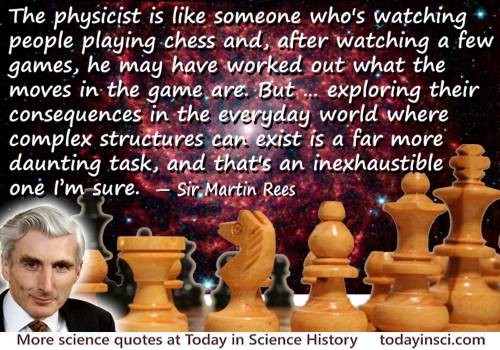
The physicist is like someone who’s watching people playing chess and, after watching a few games, he may have worked out what the moves in the game are. But understanding the rules is just a trivial preliminary on the long route from being a novice to being a grand master. So even if we understand all the laws of physics, then exploring their consequences in the everyday world where complex structures can exist is a far more daunting task, and that’s an inexhaustible one I'm sure.
In Lewis Wolpert and Alison Richards, A Passion For Science (1988), 37.
 In science it often happens that scientists say, 'You know that's a really good argument; my position is mistaken,' and then they would actually change their minds and you never hear that old view from them again. They really do it. It doesn't happen as often as it should, because scientists are human and change is sometimes painful. But it happens every day. I cannot recall the last time something like that happened in politics or religion.
(1987) --
In science it often happens that scientists say, 'You know that's a really good argument; my position is mistaken,' and then they would actually change their minds and you never hear that old view from them again. They really do it. It doesn't happen as often as it should, because scientists are human and change is sometimes painful. But it happens every day. I cannot recall the last time something like that happened in politics or religion.
(1987) -- 





