Chemistry Quotes (384 quotes)
...the question undoubtedly is, or soon will be, not whether or no we shall employ notation in chemistry, but whether we shall use a bad and incongruous, or a consistent and regular notation.
'On the Employment of Notation in Chemistry', Journal of the Royal Institution (1838), 1, 438. Cited in Timothy L. Alborn, 'Negotiating Notation: Chemical Symbols and British Society, 1831-1835', Annals of Science (1989), 46, 437.
’Tis a short sight to limit our faith in laws to those of gravity, of chemistry, of botany, and so forth. Those laws do not stop where our eyes lose them, but push the same geometry and chemistry up into the invisible plane of social and rational life, so that, look where we will, in a boy's game, or in the strifes of races, a perfect reaction, a perpetual judgment keeps watch and ward.
From 'Worship', The Conduct of Life (1860) collected in The Complete Works of Ralph Waldo Emerson (1866), Vol.2, 401.
[Chemistry] laboratory work was my first challenge. ... I still carry the scars of my first discovery—that test-tubes are fragile.
Edward Teller with Judith L. Shoolery, Memoirs: A Twentieth-Century Journey in Science and Politics (2001), 42.
[My friends and I studied science to get away from] the stench of Fascist truths which tainted the sky. ... [T]he chemistry and physics on which we fed, besides being nourishment vital in themselves, were an antidote to Fascism. ... [T]hey were clear and distinct and verifiable at every step, and not a tissue of lies and emptiness like the radio and the newspapers.
The Periodic Table, trans. Raymond Rosenthal (1986), 42. In Vinoth Ramachandra, Subverting Global Myths: Theology and the Public Issues Shaping our World (2008), 170.
[On the future of Chemistry:] Chemistry is not the preservation hall of old jazz that it sometimes looks like. We cannot know what may happen tomorrow. Someone may oxidize mercury (II), francium (I), or radium (II). A mineral in Nova Scotia may contain an unsaturated quark per 1020 nucleons. (This is still 6000 per gram.) We may pick up an extraterrestrial edition of Chemical Abstracts. The universe may be a 4-dimensional soap bubble in an 11-dimensional space as some supersymmetry theorists argued in May of 1983. Who knows?
In George B. Kaufmann, 'Interview with Jannik Bjerrum and Christian Klixbull Jørgensen', Journal of Chemical Education (1985), 62, No. 11, 1005.
[The nanotube] brings those properties you cannot get from other organic molecules. And it’s still carbon, so it has organic chemistry. Here is an object that has, to a superlative degree, the aspects that we hold most central to the inorganic world: hardness, toughness, terrific strength, thermal and electrical conductivity. Things you just can’t do with bone and wood. But it’s made out of carbon. It’s something that plays the game at the same level of perfection as molecules and life.
From interview in 'Wires of Wonder', Technology Review (Mar 2001), 104, No. 2, 88.
[The] structural theory is of extreme simplicity. It assumes that the molecule is held together by links between one atom and the next: that every kind of atom can form a definite small number of such links: that these can be single, double or triple: that the groups may take up any position possible by rotation round the line of a single but not round that of a double link: finally that with all the elements of the first short period [of the periodic table], and with many others as well, the angles between the valencies are approximately those formed by joining the centre of a regular tetrahedron to its angular points. No assumption whatever is made as to the mechanism of the linkage. Through the whole development of organic chemistry this theory has always proved capable of providing a different structure for every different compound that can be isolated. Among the hundreds of thousands of known substances, there are never more isomeric forms than the theory permits.
Presidential Address to the Chemical Society (16 Apr 1936), Journal of the Chemical Society (1936), 533.
[While in school, before university,] I, like almost all chemists I know, was also attracted by the smells and bangs that endowed chemistry with that slight but charismatic element of danger which is now banned from the classroom. I agree with those of us who feel that the wimpish chemistry training that schools are now forced to adopt is one possible reason that chemistry is no longer attracting as many talented and adventurous youngsters as it once did. If the decline in hands-on science education is not redressed, I doubt that we shall survive the 21st century.
Nobel laureate autobiography in Les Prix Nobel/Nobel Lectures 1996 (1997), 191.
Πάντα ῥεῖ : all things are in flux. It is inevitable that you are indebted to the past. You are fed and formed by it. The old forest is decomposed for the composition of the new forest. The old animals have given their bodies to the earth to furnish through chemistry the forming race, and every individual is only a momentary fixation of what was yesterday another’s, is today his and will belong to a third to-morrow. So it is in thought.
In Lecture, second in a series given at Freeman Place Chapel, Boston (Mar 1859), 'Quotation and Originality', collected in Letters and Social Aims (1875, 1917), 200. The Greek expression, “panta rei” is a quote from Heraclitus.
[Recalling Professor Ira Remsen's remarks (1895) to a group of his graduate students about to go out with their degrees into the world beyond the university:]
He talked to us for an hour on what was ahead of us; cautioned us against giving up the desire to push ahead by continued study and work. He warned us against allowing our present accomplishments to be the high spot in our lives. He urged us not to wait for a brilliant idea before beginning independent research, and emphasized the fact the Lavoisier's first contribution to chemistry was the analysis of a sample of gypsum. He told us that the fields in which the great masters had worked were still fruitful; the ground had only been scratched and the gleaner could be sure of ample reward.
He talked to us for an hour on what was ahead of us; cautioned us against giving up the desire to push ahead by continued study and work. He warned us against allowing our present accomplishments to be the high spot in our lives. He urged us not to wait for a brilliant idea before beginning independent research, and emphasized the fact the Lavoisier's first contribution to chemistry was the analysis of a sample of gypsum. He told us that the fields in which the great masters had worked were still fruitful; the ground had only been scratched and the gleaner could be sure of ample reward.
Quoted in Frederick Hutton Getman, The Life of Ira Remsen (1980), 73.
[Responding to a student whose friend asked about studying Agricultural Chemistry at Johns Hopkins:]
We would be glad to have your friend come here to study, but tell him that we teach Chemistry here and not Agricultural Chemistry, nor any other special kind of chemistry. ... We teach Chemistry.
We would be glad to have your friend come here to study, but tell him that we teach Chemistry here and not Agricultural Chemistry, nor any other special kind of chemistry. ... We teach Chemistry.
In Frederick Hutton Getman, The Life of Ira Remsen, 71.
Ces détails scientifiques qui effarouchent les fabricans d’un certain âge, ne seront qu’un
jeu pour leurs enfans, quand ils auront apprit dans leurs collèges un peu plus de mathématiques et un peu moins de Latin; un peu plus de Chimie, et un peu moins de Grec!
The scientific details which now terrify the adult manufacturer will be mere trifles to his children when they shall be taught at school, a little more Mathematics and a little less Latin, a little more Chemistry, and a little less Greek.
The scientific details which now terrify the adult manufacturer will be mere trifles to his children when they shall be taught at school, a little more Mathematics and a little less Latin, a little more Chemistry, and a little less Greek.
As quoted in 'Sketches From Life of Some Eminent Foreign Scientific Lecturers: Dumas', Magazine of Popular Science, and Journal of the Useful Arts (1836). Vol. 1, 177.
Chemie ist nicht nur, wenn es stinkt und kracht.
Chemistry is not just, when it stinks and bangs.
Chemistry is not just, when it stinks and bangs.
German chemistry saying, seen on various web pages.
Compounds formed by chemical attraction, possess new properties different from those of their component parts... chemists have long believed that the contrary took place in their combination. They thought, in fact, that the compounds possessed properties intermediate between those of their component parts; so that two bodies, very coloured, very sapid, or insapid, soluble or insoluble, fusible or infusible, fixed or volatile, assumed in chemical combination, a shade or colour, or taste, solubility or volatility, intermediate between, and in some sort composed of, the same properties which were considered in their principles. This is an illusion or error which modern chemistry is highly interested to overthrow.
Quoted in A General System of Chemical Knowledge (1804), Vol. I, trans. W. Nicholson, 102-3.
Die Chemie ist der unreinliche Teil der Physik.
Chemistry is the dirty part of physics.
Chemistry is the dirty part of physics.
Original German as quoted by Paul Krische, Wie Studiert man Chemie? (1904), 67, who also stated that Peter Reiss was a friend of Friedrich Wöhler (both chemists). English version as given in Chemisch Weekblad (1925), 22, 363. In more recent books, the quote is cited as by physicist Johann Philipp Reis. This confusion appears, for example in Ralph Oesper, The Human Side of Scientists (1975), 116.
Engineering, too, owes its most useful materials to the achievements of chemists in identifying, separating, and transforming materials: structural steel for the framework of bridges and buildings, portland cement for roadways and aqueducts, pure copper for the electrical industries, aluminum alloys for automobiles and airplanes, porcelain for spark plugs and electrical insulators. The triumphs of engineering skill rest on a chemical foundation.
In Fundamental Chemistry, and Elementary Textbook for College Classes (1936), 8.
La chemie est une science française; elle fut constitutée par Lavoisier d’immortelle mémoire.
Chemistry is a French Science. It was founded by Lavoisier of immortal memory.
Chemistry is a French Science. It was founded by Lavoisier of immortal memory.
In 'Histoire des doctrines chimiques', Dictionnaire de Chimie Pure et Appliquée (1868), Vol. 1, i.
Misattributed to Johann Reiss. Probably by Peter Reiss.
Die Chemie ist der unreinliche Teil der Physik.
Chemistry is the dirty part of physics.
Die Chemie ist der unreinliche Teil der Physik.
Chemistry is the dirty part of physics.
Webmaster believes this quote should be attributed to Peter Reiss, having found the following example cited for Peter Reiss. Original German as quoted by Paul Krische, Wie Studiert man Chemie? (1904), 67, who also stated that Peter Reiss was a friend of Friedrich Wöhler (both chemists). English version as given in Chemisch Weekblad (1925), 22, 363. In various recent books, the quote is cited as by physicist Johann Philipp Reis. This confusion appears, for example in Ralph Oesper, The Human Side of Scientists (1975), 116.
Mit dem Schwerte der Wissenschaft, mit dem Panzer der Praxis, so wird Deutsche Bier die Welt erringen.
With the sword of Science and the armour of Practice, German beer will encircle the world.
With the sword of Science and the armour of Practice, German beer will encircle the world.
From address about yeast and fermentation in the brewery, to the German Brewing Congress (Jun 1884) as Director of the Experimental and Teaching Institute for Brewing in Berlin. In 'Ueber Hefe und Gärung in der Bierbrauerei', Bayerische Bierbauer, 1884, 19, 312. As cited in Ray Anderson, Brewery History (Summer 2006), No. 123, 55. Indeed, as quoting Anderson, “In 1887 beer output in the German states exceeded that in the UK for the first time and Germany became the largest producer of beer in the world.” Using Google translation, the word “armour” might also be read as “breast-plate.”
Similia similibus solvuntur
Like dissolves like.
Like dissolves like.
Aphorism used in chemistry to indicate the polar solvents dissolve polar solutes, whereas non-polar solvents will dissolve non-polar solutes. Seen, for example, in Corpus Pharmaceutico-Chymico-Medicum Universale (1711), 4. It appears in this context: “Sic spiritus vini cum camphora, item oleum destillatum cum sulfure se intimè unit. Quae separando homogeneas saltem particulas adsciscunt, & sibi uniunt, his competit regula: Similia similibus solvuntur: & est genuina solutio.”
Tierchemie ist Schmierchemie.
Animal chemistry is messy chemistry.
Animal chemistry is messy chemistry.
Quoted without source in Joseph S. Feuton, Proteins, Enzymes, Genes: The Interplay of Chemistry and Biology (1999), 57.
Tout homme qui reçoit une éducation libérale compte aujourd'hui la chimie parmi les objets les plus indispensables de ses études.
Everyone who receives a liberal education today counts chemistry among the most essential parts of his studies.
Everyone who receives a liberal education today counts chemistry among the most essential parts of his studies.
Système des Connaissances Chimiques, et de Leurs Applications aux Phénomènes de la Nature et de l'Art (1800), Vol. 1, Preface, xviii. Translation by Webmaster.
~~[Need source]~~ All theoretical chemistry is really physics; and all theoretical chemists know it.
Webmaster, so far, has been unable to find a primary source that adds the ending clause. (Can you help?) But Feynman certainly several times stated the idea in the opening clause. See, for example, the quote, “The theory of quantum mechanics … supplied the theory behind chemistry. So, fundamental theoretical chemistry is really physics.” on the Richard Feynman Quotes page on this website.
1. Universal CHEMISTRY is the Art of resolving mixt, compound, or aggregate Bodies into their Principles; and of composing such Bodies from those Principles. 2. It has for its Subject all the mix’d, compound, and aggregate Bodies that are and resolvable and combinable and Resolution and Combination, or Destruction and Generation, for its Object. 3. Its Means in general, are either remote or immediate; that is, either Instruments or the Operations themselves. 4. Its End is either philosophical and theoretical; or medicinal, mechanical, œconomical, and practical. 5. Its efficient Cause is the Chemist.
In Philosophical Principles of Universal Chemistry: Or, The Foundation of a Scientifical Manner of Inquiring Into and Preparing the Natural and Artificial Bodies for the Uses of Life: Both in the Smaller Way of Experiment, and the Larger Way of Business (1730), 1. Footnote to (1.): “The justness of this Definition will appear from the scope and tenour of the Work; though it is rather adapted to the perfect, than the present imperfect state of Chemistry….” Footnote to (4): “Hence universal Chemistry is commodiously resolved into several Parts or Branches, under which it must be distinctly treated to give a just notion of its due extent and usefulness. For tho’ in common acceptation of the word, Chemistry is supposed to relate chiefly to the Art of Medicine, as it supplies that Art with Remedies, this in reality is but a very small part of its use, compared with the rest; numerous other Arts, Trades, and mechanical Employments, Merchandize itself, and all natural Philosophy, being as much, and some of them more, concern’d therewith….”
A beautiful blonde is chemically three-fourths water, but what lovely surface tension.
In Evan Esar, 20,000 Quips and Quotes, 127.
A chemical compound once formed would persist for ever, if no alteration took place in surrounding conditions. But to the student of Life the aspect of nature is reversed. Here, incessant, and, so far as we know, spontaneous change is the rule, rest the exception—the anomaly to be accounted for. Living things have no inertia and tend to no equilibrium.
From Address (22 Jul 1854) delivered at St. Martin’s Hall, published as a pamphlet (1854), 7, and collected in 'Educational Value of Natural History Sciences', Lay Sermons, Addresses, and Reviews (1870), 75.
A commonsense interpretation of the facts suggests that a superintellect has monkeyed with physics, as well as with chemistry and biology, and that there are no blind forces worth speaking about in nature. The numbers one calculates from the facts seem to me so overwhelming as to put this conclusion almost beyond question.
In 'The Universe: Past and Present Reflections', Astrophysics and Relativity (1981), 70, 26.
A German once has said of the Chemical Laboratory in Munich: “In diesem Hause stinkt es sehr, Dies kommt von Adolf Baeyer her.” [It stinks a lot in this house; this comes from Adolf Baeyer.]
From 'What Can the Modern Chemist Learn From the Old Alchemy?', Introductory Lecture (1917), delivered at Cornell University, written in German, translated by L.F. Audrieth, and published in Salts, Acids, and Bases: Electrolytes Stereochemistry (1929), 1, as Vol. 4 of the George Fisher Baker Non-Resident Lectureship in Chemistry at Cornell University. Translation of German part of above quote by Webmaster using Google Translate.
A great department of thought must have its own inner life, however transcendent may be the importance of its relations to the outside. No department of science, least of all one requiring so high a degree of mental concentration as Mathematics, can be developed entirely, or even mainly, with a view to applications outside its own range. The increased complexity and specialisation of all branches of knowledge makes it true in the present, however it may have been in former times, that important advances in such a department as Mathematics can be expected only from men who are interested in the subject for its own sake, and who, whilst keeping an open mind for suggestions from outside, allow their thought to range freely in those lines of advance which are indicated by the present state of their subject, untrammelled by any preoccupation as to applications to other departments of science. Even with a view to applications, if Mathematics is to be adequately equipped for the purpose of coping with the intricate problems which will be presented to it in the future by Physics, Chemistry and other branches of physical science, many of these problems probably of a character which we cannot at present forecast, it is essential that Mathematics should be allowed to develop freely on its own lines.
In Presidential Address British Association for the Advancement of Science, Sheffield, Section A,
Nature (1 Sep 1910), 84, 286.
A man cannot be professor of zoölogy on one day and of chemistry on the next, and do good work in both. As in a concert all are musicians,—one plays one instrument, and one another, but none all in perfection.
Lecture at a teaching laboratory on Penikese Island, Buzzard's Bay. Quoted from the lecture notes by David Starr Jordan, Science Sketches (1911), 146.
A schism has taken place among the chemists. A particular set of them in France have undertaken to remodel all the terms of the science, and to give every substance a new name, the composition, and especially the termination of which, shall define the relation in which it stands to other substances of the same family, But the science seems too much in its infancy as yet, for this reformation; because in fact, the reformation of this year must be reformed again the next year, and so on, changing the names of substances as often as new experiments develop properties in them undiscovered before. The new nomenclature has, accordingly, been already proved to need numerous and important reformations. ... It is espoused by the minority here, and by the very few, indeed, of the foreign chemists. It is particularly rejected in England.
Letter to Dr. Willard (Paris, 1788). In Thomas Jefferson and John P. Foley (ed.), The Jeffersonian Cyclopedia (1900), 135. From H.A. Washington, The Writings of Thomas Jefferson (1853-54). Vol 3, 15.
A. R. Todd
Thinks he’s God.
N. F. Mott
Says he’s not.
Thinks he’s God.
N. F. Mott
Says he’s not.
Quoted by William Lord in The Times (22 Jan 1997), remarking on the competitiveness between the Physics and Chemistry Departments at the University of Cambridge.
According to the older view, for every single effect of a serum, there was a separate substance, or at least a particular chemical group... A normal serum contained as many different haemagglutinins as it agglutinated different cells. The situation was undoubtedly made much simpler if, to use the Ehrlich terminology... the separate haptophore groups can combine with an extremely large number of receptors in stepwise differing quantities as a stain does with different animal tissues, though not always with the same intensity. A normal serum would therefore visibly affect such a large number of different blood cells... not because it contained countless special substances, but because of the colloids of the serum, and therefore of the agglutinins by reason of their chemical constitution and the electrochemical properties resulting from it. That this manner of representation is a considerable simplification is clear; it also opens the way to direct experimental testing by the methods of structural chemistry.
'Die Theorien der Antikorperbildung ... ', Wiener klinische Wöchenschrift (1909), 22, 1623-1631. Trans. Pauline M. H. Mazumdar.
Acid Salts have the Power of Destroying the Blewness of the Infusion of our Wood [lignum nephreticum], and those Liquors indiscriminatly that abound with Sulphurous Salts, (under which I comprehend the Urinous and Volatile Salts of Animal Substances, and the Alcalisate or fixed Salts that are made by Incineration) have the virtue of Restoring it.
Experiments and Considerations Touching Colours (1664), 212.
After having a wash I proceeded to the bar where—believe it or not—there was a white-coated barman who was not only serving drinks but also cigarettes! I hastened forward and rather timidly said ‘Can I have some cigarettes?’
‘What’s your rank?’ was the slightly unexpected reply.
‘I am afraid I haven’t got one,’ I answered.
‘Nonsense—everyone who comes here has a rank.’
‘I’m sorry but I just don’t have one.’
‘Now that puts me in a spot,’ said the barman, ‘for orders about cigarettes in this camp are clear—twenty for officers and ten for other ranks. Tell me what exactly are you?’
Now I really wanted those cigarettes so I drew myself up and said ‘I am the Professor of Chemistry at Manchester University.’
The barman contemplated me for about thirty seconds and then said ‘I’ll give you five.’
Since that day I have had few illusions about the importance of professors!
‘What’s your rank?’ was the slightly unexpected reply.
‘I am afraid I haven’t got one,’ I answered.
‘Nonsense—everyone who comes here has a rank.’
‘I’m sorry but I just don’t have one.’
‘Now that puts me in a spot,’ said the barman, ‘for orders about cigarettes in this camp are clear—twenty for officers and ten for other ranks. Tell me what exactly are you?’
Now I really wanted those cigarettes so I drew myself up and said ‘I am the Professor of Chemistry at Manchester University.’
The barman contemplated me for about thirty seconds and then said ‘I’ll give you five.’
Since that day I have had few illusions about the importance of professors!
In A Time to Remember: The Autobiography of a Chemist (1983), 59. This event took place after a visit to the Defence Research Establishment at Porton to observe a demonstration of a new chemical anti-tank weapon (1941).
Alchymy, or Chymistry, is …
An Art which good men bate, and most men blame,
Which her admirers practice to their shame,
Whose plain Impostures, easie to perceive,
Not onely others, but themselves deceive.
An Art which good men bate, and most men blame,
Which her admirers practice to their shame,
Whose plain Impostures, easie to perceive,
Not onely others, but themselves deceive.
In The Vanity of Arts and Sciences (1676), 312.
All the experiments which have been hitherto carried out, and those that are still being daily performed, concur in proving that between different bodies, whether principles or compounds, there is an agreement, relation, affinity or attraction (if you will have it so), which disposes certain bodies to unite with one another, while with others they are unable to contract any union: it is this effect, whatever be its cause, which will help us to give a reason for all the phenomena furnished by chemistry, and to tie them together.
From Elemens de Chymie Theorique (1749). As quoted, in Trevor Harvey Levere, Affinity and Matter: Elements of Chemical Philosophy, 1800-1865 (1971), 17.
All things on the earth are the result of chemical combination. The operation by which the commingling of molecules and the interchange of atoms take place we can imitate in our laboratories; but in nature they proceed by slow degrees, and, in general, in our hands they are distinguished by suddenness of action. In nature chemical power is distributed over a long period of time, and the process of change is scarcely to be observed. By acts we concentrate chemical force, and expend it in producing a change which occupies but a few hours at most.
In chapter 'Chemical Forces', The Poetry of Science: Or, Studies of the Physical Phenomena of Nature (1848), 235-236. Charles Dicken used this quote, with his own sub-head of 'Relative Importance Of Time To Man And Nature', to conclude his review of the book, published in The Examiner (1848).
Although I was four years at the University [of Wisconsin], I did not take the regular course of studies, but instead picked out what I thought would be most useful to me, particularly chemistry, which opened a new world, mathematics and physics, a little Greek and Latin, botany and and geology. I was far from satisfied with what I had learned, and should have stayed longer.
[Enrolled in Feb 1861, left in 1863 without completing a degree, and began his first botanical foot journey.]
[Enrolled in Feb 1861, left in 1863 without completing a degree, and began his first botanical foot journey.]
The Story of My Boyhood and Youth (1913), 286.
Among those whom I could never pursuade to rank themselves with idlers, and who speak with indignation of my morning sleeps and nocturnal rambles, one passes the day in catching spiders, that he may count their eyes with a microscope; another exhibits the dust of a marigold separated from the flower with a dexterity worthy of Leuwenhoweck himself. Some turn the wheel of electricity; some suspend rings to a lodestone, and find that what they did yesterday, they can do again to-day.—Some register the changes of the wind, and die fully convinced that the wind is changeable.—There are men yet more profound, who have heard that two colorless liquors may produce a color by union, and that two cold bodies will grow hot of they are mingled: they mingle them, and produce the effect expected, say it is strange, and mingle them again.
In Tryon Edwards, A Dictionary of Thoughts (1908), 243.
An egg is a chemical process, but it is not a mere chemical process. It is one that is going places—even when, in our world of chance and contingency, it ends up in an omelet and not in a chicken. Though it surely be a chemical process, we cannot understand it adequately without knowing the kind of chicken it has the power to become.
'The Changing Impact of Darwin on Philosophy', Journal of the History of Ideas (1961), 22, 457.
And indeed I am not humming,
Thus to sing of Cl-ke and C-ming,
Who all the universe surpasses
in cutting up and making gases;
With anatomy and chemics,
Metaphysics and polemics,
Analyzing and chirugery,
And scientific surgery …
H-slow's lectures on the cabbage
Useful are as roots of Babbage;
Fluxions and beet-root botany,
Some would call pure monotony.
Thus to sing of Cl-ke and C-ming,
Who all the universe surpasses
in cutting up and making gases;
With anatomy and chemics,
Metaphysics and polemics,
Analyzing and chirugery,
And scientific surgery …
H-slow's lectures on the cabbage
Useful are as roots of Babbage;
Fluxions and beet-root botany,
Some would call pure monotony.
— Magazine
Punch in Cambridge (28 Jan 1834). In Mark Weatherall, Gentlemen, Scientists, and Medicine at Cambridge 1800-1940 (2000), Vol. 3,77. The professors named were William Clark (anatomy), James Cumming (chemistry) and Johns Stephens Henslow (botany).
And so, after many years, victory has come, and the romance of exploration, of high hopes and bitter disappointment, will in a few years simply be recorded in the text-books of organic chemistry in a few terse sentences.
Recent Developments in the Vitamin A Field', The Pedlar Lecture, 4 Dec 1947, Journal of the Chemical Society, Part I (1948), 393.
As a scientist and geneticist I started to feel that science would probably soon reach the point where its interference into the life processes would be counterproductive if a properly designed governing policy was not implemented. A heavily overcrowded planet, ninety-five percent urbanized with nuclear energy as the main source of energy and with all aspects of life highly computerized, is not too pleasant a place for human life. The life of any individual soon will be predictable from birth to death. Medicine, able to cure almost everything, will make the load of accumulated defects too heavy in the next two or three centuries. The artificial prolongation of life, which looked like a very bright idea when I started research in aging about twenty-five years ago, has now lost its attractiveness for me. This is because I now know that the aging process is so multiform and complex that the real technology and chemistry of its prevention by artificial interference must be too complex and expensive. It would be the privilege of a few, not the method for the majority. I also was deeply concerned about the fact that most research is now either directly or indirectly related to military projects and objectives for power.
Quoted in 'Zhores A(leksandrovich) Medvedev', Contemporary Authors Online, Gale, 2002.
As a second year high school chemistry student, I still have a vivid memory of my excitement when I first saw a chart of the periodic table of elements. The order in the universe seemed miraculous, and I wanted to study and learn as much as possible about the natural sciences.
In Tore Frängsmyr and Jan E. Lindsten (eds.), Nobel Lectures: Physiology Or Medicine: 1981-1990 (1993), 555.
As long as museums and universities send out expeditions to bring to light new forms of living and extinct animals and new data illustrating the interrelations of organisms and their environments, as long as anatomists desire a broad comparative basis human for anatomy, as long as even a few students feel a strong curiosity to learn about the course of evolution and relationships of animals, the old problems of taxonomy, phylogeny and evolution will gradually reassert themselves even in competition with brilliant and highly fruitful laboratory studies in cytology, genetics and physiological chemistry.
'Genetics Versus Paleontology', The American Naturalist, 1917, 51, 623.
As mineralogy constitutes a part of chemistry, it is clear that this arrangement [of minerals] must derive its principles from chemistry. The most perfect mode of arrangement would certainly be to allow bodies to follow each other according to the order of their electro-chemical properties, from the most electro-negative, oxygen, to the most electro-positive, potassium; and to place every compound body according to its most electro-positive ingredient.
An Attempt to Establish a Pure Scientific System of Mineralogy (1814), trans. J. Black, 48.
As soon as we touch the complex processes that go on in a living thing, be it plant or animal, we are at once forced to use the methods of this science [chemistry]. No longer will the microscope, the kymograph, the scalpel avail for the complete solution of the problem. For the further analysis of these phenomena which are in flux and flow, the investigator must associate himself with those who have labored in fields where molecules and atoms, rather than multicellular tissues or even unicellular organisms, are the units of study.
'Experimental and Chemical Studies of the Blood with an Appeal for More Extended Chemical Training for the Biological and Medical Investigator', Science (6 Aug 1915), 42, 176.
Astrology was much in vogue during the middle ages, and became the parent of modern astronomy, as alchemy did of chemistry.
As given in Edwin Davies, Other Men's Minds, Or, Seven Thousand Choice Extracts on History, Science, Philosophy, Religion, Etc (1800), 41. Webmaster so far has not found the primary source-can you help?
At the present time it is of course quite customary for physicists to trespass on chemical ground, for mathematicians to do excellent work in physics, and for physicists to develop new mathematical procedures. … Trespassing is one of the most successful techniques in science.
In Dynamics in Psychology (1940, 1973), 116.
Beadle believed that genetics were inseparable from chemistry—more precisely, biochemistry. They were, he said, “two doors leading to the same room.”
In Warren Weaver, Science and Imagination (1967), xii. Quoted in Thomas Hager, Force of Nature: The Life of Linus Pauling (1995), 276.
Berzelius' symbols are horrifying. A young student in chemistry might as soon learn Hebrew as make himself acquainted with them... They appear to me equally to perplex the adepts in science, to discourage the learner, as well as to cloud the beauty and simplicity of the atomic theory.
Quoted in H. E. Roscoe, 'Presidential Address', Reports of the British Association for the Advancement of Science, 57th report, 1887, 7.
Besides accustoming the student to demand, complete proof, and to know when he has not obtained it, mathematical studies are of immense benefit to his education by habituating him to precision. It is one of the peculiar excellencies of mathematical discipline, that the mathematician is never satisfied with à peu près. He requires the exact truth. Hardly any of the non-mathematical sciences, except chemistry, has this advantage. One of the commonest modes of loose thought, and sources of error both in opinion and in practice, is to overlook the importance of quantities. Mathematicians and chemists are taught by the whole course of their studies, that the most fundamental difference of quality depends on some very slight difference in proportional quantity; and that from the qualities of the influencing elements, without careful attention to their quantities, false expectation would constantly be formed as to the very nature and essential character of the result produced.
In An Examination of Sir William Hamilton’s Philosophy (1878), 611. [The French phrase, à peu près means “approximately”. —Webmaster]
Better Things for Better Living Through Chemistry.
Advertising campaign slogan for the DuPont Company from 1935.
Biology today is moving in the direction of chemistry. Much of what is understood in the field is based on the structure of molecules and the properties of molecules in relation to their structure. If you have that basis, then biology isn’t just a collection of disconnected facts.
From interview with Neil A. Campbell, in 'Crossing the Boundaries of Science', BioScience (Dec 1986), 36, No. 11, 737.
But for twenty years previous to 1847 a force had been at work in a little county town of Germany destined to effect the education of Christendom, and at the same time to enlarge the boundaries of human knowledge, first in chemistry and the allied branches, then in every other one of the natural sciences. The place was Giessen; the inventor Liebig; the method, a laboratory for instruction and research.
A Semi-Centennial Discourse, 1847-97' (28 Oct 1897), The Sheffield Scientific School of Yale University. Quoted in Daniel Coit Gilman, University Problems in the United States (1898), 120.
But nothing of a nature foreign to the duties of my profession [clergyman] engaged my attention while I was at Leeds so much as the, prosecution of my experiments relating to electricity, and especially the doctrine of air. The last I was led into a consequence of inhabiting a house adjoining to a public brewery, where first amused myself with making experiments on fixed air [carbon dioxide] which found ready made in the process of fermentation. When I removed from that house, I was under the necessity making the fixed air for myself; and one experiment leading to another, as I have distinctly and faithfully noted in my various publications on the subject, I by degrees contrived a convenient apparatus for the purpose, but of the cheapest kind. When I began these experiments I knew very little of chemistry, and had in a manner no idea on the subject before I attended a course of chymical lectures delivered in the Academy at Warrington by Dr. Turner of Liverpool. But I have often thought that upon the whole, this circumstance was no disadvantage to me; as in this situation I was led to devise an apparatus and processes of my own, adapted to my peculiar views. Whereas, if I had been previously accustomed to the usual chemical processes, I should not have so easily thought of any other; and without new modes of operation I should hardly have discovered anything materially new.
Memoirs of Dr. Joseph Priestley, in the Year 1795 (1806), Vol. 1, 61-2.
Carbon has this genius of making a chemically stable two-dimensional, one-atom-thick membrane in a three-dimensional world. And that, I believe, is going to be very important in the future of chemistry and technology in general.
From Nobel Lecture (7 Dec 1996), 'Discovering the Fullerenes', collected in Ingmar Grenthe (ed.), Nobel Lectures, Chemistry 1996-2000 (2003).
Cellular pathology is not an end if one cannot see any alteration in the cell. Chemistry brings the clarification of living processes nearer than does anatomy. Each anatomical change must have been preceded by a chemical one.
Attributed in H. Coper and H. Herken, Deutsche Medizini Wochenschrift (18 Oct 1963), 88, No. 42, 2035, in the original German, “Nach der Überlieferung durch His soll Virchow geäußert haben: ‘Die Zellular-pathologie ist nicht am Ende, wenn man an einer Zelle keine Veränderungen mehr sehen kann. Die Chemie steht der Erklärung der Lebensvorgänge näher als die Anatomie. Jede anatomische Verände-rung setzt notwendig eine chemische voraus.’” As translated in Angel Pentschew,'Morphology and morphogenesis of lead encephalopathy', Acta Neuropathologica (Sep 1965) 5, No. 2, 133-160, as cited in I. Arthur Michaelson and Mitchell W. Sauerhoff, 'Animal Models of Human Disease: Severe and Mild Lead Encephalopathy in the Neonatal Rat', Environmental Health Perspectives (May 1974), 7, 204 & 223 footnote. Note: Although given in quotation marks in the original German text, the subject quote is almost definitely NOT verbatim, but only a paraphrase of Virchow’s teachings. The German text introduces the subject quote with, “Nach der Überlieferung durch His soll Virchow geäußert haben:…” which means, “According to tradition Virchow is said to have expressed:…” (using Google translate). However, it is useful as a succinct statement to the effect of what Virchow might say to summarize his doctrine.
Chemical engineering is the profession in which a knowledge of mathematics, chemistry and other natural sciences gained by study, experience and practice is applied with judgment to develop economic ways of using materials and energy for the benefit of mankind.
— AIChE
In Article III, 'Definition of the Profession', Constitution of the American Institute of
Chemical Engineers (as amended 17 Jan 2003). The same wording is found in the 1983 Constitution, as quoted in Nicholas A. Peppas (ed.), One Hundred Years of Chemical Engineering: From Lewis M. Norton (M.I.T. 1888) to Present (2012), 334.
Chemical research conducts to the knowledge of philosophical truth, and forms the mind to philosophical enlargement and accuracy of thought, more happily than almost any other species of investigation in which the human intellect can be employed.
Quote following title page of Samuel Parkes, A Chemical Catechism With Notes, Illustrations and Experiments (8th ed. 1818).
Chemistry affords two general methods of determining the constituent principles of bodies, the method of analysis, and that of synthesis. When, for instance, by combining water with alkohol, we form the species of liquor called, in commercial language, brandy or spirit of wine, we certainly have a right to conclude, that brandy, or spirit of wine, is composed of alkohol combined with water. We can produce the same result by the analytical method; and in general it ought to be considered as a principle in chemical science, never to rest satisfied without both these species of proofs. We have this advantage in the analysis of atmospherical air, being able both to decompound it, and to form it a new in the most satisfactory manner.
Elements of Chemistry (1790), trans. R. Kerr, 33.
Chemistry and physics are experimental sciences; and those who are engaged in attempting to enlarge the boundaries of science by experiment are generally unwilling to publish speculations; for they have learned, by long experience, that it is unsafe to anticipate events. It is true, they must make certain theories and hypotheses. They must form some kind of mental picture of the relations between the phenomena which they are trying to investigate, else their experiments would be made at random, and without connection.
From 'Radium and Its Products', Harper’s Magazine (Dec 1904), 52.
Chemistry as a science is still in its infancy. I hold to my view because there is still so much beyond our understanding even in the simplest systems the chemist has cared to deal with.
Speech at the Nobel Banquet (10 Dec 1983) for his Nobel Prize in Chemistry. In Wilhelm Odelberg (ed.), Les Prix Nobel: The Nobel Prizes (1984), 43.
Chemistry dissolves the goddess in the alembic,
Venus, the white queen, the universal matrix,
Down to the molecular hexagons and carbon-chains.
Venus, the white queen, the universal matrix,
Down to the molecular hexagons and carbon-chains.
'The Human Form Divine', in The Collected Poems of Kathleen Raine (1956), 86.
Chemistry has been termed by the physicist as the messy part of physics, but that is no reason why the physicists should be permitted to make a mess of chemistry when they invade it.
Attributed. As quoted in American Journal of Physics (1946),14 248. Also in Robert L. Weber, More Random Walks in Science: An Anthology (1982), 64, without citation. Contact Webmaster if you know any primary source.
Chemistry has the same quickening and suggestive influence upon the algebraist as a visit to the Royal Academy, or the old masters may be supposed to have on a Browning or a Tennyson. Indeed it seems to me that an exact homology exists between painting and poetry on the one hand and modern chemistry and modern algebra on the other. In poetry and algebra we have the pure idea elaborated and expressed through the vehicle of language, in painting and chemistry the idea enveloped in matter, depending in part on manual processes and the resources of art for its due manifestation.
Attributed.
Chemistry is a gibberish of Latin and German; but in Leibig's hands it becomes a powerful language.
'Die Chemie kauderwelscht in Latein und Deutsch, aber in Leibig's munde wird sie sprachgewaltig' . Jakob Grimm (ed.), Deutsche Wörlerbuch (1854), Vol. 1, xxxi. Translated and quoted by William H. Brock, in Justus von Liebig: The Chemical Gatekeeper (2002), 174. Note that Jacob and Wilhelm Grimm are better known as the Brothers Grimm.
Chemistry is an art that has furnished the world with a great number of useful facts, and has thereby contributed to the improvement of many arts; but these facts lie scattered in many different books, involved in obscure terms, mixed with many falsehoods, and joined to a great deal of false philosophy; so that it is not great wonder that chemistry has not been so much studied as might have been expected with regard to so useful a branch of knowledge, and that many professors are themselves but very superficially acquainted with it. But it was particularly to be expected, that, since it has been taught in universities, the difficulties in this study should have been in some measure removed, that the art should have been put into form, and a system of it attempted—the scattered facts collected and arranged in a proper order. But this has not yet been done; chemistry has not yet been taught but upon a very narrow plan. The teachers of it have still confined themselves to the purposes of pharmacy and medicine, and that comprehends a small branch of chemistry; and even that, by being a single branch, could not by itself be tolerably explained.
John Thomson, An Account of the Life, Lectures and Writings of William Cullen, M.D. (1832), Vol. 1, 40.
Chemistry is fun!
In Joseph Hirschfelder, Annual Review of Physical Chemistry, (1983), 3, 1. Stated as “To Hildebrand, Chemistry is Fun!” in Preface to Hildebrand's Viscosity and Diffusivity (1977), v.
Chemistry is like a majestic skyscraper. The concrete secure foundation of chemistry consists of countless experimentally observed facts. The theories, principles and laws developed from these observations are like an elevator which runs from the bottom to the top of the edifice.
Ernest R. Toon and George L. Ellis (eds.), Foundations of Chemistry (1968), 1.
Chemistry is not a primitive science like geometry and astronomy; it is constructed from the debris of a previous scientific formation; a formation half chimerical and half positive, itself found on the treasure slowly amassed by the practical discoveries of metallurgy, medicine, industry and domestic economy. It has to do with alchemy, which pretended to enrich its adepts by teaching them to manufacture gold and silver, to shield them from diseases by the preparation of the panacea, and, finally, to obtain for them perfect felicity by identifying them with the soul of the world and the universal spirit.
From Les Origines de l’Alchimie (1885), 1-2. Translation as quoted in Harry Shipley Fry, 'An Outline of the History of Chemistry Symbolically Represented in a Rookwood Fountain', The Journal of Industrial and Engineering Chemistry (1 Sep 1922), 14, No. 9, 868. From the original French, “La Chimie n’est pas une science primitive, comme la géométrie ou l’astronomie; elle s’est constituée sur les débris d’une formation scientifique antérieure; formation demi-chimérique et demi-positive, fondée elle-même sur le trésor lentement amassé des découvertes pratiques de la métallurgie, de la médecine, de l’industrie et de l’économie domestique. Il s’agit de l’alchimie, qui prétendait à la fois enrichir ses adeptes en leur apprenant à fabriquer l’or et l’argent, les mettre à l’abri des maladies par la préparation de la panacée, enfin leur procurer le bonheur parfait en les identifiant avec l’âme du monde et l’esprit universel.”
Chemistry is one of those branches of human knowledge which has built itself upon methods and instruments by which truth can presumably be determined. It has survived and grown because all its precepts and principles can be re-tested at any time and anywhere. So long as it remained the mysterious alchemy by which a few devotees, by devious and dubious means, presumed to change baser metals into gold, it did not flourish, but when it dealt with the fact that 56 g. of fine iron, when heated with 32 g. of flowers of sulfur, generated extra heat and gave exactly 88 g. of an entirely new substance, then additional steps could be taken by anyone. Scientific research in chemistry, since the birth of the balance and the thermometer, has been a steady growth of test and observation. It has disclosed a finite number of elementary reagents composing an infinite universe, and it is devoted to their inter-reaction for the benefit of mankind.
Address upon receiving the Perkin Medal Award, 'The Big Things in Chemistry', The Journal of Industrial and Engineering Chemistry (Feb 1921), 13, No. 2, 163.
Chemistry is the science or study of those effects and qualities of matter which are discovered by mixing bodies variously together, or applying them to one another with a view to mixture, and by exposing them to different degrees of heat, alone, or in mixture with one another, in order to enlarge our knowledge of nature, and to promote the useful arts.
From the first of a series of lectures on chemistry, collected in John Robison (ed.), Lectures on the Elements of Chemistry: Delivered in the University of Edinburgh (1807), Vol. 1, 11.
Chemistry is the study of material transformations. Yet a knowledge of the rate, or time dependence, of chemical change is of critical importance for the successful synthesis of new materials and for the utilization of the energy generated by a reaction. During the past century it has become clear that all macroscopic chemical processes consist of many elementary chemical reactions that are themselves simply a series of encounters between atomic or molecular species. In order to understand the time dependence of chemical reactions, chemical kineticists have traditionally focused on sorting out all of the elementary chemical reactions involved in a macroscopic chemical process and determining their respective rates.
'Molecular Beam Studies of Elementary Chemical Processes', Nobel Lecture, 8 Dec 1986. In Nobel Lectures: Chemistry 1981-1990 (1992), 320.
Chemistry is the study of the effects of heat and mixture, with a view of discovering their general and subordinate laws, and of improving the useful arts.
This is an editor’s shorter restatement of the definition given by Black in the first of a series of lectures on chemistry, collected in John Robison (ed.), Lectures on the Elements of Chemistry: Delivered in the University of Edinburgh (1807), Vol. 1, 11, footnote. For the definitions as given by Black, see elsewhere on this web page.
Chemistry is yet, indeed, a mere embryon. Its principles are contested; experiments seem contradictory; their subjects are so minute as to escape our senses; and their result too fallacious to satisfy the mind. It is probably an age too soon to propose the establishment of a system.
Letter to Rev. James Madison (Paris, 19 Jul 1788). In Thomas Jefferson and John P. Foley (ed.), The Jeffersonian Cyclopedia (1900), 135. From H.A. Washington, The Writings of Thomas Jefferson (1853-54). Vol 2, 431.
Chemistry must become the astronomy of the molecular world.
Autograph Quotation for a Charity, (1905). In G. B. Kaufman, Alfred Werner (1966), iii.
Chemistry ought not to be for chemists alone.
From Miguel Unamuno and J. E. Crawford Flitch (trans.), Essays and Soliloquies (1926), 122.
Chemistry stands at the pivot of science. On the one hand it deals with biology and provides explanations for the processes of life. On the other hand it mingles with physics and finds explanations for chemical phenomena in the fundamental processes and particles of the universe. Chemistry links the familiar with the fundamental.
In Scientific American Library, Molecules (1987, 2003), 2.
Chemistry teaches us to regard under one aspect, as various types of combustion or oxidation, the burning of a candle, the rusting of metals, the physiological process of respiration, and the explosion of gunpowder. In each process there is the one common fact that oxygen enters into new chemical combinations. Similarly to the physicist, the fall of the traditional apple of Newton, the revolution of the earth and planets round the sun, the apparitions of comets, and the ebb and flow of the tides are all phases of the universal law of gravitation. A race ignorant of the nature of combustion or of the law of gravitation, and ignorant of the need of such generalisations, could not be considered to have advanced far along the paths of scientific discovery.
In 'The Discovery of Radioactivity: Radioactivity, a New Science', The Interpretation of Radium and the Structure of the Atom (4th ed., 1920), 1.
Chemistry without catalysis, would be a sword without a handle, a light without brilliance, a bell without sound.
R. B. Desper, 'Alwin Mittasch', Journal of Chemlca1 Education (1948), 25, 531-2.
Chemistry works with an enormous number of substances, but cares only for some few of their properties; it is an extensive science. Physics on the other hand works with rather few substances, such as mercury, water, alcohol, glass, air, but analyses the experimental results very thoroughly; it is an intensive science. Physical chemistry is the child of these two sciences; it has inherited the extensive character from chemistry. Upon this depends its all-embracing feature, which has attracted so great admiration. But on the other hand it has its profound quantitative character from the science of physics.
In Theories of Solutions (1912), xix.
Chemistry: that most excellent child of intellect and art.
From presidential address to 1953 conference of Science Masters Association, Oxford, part of the Centenary Celbrations of the Chemical Society of London. As quoted in Charles Alfred Coulson, Science and Christian Belief (1956), 51.
Chemistry... is like the maid occupied with daily civilisation; she is busy with fertilisers, medicines, glass, insecticides ... for she dispenses the recipes.
Les Confessions d'un Chimiste Ordinaire (1981), 5. Trans. W. H. Brock.
Chemists have made of phlogiston a vague principle which is not at all rigorously defined, and which, in consequence, adapts itself to all explanations in which it is wished it shall enter; sometimes it is free fire, sometimes it is fire combined with the earthy element; sometimes it passes through the pores of vessels, sometimes they are impenetrable to it; it explains both the causticity and non-causticity, transparency and opacity, colours and absence of colours. It is a veritable Proteus which changes its form every instant. It is time to conduct chemistry to a more rigorous mode of reasoning ... to distinguish fact and observation from what is systematic and hypothetical.
'Réflexions sur le phlogistique', Mémoires de l'Académie des Sciences, 1783, 505-38. Reprinted in Oeuvres de Lavoisier (1864), Vol. 2, 640, trans. M. P. Crosland.
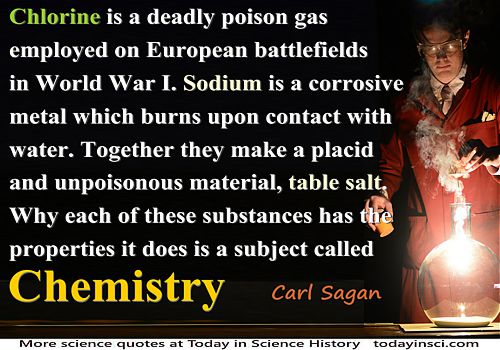
Chlorine is a deadly poison gas employed on European battlefields in World War I. Sodium is a corrosive metal which burns upon contact with water. Together they make a placid and unpoisonous material, table salt. Why each of these substances has the properties it does is a subject called chemistry.
In Broca's Brain: The Romance of Science (1979), 18, footnote.
Chymia, or Alchemy and Spagyrism, is the art of resolving compound bodies into their principles and of combining these again.
Fundamenta Chymiae (1720). Trans. J. R. Partington, A History of Chemistry (1961), Vol. 2, 664.
Chymistry. … An art whereby sensible bodies contained in vessels … are so changed, by means of certain instruments, and principally fire, that their several powers and virtues are thereby discovered, with a view to philosophy or medicine.
An antiquated definition, as quoted in Samuel Johnson, entry for 'Chymistry' in Dictionary of the English Language (1785). Also in The Quarterly Journal of Science, Literature, and the Arts (1821), 284, wherein a letter writer (only identified as “C”) points out that this definition still appeared in the, then, latest Rev. Mr. Todd’s Edition of Johnson’s Dictionary, and that it showed “very little improvement of scientific words.” The letter included examples of better definitions by Black and by Davy. (See their pages on this website.)
Computer science is no more about computers than astronomy is about telescopes, biology is about microscopes or chemistry is about beakers and test tubes. Science is not about tools. It is about how we use them, and what we find out when we do.
In G. Michael Schneider, Judith L. Gersting, Sara Baase, An invitation to Computer Science: Java version (2000), 2.
Considered from the standpoint of chemistry, living bodies appear to us as laboratories of chemical processes, for they undergo perpetual changes in their material substrate. They draw materials from the outside world and combine them with the mass of their liquid and solid parts.
In 'Allgemeine Betrachtungen der orgauischen Korper', Physiologie des Menschen (1830), Vol. 1, 34. Trans. in Kenneth L. Caneva, Robert Mayer and the Conservation of Energy (1993), 7I.
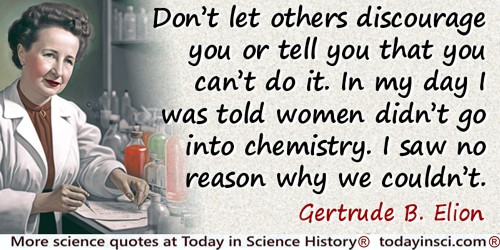
Don’t be afraid of hard work. Nothing worthwhile comes easily. Don’t let others discourage you or tell you that you can’t do it. In my day I was told women didn’t go into chemistry. I saw no reason why we couldn’t.
from her lecture notes
Dr. Johnson ... sometimes employed himself in chymistry, sometimes in watering and pruning a vine, and sometimes in small experiments, at which those who may smile, should recollect that there are moments which admit of being soothed only by trifles.
Quoted in James Boswell, The Life of Samuel Johnson, LL.D. (1826), Vol. 3, 352.
Engineering is quite different from science. Scientists try to understand nature. Engineers try to make things that do not exist in nature. Engineers stress invention. To embody an invention the engineer must put his idea in concrete terms, and design something that people can use. That something can be a device, a gadget, a material, a method, a computing program, an innovative experiment, a new solution to a problem, or an improvement on what is existing. Since a design has to be concrete, it must have its geometry, dimensions, and characteristic numbers. Almost all engineers working on new designs find that they do not have all the needed information. Most often, they are limited by insufficient scientific knowledge. Thus they study mathematics, physics, chemistry, biology and mechanics. Often they have to add to the sciences relevant to their profession. Thus engineering sciences are born.
Y.C. Fung and P. Tong, Classical and Computational Solid Mechanics (2001), 1.
Even mistaken hypotheses and theories are of use in leading to discoveries. This remark is true in all the sciences. The alchemists founded chemistry by pursuing chimerical problems and theories which are false. In physical science, which is more advanced than biology, we might still cite men of science who make great discoveries by relying on false theories. It seems, indeed, a necessary weakness of our mind to be able to reach truth only across a multitude of errors and obstacles.
An Introduction to the Study of Experimental Medicine (1865, translation 1927, 1957), 170.
Every scientist is an agent of cultural change. He may not be a champion of change; he may even resist it, as scholars of the past resisted the new truths of historical geology, biological evolution, unitary chemistry, and non-Euclidean geometry. But to the extent that he is a true professional, the scientist is inescapably an agent of change. His tools are the instruments of change—skepticism, the challenge to establish authority, criticism, rationality, and individuality.
In Science in Russian Culture: A History to 1860 (1963).
Experiments in geology are far more difficult than in physics and chemistry because of the greater size of the objects, commonly outside our laboratories, up to the earth itself, and also because of the fact that the geologic time scale exceeds the human time scale by a million and more times. This difference in time allows only direct observations of the actual geologic processes, the mind having to imagine what could possibly have happened in the past.
In 'The Scientific Character of Geology', The Journal of Geology (Jul 1961), 69, No. 4, 455-6.
Few scientists acquainted with the chemistry of biological systems at the molecular level can avoid being inspired. Evolution has produced chemical compounds exquisitely organized to accomplish the most complicated and delicate of tasks. Many organic chemists viewing crystal structures of enzyme systems or nucleic acids and knowing the marvels of specificity of the immune systems must dream of designing and synthesizing simpler organic compounds that imitate working features of these naturally occurring compounds.
In 'The Design of Molecular Hosts, Guests, and Their Complexes', Nobel Lecture, 8 December 1987. In Nobel Lectures: Chemistry 1981-1990 (1992), 419.
Finally, I aim at giving denominations to things, as agreeable to truth as possible. I am not ignorant that words, like money, possess an ideal value, and that great danger of confusion may be apprehended from a change of names; in the mean time it cannot be denied that chemistry, like the other sciences, was formerly filled with improper names. In different branches of knowledge, we see those matters long since reformed: why then should chemistry, which examines the real nature of things, still adopt vague names, which suggest false ideas, and favour strongly of ignorance and imposition? Besides, there is little doubt but that many corrections may be made without any inconvenience.
Physical and Chemical Essays (1784), Vol. I, xxxvii.
For chemistry is no science form’d à priori; ’tis no production of the human mind, framed by reasoning and deduction: it took its rise from a number of experiments casually made, without any expectation of what follow’d; and was only reduced into an art or system, by collecting and comparing the effects of such unpremeditated experiments, and observing the uniform tendency thereof. So far, then, as a number of experimenters agree to establish any undoubted truth; so far they may be consider'd as constituting the theory of chemistry.
From 'The Author's Preface', in A New Method of Chemistry (1727), vi.
For example, there are numbers of chemists who occupy themselves exclusively with the study of dyestuffs. They discover facts that are useful to scientific chemistry; but they do not rank as genuine scientific men. The genuine scientific chemist cares just as much to learn about erbium—the extreme rarity of which renders it commercially unimportant—as he does about iron. He is more eager to learn about erbium if the knowledge of it would do more to complete his conception of the Periodic Law, which expresses the mutual relations of the elements.
From 'Lessons from the History of Science: The Scientific Attitude' (c.1896), in Collected Papers (1931), Vol. 1, 20.
For it is not cell nuclei, not even individual chromosomes, but certain parts of certain chromosomes from certain cells that must be isolated and collected in enormous quantities for analysis; that would be the precondition for placing the chemist in such a position as would allow him to analyse [the hereditary material] more minutely than [can] the morphologists ... For the morphology of the nucleus has reference at the very least to the gearing of the clock, but at best the chemistry of the nucleus refers only to the metal from which the gears are formed.
Ergebnisse über die Konstitution der chromatischen Substam des Zellkems (1904), 123. Translated in Robert Olby, The Path to the Double Helix: The Discovery of DNA (1994), xx.
For the first time I saw a medley of haphazard facts fall into line and order. All the jumbles and recipes and Hotchpotch of the inorganic chemistry of my boyhood seemed to fit into the scheme before my eyes-as though one were standing beside a jungle and it suddenly transformed itself into a Dutch garden. “But it’s true,” I said to myself “It’s very beautiful. And it’s true.”
How the Periodic Table was explained in a first-term university lecture to the central character in the novel by C.P. Snow, The Search (1935), 38.
For those of us who make only a brief study of chemistry, the benefits to be expected are of an indirect nature. Increased capacity for enjoyment, a livelier interest in the world in which we live, a more intelligent attitude toward the great questions of the day—these are the by-products of a well-balanced education, including chemistry in its proper relation to other studies.
In 'Introduction', General Chemistry: An Elementary Survey Emphasizing Industrial Applications of Fundamental Principles (1923), 4.
From my father I learned to build things, to take them apart, and to fix mechanical and electrical equipment in general. I spent vast hours in a woodworking shop he maintained in the basement of our house, building gadgets, working both with my father and alone, often late into the night. … This play with building, fixing, and designing was my favorite activity throughout my childhood, and was a wonderful preparation for my later career as an experimentalist working on the frontiers of chemistry and physics.
From 'Richard E. Smalley: Biographical', collected in Tore Frängsmyr (ed.), Les Prix Nobel: The Nobel Prizes 1996 (1997).
From the infinitely great down to the infinitely small, all things are subject to [the laws of nature]. The sun and the planets follow the laws discovered by Newton and Laplace, just as the atoms in their combinations follow the laws of chemistry, as living creatures follow the laws of biology. It is only the imperfections of the human mind which multiply the divisions of the sciences, separating astronomy from physics or chemistry, the natural sciences from the social sciences. In essence, science is one. It is none other than the truth.
From Cours d’Economie Politique (1896-97), as given in Archives Internationales d’Histoire des Sciences (1993), Issues 131-133, 67.
Gaia is a thin spherical shell of matter that surrounds the incandescent interior; it begins where the crustal rocks meet the magma of the Earth’s hot interior, about 100 miles below the surface, and proceeds another 100 miles outwards through the ocean and air to the even hotter thermosphere at the edge of space. It includes the biosphere and is a dynamic physiological system that has kept our planet fit for life for over three billion years. I call Gaia a physiological system because it appears to have the unconscious goal of regulating the climate and the chemistry at a comfortable state for life. Its goals are not set points but adjustable for whatever is the current environment and adaptable to whatever forms of life it carries.
In The Revenge of Gaia: Earth’s Climate Crisis & The Fate of Humanity (2006, 2007), 19.
Genetics has enticed a great many explorers during the past two decades. They have labored with fruit-flies and guinea-pigs, with sweet peas and corn, with thousands of animals and plants in fact, and they have made heredity no longer a mystery but an exact science to be ranked close behind physics and chemistry in definiteness of conception. One is inclined to believe, however, that the unique magnetic attraction of genetics lies in the vision of potential good which it holds for mankind rather than a circumscribed interest in the hereditary mechanisms of the lowly species used as laboratory material. If man had been found to be sharply demarcated from the rest of the occupants of the world, so that his heritage of physical form, of physiological function, and of mental attributes came about in a superior manner setting him apart as lord of creation, interest in the genetics of the humbler organisms—if one admits the truth—would have flagged severely. Biologists would have turned their attention largely to the ways of human heredity, in spite of the fact that the difficulties encountered would have rendered progress slow and uncertain. Since this was not the case, since the laws ruling the inheritance of the denizens of the garden and the inmates of the stable were found to be applicable to prince and potentate as well, one could shut himself up in his laboratory and labor to his heart's content, feeling certain that any truth which it fell to his lot to discover had a real human interest, after all.
Mankind at the Crossroads (1923), v-vi.
Geology differs from physics, chemistry, and biology in that the possibilities for experiment are limited.
In 'The Scientific Character of Geology', The Journal of Geology (Jul 1961), 69, No. 4, 453.
Geology has its peculiar difficulties, from which all other sciences are exempt. Questions in chemistry may be settled in the laboratory by experiment. Mathematical and philosophical questions may be discussed, while the materials for discussion are ready furnished by our own intellectual reflections. Plants, animals and minerals, may be arranged in the museum, and all questions relating to their intrinsic principles may be discussed with facility. But the relative positions, the shades of difference, the peculiar complexions, whether continuous or in subordinate beds, are subjects of enquiry in settling the character of rocks, which can be judged of while they are in situ only.
A Geological and Agricultural Survey of the District Adjoining the Erie Canal (1824), 8.
Geology is intimately related to almost all the physical sciences, as is history to the moral. An historian should, if possible, be at once profoundly acquainted with ethics, politics, jurisprudence, the military art, theology; in a word, with all branches of knowledge, whereby any insight into human affairs, or into the moral and intellectual nature of man, can be obtained. It would be no less desirable that a geologist should be well versed in chemistry, natural philosophy, mineralogy, zoology, comparative anatomy, botany; in short, in every science relating to organic and inorganic nature. With these accomplishments the historian and geologist would rarely fail to draw correct and philosophical conclusions from the various monuments transmitted to them of former occurrences.
Principles of Geology (1830-3), Vol. 1, 2-3.
Geology itself is only chemistry with the element of time added.
In 'Progress of Culture', an address read to the Phi Beta Kappa Society at Cambridge, 18 July 1867. Collected in Works of Ralph Waldo Emerson (1883), 475.
Great cities are levelling; they lift up the low and depress the high; they exalt mediocrity and abase superlativeness—the result of the action of the mass, as powerful in social life as in chemistry.
From Miguel Unamuno and J. E. Crawford Flitch (trans.), Essays and Soliloquies (1926), 126.
He [William Harvey] did not care for chymistrey, and was wont to speake against them with an undervalue.
Brief Lives (1680), edited by Oliver Lawson Dick (1949), 132.
He never got drunk, he never got tired, and he never perspired.
[Harvard chemistry students’ axioms.]
[Harvard chemistry students’ axioms.]
As attributed in John D. Roberts, The Right Place at the Right Time (1990), 52.
He that could teach mathematics well, would not be a bad teacher in any of [physics, chemistry, biology or psychology] unless by the accident of total inaptitude for experimental illustration; while the mere experimentalist is likely to fall into the error of missing the essential condition of science as reasoned truth; not to speak of the danger of making the instruction an affair of sensation, glitter, or pyrotechnic show.
In Education as a Science (1879), 298.
His motion to the meeting of the Council of the Chemical Society:
That henceforth the absurd game of chemical noughts and crosses be tabu within the Society's precincts and that, following the practice of the Press in ending a correspondence, it be an instruction to the officers to give notice “That no further contributions to the mysteries of Polarity will be received, considered or printed by the Society.” His challenge was not accepted.
That henceforth the absurd game of chemical noughts and crosses be tabu within the Society's precincts and that, following the practice of the Press in ending a correspondence, it be an instruction to the officers to give notice “That no further contributions to the mysteries of Polarity will be received, considered or printed by the Society.” His challenge was not accepted.
From the personal and other items column of Chemistry and Industry (1925), 44, 1050.
Historically [chemistry] arose from a constellation of interests: the empirically based technologies of early metallurgists, brewers, dyers, tanners, calciners and pharmacists; the speculative Greek philosphers' concern whether brute matter was invariant or transformable; the alchemists' real or symbolic attempts to achieve the transmutation of base metals into gold; and the iatrochemists' interst in the chemistry and pathology of animal and human functions. Partly because of the sheer complexity of chemical phenomena, the absence of criteria and standards of purity, and uncertainty over the definition of elements ... but above all because of the lack of a concept of the gaseous state of matter, chemistry remained a rambling, puzzling and chaotic area of natural philosophy until the middle of the eighteenth century.
The Chemical Tree: A History of Chemistry (2000), xxii.
How far will chemistry and physics … help us understand the appeal of a painting?
Colour: Why the World Isn’t Grey (1983). Quoted in Sidney Perkowitz, Empire of Light (1999), 1.
I am afraid I shall have to give up my trade; I am far too inert to keep up with organic chemistry, it is becoming too much for me, though I may boast of having contributed something to its development. The modern system of formulae is to me quite repulsive.
Letter to Christian Schönbein (21 May 1862), The Letters of Faraday and Schoenbein, 1836-1862 (1899), footnote, 225.
I am an organic chemist, albeit one who adheres to the definition of organic chemistry given by the great Swedish chemist Berzelius, namely, the chemistry of substances found in living matter, and my science is one of the more abstruse insofar as it rests on concepts and employs a jargon neither of which is a part of everyday experience. Nevertheless, organic chemistry deals with matters of truly vital Importance and in some of its aspects with which I myself have been particularly concerned it may prove to hold the keys to Life itself.
In 'Synthesis in the Study of Nucleotides', Nobel Lecture, 11 December 1957. In Nobel Lectures: Chemistry 1942-1962 (1964), 522.
I am now convinced that we have recently become possessed of experimental evidence of the discrete or grained nature of matter, which the atomic hypothesis sought in vain for hundreds and thousands of years. The isolation and counting of gaseous ions, on the one hand, which have crowned with success the long and brilliant researches of J.J. Thomson, and, on the other, agreement of the Brownian movement with the requirements of the kinetic hypothesis, established by many investigators and most conclusively by J. Perrin, justify the most cautious scientist in now speaking of the experimental proof of the atomic nature of matter, The atomic hypothesis is thus raised to the position of a scientifically well-founded theory, and can claim a place in a text-book intended for use as an introduction to the present state of our knowledge of General Chemistry.
In Grundriss der allgemeinen Chemie (4th ed., 1909), Preface, as cited by Erwin N. Hiebert and Hans-Gunther Korber in article on Ostwald in Charles Coulston Gillespie (ed.), Dictionary of Scientific Biography Supplement 1, Vol 15-16, 464.
I believe that the science of chemistry alone almost proves the existence of an intelligent creator.
…...
I came to biochemistry through chemistry; I came to chemistry, partly by the labyrinthine routes that I have related, and partly through the youthful romantic notion that the natural sciences had something to do with nature. What I liked about chemistry was its clarity surrounded by darkness; what attracted me, slowly and hesitatingly, to biology was its darkness surrounded by the brightness of the givenness of nature, the holiness of life. And so I have always oscillated between the brightness of reality and the darkness of the unknowable. When Pascal speaks of God in hiding, Deus absconditus, we hear not only the profound existential thinker, but also the great searcher for the reality of the world. I consider this unquenchable resonance as the greatest gift that can be bestowed on a naturalist.
Heraclitean Fire: Sketches from a Life before Nature (1978), 55.
I do not find that any one has doubted that there are four elements. The highest of these is supposed to be fire, and hence proceed the eyes of so many glittering stars. The next is that spirit, which both the Greeks and ourselves call by the same name, air. It is by the force of this vital principle, pervading all things and mingling with all, that the earth, together with the fourth element, water, is balanced in the middle of space.
In The Natural History of Pliny (1855), Vol. 1, 18.
I do not know if I am mistaken, but it seems that one can obtain more truths, important to Humanity, from Chemistry than from any other Science.
In Chemische Annalen (Crell;s) I:291-305, 1788. As cited in Israel S. Kleiner, 'Hahnemann as a Chemist', The Scientific Monthly (May 1938), 46, 450. The quote is the opening words of an article describing his test for lead and iron in wine.
I do not know whether you are fond of chemical reading. There are some things in this science worth reading.
Letter to Mr. Rittenhouse (Paris, 1786). In Thomas Jefferson and John P. Foley (ed.), The Jeffersonian Cyclopedia (1900), 135. From H.A. Washington, The Writings of Thomas Jefferson (1853-54). Vol 1, 517.
I do not want chemistry to degenerate into a religion; I do not want the chemist to believe in the existence of atoms as the Christian believes in the existence of Christ in the communion wafer.
Said to Alfred Nacquet in a debate on chemical education. Quoted in 'Berthelot', Berichte, 1908, 41, 4855.
I hadn’t been aware that there were doors closed to me until I started knocking on them. I went to an all-girls school. There were 75 chemistry majors in that class, but most were going to teach it … When I got out and they didn't want women in the laboratory, it was a shock … It was the Depression and nobody was getting jobs. But I had taken that to mean nobody was getting jobs … [when I heard] “You're qualified. But we’ve never had a woman in the laboratory before, and we think you’d be a distracting influence.”
As quoted in Sharon Bertsch McGrayne, Nobel Prize Women in Science: Their Lives, Struggles and Momentous Discoveries (1993).
I have always been very fond of mathematics—for one short period, I even toyed with the possibility of abandoning chemistry in its favour. I enjoyed immensely both its conceptual and formal beauties, and the precision and elegance of its relationships and transformations. Why then did I not succumb to its charms? … because by and large, mathematics lacks the sensuous elements which play so large a role in my attraction to chemistry.I love crystals, the beauty of their forms and formation; liquids, dormant, distilling, sloshing! The fumes, the odors—good or bad, the rainbow of colors; the gleaming vessels of every size, shape and purpose.
In Arthur Clay Cope Address, Chicago (28 Aug 1973). In O. T. Benfey and P. J. T. Morris (eds.), Robert Burns Woodward. Architect and Artist in the World of Molecules (2001), 427.
I have always had the feeling that organic chemistry is a very peculiar science, that organic chemists are unlike other men, and there are few occupations that give more satisfactions [sic] than masterly experimentation along the old lines of this highly specialised science.
Henderson’s memories, unpublished typescript, 85-6, Harvard University Archives 4450.7.2. Quoted in J. S. Fruton, Contrasts in Scientific Style (1990), 194.
I have been so electrically occupied of late that I feel as if hungry for a little chemistry: but then the conviction crosses my mind that these things hang together under one law & that the more haste we make onwards each in his own path the sooner we shall arrive, and meet each other, at that state of knowledge of natural causes from which all varieties of effects may be understood & enjoyed.
Letter to Eilhard Mitscherlich, 24 Jan 1838. In Frank A. J. L. James (ed.), The Correspondence of Michael Faraday (1993), Vol. 2, 488.
I have paid special attention to those Properties of the Positive Rays which seem to throw light on the problems of the structure of molecules and atoms and the question of chemical combination … I am convinced that as yet we are only at the beginning of the harvest of results which will elucidate the process of chemical combination, and thus bridge over the most serious gap which now exists between Physics and Chemistry.
Rays of Positive Electricity and their Application to Chemical Analyses (1921), v.
I have reviewed this work elsewhere under the title 'Natural Products Chemistry 1950 to 1980-A Personal View.' It is with some relish that I recall the flood of reprint requests prompted by the following footnote on the title page: 'Selected personal statements by the author were removed by the editor without Professor Djerassi's consent. An uncensored version of this paper can be obtained by writing to Professor C. Djerassi'.
Steroids Made it Possible (1990), 14.
I have wished to see chemistry applied to domestic objects, to malting, for instance, brewing, making cider, to fermentation and distillation generally, to the making of bread, butter, cheese, soap, to the incubation of eggs, &c.
Letter to Thomas Cooper (Monticello, 1812). In Thomas Jefferson and John P. Foley (ed.), The Jeffersonian Cyclopedia (1900), 135. From H.A. Washington, The Writings of Thomas Jefferson (1853-54). Vol 6, 73.
I hope that in due time the chemists will justify their proceedings by some large generalisations deduced from the infinity of results which they have collected. For me I am left hopelessly behind and I will acknowledge to you that through my bad memory organic chemistry is to me a sealed book. Some of those here, [August] Hoffman for instance, consider all this however as scaffolding, which will disappear when the structure is built. I hope the structure will be worthy of the labour. I should expect a better and a quicker result from the study of the powers of matter, but then I have a predilection that way and am probably prejudiced in judgment.
Letter to Christian Schönbein (9 Dec 1852), The Letters of Faraday and Schoenbein, 1836-1862 (1899), 209-210.
I looked for it [heavy hydrogen, deuterium] because I thought it should exist. I didn't know it would have industrial applications or be the basic for the most powerful weapon ever known [the nuclear bomb] … I thought maybe my discovery might have the practical value of, say, neon in neon signs.
[He was awarded the 1931 Nobel Prize in Chemistry for discovering deuterium.]
[He was awarded the 1931 Nobel Prize in Chemistry for discovering deuterium.]
Quoted in 'Moon-Struck Scientist,' New York Times (27 Apr 1961), 42.
I might paraphrase Churchill and say: never have I received so much for so little.
[Exemplifying humility, upon accepting the Nobel Prize in Chemistry.]
[Exemplifying humility, upon accepting the Nobel Prize in Chemistry.]
In Banquet Speech, Stokholm (10 Dec 1970). Nobelprize.org website.
I notice that, in the lecture … which Prof. Lowry gave recently, in Paris … he brought forward certain freak formulae for tartaric acid, in which hydrogen figures as bigamist … I may say, he but follows the loose example set by certain Uesanians, especially one G. N. Lewis, a Californian thermodynamiter, who has chosen to disregard the fundamental canons of chemistry—for no obvious reason other than that of indulging in premature speculation upon electrons as the cause of valency…
'Bigamist Hydrogen. A Protest', Nature (1926), 117, 553.
I recognize nothing that is not material. In physics, chemistry and biology I see only mechanics. The Universe is nothing but an infinite and complex mechanism. Its complexity is so great that it borders on willfulness, suddenness, and randomness; it gives the illusion of free will possessed by conscious beings.
In Monism of the Universe (1931).
I remember chemistry, which I never took again, a good high school chemistry course. I passed first in New York in the College Entrance Board examination in chemistry that year, almost broke into tears because I didn’t get a hundred percent. I only got ninety-eight point six, or whatever it was, something very high. But not perfect, and therefore disturbing.
From transcript of oral history interview by Jesse Wright, Niels Bohr Library & Archives (31 Jul 1974). Greenstein graduated from high school, and entered Harvard University, at age fifteen.
I shall attack Chemistry, like a Shark.
On his plans to set up a joint chemistry laboratory with Davy and Wordsworth in the Lake District.
On his plans to set up a joint chemistry laboratory with Davy and Wordsworth in the Lake District.
Letter to Humphry Davy, 15 July 1800. In Earl Leslie Griggs (ed.), The Collected Letters of Samuel Taylor Coleridge (1956), Vol. 1, 605.
I should not think of devoting less than 20 years to an Epic Poem. Ten to collect materials and warm my mind with universal science. I would be a tolerable Mathematician, I would thoroughly know Mechanics, Hydrostatics, Optics, and Astronomy, Botany, Metallurgy, Fossilism, Chemistry, Geology, Anatomy, Medicine—then the mind of man—then the minds of men—in all Travels, Voyages and Histories. So I would spend ten years—the next five to the composition of the poem—and the five last to the correction of it. So I would write haply not unhearing of the divine and rightly-whispering Voice, which speaks to mighty minds of predestinated Garlands, starry and unwithering.
Letter to Joseph Cottle, early April 1797. In Earl Leslie Griggs (ed.), The Collected Letters of Samuel Taylor Coleridge (1956), Vol. 1, 320-1.
I suppose I should be run after for a professorship if I had studied at Giessen, as it seems to be a settled point that no young man can be expected to know anything of chemistry unless he has studied with Liebig; while the truth is, that any one who goes there and does not afterwards correct the bad habits acquired there, in some other laboratory, is almost unfitted for doing things in Chemistry. No doubt Liebig is a remarkable man, who has done much for organic Chemistry, not to speak of his having quarreled with all the Chemists in Europe...
Letter to his brother, William Dwight Whitney (25 Apr 1846). In Edwin Tenney Brewster and Josiah Dwight Whitney, Life and Letters of Josiah Dwight Whitney (1909), 79-80.
I think chemistry is being frittered away by the hairsplitting of the organic chemists; we have new compounds discovered, which scarcely differ from the known ones and when discovered are valueless—very illustrations perhaps of their refinements in analysis, but very little aiding the progress of true science.
Letter to William Grove (5 Jan 1845), The Letters of Faraday and Schoenbein, 1836-1862 (1899), Footnote, 209.
I think it is a sad reflection on our civilization that while we can and do measure the temperature in the atmosphere of Venus we do not know what goes on inside our soufflés.
[Remark made while demonstrating the progress of cooking a Soufflé à la Chartreuse, demonstrating its progress with thermocouples and chart recorders.]
[Remark made while demonstrating the progress of cooking a Soufflé à la Chartreuse, demonstrating its progress with thermocouples and chart recorders.]
Friday Evening Discourse at the Royal Institution, ‘The Physicist in the Kitchen’. In Proceedings of the Royal Institution (1969), 42/199, 451–67. Cited in article on Kurti by Ralph G. Scurlock in Oxford Dictionary of National Biography.
I think my most important work has been done on the borderlines between different areas of science. My first work was in geophysics, a combination of physics and geology, and then at the Bell Laboratories, it was more a combination of physics and electrical engineering. That’s what I’m following more or less as time goes on. My appointment here at the university relates to physics and electrical engineering, but I have also worked in the borderline areas between physics and chemistry. I think reading widely and being interested in many different areas in science is important.
In Robert L. Burtch, 'Interview with a Nobel Laureate: Fifth Graders Learn About a Scientist We All Should Know', Science and Children, (Nov/Dec 1990), 28, No. 3, 16-17.
I think we may picture those domains where understanding exists, whether in physics, chemistry, biology, psychology, economics or any other discipline as cultivated valleys in a formidably mountainous country. We may recognise in principle that we all inhabit the same world but in practice we do well to cultivate our own valleys, with an occasional assault on the more accessible foothills, rather than to build roads in a vain attempt at colonisation.
From Inaugural Lecture as Cavendish Professor of Physics, Cambridge, as quoted in Gordon L. Glegg, The Development of Design (1981), 1-2.
I took biology in high school and didn't like it at all. It was focused on memorization. ... I didn't appreciate that biology also had principles and logic ... [rather than dealing with a] messy thing called life. It just wasn't organized, and I wanted to stick with the nice pristine sciences of chemistry and physics, where everything made sense. I wish I had learned sooner that biology could be fun as well.
Interview (23 May 1998), 'Creating the Code to Life', Academy of Achievement web site.
I trust ... I have succeeded in convincing you that modern chemistry is not, as it has so long appeared, an ever-growing accumulation of isolated facts, as impossible for a single intellect to co-ordinate as for a single memory to grasp.
The intricate formulae that hang upon these walls, and the boundless variety of phenomena they illustrate, are beginning to be for us as a labyrinth once impassable, but to which we have at length discovered the clue. A sense of mastery and power succeeds in our minds to the sort of weary despair with which we at first contemplated their formidable array. For now, by the aid of a few general principles, we find ourselves able to unravel the complexities of these formulae, to marshal the compounds which they represent in orderly series; nay, even to multiply their numbers at our will, and in a great measure to forecast their nature ere we have called them into existence. It is the great movement of modern chemistry that we have thus, for an hour, seen passing before us. It is a movement as of light spreading itself over a waste of obscurity, as of law diffusing order throughout a wilderness of confusion, and there is surely in its contemplation something of the pleasure which attends the spectacle of a beautiful daybreak, something of the grandeur belonging to the conception of a world created out of chaos.
The intricate formulae that hang upon these walls, and the boundless variety of phenomena they illustrate, are beginning to be for us as a labyrinth once impassable, but to which we have at length discovered the clue. A sense of mastery and power succeeds in our minds to the sort of weary despair with which we at first contemplated their formidable array. For now, by the aid of a few general principles, we find ourselves able to unravel the complexities of these formulae, to marshal the compounds which they represent in orderly series; nay, even to multiply their numbers at our will, and in a great measure to forecast their nature ere we have called them into existence. It is the great movement of modern chemistry that we have thus, for an hour, seen passing before us. It is a movement as of light spreading itself over a waste of obscurity, as of law diffusing order throughout a wilderness of confusion, and there is surely in its contemplation something of the pleasure which attends the spectacle of a beautiful daybreak, something of the grandeur belonging to the conception of a world created out of chaos.
Concluding remark for paper presented at the Friday Discourse of the the Royal Institution (7 Apr 1865). 'On the Combining Power of Atoms', Proceedings of the Royal Institution (1865), 4, No. 42, 416.
I venture to maintain, that, if the general culture obtained in the Faculty of Arts were what it ought to be, the student would have quite as much knowledge of the fundamental principles of Physics, of Chemistry, and of Biology, as he needs, before he commenced his special medical studies. Moreover, I would urge, that a thorough study of Human Physiology is, in itself, an education broader and more comprehensive than much that passes under that name. There is no side of the intellect which it does not call into play, no region of human knowledge into which either its roots, or its branches, do not extend; like the Atlantic between the Old and the New Worlds, its waves wash the shores of the two worlds of matter and of mind; its tributary streams flow from both; through its waters, as yet unfurrowed by the keel of any Columbus, lies the road, if such there be, from the one to the other; far away from that Northwest Passage of mere speculation, in which so many brave souls have been hopelessly frozen up.
'Universities: Actual and Ideal' (1874). In Collected Essays (1893), Vol. 3, 220.
I want to get back again from Chemistry to Physics as soon as I can. The second-rate men seem to know their place so much better.
R. J. Strutt, John William Strutt, Third Baron Rayleigh (1924), 222.
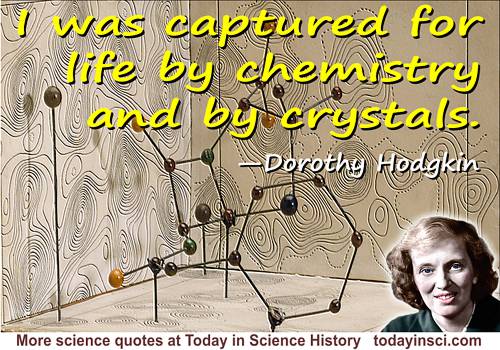
I was captured for life by chemistry and by crystals.
Oxford Dictionary of Quotations, 6th ed.
I will now direct the attention of scientists to a previously unnoticed cause which brings about the metamorphosis and decomposition phenomena which are usually called decay, putrefaction, rotting, fermentation and moldering. This cause is the ability possessed by a body engaged in decomposition or combination, i.e. in chemical action, to give rise in a body in contact with it the same ability to undergo the same change which it experiences itself.
Annalen der Pharmacie 1839, 30, 262. Trans. W. H. Brock.
I wish the lecturers to treat their subject as a strictly natural science, the greatest of all possible sciences, indeed, in one sense, the only science, that of Infinite Being, without reference to or reliance upon any supposed special exception or so-called miraculous revelation. I wish it considered just as astronomy or chemistry is.
Statement in deed of foundation of the Gifford Lectures on natural theology (1885).
Statement in deed of foundation of the Gifford Lectures on natural theology (1885).
Quoted in Michael A. Arbib and Mary B. Hesse, The Construction of Reality (1986), 1.
I would efface the word atoms from science, persuaded that it goes further than experience... In chemistry we should never go further than experience. Could there be any hope of ever identifying the minuscule entities?
Quoted, without citation, in Nick Herbert, Quantum Reality: Beyond the New Physics, (1985), 9.
I would have you to observe that the difficulty & mystery which often appear in matters of science & learning are only owing to the terms of art used in them, & if many gentlemen had not been rebuted by the uncouth dress in which science was offered to them, we must believe that many of these who now shew an acute & sound judgement in the affairs of life would also in science have excelled many of those who are devoted to it & who were engaged in it only by necessity & a phlegmatic temper. This is particularly the case with respect to chemistry, which is as easy to be comprehended as any of the common affairs of life, but gentlemen have been kept from applying to it by the jargon in which it has been industriously involved.
Cullen MSS, No. 23, Glasgow University library. In A. L. Donovan, Philosophical Chemistry In the Scottish Enlightenment: The Doctrines and Discoveries of Wllliam Cullen and Joseph Black (1975), 111.
I would like to emphasize strongly my belief that the era of computing chemists, when hundreds if not thousands of chemists will go to the computing machine instead of the laboratory for increasingly many facets of chemical information, is already at hand. There is only one obstacle, namely that someone must pay for the computing time.
'Spectroscopy, Molecular Orbitals, and Chemical Bonding', Nobel Lecture (12 Dec 1966). In Nobel Lectures: Chemistry 1963-1970 (1972), 159.
I would like to start by emphasizing the importance of surfaces. It is at a surface where many of our most interesting and useful phenomena occur. We live for example on the surface of a planet. It is at a surface where the catalysis of chemical reactions occur. It is essentially at a surface of a plant that sunlight is converted to a sugar. In electronics, most if not all active circuit elements involve non-equilibrium phenomena occurring at surfaces. Much of biology is concerned with reactions at a surface.
'Surface properties of semiconductors', Nobel Lecture (11 Dec 1956). In Nobel Lectures, Physics 1942-1962 (1967), 377.
I would... establish the conviction that Chemistry, as an independent science, offers one of the most powerful means towards the attainment of a higher mental cultivation; that the study of Chemistry is profitable, not only inasmuch as it promotes the material interests of mankind, but also because it furnishes us with insight into those wonders of creation which immediately surround us, and with which our existence, life, and development, are most closely connected.
Familiar Letters on Chemistry (1859), 4th edn., 1.
I’m on the verge of a major breakthrough, but I’m also at the point where physics ends and chemistry begins, so I’ll have to drop the whole thing,
Epigraph in Michael Dudley Sturge , Statistical and Thermal Physics (2003), 139.
If everything in chemistry is explained in a satisfactory manner without the help of phlogiston, it is by that reason alone infinitely probable that the principle does not exist; that it is a hypothetical body, a gratuitous supposition; indeed, it is in the principles of good logic, not to multiply bodies without necessity.
'Reflexions sur le phlogistique', Mémoires de l'Académie des Sciences, 1783, 505-38. Reprinted in Oeuvres de Lavoisier (1864), Vol. 2, 623, trans. M. P. Crosland.
If it be urged that the action of the potato is chemical and mechanical only, and that it is due to the chemical and mechanical effects of light and heat, the answer would seem to lie in an enquiry whether every sensation is not chemical and mechanical in its operation? Whether those things which we deem most purely spiritual are anything but disturbances of equilibrium in an infinite series of levers, beginning with those that are too small for microscopic detection, and going up to the human arm and the appliances which it makes use of? Whether there be not a molecular action of thought, whence a dynamical theory of the passions shall be deducible?
In Erewhon, Or, Over the Range (1872), 192.
If it’s green or wriggles, it’s biology. If it stinks, it’s chemistry. If it doesn’t work, it’s physics or engineering. If it’s green and wiggles and stinks and still doesn’t work, it’s psychology. If it’s incomprehensible, it’s mathematics. If it puts you to sleep, it’s statistics.
In Journal of the South African Institute of Mining and Metallurgy (1978), 79, 97, and additional lines from other sources.
If materialism is true, it seems to me that we cannot know that it is true. If my opinions are the result of the chemical processes going on in my brain, they are determined by the laws of chemistry, not those of logic.
The Inequality of Man (1932), 162.
If the laws of physics and chemistry are universal, we can extrapolate the events of Earth’s chemical evolution to other planets and other stars and thus argue for the possibility of life beyond Earth.
In 'Cosmochemistry The Earliest Evolution', The Science Teacher (Oct 1983), 50, No. 7, 36.
If the modern conception of the atom is correct the barrier which separated physics from chemistry has been removed.
The Electron in Chemistry (1923), Preface.
If the task of scientific methodology is to piece together an account of what scientists actually do, then the testimony of biologists should be heard with specially close attention. Biologists work very close to the frontier between bewilderment and understanding.
Biology is complex, messy and richly various, like real life; it travels faster nowadays than physics or chemistry (which is just as well, since it has so much farther to go), and it travels nearer to the ground. It should therefore give us a specially direct and immediate insight into science in the making.
Biology is complex, messy and richly various, like real life; it travels faster nowadays than physics or chemistry (which is just as well, since it has so much farther to go), and it travels nearer to the ground. It should therefore give us a specially direct and immediate insight into science in the making.
Induction and Intuition in Scientific Thought (1969), 1.
If there is life elsewhere in the universe, chemically speaking, it would be very similar to what we have on earth.
Speaking at a 1986 Fall Meeting of the American Chemical Society, Anaheim, California, as quoted and cited in J. Raloff, 'Is There a Cosmic Chemistry of Life?', Science News (20 Sep 1986), 130, No. 12, 182.
If you want to become a chemist, you will have to ruin your health. If you don’t ruin your health studying, you won’t accomplish anything these days in chemistry.
Liebig's advice to Kekulé. Quoted in Berichte der Deutschen Chemischen Gesellschaft, 23, 1890. Trans. W. H. Brock.
Imagination and even sentiment play an important part in chemistry, and that if too narrowly and rigidly interpreted, facts may become very misleading factors.
In article 'Chemistry', Encyclopedia Britannica (1902), 714.
Imagine a school-boy who has outgrown his clothes. Imagine the repairs made on the vestments where the enlarged frame had burst the narrow limits of the enclosure. Imagine the additions made where the projecting limbs had fairly and far emerged beyond the confines of the garment. Imagine the boy still growing, and the clothes, mended allover, now more than ever in want of mending—such is chemistry, and such is nomenclature.
Chemical Recreations (1834), 206, footnote.
In 1912 I went to a book sale and bought ten books for fifty cents. One of the books was by Ostwald The Scientific Foundations of Analytical Chemistry. Ostwald wrote at the beginning of that book that analytical chemists are the maidservants of other chemists. This made quite an impression on me, because I didn't want to be a maidservant.
Comment during interview, Beckman Center (15 March 1984), as recorded on tape held by The Chemical Heritage Foundation, Philadelphia. Quotation provided by W. H. Brock.
In all our academies we attempt far too much. ... In earlier times lectures were delivered upon chemistry and botany as branches of medicine, and the medical student learned enough of them. Now, however, chemistry and botany are become sciences of themselves, incapable of comprehension by a hasty survey, and each demanding the study of a whole life, yet we expect the medical student to understand them. He who is prudent, accordingly declines all distracting claims upon his time, and limits himself to a single branch and becomes expert in one thing.
Quoted in Johann Hermann Baas, Henry Ebenezer Handerson (trans.), Outlines of the History of Medicine and the Medical Profession (1889), 842-843.
In arranging the bodies in order of their electrical nature, there is formed an electro-chemical system which, in my opinion, is more fit than any other to give an idea of chemistry.
Essai sur le théorie des proportions chimiques (1819). Translated in Henry M. Leicester and Herbert S. Klickstein, A Source Book in Chemistry 1400-1900 (1952), 260.
In chemistry, our theories are crutches; to show that they are valid, they must be used to walk... A theory established with the help of twenty facts must explain thirty, and lead to the discovery of ten more.
Leçons sur la Philosophie Chimique (1837), 60. Trans. S. Kapoor, 'Dumas and Organic Classification', Ambix, 1969, 16, 4.
In college I largely wasted my opportunities. My worst subjects were drawing and science. Almost my only memory of the chemistry class was of making some sulfuric acid into a foul-smelling concoction and dropping it into another student’s pocket.
From My Own Story (1957), 55.
In early life I had felt a strong desire to devote myself to the experimental study of nature; and, happening to see a glass containing some camphor, portions of which had been caused to condense in very beautiful crystals on the illuminated side, I was induced to read everything I could obtain respecting the chemical and mechanical influences of light, adhesion, and capillary attraction.
In preface to Scientific Memoirs (1878), xii.
In early times, when the knowledge of nature was small, little attempt was made to divide science into parts, and men of science did not specialize. Aristotle was a master of all science known in his day, and wrote indifferently treatises on physics or animals. As increasing knowledge made it impossible for any one man to grasp all scientific subjects, lines of division were drawn for convenience of study and of teaching. Besides the broad distinction into physical and biological science, minute subdivisions arose, and, at a certain stage of development, much attention was, given to methods of classification, and much emphasis laid on the results, which were thought to have a significance beyond that of the mere convenience of mankind.
But we have reached the stage when the different streams of knowledge, followed by the different sciences, are coalescing, and the artificial barriers raised by calling those sciences by different names are breaking down. Geology uses the methods and data of physics, chemistry and biology; no one can say whether the science of radioactivity is to be classed as chemistry or physics, or whether sociology is properly grouped with biology or economics. Indeed, it is often just where this coalescence of two subjects occurs, when some connecting channel between them is opened suddenly, that the most striking advances in knowledge take place. The accumulated experience of one department of science, and the special methods which have been developed to deal with its problems, become suddenly available in the domain of another department, and many questions insoluble before may find answers in the new light cast upon them. Such considerations show us that science is in reality one, though we may agree to look on it now from one side and now from another as we approach it from the standpoint of physics, physiology or psychology.
But we have reached the stage when the different streams of knowledge, followed by the different sciences, are coalescing, and the artificial barriers raised by calling those sciences by different names are breaking down. Geology uses the methods and data of physics, chemistry and biology; no one can say whether the science of radioactivity is to be classed as chemistry or physics, or whether sociology is properly grouped with biology or economics. Indeed, it is often just where this coalescence of two subjects occurs, when some connecting channel between them is opened suddenly, that the most striking advances in knowledge take place. The accumulated experience of one department of science, and the special methods which have been developed to deal with its problems, become suddenly available in the domain of another department, and many questions insoluble before may find answers in the new light cast upon them. Such considerations show us that science is in reality one, though we may agree to look on it now from one side and now from another as we approach it from the standpoint of physics, physiology or psychology.
In article 'Science', Encyclopedia Britannica (1911), 402.
In general, art has preceded science. Men have executed great, and curious, and beautiful works before they had a scientific insight into the principles on which the success of their labours was founded. There were good artificers in brass and iron before the principles of the chemistry of metals were known; there was wine among men before there was a philosophy of vinous fermentation; there were mighty masses raised into the air, cyclopean walls and cromlechs, obelisks and pyramids—probably gigantic Doric pillars and entablatures—before there was a theory of the mechanical powers. … Art was the mother of Science.
Lecture (26 Nov 1851), to the London Society of Arts, 'The General Bearing of the Great Exhibition on the Progress of Art and Science', collected in Lectures on the Results of the Great Exhibition of 1851' (1852), 7-8.
In inorganic chemistry the radicals are simple; in organic chemistry they are compounds—that is the sole difference.
Joint paper with Liebig, but written by Dumas, Comptes Rendus 1837, 5, 567. Trans. J. R. Partington, A History of Chemistry, Vol. 4, 351.
In Institutions of a lower grade [secondary schools], it [geology] receives far less attention than its merits deserve. Why should not a science, whose facts possess a thrilling interest; whose reasonings are admirably adapted for mental discipline, and often severely tax the strongest powers; and whose results are, many of them, as grand and ennobling as those of Astronomy itself; … why should not such a science be thought as essential in education as the kindred branches of Chemistry and Astronomy?
In 'Preface', Elementary Geology (1840, 1841), vi.
In Melvin Calvin’s office there were four photographs: Michael Polanyi, Joel Hildebrand, Gilbert N. Lewis, and Ernest O. Lawrence. These scientists were his mentors: Polanyi for introducing him to the chemistry of phthalocyanine; Hildebrand for bringing him to Berkeley; Lewis, perhaps his most influential teacher; and Lawrence, who provided him the opportunity to work with the new scientific tool of radioactive carbon, which enabled the search for the path of carbon in photosynthesis to be successful.
Co-author with Marilyn Taylor and Robert E. Connick, obituary, 'Melvin Calvin', Proceedings of the American Philosophical Society (Dec 2000), 144, No. 4, 454.
In modern Europe, the Middle Ages were called the Dark Ages. Who dares to call them so now? … Their Dante and Alfred and Wickliffe and Abelard and Bacon; their Magna Charta, decimal numbers, mariner’s compass, gunpowder, glass, paper, and clocks; chemistry, algebra, astronomy; their Gothic architecture, their painting,—are the delight and tuition of ours. Six hundred years ago Roger Bacon explained the precession of the equinoxes, and the necessity of reform in the calendar; looking over how many horizons as far as into Liverpool and New York, he announced that machines can be constructed to drive ships more rapidly than a whole galley of rowers could do, nor would they need anything but a pilot to steer; carriages, to move with incredible speed, without aid of animals; and machines to fly into the air like birds.
In 'Progress of Culture', an address read to the Phi Beta Kappa Society at Cambridge, 18 July 1867. Collected in Works of Ralph Waldo Emerson (1883), 475.
In order to discover Truth in this manner by observation and reason, it is requisite we should fix on some principles whose certainty and effects are demonstrable to our senses, which may serve to explain the phenomena of natural bodies and account for the accidents that arise in them; such only are those which are purely material in the human body with mechanical and physical experiments … a physician may and ought to furnish himself with, and reason from, such things as are demonstrated to be true in anatomy, chemistry, and mechanics, with natural and experimental philosophy, provided he confines his reasoning within the bounds of truth and simple experiment.
As quoted in selection from the writings of Herman Boerhaave, collected in Oliver Joseph Thatcher (ed.), The Ideas that Have Influenced Civilization, in the Original Documents (1800), Vol. 6, 242.
In organic chemistry there exist certain types which are conserved even when, in place of hydrogen, equal volumes of chlorine, of bromine, etc. are introduced.
Comptes Rendus, 1839, 8, 609-22. Trans. J. R. Partington, A History of Chemistry, Vol. 4, 364.
In the arts of life main invents nothing; but in the arts of death he outdoes Nature herself, and produces by chemistry and machinery all the slaughter of plague, pestilence and famine. … There is nothing in Man's industrial machinery but his greed and sloth: his heart is in his weapons.
Play, Man and Superman: A Comedy and a Philosophy (1903)
In the beginning, there was benzene!
[Written over Thiele’s office door. His former student Heinrich Otto Wieland said it expressed Thiele’s disdain for the chemistry of natural products.]
[Written over Thiele’s office door. His former student Heinrich Otto Wieland said it expressed Thiele’s disdain for the chemistry of natural products.]
Quoted in R. Huisgen, 'The Wieland Memorial Lecture: Heinrich Wieland', Proceedings of the Chemical Society (1958), 214.
In the benzene nucleus we have been given a soil out of which we can see with surprise the already-known realm of organic chemistry multiply, not once or twice but three, four, five or six times just like an equivalent number of trees. What an amount of work had suddenly become necessary, and how quickly were busy hands found to carry it out! First the eye moves up the six stems opening out from the tremendous benzene trunk. But already the branches of the neighbouring stems have become intertwined, and a canopy of leaves has developed which becomes more spacious as the giant soars upwards into the air. The top of the tree rises into the clouds where the eye cannot yet follow it. And to what an extent is this wonderful benzene tree thronged with blossoms! Everywhere in the sea of leaves one can spy the slender hydroxyl bud: hardly rarer is the forked blossom [Gabelblüte] which we call the amine group, the most frequent is the beautiful cross-shaped blossom we call the methyl group. And inside this embellishment of blossoms, what a richness of fruit, some of them shining in a wonderful blaze of color, others giving off an overwhelming fragrance.
A. W. Hofmann, after-dinner speech at Kekulé Benzolfest (Mar 1890). Trans. in W. H. Brock, O. Theodor Benfrey and Susanne Stark, 'Hofmann's Benzene Tree at the Kekulé Festivities', Journal of Chemical Education (1991), 68, 887-8.
In the natural sciences, and particularly in chemistry, generalities must come after the detailed knowledge of each fact and not before it.
Maurice Crosland, Gay-Lussac, Scientist and Bourgeois (1978), 69.
In the progressive growth of astronomy, physics or mechanical science was developed, and when this had been, to a certain degree, successfully cultivated, it gave birth to the science of chemistry.
Familiar Letters on Chemistry (1851), 2.
In the vestibule of the Manchester Town Hall are placed two life-sized marble statues facing each other. One of these is that of John Dalton … the other that of James Prescott Joule. … Thus honour is done to Manchester’s two greatest sons—to Dalton, the founder of modern Chemistry and of the Atomic Theory, and the laws of chemical-combining proportions; to Joule, the founder of modern Physics and the discoverer of the Law of Conservation of Energy. The one gave to the world the final and satisfactory proof … that in every kind of chemical change no loss of matter occurs; the other proved that in all the varied modes of physical change, no loss of energy takes place.
In John Dalton and the Rise of Modern Chemistry (1895), 7.
In the year 1902 (while I was attempting to explain to an elementary class in chemistry some of the ideas involved in the periodic law) becoming interested in the new theory of the electron, and combining this idea with those which are implied in the periodic classification, I formed an idea of the inner structure of the atom which, although it contained certain crudities, I have ever since regarded as representing essentially the arrangement of electrons in the atom ... In accordance with the idea of Mendeleef, that hydrogen is the first member of a full period, I erroneously assumed helium to have a shell of eight electrons. Regarding the disposition in the positive charge which balanced the electrons in the neutral atom, my ideas were very vague; I believed I inclined at that time toward the idea that the positive charge was also made up of discrete particles, the localization of which determined the localization of the electrons.
Valence and the Structure of Atoms and Molecules (1923), 29-30.
In using the present in order to reveal the past, we assume that the forces in the world are essentially the same through all time; for these forces are based on the very nature of matter, and could not have changed. The ocean has always had its waves, and those waves have always acted in the same manner. Running water on the land has ever had the same power of wear and transportation and mathematical value to its force. The laws of chemistry, heat, electricity, and mechanics have been the same through time. The plan of living structures has been fundamentally one, for the whole series belongs to one system, as much almost as the parts of an animal to the one body; and the relations of life to light and heat, and to the atmosphere, have ever been the same as now.
In 'Introduction', Manual of Geology: Treating of the Principles of the Science (1863), 7.
Is it not true that the doctrine of attraction and gravity has done nothing but astonish our imagination? Is it not true that all chemical discoveries have done only the same?
Letter to Jean le Rond D'Alembert (7 Jan 1768). Collected in Correspondence: Letters Between Frederick II and M. D’Alembert (1789), 79, as translated by Thomas Holcroft.
It [buckyballs, C60 by Richard Smalley] was an absolutely electrifying discovery. Within a year or two, you couldn’t pick up a chemistry journal without one-third of the articles being about fullerenes.
As quoted in Eric Berger, Houston Chronicle (28 Oct 2005).
It does appear that on the whole a physicist… tries to reduce his theory at all times to as few parameters as possible and is inclined to feel that a theory is a “respectable” one, though by no means necessarily correct, if in principle it does offer reasonably specific means for its possible refutation. Moreover the physicist will generally arouse the irritation amongst fellow physicists if he is not prepared to abandon his theory when it clashes with subsequent experiments. On the other hand it would appear that the chemist regards theories—or perhaps better his theories (!) —as far less sacrosanct, and perhaps in extreme cases is prepared to modify them continually as each bit of new experimental evidence comes in.
'Discussion: Physics and Chemistry: Comments on Caldin's View of Chemistry', British Journal of the Philosophy of Science, 1960, 11, 222.
It has been recognized that hydrogen bonds restrain protein molecules to their native configurations, and I believe that as the methods of structural chemistry are further applied to physiological problems it will be found that the significance of the hydrogen bond for physiology is greater than that of any other single structural feature.
Nature of the Chemical Bond and the Structure of Molecules and Crystals (1939), 265.
It is … a sign of the times—though our brothers of physics and chemistry may smile to hear me say so—that biology is now a science in which theories can be devised: theories which lead to predictions and predictions which sometimes turn out to be correct. These facts confirm me in a belief I hold most passionately—that biology is the heir of all the sciences.
From Nobel Banquet speech (10 Dec 1960).
It is a misfortune for a science to be born too late when the means of observation have become too perfect. That is what is happening at this moment with respect to physical chemistry; the founders are hampered in their general grasp by third and fourth decimal places; happily they are men of robust faith.
From La Science et l’Hypothèse (1901, 1908), 211-212, as translated in Henri Poincaré and William John Greenstreet (trans.), Science and Hypothesis (1902, 1905), 181. From the original French, “C’est un malheur pour une science de prendre naissance trop tard, quand les moyens d’observation sont devenus trop parfaits. C’est ce qui arrive aujourd’hui à la physico-chimie; ses fondateurs sont gènés dans leurs aperçus par la troisième et la quatrième décimales; heureusement, ce sont des hommes d’une foi robuste.”
It is an old saying, abundantly justified, that where sciences meet there growth occurs. It is true moreover to say that in scientific borderlands not only are facts gathered that [are] often new in kind, but it is in these regions that wholly new concepts arise. It is my own faith that just as the older biology from its faithful studies of external forms provided a new concept in the doctrine of evolution, so the new biology is yet fated to furnish entirely new fundamental concepts of science, at which physics and chemistry when concerned with the non-living alone could never arrive.
'Biological Thought and Chemical Thought: A Plea for Unification', Linacre Lecture, Cambridge (6 May 1938), published in Lancet (1938),2, 1204.
It is beyond all doubt that during the sixteenth century, and the years immediately preceding and following it, poisoning had been brought to a pitch of perfection which remains unknown to modern chemistry, but which is indisputably proved by history. Italy, the cradle of modern science, was at that time the inventor and mistress of these secrets, many of which are lost. Romancers have made such extravagant use of this fact, that whenever they introduce Italians they make them play the part of assassins and poisoners.
In Catherine De Medici (1842), 274-275.
It is now quite lawful for a Catholic woman to avoid pregnancy by a resort to mathematics, though she is still forbidden to resort to physics and chemistry.
…...
It is often said that all the conditions for the first production of a living being are now present, which could ever have been present. But if (and oh what a big if) we could conceive in some warm little pond with all sort of ammonia and phosphoric salts—light, heat, electricity present, that a protein compound was chemically formed, ready to undergo still more complex changes, at the present such matter would be instantly devoured, or absorbed, which would not have been the case before living creatures were formed.
Letter (1 Feb 1871) to Joseph Dalton Hooker. In The Life and Letters of Charles Darwin (1888), Vol. 3, 18.
It is only those who know a little of nature, who fancy they know much. I have heard a young man say, after hearing a few popular chemical lectures, and seeing a few bottle and squirt experiments: Oh, water—water is only oxygen and hydrogen!—as if he knew all about it. While the true chemist would smile sadly enough at the the youth's hasty conceit, and say in his heart: 'Well, he is a lucky fellow.'
'Thoughts in a Gravel Pit', a lecture delivered at the Mechanics' Institute, Odiham (1857). The Works of Charles Kingsley (1880), 284.
It may sound like a lot of work to keep up with organic chemistry, and it is; however, those who haven't the time to do it become subject to decay in the ability to teach and to contribute to the Science—a sort of first-order process the half-life of which can't be much more than a year or two.
Highlights of Organic Chemistry: An Advanced Textbook (1974), 112.
It were indeed to be wish’d that our art had been less ingenious, in contriving means destructive to mankind; we mean those instruments of war, which were unknown to the ancients, and have made such havoc among the moderns. But as men have always been bent on seeking each other’s destruction by continual wars; and as force, when brought against us, can only be repelled by force; the chief support of war, must, after money, be now sought in chemistry.
A New Method of Chemistry, 3rd edition (1753), Vol. I, trans. P. Shaw, 189-90.
Just think of the differences today. A young person gets interested in chemistry and is given a chemical set. But it doesn't contain potassium cyanide. It doesn't even contain copper sulfate or anything else interesting because all the interesting chemicals are considered dangerous substances. Therefore, these budding young chemists don't get a chance to do anything engrossing with their chemistry sets. As I look back, I think it is pretty remarkable that Mr. Ziegler, this friend of the family, would have so easily turned over one-third of an ounce of potassium cyanide to me, an eleven-year-old boy.
In Barbara Marinacci, Linus Pauling In His Own Words (1995), 29.
LEAD, n. A heavy blue-gray metal much used ... as a counterpoise to an argument of such weight that it turns the scale of debate the wrong way. An interesting fact in the chemistry of international controversy is that at the point of contact of two patriotisms lead is precipitated in great quantities.
[Referring to bullets.]
[Referring to bullets.]
The Collected Works of Ambrose Bierce (1911), Vol. 7, The Devil's Dictionary, 187.
Liebig taught the world two great lessons. The first was that in order to teach chemistry it was necessary that students should be taken into a laboratory. The second lesson was that he who is to apply scientific thought and method to industrial problems must have a thorough knowledge of the sciences. The world learned the first lesson more readily than it learned the second.
Ira Remsen, Address to the Industrial Chemistry Society, Glasgow (1910). Quoted in Frederick Hutton Getman, The Life of Ira Remsen (1980), 121-122.
M. Waldman … concluded with a panegyric upon modern chemistry…:— “The ancient teachers of this science” said he, “Promised impossibilities and performed nothing. The modern masters promise very little; they know that metals cannot be transmuted and that the elixir of life is a chimera. But these philosophers seem only made to dabble in dirt, and their eyes to pore over the microscope or crucible, have indeed performed miracles. They penetrate into the recesses of nature and show how she works in her hiding-places. They ascend into the heavens; they have discovered how the blood circulates, and the nature of the air we breathe. They can command the thunders of heaven, mimic the earthquake, and even mock the invisible world with its own shadows.”
In Frankenstein: Or, The Modern Prometheus (1823), Vol. 1, 73-74. Webmaster note: In the novel, when the fictional characters meet, M. Waldman, professor of chemistry, sparks Victor Frankenstein’s interest in science. Shelley was age 20 when the first edition of the novel was published anonymously (1818).
Mainstream biology may be suffering from what I call 'Physics envy' in aiming to reduce life to nothing but well known, typically Newtonian principles of physics and chemistry.
'From the Editor's Desk', Frontier Perspectives (1991), 2, 3.
Man cannot have an effect on nature, cannot adopt any of her forces, if he does not know the natural laws in terms of measurement and numerical relations. Here also lies the strength of the national intelligence, which increases and decreases according to such knowledge. Knowledge and comprehension are the joy and justification of humanity; they are parts of the national wealth, often a replacement for the materials that nature has too sparcely dispensed. Those very people who are behind us in general industrial activity, in application and technical chemistry, in careful selection and processing of natural materials, such that regard for such enterprise does not permeate all classes, will inevitably decline in prosperity; all the more so were neighbouring states, in which science and the industrial arts have an active interrelationship, progress with youthful vigour.
Kosmos (1845), vol.1, 35. Quoted in C. C. Gillispie (ed.), Dictionary of Scientific Biography (1970), vol. 6, 552.
Man carries the world in his head, the whole astronomy and chemistry suspended in a thought. Because the history of nature is charactered in his brain, therefore he is the prophet and discoverer of her secrets. Every known fact in natural science was divined by the presentiment of somebody, before it was actually verified.
Essay, 'Nature', in Ralph Waldo Emerson, Alfred Riggs Ferguson (ed.) and Jean Ferguson Carr (ed.), The Collected Works of Ralph Waldo Emerson, Volume III, Essays: Second Series (1984), 106-107.
Mankind have been slow to believe that order reigns in the universe—that the world is a cosmos and a chaos.
… The divinities of heathen superstition still linger in one form or another in the faith of the ignorant, and even intelligent men shrink from the contemplation of one supreme will acting regularly, not fortuitously, through laws beautiful and simple rather than through a fitful and capricious system of intervention.
... The scientific spirit has cast out the demons, and presented us with nature clothed in her right mind and living under the reign of law. It has given us, for the sorceries of the alchemist, the beautiful laws of chemistry; for the dreams of the astrologer, the sublime truths of astronomy; for the wild visions of cosmogony, the monumental records of geology; for the anarchy of diabolism, the laws of God.
… The divinities of heathen superstition still linger in one form or another in the faith of the ignorant, and even intelligent men shrink from the contemplation of one supreme will acting regularly, not fortuitously, through laws beautiful and simple rather than through a fitful and capricious system of intervention.
... The scientific spirit has cast out the demons, and presented us with nature clothed in her right mind and living under the reign of law. It has given us, for the sorceries of the alchemist, the beautiful laws of chemistry; for the dreams of the astrologer, the sublime truths of astronomy; for the wild visions of cosmogony, the monumental records of geology; for the anarchy of diabolism, the laws of God.
Speech (16 Dec 1867) given while a member of the U.S. House of Representatives, introducing resolution for the appointment of a committee to examine the necessities for legislation upon the subject of the ninth census to be taken the following year. Quoted in John Clark Ridpath, The Life and Work of James A. Garfield (1881), 216.
Mathematics is the cheapest science. Unlike physics or chemistry, it does not require any expensive equipment. All one needs for mathematics is a pencil and paper.
Quoted in 'And Sometimes the Mathematician Wants a Powerful Computer', in Donald J. Albers and Gerald L. Alexanderson (eds.), Mathematical People (1985). In John De Pillis, 777 Mathematical Conversation Starters (2002), 193.
Melvin Calvin was a fearless scientist, totally unafraid to venture into new fields such as hot atom chemistry, carcinogenesis, chemical evolution and the origin of life, organic geochemistry, immunochemistry, petroleum production from plants, farming, Moon rock analysis, and development of novel synthetic biomembrane models for plant photosystems.
Co-author with Andrew A. Benson, 'Melvin Calvin', Biographical Memoirs of the US National Academy of Science.
Millions and immortality are well within reach of the man who discovers or devises a practical substitute for coal. Never has a great chemical problem come so close to the lives of the people. Science asks for a fuel which will be cheap, accessible, and plentiful, from which light, heat, electricity, and motion in all its modes may he generated. Science so far finds no
answer. …
[N]atural gas has been found in limited areas and quantities only. Artificial gas is generated, like electricity—both admirable heating and lighting agents—from the coal pile. …
Air, earth, water, and fire—the elemental three are useless to humanity without the fourth. So far earth has furnished the source of heat and light. But the coal beds cannot last forever. What has earth to offer in place of coal?
[N]atural gas has been found in limited areas and quantities only. Artificial gas is generated, like electricity—both admirable heating and lighting agents—from the coal pile. …
Air, earth, water, and fire—the elemental three are useless to humanity without the fourth. So far earth has furnished the source of heat and light. But the coal beds cannot last forever. What has earth to offer in place of coal?
— Magazine
In 'A Fuel to Supplant Coal', Harper’s Weekly (18 Oct 1902), 46, No. 2391, 1490.
Modern bodybuilding is ritual, religion, sport, art, and science, awash in Western chemistry and mathematics. Defying nature, it surpasses it.
'Alice in Muscle Land,' Boston Globe (27 Jan 1991). Reprinted in Sex, Art, and American Culture (1992), 82.
Modern chemistry, with its far-reaching generalizations and hypotheses, is a fine example of how far the human mind can go in exploring the unknown beyond the limits of human senses.
In 'Introduction', General Chemistry: An Elementary Survey Emphasizing Industrial Applications of Fundamental Principles (1923), 4.
Moissan, in his chemical quest,
Put his talents to the test.
Isolated fluorine, so rare,
With precision and care,
His achievement among the best.
Put his talents to the test.
Isolated fluorine, so rare,
With precision and care,
His achievement among the best.
Limerick by Artificial Intelligence, without any edits. Prompt by Webmaster: “Write a limerick about Henri Moissan isolating fluorine as an element.” (20 Feb 2024)
My ambition was to bring to bear on medicine a chemical approach. I did that by chemical manipulation of viruses and chemical ways of thinking in biomedical research.
From interview (1980) quoted in New York Times (24 Jun 1995), 9.
My attitude was: “Just look at all the interesting atoms in that region of the periodic table; certainly the reason that carbon dominates chemistry is our own ignorance.”
Recollection of being unimpressed in high school when taught that carbon, being the basic building block of life, was the most important element in the periodic table. In Chappell Brown, 'A Carbon Copy of the Real Thing', Electronic Engineering Times (28 Dec 1998), 50.
My dear nephew was only in his sixth year when I came to be detached from the family circle. But this did not hinder John and I from remaining the most affectionate friends, and many a half or whole holiday he was allowed to spend with me, was dedicated to making experiments in chemistry, where generally all boxes, tops of tea-canisters, pepper-boxes, teacups, &c., served for the necessary vessels, and the sand-tub furnished the matter to be analysed. I only had to take care to exclude water, which would have produced havoc on my carpet.
Letter to Lady Herschel, 6 Sep 1833. Quoted in Memoir and Correspondence of Caroline Herschel (1876), 259.
My father introduced me to three black men who had earned doctorates in chemistry and physics. The best jobs they could find were at the post office. My father said I was taking the long road toward working at the post office.
Recalling how his parents were disappointed that he chose to study physics at university instead of medicine to be a doctor. Quoted in Johns Hopkins University News Release (9 Jan 2003) on jh.edu web site.
My first knowledge of chemistry was gained as a schoolboy at Oberlin, Ohio, from reading a book on chemistry which my father studied in college in the forties. I still have the book.
In 'The Perkin Medal Award', The Journal of Industrial and Engineering Chemistry (Mar 1911), 3, No. 3, 146.
My interest in chemistry was started by reading Robert Kennedy Duncan’s popular books while a high school student in Des Moines, Iowa, so that after some delay when it was possible for me to go to college I had definitely decided to specialize in chemistry.
Letter (4 Apr 1932) to Pauline G. Beery. Hagley Museum and Library Collection, Wilmington, Delaware. 1784.) As cited in Matthew E. Hermes, Enough for One Lifetime: Wallace Carothers, Inventor of Nylon (1996), 13.
My interest in the sciences started with mathematics in the very beginning, and later with chemistry in early high school and the proverbial home chemistry set.
In Tore Frängsmyr (ed.), Les Prix Nobel/The Nobel Prizes 1992.
Narration by flashback is now used by almost all novelists… The method of the sleuth does have some relation to contemporary science as well as to art. One of the procedures in modern chemical research, for example, is to take a compound or a chemical reaction and then to work backwards from that to the formula which will produce that compound or reaction.
In The Mechanical Bride: Folklore of Industrial Man (1967), 106.
Neither cookery nor chymistry [has] been able to make milk out of grass.
In The Works of William Paley (1838), Vol. 1, 105.
No, this trick wont work ... How on earth are you ever going to explain in terms of chemistry and physics so important a biological phenomenon as first love?
…...
Not only do wild species supply materials for our direct use, but they provide “models” for researchers to draw on when they are devising synthetic medicines or designing industrial products. Scientists would have had a hard time devising synthetic rubber if they had not had a “blueprint” to copy, in the molecular structure of natural rubber.
A Wealth Of Wild Species: Storehouse For Human Welfare (1983), Prologue, 5.
Now if we want poets to interpret physical science as Milton and Shelley did (Shelley and Keats were the last English poets who were at all up-to-date in their chemical knowledge), we must see that our possible poets are instructed, as their masters were, in science and economics.
In Daedalus or Science and the Future (1924). Reprinted in Haldane's Daedalus Revisited (1995), 31.
Nymphs! you disjoin, unite, condense, expand,
And give new wonders to the Chemist’s hand;
On tepid clouds of rising steam aspire,
Or fix in sulphur all its solid fire;
With boundless spring elastic airs unfold,
Or fill the fine vacuities of gold
With sudden flash vitrescent sparks reveal,
By fierce collision from the flint and steel. …
And give new wonders to the Chemist’s hand;
On tepid clouds of rising steam aspire,
Or fix in sulphur all its solid fire;
With boundless spring elastic airs unfold,
Or fill the fine vacuities of gold
With sudden flash vitrescent sparks reveal,
By fierce collision from the flint and steel. …
Obvious facts are apt to be over-rated. System-makers see the gravitation of history, and fail to observe its chemistry, of greater though less evident power.
From chapter 'Jottings from a Note-book', in Canadian Stories (1918), 179.
Of all the Prizes endowed by Alfred Nobel, only one has an ambiguous name—the Prize for Physiology or Medicine. Nobel believed that physiology was an experimental science like physics and chemistry. On the other hand, medicine was an empirical art that would rarely merit a scientific prize. To the contrary, however, many of the advances in biology during the subsequent 85 years were made by people trained in medicine who were attempting to solve medical problems.
In Banquet Speech, 'The Nobel Prize in Physiology or Medicine 1985', on website nobelprize.org. Published in Les Prix Nobel, 1985: Nobel Prizes, Presentations, Biographies and Lectures (1986).
Of the nucleosides from deoxyribonucleic acids, all that was known with any certainty [in the 1940s] was that they were 2-deoxy-D-ribosides of the bases adenine, guanine, thymine and cytosine and it was assumed that they were structurally analogous to the ribonucleosides. The chemistry of the nucleotides—the phosphates of the nucleosides—was in a correspondingly primitive state. It may well be asked why the chemistry of these groups of compounds was not further advanced, particularly since we recognize today that they occupy a central place in the history of the living cell. True, their full significance was for a long time unrecognized and emerged only slowly as biochemical research got into its stride but I think a more important reason is to be found in the physical properties of compounds of the nucleotide group. As water-soluble polar compounds with no proper melting points they were extremely difficult to handle by the classic techniques of organic chemistry, and were accordingly very discouraging substances to early workers. It is surely no accident that the major advances in the field have coincided with the appearance of new experimental techniques such as paper and ion-exchange chromatography, paper electrophoresis, and countercurrent distribution, peculiarly appropriate to the compounds of this group.
In 'Synthesis in the Study of Nucleotides', Nobel Lecture, 11 December 1957. In Nobel Lectures: Chemistry 1942-1962 (1964), 524.
On consideration and by the advice of learned men, I thought it improper to unfold the secrets of the art (alchemy) to the vulgar, as few persons are capable of using its mysteries to advantage and without detriment.
On my tests I used to always give as my first question, define chemistry, because I thought every student should know what they were taking. I do this quite often.
In address, to the Economic Club of Detroit (14 Jan 1990), 'Where Do We Go From Here?' on the massiechairs.com website.
On the terrace of the Pepiniere, the 150 pupils of the Institut Chemique talk chemistry as they leave the auditoria and the laboratory. The echoes of the magnificent public garden of the city of Nancy make the words reverberate; coupling, condensation, grignardization. Moreover, their clothes stay impregnated with strong and characteristic odours; we follow the initiates of Hermes by their scent. In such an environment, how is it possible not to be productive?
Charles Courtot, 'Notice sur la vie de Victor Grignard', Bulletin Societé Chemie, 1936, 3, 1445. Trans. in Mary Jo Nye, Science in the Provinces (1986),184.
On the whole, I cannot help saying that it appears to me not a little extraordinary, that a theory so new, and of such importance, overturning every thing that was thought to be the best established in chemistry, should rest on so very narrow and precarious a foundation, the experiments adduced in support of it being not only ambiguous or explicable on either hypothesis, but exceedingly few. I think I have recited them all, and that on which the greatest stress is laid, viz. That of the formation of water from the decomposition of the two kinds of air, has not been sufficiently repeated. Indeed it required so difficult and expensive an apparatus, and so many precautions in the use of it, that the frequent repetition of the experiment cannot be expected; and in these circumstances the practised experimenter cannot help suspecting the accuracy of the result and consequently the certainty of the conclusion.
Considerations on the Doctrine of Phlogiston (1796), 57-8.
One day while I was sitting in a Santa Fe coach at Lawrence, Kansas, waiting for a branch line train to arrive, so that our train could go on west, I watched a section hand shoveling cinders into a flat car. He was alone. He seemed to have much trouble with his pipe. Between walking around the cinder pile and caring for his pipe he put just ten small shovelsful of cinders in the car in the first twenty minutes during which he was under my observation.
Then a small red-headed Irishman puffing on a short-stemmed cob-pipe came around the end of a string of cars hopped up on a pile of ties and sat there smoking. As long as the Irishman sat there, fifteen shovelsful per minute of those cinders went into that car.
The red-headed Irishman did not say a word, or do any work so far as I could see; but as long as he sat on that tie pile close to the cinder pile, the cinders went into the car thirty times as fast as when he was not there.
In railroading they call him a section boss. In chemistry it is a catalyst.
Then a small red-headed Irishman puffing on a short-stemmed cob-pipe came around the end of a string of cars hopped up on a pile of ties and sat there smoking. As long as the Irishman sat there, fifteen shovelsful per minute of those cinders went into that car.
The red-headed Irishman did not say a word, or do any work so far as I could see; but as long as he sat on that tie pile close to the cinder pile, the cinders went into the car thirty times as fast as when he was not there.
In railroading they call him a section boss. In chemistry it is a catalyst.
— Magazine
From article by F.E. Brown, 'Homely Illustrations: Catalysis', in Journal of Chemical Education (Dec 1925) 2, No. 12, 1195.
One of the first things a boy learns with a chemistry set is that he'll never get another one.
In Evan Esar, 20,000 Quips and Quotes, 128.
One of the largest promises of science is, that the sum of human happiness will be increased, ignorance destroyed, and, with ignorance, prejudice and superstition, and that great truth taught to all, that this world and all it contains were meant for our use and service; and that where nature by her own laws has defined the limits of original unfitness, science may by extract so modify those limits as to render wholesome that which by natural wildness was hurtful, and nutritious that which by natural poverty was unnourishing. We do not yet know half that chemistry may do by way of increasing our food.
'Common Cookery'. Household Words (26 Jan 1856), 13, 45. An English weekly magazine edited by Charles Dickens.
One of the memorable moments of my life was when Willard Libby came to Princeton with a little jar full of crystals of barium xenate. A stable compound, looking like common salt, but much heavier. This was the magic of chemistry, to see xenon trapped into a crystal.
Letter to Oliver Sacks. Quoted in Oliver Sacks, Uncle Tungsten: Memories of a Chemical Boyhood (2001), footnote, 203.
One of the most immediate consequences of the electrochemical theory is the necessity of regarding all chemical compounds as binary substances. It is necessary to discover in each of them the positive and negative constituents... No view was ever more fitted to retard the progress of organic chemistry. Where the theory of substitution and the theory of types assume similar molecules, in which some of the elements can be replaced by others without the edifice becoming modified either in form or outward behaviour, the electrochemical theory divides these same molecules, simply and solely, it may be said, in order to find in them two opposite groups, which it then supposes to be combined with each other in virtue of their mutual electrical activity... I have tried to show that in organic chemistry there exist types which are capable, without destruction, of undergoing the most singular transformations according to the nature of the elements.
Traité de Chemie Appliquée aux Arts, Vol. I (1828), 53. Trans. J. R. Partington, A History of Chemistry, Vol. 4, 366.
Only about seventy years ago was chemistry, like a grain of seed from a ripe fruit, separated from the other physical sciences. With Black, Cavendish and Priestley, its new era began. Medicine, pharmacy, and the useful arts, had prepared the soil upon which this seed was to germinate and to flourish.
Familiar Letters on Chemistry (1851),5.
Organic Chemistry has become a vast rubbish heap of puzzling and bewildering compounds.
Preface to A. W. Stewart, Recent Advances in Organic Chemistry (1908), xiii.
Organic chemistry has literally placed a new nature beside the old. And not only for the delectation and information of its devotees; the whole face and manner of society has been altered by its products. We are clothed, ornamented and protected by forms of matter foreign to Nature; we travel and are propelled, in, on and by them. Their conquest of our powerful insect enemies, their capacity to modify the soil and control its microscopic flora, their ability to purify and protect our water, have increased the habitable surface of the earth and multiplied our food supply; and the dramatic advances in synthetic medicinal chemistry comfort and maintain us, and create unparalleled social opportunities (and problems).
In 'Synthesis', in A. Todd (ed.), Perspectives in Organic Chemistry (1956), 180.
Organic chemistry is the chemistry of carbon compounds. Biochemistry is the study of carbon compounds that crawl.
Often seen quoted, though without source, for example, in Jon Fripp, Michael Fripp and Deborah Fripp , Speaking of Science (2000), 13. [Please contact webmaster if you can identify the author and a primary source.]
Organic chemistry is the study of organs; inorganic chemistry is the study of the insides of organs.
Barefoot Boy with Cheek (1943), 129.
Organic chemistry just now is enough to drive one mad. It gives me the impression of a primeval forest full of the most remarkable things, a monstrous and boundless thicket, with no way of escape, into which one may well dread to enter.
Letter to J.J. Berzelius (28 Jan 1835). In Bulletin of the Atomic Scientists (Nov 1949), 310. Date of letter as given in Alan L. Mackay, A Dictionary of Scientific Quotations (1991), 267. An alternate translation is “Organic chemistry nowadays almost drives one mad to me it appears like a primeval tropical forest full of the most remarkable things a dreadful endless jungle into which one dare not enter for there seems no way out.” as given in J.R. Partington, A History of Chemistry (1901), Vol. 4, 327.
Ostwald was a great protagonist and an inspiring teacher. He had the gift of saying the right thing in the right way. When we consider the development of chemistry as a whole, Ostwald's name like Abou ben Adhem's leads all the rest ... Ostwald was absolutely the right man in the right place. He was loved and followed by more people than any chemist of our time.
'Ostwald', Journal of Chemical Education, 1933, 10, 612, as cited by Erwin N. Hiebert and Hans-Gunther Korber in article on Ostwald in Charles Coulston Gillespie (ed.), Dictionary of Scientific Biography Supplement 1, Vol 15-16, 466, which also says Wilder Bancroft "received his doctorate under Ostwald in 1892."
People have now-a-days got a strange opinion that everything should be taught by lectures. Now, I cannot see that lectures can do so much good as reading the books from which the lectures are taken. I know nothing that can best be taught by lectures, except where experiments are to be shewn. You may teach chemistry by lectures.
Elements of Chemistry (1830)
People have wracked their brains for an explanation of benzene and how the celebrated man [Kekulé] managed to come up with the concept of the benzene theory. With regard to the last point especially, a friend of mine who is a farmer and has a lively interest in chemistry has asked me a question which I would like to share with you. My “agricultural friend” apparently believes he has traced the origins of the benzene theory. “Has Kekulé,” so ran the question, “once been a bee-keeper? You certainly know that bees too build hexagons; they know well that they can store the greatest amount of honey that way with the least amount of wax. I always liked it,” my agricultural friend went on, “When I received a new issue of the Berichte; admittedly, I don't read the articles, but I like the pictures very much. The patterns of benzene, naphthalene and especially anthracene are indeed wonderful. When I look at the pictures I always have to think of the honeycombs of my bee hives.”
A. W. Hofmann, after-dinner speech at Kekulé Benzolfest (Mar 1890). Trans. in W. H. Brock, O. Theodor Benfrey and Susanne Stark, 'Hofmann's Benzene Tree at the Kekulé Festivities', Journal of Chemical Education (1991), 68, 888.
Physical changes take place continuously, while chemical changes take place discontinuously. Physics deals chiefly with continuous varying quantities, while chemistry deals chiefly with whole numbers.
Treatise on Thermodynamics (1897), trans. Alexander Ogg (1903), 22, footnote.
Physical chemistry is all very well, but it does not apply to organic substances.
Quoted in L. E. Sutton's obituary of Nevil V. Sidgwick, Proceedings of the Chemical Society (1958), 312.
Physics was always the master-science. The behaviour of matter and energy, which was its theme, underlay all action in the world. In time astronomy, chemistry, geology and even biology became extensions of physics. Moreover, its discoveries found ready application, whether in calculating the tides, creating television or releasing nuclear energy. For better or worse, physics made a noise in the world. But the abiding reason for its special status was that it posed the deepest questions to nature.
In The Key to the Universe: Report on the New Physics (1977), 14.
Please forget everything you have learned in school; for you haven’t learned it. … My daughters have been studying (chemistry) for several semesters already, think they have learned differential and integral calculus in school, and even today don’t know why x · y = y · x is true.
From 'Vorwort für den Lernenden', Grundlagen der Analysis (1930), vi. A later edition of the German text, published in the United States (1951, 1965), included Prefaces (only) translated into English by F. Steinhardt. In the latter text, the quote appears in English on pages 7-8, and in the original German on pages 15-16: “Bitte vergiß alles was Du auf der Schule gelernt hast; denn Du hast es nicht gelernt. … meine Töchter … schon mehrere Semester studieren (Chemie), schon auf der Schule Differential- und Integral-rechnung gelernt zu haben glauben und heute noch nicht, wissen, warum x · y = y · x ist.”
Psychology, as the behaviorist views it, is a purely objective, experimental branch of natural science which needs introspection as little as do the sciences of chemistry and physics. It is granted that the behavior of animals can be investigated without appeal to consciousness. Heretofore the viewpoint has been that such data have value only in so far as they can be interpreted by analogy in terms of consciousness. The position is taken here that the behavior of man and the behavior of animals must be considered in the same plane.
In Psychology as the Behaviorist Views It (1913), 176.
Radioactivity is a new primary science owing allegiance neither to physics nor chemistry, as these sciences were understood before its advent, because it is concerned with a knowledge of the elementary atoms themselves of a character so fundamental and intimate that the old laws of physics and chemistry, concerned almost wholly with external relationships, do not suffice.
In 'The Discovery of Radioactivity: Radioactivity, a New Science', The Interpretation of Radium and the Structure of the Atom (4th ed., 1920), 2-3.
Realizing how often ingenious speculation in the complex biological world has led nowhere and how often the real advances in biology as well as in chemistry, physics and astronomy have kept within the bounds of mechanistic interpretation, we geneticists should rejoice, even with our noses on the grindstone (which means both eyes on the objectives), that we have at command an additional means of testing whatever original ideas pop into our heads.
'The Rise of Genetics', Science (1932), 1969, 264.
Recognize that the very molecules that make up your body, the atoms that construct the molecules, are traceable to the crucibles that were once the centers of high mass stars that exploded their chemically rich guts into the galaxy, enriching pristine gas clouds with the chemistry of life. So that we are all connected to each other biologically, to the earth chemically and to the rest of the universe atomically. That’s kinda cool! That makes me smile and I actually feel quite large at the end of that. It’s not that we are better than the universe, we are part of the universe. We are in the universe and the universe is in us.
From a History Channel TV show, (?) The Universe.
Said M. Waldman, “…Chemistry is that branch of natural philosophy in which the greatest improvements have been and may be made; it is on that account that I have made it my peculiar study; but at the same time, I have not neglected the other branches of science. A man would make but a very sorry chemist if he attended to that department of human knowledge alone. If your wish is to become really a man of science and not merely a petty experimentalist, I should advise you to apply to every branch of natural philosophy, including mathematics.”
In Frankenstein: Or, The Modern Prometheus (1823), Vol. 1, 73-74. Webmaster note: In the novel, when the fictional characters meet, M. Waldman, professor of chemistry, sparks Victor Frankenstein’s interest in science. Shelley was age 20 when the first edition of the novel was published anonymously (1818).
Scheele, it was said, never forgot anything if it had to do with chemistry. He never forgot the look, the feel, the smell of a substance, or the way it was transformed in chemical reactions, never forgot anything he read, or was told, about the phenomena of chemistry. He seemed indifferent, or inattentive, to most things else, being wholly dedicated to his single passion, chemistry. It was this pure and passionate absorption in phenomena—noticing everything, forgetting nothing—that constituted Scheele's special strength.
Uncle Tungsten: Memories of a Chemical Boyhood (2001), 44.
Scientists don’t really ever grow up. I read, as a 10-or-so-year-old, a book for kids by Einstein. I think it was The Meaning of Relativity. It was exciting! Science was compared to a detective story, replete with clues, and the solution was the search for a coherent account of all the known events. Then I remember some very entrapping biographies: Crucibles, by Bernard Jaffe, was the story of chemistry told through the lives of great chemists; Microbe Hunters, by Paul de Kruif, did the same for biologists. Also, the novel Arrowsmith, by Sinclair Lewis, about a medical researcher. These books were a crucial component of getting hooked into science.
When asked by Discover magazine what books helped inspire his passion as a scientist.
When asked by Discover magazine what books helped inspire his passion as a scientist.
In 'The 1998 Discover Science Gift Guide: Fantastic Voyages Children's Books That Mattered', Discover (Dec 1998).
Sex appeal is a matter of chemistry, but you don't have to be a chemist to find the formula.
In Evan Esar, 20,000 Quips and Quotes, 128.
She [Rosalind Franklin] discovered in a series of beautifully executed researches the fundamental distinction between carbons that turned on heating into graphite and those that did not. Further she related this difference to the chemical constitution of the molecules from which carbon was made. She was already a recognized authority in industrial physico-chemistry when she chose to abandon this work in favour of the far more difficult and more exciting fields of biophysics.
Comment in The Times, 19 Apr 1958, shortly after Franklin's death. In Jenifer Glynn, 'Rosalind Franklin', in E. Shils and C. Blacker (eds.), Cambridge Women: Twelve Portraits (1996), 206.
Some months ago we discovered that certain light elements emit positrons under the action of alpha particles. Our latest experiments have shown a very striking fact: when an aluminium foil is irradiated on a polonium preparation [alpha ray emitter], the emission of positrons does not cease immediately when the active preparation is removed: the foil remains radioactive and the emission of radiation decays exponentially as for an ordinary radio-element. We observed the same phenomenon with boron and magnesium.
[Co-author with Irène Joliot-Curie. This one-page paper reported their discovery of artificial radioactivity for which they were awarded the 1935 Nobel Prize for Chemistry.]
[Co-author with Irène Joliot-Curie. This one-page paper reported their discovery of artificial radioactivity for which they were awarded the 1935 Nobel Prize for Chemistry.]
Letter to the Editor, 'Artificial Production of a New Kind of Radio-Element'(10 Jan 1934) published in Nature (1934), 133, 201-2. Cited in Mauro Dardo, Nobel Laureates and Twentieth-Century Physics (2004), 187.
Something is as little explained by means of a distinctive vital force as the attraction between iron and magnet is explained by means of the name magnetism. We must therefore firmly insist that in the organic natural sciences, and thus also in botany, absolutely nothing has yet been explained and the entire field is still open to investigation as long as we have not succeeded in reducing the phenomena to physical and chemical laws.
Grundzüge der Wissenschaftlichen Botanik nebst einer Methodologischen Einleitung als Anleitung zum Studium der Planze [Principles of Scientific Botany] (1842-3), Vol. 1, 49. Trans. Kenneth L. Caneva, Robert Mayer and the Conservation of Energy (1993), 108.
Speaking one day to Monsieur de Buffon, on the present ardor of chemical inquiry, he affected to consider chemistry but as cookery, and to place the toils of the laboratory on the footing with those of the kitchen. I think it, on the contrary, among the most useful of sciences, and big with future discoveries for the utility and safety of the human race.
Letter to Rev. James Madison (Paris, 19 Jul 1788). In Thomas Jefferson and John P. Foley (ed.), The Jeffersonian Cyclopedia (1900), 135. From H.A. Washington, The Writings of Thomas Jefferson (1853-54). Vol 2, 431.
Suppose [an] imaginary physicist, the student of Niels Bohr, is shown an experiment in which a virus particle enters a bacterial cell and 20 minutes later the bacterial cell is lysed and 100 virus particles are liberated. He will say: “How come, one particle has become 100 particles of the same kind in 20 minutes? That is very interesting. Let us find out how it happens! How does the particle get in to the bacterium? How does it multiply? Does it multiply like a bacterium, growing and dividing, or does it multiply by an entirely different mechanism ? Does it have to be inside the bacterium to do this multiplying, or can we squash the bacterium and have the multiplication go on as before? Is this multiplying a trick of organic chemistry which the organic chemists have not yet discovered ? Let us find out. This is so simple a phenomenon that the answers cannot be hard to find. In a few months we will know. All we have to do is to study how conditions will influence the multiplication. We will do a few experiments at different temperatures, in different media, with different viruses, and we will know. Perhaps we may have to break into the bacteria at intermediate stages between infection and lysis. Anyhow, the experiments only take a few hours each, so the whole problem can not take long to solve.”
[Eight years later] he has not got anywhere in solving the problem he set out to solve. But [he may say to you] “Well, I made a slight mistake. I could not do it in a few months. Perhaps it will take a few decades, and perhaps it will take the help of a few dozen other people. But listen to what I have found, perhaps you will be interested to join me.”
[Eight years later] he has not got anywhere in solving the problem he set out to solve. But [he may say to you] “Well, I made a slight mistake. I could not do it in a few months. Perhaps it will take a few decades, and perhaps it will take the help of a few dozen other people. But listen to what I have found, perhaps you will be interested to join me.”
From 'Experiments with Bacterial Viruses (Bacteriophages)', Harvey Lecture (1946), 41, 161-162. As cited in Robert Olby, The Path of the Double Helix: The Discovery of DNA (1974, 1994), 237.
Surprisingly, history is much more difficult than chemistry.
Louis Hammett Symposium (31 Aug 1983), Advances in Physical Organic Chemistry (1985), 21, 2.
The advances of biology during the past 20 years have been breathtaking, particularly in cracking the mystery of heredity. Nevertheless, the greatest and most difficult problems still lie ahead. The discoveries of the 1970‘s about the chemical roots of memory in nerve cells or the basis of learning, about the complex behavior of man and animals, the nature of growth, development, disease and aging will be at least as fundamental and spectacular as those of the recent past.
As quoted in 'H. Bentley Glass', New York Times (12 Jan 1970), 96.
The ancients can still speak to us with authority, even on the themes of geology and chemistry, though these studies are thought to have had their birth in modern times.
In A Week on the Concord and Merrimack Rivers (1862), 384.
The attempt of Lavoisier to reform chemical nomenclature is premature. One single experiment may destroy the whole filiation of his terms; and his string of sulphates, sulphites, and sulphures, may have served no end than to have retarded the progress of science by a jargon, from the confusion of which time will be requisite to extricate us.
Letter to Rev. James Madison (Paris, 1788). In Thomas Jefferson and John P. Foley (ed.), The Jeffersonian Cyclopedia (1900), 135. From H.A. Washington, The Writings of Thomas Jefferson (1853-54). Vol 2, 432.
The capital ... shall form a fund, the interest of which shall be distributed annually as prizes to those persons who shall have rendered humanity the best services during the past year. ... One-fifth to the person having made the most important discovery or invention in the science of physics, one-fifth to the person who has made the most eminent discovery or improvement in chemistry, one-fifth to the one having made the most important discovery with regard to physiology or medicine, one-fifth to the person who has produced the most distinguished idealistic work of literature, and one-fifth to the person who has worked the most or best for advancing the fraternization of all nations and for abolishing or diminishing the standing armies as well as for the forming or propagation of committees of peace.
From will (27 Nov 1895), in which he established the Nobel Prizes, as translated in U.S. Dept. of Commerce, Consular Reports, Issues 156-159 (1897), 331.
The cell, this elementary keystone of living nature, is far from being a peculiar chemical giant molecule or even a living protein and as such is not likely to fall prey to the field of an advanced chemistry. The cell is itself an organism, constituted of many small units of life.
Quoted in Joseph S. Fruton, Proteins, Enzymes, Genes: The Interplay of Chemistry and Biology (1999), 59.
The Chemical conviction
That Nought be lost
Enable in Disaster
My fractured Trust—
The Faces of the Atoms
If I shall see
How more the Finished Creatures
Departed Me!
That Nought be lost
Enable in Disaster
My fractured Trust—
The Faces of the Atoms
If I shall see
How more the Finished Creatures
Departed Me!
The contradictory experiments of chemists leave us at liberty to conclude what we please. My conclusion is, that art has not yet invented sufficient aids to enable such subtle bodies [air, light, &c.] to make a well-defined impression on organs as blunt as ours; that it is laudable to encourage investigation but to hold back conclusion.
Letter to Rev. James Madison (Paris, 19 Jul 1788). In Thomas Jefferson and John P. Foley (ed.), The Jeffersonian Cyclopedia (1900), 135. From H.A. Washington, The Writings of Thomas Jefferson (1853-54). Vol 2, 431.
The curiosity remains… to grasp more clearly how the same matter, which in physics and chemistry displays orderly and reproducible and relatively simple properties, arranges itself in the most astounding fashions as soon as it is drawn into the orbit of the living organism. The closer one looks at these performances of matter in living organisms the more impressive the show becomes. The meanest living cell becomes a magic puzzle box full of elaborate and changing molecules.
From 'Life: The Magic Puzzle Box', Transactions of the Connecticut Academy of Arts and Sciences (Dec 1949), 38, 173-190.
The deepest part of theoretical chemistry must end up in quantum mechanics.
In 'Chemistry', The Feynman Lectures on Physics (1965), Vol. 1, page 3-1.
The discovery of the laws of definite proportions is one of the most important and wonderful among the great and brilliant achievements of modern chemistry. It is sufficient of itself to convince any reasoning mind, that order and system pervade the universe, and that the minutest atoms of matter, and the vast orbs that move round the heavens are equally under the control of the invariable laws of the creator.
Elements of Chemistry (1845), 84.
The discovery that these soccer-ball-like molecules can be made in large quantities will have an effect on chemistry like the sowing of a bucket of flower seeds—the results will spring up everywhere from now on. I’d be surprised if we don’t see thousands of new fullerene compounds in the next few years, some of which are almost certain to have important uses.
As quoted in Malcolm W. Browne, 'Bizarre New Class of Molecules Spawns Its Own Branch of Chemistry', New York Times (25 Dec 1990), Late Edition (East Coast), L37.
The establishment of the periodic law may truly be said to mark a line in chemical science, and we anticipate that its application and and extension will be fraught With the most important consequences. It reminds us how important above all things is the correct determination of the fundamental constants of our science—the atomic weights of the elements, about which in many cases great uncertainty prevails; it is much to be desired that this may not long remain the case. It also affords the strongest encouragement to the chemist to persevere in the search for new elements.
In The Encyclopaedia Britannica: Ninth Edition (1877), Vol. 5, 714.
The fundamental laws necessary for the mathematical treatment of a large part of physics and the whole of chemistry are thus completely known, and the difficulty lies only in the fact that application of these laws leads to equations that are too complex to be solved.
'Quantum Mechanics of Many-Electron Systems', Proceedings of the Royal Society (1929), A, 123, 714-733. Quoted in Steven M. Bachrach, Computational Organic Chemistry, Preface, xiii.
THE fundamental questions in chemistry,—those questions the answers to which would convert chemistry into a branch of exact science, and enable us to predict with absolute certainty the result of every reaction—are (1) What is the nature of the forces which retain the several molecules or atoms of a compound together? and (2) How may their direction and amount be determined? We may safely say that, in the present state of the science, these questions cannot be answered; and it is extremely doubtful whether any future advances will render their solution possible.
Opening paragraph of his University of Edinburgh M.D. thesis, 'On the Theory of Chemical Combination' (1861).
The general knowledge of our author [Leonhard Euler] was more extensive than could well be expected, in one who had pursued, with such unremitting ardor, mathematics and astronomy as his favorite studies. He had made a very considerable progress in medical, botanical, and chemical science. What was still more extraordinary, he was an excellent scholar, and possessed in a high degree what is generally called erudition. He had attentively read the most eminent writers of ancient Rome; the civil and literary history of all ages and all nations was familiar to him; and foreigners, who were only acquainted with his works, were astonished to find in the conversation of a man, whose long life seemed solely occupied in mathematical and physical researches and discoveries, such an extensive acquaintance with the most interesting branches of literature. In this respect, no doubt, he was much indebted to an uncommon memory, which seemed to retain every idea that was conveyed to it, either from reading or from meditation.
In Philosophical and Mathematical Dictionary (1815), 493-494.
The geologist applies a certain number of general views and concepts which are the rules for his scientific practice. Such premises, however, are less fixed than the natural laws postulated by the basic sciences of physics and chemistry. The geologist is therefore forced to test the validity of the greatest possible number of presuppositions (method of multiple working hypotheses).
The Scientific Character of Geology', The Journal of Geology (Jul 1961), 69, No. 4, 453.

The history of chemistry is properly divided into the mythologic, the obscure, and the certain. The first period exhibits it from its infancy, deformed by fictions, until the destruction of the library of Alexandria by the Arabs. —The second, though freed in some measure from these absurdities, yet is still clothed in numberless enigmas and allegorical expressions.— The third period commences at the middle of the seventeenth century, with the first establishment of societies and academies of science; of which the wise associates, in many places uniting their efforts, determined to pursue the study of Natural Philosophy by observation and experiments, and candidly to publish their attempts in a general account of their transactions.
In Essays, Physical and Chemical (1791), 4, translated from the original Latin.
The idea of an atom has been so constantly associated with incredible assumptions of infinite strength, absolute rigidity, mystical actions at a distance, and individuality, that chemists and many other reasonable naturalists of modern times, losing all patience with it, have dismissed it to the realms of metaphysics, and made it smaller than ‘anything we can conceive.’ But if atoms are inconceivably small, why are not all chemical actions infinitely swift? Chemistry is powerless to deal with this question, and many others of paramount importance, if barred by the hardness of its fundamental assumptions, from contemplating the atom as a real portion of matter occupying a finite space, and forming not an immeasurably small constituent of any palpable body.
Sir William Thomson and Peter Guthrie Tait, A Treatise on Natural Philosophy (1883), Vol. I, Part 2, 495.
The ingenuity and effective logic that enabled chemists to determine complex molecular structures from the number of isomers, the reactivity of the molecule and of its fragments, the freezing point, the empirical formula, the molecular weight, etc., is one of the outstanding triumphs of the human mind.
'Trends in Chemistry', Chemical Engineering News, 7 Jan 1963, 5.
The ionosphere … provides a laboratory for ion chemistry in which reactions continue to completion without the influence of walls.
From 'Edward Uhler Condon, A Personal Recollection', presented at the Fourth International Conference on Atomic Physics, published in the Proceedings of this conference by G. zu Pulitz et al. (eds.), Atomic Physics (1975), Vol. 4, as collected in Asim O. Barut, Halis Odabasi and Alwyn van der Merwe (eds.), Selected Popular Writings of E.U. Condon (1991), 2.
The laws of physics and chemistry are statistical throughout.
…...
The laws of physics and chemistry must be the same in a crucible as in the larger laboratory of Nature.
The Natural History of Igneous Rocks (1909), 282.
The lessons of science should be experimental also. The sight of a planet through a telescope is worth all the course on astronomy; the shock of the electric spark in the elbow outvalues all theories; the taste of the nitrous oxide, the firing of an artificial volcano, are better than volumes of chemistry.
The Prose Works of Ralph Waldo Emerson (1870), 552.
The morphological characteristics of plant and animal species form the chief subject of the descriptive natural sciences and are the criteria for their classification. But not until recently has it been recognized that in living organisms, as in the realm of crystals, chemical differences parallel the variation in structure.
The Specificity of Serological Reactions (1936), 3.
The most useless investigation may prove to have the most startling practical importance: Wireless telegraphy might not yet have come if Clerk Maxwell had been drawn away from his obviously “useless” equations to do something of more practical importance. Large branches of chemistry would have remained obscure had Willard Gibbs not spent his time at mathematical calculations which only about two men of his generation could understand.
Quoted in Larry R. Squire (ed.), The History of Neuroscience in Autobiography (1996), Vol. 1, 350-351. The above is a highlight excerpted from a longer quote beginning “To prove to an indignant questioner ….” in this same collection for A. V. Hill.
The native intellectual powers of men in different times, are not so much the causes of the different success of their labours, as the peculiar nature of the means and artificial resources in their possession. Independent of vessels of glass, there could have been no accurate manipulations in common chemistry: the air pump was necessary for live investigation of the properties of gaseous matter; and without the Voltaic apparatus, there was no possibility of examining the relations of electrical polarities to chemical attractions.
In Elements of Chemical Philosophy (1812), Vol. 1, Part 1, 28-29.
The new chemistry indeed has given us a new principle of the generation of rain, by proving water to be a composition of different gases, and has aided our theory of meteoric lights.
Letter (5 Sep 1822) to George F. Hopkins. Collected in The Writings of Thomas Jefferson (1854), Vol. 7, 260.
The poet alone knows astronomy, chemistry, vegetation, and animation, for he does not stop at these facts, but employs them as signs. He knows why the plain, or meadow of space, was strown with these flowers we call suns, and moons, and stars; why the deep is adorned with animals, with men, and gods; for, in every word he speaks he rides on them as the horses of thought.
Essay, 'The Poet', in Ralph Waldo Emerson, Alfred Riggs Ferguson (ed.) and Jean Ferguson Carr (ed.), The Collected Works of Ralph Waldo Emerson, Volume III, Essays: Second Series (1984), 104.
The progress of synthesis, or the building up of natural materials from their constituent elements, proceeds apace. Even some of the simpler albuminoids, a class of substances of great importance in the life process, have recently been artificially prepared. ... Innumerable entirely new compounds have been produced in the last century. The artificial dye-stuffs, prepared from materials occurring in coal-tar, make the natural colours blush. Saccharin, which is hundreds of times sweeter than sugar, is a purely artificial substance. New explosives, drugs, alloys, photographic substances, essences, scents, solvents, and detergents are being poured out in a continuous stream.
In Matter and Energy (1912), 45-46.
The pursuits of the greatest trifles may sometimes have a very good effect. The search after the philosopher’s stone has preserved chemistry; and the following astrology so much in former ages has been the cause of astronomy’s being so much advanced in ours. Sir Isaac Newton himself has owned that he began with studying judicial astrology, and that it was his pursuits of that idle and vain study which led him into the beauties and love of astronomy.
As recalled and recorded in Joseph Spence and Edmund Malone (ed.) Anecdotes, Observations, and Characters of Books and Men (1858), 159-160.
The question whether atoms exist or not... belongs rather to metaphysics. In chemistry we have only to decide whether the assumption of atoms is an hypothesis adapted to the explanation of chemical phenomena... whether a further development of the atomic hypothesis promises to advance our knowledge of the mechanism of chemical phenomena... I rather expect that we shall some day find, for what we now call atoms, a mathematico-mechanical explanation, which will render an account of atomic weight, of atomicity, and of numerous other properties of the so-called atoms.
Laboratory (1867), 1, 303.
The reputation of science which ought to be the most lasting, as synonymous with truth, is often the least so. One discovery supersedes another; and the progress of light throws the past into obscurity. What is become of the Blacks, the Lavoisiers, the Priestleys, in chemistry? … When any set of men think theirs the only science worth studying, and themselves the only infallible persons in it, it is a sign how frail the traces are of past excellence in it.
Characteristics: In the Manner of Rochefoucault's Maxims (1837), 148-149.
The science of alchemy I like very well. I like it not only for the profits it brings in melting metals, in decocting, preparing, extracting, and distilling herbs, roots; I like it also for the sake of the allegory and secret signification, which is exceedingly fine, touching the resurrection of the dead at the last day.
In The Table Talk (1569).
The science of genetics is in a transition period, becoming an exact science just as the chemistry in the times of Lavoisier, who made the balance an indispensable implement in chemical research.
The Genotype Conception of Heredity', The American Naturalist (1911), 45, 131.
The secrets of the sun include the cipher in which the light messages … the Chemistry of Space.
How observation of details in the Sun’s light spectrum can be interpreted to reveal the Sun’s chemical composition. In 'What the Sun Is Made Of', The Nineteenth Century (1878), 4, No. 17, 75.
The solution is dilution.
Aphorism, seen for example, in Frank R. Spellman and Nancy E. Whiting, Environmental Engineer’s Mathematics Handbook (2004), 291.
The standard of proof is not very high for an investigation that announces that a plume is responsible for a bit of magma or a bit of chemistry found in, or near, or away from a volcano. The standard is being lowered all the time. Plumes were invented to explain small-scale features such as volcanoes. They were 100 kilometers wide. Then they were used to provide magmas 600 km away from a volcano, or to interact with distant ridges. Then the whole North Atlantic, from Canada to England needed to be serviced by a single plume. Then all of Africa. Then a bit of basalt on the East Pacific Rise was found to be similar to a Hawaiian basalt, so the plume influence was stretched to 5000 kilometers! No reviewer or editor has been found to complain yet. Superplumes are now routinely used to affect geology all around the Pacific. This is called creeping incredulity. It can also be called a Just-So Story.
Please contact Webmaster if you know the primary source for this quote.
The structural theory of Kekulé has been the growth hormone of organic chemistry.
Co-author with Melville Calvin (1911-1997)
Co-author with Melville Calvin (1911-1997)
The Theory of Organic Chemistry (1941), Preface, v.
The success of Apollo was mainly due to the fact that the project was conceived and honestly presented to the public as an international sporting event and not as a contribution to science. The order of priorities in Apollo was accurately reflected by the first item to be unloaded after each landing on the Moon's surface, the television camera. The landing, the coming and going of the astronauts, the exploring of the moon's surface, the gathering of Moon rocks and the earthward departure, all were expertly choreographed with the cameras placed in the right positions to make a dramatic show on television. This was to me the great surprise of the Apollo missions. There was nothing surprising in the fact that astronauts could walk on the Moon and bring home Moon rocks. There were no big scientific surprises in the chemistry of the Moon rocks or in the results of magnetic and seismic observations that the astronauts carried out. The big surprise was the quality of the public entertainment that the missions provided. I had never expected that we would see in real time astronauts hopping around in lunar gravity and driving their Rover down the Lincoln- Lee scarp to claim a lunar speed record of eleven miles per hour. Intensive television coverage was the driving force of Apollo. Von Braun had not imagined the possibilities of television when he decided that one kilohertz would be an adequate communication bandwidth for his Mars Project.
From a Danz lecture at University of Washington, 'Sixty Years of Space Science 1958-2018' (1988), collected in From Eros to Gaia (1992), Vol. 5, 52.
The synthesis of substances occurring in Nature, perhaps in greater measure than activities in any other area of organic chemistry, provides a measure of the conditions and powers of science.
'Synthesis', in A. Todd (ed.), Perspectives in Organic Chemistry (1956), 155.
The term element is applied in chemistry to those forms of matter which have hitherto resisted all attempts to decompose them. Nothing is ever meant to be affirmed concerning their real nature; they are simply elements to us at the present time; hereafter, by new methods of research, or by new combinations of those already possessed by science, many of the substances which now figure as elements may possibly be shown to be compounds; this has already happened, and may again take place.
In Elementary Chemistry, Theoretical and Practical (1854), 103. There follows on this page, 62 listed elements, some indicated as “of recent discovery and yet imperfectly known”. Two of the later names were Norium and Pelopium.
The theoretical side of physical chemistry is and will probably remain the dominant one; it is by this peculiarity that it has exerted such a great influence upon the neighboring sciences, pure and applied, and on this ground physical chemistry may be regarded as an excellent school of exact reasoning for all students of the natural sciences.
In Theories of Solutions (1912), xx.
The theory of quantum mechanics also explained all kinds of details, such as why an oxygen atom combines with two hydrogen atoms to make water, and so on. Quantum mechanics thus supplied the theory behind chemistry. So, fundamental theoretical chemistry is really physics.
In 'Introduction', QED: The Strange Theory of Light and Matter (1985), 5.
The title affixed to it is “The Chemical Theory of Electrolytes,” but it is a bigger thing than this: it really is an attempt at an electrolytic theory of chemistry.
On Svante Arrhenius’ Theorie Chemique des Electrolytes, abstract and report by Oliver Lodge.
On Svante Arrhenius’ Theorie Chemique des Electrolytes, abstract and report by Oliver Lodge.
56th Report of The British Association for the Advancement of Science, 1886, 362.
The trick in discovering evolutionary laws is the same as it is in discovering laws of physics or chemistry—namely, finding the right level of generalization to make prediction possible. We do not try to find a law that says when and where explosions will occur. We content ourselves with saying that certain sorts of compounds are explosive under the right conditions, and we predict that explosions will occur whenever those conditions are realized.
In 'Paleoanthropology: Science or Mythical Charter?', Journal of Anthropological Research (Summer 2002), 58, No. 2, 193.
The two sciences which most assist the manufacturer, are mechanics and chemistry; the one for building mills, working mines, and in general for constructing machines, either to shorten the labour of man by performing it in less time, or to perform what the strength of man alone could not accomplish; the other for fusing and working ores, dying, bleaching, and extracting the virtues of various substances for particular occasions.
From 'Commerce and Manufactures', The Artist & Tradesman’s Guide: Embracing Some Leading Facts & Principles of Science, and a Variety of Matter Adapted to the Wants of the Artist, Mechanic, Manufacturer, and Mercantile Community (1827), 127.
The ultimate aim of the modern movement in biology is in fact to explain all biology in terms of physics and chemistry.
In 'The Nature of Vitalism', Of Molecules and Men (1966), 10.
The universe is asymmetric and I am persuaded that life, as it is known to us, is a direct result of the asymmetry of the universe or of its indirect consequences. The universe is asymmetric.
Acknowledging the role of molecules that have stereoisomers, some the mirror image of the others, and microorganisms whose chemistry prefers only one of those forms.
Acknowledging the role of molecules that have stereoisomers, some the mirror image of the others, and microorganisms whose chemistry prefers only one of those forms.
Comptes Rendus de l'Académie des Science (1 Jun 1874). Reprinted in Oeuvres, Vol. 1, 361. In J.B.S. Haldane, Nature, 185, 87. As cited in Alan L. Mackay,The Harvest of a Quiet Eye (1977), 117. Pasteur's application of a microorganism with a chemical behaviour preferring a specific stereoisomer is in Sven Klussmann, The Aptamer Handbook (2006), 420.
The whole art of making experiments in chemistry is founded on the principle: we must always suppose an exact equality or equation between the principles of the body examined and those of the products of its analysis.
From Traité Élémentaire de Chimie (1789), 140. Translation as given in James Riddick Partington, A Short History of Chemistry (1960), 124. This is an alternate translation of part of the same passage on this page that begins “We may lay it down as an incontestible axiom…”
The works of Lavoisier and his associates operated upon many of us at that time like the Sun's rising after a night of moonshine: but Chemistry is now betrothed to the Mathematics, and is in consequence grown somewhat shy of her former admirers.
In Luke Howard, Johann Wolfgang von Goethe and D.F.S. Scott (ed.), Luke Howard (1772-1864): His Correspondence with Goethe and his Continental Journey of 1816(1976), 2.
Then we'll work a hundred years without physics and chemistry.
[Response shouted back to Carl Bosch (then still head of IG Farben), who had tried to advise him that if Jewish scientists were forced to leave the country both physics and chemistry would be set back 100 years.]
[Response shouted back to Carl Bosch (then still head of IG Farben), who had tried to advise him that if Jewish scientists were forced to leave the country both physics and chemistry would be set back 100 years.]
At first meeting between Bosch and Hitler (Mar 1933). As quoted in Joseph Borkin, (1978), 57. Pat Choate in Hot Property: The Stealing of Ideas in an Age of Globalization (2005), states the result that “A month after that meeting, the ninety-day-old Nazi-led government adopted a law that forbade anyone of ‘non-Aryan descent’ from working in the German civil service, including state-run universities. ... Within a year, almost 20 percent of Germany's mathematicians and physicists were dismissed from university positions.”
Theoretical chemistry is a peculiar subject. It is based on an equation that can hardly ever be solved.
'Orbital Update', review of R. McWenny, Methods of Molecular Quantum Mechanics (1989). Nature, 1990, 343, 222.
There is no such thing as chemistry for medical students! Chemistry is chemistry!
In G. B. Kauffman, Alfred Werner (1966), 60.
There is not a “pure” science. By this I mean that physics impinges on astronomy, on the one hand, and chemistry and biology on the other. And not only does each support neighbors, but derives sustenance from them. The same can be said of chemistry. Biology is, perhaps, the example par excellence today of an “impure” science.
In 'Abstract' The Impurity of Science (19 Apr 1962), the printed version of the Robbins Lecture (27 Feb 1962) given at, Pomona College, Claremont, California, as published by Ernest O. Lawrence Radiation Laboratory, University of California.
There was a time, I can assure you, when he was possessed with the old fooleries of astrology; and another when he was so far gone in chemistry as to be
upon the hunt after the philosopher’s stone.
As recalled and recorded in Joseph Spence and Edmund Malone (ed.) Anecdotes, Observations, and Characters of Books and Men (1858), 159.
They may say what they like; everything is organized matter. The tree is the first link of the chain; man is the last. Men are young; the earth is old. Vegetable and animal chemistry are still in their infancy. Electricity, galvanism,—what discoveries in a few years!
…...
This [cyanide] poison is for professors of chemistry only. You, as a professor of mechanics, will have to use the rope.
Said during the Nazi occupation of Norway.
Said during the Nazi occupation of Norway.
Quoted in Kaufman, Industrial Chemist and Chemical Manufacturer, Jan 1988.
This [discovery of a cell-free yeast extract] will make him famous, even though he has no talent for chemistry.
Baeyer to Willstatter. Quoted in R. Willstatter, From My Life (1965), trans. J. S. Froton.
This irrelevance of molecular arrangements for macroscopic results has given rise to the tendency to confine physics and chemistry to the study of homogeneous systems as well as homogeneous classes. In statistical mechanics a great deal of labor is in fact spent on showing that homogeneous systems and homogeneous classes are closely related and to a considerable extent interchangeable concepts of theoretical analysis (Gibbs theory). Naturally, this is not an accident. The methods of physics and chemistry are ideally suited for dealing with homogeneous classes with their interchangeable components. But experience shows that the objects of biology are radically inhomogeneous both as systems (structurally) and as classes (generically). Therefore, the method of biology and, consequently, its results will differ widely from the method and results of physical science.
Atom and Organism: A New Approach to Theoretical Biology (1966), 34.
This is, in truth, the first charm of chemistry, and the secret of the almost universal interest excited by its discoveries. The serious complacency which is afforded by the sense of truth, utility, permanence, and progression, blends with and ennobles the exhilarating surprise and the pleasurable sting of curiosity, which accompany the propounding and the solving of an Enigma... If in SHAKPEARE [sic] we find Nature idealized into Poetry, through the creative power of a profound yet observant meditation, so through the meditative observation of a DAVY, a WOOLLASTON [sic], or a HATCHETT; we find poetry, as if were, substantiated and realized in nature.
Essays on the Principle of Method, Essay VI (1818). In The Collected Works of Samuel Taylor Coleridge: The Friend (1969), Vol. 4, 1, Barbara E. Rooke (ed.), 471.
This means that we have here an entirely separate kind of chemistry for which the current tool we use is the electrometer, not the balance, and which we might well call the chemistry of the imponderable.
(11 Dec 1911) As quoted in Marie and Pierre Curie and the Discovery of Polonium and Radium, Nobel Lecture
This missing science of heredity, this unworked mine of knowledge on the borderland of biology and anthropology, which for all practical purposes is as unworked now as it was in the days of Plato, is, in simple truth, ten times more important to humanity than all the chemistry and physics, all the technical and indsutrial science that ever has been or ever will be discovered.
Mankind in the Making (1903), 72.
Those of us who were familiar with the state of inorganic chemistry in universities twenty to thirty years ago will recall that at that time it was widely regarded as a dull and uninteresting part of the undergraduate course. Usually, it was taught almost entirely in the early years of the course and then chiefly as a collection of largely unconnected facts. On the whole, students concluded that, apart from some relationships dependent upon the Periodic table, there was no system in inorganic chemistry comparable with that to be found in organic chemistry, and none of the rigour and logic which characterised physical chemistry. It was widely believed that the opportunities for research in inorganic chemistry were few, and that in any case the problems were dull and uninspiring; as a result, relatively few people specialized in the subject... So long as inorganic chemistry is regarded as, in years gone by, as consisting simply of the preparations and analysis of elements and compounds, its lack of appeal is only to be expected. The stage is now past and for the purpose of our discussion we shall define inorganic chemistry today as the integrated study of the formation, composition, structure and reactions of the chemical elements and compounds, excepting most of those of carbon.
Inaugural Lecture delivered at University College, London (1 Mar 1956). In The Renaissance of Inorganic Chemistry (1956), 4-5.
Thou, Chemistry, do penetrate
With vision keen the bowels of earth,
Reveal what treasure Russia hides there… .
With vision keen the bowels of earth,
Reveal what treasure Russia hides there… .
As quoted, without citation, in Isaac Asimov and Jason A. Shulman (eds.), Isaac Asimov’s Book of Science and Nature Quotations (1988), 45.
Throughout his life Newton must have devoted at least as much attention to chemistry and theology as to mathematics.
In History of Mathematics (3rd Ed., 1901), 335.
Time out of mind—or, rather, ever since Nicolas Le Fèvre … pointed out that chemistry was the art of separations as well as of transmutations—it has been recognized that, with every increase of temperature, or dissociating power, bodies were separated from each other.
In The Chemistry of the Sun (1887), x.
To my knowledge there are no written accounts of Fermi’s contributions to the [first atomic bomb] testing problems, nor would it be easy to reconstruct them in detail. This, however, was one of those occasions in which Fermi’s dominion over all physics, one of his most startling characteristics, came into its own. The problems involved in the Trinity test ranged from hydrodynamics to nuclear physics, from optics to thermodynamics, from geophysics to nuclear chemistry. Often they were closely interrelated, and to solve one’it was necessary to understand all the others. Even though the purpose was grim and terrifying, it was one of the greatest physics experiments of all time. Fermi completely immersed himself in the task. At the time of the test he was one of the very few persons (or perhaps the only one) who understood all the technical ramifications.
In Enrico Fermi: Physicist (1970), 145
To prove to an indignant questioner on the spur of the moment that the work I do was useful seemed a thankless task and I gave it up. I turned to him with a smile and finished, “To tell you the truth we don’t do it because it is useful but because it’s amusing.” The answer was thought of and given in a moment: it came from deep down in my soul, and the results were as admirable from my point of view as unexpected. My audience was clearly on my side. Prolonged and hearty applause greeted my confession. My questioner retired shaking his head over my wickedness and the newspapers next day, with obvious approval, came out with headlines “Scientist Does It Because It’s Amusing!” And if that is not the best reason why a scientist should do his work, I want to know what is. Would it be any good to ask a mother what practical use her baby is? That, as I say, was the first evening I ever spent in the United States and from that moment I felt at home. I realised that all talk about science purely for its practical and wealth-producing results is as idle in this country as in England. Practical results will follow right enough. No real knowledge is sterile. The most useless investigation may prove to have the most startling practical importance: Wireless telegraphy might not yet have come if Clerk Maxwell had been drawn away from his obviously “useless” equations to do something of more practical importance. Large branches of chemistry would have remained obscure had Willard Gibbs not spent his time at mathematical calculations which only about two men of his generation could understand. With this faith in the ultimate usefulness of all real knowledge a man may proceed to devote himself to a study of first causes without apology, and without hope of immediate return.
From lecture to a scientific society in Philadelphia on “The Mechanism of the Muscle” given by invitation after he received a Nobel Prize for that work. The quote is Hill’s response to a post-talk audience question asking disapprovingly what practical use the speaker thought there was in his research. The above quoted answer, in brief, is—for the intellectual curiosity. As quoted about Hill by Bernard Katz in his own autobiographical chapter, 'Sir Bernard Katz', collected in Larry R. Squire (ed.), The History of Neuroscience in Autobiography (1996), Vol. 1, 350-351. Two excerpts from the above have been highlighted as standalone quotes here in this same quote collection for A. V. Hill. They begin “All talk about science…” and “The most useless investigation may prove…”.
To the manufacturer, chemistry has lately become fruitful of instruction and assistance. In the arts of brewing, tanning, dying, and bleaching, its doctrines are important guides. In making soap, glass, pottery, and all metallic wares, its principles are daily applied, and are capable of a still more useful application, as they become better understood.
From 'Chemistry', The Artist & Tradesman’s Guide: Embracing Some Leading Facts & Principles of Science, and a Variety of Matter Adapted to the Wants of the Artist, Mechanic, Manufacturer, and Mercantile Community (1827), 9.
To those who have any intimate acquaintance with the laws of chemistry and physics the suggestion that the spiritual world could be ruled by laws of allied character is as preposterous as the suggestion that a nation could be ruled by laws like the laws of grammar.
Swarthmore Lecture (1929) at Friends’ House, London, printed in Science and the Unseen World (1929), 54.
To-day, science has withdrawn into realms that are hardly understanded of the people. Biology means very largely histology, the study of the cell by difficult and elaborate microscopical processes. Chemistry has passed from the mixing of simple substances with ascertained reactions, to an experimentation of these processes under varying conditions of temperature, pressure, and electrification—all requiring complicated apparatus and the most delicate measurement and manipulation. Similarly, physics has outgrown the old formulas of gravity, magnetism, and pressure; has discarded the molecule and atom for the ion, and may in its recent generalizations be followed only by an expert in the higher, not to say the transcendental mathematics.
‘Exit the Amateur Scientist.’ Editorial, The Nation, 23 August 1906, 83, 160.
Undeveloped though the science [of chemistry] is, it already has great power to bring benefits. Those accruing to physical welfare are readily recognized, as in providing cures, improving the materials needed for everyday living, moving to ameliorate the harm which mankind by its sheer numbers does to the environment, to say nothing of that which even today attends industrial development. And as we continue to improve our understanding of the basic science on which applications increasingly depend, material benefits of this and other kinds are secured for the future.
Speech at the Nobel Banquet (10 Dec 1983) for his Nobel Prize in Chemistry. In Wilhelm Odelberg (ed.), Les Prix Nobel: The Nobel Prizes (1984), 43.
Upon the whole, Chymistry is as yet but an opening science, closely connected with the usefull and ornamental arts, and worthy the attention of the liberal mind. And it must always become more and more so: for though it is only of late, that it has been looked upon in that light, the great progress already made in Chymical knowledge, gives us a pleasant prospect of rich additions to it. The Science is now studied on solid and rational grounds. While our knowledge is imperfect, it is apt to run into error: but Experiment is the thread that will lead us out of the labyrinth.
In Alexander Law, Notes of Black's Lectures, vol. 3, 88. Cited in Charles Coulston Gillispie, Dictionary of Scientific Biography: Volumes 1-2 (1981), 181.
We all teach ... the chemistry of Lavoisier and Gay-Lussac.
Comment made in 1877. Cited in Maurice Crosland, Gay-Lussac, Scientist and Bourgeois (1972), 248.
We are at the dawn of a new era, the era of “molecular biology” as I like to call it, and there is an urgency about the need for more intensive application of physics and chemistry, and specially of structure analysis, that is still not sufficiently appreciated.
'On the Structure of Biological Fibres and the Problem of Muscle', Proceedings of the Royal Society of London, 1947, 134, 326.
We are sometimes told that chemistry is a modern science: that is not true. The moment that men’s minds began to experiment on the constitution of matter, there was a science of chemistry.
In address, as printed in 'Chemical Society’s Jubilee', Nature (26 Mar 1891), 43, No. 1117, 492.
We define organic chemistry as the chemistry of carbon compounds.
Lehrbuch der Organischen Chemie (1861), Vol. 1, 11. Trans. W. H. Brock.
We have learned that there is an endocrinology of elation and despair, a chemistry of mystical insight, and, in relation to the autonomic nervous system, a meteorology and even... an astro-physics of changing moods.
Literature and Science (1963), 90.
We may be well be justified in saying that quantum theory is of greater importance to chemistry than physics. For where there are large fields of physics that can be discussed in a completely penetrating way without reference to Planck's constant and to quantum theory at all, there is no part of chemistry that does not depend, in its fundamental theory, upon quantum principles.
As quoted in Leonard W. Fine, Chemistry (1972), 537. Please contact Webmaster if you know the primary source.
We may lay it down as an incontestible axiom, that, in all the operations of art and nature, nothing is created; an equal quantity of matter exists both before and after the experiment; the quality and quantity of the elements remain precisely the same; and nothing takes place beyond changes and modifications in the combination of these elements. Upon this principle the whole art of performing chemical experiments depends: We must always suppose an exact equality between the elements of the body examined and those of the products of its analysis.
Elements of Chemistry trans. Robert. Kerr, (1790, 5th Ed. 1802), Vol. 1, 226.
We may regard [Scheele] not only as having given the first indication of the rich harvest to be reaped by the investigation of the compounds of organic chemistry, but as having been the first to discover and make use of characteristic reactions by which closely allied substances can be detected and separated, so that he must be considered one of the chief founders of analytical chemistry.
In Treatise on Chemistry (1877, 1890), Vol. 1, 23.
We may regard the cell quite apart from its familiar morphological aspects, and contemplate its constitution from the purely chemical standpoint. We are obliged to adopt the view, that the protoplasm is equipped with certain atomic groups, whose function especially consists in fixing to themselves food-stuffs, of importance to the cell-life. Adopting the nomenclature of organic chemistry, these groups may be designated side-chains. We may assume that the protoplasm consists of a special executive centre (Leistungs-centrum) in connection with which are nutritive side-chains… The relationship of the corresponding groups, i.e., those of the food-stuff, and those of the cell, must be specific. They must be adapted to one another, as, e.g., male and female screw (Pasteur), or as lock and key (E. Fischer).
Croonian Lecture, 'On Immunity with Special Reference to Cell Life', Proceedings of the Royal Society of London, 1900, 66, 433-434.
We modern chemists, the witnesses and workers of this “Age of Chemistry,” can learn something from the old alchemy, full as it was of errors and fantasies! … Let the Past furnish us a warning against too much phantasy in modern chemistry.
From 'What Can the Modern Chemist Learn From the Old Alchemy?', Introductory Lecture (1917), delivered at Cornell University, written in German, translated by L.F. Audrieth, and published in Salts, Acids, and Bases: Electrolytes Stereochemistry (1929), 1-2, as Vol. 4 of the George Fisher Baker Non-Resident Lectureship in Chemistry at Cornell University.
We must not only prepare [students] in sciences, we must prepare them in other areas. For example, I teach Chemistry but on every test I give I have an English question. And I give a simple question. I say, “Discuss your understanding of this topic.”
In address, to the Economic Club of Detroit (14 Jan 1990), 'Where Do We Go From Here?' on the massiechairs.com website.
We need nothing to explain behavior but the ordinary laws of physics and chemistry. There are many things we cannot explain in behavior just as there are many things we cannot explain in physics and chemistry, but where objectively verifiable experimentation ends, hypothesis, and later theory, begin. But even theories and hypotheses must be couched in terms of what is already known about physical and chemical processes. … The Behaviorist cannot find consciousness in the test-tube of his science.
In The Battle Of Behaviorism: An Exposition and an Exposure (1927), 26.
We speak erroneously of “artificial” materials, “synthetics”, and so forth. The basis for this erroneous terminology is the notion that Nature has made certain things which we call natural, and everything else is “man-made”, ergo artificial. But what one learns in chemistry is that Nature wrote all the rules of structuring; man does not invent chemical structuring rules; he only discovers the rules. All the chemist can do is find out what Nature permits, and any substances that are thus developed or discovered are inherently natural. It is very important to remember that.
From 'The Comprehensive Man', Ideas and Integrities: A Spontaneous Autobiographical Disclosure (1963), 75-76.
We…know…that the smallest units of many materials are not atoms but molecules, which are groups of atoms, closely bound to each other. If we are to understand the structure of matter, we must understand not only the structure of atoms but also the reason atoms join and form molecules. We must understand what is called the chemical bond, which keeps the atoms together within the molecule, and we must get acquainted with a few typical molecules and their properties. The chemical bond and the properties of molecules are the subjects of chemistry.
In 'The Chemical Bond', Knowledge and Wonder (1962, Rev. ed. 1966), 142.
What are the most brilliant of our chymical discoveries compared with the invention of fire and the metals?
Lothair (1879), preface, xvii.
What chemists took from Dalton was not new experimental laws but a new way of practicing chemistry (he himself called it the “new system of chemical philosophy”), and this proved so rapidly fruitful that only a few of the older chemists in France and Britain were able to resist it.
The Structure of Scientific Revolutions (1962), 133.
What others strive to see dimly and blindly, like bats in twilight, he [Petrus Peregrinus] gazes at in the full light of day, because he is a master of experiment. Through experiment he gains knowledge of natural things, medical, chemical, and indeed of everything in the heavens or earth. … He has even taken note of the remedies, lot casting, and charms used by old women and by wizards and magicians, and of the deceptions and devices of conjurors, so that nothing which deserves inquiry should escape him, and that he may be able to expose the falsehoods of magicians.
What remains to be learned may indeed dwarf imagination. Nevertheless, the universe itself is closed and finite. … The uniformity of nature and the general applicability of natural laws set limits to knowledge. If there are just 100, or 105, or 110 ways in which atoms may form, then when one has identified the full range of properties of these, singly and in combination, chemical knowledge will be complete.
Presidential Address (28 Dec 1970) to the American Association for the Advancement of Science. 'Science: Endless Horizons or Golden Age?', Science (8 Jan 1971), 171, No. 3866, 24.
Whatever plan of classification, founded on the natural relations of the elements, be adopted, in the practical study of chemistry, it will always be found most advantageous to commence with the consideration of the great constituents of the ocean and the atmosphere.
Introducing sections on oxygen and hydrogen, in Elementary Chemistry, Theoretical and Practical (1854), 104.
When Aloisio Galvani first stimulated the nervous fiber by the accidental contact of two heterogeneous metals, his contemporaries could never have anticipated that the action of the voltaic pile would discover to us, in the alkalies, metals of a silvery luster, so light as to swim on water, and eminently inflammable; or that it would become a powerful instrument of chemical analysis, and at the same time a thermoscope and a magnet.
In 'Introduction' Cosmos: A Sketch of a Physical Description of the Universe (1860), Vol. 1, 52, as translated by E.C. Otté.
When an element A has an affinity for another substance B, I see no mechanical reason why it should not take as many atoms of B as are presented to it, and can possibly come into contact with it (which may probably be 12 in general), except so far as the repulsion of the atoms of B among themselves are more than a match for the attraction of an atom of A. Now this repulsion begins with 2 atoms of B to 1 atom of A, in which case the 2 atoms of B are diametrically opposed; it increases with 3 atoms of B to 1 of A, in which case the atoms are only 120° asunder; with 4 atoms of B it is still greater as the distance is then only 90; and so on in proportion to the number of atoms. It is evident from these positions, that, as far as powers of attraction and repulsion are concerned (and we know of no other in chemistry), binary compounds must first be formed in the ordinary course of things, then ternary and so on, till the repulsion of the atoms of B (or A, whichever happens to be on the surface of the other), refuse to admit any more.
Observations on Dr. Bostock's Review of the Atomic Principles of Chemistry', Nicholson's Journal, 1811, 29, 147.
When carbon (C), Oxygen (o) and hydrogen (H) atoms bond in a certain way to form sugar, the resulting compound has a sweet taste. The sweetness resides neither in the C, nor in the O, nor in the H; it resides in the pattern that emerges from their interaction. It is an emergent property. Moreover, strictly speaking, is not a property of the chemical bonds. It is a sensory experience that arises when the sugar molecules interact with the chemistry of our taste buds, which in turns causes a set of neurons to fire in a certain way. The experience of sweetness emerges from that neural activity.
In The Hidden Connections (2002), 116-117.
When chemists have brought their knowledge out of their special laboratories into the laboratory of the world, where chemical combinations are and have been through all time going on in such vast proportions,—when physicists study the laws of moisture, of clouds and storms, in past periods as well as in the present,—when, in short, geologists and zoologists are chemists and physicists, and vice versa,—then we shall learn more of the changes the world has undergone than is possible now that they are separately studied.
Geological Sketches (1866), 73.
When one studies strongly radioactive substances special precautions must be taken if one wishes to be able to take delicate measurements. The various objects used in a chemical laboratory and those used in a chemical laboratory, and those which serve for experiments in physics, become radioactive in a short time and act upon photographic plates through black paper. Dust, the air of the room, and one’s clothes all become radioactive.
Notebook entry. In Eve Curie, Madame Curie: a Biography by Eve Curie (1937, 2007), 196.
When... the biologist is confronted with the fact that in the organism the parts are so adapted to each other as to give rise to a harmonious whole; and that the organisms are endowed with structures and instincts calculated to prolong their life and perpetuate their race, doubts as to the adequacy of a purely physiochemical viewpoint in biology may arise. The difficulties besetting the biologist in this problem have been rather increased than diminished by the discovery of Mendelian heredity, according to which each character is transmitted independently of any other character. Since the number of Mendelian characters in each organism is large, the possibility must be faced that the organism is merely a mosaic of independent hereditary characters. If this be the case the question arises: What moulds these independent characters into a harmonious whole? The vitalist settles this question by assuming the existence of a pre-established design for each organism and of a guiding 'force' or 'principle' which directs the working out of this design. Such assumptions remove the problem of accounting for the harmonious character of the organism from the field of physics or chemistry. The theory of natural selection invokes neither design nor purpose, but it is incomplete since it disregards the physiochemical constitution of living matter about which little was known until recently.
The Organism as a Whole: From a Physiochemical Viewpoint (1916), v-vi.
Whenever Nature's bounty is in danger of exhaustion, the chemist has sought for a substitute. The conquest of disease has made great progress as a result of your efforts. Wherever we look, the work of the chemist has raised the level of our civilization and has increased the productive capacity of the nation. Waste materials, formerly cast aside, are now being utilized.
Speech to American Chemical Society, White House lawn (Apr 1924). Quoted in American Druggist (1925), 73, 19.
Whereas the chemico-chemists always find in industry a beautiful field of gold-laden soil, the physico-chemists stand somewhat farther off, especially those who seek only the greatest dilution, for in general there is little to make with watery solutions.
Attributed.
While reading in a textbook of chemistry, … I came across the statement, “nitric acid acts upon copper.” I was getting tired of reading such absurd stuff and I determined to see what this meant. Copper was more or less familiar to me, for copper cents were then in use. I had seen a bottle marked “nitric acid” on a table in the doctor’s office where I was then “doing time.” I did not know its peculiarities, but I was getting on and likely to learn. The spirit of adventure was upon me. Having nitric acid and copper, I had only to learn what the words “act upon” meant … I put one of them [cent] on the table, opened the bottle marked “nitric acid”; poured some of the liquid on the copper; and prepared to make an observation. But what was this wonderful thing which I beheld? The cent was already changed, and it was no small change either. A greenish blue liquid foamed and fumed over the cent and over the table. The air in the neighborhood of the performance became colored dark red. A great colored cloud arose. This was disagreeable and suffocating—how should I stop this? I tried to get rid of the objectionable mess by picking it up and throwing it out of the window, which I had meanwhile opened. I learned another fact—nitric acid not only acts upon copper but it acts upon fingers. The pain led to another unpremeditated experiment. I drew my fingers across my trousers and another fact was discovered. Nitric acid acts upon trousers. Taking everything into consideration, that was the most impressive experiment, and, relatively, probably the most costly experiment I have ever performed.
In F.H. Getman, The Life of Ira Remsen (1940), 9.
Who are the farmer’s servants? … Geology and Chemistry, the quarry of the air, the water of the brook, the lightning of the cloud, the castings of the worm, the plough of the frost.
From 'Farming' in Society and Solitude (1870). Collected in Emerson's Complete Works (1883), Vol. 7, 138.
Who would not have been laughed at if he had said in 1800 that metals could be extracted from their ores by electricity or that portraits could be drawn by chemistry.
[Commenting on Becquerel’s process for extracting metals by voltaic means.]
[Commenting on Becquerel’s process for extracting metals by voltaic means.]
Letter (20 Aug 1847), The Letters of Faraday and Schoenbein, 1836-1862 (1899), footnote, 209.
Who—aside from certain big children who are indeed found in the natural sciences—still believes that the findings of astronomy, biology, physics, or chemistry could teach us anything about the meaning of the world?
From a Speech (1918) presented at Munich University, published in 1919, and collected in 'Wissenschaft als Beruf', Gessammelte Aufsätze zur Wissenschaftslehre (1922), 524-525. As given in H.H. Gerth and C. Wright-Mills (translators and eds.), 'Science as a Vocation', Max Weber: Essays in Sociology (1946), 142.
Why did I decide to undertake my doctorate research in the exotic field of boron hydrides? As it happened, my girl friend, Sarah Baylen, soon to become my wife, presented me with a graduation gift, Alfred Stock's book, The Hydrides of Boron and Silicon. I read this book and became interested in the subject. How did it happen that she selected this particular book? This was the time of the Depression. None of us had much money. It appears she selected as her gift the most economical chemistry book ($2.06) available in the University of Chicago bookstore. Such are the developments that can shape a career.
'From Little Acorns Through to Tall Oaks From Boranes Through Organoboranes', Nobel Lecture (8 Dec) 1979. In Nobel Lectures: Chemistry, 1971-1980 (1993), 341.
Without an acquaintance with chemistry, the statesman must remain a stranger to the true vital interests of the state, to the means of its organic development and improvement; ... The highest economic or material interests of a country, the increased and more profitable production of food for man and animals, ... are most closely linked with the advancement and diffusion of the natural sciences, especially of chemistry.
Familiar Letters on Chemistry (1851), 3rd edn., 19.
Without preparing fluorine, without being able to separate it from the substances with which it is united, chemistry has been able to study and to analyze a great number of its compounds. The body was not isolated, and yet its place was marked in our classifications. This well demonstrates the usefulness of a scientific theory, a theory which is regarded as true during a certain time, which correlates facts and leads the mind to new hypotheses, the first causes of experimentation; which, little by little, destroy the theory itself, in order to replace it by another more in harmony with the progress of science.
[Describing the known history of fluorine compounds before his isolation of the element.]
[Describing the known history of fluorine compounds before his isolation of the element.]
'Fluorine', lecture at the Royal Institution (28 May 1897), translated from the French, in Proceedings of the Royal Institution (1897). In Annual Report of the Board of Regents of the Smithsonian Institution to July 1897 (1898), 262.
Without some idea of oxidation processes, of the chemical structure of food, and of the chemical reactions in digestion, visceral behavior is a blank. And without some understanding of visceral behavior, psychic behavior is up in the air.
From Why We Behave Like Human Beings (1925), xiv.
You have heard of the new chemical nomenclature endeavored to be introduced by Lavoisier, Fourcroy, &c. Other chemists of this country, of equal note, reject it, and prove in my opinion that it is premature, insufficient and false. These latter are joined by the British chemists; and upon the whole, I think the new nomenclature will be rejected, after doing more harm than good. There are some good publications in it, which must be translated into the ordinary chemical language before they will be useful.
Letter to Dr. Currie (Paris, 1788). In Thomas Jefferson and John P. Foley (ed.), The Jeffersonian Cyclopedia (1900), 135. From H.A. Washington, The Writings of Thomas Jefferson (1853-54). Vol 2, 544.
Your aim is no better than your knowledge of chemistry.
[On being shot at by a Polish student whom Werner had failed in an examination.]
[On being shot at by a Polish student whom Werner had failed in an examination.]
In G. B. Kauffman, Alfred Werner (1966), 59.
Your remarks upon chemical notation with the variety of systems which have arisen, &c., &c., had almost stirred me up to regret publicly that such hindrances to the progress of science should exist. I cannot help thinking it a most unfortunate thing that men who as experimentalists & philosophers are the most fitted to advance the general cause of science & knowledge should by promulgation of their own theoretical views under the form of nomenclature, notation, or scale, actually retard its progress.
Letter to William Whewell (21 Feb 1831). In Isaac Todhunter, William Whewell, An Account of his Writings (1876), Vol. 1., 307. Faraday may have been referring to a paper by Whewell published in the Journal of the Royal Institution of England (1831), 437-453.
 In science it often happens that scientists say, 'You know that's a really good argument; my position is mistaken,' and then they would actually change their minds and you never hear that old view from them again. They really do it. It doesn't happen as often as it should, because scientists are human and change is sometimes painful. But it happens every day. I cannot recall the last time something like that happened in politics or religion.
(1987) --
In science it often happens that scientists say, 'You know that's a really good argument; my position is mistaken,' and then they would actually change their minds and you never hear that old view from them again. They really do it. It doesn't happen as often as it should, because scientists are human and change is sometimes painful. But it happens every day. I cannot recall the last time something like that happened in politics or religion.
(1987) --