Chemist Quotes (170 quotes)
… I became captivated by the edifices chemists had raised through experiment and imagination—but still I had a lurking question. Would it not be better if one could really “see” whether molecules as complicated as the sterols, or strychnine were just as experiment suggested?
(11 Dec 1964) The X-ray analysis of complicated molecules, Nobel Lecture.
[The popular impression about some chemists is that] the aquafortis and the chlorine of the laboratories have as effectually bleached the poetry out of them, as they destroy the colours of tissues exposed to their action.
'The Alleged Antagonism between Poetry and Chemistry.' In Jesse Aitken Wilson, Memoirs of George Wilson. Quoted in Natural History Society of Montreal, 'Reviews and Notices of Books,' The Canadian Naturalist and Geologist (1861) Vol. 6, 391.
[While in school, before university,] I, like almost all chemists I know, was also attracted by the smells and bangs that endowed chemistry with that slight but charismatic element of danger which is now banned from the classroom. I agree with those of us who feel that the wimpish chemistry training that schools are now forced to adopt is one possible reason that chemistry is no longer attracting as many talented and adventurous youngsters as it once did. If the decline in hands-on science education is not redressed, I doubt that we shall survive the 21st century.
Nobel laureate autobiography in Les Prix Nobel/Nobel Lectures 1996 (1997), 191.
[Recalling Professor Ira Remsen's remarks (1895) to a group of his graduate students about to go out with their degrees into the world beyond the university:]
He talked to us for an hour on what was ahead of us; cautioned us against giving up the desire to push ahead by continued study and work. He warned us against allowing our present accomplishments to be the high spot in our lives. He urged us not to wait for a brilliant idea before beginning independent research, and emphasized the fact the Lavoisier's first contribution to chemistry was the analysis of a sample of gypsum. He told us that the fields in which the great masters had worked were still fruitful; the ground had only been scratched and the gleaner could be sure of ample reward.
He talked to us for an hour on what was ahead of us; cautioned us against giving up the desire to push ahead by continued study and work. He warned us against allowing our present accomplishments to be the high spot in our lives. He urged us not to wait for a brilliant idea before beginning independent research, and emphasized the fact the Lavoisier's first contribution to chemistry was the analysis of a sample of gypsum. He told us that the fields in which the great masters had worked were still fruitful; the ground had only been scratched and the gleaner could be sure of ample reward.
Quoted in Frederick Hutton Getman, The Life of Ira Remsen (1980), 73.
[When questioned on his longevity] First of all, I selected my ancestors very wisely. ... They were long-lived, healthy people. Then, as a chemist, I know how to eat, how to exercise, keep my blood circulating. ... I don't worry. I don't get angry at people. I don't worry about things I can't help. I do what I can to make the world a better place to live, but I don't complain if things aren't right. As a scientist I take the world as I find it.
[About celebrating his 77th birthday by swimming a half mile in 22 minutes] I used swim fins and webbed gloves because a man of intelligence should apply his power efficiently, not just churn the water.
[About celebrating his 77th birthday by swimming a half mile in 22 minutes] I used swim fins and webbed gloves because a man of intelligence should apply his power efficiently, not just churn the water.
As quoted in obituary by Wallace Turner, 'Joel Hildebrand, 101', New York Times (3 May 1983), D27.
Bin Chemiker der kein Physiker ist, ist gar nichts.
A chemist who is not a physicist is nothing at all.
A chemist who is not a physicist is nothing at all.
J. R. Partington (ed.), A History of Chemistry (1961), Vol. 4, 282.
Compounds formed by chemical attraction, possess new properties different from those of their component parts... chemists have long believed that the contrary took place in their combination. They thought, in fact, that the compounds possessed properties intermediate between those of their component parts; so that two bodies, very coloured, very sapid, or insapid, soluble or insoluble, fusible or infusible, fixed or volatile, assumed in chemical combination, a shade or colour, or taste, solubility or volatility, intermediate between, and in some sort composed of, the same properties which were considered in their principles. This is an illusion or error which modern chemistry is highly interested to overthrow.
Quoted in A General System of Chemical Knowledge (1804), Vol. I, trans. W. Nicholson, 102-3.
Engineering, too, owes its most useful materials to the achievements of chemists in identifying, separating, and transforming materials: structural steel for the framework of bridges and buildings, portland cement for roadways and aqueducts, pure copper for the electrical industries, aluminum alloys for automobiles and airplanes, porcelain for spark plugs and electrical insulators. The triumphs of engineering skill rest on a chemical foundation.
In Fundamental Chemistry, and Elementary Textbook for College Classes (1936), 8.
Remarking about Frederick Sanger who used the new technique of paper chromotography:
They are not chemists there, just a lot of paper hangers.
They are not chemists there, just a lot of paper hangers.
Quoted in 'Alexander Robertus Todd, O.M., Baron Todd of Trumpington', obituary by Damiel M. Brown and Hans Kornberg in Biographical Memoirs of Fellows of the Royal Society, 2000, 46, 527. At Cambridge, Todd and his colleagues began using paper chromotography in the early 1950s to separate a mixture of vitamin B12 reaction products as a method to identify them.
~~[Need source]~~ All theoretical chemistry is really physics; and all theoretical chemists know it.
Webmaster, so far, has been unable to find a primary source that adds the ending clause. (Can you help?) But Feynman certainly several times stated the idea in the opening clause. See, for example, the quote, “The theory of quantum mechanics … supplied the theory behind chemistry. So, fundamental theoretical chemistry is really physics.” on the Richard Feynman Quotes page on this website.
1. Universal CHEMISTRY is the Art of resolving mixt, compound, or aggregate Bodies into their Principles; and of composing such Bodies from those Principles. 2. It has for its Subject all the mix’d, compound, and aggregate Bodies that are and resolvable and combinable and Resolution and Combination, or Destruction and Generation, for its Object. 3. Its Means in general, are either remote or immediate; that is, either Instruments or the Operations themselves. 4. Its End is either philosophical and theoretical; or medicinal, mechanical, œconomical, and practical. 5. Its efficient Cause is the Chemist.
In Philosophical Principles of Universal Chemistry: Or, The Foundation of a Scientifical Manner of Inquiring Into and Preparing the Natural and Artificial Bodies for the Uses of Life: Both in the Smaller Way of Experiment, and the Larger Way of Business (1730), 1. Footnote to (1.): “The justness of this Definition will appear from the scope and tenour of the Work; though it is rather adapted to the perfect, than the present imperfect state of Chemistry….” Footnote to (4): “Hence universal Chemistry is commodiously resolved into several Parts or Branches, under which it must be distinctly treated to give a just notion of its due extent and usefulness. For tho’ in common acceptation of the word, Chemistry is supposed to relate chiefly to the Art of Medicine, as it supplies that Art with Remedies, this in reality is but a very small part of its use, compared with the rest; numerous other Arts, Trades, and mechanical Employments, Merchandize itself, and all natural Philosophy, being as much, and some of them more, concern’d therewith….”
A century ago astronomers, geologists, chemists, physicists, each had an island of his own, separate and distinct from that of every other student of Nature; the whole field of research was then an archipelago of unconnected units. To-day all the provinces of study have risen together to form a continent without either a ferry or a bridge.
From chapter 'Jottings from a Note-book', in Canadian Stories (1918), 182-183.
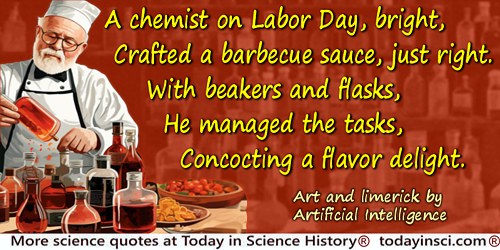
A chemist on Labor Day, bright,
Crafted a barbecue sauce, just right.
With beakers and flasks,
He managed the tasks,
Concocting a flavor delight.
Crafted a barbecue sauce, just right.
With beakers and flasks,
He managed the tasks,
Concocting a flavor delight.
Limerick and art by Artificial Intelligence. Prompt by Webmaster.

A chemist says that the first alcohol was distilled in Arabia, which may explain those nights.
Space filler, citing Detroit News, in The School of Education Record of the University of North Dakota (Jun 1926), 11 No. 9, 73.
A chemist who does not know mathematics is seriously handicapped.
Quoted in Albert Rosenfeld, Langmuir: The Man and the Scientist (1962), 293.
A chemist without a nose is in for trouble.
In 'Arsenic', The Periodic Table (1975, 1996), 178.
A schism has taken place among the chemists. A particular set of them in France have undertaken to remodel all the terms of the science, and to give every substance a new name, the composition, and especially the termination of which, shall define the relation in which it stands to other substances of the same family, But the science seems too much in its infancy as yet, for this reformation; because in fact, the reformation of this year must be reformed again the next year, and so on, changing the names of substances as often as new experiments develop properties in them undiscovered before. The new nomenclature has, accordingly, been already proved to need numerous and important reformations. ... It is espoused by the minority here, and by the very few, indeed, of the foreign chemists. It is particularly rejected in England.
Letter to Dr. Willard (Paris, 1788). In Thomas Jefferson and John P. Foley (ed.), The Jeffersonian Cyclopedia (1900), 135. From H.A. Washington, The Writings of Thomas Jefferson (1853-54). Vol 3, 15.
A tidy laboratory means a lazy chemist.
Berzelius to Nils Sefstrom, 8th July 1812. In C. G. Bernard, 'Berzelius as a European Traveller', in E. M. Melhardo and T. Frängsmyr (eds.), Enlightenment Science in the Romantic Era (1992), 225.
A writer must be as objective as a chemist: he must abandon the subjective line; he must know that dung-heaps play a very reasonable part in a landscape, and that the evil passions are as inherent in life as good ones.
Letter to M. V. Kiselev (14 Jan 1887). In L. S. Friedland (ed.), Anton Chekhov: Letters on the Short Story (1967).
Albertus [Magnus] ... debased the doctrine of Aristotle with the itch of the chemists flowing with the bloody flux of quicksilver and the stench of sulphur.
De Orta et Causis Subterraneorum Lib. V (1546), 46, trans. John Howes.
An amino acid residue (other than glycine) has no symmetry elements. The general operation of conversion of one residue of a single chain into a second residue equivalent to the first is accordingly a rotation about an axis accompanied by translation along the axis. Hence the only configurations for a chain compatible with our postulate of equivalence of the residues are helical configurations.
[Co-author with American chemist, ert B. Corey (1897-1971) and H. R. Branson]
[Co-author with American chemist, ert B. Corey (1897-1971) and H. R. Branson]
'The Structure of Proteins: Two Hydrogen-bonded Helical Configurations of the Polypeptide Chain', Proceedings of the National Academy of Sciences of the United States of America (1951), 37, 206.
Any chemist reading this book can see, in some detail, how I have spent most of my mature life. They can become familiar with the quality of my mind and imagination. They can make judgements about my research abilities. They can tell how well I have documented my claims of experimental results. Any scientist can redo my experiments to see if they still work—and this has happened! I know of no other field in which contributions to world culture are so clearly on exhibit, so cumulative, and so subject to verification.
From Design to Discovery (1990), 119-20.
As chemists, we must rename [our] scheme and insert the symbols Ba, La, Ce in place of Ra, Ac, Th. As nuclear chemists closely associated with physics, we cannot yet convince ourselves to make this leap, which contradicts all previous experience in nuclear physics.
Co-author with Fritz Strassmann, German chemist (1902-80)
Co-author with Fritz Strassmann, German chemist (1902-80)
'(Über den nachweis und das Verhalten der bei der Bestrahlung des Urans mittels Neutronen entstehenden Erdalkallmetalle', Die Naturwissenschaften, 1939, 27, 11-15. Trans. J. Heilbron and Robert W. Seidel, Lawrence and his Laboratory: A History of the Lawrence Berkeley Laboratory (1989), Vol. 1, 436-7.
Astronomers tell us that there are about 1023 stars in the universe. That’s a meaningful number to chemists—an Avogadro number of potential solar systems of which between 1 and 50 percent are estimated to have planets. … Planets are plentiful—and from this fact we can begin our exploration of how life might have evolved on any one of them.
In 'Cosmochemistry The Earliest Evolution', The Science Teacher (Oct 1983), 50, No. 7, 34.
Away from their laboratories, physicist and chemist are but disarmed soldiers on a battlefield.
Hors de leurs laboratoires, le physicien et le chimiste sont des soldats sans armes sur le champ de bataille.
Hors de leurs laboratoires, le physicien et le chimiste sont des soldats sans armes sur le champ de bataille.
In article 'The Budget of Science', Revue des Cours Scientifiques (1 Feb 1868) and published as a pamphlet, Some Reflections on Science in France. Original French quote in René Vallery-Radot, La Vie de Pasteur (1900), 215. As translated in René Vallery-Radot and Mrs R. L. Devonshire (trans.) The Life of Pasteur (1902), 199. Also translated as “Outside their laboratories, the physicist and chemist are soldiers without arms on the field of battle.”
Baeyer—a chemist who was more of an encyclopedist than a researcher.
In Richard Willstätter, Arthur Stoll (ed. of the original German) and Lilli S. Hornig (trans.), From My Life: The Memoirs of Richard Willstätter (1958), 174.
Be a physical chemist, an organic chemist, an analytical chemist, if you will; but above all be a Chemist.
[Admonishing his students to avoid over-specialization.]
[Admonishing his students to avoid over-specialization.]
F. H. Getman, The Life of Ira Remsen (1940), 71.
Because I was less tied to Parliament, because I was freer to travel and investigate and explore, I found myself often with the odd jobs which nobody else wanted or had time for. One of these, I remember, was a study of the myxomatosis problem. Myxomatosis was a disease fatal to rabbits and without a cure—there had been prolonged examination of it on the Continent where there were dreams of eradicating or anyway reducing the rabbit population. A French chemical scientist carried out a series of experiments in the park of his chateau, with a view to rabbit control. He let the virus loose, apparently unaware that it could be carried by birds and insects. Very soon myxomatosis had spread like wildfire through France.
In Reflect on Things Past: The Memoirs of Lord Carrington (1089), 97.
Behind the artisan is the chemist, behind the chemist a physicist, behind the physicist a mathematician.
In A Scrap-book of Elementary Mathematics: Notes, Recreations, Essays (1908), 217.
Besides accustoming the student to demand, complete proof, and to know when he has not obtained it, mathematical studies are of immense benefit to his education by habituating him to precision. It is one of the peculiar excellencies of mathematical discipline, that the mathematician is never satisfied with à peu près. He requires the exact truth. Hardly any of the non-mathematical sciences, except chemistry, has this advantage. One of the commonest modes of loose thought, and sources of error both in opinion and in practice, is to overlook the importance of quantities. Mathematicians and chemists are taught by the whole course of their studies, that the most fundamental difference of quality depends on some very slight difference in proportional quantity; and that from the qualities of the influencing elements, without careful attention to their quantities, false expectation would constantly be formed as to the very nature and essential character of the result produced.
In An Examination of Sir William Hamilton’s Philosophy (1878), 611. [The French phrase, à peu près means “approximately”. —Webmaster]
Boundaries which mark off one field of science from another are purely artificial, are set up only for temporary convenience. Let chemists and physicists dig deep enough, and they reach common ground.
From chapter 'Jottings from a Note-Book', in Canadian Stories (1918), 183.
But if we are to control evolution we shall have to find out how to influence gene reproduction in a definite direction, just as organic chemists nowadays work for definite ends. Such a possibility is at present entirely beyond our grasp, but a century hence it may not be so.
In 'The Biochemistry of the Individual' (1937), collected in Neurath Hans (ed.), Perspectives in Biochemistry (1989), 6.
Chemistry as a science is still in its infancy. I hold to my view because there is still so much beyond our understanding even in the simplest systems the chemist has cared to deal with.
Speech at the Nobel Banquet (10 Dec 1983) for his Nobel Prize in Chemistry. In Wilhelm Odelberg (ed.), Les Prix Nobel: The Nobel Prizes (1984), 43.
Chemistry ought not to be for chemists alone.
From Miguel Unamuno and J. E. Crawford Flitch (trans.), Essays and Soliloquies (1926), 122.
Chemists can devise ways to make … less polluting fuels for transport, from any energy source, even nuclear, but such is the inertia of industrial civilization that we are likely to go on using fossil fuel for a decade [beyond that] at least.
In The Revenge of Gaia: Earth’s Climate Crisis & The Fate of Humanity (2006, 2007), 94.
Chemists do have a good sense of humor but lose it when they serve as referees.
A. Nickon and E. F. Silversmith, Organic Chemistry: The Name Game, Modern Coined Terms and Their Origins (1987), 293, footnote.
Chemists have made of phlogiston a vague principle which is not at all rigorously defined, and which, in consequence, adapts itself to all explanations in which it is wished it shall enter; sometimes it is free fire, sometimes it is fire combined with the earthy element; sometimes it passes through the pores of vessels, sometimes they are impenetrable to it; it explains both the causticity and non-causticity, transparency and opacity, colours and absence of colours. It is a veritable Proteus which changes its form every instant. It is time to conduct chemistry to a more rigorous mode of reasoning ... to distinguish fact and observation from what is systematic and hypothetical.
'Réflexions sur le phlogistique', Mémoires de l'Académie des Sciences, 1783, 505-38. Reprinted in Oeuvres de Lavoisier (1864), Vol. 2, 640, trans. M. P. Crosland.
Chemists must unite in order to force upon the reluctant world the power of their discoveries.
Shortly after World War I. Quoted, as a memory of Pope, in Sir William Jackson Pope Memorial Lecture by Leslie H. Lampitt, 'Sir William Jackson Pope: His Influence on Scientific Organisation' Journal of the Royal Society of Arts (31 Jan 1947), 95, No. 4736, 174. Webmaster notes that this is given as a memory, and the wording therefore may not be verbatim.
Chemists show us that strange property, catalysis, which enables a substance while unaffected itself to incite to union elements around it. So a host, or hostess, who may know but little of those concerned, may, as a social switchboard, bring together the halves of pairs of scissors, men who become life-long friends, men and women who marry and are happy husbands and wives.
From chapter 'Jottings from a Note-book', in Canadian Stories (1918), 179.
Dead is when the chemists take over the subject.
Lecture at Stanford, 'Is Spectroscopy Dead?', as quoted in Steven Chu and Charles H. Townes, 'Arthur Schawlow', Biographical Memoirs of the National Academy of Sciences (2003), Vol. 83, 202.
England and all civilised nations stand in deadly peril of not having enough to eat. As mouths multiply, food resources dwindle. Land is a limited quantity, and the land that will grow wheat is absolutely dependent on difficult and capricious natural phenomena... I hope to point a way out of the colossal dilemma. It is the chemist who must come to the rescue of the threatened communities. It is through the laboratory that starvation may ultimately be turned into plenty... The fixation of atmospheric nitrogen is one of the great discoveries, awaiting the genius of chemists.
Presidential Address to the British Association for the Advancement of Science 1898. Published in Chemical News, 1898, 78, 125.
Exact science and its practical movements are no checks on the greatest poet, but always his encouragement and support … The sailor and traveller, the anatomist, chemist, astronomer, geologist, phrenologist, spiritualist, mathematician, historian and lexicographer are not poets, but they are the lawgivers of poets and their construction underlies the structure of every perfect poem.
In Walt Whitman and William Michael Rossetti (ed.), 'Preface to the First Edition of Leaves of Grass', Poems By Walt Whitman (1868), 46.
Few scientists acquainted with the chemistry of biological systems at the molecular level can avoid being inspired. Evolution has produced chemical compounds exquisitely organized to accomplish the most complicated and delicate of tasks. Many organic chemists viewing crystal structures of enzyme systems or nucleic acids and knowing the marvels of specificity of the immune systems must dream of designing and synthesizing simpler organic compounds that imitate working features of these naturally occurring compounds.
In 'The Design of Molecular Hosts, Guests, and Their Complexes', Nobel Lecture, 8 December 1987. In Nobel Lectures: Chemistry 1981-1990 (1992), 419.
For example, there are numbers of chemists who occupy themselves exclusively with the study of dyestuffs. They discover facts that are useful to scientific chemistry; but they do not rank as genuine scientific men. The genuine scientific chemist cares just as much to learn about erbium—the extreme rarity of which renders it commercially unimportant—as he does about iron. He is more eager to learn about erbium if the knowledge of it would do more to complete his conception of the Periodic Law, which expresses the mutual relations of the elements.
From 'Lessons from the History of Science: The Scientific Attitude' (c.1896), in Collected Papers (1931), Vol. 1, 20.
For it is not cell nuclei, not even individual chromosomes, but certain parts of certain chromosomes from certain cells that must be isolated and collected in enormous quantities for analysis; that would be the precondition for placing the chemist in such a position as would allow him to analyse [the hereditary material] more minutely than [can] the morphologists ... For the morphology of the nucleus has reference at the very least to the gearing of the clock, but at best the chemistry of the nucleus refers only to the metal from which the gears are formed.
Ergebnisse über die Konstitution der chromatischen Substam des Zellkems (1904), 123. Translated in Robert Olby, The Path to the Double Helix: The Discovery of DNA (1994), xx.
For many centuries chemists labored to change lead into precious gold, and eventually found that precious uranium turned to lead without any human effort at all.
Epigraph in Isaac Asimov and Jason A. Shulman (eds.), Isaac Asimov’s Book of Science and Nature Quotations (1988), 43.
Gay-Lussac was quick, lively, ingenious and profound, with great activity of mind and great facility of manipulation. I should place him at the head of all the living chemists in France.
In Mary Elvira Weeks, Discovery of the Elements (1934), 161, citing J. Davy, Memoirs of the Life of Sir Humphry Davy, Bart. (1836) Vol. 1, 469.
I am an organic chemist, albeit one who adheres to the definition of organic chemistry given by the great Swedish chemist Berzelius, namely, the chemistry of substances found in living matter, and my science is one of the more abstruse insofar as it rests on concepts and employs a jargon neither of which is a part of everyday experience. Nevertheless, organic chemistry deals with matters of truly vital Importance and in some of its aspects with which I myself have been particularly concerned it may prove to hold the keys to Life itself.
In 'Synthesis in the Study of Nucleotides', Nobel Lecture, 11 December 1957. In Nobel Lectures: Chemistry 1942-1962 (1964), 522.
I denounce to you the Coryphaeus—the leader of the chorus—of charlatans, Sieur Lavoisier, son of a land-grabber, apprentice-chemist, pupil of the Genevan stock-jobber [Necker], a Farmer-General, Commisioner for Gunpowder and Saltpetre, Governor of the Discount Bank, Secretary to the King, Member of the Academy of Sciences.
Marat's denunciation of 1791
Marat's denunciation of 1791
L' Ami du Peuple, 27 January 1791. Trans. D. McKie, Antoine Lavoisier, Scientist, Economist, Social Reformer (1952), 242.
I do not want chemistry to degenerate into a religion; I do not want the chemist to believe in the existence of atoms as the Christian believes in the existence of Christ in the communion wafer.
Said to Alfred Nacquet in a debate on chemical education. Quoted in 'Berthelot', Berichte, 1908, 41, 4855.
I have always had the feeling that organic chemistry is a very peculiar science, that organic chemists are unlike other men, and there are few occupations that give more satisfactions [sic] than masterly experimentation along the old lines of this highly specialised science.
Henderson’s memories, unpublished typescript, 85-6, Harvard University Archives 4450.7.2. Quoted in J. S. Fruton, Contrasts in Scientific Style (1990), 194.
I have spent some months in England, have seen an awful lot and learned little. England is not a land of science, there is only a widely practised dilettantism, the chemists are ashamed to call themselves chemists because the pharmacists, who are despised, have assumed this name.
Liebig to Berzelius, 26 Nov 1837. Quoted in J. Carriere (ed.), Berzelius und Liebig.; ihre Briefe (1898), 134. Trans. W. H. Brock.
I hope that in due time the chemists will justify their proceedings by some large generalisations deduced from the infinity of results which they have collected. For me I am left hopelessly behind and I will acknowledge to you that through my bad memory organic chemistry is to me a sealed book. Some of those here, [August] Hoffman for instance, consider all this however as scaffolding, which will disappear when the structure is built. I hope the structure will be worthy of the labour. I should expect a better and a quicker result from the study of the powers of matter, but then I have a predilection that way and am probably prejudiced in judgment.
Letter to Christian Schönbein (9 Dec 1852), The Letters of Faraday and Schoenbein, 1836-1862 (1899), 209-210.
I liked science. I wasn’t mathematically oriented, so I became an organic chemist.
As quoted in Columbia University Press Release, On Campus (21 Feb 2013).
I must confess the language of symbols is to me
A Babylonish dialect
Which learned chemists much affect;
It is a party-coloured dress
Of patch'd and piebald languages:
'T is English cut on Greek and Latin,
Like fustian heretofore on satin.
A Babylonish dialect
Which learned chemists much affect;
It is a party-coloured dress
Of patch'd and piebald languages:
'T is English cut on Greek and Latin,
Like fustian heretofore on satin.
'Additional Observations on the Use of Chemical Symbols', Philosophical Magazine, Third series (1834), 4, 251. Cited in Timothy L. Alborn, 'Negotiating Notation: Chemical Symbols and British Society, 1831-1835', Annals of Science (1989), 46, 437.
I saw [Linus Pauling] as a brilliant lecturer and a man with a fantastic memory, and a great, great showman. I think he was the century’s greatest chemist. No doubt about it.
From transcript of audio of Max Perutz in BBC programme, 'Lifestory: Linus Pauling' (1997). On 'Linus Pauling and the Race for DNA' webpage 'I Wish I Had Made You Angry Earlier.'
I suppose I should be run after for a professorship if I had studied at Giessen, as it seems to be a settled point that no young man can be expected to know anything of chemistry unless he has studied with Liebig; while the truth is, that any one who goes there and does not afterwards correct the bad habits acquired there, in some other laboratory, is almost unfitted for doing things in Chemistry. No doubt Liebig is a remarkable man, who has done much for organic Chemistry, not to speak of his having quarreled with all the Chemists in Europe...
Letter to his brother, William Dwight Whitney (25 Apr 1846). In Edwin Tenney Brewster and Josiah Dwight Whitney, Life and Letters of Josiah Dwight Whitney (1909), 79-80.
I suppose that the first chemists seemed to be very hard-hearted and unpoetical persons when they scouted the glorious dream of the alchemists that there must be some process for turning base metals into gold. I suppose that the men who first said, in plain, cold assertion, there is no fountain of eternal youth, seemed to be the most cruel and cold-hearted adversaries of human happiness. I know that the economists who say that if we could transmute lead into gold, it would certainly do us no good and might do great harm, are still regarded as unworthy of belief. Do not the money articles of the newspapers yet ring with the doctrine that we are getting rich when we give cotton and wheat for gold rather than when we give cotton and wheat for iron?
'The Forgotten Man' (1883). In The Forgotten Man and Other Essays (1918), 468.
I think chemistry is being frittered away by the hairsplitting of the organic chemists; we have new compounds discovered, which scarcely differ from the known ones and when discovered are valueless—very illustrations perhaps of their refinements in analysis, but very little aiding the progress of true science.
Letter to William Grove (5 Jan 1845), The Letters of Faraday and Schoenbein, 1836-1862 (1899), Footnote, 209.
I think the name atomic theory was an unfortunate one. We talk fluently about atoms as the smallest particles that exist, and chemists regard them as indivisible … To my mind the infinitely small is as incomprehensible as the infinitely great. … we cannot comprehend it, we cannot take it in. And so with the atom. Therefore I think that it would have been better to have taken a different word—say minim—which would have been a safer term than atom.
Address, in 'Report to the Chemical Society's Jubilee', Nature (26 Mar 1891), 43, 493.
I would like to emphasize strongly my belief that the era of computing chemists, when hundreds if not thousands of chemists will go to the computing machine instead of the laboratory for increasingly many facets of chemical information, is already at hand. There is only one obstacle, namely that someone must pay for the computing time.
'Spectroscopy, Molecular Orbitals, and Chemical Bonding', Nobel Lecture (12 Dec 1966). In Nobel Lectures: Chemistry 1963-1970 (1972), 159.
I would not have it inferred ... that I am, as yet, an advocate for the hypothesis of chemical life. The doctrine of the vitality of the blood, stands in no need of aid from that speculative source. If it did, I would certainly abandon it. For, notwithstanding the fashionableness of the hypothesis in Europe, and the ascendancy it has gained over some minds in this country [USA], it will require stubborn facts to convince me that man with all his corporeal and intellectual attributes is nothing but hydro-phosphorated oxyde of azote ... When the chemist declares, that the same laws which direct the crystallization of spars, nitre and Glauber's salts, direct also the crystallization of man, he must pardon me if I neither understand him, nor believe him.
Medical Theses (1805), 391-2, footnote.
If any spiritualistic medium can do stunts, there is no more need for special conditions than there is for a chemist to turn down lights, start operations with a hymn, and ask whether there's any chemical present that has affinity with something named Hydrogen.
Lo! (1932). In The Complete Books of Charles Fort (1975), 575.
If one were to demonstrate to an architect that the bricks…in his constructions were under other circumstances capable of entirely different uses—let us say,…that they could with effect be employed as an explosive incomparably more powerful in its activities than dynamite—the surprise of the architect would be no greater than the surprise of the chemist at the new and undreamt of possibilities of matter demonstrated by the mere existence of such an element as radium.
In 'The Discovery of Radioactivity: Radioactivity, a New Science', The Interpretation of Radium and the Structure of the Atom (4th ed., 1920), 3.
If the greenhouse effect is a blanket in which we wrap ourselves to keep warm, nuclear winter kicks the blanket off.
[co-author with American atmospheric chemist Richard P. Turco (1943- )]
[co-author with American atmospheric chemist Richard P. Turco (1943- )]
A Path Where No Man Thought: Nuclear Winter and the End of the Arms Race (1990), 24.
If these d'Hérelle bodies were really genes, fundamentally like our chromosome genes, they would give us an utterly new angle from which to attack the gene problem. They are filterable, to some extent isolable, can be handled in test-tubes, and their properties, as shown by their effects on the bacteria, can then be studied after treatment. It would be very rash to call these bodies genes, and yet at present we must confess that there is no distinction known between the genes and them. Hence we can not categorically deny that perhaps we may be able to grind genes in a mortar and cook them in a beaker after all. Must we geneticists become bacteriologists, physiological chemists and physicists, simultaneously with being zoologists and botanists? Let us hope so.
'Variation Due to Change in the Individual Gene', The American Naturalist (1922), 56, 48-9.
If we assume that there is only one enzyme present to act as an oxidizing agent, we must assume for it as many different degrees of activity as are required to explain the occurrence of the various colors known to mendelize (three in mice, yellow, brown, and black). If we assume that a different enzyme or group of enzymes is responsible for the production of each pigment we must suppose that in mice at least three such enzymes or groups of enzymes exist. To determine which of these conditions occurs in mice is not a problem for the biologist, but for the chemist. The biologist must confine his attention to determining the number of distinct agencies at work in pigment formation irrespective of their chemical nature. These agencies, because of their physiological behavior, the biologist chooses to call 'factors,' and attempts to learn what he can about their functions in the evolution of color varieties.
Experimental Studies of the Inheritance of Color in Mice (1913), 17-18.
If you want to become a chemist, you will have to ruin your health. If you don’t ruin your health studying, you won’t accomplish anything these days in chemistry.
Liebig's advice to Kekulé. Quoted in Berichte der Deutschen Chemischen Gesellschaft, 23, 1890. Trans. W. H. Brock.
If, as a chemist, I see a flower, I know all that is involved in synthesizing a flower’s elements. And I know that even the fact that it exists is not something that is natural. It is a miracle.
In Pamela Weintraub (ed.), 'Through the Looking Glass', The Omni Interviews (1984), 161.
Immediately south of nitrogen is phosphorus, which was first isolated by the distillation and treatment of urine—an indication of the lengths to which chemists are prepared to go, or perhaps only a sign of the obsessive, scatological origins of their vocation.
In The Periodic Kingdom: A Journey Into the Land of the Chemical Elements (1995), 20. [On the Periodic Table, nitrogen and phosphorus are in the same Group, a column headed by nitrogen. Phosphorus is located immediately below, or “south” if the Periodic Table is viewed as analogous to a map. —Webmaster]
In 1768, some peasants, near Luce in France, heard a thunderclap and saw a large stone fall from the sky. Reports of this strange phenomenon reached the French Academy of Sciences. The Academy asked Lavoisier, the premier chemist, to investigate. Lavoisier knew that stones do not fall out of the sky; so, in his knowledgeable arrogance, he reported that the witnesses were either lying or mistaken. The academy did not accept the fact of meteorites until the following century.
In 'Forum: A Case of Spontaneous Human Combustion', New Scientist (15 May 1986), 70.
In 1912 I went to a book sale and bought ten books for fifty cents. One of the books was by Ostwald The Scientific Foundations of Analytical Chemistry. Ostwald wrote at the beginning of that book that analytical chemists are the maidservants of other chemists. This made quite an impression on me, because I didn't want to be a maidservant.
Comment during interview, Beckman Center (15 March 1984), as recorded on tape held by The Chemical Heritage Foundation, Philadelphia. Quotation provided by W. H. Brock.
In the world of science different levels of esteem are accorded to different kinds of specialist. Mathematicians have always been eminently respectable, and so are those who deal with hard lifeless theories about what constitutes the physical world: the astronomers, the physicists, the theoretical chemists. But the more closely the scientist interests himself in matters which are of direct human relevance, the lower his social status. The real scum of the scientific world are the engineers and the sociologists and the psychologists. Indeed, if a psychologist wants to rate as a scientist he must study rats, not human beings. In zoology the same rules apply. It is much more respectable to dissect muscle tissues in a laboratory than to observe the behaviour of a living animal in its natural habitat.
From transcript of BBC radio Reith Lecture (12 Nov 1967), 'A Runaway World', on the bbc.co.uk website.
IODINE
It was Courtois discover'd Iodine
(In the commencement of this century),
Which, with its sisters, bromine and chlorine,
Enjoys a common parentage - the sea;
Although sometimes 'tis found, with other things,
In minerals and many saline springs.
But yet the quantity is so minute
In the great ocean, that a chemist might,
With sensibilities the most acute,
Have never brought this element to light,
Had he not thought it were as well to try
Where ocean's treasures concentrated lie.
And Courtois found that several plants marine,
Sponges, et cetera, exercise the art
Of drawing from the sea its iodine
In quantities sufficient to impart
Its properties; and he devised a plan
Of bringing it before us - clever man!
It was Courtois discover'd Iodine
(In the commencement of this century),
Which, with its sisters, bromine and chlorine,
Enjoys a common parentage - the sea;
Although sometimes 'tis found, with other things,
In minerals and many saline springs.
But yet the quantity is so minute
In the great ocean, that a chemist might,
With sensibilities the most acute,
Have never brought this element to light,
Had he not thought it were as well to try
Where ocean's treasures concentrated lie.
And Courtois found that several plants marine,
Sponges, et cetera, exercise the art
Of drawing from the sea its iodine
In quantities sufficient to impart
Its properties; and he devised a plan
Of bringing it before us - clever man!
Discursive Chemical Notes in Rhyme (1876) by the Author of the Chemical Review, a B.
It does appear that on the whole a physicist… tries to reduce his theory at all times to as few parameters as possible and is inclined to feel that a theory is a “respectable” one, though by no means necessarily correct, if in principle it does offer reasonably specific means for its possible refutation. Moreover the physicist will generally arouse the irritation amongst fellow physicists if he is not prepared to abandon his theory when it clashes with subsequent experiments. On the other hand it would appear that the chemist regards theories—or perhaps better his theories (!) —as far less sacrosanct, and perhaps in extreme cases is prepared to modify them continually as each bit of new experimental evidence comes in.
'Discussion: Physics and Chemistry: Comments on Caldin's View of Chemistry', British Journal of the Philosophy of Science, 1960, 11, 222.
It has hitherto been a serious impediment to the progress of knowledge, that is in investigating the origin or causes of natural productions, recourse has generally been had to the examination, both by experiment and reasoning, of what might be rather than what is. The laws or processes of nature we have every reason to believe invariable. Their results from time to time vary, according to the combinations of influential circumstances; but the process remains the same. Like the poet or the painter, the chemist may, and no doubt often' does, create combinations which nature never produced; and the possibility of such and such processes giving rise to such and such results, is no proof whatever that they were ever in natural operation.
Considerations on Volcanoes (1825), 243.
It is my intent to beget a good understanding between the chymists and the mechanical philosophers who have hitherto been too little acquainted with one another's learning.
The Sceptical Chymist (1661).
It is one of the signs of the times that modern chemists hold themselves bound and consider themselves in a position to give an explanation for everything, and when their knowledge fails them to make sure of supernatural explanations. Such a treatment of scientific subjects, not many degrees removed from a belief in witches and spirit-rapping, even Wislicenus considers permissible.
In H. Kolbe, 'Sign of the Times', Journal für Praktische Chemie (1877), 15, 473. Trans. W. H. Brock.
It is only those who know a little of nature, who fancy they know much. I have heard a young man say, after hearing a few popular chemical lectures, and seeing a few bottle and squirt experiments: Oh, water—water is only oxygen and hydrogen!—as if he knew all about it. While the true chemist would smile sadly enough at the the youth's hasty conceit, and say in his heart: 'Well, he is a lucky fellow.'
'Thoughts in a Gravel Pit', a lecture delivered at the Mechanics' Institute, Odiham (1857). The Works of Charles Kingsley (1880), 284.
It is structure that we look for whenever we try to understand anything. All science is built upon this search; we investigate how the cell is built of reticular material, cytoplasm, chromosomes; how crystals aggregate; how atoms are fastened together; how electrons constitute a chemical bond between atoms. We like to understand, and to explain, observed facts in terms of structure. A chemist who understands why a diamond has certain properties, or why nylon or hemoglobin have other properties, because of the different ways their atoms are arranged, may ask questions that a geologist would not think of formulating, unless he had been similarly trained in this way of thinking about the world.
‘The Place of Chemistry In the Integration of the Sciences’, Main Currents in Modern Thought (1950), 7, 110.
It is very interesting to observe how high the rank may be in the world of science, without the aid of wealth. I have before me a letter of the late Dr. Dalton, who, notwithstanding his great reputation as a chemist, until a late period of his life was a teacher of mathematics. He remarks in this note, that if the price of mercury continues so dear he shall not be able to afford the expense of filling the barometers which he requires for some experiments.
In Education and Manufactures (1863), 44-45.
It is with mathematics not otherwise than it is with music, painting or poetry. Anyone can become a lawyer, doctor or chemist, and as such may succeed well, provided he is clever and industrious, but not every one can become a painter, or a musician, or a mathematician: general cleverness and industry alone count here for nothing.
In Ueber die Anlage zur Mathematik (1900), 5. As translated in Robert Édouard Moritz, Memorabilia Mathematica; Or, The Philomath’s Quotation-Book (1914), 184.
It is, I believe, justifiable to make the generalization that anything an organic chemist can synthesize can be made without him. All he does is increase the probability that given reactions will “go”. So it is quite reasonable to assume that given sufficient time and proper conditions, nucleotides, amino acids, proteins, and nucleic acids will arise by reactions that, though less probable, are as inevitable as those by which the organic chemist fulfills his predictions. So why not self-duplicating virus-like systems capable of further evolution?
The Place of Genetics in Modern Biology (1959),18.
Just think of the differences today. A young person gets interested in chemistry and is given a chemical set. But it doesn't contain potassium cyanide. It doesn't even contain copper sulfate or anything else interesting because all the interesting chemicals are considered dangerous substances. Therefore, these budding young chemists don't get a chance to do anything engrossing with their chemistry sets. As I look back, I think it is pretty remarkable that Mr. Ziegler, this friend of the family, would have so easily turned over one-third of an ounce of potassium cyanide to me, an eleven-year-old boy.
In Barbara Marinacci, Linus Pauling In His Own Words (1995), 29.
Knowledge and ability must be combined with ambition as well as with a sense of honesty and a severe conscience. Every analyst occasionally has doubts about the accuracy of his results, and also there are times when he knows his results to be incorrect. Sometimes a few drops of the solution were spilt, or some other slight mistake made. In these cases it requires a strong conscience to repeat the analysis and to make a rough estimate of the loss or apply a correction. Anyone not having sufficient will-power to do this is unsuited to analysis no matter how great his technical ability or knowledge. A chemist who would not take an oath guaranteeing the authenticity, as well as the accuracy of his work, should never publish his results, for if he were to do so, then the result would be detrimental not only to himself, but to the whole of science.
Anleitung zur Quantitativen Analyse (1847), preface. F. Szabadvary, History of Analytical Chemistry (1966), trans. Gyula Svehla, 176.
Langmuir is the most convincing lecturer that I have ever heard. I have heard him talk to an audience of chemists when I knew they did not understand more than one-third of what he was saying; but they thought they did. It’s very easy to be swept off one's feet by Langmuir. You remember in [Kipling’s novel] Kim that the water jar was broken and Lurgan Sahib was trying to hypnotise Kim into seeing it whole again. Kim saved himself by saying the multiplication table [so] I have heard Langmuir lecture when I knew he was wrong, but I had to repeat to myself: “He is wrong; I know he is wrong; he is wrong”, or I should have believed like the others.
In 'How to Ripen Time', Journal of Physical Chemistry 1931, 35, 1917.
Many will, no doubt, prefer to retain old unsystematic names as far as possible, but it is easy to see that the desire to avoid change may carry us too far in this direction; it will undoubtedly be very inconvenient to the present generation of chemists to abandon familiar and cherished names, but nevertheless it may be a wise course to boldly face the difficulty, rather than inflict on coming generations a partially illogical and unsystematic nomenclature.
'International Conference on Chemical Nomenclature', Nature (19 May 1892), 46, 57.
Maybe I was young and 'cute' (after all, I was only twenty then), but I've learned over the years that when you put white lab coats on chemists, they all look alike!
(6 Jul 1989) recalling being denied a laboratory job in her youth, since - allegedly - her physical attractiveness would be distracting to male coworkers. quoted in Feminine Ingenuity by Anne L. MacDonald (1992)
Mr Humphry Davy is a lively and talented man, and a thorough chemist; but if I might venture to give an opinion... he is rather too lively to fill the Chair of the Royal Society with that degree of gravity it is most becoming to assume.
Quoted in John Barrow, Sketches of the Royal Society (1849), 52.
Mr Justus Liebig is no doubt a very clever gentleman and a most profound chemist, but in our opinion he knows as much of agriculture as the horse that ploughs the ground, and there is not an old man that stands between the stilts of a plough in Virginia, that cannot tell him of facts totally at variance with his finest spun theories.
— Magazine
The Southern Planter (1845), 3, 23.
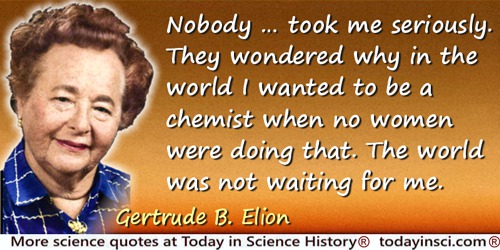
Nobody … took me seriously. They wondered why in the world I wanted to be a chemist when no women were doing that. The world was not waiting for me.
Quoted in interview by Mary Ellen Avery (1997).
Nymphs! you disjoin, unite, condense, expand,
And give new wonders to the Chemist’s hand;
On tepid clouds of rising steam aspire,
Or fix in sulphur all its solid fire;
With boundless spring elastic airs unfold,
Or fill the fine vacuities of gold
With sudden flash vitrescent sparks reveal,
By fierce collision from the flint and steel. …
And give new wonders to the Chemist’s hand;
On tepid clouds of rising steam aspire,
Or fix in sulphur all its solid fire;
With boundless spring elastic airs unfold,
Or fill the fine vacuities of gold
With sudden flash vitrescent sparks reveal,
By fierce collision from the flint and steel. …
Oh! That the Chemist’s magic art
Could crystallize this sacred treasure!…
That very law which moulds a tear,
And bids it trickle from its source;
That law preserves the earth a sphere,
And guides the planets in their course.
Could crystallize this sacred treasure!…
That very law which moulds a tear,
And bids it trickle from its source;
That law preserves the earth a sphere,
And guides the planets in their course.
Referring to the Law of Gravitation. From Poem, 'On a Tear' (c.1813-15), in Samuel Rogers et al., The Poetical Works of Rogers, Campbell, J. Montombery, Lamb, and Kirke White (1836), 101.
One began to hear it said that World War I was the chemists’ war, World War II was the physicists’ war, World War III (may it never come) will be the mathematicians’ war.
Co-author with and Reuben Hersh, The Mathematical Experience (1981), 96.
One is almost tempted to say... at last I can almost see a bond. But that will never be, for a bond does not really exist at all: it is a most convenient fiction which, as we have seen, is convenient both to experimental and theoretical chemists.
'What is a Chemical Bond?', Coulson Papers, 25, Bodleian Library, Oxford. In Mary-Jo Nye, From Chemical Philosophy to Theoretical Chemistry (1993), 261.
One of the most striking evidences of the reliability of the organic chemist's methods of determining molecular structure is the fact that he has never been able to derive satisfactory structures for supposed molecules which are in fact nonexistent.
Physical Organic Chemistry; Reaction Rates, Equilibria, and Mechanisms (1940),38.
One reason which has led the organic chemist to avert his mind from the problems of Biochemistry is the obsession that the really significant happenings in the animal body are concerned in the main with substances of such high molecular weight and consequent vagueness of molecular structure as to make their reactions impossible of study by his available and accurate methods. There remains, I find, pretty widely spread, the feeling—due to earlier biological teaching—that, apart from substances which are obviously excreta, all the simpler products which can be found in cells or tissues are as a class mere objects, already too remote from the fundamental biochemical events to have much significance. So far from this being the case, recent progress points in the clearest way to the fact that the molecules with which a most important and significant part of the chemical dynamics of living tissues is concerned are of a comparatively simple character.
In 'The Dynamic Side of Biochemistry', Address (11 Sep 1913) in Report on the 83rd Meeting of the British Association for the Advancement of Science (1914), 657-8.
Ostwald was a great protagonist and an inspiring teacher. He had the gift of saying the right thing in the right way. When we consider the development of chemistry as a whole, Ostwald's name like Abou ben Adhem's leads all the rest ... Ostwald was absolutely the right man in the right place. He was loved and followed by more people than any chemist of our time.
'Ostwald', Journal of Chemical Education, 1933, 10, 612, as cited by Erwin N. Hiebert and Hans-Gunther Korber in article on Ostwald in Charles Coulston Gillespie (ed.), Dictionary of Scientific Biography Supplement 1, Vol 15-16, 466, which also says Wilder Bancroft "received his doctorate under Ostwald in 1892."
Our conception of a native protein molecule (showing specific properties) is the following. The molecule consists of one polypeptide chain which continues without interruption throughout the molecule (or, in certain cases, of two or more such chains); this chain is folded into a uniquely defined configuration, in which it is held by hydrogen bonds between the peptide nitrogen and oxygen atoms and also between the free amino and carboxyl groups of the diamino and dicarboxyl amino acid residues.
The characteristic specific properties of native proteins we attribute to their uniquely defined configurations.
The denatured protein molecule we consider to be characterized by the absence of a uniquely defined configuration.
[Co-author with American chemist, Linus Pauling (1901-94)]
The characteristic specific properties of native proteins we attribute to their uniquely defined configurations.
The denatured protein molecule we consider to be characterized by the absence of a uniquely defined configuration.
[Co-author with American chemist, Linus Pauling (1901-94)]
'On the Structure of Native, Denatured, and Coagulated Proteins', Proceedings of the National Academy of Sciences of the United States of America (1936), 22, 442-3.
Professor, how can you bring yourself to enter this chemical building that has Ionic columns?
[Kahlenberg, a physical chemist, was an opponent of ionic theory.]
[Kahlenberg, a physical chemist, was an opponent of ionic theory.]
Quoted in Ralph Oesper, The Human Side of Scientists (1975), 106.
Said M. Waldman, “…Chemistry is that branch of natural philosophy in which the greatest improvements have been and may be made; it is on that account that I have made it my peculiar study; but at the same time, I have not neglected the other branches of science. A man would make but a very sorry chemist if he attended to that department of human knowledge alone. If your wish is to become really a man of science and not merely a petty experimentalist, I should advise you to apply to every branch of natural philosophy, including mathematics.”
In Frankenstein: Or, The Modern Prometheus (1823), Vol. 1, 73-74. Webmaster note: In the novel, when the fictional characters meet, M. Waldman, professor of chemistry, sparks Victor Frankenstein’s interest in science. Shelley was age 20 when the first edition of the novel was published anonymously (1818).
Scientists don’t really ever grow up. I read, as a 10-or-so-year-old, a book for kids by Einstein. I think it was The Meaning of Relativity. It was exciting! Science was compared to a detective story, replete with clues, and the solution was the search for a coherent account of all the known events. Then I remember some very entrapping biographies: Crucibles, by Bernard Jaffe, was the story of chemistry told through the lives of great chemists; Microbe Hunters, by Paul de Kruif, did the same for biologists. Also, the novel Arrowsmith, by Sinclair Lewis, about a medical researcher. These books were a crucial component of getting hooked into science.
When asked by Discover magazine what books helped inspire his passion as a scientist.
When asked by Discover magazine what books helped inspire his passion as a scientist.
In 'The 1998 Discover Science Gift Guide: Fantastic Voyages Children's Books That Mattered', Discover (Dec 1998).
Sex appeal is a matter of chemistry, but you don't have to be a chemist to find the formula.
In Evan Esar, 20,000 Quips and Quotes, 128.
So far no chemist has ever discovered exchange-value either in a pearl or a diamond.
Capital: A Critique of Political Economy (1867), trans. Ben Fowkes (1976), Vol. 1, 177.
Space … is big. Really big. You just won’t believe how vastly hugely mind-bogglingly big it is. I mean, you may think it’s a long way down the road to the chemist, but that's just peanuts to space.
The Hitch-Hiker’s Guide to the Galaxy (1979, 1981), 76.
Specialists never contribute anything to their specialty; Helmholtz wasn’t an eye-specialist, but a German army doctor who invented the ophthalmoscope one Saturday afternoon when there wasn’t anything else to do. Incidentally, he rewrote whole chapters of physics, so that the physicists only know him as one of their own. Robert Mayer wasn’t a physicist, but another country doctor; and Pasteur, who made bacteriology, was a tanner’s son or a chemist, as you will.
In Fischerisms (1930), 7.
Suppose [an] imaginary physicist, the student of Niels Bohr, is shown an experiment in which a virus particle enters a bacterial cell and 20 minutes later the bacterial cell is lysed and 100 virus particles are liberated. He will say: “How come, one particle has become 100 particles of the same kind in 20 minutes? That is very interesting. Let us find out how it happens! How does the particle get in to the bacterium? How does it multiply? Does it multiply like a bacterium, growing and dividing, or does it multiply by an entirely different mechanism ? Does it have to be inside the bacterium to do this multiplying, or can we squash the bacterium and have the multiplication go on as before? Is this multiplying a trick of organic chemistry which the organic chemists have not yet discovered ? Let us find out. This is so simple a phenomenon that the answers cannot be hard to find. In a few months we will know. All we have to do is to study how conditions will influence the multiplication. We will do a few experiments at different temperatures, in different media, with different viruses, and we will know. Perhaps we may have to break into the bacteria at intermediate stages between infection and lysis. Anyhow, the experiments only take a few hours each, so the whole problem can not take long to solve.”
[Eight years later] he has not got anywhere in solving the problem he set out to solve. But [he may say to you] “Well, I made a slight mistake. I could not do it in a few months. Perhaps it will take a few decades, and perhaps it will take the help of a few dozen other people. But listen to what I have found, perhaps you will be interested to join me.”
[Eight years later] he has not got anywhere in solving the problem he set out to solve. But [he may say to you] “Well, I made a slight mistake. I could not do it in a few months. Perhaps it will take a few decades, and perhaps it will take the help of a few dozen other people. But listen to what I have found, perhaps you will be interested to join me.”
From 'Experiments with Bacterial Viruses (Bacteriophages)', Harvey Lecture (1946), 41, 161-162. As cited in Robert Olby, The Path of the Double Helix: The Discovery of DNA (1974, 1994), 237.
The astronomer is severely handicapped as compared with other scientists. He is forced into a comparatively passive role. He cannot invent his own experiments as the physicist, the chemist or the biologist can. He cannot travel about the Universe examining the items that interest him. He cannot, for example, skin a star like an onion and see how it works inside.
In The Nature of the Universe (1950).
The biologist can push it back to the original protist, and the chemist can push it back to the crystal, but none of them touch the real question of why or how the thing began at all. The astronomer goes back untold million of years and ends in gas and emptiness, and then the mathematician sweeps the whole cosmos into unreality and leaves one with mind as the only thing of which we have any immediate apprehension. Cogito ergo sum, ergo omnia esse videntur. All this bother, and we are no further than Descartes. Have you noticed that the astronomers and mathematicians are much the most cheerful people of the lot? I suppose that perpetually contemplating things on so vast a scale makes them feel either that it doesn’t matter a hoot anyway, or that anything so large and elaborate must have some sense in it somewhere.
As co-author with Robert Eustace, The Documents in the Case (1930), 72.
The chemical or physical inventor is always a Prometheus. There is no great invention, from fire to flying, which has not been hailed as an insult to some god. But if every physical and chemical invention is a blasphemy, every biological invention is a perversion. There is hardly one which, on first being brought to the notice of an observer from any nation which had not previously heard of their existence, would not appear to him as indecent and unnatural.
Lecture (4 Feb 1923) to the Heretics Society, Cambridge University, published in Daedalus; or, Science and the Future (1924), 44.
The chemist and the engineer have a vital interest in knowing the processes that have fallen into disuse, but to which the very progress of science may give from one day to the next a new career. The history of science is to them, so to say, what forsaken mines are to the prospector.
In 'The History of Science', The Monist (July 1916), 26, No. 3, 348.
The chemist in America has in general been content with what I have called a loafer electron theory. He has imagined the electrons sitting around on dry goods boxes at every corner [viz. the cubic atom], ready to shake hands with, or hold on to similar loafer electrons in other atoms.
'Atomism in Modern Physics', Journal of the Chemical Society (1924), 1411.
The chemist studies the effects produced by heat and by mixture, in all bodies, or mixtures of bodies, natural or artificial, and studies them with a view to the improvement of arts, and the knowledge of nature.
Restating his own definition in fewer words, from the first of a series of lectures on chemistry, collected in John Robison (ed.), Lectures on the Elements of Chemistry: Delivered in the University of Edinburgh (1807), Vol. 1, 11.
The chemist works along his own brilliant line of discovery and exposition; the astronomer has his special field to explore; the geologist has a well-defined sphere to occupy. It is manifest, however, that not one of these men can tell the whole tale, and make a complete story of creation. Another man is wanted. A man who, though not necessarily going into formal science, sees the whole idea, and speaks of it in its unity. This man is the theologian. He is not a chemist, an astronomer, a geologist, a botanist——he is more: he speaks of circles, not of segments; of principles, not of facts; of causes and purposes rather than of effects and appearances. Not that the latter are excluded from his study, but that they are so wisely included in it as to be put in their proper places.
In The People's Bible: Discourses Upon Holy Scripture: Vol. 1. Genesis (1885), 120.
The chemists are a strange class of mortals, impelled by an almost insane impulse to seek their pleasures amid smoke and vapour, soot and flame, poisons and poverty; yet among all these evils I seem to live so sweetly that may I die if I were to change places with the Persian king.
Physica subterranea (1667). Quoted in The Chemistry Leaflet (1935), 9, 490, which also comments that it was hanging as an inscription “on the walls of the library of the Chemists’ Club in New York City.”
The chemists who uphold dualism are far from being agreed among themselves; nevertheless, all of them in maintaining their opinion, rely upon the phenomena of chemical reactions. For a long time the uncertainty of this method has been pointed out: it has been shown repeatedly, that the atoms put into movement during a reaction take at that time a new arrangement, and that it is impossible to deduce the old arrangement from the new one. It is as if, in the middle of a game of chess, after the disarrangement of all the pieces, one of the players should wish, from the inspection of the new place occupied by each piece, to determine that which it originally occupied.
Chemical Method (1855), 18.
The chemists work with inaccurate and poor measuring services, but they employ very good materials. The physicists, on the other hand, use excellent methods and accurate instruments, but they apply these to very inferior materials. The physical chemists combine both these characteristics in that they apply imprecise methods to impure materials.
Quoted in Ralph Oesper, The Human Side of Scientists (1975), 116.
The contradictory experiments of chemists leave us at liberty to conclude what we please. My conclusion is, that art has not yet invented sufficient aids to enable such subtle bodies [air, light, &c.] to make a well-defined impression on organs as blunt as ours; that it is laudable to encourage investigation but to hold back conclusion.
Letter to Rev. James Madison (Paris, 19 Jul 1788). In Thomas Jefferson and John P. Foley (ed.), The Jeffersonian Cyclopedia (1900), 135. From H.A. Washington, The Writings of Thomas Jefferson (1853-54). Vol 2, 431.
The dogma of the impossibility of determining the atomic constitution of substances, which until recently was advocated with such fervor by the most able chemists, is beginning to be abandoned and forgotten; and one can predict that the day is not far in the future when a sufficient collection of facts will permit determination of the internal architecture of molecules. A series of experiments directed toward such a goal is the object of this paper.
The essence of the simplest mineral phenomenon is as completely unknown to chemists and physicists today as is the essence of intellectual phenomenon to physiologists.
The establishment of the periodic law may truly be said to mark a line in chemical science, and we anticipate that its application and and extension will be fraught With the most important consequences. It reminds us how important above all things is the correct determination of the fundamental constants of our science—the atomic weights of the elements, about which in many cases great uncertainty prevails; it is much to be desired that this may not long remain the case. It also affords the strongest encouragement to the chemist to persevere in the search for new elements.
In The Encyclopaedia Britannica: Ninth Edition (1877), Vol. 5, 714.
The fact is the physical chemists never use their eyes and are most lamentably lacking in chemical culture. It is essential to cast out from our midst, root and branch, this physical element and return to our laboratories.
'Ionomania in Extremis', Chemistry and Industry (1936), 14, 917.
The fact that, with respect to size, the viruses overlapped with the organisms of the biologist at one extreme and with the molecules of the chemist at the other extreme only served to heighten the mystery regarding the nature of viruses. Then too, it became obvious that a sharp line dividing living from non-living things could not be drawn and this fact served to add fuel for discussion of the age-old question of “What is life?”
Nobel Lecture (12 Dec 1946), 'The Isolation and Properties of Crystalline Tobacco Mosaic Virus', collected in Nobel Lectures in Chemistry (1999), 140.
The farther an experiment is from theory, the closer it is to the Nobel Prize.
Also French chemist, Irène Joliot-Curie (1897-1956)
Also French chemist, Irène Joliot-Curie (1897-1956)
Attributed to either.
The idea of an atom has been so constantly associated with incredible assumptions of infinite strength, absolute rigidity, mystical actions at a distance, and individuality, that chemists and many other reasonable naturalists of modern times, losing all patience with it, have dismissed it to the realms of metaphysics, and made it smaller than ‘anything we can conceive.’ But if atoms are inconceivably small, why are not all chemical actions infinitely swift? Chemistry is powerless to deal with this question, and many others of paramount importance, if barred by the hardness of its fundamental assumptions, from contemplating the atom as a real portion of matter occupying a finite space, and forming not an immeasurably small constituent of any palpable body.
Sir William Thomson and Peter Guthrie Tait, A Treatise on Natural Philosophy (1883), Vol. I, Part 2, 495.
The ideal chemist of the future will be an investigator, one who dares to think and work with an independent freedom not permissible heretofore, unfolding before our very eyes a veritable mystic maze of new and useful products from material almost or quite beneath our feet and now considered of little or no value. This is the work of the creative research chemist, and it is to this group of workers that the whole civilized world must look for its greatest development.
From opening of Address at Third Session on 'Chemistry and Peace', New York (1939). Excerpted in Glenn Clarke, The Man Who Talks With the Flowers: The Intimate Life Story of Dr. George Washington Carver (1939), 62.
The ingenuity and effective logic that enabled chemists to determine complex molecular structures from the number of isomers, the reactivity of the molecule and of its fragments, the freezing point, the empirical formula, the molecular weight, etc., is one of the outstanding triumphs of the human mind.
'Trends in Chemistry', Chemical Engineering News, 7 Jan 1963, 5.
The loveliest theories are being overthrown by these damned experiments; it's no fun being a chemist anymore.
Liebig to Berzelius, 22 Jul 1834. Quoted in J. Carriere (ed.), Berzelius und Liebig: ihre Briefe (1898), 94. Trans. W. H. Brock.
The nucleic acids, as constituents of living organisms, are comparable In importance to proteins. There is evidence that they are Involved In the processes of cell division and growth, that they participate In the transmission of hereditary characters, and that they are important constituents of viruses. An understanding of the molecular structure of the nucleic acids should be of value In the effort to understand the fundamental phenomena of life.
[Co-author with American chemist, B. Corey (1897-1971)]
[Co-author with American chemist, B. Corey (1897-1971)]
'A Proposed Structure for the Nucleic Acids', Proceedings of the National Academy of Sciences (1953), 39, 84.
The prediction of nuclear winter is drawn not, of course, from any direct experience with the consequences of global nuclear war, but rather from an investigation of the governing physics. (The problem does not lend itself to full experimental verification—at least not more than once.)[co-author with American atmospheric chemist Richard P. Turco (1943- )]
A Path Where No Man Thought: Nuclear Winter and the End of the Arms Race (1990), 26.
The reason that, having started as a chemist, I became a statistician was that Statistics seemed to me of much greater importance. It was about the catalysis of scientific method itself.
In article Total Quality: Its Origins and its Future (1995), published at the Center for Quality and Productivity Improvement.
The recent ruling by the Supreme Court restricting obscenity in books, magazines and movies, requires that we re-examine our own journals for lewd contents. The recent chemical literature provides many examples of words and concepts whose double meaning and thinly veiled overtones are an affront to all clean chemists. What must a layman think of ‘coupling constants’, ‘tickling techniques’, or indeed ‘increased overlap’? The bounds of propriety are surely exceeded when heterocyclic chemists discuss homoenolization.
In Chemical Engineering News (8 Oct 1973), 68.
The remotest discoveries of the Chemist, the Botanist, or the Mineralogist, will be as proper objects of the Poet’s art as any upon which it can be employed, if the time should ever come when these things shall be familiar to us, and the relations under which they are contemplated by the followers of these respective sciences shall be manifestly and palpably material to us as enjoying and suffering beings.
In W. J. B. Owen (ed.), Preface to the Lyrical Ballads (1800, 1957), 124-125.
The responsibility for maintaining the composition of the blood in respect to other constituents devolves largely upon the kidneys. It is no exaggeration to say that the composition of the blood is determined not by what the mouth ingests but by what the kidneys keep; they are the master chemists of our internal environment, which, so to speak, they synthesize in reverse. When, among other duties, they excrete the ashes of our body fires, or remove from the blood the infinite variety of foreign substances which are constantly being absorbed from our indiscriminate gastrointestinal tracts, these excretory operations are incidental to the major task of keeping our internal environment in an ideal, balanced state. Our glands, our muscles, our bones, our tendons, even our brains, are called upon to do only one kind of physiological work, while our kidneys are called upon to perform an innumerable variety of operations. Bones can break, muscles can atrophy, glands can loaf, even the brain can go to sleep, without immediately endangering our survival, but when the kidneys fail to manufacture the proper kind of blood neither bone, muscle, gland nor brain can carry on.
'The Evolution of the Kidney', Lectures on the Kidney (1943), 3.
The School of Physics could give us no suitable premises, but for lack of anything better, the Director permitted us to use an abandoned shed which had been in service as a dissecting room of the School of Medicine. Its glass roof did not afford complete shelter against rain; the heat was suffocating in summer, and the bitter cold of winter was only a little lessened by the iron stove, except in its immediate vicinity. There was no question of obtaining the needed proper apparatus in common use by chemists. We simply had some old pine-wood tables with furnaces and gas burners. We had to use the adjoining yard for those of our chemical operations that involved producing irritating gases; even then the gas often filled our shed. With this equipment we entered on our exhausting work. Yet it was in this miserable old shed that we passed the best and happiest years of our life.
As translated by Charlotte and Vernon Kellogg in Marie Curie, 'Autobiographical Notes', Pierre Curie (1923), 186. [With her husband, Pierre Curie, it was in this poorly equipped facility that they worked on their discovery of polonium (announced Jul 1898) and radium (announced Dec 1898). —Webmaster]
The step between practical and theoretic science, is the step between the miner and the geologist, the apocathecary and the chemist.
Modern Painters (1852), Part 3, 8.
The structural formula of the organic chemist is not the canvas on which the cubist artist should impose his drawings which he alone can interpret.
'A Pragmatic System of Notation for Electronic Valance Conceptions in Chemical Formulas', Chemical Reviews, 1928, 5, 558-9.
The structure known, but not yet accessible by synthesis, is to the chemist what the unclimbed mountain, the uncharted sea, the untilled field, the unreached planet, are to other men … The unique challenge which chemical synthesis provides for the creative imagination and the skilled hand ensures that it will endure as long as men write books, paint pictures, and fashion things which are beautiful, or practical, or both.
In 'Art and Science in the Synthesis of Organic Compounds: Retrospect and Prospect', in Maeve O'Connor (ed.), Pointers and Pathways in Research (1963), 41.
The struggle between the unitary and dualistic theories of chemical affinity, which raged for nearly a century, was a form of civil war between inorganic and organic chemists.
Comment made on a postcard sent to Robin O. Gandy. Reproduced in Andrew Hodges, Alan Turing: The Enigma (1983), 513.
The tendency of the sciences has long been an increasing proclivity of separation and dismemberment … The mathematician turns away from the chemist; the chemist from the naturalist; the mathematician, left to himself divides himself into a pure mathematician and a mixed mathematician, who soon part company … And thus science, even mere physical science, loses all traces of unity. A curious illustration of this result may be observed in the want of any name by which we can designate the students of the knowledge of the material world collectively. We are informed that this difficulty was felt very oppressively by the members of the British Association for the Advancement of Science, at their meetings at York, Oxford and Cambridge, in the last three summers. There was no general term by which these gentlemen could describe themselves with reference to their pursuits … some ingenious gentleman [William Whewell] proposed that, by analogy with artist, they might form Scientist, and added that there could be no scruple … when we have words such as sciolist, economist, and atheist—but this was not generally palatable.
In Review of Mrs Somerville, 'On the Connexion of the Physical Sciences', The Quarterly Review (1834), 51, 58-61.
The universe is reeking with organic matter. You could say that the universe is in the business of making life—or that God is an organic chemist.
From interview, 'The Seeds of Life', in The Omni Interviews (1984), 10.
There are reported to be six species of metals, namely, gold, silver, iron, copper, tin, and lead. Actually there are more. Mercury is a metal although we differ on this point with the chemists. Plumbum cinereum (gray lead) which we call bisemutum was unknown to the older Greek writers. On the other hand, Ammonius writes correctly many metals are unknown to us, as well as many plants and animals.
As translated by Mark Chance Bandy and Jean A. Bandy from the first Latin Edition of 1546 in De Natura Fossilium: (Textbook of Mineralogy) (2004), 19. Originally published by Geological Society of America as a Special Paper (1955). There are other translations with different wording.
There are three distinctions in the kinds of bodies, or three states, which have more especially claimed the attention of philosophical chemists; namely, those which are marked by the terms elastic fluids, liquids, and solids. A very familiar instance is exhibited to us in water, of a body, which, in certain circumstances, is capable of assuming all the three states. In steam we recognise a perfectly elastic fluid, in water, a perfect liquid, and in ice of a complete solid. These observations have tacitly led to the conclusion which seems universally adopted, that all bodies of sensible magnitude, whether liquid or solid, are constituted of a vast number of extremely small particles, or atoms of matter bound together by a force of attraction.
A New System of Chemical Philosophy (1808), Vol. 1, 141.
There is in the chemist a form of thought by which all ideas become visible in the mind as strains of an imagined piece of music. This form of thought is developed in Faraday in the highest degree, whence it arises that to one who is not acquainted with this method of thinking, his scientific works seem barren and dry, and merely a series of researches strung together, while his oral discourse when he teaches or explains is intellectual, elegant, and of wonderful clearness.
Autobiography, 257-358. Quoted in William H. Brock, Justus Von Liebig (2002), 9.
This theory [the oxygen theory] is not as I have heard it described, that of the French chemists, it is mine (elle est la mienne); it is a property which I claim from my contemporaries and from posterity.
Memoires de Chimie (1805), Vol. 2, 87, trans. M. P. Crosland.
Those who consider James Watt only as a great practical mechanic form a very erroneous idea of his character: he was equally distinguished as a natural philosopher and a chemist, and his inventions demonstrate his profound knowledge of those sciences, and that peculiar characteristic of genius, the union of them for practical application.
As reported in Proceedings of the Public Meeting held at Preemasons' Hall, on the 18th June, 1824, for Erecting a Monument to the Late James Watt (1824), 8.
Though to the layman, the world revealed by the chemist may seem more commonplace, it is not so to him. Each new insight into how the atoms in their interactions express themselves in structure and transformations, not only of inanimate matter, but particularly also of living matter, provides a thrill.
Speech at the Nobel Banquet (10 Dec 1983) for his Nobel Prize in Chemistry. In Wilhelm Odelberg (ed.), Les Prix Nobel: The Nobel Prizes (1984), 43.
To many physical chemists in the 1920's and early 1930's, the organic chemist was a grubby artisan engaged in an unsystematic search for new compounds, a search which was strongly influenced by the profit motive.
'Physical Organic Chemistry in Retrospect', Journal of Chemical Education, 1966, 43, 464.
To the Philosopher, the Physician, the Meteorologist, and the Chemist, there is perhaps no subject more attractive than that of Ozone.
Ozone and Antozone (1873), 1.
Twenty years ago many chemists would have defended the theory of bond arms as a satisfactory explanation because they had become accustomed to thinking of it as unique and as ultimate.
The Nature of Physical Reality: A Philosophy of Modern Physics (1950), 99, n.1.
Unless the chemist learns the language of mathematics, he will become a provincial and the higher branches of chemical work, that require reason as well as skill, will gradually pass out of his hands.
Quoted in Journal of the Chemical Society, 1929, 6, 254.
We have no knowledge, that is, no general principles drawn from the contemplation of particular facts, but what has been built up by pleasure, and exists in us by pleasure alone. The Man of Science, the Chemist and Mathematician, whatever difficulties and disgusts they may have had to struggle with, know and feel this. However painful may be the objects with which the Anatomist's knowledge is connected, he feels that his knowledge is pleasure; and where he has no pleasure he has no knowledge.
In Lyrical Ballads: With Pastoral and Other Poems (3rd Ed., 1802), Vol. 1, Preface, xxxiv.
We may affirm of Mr. Buffon, that which has been said of the chemists of old; though he may have failed in attaining his principal aim, of establishing a theory, yet he has brought together such a multitude of facts relative to the history of the earth, and the nature of its fossil productions, that curiosity finds ample compensation, even while it feels the want of conviction.
In History of the Earth and Animated Nature (1774, 1847), Vol. 1, 73.
We modern chemists, the witnesses and workers of this “Age of Chemistry,” can learn something from the old alchemy, full as it was of errors and fantasies! … Let the Past furnish us a warning against too much phantasy in modern chemistry.
From 'What Can the Modern Chemist Learn From the Old Alchemy?', Introductory Lecture (1917), delivered at Cornell University, written in German, translated by L.F. Audrieth, and published in Salts, Acids, and Bases: Electrolytes Stereochemistry (1929), 1-2, as Vol. 4 of the George Fisher Baker Non-Resident Lectureship in Chemistry at Cornell University.
We speak erroneously of “artificial” materials, “synthetics”, and so forth. The basis for this erroneous terminology is the notion that Nature has made certain things which we call natural, and everything else is “man-made”, ergo artificial. But what one learns in chemistry is that Nature wrote all the rules of structuring; man does not invent chemical structuring rules; he only discovers the rules. All the chemist can do is find out what Nature permits, and any substances that are thus developed or discovered are inherently natural. It is very important to remember that.
From 'The Comprehensive Man', Ideas and Integrities: A Spontaneous Autobiographical Disclosure (1963), 75-76.
Were it my business to understand physic, would not the safe way be to consult nature herself in the history of diseases and their cures, than espouse the principles of the dogmatists, methodists, or chemists?
In Essay Concerning Human Understanding (1796, 20th ed.), Vol. 2, Book 4, 383.
What chemists took from Dalton was not new experimental laws but a new way of practicing chemistry (he himself called it the “new system of chemical philosophy”), and this proved so rapidly fruitful that only a few of the older chemists in France and Britain were able to resist it.
The Structure of Scientific Revolutions (1962), 133.
What made von Liebig and his students “different” from other chemists was their effort to apply their fundamental discoveries to the development of specific chemical processes and products.
In 'The Origins of Academic Chemical Engineering', collected in Nicholas A. Peppas (ed.), One Hundred Years of Chemical Engineering: From Lewis M. Norton (M.I.T. 1888) to Present (2012), 2.
What makes the beauty of this flower which blows?
Not nourishing earth, nor air, nor heaven’s blue,
Nor sun, nor soil, nor the translucent dew;
But that which held in combination grows
Whole in each part, and perfect at the close.
Chemist nor botanist no more than you
Can see that pure necessity wherethrough
Beauty is born—a rose within the rose.
Not nourishing earth, nor air, nor heaven’s blue,
Nor sun, nor soil, nor the translucent dew;
But that which held in combination grows
Whole in each part, and perfect at the close.
Chemist nor botanist no more than you
Can see that pure necessity wherethrough
Beauty is born—a rose within the rose.
In 'A Rose', Memorial Volume: Selections from the Prose and Poetical Writings of the Late John Savary (1912), 41. The quoted lines begin the first stanza, which ends similarly: “Upon the shooting of a seed
Our world depends for daily bread.”
Our world depends for daily bread.”
What molecules and atoms and electrons are to the physicist and chemist, chromosomes and genes are to the biologist.
From Penrose Memorial Lecture to the American Philosophical Society, Philadelphia (20 Apr 1934), published as 'A Generation's Progress in the Study of Evolution', Science (17 Aug 1934), 80, No 2068, 151.
What we call man is a mechanism made up of … uncrystallized matter … all the colloid matter of his mechanism is concentrated in a countless number of small cells. … [T]hese cells [are] dwelling places, communes, a walled town within which are many citizens. ... [T]hese are the units of life and when they pass out into space man as we think we know him is dead, a mere machine from which the crew have left,so to speak. ... [T]hese units are endowed with great intelligence. They have memories, they must be divided into countless thousands of groups, most are workers, there are directing groups. Some are chemists, they manufacture the most complicated chemicals that are secreted by the glands.
Diary and Sundry Observations of Thomas Alva Edison (1948), 203-44. In Mark Seltzer, Serial Killers (1998), 215-6.
When chemists have brought their knowledge out of their special laboratories into the laboratory of the world, where chemical combinations are and have been through all time going on in such vast proportions,—when physicists study the laws of moisture, of clouds and storms, in past periods as well as in the present,—when, in short, geologists and zoologists are chemists and physicists, and vice versa,—then we shall learn more of the changes the world has undergone than is possible now that they are separately studied.
Geological Sketches (1866), 73.
When the chemist makes gloves, he usually cannot help making them in pairs for both hands.
'The Origin of Life: A Chemist’s Fantasy', Science Progress (1912), 7, 318.
When the simplest compounds of this element are considered (marsh gas, chloride of carbon, chloroform, carbonic acid, phosgene, sulphide of carbon, hydrocyanic acid, etc.) it is seen that the quantity of carbon which chemists have recognised as the smallest possible, that is, as an atom, always unites with 4 atoms of a monatomic or with two atoms of a diatomic element; that in general, the sum of the chemical units of the elements united with one atom of carbon is 4. This leads us to the view that carbon is tetratomic or tetrabasic. In the cases of substances which contain several atoms of carbon, it must be assumed that at least some of the atoms are in some way held in the compound by the affinity of carbon, and that the carbon atoms attach themselves to one another, whereby a part of the affinity of the one is naturally engaged with an equal part of the affinity of the other. The simplest and therefore the most probable case of such an association of carbon atoms is that in which one affinity unit of one is bound by one of the other. Of the 2 x 4 affinity units of the two carbon atoms, two are used up in holding the atoms together, and six remain over, which can be bound by atom)' of other elements.
'Ueber die Konstitution und die Metamorphosen der chemischen Verbindungen', Annalen (1858) 5, 106. Trans. in J. R. Partington, A History of Chemistry (1972), Vol. 4, 536.
Whenever Nature's bounty is in danger of exhaustion, the chemist has sought for a substitute. The conquest of disease has made great progress as a result of your efforts. Wherever we look, the work of the chemist has raised the level of our civilization and has increased the productive capacity of the nation. Waste materials, formerly cast aside, are now being utilized.
Speech to American Chemical Society, White House lawn (Apr 1924). Quoted in American Druggist (1925), 73, 19.
Whereas the chemico-chemists always find in industry a beautiful field of gold-laden soil, the physico-chemists stand somewhat farther off, especially those who seek only the greatest dilution, for in general there is little to make with watery solutions.
Attributed.
While the unique crystal stands on its shelf unmeasured by the goniometer, unslit by the optical lapidary, unanalysed by the chemist,—it is merely a piece of furniture, and has no more right to be considered as anything pertaining to science, than a curious china tea-cup on a chimney-piece.
In 'Report on the Progress and Present State of Mineralogy', Report of the British Association for the Advancement of Science (1831 -32), 364-365.
Why can the chemist not take the requisite numbers of atoms and simply put them together? The answer is that the chemist never has atoms at his disposal, and if he had, the direct combination of the appropriate numbers of atoms would lead only to a Brobdingnagian potpourri of different kinds of molecules, having a vast array of different structures. What the chemist has at hand always consists of substances, themselves made up of molecules, containing defined numbers of atoms in ordered arrangements. Consequently, in order to synthesize anyone substance, his task is that of combining, modifying, transforming, and tailoring known substances, until the total effect of his manipulations is the conversion of one or more forms of matter into another.
In 'Art and Science in the Synthesis of Organic Compounds: Retrospect and Prospect', in Maeve O'Connor (ed.), Pointers and Pathways in Research (1963), 28.
Will fluorine ever have practical applications?
It is very difficult to answer this question. I may, however, say in all sincerity that I gave this subject little thought when I undertook my researches, and I believe that all the chemists whose attempts preceded mine gave it no more consideration.
A scientific research is a search after truth, and it is only after discovery that the question of applicability can be usefully considered.
It is very difficult to answer this question. I may, however, say in all sincerity that I gave this subject little thought when I undertook my researches, and I believe that all the chemists whose attempts preceded mine gave it no more consideration.
A scientific research is a search after truth, and it is only after discovery that the question of applicability can be usefully considered.
Proceedings of the Royal Institution (1897). In Annual Report of the Board of Regents of the Smithsonian Institution to July 1897 (1898), 261.
You have heard of the new chemical nomenclature endeavored to be introduced by Lavoisier, Fourcroy, &c. Other chemists of this country, of equal note, reject it, and prove in my opinion that it is premature, insufficient and false. These latter are joined by the British chemists; and upon the whole, I think the new nomenclature will be rejected, after doing more harm than good. There are some good publications in it, which must be translated into the ordinary chemical language before they will be useful.
Letter to Dr. Currie (Paris, 1788). In Thomas Jefferson and John P. Foley (ed.), The Jeffersonian Cyclopedia (1900), 135. From H.A. Washington, The Writings of Thomas Jefferson (1853-54). Vol 2, 544.
 In science it often happens that scientists say, 'You know that's a really good argument; my position is mistaken,' and then they would actually change their minds and you never hear that old view from them again. They really do it. It doesn't happen as often as it should, because scientists are human and change is sometimes painful. But it happens every day. I cannot recall the last time something like that happened in politics or religion.
(1987) --
In science it often happens that scientists say, 'You know that's a really good argument; my position is mistaken,' and then they would actually change their minds and you never hear that old view from them again. They really do it. It doesn't happen as often as it should, because scientists are human and change is sometimes painful. But it happens every day. I cannot recall the last time something like that happened in politics or religion.
(1987) -- 





.jpg)
