Charge Quotes (63 quotes)
… There can be no doubt about faith and not reason being the ultima ratio. Even Euclid, who has laid himself as little open to the charge of credulity as any writer who ever lived, cannot get beyond this. He has no demonstrable first premise. He requires postulates and axioms which transcend demonstration, and without which he can do nothing. His superstructure indeed is demonstration, but his ground his faith. Nor again can he get further than telling a man he is a fool if he persists in differing from him. He says “which is absurd,” and declines to discuss the matter further. Faith and authority, therefore, prove to be as necessary for him as for anyone else.
In The Way of All Flesh (1917), 319-320.
[1665-12-31] Thus ends this year ... It is true we have gone through great melancholy because of the great plague, and I put to great charges by it, by keeping my family long at Woolwich, and myself and another part of my family, my clerks, at my charge at Greenwich ... But now the plague is abated almost to nothing ... But many of such as I know very well, dead. Yet to our great joy, the town fills apace, and shops begin to open again. Pray God continue the plague's decrease - for that keeps the Court away from the place of business, and so all goes to wrack as to public matters, they at this distance not thinking of it.
Diary of Samuel Pepys (31 Dec 1665)
[The toughest part of being in charge is] killing ideas that are great but poorly timed. And delivering tough feedback that’s difficult to hear but that I know will help people—and the team—in the long term.
In Issie Lapowsky, 'Scott Belsky', Inc. (Nov 2013), 140. Biography in Context,
Ath. There still remain three studies suitable for freemen. Calculation in arithmetic is one of them; the measurement of length, surface, and depth is the second; and the third has to do with the revolutions of the stars in reference to one another … there is in them something that is necessary and cannot be set aside, … if I am not mistaken, [something of] divine necessity; for as to the human necessities of which men often speak when they talk in this manner, nothing can be more ridiculous than such an application of the words.
Cle. And what necessities of knowledge are there, Stranger, which are divine and not human?
Ath. I conceive them to be those of which he who has no use nor any knowledge at all cannot be a god, or demi-god, or hero to mankind, or able to take any serious thought or charge of them.
Cle. And what necessities of knowledge are there, Stranger, which are divine and not human?
Ath. I conceive them to be those of which he who has no use nor any knowledge at all cannot be a god, or demi-god, or hero to mankind, or able to take any serious thought or charge of them.
— Plato
In Republic, Bk. 7, in Jowett, Dialogues of Plato (1897, 2010), Vol. 4, 331.
A black hole has no hair.
[Summarizing the simplicity of a black hole, which shows only three characteristics to the outside world (mass, charge, spin) and comparing the situation to a room full of bald-pated people who had one characteristic in common, but no differences in hair length, style or color for individual variations.]
[Summarizing the simplicity of a black hole, which shows only three characteristics to the outside world (mass, charge, spin) and comparing the situation to a room full of bald-pated people who had one characteristic in common, but no differences in hair length, style or color for individual variations.]
In Geons, Black Holes, and Quantum Foam (2000), 297. Quote introduced previously as the No-Hair Theorem in Charles W. Misner, Kip S. Thorne and John Wheeler, Gravitation (1973).
A surgeon should give as little pain as possible while he is treating the patient, and no pain at all when he charges his fee.
‘FRCS’ in The Times, quoted by Reginald Pound in Harley Street (1967).
Almost all of the material phenomena which occur under terrestrial conditions are recognized as quantum mechanical consequences of the electrical attraction between electrons and nuclei and of the gravitational attraction between massive objects. We should be able, therefore, to express all the relevant magnitudes which characterize the properties of matter in terms of the following six magnitudes: M, m, e, c, G, and h; M is the mass of the proton, m and e are the mass and electrical charge of the electron, c is the light velocity, G is Newton's gravitational constant, and—most importantly—h is the quantum of action.
In 'Of Atoms, Mountains, and Stars: A Study in Qualitative Physics' (21 Feb 1975), Science, 187 No. 4177, 605.
Although we know nothing of what an atom is, yet we cannot resist forming some idea of a small particle, which represents it to the mind ... there is an immensity of facts which justify us in believing that the atoms of matter are in some way endowed or associated with electrical powers, to which they owe their most striking qualities, and amongst them their mutual chemical affinity.
[Summarizing his investigations in electrolysis.]
[Summarizing his investigations in electrolysis.]
Experimental Researches in Electricity (1839), section 852. Cited in Laurie M. Brown, Abraham Pais, Brian Pippard, Twentieth Century Physics (1995), Vol. 1, 51.
An incidental remark from a German colleague illustrates the difference between Prussian ways and our own. He had apparently been studying the progress of our various crews on the river, and had been struck with the fact that though the masters in charge of the boats seemed to say and do very little, yet the boats went continually faster and faster, and when I mentioned Dr. Young’s book to him, he made the unexpected but suggestive reply: “Mathematics in Prussia! Ah, sir, they teach mathematics in Prussia as you teach your boys rowing in England: they are trained by men who have been trained by men who have themselves been trained for generations back.”
In John Perry (ed.), Discussion on the Teaching of Mathematics (1901), 43. The discussion took place on 14 Sep 1901 at the British Association at Glasgow, during a joint meeting of the mathematics and physics sections with the education section. The proceedings began with an address by John Perry. Langley related this anecdote during the Discussion which followed.
Anton Chekhov wrote that ‘one must not put a loaded rifle on stage if no one is thinking of firing it.’ Good drama requires spare and purposive action, sensible linking of potential causes with realized effects. Life is much messier; nothing happens most of the time. Millions of Americans (many hotheaded) own rifles (many loaded), but the great majority, thank God, do not go off most of the time. We spend most of real life waiting for Godot, not charging once more unto the breach.
…...
Are the humanistic and scientific approaches different? Scientists can calculate the torsion of a skyscraper at the wing-beat of a bird, or 155 motions of the Moon and 500 smaller ones in addition. They move in academic garb and sing logarithms. They say, “The sky is ours”, like priests in charge of heaven. We poor humanists cannot even think clearly, or write a sentence without a blunder, commoners of “common sense”. We never take a step without stumbling; they move solemnly, ever unerringly, never a step back, and carry bell, book, and candle.
Quoting himself in Stargazers and Gravediggers: Memoirs to Worlds in Collision (2012), 212.
As scientific men we have all, no doubt, felt that our fellow men have become more and more satisfying as fish have taken up their work which has been put often to base uses, which must lead to disaster. But what sin is to the moralist and crime to the jurist so to the scientific man is ignorance. On our plane, knowledge and ignorance are the immemorial adversaries. Scientific men can hardly escape the charge of ignorance with regard to the precise effect of the impact of modern science upon the mode of living of the people and upon their civilisation. For them, such a charge is worse than that of crime.
From Banquet Speech (10 Dec 1922), Nobel Prize in Chemistry, collected in Carl Gustaf Santesson (ed.), Les Prix Nobel en 1921-1922 (1923).
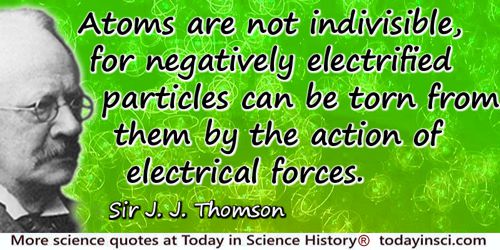
Atoms are not indivisible, for negatively electrified particles can be torn from them by the action of electrical forces.
In Recollections and Reflections (1936), 338.
Atoms have a nucleus, made of protons and neutrons bound together. Around this nucleus shells of electrons spin, and each shell is either full or trying to get full, to balance with the number of protons—to balance the number of positive and negative charges. An atom is like a human heart, you see.
The Lunatics (1988). In Gary Westfahl, Science Fiction Quotations: From the Inner Mind to the Outer Limits (2006), 323.
He (Anaxagoras) is said to have been twenty years old at the time of Xerxes' crossing, and to have lived to seventy-two. Apollodorus says in his Chronicles that he was born in the seventieth Olympiad (500-497 B.C.) and died in the first year of the eighty-eighth (428/7). He began to be a philosopher at Athens in the archonship of Callias (456/5), at the age of twenty, as Demetrius Phalereus tells us in his Register of Archons, and they say he spent thirty years there. … There are different accounts given of his trial. Sotion, in his Succession of Philosophers, says that he was prosecuted by Cleon for impiety, because he maintained that the sun was a red hot mass of metal, and after that Pericles, his pupil, had made a speech in his defence, he was fined five talents and exiled. Satyrus in his Uves, on the other hand, says that the charge was brought by Thucydides in his political campaign against Pericles; and he adds that the charge was not only for the impiety but for Medism as well; and he was condemned to death in his absence. ... Finally he withdrew to Lampsacus, and there died. It is said that when the rulers of the city asked him what privilege he wished to be granted, he replied that the children should be given a holiday every year in the month in which he died. The custom is preserved to the present day. When he died the Lampsacenes buried him with full honours.
Diogenes Laërtius 2.7. In G. S. Kirk, J. E. Raven and M. Schofield (eds.), The Presocratic Philosophers: A Critical History with a Selection of Texts (1983), p. 353.
I have been battering away at Saturn, returning to the charge every now and then. I have effected several breaches in the solid ring, and now I am splash into the fluid one, amid a clash of symbols truly astounding. When I reappear it will be in the dusky ring, which is something like the state of the air supposing the siege of Sebastopol conducted from a forest of guns 100 miles one way, and 30,000 miles the other, and the shot never to stop, but go spinning away round a circle, radius 170,000 miles.
Letter to Lewis Campbell (28 Aug 1857). In P. M. Harman (ed.), The Scientific Letters and Papers of James Clerk Maxwell (1990), Vol. 1, 1846-1862, 538.
I have done a terrible thing: I have postulated a particle that cannot be detected.
After postulating the existence of the neutrino, a particle with no mass and no electric charge, in order to balance an equation. In an article in Mercury, 29, 29, it is stated, without citation, that “the day after making the proposal Pauli told his colleague Walter Baade.” Webmaster has looked, but not yet found a primary source. Can you help?
I must … explain how I was led to concern myself with the pathogenic protozoa. … I was sent to Algeria and put in charge of a department of the hospital at Bone. A large number of my patients had malarial fevers and I was naturally led to study these fevers of which I had only seen rare and benign forms in France.
From Nobel Lecture (11 Dec 1907), 'Protozoa as Causes of Diseases', collected in Nobel Lectures, Physiology or Medicine 1901-1921 (1967, 1999), 264.
I think the facts leave no doubt that the very mightiest among the chemical forces are of electric origin. The atoms cling to their electric charges, and opposite electric charges cling to each other.
'On the Modern Development of Faraday's Conception of Electricity', Journal of the Chemical Society 1881, 39, 302.
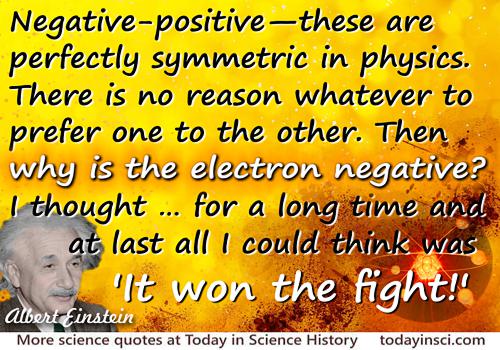
I used to wonder how it comes about that the electron is negative. Negative-positive—these are perfectly symmetric in physics. There is no reason whatever to prefer one to the other. Then why is the electron negative? I thought about this for a long time and at last all I could think was 'It won the fight!'
Quoted in George Wald, 'The Origin of Optical Activity', Annals of the New York Academy of Sciences (1957), 60, 352-68.
If to be the Author of new things, be a crime; how will the first Civilizers of Men, and makers of Laws, and Founders of Governments escape? Whatever now delights us in the Works of Nature, that excells the rudeness of the first Creation, is New. Whatever we see in Cities, or Houses, above the first wildness of Fields, and meaness of Cottages, and nakedness of Men, had its time, when this imputation of Novelty, might as well have bin laid to its charge. It is not therefore an offence, to profess the introduction of New things, unless that which is introduc'd prove pernicious in itself; or cannot be brought in, without the extirpation of others, that are better.
The History of the Royal Society (1667), 322.
If we ascribe the ejection of the proton to a Compton recoil from a quantum of 52 x 106 electron volts, then the nitrogen recoil atom arising by a similar process should have an energy not greater than about 400,000 volts, should produce not more than about 10,000 ions, and have a range in the air at N.T.P. of about 1-3mm. Actually, some of the recoil atoms in nitrogen produce at least 30,000 ions. In collaboration with Dr. Feather, I have observed the recoil atoms in an expansion chamber, and their range, estimated visually, was sometimes as much as 3mm. at N.T.P.
These results, and others I have obtained in the course of the work, are very difficult to explain on the assumption that the radiation from beryllium is a quantum radiation, if energy and momentum are to be conserved in the collisions. The difficulties disappear, however, if it be assumed that the radiation consists of particles of mass 1 and charge 0, or neutrons. The capture of the a-particle by the Be9 nucleus may be supposed to result in the formation of a C12 nucleus and the emission of the neutron. From the energy relations of this process the velocity of the neutron emitted in the forward direction may well be about 3 x 109 cm. per sec. The collisions of this neutron with the atoms through which it passes give rise to the recoil atoms, and the observed energies of the recoil atoms are in fair agreement with this view. Moreover, I have observed that the protons ejected from hydrogen by the radiation emitted in the opposite direction to that of the exciting a-particle appear to have a much smaller range than those ejected by the forward radiation.
This again receives a simple explanation on the neutron hypothesis.
These results, and others I have obtained in the course of the work, are very difficult to explain on the assumption that the radiation from beryllium is a quantum radiation, if energy and momentum are to be conserved in the collisions. The difficulties disappear, however, if it be assumed that the radiation consists of particles of mass 1 and charge 0, or neutrons. The capture of the a-particle by the Be9 nucleus may be supposed to result in the formation of a C12 nucleus and the emission of the neutron. From the energy relations of this process the velocity of the neutron emitted in the forward direction may well be about 3 x 109 cm. per sec. The collisions of this neutron with the atoms through which it passes give rise to the recoil atoms, and the observed energies of the recoil atoms are in fair agreement with this view. Moreover, I have observed that the protons ejected from hydrogen by the radiation emitted in the opposite direction to that of the exciting a-particle appear to have a much smaller range than those ejected by the forward radiation.
This again receives a simple explanation on the neutron hypothesis.
'Possible Existence of a Neutron', Letter to the Editor, Nature, 1932, 129, 312.
If, unwarned by my example, any man shall undertake and shall succeed in really constructing an engine embodying in itself the whole of the executive department of mathematical analysis upon different principles or by simpler mechanical means, I have no fear of leaving my reputation in his charge, for he alone will be fully able to appreciate the nature of my efforts and the value of their results.
In Passages from the Life of a Philosopher (1864), 450.
In order to comprehend and fully control arithmetical concepts and methods of proof, a high degree of abstraction is necessary, and this condition has at times been charged against arithmetic as a fault. I am of the opinion that all other fields of knowledge require at least an equally high degree of abstraction as mathematics,—provided, that in these fields the foundations are also everywhere examined with the rigour and completeness which is actually necessary.
In 'Die Theorie der algebraischen Zahlkorper', Vorwort, Jahresbericht der Deutschen Mathematiker Vereinigung, Bd. 4.
In the discussion of the. energies involved in the deformation of nuclei, the concept of surface tension of nuclear matter has been used and its value had been estimated from simple considerations regarding nuclear forces. It must be remembered, however, that the surface tension of a charged droplet is diminished by its charge, and a rough estimate shows that the surface tension of nuclei, decreasing with increasing nuclear charge, may become zero for atomic numbers of the order of 100. It seems therefore possible that the uranium nucleus has only small stability of form, and may, after neutron capture, divide itself into two nuclei of roughly equal size (the precise ratio of sizes depending on liner structural features and perhaps partly on chance). These two nuclei will repel each other and should gain a total kinetic energy of c. 200 Mev., as calculated from nuclear radius and charge. This amount of energy may actually be expected to be available from the difference in packing fraction between uranium and the elements in the middle of the periodic system. The whole 'fission' process can thus be described in an essentially classical way, without having to consider quantum-mechanical 'tunnel effects', which would actually be extremely small, on account of the large masses involved.
[Co-author with Otto Robert Frisch]
[Co-author with Otto Robert Frisch]
Lise Meitner and O. R. Frisch, 'Disintegration of Uranium by Neutrons: a New Type of Nuclear Reaction', Nature (1939), 143, 239.
In the present state of our knowledge, it would be useless to attempt to speculate on the remote cause of the electrical energy, or the reason why different bodies, after being brought into contact, should be found differently electrified; its relation to chemical affinity is, however, sufficiently evident. May it not be identical with it, and an essential property of matter?
Bakerian Lecture, 'On Some Chemical Agencies of Electricity', Philosophical Transactions of the Royal Society, 1807, 97, 39.
In the X-ray laboratory we are exposed, not only to the direct action of the rays, but to the effects of ionized air. This may be proved by hanging a charged silk tassel anywhere in the room. It will suddenly collapse when the current is turned on through the focus tube.
In 'Protection in X-Ray Work', Archives of the Roentgen Ray (July 1905), 10, No. 2, 38. [Note that this concern for protection, written in 1905, comes within 10 years of the discovery of X-Rays in 1895. —Webmaster]
In the year 1902 (while I was attempting to explain to an elementary class in chemistry some of the ideas involved in the periodic law) becoming interested in the new theory of the electron, and combining this idea with those which are implied in the periodic classification, I formed an idea of the inner structure of the atom which, although it contained certain crudities, I have ever since regarded as representing essentially the arrangement of electrons in the atom ... In accordance with the idea of Mendeleef, that hydrogen is the first member of a full period, I erroneously assumed helium to have a shell of eight electrons. Regarding the disposition in the positive charge which balanced the electrons in the neutral atom, my ideas were very vague; I believed I inclined at that time toward the idea that the positive charge was also made up of discrete particles, the localization of which determined the localization of the electrons.
Valence and the Structure of Atoms and Molecules (1923), 29-30.
Indeed, nothing more beautifully simplifying has ever happened in the history of science than the whole series of discoveries culminating about 1914 which finally brought practically universal acceptance to the theory that the material world contains but two fundamental entities, namely, positive and negative electrons, exactly alike in charge, but differing widely in mass, the positive electron—now usually called a proton—being 1850 times heavier than the negative, now usually called simply the electron.
Time, Matter and Values (1932), 46. Cited in Karl Raimund Popper and William Warren Bartley (ed.), Quantum Theory and theSchism in Physics (1992), 37.
It is a matter of primary importance in the cultivation of those sciences in which truth is discoverable by the human intellect that the investigator should be free, independent, unshackled in his movement; that he should be allowed and enabled to fix his mind intently, nay, exclusively, on his special object, without the risk of being distracted every other minute in the process and progress of his inquiry by charges of temerariousness, or by warnings against extravagance or scandal.
In The Idea of a University Defined and Illustrated (1905), 471.
It is a profoundly erroneous truism, repeated by all copy-books and eminent people when they are making speeches, that we should cultivate habit of thinking of what we are doing. The precise opposite is the case. Civilization advances by extending the number of important operations which we can perform without thinking about them. Operations of thought are like cavalry charges in a battle—they are strictly limited in number, they require fresh horses, and must only be made at decisive moments.
In An Introduction to Mathematics (1911), 61.
It is for such inquiries the modern naturalist collects his materials; it is for this that he still wants to add to the apparently boundless treasures of our national museums, and will never rest satisfied as long as the native country, the geographical distribution, and the amount of variation of any living thing remains imperfectly known. He looks upon every species of animal and plant now living as the individual letters which go to make up one of the volumes of our earth’s history; and, as a few lost letters may make a sentence unintelligible, so the extinction of the numerous forms of life which the progress of cultivation invariably entails will necessarily render obscure this invaluable record of the past. It is, therefore, an important object, which governments and scientific institutions should immediately take steps to secure, that in all tropical countries colonised by Europeans the most perfect collections possible in every branch of natural history should be made and deposited in national museums, where they may be available for study and interpretation. If this is not done, future ages will certainly look back upon us as a people so immersed in the pursuit of wealth as to be blind to higher considerations. They will charge us with having culpably allowed the destruction of some of those records of Creation which we had it in our power to preserve; and while professing to regard every living thing as the direct handiwork and best evidence of a Creator, yet, with a strange inconsistency, seeing many of them perish irrecoverably from the face of the earth, uncared for and unknown.
In 'On the Physical Geography of the Malay Archipelago', Journal of the Royal Geographical Society (1863), 33, 234.
It is not always possible to know what one has learned, or when the dawning will arrive. You will continue to shift, sift, to shake out and to double back. The synthesis that finally occurs can be in the most unexpected place and the most unexpected time. My charge ... is to be alert to the dawnings.
…...

It is perhaps difficult for a modern student of Physics to realize the basic taboo of the past period (before 1956) … it was unthinkable that anyone would question the validity of symmetries under “space inversion,” “charge conjugation” and “time reversal.” It would have been almost sacrilegious to do experiments to test such unholy thoughts.
In paper presented to the International Conference on the History of Original Ideas and Basic Discoveries, Erice, Sicily (27 Jul-4 Aug 1994), 'Parity Violation' collected in Harvey B. Newman, Thomas Ypsilantis History of Original Ideas and Basic Discoveries in Particle Physics (1996), 381.
It is well-known that those who have charge of young infants, that it is difficult to feel sure when certain movements about their mouths are really expressive; that is when they really smile. Hence I carefully watched my own infants. One of them at the age of forty-five days, and being in a happy frame of mind, smiled... I observed the same thing on the following day: but on the third day the child was not quite well and there was no trace of a smile, and this renders it probable that the previous smiles were real.
The Expression of Emotions in Man and Animals
It required unusual inquisitiveness to pursue the development of scientific curiosities such as charged pith balls, the voltaic cell, and the electrostatic machine. Without such endeavors and the evolution of associated instrumentation, initially of purely scientific interest, most of the investigations that lead to the basic equations of electromagnetism would have been missed. … We would have been deprived of electromagnetic machinery as well as knowledge of electromagnetic waves.
From The Science Matrix: The Journey, Travails, Triumphs (1992, 1998), 14.
It will be a general expression of the facts that have been detailed, relating to the changes and transitions by electricity, in common philosophical language, to say, that hydrogen, the alkaline substances, the metals, and certain metallic oxides, are all attracted by negatively electrified metallic surfaces; and contrariwise, that oxygen and acid substances are attracted by positively electrified metallic surfaces and rejected by negatively electrified metallic surfaces; and these attractive and repulsive forces are sufficiently energetic to destroy or suspend the usual operation of elective affinity.
Bakerian Lecture, 'On Some Chemical Agencies of Electricity', Philosophical Transactions of the Royal Society, 1807, 97, 28-29.
Many from … an inconsiderate zeal unto truth, have too rashly charged the troops of error, and remain as trophies unto the enemies of truth.
In T. Chapman (ed.), Religio Medici (1643, 1831), part 1, sect. 6, 11.
Mathematics may be likened to a large rock whose interior composition we wish to examine. The older mathematicians appear as persevering stone cutters slowly attempting to demolish the rock from the outside with hammer and chisel. The later mathematicians resemble expert miners who seek vulnerable veins, drill into these strategic places, and then blast the rock apart with well placed internal charges.
From In Mathematical Circles (1969), 7.
My profession often gets bad press for a variety of sins, both actual and imagined: arrogance, venality, insensitivity to moral issues about the use of knowledge, pandering to sources of funding with insufficient worry about attendant degradation of values. As an advocate for science, I plead ‘mildly guilty now and then’ to all these charges. Scientists are human beings subject to all the foibles and temptations of ordinary life. Some of us are moral rocks; others are reeds. I like to think (though I have no proof) that we are better, on average, than members of many other callings on a variety of issues central to the practice of good science: willingness to alter received opinion in the face of uncomfortable data, dedication to discovering and publicizing our best and most honest account of nature’s factuality, judgment of colleagues on the might of their ideas rather than the power of their positions.
In Dinosaur in a Haystack: Reflections in Natural History (1997), 270.
Nazis started the Science of Eugenics. It’s the theory that to them, justified the holocaust. The problem is the Science has been broadly accepted around the world, including the United States. We even went as far as to hire the Scientists that were working on it and brought them over here rather then charging them with war crimes. [Project Paperclip] I think it is a very dangerous Science that contains ideologies that are a grave danger to the entire world.
…...
Neutrinos ... win the minimalist contest: zero charge, zero radius, and very possibly zero mass.
In Leon Lederman and Dick Teresi, The God Particle: If the Universe is the Answer, What is the
Question (1993, 2006), xiii.
Neutrinos, they are very small
They have no charge and have no mass
And do not interact at all.
The earth is just a silly ball
To them, through which they simply pass,Like dustmaids down a drafty hall
Or photons through a sheet of glass.
They snub the most exquisite gas,
Ignore the most substantial wall,
Cold-shoulder steel and sounding brass,
Insult the stallion in his stall,
And, scorning barriers of class,
Infiltrate you and me! Like tall
And painless guillotines, they fall
Down through our heads into the grass.
At night, they enter at Nepal
And pierce the lover and his lass
From underneath the bed—you call
It wonderful; I call it crass.
They have no charge and have no mass
And do not interact at all.
The earth is just a silly ball
To them, through which they simply pass,Like dustmaids down a drafty hall
Or photons through a sheet of glass.
They snub the most exquisite gas,
Ignore the most substantial wall,
Cold-shoulder steel and sounding brass,
Insult the stallion in his stall,
And, scorning barriers of class,
Infiltrate you and me! Like tall
And painless guillotines, they fall
Down through our heads into the grass.
At night, they enter at Nepal
And pierce the lover and his lass
From underneath the bed—you call
It wonderful; I call it crass.
In poem 'Cosmic Gall', The New Yorker (17 Dec 1960). Collected in Telephone Poles and Other Poems (1964), 5. Note: In fact, about 1014 neutrinos from the Sun and 103 neutrinos in cosmic rays pass through our bodies each second. Neutrinos are now known to have a very small amount of mass, and they do interact (through the weak force). Thus line 3 is better expressed as: “And scarcely interact at all,” which Murray Gell-Mann substitutes, claiming “scientific license, in his 'The Elementary particles of Matter', Engineering and Science (Jan 1967), 21.
On one occasion committee members were asked by the chairman, who was also in charge of the project, to agree that a certain machine be run at a power which was ten percent lower than the design value. [Franz Eugen] Simon objected, arguing that “design value” should mean what it said. Thereupon the chairman remarked, “Professor Simon, don’t you see that we are not talking about science, but about engineering, which is an art.” Simon was persistent: “What would happen if the machine were run at full power?” “It might get too hot.” “But, Mr. Chairman,” came Simon’s rejoinder, “Can’t artists use thermometers?”
(1908). From N. Kurti, 'Franz Eugen Simon', Biographical Memoirs of Fellows of the Royal Society (Nov 1958), 4, 247.
Open to lawful traffic of all descriptions without toll charges.
From the Proclamation by the Lincoln Highway Association (13 Sep 1913), announcing the route of the Lincoln Highway. In the Lincoln Highway Association, The Lincoln Highway: the Story of a Crusade That Made Transportation History (1935), 61.
Our most successful theories in physics are those that explicitly leave room for the unknown, while confining this room sufficiently to make the theory empirically disprovable. It does not matter whether this room is created by allowing for arbitrary forces as Newtonian dynamics does, or by allowing for arbitrary equations of state for matter, as General Relativity does, or for arbitrary motions of charges and dipoles, as Maxwell's electrodynamics does. To exclude the unknown wholly as a “unified field theory” or a “world equation” purports to do is pointless and of no scientific significance.
Rome wasn’t built in a day? I wasn’t in charge of that job.
In 'Speeding up Calculations', Facts From Figures (1951), Chap. 6, 66.
Significant inventions are not mere accidents. The erroneous view [that they are] is widely held, and it is one that the scientific and technical community, unfortunately, has done little to dispel. Happenstance usually plays a part, to be sure, but there is much more to invention than the popular notion of a bolt out of the blue. Knowledge in depth and in breadth are virtual prerequisites. Unless the mind is thoroughly charged beforehand, the proverbial spark of genius, if it should manifest itself, probably will find nothing to ignite.
Speech, at award of Perkin Medal. As quoted in 'Introduction', Royston M. Roberts, Serendipity (1989), x.
The man who is thoroughly convinced of the universal operation of the law of causation cannot for a moment entertain the idea of a being who interferes in the course of events–provided, of course, that he takes the hypothesis of causality really seriously. He has no use for the religion of fear and equally little for social or moral religion. A God who rewards and punishes is inconceivable to him for the simple reason that a man’s actions are determined by necessity, external and internal, so that in God’s eyes he cannot be responsible, any more than an inanimate object is responsible for the motions it undergoes. Science has therefore been charged with undermining morality, but the charge is unjust. A man’s ethical behavior should be based effectually on sympathy, education, and social ties and needs; no religious basis is necessary. Man would indeed be in a poor way if he had to be restrained by fear of punishment and hopes of reward after death.
From 'Religion And Science', as collected in Ideas And Opinions (1954), 39, given its source as: “Written expressly for the New York Times Magazine. Appeared there November 9, 1930 (pp. 1-4). The German text was published in the Berliner Tageblatt, November 11, 1930.” The NYT Magazine article in full, is reprinted in Edward H. Cotton (ed.), Has Science Discovered God? A Symposium of Modern Scientific Opinion (1931), 101. This original version directly from the magazine has significantly different wording, beginning, “For anyone who is pervaded with the sense of causal law….” See this alternate form on the Albert Einstein Quotes page on this website. As for why the difference, Webmaster speculates the book form editor perhaps used a revised translation from Einstein’s German article.
The most startling result of Faraday’s Law is perhaps this. If we accept the hypothesis that the elementary substances are composed of atoms, we cannot avoid concluding that electricity also, positive as well as negative, is divided into definite elementary portions, which behave like atoms of electricity.
Faraday Lecture (1881). In 'On the Modern Development of Faraday's Conception of Electricity', Journal of the Chemical Society 1881, 39, 290. It is also stated in the book by Laurie M. Brown, Abraham Pais and Brian Pippard, Twentieth Century P, Vol. 1, 52, that this is 'a statement which explains why in subsequent years the quantity e was occasionally referred to in German literature as das Helmholtzsche Elementarquantum'.
The only thing that I’d rather own than Windows is English, because then I could charge you two hundred and forty-nine dollars for the right to speak it.
…...
The original Marxist notion of ideology was conveniently forgotten because it inconveniently did not exempt common sense and empiricism from the charge of ideology.
In Social Amnesia (1975), 6-7.
The rich can pay when they have to pay [for medical care]. The poor receive free treatment from skilled specialists and can go, when necessary, to hospitals free of charge. But between seventy-five and ninety per cent. of our population, that which constitutes our very backbone, find it difficult to be relieved from the intolerable burden of illness.
In Genevieve Parkhurst, 'Dr. Sabin, Scientist: Winner Of Pictorial Review’s Achievement Award', Pictorial Review (Jan 1930), 70.
The same algebraic sum of positive and negative charges in the nucleus, when the arithmetical sum is different, gives what I call “isotopes” or “isotopic elements,” because they occupy the same place in the periodic table. They are chemically identical, and save only as regards the relatively few physical properties which depend upon atomic mass directly, physically identical also. Unit changes of this nuclear charge, so reckoned algebraically, give the successive places in the periodic table. For any one “place” or any one nuclear charge, more than one number of electrons in the outer-ring system may exist, and in such a case the element exhibits variable valency. But such changes of number, or of valency, concern only the ring and its external environment. There is no in- and out-going of electrons between ring and nucleus.
Concluding paragraph of 'Intra-atomic Charge', Nature (1913), 92, 400. Collected in Alfred Romer, Radiochemistry and the Discovery of Isotopes (1970), 251-252.
The sky seems to be a pure, a cooler blue, the trees a deeper green. The whole world is charged with the glory of God and I feel fire and music under my feet.
On reading the scriptures. Quoted in Kim Lim (ed.), 1,001 Pearls of Spiritual Wisdom: Words to Enrich, Inspire, and Guide Your Life (2014), 166
The world is charged with the grandeur of God. It will flame out, like shining from shook foil.
Quoted in Kim Lim (ed.), 1,001 Pearls of Spiritual Wisdom: Words to Enrich, Inspire, and Guide Your Life (2014), 165
There has come about a general public awareness that America is not automatically, and effortlessly, and unquestionably the leader of the world in science and technology. This comes as no surprise to those of us who have watched and tried to warn against the steady deterioration in the teaching of science and mathematics in the schools for the past quarter century. It comes as no surprise to those who have known of dozens of cases of scientists who have been hounded out of jobs by silly disloyalty charges, and kept out of all professional employment by widespread blacklisting practices.
Banquet speech at American Physical Society, St. Louis, Missouri. (29 Nov 1957). In "Time to Stop Baiting Scientists", Bulletin of the Atomic Scientists (Feb 1958), 80.
There is a story that once, not long after he came to Berlin, Planck forgot which room had been assigned to him for a lecture and stopped at the entrance office of the university to find out. Please tell me, he asked the elderly man in charge, “In which room does Professor Planck lecture today?” The old man patted him on the shoulder “Don't go there, young fellow,” he said “You are much too young to understand the lectures of our learned Professor Planck.”
In Barbara Lovett Cline, Men Who Made a New Physics: Physicists and the Quantum Theory (1987), 46.
There is nothing in the world except empty curved space. Matter, charge, electromagnetism, and other fields are only manifestations of the curvature of space.
(1957) Quoted in New Scientist, 26 Sep 1974.
This Academy [at Lagado] is not an entire single Building, but a Continuation of several Houses on both Sides of a Street; which growing waste, was purchased and applied to that Use.
I was received very kindly by the Warden, and went for many Days to the Academy. Every Room hath in it ' one or more Projectors; and I believe I could not be in fewer than five Hundred Rooms.
The first Man I saw was of a meagre Aspect, with sooty Hands and Face, his Hair and Beard long, ragged and singed in several Places. His Clothes, Shirt, and Skin were all of the same Colour. He had been Eight Years upon a Project for extracting Sun-Beams out of Cucumbers, which were to be put into Vials hermetically sealed, and let out to warm the Air in raw inclement Summers. He told me, he did not doubt in Eight Years more, that he should be able to supply the Governor's Gardens with Sunshine at a reasonable Rate; but he complained that his Stock was low, and interested me to give him something as an Encouragement to Ingenuity, especially since this had been a very dear Season for Cucumbers. I made him a small Present, for my Lord had furnished me with Money on purpose, because he knew their Practice of begging from all who go to see them.
I saw another at work to calcine Ice into Gunpowder; who likewise shewed me a Treatise he had written concerning the Malleability of Fire, which he intended to publish.
There was a most ingenious Architect who had contrived a new Method for building Houses, by beginning at the Roof, and working downwards to the Foundation; which he justified to me by the life Practice of those two prudent Insects the Bee and the Spider.
In another Apartment I was highly pleased with a Projector, who had found a device of plowing the Ground with Hogs, to save the Charges of Plows, Cattle, and Labour. The Method is this: In an Acre of Ground you bury at six Inches Distance, and eight deep, a quantity of Acorns, Dates, Chestnuts, and other Masts or Vegetables whereof these Animals are fondest; then you drive six Hundred or more of them into the Field, where in a few Days they will root up the whole Ground in search of their Food, and make it fit for sowing, at the same time manuring it with their Dung. It is true, upon Experiment they found the Charge and Trouble very great, and they had little or no Crop. However, it is not doubted that this Invention may be capable of great Improvement.
I had hitherto seen only one Side of the Academy, the other being appropriated to the Advancers of speculative Learning.
Some were condensing Air into a dry tangible Substance, by extracting the Nitre, and letting the acqueous or fluid Particles percolate: Others softening Marble for Pillows and Pin-cushions. Another was, by a certain Composition of Gums, Minerals, and Vegetables outwardly applied, to prevent the Growth of Wool upon two young lambs; and he hoped in a reasonable Time to propagate the Breed of naked Sheep all over the Kingdom.
I was received very kindly by the Warden, and went for many Days to the Academy. Every Room hath in it ' one or more Projectors; and I believe I could not be in fewer than five Hundred Rooms.
The first Man I saw was of a meagre Aspect, with sooty Hands and Face, his Hair and Beard long, ragged and singed in several Places. His Clothes, Shirt, and Skin were all of the same Colour. He had been Eight Years upon a Project for extracting Sun-Beams out of Cucumbers, which were to be put into Vials hermetically sealed, and let out to warm the Air in raw inclement Summers. He told me, he did not doubt in Eight Years more, that he should be able to supply the Governor's Gardens with Sunshine at a reasonable Rate; but he complained that his Stock was low, and interested me to give him something as an Encouragement to Ingenuity, especially since this had been a very dear Season for Cucumbers. I made him a small Present, for my Lord had furnished me with Money on purpose, because he knew their Practice of begging from all who go to see them.
I saw another at work to calcine Ice into Gunpowder; who likewise shewed me a Treatise he had written concerning the Malleability of Fire, which he intended to publish.
There was a most ingenious Architect who had contrived a new Method for building Houses, by beginning at the Roof, and working downwards to the Foundation; which he justified to me by the life Practice of those two prudent Insects the Bee and the Spider.
In another Apartment I was highly pleased with a Projector, who had found a device of plowing the Ground with Hogs, to save the Charges of Plows, Cattle, and Labour. The Method is this: In an Acre of Ground you bury at six Inches Distance, and eight deep, a quantity of Acorns, Dates, Chestnuts, and other Masts or Vegetables whereof these Animals are fondest; then you drive six Hundred or more of them into the Field, where in a few Days they will root up the whole Ground in search of their Food, and make it fit for sowing, at the same time manuring it with their Dung. It is true, upon Experiment they found the Charge and Trouble very great, and they had little or no Crop. However, it is not doubted that this Invention may be capable of great Improvement.
I had hitherto seen only one Side of the Academy, the other being appropriated to the Advancers of speculative Learning.
Some were condensing Air into a dry tangible Substance, by extracting the Nitre, and letting the acqueous or fluid Particles percolate: Others softening Marble for Pillows and Pin-cushions. Another was, by a certain Composition of Gums, Minerals, and Vegetables outwardly applied, to prevent the Growth of Wool upon two young lambs; and he hoped in a reasonable Time to propagate the Breed of naked Sheep all over the Kingdom.
Gulliver's Travels (1726, Penguin ed. 1967), Part III, Chap. 5, 223.
This is the excellent foppery of the world: that when we are sick in fortune—often the surfeits of our own behaviour—we make guilty of our disasters the sun, the moon, and stars, as if we were villains on necessity, fools by heavenly compulsion, knaves, thieves, and treachers by spherical predominance, drunkards, liars, and adulterers, by an enforced obedience of planetary influence, and all that we are evil in, by a divine thrusting on. An admirable evasion of whoremaster man, to lay his goatish disposition on the charge of a star! My father compounded with my mother under the Dragon's tail and my nativity was under Ursa Major, so that it follows that I am rough and lecherous. Fut! I should have been that I am had the maidenliest star in the firmament twinkled on my bastardizing.
King Lear (1605-6), I, ii.
Tiny ferryboats they were, each laden with its little electric charge, unloading their etheric cargo at the opposite electrode and retracing their journeyings, or caught by a cohesive force, building up little bridges, or trees with quaint and beautiful patterns.
Describing the flow of electrons between electrodes in a vacuum tube.
Describing the flow of electrons between electrodes in a vacuum tube.
Father of Radio: the Autobiography of Lee De Forest (1950), 119. In Rodney P. Carlisle, Scientific American Inventions and Discoveries (2004), 391.
When in Ames, I had charge of a football team and a track team. I was the official ‘rubber.’ Now we call them ‘Masseurs.’ But we weren’t so stylish in those days, so my title was that of a ‘rubber.’ I noticed then that there was something lacking in the oils used for such purposes, which set me thinking. When I came to Tuskegee, I found a healing strength in peanut oil not found in other oils. I have found great possibilities in it. I am simply a scientist attempting to work out a complete oil therapy. In my investigations I find that the peanut oils give better results when skillfully applied than any of the 44 other oils that I have used. So far my success is very gratifying. I have more than 6,000 letters before me on this subject, and there are people who come to consult with me every day.
As quoted in 'Chemistry and Peace', Atlanta Daily World (3 Jan 1943), 4.
 In science it often happens that scientists say, 'You know that's a really good argument; my position is mistaken,' and then they would actually change their minds and you never hear that old view from them again. They really do it. It doesn't happen as often as it should, because scientists are human and change is sometimes painful. But it happens every day. I cannot recall the last time something like that happened in politics or religion.
(1987) --
In science it often happens that scientists say, 'You know that's a really good argument; my position is mistaken,' and then they would actually change their minds and you never hear that old view from them again. They really do it. It doesn't happen as often as it should, because scientists are human and change is sometimes painful. But it happens every day. I cannot recall the last time something like that happened in politics or religion.
(1987) --