Change Quotes (650 quotes)
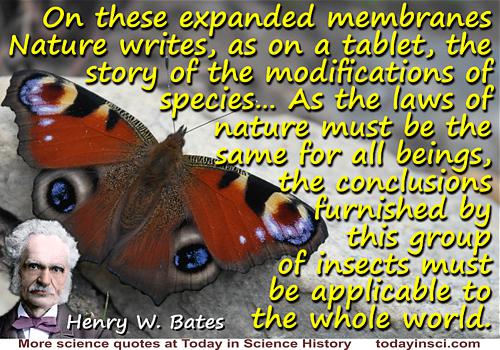
… on these expanded membranes [butterfly wings] Nature writes, as on a tablet, the story of the modifications of species, so truly do all changes of the organisation register themselves thereon. Moreover, the same colour-patterns of the wings generally show, with great regularity, the degrees of blood-relationship of the species. As the laws of nature must be the same for all beings, the conclusions furnished by this group of insects must be applicable to the whole world.
From The Naturalist on the River Amazons: A record of Adventures, Habits of Animals, Sketches of Brazilian and Indian life, and Aspects of Nature under the Equator, During Eleven Years of Travel (1864), 413.
...travel is more than the seeing of sights; it is a change that goes on, deep and permanent, in the ideas of living.
…...
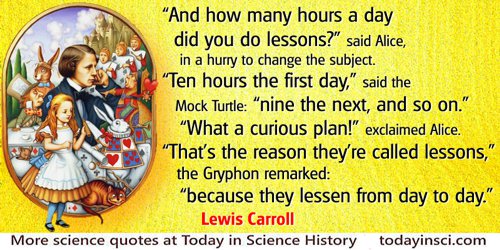
“And how many hours a day did you do lessons?” said Alice, in a hurry to change the subject.
“Ten hours the first day,” said the Mock Turtle: “nine the next, and so on.”
“What a curious plan!” exclaimed Alice.
“That's the reason they’re called lessons,” the Gryphon remarked: “because they lessen from day to day.”
“Ten hours the first day,” said the Mock Turtle: “nine the next, and so on.”
“What a curious plan!” exclaimed Alice.
“That's the reason they’re called lessons,” the Gryphon remarked: “because they lessen from day to day.”
Alice's Adventures in Wonderland (1865, 1869), 145.
“Conservation” (the conservation law) means this … that there is a number, which you can calculate, at one moment—and as nature undergoes its multitude of changes, this number doesn't change. That is, if you calculate again, this quantity, it'll be the same as it was before. An example is the conservation of energy: there's a quantity that you can calculate according to a certain rule, and it comes out the same answer after, no matter what happens, happens.
'The Great Conservation Principles', The Messenger Series of Lectures, No. 3, Cornell University, 1964. From transcript of BBC programme (11 Dec 1964).
“I’m not so sure he’s wrong about automobiles,” he said, “With all their speed forward they may be a step backward for civilization—that is, spiritual civilization … But automobiles have come, and they bring a greater change in our life than most of us expect. They are here, and almost all outward things are going to be different because of what they bring. They are going to alter war, and they are going to alter peace.”
Spoken by character Eugene, in the novel, The Magnificent Ambersons (1918), 275
“One and one make two” assumes that the changes in the shift of circumstance are unimportant. But it is impossible for us to analyze this notion of unimportant change.
In Science and Philosophy (1948), 103.
“These changes in the body,” he wrote in the review paper he sent to the American Journal of Physiology late in 1913, “are, each one of them, directly serviceable in making the organism more efficient in the struggle which fear or rage or pain may involve; for fear and rage are organic preparations for action, and pain is the most powerful known stimulus to supreme exertion. The organism which with the aid of increased adrenal secretion can best muster its energies, can best call forth sugar to supply the labouring muscles, can best lessen fatigue, and can best send blood to the parts essential in the run or the fight for life, is most likely to survive. Such, according to the view here propounded, is the function of the adrenal medulla at times of great emergency.”
Quoted in S. Benison, A. C. Barger and E. L. Wolfe, Walter B Cannon: The Life and Times of a Young Scientist (1987), 311.
(1) I have told you more than I know about osteoporosis. (2) What I have told you is subject to change without notice. (3) I hope I raised more questions than I have given answers. (4) In any case, as usual, a lot more work is necessary.
Conclusion of one of his papers.
Conclusion of one of his papers.
In Barry G. Firkin, Judith A. Whitworth, Dictionary of Medical Eponyms (1996), 5.
[1665-08-16] ...Hence to the Exchange, which I have not been a great while. But Lord, how sad a sight it is to see the streets empty of people, and very few upon the Change - jealous of every door that one sees shut up, lest it should be the plague - and about us, two shops in three, if not more, generally shut up. ... It was dark before I could get home; and so land at church-yard stairs, where to my great trouble I met a dead Corps, of the plague, in the narrow ally, just bringing down a little pair of stairs - but I thank God I was not much disturbed at it. However, I shall beware of being late abroad again.
Diary of Samuel Pepys (16 Aug 1665)
[A dragonfly larva is] carrying inside it two entirely separate blueprints, two different programmes [to turn into a dragonfly].
From 'Interview: Of Mind and Matter: David Attenborough Meets Richard Dawkins', The Guardian (11 Sep 2010).
[A plant] does not change itself gradually, but remains unaffected during all succeeding generations. It only throws off new forms, which are sharply contrasted with the parent, and which are from the very beginning as perfect and as constant, as narrowly defined, and as pure of type as might be expected of any species.
In Species and Varieties: Their Origin and Mutation (1905), 28-9.
[Certain students] suppose that because science has penetrated the structure of the atom it can solve all the problems of the universe. ... They are known in every ... college as the most insufferable, cocksure know-it-alls. If you want to talk to them about poetry, they are likely to reply that the "emotive response" to poetry is only a conditioned reflex .... If they go on to be professional scientists, their sharp corners are rubbed down, but they undergo no fundamental change. They most decidedly are not set apart from the others by their intellectual integrity and faith, and their patient humility in front of the facts of nature.... They are uneducated, in the fullest sense of the word, and they certainly are no advertisement for the claims of science teachers.
In Science is a Sacred Cow (1950), 18-19.
[Defining Life] The definite combination of heterogeneous changes, both simultaneous and successive, in correspondence with external co-existences and sequences.
Herbert Spencer, "Principles of Psychology" 1835, p. 354. Compare "Physiology of Common Life" 1860, ii., 426. In The British Controversialist and Literary Magazine (1865), 234.
[For the] increase of knowledge and … the useful application of the knowledge gained, … there never is a sudden beginning; even the cloud change which portends the thunderstorm begins slowly.
From address, 'A Medical Retrospect'. Published in Yale Medical Journal (Oct 1910), 17, No. 2, 59.
[Geology] may be looked upon as the history of the earth’s changes during preparation for the reception of organized beings, a history, which has all the character of a great epic.
Paper read to the Linnean Society, 7 Feb 1843. In George Wilson and Archibald Geikie, Memoir of Edward Forbes F.R.S. (1861), 343.
[It] is the little causes, long continued, which are considered as bringing about the greatest changes of the earth.
Theory of the Earth, with Proofs and Illustrations, Vol. 2 (1795), 205.
[Mercurial medicines] affect the human constitution in a peculiar manner, taking, so to speak, an iron grasp of all its systems, and penetrating even to the bones, by which they not only change the healthy action of its vessels, and general structure, but greatly impair and destroy its energies; so that their abuse is rarely overcome. When the tone of the stomach, intestines, or nervous system generally, has been once injured by this mineral ... it could seldom be restored.
Quoted in Wooster Beach, A Treatise on Anatomy, Physiology, and Health (1848), 177.
[My advice] will one day be found
With other relics of 'a former world,'
When this world shall be former, underground,
Thrown topsy-turvy, twisted, crisped, and curled,
Baked, fried or burnt, turned inside-out, or drowned,
Like all the worlds before, which have been hurled
First out of, and then back again to Chaos,
The Superstratum which will overlay us.
With other relics of 'a former world,'
When this world shall be former, underground,
Thrown topsy-turvy, twisted, crisped, and curled,
Baked, fried or burnt, turned inside-out, or drowned,
Like all the worlds before, which have been hurled
First out of, and then back again to Chaos,
The Superstratum which will overlay us.
Don Juan (1821), Canto 9, Verse 37. In Jerome J. McGann (ed.), Lord Byron: The Complete Poetical Works (1986), Vol. 5, 420.
[My favourite fellow of the Royal Society is the Reverend Thomas Bayes, an obscure 18th-century Kent clergyman and a brilliant mathematician who] devised a complex equation known as the Bayes theorem, which can be used to work out probability distributions. It had no practical application in his lifetime, but today, thanks to computers, is routinely used in the modelling of climate change, astrophysics and stock-market analysis.
Quoted in Max Davidson, 'Bill Bryson: Have faith, science can solve our problems', Daily Telegraph (26 Sep 2010)
![John Houghton quote: [O]ur long-term security is threatened by a problem at least as dangerous as chemical, nuclear or biologica](https://todayinsci.com/H/Houghton_John/HoughtonJohn-GlobalWarming500x250px.jpg)
[O]ur long-term security is threatened by a problem at least as dangerous as chemical, nuclear or biological weapons, or indeed international terrorism: human-induced climate change. … The impacts of global warming are such that I have no hesitation in describing it as a “weapon of mass destruction.” Like terrorism, this weapon knows no boundaries. It can strike anywhere, in any form…
London Guardian (28 Jul 2003)
[The chemical bond] First, it is related to the disposition of two electrons (remember, no one has ever seen an electron!): next, these electrons have their spins pointing in opposite directions (remember, no one can ever measure the spin of a particular electron!): then, the spatial distribution of these electrons is described analytically with some degree of precision (remember, there is no way of distinguishing experimentally the density distribution of one electron from another!): concepts like hybridization, covalent and ionic structures, resonance, all appear, not one of which corresponds to anything that is directly measurable. These concepts make a chemical bond seem so real, so life-like, that I can almost see it. Then I wake with a shock to the realization that a chemical bond does not exist; it is a figment of the imagination that we have invented, and no more real than the square root of - 1. I will not say that the known is explained in terms of the unknown, for that is to misconstrue the sense of intellectual adventure. There is no explanation: there is form: there is structure: there is symmetry: there is growth: and there is therefore change and life.
Quoted in his obituary, Biographical Memoirs of the Fellows of the Royal Society 1974, 20, 96.
[The Royal Society] is quite simply the voice of science in Britain. It is intellectually rigorous, not afraid to be outspoken on controversial issues such as climate change, but it is not aggressively secular either, insisting on a single view of the world. In fact, there are plenty of eminent scientists – Robert Winston, for instance – who are also men of faith.
Quoted in Max Davidson, 'Bill Bryson: Have faith, science can solve our problems', Daily Telegraph (26 Sep 2010)
[To the cultures of Asia and the continent of Africa] it is the Western impact which has stirred up the winds of change and set the processes of modernization in motion. Education brought not only the idea of equality but also another belief which we used to take for granted in the West—the idea of progress, the idea that science and technology can be used to better human conditions. In ancient society, men tended to believe themselves fortunate if tomorrow was not worse than today and anyway, there was little they could do about it.
Lecture at State University of Iowa (6 Apr 1961). In Barbara Ward, The Unity of the Free World (1961), 12.
“Pieces” almost always appear 'as parts' in whole processes. ... To sever a “'part” from the organized whole in which it occurs—whether it itself be a subsidiary whole or an “element”—is a very real process usually involving alterations in that “part”. Modifications of a part frequently involve changes elsewhere in the whole itself. Nor is the nature of these alterations arbitrary, for they too are determined by whole-conditions.
From 'Untersuchungen zur Lehre von der Gestalt, I', Psychol. Forsch. (1922), 1, 47-58. As translated in 'The General Theoretical Situation' (1922), collected in W. D. Ellis (ed.), A Source Book of Gestalt Psychology (1938, 1967), Vol. 2, 14.
[On the propulsive force of rockets] One part of fire takes up as much space as ten parts of air, and one part of air takes up the space of ten parts of water, and one part of water as much as ten parts of earth. Now powder is earth, consisting of the four elementary principles, and when the sulfur conducts the fire into the dryest part of the powder, fire, and air increase … the other elements also gird themselves for battle with each other and the rage of battle is changed by their heat and moisture into a strong wind.
In De La Pirotechnia (1540). From the 1943 English translation, as given in Willy Ley, Rockets: The Future of Travel Beyond the Stratosphere (1944), 64. Though Birinuccio provided the first insight into what propels a rocket, the “strong wind” blowing downward, he did not explain why that should cause the rocket to rise upward, as Issac Newton would do with his Third Law of Motion, nearly a century and a half later.
Air Chief Marshal Harris [objecting to a change in strategy recommended by statisticians]: Are we fighting this war with weapons or the slide rule?
Churchill [after puffing on his cigar]: That's a good idea. Let's try the slide rule.
Churchill [after puffing on his cigar]: That's a good idea. Let's try the slide rule.
During World War II, Britain lost the advantage when enemy U-boats began listening in to the aircraft radar, were forewarned, and would dive. U-boat sinkings fell to zero. Physicist Patrick S. Blackett with his Operational Research colleagues came up with a solution. Concentrate sufficient aircraft in certain areas, causing the subs to dive so frequently their air supply and batteries were exhausted, forcing them to remain on the surface and be vulnerable to attack. The strategy required diverting several squadrons from Bomber Command to Coastal Command. “Bomber” Harris voiced his objection to Churchill, who made the right choice, proved by successful results. As described by R.V. Jones, 'Churchill and Science', in Robert Blake and Wm. Roger Louis (eds.), Churchill (1996), 437.
Dauer in Wechsel.
Duration in change.
Duration in change.
Favourite expression.
Discovery always carries an honorific connotation. It is the stamp of approval on a finding of lasting value. Many laws and theories have come and gone in the history of science, but they are not spoken of as discoveries. Kepler is said to have discovered the laws of planetary motion named after him, but no the many other 'laws' which he formulated. ... Theories are especially precarious, as this century profoundly testifies. World views can and do often change. Despite these difficulties, it is still true that to count as a discovery a finding must be of at least relatively permanent value, as shown by its inclusion in the generally accepted body of scientific knowledge.
Discovery in the Physical Sciences (1969). In Rodney P. Carlisle, Scientific American Inventions and Discoveries (2004), 179.
~~[Orphan]~~ If the facts don’t fit the theory, change the facts.
Although in recent years seen attributed to Einstein, there seems to be no authentic source. So treat it as by “Anonymous”. Included here under Einstein to link it to this warning. Compare with, “If the facts do not agree with your theory … then so much the worse for the facts.” See quote beginning, “An enthusiastic philosopher…” on the Charles Mackay Quotes page on this website.
~~[Questionable attribution]~~ Travel and change of place impart new vigor to the mind.
Found widely quoted and attributed to Seneca, but Webmaster, as yet, has not identified the primary source of these words (in verbatim translation) in the writings of Seneca. Conversely, Seneca says somewhat the opposite in his Epistle CIV on 'Travelling', as translated in The Epistles of Lucius Annæus Seneca (1786), Vol. 2, 242-243. Seneca quotes Socrates, “For it is said that Socrates, when a person was complaining to him that he had received very little benefit from travelling, made this reply: I do not wonder at it, since you travelled with yourself.” However Seneca was perhaps commenting on physical health, saying further, “Medicine is requisite for a sick man, not a journey. … Why then should you think a mind … can be cured merely by change of place?” However, please contact if you can help with a different Seneca source applying to mental health.
A ... hypothesis may be suggested, which supposes the word 'beginning' as applied by Moses in the first of the Book of Genesis, to express an undefined period of time which was antecedent to the last great change that affected the surface of the earth, and to the creation of its present animal and vegetable inhabitants; during which period a long series of operations and revolutions may have been going on, which, as they are wholly unconnected with the history of the human race, are passed over in silence by the sacred historian, whose only concern with them was largely to state, that the matter of the universe is not eternal and self-existent but was originally created by the power of the Almighty.
Vindiciae Geologicae (1820), 31-2.
A “pacifist male” is a contradiction in terms. Most self-described “pacifists” are not pacific; they simply assume false colors. When the wind changes, they hoist the Jolly Roger.
In 'From the Notebooks of Lazarus Long', Time Enough for Love: The Lives of Lazarus Long (1973), 258.
A chemical compound once formed would persist for ever, if no alteration took place in surrounding conditions. But to the student of Life the aspect of nature is reversed. Here, incessant, and, so far as we know, spontaneous change is the rule, rest the exception—the anomaly to be accounted for. Living things have no inertia and tend to no equilibrium.
From Address (22 Jul 1854) delivered at St. Martin’s Hall, published as a pamphlet (1854), 7, and collected in 'Educational Value of Natural History Sciences', Lay Sermons, Addresses, and Reviews (1870), 75.
A comparison between the triplets tentatively deduced by these methods with the changes in amino acid sequence produced by mutation shows a fair measure of agreement.
In Nobel Lecture (11 Dec 1962). Collected in Nobel Lectures, Physiology or Medicine 1942-1962 (1964).
A distinguished writer [Siméon Denis Poisson] has thus stated the fundamental definitions of the science:
“The probability of an event is the reason we have to believe that it has taken place, or that it will take place.”
“The measure of the probability of an event is the ratio of the number of cases favourable to that event, to the total number of cases favourable or contrary, and all equally possible” (equally like to happen).
From these definitions it follows that the word probability, in its mathematical acceptation, has reference to the state of our knowledge of the circumstances under which an event may happen or fail. With the degree of information which we possess concerning the circumstances of an event, the reason we have to think that it will occur, or, to use a single term, our expectation of it, will vary. Probability is expectation founded upon partial knowledge. A perfect acquaintance with all the circumstances affecting the occurrence of an event would change expectation into certainty, and leave neither room nor demand for a theory of probabilities.
“The probability of an event is the reason we have to believe that it has taken place, or that it will take place.”
“The measure of the probability of an event is the ratio of the number of cases favourable to that event, to the total number of cases favourable or contrary, and all equally possible” (equally like to happen).
From these definitions it follows that the word probability, in its mathematical acceptation, has reference to the state of our knowledge of the circumstances under which an event may happen or fail. With the degree of information which we possess concerning the circumstances of an event, the reason we have to think that it will occur, or, to use a single term, our expectation of it, will vary. Probability is expectation founded upon partial knowledge. A perfect acquaintance with all the circumstances affecting the occurrence of an event would change expectation into certainty, and leave neither room nor demand for a theory of probabilities.
An Investigation of the Laws of Thought (1854), 243-244. The Poisson quote is footnoted as from Recherches sur la Probabilité des Jugemens.
A great ball of fire about a mile in diameter, changing colors as it kept shooting upward, from deep purple to orange, expanding, growing bigger, rising as it was expanding, an elemental force freed from its bonds after being chained for billions of years.
On the first atomic explosion in New Mexico, 16 Jul 1945.
On the first atomic explosion in New Mexico, 16 Jul 1945.
From 'Drama of the Atomic Bomb Found Climax in July 16 Test', in New York Times (26 Sep 1945). This was the first of a series of articles by Laurence, who was the only civilian witness of the first bomb test. He was on a flight to see the dropping of a bomb on Nagasaki. Laurence, science writer for the NYT, had been requested for service to the War Department to explain the atomic bomb to the lay public.
A human being should be able to change a diaper, plan an invasion, butcher a hog, conn a ship, design a building, write a sonnet, balance accounts, build a wall, set a bone, comfort the dying, take orders, give orders, cooperate, act alone, solve equations, analyze a new problem, pitch manure, program a computer, cook a tasty meal, fight efficiently, die gallantly. Specialization is for insects.
In Time Enough for Love: The Lives of Lazarus Long (1973), 265.
A man with a conviction is a hard man to change. Tell him you disagree and he turns away. Show him facts or figures and he questions your sources. Appeal to logic and he fails to see your point.
First sentences in When Prophecy Fails (1956), 3.
A recognized fact which goes back to the earliest times is that every living organism is not the sum of a multitude of unitary processes, but is, by virtue of interrelationships and of higher and lower levels of control, an unbroken unity. When research, in the efforts of bringing understanding, as a rule examines isolated processes and studies them, these must of necessity be removed from their context. In general, viewed biologically, this experimental separation involves a sacrifice. In fact, quantitative findings of any material and energy changes preserve their full context only through their being seen and understood as parts of a natural order.
First sentence of 'The Central Control of the Activity of Internal Organs', Nobel Lecture (12 Dec 1949).
A scientist is a man who changes his beliefs according to reality; a theist is a man who changes reality to match his beliefs.
In Dave Lane, Isn’t Religion Weird? Quotations for Atheists (2008), 10, with no citation. If you know the primary source, please contact Webmaster, who has meanwhile only tentatively assumed that the quote comes from Volker Braun the German playwright (but has confirmed it is not from Volker Braun the physicist).
A single ray of light from a distant star falling upon the eye of a tyrant in bygone times, may have altered the course of his life, may have changed the destiny of nations, may have transformed the surface of the globe, so intricate, so inconceivably complex are the processes of nature.
Lecture (Feb 1893) delivered before the Franklin Institute, Philadelphia, 'On Light and Other High Frequency Phenomena,' collected in Thomas Commerford Martin and Nikola Tesla, The Inventions, Researches and Writings of Nikola Tesla (1894), 298.
A sound Physics of the Earth should include all the primary considerations of the earth's atmosphere, of the characteristics and continual changes of the earth's external crust, and finally of the origin and development of living organisms. These considerations naturally divide the physics of the earth into three essential parts, the first being a theory of the atmosphere, or Meteorology, the second, a theory of the earth's external crust, or Hydrogeology, and the third, a theory of living organisms, or Biology.
Hydrogéologie (1802), trans. A. V. Carozzi (1964), 18.
A State without the means of some change is without the means of its conservation.
…...
A weapon is a device for making your enemy change his mind.
The Vor Game (1900)
A word is not a crystal, transparent and unchanged, it is the skin of a living thought and may vary greatly in color and content according to the circumstances and the time in which it is used.
In Towne v. Eisner (1918), 245 U.S. 425. As quoted in Richard A. Posner (ed.), The Essential Holmes: Selections from the Letters, Speeches, Judicial Opinions, and Other Writings of Oliver Wendell Holmes, Jr. (1992), 287.
Above, far above the prejudices and passions of men soar the laws of nature. Eternal and immutable, they are the expression of the creative power they represent what is, what must be, what otherwise could not be. Man can come to understand them: he is incapable of changing them.
From Cours d’Economie Politique (1896-97), as given in Archives Internationales d’Histoire des Sciences (1993), Issues 131-133, 67.
According to my derivative hypothesis, a change takes place first in the structure of the animal, and this, when sufficiently advanced, may lead to modifications of habits… . “Derivation” holds that every species changes, in time, by virtue of inherent tendencies thereto. “Natural Selection” holds that no such change can take place without the influence of altered external circumstances educing or selecting such change… . The hypothesis of “natural selection” totters on the extension of a conjectural condition, explanatory of extinction to the majority of organisms, and not known or observed to apply to the origin of any species.
In On the Anatomy of Vertebrates (1868), Vol. 3, 808.
Adopt good habits when I change my method of life.
From Appendix A, 'Extracts From the Unpublished Writings of Carnot', Reflections on the Motive Power of Heat (1890, 2nd ed. 1897), 206.
Adrenalin does not excite sympathetic ganglia when applied to them directly, as does nicotine. Its effective action is localised at the periphery. The existence upon plain muscle of a peripheral nervous network, that degenerates only after section of both the constrictor and inhibitory nerves entering it, and not after section of either alone, has been described. I find that even after such complete denervation, whether of three days' or ten months' duration, the plain muscle of the dilatator pupillae will respond to adrenalin, and that with greater rapidity and longer persistence than does the iris whose nervous relations are uninjured. Therefore it cannot be that adrenalin excites any structure derived from, and dependent for its persistence on, the peripheral neurone. But since adrenalin does not evoke any reaction from muscle that has at no time of its life been innervated by the sympathetic, the point at which the stimulus of the chemical excitant is received, and transformed into what may cause the change of tension of the muscle fibre, is perhaps a mechanism developed out of the muscle cell in response to its union with the synapsing sympathetic fibre, the function of which is to receive and transform the nervous impulse. Adrenalin might then be the chemical stimulant liberated on each occasion when the impulse arrives at the periphery.
'On the Action of Adrenalin', Proceedings of the Physiological Society, 21 May 1904, in The Journal of Physiology 1904, 31, xxi.
Alike in the external and the internal worlds, the man of science sees himself in the midst of perpetual changes of which he can discover neither the beginning nor the end.
In First Principles (1864, 1898), 68.
All change is relative. The universe is expanding relatively to our common material standards; our material standards are shrinking relatively to the size of the universe. The theory of the “expanding universe” might also be called the theory of the “shrinking atom”. …
:Let us then take the whole universe as our standard of constancy, and adopt the view of a cosmic being whose body is composed of intergalactic spaces and swells as they swell. Or rather we must now say it keeps the same size, for he will not admit that it is he who has changed. Watching us for a few thousand million years, he sees us shrinking; atoms, animals, planets, even the galaxies, all shrink alike; only the intergalactic spaces remain the same. The earth spirals round the sun in an ever-decreasing orbit. It would be absurd to treat its changing revolution as a constant unit of time. The cosmic being will naturally relate his units of length and time so that the velocity of light remains constant. Our years will then decrease in geometrical progression in the cosmic scale of time. On that scale man’s life is becoming briefer; his threescore years and ten are an ever-decreasing allowance. Owing to the property of geometrical progressions an infinite number of our years will add up to a finite cosmic time; so that what we should call the end of eternity is an ordinary finite date in the cosmic calendar. But on that date the universe has expanded to infinity in our reckoning, and we have shrunk to nothing in the reckoning of the cosmic being.
We walk the stage of life, performers of a drama for the benefit of the cosmic spectator. As the scenes proceed he notices that the actors are growing smaller and the action quicker. When the last act opens the curtain rises on midget actors rushing through their parts at frantic speed. Smaller and smaller. Faster and faster. One last microscopic blurr of intense agitation. And then nothing.
:Let us then take the whole universe as our standard of constancy, and adopt the view of a cosmic being whose body is composed of intergalactic spaces and swells as they swell. Or rather we must now say it keeps the same size, for he will not admit that it is he who has changed. Watching us for a few thousand million years, he sees us shrinking; atoms, animals, planets, even the galaxies, all shrink alike; only the intergalactic spaces remain the same. The earth spirals round the sun in an ever-decreasing orbit. It would be absurd to treat its changing revolution as a constant unit of time. The cosmic being will naturally relate his units of length and time so that the velocity of light remains constant. Our years will then decrease in geometrical progression in the cosmic scale of time. On that scale man’s life is becoming briefer; his threescore years and ten are an ever-decreasing allowance. Owing to the property of geometrical progressions an infinite number of our years will add up to a finite cosmic time; so that what we should call the end of eternity is an ordinary finite date in the cosmic calendar. But on that date the universe has expanded to infinity in our reckoning, and we have shrunk to nothing in the reckoning of the cosmic being.
We walk the stage of life, performers of a drama for the benefit of the cosmic spectator. As the scenes proceed he notices that the actors are growing smaller and the action quicker. When the last act opens the curtain rises on midget actors rushing through their parts at frantic speed. Smaller and smaller. Faster and faster. One last microscopic blurr of intense agitation. And then nothing.
In The Expanding Universe (1933) , 90-92.
All frescoes are as high finished as miniatures or enamels, and they are known to be unchangeable; but oil, being a body itself, will drink or absorb very little colour, and changing yellow, and at length brown, destroys every colour it is mixed with, especially every delicate colour. It turns every permanent white to a yellow and brown putty, and has compelled the use of that destroyer of colour, white lead, which, when its protecting oil is evaporated, will become lead again. This is an awful thing to say to oil painters ; they may call it madness, but it is true. All the genuine old little pictures, called cabinet pictures, are in fresco and not in oil. Oil was not used except by blundering ignorance till after Vandyke’s time ; but the art of fresco painting being lost, oil became a fetter to genius and a dungeon to art.
In 'Opinions', The Poems: With Specimens of the Prose Writings of William Blake (1885), 276-277.
All interpretations made by a scientist are hypotheses, and all hypotheses are tentative. They must forever be tested and they must be revised if found to be unsatisfactory. Hence, a change of mind in a scientist, and particularly in a great scientist, is not only not a sign of weakness but rather evidence for continuing attention to the respective problem and an ability to test the hypothesis again and again.
The Growth of Biological Thought: Diversity, Evolution and Inheritance (1982), 831.
All parts of the material universe are in constant motion and though some of the changes may appear to be cyclical, nothing ever exactly returns, so far as human experience extends, to precisely the same condition.
Address (Jul 1874) at the grave of Joseph Priestley, in Joseph Henry and Arthur P. Molella, et al. (eds.), A Scientist in American Life: Essays and Lectures of Joseph Henry (1980), 119.
All scientific theories are provisional and may be changed, but ... on the whole, they are accepted from Washington to Moscow because of their practical success. Where religion has opposed the findings of science, it has almost always had to retreat.
Essay 'Science Will Never Give Us the Answers to All Our Questions', collected in Henry Margenau, and Roy Abraham Varghese (eds.), Cosmos, Bios, Theos (1992), 65.
All substances susceptible of decay, when in a moist state, and exposed to the air and light at the common temperature, undergo precisely the same change as they would if exposed to a red-heat, in a dry state, that is, they absorb oxygen,—they undergo combustion.
Justus von Liebig and John Gardner (ed.), Familiar Letters on Chemistry: Second Series. The Philosophical Principles and General Laws of the Science (1844), 183.
All the life of the universe may be regarded as manifestations of energy masquerading in various forms, and all the changes in the universe as energy running about from one of these forms to the other, but always without altering the total amount.
In The Universe Around Us (1929, 1934), 114-115. Also in David Dietz, 'Cultural Values of Physics', Annual Report of the Report of the Board of Regents of The Smithsonian Institution: 1940 (1941), quoted on p.149 and cited in footnote 10 on p.154.
All the more recent work on alkaptonuria has... strengthened the belief that the homogentisic acid excreted is derived from tyrosin, but why alkaptonuric individuals pass the benzene ring of their tyrosin unbroken and how and where the peculiar chemical change from tyrosin to homogentisic acid is brought about, remain unsolved problems.
'The Incidence of Alkaptonuria: A Study in Chemical Individuality', The Lancet, 1902, 2, 1616.
All things on the earth are the result of chemical combination. The operation by which the commingling of molecules and the interchange of atoms take place we can imitate in our laboratories; but in nature they proceed by slow degrees, and, in general, in our hands they are distinguished by suddenness of action. In nature chemical power is distributed over a long period of time, and the process of change is scarcely to be observed. By acts we concentrate chemical force, and expend it in producing a change which occupies but a few hours at most.
In chapter 'Chemical Forces', The Poetry of Science: Or, Studies of the Physical Phenomena of Nature (1848), 235-236. Charles Dicken used this quote, with his own sub-head of 'Relative Importance Of Time To Man And Nature', to conclude his review of the book, published in The Examiner (1848).
Almost always the men who achieve these fundamental inventions of a new paradigm have been either very young or very new to the field whose paradigm they change.
The Structure of Scientific Revolutions (1962), 89-90.
Although a physical law may never admit of a perfectly abrupt change, there is no limit to the approach which it may make to abruptness.
In The Principles of Science: A Treatise on Logic and Scientific Method (1874), Vols. 1-2, 273.
Although few expressions are more commonly used in writing about science than “science revolution,” there is a continuing debate as to the propriety of applying the concept and term “revolution” to scientific change. There is, furthermore, a wide difference of opinion as to what may constitute a revolution. And although almost all historians would agree that a genuine alteration of an exceptionally radical nature (the Scientific Revolution) occurred in the sciences at some time between the late fifteenth (or early sixteenth) century and the end of the seventeenth century, the question of exactly when this revolution occurred arouses as much scholarly disagreement as the cognate question of precisely what it was.
The Newtonian Revolution (1980), 3.
Although species may be discrete, they have no immutable essence. Variation is the raw material of evolutionary change. It represents the fundamental reality of nature, not an accident about a created norm. Variation is primary; essences are illusory. Species must be defined as ranges of irreducible variation.
…...
Amid all the revolutions of the globe, the economy of Nature has been uniform, ... and her laws are the only things that have resisted the general movement. The rivers and the rocks, the seas and the continents, have been changed in all their parts; but the laws which direct those changes, and the rules to which they are subject, have remained invariably the same.
Illustrations of the Huttonian Theory of the Earth (1802) collected in The Works of John Playfair (1822), Vol. 1, 415
Among the authorities it is generally agreed that the Earth is at rest in the middle of the universe, and they regard it as inconceivable and even ridiculous to hold the opposite opinion. However, if we consider it more closely the question will be seen to be still unsettled, and so decidedly not to be despised. For every apparent change in respect of position is due to motion of the object observed, or of the observer, or indeed to an unequal change of both.
'Book One. Chapter V. Whether Circular Motion is Proper to the Earth, and of its Place', in Copernicus: On the Revolutions of the Heavenly Spheres (1543), trans. A. M. Duncan (1976), 40.
Among the multitude of animals which scamper, fly, burrow and swim around us, man is the only one who is not locked into his environment. His imagination, his reason, his emotional subtlety and toughness, make it possible for him not to accept the environment, but to change it. And that series of inventions, by which man from age to age has remade his environment, is a different kind of evolution—not biological, but cultural evolution. I call that brilliant sequence of cultural peaks The Ascent of Man. I use the word ascent with a precise meaning. Man is distinguished from other animals by his imaginative gifts. He makes plans, inventions, new discoveries, by putting different talents together; and his discoveries become more subtle and penetrating, as he learns to combine his talents in more complex and intimate ways. So the great discoveries of different ages and different cultures, in technique, in science, in the arts, express in their progression a richer and more intricate conjunction of human faculties, an ascending trellis of his gifts.
The Ascent of Man (1973), 19-20.
Among the older records, we find chapter after chapter of which we can read the characters, and make out their meaning: and as we approach the period of man’s creation, our book becomes more clear, and nature seems to speak to us in language so like our own, that we easily comprehend it. But just as we begin to enter on the history of physical changes going on before our eyes, and in which we ourselves bear a part, our chronicle seems to fail us—a leaf has been torn out from nature's record, and the succession of events is almost hidden from our eyes.
Letter 1 to William Wordsworth. Quoted in the appendix to W. Wordsworth, A Complete Guide to the Lakes, Comprising Minute Direction for the Tourist, with Mr Wordsworth's Description of the Scenery of the County and Three Letters upon the Geology of the Lake District (1842), 14.
Among those whom I could never pursuade to rank themselves with idlers, and who speak with indignation of my morning sleeps and nocturnal rambles, one passes the day in catching spiders, that he may count their eyes with a microscope; another exhibits the dust of a marigold separated from the flower with a dexterity worthy of Leuwenhoweck himself. Some turn the wheel of electricity; some suspend rings to a lodestone, and find that what they did yesterday, they can do again to-day.—Some register the changes of the wind, and die fully convinced that the wind is changeable.—There are men yet more profound, who have heard that two colorless liquors may produce a color by union, and that two cold bodies will grow hot of they are mingled: they mingle them, and produce the effect expected, say it is strange, and mingle them again.
In Tryon Edwards, A Dictionary of Thoughts (1908), 243.
Anaximenes ... said that infinite air was the principle, from which the things that are becoming, and that are, and that shall be, and gods and things divine, all come into being, and the rest from its products. The form of air is of this kind: whenever it is most equable it is invisible to sight, but is revealed by the cold and the hot and the damp and by movement. It is always in motion; for things that change do not change unless there be movement. Through becoming denser or finer it has different appearances; for when it is dissolved into what is finer it becomes fire, while winds, again, are air that is becoming condensed, and cloud is produced from air by felting. When it is condensed still more, water is produced; with a further degree of condensation earth is produced, and when condensed as far as possible, stones. The result is that the most influential components of the generation are opposites, hot and cold.
Hippolytus, Refutation, 1.7.1. In G. S. Kirk, J. E. Raven and M. Schofield (eds.), The Presocratic Philosophers: A Critical History with a Selection of Texts (1983), p. 145.
And by the influence of heat, light, and electrical powers, there is a constant series of changes [in animal and vegetal substances]; matter assumes new forms, the destruction of one order of beings tends to the conservation of another, solution and consolidation, decay and renovation, are connected, and whilst the parts of the system, continue in a state of fluctuation and change, the order and harmony of the whole remain unalterable.
The Elements of Agricultural Chemistry (1813), in J. Davy (ed.) The Collected Works of Sir Humphry Davy(1839-40), Vol 7, 182.
And what a science Natural History will be, when we are in our graves, when all the laws of change are thought one of the most important parts of Natural History.
From Letter (1856) to J.D. Hooker, collected in in Francis Darwin, The Life and Letters of Charles Darwin (1896), 439. [Darwin was contemplating natural history as the synthesis of evolution (change) and forces of the environment.]
Animals generally seem naturally disposed to … intercourse at about the same period of the year, and that is when winter is changing into summer…. In the human species, the male experiences more under sexual excitement in winter, and the female in summer.
In The Works of Aristotle: Historia Animalium (350 BC), (The History of Animals), Book V, Part 8, 542a20 translated in William David Ross and John Alexander Smith (eds.), D’Arcy Wentworth Thompson (trans.), (1910), Vol. 4, 27-28
Animals, even plants, lie to each other all the time, and we could restrict the research to them, putting off the real truth about ourselves for the several centuries we need to catch our breath. What is it that enables certain flowers to resemble nubile insects, or opossums to play dead, or female fireflies to change the code of their flashes in order to attract, and then eat, males of a different species?
In Late Night Thoughts on Listening to Mahler's Ninth Symphony(1984), 131.
Anthropology has reached that point of development where the careful investigation of facts shakes our firm belief in the far-reaching theories that have been built up. The complexity of each phenomenon dawns on our minds, and makes us desirous of proceeding more cautiously. Heretofore we have seen the features common to all human thought. Now we begin to see their differences. We recognize that these are no less important than their similarities, and the value of detailed studies becomes apparent. Our aim has not changed, but our method must change. We are still searching for the laws that govern the growth of human culture, of human thought; but we recognize the fact that before we seek for what is common to all culture, we must analyze each culture by careful and exact methods, as the geologist analyzes the succession and order of deposits, as the biologist examines the forms of living matter. We see that the growth of human culture manifests itself in the growth of each special culture. Thus we have come to understand that before we can build up the theory of the growth of all human culture, we must know the growth of cultures that we find here and there among the most primitive tribes of the Arctic, of the deserts of Australia, and of the impenetrable forests of South America; and the progress of the civilization of antiquity and of our own times. We must, so far as we can, reconstruct the actual history of mankind, before we can hope to discover the laws underlying that history.
The Jesup North Pacific Expedition: Memoir of the American Museum of Natural History (1898), Vol. 1, 4.
Apart from the hostile influence of man, the organic and the inorganic world are … bound together by such mutual relations and adaptations as secure, if not the absolute permanence and equilibrium of both … at least a very slow and gradual succession of changes in those conditions. But man is everywhere a disturbing agent. Wherever he plants his foot, the harmonies of nature are turned to discords.
In Man and Nature, (1864), 35-36.
As a result of the phenomenally rapid change and growth of physics, the men and women who did their great work one or two generations ago may be our distant predecessors in terms of the state of the field, but they are our close neighbors in terms of time and tastes. This may be an unprecedented state of affairs among professionals; one can perhaps be forgiven if one characterizes it epigrammatically with a disastrously mixed metaphor; in the sciences, we are now uniquely privileged to sit side-by-side with the giants on whose shoulders we stand.
In 'On the Recent Past of Physics', American Journal of Physics (1961), 29, 807.
As a scientist, I am hostile to fundamentalist religion because it actively debauches the scientific enterprise. It teaches us not to change our minds, and not to want to know exciting things that are available to be known. It subverts science and saps the intellect.
In The God Delusion (2007), 321. As cited in John C. Weaver and John David Weaver, Christianity and Science (1973, 1984), 22.
As far as the meaning of life in general, or in the abstract, as far as I can see, there is none. If all of life were suddenly to disappear from earth and anywhere else it may exist, or if none had ever formed in the first place, I think the Universe would continue to exist without perceptible change. However, it is always possible for an individual to invest his own life with meaning that he can find significant. He can so order his life that he may find as much beauty and wisdom in it as he can, and spread as much of that to others as possible.
In a book proposal for The Meaning of Life edited by Hugh S. Moorhead, 1989.
As for the formation of matter, it is never the product of sudden events, but always the outcome of gradual change.
In On Equilibrium (1929), trans. Yang JingYi, 71.
As geologists, we learn that it is not only the present condition of the globe that has been suited to the accommodation of myriads of living creatures, but that many former states also have been equally adapted to the organization and habits of prior races of beings. The disposition of the seas, continents, and islands, and the climates have varied; so it appears that the species have been changed, and yet they have all been so modelled, on types analogous to those of existing plants and animals, as to indicate throughout a perfect harmony of design and unity of purpose. To assume that the evidence of the beginning or end of so vast a scheme lies within the reach of our philosophical inquiries, or even of our speculations, appears to us inconsistent with a just estimate of the relations which subsist between the finite powers of man and the attributes of an Infinite and Eternal Being.
Concluding remark, Principles of Geology(1833), Vol. 3, 384-5.
As the human fetus develops, its changing form seems to retrace the whole of human evolution from the time we were cosmic dust to the time we were single-celled organisms in the primordial sea to the time we were four-legged, land-dwelling reptiles and beyond, to our current status as largebrained, bipedal mammals. Thus, humans seem to be the sum total of experience since the beginning of the cosmos.
From interview with James Reston, Jr., in Pamela Weintraub (ed.), The Omni Interviews (1984), 99. Previously published in magazine, Omni (May 1982).
As the race has advanced from the animal mind to savagery and then to science, the character it has ascribed to the stars, let us say, has undergone the most radical change, but hardly the character of the stars themselves.
In The Nature Of Thought Vol. 1 (1921), 425.
As the world of science has grown in size and in power, its deepest problems have changed from the epistemological to the social.
Scientific Knowledge and its Social Problems (1971), 10.
As turning the logs, will make a dull fire burn, so change of studies a dull brain.
In 'Table-Talk', The Poetical Works of Henry Wadsworth Longfellow: Volume 3 (1883), 1354.
As we celebrate the vernal equinox, let us marvel at the intricate dance of celestial bodies that govern the changing seasons. It’s a reminder of the profound interconnectedness of the cosmos and our place within it.
A fictional quote imagined in the style of an astronomer and SETI researcher (19 Mar 2024).
At last gleams of light have come, and I am almost convinced (quite contrary to opinion I started with) that species are not (it is like confessing a murder) immutable. Heaven forfend me from Lamarck nonsense of a “tendency to progression”, “adaptations from the slow willing of animals”, &c! But the conclusions I am led to are not widely different from his; though the means of change are wholly so. I think I have found out (here’s presumption!) the simple way by which species become exquisitely adapted to various ends.
Letter to Sir Joseph Hooker (11 Jan 1844). In Charles Darwin and Francis Darwin (ed.), Charles Darwin: His Life Told in an Autobiographical Chapter, and in a Selected Series of His Published Letters (1892), 173-174.
Attempts have been made from a study of the changes produced by mutation to obtain the relative order of the bases within various triplets, but my own view is that these are premature until there is more extensive and more reliable data on the composition of the triplets.
In Nobel Lecture (11 Dec 1962). Collected in Nobel Lectures, Physiology or Medicine 1942-1962 (1964).
Bacteria are highly adaptable. They frequently change both morphologically and functionally. Their virulence is also an essentially fluctuating property, that increases or diminishes according to the conditions to which the pathogenic organism is subjected.
In Studies in Immunity (1909), 1.
Bankers regard research as most dangerous a thing that makes banking hazardous due to the rapid changes it brings about in industry.
Address (1927), quoted in U.S. National Resources Committee Technology and Planning, Washington 1937, 5-6. Also U.S. Government Report, Technological Trends (1937), 63.
Biological evolution is a system of constant divergence without subsequent joining of branches. Lineages, once distinct, are separate forever. In human history, transmission across lineages is, perhaps, the major source of cultural change. Europeans learned about corn and potatoes from Native Americans and gave them smallpox in return.
…...
Biologists have long attempted by chemical means to induce in higher organisms predictable and specific changes which thereafter could be transmitted in series as hereditary characters. Among microorganisms the most striking example of inheritable and specific alterations in cell structure and function that can be experimentally induced and are reproducible under well defined and adequately controlled conditions is the transformation of specific types of Pneumococcus.
Oswald T. Avery (1877-1955), Colin Macleod (1909-72) and Maclyn McCarty (1911-2005), 'Studies on the Chemical Nature of the Substance Inducing Transformation of Pneumococcal Types', Journal of Experimental Medicine 1944, 79, 137.
Biology is a science of three dimensions. The first is the study of each species across all levels of biological organization, molecule to cell to organism to population to ecosystem. The second dimension is the diversity of all species in the biosphere. The third dimension is the history of each species in turn, comprising both its genetic evolution and the environmental change that drove the evolution. Biology, by growing in all three dimensions, is progressing toward unification and will continue to do so.
In 'Systematics and the Future of Biology', Systematics and the Origin of Species: on Ernst Mayr's 100th anniversary, Volume 102, Issues 22-26 (2005), 1.

Birds ... are sensitive indicators of the environment, a sort of “ecological litmus paper,” ... The observation and recording of bird populations over time lead inevitably to environmental awareness and can signal impending changes.
In Peterson Field Guide to Birds of North America (2008), 10.
Books are the carriers of civilization. Without books, history is silent, literature dumb, science crippled, thought and speculation at a standstill. Without books the development of civilization would have been impossible. They are engines of change, windows on the world, “lighthouses,” (as a poet said), “erected in the sea of time.”
In Authors League Bulletin (1979). As city in Charles Francis (ed.), Wisdom Well Said (2009), 48.
Building goes on briskly at the therapeutic Tower of Babel; what one recommends another condemns; what one gives in large doses another scarce dares to prescribe in small doses; and what one vaunts as a novelty another thinks not worth rescuing from merited oblivion. All is confusion, contradiction, inconceivable chaos. Every country, every place, almost every doctor, have their own pet remedies, without which they imagine their patients can not be cured; and all this changes every year, aye every mouth.
Weekly Medical Gazette, of Vienna
But I canna change the laws of physics, Captain!
— Scotty
chief engineer aboard the U.S.S. Enterprise, to Captain James T. Kirk on Star Trek.
But I should be very sorry if an interpretation founded on a most conjectural scientific hypothesis were to get fastened to the text in Genesis... The rate of change of scientific hypothesis is naturally much more rapid than that of Biblical interpretations, so that if an interpretation is founded on such an hypothesis, it may help to keep the hypothesis above ground long after it ought to be buried and forgotten.
Letter to Rev. C. J. Ellicott, Bishop of Gloucester and Bristol (22 Nov 1876). Quoted in Lewis Campbell and William Garnett, The Life of James Clerk Maxwell (1882), 394.
But I think that in the repeated and almost entire changes of organic types in the successive formations of the earth—in the absence of mammalia in the older, and their very rare appearance (and then in forms entirely. unknown to us) in the newer secondary groups—in the diffusion of warm-blooded quadrupeds (frequently of unknown genera) through the older tertiary systems—in their great abundance (and frequently of known genera) in the upper portions of the same series—and, lastly, in the recent appearance of man on the surface of the earth (now universally admitted—in one word, from all these facts combined, we have a series of proofs the most emphatic and convincing,—that the existing order of nature is not the last of an uninterrupted succession of mere physical events derived from laws now in daily operation: but on the contrary, that the approach to the present system of things has been gradual, and that there has been a progressive development of organic structure subservient to the purposes of life.
'Address to the Geological Society, delivered on the Evening of the 18th of February 1831', Proceedings of the Geological Society (1834), 1, 305-6.
But if any skillful minister of nature shall apply force to matter, and by design torture and vex it, in order to [effect] its annihilation, it, on the contrary being brought under this necessity, changes and transforms itself into a strange variety of shapes and appearances; for nothing but the power of the Creator can annihilate, or truly destroy it.
As quoted in M.J. Gorton, 'The Weather', Popular Science News (1889), 23, No. 8, 115.
But science is the great instrument of social change, all the greater because its object is not change but knowledge, and its silent appropriation of this dominant function, amid the din of political and religious strife, is the most vital of all the revolutions which have marked the development of modern civilisation.
Decadence: Henry Sidgwick Memorial Lecture (1908), 55-6.
But the whole vital process of the earth takes place so gradually and in periods of time which are so immense compared with the length of our life, that these changes are not observed, and before their course can be recorded from beginning to end whole nations perish and are destroyed.
Meteorology, 351b, 8-13. In Jonathan Barnes (ed.), The Complete Works of Aristotle (1984), Vol. I, 573.
By teaching us how to cultivate each ferment in its purity—in other words, by teaching us how to rear the individual organism apart from all others,—Pasteur has enabled us to avoid all these errors. And where this isolation of a particular organism has been duly effected it grows and multiplies indefinitely, but no change of it into another organism is ever observed. In Pasteur’s researches the Bacterium remained a Bacterium, the Vibrio a Vibrio, the Penicillium a Penicillium, and the Torula a Torula. Sow any of these in a state of purity in an appropriate liquid; you get it, and it alone, in the subsequent crop. In like manner, sow smallpox in the human body, your crop is smallpox. Sow there scarlatina, and your crop is scarlatina. Sow typhoid virus, your crop is typhoid—cholera, your crop is cholera. The disease bears as constant a relation to its contagium as the microscopic organisms just enumerated do to their germs, or indeed as a thistle does to its seed.
In 'Fermentation, and its Bearings on Surgery and Medicine', Essays on the FloatingMatter of the Air in Relation to Putrefaction and Infection (1881), 264.
Catastrophe Theory is a new mathematical method for describing the evolution of forms in nature. … It is particularly applicable where gradually changing forces produce sudden effects. We often call such effects catastrophes, because our intuition about the underlying continuity of the forces makes the very discontinuity of the effects so unexpected, and this has given rise to the name.
From Catastrophe Theory: Selected Papers, 1972-1977 (1977), 1. As quoted and cited in a Review by: Hector J. Sussmann, SIAM Review (Apr 1979), 21, No. 2, 269.
Cellular pathology is not an end if one cannot see any alteration in the cell. Chemistry brings the clarification of living processes nearer than does anatomy. Each anatomical change must have been preceded by a chemical one.
Attributed in H. Coper and H. Herken, Deutsche Medizini Wochenschrift (18 Oct 1963), 88, No. 42, 2035, in the original German, “Nach der Überlieferung durch His soll Virchow geäußert haben: ‘Die Zellular-pathologie ist nicht am Ende, wenn man an einer Zelle keine Veränderungen mehr sehen kann. Die Chemie steht der Erklärung der Lebensvorgänge näher als die Anatomie. Jede anatomische Verände-rung setzt notwendig eine chemische voraus.’” As translated in Angel Pentschew,'Morphology and morphogenesis of lead encephalopathy', Acta Neuropathologica (Sep 1965) 5, No. 2, 133-160, as cited in I. Arthur Michaelson and Mitchell W. Sauerhoff, 'Animal Models of Human Disease: Severe and Mild Lead Encephalopathy in the Neonatal Rat', Environmental Health Perspectives (May 1974), 7, 204 & 223 footnote. Note: Although given in quotation marks in the original German text, the subject quote is almost definitely NOT verbatim, but only a paraphrase of Virchow’s teachings. The German text introduces the subject quote with, “Nach der Überlieferung durch His soll Virchow geäußert haben:…” which means, “According to tradition Virchow is said to have expressed:…” (using Google translate). However, it is useful as a succinct statement to the effect of what Virchow might say to summarize his doctrine.
Change is the law of life. And those who look only to the past or the present are certain to miss the future.
Address in the Assembly Hall at the Paulskirche in Frankfurt, (25 Jun 1963). Collected in Public Papers of the Presidents of the United States: John F. Kennedy, 1963 (1964), 517.
Change requires experimentation. But no problem can be solved by the same consciousness that created it. Our job is to dream—and to make those dreams happen.
In interview article, 'Designing For The Future', Newsweek (15 May 2005).
Change—and extinctions—are inevitable. There are many things totally out of our control. I think we have to come up with a formula that will enable us to preserve biodiversity without necessarily managing it in the sense of trying to freeze it in time. It can't be kept as we first knew it.
From interview with Scott Harris, 'Conversations: Richard Leakey (July-Aug '96)' originally on website of emagazine.com.
Changes That Have Occurred in the Globe: When we have seen with our own eyes a mountain progressing into a plain; that is to say, an immense boulder separating from this mountain and covering the fields; an entire castle broken into pieces over the ground; a river swallowed up which then bursts out from its abyss; clear marks of a vast amount of water having once flooded regions now inhabited, and a hundred vestiges of other transformations, then we are much more willing to believe that great changes altered the face of the earth, than a Parisian lady who knows only that the place where her house was built was once a cultivated field. However, a lady from Naples who has seen the buried ruins of Herculaneum, is much less subject to the bias which leads us to believe that everything has always been as it is today.
From article 'Changements arrivées dans le globe', in Dictionnaire philosophique (1764), collected in Œuvres Complètes de Voltaire (1878), Vol. 2, 427-428. Translated by Ian Ellis, from the original French: “Changements arrivées dans le globe: Quand on a vu de ses yeux une montagne s’avancer dans une plaine, c’est-à-dire un immense rocher de cette montagne se détacher et couvrir des champs, un château tout entier enfoncé dans la terre, un fleuve englouti qui sort ensuite de son abîme, des marques indubitables qu’un vaste amas d’eau inondait autrefois un pays habité aujourd’hui, et cent vestiges d’autres révolutions, on est alors plus disposé à croire les grands changements qui ont altéré la face du monde, que ne l’est une dame de Paris qui sait seulement que la place où est bâtie sa maison était autrefois un champ labourable. Mais une dame de Naples, qui a vu sous terre les ruines d’Herculanum, est encore moins asservie au préjugé qui nous fait croire que tout a toujours été comme il est aujourd’hui.”
Changes, cyclic or otherwise, within the solar system or within our galaxy, would seem to be the easy and incontrovertible solution for everything that I have found remarkable in the stratigraphical record.
In The Nature of the Stratigraphical Record (1973), 83.
Chemistry is one of those branches of human knowledge which has built itself upon methods and instruments by which truth can presumably be determined. It has survived and grown because all its precepts and principles can be re-tested at any time and anywhere. So long as it remained the mysterious alchemy by which a few devotees, by devious and dubious means, presumed to change baser metals into gold, it did not flourish, but when it dealt with the fact that 56 g. of fine iron, when heated with 32 g. of flowers of sulfur, generated extra heat and gave exactly 88 g. of an entirely new substance, then additional steps could be taken by anyone. Scientific research in chemistry, since the birth of the balance and the thermometer, has been a steady growth of test and observation. It has disclosed a finite number of elementary reagents composing an infinite universe, and it is devoted to their inter-reaction for the benefit of mankind.
Address upon receiving the Perkin Medal Award, 'The Big Things in Chemistry', The Journal of Industrial and Engineering Chemistry (Feb 1921), 13, No. 2, 163.
Chemistry is the study of material transformations. Yet a knowledge of the rate, or time dependence, of chemical change is of critical importance for the successful synthesis of new materials and for the utilization of the energy generated by a reaction. During the past century it has become clear that all macroscopic chemical processes consist of many elementary chemical reactions that are themselves simply a series of encounters between atomic or molecular species. In order to understand the time dependence of chemical reactions, chemical kineticists have traditionally focused on sorting out all of the elementary chemical reactions involved in a macroscopic chemical process and determining their respective rates.
'Molecular Beam Studies of Elementary Chemical Processes', Nobel Lecture, 8 Dec 1986. In Nobel Lectures: Chemistry 1981-1990 (1992), 320.
Chemists have made of phlogiston a vague principle which is not at all rigorously defined, and which, in consequence, adapts itself to all explanations in which it is wished it shall enter; sometimes it is free fire, sometimes it is fire combined with the earthy element; sometimes it passes through the pores of vessels, sometimes they are impenetrable to it; it explains both the causticity and non-causticity, transparency and opacity, colours and absence of colours. It is a veritable Proteus which changes its form every instant. It is time to conduct chemistry to a more rigorous mode of reasoning ... to distinguish fact and observation from what is systematic and hypothetical.
'Réflexions sur le phlogistique', Mémoires de l'Académie des Sciences, 1783, 505-38. Reprinted in Oeuvres de Lavoisier (1864), Vol. 2, 640, trans. M. P. Crosland.
Chief Seattle, of the Indians that inhabited the Seattle area, wrote a wonderful paper that has to do with putting oneself in tune with the universe. He said, “Why should I lament the disappearance of my people! All things end, and the white man will find this out also.” And this goes for the universe. One can be at peace with that. This doesn’t mean that one shouldn’t participate in efforts to correct the situation. But underlying the effort to change must be an “at peace.” To win a dog sled race is great. To lose is okay too.
In Diane K. Osbon (ed.), A Joseph Campbell Companion: Reflections on the Art of Living (Collected Works of Joseph Campbell) (1991, 1995), 98-99.
Chymistry. … An art whereby sensible bodies contained in vessels … are so changed, by means of certain instruments, and principally fire, that their several powers and virtues are thereby discovered, with a view to philosophy or medicine.
An antiquated definition, as quoted in Samuel Johnson, entry for 'Chymistry' in Dictionary of the English Language (1785). Also in The Quarterly Journal of Science, Literature, and the Arts (1821), 284, wherein a letter writer (only identified as “C”) points out that this definition still appeared in the, then, latest Rev. Mr. Todd’s Edition of Johnson’s Dictionary, and that it showed “very little improvement of scientific words.” The letter included examples of better definitions by Black and by Davy. (See their pages on this website.)
Civilization has made the peasantry its pack animal. The bourgeoisie in the long run only changed the form of the pack.
In History of the Russian Revolution (1933), Vol. 3, Chap. 1.
Climate change threatens every corner of our country, every sector of our economy and the health and future of every child. We are already seeing its impacts and we know the poorest and most vulnerable people in the United States and around the world will suffer most of all.
In Hillary Clinton, 'Hillary Clinton: America Must Lead at Paris Climate Talks', Time (29 Nov 2015).
Concerning the alchemist, Mamugnano, no one harbors doubts any longer about his daily experiments in changing quicksilver into gold. It was realized that his craft did not go beyond one pound of quicksilver… . Thus the belief is now held that his allegations to produce a number of millions have been a great fraud.
'Further Successes by Bragadini. From Vienna on the 26th day of January 1590'. As quoted in George Tennyson Matthews (ed.) News and Rumor in Renaissance Europe: The Fugger Newsletters (1959), 179. A handwritten collection of news reports (1568-1604) by the powerful banking and merchant house of Fugger in Ausburg.
Considered from the standpoint of chemistry, living bodies appear to us as laboratories of chemical processes, for they undergo perpetual changes in their material substrate. They draw materials from the outside world and combine them with the mass of their liquid and solid parts.
In 'Allgemeine Betrachtungen der orgauischen Korper', Physiologie des Menschen (1830), Vol. 1, 34. Trans. in Kenneth L. Caneva, Robert Mayer and the Conservation of Energy (1993), 7I.
Constant, or free, life is the third form of life; it belongs to the most highly organized animals. In it, life is not suspended in any circumstance, it unrolls along a constant course, apparently indifferent to the variations in the cosmic environment, or to the changes in the material conditions that surround the animal. Organs, apparatus, and tissues function in an apparently uniform manner, without their activity undergoing those considerable variations exhibited by animals with an oscillating life. This because in reality the internal environment that envelops the organs, the tissues, and the elements of the tissues does not change; the variations in the atmosphere stop there, so that it is true to say that physical conditions of the environment are constant in the higher animals; it is enveloped in an invariable medium, which acts as an atmosphere of its own in the constantly changing cosmic environment. It is an organism that has placed itself in a hot-house. Thus the perpetual changes in the cosmic environment do not touch it; it is not chained to them, it is free and independent.
Lectures on the Phenomena of Life Common to Animals and Plants (1878), trans. Hebbel E. Hoff, Roger Guillemin and Lucienne Guillemin (1974), 83.
Copernicus and Lobatchewsky were both of Slavic origin. Each of them has brought about a revolution in scientific ideas so great that it can only be compared with that wrought by the other. And the reason of the transcendent importance of these two changes is that they are changes in the conception of the Cosmos. … Now the enormous effect of the Copernican system, and of the astronomical discoveries that have followed it, is … the change effected by Copernicus in the idea of the universe. But there was left another to be made. For the laws of space and motion…. So, you see, there is a real parallel between the work of Copernicus and … the work of Lobatchewsky.
In 'The Postulates of Time And Space', Lectures and Essays (1901) Vol. 1, 354-359.
Darwinian evolution is the cornerstone of modern biology. But if we accept Darwin’s mechanism for changes in living things, we must postulate another prebiotic form of evolution, which may be described as chemical evolution.
In 'Cosmochemistry The Earliest Evolution', The Science Teacher (Oct 1983), 50, No. 7, 34.
Differences between individuals are the raw materials for evolutionary change and for the evolution of adaptations, yet of course most physiologists treat these differences as noise that is to be filtered out. From the standpoint of physiological ecology, the traditional emphasis of physiologists on central tendencies rather than on variance has some unhappy consequences. Variation is not just noise; it is also the stuff of evolution and a central attribute of living systems. The physiological differences between individuals in the same species or population, and also the patterns of variation in different groups, must not be ignored.
From 'Interspecific comparison as a tool for ecological physiologists', collected in M.E. Feder, A.F. Bennett, W.W. Burggren, and R.B. Huey, (eds.), New Directions in Ecological Physiology (1987), 32-33,
Disease may be defined as “A change produced in living things in consequence of which they are no longer in harmony with their environment.”
In Disease and its Causes (1913), 9.
Dissection … teaches us that the body of man is made up of certain kinds of material, so differing from each other in optical and other physical characters and so built up together as to give the body certain structural features. Chemical examination further teaches us that these kinds of material are composed of various chemical substances, a large number of which have this characteristic that they possess a considerable amount of potential energy capable of being set free, rendered actual, by oxidation or some other chemical change. Thus the body as a whole may, from a chemical point of view, be considered as a mass of various chemical substances, representing altogether a considerable capital of potential energy.
From Introduction to A Text Book of Physiology (1876, 1891), Book 1, 1.
Each new machine or technique, in a sense, changes all existing machines and techniques, by permitting us to put them together into new combinations. The number of possible combinations rises exponentially as the number of new machines or techniques rises
Future Shock (1970).
Ecology and economics may unify toward a more sound use of environmental resources and … can translate into a change in paradigm regarding how humans view nature.
From interview (16 Jul 2009) on rorotoko.com about his book The Balance of Nature: Ecology’s Enduring Myth (2009).
Ecosystems are always in some state of dynamics, sometimes very obviously so, sometimes not. An analogy can be drawn with watching the second and hour hands on a clock. Both hands move, but you can only detect movement in the second hand. Stare at the hour hand all you want: it never seems to move, though it obviously does. Ecosystem change ranges from “watching the second hand” to “watching the hour hand,” depending on what sort of change is occurring.
From interview (16 Jul 2009) on rorotoko.com about his book The Balance of Nature: Ecology’s Enduring Myth (2009).
Education is a mechanism for inducing change and for providing the means of accommodation and adjustment to change. At the same time, as an institution, education is given the responsibility for insuring the preservation and transfer and therefore, the continuity of society’s knowledge, skills, and values.
As quoted by Luther H. Evans and George E. Arnstein (eds.), in Automation and the Challenge to Education: Proceedings of a Symposium (1962).
Engineering is not merely knowing and being knowledgeable, like a walking encyclopedia; engineering is not merely analysis; engineering is not merely the possession of the capacity to get elegant solutions to non-existent engineering problems; engineering is practicing the art of the organizing forces of technological change ... Engineers operate at the interface between science and society.
In Bert Scalzo, et al., Database Benchmarking: Practical Methods for Oracle & SQL Server (2007), 37.
Euclidean mathematics assumes the completeness and invariability of mathematical forms; these forms it describes with appropriate accuracy and enumerates their inherent and related properties with perfect clearness, order, and completeness, that is, Euclidean mathematics operates on forms after the manner that anatomy operates on the dead body and its members. On the other hand, the mathematics of variable magnitudes—function theory or analysis—considers mathematical forms in their genesis. By writing the equation of the parabola, we express its law of generation, the law according to which the variable point moves. The path, produced before the eyes of the student by a point moving in accordance to this law, is the parabola.
If, then, Euclidean mathematics treats space and number forms after the manner in which anatomy treats the dead body, modern mathematics deals, as it were, with the living body, with growing and changing forms, and thus furnishes an insight, not only into nature as she is and appears, but also into nature as she generates and creates,—reveals her transition steps and in so doing creates a mind for and understanding of the laws of becoming. Thus modern mathematics bears the same relation to Euclidean mathematics that physiology or biology … bears to anatomy.
If, then, Euclidean mathematics treats space and number forms after the manner in which anatomy treats the dead body, modern mathematics deals, as it were, with the living body, with growing and changing forms, and thus furnishes an insight, not only into nature as she is and appears, but also into nature as she generates and creates,—reveals her transition steps and in so doing creates a mind for and understanding of the laws of becoming. Thus modern mathematics bears the same relation to Euclidean mathematics that physiology or biology … bears to anatomy.
In Die Mathematik die Fackelträgerin einer neuen Zeit (1889), 38. As translated in Robert Édouard Moritz, Memorabilia Mathematica; Or, The Philomath’s Quotation-book (1914), 112-113.
Even a god cannot change the past.
— Agathon
As loosely translated from a quote by Aristotle: “Hence Agathon is right in saying ‘This only is denied even to God, The power to make what has been done undone.’”. As quoted by Aristotle in Nicomachean Ethics, Book 6, Chap. 2, translation by H. Rackham (1934). Also seen as “The one thing which even God cannot do is to make undone what has been done,” in Susan Ratcliffe (ed.), Oxford Treasury of Sayings and Quotations (2011), 329.
Even in Europe a change has sensibly taken place in the mind of man. Science has liberated the ideas of those who read and reflect, and the American example has kindled feelings of right in the people. An insurrection has consequently begun of science talents and courage against rank and birth, which have fallen into contempt. It has failed in its first effort, because the mobs of the cities, the instrument used for its accomplishment, debased by ignorance, poverty and vice, could not be restrained to rational action. But the world will soon recover from the panic of this first catastrophe.
Letter to John Adams (Monticello, 1813). In Thomas Jefferson and John P. Foley (ed.), The Jeffersonian Cyclopedia (1900), 49. From Paul Leicester Ford (ed.), The Writings of Thomas Jefferson (1892-99). Vol 4, 439.
Even in the dark times between experimental breakthroughs, there always continues a steady evolution of theoretical ideas, leading almost imperceptibly to changes in previous beliefs.
In Nobel Lecture (8 Dec 1989), 'Conceptual Foundations of the Unified Theory of Weak and Electromagnetic Interactions.'
Even the taking of medicine serves to make time go on with less heaviness. I have a sort of genius for physic and always had great entertainment in observing the changes of the human body and the effects produced by diet, labor, rest, and physical operations.
Every body perseveres in its state of being at rest or of moving uniformly straight forward, except insofar as it is compelled to change its state by forces impressed.
The Principia: Mathematical Principles of Natural Philosophy (1687), 3rd edition (1726), trans. I. Bernard Cohen and Anne Whitman (1999), Axioms, or Laws of Motion, Law 1, 416.
Every creature has its own food, and an appropriate alchemist with the task of dividing it ... The alchemist takes the food and changes it into a tincture which he sends through the body to become blood and flesh. This alchemist dwells in the stomach where he cooks and works. The man eats a piece of meat, in which is both bad and good. When the meat reaches the stomach, there is the alchemist who divides it. What does not belong to health he casts away to a special place, and sends the good wherever it is needed. That is the Creator's decree... That is the virtue and power of the alchemist in man.
Volumen Medicinae Paramirum (c. 1520), in Paracelsus: Essential Readings, edited by Nicholas Goodrick-Clarke (1990), 50-1.
Every living language, like the perspiring bodies of living creatures, is in perpetual motion and alteration; some words go off, and become obsolete; others are taken in, and by degrees grow into common use; or the same word is inverted to a new sense and notion, which in tract of time makes as observable a change in the air and features of a language as age makes in the lines and mien of a face.
Every scheme for the analysis of nature has to face these two facts, change and endurance.
In Science and the Modern World: Lowell Lectures, 1925 (1960), 126.
Every scientist is an agent of cultural change. He may not be a champion of change; he may even resist it, as scholars of the past resisted the new truths of historical geology, biological evolution, unitary chemistry, and non-Euclidean geometry. But to the extent that he is a true professional, the scientist is inescapably an agent of change. His tools are the instruments of change—skepticism, the challenge to establish authority, criticism, rationality, and individuality.
In Science in Russian Culture: A History to 1860 (1963).
Everyone thinks of changing the world, but no one thinks of changing himself.
…...
Evolution is a theory of organic change, but it does not imply, as many people assume, that ceaseless flux is the irreducible state of nature and that structure is but a temporary incarnation of the moment. Change is more often a rapid transition between stable states than a continuous transformation at slow and steady rates. We live in a world of structure and legitimate distinction. Species are the units of nature’s morphology.
…...
Faced with a new mutation in an organism, or a fundamental change in its living conditions, the biologist is frequently in no position whatever to predict its future prospects. He has to wait and see. For instance, the hairy mammoth seems to have been an admirable animal, intelligent and well-accoutered. Now that it is extinct, we try to understand why it failed. I doubt that any biologist thinks he could have predicted that failure. Fitness and survival are by nature estimates of past performance.
In Scientific American (Sep 1958). As cited in '50, 100 & 150 years ago', Scientific American (Sep 2008), 299, No. 3, 14.
Faced with the choice between changing one's mind and proving that there is no need to do so, almost everyone gets busy with the proof.
A Contemporary Guide to Economics, Peace, and Laughter (1971), 50.
Finally, I aim at giving denominations to things, as agreeable to truth as possible. I am not ignorant that words, like money, possess an ideal value, and that great danger of confusion may be apprehended from a change of names; in the mean time it cannot be denied that chemistry, like the other sciences, was formerly filled with improper names. In different branches of knowledge, we see those matters long since reformed: why then should chemistry, which examines the real nature of things, still adopt vague names, which suggest false ideas, and favour strongly of ignorance and imposition? Besides, there is little doubt but that many corrections may be made without any inconvenience.
Physical and Chemical Essays (1784), Vol. I, xxxvii.
First follow Nature, and your judgment frame
By her just standard, which is still the same:
Unerring nature, still divinely bright,
One clear, unchanged, and universal light,
Life, force, and beauty must to all impart,
At once the source, and end, and test of art.
By her just standard, which is still the same:
Unerring nature, still divinely bright,
One clear, unchanged, and universal light,
Life, force, and beauty must to all impart,
At once the source, and end, and test of art.
#039;Essay On Criticism#039;, Miscellaneous Poems and Translations: by Several Hands (1720), 38.
Fish farming, even with conventional techniques, changes fish within a few generations from an animal like a wild buffalo or a wildebeest to the equivalent of a domestic cow.
In The End of the Line: How Overfishing is Changing the World and what We Eat (2004), 312.
For a stone, when it is examined, will be found a mountain in miniature. The fineness of Nature’s work is so great, that, into a single block, a foot or two in diameter, she can compress as many changes of form and structure, on a small scale, as she needs for her mountains on a large one; and, taking moss for forests, and grains of crystal for crags, the surface of a stone, in by far the plurality of instances, is more interesting than the surface of an ordinary hill; more fantastic in form and incomparably richer in colour—the last quality being, in fact, so noble in most stones of good birth (that is to say, fallen from the crystalline mountain ranges).
Modern Painters, 4, Containing part 5 of Mountain Beauty (1860), 311.
For many centuries chemists labored to change lead into precious gold, and eventually found that precious uranium turned to lead without any human effort at all.
Epigraph in Isaac Asimov and Jason A. Shulman (eds.), Isaac Asimov’s Book of Science and Nature Quotations (1988), 43.
For mathematics, in a wilderness of tragedy and change, is a creature of the mind, born to the cry of humanity in search of an invariant reality, immutable in substance, unalterable with time.
In The American Mathematical Monthly (1949), 56, 19. Excerpted in John Ewing (ed,), A Century of Mathematics: Through the Eyes of the Monthly (1996), 186.
For me and many scientists, the understanding of nature is based upon scientific investigations that add to humankind’s ever increasing fund of knowledge. The fund is ever changing as new generations of scientists add to, debate, and reinterpret the data.
From 'Mystery of the First Americans: Claims for the Remains: C. Vance Haynes, Jr.', web page on pbs.org website.
For nothing is fixed, forever and forever and forever, it is not fixed; the earth is always shifting, the light is always changing, the sea does not cease to grind down rock. Generations do not cease to be born, and we are responsible to them because we are the only witnesses they have. The sea rises, the light fails, lovers cling to each other, and children cling to us. The moment we cease to hold each other, the sea engulfs us and the light goes out.
…...
For ourselves, we may take as a basic assumption, clear from a survey of particular cases, that natural things are some or all of them subject to change.
In 'Physics', Book 1, Chapter 2, 185a13, as translated by William Charlton, Physics: Books I and II (1983), 2.
For several years this great man [Isaac Newton] was intensely occupied in endeavoring to discover a way of changing the base metals into gold. … There were periods when his furnace fires were not allowed to go out for six weeks; he and his secretary sitting up alternate nights to replenish them.
In 'Sir Isaac Newton', People’s Book of Biography: Or, Short Lives of the Most Interesting Persons of All Ages and Countries (1868), 256.
For the philosopher, order is the entirety of repetitions manifested, in the form of types or of laws, by perceived objects. Order is an intelligible relation. For the biologist, order is a sequence in space and time. However, according to Plato, all things arise out of their opposites. Order was born of the original disorder, and the long evolution responsible for the present biological order necessarily had to engender disorder.
An organism is a molecular society, and biological order is a kind of social order. Social order is opposed to revolution, which is an abrupt change of order, and to anarchy, which is the absence of order.
I am presenting here today both revolution and anarchy, for which I am fortunately not the only one responsible. However, anarchy cannot survive and prosper except in an ordered society, and revolution becomes sooner or later the new order. Viruses have not failed to follow the general law. They are strict parasites which, born of disorder, have created a very remarkable new order to ensure their own perpetuation.
An organism is a molecular society, and biological order is a kind of social order. Social order is opposed to revolution, which is an abrupt change of order, and to anarchy, which is the absence of order.
I am presenting here today both revolution and anarchy, for which I am fortunately not the only one responsible. However, anarchy cannot survive and prosper except in an ordered society, and revolution becomes sooner or later the new order. Viruses have not failed to follow the general law. They are strict parasites which, born of disorder, have created a very remarkable new order to ensure their own perpetuation.
'Interaction Among Virus, Cell, and Organism', Nobel Lecture (11 Dec 1965). In Nobel Lectures: Physiology or Medicine 1963-1970 (1972), 174.
For the sake of our children and our future, we must do more to combat climate change. Now, it’s true that no single event makes a trend. But the fact is the 12 hottest years on record have all come in the last 15. Heat waves, droughts, wildfires, floods—all are now more frequent and more intense. We can choose to believe that Superstorm Sandy, and the most severe drought in decades, and the worst wildfires some states have ever seen were all just a freak coincidence. Or we can choose to believe in the overwhelming judgment of science—and act before it’s too late.
From second State of the Union Address (12 Feb 2013) at the U.S. Capitol.
For those who have seen the Earth from space, and for the hundreds and perhaps thousands more who will, the experience most certainly changes your perspective. The things that we share in our world are far more valuable than those which divide us.
As quoted, without citation, in Jeffrey O. Bennett, The Cosmic Perspective (1999), 24.
For, dear me, why abandon a belief
Merely because it ceases to be true.
Cling to it long enough, and not a doubt
It will turn true again, for so it goes.
Most of the change we think we see in life
Is due to truths being in and out of favour.
Merely because it ceases to be true.
Cling to it long enough, and not a doubt
It will turn true again, for so it goes.
Most of the change we think we see in life
Is due to truths being in and out of favour.
'The Black Cottage'. In Edward Connery Latham (ed.), The Poetry of Robert Frost (1971), 77.
Forgiveness does not change the past, but it does enlarge the future.
…...
Fortunately Nature herself seems to have prepared for us the means of supplying that want which arises from the impossibility of making certain experiments on living bodies. The different classes of animals exhibit almost all the possible combinations of organs: we find them united, two and two, three and three, and in all proportions; while at the same time it may be said that there is no organ of which some class or some genus is not deprived. A careful examination of the effects which result from these unions and privations is therefore sufficient to enable us to form probable conclusions respecting the nature and use of each organ, or form of organ. In the same manner we may proceed to ascertain the use of the different parts of the same organ, and to discover those which are essential, and separate them from those which are only accessory. It is sufficient to trace the organ through all the classes which possess it, and to examine what parts constantly exist, and what change is produced in the respective functions of the organ, by the absence of those parts which are wanting in certain classes.
Letter to Jean Claude Mertrud. In Lectures on Comparative Anatomy (1802), Vol. I, xxiii--xxiv.
Forward, forward let us range,
Let the great world spin for ever down the ringing grooves of change.
Let the great world spin for ever down the ringing grooves of change.
'Locksley Hall' (1842), collected in Alfred Tennyson and William James Rolfe (ed.) The Poetic and Dramatic Works of Alfred, Lord Tennyson (1898), 94.
From thus meditating on the great similarity of the structure of the warm-blooded animals, and at the same time of the great changes they undergo both before and after their nativity; and by considering in how minute a portion of time many of the changes of animals above described have been produced; would it be too bold to imagine that, in the great length of time since the earth began to exist, perhaps millions of ages before the commencement of the history of mankind would it be too bold to imagine that all warm-blooded animals have arisen from one living filament, which THE GREAT FIRST CAUSE endued with animality, with the power of acquiring new parts, attended with new propensities, directed by irritations, sensations, volitions and associations, and thus possessing the faculty of continuing to improve by its own inherent activity, and of delivering down these improvements by generation to its posterity, world without end!
Zoonomia, Or, The Laws of Organic Life, in three parts (1803), Vol. 1, 397.
Gases are distinguished from other forms of matter, not only by their power of indefinite expansion so as to fill any vessel, however large, and by the great effect heat has in dilating them, but by the uniformity and simplicity of the laws which regulate these changes.
Theory of Heat (1904), 31.
Genuine religion has its root deep down in the heart of humanity and in the reality of things. It is not surprising that by our methods we fail to grasp it: the actions of the Deity make no appeal to any special sense, only a universal appeal; and our methods are, as we know, incompetent to detect complete uniformity. There is a principle of Relativity here, and unless we encounter flaw or jar or change, nothing in us responds; we are deaf and blind therefore to the Immanent Grandeur, unless we have insight enough to recognise in the woven fabric of existence, flowing steadily from the loom in an infinite progress towards perfection, the ever-growing garment of a transcendent God.
Continuity: The Presidential Address to the British Association (1913), 92-93.
Geologists have usually had recourse for the explanation of these changes to the supposition of sundry violent and extraordinary catastrophes, cataclysms, or general revolutions having occurred in the physical state of the earth's surface.
As the idea imparted by the term Cataclysm, Catastrophe, or Revolution, is extremely vague, and may comprehend any thing you choose to imagine, it answers for the time very well as an explanation; that is, it stops further inquiry. But it also has had the disadvantage of effectually stopping the advance of science, by involving it in obscurity and confusion.
As the idea imparted by the term Cataclysm, Catastrophe, or Revolution, is extremely vague, and may comprehend any thing you choose to imagine, it answers for the time very well as an explanation; that is, it stops further inquiry. But it also has had the disadvantage of effectually stopping the advance of science, by involving it in obscurity and confusion.
Considerations on Volcanoes (1825), iv.
Geology is the science which investigates the successive changes that have taken place in the organic and inorganic kingdoms of nature; it enquires into the causes of these changes, and the influence which they have exerted in modifying the surface and external structure of our planet.
Principles of Geology (1830-3), Vol. 1, 1.
Global nuclear war could have a major impact on climate—manifested by significant surface darkening over many weeks, subfreezing land temperatures persisting for up to several months, large perturbations in global circulation patterns, and dramatic changes in local weather and precipitation rates—a harsh “nuclear winter” in any season. [Co-author with Carl Sagan]
In 'Nuclear Winter: Global Consequences of Multiple Nuclear Explosions', Science (1983), 222, 1290.
Gyroscope, n.: A wheel or disk mounted to spin rapidly about an axis and also free to rotate about one or both of two axes perpendicular to each other and the axis of spin so that a rotation of one of the two mutually perpendicular axes results from application of torque to the other when the wheel is spinning and so that the entire apparatus offers considerable opposition depending on the angular momentum to any torque that would change the direction of the axis of spin.
Webster's New Collegiate Dictionary (8th Ed., 1973), 513. (Webmaster comments: A definition which is perfectly easy to understand. Right?)
Have the changes which lead us from one geologic state to another been, on a long average uniform in their intensity, or have they consisted of epochs of paroxysmal and catastrophic action, interposed between periods of comparative tranquillity? These two opinions will probably for some time divide the geological world into two sects, which may perhaps be designated as the Uniformitarians and the Catastrophists.
In 'Review of Charles Lyell's Principles of Geology', Quarterly Review (1832), 47, 126.
Have you ever observed a humming-bird moving about in an aerial dance among the flowers—a living prismatic gem that changes its colour with every change of position— … its exquisite form, its changeful splendour, its swift motions and intervals of aërial suspension, it is a creature of such fairy-like loveliness as to mock all description.
In Green Mansions: A Romance of the Tropical Forest (1916),
Heat can evidently be a cause of motion only by virtue of the changes of volume or of form which it produces in bodies. These changes are not caused by uniform temperature but rather by alternations of heat and cold.
As translated in Reflections on the Motive Power of Heat and on Machines Fitted to Develop Power (1890, Rev. 1897), 49. Edited by R. H. Thurston, from the original French, Réflexions sur la Puissance Motrice du Feu (1824).
Heat can never pass from a colder to a warmer body without some other change, connected therewith, occurring at the same time.
'On a Modified Form of the Second Fundamental Theorem in the Mechanical Theory of Heat', Philosophical Magazine, 1856, 12, 86.
Here’s to the crazy ones. The misfits. The rebels. The troublemakers. The round heads in the square holes. The ones who see things differently. They’re not fond of rules. You can quote them. Disagree with them. Glorify or vilify them. But the only thing you can’t do is ignore them. Because they change things. They push the human race forward. And while some may see them as the crazy ones, we see genius. Because the people who are crazy enough to think they can change the world, are the ones who do.
In Apple Computer newspaper advertisement (1997) as quoted and cited in Tad Lathrop and Jim Pettigrew, This Business of Music Marketing and Promotion (1999), 55.
High energy prices lead to lower energy prices because of the supply and demand side behavioral changes that they induce.
In transcript, 'Treasury Secretary Snow Optimistic on Economy', PBS Newshour (23 Mar 2005), on pbs.org website.
How greatly would the heroes and statesmen of antiquity have despised the labours of that man who devoted his life to investigate the properties of the magnet! Little could they anticipate that this humble mineral was destined to change the very form and condition of human society in every quarter of the globe.
In 'Observations on the Study of Mineralogy', The Philosophical Magazine and Journal (Jul 1819), 54, 46. Slightly edited and used by Joseph Henry in 'Introductory Lecture on Chemistry' (Jan-Mar 1832), The Papers of Joseph Henry, Vol. 1, 396.
How many and how curious problems concern the commonest of the sea-snails creeping over the wet sea-weed! In how many points of view may its history be considered! There are its origin and development, the mystery of its generation, the phenomena of its growth, all concerning each apparently insignificant individual; there is the history of the species, the value of its distinctive marks, the features which link it with the higher and lower creatures, the reason why it takes its stand where we place it in the scale of creation, the course of its distribution, the causes of its diffusion, its antiquity or novelty, the mystery (deepest of mysteries) of its first appearance, the changes of the outline of continents and of oceans which have taken place since its advent, and their influence on its own wanderings.
On the Natural History of European Seas. In George Wilson and Archibald Geikie, Memoir of Edward Forbes F.R.S. (1861), 547-8.
How much has happened in these fifty years—a period more remarkable than any, I will venture to say, in the annals of mankind. I am not thinking of the rise and fall of Empires, the change of dynasties, the establishment of Governments. I am thinking of those revolutions of science which have had much more effect than any political causes, which have changed the position and prospects of mankind more than all the conquests and all the codes and all the legislators that ever lived.
Banquet speech, Glasgow. In Nature (27 Nov 1873), 9, 71.
However, the small probability of a similar encounter [of the earth with a comet], can become very great in adding up over a huge sequence of centuries. It is easy to picture to oneself the effects of this impact upon the Earth. The axis and the motion of rotation changed; the seas abandoning their old position to throw themselves toward the new equator; a large part of men and animals drowned in this universal deluge, or destroyed by the violent tremor imparted to the terrestrial globe.
Exposition du Système du Monde, 2nd edition (1799), 208, trans. Ivor Grattan-Guinness.
Humans are allergic to change. They love to say, “We’ve always done it this way.” I try to fight that. That’s why I have a clock on my wall that runs counter-clockwise.
As quoted, without citation, by Kurt W. Beyer, 'Grace Murray Hopper', in Joseph J. Thomas, Leadership Embodied: The Secrets to Success of the Most Effective Navy and Marine Corps Leaders (2005), 160.
I always say people are changed forever by seeing a whale. It makes an impression on you like nothing else ever could.
As quoted in John Przybys, 'Whaling Wall’s Artist Looks For a New Canvas', . Las Vegas Review-Journal (22 Feb 1994).
I am a naturalist rather than a scientist. Simply looking at a flower or a frog has always seemed to me to be just about the most interesting thing there is. Others say human beings are pretty interesting, which they are, but as a child you’re not interested in Auntie Flo’s psychology; you’re interested in how a dragonfly larva turns into a dragonfly.
From 'Interview: Of Mind and Matter: David Attenborough Meets Richard Dawkins', The Guardian (11 Sep 2010).
I am afraid all we can do is to accept the paradox and try to accommodate ourselves to it, as we have done to so many paradoxes lately in modern physical theories. We shall have to get accustomed to the idea that the change of the quantity R, commonly called the 'radius of the universe', and the evolutionary changes of stars and stellar systems are two different processes, going on side by side without any apparent connection between them. After all the 'universe' is an hypothesis, like the atom, and must be allowed the freedom to have properties and to do things which would be contradictory and impossible for a finite material structure.
Kosmos (1932), 133.
I am not pleading with you to make changes, I am telling you you have got to make them—not because I say so, but because old Father Time will take care of you if you don’t change. Consequently, you need a procurement department for new ideas.
As quoted in book review, T.A. Boyd, 'Charles F. Kettering: Prophet of Progress', Science (30 Jan 1959), 256.
I am the daughter of earth and water, And the nursling of the sky;
I pass through the pores of the ocean and shores;
I change, but I cannot die.
For after the rain when with never a stain,
The pavilion of Heaven is bare,
And the winds and sunbeams with their convex gleams,
Build up the blue dome of air,
I silently laugh at my own cenotaph, And out of the caverns of rain,
Like a child from the womb, like a ghost from the tomb,
I arise and unbuild it again.
I pass through the pores of the ocean and shores;
I change, but I cannot die.
For after the rain when with never a stain,
The pavilion of Heaven is bare,
And the winds and sunbeams with their convex gleams,
Build up the blue dome of air,
I silently laugh at my own cenotaph, And out of the caverns of rain,
Like a child from the womb, like a ghost from the tomb,
I arise and unbuild it again.
The Cloud (1820). In K. Raine (ed.), Shelley (1974), 289.
I believe in the not-too-distant future, people are going to learn to trust their information to the Net more than they now do, and be able to essentially manage very large amounts and perhaps their whole lifetime of information in the Net with the notion that they can access it securely and privately for as long as they want, and that it will persist over all the evolution and technical changes.
From transcript of interview by Steve Inskeep, 'Computing Pioneers Discuss the State of the Net', Morning Edition (22 Aug 2005) on npr.org website.
I believe that life can go on forever. It takes a million years to evolve a new species, ten million for a new genus, one hundred million for a class, a billion for a phylum—and that’s usually as far as your imagination goes. In a billion years, it seems, intelligent life might be as different from humans as humans are from insects. But what would happen in another ten billion years? It’s utterly impossible to conceive of ourselves changing as drastically as that, over and over again. All you can say is, on that kind of time scale the material form that life would take is completely open. To change from a human being to a cloud may seem a big order, but it’s the kind of change you’d expect over billions of years.
Quoted in Omni (1986), 8, 38.
I believe that the laws of physics such as they are, such as they have been taught to us, are not the inevitable truth. We believe in the laws, or we experiment* with them each day, yet I believe it is possible to consider the existence of a universe in which these laws would be extended, changed a very tiny bit, in a precisely demarcated way. Consequently we immediately achieve extraordinary results, different yet certainly not far from the truth. After all, every century or two a new scientist comes along who changes the laws of physics, isn’t that so? After Newton there were many who did, and there were even more after Einstein, right? We have to wait to see how the laws in question will change over time, then… In any case, without being a scientist myself I can still hope to reach parallel results, if you will, in art.
Epigraph, in James Housefield, Playing with Earth and Sky: Astronomy, Geography, and the Art of Marcel Duchamp (2016), ix. As modified by James Housefield, from Guy Viau interview of Marcel Duchamp on Canadian Radio Television (17 July 1960), 'Simply Change Your Name', translated by Sarah Skinner Kilborne in Tout-Fait: the Marcel Duchamp Studies Online Journal 2, no. 4 (2002). [*Note: Where the Housefield in the Epigraph uses the word “experiment”, the original French gives “expérimentons”, which in the unmodified translation by Sarah Skinner Kilborne is written more correctly as “experience.” —Webmaster]
I call that part of the human body irritable, which becomes shorter upon being touched; very irritable if it contracts upon a slight touch, and the contrary if by a violent touch it contracts but little. I call that a sensible part of the human body, which upon being touched transmits the impression of it to the soul; and in brutes, in whom the existence of a soul is not so clear, I call those parts sensible, the Irritation of which occasions evident signs of pain and disquiet in the animal. On the contrary, I call that insensible, which being burnt, tore, pricked, or cut till it is quite destroyed, occasions no sign of pain nor convulsion, nor any sort of change in the situation of the body.
'A Treatise on the Sensible and Irritable Parts of Animals' (Read 1752). Trans. 1755 and reprinted in Bulletin of the Institute of the History of Medicine, 1936, 4(2), 658-9.
I can’t change the direction of the wind, but I can adjust my sails to always reach my destination.
…...
I do not think that, practically or morally, we can defend a policy of saving every distinctive local population of organisms. I can cite a good rationale for the preservation of species, for each species is a unique and separate natural object that, once lost, can never be reconstituted. But subspecies are distinctive local populations of species with broader geographic range. Subspecies are dynamic, interbreedable, and constantly changing: what then are we saving by declaring them all inviolate?
…...
I find in the domestic duck that the bones of the wing weigh less and the bones of the leg more, in proportion to the whole skeleton, than do the same bones in the wild duck; and this change may be safely attributed to the domestic duck flying much less, and walking more, than its wild parents.
From On the Origin of Species by Means of Natural Selection; or, The Preservation of Favoured Races in the Struggle for Life (1861), 17.
I find myself now preaching about the golden age of manned spaceflight, because something went on there, within us, that we’re missing. When we went to the Moon, it was not only just standing on a new plateau for all mankind. We changed the way everybody in the world thought of themselves, you know. It was a change that went on inside of us. And we’re losing that.
From interview with Ron Stone (24 May 1999) for NASA Johnson Space Center Oral History Project on NASA website.
I had a feeling once about Mathematics—that I saw it all. Depth beyond depth was revealed to me—the Byss and Abyss. I saw—as one might see the transit of Venus or even the Lord Mayor’s Show—a quantity passing through infinity and changing its sign from plus to minus. I saw exactly why it happened and why the tergiversation was inevitable but it was after dinner and I let it go.
In Sir Winston Churchill: A Self-Portrait (1954), 38.
I have long since come to see that no one deserves either praise or blame for the ideas that come to him, but only for the actions resulting therefrom. Ideas and beliefs are certainly not voluntary acts. They come to us—we hardly know how or whence, and once they have got possession of us we can not reject or change them at will. It is for the common good that the promulgation of ideas should be free—uninfluenced by either praise or blame, reward or punishment. But the actions which result from our ideas may properly be so treated, because it is only by patient thought and work, that new ideas, if good and true, become adopted and utilized; while, if untrue or if not adequately presented to the world, they are rejected or forgotten.
In 'The Origin of the Theory of Natural Selection', Popular Science Monthly (1909), 74, 400.
I have noticed even people who claim everything is predestined, and that we can do nothing to change it, look before they cross the road.
In Black Holes and Baby Universes and Other Essays (1993), 134.
I recognize that to view the Earth as if it were alive is just a convenient, but different, way of organizing the facts of the Earth. I am, of course, prejudiced in favour of Gaia and have filled my life for the past 25 years with the thought that the Earth might be in certain ways be alive—not as the ancients saw her, a sentient goddess with purpose and foresight—more like a tree. A tree that exists, never moving except to sway in the wind, yet endlessly conversing with the sunlight and the soil. Using sunlight and water and nutrients to grow and change. But all done so imperceptibly that, to me, the old oak tree on the green is the same as it was when I was a child.
In Healing Gaia: Practical Medicine for the Planet (1991), 12.
I remember asking an adult, “What goes on inside a cocoon?” and he said, “The caterpillar is totally broken down into a kind of soup. And then it starts again.” And I remember saying, “That can’t be right.” As a procedure, you can’t imagine how it evolved.
From 'Interview: Of Mind and Matter: David Attenborough Meets Richard Dawkins', The Guardian (11 Sep 2010).
I searched along the changing edge
Where, sky-pierced now the cloud had broken.
I saw no bird, no blade of wing,
No song was spoken.
I stood, my eyes turned upward still
And drank the air and breathed the light.
Then, like a hawk upon the wind,
I climbed the sky, I made the flight.
Where, sky-pierced now the cloud had broken.
I saw no bird, no blade of wing,
No song was spoken.
I stood, my eyes turned upward still
And drank the air and breathed the light.
Then, like a hawk upon the wind,
I climbed the sky, I made the flight.
…...
I should like to compare this rearrangement which the proteins undergo in the animal or vegetable organism to the making up of a railroad train. In their passage through the body parts of the whole may be left behind, and here and there new parts added on. In order to understand fully the change we must remember that the proteins are composed of Bausteine united in very different ways. Some of them contain Bausteine of many kinds. The multiplicity of the proteins is determined by many causes, first through the differences in the nature of the constituent Bausteine; and secondly, through differences in the arrangement of them. The number of Bausteine which may take part in the formation of the proteins is about as large as the number of letters in the alphabet. When we consider that through the combination of letters an infinitely large number of thoughts may be expressed, we can understand how vast a number of the properties of the organism may be recorded in the small space which is occupied by the protein molecules. It enables us to understand how it is possible for the proteins of the sex-cells to contain, to a certain extent, a complete description of the species and even of the individual. We may also comprehend how great and important the task is to determine the structure of the proteins, and why the biochemist has devoted himself with so much industry to their analysis.
'The Chemical Composition of the Cell', The Harvey Lectures (1911), 7, 45.
I shuddered when I saw a crimson flame through the porthole instead of the usual starry sky at the night horizon of the planet. Vast pillars of light were bursting into the sky, melting into it, and flooding over with all the colors of the rainbow. An area of red luminescence merged smoothly into the black of the cosmos. The intense and dynamic changes in the colors and forms of the pillars and garlands made me think of visual music. Finally, we saw that we had entered directly into the aurora borealis.
…...
I specifically paused to show that, if there were such machines with the organs and shape of a monkey or of some other non-rational animal, we would have no way of discovering that they are not the same as these animals. But if there were machines that resembled our bodies and if they imitated our actions as much as is morally possible, we would always have two very certain means for recognizing that, none the less, they are not genuinely human. The first is that they would never be able to use speech, or other signs composed by themselves, as we do to express our thoughts to others. For one could easily conceive of a machine that is made in such a way that it utters words, and even that it would utter some words in response to physical actions that cause a change in its organs—for example, if someone touched it in a particular place, it would ask what one wishes to say to it, or if it were touched somewhere else, it would cry out that it was being hurt, and so on. But it could not arrange words in different ways to reply to the meaning of everything that is said in its presence, as even the most unintelligent human beings can do. The second means is that, even if they did many things as well as or, possibly, better than anyone of us, they would infallibly fail in others. Thus one would discover that they did not act on the basis of knowledge, but merely as a result of the disposition of their organs. For whereas reason is a universal instrument that can be used in all kinds of situations, these organs need a specific disposition for every particular action.
Discourse on Method in Discourse on Method and Related Writings (1637), trans. Desmond M. Clarke, Penguin edition (1999), Part 5, 40.
I suspect that the changes that have taken place during the last century in the average man's fundamental beliefs, in his philosophy, in his concept of religion. in his whole world outlook, are greater than the changes that occurred during the preceding four thousand years all put together. ... because of science and its applications to human life, for these have bloomed in my time as no one in history had had ever dreamed could be possible.
In The Autobiography of Robert A. Millikan (1951, 1980), xii.
I suspect that the most important effect of World War II on physical science lay in the change in the attitude of people to science. The politicians and the public were convinced that science was useful and were in no position to argue about the details. A professor of physics might be more sinister than he was in the 1930s, but he was no longer an old fool with a beard in a comic-strip. The scientists or at any rate the physicists, had changed their attitude. They not only believed in the interest of science for themselves, they had acquired also a belief that the tax-payer should and would pay for it and would, in some unspecified length of run, benefit by it.
'The Effect of World War II on the Development of Knowledge in the Physical Sciences', Proceedings of the Royal Society of London, 1975, Series A, 342, 532.
I take it that a monograph of this sort belongs to the ephemera literature of science. The studied care which is warranted in the treatment of the more slowly moving branches of science would be out of place here. Rather with the pen of a journalist we must attempt to record a momentary phase of current thought, which may at any instant change with kaleidoscopic abruptness.
Valence and the Structure of Atoms and Molecules (1923), Preface.
I want to argue that the ‘sudden’ appearance of species in the fossil record and our failure to note subsequent evolutionary change within them is the proper prediction of evolutionary theory as we understand it ... Evolutionary ‘sequences’ are not rungs on a ladder, but our retrospective reconstruction of a circuitous path running like a labyrinth, branch to branch, from the base of the bush to a lineage now surviving at its top.
…...
I was born not knowing and have only had a little time to change that here and there.
…...
I will now direct the attention of scientists to a previously unnoticed cause which brings about the metamorphosis and decomposition phenomena which are usually called decay, putrefaction, rotting, fermentation and moldering. This cause is the ability possessed by a body engaged in decomposition or combination, i.e. in chemical action, to give rise in a body in contact with it the same ability to undergo the same change which it experiences itself.
Annalen der Pharmacie 1839, 30, 262. Trans. W. H. Brock.
I won’t let anyone take us backward, deny our economy the benefits of harnessing a clean energy future, or force our children to endure the catastrophe that would result from unchecked climate change.
In Hillary Clinton, 'Hillary Clinton: America Must Lead at Paris Climate Talks', Time (29 Nov 2015)
I would ... change the accepted rule that the nature of a complex molecule is determined by the nature, quantity, and position of its elementary component parts, by the following statement: the chemical nature of a complex molecule is determined by the nature of its elementary component parts, their quantity and chemical structure.
'On the Chemical Structure of Substances' 1861.
I would by all means have men beware, lest Æsop’s pretty fable of the fly that sate [sic] on the pole of a chariot at the Olympic races and said, “What a dust do I raise,” be verified in them. For so it is that some small observation, and that disturbed sometimes by the instrument, sometimes by the eye, sometimes by the calculation, and which may be owing to some real change in the heaven, raises new heavens and new spheres and circles.
'Of Vain Glory' (1625) in James Spedding, Robert Ellis and Douglas Heath (eds.), The Works of Francis Bacon (1887-1901), Vol. 6, 503.
I… formerly had two pair of spectacles, which I shifted occasionally, as in travelling I sometimes read, and often wanted to regard the prospects. Finding this change troublesome, and not always sufficiently ready, I had the glasses cut, and half of each kind associated in the same circle. … By this means, as I wear my spectacles constantly, I have only to move my eyes up or down, as I want to see distinctly far or near, the proper glasses being always ready.
Letter (23 May 1785) to George Wheatley). Collected in William Temple Franklin (ed.), The Works of Dr. Benjamin Franklin (1809), Vol. 6, 168.
I'm not saying … I'm gonna change the world, but I guarantee you that I will spark the brain that will change the world.
From interview on MTV (1994).
I’ll change my state with any wretch
Thou canst from gaol of dunghill fetch.
My pain’s past cure, another hell;
I may not in this torment dwell.
Now desperate I hate my life,
Lend me a halter or a knife!
All my griefs to this are jolly,
Naught so damned as melancholy.
Thou canst from gaol of dunghill fetch.
My pain’s past cure, another hell;
I may not in this torment dwell.
Now desperate I hate my life,
Lend me a halter or a knife!
All my griefs to this are jolly,
Naught so damned as melancholy.
I’m convinced that the best solutions are often the ones that are counterintuitive—that challenge conventional thinking—and end in breakthroughs. It is always easier to do things the same old way … why change? To fight this, keep your dissatisfaction index high and break with tradition. Don’t be too quick to accept the way things are being done. Question whether there’s a better way. Very often you will find that once you make this break from the usual way - and incidentally, this is probably the hardest thing to do—and start on a new track your horizon of new thoughts immediately broadens. New ideas flow in like water. Always keep your interests broad - don’t let your mind be stunted by a limited view.
1988
I’m one of those people that think Thomas Edison and the light bulb changed the world more than Karl Marx ever did.
Expressing his reason for having no interest in a public sector role in politics. Interview with Rolling Stone writer, Steven Levy (late Nov 1983). As quoted in Nick Bilton, 'The 30-Year-Old Macintosh and a Lost Conversation With Steve Jobs' (24 Jan 2014), on New York Times blog web page. Levy appended a transcript of the interview to an updated Kindle version of his book, Insanely Great: The Life and Times of Macintosh, the Computer that Changed Everything.
If a body previously at rest begin to move, we may be certain that this is only in virtue of some extraneous cause acting upon it. This cause, whatever it may be, and which is known to us only by its effects, we call Force. Force then is any cause whatever of motion.
In Thomas Sutton (trans.), The Elements of Statics (1847), Vol. 1, 1. A footnote is added (Appendix, p.63): “Force is very often defined to be ‘any cause which changes tries to change the state of a body’s rest or motion.’”
If a little less time was devoted to the translation of letters by Julius Caesar describing Britain 2000 years ago and a little more time was spent on teaching children how to describe (in simple modern English) the method whereby ethylene was converted into polythene in 1933 in the ICI laboratories at Northwich, and to discussing the enormous social changes which have resulted from this discovery, then I believe that we should be training future leaders in this country to face the world of tomorrow far more effectively than we are at the present time.
Quoted in an Obituary, D. P. Craig, Biographical Memoirs of Fellows of the Royal Society (1972), 18, 461.
If enough of us stop looking away and decide that climate change is a crisis worthy of Marshall Plan levels of response, then it will become one.
From This Changes Everything: Capitalism vs. the Climate (2014), 6.
If I make a decision it is a possession. I take pride in it, I tend to defend it and not listen to those who question it. If I make sense, then this is more dynamic, and I listen and I can change it. A decision is something you polish. Sensemaking is a direction for the next period.
Personal communication (13 Jun 1995). In Karl E. Weick, 'The Experience of Theorizing: Sensemaking as Topic and Resource'. Quoted in Ken G. Smith (ed.) and Michael A. Hitt (ed), Great Minds in Management: the Theory of Process Development (2005), 398. Weick writes that Gleason explains how leadership needs 'sensemaking rather than decision making.' As a highly skilled wildland firefighter he would make sense of an unfolding fire, giving directives that are open to revision at any time, so they can be self-correcting, responsive, with a transparent rationale. By contrast, decision making eats up valuable time with polishing the decision to get it 'right' and defending it, and also encourages blind spots.
If the great story of the last century was the conflict among various political ideologies—communism, fascism and democracy—then the great narrative of this century will be the changes wrought by astonishing scientific breakthroughs
Atlanta Journal-Constitution, column also distributed by United Press Syndicate, American Know-How Hobbled by Know-Nothings (9 Aug 2005). In Eve Herold, George Daley, Stem Cell Wars (2007), 21.
If the human race wants to go to hell in a basket, technology can help it get there by jet. It won’t change the desire or the direction, but it can greatly speed the passage.
In a speech at Wake Forest University, Winston-Salem, North Carolina, April 25, 1967.
If the mysterious influence to which the dissymmetry of nature is due should come to change in sense or direction, the constituting elements of all living beings would take an inverse dissymmetry. Perhaps a new world would be presented to us. Who could foresee the organization of living beings, if the cellulose, which is right, should become left, if the left albumen of the blood should become right? There are here mysteries which prepare immense labours for the future, and from this hour invite the most serious meditations in science.
Lecture (3 Feb 1860), to the Chemical Society of Paris, 'On the Molecular Dissymetry of Natural Organic Products', reprinted in The Chemical News and Journal of Industrial Science (3 May 1862), 5, No. 126, 248.
If there is anything that we wish to change in a child, we should first examine it and see whether it is not something that could be better changed in ourselves.
…...
If there were not something of mind in matter, how could matter change the mind?
In Pamela Weintraub (ed.), 'Through the Looking Glass', The Omni Interviews (1984), 161.
If we are correct in understanding how evolution actually works, and provided we can survive the complications of war, environmental degradation, and possible contact with interstellar planetary travelers, we will look exactly the same as we do now. We won’t change at all. The species is now so widely dispersed that it is not going to evolve, except by gradualism.
In Pamela Weintraub, The Omni Interviews (1984), 75.
If we lived on a planet where nothing ever changed, there would be little to do. There would be nothing to figure out. There would be no impetus for science. And if we lived in an unpredictable world, where things changed in random or very complex ways, we would not be able to figure things out. But we live in an in-between universe, where things change, but according to patterns, rules, or as we call them, laws of nature. If I throw a stick up in the air, it always falls down. If the sun sets in the west, it always rises again the next morning in the east. And so it becomes possible to figure things out. We can do science, and with it we can improve our lives.
Cosmos (1980, 1985), 32.
If we look round the world, there seem to be not above six distinct varieties in the human species, each of which is strongly marked, and speaks the kind seldom to have mixed with any other. But there is nothing in the shape, nothing in the faculties, that shows their coming from different originals; and the varieties of climate, of nourishment, and custom, are sufficient to produce every change.
In History of the Earth and Animated Nature (1774, 1812), Vol. 2, 154.
If we sink to the biochemical level, then the human being has lost a great many synthetic abilities possessed by other species and, in particular, by plants and microorganisms. Our loss of ability to manufacture a variety of vitamins makes us dependent on our diet and, therefore, on the greater synthetic versatility of other creatures. This is as much a “degenerative” change as the tapeworm’s abandonment of a stomach it no longer needs, but since we are prejudiced in our own favor, we don’t mention it.
In 'The Modern Demonology' (Jan 1962). Collected in Asimov on Physics (1976), 150.
If you look at a tree and think of it as a design assignment, it would be like asking you to make something that makes oxygen, sequesters carbon, fixes nitrogen, distills water, provides habitat for hundreds of species, accrues solar energy’s fuel, makes complex sugars and food, changes colors with the seasons, creates microclimates, and self-replicates.
In audio segment, 'William McDonough: Godfather of Green', WNYC, Studio 360 broadcast on NPR radio (18 Mar 2008) and archived on the station website.
Imperceptibly a change had been wrought in me until I no longer felt alone in a strange, silent country. I had learned to hear the echoes of a time when every living thing upon this land and even the varied overshadowing skies had its voice, a voice that was attentively heard and devoutly heeded by the ancient people of America. Henceforth, to me the plants, the trees, the clouds and all things had become vocal with human hopes, fears and supplications.
From Preface, Indian Games and Dances with Native Songs (1915), v.
Impressed force is the action exerted on a body to change its state either of resting or of moving uniformly straight forward.
The Principia: Mathematical Principles of Natural Philosophy (1687), 3rd edition (1726), trans. I. Bernard Cohen and Anne Whitman (1999), Definition 4, 405.
In a time of drastic change it is the learners who inherit the future. The learned usually find themselves equipped to live in a world that no longer exists.
In Reflections on the Human Condition (1973), 22.
In a world that is rightly so concerned about climate change and the atmosphere, to be so ignorant and neglectful of our oceans is deeply troubling. However, … having woken up to this living disaster and having realized that there are limits to how much abuse we can inflict, it’s not too late to turn things around.
In 'Can We Stop Killing Our Oceans Now, Please?', Huffington Post (14 Aug 2013).
In all speculations on the origin, or agents that have produced the changes on this globe, it is probable that we ought to keep within the boundaries of the probable effects resulting from the regular operations of the great laws of nature which our experience and observation have brought within the sphere of our knowledge. When we overleap those limits, and suppose a total change in nature's laws, we embark on the sea of uncertainty, where one conjecture is perhaps as probable as another; for none of them can have any support, or derive any authority from the practical facts wherewith our experience has brought us acquainted.
Observations on the Geology of the United States of America (1817), iv-v.
In attempting to explain geological phenomena, the bias has always been on the wrong side; there has always been a disposition to reason á priori on the extraordinary violence and suddenness of changes, both in the inorganic crust of the earth, and in organic types, instead of attempting strenuously to frame theories in accordance with the ordinary operations of nature.
Letter to Rev. W. Whewell (7 Mar 1837). Quoted in Mrs Lyell (ed.), Life, Letters and Journals of Sir Charles Lyell, Bart (1881), Vol. 2, 3.
In August, 1896, I exposed the sodium flame to large magnetic forces by placing it between the poles of a strong electromagnet. Again I studied the radiation of the flame by means of Rowland's mirror, the observations being made in the direction perpendicular to the lines of force. Each line, which in the absence of the effect of the magnetic forces was very sharply defined, was now broadened. This indicated that not only the original oscillations, but also others with greater and again others with smaller periods of oscillation were being radiated by the flame. The change was however very small. In an easily produced magnetic field it corresponded to a thirtieth of the distance between the two sodium lines, say two tenths of an Angstrom, a unit of measure whose name will always recall to physicists the meritorious work done by the father of my esteemed colleague.
'Light Radiation in a Magnetic Field', Nobel Lecture, 2 May 1903. In Nobel Lectures: Physics 1901-1921 (1967), 34-5.
In Darwin’s theory, you just have to substitute ‘mutations’ for his ‘slight accidental variations’ (just as quantum theory substitutes ‘quantum jump’ for ‘continuous transfer of energy’). In all other respects little change was necessary in Darwin’s theory.
…...
In departing from any settled opinion or belief, the variation, the change, the break with custom may come gradually; and the way is usually prepared; but the final break is made, as a rule, by some one individual, … who sees with his own eyes, and with an instinct or genius for truth, escapes from the routine in which his fellows live. But he often pays dearly for his boldness.
In The Harveian Oration, delivered before the Royal College of Physicians of London (18 Oct 1906). Printed in 'The Growth of Truth, as Illustrated in the Discovery of the Circulation of Blood', The Lancet (27 Oct 1906), Vol. 2, Pt. 2, 1114.
In deriving a body from the water type I intend to express that to this body, considered as an oxide, there corresponds a chloride, a bromide, a sulphide, a nitride, etc., susceptible of double compositions, or resulting from double decompositions, analogous to those presented by hydrochloric acid, hydrobromic acid, sulphuretted hydrogen, ammonia etc., or which give rise to the same compounds. The type is thus the unit of comparison for all the bodies which, like it, are susceptible of similar changes or result from similar changes.
Traité de Chimie Organique, 1856, 4, 587. Trans. J. R. Partington, A History of Chemistry, (1970), Vol. 4, 456.
In every combustion there is disengagement of the matter of fire or of light. A body can burn only in pure air [oxygen]. There is no destruction or decomposition of pure air and the increase in weight of the body burnt is exactly equal to the weight of air destroyed or decomposed. The body burnt changes into an acid by addition of the substance that increases its weight. Pure air is a compound of the matter of fire or of light with a base. In combustion the burning body removes the base, which it attracts more strongly than does the matter of heat, which appears as flame, heat and light.
'Memoire sur la combustion en général', Mémoires de l'Académie des Sciences, 1777, 592. Reprinted in Oeuvres de Lavoisier (1864), Vol. 2, 225-33, trans. M. P. Crosland.
In every living being there exists a capacity for endless diversity of form; each possesses the power of adapting its organization to the variations of the external world, and it is this power, called into activity by cosmic changes, which has enabled the simple zoophytes of the primitive world to climb to higher and higher stages of organization, and has brought endless variety into nature.
From Gottfried Reinold Treviranus, Biologie, oder Philosophie der lebenden Natur [Biology, or Philosophy of Animate Nature], quoted in Lecture 1, August Weismann (1904, 2nd German ed.) as translated in August Weismann, Margaret R. Thomson (trans.), The Evolution Theory, Vol 1., 18-19.
In India, rice is grown below sea level in Kuttanad in Kerala and at above 3,000 meters in Kashmir and Himachal Pradesh. The importance of rice as the mainstay of a sustainable food security system will grow during this century because of climate change. No other cereal has the resilience of rice to grow under a wide range of growing conditions.
In 'Science and Shaping the Future of Rice', collected in Pramod K. Aggarwal et al. (eds.), 206 International Rice Congress: Science, Technology, and Trade for Peace and Prosperity (2007), 4.
In our time this search [for extraterrestrial life] will eventually change our laws, our religions, our philosophies, our arts, our recreations, as well as our sciences. Space, the mirror, waits for life to come look for itself there.
…...
In passing, I firmly believe that research should be offset by a certain amount of teaching, if only as a change from the agony of research. The trouble, however, I freely admit, is that in practice you get either no teaching, or else far too much.
From 'The Mathematician's Art of Work' (1967) in Béla Bollobás (ed.) Littlewood's Miscellany (1986), 194.
In science it often happens that scientists say, “You know that's a really good argument; my position is mistaken,” and then they would actually change their minds and you never hear that old view from them again. They really do it. It doesn't happen as often as it should, because scientists are human and change is sometimes painful. But it happens every day. I cannot recall the last time something like that happened in politics or religion. It’s very rare that a senator, say, replies, “That’s a good argument. I will now change my political affiliation.”
From keynote address at CSICOP conference, Pasadena, California (3 Apr 1987). Printed in 'The Burden of Skepticism', Skeptical Inquirer (1987), 12, No. 1. Collected in Kendrick Frazier (ed.), The Hundredth Monkey: And Other Paradigms of the Paranormal (1991), 5.
In science the important thing is to modify and change one's ideas as science advances.
As given by in Bertha McCool, 'The Development of Embryology', Bios (Oct 1935), 6, No. 3, 303. Also in Rudolf Franz Flesch, The Art of Clear Thinking (1951), 122. Webmaster has also seen this attributed to Herbert Spencer, but has yet found such examples date only after 1997. If you know the primary source from Bernard, please contact Webmaster.
In science the important thing is to modify and change one's ideas as science advances.
[Misattributed? See instead Claude Bernard]
[Misattributed? See instead Claude Bernard]
Webmaster believes this is a quote by Claude Bernard, for whom examples date back to at least 1935, whereas Webmaster has found attribution to Spencer only as early as 1997. If you know the primary source from either Spencer or Bernard, please contact Webmaster.
In science, attempts at formulating hierarchies are always doomed to eventual failure. A Newton will always be followed by an Einstein, a Stahl by a Lavoisier; and who can say who will come after us? What the human mind has fabricated must be subject to all the changes—which are not progress—that the human mind must undergo. The 'last words' of the sciences are often replaced, more often forgotten. Science is a relentlessly dialectical process, though it suffers continuously under the necessary relativation of equally indispensable absolutes. It is, however, possible that the ever-growing intellectual and moral pollution of our scientific atmosphere will bring this process to a standstill. The immense library of ancient Alexandria was both symptom and cause of the ossification of the Greek intellect. Even now I know of some who feel that we know too much about the wrong things.
Voices in the Labyrinth: Nature, Man, and Science (1979), 46.
In scientific thought we adopt the simplest theory which will explain all the facts under consideration and enable us to predict new facts of the same kind. The catch in this criterion lies in the world “simplest.” It is really an aesthetic canon such as we find implicit in our criticisms of poetry or painting. The layman finds such a law as dx/dt = κ(d²x/dy²) much less simple than “it oozes,” of which it is the mathematical statement. The physicist reverses this judgment, and his statement is certainly the more fruitful of the two, so far as prediction is concerned. It is, however, a statement about something very unfamiliar to the plain man, namely the rate of change of a rate of change.
In 'Science and Theology as Art-Forms', Possible Worlds (1927), 227.
In the case of chemical investigations known as decompositions or analyses, it is first important to determine exactly what ingredients you are dealing with, or chemically speaking, what substances are contained in a given mixture or composite. For this purpose we use reagents, i.e., substances that possess certain properties and characteristics, which we well know from references or personal experience, such that the changes which they bring about or undergo, so to say the language that they speak thereby inform the researcher that this or that specific substance is present in the mixture in question.
From Zur Farben-Chemie Musterbilder für Freunde des Schönen und zum Gebrauch für Zeichner, Maler, Verzierer und Zeugdrucker [On Colour Chemistry...] (1850), Introduction. Translation tweaked by Webmaster from version in Herbert and W. Roesky and Klaud Möckel, translated by T.N. Mitchell and W.E. Russey, Chemical Curiosities: Spectacular Experiments and Inspired Quotes (1996), 1. From the original German, “Bei solchen chemischen Untersuchungen, die man zersetzende oder zergliedernde nennt, kommt es zunächst darauf an, zu ermitteln, mit welchen Stoffen man es zu thun hat, oder um chemisch zu reden, welche Stoffe in einem bestimmten Gemenge oder Gemisch enthalten sind. Hierzu bedient man sich sogenannter gegenwirkender Mittel, d. h. Stoffe, die bestimmte Eigenschaften und Eigenthümlichkeiten besitzen und die man aus Ueberlieferung oder eigner Erfahrung genau kennt, so daß die Veränderungen, welche sie bewirken oder erleiden, gleichsam die Sprache sind, mit der sie reden und dadurch dem Forscher anzeigen, daß der und der bestimmte Stoff in der fraglichen Mischung enthalten sei.”
In the case of the Sun, we have a new understanding of the cosmological meaning of sacrifice. The Sun is, with each second, transforming four million tons of itself into light—giving itself over to become energy that we, with every meal, partake of. The Sun converts itself into a flow of energy that photosynthesis changes into plants that are consumed by animals. Humans have been feasting on the Sun’s energy stored in the form of wheat or maize or reindeer as each day the Sun dies as Sun and is reborn as the vitality of Earth. These solar flares are in fact the very power of the vast human enterprise. Every child of ours needs to learn the simple truth: she is the energy of the Sun. And we adults should organize things so her face shines with the same radiant joy.
In The Hidden Heart of the Cosmos: Humanity and the New Story (1996), 40-41.
In the course of the history of the earth innumerable events have occurred one after another, causing changes of states, all with certain lasting consequences. This is the basis of our developmental law, which, in a nutshell, claims that the diversity of phenomena is a necessary consequence of the accumulation of the results of all individual occurrences happening one after another... The current state of the earth, thus, constitutes the as yet most diverse final result, which of course represents not a real but only a momentary end-point.
Ober das Entwicklung der Erde, (1867), 5-6.
In the early days of dealing with climate change, I wouldn’t go out on a limb one way or another, because I don’t have the qualifications there. But I do have the qualifications to measure the scientific community and see what the consensus is about climate change. I remember the moment when I suddenly thought it was incontrovertible. There was a lecture given by a distinguished American expert in atmospheric science and he showed a series of graphs about the temperature changes in the upper atmosphere. He plotted time against population growth and industrialisation. It was incontrovertible, and once you think it’s really totally incontrovertible, then you have a responsibility to say so.
From interview with Brian Cox and Robert Ince, in 'A Life Measured in Heartbeats', New Statesman (21 Dec 2012), 141, No. 5138, 32.
In the past century, there were more changes than in the previous thousand years. The new century will see changes that will dwarf those of the last.
Referring to the 19th and 20th centuries.
Referring to the 19th and 20th centuries.
Lecture, 'Discovery of the Future' at the Royal Institution (1902). Quoted in Martin J. Rees, Our Final Hour: a Scientist's Warning (2004), 9.
In the physical world, one cannot increase the size or quantity of anything without changing its quality. Similar figures exist only in pure geometry.
In W.H. Auden and Louis Kronenberger, The Viking Book of Aphorisms: A Personal Selection, (1966), 98.
In the real changes which animals undergo during their embryonic growth, in those external transformations as well as in those structural modifications within the body, we have a natural scale to measure the degree or the gradation of those full grown animals which corresponds in their external form and in their structure, to those various degrees in the metamorphoses of animals, as illustrated by embryonic changes, a real foundation for zoological classification.
From Lecture 4, collected in Twelve Lectures on Comparative Embryology: Delivered Before the Lowell Institute in Boston: December and January 1848-9 (1849), 29.
In the vast cosmical changes, the universal life comes and goes in unknown quantities ... sowing an animalcule here, crumbling a star there, oscillating and winding, ... entangling, from the highest to the lowest, all activities in the obscurity of a dizzying mechanism, hanging the flight of an insect upon the movement of the earth... Enormous gearing, whose first motor is the gnat, and whose last wheel is the zodiac.
Victor Hugo and Charles E. Wilbour (trans.), Les Misérables (1862), 41.
In the vestibule of the Manchester Town Hall are placed two life-sized marble statues facing each other. One of these is that of John Dalton … the other that of James Prescott Joule. … Thus honour is done to Manchester’s two greatest sons—to Dalton, the founder of modern Chemistry and of the Atomic Theory, and the laws of chemical-combining proportions; to Joule, the founder of modern Physics and the discoverer of the Law of Conservation of Energy. The one gave to the world the final and satisfactory proof … that in every kind of chemical change no loss of matter occurs; the other proved that in all the varied modes of physical change, no loss of energy takes place.
In John Dalton and the Rise of Modern Chemistry (1895), 7.
In the year 1692, James Bernoulli, discussing the logarithmic spiral [or equiangular spiral, ρ = αθ] … shows that it reproduces itself in its evolute, its involute, and its caustics of both reflection and refraction, and then adds: “But since this marvellous spiral, by such a singular and wonderful peculiarity, pleases me so much that I can scarce be satisfied with thinking about it, I have thought that it might not be inelegantly used for a symbolic representation of various matters. For since it always produces a spiral similar to itself, indeed precisely the same spiral, however it may be involved or evolved, or reflected or refracted, it may be taken as an emblem of a progeny always in all things like the parent, simillima filia matri. Or, if it is not forbidden to compare a theorem of eternal truth to the mysteries of our faith, it may be taken as an emblem of the eternal generation of the Son, who as an image of the Father, emanating from him, as light from light, remains ὁμοούσιος with him, howsoever overshadowed. Or, if you prefer, since our spira mirabilis remains, amid all changes, most persistently itself, and exactly the same as ever, it may be used as a symbol, either of fortitude and constancy in adversity, or, of the human body, which after all its changes, even after death, will be restored to its exact and perfect self, so that, indeed, if the fashion of Archimedes were allowed in these days, I should gladly have my tombstone bear this spiral, with the motto, ‘Though changed, I arise again exactly the same, Eadem numero mutata resurgo.’”
In 'The Uses of Mathesis', Bibliotheca Sacra, Vol. 32, 516-516. [The Latin phrase “simillima filia matri” roughly translates as “the daughter resembles the mother”. “Spira mirabilis” is Latin for “marvellous spiral”. The Greek word (?µ???s???) translates as “consubstantial”, meaning of the same substance or essence (used especially of the three persons of the Trinity in Christian theology). —Webmaster]
In this lecture I would like to conclude with … some characteristics [of] gravity … The most impressive fact is that gravity is simple. It is simple to state the principles completely and not have left any vagueness for anybody to change the ideas of the law. It is simple, and therefore it is beautiful. It is simple in its pattern. I do not mean it is simple in its action—the motions of the various planets and the perturbations of one on the other can be quite complicated to work out, and to follow how all those stars in a globular cluster move is quite beyond our ability. It is complicated in its actions, but the basic pattern or the system beneath the whole thing is simple. This is common to all our laws; they all turn out to be simple things, although complex in their actual actions.
In 'The Law of Gravitation, as Example of Physical Law', the first of his Messenger Lectures (1964), Cornell University. Collected in The Character of Physical Law (1967), 33-34.
In using the present in order to reveal the past, we assume that the forces in the world are essentially the same through all time; for these forces are based on the very nature of matter, and could not have changed. The ocean has always had its waves, and those waves have always acted in the same manner. Running water on the land has ever had the same power of wear and transportation and mathematical value to its force. The laws of chemistry, heat, electricity, and mechanics have been the same through time. The plan of living structures has been fundamentally one, for the whole series belongs to one system, as much almost as the parts of an animal to the one body; and the relations of life to light and heat, and to the atmosphere, have ever been the same as now.
In 'Introduction', Manual of Geology: Treating of the Principles of the Science (1863), 7.
Inheritance by itself leads to no change, and variation leads to no permanent change, unless the variations themselves are heritable. Thus it is not inheritance and variation which bring about evolution, but the inheritance of variation.
In 'Variation Due to Change in the Individual Gene', The American Naturalist (Jan-Feb 1922), 56, No. 642, 35.
Is pure science to be regarded as overall beneficial to society? Answer: It depends much on what you consider benefits. If you look at health, long life, transportation, communication, education, you might be tempted to say yes. If you look at the enormous social-economic dislocations, at the prospect of an immense famine in India, brought on by the advances of public health science and nutrition science, at strains on our psyches due to the imbalance between technical developments and our limited ability to adjust to the pace of change, you might be tempted to say no. Clearly, the present state of the world—to which science has contributed much—leaves a great deal to be desired, and much to be feared. So I write down … SCIENCE BENEFICIAL? DOUBTFUL.
In 'Homo Scientificus According to Beckett," collected in William Beranek, Jr. (ed.)Science, Scientists, and Society, (1972), 135. Excerpted in Ann E. Kammer, Science, Sex, and Society (1979), 276.
It [mathematics] is in the inner world of pure thought, where all entia dwell, where is every type of order and manner of correlation and variety of relationship, it is in this infinite ensemble of eternal verities whence, if there be one cosmos or many of them, each derives its character and mode of being,—it is there that the spirit of mathesis has its home and its life.
Is it a restricted home, a narrow life, static and cold and grey with logic, without artistic interest, devoid of emotion and mood and sentiment? That world, it is true, is not a world of solar light, not clad in the colours that liven and glorify the things of sense, but it is an illuminated world, and over it all and everywhere throughout are hues and tints transcending sense, painted there by radiant pencils of psychic light, the light in which it lies. It is a silent world, and, nevertheless, in respect to the highest principle of art—the interpenetration of content and form, the perfect fusion of mode and meaning—it even surpasses music. In a sense, it is a static world, but so, too, are the worlds of the sculptor and the architect. The figures, however, which reason constructs and the mathematic vision beholds, transcend the temple and the statue, alike in simplicity and in intricacy, in delicacy and in grace, in symmetry and in poise. Not only are this home and this life thus rich in aesthetic interests, really controlled and sustained by motives of a sublimed and supersensuous art, but the religious aspiration, too, finds there, especially in the beautiful doctrine of invariants, the most perfect symbols of what it seeks—the changeless in the midst of change, abiding things hi a world of flux, configurations that remain the same despite the swirl and stress of countless hosts of curious transformations.
Is it a restricted home, a narrow life, static and cold and grey with logic, without artistic interest, devoid of emotion and mood and sentiment? That world, it is true, is not a world of solar light, not clad in the colours that liven and glorify the things of sense, but it is an illuminated world, and over it all and everywhere throughout are hues and tints transcending sense, painted there by radiant pencils of psychic light, the light in which it lies. It is a silent world, and, nevertheless, in respect to the highest principle of art—the interpenetration of content and form, the perfect fusion of mode and meaning—it even surpasses music. In a sense, it is a static world, but so, too, are the worlds of the sculptor and the architect. The figures, however, which reason constructs and the mathematic vision beholds, transcend the temple and the statue, alike in simplicity and in intricacy, in delicacy and in grace, in symmetry and in poise. Not only are this home and this life thus rich in aesthetic interests, really controlled and sustained by motives of a sublimed and supersensuous art, but the religious aspiration, too, finds there, especially in the beautiful doctrine of invariants, the most perfect symbols of what it seeks—the changeless in the midst of change, abiding things hi a world of flux, configurations that remain the same despite the swirl and stress of countless hosts of curious transformations.
In 'The Universe and Beyond', Hibbert Journal (1904-1906), 3, 314.
It is a curious situation that the sea, from which life first arose should now be threatened by the activities of one form of that life. But the sea, though changed in a sinister way, will continue to exist; the threat is rather to life itself.
The Sea Around Us (1951).
It is a good thing Heaven has not given us the power to change as much of our body as we would like to or as our theory would assert is necessary.
Aphorism 34 in Notebook D (1773-1775), as translated by R.J. Hollingdale in Aphorisms (1990). Reprinted as The Waste Books (2000), 48.
It is both a sad and a happy fact of engineering history that disasters have been powerful instruments of change. Designers learn from failure. Industrial society did not invent grand works of engineering, and it was not the first to know design failure. What it did do was develop powerful techniques for learning from the experience of past disasters. It is extremely rare today for an apartment house in North America, Europe, or Japan to fall down. Ancient Rome had large apartment buildings too, but while its public baths, bridges and aqueducts have lasted for two thousand years, its big residential blocks collapsed with appalling regularity. Not one is left in modern Rome, even as ruin.
In Why Things Bite Back: Technology and the Revenge of Unintended Consequences (1997), 23.
It is change, continuing change, inevitable change, that is the dominant factor in society today. No sensible decision can be made any longer without taking into account not only the world as it is, but the world as it will be … This, in turn, means that our statesmen, our businessmen, our everyman must take on a science fictional way of thinking.
In 'My Own View', Robert Holdstock (ed.), The Encyclopedia of Science Fiction (1978). As cited in Robert Andrews, The Columbia Dictionary of Quotations (1993), 129.
It is clear, then, that though there may be countless instances of the perishing of unmoved movers, and though many things that move themselves perish and are succeeded by others that come into being, and though one thing that is unmoved moves one thing while another moves another, nevertheless there is something that comprehends them all, and that as something apart from each one of them, and this it is that is the cause of the fact that some things are and others are not and of the continuous process of change; and this causes the motion of the other movers, while they are the causes of the motion of other things. Motion, then, being eternal, the first mover, if there is but one, will be eternal also; if there are more than one, there will be a plurality of such eternal movers.
Physics, 258b, 32-259a, 8. In Jonathan Barnes (ed.), The Complete Works of Aristotle (1984), Vol. 1, 432.
It is difficult to imagine a greater imposition [than adding] genes to future generations that changes the nature of future people.
in The Second Creation: Dolly and the Age of Biological Control
It is natural selection that gives direction to changes, orients chance, and slowly, progressively produces more complex structures, new organs, and new species. Novelties come from previously unseen association of old material. To create is to recombine.
In 'Evolution and Tinkering', Science (10 Jun 1977), 196, 1163.
It is not the strongest of the species that survives, nor the most intelligent, but rather the one most responsive to change.
…...
It is often said that all the conditions for the first production of a living being are now present, which could ever have been present. But if (and oh what a big if) we could conceive in some warm little pond with all sort of ammonia and phosphoric salts—light, heat, electricity present, that a protein compound was chemically formed, ready to undergo still more complex changes, at the present such matter would be instantly devoured, or absorbed, which would not have been the case before living creatures were formed.
Letter (1 Feb 1871) to Joseph Dalton Hooker. In The Life and Letters of Charles Darwin (1888), Vol. 3, 18.
It is often said that all the conditions for the first production of a living organism are now present, which could have ever been present. But if (and oh! what a big if!) we could conceive in some warm pond, with all sorts of ammonia and phosphoric salts, light, heat, electricity, &c., present, that a proteine compound was chemically formed ready to undergo still more complex changes, at the present day such matter would be instantly devoured or absorbed, which would not have been the case before living creatures were formed.
Letter; as quoted in The Origin of Life by J.D. Bernal (1967) publ.Weidenfeld and Nicholson, London
It is probable that serum acts on bacteria by changing the relations of molecular attraction between the bacteria and the surrounding fluid.
In Studies in Immunity (1909), 144.
It is said to be the manner of hypochondriacs to change often their physician …For a physician who does not admit the reality of the disease cannot be supposed to take much pains to cure it.
First Lines of the Practice of Physic, (annoted by John Rotheram, 1796), Vol. 3, 297-8.
It is still an unending source of surprise for me to see how a few scribbles on a blackboard or on a sheet of paper could change the course of human affairs.
In Adventures of a Mathematician (1976), Prologue, 5. Also used as epigraph in Richard Rhodes, The Making of the Atomic Bomb (1986), 11. The scribbles were those of scientists during the Manhattan Project at Los Alamos, while discussing the design the atomic bomb.
It is strange, but the longer I live the more I am governed by the feeling of Fatalism, or rather predestination. The feeling or free-will, said to be innate in man, fails me more and more. I feel so deeply that however much I may struggle, I cannot change fate one jot. I am now almost resigned. I work because I feel I am at the worst. I can neither wish nor hope for anything. You have no idea how indifferent I am to everything.
In Letter to Anna Carlotta, collected in Anna Charlotte Leffler, Sonya Kovalevsky: A Biography (1895), 133, as translated by A. De Furuhjelm and A.M. Clive Bayley.
It is tautological to say that an organism is adapted to its environment. It is even tautological to say that an organism is physiologically adapted to its environment. However, just as in the case of many morphological characters, it is unwarranted to conclude that all aspects of the physiology of an organism have evolved in reference to a specific milieu. It is equally gratuitous to assume that an organism will inevitably show physiological specializations in its adaptation to a particular set of conditions. All that can be concluded is that the functional capacities of an organism are sufficient to have allowed persistence within its environment. On one hand, the history of an evolutionary line may place serious constraints upon the types of further physiological changes that are readily feasible. Some changes might require excessive restructuring of the genome or might involve maladaptive changes in related functions. On the other hand, a taxon which is successful in occupying a variety of environments may be less impressive in individual physiological capacities than one with a far more limited distribution.
In W.R. Dawson, G.A. Bartholomew, and A.F. Bennett, 'A Reappraisal of the Aquatic Specializations of the Galapagos Marine Iguana (Amblyrhynchus cristatus)', Evolution (1977), 31, 891.
It is unreasonable to expect science to produce a system of ethics—ethics are a kind of highway code for traffic among mankind—and the fact that in physics atoms which were yesterday assumed to be square are now assumed to be round is exploited with unjustified tendentiousness by all who are hungry for faith; so long as physics extends our dominion over nature, these changes ought to be a matter of complete indifference to you.
Letter to Oskar Pfister, 24 Feb 1928. Quoted in H. Meng and E. Freud (eds.), Psycho-Analysis and Faith: The Letters of Sigmund Freud and Oscar Pfister (1963), 123.
It is usual to say that the two sources of experience are Observation and Experiment. When we merely note and record the phenomena which occur around us in the ordinary course of nature we are said to observe. When we change the course of nature by the intervention of our will and muscular powers, and thus produce unusual combinations and conditions of phenomena, we are said to experiment. [Sir John] Herschel has justly remarked that we might properly call these two modes of experience passive and active observation. In both cases we must certainly employ our senses to observe, and an experiment differs from a mere observation in the fact that we more or less influence the character of the events which we observe. Experiment is thus observation plus alteration of conditions.
Principles of Science: A Treatise on Logic and Scientific Method (1874, 2nd ed., 1913), 400.
It is utterly beyond our power to measure the changes of things by time. Quite the contrary, time is an abstraction, at which we arrive by means of the changes of things; made because we are not restricted to any one definite measure, all being interconnected.
In Ernst Mach and Thomas J. McCormack (trans.), The Science of Mechanics: A Critical and Historical Exposition of Its Principles (1893), 224.
It is well for people who think to change their minds occasionally in order to keep them clean.
As quoted in Forbes (1948). 42.
It is well to observe the force and virtue and consequence of discoveries, and these are to be seen nowhere more conspicuously than in those three which were unknown to the ancients, and of which the origins, although recent, are obscure and inglorious; namely, printing, gunpowder, and the magnet. For these three have changed the whole face and state of things throughout the world; the first in literature, the second in warfare, the third in navigation; whence have followed innumerable changes, insomuch that no empire, no sect, no star seems to have exerted greater power and influence in human affairs than these mechanical discoveries.
From Novum Organum (1620), Book 1, Aphorism 129. Translated as The New Organon: Aphorisms Concerning the Interpretation of Nature and the Kingdom of Man), collected in James Spedding, Robert Ellis and Douglas Heath (eds.), The Works of Francis Bacon (1857), Vol. 4, 114.
It may metaphorically be said that natural selection is daily and hourly scrutinising, throughout the world, the slightest variations; rejecting those that are bad, preserving and adding up all that are good; silently and insensibly working, whenever and wherever opportunity offers, at the improvement of each organic being in relation to its organic and inorganic conditions of life. We see nothing of these slow changes in progress, until the hand of time has marked the lapse of ages...
The Origin of Species (1870), 80.
It seems wonderful to everyone that sometimes stones are found that have figures of animals inside and outside. For outside they have an outline, and when they are broken open, the shapes of the internal organs are found inside. And Avicenna says that the cause of this is that animals, just as they are, are sometimes changed into stones, and especially [salty] stones. For he says that just as the Earth and Water are material for stones, so animals, too, are material for stones. And in places where a petrifying force is exhaling, they change into their elements and are attacked by the properties of the qualities [hot, cold, moist, dry] which are present in those places, and in the elements in the bodies of such animals are changed into the dominant element, namely Earth mixed with Water; and then the mineralizing power converts [the mixture] into stone, and the parts of the body retain their shape, inside and outside, just as they were before. There are also stones of this sort that are [salty] and frequently not hard; for it must be a strong power which thus transmutes the bodies of animals, and it slightly burns the Earth in the moisture, so it produces a taste of salt.
De Mineralibus (On Minerals) (c.1261-1263), Book I, tract 2, chapter 8, trans. Dorothy Wyckoff (1967), 52-53.
It will be a general expression of the facts that have been detailed, relating to the changes and transitions by electricity, in common philosophical language, to say, that hydrogen, the alkaline substances, the metals, and certain metallic oxides, are all attracted by negatively electrified metallic surfaces; and contrariwise, that oxygen and acid substances are attracted by positively electrified metallic surfaces and rejected by negatively electrified metallic surfaces; and these attractive and repulsive forces are sufficiently energetic to destroy or suspend the usual operation of elective affinity.
Bakerian Lecture, 'On Some Chemical Agencies of Electricity', Philosophical Transactions of the Royal Society, 1807, 97, 28-29.
It will be noticed that the fundamental theorem proved above bears some remarkable resemblances to the second law of thermodynamics. Both are properties of populations, or aggregates, true irrespective of the nature of the units which compose them; both are statistical laws; each requires the constant increase of a measurable quantity, in the one case the entropy of a physical system and in the other the fitness, measured by m, of a biological population. As in the physical world we can conceive the theoretical systems in which dissipative forces are wholly absent, and in which the entropy consequently remains constant, so we can conceive, though we need not expect to find, biological populations in which the genetic variance is absolutely zero, and in which fitness does not increase. Professor Eddington has recently remarked that “The law that entropy always increases—the second law of thermodynamics—holds, I think, the supreme position among the laws of nature.” It is not a little instructive that so similar a law should hold the supreme position among the biological sciences. While it is possible that both may ultimately be absorbed by some more general principle, for the present we should note that the laws as they stand present profound differences—-(1) The systems considered in thermodynamics are permanent; species on the contrary are liable to extinction, although biological improvement must be expected to occur up to the end of their existence. (2) Fitness, although measured by a uniform method, is qualitatively different for every different organism, whereas entropy, like temperature, is taken to have the same meaning for all physical systems. (3) Fitness may be increased or decreased by changes in the environment, without reacting quantitatively upon that environment. (4) Entropy changes are exceptional in the physical world in being irreversible, while irreversible evolutionary changes form no exception among biological phenomena. Finally, (5) entropy changes lead to a progressive disorganization of the physical world, at least from the human standpoint of the utilization of energy, while evolutionary changes are generally recognized as producing progressively higher organization in the organic world.
The Genetical Theory of Natural Selection (1930), 36.
It would be an easy task to show that the characteristics in the organization of man, on account of which the human species and races are grouped as a distinct family, are all results of former changes of occupation, and of acquired habits, which have come to be distinctive of individuals of his kind. When, compelled by circumstances, the most highly developed apes accustomed themselves to walking erect, they gained the ascendant over the other animals. The absolute advantage they enjoyed, and the new requirements imposed on them, made them change their mode of life, which resulted in the gradual modification of their organization, and in their acquiring many new qualities, and among them the wonderful power of speech.
Quoted in Ernst Heinrich Philipp August Haeckel The Evolution of Man (1897), Vol. 1, 70.
It would not become physical science to see in its self created, changeable, economical tools, molecules and atoms, realities behind phenomena... The atom must remain a tool for representing phenomena.
'The Economical Nature of Physics' (1882), in Popular Scientific Lectures, trans. Thomas J. McConnack (1910), 206-7.
It’s funny how worms can turn leaves into silk.
But funnier far is the cow:
She changes a field of green grass into milk
And not a professor knows how.
But funnier far is the cow:
She changes a field of green grass into milk
And not a professor knows how.
In Dorothy Caruso, Enrico Caruso: His Life and Death (1963), 42. Written for Michael Pupin, who made a similar statement in prose: “Look at those animals and remember the greatest scientists in the world have never discovered how to make grass into milk.”
It’s important to always bear in mind that life occurs in historical time. Everyone in every culture lives in some sort of historical time, though it might not be perceived in the same way an outside observer sees it. It’s an interesting question, “When is now?” “Now” can be drawn from some point like this hour, this day, this month, this lifetime, or this generation. “Now” can also have occurred centuries ago; things like unfair treaties, the Trail of Tears, and the Black Hawk War, for instance, remain part of the “Now” from which many Native Americans view their place in time today. Human beings respond today to people and events that actually occurred hundreds or even thousands of years ago. Ethnohistorians have played a major role in showing how now is a social concept of time, and that time is part of all social life. I can only hope that their work will further the understanding that the study of social life is a study of change over time.
From Robert S. Grumet, 'An Interview with Anthony F. C. Wallace', Ethnohistory (Winter 1998), 45, No. 1, 127.
It’s the Heisenberg principle. Me asking the question changes the answer.
On caution collecting opinions from advisors to refine decision-making. As quoted in Michael Lewis, 'Obama’s Way', Vanity Fair (Oct 2012).
It’s worth remembering that it is often the small steps, not the giant leaps, that bring about the most lasting change.
Concluding remark of the 2019 Christmas broadcast.
James Watt patented his steam engine on the eve of the American Revolution, consummating a relationship between coal and the new Promethean spirit of the age, and humanity made its first tentative steps into an industrial way of life that would, over the next two centuries, forever change the world.
In The Hydrogen Economy: The Creation of the Worldwide Energy Web and the Redistribution of Power on Earth (2002), 2.
Joad, the philosopher, said … “science changes our environment faster than we have the ability to adjust ourselves to it.”
In 'The Talk of the Town', in The New Yorker (18 Aug 1945), 13.
Just as the musician is able to form an acoustic image of a composition which he has never heard played by merely looking at its score, so the equation of a curve, which he has never seen, furnishes the mathematician with a complete picture of its course. Yea, even more: as the score frequently reveals to the musician niceties which would escape his ear because of the complication and rapid change of the auditory impressions, so the insight which the mathematician gains from the equation of a curve is much deeper than that which is brought about by a mere inspection of the curve.
In Jahresbericht der Deutschen Mathematiker Vereiningung, 13, 864. As translated in Robert Édouard Moritz, Memorabilia Mathematica; Or, The Philomath’s Quotation-book (1914), 190
Just as, in civil History, one consults title-deeds, one studies coins, one deciphers ancient inscriptions, in order to determine the epochs of human revolutions and to fix the dates of moral [i.e. human] events; so, in Natural History, one must excavate the archives of the world, recover ancient monuments from the depths of the earth, collect their remains, and assemble in one body of proofs all the evidence of physical changes that enable us to reach back to the different ages of Nature. This, then, is the order of the times indicated by facts and monuments: these are six epochs in the succession of the first ages of Nature; six spaces of duration, the limits of which although indeterminate are not less real; for these epochs are not like those of civil History ... that we can count and measure exactly; nevertheless we can compare them with each other and estimate their relative duration.
'Des Époques de la Nature', Histoire Naturelle, Générale et Particulière contenant les Époques de la Nature (1778), Supplement Vol. 9, 1-2, 41. Trans. Martin J. Rudwick.
Kurt Gödel’s achievement in modern logic is singular and monumental—indeed it is more than a monument, it is a landmark which will remain visible far in space and time. … The subject of logic has certainly completely changed its nature and possibilities with Gödel's achievement.
From remarks at the Presentation (Mar 1951) of the Albert Einstein Award to Dr. Gödel, as quoted in 'Tribute to Dr. Gödel', in Jack J. Bulloff, Thomas C. Holyok (eds.), Foundations of Mathematics: Symposium Papers Commemorating the Sixtieth Birthday of Kurt Gödel (1969), ix.
https://books.google.com/books?id=irZLAAAAMAAJ
Kurt Gödel, Jack J. Bulloff, Thomas C. Holyoke - 1969 -
Law 2: A change in motion is proportional to the motive force impressed and takes place along the straight line in which that force is impressed.
The Principia: Mathematical Principles of Natural Philosophy (1687), 3rd edition (1726), trans. I. Bernard Cohen and Anne Whitman (1999), Axioms, or Laws of Motion, Law 2, 416.
Life arose as a living molecule or protogene, the progression from this stage to that of the ameba is at least as great as from ameba to man. All the essential problems of living organisms are already solved in the one-celled (or, as many now prefer to say, noncellular) protozoan and these are only elaborated in man or the other multicellular animals. The step from nonlife to life may not have been so complex, after all, and that from cell to multicellular organism is readily comprehensible. The change from protogene to protozoan was probably the most complex that has occurred in evolution, and it may well have taken as long as the change from protozoan to man.
The Meaning of Evolution: A Study of the History of Life and of its Significance for Man (1949), 16
Life is a five to four decision in the Supreme Court of the Mind. Counteract the hopelessness. You can change that one vote. Sit down and turn blood into ink.
As quoted in 'In memoriam—Jack J. Leedy (1921–2004)', Journal of Poetry Therapy (2004), 17, No. 4, 231.
Life is a series of definite and successive changes both in structure and in composition, which take place in an individual without destroying its identity.
In Problems of Life and Mind: Second Series: the Physical Basis of Mind (1891), 32.
Life is everything. Life is God. Everything changes and moves and that movement is God. And while there is life there is joy in consciousness of the divine. To love life is to love God.
War and Peace. Quoted in Kim Lim (ed.), 1,001 Pearls of Spiritual Wisdom: Words to Enrich, Inspire, and Guide Your Life (2014), 154
Life is like a dogsled team. If you ain’t the lead dog, the scenery never changes.
…...
Life is order, death is disorder. A fundamental law of Nature states that spontaneous chemical changes in the universe tend toward chaos. But life has, during milliards of years of evolution, seemingly contradicted this law. With the aid of energy derived from the sun it has built up the most complicated systems to be found in the universe—living organisms. Living matter is characterized by a high degree of chemical organisation on all levels, from the organs of large organisms to the smallest constituents of the cell. The beauty we experience when we enjoy the exquisite form of a flower or a bird is a reflection of a microscopic beauty in the architecture of molecules.
The Nobel Prize for Chemistry: Introductory Address'. Nobel Lectures: Chemistry 1981-1990 (1992), 69.
Living with my Indian friends I found I was a stranger in my native land. As time went on, the outward aspect of nature remained the same, but change was wrought in me. I learned to hear the echoes of a time when every living thing even the sky had a voice. That voice devoutly heard by the ancient people of America I desired to make audible to others.
On the plaque over her cremated remains in the patio of the Art Museum at Sante Fe. Edited by William Henry Homes from the preface she wrote in her last book, a small collection of Indian Games and Dances (1915). As stated in concluding pages of Joan T. Mark, A Stranger in Her Native Land: Alice Fletcher and the American Indians (1988), 354-355.
Looking back across the long cycles of change through which the land has been shaped into its present form, let us realise that these geographical revolutions are not events wholly of the dim past, but that they are still in progress. So slow and measured has been their march, that even from the earliest times of human history they seem hardly to have advanced at all. But none the less are they surely and steadily transpiring around us. In the fall of rain and the flow of rivers, in the bubble of springs and the silence of frost, in the quiet creep of glaciers and the tumultuous rush of ocean waves, in the tremor of the earthquake and the outburst of the volcano, we may recognise the same play of terrestrial forces by which the framework of the continents has been step by step evolved.
Lecture at the Evening Meeting, Royal Geographical Society (24 Mar 1879), 'Discussion on Geographical Evolution', in Proceedings of the Royal Geographical Society and Monthly Record (1879), New Monthly Series, 1, 443.
Man cannot change a single law of nature, but can put himself into such relations to natural laws that he can profit by them.
In Heredity and Environment in the Development of Men (1920), 275.
Man’s law changes with his understanding of man. Only the laws of the spirit remain always the same.
— Crow
Proverb. Quoted in Kim Lim (ed.), 1,001 Pearls of Spiritual Wisdom: Words to Enrich, Inspire, and Guide Your Life (2014), 19
Mankind has always drawn from outside sources of energy. This island was the first to harness coal and steam. But our present sources stand in the ratio of a million to one, compared with any previous sources. The release of atomic energy will change the whole structure of society.
Address to New Europe Group meeting on the third anniversary of the Hiroshima bomb. Quoted in New Europe Group, In Commemoration of Professor Frederick Soddy (1956), 7.
Many individuals are doing what they can. But real success can only come if there is a change in our societies and in our economics and in our politics.
About climate change. As quoted, without source, in Kate Ng, 'David Attenborough turns 95: His best quotes on nature, sustainability and humankind', Independent (8 May 2021).
Many scientists have spent years collecting information about the effect of human actions on the climate. There’s no question that the climate is changing, I’ve seen it all over the world. And the fact that people can deny that humans have influenced this change in climate is quite frankly absurd.
From Facebook video 10155220356117171 (31 Mar 2017) posted by Dr. Jane Goodall.
Many will, no doubt, prefer to retain old unsystematic names as far as possible, but it is easy to see that the desire to avoid change may carry us too far in this direction; it will undoubtedly be very inconvenient to the present generation of chemists to abandon familiar and cherished names, but nevertheless it may be a wise course to boldly face the difficulty, rather than inflict on coming generations a partially illogical and unsystematic nomenclature.
'International Conference on Chemical Nomenclature', Nature (19 May 1892), 46, 57.
Marxist philosophy holds that the most important problem does not lie in understanding the laws of the objective world and thus being able to explain it, but in applying the knowledge of these laws actively to change the world.
From 'On Practice,' (Jul 1937), in Quotations from Chairman Mao Tse-Tung (2017), 106.
Mathematicians create by acts of insight and intuition. Logic then sanctions the conquests of intuition. It is the hygiene that mathematics practices to keep its ideas healthy and strong. Moreover, the whole structure rests fundamentally on uncertain ground, the intuition of humans. Here and there an intuition is scooped out and replaced by a firmly built pillar of thought; however, this pillar is based on some deeper, perhaps less clearly defined, intuition. Though the process of replacing intuitions with precise thoughts does not change the nature of the ground on which mathematics ultimately rests, it does add strength and height to the structure.
In Mathematics in Western Culture (1964), 408.
Mathematicians do not study objects, but the relations between objects; to them it is a matter of indifference if these objects are replaced by others, provided that the relations do not change. Matter does not engage their attention, they are interested in form alone.
In Science and Hypothesis (1901, 1907). Translated by W.J.G. from the original French, “Les mathématiciens n'étudient pas des objets, mais des relations entre les objets ; il leur est donc indifférent de remplacer ces objets par d'autres, pourvu que les relations ne changent pas. La matière ne leur importe pas, la forme seule les intéresse.”
Mathematics, from the earliest times to which the history of human reason can reach, has followed, among that wonderful people of the Greeks, the safe way of science. But it must not be supposed that it was as easy for mathematics as for logic, in which reason is concerned with itself alone, to find, or rather to make for itself that royal road. I believe, on the contrary, that there was a long period of tentative work (chiefly still among the Egyptians), and that the change is to be ascribed to a revolution, produced by the happy thought of a single man, whose experiments pointed unmistakably to the path that had to be followed, and opened and traced out for the most distant times the safe way of a science. The history of that intellectual revolution, which was far more important than the passage round the celebrated Cape of Good Hope, and the name of its fortunate author, have not been preserved to us. … A new light flashed on the first man who demonstrated the properties of the isosceles triangle (whether his name was Thales or any other name), for he found that he had not to investigate what he saw in the figure, or the mere concepts of that figure, and thus to learn its properties; but that he had to produce (by construction) what he had himself, according to concepts a priori, placed into that figure and represented in it, so that, in order to know anything with certainty a priori, he must not attribute to that figure anything beyond what necessarily follows from what he has himself placed into it, in accordance with the concept.
In Critique of Pure Reason, Preface to the Second Edition, (1900), 690.
Men are weak now, and yet they transform the Earth’s surface. In millions of years their might will increase to the extent that they will change the surface of the Earth, its oceans, the atmosphere, and themselves. They will control the climate and the Solar System just as they control the Earth. They will travel beyond the limits of our planetary system; they will reach other Suns, and use their fresh energy instead of the energy of their dying luminary.
In Plan of Space Exploration (1926). Quote as translated in Vitaliĭ Ivanovich Sevastʹi︠a︡nov, Arkadiĭ Dmitrievich Ursul, I︠U︡riĭ Andreevich Shkolenko, The Universe and Civilisation (1981), 104.
Metaphor is important because to deal with, understand, and even ameliorate the fix we are now in over global change requires us to know the true nature of the Earth and imagine it as the largest living thing in the solar system, not something inanimate like that disreputable contraption ‘spaceship Earth’.
In The Revenge of Gaia: Earth’s Climate Crisis & The Fate of Humanity (2006, 2007), 21.
Microbes and fungi change a forest just as surely as a ranging fire, only inconspicuously and more slowly.
From Forest Primeval: The Natural History of an Ancient Forest (1989), 89.
Modern physics has changed nothing in the great classical disciplines of, for instance, mechanics, optics, and heat. Only the conception of hitherto unexplored regions, formed prematurely from a knowledge of only certain parts of the world, has undergone a decisive transformation. This conception, however, is always decisive for the future course of research.
In Philosophical Problems of Nuclear Science: Eight Lectures (1952), 18.
Modern theories did not arise from revolutionary ideas which have been, so to speak, introduced into the exact sciences from without. On the contrary they have forced their way into research which was attempting consistently to carry out the programme of classical physics—they arise out of its very nature. It is for this reason that the beginnings of modern physics cannot be compared with the great upheavals of previous periods like the achievements of Copernicus. Copernicus’s idea was much more an import from outside into the concepts of the science of his time, and therefore caused far more telling changes in science than the ideas of modern physics are creating to-day.
In Philosophical Problems of Nuclear Science: Eight Lectures (1952), 13.
Most advances in science come when a person for one reason or another is forced to change fields.
Viewing a new field with fresh eyes, and bringing prior knowledge, results in creativity.
Viewing a new field with fresh eyes, and bringing prior knowledge, results in creativity.
Quoted in Roger Von Oech, A Whack on the Side of the Head (1982), 71. (Berger is credited in the Introduction in a listed of people providing ideas and suggestions.) In Cheryl Farr, Jim Rhode, Newsletters, Patients and You (1985), 142.
Mr. Hillaire Belloc has pointed out that science has changed greatly, and for the worse, since it became popular. Some hundred years ago, or more, only very unusual, highly original spirits were attracted to science at all; scientific work was therefore carried out by men of exceptional intelligence. Now, scientists are turned out by mass production in our universities.
In Science is a Sacred Cow (1950), 23-24.
Mutations and chromosomal changes arise in every sufficiently studied organism with a certain finite frequency, and thus constantly and unremittingly supply the raw materials for evolution. But evolution involves something more than origin of mutations. Mutations and chromosomal changes are only the first stage, or level, of the evolutionary process, governed entirely by the laws of the physiology of individuals. Once produced, mutations are injected in the genetic composition of the population, where their further fate is determined by the dynamic regularities of the physiology of populations. A mutation may be lost or increased in frequency in generations immediately following its origin, and this (in the case of recessive mutations) without regard to the beneficial or deleterious effects of the mutation. The influences of selection, migration, and geographical isolation then mold the genetic structure of populations into new shapes, in conformity with the secular environment and the ecology, especially the breeding habits, of the species. This is the second level of the evolutionary process, on which the impact of the environment produces historical changes in the living population.
Genetics and Origin of Species (1937), 13.
My grandfather opened the first chapter of his story, A Smile of the Walrus, with an old nursery rhyme, “Did you ever see a walrus smile all these many years? Why yes I’ve seen a walrus smile, but it was hidden by his tears.” As we open this new chapter in the battle against climate change, I fear that if we do not take action, then the smiles of our children, like the walrus, will be hidden by the tears they shed as they pay the consequences of our inaction, our apathy and our greed.
In 'What do the Arctic, a Thermostat and COP15 Have in Common?', Huffington Post (18 Mar 2010).
My sense is that the most under-appreciated–and perhaps most under-researched–linkages between forests and food security are the roles that forest-based ecosystem services play in underpinning sustainable agricultural production. Forests regulate hydrological services including the quantity, quality, and timing of water available for irrigation. Forest-based bats and bees pollinate crops. Forests mitigate impacts of climate change and extreme weather events at the landscape scale.
In 'Forests and food security: What we know and need to know', Forest News online blog by the Center for International Forestry Research (20 Apr 2011).
Natural science is one of man’s weapons in his fight for freedom. For the purpose of attaining freedom in the world of nature, man must use natural science to understand, conquer, and change nature and thus attain freedom from nature.
In Speech (5 Feb 1940) to the Natural Science Research Society for the Border Regions, The Thoughts of Chairman Mao Tse-tung (1967) 127.
Nature doesn’t sit still. Things and individuals are changing, dying and new things are coming. They’re all stories.
From interview with Joe Shute, 'David Attenborough at 90: ‘I think about my mortality every day’', The Telegraph (29 Oct 2016).
Nature! … Incessant life, development, and movement are in her, but she advances not. She changes for ever and ever, and rests not a moment. Quietude is inconceivable to her, and she has laid her curse upon rest. She is firm. Her steps are measured, her exceptions rare, her laws unchangeable.
As quoted by T.H. Huxley, in Norman Lockyer (ed.), 'Nature: Aphorisms by Goethe', Nature (1870), 1, 9.
Neither art nor science knows anything of moral approval or disapproval. Science is out of the reach of morals, for her eyes are fixed upon eternal truths. Art is out of the reach of morals, for her eyes are fixed upon things beautiful and immortal and ever-changing.
In his dialogue 'The Critic As Artist', collected in Intentions (1891), 156. Also collected in Oscariana: Epigrams (1895), 27.
Neither in the subjective nor in the objective world can we find a criterion for the reality of the number concept, because the first contains no such concept, and the second contains nothing that is free from the concept. How then can we arrive at a criterion? Not by evidence, for the dice of evidence are loaded. Not by logic, for logic has no existence independent of mathematics: it is only one phase of this multiplied necessity that we call mathematics.
How then shall mathematical concepts be judged? They shall not be judged. Mathematics is the supreme arbiter. From its decisions there is no appeal. We cannot change the rules of the game, we cannot ascertain whether the game is fair. We can only study the player at his game; not, however, with the detached attitude of a bystander, for we are watching our own minds at play.
How then shall mathematical concepts be judged? They shall not be judged. Mathematics is the supreme arbiter. From its decisions there is no appeal. We cannot change the rules of the game, we cannot ascertain whether the game is fair. We can only study the player at his game; not, however, with the detached attitude of a bystander, for we are watching our own minds at play.
In Number: The Language of Science; a Critical Survey Written for the Cultured Non-Mathematician (1937), 244-245.
Nervous messages are invariably associated with an electrical change known as the action potential. This potential is generally believed to arise at a membrane which is situated between the axoplasm and the external medium. If this theory is correct, it should be possible to record the action potential between an electrode inside a nerve fibre and the conducting fluid outside it. Most nerve fibres are too small for this to be tested directly, but we have recently succeeded in inserting micro-electrodes into the giant axons of squids (Loligo forbesi).
Co-author with Andrew Aelding Huxley, British physiologist, (1917-2012), in 'Action Potentials Recorded from Inside a Nerve Fibre', Nature (1939), 144, 710.

Never doubt that a small group of thoughtful, committed citizens can change the world; indeed, it is the only thing that ever has.
Although this quote is frequently seen, “the quotation does not appear in any of Mead’s published work, and may have first appeared in one of her public speeches, perhaps, some say, in her speech at the first Earth Day celebration in 1970.” As stated by Nancy Lutkehaus, 'Margaret Mead: Public Anthropologist', Anthropology Now (Apr 2009), 1, No. 1, 34, [The quote is not in the Earth Day speech as it appears online; though it may be in some other undocumented speech. Webmaster.]
Never was there a dogma more calculated to foster indolence, and to blunt the keen edge of curiosity, than ... [the] assumption of the discordance between the former and the existing causes of change.
Principles of Geology(1830-3), Vol. 3, 2-3.
Nevertheless if any skillful Servant of Nature shall bring force to bear on matter, and shall vex it and drive it to extremities as if with the purpose of reducing it to nothing, then will matter (since annihilation or true destruction is not possible except by the omnipotence of God) finding itself in these straits, turn and transform itself into strange shapes, passing from one change to another till it has gone through the whole circle and finished the period.
From 'Proteus; or Matter', De Sapientia Veterum (1609), Sec. 13. As translated in James Spedding, Robert Ellis and Douglas Heath (eds.), The Works of Francis Bacon (1857), Vol. 6, 726.
Nevertheless, paradigm changes do cause scientists to see the world of their research engagements differently. Insofar as their only recourse to that world is through what they see and do, we may want to say that after a revolution scientists are responding to a different world.
In The Structure of Scientific Revolutions (1962), 110.
Nobody, I suppose, could devote many years to the study of chemical kinetics without being deeply conscious of the fascination of time and change: this is something that goes outside science into poetry; but science, subject to the rigid necessity of always seeking closer approximations to the truth, itself contains many poetical elements.
From Nobel Lecture (11 Dec 1956), collected in Nobel Lectures in Chemistry (1999), 474.
Not everything that is faced can be changed, but nothing can be changed until it is faced.
…...
Nothing inspires more reverence and awe in me than an old man who knows how to change his mind.
In Pensamientos Escogidos (1924), 58. Translated from the original Spanish, “Nada me inspira más veneración y asombro que un anciano que sabe cambiar de opinión.”
Nothing is accomplished all at once, and it is one of my great maxims, and one of the most completely verified, that Nature makes no leaps: a maxim which I have called the law of continuity.
[Referring to the gradual nature of all change from an initial state, through a continuous series of intermediate stages, to a final state.]
[Referring to the gradual nature of all change from an initial state, through a continuous series of intermediate stages, to a final state.]
Letter to de Volder, in Nouveaux Essais, New Essays (1703) translated by A. G. Langley (3rd ed. 1949). In Frederick Copleston, A History of Philosophy (1999), 292.
Nothing is constant but change! All existence is a perpetual flux of “being and becoming!” That is the broad lesson of the evolution of the world.
As translated by Joseph McCabe in Haeckel's The Wonders of Life: a Popular Study of Biological Philosophy (1904), 100.
Now, we propose in the first place to show, that this law of organic progress is the law of all progress. Whether it be in the development of the Earth, in the development in Life upon its surface, in the development of Society, of Government, of Manufactures, of Commerce, of Language, Literature, Science, Art, this same evolution of the simple into the complex, through a process of continuous differentiation, holds throughout. From the earliest traceable cosmical changes down to the latest results of civilization, we shall find that the transformation of the homogeneous into the heterogeneous is that in which Progress essentially consists.
'Progress: Its Law and Cause', Westminster Review (1857), 67, 446-7.
Nowhere would anyone grant that science and poetry can be united. They forgot that science arose from poetry, and did not see that when times change the two can meet again on a higher level as
friends.
On Morphology (Zur Morphologie) (1817). Quoted in Goethe’s Botanical Writings (1952), 171-172.
Observe constantly that all things take place by change, and accustom thyself to consider that the nature of the universe loves nothing so much as to change the things which are, and to make new things like them.
In (George Long, trans.), The Thoughts of the Emperor M. Aurelius Antoninus (1869), 101.
Obstacles cannot crush me. Every obstacle yields to stern resolve. He who is fixed to a star does not change his mind.
…...
Obviously we biologists should fit our methods to our materials. An interesting response to this challenge has been employed particularly by persons who have entered biology from the physical sciences or who are distressed by the variability in biology; they focus their research on inbred strains of genetically homogeneous laboratory animals from which, to the maximum extent possible, variability has been eliminated. These biologists have changed the nature of the biological system to fit their methods. Such a bold and forthright solution is admirable, but it is not for me. Before I became a professional biologist, I was a boy naturalist, and I prefer a contrasting approach; to change the method to fit the system. This approach requires that one employ procedures which allow direct scientific utilization of the successful long-term evolutionary experiments which are documented by the fascinating diversity and variability of the species of animals which occupy the earth. This is easy to say and hard to do.
In 'Scientific innovation and creativity: a zoologist’s point of view', American Zoologist (1982), 22, 232.
Often the great scientists, by turning the problem around a bit, changed a defect to an asset. For example, many scientists when they found they couldn't do a problem finally began to study why not. They then turned it around the other way and said, “But of course, this is what it is” and got an important result.
'You and Your Research', Bell Communications Research Colloquium Seminar, 7 Mar 1986.
Old King Coal was a merry old soul:
“I’ll move the world,” quoth he;
“My England’s high, and rich, and great,
But greater she shall be !”
And he call’d for the pick, and he call’d for the spade,
And he call’d for his miners bold;
“ And it’s dig,” he said, “in the deep, deep earth;
You’ll find my treasures better worth
Than mines of Indian gold!”
Old King Coal was a merry old soul,
Yet not content was he;
And he said, “I’ve found what I’ve desired,
Though ’tis but one of three.”
And he call’d for water, he call’d for fire,
For smiths and workmen true:
“Come, build me engines great and strong ;
We’ll have,” quoth he, “a change ere long;
We’ll try what Steam can do.”
Old King Coal was a merry old soul:
“’Tis fairly done,” quoth he,
When he saw the myriad wheels at work
O’er all the land and sea.
They spared the bones and strength of men,
They hammer’d, wove, and spun;
There was nought too great, too mean, or small,
The giant Steam had power for all;—
His task was never done.
“I’ll move the world,” quoth he;
“My England’s high, and rich, and great,
But greater she shall be !”
And he call’d for the pick, and he call’d for the spade,
And he call’d for his miners bold;
“ And it’s dig,” he said, “in the deep, deep earth;
You’ll find my treasures better worth
Than mines of Indian gold!”
Old King Coal was a merry old soul,
Yet not content was he;
And he said, “I’ve found what I’ve desired,
Though ’tis but one of three.”
And he call’d for water, he call’d for fire,
For smiths and workmen true:
“Come, build me engines great and strong ;
We’ll have,” quoth he, “a change ere long;
We’ll try what Steam can do.”
Old King Coal was a merry old soul:
“’Tis fairly done,” quoth he,
When he saw the myriad wheels at work
O’er all the land and sea.
They spared the bones and strength of men,
They hammer’d, wove, and spun;
There was nought too great, too mean, or small,
The giant Steam had power for all;—
His task was never done.
From song, 'Old King Coal' (1846), collected in The Poetical Works of Charles Mackay: Now for the First Time Collected Complete in One Volume (1876), 565. To the melody of 'Old King Cole'.
On our planet, all objects are subject to continual and inevitable changes which arise from the essential order of things. These changes take place at a variable rate according to the nature, condition, or situation of the objects involved, but are nevertheless accomplished within a certain period of time. Time is insignificant and never a difficulty for Nature. It is always at her disposal and represents an unlimited power with which she accomplishes her greatest and smallest tasks.
Hydrogéologie (1802), trans. A. V. Carozzi (1964), 61.
On the whole, at least in the author's experience, the preparation of species-specific antiserum fractions and the differentiation of closely related species with precipitin sera for serum proteins does not succeed so regularly as with agglutinins and lysins for blood cells. This may be due to the fact that in the evolutional scale the proteins undergo continuous variations whereas cell antigens are subject to sudden changes not linked by intermediary stages.
The Specificity of Serological Reactions (1936), 12-3.
On Tuesday evening at Museum, at a ball in the gardens. The night was chill, I dropped too suddenly from Differential Calculus into ladies’ society, and could not give myself freely to the change. After an hour’s attempt so to do, I returned, cursing the mode of life I was pursuing; next morning I had already shaken hands, however, with Diff. Calculus, and forgot the ladies….
From his diary for 10 Aug 1851, as quoted in J. Helen Gardner and Robin J. Wilson, 'Thomas Archer Hirst—Mathematician Xtravagant II: Student Days in Germany', The American Mathematical Monthly (Jun-Jul 1993), 6, No. 100, 534.
One must believe that every living thing whatsoever must change insensibly in its organization and in its form... One must therefore never expect to find among living species all those which are found in the fossil state, and yet one may not assume that any species has really been lost or rendered extinct.
Système des Animaux sans Vertébres, (1801) trans. D. R. Newth, in Annals of Science (1952), 5, 253-4.
One never finds fossil bones bearing no resemblance to human bones. Egyptian mummies, which are at least three thousand years old, show that men were the same then. The same applies to other mummified animals such as cats, dogs, crocodiles, falcons, vultures, oxen, ibises, etc. Species, therefore, do not change by degrees, but emerged after the new world was formed. Nor do we find intermediate species between those of the earlier world and those of today's. For example, there is no intermediate bear between our bear and the very different cave bear. To our knowledge, no spontaneous generation occurs in the present-day world. All organized beings owe their life to their fathers. Thus all records corroborate the globe's modernity. Negative proof: the barbaritY of the human species four thousand years ago. Positive proof: the great revolutions and the floods preserved in the traditions of all peoples.
'Note prese al Corso di Cuvier. Corso di Geologia all'Ateneo nel 1805', quoted in Pietro Corsi, The Age of Lamarck, trans. J. Mandelbaum (1988), 183.
One of my inventions was a large thermometer made of an iron rod, … The expansion and contraction of this rod was multiplied by a series of levers … so that the slightest change in the length of the rod was instantly shown on a dial about three feet wide multiplied about thirty-two thousand times. The zero-point was gained by packing the rod in wet snow. The scale was so large that … the temperature read while we were ploughing in the field below the house.
From The Story of My Boyhood and Youth (1913), 258-259. One of the inventions made while growing up on his father’s farm, before he left the year after he was 21.
One of the most disturbing ways that climate change is already playing out is through what ecologists call “mismatch” or “mistiming.” This is the process whereby warming causes animals to fall out of step with a critical food source, particularly at breeding times, when a failure to find enough food can lead to rapid population losses.
In 'The Change Within: The Obstacles We Face Are Not Just External', The Nation (12 May 2014).
One of the ways the telegraph changed us as humans was it gave us a new sense of what time it is. It gave us an understanding of simultaneity. It gave us the ability to synchronize clocks from one place to another. It made it possible for the world to have standard time and time zones and then Daylight Savings Time and then after that jetlag. All of that is due to the telegraph because, before that, the time was whatever it was wherever you were.
From transcript for video interview on bigthink website
One person could change the whole world for better, as long as they don’t give a damn who gets the credit.
One subject, however I shall insist upon; that is, to explode the Linnæan obscenity in his characters of the Bivalves; not only for their licentiousness, but also that they are in no ways the parts expressed. Science should be chaste and delicate. Ribaldry at times has been passed for wit; but Linnæus alone passes it for terms of science. His merit in this part of natural history is, in my opinion, much debased thereby; and I can compare these his terms only to Spintriæ [Roman erotic bronze tokens], in a valuable collection of Roman coins. I therefore with due submission recommend to that otherwise great naturalist, to change them, and expunge this reproachable obscenity from his works.
From Preface to Elements of Conchology or, An introduction to the Knowledge of Shells (1776), iv-v. [Costa is offended by nomenclature adopted by Linnaeus for features of the opening of certain bivalve shells. Based on corresponding parts of surface appearance, Linnaeus used terms distinctive to human female anatomy. Costa was determined to eliminate the indelicate terms. —Webmaster]
One summer day, while I was walking along the country road on the farm where I was born, a section of the stone wall opposite me, and not more than three or four yards distant, suddenly fell down. Amid the general stillness and immobility about me the effect was quite startling. ... It was the sudden summing up of half a century or more of atomic changes in the material of the wall. A grain or two of sand yielded to the pressure of long years, and gravity did the rest.
Under the Apple-Trees (1916), 105.
Only rarely do we see beyond the needs of humanity. … Now that we are over six billion hungry and greedy individuals, all aspiring to a first-world lifestyle, our urban way of life encroaches upon the domain of the living Earth. We are taking so much that it is no longer able to sustain the familiar and comfortable world we have taken for granted. Now it is changing, according to its own internal rules, to a state where we are no longer welcome.
In The Revenge of Gaia: Earth’s Climate Crisis & The Fate of Humanity (2006, 2007), 9. The first sentence is a concept acknowledged to John Gray, Straw Dogs (2002).
Organized Fossils are to the naturalist as coins to the antiquary; they are the antiquities of the earth; and very distinctly show its gradual regular formation, with the various changes inhabitants in the watery element.
Stratigraphical System of Organized Fossils (1817), ix-x.
Our country is now at war and the only way out is forward. I would not change one word I have spoken against war but that is no longer the issue. We must now stand together.
As quoted in 'David Starr Jordan Dies at Age of 80', New York Times (20 Sep 1931), N6.
Our earth is very old, an old warrior that has lived through many battles. Nevertheless, the face of it is still changing, and science sees no certain limit of time for its stately evolution. Our solid earth, apparently so stable, inert, and finished, is changing, mobile, and still evolving. Its major quakings are largely the echoes of that divine far-off event, the building of our noble mountains. The lava floods and intriguing volcanoes tell us of the plasticity, mobility, of the deep interior of the globe. The slow coming and going of ancient shallow seas on the continental plateaus tell us of the rhythmic distortion of the deep interior-deep-seated flow and changes of volume. Mountain chains prove the earth’s solid crust itself to be mobile in high degree. And the secret of it all—the secret of the earthquake, the secret of the “temple of fire,” the secret of the ocean basin, the secret of the highland—is in the heart of the earth, forever invisible to human eyes.
In Our Mobile Earth (1926), 320.
Our ideas are only intellectual instruments which we use to break into phenomena; we must change them when they have served their purpose, as we change a blunt lancet that we have used long enough.
In An Introduction to the Study of Experimental Medicine (1865).
Our natural way of thinking about these coarser emotions is that the mental perception of some fact excites the mental affection called the emotion, and that this latter state of mind gives rise to the bodily expression. My theory, on the contrary, is that the bodily changes follow directly the perception of the exciting fact, and that our feeling of the same changes as they occur IS the emotion. Common-sense says, we lose our fortune, are sorry and weep; we meet a bear, are frightened and run; we are insulted by a rival, are angry and strike. The hypothesis here to be defended says that this order of sequence is incorrect, that the one mental state is not immediately induced by the other, that the bodily manifestations must first be interposed between, and that the more rational statement is that we feel sorry because we cry, angry because we strike, afraid because we tremble, and not that we cry, strike, or tremble, because we are sorry, angry, or fearful, as the case may be. Without the bodily states following on the perception, the latter would be purely cognitive in form, pale, colorless, destitute of emotional warmth. We might then see the bear, and judge it best to run, receive the insult and deem it right to strike, but we should not actually feel afraid or angry.
The Principles or Psychology (1890), Vol. 2, 449-50.
Our problem is that the climate crisis hatched in our laps at a moment in history when political and social conditions were uniquely hostile to a problem of this nature and magnitude—that moment being the tail end of the go-go ’80s, the blastoff point for the crusade to spread deregulated capitalism around the world. Climate change is a collective problem demanding collective action the likes of which humanity has never actually accomplished. Yet it entered mainstream consciousness in the midst of an ideological war being waged on the very idea of the collective sphere.
In 'The Change Within: The Obstacles We Face Are Not Just External', The Nation (12 May 2014).
Our world faces a crisis as yet unperceived by those possessing power to make great decisions for good or evil. The unleashed power of the atom has changed everything save our modes of thinking and we thus drift toward unparalleled catastrophe. We scientists who released this immense power have an overwhelming responsibility in this world life-and-death struggle to harness the atom for the benefit of mankind and not for humanity’s destruction. … We need two hundred thousand dollars at once for a nation-wide campaign to let people know that a new type of thinking is essential if mankind is to survive and move toward higher levels. This appeal is sent to you only after long consideration of the immense crisis we face. … We ask your help at this fateful moment as a sign that we scientists do not stand alone.
In 'Atomic Education Urged by Einstein', New York Times (25 May 1946), 13. Extract from a telegram (24 May 1946) to “several hundred prominent Americans”, signed by Albert Einstein as Chairman, with other members, of the Emergency Committee of Atomic Scientists. It was also signed by the Federation of American Scientists.
Pain is a sensation produced by something contrary to the course of nature and this sensation is set up by one of two circumstances: either a very sudden change of the temperament (or the bad effect of a contrary temperament) or a solution of continuity.
— Avicenna
'A General Discussion of the Causes of Pain', in The Canon of Medicine, adapted by L. Bakhtiar (1999), 246.
Patience is what you need in the Antarctic. Wait—Give wind and tide a chance to change.
Muttered by Byrd onboard the ship Bear while locked in Antarctic ice. Recalled by George Dufek, 'Admiral Byrd's Greatest Discovery', This Week: The National Sunday Magazine (7 Jul 1959), as cited in Lisle A.Rose, Explorer: The Life of Richard E. Byrd (2008), 414.
People are the quintessential element in all technology... Once we recognize the inescapable human nexus of all technology our attitude toward the reliability problem is fundamentally changed.
Skeptic (Jul-Aug 1976).
Perhaps ’twas an apple fell from a tree,
That inspired young Isaac, to see.
The law of gravity it sparked,
A breakthrough, it marked,
And physics was changed, eternally!
That inspired young Isaac, to see.
The law of gravity it sparked,
A breakthrough, it marked,
And physics was changed, eternally!
Text tweaked from an original limerick by Artificial Intelligence: ChatGPT. Newton image imagined by AI: midjourney. Both had prompts formed by Webmaster. (10 Feb 2023). The original limerick as output by AI was: “There was an apple, plucked from a tree,/That inspired Sir Isaac, to see,/The laws of motion it sparked,/A breakthrough, with a mark,/And physics was changed, eternally!” Webmaster made some edits for accuracy. “Perhaps 'twas…” since the falling apple story is likely just myth. Newton was indeed young at the time; not yet “Sir”. He realized that gravity crucially affects both a falling apple and the Moon falling around in orbit. The words “it marked” scan better. The rhyming, and clever final line are entirely from AI.
Perhaps it would be necessary to weaken their opposition by not subjecting the actual proprietors to the new tax, which might take effect only with the next change either by sale or by inheritance. A restriction of the right of transfer would also facilitate the passage from one situation to the other. All changes in taxes should, as a general thing, be made gradually, in order to avoid sudden changes of fortune.
From Appendix A, 'Extracts From the Unpublished Writings of Carnot', Reflections on the Motive Power of Heat (1890, 2nd ed. 1897), 214.
Perhaps the majority of paleontologists of the present time, who believe in orthogenesis, the irreversibility of evolution and the polyphyletic origin families, will assume that a short molar must keep on getting shorter, that it can never get longer and then again grow relatively shorter and therefore that Propliopithecus with its extremely short third molar and Dryopithecus its long m3 are alike excluded from ancestry of the Gorilla, in which the is a slight retrogression in length of m3. After many years reflection and constant study of the evolution of the vertebrates however, I conclude that 'orthogenesis' should mean solely that structures and races evolve in a certain direction, or toward a certain goal, only until the direction of evolution shifts toward some other goal. I believe that the 'irreversibility of evolution' means only that past changes irreversibly limit and condition future possibilities, and that, as a matter of experience, if an organ is once lost the same (homogenous) organ can be regained, although nature is fertile in substituting imitations. But this not mean, in my judgement, that if one tooth is smaller than its fellows it will in all cases continue to grow smaller.
'Studies on the Evolution of the Primates’, Bulletin of the American Museum of Natural History, 1916, 35, 307.
Philosophers and psychiatrists should explain why it is that we mathematicians are in the habit of systematically erasing our footsteps. Scientists have always looked askance at this strange habit of mathematicians, which has changed little from Pythagoras to our day.
From the second Fubini Lecture, delivered at the Villa Gualino, Torino (2 Jun 1998), 'What is Invariant Theory, Really?' Collected in Henry H. Crapo and D. Senato (eds.), Algebraic Combinatorics and Computer Science: A Tribute to Gian-Carlo Rota (2001), 55.
Physical changes take place continuously, while chemical changes take place discontinuously. Physics deals chiefly with continuous varying quantities, while chemistry deals chiefly with whole numbers.
Treatise on Thermodynamics (1897), trans. Alexander Ogg (1903), 22, footnote.
Physical Science and Industrialism may be conceived as a pair of dancers, both of whom know their steps and have an ear for the rhythm of the music. If the partner who has been leading chooses to change parts and to follow instead, there is perhaps no reason to expect that he will dance less correctly than before.
From 'Introduction: The Geneses of Civilizations', A Study of History (1948), Vol. 1, 3, footnote.
Physics does not change the nature of the world it studies, and no science of behavior can change the essential nature of man, even though both sciences yield technologies with a vast power to manipulate their subject matters.
In article 'Man', Proceedings of the American Philosophical Society (1964), 108, 482-85. Collected in Cumulative Record: Definitive Edition (2015).
Placed in a universe of constant change, on an isolated globe surrounded by distant celestial objects on all sides, subjected to influences of various kinds, it is a sublime occupation to measure the earth and weigh the planets, to predict their changes, and even to discover the materials of which they are composed; to investigate the causes of the tempest and volcano; to bring the lightning from the clouds; to submit it to experiment by which it shall reveal its character; and to estimate the size and weight of those invisible atoms which constitute the universe of things.
In Letter (3 Feb 1873) to the Committee of Arrangements, in Proceedings of the Farewell Banquet to Professor Tyndall (4 Feb 1873), 19. Reprinted as 'On the Importance of the Cultivation of Science', The Popular Science Monthly (1873), Vol. 2, 645.
Plainly, then, these are the causes, and this is how many they are. They are four, and the student of nature should know them all, and it will be his method, when stating on account of what, to get back to them all: the matter, the form, the thing which effects the change, and what the thing is for.
From Physics, Book II, Part 7, 198a21-26. As quoted in Stephen Everson, 'Aristotle on the Foundations of the State', Political Studies (1988), 36, 89-101. Reprinted in Lloyd P. Gerson (ed.), Aristotle: Politics, Rhetoric and Aesthetics (1999), 74.
Progress is a nice word. But change is its motivator and change has its enemies.
In The Pursuit of Justice (1964), 13.
Progress, far from consisting in change, depends on retentiveness. When change is absolute there remains no being to improve and no direction is set for possible improvement: and when experience is not retained, as among savages, infancy is perpetual. Those who cannot remember the past are condemned to repeat it.
The Life of Reason, or the Phases of Human Progress (1954), 82.
Proprietors of lands, then, after all, have to bear the mutation taxes. All increase of these taxes is a loss for them, and these taxes are heavier on the small proprietors than on the large, because their changes are more frequent. The tax on the farms, on the contrary, would bear more heavily on large estates.
From Appendix A, 'Extracts From the Unpublished Writings of Carnot', Reflections on the Motive Power of Heat (1890, 2nd ed. 1897), 215.
Psychoanalysis has changed American psychiatry from a diagnostic to a therapeutic science, not because so many patients are cured by the psychoanalytic technique, but because of the new understanding of psychiatric patients it has given us and the new and different concepts of illness and health.
News summaries 29 Apr 56
Religion will not regain its old power until it can face change in the same spirit as does science. Its principles may be eternal, but the expression of those principles requires continual development.
In 'Religion and Science', The Atlantic (Aug 1925).
Research under a paradigm must be a particularly effective way of inducing paradigm change.
The Structure of Scientific Revolutions (1962), 52.
Round about what is, lies a whole mysterious world of might be, — a psychological romance of possibilities and things that do not happen. By going out a few minutes sooner or later, by stopping to speak with a friend at a corner, by meeting this man or that, or by turning down this street instead of the other, we may let slip some great occasion good, or avoid some impending evil, by which the whole current of our lives would have been changed. There is no possible solution to the dark enigma but the one word, “Providence.”
In 'Table-Talk', The Poetical Works of Henry Wadsworth Longfellow: Volume 3 (1883), 1354.
Run the tape again, and let the tiny twig of Homo sapiens expire in Africa. Other hominids may have stood on the threshold of what we know as human possibilities, but many sensible scenarios would never generate our level of mentality. Run the tape again, and this time Neanderthal perishes in Europe and Homo erectus in Asia (as they did in our world). The sole surviving human stock, Homo erectus in Africa, stumbles along for a while, even prospers, but does not speciate and therefore remains stable. A mutated virus then wipes Homo erectus out, or a change in climate reconverts Africa into inhospitable forest. One little twig on the mammalian branch, a lineage with interesting possibilities that were never realized, joins the vast majority of species in extinction. So what? Most possibilities are never realized, and who will ever know the difference? Arguments of this form lead me to the conclusion that biology's most profound insight into human nature, status, and potential lies in the simple phrase, the embodiment of contingency: Homo sapiens is an entity, not a tendency.
Wonderful Life (1989), 320.
Sailors have an expression about the weather: they say the weather is a great bluffer. I guess the same is true of our human society — things can look dark, then a break shows in the clouds, and all is changed.
Letter to M. Nadeau (30 Mar 1973).
Science and technology revolutionize our lives, but memory, tradition and myth frame our response. Expelled from individual consciousness by the rush of change, history finds its revenge by stamping the collective unconsciousness with habits, values, expectations, dreams. The dialectic between past and future will continue to form our lives.
…...
Science can amuse and fascinate us all, but it is engineering that changes the world.
Isaac Asimov’s Book of Science and Nature Quotations (1988), 78.
Science can never be a closed book. It is like a tree, ever growing, ever reaching new heights. Occasionally the lower branches, no longer giving nourishment to the tree, slough off. We should not be ashamed to change our methods; rather we should be ashamed never to do so.
Papers of Charles V. Chapin, M.D.: A Review of Public Health Realities (1934), 55.
Science is no longer what one man says. The likes of Newton, Pascal and Einstein may live again. But the need for intense specialization has combined with the need for huge facilities to make group work imperative. Los Alamos, Brookhaven, and the Institute for Advanced Studies are symbols of the change. The world of science is no longer a world of lonely geniuses. It is a collection of communities.
From Draft of Science Speech for Presidential Campaign (1960), held by the John F. Kennedy Presidential Library and Museum. Digital Identifier: JFKCAMP1960-0993-005.
Science is really in the business of disproving current models or changing them to conform to new information. In essence, we are constantly proving our latest ideas wrong.
John Mitchinson and John Lloyd, If Ignorance Is Bliss, Why Aren't There More Happy People?: Smart Quotes for Dumb Times (2009), 274.
Science no longer is in the position of observer of nature, but rather recognizes itself as part of the interplay between man and nature. The scientific method ... changes and transforms its object: the procedure can no longer keep its distance from the object.
The Representation of Nature in Contemporary Physics', Symbolism in Religion and Literature (1960), 231. Cited in John J. Stuhr, Philosophy and the Reconstruction of Culture (1993), 139.
Scientific development depends in part on a process of non-incremental or revolutionary change. Some revolutions are large, like those associated with the names of Copernicus, Newton, or Darwin, but most are much smaller, like the discovery of oxygen or the planet Uranus. The usual prelude to changes of this sort is, I believed, the awareness of anomaly, of an occurrence or set of occurrences that does not fit existing ways of ordering phenomena. The changes that result therefore require 'putting on a different kind of thinking-cap', one that renders the anomalous lawlike but that, in the process, also transforms the order exhibited by some other phenomena, previously unproblematic.
The Essential Tension (1977), xvii.
Scientific theories can always be improved and are improved. That is one of the glories of science. It is the authoritarian view of the Universe that is frozen in stone and cannot be changed, so that once it is wrong, it is wrong forever.
Essay, 'The Nearest Star', The Magazine of Fantasy and Science Fiction (Oct 1989), collected in The Secret of the Universe (1991), 82.
Scientific theories need reconstruction every now and then. If they didn't need reconstruction they would be facts, not theories. The more facts we know, the less radical become the changes in our theories. Hence they are becoming more and more constant. But take the theory of gravitation; it has not been changed in four hundred years.
As quoted in 'Electricity Will Keep The World From Freezing Up', New York Times (12 Nov 1911), SM4.
Several very eminent living paleontologists frequently emphasise the abruptness of some of the major changes that have occurred, and seek for an external cause. This is a heady wine and has intoxicated palaeontologists since the days when they could blame it all on Noah's flood. In fact, books are still being published by the lunatic fringe with the same explanation. In case this book should be read by some fundamentalist searching for straws to prop up his prejudices, let me state categorically that all my experience (such as it is) has led me to an unqualified acceptance of evolution by natural selection as a sufficient explanation for what I have seen in the fossil record
In The Nature of the Stratigraphical Record (1973), 19-20.
Since biological change occurs slowly and cultural changes occur in every generation, it is futile to try to explain the fleeting phenomena of culture by a racial constant. We can often explain them—in terms of contact with other peoples, of individual genius, of geography—but not by racial differences.
An Introduction to Cultural Anthropology (1934), 9.
Since Pawlow [Pavlov] and his pupils have succeeded in causing the secretion of saliva in the dog by means of optic and acoustic signals, it no longer seems strange to us that what the philosopher terms an 'idea' is a process which can cause chemical changes in the body.
The Mechanistic Conception of Life (1912), 63.
Since we think we understand when we know the explanation, and there are four types of explanation (one, what it is to be a thing; one, that if certain things hold it is necessary that this does; another, what initiated the change; and fourth, the aim), all these are proved through the middle term.
Posterior Analytics, 94a, 20-4. In Jonathan Barnes (ed.), The Complete Works of Aristotle (1984), Vol. I, 155.
So erst the Sage [Pythagoras] with scientific truth
In Grecian temples taught the attentive youth;
With ceaseless change how restless atoms pass
From life to life, a transmigrating mass;
How the same organs, which to-day compose
The poisonous henbane, or the fragrant rose,
May with to-morrow's sun new forms compile,
Frown in the Hero, in the Beauty smile.
Whence drew the enlighten'd Sage the moral plan,
That man should ever be the friend of man;
Should eye with tenderness all living forms,
His brother-emmets, and his sister-worms.
In Grecian temples taught the attentive youth;
With ceaseless change how restless atoms pass
From life to life, a transmigrating mass;
How the same organs, which to-day compose
The poisonous henbane, or the fragrant rose,
May with to-morrow's sun new forms compile,
Frown in the Hero, in the Beauty smile.
Whence drew the enlighten'd Sage the moral plan,
That man should ever be the friend of man;
Should eye with tenderness all living forms,
His brother-emmets, and his sister-worms.
The Temple of Nature (1803), canto 4, lines 417-28, page 163.
So it is clear, since there will be no end to time and the world is eternal, that neither the Tanais nor the Nile has always been flowing, but that the region whence they flow was once dry; for their action has an end, but time does not. And this will be equally true of all other rivers. But if rivers come into existence and perish and the same parts of the earth were not always moist, the sea must needs change correspondingly. And if the sea is always advancing in one place and receding in another it is clear that the same parts of the whole earth are not always either sea or land, but that all this changes in the course of time.
Meteorology, 353a, 14-24. In Jonathan Barnes (ed.), The Complete Works of Aristotle (1984), Vol. I, 575.
So when light generates itself in one direction drawing matter with it, it produces local motion; and when the light within matter is sent out and what is outside is sent in, it produces qualitative change. From this it is clear that corporeal motion is a multiplicative power of light, and this is a corporeal and natural appetite.
As quoted in Alistair Cameron Crombie, Robert Grosseteste and the Origins of Experimental Science, 1100-1700 (1971), 107.
Social relations are closely bound up with productive forces. In acquiring new productive forces men change their mode of production; and in changing their mode of production, in changing the way of earning their living, they change all their social relations. The hand-mill gives you society with the feudal lord; the steam-mill, society with the industrial capitalist.
The Poverty of Philosophy (1910), 119.
Sociobiology is not just any statement that biology, genetics, and evolutionary theory have something to do with human behavior. Sociobiology is a specific theory about the nature of genetic and evolutionary input into human behavior. It rests upon the view that natural selection is a virtually omnipotent architect, constructing organisms part by part as best solutions to problems of life in local environments. It fragments organisms into “traits,” explains their existence as a set of best solutions, and argues that each trait is a product of natural selection operating “for” the form or behavior in question. Applied to humans, it must view specific behaviors (not just general potentials) as adaptations built by natural selection and rooted in genetic determinants, for natural selection is a theory of genetic change. Thus, we are presented with unproved and unprovable speculations about the adaptive and genetic basis of specific human behaviors: why some (or all) people are aggressive, xenophobic, religious, acquisitive, or homosexual.
In Hen's Teeth and Horses Toes (1983, 2010), 242-243.
Some things mankind can finish and be done with, but not ... science, that persists, and changes from ancient Chaldeans studying the stars to a new telescope with a 200-inch reflector and beyond; not religion, that persists, and changes from old credulities and world views to new thoughts of God and larger apprehensions of his meaning.
In 'What Keeps Religion Going?', collected in Living Under Tension: Sermons On Christianity Today (1941), 51-52.
Sometimes scientists change their minds. New developments cause a rethink. If this bothers you, consider how much damage is being done to the world by people for whom new developments do not cause a rethink.
In Terry Pratchett, Ian Stewart and Jack Cohen, revised introductory section, 'The Story Starts Here', The Science of Discworld (Rev. ed. 2002), 14, PPS. The section is initialed by all three coauthors. Which of them wrote which lines, is not designated.
Standing now in diffused light, with the wind at my back, I experience suddenly a feeling of completeness–not a feeling of having achieved something or of being stronger than everyone who was ever here before, not a feeling of having arrived at the ultimate point, not a feeling of supremacy. Just a breath of happiness deep inside my mind and my breast. The summit seemed suddenly to me to be a refuge, and I had not expected to find any refuge up here. Looking at the steep, sharp ridges below us, I have the impression that to have come later would have been too late. Everything we now say to one another, we only say out of embarrassment. I don’t think anymore. As I pull the tape recorder, trancelike, from my rucksack, and switch it on wanting to record a few appropriate phrases, tears again well into my eyes. “Now we are on the summit of Everest,” I begin, “it is so cold that we cannot take photographs…” I cannot go on, I am immediately shaken with sobs. I can neither talk nor think, feeling only how this momentous experience changes everything. To reach only a few meters below the summit would have required the same amount of effort, the same anxiety and burden of sorrow, but a feeling like this, an eruption of feeling, is only possible on the summit itself.
In Everest: Expedition to the Ultimate (1979), 180.
Such an atmosphere is un-American, the most un-American thing we have to contend with today. It is the climate of a totalitarian country in which scientists are expected to change their theories to match changes in the police state's propaganda line.
[Stinging rebuke of J. Parnell Thomas, Chairman, House Committee on Un-American activities, who had attacked Dr. Condon (1 Mar 1948) as a weak link in American atomic security.]
[Stinging rebuke of J. Parnell Thomas, Chairman, House Committee on Un-American activities, who had attacked Dr. Condon (1 Mar 1948) as a weak link in American atomic security.]
Opening address (13 Sep 1953) at the annual meeting of the American Association for the Advancement of Science where Condon would be elected as the new AAAS president. Obituary, New York Times (27 Mar 1974), 46.
Suppose we take a quantity of heat and change it into work. In doing so, we haven’t destroyed the heat, we have only transferred it to another place or perhaps changed it into another energy form.
From 'In the Game of Energy and Thermodynamics You Can’t Even Break Even', Smithsonian (Aug 1970), 1, No. 5, 6.
Suppose you had a small electrical fire and... a structural engineer [looked] at your home’s wiring [and] reports that the wiring is “shot” and there is a 50% chance that your house would burn down in the next few years unless you replace all the wiring. The job will cost $20,000... so you get an independent assessment. The next engineer agrees with the first warning. You can either continue to shop for additional evaluations until you find the one engineer in 1,000 that is willing to give you the answer you want, “Your family is not in danger” or you can change the wiring.
[Comparing the urgency of action on climate change to a problem with electrical wiring in a house.]
[Comparing the urgency of action on climate change to a problem with electrical wiring in a house.]
From press conference at National Press Club (17 Sep 2008), 'Basic Research: Fueling America's Future'. Quoted on the Science Coalition website.
Take note, theologians, that in your desire to make matters of faith out of propositions relating to the fixity of sun and earth you run the risk of eventually having to condemn as heretics those who would declare the earth to stand still and the sun to change position—eventually, I say, at such a time as it might be physically or logically proved that the earth moves and the sun stands still.
Note added by Galileo in the preliminary leaves of his copy of Dialogue on the Great World Systems (1632).
Taxonomy is often regarded as the dullest of subjects, fit only for mindless ordering and sometimes denigrated within science as mere “stamp collecting” (a designation that this former philatelist deeply resents). If systems of classification were neutral hat racks for hanging the facts of the world, this disdain might be justified. But classifications both reflect and direct our thinking. The way we order represents the way we think. Historical changes in classification are the fossilized indicators of conceptual revolutions.
In Hen’s Teeth and Horse’s Toes: Further Reflections in Natural History (1983, 2010), 72
That great, growling engine of change—technology.
Future Shock (1970).
That many very remarkable change and involuntary motions are sudden produced in the body by various affections of the mind, is undeniably evinced from a number of facts. Thus fear often causes a sudden and uncommon flow of pale urine. Looking much at one troubled with sore eyes, has sometimes affected the spectator with the same disease.—Certain sounds cause a shivering over the whole body.—The noise of a bagpipe has raised in some persons an inclination to make urine.—The sudden appearance of any frightful object, will, in delicate people, cause an uncommon palpitation of the heart.—The sight of an epileptic person agitated with convulsions, has brought on an epilepsy; and yawning is so very catching, as frequently to be propagated through whole companies.
In An Essay on the Vital and Other Involuntary Motions of Animals (1751), 253-254.
That night I lie out under the stars again. The Pleiades are there winking at me. I am no longer on my way from one place to another. I have changed lives. My life now is as black and white as night and day; a life of fierce struggle under the sun, and peaceful reflection under the night sky. I feel as though I am floating on a raft far, far away from any world I ever knew.
…...
The Qualities then that are in Bodies rightly considered, are of Three sorts.
First, the Bulk, Figure, Number, Situation, and Motion, or Rest of their solid Parts; those are in them, whether we perceive them or no; and when they are of that size, that we can discover them, we have by these an Idea of the thing, as it is in it self, as is plain in artificial things. These I call primary Qualities.
Secondly, The Power that is in any Body, by Reason of its insensible primary Qualities, to operate after a peculiar manner on any of our Senses, and thereby produce in us the different Ideas of several Colours, Sounds, Smells, Tastes, etc. These are usually called sensible Qualities.
Thirdly, The Power that is in any Body, by Reason of the particular Constitution of its primary Qualities, to make such a change in the Bulk, Figure, Texture, and Motion of another Body, as to make it operate on our Senses, differently from what it did before. Thus the Sun has a Power to make Wax white, and Fire to make Lead fluid. These are usually called Powers.
First, the Bulk, Figure, Number, Situation, and Motion, or Rest of their solid Parts; those are in them, whether we perceive them or no; and when they are of that size, that we can discover them, we have by these an Idea of the thing, as it is in it self, as is plain in artificial things. These I call primary Qualities.
Secondly, The Power that is in any Body, by Reason of its insensible primary Qualities, to operate after a peculiar manner on any of our Senses, and thereby produce in us the different Ideas of several Colours, Sounds, Smells, Tastes, etc. These are usually called sensible Qualities.
Thirdly, The Power that is in any Body, by Reason of the particular Constitution of its primary Qualities, to make such a change in the Bulk, Figure, Texture, and Motion of another Body, as to make it operate on our Senses, differently from what it did before. Thus the Sun has a Power to make Wax white, and Fire to make Lead fluid. These are usually called Powers.
An Essay Concerning Human Understanding (1690). Edited by Peter Nidditch (1975), Book 2, Chapter 8, Section 23, 140-1.
The advance from the simple to the complex, through a process of successive differentiations, is seen alike in the earliest changes of the Universe to which we can reason our way back, and in the earliest changes which we can inductively establish; it is seen in the geologic and climatic evolution of the Earth; it is seen in the unfolding of every single organism on its surface, and in the multiplication of kinds of organisms; it is seen in the evolution of Humanity, whether contemplated in the civilized individual, or in the aggregate of races; it is seen in the evolution of Society in respect alike of its political, its religious, and its economical organization; and it is seen in the evolution of all those endless concrete and abstract products of human activity which constitute the environment of our daily life. From the remotest past which Science can fathom, up to the novelties of yesterday, that in which Progress essentially consists, is the transformation of the homogeneous into the heterogeneous.
Progress: Its Law and Cause (1857), 35.
The advance of science is not comparable to the changes of a city, where old edifices are pitilessly torn down to give place to new, but to the continuous evolution of zoologic types which develop ceaselessly and end by becoming unrecognisable to the common sight, but where an expert eye finds always traces of the prior work of the centuries past. One must not think then that the old-fashioned theories have been sterile and vain.
The Value of Science (1905), in The Foundations of Science: Science and Hypothesis, The Value of Science, Science and Method(1946), trans. by George Bruce Halsted, 208.
The aim of science is to apprehend this purely intelligible world as a thing in itself, an object which is what it is independently of all thinking, and thus antithetical to the sensible world.... The world of thought is the universal, the timeless and spaceless, the absolutely necessary, whereas the world of sense is the contingent, the changing and moving appearance which somehow indicates or symbolizes it.
'Outlines of a Philosophy of Art,' Essays in the Philosophy of Art, Indiana University Press (1964).
The art of progress is to preserve order amid change and to preserve change amid order. Life refuses to be embalmed alive. The more prolonged the halt in some unrelieved system of order, the greater the crash of the dead society.
In Process and Reality: An Essay in Cosmology (1929), 515. As cited in Paul Grimley Kuntz, Alfred North Whitehead (1984), 14.
The autopsy of a person who had died from phosphorus poisoning would reveal inflammation and haemorrhage in the stomach and bowel, the liver would show fatty changes and both it, and the kidneys would be enlarged, greasy and of a yellow colour. But the most convincing proof of death due to phosphorus exposure would be to turn off all the lights in the mortuary and see its tell-tale glow...
The 13th Element: The Sordid Tale of Murder, Fire and Phosphorus (U.S., 2000), 191. Also published in Great Britain as The Shocking History of Phosphorus (2000).
The average scientist is good for at most one revolution. Even if he has the power to make one change in his category system and carry others along, success will make him a recognized leader, with little to gain from another revolution.
In An Introduction to General Systems Thinking (1975).
The belief that mathematics, because it is abstract, because it is static and cold and gray, is detached from life, is a mistaken belief. Mathematics, even in its purest and most abstract estate, is not detached from life. It is just the ideal handling of the problems of life, as sculpture may idealize a human figure or as poetry or painting may idealize a figure or a scene. Mathematics is precisely the ideal handling of the problems of life, and the central ideas of the science, the great concepts about which its stately doctrines have been built up, are precisely the chief ideas with which life must always deal and which, as it tumbles and rolls about them through time and space, give it its interests and problems, and its order and rationality. That such is the case a few indications will suffice to show. The mathematical concepts of constant and variable are represented familiarly in life by the notions of fixedness and change. The concept of equation or that of an equational system, imposing restriction upon variability, is matched in life by the concept of natural and spiritual law, giving order to what were else chaotic change and providing partial freedom in lieu of none at all. What is known in mathematics under the name of limit is everywhere present in life in the guise of some ideal, some excellence high-dwelling among the rocks, an “ever flying perfect” as Emerson calls it, unto which we may approximate nearer and nearer, but which we can never quite attain, save in aspiration. The supreme concept of functionality finds its correlate in life in the all-pervasive sense of interdependence and mutual determination among the elements of the world. What is known in mathematics as transformation—that is, lawful transfer of attention, serving to match in orderly fashion the things of one system with those of another—is conceived in life as a process of transmutation by which, in the flux of the world, the content of the present has come out of the past and in its turn, in ceasing to be, gives birth to its successor, as the boy is father to the man and as things, in general, become what they are not. The mathematical concept of invariance and that of infinitude, especially the imposing doctrines that explain their meanings and bear their names—What are they but mathematicizations of that which has ever been the chief of life’s hopes and dreams, of that which has ever been the object of its deepest passion and of its dominant enterprise, I mean the finding of the worth that abides, the finding of permanence in the midst of change, and the discovery of a presence, in what has seemed to be a finite world, of being that is infinite? It is needless further to multiply examples of a correlation that is so abounding and complete as indeed to suggest a doubt whether it be juster to view mathematics as the abstract idealization of life than to regard life as the concrete realization of mathematics.
In 'The Humanization of Teaching of Mathematics', Science, New Series, 35, 645-46.
The best, particularly in the business of defence, is so often the enemy of the good. … Sophistication inevitably led not only to basic expense, but to additional cost because it usually involved design change during construction, technology having evolved since the start of the project.
In Reflect on Things Past: The Memoirs of Lord Carrington (1089), 161.
The big concern is that we’re starting to see a new normal, where fires, deforestation, drought and climate change are all interacting to make the Amazon more flammable.
As quoted in Brad Plumer, 'Tropical Forests Suffered Near-Record Tree Losses in 2017', New York Times (27 Jun 2018).
The blood, the fountain whence the spirits flow,
The generous stream that waters every part,
And motion, vigour, and warm life conveys
To every Particle that moves or lives;
This vital fluid, thro' unnumber'd tubes
Pour'd by the heart, and to the heart again
Refunded; scourg'd forever round and round;
Enrag'd with heat and toil, at last forgets
Its balmy nature; virulent and thin
It grows; and now, but that a thousand gates
Are open to its flight, it would destroy
The parts it cherish' d and repair'd before.
Besides, the flexible and tender tubes
Melt in the mildest, most nectareous tide
That ripening Nature rolls; as in the stream
Its crumbling banks; but what the vital force
Of plastic fluids hourly batters down,
That very force, those plastic particles
Rebuild: so mutable the state of man.
For this the watchful appetite was given,
Daily with fresh materials to repair
This unavoidable expense of life,
This necessary waste of flesh and blood.
Hence the concoctive powers, with various art,
Subdue the cruder aliments to chyle;
The chyle to blood; the foamy purple tide
To liquors, which through finer arteries
To different parts their winding course pursue;
To try new changes, and new forms put on,
Or for the public, or some private use.
The generous stream that waters every part,
And motion, vigour, and warm life conveys
To every Particle that moves or lives;
This vital fluid, thro' unnumber'd tubes
Pour'd by the heart, and to the heart again
Refunded; scourg'd forever round and round;
Enrag'd with heat and toil, at last forgets
Its balmy nature; virulent and thin
It grows; and now, but that a thousand gates
Are open to its flight, it would destroy
The parts it cherish' d and repair'd before.
Besides, the flexible and tender tubes
Melt in the mildest, most nectareous tide
That ripening Nature rolls; as in the stream
Its crumbling banks; but what the vital force
Of plastic fluids hourly batters down,
That very force, those plastic particles
Rebuild: so mutable the state of man.
For this the watchful appetite was given,
Daily with fresh materials to repair
This unavoidable expense of life,
This necessary waste of flesh and blood.
Hence the concoctive powers, with various art,
Subdue the cruder aliments to chyle;
The chyle to blood; the foamy purple tide
To liquors, which through finer arteries
To different parts their winding course pursue;
To try new changes, and new forms put on,
Or for the public, or some private use.
The Art of Preserving Health (1744), book 2, I. 12-23, p.15-16.
The challenge is for bioethicists to position themselves to be on panels, boards and other decision making bodies where public policy positions will be established—where the exploding changes in health care that are now underway will be addressed.
In Hugo Tristram Engelhardt and H. Tristram Engelhardt, Jr., Global Bioethics (2006), 359.
The changing of Bodies into Light, and Light into Bodies, is very conformable to the Course of Nature, which seems delighted with Transmutations.
Opticks, 2nd edition (1718), Book 3, Query 30, 349.
The chemists are a strange class of mortals, impelled by an almost insane impulse to seek their pleasures amid smoke and vapour, soot and flame, poisons and poverty; yet among all these evils I seem to live so sweetly that may I die if I were to change places with the Persian king.
Physica subterranea (1667). Quoted in The Chemistry Leaflet (1935), 9, 490, which also comments that it was hanging as an inscription “on the walls of the library of the Chemists’ Club in New York City.”
The clouds roll on.
Silent as sleepwalkers the clouds
keep coming from infinity
bank behind bank
and line after line,
and change colors on the earth.
Silent as sleepwalkers the clouds
keep coming from infinity
bank behind bank
and line after line,
and change colors on the earth.
As translated in Rolf Jacobsen and Roger Greenwald (ed., trans.), 'The Clouds', North in the World: Selected Poems of Rolf Jacobsen, A Bilingual Edition (1985, 2002), 9, from 'Earth and Iron' (1933). Collected in the original Norwegian edition (1999).
The comparatively small progress toward universal acceptance made by the metric system seems to be due not altogether to aversion to a change of units, but also to a sort of irrepressible conflict between the decimal and binary systems of subdivision.
[Remarking in 1892 (!) that although decimal fractions were introduced about 1585, America retains measurements in halves, quarters, eights and sixteenths in various applications such as fractions of an inch, the compass or used by brokers.]
[Remarking in 1892 (!) that although decimal fractions were introduced about 1585, America retains measurements in halves, quarters, eights and sixteenths in various applications such as fractions of an inch, the compass or used by brokers.]
'Octonary Numeration', Bulletin of the New York Mathematical Society (1892),1, 1.
The competition of the sellers would cause a momentary fall in the price of the lands, and would enable small farmers to become land-owners. The number of vast estates often badly managed would then be diminished, and considerable fortunes, changing hands more easily, would naturally pass into those which would be most likely to increase their value.
From Appendix A, 'Extracts From the Unpublished Writings of Carnot', Reflections on the Motive Power of Heat (1890, 2nd ed. 1897), 213.
The conception of correspondence plays a great part in modern mathematics. It is the fundamental notion in the science of order as distinguished from the science of magnitude. If the older mathematics were mostly dominated by the needs of mensuration, modern mathematics are dominated by the conception of order and arrangement. It may be that this tendency of thought or direction of reasoning goes hand in hand with the modern discovery in physics, that the changes in nature depend not only or not so much on the quantity of mass and energy as on their distribution or arrangement.
In History of European Thought in the Nineteenth Century (1903), Vol. 2, 736.
The contributions of physiological knowledge to an understanding of distribution are necessarily inferential. Distribution is a historical phenomenon, and the data ordinarily obtained by students of physiology are essentially instantaneous. However, every organism has a line of ancestors which extends back to the beginning of life on earth and which, during this immensity of time, has invariably been able to avoid, to adapt to, or to compensate for environmental changes.
From 'The role of physiology in the distribution of terrestrial vertebrates', collected in C.L. Hubbs (ed.), Zoogeography: Publ. 51 (1958), 84.
The cosmogonist has finished his task when he has described to the best of his ability the inevitable sequence of changes which constitute the history of the material universe. But the picture which he draws opens questions of the widest interest not only to science, but also to humanity. What is the significance of the vast processes it portrays? What is the meaning, if any there be which is intelligible to us, of the vast accumulations of matter which appear, on our present interpretations of space and time, to have been created only in order that they may destroy themselves.
In Astronomy and Cosmogony (1961).
The curiosity remains… to grasp more clearly how the same matter, which in physics and chemistry displays orderly and reproducible and relatively simple properties, arranges itself in the most astounding fashions as soon as it is drawn into the orbit of the living organism. The closer one looks at these performances of matter in living organisms the more impressive the show becomes. The meanest living cell becomes a magic puzzle box full of elaborate and changing molecules.
From 'Life: The Magic Puzzle Box', Transactions of the Connecticut Academy of Arts and Sciences (Dec 1949), 38, 173-190.
The day dawned grey and dreary
The sky made of silver
While the first snowflakes
Began to fall.
A lone bird chirped
In a tree bare of its leaves.
Standing on a lonely road
I stood watching as the world
Started changing.
And I embraced the winter
With memories of summer’s warmth
Still in my heart.
And soon the snowflakes
Began to dance about me
And I twirled around and around
As everything
Turned into a winter wonderland.
The sky made of silver
While the first snowflakes
Began to fall.
A lone bird chirped
In a tree bare of its leaves.
Standing on a lonely road
I stood watching as the world
Started changing.
And I embraced the winter
With memories of summer’s warmth
Still in my heart.
And soon the snowflakes
Began to dance about me
And I twirled around and around
As everything
Turned into a winter wonderland.
…...
The decadence of the Greeks and Romans without change of race proves the influence of institutions upon customs.
From Appendix A, 'Extracts From the Unpublished Writings of Carnot', Reflections on the Motive Power of Heat (1890, 2nd ed. 1897), 211.
The difference between the long-term average of the graph and the ice age, 12,000 years ago, is just over 3°C. The IPCC 2001 report suggests that the line of the hockey stick graph might rise a further 5°C during this century. This is about twice as much as the temperature change from the ice age to pre-industrial times.
In The Revenge of Gaia: Earth’s Climate Crisis & The Fate of Humanity (2006, 2007), 67.
The Earth reminded us of a Christmas tree ornament hanging in the blackness of space. As we got farther and farther away it diminished in size. Finally it shrank to the size of a marble, the most beautiful marble you can imagine. That beautiful, warm, living object looked so fragile, so delicate, that if you touched it with a finger it would crumble and fall apart. Seeing this has to change a man, has to make a man appreciate the creation of God and the love of God.
…...
The effects of general change in literature are most tellingly recorded not in alteration of the best products, but in the transformation of the most ordinary workaday books; for when potboilers adopt the new style, then the revolution is complete.
…...
The endeavour to observe oneself must inevitably introduce changes into the course of mental events,—changes which could not have occurred without it, and whose usual consequence is that the very process which was to have been observed disappears from consciousness.
In Principles of Physiological Psychology (1873, 1904), Vol. 1, 5.
The Epicureans, according to whom animals had no creation, doe suppose that by mutation of one into
another, they were first made; for they are the substantial part of the world; like as Anaxagoras and
Euripides affirme in these tearmes: nothing dieth, but in changing as they doe one for another they show sundry formes.
— Plutarch
Fom Morals, translated by Philemon Holland, The Philosophie, Commonlie Called, the Moral Written by the Learned Philosopher Plutarch of Chæronea (1603), 846. As cited in Harris Hawthorne Wilder, History of the Human Body (1909), 26.
The equations of dynamics completely express the laws of the historical method as applied to matter, but the application of these equations implies a perfect knowledge of all the data. But the smallest portion of matter which we can subject to experiment consists of millions of molecules, not one of which ever becomes individually sensible to us. We cannot, therefore, ascertain the actual motion of anyone of these molecules; so that we are obliged to abandon the strict historical method, and to adopt the statistical method of dealing with large groups of molecules … Thus molecular science teaches us that our experiments can never give us anything more than statistical information, and that no law derived from them can pretend to absolute precision. But when we pass from the contemplation of our experiments to that of the molecules themselves, we leave a world of chance and change, and enter a region where everything is certain and immutable.
'Molecules' (1873). In W. D. Niven (ed.), The Scientific Papers of James Clerk Maxwell (1890), Vol. 2, 374.
The essence of religion is inertia; the essence of science is change. It is the function of the one to preserve, it is the function of the other to improve. If, as in Egypt, they are firmly chained together, either science will advance, in which case the religion will be altered, or the religion will preserve its purity, and science will congeal.
In The Martyrdom of Man (1876), 41.
The fact is, a biologist to-day [1928] is pretty much where an engineer would be if he knew even in detail the cycle of chemical changes which took place within an internal combustion engine but was wholly ignorant of the disposition of tho moving parts.
As guest of honour, closing day address (Jun 1928), Sixth Colloid Symposium, Toronto, Canada, 'Living Matter', printed in Harry Boyer Weiser (ed.), Colloid Symposium Monograph (1928), Vol. 6, 7.
The fact that astronomies change while the stars abide is a true analogy of every realm of human life and thought, religion not least of all.
In The Living of These Days: An Autobiography (1956), 230.
The facts of nature are what they are, but we can only view them through the spectacles of our mind. Our mind works largely by metaphor and comparison, not always (or often) by relentless logic. When we are caught in conceptual traps, the best exit is often a change in metaphor–not because the new guideline will be truer to nature (for neither the old nor the new metaphor lies ‘out there’ in the woods), but because we need a shift to more fruitful perspectives, and metaphor is often the best agent of conceptual transition.
…...
The facts proved by geology are briefly these: that during an immense, but unknown period, the surface of the earth has undergone successive changes; land has sunk beneath the ocean, while fresh land has risen up from it; mountain chains have been elevated; islands have been formed into continents, and continents submerged till they have become islands; and these changes have taken place, not once merely, but perhaps hundreds, perhaps thousands of times.
In 'On the Law which has regulated the Introduction of New Species', The Annals and Magazine of Natural History (1855), 16, No. 93, 184.
The faculty of art is to change events; the faculty of science is to foresee them. The phenomena with which we deal are controlled by art; they are predicted by science.
'The Influence of Women on the Progress of Knowledge,', a discourse delivered at the Royal Institution (19 Mar 1858) reprinted from Fraser's Magazine (Apr 1858) in The Miscellaneous and Posthumous Works of Henry Thomas Buckle (1872), Vol. 1, 4. Quoted in James Wood, Dictionary of Quotations from Ancient and Modern, English and Foreign Sources (1893), 426:46.
The fertilized germ of one of the higher animals … is perhaps the most wonderful object in nature… . On the doctrine of reversion [atavism] … the germ becomes a far more marvelous object, for, besides the visible changes which it undergoes, we must believe that it is crowded with invisible characters … separated by hundreds or even thousands of generations from the present time: and these characters, like those written on paper with invisible ink, lie ready to be evolved whenever the organization is disturbed by certain known or unknown conditions.
The function of Art is to imitate Nature in her manner of operation. Our understanding of “her manner of operation” changes according to advances in the sciences.
A Year from Monday (1969), 31.
The function of prayer is not to influence God, but rather to change the nature of the one who prays.
Quoted in Kim Lim (ed.), 1,001 Pearls of Spiritual Wisdom: Words to Enrich, Inspire, and Guide Your Life (2014), 179
The future is not a result of choices among alternative paths offered by the present, but a place that is created—created first in the mind and will, created next in activity. The future is not some place we are going to, but one we are creating. The paths are not to be found, but made, and the activity of making them, changes both the maker and the destination.
In Legitimacy in the Modern State (1981), 321.
The geometrical problems and theorems of the Greeks always refer to definite, oftentimes to rather complicated figures. Now frequently the points and lines of such a figure may assume very many different relative positions; each of these possible cases is then considered separately. On the contrary, present day mathematicians generate their figures one from another, and are accustomed to consider them subject to variation; in this manner they unite the various cases and combine them as much as possible by employing negative and imaginary magnitudes. For example, the problems which Apollonius treats in his two books De sectione rationis, are solved today by means of a single, universally applicable construction; Apollonius, on the contrary, separates it into more than eighty different cases varying only in position. Thus, as Hermann Hankel has fittingly remarked, the ancient geometry sacrifices to a seeming simplicity the true simplicity which consists in the unity of principles; it attained a trivial sensual presentability at the cost of the recognition of the relations of geometric forms in all their changes and in all the variations of their sensually presentable positions.
In 'Die Synthetische Geometrie im Altertum und in der Neuzeit', Jahresbericht der Deutschen Mathematiker Vereinigung (1902), 2, 346-347. As translated in Robert Édouard Moritz, Memorabilia Mathematica; Or, The Philomath’s Quotation-book (1914), 112. The spelling of the first “Apollonius” has been corrected from “Appolonius” in the original English text. From the original German, “Die geometrischen Probleme und Sätze der Griechen beziehen sich allemal auf bestimmte, oft recht komplizierte Figuren. Nun können aber die Punkte und Linien einer solchen Figur häufig sehr verschiedene Lagen zu einander annehmen; jeder dieser möglichen Fälle wird alsdann für sich besonders erörtert. Dagegen lassen die heutigen Mathematiker ihre Figuren aus einander entstehen und sind gewohnt, sie als veränderlich zu betrachten; sie vereinigen so die speziellen Fälle und fassen sie möglichst zusammen unter Benutzung auch negativer und imaginärer Gröfsen. Das Problem z. B., welches Apollonius in seinen zwei Büchern de sectione rationis behandelt, löst man heutzutage durch eine einzige, allgemein anwendbare Konstruktion; Apollonius selber dagegen zerlegt es in mehr als 80 nur durch die Lage verschiedene Fälle. So opfert, wie Hermann Hankel treffend bemerkt, die antike Geometrie einer scheinbaren Einfachheit die wahre, in der Einheit der Prinzipien bestehende; sie erreicht eine triviale sinnliche Anschaulichkeit auf Kosten der Erkenntnis vom Zusammenhang geometrischer Gestalten in aller Wechsel und in aller Veränderlichkeit ihrer sinnlich vorstellbaren Lage.”
The ginkgo tree is from the era of dinosaurs, but while the dinosaur has been extinguished, the modern ginkgo has not changed. After the atomic bomb in Hiroshima, the ginkgo was the first tree that came up. It’s amazing.
As quoted in Columbia University Press Release, On Campus (21 Feb 2013).
The great basic thought that the world is not to be comprehended as a complex of ready-made things, but as a complex of processes, in which the things apparently stable no less than their mind-images in our heads, the concepts, go through an uninterrupted change of coming into being and passing away, in which, in spite of all seeming accidents and of all temporary retrogression, a progressive development asserts itself in the end—this great fundamental thought has, especially since the time of Hegel, so thoroughly permeated ordinary consciousness that in this generality it is scarcely ever contradicted.
Ludwig Feuerbach and the Outcome of Classical German Philosophy (1886). C. P. Dutt (ed.) (1934), 54.
The great upheavals which precede changes of civilisation, such as the fall of the Roman Empire and the founding of the Arabian Empire, for example, seem to have been determined mainly by considerable political transformations, invasions, or the overthrow of dynasties. But … most often, the real cause is … a profound modification in the ideas of the peoples. … The memorable events of history are the visible effects of the invisible changes of human thought. … The present epoch is one of these critical moments in which the thought of mankind is undergoing a process of transformation.
From Psychologie des Foules (1895), Introduction, 1-2. English text in The Crowd: A Study of the Popular Mind (1897), Introduction, xiii-xiv, tweaked by Webmaster. Original French text: “Les grands bouleversements qui précèdent les changements de civilisations, tels que la chute de l’Empire romain et la fondation de l’Empire arabe par exemple semblent … déterminés surtout par des transformations politiques considérables: invasions de peuples ou renversements de dynasties. Mais … se trouve le plus souvent, comme cause réelle, une modification profonde dans les peuples. … Les événements mémorables de l’histoire sont les effets visibles des invisibles changements de la pensée des hommes. … L’époque actuelle constitue un de ces moments critiques où la pensée des hommes est en voie de se transformer.”
The greater the man, the more he is soaked in the atmosphere of his time; only thus can he get a wide enough grasp of it to be able to change substantially the pattern of knowledge and action.
Science in History (1954), 22.
The greatest of all spectral classifiers, Antonia Maury had two strikes on her: the biggest one was, she was a woman. A woman had no chance at anything in astronomy except at Harvard in the 1880’s and 1890’s. And even there, things were rough. It now turns out that her director, E.C. Pickering, did not like the way she classified; she then refused to change to suit him; and after her great publication in Harvard Annals 28 (1897), she left Harvard—and in a sense, astronomy. ... I would say the most remarkable phenomenological investigation in modern astronomy is Miss Maury’s work in Harvard Annals 28. She didn’t have anything astrophysical to go on. Investigations between 1890 and 1900 were the origin of astrophysics. But these were solar, mostly. And there Miss Maury was on the periphery. I’ve seen pictures of groups, where she’d be standing away a little bit to one side of the other people, a little bit in the background. It was a very sad thing. When Hertzsprung wrote Pickering to congratulate him on Miss Maury’s work that had led to Hertzsprung’s discovery of super giants, Pickering is supposed to have replied that Miss Maury’s work was wrong — could not possibly be correct.
'Oral History Transcript: Dr. William Wilson Morgan' (8 Aug 1978) in the Niels Bohr Library & Archives.
The historian of science may be tempted to claim that when paradigms change, the world itself changes with them. Led by a new paradigm, scientists adopt new instruments and look in new places. even more important, during revolutions, scientists see new and different things when looking with familiar instruments in places they have looked before. It is rather as if the professional community had been suddenly transported to another planet where familiar objects are seen in a different light and are joined by unfamiliar ones as well.
In The Structure of Scientific Revolutions (1962, 2nd ed. 1970). Excerpt 'Revolutions as Changes of World View', in Joseph Margolis and Jacques Catudal, The Quarrel between Invariance and Flux (2001), 35-36.
The History of Evolution of Organisms consists of two kindred and closely connected parts: Ontogeny, which is the history of the evolution of individual organisms, and Phylogeny, which is the history of the evolution of organic tribes. Ontogency is a brief and rapid recapitulation of Phylogeny, dependent on the physiological functions of Heredity (reproduction) and Adaptation (nutrition). The individual organism reproduces in the rapid and short course of its own evolution the most important of the changes in form through which its ancestors, according to laws of Heredity and Adaptation, have passed in the slow and long course of their palaeontological evolution.
Translated from his Generelle Morphologie (1866) as an epigraph to Chap. 1, The Evolution of Man, (1886), Vol 1, 1-2.
The history of most fossil species includes two features particularly inconsistent with gradualism: 1. Stasis. Most species exhibit no directional change during their tenure on earth. They appear in the fossil record looking much the same as when they disappear; morphological change is usually limited and directionless. 2. Sudden appearance. In any local area, a species does not arise gradually by the steady transformation of its ancestors; it appears all at once and ‘fully formed.’
…...
The history of science, like the history of all human ideas, is a history of irresponsible dreams, of obstinacy, and of error. But science is one of the very few human activities—perhaps the only one—in which errors are systematically criticized and fairly often, in time, corrected. This is why we can say that, in science, we often learn from our mistakes, and why we can speak clearly and sensibly about making progress there. In most other fields of human endeavour there is change, but rarely progress ... And in most fields we do not even know how to evaluate change.
From Conjectures and Refutations: The Growth of Scientific Knowledge (1963), 216. Reproduced in Karl Popper, Truth, Rationality and the Growth of Scientific Knowledge (1979), 9.
The ideas which these sciences, Geometry, Theoretical Arithmetic and Algebra involve extend to all objects and changes which we observe in the external world; and hence the consideration of mathematical relations forms a large portion of many of the sciences which treat of the phenomena and laws of external nature, as Astronomy, Optics, and Mechanics. Such sciences are hence often termed Mixed Mathematics, the relations of space and number being, in these branches of knowledge, combined with principles collected from special observation; while Geometry, Algebra, and the like subjects, which involve no result of experience, are called Pure Mathematics.
In The Philosophy of the Inductive Sciences (1868), Part 1, Bk. 2, chap. 1, sect. 4.
The importance of a result is largely relative, is judged differently by different men, and changes with the times and circumstances. It has often happened that great importance has been attached to a problem merely on account of the difficulties which it presented; and indeed if for its solution it has been necessary to invent new methods, noteworthy artifices, etc., the science has gained more perhaps through these than through the final result. In general we may call important all investigations relating to things which in themselves are important; all those which have a large degree of generality, or which unite under a single point of view subjects apparently distinct, simplifying and elucidating them; all those which lead to results that promise to be the source of numerous consequences; etc.
From 'On Some Recent Tendencies in Geometric Investigations', Rivista di Matematica (1891), 44. In Bulletin American Mathematical Society (1904), 444.
The importance of rice will grow in the coming decades because of potential changes in temperature, precipitation, and sea-level rise, as a result of global warming. Rice grows under a wide range of latitudes and altitudes and can become the anchor of food security in a world confronted with the challenge of climate change.
In 'Science and Shaping the Future of Rice', collected in Pramod K. Aggarwal et al. (eds.), 206 International Rice Congress: Science, Technology, and Trade for Peace and Prosperity (2007), 4.
The increasing technicality of the terminology employed is also a serious difficulty. It has become necessary to learn an extensive vocabulary before a book in even a limited department of science can be consulted with much profit. This change, of course, has its advantages for the initiated, in securing precision and concisement of statement; but it tends to narrow the field in which an investigator can labour, and it cannot fail to become, in the future, a serious impediment to wide inductive generalisations.
Year Book of Science (1892), preface, from review in Chemical News and Journal of Physical Science (14 Apr 1892), 65, 190.
The investigation of causal relations between economic phenomena presents many problems of peculiar difficulty, and offers many opportunities for fallacious conclusions. Since the statistician can seldom or never make experiments for himself, he has to accept the data of daily experience, and discuss as best he can the relations of a whole group of changes; he cannot, like the physicist, narrow down the issue to the effect of one variation at a time. The problems of statistics are in this sense far more complex than the problems of physics.
In 'On the Theory of Correlation', Journal of the Royal Statistical Society (Dec 1897), 60, 812, as cited in Stephen M. Stigler, The History of Statistics: The Measurement of Uncertainty Before 1900 (1986), 348.
The investigator who holds back his conclusions until he is absolutely sure, never progresses far* When I reach certain conclusions, I do not hesitate to publish them, even though, after further study, I may find I was wrong; then I do not hesitate to say that I have changed my mind.
Quoted and cited as 'Sabin, F.R', Current Biography (Apr 1945) in Vincent T. Andriole, 'Florence Rena Sabin—Teacher, scientist, citizen' (1957), Yale Medicine Thesis Digital Library, article No. 2344.
The landscape has been so totally changed, the ways of thinking have been so deeply affected, that it is very hard to get hold of what it was like before… It is very hard to realize how total a change in outlook Isaac Newton has produced.
From 'Newton and the Twentieth Century—A Personal View', collected in Raymond Flood, John Fauvel, Michael Shortland and Robin Wilson (eds.), Let Newton Be! A New Perspective on his Life and Works (1988), 241.
The law of conservation rigidly excludes both creation and annihilation. Waves may change to ripples, and ripples to waves,—magnitude may be substituted for number, and number for magnitude,—asteroids may aggregate to suns, suns may resolve themselves into florae and faunae, and florae and faunae melt in air,—the flux of power is eternally the same. It rolls in music through the ages, and all terrestrial energy,—the manifestations of life, as well as the display of phenomena, are but the modulations of its rhythm.
Conclusion to lecture 12 (10 Apr 1862) at the Royal Institution, collected in Heat Considered as a Mode of Motion: Being a Course of Twelve Lectures (1863), 449.
The less we do to address climate change now, the more regulation we will have in the future.
— Bill Nye
In Harnessing Science to Change the World (2015), 275.
The main steps of my argument may be summarized thus:
1. Organisms are highly coordinated structures.
2. Only certain avenues of change are compatible with their conditions of coordination.
3. The formative and selective action of these internal conditions is theoretically and empirically different from that of Darwinian selection.
4. Mutations in the mode of coordination of the genetic system lie outside the scope of the classical arguments purporting to show that natural selection is the only directive agency.
5. The coordinative conditions constitute a second directive agency.
1. Organisms are highly coordinated structures.
2. Only certain avenues of change are compatible with their conditions of coordination.
3. The formative and selective action of these internal conditions is theoretically and empirically different from that of Darwinian selection.
4. Mutations in the mode of coordination of the genetic system lie outside the scope of the classical arguments purporting to show that natural selection is the only directive agency.
5. The coordinative conditions constitute a second directive agency.
In Internal Factors in Evolution (1965), 73.
The majority of evolutive movements are degenerative. Progressive cases are exceptional. Characters appear suddenly that have no meaning in the atavistic series. Evolution in no way shows a general tendency toward progress… . The only thing that could be accomplished by slow changes would be the accumulation of neutral characteristics without value for survival. Only important and sudden mutations can furnish the material which can be utilized by selection.
As quoted in Isaac Asimov's Book of Science and Nature Quotations (1988), 91. Please contact Webmaster if you know the primary source.
The material universe must consist ... of bodies ... such that each of them exercises its own separate, independent, and invariable effect, a change of the total state being compounded of a number of separate changes each of which is solely due to a separate portion of the preceding state.
A Treatise on Probability (), 249. In Antony Flew, A Dictionary of Philosophy (1984), 30.
The mathematic, then, is an art. As such it has its styles and style periods. It is not, as the layman and the philosopher (who is in this matter a layman too) imagine, substantially unalterable, but subject like every art to unnoticed changes form epoch to epoch. The development of the great arts ought never to be treated without an (assuredly not unprofitable) side-glance at contemporary mathematics.
In Oswald Spengler and Charles Francis Atkinson (trans.), The Decline of the West (1926), 62.
The middle third of the twentieth century was the era of hegemony of physics in American science. During that whole period Edward Uhler Condon was a leader in physics, in research of his own, in stimulating research in others, in applying physics, and in calling attention to the effects on all of us of its indiscriminate and irrational application. When he made his first contribution to theoretical physics in 1926, the word physics was not in the vocabularies of most Americans and the revolutionary concepts of quantum mechanics and relativity were just being worked out in Europe; by 1960 the applications of electronics and solid state physics had begun to change our lives irreversibly, and the implications of nuclear physics were manifest to everyone. Ed Condon contributed to each part of this explosive evolution.
From 'Edward Uhler Condon, 1902-1974', Reviews of Modern Physics (1975), 47, 1; as collected in Asim O. Barut, Halis Odabasi and Alwyn van der Merwe (eds.), Selected Popular Writings of E.U. Condon (1991), 42.
The miracle of man is not how far he has sunk but how magnificently he has risen. We are known among the stars by our poems, not our corpses. No creature who began as a mathematical improbability, who was selected through millions of years of unprecedented environmental hardship and change for ruggedness, ruthlessness, cunning, and adaptability, and who in the short ten thousand years of what we may call civilization has achieved such wonders as we find about us, may be regarded as a creature without promise.
African Genesis: A Personal Investigation into the Animal Origins and Nature of Man (1961), 348.
The moment man first picked up a stone or a branch to use as a tool, he altered irrevocably the balance between him and his environment. From this point on, the way in which the world around him changed was different. It was no longer regular or predictable. New objects appeared that were not recognizable as a mutation of something that existed before, and as each one merged it altered the environment not for one season, but for ever.
from Introduction to Connections by James Burke, Macmillan (1978)
The Moon and the weather
May change together;
But change of the Moon
Does not change the weather.
If we’d no moon at all,
And that may seem strange,
We still should have weather
That’s subject to change.
May change together;
But change of the Moon
Does not change the weather.
If we’d no moon at all,
And that may seem strange,
We still should have weather
That’s subject to change.
Cited as “heard many years ago” in Notes and Queries (23 Sep 1882), 246. Quoted in George Frederick Chambers, The Story of the Weather Simply Told for General Readers (1897), 197.
The more intelligence mankind bestows upon technology, the less knowledge a child is required to learn. If this pattern is never changed, the generation of the future may become reduced to nothing more than lifeless drones born for nothing except pushing buttons on a machine that lives the lives of their masters.
…...
The most consequential change in man's view of the world, of living nature and of himself came with the introduction, over a period of some 100 years beginning only in the 18th century, of the idea of change itself, of change over periods of time: in a word, of evolution.
'Evolution', Scientific American (Jul 1978), 239:1, 47.
The most striking characteristic of the written language of algebra and of the higher forms of the calculus is the sharpness of definition, by which we are enabled to reason upon the symbols by the mere laws of verbal logic, discharging our minds entirely of the meaning of the symbols, until we have reached a stage of the process where we desire to interpret our results. The ability to attend to the symbols, and to perform the verbal, visible changes in the position of them permitted by the logical rules of the science, without allowing the mind to be perplexed with the meaning of the symbols until the result is reached which you wish to interpret, is a fundamental part of what is called analytical power. Many students find themselves perplexed by a perpetual attempt to interpret not only the result, but each step of the process. They thus lose much of the benefit of the labor-saving machinery of the calculus and are, indeed, frequently incapacitated for using it.
In 'Uses of Mathesis', Bibliotheca Sacra (Jul 1875), 32, 505.
The neutral zone of selective advantage in the neighbourhood of zero is thus so narrow that changes in the environment, and in the genetic constitution of species, must cause this zone to be crossed and perhaps recrossed relatively rapidly in the course of evolutionary change, so that many possible gene substitutions may have a fluctuating history of advance and regression before the final balance of selective advantage is determined.
'The Distribution of Gene Ratios for Rare Mutations', Proceedings of the Royal Society of Edinburgh, 1930, 50, 219.
The number of hypotheses and theories about climate change are numerous. Quite naturally they have caught the public attention, as any proof of past climactic change points to the possibility of future climate change, which inevitably will have significant implications for global economics.
'Klimaschwankungen seit 1700 nebst Bemerkungen fiber die Klimaschwankungen der Diluvialzeit' Pencks Geographische Abhandlingen (1890) 4,2. In Eduard Brückner, Nico Stehr (Ed.), Hans von Storch (Ed.) and Barbara Stehr, Eduard Brückner (2000), 11.
The One remains, the many change and pass;
Heaven's light forever shines, Earth's shadows fly;
Life, like a dome of many-coloured glass,
Stains the white radiance of Eternity,
Until Death tramples it to fragments.
Heaven's light forever shines, Earth's shadows fly;
Life, like a dome of many-coloured glass,
Stains the white radiance of Eternity,
Until Death tramples it to fragments.
Adonais (1821), St. 52. In K. Raine (ed.), Shelley (1974), 209.
The opinion of Bacon on this subject [geometry] was diametrically opposed to that of the ancient philosophers. He valued geometry chiefly, if not solely, on account of those uses, which to Plato appeared so base. And it is remarkable that the longer Bacon lived the stronger this feeling became. When in 1605 he wrote the two books on the Advancement of Learning, he dwelt on the advantages which mankind derived from mixed mathematics; but he at the same time admitted that the beneficial effect produced by mathematical study on the intellect, though a collateral advantage, was “no less worthy than that which was principal and intended.” But it is evident that his views underwent a change. When near twenty years later, he published the De Augmentis, which is the Treatise on the Advancement of Learning, greatly expanded and carefully corrected, he made important alterations in the part which related to mathematics. He condemned with severity the pretensions of the mathematicians, “delidas et faslum mathematicorum.” Assuming the well-being of the human race to be the end of knowledge, he pronounced that mathematical science could claim no higher rank than that of an appendage or an auxiliary to other sciences. Mathematical science, he says, is the handmaid of natural philosophy; she ought to demean herself as such; and he declares that he cannot conceive by what ill chance it has happened that she presumes to claim precedence over her mistress.
In 'Lord Bacon', Edinburgh Review (Jul 1837). Collected in Critical and Miscellaneous Essays: Contributed to the Edinburgh Review (1857), Vol. 1, 395.
The philosophers have only interpreted the world in various ways, the point is to change it.
Epitaph on Marx’s tombstone in Highgate Cemetery. In Theses on Feuerbach (1845), 5.
The physiological combustion theory takes as its starting point the fundamental principle that the amount of heat that arises from the combustion of a given substance is an invariable quantity–i.e., one independent of the circumstances accompanying the combustion–from which it is more specifically concluded that the chemical effect of the combustible materials undergoes no quantitative change even as a result of the vital process, or that the living organism, with all its mysteries and marvels, is not capable of generating heat out of nothing.
Bemerkungen über das mechanische Aequivalent der Wärme [Remarks on the Mechanical Equivalent of Heat] (1851), 17-9. Trans. Kenneth L. Caneva, Robert Mayer and the Conservation of Energy (1993), 240.
The powers which tend to preserve, and those which tend to change the condition of the earth's surface, are never in equilibrio; the latter are, in all cases, the most powerful, and, in respect of the former, are like living in comparison of dead forces. Hence the law of decay is one which suffers no exception: The elements of all bodies were once loose and unconnected, and to the same state nature has appointed that they should all return... TIME performs the office of integrating the infinitesimal parts of which this progression is made up; it collects them into one sum, and produces from them an amount greater than any that can be assigned.
Illustrations of the Huttonian Theory of the Earth (1802), 116-7.
The present state of the earth and of the organisms now inhabiting it, is but the last stage of a long and uninterrupted series of changes which it has undergone, and consequently, that to endeavour to explain and account for its present condition without any reference to those changes (as has frequently been done) must lead to very imperfect and erroneous conclusions.
In 'On the Law which has regulated the Introduction of New Species', The Annals and Magazine of Natural History (1855), 16, No. 93, 184.
The psychoanalysis of individual human beings, however, teaches us with quite special insistence that the god of each of them is formed in the likeness of his father, that his personal relation to God depends on his relation to his father in the flesh and oscillates and changes along with that relation, and that at bottom God is nothing other than an exalted father.
(Originally published 1913). Totem and Taboo, vol. 13, pt. 4, sct. 6, Complete Works, Standard Edition, eds. James Strachey and Anna Freud (1953).
The ravages committed by man subvert the relations and destroy the balance which nature had established between her organized and her inorganic creations; and she avenges herself upon the intruder, by letting loose upon her defaced provinces destructive energies hitherto kept in check by organic forces destined to be his best auxiliaries, but which he has unwisely dispersed and driven from the field of action. When the forest is gone, the great reservoir of moisture stored up in its vegetable mould is evaporated, and returns only in deluges of rain to wash away the parched dust into which that mould has been converted. The well-wooded and humid hills are turned to ridges of dry rock, which encumbers the low grounds and chokes the watercourses with its debris, and–except in countries favored with an equable distribution of rain through the seasons, and a moderate and regular inclination of surface–the whole earth, unless rescued by human art from the physical degradation to which it tends, becomes an assemblage of bald mountains, of barren, turfless hills, and of swampy and malarious plains. There are parts of Asia Minor, of Northern Africa, of Greece, and even of Alpine Europe, where the operation of causes set in action by man has brought the face of the earth to a desolation almost as complete as that of the moon; and though, within that brief space of time which we call “the historical period,” they are known to have been covered with luxuriant woods, verdant pastures, and fertile meadows, they are now too far deteriorated to be reclaimable by man, nor can they become again fitted for human use, except through great geological changes, or other mysterious influences or agencies of which we have no present knowledge, and over which we have no prospective control. The earth is fast becoming an unfit home for its noblest inhabitant, and another era of equal human crime and human improvidence, and of like duration with that through which traces of that crime and that improvidence extend, would reduce it to such a condition of impoverished productiveness, of shattered surface, of climatic excess, as to threaten the depravation, barbarism, and perhaps even extinction of the species.
Man and Nature, (1864), 42-3.
The really profound changes in human life all have their ultimate origin in knowledge pursued for its own sake. The use of the compass was not introduced into Europe till the end of the twelfth century A.D., more than three thousand years after its first use in China. The importance which the science of electromagnetism has since assumed in every department of human life is due not to the superior practical bias of Europeans, but to the fact that in the West electrical and magnetic phenomena were studied by men who were dominated by abstract theoretic interests.
In Introduction to Mathematics (1911), 32-33.
The reason of ordinary man is the reason of knowledge. The reason of normal man is the reason of understanding. Knowledge is temporary, can be changed. Understanding is permanent—unchangeable.
In On Love & Psychological Exercises: With Some Aphorisms & Other Essays (1998), 52.
The recurrence of a phenomenon like Edison is not very likely. The profound change of conditions and the ever increasing necessity of theoretical training would seem to make it impossible. He will occupy a unique and exalted position in the history of his native land, which might well be proud of his great genius and undying achievements in the interest of humanity.
As quoted in 'Tesla Says Edison Was an Empiricist', The New York Times (19 Oct 1931), 25. In 1884, Tesla had moved to America to assist Edison in the designing of motors and generators.
The resources of the Deity cannot be so meagre, that, in order to create a human being endowed with reason, he must change a monkey into a man.
Methods of Study in Natural History (1863), Preface, iv.
The ridge of the Lammer-muir hills... consists of primary micaceous schistus, and extends from St Abb's head westward... The sea-coast affords a transverse section of this alpine tract at its eastern extremity, and exhibits the change from the primary to the secondary strata... Dr HUTTON wished particularly to examine the latter of these, and on this occasion Sir JAMES HALL and I had the pleasure to accompany him. We sailed in a boat from Dunglass ... We made for a high rocky point or head-land, the SICCAR ... On landing at this point, we found that we actually trode [sic] on the primeval rock... It is here a micaceous schistus, in beds nearly vertical, highly indurated, and stretching from S.E. to N. W. The surface of this rock... has thin covering of red horizontal sandstone laid over it, ... Here, therefore, the immediate contact of the two rocks is not only visible, but is curiously dissected and laid open by the action of the waves... On us who saw these phenomena for the first time, the impression will not easily be forgotten. The palpable evidence presented to us, of one of the most extraordinary and important facts in the natural history of the earth, gave a reality and substance to those theoretical speculations, which, however probable had never till now been directly authenticated by the testimony of the senses... What clearer evidence could we have had of the different formation of these rocks, and of the long interval which separated their formation, had we actually seen them emerging from the bosom of the deep? ... The mind seemed to grow giddy by looking so far into the abyss of time; and while we listened with earnestness and admiration to the philosopher who was now unfolding to us the order and series of these wonderful events, we became sensible how much farther reason may sometimes go than imagination can venture to follow.
'Biographical Account of the Late Dr James Hutton, F.R.S. Edin.' (read 1803), Transactions of the Royal Society of Edinburgh (1805), 5, 71-3.
The routine produces. But each day, nevertheless, when you try to get started you have to transmogrify, transpose yourself; you have to go through some kind of change from being a normal human being, into becoming some kind of slave.
I simply don’t want to break through that membrane. I’d do anything to avoid it. You have to get there and you don’t want to go there because there’s so much pressure and so much strain and you just want to stay on the outside and be yourself. And so the day is a constant struggle to get going.
And if somebody says to me, You’re a prolific writer—it seems so odd. It’s like the difference between geological time and human time. On a certain scale, it does look like I do a lot. But that’s my day, all day long, sitting there wondering when I’m going to be able to get started. And the routine of doing this six days a week puts a little drop in a bucket each day, and that’s the key. Because if you put a drop in a bucket every day, after three hundred and sixty-five days, the bucket’s going to have some water in it.
I simply don’t want to break through that membrane. I’d do anything to avoid it. You have to get there and you don’t want to go there because there’s so much pressure and so much strain and you just want to stay on the outside and be yourself. And so the day is a constant struggle to get going.
And if somebody says to me, You’re a prolific writer—it seems so odd. It’s like the difference between geological time and human time. On a certain scale, it does look like I do a lot. But that’s my day, all day long, sitting there wondering when I’m going to be able to get started. And the routine of doing this six days a week puts a little drop in a bucket each day, and that’s the key. Because if you put a drop in a bucket every day, after three hundred and sixty-five days, the bucket’s going to have some water in it.
https://www.theparisreview.org/interviews/5997/john-mcphee-the-art-of-nonfiction-no-3-john-mcphee
The same algebraic sum of positive and negative charges in the nucleus, when the arithmetical sum is different, gives what I call “isotopes” or “isotopic elements,” because they occupy the same place in the periodic table. They are chemically identical, and save only as regards the relatively few physical properties which depend upon atomic mass directly, physically identical also. Unit changes of this nuclear charge, so reckoned algebraically, give the successive places in the periodic table. For any one “place” or any one nuclear charge, more than one number of electrons in the outer-ring system may exist, and in such a case the element exhibits variable valency. But such changes of number, or of valency, concern only the ring and its external environment. There is no in- and out-going of electrons between ring and nucleus.
Concluding paragraph of 'Intra-atomic Charge', Nature (1913), 92, 400. Collected in Alfred Romer, Radiochemistry and the Discovery of Isotopes (1970), 251-252.
The school of Plato has advanced the interests of the race as much through geometry as through philosophy. The modern engineer, the navigator, the astronomer, built on the truths which those early Greeks discovered in their purely speculative investigations. And if the poetry, statesmanship, oratory, and philosophy of our day owe much to Plato’s divine Dialogues, our commerce, our manufactures, and our science are equally indebted to his Conic Sections. Later instances may be abundantly quoted, to show that the labors of the mathematician have outlasted those of the statesman, and wrought mightier changes in the condition of the world. Not that we would rank the geometer above the patriot, but we claim that he is worthy of equal honor.
In 'Imagination in Mathematics', North American Review, 85, 228.
The sciences have sworn among themselves an inviolable partnership; it is almost impossible to separate them, for they would rather suffer than be torn apart; and if anyone persists in doing so, he gets for his trouble only imperfect and confused fragments. Yet they do not arrive all together, but they hold each other by the hand so that they follow one another in a natural order which it is dangerous to change, because they refuse to enter in any other way where they are called. ...
Les Préludes de l'Harmonie Universelle (1634), 135-139. In Charles Coulston Gillespie (ed.), Dictionary of Scientific Biography (1974), Vol. 9, 316.
The sea never changes and its works, for all the talks of men, are wrapped in mystery.
In Typhoon, and Other Stories (1902, 1923), 46. Writing started in 1899, and first published serialized in Pall Mall Magazine (Jan–Mar 1902).
The simple fact is that the world is not paying for the services the forests provide. At the moment, they are worth more dead than alive–for soya, for beef, for palm oil and for logging, feeding the demand from other countries. … I think we need to be clear that the drivers of rainforest destruction do not originate in the rainforest nations, but in the more developed countries which, unwittingly or not, have caused climate change.
Presidential Lecture (3 Nov 2008) at the Presidential Palace, Jakarta, Indonesia. On the Prince of Wales website.
The soft minded man always fears change. He feels security in the status quo and he has an almost morbid fear of the new. For him, the greatest pain is the pain of a new idea.
In Strength to Love (1963, 1977), 15. Compare the earlier quote by Walter Bagehot, “One of the greatest pains to human nature is the pain of a new idea,” in 'The Age of Discussion', Physics and Politics (1869, 1916), 163.
The state of man is changeableness, ennui, anxiety.
Condition de l’homme, inconstance, ennui, inquietude.
Condition de l’homme, inconstance, ennui, inquietude.
From Pensées Art. vi, 46. In Craufurd Tait Ramage, Beautiful Thoughts from French and Italian Authors (1866), 239.
The stupidity of overfishing would have shocked Carson, herself a marine biologist. … Dredgers carve graveyards in seabeds, fertilisers fuel plankton blooms that result in oxygenless dead zones, and climate change threatens much sea life.
In 'Fifty Years On, the Silence of Rachel Carson’s Spring Consumes Us', The Guardian (25 Sep 2012). Griffiths also quotes a professor of marine conservation, Callum Roberts, from his Ocean of Life that “Since the 1950s, when she published her trilogy The Sea, two-thirds of the species we have fished have collapsed, and some species are down 99%.”
The Sun is no lonelier than its neighbors; indeed, it is a very common-place star,—dwarfish, though not minute,—like hundreds, nay thousands, of others. By accident the brighter component of Alpha Centauri (which is double) is almost the Sun's twin in brightness, mass, and size. Could this Earth be transported to its vicinity by some supernatural power, and set revolving about it, at a little less than a hundred million miles' distance, the star would heat and light the world just as the Sun does, and life and civilization might go on with no radical change. The Milky Way would girdle the heavens as before; some of our familiar constellations, such as Orion, would be little changed, though others would be greatly altered by the shifting of the nearer stars. An unfamiliar brilliant star, between Cassiopeia and Perseus would be—the Sun. Looking back at it with our telescopes, we could photograph its spectrum, observe its motion among the stars, and convince ourselves that it was the same old Sun; but what had happened to the rest of our planetary system we would not know.
The Solar System and its Origin (1935), 2-3.
The sun, moving as it does, sets up processes of change and becoming and decay, and by its agency the finest and sweetest water is every day carried up and is dissolved into vapour and rises to the upper region, where it is condensed again by the cold and so returns to the earth. This, as we have said before, is the regular course of nature.
Meteorology (350 B.C.), Book II, translated by E. W. Webster. Internet Classics Archive, (classics.mit.edu).
The sun's rays are the ultimate source of almost every motion which takes place on the surface of the earth. By their heat are produced all winds, and those disturbances in the electric equilibrium of the atmosphere which give rise to the phenomena of terrestrial magnetism. By their vivifying action vegetables are elaborated from inorganic matter, and become in their turn the support of animals and of man, and the sources of those great deposits of dynamical efficiency which are laid up for human use in our coal strata. By them the waters of the sea are made to circulate in vapor through the air, and irrigate the land, producing springs and rivers. By them are produced all disturbances of the chemical equilibrium of the elements of nature which, by a series of compositions and decompositions, give rise to new products, and originate a transfer of materials. Even the slow degradation of the solid constituents of the surface, in which its chief geological changes consist, and their diffusion among the waters of the ocean, are entirely due to the abrasion of the wind, rain, and tides, which latter, however, are only in part the effect of solar influence and the alternate action of the seasons.
from Outlines of Astronomy (1849), 237.
The theory of punctuated equilibrium, proposed by Niles Eldredge and myself, is not, as so often misunderstood, a radical claim for truly sudden change, but a recognition that ordinary processes of speciation, properly conceived as glacially slow by the standard of our own life-span, do not resolve into geological time as long sequences of insensibly graded intermediates (the traditional, or gradualistic, view), but as geologically ‘sudden’ origins at single bedding planes.
…...
The theory of the earth is the science which describes and explains changes that the terrestrial globe has undergone from its beginning until today, and which allows the prediction of those it shall undergo in the future. The only way to understand these changes and their causes is to study the present-day state of the globe in order to gradually reconstruct its earlier stages, and to develop probable hypotheses on its future state. Therefore, the present state of the earth is the only solid base on which the theory can rely.
In Albert V. Carozzi, 'Forty Years of Thinking in Front of the Alps: Saussure's (1796) Unpublished Theory of the Earth', Earth Sciences History (1989), 8 136.
The time will come when people will travel in stages moved by steam engines, from city to city, almost as fast as birds fly,—fifteen or twenty miles an hour. Passing through the air with such velocity, changing the scene in such rapid succession, will be the most exhilarating exercise.
(about 1804). As quoted in Henry Howe, 'Oliver Evans', Memoirs of the Most Eminent American Mechanics: (1840), 80.
The total quantity of all the forces capable of work in the whole universe remains eternal and unchanged throughout all their changes. All change in nature amounts to this, that force can change its form and locality, without its quantity being changed. The universe possesses, once for all, a store of force which is not altered by any change of phenomena, can neither be increased nor diminished, and which maintains any change which takes place on it.
The Conservation of Energy, from a Lecture, 1863. Trans. Edmund Blair Bolles (ed.), Galileo's Commandment: An Anthology of Science Writing (2000), 407.
The totality of our so-called knowledge or beliefs, from the most casual matters of geography and history to the profoundest laws of atomic physics or even of pure mathematics and logic, is a man-made fabric which impinges on experience only along the edges. Or, to change the figure, total science is like a field of force whose boundary conditions are experience. A conflict with experience at the periphery occasions readjustments in the interior of the field. Truth values have to be redistributed over some of our statements. Reevaluation of some statements entails reevaluation of others, because of their logical interconnections—the logical laws being in turn simply certain further statements of the system, certain further elements of the field.
'Two Dogmas of Experience,' in Philosophical Review (1951). Reprinted in From a Logical Point of View (1953), 42.
The transition from a paradigm in crisis to a new one from which a new tradition of normal science can emerge is far from a cumulative process, one achieved by an articulation or extension of the old paradigm. Rather it is a reconstruction of the field from new fundamentals, a reconstruction that changes some of the field's most elementary theoretical generalizations as well as many of its paradigm methods and applications. During the transition period there will be a large but never complete overlap between the problems that can be solved by the old and by the new paradigm. But there will also be a decisive difference in the modes of solution. When the transition is complete, the profession will have changed its view of the field, its methods, and its goals.
The Structure of Scientific Revolutions (1962), 84-5.
The transition from sea-floor spreading to plate tectonics is largely a change of emphasis. Sea-floor spreading is a view about the method of production of new oceans floor on the ridge axis. The magnetic lineations give the history of this production back into the late Mesozoic and illuminate the history of the new aseismic parts of the ocean floor. This naturally directed attention to the relation of the sea-floor to the continents. There are two approaches: in the first, one looks back in time to earlier arrangements of the continents; in the second, one considers the current problem of the disposal of the rapidly growing sea floor.
'The Emergence of Plate Tectonics: A Personal View', Annual Review of Earth and Planetary Sciences, 1975, 3, 20.
The unavoidable conclusion is that the unprecedented meekness of the majority is responsible for the increase in violence. Social stability is the product of an equilibrium between a vigorous majority and violent minorities. Disorder does not come from an increased inner pressure or from the interaction of explosive ingredients. There is no reason to believe that the nature of the violent minorities is now greatly different from what it was in the past. What has changed is the will and ability of the majority to react.
In 'Thoughts on the Present', First Things, Last Things (1971), 110.
The United States is the most powerful technically advanced country in the world to-day. Its influence on the shaping of international relations is absolutely incalculable. But America is a large country and its people have so far not shown much interest in great international problems, among which the problem of disarmament occupies first place today. This must be changed, if only in the essential interests of the Americans. The last war has shown that there are no longer any barriers between the continents and that the destinies of all countries are closely interwoven. The people of this country must realize that they have a great responsibility in the sphere of international politics. The part of passive spectator is unworthy of this country and is bound in the end to lead to disaster all round.
…...
The universe is one great kindergarten for man. Everything that exists has brought with it its own peculiar lesson. The mountain teaches stability and grandeur; the ocean immensity and change. Forests, lakes, and rivers, clouds and winds, stars and flowers, stupendous glaciers and crystal snowflakes—every form of animate or inanimate existence, leaves its impress upon the soul of man.
…...
The universe is what it is and can’t be changed by jiggery-pokery. It works by exact rules, like a machine. … Natural law never takes a holiday. The invariability of natural law is the cornerstone of science.
In Glory Road (1963, 1981), 115.
The Universe was a stage in which always the same actors—the atoms—played their parts, differing in disguises and groupings, but without change of identity. And these actors were endowed with immortality.
In The Mysterious Universe (1930, Rev. Ed. 1942), 56.
The vernal equinox is a celestial event that reminds us of the ever-changing nature of our planet and its orbit around the sun. It’s a moment to reflect on the wonders of astronomy and the beauty of the natural world.
A fictional quote imagined in the style of a science educator and engineer (19 Mar 2024).
The way in which the persecution of Galileo has been remembered is a tribute to the quiet commencement of the most intimate change in outlook which the human race had yet encountered. Since a babe was born in a manger, it may be doubted whether so great a thing has happened with so little stir
In Science and the Modern World (1925), 2.
The weight of our civilization has become so great, it now ranks as a global force and a significant wild card in the human future along with the Ice Ages and other vicissitudes of a volatile and changeable planetary system
Rethinking Environmentalism (13 Dec 1998).
The White medullary Substance of the Brain is also the immediate Instrument, by which Ideas are presented to the Mind: Or, in other Words, whatever Changes are made in this Substance, corresponding Changes are made in our Ideas; and vice versa.
Observations on Man, His Frame, His Duty, and His Expectations (1749), part 1, 8.
The wind makes music in the woods, but the tune changes with the seasons.
In 'Why We Should Celebrate Winter Woodland–Not Just the Christmas Tree', The Guardian (12 Dec 2015).
The world changed from having the determinism of a clock to having the contingency of a pinball machine.
On quantum theory's break with classical Newtonian physics, The Cosmic Code Simon & Schuster 82
The world hates change, yet it is the only thing that has brought progress.
The world is not as it was when it came from its Maker’s hands. It has been modified by many great revolutions, brought about by an inner mechanism of which we very imperfectly comprehend the movements; but of which we gain a glimpse by studying their effects: and their many causes still acting on the surface of our globe with undiminished power, which are changing, and will continue to change it, as long as it shall last.
Letter 1 to William Wordsworth. Quoted in the appendix to W. Wordsworth, A Complete Guide to the Lakes, Comprising Minute Direction for the Tourist, with Mr Wordsworth's Description of the Scenery of the County and Three Letters upon the Geology of the Lake District (1841), 6.
The world of mathematics, which you condemn, is really a beautiful world; it has nothing to do with life and death and human sordidness, but is eternal, cold and passionless. To me, pure, mathematics is one of the highest forms of art; it has a sublimity quite special to itself, and an immense dignity derived, from the fact that its world is exempt I, from change and time. I am quite serious in this. The only difficulty is that none but mathematicians can enter this enchanted region, and they hardly ever have a sense of beauty. And mathematics is the only thing we know of that is capable of perfection; in thinking about it we become Gods.
Letter to Helen Thomas (30 Dec 1901). Quoted in Nicholas Griffin (ed.), The Selected Letters of Bertrand Russell (1992), Vol. 1, 224.
The wound is granulating well, the matter formed is diminishing in quantity and is laudable. But the wound is still deep and must be dressed from the bottom to ensure sound healing. … In view of the fact that sinister stories continue to be manufactured and to be printed, it may again be stated, as emphatically as possible, that during the operation no trace of malignant disease was observed, … His Majesty will leave Buckingham Palace for change of air shortly, and the date of the Coronation will be announced almost immediately.
In 'The King’s Progress Towards Recovery', British Medical Journal (1902), 144. The appendectomy caused the coronation of King Edward VII to be postponed.
Then I had shown, in the same place, what the structure of the nerves and muscles of the human body would have to be in order for the animal spirits in the body to have the power to move its members, as one sees when heads, soon after they have been cut off, still move and bite the ground even though they are no longer alive; what changes must be made in the brain to cause waking, sleep and dreams; how light, sounds, odours, tastes, warmth and all the other qualities of external objects can impress different ideas on it through the senses; how hunger, thirst, and the other internal passions can also send their ideas there; what part of the brain should be taken as “the common sense”, where these ideas are received; what should be taken as the memory, which stores the ideas, and as the imagination, which can vary them in different ways and compose new ones and, by the same means, distribute the animal spirits to the muscles, cause the limbs of the body to move in as many different ways as our own bodies can move without the will directing them, depending on the objects that are present to the senses and the internal passions in the body. This will not seem strange to those who know how many different automata or moving machines can be devised by human ingenuity, by using only very few pieces in comparison with the larger number of bones, muscles, nerves, arteries, veins and all the other parts in the body of every animal. They will think of this body like a machine which, having been made by the hand of God, is incomparably better structured than any machine that could be invented by human beings, and contains many more admirable movements.
Discourse on Method in Discourse on Method and Related Writings (1637), trans. Desmond M. Clarke, Penguin edition (1999), Part 5, 39-40.
Then if the first argument remains secure (for nobody will produce a neater one, than the length of the periodic time is a measure of the size of the spheres), the order of the orbits follows this sequence, beginning from the highest: The first and highest of all is the sphere of the fixed stars, which contains itself and all things, and is therefore motionless. It is the location of the universe, to which the motion and position of all the remaining stars is referred. For though some consider that it also changes in some respect, we shall assign another cause for its appearing to do so in our deduction of the Earth’s motion. There follows Saturn, the first of the wandering stars, which completes its circuit in thirty years. After it comes Jupiter which moves in a twelve-year long revolution. Next is Mars, which goes round biennially. An annual revolution holds the fourth place, in which as we have said is contained the Earth along with the lunar sphere which is like an epicycle. In fifth place Venus returns every nine months. Lastly, Mercury holds the sixth place, making a circuit in the space of eighty days. In the middle of all is the seat of the Sun. For who in this most beautiful of temples would put this lamp in any other or better place than the one from which it can illuminate everything at the same time? Aptly indeed is he named by some the lantern of the universe, by others the mind, by others the ruler. Trismegistus called him the visible God, Sophocles' Electra, the watcher over all things. Thus indeed the Sun as if seated on a royal throne governs his household of Stars as they circle around him. Earth also is by no means cheated of the Moon’s attendance, but as Aristotle says in his book On Animals the Moon has the closest affinity with the Earth. Meanwhile the Earth conceives from the Sun, and is made pregnant with annual offspring. We find, then, in this arrangement the marvellous symmetry of the universe, and a sure linking together in harmony of the motion and size of the spheres, such as could be perceived in no other way. For here one may understand, by attentive observation, why Jupiter appears to have a larger progression and retrogression than Saturn, and smaller than Mars, and again why Venus has larger ones than Mercury; why such a doubling back appears more frequently in Saturn than in Jupiter, and still more rarely in Mars and Venus than in Mercury; and furthermore why Saturn, Jupiter and Mars are nearer to the Earth when in opposition than in the region of their occultation by the Sun and re-appearance. Indeed Mars in particular at the time when it is visible throughout the night seems to equal Jupiter in size, though marked out by its reddish colour; yet it is scarcely distinguishable among stars of the second magnitude, though recognized by those who track it with careful attention. All these phenomena proceed from the same course, which lies in the motion of the Earth. But the fact that none of these phenomena appears in the fixed stars shows their immense elevation, which makes even the circle of their annual motion, or apparent motion, vanish from our eyes.
'Book One. Chapter X. The Order of the Heavenly Spheres', in Copernicus: On the Revolutions of the Heavenly Spheres (1543), trans. A. M. Duncan (1976), 49-51.
There are many different styles of composition. I characterize them always as Mozart versus Beethoven. When Mozart began to write at that time he had the composition ready in his mind. He wrote the manuscript and it was ‘aus einem Guss’ (casted as one). And it was also written very beautiful. Beethoven was an indecisive and a tinkerer and wrote down before he had the composition ready and plastered parts over to change them. There was a certain place where he plastered over nine times and one did remove that carefully to see what happened and it turned out the last version was the same as the first one.
…...
There are still many unsolved problems about bird life, among which are the age that birds attain, the exact time at which some birds acquire their adult dress, and the changes which occur in this with years. Little, too, is known about the laws and routes of bird migration, and much less about the final disposition of the untold thousands which are annually produced.
There are three schools of magic. One: State a tautology, then ring the changes on its corollaries; that’s philosophy. Two: Record many facts. Try to find a pattern. Then make a wrong guess at the next fact; that’s science. Three: Be aware that you live in a malevolent Universe controlled by Murphy’s Law, sometimes offset by Brewster’s Factor; that’s engineering.
From the last chapter of The Number of the Beast (1980), 553.
There are, as we have seen, a number of different modes of technological innovation. Before the seventeenth century inventions (empirical or scientific) were diffused by imitation and adaption while improvement was established by the survival of the fittest. Now, technology has become a complex but consciously directed group of social activities involving a wide range of skills, exemplified by scientific research, managerial expertise, and practical and inventive abilities. The powers of technology appear to be unlimited. If some of the dangers may be great, the potential rewards are greater still. This is not simply a matter of material benefits for, as we have seen, major changes in thought have, in the past, occurred as consequences of technological advances.
Concluding paragraph of "Technology," in Dictionary of the History of Ideas (1973), Vol. 4, 364.
There are, at present, fundamental problems in theoretical physics … the solution of which … will presumably require a more drastic revision of our fundmental concepts than any that have gone before. Quite likely, these changes will be so great that it will be beyond the power of human intelligence to get the necessary new ideas by direct attempts to formulate the experimental data in mathematical terms. The theoretical worker in the future will, therefore, have to proceed in a more direct way. The most powerful method of advance that can be suggested at present is to employ all the resources of pure mathematics in attempts to perfect and generalize the mathematical formalism that forms the existing basis of theoretical physics, and after each success in this direction, to try to interpret the new mathematical features in terms of physical entities.
At age 28.
At age 28.
Proceedings of the Royal Society (1931), A133, 60. In A. Pais, 'Playing With Equations, the Dirac Way'. Behram N. Kursunoglu (Ed.) and Eugene Paul Wigner (Ed.), Paul Adrien Maurice Dirac: Reminiscences about a Great Physicist (1990), 109.
There can be no genuine security if the planet is ravaged by climate change.
In John Houghton, 'Global Warming is Now a Weapon of Mass Destruction', Guardian (28 Jul 2003).
There is a strange disparity between the sciences of inert matter and those of life. Astronomy, mechanics, and physics are based on concepts which can be expressed, tersely and elegantly, in mathematical language. They have built up a universe as harmonious as the monuments of ancient Greece. They weave about it a magnificent texture of calculations and hypotheses. They search for reality beyond the realm of common thought up to unutterable abstractions consisting only of equations of symbols. Such is not the position of biological sciences. Those who investigate the phenomena of life are as if lost in an inextricable jungle, in the midst of a magic forest, whose countless trees unceasingly change their place and their shape. They are crushed under a mass of facts, which they can describe but are incapable of defining in algebraic equations.
Man the Unknown (1935), 1.
There is no area in our minds reserved for superstition, such as the Greeks had in their mythology; and superstition, under cover of an abstract vocabulary, has revenged itself by invading the entire realm of thought. Our science is like a store filled with the most subtle intellectual devices for solving the most complex problems, and yet we are almost incapable of applying the elementary principles of rational thought. In every sphere, we seem to have lost the very elements of intelligence: the ideas of limit, measure, degree, proportion, relation, comparison, contingency, interdependence, interrelation of means and ends. To keep to the social level, our political universe is peopled exclusively by myths and monsters; all it contains is absolutes and abstract entities. This is illustrated by all the words of our political and social vocabulary: nation, security, capitalism, communism, fascism, order, authority, property, democracy. We never use them in phrases such as: There is democracy to the extent that… or: There is capitalism in so far as… The use of expressions like “to the extent that” is beyond our intellectual capacity. Each of these words seems to represent for us an absolute reality, unaffected by conditions, or an absolute objective, independent of methods of action, or an absolute evil; and at the same time we make all these words mean, successively or simultaneously, anything whatsoever. Our lives are lived, in actual fact, among changing, varying realities, subject to the casual play of external necessities, and modifying themselves according to specific conditions within specific limits; and yet we act and strive and sacrifice ourselves and others by reference to fixed and isolated abstractions which cannot possibly be related either to one another or to any concrete facts. In this so-called age of technicians, the only battles we know how to fight are battles against windmills.
From 'The Power of Words', collected in Siân Miles (ed.), Simone Weil: An Anthology (2000), 222-223.
There is no question that climate change is happening; the only arguable point is what part humans are playing in it. … Personally I would be absolutely astounded if population growth and industrialisation and all the stuff we are pumping into the atmosphere hadn’t changed the climatic balance. Of course it has. There is no valid argument for denial.
From interview with Nick Harding in 'Sir David Attenborough: ‘This awful summer? We've only ourselves to blame…’' The Independent (July 2012). On the website of independent.co.uk online.
There rolls the deep where grew the tree.
O earth, what changes hast thou seen!
There where the long street roars, hath been
The stillness of the central sea.
The hills are shadows, and they flow
From form to form, and nothing stands;
They melt like mist, the solid lands,
Like clouds they shape themselves and go.
O earth, what changes hast thou seen!
There where the long street roars, hath been
The stillness of the central sea.
The hills are shadows, and they flow
From form to form, and nothing stands;
They melt like mist, the solid lands,
Like clouds they shape themselves and go.
In Memoriam A. H. H. (1850), canto 123. Collected in Alfred Tennyson and William James Rolfe (ed.) The Poetic and Dramatic works of Alfred, Lord Tennyson (1898), 194.
These changes—the more rapid pulse, the deeper breathing, the increase of sugar in the blood, the secretion from the adrenal glands—were very diverse and seemed unrelated. Then, one wakeful night, after a considerable collection of these changes had been disclosed, the idea flashed through my mind that they could be nicely integrated if conceived as bodily preparations for supreme effort in flight or in fighting. Further investigation added to the collection and confirmed the general scheme suggested by the hunch.
The Way of an Investigator: A Scientist's Experiences in Medical Research (1945), 59-60.
They [the Haida] are a doomed race. Wars, smallpox, gross immorality, a change from old ways to new ways their fate is the common fate of the American, whether he sails the sea in the North, gallops over the plain in the West, or sleeps in his hammock in the forests of Brazil.
From Lecture on the Haida Indian Nation, delivered at the Field Columbian Museum (6 Nov 1897). Reproduced in 'A Cruise among Haida and Tlingit Villages About Dixon’s Entrance', Popular Science Monthly (Jun 1898), 164.
They often say, “What’s the point in astrology if you can’t change your destiny?” Well, it’s true that you can’t change your destiny, but still it helps knowing about gravity.
Quotations: Superultramodern Science and Philosophy (2005), 1
Thinking consists in envisaging, realizing structural features and structural requirements; proceeding in accordance with, and determined by, these requirements; thereby changing the situation in the direction of structural improvements.
In Productive Thinking (1959), 235.
This change in the conception of reality is the most profound and the most fruitful that physics has experienced since the time of Newton.
Refering to James Clerk Maxwell's contributions to physics.
Refering to James Clerk Maxwell's contributions to physics.
'Maxwell's Influence on the Development of the Conception of Physical Reality', James Clerk Maxwell: A Commemorative Volume 1831-1931 (1931), 71.
This is one of the greatest advantages of modern geometry over the ancient, to be able, through the consideration of positive and negative quantities, to include in a single enunciation the several cases which the same theorem may present by a change in the relative position of the different parts of a figure. Thus in our day the nine principal problems and the numerous particular cases, which form the object of eighty-three theorems in the two books De sectione determinata of Appolonius constitute only one problem which is resolved by a single equation.
In Histoire de la Géométrie, chap. 1, sect. 35.
This very important property of rods, and indeed also of each kind of cone, this limitation of output to a single dimension of change, may be called the Principle of Univariance and stated thus: “The output of a receptor depends upon its quantum catch, but not upon what quanta are caught.” … Young's theory of colour vision may now be stated in terms of cone pigments. “There are three classes of cone each containing a different visual pigment. The output of each cone is univariant, depending simply upon the quantum catch of its pigment. Our sensation of colour depends upon the ratios of these three cone outputs.”
Principle of Univariance, concerning color vision, as stated in Lecture to a meeting of the Physiological Society at Chelsea College, London (17 Apr 1970), and reported in 'Pigments and Signals in Colour Vision', The Journal of Physiology (1972), 220 No. 3, 4P.
Those who take refuge behind theological barbed wire fences, quite often wish they could have more freedom of thought, but fear the change to the great ocean of truth as they would a cold bath.
Quoted in Dr. D. M. Brooks, The Necessity of Atheism (1933), 341.
Though the world does not change with a change of paradigm, the scientist afterward works in a different world... I am convinced that we must learn to make sense of statements that at least resemble these. What occurs during a scientific revolution is not fully reducible to a re-interpretation of individual and stable data. In the first place, the data are not unequivocally stable.
The Structure of Scientific Revolutions (1962), 120.
Thought isn’t a form of energy. So how on Earth can it change material processes? That question has still not been answered.
As quoted in Eric Roston, The Carbon Age: How Life’s Core Element Has Become Civilization’s Gratest Threat (2009), 117.
Throughout his last half-dozen books, for example, Arthur Koestler has been conducting a campaign against his own misunderstanding of Darwinism. He hopes to find some ordering force, constraining evolution to certain directions and overriding the influence of natural selection ... Darwinism is not the theory of capricious change that Koestler imagines. Random variation may be the raw material of change, but natural selection builds good design by rejecting most variants while accepting and accumulating the few that improve adaptation to local environments.
In The Panda’s Thumb: More Reflections in Natural History (1990, 2010), 38.
Thus one becomes entangled in contradictions if one speaks of the probable position of the electron without considering the experiment used to determine it ... It must also be emphasized that the statistical character of the relation depends on the fact that the influence of the measuring device is treated in a different manner than the interaction of the various parts of the system on one another. This last interaction also causes changes in the direction of the vector representing the system in the Hilbert space, but these are completely determined. If one were to treat the measuring device as a part of the system—which would necessitate an extension of the Hilbert space—then the changes considered above as indeterminate would appear determinate. But no use could be made of this determinateness unless our observation of the measuring device were free of indeterminateness. For these observations, however, the same considerations are valid as those given above, and we should be forced, for example, to include our own eyes as part of the system, and so on. The chain of cause and effect could be quantitatively verified only if the whole universe were considered as a single system—but then physics has vanished, and only a mathematical scheme remains. The partition of the world into observing and observed system prevents a sharp formulation of the law of cause and effect. (The observing system need not always be a human being; it may also be an inanimate apparatus, such as a photographic plate.)
The Physical Principles of the Quantum Theory, trans. Carl Eckart and Frank C. Hoyt (1949), 58.
Thus the great drama of universal life is perpetually sustained; and though the individual actors undergo continual change, the same parts are ever filled by another and another generation; renewing the face of the earth, and the bosom of the deep, with endless successions of life and happiness.
Geology and Mineralogy, Considered with Reference to Natural Theology (1836), Vol. I, 134.
Thus there can be no doubt that the world was not created in time but with time. An event in time happens after one time and before another, after the past and before the future. But at the time of creation there could have been no past, because there was nothing created to provide the change and movement which is the condition of time.
De Civitate Dei (The City of God) [413-426], Book XI, chapter 6, trans. H. Bettenson (1972), 436.
Time, inexhaustible and ever accumulating his efficacy, can undoubtedly do much for the theorist in geology; but Force, whose limits we cannot measure, and whose nature we cannot fathom, is also a power never to be slighted: and to call in the one to protect us from the other, is equally presumptuous, to whichever of the two our superstition leans. To invoke Time, with ten thousand earthquakes, to overturn and set on edge a mountain-chain, should the phenomena indicate the change to have been sudden and not successive, would be ill excused by pleading the obligation of first appealing to known causes.
In History of the Inductive Sciences (1857), Vol. 3, 513-514.
Times change. But life and science go on.
From Nobel Lecture (7 Dec 1996), 'Discovering the Fullerenes', collected in Ingmar Grenthe (ed.), Nobel Lectures, Chemistry 1996-2000 (2003).
To be born, to live and to die is merely to change forms... And what does one form matter any more than another?... Each form has its own sort of happiness and unhappiness. From the elephant down to the flea... from the flea down to the sensitive and living molecule which is the origin of all, there is not a speck in the whole of nature that does not feel pain or pleasure.
D'Alembert's Dream (1769), in Rameau's Nephew and D' Alembert's Dream, trans. Leonard Tancock (Penguin edition 1966), 182.
To fly in space is to see the reality of Earth, alone. The experience changed my life and my attitude toward life itself. I am one of the lucky ones.
…...
To Nature nothing can be added; from Nature nothing can be taken away; the sum of her energies is constant, and the utmost man can do in the pursuit of physical truth, or in the applications of physical knowledge, is to shift the constituents of the never-varying total. The law of conservation rigidly excludes both creation and annihilation. Waves may change to ripples, and ripples to waves; magnitude may be substituted for number, and number for magnitude; asteroids may aggregate to suns, suns may resolve themselves into florae and faunae, and floras and faunas melt in air: the flux of power is eternally the same. It rolls in music through the ages, and all terrestrial energy—the manifestations of life as well as the display of phenomena—are but the modulations of its rhythm.
Conclusion of Heat Considered as a Mode of Motion: Being a Course of Twelve Lectures Delivered at the Royal Institution of Great Britain in the Season of 1862 (1863), 449.
To paraphrase Dr. Orr: “Darwinian evolution can easily produce irreducible complexity: all that's required is that parts that were once just favorable become, because of later changes, essential.”
In 'Is the Complement System Irreducibly Complex?' on The TalkOrigins Archive website. Coon summarizes H. Allen Orr, who wrote: “An irreducibly complex system can be built gradually by adding parts that, while initially just advantageous, become-because of later changes-essential. The logic is very simple. Some part (A) initially does some job (and not very well, perhaps). Another part (B) later gets added because it helps A. This new part isn't essential, it merely improves things. But later on, A (or something else) may change in such a way that B now becomes indispensable. This process continues as further parts get folded into the system. And at the end of the day, many parts may all be required.” In H. Allen Orr, 'Darvin v. Intelligent Design (Again)' in Boston Review (Dec 1996/Jan1997)
To say that mind is a product or function of protoplasm, or of its molecular changes, is to use words to which we can attach no clear conception. You cannot have, in the whole, what does not exist in any of the parts; and those who argue thus should put forth a definite conception of matter, with clearly enunciated properties, and show, that the necessary result of a certain complex arrangement of the elements or atoms of that matter, will be the production of self-consciousness. There is no escape from this dilemma—either all matter is conscious, or consciousness is something distinct from matter, and in the latter case, its presence in material forms is a proof of the existence of conscious beings, outside of, and independent of, what we term matter. The foregoing considerations lead us to the very important conclusion, that matter is essentially force, and nothing but force; that matter, as popularly understood, does not exist, and is, in fact, philosophically inconceivable. When we touch matter, we only really experience sensations of resistance, implying repulsive force; and no other sense can give us such apparently solid proofs of the reality of matter, as touch does. This conclusion, if kept constantly present in the mind, will be found to have a most important bearing on almost every high scientific and philosophical problem, and especially on such as relate to our own conscious existence.
In 'The Limits of Natural Selection as Applied to Man', last chapter of Contributions to the Theory of Natural Selection (1870), 365-366.
To trace the series of these revolutions, to explain their causes, and thus to connect together all the indications of change that are found in the mineral kingdom, is the proper object of a THEORY OF THE EARTH.
Illustrations of the Huttonian Theory of the Earth (1802), 2.
To vary the compression of the muscle therefore, and so to swell and shrink it, there needs nothing but to change the consistency of the included ether… . Thus may therefore the soul, by determining this ethereal animal spirit or wind into this or that nerve, perhaps with as much ease as air is moved in open spaces, cause all the motions we see in animals.
From 'An Hypothesis explaining the Properties of Light, discoursed of in my several Papers', in Thomas Birch, The History of the Royal Society (1757), Vol. 3, 252. This was from Newton’s Second Paper on Color and Light, read at the Royal Society (9 Dec 1675).
To-day we no longer beg of nature; we command her, because we have discovered certain of her secrets and shall discover others each day. We command her in the name of laws she can not challenge because they are hers; these laws we do not madly ask her to change, we are the first to submit to them. Nature can only be governed by obeying her.
In Henri Poincaré and George Bruce Halsted (trans.), The Value of Science: Essential Writings of Henri Poincare (1907), 85.
Today the world changes so quickly that in growing up we take leave not just of youth but of the world we were young in. … Fear and resentment of what is new is really a lament for the memories of our childhood.
From 'On The Effecting of All Things Possible', Presidential Address to the British Association for the Advancement of Science, Exeter (3 Sep 1969). In Pluto’s Republic (1982), 336.
Today there remain but a few small areas on the world’s map unmarked by explorers’ trails. Human courage and endurance have conquered the Poles; the secrets of the tropical jungles have been revealed. The highest mountains of the earth have heard the voice of man. But this does not mean that the youth of the future has no new worlds to vanquish. It means only that the explorer must change his methods.
On the Trail of Ancient Man (1926), 5.
Truly, we do live on a “water planet.” For us, water is that critical issue that we need. It’s the most precious substance on the planet, and it links us to pretty much every environmental issue, including climate change, that we’re facing.
From interview by Kathleen Walter, Newsmax (28 Sep 2009).
Truth travels down from the heights of philosophy to the humblest walks of life, and up from the simplest perceptions of an awakened intellect to the discoveries which almost change the face of the world. At every stage of its progress it is genial, luminous, creative. When first struck out by some distinguished and fortunate genius, it may address itself only to a few minds of kindred power. It exists then only in the highest forms of science; it corrects former systems, and authorizes new generalizations. Discussion, controversy begins; more truth is elicited, more errors exploded, more doubts cleared up, more phenomena drawn into the circle, unexpected connexions of kindred sciences are traced, and in each step of the progress, the number rapidly grows of those who are prepared to comprehend and carry on some branches of the investigation,— till, in the lapse of time, every order of intellect has been kindled, from that of the sublime discoverer to the practical machinist; and every department of knowledge been enlarged, from the most abstruse and transcendental theory to the daily arts of life.
In An Address Delivered Before the Literary Societies of Amherst College (25 Aug 1835), 16-17.
Try to find pleasure in the speed that you’re not used to. Changing the way you do routine things allows a new person to grow inside of you.
Quoted in Kim Lim (ed.), 1,001 Pearls of Spiritual Wisdom: Words to Enrich, Inspire, and Guide Your Life (2014), 236
Unconfusion submits
its confusion to proof; it's
not a Herod's oath that cannot change.
its confusion to proof; it's
not a Herod's oath that cannot change.
The Mind is an Enchanting Thing'. Complete Poems (1994), 135.
Unless man can make new and original adaptations to his environment as rapidly as his science can change the environment, our culture will perish.
On Becoming a Person: A Therapist's View of Psychotherapy (1961), 348.
Unlike any creature that lived before, humans have become a geophysical force, swiftly changing the atmosphere and climate as well as the composition of the world’s fauna and flora. … Darwin’s dice have rolled badly for Earth.
In 'Is Humanity Suicidal?', In Search of Nature (1996), 184.
Very few, even among those who have taken the keenest interest in the progress of the revolution in natural knowledge set afoot by the publication of the “Origin of Species”; and who have watched, not without astonishment, the rapid and complete change which has been effected both inside and outside the boundaries of the scientific world in the attitude of men’s minds towards the doctrines which are expounded in that great work, can have been prepared for the extraordinary manifestation of affectionate regard for the man, and of profound reverence for the philosopher, which followed the announcement, on Thursday last, of the death of Mr Darwin.
'Obituary [of Charles Darwin]' (1882). In Collected Essays (1893), Vol. 2, 244.
We are a plague on the Earth. It’s coming home to roost over the next 50 years or so. It’s not just climate change; it’s sheer space, places to grow food for this enormous horde. Either we limit our population growth or the natural world will do it for us, and the natural world is doing it for us right now.
As quoted and cited from Radio Times in Louise Gray, 'David Attenborough - Humans are Plague on Earth', The Telegraph (22 Jan 2013).
We are not talking about what to teach; we are talking about what science is. It is not science to know how to change Centigrade to Fahrenheit. It’s necessary, but it is not exactly science.
From address to the National Science Teachers’ Association convention (Apr 1966), 'What Is Science?', collected in Richard Phillips Feynman and Jeffrey Robbins (ed.), The Pleasure of Finding Things Out: The Best Short Works of Richard P. Feynman (1999, 2005), 179.
We are the children of a technological age. We have found streamlined ways of doing much of our routine work. Printing is no longer the only way of reproducing books. Reading them, however, has not changed...
…...
We are the children of chaos, and the deep structure of change is decay. At root, there is only corruption, and the unstemmable tide of chaos. Gone is purpose; all that is left is direction. This is the bleakness we have to accept as we peer deeply and dispassionately into the heart of the Universe.
In The Second Law (1984), 216.
We are too ready to accept others and ourselves as we are and to assume that we are incapable of change. We forget the idea of growth, or we do not take it seriously. There is no good reason why we should not develop and change until the last day we live. Psychoanalysis is one of the most powerful means of helping us to realize this aim.
In 'Dedication', American Journal of Psychoanalysis (1942), 35, 99-100. As quoted and cited in Milton M. Berger, Women Beyond Freud: New Concepts Of Feminine Psychology (2013).
We believe that biotechnology has a critical role to play in increasing agricultural productivity, particularly in light of climate change. We also believe it can help to improve the nutritional value of staple foods.
U.S. Senate Appropriations Committee. Hearing on the President’s FY2009 War Supplemental Request. (30 Apr 2009).
We build our personalities laboriously and through many years, and we cannot order fundamental changes just because we might value their utility; no button reading ‘positive attitude’ protrudes from our hearts, and no finger can coerce positivity into immediate action by a single and painless pressing.
…...
We cannot idealize technology. Technology is only and always the reflection of our own imagination, and its uses must be conditioned by our own values. Technology can help cure diseases, but we can prevent a lot of diseases by old-fashioned changes in behavior.
Remarks at Knoxville Auditorium Coliseum, Knoxville, Tennessee (10 Oct 1996) while seeking re-election. American Presidency Project web page.
We do not inhabit a perfected world where natural selection ruthlessly scrutinizes all organic structures and then molds them for optimal utility. Organisms inherit a body form and a style of embryonic development; these impose constraint s upon future change and adaptation. In many cases, evolutionary pathways reflect inherited patterns more than current environmental demands. These inheritances constrain, but they also provide opportunity. A potentially minor genetic change ... entails a host of complex, nonadaptive consequences ... What ‘play’ would evolution have if each structure were built for a restricted purpose and could be used for nothing else? How could humans learn to write if our brain had not evolved for hunting, social cohesion, or whatever, and could not transcend the adaptive boundaries of its original purpose?
…...
We don’t have to change what we see. Only the way we see.
Quoted in Kim Lim (ed.), 1,001 Pearls of Spiritual Wisdom: Words to Enrich, Inspire, and Guide Your Life (2014), 12
We don’t teach our students enough of the intellectual content of experiments—their novelty and their capacity for opening new fields… . My own view is that you take these things personally. You do an experiment because your own philosophy makes you want to know the result. It’s too hard, and life is too short, to spend your time doing something because someone else has said it’s important. You must feel the thing yourself—feel that it will change your outlook and your way of life.
In Bernstein, 'Profiles: Physicists: I', The New Yorker (13 Oct 1975), 108.
We have a right to expect that the best trained, the best educated men on the Pacific slope, the Rocky Mountains, and great plains States will take the lead in the preservation and right use of forests, in securing the right use of waters, and in seeing that our land policy is not twisted from its original purpose, but is perpetuated by amendment, by change when such change is necessary in the life of that purpose, the purpose being to turn the public domain into farms each to be the property of the man who actually tills it and makes his home in it.
Address at Leland Stanford, Jr., University, Palo Alto, California, 12 May 1903. Addresses and Presidential Messages of Theodore Roosevelt, 1902-1904 (1904), 198.
We have long been seeking a different kind of evolutionary process and have now found one; namely, the change within the pattern of the chromosomes. ... The neo-Darwinian theory of the geneticists is no longer tenable.
The Material Basis of Evolution (1940), 397.
We have reason not to be afraid of the machine, for there is always constructive change, the enemy of machines, making them change to fit new conditions.
We suffer not from overproduction but from undercirculation. You have heard of technocracy. I wish I had those fellows for my competitors. I'd like to take the automobile it is said they predicted could be made now that would last fifty years. Even if never used, this automobile would not be worth anything except to a junkman in ten years, because of the changes in men's tastes and ideas. This desire for change is an inherent quality in human nature, so that the present generation must not try to crystallize the needs of the future ones.
We have been measuring too much in terms of the dollar. What we should do is think in terms of useful materials—things that will be of value to us in our daily life.
We suffer not from overproduction but from undercirculation. You have heard of technocracy. I wish I had those fellows for my competitors. I'd like to take the automobile it is said they predicted could be made now that would last fifty years. Even if never used, this automobile would not be worth anything except to a junkman in ten years, because of the changes in men's tastes and ideas. This desire for change is an inherent quality in human nature, so that the present generation must not try to crystallize the needs of the future ones.
We have been measuring too much in terms of the dollar. What we should do is think in terms of useful materials—things that will be of value to us in our daily life.
In 'Quotation Marks: Against Technocracy', New York Times (1 Han 1933), E4.
We hold these truths to be self-evident.
Franklin's edit to the assertion of religion in Thomas Jefferson's original wording, “We hold these truths to be sacred and undeniable” in a draft of the Declaration of Independence changes it instead into an assertion of rationality. The scientific mind of Franklin drew on the scientific determinism of Isaac Newton and the analytic empiricism of David Hume and Gottfried Leibniz. In what became known as “Hume's Fork” the latters' theory distinguished between synthetic truths that describe matters of fact, and analytic truths that are self-evident by virtue of reason and definition.
Franklin's edit to the assertion of religion in Thomas Jefferson's original wording, “We hold these truths to be sacred and undeniable” in a draft of the Declaration of Independence changes it instead into an assertion of rationality. The scientific mind of Franklin drew on the scientific determinism of Isaac Newton and the analytic empiricism of David Hume and Gottfried Leibniz. In what became known as “Hume's Fork” the latters' theory distinguished between synthetic truths that describe matters of fact, and analytic truths that are self-evident by virtue of reason and definition.
As explained by Walter Isaacson in Benjamin Franklin: An American Life (2004), 312.
We know that there is an infinite, and we know not its nature. As we know it to be false that numbers are finite, it is therefore true that there is a numerical infinity. But we know not of what kind; it is untrue that it is even, untrue that it is odd; for the addition of a unit does not change its nature; yet it is a number, and every number is odd or even (this certainly holds of every finite number). Thus we may quite well know that there is a God without knowing what He is.
Pensées (1670), Section 1, aphorism 223. In H. F. Stewart (ed.), Pascal's Pensées (1950), 117.
We live in a changing universe, and few things are changing faster than our conception of it.
…...
We live on a live planet that can respond to the changes we make, either by cancelling the changes or by cancelling us.
In The Revenge of Gaia: Earth’s Climate Crisis & The Fate of Humanity (2006, 2007), 21.
We may consequently regard it as certain that, neither by natural agencies of inanimate matter, nor by the operations arbitrarily effected by animated Creatures, can there be any change produced in the amount of mechanical energy in the Universe.
In Draft of 'On a Universal Tendency … ', PA 137, Kelvin Collection, Cambridge Univ Library. As cited in Crosbie Smith, The Science of Energy: A Cultural History of Energy Physics in Victorian Britain (1998), 139.
We may lay it down as an incontestible axiom, that, in all the operations of art and nature, nothing is created; an equal quantity of matter exists both before and after the experiment; the quality and quantity of the elements remain precisely the same; and nothing takes place beyond changes and modifications in the combination of these elements. Upon this principle the whole art of performing chemical experiments depends: We must always suppose an exact equality between the elements of the body examined and those of the products of its analysis.
Elements of Chemistry trans. Robert. Kerr, (1790, 5th Ed. 1802), Vol. 1, 226.
We may... have to relinquish the notion, explicit or implicit, that changes of paradigm carry scientists and those who learn from them closer and closer to the truth... The developmental process described in this essay has been a process of evolution from primitive beginnings—a process whose successive stages are characterized by an increasingly detailed and refined understanding of nature. But nothing that has been or will be said makes it a process of evolution toward anything.
The Structure of Scientific Revolutions (1962), 169-70.
We might expect that as we come close upon living nature the characters of our old records would grow legible and clear; but just when we begin to enter on the history of the physical changes going on before our eyes, and in which we ourselves bear a part, our chronicle seems to fail us: a leaf has been torn out from Nature’s book, and the succession of events is almost hidden from our eyes. [On gaps in the Pleistocene fossil record.]
As quoted by Hugh Miller in Lecture First, collected in Popular Geology: A Series of Lectures Read Before the Philosophical Institution of Edinburgh, with Descriptive Sketches from a Geologist's Portfolio (1859), 82-83.
We must reject the false choice between combating climate change and fostering strong economic growth. If any country can prove that, it’s the United States.
In Hillary Clinton, 'Hillary Clinton: America Must Lead at Paris Climate Talks', Time (29 Nov 2015).
We need to engage and inspire today’s youth to do a much better job of protecting the planet and our future than we have. My grandfather raised me believing in the power of youth to change the world. … Education and young people are key to making sure we don’t keep repeating our mistakes.
In 'Gulf Dispatch: Time to Tap Power of Teens', CNN Blog (23 Jul 2010).
We pass the word around; we ponder how the case is put by different people, we read the poetry; we meditate over the literature; we play the music; we change our minds; we reach an understanding. Society evolves this way. Not by shouting each other down, but by the unique capacity of unique, individual human beings to comprehend each other.
Essay, 'On Committees' collected in The Medusa and the Snail: More Notes of a Biology Watcher (1974, 1979), 120.
We should stop the non-scientific, pseudo-scientific, and anti-scientific nonsense emanating from the right wing, and start demanding immediate action to reduce global warming and prevent catastrophic climate change that may be on our horizon now. We must not let the [Bush] Administration distort science and rewrite and manipulate scientific reports in other areas. We must not let it turn the Environmental Protection Agency into the Environmental Pollution Agency.
Address to National Press Club, Washington, DC (12 Jan 2005). In Bill Adler (ed.), The Wit and Wisdom of Ted Kennedy (2011).
We, the people, still believe that our obligations as Americans are not just to ourselves, but to all posterity. We will respond to the threat of climate change, knowing that the failure to do so would betray our children and future generations. Some may still deny the overwhelming judgment of science, but none can avoid the devastating impact of raging fires and crippling drought and more powerful storms.
In Second Inaugural Address (21 Jan 2013) at the United States Capitol.
We’re going to see public attitudes [on climate change] switch not in proportion to scientific findings or graphs, but in proportion to the stories they hear, the people they know whose lives have been touched by climate change or some environmental calamity. That’s what really changed public opinion.
From interview with Mark Tercek, 'Q&A With Ramez Naam: Dialogues on the Environment', Huffington Post (1 Jul 2013).
We’re inquiring into the deepest nature of our constitutions: How we inherit from each other. How we can change. How our minds think. How our will is related to our thoughts. How our thoughts are related to our molecules.
Newsweek 4 Jul 76
What astronomy has done for space, geology has done for time; the one gives us the idea of infinite distance and magnitude in the starry heavens—the other, of almost infinite duration of time in the immense cycles of changes which our own planet has undergone.
In The Geological Survey of California: An Address Delivered Before the Legislature of California … March 12th, 1861 by J.D. Whitney (1861), 8.
What happened to those Ice Age beasts? What caused the mammoth and mastodon and wooly rhinoceros to pay the ultimate Darwinian penalty, while bison and musk ox survived? Why didn't the fauna of Africa suffer the kinds of losses evident in other regions of the world? And if something like climatic change caused the extinction of North America's Pleistocene horse, how have feral horses managed to reestablish themselves on the western range?
(1986)
What has been learned in physics stays learned. People talk about scientific revolutions. The social and political connotations of revolution evoke a picture of a body of doctrine being rejected, to be replaced by another equally vulnerable to refutation. It is not like that at all. The history of physics has seen profound changes indeed in the way that physicists have thought about fundamental questions. But each change was a widening of vision, an accession of insight and understanding. The introduction, one might say the recognition, by man (led by Einstein) of relativity in the first decade of this century and the formulation of quantum mechanics in the third decade are such landmarks. The only intellectual casualty attending the discovery of quantum mechanics was the unmourned demise of the patchwork quantum theory with which certain experimental facts had been stubbornly refusing to agree. As a scientist, or as any thinking person with curiosity about the basic workings of nature, the reaction to quantum mechanics would have to be: “Ah! So that’s the way it really is!” There is no good analogy to the advent of quantum mechanics, but if a political-social analogy is to be made, it is not a revolution but the discovery of the New World.
From Physics Survey Committee, U.S. National Academy of Sciences, National
Research Council, 'The Nature of Physics', in report Physics in Perspective (1973), 61-62. As cited in I. Bernard Cohen, Revolution in Science (1985), 554-555.
What is mathematics? What is it for? What are mathematicians doing nowadays? Wasn't it all finished long ago? How many new numbers can you invent anyway? Is today’s mathematics just a matter of huge calculations, with the mathematician as a kind of zookeeper, making sure the precious computers are fed and watered? If it’s not, what is it other than the incomprehensible outpourings of superpowered brainboxes with their heads in the clouds and their feet dangling from the lofty balconies of their ivory towers?
Mathematics is all of these, and none. Mostly, it’s just different. It’s not what you expect it to be, you turn your back for a moment and it's changed. It's certainly not just a fixed body of knowledge, its growth is not confined to inventing new numbers, and its hidden tendrils pervade every aspect of modern life.
Mathematics is all of these, and none. Mostly, it’s just different. It’s not what you expect it to be, you turn your back for a moment and it's changed. It's certainly not just a fixed body of knowledge, its growth is not confined to inventing new numbers, and its hidden tendrils pervade every aspect of modern life.
Opening paragraphs of 'Preface', From Here to Infinity (1996), vii.
What is peculiar and new to the [19th] century, differentiating it from all its predecessors, is its technology. It was not merely the introduction of some great isolated inventions. It is impossible not to feel that something more than that was involved. … The process of change was slow, unconscious, and unexpected. In the nineteeth century, the process became quick, conscious, and expected. … The whole change has arisen from the new scientific information. Science, conceived not so much in its principles as in its results, is an obvious storehouse of ideas for utilisation. … Also, it is a great mistake to think that the bare scientific idea is the required invention, so that it has only to be picked up and used. An intense period of imaginative design lies between. One element in the new method is just the discovery of how to set about bridging the gap between the scientific ideas, and the ultimate product. It is a process of disciplined attack upon one difficulty after another This discipline of knowledge applies beyond technology to pure science, and beyond science to general scholarship. It represents the change from amateurs to professionals. … But the full self-conscious realisation of the power of professionalism in knowledge in all its departments, and of the way to produce the professionals, and of the importance of knowledge to the advance of technology, and of the methods by which abstract knowledge can be connected with technology, and of the boundless possibilities of technological advance,—the realisation of all these things was first completely attained in the nineteeth century.
In Science and the Modern World (1925, 1997), 96.
What is possible can never be demonstrated to be false; and 'tis possible the course of nature may change, since we can conceive such a change. Nay, I will go farther, and assert, that he could not so much as prove by any probable arguments, that the future must be conformable to the past. All probable arguments are built on the supposition, that there is this conformity betwixt the future and the past, and therefore can never prove it. This conformity is a matter of fact, and if it must be proved, will admit of no proof but from experience. But our experience in the past can be a proof of nothing for the future, but upon a supposition, that there is a resemblance betwixt them. This therefore is a point, which can admit of no proof at all, and which we take for granted without any proof.
An Abstract of A Treatise on Human Nature (1740), ed. John Maynard Keynes and Piero Sraffa (1938), 15.
What nature does in the course of long periods we do every day when we suddenly change the environment in which some species of living plant is situated.
Philosophie Zoologique (1809), Vol. 1, 226, trans. Hugh Elliot (1914), 109.
What these two sciences of recognition, evolution and immunology, have in common is not found in nonbiological systems such as 'evolving' stars. Such physical systems can be explained in terms of energy transfer, dynamics, causes, and even 'information transfer'. But they do not exhibit repertoires of variants ready for interaction by selection to give a population response according to a hereditary principle. The application of a selective principle in a recognition system, by the way, does not necessarily mean that genes must be involved—it simply means that any state resulting after selection is highly correlated in structure with the one that gave rise to it and that the correlation continues to be propagated. Nor is it the case that selection cannot itself introduce variation. But a constancy or 'memory' of selected events is necessary. If changes occurred so fast that what was selected could not emerge in the population or was destroyed, a recognition system would not survive. Physics proper does not deal with recognition systems, which are by their nature biological and historical systems. But all the laws of physics nevertheless apply to recognition systems.
Bright and Brilliant Fire, On the Matters of the Mind (1992), 79.
When an inquiry becomes so convoluted, we must suspect that we are proceeding in the wrong way. We must return to go, change gears, and reformulate the problem, not pursue every new iota of information or nuance of argument jn the old style, hoping all the time that our elusive solution simply awaits a crucial item, yet undiscovered.
In The Flamingo’s Smile (1985).
When chemists have brought their knowledge out of their special laboratories into the laboratory of the world, where chemical combinations are and have been through all time going on in such vast proportions,—when physicists study the laws of moisture, of clouds and storms, in past periods as well as in the present,—when, in short, geologists and zoologists are chemists and physicists, and vice versa,—then we shall learn more of the changes the world has undergone than is possible now that they are separately studied.
Geological Sketches (1866), 73.
When I first ventured into the Gulf of Mexico in the 1950s, the sea appeared to be a blue infinity too large, too wild to be harmed by anything that people could do. I explored powder white beaches, dense marshes, mangrove forests, and miles of sea grass meadows alive with pink sea urchins, tiny shrimps, and seahorses half the size of my little finger. … Then, in mere decades, not millennia, the blue wilderness of my childhood disappeared: biologic change in the space of a lifetime.
From 'My Blue Wilderness', National Geographic Magazine (Oct 2010), 76.
When I hear to-day protests against the Bolshevism of modern science and regrets for the old-established order, I am inclined to think that Rutherford, not Einstein, is the real villain of the piece. When we compare the universe as it is now supposed to be with the universe as we had ordinarily preconceived it, the most arresting change is not the rearrangement of space and time by Einstein but the dissolution of all that we regard as most solid into tiny specks floating in void. That gives an abrupt jar to those who think that things are more or less what they seem. The revelation by modern physics of the void within the atom is more disturbing than the revelation by astronomy of the immense void of interstellar space.
In The Nature of the Physical World (1928, 2005), 1.
When I read an Italian letter [Saggio by Voltaire] on changes which had occurred on the surface of the earth, published in Paris this year (1746), I believed that these facts were reported by La Loubère. Indeed, they correspond perfectly with the author’s ideas. Petrified fish are according to him merely rare fish thrown away by Roman cooks because they were spoiled; and with respect to shells, he said that they were from the sea of the Levant and brought back by pilgrims from Syria at the time of the crusades. These shells are found today petrified in France, in Italy and in other Christian states. Why did he not add that monkeys transported shells on top of high mountains and to every place where humans cannot live? It would not have harmed his story but made his explanation even more plausible.
In 'Preuves de la Théorie de la Terre', Histoire Naturelle, Générale et Particuliere, Avec la Description du Cabinet du Roi (1749), Vol. I, 281. Trans. Albert V. and Marguerite Carozzi.
When I was … a teenager … like, 14, … the space program was getting started, and I wanted to be an astronaut. I wrote to NASA and I said, “What do I have to do to be prepared to be an astronaut?” And they wrote back and said, “Thank you very much but we’re not taking girls.” … That thankfully changed with Sally Ride and a lot of the other great women astronauts.
At Town Hall Meeting, Dover, New Hampshire (16 Jul 2015). As quoted in Clare Foran, 'Hillary Clinton: I Wanted to Be an Astronaut', National Journal (16 Jul 2015).
When I was an undergraduate, I went to the professor of geology and said, “Would you talk to us about the way that continents are drifting?” And he said, “The moment we can demonstrate that continents are moving by a millimetre, I will consider it, but until then it’s sheer moonshine, dear boy.” And within five years of me leaving Cambridge, it was confirmed, and all the problems disappeared—why Australian animals were different—that one thing changed our understanding and made sense of everything.
From 'Interview: Of Mind and Matter: David Attenborough Meets Richard Dawkins', The Guardian (11 Sep 2010).
When the war finally came to an end, 1 was at a loss as to what to do. ... I took stock of my qualifications. A not-very-good degree, redeemed somewhat by my achievements at the Admiralty. A knowledge of certain restricted parts of magnetism and hydrodynamics, neither of them subjects for which I felt the least bit of enthusiasm.
No published papers at all … [Only gradually did I realize that this lack of qualification could be an advantage. By the time most scientists have reached age thirty they are trapped by their own expertise. They have invested so much effort in one particular field that it is often extremely difficult, at that time in their careers, to make a radical change. I, on the other hand, knew nothing, except for a basic training in somewhat old-fashioned physics and mathematics and an ability to turn my hand to new things. … Since I essentially knew nothing, I had an almost completely free choice. …
No published papers at all … [Only gradually did I realize that this lack of qualification could be an advantage. By the time most scientists have reached age thirty they are trapped by their own expertise. They have invested so much effort in one particular field that it is often extremely difficult, at that time in their careers, to make a radical change. I, on the other hand, knew nothing, except for a basic training in somewhat old-fashioned physics and mathematics and an ability to turn my hand to new things. … Since I essentially knew nothing, I had an almost completely free choice. …
In What Mad Pursuit (1988).
When two plants, constantly different in one or several traits, are crossed, the traits they have in common are transmitted unchanged to the hybrids and their progeny, as numerous experiments have proven; a pair of differing traits, on the other hand, are united in the hybrid to form a new trait, which usually is subject to changes in the hybrids' progeny.
'Experiments on Plant Hybrids' (1865). In Curt Stern and Eva R. Sherwood (eds.), The Origin of Genetics: A Mendel Source Book (1966), 5.
When we look back beyond one hundred years over the long trails of history, we see immediately why the age we live in differs from all other ages in human annals. … It remained stationary in India and in China for thousands of years. But now it is moving very fast. … A priest from Thebes would probably have felt more at home at the council of Trent, two thousand years after Thebes had vanished, than Sir Isaac Newton at a modern undergraduate physical society, or George Stephenson in the Institute of Electrical Engineers. The changes have have been so sudden and so gigantic, that no period in history can be compared with the last century. The past no longer enables us even dimly to measure the future.
From 'Fifty Years Hence', Strand Magazine (Dec 1931). Reprinted in Popular Mechanics (Mar 1932), 57, No. 3, 393.
When we react to life from the head without joining forces with the heart, it can lead us into childish, inelegant behavior that we don’t respect in ourselves. If we get the head in sync with the heart first, we have the power of their teamwork working for us and we can make the changes we know we need to make.
Doc Childre and Howard Martin
When you change the way you look at things, the things you look at change. [Dubious attribution]
This is a quote included only to attach a caution about its authenticity. Webmaster came across this in a few places that fail to cite any source, for example, Bonnie Harris, Confident Parents, Remarkable Kids: 8 Principles for Raising Kids You’ll Love to Live With (2008), 15. Being in context of a non-science book raises an eye-brow, and the quote being stated with “As so-and-so said...” raises the other eyebrow. “As so-and-so said” seems a red flag for an author too lazy to check the source. So, if you know that a reliable primary source actually exists, please contact Webmaster. Meanwhile Webmaster suggests this is a quote of dubious authenticity. It appears in a few books published in recent years when quotes are readily grabbed from the web and spread virally without authentication. It is also called an “ancient Tao observation” by Wayne W. Dyer in A New Way of Thinking, a New Way of Being: Experiencing the Tao Te Ching (2009), Introduction, v.
When you make a mistake, don’t look back at it long. Take the reason of the thing into your mind, and then look forward. Mistakes are lessons of wisdom. The past cannot be changed. The future is yet in your power.
…...
Wherever we seek to find constancy we discover change. Having looked at the old woodlands in Hutcheson Forest, at Isle Royale, and in the wilderness of the boundary waters, in the land of the moose and the wolf, and having uncovered the histories hidden within the trees and within the muds, we find that nature undisturbed is not constant in form, structure, or proportion, but changes at every scale of time and space. The old idea of a static landscape, like a single musical chord sounded forever, must be abandoned, for such a landscape never existed except in our imagination. Nature undisturbed by human influence seems more like a symphony whose harmonies arise from variation and change over many scales of time and space, changing with individual births and deaths, local disruptions and recoveries, larger scale responses to climate from one glacial age to another, and to the slower alterations of soils, and yet larger variations between glacial ages.
Discordant Harmonies (1990), 62.
While no one can ascribe a single weather event to climate change with any degree of scientific certainty, higher maximum temperatures are one of the most predictable impacts of accelerated global warming, and the parallels—between global climate change and global terrorism—are becoming increasingly obvious.
In 'Global Warming is Now a Weapon of Mass Destruction', The Guardian (28 Jul 2003).
While reading in a textbook of chemistry, … I came across the statement, “nitric acid acts upon copper.” I was getting tired of reading such absurd stuff and I determined to see what this meant. Copper was more or less familiar to me, for copper cents were then in use. I had seen a bottle marked “nitric acid” on a table in the doctor’s office where I was then “doing time.” I did not know its peculiarities, but I was getting on and likely to learn. The spirit of adventure was upon me. Having nitric acid and copper, I had only to learn what the words “act upon” meant … I put one of them [cent] on the table, opened the bottle marked “nitric acid”; poured some of the liquid on the copper; and prepared to make an observation. But what was this wonderful thing which I beheld? The cent was already changed, and it was no small change either. A greenish blue liquid foamed and fumed over the cent and over the table. The air in the neighborhood of the performance became colored dark red. A great colored cloud arose. This was disagreeable and suffocating—how should I stop this? I tried to get rid of the objectionable mess by picking it up and throwing it out of the window, which I had meanwhile opened. I learned another fact—nitric acid not only acts upon copper but it acts upon fingers. The pain led to another unpremeditated experiment. I drew my fingers across my trousers and another fact was discovered. Nitric acid acts upon trousers. Taking everything into consideration, that was the most impressive experiment, and, relatively, probably the most costly experiment I have ever performed.
In F.H. Getman, The Life of Ira Remsen (1940), 9.
While we cannot accurately predict the course of climate change in the coming decades, the risks we run if we don’t change our course are enormous. Prudent risk management does not equate uncertainty with inaction.
In letter (1 Feb 2013) to Energy Department employees announcing his decision not to serve a second term.
Who shall declare the time allotted to the human race, when the generations of the most insignificant insect also existed for unnumbered ages? Yet man is also to vanish in the ever-changing course of events. The earth is to be burnt up, and the elements are to melt with fervent heat—to be again reduced to chaos—possibly to be renovated and adorned for other races of beings. These stupendous changes may be but cycles in those great laws of the universe, where all is variable but the laws themselves and He who has ordained them.
Physical Geography (1848), Vol. 1, 2-3.
Why Become Extinct? Authors with varying competence have suggested that dinosaurs disappeared because the climate deteriorated (became suddenly or slowly too hot or cold or dry or wet), or that the diet did (with too much food or not enough of such substances as fern oil; from poisons in water or plants or ingested minerals; by bankruptcy of calcium or other necessary elements). Other writers have put the blame on disease, parasites, wars, anatomical or metabolic disorders (slipped vertebral discs, malfunction or imbalance of hormone and endocrine systems, dwindling brain and consequent stupidity, heat sterilization, effects of being warm-blooded in the Mesozoic world), racial old age, evolutionary drift into senescent overspecialization, changes in the pressure or composition of the atmosphere, poison gases, volcanic dust, excessive oxygen from plants, meteorites, comets, gene pool drainage by little mammalian egg-eaters, overkill capacity by predators, fluctuation of gravitational constants, development of psychotic suicidal factors, entropy, cosmic radiation, shift of Earth’s rotational poles, floods, continental drift, extraction of the moon from the Pacific Basin, draining of swamp and lake environments, sunspots, God’s will, mountain building, raids by little green hunters in flying saucers, lack of standing room in Noah’s Ark, and palaeoweltschmerz.
'Riddles of the Terrible Lizards', American Scientist (1964) 52, 231.
Why it is that animals, instead of developing in a simple and straightforward way, undergo in the course of their growth a series of complicated changes, during which they often acquire organs which have no function, and which, after remaining visible for a short time, disappear without leaving a trace ... To the Darwinian, the explanation of such facts is obvious. The stage when the tadpole breathes by gills is a repetition of the stage when the ancestors of the frog had not advanced in the scale of development beyond a fish.
In The Works of Francis Maitland Balfour (1885), Vol. 1, 702.
Why then be concerned about the conservation of wildlife when for all practical purposes we would be much better off if humans and their domestic animals and pets were the only living creatures on the face of the earth? There is no obvious and demolishing answer to this rather doubtful logic although in practice the destruction of all wild animals would certainly bring devastating changes to our existence on this planet as we know it today… The trouble is that everything in nature is completely interdependent. Tinker with one part of it and the repercussions ripple out in all directions… Wildlife—and that includes everything from microbes to blue whales and from a fungus to a redwood tree—has been so much part of life on the earth that we are inclined to take its continued existence for granted… Yet the wildlife of the world is disappearing, not because of a malicious and deliberate policy of slaughter and extermination, but simply because of a general and widespread ignorance and neglect.
World Wildlife Fund Dinner, York, (1969). As quoted and cited in 'The Mirror of a Duke', The Dorset Eye on dorseteye.com website
Why we love science. It’s more than a school subject, or the periodic table, or the properties of waves. It is an approach to the world, a critical way to understand and explore and engage with the world, and then have the capacity to change that world, and to share this accumulated knowledge. It’s a mindset that says we that can use reason and logic and honest inquiry to reach new conclusions and solve big problems.
From remarks at the fifth White House Science Fair, in Press Release (23 Mar 2015).
With respect to those who may ask why Nature does not produce new beings? We may enquire of them in turn, upon what foundation they suppose this fact? What it is that authorizes them to believe this sterility in Nature? Know they if, in the various combinations which she is every instant forming, Nature be not occupied in producing new beings, without the cognizance of these observers? Who has informed them that this Nature is not actually assembling, in her immense elaboratory, the elements suitable to bring to light, generations entirely new, that will have nothing in common with those of the species at present existing? What absurdity then, or what want of just inference would there be, to imagine that the man, the horse, the fish, the bird will be no more? Are these animals so indispensably requisite to Nature, that without them she cannot continue her eternal course? Does not all change around us? Do we not ourselves change? ... Nature contains no one constant form.
The System of Nature (1770), trans. Samuel Wilkinson (1820), Vol. 1, 94-95.
With the growth of knowledge our ideas must from time to time be organised afresh. The change takes place usually in accordance with new maxims as they arise, but it always remains provisional.
In The Maxims and Reflections of Goethe (1906), 186.
Words are to the Anthropologist what rolled pebbles are to the Geologist—Battered relics of past ages often containing within them indelible records capable of intelligible interpretion—and when we see what amount of change 2000 years has been able to produce in the languages of Greece & Italy or 1000 in those of Germany, France & Spain we naturally begin to ask how long a period must have lapsed since the Chinese, the Hebrew, the Delaware & the Malesass had a point in common with the German & Italian & each other.—Time! Time! Time!—we must not impugn the Scripture Chronology, but we must interpret it in accordance with whatever shall appear on fair enquiry to be the truth for there cannot be two truths. And really there is scope enough: for the lives of the Patriarchs may as reasonably be extended to 5000 or 50000 years apiece as the days of Creation to as many thousand millions of years.
Letter to Charles Lyell, 20 Feb 1836, In Walter F. Cannon, 'The Impact of Uniformitarianism', Proceedings of the American Philosophical Society, 1961, 105, 308.
Words change their meanings, just as organism s evolve. We would impose an enormous burden on our economy if we insisted on payment in cattle every time we identified a bonus as a pecuniary advantage (from the Latin pecus, or cattle, a verbal fossil from a former commercial reality).
…...
Xenophanes of Kolophon ... says that nothing comes into being, nor is anything destroyed, nor moved; and that the universe is one and is not subject to change.
Doxographists, Epiph. adv. Haer. iii. 9; Dox. 590. Quoted in Arthur Fairbanks (ed. And trans.), The First Philosophers of Greece (1898), 83.
Ye knowe eek, that in forme of speche is chaunge
With-inne a thousand yeer, and wordes tho
That hadden prys, now wonder nyce and straunge
Us thinketh hem; and yet they spake hem so,
And spedde as wel in love as men now do.
With-inne a thousand yeer, and wordes tho
That hadden prys, now wonder nyce and straunge
Us thinketh hem; and yet they spake hem so,
And spedde as wel in love as men now do.
You know, all is development. The principle is perpetually going on. First, there was nothing, then there was something; then—I forget the next—I think there were shells, then fishes; then we came—let me see—did we come next? Never mind that; we came at last. And at the next change there will be something very superior to us—something with wings. Ah! That's it: we were fishes, and I believe we shall be crows.
Tancred: or, The New Crusade (1847), 124.
You will be astonished to find how the whole mental disposition of your children changes with advancing years. A young child and the same when nearly grown, sometimes differ almost as much as do a caterpillar and butterfly.
Letter to E. Haeckel (19 Nov 1868). In Charles Darwin and Francis Darwin, The Life and Letters of Charles Darwin (1887), 104.
You will be astonished when I tell you what this curious play of carbon amounts to. A candle will burn some four, five, six, or seven hours. What, then, must be the daily amount of carbon going up into the air in the way of carbonic acid! ... Then what becomes of it? Wonderful is it to find that the change produced by respiration ... is the very life and support of plants and vegetables that grow upon the surface of the earth.
From the concluding lecture (8 Jan 1861) given to a juvenile audience at the Royal Institution, as published in A Course of Six Lectures on the Chemical History of a Candle (1861), 177.
You, in this country [the USA], are subjected to the British insularity in weights and measures; you use the foot, inch and yard. I am obliged to use that system, but must apologize to you for doing so, because it is so inconvenient, and I hope Americans will do everything in their power to introduce the French metrical system. ... I look upon our English system as a wickedly, brain-destroying system of bondage under which we suffer. The reason why we continue to use it, is the imaginary difficulty of making a change, and nothing else; but I do not think in America that any such difficulty should stand in the way of adopting so splendidly useful a reform.
Journal of the Franklin Institute, Nov 1884, 118, 321-341
 In science it often happens that scientists say, 'You know that's a really good argument; my position is mistaken,' and then they would actually change their minds and you never hear that old view from them again. They really do it. It doesn't happen as often as it should, because scientists are human and change is sometimes painful. But it happens every day. I cannot recall the last time something like that happened in politics or religion.
(1987) --
In science it often happens that scientists say, 'You know that's a really good argument; my position is mistaken,' and then they would actually change their minds and you never hear that old view from them again. They really do it. It doesn't happen as often as it should, because scientists are human and change is sometimes painful. But it happens every day. I cannot recall the last time something like that happened in politics or religion.
(1987) -- 





.jpg)