Chance Quotes (247 quotes)
… the truth is that the knowledge of external nature and of the sciences which that knowledge requires or includes, is not the great or the frequent business of the human mind. Whether we provide for action or conversation, whether we wish to be useful or pleasing, the first requisite is the religious and moral knowledge of right and wrong; the next is an acquaintance with the history of mankind, and with those examples which may be said to embody truth, and prove by events the reasonableness of opinions. Prudence and justice are virtues, and excellencies, of all times and of all places; we are perpetually moralists, but we are geometricians only by chance. Our intercourse with intellectual nature is necessary; our speculations upon matter are voluntary, and at leisure. Physical knowledge is of such rare emergence, that one man may know another half his life without being able to estimate his skill in hydrostatics or astronomy; but his moral and prudential character immediately appears.
In Lives of the Poets (1779-81).
...he who remains passive when over-whelmed with grief loses his best chance of recovering his elasticity of mind.
The Expression of Emotions in Man and Animals
...I may perhaps venture a short word on the question much discussed in certain quarters, whether in the work of excavation it is a good thing to have cooperation between men and women ... Of a mixed dig ... I have seen something, and it is an experiment that I would be reluctant to try again. I would grant if need be that women are admirable fitted for the work, yet I would uphold that they should undertake it by themselves ... the work of an excavator on the dig and off it lays on those who share it a bond of closer daily intercourse than is conceivable ... between men and women, except in chance cases, I do not believe that such close and unavoidable companionship can ever be other than a source of irritation; at any rate, I believe that however it may affect women, the ordinary male at least cannot stand it ... A minor ... objection lies in one particular form of contraint ... moments will occur on the best regulated dig when you want to say just what you think without translation, which before the ladies, whatever their feelings about it, cannot be done.
Archaeological Excavation (1915), 63-64. In Getzel M. Cohen and Martha Sharp Joukowsky Breaking Ground (2006), 557-558.
By (), 163-164.
“But in the binary system,” Dale points out, handing back the squeezable glass, “the alternative to one isn’t minus one, it’s zero. That’s the beauty of it, mechanically.” “O.K. Gotcha. You’re asking me, What’s this minus one? I’ll tell you. It’s a plus one moving backward in time. This is all in the space-time foam, inside the Planck duration, don’t forget. The dust of points gives birth to time, and time gives birth to the dust of points. Elegant, huh? It has to be. It’s blind chance, plus pure math. They’re proving it, every day. Astronomy, particle physics, it’s all coming together. Relax into it, young fella. It feels great. Space-time foam.”
In Roger's Version: A Novel (1986), 304.
[I]magine you want to know the sex of your unborn child. There are several approaches. You could, for example, do what the late film star ... Cary Grant did before he was an actor: In a carnival or fair or consulting room, you suspend a watch or a plumb bob above the abdomen of the expectant mother; if it swings left-right it's a boy, and if it swings forward-back it's a girl. The method works one time in two. Of course he was out of there before the baby was born, so he never heard from customers who complained he got it wrong. ... But if you really want to know, then you go to amniocentesis, or to sonograms; and there your chance of being right is 99 out of 100. ... If you really want to know, you go to science.
In 'Wonder and Skepticism', Skeptical Enquirer (Jan-Feb 1995), 19, No. 1.
[T]here is little chance that aliens from two societies anywhere in the Galaxy will be culturally close enough to really 'get along.' This is something to ponder as you watch the famous cantina scene in Star Wars. ... Does this make sense, given the overwhelmingly likely situation that galactic civilizations differ in their level of evolutionary development by thousands or millions of years? Would you share drinks with a trilobite, an ourang-outang, or a saber-toothed tiger? Or would you just arrange to have a few specimens stuffed and carted off to the local museum?
Quoted in 'Do Aliens Exist in the Milky Way', PBS web page for WGBH Nova, 'Origins.'
[Answering whether there was life in other worlds, he said there probably was.] After all, there's plenty of unearthly looking things moving around in my refrigerator, so there's always a chance of life springing up almost anywhere.
In Keith Colquhoun and Ann Wroe, Economist Book of Obituaries (2008), 79.
Chaos umpire sits
And by decision more embroils the fray
By which he reigns: next him high arbiter
Chance governs all.
And by decision more embroils the fray
By which he reigns: next him high arbiter
Chance governs all.
In Richard Bentlet (ed.), Milton's Paradise Lost (1732), book 2, lines 907-910, 70.
Dans les champs de l’observation le hasard ne favorise que les esprits préparés.
In the field of observation, chance favours only the prepared mind.
In the field of observation, chance favours only the prepared mind.
Inaugural Address as newly appointed Professor and Dean (Sep 1854) at the opening of the new Faculté des Sciences at Lille (7 Dec 1854). In René Vallery-Radot, The Life of Pasteur, translated by Mrs. R. L. Devonshire (1919), 76.
Kein Sieger glaubt an den Zufall.
No victor believes in chance.
No victor believes in chance.
The Gay Science (1882), book 3, no. 258, trans. W. Kaufmann (1974), 217.
Socrates: Very good; let us begin then, Protarchus, by asking whether all this which they call the universe is left to the guidance of unreason and chance medley, or, on the contrary, as our fathers have declared, ordered and governed by a marvellous intelligence and wisdom.
Protarchus: Wide asunder are the two assertions, illustrious Socrates, for that which you were just now saying to me appears to be blasphemy, but the other assertion, that mind orders all things, is worthy of the aspect of the world…
Protarchus: Wide asunder are the two assertions, illustrious Socrates, for that which you were just now saying to me appears to be blasphemy, but the other assertion, that mind orders all things, is worthy of the aspect of the world…
— Plato
From 'Philebus', collected in The Dialogues of Plato (1875), Vol. 4, 70.
A body of work such as Pasteur’s is inconceivable in our time: no man would be given a chance to create a whole science. Nowadays a path is scarcely opened up when the crowd begins to pour in.
Pensées d’un Biologiste (1939). Translated in The Substance of Man (1962), Chap. 6.
A fool must now and then be right, by chance
In 'Conversation' (published 1782). In William Cowper and Humphrey Sumner Milford (ed.), The Complete Poetical Works of William Cowper (1905), 92.
A game is on, at the other end of this infinite distance, and heads or tails will turn up. What will you wager? According to reason you cannot leave either; according to reason you cannot leave either undone... Yes, but wager you must; there is no option, you have embarked on it. So which will you have. Come. Since you must choose, let us see what concerns you least. You have two things to lose: truth and good, and two things to stake: your reason and your will, your knowledge and your happiness. And your nature has two things to shun: error and misery. Your reason does not suffer by your choosing one more than the other, for you must choose. That is one point cleared. But your happiness? Let us weigh gain and loss in calling heads that God is. Reckon these two chances: if you win, you win all; if you lose, you lose naught. Then do not hesitate, wager that He is.
Pensées (1670), Section I, aphorism 223. In H. F. Stewart (ed.), Pascal's Pensées (1950), 117-119.
A good theoretical physicist today might find it useful to have a wide range of physical viewpoints and mathematical expressions of the same theory (for example, of quantum electrodynamics) available to him. This may be asking too much of one man. Then new students should as a class have this. If every individual student follows the same current fashion in expressing and thinking about electrodynamics or field theory, then the variety of hypotheses being generated to understand strong interactions, say, is limited. Perhaps rightly so, for possibly the chance is high that the truth lies in the fashionable direction. But, on the off-chance that it is in another direction—a direction obvious from an unfashionable view of field theory—who will find it?
In his Nobel Prize Lecture (11 Dec 1965), 'The Development of the Space-Time View of Quantum Electrodynamics'. Collected in Stig Lundqvist, Nobel Lectures: Physics, 1963-1970 (1998), 177.
A grove of giant redwoods or sequoias should be kept just as we keep a great or beautiful cathedral. The extermination of the passenger pigeon meant that mankind was just so much poorer; exactly as in the case of the destruction of the cathedral at Rheims. And to lose the chance to see frigate-birds soaring in circles above the storm, or a file of pelicans winging their way homeward across the crimson afterglow of the sunset, or a myriad terns flashing in the bright light of midday as they hover in a shifting maze above the beach—why, the loss is like the loss of a gallery of the masterpieces of the artists of old time.
In A Book-Lover's Holidays in the Open (1916), 316-317.
A man who keeps company with glaciers comes to feel tolerably insignificiant by and by. The Alps and the glaciers together are able to take every bit of conceit out of a man and reduce his self-importance to zero if he will only remain within the influence of their sublime presence long enough to give it a fair and reasonable chance to do its work.
In A Tramp Abroad (1880), 466.
A New Arithmetic: “I am not much of a mathematician,” said the cigarette, “but I can add nervous troubles to a boy, I can subtract from his physical energy, I can multiply his aches and pains, I can divide his mental powers, I can take interest from his work and discount his chances for success.”
In Henry Ford, The Case Against the Little White Slaver (1914), Vol. 3, 40.
A problem is a chance for you to do your best.
…...
A single tree by itself is dependent upon all the adverse chances of shifting circumstances. The wind stunts it: the variations in temperature check its foliage: the rains denude its soil: its leaves are blown away and are lost for the purpose of fertilisation. You may obtain individual specimens of line trees either in exceptional circumstances, or where human cultivation had intervened. But in nature the normal way in which trees flourish is by their association in a forest. Each tree may lose something of its individual perfection of growth, but they mutually assist each other in preserving the conditions of survival. The soil is preserved and shaded; and the microbes necessary for its fertility are neither scorched, nor frozen, nor washed away. A forest is the triumph of the organisation of mutually dependent species.
In Science and the Modern World (1926), 296-7.
A theory is scientific only if it can be disproved. But the moment you try to cover absolutely everything the chances are that you cover nothing.
From Assumption and Myth in Physical Theory (1967), 12.
A very small cause which escapes our notice determines a considerable effect that we cannot fail to see, and then we say that the effect is due to chance. If we knew exactly the laws of nature and the situation of the universe at the initial moment, we could predict exactly the situation of that same universe at a succeeding moment.
In 'Chance', Science et Méthode (1908). Quoted in Richard Kautz, Chaos: The Science of Predictable Random Motion (2011), 167 as translated in Science and Method by F. Maitland (1918).
About medications that are drunk or applied to wounds it is worth learning from everyone; for people do not discover these by reasoning but by chance, and experts not more than laymen.
Affections, in Hippocrates, trans. P. Potter (1988), Vol. 5, 69. Littré VI, 254.
Adventure is the point where you toss your life on the scales of chance and wait for the pointer to stop.
First Contact (1945)
All Nature is but Art, unknown to thee;
All Chance, Direction, which thou canst not see;
All Discord, Harmony, not understood;
All partial Evil, universal Good:
And, spite of Pride, in erring Reason’s spite,
One truth is clear, “Whatever IS, is RIGHT.”
All Chance, Direction, which thou canst not see;
All Discord, Harmony, not understood;
All partial Evil, universal Good:
And, spite of Pride, in erring Reason’s spite,
One truth is clear, “Whatever IS, is RIGHT.”
'An Essay on Man' (1733-4), Epistle I. In John Butt (ed.), The Poems of Alexander Pope (1965), 515.
All scientists must focus closely on limited targets. Whether or not one’s findings on a limited subject will have wide applicability depends to some extent on chance, but biologists of superior ability repeatedly focus on questions the answers to which either have wide ramifications or lead to new areas of investigation. One procedure that can be effective is to attempt both reduction and synthesis; that is, direct a question at a phenomenon on one integrative level, identify its mechanism at a simpler level, then extrapolate its consequences to a more complex level of integration.
In 'Scientific innovation and creativity: a zoologist’s point of view', American Zoologist (1982), 22, 230-231,
Among all the occurrences possible in the universe the a priori probability of any particular one of them verges upon zero. Yet the universe exists; particular events must take place in it, the probability of which (before the event) was infinitesimal. At the present time we have no legitimate grounds for either asserting or denying that life got off to but a single start on earth, and that, as a consequence, before it appeared its chances of occurring were next to nil. ... Destiny is written concurrently with the event, not prior to it.
In Jacques Monod and Austryn Wainhouse (trans.), Chance and Necessity: An Essay on the Natural Philosophy of Modern Biology (1971), 145.
Among innumerable footsteps of divine providence to be found in the works of nature, there is a very remarkable one to be observed in the exact balance that is maintained, between the numbers of men and women; for by this means is provided, that the species never may fail, nor perish, since every male may have its female, and of proportionable age. This equality of males and females is not the effect of chance but divine providence, working for a good end, which I thus demonstrate.
'An Argument for Divine Providence, taken from the Constant Regularity observ’d in the Births of both Sexes', Philosophical Transactions of the Royal Society, 1710-12, 27, 186. This has been regarded as the origin of mathematical statistics
An egg is a chemical process, but it is not a mere chemical process. It is one that is going places—even when, in our world of chance and contingency, it ends up in an omelet and not in a chicken. Though it surely be a chemical process, we cannot understand it adequately without knowing the kind of chicken it has the power to become.
'The Changing Impact of Darwin on Philosophy', Journal of the History of Ideas (1961), 22, 457.
An experiment is an observation that can be repeated, isolated and varied. The more frequently you can repeat an observation, the more likely are you to see clearly what is there and to describe accurately what you have seen. The more strictly you can isolate an observation, the easier does your task of observation become, and the less danger is there of your being led astray by irrelevant circumstances, or of placing emphasis on the wrong point. The more widely you can vary an observation, the more clearly will the uniformity of experience stand out, and the better is your chance of discovering laws.
In A Text-Book of Psychology (1909), 20.
Archimedes will be remembered when Aeschylus is forgotten, because languages die and mathematical ideas do not. “Immortality” may be a silly word, but probably a mathematician has the best chance of whatever it may mean.
In A Mathematician's Apology (1940, reprint with Foreward by C.P. Snow 1992), 81.
Armed with all the powers, enjoying all the wealth they owe to science, our societies are still trying to practice and to teach systems of values already destroyed at the roots by that very science. Man knows at last that he is alone in the indifferent immensity of the universe, whence which he has emerged by chance. His duty, like his fate, is written nowhere.
In Jacques Monod and Austryn Wainhouse (trans.), Chance and Necessity: An Essay on the Natural Philosophy of Modern Biology (1971), 171.
As Crystallography was born of a chance observation by Haüy of the cleavage-planes of a single fortunately fragile specimen, … so out of the slender study of the Norwich Spiral has sprung the vast and interminable Calculus of Cyclodes, which strikes such far-spreading and tenacious roots into the profoundest strata of denumeration, and, by this and the multitudinous and multifarious dependent theories which cluster around it, reminds one of the Scriptural comparison of the Kingdom of Heaven “to a grain of mustard-seed which a man took and cast into his garden, and it grew and waxed a great tree, and the fowls of the air lodged in the branches of it.”
From 'Outline Trace of the Theory of Reducible Cyclodes', Proceedings of the London Mathematical Society (1869), 2, 155, collected in Collected Mathematical Papers of James Joseph Sylvester (1908), Vol. 2, 683-684.
As immoral and unethical as this may be [to clone a human], there is a real chance that could have had some success. This is a pure numbers game. If they have devoted enough resources and they had access to enough eggs, there is a distinct possibility. But, again, without any scientific data, one has to be extremely skeptical.
Commenting on the announcement of the purported birth of the first cloned human.
Commenting on the announcement of the purported birth of the first cloned human.
Transcript of TV interview by Sanjay Gupta aired on CNN (27 Dec 2002).
Astronomy is perhaps the science whose discoveries owe least to chance, in which human understanding appears in its whole magnitude, and through which man can best learn how small he is.
Aphorism 23 in Notebook C (1772-1773), as translated by R.J. Hollingdale in Aphorisms (1990). Reprinted as The Waste Books (2000), 35.
Be glad of life, because it gives you the chance to love and to work and to play and to look up at the stars.
…...
Borel makes the amusing supposition of a million monkeys allowed to play upon the keys of a million typewriters. What is the chance that this wanton activity should reproduce exactly all of the volumes which are contained in the library of the British Museum? It certainly is not a large chance, but it may be roughly calculated, and proves in fact to be considerably larger than the chance that a mixture of oxygen and nitrogen will separate into the two pure constituents. After we have learned to estimate such minute chances, and after we have overcome our fear of numbers which are very much larger or very much smaller than those ordinarily employed, we might proceed to calculate the chance of still more extraordinary occurrences, and even have the boldness to regard the living cell as a result of random arrangement and rearrangement of its atoms. However, we cannot but feel that this would be carrying extrapolation too far. This feeling is due not merely to a recognition of the enormous complexity of living tissue but to the conviction that the whole trend of life, the whole process of building up more and more diverse and complex structures, which we call evolution, is the very opposite of that which we might expect from the laws of chance.
The Anatomy of Science (1926), 158-9.
Bradley is one of the few basketball players who have ever been appreciatively cheered by a disinterested away-from-home crowd while warming up. This curious event occurred last March, just before Princeton eliminated the Virginia Military Institute, the year’s Southern Conference champion, from the NCAA championships. The game was played in Philadelphia and was the last of a tripleheader. The people there were worn out, because most of them were emotionally committed to either Villanova or Temple-two local teams that had just been involved in enervating battles with Providence and Connecticut, respectively, scrambling for a chance at the rest of the country. A group of Princeton players shooting basketballs miscellaneously in preparation for still another game hardly promised to be a high point of the evening, but Bradley, whose routine in the warmup time is a gradual crescendo of activity, is more interesting to watch before a game than most players are in play. In Philadelphia that night, what he did was, for him, anything but unusual. As he does before all games, he began by shooting set shots close to the basket, gradually moving back until he was shooting long sets from 20 feet out, and nearly all of them dropped into the net with an almost mechanical rhythm of accuracy. Then he began a series of expandingly difficult jump shots, and one jumper after another went cleanly through the basket with so few exceptions that the crowd began to murmur. Then he started to perform whirling reverse moves before another cadence of almost steadily accurate jump shots, and the murmur increased. Then he began to sweep hook shots into the air. He moved in a semicircle around the court. First with his right hand, then with his left, he tried seven of these long, graceful shots-the most difficult ones in the orthodoxy of basketball-and ambidextrously made them all. The game had not even begun, but the presumably unimpressible Philadelphians were applauding like an audience at an opera.
A Sense of Where You Are: Bill Bradley at Princeton
By the 18th century science had been so successful in laying bare the laws of nature that many thought there was nothing left to discover. Immutable laws prescribed the motion of every particle in the universe, exactly and forever: the task of the scientist was to elucidate the implications of those laws for any particular phenomenon of interest. Chaos gave way to a clockwork world. But the world moved on ...Today even our clocks are not made of clockwork. ... With the advent of quantum mechanics, the clockwork world has become a lottery. Fundamental events, such as the decay of a radioactive atom, are held to be determined by chance, not law.
Does God Play Dice?: The New Mathematics of Chaos (2002). xi.
By these pleasures it is permitted to relax the mind with play, in turmoils of the mind, or when our labors are light, or in great tension, or as a method of passing the time. A reliable witness is Cicero, when he says (De Oratore, 2): 'men who are accustomed to hard daily toil, when by reason of the weather they are kept from their work, betake themselves to playing with a ball, or with knucklebones or with dice, or they may also contrive for themselves some new game at their leisure.'
The Book of Games of Chance (1663), final sentences, trans. Sydney Henry Gould. In Oysten Ore, The Gambling Scholar (1953), 241.
Chance … in the accommodation peculiar to sensorimotor intelligence, plays the same role as in scientific discovery. It is only useful to the genius and its revelations remain meaningless to the unskilled.
In The Origin of Intelligence in the Child (1936), trans. Margaret Cook (1953), 303.
Chance ... must be something more than the name we give to our ignorance.
In Science and Method (1908) translated by Francis Maitland (1914, 2007), 66.
Chance alone is at the source of every innovaton, of all creation in the biosphere. Pure chance, only chance, absolute but blind liberty is at the root of the prodigious edifice that is evolution... It today is the sole conceivable hypothesis, the only one that squares with observed and tested fact.
Stating life began by the chance collision of particles of nucleic acid in the “prebiotic soup.”
Stating life began by the chance collision of particles of nucleic acid in the “prebiotic soup.”
In Jacques Monod and Austryn Wainhouse (trans.), Chance and Necessity: An Essay on the Natural Philosophy of Modern Biology (1971), 112-113.
Chance and necessity.
Title of Jacques Monod and Austryn Wainhouse (trans.), Chance and Necessity: An Essay on the Natural Philosophy of Modern Biology (1971). See also the source quote by Diogenes Laertius, “Everything existing in the Universe is the fruit of chance and necessity.”
Chance favours only those who know how to court her.
Epigraph in The Art of Scientific Investigation (1957), 27.
Chance is the only source of true novelty.
In Life Itself: Its Origin and Nature (1981), 58.
Chance may be the pseudonym God uses when He doesn't want to sign His name.
As quoted, without citation, by Marcus Bach, 'Serendiptiy in the Business World', in The Rotarian (Oct 1981), 139, No. 4, 40. If you know the primary source, please contact Webmaster.
Chance throws peculiar conditions in everyone's way. If we apply intelligence, patience and special vision, we are rewarded with new creative breakthroughs.
Told to his Harvard students. As quoted, without citation, by Marcus Bach, 'Serendiptiy in the Business World', in The Rotarian (Oct 1981), 139, No. 4, 40. If you know a primary source, please contact Webmaster.
Climbing is all about freedom, the freedom to go beyond all the rules and take a chance, to experience something new, to gain insight into human nature.
In Reinhold Messner: My Life At The Limit (2014), 12-13.
Coastal sailing as long as it is perfectly safe and easy commands no magic. Overseas expeditions are invariably bound up with ceremonies and ritual. Man resorts to magic only where chance and circumstances are not fully controlled by knowledge.
Culture (1931), 636.
De Morgan was explaining to an actuary what was the chance that a certain proportion of some group of people would at the end of a given time be alive; and quoted the actuarial formula, involving p [pi], which, in answer to a question, he explained stood for the ratio of the circumference of a circle to its diameter. His acquaintance, who had so far listened to the explanation with interest, interrupted him and exclaimed, “My dear friend, that must be a delusion, what can a circle have to do with the number of people alive at a given time?”
In Mathematical Recreations and Problems (1896), 180; See also De Morgan’s Budget of Paradoxes (1872), 172.
Do the day’s work. If it be to protect the rights of the weak, whoever objects, do it. If it be to help a powerful corporation better to serve the people, whatever the opposition, do that. Expect to be called a stand-patter, but don’t be a stand-patter. Expect to be called a demagogue, but don’t be a demagogue. Don’t hesitate to be as revolutionary as science. Don’t hesitate to be as reactionary as the multiplication table. Don’t expect to build up the weak by pulling down the strong. Don’t hurry to legislate. Give administration a chance to catch up with legislation.
Speech (7 Jan 1914), to the State Senate of Massachusetts upon election as its president. Collected in Coolidge, Have Faith in Massachusetts (1919, 2004), 7-8.
Do we really wish to replace the fateful but impartial workings of chance with the purposeful self-interested workings of human will?
Reported in 1981, expressing concern for the future of gene-splicing.
Reported in 1981, expressing concern for the future of gene-splicing.
'Shaping Life in the Lab'. In Time (9 Mar 1981).
Each species has evolved a special set of solutions to the general problems that all organisms must face. By the fact of its existence, a species demonstrates that its members are able to carry out adequately a series of general functions. … These general functions offer a framework within which one can integrate one’s view of biology and focus one’s research. Such a view helps one to avoid becoming lost in a morass of unstructured detail—even though the ways in which different species perform these functions may differ widely. A few obvious examples will suffice. Organisms must remain functionally integrated. They must obtain materials from their environments, and process and release energy from these materials. … They must differentiate and grow, and they must reproduce. By focusing one’s questions on one or another of these obligatory and universal capacities, one can ensure that one’s research will not be trivial and that it will have some chance of achieving broad general applicability.
In 'Integrative Biology: An Organismic Biologist’s Point of View', Integrative and Comparative Biology (2005), 45, 331.
Einstein never accepted quantum mechanics because of this element of chance and uncertainty. He said: God does not play dice. It seems that Einstein was doubly wrong. The quantum effects of black holes suggests that not only does God play dice, He sometimes throws them where they cannot be seen.
…...
Environment counts for a great deal. A man’s particular idea may have no chance for growth or encouragement in his community. Real success is denied that man, until he finds a proper environment.
In Orison Swett Marden, 'Bell Telephone Talk: Hints on Success by Alexander G. Bell', How They Succeeded: Life Stories of Successful Men Told by Themselves (1901), 39.
Even today a good many distinguished minds seem unable to accept or even to understand that from a source of noise natural selection alone and unaided could have drawn all the music of the biosphere. In effect natural selection operates upon the products of chance and can feed nowhere else; but it operates in a domain of very demanding conditions, and from this domain chance is barred. It is not to chance but to these conditions that eveloution owes its generally progressive cource, its successive conquests, and the impresssion it gives of a smooth and steady unfolding.
In Jacques Monod and Austryn Wainhouse (trans.), Chance and Necessity: An Essay on the Natural Philosophy of Modern Biology (1971), 118-119.
Every gambler stakes a certainty to gain an uncertainty, and yet he stakes a finite certainty against a finite uncertainty without acting unreasonably. … The uncertainty of gain is proportioned to the certainty of the stake, according to the proportion of chances of gain and loss, and if therefore there are as many chances on one side as on the other, the game is even.
In Blaise Pascal and C. Kegan Paul (trans.), 'Of The Need of Seeking Truth', The Thought of Blaise Pascal: Translated from the Text of M. Auguste Molinier (1905), 98.
Every lecture should state one main point and repeat it over and over, like a theme with variations. An audience is like a herd of cows, moving slowly in the direction they are being driven towards. If we make one point, we have a good chance that the audience will take the right direction; if we make several points, then the cows will scatter all over the field. The audience will lose interest and everyone will go back to the thoughts they interrupted in order to come to our lecture.
In 'Ten Lessons I Wish I Had Been Taught', Indiscrete Thoughts (2008), 196.
Every phenomenon, however trifling it be, has a cause, and a mind infinitely powerful, and infinitely well-informed concerning the laws of nature could have foreseen it from the beginning of the ages. If a being with such a mind existed, we could play no game of chance with him; we should always lose.
Science and Method (1908), trans. Francis Maitland (1914), 65.
Every species of plant and animal is determined by a pool of germ plasm that has been most carefully selected over a period of hundreds of millions of years. We can understand now why it is that mutations in these carefully selected organisms almost invariably are detrimental.The situation can be suggested by a statement by Dr. J.B.S. Haldane: “My clock is not keeping perfect time. It is conceivable that it will run better if I shoot a bullet through it; but it is much more probable that it will stop altogether.” Professor George Beadle, in this connection, has asked: “What is the chance that a typographical error would improve Hamlet?”
In No More War! (1958), Chap. 4, 53.
Everything existing in the Universe is the fruit of chance and necessity.
Diogenes Laertius IX. This was taken by Jacques Monod as the title of his book. As given by Alan L. Mackay, A Dictionary of Scientific Quotations (1992, 1994), 71.
Far and away the best prize that life has to offer is the chance to work hard at work worth doing.
From Address (7 Sep 1903), at the State Fair, Syracuse, N.Y., collected in Addresses and Presidential Messages of Theodore Roosevelt, 1902-1904 (1907), Vol. 1, 241.
Five per cent vision is better than no vision at all. Five per cent hearing is better than no hearing at all. Five per cent flight efficiency is better than no flight at all. It is thoroughly believable that every organ or apparatus that we actually see is the product of a smooth trajectory through animal space, a trajectory in which every intermediate stage assisted survival and reproduction.
[Rebutting the Creationist assertion that fully developed organs could not have arisen 'by chance.']
[Rebutting the Creationist assertion that fully developed organs could not have arisen 'by chance.']
The Blind Watchmaker (1986, 1996) 90-91.
![Christiaan Barnard quote: For a dying man it is not a difficult decision [to agree to become the world’s first heart transplant]](https://todayinsci.com/B/Barnard_Christiaan/BarnardChristiaan-Decision500x250px.jpg)
For a dying man it is not a difficult decision [to agree to become the world's first heart transplant] … because he knows he is at the end. If a lion chases you to the bank of a river filled with crocodiles, you will leap into the water convinced you have a chance to swim to the other side. But you would not accept such odds if there were no lion.
In Janie B. Butts and Karen Rich, Nursing Ethics (2005), 59.
For the environmentalists, The Space Option is the ultimate environmental solution. For the Cornucopians, it is the technological fix that they are relying on. For the hard core space community, the obvious by-product would be the eventual exploration and settlement of the solar system. For most of humanity however, the ultimate benefit is having a realistic hope in a future with possibilities.... If our species does not soon embrace this unique opportunity with sufficient commitment, it may miss its one and only chance to do so. Humanity could soon be overwhelmed by one or more of the many challenges it now faces. The window of opportunity is closing as fast as the population is increasing. Our future will be either a Space Age or a Stone Age.
Arthur Woods and Marco Bernasconi
For there was never yet philosopher
That could endure the toothache patiently,
However they have writ the style of gods,
And made a push at chance and sufferance.
That could endure the toothache patiently,
However they have writ the style of gods,
And made a push at chance and sufferance.
Much Ado about Nothing (1598-9), V, i.
Fortunately somewhere between chance and mystery lies imagination, the only thing that protects our freedom, despite the fact that people keep trying to reduce it or kill it off altogether.
My Last Breath? (1984), 174.
Free will is to mind what chance is to matter.
Notebook M (begun July 1838). In Charles Darwin, Paul H. Barrett and Peter J. Gautrey, Charles Darwin’s Notebooks, 1836-1844 (1987, 2009), 536. Darwin inserted a note “M. Le Comte,” perhaps (thinks the Webmaster) as a reference to the latter’s philosophy.
Further, the same Arguments which explode the Notion of Luck, may, on the other side, be useful in some Cases to establish a due comparison between Chance and Design: We may imagine Chance and Design to be, as it were, in Competition with each other, for the production of some sorts of Events, and many calculate what Probability there is, that those Events should be rather be owing to the one than to the other.
Doctrine of Chances (1718), Preface, v.
Great healers, people of divine realization, do not cure by chance but by exact knowledge.
In Richard Alan Krieger, Civilization's Quotations (2002), 313.
Haemoglobin is a very large molecule by ordinary standards, containing about ten thousand atoms, but the chances are that your haemoglobin and mine are identical, and significantly different from that of a pig or horse. You may be impressed by how much human beings differ from one another, but if you were to look into the fine details of the molecules of which they are constructed, you would be astonished by their similarity.
In Of Molecules and Men (1966, 2004), 6.
He that leaves nothing to chance will do few things ill, but he will do very few things.
…...
Heads I win, tails you lose.
The Professor at the Breakfast-Table (1860), 176.
His [Thomas Edison] method was inefficient in the extreme, for an immense ground had to be covered to get anything at all unless blind chance intervened and, at first, I was almost a sorry witness of his doings, knowing that just a little theory and calculation would have saved him 90 per cent of the labor. But he had a veritable contempt for book learning and mathematical knowledge, trusting himself entirely to his inventor's instinct and practical American sense. In view of this, the truly prodigious amount of his actual accomplishments is little short of a miracle.
As quoted in 'Tesla Says Edison Was an Empiricist', The New York Times (19 Oct 1931), 25. In 1884, Tesla had moved to America to assist Edison in the designing of motors and generators.
History shows that the human animal has always learned but progress used to be very slow. This was because learning often depended on the chance coming together of a potentially informative event on the one hand and a perceptive observer on the other. Scientific method accelerated that process.
In article Total Quality: Its Origins and its Future (1995), published at the Center for Quality and Productivity Improvement.
How dare we speak of the laws of chance? Is not chance the antithesis of all law?
At the beginning of Calcul des probabilités. Quoted in Henry Poincaré, 'Chance,' essay, in James Roy Newman, The World of Mathematics (2000), Vol. 2, 1380.
How often might a man, after he had jumbled a set of letters in a bag, fling them out upon the ground before they would fall into an exact poem, yea, or so much as make a good discourse in prose. And may not a little book be as easily made by chance as this great volume of the world.
In The Works of the Most Reverend Dr. John Tillotson (1714), 15.
How often things occur by mere chance which we dared not even hope for.
— Terence
In Phormio, v.1, 31, as quoted and cited in (1908), 109.
I am particularly concerned to determine the probability of causes and results, as exhibited in events that occur in large numbers, and to investigate the laws according to which that probability approaches a limit in proportion to the repetition of events. That investigation deserves the attention of mathematicians because of the analysis required. It is primarily there that the approximation of formulas that are functions of large numbers has its most important applications. The investigation will benefit observers in identifying the mean to be chosen among the results of their observations and the probability of the errors still to be apprehended. Lastly, the investigation is one that deserves the attention of philosophers in showing how in the final analysis there is a regularity underlying the very things that seem to us to pertain entirely to chance, and in unveiling the hidden but constant causes on which that regularity depends. It is on the regularity of the main outcomes of events taken in large numbers that various institutions depend, such as annuities, tontines, and insurance policies. Questions about those subjects, as well as about inoculation with vaccine and decisions of electoral assemblies, present no further difficulty in the light of my theory. I limit myself here to resolving the most general of them, but the importance of these concerns in civil life, the moral considerations that complicate them, and the voluminous data that they presuppose require a separate work.
Philosophical Essay on Probabilities (1825), trans. Andrew I. Dale (1995), Introduction.
I am pessimistic about the human race because it is too ingenious for its own good. Our approach to nature is to beat it into submission. We would stand a better chance of survival if we accommodated ourselves to this planet and viewed it appreciatively instead of skeptically and dictatorially.
Epigraph in Rachel Carson, Silent Spring (1962), vii.
I cannot anyhow be contented to view this wonderful universe, and especially the nature of man, and to conclude that everything is the result of brute force. I am inclined to look at everything as resulting from designed laws, with the details, whether good or bad, left to the working out of what we call chance. Not that this notion at all satisfies me. I feel most deeply that the whole subject is too profound for the human intellect. A dog might as well speculate on the mind of Newton. Let each man hope and believe what he can.
Letter to Asa Gray (22 May 1860). In Charles Darwin and Francis Darwin (ed.), Charles Darwin: His Life Told in an Autobiographical Chapter, and in a Selected Series of His Published Letters (1892), 236.
I cannot find anything showing early aptitude for acquiring languages; but that he [Clifford] had it and was fond of exercising it in later life is certain. One practical reason for it was the desire of being able to read mathematical papers in foreign journals; but this would not account for his taking up Spanish, of which he acquired a competent knowledge in the course of a tour to the Pyrenees. When he was at Algiers in 1876 he began Arabic, and made progress enough to follow in a general way a course of lessons given in that language. He read modern Greek fluently, and at one time he was furious about Sanskrit. He even spent some time on hieroglyphics. A new language is a riddle before it is conquered, a power in the hand afterwards: to Clifford every riddle was a challenge, and every chance of new power a divine opportunity to be seized. Hence he was likewise interested in the various modes of conveying and expressing language invented for special purposes, such as the Morse alphabet and shorthand. … I have forgotten to mention his command of French and German, the former of which he knew very well, and the latter quite sufficiently; …
In paper, 'William Kingdon Clifford', The Fortnightly Review (1879), 31, 671. Published in advance of Leslie Stephen and Frederick Pollock (eds.), Clifford’s Lectures and Essays (1879), Vol. 1, Introduction, 9. The 'Introduction' was written by Pollock.
I do not think we can impose limits on research. Through hundreds of thousands of years, man’s intellectual curiosity has been essential to all the gains we have made. Although in recent times we have progressed from chance and hit-or-miss methods to consciously directed research, we still cannot know in advance what the results may be. It would be regressive and dangerous to trammel the free search for new forms of truth.
In Margaret Mead and Rhoda Bubendey Métraux (ed.), Margaret Mead, Some Personal Views (1979), 89.
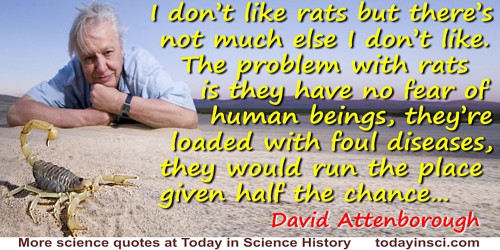
I don’t like rats but there’s not much else I don’t like. The problem with rats is they have no fear of human beings, they’re loaded with foul diseases, they would run the place given half the chance…
Interview by Simon Gage in 'David Attenborough: I’m not an animal lover', Metro newspaper (29 Jan 2013, London).
I figure you have the same chance of winning the lottery whether you play or not.
…...
I find it [science] analytical, pretentious and superficial—largely because it does not address itself to dreams, chance, laughter, feelings, or paradox—in other words,—all the things I love the most.
My Last Sigh, trans. Abigail Israel (1983), 174.
I forget whether you take in the Times; for the chance of your not doing so, I send the enclosed rich letter. It is, I am sure, by Fitz-Roy. … It is a pity he did not add his theory of the extinction of Mastodon, etc., from the door of the Ark being made too small.
Letter (5 Dec 1859) to Charles Lyell. In Francis Darwin and Albert Charles Seward (eds.), More Letters of Charles Darwin: A Record of his Work in a Series of Hitherto Unpublished Letters (103), Vol. 1, 129. The referenced letters in the Times were on 1 Dec and 5 Dec 1859, signed under the pseudonym “Senex”, on the topic of “Works of Art in the Drift.”
I had at one time a very bad fever of which I almost died. In my fever I had a long consistent delirium. I dreamt that I was in Hell, and that Hell is a place full of all those happenings that are improbable but not impossible. The effects of this are curious. Some of the damned, when they first arrive below, imagine that they will beguile the tedium of eternity by games of cards. But they find this impossible, because, whenever a pack is shuffled, it comes out in perfect order, beginning with the Ace of Spades and ending with the King of Hearts. There is a special department of Hell for students of probability. In this department there are many typewriters and many monkeys. Every time that a monkey walks on a typewriter, it types by chance one of Shakespeare's sonnets. There is another place of torment for physicists. In this there are kettles and fires, but when the kettles are put on the fires, the water in them freezes. There are also stuffy rooms. But experience has taught the physicists never to open a window because, when they do, all the air rushes out and leaves the room a vacuum.
'The Metaphysician's Nightmare', Nightmares of Eminent Persons and Other Stories (1954), 38-9.
I have always liked horticulturists, people who make their living from orchards and gardens, whose hands are familiar with the feel of the bark, whose eyes are trained to distinguish the different varieties, who have a form memory. Their brains are not forever dealing with vague abstractions; they are satisfied with the romance which the seasons bring with them, and have the patience and fortitude to gamble their lives and fortunes in an industry which requires infinite patience, which raise hopes each spring and too often dashes them to pieces in fall. They are always conscious of sun and wind and rain; must always be alert lest they lose the chance of ploughing at the right moment, pruning at the right time, circumventing the attacks of insects and fungus diseases by quick decision and prompt action. They are manufacturers of a high order, whose business requires not only intelligence of a practical character, but necessitates an instinct for industry which is different from that required by the city dweller always within sight of other people and the sound of their voices. The successful horticulturist spends much time alone among his trees, away from the constant chatter of human beings.
I have been trying to point out that in our lives chance may have an astonishing influence and, if I may offer advice to the young laboratory worker, it would be this—never neglect an extraordinary appearance or happening. It may be—usually is, in fact—a false alarm that leads to nothing, but may on the other hand be the clue provided by fate to lead you to some important advance.
Lecture at Harvard University. Quoted in Joseph Sambrook, David W. Russell, Molecular Cloning (2001), Vol. 1, 153.
I have never done anything 'useful'. No discovery of mine has made, or is likely to make, directly or indirectly, for good or ill, the least difference to the amenity of the world... Judged by all practical standards, the value of my mathematical life is nil; and outside mathematics it is trivial anyhow. I have just one chance of escaping a verdict of complete triviality, that I may be judged to have created something worth creating. And that I have created something is undeniable: the question is about its value.
A Mathematician's Apology (1940), 90-1.
I have never done anything “useful.” No discovery of mine has made, or is likely to make, directly or indirectly, for good or ill, the least difference to the amenity of the world... Judged by all practical standards, the value of my mathematical life is nil; and outside mathematics it is trivial anyhow. I have just one chance of escaping a verdict of complete triviality, that I may be judged to have created something worth creating. And that I have created something is undeniable: the question is about its value. [The things I have added to knowledge do not differ from] the creations of the other artists, great or small, who have left some kind of memorial beind them.
Concluding remarks in A Mathmatician's Apology (1940, 2012), 150-151.
I returned and saw under the sun that the race is not to the swift, nor the battle to the strong, neither yet bread to the wise, nor yet riches to men of understanding, nor yet favour to men of skill; but time and chance happeneth to them all.
— Bible
Ecclesiastes 9:11. As given in the King James Version.
I said that there is something every man can do, if he can only find out what that something is. Henry Ford has proved this. He has installed in his vast organization a system for taking hold of a man who fails in one department, and giving him a chance in some other department. Where necessary every effort is made to discover just what job the man is capable of filling. The result has been that very few men have had to be discharged, for it has been found that there was some kind of work each man could do at least moderately well. This wonderful system
adopted by my friend Ford has helped many a man to find himself. It has put many a fellow on his feet. It has taken round pegs out of square holes and found a round hole for them. I understand that last year only 120 workers out of his force of 50,000 were discharged.
As quoted from an interview by B.C. Forbes in The American Magazine (Jan 1921), 10.
I see nothing wrong ethically with the idea of correcting single gene defects [through genetic engineering]. But I am concerned about any other kind of intervention, for anything else would be an experiment, [which would] impose our will on future generations [and take unreasonable chances] with their welfare ... [Thus] such intervention is beyond the scope of consideration.
in The Second Creation: Dolly and the Age of Biological Control
I sought excitement and, taking chances, I was all ready to fail in order to achieve something large.
On the official Raymond Loewry website. Also quoted in part in Society of Industrial Artists and Designers, Designer (1980).
I think it perfectly just, that he who, from the love of experiment, quits an approved for an uncertain practice, should suffer the full penalty of Egyptian law against medical innovation; as I would consign to the pillory, the wretch, who out of regard to his character, that is, to his fees, should follow the routine, when, from constant experience he is sure that his patient will die under it, provided any, not inhuman, deviation would give his patient a chance.
From his researches in Fever, 196. In John Edmonds Stock, Memoirs of the life of Thomas Beddoes (1810), 400.
I think it would be a very rash presumption to think that nowhere else in the cosmos has nature repeated the strange experiment which she has performed on earth—that the whole purpose of creation has been staked on this one planet alone. It is probable that dotted through the cosmos there are other suns which provide the energy for life to attendant planets. It is apparent, however, that planets with just the right conditions of temperature, oxygen, water and atmosphere necessary for life are found rarely.
But uncommon as a habitable planet may be, non-terrestrial life exists, has existed and will continue to exist. In the absence of information, we can only surmise that the chance that it surpasses our own is as good as that it falls below our level.
But uncommon as a habitable planet may be, non-terrestrial life exists, has existed and will continue to exist. In the absence of information, we can only surmise that the chance that it surpasses our own is as good as that it falls below our level.
As quoted by H. Gordon Garbedian in 'Ten Great Riddles That Call For Solution by Scientists', New York Times (5 Oct 1930), XX4. Garbedian gave no citation to a source for Shapley’s words. However, part of this quote is very similar to that of Sir Arthur Eddington: “It would indeed be rash to assume that nowhere else has Nature repeated the strange experiment which she has performed on the earth,” from 'Man’s Place in the Universe', Harper’s Magazine (Oct 1928), 157 573.
I wouldn’t miss this opportunity for anything. For the chance to work on these conservation issues, to serve my country, to work for this president, I’d do it all over again, every single minute.
…...
I’ve learned that life sometimes gives you a second chance.
Fifth stanza of poem 'On Turning 70'. The poem is printed in Michigan Office of Services to the Aging, Annual Report 2004 (2005), no page number.
If a project is truly innovative, you cannot possibly know its exact cost and exact schedule at the beginning. And if you do know the exact cost and the exact schedule, chances are that the technology is obsolete.
From interview with Technology Review, quoted in Douglas Martin, 'Joseph Gavin, Who Helped Put First Man on Moon, Dies at 90', New York Times (4 Nov 2010)
If a superior alien civilisation sent us a message saying, “We’ll arrive in a few decades,” would we just reply, “OK, call us when you get here—we’ll leave the lights on”? Probably not—but this is more or less what is happening with AI. Although we are facing potentially the best or worst thing to happen to humanity in history, little serious research is devoted to these issues outside non-profit institutes such as the Cambridge Centre for the Study of Existential Risk, the Future of Humanity Institute, the Machine Intelligence Research Institute, and the Future of Life Institute. All of us should ask ourselves what we can do now to improve the chances of reaping the benefits and avoiding the risks.
From article with byline attributing several authors collectively, namely: Stephen Hawking, Stuart Russell, Max Tegmark, Frank Wilczek, 'Stephen Hawking: `Transcendence looks at the implications of artificial intelligence—but are we taking AI seriously enough?’', Independent. Posted on the newspaper site www.independent.co.uk (01 May 2014). The article does not given an individual attribution to the quoter, so it is not clear if Stephen Hawking contributed it, and it is easily possible he did not. Thus this entry is filed under his name only because he is the first-listed in the byline.
If agriculture goes wrong, nothing else will have a chance to go right in the country.
Quoted as “He had a strong belief” in Journal of Plantation Crops (2002), 30-33, 72. Also in Combating Hunger and Achieving Food Security (2016), 86, ending with wording “in our country”, referring to India.
If an event can be produced by a number n of different causes, the probabilities of the existence of these causes, given the event (prises de l'événement), are to each other as the probabilities of the event, given the causes: and the probability of each cause is equal to the probability of the event, given that cause, divided by the sum of all the probabilities of the event, given each of the causes.
'Mémoire sur la Probabilité des Causes par les Événements' (1774). In Oeuvres complètes de Laplace, 14 Vols. (1843-1912), Vol. 8, 29, trans. Charles Coulston Gillispie, Pierre-Simon Laplace 1749-1827: A Life in Exact Science (1997), 16.
If atoms do, by chance, happen to combine themselves into so many shapes, why have they never combined together to form a house or a slipper? By the same token, why do we not believe that if innumerable letters of the Greek alphabet were poured all over the market-place they would eventually happen to form the text of the Iliad?
The Essays of Michel de Montaigne, Book 2, Chapter 12, 'Apology for Raymond Sebond', trans. M. A. Screech (1991), 612.
If intellectual curiosity, professional pride, and ambition are the dominant incentives to research, then assuredly no one has a fairer chance of gratifying them than a mathematician.
In A Mathematician’s Apology (1940, 1967), 80.
If it be true, that some Chymists have now and then converted Lead into Gold, it was by just such a hazard, as if a man should let fall a handful of sand upon a table and the particles of it should be so ranged that we could read distinctly on it a whole page of Virgil’s Ænead.
In Traité de Physique, (1671, 1676), Part. 3, Chap. 6, 186. As translated in Rohault’s System of Natural Philosophy (1723), Part 3, Chap. 6, 154. From the original French, “Que s’il est vray que quelques Chymistes ayent autrefois converty du plomb en or, ça esté par un hazard aussi grand, que si ayant laissé tomber de haut une poignée de sable sur une table, ses gains s'estoient tellement rangez, qu'on y pût lire distinctement une page de l'Eneide de Virgile.”
If it were customary to send daughters to school like sons, and if they were then taught the natural sciences, they would learn as thoroughly and understand the subtleties of all the arts and sciences as well as sons. And by chance there happen to be such women, for, as I touched on before, just as women have more delicate bodies than men, weaker and less able to perform many tasks, so do they have minds that are freer and sharper whenever they apply themselves.
The Book of the City of Ladies (1405), part 1, section 27. Trans. Earl Jeffrey Richards (1982), 63.
If one of these people, in whom the chance-worship of our remoter ancestors thus strangely survives, should be within reach of the sea when a heavy gale is blowing, let him betake himself to the shore and watch the scene. Let him note the infinite variety of form and size of the tossing waves out at sea; or against the curves of their foam-crested breakers, as they dash against the rocks; let him listen to the roar and scream of the shingle as it is cast up and torn down the beach; or look at the flakes of foam as they drive hither and thither before the wind: or note the play of colours, which answers a gleam of sunshine as it falls upon their myriad bubbles. Surely here, if anywhere, he will say that chance is supreme, and bend the knee as one who has entered the very penetralia of his divinity. But the man of science knows that here, as everywhere, perfect order is manifested; that there is not a curve of the waves, not a note in the howling chorus, not a rainbow-glint on a bubble, which is other than a necessary consequence of the ascertained laws of nature; and that with a sufficient knowledge of the conditions, competent physico-mathematical skill could account for, and indeed predict, every one of these 'chance' events.
In 'On the Reception of the Origin of Species'. In Francis Darwin (ed.), The Life and Letters of Charles Darwin, Including an Autobiographical Chapter (1888), Vol. 2, 200-1.
If one were to define chance as the outcome of a random movement which interlocks with no causes, I should maintain that it does not exist at all, that it is a wholly empty term denoting nothing substantial.
The Consolation of Philosophy [before 524], Book V, trans. P. G. Walsh (1999), 97.
If the same holds for intelligent aliens [as with our own invention of nuclear bombs], then they might not last long. Perhaps they all blow themselves up soon after they discover that E=mc². If civilizations take billions of years to evolve, only to vanish virtually overnight, then sadly we've next to no chance of hearing from them.
From Discovery TV series, Into the Universe With Stephen Hawking (2010). As quoted on nbcnews.com webpage, 'Hawking: Aliens may pose risks to Earth' (25 Apr 2010). He warned that rather than actively trying to communicate with extra-terrestrials, humans should do everything possible to avoid contact.
If this [human kind’s extinction] happens I venture to hope that we shall not have destroyed the rat, an animal of considerable enterprise which stands as good a chance as any … of evolving toward intelligence.
In The Inequality of Man: And Other Essays (1937), 143.
If we thus go very far back to the source of the Mammalian type of organisation; it is extremely improbable that any of [his relatives shall likewise] the successors of his relations now exist,—In same manner, if we take [a man from] any large family of 12 brothers & sisters [in a state which does not increase] it will be chances against anyone [of them] having progeny living ten thousand years hence; because at present day many are relatives so that tracing back the [descen] fathers would be reduced to small percentage.—& [in] therefore the chances are excessively great against, any two of the 12, having progeny, after that distant period.
P. H. Barrett et al. (eds.), Charles Darwin's Notebooks, 1836-1844: Geology, Transmutation of the Species and Metaphysical Enquiries (1987), Notebook B, 40-1.
If we use resources productively and take to heart the lessons learned from coping with the energy crisis, we face a future confronted only, as Pogo, once said, by insurmountable opportunities. The many crises facing us should be seen, then, not as threats, but as chances to remake the future so it serves all beings.
Utne Reader (Nov-Dec 1989).
If you want to achieve conservation, the first thing you have to do is persuade people that the natural world is precious, beautiful, worth saving and complex. If people don’t understand that and don’t believe that in their hearts, conservation doesn't stand a chance. That’s the first step, and that is what I do.
From interview with Michael Bond, 'It’s a Wonderful Life', New Scientist (14 Dec 2002), 176, No. 2373, 48.
Improvements in industry can be left to chance in the hope that someone, sometime, will think of something useful. that some good invention will show up. The other way is to organize so that new knowledge shall always be coming from the researches in the fundamental sciences and engineering arts on which business is based. From that steady stream will arise inventions and new methods. This is the way of Bell Laboratories.
From a Bell Telephone System advertisement, 'The Search That Never Ends', placed, for example, in Life Magazine (17 Jan 1944), 33.
In 1808 … Malus chanced to look through a double refracting prism at the light of the setting sun, reflected from the windows of the Luxembourg Palace. In turning the prism round, he was surprised to find that the ordinary image disappeared at two opposite positions of the prism. He remarked that the reflected light behaved like light which had been polarized by passing through another prism.
In Principles of Science (1874), Vols. 1-2, Book IV, Chap. 18, 163.
In a library we are surrounded by many hundreds of dear friends, but they are imprisoned by an enchanter in these paper and leathern boxes; and though they know us, and have been waiting two, ten, or twenty centuries for us,—some of them,—and are eager to give us a sign and unbosom themselves, it is the law of their limbo that they must not speak until spoken to; and as the enchanter has dressed them, like battalions of infantry, in coat and jacket of one cut, by the thousand and ten thousand, your chance of hitting on the right one is to be computed by the arithmetical rule of Permutation and Combination,—not a choice out of three caskets, but out of half a million caskets, all alike.
In essay 'Books', collected in Society and Solitude (1870, 1871), 171
In a sense, of course, probability theory in the form of the simple laws of chance is the key to the analysis of warfare;… My own experience of actual operational research work, has however, shown that its is generally possible to avoid using anything more sophisticated. … In fact the wise operational research worker attempts to concentrate his efforts in finding results which are so obvious as not to need elaborate statistical methods to demonstrate their truth. In this sense advanced probability theory is something one has to know about in order to avoid having to use it.
In 'Operations Research', Physics Today (Nov 1951), 19. As cited by Maurice W. Kirby and Jonathan Rosenhead, 'Patrick Blackett (1897)' in Arjang A. Assad (ed.) and Saul I. Gass (ed.),Profiles in Operations Research: Pioneers and Innovators (2011), 25.
In assessing Audubon, whose firm grip on the popular imagination has scarcely lessened since 1826, we must as historians of science seriously ask who would remember him if he had not been an artist of great imagination and flair. ... The chances seem to be very poor that had he not been an artist, he would be an unlikely candidate for a dictionary of scientific biography, if remembered to science at all.
In Charles Coulston Gillespie (ed.), Dictionary of Scientific Biography (1972), Vol. 1, 331.
In like manner, the loadstone has from nature its two poles, a northern and a southern; fixed, definite points in the stone, which are the primary termini of the movements and effects, and the limits and regulators of the several actions and properties. It is to be understood, however, that not from a mathematical point does the force of the stone emanate, but from the parts themselves; and all these parts in the whole—while they belong to the whole—the nearer they are to the poles of the stone the stronger virtues do they acquire and pour out on other bodies. These poles look toward the poles of the earth, and move toward them, and are subject to them. The magnetic poles may be found in very loadstone, whether strong and powerful (male, as the term was in antiquity) or faint, weak, and female; whether its shape is due to design or to chance, and whether it be long, or flat, or four-square, or three-cornered or polished; whether it be rough, broken-off, or unpolished: the loadstone ever has and ever shows its poles.
On the Loadstone and Magnetic Bodies and on the Great Magnet the Earth: A New Physiology, Demonstrated with many Arguments and Experiments (1600), trans. P. Fleury Mottelay (1893), 23.
In my first publication I might have claimed that I had come to the conclusion, as a result of serious study of the literature and deep thought, that valuable antibacterial substances were made by moulds and that I set out to investigate the problem. That would have been untrue and I preferred to tell the truth that penicillin started as a chance observation. My only merit is that I did not neglect the observation and that I pursued the subject as a bacteriologist. My publication in 1929 was the starting-point of the work of others who developed penicillin especially in the chemical field.
'Penicillin', Nobel Lecture, 11 Dec 1945. In Nobel Lectures: Physiology or Medicine 1942-1962 (1964), 83.
In presenting a mathematical argument the great thing is to give the educated reader the chance to catch on at once to the momentary point and take details for granted: his successive mouthfuls should be such as can be swallowed at sight; in case of accidents, or in case he wishes for once to check in detail, he should have only a clearly circumscribed little problem to solve (e.g. to check an identity: two trivialities omitted can add up to an impasse). The unpractised writer, even after the dawn of a conscience, gives him no such chance; before he can spot the point he has to tease his way through a maze of symbols of which not the tiniest suffix can be skipped.
In A Mathematician's Miscellany (1953). Reissued as Béla Bollobás (ed.), Littlewood’s Miscellany (1986), 49.
In that memorable year, 1822: Oersted, a Danish physicist, held in his hands a piece of copper wire, joined by its extremities to the two poles of a Volta pile. On his table was a magnetized needle on its pivot, and he suddenly saw (by chance you will say, but chance only favours the mind which is prepared) the needle move and take up a position quite different from the one assigned to it by terrestrial magnetism. A wire carrying an electric current deviates a magnetized needle from its position. That, gentlemen, was the birth of the modern telegraph.
Le hasard favorise l’esprit preparé
Le hasard favorise l’esprit preparé
Inaugural Address as newly appointed Professor and Dean (Sep 1854) at the opening of the new Faculté des Sciences at Lille (7 Dec 1854). In René Vallery-Radot, The Life of Pasteur, translated by Mrs. R. L. Devonshire (1919), 76.
In the discussion of the. energies involved in the deformation of nuclei, the concept of surface tension of nuclear matter has been used and its value had been estimated from simple considerations regarding nuclear forces. It must be remembered, however, that the surface tension of a charged droplet is diminished by its charge, and a rough estimate shows that the surface tension of nuclei, decreasing with increasing nuclear charge, may become zero for atomic numbers of the order of 100. It seems therefore possible that the uranium nucleus has only small stability of form, and may, after neutron capture, divide itself into two nuclei of roughly equal size (the precise ratio of sizes depending on liner structural features and perhaps partly on chance). These two nuclei will repel each other and should gain a total kinetic energy of c. 200 Mev., as calculated from nuclear radius and charge. This amount of energy may actually be expected to be available from the difference in packing fraction between uranium and the elements in the middle of the periodic system. The whole 'fission' process can thus be described in an essentially classical way, without having to consider quantum-mechanical 'tunnel effects', which would actually be extremely small, on account of the large masses involved.
[Co-author with Otto Robert Frisch]
[Co-author with Otto Robert Frisch]
Lise Meitner and O. R. Frisch, 'Disintegration of Uranium by Neutrons: a New Type of Nuclear Reaction', Nature (1939), 143, 239.
In the fields of observation chance favors only the prepared mind.
In a lecture at the University of Lille, December 7, 1854.
In this physical world there is no real chaos; all is in fact orderly; all is ordered by the physical principles. Chaos is but unperceived order- it is a word indicating the limitations of the human mind and the paucity of observational facts. The words “chaos,” “accidental,” “chance,” “unpredictable," are conveniences behind which we hide our ignorance.
From Of Stars and Men: The Human Response to an Expanding Universe (1958 Rev. Ed. 1964), Foreword.
Inventions and discoveries are of two kinds. The one which we owe to chance, such as those of the mariner’s compass, gunpowder, and in general almost all the discoveries we have made in the arts. The other which we owe to genius: and here we ought to understand by the word discovery, a new combination, or a new relation perceived between certain objects or ideas. A person obtains the title of a man of genius, if the ideas which result from this combination form one grand whole, are fruitful in truths, and are of importance with respect to mankind.
From the original French, “Les inventions ou les découvertes sont de deux espèces. Il en est que nous devons au hazard; telles sont la boussole, la poudre à canon, & généralement presque toutes les découvertes que nous avons faites dans les arts. Il en est d'autres que nous devons au génie: &, par ce mot de découverte, on doit alors entendre une nouvelle combinaison, un rapport nouveau aperçu entre certains objets ou certaines idées. On obtient le titre d'homme de génie, si les idées qui résultent de ce rapport forment un grand ensemble, sont fécondes en vérités & intéressantes pour l'humanité,” in 'Du Génie', L’Esprit (1758), Discourse 4, 476. English version from Claude Adrien Helvétius and William Mudford (trans.), 'Of Genius', De l’Esprit or, Essays on the Mind and its several Faculties (1759), Essay 4, Chap. 1, 241-242.
It has often been said that, if the human species fails to make a go of it here on the Earth, some other species will take over the running. In the sense of developing intelligence this is not correct. We have, or soon will have, exhausted the necessary physical prerequisites so far as this planet is concerned. With coal gone, oil gone, high-grade metallic ores gone, no species however competent can make the long climb from primitive conditions to high-level technology. This is a one-shot affair. If we fail, this planetary system fails so far as intelligence is concerned. The same will be true of other planetary systems. On each of them there will be one chance, and one chance only.
In Of Men and Galaxies (1964, 2005), 61.
It is easy without any very profound logical analysis to perceive the difference between a succession of favorable deviations from the laws of chance, and on the other hand, the continuous and cumulative action of these laws. It is on the latter that the principle of Natural Selection relies.
In The Genetical Theory of Natural Selection (1930), 37. Reprinted as A Complete Variorum Edition (2003), 37.
It is grindingly, creakingly, crashingly obvious that, if Darwinism were really a theory of chance, it couldn’t work. You don't need to be a mathematician or physicist to calculate that an eye or a haemoglobin molecule would take from here to infinity to self-assemble by sheer higgledy-piggledy luck. Far from being a difficulty peculiar to Darwinism, the astronomic improbability of eyes and knees, enzymes and elbow joints and all the other living wonders is precisely the problem that any theory of life must solve, and that Darwinism uniquely does solve. It solves it by breaking the improbability up into small, manageable parts, smearing out the luck needed, going round the back of Mount Improbable and crawling up the gentle slopes, inch by million-year inch. Only God would essay the mad task of leaping up the precipice in a single bound.
In Climbing Mount Improbable (1996), 67-8.
It is impossible for a Die, with such determin'd force and direction, not to fall on such determin'd side, only I don't know the force and direction which makes it fall on such determin'd side, and therefore I call it Chance, which is nothing but the want of art.... .
Of the Laws of Chance (1692), preface
It is impossible to answer your question briefly; and I am not sure that I could do so, even if I wrote at some length. But I may say that the impossibility of conceiving that this grand and wondrous universe, with our conscious selves, arose through chance, seems to me the chief argument for the existence of God; but whether this is an argument of real value, I have never been able to decide.
[Replying to query about his religious views]
[Replying to query about his religious views]
Letter to a Dutch student (2 Apr 1873), in Charles Darwin and Sir Francis Darwin (ed.), The Life and Letters of Charles Darwin (1896), 276.
It is in scientific honesty that I endorse the presentation of alternative theories for the origin of the universe, life and man in the science classroom. It would be an error to overlook the possibility that the universe was planned rather than happening by chance.
In letter to California State board of Education (14 Sep 1972).
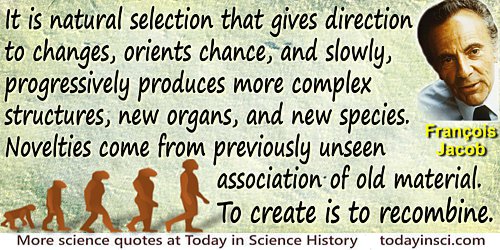
It is natural selection that gives direction to changes, orients chance, and slowly, progressively produces more complex structures, new organs, and new species. Novelties come from previously unseen association of old material. To create is to recombine.
In 'Evolution and Tinkering', Science (10 Jun 1977), 196, 1163.
It is one of the laws of life that each acquisition has its cost. No organism can exercise power without yielding up part of its substance. The physiological law of Transfer of Energy is the basis of human success and happiness. There is no action without expenditure of energy and if energy be not expended the power to generate it is lost. This law shows itself in a thousand ways in the life of man. The arm which is not used becomes palsied. The wealth which comes by chance weakens and destroys. The good which is unused turns to evil. The charity which asks no effort cannot relieve the misery she creates.
In The Strength of Being Clean: A Study of the Quest for Unearned Happiness (1900), 6.
It is remarkable that a science which began with the consideration of games of chance should have become the most important object of human knowledge.
Théorie Analytique des Probabilitiés. Quoted in Isaac Todhunter, History of the Mathematical Theory of Probability from the Time of Pascal to that of Laplace (1865),
It is safe to say that the little pamphlet which was left to find its way through the slow mails to the English scientist outweighed in importance and interest for the human race all the press dispatches which have been flashed under the channel since the delivery of the address—March 24. The rapid growth of the Continental capitals, the movements of princely noodles and fat, vulgar Duchesses, the debates in the Servian Skupschina, and the progress or receding of sundry royal gouts are given to the wings of lightning; a lumbering mail-coach is swift enough for the news of one of the great scientific discoveries of the age. Similarly, the gifted gentlemen who daily sift out for the American public the pith and kernel of the Old World's news; leave Dr. KOCH and his bacilli to chance it in the ocean mails, while they challenge the admiration of every gambler and jockey in this Republic by the fullness and accuracy of their cable reports of horse-races.
New York Times (3 May 1882). Quoted in Thomas D. Brock, Robert Koch (1988), 131.
It is said that the composing of the Lilavati was occasioned by the following circumstance. Lilavati was the name of the author’s daughter, concerning whom it appeared, from the qualities of the ascendant at her birth, that she was destined to pass her life unmarried, and to remain without children. The father ascertained a lucky hour for contracting her in marriage, that she might be firmly connected and have children. It is said that when that hour approached, he brought his daughter and his intended son near him. He left the hour cup on the vessel of water and kept in attendance a time-knowing astrologer, in order that when the cup should subside in the water, those two precious jewels should be united. But, as the intended arrangement was not according to destiny, it happened that the girl, from a curiosity natural to children, looked into the cup, to observe the water coming in at the hole, when by chance a pearl separated from her bridal dress, fell into the cup, and, rolling down to the hole, stopped the influx of water. So the astrologer waited in expectation of the promised hour. When the operation of the cup had thus been delayed beyond all moderate time, the father was in consternation, and examining, he found that a small pearl had stopped the course of the water, and that the long-expected hour was passed. In short, the father, thus disappointed, said to his unfortunate daughter, I will write a book of your name, which shall remain to the latest times—for a good name is a second life, and the ground-work of eternal existence.
In Preface to the Persian translation of the Lilavati by Faizi (1587), itself translated into English by Strachey and quoted in John Taylor (trans.) Lilawati, or, A Treatise on Arithmetic and Geometry by Bhascara Acharya (1816), Introduction, 3. [The Lilavati is the 12th century treatise on mathematics by Indian mathematician, Bhaskara Acharya, born 1114.]
It is still believed, apparently, that there is some thing mysteriously laudable about achieving viable offspring. I have searched the sacred and profane scriptures, for many years, but have yet to find any ground for this notion. To have a child is no more creditable than to have rheumatism–and no more discreditable. Ethically, it is absolutely meaningless. And practically, it is mainly a matter of chance.
…...
It is the simple hypotheses of which one must be most wary; because these are the ones that have the most chances of passing unnoticed.
…...
It would be difficult and perhaps foolhardy to analyze the chances of further progress in almost every part of mathematics one is stopped by unsurmountable difficulties, improvements in the details seem to be the only possibilities which are left… All these difficulties seem to announce that the power of our analysis is almost exhausted, even as the power of ordinary algebra with regard to transcendental geometry in the time of Leibniz and Newton, and that there is a need of combinations opening a new field to the calculation of transcendental quantities and to the solution of the equations including them.
From Rapport historique sur les progrès des sciences mathématiques depuis 1789, et sur leur état actuel (1810), 131. As translated in George Sarton, The Study of the History of Mathematics (1936), 13. In the original French: “Il seroit difficile et peut-être téméraire d’analyser les chances que l’avenir offre à l’avancement des mathématiques: dans presque toutes les parties, on est arrêté par des difficultés insurmontables; des perfectionnements de détail semblent la seule chose qui reste à faire… Toutes ces difficultés semblent annoncer que la puissance de notre analyse est à-peu-près épuisée, comme celle de l’algèbre ordinaire l’étoit par rapport à la géométrie transcendante au temps de Leibnitz et de Newton, et qu’il faut des combinaisons qui ouvrent un nouveau champ au calcul des transcendantes et à la résolution des équations qui les contiennent.” Sarton states this comes from “the report on mathematical progress prepared for the French Academy of Sciences at Napoleon’s request”.
It would indeed be a great delusion, if we stated that those sports of Nature [we find] enclosed in rocks are there by chance or by some vague creative power. Ah, that would be superficial indeed! In reality, those shells, which once were alive in water and are now dead and decomposed, were made thus by time not Nature; and what we now find as very hard, figured stone, was once soft mud and which received the impression of the shape of a shell, as I have frequently demonstrated.
La vana speculazione disingannata del senso (1670), trans. Ezio Vaccari, 83-4.
Just think of the differences today. A young person gets interested in chemistry and is given a chemical set. But it doesn't contain potassium cyanide. It doesn't even contain copper sulfate or anything else interesting because all the interesting chemicals are considered dangerous substances. Therefore, these budding young chemists don't get a chance to do anything engrossing with their chemistry sets. As I look back, I think it is pretty remarkable that Mr. Ziegler, this friend of the family, would have so easily turned over one-third of an ounce of potassium cyanide to me, an eleven-year-old boy.
In Barbara Marinacci, Linus Pauling In His Own Words (1995), 29.
Keep on going and the chances are you will stumble on something, perhaps when you are least expecting it. I have never heard of anyone stumbling on something sitting down.
Knowledge of the laws of nature offers humankind the only chance of survival in a changing environment. … The search for knowledge gives expression to a basic curiosity which appears to be the salient defining characteristic of human beings.
From opening paragraph of Preface, Quasars, Redshifts and Controversies (1987).
Let us weigh the gain and the loss in wagering that God is. Let us consider the two chances. If you gain, you gain all; if you lose, you lose nothing. Wager then without hesitation that He is.
In Pensées (1670), Section 10. From Blaise Pascal and W.F. Trotter (trans.), 'Thoughts', collected in Charles W. Eliot (ed.), The Harvard Classics (1910), Vol. 48, 85. Also seen translated as, “…consider the two possibilities…”. From the French, “Pesons le gain et la perte, en prenant croix, que Dieu est. Estimons ces deux cas: si vous gagnez, vous gagnez tout; si vous perdez, vous ne perdez rien. Gagez donc qu’il est, sans hésiter,” in Oeuvres Complètes de Blaise Pascal (1864), Vol. 1, 304.
Lost in the milky way,
Smile at the empty sky
And wait for the moment
When a million chances may all collide.
Smile at the empty sky
And wait for the moment
When a million chances may all collide.
Song lyrics
Man at last knows that he is alone in the unfeeling immensity of the universe, out of which he emerged only by chance. Neither his destiny nor his duty have been written down. The kingdom above or the darkness below: it is for him to choose.
Concluding remarks in Jacques Monod and Austryn Wainhouse (trans.), Chance and Necessity: An Essay on the Natural Philosophy of Modern Biology (1972), 180. Also seen translated as, “The ancient covenant is in pieces; man knows at last that he is alone in the universe’s unfeeling immensity, out of which he emerged only by chance. His destiny is nowhere spelled out, nor is his duty. The kingdom above or the darkness below: it is time for him to choose.”
Mathematicians attach great importance to the elegance of their methods and their results. This is not pure dilettantism. What is it indeed that gives us the feeling of elegance in a solution, in a demonstration? It is the harmony of the diverse parts, their symmetry, their happy balance; in a word it is all that introduces order, all that gives unity, that permits us to see clearly and to comprehend at once both the ensemble and the details. But this is exactly what yields great results, in fact the more we see this aggregate clearly and at a single glance, the better we perceive its analogies with other neighboring objects, consequently the more chances we have of divining the possible generalizations. Elegance may produce the feeling of the unforeseen by the unexpected meeting of objects we are not accustomed to bring together; there again it is fruitful, since it thus unveils for us kinships before unrecognized. It is fruitful even when it results only from the contrast between the simplicity of the means and the complexity of the problem set; it makes us then think of the reason for this contrast and very often makes us see that chance is not the reason; that it is to be found in some unexpected law. In a word, the feeling of mathematical elegance is only the satisfaction due to any adaptation of the solution to the needs of our mind, and it is because of this very adaptation that this solution can be for us an instrument. Consequently this esthetic satisfaction is bound up with the economy of thought.
In 'The Future of Mathematics', Monist, 20, 80. Translated from the French by George Bruce Halsted.
Men are rather beholden ... generally to chance or anything else, than to logic, for the invention of arts and sciences.
The Advancement of Learning (1605) in James Spedding, Robert Ellis and Douglas Heath (eds.), The Works of Francis Bacon (1887-1901), Vol. 3, 386.
Men attribute to chance those events of the causes of which they are ignorant. If they succeed in divining these causes, chance disappears. To say that a thing has happened by chance, is to say that we have not been able to foresee it. I do not myself believe that any other acceptation can be given to this word. What to an ignorant man is chance, cannot be chance to one better instructed.
From Appendix A, 'Extracts From the Unpublished Writings of Carnot', Reflections on the Motive Power of Heat (1890, 2nd ed. 1897), 215-216.
Might one not say that in the chance combination of nature's production, since only those endowed with certain relations of suitability could survive, it is no cause for wonder that this suitability is found in all species that exist today? Chance, one might say, produced an innumerable multitude of individuals; a small number turned out to be constructed in such fashion that the parts of the animal could satisfy its needs; in another, infinitely greater number, there was neither suitability nor order: all of the later have perished; animals without a mouth could not live, others lacking organs for reproduction could not perpetuate themselves: the only ones to have remained are those in which were found order and suitability; and these species, which we see today, are only the smallest part of what blind fate produced.
'Essai de Cosmologie' in Oeuvres de Mr. De Maupertuis (1756), Vol. 1, 11-12. Quoted in Jacques Roger, The Life Sciences in Eighteenth-Century French Thought, ed. Keith R. Benson and trans. Robert Ellrich (1997), 381.
Money. It has such an inherent power to run itself clear of taint that human ingenuity cannot devise the means of making it work permanent mischief, any more than means can be found of torturing people beyond what they can bear. Even if a man founds a College of Technical Instruction, the chances are ten to one that no one will be taught anything and that it will have been practically left to a number of excellent professors who will know very well what to do with it.
Samuel Butler, Henry Festing Jones (ed.), The Note-Books of Samuel Butler (1917), 221.
Moreover, the works already known are due to chance and experiment rather than to sciences; for the sciences we now possess are merely systems for the nice ordering and setting forth of things already invented; not methods of invention or directions for new works.
From Novum Organum (1620), Book 1, Aphorism 8. Translated as The New Organon: Aphorisms Concerning the Interpretation of Nature and the Kingdom of Man), collected in James Spedding, Robert Ellis and Douglas Heath (eds.), The Works of Francis Bacon (1857), Vol. 4, 48.
No anatomist ever discovered a system of organization, calculated to produce pain and disease; or, in explaining the parts of the human body, ever said, this is to irritate; this is to inflame; this duct is to convey the gravel to the kidneys; this gland to secrete the humour which forms the gout: if by chance he come at a part of which he knows not the use, the most he can say is, that it is useless; no one ever suspects that it is put there to incommode, to annoy, or torment.
The Principles of Moral and Political Philosophy (1785), Vol. 1, 79.
No isolated experiment, however significant in itself, can suffice for the experimental demonstration of any natural phenomenon; for the “one chance in a million” will undoubtedly occur, with no less and no more than its appropriate frequency, however surprised we may be that it should occur to us.
The Design of Experiments (1935, 1971), 13-14.
No national improvement can come from outside. It must come from within… But improved feeling has no chance of spreading throughout the body politic without that machinery of infection which we know by the name of education.
In paper 'On Social Unrest', The Daily Mail (1912). Collected and cited in A Sheaf (1916), 197-198.
No place affords a more striking conviction of the vanity of human hopes than a publick library; for who can see the wall crouded on every side by mighty volumes, the works of laborious meditation, and accurate inquiry, now scarcely known but by the catalogue, and preserved only to encrease the pomp of learning, without considering how many hours have been wasted in vain endeavours, how often imagination has anticipated the praises of futurity, how many statues have risen to the eye of vanity, how many ideal converts have elevated zeal, how often wit has exulted in the eternal infamy of his antagonists, and dogmatism has delighted in the gradual advances of his authority, the immutability of his decrees, and the perpetuity of his power.
Non unquam dedit
Documenta fors majora, quam fragili loco
Starent superbi.
Seneca, Troades, II, 4-6
Insulting chance ne'er call'd with louder voice,
On swelling mortals to be proud no more.
Of the innumerable authors whose performances are thus treasured up in magnificent obscurity, most are forgotten, because they never deserved to be remembered, and owed the honours which they have once obtained, not to judgment or to genius, to labour or to art, but to the prejudice of faction, the stratagem of intrigue, or the servility of adulation.
Nothing is more common than to find men whose works are now totally neglected, mentioned with praises by their contemporaries, as the oracles of their age, and the legislators of science. Curiosity is naturally excited, their volumes after long enquiry are found, but seldom reward the labour of the search. Every period of time has produced these bubbles of artificial fame, which are kept up a while by the breath of fashion and then break at once and are annihilated. The learned often bewail the loss of ancient writers whose characters have survived their works; but perhaps if we could now retrieve them we should find them only the Granvilles, Montagus, Stepneys, and Sheffields of their time, and wonder by what infatuation or caprice they could be raised to notice.
It cannot, however, be denied, that many have sunk into oblivion, whom it were unjust to number with this despicable class. Various kinds of literary fame seem destined to various measures of duration. Some spread into exuberance with a very speedy growth, but soon wither and decay; some rise more slowly, but last long. Parnassus has its flowers of transient fragrance as well as its oaks of towering height, and its laurels of eternal verdure.
Non unquam dedit
Documenta fors majora, quam fragili loco
Starent superbi.
Seneca, Troades, II, 4-6
Insulting chance ne'er call'd with louder voice,
On swelling mortals to be proud no more.
Of the innumerable authors whose performances are thus treasured up in magnificent obscurity, most are forgotten, because they never deserved to be remembered, and owed the honours which they have once obtained, not to judgment or to genius, to labour or to art, but to the prejudice of faction, the stratagem of intrigue, or the servility of adulation.
Nothing is more common than to find men whose works are now totally neglected, mentioned with praises by their contemporaries, as the oracles of their age, and the legislators of science. Curiosity is naturally excited, their volumes after long enquiry are found, but seldom reward the labour of the search. Every period of time has produced these bubbles of artificial fame, which are kept up a while by the breath of fashion and then break at once and are annihilated. The learned often bewail the loss of ancient writers whose characters have survived their works; but perhaps if we could now retrieve them we should find them only the Granvilles, Montagus, Stepneys, and Sheffields of their time, and wonder by what infatuation or caprice they could be raised to notice.
It cannot, however, be denied, that many have sunk into oblivion, whom it were unjust to number with this despicable class. Various kinds of literary fame seem destined to various measures of duration. Some spread into exuberance with a very speedy growth, but soon wither and decay; some rise more slowly, but last long. Parnassus has its flowers of transient fragrance as well as its oaks of towering height, and its laurels of eternal verdure.
The Rambler, Number 106, 23 Mar 1751. In W. J. Bate and Albrecht B. Strauss (eds.), The Rambler (1969), Vol. 2, 200-1.
Nothing will benefit human health and increase chances for survival of life on Earth as much as the evolution to a vegetarian diet.
…...
On the way back [from the moon] we had an EVA [extra-vehicular activity, or spacewalk] I had a chance to look around while I was outside and Earth was off to the right, 180,000 miles away, a little thin sliver of blue and white like a new moon surrounded by this blackness of space. Back over my left shoulder was almost a full moon. I didn’t feel like I was a participant. It was like sitting in the last row of the balcony, looking down at all of that play going on down there. I had that insignificant feeling of the immensity of this, God’s creation.
Reflecting on his participation on the Apollo 16 moon mission. Contributed to Kevin W. Kelley (ed.), The Home Planet (1988), unpaginated, with photo 55.
Organization is simply the means by which the acts of ordinary men can be made to add up to extraordinary results. To this idea of progress that does not wait on some lucky break, some chance discovery, or some rare stroke of genius, but instead is achieved through systematic, cumulative effort, the engineer has contributed brilliantly.
In A Professional Guide for Young Engineers (1949, 1967), 36.
Our challenge is to give what account we can of what becomes of life in the solar system, this corner of the universe that is our home; and, most of all, what becomes of men—all men, of all nations, colors, and creeds. This has become one world, a world for all men. It is only such a world that can now offer us life, and the chance to go on.
From speech given at an anti-war teach-in at the Massachusetts Institute of Technology, (4 Mar 1969) 'A Generation in Search of a Future', as edited by Ron Dorfman for Chicago Journalism Review, (May 1969).
Patience is what you need in the Antarctic. Wait—Give wind and tide a chance to change.
Muttered by Byrd onboard the ship Bear while locked in Antarctic ice. Recalled by George Dufek, 'Admiral Byrd's Greatest Discovery', This Week: The National Sunday Magazine (7 Jul 1959), as cited in Lisle A.Rose, Explorer: The Life of Richard E. Byrd (2008), 414.
Philosophers say, that Man is a Microcosm, or little World, resembling in Miniature every Part of the Great: And, in my Opinion, the Body Natural may be compared to the Body Politic: and if this be so, how can the Epicureans Opinion be true, that the Universe was formed by a fortuitous Concourse of Atoms; which I will no more believe, than that the accidental Jumbling of the Letters of the Alphabet, could fall by Chance into a most ingenious and learned Treatise of Philosophy. Risum teneatis Amici, Hor.
In 'A Tritical Essay Upon the Faculties of the Mind' (6 Aug 1707), collected in various volumes and editions, for example, The Works of J.S, D.D, D.S.P.D.: Volume 1: Miscellanies in Prose (1739), 173. An earlier, undated, fourth volume of Miscellanies gives the 6 Aug 1707 date the essay was written. The final Latin phrase can be translated as, “Can you help laughing, friends?” attributed to Horace. In Jonathan Swift and Temple Scott (ed.), The Prose Works of Jonathan Swift: A Tale of a Tub: the Battle of the Books, and Other Early Works (1897, reprint 1907), Vol. 1, 291, the editor footnotes that “this essay is a parody on the pseudo-philosophical essays of the time, in which all sense was lost in the maze of inconsequential quotations.” Indeed, the rest of the essay is, by design, a jumble of disjointed thoughts and makes next to no sense.
Plants, generally speaking, meet the impact of the terrestrial environment head on, although of course they in turn modify the physical environment by adventitious group activity. The individual plant cannot select its habitat; its location is largely determined by the vagaries of the dispersal of seeds or spores and is thus profoundly affected by chance. Because of their mobility and their capacity for acceptance or rejection terrestrial animals, in contrast, can and do actively seek out and utilize the facets of the environment that allow their physiological capacities to function adequately. This means that an animal by its behavior can fit the environment to its physiology by selecting situations in which its physiological capacities can cope with physical conditions. If one accepts this idea, it follows that there is no such thing as The Environment, for there exist as many different terrestrial environments as there are species of animals.
From 'The role of physiology in the distribution of terrestrial vertebrates', collected in C.L. Hubbs (ed.), Zoogeography: Publ. 51 (1958), 84.
Population stabilization policies are a must for sustainable food, health, and livelihood security in many developing countries. If population policies go wrong, nothing else will have a chance to succeed.
In 'Malthus and Mendel: Children for Happiness', Politics and the Life Sciences (Sep 1997), 16, No. 2, 221.
Prophetic of infidel times, and indicating the unsoundness of our general education, “The Vestiges of the Natural History of Creation,” has started into public favour with a fair chance of poisoning the fountains of science, and sapping the foundations of religion.
Review of the 4th edition of Chambers’ Book, 'Vestiges of the Natural History of Creation', The North British Review, 1845, 3, 471.
Quantitative work shows clearly that natural selection is a reality, and that, among other things, it selects Mendelian genes, which are known to be distributed at random through wild populations, and to follow the laws of chance in their distribution to offspring. In other words, they are an agency producing variation of the kind which Darwin postulated as the raw material on which selection acts.
'Natural Selection', Nature, 1929, 124, 444.
Quoth she: “I’ve heard old cunning stagers
Say fools for arguments use wagers.”
Say fools for arguments use wagers.”
From poem 'Hudibras' (1684), Part 2, Canto 1, Line 297. In Hudibras: In Three Parts, Written in the Time of the Late Wars (1806), 369.
Random search for data on ... off-chance is hardly scientific. A questionnaire on 'Intellectual Immoralities' was circulated by a well-known institution. 'Intellectual Immorality No. 4' read: 'Generalizing beyond one's data'. [Wilder Dwight] Bancroft asked whether it would not be more correct to word question no. 4 'Not generalizing beyond one's data.'
From Dream to Discovery: On Being a Scientist (1964), 279. In Henry Mintzberg, essay, 'Developing Theory About the Development of Theory,' in Ken G. Smith and Michael A. Hitt, Great Minds in Management: the Theory of Process Development (2005), 361.
Science can be interpreted effectively only for those who have more than the usual intelligence and innate curiosity. These will work hard if given the chance and if they find they acquire something by so doing.
(1940). Epigraph, without citation, in I. Bernard Cohen, Science, Servant of Man: A Layman's Primer for the Age of Science (1948), xi. Also seen epigraph, without citation in Science Digest (1950), 28, 17.
Science is complex and chilling. The mathematical language of science is understood by very few. The vistas it presents are scary—an enormous universe ruled by chance and impersonal rules, empty and uncaring, ungraspable and vertiginous. How comfortable to turn instead to a small world, only a few thousand years old, and under God's personal; and immediate care; a world in which you are His peculiar concern.
The 'Threat' of Creationism. In Ashley Montagu (ed.), Science and Creationism (1984), 192.
Science predicts that many different kinds of universe will be spontaneously created out of nothing. It is a matter of chance which we are in.
[Answer to question: You've said there is no reason to invoke God to light the blue touchpaper. Is our existence all down to luck?]
[Answer to question: You've said there is no reason to invoke God to light the blue touchpaper. Is our existence all down to luck?]
'Stephen Hawking: "There is no heaven; it's a fairy story"', interview in newspaper The Guardian (15 May 2011).
Science progresses by a series of combinations in which chance plays not the least role. Its life is rough and resembles that of minerals which grow by juxtaposition [accretion]. This applies not only to science such as it emerges [results] from the work of a series of scientists, but also to the particular research of each one of them. In vain would analysts dissimulate: (however abstract it may be, analysis is no more our power than that of others); they do not deduce, they combine, they compare: (it must be sought out, sounded out, solicited.) When they arrive at the truth it is by cannoning from one side to another that they come across it.
English translation from manuscript, in Évariste Galois and Peter M. Neumann, 'Dossier 12: On the progress of pure analysis', The Mathematical Writings of Évariste Galois (2011), 263. A transcription of the original French is on page 262. In the following quote from that page, indicated deletions are omitted, and Webmaster uses parentheses to enclose indications of insertions above the original written line. “La science progresse par une série de combinaisons où le hazard ne joue pas le moindre rôle; sa vie est brute et ressemble à celle des minéraux qui croissent par juxtà position. Cela s’applique non seulement à la science telle qu’elle résulte des travaux d’une série de savants, mais aussi aux recherches particulières à chacun d’eux. En vain les analystes voudraient-ils se le dissimuler: (toute immatérielle qu’elle wst analyse n’est pas pas plus en notre pouvoir que des autres); ils ne déduisent pas, ils combinent, ils comparent: (il faut l’epier, la sonder, la solliciter) quand ils arrivent à la vérité, c’est en heurtant de côté et d’autre qu’il y sont tombés.” Webmaster corrected from typo “put” to “but” in the English text.
Scientists have calculated that the chance of anything so patently absurd actually existing are millions to one. But magicians have calculated that million-to-one chances crop up nine times out of ten.
Mort, describing the origin myth of the Discworld. Quoted in Kim Lim (ed.), 1,001 Pearls of Spiritual Wisdom: Words to Enrich, Inspire, and Guide Your Life (2014), 45
Somewhere between 1900 and 1912 in this country, according to one sober medical scientist [Henderson] a random patient, with a random disease, consulting a doctor chosen at random had, for the first time in the history of mankind, a better than fifty-fifty chance of profiting from the encounter.
Quoted in New England Journal of Medicine (1964), 270, 449.
String Theory is a part of twenty-first century physics that fell by chance into the twentieth century.
…...
Suppose the results of a line of study are negative. It might save a lot of otherwise wasted money to know a thing won’t work. But how do you accurately evaluate negative results? ... The power plant in [the recently developed streamline trains] is a Diesel engine of a type which was tried out many [around 25] years ago and found to be a failure. … We didn’t know how to build them. The principle upon which it operated was sound. [Since then much has been] learned in metallurgy [and] the accuracy with which parts can be manufactured
When this type of engine was given another chance it was an immediate success [because now] an accuracy of a quarter of a tenth of a thousandth of an inch [prevents high-pressure oil leaks]. … If we had taken the results of past experience without questioning the reason for the first failure, we would never have had the present light-weight, high-speed Diesel engine which appears to be the spark that will revitalize the railroad business.
When this type of engine was given another chance it was an immediate success [because now] an accuracy of a quarter of a tenth of a thousandth of an inch [prevents high-pressure oil leaks]. … If we had taken the results of past experience without questioning the reason for the first failure, we would never have had the present light-weight, high-speed Diesel engine which appears to be the spark that will revitalize the railroad business.
'Industrial Prospecting', an address to the Founder Societies of Engineers (20 May 1935). In National Research Council, Reprint and Circular Series of the National Research Council (1933), No. 107, 2-3.
Suppose you had a small electrical fire and... a structural engineer [looked] at your home’s wiring [and] reports that the wiring is “shot” and there is a 50% chance that your house would burn down in the next few years unless you replace all the wiring. The job will cost $20,000... so you get an independent assessment. The next engineer agrees with the first warning. You can either continue to shop for additional evaluations until you find the one engineer in 1,000 that is willing to give you the answer you want, “Your family is not in danger” or you can change the wiring.
[Comparing the urgency of action on climate change to a problem with electrical wiring in a house.]
[Comparing the urgency of action on climate change to a problem with electrical wiring in a house.]
From press conference at National Press Club (17 Sep 2008), 'Basic Research: Fueling America's Future'. Quoted on the Science Coalition website.
Take care of your health. ... Imagine Hercules as oarsman in a rotten boat; what can he do there but by the very force of his stroke expedite the ruin of his craft. Take care of the timbers of your boat. ... The formation of right habits is essential to your permanent security. They diminish your chance of falling when assaulted, and they augment your chance of recovery when overthrown.
Concluding remark from 'An Address to Students of University College, London' (1869), in Fragments of Science for Unscientific People (1871), 105.
That the Universe was formed by a fortuitous Concourse of Atoms, I will no more believe than that the accidental Jumbling of the Letters of the Alphabet would fall by Chance into a most ingenious and learned Treatise of Philosophy, Risum teneatis Amici, Hor.
In 'A Tritical Essay Upon the Faculties of the Mind' (6 Aug 1707), collected in various volumes and editions, for example, The Works of J.S, D.D, D.S.P.D.: Volume 1: Miscellanies in Prose (1739), 173. An earlier, undated, fourth volume of Miscellanies gives the 6 Aug 1707 date the essay was written. The final Latin phrase can be translated as, “Can you help laughing, friends?” attributed to Horace.
The “big bang” … set matter whirling in a maelstrom of activity that would never cease. The forces of order sought to bring this process under control, to tame chance. The result was not the rigid order of a crystal but the order of life. From the outset, chance has been the essential counterpart of the ordering forces.
As co-author with Ruthild Winkler, trans by Robert and Rita Kimber, in The Laws of the Game: How the Principles of Nature Govern Chance (1981, 1993), 3.
The assumption we have made … is that marriages and the union of gametes occur at random. The validity of this assumption may now be examined. “Random mating” obviously does not mean promiscuity; it simply means, as already explained above, that in the choice of mates for marriage there is neither preference for nor aversion to the union of persons similar or dissimilar with respect to a given trait or gene. Not all gentlemen prefer blondes or brunettes. Since so few people know what their blood type is, it is even safer to say that the chances of mates being similar or dissimilar in blood type are determined simply by the incidence of these blood types in a given Mendelian population.
[Co-author with Theodosius Dobzhansky]
[Co-author with Theodosius Dobzhansky]
In Radiation, Genes and Man (1960), 107.
The chances for favorable serendipity are increased if one studies an animal that is not one of the common laboratory species. Atypical animals, or preparations, force one to use non-standard approaches and non-standard techniques, and even to think nonstandard ideas. My own preference is to seek out species which show some extreme of adaptation. Such organisms often force one to abandon standard methods and standard points of view. Almost inevitably they lead one to ask new questions, and most importantly in trying to comprehend their special and often unusual adaptations one often serendipitously stumbles upon new insights.
In 'Scientific innovation and creativity: a zoologist’s point of view', American Zoologist (1982), 22, 234.
The contents of this section will furnish a very striking illustration of the truth of a remark, which I have more than once made in my philosophical writings, and which can hardly be too often repeated, as it tends greatly to encourage philosophical investigations viz. That more is owing to what we call chance, that is, philosophically speaking, to the observation of events arising from unknown causes, than to any proper design, or pre-conceived theory in this business. This does not appear in the works of those who write synthetically upon these subjects; but would, I doubt not, appear very strikingly in those who are the most celebrated for their philosophical acumen, did they write analytically and ingenuously.
'On Dephlogisticated Air, and the Constitution of the Atmosphere', in The Discovery of Oxygen, Part I, Experiments by Joseph Priestley 1775 (Alembic Club Reprint, 1894), 5.
The Darwinian process of continued interplay of a random and a selective process is not intermediate between pure chance and pure determinism, but qualitatively utterly different from either in its consequences.
In 'Comments on the Preliminary Working Papers of Eden and Waddington'. In P. Moorhead and M. Kaplan (eds.), Mathematical Challenges to the Neo-Darwinian Interpretation of Evolution (1967), 117.
The dice of God are always loaded.
[A fragment from a lost play of Sophocles, “Ever the dice of Zeus fall well.”]
[A fragment from a lost play of Sophocles, “Ever the dice of Zeus fall well.”]
A colloquial translation, presumably ironic, from the original Greek phrase (preceding it), as given in 'Compensation', collected in The Complete Works of Ralph Waldo Emerson (1903), 102. The more literal translation of the original Greek is discussed in the added Notes section by Joseph Slater in The Collected Works of Ralph Waldo Emerson: First Series, Essays (1979), 234. Fragment translation from Paul Shorey, 'The Influence of Classics on American Literature', The Chautauquan (1906), 43, 129.
The dodo never had a chance. He seems to have been invented for the sole purpose of becoming extinct and that was all he was good for. … I’m not blaming the Dodo but he was a mess. He had an ugly face with a large hooked beak, a tail in the wrong place, wings too small … and a very prominent stomach.
In 'The Dodo', How to Become Extinct (1941), 163.
The equations of dynamics completely express the laws of the historical method as applied to matter, but the application of these equations implies a perfect knowledge of all the data. But the smallest portion of matter which we can subject to experiment consists of millions of molecules, not one of which ever becomes individually sensible to us. We cannot, therefore, ascertain the actual motion of anyone of these molecules; so that we are obliged to abandon the strict historical method, and to adopt the statistical method of dealing with large groups of molecules … Thus molecular science teaches us that our experiments can never give us anything more than statistical information, and that no law derived from them can pretend to absolute precision. But when we pass from the contemplation of our experiments to that of the molecules themselves, we leave a world of chance and change, and enter a region where everything is certain and immutable.
'Molecules' (1873). In W. D. Niven (ed.), The Scientific Papers of James Clerk Maxwell (1890), Vol. 2, 374.
The fundamental hypothesis of genetic epistemology is that there is a parallelism between the progress made in the logical and rational organization of knowledge and the corresponding formative psychological processes. With that hypothesis, the most fruitful, most obvious field of study would be the reconstituting of human history—the history of human thinking in prehistoric man. Unfortunately, we are not very well informed in the psychology of primitive man, but there are children all around us, and it is in studying children that we have the best chance of studying the development of logical knowledge, physical knowledge, and so forth.
'Genetic Epistemology', Columbia Forum (1969), 12, 4.
The generation of random numbers is too important to be left to chance.
Title of an article (1970). Quoted by M. Gardner (1977), 169. Cited in Gideon Keren and Charles Lewis, A Handbook for data analysis in the behavioral sciences (), 390.
The greatest of all spectral classifiers, Antonia Maury had two strikes on her: the biggest one was, she was a woman. A woman had no chance at anything in astronomy except at Harvard in the 1880’s and 1890’s. And even there, things were rough. It now turns out that her director, E.C. Pickering, did not like the way she classified; she then refused to change to suit him; and after her great publication in Harvard Annals 28 (1897), she left Harvard—and in a sense, astronomy. ... I would say the most remarkable phenomenological investigation in modern astronomy is Miss Maury’s work in Harvard Annals 28. She didn’t have anything astrophysical to go on. Investigations between 1890 and 1900 were the origin of astrophysics. But these were solar, mostly. And there Miss Maury was on the periphery. I’ve seen pictures of groups, where she’d be standing away a little bit to one side of the other people, a little bit in the background. It was a very sad thing. When Hertzsprung wrote Pickering to congratulate him on Miss Maury’s work that had led to Hertzsprung’s discovery of super giants, Pickering is supposed to have replied that Miss Maury’s work was wrong — could not possibly be correct.
'Oral History Transcript: Dr. William Wilson Morgan' (8 Aug 1978) in the Niels Bohr Library & Archives.
The imagination is … the most precious faculty with which a scientist can be equipped. It is a risky possession, it is true, for it leads him astray a hundred times for once that it conducts him to truth; but without it he has no chance at all of getting at the meaning of the facts he has learned or discovered.
In Respiratory Proteids: Researches in Biological Chemistry (1897), Preface, iv.
The industry of artificers maketh some small improvement of things invented; and chance sometimes in experimenting maketh us to stumble upon somewhat which is new; but all the disputation of the learned never brought to light one effect of nature before unknown.
In The Works of Francis Bacon (1740), Vol. 1, 69.
The man in the street will, therefore, twist the statement that the scientist has come to the end of meaning into the statement that the scientist has penetrated as far as he can with the tools at his command, and that there is something beyond the ken of the scientist. This imagined beyond, which the scientist has proved he cannot penetrate, will become the playground of the imagination of every mystic and dreamer. The existence of such a domain will be made the basis of an orgy of rationalizing. It will be made the substance of the soul; the spirits of the dead will populate it; God will lurk in its shadows; the principle of vital processes will have its seat here; and it will be the medium of telepathic communication. One group will find in the failure of the physical law of cause and effect the solution of the age-long problem of the freedom of the will; and on the other hand the atheist will find the justification of his contention that chance rules the universe.
Reflections of a Physicist (1950),102-3.
The meaning of human life and the destiny of man cannot be separable from the meaning and destiny of life in general. 'What is man?' is a special case of 'What is life?' Probably the human species is not intelligent enough to answer either question fully, but even such glimmerings as are within our powers must be precious to us. The extent to which we can hope to understand ourselves and to plan our future depends in some measure on our ability to read the riddles of the past. The present, for all its awesome importance to us who chance to dwell in it, is only a random point in the long flow of time. Terrestrial life is one and continuous in space and time. Any true comprehension of it requires the attempt to view it whole and not in the artificial limits of any one place or epoch. The processes of life can be adequately displayed only in the course of life throughout the long ages of its existence.
The Meaning of Evolution: A Study of the History of Life and of its Significance for Man (1949), 9.
The measure of the probability of an event is the ratio of the number of cases favourable to that event, to the total number of cases favourable or contrary, and all equally possible, or all of which have the same chance.
In 'Règles générales des probabilités', Recherches sur la Probabilités des Jugemens (1837), Chap. 1, 31, as translated in George Boole, An Investigation of the Laws of Thought (1854), 244. From the original French, “La mesure de la probabilité d'un événement, est le rapport du nombre de cas favorables à cet événement, au nombre total de cas favorables ou contraires, et tous également possibles, ou qui ont tous une même chance.”
The most direct, and in a sense the most important, problem which our conscious knowledge of Nature should enable us to solve is the anticipation of future events, so that we may arrange our present affairs in accordance with such anticipation. As a basis for the solution of this problem we always make use of our knowledge of events which have already occurred, obtained by chance observation or by prearranged experiment.
In Heinrich Hertz, D.E. Jones (trans.) and J.T. Walley (trans.), 'Introduction', The Principles of Mechanics (1899), 1.
The most important effect of the suffrage is psychological. The permanent consciousness of power for effective action, the knowledge that their own thoughts have an equal chance with those of any other person … this is what has always rendered the men of a free state so energetic, so acutely intelligent, so powerful.
In “Common Sense” Applied to Woman Suffrage (1894), 180.
The oceans are the planet’s last great living wilderness, man’s only remaining frontier on Earth, and perhaps his last chance to prove himself as a rational species.
The Forests of the Sea
The opinion of Bacon on this subject [geometry] was diametrically opposed to that of the ancient philosophers. He valued geometry chiefly, if not solely, on account of those uses, which to Plato appeared so base. And it is remarkable that the longer Bacon lived the stronger this feeling became. When in 1605 he wrote the two books on the Advancement of Learning, he dwelt on the advantages which mankind derived from mixed mathematics; but he at the same time admitted that the beneficial effect produced by mathematical study on the intellect, though a collateral advantage, was “no less worthy than that which was principal and intended.” But it is evident that his views underwent a change. When near twenty years later, he published the De Augmentis, which is the Treatise on the Advancement of Learning, greatly expanded and carefully corrected, he made important alterations in the part which related to mathematics. He condemned with severity the pretensions of the mathematicians, “delidas et faslum mathematicorum.” Assuming the well-being of the human race to be the end of knowledge, he pronounced that mathematical science could claim no higher rank than that of an appendage or an auxiliary to other sciences. Mathematical science, he says, is the handmaid of natural philosophy; she ought to demean herself as such; and he declares that he cannot conceive by what ill chance it has happened that she presumes to claim precedence over her mistress.
In 'Lord Bacon', Edinburgh Review (Jul 1837). Collected in Critical and Miscellaneous Essays: Contributed to the Edinburgh Review (1857), Vol. 1, 395.
The origin of an adaptive structure and the purposes it comes to fulfill are only chance combinations. Purposefulness is a very human conception for usefulness. It is usefulness looked at backwards. Hard as it is to imagine, inconceivably hard it may appear to many, that there is no direct relation between the origin of useful variations and the ends they come to serve, yet the modern zoologist takes his stand as a man of science on this ground. He may admit in secret to his father confessor, the metaphysician, that his poor intellect staggers under such a supposition, but he bravely carries forward his work of investigation along the only lines that he has found fruitful.
'For Darwin', The Popular Science Monthly (1909), 74, 380.
The physician being, then, truly a blind man, armed with a club, who, as chance directs the weight of his blow, will be certain of annihilating nature or the disease.
…...
The power of the eye could not be extended further in the opened living animal, hence I had believed that this body of the blood breaks into the empty space, and is collected again by a gaping vessel and by the structure of the walls. The tortuous and diffused motion of the blood in divers directions, and its union at a determinate place offered a handle to this. But the dried lung of the frog made my belief dubious. This lung had, by chance, preserved the redness of the blood in (what afterwards proved to be) the smallest vessels, where by means of a more perfect lens, no more there met the eye the points forming the skin called Sagrino, but vessels mingled annularly. And, so great is the divarication of these vessels as they go out, here from a vein, there from an artery, that order is no longer preserved, but a network appears made up of the prolongations of both vessels. This network occupies not only the whole floor, but extends also to the walls, and is attached to the outgoing vessel, as I could see with greater difficulty but more abundantly in the oblong lung of a tortoise, which is similarly membranous and transparent. Here it was clear to sense that the blood flows away through the tortuous vessels, that it is not poured into spaces but always works through tubules, and is dispersed by the multiplex winding of the vessels.
De Pulmonibus (1661), trans. James Young, Proceedings of the Royal Society of Medicine (1929-30), 23, 8.
The present state of the system of nature is evidently a consequence of what it was in the preceding moment, and if we conceive of an intelligence that at a given instant comprehends all the relations of the entities of this universe, it could state the respective position, motions, and general affects of all these entities at any time in the past or future. Physical astronomy, the branch of knowledge that does the greatest honor to the human mind, gives us an idea, albeit imperfect, of what such an intelligence would be. The simplicity of the law by which the celestial bodies move, and the relations of their masses and distances, permit analysis to follow their motions up to a certain point; and in order to determine the state of the system of these great bodies in past or future centuries, it suffices for the mathematician that their position and their velocity be given by observation for any moment in time. Man owes that advantage to the power of the instrument he employs, and to the small number of relations that it embraces in its calculations. But ignorance of the different causes involved in the production of events, as well as their complexity, taken together with the imperfection of analysis, prevents our reaching the same certainty about the vast majority of phenomena. Thus there are things that are uncertain for us, things more or less probable, and we seek to compensate for the impossibility of knowing them by determining their different degrees of likelihood. So it was that we owe to the weakness of the human mind one of the most delicate and ingenious of mathematical theories, the science of chance or probability.
'Recherches, 1º, sur l'Intégration des Équations Différentielles aux Différences Finies, et sur leur Usage dans la Théorie des Hasards' (1773, published 1776). In Oeuvres complètes de Laplace, 14 Vols. (1843-1912), Vol. 8, 144-5, trans. Charles Coulston Gillispie, Pierre-Simon Laplace 1749-1827: A Life in Exact Science (1997), 26.
The progress of science depends less than is usually believed on the efforts and performance of the individual genius ... many important discoveries have been made by men of ordinary talents, simply because chance had made them, at the proper time and in the proper place and circumstances, recipients of a body of doctrines, facts and techniques that rendered almost inevitable the recognition of an important phenomenon. It is surprising that some historian has not taken malicious pleasure in writing an anthology of 'one discovery' scientists. Many exciting facts have been discovered as a result of loose thinking and unimaginative experimentation, and described in wrappings of empty words. One great discovery does not betoken a great scientist; science now and then selects insignificant standard bearers to display its banners.
Louis Pasteur, Free Lance of Science (1986), 368
The proof given by Wright, that non-adaptive differentiation will occur in small populations owing to “drift,” or the chance fixation of some new mutation or recombination, is one of the most important results of mathematical analysis applied to the facts of neo-mendelism. It gives accident as well as adaptation a place in evolution, and at one stroke explains many facts which puzzled earlier selectionists, notably the much greater degree of divergence shown by island than mainland forms, by forms in isolated lakes than in continuous river-systems.
Evolution: The Modern Synthesis (1942), 199-200.
The roulette wheel has neither conscience nor memory.
As quoted, without citation, in Émile Borel, Probabilities and Life (1962), 13.
The seeds of discoveries presented to us by chance will remain barren, if attention do not render them fruitful.
From the original French, “Les semences des découvertes présentées à tous par le hazard, sont stériles, si l’attention ne les séconde,” in De l'Homme, de ses Facultés Intellectuelles, et de son Éducation (1773), Tome 1, Discours 3, Chap. 3, 269. English version from Claude Adrien Helvétius and W. Hooper (trans.), 'On Man and his Education', A Treatise on Man, His Intellectual Faculties and His Education: A Posthumous Work of M. Helvetius (1777), Vol. 1, Essay 3, Chap. 3, 261.
The Struggle for Existence amongst all organic beings throughout the world, which inevitably follows from their high geometrical powers of increase ... This is the doctrine of Malthus, applied to the whole animal and vegetable kingdoms. As many more individuals of each species are born than can possibly survive; and as, consequently, there is a frequently recurring struggle for existence, it follows that any being, if it vary however slightly in any manner profitable to itself, under the complex and sometimes varying conditions of life, will have a better chance of surviving, and thus be naturally selected. From the strong principle of inheritance, any selected variety will tend to propagate its new and modified form.
From On the Origin of Species by Means of Natural Selection; or, The Preservation of Favoured Races in the Struggle for Life (1861), 12.
The theory of probabilities is at bottom only common sense reduced to calculation; it makes us appreciate with exactitude what reasonable minds feel by a sort of instinct, often without being able to account for it. … It is remarkable that [this] science, which originated in the consideration of games of chance, should have become the most important object of human knowledge.
From A Philosophical Essay on Probabilities. As given in epigraph, E.T. Bell, Men of Mathematics (2014), 71.
The word “chance” then expresses only our ignorance of the causes of the phenomena that we observe to occur and to succeed one another in no apparent order. Probability is relative in part to this ignorance, and in part to our knowledge.
'Mémoire sur les Approximations des Formules qui sont Fonctions de Très Grands Nombres' (1783, published 1786). In Oeuvres complète de Laplace, 14 Vols. (1843-1912), Vol. 10, 296, trans. Charles Coulston Gillispie, Pierre-Simon Laplace 1749-1827: A Life in Exact Science (1997), 91.
The world probably being of much greater antiquity than physical science has thought to be possible, it is interesting and harmless to speculate whether man has shared with the world its more remote history. … Some of the beliefs and legends which have come down to us from antiquity are so universal and deep-rooted that we have are accustomed to consider them almost as old as the race itself. One is tempted to inquire how far the unsuspected aptness of some of these beliefs and sayings to the point of view so recently disclosed is the result of mere chance or coincidence, and how far it may be evidence of a wholly unknown and unsuspected ancient civilization of which all other relic has disappeared.
In 'The Elixir of Life', The Interpretation of Radium: Being the Substance of Six Free Popular Lectures Delivered at the University of Glasgow (1909, 1912), 248-250. The original lectures of early 1908, were greatly edited, rearranged and supplemented by the author for the book form.
There are three creative ideas which, each in its turn, have been central to science. They are the idea of order, the idea of causes, and the idea of chance.
From The Common Sense of Science (1951), 145.
There is no royal road to science, and only those who do not dread the fatiguing climb of its steep paths have a chance of gaining its luminous summits.
Preface to the French Edition, Das Capital (1872). In Karl Marx, Capital: The Process of Capitalist Production, translated from the 3rd German edition by S. Moore and E. Aveling (1967), 21.
There is no such thing as absolute truth and absolute falsehood. The scientific mind should never recognise the perfect truth or the perfect falsehood of any supposed theory or observation. It should carefully weigh the chances of truth and error and grade each in its proper position along the line joining absolute truth and absolute error.
In 'The Highest Aim of the Physicist: Presidential Address Delivered at the 2nd Meeting of the Society, October 28th, 1899', Bulletin of the American Physical Society (1899), 1, 13.
There is thus a possibility that the ancient dream of philosophers to connect all Nature with the properties of whole numbers will some day be realized. To do so physics will have to develop a long way to establish the details of how the correspondence is to be made. One hint for this development seems pretty obvious, namely, the study of whole numbers in modern mathematics is inextricably bound up with the theory of functions of a complex variable, which theory we have already seen has a good chance of forming the basis of the physics of the future. The working out of this idea would lead to a connection between atomic theory and cosmology.
From Lecture delivered on presentation of the James Scott prize, (6 Feb 1939), 'The Relation Between Mathematics And Physics', printed in Proceedings of the Royal Society of Edinburgh (1938-1939), 59, Part 2, 129.
There may be more than one way to skin a cat, but you just get one chance per cat.
…...
There must be some bond of union between mass and the chemical elements; and as the mass of a substance is ultimately expressed (although not absolutely, but only relatively) in the atom, a functional dependence should exist and be discoverable between the individual properties of the elements and their atomic weights. But nothing, from mushrooms to a scientific dependence can be discovered without looking and trying. So I began to look about and write down the elements with their atomic weights and typical properties, analogous elements and like atomic weights on separate cards, and soon this convinced me that the properties of the elements are in periodic dependence upon their atomic weights; and although I had my doubts about some obscure points, yet I have never doubted the universality of this law, because it could not possibly be the result of chance.
Principles of Chemistry (1905), Vol. 2, 18.
Therefore I chance to think that all Nature and the graceful sky are symbolised in the art of geometry. … Now as God the maker play’d He taught the game to Nature whom He created in His image; taught her the self-same game which He played to her.
In Tertius Interveniens (1610), as quoted and cited in an epigraph, Jagdish Mehra, Einstein, Hilbert, and The Theory of Gravitation: Historical Origins (1974), 1.
These duplicates in those parts of the body, without which a man might have very well subsisted, though not so well as with them, are a plain demonstration of an all-wise Contriver, as those more numerous copyings which are found among the vessels of the same body are evident demonstrations that they could not be the work of chance. This argument receives additional strength if we apply it to every animal and insect within our knowledge, as well as to those numberless living creatures that are objects too minute for a human eye: and if we consider how the several species in this whole world of life resemble one another in very many particulars, so far as is convenient for their respective states of existence, it is much more probable that a hundred millions of dice should be casually thrown a hundred millions of times in the same number than that the body of any single animal should be produced by the fortuitous concourse of matter.
In The Spectator (22 Nov 1712), No. 543, as collected in Vol. 4 (1721, 10th ed.), 48.
This isn’t just about today, this about generations to come. And you’ve got a chance to be the greatest conservation President since Theodore Roosevelt, and I think he’s done it.
From transcript, 'Exit Interview: Bruce Babbit', PBS Newshour (5 Jan 2001). On pbs.org website.
Tho' there be no such Thing as Chance in the World; our Ignorance of the real Ccause of any Event has the same Influence on the Understanding, and begets a like Species of Belief or Opinion.
An Enquiry Concerning Human Understanding (1748), 93.
Thus God himself was too kind to remain idle, and began to play the game of signatures, signing his likeness into the world; therefore I chance to think that all nature and the graceful sky are symbolized in the art of geometry.
In Tertius Interveniens (1610), as quoted in Freeman Dyson, 'Mathematics in the Physical Sciences', Scientific American (Sep 1964), 211, No. 3, 129.
To fulfill a dream, to be allowed to sweat over lonely labor, to be given a chance to create, are the meat and potatoes of life. The money is the gravy.
…...
We all agreed that your theory is crazy. The question which divides us is whether it is crazy enough to have a chance of being correct.
In The Ambidextrous Universe by Martin Gardner (1964).
We are the intelligent elite among animal life on earth and whatever our mistakes, [Earth] needs us. This may seem an odd statement after … the way 20th century humans became almost a planetary disease organism. But it has taken [Earth] 2.5 billion years to evolve an animal that can think and communicate its thoughts. If we become extinct she has little chance of evolving another.
In The Vanishing Face of Gaia: A Final Warning (2010), 28.
We divide the world…
Into things that give you cancer and the things that cure cancer
And the things that don't cause cancer, but there's a chance they will cause cancer in the future.
Into things that give you cancer and the things that cure cancer
And the things that don't cause cancer, but there's a chance they will cause cancer in the future.
From song, 'The Fence' (2010).
We greatly want a brief word to express the science of improving stock, which is by no means confined to questions of judicious mating, but which, especially in the case of man, takes cognisance of all influences that tend in however remote a degree to give to the more suitable races or strains of blood a better chance of prevailing speedily over the less suitable than they otherwise would have had. The word eugenics would sufficiently express the idea; it is at least a neater word and a more generalised one than viviculture, which I once ventured to use.
First use of the term Eugenics.
First use of the term Eugenics.
Inquiries into Human Faculty and its Development (1883), 25, footnote.
We have not done the things that are necessary to lower emissions because these things fundamentally conflict with deregulated capitalism… We are stuck because the actions that would give us the best chance of averting catastrophe–and would benefit the vast majority–are extremely threatening to an elite minority that has a stranglehold over our economy, our political process, and most of our major media outlets.
From This Changes Everything: Capitalism vs. the Climate (2014), 18.
We have to keep trying things we’re not sure we can pull off. If we just do the things we know we can do... you don’t grow as much. You gotta take those chances on making those big mistakes.
…...
We know the laws of trial and error, of large numbers and probabilities. We know that these laws are part of the mathematical and mechanical fabric of the universe, and that they are also at play in biological processes. But, in the name of the experimental method and out of our poor knowledge, are we really entitled to claim that everything happens by chance, to the exclusion of all other possibilities?
From Nobel Prize Lecture (Dec 1974), 'The Coming Age of the Cell'. Collected in Jan Lindsten (ed.) Nobel Lectures, Physiology or Medicine 1971-1980 (1992).
We must not forget that when radium was discovered no one knew that it would prove useful in hospitals. The work was one of pure science. And this is a proof that scientific work must not be considered from the point of view of the direct usefulness of it. It must be done for itself, for the beauty of science, and then there is always the chance that a scientific discovery may become like the radium a benefit for humanity.
Lecture at Vassar College, Poughkeepsie, New York (14 May 1921). In Cambridge Editorial Partnership, Speeches that Changed the World, 53.
We should admit in theory what is already very largely a case in practice, that the main currency of scientific information is the secondary sources in the forms of abstracts, reports, tables, &c., and that the primary sources are only for detailed reference by very few people. It is possible that the fate of most scientific papers will be not to be read by anyone who uses them, but with luck they will furnish an item, a number, some facts or data to such reports which may, but usually will not, lead to the original paper being consulted. This is very sad but it is the inevitable consequence of the growth of science. The number of papers that can be consulted is absolutely limited, no more time can be spent in looking up papers, by and large, than in the past. As the number of papers increase the chance of any one paper being looked at is correspondingly diminished. This of course is only an average, some papers may be looked at by thousands of people and may become a regular and fixed part of science but most will perish unseen.
'The Supply of Information to the Scientist: Some Problems of the Present Day', The Journal of Documentation, 1957, 13, 195.
We should give free passage to diseases; ... Let us give Nature a chance; she knows her business better than we do.
The Complete Essays of Montaigne, trans. Donald M. Frame (1958), 395.
What we still designate as chance, merely depends on a concatenation of circumstances, the internal connection and final causes of which we have as yet been unable to unravel.
Force and Matter (1884), 226.
Whatever be the detail with which you cram your student, the chance of his meeting in after life exactly that detail is almost infinitesimal; and if he does meet it, he will probably have forgotten what you taught him about it. The really useful training yields a comprehension of a few general principles with a thorough grounding in the way they apply to a variety of concrete details. In subsequent practice the men will have forgotten your particular details; but they will remember by an unconscious common sense how to apply principles to immediate circumstances. Your learning is useless to you till you have lost your textbooks, burnt your lecture notes, and forgotten the minutiae which you learned by heart for the examination. What, in the way of detail, you continually require will stick in your memory as obvious facts like the sun and the moon; and what you casually require can be looked up in any work of reference. The function of a University is to enable you to shed details in favor of principles. When I speak of principles I am hardly even thinking of verbal formulations. A principle which has thoroughly soaked into you is rather a mental habit than a formal statement. It becomes the way the mind reacts to the appropriate stimulus in the form of illustrative circumstances. Nobody goes about with his knowledge clearly and consciously before him. Mental cultivation is nothing else than the satisfactory way in which the mind will function when it is poked up into activity.
In 'The Rhythm of Education', The Aims of Education: & Other Essays (1917), 41.
When all beliefs are challenged together, the just and necessary ones have a chance to step forward and to re-establish themselves alone.
In The Life of Reason: Reasons in Science (1905-06).
When one ponders on the tremendous journey of evolution over the past three billion years or so, the prodigious wealth of structures it has engendered, and the extraordinarily effective teleonomic performances of living beings from bacteria to man, one may well find oneself beginning to doubt again whether all this could conceiveably be the product of an enormous lottery presided over by natural selection, blindly picking the rare winners from among numbers drawn at random. [Nevertheless,] a detailed review of the accumulated modern evidence [shows] that this conception alone is compatible with the facts.
In Jacques Monod and Austryn Wainhouse (trans.), Chance and Necessity: An Essay on the Natural Philosophy of Modern Biology (1971), 138.
When Ramanujan was sixteen, he happened upon a copy of Carr’s Synopsis of Mathematics. This chance encounter secured immortality for the book, for it was this book that suddenly woke Ramanujan into full mathematical activity and supplied him essentially with his complete mathematical equipment in analysis and number theory. The book also gave Ramanujan his general direction as a dealer in formulas, and it furnished Ramanujan the germs of many of his deepest developments.
In Mathematical Circles Squared (1972), 158. George Shoobridge Carr (1837-1914) wrote his Synopsis of Elementary Results in Mathematics in 1886.
Who then can calculate the path of the molecule? how do we know that the creations of worlds are not determined by the fall of grains of sand?
Victor Hugo and Charles E. Wilbour (trans.), Les Misérables (1862), 41.
Why is it that showers and even storms seem to come by chance, so that many people think it quite natural to pray for rain or fine weather, though they would consider it ridiculous to ask for an eclipse by prayer.
Science and Method (1908), trans. Francis Maitland (1914), 68.
Without any remaining wilderness we are committed wholly, without chance for even momentary reflection and rest, to a headlong drive into our technological termite-life, the Brave New World of a completely man-controlled environment. We need wilderness preserved—as much of it as is still left, and as many kinds—because it was the challenge against which our character as a people was formed.
Letter (3 Dec 1960) written to David E. Pesonen of the Outdoor Recreation Resources Review Commission. Collected in 'Coda: Wilderness Letter', The Sound of Mountain Water: The Changing American West (1969), 147.
You must remember that nothing happens quite by chance. It’s a question of accretion of information and experience … it’s just chance that I happened to be here at this particular time when there was available and at my disposal the great experience of all the investigators who plodded along for a number of years.
on his discovery of the polio vaccine, in Breakthrough: The Saga of Jonas Salk by Richard Carter (1965).
You will never stub your toe standing still. The faster you go, the more chance there is of stubbing your toe, but the more chance you have of getting somewhere.
 In science it often happens that scientists say, 'You know that's a really good argument; my position is mistaken,' and then they would actually change their minds and you never hear that old view from them again. They really do it. It doesn't happen as often as it should, because scientists are human and change is sometimes painful. But it happens every day. I cannot recall the last time something like that happened in politics or religion.
(1987) --
In science it often happens that scientists say, 'You know that's a really good argument; my position is mistaken,' and then they would actually change their minds and you never hear that old view from them again. They really do it. It doesn't happen as often as it should, because scientists are human and change is sometimes painful. But it happens every day. I cannot recall the last time something like that happened in politics or religion.
(1987) -- 





